National Aeronautics and Space Administration


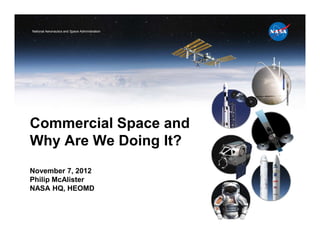
Commercial Space and
Why Are We Doing It?
November 7, 2012
Philip McAlister
NASA HQ, HEOMD
The Future State


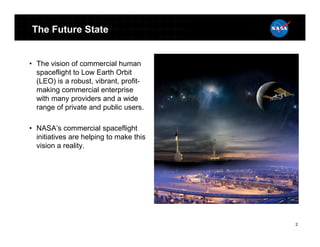
• The vision of commercial human
  spaceflight to Low Earth Orbit
  (LEO) is a robust, vibrant, profit-
  making commercial enterprise
  with many providers and a wide
  range of private and public users.

• NASA’s commercial spaceflight
  initiatives are helping to make this
  vision a reality.


                                         2
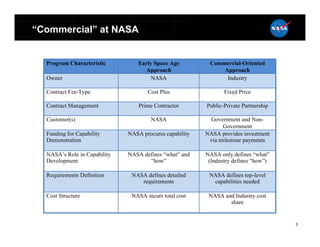
“Commercial” at NASA


  Program Characteristic          Early Space Age         Commercial-Oriented
                                    Approach                  Approach
  Owner                                NASA                    Industry

  Contract Fee-Type                  Cost Plus                  Fixed Price

  Contract Management             Prime Contractor       Public-Private Partnership

  Customer(s)                         NASA                Government and Non-
                                                               Government
  Funding for Capability      NASA procures capability   NASA provides investment
  Demonstration                                           via milestone payments

  NASA’s Role in Capability   NASA defines “what” and    NASA only defines “what”
  Development                        “how”                (Industry defines “how”)

  Requirements Definition      NASA defines detailed      NASA defines top-level
                                  requirements             capabilities needed

  Cost Structure               NASA incurs total cost     NASA and Industry cost
                                                                 share


                                                                                      3
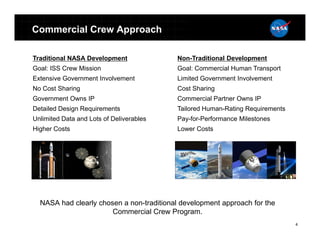
Commercial Crew Approach

Traditional NASA Development              Non-Traditional Development
Goal: ISS Crew Mission                    Goal: Commercial Human Transport
Extensive Government Involvement          Limited Government Involvement
No Cost Sharing                           Cost Sharing
Government Owns IP                        Commercial Partner Owns IP
Detailed Design Requirements              Tailored Human-Rating Requirements
Unlimited Data and Lots of Deliverables   Pay-for-Performance Milestones
Higher Costs                              Lower Costs


  NASA had clearly chosen a non-traditional development approach for the
                       Commercial Crew Program.
                                                                               4
Unique Approach to a Unique Situation

• Over the years, NASA has used a variety of a different approaches to
  overseeing and understanding the development of spacecraft. Each
  approach was tailored to meet the specific needs of the program.

• Within the context of CCP, the following key ingredients are present
  which enable the adoption of these key paradigm changes:
  – No technology breakthroughs were required – we are not pushing the
    technological state of the art by flying people to and from low Earth orbit
  – Very real prospect of other customers beyond NASA – spaceflight
    participants and sovereign clients are existing markets with substantial
    growth potential
  – Government foundational customer base – the International Space Station
    represents a long term, repeatable market
  – Strong industrial base – many U.S. companies have the capability to
    develop safe and reliable crew transportation systems.


                                                                                  5
Approach Summary

• The purpose of contrasting NASA’s traditional and non-traditional
  approaches does not mean one is better than the other.

• Each approach is appropriate for the type of program required.
    – For technically-ambitious, one-of-a-kind programs where NASA is the
      only customer and production is limited to only one (or a few) of the
      systems, then a traditional approach is more appropriate.
    – For more commercial-like programs that feature the key ingredients
      mentioned previously, the approach being followed by the CCP is more
      appropriate.

• The combination of a unique contracting mechanism and an innovative
  technical approach should enable the development of a safe, reliable,
  and cost effective crew transportation system for use by a wide range
  of public and private users.


                                                                              6
Commercial Cargo Status

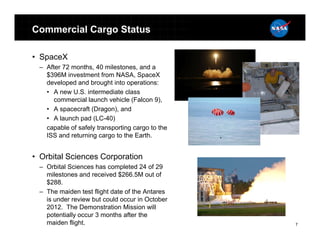
• SpaceX
 – After 72 months, 40 milestones, and a
   $396M investment from NASA, SpaceX
   developed and brought into operations:
   • A new U.S. intermediate class
      commercial launch vehicle (Falcon 9),
   • A spacecraft (Dragon), and
   • A launch pad (LC-40)
   capable of safely transporting cargo to the
   ISS and returning cargo to the Earth.


• Orbital Sciences Corporation
 – Orbital Sciences has completed 24 of 29
   milestones and received $266.5M out of
   $288.
 – The maiden test flight date of the Antares
   is under review but could occur in October
   2012. The Demonstration Mission will
   potentially occur 3 months after the
   maiden flight.                                7
Commercial Crew Program Roadmap

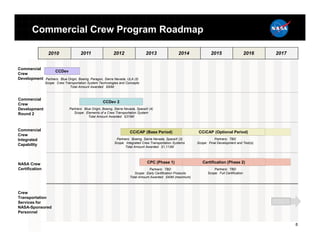
                  2010                2011                  2012                  2013               2014               2015                      2016   2017


Commercial
                  CCDev
Crew
Development Partners: Blue Origin, Boeing, Paragon, Sierra Nevada, ULA (5)
                Scope: Crew Transportation System Technologies and Concepts
                               Total Amount Awarded: $50M


Commercial
                                                     CCDev 2
Crew
Development                    Partners: Blue Origin, Boeing, Sierra Nevada, SpaceX (4)
Round 2                           Scope: Elements of a Crew Transportation System
                                            Total Amount Awarded: $315M


Commercial                                                             CCiCAP (Base Period)                      CCiCAP (Optional Period)
Crew
Integrated                                                    Partners: Boeing, Sierra Nevada, SpaceX (3)                  Partners: TBD
                                                             Scope: Integrated Crew Transportation Systems      Scope: Final Development and Test(s)
Capability                                                          Total Amount Awarded: $1,112M


NASA Crew                                                                          CPC (Phase 1)                   Certification (Phase 2)
Certification                                                                      Partners: TBD                          Partners: TBD
                                                                          Scope: Early Certification Products         Scope: Full Certification
                                                                       Total Amount Awarded: $40M (maximum)


Crew
Transportation
Services for
NASA-Sponsored
Personnel


                                                                                                                                                                8
Sierra Nevada Corporation

 • Descriptions & Features
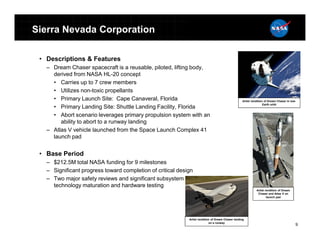
   – Dream Chaser spacecraft is a reusable, piloted, lifting body,
     derived from NASA HL-20 concept
     • Carries up to 7 crew members
     • Utilizes non-toxic propellants
     • Primary Launch Site: Cape Canaveral, Florida                                                Artist rendition of Dream Chaser in low-
                                                                                                                   Earth orbit
     • Primary Landing Site: Shuttle Landing Facility, Florida
     • Abort scenario leverages primary propulsion system with an
        ability to abort to a runway landing
   – Atlas V vehicle launched from the Space Launch Complex 41
     launch pad


 • Base Period
   – $212.5M total NASA funding for 9 milestones
   – Significant progress toward completion of critical design
   – Two major safety reviews and significant subsystem
     technology maturation and hardware testing
                                                                                                             Artist rendition of Dream
                                                                                                              Chaser and Atlas V on
                                                                                                                     launch pad


                                                            Artist rendition of Dream Chaser landing
                                                                           on a runway
                                                                                                                                          9
SpaceX

 • Descriptions & Features
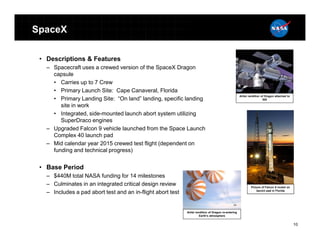
   – Spacecraft uses a crewed version of the SpaceX Dragon
     capsule
     • Carries up to 7 Crew
     • Primary Launch Site: Cape Canaveral, Florida
                                                                                                      Artist rendition of Dragon attached to
     • Primary Landing Site: “On land” landing, specific landing                                                        ISS

        site in work
     • Integrated, side-mounted launch abort system utilizing
        SuperDraco engines
   – Upgraded Falcon 9 vehicle launched from the Space Launch
     Complex 40 launch pad
   – Mid calendar year 2015 crewed test flight (dependent on
     funding and technical progress)


 • Base Period
   – $440M total NASA funding for 14 milestones
   – Culminates in an integrated critical design review                                                       Picture of Falcon 9 rocket on
                                                                                                                  launch pad in Florida
   – Includes a pad abort test and an in-flight abort test


                                                             Artist rendition of Dragon re-entering
                                                                       Earth’s atmosphere


                                                                                                                                               10
Boeing

 • Descriptions & Features
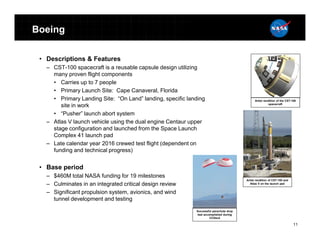
   – CST-100 spacecraft is a reusable capsule design utilizing
     many proven flight components
     • Carries up to 7 people
     • Primary Launch Site: Cape Canaveral, Florida
     • Primary Landing Site: “On Land” landing, specific landing                              Artist rendition of the CST-100
                                                                                                         spacecraft
        site in work
     • “Pusher” launch abort system
   – Atlas V launch vehicle using the dual engine Centaur upper
     stage configuration and launched from the Space Launch
     Complex 41 launch pad
   – Late calendar year 2016 crewed test flight (dependent on
     funding and technical progress)


 • Base period
   – $460M total NASA funding for 19 milestones
                                                                                        Artist rendition of CST-100 and
   – Culminates in an integrated critical design review                                    Atlas V on the launch pad


   – Significant propulsion system, avionics, and wind
     tunnel development and testing

                                                            Successful parachute drop
                                                             test accomplished during
                                                                      CCDev2

                                                                                                                           11
Accomplishments and Status

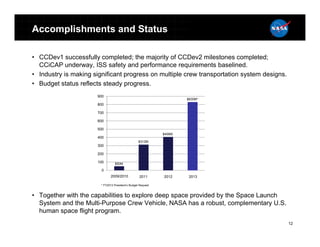
• CCDev1 successfully completed; the majority of CCDev2 milestones completed;
  CCiCAP underway, ISS safety and performance requirements baselined.
• Industry is making significant progress on multiple crew transportation system designs.
• Budget status reflects steady progress.
                      900
                                                                      $830M*
                      800

                      700

                      600

                      500
                                                              $406M
                      400
                                                   $312M
                      300

                      200

                      100         $50M

                        0
                              2009/2010             2011      2012     2013

                        * FY2013 President’s Budget Request


• Together with the capabilities to explore deep space provided by the Space Launch
  System and the Multi-Purpose Crew Vehicle, NASA has a robust, complementary U.S.
  human space flight program.
                                                                                            12

Nasa commercial space dec 2012

  • 1.
    National Aeronautics andSpace Administration Commercial Space and Why Are We Doing It? November 7, 2012 Philip McAlister NASA HQ, HEOMD
  • 2.
    The Future State •The vision of commercial human spaceflight to Low Earth Orbit (LEO) is a robust, vibrant, profit- making commercial enterprise with many providers and a wide range of private and public users. • NASA’s commercial spaceflight initiatives are helping to make this vision a reality. 2
  • 3.
    “Commercial” at NASA Program Characteristic Early Space Age Commercial-Oriented Approach Approach Owner NASA Industry Contract Fee-Type Cost Plus Fixed Price Contract Management Prime Contractor Public-Private Partnership Customer(s) NASA Government and Non- Government Funding for Capability NASA procures capability NASA provides investment Demonstration via milestone payments NASA’s Role in Capability NASA defines “what” and NASA only defines “what” Development “how” (Industry defines “how”) Requirements Definition NASA defines detailed NASA defines top-level requirements capabilities needed Cost Structure NASA incurs total cost NASA and Industry cost share 3
  • 4.
    Commercial Crew Approach TraditionalNASA Development Non-Traditional Development Goal: ISS Crew Mission Goal: Commercial Human Transport Extensive Government Involvement Limited Government Involvement No Cost Sharing Cost Sharing Government Owns IP Commercial Partner Owns IP Detailed Design Requirements Tailored Human-Rating Requirements Unlimited Data and Lots of Deliverables Pay-for-Performance Milestones Higher Costs Lower Costs NASA had clearly chosen a non-traditional development approach for the Commercial Crew Program. 4
  • 5.
    Unique Approach toa Unique Situation • Over the years, NASA has used a variety of a different approaches to overseeing and understanding the development of spacecraft. Each approach was tailored to meet the specific needs of the program. • Within the context of CCP, the following key ingredients are present which enable the adoption of these key paradigm changes: – No technology breakthroughs were required – we are not pushing the technological state of the art by flying people to and from low Earth orbit – Very real prospect of other customers beyond NASA – spaceflight participants and sovereign clients are existing markets with substantial growth potential – Government foundational customer base – the International Space Station represents a long term, repeatable market – Strong industrial base – many U.S. companies have the capability to develop safe and reliable crew transportation systems. 5
  • 6.
    Approach Summary • Thepurpose of contrasting NASA’s traditional and non-traditional approaches does not mean one is better than the other. • Each approach is appropriate for the type of program required. – For technically-ambitious, one-of-a-kind programs where NASA is the only customer and production is limited to only one (or a few) of the systems, then a traditional approach is more appropriate. – For more commercial-like programs that feature the key ingredients mentioned previously, the approach being followed by the CCP is more appropriate. • The combination of a unique contracting mechanism and an innovative technical approach should enable the development of a safe, reliable, and cost effective crew transportation system for use by a wide range of public and private users. 6
  • 7.
    Commercial Cargo Status •SpaceX – After 72 months, 40 milestones, and a $396M investment from NASA, SpaceX developed and brought into operations: • A new U.S. intermediate class commercial launch vehicle (Falcon 9), • A spacecraft (Dragon), and • A launch pad (LC-40) capable of safely transporting cargo to the ISS and returning cargo to the Earth. • Orbital Sciences Corporation – Orbital Sciences has completed 24 of 29 milestones and received $266.5M out of $288. – The maiden test flight date of the Antares is under review but could occur in October 2012. The Demonstration Mission will potentially occur 3 months after the maiden flight. 7
  • 8.
    Commercial Crew ProgramRoadmap 2010 2011 2012 2013 2014 2015 2016 2017 Commercial CCDev Crew Development Partners: Blue Origin, Boeing, Paragon, Sierra Nevada, ULA (5) Scope: Crew Transportation System Technologies and Concepts Total Amount Awarded: $50M Commercial CCDev 2 Crew Development Partners: Blue Origin, Boeing, Sierra Nevada, SpaceX (4) Round 2 Scope: Elements of a Crew Transportation System Total Amount Awarded: $315M Commercial CCiCAP (Base Period) CCiCAP (Optional Period) Crew Integrated Partners: Boeing, Sierra Nevada, SpaceX (3) Partners: TBD Scope: Integrated Crew Transportation Systems Scope: Final Development and Test(s) Capability Total Amount Awarded: $1,112M NASA Crew CPC (Phase 1) Certification (Phase 2) Certification Partners: TBD Partners: TBD Scope: Early Certification Products Scope: Full Certification Total Amount Awarded: $40M (maximum) Crew Transportation Services for NASA-Sponsored Personnel 8
  • 9.
    Sierra Nevada Corporation • Descriptions & Features – Dream Chaser spacecraft is a reusable, piloted, lifting body, derived from NASA HL-20 concept • Carries up to 7 crew members • Utilizes non-toxic propellants • Primary Launch Site: Cape Canaveral, Florida Artist rendition of Dream Chaser in low- Earth orbit • Primary Landing Site: Shuttle Landing Facility, Florida • Abort scenario leverages primary propulsion system with an ability to abort to a runway landing – Atlas V vehicle launched from the Space Launch Complex 41 launch pad • Base Period – $212.5M total NASA funding for 9 milestones – Significant progress toward completion of critical design – Two major safety reviews and significant subsystem technology maturation and hardware testing Artist rendition of Dream Chaser and Atlas V on launch pad Artist rendition of Dream Chaser landing on a runway 9
  • 10.
    SpaceX • Descriptions& Features – Spacecraft uses a crewed version of the SpaceX Dragon capsule • Carries up to 7 Crew • Primary Launch Site: Cape Canaveral, Florida Artist rendition of Dragon attached to • Primary Landing Site: “On land” landing, specific landing ISS site in work • Integrated, side-mounted launch abort system utilizing SuperDraco engines – Upgraded Falcon 9 vehicle launched from the Space Launch Complex 40 launch pad – Mid calendar year 2015 crewed test flight (dependent on funding and technical progress) • Base Period – $440M total NASA funding for 14 milestones – Culminates in an integrated critical design review Picture of Falcon 9 rocket on launch pad in Florida – Includes a pad abort test and an in-flight abort test Artist rendition of Dragon re-entering Earth’s atmosphere 10
  • 11.
    Boeing • Descriptions& Features – CST-100 spacecraft is a reusable capsule design utilizing many proven flight components • Carries up to 7 people • Primary Launch Site: Cape Canaveral, Florida • Primary Landing Site: “On Land” landing, specific landing Artist rendition of the CST-100 spacecraft site in work • “Pusher” launch abort system – Atlas V launch vehicle using the dual engine Centaur upper stage configuration and launched from the Space Launch Complex 41 launch pad – Late calendar year 2016 crewed test flight (dependent on funding and technical progress) • Base period – $460M total NASA funding for 19 milestones Artist rendition of CST-100 and – Culminates in an integrated critical design review Atlas V on the launch pad – Significant propulsion system, avionics, and wind tunnel development and testing Successful parachute drop test accomplished during CCDev2 11
  • 12.
    Accomplishments and Status •CCDev1 successfully completed; the majority of CCDev2 milestones completed; CCiCAP underway, ISS safety and performance requirements baselined. • Industry is making significant progress on multiple crew transportation system designs. • Budget status reflects steady progress. 900 $830M* 800 700 600 500 $406M 400 $312M 300 200 100 $50M 0 2009/2010 2011 2012 2013 * FY2013 President’s Budget Request • Together with the capabilities to explore deep space provided by the Space Launch System and the Multi-Purpose Crew Vehicle, NASA has a robust, complementary U.S. human space flight program. 12