


Magento EAV System
The EAV system is one of the most complex part of Magento system.
TRUONG DINH KHOA
Email: mrkhoa99@gmail.com
Do you know?
 MySQL has a hard limit of 4096 columns per table.
 Oracle has even less: 1000.
 Microsoft SQL Server offers up to 30,000 columns.
Traditional model
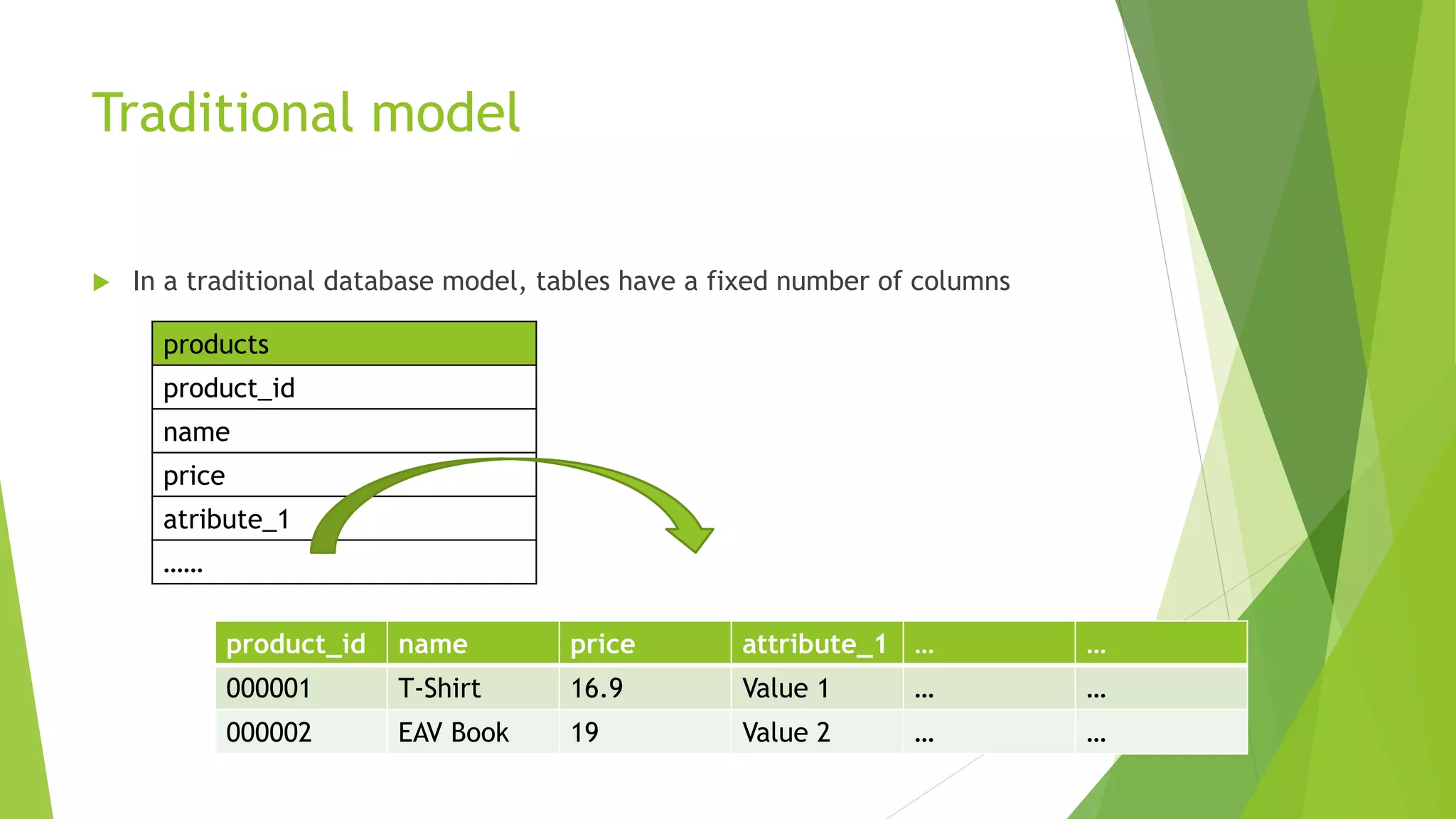
 In a traditional database model, tables have a fixed number of columns
products
product_id
name
price
atribute_1
……
product_id name price attribute_1 … …
000001 T-Shirt 16.9 Value 1 … …
000002 EAV Book 19 Value 2 … …
EAV Model
 However, if entities have a huge of possible attributes? What happens? E.g. a
product has a lot of attribute: price, name, color, image, tax, manufacturer , attribute_1…
attribute_n, etc..
EAV Model
 The problem can be addressed by EAV (row modelling).
 Traditional model : adding more attributes => more columns.
 EAV model: adding more attributes => more rows.
 EAV stands for entity, attribute and value.
 Many cloud computing platforms (Amazon, Google, Microsoft, etc.) offer EAV
Model as featuring data stores.
EAV Model
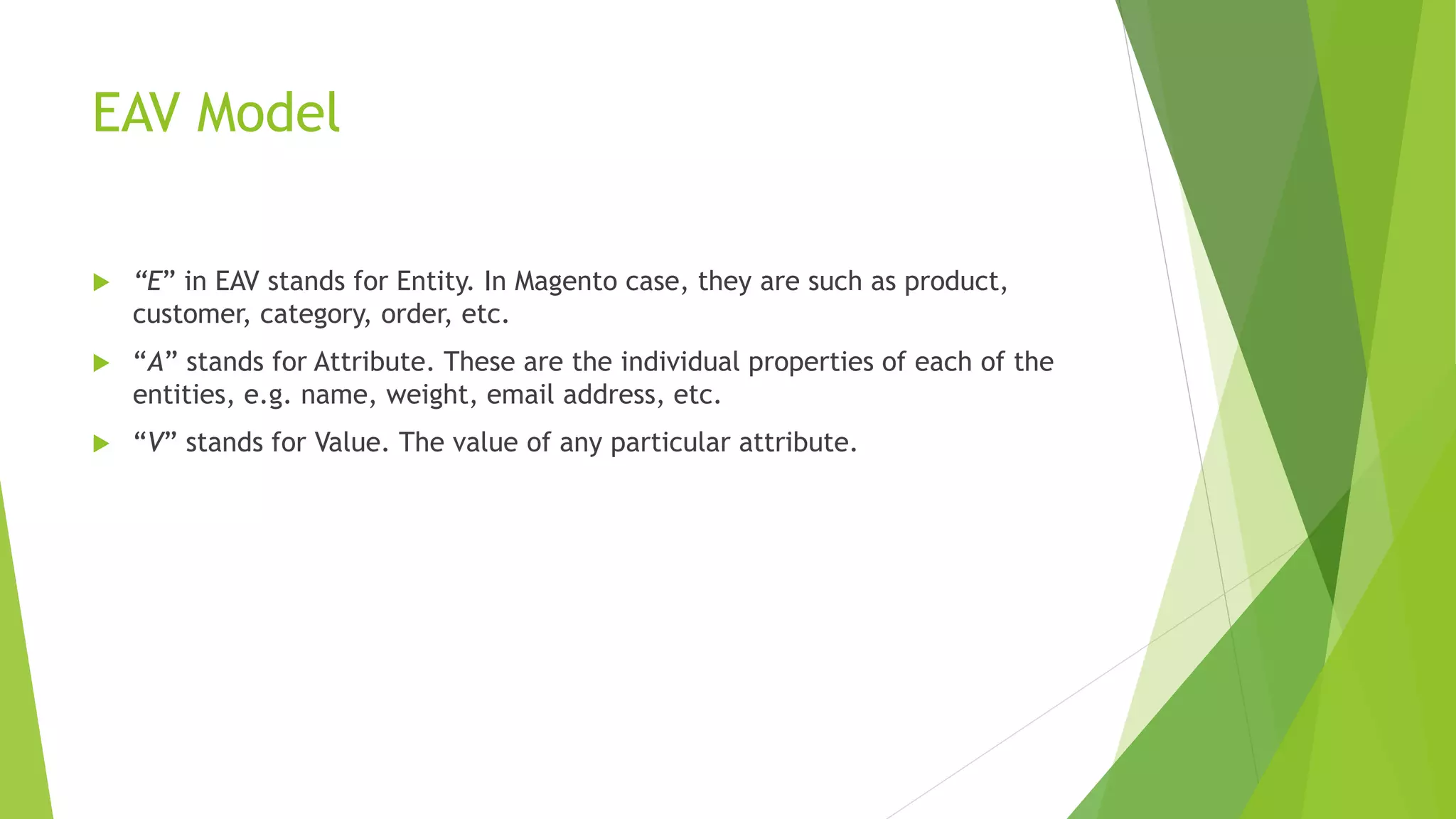
 “E” in EAV stands for Entity. In Magento case, they are such as product,
customer, category, order, etc.
 “A” stands for Attribute. These are the individual properties of each of the
entities, e.g. name, weight, email address, etc.
 “V” stands for Value. The value of any particular attribute.
EAV Model
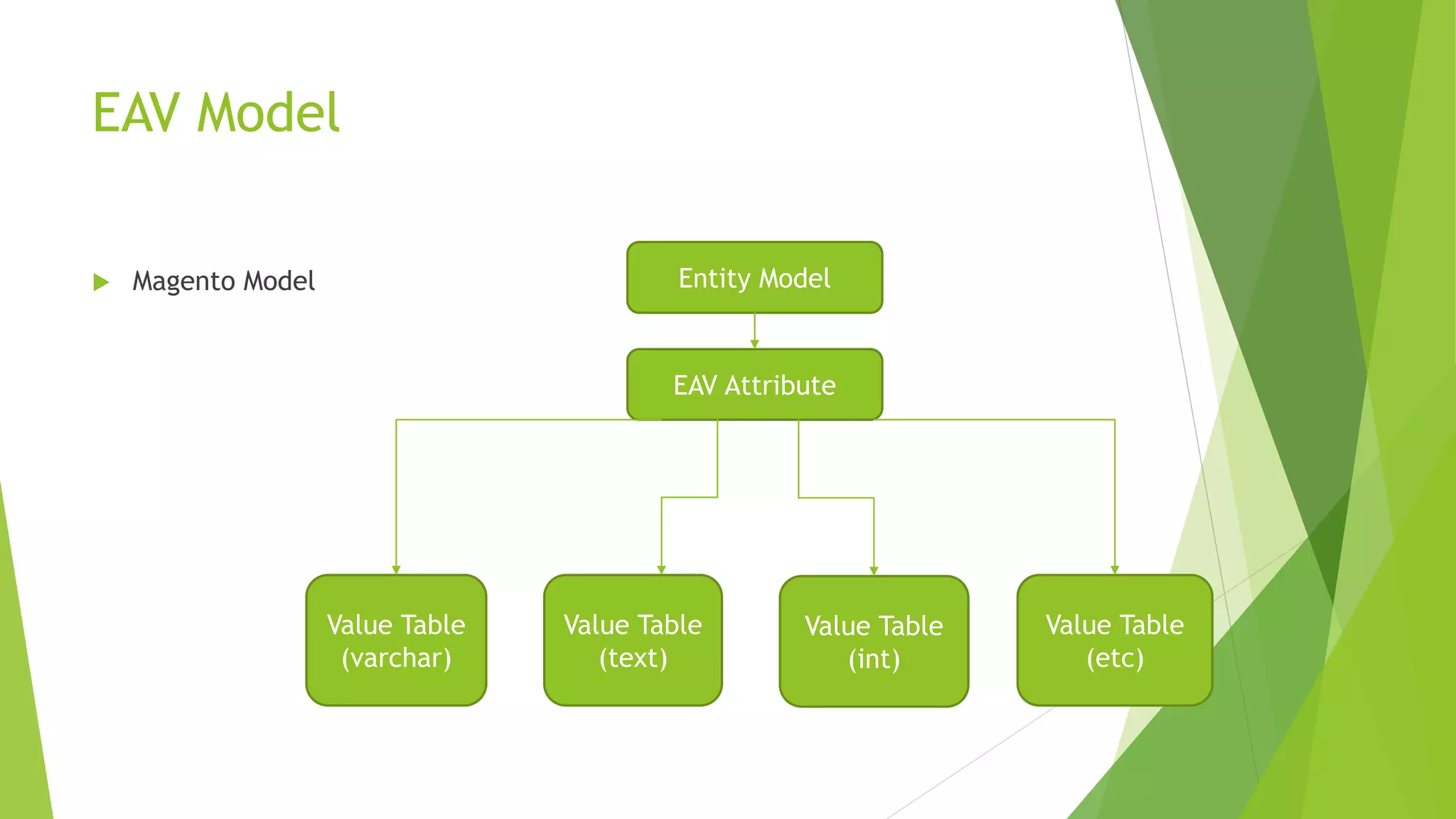
 Magento Model Entity Model
EAV Attribute
Value Table
(varchar)
Value Table
(text)
Value Table
(int)
Value Table
(etc)
EAV Model
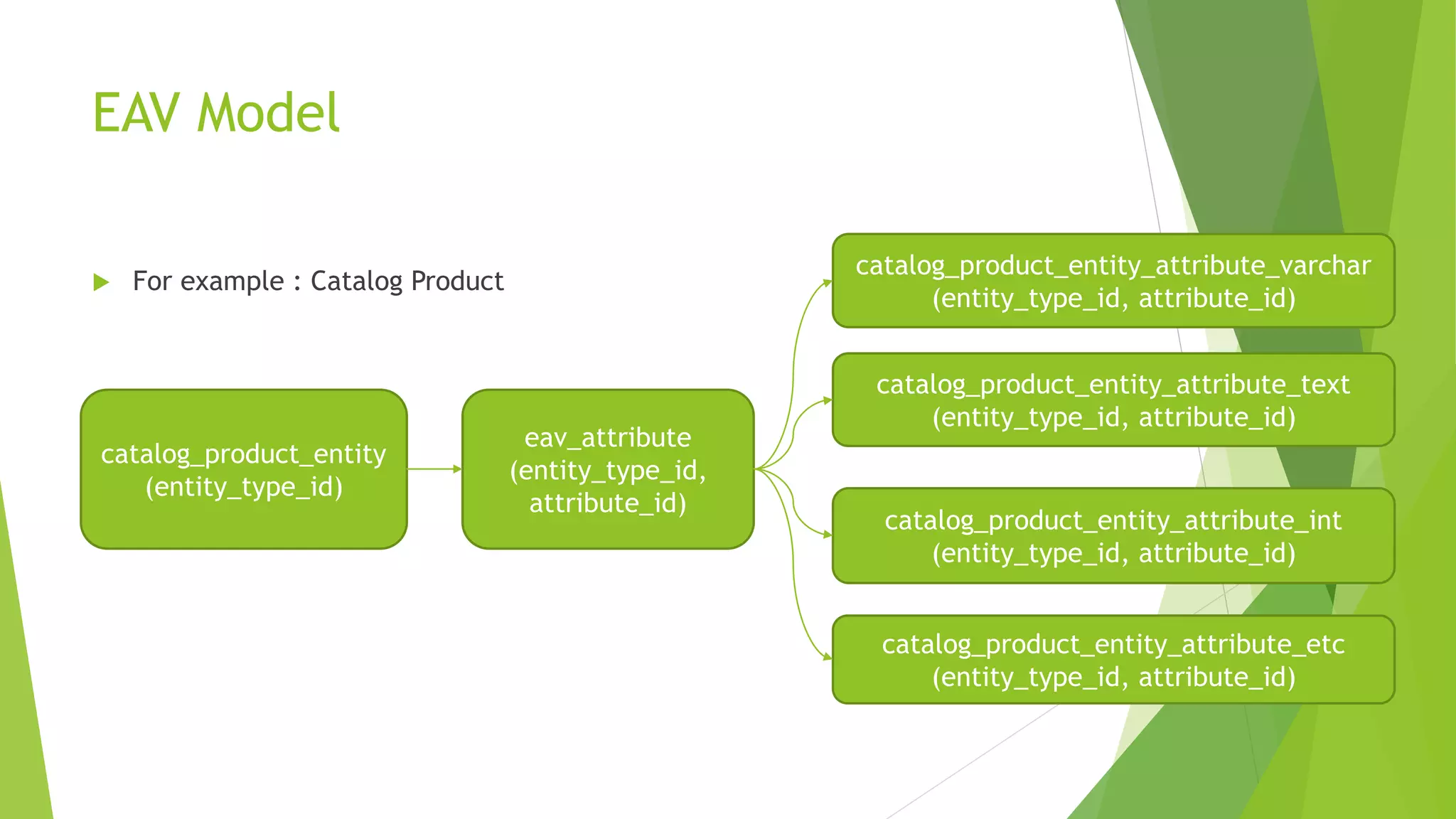
 For example : Catalog Product
catalog_product_entity
(entity_type_id)
eav_attribute
(entity_type_id,
attribute_id)
catalog_product_entity_attribute_varchar
(entity_type_id, attribute_id)
catalog_product_entity_attribute_text
(entity_type_id, attribute_id)
catalog_product_entity_attribute_int
(entity_type_id, attribute_id)
catalog_product_entity_attribute_etc
(entity_type_id, attribute_id)
Creating simple raw sql
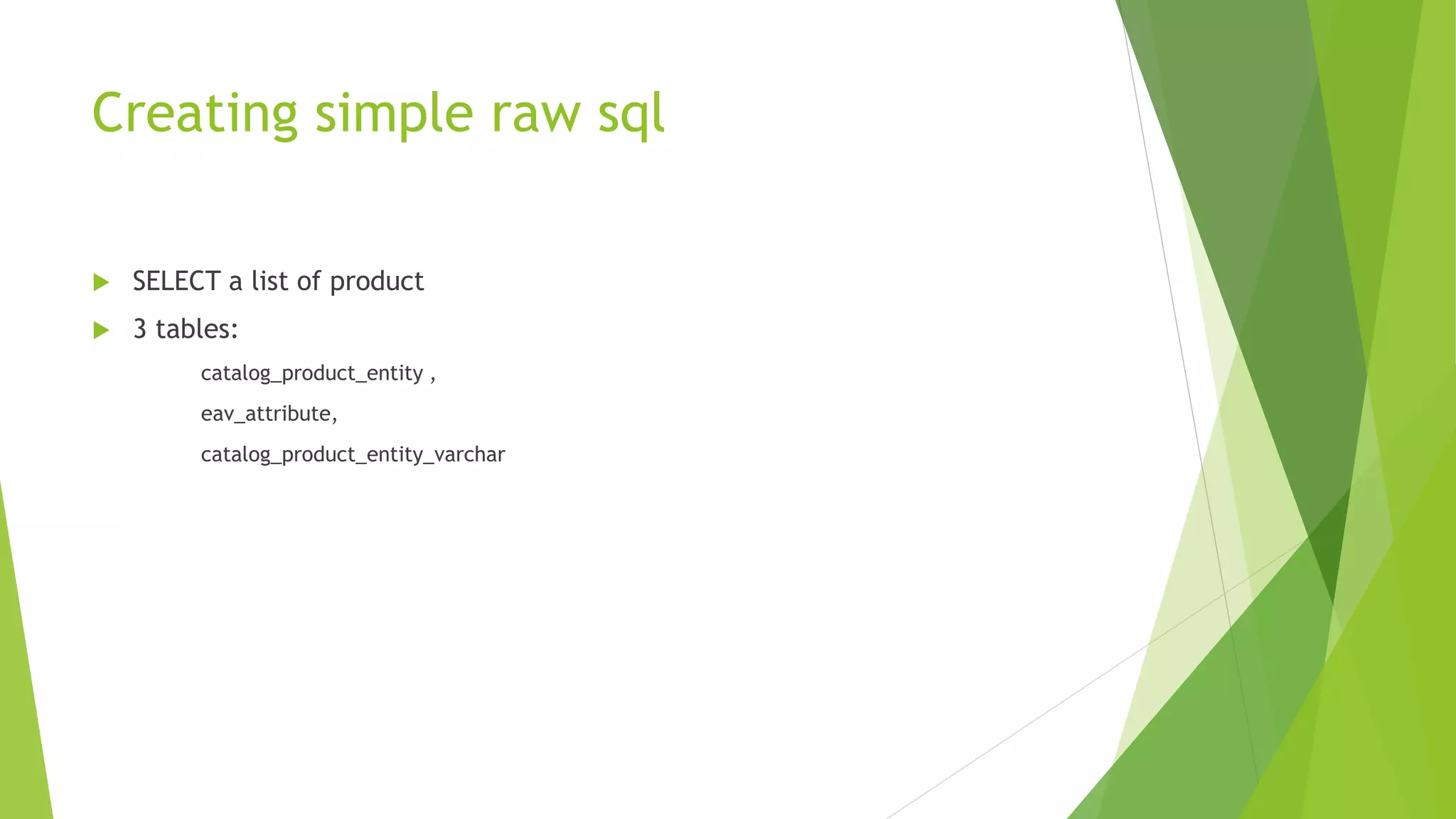
 SELECT a list of product
 3 tables:
catalog_product_entity ,
eav_attribute,
catalog_product_entity_varchar
Creating simple raw sql
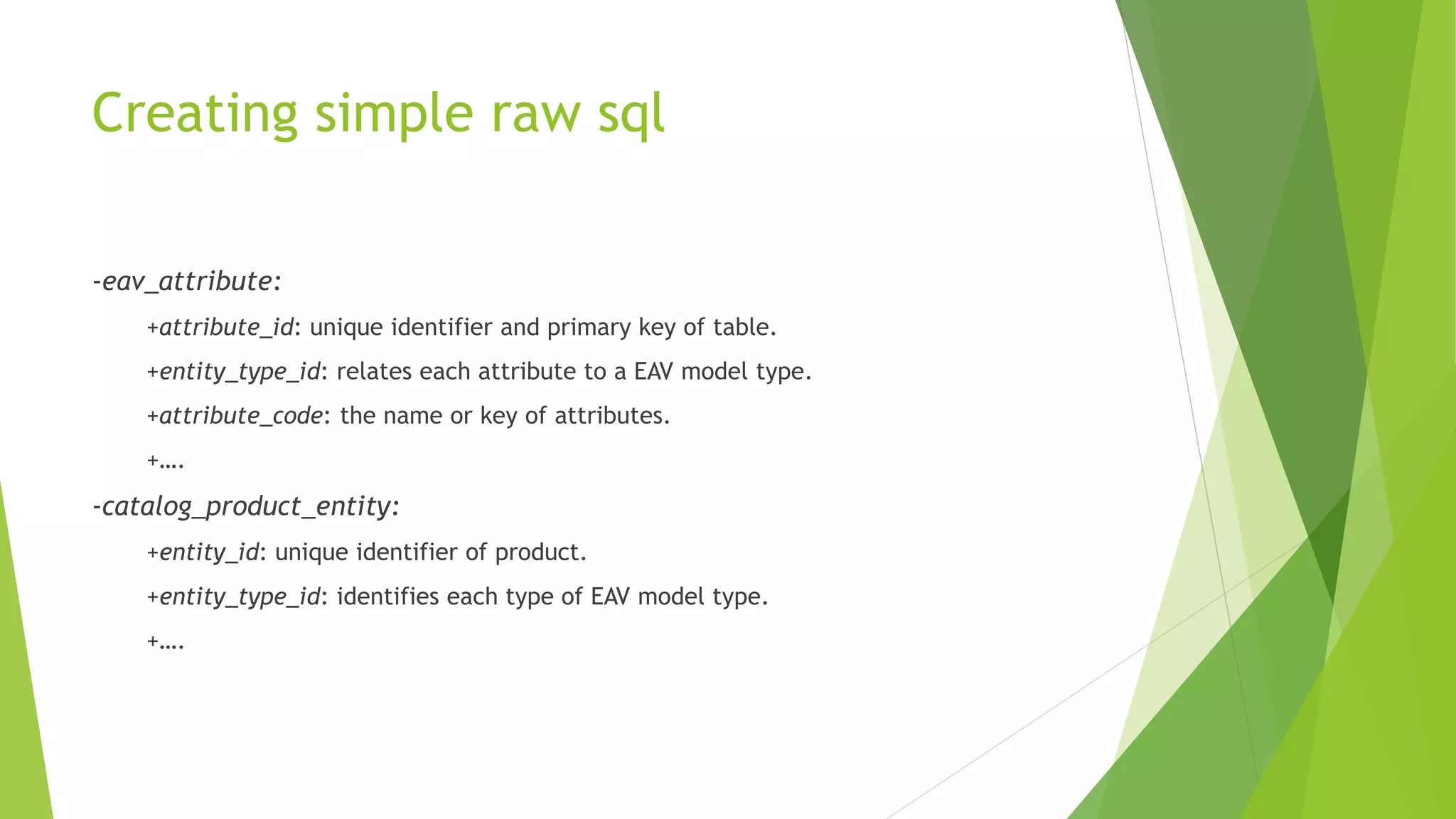
-eav_attribute:
+attribute_id: unique identifier and primary key of table.
+entity_type_id: relates each attribute to a EAV model type.
+attribute_code: the name or key of attributes.
+….
-catalog_product_entity:
+entity_id: unique identifier of product.
+entity_type_id: identifies each type of EAV model type.
+….
Creating simple raw sql
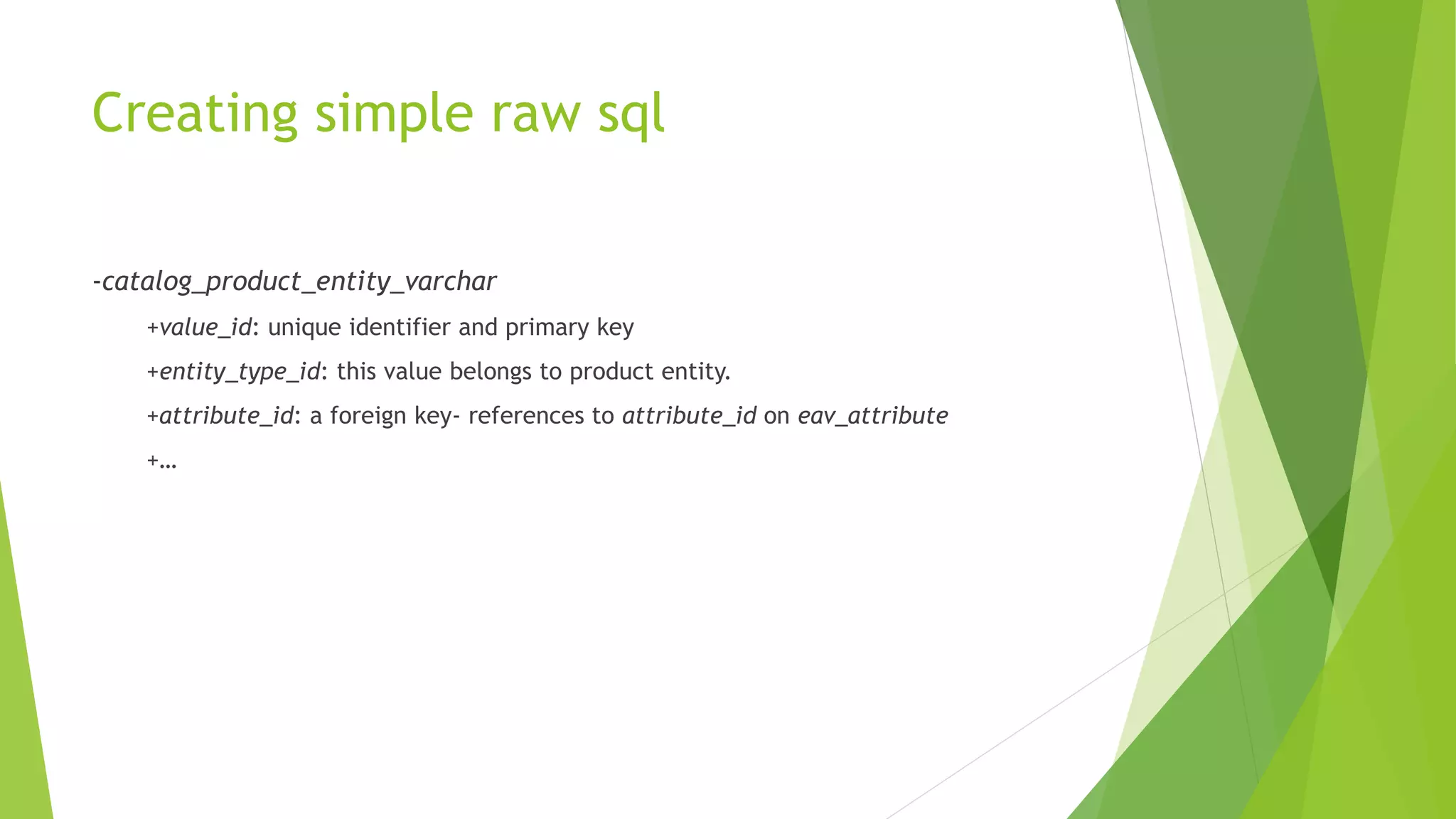
-catalog_product_entity_varchar
+value_id: unique identifier and primary key
+entity_type_id: this value belongs to product entity.
+attribute_id: a foreign key- references to attribute_id on eav_attribute
+…
Creating simple raw sql
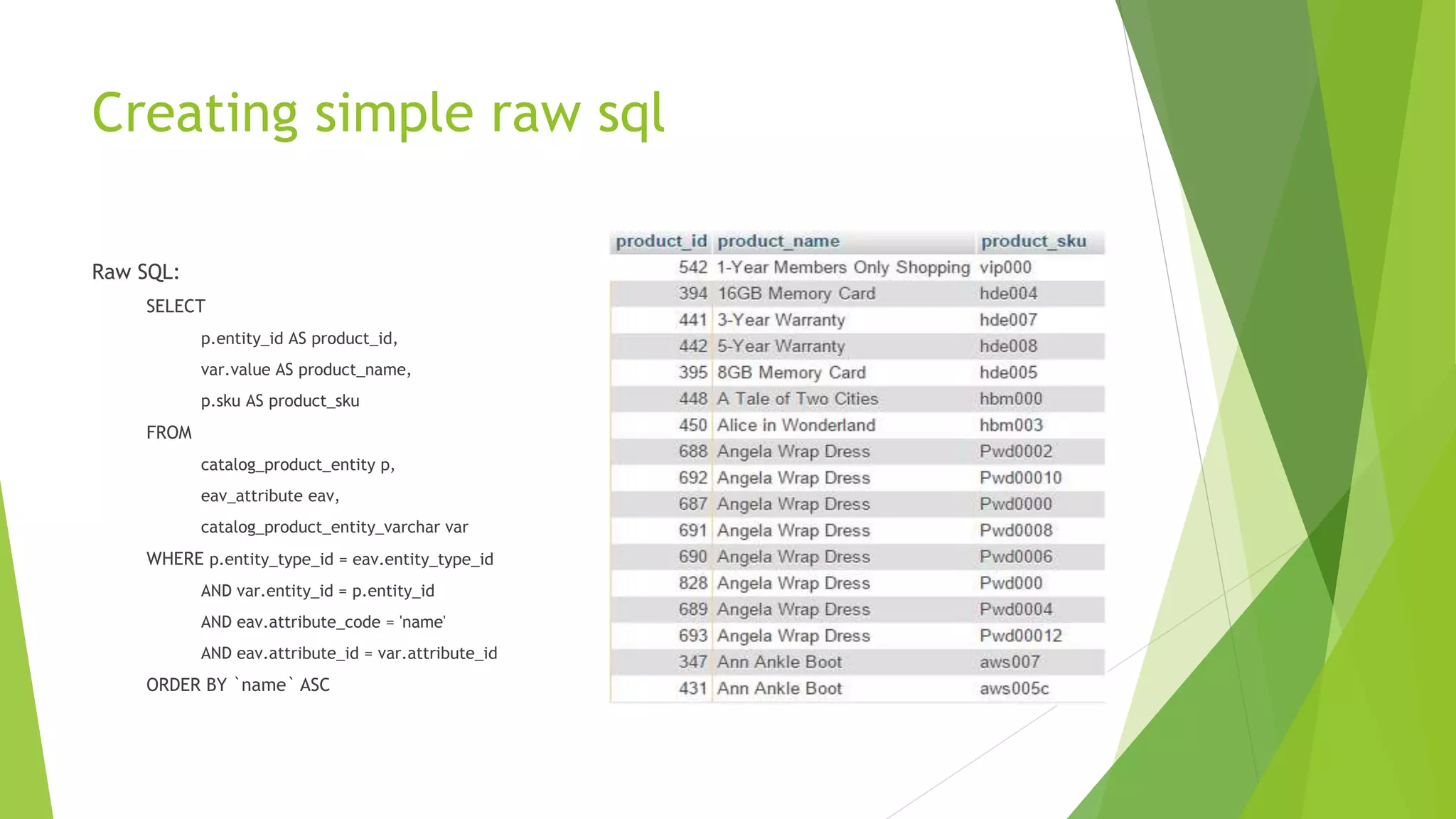
Raw SQL:
SELECT
p.entity_id AS product_id,
var.value AS product_name,
p.sku AS product_sku
FROM
catalog_product_entity p,
eav_attribute eav,
catalog_product_entity_varchar var
WHERE p.entity_type_id = eav.entity_type_id
AND var.entity_id = p.entity_id
AND eav.attribute_code = 'name'
AND eav.attribute_id = var.attribute_id
ORDER BY `name` ASC
What’s next?
 Creating a raw sql shows a small piece. It is easy to understand for new
Magento developers. But for customizing and maintaining purpose, what
programming technique is used?
 In a big picture, we need to do more for our software => Magento used Object
Relational Mapping (ORM) system.
Magneto ORM System
 Object-relational mapping (ORM, O/RM, and O/R mapping) in computer
software is a programming technique for converting data between
incompatible type systems in object-oriented programming languages. This
creates, in effect, a "virtual object database" that can be used from within
the programming language.
https://en.wikipedia.org/wiki/Object-relational_mapping
Magento ORM System
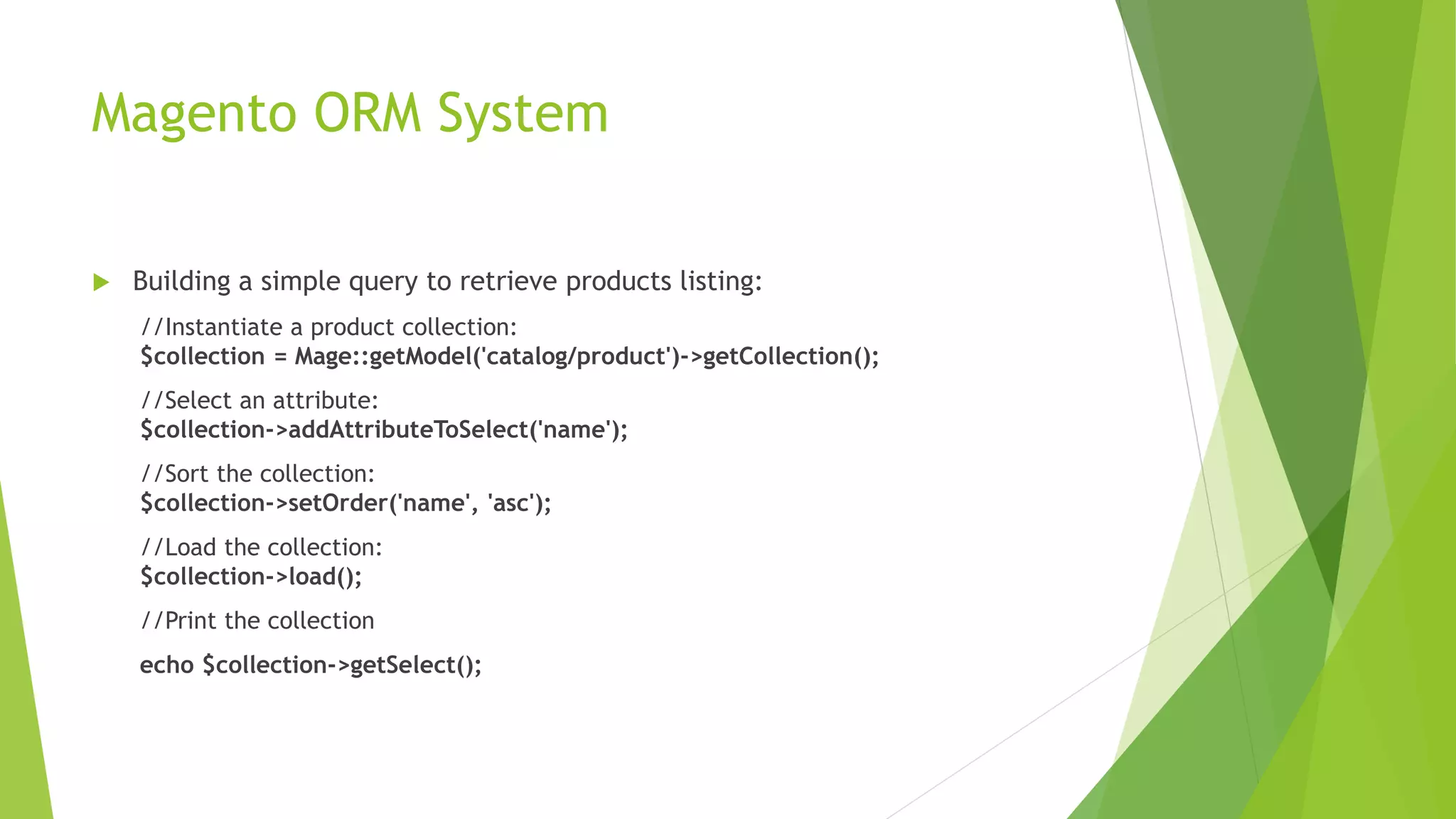
 Building a simple query to retrieve products listing:
//Instantiate a product collection:
$collection = Mage::getModel('catalog/product')->getCollection();
//Select an attribute:
$collection->addAttributeToSelect('name');
//Sort the collection:
$collection->setOrder('name', 'asc');
//Load the collection:
$collection->load();
//Print the collection
echo $collection->getSelect();
Magento ORM System
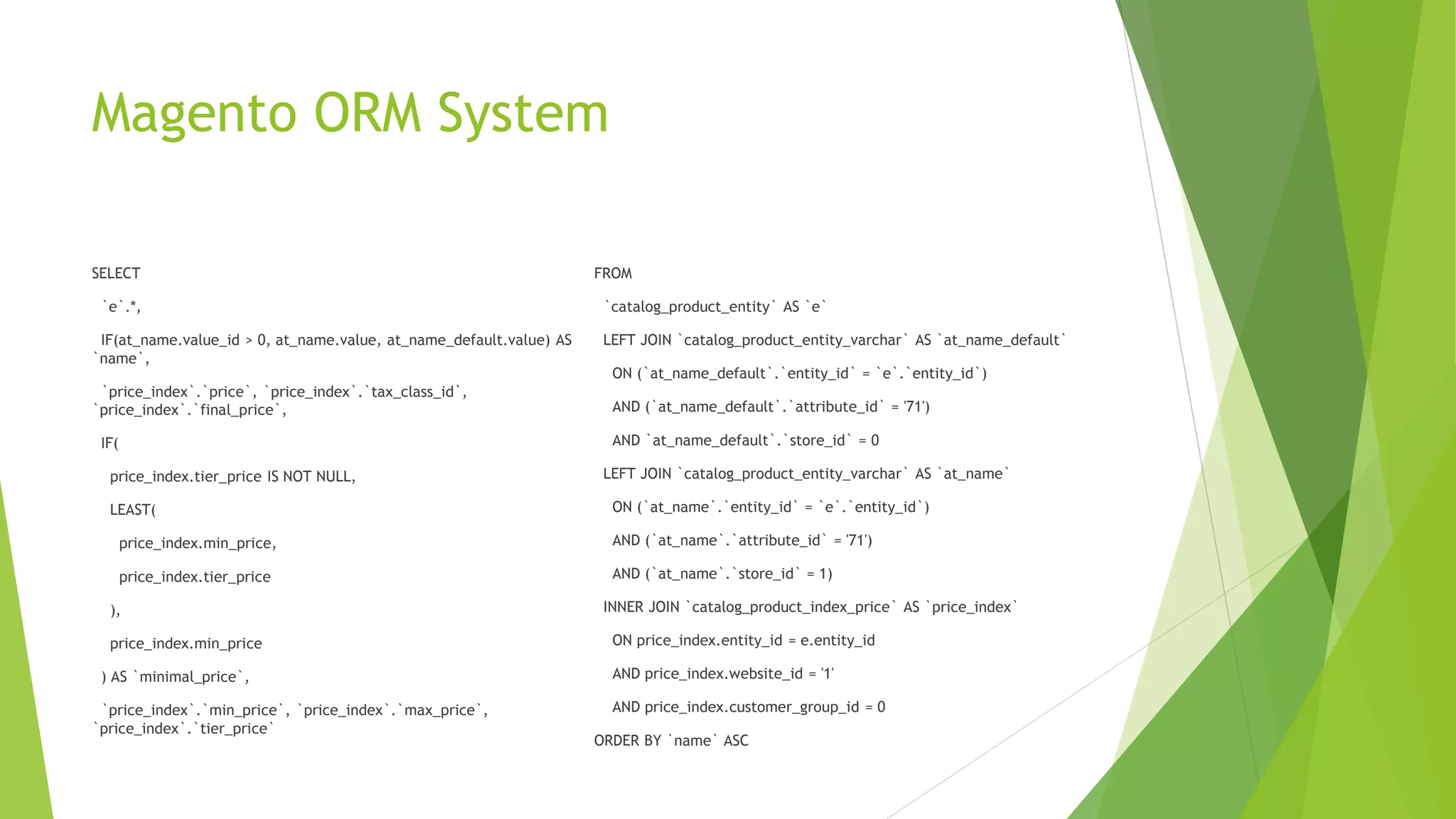
SELECT
`e`.*,
IF(at_name.value_id > 0, at_name.value, at_name_default.value) AS
`name`,
`price_index`.`price`, `price_index`.`tax_class_id`,
`price_index`.`final_price`,
IF(
price_index.tier_price IS NOT NULL,
LEAST(
price_index.min_price,
price_index.tier_price
),
price_index.min_price
) AS `minimal_price`,
`price_index`.`min_price`, `price_index`.`max_price`,
`price_index`.`tier_price`
FROM
`catalog_product_entity` AS `e`
LEFT JOIN `catalog_product_entity_varchar` AS `at_name_default`
ON (`at_name_default`.`entity_id` = `e`.`entity_id`)
AND (`at_name_default`.`attribute_id` = '71')
AND `at_name_default`.`store_id` = 0
LEFT JOIN `catalog_product_entity_varchar` AS `at_name`
ON (`at_name`.`entity_id` = `e`.`entity_id`)
AND (`at_name`.`attribute_id` = '71')
AND (`at_name`.`store_id` = 1)
INNER JOIN `catalog_product_index_price` AS `price_index`
ON price_index.entity_id = e.entity_id
AND price_index.website_id = '1'
AND price_index.customer_group_id = 0
ORDER BY `name` ASC
Magento ORM System
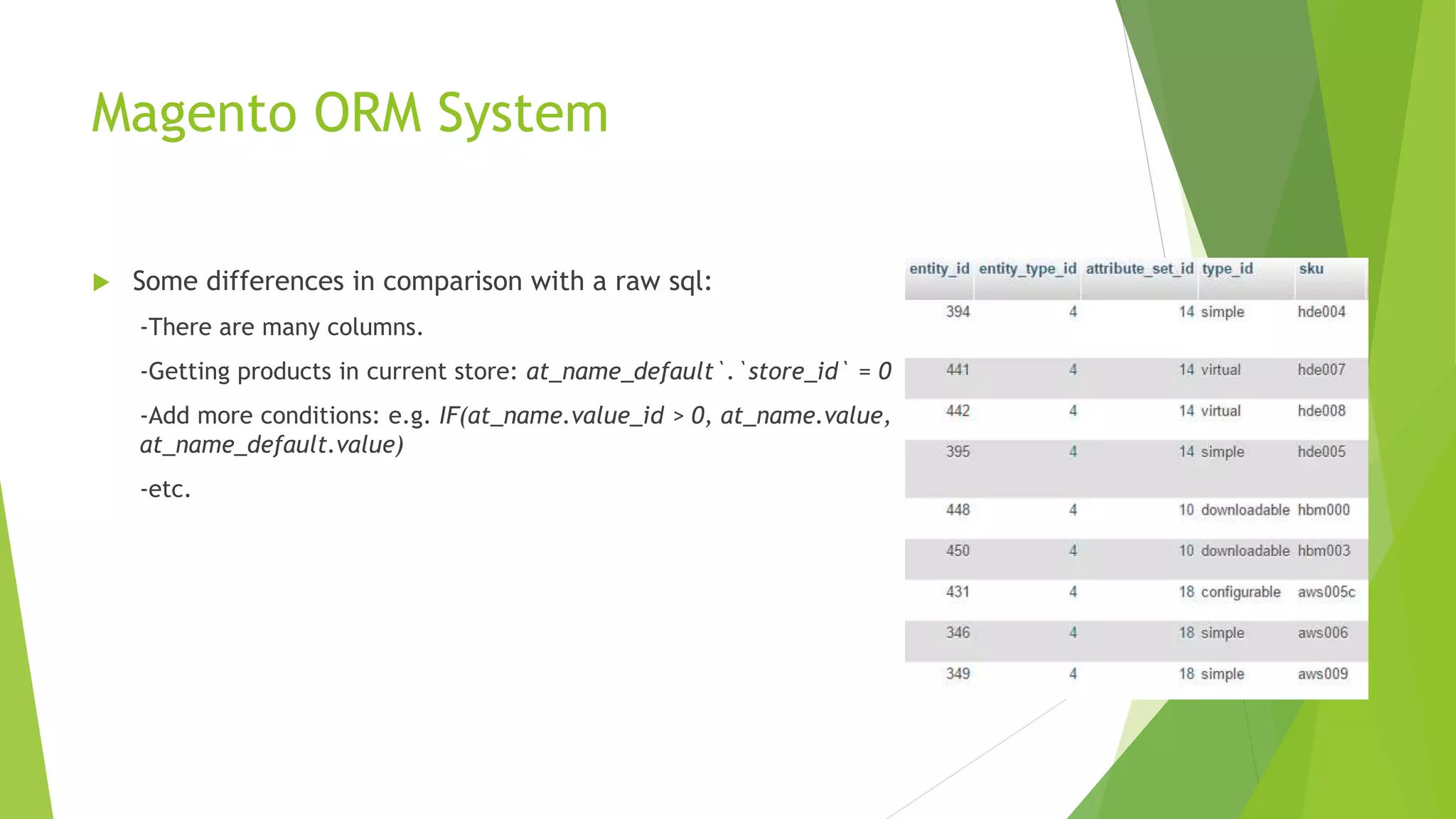
 Some differences in comparison with a raw sql:
-There are many columns.
-Getting products in current store: at_name_default`.`store_id` = 0
-Add more conditions: e.g. IF(at_name.value_id > 0, at_name.value,
at_name_default.value)
-etc.
Magento ORM System
The most useful collection methods
 addAttributeToSelect: adding an attribute to entities in a collection
 addAttributeToFilter: using to filter a collection of
EAV entities with the specified conditional parameters.
 addFieldToFilter: using also to filter a collection, but for non-EAV models, this
function is used regularly.
 addAttributeToSort: adding an attribute to sort order
 etc.
EAV-Advantages
 Flexibility.
 Don’t need to change database schema when adding new attributes.
 Quick to implement.
EAV-Disadvantages
 Performance problem: a lot of tables are required when making a query with
EAV Model.
 Find more…
Thanks you!
Khoa Truong Dinh
mrkhoa99@gmail.com
 http://www.boolfly.com/
 https://github.com/mrkhoa99
 https://vn.linkedin.com/in/truongdinhkhoa
 http://stackoverflow.com/users/5179786/khoa-truongdinh

EAV Sytem- Magento EAV Model

  • 1.
    Magento EAV System TheEAV system is one of the most complex part of Magento system. TRUONG DINH KHOA Email: mrkhoa99@gmail.com
  • 2.
    Do you know? MySQL has a hard limit of 4096 columns per table.  Oracle has even less: 1000.  Microsoft SQL Server offers up to 30,000 columns.
  • 3.
    Traditional model  Ina traditional database model, tables have a fixed number of columns products product_id name price atribute_1 …… product_id name price attribute_1 … … 000001 T-Shirt 16.9 Value 1 … … 000002 EAV Book 19 Value 2 … …
  • 4.
    EAV Model  However,if entities have a huge of possible attributes? What happens? E.g. a product has a lot of attribute: price, name, color, image, tax, manufacturer , attribute_1… attribute_n, etc..
  • 5.
    EAV Model  Theproblem can be addressed by EAV (row modelling).  Traditional model : adding more attributes => more columns.  EAV model: adding more attributes => more rows.  EAV stands for entity, attribute and value.  Many cloud computing platforms (Amazon, Google, Microsoft, etc.) offer EAV Model as featuring data stores.
  • 6.
    EAV Model  “E”in EAV stands for Entity. In Magento case, they are such as product, customer, category, order, etc.  “A” stands for Attribute. These are the individual properties of each of the entities, e.g. name, weight, email address, etc.  “V” stands for Value. The value of any particular attribute.
  • 7.
    EAV Model  MagentoModel Entity Model EAV Attribute Value Table (varchar) Value Table (text) Value Table (int) Value Table (etc)
  • 8.
    EAV Model  Forexample : Catalog Product catalog_product_entity (entity_type_id) eav_attribute (entity_type_id, attribute_id) catalog_product_entity_attribute_varchar (entity_type_id, attribute_id) catalog_product_entity_attribute_text (entity_type_id, attribute_id) catalog_product_entity_attribute_int (entity_type_id, attribute_id) catalog_product_entity_attribute_etc (entity_type_id, attribute_id)
  • 9.
    Creating simple rawsql  SELECT a list of product  3 tables: catalog_product_entity , eav_attribute, catalog_product_entity_varchar
  • 10.
    Creating simple rawsql -eav_attribute: +attribute_id: unique identifier and primary key of table. +entity_type_id: relates each attribute to a EAV model type. +attribute_code: the name or key of attributes. +…. -catalog_product_entity: +entity_id: unique identifier of product. +entity_type_id: identifies each type of EAV model type. +….
  • 11.
    Creating simple rawsql -catalog_product_entity_varchar +value_id: unique identifier and primary key +entity_type_id: this value belongs to product entity. +attribute_id: a foreign key- references to attribute_id on eav_attribute +…
  • 12.
    Creating simple rawsql Raw SQL: SELECT p.entity_id AS product_id, var.value AS product_name, p.sku AS product_sku FROM catalog_product_entity p, eav_attribute eav, catalog_product_entity_varchar var WHERE p.entity_type_id = eav.entity_type_id AND var.entity_id = p.entity_id AND eav.attribute_code = 'name' AND eav.attribute_id = var.attribute_id ORDER BY `name` ASC
  • 13.
    What’s next?  Creatinga raw sql shows a small piece. It is easy to understand for new Magento developers. But for customizing and maintaining purpose, what programming technique is used?  In a big picture, we need to do more for our software => Magento used Object Relational Mapping (ORM) system.
  • 14.
    Magneto ORM System Object-relational mapping (ORM, O/RM, and O/R mapping) in computer software is a programming technique for converting data between incompatible type systems in object-oriented programming languages. This creates, in effect, a "virtual object database" that can be used from within the programming language. https://en.wikipedia.org/wiki/Object-relational_mapping
  • 15.
    Magento ORM System Building a simple query to retrieve products listing: //Instantiate a product collection: $collection = Mage::getModel('catalog/product')->getCollection(); //Select an attribute: $collection->addAttributeToSelect('name'); //Sort the collection: $collection->setOrder('name', 'asc'); //Load the collection: $collection->load(); //Print the collection echo $collection->getSelect();
  • 16.
    Magento ORM System SELECT `e`.*, IF(at_name.value_id> 0, at_name.value, at_name_default.value) AS `name`, `price_index`.`price`, `price_index`.`tax_class_id`, `price_index`.`final_price`, IF( price_index.tier_price IS NOT NULL, LEAST( price_index.min_price, price_index.tier_price ), price_index.min_price ) AS `minimal_price`, `price_index`.`min_price`, `price_index`.`max_price`, `price_index`.`tier_price` FROM `catalog_product_entity` AS `e` LEFT JOIN `catalog_product_entity_varchar` AS `at_name_default` ON (`at_name_default`.`entity_id` = `e`.`entity_id`) AND (`at_name_default`.`attribute_id` = '71') AND `at_name_default`.`store_id` = 0 LEFT JOIN `catalog_product_entity_varchar` AS `at_name` ON (`at_name`.`entity_id` = `e`.`entity_id`) AND (`at_name`.`attribute_id` = '71') AND (`at_name`.`store_id` = 1) INNER JOIN `catalog_product_index_price` AS `price_index` ON price_index.entity_id = e.entity_id AND price_index.website_id = '1' AND price_index.customer_group_id = 0 ORDER BY `name` ASC
  • 17.
    Magento ORM System Some differences in comparison with a raw sql: -There are many columns. -Getting products in current store: at_name_default`.`store_id` = 0 -Add more conditions: e.g. IF(at_name.value_id > 0, at_name.value, at_name_default.value) -etc.
  • 18.
    Magento ORM System Themost useful collection methods  addAttributeToSelect: adding an attribute to entities in a collection  addAttributeToFilter: using to filter a collection of EAV entities with the specified conditional parameters.  addFieldToFilter: using also to filter a collection, but for non-EAV models, this function is used regularly.  addAttributeToSort: adding an attribute to sort order  etc.
  • 19.
    EAV-Advantages  Flexibility.  Don’tneed to change database schema when adding new attributes.  Quick to implement.
  • 20.
    EAV-Disadvantages  Performance problem:a lot of tables are required when making a query with EAV Model.  Find more…
  • 21.
  • 22.
    Khoa Truong Dinh mrkhoa99@gmail.com http://www.boolfly.com/  https://github.com/mrkhoa99  https://vn.linkedin.com/in/truongdinhkhoa  http://stackoverflow.com/users/5179786/khoa-truongdinh