Entity - Attribute - Value
 (EAV) Data Model in
        Magento
      @Pờ Đình Tâm
What is EAV
   EAV can be thought of as “vertical”
    modeling instead of “horizontal”
    modeling of columns in a database
    table.
   Instead of a table consisting of a
    number of columns, denoting
    attributes of a conceptual piece of
    data, the attributes are stored in one
    column of a separate table.
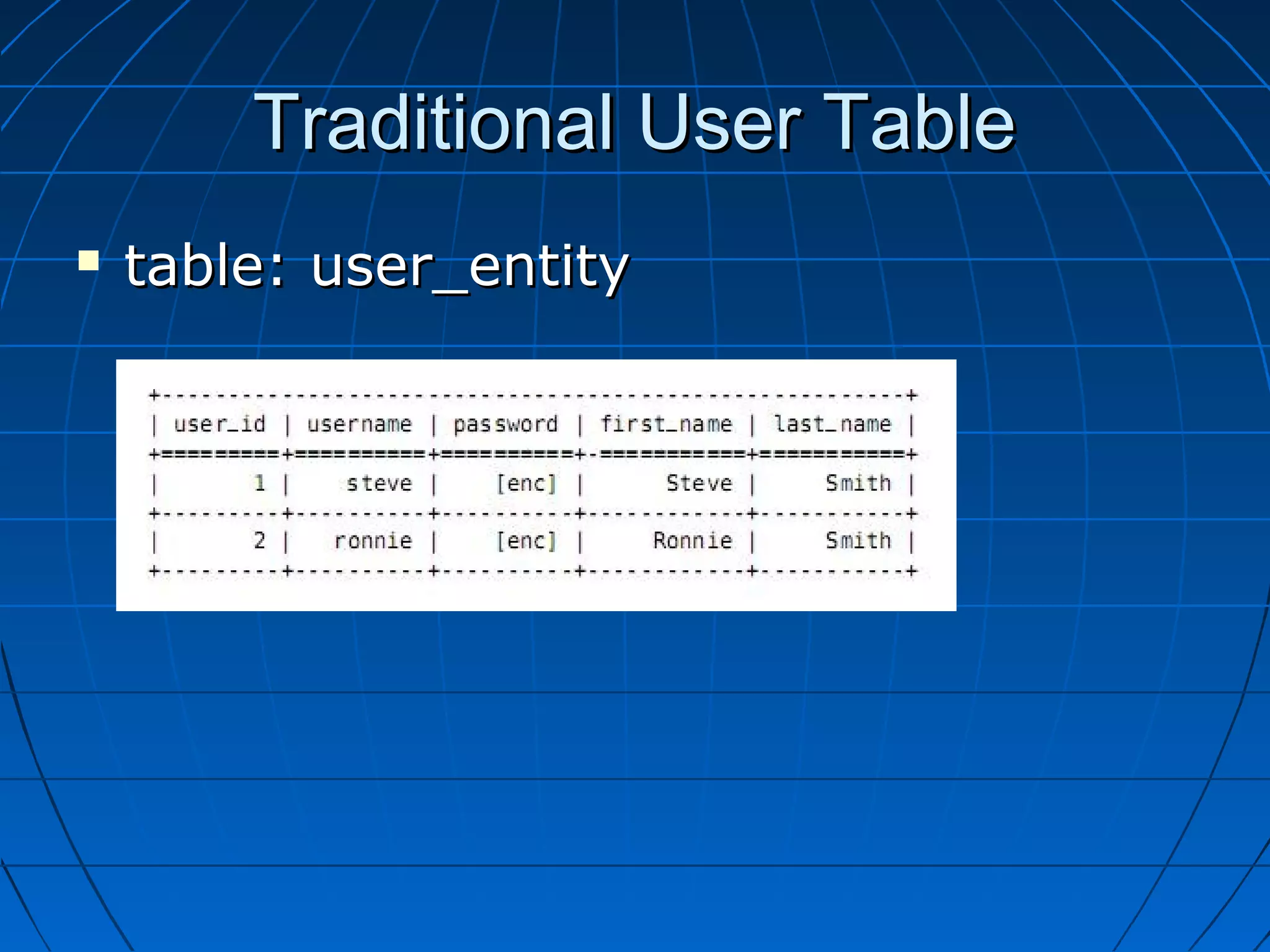
Traditional User Table
   table: user_entity
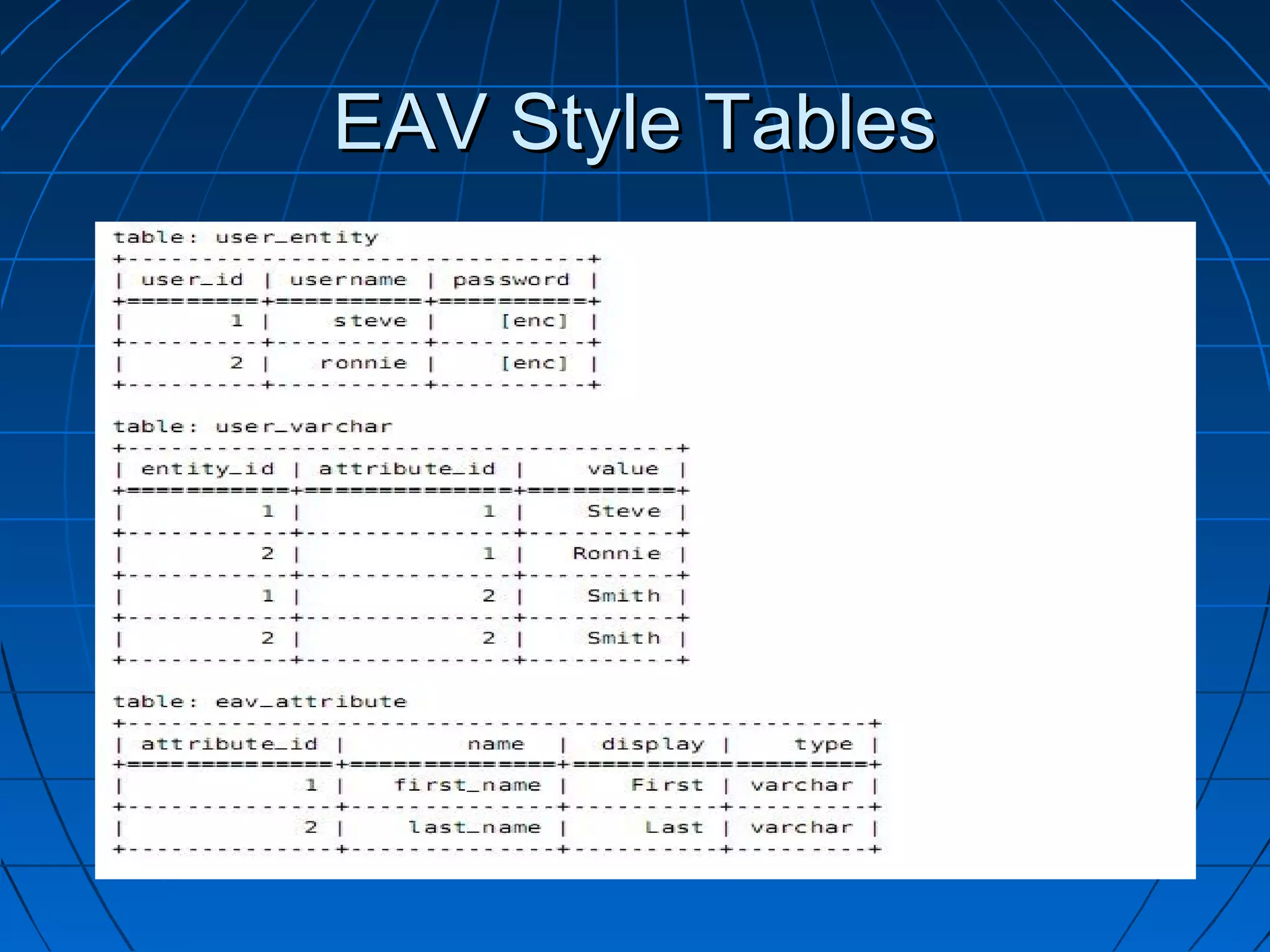
EAV Style Tables
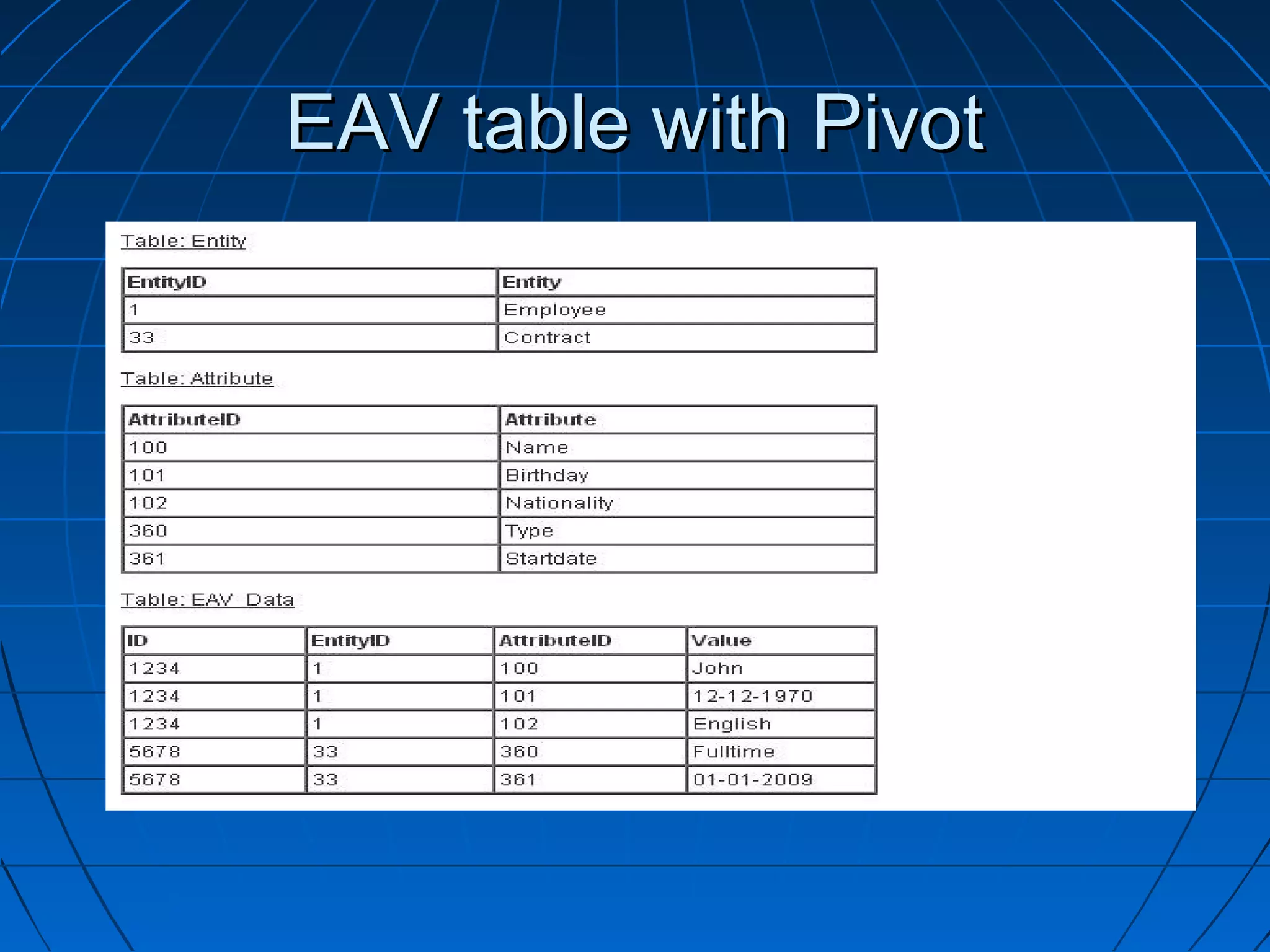
Structure of an EAV table
   The entity: Objects are entities (in
    Magento. Entities are: product,
    customer, order,…)
   The attribute: object properties are
    attributes
   The value: The value of the attribute
Update
SQL: UPDATE `eav_attribute` SET `attribute_id` = ?, `entity_type_id` = ?, `attribute_code` = ?, `attribute_model` = ?, `backend_model` = ?,
      `backend_type` = ?, `backend_table` = ?, `frontend_model` = ?, `frontend_input` = ?, `frontend_input_renderer` = ?, `frontend_label` = ?,
      `frontend_class` = ?, `source_model` = ?, `is_global` = ?, `is_visible` = ?, `is_required` = ?, `is_user_defined` = ?, `default_value` = ?,
      `is_searchable` = ?, `is_filterable` = ?, `is_comparable` = ?, `is_visible_on_front` = ?, `is_html_allowed_on_front` = ?, `is_unique` = ?,
      `is_used_for_price_rules` = ?, `is_filterable_in_search` = ?, `used_in_product_listing` = ?, `used_for_sort_by` = ?, `is_configurable` = ?,
      `apply_to` = ?, `position` = ?, `note` = ?, `is_visible_in_advanced_search` = ? WHERE (attribute_id='498')
BIND: Array
(
  [0] => 498
  [1] => 4
  [2] => sp_test
  [3] =>
  [4] =>
  [5] => varchar
  [6] =>
  [7] =>
  [8] => text
  [9] =>
  [10] => sp test
  [11] =>
  [12] =>
  [13] => 0
  [14] => 1
  [15] => 0
  [16] => 1
  [17] =>
  [18] => 1
  [19] => 0
  [20] => 1
  [21] => 0
  [22] => 1
  [23] => 0
  [24] => 0
  [25] => 0
  [26] => 0
  [27] => 0
  [28] => 0
  [29] =>
  [30] => 0
  [31] =>
  [32] => 1
)
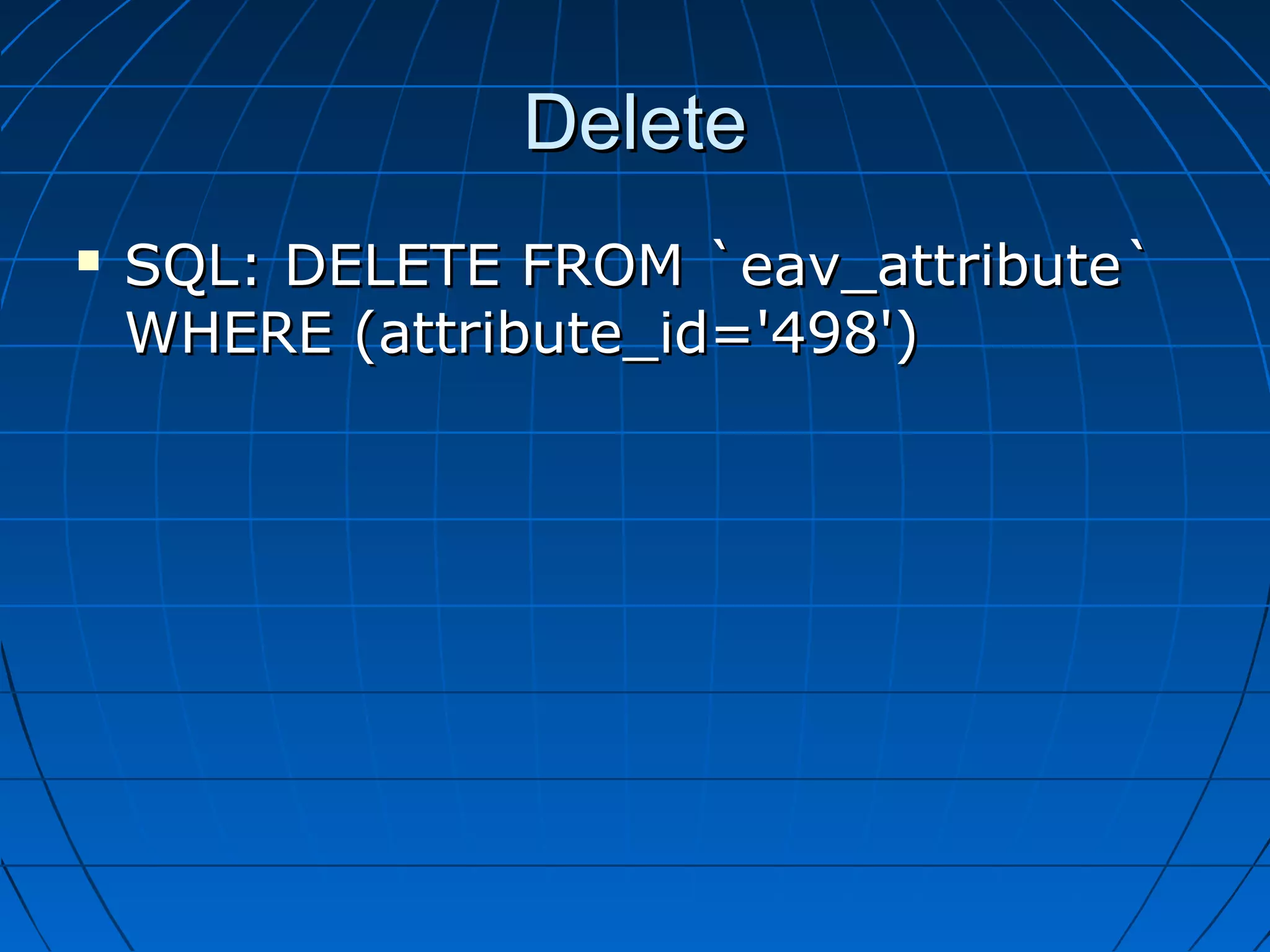
Delete
   SQL: DELETE FROM `eav_attribute`
    WHERE (attribute_id='498')
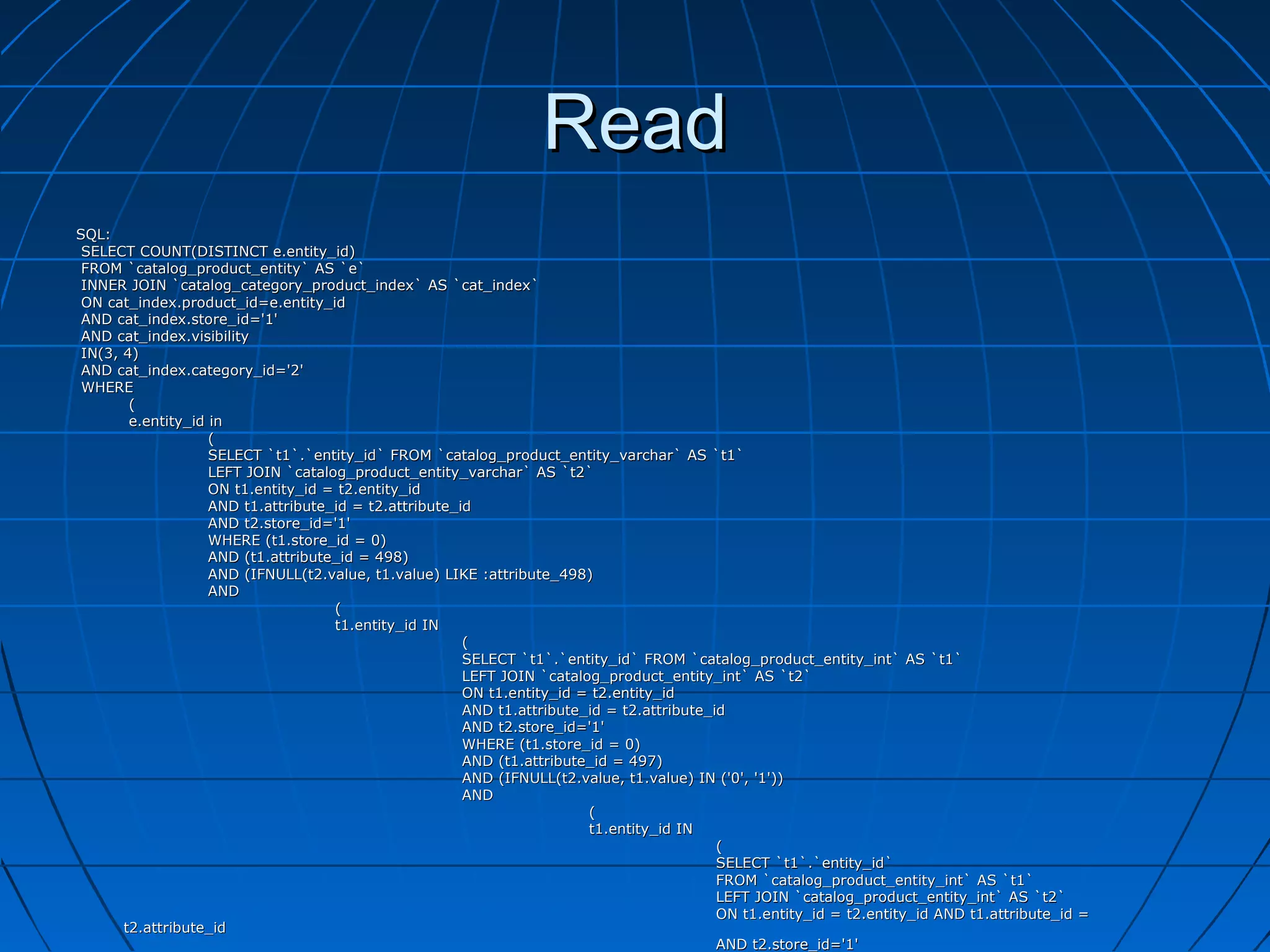
Read
SQL:
 SELECT COUNT(DISTINCT e.entity_id)
 FROM `catalog_product_entity` AS `e`
 INNER JOIN `catalog_category_product_index` AS `cat_index`
 ON cat_index.product_id=e.entity_id
 AND cat_index.store_id='1'
 AND cat_index.visibility
 IN(3, 4)
 AND cat_index.category_id='2'
 WHERE
        (
        e.entity_id in
                    (
                    SELECT `t1`.`entity_id` FROM `catalog_product_entity_varchar` AS `t1`
                    LEFT JOIN `catalog_product_entity_varchar` AS `t2`
                    ON t1.entity_id = t2.entity_id
                    AND t1.attribute_id = t2.attribute_id
                    AND t2.store_id='1'
                    WHERE (t1.store_id = 0)
                    AND (t1.attribute_id = 498)
                    AND (IFNULL(t2.value, t1.value) LIKE :attribute_498)
                    AND
                                     (
                                     t1.entity_id IN
                                                        (
                                                        SELECT `t1`.`entity_id` FROM `catalog_product_entity_int` AS `t1`
                                                        LEFT JOIN `catalog_product_entity_int` AS `t2`
                                                        ON t1.entity_id = t2.entity_id
                                                        AND t1.attribute_id = t2.attribute_id
                                                        AND t2.store_id='1'
                                                        WHERE (t1.store_id = 0)
                                                        AND (t1.attribute_id = 497)
                                                        AND (IFNULL(t2.value, t1.value) IN ('0', '1'))
                                                        AND
                                                                         (
                                                                         t1.entity_id IN
                                                                                            (
                                                                                            SELECT `t1`.`entity_id`
                                                                                            FROM `catalog_product_entity_int` AS `t1`
                                                                                            LEFT JOIN `catalog_product_entity_int` AS `t2`
                                                                                            ON t1.entity_id = t2.entity_id AND t1.attribute_id =
       t2.attribute_id
                                                                                            AND t2.store_id='1'
Good
   Provides a flexible mechanism to
    record the attributes associated with
    any entity.
   This EAV design requires almost no
    consideration of the nature of the
    applicable hierarchical data and
    requires very little time to implement
    ( cookie cutter)
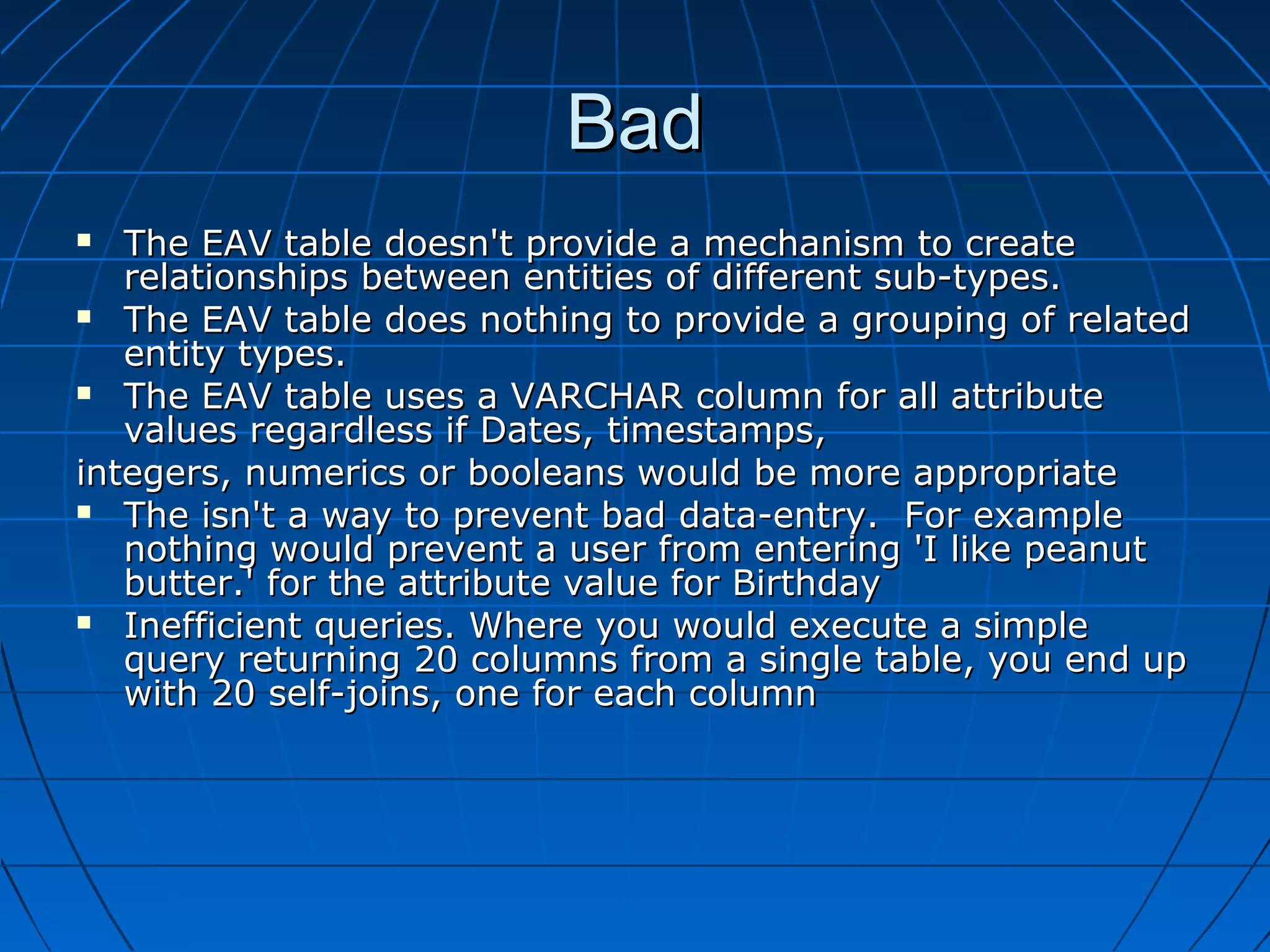
Bad
  The EAV table doesn't provide a mechanism to create
   relationships between entities of different sub-types.
 The EAV table does nothing to provide a grouping of related
   entity types.
 The EAV table uses a VARCHAR column for all attribute
   values regardless if Dates, timestamps,
integers, numerics or booleans would be more appropriate
 The isn't a way to prevent bad data-entry. For example
   nothing would prevent a user from entering 'I like peanut
   butter.' for the attribute value for Birthday
 Inefficient queries. Where you would execute a simple
   query returning 20 columns from a single table, you end up
   with 20 self-joins, one for each column
Solution
   Take a look at Magento Database
    Diagram
EAV table with Pivot
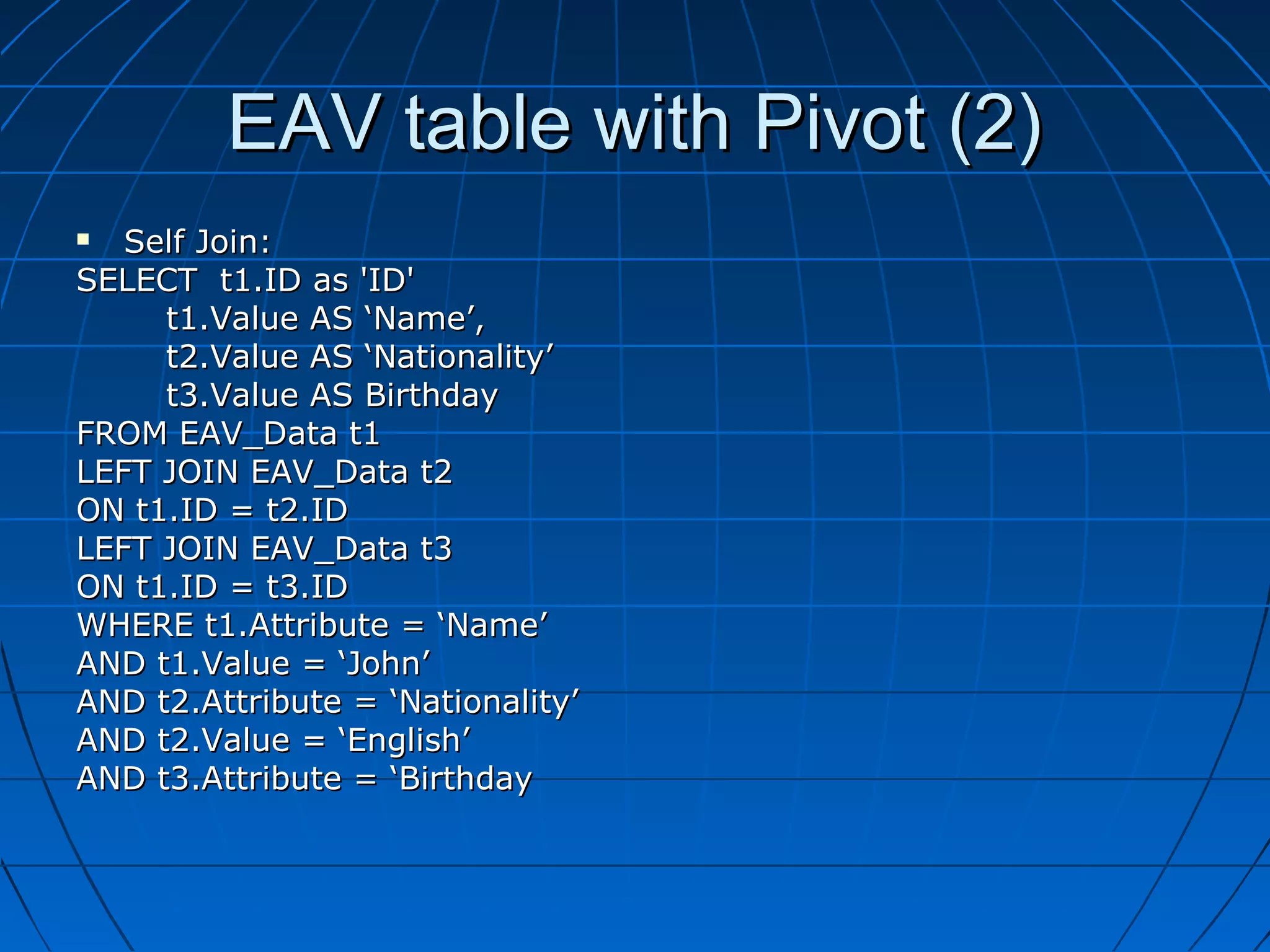
EAV table with Pivot (2)
  Self Join:
SELECT t1.ID as 'ID'
     t1.Value AS ‘Name’,
     t2.Value AS ‘Nationality’
     t3.Value AS Birthday
FROM EAV_Data t1
LEFT JOIN EAV_Data t2
ON t1.ID = t2.ID
LEFT JOIN EAV_Data t3
ON t1.ID = t3.ID
WHERE t1.Attribute = ‘Name’
AND t1.Value = ‘John’
AND t2.Attribute = ‘Nationality’
AND t2.Value = ‘English’
AND t3.Attribute = ‘Birthday
EAV table with Pivot (3)
   Pivot
SELECT * FROM
  (
      SELECT ID
           , [100] AS Name
           , [101] AS Birthday
           , [102] AS Nationality
      FROM
      (
           SELECT ID, EntityID, AttributeID, Value
          FROM EAV_Table
     )p
     PIVOT
     (
          MAX (Value)
          FOR AttributeID IN ([100], [101], [102])
     ) AS pvt
  )
 WHERE Name = 'John'
 AND Nationality = 'English'
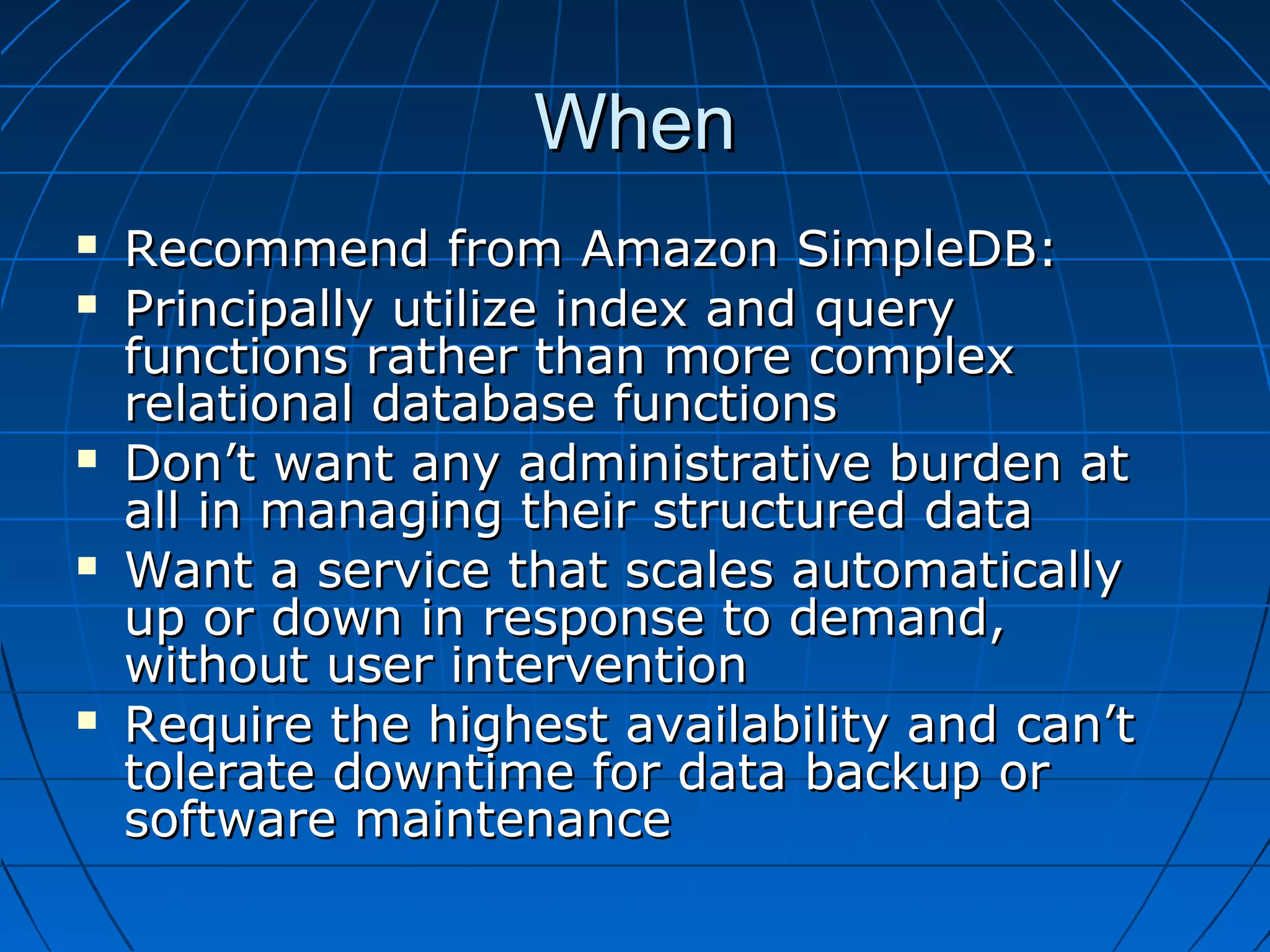
When
   Recommend from Amazon SimpleDB:
   Principally utilize index and query
    functions rather than more complex
    relational database functions
   Don’t want any administrative burden at
    all in managing their structured data
   Want a service that scales automatically
    up or down in response to demand,
    without user intervention
   Require the highest availability and can’t
    tolerate downtime for data backup or
    software maintenance
Thanks for your attention

EAV in Magento

  • 1.
    Entity - Attribute- Value (EAV) Data Model in Magento @Pờ Đình Tâm
  • 2.
    What is EAV  EAV can be thought of as “vertical” modeling instead of “horizontal” modeling of columns in a database table.  Instead of a table consisting of a number of columns, denoting attributes of a conceptual piece of data, the attributes are stored in one column of a separate table.
  • 3.
    Traditional User Table  table: user_entity
  • 4.
  • 5.
    Structure of anEAV table  The entity: Objects are entities (in Magento. Entities are: product, customer, order,…)  The attribute: object properties are attributes  The value: The value of the attribute
  • 6.
    Update SQL: UPDATE `eav_attribute`SET `attribute_id` = ?, `entity_type_id` = ?, `attribute_code` = ?, `attribute_model` = ?, `backend_model` = ?, `backend_type` = ?, `backend_table` = ?, `frontend_model` = ?, `frontend_input` = ?, `frontend_input_renderer` = ?, `frontend_label` = ?, `frontend_class` = ?, `source_model` = ?, `is_global` = ?, `is_visible` = ?, `is_required` = ?, `is_user_defined` = ?, `default_value` = ?, `is_searchable` = ?, `is_filterable` = ?, `is_comparable` = ?, `is_visible_on_front` = ?, `is_html_allowed_on_front` = ?, `is_unique` = ?, `is_used_for_price_rules` = ?, `is_filterable_in_search` = ?, `used_in_product_listing` = ?, `used_for_sort_by` = ?, `is_configurable` = ?, `apply_to` = ?, `position` = ?, `note` = ?, `is_visible_in_advanced_search` = ? WHERE (attribute_id='498') BIND: Array ( [0] => 498 [1] => 4 [2] => sp_test [3] => [4] => [5] => varchar [6] => [7] => [8] => text [9] => [10] => sp test [11] => [12] => [13] => 0 [14] => 1 [15] => 0 [16] => 1 [17] => [18] => 1 [19] => 0 [20] => 1 [21] => 0 [22] => 1 [23] => 0 [24] => 0 [25] => 0 [26] => 0 [27] => 0 [28] => 0 [29] => [30] => 0 [31] => [32] => 1 )
  • 7.
    Delete  SQL: DELETE FROM `eav_attribute` WHERE (attribute_id='498')
  • 8.
    Read SQL: SELECT COUNT(DISTINCTe.entity_id) FROM `catalog_product_entity` AS `e` INNER JOIN `catalog_category_product_index` AS `cat_index` ON cat_index.product_id=e.entity_id AND cat_index.store_id='1' AND cat_index.visibility IN(3, 4) AND cat_index.category_id='2' WHERE ( e.entity_id in ( SELECT `t1`.`entity_id` FROM `catalog_product_entity_varchar` AS `t1` LEFT JOIN `catalog_product_entity_varchar` AS `t2` ON t1.entity_id = t2.entity_id AND t1.attribute_id = t2.attribute_id AND t2.store_id='1' WHERE (t1.store_id = 0) AND (t1.attribute_id = 498) AND (IFNULL(t2.value, t1.value) LIKE :attribute_498) AND ( t1.entity_id IN ( SELECT `t1`.`entity_id` FROM `catalog_product_entity_int` AS `t1` LEFT JOIN `catalog_product_entity_int` AS `t2` ON t1.entity_id = t2.entity_id AND t1.attribute_id = t2.attribute_id AND t2.store_id='1' WHERE (t1.store_id = 0) AND (t1.attribute_id = 497) AND (IFNULL(t2.value, t1.value) IN ('0', '1')) AND ( t1.entity_id IN ( SELECT `t1`.`entity_id` FROM `catalog_product_entity_int` AS `t1` LEFT JOIN `catalog_product_entity_int` AS `t2` ON t1.entity_id = t2.entity_id AND t1.attribute_id = t2.attribute_id AND t2.store_id='1'
  • 9.
    Good  Provides a flexible mechanism to record the attributes associated with any entity.  This EAV design requires almost no consideration of the nature of the applicable hierarchical data and requires very little time to implement ( cookie cutter)
  • 10.
    Bad  TheEAV table doesn't provide a mechanism to create relationships between entities of different sub-types.  The EAV table does nothing to provide a grouping of related entity types.  The EAV table uses a VARCHAR column for all attribute values regardless if Dates, timestamps, integers, numerics or booleans would be more appropriate  The isn't a way to prevent bad data-entry. For example nothing would prevent a user from entering 'I like peanut butter.' for the attribute value for Birthday  Inefficient queries. Where you would execute a simple query returning 20 columns from a single table, you end up with 20 self-joins, one for each column
  • 11.
    Solution  Take a look at Magento Database Diagram
  • 12.
  • 13.
    EAV table withPivot (2)  Self Join: SELECT t1.ID as 'ID' t1.Value AS ‘Name’, t2.Value AS ‘Nationality’ t3.Value AS Birthday FROM EAV_Data t1 LEFT JOIN EAV_Data t2 ON t1.ID = t2.ID LEFT JOIN EAV_Data t3 ON t1.ID = t3.ID WHERE t1.Attribute = ‘Name’ AND t1.Value = ‘John’ AND t2.Attribute = ‘Nationality’ AND t2.Value = ‘English’ AND t3.Attribute = ‘Birthday
  • 14.
    EAV table withPivot (3)  Pivot SELECT * FROM ( SELECT ID , [100] AS Name , [101] AS Birthday , [102] AS Nationality FROM ( SELECT ID, EntityID, AttributeID, Value FROM EAV_Table )p PIVOT ( MAX (Value) FOR AttributeID IN ([100], [101], [102]) ) AS pvt ) WHERE Name = 'John' AND Nationality = 'English'
  • 15.
    When  Recommend from Amazon SimpleDB:  Principally utilize index and query functions rather than more complex relational database functions  Don’t want any administrative burden at all in managing their structured data  Want a service that scales automatically up or down in response to demand, without user intervention  Require the highest availability and can’t tolerate downtime for data backup or software maintenance
  • 16.
    Thanks for yourattention