HIPAA Compliance
for Developers
Breaking down the regulatory issues around building
digital health apps for fun and profit.
HIPAA compliant database-as-a-service
HIPAA Compliance is a 

Brutal Time Suck!
!
“[Building our own HIPAA compliant infrastructure] took upwards of
1,000 person-hours to figure out HIPAA-compliance issues. This will
continue to be an ongoing cost for us, because HIPAA is an ongoing law
and it changes sometimes. It takes substantial auditing time and money.
TrueVault would save us all that.”


Posted on Hacker News by jph

(Unsolicited comment. Not a customer.)
HIPAA compliant database-as-a-service
First off, What is HIPAA?
Health Insurance Portability and Accountability Act
• HIPAA sets the standard for protecting sensitive patient data.
• Covered Entities and their Business Associates need to protect
the privacy and security of protected health information (PHI).
• Developed in 1996. HIPAA was initially created to help the public
with insurance portability. In addition, they built a series of privacy
tools to protect healthcare data.
HIPAA compliant database-as-a-service
What Does HIPAA Require?
1.Put safeguards in place to protect patient health information.
2.Reasonably limit use and sharing to the minimum necessary to
accomplish your intended purpose.
3.Have agreements in place with service providers that perform covered
functions. These agreements (BAAs) ensure that service providers
(Business Associates) use, safeguard and disclose patient information
properly.
4.Procedures to limit who can access patient health information, and
training programs about how to protect patient health information.
HIPAA compliant database-as-a-service
The Four Rules of HIPAA
Like the four horsemen, these are the major pieces that govern what you do
and how you do it.
1.HIPAA Privacy Rule
2.HIPAA Security Rule
3.HIPAA Enforcement Rule
4.HIPAA Breach Notification Rule

HIPAA compliant database-as-a-service
Developers need to focus on the Technical and Physical
safeguards outlined in the Security Rule.
The Privacy Rule
HIPAA compliant database-as-a-service
Addresses the saving, accessing and sharing of
medical and personal information of an individual,
including a patient’s own right to access.
The Security Rule
HIPAA compliant database-as-a-service
Outlines national security standards intended to
protect health data created, received, maintained,
or transmitted electronically.
The Security Rule
HIPAA compliant database-as-a-service
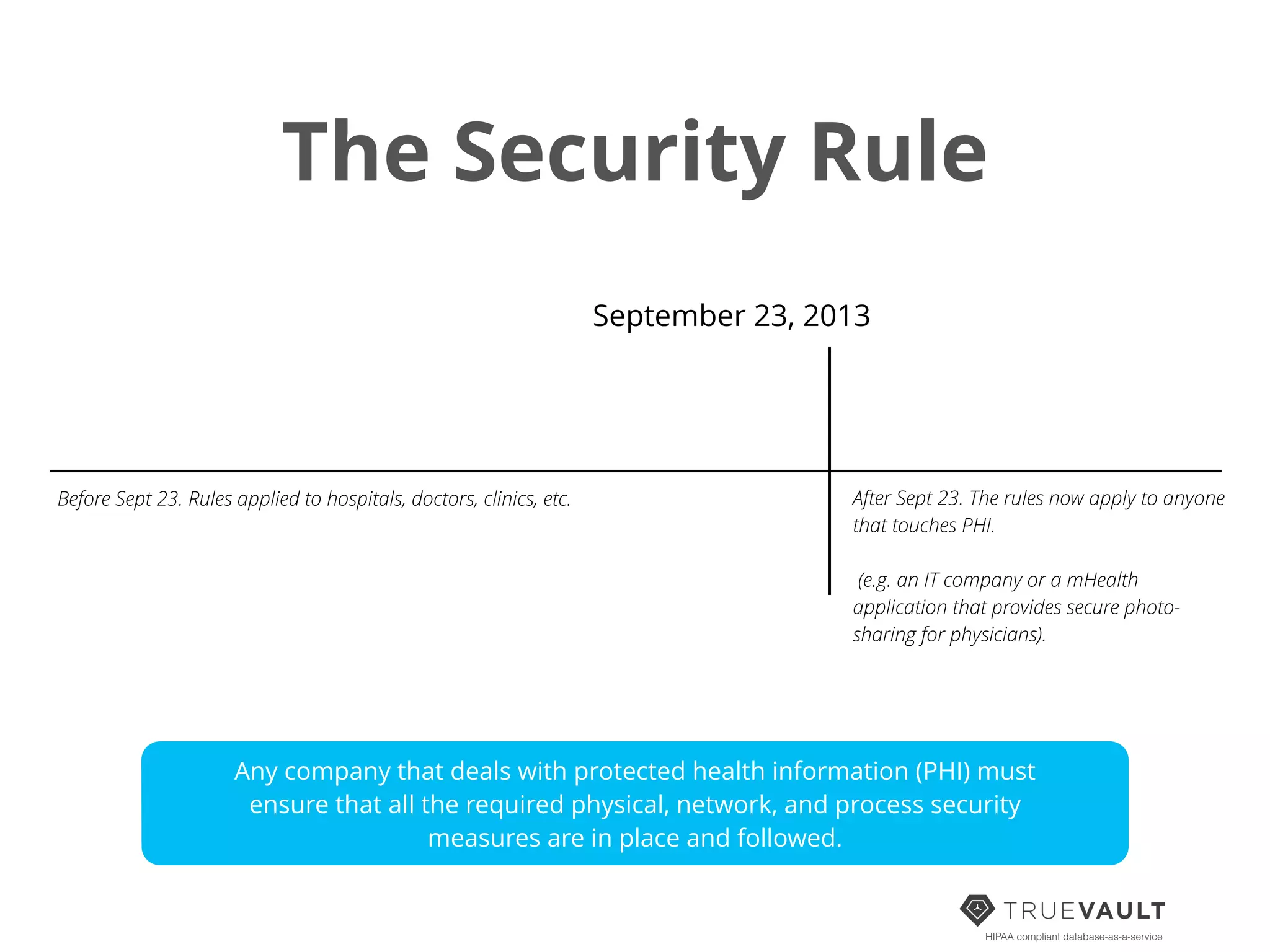
September 23, 2013
Before Sept 23. Rules applied to hospitals, doctors, clinics, etc. After Sept 23. The rules now apply to anyone
that touches PHI.


(e.g. an IT company or a mHealth
application that provides secure photo-
sharing for physicians).
Any company that deals with protected health information (PHI) must
ensure that all the required physical, network, and process security
measures are in place and followed.
HIPAA compliant database-as-a-service
“Do I need to be
HIPAA compliant?”
HIPAA compliant database-as-a-service
“Do I need to be
HIPAA compliant?”
If you handle PHI then you need to be HIPAA compliant.
The HIPAA rules apply to both Covered Entities
and their Business Associates
What is Protected Health
Information (PHI)?
• PHI is any information in a medical record that can be used to
identify an individual, and that was created, used, or disclosed in
the course of providing a healthcare service.
• Includes:
• Medical records
• Billing information
• Health insurance information
• Any individually identifiable health information
HIPAA compliant database-as-a-service
Electronic Protected Health
Information (EPHI)
HIPAA compliant database-as-a-service
All individually identifiable health information that
is created, maintained, or transmitted
electronically.
Covered Entity (CE)
HIPAA compliant database-as-a-service
• Anyone who provides treatment, payment and operations in
healthcare.
• Includes:
• Doctor’s office, dental offices, clinics, psychologists,
• Nursing home, pharmacy, hospital or home healthcare agency
• Health plans, insurance companies, HMOs
• Government programs that pay for healthcare
• Health clearing houses
Business Associate (BA)
HIPAA compliant database-as-a-service
• Anyone who has access to patient information, whether directly, indirectly,
physically or virtually.
• Any organization that provides support in the treatment, payment or operations
• Includes:
• IT providers, health applications
• Telephone service provider, document management and destruction
• Accountant, lawyer or other service provider
Business associates have the responsibility to achieve and maintain HIPAA
compliance in terms of all of the internal, administrative, and technical safeguards.
Exceptions
HIPAA compliant database-as-a-service
• Entities providing data transmission services, including services that
involve temporary storage of PHI that is incident to the
transmission (e.g. courier services and their electronic equivalents,
such as ISPs or telecoms).
While entities that are “mere conduits” for PHI are not Business Associates, the
rules emphasize that this exception is narrow.
HIPAA compliant database-as-a-service
“Who certifies HIPAA
compliance?”
HIPAA compliant database-as-a-service
“Who certifies HIPAA
compliance?”
The short answer is no one.
Who certifies HIPAA
compliance?
• Unlike PCI, there is no one that can “certify” that an organization is HIPAA
compliant.
• The Office for Civil Rights (OCR) from the Department of Health and Human
Services (HHS) is the federal governing body. HHS does not endorse or
recognize the “certifications” made by private organizations.
• The evaluation standard in the Security Rule § 164.308(a)(8) requires you to
perform a periodic technical and non-technical evaluation to make sure your
security policies and procedures meet security requirements.
• But, HHS doesn’t care if the evaluation is performed internally or by an external
organization.
HIPAA compliant database-as-a-service
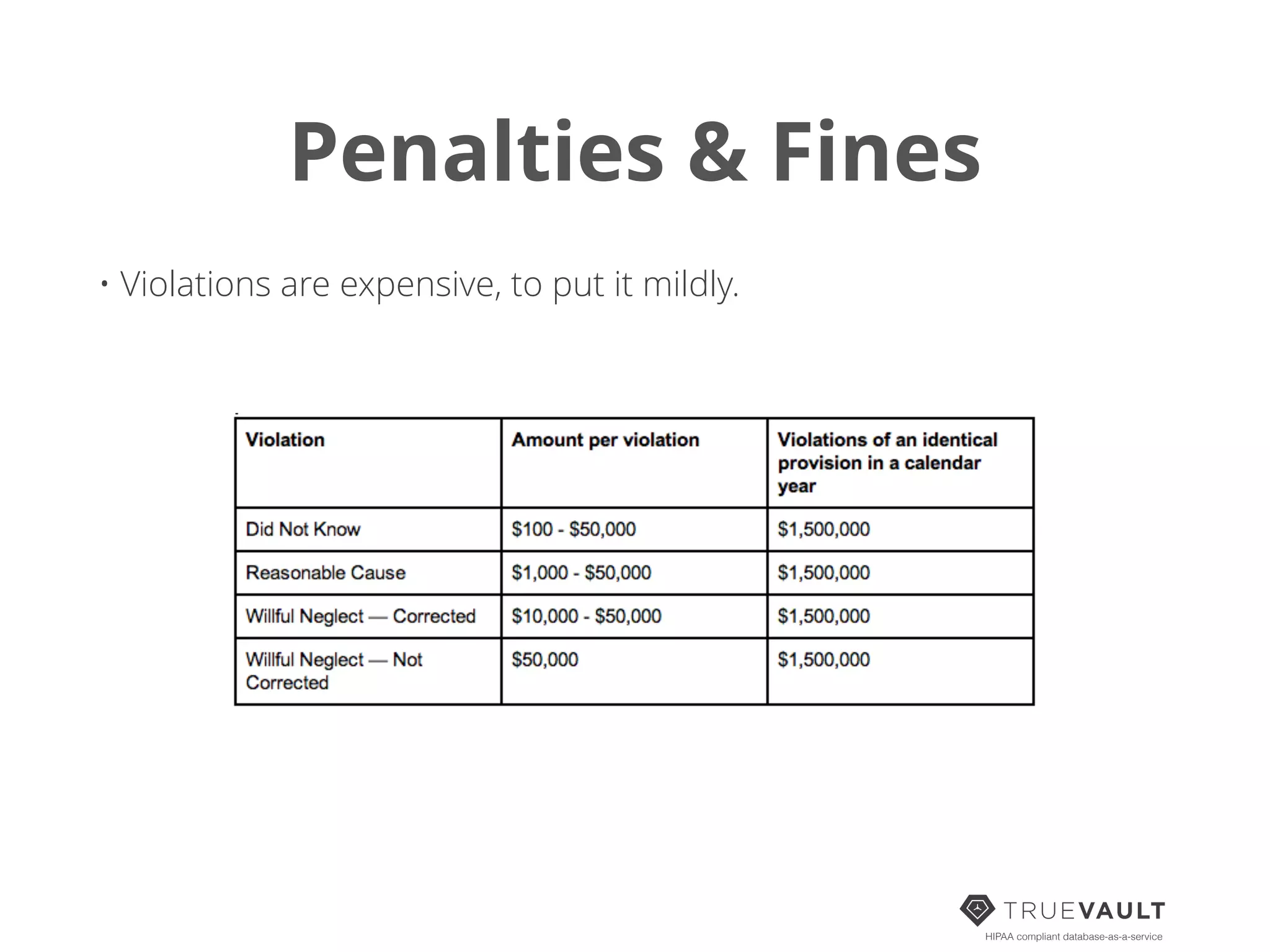
Penalties & Fines
• Violations are expensive, to put it mildly.
HIPAA compliant database-as-a-service
“How do I become
HIPAA compliant?”
HIPAA compliant database-as-a-service
“How do I become
HIPAA compliant?”
The HIPAA Security Rule requires appropriate Administrative,
Physical, and Technical Safeguards to ensure the confidentiality,
integrity, and security of protected health information (PHI).
3 Parts to the Security Rule
1.Administrative Safeguards
2.Technical Safeguards
3.Physical Safeguards
HIPAA compliant database-as-a-service
“required” vs. “addressable”
• Some implementation specifications are “required” and others are
“addressable.” Required implementation specifications must be
implemented.
• Addressable implementation specifications must be implemented if it is
reasonable and appropriate to do so; your choice must be documented.
• It is important to remember that an addressable implementation
specification is not optional.
HIPAA compliant database-as-a-service
When in doubt, you should just implement the addressable implementation
specifications. Most of them are best practices anyway.
Administrative Safeguards
The administrative components are really important when
implementing a HIPAA compliance program; you are required to:
1.Assign a privacy officer
2.Complete a risk assessment annually
3.Implement employee training
4.Review policies and procedures
5.Execute Business Associate Agreements (BAAs) with all partners
who handle protected health information (PHI)
HIPAA compliant database-as-a-service
Administrative Safeguards
Companies who can help with the administrative components of a
compliance program:
• Accountable -- http://accountablehq.com
• Compliance Helper -- http://www.compliancehelper.com
• Compliancy Group -- http://compliancy-group.com
HIPAA compliant database-as-a-service
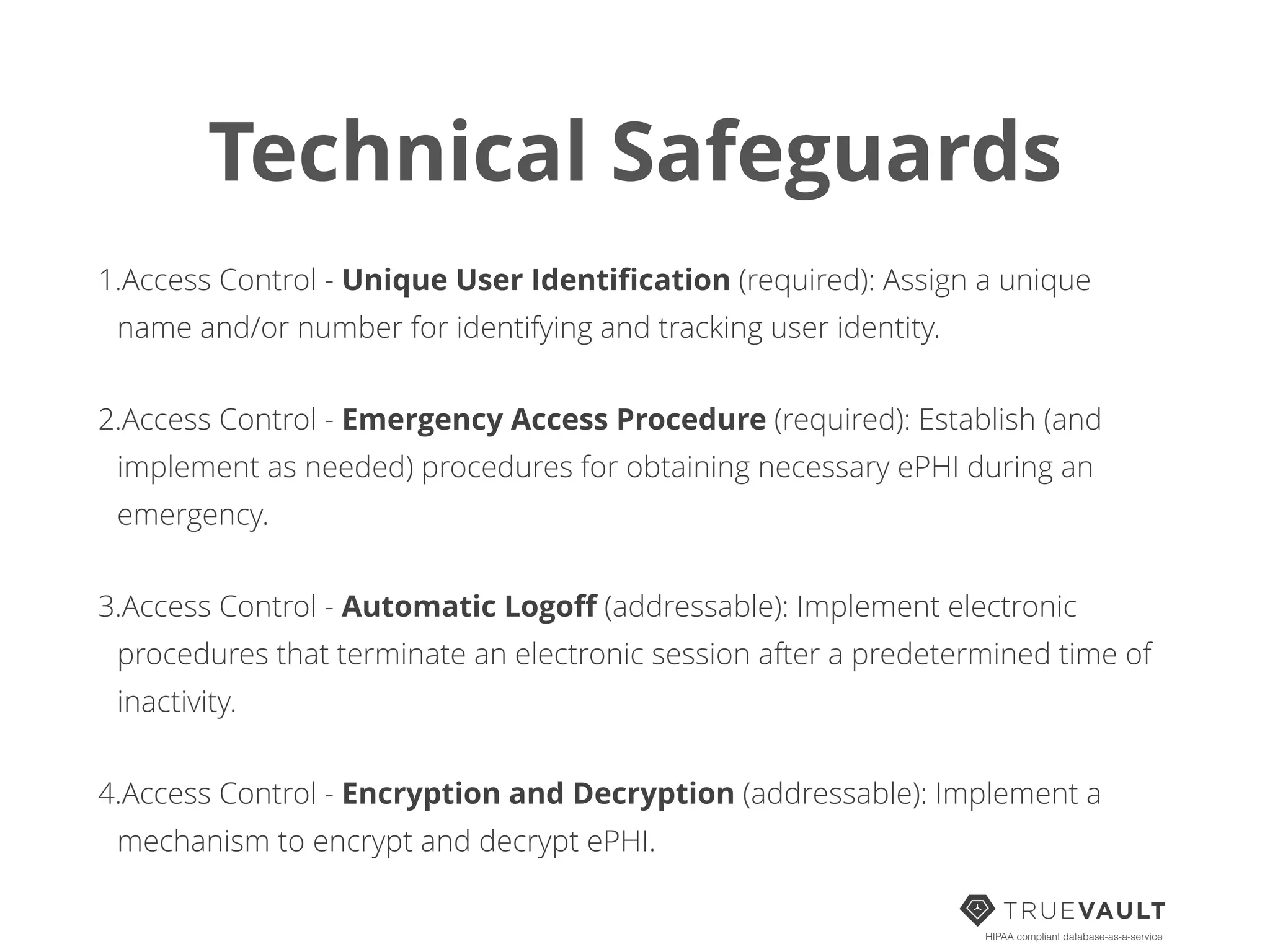
Technical Safeguards
1.Access Control - Unique User Identification (required): Assign a unique
name and/or number for identifying and tracking user identity.
2.Access Control - Emergency Access Procedure (required): Establish (and
implement as needed) procedures for obtaining necessary ePHI during an
emergency.
3.Access Control - Automatic Logoff (addressable): Implement electronic
procedures that terminate an electronic session after a predetermined time of
inactivity.
4.Access Control - Encryption and Decryption (addressable): Implement a
mechanism to encrypt and decrypt ePHI.
HIPAA compliant database-as-a-service
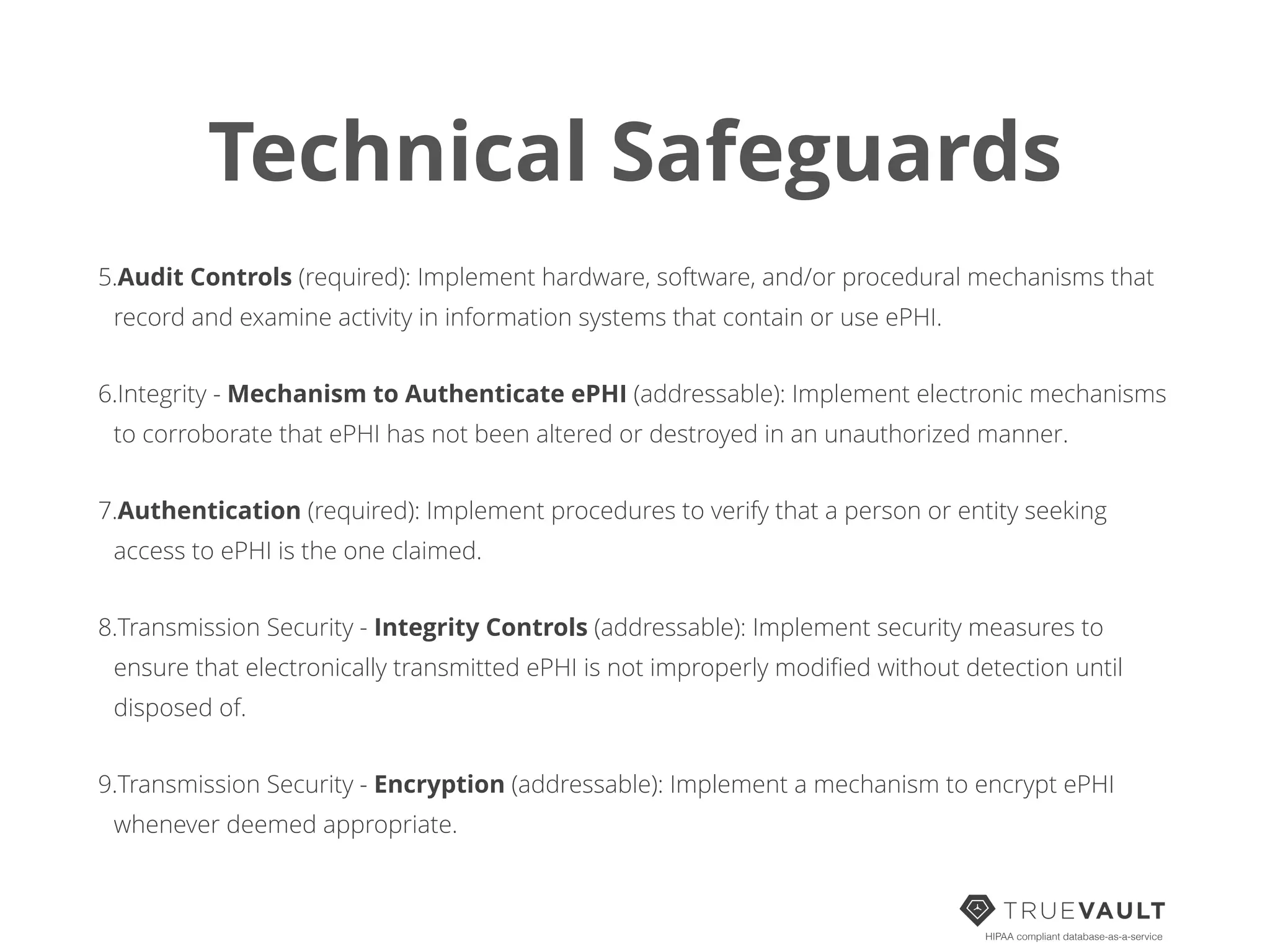
Technical Safeguards
5.Audit Controls (required): Implement hardware, software, and/or procedural mechanisms that
record and examine activity in information systems that contain or use ePHI.
6.Integrity - Mechanism to Authenticate ePHI (addressable): Implement electronic mechanisms
to corroborate that ePHI has not been altered or destroyed in an unauthorized manner.
7.Authentication (required): Implement procedures to verify that a person or entity seeking
access to ePHI is the one claimed.
8.Transmission Security - Integrity Controls (addressable): Implement security measures to
ensure that electronically transmitted ePHI is not improperly modified without detection until
disposed of.
9.Transmission Security - Encryption (addressable): Implement a mechanism to encrypt ePHI
whenever deemed appropriate.
HIPAA compliant database-as-a-service
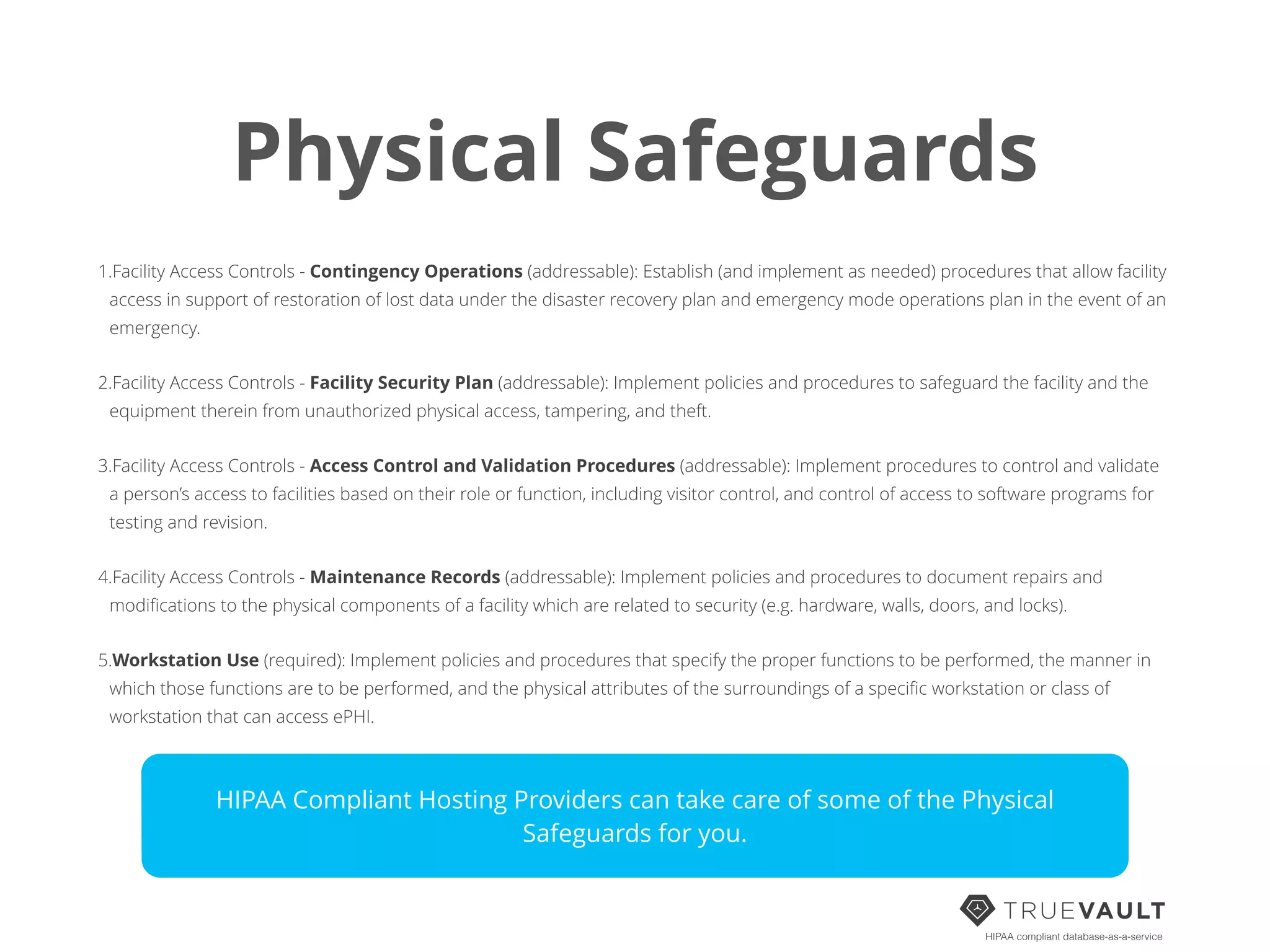
Physical Safeguards
1.Facility Access Controls - Contingency Operations (addressable): Establish (and implement as needed) procedures that allow facility
access in support of restoration of lost data under the disaster recovery plan and emergency mode operations plan in the event of an
emergency.
2.Facility Access Controls - Facility Security Plan (addressable): Implement policies and procedures to safeguard the facility and the
equipment therein from unauthorized physical access, tampering, and theft.
3.Facility Access Controls - Access Control and Validation Procedures (addressable): Implement procedures to control and validate
a person’s access to facilities based on their role or function, including visitor control, and control of access to software programs for
testing and revision.
4.Facility Access Controls - Maintenance Records (addressable): Implement policies and procedures to document repairs and
modifications to the physical components of a facility which are related to security (e.g. hardware, walls, doors, and locks).
5.Workstation Use (required): Implement policies and procedures that specify the proper functions to be performed, the manner in
which those functions are to be performed, and the physical attributes of the surroundings of a specific workstation or class of
workstation that can access ePHI.
HIPAA compliant database-as-a-service
HIPAA Compliant Hosting Providers can take care of some of the Physical
Safeguards for you.
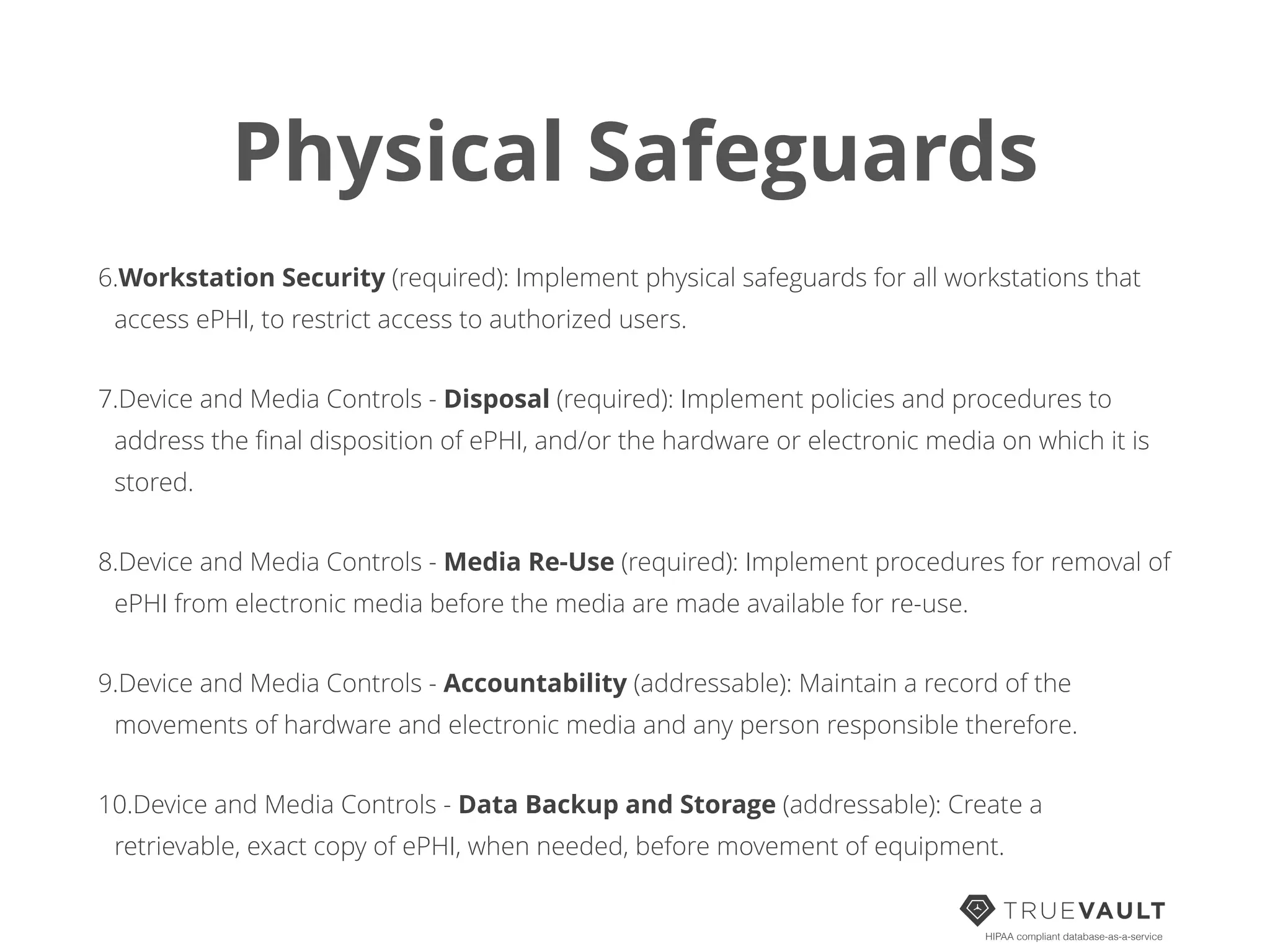
Physical Safeguards
6.Workstation Security (required): Implement physical safeguards for all workstations that
access ePHI, to restrict access to authorized users.
7.Device and Media Controls - Disposal (required): Implement policies and procedures to
address the final disposition of ePHI, and/or the hardware or electronic media on which it is
stored.
8.Device and Media Controls - Media Re-Use (required): Implement procedures for removal of
ePHI from electronic media before the media are made available for re-use.
9.Device and Media Controls - Accountability (addressable): Maintain a record of the
movements of hardware and electronic media and any person responsible therefore.
10.Device and Media Controls - Data Backup and Storage (addressable): Create a
retrievable, exact copy of ePHI, when needed, before movement of equipment.
HIPAA compliant database-as-a-service
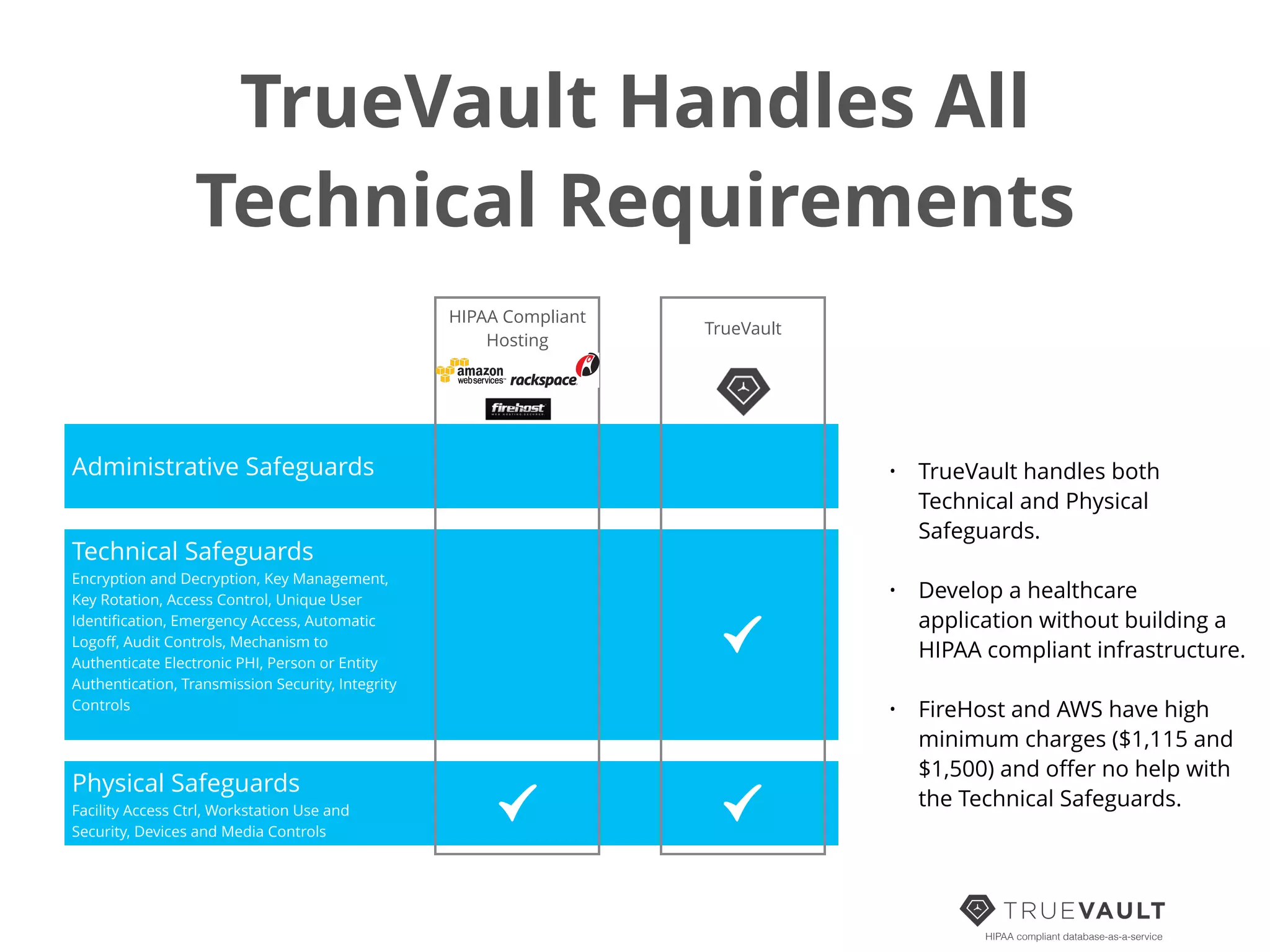
TrueVault Handles All
Technical Requirements
HIPAA compliant database-as-a-service
Administrative Safeguards
Technical Safeguards
Encryption and Decryption, Key Management,
Key Rotation, Access Control, Unique User
Identification, Emergency Access, Automatic
Logoff, Audit Controls, Mechanism to
Authenticate Electronic PHI, Person or Entity
Authentication, Transmission Security, Integrity
Controls
Physical Safeguards
Facility Access Ctrl, Workstation Use and
Security, Devices and Media Controls
HIPAA Compliant
Hosting
TrueVault
• TrueVault handles both
Technical and Physical
Safeguards.
!
• Develop a healthcare
application without building a
HIPAA compliant infrastructure.
!
• FireHost and AWS have high
minimum charges ($1,115 and
$1,500) and offer no help with
the Technical Safeguards.
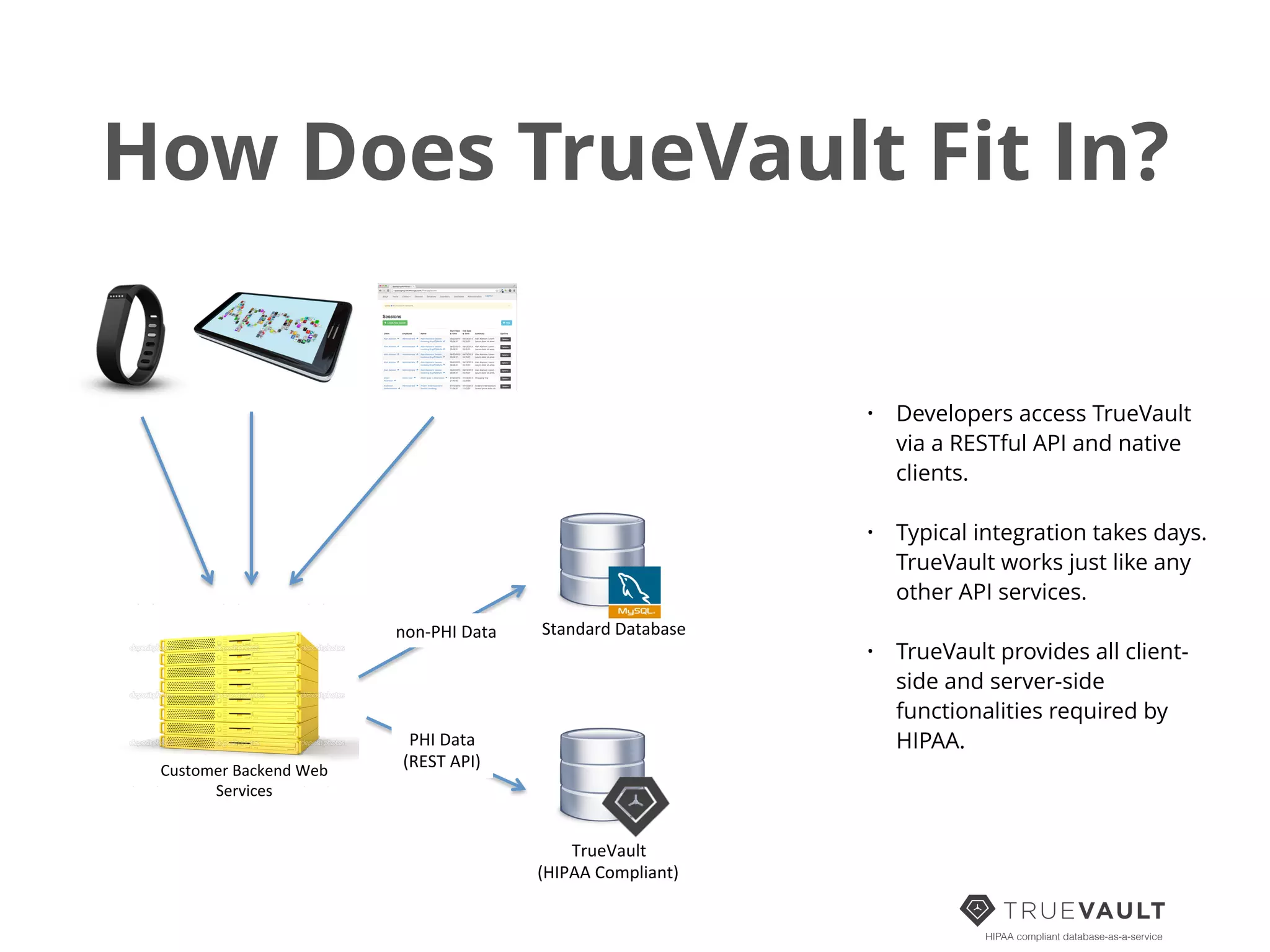
How Does TrueVault Fit In?
HIPAA compliant database-as-a-service
!
• Developers access TrueVault
via a RESTful API and native
clients.
!
• Typical integration takes days.
TrueVault works just like any
other API services.
!
• TrueVault provides all client-
side and server-side
functionalities required by
HIPAA.
Customer)Backend)Web)
Services))
Standard)Database)
TrueVault)
(HIPAA)Compliant))
non@PHI)Data)
PHI)Data)
(REST)API))
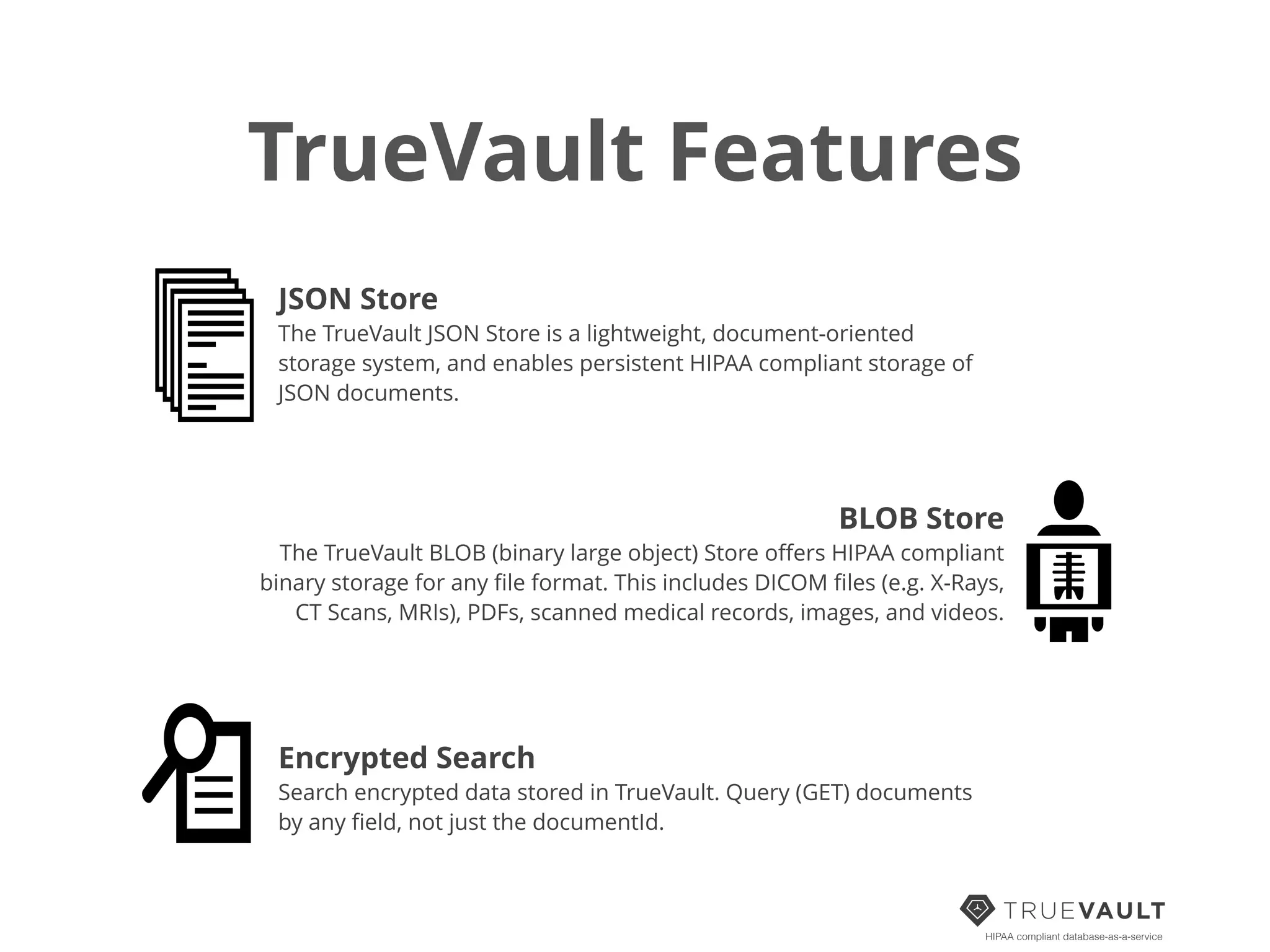
TrueVault Features
HIPAA compliant database-as-a-service
JSON Store
The TrueVault JSON Store is a lightweight, document-oriented
storage system, and enables persistent HIPAA compliant storage of
JSON documents.
BLOB Store
The TrueVault BLOB (binary large object) Store offers HIPAA compliant
binary storage for any file format. This includes DICOM files (e.g. X-Rays,
CT Scans, MRIs), PDFs, scanned medical records, images, and videos.
Encrypted Search
Search encrypted data stored in TrueVault. Query (GET) documents
by any field, not just the documentId.
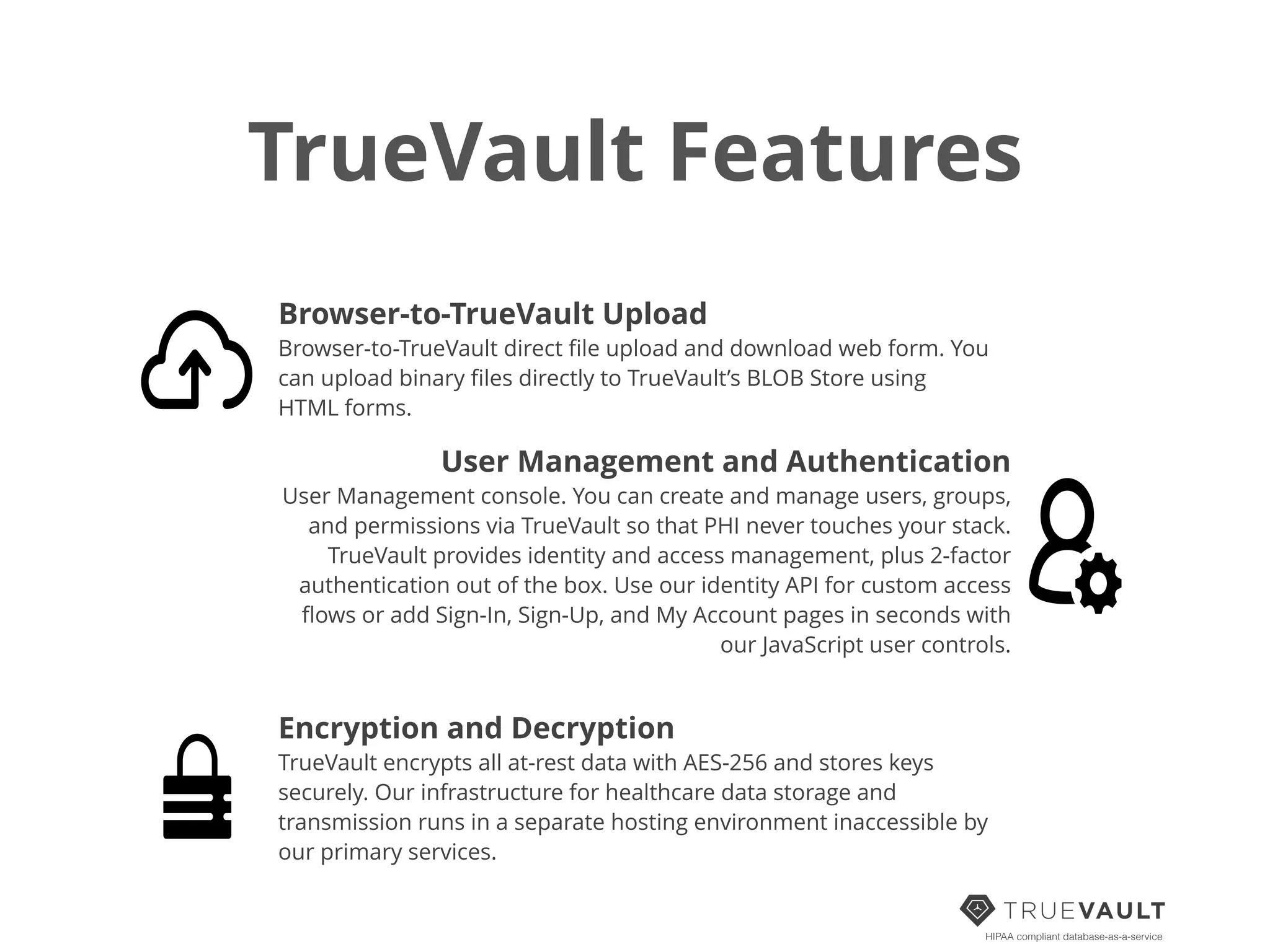
TrueVault Features
HIPAA compliant database-as-a-service
Browser-to-TrueVault Upload
Browser-to-TrueVault direct file upload and download web form. You
can upload binary files directly to TrueVault’s BLOB Store using
HTML forms.
User Management and Authentication
User Management console. You can create and manage users, groups,
and permissions via TrueVault so that PHI never touches your stack.
TrueVault provides identity and access management, plus 2-factor
authentication out of the box. Use our identity API for custom access
flows or add Sign-In, Sign-Up, and My Account pages in seconds with
our JavaScript user controls.
Encryption and Decryption
TrueVault encrypts all at-rest data with AES-256 and stores keys
securely. Our infrastructure for healthcare data storage and
transmission runs in a separate hosting environment inaccessible by
our primary services.
TrueVault Features
HIPAA compliant database-as-a-service
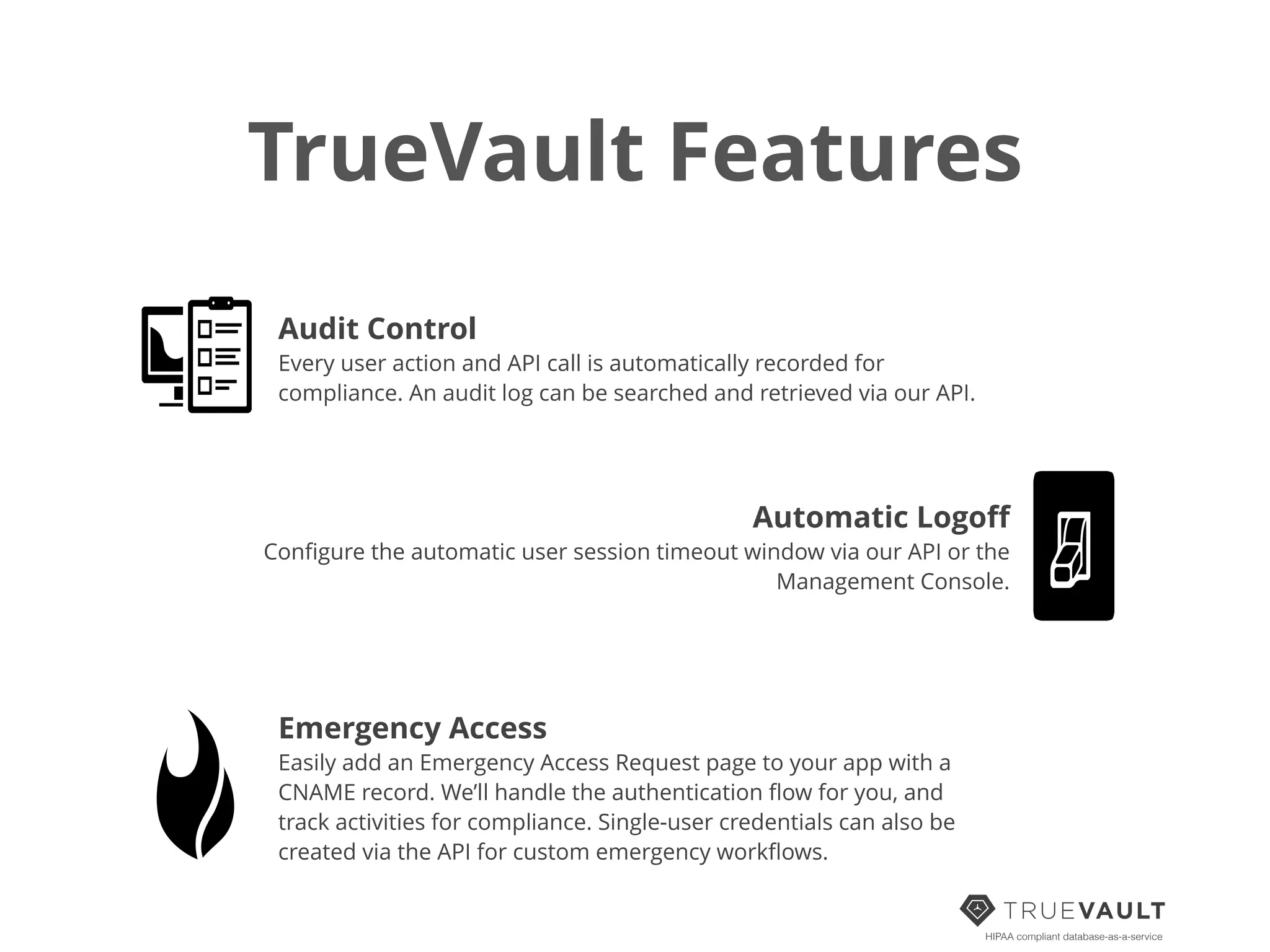
Audit Control
Every user action and API call is automatically recorded for
compliance. An audit log can be searched and retrieved via our API.
Automatic Logoff
Configure the automatic user session timeout window via our API or the
Management Console.
Emergency Access
Easily add an Emergency Access Request page to your app with a
CNAME record. We’ll handle the authentication flow for you, and
track activities for compliance. Single-user credentials can also be
created via the API for custom emergency workflows.
TrueVault Features
HIPAA compliant database-as-a-service
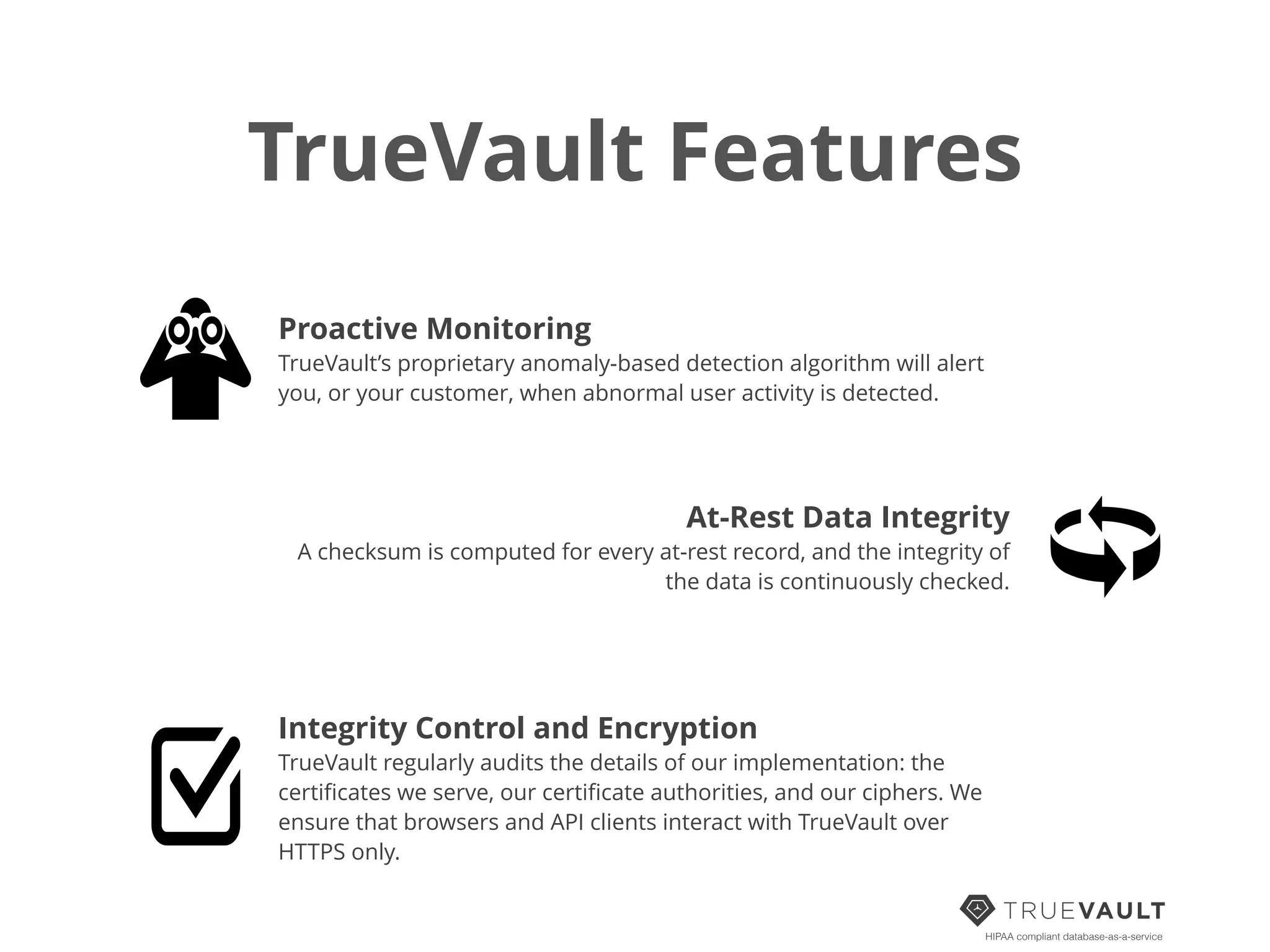
Proactive Monitoring
TrueVault’s proprietary anomaly-based detection algorithm will alert
you, or your customer, when abnormal user activity is detected.
At-Rest Data Integrity
A checksum is computed for every at-rest record, and the integrity of
the data is continuously checked.
Integrity Control and Encryption
TrueVault regularly audits the details of our implementation: the
certificates we serve, our certificate authorities, and our ciphers. We
ensure that browsers and API clients interact with TrueVault over
HTTPS only.
HIPAA compliant database-as-a-service
"Becoming HIPAA compliant as an early stage organization was a
daunting task, until we found TrueVault! Their turn-key API has
allowed us to check this box and get back to focusing on our core
product and offering."
Edith Elliott

CEO Noora Health
Try TrueVault for Free
HIPAA compliant database-as-a-service
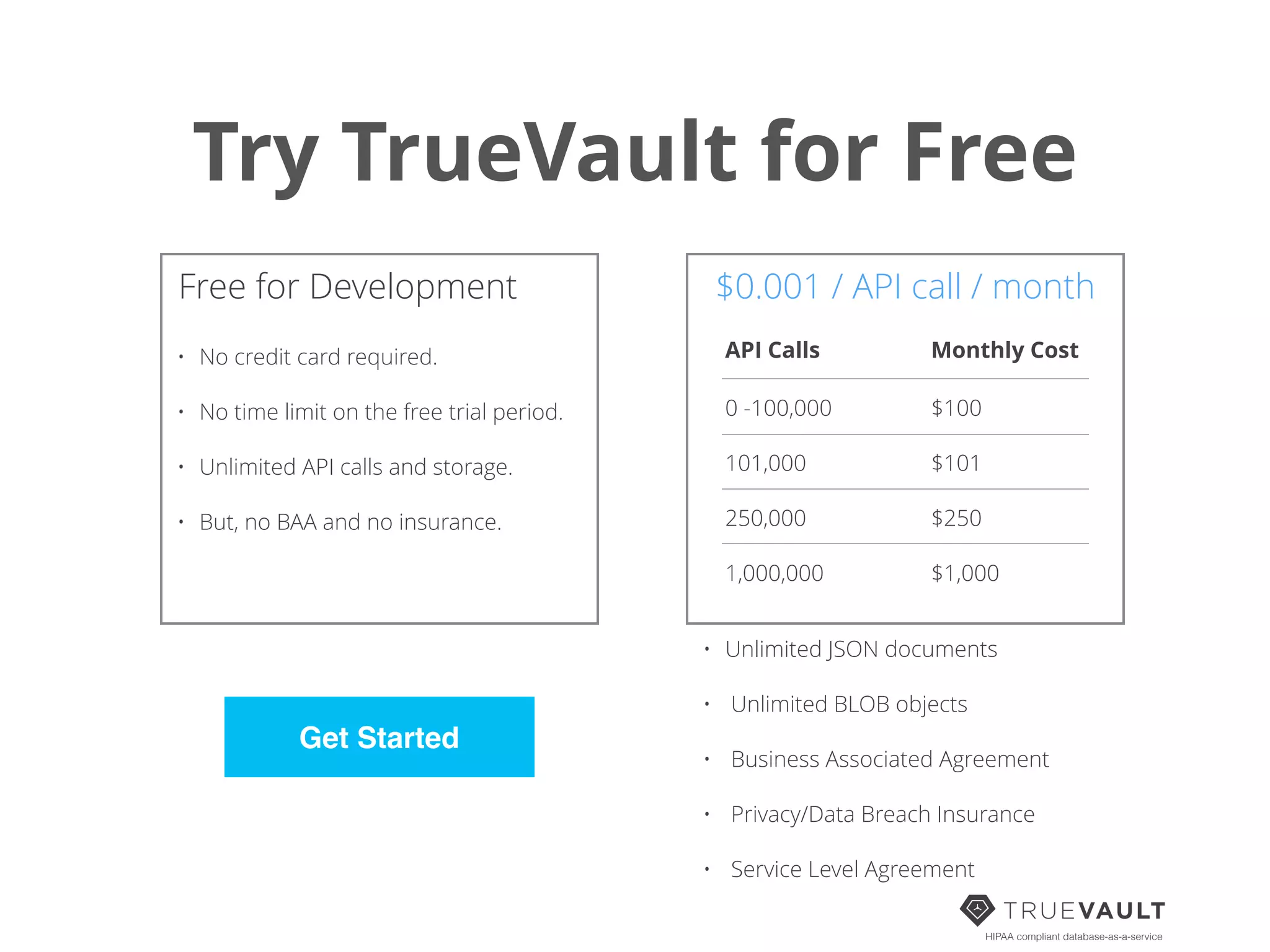
$0.001 / API call / monthFree for Development
• No credit card required.
• No time limit on the free trial period.
• Unlimited API calls and storage.
• But, no BAA and no insurance.
API Calls Monthly Cost

0 -100,000 $100
101,000 $101
250,000 $250
1,000,000 $1,000
• Unlimited JSON documents
• Unlimited BLOB objects
• Business Associated Agreement
• Privacy/Data Breach Insurance
• Service Level Agreement
Get Started

HIPAA Compliance for Developers

  • 1.
    HIPAA Compliance for Developers Breakingdown the regulatory issues around building digital health apps for fun and profit. HIPAA compliant database-as-a-service
  • 2.
    HIPAA Compliance isa 
 Brutal Time Suck! ! “[Building our own HIPAA compliant infrastructure] took upwards of 1,000 person-hours to figure out HIPAA-compliance issues. This will continue to be an ongoing cost for us, because HIPAA is an ongoing law and it changes sometimes. It takes substantial auditing time and money. TrueVault would save us all that.” 
 Posted on Hacker News by jph
 (Unsolicited comment. Not a customer.) HIPAA compliant database-as-a-service
  • 3.
    First off, Whatis HIPAA? Health Insurance Portability and Accountability Act • HIPAA sets the standard for protecting sensitive patient data. • Covered Entities and their Business Associates need to protect the privacy and security of protected health information (PHI). • Developed in 1996. HIPAA was initially created to help the public with insurance portability. In addition, they built a series of privacy tools to protect healthcare data. HIPAA compliant database-as-a-service
  • 4.
    What Does HIPAARequire? 1.Put safeguards in place to protect patient health information. 2.Reasonably limit use and sharing to the minimum necessary to accomplish your intended purpose. 3.Have agreements in place with service providers that perform covered functions. These agreements (BAAs) ensure that service providers (Business Associates) use, safeguard and disclose patient information properly. 4.Procedures to limit who can access patient health information, and training programs about how to protect patient health information. HIPAA compliant database-as-a-service
  • 5.
    The Four Rulesof HIPAA Like the four horsemen, these are the major pieces that govern what you do and how you do it. 1.HIPAA Privacy Rule 2.HIPAA Security Rule 3.HIPAA Enforcement Rule 4.HIPAA Breach Notification Rule
 HIPAA compliant database-as-a-service Developers need to focus on the Technical and Physical safeguards outlined in the Security Rule.
  • 6.
    The Privacy Rule HIPAAcompliant database-as-a-service Addresses the saving, accessing and sharing of medical and personal information of an individual, including a patient’s own right to access.
  • 7.
    The Security Rule HIPAAcompliant database-as-a-service Outlines national security standards intended to protect health data created, received, maintained, or transmitted electronically.
  • 8.
    The Security Rule HIPAAcompliant database-as-a-service September 23, 2013 Before Sept 23. Rules applied to hospitals, doctors, clinics, etc. After Sept 23. The rules now apply to anyone that touches PHI.
 
 (e.g. an IT company or a mHealth application that provides secure photo- sharing for physicians). Any company that deals with protected health information (PHI) must ensure that all the required physical, network, and process security measures are in place and followed.
  • 9.
    HIPAA compliant database-as-a-service “DoI need to be HIPAA compliant?”
  • 10.
    HIPAA compliant database-as-a-service “DoI need to be HIPAA compliant?” If you handle PHI then you need to be HIPAA compliant. The HIPAA rules apply to both Covered Entities and their Business Associates
  • 11.
    What is ProtectedHealth Information (PHI)? • PHI is any information in a medical record that can be used to identify an individual, and that was created, used, or disclosed in the course of providing a healthcare service. • Includes: • Medical records • Billing information • Health insurance information • Any individually identifiable health information HIPAA compliant database-as-a-service
  • 12.
    Electronic Protected Health Information(EPHI) HIPAA compliant database-as-a-service All individually identifiable health information that is created, maintained, or transmitted electronically.
  • 13.
    Covered Entity (CE) HIPAAcompliant database-as-a-service • Anyone who provides treatment, payment and operations in healthcare. • Includes: • Doctor’s office, dental offices, clinics, psychologists, • Nursing home, pharmacy, hospital or home healthcare agency • Health plans, insurance companies, HMOs • Government programs that pay for healthcare • Health clearing houses
  • 14.
    Business Associate (BA) HIPAAcompliant database-as-a-service • Anyone who has access to patient information, whether directly, indirectly, physically or virtually. • Any organization that provides support in the treatment, payment or operations • Includes: • IT providers, health applications • Telephone service provider, document management and destruction • Accountant, lawyer or other service provider Business associates have the responsibility to achieve and maintain HIPAA compliance in terms of all of the internal, administrative, and technical safeguards.
  • 15.
    Exceptions HIPAA compliant database-as-a-service •Entities providing data transmission services, including services that involve temporary storage of PHI that is incident to the transmission (e.g. courier services and their electronic equivalents, such as ISPs or telecoms). While entities that are “mere conduits” for PHI are not Business Associates, the rules emphasize that this exception is narrow.
  • 16.
    HIPAA compliant database-as-a-service “Whocertifies HIPAA compliance?”
  • 17.
    HIPAA compliant database-as-a-service “Whocertifies HIPAA compliance?” The short answer is no one.
  • 18.
    Who certifies HIPAA compliance? •Unlike PCI, there is no one that can “certify” that an organization is HIPAA compliant. • The Office for Civil Rights (OCR) from the Department of Health and Human Services (HHS) is the federal governing body. HHS does not endorse or recognize the “certifications” made by private organizations. • The evaluation standard in the Security Rule § 164.308(a)(8) requires you to perform a periodic technical and non-technical evaluation to make sure your security policies and procedures meet security requirements. • But, HHS doesn’t care if the evaluation is performed internally or by an external organization. HIPAA compliant database-as-a-service
  • 19.
    Penalties & Fines •Violations are expensive, to put it mildly. HIPAA compliant database-as-a-service
  • 20.
    HIPAA compliant database-as-a-service “Howdo I become HIPAA compliant?”
  • 21.
    HIPAA compliant database-as-a-service “Howdo I become HIPAA compliant?” The HIPAA Security Rule requires appropriate Administrative, Physical, and Technical Safeguards to ensure the confidentiality, integrity, and security of protected health information (PHI).
  • 22.
    3 Parts tothe Security Rule 1.Administrative Safeguards 2.Technical Safeguards 3.Physical Safeguards HIPAA compliant database-as-a-service
  • 23.
    “required” vs. “addressable” •Some implementation specifications are “required” and others are “addressable.” Required implementation specifications must be implemented. • Addressable implementation specifications must be implemented if it is reasonable and appropriate to do so; your choice must be documented. • It is important to remember that an addressable implementation specification is not optional. HIPAA compliant database-as-a-service When in doubt, you should just implement the addressable implementation specifications. Most of them are best practices anyway.
  • 24.
    Administrative Safeguards The administrativecomponents are really important when implementing a HIPAA compliance program; you are required to: 1.Assign a privacy officer 2.Complete a risk assessment annually 3.Implement employee training 4.Review policies and procedures 5.Execute Business Associate Agreements (BAAs) with all partners who handle protected health information (PHI) HIPAA compliant database-as-a-service
  • 25.
    Administrative Safeguards Companies whocan help with the administrative components of a compliance program: • Accountable -- http://accountablehq.com • Compliance Helper -- http://www.compliancehelper.com • Compliancy Group -- http://compliancy-group.com HIPAA compliant database-as-a-service
  • 26.
    Technical Safeguards 1.Access Control- Unique User Identification (required): Assign a unique name and/or number for identifying and tracking user identity. 2.Access Control - Emergency Access Procedure (required): Establish (and implement as needed) procedures for obtaining necessary ePHI during an emergency. 3.Access Control - Automatic Logoff (addressable): Implement electronic procedures that terminate an electronic session after a predetermined time of inactivity. 4.Access Control - Encryption and Decryption (addressable): Implement a mechanism to encrypt and decrypt ePHI. HIPAA compliant database-as-a-service
  • 27.
    Technical Safeguards 5.Audit Controls(required): Implement hardware, software, and/or procedural mechanisms that record and examine activity in information systems that contain or use ePHI. 6.Integrity - Mechanism to Authenticate ePHI (addressable): Implement electronic mechanisms to corroborate that ePHI has not been altered or destroyed in an unauthorized manner. 7.Authentication (required): Implement procedures to verify that a person or entity seeking access to ePHI is the one claimed. 8.Transmission Security - Integrity Controls (addressable): Implement security measures to ensure that electronically transmitted ePHI is not improperly modified without detection until disposed of. 9.Transmission Security - Encryption (addressable): Implement a mechanism to encrypt ePHI whenever deemed appropriate. HIPAA compliant database-as-a-service
  • 28.
    Physical Safeguards 1.Facility AccessControls - Contingency Operations (addressable): Establish (and implement as needed) procedures that allow facility access in support of restoration of lost data under the disaster recovery plan and emergency mode operations plan in the event of an emergency. 2.Facility Access Controls - Facility Security Plan (addressable): Implement policies and procedures to safeguard the facility and the equipment therein from unauthorized physical access, tampering, and theft. 3.Facility Access Controls - Access Control and Validation Procedures (addressable): Implement procedures to control and validate a person’s access to facilities based on their role or function, including visitor control, and control of access to software programs for testing and revision. 4.Facility Access Controls - Maintenance Records (addressable): Implement policies and procedures to document repairs and modifications to the physical components of a facility which are related to security (e.g. hardware, walls, doors, and locks). 5.Workstation Use (required): Implement policies and procedures that specify the proper functions to be performed, the manner in which those functions are to be performed, and the physical attributes of the surroundings of a specific workstation or class of workstation that can access ePHI. HIPAA compliant database-as-a-service HIPAA Compliant Hosting Providers can take care of some of the Physical Safeguards for you.
  • 29.
    Physical Safeguards 6.Workstation Security(required): Implement physical safeguards for all workstations that access ePHI, to restrict access to authorized users. 7.Device and Media Controls - Disposal (required): Implement policies and procedures to address the final disposition of ePHI, and/or the hardware or electronic media on which it is stored. 8.Device and Media Controls - Media Re-Use (required): Implement procedures for removal of ePHI from electronic media before the media are made available for re-use. 9.Device and Media Controls - Accountability (addressable): Maintain a record of the movements of hardware and electronic media and any person responsible therefore. 10.Device and Media Controls - Data Backup and Storage (addressable): Create a retrievable, exact copy of ePHI, when needed, before movement of equipment. HIPAA compliant database-as-a-service
  • 30.
    TrueVault Handles All TechnicalRequirements HIPAA compliant database-as-a-service Administrative Safeguards Technical Safeguards Encryption and Decryption, Key Management, Key Rotation, Access Control, Unique User Identification, Emergency Access, Automatic Logoff, Audit Controls, Mechanism to Authenticate Electronic PHI, Person or Entity Authentication, Transmission Security, Integrity Controls Physical Safeguards Facility Access Ctrl, Workstation Use and Security, Devices and Media Controls HIPAA Compliant Hosting TrueVault • TrueVault handles both Technical and Physical Safeguards. ! • Develop a healthcare application without building a HIPAA compliant infrastructure. ! • FireHost and AWS have high minimum charges ($1,115 and $1,500) and offer no help with the Technical Safeguards.
  • 31.
    How Does TrueVaultFit In? HIPAA compliant database-as-a-service ! • Developers access TrueVault via a RESTful API and native clients. ! • Typical integration takes days. TrueVault works just like any other API services. ! • TrueVault provides all client- side and server-side functionalities required by HIPAA. Customer)Backend)Web) Services)) Standard)Database) TrueVault) (HIPAA)Compliant)) non@PHI)Data) PHI)Data) (REST)API))
  • 32.
    TrueVault Features HIPAA compliantdatabase-as-a-service JSON Store The TrueVault JSON Store is a lightweight, document-oriented storage system, and enables persistent HIPAA compliant storage of JSON documents. BLOB Store The TrueVault BLOB (binary large object) Store offers HIPAA compliant binary storage for any file format. This includes DICOM files (e.g. X-Rays, CT Scans, MRIs), PDFs, scanned medical records, images, and videos. Encrypted Search Search encrypted data stored in TrueVault. Query (GET) documents by any field, not just the documentId.
  • 33.
    TrueVault Features HIPAA compliantdatabase-as-a-service Browser-to-TrueVault Upload Browser-to-TrueVault direct file upload and download web form. You can upload binary files directly to TrueVault’s BLOB Store using HTML forms. User Management and Authentication User Management console. You can create and manage users, groups, and permissions via TrueVault so that PHI never touches your stack. TrueVault provides identity and access management, plus 2-factor authentication out of the box. Use our identity API for custom access flows or add Sign-In, Sign-Up, and My Account pages in seconds with our JavaScript user controls. Encryption and Decryption TrueVault encrypts all at-rest data with AES-256 and stores keys securely. Our infrastructure for healthcare data storage and transmission runs in a separate hosting environment inaccessible by our primary services.
  • 34.
    TrueVault Features HIPAA compliantdatabase-as-a-service Audit Control Every user action and API call is automatically recorded for compliance. An audit log can be searched and retrieved via our API. Automatic Logoff Configure the automatic user session timeout window via our API or the Management Console. Emergency Access Easily add an Emergency Access Request page to your app with a CNAME record. We’ll handle the authentication flow for you, and track activities for compliance. Single-user credentials can also be created via the API for custom emergency workflows.
  • 35.
    TrueVault Features HIPAA compliantdatabase-as-a-service Proactive Monitoring TrueVault’s proprietary anomaly-based detection algorithm will alert you, or your customer, when abnormal user activity is detected. At-Rest Data Integrity A checksum is computed for every at-rest record, and the integrity of the data is continuously checked. Integrity Control and Encryption TrueVault regularly audits the details of our implementation: the certificates we serve, our certificate authorities, and our ciphers. We ensure that browsers and API clients interact with TrueVault over HTTPS only.
  • 36.
    HIPAA compliant database-as-a-service "BecomingHIPAA compliant as an early stage organization was a daunting task, until we found TrueVault! Their turn-key API has allowed us to check this box and get back to focusing on our core product and offering." Edith Elliott
 CEO Noora Health
  • 37.
    Try TrueVault forFree HIPAA compliant database-as-a-service $0.001 / API call / monthFree for Development • No credit card required. • No time limit on the free trial period. • Unlimited API calls and storage. • But, no BAA and no insurance. API Calls Monthly Cost 
0 -100,000 $100 101,000 $101 250,000 $250 1,000,000 $1,000 • Unlimited JSON documents • Unlimited BLOB objects • Business Associated Agreement • Privacy/Data Breach Insurance • Service Level Agreement Get Started