Banana Fiber

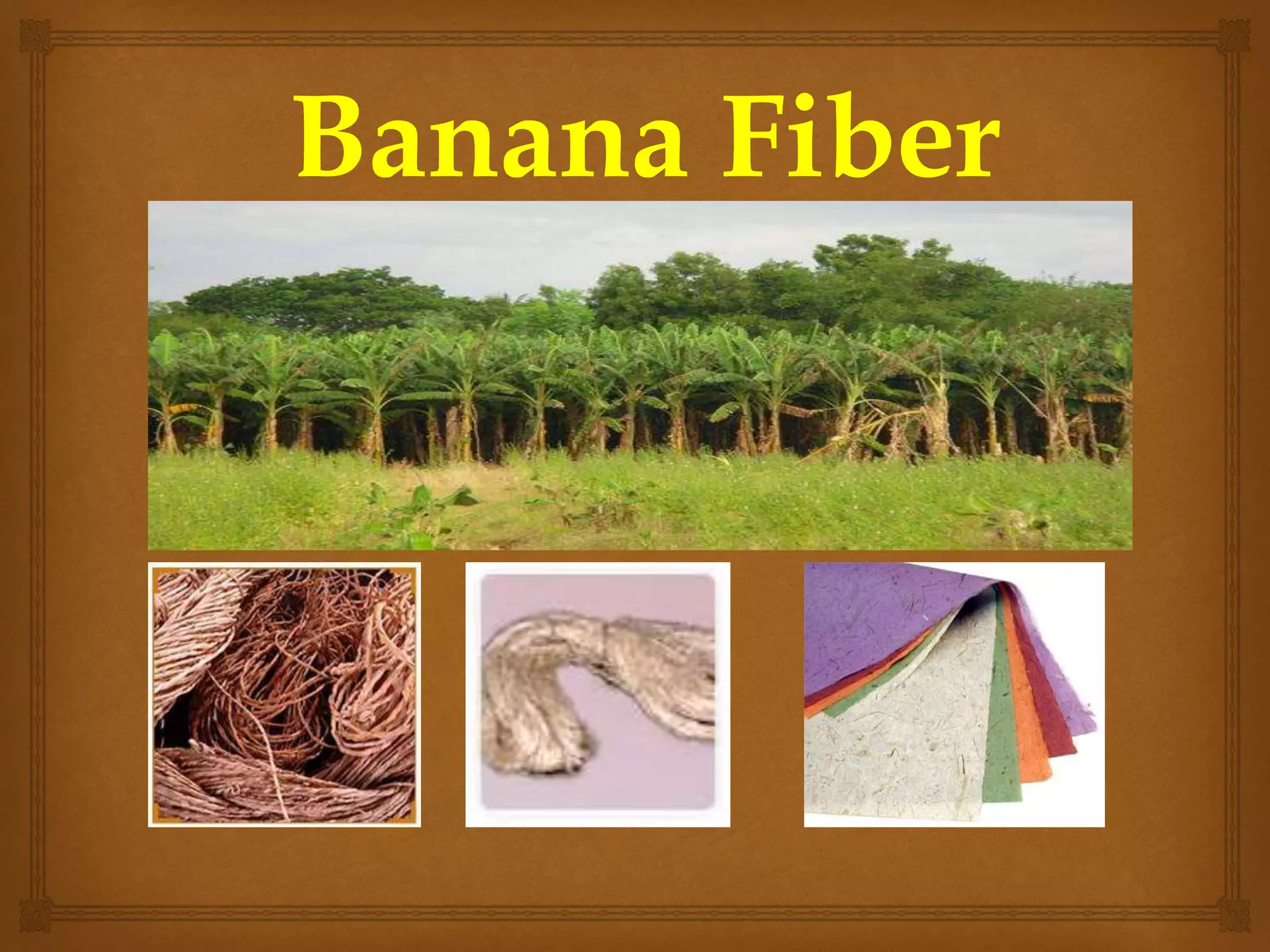
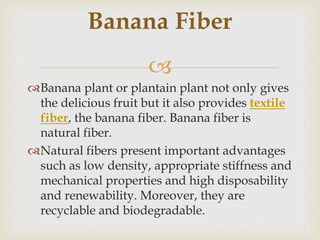
Banana plant or plantain plant not only gives
the delicious fruit but it also provides textile
fiber, the banana fiber. Banana fiber is
natural fiber.
Natural fibers present important advantages
such as low density, appropriate stiffness and
mechanical properties and high disposability
and renewability. Moreover, they are
recyclable and biodegradable.
Banana Fiber

There has been lot of research on use of natural
fibers in reinforcements. Banana fiber, a ligno-
cellulosic fiber, obtained from the pseudo-stem of
banana plant (Musa sepientum), is a bast fiber
with relatively good mechanical properties.
Banana plant is a large perennial herb with leaf
sheaths that form pseudo stem. Its height can be
10-40 feet (3.0-12.2 meters) surrounding with 8-12
large leaves. The leaves are up to 9 feet long and 2
feet wide (2.7 meters and 0.61 meter).
Banana plant is available throughout Thailand
and Southeast Asian, India, Bangladesh,
Indonesia, Malaysia, Philippines, Hawaii, and
some Pacific islands.

Appearance of banana fiber is similar to that of
bamboo fiber and ramie fiber, but its fineness
and spinnability is better than the two.
The chemical composition of banana fiber is
cellulose, hemicellulose, and lignin.
It is highly strong fiber.
It has smaller elongation.
It has somewhat shiny appearance depending
upon the extraction & spinning process
characteristics of
banana fibers

It is light weight.
It has strong moisture absorption quality. It
absorbs as well as releases moisture very fast.
It is bio- degradable and has no negative
effect on environment and thus can be
categorized as eco-friendly fiber.
Its average fineness is 2400Nm.
It can be spun through almost all the
methods of spinning including ring
spinning, open-end spinning, bast fiber
spinning, and semi-worsted spinning among
others.

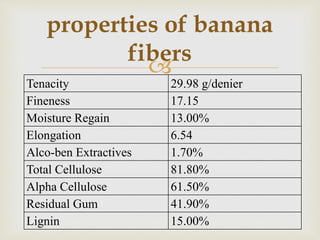
properties of banana
fibers
Tenacity 29.98 g/denier
Fineness 17.15
Moisture Regain 13.00%
Elongation 6.54
Alco-ben Extractives 1.70%
Total Cellulose 81.80%
Alpha Cellulose 61.50%
Residual Gum 41.90%
Lignin 15.00%

Banana fiber is similar to that of bamboo
fiber, but its fineness and spin ability is
better.
The chemical composition of banana fiber is
cellulose, hemicellulose, and lignin.
It is highly strong fiber.
It has smaller elongation.
It has got shiny appearance depending upon
the extraction & spinning process.
Properties of banana
fiber

It is light weight.
It absorbs as well as releases moisture
very fast.
It is bio- degradable and has no
negative effect on environment and
thus can be categorized as eco-friendly
fiber.
It can be spun through almost all the
methods of spinning including ring
spinning, open-end spinning, bast fiber
spinning, and semi-worsted spinning
among others.

 Composite building materials such as cements,
concrete.
 Reinforced plastics such as fiber reinforced polymer.
 Metal composites.
 Ceramic composites (composite ceramic and metal
matrices).
 Synthetic composites: composite materials made of
artificially produced materials.
Examples: Glass reinforced plastic, Thermo-plastic
composites.
Types of composites

 Plant fibers are usually consists of cellulose:
examples cotton, jute, bamboo, flax, ramie, hemp,
coir and sisal. Cellulose fibers are used in various
applications.
1. Silk fibers (Kapok and cotton)
2. Fruit fibers (Banana and coconut)
3. Stalk fibers (Rice, bamboos, wheat)
4. Leaf fibers (Agave and sisal)
5. Skin fibers (Obtained from the skin of the stems)
Plant fibers
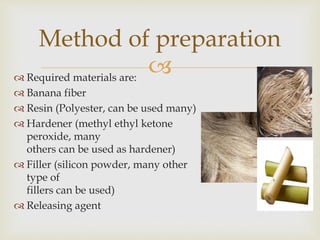
 Required materials are:
 Banana fiber
 Resin (Polyester, can be used many)
 Hardener (methyl ethyl ketone
peroxide, many
others can be used as hardener)
 Filler (silicon powder, many other
type of
fillers can be used)
 Releasing agent
Method of preparation
 The banana fiber is obtained from banana plant.
 The extracted banana fiber firstly sun dried and then dried in oven to
remove water content present in the fiber.
 Then banana fiber of different length is mixed with matrix mixture with
their respective values by simple mechanical stirring and mixture are
slowly poured in different moulds.
 Releasing agent is used on mould sheet which gives ease to removal of
composite from the mould.
 After pouring in to the mould it is heated to 30°C for approximately 24
hours.
 A constant load is applied on to the mould.
 After curing is done, the specimen is taken out from the mould.
Steps involved

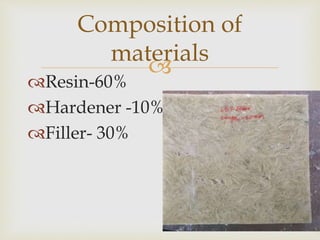
Resin-60%
Hardener -10%
Filler- 30%
Composition of
materials

Banana Fiber Extraction
Processing, Yarn Spinning &
Weaving:
The extraction of the natural fiber from the
plant required certain care to avoid damage. In
the present experiments, initially the banana
plant sections were cut from the main stem of
the plant and then rolled lightly to remove the
excess moisture. Impurities in the rolled fibers
such as pigments, broken fibers, coating of
cellulose etc.

were removed manually by means of comb,
and then the fibers were cleaned and dried.
This mechanical and manual extraction of
banana fibers was tedious, time consuming,
and caused damage to the fiber.
Consequently, this type of technique cannot
be recommended for industrial application.
A special machine was designed and
developed for the extraction of banana fibers
in a mechanically automated manner. It
consisted mainly of two horizontal beams
whereby a carriage with an attached and
specially designed comb, could move back
and forth.

 The fiber extraction using this technique could be
performed simply by placing a cleaned part of the
banana stem on the fixed platform of the machine,
and clamped at the ends by jaws. This eliminated
relative movement of the stem and avoided
premature breakage of the fibers. This was followed
by cleaning and drying of the fibers in a chamber at
200 C for three hours. These fibers were then labeled
and ready for lamination process.
After fiber is collected, the process goes to yarn
spinning. The researcher investigated the traditional
process, which use the filament yarns in weaving
banana fabric.

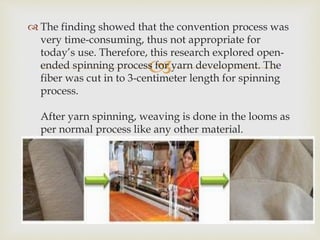
 The finding showed that the convention process was
very time-consuming, thus not appropriate for
today’s use. Therefore, this research explored open-
ended spinning process for yarn development. The
fiber was cut in to 3-centimeter length for spinning
process.
After yarn spinning, weaving is done in the looms as
per normal process like any other material.

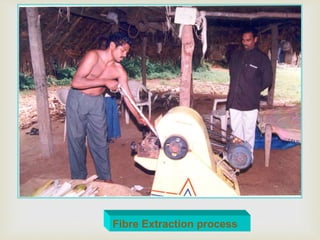
Fibre Extraction process

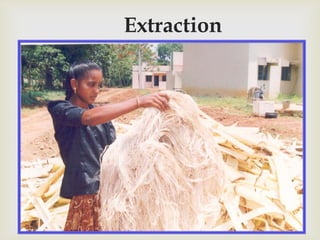
Extraction

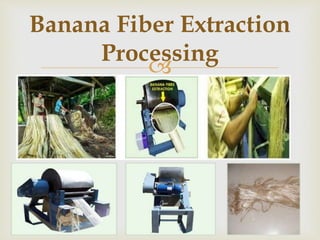
Banana Fiber Extraction
Processing

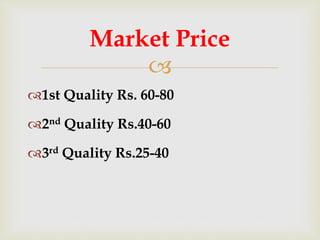
1st Quality Rs. 60-80
2nd Quality Rs.40-60
3rd Quality Rs.25-40
Market Price

Extracks 15 kg fiber in 8 hours.
Consumes less Electricity, That is 0.75 units
per hour
Provides fiber of superior quality in terms of
length softness , Strength, and colour
Less Maintenance, Easy and safe to operate.
Clean work Environment
Reduces Drudgery.
Advantage of the
Machine

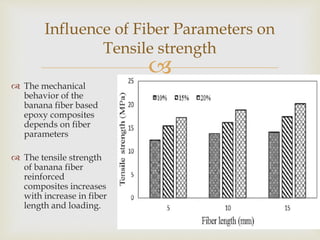
 The mechanical
behavior of the
banana fiber based
epoxy composites
depends on fiber
parameters
 The tensile strength
of banana fiber
reinforced
composites increases
with increase in fiber
length and loading.
Influence of Fiber Parameters on
Tensile strength
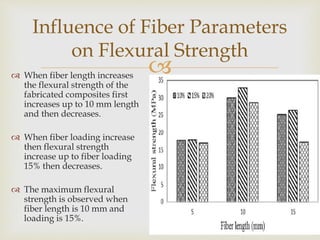
 When fiber length increases
the flexural strength of the
fabricated composites first
increases up to 10 mm length
and then decreases.
 When fiber loading increase
then flexural strength
increase up to fiber loading
15% then decreases.
 The maximum flexural
strength is observed when
fiber length is 10 mm and
loading is 15%.
Influence of Fiber Parameters
on Flexural Strength
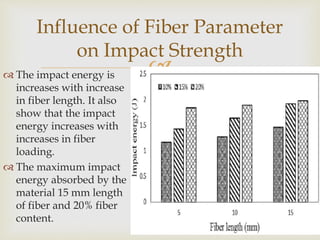
 The impact energy is
increases with increase
in fiber length. It also
show that the impact
energy increases with
increases in fiber
loading.
 The maximum impact
energy absorbed by the
material 15 mm length
of fiber and 20% fiber
content.
Influence of Fiber Parameter
on Impact Strength
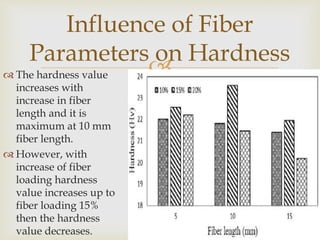
 The hardness value
increases with
increase in fiber
length and it is
maximum at 10 mm
fiber length.
 However, with
increase of fiber
loading hardness
value increases up to
fiber loading 15%
then the hardness
value decreases.
Influence of Fiber
Parameters on Hardness

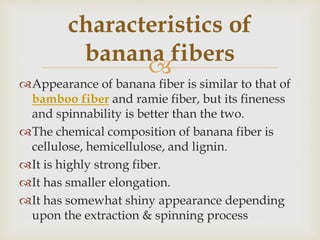
To make currencies, bond papers , and speciality
papers which can last for 100 years
As a very good replacement for wood pulp in
paper industry, as it has high cellulose
content,thus reducing the Environmental impact
of deforestation
In making composite materials as a replacement
for fiber glass
Uses of Banana Fiber

For manufacturing mattresses, pillows and
cushions in the furniture industry.
In handicraft, extensively for making bags,
purse, mobile phone cover, door mats,
curtains, and yoga mats etc.
In the manufacture of textiles
Research is underway to find out other uses
of this fiber

In the recent past, banana fiber had a very
limited application and was primarily used
for making items like ropes, mats, and some
other composite materials. With the
increasing environmental awareness and
growing importance of eco-friendly fabrics,
banana fiber has also been recognized for all
its good qualities and now its application is
increasing in other fields too such as apparel
garments and home furnishings.
Applications of Banana
Fiber

 . However, in Japan, it is being used for
making traditional dresses like kimono, and
kamishimo since the Edo period (1600-1868).
Due to its being lightweight and comfortable
to wear, it is still preferred by people there as
summer wear.
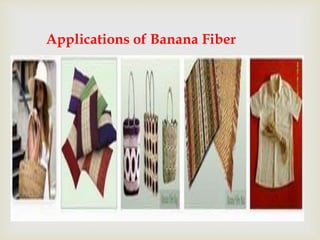
 Banana fiber is also used to make fine
cushion covers, Necties, bags, table cloths,
curtains etc. Rugs made from banana silk
yarn fibers are also very popular world over.

Applications of Banana Fiber


Banana fiber

  • 1.
  • 2.
     Banana plant orplantain plant not only gives the delicious fruit but it also provides textile fiber, the banana fiber. Banana fiber is natural fiber. Natural fibers present important advantages such as low density, appropriate stiffness and mechanical properties and high disposability and renewability. Moreover, they are recyclable and biodegradable. Banana Fiber
  • 3.
     There has beenlot of research on use of natural fibers in reinforcements. Banana fiber, a ligno- cellulosic fiber, obtained from the pseudo-stem of banana plant (Musa sepientum), is a bast fiber with relatively good mechanical properties. Banana plant is a large perennial herb with leaf sheaths that form pseudo stem. Its height can be 10-40 feet (3.0-12.2 meters) surrounding with 8-12 large leaves. The leaves are up to 9 feet long and 2 feet wide (2.7 meters and 0.61 meter). Banana plant is available throughout Thailand and Southeast Asian, India, Bangladesh, Indonesia, Malaysia, Philippines, Hawaii, and some Pacific islands.
  • 4.
     Appearance of bananafiber is similar to that of bamboo fiber and ramie fiber, but its fineness and spinnability is better than the two. The chemical composition of banana fiber is cellulose, hemicellulose, and lignin. It is highly strong fiber. It has smaller elongation. It has somewhat shiny appearance depending upon the extraction & spinning process characteristics of banana fibers
  • 5.
     It is lightweight. It has strong moisture absorption quality. It absorbs as well as releases moisture very fast. It is bio- degradable and has no negative effect on environment and thus can be categorized as eco-friendly fiber. Its average fineness is 2400Nm. It can be spun through almost all the methods of spinning including ring spinning, open-end spinning, bast fiber spinning, and semi-worsted spinning among others.
  • 6.
     properties of banana fibers Tenacity29.98 g/denier Fineness 17.15 Moisture Regain 13.00% Elongation 6.54 Alco-ben Extractives 1.70% Total Cellulose 81.80% Alpha Cellulose 61.50% Residual Gum 41.90% Lignin 15.00%
  • 7.
     Banana fiber issimilar to that of bamboo fiber, but its fineness and spin ability is better. The chemical composition of banana fiber is cellulose, hemicellulose, and lignin. It is highly strong fiber. It has smaller elongation. It has got shiny appearance depending upon the extraction & spinning process. Properties of banana fiber
  • 8.
     It is lightweight. It absorbs as well as releases moisture very fast. It is bio- degradable and has no negative effect on environment and thus can be categorized as eco-friendly fiber. It can be spun through almost all the methods of spinning including ring spinning, open-end spinning, bast fiber spinning, and semi-worsted spinning among others.
  • 9.
      Composite buildingmaterials such as cements, concrete.  Reinforced plastics such as fiber reinforced polymer.  Metal composites.  Ceramic composites (composite ceramic and metal matrices).  Synthetic composites: composite materials made of artificially produced materials. Examples: Glass reinforced plastic, Thermo-plastic composites. Types of composites
  • 10.
      Plant fibersare usually consists of cellulose: examples cotton, jute, bamboo, flax, ramie, hemp, coir and sisal. Cellulose fibers are used in various applications. 1. Silk fibers (Kapok and cotton) 2. Fruit fibers (Banana and coconut) 3. Stalk fibers (Rice, bamboos, wheat) 4. Leaf fibers (Agave and sisal) 5. Skin fibers (Obtained from the skin of the stems) Plant fibers
  • 11.
     Required materialsare:  Banana fiber  Resin (Polyester, can be used many)  Hardener (methyl ethyl ketone peroxide, many others can be used as hardener)  Filler (silicon powder, many other type of fillers can be used)  Releasing agent Method of preparation
  • 12.
     The bananafiber is obtained from banana plant.  The extracted banana fiber firstly sun dried and then dried in oven to remove water content present in the fiber.  Then banana fiber of different length is mixed with matrix mixture with their respective values by simple mechanical stirring and mixture are slowly poured in different moulds.  Releasing agent is used on mould sheet which gives ease to removal of composite from the mould.  After pouring in to the mould it is heated to 30°C for approximately 24 hours.  A constant load is applied on to the mould.  After curing is done, the specimen is taken out from the mould. Steps involved
  • 13.
  • 14.
     Banana Fiber Extraction Processing,Yarn Spinning & Weaving: The extraction of the natural fiber from the plant required certain care to avoid damage. In the present experiments, initially the banana plant sections were cut from the main stem of the plant and then rolled lightly to remove the excess moisture. Impurities in the rolled fibers such as pigments, broken fibers, coating of cellulose etc.
  • 15.
     were removed manuallyby means of comb, and then the fibers were cleaned and dried. This mechanical and manual extraction of banana fibers was tedious, time consuming, and caused damage to the fiber. Consequently, this type of technique cannot be recommended for industrial application. A special machine was designed and developed for the extraction of banana fibers in a mechanically automated manner. It consisted mainly of two horizontal beams whereby a carriage with an attached and specially designed comb, could move back and forth.
  • 16.
      The fiberextraction using this technique could be performed simply by placing a cleaned part of the banana stem on the fixed platform of the machine, and clamped at the ends by jaws. This eliminated relative movement of the stem and avoided premature breakage of the fibers. This was followed by cleaning and drying of the fibers in a chamber at 200 C for three hours. These fibers were then labeled and ready for lamination process. After fiber is collected, the process goes to yarn spinning. The researcher investigated the traditional process, which use the filament yarns in weaving banana fabric.
  • 17.
      The findingshowed that the convention process was very time-consuming, thus not appropriate for today’s use. Therefore, this research explored open- ended spinning process for yarn development. The fiber was cut in to 3-centimeter length for spinning process. After yarn spinning, weaving is done in the looms as per normal process like any other material.
  • 18.
  • 21.
  • 22.
  • 23.
  • 24.
     1st Quality Rs.60-80 2nd Quality Rs.40-60 3rd Quality Rs.25-40 Market Price
  • 25.
     Extracks 15 kgfiber in 8 hours. Consumes less Electricity, That is 0.75 units per hour Provides fiber of superior quality in terms of length softness , Strength, and colour Less Maintenance, Easy and safe to operate. Clean work Environment Reduces Drudgery. Advantage of the Machine
  • 26.
      The mechanical behaviorof the banana fiber based epoxy composites depends on fiber parameters  The tensile strength of banana fiber reinforced composites increases with increase in fiber length and loading. Influence of Fiber Parameters on Tensile strength
  • 27.
     When fiberlength increases the flexural strength of the fabricated composites first increases up to 10 mm length and then decreases.  When fiber loading increase then flexural strength increase up to fiber loading 15% then decreases.  The maximum flexural strength is observed when fiber length is 10 mm and loading is 15%. Influence of Fiber Parameters on Flexural Strength
  • 28.
     The impactenergy is increases with increase in fiber length. It also show that the impact energy increases with increases in fiber loading.  The maximum impact energy absorbed by the material 15 mm length of fiber and 20% fiber content. Influence of Fiber Parameter on Impact Strength
  • 29.
     The hardnessvalue increases with increase in fiber length and it is maximum at 10 mm fiber length.  However, with increase of fiber loading hardness value increases up to fiber loading 15% then the hardness value decreases. Influence of Fiber Parameters on Hardness
  • 30.
     To make currencies,bond papers , and speciality papers which can last for 100 years As a very good replacement for wood pulp in paper industry, as it has high cellulose content,thus reducing the Environmental impact of deforestation In making composite materials as a replacement for fiber glass Uses of Banana Fiber
  • 31.
     For manufacturing mattresses,pillows and cushions in the furniture industry. In handicraft, extensively for making bags, purse, mobile phone cover, door mats, curtains, and yoga mats etc. In the manufacture of textiles Research is underway to find out other uses of this fiber
  • 32.
     In the recentpast, banana fiber had a very limited application and was primarily used for making items like ropes, mats, and some other composite materials. With the increasing environmental awareness and growing importance of eco-friendly fabrics, banana fiber has also been recognized for all its good qualities and now its application is increasing in other fields too such as apparel garments and home furnishings. Applications of Banana Fiber
  • 33.
      . However,in Japan, it is being used for making traditional dresses like kimono, and kamishimo since the Edo period (1600-1868). Due to its being lightweight and comfortable to wear, it is still preferred by people there as summer wear.  Banana fiber is also used to make fine cushion covers, Necties, bags, table cloths, curtains etc. Rugs made from banana silk yarn fibers are also very popular world over.
  • 34.
  • 35.