Medium Voltage
Cable Accessories
A Theoretical & Practical Appraisal
Dr. Derek Goulsbra
CEng. MIET
Medium Voltage
Cable Accessories
A Theoretical & Practical Appraisal
Dr. Derek Goulsbra
CEng. MIET
Published by Nexans Power Accessories (UK) Ltd
Unit 2
Aire & Calder Industrial Park
Lock Lane
Castleford
West Yorkshire
United Kingdom WF10 2JA
www.nexans.co.uk
+44 (0) 1977 669966
sales@nexansdirect.com
First published 2012
Text © Derek Goulsbra CEng. MIET
Images © Nexans Power Accessories (UK) Ltd
ISBN: 978-0-9573785-0-6
The moral right of Derek Goulsbra to be identified
as the author of this work has been asserted.
All rights reserved. No part of this book may be
reproduced or transferred in any form or by any
means, graphic, electronic, or mechanical,
including photocopying, recording, taping, or by
any information storage retrieval system, without
the written permission of the author.
Although the author and publisher have made
every effort to ensure that the information in this
book was correct at press time, the author and
publisher do not assume and hereby disclaim
any liability to any party for any loss, damage,
or disruption caused by errors or omissions,
whether such errors or omissions result from
negligence, accident, or any other cause. The
contents of this book do not constitute or replace
any manufacturers installation procedures. It is
the responsibility of installers to ensure that
they are adequately trained in the installation
of medium voltage accessories. Nexans Power
Accessories (UK) Ltd and the author will not be
held responsible for incorrect installation practises
that deviate from manufacturers installation
procedures issued with accessories.
Foreword

iii

This book is a follow up to an earlier edition entitled “Some thoughts on MV cable
accessories”. Greater emphasis is placed on modes of failure and ways to overcome
potential problems encountered in the field. It is the aim of the book to provide as
much information as possible to engineers and jointers who are responsible for
specifying and installing these products. It is hoped that by following the information
presented, the reliability of accessories will be improved thus saving considerably
on the cost of failures due to loss of supply, labour and equipment replacement.
Cable accessories account for the least capital expenditure in the distribution
network when compared with switchgear, transformers and cables, but can prove
to be the weakest part of it because they have to be assembled on site. This book
will describe in detail the workings of accessories and show why common faults can
occur and the steps to be taken to prevent problems.
Some of the mathematics and associated assumptions relating to voltage
distribution in this work are simplified and two-dimensional. In reality we a looking
at complex three-dimensional models, but it is felt that it is unnecessary to proceed
down this path in order to explain in broad terms how certain phenomena occur.
The author makes no apology for this, but begs the reader understands the purpose
of the work.
Nexans Power Accessories (UK) Ltd
iv

Acknowledgements

I am indebted to the help and encouragement given by Gary Halton, Mick Dawn,
Emma Hutton and Jon Rhodes of Nexans Power Accessories (UK) Ltd. The following
companies have been most helpful in providing information and illustrations and
their cooperation is much appreciated.
• CMP Products – www.cmp-products.co.uk
• Ellis Patents Ltd – www.ellispatents.co.uk
• W T Henley Limited – www.wt-henley.com
• Nexans Power Accessories (UK) Ltd – www.nexans.co.uk
Contents

v

Chapter 1

An introduction

1

Chapter 2

Electrical breakdown of air and solid dielectrics

3

2.1. Electrical breakdown of air

2.2. Electrical breakdown of solid insulating materials
2.3. Effect of air/solid combinations on voltage
distribution

2.3.1. Voltage distribution between infinite parallel
plates
2.3.2. Voltage distribution between concentric
cylinders
2.3.3. Voltage distribution between concentric
cylinders with two dielectrics
2.3.4. Maximum electric stress in a cylindrical
dielectric
Chapter 3

Some practical examples of mixed dielectrics
in accessories
3.1. Cable breakout area of paper belted cable
3.2. Adjacent unscreened cores

3.3. The end of an earth screen on polymeric cable
3.4. Area surrounding a connector in a joint

19
vi

Medium Voltage Cable Accessories

Chapter 4

Some notes on cable preparation

23

4.1. Tools for removing outer sheath and insulation
4.2. Removing a bonded screen
4.3. Removing easy peel screen

4.3.1. Method 1 – using basic tools

4.3.2. Method 2 – using sophisticated tooling

4.4. Graphite coated conductive tape wrapped cores
Chapter 5

Treating the screen cut on polymeric cables

31

5.1. The problem area

5.2. Some techniques for eliminating potential voids
5.2.1. Conductive paint

5.2.2. Void filling stress relieving tape
5.2.3. Pliable stress control
5.3. Pros and Cons
Chapter 6

Stress control on paper belted cables

35

6.1. Initial preparation of paper belted cable

6.2. Cable breakout area of unscreened paper cable
6.3. Screening the cable cores
Chapter 7

Stress control in polymeric cable accessories

41

7.1. Stresses within a cable

7.2. Stress control at screen cut
7.2.1. Swamping

7.2.2. Geometric stress control
7.2.3. Electrical stress control
7.3. Stress control in joints

7.3.1. Stress relieving tape around the connector
7.3.2. The Faraday Cage
Chapter 8

Terminations 1 – A practical appraisal
8.1. The function of a termination
8.2. Management of air

49
Medium Voltage Cable Accessories

8.2.1. Paper belted terminations

8.2.2. Screened cable terminations

8.2.3. Screened cable terminations – some examples
8.3. Connection to equipment bushings
8.3.1. Heat shrink mouldings
8.3.2. Push on mouldings

8.4. Issues with bushing connection insulating systems
8.5. Outdoor terminations
Chapter 9

Terminations 2 – Separable connectors

63

9.1. Introduction

9.2. A screened separable connector
9.3. Bushings

9.4. Cable reducers

9.5. Connecting to a bushing

9.6. Connecting more than one cable per phase
Chapter 10

Terminations 3 – Earthing
10.1. Introduction

10.2. Outdoor terminations

10.2.1. Single core cable with copper wires or
copper tape screen

10.2.2. Single core polymeric cable with aluminium armour
10.2.3. Three core polymeric cable with steel wire armour
10.2.4. Three core paper cable with corrugated
aluminium sheath

10.2.5. Paper cable with lead sheath and steel wire armours
10.2.6. Three core paper cable with steel tape armour
10.3. Indoor terminations

10.3.1. Single core unarmoured polymeric cable

10.3.2. Single core cable with tape screen and armours
10.3.3. Three core paper cable with corrugated
aluminium sheath

10.3.4. Three core cable with steel wire armours

71

vii
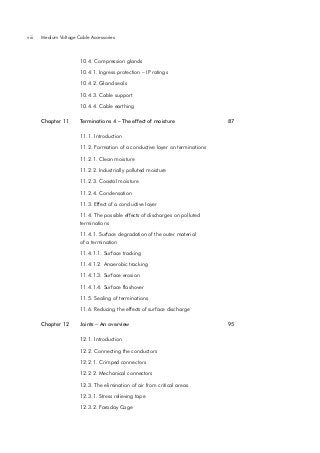
viii

Medium Voltage Cable Accessories

10.4. Compression glands

10.4.1. Ingress protection – IP ratings
10.4.2. Gland seals

10.4.3. Cable support

10.4.4. Cable earthing
Chapter 11

Terminations 4 – The effect of moisture

87

11.1. Introduction

11.2. Formation of a conductive layer on terminations
11.2.1. Clean moisture

11.2.2. Industrially polluted moisture
11.2.3. Coastal moisture
11.2.4. Condensation

11.3. Effect of a conductive layer

11.4. The possible effects of discharges on polluted
terminations
11.4.1. Surface degradation of the outer material
of a termination
11.4.1.1. Surface tracking

11.4.1.2. Anaerobic tracking
11.4.1.3. Surface erosion

11.4.1.4. Surface flashover

11.5. Sealing of terminations

11.6. Reducing the effects of surface discharge
Chapter 12

Joints – An overview
12.1. Introduction

12.2. Connecting the conductors
12.2.1. Crimped connectors

12.2.2. Mechanical connectors

12.3. The elimination of air from critical areas
12.3.1. Stress relieving tape
12.3.2. Faraday Cage

95
Medium Voltage Cable Accessories

12.4. Stress control

12.4.1. Geometric type – a) push on

12.4.2. Geometric type – b) cold shrink
12.4.3. High permittivity

12.5. Thickness of insulation
12.6. Sealing the joint

12.6.1. The one piece joint

12.6.2. The multi layered joint
12.7. Earthing

12.7.1. Single core

12.7.2. Three core joint earth
12.8. Mechanical strength
12.9. Hybrid joints

12.9.1. Moulded Faraday Cage over connector
12.9.2. Shrink tubes and resin combination
Chapter 13

Earthing of single core cables

109

13.1. Induced voltages and currents in single core cables
13.1.1. Induced voltage
13.1.2. Induced current

13.2. Some practical situations
13.2.1. Short cable length

13.2.2. Medium cable length
13.2.3. Long cable runs

13.3. Fault caused by circulating current
13.4. Conclusions
Chapter 14

Type testing of accessories
14.1. Introduction

14.2. Some qualification tests for accessories
14.2.1. DC withstand

14.2.2. AC dry withstand

14.2.3. AC wet withstand – outdoor terminations only

115

ix
x

Medium Voltage Cable Accessories

14.2.4. Partial discharge

14.2.5. Impact test – joints only
14.2.6. Thermal cycling

14.2.7. Impulse voltage withstand

14.2.8. Humidity – indoor terminations only

14.2.9. Salt fog test – outdoor terminations only

14.2.10. Immersion test – outdoor terminations only
14.2.11. Thermal short circuit

14.2.12. Dynamic short circuit
14.2.13. Inspection

14.3. Test voltage levels

14.4. Testing terminations to HD 629/BS 7888
14.5. Testing joints to HD 629/BS 7888

14.6. Testing screened separable connectors
14.7. Limitations of type testing
Chapter 15

Surge arresters

129

15.1. Introduction

15.2. Metal Oxide Arrester

15.3. Typical surge arresters and connections
Chapter 16

Testing of cable and equipment

133

Chapter 17

Cable supports

141

17.1. Introduction
17.2. Cleats

17.2.1. Requirements

17.2.2. Cleat spacing

17.2.3. Cleat specifications

17.2.4. Trefoil cables with low short circuit levels

17.2.5. Trefoil cables with moderate short circuit levels
17.2.6. Trefoil cables with high short circuit levels
17.2.7. Triplex cables

17.3. Short circuit test with correctly installed cleats
Medium Voltage Cable Accessories

Chapter 18

Recent developments

147

18.1. Terminations
18.1.1. Push on

18.1.2. Cold shrink
18.2 Joints

18.3. Separable connectors

18.3.1. Larger rated systems

18.3.2. Reduced size of products
Chapter 19

A review
19.1. Introduction

19.2. Dos and don’ts
19.3. The future

155

xi
This book is a detailed look at medium voltage cable accessories which will
be of value to jointers and engineers alike. In order to understand the
workings and failure modes of the accessories, a section on electrical
breakdown of air and solids and a combination of the two is presented.
This is followed by a practical consideration of cable preparation using
present day techniques and tools prior to installing the accessory.
Terminations, separable connectors, joints and associated components are
examined in detail with explanations of the various technologies employed.
Finally, examples of failures are presented with explanations of how these
could have been avoided.

Nexans Power Accessories (UK) Ltd, Unit 2, Aire & Calder Industrial Park,
Lock Lane, Castleford, West Yorkshire, United Kingdom, WF10 2JA.
www.nexans.co.uk Tel: +44 (0) 1977 669966 Email: sales@nexansdirect.com

Nexans Medium Voltage Cable Accessories Book - Content Pages

  • 1.
    Medium Voltage Cable Accessories ATheoretical & Practical Appraisal Dr. Derek Goulsbra CEng. MIET
  • 2.
    Medium Voltage Cable Accessories ATheoretical & Practical Appraisal Dr. Derek Goulsbra CEng. MIET
  • 3.
    Published by NexansPower Accessories (UK) Ltd Unit 2 Aire & Calder Industrial Park Lock Lane Castleford West Yorkshire United Kingdom WF10 2JA www.nexans.co.uk +44 (0) 1977 669966 sales@nexansdirect.com First published 2012 Text © Derek Goulsbra CEng. MIET Images © Nexans Power Accessories (UK) Ltd ISBN: 978-0-9573785-0-6 The moral right of Derek Goulsbra to be identified as the author of this work has been asserted. All rights reserved. No part of this book may be reproduced or transferred in any form or by any means, graphic, electronic, or mechanical, including photocopying, recording, taping, or by any information storage retrieval system, without the written permission of the author. Although the author and publisher have made every effort to ensure that the information in this book was correct at press time, the author and publisher do not assume and hereby disclaim any liability to any party for any loss, damage, or disruption caused by errors or omissions, whether such errors or omissions result from negligence, accident, or any other cause. The contents of this book do not constitute or replace any manufacturers installation procedures. It is the responsibility of installers to ensure that they are adequately trained in the installation of medium voltage accessories. Nexans Power Accessories (UK) Ltd and the author will not be held responsible for incorrect installation practises that deviate from manufacturers installation procedures issued with accessories.
  • 4.
    Foreword iii This book isa follow up to an earlier edition entitled “Some thoughts on MV cable accessories”. Greater emphasis is placed on modes of failure and ways to overcome potential problems encountered in the field. It is the aim of the book to provide as much information as possible to engineers and jointers who are responsible for specifying and installing these products. It is hoped that by following the information presented, the reliability of accessories will be improved thus saving considerably on the cost of failures due to loss of supply, labour and equipment replacement. Cable accessories account for the least capital expenditure in the distribution network when compared with switchgear, transformers and cables, but can prove to be the weakest part of it because they have to be assembled on site. This book will describe in detail the workings of accessories and show why common faults can occur and the steps to be taken to prevent problems. Some of the mathematics and associated assumptions relating to voltage distribution in this work are simplified and two-dimensional. In reality we a looking at complex three-dimensional models, but it is felt that it is unnecessary to proceed down this path in order to explain in broad terms how certain phenomena occur. The author makes no apology for this, but begs the reader understands the purpose of the work. Nexans Power Accessories (UK) Ltd
  • 5.
    iv Acknowledgements I am indebtedto the help and encouragement given by Gary Halton, Mick Dawn, Emma Hutton and Jon Rhodes of Nexans Power Accessories (UK) Ltd. The following companies have been most helpful in providing information and illustrations and their cooperation is much appreciated. • CMP Products – www.cmp-products.co.uk • Ellis Patents Ltd – www.ellispatents.co.uk • W T Henley Limited – www.wt-henley.com • Nexans Power Accessories (UK) Ltd – www.nexans.co.uk
  • 6.
    Contents v Chapter 1 An introduction 1 Chapter2 Electrical breakdown of air and solid dielectrics 3 2.1. Electrical breakdown of air 2.2. Electrical breakdown of solid insulating materials 2.3. Effect of air/solid combinations on voltage distribution 2.3.1. Voltage distribution between infinite parallel plates 2.3.2. Voltage distribution between concentric cylinders 2.3.3. Voltage distribution between concentric cylinders with two dielectrics 2.3.4. Maximum electric stress in a cylindrical dielectric Chapter 3 Some practical examples of mixed dielectrics in accessories 3.1. Cable breakout area of paper belted cable 3.2. Adjacent unscreened cores 3.3. The end of an earth screen on polymeric cable 3.4. Area surrounding a connector in a joint 19
  • 7.
    vi Medium Voltage CableAccessories Chapter 4 Some notes on cable preparation 23 4.1. Tools for removing outer sheath and insulation 4.2. Removing a bonded screen 4.3. Removing easy peel screen 4.3.1. Method 1 – using basic tools 4.3.2. Method 2 – using sophisticated tooling 4.4. Graphite coated conductive tape wrapped cores Chapter 5 Treating the screen cut on polymeric cables 31 5.1. The problem area 5.2. Some techniques for eliminating potential voids 5.2.1. Conductive paint 5.2.2. Void filling stress relieving tape 5.2.3. Pliable stress control 5.3. Pros and Cons Chapter 6 Stress control on paper belted cables 35 6.1. Initial preparation of paper belted cable 6.2. Cable breakout area of unscreened paper cable 6.3. Screening the cable cores Chapter 7 Stress control in polymeric cable accessories 41 7.1. Stresses within a cable 7.2. Stress control at screen cut 7.2.1. Swamping 7.2.2. Geometric stress control 7.2.3. Electrical stress control 7.3. Stress control in joints 7.3.1. Stress relieving tape around the connector 7.3.2. The Faraday Cage Chapter 8 Terminations 1 – A practical appraisal 8.1. The function of a termination 8.2. Management of air 49
  • 8.
    Medium Voltage CableAccessories 8.2.1. Paper belted terminations 8.2.2. Screened cable terminations 8.2.3. Screened cable terminations – some examples 8.3. Connection to equipment bushings 8.3.1. Heat shrink mouldings 8.3.2. Push on mouldings 8.4. Issues with bushing connection insulating systems 8.5. Outdoor terminations Chapter 9 Terminations 2 – Separable connectors 63 9.1. Introduction 9.2. A screened separable connector 9.3. Bushings 9.4. Cable reducers 9.5. Connecting to a bushing 9.6. Connecting more than one cable per phase Chapter 10 Terminations 3 – Earthing 10.1. Introduction 10.2. Outdoor terminations 10.2.1. Single core cable with copper wires or copper tape screen 10.2.2. Single core polymeric cable with aluminium armour 10.2.3. Three core polymeric cable with steel wire armour 10.2.4. Three core paper cable with corrugated aluminium sheath 10.2.5. Paper cable with lead sheath and steel wire armours 10.2.6. Three core paper cable with steel tape armour 10.3. Indoor terminations 10.3.1. Single core unarmoured polymeric cable 10.3.2. Single core cable with tape screen and armours 10.3.3. Three core paper cable with corrugated aluminium sheath 10.3.4. Three core cable with steel wire armours 71 vii
  • 9.
    viii Medium Voltage CableAccessories 10.4. Compression glands 10.4.1. Ingress protection – IP ratings 10.4.2. Gland seals 10.4.3. Cable support 10.4.4. Cable earthing Chapter 11 Terminations 4 – The effect of moisture 87 11.1. Introduction 11.2. Formation of a conductive layer on terminations 11.2.1. Clean moisture 11.2.2. Industrially polluted moisture 11.2.3. Coastal moisture 11.2.4. Condensation 11.3. Effect of a conductive layer 11.4. The possible effects of discharges on polluted terminations 11.4.1. Surface degradation of the outer material of a termination 11.4.1.1. Surface tracking 11.4.1.2. Anaerobic tracking 11.4.1.3. Surface erosion 11.4.1.4. Surface flashover 11.5. Sealing of terminations 11.6. Reducing the effects of surface discharge Chapter 12 Joints – An overview 12.1. Introduction 12.2. Connecting the conductors 12.2.1. Crimped connectors 12.2.2. Mechanical connectors 12.3. The elimination of air from critical areas 12.3.1. Stress relieving tape 12.3.2. Faraday Cage 95
  • 10.
    Medium Voltage CableAccessories 12.4. Stress control 12.4.1. Geometric type – a) push on 12.4.2. Geometric type – b) cold shrink 12.4.3. High permittivity 12.5. Thickness of insulation 12.6. Sealing the joint 12.6.1. The one piece joint 12.6.2. The multi layered joint 12.7. Earthing 12.7.1. Single core 12.7.2. Three core joint earth 12.8. Mechanical strength 12.9. Hybrid joints 12.9.1. Moulded Faraday Cage over connector 12.9.2. Shrink tubes and resin combination Chapter 13 Earthing of single core cables 109 13.1. Induced voltages and currents in single core cables 13.1.1. Induced voltage 13.1.2. Induced current 13.2. Some practical situations 13.2.1. Short cable length 13.2.2. Medium cable length 13.2.3. Long cable runs 13.3. Fault caused by circulating current 13.4. Conclusions Chapter 14 Type testing of accessories 14.1. Introduction 14.2. Some qualification tests for accessories 14.2.1. DC withstand 14.2.2. AC dry withstand 14.2.3. AC wet withstand – outdoor terminations only 115 ix
  • 11.
    x Medium Voltage CableAccessories 14.2.4. Partial discharge 14.2.5. Impact test – joints only 14.2.6. Thermal cycling 14.2.7. Impulse voltage withstand 14.2.8. Humidity – indoor terminations only 14.2.9. Salt fog test – outdoor terminations only 14.2.10. Immersion test – outdoor terminations only 14.2.11. Thermal short circuit 14.2.12. Dynamic short circuit 14.2.13. Inspection 14.3. Test voltage levels 14.4. Testing terminations to HD 629/BS 7888 14.5. Testing joints to HD 629/BS 7888 14.6. Testing screened separable connectors 14.7. Limitations of type testing Chapter 15 Surge arresters 129 15.1. Introduction 15.2. Metal Oxide Arrester 15.3. Typical surge arresters and connections Chapter 16 Testing of cable and equipment 133 Chapter 17 Cable supports 141 17.1. Introduction 17.2. Cleats 17.2.1. Requirements 17.2.2. Cleat spacing 17.2.3. Cleat specifications 17.2.4. Trefoil cables with low short circuit levels 17.2.5. Trefoil cables with moderate short circuit levels 17.2.6. Trefoil cables with high short circuit levels 17.2.7. Triplex cables 17.3. Short circuit test with correctly installed cleats
  • 12.
    Medium Voltage CableAccessories Chapter 18 Recent developments 147 18.1. Terminations 18.1.1. Push on 18.1.2. Cold shrink 18.2 Joints 18.3. Separable connectors 18.3.1. Larger rated systems 18.3.2. Reduced size of products Chapter 19 A review 19.1. Introduction 19.2. Dos and don’ts 19.3. The future 155 xi
  • 13.
    This book isa detailed look at medium voltage cable accessories which will be of value to jointers and engineers alike. In order to understand the workings and failure modes of the accessories, a section on electrical breakdown of air and solids and a combination of the two is presented. This is followed by a practical consideration of cable preparation using present day techniques and tools prior to installing the accessory. Terminations, separable connectors, joints and associated components are examined in detail with explanations of the various technologies employed. Finally, examples of failures are presented with explanations of how these could have been avoided. Nexans Power Accessories (UK) Ltd, Unit 2, Aire & Calder Industrial Park, Lock Lane, Castleford, West Yorkshire, United Kingdom, WF10 2JA. www.nexans.co.uk Tel: +44 (0) 1977 669966 Email: sales@nexansdirect.com