Significant Figures When using our calculators we must determine the correct answer; our calculators are mindless drones and don’t know the correct answer. There are 2 different types of numbers Exact Measured Exact numbers are infinitely important Measured number = they are measured with a measuring device (name all 4) so these numbers have ERROR. When you use your calculator your answer can only be as accurate as your worst measurement…Doohoo     Chapter Two
Exact Numbers An exact number is obtained when you count objects or use a defined relationship. Counting objects are always exact 2 soccer balls 4 pizzas Exact relationships, predefined values, not measured 1 foot = 12 inches 1 meter = 100 cm For instance is 1 foot = 12.000000000001 inches? No  1 ft is EXACTLY 12 inches.
Learning Check  A.  Exact numbers are obtained by   1.  using a measuring tool    2.  counting 3.  definition B.  Measured numbers are obtained by   1.  using a measuring tool   2.  counting 3.  definition
Solution A.  Exact numbers are obtained by   2.  counting 3.  definition B.  Measured numbers are obtained by   1.  using a measuring tool
Learning Check Classify each of the following as an exact or a measured number. 1 yard = 3 feet The diameter of a red blood cell is 6 x 10 -4  cm. There are 6 hats on the shelf. Gold melts at 1064°C.
Classify each of the following as an exact (1) or a measured(2) number.  This is a defined relationship. A measuring tool is used to determine length. The number of hats is obtained by counting. A measuring tool is required.   Solution
2.4 Measurement and Significant Figures Every experimental measurement has a degree of uncertainty. The volume, V, at right is certain in the 10’s place, 10mL<V<20mL The 1’s digit is also certain, 17mL<V<18mL A best guess is needed for the tenths place. Chapter Two
What is the Length? We can see the markings between 1.6-1.7cm We can’t see the markings between the .6-.7 We must guess between .6 & .7 We record 1.67 cm as our measurement The last digit an 7 was our guess...stop there
Learning Check What is the length of the wooden stick? 1)  4.5 cm  2)  4.54 cm  3)  4.547 cm
8.00 cm or 3 (2.2/8) ?
Measured Numbers Do you see why Measured Numbers have error…you have to make that Guess! All but one of the significant figures are known with certainty. The last significant figure is only the best possible estimate. To indicate the precision of a measurement, the value recorded should use all the digits known with certainty.
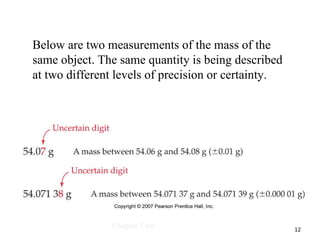
Chapter Two Below are two measurements of the mass of the same object. The same quantity is being described at two different levels of precision or certainty.
Note the 4 rules When reading a measured value, all nonzero digits should be counted as significant. There is a set of rules for determining if a zero in a measurement is significant or not. RULE 1.  Zeros in the middle of a number are like any other digit; they are always significant. Thus, 94.072 g has five significant figures. RULE 2.  Zeros at the beginning of a number are not significant; they act only to locate the decimal point. Thus, 0.0834 cm has three significant figures, and 0.029 07 mL has four. Chapter Two
RULE 3.  Zeros at the end of a number and  after  the decimal point are significant. It is assumed that these zeros would not be shown unless they were significant. 138.200 m has six significant figures. If the value were known to only four significant figures, we would write 138.2 m. RULE 4.  Zeros at the end of a number and  before  an implied decimal point may or may not be significant. We cannot tell whether they are part of the measurement or whether they act only to locate the unwritten but implied decimal point. Chapter Two
Practice Rule #1 Zeros 45.8736 .000239  .00023900  48000.  48000  3.982  10 6   1.00040 6 3 5 5 2 4 6 All digits count Leading 0’s don’t Trailing 0’s do 0’s count in decimal form 0’s don’t count w/o decimal All digits count 0’s between digits count as well as trailing in decimal form
2.5 Scientific Notation Scientific notation  is a convenient way to write a very small or a very large number. Numbers are written as a product of a number between 1 and 10, times the number 10 raised to power. 215 is written in scientific notation as:  215 = 2.15 x 100 = 2.15 x (10 x 10) = 2.15 x 10 2 Chapter Two
Chapter Two Two examples of converting standard notation to scientific notation are shown below.
Chapter Two Two examples of converting scientific notation back to  standard notation are shown below.
Scientific notation is helpful for indicating how many significant figures are present in a number that has zeros at the end but to the left of a decimal point. The distance from the Earth to the Sun is 150,000,000 km. Written in standard notation this number could have anywhere from 2 to 9 significant figures. Scientific notation can indicate how many digits are significant. Writing 150,000,000 as 1.5 x 10 8  indicates 2 and writing it as 1.500 x 10 8  indicates 4. Scientific notation can make doing arithmetic easier. Rules for doing arithmetic with numbers written in scientific notation are reviewed in Appendix A. Chapter Two
2.6 Rounding Off Numbers Often when doing arithmetic on a pocket calculator, the answer is displayed with more significant figures than are really justified. How do you decide how many digits to keep? Simple rules exist to tell you how. Chapter Two
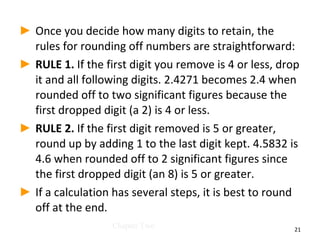
Once you decide how many digits to retain, the rules for rounding off numbers are straightforward: RULE 1.  If the first digit you remove is 4 or less, drop it and all following digits. 2.4271 becomes 2.4 when rounded off to two significant figures because the first dropped digit (a 2) is 4 or less. RULE 2.  If the first digit removed is 5 or greater, round up by adding 1 to the last digit kept. 4.5832 is 4.6 when rounded off to 2 significant figures since the first dropped digit (an 8) is 5 or greater. If a calculation has several steps, it is best to round off at the end. Chapter Two
Practice Rule #2 Rounding Make the following into a 3 Sig Fig number 1.5587 .0037421 1367 128,522 1.6683   10 6   1.56 .00374 1370 129,000 1.67   10 6 Your Final number must be of the same value as the number you started with, 129,000 and  not  129
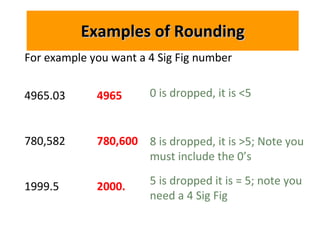
Examples of Rounding For example you want a 4 Sig Fig number 4965.03   780,582   1999.5   0 is dropped, it is <5 8 is dropped, it is >5; Note you must include the 0’s 5 is dropped it is = 5; note you need a 4 Sig Fig 4965 780,600 2000.
RULE 1.  In carrying out a multiplication or division, the answer cannot have more significant figures than either of the original numbers. Chapter Two
RULE 2.  In carrying out an addition or subtraction, the answer cannot have more digits after the decimal point than either of the original numbers. Chapter Two
Multiplication and division 32.27    1.54 = 49.6958 3.68    .07925 = 46.4353312 1.750    .0342000 = 0.05985 3.2650  10 6     4.858 = 1.586137    10 7   6.022  10 23     1.661  10 -24  = 1.000000 49.7 46.4 .05985 1.586   10 7   1.000
Addition/Subtraction 25.5   32.72   320  +34.270     ‑  0.0049   + 12.5 59.770   32.7151   332.5  59.8   32.72   330
Addition and Subtraction __  ___  __ .56 + .153 = .713 82000 + 5.32 = 82005.32 10.0 - 9.8742 = .12580 10 – 9.8742 = .12580 .71 82000 .1 0 Look for the last important digit
Mixed Order of Operation 8.52  + 4 .1586    18.73 + 153.2 =   (8.52  + 4 .1586)    (18.73 + 153.2) = 239.6 2180. =  8.52  + 77.89  + 153.2 = 239.61 = = 12.68    171.9 = 2179.692 =
Try Find the standard deviation for the following numbers:  7.691 g, 7.23 g, 7.892 g
Try 7.691 g  7.23  g  7.892 g 22.813  g 22.81  g   = 7.603 g 3 7.691 g, 7.23 g, 7.892 g
Try    = 7.603 g 7.691 g – 7.603 g =  .088 g  7.23  g – 7.603 g =  -.37 g 7.892 g – 7.603 g =  .289 g   .01 g
Try .25 .01  = .01 g

Sig Figs

  • 1.
    Significant Figures Whenusing our calculators we must determine the correct answer; our calculators are mindless drones and don’t know the correct answer. There are 2 different types of numbers Exact Measured Exact numbers are infinitely important Measured number = they are measured with a measuring device (name all 4) so these numbers have ERROR. When you use your calculator your answer can only be as accurate as your worst measurement…Doohoo  Chapter Two
  • 2.
    Exact Numbers Anexact number is obtained when you count objects or use a defined relationship. Counting objects are always exact 2 soccer balls 4 pizzas Exact relationships, predefined values, not measured 1 foot = 12 inches 1 meter = 100 cm For instance is 1 foot = 12.000000000001 inches? No 1 ft is EXACTLY 12 inches.
  • 3.
    Learning Check A. Exact numbers are obtained by 1. using a measuring tool 2. counting 3. definition B. Measured numbers are obtained by 1. using a measuring tool 2. counting 3. definition
  • 4.
    Solution A. Exact numbers are obtained by 2. counting 3. definition B. Measured numbers are obtained by 1. using a measuring tool
  • 5.
    Learning Check Classifyeach of the following as an exact or a measured number. 1 yard = 3 feet The diameter of a red blood cell is 6 x 10 -4 cm. There are 6 hats on the shelf. Gold melts at 1064°C.
  • 6.
    Classify each ofthe following as an exact (1) or a measured(2) number. This is a defined relationship. A measuring tool is used to determine length. The number of hats is obtained by counting. A measuring tool is required. Solution
  • 7.
    2.4 Measurement andSignificant Figures Every experimental measurement has a degree of uncertainty. The volume, V, at right is certain in the 10’s place, 10mL<V<20mL The 1’s digit is also certain, 17mL<V<18mL A best guess is needed for the tenths place. Chapter Two
  • 8.
    What is theLength? We can see the markings between 1.6-1.7cm We can’t see the markings between the .6-.7 We must guess between .6 & .7 We record 1.67 cm as our measurement The last digit an 7 was our guess...stop there
  • 9.
    Learning Check Whatis the length of the wooden stick? 1) 4.5 cm 2) 4.54 cm 3) 4.547 cm
  • 10.
    8.00 cm or3 (2.2/8) ?
  • 11.
    Measured Numbers Doyou see why Measured Numbers have error…you have to make that Guess! All but one of the significant figures are known with certainty. The last significant figure is only the best possible estimate. To indicate the precision of a measurement, the value recorded should use all the digits known with certainty.
  • 12.
    Chapter Two Beloware two measurements of the mass of the same object. The same quantity is being described at two different levels of precision or certainty.
  • 13.
    Note the 4rules When reading a measured value, all nonzero digits should be counted as significant. There is a set of rules for determining if a zero in a measurement is significant or not. RULE 1. Zeros in the middle of a number are like any other digit; they are always significant. Thus, 94.072 g has five significant figures. RULE 2. Zeros at the beginning of a number are not significant; they act only to locate the decimal point. Thus, 0.0834 cm has three significant figures, and 0.029 07 mL has four. Chapter Two
  • 14.
    RULE 3. Zeros at the end of a number and after the decimal point are significant. It is assumed that these zeros would not be shown unless they were significant. 138.200 m has six significant figures. If the value were known to only four significant figures, we would write 138.2 m. RULE 4. Zeros at the end of a number and before an implied decimal point may or may not be significant. We cannot tell whether they are part of the measurement or whether they act only to locate the unwritten but implied decimal point. Chapter Two
  • 15.
    Practice Rule #1Zeros 45.8736 .000239 .00023900 48000. 48000 3.982  10 6 1.00040 6 3 5 5 2 4 6 All digits count Leading 0’s don’t Trailing 0’s do 0’s count in decimal form 0’s don’t count w/o decimal All digits count 0’s between digits count as well as trailing in decimal form
  • 16.
    2.5 Scientific NotationScientific notation is a convenient way to write a very small or a very large number. Numbers are written as a product of a number between 1 and 10, times the number 10 raised to power. 215 is written in scientific notation as: 215 = 2.15 x 100 = 2.15 x (10 x 10) = 2.15 x 10 2 Chapter Two
  • 17.
    Chapter Two Twoexamples of converting standard notation to scientific notation are shown below.
  • 18.
    Chapter Two Twoexamples of converting scientific notation back to standard notation are shown below.
  • 19.
    Scientific notation ishelpful for indicating how many significant figures are present in a number that has zeros at the end but to the left of a decimal point. The distance from the Earth to the Sun is 150,000,000 km. Written in standard notation this number could have anywhere from 2 to 9 significant figures. Scientific notation can indicate how many digits are significant. Writing 150,000,000 as 1.5 x 10 8 indicates 2 and writing it as 1.500 x 10 8 indicates 4. Scientific notation can make doing arithmetic easier. Rules for doing arithmetic with numbers written in scientific notation are reviewed in Appendix A. Chapter Two
  • 20.
    2.6 Rounding OffNumbers Often when doing arithmetic on a pocket calculator, the answer is displayed with more significant figures than are really justified. How do you decide how many digits to keep? Simple rules exist to tell you how. Chapter Two
  • 21.
    Once you decidehow many digits to retain, the rules for rounding off numbers are straightforward: RULE 1. If the first digit you remove is 4 or less, drop it and all following digits. 2.4271 becomes 2.4 when rounded off to two significant figures because the first dropped digit (a 2) is 4 or less. RULE 2. If the first digit removed is 5 or greater, round up by adding 1 to the last digit kept. 4.5832 is 4.6 when rounded off to 2 significant figures since the first dropped digit (an 8) is 5 or greater. If a calculation has several steps, it is best to round off at the end. Chapter Two
  • 22.
    Practice Rule #2Rounding Make the following into a 3 Sig Fig number 1.5587 .0037421 1367 128,522 1.6683  10 6 1.56 .00374 1370 129,000 1.67  10 6 Your Final number must be of the same value as the number you started with, 129,000 and not 129
  • 23.
    Examples of RoundingFor example you want a 4 Sig Fig number 4965.03   780,582   1999.5 0 is dropped, it is <5 8 is dropped, it is >5; Note you must include the 0’s 5 is dropped it is = 5; note you need a 4 Sig Fig 4965 780,600 2000.
  • 24.
    RULE 1. In carrying out a multiplication or division, the answer cannot have more significant figures than either of the original numbers. Chapter Two
  • 25.
    RULE 2. In carrying out an addition or subtraction, the answer cannot have more digits after the decimal point than either of the original numbers. Chapter Two
  • 26.
    Multiplication and division32.27  1.54 = 49.6958 3.68  .07925 = 46.4353312 1.750  .0342000 = 0.05985 3.2650  10 6  4.858 = 1.586137  10 7 6.022  10 23  1.661  10 -24 = 1.000000 49.7 46.4 .05985 1.586  10 7 1.000
  • 27.
    Addition/Subtraction 25.5 32.72 320 +34.270 ‑ 0.0049 + 12.5 59.770 32.7151 332.5 59.8 32.72 330
  • 28.
    Addition and Subtraction__ ___ __ .56 + .153 = .713 82000 + 5.32 = 82005.32 10.0 - 9.8742 = .12580 10 – 9.8742 = .12580 .71 82000 .1 0 Look for the last important digit
  • 29.
    Mixed Order ofOperation 8.52 + 4 .1586  18.73 + 153.2 = (8.52 + 4 .1586)  (18.73 + 153.2) = 239.6 2180. = 8.52 + 77.89 + 153.2 = 239.61 = = 12.68  171.9 = 2179.692 =
  • 30.
    Try Find thestandard deviation for the following numbers: 7.691 g, 7.23 g, 7.892 g
  • 31.
    Try 7.691 g 7.23 g 7.892 g 22.813 g 22.81 g = 7.603 g 3 7.691 g, 7.23 g, 7.892 g
  • 32.
    Try  = 7.603 g 7.691 g – 7.603 g = .088 g 7.23 g – 7.603 g = -.37 g 7.892 g – 7.603 g = .289 g .01 g
  • 33.
    Try .25 .01 = .01 g