3
2
1
Different types and styles of dancing
INDEXWHAT IS DANCING?JAZZCHA CHACHASALSAJIVEMAMBOWALTZ
BALLETHIP-HOPBREAK DANCEBELLY DANCINGINDIAN CLASSICALBOLLYWOOD
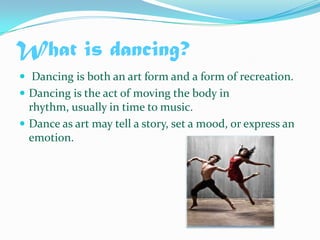
What is dancing? Dancing is both an art form and a form of recreation. Dancing is the act of moving the body in rhythm, usually in time to music. Dance as art may tell a story, set a mood, or express an emotion.
jazzJazz dance is a classification shared by a broad range of dance stylesBefore the 1950s, jazz dance referred to dance styles that originated from African American vernacular dance.Before the 1950s, jazz dance referred to dance styles that originated from African American vernacular dance.
Cha cha cha   The Cha-cha-cha is the name of a Latin American dance of Cuban origin. It is danced to the music of the same name introduced by Cuban composer and violinist Enrique Jorrín in 1953   The music for the international ballroom cha-cha-cha is energetic and with a steady beat    The Cuban cha-cha-chá is more sensual and may involve complex polyrhythm’s.
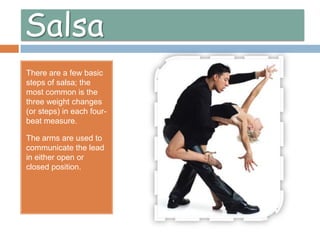
SalsaThere are a few basic steps of salsa; the most common is the three weight changes (or steps) in each four-beat measure.The arms are used to communicate the lead in either open or closed position.
More about salsaSalsa is a syncretic dance form with origins from Cuba, as the original meeting point of European and African cultures. Its movements originate in Cuban Son, with strong influences from Mambo, Guaguanco, and other Afro-Cuban music.Salsa is normally a partner dance, although there are recognized solo forms, line dancing (suelta), and Rueda de Casino where groups of couples exchange partners in a circle.Music suitable for dancing ranges from about 150 bpm (beats per minute) to around 250 bpm, although most dancing is done to music somewhere between 160–220 bpm
In Ballroom dancing, Jive is a dance style in 4/4 time that originated in the United States from African-Americans in the early 1940s.
Jive is one of the five International Latin dances
The basic step (Jive Basic) is a six beat pattern, comprising eight weight changes.
Leader: Normally the male
Counts 1 2 - Rock step: left foot step back, right foot replace
Counts 3 a4 - Chasse to the left
Counts 5 a6 - Chasse to the rightMAMBOThe Mambo dance originated in Cuba where there were substantial settlements of Haitians. In the back country of Haiti, the "Mambo" is a voodoo priestess, who serves the villagers as counselor, healer, exorcist, soothsayer, spiritual advisor, and organizer of public entertainment. However, there is not a folk dance in Haiti called the "Mambo."The fusion of Swing and Cuban music produced this fascinating rhythm and in turn created a new sensational dance.
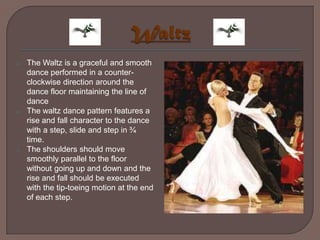
WaltzThe Waltz is a graceful and smooth dance performed in a counter-clockwise direction around the dance floor maintaining the line of dance
The waltz dance pattern features a rise and fall character to the dance with a step, slide and step in ¾ time.
The shoulders should move smoothly parallel to the floor without going up and down and the rise and fall should be executed with the tip-toeing motion at the end of each step.
Ballet     Ballet first developed in Europe in the Renaissance period. -In Italy and France, dancing masters taught royalty and choreographed entertainments for the courts      In the late 1700’s, Jean-George Noverre composed 150 ballets which emphasized acting over dance technique.Probably the most important part of a ballet dancer's equipment is ballet  shoes.      After several years of proper training, some female ballet dancers wear pointe shoes to make them appear lighter and more delicate.
HIP -HOPHip-hop dance refers to social or choreographed dance styles primarily danced to hip-hop music or that have evolved as part of hip-hop culture. This includes a wide range of styles notably breaking, locking, and popping
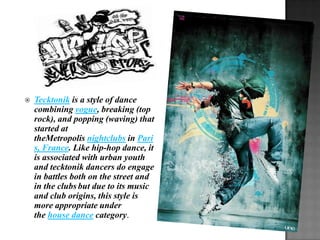
Tecktonik is a style of dance combining vogue, breaking (top rock), and popping (waving) that started at theMetropolis nightclubs in Paris, France. Like hip-hop dance, it is associated with urban youth and tecktonik dancers do engage in battles both on the street and in the clubsbut due to its music and club origins, this style is more appropriate under the house dance category.
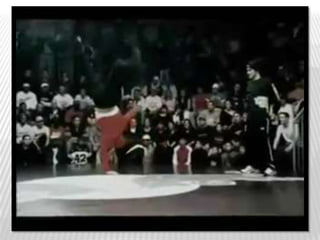
!!!Break dance!!!
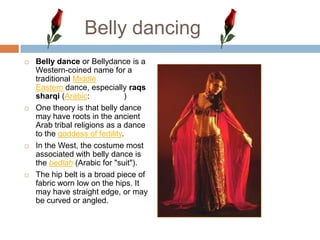
Belly dancingBelly dance or Bellydance is a Western-coined name for a traditional Middle Eastern dance, especially raqssharqi (Arabic: رقصشرقي‎)One theory is that belly dance may have roots in the ancient Arab tribal religions as a dance to the goddess of fertility.In the West, the costume most associated with belly dance is the bedlah (Arabic for "suit").The hip belt is a broad piece of fabric worn low on the hips. It may have straight edge, or may be curved or angled.
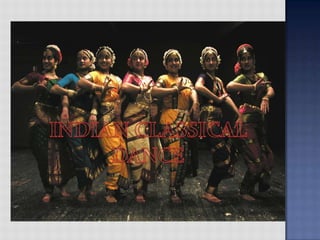
INDIAN CLASSICAL DANCE

Types of dance forms

  • 1.
  • 2.
  • 3.
  • 4.
    Different types andstyles of dancing
  • 5.
    INDEXWHAT IS DANCING?JAZZCHACHACHASALSAJIVEMAMBOWALTZ
  • 6.
  • 7.
    What is dancing?Dancing is both an art form and a form of recreation. Dancing is the act of moving the body in rhythm, usually in time to music. Dance as art may tell a story, set a mood, or express an emotion.
  • 8.
    jazzJazz dance is aclassification shared by a broad range of dance stylesBefore the 1950s, jazz dance referred to dance styles that originated from African American vernacular dance.Before the 1950s, jazz dance referred to dance styles that originated from African American vernacular dance.
  • 9.
    Cha cha cha The Cha-cha-cha is the name of a Latin American dance of Cuban origin. It is danced to the music of the same name introduced by Cuban composer and violinist Enrique Jorrín in 1953 The music for the international ballroom cha-cha-cha is energetic and with a steady beat The Cuban cha-cha-chá is more sensual and may involve complex polyrhythm’s.
  • 10.
    SalsaThere are afew basic steps of salsa; the most common is the three weight changes (or steps) in each four-beat measure.The arms are used to communicate the lead in either open or closed position.
  • 11.
    More about salsaSalsa isa syncretic dance form with origins from Cuba, as the original meeting point of European and African cultures. Its movements originate in Cuban Son, with strong influences from Mambo, Guaguanco, and other Afro-Cuban music.Salsa is normally a partner dance, although there are recognized solo forms, line dancing (suelta), and Rueda de Casino where groups of couples exchange partners in a circle.Music suitable for dancing ranges from about 150 bpm (beats per minute) to around 250 bpm, although most dancing is done to music somewhere between 160–220 bpm
  • 13.
    In Ballroom dancing, Jive is a dance stylein 4/4 time that originated in the United States from African-Americans in the early 1940s.
  • 14.
    Jive is oneof the five International Latin dances
  • 15.
    The basic step (Jive Basic)is a six beat pattern, comprising eight weight changes.
  • 16.
  • 17.
    Counts 1 2- Rock step: left foot step back, right foot replace
  • 18.
    Counts 3 a4- Chasse to the left
  • 19.
    Counts 5 a6- Chasse to the rightMAMBOThe Mambo dance originated in Cuba where there were substantial settlements of Haitians. In the back country of Haiti, the "Mambo" is a voodoo priestess, who serves the villagers as counselor, healer, exorcist, soothsayer, spiritual advisor, and organizer of public entertainment. However, there is not a folk dance in Haiti called the "Mambo."The fusion of Swing and Cuban music produced this fascinating rhythm and in turn created a new sensational dance.
  • 20.
    WaltzThe Waltz isa graceful and smooth dance performed in a counter-clockwise direction around the dance floor maintaining the line of dance
  • 21.
    The waltz dancepattern features a rise and fall character to the dance with a step, slide and step in ¾ time.
  • 22.
    The shoulders shouldmove smoothly parallel to the floor without going up and down and the rise and fall should be executed with the tip-toeing motion at the end of each step.
  • 23.
    Ballet Ballet first developed in Europe in the Renaissance period. -In Italy and France, dancing masters taught royalty and choreographed entertainments for the courts In the late 1700’s, Jean-George Noverre composed 150 ballets which emphasized acting over dance technique.Probably the most important part of a ballet dancer's equipment is ballet shoes. After several years of proper training, some female ballet dancers wear pointe shoes to make them appear lighter and more delicate.
  • 24.
    HIP -HOPHip-hop dance refersto social or choreographed dance styles primarily danced to hip-hop music or that have evolved as part of hip-hop culture. This includes a wide range of styles notably breaking, locking, and popping
  • 25.
    Tecktonik is a styleof dance combining vogue, breaking (top rock), and popping (waving) that started at theMetropolis nightclubs in Paris, France. Like hip-hop dance, it is associated with urban youth and tecktonik dancers do engage in battles both on the street and in the clubsbut due to its music and club origins, this style is more appropriate under the house dance category.
  • 27.
  • 29.
    Belly dancingBelly dance orBellydance is a Western-coined name for a traditional Middle Eastern dance, especially raqssharqi (Arabic: رقصشرقي‎)One theory is that belly dance may have roots in the ancient Arab tribal religions as a dance to the goddess of fertility.In the West, the costume most associated with belly dance is the bedlah (Arabic for "suit").The hip belt is a broad piece of fabric worn low on the hips. It may have straight edge, or may be curved or angled.
  • 30.
  • 31.
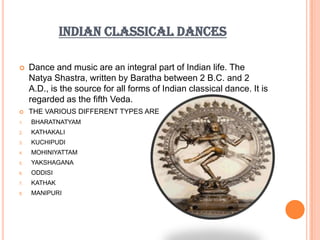
    INDIAN CLASSICAL DANCESDanceand music are an integral part of Indian life. The NatyaShastra, written by Baratha between 2 B.C. and 2 A.D., is the source for all forms of Indian classical dance. It is regarded as the fifth Veda.THE VARIOUS DIFFERENT TYPES AREBHARATNATYAMKATHAKALIKUCHIPUDIMOHINIYATTAMYAKSHAGANAODDISIKATHAKMANIPURI
  • 32.
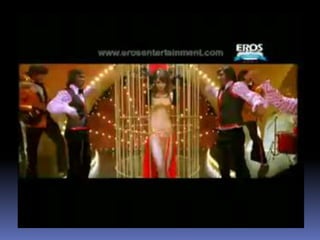
    Bollywood dancingBollywood danceis a difficult topic to discuss because it is hard to pin down.  Its exact definition, geographical distribution, and stylistic characteristics are amorphous.  However in spite of all of this, it is surprisingly recognisable.The international appeal of Bollywood dancing is something that has been many decades in the making. 
  • 34.
    CONCLUSIONSNumerous dance formsand styles have been developed all around the world. The dance styles reflect the cultural and traditional values. The rhythm quick samba, the beat king hip-hop, the somber soothing Indian traditional dances.Dancing is a form of expressing one self. One doesn’t need to attend costly dance programmes to be a good dancer. It comes from within the source, energy, power, expression.Every dance form also has a peculiar style in sense of dressing and body language.
  • 35.