Regional Statistics
Chair – Dev Virdee
Improving Local Productivity
Professor Richard Kneller
School of Economics
University of Nottingham
richard.kneller@nottingham.ac.uk
The Challenges
• Output per hour worked 15% below the average of G7
• D2N2 productivity is 10% lower than the UK average
National and local
productivity gap
• Difficulty in un-picking that headline figure
Data
• No previous examples on interventions targeted at productivity
• Lack of evidence on past business interventions that might have
had productivity effects
Lack of evidence on what
works
• Industrial strategy and local industrial strategyNational versus LEP
policy levers
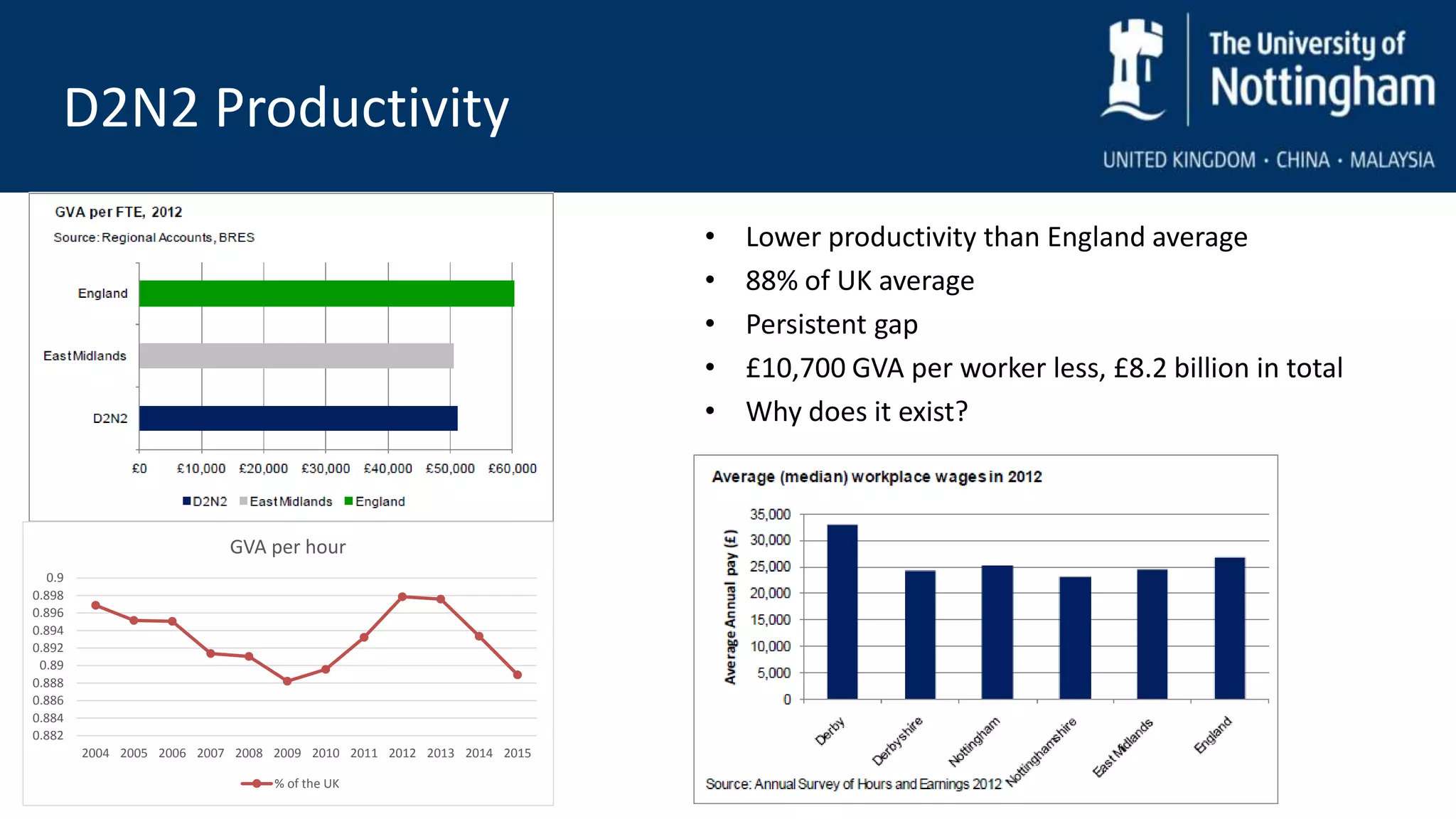
• Lower productivity than England average
• 88% of UK average
• Persistent gap
• £10,700 GVA per worker less, £8.2 billion in total
• Why does it exist?
D2N2 Productivity
0.882
0.884
0.886
0.888
0.89
0.892
0.894
0.896
0.898
0.9
2004 2005 2006 2007 2008 2009 2010 2011 2012 2013 2014 2015
GVA per hour
% of the UK
D2N2
productivity
D2N2 Productivity
Why is D2N2 less productive?
1. Sectoral
composition
2. Too many small
businesses
3. Too little entry
(and exit)
4. Our businesses
are not
productive
5. Our productive
businesses are
too small
D2N2
Productivity
Sectoral
Composition
Within
Industry
Between
Firm
Within Firm
Covariance
5 explanations
D2N2
productivity
Within industry
Sectoral
composition
• How productive is an
industry
• How big is it compared
to the rest of the
economy
• D2N2 has Larger
manufacturing
employment
• Smaller business
services & finance
employment
• Shifting industrial
composition would
close the gap by 1
percentage point
Why is D2N2 less productive?
GVA per emp
England emp
share
D2N2 emp
share
Agri. 16,468 0.6 0.9
Manuf. 47,108 10.0 14.3
Whole&Ret 29,822 18.7 18.7
Transp. 27,868 9.2 8.7
FIRE 61,521 16.6 11.9
Gov 24,249 29.7 31.6
D2N2
productivity growth
-1.5
-1
-0.5
0
0.5
1
1.5
2
1950
1953
1956
1959
1962
1965
1968
1971
1974
1977
1980
1983
1986
1989
1992
1995
1998
2001
2004
2007
Productivity Growth
Structural Change
Within Industry
Within industry:
productivity change of an
industry
Structural change:
reallocation of resources
across industries
• For UK structural
change appears
relatively
unimportant
• Or at least its
contribution takes
a long time to
appear
• Almost all
productivity
growth occurs
within industries
Why is D2N2 less productive?
• Can compare the
productivity of businesses
• The differences are big!
• This is a picture replicated
across industries,
countries and time
• In this region the gap is
not at the bottom or the
top
• There are more businesses
in D2N2 with productivity
a little below the average
and too few with
productivity just above
• Increasing productivity of
the average firm would
close the gap by 5
percentage points
Why is D2N2 less productive?
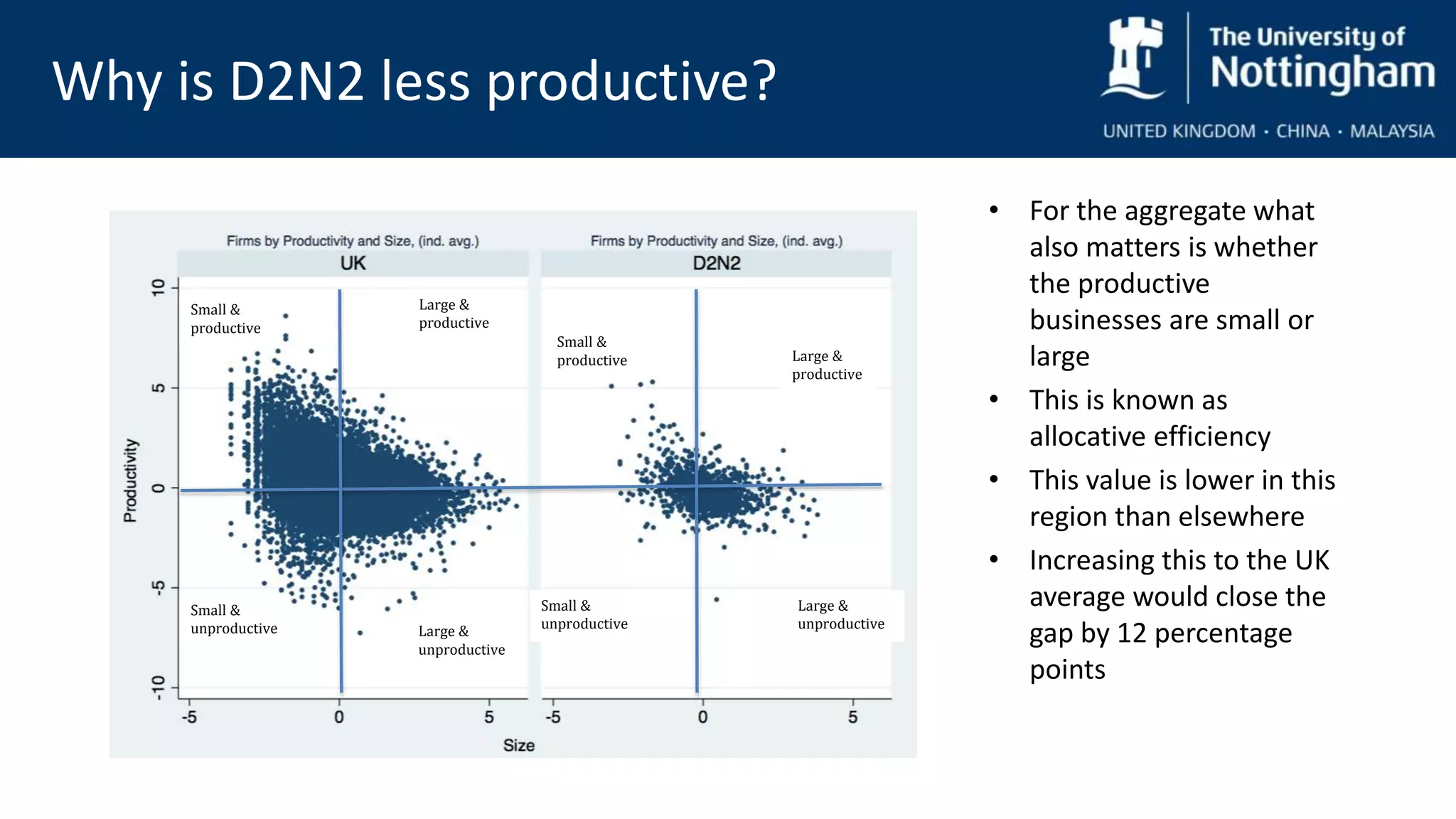
• For the aggregate what
also matters is whether
the productive
businesses are small or
large
• This is known as
allocative efficiency
• This value is lower in this
region than elsewhere
• Increasing this to the UK
average would close the
gap by 12 percentage
points
Why is D2N2 less productive?
Large &
productive
Large &
productive
Large &
unproductive
Large &
unproductive
Small &
productive
Small &
productive
Small &
unproductive
Small &
unproductive
Within Firm
• Creation of new technologies
• Adoption of new technologies
• Management Practice and
Organisation
• Efficient use of these technologies
Between Firm
• Reallocation of market shares to more
productive firms
• That productive firms have opportunity
& finance to survive and grow
• Entry of new productive firms
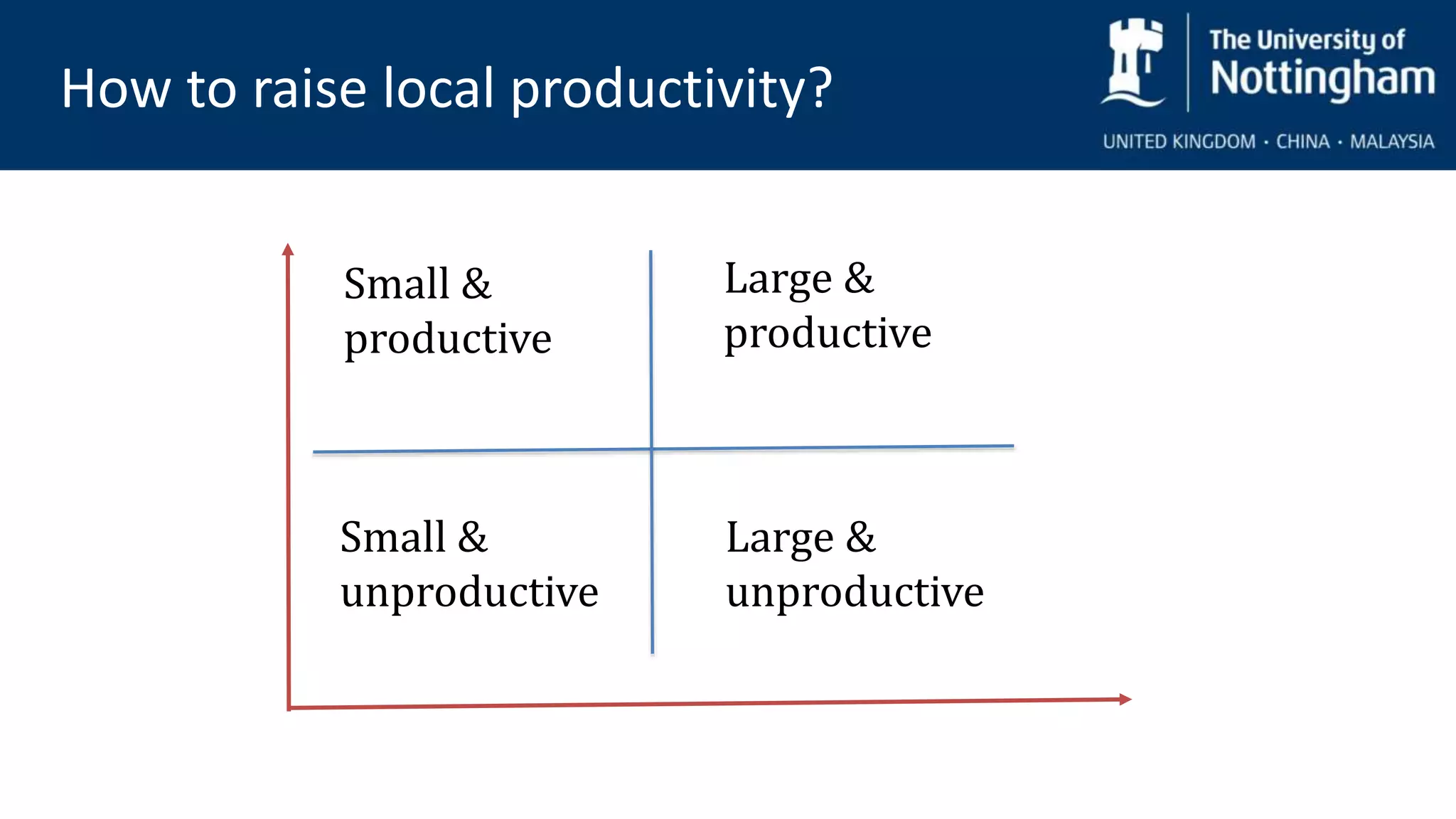
How to raise local productivity?
• multinationals
• Knowledge and R&D intensive
• Excellent management
• ICT & high skill intensive
frontier
• Exporter/importers
• Technology adopters/imitators
• Average management/organisation
National
champions
• domestic focused
• Below average management
• Slow adoption of new technology
• Focused on survival
Laggards
• Market size
(domestic,
foreign)
• Competition
• Infrastructure
(road, rail, air,
digital)
• Skills/
education
How to raise local productivity?
Large &
productive
Large &
unproductive
Small &
productive
Small &
unproductive
A framework for Productivity
enhancing business support
What is the long-term
change you see as
your goal?
Improvement in all
measures of productivity:
- Increase in average
productivity of firms
- Improvement in
allocative efficiency
- Increase in output per
hour
Which
productivity
driver(s) are you
trying to affect?
- R&D investment
- Management
practices
- Market
development
...
Who are your
target
businesses?
- Any sector or priority
sectors
- Small productive or
large unproductive
firms
...
Key assumptions:
Literature review on
drivers of productivity
What is your
entry point to
reaching
businesses?
- Own networks
- D2N2 Growth Hub
- Market research &
active engagement
...
Key assumptions:
Diagnostic tool to help
identify what drives
productivity for
different types of
firms
Key assumptions:
The appropriate
segment of businesses
is reached proactively
or referred to in case a
business is reaching
out for support.
What is the
measurable effect
of your
intervention?
- New
products/services
- Improvement in
management scores
...
Key assumptions:
Firm performance data
are recorded before
and after the
intervention for all
participants
What are the
wider benefits of
your
intervention?
- Productive firms
become bigger
- Competition
improves
...
Key assumptions:
Methodologies that
enable causal
inferences are used to
evaluate interventions
Stakeholders:
-Government (BEIS, Local)
-EU
-Economic development
partnerships (LEPs, Midlands
Engine, Northern
Powerhouse)
-Research bodies
-Business organisations (CBI,
Chambers of commerce)
Inspired by Theory of Change, Nesta
Productivity
Improvement
Programme
Confounding
Variable
Productivity
PIP Group
Couterfactual
group
Effect of the
PIP
Weakest
• Case studies
• Simple correlation regressions
• Matching
• Difference-in-differences
• Regression discontinuity
• Instrumental variable
Strongest
• Randomised control trial
A framework for Productivity
enhancing business support
National View
• Treasury view emphasises broader
policy levers
• Industrial strategy, recognises
productivity as an issue.
• Local industrial strategy, emphasises
local solutions
• Narrative based on unique
strengths and challenges of the
region
• Difficult to provide diagnostic
that goes beyond one of sectors
Developing a road-map
and co-production of
(sub)regional statistics and analysis
Greater Manchester Combined Authority
Rupert Greenhalgh – Principal Analyst
Greater Manchester – key stats
110,000 businesses
2.8m people
+240,000 since 2000
Over 100,000 Higher
Education Students
at 5 HE Institutions
1.3m working in GM
+100,000 next 10 yrs
GM
ECONOMY
€72.6bn
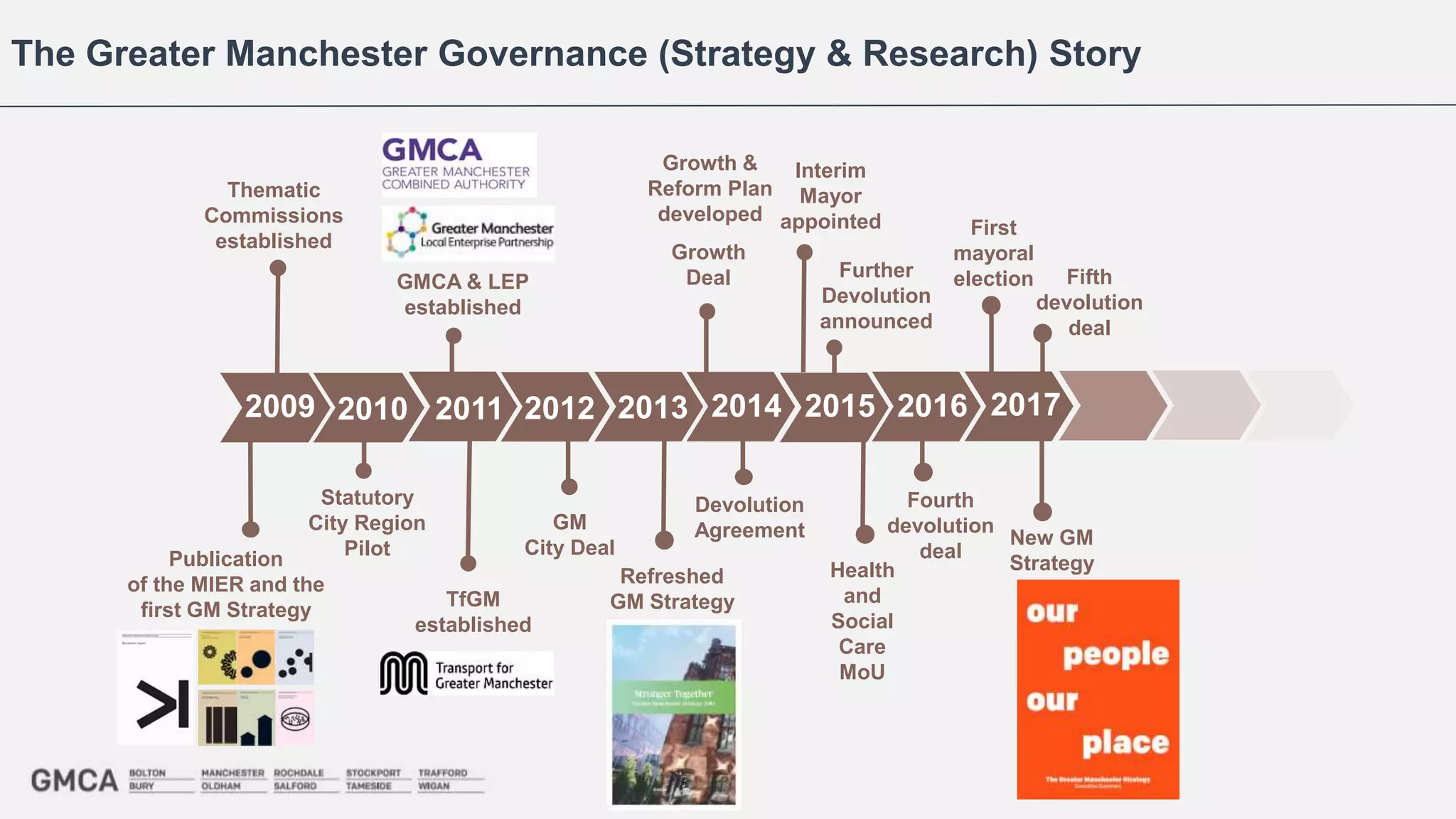
The Greater Manchester Governance (Strategy & Research) Story
GMCA & LEP
established
Publication
of the MIER and the
first GM Strategy
Thematic
Commissions
established
TfGM
established
GM
City Deal
Refreshed
GM Strategy
Devolution
Agreement
Growth
Deal
Growth &
Reform Plan
developed
Interim
Mayor
appointed
Health
and
Social
Care
MoU
Further
Devolution
announced
2009 2010 2011 2013 2014 20152012 2016 2017
Fourth
devolution
deal
2017
First
mayoral
election
Statutory
City Region
Pilot
New GM
Strategy
Fifth
devolution
deal
GMCA functions
Policing Transport Fire and Rescue Health Waste disposal
Economic
development,
regeneration and
housing
All functions conferred on the GMCA by any enactment are
functions of the GMCA, but an order or other enactment may
provide that certain functions are exercisable only by the Mayor
Developing the relationship with ONS
A series of targets or ‘prizes’ for our team
• Partner need and interest (Officers and Members, and Mayor)
• Knowledge and development (staff learning new things and approaches to analysing data)
• Profile (in GM and nationally)
• Access to the Secure Research Services (Microlab)
• A roadmap share with internal Officers, and externally with ONS
• An MoU, not legally binding but setting out how we will help ONS, and they help us
• To use the data within 12 months on a nationally known project / study
Use case: Greater Manchester - Independent Prosperity Review (Panel)
Published early 2019. Business expertise will brought in by industry
sessions with Panel members during the process. Partnerships with
OECD, European Commission and World Economic Forum.
Informs GMs LIS
Diane Coyle (Chair)
Bennett Professor of Public
Policy, University of Cambridge
Professor Ed Glaeser
Professor of Economics at
Harvard University
Stephanie Flanders
Head of Bloomberg Economics
Professor Henry Overman
Professor of Economic
Geography at the London School
of Economics
Professor Mariana Mazzucato
Professor in the Economics of
Innovation at University College
London
Darra Singh
Government & Public Sector
Lead at Ernst & Young
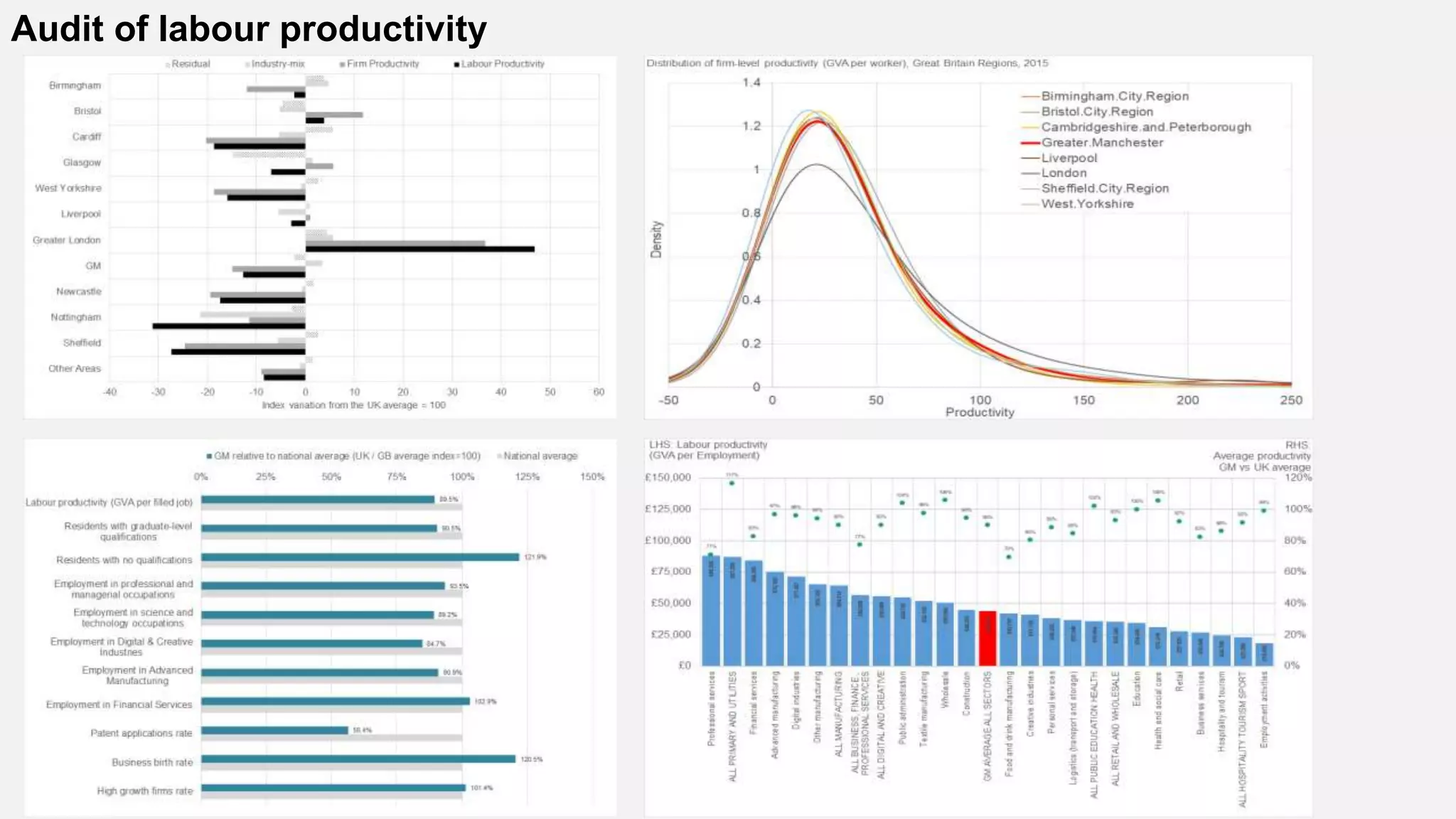
• Analysis of productivity taking a deep-dive into labour productivity
performance across GM
• Analysis of the ‘long tail’ of low-productivity firms and low pay within GM
• Identifying the main policy levers that could raise labour productivity
• A study to understand GM’s national and international supply chain and
trade linkages
• An exploration of the city region’s innovation ecosystems and sources of
global competitiveness, building on the 2016 Science and Innovation Audit
• Analysis of education and skills transitions, reviewing the role of the entire
education and skills system in GM and how individuals pass through key
transition points
• A review of the infrastructure needs of GM to raise productivity, including the
potential for new approaches to unlock investment
Audit of labour productivity
Refreshment Break
Compiling Economic Statistics
for Scotland – past, present and
future.
Sandy Stewart
Scottish Government
Compiling Economic Statistics for Scotland
• History
• What we currently produce
• Challenges
• Uses
• Future developments
• Understanding the Scottish Economy
• Long term times series
• Sub-Scotland analysis
• Other analysis for community planning
• Conclusions
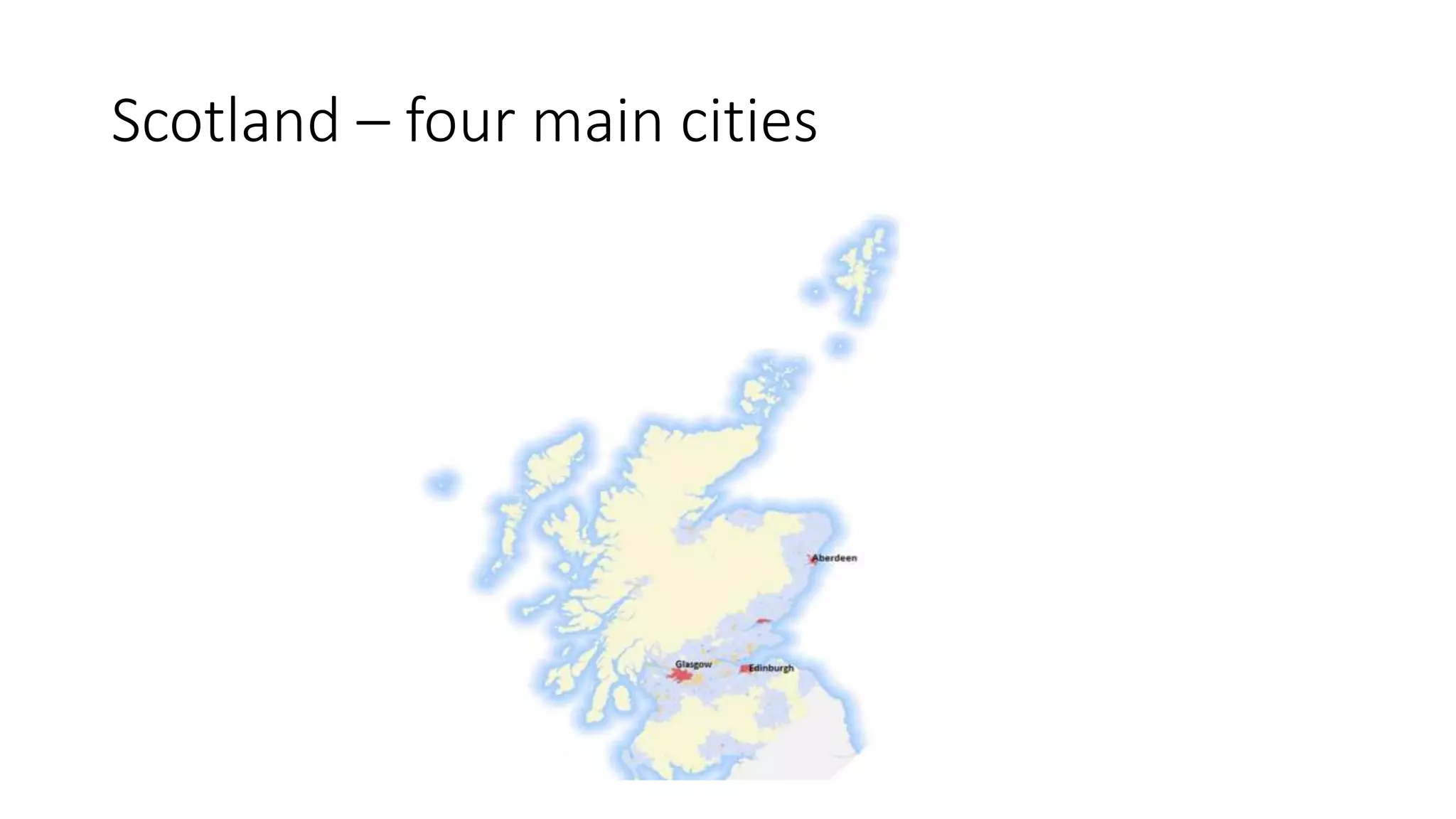
Scotland – four main cities
Cities - Edinburgh
Cities - Glasgow
Industry in Central Belt - Grangemouth
– Ineos + Petrochina = Petroineos
Remote Islands - Harris
Remote Islands – Isle of Skye
Remote – a Scottish croft
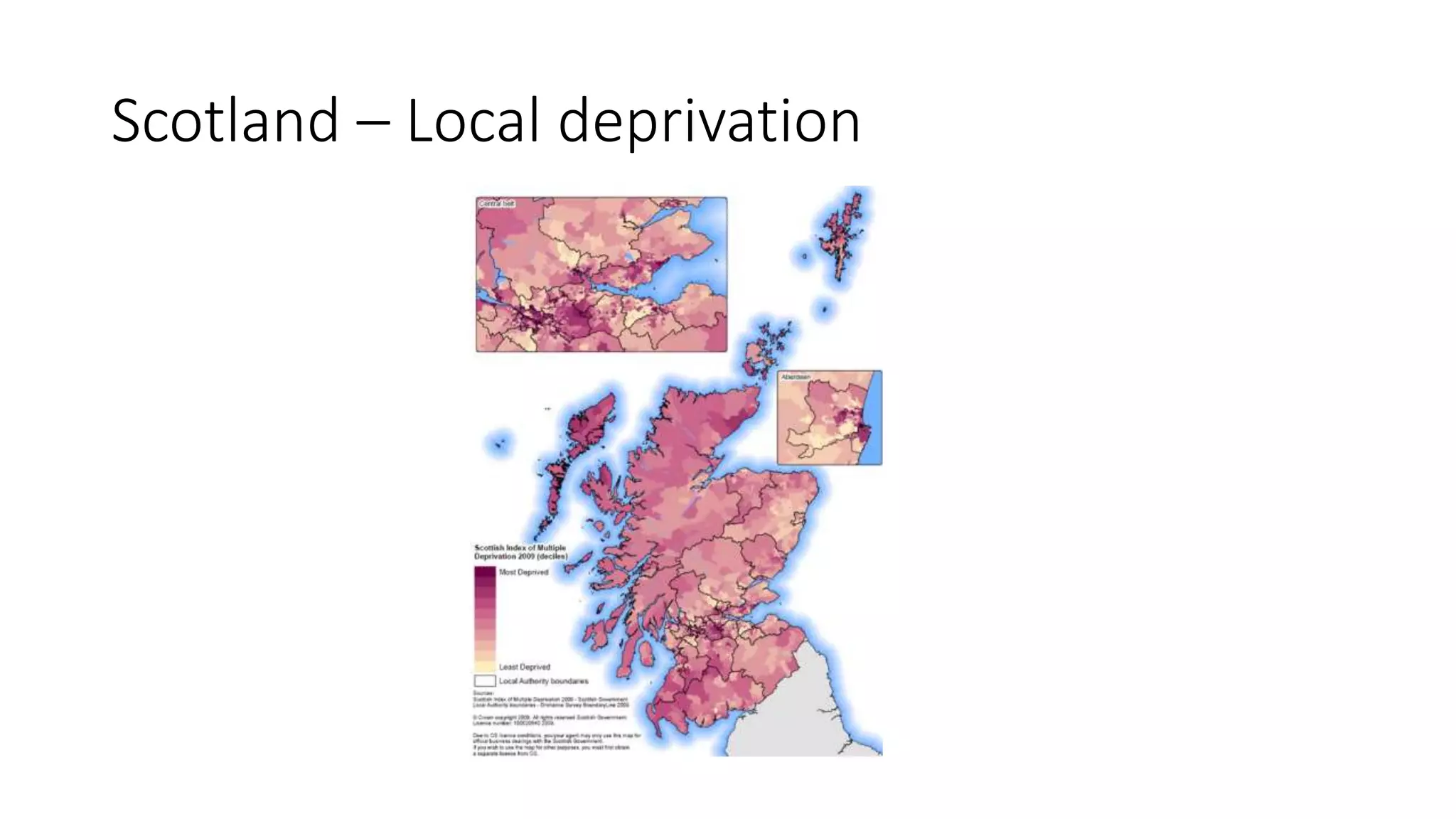
Scotland – Local deprivation
History
History
Scottish Office
• 1988 – Index of Industrial Production and Construction (quarterly);
GDP Index (annual)
• 1990 – compilation of 1989 Input-Output tables (to complement
1973 and 1979)
1999 – Demands of Scottish Parliament
• 2002 - First quarterly real GDP series (1997-2001)
• Demand for more regular I-O tables, trade and GDP (I) and (E) as well
as (O)
History
2008 – Demands of Council of Economic Advisors
• October 2008 – SESCG proposal to embark on experimental SNAP
• Consistent quarterly GDP(O), (I) and (E) components
• Annual I-O tables 1998 to present
• Development of onshore Quarterly Supply Use framework (quarterly)
• First experiment estimates published October 2009
• August 2014 – QNAS – National Statistics status
• Now releases of GDP and revised GDP/National Accounts each
quarter
What we produce now
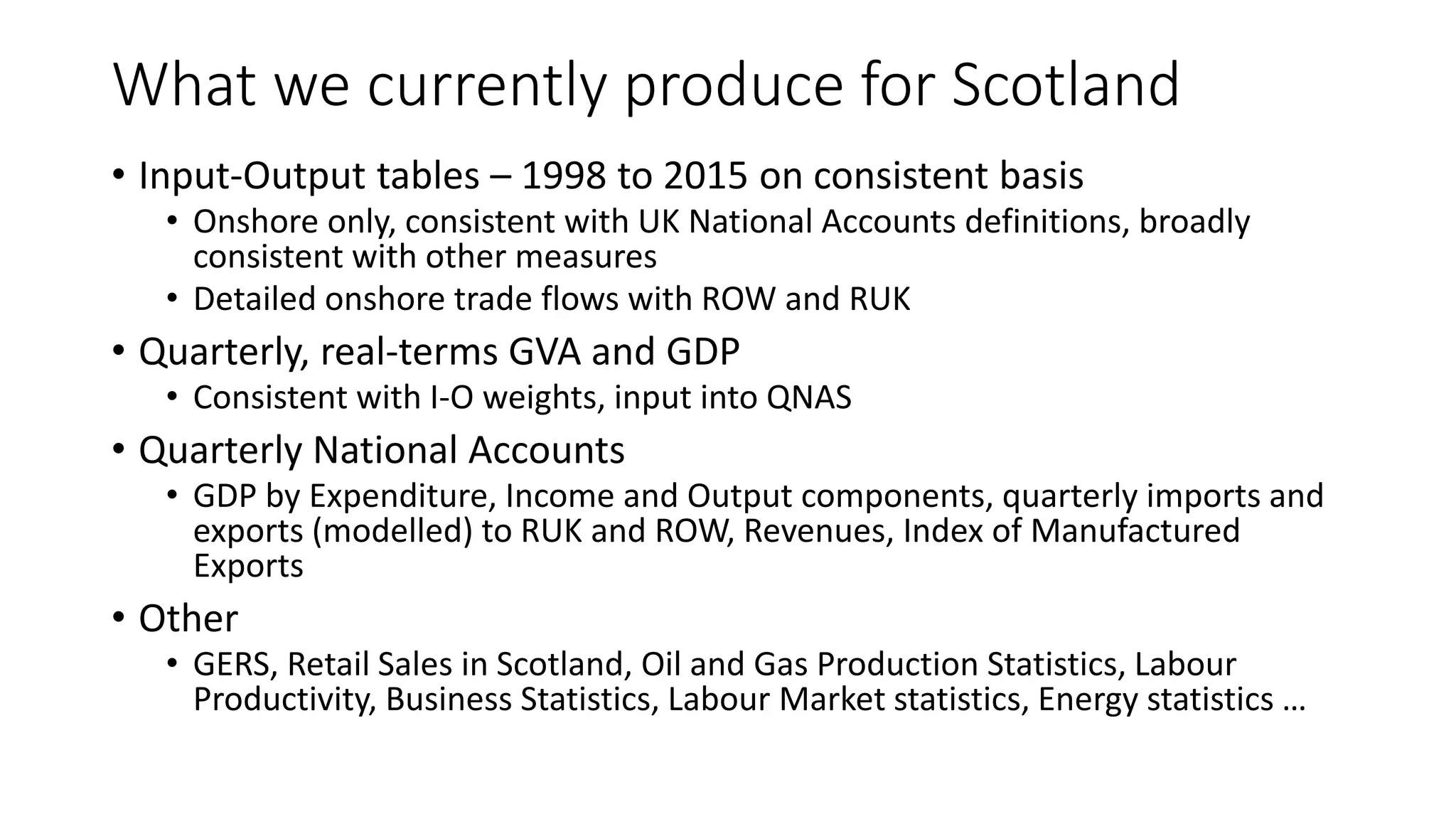
What we currently produce for Scotland
• Input-Output tables – 1998 to 2015 on consistent basis
• Onshore only, consistent with UK National Accounts definitions, broadly
consistent with other measures
• Detailed onshore trade flows with ROW and RUK
• Quarterly, real-terms GVA and GDP
• Consistent with I-O weights, input into QNAS
• Quarterly National Accounts
• GDP by Expenditure, Income and Output components, quarterly imports and
exports (modelled) to RUK and ROW, Revenues, Index of Manufactured
Exports
• Other
• GERS, Retail Sales in Scotland, Oil and Gas Production Statistics, Labour
Productivity, Business Statistics, Labour Market statistics, Energy statistics …
New products
• Whole of Scotland Accounts – 2017/18
• North Sea satellite account
• Complements onshore I-O tables
• Quarterly Gross National Income (GNI) – 2017/18
• Direct Investment, Portfolio Investment, Other Investment, Employment flows
with ROW and RUK, North Sea
• Balance of Payments – longer term
• Needs Primary Income, Balance of Trade and some brainwork!
• Sub-Scotland economic statistics
• SESCG sub-group set up in 2018
Challenges
Specific Challenges
• Defining Scotland
• Defining an enterprise and what it does
• Regional prices and deflators
Defining Scotland
Defining Scotland
A
C
B
B
A
Defining an enterprise and what it does
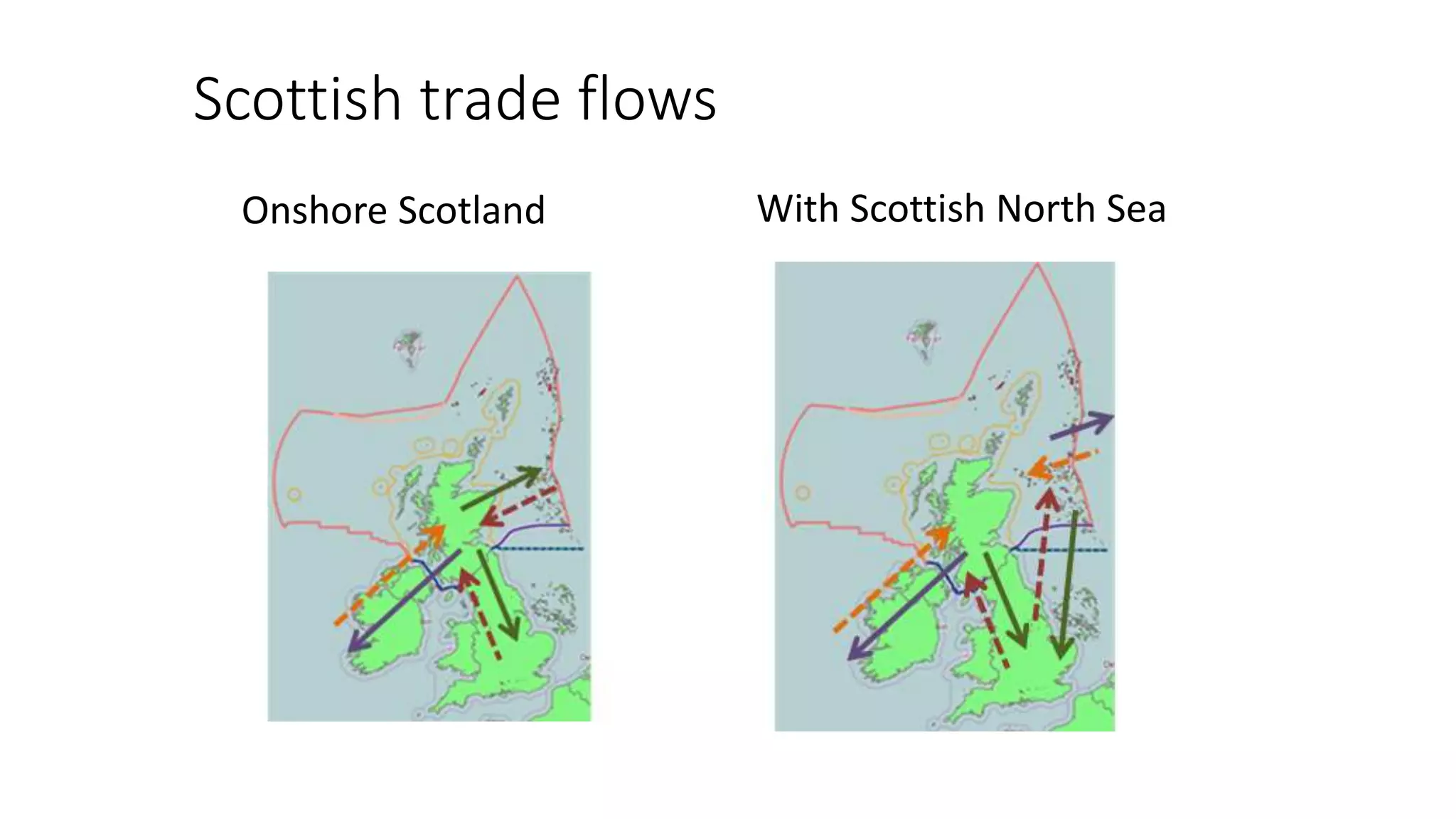
Scottish trade flows
Onshore Scotland With Scottish North Sea
Regional prices and deflators
• No regional prices/deflators available
• Use UK deflators, weighted by industry
• Adjust for domestic/export consumption for manufactured goods
• Input prices should also be considered …
• Regional double deflation
• Hedonic quality adjustments
• Speed up processing and publishing of all outputs
Uses of Scottish Economic Statistics
• Public, Parliament and Media
• Modelling and Analysis
• CGE model – using I-O framework
• Multi regional CGE model
• Shock and impact assessments
• Forecasting the economy and tax revenues
Future challenges
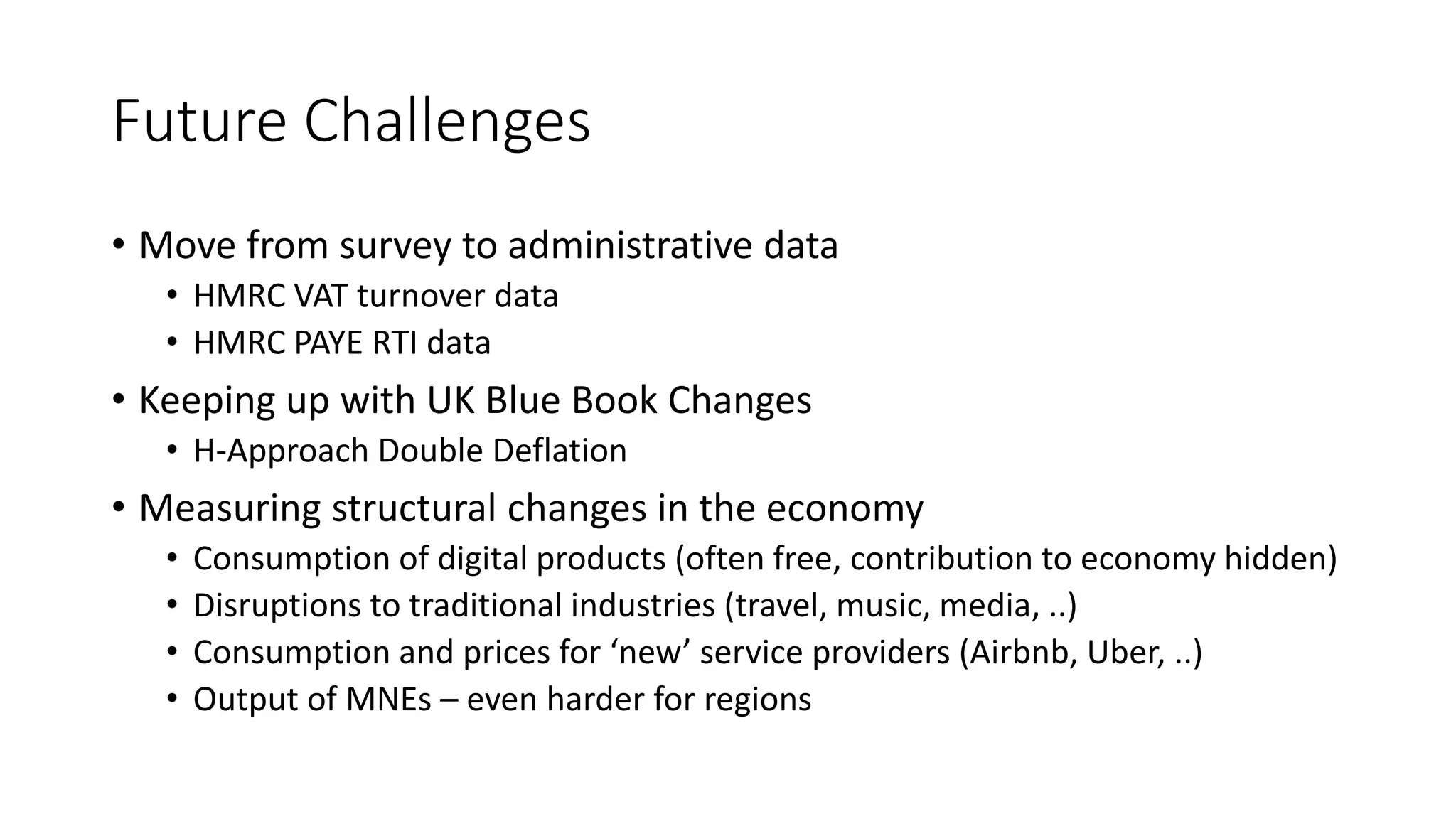
Future Challenges
• Move from survey to administrative data
• HMRC VAT turnover data
• HMRC PAYE RTI data
• Keeping up with UK Blue Book Changes
• H-Approach Double Deflation
• Measuring structural changes in the economy
• Consumption of digital products (often free, contribution to economy hidden)
• Disruptions to traditional industries (travel, music, media, ..)
• Consumption and prices for ‘new’ service providers (Airbnb, Uber, ..)
• Output of MNEs – even harder for regions
Understanding the Scottish Economy
• QNAS goes a long way towards understanding current changes …
• But need more …
• … especially relating to long term analysis of employment, output and
productivity, and regional variation
• … but difficult because data sources and methods, industrial
classifications, and geographic boundaries change over time
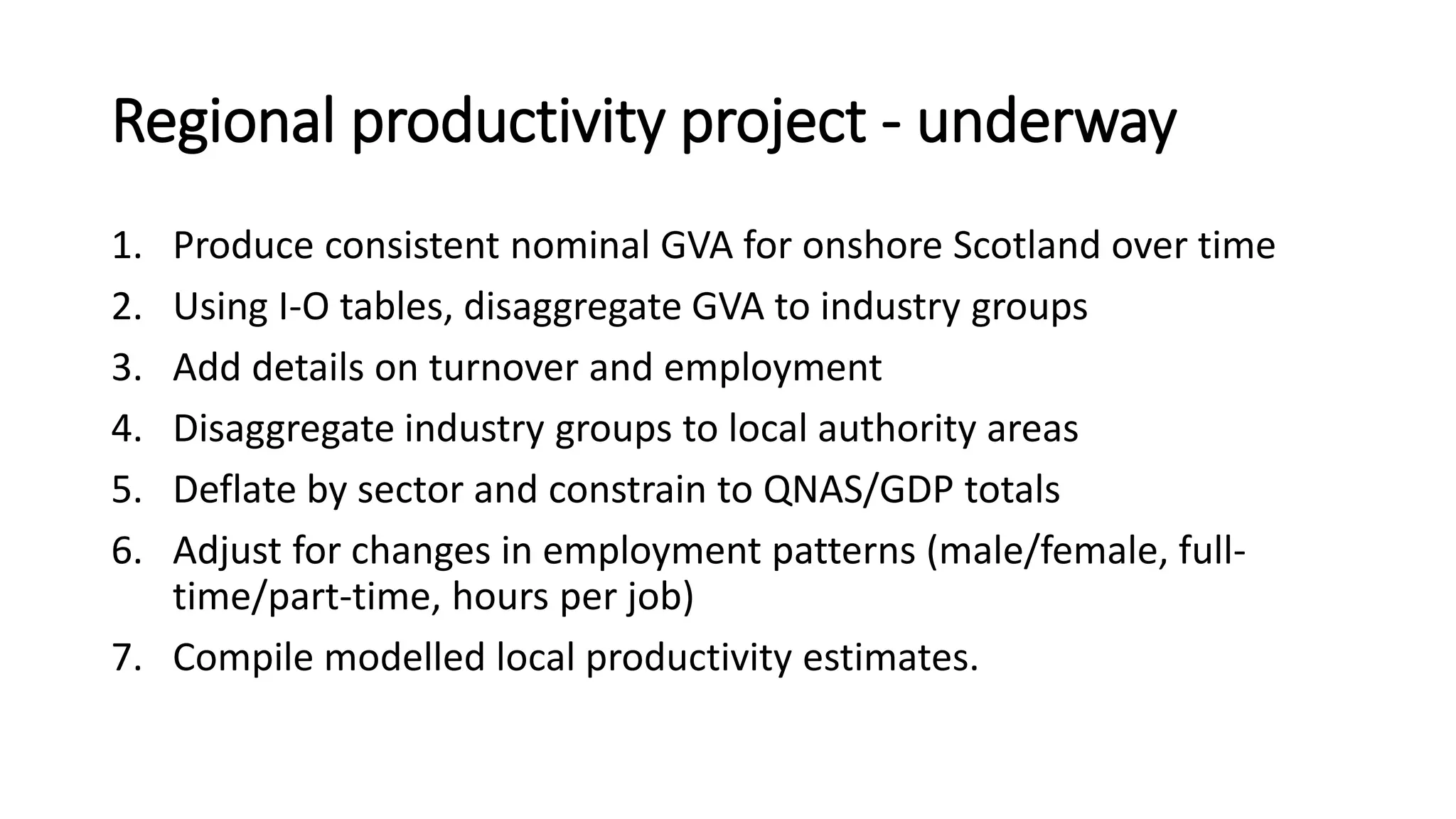
Regional productivity project - underway
1. Produce consistent nominal GVA for onshore Scotland over time
2. Using I-O tables, disaggregate GVA to industry groups
3. Add details on turnover and employment
4. Disaggregate industry groups to local authority areas
5. Deflate by sector and constrain to QNAS/GDP totals
6. Adjust for changes in employment patterns (male/female, full-
time/part-time, hours per job)
7. Compile modelled local productivity estimates.
Stage 1
Establishing a long term GVA time series
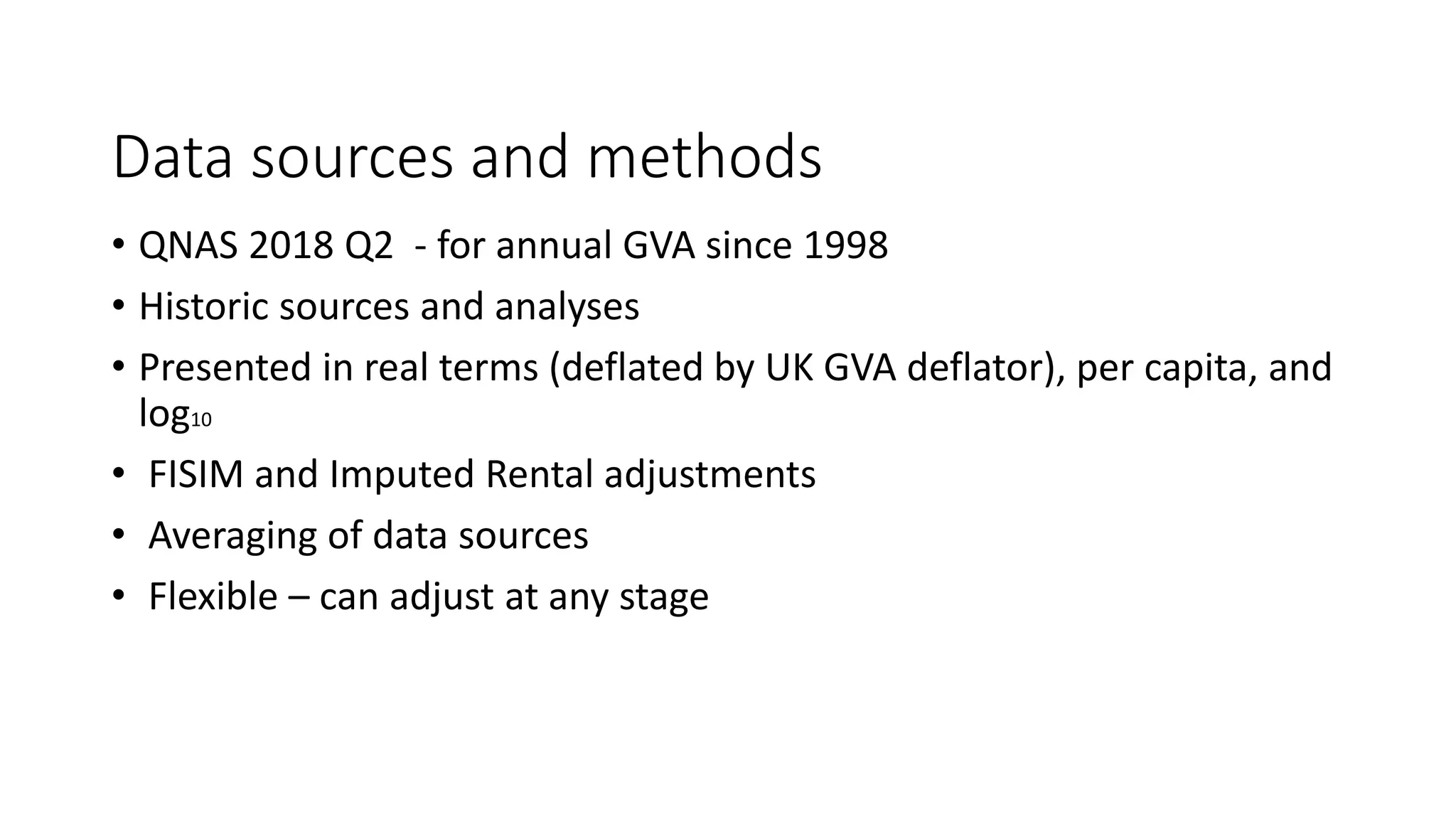
Data sources and methods
• QNAS 2018 Q2 - for annual GVA since 1998
• Historic sources and analyses
• Presented in real terms (deflated by UK GVA deflator), per capita, and
log10
• FISIM and Imputed Rental adjustments
• Averaging of data sources
• Flexible – can adjust at any stage
Sources of historic information
Title Author(s) Date published
1. The Scottish Economy – A statistical account of Scottish life AK Cairncross et al 1954
2. Survey of economic conditions in Scotland in 1954 Clydesdale & North of
Scotland bank Ltd
1955
3. An Inquiry into the Scottish economy (1960-61) JN Toothill 1961
4. Scotland’s Economic Progress 1951-1960 – A study in regional accounting G McCrone 1965
5. Scotland – The Vital Market Credland, Luby, Murray,
La Frenais
1966
6. The Structure and Growth of the Scottish economy Johnston, Buxton & Mair 1971
7. The Renaissance of the Scottish Economy? C Lythe & M Majmudar 1982
8. Understanding the Scottish Economy Ingham & Love 1983
9. The Caledonian Blue Book, 1997 H Gibson, G Riddington, D
Whigham & J Whyte
1997
Stage 2
Apportioning to Input-Output
classifications (IOCs)
Data sources and methods
• IOCs – arguably too detailed, but deflators available for IOC groups –
consistency with QNAS and GDP analysis
• QNAS – provides IOC detail back to 1998
• Unpublished I-O analysis 1950 – 2014 (pre-dated ESA2007 changes)
• Further work needed to harmonise and make consistent with overall
GVA estimates
Stage 3
Detailed Industry analysis – turnover, GVA
and employment
Sectors of interest
• Regional data system – manufacturing employment
• Sea Fisheries
• Coal Mining
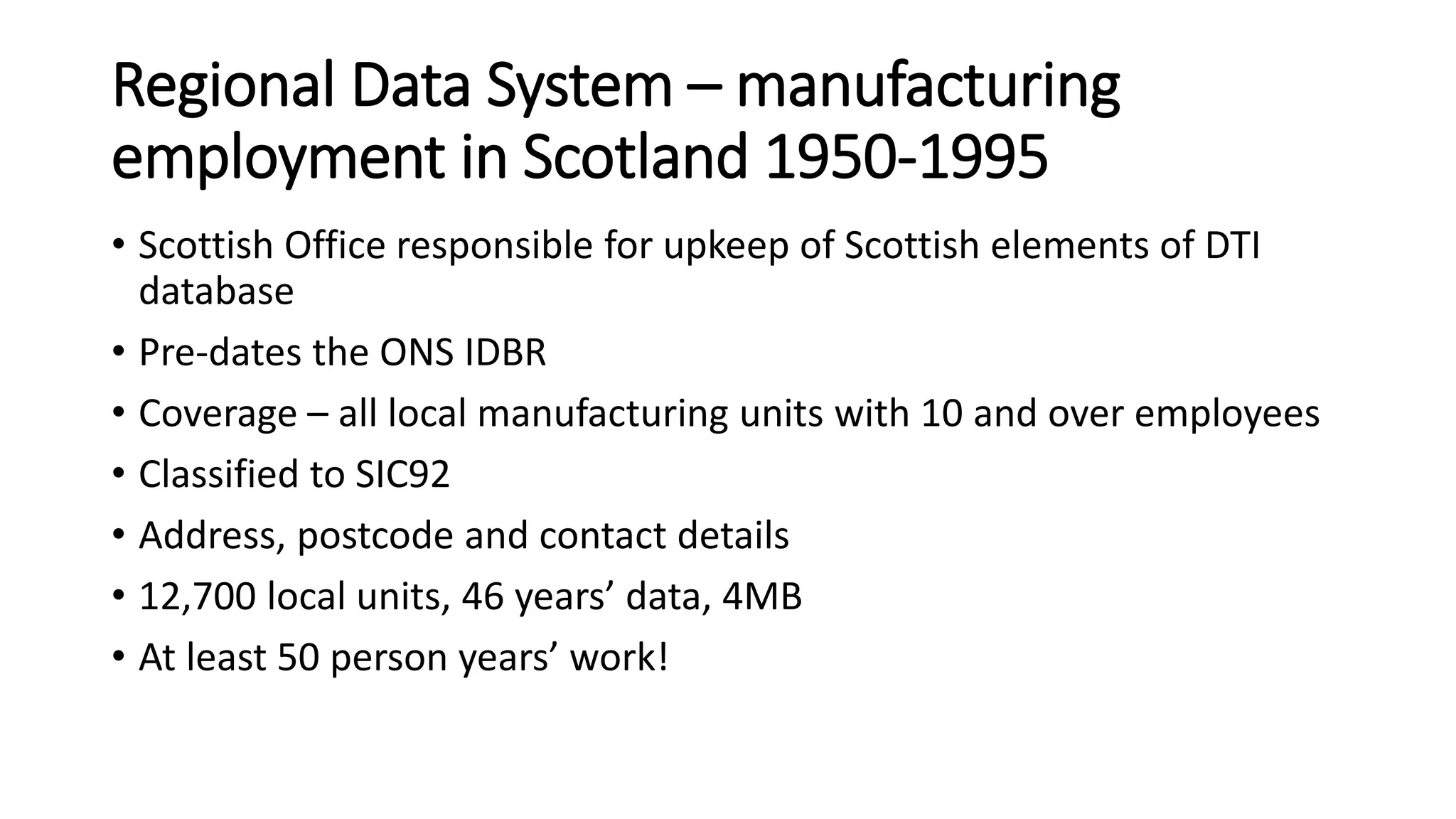
Regional Data System – manufacturing
employment in Scotland 1950-1995
• Scottish Office responsible for upkeep of Scottish elements of DTI
database
• Pre-dates the ONS IDBR
• Coverage – all local manufacturing units with 10 and over employees
• Classified to SIC92
• Address, postcode and contact details
• 12,700 local units, 46 years’ data, 4MB
• At least 50 person years’ work!
Sea fishing
• Detailed employment and landings statistics since early 1900s
• GVA harder to estimate, but employment (possibly) good proxy for
geographical distribution.
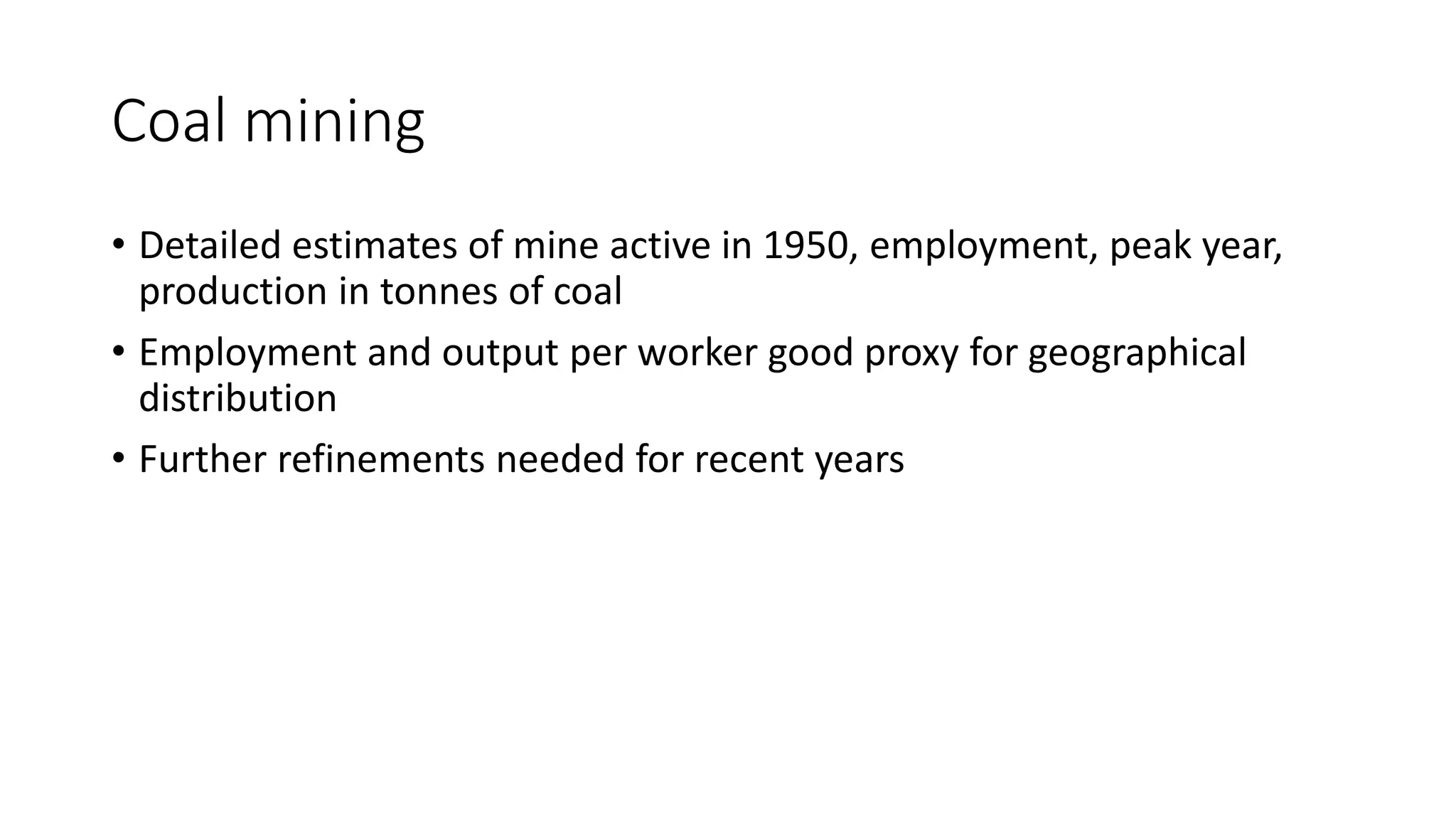
Coal mining
• Detailed estimates of mine active in 1950, employment, peak year,
production in tonnes of coal
• Employment and output per worker good proxy for geographical
distribution
• Further refinements needed for recent years
Stage 4
Disaggregating IOC GVA to Local
Authorities
Sources and methods
• Input-Output analysis at core – uses many sources IDBR, ABS,
Regional Accounts – good quality from 1998
• Pre 1998 harder – but have
• Data ACOP, ACOC, RDS
• Analysis , SEBs, academic work
• Work incomplete – work in progress
Further Scottish contextual analysis – Low
level geographies
To conclude ….
• Scottish economic statistics have matured significantly since the
Scottish Parliament was established
• There are many challenges in producing regional economic indicators
– but not insurmountable
• To understand the changing economy (productivity) need to
understand:
• Long term changes / history
• Local differences
• GDP important, but only in a wider context
End

ESWG - Exploring Regional Statistics

  • 1.
  • 2.
    Improving Local Productivity ProfessorRichard Kneller School of Economics University of Nottingham richard.kneller@nottingham.ac.uk
  • 3.
    The Challenges • Outputper hour worked 15% below the average of G7 • D2N2 productivity is 10% lower than the UK average National and local productivity gap • Difficulty in un-picking that headline figure Data • No previous examples on interventions targeted at productivity • Lack of evidence on past business interventions that might have had productivity effects Lack of evidence on what works • Industrial strategy and local industrial strategyNational versus LEP policy levers
  • 4.
    • Lower productivitythan England average • 88% of UK average • Persistent gap • £10,700 GVA per worker less, £8.2 billion in total • Why does it exist? D2N2 Productivity 0.882 0.884 0.886 0.888 0.89 0.892 0.894 0.896 0.898 0.9 2004 2005 2006 2007 2008 2009 2010 2011 2012 2013 2014 2015 GVA per hour % of the UK
  • 5.
  • 6.
    Why is D2N2less productive? 1. Sectoral composition 2. Too many small businesses 3. Too little entry (and exit) 4. Our businesses are not productive 5. Our productive businesses are too small D2N2 Productivity Sectoral Composition Within Industry Between Firm Within Firm Covariance 5 explanations
  • 7.
    D2N2 productivity Within industry Sectoral composition • Howproductive is an industry • How big is it compared to the rest of the economy • D2N2 has Larger manufacturing employment • Smaller business services & finance employment • Shifting industrial composition would close the gap by 1 percentage point Why is D2N2 less productive? GVA per emp England emp share D2N2 emp share Agri. 16,468 0.6 0.9 Manuf. 47,108 10.0 14.3 Whole&Ret 29,822 18.7 18.7 Transp. 27,868 9.2 8.7 FIRE 61,521 16.6 11.9 Gov 24,249 29.7 31.6
  • 8.
    D2N2 productivity growth -1.5 -1 -0.5 0 0.5 1 1.5 2 1950 1953 1956 1959 1962 1965 1968 1971 1974 1977 1980 1983 1986 1989 1992 1995 1998 2001 2004 2007 Productivity Growth StructuralChange Within Industry Within industry: productivity change of an industry Structural change: reallocation of resources across industries • For UK structural change appears relatively unimportant • Or at least its contribution takes a long time to appear • Almost all productivity growth occurs within industries Why is D2N2 less productive?
  • 9.
    • Can comparethe productivity of businesses • The differences are big! • This is a picture replicated across industries, countries and time • In this region the gap is not at the bottom or the top • There are more businesses in D2N2 with productivity a little below the average and too few with productivity just above • Increasing productivity of the average firm would close the gap by 5 percentage points Why is D2N2 less productive?
  • 10.
    • For theaggregate what also matters is whether the productive businesses are small or large • This is known as allocative efficiency • This value is lower in this region than elsewhere • Increasing this to the UK average would close the gap by 12 percentage points Why is D2N2 less productive? Large & productive Large & productive Large & unproductive Large & unproductive Small & productive Small & productive Small & unproductive Small & unproductive
  • 11.
    Within Firm • Creationof new technologies • Adoption of new technologies • Management Practice and Organisation • Efficient use of these technologies Between Firm • Reallocation of market shares to more productive firms • That productive firms have opportunity & finance to survive and grow • Entry of new productive firms How to raise local productivity?
  • 12.
    How to raiselocal productivity? • multinationals • Knowledge and R&D intensive • Excellent management • ICT & high skill intensive frontier • Exporter/importers • Technology adopters/imitators • Average management/organisation National champions • domestic focused • Below average management • Slow adoption of new technology • Focused on survival Laggards • Market size (domestic, foreign) • Competition • Infrastructure (road, rail, air, digital) • Skills/ education
  • 13.
    How to raiselocal productivity? Large & productive Large & unproductive Small & productive Small & unproductive
  • 14.
    A framework forProductivity enhancing business support What is the long-term change you see as your goal? Improvement in all measures of productivity: - Increase in average productivity of firms - Improvement in allocative efficiency - Increase in output per hour Which productivity driver(s) are you trying to affect? - R&D investment - Management practices - Market development ... Who are your target businesses? - Any sector or priority sectors - Small productive or large unproductive firms ... Key assumptions: Literature review on drivers of productivity What is your entry point to reaching businesses? - Own networks - D2N2 Growth Hub - Market research & active engagement ... Key assumptions: Diagnostic tool to help identify what drives productivity for different types of firms Key assumptions: The appropriate segment of businesses is reached proactively or referred to in case a business is reaching out for support. What is the measurable effect of your intervention? - New products/services - Improvement in management scores ... Key assumptions: Firm performance data are recorded before and after the intervention for all participants What are the wider benefits of your intervention? - Productive firms become bigger - Competition improves ... Key assumptions: Methodologies that enable causal inferences are used to evaluate interventions Stakeholders: -Government (BEIS, Local) -EU -Economic development partnerships (LEPs, Midlands Engine, Northern Powerhouse) -Research bodies -Business organisations (CBI, Chambers of commerce) Inspired by Theory of Change, Nesta
  • 15.
    Productivity Improvement Programme Confounding Variable Productivity PIP Group Couterfactual group Effect ofthe PIP Weakest • Case studies • Simple correlation regressions • Matching • Difference-in-differences • Regression discontinuity • Instrumental variable Strongest • Randomised control trial A framework for Productivity enhancing business support
  • 16.
    National View • Treasuryview emphasises broader policy levers • Industrial strategy, recognises productivity as an issue. • Local industrial strategy, emphasises local solutions • Narrative based on unique strengths and challenges of the region • Difficult to provide diagnostic that goes beyond one of sectors
  • 18.
    Developing a road-map andco-production of (sub)regional statistics and analysis Greater Manchester Combined Authority Rupert Greenhalgh – Principal Analyst
  • 19.
    Greater Manchester –key stats 110,000 businesses 2.8m people +240,000 since 2000 Over 100,000 Higher Education Students at 5 HE Institutions 1.3m working in GM +100,000 next 10 yrs GM ECONOMY €72.6bn
  • 20.
    The Greater ManchesterGovernance (Strategy & Research) Story GMCA & LEP established Publication of the MIER and the first GM Strategy Thematic Commissions established TfGM established GM City Deal Refreshed GM Strategy Devolution Agreement Growth Deal Growth & Reform Plan developed Interim Mayor appointed Health and Social Care MoU Further Devolution announced 2009 2010 2011 2013 2014 20152012 2016 2017 Fourth devolution deal 2017 First mayoral election Statutory City Region Pilot New GM Strategy Fifth devolution deal
  • 21.
    GMCA functions Policing TransportFire and Rescue Health Waste disposal Economic development, regeneration and housing All functions conferred on the GMCA by any enactment are functions of the GMCA, but an order or other enactment may provide that certain functions are exercisable only by the Mayor
  • 22.
    Developing the relationshipwith ONS A series of targets or ‘prizes’ for our team • Partner need and interest (Officers and Members, and Mayor) • Knowledge and development (staff learning new things and approaches to analysing data) • Profile (in GM and nationally) • Access to the Secure Research Services (Microlab) • A roadmap share with internal Officers, and externally with ONS • An MoU, not legally binding but setting out how we will help ONS, and they help us • To use the data within 12 months on a nationally known project / study
  • 23.
    Use case: GreaterManchester - Independent Prosperity Review (Panel) Published early 2019. Business expertise will brought in by industry sessions with Panel members during the process. Partnerships with OECD, European Commission and World Economic Forum. Informs GMs LIS Diane Coyle (Chair) Bennett Professor of Public Policy, University of Cambridge Professor Ed Glaeser Professor of Economics at Harvard University Stephanie Flanders Head of Bloomberg Economics Professor Henry Overman Professor of Economic Geography at the London School of Economics Professor Mariana Mazzucato Professor in the Economics of Innovation at University College London Darra Singh Government & Public Sector Lead at Ernst & Young • Analysis of productivity taking a deep-dive into labour productivity performance across GM • Analysis of the ‘long tail’ of low-productivity firms and low pay within GM • Identifying the main policy levers that could raise labour productivity • A study to understand GM’s national and international supply chain and trade linkages • An exploration of the city region’s innovation ecosystems and sources of global competitiveness, building on the 2016 Science and Innovation Audit • Analysis of education and skills transitions, reviewing the role of the entire education and skills system in GM and how individuals pass through key transition points • A review of the infrastructure needs of GM to raise productivity, including the potential for new approaches to unlock investment
  • 24.
    Audit of labourproductivity
  • 26.
  • 27.
    Compiling Economic Statistics forScotland – past, present and future. Sandy Stewart Scottish Government
  • 28.
    Compiling Economic Statisticsfor Scotland • History • What we currently produce • Challenges • Uses • Future developments • Understanding the Scottish Economy • Long term times series • Sub-Scotland analysis • Other analysis for community planning • Conclusions
  • 29.
    Scotland – fourmain cities
  • 30.
  • 31.
  • 32.
    Industry in CentralBelt - Grangemouth – Ineos + Petrochina = Petroineos
  • 33.
  • 34.
    Remote Islands –Isle of Skye
  • 35.
    Remote Islands –Isle of Skye
  • 36.
    Remote – aScottish croft
  • 37.
    Scotland – Localdeprivation
  • 38.
  • 39.
    History Scottish Office • 1988– Index of Industrial Production and Construction (quarterly); GDP Index (annual) • 1990 – compilation of 1989 Input-Output tables (to complement 1973 and 1979) 1999 – Demands of Scottish Parliament • 2002 - First quarterly real GDP series (1997-2001) • Demand for more regular I-O tables, trade and GDP (I) and (E) as well as (O)
  • 40.
    History 2008 – Demandsof Council of Economic Advisors • October 2008 – SESCG proposal to embark on experimental SNAP • Consistent quarterly GDP(O), (I) and (E) components • Annual I-O tables 1998 to present • Development of onshore Quarterly Supply Use framework (quarterly) • First experiment estimates published October 2009 • August 2014 – QNAS – National Statistics status • Now releases of GDP and revised GDP/National Accounts each quarter
  • 41.
  • 42.
    What we currentlyproduce for Scotland • Input-Output tables – 1998 to 2015 on consistent basis • Onshore only, consistent with UK National Accounts definitions, broadly consistent with other measures • Detailed onshore trade flows with ROW and RUK • Quarterly, real-terms GVA and GDP • Consistent with I-O weights, input into QNAS • Quarterly National Accounts • GDP by Expenditure, Income and Output components, quarterly imports and exports (modelled) to RUK and ROW, Revenues, Index of Manufactured Exports • Other • GERS, Retail Sales in Scotland, Oil and Gas Production Statistics, Labour Productivity, Business Statistics, Labour Market statistics, Energy statistics …
  • 43.
    New products • Wholeof Scotland Accounts – 2017/18 • North Sea satellite account • Complements onshore I-O tables • Quarterly Gross National Income (GNI) – 2017/18 • Direct Investment, Portfolio Investment, Other Investment, Employment flows with ROW and RUK, North Sea • Balance of Payments – longer term • Needs Primary Income, Balance of Trade and some brainwork! • Sub-Scotland economic statistics • SESCG sub-group set up in 2018
  • 44.
  • 45.
    Specific Challenges • DefiningScotland • Defining an enterprise and what it does • Regional prices and deflators
  • 46.
  • 47.
  • 48.
  • 49.
    Scottish trade flows OnshoreScotland With Scottish North Sea
  • 50.
    Regional prices anddeflators • No regional prices/deflators available • Use UK deflators, weighted by industry • Adjust for domestic/export consumption for manufactured goods • Input prices should also be considered … • Regional double deflation • Hedonic quality adjustments • Speed up processing and publishing of all outputs
  • 51.
    Uses of ScottishEconomic Statistics
  • 52.
    Uses of ScottishEconomic Statistics • Public, Parliament and Media • Modelling and Analysis • CGE model – using I-O framework • Multi regional CGE model • Shock and impact assessments • Forecasting the economy and tax revenues
  • 56.
  • 57.
    Future Challenges • Movefrom survey to administrative data • HMRC VAT turnover data • HMRC PAYE RTI data • Keeping up with UK Blue Book Changes • H-Approach Double Deflation • Measuring structural changes in the economy • Consumption of digital products (often free, contribution to economy hidden) • Disruptions to traditional industries (travel, music, media, ..) • Consumption and prices for ‘new’ service providers (Airbnb, Uber, ..) • Output of MNEs – even harder for regions
  • 58.
  • 59.
    Understanding the ScottishEconomy • QNAS goes a long way towards understanding current changes … • But need more … • … especially relating to long term analysis of employment, output and productivity, and regional variation • … but difficult because data sources and methods, industrial classifications, and geographic boundaries change over time
  • 60.
    Regional productivity project- underway 1. Produce consistent nominal GVA for onshore Scotland over time 2. Using I-O tables, disaggregate GVA to industry groups 3. Add details on turnover and employment 4. Disaggregate industry groups to local authority areas 5. Deflate by sector and constrain to QNAS/GDP totals 6. Adjust for changes in employment patterns (male/female, full- time/part-time, hours per job) 7. Compile modelled local productivity estimates.
  • 61.
    Stage 1 Establishing along term GVA time series
  • 62.
    Data sources andmethods • QNAS 2018 Q2 - for annual GVA since 1998 • Historic sources and analyses • Presented in real terms (deflated by UK GVA deflator), per capita, and log10 • FISIM and Imputed Rental adjustments • Averaging of data sources • Flexible – can adjust at any stage
  • 64.
    Sources of historicinformation Title Author(s) Date published 1. The Scottish Economy – A statistical account of Scottish life AK Cairncross et al 1954 2. Survey of economic conditions in Scotland in 1954 Clydesdale & North of Scotland bank Ltd 1955 3. An Inquiry into the Scottish economy (1960-61) JN Toothill 1961 4. Scotland’s Economic Progress 1951-1960 – A study in regional accounting G McCrone 1965 5. Scotland – The Vital Market Credland, Luby, Murray, La Frenais 1966 6. The Structure and Growth of the Scottish economy Johnston, Buxton & Mair 1971 7. The Renaissance of the Scottish Economy? C Lythe & M Majmudar 1982 8. Understanding the Scottish Economy Ingham & Love 1983 9. The Caledonian Blue Book, 1997 H Gibson, G Riddington, D Whigham & J Whyte 1997
  • 65.
    Stage 2 Apportioning toInput-Output classifications (IOCs)
  • 66.
    Data sources andmethods • IOCs – arguably too detailed, but deflators available for IOC groups – consistency with QNAS and GDP analysis • QNAS – provides IOC detail back to 1998 • Unpublished I-O analysis 1950 – 2014 (pre-dated ESA2007 changes) • Further work needed to harmonise and make consistent with overall GVA estimates
  • 67.
    Stage 3 Detailed Industryanalysis – turnover, GVA and employment
  • 68.
    Sectors of interest •Regional data system – manufacturing employment • Sea Fisheries • Coal Mining
  • 69.
    Regional Data System– manufacturing employment in Scotland 1950-1995 • Scottish Office responsible for upkeep of Scottish elements of DTI database • Pre-dates the ONS IDBR • Coverage – all local manufacturing units with 10 and over employees • Classified to SIC92 • Address, postcode and contact details • 12,700 local units, 46 years’ data, 4MB • At least 50 person years’ work!
  • 74.
    Sea fishing • Detailedemployment and landings statistics since early 1900s • GVA harder to estimate, but employment (possibly) good proxy for geographical distribution.
  • 76.
    Coal mining • Detailedestimates of mine active in 1950, employment, peak year, production in tonnes of coal • Employment and output per worker good proxy for geographical distribution • Further refinements needed for recent years
  • 78.
    Stage 4 Disaggregating IOCGVA to Local Authorities
  • 79.
    Sources and methods •Input-Output analysis at core – uses many sources IDBR, ABS, Regional Accounts – good quality from 1998 • Pre 1998 harder – but have • Data ACOP, ACOC, RDS • Analysis , SEBs, academic work • Work incomplete – work in progress
  • 81.
    Further Scottish contextualanalysis – Low level geographies
  • 84.
    To conclude …. •Scottish economic statistics have matured significantly since the Scottish Parliament was established • There are many challenges in producing regional economic indicators – but not insurmountable • To understand the changing economy (productivity) need to understand: • Long term changes / history • Local differences • GDP important, but only in a wider context
  • 86.

Editor's Notes

  • #22 Economic development, regeneration and housing Preparation of spatial development strategy (but needs approval of all 10 other GMCA members) Designation of mayoral development areas (but needs consent of GMCA member(s) for area concerned) Approval of Compulsory Purchase Orders (but needs consent of GMCA member(s) for area concerned)