Title: VITON-HD: High-Resolution Virtual Try-On via Misalignment-Aware Normalization
Authors: Seunghwan Choi*, Sunghyun Park*, Minsoo Lee*, Jaegul Choo (*: equal contributions)
Abstract:
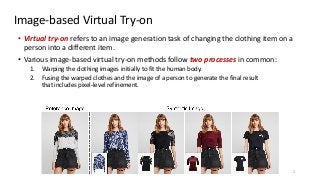
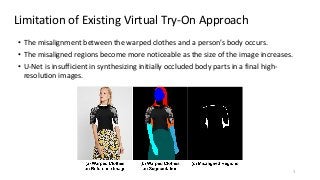
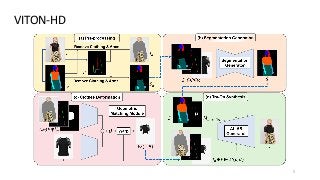
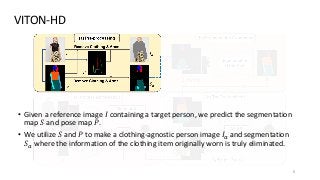
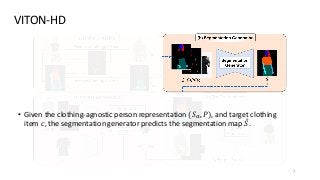
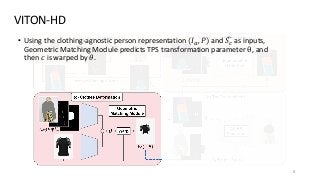
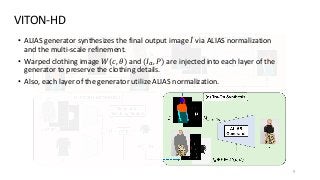
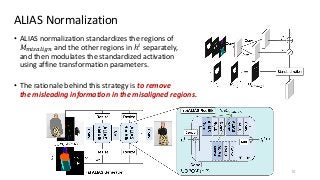
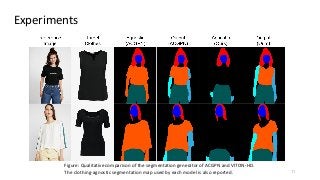
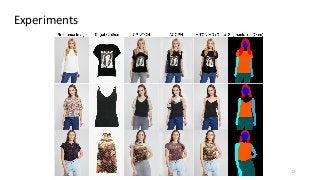
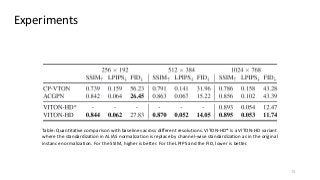
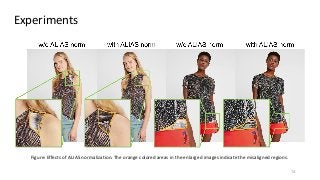
The task of image-based virtual try-on aims to transfer a target clothing item onto the corresponding region of a person, which is commonly tackled by fitting the item to the desired body part and fusing the warped item with the person. While an increasing number of studies have been conducted, the resolution of synthesized images is still limited to low (e.g., 256x192), which acts as the critical limitation against satisfying online consumers. We argue that the limitation stems from several challenges: as the resolution increases, the artifacts in the misaligned areas between the warped clothes and the desired clothing regions become noticeable in the final results; the architectures used in existing methods have low performance in generating high-quality body parts and maintaining the texture sharpness of the clothes. To address the challenges, we propose a novel virtual try-on method called VITON-HD that successfully synthesizes 1024x768 virtual try-on images. Specifically, we first prepare the segmentation map to guide our virtual try-on synthesis, and then roughly fit the target clothing item to a given person's body. Next, we propose ALIgnment-Aware Segment (ALIAS) normalization and ALIAS generator to handle the misaligned areas and preserve the details of 1024x768 inputs. Through rigorous comparison with existing methods, we demonstrate that VITON-HD highly sur-passes the baselines in terms of synthesized image quality both qualitatively and quantitatively.




![[AAAI 2021] Vid-ODE: Continuous-Time Video Generation with Neural Ordinary Di...](https://cdn.slidesharecdn.com/ss_thumbnails/2021aaaivid-ode20min-210401064554-thumbnail.jpg?width=640&height=640&fit=bounds)


![[DSC Europe 25] Milovan Jovicic - Beyond AI's Reach: The Enduring Value of Ev...](https://cdn.slidesharecdn.com/ss_thumbnails/pyeij0hurgwq5jugmtnv-2-milovan-jovicic-beyond-ais-reach-the-enduring-value-of-evergreen-design-v2-260120105856-d6ee57e5-thumbnail.jpg?width=640&height=640&fit=bounds)
![[DSC Europe 25] Tali Fulman - Guild Meetings, Then What? Building Data Commun...](https://cdn.slidesharecdn.com/ss_thumbnails/fgohhi33rwmhqdowdj5k-tali-fulman-guild-meetings-then-what-building-data-communities-that-actually-ch-260120105855-528492c3-thumbnail.jpg?width=640&height=640&fit=bounds)
![[DSC Europe 25] Laila Kakar - Leveraging AI for Strategic Excellence: Enhanci...](https://cdn.slidesharecdn.com/ss_thumbnails/eykmhrtsqmaaftwkexh7-dsc-lailakakar-1-260119101520-5f3b5616-thumbnail.jpg?width=640&height=640&fit=bounds)
![[DSC Europe 25] Borko Kozomora - Optimizing business workflows with advances ...](https://cdn.slidesharecdn.com/ss_thumbnails/hbgekyb0txw0xpo4yfml-borko-kozomora-leading-ai-transformation-260122103838-cc29ee38-thumbnail.jpg?width=640&height=640&fit=bounds)
![[DSC Europe 25] Mikhail Rozhkov - AI Product Canvas: From Business Goals to T...](https://cdn.slidesharecdn.com/ss_thumbnails/d53doddtpgfqivmzqel6-mikhail-rozhkov-ai-product-canvas-v1-260121115910-9dd517a7-thumbnail.jpg?width=640&height=640&fit=bounds)

![[DSC Europe 25] Egor Krasheninnikov - The Control Stack: Building Guardrails ...](https://cdn.slidesharecdn.com/ss_thumbnails/3lzcz7hxqmo51mtalv4u-the-control-stack-260119101520-ea90841a-thumbnail.jpg?width=640&height=640&fit=bounds)
![[DSC Europe 25] Bojan Djuricic - Predictive Design Process.pdf](https://cdn.slidesharecdn.com/ss_thumbnails/5awdrbedqdek3gqu2ezy-4-the-predictive-design-bojan-djuricic-260120105856-6c399e9b-thumbnail.jpg?width=640&height=640&fit=bounds)

![[DSC Europe 25] Marcos Heidemann - Beyond the Hype: Making AI Coding Assistan...](https://cdn.slidesharecdn.com/ss_thumbnails/eexkhvldrjsopspdjbur-marcos-heidemann-beyond-the-hype-getting-real-value-out-of-ai-assisted-coding-260121115910-7e9d41ec-thumbnail.jpg?width=640&height=640&fit=bounds)


![[DSC Europe 25] Dubravko Culibrk - Deep Learning for Mammography.pptx](https://cdn.slidesharecdn.com/ss_thumbnails/yiscimuktacgqoiu4dkp-deep-learning-for-mammography-260119121559-aad59182-thumbnail.jpg?width=640&height=640&fit=bounds)


![[DSC Europe 25] Milos Belcevic - Product Professional's Journey to Full-Stack...](https://cdn.slidesharecdn.com/ss_thumbnails/1zovd6fgsycdg4wvgvls-milos-belcevic-product-professionals-journey-to-full-stack-product-developer-260123083019-d993120d-thumbnail.jpg?width=640&height=640&fit=bounds)


