Hydrogen Fuel Cells
David Lorse
ESS 315
What is a hydrogen fuel cell?
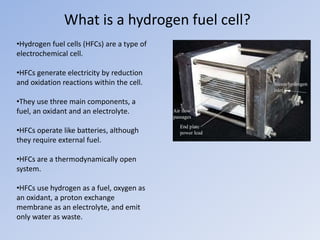
•Hydrogen fuel cells (HFCs) are a type of
electrochemical cell.
•HFCs generate electricity by reduction
and oxidation reactions within the cell.
•They use three main components, a
fuel, an oxidant and an electrolyte.
•HFCs operate like batteries, although
they require external fuel.
•HFCs are a thermodynamically open
system.
•HFCs use hydrogen as a fuel, oxygen as
an oxidant, a proton exchange
membrane as an electrolyte, and emit
only water as waste.
How do they work?
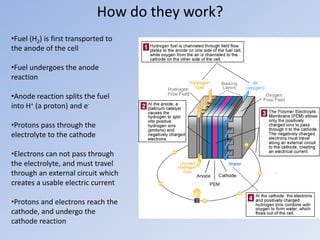
•Fuel (H2) is first transported to
the anode of the cell
•Fuel undergoes the anode
reaction
•Anode reaction splits the fuel
into H+ (a proton) and e-
•Protons pass through the
electrolyte to the cathode
•Electrons can not pass through
the electrolyte, and must travel
through an external circuit which
creates a usable electric current
•Protons and electrons reach the
cathode, and undergo the
cathode reaction
Chemistry behind the technology
Oxidation
At the anode of the cell, a
catalyst (platinum powder)
is used to separate the
proton from the electron in
the hydrogen fuel.
Anode half-reaction:
2H2  4H+ + 4e-
Eo = 0.00V
Reduction
At the cathode of the cell, a
second catalyst (nickel) is used to
recombine the protons,
electrons, and oxygen atoms to
form water.
Cathode half- reaction:
4H+ + O2 + 4e-  2H2O
Eo = 0.68V
In electrochemistry, the Eo
cell value (energy) of a fuel cell is equal to the Eo of
the cathode half-reaction minus the Eo of the anode half-reaction. For a
hydrogen fuel cell, the two half reactions are shown above. So to calculate the
energy of one fuel cell, we need to subtract the anode energy from the
cathode energy. For a HFC, the Eo
cell = 0.68V – 0.00V which equals 0.68V
Uses of hydrogen fuel cells
There are many different uses of fuel cells being utilized right now. Some of these
uses are…
•Power sources for vehicles such as cars, trucks, buses and even boats and submarines
•Power sources for spacecraft, remote weather stations and military technology
•Batteries for electronics such as laptops and smart phones
•Sources for uninterruptable power supplies.
Problems regarding hydrogen fuel cells
•Lack of hydrogen infrastructure
•Need for refueling stations
•Lack of consumer distribution system
•Cost of hydrogen fuel cells
•2009 Department of Energy estimated $61/kw
•Honda FCX Clarity costs about half a million dollars to make
•Carbon cost of producing hydrogen
•Problems with HFC cars
•Short range (~260 miles)
•Warm up time (~5 minutes)
References
•http://www.fueleconomy.gov/feg/fuelcell.shtml
•http://www.howstuffworks.com/fuel-efficiency/alternative-fuels/fuel-cell.htm
•http://www.energy.gov
•Chemical Principles, Sixth Edition, Zumdahl

Hydrogen_Fuel_Cells.ppt

  • 1.
  • 2.
    What is ahydrogen fuel cell? •Hydrogen fuel cells (HFCs) are a type of electrochemical cell. •HFCs generate electricity by reduction and oxidation reactions within the cell. •They use three main components, a fuel, an oxidant and an electrolyte. •HFCs operate like batteries, although they require external fuel. •HFCs are a thermodynamically open system. •HFCs use hydrogen as a fuel, oxygen as an oxidant, a proton exchange membrane as an electrolyte, and emit only water as waste.
  • 3.
    How do theywork? •Fuel (H2) is first transported to the anode of the cell •Fuel undergoes the anode reaction •Anode reaction splits the fuel into H+ (a proton) and e- •Protons pass through the electrolyte to the cathode •Electrons can not pass through the electrolyte, and must travel through an external circuit which creates a usable electric current •Protons and electrons reach the cathode, and undergo the cathode reaction
  • 4.
    Chemistry behind thetechnology Oxidation At the anode of the cell, a catalyst (platinum powder) is used to separate the proton from the electron in the hydrogen fuel. Anode half-reaction: 2H2  4H+ + 4e- Eo = 0.00V Reduction At the cathode of the cell, a second catalyst (nickel) is used to recombine the protons, electrons, and oxygen atoms to form water. Cathode half- reaction: 4H+ + O2 + 4e-  2H2O Eo = 0.68V In electrochemistry, the Eo cell value (energy) of a fuel cell is equal to the Eo of the cathode half-reaction minus the Eo of the anode half-reaction. For a hydrogen fuel cell, the two half reactions are shown above. So to calculate the energy of one fuel cell, we need to subtract the anode energy from the cathode energy. For a HFC, the Eo cell = 0.68V – 0.00V which equals 0.68V
  • 5.
    Uses of hydrogenfuel cells There are many different uses of fuel cells being utilized right now. Some of these uses are… •Power sources for vehicles such as cars, trucks, buses and even boats and submarines •Power sources for spacecraft, remote weather stations and military technology •Batteries for electronics such as laptops and smart phones •Sources for uninterruptable power supplies.
  • 6.
    Problems regarding hydrogenfuel cells •Lack of hydrogen infrastructure •Need for refueling stations •Lack of consumer distribution system •Cost of hydrogen fuel cells •2009 Department of Energy estimated $61/kw •Honda FCX Clarity costs about half a million dollars to make •Carbon cost of producing hydrogen •Problems with HFC cars •Short range (~260 miles) •Warm up time (~5 minutes)
  • 7.