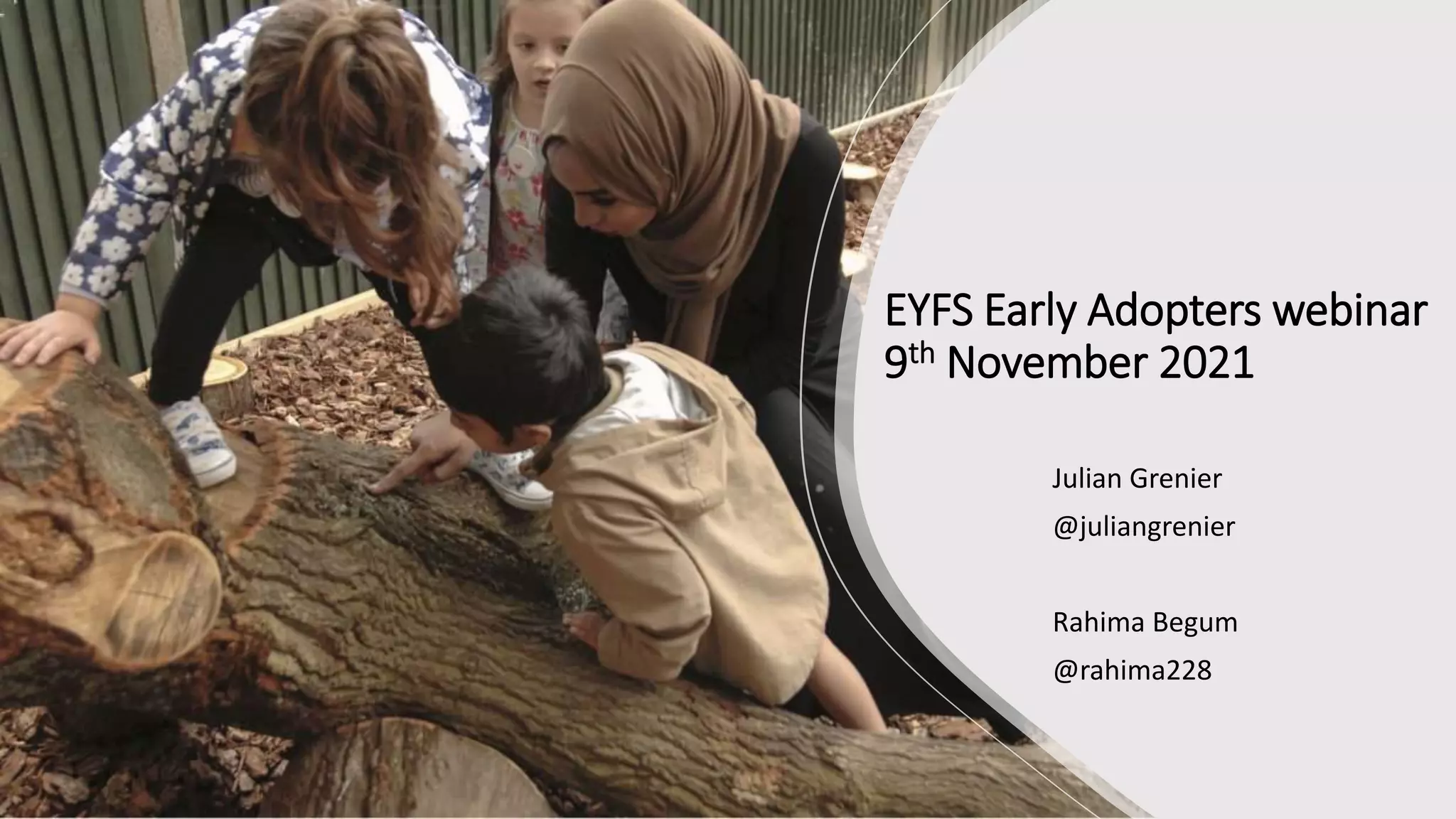
EYFS Early Adopters webinar
9th November 2021
Julian Grenier
@juliangrenier
Rahima Begum
@rahima228
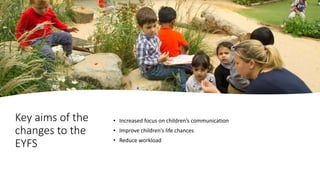
Key aims of the
changes to the
EYFS
• Increased focus on children’s communication
• Improve children’s life chances
• Reduce workload
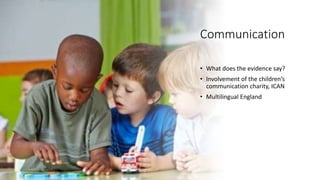
Communication
• What does the evidence say?
• Involvement of the children’s
communication charity, ICAN
• Multilingual England
The challenge
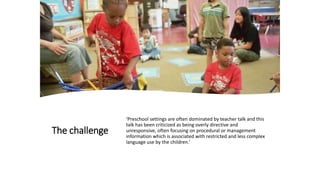
‘Preschool settings are often dominated by teacher talk and this
talk has been criticized as being overly directive and
unresponsive, often focusing on procedural or management
information which is associated with restricted and less complex
language use by the children.’
The challenge
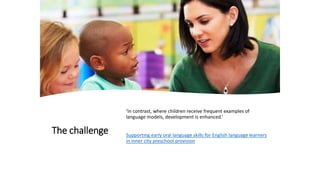
‘In contrast, where children receive frequent examples of
language models, development is enhanced.’
Supporting early oral language skills for English language learners
in inner city preschool provision
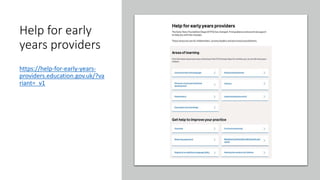
Help for early
years providers
https://help-for-early-years-
providers.education.gov.uk/?va
riant=_v1
A brighter start for every child
@EducEndowFoundn
EEF-funded
projects
schools, nurseries,
colleges involved
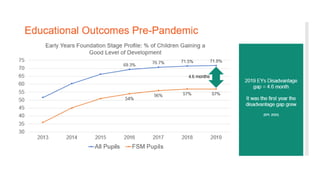
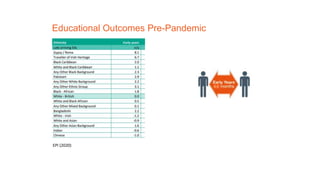
Educational Outcomes Pre-Pandemic
EPI (2020)
4.6
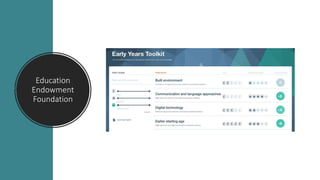
Education
Endowment
Foundation
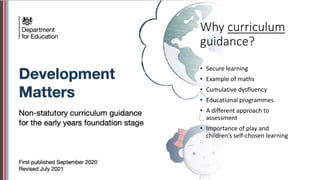
Why curriculum
guidance?
• Secure learning
• Example of maths
• Cumulative dysfluency
• Educational programmes
• A different approach to
assessment
• Importance of play and
children’s self-chosen learning
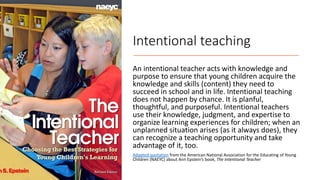
Intentional teaching
An intentional teacher acts with knowledge and
purpose to ensure that young children acquire the
knowledge and skills (content) they need to
succeed in school and in life. Intentional teaching
does not happen by chance. It is planful,
thoughtful, and purposeful. Intentional teachers
use their knowledge, judgment, and expertise to
organize learning experiences for children; when an
unplanned situation arises (as it always does), they
can recognize a teaching opportunity and take
advantage of it, too.
Adapted quotation from the American National Association for the Educating of Young
Children (NAEYC) about Ann Epstein’s book, The Intentional Teacher
Intentional teaching means teachers act with specific outcomes or
goals in mind for all domains of children’s development and learning.
“Academic” domains (literacy, mathematics, science, and social studies)
as well as what have traditionally been considered early learning
domains (social and emotional, cognitive, physical, and creative
development) all consist of important knowledge and skills that young
children want and need to master. Intentional teachers, therefore,
integrate and promote meaningful learning in all domains.
Workload
• ‘I feel like I am not living, I am
existing.’
• Minds Matter (Early Years
Alliance)
A different
emphasis
• Curriculum Guidance
• A focus on curriculum, and
assessment that’s fit for
purpose
• Tackling the excessive
workload associated with
tracking
The
example of
maths
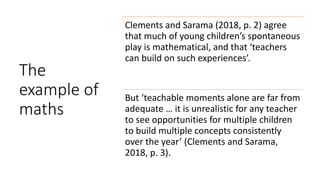
Clements and Sarama (2018, p. 2) agree
that much of young children’s spontaneous
play is mathematical, and that ‘teachers
can build on such experiences’.
But ‘teachable moments alone are far from
adequate … it is unrealistic for any teacher
to see opportunities for multiple children
to build multiple concepts consistently
over the year’ (Clements and Sarama,
2018, p. 3).
  52 
Notice patterns and arrange 
things in patterns. 
Provide patterned material – gingham, polka dots, 
stripes etc. – and small objects to arrange in patterns. 
Use words like ‘repeated’ and ‘the same’ over and 
over. 
 
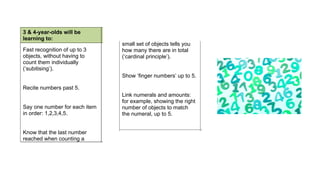
3 & 4-year-olds will be 
learning to: 
Examples of how to support this: 
Fast recognition of up to 3 
objects, without having to 
count them individually 
(‘subitising’). 
 
Recite numbers past 5. 
 
Say one number for each item 
in order: 1,2,3,4,5.  
 
Know that the last number 
reached when counting a 
Point to small groups of two or three objects: “Look, 
there are two!” Occasionally ask children how many 
there are in a small set of two or three.  
 
Regularly say the counting sequence, in a variety of 
playful contexts, inside and outdoors, forwards and 
backwards, sometimes going to high numbers. For 
example: hide and seek, rocket-launch count-downs.  
 
Count things and then repeat the last number. For 
example: “1, 2, 3  – 3 cars”. Point out the number of 
things whenever possible; so, rather than just 
3 & 4-year-olds will be 
learning to: 
Examples of how to support this: 
small set of objects tells you 
how many there are in total 
(‘cardinal principle’). 
 
Show ‘finger numbers’ up to 5. 
 
Link numerals and amounts: 
for example, showing the right 
number of objects to match 
the numeral, up to 5. 
 
‘chairs’, ‘apples’ or ‘children’, say ‘two chairs’, ‘th
apples’, ‘four children’. 
Ask children to get you a number of things, and 
emphasise the total number in your conversation
the child. 
 
Use small numbers to manage the learning 
environment. Suggestions: have a pot labelled ‘5
pencils’ or a crate for ‘3 trucks’. Draw children’s 
attention to these throughout the session and 
especially at tidy-up time: “How many pencils sho
be in this pot?” or “How many have we got?” etc.
Experiment with their own 
symbols and marks as well as 
numerals.  
 
Solve real world mathematical 
problems with numbers up to 
Encourage children in their own ways of recordin
(for example) how many balls they managed to t
through the hoop. Provide numerals nearby for 
reference. Suggestions: wooden numerals in a 
basket or a number track on the fence. 
 
The example of early reading
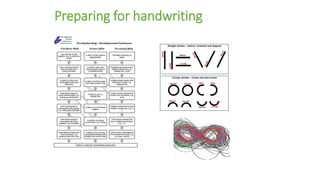
Preparing for handwriting
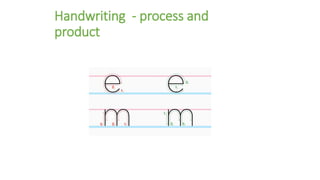
Handwriting - process and
product
Handwriting
• Achieving good results in the end of key stage assessments is of
crucial importance to schools. Consequently, there is considerable
pressure on practitioners to ‘get children writing’ whether or not they
are developmentally ready. One casualty of this pressure is the effect
on learning and practising the movements for each letter family.
Many children enter Year 1 of the National Curriculum with letters
incorrectly formed.
• Source: https://nha-handwriting.org.uk/handwriting/help-for-teachers/development-of-handwriting-in-the-eyfs/
One
approach to
curriculum
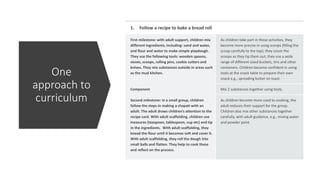
1. Follow a recipe to bake a bread roll
First milestone: with adult support, children mix
different ingredients, including: sand and water,
and flour and water to make simple playdough.
They use the following tools: wooden spoons,
sieves, scoops, rolling pins, cookie cutters and
knives. They mix substances outside in areas such
as the mud kitchen.
As children take part in these activities, they
become more precise in using scoops (filling the
scoop carefully to the top); they count the
scoops as they tip them out; they use a wide
range of different-sized buckets, tins and other
containers. Children become confident in using
tools at the snack table to prepare their own
snack e.g., spreading butter on toast.
Component Mix 2 substances together using tools.
Second milestone: in a small group, children
follow the steps in making a chapati with an
adult. The adult draws children’s attention to the
recipe card. With adult scaffolding, children use
measures (teaspoon, tablespoon, cup etc) and tip
in the ingredients. With adult scaffolding, they
knead the flour until it becomes soft and cover it.
With adult scaffolding, they roll the dough into
small balls and flatten. They help to cook these
and reflect on the process.
As children become more used to cooking, the
adult reduces their support for the group.
Children also mix other substances together
carefully, with adult guidance, e.g., mixing water
and powder paint.
One
approach to
curriculum
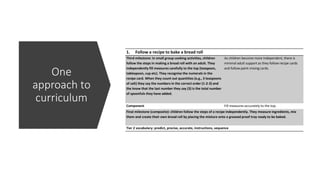
1. Follow a recipe to bake a bread roll
Third milestone: In small group cooking activities, children
follow the steps in making a bread roll with an adult. They
independently fill measures carefully to the top (teaspoon,
tablespoon, cup etc). They recognise the numerals in the
recipe card. When they count out quantities (e.g., 3 teaspoons
of salt) they say the numbers in the correct order (1-2-3) and
the know that the last number they say (3) is the total number
of spoonfuls they have added.
As children become more independent, there is
minimal adult support as they follow recipe cards
and follow paint-mixing cards.
Component Fill measures accurately to the top.
Final milestone (composite): children follow the steps of a recipe independently. They measure ingredients, mix
them and create their own bread roll by placing the mixture onto a greased proof tray ready to be baked.
Tier 2 vocabulary: predict, precise, accurate, instructions, sequence
Curriculum progress maps
• We’re responsible for children from when they start with us
• We need a curriculum plan from EYFS onwards: ‘vertical integration’ is
important
• No prescribed format or approach
• We don’t teach geography in early years
• Subject leads need to understand EYFS, and vice versa
• What’s the key, foundational content that children will learn in EYFS
to support them when they start learning geography in KS1?
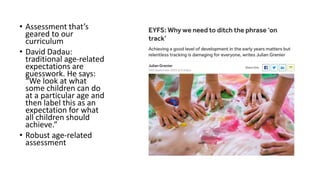
• Assessment that’s
geared to our
curriculum
• David Dadau:
traditional age-related
expectations are
guesswork. He says:
“We look at what
some children can do
at a particular age and
then label this as an
expectation for what
all children should
achieve.”
• Robust age-related
assessment
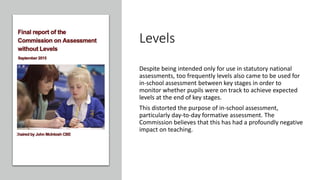
Levels
Despite being intended only for use in statutory national
assessments, too frequently levels also came to be used for
in-school assessment between key stages in order to
monitor whether pupils were on track to achieve expected
levels at the end of key stages.
This distorted the purpose of in-school assessment,
particularly day-to-day formative assessment. The
Commission believes that this has had a profoundly negative
impact on teaching.
Too often levels became viewed as thresholds and teaching became
focused on getting pupils across the next threshold instead of ensuring
they were secure in the knowledge and understanding defined in the
programmes of study. Depth and breadth of understanding were
sometimes sacrificed in favour of pace. Levels also used a ‘best fit’
model, which meant that a pupil could have serious gaps in their
knowledge and understanding, but still be placed within the level. This
meant it wasn’t always clear exactly which areas of the curriculum the
child was secure in and where the gaps were.
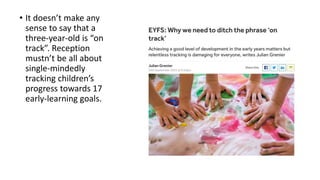
• It doesn’t make any
sense to say that a
three-year-old is “on
track”. Reception
mustn’t be all about
single-mindedly
tracking children’s
progress towards 17
early-learning goals.
@primarypercival
False opposites
‘Interventions that include an explicit focus on executive
function skills do not need to be implemented separately from
those focused on instruction in early literacy and math
abilities. Indeed, the complex interactions that occur among
executive functioning, social competence, and academic skills
in preschool classrooms underscore the likely value of blending
interventions designed to strengthen working memory,
inhibition, and attention control with curricula focused on
early literacy and math skill’.
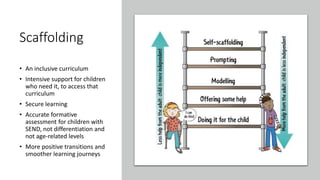
Scaffolding
• An inclusive curriculum
• Intensive support for children
who need it, to access that
curriculum
• Secure learning
• Accurate formative
assessment for children with
SEND, not differentiation and
not age-related levels
• More positive transitions and
smoother learning journeys
Leadership
School leaders
Progress
meetings
about children
Professional development
• Stronger focus on early
communication
• Rooted in research and the
frontline experience of early
years care and education
• Professional judgement – and
a stronger focus on
professional development
• Improving children’s life-
chances
• A focus on curriculum and
assessment that’s geared to
improving children’s learning
• Reduced length and
consistent messages around
workload reduction
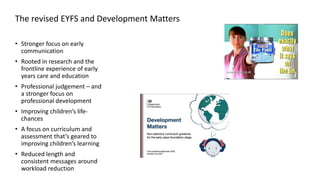
The revised EYFS and Development Matters

Early Years Early Adopter Webinar

Editor's Notes

  • #23 Ask delegates if they actively monitor children’s actual development skills? Show materials
  • #24 2 strands Extensive practice needed Gross and fine motor development