Beginning Teaching Beginning Learning in Primary
Education 3rd Edition Janet Moyles pdf download
https://ebookfinal.com/download/beginning-teaching-beginning-
learning-in-primary-education-3rd-edition-janet-moyles/
Explore and download more ebooks or textbooks
at ebookfinal.com
We have selected some products that you may be interested in
Click the link to download now or visit ebookfinal.com
for more options!.
A Z of Play 1st Edition Janet Moyles
https://ebookfinal.com/download/a-z-of-play-1st-edition-janet-moyles/
Beginning Linux programming 3rd Edition Neil Matthew
https://ebookfinal.com/download/beginning-linux-programming-3rd-
edition-neil-matthew/
Beginning Programming Wrox Beginning Guides 1st Edition
Adrian Kingsley-Hughes
https://ebookfinal.com/download/beginning-programming-wrox-beginning-
guides-1st-edition-adrian-kingsley-hughes/
Beginning Programming for Dummies 3rd ed Edition Wallace
Wang
https://ebookfinal.com/download/beginning-programming-for-dummies-3rd-
ed-edition-wallace-wang/
Online Learning and Teaching in Higher Education 1st
Edition Shirley Bach
https://ebookfinal.com/download/online-learning-and-teaching-in-
higher-education-1st-edition-shirley-bach/
180 Days of Cursive Beginning Practice Assess Diagnose 1st
Edition Shell Education
https://ebookfinal.com/download/180-days-of-cursive-beginning-
practice-assess-diagnose-1st-edition-shell-education/
Teaching in Primary Schools in China and India Contexts of
learning 1st Edition Nirmala Rao
https://ebookfinal.com/download/teaching-in-primary-schools-in-china-
and-india-contexts-of-learning-1st-edition-nirmala-rao/
Schaum s Outline of Beginning Chemistry 3rd Edition David
Goldberg
https://ebookfinal.com/download/schaum-s-outline-of-beginning-
chemistry-3rd-edition-david-goldberg/
Primary Languages in Practice A Guide to Teaching and
Learning 1st Edition Jane Jones
https://ebookfinal.com/download/primary-languages-in-practice-a-guide-
to-teaching-and-learning-1st-edition-jane-jones/
Beginning Teaching Beginning Learning in Primary
Education 3rd Edition Janet Moyles Digital Instant

Download
Author(s): Janet Moyles
ISBN(s): 9780335230068, 0335230067
File Details: PDF, 15.14 MB
Year: 2007
Language: english
Beginning Teaching:
Beginning Learning
Third Edition
Beginning Teaching:
Beginning Learning
Third Edition
Edited by
Janet Moyles
Open University Press
McGraw-Hill Education
McGraw-Hill House
Shoppenhangers Road
Maidenhead
Berkshire
England
SL6 2QL
email: enquiries@openup.co.uk
world wide web: www.openup.co.uk
and Two Penn Plaza, New York, NY 10121–2289, USA
First published 2007
Copyright # The Editor and Contributors, 2007
All rights reserved. Except for the quotation of short passages for the purposes of criticism and
review, no part of this publication may be reproduced, stored in a retrieval system, or
transmitted, in any form or by any means, electronic, mechanical, photocopying, recording or
otherwise, without the prior permission of the publisher or a licence from the Copyright
Licensing Agency Limited. Details of such licences (for reprographic reproduction) may be
obtained from the Copyright Licensing Agency Ltd of 90 Tottenham Court Road, London, W1T
4LP.
A catalogue record of this book is available from the British Library
ISBN 13: 978 0335 221 301 (pb) 978 0335 221 318 (hb)
ISBN 10: 0335 221 300 (pb) 0335 221 319 (hb)
Library of Congress Cataloguing-in-Publication Data
CIP data applied for
Typeset by YHT Ltd, London
Printed in Poland by OZGraf S.A.
www.polslzabook.pl
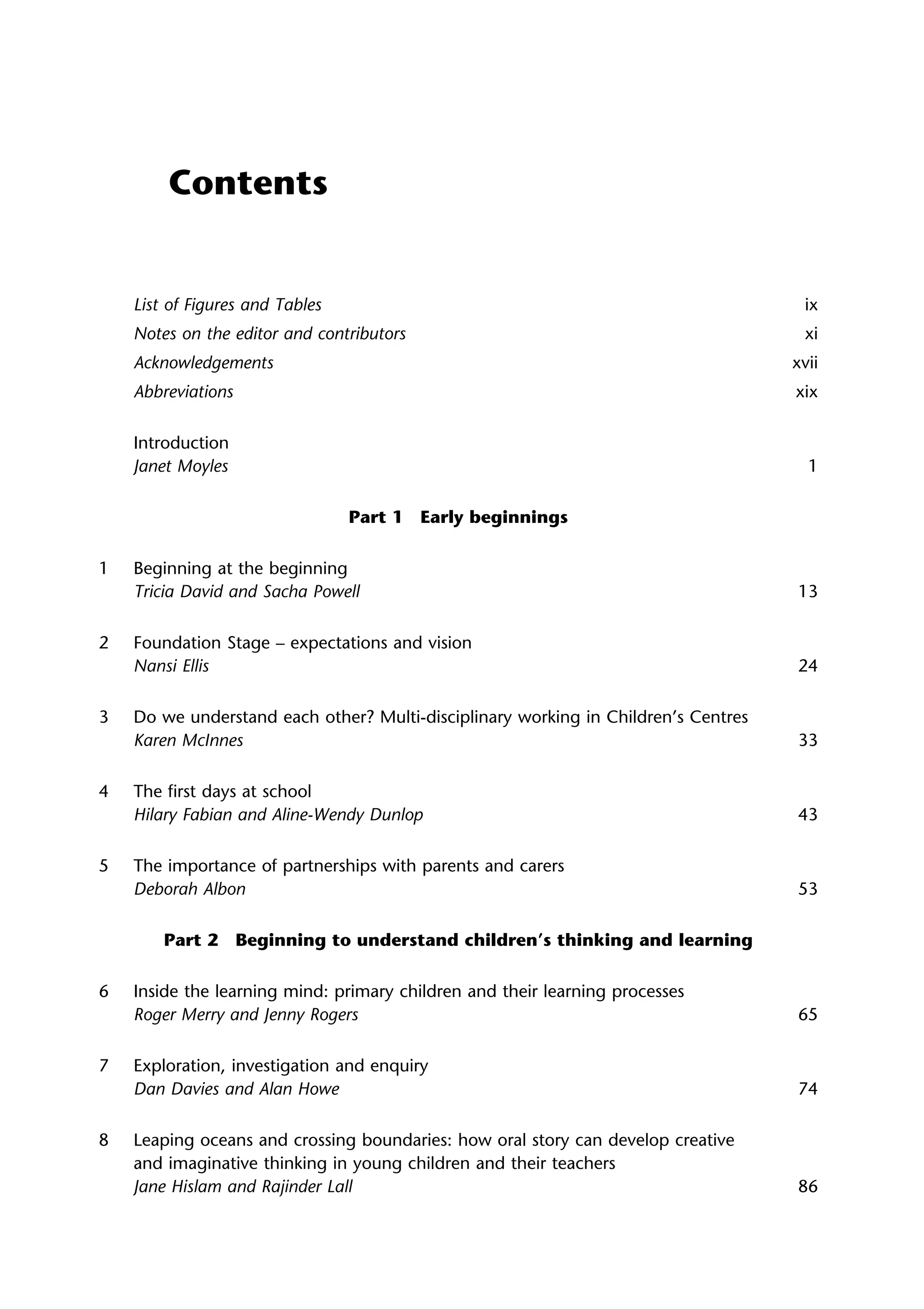
Contents
List of Figures and Tables ix
Notes on the editor and contributors xi
Acknowledgements xvii
Abbreviations xix
Introduction
Janet Moyles 1
Part 1 Early beginnings
1 Beginning at the beginning
Tricia David and Sacha Powell 13
2 Foundation Stage – expectations and vision
Nansi Ellis 24
3 Do we understand each other? Multi-disciplinary working in Children’s Centres
Karen McInnes 33
4 The first days at school
Hilary Fabian and Aline-Wendy Dunlop 43
5 The importance of partnerships with parents and carers
Deborah Albon 53
Part 2 Beginning to understand children’s thinking and learning
6 Inside the learning mind: primary children and their learning processes
Roger Merry and Jenny Rogers 65
7 Exploration, investigation and enquiry
Dan Davies and Alan Howe 74
8 Leaping oceans and crossing boundaries: how oral story can develop creative
and imaginative thinking in young children and their teachers
Jane Hislam and Rajinder Lall 86
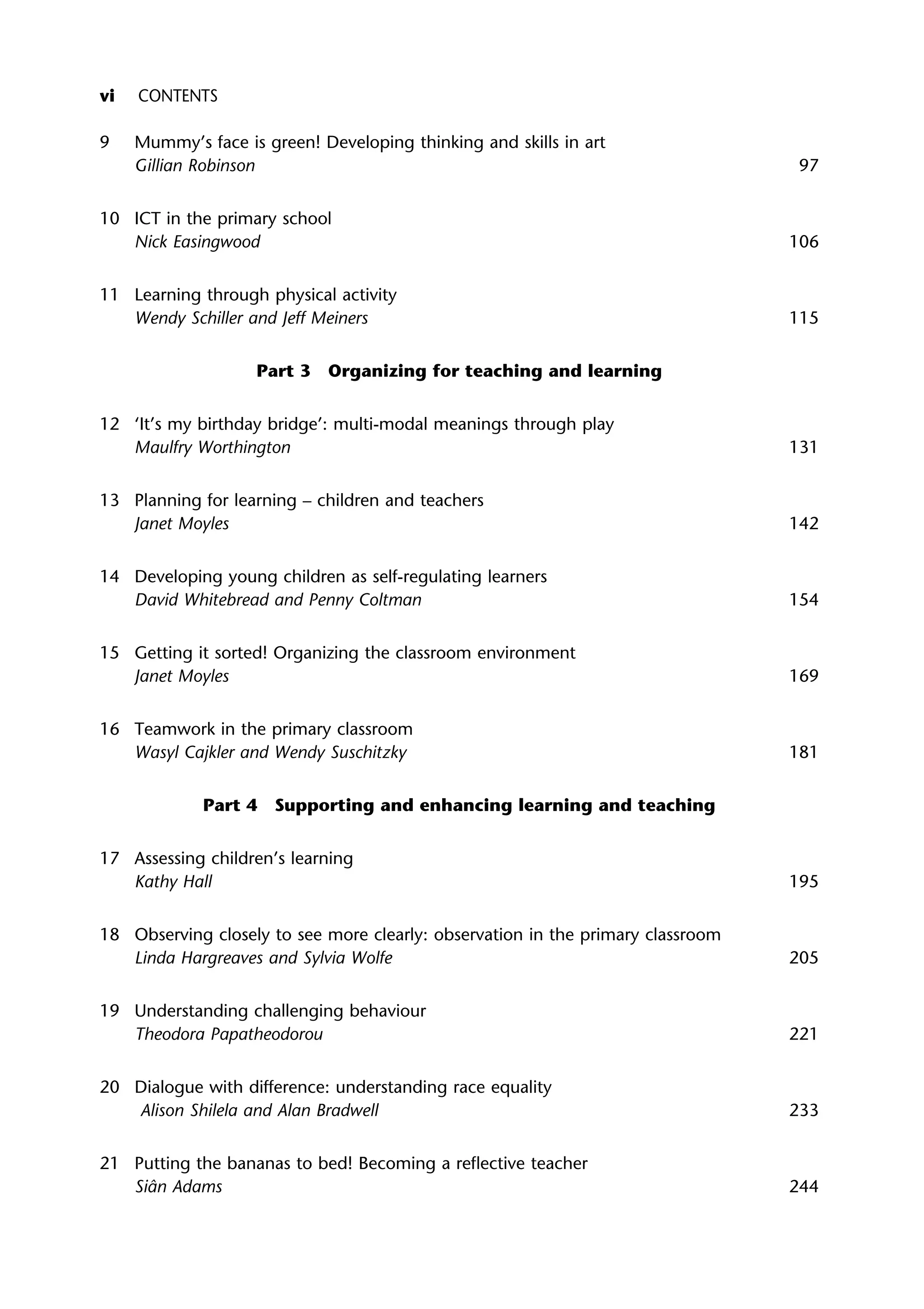
9 Mummy’s face is green! Developing thinking and skills in art
Gillian Robinson 97
10 ICT in the primary school
Nick Easingwood 106
11 Learning through physical activity
Wendy Schiller and Jeff Meiners 115
Part 3 Organizing for teaching and learning
12 ‘It’s my birthday bridge’: multi-modal meanings through play
Maulfry Worthington 131
13 Planning for learning – children and teachers
Janet Moyles 142
14 Developing young children as self-regulating learners
David Whitebread and Penny Coltman 154
15 Getting it sorted! Organizing the classroom environment
Janet Moyles 169
16 Teamwork in the primary classroom
Wasyl Cajkler and Wendy Suschitzky 181
Part 4 Supporting and enhancing learning and teaching
17 Assessing children’s learning
Kathy Hall 195
18 Observing closely to see more clearly: observation in the primary classroom
Linda Hargreaves and Sylvia Wolfe 205
19 Understanding challenging behaviour
Theodora Papatheodorou 221
20 Dialogue with difference: understanding race equality
Alison Shilela and Alan Bradwell 233
21 Putting the bananas to bed! Becoming a reflective teacher
Siân Adams 244
vi CONTENTS
Conclusion
Janet Moyles, beginner teachers and tutors 254
Index 259
CONTENTS vii
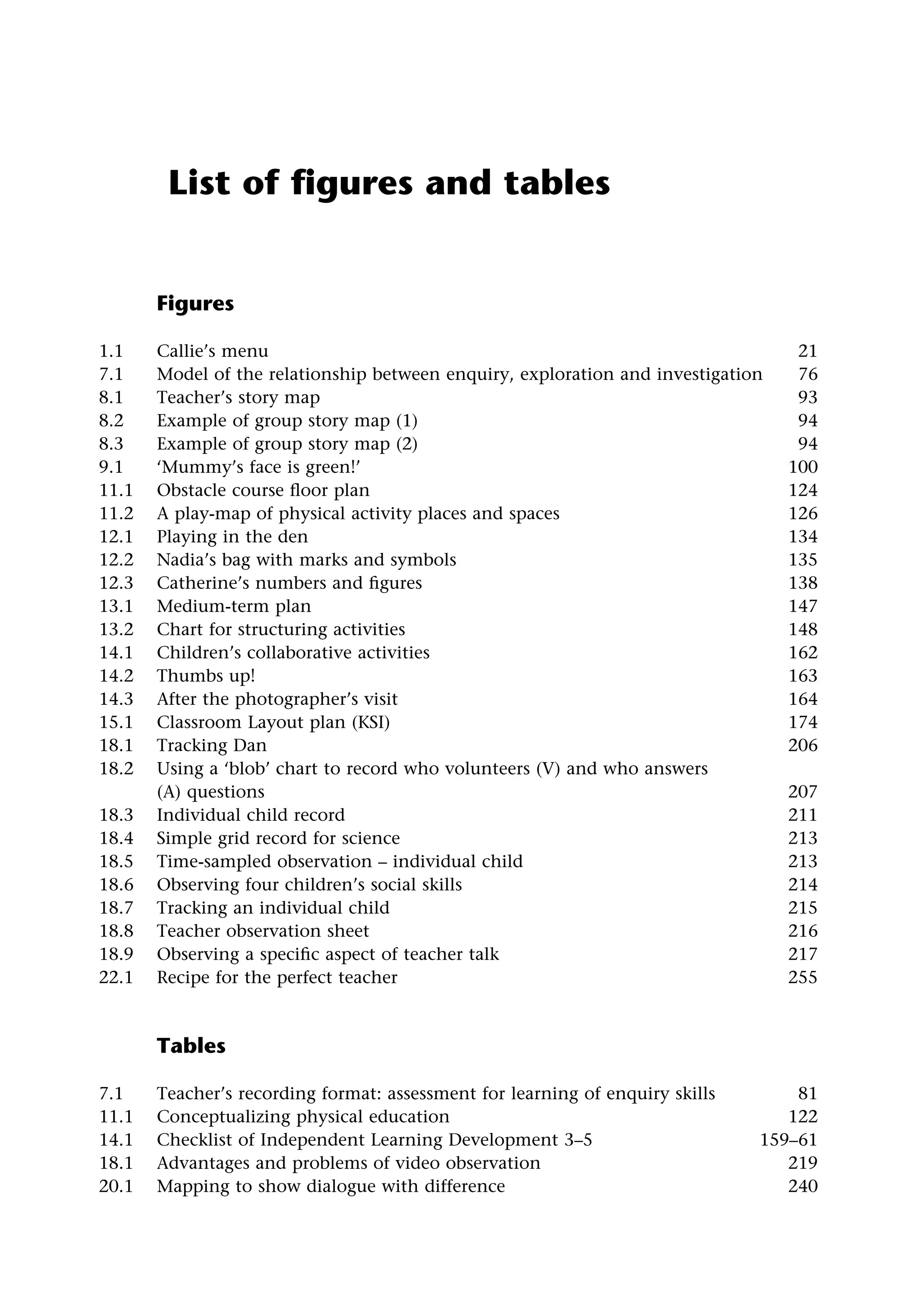
List of figures and tables
Figures
1.1 Callie’s menu 21
7.1 Model of the relationship between enquiry, exploration and investigation 76
8.1 Teacher’s story map 93
8.2 Example of group story map (1) 94
8.3 Example of group story map (2) 94
9.1 ‘Mummy’s face is green!’ 100
11.1 Obstacle course floor plan 124
11.2 A play-map of physical activity places and spaces 126
12.1 Playing in the den 134
12.2 Nadia’s bag with marks and symbols 135
12.3 Catherine’s numbers and figures 138
13.1 Medium-term plan 147
13.2 Chart for structuring activities 148
14.1 Children’s collaborative activities 162
14.2 Thumbs up! 163
14.3 After the photographer’s visit 164
15.1 Classroom Layout plan (KSI) 174
18.1 Tracking Dan 206
18.2 Using a ‘blob’ chart to record who volunteers (V) and who answers
(A) questions 207
18.3 Individual child record 211
18.4 Simple grid record for science 213
18.5 Time-sampled observation – individual child 213
18.6 Observing four children’s social skills 214
18.7 Tracking an individual child 215
18.8 Teacher observation sheet 216
18.9 Observing a specific aspect of teacher talk 217
22.1 Recipe for the perfect teacher 255
Tables
7.1 Teacher’s recording format: assessment for learning of enquiry skills 81
11.1 Conceptualizing physical education 122
14.1 Checklist of Independent Learning Development 3–5 159–61
18.1 Advantages and problems of video observation 219
20.1 Mapping to show dialogue with difference 240
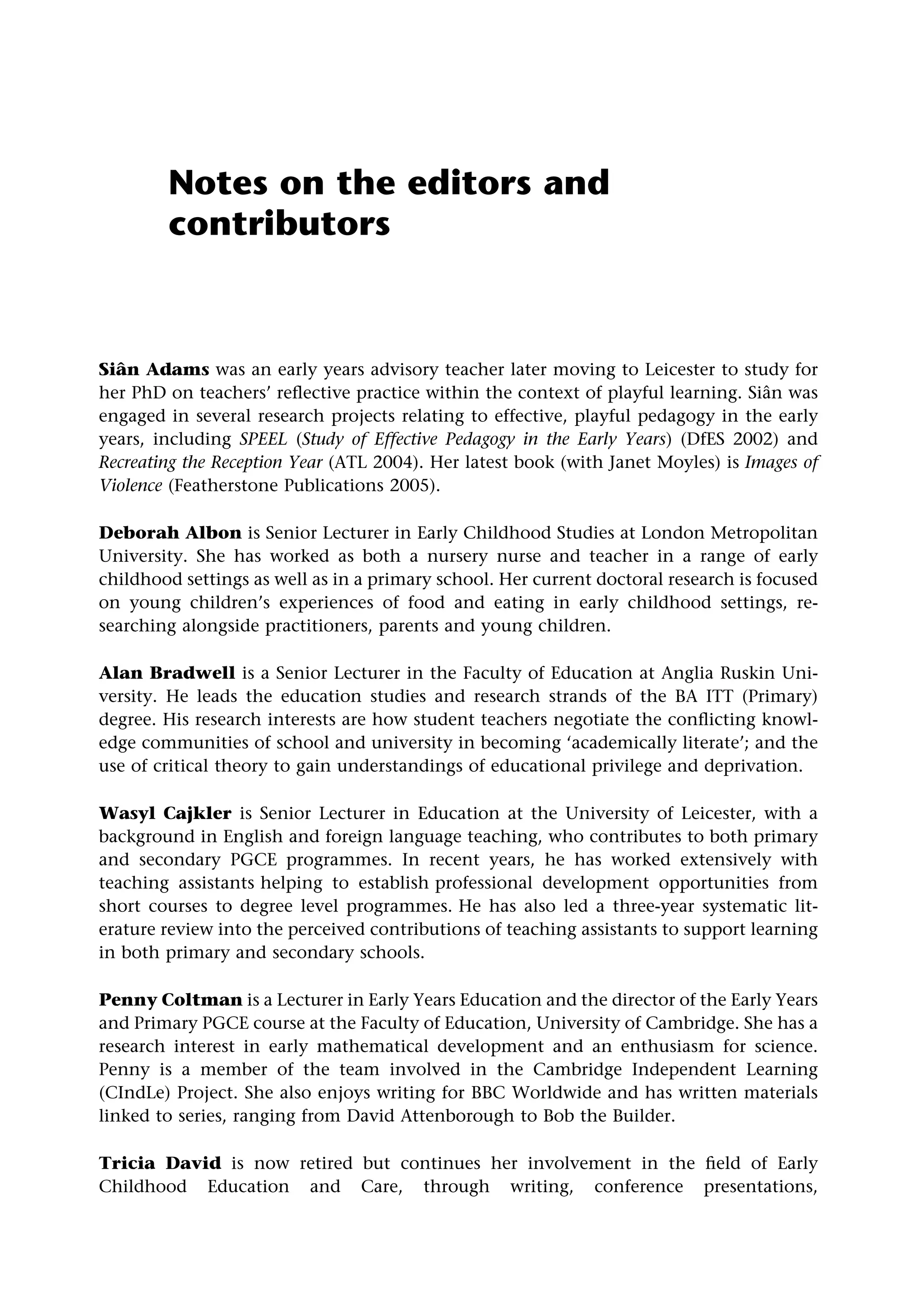
Notes on the editors and
contributors
Siân Adams was an early years advisory teacher later moving to Leicester to study for
her PhD on teachers’ reflective practice within the context of playful learning. Siân was
engaged in several research projects relating to effective, playful pedagogy in the early
years, including SPEEL (Study of Effective Pedagogy in the Early Years) (DfES 2002) and
Recreating the Reception Year (ATL 2004). Her latest book (with Janet Moyles) is Images of
Violence (Featherstone Publications 2005).
Deborah Albon is Senior Lecturer in Early Childhood Studies at London Metropolitan
University. She has worked as both a nursery nurse and teacher in a range of early
childhood settings as well as in a primary school. Her current doctoral research is focused
on young children’s experiences of food and eating in early childhood settings, re-
searching alongside practitioners, parents and young children.
Alan Bradwell is a Senior Lecturer in the Faculty of Education at Anglia Ruskin Uni-
versity. He leads the education studies and research strands of the BA ITT (Primary)
degree. His research interests are how student teachers negotiate the conflicting knowl-
edge communities of school and university in becoming ‘academically literate’; and the
use of critical theory to gain understandings of educational privilege and deprivation.
Wasyl Cajkler is Senior Lecturer in Education at the University of Leicester, with a
background in English and foreign language teaching, who contributes to both primary
and secondary PGCE programmes. In recent years, he has worked extensively with
teaching assistants helping to establish professional development opportunities from
short courses to degree level programmes. He has also led a three-year systematic lit-
erature review into the perceived contributions of teaching assistants to support learning
in both primary and secondary schools.
Penny Coltman is a Lecturer in Early Years Education and the director of the Early Years
and Primary PGCE course at the Faculty of Education, University of Cambridge. She has a
research interest in early mathematical development and an enthusiasm for science.
Penny is a member of the team involved in the Cambridge Independent Learning
(CIndLe) Project. She also enjoys writing for BBC Worldwide and has written materials
linked to series, ranging from David Attenborough to Bob the Builder.
Tricia David is now retired but continues her involvement in the field of Early
Childhood Education and Care, through writing, conference presentations,
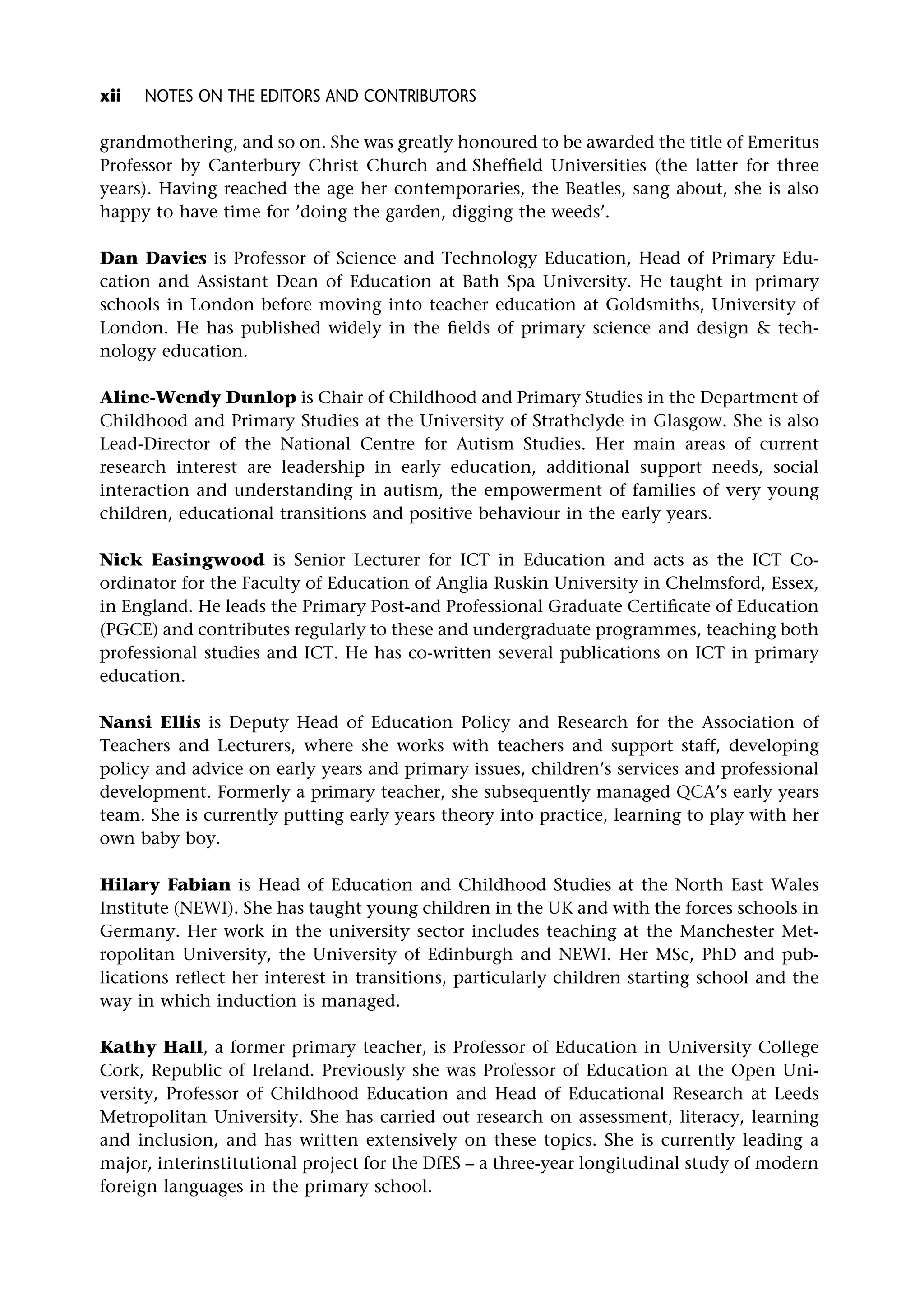
grandmothering, and so on. She was greatly honoured to be awarded the title of Emeritus
Professor by Canterbury Christ Church and Sheffield Universities (the latter for three
years). Having reached the age her contemporaries, the Beatles, sang about, she is also
happy to have time for ’doing the garden, digging the weeds’.
Dan Davies is Professor of Science and Technology Education, Head of Primary Edu-
cation and Assistant Dean of Education at Bath Spa University. He taught in primary
schools in London before moving into teacher education at Goldsmiths, University of
London. He has published widely in the fields of primary science and design & tech-
nology education.
Aline-Wendy Dunlop is Chair of Childhood and Primary Studies in the Department of
Childhood and Primary Studies at the University of Strathclyde in Glasgow. She is also
Lead-Director of the National Centre for Autism Studies. Her main areas of current
research interest are leadership in early education, additional support needs, social
interaction and understanding in autism, the empowerment of families of very young
children, educational transitions and positive behaviour in the early years.
Nick Easingwood is Senior Lecturer for ICT in Education and acts as the ICT Co-
ordinator for the Faculty of Education of Anglia Ruskin University in Chelmsford, Essex,
in England. He leads the Primary Post-and Professional Graduate Certificate of Education
(PGCE) and contributes regularly to these and undergraduate programmes, teaching both
professional studies and ICT. He has co-written several publications on ICT in primary
education.
Nansi Ellis is Deputy Head of Education Policy and Research for the Association of
Teachers and Lecturers, where she works with teachers and support staff, developing
policy and advice on early years and primary issues, children’s services and professional
development. Formerly a primary teacher, she subsequently managed QCA’s early years
team. She is currently putting early years theory into practice, learning to play with her
own baby boy.
Hilary Fabian is Head of Education and Childhood Studies at the North East Wales
Institute (NEWI). She has taught young children in the UK and with the forces schools in
Germany. Her work in the university sector includes teaching at the Manchester Met-
ropolitan University, the University of Edinburgh and NEWI. Her MSc, PhD and pub-
lications reflect her interest in transitions, particularly children starting school and the
way in which induction is managed.
Kathy Hall, a former primary teacher, is Professor of Education in University College
Cork, Republic of Ireland. Previously she was Professor of Education at the Open Uni-
versity, Professor of Childhood Education and Head of Educational Research at Leeds
Metropolitan University. She has carried out research on assessment, literacy, learning
and inclusion, and has written extensively on these topics. She is currently leading a
major, interinstitutional project for the DfES – a three-year longitudinal study of modern
foreign languages in the primary school.
xii NOTES ON THE EDITORS AND CONTRIBUTORS
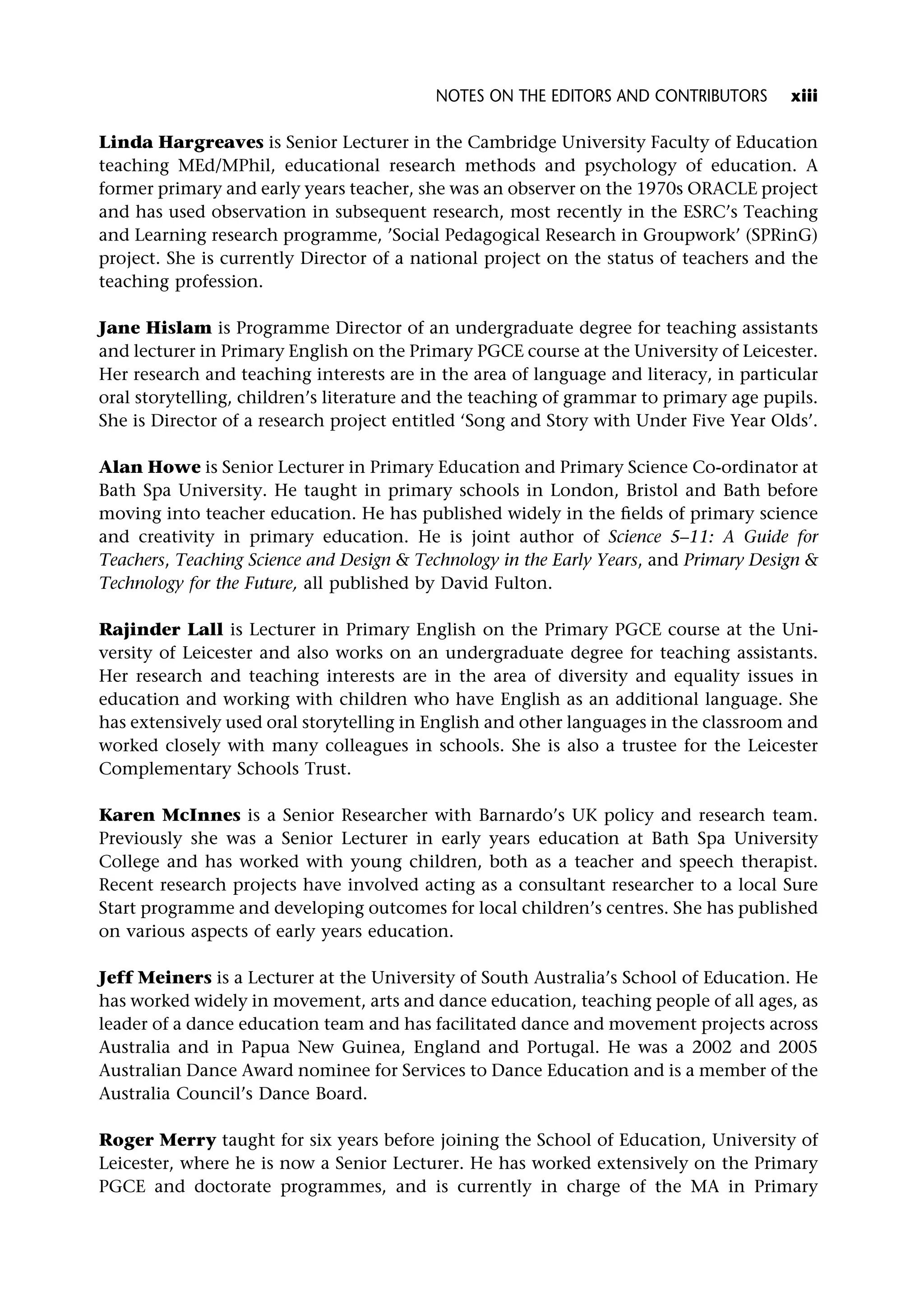
Linda Hargreaves is Senior Lecturer in the Cambridge University Faculty of Education
teaching MEd/MPhil, educational research methods and psychology of education. A
former primary and early years teacher, she was an observer on the 1970s ORACLE project
and has used observation in subsequent research, most recently in the ESRC’s Teaching
and Learning research programme, ’Social Pedagogical Research in Groupwork’ (SPRinG)
project. She is currently Director of a national project on the status of teachers and the
teaching profession.
Jane Hislam is Programme Director of an undergraduate degree for teaching assistants
and lecturer in Primary English on the Primary PGCE course at the University of Leicester.
Her research and teaching interests are in the area of language and literacy, in particular
oral storytelling, children’s literature and the teaching of grammar to primary age pupils.
She is Director of a research project entitled ‘Song and Story with Under Five Year Olds’.
Alan Howe is Senior Lecturer in Primary Education and Primary Science Co-ordinator at
Bath Spa University. He taught in primary schools in London, Bristol and Bath before
moving into teacher education. He has published widely in the fields of primary science
and creativity in primary education. He is joint author of Science 5–11: A Guide for
Teachers, Teaching Science and Design & Technology in the Early Years, and Primary Design &
Technology for the Future, all published by David Fulton.
Rajinder Lall is Lecturer in Primary English on the Primary PGCE course at the Uni-
versity of Leicester and also works on an undergraduate degree for teaching assistants.
Her research and teaching interests are in the area of diversity and equality issues in
education and working with children who have English as an additional language. She
has extensively used oral storytelling in English and other languages in the classroom and
worked closely with many colleagues in schools. She is also a trustee for the Leicester
Complementary Schools Trust.
Karen McInnes is a Senior Researcher with Barnardo’s UK policy and research team.
Previously she was a Senior Lecturer in early years education at Bath Spa University
College and has worked with young children, both as a teacher and speech therapist.
Recent research projects have involved acting as a consultant researcher to a local Sure
Start programme and developing outcomes for local children’s centres. She has published
on various aspects of early years education.
Jeff Meiners is a Lecturer at the University of South Australia’s School of Education. He
has worked widely in movement, arts and dance education, teaching people of all ages, as
leader of a dance education team and has facilitated dance and movement projects across
Australia and in Papua New Guinea, England and Portugal. He was a 2002 and 2005
Australian Dance Award nominee for Services to Dance Education and is a member of the
Australia Council’s Dance Board.
Roger Merry taught for six years before joining the School of Education, University of
Leicester, where he is now a Senior Lecturer. He has worked extensively on the Primary
PGCE and doctorate programmes, and is currently in charge of the MA in Primary
NOTES ON THE EDITORS AND CONTRIBUTORS xiii
Education, with distance learning students from all over the world. His main interest is in
children’s learning, with publications including academic articles and books and ma-
terials for teachers and children.
Janet Moyles is Professor Emeritus at Anglia Ruskin University and an early years
consultant. She has worked as an early years teacher and head, and also run early years
initial and inservice training courses for teachers on play and learning and effective/
reflective pedagogy. She has directed several research projects including Jills of All Trades?
(ATL 1996), Teaching Fledglings to Fly (ATL 1997), Too Busy to Play? (Leicester 1997–2000),
SPEEL – Study of Pedagogical Effectiveness in Early Learning (DfES 2002) and Recreating the
Reception Year (ATL 2004).
Theodora Papatheodorou is Professor in Early Childhood Education and Research at
Anglia Ruskin University. She has long and diverse teaching and research experience in
the field of early childhood. Her work has been widely disseminated by publications and
presentations at international journals and conferences, respectively. She is the author of
the book Behaviour Problems in the Early Years (Routledge 2005).
Sacha Powell is Senior Research Fellow in the Department of Educational Research
at Canterbury Christ Church University. She works on a variety of research projects,
primarily in childhood and community studies. She has a particular interest in con-
structions of early childhood internationally, and regularly works with colleagues in the
People’s Republic of China. Her current research focus is on play policies and strategies
and their impact on opportunities for children’s and young people’s play and informal
recreation.
Gillian Robinson is Reader in Education, Director of Research Degrees and Lecturer in
Art and Design at Anglia Polytechnic University. Her book Sketch-books: Explore and Store
was published in 1995 and by Heinemann USA in 1996. Her continuing research interests
are focused on the value of sketchbooks and journals as a cross-curricular tool for de-
veloping creativity and thinking skills. She is also a practising painter, working mostly in
mixed media.
Jenny Rogers is an experienced early years teacher, psychologist and teacher-educator.
She developed the current Professional Course of the Primary PGCE at the University of
Leicester where she is Co-Director of the MA in Primary Education and supervises the
research of masters and doctoral students. She has published widely in the area of young
children’s learning, including mathematical development, and leads an international
research project on early learning and problem-solving.
Wendy Schiller has worked in Canada, South Africa, PNG and Australia with in-
digenous populations and taught at tertiary level in Canada and Australia. Wendy has
edited and authored 11 books, 25 book chapters and over 35 journal articles. She is
currently Professor and Director of Research at de Lissa Institute of Early Childhood and
Family Studies at the University of South Australia. Wendy was recently awarded an
Order of Australia Medal (OAM) for services to early childhood education.
xiv NOTES ON THE EDITORS AND CONTRIBUTORS
Alison Shilela is Associate Dean in the Faculty of Education at Anglia Ruskin Uni-
versity. She has taught in England, France, Zambia, Senegal and Germany in the primary,
secondary and post-compulsory sectors. She worked for the Cambridge Multicultural
Education Service and taught Namibian refugees in Zambia. Alison’s commitment to
teaching for social justice is now reflected in her research focused on engagement with
critical pedagogy through curriculum development in higher education from an inter-
national perspective.
Wendy Suschitzky is a part-time tutor working in initial teacher education at the
University of Leicester. She has worked in early years and community education. Her
main interests are mentoring, teacher education and diversity issues in young children’s
education.
David Whitebread is a Senior Lecturer in Psychology and Education in the Faculty of
Education, University of Cambridge, and a former director of the Early Years and Primary
PGCE course. His research interests are concerned with learning in young children, in-
cluding the role of play, thinking skills, and the development of self-regulation and
independent learning. His publications include The Psychology of Teaching and Learning in
the Primary School (RoutledgeFalmer 2000) and Teaching and Learning in the Early Years,
2nd edn (RoutledgeFalmer 2003).
Sylvia Wolfe is a tutor on the Primary PGCE course in the Faculty of Education, Uni-
versity of Cambridge, and an affiliate member of the Educational Dialogue Research Unit
at the Open University. Prior to studying for a PhD, she had extensive experience
working in an advisory service and as a class and language support teacher with a par-
ticular expertize in early years practice. Her research interests are in investigating class-
room communication, particularly the role of dialogue in effective teaching and
learning, and raising the achievement of bilingual pupils.
Maulfry Worthington is the co-author of Children’s Mathematics: Making Marks,
Making Meaning and is engaged in further research on children’s mathematical graphics
for her doctorate (Free University, Amsterdam). She has taught in the full 3–8 year age
range for 25 years. Maulfry has worked as a National Numeracy Consultant and lectured
on Primary and Early Years mathematics and Early Years pedagogy in Initial Teacher
Education. She is joint founder of the international Children’s Mathematics Network.
NOTES ON THE EDITORS AND CONTRIBUTORS xv
Acknowledgements
Many thanks and much appreciation should go to the students, tutors and others asso-
ciated with the range of institutions represented in this book who have contributed in
various ways to the production of this third edition. They have all worked hard to pro-
duce a worthwhile and exciting new volume which we all hope will ensure this book
continues to support the important task of educating our new early years and primary
teachers and the staff who work with them. This is no mean feat in the current age where
education is expected to be the panacea for many of society’s challenges and teachers are
under pressure to produce better and higher standards of learning and behaviour.
Further acknowledgements are given in individual chapters.
Abbreviations
We have tried to keep educational jargon to a minimum in the book but, inevitably, there
are certain acronyms or phrases given specific meaning in education.
ALS Additional Literacy Support
ATs Attainment Targets and tests within NC subjects
Citizenship Part of the NC related to children developing social and political
awareness
CWDC Children’s Workforce Development Council
DES Department for Education and Science, later to become the DfE
DfE Department for Education, the previous name for the DES
DfEE Department for Education and Employment, the government body in
charge of education prior to 2000
DfES Department for Education and Skills
EAL English as an Additional Language and EFL (English as a Foreign
Language)
Early years or
Early childhood
Education Applied usually to the education of birth–7/8-year-olds but increasingly
focused on birth–5-year-olds in the Foundation Stage
ECEC Early Childhood Education Centre
ERA Education Reform Act
EYFS Early Years Foundation Stage – guidance on curriculum for children
aged birth–5 years in all settings, e.g. nurseries, playgroups, reception
classes
HEI Higher Education Institution, e.g. university, college
ICT Information Communications Technology
ITE Initial Teacher Education (preferred by most academics to ITT)
ITT Initial Teacher Training
KS1 and KS2 The NC gives four age-related stages of education, with Key Stages 1 and
2 relating to primary children aged from 5–7 and 7–11 respectively
LEA Local Education Authority
NC National Curriculum
NQT Newly qualified teacher
OfSTED Office for Standards in Education, the body which governs school and
ITE/ITT course inspections
Parents/carers Anyone who has the legal guardianship of a child
PE Physical Education
Pedagogy The study of teaching and learning
PGCE Post-graduate Certificate in Education Professional Graduate Certificate
of Education
PPA Planning, Preparation and Assessment
Pupils Children in the context of school/ing
QCA Qualifications and Curriculum Authority
QTS Qualified Teaching Status
RE Religious Education
SATs Standard Attainment Tasks
SEN Special Educational Need(s)
STA Specialist Teaching Assistant
TAs Teacher Assistants (sometimes called Classroom Assistants or Learning
Support Assistants)
TDA Teacher Development Agency, which has charge of all ITT/ITE courses
TE Teaching experience (or TP, teaching practice or placement)
Year groups Those years which now constitute the years of schooling for primary
childen from age 5 to 11, e.g. Year 1 = 5–6-year-olds, Year 2 = 6–7-year-
olds, through to Year 6 = 10–11-year-olds. There is a designated Year R
for reception children (those who are approaching 5) now within the
EYFS.
xx ABBREVIATIONS
Discovering Diverse Content Through
Random Scribd Documents
young man with whom he was intimate, bought him several things
for his journey, and gave him a guinea; this same person befriended
his family during his absence. At three in the morning he rose to
depart: his son-in-law prepared breakfast, and they made the
watchman who had called him partake of it, for it was severely cold.
"I then," says Wright, "turned to my children, who were all fast
asleep, and kissed them, and interceded with the great and merciful
God, relating to him their situation, in which, for his sake, they were
going to be left without any outward dependence;—and at that time
some of them were lying on a bed of shavings that I used to bring
from my shop; at the same time imploring him that he would be
pleased to bless them, and if one friend failed, another might be
raised up, as I did not know whether I ever should see them any
more; for, although our first journey was to Avignon, we did not
know it would end there."
He then went to Bryan's wife, whom his own was nursing in child-
bed. The poor woman's resentment had now given way, the quiet
self-devotion of her husband and his friend had almost persuaded
her to believe also; she burst into tears when she saw him, and
saluted him, as he says, in the fear and love of God, in which she
bade him remember her to her husband. Wright then went to the
coach. Soon after they left London it began to rain and snow, and he
was on the outside. He was of a sickly habit, always liable to take
cold, and had at this time a bad cough. A doubt came upon him,
that if the Lord had sent him he would certainly have caused it to be
fine weather. Besides this, he began to fear that Bryan would already
have crost the channel, in which case, when he got to Dover, he
should have no money to pay his passage. Was it not better
therefore to turn back? But the testimony of God's power in his
heart, he says, was greater than all these thoughts.
The wind had been contrary, and detained Bryan. They crossed
over to Calais, took some food at an inn there, and got their money
changed, enquired the names of bread, wine, and sleeping, in the
language of the country, and which way they were to go, and then
set off on their journey. They travelled on foot to Paris. Wright's feet
were sorely blistered; but there was no stopping, for his "mind was
bound in the spirit to travel on." They carried their burthen by turns
when both were able, but it generally fell upon Bryan as the stronger
man. Change of climate, however, aided probably by the faith which
was in him, removed Wright's cough. Their funds just lasted to Paris;
here Bryan had an acquaintance, to whose house they went. This
man had received a letter to say who were coming, and that they
were bad men, Wright in particular, whom it advised him to send
back. As you may suppose, he was soon fully satisfied with them—
he entertained them three days, and then dismissed them, giving
them five louis d'ors to bear them on. The whole journal of their way
is interesting: it relates instances of that subsiding of overwrought
feelings which bodily exhaustion produces, and which enthusiasts
call desertion; of natural thoughts and fears recurring,
remembrances of home, and depression which sometimes
occasioned self-suspicion and half-repentance:—with these
symptoms the church is well acquainted, as common to the deluded,
and to those who are in truth under the influence of divine
inspiration, and they prove the sincerity of this narrative.
At length they came in sight of Avignon. They washed some linen
in the river, sat down under the bushes till it was dry, then put it on;
and, having thus made their appearance as decent as they could,
proceeded to the house of the prophets, to which, as it appears,
they had brought with them a sufficient direction. The door was
opened by one of the brethren, and by a person who could speak
English, and who had arrived there a day or two before from another
part of the world. After they had washed and shaved, they were
taken across the street to another house, and shown into a large
room, where there was a table spread, nearly the whole length; they
were told that table was provided by the Lord, and when they
wanted any thing to eat or to drink they were to go there, and they
would find a servant ready to wait upon them. The brethren also
provided them with clothes and whatever else they needed, and
with money to give to the poor, saying they had orders from the
Lord to do so. In a short time their Paris friend arrived, and was
admitted a member of the society before them, that he might be
their interpreter. I wish the form of initiation had been given. They
met every evening to commemorate the death of our Lord by eating
bread and drinking wine. Very often, says Wright, when we have
been sitting together, the furniture in the room has been shaken as
though it were all coming to pieces; and upon enquiring what was
the cause, we were told that it announced the presence of angels;
and when these were not heard, the brethren were always afraid
that something was amiss, and so enquired at the Word of the Lord.
You will easily suppose that they had orders to keep the society
secret till the appointed time. I much wish that the book had stated
how their answers from the Lord were received, but on this it is
silent. The drift and charter of the society are, however, sufficiently
manifested by the Extracts which Wright has published from their
Journals, and of which I here subjoin enough to satisfy you:
"You will soon see the pride of the Mahometan in the field; several sovereigns
will unite to lay it low. It is then that the great light will appear. These perfidious
enemies of the name of God will keep themselves up for a time in their obstinacy,
and in the mean time will grow up he who shall destroy them. Before the end of
this year they will begin to show their fierceness, and you will hear of
extraordinary things and memorable feats. You will hear that the world is filled
with trouble and dissension; father, son, relations, friends, all will be in motion;
and it is in this year (1789) that all will have its beginning.
"Remember that the face of the world will be changed, and you shall see it
restored to its first state. The thrones shall be overturned, the earth shall be
furrowed and change its aspect. They who shall be alive at that time will envy the
fate of the dead.
"The world will very soon be filled with trouble. Every where people will
experience misfortunes. I announce it to you before-hand. The shepherd will
forsake his flock; the sheep will be dispersed. He will oppress another land, and
the nations will rise up in arms.
"You will learn very soon that a part of the world is in confusion; that the chiefs
of nations are armed one against another. The earth will be overflowed with blood.
You will hear of the death of several sovereigns; they give themselves up to
luxury, they live in pleasures, but at last one of them will fall and make an
unhappy end.
"All the events of this century have been foreseen, and no century has been
distinguished by so many prodigies, but the ensuing will be filled with much
greater still.
"The fire is kindled, the moment is come, the Mahometan is going to fall. Asia
and Africa are staggering; fear pursues them, and they have a glimpse of the fate
that awaits them.
"The cross of Jesus Christ shall be set up and triumph in those vast countries
where it has been so long despised. Then Palestine will become again the most
fortunate country on the earth; it shall be the centre of that faith of which it was
the cradle, and from thence faith will spread itself all over the earth. All the people
will embrace it. The world will become again what it was in the beginning. The
enlightened Jews will embrace the Catholic faith. All people will acknowledge God,
the only true God. They will be guided by one only Pastor, and governed by one
sole Master.
"The second Zion has contributed the most to misguide the spirits of men. She
has introduced new Gentiles still more monstrous than those who have reigned
upon the earth. She only wants the statues of the Gods to resemble the ancient
times. Yea, they have been replaced by these carnal divinities to which they
render a sacrilegious adoration, and lavish an incense to them which they refuse
to God.
"The end of this century will be a series of calamities for the people. Very few
men are struck with the rapid decline of the present age. All the nations will be
enlightened to see their dangerous errors. They will acknowledge how much they
have been deceived by the masters who have instructed them, and they will be
desolated at the thoughts of having lost so precious a treasure, for having
believed such rascals. But at the marked time how many errors will they not
abjure, when our children every where, in the name of God, shall make their
impious and monstrous errors disappear!—And thou, Crescent, who so much at
this day applaudest thyself, the lustre with which thou shinest is soon to be
eclipsed;—thy unjust conquests have long enough spun out the time of thy
empire, and thy power from one pole to another is far enough extended. Thou
dost not suspect that thy ruin is so near, and thou dost not know him who is
growing up to operate it.
"Here is the time in which God will break the laws made by the children of the
earth. Here is the time wherein he will reprove the science of men, and here is the
time of his justice. This is the time that we must believe all those who announce
the new reign of the Lord, for his spirit is with them.
"The ages have not now long to linger for the accomplishment of the promises
of the Eternal.—The Eternal calls the times which walk in the shadows and days of
darkness, without light and without strength, to come and change the face of the
world, and commence his new reign. This is the time of the new Heavens and the
new Earth.
"The Eternal has spoken, I shall simplify all things for the happiness of my elect.
The moment is at hand when the confusion of languages shall no more be an
obstacle to the knowledge of the truth.
"When the impious and his superb eagle in his fury will dare to declare war
against the God of Heaven, every thing will give way immediately to his pride. He
will dare to make victims for himself among the saints whom Heaven has chosen;
he will dare to profane their asylums, to appropriate to himself the gifts of the
Eternal by the blackest of crimes, and by his success strengthening his pride he
will believe himself master of the world. Then—then—Heaven will stop him: a
feeble child will subdue his valour, and his fall will testify that in the sight of the
Eternal there is no other power but the power of his arm.
"Already the measure is filled; already the times are accomplished, and the
reign of the Word is at hand. Terror will precede to enlighten the blind who go
astray, to humble the obstinate high-minded men, and to punish the impious."
These are no common prophecies. Honest fanaticism has had no
share in manufacturing them. Vague as the language necessarily is,
there is an end and aim in it not to be mistaken; and it is almost
startling to observe how much of what was designed has taken
place, and how much may still be applied to these immediate times.
Among these communications "For the Benefit and Instruction of
all Mankind," are others which are addressed to Wright and Bryan,
and to those who, like them, were the unsuspecting tools of the
society. I copy them with their cyphers and forms.
Question.
February 9, 1789.
H. W. We supplicate thee to give us thy orders about the two Englishmen B. and
W. who arrived here on Thursday the 19th instant.
Answer.
O thou who walkest before them to show them the way, Son of the Voice, tell
them that very soon the instruction will grow in their souls; they will believe it and
love it. Then, Son of the Voice, I shall let thee know what Heaven ordains about
their fate.
Question.
March 18, 1789.
By 2. l. 9.
H. W. Let me know the moment in which B. and W. should be consecrated.
Answer.
Son of the Voice, fidelity and happiness will in the first instance be the fruit of
their union, the second will fill them with love and zeal. The moment hastens that
is to call them near to us and to you.
Some things seem to have been inserted in their journal in
condescension to the weaker brethren, who required to be amused.
Such as the following instances:—
In the month of June, 1789, we received a letter from the Union at Rome, which
informed us that the weather was as cold there as it is in England in the month of
January, and the Archangel Raphael asked the brethren and sisters if the cold
made them uneasy, and said, Have a little patience, and the weather will be warm
enough.
"The 17th of June, 1789, we received a letter from the Union at Rome, in which
they informed us of a sister, the daughter of a Turk, whom Brother Brimmore
baptized at Silesia, in the dominions of the king of Prussia, between ten and
fifteen years ago; after having lived some time in the enjoyment of the Christian
faith, she was suddenly taken by her father, and carried to Alexandria in Egypt,[21]
which is in the dominions of the Turk, where she lived with her father in much
sorrow and trouble. After her father was dead, she was ordered by the Archangel
Raphael to dress herself in a soldier's dress, and fly into a Christian country; which
she did, and got aboard a Spanish ship, and from this date has been between two
and three months at sea."
But though the society occasionally accommodated itself to the
capacity of the weaker brethren, its oracles were more frequently
delivered to correct troublesome credulity, or repress more
troublesome doubts.
Question.
April 12, 1789.
H. W. The three knocks which l. 4. 7. heard in the night, was it any thing
supernatural?
Answer.
To 2. l. 9.
Ask no more questions, if thou hast none to make of more importance.
Question.
April 14, 1789.
H. W. If it please thee, l. 4. 7. would be glad to know if the offering which he
made on the mountain was acceptable to the Lord his God?
Answer.
If Wisdom hath called thee, if Wisdom hath been thy guide, my son, why dost
thou stop? Leave to thy God the care of thy conduct; forget—forget thyself in
approaching to him, and his light will enlighten thy soul, and thy spirit shall no
more make the law. Believe—believe, my son, that docility is the way which
leadeth to knowledge; that with love and simplicity thou shalt have nothing to fear
from the snares of Hell, and that Heaven cannot lead thee astray, for it is Heaven
which hath marked to thee thy route.
Question.
July 8, 1789.
H. W. l. 4. 7. prays to know if it is the will of Heaven that he should cause his
wife to come with Duche to be consecrated?
Answer.
Heaven sees thy motives, my son, and approves thy zeal; but in order that it
may take place ************* do not think of it; thy hope is vain.
Question.
April 16, 1789.
l. 2. 3. prays the H. W. to let him know if the Eternal has accepted of his
incense?
Answer.
Raphael is the spirit which thy heart followed, my son, when thou camest into
these countries to seek for science and rest: but the spirit which confuses thy idea
is not the spirit of Raphael. Mistrust, son that art called, the father of lies. Submit
thy spirit to my voice. Believe—believe, my son, and thy God forgives thee, and
then thy incense is accepted, and thy return will cover thee with glory.
August 11, 1789.
for the B. 12 April, 1756. Of l. 2. 3.
C. 24 March.
April 1.
If the ardour which animates thee gives at last to thy heart over thy spirit the
victory and the empire; if thy desire renounces to discover, before the time, the
secret of the mysteries which simple reason is not able to conceive, nothing can,
my son, convey an obstacle to that happiness which awaits thee.
Walk without fear, and chase from thy soul the deceiving spirit who wants to
lead thee astray. Believe—believe, my son, every thing that I reveal to our elect in
the name of the Eternal, and the Eternal will make thee the forerunning
instrument of his glory in the places where his clemency wants to pardon those of
thy nation whom the enemy seduces by his prestiges.
Question.
August 21, 1789.
[22] l. 4. 7. prays the H. W. to inform him if it is the will of Heaven for him also to
return with l. 2. 3.
Answer.
Yes. Son called, thou canst yet hearken to what I have to say unto thee. Thy
fate is in thy hands. It will be great if thou makest haste to offer to thy God, who
chuseth thee, the vain efforts of a useless knowledge, when it is only necessary to
obey. Forget—forget thy knowledge: it fatigues thy spirits, it hurts thy heart, and
retards from thy soul the influence of Heaven. Renounce, in fine, to search into
the sublime mysteries of thy God. Believe—believe, and the Eternal will bless thy
return, and thy simplicity will confound the knowledge, the pride, and the
prepossession of the senseless man, who believeth in his own wisdom much more
than in the wisdom of his God.
The subject is so curious that I think you will be pleased to see
the character of this mysterious society further exemplified by a few
of the sentences, moral maxims, and spiritual instructions, which
they delivered as from Heaven. The first is sufficiently remarkable:—
"Woe to him who dares to cover a lie with the sacred name of the Eternal!
"One ray of light is not the entire light.
"A wise man is silent when he ought to be so.
"It is to the simple of heart that the Eternal will grant the wisdom of the Spirit.
"The night was before the day, the day is before the night.
"When God commands, he who consulteth does not obey.
"He who walketh alone easily goes astray.
"To doubt, Is that believing? and to tremble, Is that to hope?
"He who thinks himself wise lies to himself deceives himself, goeth astray, and
knoweth nothing.
"Shall man tremble when God supports him?
"The repentance of the wise is in his works, that of the fool in his tears.
"The child of man thinks of man, the child of God thinks of God; he must forget
every thing else.
"Fear leads our spirit astray; by laying a weight upon our days it overturns
wisdom, it intimidates nature, and the painful seeds of uneasiness and anguish
take part in our hearts.
"Heaven explains itself sufficiently when it inspires.
"Wilt thou never hear my word with the ears of thy soul, and wilt thou never
overturn the idol of mistrust that is in thy heart?
"The Lord has placed the key of his treasure under the cup of bitterness.
"The ark of God conveys death to those who make use of false keys.
"Who is that man, saith the Lord, that will not abandon his heart to me when I
have promised to guide it?
"I am One, and all that is in me is One.
"Remember, and remember well, that the Word is but One for him who desires
to comprehend; and there would be no more mysteries for man but for the vanity
of his heart, and the folly of his understanding.
"Is it in the tumult of the world that the voice of the Most High can enter into
the heart?
"Do not attach any importance to your opinions: Of what avail to your fate are
your very weak ideas?
"Forget all, O our friends, except Heaven and yourselves, to obey only what
Heaven prescribes to you."
This narrative, and these extracts, require no comment. They
prove incontestably the existence of a society of political Jesuits;
they prove also, that however little may have been the religion of
these men themselves, they were convinced how indispensably
necessary it was for mankind; and that, instead of plotting to break
up the system of social order by destroying faith and morals, faith
was the engine which they employed to prepare society for some
imaginary amelioration, forgetting that nothing which is founded
upon delusion can be permanent.
The two Englishmen remained at Avignon six months, and were
then informed by the Spirit that they might return. The brethren
supplied them with money, so that they went back with more
comfort than they came, and had a handsome sum left when they
landed in England, where they both returned to their former
employments, expecting the accomplishment of the mighty changes
which had been foretold. The Revolution brake out.—They who had
raised the storm could not direct it: they became its victims—and
knavery reaped what fanaticism had sown, as they who lag in the
assault enter the breach over the bodies of the brave who have won
the passage for them. What became of the Avignon society Heaven
knows. The honest dupes whom they had sent abroad, fully
prepared to welcome any novelty as the commencement of the
Millennium, were left to their own direction. A king of the Hebrews
appeared in England, and Wright and Bryan were, as you may
suppose, among the first to acknowledge him. They imagined that
the appointed time was come, and published these secrets of the
society which they had been ordered to keep concealed. Of the King
of the Hebrews in my next.
[21] Alexandria would naturally be thus distinguished at
Avignon—this, therefore, is good proof of the authenticity of
the book.
[22] l. 4. 7. and l. 2. 3. seem to mean the two Englishmen. H.
W. is evidently Holy Word.
LETTER LXIX.
Account of Richard Brothers.
My former letters must have shown you that these English, whom
we are accustomed to consider as an unbelieving people, are in
reality miserably prone to superstition; yet you will perhaps be
surprised at the new instance which I am about to relate.
There started up in London, about the beginning of the late war, a
new pseudo-prophet, whose name was Richard Brothers, and who
called himself King of the Hebrews, and Nephew of God. He taught,
that all existing souls had been created at the same time with Adam,
and his system was, that they had all lived with him in Paradise, and
all fallen with him in consequence of their joint transgression; for all
things which they saw and knew were in God, and indeed were God,
and they desired to know something besides God, in which desire
they were indulged, fatally for themselves, for the only thing which
is not God is Evil. Evil was thus introduced, and they for their
punishment cast into hell, that is to say, upon this present earth;
and in this hell they have remained from that time till now,
transmigrating from one human body to another. But the term of
their punishment is now drawing towards its close: the
consummation of all things is at hand, and every one will then
recover the recollection of all the scenes and changes through which
he has passed. This knowledge has already been vouchsafed in part
to Brothers himself, and it is thus that he explained the extraordinary
relationship to the Almighty which he laid claim to, asserting that in
the days of our Lord, he was the son of James, the Brother of Christ.
You know the heretics in their hatred to virginity and to Mary the
most pure, maintain that when Christ's brethren are mentioned in
the Gospels, the word is to be understood in its literal and carnal
sense; consequently he was then the Nephew of the second Person
in the Trinity.
Human fancy, it has been said, cannot imagine a monster whose
constituent parts are not all already in existence; it is nearly as
impossible for a new heresy to be now devised, so prolific has
human error been. This metempsychosis not only bears a general
resemblance to that doctrine as held by the Orientals and by
Pythagoras, but has been held in this peculiar heretical form by the
old heretic Barules, and by the Flagellants of the fourteenth and
fifteenth centuries.
Brothers had been a lieutenant in the navy, and was known to be
insane; but when a madman calls himself inspired, from that
moment the disorder becomes infectious. The society at Avignon
had unintentionally trained up apostles for this man. Wright and
Bryan had now for some years been looking for the kingdom of
Christ, and teaching all within the circle of their influence to expect
the same promised day. Of what had been announced to them,
much had been too truly accomplished. The world was indeed filled
with troubles and dissension, the fire was kindled, the thrones of
Europe were shaken, and one of its kings had been brought to an
unhappy end, according to the prediction. The laws made by the
children of the earth were broken, the reign of terror was begun,
and the times disastrous to the full measure of their prophecies.
They had been instructed to look for a miraculous deliverer and Lord
of the earth, and here was one who laid claim to the character.
There were, however, some difficulties. At Avignon they had been
informed, that he who was to be the Leader of the Faithful, and to
overthrow the kingdoms of the world, was at that time twelve years
old, and living at Rome; even his name had been revealed.[23]
Neither in this, nor in age, nor country, did Brothers answer the
prophecy. One of these men therefore decided in his own mind that
he was an impostor; he went to see him, with a full belief that
whether he was so or not would be revealed to him during the
interview, and he took a knife with him, with which, if his suspicions
had been confirmed, he was resolved to deliver him such a message
from the Lord as Ehud carried to the king of Eglon. Luckily for both
parties, Brothers, who little knew the dangerous trial he was
undergoing, supported his part so well, that the desperate fanatic
was converted.
The new King of the Hebrews had not perhaps a single Jew
among his believers. These people, who have in old times suffered
well nigh as severely for their credulity in false Messiahs, as for their
rejection of the true one, are less disposed to lend ear to such
delusions now than in any former time, and here than in any other
country. Here they have no amelioration of their condition to wish
for; the free exercise of their religion is permitted, what they gain
they enjoy in security, and are protected by the state without the
trouble of self-defence. The flesh pots of England are not less
delicious than those of Egypt, and a land flowing with milk and
honey not so attractive for the sons of the Synagogue, as one which
abounds with old clothes for the lower order, and loans and
contracts for their wealthier brethren. The land of promise offers
nothing so tempting to them as scrip and omnium. The King of the
Hebrews therefore was not acknowledged by any of his own people;
his scheme of pre-existence helped him out of this difficulty. He
could tell if any person had been a Jew in any former stage of being,
and even of what tribe: that of Judah, as the most favoured, he
bestowed liberally upon his believers, and those whom he hoped to
convert. He informed Mr Pitt by letter that he was a Jew, some of
the royal family were in like manner declared to be Jews, and J.'s
friend received from Bryan the same flattering assurance.
Besides the prophets from Avignon, Brothers succeeded in making
two other useful and extraordinary disciples. The one, an engraver
of first-rate skill in his art, who published a masterly portrait of him,
with these words underneath, Fully believing this to be the man
whom God hath appointed, I engrave his likeness. This was to be
seen in all the print-shops. Mr Halhed was the other of these
converts, a member of the house of commons, and one of the
profoundest oriental scholars then living. This gentleman was in the
early part of his life an unbeliever, and had attempted to invalidate
the truths of holy writ by arguments deduced from Indian
chronology. The study of Indian mythology brought him back to
Christianity, and by a strange perversion of intellect, the Trimourtee
of the Hindoos convinced him of the doctrine of the Trinity; and as
he recovered his faith he lost his wits. To the astonishment of the
world he published a pamphlet avowing his belief that Richard
Brothers was the Lion of the Tribe of Judah, and that in him the
prophecies were speedily to be fulfilled.
Brothers wrote letters to the king, and to all the members of both
houses of parliament, calling upon them to give ear to the word of
God, and prepare for the speedy establishment of his kingdom upon
earth. He announced to his believers his intention of speedily setting
out for Jerusalem to take possession of his metropolis, and invited
them to accompany him. Some of these poor people actually shut up
their shops, forsook their business and their families, and travelled
from distant parts of the country to London to join him, and depart
with him whenever he gave the word. Before he went, he said, he
would prove the truth of his mission by a public miracle; he would
throw down his stick in the Strand at noon-day, and it should
become a serpent; and he affirmed that he had already made the
experiment and successfully performed it in private. A manifest
falsehood this, but not a wilful one; in like manner he said that he
had seen the Devil walking leisurely up Tottenham-Court-road;—the
man was evidently in such a state of mind that his waking dreams
were mistaken for realities. He threatened London with an
earthquake because of its unbelief, and at length named the day
when the city should be destroyed. Many persons left town to avoid
this threatened calamity; the day passed by, he claimed the merit of
having prevailed in prayer and obtained a respite, and fixed another.
The business was becoming serious: all the madmen and
enthusiasts in England, a land wherein there is never any lack of
them, made a common cause with this King of the Hebrews.
Pamphlets in his favour swarmed from the press; the prophecy of
some old heretic was raked up, which fixed the downfall of the
church as destined now to be accomplished; and the number of the
Beast was explained by Ludovicus XVI. One madman printed his
dreams, another his day-visions; one had seen an angel come out of
the sun with a drawn sword in his hand, another had seen fiery
dragons in the air, and hosts of angels in battle array: these signs
and tokens were represented in rude engravings, and the lower
classes of people, to whose capacity and whose hungry superstition
they were addressed, began to believe that the seven seals were
about to be opened, and all the wonders in the Apocalypse would be
displayed. Government at last thought fit to interfere, and committed
Brothers to the national hospital for madmen. Mr Halhed made a
speech in parliament upon this occasion, the most extraordinary
perhaps that ever was delivered to a legislative assembly. It was a
calm and logical remonstrance against the illegality and
unreasonableness of their proceedings. They had imprisoned this
person as a madman, he said, because he announced himself as a
prophet; but it was incumbent upon them to have fairly examined
his pretensions, and ascertained their truth or falsehood, before they
had proceeded against him in this manner. Brothers had appealed to
the Holy Scriptures, the divine authority of which that house
acknowledged; he appealed also to certain of his own predictions as
contained in the letters which he had addressed to the king and his
ministers;—let them be produced, and the question solemnly
investigated as its importance deserved. According to the rules of
the house of commons, no motion can be debated or put to the
vote, unless it be seconded; Mr Halhed found no one to second him,
and his proposal was thus silently negatived.
Thus easily and effectually was this wild heresy crushed. Brothers
continued to threaten earthquakes, fix days for them, and prorogue
them after the day was past; but his influence was at an end. The
people had lost sight of him; and being no longer agitated by signs
and tokens, dreams and denunciations, they forgot him. A few of his
steadier adherents persisted in their belief, and comforted him and
themselves by reminding him of Daniel in the lions' den, and of
Jeremiah in the dungeon. He was lucky enough to find out better
consolation for himself. There was a female lunatic in the same
hospital, whom he discovered to be the destined Queen of the
Hebrews; and as such announced her to the world. At present he
and his chosen partner of the throne of David are in daily
expectation of a miraculous deliverance, after which they are to
proceed to Jerusalem to be crowned, and commence their reign.
Plans and elevations of their palace and of the new Temple have
been made for them, and are now being engraved for the public;
and in these dreams they will probably continue as long as they live.
Upon madmen of this stamp, experience has as little effect as
hellebore. Their thoughts of the future are so delightful that they
forget the past, and are well nigh insensible to the present, just as
all other objects near or distant appear darkened to him who has
been looking at the sun. Their hope has neither fear nor doubt to
allay it, and its intensity gives them a joy which could scarcely be
exceeded by its accomplishment.
[23] At the ninth year, the children shall be solemnly offered
to the Mother of God at Genatzans; at that time you will
already have made the barbarians feel the blows that you are
to give them. Yes; at that age, so very tender, united to you
two and to others, Charles will take up for the first time his
arms; the glory of his name shall spread every where.
LETTER LXX.
Account of Joanna Southcott.
In the early part of the thirteenth century there appeared an English
virgin in Italy, beautiful and eloquent, who affirmed that the Holy
Ghost was incarnate in her for the redemption of women, and she
baptized women in the name of the Father, and of the Son, and of
herself. Her body was carried to Milan and burnt there. An arch-
heretic of the same sex and country is now establishing a sect in
England, founded upon a not dissimilar and equally portentous
blasphemy. The name of this woman is Joanna Southcott; she
neither boasts of the charms of her forerunner, nor needs them.
Instead of having an eye which can fascinate, and a tongue which
can persuade to error by glossing it with sweet discourse, she is old,
vulgar, and illiterate. In all the innumerable volumes which she has
sent into the world, there are not three connected sentences in
sequence, and the language alikes violates common sense and
common syntax. Yet she has her followers among the educated
classes, and even among the beneficed clergy. "If Adam," she says,
"had refused listening to a foolish ignorant woman at first, then man
might refuse listening to a foolish ignorant woman at last!"—and the
argument is admitted by her adherents. When we read in romance
of enchanted fountains, they are described as flowing with such
clear and sparkling waters as tempt the traveller to thirst; here,
there may be a magic in the draught, but he who can taste of so
foul a stream must previously have lost his senses. The filth and the
abominations of demoniacal witchcraft are emblematical of such
delusions; not the golden goblet and bewitching allurements of Circe
and Armida.
The patient and resolute obedience with which I have collected for
you some account of this woman and her system, from a pile of
pamphlets half a yard high, will, I hope, be imputed to me as a
merit. Had the heretics of old been half as voluminous, and half as
dull, St Epiphanius would never have persevered through his task.
She was born in Devonshire about the middle of the last century,
and seems to have passed forty years of her life in honest industry,
sometimes as a servant, at others working at the upholsterers'
business, without any other symptom of a disordered intellect than
that she was zealously attached to the Methodists. These people
were equally well qualified to teach her the arts of imposture, or to
drive her mad; or to produce in her a happy mixture of craziness and
knavery, ingredients which in such cases are usually found in
combination. She mentions in her books a preacher who frequented
her master's house, and, according to her account, lived in habits of
adultery with the wife, trying at the same time to debauch the
daughter, while the husband vainly attempted to seduce Joanna
herself. This preacher used to terrify all who heard him in prayer,
and make them shriek out convulsively. He said that he had
sometimes, at a meeting, made the whole congregation lie stiff upon
the floor till he had got the evil spirits out of them; that there never
was a man so highly favoured of God as himself; that he would not
thank God to make him any thing, unless he made him greater than
any man upon earth, and gave him power above all men; and he
boasted, upon hearing the death of one who had censured him, that
he had fasted and prayed three days and three nights, beseeching
God to take vengeance upon that man and send him to eternity.
Where such impious bedlamites as this are allowed to walk abroad,
it is not to be wondered at that madness should become epidemic.
Joanna Southcott lived in a house which this man frequented, and
where, notwithstanding his infamous life, his pretensions to
supernatural gifts were acknowledged, and he was accustomed to
preach and pray. The servants all stood in fear of him. She says he
had no power over her, but she used to think the room was full of
spirits when he was in prayer; and he was so haunted that he never
could sleep in a room by himself, for he said his wife came every
night to trouble him: she was perplexed about him, fully believing
that he wrought miracles, and wondering by what spirit he wrought
them. After she became a prophetess herself, she discovered that
this Sanderson was the false prophet in the Revelations, who is to be
taken with the Beast, and cast alive with him into a lake of burning
brimstone.
Four persons have written to Joanna upon the subject of her
pretended mission, each calling himself Christ! One Mr Leach, a
Methodist preacher, told her to go to the Lord in his name, and tell
the Lord that he said her writings were inspired by the Devil. These
circumstances show how commonly delusion, blasphemy, and
madness are to be found in this country, and may lessen our wonder
at the phrenzy of Joanna and her followers. Her own career began
humbly, with prophecies concerning the weather, such as the
popular English almanacks contain, and threats concerning the fate
of Europe and the successes of the French, which were at that time
the speculations of every newspaper, and of every alehouse
politician. Some of these guesses having chanced to be right, the
women of the family in which she then worked at the upholstering
business began to lend ear to her, and she ventured to submit her
papers to the judgment of one Mr Pomeroy, the clergyman whose
church she attended in Exeter. He listened to her with timid curiosity,
rather wanting courage than credulity to become her disciple;
received from her certain sealed prophecies which were at some
future time to be opened, when, as it would be seen that they had
been accomplished, they would prove the truth of her inspiration;
and sanctioned, or seemed to sanction, her design of publishing her
call to the world. But in this publication his own named appeared,
and that in such a manner as plainly to imply, that if he had not
encouraged her to print, he had not endeavoured to prevent her
from so doing. His eyes were immediately opened to his own
imprudence, whatever they may have been to the nature of her call,
and he obtained her consent to insert an advertisement in the
newspaper with her signature, stating that he had said it was the
work of the Devil. But here the parties are at issue: as the
advertisement was worded, it signifies that Mr Pomeroy always said
her calling was from the Devil; on the other hand, Joanna and her
witnesses protest that what she had signed was merely an
acknowledgment that Mr Pomeroy had said, after her book was
printed, the Devil had instigated her to print his name in it. This
would not be worthy of mention, if it were not for the very
extraordinary situation into which this gentleman has brought
himself. Wishing to be clear of the connection in which he had so
unluckily engaged, he burnt the sealed papers which had been
entrusted to his care. From that time all the Joannians, who are now
no inconsiderable number, regard him as the arch-apostate. He is
the Jehoiakim who burnt Jeremiah's roll of prophecies; he is their
Judas Iscariot, a second Lucifer, son of the Morning. They call upon
him to produce these prophecies, which she boldly asserts, and they
implicitly believe, have all been fulfilled, and therefore would
convince the world of the truth of her mission. In vain does Mr
Pomeroy answer that he has burnt these unhappy papers:—in an
unhappy hour for himself did he burn them! Day after day long
letters are dispatched to him, sometimes from Joanna herself,
sometimes from her brother, sometimes from one of her four-and-
twenty elders, filled with exhortation, invective, texts of scripture,
and denunciations of the Law in this world and the Devil in the next;
and these letters the prophetess prints, for this very sufficient reason
—that all her believers purchase them. Mr Pomeroy sometimes
treats them with contempt, at other times he appeals to their
compassion, and beseeches them, if they have any bowels of
Christian charity, to have compassion on him, and let him rest, and
no longer add to the inconceivable and irreparable injuries which
they have already occasioned him. If he is silent, no matter, on they
go, printing copies of all which they write, and when he is worried
into replying, his answers also serve to swell Joanna's books. In this
manner is this poor man, because he has recovered his senses,
persecuted by a crazy prophetess, and her four-and-twenty crazy
elders, who seem determined not to desist, till, one way or other,
they have made him as ripe for Bedlam as they are themselves.
The books which she sends into the world are written partly in
prose, partly in rhyme, all the verse, and the greater part of the
prose, being delivered in the character of the Almighty! It is not
possible to convey any adequate idea of this unparalleled and
unimaginable nonsense by any other means than literal transcript.[24]
Her hand-writing was illegibly bad, so that at last she found it
convenient to receive orders to throw away the pen, and deliver her
oracles orally; and her words flow from her faster than her scribes
can write them down. This may be well believed, for they are mere
words, and nothing else: a rhapsody of texts, vulgar dreams, and
vulgar interpretations, vulgar types and vulgar applications:—the
vilest string of words in the vilest doggerel verse, which has no other
connection than what the vilest rhymes have suggested, she vents,
and her followers receive, as the dictates of immediate inspiration. A
herd, however, was ready to devour this garbage as the bread of
life. Credulity and Vanity are foul feeders.
The clergy in her own neighbourhood were invited by her, by
private letters, to examine her claims, but they treated her invitation
with contempt: the bishop also did not choose to interfere;—of what
avail, indeed, would it have been to have examined her, when they
had no power to silence her blasphemies! She found believers at a
distance. Seven men came from different parts of the country to
examine—that is—to believe in her; these were her seven stars; and
when at another time seven more arrived upon the same wise
errand, she observed, in allusion to one of those vulgar sayings from
which all her allusions are drawn, that her seven stars were come to
fourteen. Among these early believers were three clergymen, one of
them a man of fashion, fortune, and noble family. It is not unlikely
that the woman at first suspected the state of her own intellects: her
letters appear to indicate this; they express a humble submission to
wiser judgments than her own; and could she have breathed the
first thoughts of delusion into the ear of some pious confessor, it is
more than probable that she would have soon acknowledged her
error at his feet, and the phrensy which has now infected thousands
would have been cut off on its first appearance. But when she found
that persons into whose society nothing else could ever have
elevated her, listened to her with reverence, believed all her ravings,
and supplied her with means and money to spread them abroad, it is
not to be wondered at if she went on more boldly;—the gainfulness
of the trade soon silencing all doubts of the truth of her inspiration.
Some of her foremost adherents were veterans in credulity: they
have been initiated in the mysteries of animal magnetism, had
received spiritual circumcision from Brothers, and were thus doubly
qualified for the part they were to act in this new drama of delusion.
To accommodate them, Joanna confirmed the authenticity of this
last fanatic's mission, and acknowledged him as King of the
Hebrews,—but she dropt his whole mythology. Her heresy in its main
part is not new. The opinion that redemption extended to men only
and not to women, had been held by a Norman in the sixteenth
century, as well as by the fair English heretic already mentioned.
This man, in a book called Virgo Veneta, maintained that a female
Redeemer was necessary for the daughters of Eve, and announced
an old woman of Venice of his acquaintance as the Saviour of her
sex. Bordonius, a century ago, broached even a worse heresy. In a
work upon miracles, printed at Parma, he taught that women did not
participate in the atonement, because they were of a different
species from man, and were incapable of eternal life. Joanna and
her followers are too ignorant to be acquainted with these her
prototypes in blasphemy, and the whole merit of originality in her
system must be allowed her, as indeed she has exceeded her
forerunners in the audacity of her pretensions. She boldly asserts
that she is the Woman in the Revelations, who has the Moon under
her feet, and on her head a crown of twelve stars: the twelve stars
being her twelve apostles, who with the second dozen of believers
make up her four-and-twenty elders. In her visitation it was told her
that the angels rejoiced at her birth, because she was born to deliver
both men and angels from the insults of the Devil. Let it be lawful
for me to repeat these blasphemies, holding them up to merited
abhorrence. The scheme of redemption, she says, is completed in
her, and without her would be imperfect; by woman came the fall of
man, by woman must come his redemption: woman plucked the evil
fruit, and woman must pluck the good fruit; if the Tree of Knowledge
was violated by Eve, the Tree of Life is reserved for Joanna. Eve was
a bone from Adam, she is a bone from Christ the second Adam. She
is the Bride, the promised seed who is to bruise the Serpent's head;
she it is who claims the promise made at the creation, that woman
should be the helpmate of man, and by her the Creator fulfils that
promise, and acquits himself of the charge of having given to man
the woman in vain. The evening star was placed in the firmament to
be her type. While she arrogates so much to herself, she is
proportionately liberal to her followers: they have been appointed to
the four-and-twenty elderships: and to one of them, when he died, a
higher character was more blasphemously attributed: she assured
his relations, that he was gone to plead the promises before the
Lord; that to him was to be given the key of the bottomless pit, and
that the time was at hand when he should be seen descending in
the air,—for they knew not the meaning of our Saviour's words when
he said, "Ye shall see the Son of Man coming in the clouds, in power
and great glory!"
The immediate object of her call is to destroy the Devil: of this the
Devil was aware, and that it might not be said he had had foul play,
a regular dispute of seven days was agreed on between him and
Joanna, in which she was to be alone, and he to bring with him as
many of the Powers of Darkness as he pleased: but he was not to
appear visibly; for, as he did not choose to make his appearance on
a former occasion, when some of her elders went to give him the
meeting, but had disappointed them, he was not to be permitted to
manifest himself bodily now. The conditions were, that if she held
out with argument against him for seven days, the Woman should
be freed, and he fall; but if she yielded, Satan's kingdom was to
stand, and a second fall of the human race would be the
consequence. Accordingly, she went alone into a solitary house for
this conference. Joanna was her own secretary upon this occasion,
and the process-verbal of the conference has been printed, as
literally taken down; for she was ordered to set down all his
blasphemies, and show to the world what the language of Hell is. It
is by no means a polite language;—indeed the proficiency which
Satan displays in the vulgar tongue is surprising.
Of all Joanna's books this is the most curious. Satan brought a
friend with him, and they made up a story for themselves which has
some ingenuity. "It is written," said they, "Be still, and know that I
am God;" this still worship did not suit Satan; he was a lively
cheerful spirit, full of mirth and gaiety, which the Lord could not
bear, and therefore cast him out of Heaven. This, according to
Apollyon's account of Heaven, could have been no great evil. "Thou
knowest," he says, "it is written of God, he is a consuming fire, and
who can dwell in everlasting burnings? Our backs are not brass, nor
our sinews iron, to dwell with God in Heaven." The Heaven therefore
which men mistakingly desire, is in its nature the very Hell of which
they are so much afraid; and it is sufficient proof of the truth of all
this, that the Devil invites them to make themselves happy and lead
a gay life, agreeably to his own cheerful disposition, whereas religion
enjoins self-denial, penitence, and all things which are contrary to
our natural inclinations. Satan accounted to Joanna for her
inspiration by this solution: An evil spirit had loved her from her
youth up, he found there was no other access to her heart than by
means of religion; and, being himself able to foresee future events,
imparted this knowledge to her in the character of a good spirit. This
spirit, he said, was one which she had been well acquainted with; it
was that of one Mr Follart, who had told her if she would not have
him for a husband he should die for her sake, and accordingly he
had died. But this deception had now been carried so far that Satan
was angry, and threatened, unless she broke her seals and
destroyed her writings, he would tear her in pieces.
The conference terminated like most theological disputes. Both
parties grew warm. Apollyon interfered, and endeavoured to
accommodate matters, but without effect, and Joanna talked Satan
out of all patience. She gave him, as he truly complained, ten words
for one, and allowed him no time to speak. All men, he said, were
tired of her tongue already, and now she had tired the Devil. This
was not unreasonable; but he proceeded to abuse the whole sex,
which would have been ungracious in any one, and in him was
ungrateful. He said no man could tame a woman's tongue—the
sands of an hour-glass did not run faster—it was better to dispute
with a thousand men than one woman. After this dispute she fasted
forty days; but this fast, which is regarded by her believers as so
miraculous, was merely a Catholic Lent, in which she abstained from
fish as well as flesh.
The Moon which is under her feet in the Revelations, typifies the
Devil: for the moon, it seems, having power to give light by night
but not by day, is Satan's kingdom, and his dwelling-place; he, I
conclude, being the very person commonly called the Man in the
Moon; a conjecture of my own, which, you must allow, is strongly
confirmed by his horns. Once, when the Lord made her the same
promise as Herod had done to Herodias, she requested that Satan
might be cut off from the face of the earth as John the Baptist had
been. This petition she was instructed to write, and seal it with three
seals, and carry it to the altar when she received the sacrament! and
a promise was returned that it should be granted. Her dreams are
usually of the Devil. Once she saw him like a pig with his mouth
tied; at another time skinned his face with her nails after a fierce
battle; once she bit off his fingers, and thought the blood sweet,—
and once she dreamt she had fairly killed him. But neither has the
promise of his destruction been as yet fulfilled, nor the dream
accomplished.
This phrensy would have been speedily cured in our country;
bread and water, a solitary cell, and a little wholesome discipline are
specifics in such cases. Mark the difference in England. No bishop
interferes; she therefore boldly asserts that she has the full consent
of the bishops to declare that her call is from God, because, having
been called upon to disprove it, they keep silent. She who was used
to earn her daily bread by daily labour, is now taken into the houses
of her wealthy believers, regarded as the most blessed among
women, carried from one part of England to another, and treated
every where with reverence little less than idolatry. Meantime
dictating books as fast as her scribes can write them down, she
publishes them as fast as they are written, and the Joannians buy
them as fast as they are published. Nor is this her only trade. The
seals in the Revelations furnished her with a happy hint. She calls
upon all persons "to sign their names for Christ's glorious and
peaceable kingdom to be established, and to come upon earth, and
his will to be done on earth as it is done in heaven, and for Satan's
kingdom to be destroyed, which is the prayer and desire of Joanna
Southcott." They who sign this are to be sealed. Now if this temporal
sealing, which is mentioned by St John in the Revelations, had been
understood before this time, men would have begun sealing
themselves without the visitation of the spirit; and if she had not
understood it and explained it now, it would have been more fatal
for herself and for all mankind than the fall of Eve was. The mystery
of sealing is this: whosoever signs his name receives a sealed letter
containing these words: The Sealed of the Lord, the Elect, Precious,
Man's Redemption, to inherit the Tree of Life, to be made Heirs of
God, and Joint-heirs with Jesus Christ. Signed Joanna Southcott. I
know not what the price of this initiation is; but she boasts of having
sealed above eight thousand persons, so that the trade is a thriving
one.
And these things are believed in England! in England, where
Catholic Christians are so heartily despised for superstition; in
England, where the people think themselves so highly enlightened,—
in this country of reason and philosophy, and free enquiry! It is
curious to observe how this age in which we live is denominated by
every writer just as its temper accords with his own views: with the
Infidel, it is the Age of Reason; with the Churchman, the Age of
Infidelity; with the Chemist, the Age of Philosophy; with Rulers, the
Age of Anarchy; with the People, the Age of Oppression,—every one
beholding the prospect through a coloured glass, and giving it
sunshine or shade, frost or verdure, according to his own fancy,
none looking round him, and seeing it fairly as it is. Yet surely if we
consider the ignorance of the great majority of the English, the want
of anchorage for their faith, the want of able directors for their souls,
the rapidity with which novelties of any kind are circulated
throughout the country, the eagerness with which the credulous
listen to every new blasphemy, the contemptuous indifference of the
clergy to any blasphemy, provided it does not immediately threaten
themselves, the unlimited toleration shown to Jews, Gentiles, and
Heretics of every description,—above all, if we remember that every
person has the power of comparing these delusive books with the
Bible, of which they are instructed to consider themselves competent
expounders,—we must acknowledge that there never was any age
or any country so favourable to the success of imposture, and the
growth of superstition, as this very age and this very England.
I have to add concerning Joanna, that she prophesies how she
and her believers are to be tried in the ensuing year, and that this
awful trial will be only second to that of our blessed Lord at Pilate's
bar! What new juggle is in preparation I pretend not to divine. Thus
much is certain, that her believers are proof against conviction, and
you will agree with me in thinking no further trial necessary to prove
that she and her abettors ought either to be punished as impostors,
or silenced as lunatics.[25]
[24] See note at the end of the letter.
[25] The Translator has been curious enough to enquire the
event of this trial, which may be related in few words. None but
her believers assembled; they provided an attorney to give
their proceedings some of the ceremonials of legality, examined
witnesses to prove the good character of the prophetess,
signed a profession of belief in her,—and afterwards published
an account of all this folly under the title of The Trial of Joanna
Southcott. Joanna had predicted that at this trial she was to be
cast into a trance;—not thinking this convenient when the time
appointed came, she had a revelation to say, that if any of her
judges required it, the Lord would still entrance her, but that it
would certainly be her death: and thus throwing herself upon
the mercy of her own accomplices, it will easily be guessed that
none among them insisted upon the proof. One of the company
enquired whether Satan knew he was cast by this trial; as, in
that case, it was to be presumed he would rage against her
and her friends with the utmost of his fury. This gentleman
would have been a good subject for a night-mare.
D. Manuel might well say that nothing but literal transcript
could convey an idea of this woman's vulgarity and nonsense;
witness the passages which he has selected.—Tr.
So, learned men, no more contend,
Till you have seen all clear,
The Woman clothed with the Sun
A wonder to you here.
So, in amaze, you all may gaze,
As Adam did at first,
To see the bone to him unknown,
The woman there was placed.
The woe you see, she brought on he,
And the first woe for man;—
But how shall Satan now get free,
She casts her woe on man.—
Though 'twas not she, I must tell ye,
Did cast the woe on man;
The serpent was condemned by she,
And there her woe must come.
It is speaking within compass, to say that she has sent into the
world above twenty thousand of such verses as these, as the
dictates of the Spirit!
What follows is in the words of one of her chosen disciples:
—"On Monday morning Joanna received a letter from Exeter,
which informed her she would have Mr Jones's answer about
Mr Pomeroy in the evening; and her fears for him flung her into
a violent agitation; every nerve in her shook, and she fell sick
as though she would have fainted away. She could not keep in
her bed, but laid herself on the floor in agonies, and said she
knew not whether to pity or condemn him; but at last got up in
a rage against the Devil, and said her revenge would be sweet
to see the Devil chained down, and she should like, with a
sharp sword to cut him in pieces. She then got into bed,
exclaiming against the clergy, and asked for a glass of wine;
but she brought it up immediately. Soon after the bason was
set upon the bed, she took it up and dashed it violently across
the room, and broke it to pieces. After that she had some lamb
brought up for her dinner; she tried to swallow a mouthful but
could not, but spit it into another bason, and said she could
neither swallow the wine nor the lamb, but found the fury of
the Lord break in upon her, and she dashed the second bason
on the floor. She then said she felt herself happier and easier
since she had broken both the basons; for so would the Lord,
in his anger, break the clergy."
This is from a book with the following curious title:
MR JOSEPH SOUTHCOTT,
the brother of
joanna southcott,
will now come forward as dinah's brethren did,
that they shall not deal with his sister
as they would with a harlot,
for so they are now dealing with her.
and he will prove to the world where the
adultery is committed, by men who are
uncircumcised in heart and life:
and now he will expend all that he has
in the world, if required, in the honest
defence of her character, till he has slain
the uncircumcised philistines,
and entirely freed his sister from the
reproaches of their adultery.
A few flowers of infernal eloquence should be added from The
Dispute with the Powers of Darkness. Satan says to her, "Thou
infamous b—ch! thou hast been flattering God that he may
stand thy friend. Such low cunning art I despise.—Thou
wheening devil! stop thy d—mn'd eternal tongue; thou runnest
on so fast all the Devils in Hell cannot keep up with thee.—God
hath done something to chuse a b—ch of a woman that will
down-argue the Devil, and scarce give him room to speak."—It
may truly be said, in Joanna's own words, "If the woman is not
ashamed of herself, the Devil cannot shame her."
If the language of Joanna herself is grovelling in the very mud
and mire of baseness and vulgarity, one of her elders has
soared into the sublime of frenzy. The passage is long, but
deserves insertion, as, perhaps, there does not exist elsewhere
so complete a specimen of a prophet rampant. The gentleman
begins in some plain prose reflections upon the Fall, and goes
on addressing the Devil, till he has worked himself up, and
begins thus to rave in rhythm.
"—Then where's thy ground on earth? receive thy doom, the
pit, there twist in flames, and there thy like deceive!—Then
Cain receive thy doom from Abel's blood. Then where is
Pharaoh and his host?—Judge then, need Moses fear! Where is
the Lion fallen? and the pit has oped its mouth,—the covering's
dropt;—the Lamb has nought to fear—then roar no more to
shake the earth and sea. Where now's the eagle and vultur'd
host—thy wings are pluck'd on earth, she stands defenceless,
the fatal net beneath.—The Dove now has protection; she
ranges earth and sea, and soars aloft unhurt, unfeared, to
carry peace to all.—The Ark is opened now, she brings the olive
branch,—the floods are past, where's now the giant race?—
Who pressed on Lot? 'Twas thee the proud oppressor! Where
art thou now?—Where is thy pride and city? Knowest thou the
words, come out! come out! let Sodom feel its doom. Where
now is Lot? At Zoar safe! Where is his wife? Is she not salt all?
—The writing's on the wall.—Thou lewdly revellest with the
bowls of God.—Thy kingdom's past away—Now see my Daniel
rise—Who cast him in the den?—'Twas thee—Thou rolledst the
stone, thou sealedst his doom—the roaring Lion thee! Then let
the stone return, the seal be broke, and go thou in his stead.
Where is the image gold and Bel? Where is proud Babel's
builder? Confusion is thy name: confusion is thy doom! Let Bel
asunder burst! the pitch, and tar, and walls of wood expose thy
make, deceit and craft, and pass in flames away. The God of
Daniel stands—Daniel, rise up!—Six days are past—the seventh
now is here—seven times refined and purified—in innocency
come.—The emerald, unhurt in fire, displays great Judah's son.
—Let Urim's Light and Thummim shine in bright perfection's
day. The twelve men stand upon the plate—the fourth denotes
great Judah's son, who is the rightful heir. The stones denote
old Jacob's sons, their light and quality—they shine as stars in
Jesus' crown upon the Woman's head.—The sun unveil'd shall
now arise—The Moon from scarlet shall emerge—The stars
from darkness now appear to light the midnight hour—Then
where art thou, O Satan! Where are thy heads, and horns, and
dragon's tail, which slew and hurt the living stars? Where are
thy rays of fire—thy watery floods—behold they are past away
—The woman's fears of thee are o'er—the wilderness receives
her child, whose iron rod now feel. The pit has oped its mouth
—thou now art cast, shut up and sealed—the saints now judge
the earth. The Omnipotent is here in power and spirit in the
word—The sword, white horse, and King of Kings has drawn
the flaming sword! Rejoice, ye saints, rejoice! The Beast and
Dragon, mountain, tree, no more shall hurt, devour, becloud,
the Saint, the gold, and vine. The gold and gems appear—The
mighty earthquake now displays the hidden Son of God. The
rod and smitten rock gush forth, and smite and slay, and make
alive, now saves and now destroys. The cloud and glory,
Jonah's sign, display the virtues of the word, the light and
darkness shews. The Gospel brings the light, and life, and
death—and death as men obey or mock. The six denotes the
suffering time to shew the Son of Man—The sign within the Sun
—The fowls now feast on thee! Then where's thy former reign?
Beneath the rod of Moses see thy fall from Heaven's height.
Son of the Morning, Lucifer, no more oppress—be thou a fallen
star! Great Gog and Agag, where are ye? The walls of Jericho
art thou; fall flat! Joshua's ram's horns, the seven and twelve,
pass Jordan's stream.—Where is the Lion, Bear, Goliath huge,
but in the centre thee. David appears, a stripling youth, now
tears, and slays, and slings the stone, and smites thy dragon's
head. Now see great David's reign—The temple's stones,
unhewed by man in those days, unite, the King of Peace amidst
the seven in oil unite, and in a stone with seven eyes appears.
The stately fabric now is laid, founded and topped with gems of
every hue. The ark of Moses now is built—The words, the laws,
the sceptre, all unite, and Aaron's budded rod—He now is
chosen; eat the bread, prepare the sacrifice. John eats the
book which sweet and bitter is—He prophesies; the temple
metes, and stands before the Lamb. The temple measures, and
anoints, and Moses's tabernacle. The witnesses, Matthew and
John, as olive trees appear.—The broken stones of Moses now
uplift, renewed in books arise from death—The Lord's anointed
reigns—The rods, or laws, of Ephraim ten, unite in one and
hold by Judah's skirt—The Son of Man o'er Israel reigns—The
dry bones now arise—Here ends thy earthly reign—The bond of
union now is come—The marriage ring appears—The Bride is
come—The Bridegroom now receives the marriage seal—The
Law and Gospel now unite—The Moon and Sun appear—Caleb
and Joshua pass the stream in triumph to restore. Where now,
thou Canaanite, art thou? Where all thy maddened crew?—
Welcome to our website – the ideal destination for book lovers and
knowledge seekers. With a mission to inspire endlessly, we offer a
vast collection of books, ranging from classic literary works to
specialized publications, self-development books, and children's
literature. Each book is a new journey of discovery, expanding
knowledge and enriching the soul of the reade
Our website is not just a platform for buying books, but a bridge
connecting readers to the timeless values of culture and wisdom. With
an elegant, user-friendly interface and an intelligent search system,
we are committed to providing a quick and convenient shopping
experience. Additionally, our special promotions and home delivery
services ensure that you save time and fully enjoy the joy of reading.
Let us accompany you on the journey of exploring knowledge and
personal growth!
ebookfinal.com

Beginning Teaching Beginning Learning in Primary Education 3rd Edition Janet Moyles
  • 1.
    Beginning Teaching BeginningLearning in Primary Education 3rd Edition Janet Moyles pdf download https://ebookfinal.com/download/beginning-teaching-beginning- learning-in-primary-education-3rd-edition-janet-moyles/ Explore and download more ebooks or textbooks at ebookfinal.com

  • 2.
    We have selectedsome products that you may be interested in Click the link to download now or visit ebookfinal.com for more options!. A Z of Play 1st Edition Janet Moyles https://ebookfinal.com/download/a-z-of-play-1st-edition-janet-moyles/ Beginning Linux programming 3rd Edition Neil Matthew https://ebookfinal.com/download/beginning-linux-programming-3rd- edition-neil-matthew/ Beginning Programming Wrox Beginning Guides 1st Edition Adrian Kingsley-Hughes https://ebookfinal.com/download/beginning-programming-wrox-beginning- guides-1st-edition-adrian-kingsley-hughes/ Beginning Programming for Dummies 3rd ed Edition Wallace Wang https://ebookfinal.com/download/beginning-programming-for-dummies-3rd- ed-edition-wallace-wang/
  • 3.
    Online Learning andTeaching in Higher Education 1st Edition Shirley Bach https://ebookfinal.com/download/online-learning-and-teaching-in- higher-education-1st-edition-shirley-bach/ 180 Days of Cursive Beginning Practice Assess Diagnose 1st Edition Shell Education https://ebookfinal.com/download/180-days-of-cursive-beginning- practice-assess-diagnose-1st-edition-shell-education/ Teaching in Primary Schools in China and India Contexts of learning 1st Edition Nirmala Rao https://ebookfinal.com/download/teaching-in-primary-schools-in-china- and-india-contexts-of-learning-1st-edition-nirmala-rao/ Schaum s Outline of Beginning Chemistry 3rd Edition David Goldberg https://ebookfinal.com/download/schaum-s-outline-of-beginning- chemistry-3rd-edition-david-goldberg/ Primary Languages in Practice A Guide to Teaching and Learning 1st Edition Jane Jones https://ebookfinal.com/download/primary-languages-in-practice-a-guide- to-teaching-and-learning-1st-edition-jane-jones/
  • 5.
    Beginning Teaching BeginningLearning in Primary Education 3rd Edition Janet Moyles Digital Instant Download Author(s): Janet Moyles ISBN(s): 9780335230068, 0335230067 File Details: PDF, 15.14 MB Year: 2007 Language: english
  • 6.
  • 8.
    Beginning Teaching: Beginning Learning ThirdEdition Edited by Janet Moyles Open University Press
  • 9.
    Open University Press McGraw-HillEducation McGraw-Hill House Shoppenhangers Road Maidenhead Berkshire England SL6 2QL email: enquiries@openup.co.uk world wide web: www.openup.co.uk and Two Penn Plaza, New York, NY 10121–2289, USA First published 2007 Copyright # The Editor and Contributors, 2007 All rights reserved. Except for the quotation of short passages for the purposes of criticism and review, no part of this publication may be reproduced, stored in a retrieval system, or transmitted, in any form or by any means, electronic, mechanical, photocopying, recording or otherwise, without the prior permission of the publisher or a licence from the Copyright Licensing Agency Limited. Details of such licences (for reprographic reproduction) may be obtained from the Copyright Licensing Agency Ltd of 90 Tottenham Court Road, London, W1T 4LP. A catalogue record of this book is available from the British Library ISBN 13: 978 0335 221 301 (pb) 978 0335 221 318 (hb) ISBN 10: 0335 221 300 (pb) 0335 221 319 (hb) Library of Congress Cataloguing-in-Publication Data CIP data applied for Typeset by YHT Ltd, London Printed in Poland by OZGraf S.A. www.polslzabook.pl
  • 10.
    Contents List of Figuresand Tables ix Notes on the editor and contributors xi Acknowledgements xvii Abbreviations xix Introduction Janet Moyles 1 Part 1 Early beginnings 1 Beginning at the beginning Tricia David and Sacha Powell 13 2 Foundation Stage – expectations and vision Nansi Ellis 24 3 Do we understand each other? Multi-disciplinary working in Children’s Centres Karen McInnes 33 4 The first days at school Hilary Fabian and Aline-Wendy Dunlop 43 5 The importance of partnerships with parents and carers Deborah Albon 53 Part 2 Beginning to understand children’s thinking and learning 6 Inside the learning mind: primary children and their learning processes Roger Merry and Jenny Rogers 65 7 Exploration, investigation and enquiry Dan Davies and Alan Howe 74 8 Leaping oceans and crossing boundaries: how oral story can develop creative and imaginative thinking in young children and their teachers Jane Hislam and Rajinder Lall 86

  • 11.
    9 Mummy’s faceis green! Developing thinking and skills in art Gillian Robinson 97 10 ICT in the primary school Nick Easingwood 106 11 Learning through physical activity Wendy Schiller and Jeff Meiners 115 Part 3 Organizing for teaching and learning 12 ‘It’s my birthday bridge’: multi-modal meanings through play Maulfry Worthington 131 13 Planning for learning – children and teachers Janet Moyles 142 14 Developing young children as self-regulating learners David Whitebread and Penny Coltman 154 15 Getting it sorted! Organizing the classroom environment Janet Moyles 169 16 Teamwork in the primary classroom Wasyl Cajkler and Wendy Suschitzky 181 Part 4 Supporting and enhancing learning and teaching 17 Assessing children’s learning Kathy Hall 195 18 Observing closely to see more clearly: observation in the primary classroom Linda Hargreaves and Sylvia Wolfe 205 19 Understanding challenging behaviour Theodora Papatheodorou 221 20 Dialogue with difference: understanding race equality Alison Shilela and Alan Bradwell 233 21 Putting the bananas to bed! Becoming a reflective teacher Siân Adams 244 vi CONTENTS
  • 12.
    Conclusion Janet Moyles, beginnerteachers and tutors 254 Index 259 CONTENTS vii
  • 14.
    List of figuresand tables Figures 1.1 Callie’s menu 21 7.1 Model of the relationship between enquiry, exploration and investigation 76 8.1 Teacher’s story map 93 8.2 Example of group story map (1) 94 8.3 Example of group story map (2) 94 9.1 ‘Mummy’s face is green!’ 100 11.1 Obstacle course floor plan 124 11.2 A play-map of physical activity places and spaces 126 12.1 Playing in the den 134 12.2 Nadia’s bag with marks and symbols 135 12.3 Catherine’s numbers and figures 138 13.1 Medium-term plan 147 13.2 Chart for structuring activities 148 14.1 Children’s collaborative activities 162 14.2 Thumbs up! 163 14.3 After the photographer’s visit 164 15.1 Classroom Layout plan (KSI) 174 18.1 Tracking Dan 206 18.2 Using a ‘blob’ chart to record who volunteers (V) and who answers (A) questions 207 18.3 Individual child record 211 18.4 Simple grid record for science 213 18.5 Time-sampled observation – individual child 213 18.6 Observing four children’s social skills 214 18.7 Tracking an individual child 215 18.8 Teacher observation sheet 216 18.9 Observing a specific aspect of teacher talk 217 22.1 Recipe for the perfect teacher 255 Tables 7.1 Teacher’s recording format: assessment for learning of enquiry skills 81 11.1 Conceptualizing physical education 122 14.1 Checklist of Independent Learning Development 3–5 159–61 18.1 Advantages and problems of video observation 219 20.1 Mapping to show dialogue with difference 240
  • 16.
    Notes on theeditors and contributors Siân Adams was an early years advisory teacher later moving to Leicester to study for her PhD on teachers’ reflective practice within the context of playful learning. Siân was engaged in several research projects relating to effective, playful pedagogy in the early years, including SPEEL (Study of Effective Pedagogy in the Early Years) (DfES 2002) and Recreating the Reception Year (ATL 2004). Her latest book (with Janet Moyles) is Images of Violence (Featherstone Publications 2005). Deborah Albon is Senior Lecturer in Early Childhood Studies at London Metropolitan University. She has worked as both a nursery nurse and teacher in a range of early childhood settings as well as in a primary school. Her current doctoral research is focused on young children’s experiences of food and eating in early childhood settings, re- searching alongside practitioners, parents and young children. Alan Bradwell is a Senior Lecturer in the Faculty of Education at Anglia Ruskin Uni- versity. He leads the education studies and research strands of the BA ITT (Primary) degree. His research interests are how student teachers negotiate the conflicting knowl- edge communities of school and university in becoming ‘academically literate’; and the use of critical theory to gain understandings of educational privilege and deprivation. Wasyl Cajkler is Senior Lecturer in Education at the University of Leicester, with a background in English and foreign language teaching, who contributes to both primary and secondary PGCE programmes. In recent years, he has worked extensively with teaching assistants helping to establish professional development opportunities from short courses to degree level programmes. He has also led a three-year systematic lit- erature review into the perceived contributions of teaching assistants to support learning in both primary and secondary schools. Penny Coltman is a Lecturer in Early Years Education and the director of the Early Years and Primary PGCE course at the Faculty of Education, University of Cambridge. She has a research interest in early mathematical development and an enthusiasm for science. Penny is a member of the team involved in the Cambridge Independent Learning (CIndLe) Project. She also enjoys writing for BBC Worldwide and has written materials linked to series, ranging from David Attenborough to Bob the Builder. Tricia David is now retired but continues her involvement in the field of Early Childhood Education and Care, through writing, conference presentations,
  • 17.
    grandmothering, and soon. She was greatly honoured to be awarded the title of Emeritus Professor by Canterbury Christ Church and Sheffield Universities (the latter for three years). Having reached the age her contemporaries, the Beatles, sang about, she is also happy to have time for ’doing the garden, digging the weeds’. Dan Davies is Professor of Science and Technology Education, Head of Primary Edu- cation and Assistant Dean of Education at Bath Spa University. He taught in primary schools in London before moving into teacher education at Goldsmiths, University of London. He has published widely in the fields of primary science and design & tech- nology education. Aline-Wendy Dunlop is Chair of Childhood and Primary Studies in the Department of Childhood and Primary Studies at the University of Strathclyde in Glasgow. She is also Lead-Director of the National Centre for Autism Studies. Her main areas of current research interest are leadership in early education, additional support needs, social interaction and understanding in autism, the empowerment of families of very young children, educational transitions and positive behaviour in the early years. Nick Easingwood is Senior Lecturer for ICT in Education and acts as the ICT Co- ordinator for the Faculty of Education of Anglia Ruskin University in Chelmsford, Essex, in England. He leads the Primary Post-and Professional Graduate Certificate of Education (PGCE) and contributes regularly to these and undergraduate programmes, teaching both professional studies and ICT. He has co-written several publications on ICT in primary education. Nansi Ellis is Deputy Head of Education Policy and Research for the Association of Teachers and Lecturers, where she works with teachers and support staff, developing policy and advice on early years and primary issues, children’s services and professional development. Formerly a primary teacher, she subsequently managed QCA’s early years team. She is currently putting early years theory into practice, learning to play with her own baby boy. Hilary Fabian is Head of Education and Childhood Studies at the North East Wales Institute (NEWI). She has taught young children in the UK and with the forces schools in Germany. Her work in the university sector includes teaching at the Manchester Met- ropolitan University, the University of Edinburgh and NEWI. Her MSc, PhD and pub- lications reflect her interest in transitions, particularly children starting school and the way in which induction is managed. Kathy Hall, a former primary teacher, is Professor of Education in University College Cork, Republic of Ireland. Previously she was Professor of Education at the Open Uni- versity, Professor of Childhood Education and Head of Educational Research at Leeds Metropolitan University. She has carried out research on assessment, literacy, learning and inclusion, and has written extensively on these topics. She is currently leading a major, interinstitutional project for the DfES – a three-year longitudinal study of modern foreign languages in the primary school. xii NOTES ON THE EDITORS AND CONTRIBUTORS
  • 18.
    Linda Hargreaves isSenior Lecturer in the Cambridge University Faculty of Education teaching MEd/MPhil, educational research methods and psychology of education. A former primary and early years teacher, she was an observer on the 1970s ORACLE project and has used observation in subsequent research, most recently in the ESRC’s Teaching and Learning research programme, ’Social Pedagogical Research in Groupwork’ (SPRinG) project. She is currently Director of a national project on the status of teachers and the teaching profession. Jane Hislam is Programme Director of an undergraduate degree for teaching assistants and lecturer in Primary English on the Primary PGCE course at the University of Leicester. Her research and teaching interests are in the area of language and literacy, in particular oral storytelling, children’s literature and the teaching of grammar to primary age pupils. She is Director of a research project entitled ‘Song and Story with Under Five Year Olds’. Alan Howe is Senior Lecturer in Primary Education and Primary Science Co-ordinator at Bath Spa University. He taught in primary schools in London, Bristol and Bath before moving into teacher education. He has published widely in the fields of primary science and creativity in primary education. He is joint author of Science 5–11: A Guide for Teachers, Teaching Science and Design & Technology in the Early Years, and Primary Design & Technology for the Future, all published by David Fulton. Rajinder Lall is Lecturer in Primary English on the Primary PGCE course at the Uni- versity of Leicester and also works on an undergraduate degree for teaching assistants. Her research and teaching interests are in the area of diversity and equality issues in education and working with children who have English as an additional language. She has extensively used oral storytelling in English and other languages in the classroom and worked closely with many colleagues in schools. She is also a trustee for the Leicester Complementary Schools Trust. Karen McInnes is a Senior Researcher with Barnardo’s UK policy and research team. Previously she was a Senior Lecturer in early years education at Bath Spa University College and has worked with young children, both as a teacher and speech therapist. Recent research projects have involved acting as a consultant researcher to a local Sure Start programme and developing outcomes for local children’s centres. She has published on various aspects of early years education. Jeff Meiners is a Lecturer at the University of South Australia’s School of Education. He has worked widely in movement, arts and dance education, teaching people of all ages, as leader of a dance education team and has facilitated dance and movement projects across Australia and in Papua New Guinea, England and Portugal. He was a 2002 and 2005 Australian Dance Award nominee for Services to Dance Education and is a member of the Australia Council’s Dance Board. Roger Merry taught for six years before joining the School of Education, University of Leicester, where he is now a Senior Lecturer. He has worked extensively on the Primary PGCE and doctorate programmes, and is currently in charge of the MA in Primary NOTES ON THE EDITORS AND CONTRIBUTORS xiii
  • 19.
    Education, with distancelearning students from all over the world. His main interest is in children’s learning, with publications including academic articles and books and ma- terials for teachers and children. Janet Moyles is Professor Emeritus at Anglia Ruskin University and an early years consultant. She has worked as an early years teacher and head, and also run early years initial and inservice training courses for teachers on play and learning and effective/ reflective pedagogy. She has directed several research projects including Jills of All Trades? (ATL 1996), Teaching Fledglings to Fly (ATL 1997), Too Busy to Play? (Leicester 1997–2000), SPEEL – Study of Pedagogical Effectiveness in Early Learning (DfES 2002) and Recreating the Reception Year (ATL 2004). Theodora Papatheodorou is Professor in Early Childhood Education and Research at Anglia Ruskin University. She has long and diverse teaching and research experience in the field of early childhood. Her work has been widely disseminated by publications and presentations at international journals and conferences, respectively. She is the author of the book Behaviour Problems in the Early Years (Routledge 2005). Sacha Powell is Senior Research Fellow in the Department of Educational Research at Canterbury Christ Church University. She works on a variety of research projects, primarily in childhood and community studies. She has a particular interest in con- structions of early childhood internationally, and regularly works with colleagues in the People’s Republic of China. Her current research focus is on play policies and strategies and their impact on opportunities for children’s and young people’s play and informal recreation. Gillian Robinson is Reader in Education, Director of Research Degrees and Lecturer in Art and Design at Anglia Polytechnic University. Her book Sketch-books: Explore and Store was published in 1995 and by Heinemann USA in 1996. Her continuing research interests are focused on the value of sketchbooks and journals as a cross-curricular tool for de- veloping creativity and thinking skills. She is also a practising painter, working mostly in mixed media. Jenny Rogers is an experienced early years teacher, psychologist and teacher-educator. She developed the current Professional Course of the Primary PGCE at the University of Leicester where she is Co-Director of the MA in Primary Education and supervises the research of masters and doctoral students. She has published widely in the area of young children’s learning, including mathematical development, and leads an international research project on early learning and problem-solving. Wendy Schiller has worked in Canada, South Africa, PNG and Australia with in- digenous populations and taught at tertiary level in Canada and Australia. Wendy has edited and authored 11 books, 25 book chapters and over 35 journal articles. She is currently Professor and Director of Research at de Lissa Institute of Early Childhood and Family Studies at the University of South Australia. Wendy was recently awarded an Order of Australia Medal (OAM) for services to early childhood education. xiv NOTES ON THE EDITORS AND CONTRIBUTORS
  • 20.
    Alison Shilela isAssociate Dean in the Faculty of Education at Anglia Ruskin Uni- versity. She has taught in England, France, Zambia, Senegal and Germany in the primary, secondary and post-compulsory sectors. She worked for the Cambridge Multicultural Education Service and taught Namibian refugees in Zambia. Alison’s commitment to teaching for social justice is now reflected in her research focused on engagement with critical pedagogy through curriculum development in higher education from an inter- national perspective. Wendy Suschitzky is a part-time tutor working in initial teacher education at the University of Leicester. She has worked in early years and community education. Her main interests are mentoring, teacher education and diversity issues in young children’s education. David Whitebread is a Senior Lecturer in Psychology and Education in the Faculty of Education, University of Cambridge, and a former director of the Early Years and Primary PGCE course. His research interests are concerned with learning in young children, in- cluding the role of play, thinking skills, and the development of self-regulation and independent learning. His publications include The Psychology of Teaching and Learning in the Primary School (RoutledgeFalmer 2000) and Teaching and Learning in the Early Years, 2nd edn (RoutledgeFalmer 2003). Sylvia Wolfe is a tutor on the Primary PGCE course in the Faculty of Education, Uni- versity of Cambridge, and an affiliate member of the Educational Dialogue Research Unit at the Open University. Prior to studying for a PhD, she had extensive experience working in an advisory service and as a class and language support teacher with a par- ticular expertize in early years practice. Her research interests are in investigating class- room communication, particularly the role of dialogue in effective teaching and learning, and raising the achievement of bilingual pupils. Maulfry Worthington is the co-author of Children’s Mathematics: Making Marks, Making Meaning and is engaged in further research on children’s mathematical graphics for her doctorate (Free University, Amsterdam). She has taught in the full 3–8 year age range for 25 years. Maulfry has worked as a National Numeracy Consultant and lectured on Primary and Early Years mathematics and Early Years pedagogy in Initial Teacher Education. She is joint founder of the international Children’s Mathematics Network. NOTES ON THE EDITORS AND CONTRIBUTORS xv
  • 22.
    Acknowledgements Many thanks andmuch appreciation should go to the students, tutors and others asso- ciated with the range of institutions represented in this book who have contributed in various ways to the production of this third edition. They have all worked hard to pro- duce a worthwhile and exciting new volume which we all hope will ensure this book continues to support the important task of educating our new early years and primary teachers and the staff who work with them. This is no mean feat in the current age where education is expected to be the panacea for many of society’s challenges and teachers are under pressure to produce better and higher standards of learning and behaviour. Further acknowledgements are given in individual chapters.
  • 24.
    Abbreviations We have triedto keep educational jargon to a minimum in the book but, inevitably, there are certain acronyms or phrases given specific meaning in education. ALS Additional Literacy Support ATs Attainment Targets and tests within NC subjects Citizenship Part of the NC related to children developing social and political awareness CWDC Children’s Workforce Development Council DES Department for Education and Science, later to become the DfE DfE Department for Education, the previous name for the DES DfEE Department for Education and Employment, the government body in charge of education prior to 2000 DfES Department for Education and Skills EAL English as an Additional Language and EFL (English as a Foreign Language) Early years or Early childhood Education Applied usually to the education of birth–7/8-year-olds but increasingly focused on birth–5-year-olds in the Foundation Stage ECEC Early Childhood Education Centre ERA Education Reform Act EYFS Early Years Foundation Stage – guidance on curriculum for children aged birth–5 years in all settings, e.g. nurseries, playgroups, reception classes HEI Higher Education Institution, e.g. university, college ICT Information Communications Technology ITE Initial Teacher Education (preferred by most academics to ITT) ITT Initial Teacher Training KS1 and KS2 The NC gives four age-related stages of education, with Key Stages 1 and 2 relating to primary children aged from 5–7 and 7–11 respectively LEA Local Education Authority NC National Curriculum NQT Newly qualified teacher OfSTED Office for Standards in Education, the body which governs school and ITE/ITT course inspections Parents/carers Anyone who has the legal guardianship of a child PE Physical Education Pedagogy The study of teaching and learning
  • 25.
    PGCE Post-graduate Certificatein Education Professional Graduate Certificate of Education PPA Planning, Preparation and Assessment Pupils Children in the context of school/ing QCA Qualifications and Curriculum Authority QTS Qualified Teaching Status RE Religious Education SATs Standard Attainment Tasks SEN Special Educational Need(s) STA Specialist Teaching Assistant TAs Teacher Assistants (sometimes called Classroom Assistants or Learning Support Assistants) TDA Teacher Development Agency, which has charge of all ITT/ITE courses TE Teaching experience (or TP, teaching practice or placement) Year groups Those years which now constitute the years of schooling for primary childen from age 5 to 11, e.g. Year 1 = 5–6-year-olds, Year 2 = 6–7-year- olds, through to Year 6 = 10–11-year-olds. There is a designated Year R for reception children (those who are approaching 5) now within the EYFS. xx ABBREVIATIONS
  • 26.
    Discovering Diverse ContentThrough Random Scribd Documents
  • 27.
    young man withwhom he was intimate, bought him several things for his journey, and gave him a guinea; this same person befriended his family during his absence. At three in the morning he rose to depart: his son-in-law prepared breakfast, and they made the watchman who had called him partake of it, for it was severely cold. "I then," says Wright, "turned to my children, who were all fast asleep, and kissed them, and interceded with the great and merciful God, relating to him their situation, in which, for his sake, they were going to be left without any outward dependence;—and at that time some of them were lying on a bed of shavings that I used to bring from my shop; at the same time imploring him that he would be pleased to bless them, and if one friend failed, another might be raised up, as I did not know whether I ever should see them any more; for, although our first journey was to Avignon, we did not know it would end there." He then went to Bryan's wife, whom his own was nursing in child- bed. The poor woman's resentment had now given way, the quiet self-devotion of her husband and his friend had almost persuaded her to believe also; she burst into tears when she saw him, and saluted him, as he says, in the fear and love of God, in which she bade him remember her to her husband. Wright then went to the coach. Soon after they left London it began to rain and snow, and he was on the outside. He was of a sickly habit, always liable to take cold, and had at this time a bad cough. A doubt came upon him, that if the Lord had sent him he would certainly have caused it to be fine weather. Besides this, he began to fear that Bryan would already have crost the channel, in which case, when he got to Dover, he should have no money to pay his passage. Was it not better therefore to turn back? But the testimony of God's power in his heart, he says, was greater than all these thoughts. The wind had been contrary, and detained Bryan. They crossed over to Calais, took some food at an inn there, and got their money changed, enquired the names of bread, wine, and sleeping, in the language of the country, and which way they were to go, and then set off on their journey. They travelled on foot to Paris. Wright's feet
  • 28.
    were sorely blistered;but there was no stopping, for his "mind was bound in the spirit to travel on." They carried their burthen by turns when both were able, but it generally fell upon Bryan as the stronger man. Change of climate, however, aided probably by the faith which was in him, removed Wright's cough. Their funds just lasted to Paris; here Bryan had an acquaintance, to whose house they went. This man had received a letter to say who were coming, and that they were bad men, Wright in particular, whom it advised him to send back. As you may suppose, he was soon fully satisfied with them— he entertained them three days, and then dismissed them, giving them five louis d'ors to bear them on. The whole journal of their way is interesting: it relates instances of that subsiding of overwrought feelings which bodily exhaustion produces, and which enthusiasts call desertion; of natural thoughts and fears recurring, remembrances of home, and depression which sometimes occasioned self-suspicion and half-repentance:—with these symptoms the church is well acquainted, as common to the deluded, and to those who are in truth under the influence of divine inspiration, and they prove the sincerity of this narrative. At length they came in sight of Avignon. They washed some linen in the river, sat down under the bushes till it was dry, then put it on; and, having thus made their appearance as decent as they could, proceeded to the house of the prophets, to which, as it appears, they had brought with them a sufficient direction. The door was opened by one of the brethren, and by a person who could speak English, and who had arrived there a day or two before from another part of the world. After they had washed and shaved, they were taken across the street to another house, and shown into a large room, where there was a table spread, nearly the whole length; they were told that table was provided by the Lord, and when they wanted any thing to eat or to drink they were to go there, and they would find a servant ready to wait upon them. The brethren also provided them with clothes and whatever else they needed, and with money to give to the poor, saying they had orders from the Lord to do so. In a short time their Paris friend arrived, and was
  • 29.
    admitted a memberof the society before them, that he might be their interpreter. I wish the form of initiation had been given. They met every evening to commemorate the death of our Lord by eating bread and drinking wine. Very often, says Wright, when we have been sitting together, the furniture in the room has been shaken as though it were all coming to pieces; and upon enquiring what was the cause, we were told that it announced the presence of angels; and when these were not heard, the brethren were always afraid that something was amiss, and so enquired at the Word of the Lord. You will easily suppose that they had orders to keep the society secret till the appointed time. I much wish that the book had stated how their answers from the Lord were received, but on this it is silent. The drift and charter of the society are, however, sufficiently manifested by the Extracts which Wright has published from their Journals, and of which I here subjoin enough to satisfy you: "You will soon see the pride of the Mahometan in the field; several sovereigns will unite to lay it low. It is then that the great light will appear. These perfidious enemies of the name of God will keep themselves up for a time in their obstinacy, and in the mean time will grow up he who shall destroy them. Before the end of this year they will begin to show their fierceness, and you will hear of extraordinary things and memorable feats. You will hear that the world is filled with trouble and dissension; father, son, relations, friends, all will be in motion; and it is in this year (1789) that all will have its beginning. "Remember that the face of the world will be changed, and you shall see it restored to its first state. The thrones shall be overturned, the earth shall be furrowed and change its aspect. They who shall be alive at that time will envy the fate of the dead. "The world will very soon be filled with trouble. Every where people will experience misfortunes. I announce it to you before-hand. The shepherd will forsake his flock; the sheep will be dispersed. He will oppress another land, and the nations will rise up in arms. "You will learn very soon that a part of the world is in confusion; that the chiefs of nations are armed one against another. The earth will be overflowed with blood. You will hear of the death of several sovereigns; they give themselves up to luxury, they live in pleasures, but at last one of them will fall and make an unhappy end.
  • 30.
    "All the eventsof this century have been foreseen, and no century has been distinguished by so many prodigies, but the ensuing will be filled with much greater still. "The fire is kindled, the moment is come, the Mahometan is going to fall. Asia and Africa are staggering; fear pursues them, and they have a glimpse of the fate that awaits them. "The cross of Jesus Christ shall be set up and triumph in those vast countries where it has been so long despised. Then Palestine will become again the most fortunate country on the earth; it shall be the centre of that faith of which it was the cradle, and from thence faith will spread itself all over the earth. All the people will embrace it. The world will become again what it was in the beginning. The enlightened Jews will embrace the Catholic faith. All people will acknowledge God, the only true God. They will be guided by one only Pastor, and governed by one sole Master. "The second Zion has contributed the most to misguide the spirits of men. She has introduced new Gentiles still more monstrous than those who have reigned upon the earth. She only wants the statues of the Gods to resemble the ancient times. Yea, they have been replaced by these carnal divinities to which they render a sacrilegious adoration, and lavish an incense to them which they refuse to God. "The end of this century will be a series of calamities for the people. Very few men are struck with the rapid decline of the present age. All the nations will be enlightened to see their dangerous errors. They will acknowledge how much they have been deceived by the masters who have instructed them, and they will be desolated at the thoughts of having lost so precious a treasure, for having believed such rascals. But at the marked time how many errors will they not abjure, when our children every where, in the name of God, shall make their impious and monstrous errors disappear!—And thou, Crescent, who so much at this day applaudest thyself, the lustre with which thou shinest is soon to be eclipsed;—thy unjust conquests have long enough spun out the time of thy empire, and thy power from one pole to another is far enough extended. Thou dost not suspect that thy ruin is so near, and thou dost not know him who is growing up to operate it. "Here is the time in which God will break the laws made by the children of the earth. Here is the time wherein he will reprove the science of men, and here is the time of his justice. This is the time that we must believe all those who announce the new reign of the Lord, for his spirit is with them. "The ages have not now long to linger for the accomplishment of the promises of the Eternal.—The Eternal calls the times which walk in the shadows and days of darkness, without light and without strength, to come and change the face of the
  • 31.
    world, and commencehis new reign. This is the time of the new Heavens and the new Earth. "The Eternal has spoken, I shall simplify all things for the happiness of my elect. The moment is at hand when the confusion of languages shall no more be an obstacle to the knowledge of the truth. "When the impious and his superb eagle in his fury will dare to declare war against the God of Heaven, every thing will give way immediately to his pride. He will dare to make victims for himself among the saints whom Heaven has chosen; he will dare to profane their asylums, to appropriate to himself the gifts of the Eternal by the blackest of crimes, and by his success strengthening his pride he will believe himself master of the world. Then—then—Heaven will stop him: a feeble child will subdue his valour, and his fall will testify that in the sight of the Eternal there is no other power but the power of his arm. "Already the measure is filled; already the times are accomplished, and the reign of the Word is at hand. Terror will precede to enlighten the blind who go astray, to humble the obstinate high-minded men, and to punish the impious." These are no common prophecies. Honest fanaticism has had no share in manufacturing them. Vague as the language necessarily is, there is an end and aim in it not to be mistaken; and it is almost startling to observe how much of what was designed has taken place, and how much may still be applied to these immediate times. Among these communications "For the Benefit and Instruction of all Mankind," are others which are addressed to Wright and Bryan, and to those who, like them, were the unsuspecting tools of the society. I copy them with their cyphers and forms. Question. February 9, 1789. H. W. We supplicate thee to give us thy orders about the two Englishmen B. and W. who arrived here on Thursday the 19th instant. Answer. O thou who walkest before them to show them the way, Son of the Voice, tell them that very soon the instruction will grow in their souls; they will believe it and love it. Then, Son of the Voice, I shall let thee know what Heaven ordains about their fate.
  • 32.
    Question. March 18, 1789. By2. l. 9. H. W. Let me know the moment in which B. and W. should be consecrated. Answer. Son of the Voice, fidelity and happiness will in the first instance be the fruit of their union, the second will fill them with love and zeal. The moment hastens that is to call them near to us and to you. Some things seem to have been inserted in their journal in condescension to the weaker brethren, who required to be amused. Such as the following instances:— In the month of June, 1789, we received a letter from the Union at Rome, which informed us that the weather was as cold there as it is in England in the month of January, and the Archangel Raphael asked the brethren and sisters if the cold made them uneasy, and said, Have a little patience, and the weather will be warm enough. "The 17th of June, 1789, we received a letter from the Union at Rome, in which they informed us of a sister, the daughter of a Turk, whom Brother Brimmore baptized at Silesia, in the dominions of the king of Prussia, between ten and fifteen years ago; after having lived some time in the enjoyment of the Christian faith, she was suddenly taken by her father, and carried to Alexandria in Egypt,[21] which is in the dominions of the Turk, where she lived with her father in much sorrow and trouble. After her father was dead, she was ordered by the Archangel Raphael to dress herself in a soldier's dress, and fly into a Christian country; which she did, and got aboard a Spanish ship, and from this date has been between two and three months at sea." But though the society occasionally accommodated itself to the capacity of the weaker brethren, its oracles were more frequently delivered to correct troublesome credulity, or repress more troublesome doubts. Question. April 12, 1789. H. W. The three knocks which l. 4. 7. heard in the night, was it any thing supernatural? Answer. To 2. l. 9.
  • 33.
    Ask no morequestions, if thou hast none to make of more importance. Question. April 14, 1789. H. W. If it please thee, l. 4. 7. would be glad to know if the offering which he made on the mountain was acceptable to the Lord his God? Answer. If Wisdom hath called thee, if Wisdom hath been thy guide, my son, why dost thou stop? Leave to thy God the care of thy conduct; forget—forget thyself in approaching to him, and his light will enlighten thy soul, and thy spirit shall no more make the law. Believe—believe, my son, that docility is the way which leadeth to knowledge; that with love and simplicity thou shalt have nothing to fear from the snares of Hell, and that Heaven cannot lead thee astray, for it is Heaven which hath marked to thee thy route. Question. July 8, 1789. H. W. l. 4. 7. prays to know if it is the will of Heaven that he should cause his wife to come with Duche to be consecrated? Answer. Heaven sees thy motives, my son, and approves thy zeal; but in order that it may take place ************* do not think of it; thy hope is vain. Question. April 16, 1789. l. 2. 3. prays the H. W. to let him know if the Eternal has accepted of his incense? Answer. Raphael is the spirit which thy heart followed, my son, when thou camest into these countries to seek for science and rest: but the spirit which confuses thy idea is not the spirit of Raphael. Mistrust, son that art called, the father of lies. Submit thy spirit to my voice. Believe—believe, my son, and thy God forgives thee, and then thy incense is accepted, and thy return will cover thee with glory. August 11, 1789. for the B. 12 April, 1756. Of l. 2. 3. C. 24 March. April 1.
  • 34.
    If the ardourwhich animates thee gives at last to thy heart over thy spirit the victory and the empire; if thy desire renounces to discover, before the time, the secret of the mysteries which simple reason is not able to conceive, nothing can, my son, convey an obstacle to that happiness which awaits thee. Walk without fear, and chase from thy soul the deceiving spirit who wants to lead thee astray. Believe—believe, my son, every thing that I reveal to our elect in the name of the Eternal, and the Eternal will make thee the forerunning instrument of his glory in the places where his clemency wants to pardon those of thy nation whom the enemy seduces by his prestiges. Question. August 21, 1789. [22] l. 4. 7. prays the H. W. to inform him if it is the will of Heaven for him also to return with l. 2. 3. Answer. Yes. Son called, thou canst yet hearken to what I have to say unto thee. Thy fate is in thy hands. It will be great if thou makest haste to offer to thy God, who chuseth thee, the vain efforts of a useless knowledge, when it is only necessary to obey. Forget—forget thy knowledge: it fatigues thy spirits, it hurts thy heart, and retards from thy soul the influence of Heaven. Renounce, in fine, to search into the sublime mysteries of thy God. Believe—believe, and the Eternal will bless thy return, and thy simplicity will confound the knowledge, the pride, and the prepossession of the senseless man, who believeth in his own wisdom much more than in the wisdom of his God. The subject is so curious that I think you will be pleased to see the character of this mysterious society further exemplified by a few of the sentences, moral maxims, and spiritual instructions, which they delivered as from Heaven. The first is sufficiently remarkable:— "Woe to him who dares to cover a lie with the sacred name of the Eternal! "One ray of light is not the entire light. "A wise man is silent when he ought to be so. "It is to the simple of heart that the Eternal will grant the wisdom of the Spirit. "The night was before the day, the day is before the night. "When God commands, he who consulteth does not obey. "He who walketh alone easily goes astray. "To doubt, Is that believing? and to tremble, Is that to hope?
  • 35.
    "He who thinkshimself wise lies to himself deceives himself, goeth astray, and knoweth nothing. "Shall man tremble when God supports him? "The repentance of the wise is in his works, that of the fool in his tears. "The child of man thinks of man, the child of God thinks of God; he must forget every thing else. "Fear leads our spirit astray; by laying a weight upon our days it overturns wisdom, it intimidates nature, and the painful seeds of uneasiness and anguish take part in our hearts. "Heaven explains itself sufficiently when it inspires. "Wilt thou never hear my word with the ears of thy soul, and wilt thou never overturn the idol of mistrust that is in thy heart? "The Lord has placed the key of his treasure under the cup of bitterness. "The ark of God conveys death to those who make use of false keys. "Who is that man, saith the Lord, that will not abandon his heart to me when I have promised to guide it? "I am One, and all that is in me is One. "Remember, and remember well, that the Word is but One for him who desires to comprehend; and there would be no more mysteries for man but for the vanity of his heart, and the folly of his understanding. "Is it in the tumult of the world that the voice of the Most High can enter into the heart? "Do not attach any importance to your opinions: Of what avail to your fate are your very weak ideas? "Forget all, O our friends, except Heaven and yourselves, to obey only what Heaven prescribes to you." This narrative, and these extracts, require no comment. They prove incontestably the existence of a society of political Jesuits; they prove also, that however little may have been the religion of these men themselves, they were convinced how indispensably necessary it was for mankind; and that, instead of plotting to break up the system of social order by destroying faith and morals, faith was the engine which they employed to prepare society for some imaginary amelioration, forgetting that nothing which is founded upon delusion can be permanent.
  • 36.
    The two Englishmenremained at Avignon six months, and were then informed by the Spirit that they might return. The brethren supplied them with money, so that they went back with more comfort than they came, and had a handsome sum left when they landed in England, where they both returned to their former employments, expecting the accomplishment of the mighty changes which had been foretold. The Revolution brake out.—They who had raised the storm could not direct it: they became its victims—and knavery reaped what fanaticism had sown, as they who lag in the assault enter the breach over the bodies of the brave who have won the passage for them. What became of the Avignon society Heaven knows. The honest dupes whom they had sent abroad, fully prepared to welcome any novelty as the commencement of the Millennium, were left to their own direction. A king of the Hebrews appeared in England, and Wright and Bryan were, as you may suppose, among the first to acknowledge him. They imagined that the appointed time was come, and published these secrets of the society which they had been ordered to keep concealed. Of the King of the Hebrews in my next. [21] Alexandria would naturally be thus distinguished at Avignon—this, therefore, is good proof of the authenticity of the book. [22] l. 4. 7. and l. 2. 3. seem to mean the two Englishmen. H. W. is evidently Holy Word.
  • 38.
    LETTER LXIX. Account ofRichard Brothers. My former letters must have shown you that these English, whom we are accustomed to consider as an unbelieving people, are in reality miserably prone to superstition; yet you will perhaps be surprised at the new instance which I am about to relate. There started up in London, about the beginning of the late war, a new pseudo-prophet, whose name was Richard Brothers, and who called himself King of the Hebrews, and Nephew of God. He taught, that all existing souls had been created at the same time with Adam, and his system was, that they had all lived with him in Paradise, and all fallen with him in consequence of their joint transgression; for all things which they saw and knew were in God, and indeed were God, and they desired to know something besides God, in which desire they were indulged, fatally for themselves, for the only thing which is not God is Evil. Evil was thus introduced, and they for their punishment cast into hell, that is to say, upon this present earth; and in this hell they have remained from that time till now, transmigrating from one human body to another. But the term of their punishment is now drawing towards its close: the consummation of all things is at hand, and every one will then recover the recollection of all the scenes and changes through which he has passed. This knowledge has already been vouchsafed in part to Brothers himself, and it is thus that he explained the extraordinary relationship to the Almighty which he laid claim to, asserting that in the days of our Lord, he was the son of James, the Brother of Christ. You know the heretics in their hatred to virginity and to Mary the most pure, maintain that when Christ's brethren are mentioned in the Gospels, the word is to be understood in its literal and carnal sense; consequently he was then the Nephew of the second Person in the Trinity.
  • 39.
    Human fancy, ithas been said, cannot imagine a monster whose constituent parts are not all already in existence; it is nearly as impossible for a new heresy to be now devised, so prolific has human error been. This metempsychosis not only bears a general resemblance to that doctrine as held by the Orientals and by Pythagoras, but has been held in this peculiar heretical form by the old heretic Barules, and by the Flagellants of the fourteenth and fifteenth centuries. Brothers had been a lieutenant in the navy, and was known to be insane; but when a madman calls himself inspired, from that moment the disorder becomes infectious. The society at Avignon had unintentionally trained up apostles for this man. Wright and Bryan had now for some years been looking for the kingdom of Christ, and teaching all within the circle of their influence to expect the same promised day. Of what had been announced to them, much had been too truly accomplished. The world was indeed filled with troubles and dissension, the fire was kindled, the thrones of Europe were shaken, and one of its kings had been brought to an unhappy end, according to the prediction. The laws made by the children of the earth were broken, the reign of terror was begun, and the times disastrous to the full measure of their prophecies. They had been instructed to look for a miraculous deliverer and Lord of the earth, and here was one who laid claim to the character. There were, however, some difficulties. At Avignon they had been informed, that he who was to be the Leader of the Faithful, and to overthrow the kingdoms of the world, was at that time twelve years old, and living at Rome; even his name had been revealed.[23] Neither in this, nor in age, nor country, did Brothers answer the prophecy. One of these men therefore decided in his own mind that he was an impostor; he went to see him, with a full belief that whether he was so or not would be revealed to him during the interview, and he took a knife with him, with which, if his suspicions had been confirmed, he was resolved to deliver him such a message from the Lord as Ehud carried to the king of Eglon. Luckily for both parties, Brothers, who little knew the dangerous trial he was
  • 40.
    undergoing, supported hispart so well, that the desperate fanatic was converted. The new King of the Hebrews had not perhaps a single Jew among his believers. These people, who have in old times suffered well nigh as severely for their credulity in false Messiahs, as for their rejection of the true one, are less disposed to lend ear to such delusions now than in any former time, and here than in any other country. Here they have no amelioration of their condition to wish for; the free exercise of their religion is permitted, what they gain they enjoy in security, and are protected by the state without the trouble of self-defence. The flesh pots of England are not less delicious than those of Egypt, and a land flowing with milk and honey not so attractive for the sons of the Synagogue, as one which abounds with old clothes for the lower order, and loans and contracts for their wealthier brethren. The land of promise offers nothing so tempting to them as scrip and omnium. The King of the Hebrews therefore was not acknowledged by any of his own people; his scheme of pre-existence helped him out of this difficulty. He could tell if any person had been a Jew in any former stage of being, and even of what tribe: that of Judah, as the most favoured, he bestowed liberally upon his believers, and those whom he hoped to convert. He informed Mr Pitt by letter that he was a Jew, some of the royal family were in like manner declared to be Jews, and J.'s friend received from Bryan the same flattering assurance. Besides the prophets from Avignon, Brothers succeeded in making two other useful and extraordinary disciples. The one, an engraver of first-rate skill in his art, who published a masterly portrait of him, with these words underneath, Fully believing this to be the man whom God hath appointed, I engrave his likeness. This was to be seen in all the print-shops. Mr Halhed was the other of these converts, a member of the house of commons, and one of the profoundest oriental scholars then living. This gentleman was in the early part of his life an unbeliever, and had attempted to invalidate the truths of holy writ by arguments deduced from Indian chronology. The study of Indian mythology brought him back to
  • 41.
    Christianity, and bya strange perversion of intellect, the Trimourtee of the Hindoos convinced him of the doctrine of the Trinity; and as he recovered his faith he lost his wits. To the astonishment of the world he published a pamphlet avowing his belief that Richard Brothers was the Lion of the Tribe of Judah, and that in him the prophecies were speedily to be fulfilled. Brothers wrote letters to the king, and to all the members of both houses of parliament, calling upon them to give ear to the word of God, and prepare for the speedy establishment of his kingdom upon earth. He announced to his believers his intention of speedily setting out for Jerusalem to take possession of his metropolis, and invited them to accompany him. Some of these poor people actually shut up their shops, forsook their business and their families, and travelled from distant parts of the country to London to join him, and depart with him whenever he gave the word. Before he went, he said, he would prove the truth of his mission by a public miracle; he would throw down his stick in the Strand at noon-day, and it should become a serpent; and he affirmed that he had already made the experiment and successfully performed it in private. A manifest falsehood this, but not a wilful one; in like manner he said that he had seen the Devil walking leisurely up Tottenham-Court-road;—the man was evidently in such a state of mind that his waking dreams were mistaken for realities. He threatened London with an earthquake because of its unbelief, and at length named the day when the city should be destroyed. Many persons left town to avoid this threatened calamity; the day passed by, he claimed the merit of having prevailed in prayer and obtained a respite, and fixed another. The business was becoming serious: all the madmen and enthusiasts in England, a land wherein there is never any lack of them, made a common cause with this King of the Hebrews. Pamphlets in his favour swarmed from the press; the prophecy of some old heretic was raked up, which fixed the downfall of the church as destined now to be accomplished; and the number of the Beast was explained by Ludovicus XVI. One madman printed his dreams, another his day-visions; one had seen an angel come out of
  • 42.
    the sun witha drawn sword in his hand, another had seen fiery dragons in the air, and hosts of angels in battle array: these signs and tokens were represented in rude engravings, and the lower classes of people, to whose capacity and whose hungry superstition they were addressed, began to believe that the seven seals were about to be opened, and all the wonders in the Apocalypse would be displayed. Government at last thought fit to interfere, and committed Brothers to the national hospital for madmen. Mr Halhed made a speech in parliament upon this occasion, the most extraordinary perhaps that ever was delivered to a legislative assembly. It was a calm and logical remonstrance against the illegality and unreasonableness of their proceedings. They had imprisoned this person as a madman, he said, because he announced himself as a prophet; but it was incumbent upon them to have fairly examined his pretensions, and ascertained their truth or falsehood, before they had proceeded against him in this manner. Brothers had appealed to the Holy Scriptures, the divine authority of which that house acknowledged; he appealed also to certain of his own predictions as contained in the letters which he had addressed to the king and his ministers;—let them be produced, and the question solemnly investigated as its importance deserved. According to the rules of the house of commons, no motion can be debated or put to the vote, unless it be seconded; Mr Halhed found no one to second him, and his proposal was thus silently negatived. Thus easily and effectually was this wild heresy crushed. Brothers continued to threaten earthquakes, fix days for them, and prorogue them after the day was past; but his influence was at an end. The people had lost sight of him; and being no longer agitated by signs and tokens, dreams and denunciations, they forgot him. A few of his steadier adherents persisted in their belief, and comforted him and themselves by reminding him of Daniel in the lions' den, and of Jeremiah in the dungeon. He was lucky enough to find out better consolation for himself. There was a female lunatic in the same hospital, whom he discovered to be the destined Queen of the Hebrews; and as such announced her to the world. At present he
  • 43.
    and his chosenpartner of the throne of David are in daily expectation of a miraculous deliverance, after which they are to proceed to Jerusalem to be crowned, and commence their reign. Plans and elevations of their palace and of the new Temple have been made for them, and are now being engraved for the public; and in these dreams they will probably continue as long as they live. Upon madmen of this stamp, experience has as little effect as hellebore. Their thoughts of the future are so delightful that they forget the past, and are well nigh insensible to the present, just as all other objects near or distant appear darkened to him who has been looking at the sun. Their hope has neither fear nor doubt to allay it, and its intensity gives them a joy which could scarcely be exceeded by its accomplishment. [23] At the ninth year, the children shall be solemnly offered to the Mother of God at Genatzans; at that time you will already have made the barbarians feel the blows that you are to give them. Yes; at that age, so very tender, united to you two and to others, Charles will take up for the first time his arms; the glory of his name shall spread every where.
  • 45.
    LETTER LXX. Account ofJoanna Southcott. In the early part of the thirteenth century there appeared an English virgin in Italy, beautiful and eloquent, who affirmed that the Holy Ghost was incarnate in her for the redemption of women, and she baptized women in the name of the Father, and of the Son, and of herself. Her body was carried to Milan and burnt there. An arch- heretic of the same sex and country is now establishing a sect in England, founded upon a not dissimilar and equally portentous blasphemy. The name of this woman is Joanna Southcott; she neither boasts of the charms of her forerunner, nor needs them. Instead of having an eye which can fascinate, and a tongue which can persuade to error by glossing it with sweet discourse, she is old, vulgar, and illiterate. In all the innumerable volumes which she has sent into the world, there are not three connected sentences in sequence, and the language alikes violates common sense and common syntax. Yet she has her followers among the educated classes, and even among the beneficed clergy. "If Adam," she says, "had refused listening to a foolish ignorant woman at first, then man might refuse listening to a foolish ignorant woman at last!"—and the argument is admitted by her adherents. When we read in romance of enchanted fountains, they are described as flowing with such clear and sparkling waters as tempt the traveller to thirst; here, there may be a magic in the draught, but he who can taste of so foul a stream must previously have lost his senses. The filth and the abominations of demoniacal witchcraft are emblematical of such delusions; not the golden goblet and bewitching allurements of Circe and Armida. The patient and resolute obedience with which I have collected for you some account of this woman and her system, from a pile of pamphlets half a yard high, will, I hope, be imputed to me as a
  • 46.
    merit. Had theheretics of old been half as voluminous, and half as dull, St Epiphanius would never have persevered through his task. She was born in Devonshire about the middle of the last century, and seems to have passed forty years of her life in honest industry, sometimes as a servant, at others working at the upholsterers' business, without any other symptom of a disordered intellect than that she was zealously attached to the Methodists. These people were equally well qualified to teach her the arts of imposture, or to drive her mad; or to produce in her a happy mixture of craziness and knavery, ingredients which in such cases are usually found in combination. She mentions in her books a preacher who frequented her master's house, and, according to her account, lived in habits of adultery with the wife, trying at the same time to debauch the daughter, while the husband vainly attempted to seduce Joanna herself. This preacher used to terrify all who heard him in prayer, and make them shriek out convulsively. He said that he had sometimes, at a meeting, made the whole congregation lie stiff upon the floor till he had got the evil spirits out of them; that there never was a man so highly favoured of God as himself; that he would not thank God to make him any thing, unless he made him greater than any man upon earth, and gave him power above all men; and he boasted, upon hearing the death of one who had censured him, that he had fasted and prayed three days and three nights, beseeching God to take vengeance upon that man and send him to eternity. Where such impious bedlamites as this are allowed to walk abroad, it is not to be wondered at that madness should become epidemic. Joanna Southcott lived in a house which this man frequented, and where, notwithstanding his infamous life, his pretensions to supernatural gifts were acknowledged, and he was accustomed to preach and pray. The servants all stood in fear of him. She says he had no power over her, but she used to think the room was full of spirits when he was in prayer; and he was so haunted that he never could sleep in a room by himself, for he said his wife came every night to trouble him: she was perplexed about him, fully believing that he wrought miracles, and wondering by what spirit he wrought
  • 47.
    them. After shebecame a prophetess herself, she discovered that this Sanderson was the false prophet in the Revelations, who is to be taken with the Beast, and cast alive with him into a lake of burning brimstone. Four persons have written to Joanna upon the subject of her pretended mission, each calling himself Christ! One Mr Leach, a Methodist preacher, told her to go to the Lord in his name, and tell the Lord that he said her writings were inspired by the Devil. These circumstances show how commonly delusion, blasphemy, and madness are to be found in this country, and may lessen our wonder at the phrenzy of Joanna and her followers. Her own career began humbly, with prophecies concerning the weather, such as the popular English almanacks contain, and threats concerning the fate of Europe and the successes of the French, which were at that time the speculations of every newspaper, and of every alehouse politician. Some of these guesses having chanced to be right, the women of the family in which she then worked at the upholstering business began to lend ear to her, and she ventured to submit her papers to the judgment of one Mr Pomeroy, the clergyman whose church she attended in Exeter. He listened to her with timid curiosity, rather wanting courage than credulity to become her disciple; received from her certain sealed prophecies which were at some future time to be opened, when, as it would be seen that they had been accomplished, they would prove the truth of her inspiration; and sanctioned, or seemed to sanction, her design of publishing her call to the world. But in this publication his own named appeared, and that in such a manner as plainly to imply, that if he had not encouraged her to print, he had not endeavoured to prevent her from so doing. His eyes were immediately opened to his own imprudence, whatever they may have been to the nature of her call, and he obtained her consent to insert an advertisement in the newspaper with her signature, stating that he had said it was the work of the Devil. But here the parties are at issue: as the advertisement was worded, it signifies that Mr Pomeroy always said her calling was from the Devil; on the other hand, Joanna and her
  • 48.
    witnesses protest thatwhat she had signed was merely an acknowledgment that Mr Pomeroy had said, after her book was printed, the Devil had instigated her to print his name in it. This would not be worthy of mention, if it were not for the very extraordinary situation into which this gentleman has brought himself. Wishing to be clear of the connection in which he had so unluckily engaged, he burnt the sealed papers which had been entrusted to his care. From that time all the Joannians, who are now no inconsiderable number, regard him as the arch-apostate. He is the Jehoiakim who burnt Jeremiah's roll of prophecies; he is their Judas Iscariot, a second Lucifer, son of the Morning. They call upon him to produce these prophecies, which she boldly asserts, and they implicitly believe, have all been fulfilled, and therefore would convince the world of the truth of her mission. In vain does Mr Pomeroy answer that he has burnt these unhappy papers:—in an unhappy hour for himself did he burn them! Day after day long letters are dispatched to him, sometimes from Joanna herself, sometimes from her brother, sometimes from one of her four-and- twenty elders, filled with exhortation, invective, texts of scripture, and denunciations of the Law in this world and the Devil in the next; and these letters the prophetess prints, for this very sufficient reason —that all her believers purchase them. Mr Pomeroy sometimes treats them with contempt, at other times he appeals to their compassion, and beseeches them, if they have any bowels of Christian charity, to have compassion on him, and let him rest, and no longer add to the inconceivable and irreparable injuries which they have already occasioned him. If he is silent, no matter, on they go, printing copies of all which they write, and when he is worried into replying, his answers also serve to swell Joanna's books. In this manner is this poor man, because he has recovered his senses, persecuted by a crazy prophetess, and her four-and-twenty crazy elders, who seem determined not to desist, till, one way or other, they have made him as ripe for Bedlam as they are themselves. The books which she sends into the world are written partly in prose, partly in rhyme, all the verse, and the greater part of the
  • 49.
    prose, being deliveredin the character of the Almighty! It is not possible to convey any adequate idea of this unparalleled and unimaginable nonsense by any other means than literal transcript.[24] Her hand-writing was illegibly bad, so that at last she found it convenient to receive orders to throw away the pen, and deliver her oracles orally; and her words flow from her faster than her scribes can write them down. This may be well believed, for they are mere words, and nothing else: a rhapsody of texts, vulgar dreams, and vulgar interpretations, vulgar types and vulgar applications:—the vilest string of words in the vilest doggerel verse, which has no other connection than what the vilest rhymes have suggested, she vents, and her followers receive, as the dictates of immediate inspiration. A herd, however, was ready to devour this garbage as the bread of life. Credulity and Vanity are foul feeders. The clergy in her own neighbourhood were invited by her, by private letters, to examine her claims, but they treated her invitation with contempt: the bishop also did not choose to interfere;—of what avail, indeed, would it have been to have examined her, when they had no power to silence her blasphemies! She found believers at a distance. Seven men came from different parts of the country to examine—that is—to believe in her; these were her seven stars; and when at another time seven more arrived upon the same wise errand, she observed, in allusion to one of those vulgar sayings from which all her allusions are drawn, that her seven stars were come to fourteen. Among these early believers were three clergymen, one of them a man of fashion, fortune, and noble family. It is not unlikely that the woman at first suspected the state of her own intellects: her letters appear to indicate this; they express a humble submission to wiser judgments than her own; and could she have breathed the first thoughts of delusion into the ear of some pious confessor, it is more than probable that she would have soon acknowledged her error at his feet, and the phrensy which has now infected thousands would have been cut off on its first appearance. But when she found that persons into whose society nothing else could ever have elevated her, listened to her with reverence, believed all her ravings,
  • 50.
    and supplied herwith means and money to spread them abroad, it is not to be wondered at if she went on more boldly;—the gainfulness of the trade soon silencing all doubts of the truth of her inspiration. Some of her foremost adherents were veterans in credulity: they have been initiated in the mysteries of animal magnetism, had received spiritual circumcision from Brothers, and were thus doubly qualified for the part they were to act in this new drama of delusion. To accommodate them, Joanna confirmed the authenticity of this last fanatic's mission, and acknowledged him as King of the Hebrews,—but she dropt his whole mythology. Her heresy in its main part is not new. The opinion that redemption extended to men only and not to women, had been held by a Norman in the sixteenth century, as well as by the fair English heretic already mentioned. This man, in a book called Virgo Veneta, maintained that a female Redeemer was necessary for the daughters of Eve, and announced an old woman of Venice of his acquaintance as the Saviour of her sex. Bordonius, a century ago, broached even a worse heresy. In a work upon miracles, printed at Parma, he taught that women did not participate in the atonement, because they were of a different species from man, and were incapable of eternal life. Joanna and her followers are too ignorant to be acquainted with these her prototypes in blasphemy, and the whole merit of originality in her system must be allowed her, as indeed she has exceeded her forerunners in the audacity of her pretensions. She boldly asserts that she is the Woman in the Revelations, who has the Moon under her feet, and on her head a crown of twelve stars: the twelve stars being her twelve apostles, who with the second dozen of believers make up her four-and-twenty elders. In her visitation it was told her that the angels rejoiced at her birth, because she was born to deliver both men and angels from the insults of the Devil. Let it be lawful for me to repeat these blasphemies, holding them up to merited abhorrence. The scheme of redemption, she says, is completed in her, and without her would be imperfect; by woman came the fall of man, by woman must come his redemption: woman plucked the evil fruit, and woman must pluck the good fruit; if the Tree of Knowledge
  • 51.
    was violated byEve, the Tree of Life is reserved for Joanna. Eve was a bone from Adam, she is a bone from Christ the second Adam. She is the Bride, the promised seed who is to bruise the Serpent's head; she it is who claims the promise made at the creation, that woman should be the helpmate of man, and by her the Creator fulfils that promise, and acquits himself of the charge of having given to man the woman in vain. The evening star was placed in the firmament to be her type. While she arrogates so much to herself, she is proportionately liberal to her followers: they have been appointed to the four-and-twenty elderships: and to one of them, when he died, a higher character was more blasphemously attributed: she assured his relations, that he was gone to plead the promises before the Lord; that to him was to be given the key of the bottomless pit, and that the time was at hand when he should be seen descending in the air,—for they knew not the meaning of our Saviour's words when he said, "Ye shall see the Son of Man coming in the clouds, in power and great glory!" The immediate object of her call is to destroy the Devil: of this the Devil was aware, and that it might not be said he had had foul play, a regular dispute of seven days was agreed on between him and Joanna, in which she was to be alone, and he to bring with him as many of the Powers of Darkness as he pleased: but he was not to appear visibly; for, as he did not choose to make his appearance on a former occasion, when some of her elders went to give him the meeting, but had disappointed them, he was not to be permitted to manifest himself bodily now. The conditions were, that if she held out with argument against him for seven days, the Woman should be freed, and he fall; but if she yielded, Satan's kingdom was to stand, and a second fall of the human race would be the consequence. Accordingly, she went alone into a solitary house for this conference. Joanna was her own secretary upon this occasion, and the process-verbal of the conference has been printed, as literally taken down; for she was ordered to set down all his blasphemies, and show to the world what the language of Hell is. It
  • 52.
    is by nomeans a polite language;—indeed the proficiency which Satan displays in the vulgar tongue is surprising. Of all Joanna's books this is the most curious. Satan brought a friend with him, and they made up a story for themselves which has some ingenuity. "It is written," said they, "Be still, and know that I am God;" this still worship did not suit Satan; he was a lively cheerful spirit, full of mirth and gaiety, which the Lord could not bear, and therefore cast him out of Heaven. This, according to Apollyon's account of Heaven, could have been no great evil. "Thou knowest," he says, "it is written of God, he is a consuming fire, and who can dwell in everlasting burnings? Our backs are not brass, nor our sinews iron, to dwell with God in Heaven." The Heaven therefore which men mistakingly desire, is in its nature the very Hell of which they are so much afraid; and it is sufficient proof of the truth of all this, that the Devil invites them to make themselves happy and lead a gay life, agreeably to his own cheerful disposition, whereas religion enjoins self-denial, penitence, and all things which are contrary to our natural inclinations. Satan accounted to Joanna for her inspiration by this solution: An evil spirit had loved her from her youth up, he found there was no other access to her heart than by means of religion; and, being himself able to foresee future events, imparted this knowledge to her in the character of a good spirit. This spirit, he said, was one which she had been well acquainted with; it was that of one Mr Follart, who had told her if she would not have him for a husband he should die for her sake, and accordingly he had died. But this deception had now been carried so far that Satan was angry, and threatened, unless she broke her seals and destroyed her writings, he would tear her in pieces. The conference terminated like most theological disputes. Both parties grew warm. Apollyon interfered, and endeavoured to accommodate matters, but without effect, and Joanna talked Satan out of all patience. She gave him, as he truly complained, ten words for one, and allowed him no time to speak. All men, he said, were tired of her tongue already, and now she had tired the Devil. This was not unreasonable; but he proceeded to abuse the whole sex,
  • 53.
    which would havebeen ungracious in any one, and in him was ungrateful. He said no man could tame a woman's tongue—the sands of an hour-glass did not run faster—it was better to dispute with a thousand men than one woman. After this dispute she fasted forty days; but this fast, which is regarded by her believers as so miraculous, was merely a Catholic Lent, in which she abstained from fish as well as flesh. The Moon which is under her feet in the Revelations, typifies the Devil: for the moon, it seems, having power to give light by night but not by day, is Satan's kingdom, and his dwelling-place; he, I conclude, being the very person commonly called the Man in the Moon; a conjecture of my own, which, you must allow, is strongly confirmed by his horns. Once, when the Lord made her the same promise as Herod had done to Herodias, she requested that Satan might be cut off from the face of the earth as John the Baptist had been. This petition she was instructed to write, and seal it with three seals, and carry it to the altar when she received the sacrament! and a promise was returned that it should be granted. Her dreams are usually of the Devil. Once she saw him like a pig with his mouth tied; at another time skinned his face with her nails after a fierce battle; once she bit off his fingers, and thought the blood sweet,— and once she dreamt she had fairly killed him. But neither has the promise of his destruction been as yet fulfilled, nor the dream accomplished. This phrensy would have been speedily cured in our country; bread and water, a solitary cell, and a little wholesome discipline are specifics in such cases. Mark the difference in England. No bishop interferes; she therefore boldly asserts that she has the full consent of the bishops to declare that her call is from God, because, having been called upon to disprove it, they keep silent. She who was used to earn her daily bread by daily labour, is now taken into the houses of her wealthy believers, regarded as the most blessed among women, carried from one part of England to another, and treated every where with reverence little less than idolatry. Meantime dictating books as fast as her scribes can write them down, she
  • 54.
    publishes them asfast as they are written, and the Joannians buy them as fast as they are published. Nor is this her only trade. The seals in the Revelations furnished her with a happy hint. She calls upon all persons "to sign their names for Christ's glorious and peaceable kingdom to be established, and to come upon earth, and his will to be done on earth as it is done in heaven, and for Satan's kingdom to be destroyed, which is the prayer and desire of Joanna Southcott." They who sign this are to be sealed. Now if this temporal sealing, which is mentioned by St John in the Revelations, had been understood before this time, men would have begun sealing themselves without the visitation of the spirit; and if she had not understood it and explained it now, it would have been more fatal for herself and for all mankind than the fall of Eve was. The mystery of sealing is this: whosoever signs his name receives a sealed letter containing these words: The Sealed of the Lord, the Elect, Precious, Man's Redemption, to inherit the Tree of Life, to be made Heirs of God, and Joint-heirs with Jesus Christ. Signed Joanna Southcott. I know not what the price of this initiation is; but she boasts of having sealed above eight thousand persons, so that the trade is a thriving one. And these things are believed in England! in England, where Catholic Christians are so heartily despised for superstition; in England, where the people think themselves so highly enlightened,— in this country of reason and philosophy, and free enquiry! It is curious to observe how this age in which we live is denominated by every writer just as its temper accords with his own views: with the Infidel, it is the Age of Reason; with the Churchman, the Age of Infidelity; with the Chemist, the Age of Philosophy; with Rulers, the Age of Anarchy; with the People, the Age of Oppression,—every one beholding the prospect through a coloured glass, and giving it sunshine or shade, frost or verdure, according to his own fancy, none looking round him, and seeing it fairly as it is. Yet surely if we consider the ignorance of the great majority of the English, the want of anchorage for their faith, the want of able directors for their souls, the rapidity with which novelties of any kind are circulated
  • 55.
    throughout the country,the eagerness with which the credulous listen to every new blasphemy, the contemptuous indifference of the clergy to any blasphemy, provided it does not immediately threaten themselves, the unlimited toleration shown to Jews, Gentiles, and Heretics of every description,—above all, if we remember that every person has the power of comparing these delusive books with the Bible, of which they are instructed to consider themselves competent expounders,—we must acknowledge that there never was any age or any country so favourable to the success of imposture, and the growth of superstition, as this very age and this very England. I have to add concerning Joanna, that she prophesies how she and her believers are to be tried in the ensuing year, and that this awful trial will be only second to that of our blessed Lord at Pilate's bar! What new juggle is in preparation I pretend not to divine. Thus much is certain, that her believers are proof against conviction, and you will agree with me in thinking no further trial necessary to prove that she and her abettors ought either to be punished as impostors, or silenced as lunatics.[25] [24] See note at the end of the letter. [25] The Translator has been curious enough to enquire the event of this trial, which may be related in few words. None but her believers assembled; they provided an attorney to give their proceedings some of the ceremonials of legality, examined witnesses to prove the good character of the prophetess, signed a profession of belief in her,—and afterwards published an account of all this folly under the title of The Trial of Joanna Southcott. Joanna had predicted that at this trial she was to be cast into a trance;—not thinking this convenient when the time appointed came, she had a revelation to say, that if any of her judges required it, the Lord would still entrance her, but that it would certainly be her death: and thus throwing herself upon the mercy of her own accomplices, it will easily be guessed that none among them insisted upon the proof. One of the company enquired whether Satan knew he was cast by this trial; as, in that case, it was to be presumed he would rage against her and her friends with the utmost of his fury. This gentleman would have been a good subject for a night-mare.
  • 56.
    D. Manuel mightwell say that nothing but literal transcript could convey an idea of this woman's vulgarity and nonsense; witness the passages which he has selected.—Tr. So, learned men, no more contend, Till you have seen all clear, The Woman clothed with the Sun A wonder to you here. So, in amaze, you all may gaze, As Adam did at first, To see the bone to him unknown, The woman there was placed. The woe you see, she brought on he, And the first woe for man;— But how shall Satan now get free, She casts her woe on man.— Though 'twas not she, I must tell ye, Did cast the woe on man; The serpent was condemned by she, And there her woe must come. It is speaking within compass, to say that she has sent into the world above twenty thousand of such verses as these, as the dictates of the Spirit! What follows is in the words of one of her chosen disciples: —"On Monday morning Joanna received a letter from Exeter, which informed her she would have Mr Jones's answer about Mr Pomeroy in the evening; and her fears for him flung her into a violent agitation; every nerve in her shook, and she fell sick as though she would have fainted away. She could not keep in her bed, but laid herself on the floor in agonies, and said she knew not whether to pity or condemn him; but at last got up in a rage against the Devil, and said her revenge would be sweet to see the Devil chained down, and she should like, with a sharp sword to cut him in pieces. She then got into bed, exclaiming against the clergy, and asked for a glass of wine; but she brought it up immediately. Soon after the bason was set upon the bed, she took it up and dashed it violently across the room, and broke it to pieces. After that she had some lamb brought up for her dinner; she tried to swallow a mouthful but could not, but spit it into another bason, and said she could neither swallow the wine nor the lamb, but found the fury of the Lord break in upon her, and she dashed the second bason
  • 57.
    on the floor.She then said she felt herself happier and easier since she had broken both the basons; for so would the Lord, in his anger, break the clergy." This is from a book with the following curious title: MR JOSEPH SOUTHCOTT, the brother of joanna southcott, will now come forward as dinah's brethren did, that they shall not deal with his sister as they would with a harlot, for so they are now dealing with her. and he will prove to the world where the adultery is committed, by men who are uncircumcised in heart and life: and now he will expend all that he has in the world, if required, in the honest defence of her character, till he has slain the uncircumcised philistines, and entirely freed his sister from the reproaches of their adultery. A few flowers of infernal eloquence should be added from The Dispute with the Powers of Darkness. Satan says to her, "Thou infamous b—ch! thou hast been flattering God that he may stand thy friend. Such low cunning art I despise.—Thou wheening devil! stop thy d—mn'd eternal tongue; thou runnest on so fast all the Devils in Hell cannot keep up with thee.—God hath done something to chuse a b—ch of a woman that will down-argue the Devil, and scarce give him room to speak."—It may truly be said, in Joanna's own words, "If the woman is not ashamed of herself, the Devil cannot shame her." If the language of Joanna herself is grovelling in the very mud and mire of baseness and vulgarity, one of her elders has soared into the sublime of frenzy. The passage is long, but deserves insertion, as, perhaps, there does not exist elsewhere so complete a specimen of a prophet rampant. The gentleman begins in some plain prose reflections upon the Fall, and goes
  • 58.
    on addressing theDevil, till he has worked himself up, and begins thus to rave in rhythm. "—Then where's thy ground on earth? receive thy doom, the pit, there twist in flames, and there thy like deceive!—Then Cain receive thy doom from Abel's blood. Then where is Pharaoh and his host?—Judge then, need Moses fear! Where is the Lion fallen? and the pit has oped its mouth,—the covering's dropt;—the Lamb has nought to fear—then roar no more to shake the earth and sea. Where now's the eagle and vultur'd host—thy wings are pluck'd on earth, she stands defenceless, the fatal net beneath.—The Dove now has protection; she ranges earth and sea, and soars aloft unhurt, unfeared, to carry peace to all.—The Ark is opened now, she brings the olive branch,—the floods are past, where's now the giant race?— Who pressed on Lot? 'Twas thee the proud oppressor! Where art thou now?—Where is thy pride and city? Knowest thou the words, come out! come out! let Sodom feel its doom. Where now is Lot? At Zoar safe! Where is his wife? Is she not salt all? —The writing's on the wall.—Thou lewdly revellest with the bowls of God.—Thy kingdom's past away—Now see my Daniel rise—Who cast him in the den?—'Twas thee—Thou rolledst the stone, thou sealedst his doom—the roaring Lion thee! Then let the stone return, the seal be broke, and go thou in his stead. Where is the image gold and Bel? Where is proud Babel's builder? Confusion is thy name: confusion is thy doom! Let Bel asunder burst! the pitch, and tar, and walls of wood expose thy make, deceit and craft, and pass in flames away. The God of Daniel stands—Daniel, rise up!—Six days are past—the seventh now is here—seven times refined and purified—in innocency come.—The emerald, unhurt in fire, displays great Judah's son. —Let Urim's Light and Thummim shine in bright perfection's day. The twelve men stand upon the plate—the fourth denotes great Judah's son, who is the rightful heir. The stones denote old Jacob's sons, their light and quality—they shine as stars in Jesus' crown upon the Woman's head.—The sun unveil'd shall now arise—The Moon from scarlet shall emerge—The stars from darkness now appear to light the midnight hour—Then where art thou, O Satan! Where are thy heads, and horns, and dragon's tail, which slew and hurt the living stars? Where are thy rays of fire—thy watery floods—behold they are past away —The woman's fears of thee are o'er—the wilderness receives her child, whose iron rod now feel. The pit has oped its mouth
  • 59.
    —thou now artcast, shut up and sealed—the saints now judge the earth. The Omnipotent is here in power and spirit in the word—The sword, white horse, and King of Kings has drawn the flaming sword! Rejoice, ye saints, rejoice! The Beast and Dragon, mountain, tree, no more shall hurt, devour, becloud, the Saint, the gold, and vine. The gold and gems appear—The mighty earthquake now displays the hidden Son of God. The rod and smitten rock gush forth, and smite and slay, and make alive, now saves and now destroys. The cloud and glory, Jonah's sign, display the virtues of the word, the light and darkness shews. The Gospel brings the light, and life, and death—and death as men obey or mock. The six denotes the suffering time to shew the Son of Man—The sign within the Sun —The fowls now feast on thee! Then where's thy former reign? Beneath the rod of Moses see thy fall from Heaven's height. Son of the Morning, Lucifer, no more oppress—be thou a fallen star! Great Gog and Agag, where are ye? The walls of Jericho art thou; fall flat! Joshua's ram's horns, the seven and twelve, pass Jordan's stream.—Where is the Lion, Bear, Goliath huge, but in the centre thee. David appears, a stripling youth, now tears, and slays, and slings the stone, and smites thy dragon's head. Now see great David's reign—The temple's stones, unhewed by man in those days, unite, the King of Peace amidst the seven in oil unite, and in a stone with seven eyes appears. The stately fabric now is laid, founded and topped with gems of every hue. The ark of Moses now is built—The words, the laws, the sceptre, all unite, and Aaron's budded rod—He now is chosen; eat the bread, prepare the sacrifice. John eats the book which sweet and bitter is—He prophesies; the temple metes, and stands before the Lamb. The temple measures, and anoints, and Moses's tabernacle. The witnesses, Matthew and John, as olive trees appear.—The broken stones of Moses now uplift, renewed in books arise from death—The Lord's anointed reigns—The rods, or laws, of Ephraim ten, unite in one and hold by Judah's skirt—The Son of Man o'er Israel reigns—The dry bones now arise—Here ends thy earthly reign—The bond of union now is come—The marriage ring appears—The Bride is come—The Bridegroom now receives the marriage seal—The Law and Gospel now unite—The Moon and Sun appear—Caleb and Joshua pass the stream in triumph to restore. Where now, thou Canaanite, art thou? Where all thy maddened crew?—
  • 60.
    Welcome to ourwebsite – the ideal destination for book lovers and knowledge seekers. With a mission to inspire endlessly, we offer a vast collection of books, ranging from classic literary works to specialized publications, self-development books, and children's literature. Each book is a new journey of discovery, expanding knowledge and enriching the soul of the reade Our website is not just a platform for buying books, but a bridge connecting readers to the timeless values of culture and wisdom. With an elegant, user-friendly interface and an intelligent search system, we are committed to providing a quick and convenient shopping experience. Additionally, our special promotions and home delivery services ensure that you save time and fully enjoy the joy of reading. Let us accompany you on the journey of exploring knowledge and personal growth! ebookfinal.com