POLYMERS
    •POLYMERS

    •INTRODUCTION & CLASSIFICATION OF


                                                   Introduction to Polymers
    POLYMERS
    •ADDITION   & CONDENSATION – POLYMERIZATION
    •FREE   RADICAL REACTION MECHANISM


                             BY,
                                   MOHAMMED MAAZ
1
WHAT ARE POLYMERS, MONOMERS
 AND
 POLYMERIZATIONS?


Polymers are macromolecules built up by the linking


                                                            Introduction to Polymers
 together of large numbers of much smaller molecules.
Polymerization : The process of linking the repeating
 units (monomers) is termed as polymerization


                                                        2
WHAT ARE POLYMERS, MONOMERS
 AND
 POLYMERIZATIONS?


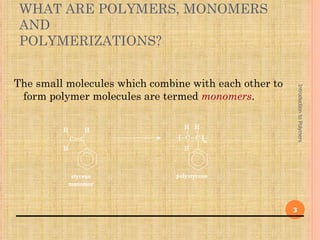
The small molecules which combine with each other to


                                                           Introduction to Polymers
 form polymer molecules are termed monomers.


                                                       3
Introduction to Polymers
                           4
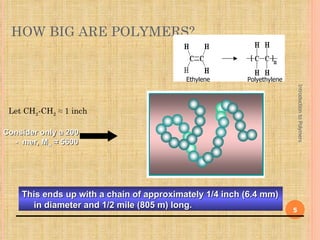
HOW BIG ARE POLYMERS?


                                          Ethylene      Polyethylene


                                                                           Introduction to Polymers
 Let CH2-CH2 ≈ 1 inch

Consider only a 200
  - mer, Mw ≈ 5600


    This ends up with a chain of approximately 1/4 inch (6.4 mm)
      in diameter and 1/2 mile (805 m) long.                           5
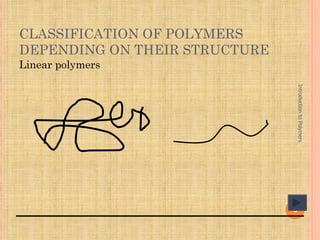
CLASSIFICATION OF POLYMERS
DEPENDING ON THEIR STRUCTURE
Linear polymers


                                   Introduction to Polymers
                               6
CLASSIFICATION OF POLYMERS
   DEPENDING ON THEIR STRUCTURE
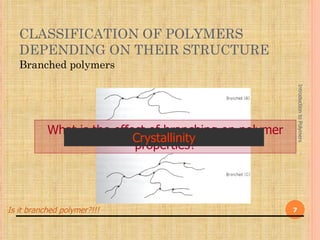
   Branched polymers


                                                            Introduction to Polymers
           What is the effect of branching on polymer
                           Crystallinity
                           properties?


Is it branched polymer?!!!                              7
Introduction to Polymers
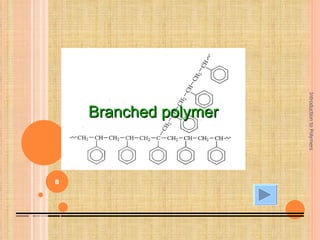
    LINEAR POLYMER
      Branched polymer


8
CLASSIFICATION OF POLYMERS
   DEPENDING ON THEIR STRUCTURE
   Cross-linked polymers
Crosslinked polymers do not dissolve but can be swelled
by liquids.


                                                                 Introduction to Polymers
Light cross-linking improves elasticity properties
  Using appropriate monomers
 Chemical reactions
⇒ polymer is used as rubber
High degree of crosslinking gives high rigidity and
thermal stability (high melting point).
 Polymer molecules are connected together at points
BOTHthan their ends
 other CROSSLINKED POLYMERS CANNOT                    BE RECYLED
                      OR REPOROCESSED                        9
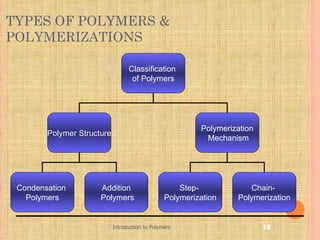
TYPES OF POLYMERS &
POLYMERIZATIONS

                                  Classification
                                   of Polymers


                                                          Polymerization
        Polymer Structure
                                                           Mechanism


 Condensation         Addition                       Step-            Chain-
   Polymers           Polymers                   Polymerization    Polymerization


                            Introduction to Polymers                       10
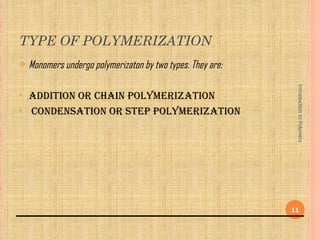
TYPE OF POLYMERIZATION
   Monomers undergo polymerizaton by two types. They are:


                                                              Introduction to Polymers
•   Addition or chAin polymerizAtion
•   condensAtion or step polymerizAtion


                                                             11
THE ADDITION-CONDENSATION
SYSTEM


What are addition polymers?


                                                    Introduction to Polymers
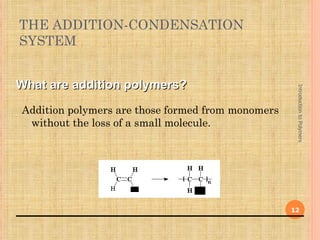
Addition polymers are those formed from monomers
 without the loss of a small molecule.


                    Y           Y

                                                   12
Polymer Structure

 The addition-condensation system

Condensation polymers (New definition)


                                                                  Introduction to Polymers
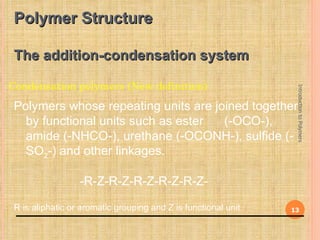
 Polymers whose repeating units are joined together
   by functional units such as ester  (-OCO-),
   amide (-NHCO-), urethane (-OCONH-), sulfide (-
   SO2-) and other linkages.

                  -R-Z-R-Z-R-Z-R-Z-R-Z-

 R is aliphatic or aromatic grouping and Z is functional unit.   13
Polymer Structure

The addition-condensation system


                                                       Introduction to Polymers
The major addition polymers are those formed by
 polymerization of monomers containing carbon-carbon
 double bond; such monomers are called vinyl
 monomers or substituted ethylenes.


                                                  14
ADDITION POLMERIZATION
   Self addition of several bifunctional monomers to
    each ohter takes place by chain reaction without
    the elimination of any simple molecules.


                                                         Introduction to Polymers
       GENERAL REACTION:
    n [CH2=CH]  [-CH2-CH-]n
                 |               |

                 Y               Y

        Where Y=H,Ethylene,CH3,Propylene,Cl, Vinyl      15
        Chloride, C6H5, Sterene, CN , Acrylonitrile
 Addition polymerization is initiated
  by small qty of substance called


                                          Introduction to Polymers
  Initiators.
 E.g.-Zeigler-Natta catalyst,
  potassium persulphate , dibenzoyl
  sulphat e.


                                         16
CONDENSATION
POLYMERIZATION
•   Self addition of several bifunctional monomer to
    each other takes place accompanying elimination
    of simple molecues like H2O,NH3 & HCL


                                                        Introduction to Polymers
•   General reaction:
    n[HOOC-X-COOH] + n[HO-Y-OH]


HO-[….OC-X-COO-Y-O]n-H + (2n-1)H20

                                                       17
E.g..
 Terylene is obtained by condensing terpthalic


                                                      Introduction to Polymers
  acid [HOOC-C6H4-COOH] with ethylene glycol
  [HO-C2H4-OH]
 Nylon is made by the condensation of adipic acid
  [HOOC-(CH2)4-COOH] with hexamethylene
  diamine [NH2-(CH2)6-NH2]


                                                     18
MECHANISM OF ADDITION POLYMERIZATION
{FREE RADICLE REACTION MECHANISM}

   Free Radical Mechanism of chain reaction
    involves 3 stages namely


                                                Introduction to Polymers
II. Initiation

III.Propagation

IV.Termination


 SCHEMATIC REPRESENTATION
[ R* - Free radical
  M* - Unsaturated Monomer]

                                               19
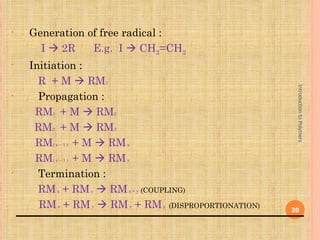
•   Generation of free radical :
      I  2R    E.g. I  CH2=CH2
•   Initiation :
      R + M  RM1


                                                        Introduction to Polymers
•     Propagation :
     RM1 + M  RM2
     RM2 + M  RM3
     RM( x – 1 ) + M  RM x
     RM( y – 1 ) + M  RM y
•     Termination :
      RM x + RM y  RM x + y (COUPLING)
      RM x + RM y  RM x + RM y (DISPROPORTIONATION)   20
MECHANISM OF ADDITION
POLYMERIZATION OF POLY-
ETHYLENE
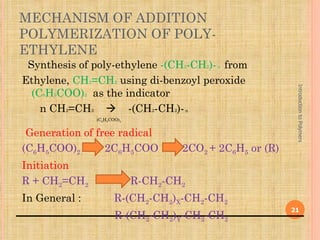
 Synthesis of poly-ethylene -(CH2-CH2)- n from
Ethylene, CH2=CH2 using di-benzoyl peroxide


                                                           Introduction to Polymers
  (C6H5COO)2 as the indicator
    n CH2=CH2  -(CH2-CH2)- n
               (C6H5COO)2


 Generation of free radical
(C6H5COO)2       2C6H5COO           2CO2 + 2C6H5 or (R)
Initiation
R + CH2=CH2                 R-CH2-CH2
In General :          R-(CH2-CH2)X-CH2-CH2
                                                          21
                      R-(CH2-CH2)Y-CH2-CH2
Termination
 By coupling (by the combination of two radicals)

R-(CH2-CH2)X-CH2-CH2 + CH2-CH2-(CH2-CH2)Y-R


                                                      Introduction to Polymers
R-(CH2-CH2)X-CH2-CH2-CH2-CH2-(CH2-CH2)Y-R
By disproportionation
R-(CH2-CH2)X-CH2-CH2 + R-(CH2-CH2)Y-CH2-CH2


R(CH2CH2)X-CH2-CH3 + R(CH2CH2)Y-CH=CH2
                                                     22

Polymers

  • 1.
    POLYMERS •POLYMERS •INTRODUCTION & CLASSIFICATION OF Introduction to Polymers POLYMERS •ADDITION & CONDENSATION – POLYMERIZATION •FREE RADICAL REACTION MECHANISM BY, MOHAMMED MAAZ 1
  • 2.
    WHAT ARE POLYMERS,MONOMERS AND POLYMERIZATIONS? Polymers are macromolecules built up by the linking Introduction to Polymers together of large numbers of much smaller molecules. Polymerization : The process of linking the repeating units (monomers) is termed as polymerization 2
  • 3.
    WHAT ARE POLYMERS,MONOMERS AND POLYMERIZATIONS? The small molecules which combine with each other to Introduction to Polymers form polymer molecules are termed monomers. 3
  • 4.
  • 5.
    HOW BIG AREPOLYMERS? Ethylene Polyethylene Introduction to Polymers Let CH2-CH2 ≈ 1 inch Consider only a 200 - mer, Mw ≈ 5600 This ends up with a chain of approximately 1/4 inch (6.4 mm) in diameter and 1/2 mile (805 m) long. 5
  • 6.
    CLASSIFICATION OF POLYMERS DEPENDINGON THEIR STRUCTURE Linear polymers Introduction to Polymers 6
  • 7.
    CLASSIFICATION OF POLYMERS DEPENDING ON THEIR STRUCTURE Branched polymers Introduction to Polymers What is the effect of branching on polymer Crystallinity properties? Is it branched polymer?!!! 7
  • 8.
    Introduction to Polymers LINEAR POLYMER Branched polymer 8
  • 9.
    CLASSIFICATION OF POLYMERS DEPENDING ON THEIR STRUCTURE Cross-linked polymers Crosslinked polymers do not dissolve but can be swelled by liquids. Introduction to Polymers Light cross-linking improves elasticity properties Using appropriate monomers Chemical reactions ⇒ polymer is used as rubber High degree of crosslinking gives high rigidity and thermal stability (high melting point). Polymer molecules are connected together at points BOTHthan their ends other CROSSLINKED POLYMERS CANNOT BE RECYLED OR REPOROCESSED 9
  • 10.
    TYPES OF POLYMERS& POLYMERIZATIONS Classification of Polymers Polymerization Polymer Structure Mechanism Condensation Addition Step- Chain- Polymers Polymers Polymerization Polymerization Introduction to Polymers 10
  • 11.
    TYPE OF POLYMERIZATION  Monomers undergo polymerizaton by two types. They are: Introduction to Polymers • Addition or chAin polymerizAtion • condensAtion or step polymerizAtion 11
  • 12.
    THE ADDITION-CONDENSATION SYSTEM What areaddition polymers? Introduction to Polymers Addition polymers are those formed from monomers without the loss of a small molecule. Y Y 12
  • 13.
    Polymer Structure Theaddition-condensation system Condensation polymers (New definition) Introduction to Polymers Polymers whose repeating units are joined together by functional units such as ester (-OCO-), amide (-NHCO-), urethane (-OCONH-), sulfide (- SO2-) and other linkages. -R-Z-R-Z-R-Z-R-Z-R-Z- R is aliphatic or aromatic grouping and Z is functional unit. 13
  • 14.
    Polymer Structure The addition-condensationsystem Introduction to Polymers The major addition polymers are those formed by polymerization of monomers containing carbon-carbon double bond; such monomers are called vinyl monomers or substituted ethylenes. 14
  • 15.
    ADDITION POLMERIZATION  Self addition of several bifunctional monomers to each ohter takes place by chain reaction without the elimination of any simple molecules. Introduction to Polymers  GENERAL REACTION: n [CH2=CH]  [-CH2-CH-]n | | Y Y Where Y=H,Ethylene,CH3,Propylene,Cl, Vinyl 15 Chloride, C6H5, Sterene, CN , Acrylonitrile
  • 16.
     Addition polymerizationis initiated by small qty of substance called Introduction to Polymers Initiators.  E.g.-Zeigler-Natta catalyst, potassium persulphate , dibenzoyl sulphat e. 16
  • 17.
    CONDENSATION POLYMERIZATION • Self addition of several bifunctional monomer to each other takes place accompanying elimination of simple molecues like H2O,NH3 & HCL Introduction to Polymers • General reaction: n[HOOC-X-COOH] + n[HO-Y-OH] HO-[….OC-X-COO-Y-O]n-H + (2n-1)H20 17
  • 18.
    E.g..  Terylene isobtained by condensing terpthalic Introduction to Polymers acid [HOOC-C6H4-COOH] with ethylene glycol [HO-C2H4-OH]  Nylon is made by the condensation of adipic acid [HOOC-(CH2)4-COOH] with hexamethylene diamine [NH2-(CH2)6-NH2] 18
  • 19.
    MECHANISM OF ADDITIONPOLYMERIZATION {FREE RADICLE REACTION MECHANISM}  Free Radical Mechanism of chain reaction involves 3 stages namely Introduction to Polymers II. Initiation III.Propagation IV.Termination  SCHEMATIC REPRESENTATION [ R* - Free radical M* - Unsaturated Monomer] 19
  • 20.
    Generation of free radical : I  2R E.g. I  CH2=CH2 • Initiation : R + M  RM1 Introduction to Polymers • Propagation : RM1 + M  RM2 RM2 + M  RM3 RM( x – 1 ) + M  RM x RM( y – 1 ) + M  RM y • Termination : RM x + RM y  RM x + y (COUPLING) RM x + RM y  RM x + RM y (DISPROPORTIONATION) 20
  • 21.
    MECHANISM OF ADDITION POLYMERIZATIONOF POLY- ETHYLENE Synthesis of poly-ethylene -(CH2-CH2)- n from Ethylene, CH2=CH2 using di-benzoyl peroxide Introduction to Polymers (C6H5COO)2 as the indicator n CH2=CH2  -(CH2-CH2)- n (C6H5COO)2 Generation of free radical (C6H5COO)2 2C6H5COO 2CO2 + 2C6H5 or (R) Initiation R + CH2=CH2 R-CH2-CH2 In General : R-(CH2-CH2)X-CH2-CH2 21 R-(CH2-CH2)Y-CH2-CH2
  • 22.
    Termination  By coupling(by the combination of two radicals) R-(CH2-CH2)X-CH2-CH2 + CH2-CH2-(CH2-CH2)Y-R Introduction to Polymers R-(CH2-CH2)X-CH2-CH2-CH2-CH2-(CH2-CH2)Y-R By disproportionation R-(CH2-CH2)X-CH2-CH2 + R-(CH2-CH2)Y-CH2-CH2 R(CH2CH2)X-CH2-CH3 + R(CH2CH2)Y-CH=CH2 22