Urban Forestry&UrbanGreening8(2009)65–75 
Towards anintegratedunderstandingofgreenspaceintheEuropean 
built environment 
P. Jamesa,, K.Tzoulasa, M.D.Adamsb, A.Barberc, J.Boxd, J.Breustee, T.Elmqvistf, 
M. Frithg, C.Gordonh, K.L.Greeningi, J.Handleyj, S.Haworthk, A.E.Kazmierczaka, 
M. Johnstonl, K.Korpelam, M.Morettin, J.Niemela¨o, S.Pauleitp, M.H.Roeq, 
J.P. Sadlerr, C.WardThompsons 
aBuHu andSchoolofEnvironmentandLifeSciences,PeelBuilding,UniversityofSalford,SalfordM54WT,UK 
bBuHu andSchoolofScienceandEngineering,NewtonBuilding,UniversityofSalford,SalfordM54WT,UK 
cCABE-Space, 1KembleStreet,LondonWC2B4AN,UK 
dAtkins, CornerstoneHouse,StaffordPark13,Telford,ShropshireTF33AZ,UK 
eDepartment ofGeographyandGeology,UrbanandLandscapeEcology,UniversityofSalzburg,Hellbrunnerstrasse34,A-5020 
Salzburg, Austria 
fDepartment ofSystemsEcology,StockholmsUniversity,SE-10691Stockholm,Sweden 
gPeabody Trust,45WestminsterBridgeRoad,LondonSE17JB,UK 
hNatural England,NorthminsterHouse,PeterboroughPE11UA,UK 
iFaculty ofHealthandSocialCare,WestminsterBuilding,UniversityofChester,ParkgateRoad,ChesterCH14BJ,UK 
jSchool ofEnvironmentandDevelopment(PlanningLandscape),UniversityofManchester,ManchesterM139PL,UK 
kSchool ofEnvironmentandLifeSciences,PeelBuilding,UniversityofSalford,SalfordM54WT,UK 
lMyerscough College,MyerscoughHall,St.Michael’sRoad,BilsborrowPreston,LancashirePR30R,UK 
mDepartment ofPsychology,33014UniversityofTampere,Finland 
nSwiss FederalResearchInstituteWSL,UnitEcosystemBoundaries,ViaBelsoggiorno22,CH-6500Bellinzona,Switzerland 
oFaculty ofBiosciences,Viikinkaari1,P.O.Box65,00014UniversityofHelsinki,Finland 
pCentre forForest,LandscapeandPlanning,UniversityofCopenhagen,Rolighedsvej23,DK-1958FrederiksbergC,Denmark 
qSchool ofArchitecture,PlanningLandscape,UniversityofNewcastleuponTyne,NewcastleuponTyneNE17RU,UK 
rSchool ofGeography,EarthEnvironmentalSciences,TheUniversityofBirmingham,Edgbaston,BirminghamB152TT,UK 
sOPENspace, EdinburghCollegeofArt,LauristonPlace,EdinburghEH39DF,UK 
Abstract 
In recentyearssocial,economicandenvironmentalconsiderationshaveledtoareevaluationofthefactorsthat 
contributetosustainableurbanenvironments.Increasingly,urbangreenspaceisseenasanintegralpartofcities 
providingarangeofservicestoboththepeopleandthewildlifelivinginurbanareas.Withthisrecognitionand 
resultingfromthesimultaneousprovisionofdifferentservices,thereisarealneedtoidentifyaresearchframeworkin 
ARTICLEINPRESS 
www.elsevier.de/ufug 
1618-8667/$-seefrontmatter r 2009 ElsevierGmbH.Allrightsreserved. 
doi:10.1016/j.ufug.2009.02.001 
Correspondingauthor.Tel.:+441612952133;fax:+441612955015. 
E-mail addresses: P.James@salford.ac.uk(P.James), K.Tzoulas@salford.ac.uk(K.Tzoulas), M.D.Adams@salford.ac.uk(M.D.Adams), 
alan.barber@blueyounder.co.uk(A.Barber), john.box@atkinsglobal.com(J.Box), juergen.breuste@sbg.ac.uk(J.Breuste), thomase@ecology.su.se 
(T. Elmqvist), mathew.frith@peabody.org.uk(M.Frith), Chris.Gordon@naturalengland.org.uk(C.Gordon), K.Greening@chester.ac.uk 
(K.L. Greening), John.Handley@manchester.ac.uk(J.Handley), Stephen.haworth2@btopenworld.com(S.Haworth), 
mjohnston@myerscough.ac.uk(M.Johnston), Kalevi.Korpela@uta.fi(K.Korpela), marco.moretti@wsl.ch(M.Moretti), jari.niemela@helsinki.fi 
(J. Niemela¨), sp@life.ku.dk (S.Pauleit), m.h.roe@newcastle.ac.uk(M.H.Roe), j.p.sadler@bham.ac.uk(J.P.Sadler), c.ward-thompson@eca.ac.uk 
(C. WardThompson).
whichtodevelopmultidisciplinaryandinterdisciplinaryresearchonurbangreenspace.Inordertoaddressthese 
needs,aniterativeprocessbasedonthedelphitechniquewasdeveloped,whichcomprisedemail-mediateddiscussions 
and atwo-daysymposiuminvolvingexpertsfromvariousdisciplines.Thetwooutputsofthisiterativeprocesswere(i) 
an integratedframeworkformultidisciplinaryandinterdisciplinaryresearchand(ii)acatalogueofkeyresearch 
questionsinurbangreenspaceresearch.Theintegratedframeworkpresentedhereincludesrelevantresearchareas(i.e. 
ecosystemservices,driversofchange,pressuresonurbangreenspace,humanprocessesandgoalsofprovisionof 
urbangreenspace)andemergentresearchthemesinurbangreenspacestudies(i.e.physicality,experience,valuation, 
managementandgovernance).Collectivelythesetwooutputshavethepotentialtoestablishaninternationalresearch 
agendaforurbangreenspace,whichcancontributetothebetterunderstandingofpeople’srelationshipwithcities. 
r 2009 ElsevierGmbH.Allrightsreserved. 
Keywords: Delphi technique;Researchagenda;Urbanecology 
Introduction 
There areanumberofsignificantfactorsthatare 
convergingandforcingare-examinationoftheway 
cities areplanned,designedandlivedin.TheGlobal 
EnvironmentOutlook(UNEP, 2007) identifiedfive 
driversforhumandevelopment:demographics;eco- 
nomicprocesses(consumption,production,markets 
and trade);scientificandtechnologicalinnovation; 
distributionpatternprocesses(inter-andintra-genera- 
tional);andcultural,social,politicalandinstitutional 
processes(includinghumanbehavioursandtheproduc- 
tion andservicesectors).Thesedrivers,andothersthat 
may emerge,willhavesubstantialconsequencesfor 
urbandevelopment,andhencegreenspacewithinurban 
areas, yetthereisgreatuncertaintyaboutthewaysin 
whichurbanareaswillbeaffected.Whatislackingisa 
frameworkformulti-,inter-andtransdisciplinary 
researchthatwouldformanevidencebasetosupport 
these changesandactions.Thedistinctionsbetween 
these threeapproachesandtheirdifferencefroma 
traditional,singledisciplinaryapproachrequiresome 
consideration.Amultidisciplinaryapproachisonein 
whichindividualsorgroupsworkingindifferent 
disciplinesaddressthesameissue,whereasaninter- 
disciplinaryapproachisonewhereanindividualora 
groupworkattheboundariesoftraditionaldisciplines 
and ofteningapsthatemergebetweendisciplines,and 
lastly atransdisciplinaryapproachisonewherean 
individualorgroupusesknowledgefromanumberof 
disciplinestoseenewconnectionsandgainnewinsights. 
The termsgreenspaceandopenspaceareoftenused 
interchangeably(Swanwicketal.,2003). Inorderto 
addresstheconfusionthatmayoccur,theydefinedthe 
key termsmoreclearly. Swanwicketal.(2003) suggested 
that urbanareasaremadeupofthebuiltenvironment 
and theexternalenvironmentbetweenbuildings.The 
externalenvironment,intheirmodel,iscomposedof 
two distinctspaces:‘greyspace’and‘greenspace’.Grey 
space islandthatconsistsofpredominantlysealed, 
impermeable,‘hard’surfacessuchasconcreteortarmac. 
Green spaceland,whetherpubliclyorprivatelyowned, 
consistsofpredominantlyunsealed,permeable,‘soft’ 
surfacessuchassoil,grass,shrubs,treesandwater.In 
this papertheauthorsfollowthisdefinitionofgreen 
spacewhilstatthesametimerecognisingthatthe 
juxtapositionofgreenandgreyspacesisessentialin 
townsandcities. 
AcrossEurope,developmenttrajectoriesoftownsand 
citiesvary(Kasanko etal.,2006). Wherethepopula- 
tions arefalling,thereareopportunitiestoredesignthe 
builtandexternalenvironmentsinordertoimprove 
liveabilityandsustainability(Mace etal.,2007). Where 
populationsaregrowingandcitiesareexpanding 
spatially,orareconfinedbyphysicalorpolitical 
boundaries,thereisadecreaseinpercapitaspaceand 
often aneedtoaddressissuesofthelossofurbangreen 
space. 
Whilstanunderstandingofthemultiplefunctionsof 
urbangreenspacesisreasonablywelldeveloped,itisnot 
wellintegratedintotheplanning,designandmanage- 
mentprocess(Yli-PelkonenandNiemela¨, 2005; Sand-stro 
¨m etal.,2006). Furthermore,reliableandrobust 
approachestothevaluationofurbangreenspacethat 
effectivelysupportdecision-makingareoftenabsent 
(Tyrva¨inen, 2001; Neilan,2008). Therefore,itisdesir- 
abletoidentifythekeyissuesrequiringresearch,to 
developevidenceonwhichtobasedecisionsandto 
presenttheseinawaythatisaccessibletoacademics, 
practitionersanddecision-makers. 
This paperreportsontheoutcomesofasymposium 
heldattheUniversityofSalford,UnitedKingdom, 
duringJune2007.Thissymposiumwasdevelopedin 
recognitionofthreeimportantgapsinurbangreen 
spaceresearch:theneedtoencourageinterdisciplinary 
andmultidisciplinaryapproaches,theneedtodevelop 
joint,multidisciplinaryinitiativesacrossEuropeandthe 
needforcomparativeresearch.Expertsfromdifferent 
disciplines,countriesandjobroles(e.g.academics, 
practitionersanddecision-makers)attendedthesympo- 
sium withthegoaltodevelop,andsubsequentlyagree 
on, anintegratingframeworkthatwouldbringtogether 
ARTICLEINPRESS 
P. Jamesetal./UrbanForestryUrbanGreening8(2009)65–75 66
different disciplineandprofessionalinterestsinurban 
green space.Emergentfromthisprocesswasacatalogue 
of keyresearchquestionsforurbangreenspaceresearch 
and thesynthesisoftheseintoanintegratingframework 
to supportmultidisciplinaryandinterdisciplinaryunder- 
standingandcommunication,decision-makingand 
researchefforts.Inthispapertheauthorsproposean 
internationalresearchagendarelatingtothiskey 
componentofurbanliving. 
The paperisprimarilyinformedbyresearchrelating 
to theEuropeanandNorthAmericancontextandby 
Europeanissuesandpractices.Itisintendedthatthe 
agendawillinfluenceregional,nationalandinterna- 
tional researchfundingallocationsandinformthe 
discussionsofthoseconcernedwithidentifyingthe 
needs andprioritiesofurbangreenspace. 
Process 
The needforamultidisciplinaryapproachinurban 
green spaceresearchwasidentifiedduringdiscussions 
held amongsttheparticipantsattheEuropeanSociety 
for ConservationBiologymeetinginEger,Hungary. 
Subsequently,theoverallprocesswasbasedarounda 
modified DelphiTechnique,awidelyusedtechniquein 
consultationexerciseswhereconsensusisrequired 
(Ndour etal.,1992; Medsker etal.,1995; Curtis,2004; 
Okoli andPawlowski,2004). 
In early2007agroupof40peoplecametogetherto 
address thisneed.Thegroupincludedrepresentativesof 
academicinstitutions(29),consultancy(4),voluntary 
organizations(2),politicians(1),statutorybodies(1), 
housing provider(1),practiceandpolicyadvisor(1), 
centralgovernment(1)andlocalauthority(1).These 
peoplewereallchosenbecauseoftheirestablished 
record ofinterestin,andcommitmentto,academic, 
managerialordecision-makingrolesinurbanenviron- 
ment. Also,theparticipantspossessedknowledgeofthe 
historicandcontemporaryissuesassociatedwithopen 
green spaceincitiesandtowns.Furthermore,thegroup 
was chosentoberepresentativeofdifferentacademic 
disciplines(e.g.Psychology,Sociology,Planning,Ecol- 
ogy, andHealth),withmanycontributorshaving 
expertiseinmorethanonediscipline.Representation 
from differentpartsofEuropewasachieved–Austria 
(2), Finland(2),France(1),Greece(1),Denmark(1), 
The Netherlands(2),Poland(1),Sweden(1),Switzer- 
land (2)andUnitedKingdom(28). 
The purposeoftheprocesswastoidentifykey 
researchthemesandquestionsrelatedtocontemporary 
issuesandfuturestudiesinurbangreenspace.Theneed 
for amultidisciplinaryapproachwasidentifiedduring 
conversationsheldatvariousconferencesthroughout 
2006. Consequently,theoverallprocesswasbased 
aroundamodifiedDelphiTechnique.Thisisawidely 
used techniqueinconsultationexerciseswhereconsen- 
sus isrequired(Ndouretal.,1992; Medskeretal.,1995; 
Curtis,2004; Okoli andPawlowski,2004). 
In theresearchreportedheretheDelphiTechnique 
was dividedintothreestages.Theinitialstagewasto 
inviteallindividualstopartakeinanemail-mediated 
discussion.Theinitiallistofinviteeswascompiledby 
the UrbanNatureResearchGroupintheResearch 
InstitutefortheBuiltandHumanEnvironmentatthe 
UniversityofSalford.Thelistgrewto40asexisting 
memberssuggestedotherprospectivemembers.All 
emailsweresharedamongstthewholegroupwith 
periodicpublicationofacompendiumofemailscover- 
ing specifictimeperiods.Inthiswayallcontributors 
weremadeawareoftheongoingdebates,thechronol- 
ogyofideasandtheprovenanceoftheideas.Earlyonin 
the processthesymposiumchairwasidentified.This 
personalsomediatedthepre-symposiumpreparations 
ensuringthatallemailswereavailabletoallmembers. 
Theseemailexchangesbegantheprocessofdeveloping 
a richpictureofthescopeandconcernsrelatedtothe 
topic. Thereafterparticipantswereinvitedtosubmita 
list ofkeyresearchquestionsrelevanttotheprevious 
email-mediateddiscussions.Intotal215questionswere 
submitted. 
The secondstagewasatwo-dayexpertsymposium 
that washeldinSalfordinearlyJune2007,towhichall 
40 contributorswereinvited,29wereabletoattend.The 
symposiumwasbasedonfacilitatedgroupdiscussions 
andsubjectpresentationsaroundthecoreprinciplesof 
opendiscussionandconsensusbuilding.Thepartici- 
pantswerefirstsplitintothreemultidisciplinaryteams. 
The aimwasthateachgroupwouldhaverepresentatives 
from allthedisciplinesrepresentedatthesymposium. 
Eachgrouphadonesessiondiscussingtheresearch 
areas andemergentresearchthemes,andthreesessions 
focused onrefiningtheemergentresearchquestions.The 
discussionsinthesesessionswerefacilitatedbyagroup 
chairperson.Attheendofeachsessiontheoutcomes 
from eachgroupwerecombinedanddiscussedin 
plenary session.Thesubjectpresentationfocusedon 
introducingandsummarizingthedifferentcomponents 
of thesymposium. 
By thecloseofthesymposium,threespecificout- 
comeswereachieved.Firstly,thethemesthatsurfaced 
duringtheemail-mediateddiscussionswererevisited, 
discussedandamended.Secondly,thelonglistof215 
questionswasdistilledtoashortlistof50questions. 
Thisreductioncamethroughaprocessthatinvolved 
combiningsimilarquestions,developingcomposite 
questionsfromthosethataddressedsimilarthemes 
andtestingeachquestionforrelevanceandsuitability 
for research.Thirdly,aself-selectedsteeringgroup 
of 17people,coveringtherangeofdisciplinesrepre- 
sented inthesymposium,agreedtotakeforward 
ARTICLEINPRESS 
P. Jamesetal./UrbanForestryUrbanGreening8(2009)65–7567
detaileddiscussionofthepointsraisedduringthe 
symposium,todistilfurthertheshortlistofquestions 
and todrawthelistandthemestogetherintoaresearch 
paper.Thisfurtheriterationofquestionsformedthe 
thirdandfinalstageoftheDelphiprocess. 
Emergent researchagenda 
Five researchthemesand35researchquestions 
The pre-symposiumemaildiscussionsenabledthe 
originalcatalogueof215questionstobecategorised 
into fiveemergentthemes:thephysicality,theexperi- 
ence,thevaluation,themanagementandthegovernance 
of urbangreenspace.Furtherrefinementsduringthe 
symposiumandpost-symposiumemaildiscussions 
reducedtheseto50questionsandfinallyto35questions. 
This catalogueofquestionsinconjunctionwiththe 
integratedframework,whichisdiscussedlaterinthis 
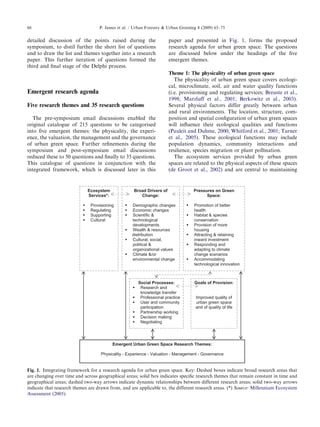
paperandpresentedin Fig. 1, forms theproposed 
researchagendaforurbangreenspace.Thequestions 
arediscussedbelowundertheheadingsofthefive 
emergentthemes. 
Theme1:Thephysicalityofurbangreenspace 
The physicalityofurbangreenspacecoversecologi- 
cal,microclimate,soil,airandwaterqualityfunctions 
(i.e.provisioningandregulatingservices; Breuste etal., 
1998; Marzluffetal.,2001; Berkowitzetal.,2003). 
Severalphysicalfactorsdiffergreatlybetweenurban 
andruralenvironments.Thelocation,structure,com- 
positionandspatialconfigurationofurbangreenspaces 
willinfluencetheirecologicalqualitiesandfunctions 
(PauleitandDuhme,2000; Whitford etal.,2001; Turner 
etal.,2005). Theseecologicalfunctionsmayinclude 
populationdynamics,communityinteractionsand 
resilience,speciesmigrationorplantpollination. 
The ecosystemservicesprovidedbyurbangreen 
spacesarerelatedtothephysicalaspectsofthesespaces 
(de Grootetal.,2002) andarecentraltomaintaining 
ARTICLEINPRESS 
Social Processes: 
Research and 
knowledge transfer 
Professional practice 
User and community 
participation 
Partnership working 
Decision making 
Negotiating 
Goals of Provision: 
Improved quality of 
urban green space 
and of quality of life 
Pressures on Green 
Space: 
Promotion of better 
health 
Habitat  species 
conservation 
Provision of more 
housing 
Attracting  retaining 
inward investment 
Responding and 
adapting to climate 
change scenarios 
Accommodating 
technological innovation 
Broad Drivers of 
Change: 
Demographic changes 
Economic changes Scientific  
technological 
developments 
Wealth  resources 
distribution 
Cultural, social, 
political  
organizational values 
Climate /or 
environmental change 
Ecosystem 
Services*: 
Provisioning 
Regulating 
Supporting 
Cultural 
Emergent Urban Green Space Research Themes: 
Physicality - Experience - Valuation - Management - Governance 
Fig. 1. Integrating frameworkforaresearchagendaforurbangreenspace.Key:Dashedboxesindicatebroadresearchareasthat 
are changingovertimeandacrossgeographicalareas;solidboxindicatesspecificresearchthemesthatremainconstantintimeand 
geographical areas;dashedtwo-wayarrowsindicatedynamicrelationshipsbetweendifferentresearchareas;solidtwo-wayarrows 
indicate thatresearchthemesaredrawnfrom,andareapplicableto,thedifferentresearchareas.(*) Source: Millennium Ecosystem 
Assessment (2005). 
P. Jamesetal./UrbanForestryUrbanGreening8(2009)65–75 68
human healthandviablewildlifepopulations(Tzoulas 
et al.,2007). Withinthecontextofclimatechange, 
urban greenspacescanplayacentralroleinboth 
climate-proofingcitiesandinreducingtheimpactsof 
cities onclimate(Gill etal.,2007). Whiletheroleof 
green areasinsequesteringcarbonissmallcomparedto 
carbon dioxideemissionsproducedincities(Nowak, 
1994; McPherson,1998), urbangreenspacesmayreduce 
energy consumptionandthusalsocarbondioxide 
emissions byreducingtheneedforairconditioningin 
the summerandtheneedforheatinginthewinter 
(McPherson,1994; Jo andMcPherson,2001). Within 
the themeof‘ThePhysicalityofUrbanGreenSpace’, 
the followingsevenkeyresearchquestions(1–7)are 
identified: 
1. Whataretheecosystemservicesprovidedbyurban 
green spacesandhowcantheseservicesbequanti- 
fied? 
2. Whatbenefitsdoesthecreationofurbangreenspace 
provide inareasthathavepoorenvironmental 
conditionsorsocialproblems? 
3. What,inrelationtourbanform,aretherequired 
quantity,qualityandconfigurationofurbangreen 
spaces tomaintain,sustainandenhanceecosystem 
services andecologicalfunctioncompatiblewith 
other functions? 
4. Whatarethedirectandindirecteffectsoftheclimate 
changes predictedincurrentscenariosonurbangreen 
spaces andhowdothesechangesimpactpeople’s 
well-being(qualityoflife)inurbanareas? 
5. Howresilientarecurrentgreenspacedesigns 
(includingstreettrees)toclimatechangeandhow 
can resiliencebeimproved? 
6. Howcanurbangreenspacesthatarerobusttoharsh 
urban environments(e.g.lackofwaterandsunshine) 
be designedandmanagedtomitigatetheeffectsof 
climate changeinurbanareasandallowcitiesto 
adapt tothesechanges? 
7. Howcantheprovisionandmanagementoffresh- 
water quantityandqualitybepromotedthrough 
urban greenspaces? 
Theme 2:Theexperienceofurbangreenspace 
Urban greenspacesareimportantincitiesduetothe 
opportunitiestheyprovidetopeopletocomeincontact 
with natureandwitheachother.Contactwithnature 
has psychologicalbenefitsbyreducingstress(Ulrich, 
1984; Ulrich etal.,1991), restoringattention(Kaplan 
and Kaplan,1989), reducingcriminalandanti-social 
behaviour(Kuo andSullivan,2001) andbypositively 
affectingself-regulationandrestorativeexperiences 
(Korpelaetal.,2001; Hartigetal.,2003; Korpela and 
Yle´n, 2007; van denBergetal.,2007). Inadditionto 
psychologicalbenefitsfromcontactwithnature,there 
are directphysicalhealthbenefits(Prettyetal.,2006), 
such asaddressingissuesassociatedwithobesity 
(DepartmentofHealth,2004), increasedlongevity 
(Takanoetal.,2002) andself-reportedhealth(de Vries 
et al.,2003; Maasetal.,2006). Intermsofsocialwell- 
beingurbangreenspacecontributestosocialinteraction 
andtobringingpeopletogether,reducesnegativesocial 
behaviourssuchasaggressionandviolence,contributes 
to asenseofplaceandplaysanimportantrolein 
fosteringsocialcohesionandidentify(Newton, 2007). 
Thesepsychological,physicalandsocialhealtheffectsof 
urbangreenspacesmakethemanimportantcomponent 
of publichealthprovision(Henwood,2003; Newton, 
2007). 
However,greenspacesthatareperceivedtobe 
unmanagedmayhaveanegativeeffectonthewell- 
beingofpeoplebyincreasinganxietycausedbycrime 
andfearofcrime(BixlerandFloyd,1997; Kuo etal., 
1998; Jorgensenetal.,2007). Theoccurrenceofwild 
animalsincities,forexample,largemammalssuchas 
fox (Vulpes vulpes L.), badger(Meles meles L.), wild 
boar(Sus scrofa L.) andbear(Ursus arctos L.), bring 
withthemaneedtoaddressthechangingrelationships 
betweenpeopleandwildlife.Urbanandperi-urban 
ecologicalchangescanaffectthegeographicalrangeof 
diseasessuchasLymedisease(Patz andNorris,2004) 
andWestNileVirus(Zielinski-GutierrezandHayden, 
2006). Hence,furtherresearchwillshowwhetheritis 
possibletoquantifyenvironmentalinfluencesand 
subsequentpositiveornegativehealthoutcomesfrom 
differenttypesandconfigurationsofurbangreen 
spaces. 
The aestheticcontributionsofurbangreenspacesto 
city lifeareequallyimportant.Thereisaplethoraof 
theoriesandstudiesshowingthepreferenceamongst 
urbandwellersforurbanareaswithgreenspacesin 
them (Wilson,1993; Appleton, 1996; Stamps,2004; 
StaatsandHartig,2004; Regan andHorn,2005; Hartig 
andStaats,2006). Thecharacterofurbangreenspaces 
hasbeen,andcontinuestobe,importantinexpressing 
contemporaryvalues,beliefsandculturaltrendsin 
urbansocieties(Thompson,2004). 
Closely linkedwithaestheticandpublichealthaspects 
of urbangreenspacesaretheculturalbackgroundsof 
the communitiesthatusethem(WardThompson,1996; 
Tzoulas,2006). Differentcultureshavedifferentvalue 
systemsandrelationshipswithnature.So,theroleof 
urbangreenspacesinimprovinglocalquality,identity 
andcharactermaybedifferentamongstdifferent 
culturalgroupswithinthesamecityandalsoamongst 
individuals.Understandinghowdifferentculturaland 
sub-culturalgroupsincitiesuseurbangreenspacesis 
centralindevelopingappropriatemanagementsystems 
(JohnstonandShimada,2003). Hence,withinthetheme 
of ‘TheExperienceofUrbanGreenSpace’,ninekey 
researchquestions(8–16)areidentified: 
ARTICLEINPRESS 
P. Jamesetal./UrbanForestryUrbanGreening8(2009)65–7569
8. Howcanurbangreenspacesbedesignedand 
managed andprovideaccesstoexperiencenature 
for theurbanpopulationandstillmeetnationaland 
regionalbiodiversitytargets? 
9. Whatarethepersonalandsocialinfluencesthat 
resultingreateruseofurbangreenspaces? 
10. Whatarethedynamicinteractionsbetweensocietal, 
personality,situational,andtemporalfactorsand 
individualandgroupengagementwithurbangreen 
spaces? 
11. Howdothecumulativeeffectsofcognitive,emo- 
tional,psychologicalandphysicalhealthbenefits 
from multisensorycontactwithgreenspacesinflu- 
enceindividualandcommunityhealthandwell- 
being? 
12. Whataspectsandtypesofurbangreenspace 
stimulatepositiveandnegativephysicalandpsy- 
chologicalhealtheffects? 
13. Whatarethenecessaryquantities,qualitiesand 
configurationofurbangreenspacesthatcontribute 
to theirregularusesuchthatdifferentsegmentsofa 
societywithchangingsocio-demographiccharacter- 
isticsmaygainbenefits? 
14. Howcanactualandperceivedlevelsofcrimeand 
anti-socialbehaviourbemanagedthroughmanip- 
ulationoflandscapedesigningreenspaceswhilst 
maintainingecological,landscapeandaesthetic 
benefits? 
15. Howdoesgreenspaceaffectanti-socialbehaviour 
andcommunitydevelopmentgenerally? 
16. Howcanurbangreenspacesbeusedforgreater 
benefitinenvironmentaleducationandineducation 
more generally? 
Theme3:Thevaluationofurbangreenspace 
In herreviewofEnglishlanguageliteratureonthe 
link betweenqualityoflifeandeconomiccompetitive- 
ness ofcityregions Donald (2001) focused onthelinks 
betweenacityregion’seconomiccompetitivenessand, 
with regardtoenvironmentalquality,concludedthere 
was evidencesuggestingarelationshipbetweenenviron- 
mentalquality,hightechnologyandtheattractionof 
knowledgeworkers.Astheknowledgesocietycontinues 
to becomeanevermoredominantfeatureofthe21st 
century,sodoestheimportanceofcreatingplaceswhere 
peoplewishtoliveandwork. Luttik (2000), reporting 
on astudyof3000housetransactionsintheNether- 
lands, foundthataviewonaparkorwaterleadstoan 
increaseinhouseprices.Theobservation,basedonthe 
willingnesstopayconcept,clearlyindicatesthevalue 
attributedtonearbygreenspacebyindividuals.Ata 
policy leveltheimportanceofurbangreenspaceto 
economicdevelopmentisincreasinglyrecognised 
(Ahern, 1995; Sandstro¨m, 2002; Benedict andMcMa- 
hon, 2002; Konijnendijk,2003; Li etal.,2005; Benedict 
andMcMahon,2006). However,atalocalauthority 
level thismaynotalwaysappeartobethecase(Barber, 
2007; Britt andJohnston,2008). 
The contributionmadebyurbangreenspaceto 
ecosystemservicesandtopsychological,socialand 
healthexperiencesisdifficulttovalue(Ulrich, 1984; 
KaplanandKaplan1989; Takanoetal.,2002; de Groot 
etal.,2002; Tzoulasetal.,2007). However,thereisstilla 
needforquantitativeeconomicevaluationofboth 
physicalandsocialecosystemservicesprovidedby 
greenspaces(McPherson,1998; Tyrva¨inen, 2001; 
Lambert,2007; Neilan,2008). Traditionalvaluation 
techniquessuchasCostBenefitAnalysisandCon- 
tingentValuationmaynotbeabletocopewithvaluing 
the ecologicalandsocialfunctionsofurbangreen 
spaces,whicharerequiredtostrengthentheirrolein 
the decision-makingprocesswithinlocalcommunities. 
New valuationtechniquesmayberequired.Hence, 
withinthetheme‘TheValuationofUrbanGreen 
Space’,thefollowingfourkeyresearchquestions 
(17–20)areidentified: 
17.Whatglobalcompetitivegainsaredeliveredtocities 
through theprovisionofhigh-qualitygreenspaces 
and howcanthesegainsbesustained/increased 
through greenspaceplanningandmanagement? 
18.Howcantransdisciplinaryconsiderationsbeinte- 
grated intothedevelopmentofwidelyaccepted 
methodologiesforquantifyingandvaluingecosys- 
tem servicesthatareprovidedbyurbangreen 
spaces? 
19.Howcanthemultiple‘publicgood’and‘market’ 
benefits ofurbangreenspacesbevaluedandbuilt 
into governanceandfundingdecisionsupporttools? 
20.Howcanecosystemservicesbegivenanappropriate 
valuation sothattheycanbeconsideredmore 
equitablyalongsideotherurbansystemfunctions? 
Theme4:Themanagementofurbangreenspace 
The managementofurbangreenspaceincluding 
planning,designandresourcemanagementrequiresthe 
collaborativeworkingofmanydisciplinesatdifferent 
spatialscales.Thereisvariabilityinthemechanismsand 
structuresgoverninggreenspacemanagementand 
maintenancewithinthesamecountrybutevenmore 
so acrossEurope(Werquinetal.,2005). Overall 
responsibilityforurbangreenspacerarelyrestswith 
nationalministries,departmentsoragenciesconcerned 
withcityplanningortheenvironment(Carmonaetal., 
n.d.). Usuallyurbangreenspacesaretheremitof 
municipalorregionalauthorities(Niemela¨, 1999). 
Variousschemeshavebeenproposedandimplemen- 
ted todifferingdegreesacrossEuropeincludingthe 
urbanforest(Konijnendijk,2000), greenbeltandgreen 
heart(Ku¨hn, 2003), greenfingersorwedges(Jim and 
ARTICLEINPRESS 
P. Jamesetal./UrbanForestryUrbanGreening8(2009)65–75 70
Chen, 2003), greenways(Walmsley, 2006), greeninfra- 
structure(Sandstro¨m, 2002), ecologicalframeworks 
(KazmierczakandJames,2008) andecologicalnetworks 
(Opdam etal.,2006; Sandstro¨m etal.,2006). Someof 
these andotheropenspaceplanningmodelshavebeen 
reviewedby MaruaniandAmit-Cohen(2007) who 
organisedthevariousmodelsintoacomparative 
classificationframework.Theyfoundthatnomodel 
was universallyapplicabletoallfunctionsandneedsand 
that thedifferentmodelsreflectdifferentplanning 
conceptsofthespatialorfunctionalconfigurationof 
urban greenspaces.Thisvariabilityinthemechanisms 
of governanceofgreenspaces,inconceptualspatial 
models andinconcernedagencies,createsadifficultyin 
comparativeanalysisandimportantlyinthecompre- 
hensive assessmentandplanningofgreenspacesata 
transnational,nationalorregionallevel.Hence,within 
the theme‘TheManagementofUrbanGreenSpace’, 
the followingsevenkeyresearchquestions(21–27)are 
identified: 
21. Whatareappropriateindicatorsandtypologiesfor 
the comparativeassessment,monitoringandpredic- 
tion ofthestateandtrendsofurbangreenspaces 
and theirecosystemservicesacrossEurope? 
22. Whatarethemechanismsbywhichgreenspacecan 
be successfullyplanned,designedandmanagedat 
local,regionalandnationallevels,andhowcan 
different levelseffectivelyworktogether? 
23. Howeffectiveisthecurrenttheoreticalbasisof 
urban andrestorationecologyinsupportingsus- 
tainableurbanecosystemmanagementstrategies, 
and informingurbanplanning? 
24. Howcantheresilienceandadaptabilityofurban 
areas tofutureeconomic,housingandenvironmen- 
tal demandsbeenhancedthroughappropriate 
design andmanagementofurbangreenspaces? 
25. Howwillchangingsocialvaluesandbehaviours 
guide theprovisionandmaintenanceofurbangreen 
spaces? 
26. Howcantheviewsandexperienceofalllocal 
residentsinformtheplanninganddesignprocessof 
urban greenspaces? 
27. Howcantheskillsbaserequiredfordelivering 
integratedplanning,design,managementandmain- 
tenance ofurbangreenspacesinsupportingurban 
sustainabilitybeimproved? 
Theme 5:Thegovernanceofurbangreenspace 
Governanceistheprocessofmakingdecisionsthat 
defineexpectations,grantauthorityandverifyperfor- 
mance. Greenspacegovernanceandmanagementis 
commonlyalocalauthorityresponsibility,oftendivided 
amongst differentdepartmentsandgeographicalareas 
(Britt andJohnston,2008). However, Carmonaetal. 
(n.d.) recognisedthatthewaythatgreenspacegovern- 
anceandmanagementresponsibilitiesarecoordinatedis 
more importantthantheirdistributionamongstdiffer- 
entdepartments.Theyalsoidentifiedthatimportant 
issuesinthecoordinationofresponsibilitiesofurban 
green spacemanagementandgovernancemayinclude 
limitationsonexistingstatutoryandnon-statutory 
powers,availabilityofskillsandeffectivecommunica- 
tion amongstdepartments.Hence,withinthetheme 
‘TheGovernanceofUrbanGreenSpace’,thefollowing 
eight keyresearchquestions(28–35)areidentified: 
28. Howdodifferinggovernanceandmanagement 
systemsofurbangreenspaceinfluencetheplanning 
for deliveryofsustainableecosystemservicesand 
ecologicalfunctionofurbangreenspaces? 
29. Whataretheconsequencesofchangingpatternsof 
urbangreenspaceownership? 
30. Whatarethesocialandgovernanceimplicationsof 
differentfundingandtenuremodelsforthedelivery 
of high-qualityurbangreenspaceinwhichthelocal 
communityisengagedfully? 
31. Whatarethecriticalfactorsthataffecttheextentto 
whichlocalcommunitiesareempoweredtopartici- 
pateinlocaldecision-makingprocesses? 
32. Howisthepowerrelationshipbetweenlocal 
authorities,developersandlocalcommunitieschan- 
ging ascommunitiesareencouragedtobecome 
more involvedinthedecision-makingprocessabout 
developmentandadaptationoftheirneighbour- 
hood greenspaces? 
33. Howcanfinancialcommitmentsofdevelopersbe 
reconciledwiththetimerequirementsofinclusive 
publicconsultation? 
34. Whichmodelsofgovernanceeffectivelyfacilitate 
meaningfulparticipationindecision-makinginan 
environmentwhereownershipoflandparcels 
changesovertime? 
35. Whatistheevidencethaturbangreenspaceshave 
risenupthelocalpoliticalagendaandwhat 
differencehasitmadetogreenspaceresourcesand 
qualityofstewardship? 
An integratedframeworkformultidisciplinaryand 
interdisciplinary researchonurbangreenspace 
The questionsidentifiedunderthepreviousfive 
themes,distilledfromtheDelphiprocessdescribed 
previouslyandunderpinnedbytheexistingurbangreen 
space evidencebase,haveenabledthedevelopmentofan 
integratedcontextualframeworkforinterdisciplinary 
andmultidisciplinaryresearch(Fig. 1). Suchaframe- 
work aidsinterdisciplinaryandmultidisciplinaryunder- 
standings,andthecommunicationofthecomplexityof 
the issuesidentifiedduringdiscussions.Thisframework, 
ARTICLEINPRESS 
P. Jamesetal./UrbanForestryUrbanGreening8(2009)65–7571
along withthedetailedquestionscataloguedabove, 
formsthebasisofanagreedresearchagenda. 
Ecosystemservicesareprimarily,butnotexclusively, 
concernedwiththeenvironmentalfunctionsprovidedby 
urbangreenspace(Whitfordetal.,2001; de Grootetal., 
2002; Tratalosetal.,2007). Suchenvironmentalfunc- 
tions mayincludetheprovisioningofresources(e.g. 
food orfuel),theregulatingofmicroclimates,the 
supportingofbio-geophysicalprocessandcycles(e.g. 
soil formation)andculturalinterpretations(e.g.aes- 
thetic,recreationaloreducationalfacilities; Millennium 
EcosystemAssessment,2005). Theecosystemservices 
providedbyurbangreenspacesareinextricablyrelated 
to broadsocio-economicandenvironmentaldriversof 
change.Suchbroaddriversofchangeincludedemo- 
graphic,economicandscientificdevelopments,evolving 
socio-politicalvalues,andclimatechangeorother 
environmentalhazards.Ecosystem,environmentaland 
socio-economicdriversofchangecreatespecificpres- 
sures onurbangreenspacessuchasadaptingto 
technologicalandsocietalchanges,attractinginward 
investment,andpromotingnatureconservationand 
health. 
Social processesareimportantinbringingtogether 
broaddriversofchangeandspecificpressuresthatact 
upon themanagementanduseofurbangreenspace. 
Socialprocessesarealsoimportantinintegratingpublic 
sector,professional,academicandvoluntarysector 
practices.Suchprocessmayincluderesearchand 
knowledgetransfer,professionalpractices,community 
participationandinclusivedecision-making.Thegoals 
of urbangreenspaceprovisionaretheoutcomeofthe 
multiple,dynamicandcomplexinterplaybetweensocial, 
economicandenvironmentalfactors.Theseareprimar- 
ily focussedonimprovementsinthequalityoflifein 
urbanareasandinthequalityofurbangreenspace. 
These broadresearchareas(ecosystemservices, 
driversofchange,pressures,socialprocessesandgoals 
of provisionassociatedwithurbangreenspace)are 
interrelatedandthisisindicatedbythedottedtwo-way 
arrowsbetweenthem(Fig. 1). Fiveresearchthemes, 
namelyphysicality,experience,valuation,management 
and governanceofurbangreenspace,emergedfromthe 
Delphi process,andhavebeenusedtostructurethe 
presentationofresearchquestionsinthispaper.These 
researchthemes,andassociatedresearchquestions,are 
drawnfromandareapplicabletoalloftheresearch 
areas oftheintegratingframework.Thisisindicatedby 
the solidtwo-wayarrowsin Fig. 1. 
Discussion 
An importantaspectoftheintegratedframework 
developedduringthisresearchandpresentedin Fig. 1 is 
that changesintheurbanenvironment,aselsewhere,are 
the resultofthecomplexinteractionsofnaturaland 
spontaneousprocessesaswellasoftheplannedactions 
by humans(Antrop,1998; WoodandHandley,2001). 
Thus,anunderstandingofthedetailof,andinteractions 
between,thefivebroadresearchareasisimportant. 
Furthermore,thisintegratedframeworkdemonstrates 
explicitlythattheoutcomesfromdifferentresearch 
themesofurbangreenspaceareinextricablylinkedand 
include physicalandsocialsystemsandprocesses.What 
emergesfromthiscontextualconceptualisationisthat 
aninterdisciplinary,multidisciplinaryandtransdisci- 
plinaryunderstandingoftheemergentresearchthemes 
arerequired.Theproposedresearchagenda(Fig. 1 and 
the 35questions)facilitatesthedevelopmentofsuch 
studiesintwoways.First, Fig. 1 identifiesbroad 
interrelationshipsbetweenresearchareasandthusgives 
anindicationofthepotentialforcollaborationbetween 
disciplines.Second,the35questionsprovideaninitial 
catalogueofidentifiedquestionsthatrequirefurther 
research.Thiscatalogueofquestionsisnotdefinitive, 
nor isitprioritised,andthequestionsmayvaryin 
differentgeographicallocationsandatdifferenthistor- 
ical times.However,itdoesprovideacommonframe- 
work forresearchingcurrenturbangreenspacetopicsin 
Europe. 
Our analysisshowsthatwhilstthegeneralfunctions 
andbenefitsofgreenspacesarereasonablywellunder- 
stood,whenlookingtothefuturethereisinsufficient 
understandingofthefollowing: 
(a) howtoplan,designandmanagegreenspace(e.g. 
how large,howtoconnect);and 
(b) howgreenspaceswillbehaveundersocio-demo- 
graphicandenvironmentalchange. 
The frameworkpresentedhereoffersanoverviewfor 
how suchresearchmightbestructured.Aswithallsuch 
frameworksthisisverymuchaproductofitstimeand 
place. Hence,therelativeimportanceofspecificissues 
willvaryovertime.However,theframework(Fig. 1), 
andtheresearchquestionspresentedhere,shouldbe 
seen asatoolfordevelopingworkingpracticesthat 
transcenddisciplinaryboundariesinordertodevelop 
newinsightsandunderstandingofurbangreenspaces:it 
hasbeendesignedtoberesilientinordertoaccom- 
modatechangesinknowledge.Astheseissuesare 
developedbyothers,thegeneralmodelcanbeexpanded 
by incorporatingstandard(quantitative)indicatorsfor 
eachofthefiveemergenturbangreenspaceresearch 
themes. 
Acknowledgements 
Therehavebeenmanycontributorstothispaper 
beyondthemainauthors.Thesecontributorswereas 
ARTICLEINPRESS 
P. Jamesetal./UrbanForestryUrbanGreening8(2009)65–75 72
follows:PeterAnnett,DepartmentforCommunities 
and LocalGovernment;IanCooper,Universityof 
Salford;SteveCurwell,UniversityofSalford;Tom 
Flood,BritishTrustforConservationVolunteers; 
DavidGledhill,UniversityofSalford;DavidGoode, 
UniversityCollegeLondon;JohnHandley,CURE, 
UniversityofManchester;StewartHarding,TheParks 
Agency;FrancisHesketh,TheEnvironmentPartner- 
ship; GraemeLeeks,CentreforEcologyandHydrology; 
ElliottMorley,MP,HouseofCommons;SylvieNail, 
Universite´ SorbonneNouvelle;JamesPowell,Univer- 
sity ofSalford;KathleenRadford,Universityof 
Salford;DerekRichardson,GreaterManchesterEcol- 
ogy Unit;AnnaScott,UniversityofSalford;Paul 
Selman,UniversityofSheffield;RobbertSnep,Alterra 
Wageningen;NicolaStern,UniversityofSalzburg;and 
Wim Timmermans,AlterraWageningen. 
References 
Ahern, J.,1995.Greenwaysasaplanningstrategy.Landscape 
and UrbanPlanning33(1–3),131–155. 
Antrop, M.,1998.Landscapechange:planorchaos?Land- 
scape andUrbanPlanning41(3),155–161. 
Appleton, J.,1996.TheExperienceofLandscape,2nded. 
Wiley, Chichester. 
Barber, A.,2007.Let’stalkmoney.GreenPlaces35,22–25. 
Benedict, M.A.,McMahon,E.T.,2006.GreenInfrastructure: 
Linking LandscapesandCommunities.IslandPress, 
Washington. 
Benedict, M.A.,McMahon,E.T.,2002.Greeninfrastructure: 
smart conservationforthe21stcentury.Renewable 
Resources Journal(AutumnEdition),12–17. 
Berkowitz, A.R.,Nilon,C.H.,Hollweg,K.S.(Eds.),2003. 
Understanding UrbanEcosystems:ANewFrontierfor 
Science andEducation.Springer,NewYork. 
Bixler, R.D.,Floyd,M.F.,1997.Natureisscary,disgusting 
and uncomfortable.EnvironmentandBehaviour29, 
443–467. 
Breuste, J.,Feldmann,H.,Uhlmann,O.(Eds.),1998.Urban 
Ecology. Springer,Berlin. 
Britt, C.,Johnston,M.,2008.TreesintownsII:anewsurvey 
of urbantreesinEnglandandtheirconditionand 
management. DepartmentforCommunitiesandLocal 
Government, London. 
Carmona, M.,DeMagalhaes,C.,Blum,R.,notdated.Isthe 
grass greener?Learningfrominternationalinnovationsin 
urban greenspacemanagement.CommissionforArchitec- 
ture andtheBuiltEnvironment–Space,London. 
Curtis, I.A.,2004.Valuingecosystemgoodsandservices:a 
new approachusingasurrogatemarketandthecombina- 
tion ofamultiplecriteriaanalysisandaDelphipanelto 
assign weightstotheattributes.EcologicalEconomics50 
(3–4), 163–194. 
de Groot,R.S.,Wilson,M.A.,Boumans,R.M.J.,2002.A 
typology fortheclassification,descriptionandevaluation 
of ecosystemfunctions,goodsandservices.Ecological 
Economics 41,393–408. 
de Vries,S.,Verheij,R.A.,Groenewegen,P.P.,Spreeuwen- 
berg, P.,2003.Naturalenvironments–healthyenviron- 
ments? EnvironmentalPlanning35,1717–1731. 
Department ofHealth,2004.Atleastfiveaweek:evidenceon 
the impactofphysicalactivityanditsrelationshiptohealth. 
A reportfromtheChiefMedicalOfficer.Departmentof 
Health, London. 
Donald,B.,2001.Economiccompetitivenessandqualityoflifein 
city regions:areviewoftheliterature.RetrievedDecember8, 
2007, from: /http://66.102.1.104/scholar?hl=enlr=q= 
cache:af-cx2jkkKgJ:geog.queensu.ca/WilliamsResearch.pdf+ 
Green+Space+and+City+CompetitivenessS. 
Gill, S.,Handley,J.,Ennos,R.,Pauleit,S.,2007.Adapting 
cities forclimatechange:theroleofthegreeninfrastruc- 
ture. JournaloftheBuiltEnvironment33(1),115–133. 
Hartig, T.,Staats,H.,2006.Theneedforpsychological 
restoration asadeterminantofenvironmentalpreferences. 
Journal ofEnvironmentalPsychology26,215–226. 
Hartig, T.,Evans,G.W.,Jamner,L.D.,Davis,D.S.,Ga¨rling, 
T., 2003.Trackingrestorationinnaturalandurbanfield 
settings. JournalofEnvironmentalPsychology23,109–123. 
Henwood, K.,2003.Environmentandhealth:istherearole 
for environmentalandcountrysideagenciesinpromoting 
benefits tohealth.Issuesinhealthdevelopment.NHS, 
Health DevelopmentAgency. 
Jim, C.Y.,Chen,S.S.,2003.Comprehensivegreenspace 
planning basedonlandscapeecologyprinciplesincompact 
Nanjing city,China.LandscapeandUrbanPlanning65, 
95–116. 
Jo, H.K.,McPherson,E.G.,2001.Indirectcarbonreduction 
by residentialvegetationandplantingstrategiesinChicago, 
USA. JournalofEnvironmentalManagement61,165–177. 
Johnston, M.,Shimada,L.,2003.Urbanforestryinamulti- 
cultural society.JournalofArboriculture30(3),185–192. 
Jorgensen, A.,Hitchmough,J.,Dunnett,N.,2007.Woodland 
as asettingforhousing-appreciationandfearandthe 
contribution toresidentialsatisfactionandplaceidentityin 
Warrington NewTown,UK.LandscapeandUrban 
Planning 79,273–287. 
Kaplan, R.,Kaplan,S.,1989.TheExperienceofNature:A 
Psychological Perspective.CambridgeUniversityPress, 
Cambridge. 
Kasanko, M.,Barredo,J.I.,Lavalle,C.,Mccormick,N., 
Demicheli, L.,Sagris,V.,Brezger,A.,2006.AreEuropean 
cities becomingdispersed?Acomparativeanalysisof15 
European urbanareas.LandscapeandUrbanPlanning77, 
111–130. 
Kazmierczak, A.E.,James,P.,2008.Planningforbiodiversity 
conservation inlargerurbanareas:theecologicalframework 
for GreaterManchester.In:Breuste,J.(Ed.),Ecological 
PerspectivesofUrbanGreenandOpenSpacesSalzburger 
Geographische ArbeitenBand,vol.42,pp.129–150. 
Konijnendijk, C.C.,2000.Adaptingforestrytourban 
demands: theroleofcommunicationinurbanforestryin 
Europe. LandscapeandUrbanPlanning52,89–100. 
Konijnendijk, C.C.,2003.Adecadeofurbanforestryin 
Europe. ForestPolicyandEconomics5,173–186. 
Korpela, K.,Yle´n, M.,2007.Perceivedhealthisassociated 
with visitingnaturalfavoriteplacesinthevicinity.Health 
Place 13,138–151. 
ARTICLEINPRESS 
P. Jamesetal./UrbanForestryUrbanGreening8(2009)65–7573
Korpela, K.M.,Hartig,T.,Kaiser,F.,Fuhrer,U.,2001. 
Restorative experienceandself-regulationinfavourite 
places. EnvironmentandBehaviour33,572–589. 
Ku¨hn, M.,2003.Greenbeltandgreenheart:separatingand 
integrating landscapesinEuropeancityregions.Landscape 
and UrbanPlanning64,19–27. 
Kuo, F.E.,Bacaicoa,M.,Sullivan,W.C.,1998.Transforming 
inner citylandscapes:trees,senseofplaceandpreference. 
Environment andBehaviour42,462–483. 
Kuo, F.E.,Sullivan,W.C.,2001.EnvironmentandCrimein 
the innercity:doesvegetationreducecrime?Environment 
and Behaviour33(3),343–367. 
Lambert, D.,2007.Assetsandliabilities:what’sthepark 
worth? GreenPlaces35,26–27. 
Li, F.,Wang,R.,Paulussen,J.,Liu,X.,2005.Comprehensive 
concept planningofurbangreeningbasedonecological 
principles: acasestudyinBeijing,China.Landscapeand 
Urban Planning72(4),325–336. 
Luttik, J.,2000.Thevalueoftrees,waterandopenspaceas 
reflected byhousepricesintheNetherlands.Landscapeand 
Urban Planning48,161–167. 
McPherson, E.G.,1998.Atmosphericcarbondioxidereduc- 
tion bySacramento’surbanforest.JournalofArboricul- 
ture 24(4),215–223. 
McPherson, E.G.,1994.Energy-savingpotentialoftreesin 
Chicago. In:McPherson,E.G.,Nowak,D.L.,Rowntree, 
R.A. (Eds.),Chicago’sUrbanForestEcosystem:Resultsof 
the ChicagoUrbanForestClimateProject.USDAForest 
Service GeneralTechnicalReportNE-186.Radnor,Penn- 
sylvania, pp.95–114. 
Maas, J.,Verheij,R.A.,Groenewegen,P.P.,deVries,S., 
Spreeuwenberg, P.,2006.Greenspace,urbanity,and 
health: howstrongistherelation?JournalofEpidemiology 
 CommunityHealth60,587–592. 
Mace, A.,Hall,P.,Gallent,N.,2007.NewEastManchester: 
urban renaissanceorurbanopportunism?EuropeanPlan- 
ning Studies15(1),51–65. 
Maruani, T.,Amit-Cohen,I.,2007.Openspaceplanning 
models: areviewofapproachesandmethods.Landscape 
and UrbanPlanning81,1–13. 
Marzluff, J.M.,Bowman,R.,Donelly,R.(Eds.),2001.Avian 
Ecology andConservationinanUrbanizingWorld. 
Kluwer AcademicPublishers,Norwell. 
Medsker,L.,Tan,M.,Turban,E.,1995.Knowledgeacquisition 
frommultipleexperts:problems andissuesexpertsystems 
with applications.InformationandManagement9(1),35–40. 
Millennium EcosystemAssessment,2005.Ecosystemsand 
Human Well-Being:AFrameworkforAssessment.Island 
Press, NewYork. 
Ndour, B.,Force,J.E.,McLaughlin,W.J.,1992.Usingthe 
Delphi methodfordeterminingcriteriainagroforestry 
research planningindevelopingcountries.Agroforestry 
Systems 19(2),119–129. 
Neilan, C.,2008.CAVAT:CapitalAssetValueforAmenity 
Trees. Revisededition.LondonTreeOfficersAssociation. 
Newton, J.,2007.Well-beingandthenaturalenvironment:a 
brief overviewoftheevidence.RetrievedDecember10, 
2007from: /http://www.sustainable-development.gov.uk/what/ 
documents/Well-beingAndTheNaturalEnvironmentReport. 
docS. 
Niemela¨, J.,1999.Ecologyandurbanplanning.Biodiversity 
and Conservation8,119–131. 
Nowak, D.J.,1994.Atmosphericcarbondioxidereductionby 
Chicago’s urbanforest.In:McPherson,E.G.,Nowak,D.J., 
Rowntree, R.A.(Eds.),Chicago’sUrbanForestEcosystem: 
Results oftheChicagoUrbanForestClimateProject. 
USDA ForestServiceGeneralTechnicalReportNE-186. 
Radnor, Pennsylvania,pp.83–94. 
Okoli, C.,Pawlowski,S.D.,2004.TheDelphimethod 
as aresearchtool:anexample,design,considerations 
and applications.InformationandManagement42(1), 
15–29. 
Opdam, P.,Steingrover,E.,vanRooij,S.,2006.Ecological 
networks: aspatialconceptformulti-actorplanningof 
sustainable landscapes.LandscapeandUrbanPlanning75, 
322–332. 
Patz, J.A.,Norris,D.E.,2004.Landusechangeandhuman 
health. EcosystemsandLandUseChange153,159–167. 
Pauleit, S.,Duhme,F.,2000.Assessingtheenvironmental 
performance oflandcovertypesforurbanplanning. 
Landscape andUrbanPlanning52,1–20. 
Pretty, J.,Peacock,J.,Hine,R.,2006.Greenexercise:the 
benefits ofactivitiesingreenplaces.TheBiologist53, 
143–148. 
Regan, C.L.,Horn,S.A.,2005.Tonatureornottonature: 
associations betweenenvironmentalpreferences,mood 
states anddemographicfactors.JournalofEnvironmental 
Psychology 25,57–66. 
Sandstro¨m, U.G.,Angelstam,P.,Khakee,A.,2006.Urban 
comprehensive planning:identifyingbarriersforthemain- 
tenance offunctionalhabitatnetworks.Landscapeand 
Urban Planning75,43–57. 
Sandstro¨m, U.G.,2002.Greeninfrastructureplanningin 
urban Sweden.PlanningPracticeandResearch17(4), 
373–385. 
Staats, H.,Hartig,T.,2004.Aloneorwithafriend:asocial 
context forpsychologicalrestorationandenvironmental 
preferences. JournalofEnvironmentalPsychology24, 
199–211. 
Stamps III,A.E.,2004.Mystery,complexity,legibilityand 
coherence: ameta-analysis.JournalofEnvironmental 
Psychology 24,1–16. 
Swanwick, C.,Dunnett,N.,Woolley,H.,2003.Nature,role 
and valueofgreenspacesintownsandcities:anoverview. 
Built Environment29(2),94–106. 
Takano, T.,Nakamura,K.,Watanabe,M.,2002.Urban 
residential environmentsandseniorcitizens’longevityin 
mega-city areas:theimportanceofwalkablegreenspace. 
Journal ofEpidemiologyandCommunityHealth56(12), 
913–916. 
Thompson, I.H.,2004.Ecology,CommunityandDelight: 
Sources ofValuesinLandscapeArchitecture.Taylor 
Francis, London. 
Tratalos, J.,Fuller,R.A.,Warren,P.H.,Davies,R.G., 
Gaston, K.J.,2007.Urbanform,biodiversitypotential 
and ecosystemservices.LandscapeandUrbanPlanning83 
(4), 308–317. 
Turner, K.,Lefler,L.,Freedman,B.,2005.Plantcommunities 
of selectedurbanisedareasofHalifax,NovaScotia, 
Canada. LandscapeandUrbanPlanning71,191–206. 
ARTICLEINPRESS 
P. Jamesetal./UrbanForestryUrbanGreening8(2009)65–75 74
Tyrva¨inen, L.,2001.Economicvaluationofurbanforest 
benefits inFinland.JournalofEnvironmentalManagement 
62, 75–92. 
Tzoulas, K.,Korpela,K.,Venn,S.,Yli-Pelkonen,V., 
Kazmierczak, A.,Niemela¨, J.,James,P.,2007.Promoting 
ecosystem andhumanhealthinurbanareasusingGreen 
infrastructure: aliteraturereview.LandscapeandUrban 
Planning 81,167–178. 
Tzoulas, K.,2006.Localculture:afundamentalfactorin 
biodiversity’s contributiontohumanhealthandwell- 
being. Ph.D.Thesis.TheUniversityofSalford,Greater 
Manchester. 
Ulrich, R.S.,Simons,R.F.,Losito,B.D.,Fiorito,E., 
Miles, M.A.,Zelson,M.,1991.Stressrecoveryduring 
exposure tonaturalandurbanenvironments.Journalof 
Environmental Psychology11,201–230. 
Ulrich, R.S.,1984.Viewthroughawindowmayinfluence 
recovery fromsurgery.Science224,420–421. 
UNEP, 2007.GlobalEnvironmentOutlook.UnitedNations 
Environment Programme,Nairobi. 
van denBerg,A.E.,Hartig,T.,Staats,H.,2007.Preferencefor 
nature inurbanizedsocieties:stress,restoration,andthe 
pursuit ofsustainability.JournalofSocialIssues63(1), 
79–96. 
Walmsley, A.,2006.Greenways:multiplyinganddiversifying 
in the21stcentury.LandscapeandUrbanPlanning76, 
252–290. 
Ward Thompson,C.,1996.Updatingolmsted.Landscape 
Design 254,23–33. 
Werquin, A.C.,Duhem,B.,Lindholm,G.,Oppermann,B., 
Pauleit, S.,Tjallingii,S.(Eds.),2005.GreenStructureand 
Urban Planning.FinalReport,COSTActionC11, 
European Commission,Brussels. 
Whitford, V.,Ennos,A.R.,Handley,J.F.,2001.Cityformand 
natural processes:indicatorsfortheecologicalperformance 
of urbanareasandtheirapplicationtoMerseyside,UK. 
Landscape andUrbanPlanning20(2),91–103. 
Wilson, E.O.,1993.Biophiliaandtheconservationethic.In: 
Kellert, R.,Wilson,E.O.(Eds.),TheBiophiliaHypothesis. 
Island Press,Washington,DC. 
Wood, R.,Handley,J.,2001.Landscapedynamicsandthe 
management ofchange.LandscapeResearch26,45–54. 
Yli-Pelkonen, V.,Niemela¨, J.,2005.Linkingecologicaland 
social systemsincities:urbanplanninginFinlandasacase. 
Biodiversity andConservation14,1947–1967. 
Zielinski-Gutierrez, E.C.,Hayden,M.H.,2006.Amodelfor 
defining WestNilevirusriskperceptionbasedonecology 
and proximity.EcoHealth3,28–34. 
ARTICLEINPRESS 
P. Jamesetal./UrbanForestryUrbanGreening8(2009)65–7575

Towards an integrated Understanding of Green Space in the European Built Environment

  • 1.
    Urban Forestry&UrbanGreening8(2009)65–75 TowardsanintegratedunderstandingofgreenspaceintheEuropean built environment P. Jamesa,, K.Tzoulasa, M.D.Adamsb, A.Barberc, J.Boxd, J.Breustee, T.Elmqvistf, M. Frithg, C.Gordonh, K.L.Greeningi, J.Handleyj, S.Haworthk, A.E.Kazmierczaka, M. Johnstonl, K.Korpelam, M.Morettin, J.Niemela¨o, S.Pauleitp, M.H.Roeq, J.P. Sadlerr, C.WardThompsons aBuHu andSchoolofEnvironmentandLifeSciences,PeelBuilding,UniversityofSalford,SalfordM54WT,UK bBuHu andSchoolofScienceandEngineering,NewtonBuilding,UniversityofSalford,SalfordM54WT,UK cCABE-Space, 1KembleStreet,LondonWC2B4AN,UK dAtkins, CornerstoneHouse,StaffordPark13,Telford,ShropshireTF33AZ,UK eDepartment ofGeographyandGeology,UrbanandLandscapeEcology,UniversityofSalzburg,Hellbrunnerstrasse34,A-5020 Salzburg, Austria fDepartment ofSystemsEcology,StockholmsUniversity,SE-10691Stockholm,Sweden gPeabody Trust,45WestminsterBridgeRoad,LondonSE17JB,UK hNatural England,NorthminsterHouse,PeterboroughPE11UA,UK iFaculty ofHealthandSocialCare,WestminsterBuilding,UniversityofChester,ParkgateRoad,ChesterCH14BJ,UK jSchool ofEnvironmentandDevelopment(PlanningLandscape),UniversityofManchester,ManchesterM139PL,UK kSchool ofEnvironmentandLifeSciences,PeelBuilding,UniversityofSalford,SalfordM54WT,UK lMyerscough College,MyerscoughHall,St.Michael’sRoad,BilsborrowPreston,LancashirePR30R,UK mDepartment ofPsychology,33014UniversityofTampere,Finland nSwiss FederalResearchInstituteWSL,UnitEcosystemBoundaries,ViaBelsoggiorno22,CH-6500Bellinzona,Switzerland oFaculty ofBiosciences,Viikinkaari1,P.O.Box65,00014UniversityofHelsinki,Finland pCentre forForest,LandscapeandPlanning,UniversityofCopenhagen,Rolighedsvej23,DK-1958FrederiksbergC,Denmark qSchool ofArchitecture,PlanningLandscape,UniversityofNewcastleuponTyne,NewcastleuponTyneNE17RU,UK rSchool ofGeography,EarthEnvironmentalSciences,TheUniversityofBirmingham,Edgbaston,BirminghamB152TT,UK sOPENspace, EdinburghCollegeofArt,LauristonPlace,EdinburghEH39DF,UK Abstract In recentyearssocial,economicandenvironmentalconsiderationshaveledtoareevaluationofthefactorsthat contributetosustainableurbanenvironments.Increasingly,urbangreenspaceisseenasanintegralpartofcities providingarangeofservicestoboththepeopleandthewildlifelivinginurbanareas.Withthisrecognitionand resultingfromthesimultaneousprovisionofdifferentservices,thereisarealneedtoidentifyaresearchframeworkin ARTICLEINPRESS www.elsevier.de/ufug 1618-8667/$-seefrontmatter r 2009 ElsevierGmbH.Allrightsreserved. doi:10.1016/j.ufug.2009.02.001 Correspondingauthor.Tel.:+441612952133;fax:+441612955015. E-mail addresses: P.James@salford.ac.uk(P.James), K.Tzoulas@salford.ac.uk(K.Tzoulas), M.D.Adams@salford.ac.uk(M.D.Adams), alan.barber@blueyounder.co.uk(A.Barber), john.box@atkinsglobal.com(J.Box), juergen.breuste@sbg.ac.uk(J.Breuste), thomase@ecology.su.se (T. Elmqvist), mathew.frith@peabody.org.uk(M.Frith), Chris.Gordon@naturalengland.org.uk(C.Gordon), K.Greening@chester.ac.uk (K.L. Greening), John.Handley@manchester.ac.uk(J.Handley), Stephen.haworth2@btopenworld.com(S.Haworth), mjohnston@myerscough.ac.uk(M.Johnston), Kalevi.Korpela@uta.fi(K.Korpela), marco.moretti@wsl.ch(M.Moretti), jari.niemela@helsinki.fi (J. Niemela¨), sp@life.ku.dk (S.Pauleit), m.h.roe@newcastle.ac.uk(M.H.Roe), j.p.sadler@bham.ac.uk(J.P.Sadler), c.ward-thompson@eca.ac.uk (C. WardThompson).
  • 2.
    whichtodevelopmultidisciplinaryandinterdisciplinaryresearchonurbangreenspace.Inordertoaddressthese needs,aniterativeprocessbasedonthedelphitechniquewasdeveloped,whichcomprisedemail-mediateddiscussions andatwo-daysymposiuminvolvingexpertsfromvariousdisciplines.Thetwooutputsofthisiterativeprocesswere(i) an integratedframeworkformultidisciplinaryandinterdisciplinaryresearchand(ii)acatalogueofkeyresearch questionsinurbangreenspaceresearch.Theintegratedframeworkpresentedhereincludesrelevantresearchareas(i.e. ecosystemservices,driversofchange,pressuresonurbangreenspace,humanprocessesandgoalsofprovisionof urbangreenspace)andemergentresearchthemesinurbangreenspacestudies(i.e.physicality,experience,valuation, managementandgovernance).Collectivelythesetwooutputshavethepotentialtoestablishaninternationalresearch agendaforurbangreenspace,whichcancontributetothebetterunderstandingofpeople’srelationshipwithcities. r 2009 ElsevierGmbH.Allrightsreserved. Keywords: Delphi technique;Researchagenda;Urbanecology Introduction There areanumberofsignificantfactorsthatare convergingandforcingare-examinationoftheway cities areplanned,designedandlivedin.TheGlobal EnvironmentOutlook(UNEP, 2007) identifiedfive driversforhumandevelopment:demographics;eco- nomicprocesses(consumption,production,markets and trade);scientificandtechnologicalinnovation; distributionpatternprocesses(inter-andintra-genera- tional);andcultural,social,politicalandinstitutional processes(includinghumanbehavioursandtheproduc- tion andservicesectors).Thesedrivers,andothersthat may emerge,willhavesubstantialconsequencesfor urbandevelopment,andhencegreenspacewithinurban areas, yetthereisgreatuncertaintyaboutthewaysin whichurbanareaswillbeaffected.Whatislackingisa frameworkformulti-,inter-andtransdisciplinary researchthatwouldformanevidencebasetosupport these changesandactions.Thedistinctionsbetween these threeapproachesandtheirdifferencefroma traditional,singledisciplinaryapproachrequiresome consideration.Amultidisciplinaryapproachisonein whichindividualsorgroupsworkingindifferent disciplinesaddressthesameissue,whereasaninter- disciplinaryapproachisonewhereanindividualora groupworkattheboundariesoftraditionaldisciplines and ofteningapsthatemergebetweendisciplines,and lastly atransdisciplinaryapproachisonewherean individualorgroupusesknowledgefromanumberof disciplinestoseenewconnectionsandgainnewinsights. The termsgreenspaceandopenspaceareoftenused interchangeably(Swanwicketal.,2003). Inorderto addresstheconfusionthatmayoccur,theydefinedthe key termsmoreclearly. Swanwicketal.(2003) suggested that urbanareasaremadeupofthebuiltenvironment and theexternalenvironmentbetweenbuildings.The externalenvironment,intheirmodel,iscomposedof two distinctspaces:‘greyspace’and‘greenspace’.Grey space islandthatconsistsofpredominantlysealed, impermeable,‘hard’surfacessuchasconcreteortarmac. Green spaceland,whetherpubliclyorprivatelyowned, consistsofpredominantlyunsealed,permeable,‘soft’ surfacessuchassoil,grass,shrubs,treesandwater.In this papertheauthorsfollowthisdefinitionofgreen spacewhilstatthesametimerecognisingthatthe juxtapositionofgreenandgreyspacesisessentialin townsandcities. AcrossEurope,developmenttrajectoriesoftownsand citiesvary(Kasanko etal.,2006). Wherethepopula- tions arefalling,thereareopportunitiestoredesignthe builtandexternalenvironmentsinordertoimprove liveabilityandsustainability(Mace etal.,2007). Where populationsaregrowingandcitiesareexpanding spatially,orareconfinedbyphysicalorpolitical boundaries,thereisadecreaseinpercapitaspaceand often aneedtoaddressissuesofthelossofurbangreen space. Whilstanunderstandingofthemultiplefunctionsof urbangreenspacesisreasonablywelldeveloped,itisnot wellintegratedintotheplanning,designandmanage- mentprocess(Yli-PelkonenandNiemela¨, 2005; Sand-stro ¨m etal.,2006). Furthermore,reliableandrobust approachestothevaluationofurbangreenspacethat effectivelysupportdecision-makingareoftenabsent (Tyrva¨inen, 2001; Neilan,2008). Therefore,itisdesir- abletoidentifythekeyissuesrequiringresearch,to developevidenceonwhichtobasedecisionsandto presenttheseinawaythatisaccessibletoacademics, practitionersanddecision-makers. This paperreportsontheoutcomesofasymposium heldattheUniversityofSalford,UnitedKingdom, duringJune2007.Thissymposiumwasdevelopedin recognitionofthreeimportantgapsinurbangreen spaceresearch:theneedtoencourageinterdisciplinary andmultidisciplinaryapproaches,theneedtodevelop joint,multidisciplinaryinitiativesacrossEuropeandthe needforcomparativeresearch.Expertsfromdifferent disciplines,countriesandjobroles(e.g.academics, practitionersanddecision-makers)attendedthesympo- sium withthegoaltodevelop,andsubsequentlyagree on, anintegratingframeworkthatwouldbringtogether ARTICLEINPRESS P. Jamesetal./UrbanForestryUrbanGreening8(2009)65–75 66
  • 3.
    different disciplineandprofessionalinterestsinurban greenspace.Emergentfromthisprocesswasacatalogue of keyresearchquestionsforurbangreenspaceresearch and thesynthesisoftheseintoanintegratingframework to supportmultidisciplinaryandinterdisciplinaryunder- standingandcommunication,decision-makingand researchefforts.Inthispapertheauthorsproposean internationalresearchagendarelatingtothiskey componentofurbanliving. The paperisprimarilyinformedbyresearchrelating to theEuropeanandNorthAmericancontextandby Europeanissuesandpractices.Itisintendedthatthe agendawillinfluenceregional,nationalandinterna- tional researchfundingallocationsandinformthe discussionsofthoseconcernedwithidentifyingthe needs andprioritiesofurbangreenspace. Process The needforamultidisciplinaryapproachinurban green spaceresearchwasidentifiedduringdiscussions held amongsttheparticipantsattheEuropeanSociety for ConservationBiologymeetinginEger,Hungary. Subsequently,theoverallprocesswasbasedarounda modified DelphiTechnique,awidelyusedtechniquein consultationexerciseswhereconsensusisrequired (Ndour etal.,1992; Medsker etal.,1995; Curtis,2004; Okoli andPawlowski,2004). In early2007agroupof40peoplecametogetherto address thisneed.Thegroupincludedrepresentativesof academicinstitutions(29),consultancy(4),voluntary organizations(2),politicians(1),statutorybodies(1), housing provider(1),practiceandpolicyadvisor(1), centralgovernment(1)andlocalauthority(1).These peoplewereallchosenbecauseoftheirestablished record ofinterestin,andcommitmentto,academic, managerialordecision-makingrolesinurbanenviron- ment. Also,theparticipantspossessedknowledgeofthe historicandcontemporaryissuesassociatedwithopen green spaceincitiesandtowns.Furthermore,thegroup was chosentoberepresentativeofdifferentacademic disciplines(e.g.Psychology,Sociology,Planning,Ecol- ogy, andHealth),withmanycontributorshaving expertiseinmorethanonediscipline.Representation from differentpartsofEuropewasachieved–Austria (2), Finland(2),France(1),Greece(1),Denmark(1), The Netherlands(2),Poland(1),Sweden(1),Switzer- land (2)andUnitedKingdom(28). The purposeoftheprocesswastoidentifykey researchthemesandquestionsrelatedtocontemporary issuesandfuturestudiesinurbangreenspace.Theneed for amultidisciplinaryapproachwasidentifiedduring conversationsheldatvariousconferencesthroughout 2006. Consequently,theoverallprocesswasbased aroundamodifiedDelphiTechnique.Thisisawidely used techniqueinconsultationexerciseswhereconsen- sus isrequired(Ndouretal.,1992; Medskeretal.,1995; Curtis,2004; Okoli andPawlowski,2004). In theresearchreportedheretheDelphiTechnique was dividedintothreestages.Theinitialstagewasto inviteallindividualstopartakeinanemail-mediated discussion.Theinitiallistofinviteeswascompiledby the UrbanNatureResearchGroupintheResearch InstitutefortheBuiltandHumanEnvironmentatthe UniversityofSalford.Thelistgrewto40asexisting memberssuggestedotherprospectivemembers.All emailsweresharedamongstthewholegroupwith periodicpublicationofacompendiumofemailscover- ing specifictimeperiods.Inthiswayallcontributors weremadeawareoftheongoingdebates,thechronol- ogyofideasandtheprovenanceoftheideas.Earlyonin the processthesymposiumchairwasidentified.This personalsomediatedthepre-symposiumpreparations ensuringthatallemailswereavailabletoallmembers. Theseemailexchangesbegantheprocessofdeveloping a richpictureofthescopeandconcernsrelatedtothe topic. Thereafterparticipantswereinvitedtosubmita list ofkeyresearchquestionsrelevanttotheprevious email-mediateddiscussions.Intotal215questionswere submitted. The secondstagewasatwo-dayexpertsymposium that washeldinSalfordinearlyJune2007,towhichall 40 contributorswereinvited,29wereabletoattend.The symposiumwasbasedonfacilitatedgroupdiscussions andsubjectpresentationsaroundthecoreprinciplesof opendiscussionandconsensusbuilding.Thepartici- pantswerefirstsplitintothreemultidisciplinaryteams. The aimwasthateachgroupwouldhaverepresentatives from allthedisciplinesrepresentedatthesymposium. Eachgrouphadonesessiondiscussingtheresearch areas andemergentresearchthemes,andthreesessions focused onrefiningtheemergentresearchquestions.The discussionsinthesesessionswerefacilitatedbyagroup chairperson.Attheendofeachsessiontheoutcomes from eachgroupwerecombinedanddiscussedin plenary session.Thesubjectpresentationfocusedon introducingandsummarizingthedifferentcomponents of thesymposium. By thecloseofthesymposium,threespecificout- comeswereachieved.Firstly,thethemesthatsurfaced duringtheemail-mediateddiscussionswererevisited, discussedandamended.Secondly,thelonglistof215 questionswasdistilledtoashortlistof50questions. Thisreductioncamethroughaprocessthatinvolved combiningsimilarquestions,developingcomposite questionsfromthosethataddressedsimilarthemes andtestingeachquestionforrelevanceandsuitability for research.Thirdly,aself-selectedsteeringgroup of 17people,coveringtherangeofdisciplinesrepre- sented inthesymposium,agreedtotakeforward ARTICLEINPRESS P. Jamesetal./UrbanForestryUrbanGreening8(2009)65–7567
  • 4.
    detaileddiscussionofthepointsraisedduringthe symposium,todistilfurthertheshortlistofquestions andtodrawthelistandthemestogetherintoaresearch paper.Thisfurtheriterationofquestionsformedthe thirdandfinalstageoftheDelphiprocess. Emergent researchagenda Five researchthemesand35researchquestions The pre-symposiumemaildiscussionsenabledthe originalcatalogueof215questionstobecategorised into fiveemergentthemes:thephysicality,theexperi- ence,thevaluation,themanagementandthegovernance of urbangreenspace.Furtherrefinementsduringthe symposiumandpost-symposiumemaildiscussions reducedtheseto50questionsandfinallyto35questions. This catalogueofquestionsinconjunctionwiththe integratedframework,whichisdiscussedlaterinthis paperandpresentedin Fig. 1, forms theproposed researchagendaforurbangreenspace.Thequestions arediscussedbelowundertheheadingsofthefive emergentthemes. Theme1:Thephysicalityofurbangreenspace The physicalityofurbangreenspacecoversecologi- cal,microclimate,soil,airandwaterqualityfunctions (i.e.provisioningandregulatingservices; Breuste etal., 1998; Marzluffetal.,2001; Berkowitzetal.,2003). Severalphysicalfactorsdiffergreatlybetweenurban andruralenvironments.Thelocation,structure,com- positionandspatialconfigurationofurbangreenspaces willinfluencetheirecologicalqualitiesandfunctions (PauleitandDuhme,2000; Whitford etal.,2001; Turner etal.,2005). Theseecologicalfunctionsmayinclude populationdynamics,communityinteractionsand resilience,speciesmigrationorplantpollination. The ecosystemservicesprovidedbyurbangreen spacesarerelatedtothephysicalaspectsofthesespaces (de Grootetal.,2002) andarecentraltomaintaining ARTICLEINPRESS Social Processes: Research and knowledge transfer Professional practice User and community participation Partnership working Decision making Negotiating Goals of Provision: Improved quality of urban green space and of quality of life Pressures on Green Space: Promotion of better health Habitat species conservation Provision of more housing Attracting retaining inward investment Responding and adapting to climate change scenarios Accommodating technological innovation Broad Drivers of Change: Demographic changes Economic changes Scientific technological developments Wealth resources distribution Cultural, social, political organizational values Climate /or environmental change Ecosystem Services*: Provisioning Regulating Supporting Cultural Emergent Urban Green Space Research Themes: Physicality - Experience - Valuation - Management - Governance Fig. 1. Integrating frameworkforaresearchagendaforurbangreenspace.Key:Dashedboxesindicatebroadresearchareasthat are changingovertimeandacrossgeographicalareas;solidboxindicatesspecificresearchthemesthatremainconstantintimeand geographical areas;dashedtwo-wayarrowsindicatedynamicrelationshipsbetweendifferentresearchareas;solidtwo-wayarrows indicate thatresearchthemesaredrawnfrom,andareapplicableto,thedifferentresearchareas.(*) Source: Millennium Ecosystem Assessment (2005). P. Jamesetal./UrbanForestryUrbanGreening8(2009)65–75 68
  • 5.
    human healthandviablewildlifepopulations(Tzoulas etal.,2007). Withinthecontextofclimatechange, urban greenspacescanplayacentralroleinboth climate-proofingcitiesandinreducingtheimpactsof cities onclimate(Gill etal.,2007). Whiletheroleof green areasinsequesteringcarbonissmallcomparedto carbon dioxideemissionsproducedincities(Nowak, 1994; McPherson,1998), urbangreenspacesmayreduce energy consumptionandthusalsocarbondioxide emissions byreducingtheneedforairconditioningin the summerandtheneedforheatinginthewinter (McPherson,1994; Jo andMcPherson,2001). Within the themeof‘ThePhysicalityofUrbanGreenSpace’, the followingsevenkeyresearchquestions(1–7)are identified: 1. Whataretheecosystemservicesprovidedbyurban green spacesandhowcantheseservicesbequanti- fied? 2. Whatbenefitsdoesthecreationofurbangreenspace provide inareasthathavepoorenvironmental conditionsorsocialproblems? 3. What,inrelationtourbanform,aretherequired quantity,qualityandconfigurationofurbangreen spaces tomaintain,sustainandenhanceecosystem services andecologicalfunctioncompatiblewith other functions? 4. Whatarethedirectandindirecteffectsoftheclimate changes predictedincurrentscenariosonurbangreen spaces andhowdothesechangesimpactpeople’s well-being(qualityoflife)inurbanareas? 5. Howresilientarecurrentgreenspacedesigns (includingstreettrees)toclimatechangeandhow can resiliencebeimproved? 6. Howcanurbangreenspacesthatarerobusttoharsh urban environments(e.g.lackofwaterandsunshine) be designedandmanagedtomitigatetheeffectsof climate changeinurbanareasandallowcitiesto adapt tothesechanges? 7. Howcantheprovisionandmanagementoffresh- water quantityandqualitybepromotedthrough urban greenspaces? Theme 2:Theexperienceofurbangreenspace Urban greenspacesareimportantincitiesduetothe opportunitiestheyprovidetopeopletocomeincontact with natureandwitheachother.Contactwithnature has psychologicalbenefitsbyreducingstress(Ulrich, 1984; Ulrich etal.,1991), restoringattention(Kaplan and Kaplan,1989), reducingcriminalandanti-social behaviour(Kuo andSullivan,2001) andbypositively affectingself-regulationandrestorativeexperiences (Korpelaetal.,2001; Hartigetal.,2003; Korpela and Yle´n, 2007; van denBergetal.,2007). Inadditionto psychologicalbenefitsfromcontactwithnature,there are directphysicalhealthbenefits(Prettyetal.,2006), such asaddressingissuesassociatedwithobesity (DepartmentofHealth,2004), increasedlongevity (Takanoetal.,2002) andself-reportedhealth(de Vries et al.,2003; Maasetal.,2006). Intermsofsocialwell- beingurbangreenspacecontributestosocialinteraction andtobringingpeopletogether,reducesnegativesocial behaviourssuchasaggressionandviolence,contributes to asenseofplaceandplaysanimportantrolein fosteringsocialcohesionandidentify(Newton, 2007). Thesepsychological,physicalandsocialhealtheffectsof urbangreenspacesmakethemanimportantcomponent of publichealthprovision(Henwood,2003; Newton, 2007). However,greenspacesthatareperceivedtobe unmanagedmayhaveanegativeeffectonthewell- beingofpeoplebyincreasinganxietycausedbycrime andfearofcrime(BixlerandFloyd,1997; Kuo etal., 1998; Jorgensenetal.,2007). Theoccurrenceofwild animalsincities,forexample,largemammalssuchas fox (Vulpes vulpes L.), badger(Meles meles L.), wild boar(Sus scrofa L.) andbear(Ursus arctos L.), bring withthemaneedtoaddressthechangingrelationships betweenpeopleandwildlife.Urbanandperi-urban ecologicalchangescanaffectthegeographicalrangeof diseasessuchasLymedisease(Patz andNorris,2004) andWestNileVirus(Zielinski-GutierrezandHayden, 2006). Hence,furtherresearchwillshowwhetheritis possibletoquantifyenvironmentalinfluencesand subsequentpositiveornegativehealthoutcomesfrom differenttypesandconfigurationsofurbangreen spaces. The aestheticcontributionsofurbangreenspacesto city lifeareequallyimportant.Thereisaplethoraof theoriesandstudiesshowingthepreferenceamongst urbandwellersforurbanareaswithgreenspacesin them (Wilson,1993; Appleton, 1996; Stamps,2004; StaatsandHartig,2004; Regan andHorn,2005; Hartig andStaats,2006). Thecharacterofurbangreenspaces hasbeen,andcontinuestobe,importantinexpressing contemporaryvalues,beliefsandculturaltrendsin urbansocieties(Thompson,2004). Closely linkedwithaestheticandpublichealthaspects of urbangreenspacesaretheculturalbackgroundsof the communitiesthatusethem(WardThompson,1996; Tzoulas,2006). Differentcultureshavedifferentvalue systemsandrelationshipswithnature.So,theroleof urbangreenspacesinimprovinglocalquality,identity andcharactermaybedifferentamongstdifferent culturalgroupswithinthesamecityandalsoamongst individuals.Understandinghowdifferentculturaland sub-culturalgroupsincitiesuseurbangreenspacesis centralindevelopingappropriatemanagementsystems (JohnstonandShimada,2003). Hence,withinthetheme of ‘TheExperienceofUrbanGreenSpace’,ninekey researchquestions(8–16)areidentified: ARTICLEINPRESS P. Jamesetal./UrbanForestryUrbanGreening8(2009)65–7569
  • 6.
    8. Howcanurbangreenspacesbedesignedand managedandprovideaccesstoexperiencenature for theurbanpopulationandstillmeetnationaland regionalbiodiversitytargets? 9. Whatarethepersonalandsocialinfluencesthat resultingreateruseofurbangreenspaces? 10. Whatarethedynamicinteractionsbetweensocietal, personality,situational,andtemporalfactorsand individualandgroupengagementwithurbangreen spaces? 11. Howdothecumulativeeffectsofcognitive,emo- tional,psychologicalandphysicalhealthbenefits from multisensorycontactwithgreenspacesinflu- enceindividualandcommunityhealthandwell- being? 12. Whataspectsandtypesofurbangreenspace stimulatepositiveandnegativephysicalandpsy- chologicalhealtheffects? 13. Whatarethenecessaryquantities,qualitiesand configurationofurbangreenspacesthatcontribute to theirregularusesuchthatdifferentsegmentsofa societywithchangingsocio-demographiccharacter- isticsmaygainbenefits? 14. Howcanactualandperceivedlevelsofcrimeand anti-socialbehaviourbemanagedthroughmanip- ulationoflandscapedesigningreenspaceswhilst maintainingecological,landscapeandaesthetic benefits? 15. Howdoesgreenspaceaffectanti-socialbehaviour andcommunitydevelopmentgenerally? 16. Howcanurbangreenspacesbeusedforgreater benefitinenvironmentaleducationandineducation more generally? Theme3:Thevaluationofurbangreenspace In herreviewofEnglishlanguageliteratureonthe link betweenqualityoflifeandeconomiccompetitive- ness ofcityregions Donald (2001) focused onthelinks betweenacityregion’seconomiccompetitivenessand, with regardtoenvironmentalquality,concludedthere was evidencesuggestingarelationshipbetweenenviron- mentalquality,hightechnologyandtheattractionof knowledgeworkers.Astheknowledgesocietycontinues to becomeanevermoredominantfeatureofthe21st century,sodoestheimportanceofcreatingplaceswhere peoplewishtoliveandwork. Luttik (2000), reporting on astudyof3000housetransactionsintheNether- lands, foundthataviewonaparkorwaterleadstoan increaseinhouseprices.Theobservation,basedonthe willingnesstopayconcept,clearlyindicatesthevalue attributedtonearbygreenspacebyindividuals.Ata policy leveltheimportanceofurbangreenspaceto economicdevelopmentisincreasinglyrecognised (Ahern, 1995; Sandstro¨m, 2002; Benedict andMcMa- hon, 2002; Konijnendijk,2003; Li etal.,2005; Benedict andMcMahon,2006). However,atalocalauthority level thismaynotalwaysappeartobethecase(Barber, 2007; Britt andJohnston,2008). The contributionmadebyurbangreenspaceto ecosystemservicesandtopsychological,socialand healthexperiencesisdifficulttovalue(Ulrich, 1984; KaplanandKaplan1989; Takanoetal.,2002; de Groot etal.,2002; Tzoulasetal.,2007). However,thereisstilla needforquantitativeeconomicevaluationofboth physicalandsocialecosystemservicesprovidedby greenspaces(McPherson,1998; Tyrva¨inen, 2001; Lambert,2007; Neilan,2008). Traditionalvaluation techniquessuchasCostBenefitAnalysisandCon- tingentValuationmaynotbeabletocopewithvaluing the ecologicalandsocialfunctionsofurbangreen spaces,whicharerequiredtostrengthentheirrolein the decision-makingprocesswithinlocalcommunities. New valuationtechniquesmayberequired.Hence, withinthetheme‘TheValuationofUrbanGreen Space’,thefollowingfourkeyresearchquestions (17–20)areidentified: 17.Whatglobalcompetitivegainsaredeliveredtocities through theprovisionofhigh-qualitygreenspaces and howcanthesegainsbesustained/increased through greenspaceplanningandmanagement? 18.Howcantransdisciplinaryconsiderationsbeinte- grated intothedevelopmentofwidelyaccepted methodologiesforquantifyingandvaluingecosys- tem servicesthatareprovidedbyurbangreen spaces? 19.Howcanthemultiple‘publicgood’and‘market’ benefits ofurbangreenspacesbevaluedandbuilt into governanceandfundingdecisionsupporttools? 20.Howcanecosystemservicesbegivenanappropriate valuation sothattheycanbeconsideredmore equitablyalongsideotherurbansystemfunctions? Theme4:Themanagementofurbangreenspace The managementofurbangreenspaceincluding planning,designandresourcemanagementrequiresthe collaborativeworkingofmanydisciplinesatdifferent spatialscales.Thereisvariabilityinthemechanismsand structuresgoverninggreenspacemanagementand maintenancewithinthesamecountrybutevenmore so acrossEurope(Werquinetal.,2005). Overall responsibilityforurbangreenspacerarelyrestswith nationalministries,departmentsoragenciesconcerned withcityplanningortheenvironment(Carmonaetal., n.d.). Usuallyurbangreenspacesaretheremitof municipalorregionalauthorities(Niemela¨, 1999). Variousschemeshavebeenproposedandimplemen- ted todifferingdegreesacrossEuropeincludingthe urbanforest(Konijnendijk,2000), greenbeltandgreen heart(Ku¨hn, 2003), greenfingersorwedges(Jim and ARTICLEINPRESS P. Jamesetal./UrbanForestryUrbanGreening8(2009)65–75 70
  • 7.
    Chen, 2003), greenways(Walmsley,2006), greeninfra- structure(Sandstro¨m, 2002), ecologicalframeworks (KazmierczakandJames,2008) andecologicalnetworks (Opdam etal.,2006; Sandstro¨m etal.,2006). Someof these andotheropenspaceplanningmodelshavebeen reviewedby MaruaniandAmit-Cohen(2007) who organisedthevariousmodelsintoacomparative classificationframework.Theyfoundthatnomodel was universallyapplicabletoallfunctionsandneedsand that thedifferentmodelsreflectdifferentplanning conceptsofthespatialorfunctionalconfigurationof urban greenspaces.Thisvariabilityinthemechanisms of governanceofgreenspaces,inconceptualspatial models andinconcernedagencies,createsadifficultyin comparativeanalysisandimportantlyinthecompre- hensive assessmentandplanningofgreenspacesata transnational,nationalorregionallevel.Hence,within the theme‘TheManagementofUrbanGreenSpace’, the followingsevenkeyresearchquestions(21–27)are identified: 21. Whatareappropriateindicatorsandtypologiesfor the comparativeassessment,monitoringandpredic- tion ofthestateandtrendsofurbangreenspaces and theirecosystemservicesacrossEurope? 22. Whatarethemechanismsbywhichgreenspacecan be successfullyplanned,designedandmanagedat local,regionalandnationallevels,andhowcan different levelseffectivelyworktogether? 23. Howeffectiveisthecurrenttheoreticalbasisof urban andrestorationecologyinsupportingsus- tainableurbanecosystemmanagementstrategies, and informingurbanplanning? 24. Howcantheresilienceandadaptabilityofurban areas tofutureeconomic,housingandenvironmen- tal demandsbeenhancedthroughappropriate design andmanagementofurbangreenspaces? 25. Howwillchangingsocialvaluesandbehaviours guide theprovisionandmaintenanceofurbangreen spaces? 26. Howcantheviewsandexperienceofalllocal residentsinformtheplanninganddesignprocessof urban greenspaces? 27. Howcantheskillsbaserequiredfordelivering integratedplanning,design,managementandmain- tenance ofurbangreenspacesinsupportingurban sustainabilitybeimproved? Theme 5:Thegovernanceofurbangreenspace Governanceistheprocessofmakingdecisionsthat defineexpectations,grantauthorityandverifyperfor- mance. Greenspacegovernanceandmanagementis commonlyalocalauthorityresponsibility,oftendivided amongst differentdepartmentsandgeographicalareas (Britt andJohnston,2008). However, Carmonaetal. (n.d.) recognisedthatthewaythatgreenspacegovern- anceandmanagementresponsibilitiesarecoordinatedis more importantthantheirdistributionamongstdiffer- entdepartments.Theyalsoidentifiedthatimportant issuesinthecoordinationofresponsibilitiesofurban green spacemanagementandgovernancemayinclude limitationsonexistingstatutoryandnon-statutory powers,availabilityofskillsandeffectivecommunica- tion amongstdepartments.Hence,withinthetheme ‘TheGovernanceofUrbanGreenSpace’,thefollowing eight keyresearchquestions(28–35)areidentified: 28. Howdodifferinggovernanceandmanagement systemsofurbangreenspaceinfluencetheplanning for deliveryofsustainableecosystemservicesand ecologicalfunctionofurbangreenspaces? 29. Whataretheconsequencesofchangingpatternsof urbangreenspaceownership? 30. Whatarethesocialandgovernanceimplicationsof differentfundingandtenuremodelsforthedelivery of high-qualityurbangreenspaceinwhichthelocal communityisengagedfully? 31. Whatarethecriticalfactorsthataffecttheextentto whichlocalcommunitiesareempoweredtopartici- pateinlocaldecision-makingprocesses? 32. Howisthepowerrelationshipbetweenlocal authorities,developersandlocalcommunitieschan- ging ascommunitiesareencouragedtobecome more involvedinthedecision-makingprocessabout developmentandadaptationoftheirneighbour- hood greenspaces? 33. Howcanfinancialcommitmentsofdevelopersbe reconciledwiththetimerequirementsofinclusive publicconsultation? 34. Whichmodelsofgovernanceeffectivelyfacilitate meaningfulparticipationindecision-makinginan environmentwhereownershipoflandparcels changesovertime? 35. Whatistheevidencethaturbangreenspaceshave risenupthelocalpoliticalagendaandwhat differencehasitmadetogreenspaceresourcesand qualityofstewardship? An integratedframeworkformultidisciplinaryand interdisciplinary researchonurbangreenspace The questionsidentifiedunderthepreviousfive themes,distilledfromtheDelphiprocessdescribed previouslyandunderpinnedbytheexistingurbangreen space evidencebase,haveenabledthedevelopmentofan integratedcontextualframeworkforinterdisciplinary andmultidisciplinaryresearch(Fig. 1). Suchaframe- work aidsinterdisciplinaryandmultidisciplinaryunder- standings,andthecommunicationofthecomplexityof the issuesidentifiedduringdiscussions.Thisframework, ARTICLEINPRESS P. Jamesetal./UrbanForestryUrbanGreening8(2009)65–7571
  • 8.
    along withthedetailedquestionscataloguedabove, formsthebasisofanagreedresearchagenda. Ecosystemservicesareprimarily,butnotexclusively, concernedwiththeenvironmentalfunctionsprovidedby urbangreenspace(Whitfordetal.,2001; de Grootetal., 2002; Tratalosetal.,2007). Suchenvironmentalfunc- tions mayincludetheprovisioningofresources(e.g. food orfuel),theregulatingofmicroclimates,the supportingofbio-geophysicalprocessandcycles(e.g. soil formation)andculturalinterpretations(e.g.aes- thetic,recreationaloreducationalfacilities; Millennium EcosystemAssessment,2005). Theecosystemservices providedbyurbangreenspacesareinextricablyrelated to broadsocio-economicandenvironmentaldriversof change.Suchbroaddriversofchangeincludedemo- graphic,economicandscientificdevelopments,evolving socio-politicalvalues,andclimatechangeorother environmentalhazards.Ecosystem,environmentaland socio-economicdriversofchangecreatespecificpres- sures onurbangreenspacessuchasadaptingto technologicalandsocietalchanges,attractinginward investment,andpromotingnatureconservationand health. Social processesareimportantinbringingtogether broaddriversofchangeandspecificpressuresthatact upon themanagementanduseofurbangreenspace. Socialprocessesarealsoimportantinintegratingpublic sector,professional,academicandvoluntarysector practices.Suchprocessmayincluderesearchand knowledgetransfer,professionalpractices,community participationandinclusivedecision-making.Thegoals of urbangreenspaceprovisionaretheoutcomeofthe multiple,dynamicandcomplexinterplaybetweensocial, economicandenvironmentalfactors.Theseareprimar- ily focussedonimprovementsinthequalityoflifein urbanareasandinthequalityofurbangreenspace. These broadresearchareas(ecosystemservices, driversofchange,pressures,socialprocessesandgoals of provisionassociatedwithurbangreenspace)are interrelatedandthisisindicatedbythedottedtwo-way arrowsbetweenthem(Fig. 1). Fiveresearchthemes, namelyphysicality,experience,valuation,management and governanceofurbangreenspace,emergedfromthe Delphi process,andhavebeenusedtostructurethe presentationofresearchquestionsinthispaper.These researchthemes,andassociatedresearchquestions,are drawnfromandareapplicabletoalloftheresearch areas oftheintegratingframework.Thisisindicatedby the solidtwo-wayarrowsin Fig. 1. Discussion An importantaspectoftheintegratedframework developedduringthisresearchandpresentedin Fig. 1 is that changesintheurbanenvironment,aselsewhere,are the resultofthecomplexinteractionsofnaturaland spontaneousprocessesaswellasoftheplannedactions by humans(Antrop,1998; WoodandHandley,2001). Thus,anunderstandingofthedetailof,andinteractions between,thefivebroadresearchareasisimportant. Furthermore,thisintegratedframeworkdemonstrates explicitlythattheoutcomesfromdifferentresearch themesofurbangreenspaceareinextricablylinkedand include physicalandsocialsystemsandprocesses.What emergesfromthiscontextualconceptualisationisthat aninterdisciplinary,multidisciplinaryandtransdisci- plinaryunderstandingoftheemergentresearchthemes arerequired.Theproposedresearchagenda(Fig. 1 and the 35questions)facilitatesthedevelopmentofsuch studiesintwoways.First, Fig. 1 identifiesbroad interrelationshipsbetweenresearchareasandthusgives anindicationofthepotentialforcollaborationbetween disciplines.Second,the35questionsprovideaninitial catalogueofidentifiedquestionsthatrequirefurther research.Thiscatalogueofquestionsisnotdefinitive, nor isitprioritised,andthequestionsmayvaryin differentgeographicallocationsandatdifferenthistor- ical times.However,itdoesprovideacommonframe- work forresearchingcurrenturbangreenspacetopicsin Europe. Our analysisshowsthatwhilstthegeneralfunctions andbenefitsofgreenspacesarereasonablywellunder- stood,whenlookingtothefuturethereisinsufficient understandingofthefollowing: (a) howtoplan,designandmanagegreenspace(e.g. how large,howtoconnect);and (b) howgreenspaceswillbehaveundersocio-demo- graphicandenvironmentalchange. The frameworkpresentedhereoffersanoverviewfor how suchresearchmightbestructured.Aswithallsuch frameworksthisisverymuchaproductofitstimeand place. Hence,therelativeimportanceofspecificissues willvaryovertime.However,theframework(Fig. 1), andtheresearchquestionspresentedhere,shouldbe seen asatoolfordevelopingworkingpracticesthat transcenddisciplinaryboundariesinordertodevelop newinsightsandunderstandingofurbangreenspaces:it hasbeendesignedtoberesilientinordertoaccom- modatechangesinknowledge.Astheseissuesare developedbyothers,thegeneralmodelcanbeexpanded by incorporatingstandard(quantitative)indicatorsfor eachofthefiveemergenturbangreenspaceresearch themes. Acknowledgements Therehavebeenmanycontributorstothispaper beyondthemainauthors.Thesecontributorswereas ARTICLEINPRESS P. Jamesetal./UrbanForestryUrbanGreening8(2009)65–75 72
  • 9.
    follows:PeterAnnett,DepartmentforCommunities and LocalGovernment;IanCooper,Universityof Salford;SteveCurwell,UniversityofSalford;Tom Flood,BritishTrustforConservationVolunteers; DavidGledhill,UniversityofSalford;DavidGoode, UniversityCollegeLondon;JohnHandley,CURE, UniversityofManchester;StewartHarding,TheParks Agency;FrancisHesketh,TheEnvironmentPartner- ship; GraemeLeeks,CentreforEcologyandHydrology; ElliottMorley,MP,HouseofCommons;SylvieNail, Universite´ SorbonneNouvelle;JamesPowell,Univer- sity ofSalford;KathleenRadford,Universityof Salford;DerekRichardson,GreaterManchesterEcol- ogy Unit;AnnaScott,UniversityofSalford;Paul Selman,UniversityofSheffield;RobbertSnep,Alterra Wageningen;NicolaStern,UniversityofSalzburg;and Wim Timmermans,AlterraWageningen. References Ahern, J.,1995.Greenwaysasaplanningstrategy.Landscape and UrbanPlanning33(1–3),131–155. Antrop, M.,1998.Landscapechange:planorchaos?Land- scape andUrbanPlanning41(3),155–161. Appleton, J.,1996.TheExperienceofLandscape,2nded. Wiley, Chichester. Barber, A.,2007.Let’stalkmoney.GreenPlaces35,22–25. Benedict, M.A.,McMahon,E.T.,2006.GreenInfrastructure: Linking LandscapesandCommunities.IslandPress, Washington. Benedict, M.A.,McMahon,E.T.,2002.Greeninfrastructure: smart conservationforthe21stcentury.Renewable Resources Journal(AutumnEdition),12–17. Berkowitz, A.R.,Nilon,C.H.,Hollweg,K.S.(Eds.),2003. Understanding UrbanEcosystems:ANewFrontierfor Science andEducation.Springer,NewYork. Bixler, R.D.,Floyd,M.F.,1997.Natureisscary,disgusting and uncomfortable.EnvironmentandBehaviour29, 443–467. Breuste, J.,Feldmann,H.,Uhlmann,O.(Eds.),1998.Urban Ecology. Springer,Berlin. Britt, C.,Johnston,M.,2008.TreesintownsII:anewsurvey of urbantreesinEnglandandtheirconditionand management. DepartmentforCommunitiesandLocal Government, London. Carmona, M.,DeMagalhaes,C.,Blum,R.,notdated.Isthe grass greener?Learningfrominternationalinnovationsin urban greenspacemanagement.CommissionforArchitec- ture andtheBuiltEnvironment–Space,London. Curtis, I.A.,2004.Valuingecosystemgoodsandservices:a new approachusingasurrogatemarketandthecombina- tion ofamultiplecriteriaanalysisandaDelphipanelto assign weightstotheattributes.EcologicalEconomics50 (3–4), 163–194. de Groot,R.S.,Wilson,M.A.,Boumans,R.M.J.,2002.A typology fortheclassification,descriptionandevaluation of ecosystemfunctions,goodsandservices.Ecological Economics 41,393–408. de Vries,S.,Verheij,R.A.,Groenewegen,P.P.,Spreeuwen- berg, P.,2003.Naturalenvironments–healthyenviron- ments? EnvironmentalPlanning35,1717–1731. Department ofHealth,2004.Atleastfiveaweek:evidenceon the impactofphysicalactivityanditsrelationshiptohealth. A reportfromtheChiefMedicalOfficer.Departmentof Health, London. Donald,B.,2001.Economiccompetitivenessandqualityoflifein city regions:areviewoftheliterature.RetrievedDecember8, 2007, from: /http://66.102.1.104/scholar?hl=enlr=q= cache:af-cx2jkkKgJ:geog.queensu.ca/WilliamsResearch.pdf+ Green+Space+and+City+CompetitivenessS. Gill, S.,Handley,J.,Ennos,R.,Pauleit,S.,2007.Adapting cities forclimatechange:theroleofthegreeninfrastruc- ture. JournaloftheBuiltEnvironment33(1),115–133. Hartig, T.,Staats,H.,2006.Theneedforpsychological restoration asadeterminantofenvironmentalpreferences. Journal ofEnvironmentalPsychology26,215–226. Hartig, T.,Evans,G.W.,Jamner,L.D.,Davis,D.S.,Ga¨rling, T., 2003.Trackingrestorationinnaturalandurbanfield settings. JournalofEnvironmentalPsychology23,109–123. Henwood, K.,2003.Environmentandhealth:istherearole for environmentalandcountrysideagenciesinpromoting benefits tohealth.Issuesinhealthdevelopment.NHS, Health DevelopmentAgency. Jim, C.Y.,Chen,S.S.,2003.Comprehensivegreenspace planning basedonlandscapeecologyprinciplesincompact Nanjing city,China.LandscapeandUrbanPlanning65, 95–116. Jo, H.K.,McPherson,E.G.,2001.Indirectcarbonreduction by residentialvegetationandplantingstrategiesinChicago, USA. JournalofEnvironmentalManagement61,165–177. Johnston, M.,Shimada,L.,2003.Urbanforestryinamulti- cultural society.JournalofArboriculture30(3),185–192. Jorgensen, A.,Hitchmough,J.,Dunnett,N.,2007.Woodland as asettingforhousing-appreciationandfearandthe contribution toresidentialsatisfactionandplaceidentityin Warrington NewTown,UK.LandscapeandUrban Planning 79,273–287. Kaplan, R.,Kaplan,S.,1989.TheExperienceofNature:A Psychological Perspective.CambridgeUniversityPress, Cambridge. Kasanko, M.,Barredo,J.I.,Lavalle,C.,Mccormick,N., Demicheli, L.,Sagris,V.,Brezger,A.,2006.AreEuropean cities becomingdispersed?Acomparativeanalysisof15 European urbanareas.LandscapeandUrbanPlanning77, 111–130. Kazmierczak, A.E.,James,P.,2008.Planningforbiodiversity conservation inlargerurbanareas:theecologicalframework for GreaterManchester.In:Breuste,J.(Ed.),Ecological PerspectivesofUrbanGreenandOpenSpacesSalzburger Geographische ArbeitenBand,vol.42,pp.129–150. Konijnendijk, C.C.,2000.Adaptingforestrytourban demands: theroleofcommunicationinurbanforestryin Europe. LandscapeandUrbanPlanning52,89–100. Konijnendijk, C.C.,2003.Adecadeofurbanforestryin Europe. ForestPolicyandEconomics5,173–186. Korpela, K.,Yle´n, M.,2007.Perceivedhealthisassociated with visitingnaturalfavoriteplacesinthevicinity.Health Place 13,138–151. ARTICLEINPRESS P. Jamesetal./UrbanForestryUrbanGreening8(2009)65–7573
  • 10.
    Korpela, K.M.,Hartig,T.,Kaiser,F.,Fuhrer,U.,2001. Restorativeexperienceandself-regulationinfavourite places. EnvironmentandBehaviour33,572–589. Ku¨hn, M.,2003.Greenbeltandgreenheart:separatingand integrating landscapesinEuropeancityregions.Landscape and UrbanPlanning64,19–27. Kuo, F.E.,Bacaicoa,M.,Sullivan,W.C.,1998.Transforming inner citylandscapes:trees,senseofplaceandpreference. Environment andBehaviour42,462–483. Kuo, F.E.,Sullivan,W.C.,2001.EnvironmentandCrimein the innercity:doesvegetationreducecrime?Environment and Behaviour33(3),343–367. Lambert, D.,2007.Assetsandliabilities:what’sthepark worth? GreenPlaces35,26–27. Li, F.,Wang,R.,Paulussen,J.,Liu,X.,2005.Comprehensive concept planningofurbangreeningbasedonecological principles: acasestudyinBeijing,China.Landscapeand Urban Planning72(4),325–336. Luttik, J.,2000.Thevalueoftrees,waterandopenspaceas reflected byhousepricesintheNetherlands.Landscapeand Urban Planning48,161–167. McPherson, E.G.,1998.Atmosphericcarbondioxidereduc- tion bySacramento’surbanforest.JournalofArboricul- ture 24(4),215–223. McPherson, E.G.,1994.Energy-savingpotentialoftreesin Chicago. In:McPherson,E.G.,Nowak,D.L.,Rowntree, R.A. (Eds.),Chicago’sUrbanForestEcosystem:Resultsof the ChicagoUrbanForestClimateProject.USDAForest Service GeneralTechnicalReportNE-186.Radnor,Penn- sylvania, pp.95–114. Maas, J.,Verheij,R.A.,Groenewegen,P.P.,deVries,S., Spreeuwenberg, P.,2006.Greenspace,urbanity,and health: howstrongistherelation?JournalofEpidemiology CommunityHealth60,587–592. Mace, A.,Hall,P.,Gallent,N.,2007.NewEastManchester: urban renaissanceorurbanopportunism?EuropeanPlan- ning Studies15(1),51–65. Maruani, T.,Amit-Cohen,I.,2007.Openspaceplanning models: areviewofapproachesandmethods.Landscape and UrbanPlanning81,1–13. Marzluff, J.M.,Bowman,R.,Donelly,R.(Eds.),2001.Avian Ecology andConservationinanUrbanizingWorld. Kluwer AcademicPublishers,Norwell. Medsker,L.,Tan,M.,Turban,E.,1995.Knowledgeacquisition frommultipleexperts:problems andissuesexpertsystems with applications.InformationandManagement9(1),35–40. Millennium EcosystemAssessment,2005.Ecosystemsand Human Well-Being:AFrameworkforAssessment.Island Press, NewYork. Ndour, B.,Force,J.E.,McLaughlin,W.J.,1992.Usingthe Delphi methodfordeterminingcriteriainagroforestry research planningindevelopingcountries.Agroforestry Systems 19(2),119–129. Neilan, C.,2008.CAVAT:CapitalAssetValueforAmenity Trees. Revisededition.LondonTreeOfficersAssociation. Newton, J.,2007.Well-beingandthenaturalenvironment:a brief overviewoftheevidence.RetrievedDecember10, 2007from: /http://www.sustainable-development.gov.uk/what/ documents/Well-beingAndTheNaturalEnvironmentReport. docS. Niemela¨, J.,1999.Ecologyandurbanplanning.Biodiversity and Conservation8,119–131. Nowak, D.J.,1994.Atmosphericcarbondioxidereductionby Chicago’s urbanforest.In:McPherson,E.G.,Nowak,D.J., Rowntree, R.A.(Eds.),Chicago’sUrbanForestEcosystem: Results oftheChicagoUrbanForestClimateProject. USDA ForestServiceGeneralTechnicalReportNE-186. Radnor, Pennsylvania,pp.83–94. Okoli, C.,Pawlowski,S.D.,2004.TheDelphimethod as aresearchtool:anexample,design,considerations and applications.InformationandManagement42(1), 15–29. Opdam, P.,Steingrover,E.,vanRooij,S.,2006.Ecological networks: aspatialconceptformulti-actorplanningof sustainable landscapes.LandscapeandUrbanPlanning75, 322–332. Patz, J.A.,Norris,D.E.,2004.Landusechangeandhuman health. EcosystemsandLandUseChange153,159–167. Pauleit, S.,Duhme,F.,2000.Assessingtheenvironmental performance oflandcovertypesforurbanplanning. Landscape andUrbanPlanning52,1–20. Pretty, J.,Peacock,J.,Hine,R.,2006.Greenexercise:the benefits ofactivitiesingreenplaces.TheBiologist53, 143–148. Regan, C.L.,Horn,S.A.,2005.Tonatureornottonature: associations betweenenvironmentalpreferences,mood states anddemographicfactors.JournalofEnvironmental Psychology 25,57–66. Sandstro¨m, U.G.,Angelstam,P.,Khakee,A.,2006.Urban comprehensive planning:identifyingbarriersforthemain- tenance offunctionalhabitatnetworks.Landscapeand Urban Planning75,43–57. Sandstro¨m, U.G.,2002.Greeninfrastructureplanningin urban Sweden.PlanningPracticeandResearch17(4), 373–385. Staats, H.,Hartig,T.,2004.Aloneorwithafriend:asocial context forpsychologicalrestorationandenvironmental preferences. JournalofEnvironmentalPsychology24, 199–211. Stamps III,A.E.,2004.Mystery,complexity,legibilityand coherence: ameta-analysis.JournalofEnvironmental Psychology 24,1–16. Swanwick, C.,Dunnett,N.,Woolley,H.,2003.Nature,role and valueofgreenspacesintownsandcities:anoverview. Built Environment29(2),94–106. Takano, T.,Nakamura,K.,Watanabe,M.,2002.Urban residential environmentsandseniorcitizens’longevityin mega-city areas:theimportanceofwalkablegreenspace. Journal ofEpidemiologyandCommunityHealth56(12), 913–916. Thompson, I.H.,2004.Ecology,CommunityandDelight: Sources ofValuesinLandscapeArchitecture.Taylor Francis, London. Tratalos, J.,Fuller,R.A.,Warren,P.H.,Davies,R.G., Gaston, K.J.,2007.Urbanform,biodiversitypotential and ecosystemservices.LandscapeandUrbanPlanning83 (4), 308–317. Turner, K.,Lefler,L.,Freedman,B.,2005.Plantcommunities of selectedurbanisedareasofHalifax,NovaScotia, Canada. LandscapeandUrbanPlanning71,191–206. ARTICLEINPRESS P. Jamesetal./UrbanForestryUrbanGreening8(2009)65–75 74
  • 11.
    Tyrva¨inen, L.,2001.Economicvaluationofurbanforest benefitsinFinland.JournalofEnvironmentalManagement 62, 75–92. Tzoulas, K.,Korpela,K.,Venn,S.,Yli-Pelkonen,V., Kazmierczak, A.,Niemela¨, J.,James,P.,2007.Promoting ecosystem andhumanhealthinurbanareasusingGreen infrastructure: aliteraturereview.LandscapeandUrban Planning 81,167–178. Tzoulas, K.,2006.Localculture:afundamentalfactorin biodiversity’s contributiontohumanhealthandwell- being. Ph.D.Thesis.TheUniversityofSalford,Greater Manchester. Ulrich, R.S.,Simons,R.F.,Losito,B.D.,Fiorito,E., Miles, M.A.,Zelson,M.,1991.Stressrecoveryduring exposure tonaturalandurbanenvironments.Journalof Environmental Psychology11,201–230. Ulrich, R.S.,1984.Viewthroughawindowmayinfluence recovery fromsurgery.Science224,420–421. UNEP, 2007.GlobalEnvironmentOutlook.UnitedNations Environment Programme,Nairobi. van denBerg,A.E.,Hartig,T.,Staats,H.,2007.Preferencefor nature inurbanizedsocieties:stress,restoration,andthe pursuit ofsustainability.JournalofSocialIssues63(1), 79–96. Walmsley, A.,2006.Greenways:multiplyinganddiversifying in the21stcentury.LandscapeandUrbanPlanning76, 252–290. Ward Thompson,C.,1996.Updatingolmsted.Landscape Design 254,23–33. Werquin, A.C.,Duhem,B.,Lindholm,G.,Oppermann,B., Pauleit, S.,Tjallingii,S.(Eds.),2005.GreenStructureand Urban Planning.FinalReport,COSTActionC11, European Commission,Brussels. Whitford, V.,Ennos,A.R.,Handley,J.F.,2001.Cityformand natural processes:indicatorsfortheecologicalperformance of urbanareasandtheirapplicationtoMerseyside,UK. Landscape andUrbanPlanning20(2),91–103. Wilson, E.O.,1993.Biophiliaandtheconservationethic.In: Kellert, R.,Wilson,E.O.(Eds.),TheBiophiliaHypothesis. Island Press,Washington,DC. Wood, R.,Handley,J.,2001.Landscapedynamicsandthe management ofchange.LandscapeResearch26,45–54. Yli-Pelkonen, V.,Niemela¨, J.,2005.Linkingecologicaland social systemsincities:urbanplanninginFinlandasacase. Biodiversity andConservation14,1947–1967. Zielinski-Gutierrez, E.C.,Hayden,M.H.,2006.Amodelfor defining WestNilevirusriskperceptionbasedonecology and proximity.EcoHealth3,28–34. ARTICLEINPRESS P. Jamesetal./UrbanForestryUrbanGreening8(2009)65–7575