z/OS Communications Server support for
the Network Express feature on z17
Jerry Stevens - Jerry.Stevens1@ibm.com
Randy Kunkel – kunkel@us.ibm.com
© 2025 IBM Corporation 1
Agenda
• Overview
• Usage & Invocation
• I/O Configuration
• TCP/IP Configuration
• Auto-Migration
• Sample Displays
• Current Limitations / Guidance
• Installation & Configuration
• APARs for Enablement
• Appendix
© 2025 IBM Corporation 2
Overview
• The IBM z17 introduces a new I/O DPU (Data Processing Unit), system
architecture and a network adapter called the IBM Network Express feature.
• The Network Express feature:
• combines the functionality of both the OSA-Express and RoCE Express features
• can be viewed as the next generation of “OSA” and “RoCE” adapters
• z/OS Communications Server has provided support for the Network Express feature
available on z17
• This presentation provides an overview of:
• The IBM Network Express feature and the system architecture.
• The z/OS Communications Server support of Network Express.
• What’s different for you, our users (usability and simplifications).
© 2025 IBM Corporation 3
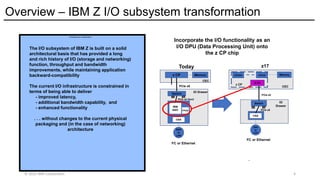
Overview – IBM Z I/O subsystem transformation
© 2025 IBM Corporation 4
I/O Infrastructure Transformation
The I/O subsystem of IBM Z is built on a solid
architectural basis that has provided a long
and rich history of I/O (storage and networking)
function, throughput and bandwidth
improvements, while maintaining application
backward-compatibility
The current I/O infrastructure is constrained in
terms of being able to deliver
- improved latency,
- additional bandwidth capability, and
- enhanced functionality
. . . without changes to the current physical
packaging and (in the case of networking)
architecture
4
Switch
CNA
SAN
or
LAN
IO
Drawer
PCIe x8
FC or Ethernet
Memory
Z I/O
CEC
zCore
PCIe x8
Memory
Switch
IBM
ASIC FPGA
CNA
SAN
or
LAN
IO Drawer
CEC
z CP
PCIe x8
PCIe x8 Gen3
zCore
z CP
Today z17
FC or Ethernet
Incorporate the I/O functionality as an
I/O DPU (Data Processing Unit) onto
the z CP chip
Overview – Ethernet on Z Today
© 2025 IBM Corporation 5
OSC
I/O Drawer
PCIe
Switch
LP1 LP2
Channel Subsystem
LP3
zTPF
z/OS zVM
OSD
RoCE
Linux
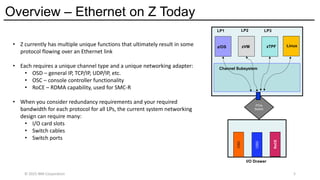
• Z currently has multiple unique functions that ultimately result in some
protocol flowing over an Ethernet link
• Each requires a unique channel type and a unique networking adapter:
• OSD – general IP, TCP/IP, UDP/IP, etc.
• OSC – console controller functionality
• RoCE – RDMA capability, used for SMC-R
• When you consider redundancy requirements and your required
bandwidth for each protocol for all LPs, the current system networking
design can require many:
• I/O card slots
• Switch cables
• Switch ports
Overview – Converged Multi-Function Network Adapter
© 2025 IBM Corporation 6
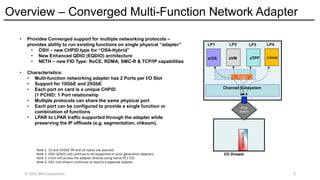
• Provides Converged support for multiple networking protocols –
provides ability to run existing functions on single physical “adapter”
• OSH – new CHPID type for “OSA-Hybrid”
• New Enhanced QDIO (EQDIO) architecture
• NETH – new FID Type: RoCE, RDMA, SMC-R & TCP/IP capabilities
• Characteristics:
• Multi-function networking adapter has 2 Ports per I/O Slot
• Support for 10GbE and 25GbE
• Each port on card is a unique CHPID
(1 PCHID: 1 Port relationship
• Multiple protocols can share the same physical port
• Each port can be configured to provide a single function or
combination of functions
• LPAR to LPAR traffic supported through the adapter while
preserving the IP offloads (e.g. segmentation, chksum).
I/O Drawer
PCIe
Switch
LP1 LP2
Channel Subsystem
LP3
zTPF
z/OS zVM
OSH/RoCE
Linux
LP4
Z CP
Z IO
Note 1. 10 and 25GbE SR and LR optics are planned
Note 2. OSD (QDIO) will continue to be supported on prior generation adapters
Note 3. Linux will access the adapter directly using native PCI FID.
Note 4. OSC (not shown) continues to require a separate adapter.
Overview - Enhanced QDIO (EQDIO) Architecture
© 2025 IBM Corporation 7
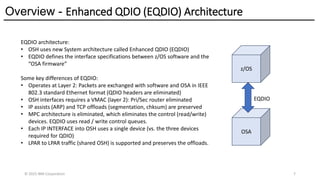
EQDIO architecture:
• OSH uses new System architecture called Enhanced QDIO (EQDIO)
• EQDIO defines the interface specifications between z/OS software and the
“OSA firmware”
Some key differences of EQDIO:
• Operates at Layer 2: Packets are exchanged with software and OSA in IEEE
802.3 standard Ethernet format (QDIO headers are eliminated)
• OSH interfaces requires a VMAC (layer 2): Pri/Sec router eliminated
• IP assists (ARP) and TCP offloads (segmentation, chksum) are preserved
• MPC architecture is eliminated, which eliminates the control (read/write)
devices. EQDIO uses read / write control queues.
• Each IP INTERFACE into OSH uses a single device (vs. the three devices
required for QDIO)
• LPAR to LPAR traffic (shared OSH) is supported and preserves the offloads.
z/OS
OSA
EQDIO
Overview – z17 and z/OS Networking Key Concepts and Terminology
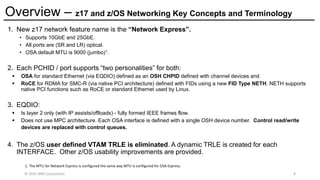
1. New z17 network feature name is the “Network Express”.
• Supports 10GbE and 25GbE.
• All ports are (SR and LR) optical.
• OSA default MTU is 9000 (jumbo)1.
2. Each PCHID / port supports “two personalities” for both:
 OSA for standard Ethernet (via EQDIO) defined as an OSH CHPID defined with channel devices and
 RoCE for RDMA for SMC-R (via native PCI architecture) defined with FIDs using a new FID Type NETH. NETH supports
native PCI functions such as RoCE or standard Ethernet used by Linux.
3. EQDIO:
 Is layer 2 only (with IP assists/offloads) - fully formed IEEE frames flow.
 Does not use MPC architecture. Each OSA interface is defined with a single OSH device number. Control read/write
devices are replaced with control queues.
4. The z/OS user defined VTAM TRLE is eliminated. A dynamic TRLE is created for each
INTERFACE. Other z/OS usability improvements are provided.
© 2025 IBM Corporation 8
1. The MTU for Network Express is configured the same way MTU is configured for OSA-Express.
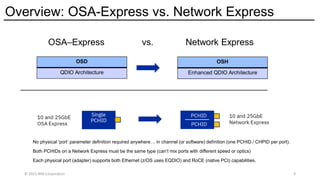
Overview: OSA-Express vs. Network Express
© 2025 IBM Corporation 9
No physical ‘port’ parameter definition required anywhere… in channel (or software) definition (one PCHID / CHPID per port).
Both PCHIDs on a Network Express must be the same type (can’t mix ports with different speed or optics)
Each physical port (adapter) supports both Ethernet (z/OS uses EQDIO) and RoCE (native PCI) capabilities.
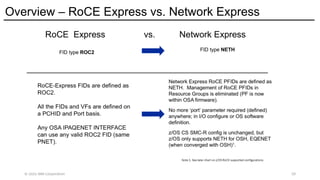
Overview – RoCE Express vs. Network Express
© 2025 IBM Corporation 10
Usage & Invocation – I/O Configuration
© 2025 IBM Corporation 11
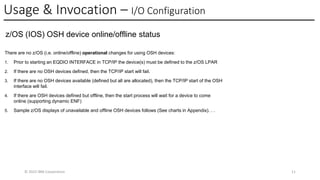
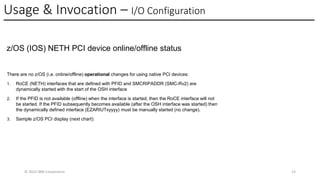
z/OS (IOS) OSH device online/offline status
There are no z/OS (i.e. online/offline) operational changes for using OSH devices:
1. Prior to starting an EQDIO INTERFACE in TCP/IP the device(s) must be defined to the z/OS LPAR
2. If there are no OSH devices defined, then the TCP/IP start will fail.
3. If there are no OSH devices available (defined but all are allocated), then the TCP/IP start of the OSH
interface will fail.
4. If there are OSH devices defined but offline, then the start process will wait for a device to come
online (supporting dynamic ENF)
5. Sample z/OS displays of unavailable and offline OSH devices follows (See charts in Appendix). . .
Usage & Invocation – I/O Configuration
© 2025 IBM Corporation 12
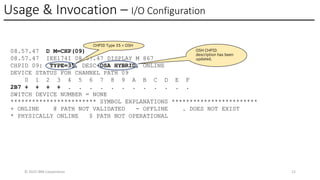
08.57.47 D M=CHP(09)
08.57.47 IEE174I 08.57.47 DISPLAY M 867
CHPID 09: TYPE=35, DESC=OSA HYBRID, ONLINE
DEVICE STATUS FOR CHANNEL PATH 09
0 1 2 3 4 5 6 7 8 9 A B C D E F
2B7 + + + + . . . . . . . . . . . .
SWITCH DEVICE NUMBER = NONE
************************ SYMBOL EXPLANATIONS ************************
+ ONLINE @ PATH NOT VALIDATED - OFFLINE . DOES NOT EXIST
* PHYSICALLY ONLINE $ PATH NOT OPERATIONAL
CHPID Type 35 = OSH
OSH CHPID
description has been
updated.
Usage & Invocation – I/O Configuration
© 2025 IBM Corporation 13
z/OS (IOS) NETH PCI device online/offline status
There are no z/OS (i.e. online/offline) operational changes for using native PCI devices:
1. RoCE (NETH) interfaces that are defined with PFID and SMCRIPADDR (SMC-Rv2) are
dynamically started with the start of the OSH interface
2. If the PFID is not available (offline) when the interface is started, then the RoCE interface will not
be started. If the PFID subsequently becomes available (after the OSH interface was started) then
the dynamically defined interface (EZARIUTxyyyy) must be manually started (no change).
3. Sample z/OS PCI display (next chart):
Usage & Invocation – I/O Configuration
© 2025 IBM Corporation 14
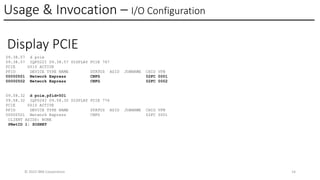
Display PCIE
09.38.57 d pcie
09.38.57 IQP022I 09.38.57 DISPLAY PCIE 767
PCIE 0010 ACTIVE
PFID DEVICE TYPE NAME STATUS ASID JOBNAME CHID VFN
00000501 Network Express CNFG 02FC 0001
00000502 Network Express CNFG 02FC 0002
09.58.32 d pcie,pfid=501
09.58.32 IQP024I 09.58.32 DISPLAY PCIE 776
PCIE 0010 ACTIVE
PFID DEVICE TYPE NAME STATUS ASID JOBNAME CHID VFN
00000501 Network Express CNFG 02FC 0001
CLIENT ASIDS: NONE
PNetID 1: ZOSNET
Usage & Invocation – TCP/IP Configuration
© 2025 IBM Corporation 15
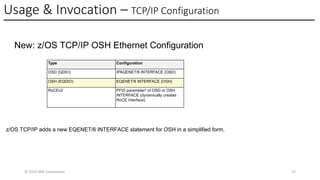
New: z/OS TCP/IP OSH Ethernet Configuration
Type Configuration
OSD (QDIO) IPAQENET/6 INTERFACE (OSD)
OSH (EQDIO) EQENET/6 INTERFACE (OSH)
RoCEv2 PFID parameter2 of OSD or OSH
INTERFACE (dynamically creates
RoCE Interface)
z/OS TCP/IP adds a new EQENET/6 INTERFACE statement for OSH in a simplified form.
Usage & Invocation – TCP/IP Configuration
© 2025 IBM Corporation 16
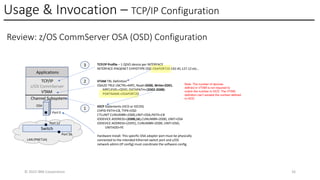
Review: z/OS CommServer OSA (OSD) Configuration
Applications
TCP/IP
z/OS CommServer
VTAM
Channel Subsystem
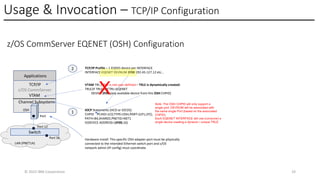
TCP/IP Profile – 1 QDIO device per INTERFACE
INTERFACE IPAQENET CHPIDTYPE OSD OSAPORT2D 192.45.127.12 etc…
VTAM TRL Definition
OSA2D TRLE LNCTRL=MPC, Read=2D00, Write=2D01,
MPCLEVEL=QDIO, DATAPATH=(2D02-2D0B)
PORTNAME=OSAPORT2D
IOCP Statements (HCD or IOCDS)
CHPID PATH=C8, TYPE=OSD
CTLUNIT CUNUMBR=2D00,UNIT=OSA,PATH=C8
IODEVICE ADDRESS=(2D00,16),CUNUMBR=2D00, UNIT=OSA
IODEVICE ADDRESS=(2DFE), CUNUMBR=2D00, UNIT=OSD,
UNITADD=FE
Hardware install: This specific OSA adapter port must be physically
connected to the intended Ethernet switch port and z/OS
network admin (IP config) must coordinate the software config.
Switch
Port 0
Port 12
Port 16
LAN (PNET1A)
3
2
1
OSA
Note. The number of devices
defined in VTAM is not required to
match the number in HCD. The VTAM
definition can’t exceed the number defined
in HCD.
Usage & Invocation – TCP/IP Configuration
© 2025 IBM Corporation 17
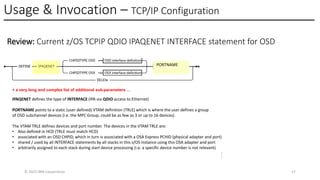
Review: Current z/OS TCPIP QDIO IPAQENET INTERFACE statement for OSD
IPAQENET defines the type of INTERFACE (IPA via QDIO access to Ethernet)
PORTNAME points to a static (user defined) VTAM definition (TRLE) which is where the user defines a group
of OSD subchannel devices (i.e. the MPC Group, could be as few as 3 or up to 16 devices).
The VTAM TRLE defines devices and port number. The devices in the VTAM TRLE are:
• Also defined in HCD (TRLE must match HCD)
• associated with an OSD CHPID, which in turn is associated with a OSA Express PCHID (physical adapter and port)
• shared / used by all INTERFACE statements by all stacks in this z/OS instance using this OSA adapter and port
• arbitrarily assigned to each stack during start device processing (i.e. a specific device number is not relevant)
PORTNAME
1
7
+ a very long and complex list of additional sub-parameters …
Usage & Invocation – TCP/IP Configuration
© 2025 IBM Corporation 18
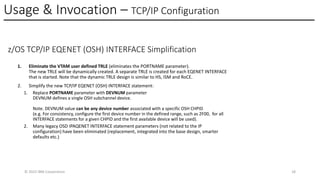
z/OS TCP/IP EQENET (OSH) INTERFACE Simplification
1. Eliminate the VTAM user defined TRLE (eliminates the PORTNAME parameter).
The new TRLE will be dynamically created. A separate TRLE is created for each EQENET INTERFACE
that is started. Note that the dynamic TRLE design is similar to HS, ISM and RoCE.
2. Simplify the new TCP/IP EQENET (OSH) INTERFACE statement:
1. Replace PORTNAME parameter with DEVNUM parameter
DEVNUM defines a single OSH subchannel device.
Note. DEVNUM value can be any device number associated with a specific OSH CHPID
(e.g. For consistency, configure the first device number in the defined range, such as 2F00, for all
INTERFACE statements for a given CHPID and the first available device will be used).
2. Many legacy OSD IPAQENET INTERFACE statement parameters (not related to the IP
configuration) have been eliminated (replacement, integrated into the base design, smarter
defaults etc.)
Usage & Invocation – TCP/IP Configuration
© 2025 IBM Corporation 19
z/OS CommServer EQENET (OSH) Configuration
Applications
TCP/IP
z/OS CommServer
VTAM
Channel Subsystem
TCP/IP Profile – 1 EQDIO device per INTERFACE
INTERFACE EQENET DEVNUM 2F00 192.45.127.12 etc…
VTAM TRL (TRLE is not user defined – TRLE is dynamically created)
TRLE2F TRLE LNCTRL=EQENET
DEVICE 2F00 (any available device from this OSH CHPID)
IOCP Statements (HCD or IOCDS)
CHPID PCHID=1C0,TYPE=OSH,PART=(LP1,LP2),
PATH=84,SHARED,PNETID=NET1
IODEVICE ADDRESS=(2F00,16)
Hardware install: This specific OSH adapter port must be physically
connected to the intended Ethernet switch port and z/OS
network admin (IP config) must coordinate.
Switch
Port
Port 12
Port 16
LAN (PNET1A)
2
1
OSH
Note. The OSH CHPID will only support a
single port. DEVNUM will be associated with
the same single Port (based on the associated
CHPID).
Each EQENET INTERFACE will use (consume) a
single device creating a dynamic / unique TRLE.
X
Usage & Invocation – TCP/IP Configuration
© 2025 IBM Corporation 20
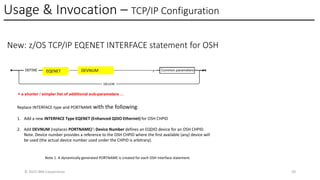
New: z/OS TCP/IP EQENET INTERFACE statement for OSH
Replace INTERFACE type and PORTNAME with the following:
1. Add a new INTERFACE Type EQENET (Enhanced QDIO Ethernet) for OSH CHPID
2. Add DEVNUM (replaces PORTNAME)1: Device Number defines an EQDIO device for an OSH CHPID.
Note. Device number provides a reference to the OSH CHPID where the first available (any) device will
be used (the actual device number used under the CHPID is arbitrary).
EQENET
OSD OSD interface definition
d
d
DEVNUM
+ a shorter / simpler list of additional sub-parameters …
Note 1. A dynamically generated PORTNAME is created for each OSH interface statement.
Usage & Invocation – TCP/IP Configuration
© 2025 IBM Corporation 21
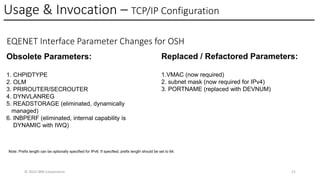
EQENET Interface Parameter Changes for OSH
Obsolete Parameters:
1. CHPIDTYPE
2. OLM
3. PRIROUTER/SECROUTER
4. DYNVLANREG
5. READSTORAGE (eliminated, dynamically
managed)
6. INBPERF (eliminated, internal capability is
DYNAMIC with IWQ)
Replaced / Refactored Parameters:
1.VMAC (now required)
2. subnet mask (now required for IPv4)
3. PORTNAME (replaced with DEVNUM)
Note: Prefix length can be optionally specified for IPv6. If specified, prefix length should be set to 64.
Usage & Invocation – TCP/IP Configuration
© 2025 IBM Corporation 22
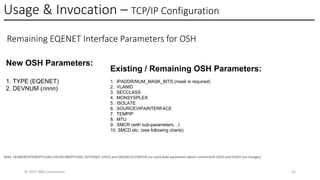
Remaining EQENET Interface Parameters for OSH
New OSH Parameters:
1. TYPE (EQENET)
2. DEVNUM (nnnn)
Existing / Remaining OSH Parameters:
1. IPADDR/NUM_MASK_BITS (mask is required)
2. VLANID
3. SECCLASS
4. MONSYSPLEX
5. ISOLATE
6. SOURCEVIPAINTERFACE
7. TEMPIP
8. MTU
9. SMCR (with sub-parameters…)
10. SMCD etc. (see following charts)
Note. SEGMENTATIONOFFLOAD,CHECKSUMOFFLOAD, AUTOIQDC (HSCI) and QDIOACCELERATOR are stack wide parameters which control both QDIO and EQDIO (no changes)
Usage & Invocation – TCP/IP Configuration
© 2025 IBM Corporation 23
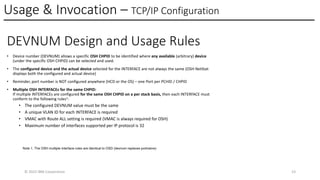
DEVNUM Design and Usage Rules
• Device number (DEVNUM) allows a specific OSH CHPID to be identified where any available (arbitrary) device
(under the specific OSH CHPID) can be selected and used.
• The configured device and the actual device selected for the INTERFACE are not always the same (OSH NetStat
displays both the configured and actual device)
• Reminder, port number is NOT configured anywhere (HCD or the OS) – one Port per PCHID / CHPID
• Multiple OSH INTERFACEs for the same CHPID:
If multiple INTERFACEs are configured for the same OSH CHPID on a per stack basis, then each INTERFACE must
conform to the following rules1:
• The configured DEVNUM value must be the same
• A unique VLAN ID for each INTERFACE is required
• VMAC with Route ALL setting is required (VMAC is always required for OSH)
• Maximum number of interfaces supported per IP protocol is 32
Note 1. The OSH multiple interface rules are identical to OSD (devnum replaces portname)
Usage & Invocation – Auto-Migration
© 2025 IBM Corporation 24
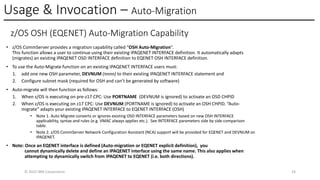
z/OS OSH (EQENET) Auto-Migration Capability
• z/OS CommServer provides a migration capability called “OSH Auto-Migration”.
This function allows a user to continue using their existing IPAQENET INTERFACE definition. It automatically adapts
(migrates) an existing IPAQENET OSD INTERFACE definition to EQENET OSH INTERFACE definition.
• To use the Auto-Migrate function on an existing IPAQENET INTERFACE users must:
1. add one new OSH parameter, DEVNUM (nnnn) to their existing IPAQENET INTERFACE statement and
2. Configure subnet mask (required for OSH and can’t be generated by software)
• Auto-migrate will then function as follows:
1. When z/OS is executing on pre-z17 CPC: Use PORTNAME (DEVNUM is ignored) to activate an OSD CHPID
2. When z/OS is executing on z17 CPC: Use DEVNUM (PORTNAME is ignored) to activate an OSH CHPID. “Auto-
migrate” adapts your existing IPAQENET INTERFACE to EQENET INTERFACE (OSH)
• Note 1. Auto Migrate converts or ignores existing OSD INTERFACE parameters based on new OSH INTERFACE
applicability, syntax and rules (e.g. VMAC always applies etc.). See INTERFACE parameters side by side comparison
table.
• Note 2. z/OS CommServer Network Configuration Assistant (NCA) support will be provided for EQENET and DEVNUM on
IPAQENET.
• Note: Once an EQENET interface is defined (Auto-migration or EQENET explicit definition), you
cannot dynamically delete and define an IPAQENET interface using the same name. This also applies when
attempting to dynamically switch from IPAQENET to EQENET (i.e. both directions).
Usage & Invocation – Auto-Migration
© 2025 IBM Corporation 25
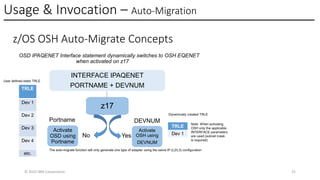
OSD IPAQENET Interface statement dynamically switches to OSH EQENET
when activated on z17
z17
INTERFACE IPAQENET
PORTNAME + DEVNUM
Activate
OSH using
DEVNUM
Activate
OSD using
Portname
No
Note. When activating
OSH only the applicable
INTERFACE parameters
are used (subnet mask
is required)
Yes
Portname DEVNUM
TRLE
Dev 1
Dev 2
Dev 3
Dev 4
etc.
TRLE
Dev 1
The auto-migrate function will only generate one type of adapter using the same IP (L2/L3) configuration
User defined static TRLE
Dynamically created TRLE
z/OS OSH Auto-Migrate Concepts
Usage & Invocation – TCP/IP Configuration
© 2025 IBM Corporation 26
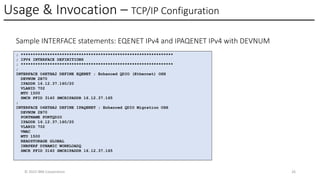
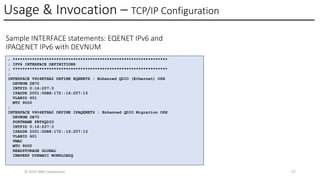
Sample INTERFACE statements: EQENET IPv4 and IPAQENET IPv4 with DEVNUM
; ***************************************************************
; IPV4 INTERFACE DEFINITIONS
; ***************************************************************
;
INTERFACE O4ETHA2 DEFINE EQENET ; Enhanced QDIO (Ethernet) OSH
DEVNUM 2B70
IPADDR 16.12.37.160/20
VLANID 702
MTU 1500
SMCR PFID 3140 SMCRIPADDR 16.12.37.165
;
INTERFACE O4ETHA2 DEFINE IPAQENET ; Enhanced QDIO Migration OSH
DEVNUM 2B70
PORTNAME PORTQDIO
IPADDR 16.12.37.160/20
VLANID 702
VMAC
MTU 1500
READSTORAGE GLOBAL
INBPERF DYNAMIC WORKLOADQ
SMCR PFID 3140 SMCRIPADDR 16.12.37.165
Usage & Invocation – TCP/IP Configuration
© 2025 IBM Corporation 27
Sample INTERFACE statements: EQENET IPv6 and
IPAQENET IPv6 with DEVNUM
; ****************************************************************
; IPV6 INTERFACE DEFINITIONS
; ****************************************************************
;
INTERFACE V6O4ETHA2 DEFINE EQENET6 ; Enhanced QDIO (Ethernet) OSH
DEVNUM 2B70
INTFID 0:16:207:3
IPADDR 2001:0DB8:172::16:207:13
VLANID 601
MTU 9000
;
INTERFACE V6O4ETHA2 DEFINE IPAQENET6 ; Enhanced QDIO Migration OSH
DEVNUM 2B70
PORTNAME PRT6QDIO
INTFID 0:16:207:3
IPADDR 2001:0DB8:172::16:207:13
VLANID 601
VMAC
MTU 9000
READSTORAGE GLOBAL
INBPERF DYNAMIC WORKLOADQ
Usage & Invocation – RoCEv2 Configuration
© 2025 IBM Corporation 28
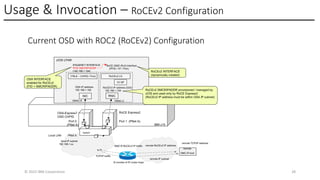
Current OSD with ROC2 (RoCEv2) Configuration
z/OS LPAR
RoCE Express2
Port 1 (PNet A)
OSA-Express7
OSD CHPID
Port 0
(PNet A)
RoCEV2 IP address (GID)
192.168.1.104
RoCEv2 LG
V2 QP
RNIC
VMAC-2
RoCE (SMC-Rv2) Interface
(PFID / VF / Port)
NIC
VMAC-A
OSA IP address
192.168.1.100
(TRLE – CHPID / Port)
IPAQENET INTERFACE
PFID SMCRIPADDR
(192.168.1.104)
local IP subnet
192.168.1.xx
remote IP subnet
remote
SMC-R host
TCP/IP traffic
SMC-R RoCEv2 IP traffic
remote TCP/IP address
remote RoCEv2 IP address
IBM z15
OSA INTERFACE
enabled for RoCEv2
(FID + SMCRIPADDR)
RoCEv2 INTERFACE
(dynamically created)
RoCEv2 SMCRIPADDR provisioned / managed by
z/OS and used only by RoCE Express2
(RoCEv2 IP address must be within OSA IP subnet)
N number of IP router hops
Local LAN PNet A
Switch
Usage & Invocation – RoCEv2 Configuration
© 2025 IBM Corporation 29
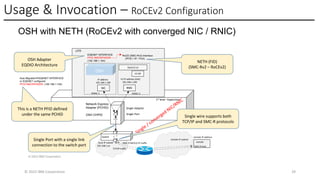
z/OS
Single Adapter
1st level Hypervisor
Single Port
V2 IP address (GID)
192.168.1.104
RoCEv2 LG
V2 QP
RNIC
VMAC-2
NIC
VMAC-1
IP address
192.168.1.100
local IP subnet
192.168.1.xx
remote IP subnet
remote
SMC-R host
TCP/IP traffic
SMC-R RoCEv2 IP traffic
remote IP address
OSH
OSH Adapter
EQDIO Architecture
NETH (FID)
(SMC-Rv2 – RoCEv2)
Network Express
Adapter (PCHID)
OSH CHPID
Auto Migrated IPAQENET INTERFACE
or EQENET configured
PFID SMCRIPADDR (192.168.1.104)
EQENET INTERFACE
PFID SMCRIPADDR
(192.168.1.104)
RoCE (SMC-Rv2) Interface
(PFID / VF / Port)
Single Port with a single link
connection to the switch port
© 2023 IBM Corporation
This is a NETH PFID defined
under the same PCHID Single wire supports both
TCP/IP and SMC-R protocols
Switch
OSH with NETH (RoCEv2 with converged NIC / RNIC)
Usage & Invocation – RoCEv2 Configuration
© 2025 IBM Corporation 30
z/OS
Single Adapter (PCHID)
1st level Hypervisor
Single Port
V2 IP address (GID)
192.168.1.104
RoCEv2 LG
V2 QP
RNIC
VMAC-2
NIC
VMAC-1
IP address
192.168.1.100
local IP subnet
192.168.1.xx
remote IP subnet
remote
SMC-R host
TCP/IP traffic
SMC-R RoCEv2 IP traffic
remote IP address
OSH
OSH Adapter
EQDIO Architecture
NETH (FID)
(SMC-Rv2 – RoCEv2)
Network Express
Adapter (PCHID)1
OSH CHPID
Auto Migrated IPAQENET INTERFACE
or EQENET configured
PFID SMCRIPADDR (192.168.1.104)
EQENET INTERFACE
PFID SMCRIPADDR
(192.168.1.104)
RoCE (SMC-Rv2) Interface
(PFID / VF / Port)
Single Port with a single link
connection to the switch port
© 2023 IBM Corporation
This is a NETH PFID defined
under the same PCHID Single wire supports both
TCP/IP and SMC-R protocols
Switch
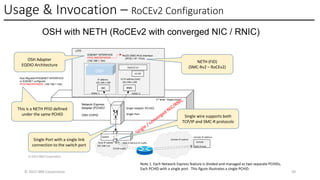
OSH with NETH (RoCEv2 with converged NIC / RNIC)
Note 1. Each Network Express feature is divided and managed as two separate PCHIDs,
Each PCHID with a single port. This figure illustrates a single PCHID.
Usage & Invocation – Netstat Displays
© 2025 IBM Corporation 31
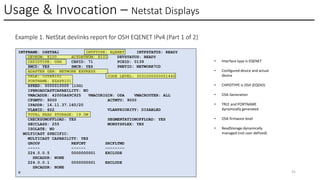
Example 1. NetStat devlinks report for OSH EQENET IPv4 (Part 1 of 2)
INTFNAME: O4ETHA1 INTFTYPE: EQENET INTFSTATUS: READY
DEVNUM: 8100 ACTDEVNUM: 8101 DEVSTATUS: READY
CHPIDTYPE: OSH CHPID: 71 PCHID: 0139
SMCD: YES SMCR: YES PNETID: NETWORK7CD
ADAPTER GEN: NETWORK EXPRESS
TRLE: IUTE8101 CODE LEVEL: 3031000000001440
PORTNAME: EZAP8101
SPEED: 0000010000 (10G)
IPBROADCASTCAPABILITY: NO
VMACADDR: 42000A69C925 VMACORIGIN: OSA VMACROUTER: ALL
CFGMTU: 9000 ACTMTU: 9000
IPADDR: 16.11.37.160/20
VLANID: 602 VLANPRIORITY: DISABLED
TOTAL READ STORAGE: 19.0M
CHECKSUMOFFLOAD: YES SEGMENTATIONOFFLOAD: YES
SECCLASS: 255 MONSYSPLEX: YES
ISOLATE: NO
MULTICAST SPECIFIC:
MULTICAST CAPABILITY: YES
GROUP REFCNT SRCFLTMD
----- ------ --------
224.0.0.5 0000000001 EXCLUDE
SRCADDR: NONE
224.0.0.1 0000000001 EXCLUDE
SRCADDR: NONE
c
• Interface type is EQENET
• Configured device and actual
device
• CHPIDTYPE is OSH (EQDIO)
• OSA Generation
• TRLE and PORTNAME
dynamically generated
• OSA firmware level
• ReadStorage dynamically
managed (not user defined)
Usage & Invocation – Netstat Displays
© 2025 IBM Corporation 32
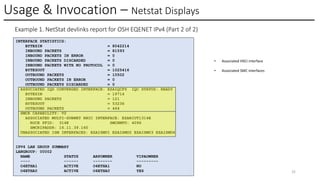
Example 1. NetStat devlinks report for OSH EQENET IPv4 (Part 2 of 2)
INTERFACE STATISTICS:
BYTESIN = 8042214
INBOUND PACKETS = 81593
INBOUND PACKETS IN ERROR = 0
INBOUND PACKETS DISCARDED = 0
INBOUND PACKETS WITH NO PROTOCOL = 0
BYTESOUT = 1025416
OUTBOUND PACKETS = 10502
OUTBOUND PACKETS IN ERROR = 0
OUTBOUND PACKETS DISCARDED = 0
ASSOCIATED IQD CONVERGED INTERFACE: EZAIQCF9 IQC STATUS: READY
BYTESIN = 19714
INBOUND PACKETS = 121
BYTESOUT = 53236
OUTBOUND PACKETS = 464
SMCR CAPABILITY: V2
ASSOCIATED MULTI-SUBNET RNIC INTERFACE: EZARIUT1314E
ROCE PFID: 314E SMCRMTU: 4096
SMCRIPADDR: 16.11.39.160
UNASSOCIATED ISM INTERFACES: EZAISMU1 EZAISMU2 EZAISMU3 EZAISMU4
IPV4 LAN GROUP SUMMARY
LANGROUP: 00002
NAME STATUS ARPOWNER VIPAOWNER
---- ------ -------- ---------
O4ETHA1 ACTIVE O4ETHA1 NO
O4ETHA0 ACTIVE O4ETHA0 YES
• Associated HSCI interface
• Associated SMC interfaces
Usage & Invocation – Netstat Displays
© 2025 IBM Corporation 33
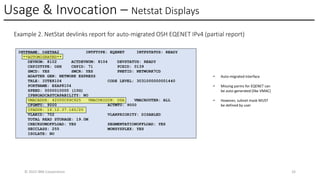
Example 2. NetStat devlinks report for auto-migrated OSH EQENET IPv4 (partial report)
INTFNAME: O4ETHA2 INTFTYPE: EQENET INTFSTATUS: READY
**AUTOMIGRATED**
DEVNUM: 8102 ACTDEVNUM: 8104 DEVSTATUS: READY
CHPIDTYPE: OSH CHPID: 71 PCHID: 0139
SMCD: YES SMCR: YES PNETID: NETWORK7CD
ADAPTER GEN: NETWORK EXPRESS
TRLE: IUTE8104 CODE LEVEL: 3031000000001440
PORTNAME: EZAP8104
SPEED: 0000010000 (10G)
IPBROADCASTCAPABILITY: NO
VMACADDR: 42000C69C925 VMACORIGIN: OSA VMACROUTER: ALL
CFGMTU: 9000 ACTMTU: 9000
IPADDR: 16.12.37.160/20
VLANID: 702 VLANPRIORITY: DISABLED
TOTAL READ STORAGE: 19.0M
CHECKSUMOFFLOAD: YES SEGMENTATIONOFFLOAD: YES
SECCLASS: 255 MONSYSPLEX: YES
ISOLATE: NO
• Auto-migrated interface
• Missing parms for EQENET can
be auto-generated (like VMAC)
• However, subnet mask MUST
be defined by user
Usage & Invocation – Netstat Displays
© 2025 IBM Corporation 34
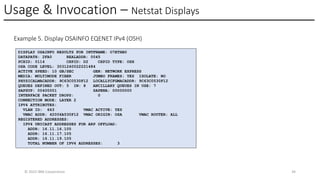
Example 5. Display OSAINFO EQENET IPv4 (OSH)
DISPLAY OSAINFO RESULTS FOR INTFNAME: O7ETHB0
DATAPATH: 2FA0 REALADDR: 0045
PCHID: 0114 CHPID: D2 CHPID TYPE: OSH
OSA CODE LEVEL: 3031240022221484
ACTIVE SPEED: 10 GB/SEC GEN: NETWORK EXPRESS
MEDIA: MULTIMODE FIBER JUMBO FRAMES: YES ISOLATE: NO
PHYSICALMACADDR: 9C63C0530F12 LOCALLYCFGMACADDR: 9C63C0530F12
QUEUES DEFINED OUT: 5 IN: 8 ANCILLARY QUEUES IN USE: 7
SAPSUP: 00400001 SAPENA: 00000000
INTERFACE PACKET DROPS: 0
CONNECTION MODE: LAYER 2
IPV4 ATTRIBUTES:
VLAN ID: 663 VMAC ACTIVE: YES
VMAC ADDR: 42006A530F12 VMAC ORIGIN: OSA VMAC ROUTER: ALL
REGISTERED ADDRESSES:
IPV4 UNICAST ADDRESSES FOR ARP OFFLOAD:
ADDR: 16.11.16.105
ADDR: 16.11.17.105
ADDR: 16.11.19.105
TOTAL NUMBER OF IPV4 ADDRESSES: 3
Usage & Invocation – TRLE Display
© 2025 IBM Corporation 35
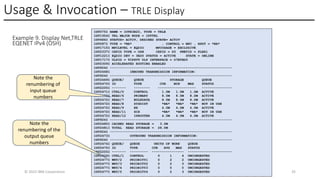
Example 9. Display Net,TRLE
EQENET IPv4 (OSH)
IST075I NAME = IUTE3B20, TYPE = TRLE
IST1954I TRL MAJOR NODE = ISTTRL
IST486I STATUS= ACTIV, DESIRED STATE= ACTIV
IST087I TYPE = *NA* , CONTROL = MPC , HPDT = *NA*
IST1715I MPCLEVEL = EQDIO MPCUSAGE = EXCLUSIVE
IST2337I CHPID TYPE = OSH CHPID = D5 PNETID = PLEX1
IST1221I EQDIO DEV = 3B20 STATUS = ACTIVE STATE = ONLINE
IST1717I ULPID = TCPSVT ULP INTERFACE = O7ETHD0
IST2309I ACCELERATED ROUTING ENABLED
IST924I -------------------------------------------------------------
IST2468I INBOUND TRANSMISSION INFORMATION:
IST924I -------------------------------------------------------------
IST2469I QUEUE/ QUEUE STORAGE QUEUE
IST2470I ID TYPE CUR MIN MAX STATUS
IST2205I ------- -------- ------------------- ---------------
IST2471I CTRL/0 CONTROL 1.0M 1.0M 1.0M ACTIVE
IST2472I READ/6 PRIMARY 8.0M 8.0M 8.0M ACTIVE
IST2472I READ/7 BULKDATA 8.0M 8.0M 8.0M ACTIVE
IST2472I READ/8 SYSDIST *NA* *NA* *NA* NOT IN USE
IST2472I READ/9 EE 4.0M 4.0M 4.0M ACTIVE
IST2472I READ/11 ZCX *NA* *NA* *NA* NOT IN USE
IST2472I READ/12 IPROUTER 4.0M 4.0M 4.0M ACTIVE
IST924I -------------------------------------------------------------
IST2480I CACHED READ STORAGE = 3.0M
IST2481I TOTAL READ STORAGE = 28.0M
IST924I -------------------------------------------------------------
IST2473I OUTBOUND TRANSMISSION INFORMATION:
IST924I -------------------------------------------------------------
IST2474I QUEUE/ QUEUE UNITS OF WORK QUEUE
IST2475I ID TYPE CUR AVG MAX STATUS
IST2205I ------- --------- ---------------- ----------------------
IST2476I CTRL/1 CONTROL 0 1 4 UNCONGESTED
IST2477I WRT/2 PRIORITY1 0 2 2 UNCONGESTED
IST2477I WRT/3 PRIORITY2 0 2 3 UNCONGESTED
IST2477I WRT/4 PRIORITY3 0 0 0 UNCONGESTED
IST2477I WRT/5 PRIORITY4 0 2 3 UNCONGESTED
Note the
renumbering of
input queue
numbers
Note the
renumbering of the
output queue
numbers
Usage & Invocation – Current Limitations / Guidance
© 2025 IBM Corporation 36
• No EQDIO support on z/OS 2.4 or a VSE client
- NETH support on z/OS 2.4 for SMC-Rv1 is available
•
•
•
• SNMP support for OSA (OSH) will not be available at z17 GA (targeted for Sept/2025)
• OSAENTA (Network Traffic Analyzer) trace support will not be available
(Alternatively, a sniffer (wireshark) trace may be used)
• QDIOSYNC support will not be available (Automated mechanism to collect SW and HW traces concurrently)
• NETH PFIDs (RoCE) - Guideline
o For clients using IBM Network Express 10G or 25G with z/OS CommServer 2.5 or 3.1, it is recommended to set up a
maximum of 16 NETH FIDs on the same adapter when OSH is also enabled.
• zOS guest deployed in zVM vSwitch environment must be Layer 3 QDIO – must use OSA-Express
(IPAQENET (OSD CHPID) OSA-Express)
o A z/VM vSwitch attached to a Network Express card must operate in Layer-2 mode. This means that a z/OS guest
cannot be deployed on this vSwitch, as the z/OS guest must use a QDIO interface (a current z/VM limitation) and z/OS
does not support Layer-2 with QDIO. Linux supports both modes today, so Linux guests using QDIO can use this
configuration.
• “QDIO Accelerator” is supported for EQDIO but is limited to EQDIO-to-EQDIO interfaces only.
Installation & Configuration – APARs for enablement
© 2025 IBM Corporation 37
z/OS CommServer APARs (2.5 and 3.1):
• OA64896 for SNA
• PH54596 for TCP/IP
IOS APAR:
• OA63265
© 2025 IBM Corporation 38
Questions?
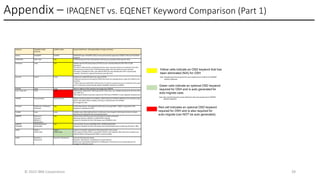
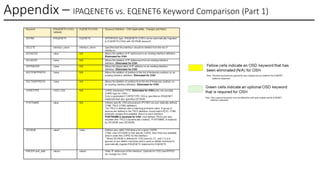
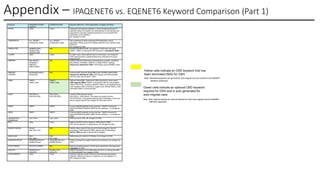
Appendix – IPAQENET vs. EQENET Keyword Comparison (Part 1)
© 2025 IBM Corporation 39
Keyword IPAQENET (OSD)
(default)
EQENET (OSH) Keyword Definition- OSH Applicability, Changes and Notes
define IPAQENET EQENET INTERFACE type: IPAQENET (OSD) can be automatically migratedto EQENET (OSH) with DEVNUM
keyword
CHPIDTYPE OSD | OSX N/A CHPID (hardware) TYPE: Eliminatedfor OSH (only one possible CHPID type for OSH)
Portname value N/A Defines specific OSD physical port (PCHID) via user statically defined VTAM TRLE (VTAM
definition):
The TRLE is defined with a matching portname value. A group of devices are defined in the TRLE
definition(must match HCD). VTAM arbitrarily assigns first avail device to each interface.
Portname is obsolete for OSH. User defined TRLEs are also obsolete (the TRLE is dynamically
created). Portname is replaced by devnum (see devnum).
Devnum Value* value Defines (any valid) OSH device for a given CHPID:
VTAM uses devnum to find specific CHPID then finds any availabledevice under this CHPID for the
interface.
* When devnum is defined for OSD (new for 2.5 only) it is ignored on pre z17 machines and is used
on z17 machines to automaticallymigrate IPAQENET statement to EQENET
IPADDR value value Static IP address of this interface: No change (see TEMPIP)
num_mask_bits mask mask Subnet mask: Optional for OSD (required for some cases, e.g. multiple interfaces for the same OSA
port, SMC etc.)
OSH requires Subnet mask (also required for OSD when IPAQENET is auto-migrated using devnum)
TEMPIP No parameters No parameters Defines Interface without an IP Address. Allows dynamic IP address definition over interface using
DHCP. Once DHCP flows complete, interfaceis restarted with new IPADDR.
No changes for OSH
Prirouter NonRouter | PriRouter |
SecRouter
N/A Pri/Sec/Non Router: Only applied to OSD when not using VMAC. VMAC is required for OSH
(keyword is obsolete for OSH)
VLANID value value VLANID value: When defined host is VLAN aware. No change for OSH (required when multiple
interfaces are defined for the same physical port).
INBPERF Balanced |
Dynamic |
MINCPU |
MINLATENCY
N/A Defines Inbound Performance characteristics (complexvariations):
Balanced, Dynamic, MINCPU or MINLATENCY settings.
Keyword is obsolete for OSH. OSH always uses DYNAMIC mode
INBPERF
DYNAMIC
NOWORKLOADQ |
WorkloadQ
N/A Controls IWQ: Dynamic NOWORKLOAD | WORKLOADQ (IWQ)
Keyword is obsolete for OSH. OSH always uses IWQ (possible service mode only off switch -TBD)
VMAC VMAC |
VMAC value
VMAC |
VMAC value
Defines Virtual MAC: Optional for OSD (required for some cases)
OSH requires VMAC (VMAC is required for OSD for auto-migrate). OSH continues to support user
defined VMACs, OSA generated VMAC is recommended.
VMAC RouteALL |
RouteLocal
RouteAll | RouteLocal Controls OSA inbound routing:
RouteALL: OSD Default - All packets are routed inbound
RouteLocal: Only packets destined for IP Addresses in the home list are routed inbound. No
changes for OSH (see note 3)
Yellow cells indicate an OSD keyword that has
been eliminated (N/A) for OSH
Note. Obsolete keywords are ignored for auto-migrate but are invalid for the EQENET
definition statement.
Green cells indicate an optional OSD keyword
required for OSH and is auto generated for
auto-migrate case.
Note. New required keywords must be defined for both auto-migrate and for EQENET
definition statement.
Red cell indicates an optional OSD keyword
required for OSH and is also required for
auto-migrate (can NOT be auto generated).
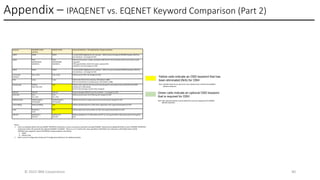
Appendix – IPAQENET vs. EQENET Keyword Comparison (Part 2)
© 2025 IBM Corporation 40
Keyword IPAQENET (OSD)
(default)
EQENET (OSH) Keyword Definition- OSH Applicability, Changes and Notes
SMCR SMCR SMCR Controls SMCR eligibilityfor this interface– SMCR remains the default (NOSMCR disables SMCR for
the interface)– no change for OSH
SMCR PFID
SMCRIPADDR
SMCRMTU
PFID
SMCRIPADDR
SMCRMTU
SMC-Rv2 Parameters: Enables and defines SMC-Rv2 for this IP interface (PFID and IP addr are both
required):
PFID (specific RNIC), RoCEv2 IPv4 addr, optional MTU
(defaults to 1k). No changes for OSH.
SMCD SMCD SMCD Controls SMCD eligibilityfor this interface– SMCD remains the default (NOSMCD disables SMCD for
the interface)– no change for OSH
Sourcevipa
interface
vipa_name vipa_name Defines source VIPA. No changes for OSH
MTU value value Defines the MTU for this interface. OSD default is 8992.
MTU can be defined in multiple places. OSH default is 9000.
Readstorage Global |
Max, Min, AVG
N/A Defines static value for the amount of read storage for inbound processing. OSD default GLOBAL
setting uses VTAM setting.
N/A for OSH (storage is dynamicallymanaged)
IPBCAST IPBCAST IPBCAST Defines (enables) IPBCAST over this interface – no changes for OSH
SECCLASS 255 |
sec_class
255 |
sec_class
Defines security class for IP filtering. No changes for OSH
NoMonSysplex NoMonsysplex |
MonSysplex
NoMonSysplex |
MonSysplex
Defines interface for sysplex autonomics monitoring. No changes for OSH
DynVLANReg NoDynVLANReg N/A Defines (enables) dynamic VLAN switch registration. Not supported (obsolete) for OSH.
OLM NonOLM |
OLM
N/A Defines OptimizedLatency Mode for OSD. Not supported (obsolete) for OSH.
ISOLATE NoISOLATE |
ISOLATE
NoISOLATE |
ISOLATE
Defines (enables) LP-LP traffic within the CPC (vs. forcing all traffic to flow externally). No change for
OSH
Yellow cells indicate an OSD keyword that has
been eliminated (N/A) for OSH
Note. Obsolete keywords are ignored for auto-migrate but are invalid for the EQENET
definition statement.
Green cells indicate an optional OSD keyword
that is required for OSH
Note. New required keywords must be defined for both auto-migrate and for EQENET
definition statement.
Notes:
1. Users can explicitly define the new EQENET INTERFACE statement, or they can continue using their existing IPAQENET statements by adding DEVNUM on their IPAQENET INTERFACE
statements which will automatically migrate IPAQENET to EQENET. When on a z17 machine the value specified on DEVNUM must reference a valid EQDIO device (HCD).
DEVNUM auto-migration requires INTERFACE keywords (green cells above):
a. VMAC
b. Subnet mask
2. Refer to the IP Configuration Guide and IP Configuration Reference for additional details.
Appendix – IPAQENET6 vs. EQENET6 Keyword Comparison (Part 1)
Keyword IPAQENET6 (OSD)
(default)
EQENET6 (OSH) Keyword Definition - OSH Applicability, Changes and Notes
INTFID value Value Optional 64-bit interface identifier in colon-hexadecimal format. If
specified, allows forming the link-local address for the interface and
appended to manually configured prefixes to form complete IPv6
addresses on the interface.
No changes for OSH
TEMPPREFIX ALL | NONE |
prefix/prefix_length
ALL | NONE |
prefix/prefix_length
Set of prefixes for which temporary IPv6 addresses can be
generated. Allows dynamic IP address definition over interface using
DHCPv6.
No changes for OSH
PRIROUTER NONROUTER |
PRIROUTER |
SECROUTER
N/A PRI/SEC/NONROUTER: Only applied to OSD when not using
VMAC. VMAC is required for OSH (keyword is obsolete for OSH)
VLANID value Value VLANID value: When defined host is VLAN aware. No change for
OSH (required when multiple interfaces are defined for the same
physical port).
INBPERF BALANCED |
DYNAMIC |
MINCPU |
MINLATENCY
N/A Defines Inbound Performance characteristics (complex variations):
BALANCED, DYNAMIC, MINCPU or MINLATENCY settings.
Keyword is obsolete for OSH. OSH always uses DYNAMIC mode
INBPERF
DYNAMIC
NOWORKLOADQ |
WorkloadQ
N/A Controls IWQ: Dynamic NOWORKLOAD | WORKLOADQ (IWQ)
Keyword is obsolete for OSH. OSH always uses IWQ (possible
service mode only off switch -TBD)
VMAC VMAC |
VMAC value
VMAC |
VMAC value
Defines Virtual MAC: Optional for OSD (required for some cases)
OSH requires VMAC (VMAC is required for OSD for auto-migrate).
VMAC ROUTEALL is used as default if VMAC is not specified during
auto-migration. OSH continues to support user defined VMACs, OSA
generated VMAC is recommended.
VMAC ROUTEALL |
ROUTELOCAL
ROUTEALL |
ROUTELOCAL
Controls OSA inbound routing:
ROUTEALL: OSD Default - All packets are routed inbound
ROUTELOCAL: Only packets destined for IP Addresses in the home
list are routed inbound. No changes for OSH (see note 3)
SMCR SMCR SMCR Controls SMCR eligibility for this interface – SMCR remains the
default (NOSMCR disables SMCR for the interface) – no change for
OSH
SMCD SMCD SMCD Controls SMCD eligibility for this interface – SMCD remains the
default (NOSMCD disables SMCD for the interface) – no change for
OSH
SOURCEVIPA
INTERFACE
vipa_name vipa_name Defines source VIPA. No changes for OSH
MTU value Value Defines the MTU for this interface. OSD default is 9000.
MTU can be defined in multiple places. No changes for OSH.
READSTORAGE Global |
Max, Min, AVG
N/A Defines static value for the amount of read storage for inbound
processing. OSD default GLOBAL setting uses VTAM setting.
N/A for OSH (storage is dynamically managed)
SECCLASS 255 |
sec_class
255 |
sec_class
Defines security class for IP filtering. No changes for OSH
NOMONSYSPLEX NOMONSYSPLEX |
MONSYSPLEX
NOMONSYSPLEX |
MONSYSPLEX
Defines interface for sysplex autonomics monitoring. No changes for
OSH
DYNVLANREG NODYNVLANREG N/A Defines (enables) dynamic VLAN switch registration. Not supported
(obsolete) for OSH.
ISOLATE NOISOLATE |
ISOLATE
NOISOLATE |
ISOLATE
Defines (enables) LP-LP traffic within the CPC (vs. forcing all traffic
to flow externally). No change for OSH
DUPADDRDET1 value Value Optional, defines number of times to attempt duplicate address
detection. (Minimum value is 0, maximum is 2, and default is 1).
NO changes for OSH
Yellow cells indicate an OSD keyword that has
been eliminated (N/A) for OSH
Note. Obsolete keywords are ignored for auto-migrate but are invalid for the EQENET
definition statement.
Green cells indicate an optional OSD keyword
required for OSH and is auto generated for
auto-migrate case.
Note. New required keywords must be defined for both auto-migrate and for EQENET
definition statement.
Appendix – I/O Configuration
© 2025 IBM Corporation 43
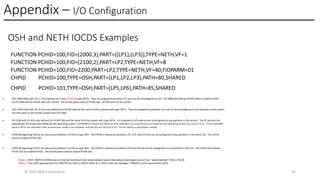
OSH and NETH IOCDS Examples
FUNCTION PCHID=100,FID=(2000,3),PART=((LP1),(LP3)),TYPE=NETH,VF=1
FUNCTION PCHID=100,FID=(2100,2),PART=LP2,TYPE=NETH,VF=8
FUNCTION PCHID=100,FID=2200,PART=LP2,TYPE=NETH,VF=40,FIDPARM=01
CHPID PCHID=100,TYPE=OSH,PART=(LP1,LP2,LP3),PATH=80,SHARED
CHPID PCHID=101,TYPE=OSH,PART=(LP5,LP6),PATH=85,SHARED
Note 1. OSH / NETH VCHIDs are an internal construct (not externalized) used internally to represent one of two “personalities” OSA or RoCE.
Note 2. The z/OS requirement for PNETID for OSA or RoCE (SMC-R or HSCI) has not changed. PNetID is still required for z/OS.
• FIDs 2000-2002 with VFs 1-3 are defined on a new VCHID1 as type NETH. They are assigned to partition LP1 and can be reconfigured to LP3. FID 2000 also defines PCHID 100 as a Hybrid PCHID.
So FID 2000 defines PCHID 100 and a VCHID. The VCHID points back to PCHID 100. All FIDs point to the VCHID.
• FIDs 2100-2101 with VFs 8-9 are also defined for PCHID 100 and the same VCHID as above with type NETH. They are assigned to partition LP2 and can be reconfigured to any partition in the system.
The FIDs point to the VCHID created with FID 2000.
• FID 2200 with VF 40 is also defined for PCHID 100 and the same VCHID as above with type NETH. It is assigned to LP2 and can be reconfigured to any partition in the system. The VF permits the
exploitation of Promiscuous Mode by the operating system. FIDPARM=01 allows the FID(s) on that statement to use promiscuous mode but the operating system has to turn it on. If the FIDPARM
value is 00 or not specified, then promiscuous mode is not allowed, and the OS can not turn it on. The 01 value is a permission setting.
• CHPID 80 (ignoring CSS for this discussion) defines a VCHID as type OSH. The CHPID is shared by partitions LP1, LP2, and LP3 and can be configured to any partition in the same CSS. The VCHID
points to Hybrid PCHID 100.
• CHPID 85 (ignoring CSS for this discussion) defines a VCHID as type OSH. The CHPID is shared by partitions LP5 and LP6 and can be configured to any partition in the CSS. The CHPID also defines
PCHID 101 as a Hybrid PCHID. The VCHID points back to Hybrid PCHID 101.
Appendix – I/O Configuration
© 2025 IBM Corporation 44
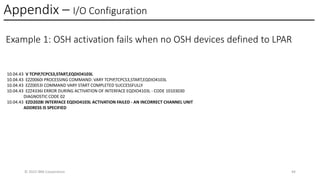
Example 1: OSH activation fails when no OSH devices defined to LPAR
10.04.43 V TCPIP,TCPCS3,START,EQDIO4103L
10.04.43 EZZ0060I PROCESSING COMMAND: VARY TCPIP,TCPCS3,START,EQDIO4103L
10.04.43 EZZ0053I COMMAND VARY START COMPLETED SUCCESSFULLY
10.04.43 EZZ4336I ERROR DURING ACTIVATION OF INTERFACE EQDIO4103L - CODE 10103030
DIAGNOSTIC CODE 02
10.04.43 EZD2028I INTERFACE EQDIO4103L ACTIVATION FAILED - AN INCORRECT CHANNEL UNIT
ADDRESS IS SPECIFIED
Appendix – I/O Configuration
© 2025 IBM Corporation 45
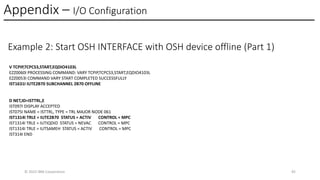
Example 2: Start OSH INTERFACE with OSH device offline (Part 1)
V TCPIP,TCPCS3,START,EQDIO4103L
EZZ0060I PROCESSING COMMAND: VARY TCPIP,TCPCS3,START,EQDIO4103L
EZZ0053I COMMAND VARY START COMPLETED SUCCESSFULLY
IST1631I IUTE2B70 SUBCHANNEL 2B70 OFFLINE
D NET,ID=ISTTRL,E
IST097I DISPLAY ACCEPTED
IST075I NAME = ISTTRL, TYPE = TRL MAJOR NODE 061
IST1314I TRLE = IUTE2B70 STATUS = ACTIV CONTROL = MPC
IST1314I TRLE = IUTIQDIO STATUS = NEVAC CONTROL = MPC
IST1314I TRLE = IUTSAMEH STATUS = ACTIV CONTROL = MPC
IST314I END
Appendix – I/O Configuration
© 2025 IBM Corporation 46
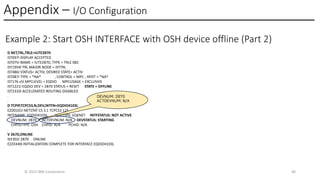
Example 2: Start OSH INTERFACE with OSH device offline (Part 2)
D NET,TRL,TRLE=IUTE2B70
IST097I DISPLAY ACCEPTED
IST075I NAME = IUTE2B70, TYPE = TRLE 082
IST1954I TRL MAJOR NODE = ISTTRL
IST486I STATUS= ACTIV, DESIRED STATE= ACTIV
IST087I TYPE = *NA* , CONTROL = MPC , HPDT = *NA*
IST176 v5I MPCLEVEL = EQDIO MPCUSAGE = EXCLUSIVE
IST1221I EQDIO DEV = 2B70 STATUS = RESET STATE = OFFLINE
IST2310I ACCELERATED ROUTING DISABLED
.
.
D TCPIP,TCPCS3,N,DEV,INTFN=EQDIO4103L
EZD0101I NETSTAT CS 3.1 TCPCS3 125
INTFNAME: EQDIO4103L INTFTYPE: EQENET INTFSTATUS: NOT ACTIVE
DEVNUM: 2B70 ACTDEVNUM: N/A DEVSTATUS: STARTING
CHPIDTYPE: OSH CHPID: N/A PCHID: N/A
.
V 2b70,ONLINE
IEE302I 2B70 ONLINE
EZZ4340I INITIALIZATION COMPLETE FOR INTERFACE EQDIO4103L
DEVNUM: 2B70
ACTDEVNUM: N/A
Appendix – RoCE Configurations
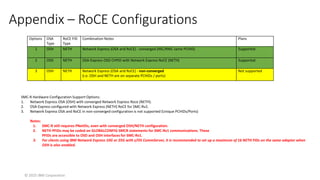
Options OSA
Type
RoCE FID
Type
Combination Notes Plans
1 OSH NETH Network Express (OSA and RoCE) - converged (NIC/RNIC same PCHID) Supported
2 OSD NETH OSA-Express OSD CHPID with Network Express RoCE (NETH) Supported
3 OSH NETH Network Express (OSA and RoCE) - non-converged
(i.e. OSH and NETH are on separate PCHIDs / ports)
Not supported
SMC-R Hardware Configuration Support Options:
1. Network Express OSA (OSH) with converged Network Express Roce (NETH).
2. OSA-Express configured with Network Express (NETH) RoCE for SMC-Rv2.
3. Network Express OSA and RoCE in non-converged configuration is not supported (Unique PCHIDs/Ports)
Notes:
1. SMC-R still requires PNetIDs, even with converged OSH/NETH configuration.
2. NETH PFIDs may be coded on GLOBALCONFIG SMCR statements for SMC-Rv1 communications. These
PFIDs are accessible to OSD and OSH interfaces for SMC-Rv1.
3. For clients using IBM Network Express 10G or 25G with z/OS CommServer, it is recommended to set up a maximum of 16 NETH FIDs on the same adapter when
OSH is also enabled.
© 2025 IBM Corporation
Appendix – Netstat Displays
© 2025 IBM Corporation 48
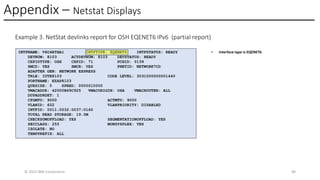
Example 3. NetStat devlinks report for OSH EQENET6 IPv6 (partial report)
INTFNAME: V6O4ETHA1 INTFTYPE: EQENET6 INTFSTATUS: READY
DEVNUM: 8103 ACTDEVNUM: 8103 DEVSTATUS: READY
CHPIDTYPE: OSH CHPID: 71 PCHID: 0139
SMCD: YES SMCR: YES PNETID: NETWORK7CD
ADAPTER GEN: NETWORK EXPRESS
TRLE: IUTE8103 CODE LEVEL: 3031000000001440
PORTNAME: EZAP8103
QUESIZE: 0 SPEED: 0000010000
VMACADDR: 42000B69C925 VMACORIGIN: OSA VMACROUTER: ALL
DUPADDRDET: 1
CFGMTU: 9000 ACTMTU: 9000
VLANID: 602 VLANPRIORITY: DISABLED
INTFID: 0011:0032:0037:0160
TOTAL READ STORAGE: 19.0M
CHECKSUMOFFLOAD: YES SEGMENTATIONOFFLOAD: YES
SECCLASS: 255 MONSYSPLEX: YES
ISOLATE: NO
TEMPPREFIX: ALL
• Interface type is EQENET6
Appendix – Netstat Displays
© 2025 IBM Corporation 49
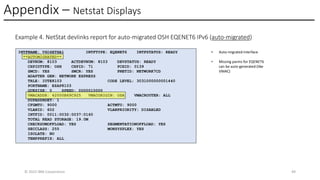
Example 4. NetStat devlinks report for auto-migrated OSH EQENET6 IPv6 (auto-migrated)
INTFNAME: V6O4ETHA1 INTFTYPE: EQENET6 INTFSTATUS: READY
**AUTOMIGRATED**
DEVNUM: 8103 ACTDEVNUM: 8103 DEVSTATUS: READY
CHPIDTYPE: OSH CHPID: 71 PCHID: 0139
SMCD: YES SMCR: YES PNETID: NETWORK7CD
ADAPTER GEN: NETWORK EXPRESS
TRLE: IUTE8103 CODE LEVEL: 3031000000001440
PORTNAME: EZAP8103
QUESIZE: 0 SPEED: 0000010000
VMACADDR: 42000B69C925 VMACORIGIN: OSA VMACROUTER: ALL
DUPADDRDET: 1
CFGMTU: 9000 ACTMTU: 9000
VLANID: 602 VLANPRIORITY: DISABLED
INTFID: 0011:0032:0037:0160
TOTAL READ STORAGE: 19.0M
CHECKSUMOFFLOAD: YES SEGMENTATIONOFFLOAD: YES
SECCLASS: 255 MONSYSPLEX: YES
ISOLATE: NO
TEMPPREFIX: ALL
• Auto-migrated interface
• Missing parms for EQENET6
can be auto-generated (like
VMAC)
Usage & Invocation – Tuning Statistics
© 2025 IBM Corporation 50
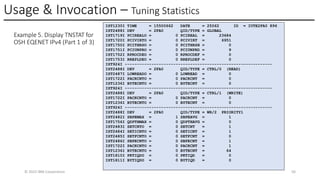
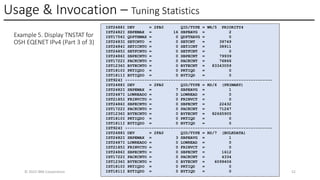
Example 5. Display TNSTAT for
OSH EQENET IPv4 (Part 1 of 3)
IST1230I TIME = 15500662 DATE = 25062 ID = IUTE2FA0 896
IST2488I DEV = 2FA0 QID/TYPE = GLOBAL
IST1719I PCIREALO = 0 PCIREAL = 23684
IST1720I PCIVIRTO = 0 PCIVIRT = 6951
IST1750I PCITHRSO = 0 PCITHRSH = 0
IST1751I PCIUNPRO = 0 PCIUNPRD = 9
IST1752I RPROCDEO = 0 RPROCDEF = 0
IST1753I RREPLDEO = 0 RREPLDEF = 0
IST924I -------------------------------------------------------------
IST2488I DEV = 2FA0 QID/TYPE = CTRL/0 (READ)
IST2487I LOWREADO = 0 LOWREAD = 0
IST1722I PACKCNTO = 0 PACKCNT = 0
IST1236I BYTECNTO = 0 BYTECNT = 0
IST924I -------------------------------------------------------------
IST2488I DEV = 2FA0 QID/TYPE = CTRL/1 (WRITE)
IST1722I PACKCNTO = 0 PACKCNT = 0
IST1236I BYTECNTO = 0 BYTECNT = 0
IST924I -------------------------------------------------------------
IST2488I DEV = 2FA0 QID/TYPE = WR/2 PRIORITY1
IST2482I SBPEMAX = 1 SBPEAVG = 1
IST1756I QDPTHMAX = 0 QDPTHAVG = 0
IST2483I SETCNTO = 0 SETCNT = 1
IST2484I SETICNTO = 0 SETICNT = 1
IST2485I SETFCNTO = 0 SETFCNT = 0
IST2486I SBPECNTO = 0 SBPECNT = 1
IST1722I PACKCNTO = 0 PACKCNT = 1
IST1236I BYTECNTO = 0 BYTECNT = 64
IST1810I PKTIQDO = 0 PKTIQD = 0
IST1811I BYTIQDO = 0 BYTIQD = 0
Usage & Invocation – Tuning Statistics
© 2025 IBM Corporation 51
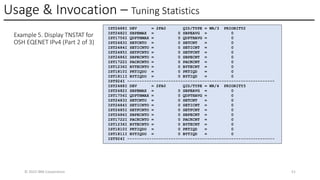
Example 5. Display TNSTAT for
OSH EQENET IPv4 (Part 2 of 3)
IST2488I DEV = 2FA0 QID/TYPE = WR/3 PRIORITY2
IST2482I SBPEMAX = 0 SBPEAVG = 0
IST1756I QDPTHMAX = 0 QDPTHAVG = 0
IST2483I SETCNTO = 0 SETCNT = 0
IST2484I SETICNTO = 0 SETICNT = 0
IST2485I SETFCNTO = 0 SETFCNT = 0
IST2486I SBPECNTO = 0 SBPECNT = 0
IST1722I PACKCNTO = 0 PACKCNT = 0
IST1236I BYTECNTO = 0 BYTECNT = 0
IST1810I PKTIQDO = 0 PKTIQD = 0
IST1811I BYTIQDO = 0 BYTIQD = 0
IST924I -------------------------------------------------------------
IST2488I DEV = 2FA0 QID/TYPE = WR/4 PRIORITY3
IST2482I SBPEMAX = 0 SBPEAVG = 0
IST1756I QDPTHMAX = 0 QDPTHAVG = 0
IST2483I SETCNTO = 0 SETCNT = 0
IST2484I SETICNTO = 0 SETICNT = 0
IST2485I SETFCNTO = 0 SETFCNT = 0
IST2486I SBPECNTO = 0 SBPECNT = 0
IST1722I PACKCNTO = 0 PACKCNT = 0
IST1236I BYTECNTO = 0 BYTECNT = 0
IST1810I PKTIQDO = 0 PKTIQD = 0
IST1811I BYTIQDO = 0 BYTIQD = 0
IST924I -------------------------------------------------------------
Usage & Invocation – Tuning Statistics
© 2025 IBM Corporation 52
Example 5. Display TNSTAT for
OSH EQENET IPv4 (Part 3 of 3)
IST2488I DEV = 2FA0 QID/TYPE = WR/5 PRIORITY4
IST2482I SBPEMAX = 16 SBPEAVG = 2
IST1756I QDPTHMAX = 0 QDPTHAVG = 0
IST2483I SETCNTO = 0 SETCNT = 39749
IST2484I SETICNTO = 0 SETICNT = 38911
IST2485I SETFCNTO = 0 SETFCNT = 0
IST2486I SBPECNTO = 0 SBPECNT = 79939
IST1722I PACKCNTO = 0 PACKCNT = 76866
IST1236I BYTECNTO = 0 BYTECNT = 83343059
IST1810I PKTIQDO = 0 PKTIQD = 0
IST1811I BYTIQDO = 0 BYTIQD = 0
IST924I -------------------------------------------------------------
IST2488I DEV = 2FA0 QID/TYPE = RD/6 (PRIMARY)
IST2482I SBPEMAX = 7 SBPEAVG = 1
IST2487I LOWREADO = 0 LOWREAD = 0
IST2185I FRINVCTO = 0 FRINVCT = 0
IST2486I SBPECNTO = 0 SBPECNT = 22432
IST1722I PACKCNTO = 0 PACKCNT = 71247
IST1236I BYTECNTO = 0 BYTECNT = 82665905
IST1810I PKTIQDO = 0 PKTIQD = 0
IST1811I BYTIQDO = 0 BYTIQD = 0
IST924I -------------------------------------------------------------
IST2488I DEV = 2FA0 QID/TYPE = RD/7 (BULKDATA)
IST2482I SBPEMAX = 3 SBPEAVG = 1
IST2487I LOWREADO = 0 LOWREAD = 0
IST2185I FRINVCTO = 0 FRINVCT = 0
IST2486I SBPECNTO = 0 SBPECNT = 1612
IST1722I PACKCNTO = 0 PACKCNT = 4334
IST1236I BYTECNTO = 0 BYTECNT = 6099406
IST1810I PKTIQDO = 0 PKTIQD = 0
IST1811I BYTIQDO = 0 BYTIQD = 0

zOS CommServer support for the Network Express feature on z17

  • 1.
    z/OS Communications Serversupport for the Network Express feature on z17 Jerry Stevens - Jerry.Stevens1@ibm.com Randy Kunkel – kunkel@us.ibm.com © 2025 IBM Corporation 1
  • 2.
    Agenda • Overview • Usage& Invocation • I/O Configuration • TCP/IP Configuration • Auto-Migration • Sample Displays • Current Limitations / Guidance • Installation & Configuration • APARs for Enablement • Appendix © 2025 IBM Corporation 2
  • 3.
    Overview • The IBMz17 introduces a new I/O DPU (Data Processing Unit), system architecture and a network adapter called the IBM Network Express feature. • The Network Express feature: • combines the functionality of both the OSA-Express and RoCE Express features • can be viewed as the next generation of “OSA” and “RoCE” adapters • z/OS Communications Server has provided support for the Network Express feature available on z17 • This presentation provides an overview of: • The IBM Network Express feature and the system architecture. • The z/OS Communications Server support of Network Express. • What’s different for you, our users (usability and simplifications). © 2025 IBM Corporation 3
  • 4.
    Overview – IBMZ I/O subsystem transformation © 2025 IBM Corporation 4 I/O Infrastructure Transformation The I/O subsystem of IBM Z is built on a solid architectural basis that has provided a long and rich history of I/O (storage and networking) function, throughput and bandwidth improvements, while maintaining application backward-compatibility The current I/O infrastructure is constrained in terms of being able to deliver - improved latency, - additional bandwidth capability, and - enhanced functionality . . . without changes to the current physical packaging and (in the case of networking) architecture 4 Switch CNA SAN or LAN IO Drawer PCIe x8 FC or Ethernet Memory Z I/O CEC zCore PCIe x8 Memory Switch IBM ASIC FPGA CNA SAN or LAN IO Drawer CEC z CP PCIe x8 PCIe x8 Gen3 zCore z CP Today z17 FC or Ethernet Incorporate the I/O functionality as an I/O DPU (Data Processing Unit) onto the z CP chip
  • 5.
    Overview – Etherneton Z Today © 2025 IBM Corporation 5 OSC I/O Drawer PCIe Switch LP1 LP2 Channel Subsystem LP3 zTPF z/OS zVM OSD RoCE Linux • Z currently has multiple unique functions that ultimately result in some protocol flowing over an Ethernet link • Each requires a unique channel type and a unique networking adapter: • OSD – general IP, TCP/IP, UDP/IP, etc. • OSC – console controller functionality • RoCE – RDMA capability, used for SMC-R • When you consider redundancy requirements and your required bandwidth for each protocol for all LPs, the current system networking design can require many: • I/O card slots • Switch cables • Switch ports
  • 6.
    Overview – ConvergedMulti-Function Network Adapter © 2025 IBM Corporation 6 • Provides Converged support for multiple networking protocols – provides ability to run existing functions on single physical “adapter” • OSH – new CHPID type for “OSA-Hybrid” • New Enhanced QDIO (EQDIO) architecture • NETH – new FID Type: RoCE, RDMA, SMC-R & TCP/IP capabilities • Characteristics: • Multi-function networking adapter has 2 Ports per I/O Slot • Support for 10GbE and 25GbE • Each port on card is a unique CHPID (1 PCHID: 1 Port relationship • Multiple protocols can share the same physical port • Each port can be configured to provide a single function or combination of functions • LPAR to LPAR traffic supported through the adapter while preserving the IP offloads (e.g. segmentation, chksum). I/O Drawer PCIe Switch LP1 LP2 Channel Subsystem LP3 zTPF z/OS zVM OSH/RoCE Linux LP4 Z CP Z IO Note 1. 10 and 25GbE SR and LR optics are planned Note 2. OSD (QDIO) will continue to be supported on prior generation adapters Note 3. Linux will access the adapter directly using native PCI FID. Note 4. OSC (not shown) continues to require a separate adapter.
  • 7.
    Overview - EnhancedQDIO (EQDIO) Architecture © 2025 IBM Corporation 7 EQDIO architecture: • OSH uses new System architecture called Enhanced QDIO (EQDIO) • EQDIO defines the interface specifications between z/OS software and the “OSA firmware” Some key differences of EQDIO: • Operates at Layer 2: Packets are exchanged with software and OSA in IEEE 802.3 standard Ethernet format (QDIO headers are eliminated) • OSH interfaces requires a VMAC (layer 2): Pri/Sec router eliminated • IP assists (ARP) and TCP offloads (segmentation, chksum) are preserved • MPC architecture is eliminated, which eliminates the control (read/write) devices. EQDIO uses read / write control queues. • Each IP INTERFACE into OSH uses a single device (vs. the three devices required for QDIO) • LPAR to LPAR traffic (shared OSH) is supported and preserves the offloads. z/OS OSA EQDIO
  • 8.
    Overview – z17and z/OS Networking Key Concepts and Terminology 1. New z17 network feature name is the “Network Express”. • Supports 10GbE and 25GbE. • All ports are (SR and LR) optical. • OSA default MTU is 9000 (jumbo)1. 2. Each PCHID / port supports “two personalities” for both:  OSA for standard Ethernet (via EQDIO) defined as an OSH CHPID defined with channel devices and  RoCE for RDMA for SMC-R (via native PCI architecture) defined with FIDs using a new FID Type NETH. NETH supports native PCI functions such as RoCE or standard Ethernet used by Linux. 3. EQDIO:  Is layer 2 only (with IP assists/offloads) - fully formed IEEE frames flow.  Does not use MPC architecture. Each OSA interface is defined with a single OSH device number. Control read/write devices are replaced with control queues. 4. The z/OS user defined VTAM TRLE is eliminated. A dynamic TRLE is created for each INTERFACE. Other z/OS usability improvements are provided. © 2025 IBM Corporation 8 1. The MTU for Network Express is configured the same way MTU is configured for OSA-Express.
  • 9.
    Overview: OSA-Express vs.Network Express © 2025 IBM Corporation 9 No physical ‘port’ parameter definition required anywhere… in channel (or software) definition (one PCHID / CHPID per port). Both PCHIDs on a Network Express must be the same type (can’t mix ports with different speed or optics) Each physical port (adapter) supports both Ethernet (z/OS uses EQDIO) and RoCE (native PCI) capabilities.
  • 10.
    Overview – RoCEExpress vs. Network Express © 2025 IBM Corporation 10
  • 11.
    Usage & Invocation– I/O Configuration © 2025 IBM Corporation 11 z/OS (IOS) OSH device online/offline status There are no z/OS (i.e. online/offline) operational changes for using OSH devices: 1. Prior to starting an EQDIO INTERFACE in TCP/IP the device(s) must be defined to the z/OS LPAR 2. If there are no OSH devices defined, then the TCP/IP start will fail. 3. If there are no OSH devices available (defined but all are allocated), then the TCP/IP start of the OSH interface will fail. 4. If there are OSH devices defined but offline, then the start process will wait for a device to come online (supporting dynamic ENF) 5. Sample z/OS displays of unavailable and offline OSH devices follows (See charts in Appendix). . .
  • 12.
    Usage & Invocation– I/O Configuration © 2025 IBM Corporation 12 08.57.47 D M=CHP(09) 08.57.47 IEE174I 08.57.47 DISPLAY M 867 CHPID 09: TYPE=35, DESC=OSA HYBRID, ONLINE DEVICE STATUS FOR CHANNEL PATH 09 0 1 2 3 4 5 6 7 8 9 A B C D E F 2B7 + + + + . . . . . . . . . . . . SWITCH DEVICE NUMBER = NONE ************************ SYMBOL EXPLANATIONS ************************ + ONLINE @ PATH NOT VALIDATED - OFFLINE . DOES NOT EXIST * PHYSICALLY ONLINE $ PATH NOT OPERATIONAL CHPID Type 35 = OSH OSH CHPID description has been updated.
  • 13.
    Usage & Invocation– I/O Configuration © 2025 IBM Corporation 13 z/OS (IOS) NETH PCI device online/offline status There are no z/OS (i.e. online/offline) operational changes for using native PCI devices: 1. RoCE (NETH) interfaces that are defined with PFID and SMCRIPADDR (SMC-Rv2) are dynamically started with the start of the OSH interface 2. If the PFID is not available (offline) when the interface is started, then the RoCE interface will not be started. If the PFID subsequently becomes available (after the OSH interface was started) then the dynamically defined interface (EZARIUTxyyyy) must be manually started (no change). 3. Sample z/OS PCI display (next chart):
  • 14.
    Usage & Invocation– I/O Configuration © 2025 IBM Corporation 14 Display PCIE 09.38.57 d pcie 09.38.57 IQP022I 09.38.57 DISPLAY PCIE 767 PCIE 0010 ACTIVE PFID DEVICE TYPE NAME STATUS ASID JOBNAME CHID VFN 00000501 Network Express CNFG 02FC 0001 00000502 Network Express CNFG 02FC 0002 09.58.32 d pcie,pfid=501 09.58.32 IQP024I 09.58.32 DISPLAY PCIE 776 PCIE 0010 ACTIVE PFID DEVICE TYPE NAME STATUS ASID JOBNAME CHID VFN 00000501 Network Express CNFG 02FC 0001 CLIENT ASIDS: NONE PNetID 1: ZOSNET
  • 15.
    Usage & Invocation– TCP/IP Configuration © 2025 IBM Corporation 15 New: z/OS TCP/IP OSH Ethernet Configuration Type Configuration OSD (QDIO) IPAQENET/6 INTERFACE (OSD) OSH (EQDIO) EQENET/6 INTERFACE (OSH) RoCEv2 PFID parameter2 of OSD or OSH INTERFACE (dynamically creates RoCE Interface) z/OS TCP/IP adds a new EQENET/6 INTERFACE statement for OSH in a simplified form.
  • 16.
    Usage & Invocation– TCP/IP Configuration © 2025 IBM Corporation 16 Review: z/OS CommServer OSA (OSD) Configuration Applications TCP/IP z/OS CommServer VTAM Channel Subsystem TCP/IP Profile – 1 QDIO device per INTERFACE INTERFACE IPAQENET CHPIDTYPE OSD OSAPORT2D 192.45.127.12 etc… VTAM TRL Definition OSA2D TRLE LNCTRL=MPC, Read=2D00, Write=2D01, MPCLEVEL=QDIO, DATAPATH=(2D02-2D0B) PORTNAME=OSAPORT2D IOCP Statements (HCD or IOCDS) CHPID PATH=C8, TYPE=OSD CTLUNIT CUNUMBR=2D00,UNIT=OSA,PATH=C8 IODEVICE ADDRESS=(2D00,16),CUNUMBR=2D00, UNIT=OSA IODEVICE ADDRESS=(2DFE), CUNUMBR=2D00, UNIT=OSD, UNITADD=FE Hardware install: This specific OSA adapter port must be physically connected to the intended Ethernet switch port and z/OS network admin (IP config) must coordinate the software config. Switch Port 0 Port 12 Port 16 LAN (PNET1A) 3 2 1 OSA Note. The number of devices defined in VTAM is not required to match the number in HCD. The VTAM definition can’t exceed the number defined in HCD.
  • 17.
    Usage & Invocation– TCP/IP Configuration © 2025 IBM Corporation 17 Review: Current z/OS TCPIP QDIO IPAQENET INTERFACE statement for OSD IPAQENET defines the type of INTERFACE (IPA via QDIO access to Ethernet) PORTNAME points to a static (user defined) VTAM definition (TRLE) which is where the user defines a group of OSD subchannel devices (i.e. the MPC Group, could be as few as 3 or up to 16 devices). The VTAM TRLE defines devices and port number. The devices in the VTAM TRLE are: • Also defined in HCD (TRLE must match HCD) • associated with an OSD CHPID, which in turn is associated with a OSA Express PCHID (physical adapter and port) • shared / used by all INTERFACE statements by all stacks in this z/OS instance using this OSA adapter and port • arbitrarily assigned to each stack during start device processing (i.e. a specific device number is not relevant) PORTNAME 1 7 + a very long and complex list of additional sub-parameters …
  • 18.
    Usage & Invocation– TCP/IP Configuration © 2025 IBM Corporation 18 z/OS TCP/IP EQENET (OSH) INTERFACE Simplification 1. Eliminate the VTAM user defined TRLE (eliminates the PORTNAME parameter). The new TRLE will be dynamically created. A separate TRLE is created for each EQENET INTERFACE that is started. Note that the dynamic TRLE design is similar to HS, ISM and RoCE. 2. Simplify the new TCP/IP EQENET (OSH) INTERFACE statement: 1. Replace PORTNAME parameter with DEVNUM parameter DEVNUM defines a single OSH subchannel device. Note. DEVNUM value can be any device number associated with a specific OSH CHPID (e.g. For consistency, configure the first device number in the defined range, such as 2F00, for all INTERFACE statements for a given CHPID and the first available device will be used). 2. Many legacy OSD IPAQENET INTERFACE statement parameters (not related to the IP configuration) have been eliminated (replacement, integrated into the base design, smarter defaults etc.)
  • 19.
    Usage & Invocation– TCP/IP Configuration © 2025 IBM Corporation 19 z/OS CommServer EQENET (OSH) Configuration Applications TCP/IP z/OS CommServer VTAM Channel Subsystem TCP/IP Profile – 1 EQDIO device per INTERFACE INTERFACE EQENET DEVNUM 2F00 192.45.127.12 etc… VTAM TRL (TRLE is not user defined – TRLE is dynamically created) TRLE2F TRLE LNCTRL=EQENET DEVICE 2F00 (any available device from this OSH CHPID) IOCP Statements (HCD or IOCDS) CHPID PCHID=1C0,TYPE=OSH,PART=(LP1,LP2), PATH=84,SHARED,PNETID=NET1 IODEVICE ADDRESS=(2F00,16) Hardware install: This specific OSH adapter port must be physically connected to the intended Ethernet switch port and z/OS network admin (IP config) must coordinate. Switch Port Port 12 Port 16 LAN (PNET1A) 2 1 OSH Note. The OSH CHPID will only support a single port. DEVNUM will be associated with the same single Port (based on the associated CHPID). Each EQENET INTERFACE will use (consume) a single device creating a dynamic / unique TRLE. X
  • 20.
    Usage & Invocation– TCP/IP Configuration © 2025 IBM Corporation 20 New: z/OS TCP/IP EQENET INTERFACE statement for OSH Replace INTERFACE type and PORTNAME with the following: 1. Add a new INTERFACE Type EQENET (Enhanced QDIO Ethernet) for OSH CHPID 2. Add DEVNUM (replaces PORTNAME)1: Device Number defines an EQDIO device for an OSH CHPID. Note. Device number provides a reference to the OSH CHPID where the first available (any) device will be used (the actual device number used under the CHPID is arbitrary). EQENET OSD OSD interface definition d d DEVNUM + a shorter / simpler list of additional sub-parameters … Note 1. A dynamically generated PORTNAME is created for each OSH interface statement.
  • 21.
    Usage & Invocation– TCP/IP Configuration © 2025 IBM Corporation 21 EQENET Interface Parameter Changes for OSH Obsolete Parameters: 1. CHPIDTYPE 2. OLM 3. PRIROUTER/SECROUTER 4. DYNVLANREG 5. READSTORAGE (eliminated, dynamically managed) 6. INBPERF (eliminated, internal capability is DYNAMIC with IWQ) Replaced / Refactored Parameters: 1.VMAC (now required) 2. subnet mask (now required for IPv4) 3. PORTNAME (replaced with DEVNUM) Note: Prefix length can be optionally specified for IPv6. If specified, prefix length should be set to 64.
  • 22.
    Usage & Invocation– TCP/IP Configuration © 2025 IBM Corporation 22 Remaining EQENET Interface Parameters for OSH New OSH Parameters: 1. TYPE (EQENET) 2. DEVNUM (nnnn) Existing / Remaining OSH Parameters: 1. IPADDR/NUM_MASK_BITS (mask is required) 2. VLANID 3. SECCLASS 4. MONSYSPLEX 5. ISOLATE 6. SOURCEVIPAINTERFACE 7. TEMPIP 8. MTU 9. SMCR (with sub-parameters…) 10. SMCD etc. (see following charts) Note. SEGMENTATIONOFFLOAD,CHECKSUMOFFLOAD, AUTOIQDC (HSCI) and QDIOACCELERATOR are stack wide parameters which control both QDIO and EQDIO (no changes)
  • 23.
    Usage & Invocation– TCP/IP Configuration © 2025 IBM Corporation 23 DEVNUM Design and Usage Rules • Device number (DEVNUM) allows a specific OSH CHPID to be identified where any available (arbitrary) device (under the specific OSH CHPID) can be selected and used. • The configured device and the actual device selected for the INTERFACE are not always the same (OSH NetStat displays both the configured and actual device) • Reminder, port number is NOT configured anywhere (HCD or the OS) – one Port per PCHID / CHPID • Multiple OSH INTERFACEs for the same CHPID: If multiple INTERFACEs are configured for the same OSH CHPID on a per stack basis, then each INTERFACE must conform to the following rules1: • The configured DEVNUM value must be the same • A unique VLAN ID for each INTERFACE is required • VMAC with Route ALL setting is required (VMAC is always required for OSH) • Maximum number of interfaces supported per IP protocol is 32 Note 1. The OSH multiple interface rules are identical to OSD (devnum replaces portname)
  • 24.
    Usage & Invocation– Auto-Migration © 2025 IBM Corporation 24 z/OS OSH (EQENET) Auto-Migration Capability • z/OS CommServer provides a migration capability called “OSH Auto-Migration”. This function allows a user to continue using their existing IPAQENET INTERFACE definition. It automatically adapts (migrates) an existing IPAQENET OSD INTERFACE definition to EQENET OSH INTERFACE definition. • To use the Auto-Migrate function on an existing IPAQENET INTERFACE users must: 1. add one new OSH parameter, DEVNUM (nnnn) to their existing IPAQENET INTERFACE statement and 2. Configure subnet mask (required for OSH and can’t be generated by software) • Auto-migrate will then function as follows: 1. When z/OS is executing on pre-z17 CPC: Use PORTNAME (DEVNUM is ignored) to activate an OSD CHPID 2. When z/OS is executing on z17 CPC: Use DEVNUM (PORTNAME is ignored) to activate an OSH CHPID. “Auto- migrate” adapts your existing IPAQENET INTERFACE to EQENET INTERFACE (OSH) • Note 1. Auto Migrate converts or ignores existing OSD INTERFACE parameters based on new OSH INTERFACE applicability, syntax and rules (e.g. VMAC always applies etc.). See INTERFACE parameters side by side comparison table. • Note 2. z/OS CommServer Network Configuration Assistant (NCA) support will be provided for EQENET and DEVNUM on IPAQENET. • Note: Once an EQENET interface is defined (Auto-migration or EQENET explicit definition), you cannot dynamically delete and define an IPAQENET interface using the same name. This also applies when attempting to dynamically switch from IPAQENET to EQENET (i.e. both directions).
  • 25.
    Usage & Invocation– Auto-Migration © 2025 IBM Corporation 25 OSD IPAQENET Interface statement dynamically switches to OSH EQENET when activated on z17 z17 INTERFACE IPAQENET PORTNAME + DEVNUM Activate OSH using DEVNUM Activate OSD using Portname No Note. When activating OSH only the applicable INTERFACE parameters are used (subnet mask is required) Yes Portname DEVNUM TRLE Dev 1 Dev 2 Dev 3 Dev 4 etc. TRLE Dev 1 The auto-migrate function will only generate one type of adapter using the same IP (L2/L3) configuration User defined static TRLE Dynamically created TRLE z/OS OSH Auto-Migrate Concepts
  • 26.
    Usage & Invocation– TCP/IP Configuration © 2025 IBM Corporation 26 Sample INTERFACE statements: EQENET IPv4 and IPAQENET IPv4 with DEVNUM ; *************************************************************** ; IPV4 INTERFACE DEFINITIONS ; *************************************************************** ; INTERFACE O4ETHA2 DEFINE EQENET ; Enhanced QDIO (Ethernet) OSH DEVNUM 2B70 IPADDR 16.12.37.160/20 VLANID 702 MTU 1500 SMCR PFID 3140 SMCRIPADDR 16.12.37.165 ; INTERFACE O4ETHA2 DEFINE IPAQENET ; Enhanced QDIO Migration OSH DEVNUM 2B70 PORTNAME PORTQDIO IPADDR 16.12.37.160/20 VLANID 702 VMAC MTU 1500 READSTORAGE GLOBAL INBPERF DYNAMIC WORKLOADQ SMCR PFID 3140 SMCRIPADDR 16.12.37.165
  • 27.
    Usage & Invocation– TCP/IP Configuration © 2025 IBM Corporation 27 Sample INTERFACE statements: EQENET IPv6 and IPAQENET IPv6 with DEVNUM ; **************************************************************** ; IPV6 INTERFACE DEFINITIONS ; **************************************************************** ; INTERFACE V6O4ETHA2 DEFINE EQENET6 ; Enhanced QDIO (Ethernet) OSH DEVNUM 2B70 INTFID 0:16:207:3 IPADDR 2001:0DB8:172::16:207:13 VLANID 601 MTU 9000 ; INTERFACE V6O4ETHA2 DEFINE IPAQENET6 ; Enhanced QDIO Migration OSH DEVNUM 2B70 PORTNAME PRT6QDIO INTFID 0:16:207:3 IPADDR 2001:0DB8:172::16:207:13 VLANID 601 VMAC MTU 9000 READSTORAGE GLOBAL INBPERF DYNAMIC WORKLOADQ
  • 28.
    Usage & Invocation– RoCEv2 Configuration © 2025 IBM Corporation 28 Current OSD with ROC2 (RoCEv2) Configuration z/OS LPAR RoCE Express2 Port 1 (PNet A) OSA-Express7 OSD CHPID Port 0 (PNet A) RoCEV2 IP address (GID) 192.168.1.104 RoCEv2 LG V2 QP RNIC VMAC-2 RoCE (SMC-Rv2) Interface (PFID / VF / Port) NIC VMAC-A OSA IP address 192.168.1.100 (TRLE – CHPID / Port) IPAQENET INTERFACE PFID SMCRIPADDR (192.168.1.104) local IP subnet 192.168.1.xx remote IP subnet remote SMC-R host TCP/IP traffic SMC-R RoCEv2 IP traffic remote TCP/IP address remote RoCEv2 IP address IBM z15 OSA INTERFACE enabled for RoCEv2 (FID + SMCRIPADDR) RoCEv2 INTERFACE (dynamically created) RoCEv2 SMCRIPADDR provisioned / managed by z/OS and used only by RoCE Express2 (RoCEv2 IP address must be within OSA IP subnet) N number of IP router hops Local LAN PNet A Switch
  • 29.
    Usage & Invocation– RoCEv2 Configuration © 2025 IBM Corporation 29 z/OS Single Adapter 1st level Hypervisor Single Port V2 IP address (GID) 192.168.1.104 RoCEv2 LG V2 QP RNIC VMAC-2 NIC VMAC-1 IP address 192.168.1.100 local IP subnet 192.168.1.xx remote IP subnet remote SMC-R host TCP/IP traffic SMC-R RoCEv2 IP traffic remote IP address OSH OSH Adapter EQDIO Architecture NETH (FID) (SMC-Rv2 – RoCEv2) Network Express Adapter (PCHID) OSH CHPID Auto Migrated IPAQENET INTERFACE or EQENET configured PFID SMCRIPADDR (192.168.1.104) EQENET INTERFACE PFID SMCRIPADDR (192.168.1.104) RoCE (SMC-Rv2) Interface (PFID / VF / Port) Single Port with a single link connection to the switch port © 2023 IBM Corporation This is a NETH PFID defined under the same PCHID Single wire supports both TCP/IP and SMC-R protocols Switch OSH with NETH (RoCEv2 with converged NIC / RNIC)
  • 30.
    Usage & Invocation– RoCEv2 Configuration © 2025 IBM Corporation 30 z/OS Single Adapter (PCHID) 1st level Hypervisor Single Port V2 IP address (GID) 192.168.1.104 RoCEv2 LG V2 QP RNIC VMAC-2 NIC VMAC-1 IP address 192.168.1.100 local IP subnet 192.168.1.xx remote IP subnet remote SMC-R host TCP/IP traffic SMC-R RoCEv2 IP traffic remote IP address OSH OSH Adapter EQDIO Architecture NETH (FID) (SMC-Rv2 – RoCEv2) Network Express Adapter (PCHID)1 OSH CHPID Auto Migrated IPAQENET INTERFACE or EQENET configured PFID SMCRIPADDR (192.168.1.104) EQENET INTERFACE PFID SMCRIPADDR (192.168.1.104) RoCE (SMC-Rv2) Interface (PFID / VF / Port) Single Port with a single link connection to the switch port © 2023 IBM Corporation This is a NETH PFID defined under the same PCHID Single wire supports both TCP/IP and SMC-R protocols Switch OSH with NETH (RoCEv2 with converged NIC / RNIC) Note 1. Each Network Express feature is divided and managed as two separate PCHIDs, Each PCHID with a single port. This figure illustrates a single PCHID.
  • 31.
    Usage & Invocation– Netstat Displays © 2025 IBM Corporation 31 Example 1. NetStat devlinks report for OSH EQENET IPv4 (Part 1 of 2) INTFNAME: O4ETHA1 INTFTYPE: EQENET INTFSTATUS: READY DEVNUM: 8100 ACTDEVNUM: 8101 DEVSTATUS: READY CHPIDTYPE: OSH CHPID: 71 PCHID: 0139 SMCD: YES SMCR: YES PNETID: NETWORK7CD ADAPTER GEN: NETWORK EXPRESS TRLE: IUTE8101 CODE LEVEL: 3031000000001440 PORTNAME: EZAP8101 SPEED: 0000010000 (10G) IPBROADCASTCAPABILITY: NO VMACADDR: 42000A69C925 VMACORIGIN: OSA VMACROUTER: ALL CFGMTU: 9000 ACTMTU: 9000 IPADDR: 16.11.37.160/20 VLANID: 602 VLANPRIORITY: DISABLED TOTAL READ STORAGE: 19.0M CHECKSUMOFFLOAD: YES SEGMENTATIONOFFLOAD: YES SECCLASS: 255 MONSYSPLEX: YES ISOLATE: NO MULTICAST SPECIFIC: MULTICAST CAPABILITY: YES GROUP REFCNT SRCFLTMD ----- ------ -------- 224.0.0.5 0000000001 EXCLUDE SRCADDR: NONE 224.0.0.1 0000000001 EXCLUDE SRCADDR: NONE c • Interface type is EQENET • Configured device and actual device • CHPIDTYPE is OSH (EQDIO) • OSA Generation • TRLE and PORTNAME dynamically generated • OSA firmware level • ReadStorage dynamically managed (not user defined)
  • 32.
    Usage & Invocation– Netstat Displays © 2025 IBM Corporation 32 Example 1. NetStat devlinks report for OSH EQENET IPv4 (Part 2 of 2) INTERFACE STATISTICS: BYTESIN = 8042214 INBOUND PACKETS = 81593 INBOUND PACKETS IN ERROR = 0 INBOUND PACKETS DISCARDED = 0 INBOUND PACKETS WITH NO PROTOCOL = 0 BYTESOUT = 1025416 OUTBOUND PACKETS = 10502 OUTBOUND PACKETS IN ERROR = 0 OUTBOUND PACKETS DISCARDED = 0 ASSOCIATED IQD CONVERGED INTERFACE: EZAIQCF9 IQC STATUS: READY BYTESIN = 19714 INBOUND PACKETS = 121 BYTESOUT = 53236 OUTBOUND PACKETS = 464 SMCR CAPABILITY: V2 ASSOCIATED MULTI-SUBNET RNIC INTERFACE: EZARIUT1314E ROCE PFID: 314E SMCRMTU: 4096 SMCRIPADDR: 16.11.39.160 UNASSOCIATED ISM INTERFACES: EZAISMU1 EZAISMU2 EZAISMU3 EZAISMU4 IPV4 LAN GROUP SUMMARY LANGROUP: 00002 NAME STATUS ARPOWNER VIPAOWNER ---- ------ -------- --------- O4ETHA1 ACTIVE O4ETHA1 NO O4ETHA0 ACTIVE O4ETHA0 YES • Associated HSCI interface • Associated SMC interfaces
  • 33.
    Usage & Invocation– Netstat Displays © 2025 IBM Corporation 33 Example 2. NetStat devlinks report for auto-migrated OSH EQENET IPv4 (partial report) INTFNAME: O4ETHA2 INTFTYPE: EQENET INTFSTATUS: READY **AUTOMIGRATED** DEVNUM: 8102 ACTDEVNUM: 8104 DEVSTATUS: READY CHPIDTYPE: OSH CHPID: 71 PCHID: 0139 SMCD: YES SMCR: YES PNETID: NETWORK7CD ADAPTER GEN: NETWORK EXPRESS TRLE: IUTE8104 CODE LEVEL: 3031000000001440 PORTNAME: EZAP8104 SPEED: 0000010000 (10G) IPBROADCASTCAPABILITY: NO VMACADDR: 42000C69C925 VMACORIGIN: OSA VMACROUTER: ALL CFGMTU: 9000 ACTMTU: 9000 IPADDR: 16.12.37.160/20 VLANID: 702 VLANPRIORITY: DISABLED TOTAL READ STORAGE: 19.0M CHECKSUMOFFLOAD: YES SEGMENTATIONOFFLOAD: YES SECCLASS: 255 MONSYSPLEX: YES ISOLATE: NO • Auto-migrated interface • Missing parms for EQENET can be auto-generated (like VMAC) • However, subnet mask MUST be defined by user
  • 34.
    Usage & Invocation– Netstat Displays © 2025 IBM Corporation 34 Example 5. Display OSAINFO EQENET IPv4 (OSH) DISPLAY OSAINFO RESULTS FOR INTFNAME: O7ETHB0 DATAPATH: 2FA0 REALADDR: 0045 PCHID: 0114 CHPID: D2 CHPID TYPE: OSH OSA CODE LEVEL: 3031240022221484 ACTIVE SPEED: 10 GB/SEC GEN: NETWORK EXPRESS MEDIA: MULTIMODE FIBER JUMBO FRAMES: YES ISOLATE: NO PHYSICALMACADDR: 9C63C0530F12 LOCALLYCFGMACADDR: 9C63C0530F12 QUEUES DEFINED OUT: 5 IN: 8 ANCILLARY QUEUES IN USE: 7 SAPSUP: 00400001 SAPENA: 00000000 INTERFACE PACKET DROPS: 0 CONNECTION MODE: LAYER 2 IPV4 ATTRIBUTES: VLAN ID: 663 VMAC ACTIVE: YES VMAC ADDR: 42006A530F12 VMAC ORIGIN: OSA VMAC ROUTER: ALL REGISTERED ADDRESSES: IPV4 UNICAST ADDRESSES FOR ARP OFFLOAD: ADDR: 16.11.16.105 ADDR: 16.11.17.105 ADDR: 16.11.19.105 TOTAL NUMBER OF IPV4 ADDRESSES: 3
  • 35.
    Usage & Invocation– TRLE Display © 2025 IBM Corporation 35 Example 9. Display Net,TRLE EQENET IPv4 (OSH) IST075I NAME = IUTE3B20, TYPE = TRLE IST1954I TRL MAJOR NODE = ISTTRL IST486I STATUS= ACTIV, DESIRED STATE= ACTIV IST087I TYPE = *NA* , CONTROL = MPC , HPDT = *NA* IST1715I MPCLEVEL = EQDIO MPCUSAGE = EXCLUSIVE IST2337I CHPID TYPE = OSH CHPID = D5 PNETID = PLEX1 IST1221I EQDIO DEV = 3B20 STATUS = ACTIVE STATE = ONLINE IST1717I ULPID = TCPSVT ULP INTERFACE = O7ETHD0 IST2309I ACCELERATED ROUTING ENABLED IST924I ------------------------------------------------------------- IST2468I INBOUND TRANSMISSION INFORMATION: IST924I ------------------------------------------------------------- IST2469I QUEUE/ QUEUE STORAGE QUEUE IST2470I ID TYPE CUR MIN MAX STATUS IST2205I ------- -------- ------------------- --------------- IST2471I CTRL/0 CONTROL 1.0M 1.0M 1.0M ACTIVE IST2472I READ/6 PRIMARY 8.0M 8.0M 8.0M ACTIVE IST2472I READ/7 BULKDATA 8.0M 8.0M 8.0M ACTIVE IST2472I READ/8 SYSDIST *NA* *NA* *NA* NOT IN USE IST2472I READ/9 EE 4.0M 4.0M 4.0M ACTIVE IST2472I READ/11 ZCX *NA* *NA* *NA* NOT IN USE IST2472I READ/12 IPROUTER 4.0M 4.0M 4.0M ACTIVE IST924I ------------------------------------------------------------- IST2480I CACHED READ STORAGE = 3.0M IST2481I TOTAL READ STORAGE = 28.0M IST924I ------------------------------------------------------------- IST2473I OUTBOUND TRANSMISSION INFORMATION: IST924I ------------------------------------------------------------- IST2474I QUEUE/ QUEUE UNITS OF WORK QUEUE IST2475I ID TYPE CUR AVG MAX STATUS IST2205I ------- --------- ---------------- ---------------------- IST2476I CTRL/1 CONTROL 0 1 4 UNCONGESTED IST2477I WRT/2 PRIORITY1 0 2 2 UNCONGESTED IST2477I WRT/3 PRIORITY2 0 2 3 UNCONGESTED IST2477I WRT/4 PRIORITY3 0 0 0 UNCONGESTED IST2477I WRT/5 PRIORITY4 0 2 3 UNCONGESTED Note the renumbering of input queue numbers Note the renumbering of the output queue numbers
  • 36.
    Usage & Invocation– Current Limitations / Guidance © 2025 IBM Corporation 36 • No EQDIO support on z/OS 2.4 or a VSE client - NETH support on z/OS 2.4 for SMC-Rv1 is available • • • • SNMP support for OSA (OSH) will not be available at z17 GA (targeted for Sept/2025) • OSAENTA (Network Traffic Analyzer) trace support will not be available (Alternatively, a sniffer (wireshark) trace may be used) • QDIOSYNC support will not be available (Automated mechanism to collect SW and HW traces concurrently) • NETH PFIDs (RoCE) - Guideline o For clients using IBM Network Express 10G or 25G with z/OS CommServer 2.5 or 3.1, it is recommended to set up a maximum of 16 NETH FIDs on the same adapter when OSH is also enabled. • zOS guest deployed in zVM vSwitch environment must be Layer 3 QDIO – must use OSA-Express (IPAQENET (OSD CHPID) OSA-Express) o A z/VM vSwitch attached to a Network Express card must operate in Layer-2 mode. This means that a z/OS guest cannot be deployed on this vSwitch, as the z/OS guest must use a QDIO interface (a current z/VM limitation) and z/OS does not support Layer-2 with QDIO. Linux supports both modes today, so Linux guests using QDIO can use this configuration. • “QDIO Accelerator” is supported for EQDIO but is limited to EQDIO-to-EQDIO interfaces only.
  • 37.
    Installation & Configuration– APARs for enablement © 2025 IBM Corporation 37 z/OS CommServer APARs (2.5 and 3.1): • OA64896 for SNA • PH54596 for TCP/IP IOS APAR: • OA63265
  • 38.
    © 2025 IBMCorporation 38 Questions?
  • 39.
    Appendix – IPAQENETvs. EQENET Keyword Comparison (Part 1) © 2025 IBM Corporation 39 Keyword IPAQENET (OSD) (default) EQENET (OSH) Keyword Definition- OSH Applicability, Changes and Notes define IPAQENET EQENET INTERFACE type: IPAQENET (OSD) can be automatically migratedto EQENET (OSH) with DEVNUM keyword CHPIDTYPE OSD | OSX N/A CHPID (hardware) TYPE: Eliminatedfor OSH (only one possible CHPID type for OSH) Portname value N/A Defines specific OSD physical port (PCHID) via user statically defined VTAM TRLE (VTAM definition): The TRLE is defined with a matching portname value. A group of devices are defined in the TRLE definition(must match HCD). VTAM arbitrarily assigns first avail device to each interface. Portname is obsolete for OSH. User defined TRLEs are also obsolete (the TRLE is dynamically created). Portname is replaced by devnum (see devnum). Devnum Value* value Defines (any valid) OSH device for a given CHPID: VTAM uses devnum to find specific CHPID then finds any availabledevice under this CHPID for the interface. * When devnum is defined for OSD (new for 2.5 only) it is ignored on pre z17 machines and is used on z17 machines to automaticallymigrate IPAQENET statement to EQENET IPADDR value value Static IP address of this interface: No change (see TEMPIP) num_mask_bits mask mask Subnet mask: Optional for OSD (required for some cases, e.g. multiple interfaces for the same OSA port, SMC etc.) OSH requires Subnet mask (also required for OSD when IPAQENET is auto-migrated using devnum) TEMPIP No parameters No parameters Defines Interface without an IP Address. Allows dynamic IP address definition over interface using DHCP. Once DHCP flows complete, interfaceis restarted with new IPADDR. No changes for OSH Prirouter NonRouter | PriRouter | SecRouter N/A Pri/Sec/Non Router: Only applied to OSD when not using VMAC. VMAC is required for OSH (keyword is obsolete for OSH) VLANID value value VLANID value: When defined host is VLAN aware. No change for OSH (required when multiple interfaces are defined for the same physical port). INBPERF Balanced | Dynamic | MINCPU | MINLATENCY N/A Defines Inbound Performance characteristics (complexvariations): Balanced, Dynamic, MINCPU or MINLATENCY settings. Keyword is obsolete for OSH. OSH always uses DYNAMIC mode INBPERF DYNAMIC NOWORKLOADQ | WorkloadQ N/A Controls IWQ: Dynamic NOWORKLOAD | WORKLOADQ (IWQ) Keyword is obsolete for OSH. OSH always uses IWQ (possible service mode only off switch -TBD) VMAC VMAC | VMAC value VMAC | VMAC value Defines Virtual MAC: Optional for OSD (required for some cases) OSH requires VMAC (VMAC is required for OSD for auto-migrate). OSH continues to support user defined VMACs, OSA generated VMAC is recommended. VMAC RouteALL | RouteLocal RouteAll | RouteLocal Controls OSA inbound routing: RouteALL: OSD Default - All packets are routed inbound RouteLocal: Only packets destined for IP Addresses in the home list are routed inbound. No changes for OSH (see note 3) Yellow cells indicate an OSD keyword that has been eliminated (N/A) for OSH Note. Obsolete keywords are ignored for auto-migrate but are invalid for the EQENET definition statement. Green cells indicate an optional OSD keyword required for OSH and is auto generated for auto-migrate case. Note. New required keywords must be defined for both auto-migrate and for EQENET definition statement. Red cell indicates an optional OSD keyword required for OSH and is also required for auto-migrate (can NOT be auto generated).
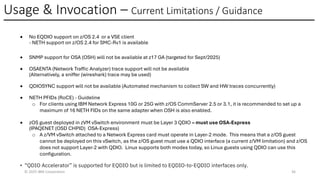
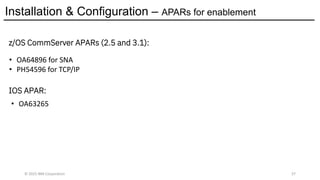
  • 40.
    Appendix – IPAQENETvs. EQENET Keyword Comparison (Part 2) © 2025 IBM Corporation 40 Keyword IPAQENET (OSD) (default) EQENET (OSH) Keyword Definition- OSH Applicability, Changes and Notes SMCR SMCR SMCR Controls SMCR eligibilityfor this interface– SMCR remains the default (NOSMCR disables SMCR for the interface)– no change for OSH SMCR PFID SMCRIPADDR SMCRMTU PFID SMCRIPADDR SMCRMTU SMC-Rv2 Parameters: Enables and defines SMC-Rv2 for this IP interface (PFID and IP addr are both required): PFID (specific RNIC), RoCEv2 IPv4 addr, optional MTU (defaults to 1k). No changes for OSH. SMCD SMCD SMCD Controls SMCD eligibilityfor this interface– SMCD remains the default (NOSMCD disables SMCD for the interface)– no change for OSH Sourcevipa interface vipa_name vipa_name Defines source VIPA. No changes for OSH MTU value value Defines the MTU for this interface. OSD default is 8992. MTU can be defined in multiple places. OSH default is 9000. Readstorage Global | Max, Min, AVG N/A Defines static value for the amount of read storage for inbound processing. OSD default GLOBAL setting uses VTAM setting. N/A for OSH (storage is dynamicallymanaged) IPBCAST IPBCAST IPBCAST Defines (enables) IPBCAST over this interface – no changes for OSH SECCLASS 255 | sec_class 255 | sec_class Defines security class for IP filtering. No changes for OSH NoMonSysplex NoMonsysplex | MonSysplex NoMonSysplex | MonSysplex Defines interface for sysplex autonomics monitoring. No changes for OSH DynVLANReg NoDynVLANReg N/A Defines (enables) dynamic VLAN switch registration. Not supported (obsolete) for OSH. OLM NonOLM | OLM N/A Defines OptimizedLatency Mode for OSD. Not supported (obsolete) for OSH. ISOLATE NoISOLATE | ISOLATE NoISOLATE | ISOLATE Defines (enables) LP-LP traffic within the CPC (vs. forcing all traffic to flow externally). No change for OSH Yellow cells indicate an OSD keyword that has been eliminated (N/A) for OSH Note. Obsolete keywords are ignored for auto-migrate but are invalid for the EQENET definition statement. Green cells indicate an optional OSD keyword that is required for OSH Note. New required keywords must be defined for both auto-migrate and for EQENET definition statement. Notes: 1. Users can explicitly define the new EQENET INTERFACE statement, or they can continue using their existing IPAQENET statements by adding DEVNUM on their IPAQENET INTERFACE statements which will automatically migrate IPAQENET to EQENET. When on a z17 machine the value specified on DEVNUM must reference a valid EQDIO device (HCD). DEVNUM auto-migration requires INTERFACE keywords (green cells above): a. VMAC b. Subnet mask 2. Refer to the IP Configuration Guide and IP Configuration Reference for additional details.
  • 41.
    Appendix – IPAQENET6vs. EQENET6 Keyword Comparison (Part 1)
  • 42.
    Appendix – IPAQENET6vs. EQENET6 Keyword Comparison (Part 1) Keyword IPAQENET6 (OSD) (default) EQENET6 (OSH) Keyword Definition - OSH Applicability, Changes and Notes INTFID value Value Optional 64-bit interface identifier in colon-hexadecimal format. If specified, allows forming the link-local address for the interface and appended to manually configured prefixes to form complete IPv6 addresses on the interface. No changes for OSH TEMPPREFIX ALL | NONE | prefix/prefix_length ALL | NONE | prefix/prefix_length Set of prefixes for which temporary IPv6 addresses can be generated. Allows dynamic IP address definition over interface using DHCPv6. No changes for OSH PRIROUTER NONROUTER | PRIROUTER | SECROUTER N/A PRI/SEC/NONROUTER: Only applied to OSD when not using VMAC. VMAC is required for OSH (keyword is obsolete for OSH) VLANID value Value VLANID value: When defined host is VLAN aware. No change for OSH (required when multiple interfaces are defined for the same physical port). INBPERF BALANCED | DYNAMIC | MINCPU | MINLATENCY N/A Defines Inbound Performance characteristics (complex variations): BALANCED, DYNAMIC, MINCPU or MINLATENCY settings. Keyword is obsolete for OSH. OSH always uses DYNAMIC mode INBPERF DYNAMIC NOWORKLOADQ | WorkloadQ N/A Controls IWQ: Dynamic NOWORKLOAD | WORKLOADQ (IWQ) Keyword is obsolete for OSH. OSH always uses IWQ (possible service mode only off switch -TBD) VMAC VMAC | VMAC value VMAC | VMAC value Defines Virtual MAC: Optional for OSD (required for some cases) OSH requires VMAC (VMAC is required for OSD for auto-migrate). VMAC ROUTEALL is used as default if VMAC is not specified during auto-migration. OSH continues to support user defined VMACs, OSA generated VMAC is recommended. VMAC ROUTEALL | ROUTELOCAL ROUTEALL | ROUTELOCAL Controls OSA inbound routing: ROUTEALL: OSD Default - All packets are routed inbound ROUTELOCAL: Only packets destined for IP Addresses in the home list are routed inbound. No changes for OSH (see note 3) SMCR SMCR SMCR Controls SMCR eligibility for this interface – SMCR remains the default (NOSMCR disables SMCR for the interface) – no change for OSH SMCD SMCD SMCD Controls SMCD eligibility for this interface – SMCD remains the default (NOSMCD disables SMCD for the interface) – no change for OSH SOURCEVIPA INTERFACE vipa_name vipa_name Defines source VIPA. No changes for OSH MTU value Value Defines the MTU for this interface. OSD default is 9000. MTU can be defined in multiple places. No changes for OSH. READSTORAGE Global | Max, Min, AVG N/A Defines static value for the amount of read storage for inbound processing. OSD default GLOBAL setting uses VTAM setting. N/A for OSH (storage is dynamically managed) SECCLASS 255 | sec_class 255 | sec_class Defines security class for IP filtering. No changes for OSH NOMONSYSPLEX NOMONSYSPLEX | MONSYSPLEX NOMONSYSPLEX | MONSYSPLEX Defines interface for sysplex autonomics monitoring. No changes for OSH DYNVLANREG NODYNVLANREG N/A Defines (enables) dynamic VLAN switch registration. Not supported (obsolete) for OSH. ISOLATE NOISOLATE | ISOLATE NOISOLATE | ISOLATE Defines (enables) LP-LP traffic within the CPC (vs. forcing all traffic to flow externally). No change for OSH DUPADDRDET1 value Value Optional, defines number of times to attempt duplicate address detection. (Minimum value is 0, maximum is 2, and default is 1). NO changes for OSH Yellow cells indicate an OSD keyword that has been eliminated (N/A) for OSH Note. Obsolete keywords are ignored for auto-migrate but are invalid for the EQENET definition statement. Green cells indicate an optional OSD keyword required for OSH and is auto generated for auto-migrate case. Note. New required keywords must be defined for both auto-migrate and for EQENET definition statement.
  • 43.
    Appendix – I/OConfiguration © 2025 IBM Corporation 43 OSH and NETH IOCDS Examples FUNCTION PCHID=100,FID=(2000,3),PART=((LP1),(LP3)),TYPE=NETH,VF=1 FUNCTION PCHID=100,FID=(2100,2),PART=LP2,TYPE=NETH,VF=8 FUNCTION PCHID=100,FID=2200,PART=LP2,TYPE=NETH,VF=40,FIDPARM=01 CHPID PCHID=100,TYPE=OSH,PART=(LP1,LP2,LP3),PATH=80,SHARED CHPID PCHID=101,TYPE=OSH,PART=(LP5,LP6),PATH=85,SHARED Note 1. OSH / NETH VCHIDs are an internal construct (not externalized) used internally to represent one of two “personalities” OSA or RoCE. Note 2. The z/OS requirement for PNETID for OSA or RoCE (SMC-R or HSCI) has not changed. PNetID is still required for z/OS. • FIDs 2000-2002 with VFs 1-3 are defined on a new VCHID1 as type NETH. They are assigned to partition LP1 and can be reconfigured to LP3. FID 2000 also defines PCHID 100 as a Hybrid PCHID. So FID 2000 defines PCHID 100 and a VCHID. The VCHID points back to PCHID 100. All FIDs point to the VCHID. • FIDs 2100-2101 with VFs 8-9 are also defined for PCHID 100 and the same VCHID as above with type NETH. They are assigned to partition LP2 and can be reconfigured to any partition in the system. The FIDs point to the VCHID created with FID 2000. • FID 2200 with VF 40 is also defined for PCHID 100 and the same VCHID as above with type NETH. It is assigned to LP2 and can be reconfigured to any partition in the system. The VF permits the exploitation of Promiscuous Mode by the operating system. FIDPARM=01 allows the FID(s) on that statement to use promiscuous mode but the operating system has to turn it on. If the FIDPARM value is 00 or not specified, then promiscuous mode is not allowed, and the OS can not turn it on. The 01 value is a permission setting. • CHPID 80 (ignoring CSS for this discussion) defines a VCHID as type OSH. The CHPID is shared by partitions LP1, LP2, and LP3 and can be configured to any partition in the same CSS. The VCHID points to Hybrid PCHID 100. • CHPID 85 (ignoring CSS for this discussion) defines a VCHID as type OSH. The CHPID is shared by partitions LP5 and LP6 and can be configured to any partition in the CSS. The CHPID also defines PCHID 101 as a Hybrid PCHID. The VCHID points back to Hybrid PCHID 101.
  • 44.
    Appendix – I/OConfiguration © 2025 IBM Corporation 44 Example 1: OSH activation fails when no OSH devices defined to LPAR 10.04.43 V TCPIP,TCPCS3,START,EQDIO4103L 10.04.43 EZZ0060I PROCESSING COMMAND: VARY TCPIP,TCPCS3,START,EQDIO4103L 10.04.43 EZZ0053I COMMAND VARY START COMPLETED SUCCESSFULLY 10.04.43 EZZ4336I ERROR DURING ACTIVATION OF INTERFACE EQDIO4103L - CODE 10103030 DIAGNOSTIC CODE 02 10.04.43 EZD2028I INTERFACE EQDIO4103L ACTIVATION FAILED - AN INCORRECT CHANNEL UNIT ADDRESS IS SPECIFIED
  • 45.
    Appendix – I/OConfiguration © 2025 IBM Corporation 45 Example 2: Start OSH INTERFACE with OSH device offline (Part 1) V TCPIP,TCPCS3,START,EQDIO4103L EZZ0060I PROCESSING COMMAND: VARY TCPIP,TCPCS3,START,EQDIO4103L EZZ0053I COMMAND VARY START COMPLETED SUCCESSFULLY IST1631I IUTE2B70 SUBCHANNEL 2B70 OFFLINE D NET,ID=ISTTRL,E IST097I DISPLAY ACCEPTED IST075I NAME = ISTTRL, TYPE = TRL MAJOR NODE 061 IST1314I TRLE = IUTE2B70 STATUS = ACTIV CONTROL = MPC IST1314I TRLE = IUTIQDIO STATUS = NEVAC CONTROL = MPC IST1314I TRLE = IUTSAMEH STATUS = ACTIV CONTROL = MPC IST314I END
  • 46.
    Appendix – I/OConfiguration © 2025 IBM Corporation 46 Example 2: Start OSH INTERFACE with OSH device offline (Part 2) D NET,TRL,TRLE=IUTE2B70 IST097I DISPLAY ACCEPTED IST075I NAME = IUTE2B70, TYPE = TRLE 082 IST1954I TRL MAJOR NODE = ISTTRL IST486I STATUS= ACTIV, DESIRED STATE= ACTIV IST087I TYPE = *NA* , CONTROL = MPC , HPDT = *NA* IST176 v5I MPCLEVEL = EQDIO MPCUSAGE = EXCLUSIVE IST1221I EQDIO DEV = 2B70 STATUS = RESET STATE = OFFLINE IST2310I ACCELERATED ROUTING DISABLED . . D TCPIP,TCPCS3,N,DEV,INTFN=EQDIO4103L EZD0101I NETSTAT CS 3.1 TCPCS3 125 INTFNAME: EQDIO4103L INTFTYPE: EQENET INTFSTATUS: NOT ACTIVE DEVNUM: 2B70 ACTDEVNUM: N/A DEVSTATUS: STARTING CHPIDTYPE: OSH CHPID: N/A PCHID: N/A . V 2b70,ONLINE IEE302I 2B70 ONLINE EZZ4340I INITIALIZATION COMPLETE FOR INTERFACE EQDIO4103L DEVNUM: 2B70 ACTDEVNUM: N/A
  • 47.
    Appendix – RoCEConfigurations Options OSA Type RoCE FID Type Combination Notes Plans 1 OSH NETH Network Express (OSA and RoCE) - converged (NIC/RNIC same PCHID) Supported 2 OSD NETH OSA-Express OSD CHPID with Network Express RoCE (NETH) Supported 3 OSH NETH Network Express (OSA and RoCE) - non-converged (i.e. OSH and NETH are on separate PCHIDs / ports) Not supported SMC-R Hardware Configuration Support Options: 1. Network Express OSA (OSH) with converged Network Express Roce (NETH). 2. OSA-Express configured with Network Express (NETH) RoCE for SMC-Rv2. 3. Network Express OSA and RoCE in non-converged configuration is not supported (Unique PCHIDs/Ports) Notes: 1. SMC-R still requires PNetIDs, even with converged OSH/NETH configuration. 2. NETH PFIDs may be coded on GLOBALCONFIG SMCR statements for SMC-Rv1 communications. These PFIDs are accessible to OSD and OSH interfaces for SMC-Rv1. 3. For clients using IBM Network Express 10G or 25G with z/OS CommServer, it is recommended to set up a maximum of 16 NETH FIDs on the same adapter when OSH is also enabled. © 2025 IBM Corporation
  • 48.
    Appendix – NetstatDisplays © 2025 IBM Corporation 48 Example 3. NetStat devlinks report for OSH EQENET6 IPv6 (partial report) INTFNAME: V6O4ETHA1 INTFTYPE: EQENET6 INTFSTATUS: READY DEVNUM: 8103 ACTDEVNUM: 8103 DEVSTATUS: READY CHPIDTYPE: OSH CHPID: 71 PCHID: 0139 SMCD: YES SMCR: YES PNETID: NETWORK7CD ADAPTER GEN: NETWORK EXPRESS TRLE: IUTE8103 CODE LEVEL: 3031000000001440 PORTNAME: EZAP8103 QUESIZE: 0 SPEED: 0000010000 VMACADDR: 42000B69C925 VMACORIGIN: OSA VMACROUTER: ALL DUPADDRDET: 1 CFGMTU: 9000 ACTMTU: 9000 VLANID: 602 VLANPRIORITY: DISABLED INTFID: 0011:0032:0037:0160 TOTAL READ STORAGE: 19.0M CHECKSUMOFFLOAD: YES SEGMENTATIONOFFLOAD: YES SECCLASS: 255 MONSYSPLEX: YES ISOLATE: NO TEMPPREFIX: ALL • Interface type is EQENET6
  • 49.
    Appendix – NetstatDisplays © 2025 IBM Corporation 49 Example 4. NetStat devlinks report for auto-migrated OSH EQENET6 IPv6 (auto-migrated) INTFNAME: V6O4ETHA1 INTFTYPE: EQENET6 INTFSTATUS: READY **AUTOMIGRATED** DEVNUM: 8103 ACTDEVNUM: 8103 DEVSTATUS: READY CHPIDTYPE: OSH CHPID: 71 PCHID: 0139 SMCD: YES SMCR: YES PNETID: NETWORK7CD ADAPTER GEN: NETWORK EXPRESS TRLE: IUTE8103 CODE LEVEL: 3031000000001440 PORTNAME: EZAP8103 QUESIZE: 0 SPEED: 0000010000 VMACADDR: 42000B69C925 VMACORIGIN: OSA VMACROUTER: ALL DUPADDRDET: 1 CFGMTU: 9000 ACTMTU: 9000 VLANID: 602 VLANPRIORITY: DISABLED INTFID: 0011:0032:0037:0160 TOTAL READ STORAGE: 19.0M CHECKSUMOFFLOAD: YES SEGMENTATIONOFFLOAD: YES SECCLASS: 255 MONSYSPLEX: YES ISOLATE: NO TEMPPREFIX: ALL • Auto-migrated interface • Missing parms for EQENET6 can be auto-generated (like VMAC)
  • 50.
    Usage & Invocation– Tuning Statistics © 2025 IBM Corporation 50 Example 5. Display TNSTAT for OSH EQENET IPv4 (Part 1 of 3) IST1230I TIME = 15500662 DATE = 25062 ID = IUTE2FA0 896 IST2488I DEV = 2FA0 QID/TYPE = GLOBAL IST1719I PCIREALO = 0 PCIREAL = 23684 IST1720I PCIVIRTO = 0 PCIVIRT = 6951 IST1750I PCITHRSO = 0 PCITHRSH = 0 IST1751I PCIUNPRO = 0 PCIUNPRD = 9 IST1752I RPROCDEO = 0 RPROCDEF = 0 IST1753I RREPLDEO = 0 RREPLDEF = 0 IST924I ------------------------------------------------------------- IST2488I DEV = 2FA0 QID/TYPE = CTRL/0 (READ) IST2487I LOWREADO = 0 LOWREAD = 0 IST1722I PACKCNTO = 0 PACKCNT = 0 IST1236I BYTECNTO = 0 BYTECNT = 0 IST924I ------------------------------------------------------------- IST2488I DEV = 2FA0 QID/TYPE = CTRL/1 (WRITE) IST1722I PACKCNTO = 0 PACKCNT = 0 IST1236I BYTECNTO = 0 BYTECNT = 0 IST924I ------------------------------------------------------------- IST2488I DEV = 2FA0 QID/TYPE = WR/2 PRIORITY1 IST2482I SBPEMAX = 1 SBPEAVG = 1 IST1756I QDPTHMAX = 0 QDPTHAVG = 0 IST2483I SETCNTO = 0 SETCNT = 1 IST2484I SETICNTO = 0 SETICNT = 1 IST2485I SETFCNTO = 0 SETFCNT = 0 IST2486I SBPECNTO = 0 SBPECNT = 1 IST1722I PACKCNTO = 0 PACKCNT = 1 IST1236I BYTECNTO = 0 BYTECNT = 64 IST1810I PKTIQDO = 0 PKTIQD = 0 IST1811I BYTIQDO = 0 BYTIQD = 0
  • 51.
    Usage & Invocation– Tuning Statistics © 2025 IBM Corporation 51 Example 5. Display TNSTAT for OSH EQENET IPv4 (Part 2 of 3) IST2488I DEV = 2FA0 QID/TYPE = WR/3 PRIORITY2 IST2482I SBPEMAX = 0 SBPEAVG = 0 IST1756I QDPTHMAX = 0 QDPTHAVG = 0 IST2483I SETCNTO = 0 SETCNT = 0 IST2484I SETICNTO = 0 SETICNT = 0 IST2485I SETFCNTO = 0 SETFCNT = 0 IST2486I SBPECNTO = 0 SBPECNT = 0 IST1722I PACKCNTO = 0 PACKCNT = 0 IST1236I BYTECNTO = 0 BYTECNT = 0 IST1810I PKTIQDO = 0 PKTIQD = 0 IST1811I BYTIQDO = 0 BYTIQD = 0 IST924I ------------------------------------------------------------- IST2488I DEV = 2FA0 QID/TYPE = WR/4 PRIORITY3 IST2482I SBPEMAX = 0 SBPEAVG = 0 IST1756I QDPTHMAX = 0 QDPTHAVG = 0 IST2483I SETCNTO = 0 SETCNT = 0 IST2484I SETICNTO = 0 SETICNT = 0 IST2485I SETFCNTO = 0 SETFCNT = 0 IST2486I SBPECNTO = 0 SBPECNT = 0 IST1722I PACKCNTO = 0 PACKCNT = 0 IST1236I BYTECNTO = 0 BYTECNT = 0 IST1810I PKTIQDO = 0 PKTIQD = 0 IST1811I BYTIQDO = 0 BYTIQD = 0 IST924I -------------------------------------------------------------
  • 52.
    Usage & Invocation– Tuning Statistics © 2025 IBM Corporation 52 Example 5. Display TNSTAT for OSH EQENET IPv4 (Part 3 of 3) IST2488I DEV = 2FA0 QID/TYPE = WR/5 PRIORITY4 IST2482I SBPEMAX = 16 SBPEAVG = 2 IST1756I QDPTHMAX = 0 QDPTHAVG = 0 IST2483I SETCNTO = 0 SETCNT = 39749 IST2484I SETICNTO = 0 SETICNT = 38911 IST2485I SETFCNTO = 0 SETFCNT = 0 IST2486I SBPECNTO = 0 SBPECNT = 79939 IST1722I PACKCNTO = 0 PACKCNT = 76866 IST1236I BYTECNTO = 0 BYTECNT = 83343059 IST1810I PKTIQDO = 0 PKTIQD = 0 IST1811I BYTIQDO = 0 BYTIQD = 0 IST924I ------------------------------------------------------------- IST2488I DEV = 2FA0 QID/TYPE = RD/6 (PRIMARY) IST2482I SBPEMAX = 7 SBPEAVG = 1 IST2487I LOWREADO = 0 LOWREAD = 0 IST2185I FRINVCTO = 0 FRINVCT = 0 IST2486I SBPECNTO = 0 SBPECNT = 22432 IST1722I PACKCNTO = 0 PACKCNT = 71247 IST1236I BYTECNTO = 0 BYTECNT = 82665905 IST1810I PKTIQDO = 0 PKTIQD = 0 IST1811I BYTIQDO = 0 BYTIQD = 0 IST924I ------------------------------------------------------------- IST2488I DEV = 2FA0 QID/TYPE = RD/7 (BULKDATA) IST2482I SBPEMAX = 3 SBPEAVG = 1 IST2487I LOWREADO = 0 LOWREAD = 0 IST2185I FRINVCTO = 0 FRINVCT = 0 IST2486I SBPECNTO = 0 SBPECNT = 1612 IST1722I PACKCNTO = 0 PACKCNT = 4334 IST1236I BYTECNTO = 0 BYTECNT = 6099406 IST1810I PKTIQDO = 0 PKTIQD = 0 IST1811I BYTIQDO = 0 BYTIQD = 0