Unmanned Aircraft System
Application on Precision
Irrigation and Feasibility Study
Dr. José L. Chávez, Joseph Yu Zhang
October, 2016
Background
• The demand of irrigation water is increasing because the world’s
population continues to grow sharply together with the food
consumption.
• The precision agriculture irrigation management systems and
technologies are required to save water nowadays and are
developing, including the remote sensing technologies.
• CSU’s unmanned aircraft system (UAS) equipped with RGB, thermal
and multi-spectral cameras can provide high spatial and temporal
resolution data in the thermal-infrared, near-infrared and
electromagnetic spectrum.
Background
• The UAS is one of the technologies which can deliver high resolution
data.
• The data will be used to estimate actual crop evapotranspiration (ETa)
and soil water deficit (SWD), then determine water demand on
certain data and location.
Background
• The Field 1070 at ARDEC (Agricultural Research, Development and
Education Center, Fort Collins, CO) provides the opportunity of flying
the UAS above different species of corns under 3 irrigation treatment.
• The Conservation Gardens at Northern Water (Berthoud, CO) contains
more than 700 varieties of plants and many irrigating treatments,
which was used for UAS application too.
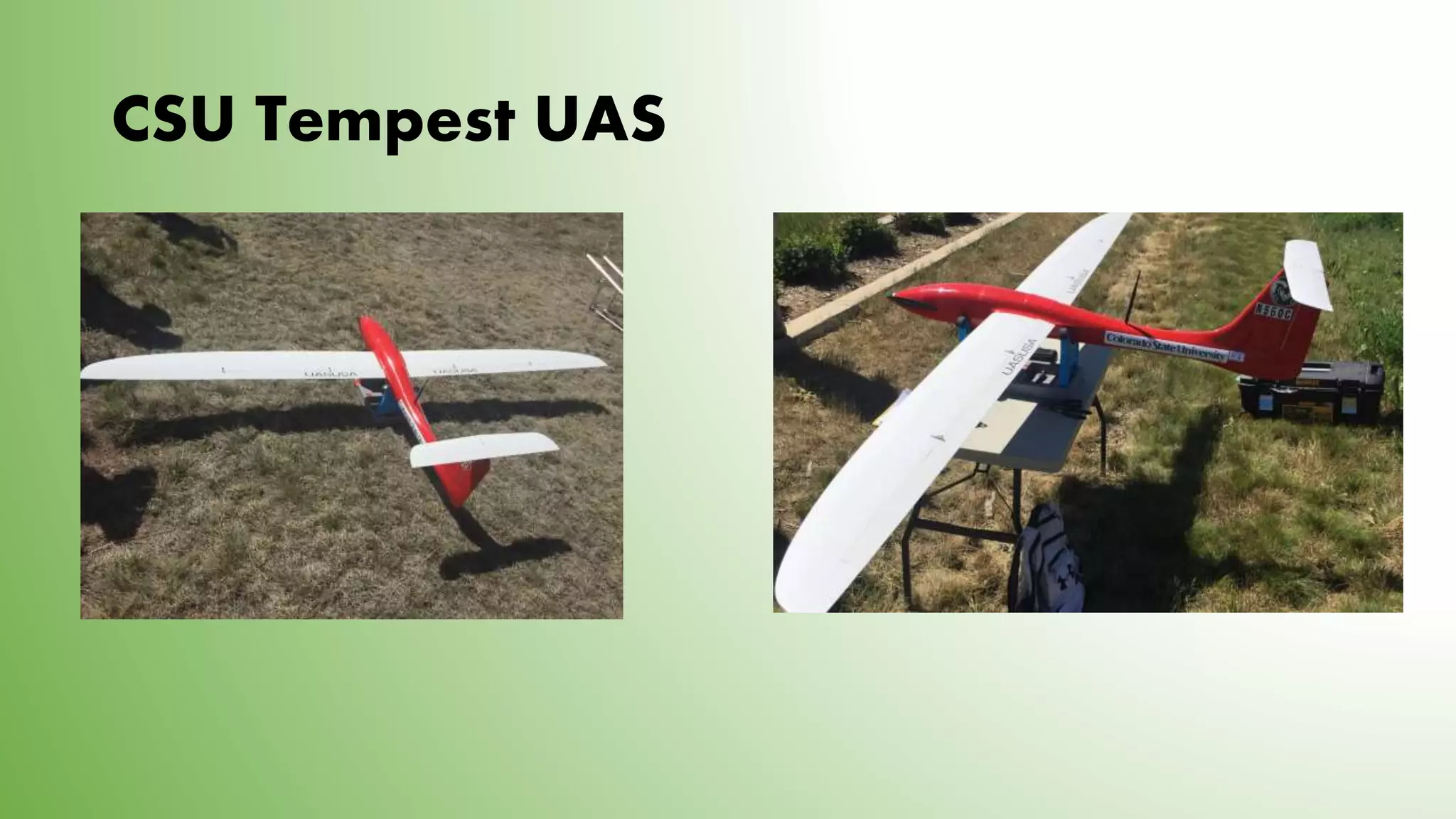
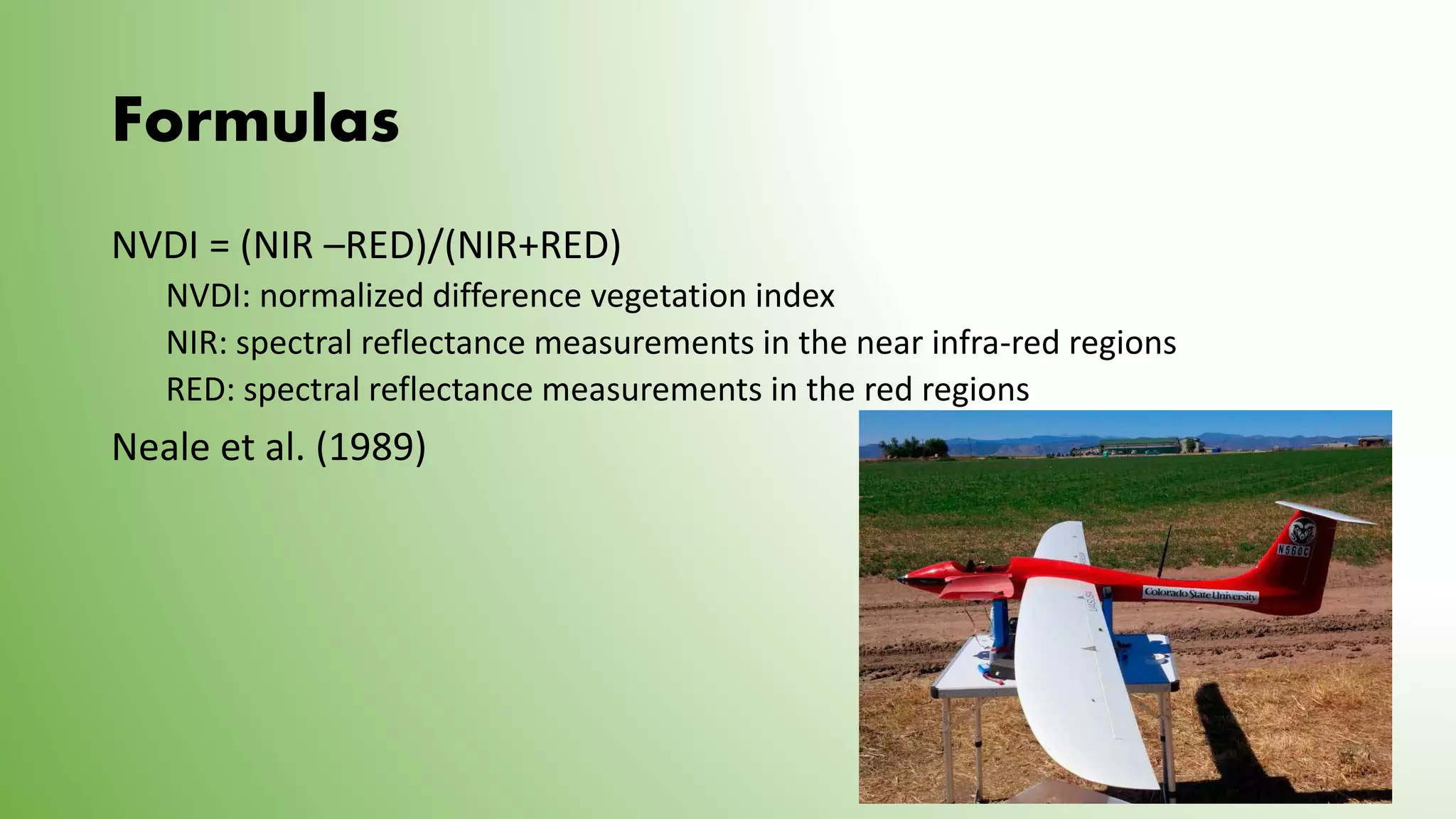
CSU Tempest UAS
• Made in 2015
• Weight: 18lbs (8.2kg) with cameras and battery
• Wingspan: 127” (3.2m)
• Length: 61” (1.6mm)
• Max Speed: 100mph
• Flight Time: 1.5hr with the same battery
• Flight height: 400ft (122m) AGL
• Radio Range: 10miles
• AutoPilot system is installed in the aircraft
CSU Tempest UAS
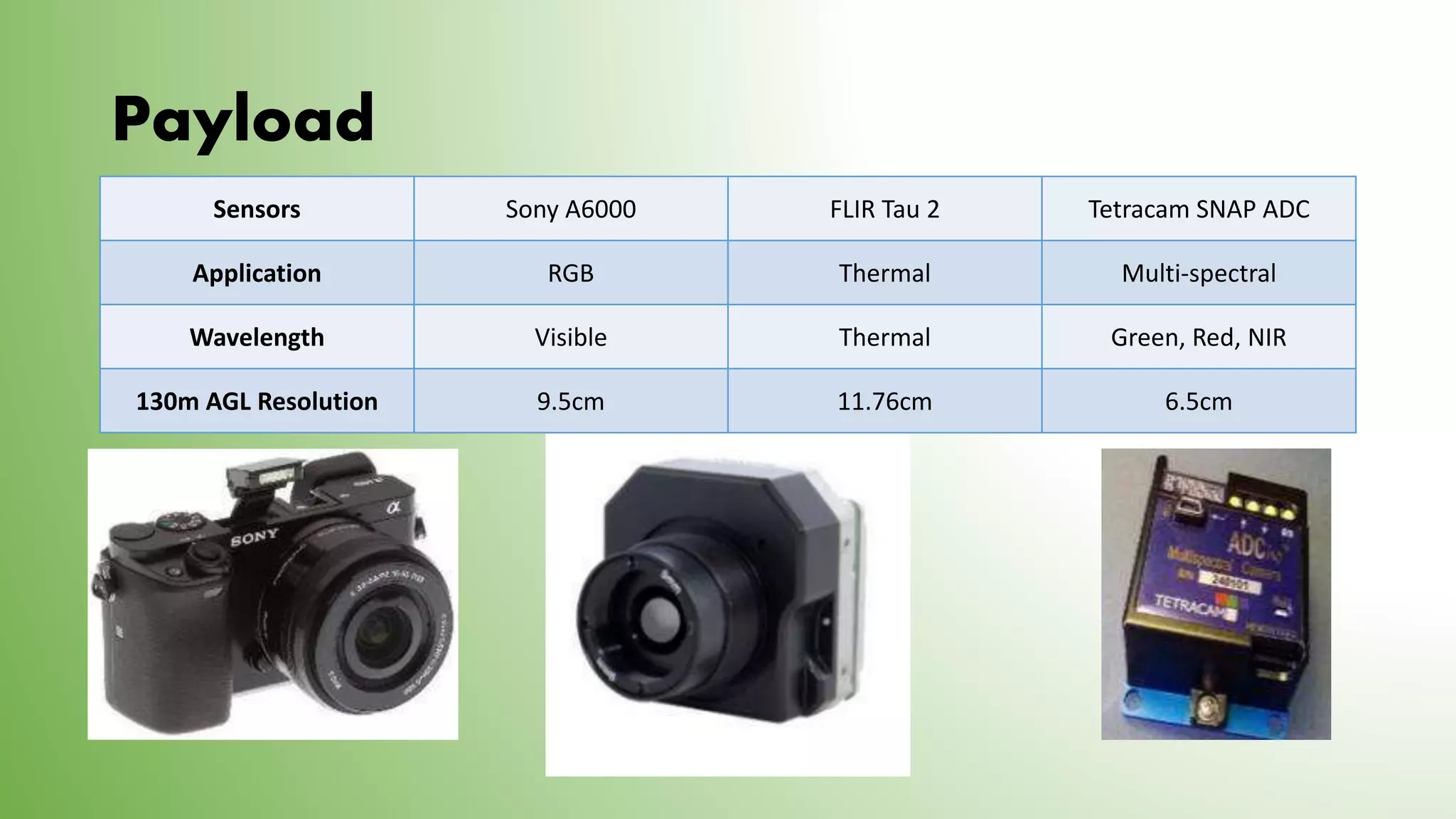
Payload
Sensors Sony A6000 FLIR Tau 2 Tetracam SNAP ADC
Application RGB Thermal Multi-spectral
Wavelength Visible Thermal Green, Red, NIR
130m AGL Resolution 9.5cm 11.76cm 6.5cm
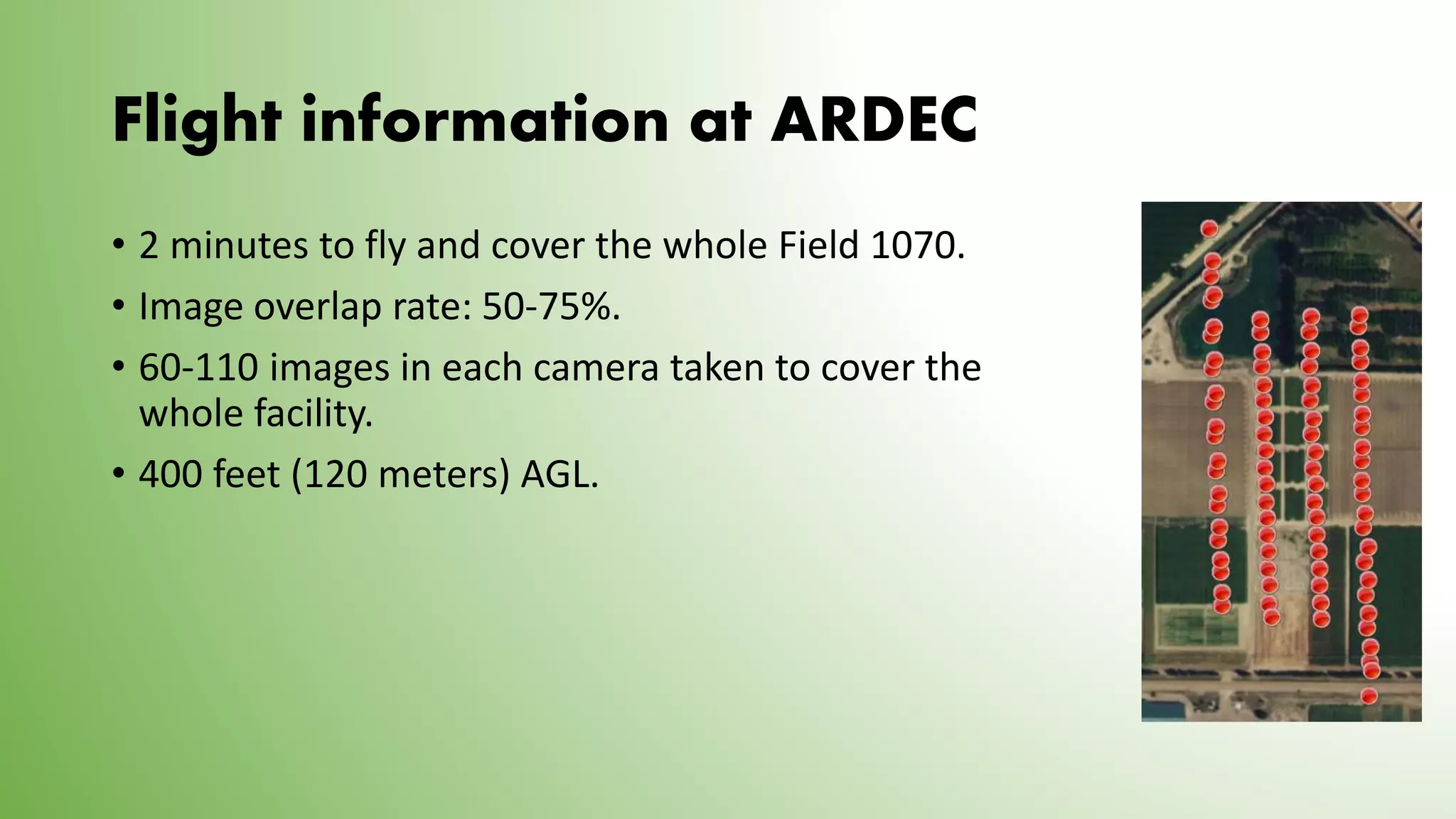
Flight information at ARDEC
• 2 minutes to fly and cover the whole Field 1070.
• Image overlap rate: 50-75%.
• 60-110 images in each camera taken to cover the
whole facility.
• 400 feet (120 meters) AGL.
Flight information at Conservation Garden
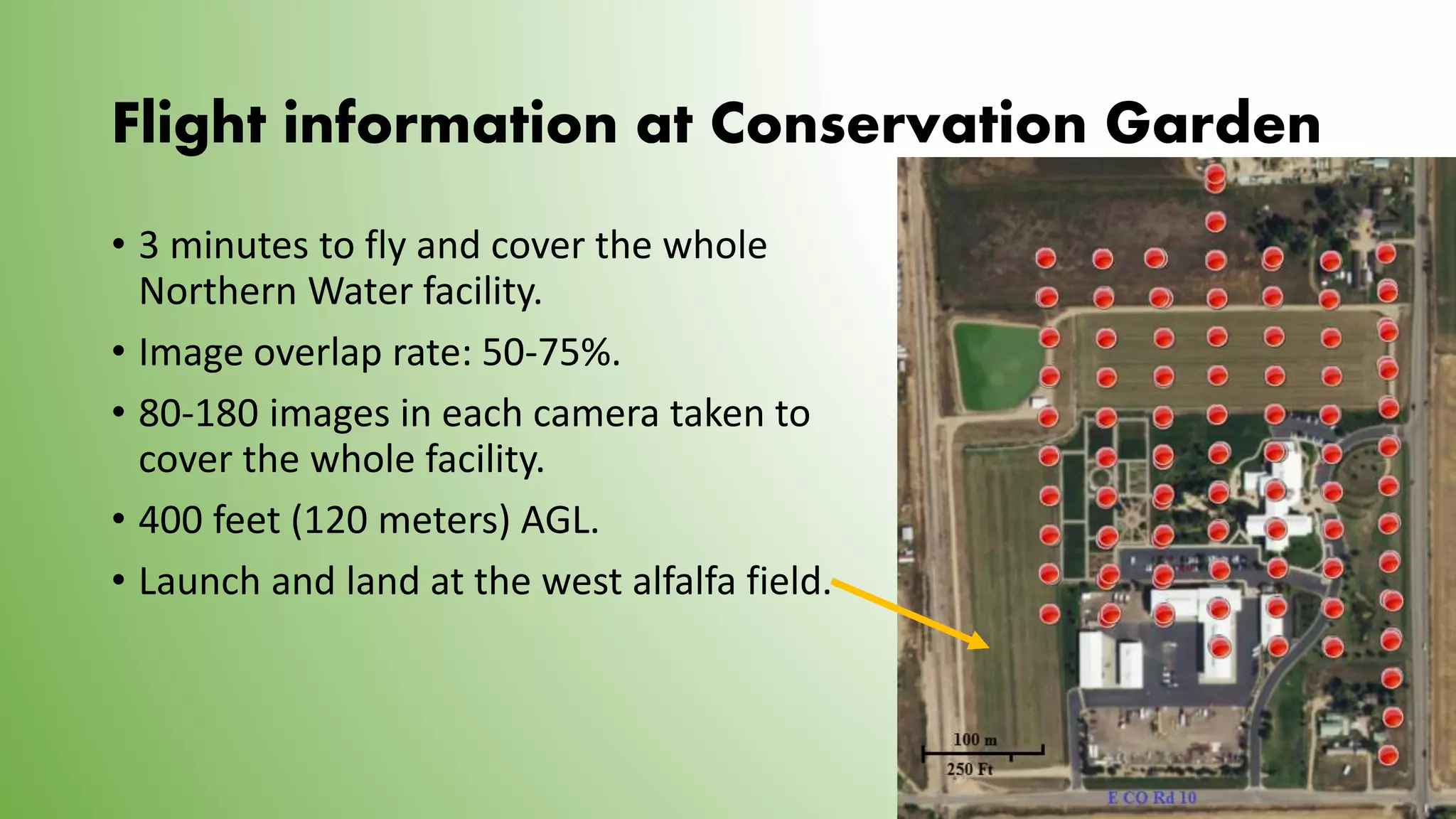
• 3 minutes to fly and cover the whole
Northern Water facility.
• Image overlap rate: 50-75%.
• 80-180 images in each camera taken to
cover the whole facility.
• 400 feet (120 meters) AGL.
• Launch and land at the west alfalfa field.
Mosaic Map Image
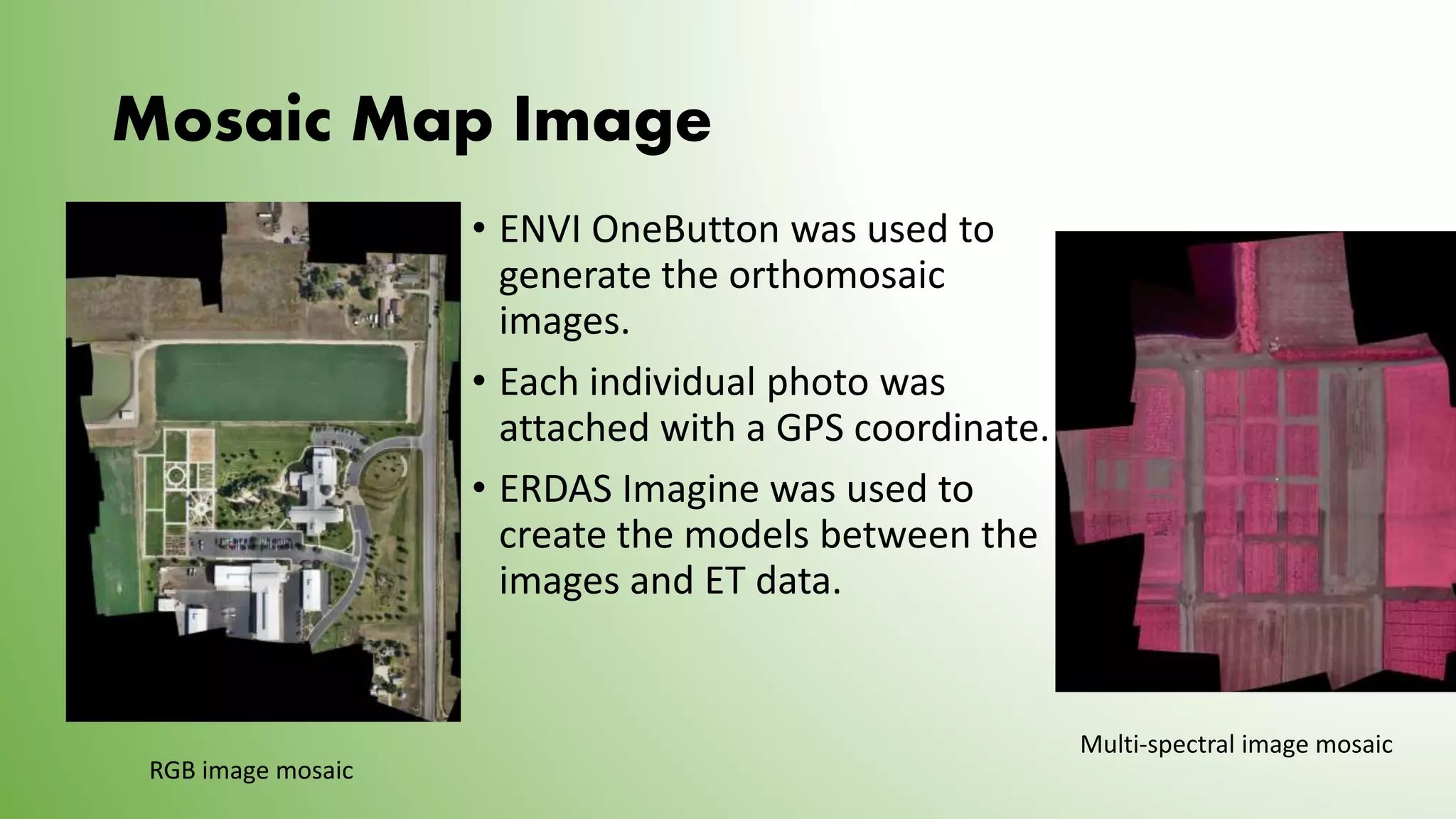
• ENVI OneButton was used to
generate the orthomosaic
images.
• Each individual photo was
attached with a GPS coordinate.
• ERDAS Imagine was used to
create the models between the
images and ET data.
RGB image mosaic
Multi-spectral image mosaic
Formulas
NVDI = (NIR –RED)/(NIR+RED)
NVDI: normalized difference vegetation index
NIR: spectral reflectance measurements in the near infra-red regions
RED: spectral reflectance measurements in the red regions
Neale et al. (1989)
Formulas
CWSI=(dT-dTmin)/(dTmax-dTmin)
CSWI:crop water stress index
dT: difference between the canopy
temperature and the air
temperature
dTmin and dTmax are measured
Idso et al. (1982)
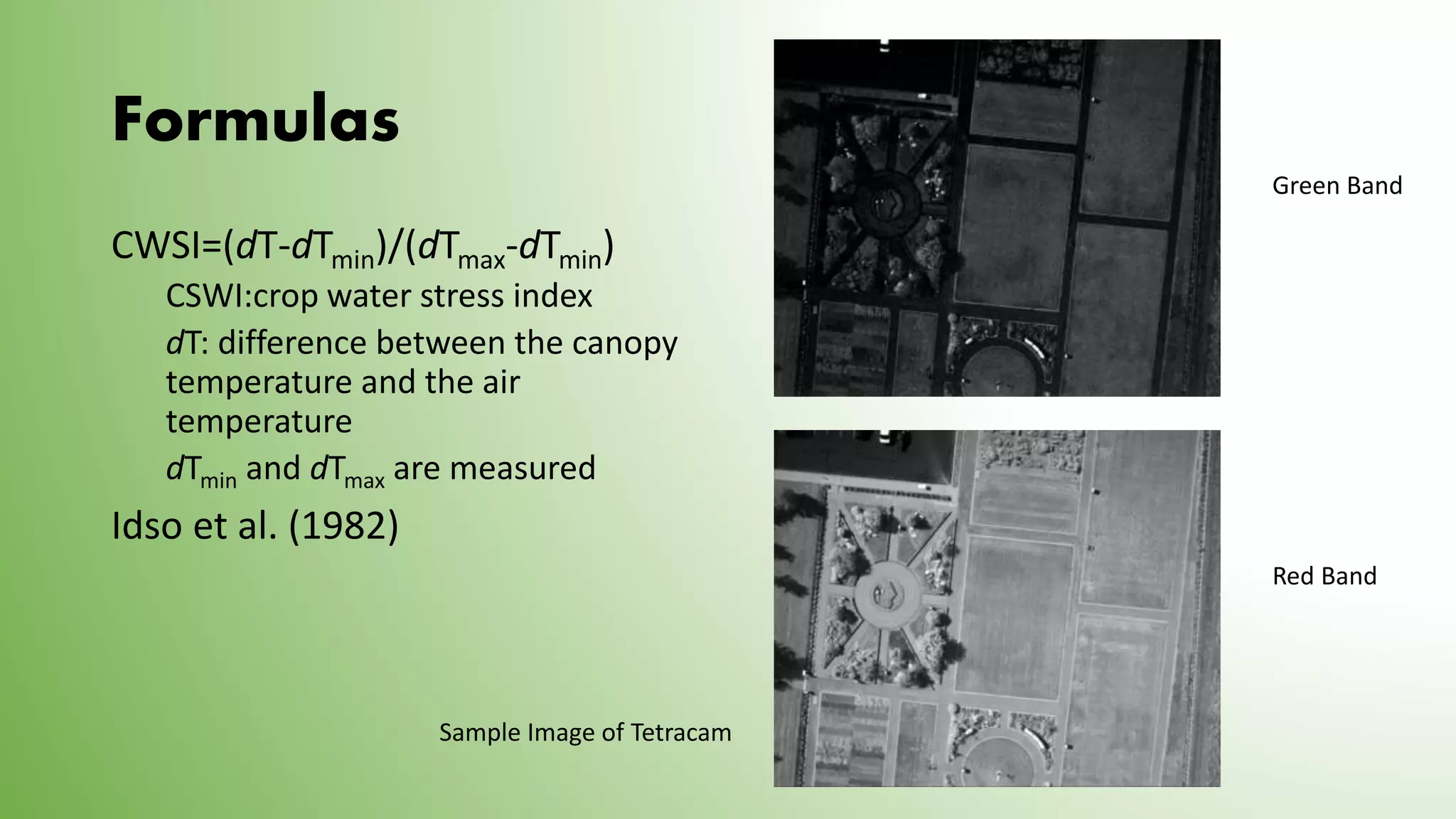
Green Band
Red Band
Sample Image of Tetracam
Formulas
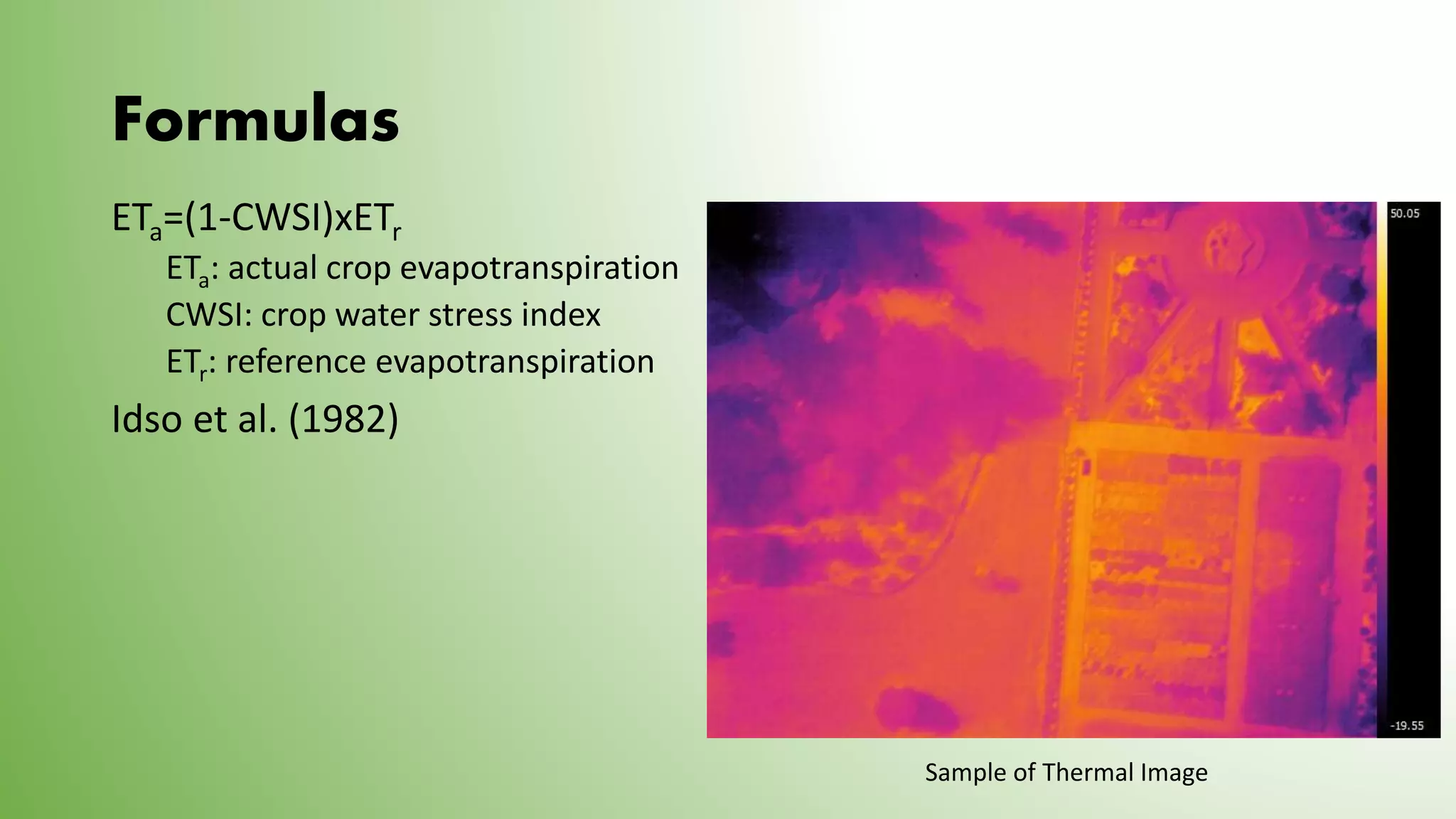
ETa=(1-CWSI)xETr
ETa: actual crop evapotranspiration
CWSI: crop water stress index
ETr: reference evapotranspiration
Idso et al. (1982)
Sample of Thermal Image
Formulas
Di=Di-1+ETa-(P-SRO)-In+DP-GW
Di:the soil water depletion at the end of day i
Di-1: the soil water depletion at the end of day i-1
ETa: the actual crop evapotranspiration
P: the gross precipitation
SRO: the surface runoff
In: is the net irrigation on day I
DP: the deep percolation on day I
GW: the ground water capillary contribution from the water table on day I
Hoffmann et al., 2007
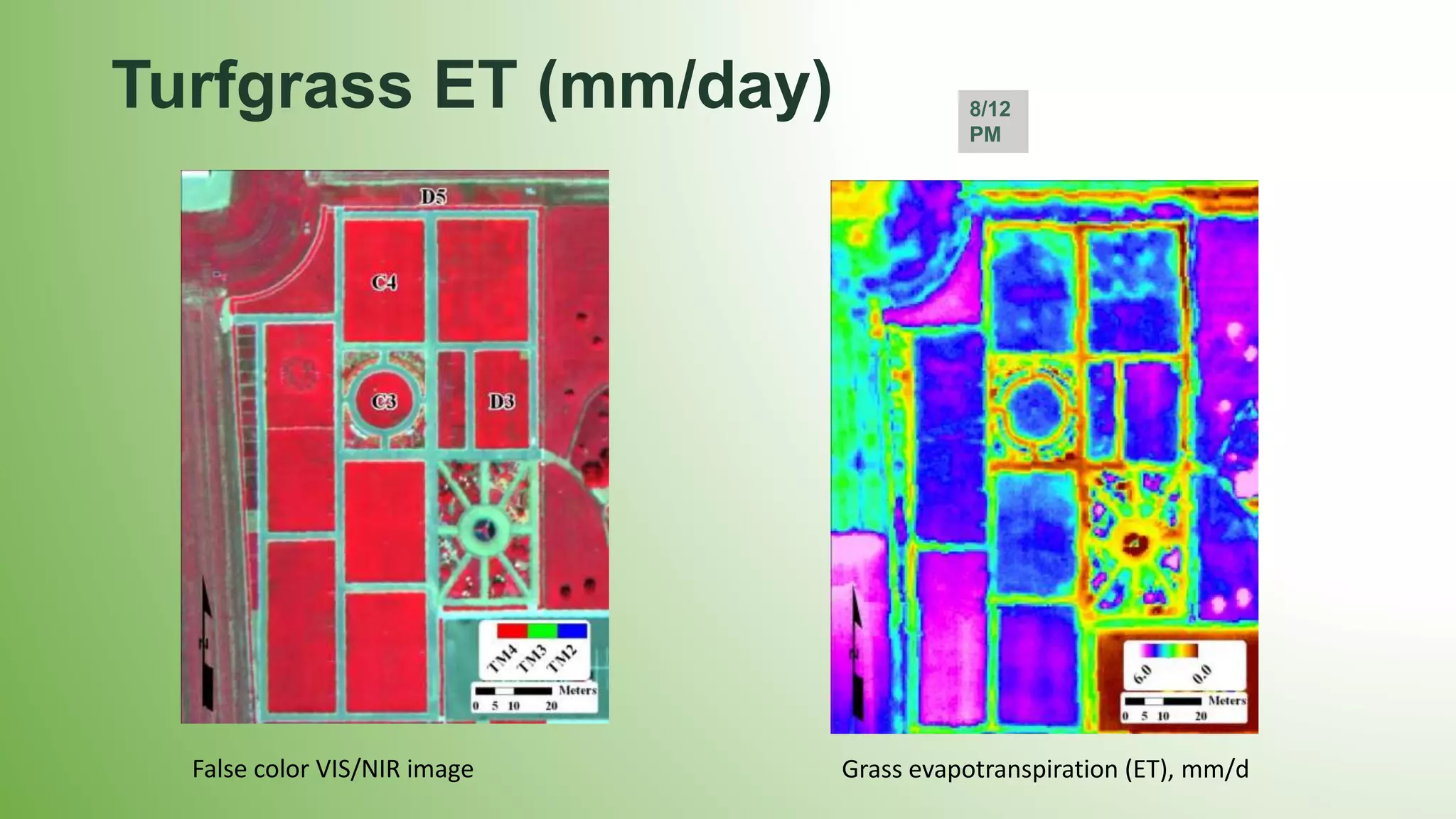
Turfgrass ET (mm/day) 8/12
PM
False color VIS/NIR image Grass evapotranspiration (ET), mm/d
Problems to overcome
• The fixed wing airplane was hard to operate due to the lack of fly
experience, unstable weather, launching and landing procedure.
• The high flying speed of the airplane required ground pilot’s high
attention because of the safety concerns.
• The Multi-spectral sensor was operated slower than others, so it
couldn’t collect the same amount of images or geo-tag them.
Problems to overcome
• With the commercial mosaic software, the thermal imagery couldn't
be orthomosaicked, as a result, it required manually mosaic process.
• Due to the belly landing procedure, the frame of the airplane might
be damaged. A replacement would be made dozens of hours of
operation.
• The UAV application required high attention to operate. At least 3
people were needed during flights (ground safety pilot, autopilot
operator and observer).
Problems to overcome
• Airplane maintenance and image processing demanded different sets
of skills. Diverse operation crews would provide efficient results and
safety.
• An effective auto-mosaic software could avoid time-consuming
manually process of the image mosaic.
• A good radio connection between the airplane and the auto-pilot
system would secure the UAV operation.
Contacts
• José L. Chávez, Ph.D.
Associate Professor, Irrigation Engineering
Extension Specialist - Irrigation Water Management (EXT)
Department of Civil and Environmental Engineering (CEE)
Colorado State University
Office Ph: (970) 491-6095; Fax: (970) 491-7727
Email: jose.chavez@colostate.edu or jlchavez@rams.colostate.edu
CEE: http://www.engr.colostate.edu/ce/
EXT: http://www.ext.colostate.edu/pubs/pubs.html
Publications: Link to articles publications
• Joseph Yu Zhang, EIT, CWP
Water Engineer
Department of Civil and Environmental Engineering (CEE)
Colorado State University
Phone: (425)343-2904
Email: josephyuzhang@gmail.com

Zhang UAV at USCID

  • 1.
    Unmanned Aircraft System Applicationon Precision Irrigation and Feasibility Study Dr. José L. Chávez, Joseph Yu Zhang October, 2016
  • 2.
    Background • The demandof irrigation water is increasing because the world’s population continues to grow sharply together with the food consumption. • The precision agriculture irrigation management systems and technologies are required to save water nowadays and are developing, including the remote sensing technologies. • CSU’s unmanned aircraft system (UAS) equipped with RGB, thermal and multi-spectral cameras can provide high spatial and temporal resolution data in the thermal-infrared, near-infrared and electromagnetic spectrum.
  • 3.
    Background • The UASis one of the technologies which can deliver high resolution data. • The data will be used to estimate actual crop evapotranspiration (ETa) and soil water deficit (SWD), then determine water demand on certain data and location.
  • 4.
    Background • The Field1070 at ARDEC (Agricultural Research, Development and Education Center, Fort Collins, CO) provides the opportunity of flying the UAS above different species of corns under 3 irrigation treatment. • The Conservation Gardens at Northern Water (Berthoud, CO) contains more than 700 varieties of plants and many irrigating treatments, which was used for UAS application too.
  • 5.
    CSU Tempest UAS •Made in 2015 • Weight: 18lbs (8.2kg) with cameras and battery • Wingspan: 127” (3.2m) • Length: 61” (1.6mm) • Max Speed: 100mph • Flight Time: 1.5hr with the same battery • Flight height: 400ft (122m) AGL • Radio Range: 10miles • AutoPilot system is installed in the aircraft
  • 6.
  • 7.
    Payload Sensors Sony A6000FLIR Tau 2 Tetracam SNAP ADC Application RGB Thermal Multi-spectral Wavelength Visible Thermal Green, Red, NIR 130m AGL Resolution 9.5cm 11.76cm 6.5cm
  • 8.
    Flight information atARDEC • 2 minutes to fly and cover the whole Field 1070. • Image overlap rate: 50-75%. • 60-110 images in each camera taken to cover the whole facility. • 400 feet (120 meters) AGL.
  • 9.
    Flight information atConservation Garden • 3 minutes to fly and cover the whole Northern Water facility. • Image overlap rate: 50-75%. • 80-180 images in each camera taken to cover the whole facility. • 400 feet (120 meters) AGL. • Launch and land at the west alfalfa field.
  • 10.
    Mosaic Map Image •ENVI OneButton was used to generate the orthomosaic images. • Each individual photo was attached with a GPS coordinate. • ERDAS Imagine was used to create the models between the images and ET data. RGB image mosaic Multi-spectral image mosaic
  • 11.
    Formulas NVDI = (NIR–RED)/(NIR+RED) NVDI: normalized difference vegetation index NIR: spectral reflectance measurements in the near infra-red regions RED: spectral reflectance measurements in the red regions Neale et al. (1989)
  • 12.
    Formulas CWSI=(dT-dTmin)/(dTmax-dTmin) CSWI:crop water stressindex dT: difference between the canopy temperature and the air temperature dTmin and dTmax are measured Idso et al. (1982) Green Band Red Band Sample Image of Tetracam
  • 13.
    Formulas ETa=(1-CWSI)xETr ETa: actual cropevapotranspiration CWSI: crop water stress index ETr: reference evapotranspiration Idso et al. (1982) Sample of Thermal Image
  • 14.
    Formulas Di=Di-1+ETa-(P-SRO)-In+DP-GW Di:the soil waterdepletion at the end of day i Di-1: the soil water depletion at the end of day i-1 ETa: the actual crop evapotranspiration P: the gross precipitation SRO: the surface runoff In: is the net irrigation on day I DP: the deep percolation on day I GW: the ground water capillary contribution from the water table on day I Hoffmann et al., 2007
  • 15.
    Turfgrass ET (mm/day)8/12 PM False color VIS/NIR image Grass evapotranspiration (ET), mm/d
  • 16.
    Problems to overcome •The fixed wing airplane was hard to operate due to the lack of fly experience, unstable weather, launching and landing procedure. • The high flying speed of the airplane required ground pilot’s high attention because of the safety concerns. • The Multi-spectral sensor was operated slower than others, so it couldn’t collect the same amount of images or geo-tag them.
  • 17.
    Problems to overcome •With the commercial mosaic software, the thermal imagery couldn't be orthomosaicked, as a result, it required manually mosaic process. • Due to the belly landing procedure, the frame of the airplane might be damaged. A replacement would be made dozens of hours of operation. • The UAV application required high attention to operate. At least 3 people were needed during flights (ground safety pilot, autopilot operator and observer).
  • 18.
    Problems to overcome •Airplane maintenance and image processing demanded different sets of skills. Diverse operation crews would provide efficient results and safety. • An effective auto-mosaic software could avoid time-consuming manually process of the image mosaic. • A good radio connection between the airplane and the auto-pilot system would secure the UAV operation.
  • 19.
    Contacts • José L.Chávez, Ph.D. Associate Professor, Irrigation Engineering Extension Specialist - Irrigation Water Management (EXT) Department of Civil and Environmental Engineering (CEE) Colorado State University Office Ph: (970) 491-6095; Fax: (970) 491-7727 Email: jose.chavez@colostate.edu or jlchavez@rams.colostate.edu CEE: http://www.engr.colostate.edu/ce/ EXT: http://www.ext.colostate.edu/pubs/pubs.html Publications: Link to articles publications • Joseph Yu Zhang, EIT, CWP Water Engineer Department of Civil and Environmental Engineering (CEE) Colorado State University Phone: (425)343-2904 Email: josephyuzhang@gmail.com