kimminha@g.skku.edu
“Zero-Shot” Super-Resolution using
Deep Internal Learning
Minha Kim
kimminha@g.skku.ed
u
Sungkyunkwan University
Paper: https://arxiv.org/abs/1712.06087
Project page: http://www.wisdom.weizmann.ac.il/~vision/zssr/
Super Resolution
- super resolution (SR) uses fixed bicubic operation for Down sampling to construct training data
pairs.
- Blind-SR (when the downscaling kernel is unknown)
Key word
- Image-specific CNN
- Zero-shot
- Unsupervised Learning (even at test time only !) / No have any ground truth
background
Kimminha@g.skku.edu
Git: github.com/alsgkals2
Introduction
- Being supervised, SR methods are restricted to specific training data, where the acquisition
of the low resolution (LR) images from their high-resolution (HR) counterparts is
predetermined (e.g., bicubic downscaling) without any distracting artifacts (e.g., sensor noise,
image compression, non-ideal PSF, etc).
- Real LR images, rarely obey these restrictions, resulting in poor SR results by SotA (State
of the Art) methods.
Problems
Propose
Authors introduce “Zero-Shot” SR (ZSSR), which exploits the power of
Deep Learning, without relying on any prior image examples or prior
training.
Kimminha@g.skku.edu
Git: github.com/alsgkals2
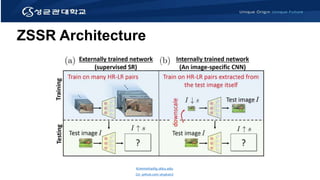
ZSSR Architecture
Kimminha@g.skku.edu
Git: github.com/alsgkals2
ZSSR Architecture
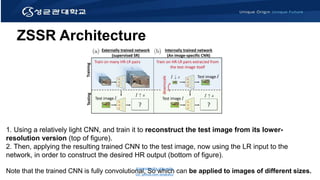
1. Using a relatively light CNN, and train it to reconstruct the test image from its lower-
resolution version (top of figure).
2. Then, applying the resulting trained CNN to the test image, now using the LR input to the
network, in order to construct the desired HR output (bottom of figure).
Note that the trained CNN is fully convolutional, So which can be applied to images of different sizes.
Kimminha@g.skku.edu
Git: github.com/alsgkals2
Setting for experiments
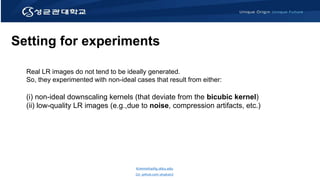
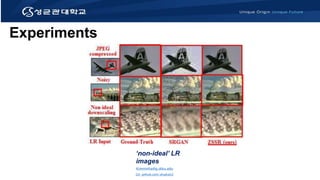
Real LR images do not tend to be ideally generated.
So, they experimented with non-ideal cases that result from either:
(i) non-ideal downscaling kernels (that deviate from the bicubic kernel)
(ii) low-quality LR images (e.g.,due to noise, compression artifacts, etc.)
Kimminha@g.skku.edu
Git: github.com/alsgkals2
Experiments
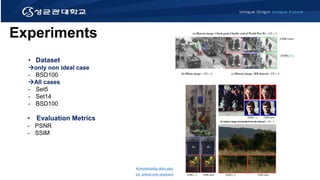
• Evaluation Metrics
- PSNR
- SSIM
• Dataset
only non ideal case
- BSD100
All cases
- Set5
- Set14
- BSD100
Kimminha@g.skku.edu
Git: github.com/alsgkals2
Experiments
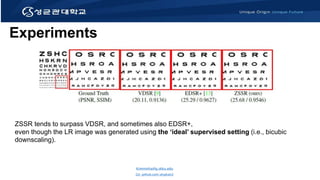
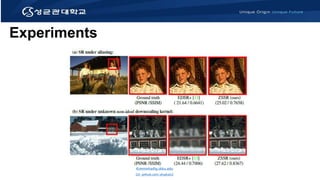
ZSSR tends to surpass VDSR, and sometimes also EDSR+,
even though the LR image was generated using the ‘ideal’ supervised setting (i.e., bicubic
downscaling).
Kimminha@g.skku.edu
Git: github.com/alsgkals2
Experiments
Kimminha@g.skku.edu
Git: github.com/alsgkals2
Experiments
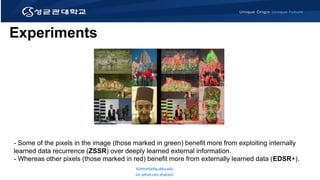
- Some of the pixels in the image (those marked in green) benefit more from exploiting internally
learned data recurrence (ZSSR) over deeply learned external information.
- Whereas other pixels (those marked in red) benefit more from externally learned data (EDSR+).
Kimminha@g.skku.edu
Git: github.com/alsgkals2
Experiments
‘non-ideal’ LR
images
Kimminha@g.skku.edu
Git: github.com/alsgkals2
Contributions
•Zero-shot method, i.e., without relying on any external examples or prior training.
•This is obtained via a small image-specific CNN, which is trained at test time
using the LR test images.
• This yields SR of real-world images, whose acquisition process is non-ideal,
unknown, and changes from image to image (i.e., image-specific settings).
•The first unsupervised CNN-based SR method.
•substantially outperforming SOTA SR methods.
Kimminha@g.skku.edu
Git: github.com/alsgkals2
In my opinion…
1. They tried the training at test time, anyway… although the images for training
are testset, Is it possible to be called like ‘zero-shot’?
2. they Impressively showed the ‘un-supervised’ SR method as the first attempt.
3. Their method is substantially simple but stronger than other SOTA supervised-
method (at 2018).
Kimminha@g.skku.edu
Git: github.com/alsgkals2
Thank you ! 
Kimminha@g.skku.edu
Git: github.com/alsgkals2

“zero-shot” super-resolution using deep internal learning [CVPR2018]

  • 1.
    kimminha@g.skku.edu “Zero-Shot” Super-Resolution using DeepInternal Learning Minha Kim kimminha@g.skku.ed u Sungkyunkwan University Paper: https://arxiv.org/abs/1712.06087 Project page: http://www.wisdom.weizmann.ac.il/~vision/zssr/
  • 2.
    Super Resolution - superresolution (SR) uses fixed bicubic operation for Down sampling to construct training data pairs. - Blind-SR (when the downscaling kernel is unknown) Key word - Image-specific CNN - Zero-shot - Unsupervised Learning (even at test time only !) / No have any ground truth background Kimminha@g.skku.edu Git: github.com/alsgkals2
  • 3.
    Introduction - Being supervised,SR methods are restricted to specific training data, where the acquisition of the low resolution (LR) images from their high-resolution (HR) counterparts is predetermined (e.g., bicubic downscaling) without any distracting artifacts (e.g., sensor noise, image compression, non-ideal PSF, etc). - Real LR images, rarely obey these restrictions, resulting in poor SR results by SotA (State of the Art) methods. Problems Propose Authors introduce “Zero-Shot” SR (ZSSR), which exploits the power of Deep Learning, without relying on any prior image examples or prior training. Kimminha@g.skku.edu Git: github.com/alsgkals2
  • 4.
  • 5.
    ZSSR Architecture 1. Usinga relatively light CNN, and train it to reconstruct the test image from its lower- resolution version (top of figure). 2. Then, applying the resulting trained CNN to the test image, now using the LR input to the network, in order to construct the desired HR output (bottom of figure). Note that the trained CNN is fully convolutional, So which can be applied to images of different sizes. Kimminha@g.skku.edu Git: github.com/alsgkals2
  • 6.
    Setting for experiments RealLR images do not tend to be ideally generated. So, they experimented with non-ideal cases that result from either: (i) non-ideal downscaling kernels (that deviate from the bicubic kernel) (ii) low-quality LR images (e.g.,due to noise, compression artifacts, etc.) Kimminha@g.skku.edu Git: github.com/alsgkals2
  • 7.
    Experiments • Evaluation Metrics -PSNR - SSIM • Dataset only non ideal case - BSD100 All cases - Set5 - Set14 - BSD100 Kimminha@g.skku.edu Git: github.com/alsgkals2
  • 8.
    Experiments ZSSR tends tosurpass VDSR, and sometimes also EDSR+, even though the LR image was generated using the ‘ideal’ supervised setting (i.e., bicubic downscaling). Kimminha@g.skku.edu Git: github.com/alsgkals2
  • 9.
  • 10.
    Experiments - Some ofthe pixels in the image (those marked in green) benefit more from exploiting internally learned data recurrence (ZSSR) over deeply learned external information. - Whereas other pixels (those marked in red) benefit more from externally learned data (EDSR+). Kimminha@g.skku.edu Git: github.com/alsgkals2
  • 11.
  • 12.
    Contributions •Zero-shot method, i.e.,without relying on any external examples or prior training. •This is obtained via a small image-specific CNN, which is trained at test time using the LR test images. • This yields SR of real-world images, whose acquisition process is non-ideal, unknown, and changes from image to image (i.e., image-specific settings). •The first unsupervised CNN-based SR method. •substantially outperforming SOTA SR methods. Kimminha@g.skku.edu Git: github.com/alsgkals2
  • 13.
    In my opinion… 1.They tried the training at test time, anyway… although the images for training are testset, Is it possible to be called like ‘zero-shot’? 2. they Impressively showed the ‘un-supervised’ SR method as the first attempt. 3. Their method is substantially simple but stronger than other SOTA supervised- method (at 2018). Kimminha@g.skku.edu Git: github.com/alsgkals2
  • 14.
    Thank you ! Kimminha@g.skku.edu Git: github.com/alsgkals2