CHEMICAL ENGG. DEPARTENT
PRESENTATION ON
“ZERO BUDGET NATURAL FARMING (ZBNF)”
By
ANKITA A. MANKAR
MT19MCL008
CONTENTS
 History
 Definition
 Principles of ZNBF
 The pillars of ZNBF
 Preparation techniques
 Importance of desi cow in ZBNF
 Goals of ZBNF
 Government Initiatives
 Benefits & issues related ZBNF
 Live examples of ZBNF
 Steps to achieve the goal of 100% ZBNF
 Conclusion
 References
HISTORY
 Mr. Subhash Palekar studied natural system and verified
natural processes of the forest on his farm for six year, since
1989 to 1995.
 There were about 154 research projects during these six years of
research work.
 After six years of verified research work, he got the package of techniques
about Zero Budget Natural Farming; which he gave to the farmers throughout India.
 The Indian Govt. has bestowed him with various awards for his extraordinary contributions.
BASAVA SHRI AWARD (2005)
GOPAL GAURAV AWARD (2007)
PADMA SHRI (2016)
DEFINITION
 Zero-Budget Natural Farming (ZBNF) is a holistic alternative to the present paradigm of high-cost
chemical inputs-based agriculture. It is very effective in addressing the uncertainties of climate change.
 Zero Budget Natural Farming, as the name implies, is a method of farming where the cost of growing
and harvesting plants is zero.
 This means that farmers need not purchase fertilizers and pesticides in order to ensure the healthy
growth of crops.
 This technique eliminates the cost of fertilizers, pesticides and seeds and greatly reduces the incentive to
borrow, one of the chief causes for farmer suicides in the country. Hence its evocative title ZERO
BUDGET NATURAL FARMING.
 It is a method of cultivation which makes the already existing nutrients in the soil such as phosphate,
potash, zinc and calcium available in absorbable form to the plants.
PRINCIPLES OF ZNBF
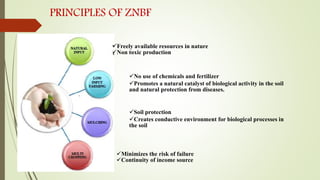
Freely available resources in nature
Non toxic production
No use of chemicals and fertilizer
Promotes a natural catalyst of biological activity in the soil
and natural protection from diseases.
Soil protection
Creates conductive environment for biological processes in
the soil
Minimizes the risk of failure
Continuity of income source
THE PILLARS OF ZNBF
The Zero Budget Natural Farming is mainly based on these 7 practicing methods:
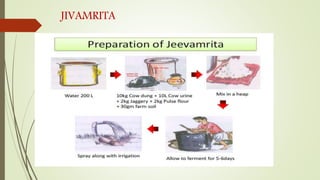
 JIVAMRITA: It is a mixture of fresh cow dung and aged cow urine (both from India's indigenous
cow breed), jaggery, pulse flour, water and soil; to be applied on farmland.
 BIJAMRITA: It is a concoction of neem leaves & pulp, tobacco and green chilies prepared for
insect and pest management, that can be used to treat seeds.
 ACCHADANA: It protects topsoil during cultivation and does not destroy it by tilling.
 WHAPASA: It is the condition where there are both air molecules and water molecules present in
the soil. Thereby helping in reducing irrigation requirement.
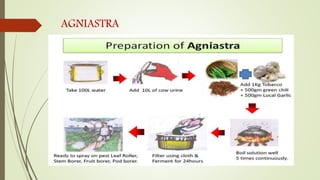
 AGNIASTRA: A natural pesticide made by a mixture of cow urine, green chilies, tobacco and
garlic.
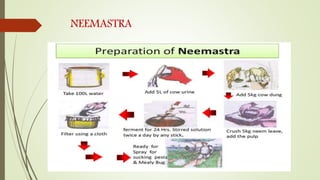
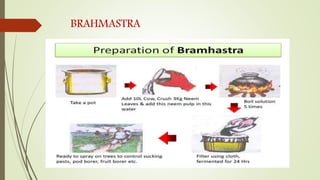
 NEEMASTRA & BRAHMASTRA: These are the natural pesticides made using cow-dung, cow
urine and neem leaves.
BIJAMRITA
JIVAMRITA
AGNIASTRA
NEEMASTRA
BRAHMASTRA
IMPORTANCE OF DESI COW IN ZBNF
 One gram of desi cow dung contains 300 to 500 crores of beneficial effective microbes.
 These micro-organisms decompose the dried biomass on the soil and
Make available the nutrients to the plants.
 All Indian cow breeds are suitable for ZBNF.
 Dung and urine from one desi cow is sufficient to cultivate
30 acres of land in ZBNF.
 Cross bred Jersey & Holstein Friesian cows are not suitable for
ZBNF , there is more pathogens in their dung and urine. Fig. Desi Cow
GOALS OF ZBNF
 An approach towards sustainability
 Expense-free farming
 Farming up to 30 acres with one native cow
 Farming with minimum electricity and water consumption
 Producing quality, poison-free food
 Agriculture without external input
 Techniques of multi-crop cultivation for higher net income
 Reducing external labor requirement
 Farming in tune with nature
 Saving the farmers from committing suicides and leaving behind their families.
GOVERNMENT INITIATIVES
 Government of India has been promoting organic farming in the country through the dedicated
schemes of Paramparagat Krishi Vikas Yojana (PKVY) since 2015-16 and also through
Rashtriya Krishi Vikas Yojana (RKVY).
 In the revised guidelines of PKVY scheme during the year 2018, various organic farming models
like Natural Farming, Rishi Farming, Vedic Farming, Cow Farming, Zero Budget Natural
Farming (ZBNF) etc. have been included wherein flexibility is given to states to adopt any model
of Organic Farming including ZBNF depending on farmer’s choice.
 Under the RKVY scheme, organic farming/ natural farming project components are considered by
the respective State Level Sanctioning Committee (SLSC) according to their priority/ choice.
BENEFITS OF ZBNF
 With the rising cost of external inputs (fertilizers and pesticides), which is the leading cause of
indebtedness and suicide among. Since in ZBNF there is the need to spend money or take loans for
external inputs, the cost of production could be reduced farmers.
 At a time when chemical-intensive farming is resulting in soil and environmental degradation, a zero-
cost environmentally-friendly farming method is definitely a timely initiative.
 The ZBNF method promotes soil aeration, minimal watering, intercropping, bunds and topsoil
mulching and discourages intensive irrigation and deep ploughing.
 It suits all crops in all agro-climatic zones.
 Citing the benefits of ZBNF, in June 2018, Andhra Pradesh rolled out an ambitious plan to
become India’s first State to practice 100% natural farming by 2024.
ISSUES RELATED TO ZBNF
 Sikkim (India's first organic state), has seen some decline in yields following conversion to organic
farming.
 Many farmers have reverted to conventional farming after seeing their ZBNF returns drop after a
few years.
 While ZBNF has definitely helped preserve soil fertility, its role in boosting productivity and farmers’
income isn’t conclusive yet.
 ZBNF advocates the need of an Indian breed cow, whose numbers are declining at a fast pace.
According to Livestock Census, the country’s total population of indigenous and nondescript cattle
has dropped by 8.1%.
 Low expenditure by the government: Last year, the government launched Rashtriya Krishi Vikas
Yojana, a flagship Green Revolution scheme with an allocation of Rs.3,745 crore for the financial
year 2019-20. Whereas the Paramparagat Krishi Vikas Yojana, which was meant to promote
organic farming and soil health has been allocated Rs.325 crore only.
LIVE EXAMPLES
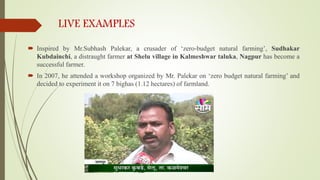
 Inspired by Mr.Subhash Palekar, a crusader of ‘zero-budget natural farming’, Sudhakar
Kubdainchi, a distraught farmer at Shelu village in Kalmeshwar taluka, Nagpur has become a
successful farmer.
 In 2007, he attended a workshop organized by Mr. Palekar on ‘zero budget natural farming’ and
decided to experiment it on 7 bighas (1.12 hectares) of farmland.
STEPS TO ACHIEVE GOAL OF 100% ZBNF
There is a host of structural marketing issues which needs to be addressed first before aiming to achieve the
ambitious goal of ZBNF. For example:
 Strengthening of agricultural market infrastructure.
 Extending the procurement mechanism to all food grain and non food grain crops to all States.
 Implementation of price deficiency payment system for selected crops.
 Fixing minimum support prices (MSP) in consonance with the cost of cultivation.
 Abolishing minimum export price for agricultural commodities.
 Enacting legislation on ‘right to sell at MSP’ needs immediate attention.
CONCLUSION
 Savings on cost of seeds, fertilizers and plant protection chemicals has been
substantial because of continuous incorporation of organic residues and
replenishment of soil fertility. Helps to maintain the soil health.
 The new system of farming has freed the farmers from the debt trap and it has
instilled in them a renewed sense of confidence to make farming an economically
viable venture.
 ZBNF is an efficient way to achieve sustainable agriculture in our country.
REFERENCES
 www.atimysore.gov.in/PDF/action_research1.pdf
 www.palekarzerobudgetspiritualfarming.org
 https://www.insightsonindia.com/2019/07/08/zero-budget-natural-farming/
 https://www.drishtiias.com/daily-updates/daily-news-editorials/zero-budget-natural-
farming

Zbnf ppt

  • 1.
    CHEMICAL ENGG. DEPARTENT PRESENTATIONON “ZERO BUDGET NATURAL FARMING (ZBNF)” By ANKITA A. MANKAR MT19MCL008
  • 2.
    CONTENTS  History  Definition Principles of ZNBF  The pillars of ZNBF  Preparation techniques  Importance of desi cow in ZBNF  Goals of ZBNF  Government Initiatives  Benefits & issues related ZBNF  Live examples of ZBNF  Steps to achieve the goal of 100% ZBNF  Conclusion  References
  • 3.
    HISTORY  Mr. SubhashPalekar studied natural system and verified natural processes of the forest on his farm for six year, since 1989 to 1995.  There were about 154 research projects during these six years of research work.  After six years of verified research work, he got the package of techniques about Zero Budget Natural Farming; which he gave to the farmers throughout India.  The Indian Govt. has bestowed him with various awards for his extraordinary contributions. BASAVA SHRI AWARD (2005) GOPAL GAURAV AWARD (2007) PADMA SHRI (2016)
  • 4.
    DEFINITION  Zero-Budget NaturalFarming (ZBNF) is a holistic alternative to the present paradigm of high-cost chemical inputs-based agriculture. It is very effective in addressing the uncertainties of climate change.  Zero Budget Natural Farming, as the name implies, is a method of farming where the cost of growing and harvesting plants is zero.  This means that farmers need not purchase fertilizers and pesticides in order to ensure the healthy growth of crops.  This technique eliminates the cost of fertilizers, pesticides and seeds and greatly reduces the incentive to borrow, one of the chief causes for farmer suicides in the country. Hence its evocative title ZERO BUDGET NATURAL FARMING.  It is a method of cultivation which makes the already existing nutrients in the soil such as phosphate, potash, zinc and calcium available in absorbable form to the plants.
  • 5.
    PRINCIPLES OF ZNBF Freelyavailable resources in nature Non toxic production No use of chemicals and fertilizer Promotes a natural catalyst of biological activity in the soil and natural protection from diseases. Soil protection Creates conductive environment for biological processes in the soil Minimizes the risk of failure Continuity of income source
  • 6.
    THE PILLARS OFZNBF The Zero Budget Natural Farming is mainly based on these 7 practicing methods:  JIVAMRITA: It is a mixture of fresh cow dung and aged cow urine (both from India's indigenous cow breed), jaggery, pulse flour, water and soil; to be applied on farmland.  BIJAMRITA: It is a concoction of neem leaves & pulp, tobacco and green chilies prepared for insect and pest management, that can be used to treat seeds.  ACCHADANA: It protects topsoil during cultivation and does not destroy it by tilling.  WHAPASA: It is the condition where there are both air molecules and water molecules present in the soil. Thereby helping in reducing irrigation requirement.  AGNIASTRA: A natural pesticide made by a mixture of cow urine, green chilies, tobacco and garlic.  NEEMASTRA & BRAHMASTRA: These are the natural pesticides made using cow-dung, cow urine and neem leaves.
  • 7.
  • 8.
  • 9.
  • 10.
  • 11.
  • 12.
    IMPORTANCE OF DESICOW IN ZBNF  One gram of desi cow dung contains 300 to 500 crores of beneficial effective microbes.  These micro-organisms decompose the dried biomass on the soil and Make available the nutrients to the plants.  All Indian cow breeds are suitable for ZBNF.  Dung and urine from one desi cow is sufficient to cultivate 30 acres of land in ZBNF.  Cross bred Jersey & Holstein Friesian cows are not suitable for ZBNF , there is more pathogens in their dung and urine. Fig. Desi Cow
  • 13.
    GOALS OF ZBNF An approach towards sustainability  Expense-free farming  Farming up to 30 acres with one native cow  Farming with minimum electricity and water consumption  Producing quality, poison-free food  Agriculture without external input  Techniques of multi-crop cultivation for higher net income  Reducing external labor requirement  Farming in tune with nature  Saving the farmers from committing suicides and leaving behind their families.
  • 14.
    GOVERNMENT INITIATIVES  Governmentof India has been promoting organic farming in the country through the dedicated schemes of Paramparagat Krishi Vikas Yojana (PKVY) since 2015-16 and also through Rashtriya Krishi Vikas Yojana (RKVY).  In the revised guidelines of PKVY scheme during the year 2018, various organic farming models like Natural Farming, Rishi Farming, Vedic Farming, Cow Farming, Zero Budget Natural Farming (ZBNF) etc. have been included wherein flexibility is given to states to adopt any model of Organic Farming including ZBNF depending on farmer’s choice.  Under the RKVY scheme, organic farming/ natural farming project components are considered by the respective State Level Sanctioning Committee (SLSC) according to their priority/ choice.
  • 15.
    BENEFITS OF ZBNF With the rising cost of external inputs (fertilizers and pesticides), which is the leading cause of indebtedness and suicide among. Since in ZBNF there is the need to spend money or take loans for external inputs, the cost of production could be reduced farmers.  At a time when chemical-intensive farming is resulting in soil and environmental degradation, a zero- cost environmentally-friendly farming method is definitely a timely initiative.  The ZBNF method promotes soil aeration, minimal watering, intercropping, bunds and topsoil mulching and discourages intensive irrigation and deep ploughing.  It suits all crops in all agro-climatic zones.  Citing the benefits of ZBNF, in June 2018, Andhra Pradesh rolled out an ambitious plan to become India’s first State to practice 100% natural farming by 2024.
  • 16.
    ISSUES RELATED TOZBNF  Sikkim (India's first organic state), has seen some decline in yields following conversion to organic farming.  Many farmers have reverted to conventional farming after seeing their ZBNF returns drop after a few years.  While ZBNF has definitely helped preserve soil fertility, its role in boosting productivity and farmers’ income isn’t conclusive yet.  ZBNF advocates the need of an Indian breed cow, whose numbers are declining at a fast pace. According to Livestock Census, the country’s total population of indigenous and nondescript cattle has dropped by 8.1%.  Low expenditure by the government: Last year, the government launched Rashtriya Krishi Vikas Yojana, a flagship Green Revolution scheme with an allocation of Rs.3,745 crore for the financial year 2019-20. Whereas the Paramparagat Krishi Vikas Yojana, which was meant to promote organic farming and soil health has been allocated Rs.325 crore only.
  • 17.
    LIVE EXAMPLES  Inspiredby Mr.Subhash Palekar, a crusader of ‘zero-budget natural farming’, Sudhakar Kubdainchi, a distraught farmer at Shelu village in Kalmeshwar taluka, Nagpur has become a successful farmer.  In 2007, he attended a workshop organized by Mr. Palekar on ‘zero budget natural farming’ and decided to experiment it on 7 bighas (1.12 hectares) of farmland.
  • 18.
    STEPS TO ACHIEVEGOAL OF 100% ZBNF There is a host of structural marketing issues which needs to be addressed first before aiming to achieve the ambitious goal of ZBNF. For example:  Strengthening of agricultural market infrastructure.  Extending the procurement mechanism to all food grain and non food grain crops to all States.  Implementation of price deficiency payment system for selected crops.  Fixing minimum support prices (MSP) in consonance with the cost of cultivation.  Abolishing minimum export price for agricultural commodities.  Enacting legislation on ‘right to sell at MSP’ needs immediate attention.
  • 19.
    CONCLUSION  Savings oncost of seeds, fertilizers and plant protection chemicals has been substantial because of continuous incorporation of organic residues and replenishment of soil fertility. Helps to maintain the soil health.  The new system of farming has freed the farmers from the debt trap and it has instilled in them a renewed sense of confidence to make farming an economically viable venture.  ZBNF is an efficient way to achieve sustainable agriculture in our country.
  • 20.
    REFERENCES  www.atimysore.gov.in/PDF/action_research1.pdf  www.palekarzerobudgetspiritualfarming.org https://www.insightsonindia.com/2019/07/08/zero-budget-natural-farming/  https://www.drishtiias.com/daily-updates/daily-news-editorials/zero-budget-natural- farming