ZMZ JANUARY 2012


         PROGRAMMING 1
                   BEB14103

Lecture 1
        1
DATA TYPES
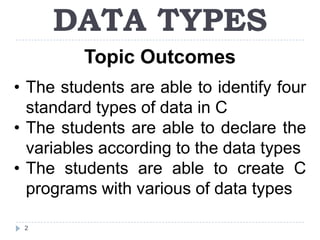
         Topic Outcomes
• The students are able to identify four
  standard types of data in C
• The students are able to declare the
  variables according to the data types
• The students are able to create C
  programs with various of data types

 2
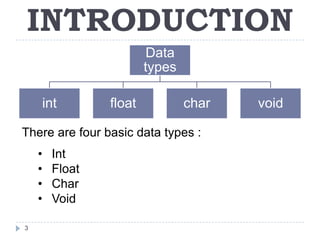
INTRODUCTION
                         Data
                        types

    int         float           char   void

There are four basic data types :
    •   Int
    •   Float
    •   Char
    •   Void

3
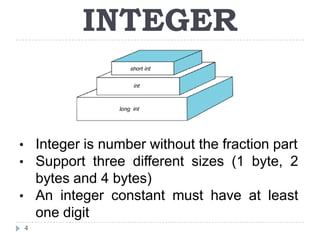
INTEGER


• Integer is number without the fraction part
• Support three different sizes (1 byte, 2
  bytes and 4 bytes)
• An integer constant must have at least
  one digit
4
CONT..
• It must not have a decimal point
• It can be either positive or negative
• If no sign precedes an integer
  constant it is assumed to be positive
• No commas or blanks are allowed
  within an integer constant
• Examples :

    426   +782   -8000   -7605
5
CHAR
• The letters of the alphabet
• Most computers use the American Standard
  Code for Information Interchange (ASCII)
• The maximum length of a character constant
  can be 1 character
• Examples :
  • 'A'
  • 'I'
  • '5'
  • '='

    6
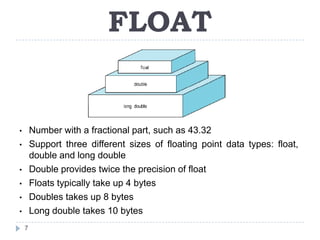
FLOAT


•       Number with a fractional part, such as 43.32
•       Support three different sizes of floating point data types: float,
        double and long double
•       Double provides twice the precision of float
•       Floats typically take up 4 bytes
•       Doubles takes up 8 bytes
•       Long double takes 10 bytes
    7
VOID
•       The void type has no values therefore we cannot
        declare it as variable as we did in case of integer
        and float.
•       The void data type is usually used with function
        to specify its type.
•       Like in in the first C program we declared
        “main()” as void type because it does not return
        any value.

    8
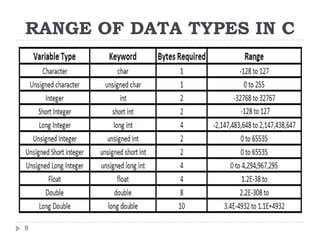
RANGE OF DATA TYPES IN C


9
VARIABLES
•        Variables are named memory
         locations that have a type.
•        Must be declared and defined
•        Declaration is used to name an
         object such as a variable
•        Definitions are used to create the
         object
•        A variable cannot be type void
    10
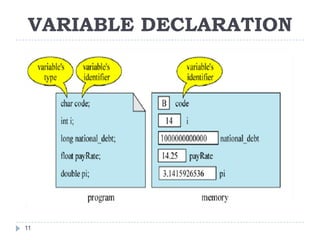
VARIABLE DECLARATION


11
CONT..
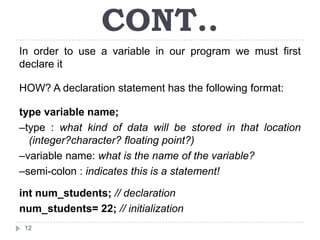
In order to use a variable in our program we must first
declare it

HOW? A declaration statement has the following format:

type variable name;
–type : what kind of data will be stored in that location
  (integer?character? floating point?)
–variable name: what is the name of the variable?
–semi-colon : indicates this is a statement!

int num_students; // declaration
num_students= 22; // initialization
 12
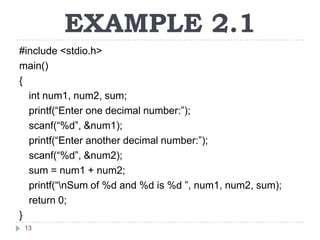
EXAMPLE 2.1
#include <stdio.h>
main()
{
  int num1, num2, sum;
  printf(“Enter one decimal number:”);
  scanf(“%d”, &num1);
  printf(“Enter another decimal number:”);
  scanf(“%d”, &num2);
  sum = num1 + num2;
  printf(“nSum of %d and %d is %d ”, num1, num2, sum);
  return 0;
}
 13
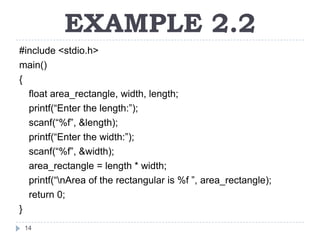
EXAMPLE 2.2
#include <stdio.h>
main()
{
  float area_rectangle, width, length;
  printf(“Enter the length:”);
  scanf(“%f”, &length);
  printf(“Enter the width:”);
  scanf(“%f”, &width);
  area_rectangle = length * width;
  printf(“nArea of the rectangular is %f ”, area_rectangle);
  return 0;
}
 14
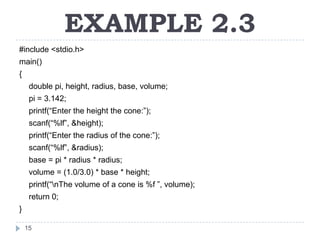
EXAMPLE 2.3
#include <stdio.h>
main()
{
     double pi, height, radius, base, volume;
     pi = 3.142;
     printf(“Enter the height the cone:”);
     scanf(“%lf”, &height);
     printf(“Enter the radius of the cone:”);
     scanf(“%lf”, &radius);
     base = pi * radius * radius;
     volume = (1.0/3.0) * base * height;
     printf(“nThe volume of a cone is %f ”, volume);
     return 0;
}

    15
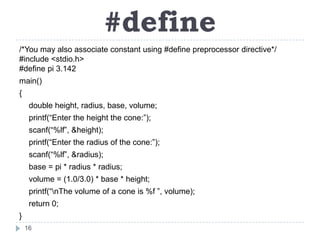
#define
/*You may also associate constant using #define preprocessor directive*/
#include <stdio.h>
#define pi 3.142
main()
{
     double height, radius, base, volume;
     printf(“Enter the height the cone:”);
     scanf(“%lf”, &height);
     printf(“Enter the radius of the cone:”);
     scanf(“%lf”, &radius);
     base = pi * radius * radius;
     volume = (1.0/3.0) * base * height;
     printf(“nThe volume of a cone is %f ”, volume);
     return 0;
}
    16
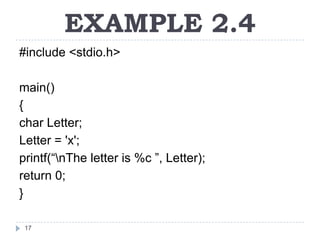
EXAMPLE 2.4
#include <stdio.h>

main()
{
char Letter;
Letter = 'x';
printf(“nThe letter is %c ”, Letter);
return 0;
}

 17
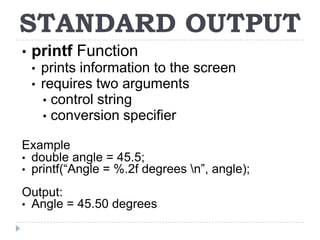
STANDARD OUTPUT
•   printf Function
    •   prints information to the screen
    •   requires two arguments
        • control string
        • conversion specifier

Example
• double angle = 45.5;
• printf(“Angle = %.2f degrees n”, angle);

Output:
• Angle = 45.50 degrees
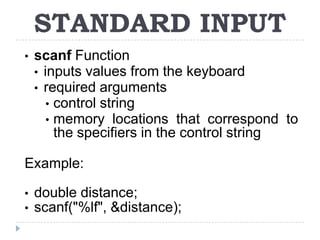
STANDARD INPUT
•   scanf Function
    • inputs values from the keyboard
    • required arguments
       • control string
       • memory locations that correspond to
         the specifiers in the control string

Example:

•   double distance;
•   scanf("%lf", &distance);
SUMMARY
•    There are four standard data types can be use in
     C program which are:
     • Integer
     • Float
     • Char
     • Void
•    Everytime you want to use a variable, the
     declaration must be made
•    To associate the variables with the data types,
     you can use standard input and output function

    20
REFERENCE
Hanly, J. R. & Koffman, E. B (2001). C
Program Design for Engineers. Addison
Wesley Longman.

Deitel, P & Deitel H (2008). C How to
Program. Pearson Education Inc.


21

Zaridah lecture2

  • 1.
    ZMZ JANUARY 2012 PROGRAMMING 1 BEB14103 Lecture 1 1
  • 2.
    DATA TYPES Topic Outcomes • The students are able to identify four standard types of data in C • The students are able to declare the variables according to the data types • The students are able to create C programs with various of data types 2
  • 3.
    INTRODUCTION Data types int float char void There are four basic data types : • Int • Float • Char • Void 3
  • 4.
    INTEGER • Integer isnumber without the fraction part • Support three different sizes (1 byte, 2 bytes and 4 bytes) • An integer constant must have at least one digit 4
  • 5.
    CONT.. • It mustnot have a decimal point • It can be either positive or negative • If no sign precedes an integer constant it is assumed to be positive • No commas or blanks are allowed within an integer constant • Examples : 426 +782 -8000 -7605 5
  • 6.
    CHAR • The lettersof the alphabet • Most computers use the American Standard Code for Information Interchange (ASCII) • The maximum length of a character constant can be 1 character • Examples : • 'A' • 'I' • '5' • '=' 6
  • 7.
    FLOAT • Number with a fractional part, such as 43.32 • Support three different sizes of floating point data types: float, double and long double • Double provides twice the precision of float • Floats typically take up 4 bytes • Doubles takes up 8 bytes • Long double takes 10 bytes 7
  • 8.
    VOID • The void type has no values therefore we cannot declare it as variable as we did in case of integer and float. • The void data type is usually used with function to specify its type. • Like in in the first C program we declared “main()” as void type because it does not return any value. 8
  • 9.
    RANGE OF DATATYPES IN C 9
  • 10.
    VARIABLES • Variables are named memory locations that have a type. • Must be declared and defined • Declaration is used to name an object such as a variable • Definitions are used to create the object • A variable cannot be type void 10
  • 11.
  • 12.
    CONT.. In order touse a variable in our program we must first declare it HOW? A declaration statement has the following format: type variable name; –type : what kind of data will be stored in that location (integer?character? floating point?) –variable name: what is the name of the variable? –semi-colon : indicates this is a statement! int num_students; // declaration num_students= 22; // initialization 12
  • 13.
    EXAMPLE 2.1 #include <stdio.h> main() { int num1, num2, sum; printf(“Enter one decimal number:”); scanf(“%d”, &num1); printf(“Enter another decimal number:”); scanf(“%d”, &num2); sum = num1 + num2; printf(“nSum of %d and %d is %d ”, num1, num2, sum); return 0; } 13
  • 14.
    EXAMPLE 2.2 #include <stdio.h> main() { float area_rectangle, width, length; printf(“Enter the length:”); scanf(“%f”, &length); printf(“Enter the width:”); scanf(“%f”, &width); area_rectangle = length * width; printf(“nArea of the rectangular is %f ”, area_rectangle); return 0; } 14
  • 15.
    EXAMPLE 2.3 #include <stdio.h> main() { double pi, height, radius, base, volume; pi = 3.142; printf(“Enter the height the cone:”); scanf(“%lf”, &height); printf(“Enter the radius of the cone:”); scanf(“%lf”, &radius); base = pi * radius * radius; volume = (1.0/3.0) * base * height; printf(“nThe volume of a cone is %f ”, volume); return 0; } 15
  • 16.
    #define /*You may alsoassociate constant using #define preprocessor directive*/ #include <stdio.h> #define pi 3.142 main() { double height, radius, base, volume; printf(“Enter the height the cone:”); scanf(“%lf”, &height); printf(“Enter the radius of the cone:”); scanf(“%lf”, &radius); base = pi * radius * radius; volume = (1.0/3.0) * base * height; printf(“nThe volume of a cone is %f ”, volume); return 0; } 16
  • 17.
    EXAMPLE 2.4 #include <stdio.h> main() { charLetter; Letter = 'x'; printf(“nThe letter is %c ”, Letter); return 0; } 17
  • 18.
    STANDARD OUTPUT • printf Function • prints information to the screen • requires two arguments • control string • conversion specifier Example • double angle = 45.5; • printf(“Angle = %.2f degrees n”, angle); Output: • Angle = 45.50 degrees
  • 19.
    STANDARD INPUT • scanf Function • inputs values from the keyboard • required arguments • control string • memory locations that correspond to the specifiers in the control string Example: • double distance; • scanf("%lf", &distance);
  • 20.
    SUMMARY • There are four standard data types can be use in C program which are: • Integer • Float • Char • Void • Everytime you want to use a variable, the declaration must be made • To associate the variables with the data types, you can use standard input and output function 20
  • 21.
    REFERENCE Hanly, J. R.& Koffman, E. B (2001). C Program Design for Engineers. Addison Wesley Longman. Deitel, P & Deitel H (2008). C How to Program. Pearson Education Inc. 21