Spiritual Formation and

gathered worship.
Spiritual formation:
The development, through
  practice, of people who
   “be,” think, feel, work,
          relate, and play

   … in the way of Jesus.
Spiritual formation:
 The development of
           disciples.
transformation

make [spiritually form] disciples
  …teach them to do
 all I have commanded you.
             (Matthew 28)
transformation

I have given you an example
  … love one another as I have loved
                you.
               (John 13-15)
transformation

     to be conformed
to the image of God’s Son
           (Romans 8)
transformation

   … be transformed
by the renewing of your
         minds.
          (Romans 8)
transformation

… I will show you the most
     excellent way …
  follow the way of love
         (1 Corinthians 12-14)
transformation


…until Christ
is formed in you.
     (Galatians 4:19)
Spiritual formation involves
intentional spiritual practices
 (or disciplines) so people can
                   learn a way:
Actions within our power which we do
            to train ourselves to do things
       currently beyond our power, and to
         become people we are currently
                        incapable of being.

-                  Running a marathon

-                     Playing the guitar

-                     Learning Chinese
Actions within our power which we do
        to train ourselves to do things
   currently beyond our power, and to
     become people we are currently
                    incapable of being.

-       And if you’re part of a
    local congregation, you’re
        already doing many of
                         them!
Spiritual formation
 through gathered
    worship …

gathered worship as
   group spiritual
     formation
Gathered (or Public)
        Worship


Liturgy: A planned succession
of group practices (exercises)
          and rituals.
Rituals:
  Practices done to bond to
the meaning they represent.
Ritualism:
  Performing the prescribed
action without connection to
       the intended meaning:
         religion on autopilot.

        (Checklist mentality.

   Routine/Judge mentality.)
How can we maximize
  gathered worship for
 spiritual formation as
              disciples?
     (How can we avoid spiritual
malformation through ritualism or
              autopilot religion?)
1. Showing Up:
  Going to a place I didn’t
                  choose

  At a time I didn’t choose

For a purpose I do choose.
               (Hebrews 10:24-25)
2. Association/
                   Hospitality
 Associating with some people
I like and others I don’t like for
 a purpose I believe in. (Romans 15:7)
     Using my presence and our
  space to help “the other” feel
     welcome in our community.
                        (1 Corinthians 11:33)
3. Speed
Altering my pace to see what
     I’ve missed and to feel a
             different rhythm.
Speeding up … slowing down
                   (Hebrews 3:15)
4. Inhabiting a story
Re-orienting my life in a holy
  storyline that renders me a
transforming nonconformist.
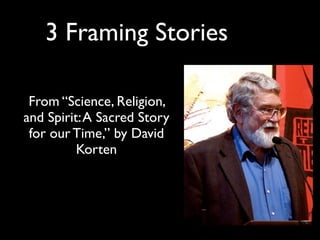
3 Framing Stories

 From “Science, Religion,
and Spirit: A Sacred Story
 for our Time,” by David
          Korten
For people, generally, their story of the
 universe and the human role in the universe
 is their primary source of intelligibility and
 value....The deepest crises experienced by
 any society are those moments of change
 when the story becomes inadequate for
 meeting the survival demands of a present
 situation.”
—Thomas Berry, The Dream of the Earth
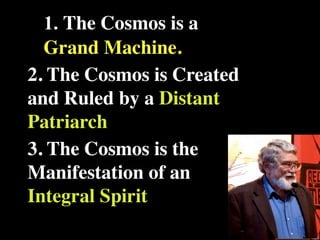
1. The Cosmos is a
  Grand Machine.
2. The Cosmos is Created
and Ruled by a Distant
Patriarch
3. The Cosmos is the
Manifestation of an
Integral Spirit
The cosmology of the Grand Machine strips our
existence of meaning and purpose. In so doing, it
supports consumerism and an ethic of individual
material gratification as a distraction from the
terrifying loneliness and despair of an otherwise
meaningless existence. By characterizing life as
essentially competitive it provides the ideological
basis for social Darwinism, colonial imperialism,
racial domination, and the unrestrained competition of
market fundamentalism. It neglects the far greater role
of cooperation and synergy on which all living
systems—and human society, civilization, and culture
— depend.
[The Distant Patriarch] cosmology focuses on our
individual relationship with a personal, but distant
God .... By implication, relationships with one another
and with nature are secondary to this primary
relationship. Although some adherents believe that we
have an obligation to care for God’s creation in this
life and to show compassion to our fellow human
beings, in many interpretations of the Distant Patriarch
story, life on Earth is but a way station on the path to
paradise. Nature exists for our temporary human use
and comfort. Authority is rightfully exercised by those
who demonstrate by their pious religious observance
their closeness to God and their understanding of His
intention.
In the [Integral Spirit story] we come to know
the nature, purpose, and intention of this divine
force through our inner experience and our
observation of its physical manifestation. All
beings, stars, planets, humans, animals, plants,
rocks, and rivers are expressions of this divine
force—each with its place and function in
service to the whole. The human brain evolved
to reward cooperation and service. Extreme
individualism, greed, and violence are
pathological and a sign of physical,
developmental, cultural, and/or institutional
failure. Appropriate moral behavior is defined
not by rules, but by relationships.
In my experience this is the underlying
cosmology of many Catholic nuns, a surprising
number of religious leaders and congregations
of various faiths, and most people who define
themselves as spiritual, but not necessarily
religious.
It is, however, a story without institutional
sponsors to give it public recognition and
remains a largely private belief system....
[T]hose who align with its foundational
insights may not recognize themselves as a
group, which limits their ability to share their
insights and join together to fulfill the
responsibilities the Integral Spirit story implies.
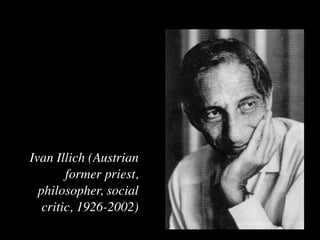
Ivan Illich (Austrian
        former priest,
  philosopher, social
   critic, 1926-2002)
Neither revolution nor reformation can
ultimately change a society, rather you
must tell a new powerful tale, one so
persuasive that it sweeps away the old
myths and becomes the preferred story
…
… one so inclusive that it gathers all the
bits of our past and our present into a
coherent whole, one that even shines some
light into the future so that we can take the
next step…. If you want to change a
society, then you have to tell an alternative
story.
    - attributed to Ivan Illich (Austrian former priest,
                philosopher, social critic, 1926-2002)
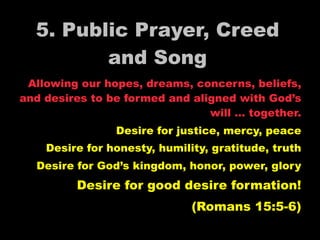
5. Public Prayer, Creed
         and Song
 Allowing our hopes, dreams, concerns, beliefs,
and desires to be formed and aligned with God’s
                                will … together.
                Desire for justice, mercy, peace
    Desire for honesty, humility, gratitude, truth
  Desire for God’s kingdom, honor, power, glory
         Desire for good desire formation!
                              (Romans 15:5-6)
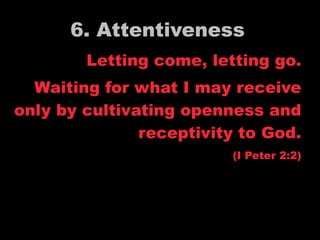
6. Attentiveness
        Letting come, letting go.
  Waiting for what I may receive
only by cultivating openness and
               receptivity to God.
                         (I Peter 2:2)
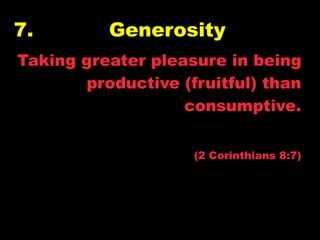
7.        Generosity
Taking greater pleasure in being
       productive (fruitful) than
                   consumptive.


                    (2 Corinthians 8:7)
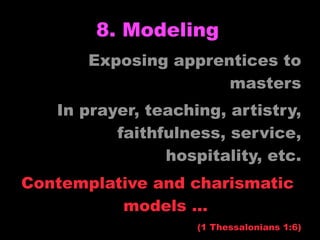
8. Modeling
       Exposing apprentices to
                      masters
   In prayer, teaching, artistry,
          faithfulness, service,
                hospitality, etc.
Contemplative and charismatic
          models …
                    (1 Thessalonians 1:6)
9. Concern and
      commissioning
Quoting, affirming, praying for,
   humanizing, including “the
                         other”
 Being sent out to know, love,
        and serve “the other.”
10. Mystery
“Flat” actions versus layered
                    actions…
    Layers of meaning in the
                  eucharist

          (1 Corinthians 10:16-17, 11:23 ff)
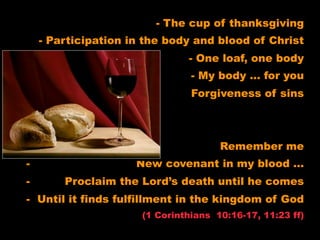
- The cup of thanksgiving
    - Participation in the body and blood of Christ
                               - One loaf, one body
                                - My body … for you
-                               Forgiveness of sins


-                                     Remember me
-                    New covenant in my blood …
-       Proclaim the Lord’s death until he comes
- Until it finds fulfillment in the kingdom of God
                      (1 Corinthians 10:16-17, 11:23 ff)
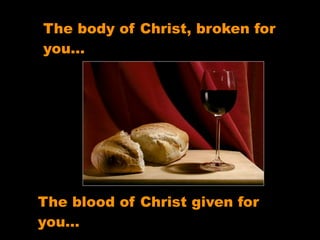
The body of Christ, broken for
you…


The blood of Christ given for
you…
Benediction
Christ has no body here but
                      ours.

  No hands, no feet here on
            earth but ours.

  Ours are the eyes through
             which he looks

On this world with kindness.
Ours are the hands through
which he works.

Ours are the feet on which he
moves.

Ours are the voices through
which he speaks

To this world with kindness.
Through our smile, our touch,
our listening ear,

Embodied in us,

Jesus is living here.
So let us go now

Filled with the Spirit

Into this world

With kindness.
Through our smile, our touch,
our listening ear,

Embodied in us,

Jesus is living here.
So let us go now

Filled with the Spirit

Into this world

With kindness.
Claremont liturgy

Claremont liturgy

  • 1.
  • 2.
    Spiritual formation: The development,through practice, of people who “be,” think, feel, work, relate, and play … in the way of Jesus.
  • 3.
    Spiritual formation: Thedevelopment of disciples.
  • 4.
    transformation make [spiritually form]disciples …teach them to do all I have commanded you. (Matthew 28)
  • 5.
    transformation I have givenyou an example … love one another as I have loved you. (John 13-15)
  • 6.
    transformation to be conformed to the image of God’s Son (Romans 8)
  • 7.
    transformation … be transformed by the renewing of your minds. (Romans 8)
  • 8.
    transformation … I willshow you the most excellent way … follow the way of love (1 Corinthians 12-14)
  • 9.
  • 10.
    Spiritual formation involves intentionalspiritual practices (or disciplines) so people can learn a way:
  • 11.
    Actions within ourpower which we do to train ourselves to do things currently beyond our power, and to become people we are currently incapable of being. - Running a marathon - Playing the guitar - Learning Chinese
  • 12.
    Actions within ourpower which we do to train ourselves to do things currently beyond our power, and to become people we are currently incapable of being. - And if you’re part of a local congregation, you’re already doing many of them!
  • 13.
    Spiritual formation throughgathered worship … gathered worship as group spiritual formation
  • 15.
    Gathered (or Public) Worship Liturgy: A planned succession of group practices (exercises) and rituals.
  • 16.
    Rituals: Practicesdone to bond to the meaning they represent.
  • 17.
    Ritualism: Performingthe prescribed action without connection to the intended meaning: religion on autopilot. (Checklist mentality. Routine/Judge mentality.)
  • 18.
    How can wemaximize gathered worship for spiritual formation as disciples? (How can we avoid spiritual malformation through ritualism or autopilot religion?)
  • 19.
    1. Showing Up: Going to a place I didn’t choose At a time I didn’t choose For a purpose I do choose. (Hebrews 10:24-25)
  • 20.
    2. Association/ Hospitality Associating with some people I like and others I don’t like for a purpose I believe in. (Romans 15:7) Using my presence and our space to help “the other” feel welcome in our community. (1 Corinthians 11:33)
  • 21.
    3. Speed Altering mypace to see what I’ve missed and to feel a different rhythm. Speeding up … slowing down (Hebrews 3:15)
  • 22.
    4. Inhabiting astory Re-orienting my life in a holy storyline that renders me a transforming nonconformist.
  • 23.
    3 Framing Stories From “Science, Religion, and Spirit: A Sacred Story for our Time,” by David Korten
  • 24.
    For people, generally,their story of the universe and the human role in the universe is their primary source of intelligibility and value....The deepest crises experienced by any society are those moments of change when the story becomes inadequate for meeting the survival demands of a present situation.” —Thomas Berry, The Dream of the Earth
  • 25.
    1. The Cosmosis a Grand Machine. 2. The Cosmos is Created and Ruled by a Distant Patriarch 3. The Cosmos is the Manifestation of an Integral Spirit
  • 26.
    The cosmology ofthe Grand Machine strips our existence of meaning and purpose. In so doing, it supports consumerism and an ethic of individual material gratification as a distraction from the terrifying loneliness and despair of an otherwise meaningless existence. By characterizing life as essentially competitive it provides the ideological basis for social Darwinism, colonial imperialism, racial domination, and the unrestrained competition of market fundamentalism. It neglects the far greater role of cooperation and synergy on which all living systems—and human society, civilization, and culture — depend.
  • 27.
    [The Distant Patriarch]cosmology focuses on our individual relationship with a personal, but distant God .... By implication, relationships with one another and with nature are secondary to this primary relationship. Although some adherents believe that we have an obligation to care for God’s creation in this life and to show compassion to our fellow human beings, in many interpretations of the Distant Patriarch story, life on Earth is but a way station on the path to paradise. Nature exists for our temporary human use and comfort. Authority is rightfully exercised by those who demonstrate by their pious religious observance their closeness to God and their understanding of His intention.
  • 28.
    In the [IntegralSpirit story] we come to know the nature, purpose, and intention of this divine force through our inner experience and our observation of its physical manifestation. All beings, stars, planets, humans, animals, plants, rocks, and rivers are expressions of this divine force—each with its place and function in service to the whole. The human brain evolved to reward cooperation and service. Extreme individualism, greed, and violence are pathological and a sign of physical, developmental, cultural, and/or institutional failure. Appropriate moral behavior is defined not by rules, but by relationships.
  • 29.
    In my experiencethis is the underlying cosmology of many Catholic nuns, a surprising number of religious leaders and congregations of various faiths, and most people who define themselves as spiritual, but not necessarily religious. It is, however, a story without institutional sponsors to give it public recognition and remains a largely private belief system.... [T]hose who align with its foundational insights may not recognize themselves as a group, which limits their ability to share their insights and join together to fulfill the responsibilities the Integral Spirit story implies.
  • 30.
    Ivan Illich (Austrian former priest, philosopher, social critic, 1926-2002)
  • 31.
    Neither revolution norreformation can ultimately change a society, rather you must tell a new powerful tale, one so persuasive that it sweeps away the old myths and becomes the preferred story …
  • 32.
    … one soinclusive that it gathers all the bits of our past and our present into a coherent whole, one that even shines some light into the future so that we can take the next step…. If you want to change a society, then you have to tell an alternative story. - attributed to Ivan Illich (Austrian former priest, philosopher, social critic, 1926-2002)
  • 33.
    5. Public Prayer,Creed and Song Allowing our hopes, dreams, concerns, beliefs, and desires to be formed and aligned with God’s will … together. Desire for justice, mercy, peace Desire for honesty, humility, gratitude, truth Desire for God’s kingdom, honor, power, glory Desire for good desire formation! (Romans 15:5-6)
  • 34.
    6. Attentiveness Letting come, letting go. Waiting for what I may receive only by cultivating openness and receptivity to God. (I Peter 2:2)
  • 35.
    7. Generosity Taking greater pleasure in being productive (fruitful) than consumptive. (2 Corinthians 8:7)
  • 36.
    8. Modeling Exposing apprentices to masters In prayer, teaching, artistry, faithfulness, service, hospitality, etc. Contemplative and charismatic models … (1 Thessalonians 1:6)
  • 37.
    9. Concern and commissioning Quoting, affirming, praying for, humanizing, including “the other” Being sent out to know, love, and serve “the other.”
  • 38.
    10. Mystery “Flat” actionsversus layered actions… Layers of meaning in the eucharist (1 Corinthians 10:16-17, 11:23 ff)
  • 39.
    - The cupof thanksgiving - Participation in the body and blood of Christ - One loaf, one body - My body … for you - Forgiveness of sins - Remember me - New covenant in my blood … - Proclaim the Lord’s death until he comes - Until it finds fulfillment in the kingdom of God (1 Corinthians 10:16-17, 11:23 ff)
  • 40.
    The body ofChrist, broken for you… The blood of Christ given for you…
  • 41.
  • 42.
    Christ has nobody here but ours. No hands, no feet here on earth but ours. Ours are the eyes through which he looks On this world with kindness.
  • 43.
    Ours are thehands through which he works. Ours are the feet on which he moves. Ours are the voices through which he speaks To this world with kindness.
  • 44.
    Through our smile,our touch, our listening ear, Embodied in us, Jesus is living here.
  • 45.
    So let usgo now Filled with the Spirit Into this world With kindness.
  • 46.
    Through our smile,our touch, our listening ear, Embodied in us, Jesus is living here.
  • 47.
    So let usgo now Filled with the Spirit Into this world With kindness.