Yitbarek Kazentet2, Wenqing Shen1, Man Gupta1, Dr. Satish Kumar1
1Georgia Institute of Technology, Atlanta, GA; 2University of Southern California, Los Angeles, CA
Background
Abstract
High Electron Mobility Transistors (HEMTs) are field effect transistors which possess a great
advantage over the regular transistors in handling high power and large amount of current and are
widely used in high frequency Radio Frequency (RF) and cellular communication. Heat dissipation
have been the critical issue on the performance of such devices since the efficiency of the HEMTs
devices is dependent on junction temperature. 1Past researches stated that the peak power density
of GaN HEMT technology is limited by a hierarchy of thermal resistances from the junction to the
ambient. Thermal management in terms of removing heat through active and passive mechanism
from the hotspots on the device would be an important task of the study.
Conclusion
Results
Methods
Man P Gupta
Wenqing Shen
Dr. Satish Kumar
GA Tech SURE Program
Grant #
Ajit Vallabhaneni
Dr. Tia L Jackson and SURE Staff
Future Work
Analysis
Use the
simulation results
to construct
conclusions and
suggestions.
Back to
Support References
1. “DOE Fundamentals of Thermodynamics, Heat Transfer, and Fluid Mechanics.” US Department of Energy,
Washington, D.C 20585, June 1992.
2. Y. Won, J. Cho, D. Agonafer, M. Asheghi, K. E. Goodson. “Cooling Limits for GaN HEMT Technology.” IEEE©2013.
3. Y. Mizuno, I. Soga, S. Hirose, O. Tsuboi, T. Iwai. “Si Microchannel Cooler Integrated with
High Power Amplifiers for Base Station of Mobile Communication Systems.” IEEE©2011
Model
Determine and
construct the
proposed
Geometry.
Meshing
Create an
appropriate mesh
based on the
proposed
geometry.
Simulation
Simulate the geometry
with the mesh to
different parameters
including flow rate and
boundary conditions.
A Numerical Study of Active and Passive Cooling of GaN HEMTs
Redefine
308K
304K
300K
308K
304K
300K
308K
304K
300K
308K
304K
300K
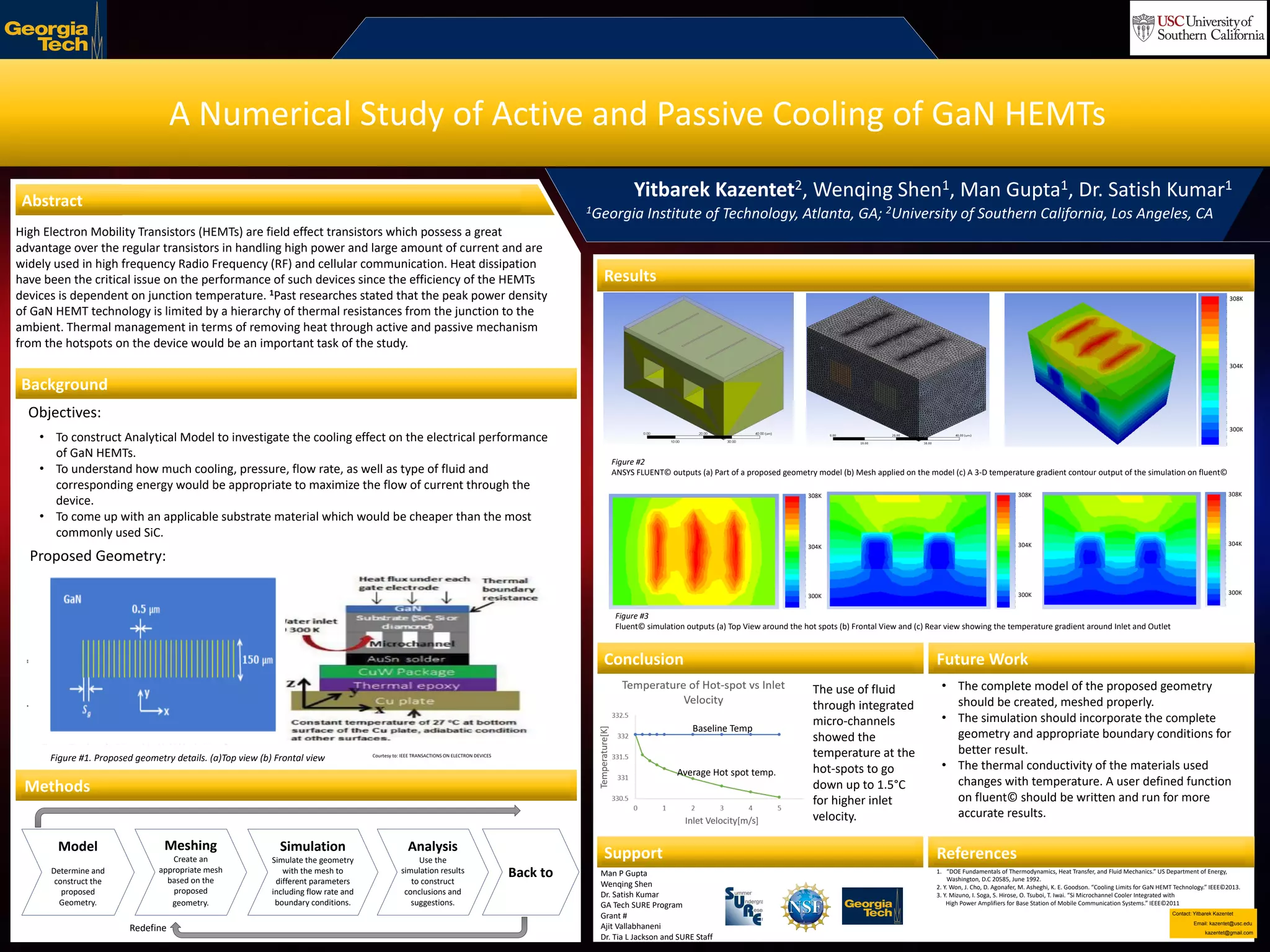
Figure #2
ANSYS FLUENT© outputs (a) Part of a proposed geometry model (b) Mesh applied on the model (c) A 3-D temperature gradient contour output of the simulation on fluent©
Courtesy to: IEEE TRANSACTIONS ON ELECTRON DEVICES
• The complete model of the proposed geometry
should be created, meshed properly.
• The simulation should incorporate the complete
geometry and appropriate boundary conditions for
better result.
• The thermal conductivity of the materials used
changes with temperature. A user defined function
on fluent© should be written and run for more
accurate results.
The use of fluid
through integrated
micro-channels
showed the
temperature at the
hot-spots to go
down up to 1.5°C
for higher inlet
velocity.
Baseline Temp
Average Hot spot temp.
Objectives:
• To construct Analytical Model to investigate the cooling effect on the electrical performance
of GaN HEMTs.
• To understand how much cooling, pressure, flow rate, as well as type of fluid and
corresponding energy would be appropriate to maximize the flow of current through the
device.
• To come up with an applicable substrate material which would be cheaper than the most
commonly used SiC.
Proposed Geometry:
Figure #1. Proposed geometry details. (a)Top view (b) Frontal view
Figure #3
Fluent© simulation outputs (a) Top View around the hot spots (b) Frontal View and (c) Rear view showing the temperature gradient around Inlet and Outlet
Contact: Yitbarek Kazentet
Email: kazentet@usc.edu
kazentet@gmail.com

YitbarekKazentetPosterDesign

  • 1.
    Yitbarek Kazentet2, WenqingShen1, Man Gupta1, Dr. Satish Kumar1 1Georgia Institute of Technology, Atlanta, GA; 2University of Southern California, Los Angeles, CA Background Abstract High Electron Mobility Transistors (HEMTs) are field effect transistors which possess a great advantage over the regular transistors in handling high power and large amount of current and are widely used in high frequency Radio Frequency (RF) and cellular communication. Heat dissipation have been the critical issue on the performance of such devices since the efficiency of the HEMTs devices is dependent on junction temperature. 1Past researches stated that the peak power density of GaN HEMT technology is limited by a hierarchy of thermal resistances from the junction to the ambient. Thermal management in terms of removing heat through active and passive mechanism from the hotspots on the device would be an important task of the study. Conclusion Results Methods Man P Gupta Wenqing Shen Dr. Satish Kumar GA Tech SURE Program Grant # Ajit Vallabhaneni Dr. Tia L Jackson and SURE Staff Future Work Analysis Use the simulation results to construct conclusions and suggestions. Back to Support References 1. “DOE Fundamentals of Thermodynamics, Heat Transfer, and Fluid Mechanics.” US Department of Energy, Washington, D.C 20585, June 1992. 2. Y. Won, J. Cho, D. Agonafer, M. Asheghi, K. E. Goodson. “Cooling Limits for GaN HEMT Technology.” IEEE©2013. 3. Y. Mizuno, I. Soga, S. Hirose, O. Tsuboi, T. Iwai. “Si Microchannel Cooler Integrated with High Power Amplifiers for Base Station of Mobile Communication Systems.” IEEE©2011 Model Determine and construct the proposed Geometry. Meshing Create an appropriate mesh based on the proposed geometry. Simulation Simulate the geometry with the mesh to different parameters including flow rate and boundary conditions. A Numerical Study of Active and Passive Cooling of GaN HEMTs Redefine 308K 304K 300K 308K 304K 300K 308K 304K 300K 308K 304K 300K Figure #2 ANSYS FLUENT© outputs (a) Part of a proposed geometry model (b) Mesh applied on the model (c) A 3-D temperature gradient contour output of the simulation on fluent© Courtesy to: IEEE TRANSACTIONS ON ELECTRON DEVICES • The complete model of the proposed geometry should be created, meshed properly. • The simulation should incorporate the complete geometry and appropriate boundary conditions for better result. • The thermal conductivity of the materials used changes with temperature. A user defined function on fluent© should be written and run for more accurate results. The use of fluid through integrated micro-channels showed the temperature at the hot-spots to go down up to 1.5°C for higher inlet velocity. Baseline Temp Average Hot spot temp. Objectives: • To construct Analytical Model to investigate the cooling effect on the electrical performance of GaN HEMTs. • To understand how much cooling, pressure, flow rate, as well as type of fluid and corresponding energy would be appropriate to maximize the flow of current through the device. • To come up with an applicable substrate material which would be cheaper than the most commonly used SiC. Proposed Geometry: Figure #1. Proposed geometry details. (a)Top view (b) Frontal view Figure #3 Fluent© simulation outputs (a) Top View around the hot spots (b) Frontal View and (c) Rear view showing the temperature gradient around Inlet and Outlet Contact: Yitbarek Kazentet Email: kazentet@usc.edu kazentet@gmail.com