Year 11 Summer exam: USA 1945-1970: The USA a divided union?What should I revise? (This should all be in your book)Remember, this is a source paper, so the level of knowledge is much less than the other papers.
Key Topic 1 McCarthyism and the Red ScareThe impact of the Cold War.The development of the Red Scare.The impact of McCarthyism.Amplification of contentThe impact of the Cold War involves reactions in the USA to the build-upof the Cold War in Europe including Soviet expansion in eastern Europe,the Truman Doctrine and Marshall Plan, the Berlin Crisis (1948–9),NATO, the Soviet Union and the atom bomb and the Korean War. Thedevelopment of the Red Scare relates to events in the USA including theFBI, HUAC, the Hollywood Ten and the Hiss and Rosenberg court cases.The impact of McCarthyism involves McCarthy’s emergence, the methodshe used and their impact, the reasons for the decline of McCarthyism andits overall impact on the USA.
Key Topic 2 The civil rights movement 1945–62Progress, especially in education and problems in implementation.Montgomery Bus Boycott.Martin Luther King and further progress and problems 1958–62.Amplification of contentThe impact of Second World War, the work of the NACCP, CORE, SNCCand the Supreme Court and key developments in education includingBrown v Topeka, Little Rock and the Meredith Case, problems faced bystudents and levels of support for segregation. The Montgomery BusBoycott, its causes, the events and results; the actions of Rosa Parkes,the organisation of the boycott, the involvement of Martin Luther King,reasons for its success and its importance. The methods and leadershipof Martin Luther King, sit-ins and the freedom riders, opposition, KKKviolence and the Anniston bomb.
Key Topic 3 Changes in the civil rights movement 1963–70Peace marches in 1963: Washington and Alabama.Martin Luther King and civil rights legislation.Malcolm X and Black Power.Amplification of contentViolent reactions to the peace march in Birmingham, Alabama, thepeace march in Washington and the ‘dream’ speech. The influence ofMartin Luther King over John F Kennedy and the civil rights movement,‘Freedom Summer’ of 1964, the murder of SNCC workers in Mississippi,Selma and the Voting Rights Act, the importance of the civil rightsAct, 1964 and the impact of the assassination of Martin Luther King.Malcolm X and his initial beliefs, methods, influence and involvementwith the Black Muslims and his later change in attitude. Black Powerinvolves the leadership of Stokely Carmichael and the meaning of BlackPower, the Black Panther movement, inner city riots and civil rights atthe end of the 1960s.
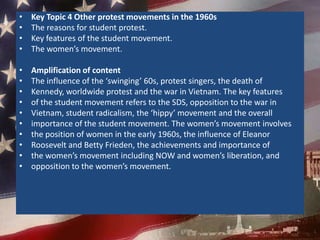
Key Topic 4 Other protest movements in the 1960sThe reasons for student protest.Key features of the student movement.The women’s movement.Amplification of contentThe influence of the ‘swinging’ 60s, protest singers, the death ofKennedy, worldwide protest and the war in Vietnam. The key featuresof the student movement refers to the SDS, opposition to the war inVietnam, student radicalism, the ‘hippy’ movement and the overallimportance of the student movement. The women’s movement involvesthe position of women in the early 1960s, the influence of EleanorRoosevelt and Betty Frieden, the achievements and importance ofthe women’s movement including NOW and women’s liberation, andopposition to the women’s movement.

Year 11 summer exam divided union, content

  • 1.
    Year 11 Summerexam: USA 1945-1970: The USA a divided union?What should I revise? (This should all be in your book)Remember, this is a source paper, so the level of knowledge is much less than the other papers.
  • 2.
    Key Topic 1McCarthyism and the Red ScareThe impact of the Cold War.The development of the Red Scare.The impact of McCarthyism.Amplification of contentThe impact of the Cold War involves reactions in the USA to the build-upof the Cold War in Europe including Soviet expansion in eastern Europe,the Truman Doctrine and Marshall Plan, the Berlin Crisis (1948–9),NATO, the Soviet Union and the atom bomb and the Korean War. Thedevelopment of the Red Scare relates to events in the USA including theFBI, HUAC, the Hollywood Ten and the Hiss and Rosenberg court cases.The impact of McCarthyism involves McCarthy’s emergence, the methodshe used and their impact, the reasons for the decline of McCarthyism andits overall impact on the USA.
  • 3.
    Key Topic 2The civil rights movement 1945–62Progress, especially in education and problems in implementation.Montgomery Bus Boycott.Martin Luther King and further progress and problems 1958–62.Amplification of contentThe impact of Second World War, the work of the NACCP, CORE, SNCCand the Supreme Court and key developments in education includingBrown v Topeka, Little Rock and the Meredith Case, problems faced bystudents and levels of support for segregation. The Montgomery BusBoycott, its causes, the events and results; the actions of Rosa Parkes,the organisation of the boycott, the involvement of Martin Luther King,reasons for its success and its importance. The methods and leadershipof Martin Luther King, sit-ins and the freedom riders, opposition, KKKviolence and the Anniston bomb.
  • 4.
    Key Topic 3Changes in the civil rights movement 1963–70Peace marches in 1963: Washington and Alabama.Martin Luther King and civil rights legislation.Malcolm X and Black Power.Amplification of contentViolent reactions to the peace march in Birmingham, Alabama, thepeace march in Washington and the ‘dream’ speech. The influence ofMartin Luther King over John F Kennedy and the civil rights movement,‘Freedom Summer’ of 1964, the murder of SNCC workers in Mississippi,Selma and the Voting Rights Act, the importance of the civil rightsAct, 1964 and the impact of the assassination of Martin Luther King.Malcolm X and his initial beliefs, methods, influence and involvementwith the Black Muslims and his later change in attitude. Black Powerinvolves the leadership of Stokely Carmichael and the meaning of BlackPower, the Black Panther movement, inner city riots and civil rights atthe end of the 1960s.
  • 5.
    Key Topic 4Other protest movements in the 1960sThe reasons for student protest.Key features of the student movement.The women’s movement.Amplification of contentThe influence of the ‘swinging’ 60s, protest singers, the death ofKennedy, worldwide protest and the war in Vietnam. The key featuresof the student movement refers to the SDS, opposition to the war inVietnam, student radicalism, the ‘hippy’ movement and the overallimportance of the student movement. The women’s movement involvesthe position of women in the early 1960s, the influence of EleanorRoosevelt and Betty Frieden, the achievements and importance ofthe women’s movement including NOW and women’s liberation, andopposition to the women’s movement.