WOODPECKERS 
Integrated Pest Management for Home Gardeners and Landscape Professionals 
Woodpeckers (Melanerpes spp.), includ-ing 
sapsuckers (Sphyrapucys spp.), and 
fl ickers (Colaptes spp.) belong to an 
interesting and well-known group of 
birds in the family Picidae. There are 
17 species found in California, two of 
which are California-listed endangered 
species. Woodpeckers vary in size 
and range from about 7 to 14 inches in 
length, usually with brightly contrast-ing 
coloration. Most males have some 
red on the head, and black and white 
markings are common on many species. 
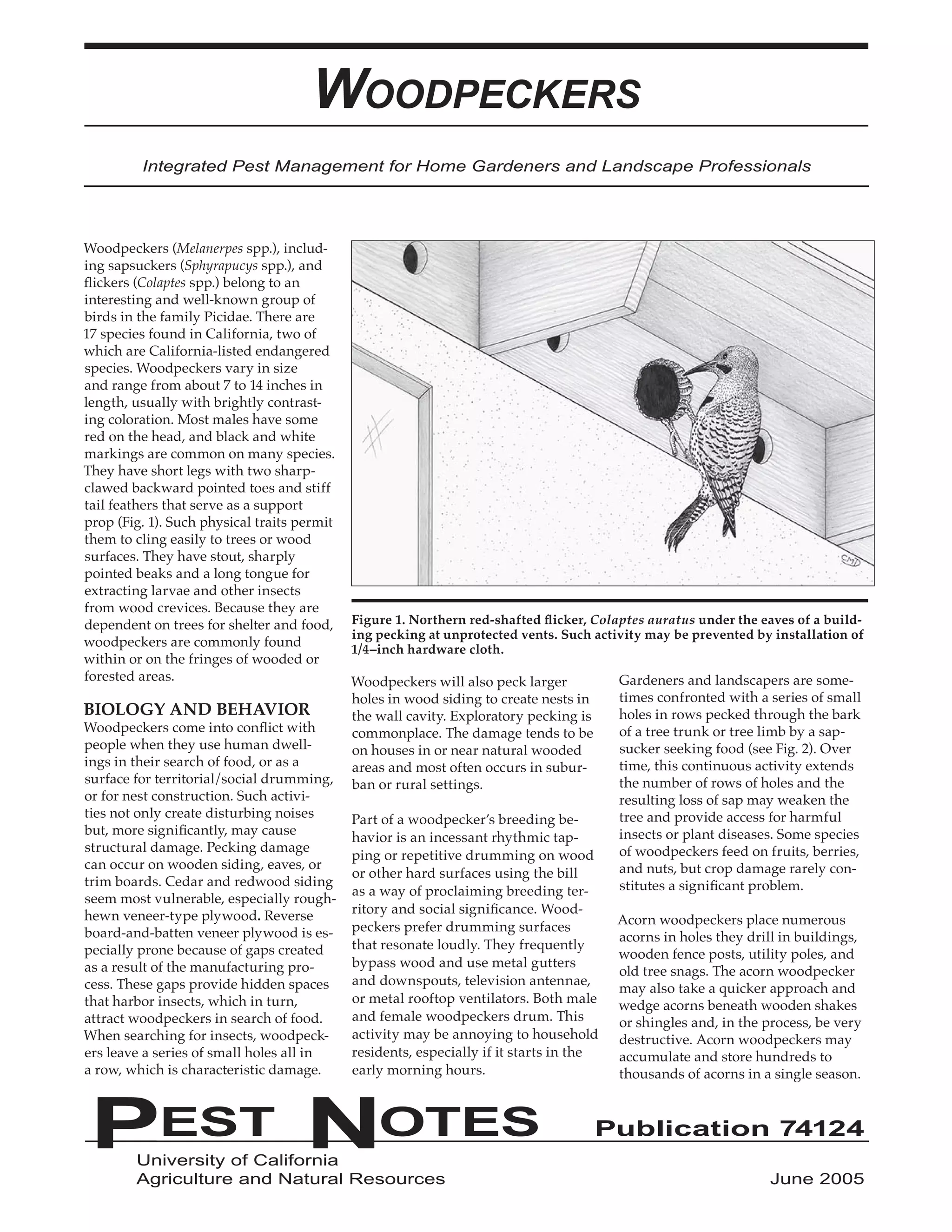
They have short legs with two sharp-clawed 
backward pointed toes and stiff 
tail feathers that serve as a support 
prop (Fig. 1). Such physical traits permit 
them to cling easily to trees or wood 
surfaces. They have stout, sharply 
pointed beaks and a long tongue for 
extracting larvae and other insects 
from wood crevices. Because they are 
dependent on trees for shelter and food, 
woodpeckers are commonly found 
within or on the fringes of wooded or 
forested areas. 
BIOLOGY AND BEHAVIOR 
Woodpeckers come into confl ict with 
people when they use human dwell-ings 
in their search of food, or as a 
surface for territorial/social drumming, 
or for nest construction. Such activi-ties 
not only create disturbing noises 
but, more signifi cantly, may cause 
structural damage. Pecking damage 
can occur on wooden siding, eaves, or 
trim boards. Cedar and redwood siding 
seem most vulnerable, especially rough-hewn 
veneer-type plywood. Reverse 
board-and-batten veneer plywood is es-pecially 
prone because of gaps created 
as a result of the manufacturing pro-cess. 
These gaps provide hidden spaces 
that harbor insects, which in turn, 
attract woodpeckers in search of food. 
When searching for insects, woodpeck-ers 
leave a series of small holes all in 
a row, which is characteristic damage. 
Figure 1. Northern red-shafted fl icker, Colaptes auratus under the eaves of a build-ing 
pecking at unprotected vents. Such activity may be prevented by installation of 
1/4–inch hardware cloth. 
Woodpeckers will also peck larger 
holes in wood siding to create nests in 
the wall cavity. Exploratory pecking is 
commonplace. The damage tends to be 
on houses in or near natural wooded 
areas and most often occurs in subur-ban 
or rural settings. 
Part of a woodpecker’s breeding be-havior 
is an incessant rhythmic tap-ping 
or repetitive drumming on wood 
or other hard surfaces using the bill 
as a way of proclaiming breeding ter-ritory 
and social signifi cance. Wood-peckers 
prefer drumming surfaces 
that resonate loudly. They frequently 
bypass wood and use metal gutters 
and downspouts, television antennae, 
or metal rooftop ventilators. Both male 
and female woodpeckers drum. This 
activity may be annoying to household 
residents, especially if it starts in the 
early morning hours. 
Gardeners and landscapers are some-times 
confronted with a series of small 
holes in rows pecked through the bark 
of a tree trunk or tree limb by a sap-sucker 
seeking food (see Fig. 2). Over 
time, this continuous activity extends 
the number of rows of holes and the 
resulting loss of sap may weaken the 
tree and provide access for harmful 
insects or plant diseases. Some species 
of woodpeckers feed on fruits, berries, 
and nuts, but crop damage rarely con-stitutes 
a signifi cant problem. 
Acorn woodpeckers place numerous 
acorns in holes they drill in buildings, 
wooden fence posts, utility poles, and 
old tree snags. The acorn woodpecker 
may also take a quicker approach and 
wedge acorns beneath wooden shakes 
or shingles and, in the process, be very 
destructive. Acorn woodpeckers may 
accumulate and store hundreds to 
thousands of acorns in a single season. 
PEST NOTES Publication 74124 
University of California 
Agriculture and Natural Resources 
June 2005
June 2005 Woodpeckers 
◆ 2 of 3 ◆ 
LEGAL STATUS 
All woodpeckers are protected under 
the Migratory Bird Treaty Act of 1918 
as migratory insectivorous birds and 
are classifi ed as non-game by the state. 
Two California woodpeckers (Gila 
woodpecker, Melanerpes uropygialis, 
and Gilded northern fl icker, Colaptes 
auratus chrysoides) are California-listed 
endangered species and are offered 
greater protection. When warranted, 
woodpeckers other than endangered 
species can be killed, but only under a 
permit issued by the Law Enforcement 
Division of the U.S. Fish and Wildlife 
Service upon recommendation of the 
United States Department of Agricul-ture, 
Animal and Plant Health Inspec-tion 
Service (USDA-APHIS) Wildlife 
Services personnel. Generally there 
must be a good case to justify a permit 
and the permit process is time consum-ing. 
Control methods that do not harm 
the bird or its active nest are allowed 
except for the two endangered species. 
Those species cannot be harassed or 
bothered in any way. Physical exclu-sion, 
if installed before the endangered 
species is in the area, is allowed. For 
more information on these and other 
endangered species, see the California 
Department of Fish and Game Web-site, 
www.dfg.ca.gov/; or contact the 
main offi ce of USDA-APHIS Wildlife 
Services in your state; online see 
www.aphis.usda.gov/ws/. 
MANAGEMENT 
Several methods have been used to 
prevent damage or to frighten wood-peckers 
from a site. Physical exclusion 
is by far the most effective. More often 
than not, frightening devices or repel-lents 
fail to provide the desired result. 
Physical Exclusion 
Installing bird-type netting to prevent 
woodpeckers from gaining access to 
wood siding or other wood surfaces 
is the most effective method to stop 
building damage. The lightweight, 
plastic, 3/4–inch mesh is stretched 
from the eaves to a lower point on 
the building (see Fig. 3 and 4). Alter-natively, 
the netting can be stretched 
over any fl at surface subject to damage, 
leaving at least three inches of space 
between the netting and damaged 
surface so that the birds cannot cause 
further damage through the mesh. If 
the appropriate type and color of net-ting 
is selected and properly installed, 
it is barely visible from a distance of a 
few yards and will offer a long-term 
solution to prevent subsequent dam-age. 
Remember that you may have to 
net the entire side of a building; oth-erwise 
the woodpecker may move just 
beyond the netted area and continue 
its activities. 
If a plastic net is used, it should be 
attached so that it can be pulled taut. 
This prevents fl apping in the wind, 
which looks unsightly and results 
in tangles or breakage at mounting 
points. The net should not have any 
loose pockets or wrinkles that could 
trap and entangle birds. 
Netting can be attached using tape, 
staples, or hooks on the eaves and the 
side of the building. An advantage 
of hooks is that the net can be taken 
down for maintenance of light fi x-tures, 
painting, etc. If staples are used, 
they should be rust-resistant to avoid 
unsightly rust stains on the build-ing. 
When using hooks, a supporting 
framework of wooden dowels, wood 
laths, or metal rods along the netting 
edges will ease attachment and cre-ate 
uniform tension on the net. Netting 
may also be wrapped once or twice 
around wood laths and nailed directly 
to the building. It should extend from 
the outer eaves edge down the side 
of the building to the point where the 
eaves’ protection from the elements is 
lost. 
Extensive netting may be a bigger 
task than some homeowners want to 
assume, especially if it involves a two-story 
building. In this case, it may be 
advisable to call a bird control profes-sional; 
look under “pest control” in the 
telephone book. Netting is increasingly 
used to curtail woodpecker damage 
because it consistently provides the 
desired result. 
Sections of lightweight sheet metal 
or 1/4–inch hardware cloth may be 
fastened directly over the woodpecker- 
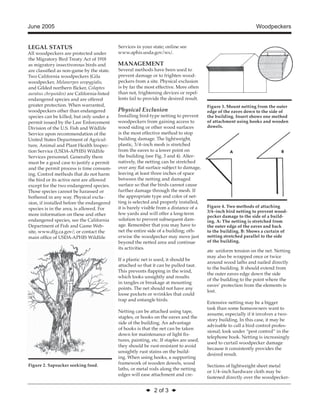
Figure 2. Sapsucker seeking food. 
Figure 3. Mount netting from the outer 
edge of the eaves down to the side of 
the building. Insert shows one method 
of attachment using hooks and wooden 
dowels. 
Figure 4. Two methods of attaching 
3/4–inch bird netting to prevent wood-pecker 
damage to the side of a build-ing. 
A: The netting is stretched from 
the outer edge of the eaves and back 
to the building. B: Shows a curtain of 
netting stretched parallel to the side 
of the building.
June 2005 Woodpeckers 
WARNING ON THE USE OF CHEMICALS 
Pesticides are poisonous. Always read and carefully follow all precautions and safety recommendations 
given on the container label. Store all chemicals in the original labeled containers in a locked cabinet or shed, 
away from food or feeds, and out of the reach of children, unauthorized persons, pets, and livestock. 
Confi ne chemicals to the property being treated. Avoid drift onto neighboring properties, especially gardens 
containing fruits or vegetables ready to be picked. 
Do not place containers containing pesticide in the trash or pour pesticides down sink or toilet. Either use 
the pesticide according to the label or take unwanted pesticides to a Household Hazardous Waste Collection 
site. Contact your county agricultural commissioner for additional information on safe container disposal and 
for the location of the Household Hazardous Waste Collection site nearest you. Dispose of empty containers 
by following label directions. Never reuse or burn the containers or dispose of them in such a manner that 
they may contaminate water supplies or natural waterways. 
The University of California prohibits discrimination or harassment of any person on the basis of race, 
color, national origin, religion, sex, gender identity, pregnancy (including childbirth, and medical condi-tions 
related to pregnancy or childbirth), physical or mental disability, medical condition (cancer-related 
or genetic characteristics), ancestry, marital status, age, sexual orientation, citizenship, or status as a 
covered veteran (covered veterans are special disabled veterans, recently separated veterans, Vietnam 
era veterans, or any other veterans who served on active duty during a war or in a campaign or expedi-tion 
for which a campaign badge has been authorized) in any of its programs or activities. University 
policy is intended to be consistent with the provisions of applicable State and Federal laws. Inquiries 
regarding the University’s nondiscrimination policies may be directed to the Affi rmative Action/Staff 
Personnel Services Director, University of California, Agriculture and Natural Resources, 300 Lakeside 
Drive, 6th Floor, Oakland, CA 94612-3550, (510) 987-0096. 
◆ 3 of 3 ◆ 
damaged areas. If done at the fi rst sign 
of damage the bird may be discour-aged 
and move on to another location. 
This metal sheeting or wire mesh can 
be painted to match the siding. This 
method is most useful where only one 
or a few relatively small areas have 
been damaged. 
Wire mesh, such as chicken wire, 
wrapped around tree trunks or limbs 
being damaged by a sapsucker will 
often persuade the bird to relocate. In 
most cases, it will be necessary to pro-tect 
a large area with mesh because the 
woodpecker will move to a nearby area 
and begin pecking again. 
Bird netting is available at many hard-ware 
and farm supply stores as well as 
from Internet sources. 
For more information contact the University 
of California Cooperative Extension or agri-cultural 
commissioner’s offi ce in your county. 
See your phone book for addresses and 
phone numbers. 
AUTHORS: T. P. Salmon, D. A. Whisson, 
and R. E. Marsh 
TECHNICAL EDITOR: M. L. Flint 
COORDINATION, DESIGN, & 
PRODUCTION: P. Galin 
ILLUSTRATIONS: Fig. 1 Christine M. De- 
Wees; Fig. 2: Courtesy of R. E. Marsh; Figs. 
3,4: Adapted from Salmon,T. P., and W. P. 
Gorenzel. 1981. Cliff Swallows: How to Live 
with Them. Oakland: Univ. Calif. Div. Agric. 
Sci. Leafl et 2126 
Produced by IPM Education and Publica-tions, 
UC Statewide IPM Program, University 
of California, Davis, CA 95616-8620 
This Pest Note is available on the World 
Wide Web (www.ipm.ucdavis.edu) 
This publication has been anonymously peer 
reviewed for technical accuracy by University of 
California scientists and other qualifi ed profession-als. 
This review process was managed by the ANR 
Associate Editor for Pest Management. 
To simplify information, trade names of products 
have been used. No endorsement of named products 
is intended, nor is criticism implied of similar products 
that are not mentioned. 
This material is partially based upon work supported 
by the Extension Service, U.S. Department of 
Agriculture, under special project Section 3(d), 
Integrated Pest Management. 
Frightening Devices 
Models of hawks, owls, and snakes are 
ineffective as frightening devices. Plas-tic 
twirlers or windmills fastened to the 
eaves, and aluminum foil or brightly-colored 
plastic strips hung from above 
repel by movement and refl ection and 
have been used with inconsistent suc-cess. 
Various other gadgets or devices 
are marketed for frightening wood-peckers, 
including a sound-activated 
giant model of a climbing spider. Some 
claim that various frightening devices 
resolved their particular problem. This 
is possible only if the woodpecker has 
not become well-attached to that partic-ular 
location. Once established, wood-peckers 
are persistent and are not easily 
driven from their territory or selected 
pecking site. 
Repellents 
Many chemicals having objectionable 
tastes or odors have been tested for 
repelling woodpeckers with little or no 
success. This search continues and in 
the future something effective may be 
found. 
On buildings sticky or tacky bird re-pellents 
such as Tanglefoot are some-times 
effective if applied to sections 
of thin plywood and placed over the 
damaged area. The substances do not 
entrap the birds, but they dislike the 
tacky footing. 
Applying sticky or tacky bird repel-lents 
can sometimes be an effective 
solution to the problem of sapsucker 
attacks on trees 
Other Control Methods 
Woodpeckers can only be removed 
with a permit specifying trapping or 
shooting as the control method. 
Other methods that are sometimes 
suggested include feeding suet to the 
woodpecker in the hope of discourag-ing 
damage. Placing nest boxes on 
nearby buildings, poles, or trees has 
also been advised, but there is no 
consistent information on whether 
providing food or nesting boxes serves 
to reduce the problem. They may, in 
fact, serve as attractants, favoring an 
increase in woodpecker numbers. 
MONITORING GUIDELINES 
Woodpeckers, like many other birds, 
are so visible that little specifi c moni-toring 
information is needed. In the 
case of woodpeckers, they may be 
heard pecking and drumming even 
before they are seen. Hearing their ac-tivity 
over several consecutive days is a 
cue to make a visual inspection. Vaca-tion 
homes in forested areas should be 
checked for damage several times dur-ing 
the spring and summer. 
COMPILED FROM 
Salmon, T. P., D. A. Whisson, and R. E. 
Marsh. In press. Wildlife Pest Control 
Around Gardens and Homes. 2nd ed. Oak-land: 
Univ. Calif. Agric. Nat. Res. Publ. 
21385. v

Woodpeckers Integrated Pest Management

  • 1.
    WOODPECKERS Integrated PestManagement for Home Gardeners and Landscape Professionals Woodpeckers (Melanerpes spp.), includ-ing sapsuckers (Sphyrapucys spp.), and fl ickers (Colaptes spp.) belong to an interesting and well-known group of birds in the family Picidae. There are 17 species found in California, two of which are California-listed endangered species. Woodpeckers vary in size and range from about 7 to 14 inches in length, usually with brightly contrast-ing coloration. Most males have some red on the head, and black and white markings are common on many species. They have short legs with two sharp-clawed backward pointed toes and stiff tail feathers that serve as a support prop (Fig. 1). Such physical traits permit them to cling easily to trees or wood surfaces. They have stout, sharply pointed beaks and a long tongue for extracting larvae and other insects from wood crevices. Because they are dependent on trees for shelter and food, woodpeckers are commonly found within or on the fringes of wooded or forested areas. BIOLOGY AND BEHAVIOR Woodpeckers come into confl ict with people when they use human dwell-ings in their search of food, or as a surface for territorial/social drumming, or for nest construction. Such activi-ties not only create disturbing noises but, more signifi cantly, may cause structural damage. Pecking damage can occur on wooden siding, eaves, or trim boards. Cedar and redwood siding seem most vulnerable, especially rough-hewn veneer-type plywood. Reverse board-and-batten veneer plywood is es-pecially prone because of gaps created as a result of the manufacturing pro-cess. These gaps provide hidden spaces that harbor insects, which in turn, attract woodpeckers in search of food. When searching for insects, woodpeck-ers leave a series of small holes all in a row, which is characteristic damage. Figure 1. Northern red-shafted fl icker, Colaptes auratus under the eaves of a build-ing pecking at unprotected vents. Such activity may be prevented by installation of 1/4–inch hardware cloth. Woodpeckers will also peck larger holes in wood siding to create nests in the wall cavity. Exploratory pecking is commonplace. The damage tends to be on houses in or near natural wooded areas and most often occurs in subur-ban or rural settings. Part of a woodpecker’s breeding be-havior is an incessant rhythmic tap-ping or repetitive drumming on wood or other hard surfaces using the bill as a way of proclaiming breeding ter-ritory and social signifi cance. Wood-peckers prefer drumming surfaces that resonate loudly. They frequently bypass wood and use metal gutters and downspouts, television antennae, or metal rooftop ventilators. Both male and female woodpeckers drum. This activity may be annoying to household residents, especially if it starts in the early morning hours. Gardeners and landscapers are some-times confronted with a series of small holes in rows pecked through the bark of a tree trunk or tree limb by a sap-sucker seeking food (see Fig. 2). Over time, this continuous activity extends the number of rows of holes and the resulting loss of sap may weaken the tree and provide access for harmful insects or plant diseases. Some species of woodpeckers feed on fruits, berries, and nuts, but crop damage rarely con-stitutes a signifi cant problem. Acorn woodpeckers place numerous acorns in holes they drill in buildings, wooden fence posts, utility poles, and old tree snags. The acorn woodpecker may also take a quicker approach and wedge acorns beneath wooden shakes or shingles and, in the process, be very destructive. Acorn woodpeckers may accumulate and store hundreds to thousands of acorns in a single season. PEST NOTES Publication 74124 University of California Agriculture and Natural Resources June 2005
  • 2.
    June 2005 Woodpeckers ◆ 2 of 3 ◆ LEGAL STATUS All woodpeckers are protected under the Migratory Bird Treaty Act of 1918 as migratory insectivorous birds and are classifi ed as non-game by the state. Two California woodpeckers (Gila woodpecker, Melanerpes uropygialis, and Gilded northern fl icker, Colaptes auratus chrysoides) are California-listed endangered species and are offered greater protection. When warranted, woodpeckers other than endangered species can be killed, but only under a permit issued by the Law Enforcement Division of the U.S. Fish and Wildlife Service upon recommendation of the United States Department of Agricul-ture, Animal and Plant Health Inspec-tion Service (USDA-APHIS) Wildlife Services personnel. Generally there must be a good case to justify a permit and the permit process is time consum-ing. Control methods that do not harm the bird or its active nest are allowed except for the two endangered species. Those species cannot be harassed or bothered in any way. Physical exclu-sion, if installed before the endangered species is in the area, is allowed. For more information on these and other endangered species, see the California Department of Fish and Game Web-site, www.dfg.ca.gov/; or contact the main offi ce of USDA-APHIS Wildlife Services in your state; online see www.aphis.usda.gov/ws/. MANAGEMENT Several methods have been used to prevent damage or to frighten wood-peckers from a site. Physical exclusion is by far the most effective. More often than not, frightening devices or repel-lents fail to provide the desired result. Physical Exclusion Installing bird-type netting to prevent woodpeckers from gaining access to wood siding or other wood surfaces is the most effective method to stop building damage. The lightweight, plastic, 3/4–inch mesh is stretched from the eaves to a lower point on the building (see Fig. 3 and 4). Alter-natively, the netting can be stretched over any fl at surface subject to damage, leaving at least three inches of space between the netting and damaged surface so that the birds cannot cause further damage through the mesh. If the appropriate type and color of net-ting is selected and properly installed, it is barely visible from a distance of a few yards and will offer a long-term solution to prevent subsequent dam-age. Remember that you may have to net the entire side of a building; oth-erwise the woodpecker may move just beyond the netted area and continue its activities. If a plastic net is used, it should be attached so that it can be pulled taut. This prevents fl apping in the wind, which looks unsightly and results in tangles or breakage at mounting points. The net should not have any loose pockets or wrinkles that could trap and entangle birds. Netting can be attached using tape, staples, or hooks on the eaves and the side of the building. An advantage of hooks is that the net can be taken down for maintenance of light fi x-tures, painting, etc. If staples are used, they should be rust-resistant to avoid unsightly rust stains on the build-ing. When using hooks, a supporting framework of wooden dowels, wood laths, or metal rods along the netting edges will ease attachment and cre-ate uniform tension on the net. Netting may also be wrapped once or twice around wood laths and nailed directly to the building. It should extend from the outer eaves edge down the side of the building to the point where the eaves’ protection from the elements is lost. Extensive netting may be a bigger task than some homeowners want to assume, especially if it involves a two-story building. In this case, it may be advisable to call a bird control profes-sional; look under “pest control” in the telephone book. Netting is increasingly used to curtail woodpecker damage because it consistently provides the desired result. Sections of lightweight sheet metal or 1/4–inch hardware cloth may be fastened directly over the woodpecker- Figure 2. Sapsucker seeking food. Figure 3. Mount netting from the outer edge of the eaves down to the side of the building. Insert shows one method of attachment using hooks and wooden dowels. Figure 4. Two methods of attaching 3/4–inch bird netting to prevent wood-pecker damage to the side of a build-ing. A: The netting is stretched from the outer edge of the eaves and back to the building. B: Shows a curtain of netting stretched parallel to the side of the building.
  • 3.
    June 2005 Woodpeckers WARNING ON THE USE OF CHEMICALS Pesticides are poisonous. Always read and carefully follow all precautions and safety recommendations given on the container label. Store all chemicals in the original labeled containers in a locked cabinet or shed, away from food or feeds, and out of the reach of children, unauthorized persons, pets, and livestock. Confi ne chemicals to the property being treated. Avoid drift onto neighboring properties, especially gardens containing fruits or vegetables ready to be picked. Do not place containers containing pesticide in the trash or pour pesticides down sink or toilet. Either use the pesticide according to the label or take unwanted pesticides to a Household Hazardous Waste Collection site. Contact your county agricultural commissioner for additional information on safe container disposal and for the location of the Household Hazardous Waste Collection site nearest you. Dispose of empty containers by following label directions. Never reuse or burn the containers or dispose of them in such a manner that they may contaminate water supplies or natural waterways. The University of California prohibits discrimination or harassment of any person on the basis of race, color, national origin, religion, sex, gender identity, pregnancy (including childbirth, and medical condi-tions related to pregnancy or childbirth), physical or mental disability, medical condition (cancer-related or genetic characteristics), ancestry, marital status, age, sexual orientation, citizenship, or status as a covered veteran (covered veterans are special disabled veterans, recently separated veterans, Vietnam era veterans, or any other veterans who served on active duty during a war or in a campaign or expedi-tion for which a campaign badge has been authorized) in any of its programs or activities. University policy is intended to be consistent with the provisions of applicable State and Federal laws. Inquiries regarding the University’s nondiscrimination policies may be directed to the Affi rmative Action/Staff Personnel Services Director, University of California, Agriculture and Natural Resources, 300 Lakeside Drive, 6th Floor, Oakland, CA 94612-3550, (510) 987-0096. ◆ 3 of 3 ◆ damaged areas. If done at the fi rst sign of damage the bird may be discour-aged and move on to another location. This metal sheeting or wire mesh can be painted to match the siding. This method is most useful where only one or a few relatively small areas have been damaged. Wire mesh, such as chicken wire, wrapped around tree trunks or limbs being damaged by a sapsucker will often persuade the bird to relocate. In most cases, it will be necessary to pro-tect a large area with mesh because the woodpecker will move to a nearby area and begin pecking again. Bird netting is available at many hard-ware and farm supply stores as well as from Internet sources. For more information contact the University of California Cooperative Extension or agri-cultural commissioner’s offi ce in your county. See your phone book for addresses and phone numbers. AUTHORS: T. P. Salmon, D. A. Whisson, and R. E. Marsh TECHNICAL EDITOR: M. L. Flint COORDINATION, DESIGN, & PRODUCTION: P. Galin ILLUSTRATIONS: Fig. 1 Christine M. De- Wees; Fig. 2: Courtesy of R. E. Marsh; Figs. 3,4: Adapted from Salmon,T. P., and W. P. Gorenzel. 1981. Cliff Swallows: How to Live with Them. Oakland: Univ. Calif. Div. Agric. Sci. Leafl et 2126 Produced by IPM Education and Publica-tions, UC Statewide IPM Program, University of California, Davis, CA 95616-8620 This Pest Note is available on the World Wide Web (www.ipm.ucdavis.edu) This publication has been anonymously peer reviewed for technical accuracy by University of California scientists and other qualifi ed profession-als. This review process was managed by the ANR Associate Editor for Pest Management. To simplify information, trade names of products have been used. No endorsement of named products is intended, nor is criticism implied of similar products that are not mentioned. This material is partially based upon work supported by the Extension Service, U.S. Department of Agriculture, under special project Section 3(d), Integrated Pest Management. Frightening Devices Models of hawks, owls, and snakes are ineffective as frightening devices. Plas-tic twirlers or windmills fastened to the eaves, and aluminum foil or brightly-colored plastic strips hung from above repel by movement and refl ection and have been used with inconsistent suc-cess. Various other gadgets or devices are marketed for frightening wood-peckers, including a sound-activated giant model of a climbing spider. Some claim that various frightening devices resolved their particular problem. This is possible only if the woodpecker has not become well-attached to that partic-ular location. Once established, wood-peckers are persistent and are not easily driven from their territory or selected pecking site. Repellents Many chemicals having objectionable tastes or odors have been tested for repelling woodpeckers with little or no success. This search continues and in the future something effective may be found. On buildings sticky or tacky bird re-pellents such as Tanglefoot are some-times effective if applied to sections of thin plywood and placed over the damaged area. The substances do not entrap the birds, but they dislike the tacky footing. Applying sticky or tacky bird repel-lents can sometimes be an effective solution to the problem of sapsucker attacks on trees Other Control Methods Woodpeckers can only be removed with a permit specifying trapping or shooting as the control method. Other methods that are sometimes suggested include feeding suet to the woodpecker in the hope of discourag-ing damage. Placing nest boxes on nearby buildings, poles, or trees has also been advised, but there is no consistent information on whether providing food or nesting boxes serves to reduce the problem. They may, in fact, serve as attractants, favoring an increase in woodpecker numbers. MONITORING GUIDELINES Woodpeckers, like many other birds, are so visible that little specifi c moni-toring information is needed. In the case of woodpeckers, they may be heard pecking and drumming even before they are seen. Hearing their ac-tivity over several consecutive days is a cue to make a visual inspection. Vaca-tion homes in forested areas should be checked for damage several times dur-ing the spring and summer. COMPILED FROM Salmon, T. P., D. A. Whisson, and R. E. Marsh. In press. Wildlife Pest Control Around Gardens and Homes. 2nd ed. Oak-land: Univ. Calif. Agric. Nat. Res. Publ. 21385. v