Animals
Common Roofing Issues
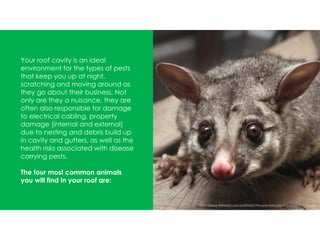
Your roof cavity is an ideal
environment for the types of pests
that keep you up at night,
scratching and moving around as
they go about their business. Not
only are they a nuisance, they are
often also responsible for damage
to electrical cabling, property
damage (internal and external)
due to nesting and debris build up
in cavity and gutters, as well as the
health risks associated with disease
carrying pests.
The four most common animals
you will find in your roof are:
https://www.lifehacker.com.au/2016/07/the-pros-and-cons-of-possums-in-your-roof/
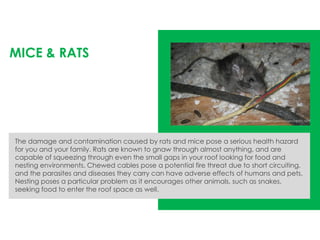
The damage and contamination caused by rats and mice pose a serious health hazard
for you and your family. Rats are known to gnaw through almost anything, and are
capable of squeezing through even the small gaps in your roof looking for food and
nesting environments. Chewed cables pose a potential fire threat due to short circuiting,
and the parasites and diseases they carry can have adverse effects of humans and pets.
Nesting poses a particular problem as it encourages other animals, such as snakes,
seeking food to enter the roof space as well.
MICE & RATS
http://www.aaanimalcontrol.com/professional-trapper/gallery/pages/rat005.html
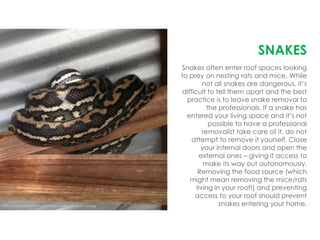
Snakes often enter roof spaces looking
to prey on nesting rats and mice. While
not all snakes are dangerous, it’s
difficult to tell them apart and the best
practice is to leave snake removal to
the professionals. If a snake has
entered your living space and it’s not
possible to have a professional
removalist take care of it, do not
attempt to remove it yourself. Close
your internal doors and open the
external ones – giving it access to
make its way out autonomously.
Removing the food source (which
might mean removing the mice/rats
living in your roof!) and preventing
access to your roof should prevent
snakes entering your home.
SNAKES
http://www.snakecatchers.com/images/carpet_python_in_roof.jpg
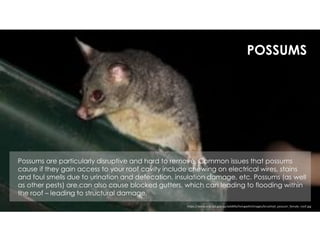
POSSUMS POSSUMS
Possums are particularly disruptive and hard to remove. Common issues that possums
cause if they gain access to your roof cavity include chewing on electrical wires, stains
and foul smells due to urination and defecation, insulation damage, etc. Possums (as well
as other pests) are can also cause blocked gutters, which can leading to flooding within
the roof – leading to structural damage.
https://www.ehp.qld.gov.au/wildlife/livingwith/images/brushtail_possum_female_roof.jpg
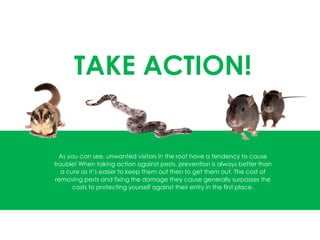
As you can see, unwanted visitors in the roof have a tendency to cause
trouble! When taking action against pests, prevention is always better than
a cure as it’s easier to keep them out then to get them out. The cost of
removing pests and fixing the damage they cause generally surpasses the
costs to protecting yourself against their entry in the first place.
TAKE ACTION!
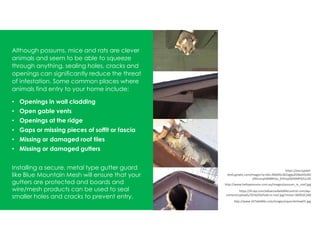
Although possums, mice and rats are clever
animals and seem to be able to squeeze
through anything, sealing holes, cracks and
openings can significantly reduce the threat
of infestation. Some common places where
animals find entry to your home include:
• Openings in wall cladding
• Open gable vents
• Openings at the ridge
• Gaps or missing pieces of soffit or fascia
• Missing or damaged roof tiles
• Missing or damaged gutters
Installing a secure, metal type gutter guard
like Blue Mountain Mesh will ensure that your
gutters are protected and boards and
wire/mesh products can be used to seal
smaller holes and cracks to prevent entry.
https://i0.wp.com/advancedwildlifecontrol.com/wp-
content/uploads/2016/03/hole-in-roof.jpg?resize=300%2C240
http://www.247wildlife.com/images/squirrelchew01.jpg
http://www.hellopossums.com.au/images/possum_in_roof.jpg
https://encrypted-
tbn0.gstatic.com/images?q=tbn:ANd9GcSKZzgjlp2O6laV0UD0
2XKrumphMB8H2a_DVEoyQX4SMPiOUU3E
If it’s too late for prevention measures, and pests
have already made shelter in your roof, then the
best of course of action is to contract a pest
removal professional – they know the most
common points of access and the best methods
for removal! Once your home is pest free again,
remember to take preventative action to ensure
they don’t return and continue to cause damage!

Animals

  • 1.
  • 2.
    Your roof cavityis an ideal environment for the types of pests that keep you up at night, scratching and moving around as they go about their business. Not only are they a nuisance, they are often also responsible for damage to electrical cabling, property damage (internal and external) due to nesting and debris build up in cavity and gutters, as well as the health risks associated with disease carrying pests. The four most common animals you will find in your roof are: https://www.lifehacker.com.au/2016/07/the-pros-and-cons-of-possums-in-your-roof/
  • 3.
    The damage andcontamination caused by rats and mice pose a serious health hazard for you and your family. Rats are known to gnaw through almost anything, and are capable of squeezing through even the small gaps in your roof looking for food and nesting environments. Chewed cables pose a potential fire threat due to short circuiting, and the parasites and diseases they carry can have adverse effects of humans and pets. Nesting poses a particular problem as it encourages other animals, such as snakes, seeking food to enter the roof space as well. MICE & RATS http://www.aaanimalcontrol.com/professional-trapper/gallery/pages/rat005.html
  • 4.
    Snakes often enterroof spaces looking to prey on nesting rats and mice. While not all snakes are dangerous, it’s difficult to tell them apart and the best practice is to leave snake removal to the professionals. If a snake has entered your living space and it’s not possible to have a professional removalist take care of it, do not attempt to remove it yourself. Close your internal doors and open the external ones – giving it access to make its way out autonomously. Removing the food source (which might mean removing the mice/rats living in your roof!) and preventing access to your roof should prevent snakes entering your home. SNAKES http://www.snakecatchers.com/images/carpet_python_in_roof.jpg
  • 5.
    POSSUMS POSSUMS Possums areparticularly disruptive and hard to remove. Common issues that possums cause if they gain access to your roof cavity include chewing on electrical wires, stains and foul smells due to urination and defecation, insulation damage, etc. Possums (as well as other pests) are can also cause blocked gutters, which can leading to flooding within the roof – leading to structural damage. https://www.ehp.qld.gov.au/wildlife/livingwith/images/brushtail_possum_female_roof.jpg
  • 6.
    As you cansee, unwanted visitors in the roof have a tendency to cause trouble! When taking action against pests, prevention is always better than a cure as it’s easier to keep them out then to get them out. The cost of removing pests and fixing the damage they cause generally surpasses the costs to protecting yourself against their entry in the first place. TAKE ACTION!
  • 7.
    Although possums, miceand rats are clever animals and seem to be able to squeeze through anything, sealing holes, cracks and openings can significantly reduce the threat of infestation. Some common places where animals find entry to your home include: • Openings in wall cladding • Open gable vents • Openings at the ridge • Gaps or missing pieces of soffit or fascia • Missing or damaged roof tiles • Missing or damaged gutters Installing a secure, metal type gutter guard like Blue Mountain Mesh will ensure that your gutters are protected and boards and wire/mesh products can be used to seal smaller holes and cracks to prevent entry. https://i0.wp.com/advancedwildlifecontrol.com/wp- content/uploads/2016/03/hole-in-roof.jpg?resize=300%2C240 http://www.247wildlife.com/images/squirrelchew01.jpg http://www.hellopossums.com.au/images/possum_in_roof.jpg https://encrypted- tbn0.gstatic.com/images?q=tbn:ANd9GcSKZzgjlp2O6laV0UD0 2XKrumphMB8H2a_DVEoyQX4SMPiOUU3E
  • 8.
    If it’s toolate for prevention measures, and pests have already made shelter in your roof, then the best of course of action is to contract a pest removal professional – they know the most common points of access and the best methods for removal! Once your home is pest free again, remember to take preventative action to ensure they don’t return and continue to cause damage!