
Microsoft ”x”RM4Legal
Legal IT Solutions for Dynamics CRM
Email Marketing Demonstration


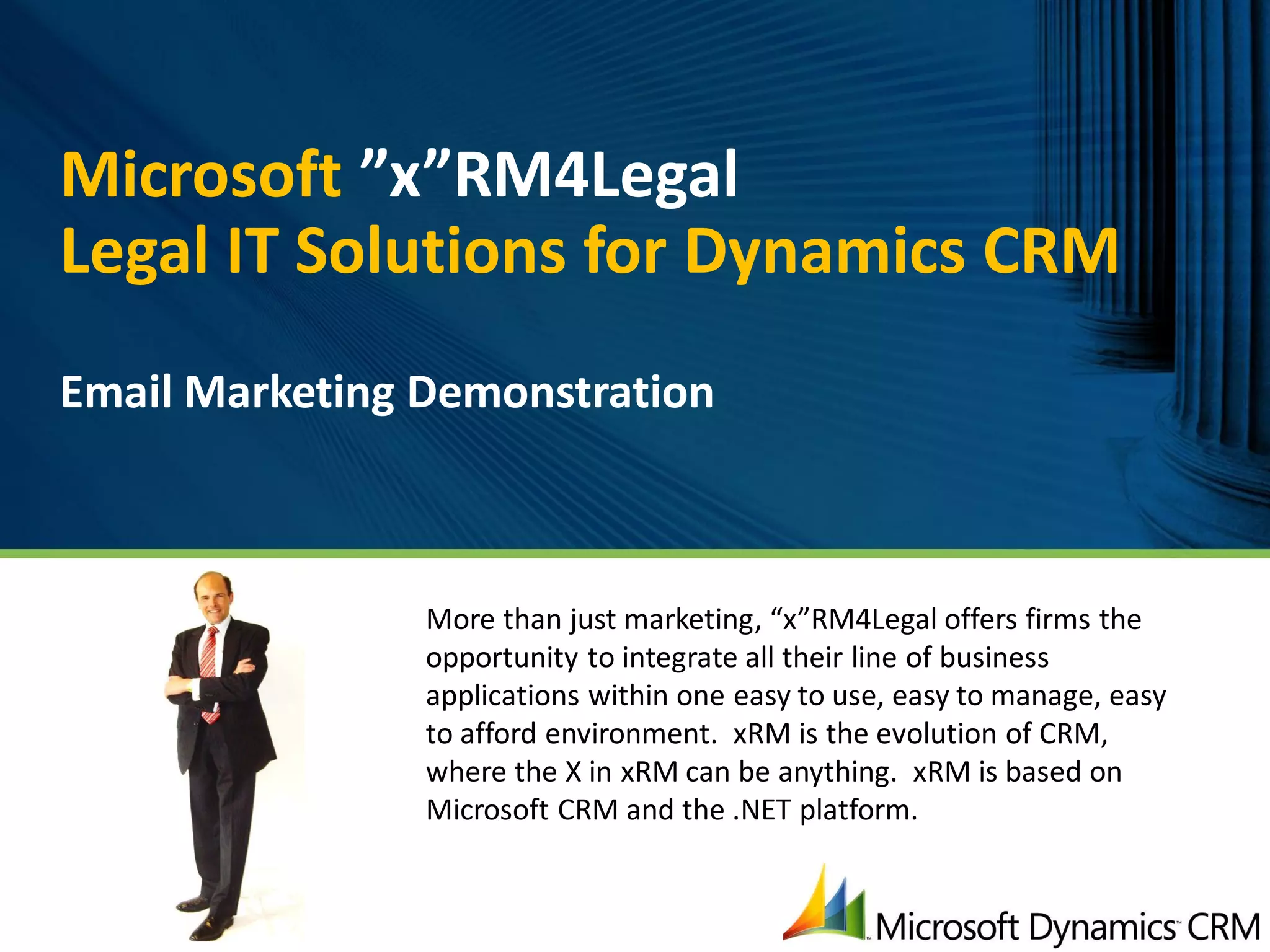
                More than just marketing, “x”RM4Legal offers firms the
                opportunity to integrate all their line of business
                applications within one easy to use, easy to manage, easy
                to afford environment. xRM is the evolution of CRM,
                where the X in xRM can be anything. xRM is based on
                Microsoft CRM and the .NET platform.
Contents

1.   Using Quick Campaigns
2.   Creating and Using Marketing Lists
3.   Creating a Marketing Event
4.   Capturing and Viewing Event Responses
5.   Performing Response Follow Ups
6.   Recording Opportunities
7.   Reporting – Charts, Dashboards, and Reports
8.   Configuration and Adding Fields
Using Quick Campaigns

You can use Quick Campaigns to communicate quickly
and easily with a marketing list of clients, contacts or
prospective clients – including staff within your firm.
There are two ways you can select the list of recipients
for your quick campaign:
1. Select the clients, contacts, or prospective clients
    directly.
2. Do a search in Advanced Find query and create a
    quick campaign from the resulting list of records.
Scenario

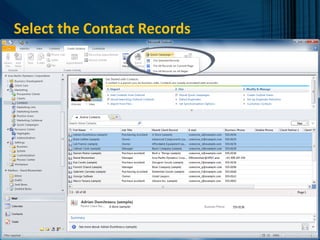
• We have a newsletter that we would like to email in
  HTML.
• The newsletter is to be emailed to a select group of
  contacts.
• The email is to be personalised unique to each
  contact.
• We would like to save a copy of the email to each
  contacts CRM activity record.
Select the Contact Records
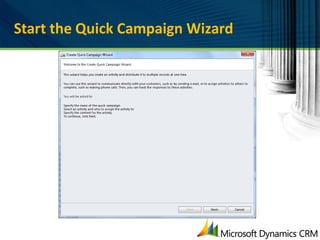
Start the Quick Campaign Wizard
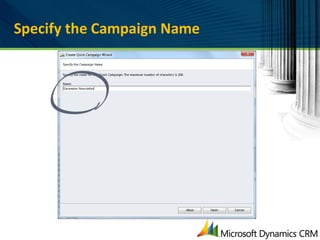
Specify the Campaign Name
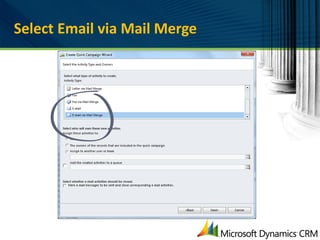
Select Email via Mail Merge
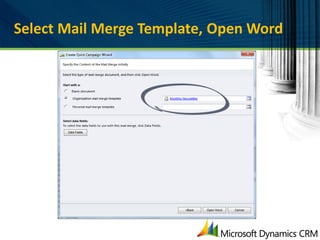
Select Mail Merge Template, Open Word
Add or Remove Recipients
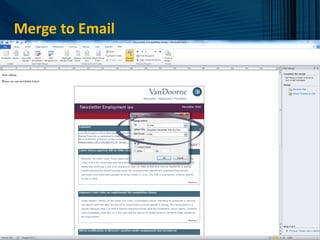
Merge to Email
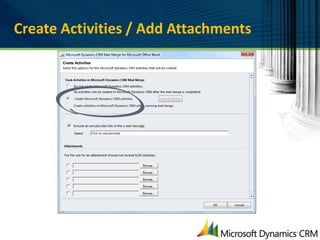
Create Activities / Add Attachments
Creating and Using Marketing Lists

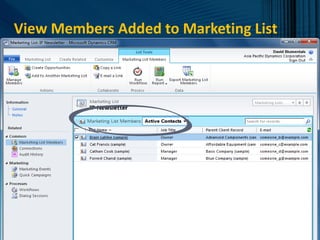
A marketing list is a list of clients, contacts or prospective clients that share
common characteristics. For example, a marketing list could be a list of all the
client contacts that have a certain professional interest, or all the staff in a
given practice group. Marketing Lists are created independently of a Marketing
Event or Quick Campaign. Each Marketing Event must have at least one
Marketing List, as the list designates the recipients of the communications
generated by the event activities.
Creating Marketing Lists. There are two steps in creating a Marketing List:
1. Create the Marketing List record: You must specify the member type for
     the Marketing List, that is, the type of record from which the members are
     drawn: clients, contacts, or prospective clients. Once a Marketing List is
     created, you cannot change the member type.
2. Add members to the list: You can add members to the list through the
     Lookup feature, an Advanced Find, or by importing members from an
     external list. You can also create dynamic lists using Advanced Find query
     tools.
Scenario

• Our IP practice group have created a new monthly
  newsletter that they would like to distribute in
  preparation for a marketing event to be held next
  month.
• We need to create a new marketing list.
• The list will be created based on Contact records with
  a specified professional interest in “Intellectual
  Property”.
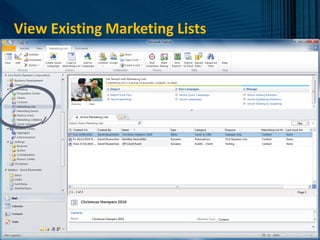
View Existing Marketing Lists
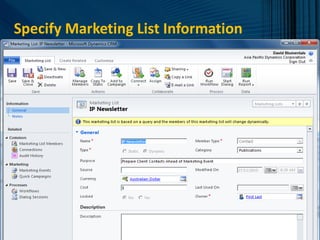
Specify Marketing List Information
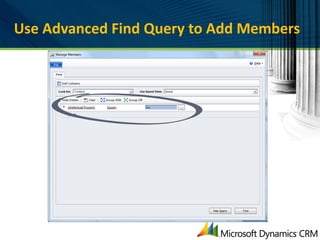
Use Advanced Find Query to Add Members
View Members Added to Marketing List
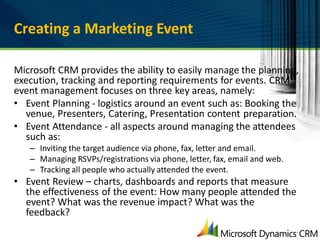
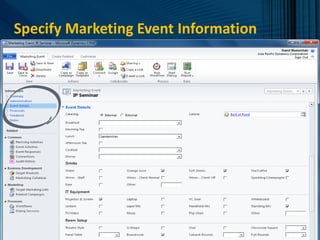
Creating a Marketing Event

Microsoft CRM provides the ability to easily manage the planning,
execution, tracking and reporting requirements for events. CRM
event management focuses on three key areas, namely:
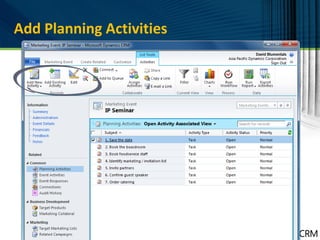
• Event Planning - logistics around an event such as: Booking the
  venue, Presenters, Catering, Presentation content preparation.
• Event Attendance - all aspects around managing the attendees
  such as:
   – Inviting the target audience via phone, fax, letter and email.
   – Managing RSVPs/registrations via phone, letter, fax, email and web.
   – Tracking all people who actually attended the event.
• Event Review – charts, dashboards and reports that measure
  the effectiveness of the event: How many people attended the
  event? What was the revenue impact? What was the
  feedback?
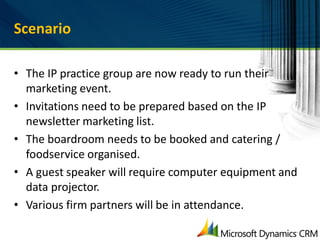
Scenario

• The IP practice group are now ready to run their
  marketing event.
• Invitations need to be prepared based on the IP
  newsletter marketing list.
• The boardroom needs to be booked and catering /
  foodservice organised.
• A guest speaker will require computer equipment and
  data projector.
• Various firm partners will be in attendance.
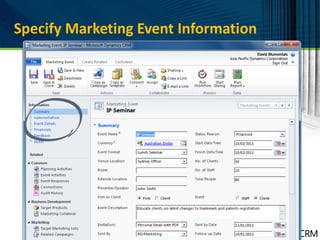
Specify Marketing Event Information
Add Planning Activities
Capturing and Viewing Event Responses

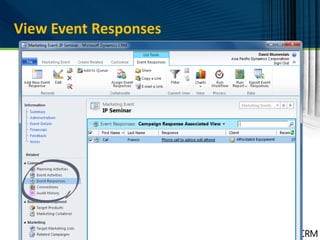
The goal of any marketing event is to create measurable results. Microsoft CRM
captures event results as responses. Once clients are contacted based on event
activities, you can expect responses.
There are four ways to create event responses:
1. Record them manually by creating a new event response. If a client calls in
     by phone, you can manually create a response record.
2. Promote a distributed campaign activity, such as an email reply, into a
     response.
3. Import responses from an Excel spreadsheet. You can import these into
     CRM using the Data Import Wizard. When you import the file, individual
     campaign responses will be created as activities.
4. Automatically generate responses as a result of an e-mail campaign using
     mail merge, in which clients respond through e-mail messages. If a client
     responds to the event by e-mail, CRM automatically creates the event
     response when the clients e-mail is received.
Scenario

• Invitations to the IP seminar have been emailed.
• We received one response; further follow up was
  conducted to ensure full attendance.
View Event Responses
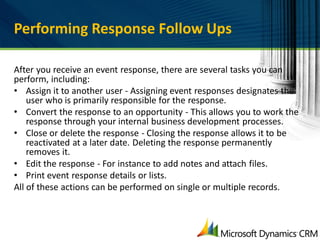
Performing Response Follow Ups

After you receive an event response, there are several tasks you can
perform, including:
• Assign it to another user - Assigning event responses designates the
    user who is primarily responsible for the response.
• Convert the response to an opportunity - This allows you to work the
    response through your internal business development processes.
• Close or delete the response - Closing the response allows it to be
    reactivated at a later date. Deleting the response permanently
    removes it.
• Edit the response - For instance to add notes and attach files.
• Print event response details or lists.
All of these actions can be performed on single or multiple records.
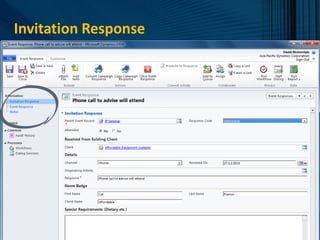
Scenario

• Invitations sent to various clients have prompted calls
  to firm reception to confirm attendance – these can
  be entered manually.
• Using the Microsoft Outlook integration produces
  some automatic event registrations in the CRM
  database.
• Once the event has been held, client follow up and
  feedback can be recorded.
Invitation Response
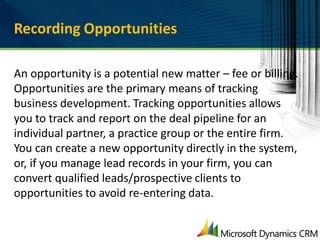
Recording Opportunities

An opportunity is a potential new matter – fee or billing.
Opportunities are the primary means of tracking
business development. Tracking opportunities allows
you to track and report on the deal pipeline for an
individual partner, a practice group or the entire firm.
You can create a new opportunity directly in the system,
or, if you manage lead records in your firm, you can
convert qualified leads/prospective clients to
opportunities to avoid re-entering data.
Scenario

• Following the event the marketing department
  contacted each client to survey their feedback and
  assess potential partner follow up.
• One response was sufficiently positive that an
  opportunity record could be created.
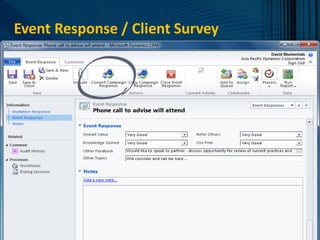
Event Response / Client Survey
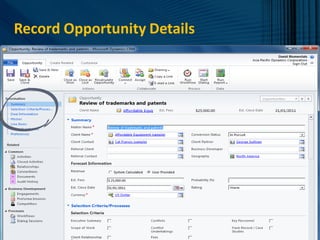
Record Opportunity Details
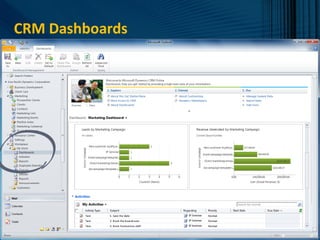
Reporting – Charts, Dashboards, and Reports

Microsoft CRM 2011 allows users with the appropriate
permissions to create their own custom charts and
dashboards as well as reports directly from the Report
Wizard.
Reports are different from saved views and Advanced
Finds because they can be used to render graphs,
perform quantitative summations and drill down to
further details.
CRM Dashboards
Configuration and Adding Fields

Based on the CRM security roles, users can take advantage of the
customisation tools provided in the application to customise its appearance
and behaviour:
Practice Managers can customise views, user permissions, business unit
settings and workflow processes.
System customisers can customise the CRM schema, including adding,
modifying, renaming, and deleting entities and fields. System customisers can
also modify the user interface by changing form and view content and defaults,
adding and modifying reports, and changing default report filters.
In some firms, the System Customiser role is assigned to a “power” user that
has normal user roles. For example, because the marketing manager is highly
technical, his firm assigns him the System Customiser role so that he can
perform form and view customisations.
System administrators can perform the same tasks as system customisers.
Administrators can also modify any record in the application, and there are
some entities that can only be imported and exported by a System
Administrator for security reasons.
Scenario

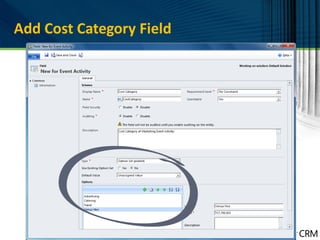
• For all Event Activities we would like to track the cost
  categories to record each expense.
• We therefore need to add a Cost Category field as an
  attribute to the Event Activity table.
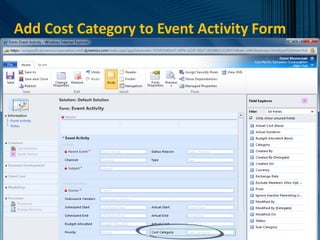
• We also need to add the new field to the Event
  Activity form.
Add Cost Category Field
Add Cost Category to Event Activity Form
Thank you!

For more information:

David Blumentals
DBlumentals@xRM4Legal.com
Phone +61 409 245 354

xRM4Legal.com
CRM.Dynamics.com

xRM4Legal Email Marketing

  • 1.
    Microsoft ”x”RM4Legal Legal ITSolutions for Dynamics CRM Email Marketing Demonstration More than just marketing, “x”RM4Legal offers firms the opportunity to integrate all their line of business applications within one easy to use, easy to manage, easy to afford environment. xRM is the evolution of CRM, where the X in xRM can be anything. xRM is based on Microsoft CRM and the .NET platform.
  • 2.
    Contents 1. Using Quick Campaigns 2. Creating and Using Marketing Lists 3. Creating a Marketing Event 4. Capturing and Viewing Event Responses 5. Performing Response Follow Ups 6. Recording Opportunities 7. Reporting – Charts, Dashboards, and Reports 8. Configuration and Adding Fields
  • 3.
    Using Quick Campaigns Youcan use Quick Campaigns to communicate quickly and easily with a marketing list of clients, contacts or prospective clients – including staff within your firm. There are two ways you can select the list of recipients for your quick campaign: 1. Select the clients, contacts, or prospective clients directly. 2. Do a search in Advanced Find query and create a quick campaign from the resulting list of records.
  • 4.
    Scenario • We havea newsletter that we would like to email in HTML. • The newsletter is to be emailed to a select group of contacts. • The email is to be personalised unique to each contact. • We would like to save a copy of the email to each contacts CRM activity record.
  • 5.
  • 6.
    Start the QuickCampaign Wizard
  • 7.
  • 8.
    Select Email viaMail Merge
  • 9.
    Select Mail MergeTemplate, Open Word
  • 10.
    Add or RemoveRecipients
  • 11.
  • 12.
    Create Activities /Add Attachments
  • 13.
    Creating and UsingMarketing Lists A marketing list is a list of clients, contacts or prospective clients that share common characteristics. For example, a marketing list could be a list of all the client contacts that have a certain professional interest, or all the staff in a given practice group. Marketing Lists are created independently of a Marketing Event or Quick Campaign. Each Marketing Event must have at least one Marketing List, as the list designates the recipients of the communications generated by the event activities. Creating Marketing Lists. There are two steps in creating a Marketing List: 1. Create the Marketing List record: You must specify the member type for the Marketing List, that is, the type of record from which the members are drawn: clients, contacts, or prospective clients. Once a Marketing List is created, you cannot change the member type. 2. Add members to the list: You can add members to the list through the Lookup feature, an Advanced Find, or by importing members from an external list. You can also create dynamic lists using Advanced Find query tools.
  • 14.
    Scenario • Our IPpractice group have created a new monthly newsletter that they would like to distribute in preparation for a marketing event to be held next month. • We need to create a new marketing list. • The list will be created based on Contact records with a specified professional interest in “Intellectual Property”.
  • 15.
  • 16.
  • 17.
    Use Advanced FindQuery to Add Members
  • 18.
    View Members Addedto Marketing List
  • 19.
    Creating a MarketingEvent Microsoft CRM provides the ability to easily manage the planning, execution, tracking and reporting requirements for events. CRM event management focuses on three key areas, namely: • Event Planning - logistics around an event such as: Booking the venue, Presenters, Catering, Presentation content preparation. • Event Attendance - all aspects around managing the attendees such as: – Inviting the target audience via phone, fax, letter and email. – Managing RSVPs/registrations via phone, letter, fax, email and web. – Tracking all people who actually attended the event. • Event Review – charts, dashboards and reports that measure the effectiveness of the event: How many people attended the event? What was the revenue impact? What was the feedback?
  • 20.
    Scenario • The IPpractice group are now ready to run their marketing event. • Invitations need to be prepared based on the IP newsletter marketing list. • The boardroom needs to be booked and catering / foodservice organised. • A guest speaker will require computer equipment and data projector. • Various firm partners will be in attendance.
  • 21.
  • 22.
  • 23.
  • 24.
    Capturing and ViewingEvent Responses The goal of any marketing event is to create measurable results. Microsoft CRM captures event results as responses. Once clients are contacted based on event activities, you can expect responses. There are four ways to create event responses: 1. Record them manually by creating a new event response. If a client calls in by phone, you can manually create a response record. 2. Promote a distributed campaign activity, such as an email reply, into a response. 3. Import responses from an Excel spreadsheet. You can import these into CRM using the Data Import Wizard. When you import the file, individual campaign responses will be created as activities. 4. Automatically generate responses as a result of an e-mail campaign using mail merge, in which clients respond through e-mail messages. If a client responds to the event by e-mail, CRM automatically creates the event response when the clients e-mail is received.
  • 25.
    Scenario • Invitations tothe IP seminar have been emailed. • We received one response; further follow up was conducted to ensure full attendance.
  • 26.
  • 27.
    Performing Response FollowUps After you receive an event response, there are several tasks you can perform, including: • Assign it to another user - Assigning event responses designates the user who is primarily responsible for the response. • Convert the response to an opportunity - This allows you to work the response through your internal business development processes. • Close or delete the response - Closing the response allows it to be reactivated at a later date. Deleting the response permanently removes it. • Edit the response - For instance to add notes and attach files. • Print event response details or lists. All of these actions can be performed on single or multiple records.
  • 28.
    Scenario • Invitations sentto various clients have prompted calls to firm reception to confirm attendance – these can be entered manually. • Using the Microsoft Outlook integration produces some automatic event registrations in the CRM database. • Once the event has been held, client follow up and feedback can be recorded.
  • 29.
  • 30.
    Recording Opportunities An opportunityis a potential new matter – fee or billing. Opportunities are the primary means of tracking business development. Tracking opportunities allows you to track and report on the deal pipeline for an individual partner, a practice group or the entire firm. You can create a new opportunity directly in the system, or, if you manage lead records in your firm, you can convert qualified leads/prospective clients to opportunities to avoid re-entering data.
  • 31.
    Scenario • Following theevent the marketing department contacted each client to survey their feedback and assess potential partner follow up. • One response was sufficiently positive that an opportunity record could be created.
  • 32.
    Event Response /Client Survey
  • 33.
  • 34.
    Reporting – Charts,Dashboards, and Reports Microsoft CRM 2011 allows users with the appropriate permissions to create their own custom charts and dashboards as well as reports directly from the Report Wizard. Reports are different from saved views and Advanced Finds because they can be used to render graphs, perform quantitative summations and drill down to further details.
  • 35.
  • 36.
    Configuration and AddingFields Based on the CRM security roles, users can take advantage of the customisation tools provided in the application to customise its appearance and behaviour: Practice Managers can customise views, user permissions, business unit settings and workflow processes. System customisers can customise the CRM schema, including adding, modifying, renaming, and deleting entities and fields. System customisers can also modify the user interface by changing form and view content and defaults, adding and modifying reports, and changing default report filters. In some firms, the System Customiser role is assigned to a “power” user that has normal user roles. For example, because the marketing manager is highly technical, his firm assigns him the System Customiser role so that he can perform form and view customisations. System administrators can perform the same tasks as system customisers. Administrators can also modify any record in the application, and there are some entities that can only be imported and exported by a System Administrator for security reasons.
  • 37.
    Scenario • For allEvent Activities we would like to track the cost categories to record each expense. • We therefore need to add a Cost Category field as an attribute to the Event Activity table. • We also need to add the new field to the Event Activity form.
  • 38.
  • 39.
    Add Cost Categoryto Event Activity Form
  • 40.
    Thank you! For moreinformation: David Blumentals DBlumentals@xRM4Legal.com Phone +61 409 245 354 xRM4Legal.com CRM.Dynamics.com