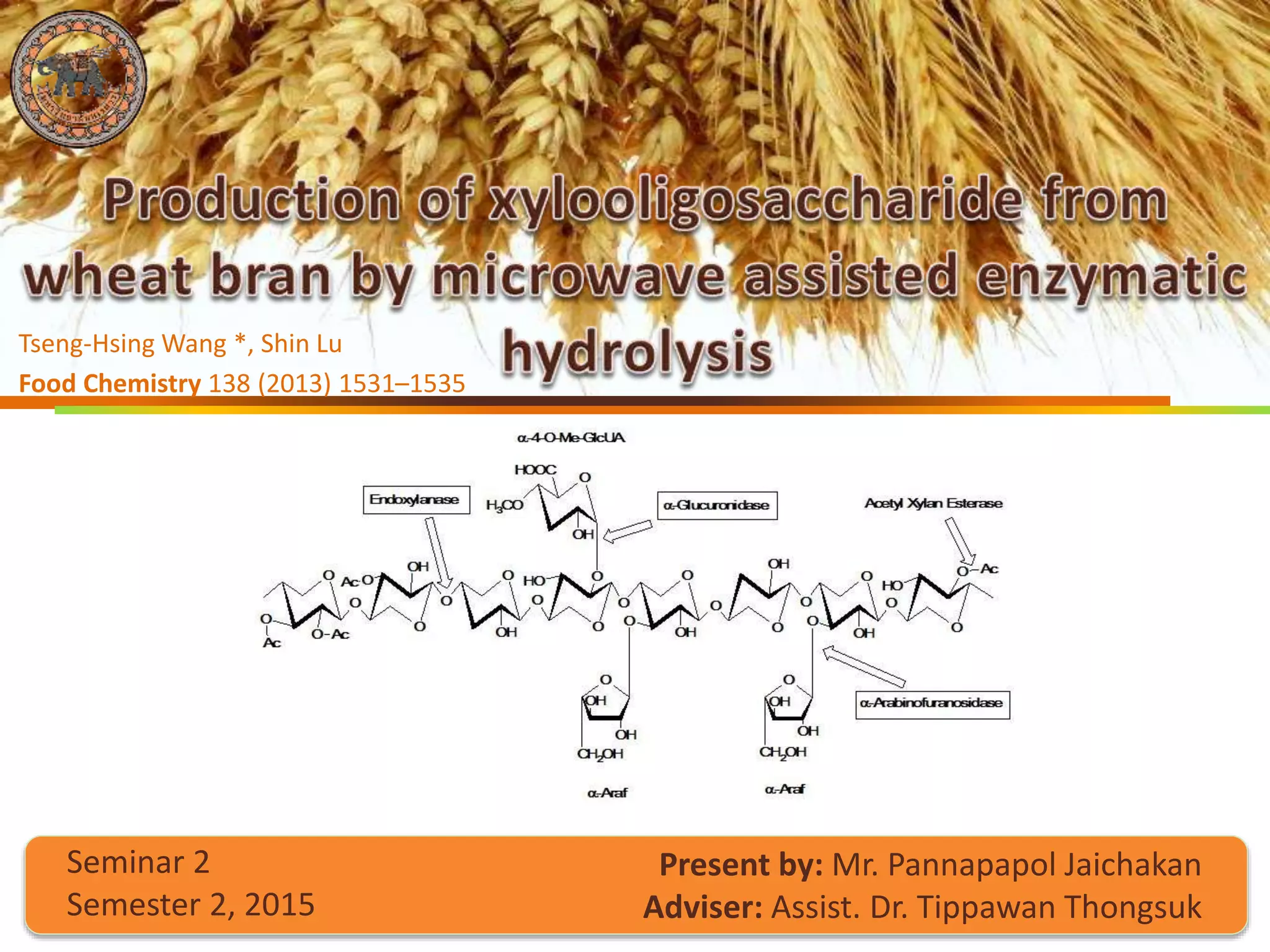
Present by: Mr. Pannapapol Jaichakan
Adviser: Assist. Dr. Tippawan Thongsuk
Seminar 2
Semester 2, 2015
Food Chemistry 138 (2013) 1531–1535
Tseng-Hsing Wang *, Shin Lu
Scope
1
•Introduction and
literature review
2
•Objectives
3
•Methods
4
•Results and discussion
5
•Conclusion
Literature Reviews
(Benamrouche S et al., 2002)
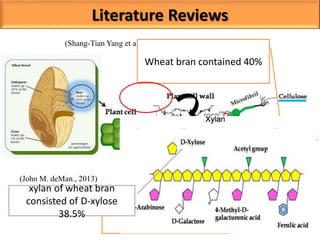
(Shang-Tian Yang et al., 2013)
Wheat bran contained 40%
Wheat bran with
heteroxylan component
40%
(John M. deMan., 2013)
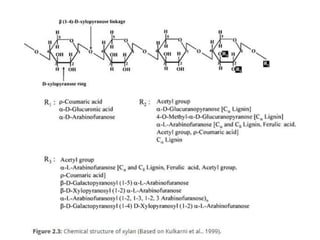
xylan of wheat bran
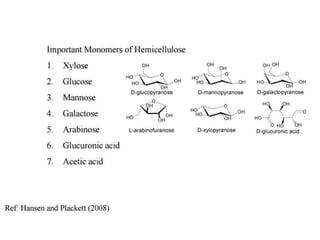
consisted of D-xylose
38.5%
Xylo-
oligosaccharide
(XOS)
Xylose
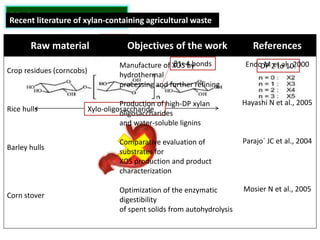
β1–4 bonds DP 2 to 10.
Xylo-oligosaccharide
Raw material Objectives of the work References
Crop residues (corncobs)
Rice hulls
Barley hulls
Corn stover
Manufacture of XOS by
hydrothermal
processing and further refining
Production of high-DP xylan
oligosaccharides
and water-soluble lignins
Comparative evaluation of
substrates for
XOS production and product
characterization
Optimization of the enzymatic
digestibility
of spent solids from autohydrolysis
Endo M et al., 2000
Hayashi N et al., 2005
Parajo´ JC et al., 2004
Mosier N et al., 2005
Recent literature of xylan-containing agricultural waste
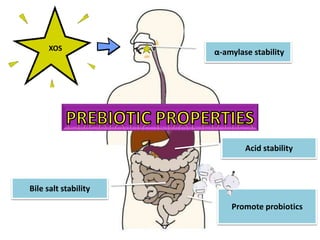
XOS
α-amylase stability
Acid stability
Bile salt stability
Promote probiotics
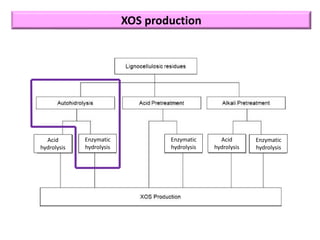
XOS production
Acid
hydrolysis
Enzymatic
hydrolysis
Enzymatic
hydrolysis
Acid
hydrolysis
Enzymatic
hydrolysis
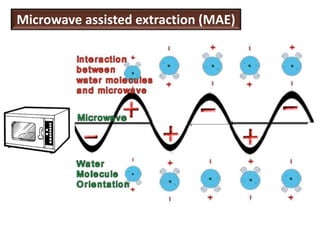
Microwave assisted extraction (MAE)
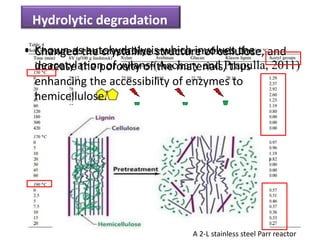
Hydrolytic degradation
Complex xylan structure
Xiaowen Chen et al., 2010
• Known as autohydrolysis which involves the
deacetylation of xylans (Aachary and Prapulla, 2011)
• Changed the crystalline structure of cellulose, and
increase the porosity of the materials, thus
enhancing the accessibility of enzymes to
hemicellulose.
A 2-L stainless steel Parr reactor
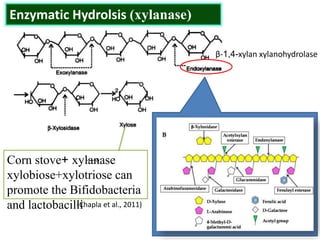
Enzymatic Hydrolsis (xylanase)
β-1,4-xylan xylanohydrolase
Corn stove+ xylanase
xylobiose+xylotriose can
promote the Bifidobacteria
and lactobacilli
(Chapla et al., 2011)
Objectives
To investigate microwave-assisted
direct enzymatic method for producing XOS
from wheat bran.
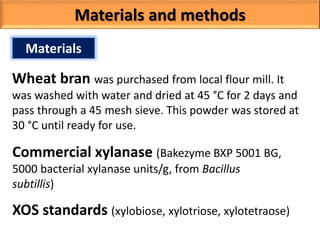
Materials and methods
Wheat bran was purchased from local flour mill. It
was washed with water and dried at 45 °C for 2 days and
pass through a 45 mesh sieve. This powder was stored at
30 °C until ready for use.
Commercial xylanase (Bakezyme BXP 5001 BG,
5000 bacterial xylanase units/g, from Bacillus
subtillis)
XOS standards (xylobiose, xylotriose, xylotetraose)
Materials
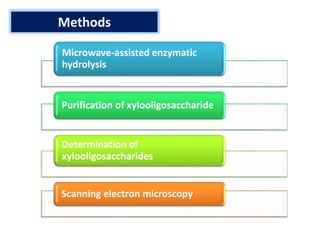
Methods
Microwave-assisted enzymatic
hydrolysis
Purification of xylooligosaccharide
Determination of
xylooligosaccharides
Scanning electron microscopy
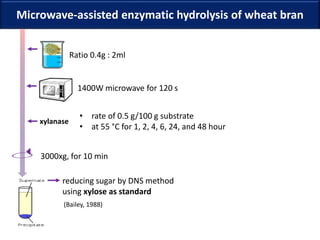
Microwave-assisted enzymatic hydrolysis of wheat bran
Ratio 0.4g : 2ml
1400W microwave for 120 s
xylanase
• rate of 0.5 g/100 g substrate
• at 55 °C for 1, 2, 4, 6, 24, and 48 hour
reducing sugar by DNS method
using xylose as standard
3000xg, for 10 min
(Bailey, 1988)
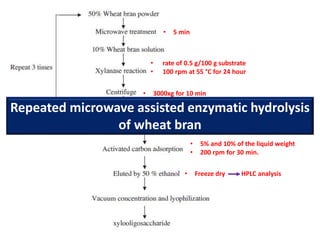
• 5 min
• rate of 0.5 g/100 g substrate
• 100 rpm at 55 °C for 24 hour
• 3000xg for 10 min
• 1:3 of 95% ethanol
• 3000xg for 10 min
• Freeze dry HPLC analysis
• 5% and 10% of the liquid weight
• 200 rpm for 30 min.
• Freeze dry HPLC analysis
Repeated microwave assisted enzymatic hydrolysis
of wheat bran
Results
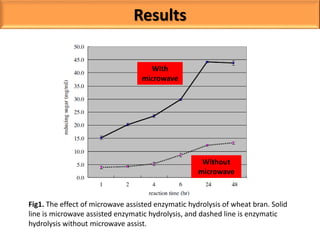
Fig1. The effect of microwave assisted enzymatic hydrolysis of wheat bran. Solid
line is microwave assisted enzymatic hydrolysis, and dashed line is enzymatic
hydrolysis without microwave assist.
With
microwave
Without
microwave
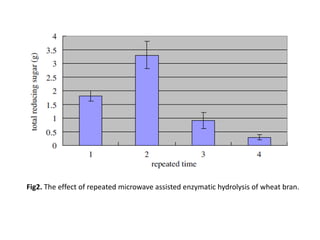
Fig2. The effect of repeated microwave assisted enzymatic hydrolysis of wheat bran.
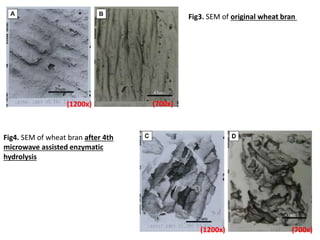
Fig3. SEM of original wheat bran
Fig4. SEM of wheat bran after 4th
microwave assisted enzymatic
hydrolysis
(1200x) (700x)
(1200x) (700x)
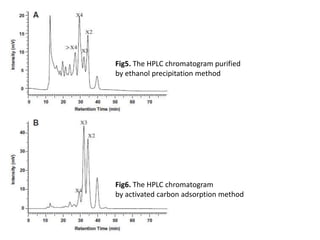
Fig5. The HPLC chromatogram purified
by ethanol precipitation method
Fig6. The HPLC chromatogram
by activated carbon adsorption method
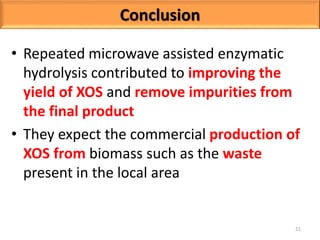
• Repeated microwave assisted enzymatic
hydrolysis contributed to improving the
yield of XOS and remove impurities from
the final product
• They expect the commercial production of
XOS from biomass such as the waste
present in the local area
21
Conclusion
THANK YOU
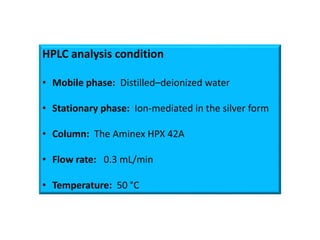
HPLC analysis condition
• Mobile phase: Distilled–deionized water
• Stationary phase: Ion-mediated in the silver form
• Column: The Aminex HPX 42A
• Flow rate: 0.3 mL/min
• Temperature: 50 °C
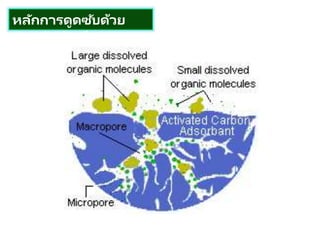
หลักการดูดซับด้วย
ถ่านกัมมันต์
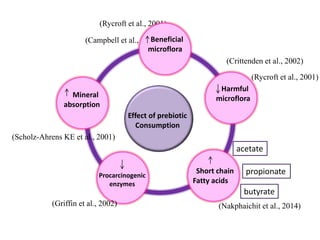
(Rycroft et al., 2001)
(Campbell et al., 1997)
(Crittenden et al., 2002)
(Rycroft et al., 2001)
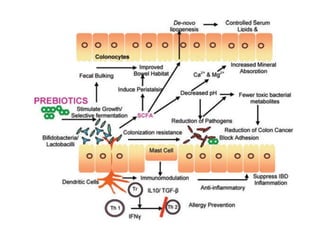
Effect of prebiotic
Consumption
Beneficial
microflora
Harmful
microflora
Mineral
absorption
Procarcinogenic
enzymes
Short chain
Fatty acids
(Scholz-Ahrens KE et al., 2001)
(Griffin et al., 2002) (Nakphaichit et al., 2014)
acetate
propionate
butyrate
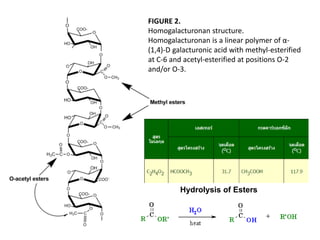
FIGURE 2.
Homogalacturonan structure.
Homogalacturonan is a linear polymer of α-
(1,4)-D galacturonic acid with methyl-esterified
at C-6 and acetyl-esterified at positions O-2
and/or O-3.
Hydrolysis of Esters
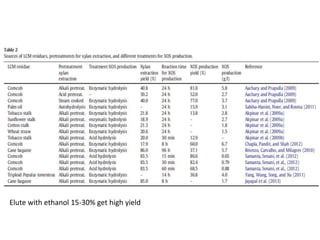
Elute with ethanol 15-30% get high yield
XOS saminar.pptx

XOS saminar.pptx

  • 1.
    Present by: Mr.Pannapapol Jaichakan Adviser: Assist. Dr. Tippawan Thongsuk Seminar 2 Semester 2, 2015 Food Chemistry 138 (2013) 1531–1535 Tseng-Hsing Wang *, Shin Lu
  • 2.
  • 3.
    Literature Reviews (Benamrouche Set al., 2002) (Shang-Tian Yang et al., 2013) Wheat bran contained 40% Wheat bran with heteroxylan component 40% (John M. deMan., 2013) xylan of wheat bran consisted of D-xylose 38.5%
  • 4.
    Xylo- oligosaccharide (XOS) Xylose β1–4 bonds DP2 to 10. Xylo-oligosaccharide Raw material Objectives of the work References Crop residues (corncobs) Rice hulls Barley hulls Corn stover Manufacture of XOS by hydrothermal processing and further refining Production of high-DP xylan oligosaccharides and water-soluble lignins Comparative evaluation of substrates for XOS production and product characterization Optimization of the enzymatic digestibility of spent solids from autohydrolysis Endo M et al., 2000 Hayashi N et al., 2005 Parajo´ JC et al., 2004 Mosier N et al., 2005 Recent literature of xylan-containing agricultural waste
  • 5.
    XOS α-amylase stability Acid stability Bilesalt stability Promote probiotics
  • 7.
  • 8.
  • 9.
    Hydrolytic degradation Complex xylanstructure Xiaowen Chen et al., 2010 • Known as autohydrolysis which involves the deacetylation of xylans (Aachary and Prapulla, 2011) • Changed the crystalline structure of cellulose, and increase the porosity of the materials, thus enhancing the accessibility of enzymes to hemicellulose. A 2-L stainless steel Parr reactor
  • 10.
    Enzymatic Hydrolsis (xylanase) β-1,4-xylanxylanohydrolase Corn stove+ xylanase xylobiose+xylotriose can promote the Bifidobacteria and lactobacilli (Chapla et al., 2011)
  • 12.
    Objectives To investigate microwave-assisted directenzymatic method for producing XOS from wheat bran.
  • 13.
    Materials and methods Wheatbran was purchased from local flour mill. It was washed with water and dried at 45 °C for 2 days and pass through a 45 mesh sieve. This powder was stored at 30 °C until ready for use. Commercial xylanase (Bakezyme BXP 5001 BG, 5000 bacterial xylanase units/g, from Bacillus subtillis) XOS standards (xylobiose, xylotriose, xylotetraose) Materials
  • 14.
    Methods Microwave-assisted enzymatic hydrolysis Purification ofxylooligosaccharide Determination of xylooligosaccharides Scanning electron microscopy
  • 15.
    Microwave-assisted enzymatic hydrolysisof wheat bran Ratio 0.4g : 2ml 1400W microwave for 120 s xylanase • rate of 0.5 g/100 g substrate • at 55 °C for 1, 2, 4, 6, 24, and 48 hour reducing sugar by DNS method using xylose as standard 3000xg, for 10 min (Bailey, 1988)
  • 16.
    • 5 min •rate of 0.5 g/100 g substrate • 100 rpm at 55 °C for 24 hour • 3000xg for 10 min • 1:3 of 95% ethanol • 3000xg for 10 min • Freeze dry HPLC analysis • 5% and 10% of the liquid weight • 200 rpm for 30 min. • Freeze dry HPLC analysis Repeated microwave assisted enzymatic hydrolysis of wheat bran
  • 17.
    Results Fig1. The effectof microwave assisted enzymatic hydrolysis of wheat bran. Solid line is microwave assisted enzymatic hydrolysis, and dashed line is enzymatic hydrolysis without microwave assist. With microwave Without microwave
  • 18.
    Fig2. The effectof repeated microwave assisted enzymatic hydrolysis of wheat bran.
  • 19.
    Fig3. SEM oforiginal wheat bran Fig4. SEM of wheat bran after 4th microwave assisted enzymatic hydrolysis (1200x) (700x) (1200x) (700x)
  • 20.
    Fig5. The HPLCchromatogram purified by ethanol precipitation method Fig6. The HPLC chromatogram by activated carbon adsorption method
  • 21.
    • Repeated microwaveassisted enzymatic hydrolysis contributed to improving the yield of XOS and remove impurities from the final product • They expect the commercial production of XOS from biomass such as the waste present in the local area 21 Conclusion
  • 22.
  • 23.
    HPLC analysis condition •Mobile phase: Distilled–deionized water • Stationary phase: Ion-mediated in the silver form • Column: The Aminex HPX 42A • Flow rate: 0.3 mL/min • Temperature: 50 °C
  • 24.
  • 25.
    (Rycroft et al.,2001) (Campbell et al., 1997) (Crittenden et al., 2002) (Rycroft et al., 2001) Effect of prebiotic Consumption Beneficial microflora Harmful microflora Mineral absorption Procarcinogenic enzymes Short chain Fatty acids (Scholz-Ahrens KE et al., 2001) (Griffin et al., 2002) (Nakphaichit et al., 2014) acetate propionate butyrate
  • 26.
    FIGURE 2. Homogalacturonan structure. Homogalacturonanis a linear polymer of α- (1,4)-D galacturonic acid with methyl-esterified at C-6 and acetyl-esterified at positions O-2 and/or O-3. Hydrolysis of Esters
  • 30.
    Elute with ethanol15-30% get high yield

Editor's Notes

  • #3 ขอบเขตของการนำเสนอในครั้งนี้ ประกอบไปด้วย
  • #4 โครงสร้างของเมล็ดข้าวประกอบไปด้วยส่วนสำคัญคือ.... ดังนั้นรำข้าวคือเปลือกของผลิตผลทางการเกษตร มีโครงสร้างเป็นใยอาหารซึ่งประกอบอยู่ในผนังเซลล์ เช่น เซลลูโลส เฮมิเซลลูโลส และ ลิกนิน เป็นต้น ส่วนหลักๆ คือโพลีแซคคาไรด์ (Polysaccharides) ประเภทเฮมิเซลลูโลส ที่ประกอบด้วยองค์ประกอบหลักคือ ไซแลน มีโครงสร้าง1,4-linked d-xylose backbone ประกอบเป็นสายโพลีแซคคาไรด์ และเมื่อถูกย่อยด้วยเอนไซม์จะให้น้ำตาลโมเลกุลเดี่ยว คือ นำตาลไซโลส
  • #5 XOS เป็นคาร์โบไฮเดรตมวลโมเลกุลต่ำประเภท oligosaccharide ประกอบด้วยหน่วยย่อยของน้ำตาลโมเลกุลเดี่ยว คือน้ำตาลไซโลส ซึ่งเป็นน้ำตาลแอลโดส ที่มีคาร์บอนในโมเลกุล 5 อะตอมประกอบกัน 2-10 โมเลกุลเชื่อมต่อกันด้วยพันธะไกลโคซิดิกแบบชนิดเบต้า ซึ่งจะแตกต่างกันไปตามวิธีการสกัด XOS ที่เป็นโอลิโกแซคคาไรด์ส่วนใหญ่ประกอบอยู่ในไซแลน มีความเสถียรต่อการเปลี่ยนแปลงค่า pH ในช่วงกว้าง ทนร้อน และทนต่อการเปลี่ยนแปลงอุณหภูมิ ร่างกายไม่สามารถย่อยได้เนื่องจากเอนไซม์ที่อยู่ในระบบทางเดินอาหารของมนุษย์มีความจำเพาะต่อโครงสร้างพันธะแบบชนิดแอลฟา แต่มีความไวและถูกไฮโดรไลซิสได้ง่ายด้วยเอนไซม์ที่แบคทีเรียภายในลำไส้ใหญ่ผลิตขึ้น
  • #11 มีรายงานเกี่ยวกับการสกัด XOS จากไซแลนด้วยกันหลายวิธี ทั้งวิธีทางกลควบคู่กับความร้อนสูง เช่น autohydrolysis และวิธีทางเคมี เช่น acid hydrolysis แต่ไม่เป็นที่นิยมเนื่องจากสามารถเกิดผลิตภัณฑ์อื่นๆได้ เช่น น้ำตาลโมเลกุลเดี่ยวและสารอื่นๆ และมีความเป็นพิษ ดังนั้นจึงหันมาสนใจการสกัด XOS ด้วยวีธีการทางเอนไซม์ที่ให้ความบริสุทธิ์มากกว่าเนื่องจากเอนไซม์มีคุณสมบัติจำเพาะเจาะจงต่อซับสเตรทนั้นๆ ในการสกัด XOS จากไซแลนโดยเอนไซม์ไซเลนเนสซึ่งจัดเป็นเอนไซม์ในกลุ่มเฮมีเซลลูเลส (Hemicellulase) ชนิดหนึ่งที่มีหน้าที่ย่อยแกนหลักของเฮมิเซลลูโลส ไซเลนเนสแบ่งได้เป็น 2 ชนิด คือเอนโดไซเลนเนสทำหน้าที่เร่งปฏิกิริยาการย่อยแบบสุ่มในสายพอลิเมอร์ของไซแลน ที่มีแกนหลักเป็นน้ำตาลไซโลสต่อกันด้วยพันธะ ß -1,4 และอีกชนิด คือ เอกโซไซเลนเนส ซึ่งย่อยโอลิโกแซคคาไรด์จากปลายแต่ไม่รีดิวซ์ (reduce) ให้สายสั้นลงจะทำให้ได้น้ำตาลโมเลกุลเดี่ยวด้วย กลไกการทำงานโดยไซลาเนสจะย่อยบริเวณด้านในของ xylan backbone ให้เป็น XOS ที่มีขนาดตั้งแต่ x2 ขึ้นไป Beta-xylosidase จะย่อย XOS ที่มีขนาดเล็ก ๆ ให้เป็นไซโลส ในส่วนของ branch chain จะถูกย่อยสลายด้วย debranching enzymes เช่น อะราบิโนฟูราโนซิเดส (arabinofuranosidase) และ อะซิติล เอกซ์เทอเรส (acetyl esterase)
  • #16 เนื่องจากภายในกากรำยังคงมีโปรตีน และไขมันประกอบอยู่จำนวนหนึ่ง ดังนั้นในการสกัด XOS ให้มีประสิทธิภาพ จึงจำเป็นต้องทำการกำจัดโปรตีน และไขมันดังกล่าวออก
  • #26 กลไกการทำงานของพรีไบโอติกมีผลต่อร่างกาย 2 ทาง คือทางตรงและทางอ้อม โดยพรีไบโอติกมีผลในการยับยั้งการเจริญของเชื้อก่อโรคและควบคุมการทำงานที่เกี่ยวข้องกับภูมิคุ้มกันของร่างกาย สำหรับผลทางอ้อมเกิดจากการส่งเสริมการเจริญหรือเพิ่มจำนวนของแบคทีเรียประจำถิ่นในร่างกายโดยเฉพาะในลำไส้ใหญ่ จากนั้นการเพิ่มจำนวนของโพรไบโอติกจึงส่งผลต่อลักษณะทางกายภาพในด้านต่างๆได้แก่ กรดไขมันสายสั้นที่แบคทีเรียสร้างขึ้นจากการหมักพรีไบโอติก เช่น กรดอะซีติก โพรพิโอนิก และบิวทิริก เป็นต้น ซึ่งกรดไขมันสายสั้นเหล่านี้ส่งผลทางอ้อมต่อการยับยั้งการก่อมะเร็งคือ บิวทิเรตช่วยกระตุ้นการเกิด apoptosis ใน cell line มะเร็งลำไส้ใหญ่ นอกจากนี้ยังพบว่ากรดแลกติกและกรดไขมันสายสั้นทำให้ค่าพีเอชในลำไส้ใหญ่ลดลง แคลเซียมจึงแตกตัวและละลายได้มากขึ้น และบิวทิเรตที่ถูกสร้างขึ้นไปเหนี่ยวนำให้เซลล์ลำไส้มีการแบ่งเซลล์ เพิ่มพื้นที่ผิวในการดูดซึมแคลเซียม