Customs and Traditions in
Christmas and New Year’s Time
from Greece
Many old aged customs on Christmas time,
still popular for Greek people
Santa Claus
At the Christmas eve, in the whole world, children string their socks up in their
fireplace and they wait with desire Santa Claus...
Gifted with special powers, without human limitations,he
can circumnavigate the world in one night and he does not
face any problem to his effort to be in countless places at the same time.
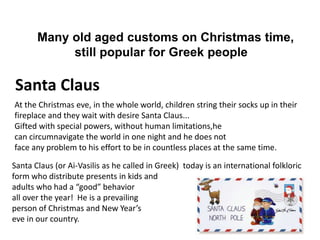
Santa Claus (or Ai-Vasilis as he called in Greek) today is an international folkloric
form who distribute presents in kids and
adults who had a “good” behavior
all over the year! He is a prevailing
person of Christmas and New Year’s
eve in our country.
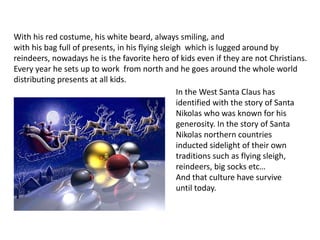
With his red costume, his white beard, always smiling, and
with his bag full of presents, in his flying sleigh which is lugged around by
reindeers, nowadays he is the favorite hero of kids even if they are not Christians.
Every year he sets up to work from north and he goes around the whole world
distributing presents at all kids.
In the West Santa Claus has
identified with the story of Santa
Nikolas who was known for his
generosity. In the story of Santa
Nikolas northern countries
inducted sidelight of their own
traditions such as flying sleigh,
reindeers, big socks etc…
And that culture have survive
until today.
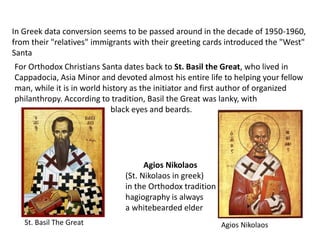
For Orthodox Christians Santa dates back to St. Basil the Great, who lived in
Cappadocia, Asia Minor and devoted almost his entire life to helping your fellow
man, while it is in world history as the initiator and first author of organized
philanthropy. According to tradition, Basil the Great was lanky, with
black eyes and beards.
In Greek data conversion seems to be passed around in the decade of 1950-1960,
from their "relatives" immigrants with their greeting cards introduced the "West"
Santa
Agios Nikolaos
(St. Nikolaos in greek)
in the Orthodox tradition
hagiography is always
a whitebearded elder
Agios NikolaosSt. Basil The Great
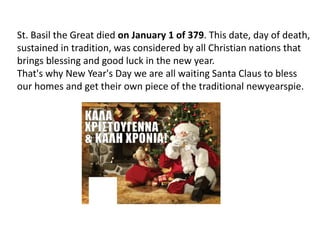
St. Basil the Great died on January 1 of 379. This date, day of death,
sustained in tradition, was considered by all Christian nations that
brings blessing and good luck in the new year.
That's why New Year's Day we are all waiting Santa Claus to bless
our homes and get their own piece of the traditional newyearspie.
KALANTA: Christmas carols
In greek we use the word “KALANTA” for Carols.
The word comes from the Latin «calenda», which means the beginning of the month.
Believed that their history goes deep into the past and connected with Ancient Greece.
They found, indeed, ancient writing songs similar to the current carols (Iresioni in antiquity).
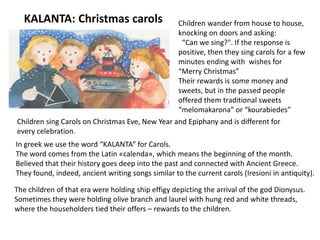
Children wander from house to house,
knocking on doors and asking:
“Can we sing?". If the response is
positive, then they sing carols for a few
minutes ending with wishes for
“Merry Christmas”
Their rewards is some money and
sweets, but in the passed people
offered them traditional sweets
“melomakarona” or “kourabiedes”
Children sing Carols on Christmas Eve, New Year and Epiphany and is different for
every celebration.
The children of that era were holding ship effigy depicting the arrival of the god Dionysus.
Sometimes they were holding olive branch and laurel with hung red and white threads,
where the householders tied their offers – rewards to the children.
Christmas “kalanta”
Καλήν ημέραν άρχοντες,
αν είναι ορισμός σας,
Χριστού την θείαν Γέννησιν
να πω στ' αρχοντικό σας.
Χριστός γεννάται σήμερον
εν Βηθλεέμ τη πόλει.
Οι ουρανοί αγάλλονται
χαίρει η κτήσις όλη.
Εν τω σπηλαίω τίκτεται
εν φάτνη των αλόγων
ο Βασιλεύς των ουρανών
και Ποιητής των όλων.
Newyears “kalanta”
Αρχιμηνιά κι Αρχιχρονιά
ψηλή μου δεντρολιβανιά
κι αρχή καλός μας χρόνος
εκκλησιά με τ' άγιο θρόνος.
Αρχή που βγήκε ο Χριστός
άγιος και Πνευματικός,
στη γη να περπατήσει
και να μας καλοκαρδίσει.
Αγιος Βασίλης έρχεται,
και δεν μας καταδέχεται,
από την Καισαρεία,
συ' σαι αρχόντισσα κυρία.
Epifany’s “kalanta”
Σήμερα τα φώτα κι ο
φωτισμός
η χαρα μεγάλη κι ο αγιασμός.
Κάτω στον Ιορδάνη τον
ποταμό
κάθετ' η κυρά μας η Παναγιά.
'Οργανo βαστάει, κερί κρατεί
και τον Αϊ-Γιάννη παρακαλεί.
'Αϊ-Γιάννη αφέντη και
βαπτιστή
βάπτισε κι εμένα Θεού παιδί.
Ν' ανεβώ επάνω στον ουρανό
να μαζέψω ρόδα και λίβανο.
Καλημέρα, καλημέρα,
Καλή σου μέρα αφέντη με την
κυρά.
The traditional Newyearspie
“VASILOPITA”
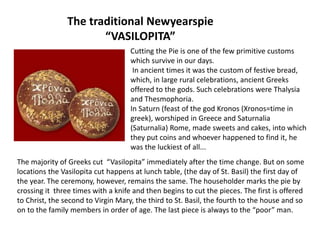
Cutting the Pie is one of the few primitive customs
which survive in our days.
In ancient times it was the custom of festive bread,
which, in large rural celebrations, ancient Greeks
offered to the gods. Such celebrations were Thalysia
and Thesmophoria.
In Saturn (feast of the god Kronos (Xronos=time in
greek), worshiped in Greece and Saturnalia
(Saturnalia) Rome, made sweets and cakes, into which
they put coins and whoever happened to find it, he
was the luckiest of all...
The majority of Greeks cut “Vasilopita” immediately after the time change. But on some
locations the Vasilopita cut happens at lunch table, (the day of St. Basil) the first day of
the year. The ceremony, however, remains the same. The householder marks the pie by
crossing it three times with a knife and then begins to cut the pieces. The first is offered
to Christ, the second to Virgin Mary, the third to St. Basil, the fourth to the house and so
on to the family members in order of age. The last piece is always to the “poor” man.
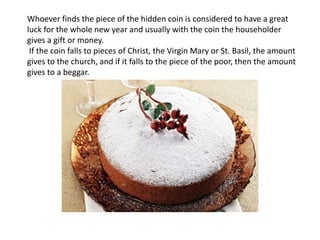
Whoever finds the piece of the hidden coin is considered to have a great
luck for the whole new year and usually with the coin the householder
gives a gift or money.
If the coin falls to pieces of Christ, the Virgin Mary or St. Basil, the amount
gives to the church, and if it falls to the piece of the poor, then the amount
gives to a beggar.
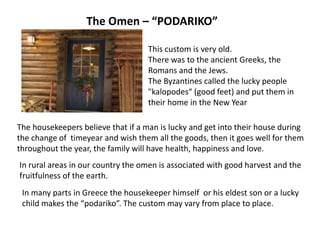
The Omen – “PODARIKO”
This custom is very old.
There was to the ancient Greeks, the
Romans and the Jews.
The Byzantines called the lucky people
"kalopodes“ (good feet) and put them in
their home in the New Year
The housekeepers believe that if a man is lucky and get into their house during
the change of timeyear and wish them all the goods, then it goes well for them
throughout the year, the family will have health, happiness and love.
In rural areas in our country the omen is associated with good harvest and the
fruitfulness of the earth.
In many parts in Greece the housekeeper himself or his eldest son or a lucky
child makes the “podariko”. The custom may vary from place to place.
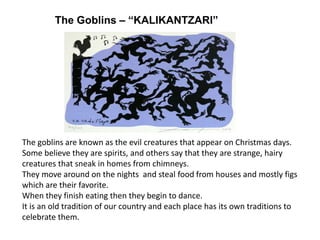
The Goblins – “KALIKANTZARI”
The goblins are known as the evil creatures that appear on Christmas days.
Some believe they are spirits, and others say that they are strange, hairy
creatures that sneak in homes from chimneys.
They move around on the nights and steal food from houses and mostly figs
which are their favorite.
When they finish eating then they begin to dance.
It is an old tradition of our country and each place has its own traditions to
celebrate them.

Christmas customs

  • 1.
    Customs and Traditionsin Christmas and New Year’s Time from Greece
  • 2.
    Many old agedcustoms on Christmas time, still popular for Greek people Santa Claus At the Christmas eve, in the whole world, children string their socks up in their fireplace and they wait with desire Santa Claus... Gifted with special powers, without human limitations,he can circumnavigate the world in one night and he does not face any problem to his effort to be in countless places at the same time. Santa Claus (or Ai-Vasilis as he called in Greek) today is an international folkloric form who distribute presents in kids and adults who had a “good” behavior all over the year! He is a prevailing person of Christmas and New Year’s eve in our country.
  • 3.
    With his redcostume, his white beard, always smiling, and with his bag full of presents, in his flying sleigh which is lugged around by reindeers, nowadays he is the favorite hero of kids even if they are not Christians. Every year he sets up to work from north and he goes around the whole world distributing presents at all kids. In the West Santa Claus has identified with the story of Santa Nikolas who was known for his generosity. In the story of Santa Nikolas northern countries inducted sidelight of their own traditions such as flying sleigh, reindeers, big socks etc… And that culture have survive until today.
  • 4.
    For Orthodox ChristiansSanta dates back to St. Basil the Great, who lived in Cappadocia, Asia Minor and devoted almost his entire life to helping your fellow man, while it is in world history as the initiator and first author of organized philanthropy. According to tradition, Basil the Great was lanky, with black eyes and beards. In Greek data conversion seems to be passed around in the decade of 1950-1960, from their "relatives" immigrants with their greeting cards introduced the "West" Santa Agios Nikolaos (St. Nikolaos in greek) in the Orthodox tradition hagiography is always a whitebearded elder Agios NikolaosSt. Basil The Great
  • 5.
    St. Basil theGreat died on January 1 of 379. This date, day of death, sustained in tradition, was considered by all Christian nations that brings blessing and good luck in the new year. That's why New Year's Day we are all waiting Santa Claus to bless our homes and get their own piece of the traditional newyearspie.
  • 6.
    KALANTA: Christmas carols Ingreek we use the word “KALANTA” for Carols. The word comes from the Latin «calenda», which means the beginning of the month. Believed that their history goes deep into the past and connected with Ancient Greece. They found, indeed, ancient writing songs similar to the current carols (Iresioni in antiquity). Children wander from house to house, knocking on doors and asking: “Can we sing?". If the response is positive, then they sing carols for a few minutes ending with wishes for “Merry Christmas” Their rewards is some money and sweets, but in the passed people offered them traditional sweets “melomakarona” or “kourabiedes” Children sing Carols on Christmas Eve, New Year and Epiphany and is different for every celebration. The children of that era were holding ship effigy depicting the arrival of the god Dionysus. Sometimes they were holding olive branch and laurel with hung red and white threads, where the householders tied their offers – rewards to the children.
  • 7.
    Christmas “kalanta” Καλήν ημέρανάρχοντες, αν είναι ορισμός σας, Χριστού την θείαν Γέννησιν να πω στ' αρχοντικό σας. Χριστός γεννάται σήμερον εν Βηθλεέμ τη πόλει. Οι ουρανοί αγάλλονται χαίρει η κτήσις όλη. Εν τω σπηλαίω τίκτεται εν φάτνη των αλόγων ο Βασιλεύς των ουρανών και Ποιητής των όλων. Newyears “kalanta” Αρχιμηνιά κι Αρχιχρονιά ψηλή μου δεντρολιβανιά κι αρχή καλός μας χρόνος εκκλησιά με τ' άγιο θρόνος. Αρχή που βγήκε ο Χριστός άγιος και Πνευματικός, στη γη να περπατήσει και να μας καλοκαρδίσει. Αγιος Βασίλης έρχεται, και δεν μας καταδέχεται, από την Καισαρεία, συ' σαι αρχόντισσα κυρία. Epifany’s “kalanta” Σήμερα τα φώτα κι ο φωτισμός η χαρα μεγάλη κι ο αγιασμός. Κάτω στον Ιορδάνη τον ποταμό κάθετ' η κυρά μας η Παναγιά. 'Οργανo βαστάει, κερί κρατεί και τον Αϊ-Γιάννη παρακαλεί. 'Αϊ-Γιάννη αφέντη και βαπτιστή βάπτισε κι εμένα Θεού παιδί. Ν' ανεβώ επάνω στον ουρανό να μαζέψω ρόδα και λίβανο. Καλημέρα, καλημέρα, Καλή σου μέρα αφέντη με την κυρά.
  • 8.
    The traditional Newyearspie “VASILOPITA” Cuttingthe Pie is one of the few primitive customs which survive in our days. In ancient times it was the custom of festive bread, which, in large rural celebrations, ancient Greeks offered to the gods. Such celebrations were Thalysia and Thesmophoria. In Saturn (feast of the god Kronos (Xronos=time in greek), worshiped in Greece and Saturnalia (Saturnalia) Rome, made sweets and cakes, into which they put coins and whoever happened to find it, he was the luckiest of all... The majority of Greeks cut “Vasilopita” immediately after the time change. But on some locations the Vasilopita cut happens at lunch table, (the day of St. Basil) the first day of the year. The ceremony, however, remains the same. The householder marks the pie by crossing it three times with a knife and then begins to cut the pieces. The first is offered to Christ, the second to Virgin Mary, the third to St. Basil, the fourth to the house and so on to the family members in order of age. The last piece is always to the “poor” man.
  • 9.
    Whoever finds thepiece of the hidden coin is considered to have a great luck for the whole new year and usually with the coin the householder gives a gift or money. If the coin falls to pieces of Christ, the Virgin Mary or St. Basil, the amount gives to the church, and if it falls to the piece of the poor, then the amount gives to a beggar.
  • 10.
    The Omen –“PODARIKO” This custom is very old. There was to the ancient Greeks, the Romans and the Jews. The Byzantines called the lucky people "kalopodes“ (good feet) and put them in their home in the New Year The housekeepers believe that if a man is lucky and get into their house during the change of timeyear and wish them all the goods, then it goes well for them throughout the year, the family will have health, happiness and love. In rural areas in our country the omen is associated with good harvest and the fruitfulness of the earth. In many parts in Greece the housekeeper himself or his eldest son or a lucky child makes the “podariko”. The custom may vary from place to place.
  • 11.
    The Goblins –“KALIKANTZARI” The goblins are known as the evil creatures that appear on Christmas days. Some believe they are spirits, and others say that they are strange, hairy creatures that sneak in homes from chimneys. They move around on the nights and steal food from houses and mostly figs which are their favorite. When they finish eating then they begin to dance. It is an old tradition of our country and each place has its own traditions to celebrate them.