XINRAN KE
Cell: (607)-280-2885
E-mail: xk33@cornell.edu
XINRAN KE | PORTFOLIO
Cornell M.Arch 11 +Tongji B.Arch
XINRANKE|PORTFOLIO
Life is to infuse the reality with poetry.
So is architecture.
CONTENT
ACADEMIC WORK
AVENUES - RDFZ | Elementary Learning Center
Internship @ Perkins Eastman
Gradient - Cornell Digital Studio
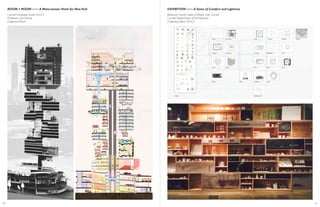
Room + Room - A Hotel for NewYork
Exhibition - Comfort and Lightness
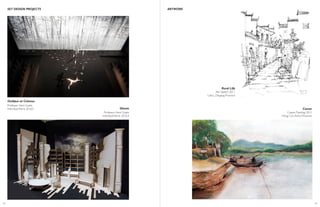
Set Design - Oedipus at Colonus, Ghosts
Artwork - Rural Life, Canoe
THICKET | Temporary Construction
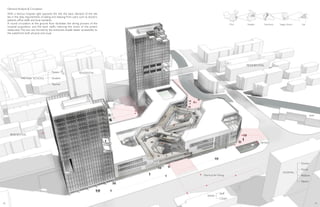
a Sense of Comfort and Lightness
04
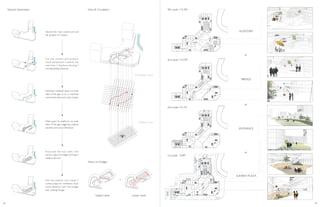
PUBLI[C]ITY | Manhattan Waterfront Planning
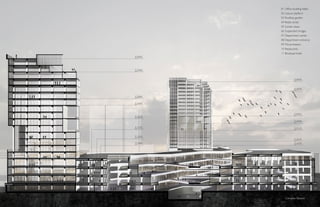
the Potential of Regular Urban System
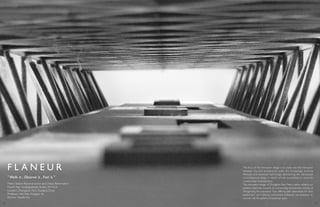
14
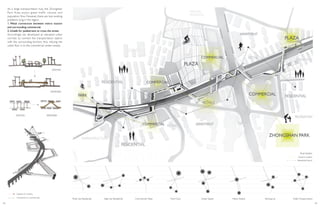
KAHN-CRETE CAMO | Forgery Museum Design
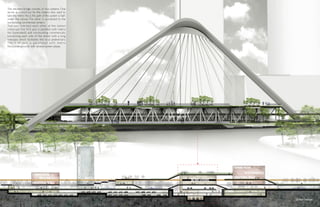
the Art of Knocking-off
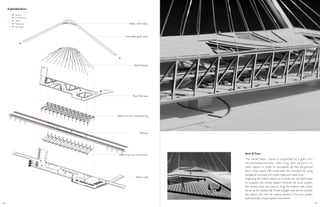
22
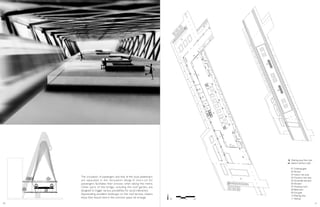
Detach or Attach
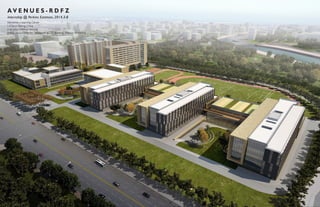
34GRAVITATION | City Complex Design
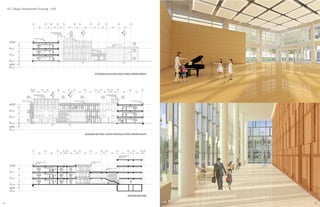
Walk it , Observe it , Feel it
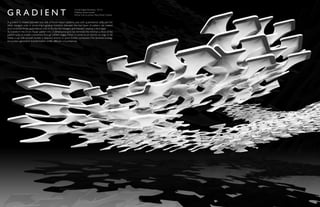
FLANEUR | Metro Station Reformation 42
PROFESSIONAL WORK
52
56
OTHER WORK
6th LIXIL International Competition, 2016.3-2016.5
Location:Taiki-Cho, Hokkaido
Professor:Andrea Lee Simitch, Lorena de Rio
Mainly Responsible for: fabric performance design, fabric
connection detailed drawing, interior rendering,
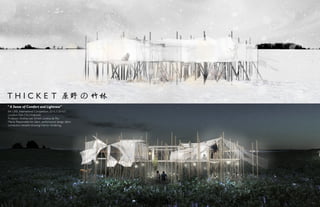
T H I C K E T 原野 の 竹林
" A Sense of Comfort and Lightness"
THICKET achieves a sense of comfort and lightness not only through a lightweight bamboo
and fabric structure, but also provides a physical experience of weightlessness through
the light touch to the ground. A field of bamboo poles serves to structure a series of
performative fabrics that provide energy, comfort, warmth, coolness and enclosure. Familiar
references of Japanese domestic space, as structured layers of increasingly private spaces, are
reimagined as layers of intelligent fabrics that create soft and flexible enclosures.
The bamboo structure lifts occupants into a constructed canopy overlooking the Taiki-
cho landscape, protecting its timeless beauty while nourishing a lush and productive garden
below, and from which flowering vines and fruit trees work their way up into the elevated
structure. From afar, THICKET promises the comfort and warmth of shelter as the fabrics
glow in the frozen landscape.
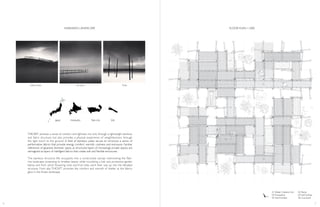
Japan Hokkaido Taiki-cho Site
HilltopTrees the Deck Poles
FLOOR PLAN 1:1000HOKKAIDO LANDSCAPE
01 Water Colletion Soil 02 Ramp
03Trampoline 04 Soft Surface
05 Hard Surface 06 Courtyard
01
04
05
03
02
06
N
6 7
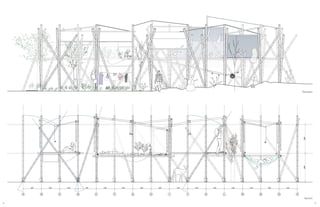
Elevation
Section
8 9
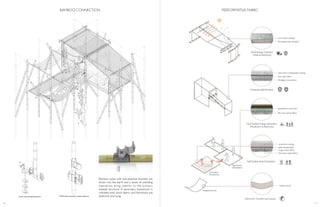
Bamboo poles with pre-attached brackets are
driven into the earth and a series of unfolding
operations bring stability to the primary
skeletal structure. A secondary framework is
unfolded onto which fabrics and hammocks are
stretched and hung.
BAMBOO CONNECTION PERFORMATIVE FABRIC
Softness and Strengh
10 11
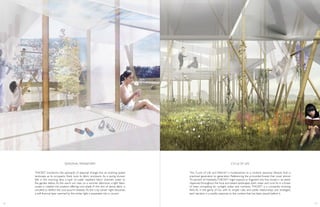
This ‘Cycle of Life and Rebirth’ is fundamental to a resilient seasonal lifestyle that is
practiced generation to generation. Referencing the primordial forests that cover almost
70 percent of Hokkaido,THICKET might expand or fragment into five clusters—as seeds
dispersed throughout the local and distant landscapes, both urban and rural.As in a forest
of trees competing for sunlight, water and nutrients, THICKET is a constantly evolving
field. As in the game of Go, with its simple rules and subtle relationships and strategies,
each iteration is a careful response to the context that has been placed before it.
SEASONALTRANSFORM
THICKET transforms the spectacle of seasonal change into an evolving spatial
landscape as its occupants finely tune its fabric enclosure. As a spring shower
falls in the morning dew, a layer of water repellant fabric channels water to
the garden below. As the warm sun rises on a summer afternoon, a light fabric
screen is rotated into position offering cool shade. A thin skin of dense fabric is
unrolled to deflect the cool autumn breezes.As the crisp winter night descends,
a soft thermal layer warmed by the winter light is expanded into a cocoon.
CYCLE OF LIFE
12 13
Manhattan Waterfront Planning
Graduate studio, 2015.6, Cornell University
Location: East-manhattan, NewYork City
Professor: Felipe Correa
Partners: Ruofei Gao,Yue Gu, Sukjune Choi
P U B L I [C] I T Y
Located in East-Manhattan riverside between E 38th street and
E 41th street, our design proposes a hierarchy of privacy within
open spaces. The deviation of building profiles enables greater
visual interactions towards both the river and the city. Meanwhile,
the regular layout at the bottom level helps maintain the original
texture of Manhattan grid. The scenery potential and the latent
hazard of water-level rise of the East River urges us to incorporate
resilient landscape design into our block system, thus creating an
experimental and sustainable paradigm for Manhattan Waterfront.
"the Potential of Regular Urban System"
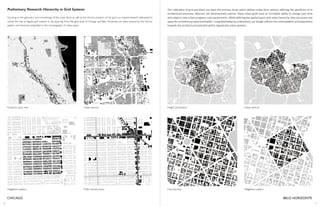
Focusing on the geometry and morphology of the urban block as well as the intrinsic property of city grid, our original research attempted to
unfold the role of regular grid systems in city planning. From the grid study of Chicago and Belo Horizonte, we were inspired by the intrinsic
pattern and hierarchy embedded in the choreography of urban space.
Preliminary Research: Hierarchy in Grid Systems The calibration of grid and block has been the primary driver which defines urban form without defining the specificity of its
architectural elements. Abstract, yet dimensionally precise, these urban grids have an incredible ability to change over time
and adapt to new urban programs and requirements. While defining key spatial layout and urban hierarchy, they also leave vast
space for architectural experimentation. Using Manhattan as a laboratory, our design reflects the contemplation and exploration
towards the architectural potential within regularized urban systems.
CHICAGO BELO HORIZONTE
Footprint upon river Urban texture
Megablock pattern Public infrastructure
Height Distribution Urban textrue
Hub and Axis Megablock pattern
16 17
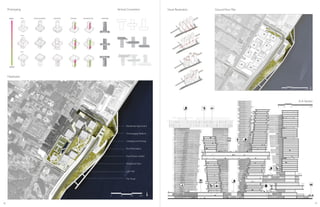
Prototyping
Masterplan
Vertical Connection
Roof Fitness Center
Waterfront Park
Roof Recreation
Light Rail
Pier Road
Residential Apartment
Overhanging Platform
Underground Parking
150m100500
Visual Penetration
20 50M0 10
A-A Section
Ground Floor Plan
40 100M0 20
A
A
18 19
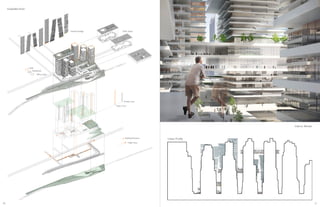
Exploded Axon
Urban Profile
Interior Render
Office tower
Public Core
Private Core
Building Entrance
Traffic Flow
Residential
Hotel
Facade Strategy Public Space
20 21
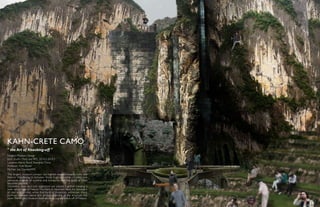
KAHN-CRETE CAMO
Forgery Museum Design
Joint Studio (Tonji and RPI), 2014.3-2014.5
Location: North Bund, Shanghai, China
Professor: Kyle Stover
Partner: Joe Daniele(RPI)
" the Art of Knocking-off "
The forgery museum conveys our highest respect towards Kahn and
Nature. Wandering in between those huge, concrete columns, one
perceives a sense of sublime and tranquility, and the spirit of Kahn
becomes palpable.
Geometric slabs and lush vegetation are pieced together, creating a
lively camouflage of Nature.The front of mountain blurs the boundary
of real and un-real, while the back of mountain witnesses sharp
contrast between nature and artifact, exposing all the structure and
pipes.The forgery museum itself serves as a great knock-off of Nature.
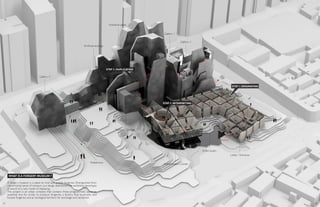
Interpretation Center
Lobby / Entrance
Artist studio
Factory / Storage
Gallery 11
Artificial ecology
Gallery 111
Gallery 1
Industrial pipes
Visitors
Pedestrians
WHAT IS A FORGERY MUSEUM ?
A forgery museum is a place to hold and exhibit forgeries. Distinguished from
conventional sense of museum, our design abandoned the exhibiting stereotype
in search of a new mode of displaying.
The project is an urban complex that contains three programmatic parts: an
assembly line for artists to produce forgeries, a factory that duplicates and
houses forgeries, and an ecological territory for exchange and recreation.
STEP 1: ORIGINATING
STEP 2 : INTERPRETING
STEP 3 : DUPLICATING
24 25
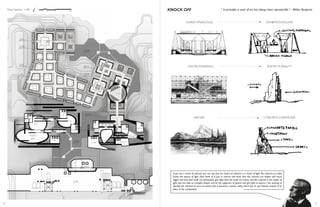
Floor Section +14M KNOCK OFF
0.00+
5M+
5 10 20 40MN
“ In principle, a work of art has always been reproducible.” --Walter Benjamin
10M+
10M+
5M+
4.3 M+
10 M+
5M+
0.00+
10 M+
4M+
A
A
HURVA SYNAGOGUE
CENTRE POMPIDOU
NATURE
EXHIBITIONVOLUME
POETRYVS REALITY
CONCRETE CAMOFLAGE
If you see a series of columns you can say that the choice of columns is a choice of light.The columns as solids
frame the spaces of light. Now think of it just in reverse and think that the columns are hollow and much
bigger and that their walls can themselves give light, then the voids are rooms, and the columns is the maker of
light and can take on complex shapes and be the supporter of spaces and give light to spaces. I am working to
develop the element to such an extent that it becomes a poetic entity which has its own beauty outside of its
place in the composition.
26 27
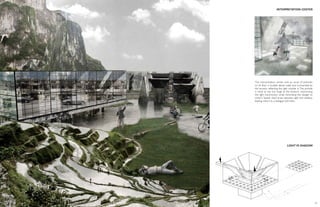
The interpretation center with an array of pinholes
on its floor is located above water and surrounded by
the terrace, reflecting the light outside in. The pinhole
is small at top but large at the bottom, maximizing
the light transmission while minimizing the danger to
visitors. Spatial ritual arises between light and shadow,
leading visitors to a dialogue with Kahn.
INTERPRETATION CENTER
LIGHT VS SHADOW
29
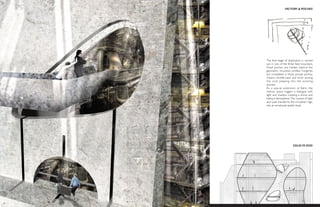
FACTORY & POCHES
The final stage of duplication is carried
out in one of the three fake mountains.
Small poches are hidden behind the
geometric mountain profiles. Forgeries
are completed in those private poches.
Visitors shuttle back and forth among
the void, peeping into the working
process.
As a spacial extension of Kahn, the
interior space triggers a dialogue with
light and shadow, creating a divine and
tranquil atmosphere.The nuance of light
and scale transforms the circulation logic
into an emotional spatial ritual.
SOLID VS VOID
30
01
02
06
04
03
08
05
07
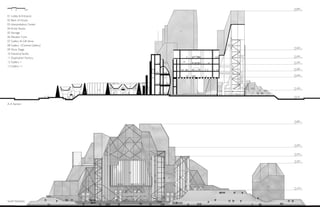
01 Lobby & Entrance
02 Back of House
03 Interpretation Center
04 Artist Studio
05 Storage
06 Elevator Core
07 Gallery & Gift Store
08 Gallery 1(Central Gallery)
09 Show Stage
10 Industrial facility
11 Duplication Factory
12 Gallery 11
13 Gallery 111
10
09
11
11
12
13
50M+
40M+
34M+
28M+
22M+
88M+
64M+
54M+
46M+
88M+
17M+
0 M+
10M+
A-A Section
South Elevation
10 20M5
GRAVITATION
City Complex Design
Undergraduate studio, 2013.3-2013.5
Location:Yangpu District, Shanghai, China
Professor: Guanglin Sun
Individual Work
" Detach ? Attach ! "
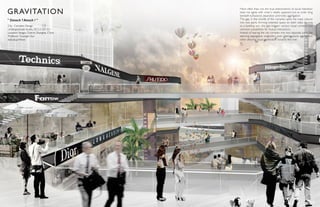
More often than not, the true phenomenon of social interation
does not agree with what is readily apparent. Just as order lying
beneath turbulance, separation promotes aggregation.
The gap in the middle of the complex splits the mass volume
into two parts, forming indented space on both sides. Serving
as a bustling axis ,the gap triggers various visual contacts and
unknown possibilities for mutual interactions.
Instead of tearing the city complex into two separate parts, the
seeming segregation engenders even intense social aggregation
when allowing visual penetration towards the river.
China Shanghai Downtown Yangpu District Site
RESIDENTIAL
BAR
HOSPITAL
Patient
Relative
Nurse
Doctor
BANK
Staff
Citizen
Teacher
Student
Parent
RESIDENTIAL
RESIDENTIAL
Demand Analysis & Circulation
With a famous hospital right opposite the site, the basic demand of the site
lies in the daily requirements of eating and relaxing from users such as doctors,
patients, office staffs and local residents.
A round circulation at the ground floor facilitates the dining process of the
hospital population and the bank staffs, relieving the stress of the extant
restaurants.The two axis formed by the entrances enable better accessibility to
the waterfront, both physical and visual.
Shortcut for Dining
PRIMARY SCHOOL
METRO
36 37
Volume Generation View & Circulation
Decide the mass volume and set
the location of 2 towers
Cut the volume and produce
visual penetration towards the
river from 2 directions, forming 3
corresponding entrances.
Generate indented space on both
sides of the gap so as to maximize
commercial value and visual contact.
Make space for platforms on both
sides of the gap, triggering outdoor
activities and social interaction.
Associate the two sides with
various types of bridges, forming 3
outdoor atriums.
Sink the bottom and create 2
sunken plazas for exhibition, draw
more attention from the bridges
thus vivifying the gap.
Views on bridges
Upper Level Lower Level
+
Circulation Grid
Optical Grid
4th Level +15.3M
3rd Level +10.2M
2nd Level +5.1M
1st Level 0.0M
ENTRANCE
SUNKEN PLAZA
BRIDGE
PLATFORM
+
+
+
38 39
01 Office building lobby
02 Leisure platform
03 Rooftop garden
04 Retail center
05 Sunken plaza
06 Suspended bridges
07 Department center
08 Department entrance
09 Movie theatre
10 Restaurants
11 Boutique hotel
Complex Section
09
89.5M+
78.7M+
24.7M+
44.5M+
39.1M+
84.0M+
75.6M+
21.0M+
58.8M+
46.2M+
04
05
02
15.9M+
54.6M+
10.8M+
49.9M+
28.3M+
01
03
06
07 08
10
11
Metro Station Reconstruction and Urban Reformation
FourthYear Undergraduate Studio, 2014.5-6
Location: Zhongshan Park, Shanghai,China
Professor:Wei Wei, Hongtao Xu
Partner: Xiaofei Wu
F L A N E U R
" Walk it , Observe it , Feel it."
The focus of the renovation design is to probe into the interaction
between city and architecture under the increasingly evolving
lifestyles and advanced technology, abandoning the stereotype
of architectural design in search of new possibilities to reconcile
current urban contradictions.
The renovation design of Zhongshan Park Metro station reflects our
positive responses towards its surrounding environment. Aiming at
reorganizing the population flow, offering safer alternatives for local
pedestrians and vitalizing commercial ambience, we endeavor to
uncover real life patterns of potential users.
42 43
Multi-rise Residential High-rise Residential Commercial+Plaza Park+Gym Green Space Metro Station Parking Lot
Dual System
As a large transportation hub, the Zhongshan
Park Area enjoys great traffic volume and
population flow. However, there are two existing
problems lying in the region.
1. Weak connection between metro station
and surrounding commercial.
2. Unsafe for pedestrians to cross the street.
Accordingly, we developed an elevated urban
corridor to connect the transportation station
with the surrounding function, thus infusing the
urban flow in to the commercial center nearby.
Dynamic system
Residential layout
Express for Citizens
Connection to commercials
PublicTransportation
44 45
The elevated bridge consists of two systems. One
serves as a short-cut for the citizens who want to
take the metro No.3, the path of this system is half-
under the railway. The other is connected to the
surrounding commericial centers.
Two axis intersect each other at the station
crossroad. The N-S axis is parelled with metro
No.3(elevated) and surrounding commercials,
connecting each side of the street with a long
overpass which facilitates the local pedestrians.
The E-W axis is par alleled with metro
No.2(underground) with several sunken plazas.
Urban Section
46 47
Web with holes
Concrete giant arch
Steel Ropes
RoofTerrace
Steel truss for load-bearing
Railway
Steel truss for connection
Metro Hall
The whole metro station is suspended by a giant arch
structure(approximate 100m long, 50m tall),with no
other support in order to completely set free the ground
floor urban space. We materialize this structure by using
hexagonal concrete arch, steel ropes and steel truss.
Regarding the metro station as a whole, we use steel topes
to suspend the whole station. Among the truss system,
the vertical ones are used to drag the bottom slab, which
serves as the station hall.Those triangle ones are to connect
the station hall with the railway platform.The truss system
itself provides unique spatial experience.
Arch &Truss
Exploded Axon
Metro
Pedestrians
Passengers
Tension
Compression
48 49
The circulation of passengers and that of the local pedestrains
are separated in the renovation design.A short-cut for
passengers facilitates their process when taking the metro.
Other parts of the bridge, including the roof garden, are
designed to trigger various possibilities for social interaction.
Appreciating excellent landscape on the roof terrace, citizens
enjoy their leisure time in the common space we arrange.
02
01Ticketing gate
02Terrace
03 Indoor rest area
04 Ourdoor rest area
05 Accessible elevator
06 Elevator
07 Assisting room
08 Bathroom
09 Exit gate
10 Waiting area
11 RailwayN
03
04
09
Waiting area floor plan
Station hall floor plan
05
06
07
08
08
07
06
01
09
01
02
10
11
06
06
5 10 20M
50 51
Elementary Learning Center
Location: Beijing, China
Instructor: Meiling Honson
Mainly Responsible for: 3d-modeling, DD drawing, Interior Rendering
A V E N U E S - R D F Z
Internship @ Perkins Eastman, 2014.3-8
ELC Design Development Drawings 1: 500
54 55
Cornell Digital Workshop, 2015.6
Professor: James Lowder
Partner:Yue Gu, Junhan Zhao, Rohan CherayilG R A D I E N T
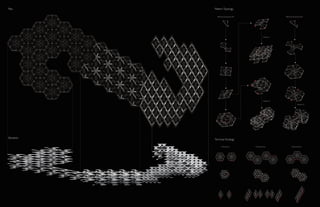
A gradient is created between two sets of Erwin Hauer patterns, one with quadrilateral units, and the
other hexagon units. In producing a gradual transition between the two types of pattern, we rotated
and combined three quadrilateral units to fit into the hexagon grid thereby creating a third layer.
To transform the Erwin Hauer pattern into 3 dimensional grid, we mirrored the minimal surface of the
pattern units to enable connection through pattern edges.When it comes to an end for an edge to be
linked, a cap with smooth border is attached directly to avoid further connection.This terminal strategy
encounters geometric transformation under different circumstances.
Plan
Elevation
PatternTypology
Terminal Strategy
ThicketThicket Thicket
HoseInflatableCurtain
Field
Field
Possessions Senses
BurnBurn
Hose
Burn
Module Primitive
GradientHose
View
Radiant SlabModels
Labor
This exhibition a documentation of the many ideas, some embraced others discarded, (and several still earnestly
waiting on the sidelines) that provided the foundation for the Department of Architecture Japan Studio’s final
competition entry to the sixth LIXIL International University Architectural Competition in Hokkaido, Japan:
Thicket. It is a categorization of the studio’s collective exploration of the themes of comfort and lightness, of
ephemerality, softness, and mist, of inflatables, transformation, ethereality, movability, and flexibility, of the senses,
seasonality, the number five, domesticity, and warmth.The amalgamation of many individual ideas into a handful of
distinct projects favors not the singular but the process, and is so doing this exhibition reveals the good and the
bad, the setbacks and the leaps forward, and recognizes the contributions that were made by the many.
As a non-hierarchical display of the everything, whether it is a Bristol model, a final render or a full-scale bamboo
detail, these are seen as complementary representations working toward the final project. The inspiration, the
maybes, the “oh nothings”, the what-makes-up-the-thing, and finally this exhibition, all of this and more displayed
here suggests another beginning, and perhaps for another time. It is a tangled endeavor and a thicket onto itself.
Kam Chi Cheng, Christopher Chown, Brian Hong,Takuma Johnson,Alex Jopek, Xinran Ke, Laura Kimmel, John Lai, Daye Lee, Sophie Nichols, Daphany Shen, Danwei Wang, XinyuYi,Yutian Zhang
A SENSE OF
COMFORT AND LIGHTNESS
EXHIBITION, CRITIQUE AND DISCUSSION MAY 12, 2016 at 1:00 p.m
BIBLIOWICZ FAMILY GALLERY, MILSTEIN HALL
with spectial thanks to Cornell AAP and the Department of Architecture, Roberto Bertoia, Iñaqui Carnicero, Patrick Charles,Adelheid Christian-Zechner,Timur Dogan, Dagur Eggertsson,
Jack Elliott, Mikhail Grinwald, Juan Hinestroza, Kent Hubbell, Paul Laroque, Ángel Martinez Garcia-Posada, David Eugin Moon, Mark Morris, Caroline O’Donnell,Val Warke, Sasa Zivkovic
May 12, 2016 at 5:00 p.m
Bibliowicz Family Gallery, Milstein Hall
May 12 - 30, 2016
Bibliowicz Family Gallery, Milstein Hall
aap.cornell.edu/events
EXHIBITION
LAUNCH
MORE
a process
Poster design by Christopher Chown
Professor Andrea Simitch with Lorena del Rio and the students of the Department of Architecture Japan Studio
0
Bibliowicz Family Gallery, Milstein Hall, Cornell
Cornell Department of Architecture
Collective Work, 2016.5
Cornell Graduate Studio, 2015.7
Professor: Dan Wood
Collective Work
EXHIBITION —— A Sense of Comfort and LightnessROOM + ROOM —— A Meta-mosaic Hotel for New York
60 61
Rural Life
Pen Sketch, 2011
Lishui, Zhejiang Province
Canoe
Crayon Painting, 2012
Hong Cun,Anhui Province
ARTWORKSET DESIGN PROJECTS
Professor: Kent Goetz
Individual Work, 2016.5
Oedipus at Colonus
Professor: Kent Goetz
Individual Work, 2016.4
Ghosts
62 63
XINRAN KE
EDUCATION
Cornell University Ithaca, NY
Post-professional Master of Architecture 06/2015-05/2016
Tongji University Shanghai, China
Bachelor of Architecture 09/2010-06/2015
Rensselaer Polytechnic Institute (RPI) +Tongji University (TJU) Shanghai, China
Undergraduate Joint Studio 03/2014-05/2014
WORK EXPERIENCE
Intern Architect NewYork, NY
Pilot Project Design Collective LLC 06/2016-Present
Brand Designer Ithaca, NewYork
Verdi Photography (Client: KseniaVerdiyan) 08/2015-10/2015
Intern Architect Shanghai, China
Perkins Eastman Architecture Design Consulting (Shanghai Branch) 03/2014-08/2014
Intern Architect Shanghai, China
Architectural Research Institute of Shanghai University 01/2013-02/2013
HONORS & AWARDS
2nd Price in Excellent Student Scholarship ofTongji University 2014
Exhibition of 2011 National Science and Art Exhibition, Shanghai Museum 2011
- Awarded to excellent art pieces nationally
SOCIAL ACTIVITIES
Member, Publicity Division, Chinese Student and Scholar Association, Cornell University 2015-2016
Volunteer, CTBUH “Future City” International Conference 2014
Member, Future Architects Association,Tongji University 2013-2015
Director, Publicity Division,Tongji University Entrepreneur Association 2012-2013
Panel Secretary, the 8th Challenge Cup National Business Plan Competition 2012
RESEARCH EXPERIENCE
SITP College Students Innovative Research and Renovation 09/2013-05/2014
- Natural lighting system in underground commercial space, China
Mapping and Drawing of ChenghuangTemple in Shanghai, China 06/2013-07/2013
LANGUAGES
English (Fluent), Chinese (Native), Korean (Beginner)
SKILLS
- Auto-CAD, Revit, Sketch-up, Photoshop, InDesign, Illustrator, Rhinoceros, 3D-MAX, Grasshopper, Maya,Visual Basic
- Architecture model-making, freehand drawing and photography.
- Piano (Shanghai Conservatory Level-10 Piano Certification, 2003)
64

Xinran Ke_Portfolio

  • 1.
    XINRAN KE Cell: (607)-280-2885 E-mail:xk33@cornell.edu XINRAN KE | PORTFOLIO Cornell M.Arch 11 +Tongji B.Arch XINRANKE|PORTFOLIO
  • 2.
    Life is toinfuse the reality with poetry. So is architecture. CONTENT ACADEMIC WORK AVENUES - RDFZ | Elementary Learning Center Internship @ Perkins Eastman Gradient - Cornell Digital Studio Room + Room - A Hotel for NewYork Exhibition - Comfort and Lightness Set Design - Oedipus at Colonus, Ghosts Artwork - Rural Life, Canoe THICKET | Temporary Construction a Sense of Comfort and Lightness 04 PUBLI[C]ITY | Manhattan Waterfront Planning the Potential of Regular Urban System 14 KAHN-CRETE CAMO | Forgery Museum Design the Art of Knocking-off 22 Detach or Attach 34GRAVITATION | City Complex Design Walk it , Observe it , Feel it FLANEUR | Metro Station Reformation 42 PROFESSIONAL WORK 52 56 OTHER WORK
  • 3.
    6th LIXIL InternationalCompetition, 2016.3-2016.5 Location:Taiki-Cho, Hokkaido Professor:Andrea Lee Simitch, Lorena de Rio Mainly Responsible for: fabric performance design, fabric connection detailed drawing, interior rendering, T H I C K E T 原野 の 竹林 " A Sense of Comfort and Lightness"
  • 4.
    THICKET achieves asense of comfort and lightness not only through a lightweight bamboo and fabric structure, but also provides a physical experience of weightlessness through the light touch to the ground. A field of bamboo poles serves to structure a series of performative fabrics that provide energy, comfort, warmth, coolness and enclosure. Familiar references of Japanese domestic space, as structured layers of increasingly private spaces, are reimagined as layers of intelligent fabrics that create soft and flexible enclosures. The bamboo structure lifts occupants into a constructed canopy overlooking the Taiki- cho landscape, protecting its timeless beauty while nourishing a lush and productive garden below, and from which flowering vines and fruit trees work their way up into the elevated structure. From afar, THICKET promises the comfort and warmth of shelter as the fabrics glow in the frozen landscape. Japan Hokkaido Taiki-cho Site HilltopTrees the Deck Poles FLOOR PLAN 1:1000HOKKAIDO LANDSCAPE 01 Water Colletion Soil 02 Ramp 03Trampoline 04 Soft Surface 05 Hard Surface 06 Courtyard 01 04 05 03 02 06 N 6 7
  • 5.
  • 6.
    Bamboo poles withpre-attached brackets are driven into the earth and a series of unfolding operations bring stability to the primary skeletal structure. A secondary framework is unfolded onto which fabrics and hammocks are stretched and hung. BAMBOO CONNECTION PERFORMATIVE FABRIC Softness and Strengh 10 11
  • 7.
    This ‘Cycle ofLife and Rebirth’ is fundamental to a resilient seasonal lifestyle that is practiced generation to generation. Referencing the primordial forests that cover almost 70 percent of Hokkaido,THICKET might expand or fragment into five clusters—as seeds dispersed throughout the local and distant landscapes, both urban and rural.As in a forest of trees competing for sunlight, water and nutrients, THICKET is a constantly evolving field. As in the game of Go, with its simple rules and subtle relationships and strategies, each iteration is a careful response to the context that has been placed before it. SEASONALTRANSFORM THICKET transforms the spectacle of seasonal change into an evolving spatial landscape as its occupants finely tune its fabric enclosure. As a spring shower falls in the morning dew, a layer of water repellant fabric channels water to the garden below. As the warm sun rises on a summer afternoon, a light fabric screen is rotated into position offering cool shade. A thin skin of dense fabric is unrolled to deflect the cool autumn breezes.As the crisp winter night descends, a soft thermal layer warmed by the winter light is expanded into a cocoon. CYCLE OF LIFE 12 13
  • 8.
    Manhattan Waterfront Planning Graduatestudio, 2015.6, Cornell University Location: East-manhattan, NewYork City Professor: Felipe Correa Partners: Ruofei Gao,Yue Gu, Sukjune Choi P U B L I [C] I T Y Located in East-Manhattan riverside between E 38th street and E 41th street, our design proposes a hierarchy of privacy within open spaces. The deviation of building profiles enables greater visual interactions towards both the river and the city. Meanwhile, the regular layout at the bottom level helps maintain the original texture of Manhattan grid. The scenery potential and the latent hazard of water-level rise of the East River urges us to incorporate resilient landscape design into our block system, thus creating an experimental and sustainable paradigm for Manhattan Waterfront. "the Potential of Regular Urban System"
  • 9.
    Focusing on thegeometry and morphology of the urban block as well as the intrinsic property of city grid, our original research attempted to unfold the role of regular grid systems in city planning. From the grid study of Chicago and Belo Horizonte, we were inspired by the intrinsic pattern and hierarchy embedded in the choreography of urban space. Preliminary Research: Hierarchy in Grid Systems The calibration of grid and block has been the primary driver which defines urban form without defining the specificity of its architectural elements. Abstract, yet dimensionally precise, these urban grids have an incredible ability to change over time and adapt to new urban programs and requirements. While defining key spatial layout and urban hierarchy, they also leave vast space for architectural experimentation. Using Manhattan as a laboratory, our design reflects the contemplation and exploration towards the architectural potential within regularized urban systems. CHICAGO BELO HORIZONTE Footprint upon river Urban texture Megablock pattern Public infrastructure Height Distribution Urban textrue Hub and Axis Megablock pattern 16 17
  • 10.
    Prototyping Masterplan Vertical Connection Roof FitnessCenter Waterfront Park Roof Recreation Light Rail Pier Road Residential Apartment Overhanging Platform Underground Parking 150m100500 Visual Penetration 20 50M0 10 A-A Section Ground Floor Plan 40 100M0 20 A A 18 19
  • 11.
    Exploded Axon Urban Profile InteriorRender Office tower Public Core Private Core Building Entrance Traffic Flow Residential Hotel Facade Strategy Public Space 20 21
  • 12.
    KAHN-CRETE CAMO Forgery MuseumDesign Joint Studio (Tonji and RPI), 2014.3-2014.5 Location: North Bund, Shanghai, China Professor: Kyle Stover Partner: Joe Daniele(RPI) " the Art of Knocking-off " The forgery museum conveys our highest respect towards Kahn and Nature. Wandering in between those huge, concrete columns, one perceives a sense of sublime and tranquility, and the spirit of Kahn becomes palpable. Geometric slabs and lush vegetation are pieced together, creating a lively camouflage of Nature.The front of mountain blurs the boundary of real and un-real, while the back of mountain witnesses sharp contrast between nature and artifact, exposing all the structure and pipes.The forgery museum itself serves as a great knock-off of Nature.
  • 13.
    Interpretation Center Lobby /Entrance Artist studio Factory / Storage Gallery 11 Artificial ecology Gallery 111 Gallery 1 Industrial pipes Visitors Pedestrians WHAT IS A FORGERY MUSEUM ? A forgery museum is a place to hold and exhibit forgeries. Distinguished from conventional sense of museum, our design abandoned the exhibiting stereotype in search of a new mode of displaying. The project is an urban complex that contains three programmatic parts: an assembly line for artists to produce forgeries, a factory that duplicates and houses forgeries, and an ecological territory for exchange and recreation. STEP 1: ORIGINATING STEP 2 : INTERPRETING STEP 3 : DUPLICATING 24 25
  • 14.
    Floor Section +14MKNOCK OFF 0.00+ 5M+ 5 10 20 40MN “ In principle, a work of art has always been reproducible.” --Walter Benjamin 10M+ 10M+ 5M+ 4.3 M+ 10 M+ 5M+ 0.00+ 10 M+ 4M+ A A HURVA SYNAGOGUE CENTRE POMPIDOU NATURE EXHIBITIONVOLUME POETRYVS REALITY CONCRETE CAMOFLAGE If you see a series of columns you can say that the choice of columns is a choice of light.The columns as solids frame the spaces of light. Now think of it just in reverse and think that the columns are hollow and much bigger and that their walls can themselves give light, then the voids are rooms, and the columns is the maker of light and can take on complex shapes and be the supporter of spaces and give light to spaces. I am working to develop the element to such an extent that it becomes a poetic entity which has its own beauty outside of its place in the composition. 26 27
  • 15.
    The interpretation centerwith an array of pinholes on its floor is located above water and surrounded by the terrace, reflecting the light outside in. The pinhole is small at top but large at the bottom, maximizing the light transmission while minimizing the danger to visitors. Spatial ritual arises between light and shadow, leading visitors to a dialogue with Kahn. INTERPRETATION CENTER LIGHT VS SHADOW 29
  • 16.
    FACTORY & POCHES Thefinal stage of duplication is carried out in one of the three fake mountains. Small poches are hidden behind the geometric mountain profiles. Forgeries are completed in those private poches. Visitors shuttle back and forth among the void, peeping into the working process. As a spacial extension of Kahn, the interior space triggers a dialogue with light and shadow, creating a divine and tranquil atmosphere.The nuance of light and scale transforms the circulation logic into an emotional spatial ritual. SOLID VS VOID 30
  • 17.
    01 02 06 04 03 08 05 07 01 Lobby &Entrance 02 Back of House 03 Interpretation Center 04 Artist Studio 05 Storage 06 Elevator Core 07 Gallery & Gift Store 08 Gallery 1(Central Gallery) 09 Show Stage 10 Industrial facility 11 Duplication Factory 12 Gallery 11 13 Gallery 111 10 09 11 11 12 13 50M+ 40M+ 34M+ 28M+ 22M+ 88M+ 64M+ 54M+ 46M+ 88M+ 17M+ 0 M+ 10M+ A-A Section South Elevation 10 20M5
  • 18.
    GRAVITATION City Complex Design Undergraduatestudio, 2013.3-2013.5 Location:Yangpu District, Shanghai, China Professor: Guanglin Sun Individual Work " Detach ? Attach ! " More often than not, the true phenomenon of social interation does not agree with what is readily apparent. Just as order lying beneath turbulance, separation promotes aggregation. The gap in the middle of the complex splits the mass volume into two parts, forming indented space on both sides. Serving as a bustling axis ,the gap triggers various visual contacts and unknown possibilities for mutual interactions. Instead of tearing the city complex into two separate parts, the seeming segregation engenders even intense social aggregation when allowing visual penetration towards the river.
  • 19.
    China Shanghai DowntownYangpu District Site RESIDENTIAL BAR HOSPITAL Patient Relative Nurse Doctor BANK Staff Citizen Teacher Student Parent RESIDENTIAL RESIDENTIAL Demand Analysis & Circulation With a famous hospital right opposite the site, the basic demand of the site lies in the daily requirements of eating and relaxing from users such as doctors, patients, office staffs and local residents. A round circulation at the ground floor facilitates the dining process of the hospital population and the bank staffs, relieving the stress of the extant restaurants.The two axis formed by the entrances enable better accessibility to the waterfront, both physical and visual. Shortcut for Dining PRIMARY SCHOOL METRO 36 37
  • 20.
    Volume Generation View& Circulation Decide the mass volume and set the location of 2 towers Cut the volume and produce visual penetration towards the river from 2 directions, forming 3 corresponding entrances. Generate indented space on both sides of the gap so as to maximize commercial value and visual contact. Make space for platforms on both sides of the gap, triggering outdoor activities and social interaction. Associate the two sides with various types of bridges, forming 3 outdoor atriums. Sink the bottom and create 2 sunken plazas for exhibition, draw more attention from the bridges thus vivifying the gap. Views on bridges Upper Level Lower Level + Circulation Grid Optical Grid 4th Level +15.3M 3rd Level +10.2M 2nd Level +5.1M 1st Level 0.0M ENTRANCE SUNKEN PLAZA BRIDGE PLATFORM + + + 38 39
  • 21.
    01 Office buildinglobby 02 Leisure platform 03 Rooftop garden 04 Retail center 05 Sunken plaza 06 Suspended bridges 07 Department center 08 Department entrance 09 Movie theatre 10 Restaurants 11 Boutique hotel Complex Section 09 89.5M+ 78.7M+ 24.7M+ 44.5M+ 39.1M+ 84.0M+ 75.6M+ 21.0M+ 58.8M+ 46.2M+ 04 05 02 15.9M+ 54.6M+ 10.8M+ 49.9M+ 28.3M+ 01 03 06 07 08 10 11
  • 22.
    Metro Station Reconstructionand Urban Reformation FourthYear Undergraduate Studio, 2014.5-6 Location: Zhongshan Park, Shanghai,China Professor:Wei Wei, Hongtao Xu Partner: Xiaofei Wu F L A N E U R " Walk it , Observe it , Feel it." The focus of the renovation design is to probe into the interaction between city and architecture under the increasingly evolving lifestyles and advanced technology, abandoning the stereotype of architectural design in search of new possibilities to reconcile current urban contradictions. The renovation design of Zhongshan Park Metro station reflects our positive responses towards its surrounding environment. Aiming at reorganizing the population flow, offering safer alternatives for local pedestrians and vitalizing commercial ambience, we endeavor to uncover real life patterns of potential users. 42 43
  • 23.
    Multi-rise Residential High-riseResidential Commercial+Plaza Park+Gym Green Space Metro Station Parking Lot Dual System As a large transportation hub, the Zhongshan Park Area enjoys great traffic volume and population flow. However, there are two existing problems lying in the region. 1. Weak connection between metro station and surrounding commercial. 2. Unsafe for pedestrians to cross the street. Accordingly, we developed an elevated urban corridor to connect the transportation station with the surrounding function, thus infusing the urban flow in to the commercial center nearby. Dynamic system Residential layout Express for Citizens Connection to commercials PublicTransportation 44 45
  • 24.
    The elevated bridgeconsists of two systems. One serves as a short-cut for the citizens who want to take the metro No.3, the path of this system is half- under the railway. The other is connected to the surrounding commericial centers. Two axis intersect each other at the station crossroad. The N-S axis is parelled with metro No.3(elevated) and surrounding commercials, connecting each side of the street with a long overpass which facilitates the local pedestrians. The E-W axis is par alleled with metro No.2(underground) with several sunken plazas. Urban Section 46 47
  • 25.
    Web with holes Concretegiant arch Steel Ropes RoofTerrace Steel truss for load-bearing Railway Steel truss for connection Metro Hall The whole metro station is suspended by a giant arch structure(approximate 100m long, 50m tall),with no other support in order to completely set free the ground floor urban space. We materialize this structure by using hexagonal concrete arch, steel ropes and steel truss. Regarding the metro station as a whole, we use steel topes to suspend the whole station. Among the truss system, the vertical ones are used to drag the bottom slab, which serves as the station hall.Those triangle ones are to connect the station hall with the railway platform.The truss system itself provides unique spatial experience. Arch &Truss Exploded Axon Metro Pedestrians Passengers Tension Compression 48 49
  • 26.
    The circulation ofpassengers and that of the local pedestrains are separated in the renovation design.A short-cut for passengers facilitates their process when taking the metro. Other parts of the bridge, including the roof garden, are designed to trigger various possibilities for social interaction. Appreciating excellent landscape on the roof terrace, citizens enjoy their leisure time in the common space we arrange. 02 01Ticketing gate 02Terrace 03 Indoor rest area 04 Ourdoor rest area 05 Accessible elevator 06 Elevator 07 Assisting room 08 Bathroom 09 Exit gate 10 Waiting area 11 RailwayN 03 04 09 Waiting area floor plan Station hall floor plan 05 06 07 08 08 07 06 01 09 01 02 10 11 06 06 5 10 20M 50 51
  • 27.
    Elementary Learning Center Location:Beijing, China Instructor: Meiling Honson Mainly Responsible for: 3d-modeling, DD drawing, Interior Rendering A V E N U E S - R D F Z Internship @ Perkins Eastman, 2014.3-8
  • 28.
    ELC Design DevelopmentDrawings 1: 500 54 55
  • 29.
    Cornell Digital Workshop,2015.6 Professor: James Lowder Partner:Yue Gu, Junhan Zhao, Rohan CherayilG R A D I E N T A gradient is created between two sets of Erwin Hauer patterns, one with quadrilateral units, and the other hexagon units. In producing a gradual transition between the two types of pattern, we rotated and combined three quadrilateral units to fit into the hexagon grid thereby creating a third layer. To transform the Erwin Hauer pattern into 3 dimensional grid, we mirrored the minimal surface of the pattern units to enable connection through pattern edges.When it comes to an end for an edge to be linked, a cap with smooth border is attached directly to avoid further connection.This terminal strategy encounters geometric transformation under different circumstances.
  • 30.
  • 31.
    ThicketThicket Thicket HoseInflatableCurtain Field Field Possessions Senses BurnBurn Hose Burn ModulePrimitive GradientHose View Radiant SlabModels Labor This exhibition a documentation of the many ideas, some embraced others discarded, (and several still earnestly waiting on the sidelines) that provided the foundation for the Department of Architecture Japan Studio’s final competition entry to the sixth LIXIL International University Architectural Competition in Hokkaido, Japan: Thicket. It is a categorization of the studio’s collective exploration of the themes of comfort and lightness, of ephemerality, softness, and mist, of inflatables, transformation, ethereality, movability, and flexibility, of the senses, seasonality, the number five, domesticity, and warmth.The amalgamation of many individual ideas into a handful of distinct projects favors not the singular but the process, and is so doing this exhibition reveals the good and the bad, the setbacks and the leaps forward, and recognizes the contributions that were made by the many. As a non-hierarchical display of the everything, whether it is a Bristol model, a final render or a full-scale bamboo detail, these are seen as complementary representations working toward the final project. The inspiration, the maybes, the “oh nothings”, the what-makes-up-the-thing, and finally this exhibition, all of this and more displayed here suggests another beginning, and perhaps for another time. It is a tangled endeavor and a thicket onto itself. Kam Chi Cheng, Christopher Chown, Brian Hong,Takuma Johnson,Alex Jopek, Xinran Ke, Laura Kimmel, John Lai, Daye Lee, Sophie Nichols, Daphany Shen, Danwei Wang, XinyuYi,Yutian Zhang A SENSE OF COMFORT AND LIGHTNESS EXHIBITION, CRITIQUE AND DISCUSSION MAY 12, 2016 at 1:00 p.m BIBLIOWICZ FAMILY GALLERY, MILSTEIN HALL with spectial thanks to Cornell AAP and the Department of Architecture, Roberto Bertoia, Iñaqui Carnicero, Patrick Charles,Adelheid Christian-Zechner,Timur Dogan, Dagur Eggertsson, Jack Elliott, Mikhail Grinwald, Juan Hinestroza, Kent Hubbell, Paul Laroque, Ángel Martinez Garcia-Posada, David Eugin Moon, Mark Morris, Caroline O’Donnell,Val Warke, Sasa Zivkovic May 12, 2016 at 5:00 p.m Bibliowicz Family Gallery, Milstein Hall May 12 - 30, 2016 Bibliowicz Family Gallery, Milstein Hall aap.cornell.edu/events EXHIBITION LAUNCH MORE a process Poster design by Christopher Chown Professor Andrea Simitch with Lorena del Rio and the students of the Department of Architecture Japan Studio 0 Bibliowicz Family Gallery, Milstein Hall, Cornell Cornell Department of Architecture Collective Work, 2016.5 Cornell Graduate Studio, 2015.7 Professor: Dan Wood Collective Work EXHIBITION —— A Sense of Comfort and LightnessROOM + ROOM —— A Meta-mosaic Hotel for New York 60 61
  • 32.
    Rural Life Pen Sketch,2011 Lishui, Zhejiang Province Canoe Crayon Painting, 2012 Hong Cun,Anhui Province ARTWORKSET DESIGN PROJECTS Professor: Kent Goetz Individual Work, 2016.5 Oedipus at Colonus Professor: Kent Goetz Individual Work, 2016.4 Ghosts 62 63
  • 33.
    XINRAN KE EDUCATION Cornell UniversityIthaca, NY Post-professional Master of Architecture 06/2015-05/2016 Tongji University Shanghai, China Bachelor of Architecture 09/2010-06/2015 Rensselaer Polytechnic Institute (RPI) +Tongji University (TJU) Shanghai, China Undergraduate Joint Studio 03/2014-05/2014 WORK EXPERIENCE Intern Architect NewYork, NY Pilot Project Design Collective LLC 06/2016-Present Brand Designer Ithaca, NewYork Verdi Photography (Client: KseniaVerdiyan) 08/2015-10/2015 Intern Architect Shanghai, China Perkins Eastman Architecture Design Consulting (Shanghai Branch) 03/2014-08/2014 Intern Architect Shanghai, China Architectural Research Institute of Shanghai University 01/2013-02/2013 HONORS & AWARDS 2nd Price in Excellent Student Scholarship ofTongji University 2014 Exhibition of 2011 National Science and Art Exhibition, Shanghai Museum 2011 - Awarded to excellent art pieces nationally SOCIAL ACTIVITIES Member, Publicity Division, Chinese Student and Scholar Association, Cornell University 2015-2016 Volunteer, CTBUH “Future City” International Conference 2014 Member, Future Architects Association,Tongji University 2013-2015 Director, Publicity Division,Tongji University Entrepreneur Association 2012-2013 Panel Secretary, the 8th Challenge Cup National Business Plan Competition 2012 RESEARCH EXPERIENCE SITP College Students Innovative Research and Renovation 09/2013-05/2014 - Natural lighting system in underground commercial space, China Mapping and Drawing of ChenghuangTemple in Shanghai, China 06/2013-07/2013 LANGUAGES English (Fluent), Chinese (Native), Korean (Beginner) SKILLS - Auto-CAD, Revit, Sketch-up, Photoshop, InDesign, Illustrator, Rhinoceros, 3D-MAX, Grasshopper, Maya,Visual Basic - Architecture model-making, freehand drawing and photography. - Piano (Shanghai Conservatory Level-10 Piano Certification, 2003) 64