Water
Conservation
 Handbook
for Local Government
Water Conservation Partnership Project                        Acknowledgments
Department for Environment and Heritage
                                                              The Department for Environment and Heritage on behalf of
GPO Box 1047 Adelaide South Australia 5001
                                                              the project partners of the Water Conservation Partnership
                                                              Project (WCPP) would like to thank the following groups and
July 2005
                                                              individuals for their valuable contribution.

ISBN 0 7590 1055 2
                                                              Project Management Group:

Disclaimer                                                    Martin Allen (DWLBC)

The views contained in this handbook do not necessarily       Marilla Barnes (SA Water)

represent those of the Department for Environment and         Natasha Davis (NABCWMB)

Heritage or the South Australian Government or the partners   Janet Inman (OCWMB)

engaged in the Water Conservation Partnership Project.        Tanya Miller (Office of Sustainability, seconded from the City

                                                              of West Torrens)

The Water Conservation Partnership Project                    Stephen West (City of Burnside)


2000- 2004 partners were:
                                                              Consultants:
• 	Local Government Association of South Australia
                                                              Sustainable Focus Pty Ltd
   (LGA)
                                                              11 Gething Crescent, Bowden SA 5007
• 	River Murray Urban Users Local Action Planning             Tel (08) 8340 8666
   Committee (RMUULAPC)                                       Email info@sustainablefocus.com.au
• 	Department for Environment and Heritage (DEH)              Web www.sustainablefocus.com.au
• 	Department of Water, Land and Biodiversity
   Conservation (DWLBC)                                       Other contacts:
• Planning SA                                                 Jade Ballantyne (City of Holdfast Bay)

• SA Water                                                    Graham Brook (City of Tea Tree Gully)

• 	Torrens Catchment Water Management Board                   Ben Calder (City of Onkaparinga) 

   (TCWMB)                                                    Jeremy Cape (CSIRO)

• 	Patawalonga Catchment Water Management Board               David Cooney and Graham Webster (Alexandrina Council)

   (PCWMB)                                                    David Cunliffe (Department for Human Services)

• 	River Murray Catchment Water Management Board              Trudi Duffield (Murray Darling Association)

   (RMCWMB)                                                   Michael Howley (City of Unley)

                                                              Tim Kelly (SA Water)

• 	Onkaparinga Catchment Water Management Board
                                                              Jacob Kochergen (City of Mitcham) 

   (OCWMB)
                                                              David Lane (Streaky Bay District Council) 

• 	Northern Adelaide and Barossa Catchment Water
                                                              Justin Lang (City of Campbelltown

   Management Board (NABCWMB)
                                                              Rima Lauge-Christensen (Hornsby Shire Council

• CSIRO                                                       Marnie Lynch (City of Prospect)

• Natural Heritage Trust                                      Rebecca Neumann (WaterWise)

                                                              John Salter (City of Adelaide)

Project Manager                                               Verity Sanders (City of Port Adelaide Enfield) 

Phil Donaldson                                                Chris Tually (City of Unley)

Office of Sustainability                                      Glen Williams (Adelaide Hills Council)

                                                              and many others.


                                                              The assistance of the Graphic Design Unit, Public Affairs

                                                              Branch (DEH) and the Murray Darling Association is

                                                              appreciated in the final production of the manual.
Foreword


The sustainable use of our water resources is crucial to   The case studies contained in the Water Conservation
ensure that future generations will enjoy the same         Handbook for Local Government demonstrate the
quality of life that we now enjoy. The stresses on the     leadership shown by a number of councils in South
River Murray, a key water resource for Adelaide and        Australia to reduce their own water use, and to provide
many South Australian country towns, and the pressure      water conservation educational and incentive schemes
on water resources in the Eyre Peninsula and Kangaroo      for their communities. The Handbook sets out how
Island regions have become increasingly evident.           councils can develop polices and plan for water
Rising water salinity, stressed water dependent            conservation in their community and within council
ecosystems and increasing pollution in our coastal and     operations. It provides an opportunity for each council
riverine environments are an indication of the impact      in South Australia to mobilise resources to implement
we have had on our water resources. The potential for      water conservation initiatives within its community.
climate change to alter rainfall in South Australia,
                                                           The Water Conservation Partnership Project (WCPP)
highlights the need for flexible and sustainable
                                                           partners have been responsible for the production of
management of our water resources.
                                                           this handbook. The WCPP (2000-2004) has been a
At the same time community expectations in relation to     joint partnership between the Local Government
water are beginning to change. The community expects       Association and local councils, the Department for
all levels of Government to assist in protecting water     Environment and Heritage, the River Murray Urban
resources. The South Australian Government has             Users Committee, the Department of Water Land and
introduced permanent water conservation measures for       Biodiversity Conservation, Planning SA, SA Water,
the first time and embarked on a WaterCare community       Patawalonga and Torrens Catchment Water
education campaign to increase awareness of the            Management Boards, River Murray Catchment Water
precious nature of our water resources. The community      Management Board, Onkaparinga Catchment Water
as a whole is beginning to accept an obligation on all     Management Board, Northern Adelaide and Barossa
users to become efficient in their water use and to        Catchment Water Management Board and the CSIRO.
reduce wasteful practices.                                 It was funded through the Commonwealth’s Natural
                                                           Heritage Trust and with the assistance of the project
The Water Conservation Handbook for Local
                                                           partners.
Government is a recognition that all sections of the
South Australian community, including State and Local      We recommend this handbook to everyone in South
Government, need to respect our water resources to         Australia as an important resource to assist in
ensure the long term sustainability of the State. The      community water conservation efforts. It is an
State Government, in response to this need, has            excellant resource to focus councils on their efforts to
launched its Greening of Government (GoGO) policy          use their water resources in their community in a
framework. The Government has eight priority areas         sustainable way.
including water conservation and wastewater
management. GoGO gives a clear message that the
State Government is serious about managing the
environmental impacts of its own operations and the
sustainable use of water resources.


Hon John Hill MP                                           Hon Karlene Maywald MP
Minister for Environment and Conservation                  Minister for the River Murray
Date 1st July 2005                                         Date 1st July 2005


Cr John Legoe                                              Colin Hill
President of the Local Government Association of           Chairman of the River Murray Urban Users Committee
South Australia
                                                           Date 1st July 2005
Date 1st July 2005
                                                                                             Water Conservation Handbook
Water Conservation Handbook   i
Table of Contents


Welcome                                      1    SECTION 5
How can you implement the ideas in this           How to conserve water in Council
Handbook?                                    1    operations                                              21
Where can you go for more information?       1    Introduction                                            21
                                                  Approaches                                              21
SECTION 1                                         A different approach – using an Energy and
Why worry about water?                       3    Water Performance Contract                              21
Why is water conservation important?         3    Planning sheet 1: Undertaking a Water Audit             23
Where does our water come from?              3    Planning sheet 2: Irrigation water use                  25
Where is water used?                         4    Planning sheet 3: Facility water use                    29
What are the benefits of conserving water?   5    Planning sheet 4: Alternative supplies of water         31
How can we conserve water?                   6    Planning sheet 5: Construction and refurbishments       35

SECTION 2                                         SECTION 6
What is happening in water conservation           Community programs for water
internationally, nationally and in South          conservation                                            37
Australia?                                   7    Introduction – Planning your community programs         37
The International context                    7    Where are the largest savings in household
The Australian context                       7    water use?                                              38
National Water Conservation Labelling             How using logic can help with your planning             40
Scheme and the Water Services Association         Describe and plan the program                           42
of Australia (WSAA)                          7    Options for water conservation activities               43
The South Australian context                 8
Catchment Water Management Boards and             SECTION 7
NRM Boards                                   9    References and contact details                          49
Local Government                             9    Resource materials included in Section 7                49
                                                  Contacts and resources                                  50
SECTION 3                                         References                                              50
Planning for water conservation              11
Introduction                                 11
Principles                                   11   Resources on CD
The Planning Process                         12   Information sheets and resources developed for this
1. Developing your approach                  12   handbook:
2. Preliminary approval                      13   - Best practice water conservation principles
3. Investigation and data collection         13   - Rainwater tanks information sheet
4. Design                                    15   - Greywater systems information sheet
5. Implementation                            15   - Home water self-audit worksheet and manual
6. Review – monitoring and evaluation        16   - Community program planning worksheet
                                                  Water Conservation Partnership Project 2003- 2004
SECTION 4                                         demonstration projects
Changing Council policies and plans          17   Australian and International case studies
Introduction                                 17   Other case studies
Strategic Management Plans                   17   Materials
Development Plans                            17
Internal policies and procedures             18
Stormwater                                   18
Council policies and plans related to
water management                             20


                                                                            Water Conservation Handbook    ii
LIST OF FIGURES                                           LIST OF TABLES
Figure 1     The natural water cycle                  3   Table 1   Possible stakeholders in water
Figure 2     Human impacts on the water cycle         4             conservation                         14
Figure 3     Regions in South Australia supplied          Table 2   Estimated annual water use by
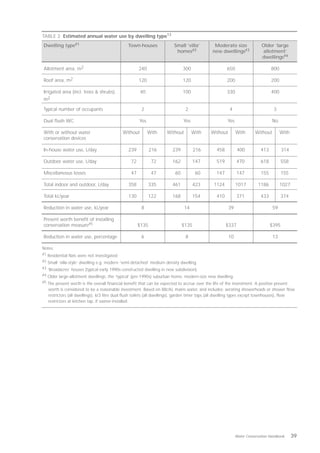
             by the River Murray                      5             dwelling type (1993)                 39
Figure 4     Adelaide metropolitan water supply       5   Table 3   Indicative savings for using water
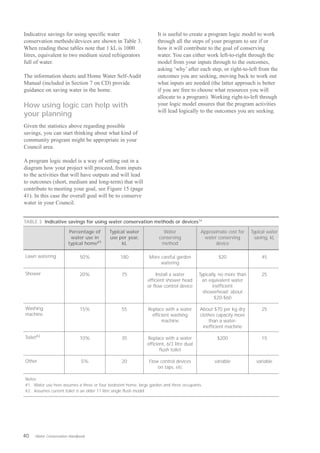
                                                                    conservation methods or devices      40
Figure 5     Water use in South Australia             5
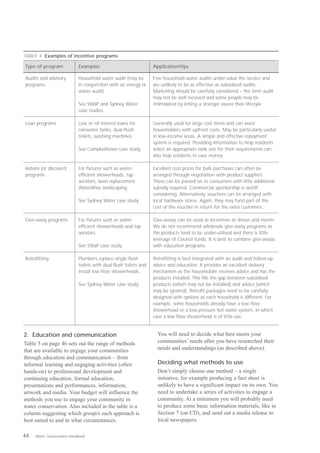
                                                          Table 4   Examples of incentive programs       44
Figure 6     The water conservation management
             hierarchy                               11   Table 5   Examples of education and
                                                                    communication programs               46
Figure 7     Council policies and plans related to
             water management                        20
Figure 8     Example chart of water use at an
             urban Council depot                     23
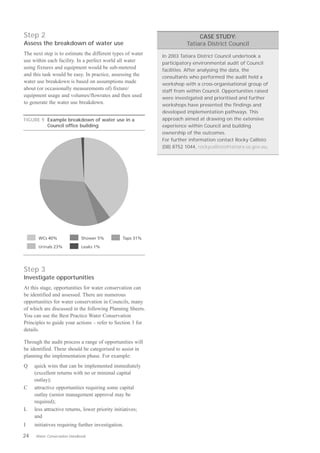
Figure 9     Example breakdown of water use in
             a Council office building               24
Figure 10 Unley Museum Rainwater Tanks
          Project Demonstration Site                 31
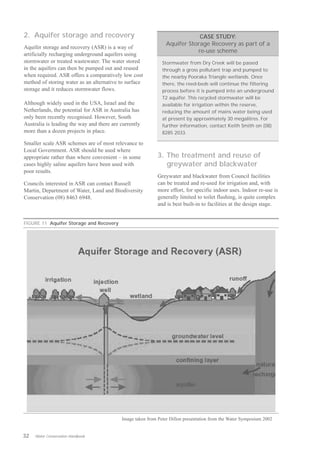
Figure 11 Aquifer Storage and Recovery               32
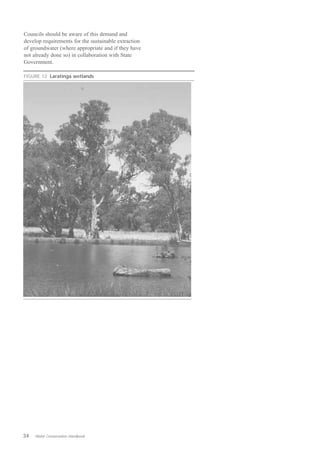
Figure 12 Laratinga wetlands                         34
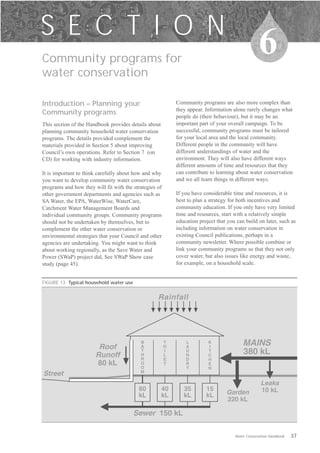
Figure 13 Typical household water use                37
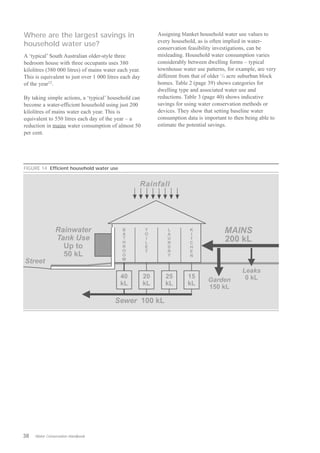
Figure 14 Efficient household water use              38
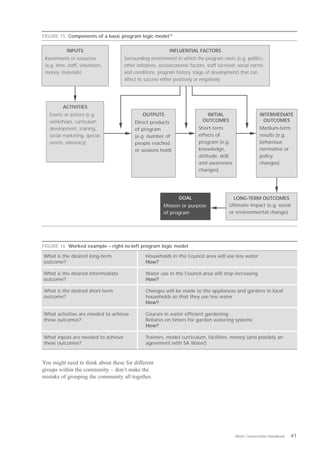
Figure 15 Components of a basic program
          logic model                                41
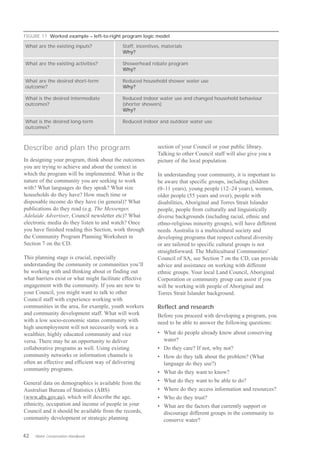
Figure 16 Worked example – right-to-left
          program logic model                        41
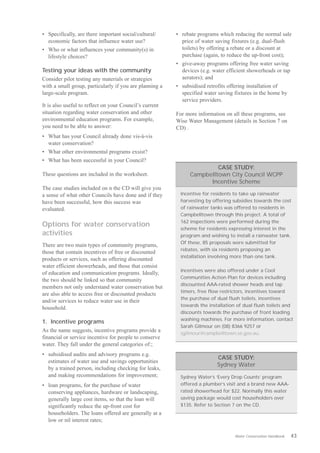
Figure 17 Worked example – left-to-right
          program logic model                        42


iii   Water Conservation Handbook
Welcome


This Handbook has been prepared as a water                 Where can you go for more
conservation resource for Local Government staff and
elected members. Whether you know a little or a lot
                                                           information?
about water conservation, this Handbook is designed to     Section 7 can be found on the attached CD, It contains
assist you to:                                             information about organisations that may be able to
1.	 understand why water conservation is important,        help you with resources and advice in implementing
    especially in South Australia (Section 1);             water conservation programs. It includes information
                                                           sheets, a household water audit manual and other
2.	 understand what is happening in water
                                                           selected resource materials.
    conservation – internationally, nationally and at a
    state level (Section 2);
3.	 develop an overall water conservation plan
    (Section 3);
4.	 alter Council policies and plans to assist water
    conservation (Section 4);
5.	 improve Council operations so that they conserve
    water (Section 5); and
6.	 undertake community programs in water
    conservation (Section 6).

The Handbook is an outcome of the Water
Conservation Partnership Project 2000- 2004 (refer to
the inside of the front cover for a list of project
partners).

How can you implement the ideas
in this Handbook?
If you are new to water conservation, you might like to
read sections 1 and 2 to understand the issues
surrounding water conservation and the context for
Local Government water conservation programs.
Section 2 gives an overview of international, national,
State and regional initiatives, current legislation
relevant to water conservation and the context of water
conservation within the South Australian Local
Government Act.

If you have sufficient time and resources, it is best to
prepare a water conservation plan to cover Council
policies, operations and community education. Section
3 provides guidance on planning your approach to
water conservation. If you have limited time and
resources, you could focus on changing Council plans
and policies, as outlined in Section 4.

Saving water in Council operations will reduce your
Council’s water bills and the savings can be used in
turn to fund other programs. Section 5 provides
guidance for saving water in Council operations.
Section 6 is an overview of incentive and education
programs that Councils can run for the community.

                                                                                     Water Conservation Handbook   1
2   Water Conservation Handbook
S E C T I O N
Why worry about water?

                                                                                                                       1
Why is water conservation                                                    water supply will fail World Health Organisation
                                                                             Guidelines for drinking water on average 40% of the
important?                                                                   time. The situation will be worse in areas that rely
Water is a precious resource that needs to be used                           solely on the River Murray for their water supply. In
wisely, especially in Australia, which is the driest                         addition, if action is not taken, increasing stream
inhabited continent on earth. At the moment we don’t                         salinity in the River Murray is projected to raise water
use water wisely; in fact, we use more water per person                      costs in South Australia by $17 million a year3. Major
than every other nation on earth, except for the United                      interventions such as dredging of the Murray Mouth,
States. In addition, salinity and deteriorating water                        salinity interception schemes and permanent water
quality are seriously affecting the sustainability of                        restrictions are contributing to the sustainable
Australia’s agricultural production, the conservation of                     management of our water resources.
biological diversity and the viability of our
infrastructure and regional communities (CoAG                                Conserving water is an effective way of maintaining an
Communique, see www.coag.gov.au/ for full details).                          adequate quality and quantity of water for the
                                                                             environment and for future generations. Fortunately,
Conserving water is particularly important in South                          most people in South Australia recognise that water
Australia because it is the driest state in Australia. On                    quality and conservation are crucial issues. For
average, 48 per cent of Australia receives more than                         example, in a survey of residents of the West Torrens
300mm of rainfall each year, whereas only twelve per                         Council area, the 200 respondents rated water quality
cent of South Australia does1. As a comparison, the                          and water conservation as their primary and fourth
annual flow of the Murray–Darling River system carries                       issues of environmental concern (from sixteen options).
less water than the Amazon River does in one day2.                           These issues also rank highly in environmental
                                                                             perspective surveys of South Australians undertaken by
The effects of our high levels of water use have been                        the Australian Bureau of Statistics.
dramatic. For example, currently the lower River
Murray effectively experiences drought conditions one                        Where does our water come from?
year in two, whereas before European arrival these
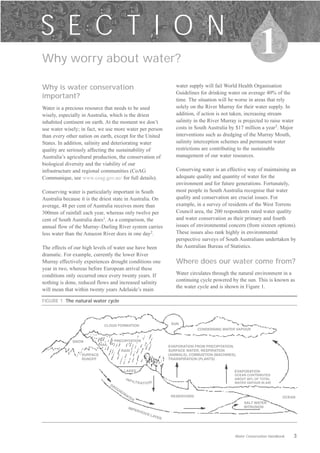
conditions only occurred once every twenty years. If                         Water circulates through the natural environment in a
nothing is done, reduced flows and increased salinity                        continuing cycle powered by the sun. This is known as
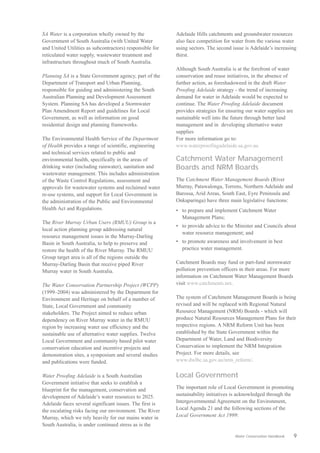
                                                                             the water cycle and is shown in Figure 1.
will mean that within twenty years Adelaide’s main

FIGURE 1 The natural water cycle


                              CLOUD FORMATION                              SUN
                                                                                        CONDENSING WATER VAPOUR


              SNOW                  PRECIPITATION
                            HAIL                                          EVAPORATION FROM PRECIPITATION,
                                          RAIN                            SURFACE WATER, RESPIRATION
                  SURFACE                                                 (ANIMALS), COMBUSTION (MACHINES),
                  RUNOFF                                                  TRANSPIRATION (PLANTS)


                                             LAKES                                                        EVAPORATION
                                                                                                          OCEAN CONTRIBUTES
                                             INF                                                          ABOUT 80% OF TOTAL
                                                   I LT R A
                                   GR                         TIO N                                       WATER VAPOUR IN AIR
                                     OU
                                        ND
                                          WA
                                            TE                             RESERVOIRS                                              OCEAN
                                                 R
                                                                                                              SALT WATER
                                              IMP                                                             INTRUSION
                                                     ERV
                                                         IOU
                                                                S LA
                                                                    YER


                                                                                                          Water Conservation Handbook   3
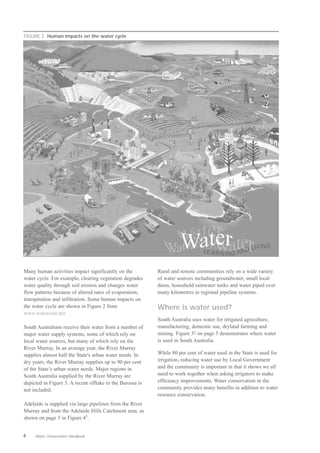
FIGURE 2 Human impacts on the water cycle


Many human activities impact significantly on the          Rural and remote communities rely on a wide variety
water cycle. For example, clearing vegetation degrades     of water sources including groundwater, small local
water quality through soil erosion and changes water       dams, household rainwater tanks and water piped over
flow patterns because of altered rates of evaporation,     many kilometres in regional pipeline systems.
transpiration and infiltration. Some human impacts on
the water cycle are shown in Figure 2 from                 Where is water used?
www.watercare.net.
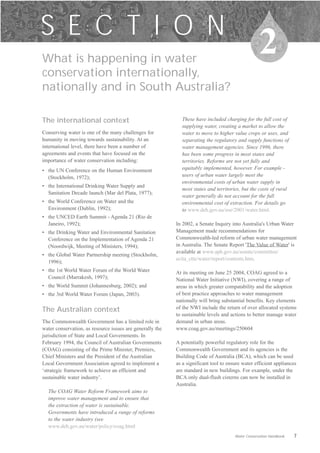
                                                           South Australia uses water for irrigated agriculture,
South Australians receive their water from a number of     manufacturing, domestic use, dryland farming and
major water supply systems, some of which rely on          mining. Figure 52 on page 5 demonstrates where water
local water sources, but many of which rely on the         is used in South Australia.
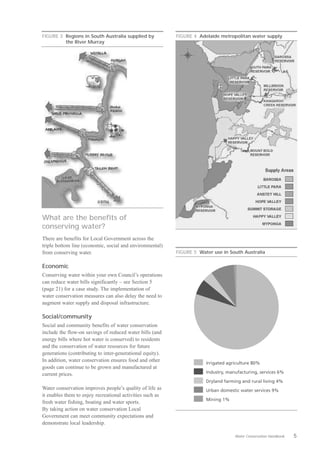
River Murray. In an average year, the River Murray
supplies almost half the State's urban water needs. In     While 80 per cent of water used in the State is used for
dry years, the River Murray supplies up to 90 per cent     irrigation, reducing water use by Local Government
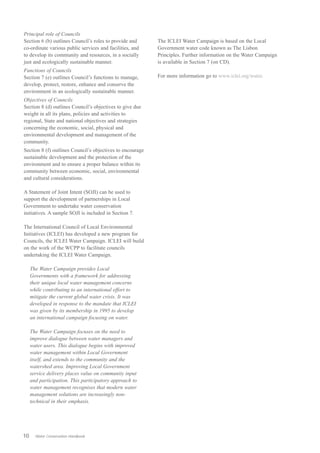
of the State’s urban water needs. Major regions in         and the community is important in that it shows we all
South Australia supplied by the River Murray are           need to work together when asking irrigators to make
depicted in Figure 3. A recent offtake to the Barossa is   efficiency improvements. Water conservation in the
not included.                                              community provides many benefits in addition to water
                                                           resource conservation.
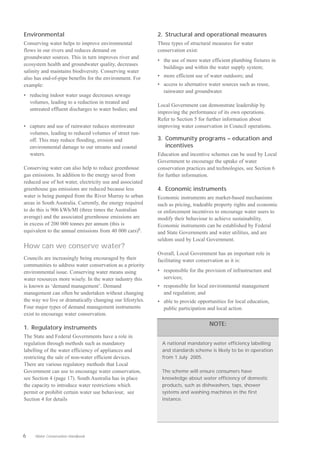
Adelaide is supplied via large pipelines from the River
Murray and from the Adelaide Hills Catchment area, as
shown on page 5 in Figure 45.


4    Water Conservation Handbook
FIGURE 3 Regions in South Australia supplied by            FIGURE 4 Adelaide metropolitan water supply
         the River Murray


What are the benefits of
conserving water?
There are benefits for Local Government across the

triple bottom line (economic, social and environmental)

from conserving water.                                     FIGURE 5 Water use in South Australia


Economic
Conserving water within your own Council’s operations
can reduce water bills significantly – see Section 5
(page 21) for a case study. The implementation of
water conservation measures can also delay the need to
augment water supply and disposal infrastructure.

Social/community
Social and community benefits of water conservation
include the flow-on savings of reduced water bills (and
energy bills where hot water is conserved) to residents
and the conservation of water resources for future
generations (contributing to inter-generational equity).
In addition, water conservation ensures food and other
                                                                       Irrigated agriculture 80%
goods can continue to be grown and manufactured at
current prices.                                                        Industry, manufacturing, services 6%

                                                                       Dryland farming and rural living 4%
Water conservation improves people’s quality of life as                Urban domestic water services 9%
it enables them to enjoy recreational activities such as
                                                                       Mining 1%
fresh water fishing, boating and water sports.
By taking action on water conservation Local
Government can meet community expectations and
demonstrate local leadership.

                                                                                    Water Conservation Handbook   5
Environmental                                              2. Structural and operational measures
Conserving water helps to improve environmental            Three types of structural measures for water
flows in our rivers and reduces demand on                  conservation exist:
groundwater sources. This in turn improves river and
                                                           •	 the use of more water efficient plumbing fixtures in
ecosystem health and groundwater quality, decreases
                                                              buildings and within the water supply system;
salinity and maintains biodiversity. Conserving water
also has end-of-pipe benefits for the environment. For     •	 more efficient use of water outdoors; and
example:                                                   •	 access to alternative water sources such as reuse,
                                                              rainwater and groundwater.
•	 reducing indoor water usage decreases sewage
   volumes, leading to a reduction in treated and
                                                           Local Government can demonstrate leadership by
   untreated effluent discharges to water bodies; and
                                                           improving the performance of its own operations.
                                                           Refer to Section 5 for further information about
•	 capture and use of rainwater reduces stormwater         improving water conservation in Council operations.
   volumes, leading to reduced volumes of street run­
   off. This may reduce flooding, erosion and              3. Community programs – education and
   environmental damage to our streams and coastal            incentives
   waters.                                                 Education and incentive schemes can be used by Local
                                                           Government to encourage the uptake of water
Conserving water can also help to reduce greenhouse        conservation practices and technologies, see Section 6
gas emissions. In addition to the energy saved from        for further information.
reduced use of hot water, electricity use and associated
greenhouse gas emissions are reduced because less          4. Economic instruments
water is being pumped from the River Murray to urban       Economic instruments are market-based mechanisms
areas in South Australia. Currently, the energy required   such as pricing, tradeable property rights and economic
to do this is 906 kWh/Ml (three times the Australian       or enforcement incentives to encourage water users to
average) and the associated greenhouse emissions are       modify their behaviour to achieve sustainability.
in excess of 200 000 tonnes per annum (this is             Economic instruments can be established by Federal
equivalent to the annual emissions from 40 000 cars)8.     and State Governments and water utilities, and are
                                                           seldom used by Local Government.
How can we conserve water?
                                                           Overall, Local Government has an important role in
Councils are increasingly being encouraged by their        facilitating water conservation as it is:
communities to address water conservation as a priority
environmental issue. Conserving water means using          • 	 responsible for the provision of infrastructure and
water resources more wisely. In the water industry this        services;
is known as ‘demand management’. Demand                    • 	 responsible for local environmental management
management can often be undertaken without changing            and regulation; and
the way we live or dramatically changing our lifestyles.   • 	 able to provide opportunities for local education,
Four major types of demand management instruments              public participation and local action.
exist to encourage water conservation.
                                                                                    NOTE:
1. Regulatory instruments
The State and Federal Governments have a role in
regulation through methods such as mandatory                 A national mandatory water efficiency labelling
labelling of the water efficiency of appliances and          and standards scheme is likely to be in operation
restricting the sale of non-water efficient devices.         from 1 July 2005.
There are various regulatory methods that Local
Government can use to encourage water conservation,          The scheme will ensure consumers have
see Section 4 (page 17). South Australia has in place        knowledge about water efficiency of domestic
the capacity to introduce water restrictions which           products, such as dishwashers, taps, shower
permit or prohibit certain water use behaviour, see          systems and washing machines in the first
Section 4 for details                                        instance.


6    Water Conservation Handbook
S E C T I O N
What is happening in water
                                                                                                    2
conservation internationally,
nationally and in South Australia?

The international context                                    These have included charging for the full cost of
                                                             supplying water, creating a market to allow the
Conserving water is one of the many challenges for           water to move to higher value crops or uses, and
humanity in moving towards sustainability. At an             separating the regulatory and supply functions of
international level, there have been a number of             water management agencies. Since 1996, there
agreements and events that have focused on the               has been some progress in most states and
importance of water conservation including:                  territories. Reforms are not yet fully and
•	 the UN Conference on the Human Environment                equitably implemented, however. For example -
   (Stockholm, 1972);                                        users of urban water largely meet the
                                                             environmental costs of urban water supply in
•	 the International Drinking Water Supply and
                                                             most states and territories, but the costs of rural
   Sanitation Decade launch (Mar del Plata, 1977);
                                                             water generally do not account for the full
•	 the World Conference on Water and the                     environmental cost of extraction. For details go
   Environment (Dublin, 1992);                               to www.deh.gov.au/soe/2001/water.html.
•	 the UNCED Earth Summit - Agenda 21 (Rio de
   Janeiro, 1992);                                         In 2002, a Senate Inquiry into Australia's Urban Water
•	 the Drinking Water and Environmental Sanitation         Management made recommendations for
   Conference on the Implementation of Agenda 21           Commonwealth-led reform of urban water management
   (Noordwijk, Meeting of Ministers, 1994);                in Australia. The Senate Report 'The Value of Water' is
                                                           available at www.aph.gov.au/senate/committee/
•	 the Global Water Partnership meeting (Stockholm,
                                                           ecita_ctte/water/report/contents.htm.
   1996);
•	 the 1st World Water Forum of the World Water            At its meeting on June 25 2004, COAG agreed to a
   Council (Marrakesh, 1997);                              National Water Initiative (NWI), covering a range of
•	 the World Summit (Johannesburg, 2002); and              areas in which greater compatability and the adoption
•	 the 3rd World Water Forum (Japan, 2003).                of best practice approaches to water management
                                                           nationally will bring substantial benefits. Key elements
The Australian context                                     of the NWI include the return of over allocated systems
                                                           to sustainable levels and actions to better manage water
The Commonwealth Government has a limited role in          demand in urban areas.
water conservation, as resource issues are generally the   www.coag.gov.au/meetings/250604
jurisdiction of State and Local Governments. In
February 1994, the Council of Australian Governments       A potentially powerful regulatory role for the
(COAG) consisting of the Prime Minister, Premiers,         Commonwealth Government and its agencies is the
Chief Ministers and the President of the Australian        Building Code of Australia (BCA), which can be used
Local Government Association agreed to implement a         as a significant tool to ensure water efficient appliances
‘strategic framework to achieve an efficient and           are standard in new buildings. For example, under the
sustainable water industry’.                               BCA only dual-flush cisterns can now be installed in
                                                           Australia.
  The COAG Water Reform Framework aims to
  improve water management and to ensure that
  the extraction of water is sustainable.
  Governments have introduced a range of reforms
  to the water industry (see
  www.deh.gov.au/water/policy/coag.html
                                                                                       Water Conservation Handbook   7
National Water Conservation
                                                         The Waste Control Regulations come into effect in
Labelling Scheme and the Water                           those areas where the SA Water Corporation's sewage
Services Association of Australia                        services are not available. About one third of South
                                                         Australians (400 000 people) are serviced by
Many water efficient products are rated under a
                                                         wastewater systems administered under the Waste
National Water Conservation Labelling Scheme
                                                         Control Regulations. The Waste Control Regulations
administered by the Water Services Association of
                                                         are administered by Local Government or authorised
Australia (WSAA). Under the scheme products can be
                                                         officers of the Department of Health with delegated
labelled from ‘A’ (a moderate water efficiency rating)
                                                         authority from the Minister of Health, depending on
to ‘AAAAA’ (the best rating of all). Many products are
                                                         the type of system. For details refer to
available that are rated at least ‘AAA’.
                                                         www.dh.sa.gov.au/pehs/branches/wastewater/wastewate
                                                         r-legis.htm
These include showerheads, washing machines, toilet
                                                         All public water supplies (including communal
suites, flow restrictors and some other appliances and
                                                         rainwater tanks) are subject to the Food Act and
fixtures. A listing of products certified under the
                                                         Regulations.
Scheme is available on the WSAA website
www.wsaa. asn.au.
Refer to Section 7 for further contact details.
                                                         Water supply and treatment
                                                         Water supply and infrastructure in South Australia is
The Department of Environment and Heritage               managed by SA Water. There are some exceptions
(Commonwealth Government Department) will                where water is supplied by private companies, for
introduce a national mandatory water efficiency          example at Skye, Coober Pedy, Leigh Creek, Woomera
labelling and minimum water efficiency standards         and Roxby Downs. In turn, rainwater tanks are
(WELS) for domestic appliances, fixtures and fittings    managed by individual householders or businesses.
as a method of reducing urban water consumption. See
www.deh.gov.au/water/urban/final-report.html for         SA Water manages the bulk of the state’s reticulation
details.                                                 systems, especially in the metropolitan area and large
                                                         country towns. There are some private reticulation
                                                         systems in smaller country towns (e.g. Weeroona
The South Australian context
                                                         Island).
Legislation
The Water Resources Act 1997 sets the legislative        SA Water also manages the bulk of SA's wastewater
framework in South Australia for water resource          treatment. There are some private wastewater treatment
management. It includes a requirement for the State      and re-use schemes and many smaller country areas
Government to prepare and keep an up-to-date State       have septic tank effluent disposal system (STEDS)
Water Plan (the current plan was released in September   schemes operated by Councils. In country areas many
2000) and provides the powers for the creation of        households and businesses have individual on-site
Catchment Water Management Boards with delegated         wastewater treatment systems.
authority to prepare Catchment Water Management
Plans. Other Acts which contain provisions relevant to   Stormwater infrastructure is managed by local
water management include the Environment Protection      Councils. Refer to Section 4 for details.
Act 1993 (water pollution), Sewerage Act 1929,
Waterworks Act (restrictions) and the Public and         State Government bodies and partnerships
Environmental Health Act 1987 (sanitation and            The Department of Water, Land and Biodiversity
drainage). The Natural Resources Management Act          Conservation (DWLBC) is the principal Department
2004, has recently been passed which will eventually     which assists the Minister responsible for the
replace the Water Resouces Act 1997 and allow for the    administration of the South Australian Water Resources
development to Natural Resource Management Boards        Act 1997. Through effective administration of the Act,
instead.                                                 the Department seeks to encourage use of water for its
                                                         highest and best return within sustainable limits.
The safe collection, treatment and disposal of non­
industrial wastewater (sewage and wastewater of          The Environment Protection Authority (EPA) regulates
domestic origin) is managed in South Australia under     and prosecutes for water pollution activities and also
the Sewerage Act administered by SA Water or the         provides water education programs for business and the
Public and Environmental Health Act (Waste Control       community including Codes of Practice for Stormwater
Regulations) 1995.                                       Pollution Prevention.

8    Water Conservation Handbook
SA Water is a corporation wholly owned by the             Adelaide Hills catchments and groundwater resources
Government of South Australia (with United Water          also face competition for water from the various water
and United Utilities as subcontractors) responsible for   using sectors. The second issue is Adelaide’s increasing
reticulated water supply, wastewater treatment and        thirst.
infrastructure throughout much of South Australia.
                                                          Although South Australia is at the forefront of water
Planning SA is a State Government agency, part of the     conservation and reuse initiatives, in the absence of
Department of Transport and Urban Planning,               further action, as foreshadoweed in the draft Water
responsible for guiding and administering the South       Proofing Adelaide strategy - the trend of increasing
Australian Planning and Development Assessment            demand for water in Adelaide would be expected to
System. Planning SA has developed a Stormwater            continue. The Water Proofing Adelaide document
Plan Amendment Report and guidelines for Local            provides strategies for ensuring our water supplies are
Government, as well as information on good                sustainable well into the future through better land
residential design and planning frameworks.               management and in developing alternative water
                                                          supplies
The Environmental Health Service of the Department        For more information go to:
of Health provides a range of scientific, engineering     www.waterproofingadelaide.sa.gov.au
and technical services related to public and
environmental health, specifically in the areas of        Catchment Water Management
drinking water (including rainwater), sanitation and      Boards and NRM Boards
wastewater management. This includes administration
of the Waste Control Regulations, assessment and          The Catchment Water Management Boards (River
approvals for wastewater systems and reclaimed water      Murray, Patawalonga, Torrens, Northern Adelaide and
re-use systems, and support for Local Government in       Barossa, Arid Areas, South East, Eyre Peninsula and
the administration of the Public and Environmental        Onkaparinga) have three main legislative functions:
Health Act and Regulations.                               •	 to prepare and implement Catchment Water
                                                             Management Plans;
The River Murray Urban Users (RMUU) Group is a
                                                          •	 to provide advice to the Minister and Councils about
local action planning group addressing natural
                                                             water resource management; and
resource management issues in the Murray-Darling
Basin in South Australia, to help to preserve and         •	 to promote awareness and involvement in best
restore the health of the River Murray. The RMUU             practice water management.
Group target area is all of the regions outside the
Murray-Darling Basin that receive piped River             Catchment Boards may fund or part-fund stormwater
Murray water in South Australia.                          pollution prevention officers in their areas. For more
                                                          information on Catchment Water Management Boards
The Water Conservation Partnership Project (WCPP)         visit www.catchments.net.
(1999–2004) was administered by the Department for
Environment and Heritage on behalf of a number of         The system of Catchment Management Boards is being
State, Local Government and community                     revised and will be replaced with Regional Natural
stakeholders. The Project aimed to reduce urban           Resource Management (NRM) Boards - which will
dependency on River Murray water in the RMUU              produce Natural Resources Management Plans for their
region by increasing water use efficiency and the         respective regions. A NRM Reform Unit has been
sustainable use of alternative water supplies. Twelve     established by the State Government within the
Local Government and community based pilot water          Department of Water, Land and Biodiversity
conservation education and incentive projects and         Conservation to implement the NRM Integration
demonstration sites, a symposium and several studies      Project. For more details, see
and publications were funded.                             www.dwlbc.sa.gov.au/nrm_reform/.

Water Proofing Adelaide is a South Australian             Local Government
Government initiative that seeks to establish a
blueprint for the management, conservation and            The important role of Local Government in promoting
development of Adelaide’s water resources to 2025.        sustainability initiatives is acknowledged through the
Adelaide faces several significant issues. The first is   Intergovernmental Agreement on the Environment,
the escalating risks facing our environment. The River    Local Agenda 21 and the following sections of the
Murray, which we rely heavily for our mains water in      Local Government Act 1999:
South Australia, is under continued stress as is the

                                                                                     Water Conservation Handbook    9
Principal role of Councils
Section 6 (b) outlines Council’s roles to provide and      The ICLEI Water Campaign is based on the Local
co-ordinate various public services and facilities, and    Government water code known as The Lisbon
to develop its community and resources, in a socially      Principles. Further information on the Water Campaign
just and ecologically sustainable manner.                  is available in Section 7 (on CD).
Functions of Councils
Section 7 (e) outlines Council’s functions to manage,      For more information go to www.iclei.org/water.
develop, protect, restore, enhance and conserve the
environment in an ecologically sustainable manner.
Objectives of Councils
Section 8 (d) outlines Council’s objectives to give due
weight in all its plans, policies and activities to
regional, State and national objectives and strategies
concerning the economic, social, physical and
environmental development and management of the
community.
Section 8 (f) outlines Council’s objectives to encourage
sustainable development and the protection of the
environment and to ensure a proper balance within its
community between economic, social, environmental
and cultural considerations.

A Statement of Joint Intent (SOJI) can be used to
support the development of partnerships in Local
Government to undertake water conservation
initiatives. A sample SOJI is included in Section 7.

The International Council of Local Environmental
Initiatives (ICLEI) has developed a new program for
Councils, the ICLEI Water Campaign. ICLEI will build
on the work of the WCPP to facilitate councils
undertaking the ICLEI Water Campaign.

     The Water Campaign provides Local
     Governments with a framework for addressing
     their unique local water management concerns
     while contributing to an international effort to
     mitigate the current global water crisis. It was
     developed in response to the mandate that ICLEI
     was given by its membership in 1995 to develop
     an international campaign focusing on water.

     The Water Campaign focuses on the need to
     improve dialogue between water managers and
     water users. This dialogue begins with improved
     water management within Local Government
     itself, and extends to the community and the
     watershed area. Improving Local Government
     service delivery places value on community input
     and participation. This participatory approach to
     water management recognises that modern water
     management solutions are increasingly non-
     technical in their emphasis.


10     Water Conservation Handbook
S E C T I O N
Planning for water conservation

                                                                                                        3
Introduction                                                   First Principle – Avoid
                                                               This principle seeks to encourage, where possible, the
This Section provides some guidance on planning your
                                                               use of waterless options where they exist. This is
approach to water conservation. If you have the time
                                                               achieved through the use of alternative techniques to
and resources, it is best to develop a comprehensive
                                                               reduce dependency on reticulated water such as
water conservation plan, including changing Council
                                                               sweeping paths and pavements, instead of hosing them,
policies and plans, improving Council operations and
                                                               and using dry composting toilets.
undertaking community programs. You can use the
planning framework provided here to develop your
                                                               Second Principle – Reduce
plan.
                                                               This principle seeks to reduce the amount of water use
If you only have limited time and resources, start with        through:
some targeted initiatives that you can build into              •	 water efficient building and garden design which
existing programs. You can use parts of the planning              can be achieved through practices such as
framework provided to design these initiatives.                   appropriate plant selection with preference to local
                                                                  indigenous species and efficient irrigation practices;
Principles                                                     •	 the efficient use of locally collected and alternative
                                                                  water supplies, for example collecting and using
The Water Conservation Partnership Project worked
                                                                  rainwater for irrigation and internal building
with Local Government to develop the five Best
                                                                  purposes;
Practice Water Conservation Principles. These are
based on the waste management hierarchy (avoid,                •	 the installation of water efficient devices, such as
reduce, re-use, recycle and disposal). Understanding              low flow showerheads, dual flush toilets, low flow
the Principles may be useful in developing your                   taps and front-loading washing machines; and
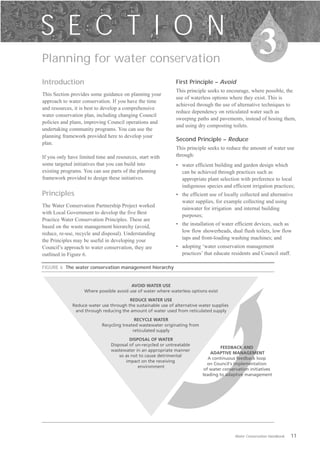
Council’s approach to water conservation, they are             •	 adopting ‘water conservation management
outlined in Figure 6.                                             practices’ that educate residents and Council staff.

FIGURE 6 The water conservation management hierarchy


                                         AVOID WATER USE
                   Where possible avoid use of water where waterless options exist

                                        REDUCE WATER USE
              Reduce water use through the sustainable use of alternative water supplies
               and through reducing the amount of water used from reticulated supply
                                           RECYCLE WATER
                           Recycling treated wastewater originating from
                                          reticulated supply
                                         DISPOSAL OF WATER
                                Disposal of un-recycled or untreatable
                                                                                     FEEDBACK AND
                                wastewater in an appropriate manner
                                                                                ADAPTIVE MANAGEMENT
                                    so as not to cause detrimental
                                                                               A continuous feedback loop
                                       impact on the receiving
                                                                               on Council's implementation
                                             environment
                                                                             of water conservation initiatives
                                                                            leading to adaptive management


                                                                                           Water Conservation Handbook   11
Third Principle – Recycle                                   1. Developing your approach
This principle seeks to use wastewater or reclaimed
                                                            This part of the planning process will determine your
water from one application such as wastewater
                                                            overall approach to water conservation.
treatment for another application. When using recycled
water, Councils must ensure that they comply with the       What is the context for water conservation
Environment Protection Policy 2003 (Water Quality).
                                                            in your Council?
                                                            The water conservation initiatives you decide to
Fourth Principle – Disposal
                                                            develop and implement will depend on many factors
This principle seeks to ensure that the disposal of water
                                                            including the location of your Council, the level of
or treated wastewater that is not recycled or reused
                                                            senior management support for water conservation
does not cause degradation of catchment, coastal,
                                                            initiatives and the funding available. It is worth
marine or terrestrial environments. This principle
                                                            considering your Council’s context by thinking about
should be employed as a last resort.
                                                            questions such as:

Feedback and Adaptive Management                            •	 is water conservation important in your Council?
Feedback and adaptive management is a continuous            •	 how is water conservation incorporated into existing
approach used by Councils in determining the success           Council plans and operations (if at all)?
of implementation of the best practice principles.          •	 are there any specific drivers or anticipated
                                                               circumstances that will heighten the importance of
Refer to Section 7 on the CD for a full description of         water conservation in your Council?
the Best Practice Water Conservation Principles.            •	 can you realise any synergies between delivering
                                                               stated Council objectives (such as Strategic Goals)
The Planning Process                                           and water conservation initiatives?

Developing a plan for your Council’s approach to            •	 how can Council address the different levels of
water conservation will assist you to take a strategic         water restriction?
and systematic approach to the business of saving
water. Your plan will help you to gain support for water    Some of the drivers for promoting water conservation
conservation initiatives within your Council and the        at your Council might include:
community and to achieve the most significant               •	 water supply security and/or reliability;
outcomes possible given your level of resources. A          •	 constraints on water treatment/supply, wastewater
well-developed plan will help to establish shared              treatment, peak demand (i.e. the demand for water
expectations, roles and responsibilities and generate          on hot, dry days);
ownership.
                                                            •	 flood mitigation through stormwater detention;
It is useful to consider your plan as a ‘living’            •	 community service (e.g. through the provision of
document. A good plan is reviewed and modified on a            information and low-cost products and services to
regular basis and used to report on progress, highlight        householders);
successes and identify areas for improvement.               •	 water quality issues;

The following generic planning process is suitable for a    •	 drought response/management; and
comprehensive water conservation plan, but the areas        •	 demonstrating Council’s commitment to sustainable
of emphasis and level of detail that you put into your         development.
plan will depend on the size and structure of your
Council, the available funds and human resources and        It is valuable to identify where water conservation may
your particular water conservation goals. You may wish      link to, or generate benefits for, other programs,
to refer to more specific approaches such as the            initiatives or objectives being implemented by your
implementation of the Best Practice Water                   Council (for example, greenhouse programs, such as
Conservation Principles or the ICLEI Water Campaign.        Cities for Climate Protection, community
                                                            environmental education programs or infrastructure
                                                            upgrades). This will increase both opportunities for
                                                            support and funding for water conservation initiatives.

                                                            Where will your approach to water conservation within
                                                            the Council exist?


12   Water Conservation Handbook
You need to decide whether you will develop a              3. Investigation and data
separate water conservation plan or whether you will
integrate water conservation into other Council
                                                              collection
planning processes. For example, your approach to          This stage of the planning process provides the
water conservation could be integrated into your           structure and background that will help you select and
Environmental Management Plan.                             develop specific programs.

Assess resources                                           Develop an overview of water
At this stage you should make a preliminary                conservation initiatives
assessment of the human and financial resources that       You can learn a lot from water conservation programs
are likely to be available for Water Conservation Plans    that have been undertaken elsewhere. You will find
and initiatives. This is where you can begin to            case studies throughout this Handbook and you can use
understand the scope of your plan.                         your Local Government networks. However, each
                                                           Council is unique and you should also investigate what
2. Preliminary approval                                    has already been done within your Council. This will
                                                           be important for maintaining your credibility within
This stage of the planning process outlines what you       Council.
will need to consider in seeking approval for your
approach to water conservation.                            Collect data
                                                           In planning your approach to water conservation it is
Identify internal partners                                 crucial to understand how much water is used, where,
Developing and implementing water conservation             by whom and how. Council water use data is available
initiatives by yourself is hard work. If possible you      from SA Water – refer to Section 5 (page 23) for
should identify members of staff to work with. This        details. Water data specific to your Council can be
could include, for example:                                broken down into residential, non-residential and
                                                           commercial sectors. The non-residential data includes
•	 a member of senior management (or an elected
                                                           Council, State Government and industrial water use.
   member) with a genuine level of commitment to
   supporting water conservation initiatives; or
                                                           Relevant data to collect might include:
•	 a cross-functional team of Council staff who can
   work with you to develop and implement water            •	 average household usage (indoor and outdoor, or by
   conservation initiatives across Council and within         end-use);
   the community.                                          •	 Council consumption (buildings, facilities, parks and
                                                              grounds);
Create a business case for involvement                     •	 population growth and the projected demand for
To obtain approval for developing and implementing            water (and possible implications);
your approach to water conservation you may need to        • other Council information: demographics, area, etc;
put together a business case for Council senior
                                                           •	 water supply source(s) cost of water, groundwater
management (and elected members) stating the broad
                                                              information etc.;
goals of the Water Conservation Plan and the resources
that will be required.                                     •	 wastewater treatment, recycling, effluent discharges,
                                                              water quality, costs; and
Gain approval to proceed                                   •	 stormwater volumes, infrastructure costs, upgrade
Depending on the scope of your plan you may need              requirements etc.
approval and commitment from senior management
(and possibly elected members). This could include:        It is important to identify the usage by sector in each
                                                           Council, so that the right priorities are targeted. For
•	 formal approval of staff-time to work on the project;   example in the City of Port Adelaide Enfield, two
•	 initial funding to undertake any investigations         thirds of water consumption is by the commercial and
   required; and                                           industrial sectors, so education programs focussed
•	 a commitment to invest in identified projects (within   purely on residential use may have minimal impact on
   agreed capital costs and returns on investment,         water consumption.
   where appropriate).
                                                           Once you have collected this data you can start to
Without this commitment, initial time and funds may        identify water conservation opportunities that will be
be wasted.                                                 most effective and give ‘value for money’.


                                                                                      Water Conservation Handbook   13
For example, if outdoor water use in your area is high,      Select and design water conservation
then a program targeted at this will have the greatest       initiatives
potential for saving water. Current consumption data         The range of water conservation programs are outlined
may also be necessary for setting and monitoring             as follows:
targets.
                                                             1.	 Changing Council plans and policies – refer to
Work with stakeholders                                           Section 4 (page 17 ) for details.
                                                             2.	 Saving water in Council operations – refer to
The value of your plan, and the success of its
                                                                 Section 5 (page 21) for details.
implementation, will be strengthened by involving the
                                                             3.	 Community programs – refer to Section 6 (page 37)
community and other stakeholders in its development.
                                                                 for details.
This involvement is the key to capacity building, which
will support, promote, contribute to and sustain your
                                                             When reviewing and selecting programs, assess which
Water Conservation Plan. The effort you put into
                                                             are most strategic for your Council in terms of:
involving stakeholders will depend on the scope of
your plan.                                                   •	 links to your Strategic/Corporate Plan;
                                                             •	 achieving significant reductions in water use;
It will be important to include some stakeholder groups
                                                             •	 the provision of community services;
directly in the process, while others may just be kept
informed. Potential stakeholders to include in the           •	 establishing partnerships with government bodies
development of your plan are outlined in Table 1.               and the private sector; and
                                                             •	 promoting your Council as responsible.
Understanding stakeholders is critical to designing and
implementing appropriate and effective water                 The most effective Water Conservation Plans are
conservation programs. This involves understanding           generally implemented through a variety of program
who will influence the implementation of your Plan,          types. If you have limited resources, it is best to focus
their level of understanding, values, perception and         on one or two initial programs.
practices in relation to water conservation, and how
you can ensure they support your goals. Gathering
knowledge about your community is explored further
in Section 6.


TABLE 1 Possible stakeholders in water conservation

Staff and elected members 	                                  Community representatives

• Management, staff and elected members	                     • Local environment groups & branches of
•	 Finance, corporate support, grounds staff,                  State/National groups
   property and facilities management,                       • Schools

   procurement etc                                           • Education (e.g. TAFE)

                                                             •	 Community groups (e.g. Lions Club, Rotary)
                                                             •	 Catchment groups

Private sector                                               Government bodies

• Council’s contractors                                      • Water suppliers (wholesale and retail) (SA Water)
• Local retailers of water using products (e.g. nurseries,   • State Government agencies (Department for
  garden supplies & irrigation equipment specialists)          Water, Land and Biodiversity Conservation etc)
• Hardware retail outlets                                    • Federal Government agencies (Environment
• Electrical retail outlets (e.g. washing machines,            Australia, Australian Greenhouse Office etc)
  dishwashers)                                               • Catchment Water Management Boards
• Manufacturers / importers of water using
  products
• Landscape businesses
• Local builders and developers
• Energy suppliers


14   Water Conservation Handbook
CASE STUDY:
                                                       Rous Water

  Rous Water, a bulk water supplier in northern                The program was so successful that some outlets
  NSW, initiated a program offering householders a             produced their own promotional material,
  $150 rebate on the purchase of a water efficient             including window displays, or supplemented the
  front loading washing machine with an energy                 offer with additional ‘cash back’ on some brands.
  rating of four stars or above. The program was run           Since the start of the program there has been
  in partnership with the NSW Sustainable Energy               interest from both washing machine manufacturers
  Development Authority and the local energy                   and retailers to join the partnership and contribute
  provider NorthPower, with each contributing $50              to the rebate. For further information contact John
  to the rebate. Local electrical goods retail outlets         Rutledge on (02) 6621 8055.
  participated in the program.


4. Design                                                      5. Implementation
At this stage of the planning process you can fully            This is the important part! Your plan should provide
develop specific water conservation initiatives.               you with the steps to follow through the
                                                               implementation phase. However, during the
Do a detailed design                                           implementation phase you will most likely need to
Refer to Sections 4, 5 and 6 for details on changing           adjust your plan to take advantages of opportunities as
Council policies and plans, improving Council                  they arise and to manage unforeseen events.
operations and undertaking community programs
respectively. Choose the programs that will suit your          Remember that implementing your plan is what you
circumstances and adapt them to the resources and              should spend most of your time doing. It is important
context of your Council.                                       to find the right balance between planning and action.

Set targets                                                    It is likely that your Council will already have
                                                               management systems or processes in place, and you
Targets specific to each initiative may be set. Targets

                                                               should integrate your plan with these where possible.
should be SMART:

Specific: clearly state what you aim to achieve.
              Manage and review data
Measurable: ensure that the data is available and that
        Data management is the most commonly neglected part
systems are in place to manage the data.
                      of water conservation programs. It is crucial to set up a
Achievable: assess if it is possible to meet the goal
         tailored data management system that collects water
with the available resources and timeframe.
                   use data as it is generated, to monitor the success of
Realistic: set targets that are possible to achieve for the
   water conservation initiatives.
type of program you are implementing.

Timely: set a timeframe for achieving each target and
         The water use data should be reviewed regularly to:
goal, and monitor on a regular basis.

                                                               •	 ensure that water conservation initiatives that have
Seek formal approval                                              been implemented are meeting their predicted
                                                                  savings; and
At this stage you may need to seek approval to expend
funds on the delivery of the Water Conservation Plan           •	 identify any unexpected changes in use as this
Plan. You should have enough information by this                  enables quick rectification if required (for example,
stage to provide costs, benefits and a detailed plan. You         if there are system leaks).
may also be able to apply for external funding through
the Office of Local Government, Local Government               When analysing water use data, you will need to take
Association, National Heritage Trust, Community                climate variability and varied usage patterns into
Development Grants, Catchment Water Management                 account. Water savings may not be reflected initially in
Boards (or NRM Boards) etc.                                    the water use data. For example, if you implement
                                                               water saving initiatives during an unusually hot year
                                                               (as in 2002), consumption may appear to increase
                                                               when water is still being saved relatively speaking


                                                                                          Water Conservation Handbook   15
because consumption would have been even higher if         There are several ways to assess the effectiveness of
you had done nothing. It is possible to correct your       water conservation programs, including:
data for climate and usage variations, but this is not
                                                           •	 surveys, questionnaires and feedback forms;
straightforward and you should seek professional
assistance if this is of interest to you.                  •	 statistical analysis;
                                                           •	 cost-benefit analysis;
It is crucial to manage your data well (both in terms of   •	 participation (or uptake) rates; and
water and budgets) in order to demonstrate savings to      •	 the amount of positive publicity received.
management and elected members.
                                                           It is critical to identify early in the planning process
Manage roles and responsibilities                          what information or data will need to be collected or
To generate shared expectations and ownership it is        maintained in order to monitor the effectiveness of
important to define the roles and responsibilities of      programs. It is better to gather more information than
Council staff and management, and other stakeholders       less, as it is often impossible to collect it after the
involved in your Water Conservation Plan. Defining         program has finished.
roles and responsibilities also strengthens commitment
through a sense of accountability.                         Celebrate! And communicate your success
                                                           In conducting programs for water conservation, it is
Communication is crucial                                   important to celebrate your successes.
Regular updates should be provided to management,
elected members, staff, stakeholders and the               Communicate the success of your programs through
community to inform them about progress. These             Council internal and external processes, for example:
updates can go beyond reports and be in the form of
                                                           •	 Council internal newsletters or via an internal email;
staff training and site visits.
                                                           •	 at a Council meeting or committee meeting (for
When addressing communication issues, consider not            example, the environment committee);
only what information needs to be communicated, but        •	 Council’s state of the environment report (if you
also the audience, the most appropriate communication         have one);
media (e.g. newsletters, email) and necessary frequency.   •	 meetings with managers and/or directors;
                                                           • your Council’s page in local newspapers;
6. Review – monitoring and                                 • on Council’s web page;
   evaluation                                              •	 at Council stalls at festivals and fairs; and
Monitoring your plan and individual programs is            •	 public events with the media (for example, when
essential to ensure you are on track to meeting goals         new rainwater tanks are installed in community
and targets. It ensures that all the hard work of             facilities).
designing and implementing water conservation
initiatives is generating benefits, as well as providing   You could also ask any stakeholders, sponsors or
an opportunity to fine-tune and improve programs. In       community groups to include information on the
some instances, particularly for larger, more costly       program in their newsletters and publications as well as
programs, it may be appropriate to seek an independent,    display information in libraries and customer service
specialist evaluation.                                     centres.

Program evaluation can be used to:
•	 influence elected members, senior management and
   other Council staff, and funding bodies;
•	 build community capacity and engage communities;
•	 communicate about your successes or failures;
•	 ensure accountability for your work; and
•	 reflect on and improve the program.

Plan your evaluation and monitoring at the outset,
otherwise you may not be able to get the data or
information you need.


16   Water Conservation Handbook
S E C T I O N
Changing Council policies

                                                                                                   4
and plans

Introduction                                               Regular reviews of Councils’ Development Plans are
                                                           required to be undertaken, via ‘Section 30 Reviews’
One of the most effective mechanisms to achieve and        under the Development Act 1993. Councils can prepare
promote water conservation outcomes in the broader         Plan Amendment Reports (PARs) to update or amend
community is via the various regulatory, planning and      each Plan, based on detailed investigations and
policy tools that Councils are responsible for             consultations with the broad community. Where it is
developing and administering. Water conservation can       identified that water conservation has become an issue
be integrated into existing frameworks through             to be incorporated into planning policy, each Council
Strategic Management Plans, Development Plans and          can, via a PAR, include appropriate planning
internal policies and operations.                          provisions in its Plan to promote or mandate particular
                                                           water conservation strategies that are appropriate for its
Understanding your Council’s corporate and                 Council area. These provisions can then be applied to
community water consumption, relevant legislation,         new developments in the Council area. Encouraging
demographics and community opinion will help you to        water sensitive urban design is an important issue for
provide justification for changes to your Council’s        Local Government.
policies and plans.
                                                           Planning provisions to reduce water (and energy)
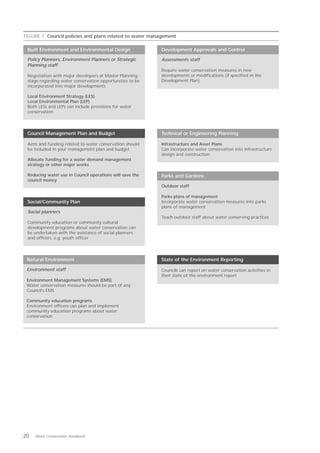
Figure 7 on page 20 depicts a typical Council Strategic    consumption through the planning and regulatory
and Policy structure. It may be useful to draw this        framework may include requiring or encouraging well-
diagram for your organisation and consider the changes     designed rainwater collection systems in new
necessary to facilitate water conservation.                developments, and requiring existing buildings that are
                                                           being renovated to be fitted with water efficient
Strategic Management Plans                                 devices. The Building Code of Australia is also an
                                                           important tool, particularly regarding the provision of
All Councils are required by the Local Government Act      water efficient fittings in new buildings, such as the
1999 to prepare Strategic Management Plans, that           standard requirement for dual flush toilets.
should provide direction and accountability in Council
achieving its functions and responsibilities under the     The State Government can prepare a Ministerial PAR
Act. These functions include ‘to manage, develop,          that will, on adoption, be applied to all or selected
protect, restore, enhance and conserve the environment     Council Development Plans in a synchronised way
in an ecologically sustainable manner’, and to ‘seek to    across the State.
facilitate sustainable development and the protection of
the environment’. Environmental and natural resource                       CASE STUDY:
management issues (including water conservation) are               Marrickville City Council (NSW)
now a core statutory focus for Councils, and should be
reflected in Council’s strategic planning processes and      Marrickville Development Control Plan No 32 –
documents.                                                   Energy Smart Water Wise contains requirements
                                                             for energy and water efficiency in both new
Councils also prepare profession-specific strategic          developments and in alterations and additions
management plans, which can include water                    to existing buildings. The main water efficiency
conservation considerations.                                 controls are dual flush toilets and AAA rated
                                                             water fixtures. A Comprehensive Water Cycle
Development Plans                                            Assessment and a Water Efficient Landscaping
                                                             Assessment are required for major
Councils administer urban planning policies and              developments. For further information refer to
regulate development through reference to a                  Section 7 on CD.
Development Plan that is prepared for each Council
area.
                                                                                       Water Conservation Handbook   17
Water conservation strategies that are appropriate to
                                                                              CASE STUDY:
Council could therefore be implemented via a
                                                                             South Australia
Ministerial PAR. Local Government can collaborate
with the State Government (Planning SA) to develop           Permanent water restrictions in South Australia
Ministerial PARs to address the issue on a regional or       were enacted on 26 October 2003 and predicted
State-wide basis, as well as amending its own                to result in a maximum reduction of 20% of
Development Plan to reflect the particular needs and         water use across the board (including irrigators,
opportunities of its Council area.                           industry, residential and government). There will
                                                             be four levels of restriction addressing:
Internal policies and procedures                             • private gardens, lawns, paved areas, sports
Councils can integrate water conservation into day-to-         grounds and recreation areas;
day business through altering internal policies and          • fountains, ponds, pools and spas;
procedures to incorporate water conservation.                • vehicle washing, building development and
                                                               construction activities; and
For example, water conservation considerations can be        • farm dams and rainwater tanks, commercial
incorporated into Purchasing and Procurement Policies          nurseries, garden centres and poultry sheds.
and Standard Operating Procedures.
                                                             SA Water has begun a community education
Alterations to the Purchasing and Procurement Policy         program and the level of restrictions will be
can reduce the environmental impacts of goods and            determined based on seasonal variations in
services purchased by Council. Some Councils include         demand, river levels and rainfall. Refer to
an overall environment statement within this policy,         www.sawater.com.au/restrictions/index.html.
referring to a number of key outcomes such as water
conservation, pollution prevention, minimising and
recycling wastes and minimising greenhouse gas                                CASE STUDY:
emissions. For example, changes to this policy may                           Barwon Water
lead to your road reconstruction contractor using
machinery that vacuums up and recycles the water used        Barwon Water is the first Victorian water
in the wet saw road cutting process. The more specific       authority to introduce a Water Conservation By­
you can be about how environmental impacts are to be         law, which came into effect from 1 February
minimised the better.                                        2003. Eighteen months community consultation
                                                             into the future of the region's water supply
Standard Operating Procedures are the procedures             preceded the by-law’s introduction. Throughout
written to govern many Council activities. These were        the consultation process there was
often written initially due to the need to make              overwhelming support for water conservation.
procedures clear for new staff members and/or the need       The by-law is a permanent measure to conserve
to protect staff from Occupational Health Safety and         water now and for future generations. It
Welfare risks. These procedures may be changed to            involves restrictions on watering gardens,
incorporate water conservation outcomes. For example,        cleaning vehicles, cleaning driveways and paths
an irrigation procedure may be altered so that               and construction activities. For further details
sprinklers are only operated between certain times.          refer to Section 7 on CD.
Obviously these changes should only be made in
consultation with the relevant managers and staff. To      Stormwater Infrastructure Planning
change these procedures in a systematic, holistic,         Councils are largely responsible for the planning,
environmental way some Councils have chosen to             development and maintenance of stormwater
undertake an Environmental Management System.              infrastructure within their areas. There are
                                                           opportunities to incorporate water conservation into the
Once you have established good practices, altering         planning for new infrastructure, and in the ongoing
policies and procedures to reflect this is a good way to   upgrades and rehabilitation of existing infrastructure.
ensure that water conservation gains are maintained.       Where greenfield development is occurring
                                                           (land that has previously been undeveloped or has been
Stormwater                                                 used for agricultural purposes) there are enormous
                                                           opportunities for Councils to work with developers in
Stormwater is a key area for Council action with regard    designing stormwater master plans that allow both
to water conservation.                                     stormwater management, and water collection and
                                                           harvesting ( if site conditions allow).

18   Water Conservation Handbook
The 2002 Ministerial PAR for Stormwater                                  CASE STUDY:
and related documents                                            Urban Stormwater Master Plans
Planning SA has prepared a Stormwater Infrastructure
Planning package to promote an integrated approach to       The Cities of Port Adelaide Enfield, Charles Sturt
catchment management. The package includes:                 and Prospect, supported by the Torrens
                                                            Catchment Water Management Board, are
•	 Planning Bulletin: Urban Stormwater Infrastructure       developing detailed integrated Urban
   to assist Councils in the process of policy              Stormwater Master Plans during 2002–05 for
   development at the level of zone or policy area by       each of the 23 independent water sub-
   raising awareness and generating debate among            catchments in the north-west Adelaide region.
   stakeholders on catchment water management policy        These will include investigations and the
   issues;                                                  identification of opportunities regarding the
•	 Guidelines for Urban Stormwater Management; and          best mix of planning, engineering and
•	 Draft Minister's Specification: On-Site Retention of     environmental policies and strategies in each
   Stormwater which is a technical standard to provide      sub-catchment to achieve a range of desired
   cost effective technical solutions to the requirements   outcomes, including improved water quality and
   for on-site retention and detention of stormwater.       conservation. For further information contact
                                                            Verity Sanders (08) 8405 6765.
Councils located wholly or partly within the catchment
areas of the Patawalonga and the Torrens Catchment
Water Management Boards are also affected by the
Stormwater in Urban Areas Plan Amendment
(November, 2002). This Plan Amendment Report
provides a development assessment framework to
facilitate appropriate management of stormwater, and
includes some broad principles regarding water
conservation.

The PAR has been incorporated into the relevant
Development Plans. For more information, the
resources listed above can be accessed from Planning
SA’s website at www.planning.sa.gov.au/publications
or you can contact Malcolm Govett at Planning SA by
telephone (08) 8204 8394 or email
govett.malcolm@saugov.sa. gov.au.

The State Government’s Guidelines for Urban
Stormwater Management include the recommendation
for Councils to prepare Urban Stormwater Master plans
which would allow the integration of stormwater
infrastructure planning, urban land use plannin, and
environmental planning into a single long term Plan.


                                                                                    Water Conservation Handbook   19
FIGURE 7 Council policies and plans related to water management

 Built Environment and Environmental Design               Development Approvals and Control
 Policy Planners, Environment Planners or Strategic       Assessments staff
 Planning staff
                                                          Require water conservation measures in new
 Negotiation with major developers at Master Planning     developments or modifications (if specified in the
 stage regarding water conservation opportunities to be   Development Plan)
 incorporated into major developments

 Local Environment Strategy (LES)
 Local Environmental Plan (LEP)
 Both LESs and LEPs can include provisions for water
 conservation


 Council Management Plan and Budget                       Technical or Engineering Planning

 Aims and funding related to water conservation should    Infrastructure and Asset Plans
 be included in your management plan and budget           Can incorporate water conservation into infrastructure
                                                          design and construction
 Allocate funding for a water demand management
 strategy or other major works

 Reducing water use in Council operations will save the   Parks and Gardens
 council money
                                                          Outdoor staff

                                                          Parks plans of management
 Social/Community Plan                                    Incorporate water conservation measures into parks
                                                          plans of management
 Social planners
                                                          Teach outdoor staff about water conserving practices
 Community education or community cultural
 development programs about water conservation can
 be undertaken with the assistance of social planners
 and officers, e.g. youth officer


 Natural Environment                                      State of the Environment Reporting

 Environment staff                                        Councils can report on water conservation activities in
                                                          their state of the environment report
 Environment Management Systems (EMS)
 Water conservation measures should be part of any
 Council’s EMS

 Community education programs
 Environment officers can plan and implement
 community education programs about water
 conservation


20   Water Conservation Handbook
S E C T I O N
How to conserve water in

                                                                                                      5
Council operations

Introduction                                                 There are many approaches to the implementation of
                                                             water conservation initiatives developed from the audit
It is important for Councils to lead by example in           process. These include:
implementing water conservation measures. This will
                                                             •	 clumping together the initiatives arising from the
save Council money, give staff experience in
                                                                audit for the purposes of a budget bid. The
implementing water conservation initiatives and gain
                                                                advantages of this approach are that you can seek
the respect of local residents. Councils are in an
                                                                approval for a comprehensive package of measures,
authoritative and unique position both to change their
                                                                include economically marginal initiatives together
own operational practices and to influence others to do
                                                                with high return initiatives to give an overall return
the same through positive role modelling.
                                                                on investment that is acceptable, and ensure a high-
                                                                level of integration between the measures.
This Section provides guidance on conserving water in
Local Government parks and gardens, buildings and            •	 implementing some high return initiatives
other facilities.                                               immediately. The advantage of this approach is that
                                                                you can quickly demonstrate the value of water
Planning sheets are provided for:                               conservation to senior managers, elected members
1. undertaking a water audit;                                   and staff and build further support.
2. irrigation water use;
3. facilty water use;                                        When deciding what actions to take, consider
4. alternative water supplies; and                           initiatives beyond capital projects, for example,
5. construction and refurbishment.                           training staff. In many cases, changing policies and
                                                             procedures (including Contracting and Procurement
                                                             Policies) can be effective and lead to far-reaching
Approaches                                                   water conservation measures. Refer to Section 4:
Conserving water within Council operations may be            Changing Council policies and plans (page 17).
undertaken through a structured approach as part of an
Environmental Management System, Environmental               It is crucial to manage your water and cost saving data
Improvement Program or Water Conservation Plan.              well (both in terms of water and budgets) in order to
Alternatively, specific water saving initiatives may be      demonstrate savings to management and elected
undertaken as opportunities arise.                           members. Refer to Section 3 (page 13) for details.


As part of a structured approach a water audit is often      A different approach – using an
undertaken by either in-house staff or qualified,            Energy and Water Performance
external organisations. The role of the audit is to assess
                                                             Contract
water collection, use and disposal and to identify
opportunities for water conservation. However, a water       An alternative way to address water conservation is
audit is only part of the process. As a stand-alone          through an Energy and Water Performance Contract.
activity, audits do not deliver results. You need to         This involves the engagement of a third party to
secure management support for the implementation             improve the efficiency of a facility (or facilities). The
phase of the program before you undertake an audit –         contractor examines the facility, evaluates the level of
refer to Section 3 for details. Planning sheet 1 details     savings that could be achieved and then offers to
how to conduct a water audit. The audit results should       implement the project and guarantee the savings over a
help you to set targets for water use reduction within       specified term. For further information on Energy and
your Council operations.                                     Water Performance Contracting see www.aepca.asn.au.


                                                                                         Water Conservation Handbook   21
CASE STUDY:
               Hornsby Shire Council

 Hornsby Shire Council has implemented
 Australia’s most comprehensive Local
 Government Energy and Water Performance
 Contract throughout Council’s buildings and
 parks. Water conservation measures include
 eliminating unused water systems, installing tap
 flow controllers, fitting flush optimisers to toilet
 cisterns and fitting keyed service taps.
 Guaranteed savings from the project are a
 reduction in energy use of 25 per cent and water
 use of six per cent, with total cost savings of
 $180 000 pa. For further information contact
 Rima Lauge-Kristensen (02) 9847 6545.


22   Water Conservation Handbook
Planning Sheet 1

1   Undertaking a Water Audit

    Introduction                                                  Often it will be difficult to obtain water use data from
                                                                  these sources and in many cases water will be provided
    A water audit can be undertaken in-house or by a
                                                                  ‘free’ of charge – be sure to investigate further as there
    qualified, external organisation. The purpose of the
                                                                  are often costs that are overlooked. Where these
    audit is to assess how water is collected, used and
                                                                  supplies are pumped you may be able to estimate
    disposed and thereby to identify opportunities to
                                                                  supply costs using fuel/electricity and maintenance
    conserve water. A water audit can range from a broad
                                                                  charges and volumes from pump run times. Check if
    overview to a detailed study. You may choose to focus
                                                                  your Council uses bottled water, as it comes at a
    on one large facility, clump similar facilities together or
                                                                  significant cost and may be replaced with rainwater in
    cover all facilities.
                                                                  some cases.
    Audits need to be focussed as much on the
                                                                  It is also important to investigate what happens to
    organisational structure and responsibilities as on
                                                                  ‘used’ water. How is it disposed of? Water disposal can
    technical solutions. Each site and organisation is
                                                                  cause significant downstream environmental impacts
    different and presents unique opportunities. In most
                                                                  and in some cases there is a cost to dispose of used
    organisations individuals have already identified
                                                                  water. For example, water used inside a building ends
    opportunities for improvement and staff should be
                                                                  up in the sewer, requires treatment and often has
    involved in the audit through a participatory process.
                                                                  significant impacts associated with disposal.
    This improves the quality of the audit and also builds
    ownership of the recommendations within the
                                                                  Once you have the required data:
    organisation.
                                                                  •	 determine the average annual water usage and
    Step 1                                                           disposal costs for each facility and prioritise based
                                                                     on usage and cost; and
    Assess water collection, use and disposal
    (and costs)                                                   •	 investigate seasonal patterns of water usage and
                                                                     other trends or events within each facility by
    The first step is to investigate your Council’s water            charting usage against time.
    supply, usage and disposal. You will need to research
                                                                  You may want to benchmark water consumption
    how much water your Council uses, from what sources
                                                                  against similar facilities. This will only be useful if
    and at what unit cost it is provided.
                                                                  there is data available that is specific to the type of
                                                                  the facility you are auditing. Note that benchmarking is
                       CASE STUDY:                                often complex owing to differing usage patterns,
                   Lismore City Council                           climate zones etc.

      Lismore City Council has developed and                      Figure 8 shows the water use of an urban Council
      implemented a comprehensive Water                           depot over the last two and a half years.
      Conservation Strategy which includes Authority
      Water Use Conservation, i.e. getting ‘Council's
      own house in order’. Refer to Section 7 on CD for           FIGURE 8 Example chart of water use at an urban
                                                                           Council depot
      the detailed case study.

                                                                                   300

    For mains water, the amount of water used by each
    meter and the unit cost can be found on your water
                                                                  WATER USE (kL)


                                                                                   250
    utility bills. In many Councils, accounts paid are filed
    by date and uncovering your water bills may be a
    difficult and frustrating process. If this is the case, SA
                                                                                   200
    Water can provide data on request. It is best to collect
    five years’ data because this enables you to investigate
    seasonal trends. Contact SA Water on (08) 8207 7739.
                                                                                   150
                                                                                         Jul 00   Jan 01   Jul 01 Jan 02    Jul 02   Jan 03
    Other water sources include rainwater, stormwater,                                                          DATE
    bottled water, groundwater, treated greywater and
    reclaimed effluent.
                                                                                                            Water Conservation Handbook   23
Step 2                                                                      CASE STUDY:
Assess the breakdown of water use                                      Tatiara District Council
The next step is to estimate the different types of water   In 2003 Tatiara District Council undertook a
use within each facility. In a perfect world all water      participatory environmental audit of Council
using fixtures and equipment would be sub-metered           facilities. After analysing the data, the
and this task would be easy. In practice, assessing the     consultants who performed the audit held a
water use breakdown is based on assumptions made            workshop with a cross-organisational group of
about (or occasionally measurements of) fixture/            staff from within Council. Opportunities raised
equipment usage and volumes/flowrates and then used         were investigated and prioritised and further
to generate the water use breakdown.                        workshops have presented the findings and
                                                            developed implementation pathways. This
FIGURE 9 Example breakdown of water use in a                approach aimed at drawing on the extensive
         Council office building                            experience within Council and building
                                                            ownership of the outcomes.
                                                            For further information contact Rocky Callisto
                                                            (08) 8752 1044, rockycallisto@tatiara.sa.gov.au.


       WCs 40%               Shower 5%          Taps 31%

       Urinals 23%           Leaks 1%


Step 3
Investigate opportunities
At this stage, opportunities for water conservation can
be identified and assessed. There are numerous
opportunities for water conservation in Councils, many
of which are discussed in the following Planning Sheets.
You can use the Best Practice Water Conservation
Principles to guide your actions – refer to Section 3 for
details.

Through the audit process a range of opportunities will
be identified. These should be categorised to assist in
planning the implementation phase. For example:
Q    quick wins that can be implemented immediately
     (excellent returns with no or minimal capital
     outlay);
C    attractive opportunities requiring some capital
     outlay (senior management approval may be
     required);
L    less attractive returns, lower priority initiatives;
     and
I    initiatives requiring further investigation.

24   Water Conservation Handbook
Planning Sheet 2

2   Irrigation water use

    Introduction                                                2. Efficient irrigation
    Most water used directly by Councils is for the             Design
    irrigation of parklands, reserves, gardens, ovals and       All efficient irrigation systems, regardless of the
    golf courses etc.                                           technology used, start with a good design. In the field
                                                                there are examples where good technology has been
    The Cities of Port Adelaide Enfield and Adelaide are        used but the design was so poor that no amount of
    the only Councils using mains water for irrigation that     management could make up for its inefficiencies. The
    are not charged for water used on parklands. SA Water       fundamental reason for this problem is that systems are
    bills the State Government for the water.                   bought on capital price and not on the basis of a net
                                                                present value over the life of the system.
    Irrigation is a specialist field and different irrigation
    methods are appropriate for different areas. You will       Water efficient irrigation systems are designed for the
    need to work with your parks and gardens or grounds         particular plant, soil and site combination under
    manager (or equivalent) to decide the best action to        consideration. A good design is critical and Councils
    take to reduce irrigation water use. These staff often      should investigate developing a good specification that
    have extensive experience that will significantly           takes into account the annual operating costs as well as
    increase the chance of your program being successful.       the initial capital cost i.e. a lifecycle costing approach.

    In general, the options to consider in reducing             The Irrigation Association of Australia (IAA)
    irrigation mains water use are:                             www.irrigation.org.au/ provides contact details for all
    1.	 choosing areas to receive less irrigation;              Australian and New Zealand IAA qualified Certified
                                                                Irrigation Designers.
    2.	 efficient irrigation;
    3.	 water efficient landscaping; and                        Management
    4.	 using alternative supplies of water (refer to           Correct management by properly trained and qualified
        Planning Sheet 4).                                      staff is essential for efficient irrigation. When drip
                                                                irrigation systems were first installed in many
    1. Choosing areas to receive less                           locations, management was not capable of operating
       (or no) irrigation                                       them correctly so systems were left on for far too long.
                                                                In agriculture, a well-managed gravity fed system can
    Maintaining lush, green lawns and gardens requires          be more efficient than a high-tech drip system.
    water. At the most fundamental level you can
    investigate reducing the amount of lawn and/or high         Training staff on irrigation system auditing and
    water using gardens within your Council and changing        scheduling is a key step that Councils can take.
    the type or reducing the quality of selected lawn areas.
    These options need to be carefully negotiated with
    stakeholders within Council and the community, as
    there are likely to be strong opinions on the way things
    should be done in this area. There is a planning role
    here vis-à-vis clearly defining the function of                              CASE STUDY:
    individual open space areas.                                   Irrigation training at five local Councils

    Potential issues include perceived negative changes to        In November 2002, thirty staff from the Cities of
    the aesthetics of parks and gardens and loss of amenity       Playford, Adelaide, Charles Sturt, Salisbury and
    in public spaces. In addition, changes to irrigation          Tea Tree Gully completed two-days training on
    water use are likely to involve changes to the working        auditing and scheduling irrigation systems
    practices of grounds staff so they need to be involved        through the Irrigation Association of Australia.
    throughout the process. Therefore, a consultative             For further information contact Jeremy Cape,
    approach to changing irrigation water use is essential.       CSIRO, Jeremy.cape@csiro.au, (08) 8303 8552.
    You can strengthen your case if you can demonstrate
    how much water will be saved (dollars and litres), the
    benefits to the environment and that low water use
    areas can be aesthetically pleasing.
                                                                                             Water Conservation Handbook   25
Technology                                                     once when it is raining to turn sprinklers off. Fully
Only after the design and management are correct               automatic control often has reliability issues and can be
should suggestions about the various available                 disempowering for staff on the ground. A certain
technologies be made. System scheduling should be              amount of on-the-ground work appears to be required
based on the objective measurement of plant water              with the balance, between automatic and manual
needs, not according to timers.                                control depending on the specific situation.


Drip irrigation is the most effective way of delivering        Basic irrigation control strategies include watering
water where it is needed with minimal losses.                  during the evening or early morning to minimise
However, drip systems may not be suitable for a                evaporation losses where possible, and watering up to
specified application in some cases:                           and not beyond the point of field capacity, i.e. where
                                                               any more water applied would drain out of the soil
•	 where drip lines need to be close to the surface they       through gravity, runoff or remain on the surface. In
   may be easily damaged in some applications;                 addition, vandal-proof taps in parks and gardens are
•	 where soils in South Australia have a high clay             excellent water savers. Where taps are used for service
   content (as often occurs) distribution problems may         purposes only they can be key locked.
   be experienced with drip systems; and
•	 where the cost of replacing sprinkler equipment is          Good irrigation control is a complex issue dependent
   prohibitive.                                                on many factors. For example:
                                                               •	 watering may be required in the heat of the day for
Spray irrigation is the most common form of irrigation            new plantings, cricket pitches and where an oval is
and can be used more efficiently by:                              served by multiple lines from one supply;
•	 testing monthly for sticking valves;                        •	 systems are often controlled to turn off at a rainfall
•	 inspecting regularly to confirm the units are                  setpoint which means that the sprinklers will operate
   functioning correctly;                                         until the rainfall reaches this setpoint or the watering
                                                                  cycle is complete as many rain events provide
•	 ensuring uniformity of coverage; and
                                                                  insufficient water; and
•	 avoiding runoff through intermittent watering
                                                               •	 excess water may be applied to specific areas for
   cycles - for example, if 30 minutes watering
                                                                  pest treatment purposes, in preference to chemical
   is required for a park this can be applied in three 10
                                                                  spraying.
   minute cycles at one hour intervals.

                                                               Therefore, it is best to ask before making conclusions
Control
                                                               about your Council watering practices.
There is a balance to be reached between manual and
automatic control. Fully manual control tends to result
in wastage, as grounds staff cannot be everywhere at           It is important to discuss with SA Water appropriate

                                                      CASE STUDY:
                                                      City of Unley

  Michael Howley has 25 years experience with                  Michael has installed rain sensors (approximately
  irrigation at the City of Unley. He says,                    $50 each) at larger sites. These are linked to
     Irrigation is an important part of horticulture, but it   controls to turn off the irrigation system
     can be expensive if not monitored correctly. As part      automatically when a specified setpoint of rainfall
     of my programming of Unley Council’s controllers I        is recorded (usually greater than 10mm, but
     cut the irrigation back once the soil temperature         altered with the season). The irrigation controls
     starts to drop below the mid-twenties. This ensures       are remote controllable within 1km of each site.
     that the turf is put out of its comfort zone, allowing
     the soil to dry to the point that when we receive         For further information contact Michael Howley,
     the winter rains the soil hasn’t reached saturation       Team Leader, Sport Recreation Parks & Gardens,
     point. During winter months the controllers are set       City of Unley, mhowley@unley.sa.gov.au,
     for two minutes each line once a fortnight to flush       0413 449 621.
     the valves and sprinklers. This maintains the
     irrigation equipment in a serviceable state.


26    Water Conservation Handbook
watering times and when restrictions are in place, and     There are many excellent references available. For
if necessary to obtain an exemption for watering           example, refer to:
outside of the required times.
                                                           •	 Macdonald G, Peate N, Talbot A, 1997 Grow What
                                                              Where, Lothian Books.
3. Water efficient landscaping                             •	 Handreck, K ,1993 Gardening Down-under: Better
Water efficient landscaping is using plants and garden        Soils & Potting Mixes for Better Gardens, CSIRO
designs that look attractive and use little water. Your       Publications.
Council landscape gardeners may have experience with       •	 SA Water website fact sheets at
water efficient landscaping. If not, think about how          www.sawater.com.au/.
opportunities could be created for them to learn about
water efficient landscaping.

In designing Council gardens you could consider:
•	 minimising the area of lawns, flower beds and high
   water using plants;
•	 locating plants with similar water needs together;
•	 reducing surface run-off by considering elevations
   and flow patterns; and
•	 avoid planting trees and shrubs where they can
   cause damage to pipework, paths or buildings.

Good management will make your gardens and parks
healthier and reduce their water requirements.

One of the keys is mulching. Mulching can reduce
irrigation water use by as much as 70 per cent. A
50 mm layer of organic mulch spread over garden beds
will break down slowly and feed plants, restrict weed
growth, prevent wind and water erosion, and shade the
ground. Allow a space around the stems and trunks of
plants.

Prepare soil before planting. Organic matter mixed
through the top layer will dramatically improve both
water and nutrient holding capacity. Do not force feed
plants with large amounts of strong fertilisers. These
produce lush growth that has a high water transpiration
rate and is more prone to insect and fungal attack.
Compost and slow release fertilisers are better.

Irrigating lawns accounts for the bulk of water use.
Seek professional advice regarding species and
management. Some ‘low water use’ species are not
suitable for the South Australian climate and perform
poorly. Select plant species suitable for the local area
and soil type that have low water use requirements.


                                                                                      Water Conservation Handbook   27
28   Water Conservation Handbook
Planning Sheet 3

3   Facility water use

    Introduction                                             Showerheads
    Many of the opportunities for water conservation         Frequency of shower use in Council facilities varies
    within Council owned and/or operated facilities are      considerably, ranging from rarely to multiple daily
    similar to opportunities in the home. However, water     uses, depending on the facility. Installing low-flow
    usage from fixtures such as taps and showers is          showerheads can halve shower water consumption.
    much more variable than within households.               For further information refer to Section 7 (on CD).

    Swimming pools                                           Taps
    Swimming pools are large water users. Water              Tap usage and applications vary considerably,
    leakage from pools can be a significant issue, as        ranging from bathroom taps to taps in service areas.
    demonstrated in the following case study. The other      Installation of key-locked, vandal-proof taps in
    main opportunity is to use a pool cover to minimise      service areas and automatic shut-off taps in public
    evaporation losses – this also reduces heat loss from    use areas are a good investment, both in water
    the pool (and energy requirements for pool heating).     savings and reduced maintenance.

                                                             Good quality tap washers pay for themselves in
                       CASE STUDY:                           reduced maintenance and water use costs. The use of
                       City of Unley                         flow reduction washers is also effective, particularly
                                                             in bathroom taps. For further information refer to
      The City of Unley closed its Olympic swimming          Section 7 (on CD).
      pool after experiencing significant leakage
      problems. The pool had a capacity of around
                                                                              CASE STUDY:
      1 million litres and was built in the 1960s (along
                                                                          City of Tea Tree Gully
      with many other pools in Adelaide). It was
      temporarily shut after losses of up to 300 000           The City of Tea Tree Gully installed special tap
      litres/day were noted from the drop in the water         washers to more than 1200 taps in over 100
      level of the pool. Attempts were made to patch           buildings during 2003-2004. The tap washers
      the pool but the water losses were still excessive.      provide a precisely controlled, even flow of water,
      For further information contact Chris Tually             delivering savings on water and energy use and
      (08) 8372 5163.                                          virtually eliminating tap maintenance. Indications
                                                               from other installations indicate a saving of 25 per
                                                               cent in water use.
    Toilets
                                                               The Council is collecting and compiling data to
    Many flush toilets in Council facilities are used          verify their water savings. For further information
    frequently. Opportunities for water conservation in        contact Michael Burke on (08) 8397 7271.
    toilets include repairing leaks and reducing flush
    volume by installing dual flush cisterns or cistern
    weights. Refer to Section 7 (on CD) for more
    information.
                                                             Urinals
    You could also consider installing waterless             Urinals can be operated by cyclic flush, pull cord or
    composting toilets, particularly in new facilities and   button operation, or automatically according to
    rural and remote areas. Many approved composting         demand, and can be surprisingly large water users.
    toilet systems are now available. They have been         A cyclic flush urinal, supplied by two 12 litre
    successfully used in National Parks (such as Flinders    cisterns operating 24 hours per day, can use nearly
    Chase and the Coorong) with good public response         2 ML/annum, which is about six times the average
    and low maintenance requirements. Refer to Section       annual household water use9.
    7 (on CD) for approval requirements for composting
    toilets.


                                                                                       Water Conservation Handbook   29
Opportunities to conserve water include modifying
flush control, reducing flush volume and conversion
to waterless urinals. There are many different flush
control options – refer to Wise Water Management
,see Section 7 (on CD) for further details.

Though relatively new to Australia, waterless urinals
have been used for some time in Europe and the
USA. Urine passes through a special trap cartridge
with an oil seal, which prevents undesirable odours
from escaping. The cartridges are replaced after
about 8500 uses and cost about $40 a year for each
urinal10.

Other equipment
Other water using equipment includes depot
washing bays and washdown areas, fire equipment
(testing and other usage), street washing, fountains
and domestic equipment such as dishwashers and
washing machines. In country areas, road building
by Councils is a significant water use.


30   Water Conservation Handbook
Planning Sheet 4

4   Alternative supplies of water

    Introduction                                            FIGURE 10 Unley Museum Rainwater Tanks Project
                                                            Demonstration Site
    You can complement water conservation measures
    by reducing the use of mains water with alternative
    water supplies. Alternative water supplies include:
    1. rainwater tanks;
    2. aquifer storage and recovery;
    3. greywater and blackwater;
    4. reclaimed effluent; and
    5. groundwater.

    1. Rainwater tanks
    The capture, storage and use of rainwater can
    significantly reduce stormwater flows to the street
    and augment supply to Council owned and occupied
    buildings. Specific considerations for Local
    Government include:
    •	 although treatment of rainwater for residential
       purposes is uncommon you will need to consider
       treatment if installing a commercial system that
       provides drinking water (Contact the Department
       for Human Services for requirements on
       commercial systems). As Ultra-violet (UV)
       sterilisation is a proven technology ideal for
       rainwater treatment (owing to the low turbidity of
       rainwater);                                                         CASE STUDY:
    •	 rainwater tank systems are most effective at                       City of Prospect
       saving mains water and reducing stormwater
                                                             A 91 000 litre underground rainwater tank is
       flows where they are fully utilised; and
                                                             being installed as part of the City of Prospect’s
    •	 the cost-effectiveness of rainwater tank systems      Civic Centre upgrade. Rainwater collected will be
       increases dramatically where rainwater is also        used for toilet flushing and irrigation of grounds.
       used to replace bottled water.                        For further information, contact Marnie Lynch
                                                             (08) 8269 5355.


                      CASE STUDY:                                           CASE STUDY:
                      City of Unley                            60 Leicester St, Carlton, Victoria (60L)
    The Unley Museum Rainwater Tanks Project                 Two 10 000 litre tanks store water harvested
    Demonstration Site demonstrates three separate           from 60L's roof. This system will collect 500
    approaches to rainwater harvesting and use,              kilolitres of water in an average rainfall year,
    including a pressure pump system for indoor              which is 90 per cent of the building’s total needs.
    water needs and a gravity-fed toilet system.             After collection, rainwater is micro-filtered and
    Expected savings are around 80 kL/annum plus             sterilised for use in taps (including drinking
    irrigation savings. For further information,             water), showers and appliances. For further
    contact the City of Unley on (08) 8372 5120.             information refer to Section 7.


                                                                                       Water Conservation Handbook   31
2. Aquifer storage and recovery                                             CASE STUDY:
                                                                Aquifer Storage Recovery as part of a
Aquifer storage and recovery (ASR) is a way of
                                                                           re-use scheme
artificially recharging underground aquifers using
stormwater or treated wastewater. The water stored            Stormwater from Dry Creek will be passed
in the aquifers can then be pumped out and reused             through a gross pollutant trap and pumped to
when required. ASR offers a comparatively low cost            the nearby Pooraka Triangle wetlands. Once
method of storing water as an alternative to surface          there, the reed-beds will continue the filtering
storage and it reduces stormwater flows.                      process before it is pumped into an underground
                                                              T2 aquifer. This recycled stormwater will be
Although widely used in the USA, Israel and the               available for irrigation within the reserve,
Netherlands, the potential for ASR in Australia has           reducing the amount of mains water being used
only been recently recognised. However, South                 at present by approximately 30 megalitres. For
Australia is leading the way and there are currently          further information, contact Keith Smith on (08)
more than a dozen projects in place.                          8285 2033.

Smaller scale ASR schemes are of most relevance to
Local Government. ASR should be used where
appropriate rather than where convenient – in some          3. The treatment and reuse of
cases highly saline aquifers have been used with               greywater and blackwater
poor results.
                                                            Greywater and blackwater from Council facilities
Councils interested in ASR can contact Russell              can be treated and re-used for irrigation and, with
Martin, Department of Water, Land and Biodiversity          more effort, for specific indoor uses. Indoor re-use is
Conservation (08) 8463 6948.                                generally limited to toilet flushing, is quite complex
                                                            and is best built-in to facilities at the design stage.


FIGURE 11 Aquifer Storage and Recovery


                                           Image taken from Peter Dillon presentation from the Water Symposium 2002


32   Water Conservation Handbook
For information on the treatment and re-use of           Examples of Councils in South Australia which
greywater refer to Section 7 (on CD). For                currently re-use treated effluent include:
information on reclaimed effluent for irrigation refer
                                                         •	 District Council of Berri and Barmera, which uses
below. For other inquiries, contact the Department
                                                            treated septic tank effluent for irrigation of parks,
of Human Services Environmental Health Branch
                                                            gardens, and the race course and golf course.
(08) 8226 7100. Your own Council Environmental
                                                            Additional effluent is evaporated and the sludge
Health Officers may also be of assistance.
                                                            used as fertiliser.
                                                         •	 The City of Holdfast Bay, where a small amount
                CASE STUDY:                                 of treated effluent from the Glenelg Wastewater
   60 Leicester St, Carlton, Victoria (60L)                 Treatment Plant is used for reserve irrigation.
                                                         •	 Onkaparinga Council – McLaren Vale and
  Wastewater from basins, sinks and showers in 60L
                                                            McLaren Flat, effluent is pumped to the Willunga
  is collected in an underground tank, together
                                                            STEDS and treated effluent is used to irrigate the
  with all the sewage from the toilets. This
                                                            golf course.
  combined effluent is then successively treated by
  sedimentation, digestion, bio-filtration and           •	 Streaky Bay Council – all treated effluent is used
  clarification before being discharged into a water        for foreshore irrigation.
  storage tank for reclaimed water. This reclaimed       •	 City of West Torrens uses about 4 ML/year on the
  water is pumped through a separate two-stage              airport grounds plus 20–30 ML/year on the
  filtration and UV sterilisation system to make it         university sports playing fields.
  suitable for flushing all toilet pans and for use in   •	 City of Port Adelaide Enfield – several industries
  sub-surface irrigation of the roof garden and             are using reclaimed water for landscape irrigation.
  other landscape features. For further information
  refer to Section 7.                                    Further information on using reclaimed effluent for
                                                         irrigation is contained in the booklet ‘South
                                                         Australian Reclaimed Water Guidelines – Treated
                 CASE STUDY:                             Effluent’, Department of Health and Environment
               New Haven Village                         Protection Agency, 1999. You can also contact:
                                                         •	 Department of Health (08) 8226 7100
  Domestic wastewater and ‘first-flush’ stormwater
  are treated on-site before being re-used for sub­      • Environment Protection Authority (08) 8204
  surface irrigation. Wastewater receives aerobic        2097.
  treatment, sand filtration and UV disinfection
  prior to storage. For further information, contact                       CASE STUDY:
  Verity Sanders at the City of Port Adelaide                   District Council of Mount Barker
  Enfield (08) 8405 6765.
                                                           Effluent from two townships with a population
                                                           of 14 000 will be treated at a microfiltration
4. Reclaimed effluent for irrigation                       plant before passing into the purpose built
                                                           Laratinga Wetlands. After at least 200 days of
The use of reclaimed effluent for irrigation by            detention the treated effluent will be sold for
Councils is quite common and presents an excellent         irrigation on adjacent market gardens11. For
opportunity to conserve mains water. Large-scale           further information, contact Atis Berzins – STEDS
reuse of treated municipal wastewater from SA              Manager (08) 8391 1633.
Water treatment plants also occurs in areas north and
south of metropolitan Adelaide. Opportunities and
costs for local Council reuse need to be considered
                                                         5. Groundwater
on a site-by-site basis.
                                                         The use of groundwater will become a critical issue
Opportunities for re-use of treated STED (Septic         in the near future as residents respond to water
Tank Effluent Disposal) lagoon effluent include oval     restrictions and shortages by wanting increased
and golf course irrigation and irrigation of other       access to groundwater supplies.
public open space areas. Irrigation re-use is quite
common among South Australian non-metropolitan
Councils.


                                                                                    Water Conservation Handbook   33
Councils should be aware of this demand and
develop requirements for the sustainable extraction
of groundwater (where appropriate and if they have
not already done so) in collaboration with State
Government.

FIGURE 12 Laratinga wetlands


34   Water Conservation Handbook
Planning Sheet 5

5   Construction and refurbishments

    Introduction
    The construction of new facilities and the                Regular project team meetings are an important part
    refurbishment of existing facilities is an unparalleled   of the process.
    opportunity to introduce water conservation
    initiatives. During construction, water conservation      Consider your communication and influencing skills.
    can be integrated into a facility in the most cost        Many of the stakeholders in construction projects
    effective way. Unfortunately, the magnitude of the        are from engineering related professions and may
    opportunity is often matched by the barriers to           respond differently to staff that you generally work
    achieving water conservation. Despite the rhetoric,       with. Awareness of this may allow you to use
    most water conservation specialists can walk into a       different approaches and improve your effectiveness.
    newly constructed ‘green building’ and identify           For example, cost benefit figures and financial
    significant opportunities for water conservation that     returns may be more persuasive than emotional
    have been missed, some of which will still be cost-       arguments in some cases.
    effective to retrofit.
                                                              Design
    Why is this the case? There are several contributing
    factors, including:                                       Involve external specialists who are independent of
    •	 mismatches between Council’s stated water              the design team, and have designs cross-checked for
       conservation objectives and the procurement and        the inclusion of water conservation initiatives. If
       construction process as water conservation is          possible get a representative on the design team.
       either left completely out of the brief or is not a    Trust your own knowledge base, seek second
       priority;                                              opinions and be wary of ‘experts’ who may have a
                                                              conflict of interest.
    •	 a shortfall in industry capacity as water
       conservation is not core business for design and
                                                              Integrated design is time consuming and complex.
       construction companies and there is limited
                                                              As a result, corners are often cut and the savings
       expertise available;
                                                              made on design are dwarfed by the additional
    •	 perceptions of in-house expertise as both the          construction costs. It is worth putting in the effort at
       construction industry and Council staff believe        the design stage.
       that everything has been covered by the design
       team, whereas this may not be the case; and
                                                              Costing
    •	 the sheer logistical difficulties involved in any
       construction project where coordination of             Construction projects are driven by the up-front
       multiple stakeholders and trades is required ­         capital cost. However, as owner-occupiers (or long-
       often something ‘has to give’ and this                 term tenants) your Council should be concerned
       ‘something’ is typically environmental initiatives.    with both capital costs and running costs over the
                                                              life of the building. Costing methodologies should
    Despite these factors, the benefits of incorporating      be used that reflect this lifecycle approach. Clear
    water conservation outweigh the barriers. Some            guidelines for costing should be provided.
    considerations for successfully integrating water
    conservation into construction projects follow.           Establishing and managing
                                                              contracts
    Communication
                                                              Establish clear guidelines for the inclusion of water
    Don’t wait to be asked to be involved – you won’t         conservation measures and ensure that these are
    necessarily be. Get involved at the earliest possible     included in the contract and regularly reviewed
    opportunity. This goes beyond expressing an               throughout the contract.
    interest; you will need to be assertive and make sure
    that you are involved at each step of the process.        Ensure that water conservation is included in the
    You may be able to add value beyond the inclusion         development of the initial brief and concept, in
    of water conservation initiatives by ensuring             choosing the design team and throughout the
    effective communication and cooperation.                  construction project.

                                                                                         Water Conservation Handbook   35
It is important to go beyond general statements
about incorporating water conservation principles
and to be specific about initiatives that will be
included and targets for water consumption.

For refurbishment or upgrades, document current
water consumption and use the redevelopment as an
opportunity to stabilise or reduce that consumption.
You might investigate the inclusion of bonuses or
penalties for water consumption targets and Energy
and Water Performance Contracts are one way to
achieve this. Refer to the beginning of Section 5
(page 21) for details.


36   Water Conservation Handbook
S E C T I O N
Community programs for
                                                                                                  6
water conservation

Introduction – Planning your                                Community programs are also more complex than
                                                            they appear. Information alone rarely changes what
Community programs
                                                            people do (their behaviour), but it may be an
This section of the Handbook provides details about         important part of your overall campaign. To be
planning community household water conservation             successful, community programs must be tailored
programs. The details provided complement the               for your local area and the local community.
materials provided in Section 5 about improving             Different people in the community will have
Council’s own operations. Refer to Section 7 (on            different understandings of water and the
CD) for working with industry information.                  environment. They will also have different ways
                                                            different amounts of time and resources that they
It is important to think carefully about how and why        can contribute to learning about water conservation
you want to develop community water conservation            and we all learn things in different ways.
programs and how they will fit with the strategies of
other government departments and agencies such as           If you have considerable time and resources, it is
SA Water, the EPA, WaterWise, WaterCare,                    best to plan a strategy for both incentives and
Catchment Water Management Boards and                       community education. If you only have very limited
individual community groups. Community programs             time and resources, start with a relatively simple
should not be undertaken by themselves, but to              education project that you can build on later, such as
complement the other water conservation or                  including information on water conservation in
environmental strategies that your Council and other        existing Council publications, perhaps in a
agencies are undertaking. You might want to think           community newsletter. Where possible combine or
about working regionally, as the Save Water and             link your community programs so that they not only
Power (SWaP) project did, See SWaP Show case                cover water, but also issues like energy and waste,
study (page 45).                                            for example, on a household scale.


FIGURE 13 Typical household water use


                                                   Rainfall


                        Roof
                                           B
                                           A
                                                        T
                                                        O
                                                                L
                                                                A
                                                                          K
                                                                          I
                                                                                          MAINS
                       Runoff
                                           T
                                           H
                                                        I
                                                        L
                                                                U
                                                                N
                                                                          T
                                                                          C
                                                                                          380 kL
                                           R            E       D         H
                       80 kL               O
                                           O
                                                        T       R         E
                                                                Y         N
                                           M
Street
                                                                                                    Leaks
                                          60          40       35        15                         10 kL
                                          kL          kL       kL        kL       Garden
                                                                                  220 kL

                                        Sewer 150 kL

                                                                                      Water Conservation Handbook   37
Where are the largest savings in                             Assigning blanket household water use values to
                                                             every household, as is often implied in water-
household water use?
                                                             conservation feasibility investigations, can be
A ‘typical’ South Australian older-style three               misleading. Household water consumption varies
bedroom house with three occupants uses 380                  considerably between dwelling forms – typical
kilolitres (380 000 litres) of mains water each year.        townhouse water use patterns, for example, are very
This is equivalent to just over 1 000 litres each day        different from that of older 1/4 acre suburban block
of the year12.                                               homes. Table 2 (page 39) shows categories for
                                                             dwelling type and associated water use and
By taking simple actions, a ‘typical’ household can          reductions. Table 3 (page 40) shows indicative
become a water-efficient household using just 200            savings for using water conservation methods or
kilolitres of mains water each year. This is                 devices. They show that setting baseline water
equivalent to 550 litres each day of the year – a            consumption data is important to then being able to
reduction in mains water consumption of almost 50            estimate the potential savings.
per cent.


FIGURE 14 Efficient household water use


                                                    Rainfall


               Rainwater                    B
                                            A
                                                        T
                                                        O
                                                                 L
                                                                 A
                                                                           K
                                                                           I
                                                                                          MAINS
               Tank Use                     T
                                            H
                                                        I        U
                                                                 N
                                                                           T              200 kL
                                                        L                  C
                 Up to                      R           E        D         H
                                            O           T        R         E
                 50 kL                      O                    Y         N
                                            M
Street
                                                                                                  Leaks
                                            40          20      25        15                       0 kL
                                                                                   Garden
                                            kL          kL      kL        kL
                                                                                   150 kL

                                         Sewer 100 kL


38   Water Conservation Handbook
TABLE 2 Estimated annual water use by dwelling type13
Dwelling type#1                                Town-houses               Small ‘villa’         Moderate size               Older ‘large
                                                                          homes#2             new dwellings#3              allotment’
                                                                                                                           dwellings#4

Allotment area, m2                                    240                     300                      650                       800

Roof area, m2                                         120                     120                      200                       200

Irrigated area (incl. trees & shrubs),                40                      100                      330                       400
m2

Typical number of occupants                            2                       2                        4                         3

Dual flush WC                                         Yes                     Yes                      Yes                        No

With or without water                       Without         With     Without        With     Without         With       Without        With
conservation devices

In-house water use, L/day                      239           216        239          216         458          400          413          314

Outdoor water use, L/day                         72          72         162          147         519          470          618          558

Miscellaneous losses                             47          47          60          60          147          147          155          155

Total indoor and outdoor, L/day                358           335        461          423       1124          1017        1186          1027

Total kL/year                                  130           122        168          154         410          371          433          374

Reduction in water use, kL/year                        8                       14                      39                         59

Present worth benefit of installing
conservation measure#5                                $135                    $135                     $337                      $395

Reduction in water use, percentage                     6                       8                       10                         13

Notes:

#1 Residential flats were not investigated.

#2 Small ‘villa-style’ dwelling e.g. modern ‘semi-detached’ medium density dwelling. 

#3 ‘Broadacres’ houses (typical early 1990s-constructed dwelling in new subdivision).

#4 Older large-allotment dwellings, the ‘typical’ (pre-1990s) suburban home, modern-size new dwelling. 

#5 The present worth is the overall financial benefit that can be expected to accrue over the life of the investment. A positive present

   worth is considered to be a reasonable investment. Based on 88c/kL mains water, and includes: aerating showerheads or shower flow
   restrictors (all dwellings), 6/3 litre dual flush toilets (all dwellings), garden timer taps (all dwelling types except townhouses), flow
   restrictors at kitchen tap, if owner-installed.


                                                                                                             Water Conservation Handbook      39
Indicative savings for using specific water                        It is useful to create a program logic model to work
conservation methods/devices are shown in Table 3.                 through all the steps of your program to see if or
When reading these tables note that 1 kL is 1000                   how it will contribute to the goal of conserving
litres, equivalent to two medium sized refrigerators               water. You can either work left-to-right through the
full of water.                                                     model from your inputs through to the outcomes,
                                                                   asking ‘why’ after each step, or right-to-left from the
The information sheets and Home Water Self-Audit                   outcomes you are seeking, moving back to work out
Manual (included in Section 7 on CD) provide                       what inputs are needed (the latter approach is better
guidance on saving water in the home.                              if you are free to choose what resources you will
                                                                   allocate to a program). Working right-to-left through
How using logic can help with                                      your logic model ensures that the program activities
                                                                   will lead logically to the outcomes you are seeking.
your planning
Given the statistics above regarding possible
savings, you can start thinking about what kind of
community program might be appropriate in your
Council area.

A program logic model is a way of setting out in a
diagram how your project will proceed, from inputs
to the activities that will have outputs and will lead
to outcomes (short, medium and long-term) that will
contribute to meeting your goal, see Figure 15 (page
41). In this case the overall goal will be to conserve
water in your Council.


TABLE 3 Indicative savings for using water conservation methods or devices14

                      Percentage of        Typical water              Water               Approximate cost for      Typical water
                       water use in        use per year,            conserving             water conserving           saving, kL
                      typical home#1            kL                   method                     device

Lawn watering                50%                180            More careful garden                 $20                   45
                                                                    watering

Shower                       20%                 75                Install a water        Typically, no more than        25
                                                              efficient shower head         an equivalent water
                                                              or flow control device             inefficient
                                                                                            showerhead: about
                                                                                                  $20-$60

Washing                      15%                 55           Replace with a water        About $70 per kg dry           25
machine                                                         efficient washing         clothes capacity more
                                                                     machine                   than a water-
                                                                                            inefficient machine

Toilet#2                     10%                 35           Replace with a water                $200                   15
                                                              efficient, 6/3 litre dual
                                                                     flush toilet

Other                        5%                  20            Flow control devices              variable             variable
                                                                   on taps, etc

Notes:

#1. Water use here assumes a three or four bedroom home, large garden and three occupants.

#2. Assumes current toilet is an older 11 litre single flush model. 


40   Water Conservation Handbook
FIGURE 15 Components of a basic program logic model15


            INPUTS                                        INFLUENTIAL FACTORS
 Investments or resources           Surrounding environment in which the program exists (e.g. politics,
 (e.g. time, staff, volunteers,     other initiatives, socioeconomic factors, staff turnover, social norms
 money, materials)                  and conditions, program history, stage of development) that can
                                    affect its success either positively or negatively


          ACTIVITIES
   Events or actions (e.g.                   OUTPUTS                        INITIAL                      INTERMEDIATE
   workshops, curriculum                 Direct products                   OUTCOMES                        OUTCOMES
   development, training,                of program                      Short-term                      Medium-term
   social marketing, special             (e.g. number of                 effects of                      results (e.g.
   events, advocacy)                     people reached                  program (e.g.                   behaviour,
                                         or sessions held)               knowledge,                      normative or
                                                                         attitude, skill,                policy
                                                                         and awareness                   changes)
                                                                         changes)


                                                               GOAL                       LONG-TERM OUTCOMES
                                                       Mission or purpose               Ultimate impact (e.g. social
                                                       of program                       or environmental change)


FIGURE 16 Worked example – right-to-left program logic model

What is the desired long-term                 Households in the Council area will use less water
outcome?                                      How?

What is the desired intermediate              Water use in the Council area will stop increasing
outcome?                                      How?

What is the desired short-term                Changes will be made to the appliances and gardens in local
outcome?                                      households so that they use less water
                                              How?

What activities are needed to achieve         Courses in water efficient gardening
these outcomes?                               Rebates on timers for garden watering systems
                                              How?

What inputs are needed to achieve             Trainers, model curriculum, facilities, money (and possibly an
these outcomes?                               agreement with SA Water)


You might need to think about these for different
groups within the community – don’t make the
mistake of grouping the community all together.


                                                                                            Water Conservation Handbook   41
FIGURE 17 Worked example – left-to-right program logic model

What are the existing inputs?               Staff, incentives, materials
                                            Why?

What are the existing activities?           Showerhead rebate program
                                            Why?

What are the desired short-term             Reduced household shower water use
outcome?                                    Why?

What is the desired intermediate            Reduced indoor water use and changed household behaviour
outcomes?                                   (shorter showers)
                                            Why?

What is the desired long-term               Reduced indoor and outdoor water use
outcomes?


Describe and plan the program                               section of your Council or your public library.
                                                            Talking to other Council staff will also give you a
In designing your program, think about the outcomes         picture of the local population.
you are trying to achieve and about the context in
which the program will be implemented. What is the          In understanding your community, it is important to
nature of the community you are seeking to work             be aware that specific groups, including children
with? What languages do they speak? What size               (0–11 years), young people (12–24 years), women,
households do they have? How much time or                   older people (55 years and over), people with
disposable income do they have (in general)? What           disabilities, Aboriginal and Torres Strait Islander
publications do they read (e.g. The Messenger,              people, people from culturally and linguistically
Adelaide Advertiser, Council newsletter etc)? What          diverse backgrounds (including racial, ethnic and
electronic media do they listen to and watch? Once          ethno-religious minority groups), will have different
you have finished reading this Section, work through        needs. Australia is a multicultural society and
the Community Program Planning Worksheet in                 developing programs that respect cultural diversity
Section 7 on the CD.                                        or are tailored to specific cultural groups is not
                                                            straightforward. The Multicultural Communities'
This planning stage is crucial, especially                  Council of SA, see Section 7 on the CD, can provide
understanding the community or communities you’ll           advice and assistance on working with different
be working with and thinking about or finding out           ethnic groups. Your local Land Council, Aboriginal
what barriers exist or what might facilitate effective      Corporation or community group can assist if you
engagement with the community. If you are new to            will be working with people of Aboriginal and
your Council, you might want to talk to other               Torres Strait Islander background.
Council staff with experience working with
communities in the area, for example, youth workers         Reflect and research
and community development staff. What will work             Before you proceed with developing a program, you
with a low socio-economic status community with             need to be able to answer the following questions:
high unemployment will not necessarily work in a
wealthier, highly educated community and vice               •	 What do people already know about conserving
versa. There may be an opportunity to deliver                  water?
collaborative programs as well. Using existing              •	 Do they care? If not, why not?
community networks or information channels is               •	 How do they talk about the problem? (What
often an effective and efficient way of delivering             language do they use?)
community programs.
                                                            •	 What do they want to know?
General data on demographics is available from the          •	 What do they want to be able to do?
Australian Bureau of Statistics (ABS)                       •	 Where do they access information and resources?
(www.abs.gov.au), which will describe the age,              •	 Who do they trust?
ethnicity, occupation and income of people in your          •	 What are the factors that currently support or
Council and it should be available from the records,           discourage different groups in the community to
community development or strategic planning                    conserve water?

42   Water Conservation Handbook
•	 Specifically, are there important social/cultural/    •	 rebate programs which reducing the normal sale
   economic factors that influence water use?               price of water saving fixtures (e.g. dual-flush
•	 Who or what influences your community(s) in              toilets) by offering a rebate or a discount at
   lifestyle choices?                                       purchase (again, to reduce the up-front cost);
                                                         •	 give-away programs offering free water saving
Testing your ideas with the community                       devices (e.g. water efficient showerheads or tap
Consider pilot testing any materials or strategies          aerators); and
with a small group, particularly if you are planning a   •	 subsidised retrofits offering installation of
large-scale program.                                        specified water saving fixtures in the home by
                                                            service providers.
It is also useful to reflect on your Council’s current
situation regarding water conservation and other         For more information on all these programs, see
environmental education programs. For example,           Wise Water Management (details in Section 7 on
you need to be able to answer:                           CD) .
•	 What has your Council already done vis-à-vis
   water conservation?
•	 What other environmental programs exsist?
•	 What has been successful in your Council?
                                                                        CASE STUDY:
These questions are included in the worksheet.                 Campbelltown City Council WCPP
                                                                     Incentive Scheme
The case studies included on n the CD will give you
a sense of what other Councils have done and if they       Incentive for residents to take up rainwater
have been successful, how this success was                 harvesting by offering subsidies towards the cost
evaluated.                                                 of rainwater tanks was offered to residents in
                                                           Campbelltown through this project. A total of
                                                           162 inspections were performed during the
Options for water conservation
                                                           scheme for residents expressing interest in the
activities                                                 program and wishing to install a rainwater tank.
                                                           Of these, 85 proposals were submitted for
There are two main types of community programs,
                                                           rebates, with six residents proposing an
those that contain incentives of free or discounted
                                                           installation involving more than one tank.
products or services, such as offering discounted
water efficient showerheads, and those that consist
                                                           Incentives were also offered under a Cool
of education and communication programs. Ideally,
                                                           Communities Action Plan for devices including
the two should be linked so that community
                                                           discounted AAA-rated shower heads and tap
members not only understand water conservation but
                                                           timers, free flow restrictors, incentives toward
are also able to access free or discounted products
                                                           the purchase of dual flush toilets, incentives
and/or services to reduce water use in their
                                                           towards the installation of dual flush toilets and
household.
                                                           discounts towards the purchase of front loading
                                                           washing machines. For more information, contact
1. Incentive programs
                                                           Sarah Gilmour on (08) 8366 9257 or
As the name suggests, incentive programs provide a
                                                           sgilmour@campbelltown.sa.gov.au.
financial or service incentive for people to conserve
water. They fall under the general categories of:;
•	 subsidised audits and advisory programs e.g.
                                                                           CASE STUDY:
   estimates of water use and savings opportunities
                                                                           Sydney Water
   by a trained person, including checking for leaks,
   and making recommendations for improvement;             Sydney Water’s ‘Every Drop Counts’ program
•	 loan programs, for the purchase of water                offered a plumber’s visit and a brand new AAA-
   conserving appliances, hardware or landscaping,         rated showerhead for $22. Normally this water
   generally large cost items, so that the loan will       saving package would cost householders over
   significantly reduce the up-front cost for              $135. Refer to Section 7 on the CD.
   householders. The loans offered are generally at a
   low or nil interest rates;

                                                                                   Water Conservation Handbook   43
TABLE 4 Examples of incentive programs

Type of program             Examples                              Application/tips

Audits and advisory         Household water audit (may be         Free household water audits under-value the service and
programs                    in conjunction with an energy or      are unlikely to be as effective as subsidised audits.
                            waste audit).                         Marketing should be carefully considered – the term audit
                                                                  may not be well received and some people may be
                            See SWaP and Sydney Water             intimidated by letting a stranger assess their lifestyle.
                            case studies.

Loan programs               Low or nil interest loans for         Generally used for large cost items and can assist
                            rainwater tanks, dual-flush           householders with upfront costs. May be particularly useful
                            toilets, washing machines.            in low-income areas. A simple and effective repayment
                                                                  system is required. Providing information to help residents
                            See Campbelltown case study.          select an appropriate tank size for their requirements can
                                                                  also help residents to save money.

Rebate (or discount)        For fixtures such as water-           Excellent cost prices for bulk purchases can often be
programs                    efficient showerheads, tap            arranged through negotiation with product suppliers.
                            aerators, lawn replacement,           These can be passed on to consumers with little additional
                            WaterWise landscaping.                subsidy required. Commercial sponsorship is worth
                                                                  considering. Alternatively, vouchers can be arranged with
                            See Sydney Water case study.          local hardware stores. Again, they may fund part of the
                                                                  cost of the voucher in return for the extra customers.

Give-away programs          For fixtures such as water-           Give-aways can be used as incentives at shows and events.
                            efficient showerheads and tap         We do not recommend wholesale give-away programs as
                            aerators.                             the products tend to be under-utilised and there is little
                                                                  leverage of Council funds. It is best to combine give-aways
                            See SWaP case study.                  with education programs.

Retrofitting                Plumbers replace single flush         Retrofitting is best integrated with an audit and follow-up
                            toilets with dual flush toilets and   advice and education. It provides an excellent delivery
                            install low-flow showerheads.         mechanism as the householder receives advice and has the
                                                                  products installed. This fills the gap between subsidised
                            See Sydney Water case study.          products (which may not be installed) and advice (which
                                                                  may be ignored). Retrofit packages need to be carefully
                                                                  designed with options as each household is different. For
                                                                  example, some households already have a low flow
                                                                  showerhead or a low pressure hot water system, in which
                                                                  case a low flow showerhead is of little use.


2. Education and communication                                      You will need to decide what best meets your
Table 5 on page 46 sets out the range of methods                    communities’ needs after you have researched their
that are available to engage your communities                       needs and understandings (as described above).
through education and communication – from
informal learning and engaging activities (often                    Deciding what methods to use
hands-on) to professional development and                           Don’t simply choose one method – a single
continuing education, formal education,                             initiative, for example producing a fact sheet is
presentations and performances, information,                        unlikely to have a significant impact on its own. You
artwork and media. Your budget will influence the                   need to undertake a series of activities to engage a
methods you use to engage your community in                         community. At a minimum you will probably need
water conservation. Also included in the table is a                 to produce some basic information materials, like in
column suggesting which group/s each approach is                    Section 7 (on CD), and send out a media release to
best suited to and in what circumstances.                           local newspapers.

44   Water Conservation Handbook
For more comprehensive advice in a similar field                       CASE STUDY:
refer to “Motivating Home Energy Action, an                 Unley Museum Rainwater Tank Project
outline of what works” at
www.greenhouse.gov.au/coolcommunities/motivatin           The overall aim of the Unley Museum Rainwater
g/index.html.                                             Tank Project was to fit the Unley Museum with
                                                          10 000 litres of rainwater tank storage as a
Work with other Council officers to plan and              demonstration site highlighting water
implement your community education project. For           conservation and the stormwater benefits of
example, talk to the Council’s media officer, find out    retrofitting suburban residential and commercial
if there are any graphic designers in-house who may       properties with tanks and water efficient fixtures.
be able to help with preparing information materials.     An educational mosaic was also developed to
Explore whether your Council have a training and          contribute to the water conservation theme and
education officer who can help you design a course        provide employment and mentoring for young
or workshop. Build on existing Council activities         South Australian visual artists.
and programs, for example, if your Council is
conducting energy audits, see if water audits could       The Project began supplying filtered rainwater to
be incorporated at the same time.                         the Unley Museum and the adjacent Cancer Care
                                                          Centre on 13 March 2003. Water is being used
                                                          for toilets, kitchen, drinking and irrigating the
                                                          new indigenous garden. Interpretive signage is
                                                          being developed. For more information contact
                                                          the Environment Officer – Water at Unley Council
                                                          on (08) 8372 5111.


                                            CASE STUDY:
                                 Save Water and Power (SWaP) Show

  In November 2002, a group of nine South                Outcomes of the project included the distribution
  Australian Councils (the Cities of Adelaide,           of approximately:
  Burnside, Holdfast Bay, Marion, Mitcham,
                                                         • 630 compact fluorescent globes
  Norwood, Payneham and St Peters, Onkaparinga,
  Unley and West Torrens, with Mitcham as the lead       • 225 AAA shower roses
  Council) and one State Government Department           • 225 kitchen tap aerators
  (Energy SA), with two funding bodies (WCPP and         • 225 lengths of hot water pipe lagging
  Cool Communities), delivered an innovative             • 180 tap timers
  environmental education and incentive program,
                                                         • 180 garden trigger nozzles
  called the Save Water and Power (SWaP) Show.
  The aim of the SWaP Show was to achieve a              • 180 worm farms
  marked reduction in residential water and energy       • 180 home audits
  consumption by influencing behaviour change and        • 180 copies of Your Home: Technical Manual
  uptake of energy and water efficient products and        (see Section 7).
  services.
                                                         The project resulted in an increased awareness and
  The SWaP Show consisted of a humorous,                 understanding about water conservation amongst
  theatrical performance delivered within each           400 metropolitan households. Another outcome
  Council area. The latter part of the show enabled      was improved capacity of participating Councils to
  the audience to ask specific questions of an expert    provide water conservation services to their
  panel regarding issues that they felt were             communities through stronger relationships with
  important. Heavily discounted SWaP Bags                product suppliers, peak bodies, and State
  containing water and energy efficient products         Government agencies. For more information
  and services were available for purchase after each    contact Craig Walker, (08) 8372 8855,
  performance.                                           cwalker@mitchamcouncil.sa.gov.au.


                                                                                  Water Conservation Handbook   45
CASE STUDY:
                                            The Zero Waste Water Project

 The Zero Waste Water project is a partnership                  the marine environment. The project is linked to
 between the District Council of Streaky Bay and                the School’s curriculum and a wider education
 the Streaky Bay Area School, with seed funding                 program for the community, including a
 from the Coast and Clean Seas Program and                      comprehensive water-quality monitoring program.
 Transport SA. Successful completion of the Project             For further information contact Ian Kent, Streaky
 will move Streaky Bay toward a goal of total water             Bay Area School (08) 8626 1202 or Murray
 cycle management, the sustainable use of water                 Greenaway, District Council of Streaky Bay
 resources and reduced wastewater discharges to                 (08) 8626 1001.


TABLE 5 Examples of education and communication programs

Type of program        Examples                   For whom?                            When to use?

Informal learning      Demonstration sites and    For the community in general,        Build engagement about water
and engaging           gardens                    usually at public events and in      conservation into your existing
activities (often      Launches                   public spaces.                       community events and where
hands-on)              Festivals and fairs                                             possible, create new events and
                       Competitions and awards                                         spaces that focus on water
                       Grant programs.                                                 conservation. For example, you
                                                                                       could launch a new rainwater tank
                                                                                       demonstration site with a public
                                                                                       celebration of water.

Presentations and      Talks, presentations,      Presentations and performances       These are ways of engaging
performances           seminars                   can be run for existing community    people, often before they have any
                       Demonstrations             groups, e.g. environment groups,     detailed knowledge of water
                       Tours                      community service organisations      conservation issues. Performances
                       Performances – street      such as Rotary and ethnic-based      are great ways of attracting
                       theatre, mime, puppetry,   organisations, or publicly           attention to an issue and starting
                       singing, storytelling.     advertised. These could also be      people thinking about the
                                                  combined with other public events,   importance of water conservation.
                                                  e.g. water conserving gardening
                                                  demonstrations at fairs.

Professional           Workshops (e.g.            For people already interested in     Useful in conjunction with audits
development/           workshops about            water conservation who want to       or other incentive programs, such
continuing             rainwater tanks)           change their homes or businesses.    as give-aways, rebates or retrofit
education              Courses                                                         programs.
                       Study groups
                       Advisory services.

Formal education       School education           For students and teachers.           Formal education is expensive and
                       TAFE courses                                                    time consuming. It is best to work
                       University education                                            with SA Water and the
                       Training for teachers                                           Department of Education to
                       Community college                                               develop programs for students or
                       courses.                                                        teachers.

                                                                                                          (Continued next page)


46   Water Conservation Handbook
(Continued from previous page)

Type of program             Examples                      For whom?                             When to use?

Information                 Printed material –            Can be tailored to different          Use in conjunction with other
                            booklets, pamphlets, fact     groups, depending on where it         types of programs for maximum
                            sheets, case studies,         will be used. For example,            effectiveness.
                            stickers, newsletters,        booklets and bags for people who      Contact WaterCare 1800420820
                            calendars, postcards, state   attend talks, postcards for           for information about programs
                            of the environment            ratepayers and display materials      relevant to your area.
                            reports (or more detailed     for people visiting Council offices
                            planning guides to            and fairs.
                            support self directed
                            learning)
                            Display material – posters,
                            models, exhibitions
                            Electronic and audio visual
                            materials – websites, CD-
                            ROMs, videos
                            Products – bags, magnets,
                            pens, bookmarks etc.

Demonstrations              Implementation of water       Community centre users, general       Can be part of Council showing
                            saving initiatives (for       public.                               leadership (refer to Section 5).
                            example, rainwater tank
                            systems) at community
                            facilities.

Signage and                 Signage at Council            For the community in general.         Signage and public art can be very
public art                  facilities (e.g. at parks                                           effective ways of communicating
                            regarding plantings and                                             with the community in public
                            watering regimes)                                                   places, but can be expensive to
                            Community artworks and                                              design, install and maintain.
                            exhibitions (e.g. water                                             Valuable at demonstration sites.
                            sculptures).

Media                       Media releases and articles   For the community in general or       Media coverage should support
                            Paid advertising (print,      specific groups, for example,         other initiatives that Council is
                            radio, TV, cinema, web,       through ethnic media.                 undertaking. Issue media releases
                            buses, taxis, dockets)                                              to promote water conservation
                            Council pages in local                                              practices by Council and local
                            newspapers.                                                         people.


What makes good communication?                                          In general, good communication is respectful,
First and foremost, the communication programs                          attractive, useful, efficient, physically appropriate,
you plan must be relevant – to the community and to                     socially appropriate and productive – in the sense of
current events (for example, if it’s a wet spell, don’t                 opening up further opportunities for good
send out a media release exhorting local residents                      communication (according to David Sless from
not to water their gardens). You can only judge what                    CRIA). Think about these criteria when producing
is relevant if you know the community, have                             your community education program. Invite people
undertaken research or can test the outline of your                     from the community to help plan and implement
program or communication materials with people                          your program. The best communication is
from the community. This can be as simple as                            participatory, for example, hosting workshops which
showing them a fact sheet and asking them what                          invite participants to take action can build ownership
they have learnt from reading it. For more                              and support in ways that sending out information
information on testing information, talk to the                         will not do.
Communication Research Institute of Australia
(CRIA), refer to Section 7 on C.


                                                                                                     Water Conservation Handbook   47
When preparing information materials make sure
that you use pictures as well as words, to cover all
literacy levels. Don’t put too much information on
one page and try to avoid technical terms like
retrofitting, unless you explain what they mean.

What makes a good media release?
A good media release;
•	 states the date issued or ‘embargoed until’ and
   then the date:
•	 states the name of the organisation (usually your
   Council) issuing the media release at the top.
•	 has a catchy short title (eight words or less);
•	 is no more than one page;
•	 has a first paragraph that captures the imagination
   and summarises the story (including who, what,
   where and when);
•	 two or three short paragraphs explaining the story;
•	 contains at least two ‘quotable quotes’; and
•	 contains contact details (including a mobile phone
   number).

For more details about writing a media release and
working with the media, talk to the media officer at
your Council.


48   Water Conservation Handbook
S E C T I O N
References and contact details

                                                                                             7
This Section provides a list of contacts, resources   •	   Hunter Valley case study
and references,plus lists the selected resource       •	   Lismore City Council case study
materials available on the CD.                        •	   Denver case study
                                                      •	   Seattle case study
Resource Materials included on CD
                                                      •	   Austin case study
Information sheets and resources                      •	   Streaky Bay case study
developed as part of this Handbook
•	 Community program planning worksheet               Other case studies
•	 Water Conservation Partnership Project Best        •	 60L 10 point tour and brochure
   Practice Water Conservation Principles             •	 Barwon Water – by-law information
•	 Greywater systems information sheet.               •	 Marrickville Energy Smart – Water Wise
•	 Rainwater tanks information sheet                     Development Control Plan summary
•	 Home water self-audit worksheet                    •	 Sydney Water brochure
•	 Home water self-audit manual
                                                      Water Conservation Material
                                                      •	 SA Water Conservation Brochure
Water Conservation Partnership Project
                                                      •	 SA Water and Adelaide Botanic Gardens
2000-2004
                                                      •	 SA Water WaterWise Gardens
Demonstration projects
                                                      •	 SA Water WaterWise Plants
•	 Burnside Sustainable Garden
                                                      •	 SA Water Micro Irrigation Brochure
•	 Campbelltown Incentive Scheme
                                                      •	 SA Water Smart Water Use
•	 Goyder Council Incentive and Education Program
                                                      •	 SA Water Managing your soils
•	 Jamestown Community School’s Water
                                                      •	 Water Wise in the household
    Conservation Partnership Project
                                                      •	 Water Wise in the commnity
•	 City of Norwood, Payneham, St Peters
    Residential Water Re-use Project                  •	 Water Wise in the Workplace
•	 District Council of Peterborough Water             Recycled Water Information sheets
    Conservation Re-use Site
                                                      •	 Department of Health publications on greywater,
•	 City of Playford ‘Garden Green, Water Wise’           reedbeds and composting toilets
    Outdoor Water Conservation Guide
                                                      •	 Grey Water Application Form
• 	 City of Salisbury Water Conservation Through
                                                      •	 Domestic Grey Water Reuse Chart
    Home Assist
                                                      •	 Sodium and phosphorous concentration in laundry
•	 SWaP Show
                                                         products
•	 Unley Museum Rainwater Tanks Project
•	 West Torrens Rainwater Tank Project                Community Information Guides
•	 Whyalla Water Efficient Demonstration House        •	 Community consultation manual
•	 Sample Statement of Joint Intent (SOJI)            •	 National Water Conservation Rating Scheme
                                                         brochure and buyers’ guide
Case studies                                          •	 Water Proofing Adelaide
Australian and International case studies             •	 Rainwater Tank guideline
•	 Mt Victoria case study
•	 Shellharbour case study                            International Campaign for Local
                                                      Environmental Initiatives Water
•	 Hasting Council case study
                                                      Campaign Information
•	 Kalgoorlie/ Boulder case study


                                                                                Water Conservation Handbook   49
Contacts and Resources                                  References
In addition to the contacts and resources referred to    1.	 Adapted from Department for Water Resources 

throughout the Handbook and included in Section 7            (2000), State Water Plan.

the following may be of use.                             2.	 WaterWise in the Community, Information 

                                                             Sheet Number 4, WaterWise.

Technical resources
                                                         3.	 The Wentworth Group (2002), Blueprint for a 

•	 WCPP Review of domestic and local council                 Living Continent.

   water conservation, roof runoff, ASR and
                                                         4.	 NSW Environment Protection Agency website,
   wastewater reuse opportunities, at
                                                             www.epa.nsw.gov.au/soe/soe2000/bw/bw_fig_
   www.deh.sa.gov.au/sustainability/pdfs/

                                                             2. htm
   WCPPReview.pdf

                                                         5.	 SA Water website, www.sawater.com.au/ 

•	 Best Practice Water Conservation Principles at
                                                             Our_Water_System/index.html.

   www.deh.sa.gov.au/sustainability/
                                                         6.	 Adapted from Department for Water Resources 

•	 Water Symposium 2002: Working on Water -
                                                             (2000), State Water Plan.

   New Trends in Water Resources Management,
   from Households to Catchment, at                      7.	 SA Water, Environmental Report 2002.
   www.deh.sa.gov.au/sustainability/ 
                   8.	 Water Services Association of Australia (1998),
   conservation.html#wcpp
                                   Wise Water Management: A Demand Management
•	 Department of Health www.health.sa.gov.au/                Manual for Water Utilities.
•	 Sydney water website www.sydneywater.                9.	 The Green Building Partnership (2003), 60L

   com.au/everydropcounts/                                  brochure.

•	 Save Water, at www.savewater.com.au                  10.	 Adapted from Local Government News, April
                                                             2003.
•	 The SA Water website has tips and fact sheets for
   saving water at home, at www.sawater.com.au/         11. 	 Eyre Peninsula Catchment Water Management
   Our_Water_System/index.html                                Board, Saving Water – What Can You Do?
•	 The Plumbing Industry Association of South           12.	 Adapted from Allen, M. (1994) cited in Water
   Australia (08) 8292 4000 will be able to suggest a        Conservation Partnerships Project – Review of
reputable WaterWise plumber in your Council area             Urban Domestic and Local Council Water
                                                             Conservation, Roof Runoff, ASR and
•	 The Your Home Guide includes water saving
                                                             Wastewater Reuse Opportunities.
   information and can be viewed on-line at
   www.greenhouse.gov.au/yourhome/index.htm             13.	 Adapted from Allen, M. (1994) cited in Water
                                                             Conservation Partnerships Project – Review of
•	 www.watercare.net is a comprehensive schools
                                                             Urban Domestic and Local Council Water
   education resource which links to a large number
                                                             Conservation, Roof Runoff, ASR and
   of water conservation sites around Australia.
                                                             Wastewater Reuse Opportunities.
Communication resources                                 14.	 US Department of Health and Human Services
                                                             Center for Disease Control and Prevention
Multicultural Communities' Council of SA
                                                             (2002), Physical Activity Evaluation Handbook.
(08) 8410 0300
web: www.multiwebsa.org.au
email: mccsa@ozemail.com.au
Migrant Resource Centre of South Australia
(08) 8223 3604
email: mrcsa@bigpond.com
Communication Research Institute of Australia
web: www.communication.org.au
An excellent, comprehensive resource on Community
Engagement in the NSW Planning System is available
on line at www.iplan.nsw.gov.au/ engagement.


   50	   Water Conservation Handbook
Water Conservation Handbook   51

Water Conservation Handbook for Local Governments - Australia

  • 1.
  • 2.
    Water Conservation PartnershipProject Acknowledgments Department for Environment and Heritage The Department for Environment and Heritage on behalf of GPO Box 1047 Adelaide South Australia 5001 the project partners of the Water Conservation Partnership Project (WCPP) would like to thank the following groups and July 2005 individuals for their valuable contribution. ISBN 0 7590 1055 2 Project Management Group: Disclaimer Martin Allen (DWLBC) The views contained in this handbook do not necessarily Marilla Barnes (SA Water) represent those of the Department for Environment and Natasha Davis (NABCWMB) Heritage or the South Australian Government or the partners Janet Inman (OCWMB) engaged in the Water Conservation Partnership Project. Tanya Miller (Office of Sustainability, seconded from the City of West Torrens) The Water Conservation Partnership Project Stephen West (City of Burnside) 2000- 2004 partners were: Consultants: • Local Government Association of South Australia Sustainable Focus Pty Ltd (LGA) 11 Gething Crescent, Bowden SA 5007 • River Murray Urban Users Local Action Planning Tel (08) 8340 8666 Committee (RMUULAPC) Email info@sustainablefocus.com.au • Department for Environment and Heritage (DEH) Web www.sustainablefocus.com.au • Department of Water, Land and Biodiversity Conservation (DWLBC) Other contacts: • Planning SA Jade Ballantyne (City of Holdfast Bay) • SA Water Graham Brook (City of Tea Tree Gully) • Torrens Catchment Water Management Board Ben Calder (City of Onkaparinga) (TCWMB) Jeremy Cape (CSIRO) • Patawalonga Catchment Water Management Board David Cooney and Graham Webster (Alexandrina Council) (PCWMB) David Cunliffe (Department for Human Services) • River Murray Catchment Water Management Board Trudi Duffield (Murray Darling Association) (RMCWMB) Michael Howley (City of Unley) Tim Kelly (SA Water) • Onkaparinga Catchment Water Management Board Jacob Kochergen (City of Mitcham) (OCWMB) David Lane (Streaky Bay District Council) • Northern Adelaide and Barossa Catchment Water Justin Lang (City of Campbelltown Management Board (NABCWMB) Rima Lauge-Christensen (Hornsby Shire Council • CSIRO Marnie Lynch (City of Prospect) • Natural Heritage Trust Rebecca Neumann (WaterWise) John Salter (City of Adelaide) Project Manager Verity Sanders (City of Port Adelaide Enfield) Phil Donaldson Chris Tually (City of Unley) Office of Sustainability Glen Williams (Adelaide Hills Council) and many others. The assistance of the Graphic Design Unit, Public Affairs Branch (DEH) and the Murray Darling Association is appreciated in the final production of the manual.
  • 3.
    Foreword The sustainable useof our water resources is crucial to The case studies contained in the Water Conservation ensure that future generations will enjoy the same Handbook for Local Government demonstrate the quality of life that we now enjoy. The stresses on the leadership shown by a number of councils in South River Murray, a key water resource for Adelaide and Australia to reduce their own water use, and to provide many South Australian country towns, and the pressure water conservation educational and incentive schemes on water resources in the Eyre Peninsula and Kangaroo for their communities. The Handbook sets out how Island regions have become increasingly evident. councils can develop polices and plan for water Rising water salinity, stressed water dependent conservation in their community and within council ecosystems and increasing pollution in our coastal and operations. It provides an opportunity for each council riverine environments are an indication of the impact in South Australia to mobilise resources to implement we have had on our water resources. The potential for water conservation initiatives within its community. climate change to alter rainfall in South Australia, The Water Conservation Partnership Project (WCPP) highlights the need for flexible and sustainable partners have been responsible for the production of management of our water resources. this handbook. The WCPP (2000-2004) has been a At the same time community expectations in relation to joint partnership between the Local Government water are beginning to change. The community expects Association and local councils, the Department for all levels of Government to assist in protecting water Environment and Heritage, the River Murray Urban resources. The South Australian Government has Users Committee, the Department of Water Land and introduced permanent water conservation measures for Biodiversity Conservation, Planning SA, SA Water, the first time and embarked on a WaterCare community Patawalonga and Torrens Catchment Water education campaign to increase awareness of the Management Boards, River Murray Catchment Water precious nature of our water resources. The community Management Board, Onkaparinga Catchment Water as a whole is beginning to accept an obligation on all Management Board, Northern Adelaide and Barossa users to become efficient in their water use and to Catchment Water Management Board and the CSIRO. reduce wasteful practices. It was funded through the Commonwealth’s Natural Heritage Trust and with the assistance of the project The Water Conservation Handbook for Local partners. Government is a recognition that all sections of the South Australian community, including State and Local We recommend this handbook to everyone in South Government, need to respect our water resources to Australia as an important resource to assist in ensure the long term sustainability of the State. The community water conservation efforts. It is an State Government, in response to this need, has excellant resource to focus councils on their efforts to launched its Greening of Government (GoGO) policy use their water resources in their community in a framework. The Government has eight priority areas sustainable way. including water conservation and wastewater management. GoGO gives a clear message that the State Government is serious about managing the environmental impacts of its own operations and the sustainable use of water resources. Hon John Hill MP Hon Karlene Maywald MP Minister for Environment and Conservation Minister for the River Murray Date 1st July 2005 Date 1st July 2005 Cr John Legoe Colin Hill President of the Local Government Association of Chairman of the River Murray Urban Users Committee South Australia Date 1st July 2005 Date 1st July 2005 Water Conservation Handbook
  • 4.
  • 5.
    Table of Contents Welcome 1 SECTION 5 How can you implement the ideas in this How to conserve water in Council Handbook? 1 operations 21 Where can you go for more information? 1 Introduction 21 Approaches 21 SECTION 1 A different approach – using an Energy and Why worry about water? 3 Water Performance Contract 21 Why is water conservation important? 3 Planning sheet 1: Undertaking a Water Audit 23 Where does our water come from? 3 Planning sheet 2: Irrigation water use 25 Where is water used? 4 Planning sheet 3: Facility water use 29 What are the benefits of conserving water? 5 Planning sheet 4: Alternative supplies of water 31 How can we conserve water? 6 Planning sheet 5: Construction and refurbishments 35 SECTION 2 SECTION 6 What is happening in water conservation Community programs for water internationally, nationally and in South conservation 37 Australia? 7 Introduction – Planning your community programs 37 The International context 7 Where are the largest savings in household The Australian context 7 water use? 38 National Water Conservation Labelling How using logic can help with your planning 40 Scheme and the Water Services Association Describe and plan the program 42 of Australia (WSAA) 7 Options for water conservation activities 43 The South Australian context 8 Catchment Water Management Boards and SECTION 7 NRM Boards 9 References and contact details 49 Local Government 9 Resource materials included in Section 7 49 Contacts and resources 50 SECTION 3 References 50 Planning for water conservation 11 Introduction 11 Principles 11 Resources on CD The Planning Process 12 Information sheets and resources developed for this 1. Developing your approach 12 handbook: 2. Preliminary approval 13 - Best practice water conservation principles 3. Investigation and data collection 13 - Rainwater tanks information sheet 4. Design 15 - Greywater systems information sheet 5. Implementation 15 - Home water self-audit worksheet and manual 6. Review – monitoring and evaluation 16 - Community program planning worksheet Water Conservation Partnership Project 2003- 2004 SECTION 4 demonstration projects Changing Council policies and plans 17 Australian and International case studies Introduction 17 Other case studies Strategic Management Plans 17 Materials Development Plans 17 Internal policies and procedures 18 Stormwater 18 Council policies and plans related to water management 20 Water Conservation Handbook ii
  • 6.
    LIST OF FIGURES LIST OF TABLES Figure 1 The natural water cycle 3 Table 1 Possible stakeholders in water Figure 2 Human impacts on the water cycle 4 conservation 14 Figure 3 Regions in South Australia supplied Table 2 Estimated annual water use by by the River Murray 5 dwelling type (1993) 39 Figure 4 Adelaide metropolitan water supply 5 Table 3 Indicative savings for using water conservation methods or devices 40 Figure 5 Water use in South Australia 5 Table 4 Examples of incentive programs 44 Figure 6 The water conservation management hierarchy 11 Table 5 Examples of education and communication programs 46 Figure 7 Council policies and plans related to water management 20 Figure 8 Example chart of water use at an urban Council depot 23 Figure 9 Example breakdown of water use in a Council office building 24 Figure 10 Unley Museum Rainwater Tanks Project Demonstration Site 31 Figure 11 Aquifer Storage and Recovery 32 Figure 12 Laratinga wetlands 34 Figure 13 Typical household water use 37 Figure 14 Efficient household water use 38 Figure 15 Components of a basic program logic model 41 Figure 16 Worked example – right-to-left program logic model 41 Figure 17 Worked example – left-to-right program logic model 42 iii Water Conservation Handbook
  • 7.
    Welcome This Handbook hasbeen prepared as a water Where can you go for more conservation resource for Local Government staff and elected members. Whether you know a little or a lot information? about water conservation, this Handbook is designed to Section 7 can be found on the attached CD, It contains assist you to: information about organisations that may be able to 1. understand why water conservation is important, help you with resources and advice in implementing especially in South Australia (Section 1); water conservation programs. It includes information sheets, a household water audit manual and other 2. understand what is happening in water selected resource materials. conservation – internationally, nationally and at a state level (Section 2); 3. develop an overall water conservation plan (Section 3); 4. alter Council policies and plans to assist water conservation (Section 4); 5. improve Council operations so that they conserve water (Section 5); and 6. undertake community programs in water conservation (Section 6). The Handbook is an outcome of the Water Conservation Partnership Project 2000- 2004 (refer to the inside of the front cover for a list of project partners). How can you implement the ideas in this Handbook? If you are new to water conservation, you might like to read sections 1 and 2 to understand the issues surrounding water conservation and the context for Local Government water conservation programs. Section 2 gives an overview of international, national, State and regional initiatives, current legislation relevant to water conservation and the context of water conservation within the South Australian Local Government Act. If you have sufficient time and resources, it is best to prepare a water conservation plan to cover Council policies, operations and community education. Section 3 provides guidance on planning your approach to water conservation. If you have limited time and resources, you could focus on changing Council plans and policies, as outlined in Section 4. Saving water in Council operations will reduce your Council’s water bills and the savings can be used in turn to fund other programs. Section 5 provides guidance for saving water in Council operations. Section 6 is an overview of incentive and education programs that Councils can run for the community. Water Conservation Handbook 1
  • 8.
    2 Water Conservation Handbook
  • 9.
    S E CT I O N Why worry about water? 1 Why is water conservation water supply will fail World Health Organisation Guidelines for drinking water on average 40% of the important? time. The situation will be worse in areas that rely Water is a precious resource that needs to be used solely on the River Murray for their water supply. In wisely, especially in Australia, which is the driest addition, if action is not taken, increasing stream inhabited continent on earth. At the moment we don’t salinity in the River Murray is projected to raise water use water wisely; in fact, we use more water per person costs in South Australia by $17 million a year3. Major than every other nation on earth, except for the United interventions such as dredging of the Murray Mouth, States. In addition, salinity and deteriorating water salinity interception schemes and permanent water quality are seriously affecting the sustainability of restrictions are contributing to the sustainable Australia’s agricultural production, the conservation of management of our water resources. biological diversity and the viability of our infrastructure and regional communities (CoAG Conserving water is an effective way of maintaining an Communique, see www.coag.gov.au/ for full details). adequate quality and quantity of water for the environment and for future generations. Fortunately, Conserving water is particularly important in South most people in South Australia recognise that water Australia because it is the driest state in Australia. On quality and conservation are crucial issues. For average, 48 per cent of Australia receives more than example, in a survey of residents of the West Torrens 300mm of rainfall each year, whereas only twelve per Council area, the 200 respondents rated water quality cent of South Australia does1. As a comparison, the and water conservation as their primary and fourth annual flow of the Murray–Darling River system carries issues of environmental concern (from sixteen options). less water than the Amazon River does in one day2. These issues also rank highly in environmental perspective surveys of South Australians undertaken by The effects of our high levels of water use have been the Australian Bureau of Statistics. dramatic. For example, currently the lower River Murray effectively experiences drought conditions one Where does our water come from? year in two, whereas before European arrival these conditions only occurred once every twenty years. If Water circulates through the natural environment in a nothing is done, reduced flows and increased salinity continuing cycle powered by the sun. This is known as the water cycle and is shown in Figure 1. will mean that within twenty years Adelaide’s main FIGURE 1 The natural water cycle CLOUD FORMATION SUN CONDENSING WATER VAPOUR SNOW PRECIPITATION HAIL EVAPORATION FROM PRECIPITATION, RAIN SURFACE WATER, RESPIRATION SURFACE (ANIMALS), COMBUSTION (MACHINES), RUNOFF TRANSPIRATION (PLANTS) LAKES EVAPORATION OCEAN CONTRIBUTES INF ABOUT 80% OF TOTAL I LT R A GR TIO N WATER VAPOUR IN AIR OU ND WA TE RESERVOIRS OCEAN R SALT WATER IMP INTRUSION ERV IOU S LA YER Water Conservation Handbook 3
  • 10.
    FIGURE 2 Humanimpacts on the water cycle Many human activities impact significantly on the Rural and remote communities rely on a wide variety water cycle. For example, clearing vegetation degrades of water sources including groundwater, small local water quality through soil erosion and changes water dams, household rainwater tanks and water piped over flow patterns because of altered rates of evaporation, many kilometres in regional pipeline systems. transpiration and infiltration. Some human impacts on the water cycle are shown in Figure 2 from Where is water used? www.watercare.net. South Australia uses water for irrigated agriculture, South Australians receive their water from a number of manufacturing, domestic use, dryland farming and major water supply systems, some of which rely on mining. Figure 52 on page 5 demonstrates where water local water sources, but many of which rely on the is used in South Australia. River Murray. In an average year, the River Murray supplies almost half the State's urban water needs. In While 80 per cent of water used in the State is used for dry years, the River Murray supplies up to 90 per cent irrigation, reducing water use by Local Government of the State’s urban water needs. Major regions in and the community is important in that it shows we all South Australia supplied by the River Murray are need to work together when asking irrigators to make depicted in Figure 3. A recent offtake to the Barossa is efficiency improvements. Water conservation in the not included. community provides many benefits in addition to water resource conservation. Adelaide is supplied via large pipelines from the River Murray and from the Adelaide Hills Catchment area, as shown on page 5 in Figure 45. 4 Water Conservation Handbook
  • 11.
    FIGURE 3 Regionsin South Australia supplied by FIGURE 4 Adelaide metropolitan water supply the River Murray What are the benefits of conserving water? There are benefits for Local Government across the triple bottom line (economic, social and environmental) from conserving water. FIGURE 5 Water use in South Australia Economic Conserving water within your own Council’s operations can reduce water bills significantly – see Section 5 (page 21) for a case study. The implementation of water conservation measures can also delay the need to augment water supply and disposal infrastructure. Social/community Social and community benefits of water conservation include the flow-on savings of reduced water bills (and energy bills where hot water is conserved) to residents and the conservation of water resources for future generations (contributing to inter-generational equity). In addition, water conservation ensures food and other Irrigated agriculture 80% goods can continue to be grown and manufactured at current prices. Industry, manufacturing, services 6% Dryland farming and rural living 4% Water conservation improves people’s quality of life as Urban domestic water services 9% it enables them to enjoy recreational activities such as Mining 1% fresh water fishing, boating and water sports. By taking action on water conservation Local Government can meet community expectations and demonstrate local leadership. Water Conservation Handbook 5
  • 12.
    Environmental 2. Structural and operational measures Conserving water helps to improve environmental Three types of structural measures for water flows in our rivers and reduces demand on conservation exist: groundwater sources. This in turn improves river and • the use of more water efficient plumbing fixtures in ecosystem health and groundwater quality, decreases buildings and within the water supply system; salinity and maintains biodiversity. Conserving water also has end-of-pipe benefits for the environment. For • more efficient use of water outdoors; and example: • access to alternative water sources such as reuse, rainwater and groundwater. • reducing indoor water usage decreases sewage volumes, leading to a reduction in treated and Local Government can demonstrate leadership by untreated effluent discharges to water bodies; and improving the performance of its own operations. Refer to Section 5 for further information about • capture and use of rainwater reduces stormwater improving water conservation in Council operations. volumes, leading to reduced volumes of street run­ off. This may reduce flooding, erosion and 3. Community programs – education and environmental damage to our streams and coastal incentives waters. Education and incentive schemes can be used by Local Government to encourage the uptake of water Conserving water can also help to reduce greenhouse conservation practices and technologies, see Section 6 gas emissions. In addition to the energy saved from for further information. reduced use of hot water, electricity use and associated greenhouse gas emissions are reduced because less 4. Economic instruments water is being pumped from the River Murray to urban Economic instruments are market-based mechanisms areas in South Australia. Currently, the energy required such as pricing, tradeable property rights and economic to do this is 906 kWh/Ml (three times the Australian or enforcement incentives to encourage water users to average) and the associated greenhouse emissions are modify their behaviour to achieve sustainability. in excess of 200 000 tonnes per annum (this is Economic instruments can be established by Federal equivalent to the annual emissions from 40 000 cars)8. and State Governments and water utilities, and are seldom used by Local Government. How can we conserve water? Overall, Local Government has an important role in Councils are increasingly being encouraged by their facilitating water conservation as it is: communities to address water conservation as a priority environmental issue. Conserving water means using • responsible for the provision of infrastructure and water resources more wisely. In the water industry this services; is known as ‘demand management’. Demand • responsible for local environmental management management can often be undertaken without changing and regulation; and the way we live or dramatically changing our lifestyles. • able to provide opportunities for local education, Four major types of demand management instruments public participation and local action. exist to encourage water conservation. NOTE: 1. Regulatory instruments The State and Federal Governments have a role in regulation through methods such as mandatory A national mandatory water efficiency labelling labelling of the water efficiency of appliances and and standards scheme is likely to be in operation restricting the sale of non-water efficient devices. from 1 July 2005. There are various regulatory methods that Local Government can use to encourage water conservation, The scheme will ensure consumers have see Section 4 (page 17). South Australia has in place knowledge about water efficiency of domestic the capacity to introduce water restrictions which products, such as dishwashers, taps, shower permit or prohibit certain water use behaviour, see systems and washing machines in the first Section 4 for details instance. 6 Water Conservation Handbook
  • 13.
    S E CT I O N What is happening in water 2 conservation internationally, nationally and in South Australia? The international context These have included charging for the full cost of supplying water, creating a market to allow the Conserving water is one of the many challenges for water to move to higher value crops or uses, and humanity in moving towards sustainability. At an separating the regulatory and supply functions of international level, there have been a number of water management agencies. Since 1996, there agreements and events that have focused on the has been some progress in most states and importance of water conservation including: territories. Reforms are not yet fully and • the UN Conference on the Human Environment equitably implemented, however. For example - (Stockholm, 1972); users of urban water largely meet the environmental costs of urban water supply in • the International Drinking Water Supply and most states and territories, but the costs of rural Sanitation Decade launch (Mar del Plata, 1977); water generally do not account for the full • the World Conference on Water and the environmental cost of extraction. For details go Environment (Dublin, 1992); to www.deh.gov.au/soe/2001/water.html. • the UNCED Earth Summit - Agenda 21 (Rio de Janeiro, 1992); In 2002, a Senate Inquiry into Australia's Urban Water • the Drinking Water and Environmental Sanitation Management made recommendations for Conference on the Implementation of Agenda 21 Commonwealth-led reform of urban water management (Noordwijk, Meeting of Ministers, 1994); in Australia. The Senate Report 'The Value of Water' is available at www.aph.gov.au/senate/committee/ • the Global Water Partnership meeting (Stockholm, ecita_ctte/water/report/contents.htm. 1996); • the 1st World Water Forum of the World Water At its meeting on June 25 2004, COAG agreed to a Council (Marrakesh, 1997); National Water Initiative (NWI), covering a range of • the World Summit (Johannesburg, 2002); and areas in which greater compatability and the adoption • the 3rd World Water Forum (Japan, 2003). of best practice approaches to water management nationally will bring substantial benefits. Key elements The Australian context of the NWI include the return of over allocated systems to sustainable levels and actions to better manage water The Commonwealth Government has a limited role in demand in urban areas. water conservation, as resource issues are generally the www.coag.gov.au/meetings/250604 jurisdiction of State and Local Governments. In February 1994, the Council of Australian Governments A potentially powerful regulatory role for the (COAG) consisting of the Prime Minister, Premiers, Commonwealth Government and its agencies is the Chief Ministers and the President of the Australian Building Code of Australia (BCA), which can be used Local Government Association agreed to implement a as a significant tool to ensure water efficient appliances ‘strategic framework to achieve an efficient and are standard in new buildings. For example, under the sustainable water industry’. BCA only dual-flush cisterns can now be installed in Australia. The COAG Water Reform Framework aims to improve water management and to ensure that the extraction of water is sustainable. Governments have introduced a range of reforms to the water industry (see www.deh.gov.au/water/policy/coag.html Water Conservation Handbook 7
  • 14.
    National Water Conservation The Waste Control Regulations come into effect in Labelling Scheme and the Water those areas where the SA Water Corporation's sewage Services Association of Australia services are not available. About one third of South Australians (400 000 people) are serviced by Many water efficient products are rated under a wastewater systems administered under the Waste National Water Conservation Labelling Scheme Control Regulations. The Waste Control Regulations administered by the Water Services Association of are administered by Local Government or authorised Australia (WSAA). Under the scheme products can be officers of the Department of Health with delegated labelled from ‘A’ (a moderate water efficiency rating) authority from the Minister of Health, depending on to ‘AAAAA’ (the best rating of all). Many products are the type of system. For details refer to available that are rated at least ‘AAA’. www.dh.sa.gov.au/pehs/branches/wastewater/wastewate r-legis.htm These include showerheads, washing machines, toilet All public water supplies (including communal suites, flow restrictors and some other appliances and rainwater tanks) are subject to the Food Act and fixtures. A listing of products certified under the Regulations. Scheme is available on the WSAA website www.wsaa. asn.au. Refer to Section 7 for further contact details. Water supply and treatment Water supply and infrastructure in South Australia is The Department of Environment and Heritage managed by SA Water. There are some exceptions (Commonwealth Government Department) will where water is supplied by private companies, for introduce a national mandatory water efficiency example at Skye, Coober Pedy, Leigh Creek, Woomera labelling and minimum water efficiency standards and Roxby Downs. In turn, rainwater tanks are (WELS) for domestic appliances, fixtures and fittings managed by individual householders or businesses. as a method of reducing urban water consumption. See www.deh.gov.au/water/urban/final-report.html for SA Water manages the bulk of the state’s reticulation details. systems, especially in the metropolitan area and large country towns. There are some private reticulation systems in smaller country towns (e.g. Weeroona The South Australian context Island). Legislation The Water Resources Act 1997 sets the legislative SA Water also manages the bulk of SA's wastewater framework in South Australia for water resource treatment. There are some private wastewater treatment management. It includes a requirement for the State and re-use schemes and many smaller country areas Government to prepare and keep an up-to-date State have septic tank effluent disposal system (STEDS) Water Plan (the current plan was released in September schemes operated by Councils. In country areas many 2000) and provides the powers for the creation of households and businesses have individual on-site Catchment Water Management Boards with delegated wastewater treatment systems. authority to prepare Catchment Water Management Plans. Other Acts which contain provisions relevant to Stormwater infrastructure is managed by local water management include the Environment Protection Councils. Refer to Section 4 for details. Act 1993 (water pollution), Sewerage Act 1929, Waterworks Act (restrictions) and the Public and State Government bodies and partnerships Environmental Health Act 1987 (sanitation and The Department of Water, Land and Biodiversity drainage). The Natural Resources Management Act Conservation (DWLBC) is the principal Department 2004, has recently been passed which will eventually which assists the Minister responsible for the replace the Water Resouces Act 1997 and allow for the administration of the South Australian Water Resources development to Natural Resource Management Boards Act 1997. Through effective administration of the Act, instead. the Department seeks to encourage use of water for its highest and best return within sustainable limits. The safe collection, treatment and disposal of non­ industrial wastewater (sewage and wastewater of The Environment Protection Authority (EPA) regulates domestic origin) is managed in South Australia under and prosecutes for water pollution activities and also the Sewerage Act administered by SA Water or the provides water education programs for business and the Public and Environmental Health Act (Waste Control community including Codes of Practice for Stormwater Regulations) 1995. Pollution Prevention. 8 Water Conservation Handbook
  • 15.
    SA Water isa corporation wholly owned by the Adelaide Hills catchments and groundwater resources Government of South Australia (with United Water also face competition for water from the various water and United Utilities as subcontractors) responsible for using sectors. The second issue is Adelaide’s increasing reticulated water supply, wastewater treatment and thirst. infrastructure throughout much of South Australia. Although South Australia is at the forefront of water Planning SA is a State Government agency, part of the conservation and reuse initiatives, in the absence of Department of Transport and Urban Planning, further action, as foreshadoweed in the draft Water responsible for guiding and administering the South Proofing Adelaide strategy - the trend of increasing Australian Planning and Development Assessment demand for water in Adelaide would be expected to System. Planning SA has developed a Stormwater continue. The Water Proofing Adelaide document Plan Amendment Report and guidelines for Local provides strategies for ensuring our water supplies are Government, as well as information on good sustainable well into the future through better land residential design and planning frameworks. management and in developing alternative water supplies The Environmental Health Service of the Department For more information go to: of Health provides a range of scientific, engineering www.waterproofingadelaide.sa.gov.au and technical services related to public and environmental health, specifically in the areas of Catchment Water Management drinking water (including rainwater), sanitation and Boards and NRM Boards wastewater management. This includes administration of the Waste Control Regulations, assessment and The Catchment Water Management Boards (River approvals for wastewater systems and reclaimed water Murray, Patawalonga, Torrens, Northern Adelaide and re-use systems, and support for Local Government in Barossa, Arid Areas, South East, Eyre Peninsula and the administration of the Public and Environmental Onkaparinga) have three main legislative functions: Health Act and Regulations. • to prepare and implement Catchment Water Management Plans; The River Murray Urban Users (RMUU) Group is a • to provide advice to the Minister and Councils about local action planning group addressing natural water resource management; and resource management issues in the Murray-Darling Basin in South Australia, to help to preserve and • to promote awareness and involvement in best restore the health of the River Murray. The RMUU practice water management. Group target area is all of the regions outside the Murray-Darling Basin that receive piped River Catchment Boards may fund or part-fund stormwater Murray water in South Australia. pollution prevention officers in their areas. For more information on Catchment Water Management Boards The Water Conservation Partnership Project (WCPP) visit www.catchments.net. (1999–2004) was administered by the Department for Environment and Heritage on behalf of a number of The system of Catchment Management Boards is being State, Local Government and community revised and will be replaced with Regional Natural stakeholders. The Project aimed to reduce urban Resource Management (NRM) Boards - which will dependency on River Murray water in the RMUU produce Natural Resources Management Plans for their region by increasing water use efficiency and the respective regions. A NRM Reform Unit has been sustainable use of alternative water supplies. Twelve established by the State Government within the Local Government and community based pilot water Department of Water, Land and Biodiversity conservation education and incentive projects and Conservation to implement the NRM Integration demonstration sites, a symposium and several studies Project. For more details, see and publications were funded. www.dwlbc.sa.gov.au/nrm_reform/. Water Proofing Adelaide is a South Australian Local Government Government initiative that seeks to establish a blueprint for the management, conservation and The important role of Local Government in promoting development of Adelaide’s water resources to 2025. sustainability initiatives is acknowledged through the Adelaide faces several significant issues. The first is Intergovernmental Agreement on the Environment, the escalating risks facing our environment. The River Local Agenda 21 and the following sections of the Murray, which we rely heavily for our mains water in Local Government Act 1999: South Australia, is under continued stress as is the Water Conservation Handbook 9
  • 16.
    Principal role ofCouncils Section 6 (b) outlines Council’s roles to provide and The ICLEI Water Campaign is based on the Local co-ordinate various public services and facilities, and Government water code known as The Lisbon to develop its community and resources, in a socially Principles. Further information on the Water Campaign just and ecologically sustainable manner. is available in Section 7 (on CD). Functions of Councils Section 7 (e) outlines Council’s functions to manage, For more information go to www.iclei.org/water. develop, protect, restore, enhance and conserve the environment in an ecologically sustainable manner. Objectives of Councils Section 8 (d) outlines Council’s objectives to give due weight in all its plans, policies and activities to regional, State and national objectives and strategies concerning the economic, social, physical and environmental development and management of the community. Section 8 (f) outlines Council’s objectives to encourage sustainable development and the protection of the environment and to ensure a proper balance within its community between economic, social, environmental and cultural considerations. A Statement of Joint Intent (SOJI) can be used to support the development of partnerships in Local Government to undertake water conservation initiatives. A sample SOJI is included in Section 7. The International Council of Local Environmental Initiatives (ICLEI) has developed a new program for Councils, the ICLEI Water Campaign. ICLEI will build on the work of the WCPP to facilitate councils undertaking the ICLEI Water Campaign. The Water Campaign provides Local Governments with a framework for addressing their unique local water management concerns while contributing to an international effort to mitigate the current global water crisis. It was developed in response to the mandate that ICLEI was given by its membership in 1995 to develop an international campaign focusing on water. The Water Campaign focuses on the need to improve dialogue between water managers and water users. This dialogue begins with improved water management within Local Government itself, and extends to the community and the watershed area. Improving Local Government service delivery places value on community input and participation. This participatory approach to water management recognises that modern water management solutions are increasingly non- technical in their emphasis. 10 Water Conservation Handbook
  • 17.
    S E CT I O N Planning for water conservation 3 Introduction First Principle – Avoid This principle seeks to encourage, where possible, the This Section provides some guidance on planning your use of waterless options where they exist. This is approach to water conservation. If you have the time achieved through the use of alternative techniques to and resources, it is best to develop a comprehensive reduce dependency on reticulated water such as water conservation plan, including changing Council sweeping paths and pavements, instead of hosing them, policies and plans, improving Council operations and and using dry composting toilets. undertaking community programs. You can use the planning framework provided here to develop your Second Principle – Reduce plan. This principle seeks to reduce the amount of water use If you only have limited time and resources, start with through: some targeted initiatives that you can build into • water efficient building and garden design which existing programs. You can use parts of the planning can be achieved through practices such as framework provided to design these initiatives. appropriate plant selection with preference to local indigenous species and efficient irrigation practices; Principles • the efficient use of locally collected and alternative water supplies, for example collecting and using The Water Conservation Partnership Project worked rainwater for irrigation and internal building with Local Government to develop the five Best purposes; Practice Water Conservation Principles. These are based on the waste management hierarchy (avoid, • the installation of water efficient devices, such as reduce, re-use, recycle and disposal). Understanding low flow showerheads, dual flush toilets, low flow the Principles may be useful in developing your taps and front-loading washing machines; and Council’s approach to water conservation, they are • adopting ‘water conservation management outlined in Figure 6. practices’ that educate residents and Council staff. FIGURE 6 The water conservation management hierarchy AVOID WATER USE Where possible avoid use of water where waterless options exist REDUCE WATER USE Reduce water use through the sustainable use of alternative water supplies and through reducing the amount of water used from reticulated supply RECYCLE WATER Recycling treated wastewater originating from reticulated supply DISPOSAL OF WATER Disposal of un-recycled or untreatable FEEDBACK AND wastewater in an appropriate manner ADAPTIVE MANAGEMENT so as not to cause detrimental A continuous feedback loop impact on the receiving on Council's implementation environment of water conservation initiatives leading to adaptive management Water Conservation Handbook 11
  • 18.
    Third Principle –Recycle 1. Developing your approach This principle seeks to use wastewater or reclaimed This part of the planning process will determine your water from one application such as wastewater overall approach to water conservation. treatment for another application. When using recycled water, Councils must ensure that they comply with the What is the context for water conservation Environment Protection Policy 2003 (Water Quality). in your Council? The water conservation initiatives you decide to Fourth Principle – Disposal develop and implement will depend on many factors This principle seeks to ensure that the disposal of water including the location of your Council, the level of or treated wastewater that is not recycled or reused senior management support for water conservation does not cause degradation of catchment, coastal, initiatives and the funding available. It is worth marine or terrestrial environments. This principle considering your Council’s context by thinking about should be employed as a last resort. questions such as: Feedback and Adaptive Management • is water conservation important in your Council? Feedback and adaptive management is a continuous • how is water conservation incorporated into existing approach used by Councils in determining the success Council plans and operations (if at all)? of implementation of the best practice principles. • are there any specific drivers or anticipated circumstances that will heighten the importance of Refer to Section 7 on the CD for a full description of water conservation in your Council? the Best Practice Water Conservation Principles. • can you realise any synergies between delivering stated Council objectives (such as Strategic Goals) The Planning Process and water conservation initiatives? Developing a plan for your Council’s approach to • how can Council address the different levels of water conservation will assist you to take a strategic water restriction? and systematic approach to the business of saving water. Your plan will help you to gain support for water Some of the drivers for promoting water conservation conservation initiatives within your Council and the at your Council might include: community and to achieve the most significant • water supply security and/or reliability; outcomes possible given your level of resources. A • constraints on water treatment/supply, wastewater well-developed plan will help to establish shared treatment, peak demand (i.e. the demand for water expectations, roles and responsibilities and generate on hot, dry days); ownership. • flood mitigation through stormwater detention; It is useful to consider your plan as a ‘living’ • community service (e.g. through the provision of document. A good plan is reviewed and modified on a information and low-cost products and services to regular basis and used to report on progress, highlight householders); successes and identify areas for improvement. • water quality issues; The following generic planning process is suitable for a • drought response/management; and comprehensive water conservation plan, but the areas • demonstrating Council’s commitment to sustainable of emphasis and level of detail that you put into your development. plan will depend on the size and structure of your Council, the available funds and human resources and It is valuable to identify where water conservation may your particular water conservation goals. You may wish link to, or generate benefits for, other programs, to refer to more specific approaches such as the initiatives or objectives being implemented by your implementation of the Best Practice Water Council (for example, greenhouse programs, such as Conservation Principles or the ICLEI Water Campaign. Cities for Climate Protection, community environmental education programs or infrastructure upgrades). This will increase both opportunities for support and funding for water conservation initiatives. Where will your approach to water conservation within the Council exist? 12 Water Conservation Handbook
  • 19.
    You need todecide whether you will develop a 3. Investigation and data separate water conservation plan or whether you will integrate water conservation into other Council collection planning processes. For example, your approach to This stage of the planning process provides the water conservation could be integrated into your structure and background that will help you select and Environmental Management Plan. develop specific programs. Assess resources Develop an overview of water At this stage you should make a preliminary conservation initiatives assessment of the human and financial resources that You can learn a lot from water conservation programs are likely to be available for Water Conservation Plans that have been undertaken elsewhere. You will find and initiatives. This is where you can begin to case studies throughout this Handbook and you can use understand the scope of your plan. your Local Government networks. However, each Council is unique and you should also investigate what 2. Preliminary approval has already been done within your Council. This will be important for maintaining your credibility within This stage of the planning process outlines what you Council. will need to consider in seeking approval for your approach to water conservation. Collect data In planning your approach to water conservation it is Identify internal partners crucial to understand how much water is used, where, Developing and implementing water conservation by whom and how. Council water use data is available initiatives by yourself is hard work. If possible you from SA Water – refer to Section 5 (page 23) for should identify members of staff to work with. This details. Water data specific to your Council can be could include, for example: broken down into residential, non-residential and commercial sectors. The non-residential data includes • a member of senior management (or an elected Council, State Government and industrial water use. member) with a genuine level of commitment to supporting water conservation initiatives; or Relevant data to collect might include: • a cross-functional team of Council staff who can work with you to develop and implement water • average household usage (indoor and outdoor, or by conservation initiatives across Council and within end-use); the community. • Council consumption (buildings, facilities, parks and grounds); Create a business case for involvement • population growth and the projected demand for To obtain approval for developing and implementing water (and possible implications); your approach to water conservation you may need to • other Council information: demographics, area, etc; put together a business case for Council senior • water supply source(s) cost of water, groundwater management (and elected members) stating the broad information etc.; goals of the Water Conservation Plan and the resources that will be required. • wastewater treatment, recycling, effluent discharges, water quality, costs; and Gain approval to proceed • stormwater volumes, infrastructure costs, upgrade Depending on the scope of your plan you may need requirements etc. approval and commitment from senior management (and possibly elected members). This could include: It is important to identify the usage by sector in each Council, so that the right priorities are targeted. For • formal approval of staff-time to work on the project; example in the City of Port Adelaide Enfield, two • initial funding to undertake any investigations thirds of water consumption is by the commercial and required; and industrial sectors, so education programs focussed • a commitment to invest in identified projects (within purely on residential use may have minimal impact on agreed capital costs and returns on investment, water consumption. where appropriate). Once you have collected this data you can start to Without this commitment, initial time and funds may identify water conservation opportunities that will be be wasted. most effective and give ‘value for money’. Water Conservation Handbook 13
  • 20.
    For example, ifoutdoor water use in your area is high, Select and design water conservation then a program targeted at this will have the greatest initiatives potential for saving water. Current consumption data The range of water conservation programs are outlined may also be necessary for setting and monitoring as follows: targets. 1. Changing Council plans and policies – refer to Work with stakeholders Section 4 (page 17 ) for details. 2. Saving water in Council operations – refer to The value of your plan, and the success of its Section 5 (page 21) for details. implementation, will be strengthened by involving the 3. Community programs – refer to Section 6 (page 37) community and other stakeholders in its development. for details. This involvement is the key to capacity building, which will support, promote, contribute to and sustain your When reviewing and selecting programs, assess which Water Conservation Plan. The effort you put into are most strategic for your Council in terms of: involving stakeholders will depend on the scope of your plan. • links to your Strategic/Corporate Plan; • achieving significant reductions in water use; It will be important to include some stakeholder groups • the provision of community services; directly in the process, while others may just be kept informed. Potential stakeholders to include in the • establishing partnerships with government bodies development of your plan are outlined in Table 1. and the private sector; and • promoting your Council as responsible. Understanding stakeholders is critical to designing and implementing appropriate and effective water The most effective Water Conservation Plans are conservation programs. This involves understanding generally implemented through a variety of program who will influence the implementation of your Plan, types. If you have limited resources, it is best to focus their level of understanding, values, perception and on one or two initial programs. practices in relation to water conservation, and how you can ensure they support your goals. Gathering knowledge about your community is explored further in Section 6. TABLE 1 Possible stakeholders in water conservation Staff and elected members Community representatives • Management, staff and elected members • Local environment groups & branches of • Finance, corporate support, grounds staff, State/National groups property and facilities management, • Schools procurement etc • Education (e.g. TAFE) • Community groups (e.g. Lions Club, Rotary) • Catchment groups Private sector Government bodies • Council’s contractors • Water suppliers (wholesale and retail) (SA Water) • Local retailers of water using products (e.g. nurseries, • State Government agencies (Department for garden supplies & irrigation equipment specialists) Water, Land and Biodiversity Conservation etc) • Hardware retail outlets • Federal Government agencies (Environment • Electrical retail outlets (e.g. washing machines, Australia, Australian Greenhouse Office etc) dishwashers) • Catchment Water Management Boards • Manufacturers / importers of water using products • Landscape businesses • Local builders and developers • Energy suppliers 14 Water Conservation Handbook
  • 21.
    CASE STUDY: Rous Water Rous Water, a bulk water supplier in northern The program was so successful that some outlets NSW, initiated a program offering householders a produced their own promotional material, $150 rebate on the purchase of a water efficient including window displays, or supplemented the front loading washing machine with an energy offer with additional ‘cash back’ on some brands. rating of four stars or above. The program was run Since the start of the program there has been in partnership with the NSW Sustainable Energy interest from both washing machine manufacturers Development Authority and the local energy and retailers to join the partnership and contribute provider NorthPower, with each contributing $50 to the rebate. For further information contact John to the rebate. Local electrical goods retail outlets Rutledge on (02) 6621 8055. participated in the program. 4. Design 5. Implementation At this stage of the planning process you can fully This is the important part! Your plan should provide develop specific water conservation initiatives. you with the steps to follow through the implementation phase. However, during the Do a detailed design implementation phase you will most likely need to Refer to Sections 4, 5 and 6 for details on changing adjust your plan to take advantages of opportunities as Council policies and plans, improving Council they arise and to manage unforeseen events. operations and undertaking community programs respectively. Choose the programs that will suit your Remember that implementing your plan is what you circumstances and adapt them to the resources and should spend most of your time doing. It is important context of your Council. to find the right balance between planning and action. Set targets It is likely that your Council will already have management systems or processes in place, and you Targets specific to each initiative may be set. Targets should integrate your plan with these where possible. should be SMART: Specific: clearly state what you aim to achieve. Manage and review data Measurable: ensure that the data is available and that Data management is the most commonly neglected part systems are in place to manage the data. of water conservation programs. It is crucial to set up a Achievable: assess if it is possible to meet the goal tailored data management system that collects water with the available resources and timeframe. use data as it is generated, to monitor the success of Realistic: set targets that are possible to achieve for the water conservation initiatives. type of program you are implementing. Timely: set a timeframe for achieving each target and The water use data should be reviewed regularly to: goal, and monitor on a regular basis. • ensure that water conservation initiatives that have Seek formal approval been implemented are meeting their predicted savings; and At this stage you may need to seek approval to expend funds on the delivery of the Water Conservation Plan • identify any unexpected changes in use as this Plan. You should have enough information by this enables quick rectification if required (for example, stage to provide costs, benefits and a detailed plan. You if there are system leaks). may also be able to apply for external funding through the Office of Local Government, Local Government When analysing water use data, you will need to take Association, National Heritage Trust, Community climate variability and varied usage patterns into Development Grants, Catchment Water Management account. Water savings may not be reflected initially in Boards (or NRM Boards) etc. the water use data. For example, if you implement water saving initiatives during an unusually hot year (as in 2002), consumption may appear to increase when water is still being saved relatively speaking Water Conservation Handbook 15
  • 22.
    because consumption wouldhave been even higher if There are several ways to assess the effectiveness of you had done nothing. It is possible to correct your water conservation programs, including: data for climate and usage variations, but this is not • surveys, questionnaires and feedback forms; straightforward and you should seek professional assistance if this is of interest to you. • statistical analysis; • cost-benefit analysis; It is crucial to manage your data well (both in terms of • participation (or uptake) rates; and water and budgets) in order to demonstrate savings to • the amount of positive publicity received. management and elected members. It is critical to identify early in the planning process Manage roles and responsibilities what information or data will need to be collected or To generate shared expectations and ownership it is maintained in order to monitor the effectiveness of important to define the roles and responsibilities of programs. It is better to gather more information than Council staff and management, and other stakeholders less, as it is often impossible to collect it after the involved in your Water Conservation Plan. Defining program has finished. roles and responsibilities also strengthens commitment through a sense of accountability. Celebrate! And communicate your success In conducting programs for water conservation, it is Communication is crucial important to celebrate your successes. Regular updates should be provided to management, elected members, staff, stakeholders and the Communicate the success of your programs through community to inform them about progress. These Council internal and external processes, for example: updates can go beyond reports and be in the form of • Council internal newsletters or via an internal email; staff training and site visits. • at a Council meeting or committee meeting (for When addressing communication issues, consider not example, the environment committee); only what information needs to be communicated, but • Council’s state of the environment report (if you also the audience, the most appropriate communication have one); media (e.g. newsletters, email) and necessary frequency. • meetings with managers and/or directors; • your Council’s page in local newspapers; 6. Review – monitoring and • on Council’s web page; evaluation • at Council stalls at festivals and fairs; and Monitoring your plan and individual programs is • public events with the media (for example, when essential to ensure you are on track to meeting goals new rainwater tanks are installed in community and targets. It ensures that all the hard work of facilities). designing and implementing water conservation initiatives is generating benefits, as well as providing You could also ask any stakeholders, sponsors or an opportunity to fine-tune and improve programs. In community groups to include information on the some instances, particularly for larger, more costly program in their newsletters and publications as well as programs, it may be appropriate to seek an independent, display information in libraries and customer service specialist evaluation. centres. Program evaluation can be used to: • influence elected members, senior management and other Council staff, and funding bodies; • build community capacity and engage communities; • communicate about your successes or failures; • ensure accountability for your work; and • reflect on and improve the program. Plan your evaluation and monitoring at the outset, otherwise you may not be able to get the data or information you need. 16 Water Conservation Handbook
  • 23.
    S E CT I O N Changing Council policies 4 and plans Introduction Regular reviews of Councils’ Development Plans are required to be undertaken, via ‘Section 30 Reviews’ One of the most effective mechanisms to achieve and under the Development Act 1993. Councils can prepare promote water conservation outcomes in the broader Plan Amendment Reports (PARs) to update or amend community is via the various regulatory, planning and each Plan, based on detailed investigations and policy tools that Councils are responsible for consultations with the broad community. Where it is developing and administering. Water conservation can identified that water conservation has become an issue be integrated into existing frameworks through to be incorporated into planning policy, each Council Strategic Management Plans, Development Plans and can, via a PAR, include appropriate planning internal policies and operations. provisions in its Plan to promote or mandate particular water conservation strategies that are appropriate for its Understanding your Council’s corporate and Council area. These provisions can then be applied to community water consumption, relevant legislation, new developments in the Council area. Encouraging demographics and community opinion will help you to water sensitive urban design is an important issue for provide justification for changes to your Council’s Local Government. policies and plans. Planning provisions to reduce water (and energy) Figure 7 on page 20 depicts a typical Council Strategic consumption through the planning and regulatory and Policy structure. It may be useful to draw this framework may include requiring or encouraging well- diagram for your organisation and consider the changes designed rainwater collection systems in new necessary to facilitate water conservation. developments, and requiring existing buildings that are being renovated to be fitted with water efficient Strategic Management Plans devices. The Building Code of Australia is also an important tool, particularly regarding the provision of All Councils are required by the Local Government Act water efficient fittings in new buildings, such as the 1999 to prepare Strategic Management Plans, that standard requirement for dual flush toilets. should provide direction and accountability in Council achieving its functions and responsibilities under the The State Government can prepare a Ministerial PAR Act. These functions include ‘to manage, develop, that will, on adoption, be applied to all or selected protect, restore, enhance and conserve the environment Council Development Plans in a synchronised way in an ecologically sustainable manner’, and to ‘seek to across the State. facilitate sustainable development and the protection of the environment’. Environmental and natural resource CASE STUDY: management issues (including water conservation) are Marrickville City Council (NSW) now a core statutory focus for Councils, and should be reflected in Council’s strategic planning processes and Marrickville Development Control Plan No 32 – documents. Energy Smart Water Wise contains requirements for energy and water efficiency in both new Councils also prepare profession-specific strategic developments and in alterations and additions management plans, which can include water to existing buildings. The main water efficiency conservation considerations. controls are dual flush toilets and AAA rated water fixtures. A Comprehensive Water Cycle Development Plans Assessment and a Water Efficient Landscaping Assessment are required for major Councils administer urban planning policies and developments. For further information refer to regulate development through reference to a Section 7 on CD. Development Plan that is prepared for each Council area. Water Conservation Handbook 17
  • 24.
    Water conservation strategiesthat are appropriate to CASE STUDY: Council could therefore be implemented via a South Australia Ministerial PAR. Local Government can collaborate with the State Government (Planning SA) to develop Permanent water restrictions in South Australia Ministerial PARs to address the issue on a regional or were enacted on 26 October 2003 and predicted State-wide basis, as well as amending its own to result in a maximum reduction of 20% of Development Plan to reflect the particular needs and water use across the board (including irrigators, opportunities of its Council area. industry, residential and government). There will be four levels of restriction addressing: Internal policies and procedures • private gardens, lawns, paved areas, sports Councils can integrate water conservation into day-to- grounds and recreation areas; day business through altering internal policies and • fountains, ponds, pools and spas; procedures to incorporate water conservation. • vehicle washing, building development and construction activities; and For example, water conservation considerations can be • farm dams and rainwater tanks, commercial incorporated into Purchasing and Procurement Policies nurseries, garden centres and poultry sheds. and Standard Operating Procedures. SA Water has begun a community education Alterations to the Purchasing and Procurement Policy program and the level of restrictions will be can reduce the environmental impacts of goods and determined based on seasonal variations in services purchased by Council. Some Councils include demand, river levels and rainfall. Refer to an overall environment statement within this policy, www.sawater.com.au/restrictions/index.html. referring to a number of key outcomes such as water conservation, pollution prevention, minimising and recycling wastes and minimising greenhouse gas CASE STUDY: emissions. For example, changes to this policy may Barwon Water lead to your road reconstruction contractor using machinery that vacuums up and recycles the water used Barwon Water is the first Victorian water in the wet saw road cutting process. The more specific authority to introduce a Water Conservation By­ you can be about how environmental impacts are to be law, which came into effect from 1 February minimised the better. 2003. Eighteen months community consultation into the future of the region's water supply Standard Operating Procedures are the procedures preceded the by-law’s introduction. Throughout written to govern many Council activities. These were the consultation process there was often written initially due to the need to make overwhelming support for water conservation. procedures clear for new staff members and/or the need The by-law is a permanent measure to conserve to protect staff from Occupational Health Safety and water now and for future generations. It Welfare risks. These procedures may be changed to involves restrictions on watering gardens, incorporate water conservation outcomes. For example, cleaning vehicles, cleaning driveways and paths an irrigation procedure may be altered so that and construction activities. For further details sprinklers are only operated between certain times. refer to Section 7 on CD. Obviously these changes should only be made in consultation with the relevant managers and staff. To Stormwater Infrastructure Planning change these procedures in a systematic, holistic, Councils are largely responsible for the planning, environmental way some Councils have chosen to development and maintenance of stormwater undertake an Environmental Management System. infrastructure within their areas. There are opportunities to incorporate water conservation into the Once you have established good practices, altering planning for new infrastructure, and in the ongoing policies and procedures to reflect this is a good way to upgrades and rehabilitation of existing infrastructure. ensure that water conservation gains are maintained. Where greenfield development is occurring (land that has previously been undeveloped or has been Stormwater used for agricultural purposes) there are enormous opportunities for Councils to work with developers in Stormwater is a key area for Council action with regard designing stormwater master plans that allow both to water conservation. stormwater management, and water collection and harvesting ( if site conditions allow). 18 Water Conservation Handbook
  • 25.
    The 2002 MinisterialPAR for Stormwater CASE STUDY: and related documents Urban Stormwater Master Plans Planning SA has prepared a Stormwater Infrastructure Planning package to promote an integrated approach to The Cities of Port Adelaide Enfield, Charles Sturt catchment management. The package includes: and Prospect, supported by the Torrens Catchment Water Management Board, are • Planning Bulletin: Urban Stormwater Infrastructure developing detailed integrated Urban to assist Councils in the process of policy Stormwater Master Plans during 2002–05 for development at the level of zone or policy area by each of the 23 independent water sub- raising awareness and generating debate among catchments in the north-west Adelaide region. stakeholders on catchment water management policy These will include investigations and the issues; identification of opportunities regarding the • Guidelines for Urban Stormwater Management; and best mix of planning, engineering and • Draft Minister's Specification: On-Site Retention of environmental policies and strategies in each Stormwater which is a technical standard to provide sub-catchment to achieve a range of desired cost effective technical solutions to the requirements outcomes, including improved water quality and for on-site retention and detention of stormwater. conservation. For further information contact Verity Sanders (08) 8405 6765. Councils located wholly or partly within the catchment areas of the Patawalonga and the Torrens Catchment Water Management Boards are also affected by the Stormwater in Urban Areas Plan Amendment (November, 2002). This Plan Amendment Report provides a development assessment framework to facilitate appropriate management of stormwater, and includes some broad principles regarding water conservation. The PAR has been incorporated into the relevant Development Plans. For more information, the resources listed above can be accessed from Planning SA’s website at www.planning.sa.gov.au/publications or you can contact Malcolm Govett at Planning SA by telephone (08) 8204 8394 or email govett.malcolm@saugov.sa. gov.au. The State Government’s Guidelines for Urban Stormwater Management include the recommendation for Councils to prepare Urban Stormwater Master plans which would allow the integration of stormwater infrastructure planning, urban land use plannin, and environmental planning into a single long term Plan. Water Conservation Handbook 19
  • 26.
    FIGURE 7 Councilpolicies and plans related to water management Built Environment and Environmental Design Development Approvals and Control Policy Planners, Environment Planners or Strategic Assessments staff Planning staff Require water conservation measures in new Negotiation with major developers at Master Planning developments or modifications (if specified in the stage regarding water conservation opportunities to be Development Plan) incorporated into major developments Local Environment Strategy (LES) Local Environmental Plan (LEP) Both LESs and LEPs can include provisions for water conservation Council Management Plan and Budget Technical or Engineering Planning Aims and funding related to water conservation should Infrastructure and Asset Plans be included in your management plan and budget Can incorporate water conservation into infrastructure design and construction Allocate funding for a water demand management strategy or other major works Reducing water use in Council operations will save the Parks and Gardens council money Outdoor staff Parks plans of management Social/Community Plan Incorporate water conservation measures into parks plans of management Social planners Teach outdoor staff about water conserving practices Community education or community cultural development programs about water conservation can be undertaken with the assistance of social planners and officers, e.g. youth officer Natural Environment State of the Environment Reporting Environment staff Councils can report on water conservation activities in their state of the environment report Environment Management Systems (EMS) Water conservation measures should be part of any Council’s EMS Community education programs Environment officers can plan and implement community education programs about water conservation 20 Water Conservation Handbook
  • 27.
    S E CT I O N How to conserve water in 5 Council operations Introduction There are many approaches to the implementation of water conservation initiatives developed from the audit It is important for Councils to lead by example in process. These include: implementing water conservation measures. This will • clumping together the initiatives arising from the save Council money, give staff experience in audit for the purposes of a budget bid. The implementing water conservation initiatives and gain advantages of this approach are that you can seek the respect of local residents. Councils are in an approval for a comprehensive package of measures, authoritative and unique position both to change their include economically marginal initiatives together own operational practices and to influence others to do with high return initiatives to give an overall return the same through positive role modelling. on investment that is acceptable, and ensure a high- level of integration between the measures. This Section provides guidance on conserving water in Local Government parks and gardens, buildings and • implementing some high return initiatives other facilities. immediately. The advantage of this approach is that you can quickly demonstrate the value of water Planning sheets are provided for: conservation to senior managers, elected members 1. undertaking a water audit; and staff and build further support. 2. irrigation water use; 3. facilty water use; When deciding what actions to take, consider 4. alternative water supplies; and initiatives beyond capital projects, for example, 5. construction and refurbishment. training staff. In many cases, changing policies and procedures (including Contracting and Procurement Policies) can be effective and lead to far-reaching Approaches water conservation measures. Refer to Section 4: Conserving water within Council operations may be Changing Council policies and plans (page 17). undertaken through a structured approach as part of an Environmental Management System, Environmental It is crucial to manage your water and cost saving data Improvement Program or Water Conservation Plan. well (both in terms of water and budgets) in order to Alternatively, specific water saving initiatives may be demonstrate savings to management and elected undertaken as opportunities arise. members. Refer to Section 3 (page 13) for details. As part of a structured approach a water audit is often A different approach – using an undertaken by either in-house staff or qualified, Energy and Water Performance external organisations. The role of the audit is to assess Contract water collection, use and disposal and to identify opportunities for water conservation. However, a water An alternative way to address water conservation is audit is only part of the process. As a stand-alone through an Energy and Water Performance Contract. activity, audits do not deliver results. You need to This involves the engagement of a third party to secure management support for the implementation improve the efficiency of a facility (or facilities). The phase of the program before you undertake an audit – contractor examines the facility, evaluates the level of refer to Section 3 for details. Planning sheet 1 details savings that could be achieved and then offers to how to conduct a water audit. The audit results should implement the project and guarantee the savings over a help you to set targets for water use reduction within specified term. For further information on Energy and your Council operations. Water Performance Contracting see www.aepca.asn.au. Water Conservation Handbook 21
  • 28.
    CASE STUDY: Hornsby Shire Council Hornsby Shire Council has implemented Australia’s most comprehensive Local Government Energy and Water Performance Contract throughout Council’s buildings and parks. Water conservation measures include eliminating unused water systems, installing tap flow controllers, fitting flush optimisers to toilet cisterns and fitting keyed service taps. Guaranteed savings from the project are a reduction in energy use of 25 per cent and water use of six per cent, with total cost savings of $180 000 pa. For further information contact Rima Lauge-Kristensen (02) 9847 6545. 22 Water Conservation Handbook
  • 29.
    Planning Sheet 1 1 Undertaking a Water Audit Introduction Often it will be difficult to obtain water use data from these sources and in many cases water will be provided A water audit can be undertaken in-house or by a ‘free’ of charge – be sure to investigate further as there qualified, external organisation. The purpose of the are often costs that are overlooked. Where these audit is to assess how water is collected, used and supplies are pumped you may be able to estimate disposed and thereby to identify opportunities to supply costs using fuel/electricity and maintenance conserve water. A water audit can range from a broad charges and volumes from pump run times. Check if overview to a detailed study. You may choose to focus your Council uses bottled water, as it comes at a on one large facility, clump similar facilities together or significant cost and may be replaced with rainwater in cover all facilities. some cases. Audits need to be focussed as much on the It is also important to investigate what happens to organisational structure and responsibilities as on ‘used’ water. How is it disposed of? Water disposal can technical solutions. Each site and organisation is cause significant downstream environmental impacts different and presents unique opportunities. In most and in some cases there is a cost to dispose of used organisations individuals have already identified water. For example, water used inside a building ends opportunities for improvement and staff should be up in the sewer, requires treatment and often has involved in the audit through a participatory process. significant impacts associated with disposal. This improves the quality of the audit and also builds ownership of the recommendations within the Once you have the required data: organisation. • determine the average annual water usage and Step 1 disposal costs for each facility and prioritise based on usage and cost; and Assess water collection, use and disposal (and costs) • investigate seasonal patterns of water usage and other trends or events within each facility by The first step is to investigate your Council’s water charting usage against time. supply, usage and disposal. You will need to research You may want to benchmark water consumption how much water your Council uses, from what sources against similar facilities. This will only be useful if and at what unit cost it is provided. there is data available that is specific to the type of the facility you are auditing. Note that benchmarking is CASE STUDY: often complex owing to differing usage patterns, Lismore City Council climate zones etc. Lismore City Council has developed and Figure 8 shows the water use of an urban Council implemented a comprehensive Water depot over the last two and a half years. Conservation Strategy which includes Authority Water Use Conservation, i.e. getting ‘Council's own house in order’. Refer to Section 7 on CD for FIGURE 8 Example chart of water use at an urban Council depot the detailed case study. 300 For mains water, the amount of water used by each meter and the unit cost can be found on your water WATER USE (kL) 250 utility bills. In many Councils, accounts paid are filed by date and uncovering your water bills may be a difficult and frustrating process. If this is the case, SA 200 Water can provide data on request. It is best to collect five years’ data because this enables you to investigate seasonal trends. Contact SA Water on (08) 8207 7739. 150 Jul 00 Jan 01 Jul 01 Jan 02 Jul 02 Jan 03 Other water sources include rainwater, stormwater, DATE bottled water, groundwater, treated greywater and reclaimed effluent. Water Conservation Handbook 23
  • 30.
    Step 2 CASE STUDY: Assess the breakdown of water use Tatiara District Council The next step is to estimate the different types of water In 2003 Tatiara District Council undertook a use within each facility. In a perfect world all water participatory environmental audit of Council using fixtures and equipment would be sub-metered facilities. After analysing the data, the and this task would be easy. In practice, assessing the consultants who performed the audit held a water use breakdown is based on assumptions made workshop with a cross-organisational group of about (or occasionally measurements of) fixture/ staff from within Council. Opportunities raised equipment usage and volumes/flowrates and then used were investigated and prioritised and further to generate the water use breakdown. workshops have presented the findings and developed implementation pathways. This FIGURE 9 Example breakdown of water use in a approach aimed at drawing on the extensive Council office building experience within Council and building ownership of the outcomes. For further information contact Rocky Callisto (08) 8752 1044, rockycallisto@tatiara.sa.gov.au. WCs 40% Shower 5% Taps 31% Urinals 23% Leaks 1% Step 3 Investigate opportunities At this stage, opportunities for water conservation can be identified and assessed. There are numerous opportunities for water conservation in Councils, many of which are discussed in the following Planning Sheets. You can use the Best Practice Water Conservation Principles to guide your actions – refer to Section 3 for details. Through the audit process a range of opportunities will be identified. These should be categorised to assist in planning the implementation phase. For example: Q quick wins that can be implemented immediately (excellent returns with no or minimal capital outlay); C attractive opportunities requiring some capital outlay (senior management approval may be required); L less attractive returns, lower priority initiatives; and I initiatives requiring further investigation. 24 Water Conservation Handbook
  • 31.
    Planning Sheet 2 2 Irrigation water use Introduction 2. Efficient irrigation Most water used directly by Councils is for the Design irrigation of parklands, reserves, gardens, ovals and All efficient irrigation systems, regardless of the golf courses etc. technology used, start with a good design. In the field there are examples where good technology has been The Cities of Port Adelaide Enfield and Adelaide are used but the design was so poor that no amount of the only Councils using mains water for irrigation that management could make up for its inefficiencies. The are not charged for water used on parklands. SA Water fundamental reason for this problem is that systems are bills the State Government for the water. bought on capital price and not on the basis of a net present value over the life of the system. Irrigation is a specialist field and different irrigation methods are appropriate for different areas. You will Water efficient irrigation systems are designed for the need to work with your parks and gardens or grounds particular plant, soil and site combination under manager (or equivalent) to decide the best action to consideration. A good design is critical and Councils take to reduce irrigation water use. These staff often should investigate developing a good specification that have extensive experience that will significantly takes into account the annual operating costs as well as increase the chance of your program being successful. the initial capital cost i.e. a lifecycle costing approach. In general, the options to consider in reducing The Irrigation Association of Australia (IAA) irrigation mains water use are: www.irrigation.org.au/ provides contact details for all 1. choosing areas to receive less irrigation; Australian and New Zealand IAA qualified Certified Irrigation Designers. 2. efficient irrigation; 3. water efficient landscaping; and Management 4. using alternative supplies of water (refer to Correct management by properly trained and qualified Planning Sheet 4). staff is essential for efficient irrigation. When drip irrigation systems were first installed in many 1. Choosing areas to receive less locations, management was not capable of operating (or no) irrigation them correctly so systems were left on for far too long. In agriculture, a well-managed gravity fed system can Maintaining lush, green lawns and gardens requires be more efficient than a high-tech drip system. water. At the most fundamental level you can investigate reducing the amount of lawn and/or high Training staff on irrigation system auditing and water using gardens within your Council and changing scheduling is a key step that Councils can take. the type or reducing the quality of selected lawn areas. These options need to be carefully negotiated with stakeholders within Council and the community, as there are likely to be strong opinions on the way things should be done in this area. There is a planning role here vis-à-vis clearly defining the function of CASE STUDY: individual open space areas. Irrigation training at five local Councils Potential issues include perceived negative changes to In November 2002, thirty staff from the Cities of the aesthetics of parks and gardens and loss of amenity Playford, Adelaide, Charles Sturt, Salisbury and in public spaces. In addition, changes to irrigation Tea Tree Gully completed two-days training on water use are likely to involve changes to the working auditing and scheduling irrigation systems practices of grounds staff so they need to be involved through the Irrigation Association of Australia. throughout the process. Therefore, a consultative For further information contact Jeremy Cape, approach to changing irrigation water use is essential. CSIRO, Jeremy.cape@csiro.au, (08) 8303 8552. You can strengthen your case if you can demonstrate how much water will be saved (dollars and litres), the benefits to the environment and that low water use areas can be aesthetically pleasing. Water Conservation Handbook 25
  • 32.
    Technology once when it is raining to turn sprinklers off. Fully Only after the design and management are correct automatic control often has reliability issues and can be should suggestions about the various available disempowering for staff on the ground. A certain technologies be made. System scheduling should be amount of on-the-ground work appears to be required based on the objective measurement of plant water with the balance, between automatic and manual needs, not according to timers. control depending on the specific situation. Drip irrigation is the most effective way of delivering Basic irrigation control strategies include watering water where it is needed with minimal losses. during the evening or early morning to minimise However, drip systems may not be suitable for a evaporation losses where possible, and watering up to specified application in some cases: and not beyond the point of field capacity, i.e. where any more water applied would drain out of the soil • where drip lines need to be close to the surface they through gravity, runoff or remain on the surface. In may be easily damaged in some applications; addition, vandal-proof taps in parks and gardens are • where soils in South Australia have a high clay excellent water savers. Where taps are used for service content (as often occurs) distribution problems may purposes only they can be key locked. be experienced with drip systems; and • where the cost of replacing sprinkler equipment is Good irrigation control is a complex issue dependent prohibitive. on many factors. For example: • watering may be required in the heat of the day for Spray irrigation is the most common form of irrigation new plantings, cricket pitches and where an oval is and can be used more efficiently by: served by multiple lines from one supply; • testing monthly for sticking valves; • systems are often controlled to turn off at a rainfall • inspecting regularly to confirm the units are setpoint which means that the sprinklers will operate functioning correctly; until the rainfall reaches this setpoint or the watering cycle is complete as many rain events provide • ensuring uniformity of coverage; and insufficient water; and • avoiding runoff through intermittent watering • excess water may be applied to specific areas for cycles - for example, if 30 minutes watering pest treatment purposes, in preference to chemical is required for a park this can be applied in three 10 spraying. minute cycles at one hour intervals. Therefore, it is best to ask before making conclusions Control about your Council watering practices. There is a balance to be reached between manual and automatic control. Fully manual control tends to result in wastage, as grounds staff cannot be everywhere at It is important to discuss with SA Water appropriate CASE STUDY: City of Unley Michael Howley has 25 years experience with Michael has installed rain sensors (approximately irrigation at the City of Unley. He says, $50 each) at larger sites. These are linked to Irrigation is an important part of horticulture, but it controls to turn off the irrigation system can be expensive if not monitored correctly. As part automatically when a specified setpoint of rainfall of my programming of Unley Council’s controllers I is recorded (usually greater than 10mm, but cut the irrigation back once the soil temperature altered with the season). The irrigation controls starts to drop below the mid-twenties. This ensures are remote controllable within 1km of each site. that the turf is put out of its comfort zone, allowing the soil to dry to the point that when we receive For further information contact Michael Howley, the winter rains the soil hasn’t reached saturation Team Leader, Sport Recreation Parks & Gardens, point. During winter months the controllers are set City of Unley, mhowley@unley.sa.gov.au, for two minutes each line once a fortnight to flush 0413 449 621. the valves and sprinklers. This maintains the irrigation equipment in a serviceable state. 26 Water Conservation Handbook
  • 33.
    watering times andwhen restrictions are in place, and There are many excellent references available. For if necessary to obtain an exemption for watering example, refer to: outside of the required times. • Macdonald G, Peate N, Talbot A, 1997 Grow What Where, Lothian Books. 3. Water efficient landscaping • Handreck, K ,1993 Gardening Down-under: Better Water efficient landscaping is using plants and garden Soils & Potting Mixes for Better Gardens, CSIRO designs that look attractive and use little water. Your Publications. Council landscape gardeners may have experience with • SA Water website fact sheets at water efficient landscaping. If not, think about how www.sawater.com.au/. opportunities could be created for them to learn about water efficient landscaping. In designing Council gardens you could consider: • minimising the area of lawns, flower beds and high water using plants; • locating plants with similar water needs together; • reducing surface run-off by considering elevations and flow patterns; and • avoid planting trees and shrubs where they can cause damage to pipework, paths or buildings. Good management will make your gardens and parks healthier and reduce their water requirements. One of the keys is mulching. Mulching can reduce irrigation water use by as much as 70 per cent. A 50 mm layer of organic mulch spread over garden beds will break down slowly and feed plants, restrict weed growth, prevent wind and water erosion, and shade the ground. Allow a space around the stems and trunks of plants. Prepare soil before planting. Organic matter mixed through the top layer will dramatically improve both water and nutrient holding capacity. Do not force feed plants with large amounts of strong fertilisers. These produce lush growth that has a high water transpiration rate and is more prone to insect and fungal attack. Compost and slow release fertilisers are better. Irrigating lawns accounts for the bulk of water use. Seek professional advice regarding species and management. Some ‘low water use’ species are not suitable for the South Australian climate and perform poorly. Select plant species suitable for the local area and soil type that have low water use requirements. Water Conservation Handbook 27
  • 34.
    28 Water Conservation Handbook
  • 35.
    Planning Sheet 3 3 Facility water use Introduction Showerheads Many of the opportunities for water conservation Frequency of shower use in Council facilities varies within Council owned and/or operated facilities are considerably, ranging from rarely to multiple daily similar to opportunities in the home. However, water uses, depending on the facility. Installing low-flow usage from fixtures such as taps and showers is showerheads can halve shower water consumption. much more variable than within households. For further information refer to Section 7 (on CD). Swimming pools Taps Swimming pools are large water users. Water Tap usage and applications vary considerably, leakage from pools can be a significant issue, as ranging from bathroom taps to taps in service areas. demonstrated in the following case study. The other Installation of key-locked, vandal-proof taps in main opportunity is to use a pool cover to minimise service areas and automatic shut-off taps in public evaporation losses – this also reduces heat loss from use areas are a good investment, both in water the pool (and energy requirements for pool heating). savings and reduced maintenance. Good quality tap washers pay for themselves in CASE STUDY: reduced maintenance and water use costs. The use of City of Unley flow reduction washers is also effective, particularly in bathroom taps. For further information refer to The City of Unley closed its Olympic swimming Section 7 (on CD). pool after experiencing significant leakage problems. The pool had a capacity of around CASE STUDY: 1 million litres and was built in the 1960s (along City of Tea Tree Gully with many other pools in Adelaide). It was temporarily shut after losses of up to 300 000 The City of Tea Tree Gully installed special tap litres/day were noted from the drop in the water washers to more than 1200 taps in over 100 level of the pool. Attempts were made to patch buildings during 2003-2004. The tap washers the pool but the water losses were still excessive. provide a precisely controlled, even flow of water, For further information contact Chris Tually delivering savings on water and energy use and (08) 8372 5163. virtually eliminating tap maintenance. Indications from other installations indicate a saving of 25 per cent in water use. Toilets The Council is collecting and compiling data to Many flush toilets in Council facilities are used verify their water savings. For further information frequently. Opportunities for water conservation in contact Michael Burke on (08) 8397 7271. toilets include repairing leaks and reducing flush volume by installing dual flush cisterns or cistern weights. Refer to Section 7 (on CD) for more information. Urinals You could also consider installing waterless Urinals can be operated by cyclic flush, pull cord or composting toilets, particularly in new facilities and button operation, or automatically according to rural and remote areas. Many approved composting demand, and can be surprisingly large water users. toilet systems are now available. They have been A cyclic flush urinal, supplied by two 12 litre successfully used in National Parks (such as Flinders cisterns operating 24 hours per day, can use nearly Chase and the Coorong) with good public response 2 ML/annum, which is about six times the average and low maintenance requirements. Refer to Section annual household water use9. 7 (on CD) for approval requirements for composting toilets. Water Conservation Handbook 29
  • 36.
    Opportunities to conservewater include modifying flush control, reducing flush volume and conversion to waterless urinals. There are many different flush control options – refer to Wise Water Management ,see Section 7 (on CD) for further details. Though relatively new to Australia, waterless urinals have been used for some time in Europe and the USA. Urine passes through a special trap cartridge with an oil seal, which prevents undesirable odours from escaping. The cartridges are replaced after about 8500 uses and cost about $40 a year for each urinal10. Other equipment Other water using equipment includes depot washing bays and washdown areas, fire equipment (testing and other usage), street washing, fountains and domestic equipment such as dishwashers and washing machines. In country areas, road building by Councils is a significant water use. 30 Water Conservation Handbook
  • 37.
    Planning Sheet 4 4 Alternative supplies of water Introduction FIGURE 10 Unley Museum Rainwater Tanks Project Demonstration Site You can complement water conservation measures by reducing the use of mains water with alternative water supplies. Alternative water supplies include: 1. rainwater tanks; 2. aquifer storage and recovery; 3. greywater and blackwater; 4. reclaimed effluent; and 5. groundwater. 1. Rainwater tanks The capture, storage and use of rainwater can significantly reduce stormwater flows to the street and augment supply to Council owned and occupied buildings. Specific considerations for Local Government include: • although treatment of rainwater for residential purposes is uncommon you will need to consider treatment if installing a commercial system that provides drinking water (Contact the Department for Human Services for requirements on commercial systems). As Ultra-violet (UV) sterilisation is a proven technology ideal for rainwater treatment (owing to the low turbidity of rainwater); CASE STUDY: • rainwater tank systems are most effective at City of Prospect saving mains water and reducing stormwater A 91 000 litre underground rainwater tank is flows where they are fully utilised; and being installed as part of the City of Prospect’s • the cost-effectiveness of rainwater tank systems Civic Centre upgrade. Rainwater collected will be increases dramatically where rainwater is also used for toilet flushing and irrigation of grounds. used to replace bottled water. For further information, contact Marnie Lynch (08) 8269 5355. CASE STUDY: CASE STUDY: City of Unley 60 Leicester St, Carlton, Victoria (60L) The Unley Museum Rainwater Tanks Project Two 10 000 litre tanks store water harvested Demonstration Site demonstrates three separate from 60L's roof. This system will collect 500 approaches to rainwater harvesting and use, kilolitres of water in an average rainfall year, including a pressure pump system for indoor which is 90 per cent of the building’s total needs. water needs and a gravity-fed toilet system. After collection, rainwater is micro-filtered and Expected savings are around 80 kL/annum plus sterilised for use in taps (including drinking irrigation savings. For further information, water), showers and appliances. For further contact the City of Unley on (08) 8372 5120. information refer to Section 7. Water Conservation Handbook 31
  • 38.
    2. Aquifer storageand recovery CASE STUDY: Aquifer Storage Recovery as part of a Aquifer storage and recovery (ASR) is a way of re-use scheme artificially recharging underground aquifers using stormwater or treated wastewater. The water stored Stormwater from Dry Creek will be passed in the aquifers can then be pumped out and reused through a gross pollutant trap and pumped to when required. ASR offers a comparatively low cost the nearby Pooraka Triangle wetlands. Once method of storing water as an alternative to surface there, the reed-beds will continue the filtering storage and it reduces stormwater flows. process before it is pumped into an underground T2 aquifer. This recycled stormwater will be Although widely used in the USA, Israel and the available for irrigation within the reserve, Netherlands, the potential for ASR in Australia has reducing the amount of mains water being used only been recently recognised. However, South at present by approximately 30 megalitres. For Australia is leading the way and there are currently further information, contact Keith Smith on (08) more than a dozen projects in place. 8285 2033. Smaller scale ASR schemes are of most relevance to Local Government. ASR should be used where appropriate rather than where convenient – in some 3. The treatment and reuse of cases highly saline aquifers have been used with greywater and blackwater poor results. Greywater and blackwater from Council facilities Councils interested in ASR can contact Russell can be treated and re-used for irrigation and, with Martin, Department of Water, Land and Biodiversity more effort, for specific indoor uses. Indoor re-use is Conservation (08) 8463 6948. generally limited to toilet flushing, is quite complex and is best built-in to facilities at the design stage. FIGURE 11 Aquifer Storage and Recovery Image taken from Peter Dillon presentation from the Water Symposium 2002 32 Water Conservation Handbook
  • 39.
    For information onthe treatment and re-use of Examples of Councils in South Australia which greywater refer to Section 7 (on CD). For currently re-use treated effluent include: information on reclaimed effluent for irrigation refer • District Council of Berri and Barmera, which uses below. For other inquiries, contact the Department treated septic tank effluent for irrigation of parks, of Human Services Environmental Health Branch gardens, and the race course and golf course. (08) 8226 7100. Your own Council Environmental Additional effluent is evaporated and the sludge Health Officers may also be of assistance. used as fertiliser. • The City of Holdfast Bay, where a small amount CASE STUDY: of treated effluent from the Glenelg Wastewater 60 Leicester St, Carlton, Victoria (60L) Treatment Plant is used for reserve irrigation. • Onkaparinga Council – McLaren Vale and Wastewater from basins, sinks and showers in 60L McLaren Flat, effluent is pumped to the Willunga is collected in an underground tank, together STEDS and treated effluent is used to irrigate the with all the sewage from the toilets. This golf course. combined effluent is then successively treated by sedimentation, digestion, bio-filtration and • Streaky Bay Council – all treated effluent is used clarification before being discharged into a water for foreshore irrigation. storage tank for reclaimed water. This reclaimed • City of West Torrens uses about 4 ML/year on the water is pumped through a separate two-stage airport grounds plus 20–30 ML/year on the filtration and UV sterilisation system to make it university sports playing fields. suitable for flushing all toilet pans and for use in • City of Port Adelaide Enfield – several industries sub-surface irrigation of the roof garden and are using reclaimed water for landscape irrigation. other landscape features. For further information refer to Section 7. Further information on using reclaimed effluent for irrigation is contained in the booklet ‘South Australian Reclaimed Water Guidelines – Treated CASE STUDY: Effluent’, Department of Health and Environment New Haven Village Protection Agency, 1999. You can also contact: • Department of Health (08) 8226 7100 Domestic wastewater and ‘first-flush’ stormwater are treated on-site before being re-used for sub­ • Environment Protection Authority (08) 8204 surface irrigation. Wastewater receives aerobic 2097. treatment, sand filtration and UV disinfection prior to storage. For further information, contact CASE STUDY: Verity Sanders at the City of Port Adelaide District Council of Mount Barker Enfield (08) 8405 6765. Effluent from two townships with a population of 14 000 will be treated at a microfiltration 4. Reclaimed effluent for irrigation plant before passing into the purpose built Laratinga Wetlands. After at least 200 days of The use of reclaimed effluent for irrigation by detention the treated effluent will be sold for Councils is quite common and presents an excellent irrigation on adjacent market gardens11. For opportunity to conserve mains water. Large-scale further information, contact Atis Berzins – STEDS reuse of treated municipal wastewater from SA Manager (08) 8391 1633. Water treatment plants also occurs in areas north and south of metropolitan Adelaide. Opportunities and costs for local Council reuse need to be considered 5. Groundwater on a site-by-site basis. The use of groundwater will become a critical issue Opportunities for re-use of treated STED (Septic in the near future as residents respond to water Tank Effluent Disposal) lagoon effluent include oval restrictions and shortages by wanting increased and golf course irrigation and irrigation of other access to groundwater supplies. public open space areas. Irrigation re-use is quite common among South Australian non-metropolitan Councils. Water Conservation Handbook 33
  • 40.
    Councils should beaware of this demand and develop requirements for the sustainable extraction of groundwater (where appropriate and if they have not already done so) in collaboration with State Government. FIGURE 12 Laratinga wetlands 34 Water Conservation Handbook
  • 41.
    Planning Sheet 5 5 Construction and refurbishments Introduction The construction of new facilities and the Regular project team meetings are an important part refurbishment of existing facilities is an unparalleled of the process. opportunity to introduce water conservation initiatives. During construction, water conservation Consider your communication and influencing skills. can be integrated into a facility in the most cost Many of the stakeholders in construction projects effective way. Unfortunately, the magnitude of the are from engineering related professions and may opportunity is often matched by the barriers to respond differently to staff that you generally work achieving water conservation. Despite the rhetoric, with. Awareness of this may allow you to use most water conservation specialists can walk into a different approaches and improve your effectiveness. newly constructed ‘green building’ and identify For example, cost benefit figures and financial significant opportunities for water conservation that returns may be more persuasive than emotional have been missed, some of which will still be cost- arguments in some cases. effective to retrofit. Design Why is this the case? There are several contributing factors, including: Involve external specialists who are independent of • mismatches between Council’s stated water the design team, and have designs cross-checked for conservation objectives and the procurement and the inclusion of water conservation initiatives. If construction process as water conservation is possible get a representative on the design team. either left completely out of the brief or is not a Trust your own knowledge base, seek second priority; opinions and be wary of ‘experts’ who may have a conflict of interest. • a shortfall in industry capacity as water conservation is not core business for design and Integrated design is time consuming and complex. construction companies and there is limited As a result, corners are often cut and the savings expertise available; made on design are dwarfed by the additional • perceptions of in-house expertise as both the construction costs. It is worth putting in the effort at construction industry and Council staff believe the design stage. that everything has been covered by the design team, whereas this may not be the case; and Costing • the sheer logistical difficulties involved in any construction project where coordination of Construction projects are driven by the up-front multiple stakeholders and trades is required ­ capital cost. However, as owner-occupiers (or long- often something ‘has to give’ and this term tenants) your Council should be concerned ‘something’ is typically environmental initiatives. with both capital costs and running costs over the life of the building. Costing methodologies should Despite these factors, the benefits of incorporating be used that reflect this lifecycle approach. Clear water conservation outweigh the barriers. Some guidelines for costing should be provided. considerations for successfully integrating water conservation into construction projects follow. Establishing and managing contracts Communication Establish clear guidelines for the inclusion of water Don’t wait to be asked to be involved – you won’t conservation measures and ensure that these are necessarily be. Get involved at the earliest possible included in the contract and regularly reviewed opportunity. This goes beyond expressing an throughout the contract. interest; you will need to be assertive and make sure that you are involved at each step of the process. Ensure that water conservation is included in the You may be able to add value beyond the inclusion development of the initial brief and concept, in of water conservation initiatives by ensuring choosing the design team and throughout the effective communication and cooperation. construction project. Water Conservation Handbook 35
  • 42.
    It is importantto go beyond general statements about incorporating water conservation principles and to be specific about initiatives that will be included and targets for water consumption. For refurbishment or upgrades, document current water consumption and use the redevelopment as an opportunity to stabilise or reduce that consumption. You might investigate the inclusion of bonuses or penalties for water consumption targets and Energy and Water Performance Contracts are one way to achieve this. Refer to the beginning of Section 5 (page 21) for details. 36 Water Conservation Handbook
  • 43.
    S E CT I O N Community programs for 6 water conservation Introduction – Planning your Community programs are also more complex than they appear. Information alone rarely changes what Community programs people do (their behaviour), but it may be an This section of the Handbook provides details about important part of your overall campaign. To be planning community household water conservation successful, community programs must be tailored programs. The details provided complement the for your local area and the local community. materials provided in Section 5 about improving Different people in the community will have Council’s own operations. Refer to Section 7 (on different understandings of water and the CD) for working with industry information. environment. They will also have different ways different amounts of time and resources that they It is important to think carefully about how and why can contribute to learning about water conservation you want to develop community water conservation and we all learn things in different ways. programs and how they will fit with the strategies of other government departments and agencies such as If you have considerable time and resources, it is SA Water, the EPA, WaterWise, WaterCare, best to plan a strategy for both incentives and Catchment Water Management Boards and community education. If you only have very limited individual community groups. Community programs time and resources, start with a relatively simple should not be undertaken by themselves, but to education project that you can build on later, such as complement the other water conservation or including information on water conservation in environmental strategies that your Council and other existing Council publications, perhaps in a agencies are undertaking. You might want to think community newsletter. Where possible combine or about working regionally, as the Save Water and link your community programs so that they not only Power (SWaP) project did, See SWaP Show case cover water, but also issues like energy and waste, study (page 45). for example, on a household scale. FIGURE 13 Typical household water use Rainfall Roof B A T O L A K I MAINS Runoff T H I L U N T C 380 kL R E D H 80 kL O O T R E Y N M Street Leaks 60 40 35 15 10 kL kL kL kL kL Garden 220 kL Sewer 150 kL Water Conservation Handbook 37
  • 44.
    Where are thelargest savings in Assigning blanket household water use values to every household, as is often implied in water- household water use? conservation feasibility investigations, can be A ‘typical’ South Australian older-style three misleading. Household water consumption varies bedroom house with three occupants uses 380 considerably between dwelling forms – typical kilolitres (380 000 litres) of mains water each year. townhouse water use patterns, for example, are very This is equivalent to just over 1 000 litres each day different from that of older 1/4 acre suburban block of the year12. homes. Table 2 (page 39) shows categories for dwelling type and associated water use and By taking simple actions, a ‘typical’ household can reductions. Table 3 (page 40) shows indicative become a water-efficient household using just 200 savings for using water conservation methods or kilolitres of mains water each year. This is devices. They show that setting baseline water equivalent to 550 litres each day of the year – a consumption data is important to then being able to reduction in mains water consumption of almost 50 estimate the potential savings. per cent. FIGURE 14 Efficient household water use Rainfall Rainwater B A T O L A K I MAINS Tank Use T H I U N T 200 kL L C Up to R E D H O T R E 50 kL O Y N M Street Leaks 40 20 25 15 0 kL Garden kL kL kL kL 150 kL Sewer 100 kL 38 Water Conservation Handbook
  • 45.
    TABLE 2 Estimatedannual water use by dwelling type13 Dwelling type#1 Town-houses Small ‘villa’ Moderate size Older ‘large homes#2 new dwellings#3 allotment’ dwellings#4 Allotment area, m2 240 300 650 800 Roof area, m2 120 120 200 200 Irrigated area (incl. trees & shrubs), 40 100 330 400 m2 Typical number of occupants 2 2 4 3 Dual flush WC Yes Yes Yes No With or without water Without With Without With Without With Without With conservation devices In-house water use, L/day 239 216 239 216 458 400 413 314 Outdoor water use, L/day 72 72 162 147 519 470 618 558 Miscellaneous losses 47 47 60 60 147 147 155 155 Total indoor and outdoor, L/day 358 335 461 423 1124 1017 1186 1027 Total kL/year 130 122 168 154 410 371 433 374 Reduction in water use, kL/year 8 14 39 59 Present worth benefit of installing conservation measure#5 $135 $135 $337 $395 Reduction in water use, percentage 6 8 10 13 Notes: #1 Residential flats were not investigated. #2 Small ‘villa-style’ dwelling e.g. modern ‘semi-detached’ medium density dwelling. #3 ‘Broadacres’ houses (typical early 1990s-constructed dwelling in new subdivision). #4 Older large-allotment dwellings, the ‘typical’ (pre-1990s) suburban home, modern-size new dwelling. #5 The present worth is the overall financial benefit that can be expected to accrue over the life of the investment. A positive present worth is considered to be a reasonable investment. Based on 88c/kL mains water, and includes: aerating showerheads or shower flow restrictors (all dwellings), 6/3 litre dual flush toilets (all dwellings), garden timer taps (all dwelling types except townhouses), flow restrictors at kitchen tap, if owner-installed. Water Conservation Handbook 39
  • 46.
    Indicative savings forusing specific water It is useful to create a program logic model to work conservation methods/devices are shown in Table 3. through all the steps of your program to see if or When reading these tables note that 1 kL is 1000 how it will contribute to the goal of conserving litres, equivalent to two medium sized refrigerators water. You can either work left-to-right through the full of water. model from your inputs through to the outcomes, asking ‘why’ after each step, or right-to-left from the The information sheets and Home Water Self-Audit outcomes you are seeking, moving back to work out Manual (included in Section 7 on CD) provide what inputs are needed (the latter approach is better guidance on saving water in the home. if you are free to choose what resources you will allocate to a program). Working right-to-left through How using logic can help with your logic model ensures that the program activities will lead logically to the outcomes you are seeking. your planning Given the statistics above regarding possible savings, you can start thinking about what kind of community program might be appropriate in your Council area. A program logic model is a way of setting out in a diagram how your project will proceed, from inputs to the activities that will have outputs and will lead to outcomes (short, medium and long-term) that will contribute to meeting your goal, see Figure 15 (page 41). In this case the overall goal will be to conserve water in your Council. TABLE 3 Indicative savings for using water conservation methods or devices14 Percentage of Typical water Water Approximate cost for Typical water water use in use per year, conserving water conserving saving, kL typical home#1 kL method device Lawn watering 50% 180 More careful garden $20 45 watering Shower 20% 75 Install a water Typically, no more than 25 efficient shower head an equivalent water or flow control device inefficient showerhead: about $20-$60 Washing 15% 55 Replace with a water About $70 per kg dry 25 machine efficient washing clothes capacity more machine than a water- inefficient machine Toilet#2 10% 35 Replace with a water $200 15 efficient, 6/3 litre dual flush toilet Other 5% 20 Flow control devices variable variable on taps, etc Notes: #1. Water use here assumes a three or four bedroom home, large garden and three occupants. #2. Assumes current toilet is an older 11 litre single flush model. 40 Water Conservation Handbook
  • 47.
    FIGURE 15 Componentsof a basic program logic model15 INPUTS INFLUENTIAL FACTORS Investments or resources Surrounding environment in which the program exists (e.g. politics, (e.g. time, staff, volunteers, other initiatives, socioeconomic factors, staff turnover, social norms money, materials) and conditions, program history, stage of development) that can affect its success either positively or negatively ACTIVITIES Events or actions (e.g. OUTPUTS INITIAL INTERMEDIATE workshops, curriculum Direct products OUTCOMES OUTCOMES development, training, of program Short-term Medium-term social marketing, special (e.g. number of effects of results (e.g. events, advocacy) people reached program (e.g. behaviour, or sessions held) knowledge, normative or attitude, skill, policy and awareness changes) changes) GOAL LONG-TERM OUTCOMES Mission or purpose Ultimate impact (e.g. social of program or environmental change) FIGURE 16 Worked example – right-to-left program logic model What is the desired long-term Households in the Council area will use less water outcome? How? What is the desired intermediate Water use in the Council area will stop increasing outcome? How? What is the desired short-term Changes will be made to the appliances and gardens in local outcome? households so that they use less water How? What activities are needed to achieve Courses in water efficient gardening these outcomes? Rebates on timers for garden watering systems How? What inputs are needed to achieve Trainers, model curriculum, facilities, money (and possibly an these outcomes? agreement with SA Water) You might need to think about these for different groups within the community – don’t make the mistake of grouping the community all together. Water Conservation Handbook 41
  • 48.
    FIGURE 17 Workedexample – left-to-right program logic model What are the existing inputs? Staff, incentives, materials Why? What are the existing activities? Showerhead rebate program Why? What are the desired short-term Reduced household shower water use outcome? Why? What is the desired intermediate Reduced indoor water use and changed household behaviour outcomes? (shorter showers) Why? What is the desired long-term Reduced indoor and outdoor water use outcomes? Describe and plan the program section of your Council or your public library. Talking to other Council staff will also give you a In designing your program, think about the outcomes picture of the local population. you are trying to achieve and about the context in which the program will be implemented. What is the In understanding your community, it is important to nature of the community you are seeking to work be aware that specific groups, including children with? What languages do they speak? What size (0–11 years), young people (12–24 years), women, households do they have? How much time or older people (55 years and over), people with disposable income do they have (in general)? What disabilities, Aboriginal and Torres Strait Islander publications do they read (e.g. The Messenger, people, people from culturally and linguistically Adelaide Advertiser, Council newsletter etc)? What diverse backgrounds (including racial, ethnic and electronic media do they listen to and watch? Once ethno-religious minority groups), will have different you have finished reading this Section, work through needs. Australia is a multicultural society and the Community Program Planning Worksheet in developing programs that respect cultural diversity Section 7 on the CD. or are tailored to specific cultural groups is not straightforward. The Multicultural Communities' This planning stage is crucial, especially Council of SA, see Section 7 on the CD, can provide understanding the community or communities you’ll advice and assistance on working with different be working with and thinking about or finding out ethnic groups. Your local Land Council, Aboriginal what barriers exist or what might facilitate effective Corporation or community group can assist if you engagement with the community. If you are new to will be working with people of Aboriginal and your Council, you might want to talk to other Torres Strait Islander background. Council staff with experience working with communities in the area, for example, youth workers Reflect and research and community development staff. What will work Before you proceed with developing a program, you with a low socio-economic status community with need to be able to answer the following questions: high unemployment will not necessarily work in a wealthier, highly educated community and vice • What do people already know about conserving versa. There may be an opportunity to deliver water? collaborative programs as well. Using existing • Do they care? If not, why not? community networks or information channels is • How do they talk about the problem? (What often an effective and efficient way of delivering language do they use?) community programs. • What do they want to know? General data on demographics is available from the • What do they want to be able to do? Australian Bureau of Statistics (ABS) • Where do they access information and resources? (www.abs.gov.au), which will describe the age, • Who do they trust? ethnicity, occupation and income of people in your • What are the factors that currently support or Council and it should be available from the records, discourage different groups in the community to community development or strategic planning conserve water? 42 Water Conservation Handbook
  • 49.
    • Specifically, arethere important social/cultural/ • rebate programs which reducing the normal sale economic factors that influence water use? price of water saving fixtures (e.g. dual-flush • Who or what influences your community(s) in toilets) by offering a rebate or a discount at lifestyle choices? purchase (again, to reduce the up-front cost); • give-away programs offering free water saving Testing your ideas with the community devices (e.g. water efficient showerheads or tap Consider pilot testing any materials or strategies aerators); and with a small group, particularly if you are planning a • subsidised retrofits offering installation of large-scale program. specified water saving fixtures in the home by service providers. It is also useful to reflect on your Council’s current situation regarding water conservation and other For more information on all these programs, see environmental education programs. For example, Wise Water Management (details in Section 7 on you need to be able to answer: CD) . • What has your Council already done vis-à-vis water conservation? • What other environmental programs exsist? • What has been successful in your Council? CASE STUDY: These questions are included in the worksheet. Campbelltown City Council WCPP Incentive Scheme The case studies included on n the CD will give you a sense of what other Councils have done and if they Incentive for residents to take up rainwater have been successful, how this success was harvesting by offering subsidies towards the cost evaluated. of rainwater tanks was offered to residents in Campbelltown through this project. A total of 162 inspections were performed during the Options for water conservation scheme for residents expressing interest in the activities program and wishing to install a rainwater tank. Of these, 85 proposals were submitted for There are two main types of community programs, rebates, with six residents proposing an those that contain incentives of free or discounted installation involving more than one tank. products or services, such as offering discounted water efficient showerheads, and those that consist Incentives were also offered under a Cool of education and communication programs. Ideally, Communities Action Plan for devices including the two should be linked so that community discounted AAA-rated shower heads and tap members not only understand water conservation but timers, free flow restrictors, incentives toward are also able to access free or discounted products the purchase of dual flush toilets, incentives and/or services to reduce water use in their towards the installation of dual flush toilets and household. discounts towards the purchase of front loading washing machines. For more information, contact 1. Incentive programs Sarah Gilmour on (08) 8366 9257 or As the name suggests, incentive programs provide a sgilmour@campbelltown.sa.gov.au. financial or service incentive for people to conserve water. They fall under the general categories of:; • subsidised audits and advisory programs e.g. CASE STUDY: estimates of water use and savings opportunities Sydney Water by a trained person, including checking for leaks, and making recommendations for improvement; Sydney Water’s ‘Every Drop Counts’ program • loan programs, for the purchase of water offered a plumber’s visit and a brand new AAA- conserving appliances, hardware or landscaping, rated showerhead for $22. Normally this water generally large cost items, so that the loan will saving package would cost householders over significantly reduce the up-front cost for $135. Refer to Section 7 on the CD. householders. The loans offered are generally at a low or nil interest rates; Water Conservation Handbook 43
  • 50.
    TABLE 4 Examplesof incentive programs Type of program Examples Application/tips Audits and advisory Household water audit (may be Free household water audits under-value the service and programs in conjunction with an energy or are unlikely to be as effective as subsidised audits. waste audit). Marketing should be carefully considered – the term audit may not be well received and some people may be See SWaP and Sydney Water intimidated by letting a stranger assess their lifestyle. case studies. Loan programs Low or nil interest loans for Generally used for large cost items and can assist rainwater tanks, dual-flush householders with upfront costs. May be particularly useful toilets, washing machines. in low-income areas. A simple and effective repayment system is required. Providing information to help residents See Campbelltown case study. select an appropriate tank size for their requirements can also help residents to save money. Rebate (or discount) For fixtures such as water- Excellent cost prices for bulk purchases can often be programs efficient showerheads, tap arranged through negotiation with product suppliers. aerators, lawn replacement, These can be passed on to consumers with little additional WaterWise landscaping. subsidy required. Commercial sponsorship is worth considering. Alternatively, vouchers can be arranged with See Sydney Water case study. local hardware stores. Again, they may fund part of the cost of the voucher in return for the extra customers. Give-away programs For fixtures such as water- Give-aways can be used as incentives at shows and events. efficient showerheads and tap We do not recommend wholesale give-away programs as aerators. the products tend to be under-utilised and there is little leverage of Council funds. It is best to combine give-aways See SWaP case study. with education programs. Retrofitting Plumbers replace single flush Retrofitting is best integrated with an audit and follow-up toilets with dual flush toilets and advice and education. It provides an excellent delivery install low-flow showerheads. mechanism as the householder receives advice and has the products installed. This fills the gap between subsidised See Sydney Water case study. products (which may not be installed) and advice (which may be ignored). Retrofit packages need to be carefully designed with options as each household is different. For example, some households already have a low flow showerhead or a low pressure hot water system, in which case a low flow showerhead is of little use. 2. Education and communication You will need to decide what best meets your Table 5 on page 46 sets out the range of methods communities’ needs after you have researched their that are available to engage your communities needs and understandings (as described above). through education and communication – from informal learning and engaging activities (often Deciding what methods to use hands-on) to professional development and Don’t simply choose one method – a single continuing education, formal education, initiative, for example producing a fact sheet is presentations and performances, information, unlikely to have a significant impact on its own. You artwork and media. Your budget will influence the need to undertake a series of activities to engage a methods you use to engage your community in community. At a minimum you will probably need water conservation. Also included in the table is a to produce some basic information materials, like in column suggesting which group/s each approach is Section 7 (on CD), and send out a media release to best suited to and in what circumstances. local newspapers. 44 Water Conservation Handbook
  • 51.
    For more comprehensiveadvice in a similar field CASE STUDY: refer to “Motivating Home Energy Action, an Unley Museum Rainwater Tank Project outline of what works” at www.greenhouse.gov.au/coolcommunities/motivatin The overall aim of the Unley Museum Rainwater g/index.html. Tank Project was to fit the Unley Museum with 10 000 litres of rainwater tank storage as a Work with other Council officers to plan and demonstration site highlighting water implement your community education project. For conservation and the stormwater benefits of example, talk to the Council’s media officer, find out retrofitting suburban residential and commercial if there are any graphic designers in-house who may properties with tanks and water efficient fixtures. be able to help with preparing information materials. An educational mosaic was also developed to Explore whether your Council have a training and contribute to the water conservation theme and education officer who can help you design a course provide employment and mentoring for young or workshop. Build on existing Council activities South Australian visual artists. and programs, for example, if your Council is conducting energy audits, see if water audits could The Project began supplying filtered rainwater to be incorporated at the same time. the Unley Museum and the adjacent Cancer Care Centre on 13 March 2003. Water is being used for toilets, kitchen, drinking and irrigating the new indigenous garden. Interpretive signage is being developed. For more information contact the Environment Officer – Water at Unley Council on (08) 8372 5111. CASE STUDY: Save Water and Power (SWaP) Show In November 2002, a group of nine South Outcomes of the project included the distribution Australian Councils (the Cities of Adelaide, of approximately: Burnside, Holdfast Bay, Marion, Mitcham, • 630 compact fluorescent globes Norwood, Payneham and St Peters, Onkaparinga, Unley and West Torrens, with Mitcham as the lead • 225 AAA shower roses Council) and one State Government Department • 225 kitchen tap aerators (Energy SA), with two funding bodies (WCPP and • 225 lengths of hot water pipe lagging Cool Communities), delivered an innovative • 180 tap timers environmental education and incentive program, • 180 garden trigger nozzles called the Save Water and Power (SWaP) Show. The aim of the SWaP Show was to achieve a • 180 worm farms marked reduction in residential water and energy • 180 home audits consumption by influencing behaviour change and • 180 copies of Your Home: Technical Manual uptake of energy and water efficient products and (see Section 7). services. The project resulted in an increased awareness and The SWaP Show consisted of a humorous, understanding about water conservation amongst theatrical performance delivered within each 400 metropolitan households. Another outcome Council area. The latter part of the show enabled was improved capacity of participating Councils to the audience to ask specific questions of an expert provide water conservation services to their panel regarding issues that they felt were communities through stronger relationships with important. Heavily discounted SWaP Bags product suppliers, peak bodies, and State containing water and energy efficient products Government agencies. For more information and services were available for purchase after each contact Craig Walker, (08) 8372 8855, performance. cwalker@mitchamcouncil.sa.gov.au. Water Conservation Handbook 45
  • 52.
    CASE STUDY: The Zero Waste Water Project The Zero Waste Water project is a partnership the marine environment. The project is linked to between the District Council of Streaky Bay and the School’s curriculum and a wider education the Streaky Bay Area School, with seed funding program for the community, including a from the Coast and Clean Seas Program and comprehensive water-quality monitoring program. Transport SA. Successful completion of the Project For further information contact Ian Kent, Streaky will move Streaky Bay toward a goal of total water Bay Area School (08) 8626 1202 or Murray cycle management, the sustainable use of water Greenaway, District Council of Streaky Bay resources and reduced wastewater discharges to (08) 8626 1001. TABLE 5 Examples of education and communication programs Type of program Examples For whom? When to use? Informal learning Demonstration sites and For the community in general, Build engagement about water and engaging gardens usually at public events and in conservation into your existing activities (often Launches public spaces. community events and where hands-on) Festivals and fairs possible, create new events and Competitions and awards spaces that focus on water Grant programs. conservation. For example, you could launch a new rainwater tank demonstration site with a public celebration of water. Presentations and Talks, presentations, Presentations and performances These are ways of engaging performances seminars can be run for existing community people, often before they have any Demonstrations groups, e.g. environment groups, detailed knowledge of water Tours community service organisations conservation issues. Performances Performances – street such as Rotary and ethnic-based are great ways of attracting theatre, mime, puppetry, organisations, or publicly attention to an issue and starting singing, storytelling. advertised. These could also be people thinking about the combined with other public events, importance of water conservation. e.g. water conserving gardening demonstrations at fairs. Professional Workshops (e.g. For people already interested in Useful in conjunction with audits development/ workshops about water conservation who want to or other incentive programs, such continuing rainwater tanks) change their homes or businesses. as give-aways, rebates or retrofit education Courses programs. Study groups Advisory services. Formal education School education For students and teachers. Formal education is expensive and TAFE courses time consuming. It is best to work University education with SA Water and the Training for teachers Department of Education to Community college develop programs for students or courses. teachers. (Continued next page) 46 Water Conservation Handbook
  • 53.
    (Continued from previouspage) Type of program Examples For whom? When to use? Information Printed material – Can be tailored to different Use in conjunction with other booklets, pamphlets, fact groups, depending on where it types of programs for maximum sheets, case studies, will be used. For example, effectiveness. stickers, newsletters, booklets and bags for people who Contact WaterCare 1800420820 calendars, postcards, state attend talks, postcards for for information about programs of the environment ratepayers and display materials relevant to your area. reports (or more detailed for people visiting Council offices planning guides to and fairs. support self directed learning) Display material – posters, models, exhibitions Electronic and audio visual materials – websites, CD- ROMs, videos Products – bags, magnets, pens, bookmarks etc. Demonstrations Implementation of water Community centre users, general Can be part of Council showing saving initiatives (for public. leadership (refer to Section 5). example, rainwater tank systems) at community facilities. Signage and Signage at Council For the community in general. Signage and public art can be very public art facilities (e.g. at parks effective ways of communicating regarding plantings and with the community in public watering regimes) places, but can be expensive to Community artworks and design, install and maintain. exhibitions (e.g. water Valuable at demonstration sites. sculptures). Media Media releases and articles For the community in general or Media coverage should support Paid advertising (print, specific groups, for example, other initiatives that Council is radio, TV, cinema, web, through ethnic media. undertaking. Issue media releases buses, taxis, dockets) to promote water conservation Council pages in local practices by Council and local newspapers. people. What makes good communication? In general, good communication is respectful, First and foremost, the communication programs attractive, useful, efficient, physically appropriate, you plan must be relevant – to the community and to socially appropriate and productive – in the sense of current events (for example, if it’s a wet spell, don’t opening up further opportunities for good send out a media release exhorting local residents communication (according to David Sless from not to water their gardens). You can only judge what CRIA). Think about these criteria when producing is relevant if you know the community, have your community education program. Invite people undertaken research or can test the outline of your from the community to help plan and implement program or communication materials with people your program. The best communication is from the community. This can be as simple as participatory, for example, hosting workshops which showing them a fact sheet and asking them what invite participants to take action can build ownership they have learnt from reading it. For more and support in ways that sending out information information on testing information, talk to the will not do. Communication Research Institute of Australia (CRIA), refer to Section 7 on C. Water Conservation Handbook 47
  • 54.
    When preparing informationmaterials make sure that you use pictures as well as words, to cover all literacy levels. Don’t put too much information on one page and try to avoid technical terms like retrofitting, unless you explain what they mean. What makes a good media release? A good media release; • states the date issued or ‘embargoed until’ and then the date: • states the name of the organisation (usually your Council) issuing the media release at the top. • has a catchy short title (eight words or less); • is no more than one page; • has a first paragraph that captures the imagination and summarises the story (including who, what, where and when); • two or three short paragraphs explaining the story; • contains at least two ‘quotable quotes’; and • contains contact details (including a mobile phone number). For more details about writing a media release and working with the media, talk to the media officer at your Council. 48 Water Conservation Handbook
  • 55.
    S E CT I O N References and contact details 7 This Section provides a list of contacts, resources • Hunter Valley case study and references,plus lists the selected resource • Lismore City Council case study materials available on the CD. • Denver case study • Seattle case study Resource Materials included on CD • Austin case study Information sheets and resources • Streaky Bay case study developed as part of this Handbook • Community program planning worksheet Other case studies • Water Conservation Partnership Project Best • 60L 10 point tour and brochure Practice Water Conservation Principles • Barwon Water – by-law information • Greywater systems information sheet. • Marrickville Energy Smart – Water Wise • Rainwater tanks information sheet Development Control Plan summary • Home water self-audit worksheet • Sydney Water brochure • Home water self-audit manual Water Conservation Material • SA Water Conservation Brochure Water Conservation Partnership Project • SA Water and Adelaide Botanic Gardens 2000-2004 • SA Water WaterWise Gardens Demonstration projects • SA Water WaterWise Plants • Burnside Sustainable Garden • SA Water Micro Irrigation Brochure • Campbelltown Incentive Scheme • SA Water Smart Water Use • Goyder Council Incentive and Education Program • SA Water Managing your soils • Jamestown Community School’s Water • Water Wise in the household Conservation Partnership Project • Water Wise in the commnity • City of Norwood, Payneham, St Peters Residential Water Re-use Project • Water Wise in the Workplace • District Council of Peterborough Water Recycled Water Information sheets Conservation Re-use Site • Department of Health publications on greywater, • City of Playford ‘Garden Green, Water Wise’ reedbeds and composting toilets Outdoor Water Conservation Guide • Grey Water Application Form • City of Salisbury Water Conservation Through • Domestic Grey Water Reuse Chart Home Assist • Sodium and phosphorous concentration in laundry • SWaP Show products • Unley Museum Rainwater Tanks Project • West Torrens Rainwater Tank Project Community Information Guides • Whyalla Water Efficient Demonstration House • Community consultation manual • Sample Statement of Joint Intent (SOJI) • National Water Conservation Rating Scheme brochure and buyers’ guide Case studies • Water Proofing Adelaide Australian and International case studies • Rainwater Tank guideline • Mt Victoria case study • Shellharbour case study International Campaign for Local Environmental Initiatives Water • Hasting Council case study Campaign Information • Kalgoorlie/ Boulder case study Water Conservation Handbook 49
  • 56.
    Contacts and Resources References In addition to the contacts and resources referred to 1. Adapted from Department for Water Resources throughout the Handbook and included in Section 7 (2000), State Water Plan. the following may be of use. 2. WaterWise in the Community, Information Sheet Number 4, WaterWise. Technical resources 3. The Wentworth Group (2002), Blueprint for a • WCPP Review of domestic and local council Living Continent. water conservation, roof runoff, ASR and 4. NSW Environment Protection Agency website, wastewater reuse opportunities, at www.epa.nsw.gov.au/soe/soe2000/bw/bw_fig_ www.deh.sa.gov.au/sustainability/pdfs/ 2. htm WCPPReview.pdf 5. SA Water website, www.sawater.com.au/ • Best Practice Water Conservation Principles at Our_Water_System/index.html. www.deh.sa.gov.au/sustainability/ 6. Adapted from Department for Water Resources • Water Symposium 2002: Working on Water - (2000), State Water Plan. New Trends in Water Resources Management, from Households to Catchment, at 7. SA Water, Environmental Report 2002. www.deh.sa.gov.au/sustainability/ 8. Water Services Association of Australia (1998), conservation.html#wcpp Wise Water Management: A Demand Management • Department of Health www.health.sa.gov.au/ Manual for Water Utilities. • Sydney water website www.sydneywater. 9. The Green Building Partnership (2003), 60L com.au/everydropcounts/ brochure. • Save Water, at www.savewater.com.au 10. Adapted from Local Government News, April 2003. • The SA Water website has tips and fact sheets for saving water at home, at www.sawater.com.au/ 11. Eyre Peninsula Catchment Water Management Our_Water_System/index.html Board, Saving Water – What Can You Do? • The Plumbing Industry Association of South 12. Adapted from Allen, M. (1994) cited in Water Australia (08) 8292 4000 will be able to suggest a Conservation Partnerships Project – Review of reputable WaterWise plumber in your Council area Urban Domestic and Local Council Water Conservation, Roof Runoff, ASR and • The Your Home Guide includes water saving Wastewater Reuse Opportunities. information and can be viewed on-line at www.greenhouse.gov.au/yourhome/index.htm 13. Adapted from Allen, M. (1994) cited in Water Conservation Partnerships Project – Review of • www.watercare.net is a comprehensive schools Urban Domestic and Local Council Water education resource which links to a large number Conservation, Roof Runoff, ASR and of water conservation sites around Australia. Wastewater Reuse Opportunities. Communication resources 14. US Department of Health and Human Services Center for Disease Control and Prevention Multicultural Communities' Council of SA (2002), Physical Activity Evaluation Handbook. (08) 8410 0300 web: www.multiwebsa.org.au email: mccsa@ozemail.com.au Migrant Resource Centre of South Australia (08) 8223 3604 email: mrcsa@bigpond.com Communication Research Institute of Australia web: www.communication.org.au An excellent, comprehensive resource on Community Engagement in the NSW Planning System is available on line at www.iplan.nsw.gov.au/ engagement. 50 Water Conservation Handbook
  • 57.