X RAY
HOW TO READ AN X-RAY
Properties of an x-ray image
• It is an grey scale
• It is summations of shadows
• It is two dimensional representation of a three
dimensional concept
• It is a static representation of a dynamic disease
process interpret with history, laboratory findings,
serial image findings
HOW TO READ AN XRAY IMAGE
• Elements of visual search
• Elements of detection
• Elements of interpretation
– A thorough knowledge of anatomy pathology,
Pathoanatomy pathophisiology of the disease
process with statistical guidance is essential to
come to a reasonable diagnosis
BASIC DENSITIES
• Air = black
• Fat = dark grey
• Soft tissue/fluid = light grey
• Bone/calcification = white
• Metal = intense white
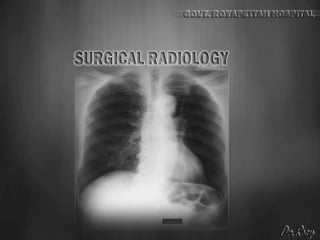
CHEST X-RAY PA VIEW
• Commonest of all x-ray investigations
performed in the department
• It is considered a routine but in fact it is the
most essential first x-ray examination
• Most of the diseases systemic pulmonary or
cardiac can be diagnosed by a glimpse
through this window
INDICATIONS
• In All Diseases Of The Chest ( Chestwall Lung Heart & Mediastinum)
• To The Check The Correct Placement Of Tubes, Electrodes And Other
Monitoring Devices
• Mass Minature Screening Of Communicable Diseases Like Tb
• Pyrexia Of Unknown Origin
• Preoperative Assesment Before General Anesthesia
• For Immigration And Health Care Screening
• In Other Systemic Or General Diseases With Suspected Lung
Involvement
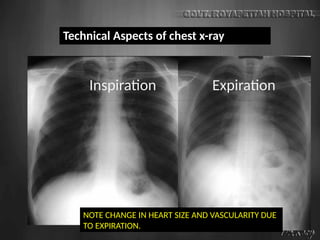
NOTE CHANGE IN HEART SIZE AND VASCULARITY DUE
TO EXPIRATION.
Technical Aspects of chest x-ray
Inspiration Expiration
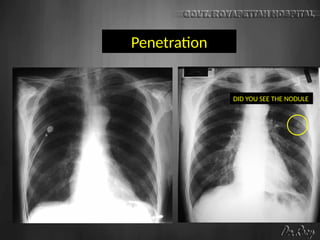
Penetration
DID YOU SEE THE NODULE
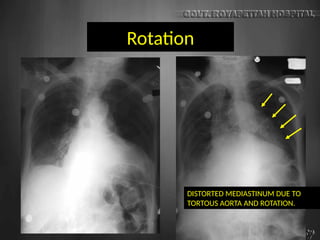
Rotation
DISTORTED MEDIASTINUM DUE TO
TORTOUS AORTA AND ROTATION.
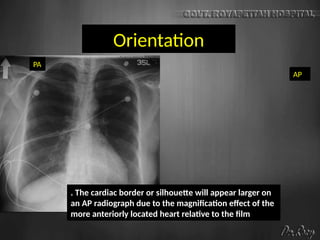
Orientation
PA
AP
. The cardiac border or silhouette will appear larger on
an AP radiograph due to the magnification effect of the
more anteriorly located heart relative to the film
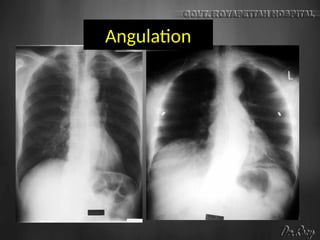
Angulation
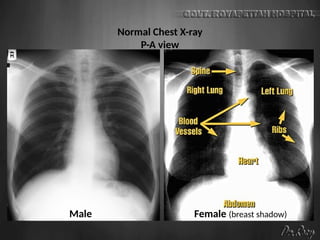
Normal Chest X-ray
P-A view
Male Female (breast shadow)
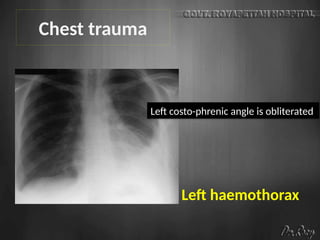
Chest trauma
Left costo-phrenic angle is obliterated
Left haemothorax
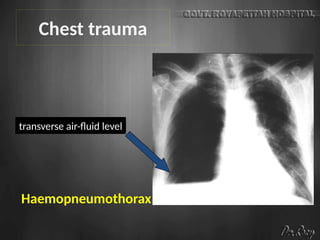
Chest trauma
transverse air-fluid level
Haemopneumothorax
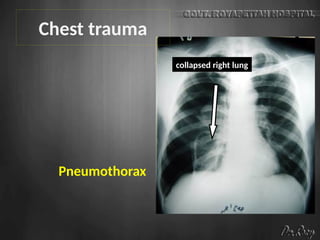
Pneumothorax
collapsed right lung
Chest trauma
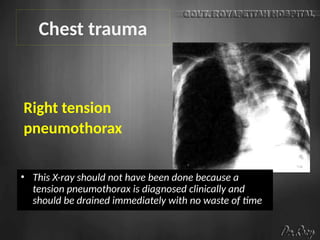
Right tension
pneumothorax
Chest trauma
• This X-ray should not have been done because a
tension pneumothorax is diagnosed clinically and
should be drained immediately with no waste of time
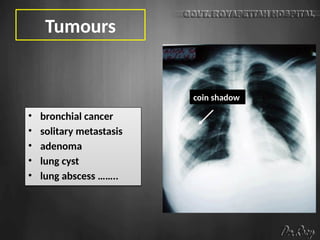
Tumours
• bronchial cancer
• solitary metastasis
• adenoma
• lung cyst
• lung abscess ……..
coin shadow
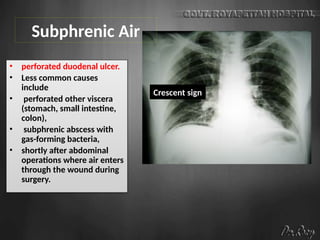
Subphrenic Air
• perforated duodenal ulcer.
• Less common causes
include
• perforated other viscera
(stomach, small intestine,
colon),
• subphrenic abscess with
gas-forming bacteria,
• shortly after abdominal
operations where air enters
through the wound during
surgery.
Crescent sign
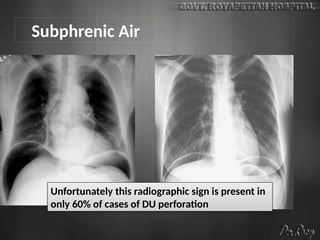
Subphrenic Air
Unfortunately this radiographic sign is present in
only 60% of cases of DU perforation
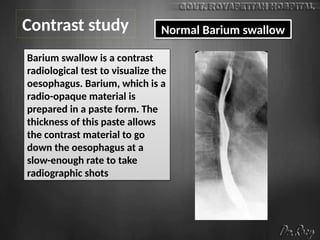
Contrast study Normal Barium swallow
Barium swallow is a contrast
radiological test to visualize the
oesophagus. Barium, which is a
radio-opaque material is
prepared in a paste form. The
thickness of this paste allows
the contrast material to go
down the oesophagus at a
slow-enough rate to take
radiographic shots
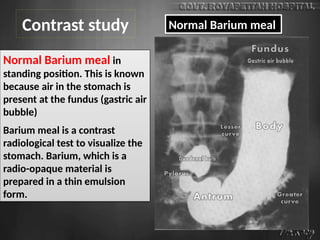
Normal Barium meal in
standing position. This is known
because air in the stomach is
present at the fundus (gastric air
bubble)
Barium meal is a contrast
radiological test to visualize the
stomach. Barium, which is a
radio-opaque material is
prepared in a thin emulsion
form.
Contrast study Normal Barium meal
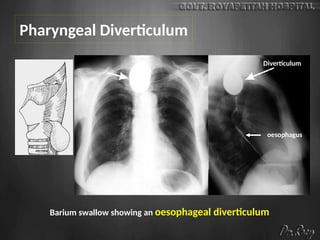
Pharyngeal Diverticulum
Barium swallow showing an oesophageal diverticulum
Diverticulum
oesophagus
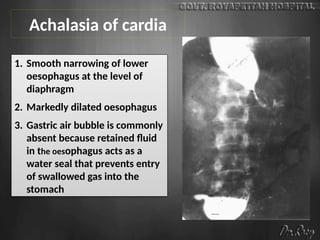
1. Smooth narrowing of lower
oesophagus at the level of
diaphragm
2. Markedly dilated oesophagus
3. Gastric air bubble is commonly
absent because retained fluid
in the oesophagus acts as a
water seal that prevents entry
of swallowed gas into the
stomach
Achalasia of cardia
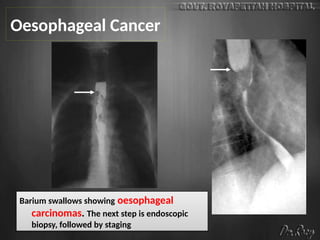
Oesophageal Cancer
Barium swallows showing oesophageal
carcinomas. The next step is endoscopic
biopsy, followed by staging
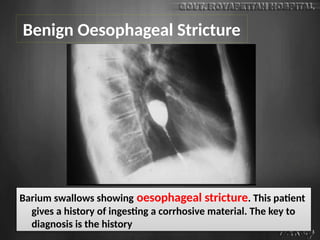
Benign Oesophageal Stricture
Barium swallows showing oesophageal stricture. This patient
gives a history of ingesting a corrhosive material. The key to
diagnosis is the history
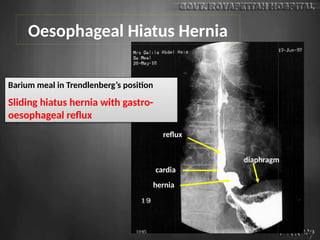
cardia
hernia
reflux
diaphragm
Barium meal in Trendlenberg’s position
Sliding hiatus hernia with gastro-
oesophageal reflux
Oesophageal Hiatus Hernia
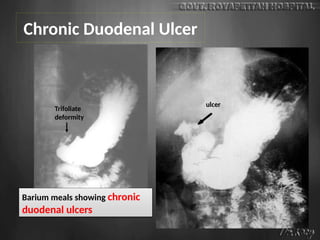
Chronic Duodenal Ulcer
Barium meals showing chronic
duodenal ulcers
ulcer
Trifoliate
deformity
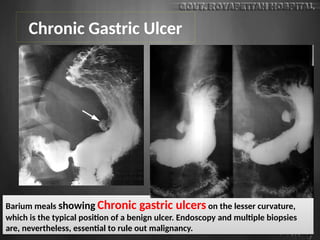
Chronic Gastric Ulcer
Barium meals showing Chronic gastric ulcers on the lesser curvature,
which is the typical position of a benign ulcer. Endoscopy and multiple biopsies
are, nevertheless, essential to rule out malignancy.
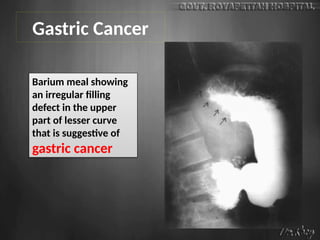
Gastric Cancer
Barium meal showing
an irregular filling
defect in the upper
part of lesser curve
that is suggestive of
gastric cancer
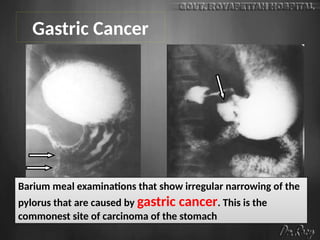
Barium meal examinations that show irregular narrowing of the
pylorus that are caused by gastric cancer. This is the
commonest site of carcinoma of the stomach
Gastric Cancer
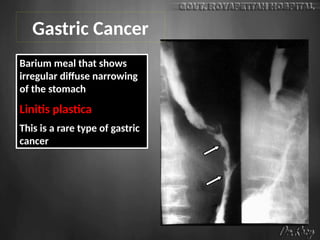
Barium meal that shows
irregular diffuse narrowing
of the stomach
Linitis plastica
This is a rare type of gastric
cancer
Gastric Cancer
Others
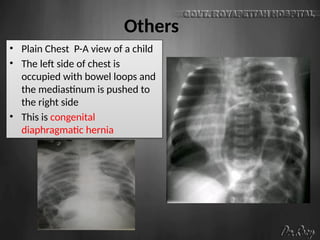
• Plain Chest P-A view of a child
• The left side of chest is
occupied with bowel loops and
the mediastinum is pushed to
the right side
• This is congenital
diaphragmatic hernia
Others
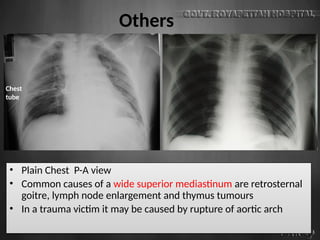
• Plain Chest P-A view
• Common causes of a wide superior mediastinum are retrosternal
goitre, lymph node enlargement and thymus tumours
• In a trauma victim it may be caused by rupture of aortic arch
Chest
tube
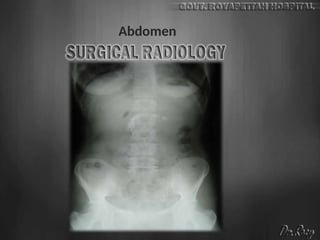
Abdomen
checklist
• Exposure
• Rotation
• Diaphragm + above and below
• Liver Spleen Kidney Psoas shadow
• Pelvis
• Calcification
• Abnormal bowel gas pattern / extraluminal air
• Soft tissue mass
• Visualized bones
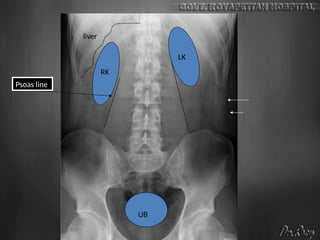
liver
RK
LK
UB
Psoas line
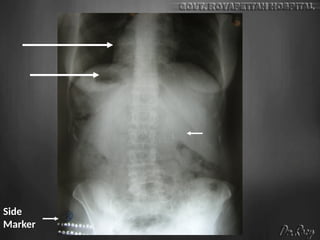
Side
Marker
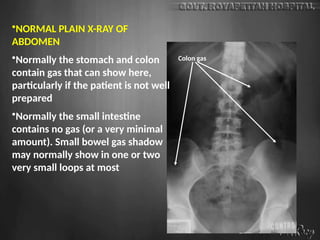
•NORMAL PLAIN X-RAY OF
ABDOMEN
•Normally the stomach and colon
contain gas that can show here,
particularly if the patient is not well
prepared
•Normally the small intestine
contains no gas (or a very minimal
amount). Small bowel gas shadow
may normally show in one or two
very small loops at most
Colon gas
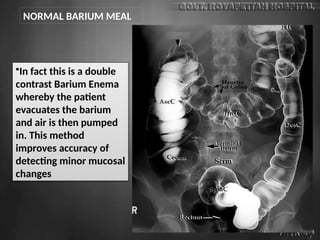
•In fact this is a double
contrast Barium Enema
whereby the patient
evacuates the barium
and air is then pumped
in. This method
improves accuracy of
detecting minor mucosal
changes
NORMAL BARIUM MEAL
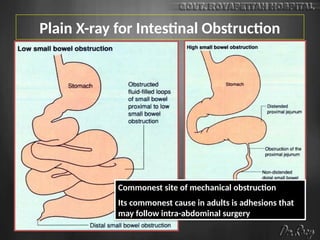
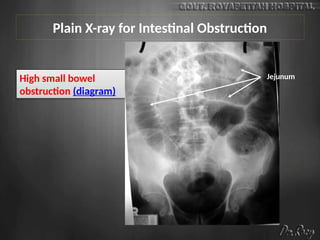
Plain X-ray for Intestinal Obstruction
Commonest site of mechanical obstruction
Its commonest cause in adults is adhesions that
may follow intra-abdominal surgery
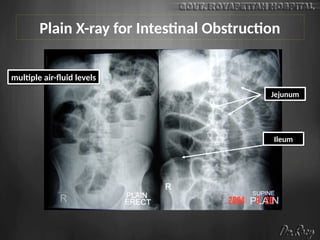
Plain X-ray for Intestinal Obstruction
Jejunum
Ileum
multiple air-fluid levels
Plain X-ray for Intestinal Obstruction
High small bowel
obstruction (diagram)
Jejunum
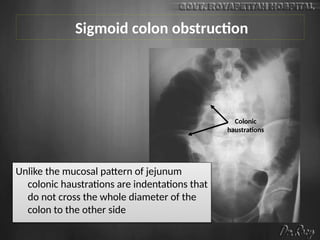
Sigmoid colon obstruction
Colonic
haustrations
Unlike the mucosal pattern of jejunum
colonic haustrations are indentations that
do not cross the whole diameter of the
colon to the other side
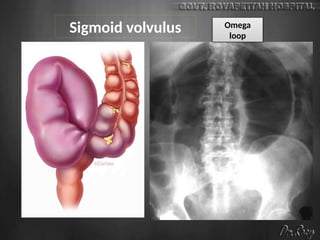
Sigmoid volvulus Omega
loop
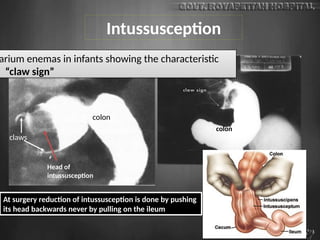
Intussusception
colon
Head of
intussusception
claws
colon
At surgery reduction of intussusception is done by pushing
its head backwards never by pulling on the ileum
arium enemas in infants showing the characteristic
“claw sign”
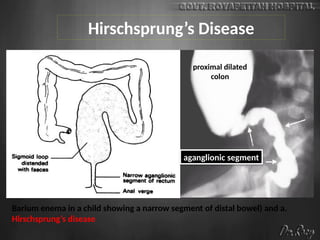
Hirschsprung’s Disease
colon
Barium enema in a child showing a narrow segment of distal bowel) and a.
Hirschsprung’s disease
aganglionic segment
proximal dilated
colon
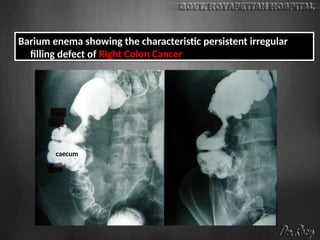
Barium enema showing the characteristic persistent irregular
filling defect of Right Colon Cancer
caecum
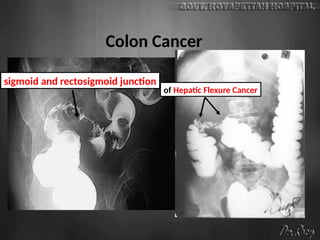
Colon Cancer
of Hepatic Flexure Cancer
sigmoid and rectosigmoid junction
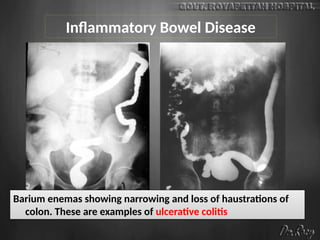
Inflammatory Bowel Disease
Barium enemas showing narrowing and loss of haustrations of
colon. These are examples of ulcerative colitis
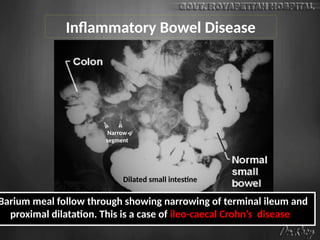
Inflammatory Bowel Disease
Dilated small intestine
Narrow
segment
Barium meal follow through showing narrowing of terminal ileum and
proximal dilatation. This is a case of ileo-caecal Crohn’s disease
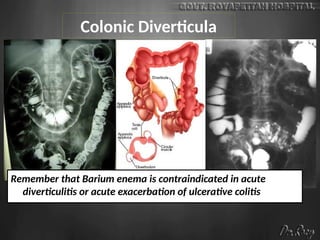
Colonic Diverticula
Remember that Barium enema is contraindicated in acute
diverticulitis or acute exacerbation of ulcerative colitis
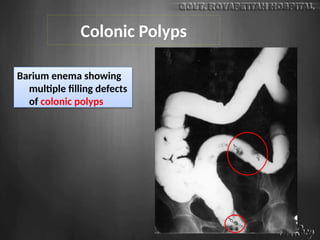
Colonic Polyps
Barium enema showing
multiple filling defects
of colonic polyps
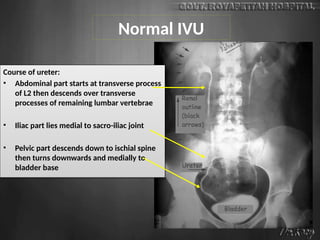
Normal IVU
Course of ureter:
• Abdominal part starts at transverse process
of L2 then descends over transverse
processes of remaining lumbar vertebrae
• Iliac part lies medial to sacro-iliac joint
• Pelvic part descends down to ischial spine
then turns downwards and medially to
bladder base
IVU
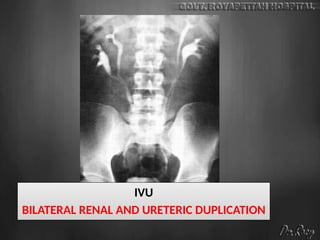
BILATERAL RENAL AND URETERIC DUPLICATION
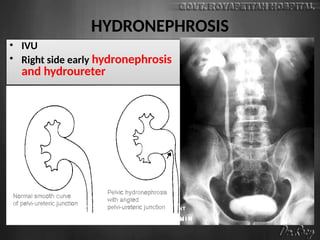
HYDRONEPHROSIS
• IVU
• Right side early hydronephrosis
and hydroureter
HYDRONEPHROSIS
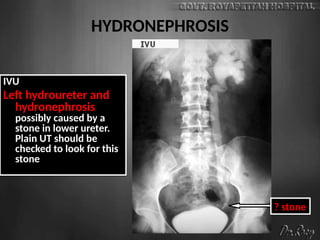
IVU
Left hydroureter and
hydronephrosis
possibly caused by a
stone in lower ureter.
Plain UT should be
checked to look for this
stone
? stone
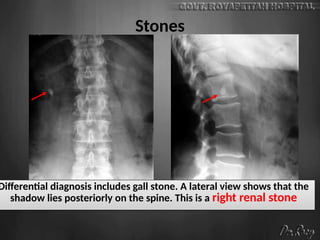
Stones
Differential diagnosis includes gall stone. A lateral view shows that the
shadow lies posteriorly on the spine. This is a right renal stone
Stones
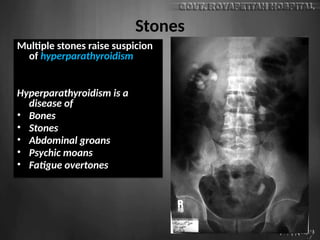
Multiple stones raise suspicion
of hyperparathyroidism
Hyperparathyroidism is a
disease of
• Bones
• Stones
• Abdominal groans
• Psychic moans
• Fatigue overtones
Stones
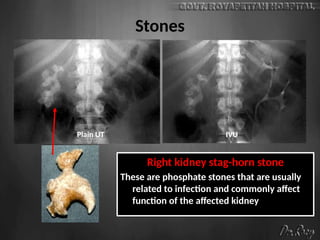
Right kidney stag-horn stone
These are phosphate stones that are usually
related to infection and commonly affect
function of the affected kidney
Plain UT IVU
Stones
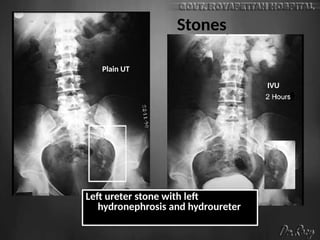
Plain UT
IVU
Left ureter stone with left
hydronephrosis and hydroureter
Stones
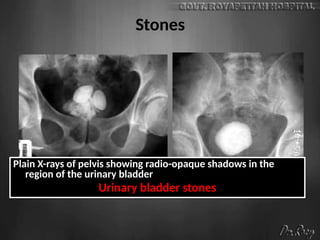
Plain X-rays of pelvis showing radio-opaque shadows in the
region of the urinary bladder
Urinary bladder stones
Plain X-ray
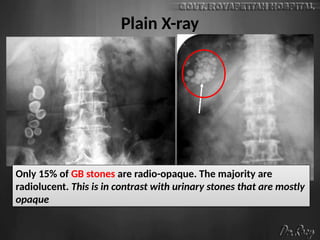
Only 15% of GB stones are radio-opaque. The majority are
radiolucent. This is in contrast with urinary stones that are mostly
opaque
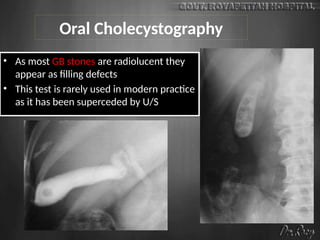
Oral Cholecystography
• As most GB stones are radiolucent they
appear as filling defects
• This test is rarely used in modern practice
as it has been superceded by U/S
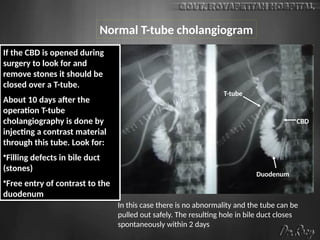
If the CBD is opened during
surgery to look for and
remove stones it should be
closed over a T-tube.
About 10 days after the
operation T-tube
cholangiography is done by
injecting a contrast material
through this tube. Look for:
•Filling defects in bile duct
(stones)
•Free entry of contrast to the
duodenum
CBD
Duodenum
T-tube
In this case there is no abnormality and the tube can be
pulled out safely. The resulting hole in bile duct closes
spontaneously within 2 days
Normal T-tube cholangiogram
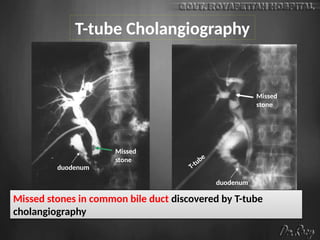
T-tube Cholangiography
duodenum
duodenum
Missed
stone
Missed
stone
T-tube
Missed stones in common bile duct discovered by T-tube
cholangiography
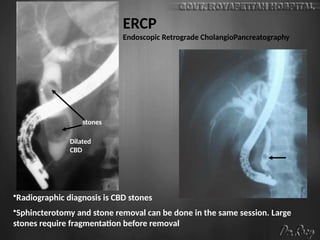
ERCP
Endoscopic Retrograde CholangioPancreatography
•Radiographic diagnosis is CBD stones
•Sphincterotomy and stone removal can be done in the same session. Large
stones require fragmentation before removal
Dilated
CBD
stones
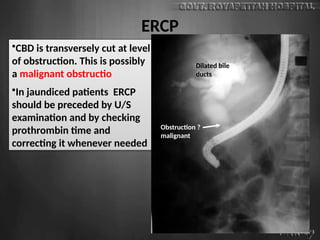
ERCP
•CBD is transversely cut at level
of obstruction. This is possibly
a malignant obstructio
•In jaundiced patients ERCP
should be preceded by U/S
examination and by checking
prothrombin time and
correcting it whenever needed
Dilated bile
ducts
Obstruction ?
malignant
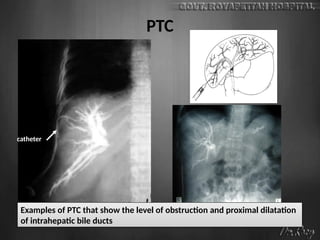
PTC
catheter
Examples of PTC that show the level of obstruction and proximal dilatation
of intrahepatic bile ducts
x ray class in final year mbbs for practical examination

x ray class in final year mbbs for practical examination

  • 1.
  • 3.
    HOW TO READAN X-RAY Properties of an x-ray image • It is an grey scale • It is summations of shadows • It is two dimensional representation of a three dimensional concept • It is a static representation of a dynamic disease process interpret with history, laboratory findings, serial image findings
  • 4.
    HOW TO READAN XRAY IMAGE • Elements of visual search • Elements of detection • Elements of interpretation – A thorough knowledge of anatomy pathology, Pathoanatomy pathophisiology of the disease process with statistical guidance is essential to come to a reasonable diagnosis
  • 5.
    BASIC DENSITIES • Air= black • Fat = dark grey • Soft tissue/fluid = light grey • Bone/calcification = white • Metal = intense white
  • 6.
    CHEST X-RAY PAVIEW • Commonest of all x-ray investigations performed in the department • It is considered a routine but in fact it is the most essential first x-ray examination • Most of the diseases systemic pulmonary or cardiac can be diagnosed by a glimpse through this window
  • 7.
    INDICATIONS • In AllDiseases Of The Chest ( Chestwall Lung Heart & Mediastinum) • To The Check The Correct Placement Of Tubes, Electrodes And Other Monitoring Devices • Mass Minature Screening Of Communicable Diseases Like Tb • Pyrexia Of Unknown Origin • Preoperative Assesment Before General Anesthesia • For Immigration And Health Care Screening • In Other Systemic Or General Diseases With Suspected Lung Involvement
  • 8.
    NOTE CHANGE INHEART SIZE AND VASCULARITY DUE TO EXPIRATION. Technical Aspects of chest x-ray Inspiration Expiration
  • 9.
  • 10.
    Rotation DISTORTED MEDIASTINUM DUETO TORTOUS AORTA AND ROTATION.
  • 11.
    Orientation PA AP . The cardiacborder or silhouette will appear larger on an AP radiograph due to the magnification effect of the more anteriorly located heart relative to the film
  • 12.
  • 13.
    Normal Chest X-ray P-Aview Male Female (breast shadow)
  • 14.
    Chest trauma Left costo-phrenicangle is obliterated Left haemothorax
  • 15.
    Chest trauma transverse air-fluidlevel Haemopneumothorax
  • 16.
  • 17.
    Right tension pneumothorax Chest trauma •This X-ray should not have been done because a tension pneumothorax is diagnosed clinically and should be drained immediately with no waste of time
  • 18.
    Tumours • bronchial cancer •solitary metastasis • adenoma • lung cyst • lung abscess …….. coin shadow
  • 19.
    Subphrenic Air • perforatedduodenal ulcer. • Less common causes include • perforated other viscera (stomach, small intestine, colon), • subphrenic abscess with gas-forming bacteria, • shortly after abdominal operations where air enters through the wound during surgery. Crescent sign
  • 20.
    Subphrenic Air Unfortunately thisradiographic sign is present in only 60% of cases of DU perforation
  • 21.
    Contrast study NormalBarium swallow Barium swallow is a contrast radiological test to visualize the oesophagus. Barium, which is a radio-opaque material is prepared in a paste form. The thickness of this paste allows the contrast material to go down the oesophagus at a slow-enough rate to take radiographic shots
  • 22.
    Normal Barium mealin standing position. This is known because air in the stomach is present at the fundus (gastric air bubble) Barium meal is a contrast radiological test to visualize the stomach. Barium, which is a radio-opaque material is prepared in a thin emulsion form. Contrast study Normal Barium meal
  • 23.
    Pharyngeal Diverticulum Barium swallowshowing an oesophageal diverticulum Diverticulum oesophagus
  • 24.
    1. Smooth narrowingof lower oesophagus at the level of diaphragm 2. Markedly dilated oesophagus 3. Gastric air bubble is commonly absent because retained fluid in the oesophagus acts as a water seal that prevents entry of swallowed gas into the stomach Achalasia of cardia
  • 25.
    Oesophageal Cancer Barium swallowsshowing oesophageal carcinomas. The next step is endoscopic biopsy, followed by staging
  • 26.
    Benign Oesophageal Stricture Bariumswallows showing oesophageal stricture. This patient gives a history of ingesting a corrhosive material. The key to diagnosis is the history
  • 27.
    cardia hernia reflux diaphragm Barium meal inTrendlenberg’s position Sliding hiatus hernia with gastro- oesophageal reflux Oesophageal Hiatus Hernia
  • 28.
    Chronic Duodenal Ulcer Bariummeals showing chronic duodenal ulcers ulcer Trifoliate deformity
  • 29.
    Chronic Gastric Ulcer Bariummeals showing Chronic gastric ulcers on the lesser curvature, which is the typical position of a benign ulcer. Endoscopy and multiple biopsies are, nevertheless, essential to rule out malignancy.
  • 30.
    Gastric Cancer Barium mealshowing an irregular filling defect in the upper part of lesser curve that is suggestive of gastric cancer
  • 31.
    Barium meal examinationsthat show irregular narrowing of the pylorus that are caused by gastric cancer. This is the commonest site of carcinoma of the stomach Gastric Cancer
  • 32.
    Barium meal thatshows irregular diffuse narrowing of the stomach Linitis plastica This is a rare type of gastric cancer Gastric Cancer
  • 33.
    Others • Plain ChestP-A view of a child • The left side of chest is occupied with bowel loops and the mediastinum is pushed to the right side • This is congenital diaphragmatic hernia
  • 34.
    Others • Plain ChestP-A view • Common causes of a wide superior mediastinum are retrosternal goitre, lymph node enlargement and thymus tumours • In a trauma victim it may be caused by rupture of aortic arch Chest tube
  • 35.
  • 36.
    checklist • Exposure • Rotation •Diaphragm + above and below • Liver Spleen Kidney Psoas shadow • Pelvis • Calcification • Abnormal bowel gas pattern / extraluminal air • Soft tissue mass • Visualized bones
  • 37.
  • 38.
  • 39.
    •NORMAL PLAIN X-RAYOF ABDOMEN •Normally the stomach and colon contain gas that can show here, particularly if the patient is not well prepared •Normally the small intestine contains no gas (or a very minimal amount). Small bowel gas shadow may normally show in one or two very small loops at most Colon gas
  • 40.
    •In fact thisis a double contrast Barium Enema whereby the patient evacuates the barium and air is then pumped in. This method improves accuracy of detecting minor mucosal changes NORMAL BARIUM MEAL
  • 41.
    Plain X-ray forIntestinal Obstruction Commonest site of mechanical obstruction Its commonest cause in adults is adhesions that may follow intra-abdominal surgery
  • 42.
    Plain X-ray forIntestinal Obstruction Jejunum Ileum multiple air-fluid levels
  • 43.
    Plain X-ray forIntestinal Obstruction High small bowel obstruction (diagram) Jejunum
  • 44.
    Sigmoid colon obstruction Colonic haustrations Unlikethe mucosal pattern of jejunum colonic haustrations are indentations that do not cross the whole diameter of the colon to the other side
  • 45.
  • 46.
    Intussusception colon Head of intussusception claws colon At surgeryreduction of intussusception is done by pushing its head backwards never by pulling on the ileum arium enemas in infants showing the characteristic “claw sign”
  • 47.
    Hirschsprung’s Disease colon Barium enemain a child showing a narrow segment of distal bowel) and a. Hirschsprung’s disease aganglionic segment proximal dilated colon
  • 48.
    Barium enema showingthe characteristic persistent irregular filling defect of Right Colon Cancer caecum
  • 49.
    Colon Cancer of HepaticFlexure Cancer sigmoid and rectosigmoid junction
  • 50.
    Inflammatory Bowel Disease Bariumenemas showing narrowing and loss of haustrations of colon. These are examples of ulcerative colitis
  • 51.
    Inflammatory Bowel Disease Dilatedsmall intestine Narrow segment Barium meal follow through showing narrowing of terminal ileum and proximal dilatation. This is a case of ileo-caecal Crohn’s disease
  • 52.
    Colonic Diverticula Remember thatBarium enema is contraindicated in acute diverticulitis or acute exacerbation of ulcerative colitis
  • 53.
    Colonic Polyps Barium enemashowing multiple filling defects of colonic polyps
  • 54.
    Normal IVU Course ofureter: • Abdominal part starts at transverse process of L2 then descends over transverse processes of remaining lumbar vertebrae • Iliac part lies medial to sacro-iliac joint • Pelvic part descends down to ischial spine then turns downwards and medially to bladder base
  • 55.
    IVU BILATERAL RENAL ANDURETERIC DUPLICATION
  • 56.
    HYDRONEPHROSIS • IVU • Rightside early hydronephrosis and hydroureter
  • 57.
    HYDRONEPHROSIS IVU Left hydroureter and hydronephrosis possiblycaused by a stone in lower ureter. Plain UT should be checked to look for this stone ? stone
  • 58.
    Stones Differential diagnosis includesgall stone. A lateral view shows that the shadow lies posteriorly on the spine. This is a right renal stone
  • 59.
    Stones Multiple stones raisesuspicion of hyperparathyroidism Hyperparathyroidism is a disease of • Bones • Stones • Abdominal groans • Psychic moans • Fatigue overtones
  • 60.
    Stones Right kidney stag-hornstone These are phosphate stones that are usually related to infection and commonly affect function of the affected kidney Plain UT IVU
  • 61.
    Stones Plain UT IVU Left ureterstone with left hydronephrosis and hydroureter
  • 62.
    Stones Plain X-rays ofpelvis showing radio-opaque shadows in the region of the urinary bladder Urinary bladder stones
  • 63.
    Plain X-ray Only 15%of GB stones are radio-opaque. The majority are radiolucent. This is in contrast with urinary stones that are mostly opaque
  • 64.
    Oral Cholecystography • Asmost GB stones are radiolucent they appear as filling defects • This test is rarely used in modern practice as it has been superceded by U/S
  • 65.
    If the CBDis opened during surgery to look for and remove stones it should be closed over a T-tube. About 10 days after the operation T-tube cholangiography is done by injecting a contrast material through this tube. Look for: •Filling defects in bile duct (stones) •Free entry of contrast to the duodenum CBD Duodenum T-tube In this case there is no abnormality and the tube can be pulled out safely. The resulting hole in bile duct closes spontaneously within 2 days Normal T-tube cholangiogram
  • 66.
  • 67.
    ERCP Endoscopic Retrograde CholangioPancreatography •Radiographicdiagnosis is CBD stones •Sphincterotomy and stone removal can be done in the same session. Large stones require fragmentation before removal Dilated CBD stones
  • 68.
    ERCP •CBD is transverselycut at level of obstruction. This is possibly a malignant obstructio •In jaundiced patients ERCP should be preceded by U/S examination and by checking prothrombin time and correcting it whenever needed Dilated bile ducts Obstruction ? malignant
  • 69.
    PTC catheter Examples of PTCthat show the level of obstruction and proximal dilatation of intrahepatic bile ducts