Jawahar Thomas Mr Jawahar
Thomas Dr J Thomas
www.jawaharthomas.com
NCPIE 2007
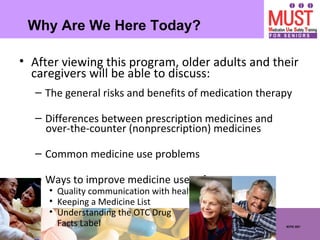
• After viewing this program, older adults and their
caregivers will be able to discuss:
– The general risks and benefits of medication therapy
– Differences between prescription medicines and
over-the-counter (nonprescription) medicines
– Common medicine use problems
– Ways to improve medicine use safety:
• Quality communication with healthcare professionals
• Keeping a Medicine List
• Understanding the OTC Drug
Facts Label
Why Are We Here Today?
NCPIE 2007
Medicines - Benefits
• What is a medicine?
– A medicine or drug changes how your body works
or
– Treats or prevents a disease or symptom
• When used correctly, medicines can lead to:
– Better life quality
– Healthier life
– Longer life
NCPIE 2007
Types of Medicines
• Prescription medicines
– Examples: blood pressure medicines, blood thinners, antibiotics, eye
drops
• Over-the-Counter (OTC) or nonprescription medicines
– Examples: aspirin, acetaminophen, cough medicine
For all medicines, you must read and follow the directions!
NCPIE 2007
Prescription and Nonprescription or
Over-the-Counter (OTC) Medicines
NCPIE 2007
Dietary Supplements
& Herbal Remedies
• Self prescribed, available from many sources
• You are responsible for choosing the correct
medicine, dose, and watching for side effects.
• Herbal remedies do not have to follow the same
strict rules that prescription drugs do.
• For herbal remedies, manufacturers do not have
to prove that the product is safe, effective, or
that it contains the ingredients on the label.
NCPIE 2007
Medicines - Risks
• It is important to know that ALL medicines,
both prescription and OTC, have risks as well
as benefits.
– The risks of medicines are the chances that
something unwanted or unexpected could happen
to you when you
use them.
– Risks could be less serious things such as an upset
NCPIE 2007
Medicine Risks
• Medicines can cause problems, even if used
correctly:
– Allergic reaction: when your body’s defense
system reacts in a bad way to a drug.
• Hives, itching, rash
• Narrowing of throat, difficulty breathing, shortness of
breath
• vs.
– Side effect: undesired effect of a medicine
• Some side effects are common (headache, upset
stomach)
• Others are very rare (liver failure)
NCPIE 2007
Medicine Use Problems
• What are Medicine Use Problems?
– Medicine use problems are any “bad” things that can happen
to you as a result of taking only one medicine or several
medicines.
• Medicine use problems can result in your not getting
the best results from your medicine
• Medicine Use Problems can:
– Prevent you from getting well as fast as you would like to
– Make you sicker
– Lower your quality of life
– Cause disabilities, accidents, or injuries
NCPIE 2007
Potential Medicine Use Problems
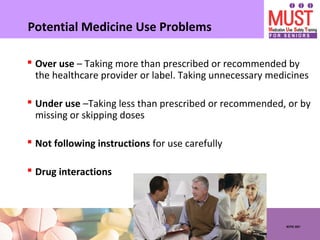
 Over use – Taking more than prescribed or recommended by
the healthcare provider or label. Taking unnecessary medicines
 Under use –Taking less than prescribed or recommended, or by
missing or skipping doses
 Not following instructions for use carefully
 Drug interactions
NCPIE 2007
Drug Interactions
• Drug interactions occur when a drug interacts with another drug,
food, or alcohol and changes the way the drug acts in the body
– May cause unexpected side effect
– The drugs involved can be prescription medicines, over-the-counter
medicines or vitamins and herbal products
– Examples:
• Warfarin and antibiotics (e.g., levofloxacin
(Levaquin)
• Warfarin and green leafy vegetables
• Alcohol and pain medicines (e.g., tramadol (Ultram)
• Selective Serotonin Reuptake Inhibitor
Antidepressants (e.g., sertraline
(Zoloft) and St. Johns Wort
• Grapefruit Juice and multiple medicines such as
NCPIE 2007
When Can Medicine Use
Problems Happen?
 When a new Medicine is added to the regimen
 When a Medicine is stopped
 When a Dose of a medicine is changed
 When alcohol is consumed while taking medicines
 When OTC and herbal products are taken without the
doctor or pharmacist knowing they are part of the
medicine regimen.
 Can really happen any time
NCPIE 2007
Ways to Avoid Medicine Use Problems
• Communication
– Asking questions to increase knowledge
– Talking to your healthcare providers
– Keeping an updated medicine list
• Using one pharmacy for all prescription medicines
• Medicine Review
– Check your prescription prior to taking
– Have all medicines reviewed at least annually
NCPIE 2007
Know Your Medicines!
 What is this medicine used for?
 Is this a BRAND or GENERIC?
 Where do you store it?
 How to take it?
 How much
 How often/what time of day
 With or without food, with or without other medicines
 What should you expect or do?
 How to tell if the medicine is working
 Possible side effects and what to do about them
 Tests or monitoring needed
 If you miss a dose
NCPIE 2007
Your Medicine List
• When visiting any healthcare professional:
– Take your Medicine List, which contains information on:
• All prescription medicines, including eye drops, topicals, samples
• Nonprescription medicines, herbals, vaccines
• What are the medicines used for
• How to take the medicine
NCPIE 2007
Your Medicine List
 Make copies of your list
Give one to your doctor, one to your pharmacist, and
one to a loved one.
Carry one with you and keep a copy at home.
Make sure to keep it updated!
NCPIE 2007
Talking with Your Healthcare Provider
• Prior to your visit, make a list of questions.
• Ask about:
– Questions you may have about a disease, symptom(s), or
medicines.
– The need to continue current medicines
– Non-drug treatments
– Over-the-counter preparations
– Need for follow-up appointments, lab work
You are an important part of your healthcare team!
NCPIE 2007
Ways to Avoid Medicine Use Problems:
The OTC Drug Fact Label
• All over-the-counter medicines
in the United States have a
Drug Facts Label that looks like
this:
• Learning to read the Drug
Facts Label will give you the
knowledge to make better
decisions, and use OTC
medicines safely.
NCPIE 2007
Reading the OTC Drug Fact Label
• Active Ingredient(s): Chemical compound in the medicine that
works with your body to bring relief
• Uses: This sections tells you the ONLY symptoms the medicine is
approved to treat
• Warnings: This section tells you what to avoid and who should not
use this
• Directions: Recommended daily dosage and frequency. Follow this
strictly
• Other Information: Tells you additional information such as
proper storage
• Inactive Ingredients: A chemical compound that has no effect on
your body
NCPIE 2007
Ways to Avoid Medicine Use Problems: Written
Information
• The information sheet you get with your
prescription medicine contains useful
information to help you get the best results
and avoid problems. Read it carefully
• The information sheet tells you:
– What the medicine is used for
– How to take your medicine correctly
– What side effects to watch for and what to do if they occur
– Warnings and Precautions
– Storage
NCPIE 2007
Review: Remember the 3 R’s for
Safe Medicine Use
1. Risk - All medicines (prescription & nonprescription) have risks as well
as benefits; and you need to weigh these risks and benefits carefully for
every medicine you take.
2. Respect – Respect the power of your medicine and the value of
medicines properly used.
3. Responsibility - Take responsibility for learning about how to take your
medicine safely.
NCPIE 2007
Resources You Can Use
• Safe Medicine Use Information:
– www.talkaboutrx.org
– www.bemedwise.org
– www.aarp.org/health/rx_drugs/usingmeds/
– www.ascp.com/consumers/tips/index.cfm
– www.fda.gov/medsinmyhome
• Buying Medicines Safely on the Internet:
– www.fda.gov/cder/consumerinfo/buyOnlineGuide_text.htm
NCPIE 2007
Contacts
National Council on Patient Information and Education (NCPIE)
4915 Saint Elmo Ave., Suite 505
Bethesda, MD 20814-6082
(301) 656-8565 – telephone
(301) 656-4464 – fax
ncpie@ncpie.info – email
www.talkaboutrx.org; www.bemedwise.org; www.mustforseniors.org
Peter Lamy Center for Drug Therapy and Aging
University of Maryland School of Pharmacy
220 Arch Street, 12th Floor
Baltimore, MD 21201
(410) 706-2434 – telephone
(410) 706-1488 – fax
lamycenter@rx.umaryland.edu – email
http://www.pharmacy.umaryland.edu/lamy/index.html
NCPIE 2007NCPIE 2007
Meet the MUST for Seniors Development
Team
TM
Nicole J. Brandt, PharmD, CGP, BCPP
Associate Professor, Geriatric Pharmacotherapy
Director, Clinical and Educational Programs
Peter Lamy Center for Drug Therapy and Aging
University of Maryland
School of Pharmacy
Baltimore, MD
Lindsay DuVall Clarke
Director of Health Programs
Alliance for Aging Research
Washington, DC
Reba Cornman, MSW, LCSW-C
Director, Geriatrics and Gerontology Education and Research Program
University of Maryland, and
Director, Communications and Outreach
Peter Lamy Center for Drug Therapy and Aging
NCPIE wishes to thank the following individuals for their input in the
development of the Medication Use Safety Training for Seniors™
(MUST for Seniors™) program:
NCPIE 2007NCPIE 2007
Meet the MUST for Seniors
Development Team
TM
Debbie Gold
Program Manager, GOSPEL Program
HHS/Office of Health Promotion
Montgomery County Government
Wheaton, MD
Kathleen (Kay) Loughrey
Consumer Services
U.S. Administration on Aging
Washington, DC
Phylliss M. Moret, RPh
Associate Executive Director / Chief Operating Officer
American Society of Consultant Pharmacists
Alexandria, VA
NCPIE 2007NCPIE 2007
Meet the MUST for Seniors
Development Team
TM
N. Lee Rucker, MSPH
Senior Policy Advisor
Public Policy Institute
AARP
Washington, DC
University of Maryland
Chanel Agness, PharmD
Assistant Professor, University of Maryland School of Pharmacy
Jennifer Hardesty, PharmD
Consultant
NCPIE 2007
Wm. Ray Bullman
Executive Vice President
National Council on Patient Information and Education
Bethesda, MD
Deborah Davidson
Membership Director
National Council on Patient Information and Education
Bethesda, MD
David Juste
2007 Summer Intern
SUNY @ Old Westbury
Brooklyn, NY
NCPIE Staff
NCPIE 2007
Louisa Hart
Director
The Cloudburst Consulting Group, Inc.
Landover, MD
Marlene Povich
Povich Design
Bethesda, MD
Alison Ray
Editor
GVI Video Productions
Washington, DC
John Seebode
Office of Medical Education
University of Maryland School of Medicine
Videography/Design
NCPIE 2007
NCPIE is pleased to acknowledge AstraZeneca Pharmaceuticals for providing a
charitable contribution to make the MUST for Seniors Program possible.

www.jawaharthomas.com

  • 1.
    Jawahar Thomas MrJawahar Thomas Dr J Thomas www.jawaharthomas.com
  • 2.
    NCPIE 2007 • Afterviewing this program, older adults and their caregivers will be able to discuss: – The general risks and benefits of medication therapy – Differences between prescription medicines and over-the-counter (nonprescription) medicines – Common medicine use problems – Ways to improve medicine use safety: • Quality communication with healthcare professionals • Keeping a Medicine List • Understanding the OTC Drug Facts Label Why Are We Here Today?
  • 3.
    NCPIE 2007 Medicines -Benefits • What is a medicine? – A medicine or drug changes how your body works or – Treats or prevents a disease or symptom • When used correctly, medicines can lead to: – Better life quality – Healthier life – Longer life
  • 4.
    NCPIE 2007 Types ofMedicines • Prescription medicines – Examples: blood pressure medicines, blood thinners, antibiotics, eye drops • Over-the-Counter (OTC) or nonprescription medicines – Examples: aspirin, acetaminophen, cough medicine For all medicines, you must read and follow the directions!
  • 5.
    NCPIE 2007 Prescription andNonprescription or Over-the-Counter (OTC) Medicines
  • 6.
    NCPIE 2007 Dietary Supplements &Herbal Remedies • Self prescribed, available from many sources • You are responsible for choosing the correct medicine, dose, and watching for side effects. • Herbal remedies do not have to follow the same strict rules that prescription drugs do. • For herbal remedies, manufacturers do not have to prove that the product is safe, effective, or that it contains the ingredients on the label.
  • 7.
    NCPIE 2007 Medicines -Risks • It is important to know that ALL medicines, both prescription and OTC, have risks as well as benefits. – The risks of medicines are the chances that something unwanted or unexpected could happen to you when you use them. – Risks could be less serious things such as an upset
  • 8.
    NCPIE 2007 Medicine Risks •Medicines can cause problems, even if used correctly: – Allergic reaction: when your body’s defense system reacts in a bad way to a drug. • Hives, itching, rash • Narrowing of throat, difficulty breathing, shortness of breath • vs. – Side effect: undesired effect of a medicine • Some side effects are common (headache, upset stomach) • Others are very rare (liver failure)
  • 9.
    NCPIE 2007 Medicine UseProblems • What are Medicine Use Problems? – Medicine use problems are any “bad” things that can happen to you as a result of taking only one medicine or several medicines. • Medicine use problems can result in your not getting the best results from your medicine • Medicine Use Problems can: – Prevent you from getting well as fast as you would like to – Make you sicker – Lower your quality of life – Cause disabilities, accidents, or injuries
  • 10.
    NCPIE 2007 Potential MedicineUse Problems  Over use – Taking more than prescribed or recommended by the healthcare provider or label. Taking unnecessary medicines  Under use –Taking less than prescribed or recommended, or by missing or skipping doses  Not following instructions for use carefully  Drug interactions
  • 11.
    NCPIE 2007 Drug Interactions •Drug interactions occur when a drug interacts with another drug, food, or alcohol and changes the way the drug acts in the body – May cause unexpected side effect – The drugs involved can be prescription medicines, over-the-counter medicines or vitamins and herbal products – Examples: • Warfarin and antibiotics (e.g., levofloxacin (Levaquin) • Warfarin and green leafy vegetables • Alcohol and pain medicines (e.g., tramadol (Ultram) • Selective Serotonin Reuptake Inhibitor Antidepressants (e.g., sertraline (Zoloft) and St. Johns Wort • Grapefruit Juice and multiple medicines such as
  • 12.
    NCPIE 2007 When CanMedicine Use Problems Happen?  When a new Medicine is added to the regimen  When a Medicine is stopped  When a Dose of a medicine is changed  When alcohol is consumed while taking medicines  When OTC and herbal products are taken without the doctor or pharmacist knowing they are part of the medicine regimen.  Can really happen any time
  • 13.
    NCPIE 2007 Ways toAvoid Medicine Use Problems • Communication – Asking questions to increase knowledge – Talking to your healthcare providers – Keeping an updated medicine list • Using one pharmacy for all prescription medicines • Medicine Review – Check your prescription prior to taking – Have all medicines reviewed at least annually
  • 14.
    NCPIE 2007 Know YourMedicines!  What is this medicine used for?  Is this a BRAND or GENERIC?  Where do you store it?  How to take it?  How much  How often/what time of day  With or without food, with or without other medicines  What should you expect or do?  How to tell if the medicine is working  Possible side effects and what to do about them  Tests or monitoring needed  If you miss a dose
  • 15.
    NCPIE 2007 Your MedicineList • When visiting any healthcare professional: – Take your Medicine List, which contains information on: • All prescription medicines, including eye drops, topicals, samples • Nonprescription medicines, herbals, vaccines • What are the medicines used for • How to take the medicine
  • 16.
    NCPIE 2007 Your MedicineList  Make copies of your list Give one to your doctor, one to your pharmacist, and one to a loved one. Carry one with you and keep a copy at home. Make sure to keep it updated!
  • 17.
    NCPIE 2007 Talking withYour Healthcare Provider • Prior to your visit, make a list of questions. • Ask about: – Questions you may have about a disease, symptom(s), or medicines. – The need to continue current medicines – Non-drug treatments – Over-the-counter preparations – Need for follow-up appointments, lab work You are an important part of your healthcare team!
  • 18.
    NCPIE 2007 Ways toAvoid Medicine Use Problems: The OTC Drug Fact Label • All over-the-counter medicines in the United States have a Drug Facts Label that looks like this: • Learning to read the Drug Facts Label will give you the knowledge to make better decisions, and use OTC medicines safely.
  • 19.
    NCPIE 2007 Reading theOTC Drug Fact Label • Active Ingredient(s): Chemical compound in the medicine that works with your body to bring relief • Uses: This sections tells you the ONLY symptoms the medicine is approved to treat • Warnings: This section tells you what to avoid and who should not use this • Directions: Recommended daily dosage and frequency. Follow this strictly • Other Information: Tells you additional information such as proper storage • Inactive Ingredients: A chemical compound that has no effect on your body
  • 20.
    NCPIE 2007 Ways toAvoid Medicine Use Problems: Written Information • The information sheet you get with your prescription medicine contains useful information to help you get the best results and avoid problems. Read it carefully • The information sheet tells you: – What the medicine is used for – How to take your medicine correctly – What side effects to watch for and what to do if they occur – Warnings and Precautions – Storage
  • 21.
    NCPIE 2007 Review: Rememberthe 3 R’s for Safe Medicine Use 1. Risk - All medicines (prescription & nonprescription) have risks as well as benefits; and you need to weigh these risks and benefits carefully for every medicine you take. 2. Respect – Respect the power of your medicine and the value of medicines properly used. 3. Responsibility - Take responsibility for learning about how to take your medicine safely.
  • 22.
    NCPIE 2007 Resources YouCan Use • Safe Medicine Use Information: – www.talkaboutrx.org – www.bemedwise.org – www.aarp.org/health/rx_drugs/usingmeds/ – www.ascp.com/consumers/tips/index.cfm – www.fda.gov/medsinmyhome • Buying Medicines Safely on the Internet: – www.fda.gov/cder/consumerinfo/buyOnlineGuide_text.htm
  • 23.
    NCPIE 2007 Contacts National Councilon Patient Information and Education (NCPIE) 4915 Saint Elmo Ave., Suite 505 Bethesda, MD 20814-6082 (301) 656-8565 – telephone (301) 656-4464 – fax ncpie@ncpie.info – email www.talkaboutrx.org; www.bemedwise.org; www.mustforseniors.org Peter Lamy Center for Drug Therapy and Aging University of Maryland School of Pharmacy 220 Arch Street, 12th Floor Baltimore, MD 21201 (410) 706-2434 – telephone (410) 706-1488 – fax lamycenter@rx.umaryland.edu – email http://www.pharmacy.umaryland.edu/lamy/index.html
  • 24.
    NCPIE 2007NCPIE 2007 Meetthe MUST for Seniors Development Team TM Nicole J. Brandt, PharmD, CGP, BCPP Associate Professor, Geriatric Pharmacotherapy Director, Clinical and Educational Programs Peter Lamy Center for Drug Therapy and Aging University of Maryland School of Pharmacy Baltimore, MD Lindsay DuVall Clarke Director of Health Programs Alliance for Aging Research Washington, DC Reba Cornman, MSW, LCSW-C Director, Geriatrics and Gerontology Education and Research Program University of Maryland, and Director, Communications and Outreach Peter Lamy Center for Drug Therapy and Aging NCPIE wishes to thank the following individuals for their input in the development of the Medication Use Safety Training for Seniors™ (MUST for Seniors™) program:
  • 25.
    NCPIE 2007NCPIE 2007 Meetthe MUST for Seniors Development Team TM Debbie Gold Program Manager, GOSPEL Program HHS/Office of Health Promotion Montgomery County Government Wheaton, MD Kathleen (Kay) Loughrey Consumer Services U.S. Administration on Aging Washington, DC Phylliss M. Moret, RPh Associate Executive Director / Chief Operating Officer American Society of Consultant Pharmacists Alexandria, VA
  • 26.
    NCPIE 2007NCPIE 2007 Meetthe MUST for Seniors Development Team TM N. Lee Rucker, MSPH Senior Policy Advisor Public Policy Institute AARP Washington, DC University of Maryland Chanel Agness, PharmD Assistant Professor, University of Maryland School of Pharmacy Jennifer Hardesty, PharmD Consultant
  • 27.
    NCPIE 2007 Wm. RayBullman Executive Vice President National Council on Patient Information and Education Bethesda, MD Deborah Davidson Membership Director National Council on Patient Information and Education Bethesda, MD David Juste 2007 Summer Intern SUNY @ Old Westbury Brooklyn, NY NCPIE Staff
  • 28.
    NCPIE 2007 Louisa Hart Director TheCloudburst Consulting Group, Inc. Landover, MD Marlene Povich Povich Design Bethesda, MD Alison Ray Editor GVI Video Productions Washington, DC John Seebode Office of Medical Education University of Maryland School of Medicine Videography/Design
  • 29.
    NCPIE 2007 NCPIE ispleased to acknowledge AstraZeneca Pharmaceuticals for providing a charitable contribution to make the MUST for Seniors Program possible.