Modern Web APIs with GraphQL
Hélder Vasconcelos
Luis Gonçalves
Outline
● Who are we
● What is a Web API
● Web API Technologies
● What is GraphQL
● GraphQL advantages
● GraphQL vs REST
● Languages that implement GraphQL
● Demo - build GraphQL Api
● Resources
● Q & A
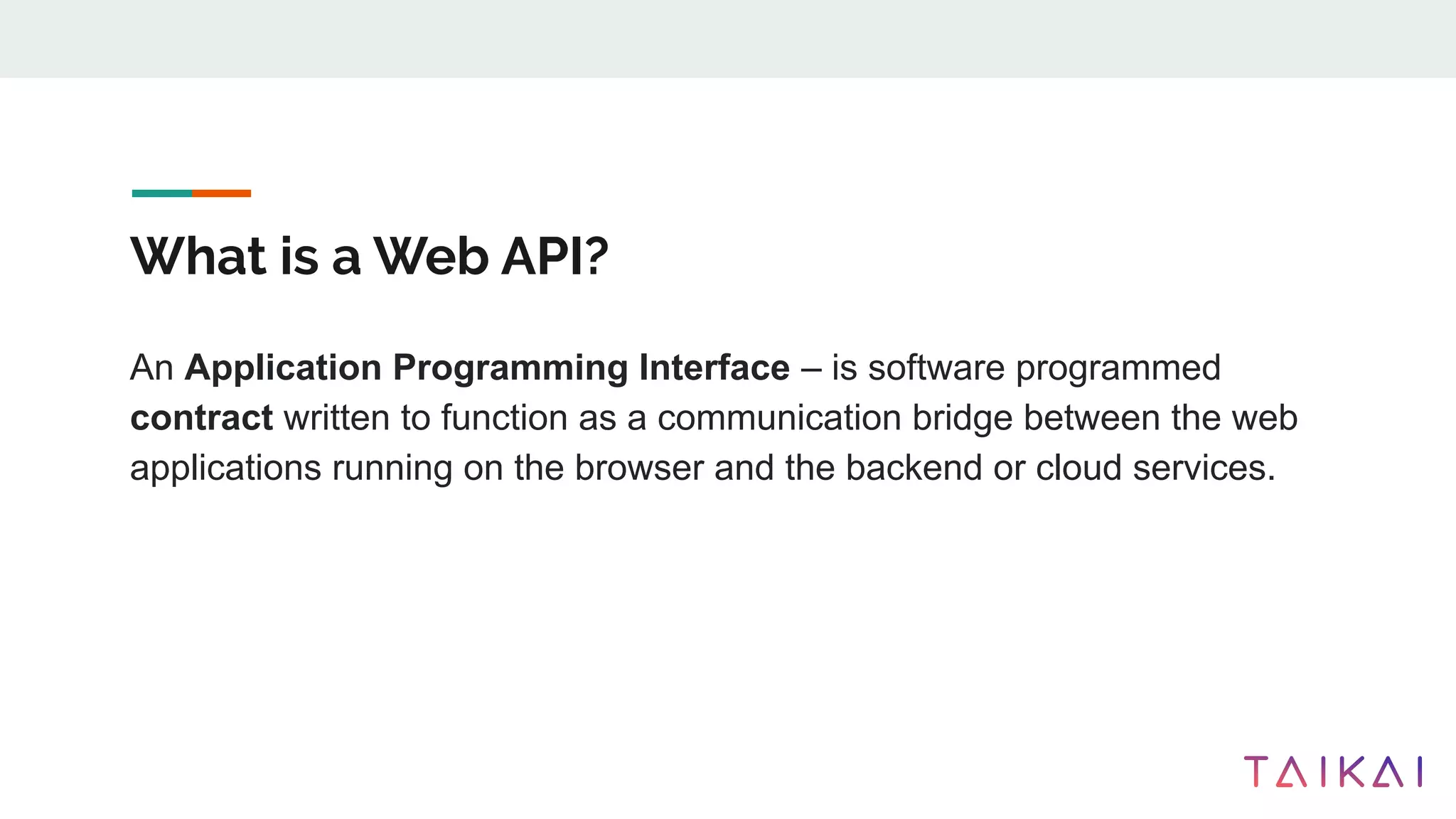
What is a Web API?
An Application Programming Interface – is software programmed
contract written to function as a communication bridge between the web
applications running on the browser and the backend or cloud services.
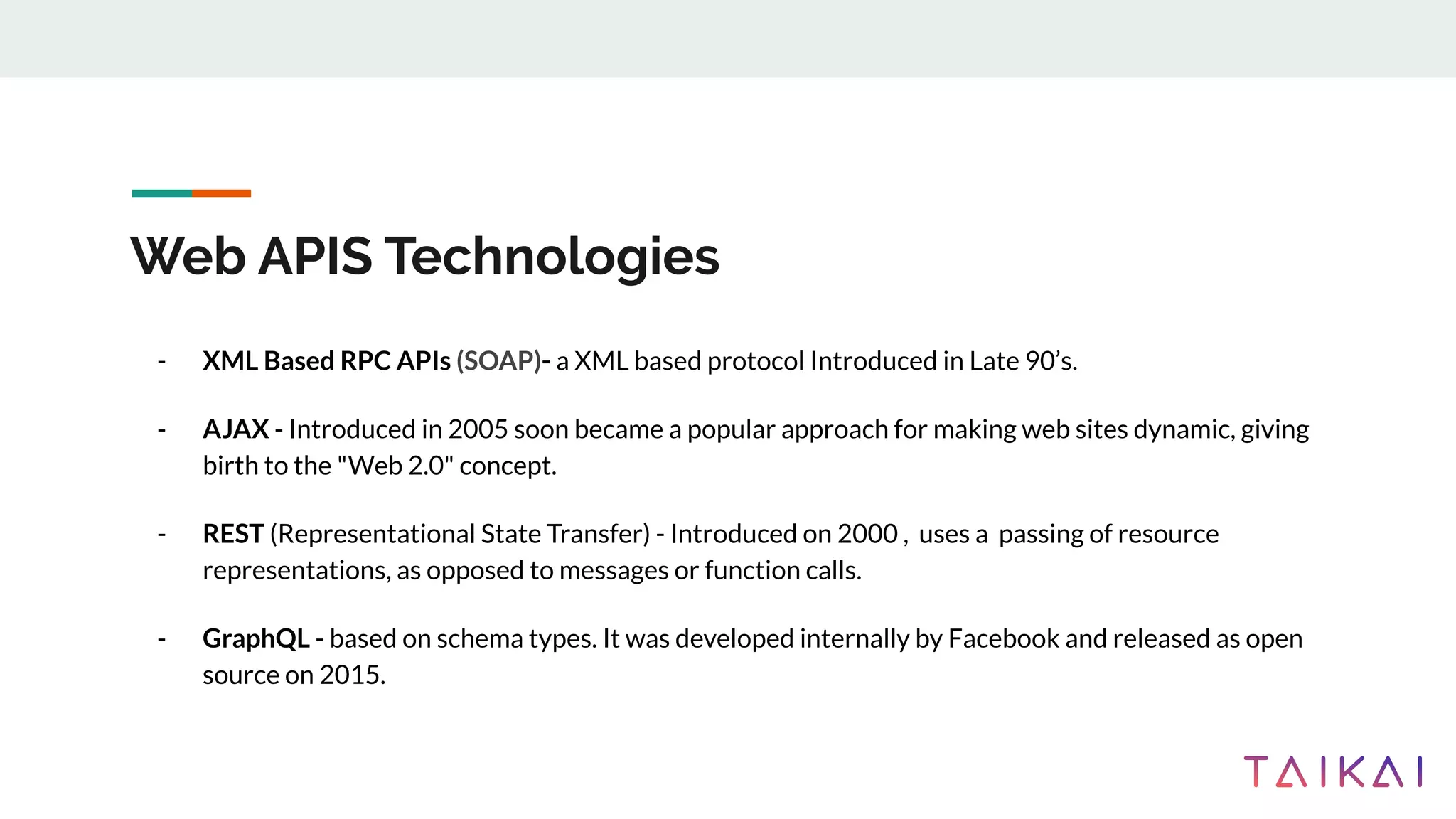
Web APIS Technologies
- XML Based RPC APIs (SOAP)- a XML based protocol Introduced in Late 90’s.
- AJAX - Introduced in 2005 soon became a popular approach for making web sites dynamic, giving
birth to the "Web 2.0" concept.
- REST (Representational State Transfer) - Introduced on 2000 , uses a passing of resource
representations, as opposed to messages or function calls.
- GraphQL - based on schema types. It was developed internally by Facebook and released as open
source on 2015.
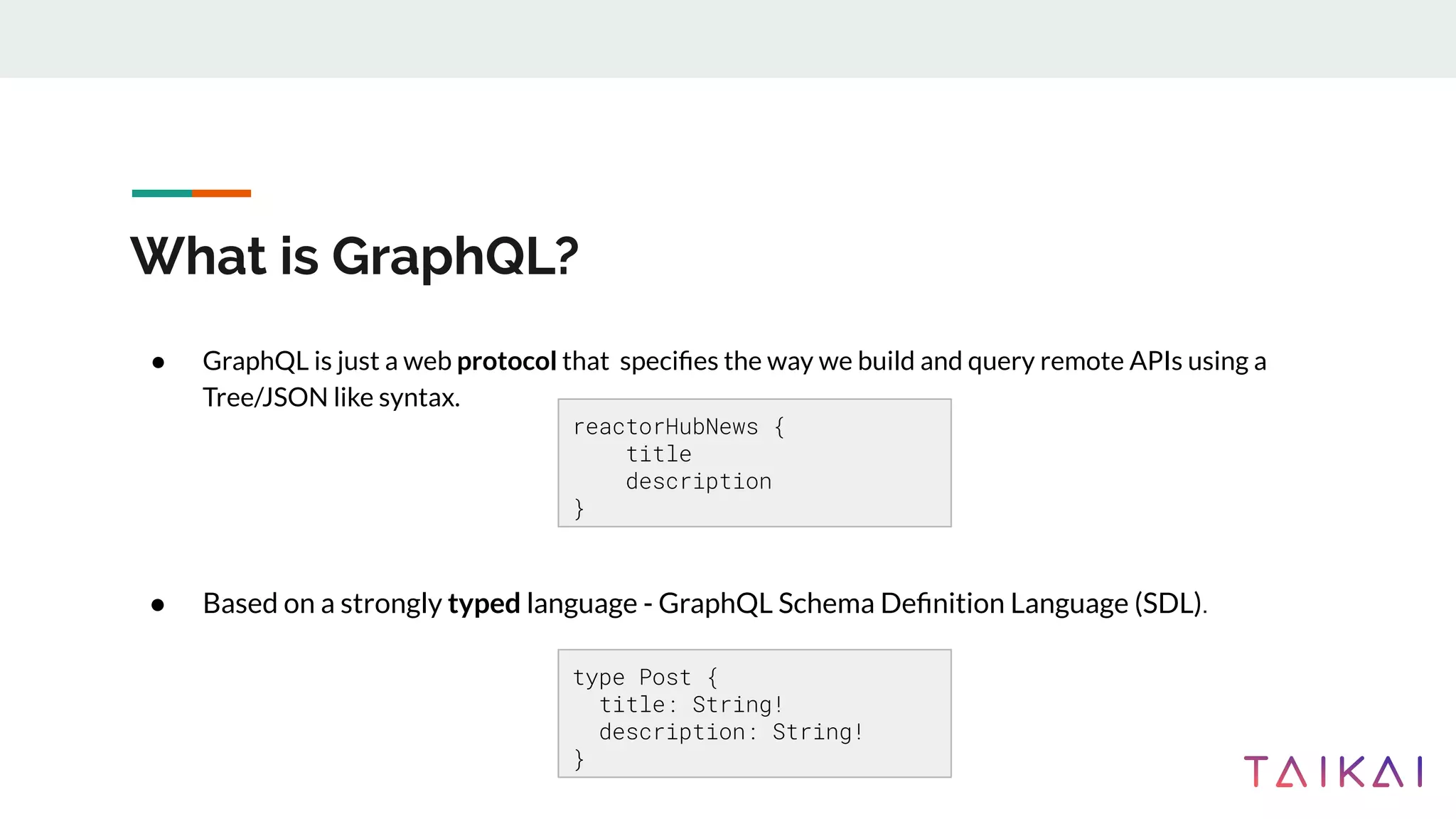
What is GraphQL?
● GraphQL is just a web protocol that specifies the way we build and query remote APIs using a
Tree/JSON like syntax.
● Based on a strongly typed language - GraphQL Schema Definition Language (SDL).
reactorHubNews {
title
description
}
type Post {
title: String!
description: String!
}
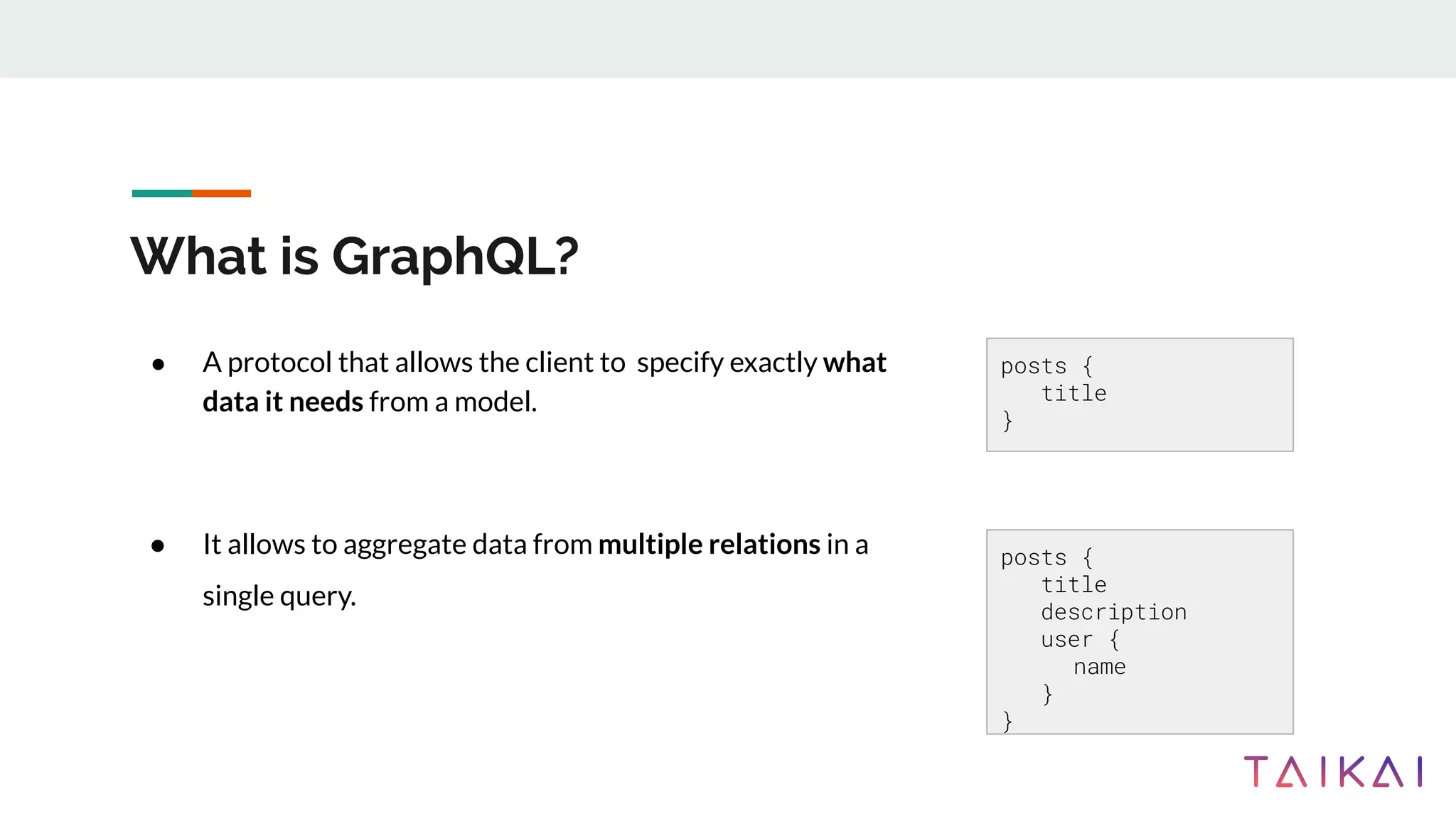
What is GraphQL?
● A protocol that allows the client to specify exactly what
data it needs from a model.
● It allows to aggregate data from multiple relations in a
single query.
posts {
title
description
user {
name
}
}
posts {
title
}
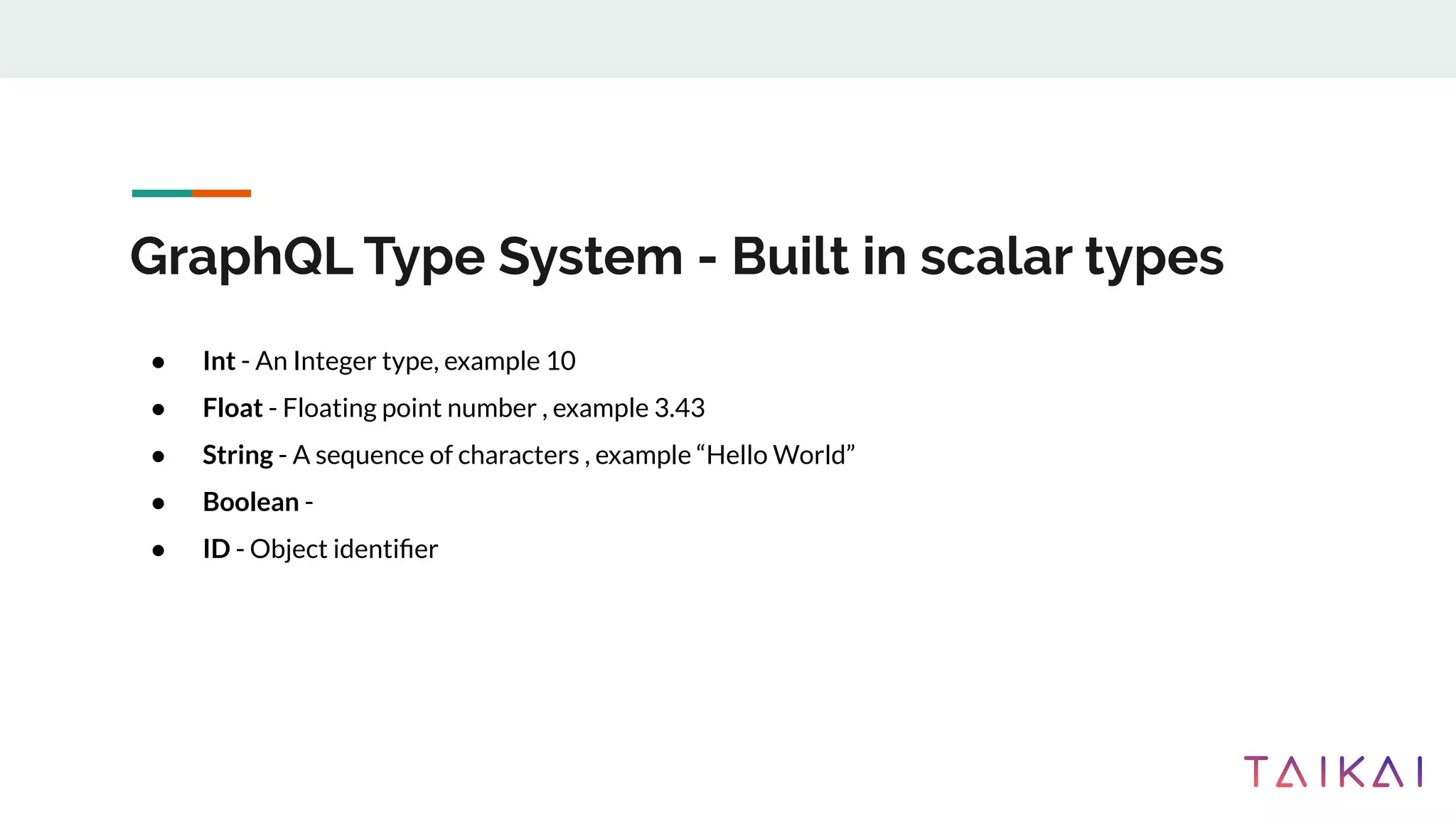
GraphQL Type System - Built in scalar types
● Int - An Integer type, example 10
● Float - Floating point number , example 3.43
● String - A sequence of characters , example “Hello World”
● Boolean -
● ID - Object identifier
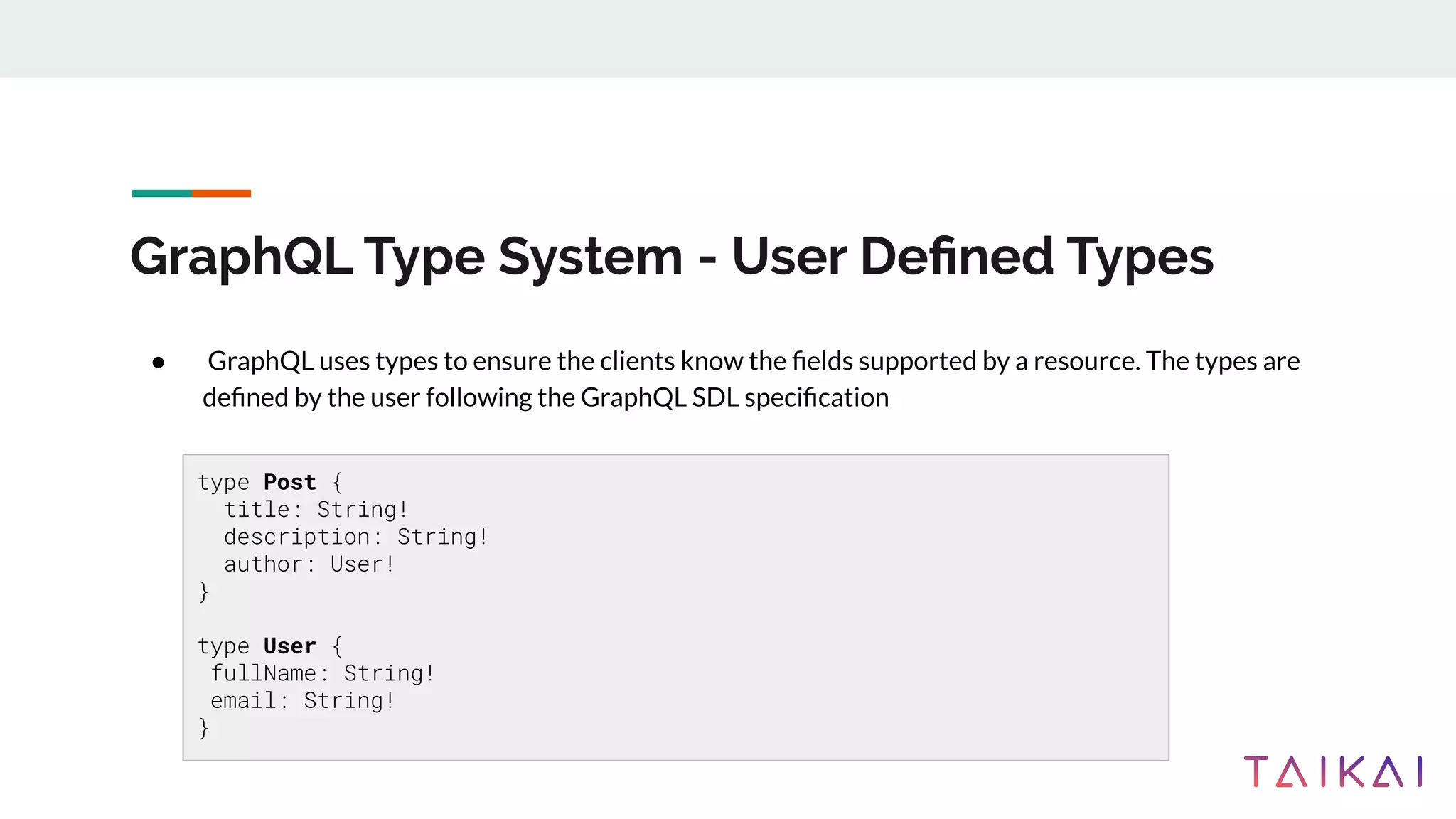
GraphQL Type System - User Defined Types
● GraphQL uses types to ensure the clients know the fields supported by a resource. The types are
defined by the user following the GraphQL SDL specification
type Post {
title: String!
description: String!
author: User!
}
type User {
fullName: String!
email: String!
}
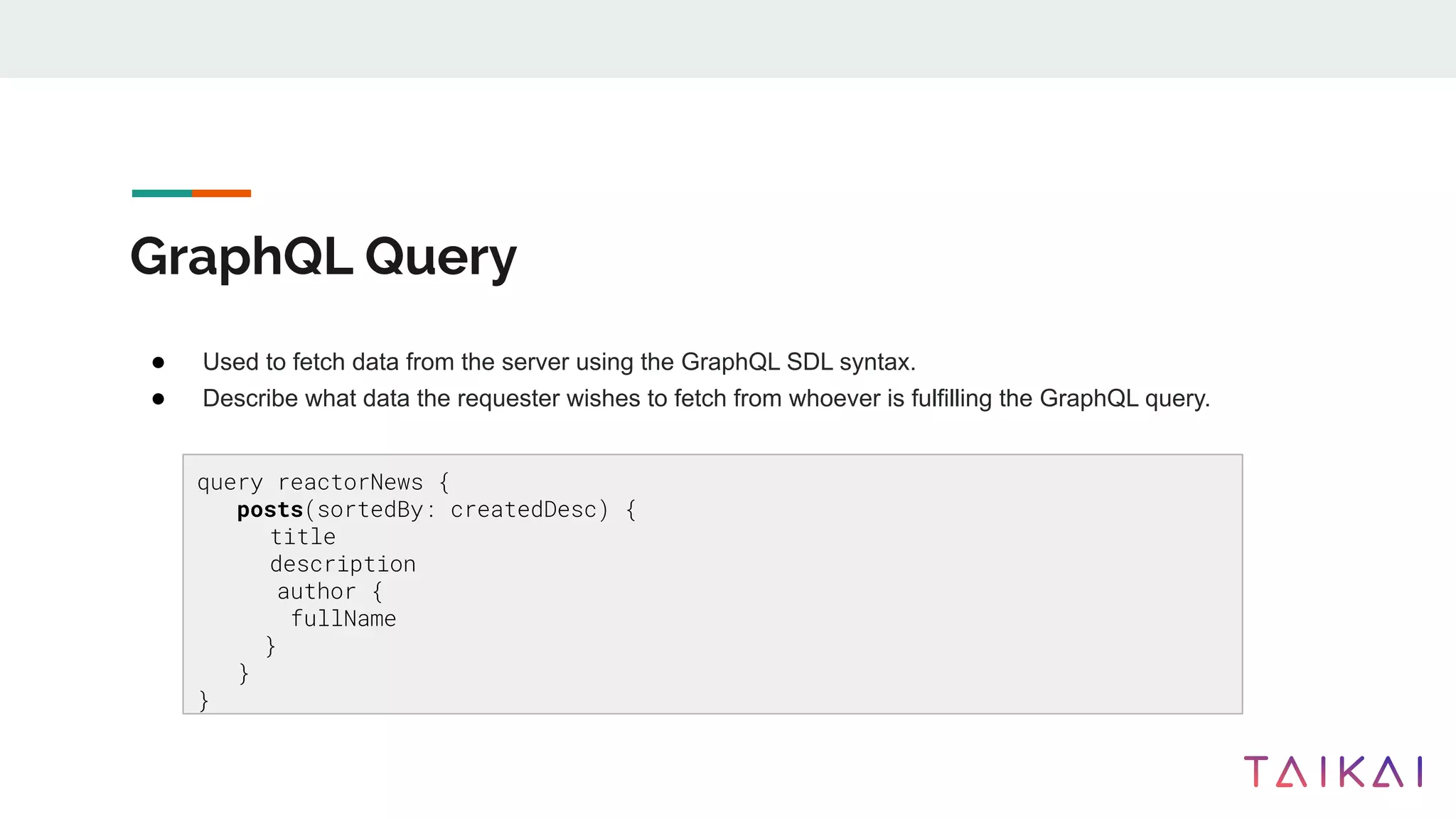
GraphQL Query
● Used to fetch data from the server using the GraphQL SDL syntax.
● Describe what data the requester wishes to fetch from whoever is fulfilling the GraphQL query.
query reactorNews {
posts(sortedBy: createdDesc) {
title
description
author {
fullName
}
}
}
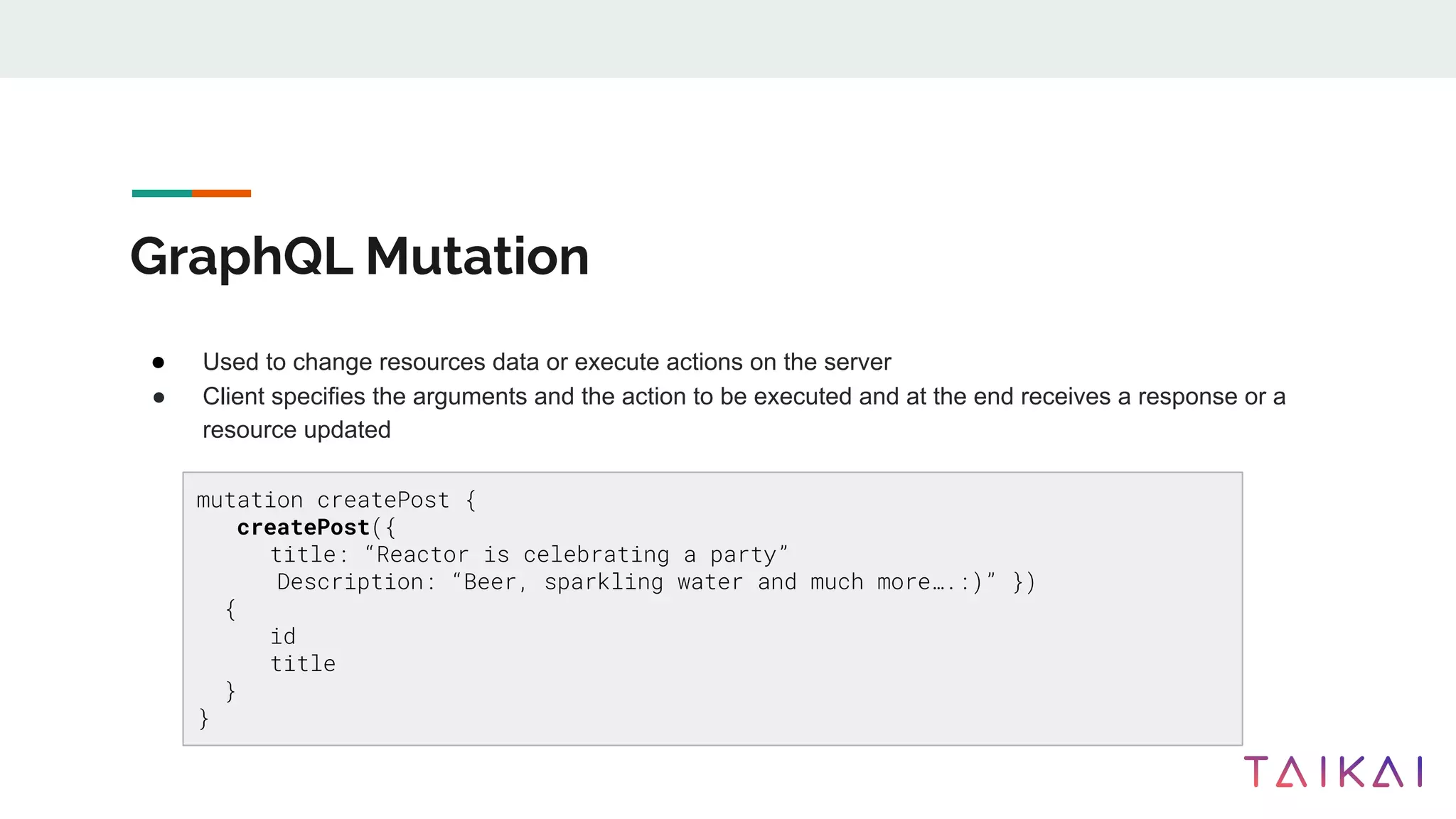
GraphQL Mutation
● Used to change resources data or execute actions on the server
● Client specifies the arguments and the action to be executed and at the end receives a response or a
resource updated
mutation createPost {
createPost({
title: “Reactor is celebrating a party”
Description: “Beer, sparkling water and much more….:)” })
{
id
title
}
}
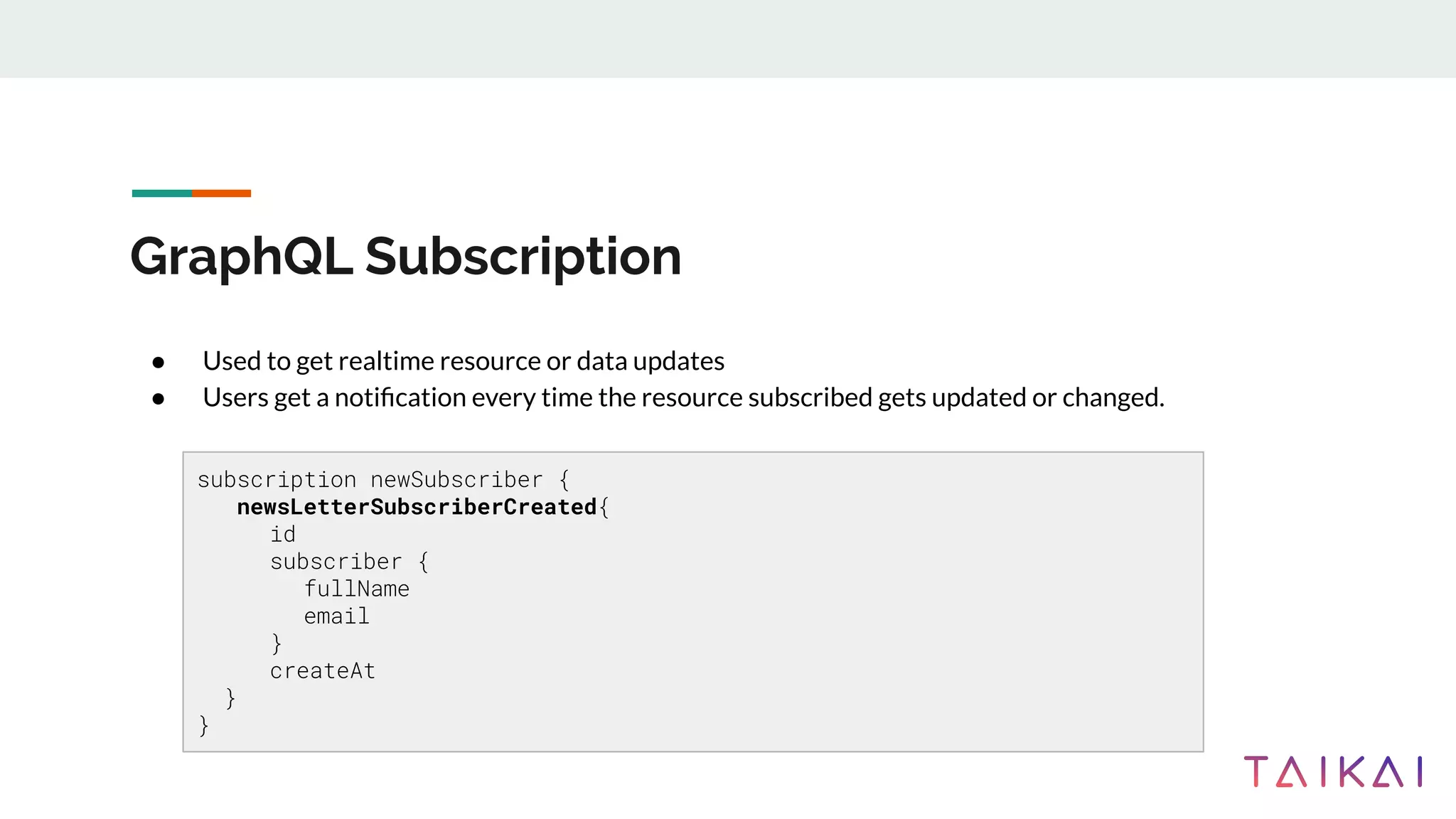
GraphQL Subscription
● Used to get realtime resource or data updates
● Users get a notification every time the resource subscribed gets updated or changed.
subscription newSubscriber {
newsLetterSubscriberCreated{
id
subscriber {
fullName
email
}
createAt
}
}
GraphQL Advantages
● You get the data you request and need for a particular scope
● Excellent developer tooling and experiences since the specification defines API introspection
● Only one endpoint to connect,
○ Example POST api.reactorhub.com /graphql/api
GraphQL vs REST
● GraphQL has only one url/endpoint
● In REST, the layout and size of data returned is determined by the server . The server has a
predetermined amount of properties and relations that sends on a call.
● In REST, to retrieve relational data you need to make multiples API calls making the data data
rendering more
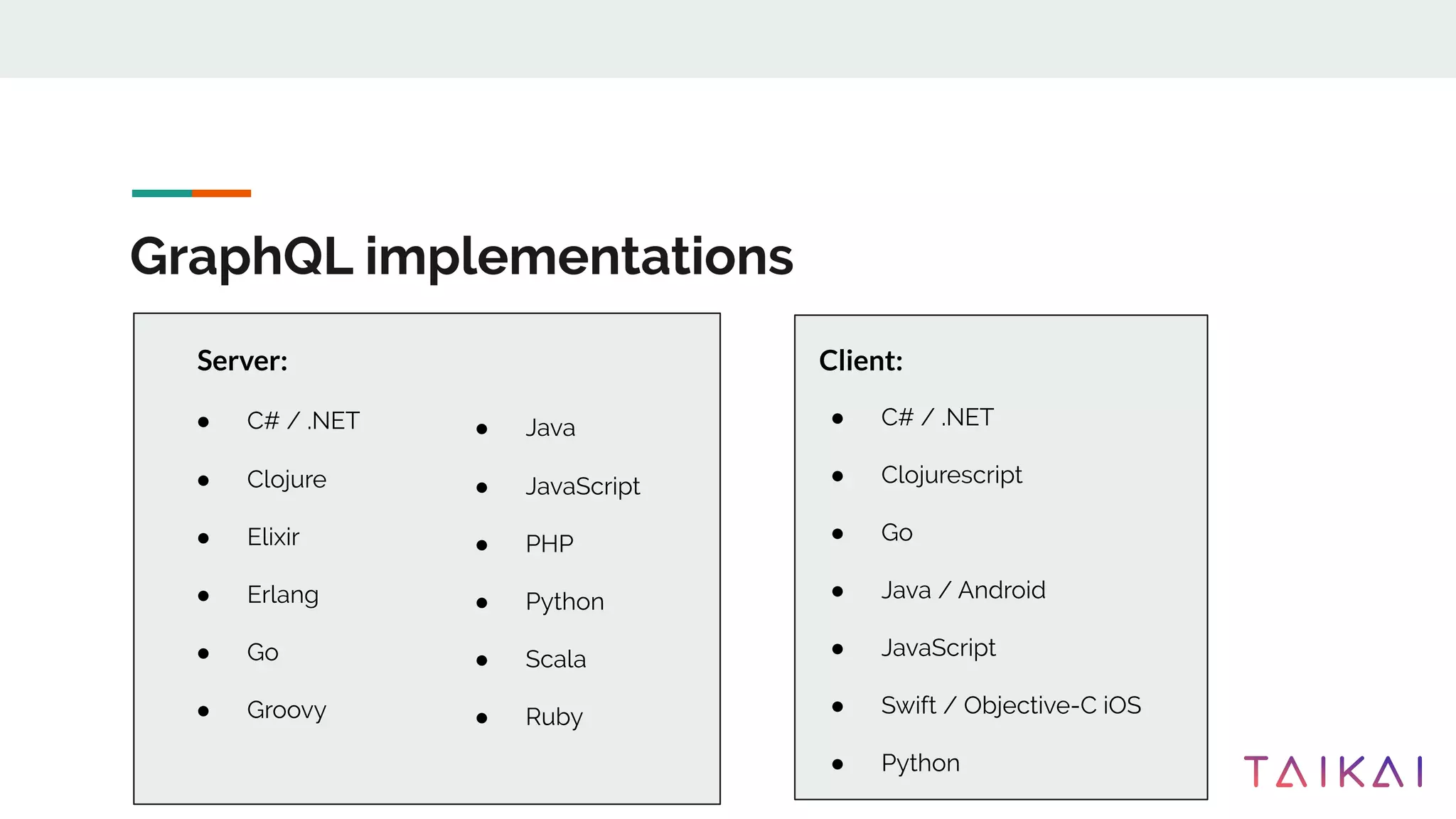
GraphQL implementations
● C# / .NET
● Clojure
● Elixir
● Erlang
● Go
● Groovy
Client:Server:
● C# / .NET
● Clojurescript
● Go
● Java / Android
● JavaScript
● Swift / Objective-C iOS
● Python
● Java
● JavaScript
● PHP
● Python
● Scala
● Ruby
Demo
- Let’s create a GraphQL API in node.js
- Create GraphQL server with ApolloServer
- Use gql to define schema ( typedefs )
- types
- Queries
- Mutations
- Define resolvers.
- Show playground to explore and test API
Resources
- Sites
- GraphQL ( https://graphql.org/ )
- GraphQL Weekly newsletter ( https://www.graphqlweekly.com/ )
- GraphQL Cheat Sheet ( https://github.com/sogko/graphql-schema-language-cheat-sheet )
- Apollo ( https://www.apollographql.com/ )
- Prisma ( https://www.prisma.io/ )
- Hasura ( https://hasura.io/ )
- GraphQL Yoga ( https://github.com/prisma/graphql-yoga )
- Podcasts
- https://graphqlpatterns.simplecast.fm/
- https://graphqlradio.com/ ( last episode > 1 year ago )
- Books
- The Road to GraphQL (free ebook)
Thanks! Any Questions ?
helder@taikai.network @heldervasc
luis@taikai.network @luisfigoncalves
www.taikai.network

Modern APIs with GraphQL

  • 1.
    Modern Web APIswith GraphQL Hélder Vasconcelos Luis Gonçalves
  • 2.
    Outline ● Who arewe ● What is a Web API ● Web API Technologies ● What is GraphQL ● GraphQL advantages ● GraphQL vs REST ● Languages that implement GraphQL ● Demo - build GraphQL Api ● Resources ● Q & A
  • 3.
    What is aWeb API? An Application Programming Interface – is software programmed contract written to function as a communication bridge between the web applications running on the browser and the backend or cloud services.
  • 4.
    Web APIS Technologies -XML Based RPC APIs (SOAP)- a XML based protocol Introduced in Late 90’s. - AJAX - Introduced in 2005 soon became a popular approach for making web sites dynamic, giving birth to the "Web 2.0" concept. - REST (Representational State Transfer) - Introduced on 2000 , uses a passing of resource representations, as opposed to messages or function calls. - GraphQL - based on schema types. It was developed internally by Facebook and released as open source on 2015.
  • 5.
    What is GraphQL? ●GraphQL is just a web protocol that specifies the way we build and query remote APIs using a Tree/JSON like syntax. ● Based on a strongly typed language - GraphQL Schema Definition Language (SDL). reactorHubNews { title description } type Post { title: String! description: String! }
  • 6.
    What is GraphQL? ●A protocol that allows the client to specify exactly what data it needs from a model. ● It allows to aggregate data from multiple relations in a single query. posts { title description user { name } } posts { title }
  • 7.
    GraphQL Type System- Built in scalar types ● Int - An Integer type, example 10 ● Float - Floating point number , example 3.43 ● String - A sequence of characters , example “Hello World” ● Boolean - ● ID - Object identifier
  • 8.
    GraphQL Type System- User Defined Types ● GraphQL uses types to ensure the clients know the fields supported by a resource. The types are defined by the user following the GraphQL SDL specification type Post { title: String! description: String! author: User! } type User { fullName: String! email: String! }
  • 9.
    GraphQL Query ● Usedto fetch data from the server using the GraphQL SDL syntax. ● Describe what data the requester wishes to fetch from whoever is fulfilling the GraphQL query. query reactorNews { posts(sortedBy: createdDesc) { title description author { fullName } } }
  • 10.
    GraphQL Mutation ● Usedto change resources data or execute actions on the server ● Client specifies the arguments and the action to be executed and at the end receives a response or a resource updated mutation createPost { createPost({ title: “Reactor is celebrating a party” Description: “Beer, sparkling water and much more….:)” }) { id title } }
  • 11.
    GraphQL Subscription ● Usedto get realtime resource or data updates ● Users get a notification every time the resource subscribed gets updated or changed. subscription newSubscriber { newsLetterSubscriberCreated{ id subscriber { fullName email } createAt } }
  • 12.
    GraphQL Advantages ● Youget the data you request and need for a particular scope ● Excellent developer tooling and experiences since the specification defines API introspection ● Only one endpoint to connect, ○ Example POST api.reactorhub.com /graphql/api
  • 13.
    GraphQL vs REST ●GraphQL has only one url/endpoint ● In REST, the layout and size of data returned is determined by the server . The server has a predetermined amount of properties and relations that sends on a call. ● In REST, to retrieve relational data you need to make multiples API calls making the data data rendering more
  • 14.
    GraphQL implementations ● C#/ .NET ● Clojure ● Elixir ● Erlang ● Go ● Groovy Client:Server: ● C# / .NET ● Clojurescript ● Go ● Java / Android ● JavaScript ● Swift / Objective-C iOS ● Python ● Java ● JavaScript ● PHP ● Python ● Scala ● Ruby
  • 15.
    Demo - Let’s createa GraphQL API in node.js - Create GraphQL server with ApolloServer - Use gql to define schema ( typedefs ) - types - Queries - Mutations - Define resolvers. - Show playground to explore and test API
  • 16.
    Resources - Sites - GraphQL( https://graphql.org/ ) - GraphQL Weekly newsletter ( https://www.graphqlweekly.com/ ) - GraphQL Cheat Sheet ( https://github.com/sogko/graphql-schema-language-cheat-sheet ) - Apollo ( https://www.apollographql.com/ ) - Prisma ( https://www.prisma.io/ ) - Hasura ( https://hasura.io/ ) - GraphQL Yoga ( https://github.com/prisma/graphql-yoga ) - Podcasts - https://graphqlpatterns.simplecast.fm/ - https://graphqlradio.com/ ( last episode > 1 year ago ) - Books - The Road to GraphQL (free ebook)
  • 17.
    Thanks! Any Questions? helder@taikai.network @heldervasc luis@taikai.network @luisfigoncalves www.taikai.network