2015 Annual Report
World Student Christian Federation Asia-Pacific
We are Many, We are One,
Sent Out to Build God's Peace
WSCF AP
unit1-2,18/F, 280 Portland St.
Commercial Bldg. Mong Kok, Kowloon,
Hong Kong,-SAR
Tel: (852) 2385-2550
www.wscfap.org
Our Vision
WSCF is called to be a prophetic witness in church and the
transformation of the world where God’s love for creation, justice
and peace is shared by all across boundaries of race, class,
ethnicity, culture, gender and sexuality. This vision is nurtured by a
radical hope of God’s reign in history and liberating faith in Jesus
Christ.
Our Mission
The WSCF is a global fellowship of Student Christian Movements
putting their faith into action to contribute to the renewal of the
ecumenical movement and to promote justice and peace in the
world.
2015 Annual Report - WSCF AP 2
Table of Contents
I. Messages from the Leadership
II. 2015 Program and Activity Reports
i. Human Rights, Justice, and Peace (HRJP) Programme
ii. Regional Women’s Programme (RWP)
iii. WSCF AP Governance Structure
iv. WSCF Global Programmes and Meetings
v. Ecumenical Partnership and Global Networking
vi. WSCF AP Senior Friend’s gathering : Network of
Student Christian Movement Senior Friends in the
Asia Pacific Region
III. Financial Overview
IV. List of Officers, Staff, Member Movements, Networks, and
Partners
V. Calendar of Events 2015
2015 Annual Report - WSCF AP 3
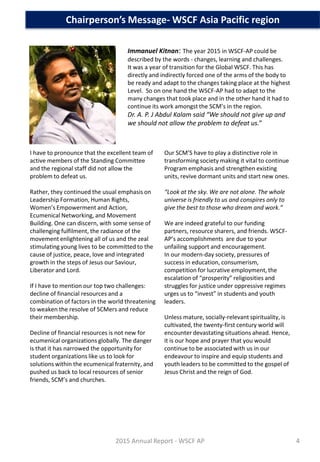
Immanuel Kitnan: The year 2015 in WSCF-AP could be
described by the words - changes, learning and challenges.
It was a year of transition for the Global WSCF. This has
directly and indirectly forced one of the arms of the body to
be ready and adapt to the changes taking place at the highest
Level. So on one hand the WSCF-AP had to adapt to the
many changes that took place and in the other hand it had to
continue its work amongst the SCM’s in the region.
Dr. A. P. J Abdul Kalam said “We should not give up and
we should not allow the problem to defeat us.”
Chairperson’s Message- WSCF Asia Pacific region
I have to pronounce that the excellent team of
active members of the Standing Committee
and the regional staff did not allow the
problem to defeat us.
Rather, they continued the usual emphasis on
Leadership Formation, Human Rights,
Women’s Empowerment and Action,
Ecumenical Networking, and Movement
Building. One can discern, with some sense of
challenging fulfilment, the radiance of the
movement enlightening all of us and the zeal
stimulating young lives to be committed to the
cause of justice, peace, love and integrated
growth in the steps of Jesus our Saviour,
Liberator and Lord.
If I have to mention our top two challenges:
decline of financial resources and a
combination of factors in the world threatening
to weaken the resolve of SCMers and reduce
their membership.
Decline of financial resources is not new for
ecumenical organizations globally. The danger
is that it has narrowed the opportunity for
student organizations like us to look for
solutions within the ecumenical fraternity, and
pushed us back to local resources of senior
friends, SCM’s and churches.
Our SCM’S have to play a distinctive role in
transforming society making it vital to continue
Program emphasis and strengthen existing
units, revive dormant units and start new ones.
“Look at the sky. We are not alone. The whole
universe is friendly to us and conspires only to
give the best to those who dream and work.”
We are indeed grateful to our funding
partners, resource sharers, and friends. WSCF-
AP’s accomplishments are due to your
unfailing support and encouragement.
In our modern-day society, pressures of
success in education, consumerism,
competition for lucrative employment, the
escalation of “prosperity” religiosities and
struggles for justice under oppressive regimes
urges us to “invest” in students and youth
leaders.
Unless mature, socially-relevant spirituality, is
cultivated, the twenty-first century world will
encounter devastating situations ahead. Hence,
it is our hope and prayer that you would
continue to be associated with us in our
endeavour to inspire and equip students and
youth leaders to be committed to the gospel of
Jesus Christ and the reign of God.
2015 Annual Report - WSCF AP 4
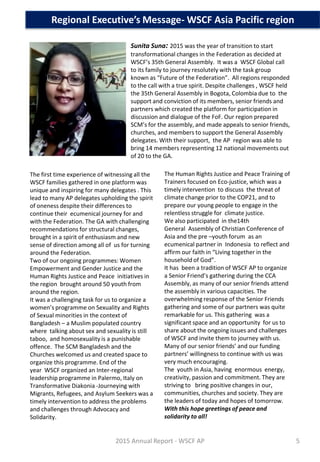
Sunita Suna: 2015 was the year of transition to start
transformational changes in the Federation as decided at
WSCF’s 35th General Assembly. It was a WSCF Global call
to its family to journey resolutely with the task group
known as “Future of the Federation”. All regions responded
to the call with a true spirit. Despite challenges , WSCF held
the 35th General Assembly in Bogota, Colombia due to the
support and conviction of its members, senior friends and
partners which created the platform for participation in
discussion and dialogue of the FoF. Our region prepared
SCM’s for the assembly, and made appeals to senior friends,
churches, and members to support the General Assembly
delegates. With their support, the AP region was able to
bring 14 members representing 12 national movements out
of 20 to the GA.
Regional Executive’s Message- WSCF Asia Pacific region
The first time experience of witnessing all the
WSCF families gathered in one platform was
unique and inspiring for many delegates . This
lead to many AP delegates upholding the spirit
of oneness despite their differences to
continue their ecumenical journey for and
with the Federation. The GA with challenging
recommendations for structural changes,
brought in a spirit of enthusiasm and new
sense of direction among all of us for turning
around the Federation.
Two of our ongoing programmes: Women
Empowerment and Gender Justice and the
Human Rights Justice and Peace initiatives in
the region brought around 50 youth from
around the region.
It was a challenging task for us to organize a
women’s programme on Sexuality and Rights
of Sexual minorities in the context of
Bangladesh – a Muslim populated country
where talking about sex and sexuality is still
taboo, and homosexuality is a punishable
offence. The SCM Bangladesh and the
Churches welcomed us and created space to
organize this programme. End of the
year WSCF organized an Inter-regional
leadership programme in Palermo, Italy on
Transformative Diakonia -Journeying with
Migrants, Refugees, and Asylum Seekers was a
timely intervention to address the problems
and challenges through Advocacy and
Solidarity.
The Human Rights Justice and Peace Training of
Trainers focused on Eco-justice, which was a
timely intervention to discuss the threat of
climate change prior to the COP21, and to
prepare our young people to engage in the
relentless struggle for climate justice.
We also participated in the14th
General Assembly of Christian Conference of
Asia and the pre –youth forum as an
ecumenical partner in Indonesia to reflect and
affirm our faith in “Living together in the
household of God”.
It has been a tradition of WSCF AP to organize
a Senior Friend’s gathering during the CCA
Assembly, as many of our senior friends attend
the assembly in various capacities. The
overwhelming response of the Senior Friends
gathering and some of our partners was quite
remarkable for us. This gathering was a
significant space and an opportunity for us to
share about the ongoing issues and challenges
of WSCF and invite them to journey with us.
Many of our senior friends’ and our funding
partners’ willingness to continue with us was
very much encouraging.
The youth in Asia, having enormous energy,
creativity, passion and commitment. They are
striving to bring positive changes in our,
communities, churches and society. They are
the leaders of today and hopes of tomorrow.
With this hope greetings of peace and
solidarity to all!
2015 Annual Report - WSCF AP 5
Regional Human Rights Justice and Peace Programme
Training of Trainers (ToTs), Indonesia
Understanding Eco-justice in a climate change regime: Acknowledge, Address & Act to
restore (eco)Justice, Peace, & Integrity of Creation
Background
The HRJP Program is an ongoing initiative of WSCF Asia-Pacific since 2006. Under the program,
three major activities are generally organized: Training of Trainers, Workshops and Solidarity
Programmes. Many Asian countries witness human rights violation and the region continues to
face major human rights challenges. The context and the reality inspired us to continue the HRJP
program to produce more young human rights defenders. Through these activities, hundreds of
students and young people from 20 countries of Asia and the Pacific have become human rights
defenders in their own countries and communities.
The HRJP Committee of WSCF AP consists of 6 members from South and South East Asia, North
East Asia and the Pacific with a mandate to focus on Human rights in the region met in 2013 to
prioritize issues for advocacy for the next 2 years.
One recommendation from the HRJP Committee was to continue addressing the challenging issue
of “Eco-Justice & Indigenous People’s Rights” – focusing on Land and Mining. The topic eco-justice
was significant and timely as the world leaders were preparing for the COP21 in December 2015.
Therefore, the 2015 HRJP ToTs focused on this theme alongside its cause, Climate Change.
Indonesia was chosen as the venue as the location was very relevant to the issue. The country is
going through serious environment concerns not only adding problems to climate change but
also affecting the poor and indigenous communities in the country. HRJP ToTs was hosted by the
Indonesia SCM (Student Christian Movement known as GMKI in Indonesia) from October 5-11,
2015 at Cibodas, Bogor, Indonesia.
2015 Annual Report - WSCF AP
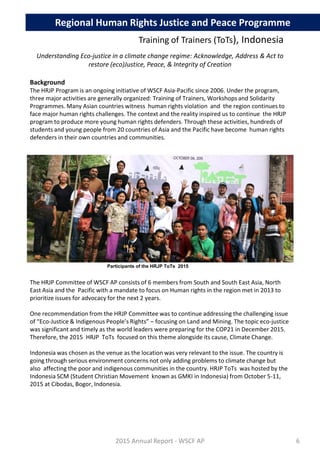
Participants of the HRJP ToTs 2015
6
Indonesia is witnessing deforestation faster
than any other country in the world,
particularly in its pursuit of producing palm oil.
Deforestation is nearly double the rate in the
Amazon. The country is said to have lost 3,250
square miles of forest in 2012. Forest fires
produce some of the world’s worst pollution,
sending suffocating smog even to faraway
cities in Malaysia and Singapore.
This has taken a heavy toll on local
communities, destroyed natural habitats for
endangered species [Orangutans, Sumatran
tigers, Borneo rhinos, and Pygmy elephants],
and become a critical factor in climate change.
Replacing natural forests with palm oil
plantations diminishes the ability of vegetation
to capture and store carbon dioxide.
With palm oil demand set to double by 2030,
the UN’s Environmental Program predicts that
most of Indonesia’s rainforest could be
destroyed by 2022.
Thirty delegates attended from the SCMs of
the following 13 countries: Australia,
Cambodia, Hong Kong, India, Indonesia,
Malaysia, Myanmar, Nepal, New Zealand,
Pakistan, Sri Lanka, South Korea, Taiwan,
Goal:
To address climate change from the
perspectives of land justice and indigenous
people’s rights as human rights defenders
Objectives
i. Raise awareness, understanding of issues
that affects the environment, marginalized
people, provide critical analysis of economy
and ecology and the human rights situation
in countries in the Asia-Pacific region;
ii. Learn to implement solutions/ Mechanisms
on advocacy that are in place and/or are
evolving with regard to Climate Change and
Human Rights
iii. Provide Biblical-theological foundation on
understanding (eco)justice, peace and
integrity of creation;
iv. Integrate with affected communities in
Indonesia by understanding the realities
via immersion program;
v. Understand and learn the theoretical
framework of Human Rights, its history and
mechanisms and strategize for our
responses to the situations of HRJP
vi. Acquire and develop skills as human rights
and advocacy works from the SCMs, church
groups, Non-Government Organizations
(NGO’s) and environmental Organizations
in the Asia-Pacific region;
vii.Help participants create action plans for
SCM, Church, and community.
2015 Annual Report - WSCF AP
Regional Human Rights Justice and Peace Programme
Training of Trainers (ToTs), Indonesia
7
Methodology
The seven days ToT was divided into five
sections in order to achieve its goal and
objectives:
i. Thematic inputs from the human rights
perspectives , & tools and skills to become
HR defenders by different resource
persons who are expertise on the issues
ii. Immersion program with three different
communities and come up with specific
strategies for advocacy
iii. Develop theological perspectives on eco-
justice
iv. Organize a public event with the
environmental department of the
Indonesian government, Senior friends of
GMKI, and ecumenical partners in
Indonesia.
v. Follow-ups
Impact
i. Created awareness among delegates on
climate change, and ongoing issues in
Indonesia
ii. Inspired participants to act on eco-
justice from a human rights perspectives
iii. Bible studies empowered delegates to
understand eco-justice, eco-feminism,
and reflection on the Pope’s encyclical
Laudato si from faith perspectives.
iv. Provided a common platform to
government officials, senior friends from
GMKI, ecumenical partners, and guests
to address eco-justice issues.
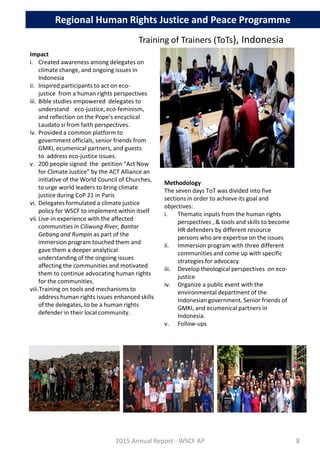
v. 200 people signed the petition “Act Now
for Climate Justice” by the ACT Alliance an
initiative of the World Council of Churches,
to urge world leaders to bring climate
justice during CoP 21 in Paris
vi. Delegates formulated a climate justice
policy for WSCF to implement within itself
vii.Live-in experience with the affected
communities in Ciliwung River, Bantar
Gebang and Rumpin as part of the
immersion program touched them and
gave them a deeper analytical
understanding of the ongoing issues
affecting the communities and motivated
them to continue advocating human rights
for the communities.
viii.Training on tools and mechanisms to
address human rights issues enhanced skills
of the delegates, to be a human rights
defender in their local community.
2015 Annual Report - WSCF AP
Regional Human Rights Justice and Peace Programme
Training of Trainers (ToTs), Indonesia
8
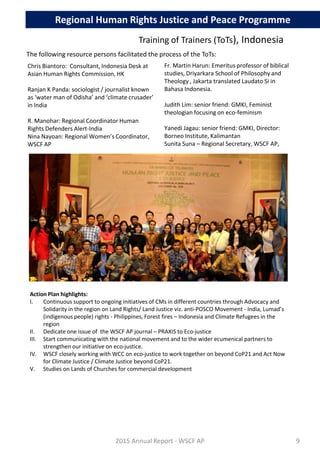
Chris Biantoro: Consultant, Indonesia Desk at
Asian Human Rights Commission, HK
Ranjan K Panda: sociologist / journalist known
as ‘water man of Odisha’ and ‘climate crusader’
in India
R. Manohar: Regional Coordinator Human
Rights Defenders Alert-India
Nina Nayoan: Regional Women’s Coordinator,
WSCF AP
Action Plan highlights:
I. Continuous support to ongoing initiatives of CMs in different countries through Advocacy and
Solidarity in the region on Land Rights/ Land Justice viz. anti-POSCO Movement - India, Lumad’s
(indigenous people) rights - Philippines, Forest fires – Indonesia and Climate Refugees in the
region
II. Dedicate one issue of the WSCF AP journal – PRAXIS to Eco-justice
III. Start communicating with the national movement and to the wider ecumenical partners to
strengthen our initiative on eco-justice.
IV. WSCF closely working with WCC on eco-justice to work together on beyond CoP21 and Act Now
for Climate Justice / Climate Justice beyond CoP21.
V. Studies on Lands of Churches for commercial development
Fr. Martin Harun: Emeritus professor of biblical
studies, Driyarkara School of Philosophy and
Theology , Jakarta translated Laudato Si in
Bahasa Indonesia.
Judith Lim: senior friend: GMKI, Feminist
theologian focusing on eco-feminism
Yanedi Jagau: senior friend: GMKI, Director:
Borneo Institute, Kalimantan
Sunita Suna – Regional Secretary, WSCF AP,
The following resource persons facilitated the process of the ToTs:
2015 Annual Report - WSCF AP
Regional Human Rights Justice and Peace Programme
Training of Trainers (ToTs), Indonesia
9
Lessons Learnt
1. Collective efforts of the WSCF
AP region with the HRJP Committee
members and the Global Advocacy and
Solidarity Committee for campaign and
advocacy gave a effective momentum to
the ToT. In future more and more
such collaborative efforts should be done.
2. Participants acknowledged the need and
importance to join and network with
various groups who are already working on
this issues, and who have the capacity to
influence local, national , global policies.
3. Through creative campaigns engage a
larger number of people from all walks of
life to make an impact.
4. Change in lifestyle towards “reduce, reuse
and recycle” should be practiced by our
members to have a “praxis” experience.
Reflections: When greed and power dominates everything, the poor and illiterate are
subjugated and exploited
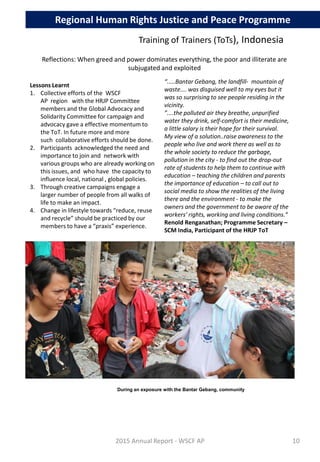
“.....Bantar Gebang, the landfill- mountain of
waste.... was disguised well to my eyes but it
was so surprising to see people residing in the
vicinity.
”....the polluted air they breathe, unpurified
water they drink, self-comfort is their medicine,
a little salary is their hope for their survival.
My view of a solution..raise awareness to the
people who live and work there as well as to
the whole society to reduce the garbage,
pollution in the city - to find out the drop-out
rate of students to help them to continue with
education – teaching the children and parents
the importance of education – to call out to
social media to show the realities of the living
there and the environment - to make the
owners and the government to be aware of the
workers’ rights, working and living conditions.”
Renold Renganathan; Programme Secretary –
SCM India, Participant of the HRJP ToT
2015 Annual Report - WSCF AP
During an exposure with the Bantar Gebang, community
Regional Human Rights Justice and Peace Programme
Training of Trainers (ToTs), Indonesia
10
The CIBODAS Statement
Cry of the Earth is the Cry of the Poor: Ensure Eco-Justice to Combat Climate Change
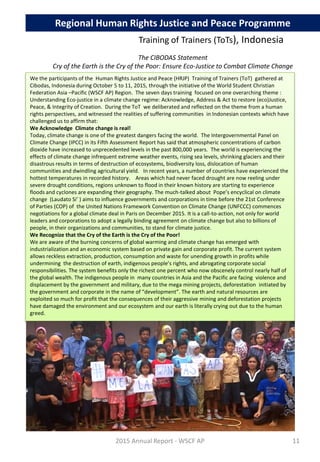
We the participants of the Human Rights Justice and Peace (HRJP) Training of Trainers (ToT) gathered at
Cibodas, Indonesia during October 5 to 11, 2015, through the initiative of the World Student Christian
Federation Asia –Pacific (WSCF AP) Region. The seven days training focused on one overarching theme :
Understanding Eco-justice in a climate change regime: Acknowledge, Address & Act to restore (eco)Justice,
Peace, & Integrity of Creation. During the ToT we deliberated and reflected on the theme from a human
rights perspectives, and witnessed the realities of suffering communities in Indonesian contexts which have
challenged us to affirm that:
We Acknowledge Climate change is real!
Today, climate change is one of the greatest dangers facing the world. The Intergovernmental Panel on
Climate Change (IPCC) in its Fifth Assessment Report has said that atmospheric concentrations of carbon
dioxide have increased to unprecedented levels in the past 800,000 years. The world is experiencing the
effects of climate change infrequent extreme weather events, rising sea levels, shrinking glaciers and their
disastrous results in terms of destruction of ecosystems, biodiversity loss, dislocation of human
communities and dwindling agricultural yield. In recent years, a number of countries have experienced the
hottest temperatures in recorded history. Areas which had never faced drought are now reeling under
severe drought conditions, regions unknown to flood in their known history are starting to experience
floods and cyclones are expanding their geography. The much-talked about Pope’s encyclical on climate
change (Laudato Si’ ) aims to influence governments and corporations in time before the 21st Conference
of Parties (COP) of the United Nations Framework Convention on Climate Change (UNFCCC) commences
negotiations for a global climate deal in Paris on December 2015. It is a call-to-action, not only for world
leaders and corporations to adopt a legally binding agreement on climate change but also to billions of
people, in their organizations and communities, to stand for climate justice.
We Recognize that the Cry of the Earth is the Cry of the Poor!
We are aware of the burning concerns of global warming and climate change has emerged with
industrialization and an economic system based on private gain and corporate profit. The current system
allows reckless extraction, production, consumption and waste for unending growth in profits while
undermining the destruction of earth, indigenous people’s rights, and abrogating corporate social
responsibilities. The system benefits only the richest one percent who now obscenely control nearly half of
the global wealth. The indigenous people in many countries in Asia and the Pacific are facing violence and
displacement by the government and military, due to the mega mining projects, deforestation initiated by
the government and corporate in the name of “development”. The earth and natural resources are
exploited so much for profit that the consequences of their aggressive mining and deforestation projects
have damaged the environment and our ecosystem and our earth is literally crying out due to the human
greed.
2015 Annual Report - WSCF AP
Regional Human Rights Justice and Peace Programme
Training of Trainers (ToTs), Indonesia
11
We heard the suffering stories of farmers in India who are forced to commit suicide due to draught
and unable to cope with the impact of climate change. Our fellow Indonesian participants from Borneo
shared the serious concerns of the hazardous haze due to the forest fire, that has caused serious health
issues for thousands of poor farmers, indigenous people and communities residing in the region.
Especially the young children's’ health are at stake as for the last 18 years, the agricultural land destroyed
and hundreds of thousands of people around the region of Kalimantan and Sumatra suffering from
respiratory illnesses due to forest fires. The profit mongering companies of Indonesia, Singapore and
Malaysia and the Indonesia government have turned a deaf ear to the cry and suffering of the indigenous
people and the innocent victims of the palm oil industries who face the brunt of the serious haze
problem in their everyday life. Researchers have recently confirmed that deforestation in Indonesia
is happening faster than any other country in the world, and mostly it is due to the uncontrolled
production of palm oil. Deforestation here is nearly double the rate in the Amazon. Under conservative
government estimates, the country is said to have lost 3,250 square miles of forest in 2012.
The recent Lumad killings in the Philippines and the heavy militarization of Lumad communities in
Mindanao is merely to protect the interests of mining companies and other corporate entities to loot and
plunder the vast mineral resources from Lumad lands and territories. The use of excessive violence by State
security forces to respond to the Lumads’ legitimate defence of their rights to land, territories and
resources against plunder and land grabbing is resulting in gross human rights violations – said the Asia
Indigenous Peoples Pact (AIPP). The Anti-POSCO Movement in Odisha, India where displaced locals are
fighting against the South Korean steel plant project for the last 10 years is another example of economic
injustice and violation of the rights of people in the region. In all above scenarios, the impact of climate
change due to excessive industrial growth and plundering of natural resources is faced by the poor the
most, as they do not have strong mechanisms as much as the rich and powerful.
We Act to restore (eco)Justice, Peace, & Integrity of Creation
We as a student community from SCMs (Student Christian Movements) and Churches commit ourselves to
Act to restore (eco)Justice, Peace, & Integrity of Creation as stewards of God’s creation. We stand in
solidarity with the suffering and marginalized people in communities, particularly in Indonesia and continue
our journey together with the people, faith communities, civil societies to do advocacy for climate justice to
restore (eco)Justice, Peace, & Integrity of Creation.
We call upon our SCMs, WSCF, and Churches to act upon:
1. changing our lifestyles in line with a sustainable development model
2. to create pressure groups with the wider network of climate justice to advocate with our respective
governments to push for a concrete Paris agreement at the COP21
3. to undertake a pilgrimage of justice and peace to Paris to achieve climate justice
4. to challenge the anthropocentric understanding of creation story from the Bible, where human being is
placed in the center and the rest of the creation at the periphery to serve the interest (greed) of the
humans.
5. To build pressure groups for strong advocacy against the palm oil tree plantation particularly in
Indonesia and advocate for land justice and mining justice
6. To change in lifestyle towards “reduce, reused and recycle” should be practiced by our members to
have a “praxis” experience and preparing an almanac to observe important ecological days, such as
the Earth Day, World Environment Day, World Water Day, etc.
7. To bring out climate change policies in SCMs, churches, and faith-based organizations and change the
lifestyle and behavior towards an eco-friendly model.
8. To this end we seek God’s blessings and guidance so that we hear the groaning of the earth and mend
our ways to become responsible citizens of this earth and become a member of the Oikos family !
In Solidarity,
Participants of the HRJP ToT 2015
2015 Annual Report - WSCF AP
Regional Human Rights Justice and Peace Programme
The CIBODAS Statement
Cry of the Earth is the Cry of the Poor: Ensure Eco-Justice to Combat Climate Change
Training of Trainers (ToTs), Indonesia
12
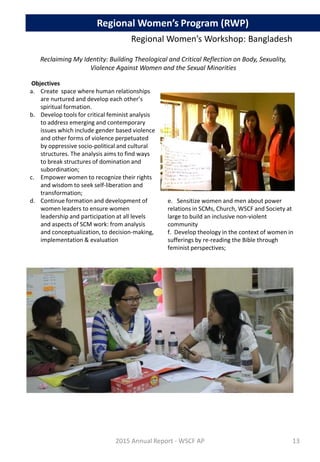
Reclaiming My Identity: Building Theological and Critical Reflection on Body, Sexuality,
Violence Against Women and the Sexual Minorities
Objectives
a. Create space where human relationships
are nurtured and develop each other’s
spiritual formation.
b. Develop tools for critical feminist analysis
to address emerging and contemporary
issues which include gender based violence
and other forms of violence perpetuated
by oppressive socio-political and cultural
structures. The analysis aims to find ways
to break structures of domination and
subordination;
c. Empower women to recognize their rights
and wisdom to seek self-liberation and
transformation;
d. Continue formation and development of
women leaders to ensure women
leadership and participation at all levels
and aspects of SCM work: from analysis
and conceptualization, to decision-making,
implementation & evaluation
2015 Annual Report - WSCF AP
e. Sensitize women and men about power
relations in SCMs, Church, WSCF and Society at
large to build an inclusive non-violent
community
f. Develop theology in the context of women in
sufferings by re-reading the Bible through
feminist perspectives;
Regional Women’s Program (RWP)
Regional Women’s Workshop: Bangladesh
13
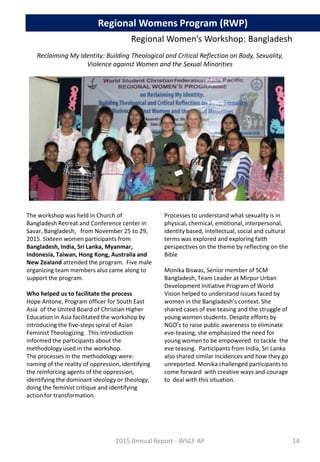
The workshop was held in Church of
Bangladesh Retreat and Conference center in
Savar, Bangladesh, from November 25 to 29,
2015. Sixteen women participants from
Bangladesh, India, Sri Lanka, Myanmar,
Indonesia, Taiwan, Hong Kong, Australia and
New Zealand attended the program. Five male
organizing team members also came along to
support the program.
Who helped us to facilitate the process
Hope Antone, Program officer for South East
Asia of the United Board of Christian Higher
Education in Asia facilitated the workshop by
introducing the five-steps spiral of Asian
Feminist Theologizing. This introduction
informed the participants about the
methodology used in the workshop.
The processes in the methodology were:
naming of the reality of oppression, identifying
the reinforcing agents of the oppression,
identifying the dominant ideology or theology,
doing the feminist critique and identifying
action for transformation.
Processes to understand what sexuality is in
physical, chemical, emotional, interpersonal,
identity based, intellectual, social and cultural
terms was explored and exploring faith
perspectives on the theme by reflecting on the
Bible
Monika Biswas, Senior member of SCM
Bangladesh, Team Leader at Mirpur Urban
Development Initiative Program of World
Vision helped to understand issues faced by
women in the Bangladesh’s context. She
shared cases of eve teasing and the struggle of
young women students. Despite efforts by
NGO’s to raise public awareness to eliminate
eve-teasing, she emphasized the need for
young women to be empowered to tackle the
eve teasing. Participants from India, Sri Lanka
also shared similar incidences and how they go
unreported. Monika challenged participants to
come forward with creative ways and courage
to deal with this situation.
Regional Women’s Workshop: Bangladesh
Reclaiming My Identity: Building Theological and Critical Reflection on Body, Sexuality,
Violence against Women and the Sexual Minorities
2015 Annual Report - WSCF AP
Regional Womens Program (RWP)
14
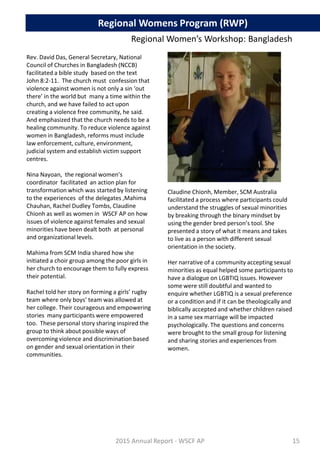
Claudine Chionh, Member, SCM Australia
facilitated a process where participants could
understand the struggles of sexual minorities
by breaking through the binary mindset by
using the gender bred person’s tool. She
presented a story of what it means and takes
to live as a person with different sexual
orientation in the society.
Her narrative of a community accepting sexual
minorities as equal helped some participants to
have a dialogue on LGBTIQ issues. However
some were still doubtful and wanted to
enquire whether LGBTIQ is a sexual preference
or a condition and if it can be theologically and
biblically accepted and whether children raised
in a same sex marriage will be impacted
psychologically. The questions and concerns
were brought to the small group for listening
and sharing stories and experiences from
women.
Rev. David Das, General Secretary, National
Council of Churches in Bangladesh (NCCB)
facilitated a bible study based on the text
John 8:2-11. The church must confession that
violence against women is not only a sin ‘out
there’ in the world but many a time within the
church, and we have failed to act upon
creating a violence free community, he said.
And emphasized that the church needs to be a
healing community. To reduce violence against
women in Bangladesh, reforms must include
law enforcement, culture, environment,
judicial system and establish victim support
centres.
Nina Nayoan, the regional women’s
coordinator facilitated an action plan for
transformation which was started by listening
to the experiences of the delegates ,Mahima
Chauhan, Rachel Dudley Tombs, Claudine
Chionh as well as women in WSCF AP on how
issues of violence against females and sexual
minorities have been dealt both at personal
and organizational levels.
Mahima from SCM India shared how she
initiated a choir group among the poor girls in
her church to encourage them to fully express
their potential.
Rachel told her story on forming a girls’ rugby
team where only boys’ team was allowed at
her college. Their courageous and empowering
stories many participants were empowered
too. These personal story sharing inspired the
group to think about possible ways of
overcoming violence and discrimination based
on gender and sexual orientation in their
communities.
2015 Annual Report - WSCF AP
Claudine Chionh sharing her experience
Regional Women’s Workshop: Bangladesh
Regional Womens Program (RWP)
15
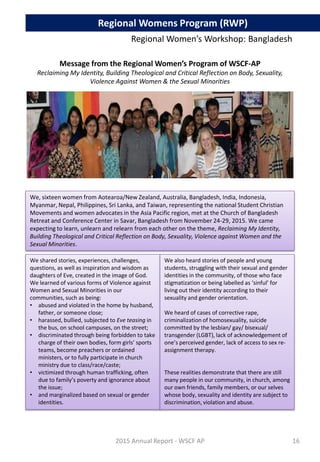
Message from the Regional Women’s Program of WSCF-AP
Reclaiming My Identity, Building Theological and Critical Reflection on Body, Sexuality,
Violence Against Women & the Sexual Minorities
We, sixteen women from Aotearoa/New Zealand, Australia, Bangladesh, India, Indonesia,
Myanmar, Nepal, Philippines, Sri Lanka, and Taiwan, representing the national Student Christian
Movements and women advocates in the Asia Pacific region, met at the Church of Bangladesh
Retreat and Conference Center in Savar, Bangladesh from November 24-29, 2015. We came
expecting to learn, unlearn and relearn from each other on the theme, Reclaiming My Identity,
Building Theological and Critical Reflection on Body, Sexuality, Violence against Women and the
Sexual Minorities.
We shared stories, experiences, challenges,
questions, as well as inspiration and wisdom as
daughters of Eve, created in the image of God.
We learned of various forms of Violence against
Women and Sexual Minorities in our
communities, such as being:
• abused and violated in the home by husband,
father, or someone close;
• harassed, bullied, subjected to Eve teasing in
the bus, on school campuses, on the street;
• discriminated through being forbidden to take
charge of their own bodies, form girls’ sports
teams, become preachers or ordained
ministers, or to fully participate in church
ministry due to class/race/caste;
• victimized through human trafficking, often
due to family’s poverty and ignorance about
the issue;
• and marginalized based on sexual or gender
identities.
We also heard stories of people and young
students, struggling with their sexual and gender
identities in the community, of those who face
stigmatization or being labelled as ‘sinful’ for
living out their identity according to their
sexuality and gender orientation.
We heard of cases of corrective rape,
criminalization of homosexuality, suicide
committed by the lesbian/ gay/ bisexual/
transgender (LGBT), lack of acknowledgement of
one’s perceived gender, lack of access to sex re-
assignment therapy.
These realities demonstrate that there are still
many people in our community, in church, among
our own friends, family members, or our selves
whose body, sexuality and identity are subject to
discrimination, violation and abuse.
2015 Annual Report - WSCF AP
Regional Women’s Workshop: Bangladesh
Regional Womens Program (RWP)
16
Regional Women’s Workshop: Bangladesh
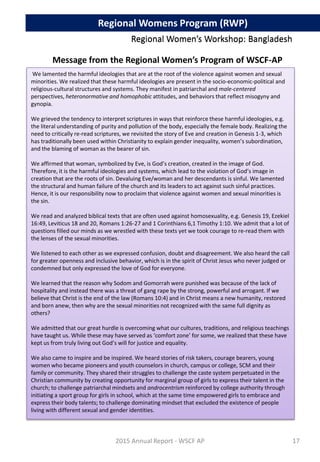
We lamented the harmful ideologies that are at the root of the violence against women and sexual
minorities. We realized that these harmful ideologies are present in the socio-economic-political and
religious-cultural structures and systems. They manifest in patriarchal and male-centered
perspectives, heteronormative and homophobic attitudes, and behaviors that reflect misogyny and
gynopia.
We grieved the tendency to interpret scriptures in ways that reinforce these harmful ideologies, e.g.
the literal understanding of purity and pollution of the body, especially the female body. Realizing the
need to critically re-read scriptures, we revisited the story of Eve and creation in Genesis 1-3, which
has traditionally been used within Christianity to explain gender inequality, women’s subordination,
and the blaming of woman as the bearer of sin.
We affirmed that woman, symbolized by Eve, is God’s creation, created in the image of God.
Therefore, it is the harmful ideologies and systems, which lead to the violation of God’s image in
creation that are the roots of sin. Devaluing Eve/woman and her descendants is sinful. We lamented
the structural and human failure of the church and its leaders to act against such sinful practices.
Hence, it is our responsibility now to proclaim that violence against women and sexual minorities is
the sin.
We read and analyzed biblical texts that are often used against homosexuality, e.g. Genesis 19, Ezekiel
16:49, Leviticus 18 and 20, Romans 1:26-27 and 1 Corinthians 6,1 Timothy 1:10. We admit that a lot of
questions filled our minds as we wrestled with these texts yet we took courage to re-read them with
the lenses of the sexual minorities.
We listened to each other as we expressed confusion, doubt and disagreement. We also heard the call
for greater openness and inclusive behavior, which is in the spirit of Christ Jesus who never judged or
condemned but only expressed the love of God for everyone.
We learned that the reason why Sodom and Gomorrah were punished was because of the lack of
hospitality and instead there was a threat of gang rape by the strong, powerful and arrogant. If we
believe that Christ is the end of the law (Romans 10:4) and in Christ means a new humanity, restored
and born anew, then why are the sexual minorities not recognized with the same full dignity as
others?
We admitted that our great hurdle is overcoming what our cultures, traditions, and religious teachings
have taught us. While these may have served as ‘comfort zone’ for some, we realized that these have
kept us from truly living out God’s will for justice and equality.
We also came to inspire and be inspired. We heard stories of risk takers, courage bearers, young
women who became pioneers and youth counselors in church, campus or college, SCM and their
family or community. They shared their struggles to challenge the caste system perpetuated in the
Christian community by creating opportunity for marginal group of girls to express their talent in the
church; to challenge patriarchal mindsets and androcentrism reinforced by college authority through
initiating a sport group for girls in school, which at the same time empowered girls to embrace and
express their body talents; to challenge dominating mindset that excluded the existence of people
living with different sexual and gender identities.
2015 Annual Report - WSCF AP
Regional Women’s Workshop: Bangladesh
Regional Womens Program (RWP)
Message from the Regional Women’s Program of WSCF-AP
17
Message from the Regional Women’s Program of WSCF-AP
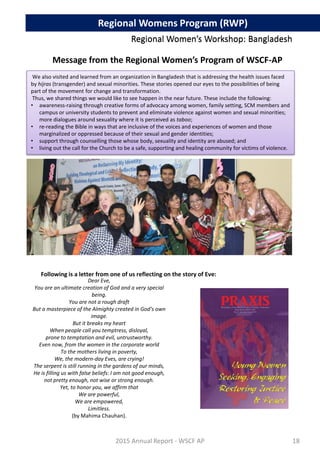
We also visited and learned from an organization in Bangladesh that is addressing the health issues faced
by hijras (transgender) and sexual minorities. These stories opened our eyes to the possibilities of being
part of the movement for change and transformation.
Thus, we shared things we would like to see happen in the near future. These include the following:
• awareness-raising through creative forms of advocacy among women, family setting, SCM members and
campus or university students to prevent and eliminate violence against women and sexual minorities;
more dialogues around sexuality where it is perceived as taboo;
• re-reading the Bible in ways that are inclusive of the voices and experiences of women and those
marginalized or oppressed because of their sexual and gender identities;
• support through counselling those whose body, sexuality and identity are abused; and
• living out the call for the Church to be a safe, supporting and healing community for victims of violence.
Dear Eve,
You are an ultimate creation of God and a very special
being.
You are not a rough draft
But a masterpiece of the Almighty created in God’s own
image.
But it breaks my heart
When people call you temptress, disloyal,
prone to temptation and evil, untrustworthy.
Even now, from the women in the corporate world
To the mothers living in poverty,
We, the modern-day Eves, are crying!
The serpent is still running in the gardens of our minds,
He is filling us with false beliefs: I am not good enough,
not pretty enough, not wise or strong enough.
Yet, to honor you, we affirm that
We are powerful,
We are empowered,
Limitless.
(by Mahima Chauhan).
Following is a letter from one of us reflecting on the story of Eve:
2015 Annual Report - WSCF AP
Regional Women’s Workshop: BangladeshRegional Women’s Workshop: Bangladesh
Regional Womens Program (RWP)
18
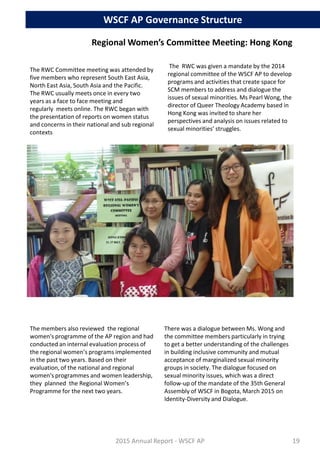
The RWC Committee meeting was attended by
five members who represent South East Asia,
North East Asia, South Asia and the Pacific.
The RWC usually meets once in every two
years as a face to face meeting and
regularly meets online. The RWC began with
the presentation of reports on women status
and concerns in their national and sub regional
contexts
WSCF AP Governance Structure
Regional Women’s Committee Meeting: Hong Kong
There was a dialogue between Ms. Wong and
the committee members particularly in trying
to get a better understanding of the challenges
in building inclusive community and mutual
acceptance of marginalized sexual minority
groups in society. The dialogue focused on
sexual minority issues, which was a direct
follow-up of the mandate of the 35th General
Assembly of WSCF in Bogota, March 2015 on
Identity-Diversity and Dialogue.
The members also reviewed the regional
women's programme of the AP region and had
conducted an internal evaluation process of
the regional women’s programs implemented
in the past two years. Based on their
evaluation, of the national and regional
women's programmes and women leadership,
they planned the Regional Women’s
Programme for the next two years.
The RWC was given a mandate by the 2014
regional committee of the WSCF AP to develop
programs and activities that create space for
SCM members to address and dialogue the
issues of sexual minorities. Ms Pearl Wong, the
director of Queer Theology Academy based in
Hong Kong was invited to share her
perspectives and analysis on issues related to
sexual minorities’ struggles.
2015 Annual Report - WSCF AP 19
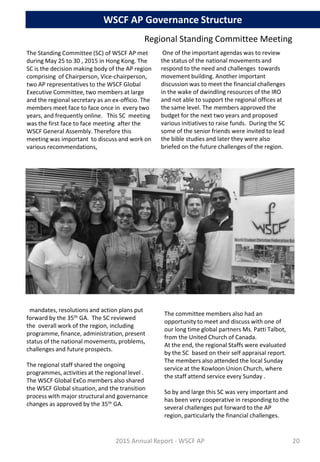
The Standing Committee (SC) of WSCF AP met
during May 25 to 30 , 2015 in Hong Kong. The
SC is the decision making body of the AP region
comprising of Chairperson, Vice-chairperson,
two AP representatives to the WSCF Global
Executive Committee, two members at large
and the regional secretary as an ex-officio. The
members meet face to face once in every two
years, and frequently online. This SC meeting
was the first face to face meeting after the
WSCF General Assembly. Therefore this
meeting was important to discuss and work on
various recommendations,
Regional Standing Committee Meeting
The committee members also had an
opportunity to meet and discuss with one of
our long time global partners Ms. Patti Talbot,
from the United Church of Canada.
At the end, the regional Staffs were evaluated
by the SC based on their self appraisal report.
The members also attended the local Sunday
service at the Kowloon Union Church, where
the staff attend service every Sunday .
So by and large this SC was very important and
has been very cooperative in responding to the
several challenges put forward to the AP
region, particularly the financial challenges.
mandates, resolutions and action plans put
forward by the 35th GA. The SC reviewed
the overall work of the region, including
programme, finance, administration, present
status of the national movements, problems,
challenges and future prospects.
The regional staff shared the ongoing
programmes, activities at the regional level .
The WSCF Global ExCo members also shared
the WSCF Global situation, and the transition
process with major structural and governance
changes as approved by the 35th GA.
One of the important agendas was to review
the status of the national movements and
respond to the need and challenges towards
movement building. Another important
discussion was to meet the financial challenges
in the wake of dwindling resources of the IRO
and not able to support the regional offices at
the same level. The members approved the
budget for the next two years and proposed
various initiatives to raise funds. During the SC
some of the senior friends were invited to lead
the bible studies and later they were also
briefed on the future challenges of the region.
2015 Annual Report - WSCF AP
WSCF AP Governance Structure
20
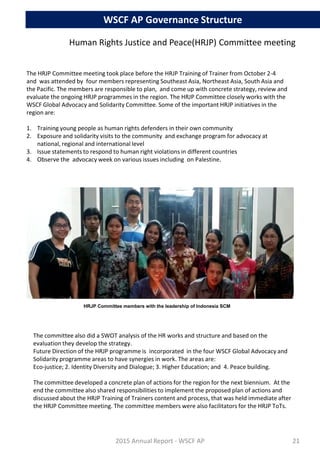
The HRJP Committee meeting took place before the HRJP Training of Trainer from October 2-4
and was attended by four members representing Southeast Asia, Northeast Asia, South Asia and
the Pacific. The members are responsible to plan, and come up with concrete strategy, review and
evaluate the ongoing HRJP programmes in the region. The HRJP Committee closely works with the
WSCF Global Advocacy and Solidarity Committee. Some of the important HRJP initiatives in the
region are:
1. Training young people as human rights defenders in their own community
2. Exposure and solidarity visits to the community and exchange program for advocacy at
national, regional and international level
3. Issue statements to respond to human right violations in different countries
4. Observe the advocacy week on various issues including on Palestine.
Human Rights Justice and Peace(HRJP) Committee meeting
The committee also did a SWOT analysis of the HR works and structure and based on the
evaluation they develop the strategy.
Future Direction of the HRJP programme is incorporated in the four WSCF Global Advocacy and
Solidarity programme areas to have synergies in work. The areas are:
Eco-justice; 2. Identity Diversity and Dialogue; 3. Higher Education; and 4. Peace building.
The committee developed a concrete plan of actions for the region for the next biennium. At the
end the committee also shared responsibilities to implement the proposed plan of actions and
discussed about the HRJP Training of Trainers content and process, that was held immediate after
the HRJP Committee meeting. The committee members were also facilitators for the HRJP ToTs.
2015 Annual Report - WSCF AP
HRJP Committee members with the leadership of Indonesia SCM
WSCF AP Governance Structure
21
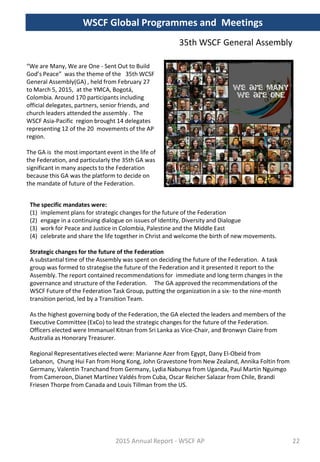
“We are Many, We are One - Sent Out to Build
God’s Peace” was the theme of the 35th WCSF
General Assembly(GA) , held from February 27
to March 5, 2015, at the YMCA, Bogotá,
Colombia. Around 170 participants including
official delegates, partners, senior friends, and
church leaders attended the assembly . The
WSCF Asia-Pacific region brought 14 delegates
representing 12 of the 20 movements of the AP
region.
The GA is the most important event in the life of
the Federation, and particularly the 35th GA was
significant in many aspects to the Federation
because this GA was the platform to decide on
the mandate of future of the Federation.
WSCF Global Programmes and Meetings
35th WSCF General Assembly
Strategic changes for the future of the Federation
A substantial time of the Assembly was spent on deciding the future of the Federation. A task
group was formed to strategise the future of the Federation and it presented it report to the
Assembly. The report contained recommendations for immediate and long term changes in the
governance and structure of the Federation. The GA approved the recommendations of the
WSCF Future of the Federation Task Group, putting the organization in a six- to the nine-month
transition period, led by a Transition Team.
As the highest governing body of the Federation, the GA elected the leaders and members of the
Executive Committee (ExCo) to lead the strategic changes for the future of the Federation.
Officers elected were Immanuel Kitnan from Sri Lanka as Vice-Chair, and Bronwyn Claire from
Australia as Honorary Treasurer.
Regional Representatives elected were: Marianne Azer from Egypt, Dany El-Obeid from
Lebanon, Chung Hui Fan from Hong Kong, John Gravestone from New Zealand, Annika Foltin from
Germany, Valentin Tranchand from Germany, Lydia Nabunya from Uganda, Paul Martin Nguimgo
from Cameroon, Dianet Martínez Valdés from Cuba, Oscar Reicher Salazar from Chile, Brandi
Friesen Thorpe from Canada and Louis Tillman from the US.
The specific mandates were:
(1) implement plans for strategic changes for the future of the Federation
(2) engage in a continuing dialogue on issues of Identity, Diversity and Dialogue
(3) work for Peace and Justice in Colombia, Palestine and the Middle East
(4) celebrate and share the life together in Christ and welcome the birth of new movements.
2015 Annual Report - WSCF AP 22
Continuing Dialogue on Identity and Diversity
For years, the Federation struggled internally to engage in a constructive dialogue on Sexuality.
This GA took a major step by recognizing the need to create spaces for prayers and dialogue, and
discern how the spirit of God is guiding the global fellowship to stand in solidarity with the Lesbian,
Gay, Bisexual and Transgender (LGBT) community. The GA approved the Identity, Diversity and
Dialogue (IDD) Report and Recommendations, providing the framework for continuing dialogue
and discernment on Sexuality for WSCF regions and member movements in the years to come.
Peace and Justice in Palestine and the Middle East
WSCF as a body committed to justice and peace, is concerned about the situation in Palestine due
to the occupation by Israel. Therefore, a Policy Paper on Palestine was being prepared prior to the
Assembly based on several visits and fact finding missions of the Federation. The GA approved the
Policy Paper on Palestine, a framework document for engaging the Federation in working towards
peace and dialogue between Israel and Palestine. The Policy Paper expressed WSCF’s position on
the Israel-Palestine conflict, invoking international human rights laws and the Palestinian Kairos
Document as the basis of its position.
Welcoming the birth of new movements
Movement building is the key to the life of Federation. The GA was the right place to receive new
movements into the folds of the Federation. The regions were encouraged to build new
movements or revive the “inactive” ones. Complementing the work of the Inter-regional office,
the six regional offices have taken steps towards the preparations for the GA, including thematic
discussions and fund-raising.
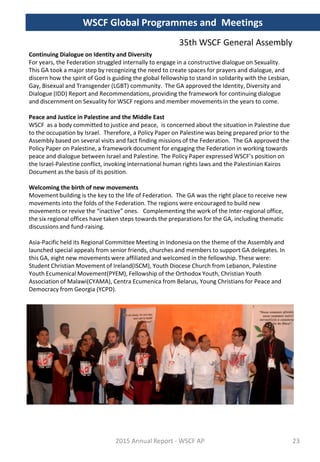
Asia-Pacific held its Regional Committee Meeting in Indonesia on the theme of the Assembly and
launched special appeals from senior friends, churches and members to support GA delegates. In
this GA, eight new movements were affiliated and welcomed in the fellowship. These were:
Student Christian Movement of Ireland(ISCM), Youth Diocese Church from Lebanon, Palestine
Youth Ecumenical Movement(PYEM), Fellowship of the Orthodox Youth, Christian Youth
Association of Malawi(CYAMA), Centra Ecumenica from Belarus, Young Christians for Peace and
Democracy from Georgia (YCPD).
2015 Annual Report - WSCF AP
WSCF Global Programmes and Meetings
35th WSCF General Assembly
23
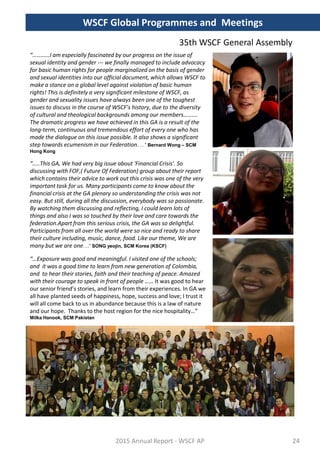
“…………I am especially fascinated by our progress on the issue of
sexual identity and gender --- we finally managed to include advocacy
for basic human rights for people marginalized on the basis of gender
and sexual identities into our official document, which allows WSCF to
make a stance on a global level against violation of basic human
rights! This is definitely a very significant milestone of WSCF, as
gender and sexuality issues have always been one of the toughest
issues to discuss in the course of WSCF’s history, due to the diversity
of cultural and theological backgrounds among our members……….
The dramatic progress we have achieved in this GA is a result of the
long-term, continuous and tremendous effort of every one who has
made the dialogue on this issue possible. It also shows a significant
step towards ecumenism in our Federation. …” Bernard Wong – SCM
Hong Kong
“…..This GA, We had very big issue about 'Financial Crisis'. So
discussing with FOF,( Future Of Federation) group about their report
which contains their advice to work out this crisis was one of the very
important task for us. Many participants came to know about the
financial crisis at the GA plenary so understanding the crisis was not
easy. But still, during all the discussion, everybody was so passionate.
By watching them discussing and reflecting, I could learn lots of
things and also I was so touched by their love and care towards the
federation.Apart from this serious crisis, the GA was so delightful.
Participants from all over the world were so nice and ready to share
their culture including, music, dance, food. Like our theme, We are
many but we are one….” SONG yeojin, SCM Korea (KSCF)
“…Exposure was good and meaningful. I visited one of the schools;
and it was a good time to learn from new generation of Colombia,
and to hear their stories, faith and their teaching of peace. Amazed
with their courage to speak in front of people …… It was good to hear
our senior friend’s stories, and learn from their experiences. In GA we
all have planted seeds of happiness, hope, success and love; I trust it
will all come back to us in abundance because this is a law of nature
and our hope. Thanks to the host region for the nice hospitality…”
Milka Hanook, SCM Pakistan
2015 Annual Report - WSCF AP
WSCF Global Programmes and Meetings
35th WSCF General Assembly
24
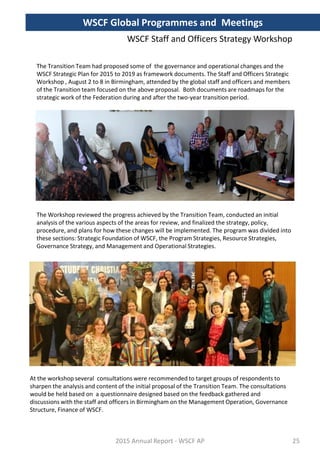
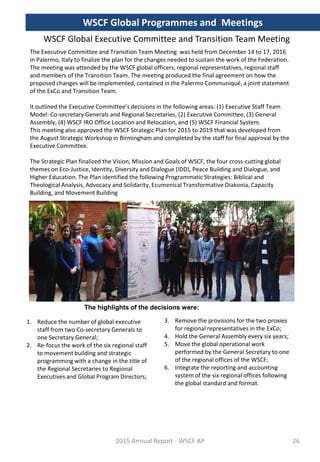
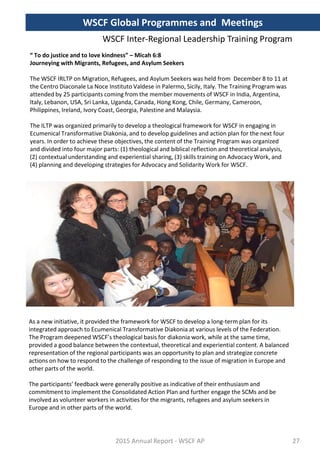
WSCF Staff and Officers Strategy Workshop
The Transition Team had proposed some of the governance and operational changes and the
WSCF Strategic Plan for 2015 to 2019 as framework documents. The Staff and Officers Strategic
Workshop , August 2 to 8 in Birmingham, attended by the global staff and officers and members
of the Transition team focused on the above proposal. Both documents are roadmaps for the
strategic work of the Federation during and after the two-year transition period.
The Workshop reviewed the progress achieved by the Transition Team, conducted an initial
analysis of the various aspects of the areas for review, and finalized the strategy, policy,
procedure, and plans for how these changes will be implemented. The program was divided into
these sections: Strategic Foundation of WSCF, the Program Strategies, Resource Strategies,
Governance Strategy, and Management and Operational Strategies.
At the workshop several consultations were recommended to target groups of respondents to
sharpen the analysis and content of the initial proposal of the Transition Team. The consultations
would be held based on a questionnaire designed based on the feedback gathered and
discussions with the staff and officers in Birmingham on the Management Operation, Governance
Structure, Finance of WSCF.
2015 Annual Report - WSCF AP
WSCF Global Programmes and Meetings
25
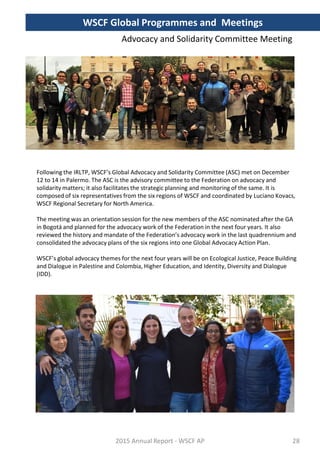
WSCF Global Executive Committee and Transition Team Meeting
The Executive Committee and Transition Team Meeting was held from December 14 to 17, 2016
in Palermo, Italy to finalize the plan for the changes needed to sustain the work of the Federation.
The meeting was attended by the WSCF global officers, regional representatives, regional staff
and members of the Transition Team. The meeting produced the final agreement on how the
proposed changes will be implemented, contained in the Palermo Communiqué, a joint statement
of the ExCo and Transition Team.
It outlined the Executive Committee’s decisions in the following areas: (1) Executive Staff Team
Model: Co-secretary Generals and Regional Secretaries, (2) Executive Committee, (3) General
Assembly, (4) WSCF IRO Office Location and Relocation, and (5) WSCF Financial System.
This meeting also approved the WSCF Strategic Plan for 2015 to 2019 that was developed from
the August Strategic Workshop in Birmingham and completed by the staff for final approval by the
Executive Committee.
The Strategic Plan finalized the Vision, Mission and Goals of WSCF, the four cross-cutting global
themes on Eco-Justice, Identity, Diversity and Dialogue (IDD), Peace Building and Dialogue, and
Higher Education. The Plan identified the following Programmatic Strategies: Biblical and
Theological Analysis, Advocacy and Solidarity, Ecumenical Transformative Diakonia, Capacity
Building, and Movement Building
The highlights of the decisions were:
3. Remove the provisions for the two proxies
for regional representatives in the ExCo;
4. Hold the General Assembly every six years;
5. Move the global operational work
performed by the General Secretary to one
of the regional offices of the WSCF;
6. Integrate the reporting and accounting
system of the six regional offices following
the global standard and format.
1. Reduce the number of global executive
staff from two Co-secretary Generals to
one Secretary General;
2. Re-focus the work of the six regional staff
to movement building and strategic
programming with a change in the title of
the Regional Secretaries to Regional
Executives and Global Program Directors;
2015 Annual Report - WSCF AP
WSCF Global Programmes and Meetings
26
“ To do justice and to love kindness” – Micah 6:8
Journeying with Migrants, Refugees, and Asylum Seekers
The WSCF IRLTP on Migration, Refugees, and Asylum Seekers was held from December 8 to 11 at
the Centro Diaconale La Noce Instituto Valdese in Palermo, Sicily, Italy. The Training Program was
attended by 25 participants coming from the member movements of WSCF in India, Argentina,
Italy, Lebanon, USA, Sri Lanka, Uganda, Canada, Hong Kong, Chile, Germany, Cameroon,
Philippines, Ireland, Ivory Coast, Georgia, Palestine and Malaysia.
The ILTP was organized primarily to develop a theological framework for WSCF in engaging in
Ecumenical Transformative Diakonia, and to develop guidelines and action plan for the next four
years. In order to achieve these objectives, the content of the Training Program was organized
and divided into four major parts: (1) theological and biblical reflection and theoretical analysis,
(2) contextual understanding and experiential sharing, (3) skills training on Advocacy Work, and
(4) planning and developing strategies for Advocacy and Solidarity Work for WSCF.
As a new initiative, it provided the framework for WSCF to develop a long-term plan for its
integrated approach to Ecumenical Transformative Diakonia at various levels of the Federation.
The Program deepened WSCF’s theological basis for diakonia work, while at the same time,
provided a good balance between the contextual, theoretical and experiential content. A balanced
representation of the regional participants was an opportunity to plan and strategize concrete
actions on how to respond to the challenge of responding to the issue of migration in Europe and
other parts of the world.
The participants’ feedback were generally positive as indicative of their enthusiasm and
commitment to implement the Consolidated Action Plan and further engage the SCMs and be
involved as volunteer workers in activities for the migrants, refugees and asylum seekers in
Europe and in other parts of the world.
2015 Annual Report - WSCF AP
WSCF Inter-Regional Leadership Training Program
WSCF Global Programmes and Meetings
27
Following the IRLTP, WSCF’s Global Advocacy and Solidarity Committee (ASC) met on December
12 to 14 in Palermo. The ASC is the advisory committee to the Federation on advocacy and
solidarity matters; it also facilitates the strategic planning and monitoring of the same. It is
composed of six representatives from the six regions of WSCF and coordinated by Luciano Kovacs,
WSCF Regional Secretary for North America.
The meeting was an orientation session for the new members of the ASC nominated after the GA
in Bogotá and planned for the advocacy work of the Federation in the next four years. It also
reviewed the history and mandate of the Federation’s advocacy work in the last quadrennium and
consolidated the advocacy plans of the six regions into one Global Advocacy Action Plan.
WSCF’s global advocacy themes for the next four years will be on Ecological Justice, Peace Building
and Dialogue in Palestine and Colombia, Higher Education, and Identity, Diversity and Dialogue
(IDD).
2015 Annual Report - WSCF AP
Advocacy and Solidarity Committee Meeting
WSCF Global Programmes and Meetings
28
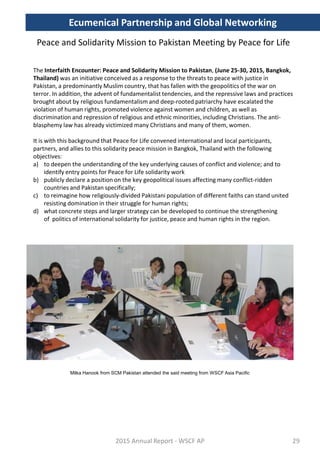
Peace and Solidarity Mission to Pakistan Meeting by Peace for Life
The Interfaith Encounter: Peace and Solidarity Mission to Pakistan, (June 25-30, 2015, Bangkok,
Thailand) was an initiative conceived as a response to the threats to peace with justice in
Pakistan, a predominantly Muslim country, that has fallen with the geopolitics of the war on
terror. In addition, the advent of fundamentalist tendencies, and the repressive laws and practices
brought about by religious fundamentalism and deep-rooted patriarchy have escalated the
violation of human rights, promoted violence against women and children, as well as
discrimination and repression of religious and ethnic minorities, including Christians. The anti-
blasphemy law has already victimized many Christians and many of them, women.
It is with this background that Peace for Life convened international and local participants,
partners, and allies to this solidarity peace mission in Bangkok, Thailand with the following
objectives:
a) to deepen the understanding of the key underlying causes of conflict and violence; and to
identify entry points for Peace for Life solidarity work
b) publicly declare a position on the key geopolitical issues affecting many conflict-ridden
countries and Pakistan specifically;
c) to reimagine how religiously-divided Pakistani population of different faiths can stand united
resisting domination in their struggle for human rights;
d) what concrete steps and larger strategy can be developed to continue the strengthening
of politics of international solidarity for justice, peace and human rights in the region.
2015 Annual Report - WSCF AP
Milka Hanook from SCM Pakistan attended the said meeting from WSCF Asia Pacific
Ecumenical Partnership and Global Networking
29
Agape International Camps, Prali, Italy
Every year the Agape Ecumenical Centre in Prali, Italy organizes three important camps for the
international participants. They are Work Camp, Theological Camp and Political Camp. Every year
the WSCF Asia Paicific sends delegates from SCMs to attend the said camps. The 2015 camps were
attended by the SCM members from Myanmar and Hong Kong. The Political Camp was attended
by the regional staff as this was after the Staff and Officers strategy workshop in Birmingham. The
time was also significant as WSCF’s 120th anniversary was falling during the political camp from
August 15-21. The Political Camp was held on the theme Peace Pedagogy: Towards New
Paradigms for People’s Security
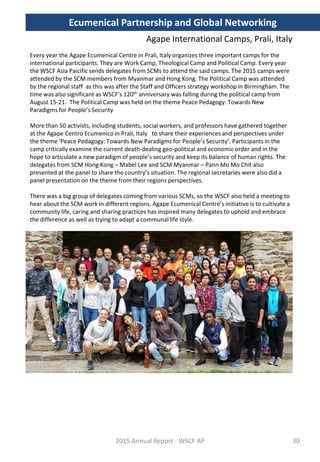
More than 50 activists, including students, social workers, and professors have gathered together
at the Agape Centro Ecumenico in Prali, Italy to share their experiences and perspectives under
the theme ‘Peace Pedagogy: Towards New Paradigms for People’s Security’. Participants in the
camp critically examine the current death-dealing geo-political and economic order and in the
hope to articulate a new paradigm of people’s security and keep its balance of human rights. The
delegates from SCM Hong Kong – Mabel Lee and SCM Myanmar – Pann Mo Mo Chit also
presented at the panel to share the country’s situation. The regional secretaries were also did a
panel presentation on the theme from their regions perspectives.
There was a big group of delegates coming from various SCMs, so the WSCF also held a meeting to
hear about the SCM work in different regions. Agape Ecumenical Centre’s initiative is to cultivate a
community life, caring and sharing practices has inspired many delegates to uphold and embrace
the difference as well as trying to adapt a communal life style.
2015 Annual Report - WSCF AP
Ecumenical Partnership and Global Networking
30
CCA and AWRC
Pre-Assembly Youth Forum and 14th General Assembly of CCA :
Living Together in the Household of God
This meeting of the Christian Conference of Asia was held from May 18-20,2015 in West Java,
Indonesia. WSCF Asia-Pacific was invited as an ecumenical partner of the CCA . The regional
secretary Ms. Sunita Suna and the regional women’s coordinator Ms. Nina Nayona attended the
youth forum prior to the CCA Assembly. Youth from different Churches of Asia and the Pacific
attended the youth forum and discussed and deliberated on the theme from the youth
perspectives and youth’s roles within the Church and in the society. Ms. Suna facilitated a session
during the forum on the theme: Building Communities of Peace and Inter-religious harmony in
Asia :Challenges of Young People on 19th May.
After the youth forum the WSCF AP staff also partly attended the CCA’s 14th General Assembly
held from May 20 to 27, at Jakarta, Indonesia. The affirmation of the assembly was summarized
to: “The Assembly invites us all to affirm that we are ‘Living Together in the Household of God’.
We listen to each other, share our burdens and struggles, celebrate our joys and give voice to our
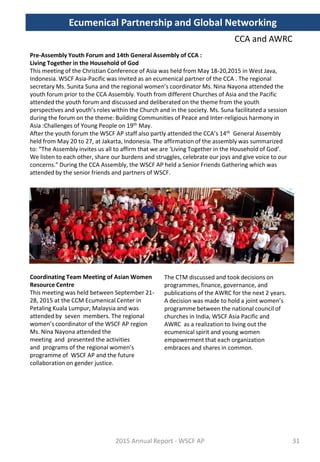
concerns.” During the CCA Assembly, the WSCF AP held a Senior Friends Gathering which was
attended by the senior friends and partners of WSCF.
Coordinating Team Meeting of Asian Women
Resource Centre
This meeting was held between September 21-
28, 2015 at the CCM Ecumenical Center in
Petaling Kuala Lumpur, Malaysia and was
attended by seven members. The regional
women’s coordinator of the WSCF AP region
Ms. Nina Nayona attended the
meeting and presented the activities
and programs of the regional women’s
programme of WSCF AP and the future
collaboration on gender justice.
2015 Annual Report - WSCF AP
The CTM discussed and took decisions on
programmes, finance, governance, and
publications of the AWRC for the next 2 years.
A decision was made to hold a joint women’s
programme between the national council of
churches in India, WSCF Asia Pacific and
AWRC as a realization to living out the
ecumenical spirit and young women
empowerment that each organization
embraces and shares in common.
Ecumenical Partnership and Global Networking
31
Excerpts from a Mission Intern of GBGM to WSCF AP
I arrived in Hong Kong on September 2013, to join the WSCF AP office as Global Mission Fellow to engage
and involve with the local communities. At the beginning it was not an easy start, because everything was
new for me! the language, food, climate and cultural customs. I thank God that I had the privilege to meet
amazing people, I found a wonderful community of faith in Kowloon Union Church. It is time to leave after
an incredible journey of 19 months in Hong Kong, with various life experiences, learning, and happiness and
of course sadness and frustrations too. I grew up in different ways, strengthened my principles, values,
ideals and beliefs to develop, and rebuild my commitment with society through real experiences.
The first programme I participated was Women Doing Theology of WSCF AP in Bangkok, Thailand. I met 25
women from different countries of Asia Pacific and heard stories of women facing discrimination and
oppression. The amazing part was when women are united it can be very powerful! I got involved with
SCM Hong Kong which is a group of very active students. I participated in a rally for LGBT rights and saw the
creative ways communities were encouraging people to respect diversity of sexual preferences .
The most significant moment was to witness the historic student’s strike for democracy in Hong Kong later
known as “The Umbrella Movement”. The streets of Hong Kong became their homes and they started
taking care of the people including distributing foods, supplies and cleaning garbage in the public
places. The other impactful programme I attended was the HRJP program of WSCF AP in India. POSCO a big
foreign company in India is building a steel plant in Odisha destroying the livelihoods of more than 4000
families. We met the villagers and listened to how the villagers were attacked by the police and POSCO's
goons, injuring women, children and elderly people. The villagers are struggling for around 10 years to
protect their lands and the livelihood. There are hundreds of false criminal charges against the villagers.
In the world there are many kinds of injustice, that probably many people are unaware of, now my
responsibility is to share about this situation and raise awareness in order to get more support to this
struggle. I really appreciate and am thankful to the General Board of Global Ministries for this opportunity.
WSCF AP has amazing human capital in the SCMs in 20 countries of Asia and the Pacific.
I realize perhaps each region or continent has its own culture own tradition; but social justice issues are the
same, especially in the global south. That is why, after being part of the Asia Pacific community I feel that
my social awareness has enhanced and I am more committed for the justice, peace concerns. Angela Ali,
Mission Intern of GBGM to WSCF AP
2015 Annual Report - WSCF AP
Ecumenical Partnership and Global Networking
32
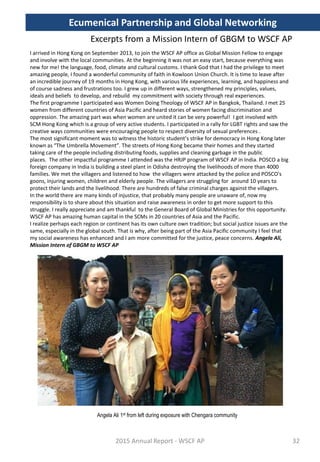
Angela Ali 1st from left during exposure with Chengara community
Network of SCM Senior Friends in the Asia Pacific Region
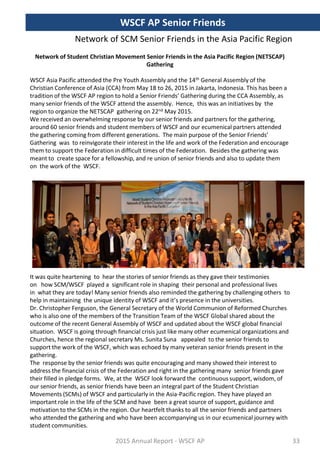
Network of Student Christian Movement Senior Friends in the Asia Pacific Region (NETSCAP)
Gathering
WSCF Asia Pacific attended the Pre Youth Assembly and the 14th General Assembly of the
Christian Conference of Asia (CCA) from May 18 to 26, 2015 in Jakarta, Indonesia. This has been a
tradition of the WSCF AP region to hold a Senior Friends’ Gathering during the CCA Assembly, as
many senior friends of the WSCF attend the assembly. Hence, this was an initiatives by the
region to organize the NETSCAP gathering on 22nd May 2015.
We received an overwhelming response by our senior friends and partners for the gathering,
around 60 senior friends and student members of WSCF and our ecumenical partners attended
the gathering coming from different generations. The main purpose of the Senior Friends’
Gathering was to reinvigorate their interest in the life and work of the Federation and encourage
them to support the Federation in difficult times of the Federation. Besides the gathering was
meant to create space for a fellowship, and re union of senior friends and also to update them
on the work of the WSCF.
It was quite heartening to hear the stories of senior friends as they gave their testimonies
on how SCM/WSCF played a significant role in shaping their personal and professional lives
in what they are today! Many senior friends also reminded the gathering by challenging others to
help in maintaining the unique identity of WSCF and it’s presence in the universities.
Dr. Christopher Ferguson, the General Secretary of the World Communion of Reformed Churches
who is also one of the members of the Transition Team of the WSCF Global shared about the
outcome of the recent General Assembly of WSCF and updated about the WSCF global financial
situation. WSCF is going through financial crisis just like many other ecumenical organizations and
Churches, hence the regional secretary Ms. Sunita Suna appealed to the senior friends to
support the work of the WSCF, which was echoed by many veteran senior friends present in the
gathering.
The response by the senior friends was quite encouraging and many showed their interest to
address the financial crisis of the Federation and right in the gathering many senior friends gave
their filled in pledge forms. We, at the WSCF look forward the continuous support, wisdom, of
our senior friends, as senior friends have been an integral part of the Student Christian
Movements (SCMs) of WSCF and particularly in the Asia-Pacific region. They have played an
important role in the life of the SCM and have been a great source of support, guidance and
motivation to the SCMs in the region. Our heartfelt thanks to all the senior friends and partners
who attended the gathering and who have been accompanying us in our ecumenical journey with
student communities.
2015 Annual Report - WSCF AP
WSCF AP Senior Friends
33
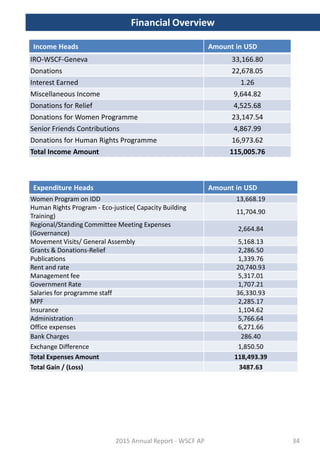
Income Heads Amount in USD
IRO-WSCF-Geneva 33,166.80
Donations 22,678.05
Interest Earned 1.26
Miscellaneous Income 9,644.82
Donations for Relief 4,525.68
Donations for Women Programme 23,147.54
Senior Friends Contributions 4,867.99
Donations for Human Rights Programme 16,973.62
Total Income Amount 115,005.76
Expenditure Heads Amount in USD
Women Program on IDD 13,668.19
Human Rights Program - Eco-justice( Capacity Building
Training)
11,704.90
Regional/Standing Committee Meeting Expenses
(Governance)
2,664.84
Movement Visits/ General Assembly 5,168.13
Grants & Donations-Relief 2,286.50
Publications 1,339.76
Rent and rate 20,740.93
Management fee 5,317.01
Government Rate 1,707.21
Salaries for programme staff 36,330.93
MPF 2,285.17
Insurance 1,104.62
Administration 5,766.64
Office expenses 6,271.66
Bank Charges 286.40
Exchange Difference 1,850.50
Total Expenses Amount 118,493.39
Total Gain / (Loss) 3487.63
2015 Annual Report - WSCF AP
Financial Overview
34
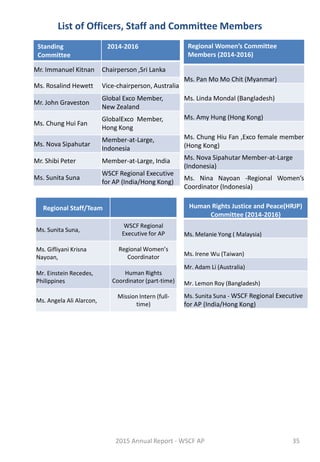
List of Officers, Staff and Committee Members
Regional Staff/Team
Ms. Sunita Suna,
WSCF Regional
Executive for AP
Ms. Gifliyani Krisna
Nayoan,
Regional Women’s
Coordinator
Mr. Einstein Recedes,
Philippines
Human Rights
Coordinator (part-time)
Ms. Angela Ali Alarcon,
Mission Intern (full-
time)
2015 Annual Report - WSCF AP 35
Standing
Committee
2014-2016
Mr. Immanuel Kitnan Chairperson ,Sri Lanka
Ms. Rosalind Hewett Vice-chairperson, Australia
Mr. John Graveston
Global Exco Member,
New Zealand
Ms. Chung Hui Fan
GlobalExco Member,
Hong Kong
Ms. Nova Sipahutar
Member-at-Large,
Indonesia
Mr. Shibi Peter Member-at-Large, India
Ms. Sunita Suna
WSCF Regional Executive
for AP (India/Hong Kong)
Regional Women’s Committee
Members (2014-2016)
Ms. Pan Mo Mo Chit (Myanmar)
Ms. Linda Mondal (Bangladesh)
Ms. Amy Hung (Hong Kong)
Ms. Chung Hiu Fan ,Exco female member
(Hong Kong)
Ms. Nova Sipahutar Member-at-Large
(Indonesia)
Ms. Nina Nayoan -Regional Women’s
Coordinator (Indonesia)
Human Rights Justice and Peace(HRJP)
Committee (2014-2016)
Ms. Melanie Yong ( Malaysia)
Ms. Irene Wu (Taiwan)
Mr. Adam Li (Australia)
Mr. Lemon Roy (Bangladesh)
Ms. Sunita Suna - WSCF Regional Executive
for AP (India/Hong Kong)
WSCF AP Member Movement and Contact Persons in 2015
2015 Annual Report - WSCF AP 36
WSCF AP Member Movement Contact Persons
Aotearoa / New Zealand SCM Ms. Jaz Burke, General Secretary
Australia SCM Ms. Rosalind Hewett, WSCF Liaison Officer
Bangladesh SCM Mr. Lawrence Mondal, General Secretary
Bhutan SCM Ms. Thuji Wangmo, Contact person
CSCM, Cambodia SCM Mr.Ham Kimhoun, Coordinator
Hong Kong SCM Mr. Holok Chen, Executive Secretary
India SCM Mr. Inbaraj Jeyakumar, General Secretary
Japan SCM/Student YMCA
Ms.Yuria Yokohama, Executive Secretary, Ms. Sayuri
Mori, Coordinator
GMKI Indonesia SCM Mr. Ayub Manuel Pongrekun, Chairperson
Korean Student Christian
Federation
Rev. Chang, Byung-Kee , General Secretary
Thailand SCM Ms. Janejinda Pawadee, Senior friends, contact person
Sri Lanka SCM Rev. Saman Jayasuriya, General Secretary
University Christian Work,
Myanmar SCM
Mr. Tun Tun Oo, General Secretary
Nepal SCM Mr. Rajesh Rai – Chairperson
Pakistan SCM Ms. Milka Hanook, General Secretary
SCM Papua New Guinea Mr. Benstead Ludlum, Senior friend
Philippine SCM Ms. Anna Katrina, Spokes Person
Singapore SCM Ms. Wong Yockleng , Senior friend
Taiwan SCM Rev. Wang Jung-Yi, Programme Secretary
MovimentoEstudanteCristao
Timor-Leste
Mr. Antonio Da Silva, Chairperson
Global and Ecumenical Partners
2015 Annual Report - WSCF AP 37
Networks and Groups in 2015
Ecumenical Asia-Pacific Students and
Youth Network, EASYNET
Asia and Pacific Alliance of YMCAs, Hong
Kong
Christian Conference of Asia, CCA,
Thailand
World Young Women Christian
Association, WYWCA, Geneva
International Movement of Catholic
Students Asia Pacific, IMCS, Philippines
International Young Christian Students
Asia, IYCS, Philippines
Asian Human Rights Commission
(AHRC),Hong Kong
Asian Women Resource Center (AWRC),
Malaysia
Asian Church Women’s Conference
(ACWC), Taiwan
Hong Kong Christian Institute(HKCI) –
Hong Kong
Hong Kong Christian Council(HKCC) –
Hong Kong
Kowloon Union Church (KUC) – Hong Kong
International Migrants Alliance(IMA) –
Hong Kong
Global and Ecumenical Partners
General Board of Global Ministries, The
United Methodist Church - the USA
United Methodist Women – UMW – USA
World Church Office, The United
Methodist Church - United Kingdom
Church of Sweden (CoS) -Sweden
Common Global Ministries of Christian
Church and United Church of Christ, USA
Council for World Mission (CWM)
Justice, Global and Ecumenical Relations
Unit, The United Church of Canada
Presbyterian Church in the Republic of
Korea
National Council of Churches in Japan,
Japan
National Council of Churches in Korea
Student YMCA, Japan
International Committee of the Fellowship
of the Least Coin, Philippines
Presbyterian Church in Taiwan
Christian Conference of Asia - Thailand
World Council of Churches
Calendar of Events 2015
2015 Annual Report - WSCF AP 38
Activity/Program Date Theme Venue
WSCF Global Executive Committee and Transition
Team Meeting
Dec14-17 Palermo, Sicily,
Italy
WSCF Inter-Regional Leadership Program (IRLTP)
and Advocacy and Solidarity Committee
Dec 8-13 Ecumenical Transformational
Diakonia “To do justice and to
love kindness”
Palermo, Sicily,
Italy
Regional Women’s Workshop November
24-29
Reclaiming My Identity:
Building Theological and
Critical Reflection on Body,
Sexuality, Violence Against
Women and the Sexual
Minorities
Church of
Bangladesh
Retreat &
Conference
Center,
Bangladesh
Peace and Solidarity Mission to Pakistan Meeting
Organized by the Peace For Life
Nov 6-9 Interfaith Encounter: Peace
and Solidarity Mission to
Pakistan
Bangkok,
Thailand
Human Rights Justice and Peace (HRJP) Training
of Trainers
October 5-11 Understanding Eco-justice in
a climate change regime:
Cibodas, Bogor,
Indonesia
Human Rights Justice and Peace Committee
Meeting (HRJPC)
October 2-4 Review, planning, strategies
for the Human Rights Justice
and Peace programme in the
WSCF AP
Jakarta,
Indonesia
WSCF AP’s participation at the Coordinating Team
Members (CTM) meeting by the Asian Women’s
Resource Centre (AWRC)
September
21-28
Kuala Lumpur,
Malaysia
WSCF AP’s participation at the AGAPE
International Camp
August 2 - 22 Harmony and Conflicts.
Dialogue & Understanding:
Christian Theology of Inter
religious dialogue
Peace Pedagogy
Agape
Ecumenical
Centre, Torino,
Italy
WSCF AP’s participation at the Youth Leadership &
Advocacy Workshop organised by The
International Planned Parenthood Federation-East
Southeast Asia and Oceania Region
August 7-9 Sexual and Reproductive
Health and Rights of Youth
(SRHR)
Jakarta,
Indonesia
WSCF Staff and Officers Strategy Workshop Aug 3 Birmingham, UK
WSCF AP Regional Women’s Committee &
Standing Committee Meeting
May 25-29 Assessment, Planning and
Implementation of the
programmes and activities of
the WSCF AP
Hong Kong
WSCF AP Senior Friend’s gathering – Network of
Student Christian Movement Senior Friends in the
Asia Pacific Region (NETSCAP)
May 22 Come, Listen, Share,
Celebrate and Accompany the
Ecumenical Journey of the
Student Christian Movement
Jakarta,
Indonesia
WSCF AP’s participation at the Youth Pre-
Assembly & 14
th
General Assembly of Christian
Conference of Asia (CCA)
May 20-27 Living Together in the
Household of God
Jakarta,
Indonesia
35
th
General Assembly of WSCF Global and the
Executive Committee Meeting
Feb27- Mar We are Many, We are One,
Sent Out to Build God;s Peace
Bogota,
Colombia
Week of Prayers for Christian Unity Service January 21 Water Union Church
Hong Kong

WSCF AP annual report 2015

  • 1.
    2015 Annual Report WorldStudent Christian Federation Asia-Pacific We are Many, We are One, Sent Out to Build God's Peace WSCF AP unit1-2,18/F, 280 Portland St. Commercial Bldg. Mong Kok, Kowloon, Hong Kong,-SAR Tel: (852) 2385-2550 www.wscfap.org
  • 2.
    Our Vision WSCF iscalled to be a prophetic witness in church and the transformation of the world where God’s love for creation, justice and peace is shared by all across boundaries of race, class, ethnicity, culture, gender and sexuality. This vision is nurtured by a radical hope of God’s reign in history and liberating faith in Jesus Christ. Our Mission The WSCF is a global fellowship of Student Christian Movements putting their faith into action to contribute to the renewal of the ecumenical movement and to promote justice and peace in the world. 2015 Annual Report - WSCF AP 2
  • 3.
    Table of Contents I.Messages from the Leadership II. 2015 Program and Activity Reports i. Human Rights, Justice, and Peace (HRJP) Programme ii. Regional Women’s Programme (RWP) iii. WSCF AP Governance Structure iv. WSCF Global Programmes and Meetings v. Ecumenical Partnership and Global Networking vi. WSCF AP Senior Friend’s gathering : Network of Student Christian Movement Senior Friends in the Asia Pacific Region III. Financial Overview IV. List of Officers, Staff, Member Movements, Networks, and Partners V. Calendar of Events 2015 2015 Annual Report - WSCF AP 3
  • 4.
    Immanuel Kitnan: Theyear 2015 in WSCF-AP could be described by the words - changes, learning and challenges. It was a year of transition for the Global WSCF. This has directly and indirectly forced one of the arms of the body to be ready and adapt to the changes taking place at the highest Level. So on one hand the WSCF-AP had to adapt to the many changes that took place and in the other hand it had to continue its work amongst the SCM’s in the region. Dr. A. P. J Abdul Kalam said “We should not give up and we should not allow the problem to defeat us.” Chairperson’s Message- WSCF Asia Pacific region I have to pronounce that the excellent team of active members of the Standing Committee and the regional staff did not allow the problem to defeat us. Rather, they continued the usual emphasis on Leadership Formation, Human Rights, Women’s Empowerment and Action, Ecumenical Networking, and Movement Building. One can discern, with some sense of challenging fulfilment, the radiance of the movement enlightening all of us and the zeal stimulating young lives to be committed to the cause of justice, peace, love and integrated growth in the steps of Jesus our Saviour, Liberator and Lord. If I have to mention our top two challenges: decline of financial resources and a combination of factors in the world threatening to weaken the resolve of SCMers and reduce their membership. Decline of financial resources is not new for ecumenical organizations globally. The danger is that it has narrowed the opportunity for student organizations like us to look for solutions within the ecumenical fraternity, and pushed us back to local resources of senior friends, SCM’s and churches. Our SCM’S have to play a distinctive role in transforming society making it vital to continue Program emphasis and strengthen existing units, revive dormant units and start new ones. “Look at the sky. We are not alone. The whole universe is friendly to us and conspires only to give the best to those who dream and work.” We are indeed grateful to our funding partners, resource sharers, and friends. WSCF- AP’s accomplishments are due to your unfailing support and encouragement. In our modern-day society, pressures of success in education, consumerism, competition for lucrative employment, the escalation of “prosperity” religiosities and struggles for justice under oppressive regimes urges us to “invest” in students and youth leaders. Unless mature, socially-relevant spirituality, is cultivated, the twenty-first century world will encounter devastating situations ahead. Hence, it is our hope and prayer that you would continue to be associated with us in our endeavour to inspire and equip students and youth leaders to be committed to the gospel of Jesus Christ and the reign of God. 2015 Annual Report - WSCF AP 4
  • 5.
    Sunita Suna: 2015was the year of transition to start transformational changes in the Federation as decided at WSCF’s 35th General Assembly. It was a WSCF Global call to its family to journey resolutely with the task group known as “Future of the Federation”. All regions responded to the call with a true spirit. Despite challenges , WSCF held the 35th General Assembly in Bogota, Colombia due to the support and conviction of its members, senior friends and partners which created the platform for participation in discussion and dialogue of the FoF. Our region prepared SCM’s for the assembly, and made appeals to senior friends, churches, and members to support the General Assembly delegates. With their support, the AP region was able to bring 14 members representing 12 national movements out of 20 to the GA. Regional Executive’s Message- WSCF Asia Pacific region The first time experience of witnessing all the WSCF families gathered in one platform was unique and inspiring for many delegates . This lead to many AP delegates upholding the spirit of oneness despite their differences to continue their ecumenical journey for and with the Federation. The GA with challenging recommendations for structural changes, brought in a spirit of enthusiasm and new sense of direction among all of us for turning around the Federation. Two of our ongoing programmes: Women Empowerment and Gender Justice and the Human Rights Justice and Peace initiatives in the region brought around 50 youth from around the region. It was a challenging task for us to organize a women’s programme on Sexuality and Rights of Sexual minorities in the context of Bangladesh – a Muslim populated country where talking about sex and sexuality is still taboo, and homosexuality is a punishable offence. The SCM Bangladesh and the Churches welcomed us and created space to organize this programme. End of the year WSCF organized an Inter-regional leadership programme in Palermo, Italy on Transformative Diakonia -Journeying with Migrants, Refugees, and Asylum Seekers was a timely intervention to address the problems and challenges through Advocacy and Solidarity. The Human Rights Justice and Peace Training of Trainers focused on Eco-justice, which was a timely intervention to discuss the threat of climate change prior to the COP21, and to prepare our young people to engage in the relentless struggle for climate justice. We also participated in the14th General Assembly of Christian Conference of Asia and the pre –youth forum as an ecumenical partner in Indonesia to reflect and affirm our faith in “Living together in the household of God”. It has been a tradition of WSCF AP to organize a Senior Friend’s gathering during the CCA Assembly, as many of our senior friends attend the assembly in various capacities. The overwhelming response of the Senior Friends gathering and some of our partners was quite remarkable for us. This gathering was a significant space and an opportunity for us to share about the ongoing issues and challenges of WSCF and invite them to journey with us. Many of our senior friends’ and our funding partners’ willingness to continue with us was very much encouraging. The youth in Asia, having enormous energy, creativity, passion and commitment. They are striving to bring positive changes in our, communities, churches and society. They are the leaders of today and hopes of tomorrow. With this hope greetings of peace and solidarity to all! 2015 Annual Report - WSCF AP 5
  • 6.
    Regional Human RightsJustice and Peace Programme Training of Trainers (ToTs), Indonesia Understanding Eco-justice in a climate change regime: Acknowledge, Address & Act to restore (eco)Justice, Peace, & Integrity of Creation Background The HRJP Program is an ongoing initiative of WSCF Asia-Pacific since 2006. Under the program, three major activities are generally organized: Training of Trainers, Workshops and Solidarity Programmes. Many Asian countries witness human rights violation and the region continues to face major human rights challenges. The context and the reality inspired us to continue the HRJP program to produce more young human rights defenders. Through these activities, hundreds of students and young people from 20 countries of Asia and the Pacific have become human rights defenders in their own countries and communities. The HRJP Committee of WSCF AP consists of 6 members from South and South East Asia, North East Asia and the Pacific with a mandate to focus on Human rights in the region met in 2013 to prioritize issues for advocacy for the next 2 years. One recommendation from the HRJP Committee was to continue addressing the challenging issue of “Eco-Justice & Indigenous People’s Rights” – focusing on Land and Mining. The topic eco-justice was significant and timely as the world leaders were preparing for the COP21 in December 2015. Therefore, the 2015 HRJP ToTs focused on this theme alongside its cause, Climate Change. Indonesia was chosen as the venue as the location was very relevant to the issue. The country is going through serious environment concerns not only adding problems to climate change but also affecting the poor and indigenous communities in the country. HRJP ToTs was hosted by the Indonesia SCM (Student Christian Movement known as GMKI in Indonesia) from October 5-11, 2015 at Cibodas, Bogor, Indonesia. 2015 Annual Report - WSCF AP Participants of the HRJP ToTs 2015 6
  • 7.
    Indonesia is witnessingdeforestation faster than any other country in the world, particularly in its pursuit of producing palm oil. Deforestation is nearly double the rate in the Amazon. The country is said to have lost 3,250 square miles of forest in 2012. Forest fires produce some of the world’s worst pollution, sending suffocating smog even to faraway cities in Malaysia and Singapore. This has taken a heavy toll on local communities, destroyed natural habitats for endangered species [Orangutans, Sumatran tigers, Borneo rhinos, and Pygmy elephants], and become a critical factor in climate change. Replacing natural forests with palm oil plantations diminishes the ability of vegetation to capture and store carbon dioxide. With palm oil demand set to double by 2030, the UN’s Environmental Program predicts that most of Indonesia’s rainforest could be destroyed by 2022. Thirty delegates attended from the SCMs of the following 13 countries: Australia, Cambodia, Hong Kong, India, Indonesia, Malaysia, Myanmar, Nepal, New Zealand, Pakistan, Sri Lanka, South Korea, Taiwan, Goal: To address climate change from the perspectives of land justice and indigenous people’s rights as human rights defenders Objectives i. Raise awareness, understanding of issues that affects the environment, marginalized people, provide critical analysis of economy and ecology and the human rights situation in countries in the Asia-Pacific region; ii. Learn to implement solutions/ Mechanisms on advocacy that are in place and/or are evolving with regard to Climate Change and Human Rights iii. Provide Biblical-theological foundation on understanding (eco)justice, peace and integrity of creation; iv. Integrate with affected communities in Indonesia by understanding the realities via immersion program; v. Understand and learn the theoretical framework of Human Rights, its history and mechanisms and strategize for our responses to the situations of HRJP vi. Acquire and develop skills as human rights and advocacy works from the SCMs, church groups, Non-Government Organizations (NGO’s) and environmental Organizations in the Asia-Pacific region; vii.Help participants create action plans for SCM, Church, and community. 2015 Annual Report - WSCF AP Regional Human Rights Justice and Peace Programme Training of Trainers (ToTs), Indonesia 7
  • 8.
    Methodology The seven daysToT was divided into five sections in order to achieve its goal and objectives: i. Thematic inputs from the human rights perspectives , & tools and skills to become HR defenders by different resource persons who are expertise on the issues ii. Immersion program with three different communities and come up with specific strategies for advocacy iii. Develop theological perspectives on eco- justice iv. Organize a public event with the environmental department of the Indonesian government, Senior friends of GMKI, and ecumenical partners in Indonesia. v. Follow-ups Impact i. Created awareness among delegates on climate change, and ongoing issues in Indonesia ii. Inspired participants to act on eco- justice from a human rights perspectives iii. Bible studies empowered delegates to understand eco-justice, eco-feminism, and reflection on the Pope’s encyclical Laudato si from faith perspectives. iv. Provided a common platform to government officials, senior friends from GMKI, ecumenical partners, and guests to address eco-justice issues. v. 200 people signed the petition “Act Now for Climate Justice” by the ACT Alliance an initiative of the World Council of Churches, to urge world leaders to bring climate justice during CoP 21 in Paris vi. Delegates formulated a climate justice policy for WSCF to implement within itself vii.Live-in experience with the affected communities in Ciliwung River, Bantar Gebang and Rumpin as part of the immersion program touched them and gave them a deeper analytical understanding of the ongoing issues affecting the communities and motivated them to continue advocating human rights for the communities. viii.Training on tools and mechanisms to address human rights issues enhanced skills of the delegates, to be a human rights defender in their local community. 2015 Annual Report - WSCF AP Regional Human Rights Justice and Peace Programme Training of Trainers (ToTs), Indonesia 8
  • 9.
    Chris Biantoro: Consultant,Indonesia Desk at Asian Human Rights Commission, HK Ranjan K Panda: sociologist / journalist known as ‘water man of Odisha’ and ‘climate crusader’ in India R. Manohar: Regional Coordinator Human Rights Defenders Alert-India Nina Nayoan: Regional Women’s Coordinator, WSCF AP Action Plan highlights: I. Continuous support to ongoing initiatives of CMs in different countries through Advocacy and Solidarity in the region on Land Rights/ Land Justice viz. anti-POSCO Movement - India, Lumad’s (indigenous people) rights - Philippines, Forest fires – Indonesia and Climate Refugees in the region II. Dedicate one issue of the WSCF AP journal – PRAXIS to Eco-justice III. Start communicating with the national movement and to the wider ecumenical partners to strengthen our initiative on eco-justice. IV. WSCF closely working with WCC on eco-justice to work together on beyond CoP21 and Act Now for Climate Justice / Climate Justice beyond CoP21. V. Studies on Lands of Churches for commercial development Fr. Martin Harun: Emeritus professor of biblical studies, Driyarkara School of Philosophy and Theology , Jakarta translated Laudato Si in Bahasa Indonesia. Judith Lim: senior friend: GMKI, Feminist theologian focusing on eco-feminism Yanedi Jagau: senior friend: GMKI, Director: Borneo Institute, Kalimantan Sunita Suna – Regional Secretary, WSCF AP, The following resource persons facilitated the process of the ToTs: 2015 Annual Report - WSCF AP Regional Human Rights Justice and Peace Programme Training of Trainers (ToTs), Indonesia 9
  • 10.
    Lessons Learnt 1. Collectiveefforts of the WSCF AP region with the HRJP Committee members and the Global Advocacy and Solidarity Committee for campaign and advocacy gave a effective momentum to the ToT. In future more and more such collaborative efforts should be done. 2. Participants acknowledged the need and importance to join and network with various groups who are already working on this issues, and who have the capacity to influence local, national , global policies. 3. Through creative campaigns engage a larger number of people from all walks of life to make an impact. 4. Change in lifestyle towards “reduce, reuse and recycle” should be practiced by our members to have a “praxis” experience. Reflections: When greed and power dominates everything, the poor and illiterate are subjugated and exploited “.....Bantar Gebang, the landfill- mountain of waste.... was disguised well to my eyes but it was so surprising to see people residing in the vicinity. ”....the polluted air they breathe, unpurified water they drink, self-comfort is their medicine, a little salary is their hope for their survival. My view of a solution..raise awareness to the people who live and work there as well as to the whole society to reduce the garbage, pollution in the city - to find out the drop-out rate of students to help them to continue with education – teaching the children and parents the importance of education – to call out to social media to show the realities of the living there and the environment - to make the owners and the government to be aware of the workers’ rights, working and living conditions.” Renold Renganathan; Programme Secretary – SCM India, Participant of the HRJP ToT 2015 Annual Report - WSCF AP During an exposure with the Bantar Gebang, community Regional Human Rights Justice and Peace Programme Training of Trainers (ToTs), Indonesia 10
  • 11.
    The CIBODAS Statement Cryof the Earth is the Cry of the Poor: Ensure Eco-Justice to Combat Climate Change We the participants of the Human Rights Justice and Peace (HRJP) Training of Trainers (ToT) gathered at Cibodas, Indonesia during October 5 to 11, 2015, through the initiative of the World Student Christian Federation Asia –Pacific (WSCF AP) Region. The seven days training focused on one overarching theme : Understanding Eco-justice in a climate change regime: Acknowledge, Address & Act to restore (eco)Justice, Peace, & Integrity of Creation. During the ToT we deliberated and reflected on the theme from a human rights perspectives, and witnessed the realities of suffering communities in Indonesian contexts which have challenged us to affirm that: We Acknowledge Climate change is real! Today, climate change is one of the greatest dangers facing the world. The Intergovernmental Panel on Climate Change (IPCC) in its Fifth Assessment Report has said that atmospheric concentrations of carbon dioxide have increased to unprecedented levels in the past 800,000 years. The world is experiencing the effects of climate change infrequent extreme weather events, rising sea levels, shrinking glaciers and their disastrous results in terms of destruction of ecosystems, biodiversity loss, dislocation of human communities and dwindling agricultural yield. In recent years, a number of countries have experienced the hottest temperatures in recorded history. Areas which had never faced drought are now reeling under severe drought conditions, regions unknown to flood in their known history are starting to experience floods and cyclones are expanding their geography. The much-talked about Pope’s encyclical on climate change (Laudato Si’ ) aims to influence governments and corporations in time before the 21st Conference of Parties (COP) of the United Nations Framework Convention on Climate Change (UNFCCC) commences negotiations for a global climate deal in Paris on December 2015. It is a call-to-action, not only for world leaders and corporations to adopt a legally binding agreement on climate change but also to billions of people, in their organizations and communities, to stand for climate justice. We Recognize that the Cry of the Earth is the Cry of the Poor! We are aware of the burning concerns of global warming and climate change has emerged with industrialization and an economic system based on private gain and corporate profit. The current system allows reckless extraction, production, consumption and waste for unending growth in profits while undermining the destruction of earth, indigenous people’s rights, and abrogating corporate social responsibilities. The system benefits only the richest one percent who now obscenely control nearly half of the global wealth. The indigenous people in many countries in Asia and the Pacific are facing violence and displacement by the government and military, due to the mega mining projects, deforestation initiated by the government and corporate in the name of “development”. The earth and natural resources are exploited so much for profit that the consequences of their aggressive mining and deforestation projects have damaged the environment and our ecosystem and our earth is literally crying out due to the human greed. 2015 Annual Report - WSCF AP Regional Human Rights Justice and Peace Programme Training of Trainers (ToTs), Indonesia 11
  • 12.
    We heard thesuffering stories of farmers in India who are forced to commit suicide due to draught and unable to cope with the impact of climate change. Our fellow Indonesian participants from Borneo shared the serious concerns of the hazardous haze due to the forest fire, that has caused serious health issues for thousands of poor farmers, indigenous people and communities residing in the region. Especially the young children's’ health are at stake as for the last 18 years, the agricultural land destroyed and hundreds of thousands of people around the region of Kalimantan and Sumatra suffering from respiratory illnesses due to forest fires. The profit mongering companies of Indonesia, Singapore and Malaysia and the Indonesia government have turned a deaf ear to the cry and suffering of the indigenous people and the innocent victims of the palm oil industries who face the brunt of the serious haze problem in their everyday life. Researchers have recently confirmed that deforestation in Indonesia is happening faster than any other country in the world, and mostly it is due to the uncontrolled production of palm oil. Deforestation here is nearly double the rate in the Amazon. Under conservative government estimates, the country is said to have lost 3,250 square miles of forest in 2012. The recent Lumad killings in the Philippines and the heavy militarization of Lumad communities in Mindanao is merely to protect the interests of mining companies and other corporate entities to loot and plunder the vast mineral resources from Lumad lands and territories. The use of excessive violence by State security forces to respond to the Lumads’ legitimate defence of their rights to land, territories and resources against plunder and land grabbing is resulting in gross human rights violations – said the Asia Indigenous Peoples Pact (AIPP). The Anti-POSCO Movement in Odisha, India where displaced locals are fighting against the South Korean steel plant project for the last 10 years is another example of economic injustice and violation of the rights of people in the region. In all above scenarios, the impact of climate change due to excessive industrial growth and plundering of natural resources is faced by the poor the most, as they do not have strong mechanisms as much as the rich and powerful. We Act to restore (eco)Justice, Peace, & Integrity of Creation We as a student community from SCMs (Student Christian Movements) and Churches commit ourselves to Act to restore (eco)Justice, Peace, & Integrity of Creation as stewards of God’s creation. We stand in solidarity with the suffering and marginalized people in communities, particularly in Indonesia and continue our journey together with the people, faith communities, civil societies to do advocacy for climate justice to restore (eco)Justice, Peace, & Integrity of Creation. We call upon our SCMs, WSCF, and Churches to act upon: 1. changing our lifestyles in line with a sustainable development model 2. to create pressure groups with the wider network of climate justice to advocate with our respective governments to push for a concrete Paris agreement at the COP21 3. to undertake a pilgrimage of justice and peace to Paris to achieve climate justice 4. to challenge the anthropocentric understanding of creation story from the Bible, where human being is placed in the center and the rest of the creation at the periphery to serve the interest (greed) of the humans. 5. To build pressure groups for strong advocacy against the palm oil tree plantation particularly in Indonesia and advocate for land justice and mining justice 6. To change in lifestyle towards “reduce, reused and recycle” should be practiced by our members to have a “praxis” experience and preparing an almanac to observe important ecological days, such as the Earth Day, World Environment Day, World Water Day, etc. 7. To bring out climate change policies in SCMs, churches, and faith-based organizations and change the lifestyle and behavior towards an eco-friendly model. 8. To this end we seek God’s blessings and guidance so that we hear the groaning of the earth and mend our ways to become responsible citizens of this earth and become a member of the Oikos family ! In Solidarity, Participants of the HRJP ToT 2015 2015 Annual Report - WSCF AP Regional Human Rights Justice and Peace Programme The CIBODAS Statement Cry of the Earth is the Cry of the Poor: Ensure Eco-Justice to Combat Climate Change Training of Trainers (ToTs), Indonesia 12
  • 13.
    Reclaiming My Identity:Building Theological and Critical Reflection on Body, Sexuality, Violence Against Women and the Sexual Minorities Objectives a. Create space where human relationships are nurtured and develop each other’s spiritual formation. b. Develop tools for critical feminist analysis to address emerging and contemporary issues which include gender based violence and other forms of violence perpetuated by oppressive socio-political and cultural structures. The analysis aims to find ways to break structures of domination and subordination; c. Empower women to recognize their rights and wisdom to seek self-liberation and transformation; d. Continue formation and development of women leaders to ensure women leadership and participation at all levels and aspects of SCM work: from analysis and conceptualization, to decision-making, implementation & evaluation 2015 Annual Report - WSCF AP e. Sensitize women and men about power relations in SCMs, Church, WSCF and Society at large to build an inclusive non-violent community f. Develop theology in the context of women in sufferings by re-reading the Bible through feminist perspectives; Regional Women’s Program (RWP) Regional Women’s Workshop: Bangladesh 13
  • 14.
    The workshop washeld in Church of Bangladesh Retreat and Conference center in Savar, Bangladesh, from November 25 to 29, 2015. Sixteen women participants from Bangladesh, India, Sri Lanka, Myanmar, Indonesia, Taiwan, Hong Kong, Australia and New Zealand attended the program. Five male organizing team members also came along to support the program. Who helped us to facilitate the process Hope Antone, Program officer for South East Asia of the United Board of Christian Higher Education in Asia facilitated the workshop by introducing the five-steps spiral of Asian Feminist Theologizing. This introduction informed the participants about the methodology used in the workshop. The processes in the methodology were: naming of the reality of oppression, identifying the reinforcing agents of the oppression, identifying the dominant ideology or theology, doing the feminist critique and identifying action for transformation. Processes to understand what sexuality is in physical, chemical, emotional, interpersonal, identity based, intellectual, social and cultural terms was explored and exploring faith perspectives on the theme by reflecting on the Bible Monika Biswas, Senior member of SCM Bangladesh, Team Leader at Mirpur Urban Development Initiative Program of World Vision helped to understand issues faced by women in the Bangladesh’s context. She shared cases of eve teasing and the struggle of young women students. Despite efforts by NGO’s to raise public awareness to eliminate eve-teasing, she emphasized the need for young women to be empowered to tackle the eve teasing. Participants from India, Sri Lanka also shared similar incidences and how they go unreported. Monika challenged participants to come forward with creative ways and courage to deal with this situation. Regional Women’s Workshop: Bangladesh Reclaiming My Identity: Building Theological and Critical Reflection on Body, Sexuality, Violence against Women and the Sexual Minorities 2015 Annual Report - WSCF AP Regional Womens Program (RWP) 14
  • 15.
    Claudine Chionh, Member,SCM Australia facilitated a process where participants could understand the struggles of sexual minorities by breaking through the binary mindset by using the gender bred person’s tool. She presented a story of what it means and takes to live as a person with different sexual orientation in the society. Her narrative of a community accepting sexual minorities as equal helped some participants to have a dialogue on LGBTIQ issues. However some were still doubtful and wanted to enquire whether LGBTIQ is a sexual preference or a condition and if it can be theologically and biblically accepted and whether children raised in a same sex marriage will be impacted psychologically. The questions and concerns were brought to the small group for listening and sharing stories and experiences from women. Rev. David Das, General Secretary, National Council of Churches in Bangladesh (NCCB) facilitated a bible study based on the text John 8:2-11. The church must confession that violence against women is not only a sin ‘out there’ in the world but many a time within the church, and we have failed to act upon creating a violence free community, he said. And emphasized that the church needs to be a healing community. To reduce violence against women in Bangladesh, reforms must include law enforcement, culture, environment, judicial system and establish victim support centres. Nina Nayoan, the regional women’s coordinator facilitated an action plan for transformation which was started by listening to the experiences of the delegates ,Mahima Chauhan, Rachel Dudley Tombs, Claudine Chionh as well as women in WSCF AP on how issues of violence against females and sexual minorities have been dealt both at personal and organizational levels. Mahima from SCM India shared how she initiated a choir group among the poor girls in her church to encourage them to fully express their potential. Rachel told her story on forming a girls’ rugby team where only boys’ team was allowed at her college. Their courageous and empowering stories many participants were empowered too. These personal story sharing inspired the group to think about possible ways of overcoming violence and discrimination based on gender and sexual orientation in their communities. 2015 Annual Report - WSCF AP Claudine Chionh sharing her experience Regional Women’s Workshop: Bangladesh Regional Womens Program (RWP) 15
  • 16.
    Message from theRegional Women’s Program of WSCF-AP Reclaiming My Identity, Building Theological and Critical Reflection on Body, Sexuality, Violence Against Women & the Sexual Minorities We, sixteen women from Aotearoa/New Zealand, Australia, Bangladesh, India, Indonesia, Myanmar, Nepal, Philippines, Sri Lanka, and Taiwan, representing the national Student Christian Movements and women advocates in the Asia Pacific region, met at the Church of Bangladesh Retreat and Conference Center in Savar, Bangladesh from November 24-29, 2015. We came expecting to learn, unlearn and relearn from each other on the theme, Reclaiming My Identity, Building Theological and Critical Reflection on Body, Sexuality, Violence against Women and the Sexual Minorities. We shared stories, experiences, challenges, questions, as well as inspiration and wisdom as daughters of Eve, created in the image of God. We learned of various forms of Violence against Women and Sexual Minorities in our communities, such as being: • abused and violated in the home by husband, father, or someone close; • harassed, bullied, subjected to Eve teasing in the bus, on school campuses, on the street; • discriminated through being forbidden to take charge of their own bodies, form girls’ sports teams, become preachers or ordained ministers, or to fully participate in church ministry due to class/race/caste; • victimized through human trafficking, often due to family’s poverty and ignorance about the issue; • and marginalized based on sexual or gender identities. We also heard stories of people and young students, struggling with their sexual and gender identities in the community, of those who face stigmatization or being labelled as ‘sinful’ for living out their identity according to their sexuality and gender orientation. We heard of cases of corrective rape, criminalization of homosexuality, suicide committed by the lesbian/ gay/ bisexual/ transgender (LGBT), lack of acknowledgement of one’s perceived gender, lack of access to sex re- assignment therapy. These realities demonstrate that there are still many people in our community, in church, among our own friends, family members, or our selves whose body, sexuality and identity are subject to discrimination, violation and abuse. 2015 Annual Report - WSCF AP Regional Women’s Workshop: Bangladesh Regional Womens Program (RWP) 16
  • 17.
    Regional Women’s Workshop:Bangladesh We lamented the harmful ideologies that are at the root of the violence against women and sexual minorities. We realized that these harmful ideologies are present in the socio-economic-political and religious-cultural structures and systems. They manifest in patriarchal and male-centered perspectives, heteronormative and homophobic attitudes, and behaviors that reflect misogyny and gynopia. We grieved the tendency to interpret scriptures in ways that reinforce these harmful ideologies, e.g. the literal understanding of purity and pollution of the body, especially the female body. Realizing the need to critically re-read scriptures, we revisited the story of Eve and creation in Genesis 1-3, which has traditionally been used within Christianity to explain gender inequality, women’s subordination, and the blaming of woman as the bearer of sin. We affirmed that woman, symbolized by Eve, is God’s creation, created in the image of God. Therefore, it is the harmful ideologies and systems, which lead to the violation of God’s image in creation that are the roots of sin. Devaluing Eve/woman and her descendants is sinful. We lamented the structural and human failure of the church and its leaders to act against such sinful practices. Hence, it is our responsibility now to proclaim that violence against women and sexual minorities is the sin. We read and analyzed biblical texts that are often used against homosexuality, e.g. Genesis 19, Ezekiel 16:49, Leviticus 18 and 20, Romans 1:26-27 and 1 Corinthians 6,1 Timothy 1:10. We admit that a lot of questions filled our minds as we wrestled with these texts yet we took courage to re-read them with the lenses of the sexual minorities. We listened to each other as we expressed confusion, doubt and disagreement. We also heard the call for greater openness and inclusive behavior, which is in the spirit of Christ Jesus who never judged or condemned but only expressed the love of God for everyone. We learned that the reason why Sodom and Gomorrah were punished was because of the lack of hospitality and instead there was a threat of gang rape by the strong, powerful and arrogant. If we believe that Christ is the end of the law (Romans 10:4) and in Christ means a new humanity, restored and born anew, then why are the sexual minorities not recognized with the same full dignity as others? We admitted that our great hurdle is overcoming what our cultures, traditions, and religious teachings have taught us. While these may have served as ‘comfort zone’ for some, we realized that these have kept us from truly living out God’s will for justice and equality. We also came to inspire and be inspired. We heard stories of risk takers, courage bearers, young women who became pioneers and youth counselors in church, campus or college, SCM and their family or community. They shared their struggles to challenge the caste system perpetuated in the Christian community by creating opportunity for marginal group of girls to express their talent in the church; to challenge patriarchal mindsets and androcentrism reinforced by college authority through initiating a sport group for girls in school, which at the same time empowered girls to embrace and express their body talents; to challenge dominating mindset that excluded the existence of people living with different sexual and gender identities. 2015 Annual Report - WSCF AP Regional Women’s Workshop: Bangladesh Regional Womens Program (RWP) Message from the Regional Women’s Program of WSCF-AP 17
  • 18.
    Message from theRegional Women’s Program of WSCF-AP We also visited and learned from an organization in Bangladesh that is addressing the health issues faced by hijras (transgender) and sexual minorities. These stories opened our eyes to the possibilities of being part of the movement for change and transformation. Thus, we shared things we would like to see happen in the near future. These include the following: • awareness-raising through creative forms of advocacy among women, family setting, SCM members and campus or university students to prevent and eliminate violence against women and sexual minorities; more dialogues around sexuality where it is perceived as taboo; • re-reading the Bible in ways that are inclusive of the voices and experiences of women and those marginalized or oppressed because of their sexual and gender identities; • support through counselling those whose body, sexuality and identity are abused; and • living out the call for the Church to be a safe, supporting and healing community for victims of violence. Dear Eve, You are an ultimate creation of God and a very special being. You are not a rough draft But a masterpiece of the Almighty created in God’s own image. But it breaks my heart When people call you temptress, disloyal, prone to temptation and evil, untrustworthy. Even now, from the women in the corporate world To the mothers living in poverty, We, the modern-day Eves, are crying! The serpent is still running in the gardens of our minds, He is filling us with false beliefs: I am not good enough, not pretty enough, not wise or strong enough. Yet, to honor you, we affirm that We are powerful, We are empowered, Limitless. (by Mahima Chauhan). Following is a letter from one of us reflecting on the story of Eve: 2015 Annual Report - WSCF AP Regional Women’s Workshop: BangladeshRegional Women’s Workshop: Bangladesh Regional Womens Program (RWP) 18
  • 19.
    The RWC Committeemeeting was attended by five members who represent South East Asia, North East Asia, South Asia and the Pacific. The RWC usually meets once in every two years as a face to face meeting and regularly meets online. The RWC began with the presentation of reports on women status and concerns in their national and sub regional contexts WSCF AP Governance Structure Regional Women’s Committee Meeting: Hong Kong There was a dialogue between Ms. Wong and the committee members particularly in trying to get a better understanding of the challenges in building inclusive community and mutual acceptance of marginalized sexual minority groups in society. The dialogue focused on sexual minority issues, which was a direct follow-up of the mandate of the 35th General Assembly of WSCF in Bogota, March 2015 on Identity-Diversity and Dialogue. The members also reviewed the regional women's programme of the AP region and had conducted an internal evaluation process of the regional women’s programs implemented in the past two years. Based on their evaluation, of the national and regional women's programmes and women leadership, they planned the Regional Women’s Programme for the next two years. The RWC was given a mandate by the 2014 regional committee of the WSCF AP to develop programs and activities that create space for SCM members to address and dialogue the issues of sexual minorities. Ms Pearl Wong, the director of Queer Theology Academy based in Hong Kong was invited to share her perspectives and analysis on issues related to sexual minorities’ struggles. 2015 Annual Report - WSCF AP 19
  • 20.
    The Standing Committee(SC) of WSCF AP met during May 25 to 30 , 2015 in Hong Kong. The SC is the decision making body of the AP region comprising of Chairperson, Vice-chairperson, two AP representatives to the WSCF Global Executive Committee, two members at large and the regional secretary as an ex-officio. The members meet face to face once in every two years, and frequently online. This SC meeting was the first face to face meeting after the WSCF General Assembly. Therefore this meeting was important to discuss and work on various recommendations, Regional Standing Committee Meeting The committee members also had an opportunity to meet and discuss with one of our long time global partners Ms. Patti Talbot, from the United Church of Canada. At the end, the regional Staffs were evaluated by the SC based on their self appraisal report. The members also attended the local Sunday service at the Kowloon Union Church, where the staff attend service every Sunday . So by and large this SC was very important and has been very cooperative in responding to the several challenges put forward to the AP region, particularly the financial challenges. mandates, resolutions and action plans put forward by the 35th GA. The SC reviewed the overall work of the region, including programme, finance, administration, present status of the national movements, problems, challenges and future prospects. The regional staff shared the ongoing programmes, activities at the regional level . The WSCF Global ExCo members also shared the WSCF Global situation, and the transition process with major structural and governance changes as approved by the 35th GA. One of the important agendas was to review the status of the national movements and respond to the need and challenges towards movement building. Another important discussion was to meet the financial challenges in the wake of dwindling resources of the IRO and not able to support the regional offices at the same level. The members approved the budget for the next two years and proposed various initiatives to raise funds. During the SC some of the senior friends were invited to lead the bible studies and later they were also briefed on the future challenges of the region. 2015 Annual Report - WSCF AP WSCF AP Governance Structure 20
  • 21.
    The HRJP Committeemeeting took place before the HRJP Training of Trainer from October 2-4 and was attended by four members representing Southeast Asia, Northeast Asia, South Asia and the Pacific. The members are responsible to plan, and come up with concrete strategy, review and evaluate the ongoing HRJP programmes in the region. The HRJP Committee closely works with the WSCF Global Advocacy and Solidarity Committee. Some of the important HRJP initiatives in the region are: 1. Training young people as human rights defenders in their own community 2. Exposure and solidarity visits to the community and exchange program for advocacy at national, regional and international level 3. Issue statements to respond to human right violations in different countries 4. Observe the advocacy week on various issues including on Palestine. Human Rights Justice and Peace(HRJP) Committee meeting The committee also did a SWOT analysis of the HR works and structure and based on the evaluation they develop the strategy. Future Direction of the HRJP programme is incorporated in the four WSCF Global Advocacy and Solidarity programme areas to have synergies in work. The areas are: Eco-justice; 2. Identity Diversity and Dialogue; 3. Higher Education; and 4. Peace building. The committee developed a concrete plan of actions for the region for the next biennium. At the end the committee also shared responsibilities to implement the proposed plan of actions and discussed about the HRJP Training of Trainers content and process, that was held immediate after the HRJP Committee meeting. The committee members were also facilitators for the HRJP ToTs. 2015 Annual Report - WSCF AP HRJP Committee members with the leadership of Indonesia SCM WSCF AP Governance Structure 21
  • 22.
    “We are Many,We are One - Sent Out to Build God’s Peace” was the theme of the 35th WCSF General Assembly(GA) , held from February 27 to March 5, 2015, at the YMCA, Bogotá, Colombia. Around 170 participants including official delegates, partners, senior friends, and church leaders attended the assembly . The WSCF Asia-Pacific region brought 14 delegates representing 12 of the 20 movements of the AP region. The GA is the most important event in the life of the Federation, and particularly the 35th GA was significant in many aspects to the Federation because this GA was the platform to decide on the mandate of future of the Federation. WSCF Global Programmes and Meetings 35th WSCF General Assembly Strategic changes for the future of the Federation A substantial time of the Assembly was spent on deciding the future of the Federation. A task group was formed to strategise the future of the Federation and it presented it report to the Assembly. The report contained recommendations for immediate and long term changes in the governance and structure of the Federation. The GA approved the recommendations of the WSCF Future of the Federation Task Group, putting the organization in a six- to the nine-month transition period, led by a Transition Team. As the highest governing body of the Federation, the GA elected the leaders and members of the Executive Committee (ExCo) to lead the strategic changes for the future of the Federation. Officers elected were Immanuel Kitnan from Sri Lanka as Vice-Chair, and Bronwyn Claire from Australia as Honorary Treasurer. Regional Representatives elected were: Marianne Azer from Egypt, Dany El-Obeid from Lebanon, Chung Hui Fan from Hong Kong, John Gravestone from New Zealand, Annika Foltin from Germany, Valentin Tranchand from Germany, Lydia Nabunya from Uganda, Paul Martin Nguimgo from Cameroon, Dianet Martínez Valdés from Cuba, Oscar Reicher Salazar from Chile, Brandi Friesen Thorpe from Canada and Louis Tillman from the US. The specific mandates were: (1) implement plans for strategic changes for the future of the Federation (2) engage in a continuing dialogue on issues of Identity, Diversity and Dialogue (3) work for Peace and Justice in Colombia, Palestine and the Middle East (4) celebrate and share the life together in Christ and welcome the birth of new movements. 2015 Annual Report - WSCF AP 22
  • 23.
    Continuing Dialogue onIdentity and Diversity For years, the Federation struggled internally to engage in a constructive dialogue on Sexuality. This GA took a major step by recognizing the need to create spaces for prayers and dialogue, and discern how the spirit of God is guiding the global fellowship to stand in solidarity with the Lesbian, Gay, Bisexual and Transgender (LGBT) community. The GA approved the Identity, Diversity and Dialogue (IDD) Report and Recommendations, providing the framework for continuing dialogue and discernment on Sexuality for WSCF regions and member movements in the years to come. Peace and Justice in Palestine and the Middle East WSCF as a body committed to justice and peace, is concerned about the situation in Palestine due to the occupation by Israel. Therefore, a Policy Paper on Palestine was being prepared prior to the Assembly based on several visits and fact finding missions of the Federation. The GA approved the Policy Paper on Palestine, a framework document for engaging the Federation in working towards peace and dialogue between Israel and Palestine. The Policy Paper expressed WSCF’s position on the Israel-Palestine conflict, invoking international human rights laws and the Palestinian Kairos Document as the basis of its position. Welcoming the birth of new movements Movement building is the key to the life of Federation. The GA was the right place to receive new movements into the folds of the Federation. The regions were encouraged to build new movements or revive the “inactive” ones. Complementing the work of the Inter-regional office, the six regional offices have taken steps towards the preparations for the GA, including thematic discussions and fund-raising. Asia-Pacific held its Regional Committee Meeting in Indonesia on the theme of the Assembly and launched special appeals from senior friends, churches and members to support GA delegates. In this GA, eight new movements were affiliated and welcomed in the fellowship. These were: Student Christian Movement of Ireland(ISCM), Youth Diocese Church from Lebanon, Palestine Youth Ecumenical Movement(PYEM), Fellowship of the Orthodox Youth, Christian Youth Association of Malawi(CYAMA), Centra Ecumenica from Belarus, Young Christians for Peace and Democracy from Georgia (YCPD). 2015 Annual Report - WSCF AP WSCF Global Programmes and Meetings 35th WSCF General Assembly 23
  • 24.
    “…………I am especiallyfascinated by our progress on the issue of sexual identity and gender --- we finally managed to include advocacy for basic human rights for people marginalized on the basis of gender and sexual identities into our official document, which allows WSCF to make a stance on a global level against violation of basic human rights! This is definitely a very significant milestone of WSCF, as gender and sexuality issues have always been one of the toughest issues to discuss in the course of WSCF’s history, due to the diversity of cultural and theological backgrounds among our members………. The dramatic progress we have achieved in this GA is a result of the long-term, continuous and tremendous effort of every one who has made the dialogue on this issue possible. It also shows a significant step towards ecumenism in our Federation. …” Bernard Wong – SCM Hong Kong “…..This GA, We had very big issue about 'Financial Crisis'. So discussing with FOF,( Future Of Federation) group about their report which contains their advice to work out this crisis was one of the very important task for us. Many participants came to know about the financial crisis at the GA plenary so understanding the crisis was not easy. But still, during all the discussion, everybody was so passionate. By watching them discussing and reflecting, I could learn lots of things and also I was so touched by their love and care towards the federation.Apart from this serious crisis, the GA was so delightful. Participants from all over the world were so nice and ready to share their culture including, music, dance, food. Like our theme, We are many but we are one….” SONG yeojin, SCM Korea (KSCF) “…Exposure was good and meaningful. I visited one of the schools; and it was a good time to learn from new generation of Colombia, and to hear their stories, faith and their teaching of peace. Amazed with their courage to speak in front of people …… It was good to hear our senior friend’s stories, and learn from their experiences. In GA we all have planted seeds of happiness, hope, success and love; I trust it will all come back to us in abundance because this is a law of nature and our hope. Thanks to the host region for the nice hospitality…” Milka Hanook, SCM Pakistan 2015 Annual Report - WSCF AP WSCF Global Programmes and Meetings 35th WSCF General Assembly 24
  • 25.
    WSCF Staff andOfficers Strategy Workshop The Transition Team had proposed some of the governance and operational changes and the WSCF Strategic Plan for 2015 to 2019 as framework documents. The Staff and Officers Strategic Workshop , August 2 to 8 in Birmingham, attended by the global staff and officers and members of the Transition team focused on the above proposal. Both documents are roadmaps for the strategic work of the Federation during and after the two-year transition period. The Workshop reviewed the progress achieved by the Transition Team, conducted an initial analysis of the various aspects of the areas for review, and finalized the strategy, policy, procedure, and plans for how these changes will be implemented. The program was divided into these sections: Strategic Foundation of WSCF, the Program Strategies, Resource Strategies, Governance Strategy, and Management and Operational Strategies. At the workshop several consultations were recommended to target groups of respondents to sharpen the analysis and content of the initial proposal of the Transition Team. The consultations would be held based on a questionnaire designed based on the feedback gathered and discussions with the staff and officers in Birmingham on the Management Operation, Governance Structure, Finance of WSCF. 2015 Annual Report - WSCF AP WSCF Global Programmes and Meetings 25
  • 26.
    WSCF Global ExecutiveCommittee and Transition Team Meeting The Executive Committee and Transition Team Meeting was held from December 14 to 17, 2016 in Palermo, Italy to finalize the plan for the changes needed to sustain the work of the Federation. The meeting was attended by the WSCF global officers, regional representatives, regional staff and members of the Transition Team. The meeting produced the final agreement on how the proposed changes will be implemented, contained in the Palermo Communiqué, a joint statement of the ExCo and Transition Team. It outlined the Executive Committee’s decisions in the following areas: (1) Executive Staff Team Model: Co-secretary Generals and Regional Secretaries, (2) Executive Committee, (3) General Assembly, (4) WSCF IRO Office Location and Relocation, and (5) WSCF Financial System. This meeting also approved the WSCF Strategic Plan for 2015 to 2019 that was developed from the August Strategic Workshop in Birmingham and completed by the staff for final approval by the Executive Committee. The Strategic Plan finalized the Vision, Mission and Goals of WSCF, the four cross-cutting global themes on Eco-Justice, Identity, Diversity and Dialogue (IDD), Peace Building and Dialogue, and Higher Education. The Plan identified the following Programmatic Strategies: Biblical and Theological Analysis, Advocacy and Solidarity, Ecumenical Transformative Diakonia, Capacity Building, and Movement Building The highlights of the decisions were: 3. Remove the provisions for the two proxies for regional representatives in the ExCo; 4. Hold the General Assembly every six years; 5. Move the global operational work performed by the General Secretary to one of the regional offices of the WSCF; 6. Integrate the reporting and accounting system of the six regional offices following the global standard and format. 1. Reduce the number of global executive staff from two Co-secretary Generals to one Secretary General; 2. Re-focus the work of the six regional staff to movement building and strategic programming with a change in the title of the Regional Secretaries to Regional Executives and Global Program Directors; 2015 Annual Report - WSCF AP WSCF Global Programmes and Meetings 26
  • 27.
    “ To dojustice and to love kindness” – Micah 6:8 Journeying with Migrants, Refugees, and Asylum Seekers The WSCF IRLTP on Migration, Refugees, and Asylum Seekers was held from December 8 to 11 at the Centro Diaconale La Noce Instituto Valdese in Palermo, Sicily, Italy. The Training Program was attended by 25 participants coming from the member movements of WSCF in India, Argentina, Italy, Lebanon, USA, Sri Lanka, Uganda, Canada, Hong Kong, Chile, Germany, Cameroon, Philippines, Ireland, Ivory Coast, Georgia, Palestine and Malaysia. The ILTP was organized primarily to develop a theological framework for WSCF in engaging in Ecumenical Transformative Diakonia, and to develop guidelines and action plan for the next four years. In order to achieve these objectives, the content of the Training Program was organized and divided into four major parts: (1) theological and biblical reflection and theoretical analysis, (2) contextual understanding and experiential sharing, (3) skills training on Advocacy Work, and (4) planning and developing strategies for Advocacy and Solidarity Work for WSCF. As a new initiative, it provided the framework for WSCF to develop a long-term plan for its integrated approach to Ecumenical Transformative Diakonia at various levels of the Federation. The Program deepened WSCF’s theological basis for diakonia work, while at the same time, provided a good balance between the contextual, theoretical and experiential content. A balanced representation of the regional participants was an opportunity to plan and strategize concrete actions on how to respond to the challenge of responding to the issue of migration in Europe and other parts of the world. The participants’ feedback were generally positive as indicative of their enthusiasm and commitment to implement the Consolidated Action Plan and further engage the SCMs and be involved as volunteer workers in activities for the migrants, refugees and asylum seekers in Europe and in other parts of the world. 2015 Annual Report - WSCF AP WSCF Inter-Regional Leadership Training Program WSCF Global Programmes and Meetings 27
  • 28.
    Following the IRLTP,WSCF’s Global Advocacy and Solidarity Committee (ASC) met on December 12 to 14 in Palermo. The ASC is the advisory committee to the Federation on advocacy and solidarity matters; it also facilitates the strategic planning and monitoring of the same. It is composed of six representatives from the six regions of WSCF and coordinated by Luciano Kovacs, WSCF Regional Secretary for North America. The meeting was an orientation session for the new members of the ASC nominated after the GA in Bogotá and planned for the advocacy work of the Federation in the next four years. It also reviewed the history and mandate of the Federation’s advocacy work in the last quadrennium and consolidated the advocacy plans of the six regions into one Global Advocacy Action Plan. WSCF’s global advocacy themes for the next four years will be on Ecological Justice, Peace Building and Dialogue in Palestine and Colombia, Higher Education, and Identity, Diversity and Dialogue (IDD). 2015 Annual Report - WSCF AP Advocacy and Solidarity Committee Meeting WSCF Global Programmes and Meetings 28
  • 29.
    Peace and SolidarityMission to Pakistan Meeting by Peace for Life The Interfaith Encounter: Peace and Solidarity Mission to Pakistan, (June 25-30, 2015, Bangkok, Thailand) was an initiative conceived as a response to the threats to peace with justice in Pakistan, a predominantly Muslim country, that has fallen with the geopolitics of the war on terror. In addition, the advent of fundamentalist tendencies, and the repressive laws and practices brought about by religious fundamentalism and deep-rooted patriarchy have escalated the violation of human rights, promoted violence against women and children, as well as discrimination and repression of religious and ethnic minorities, including Christians. The anti- blasphemy law has already victimized many Christians and many of them, women. It is with this background that Peace for Life convened international and local participants, partners, and allies to this solidarity peace mission in Bangkok, Thailand with the following objectives: a) to deepen the understanding of the key underlying causes of conflict and violence; and to identify entry points for Peace for Life solidarity work b) publicly declare a position on the key geopolitical issues affecting many conflict-ridden countries and Pakistan specifically; c) to reimagine how religiously-divided Pakistani population of different faiths can stand united resisting domination in their struggle for human rights; d) what concrete steps and larger strategy can be developed to continue the strengthening of politics of international solidarity for justice, peace and human rights in the region. 2015 Annual Report - WSCF AP Milka Hanook from SCM Pakistan attended the said meeting from WSCF Asia Pacific Ecumenical Partnership and Global Networking 29
  • 30.
    Agape International Camps,Prali, Italy Every year the Agape Ecumenical Centre in Prali, Italy organizes three important camps for the international participants. They are Work Camp, Theological Camp and Political Camp. Every year the WSCF Asia Paicific sends delegates from SCMs to attend the said camps. The 2015 camps were attended by the SCM members from Myanmar and Hong Kong. The Political Camp was attended by the regional staff as this was after the Staff and Officers strategy workshop in Birmingham. The time was also significant as WSCF’s 120th anniversary was falling during the political camp from August 15-21. The Political Camp was held on the theme Peace Pedagogy: Towards New Paradigms for People’s Security More than 50 activists, including students, social workers, and professors have gathered together at the Agape Centro Ecumenico in Prali, Italy to share their experiences and perspectives under the theme ‘Peace Pedagogy: Towards New Paradigms for People’s Security’. Participants in the camp critically examine the current death-dealing geo-political and economic order and in the hope to articulate a new paradigm of people’s security and keep its balance of human rights. The delegates from SCM Hong Kong – Mabel Lee and SCM Myanmar – Pann Mo Mo Chit also presented at the panel to share the country’s situation. The regional secretaries were also did a panel presentation on the theme from their regions perspectives. There was a big group of delegates coming from various SCMs, so the WSCF also held a meeting to hear about the SCM work in different regions. Agape Ecumenical Centre’s initiative is to cultivate a community life, caring and sharing practices has inspired many delegates to uphold and embrace the difference as well as trying to adapt a communal life style. 2015 Annual Report - WSCF AP Ecumenical Partnership and Global Networking 30
  • 31.
    CCA and AWRC Pre-AssemblyYouth Forum and 14th General Assembly of CCA : Living Together in the Household of God This meeting of the Christian Conference of Asia was held from May 18-20,2015 in West Java, Indonesia. WSCF Asia-Pacific was invited as an ecumenical partner of the CCA . The regional secretary Ms. Sunita Suna and the regional women’s coordinator Ms. Nina Nayona attended the youth forum prior to the CCA Assembly. Youth from different Churches of Asia and the Pacific attended the youth forum and discussed and deliberated on the theme from the youth perspectives and youth’s roles within the Church and in the society. Ms. Suna facilitated a session during the forum on the theme: Building Communities of Peace and Inter-religious harmony in Asia :Challenges of Young People on 19th May. After the youth forum the WSCF AP staff also partly attended the CCA’s 14th General Assembly held from May 20 to 27, at Jakarta, Indonesia. The affirmation of the assembly was summarized to: “The Assembly invites us all to affirm that we are ‘Living Together in the Household of God’. We listen to each other, share our burdens and struggles, celebrate our joys and give voice to our concerns.” During the CCA Assembly, the WSCF AP held a Senior Friends Gathering which was attended by the senior friends and partners of WSCF. Coordinating Team Meeting of Asian Women Resource Centre This meeting was held between September 21- 28, 2015 at the CCM Ecumenical Center in Petaling Kuala Lumpur, Malaysia and was attended by seven members. The regional women’s coordinator of the WSCF AP region Ms. Nina Nayona attended the meeting and presented the activities and programs of the regional women’s programme of WSCF AP and the future collaboration on gender justice. 2015 Annual Report - WSCF AP The CTM discussed and took decisions on programmes, finance, governance, and publications of the AWRC for the next 2 years. A decision was made to hold a joint women’s programme between the national council of churches in India, WSCF Asia Pacific and AWRC as a realization to living out the ecumenical spirit and young women empowerment that each organization embraces and shares in common. Ecumenical Partnership and Global Networking 31
  • 32.
    Excerpts from aMission Intern of GBGM to WSCF AP I arrived in Hong Kong on September 2013, to join the WSCF AP office as Global Mission Fellow to engage and involve with the local communities. At the beginning it was not an easy start, because everything was new for me! the language, food, climate and cultural customs. I thank God that I had the privilege to meet amazing people, I found a wonderful community of faith in Kowloon Union Church. It is time to leave after an incredible journey of 19 months in Hong Kong, with various life experiences, learning, and happiness and of course sadness and frustrations too. I grew up in different ways, strengthened my principles, values, ideals and beliefs to develop, and rebuild my commitment with society through real experiences. The first programme I participated was Women Doing Theology of WSCF AP in Bangkok, Thailand. I met 25 women from different countries of Asia Pacific and heard stories of women facing discrimination and oppression. The amazing part was when women are united it can be very powerful! I got involved with SCM Hong Kong which is a group of very active students. I participated in a rally for LGBT rights and saw the creative ways communities were encouraging people to respect diversity of sexual preferences . The most significant moment was to witness the historic student’s strike for democracy in Hong Kong later known as “The Umbrella Movement”. The streets of Hong Kong became their homes and they started taking care of the people including distributing foods, supplies and cleaning garbage in the public places. The other impactful programme I attended was the HRJP program of WSCF AP in India. POSCO a big foreign company in India is building a steel plant in Odisha destroying the livelihoods of more than 4000 families. We met the villagers and listened to how the villagers were attacked by the police and POSCO's goons, injuring women, children and elderly people. The villagers are struggling for around 10 years to protect their lands and the livelihood. There are hundreds of false criminal charges against the villagers. In the world there are many kinds of injustice, that probably many people are unaware of, now my responsibility is to share about this situation and raise awareness in order to get more support to this struggle. I really appreciate and am thankful to the General Board of Global Ministries for this opportunity. WSCF AP has amazing human capital in the SCMs in 20 countries of Asia and the Pacific. I realize perhaps each region or continent has its own culture own tradition; but social justice issues are the same, especially in the global south. That is why, after being part of the Asia Pacific community I feel that my social awareness has enhanced and I am more committed for the justice, peace concerns. Angela Ali, Mission Intern of GBGM to WSCF AP 2015 Annual Report - WSCF AP Ecumenical Partnership and Global Networking 32 Angela Ali 1st from left during exposure with Chengara community
  • 33.
    Network of SCMSenior Friends in the Asia Pacific Region Network of Student Christian Movement Senior Friends in the Asia Pacific Region (NETSCAP) Gathering WSCF Asia Pacific attended the Pre Youth Assembly and the 14th General Assembly of the Christian Conference of Asia (CCA) from May 18 to 26, 2015 in Jakarta, Indonesia. This has been a tradition of the WSCF AP region to hold a Senior Friends’ Gathering during the CCA Assembly, as many senior friends of the WSCF attend the assembly. Hence, this was an initiatives by the region to organize the NETSCAP gathering on 22nd May 2015. We received an overwhelming response by our senior friends and partners for the gathering, around 60 senior friends and student members of WSCF and our ecumenical partners attended the gathering coming from different generations. The main purpose of the Senior Friends’ Gathering was to reinvigorate their interest in the life and work of the Federation and encourage them to support the Federation in difficult times of the Federation. Besides the gathering was meant to create space for a fellowship, and re union of senior friends and also to update them on the work of the WSCF. It was quite heartening to hear the stories of senior friends as they gave their testimonies on how SCM/WSCF played a significant role in shaping their personal and professional lives in what they are today! Many senior friends also reminded the gathering by challenging others to help in maintaining the unique identity of WSCF and it’s presence in the universities. Dr. Christopher Ferguson, the General Secretary of the World Communion of Reformed Churches who is also one of the members of the Transition Team of the WSCF Global shared about the outcome of the recent General Assembly of WSCF and updated about the WSCF global financial situation. WSCF is going through financial crisis just like many other ecumenical organizations and Churches, hence the regional secretary Ms. Sunita Suna appealed to the senior friends to support the work of the WSCF, which was echoed by many veteran senior friends present in the gathering. The response by the senior friends was quite encouraging and many showed their interest to address the financial crisis of the Federation and right in the gathering many senior friends gave their filled in pledge forms. We, at the WSCF look forward the continuous support, wisdom, of our senior friends, as senior friends have been an integral part of the Student Christian Movements (SCMs) of WSCF and particularly in the Asia-Pacific region. They have played an important role in the life of the SCM and have been a great source of support, guidance and motivation to the SCMs in the region. Our heartfelt thanks to all the senior friends and partners who attended the gathering and who have been accompanying us in our ecumenical journey with student communities. 2015 Annual Report - WSCF AP WSCF AP Senior Friends 33
  • 34.
    Income Heads Amountin USD IRO-WSCF-Geneva 33,166.80 Donations 22,678.05 Interest Earned 1.26 Miscellaneous Income 9,644.82 Donations for Relief 4,525.68 Donations for Women Programme 23,147.54 Senior Friends Contributions 4,867.99 Donations for Human Rights Programme 16,973.62 Total Income Amount 115,005.76 Expenditure Heads Amount in USD Women Program on IDD 13,668.19 Human Rights Program - Eco-justice( Capacity Building Training) 11,704.90 Regional/Standing Committee Meeting Expenses (Governance) 2,664.84 Movement Visits/ General Assembly 5,168.13 Grants & Donations-Relief 2,286.50 Publications 1,339.76 Rent and rate 20,740.93 Management fee 5,317.01 Government Rate 1,707.21 Salaries for programme staff 36,330.93 MPF 2,285.17 Insurance 1,104.62 Administration 5,766.64 Office expenses 6,271.66 Bank Charges 286.40 Exchange Difference 1,850.50 Total Expenses Amount 118,493.39 Total Gain / (Loss) 3487.63 2015 Annual Report - WSCF AP Financial Overview 34
  • 35.
    List of Officers,Staff and Committee Members Regional Staff/Team Ms. Sunita Suna, WSCF Regional Executive for AP Ms. Gifliyani Krisna Nayoan, Regional Women’s Coordinator Mr. Einstein Recedes, Philippines Human Rights Coordinator (part-time) Ms. Angela Ali Alarcon, Mission Intern (full- time) 2015 Annual Report - WSCF AP 35 Standing Committee 2014-2016 Mr. Immanuel Kitnan Chairperson ,Sri Lanka Ms. Rosalind Hewett Vice-chairperson, Australia Mr. John Graveston Global Exco Member, New Zealand Ms. Chung Hui Fan GlobalExco Member, Hong Kong Ms. Nova Sipahutar Member-at-Large, Indonesia Mr. Shibi Peter Member-at-Large, India Ms. Sunita Suna WSCF Regional Executive for AP (India/Hong Kong) Regional Women’s Committee Members (2014-2016) Ms. Pan Mo Mo Chit (Myanmar) Ms. Linda Mondal (Bangladesh) Ms. Amy Hung (Hong Kong) Ms. Chung Hiu Fan ,Exco female member (Hong Kong) Ms. Nova Sipahutar Member-at-Large (Indonesia) Ms. Nina Nayoan -Regional Women’s Coordinator (Indonesia) Human Rights Justice and Peace(HRJP) Committee (2014-2016) Ms. Melanie Yong ( Malaysia) Ms. Irene Wu (Taiwan) Mr. Adam Li (Australia) Mr. Lemon Roy (Bangladesh) Ms. Sunita Suna - WSCF Regional Executive for AP (India/Hong Kong)
  • 36.
    WSCF AP MemberMovement and Contact Persons in 2015 2015 Annual Report - WSCF AP 36 WSCF AP Member Movement Contact Persons Aotearoa / New Zealand SCM Ms. Jaz Burke, General Secretary Australia SCM Ms. Rosalind Hewett, WSCF Liaison Officer Bangladesh SCM Mr. Lawrence Mondal, General Secretary Bhutan SCM Ms. Thuji Wangmo, Contact person CSCM, Cambodia SCM Mr.Ham Kimhoun, Coordinator Hong Kong SCM Mr. Holok Chen, Executive Secretary India SCM Mr. Inbaraj Jeyakumar, General Secretary Japan SCM/Student YMCA Ms.Yuria Yokohama, Executive Secretary, Ms. Sayuri Mori, Coordinator GMKI Indonesia SCM Mr. Ayub Manuel Pongrekun, Chairperson Korean Student Christian Federation Rev. Chang, Byung-Kee , General Secretary Thailand SCM Ms. Janejinda Pawadee, Senior friends, contact person Sri Lanka SCM Rev. Saman Jayasuriya, General Secretary University Christian Work, Myanmar SCM Mr. Tun Tun Oo, General Secretary Nepal SCM Mr. Rajesh Rai – Chairperson Pakistan SCM Ms. Milka Hanook, General Secretary SCM Papua New Guinea Mr. Benstead Ludlum, Senior friend Philippine SCM Ms. Anna Katrina, Spokes Person Singapore SCM Ms. Wong Yockleng , Senior friend Taiwan SCM Rev. Wang Jung-Yi, Programme Secretary MovimentoEstudanteCristao Timor-Leste Mr. Antonio Da Silva, Chairperson
  • 37.
    Global and EcumenicalPartners 2015 Annual Report - WSCF AP 37 Networks and Groups in 2015 Ecumenical Asia-Pacific Students and Youth Network, EASYNET Asia and Pacific Alliance of YMCAs, Hong Kong Christian Conference of Asia, CCA, Thailand World Young Women Christian Association, WYWCA, Geneva International Movement of Catholic Students Asia Pacific, IMCS, Philippines International Young Christian Students Asia, IYCS, Philippines Asian Human Rights Commission (AHRC),Hong Kong Asian Women Resource Center (AWRC), Malaysia Asian Church Women’s Conference (ACWC), Taiwan Hong Kong Christian Institute(HKCI) – Hong Kong Hong Kong Christian Council(HKCC) – Hong Kong Kowloon Union Church (KUC) – Hong Kong International Migrants Alliance(IMA) – Hong Kong Global and Ecumenical Partners General Board of Global Ministries, The United Methodist Church - the USA United Methodist Women – UMW – USA World Church Office, The United Methodist Church - United Kingdom Church of Sweden (CoS) -Sweden Common Global Ministries of Christian Church and United Church of Christ, USA Council for World Mission (CWM) Justice, Global and Ecumenical Relations Unit, The United Church of Canada Presbyterian Church in the Republic of Korea National Council of Churches in Japan, Japan National Council of Churches in Korea Student YMCA, Japan International Committee of the Fellowship of the Least Coin, Philippines Presbyterian Church in Taiwan Christian Conference of Asia - Thailand World Council of Churches
  • 38.
    Calendar of Events2015 2015 Annual Report - WSCF AP 38 Activity/Program Date Theme Venue WSCF Global Executive Committee and Transition Team Meeting Dec14-17 Palermo, Sicily, Italy WSCF Inter-Regional Leadership Program (IRLTP) and Advocacy and Solidarity Committee Dec 8-13 Ecumenical Transformational Diakonia “To do justice and to love kindness” Palermo, Sicily, Italy Regional Women’s Workshop November 24-29 Reclaiming My Identity: Building Theological and Critical Reflection on Body, Sexuality, Violence Against Women and the Sexual Minorities Church of Bangladesh Retreat & Conference Center, Bangladesh Peace and Solidarity Mission to Pakistan Meeting Organized by the Peace For Life Nov 6-9 Interfaith Encounter: Peace and Solidarity Mission to Pakistan Bangkok, Thailand Human Rights Justice and Peace (HRJP) Training of Trainers October 5-11 Understanding Eco-justice in a climate change regime: Cibodas, Bogor, Indonesia Human Rights Justice and Peace Committee Meeting (HRJPC) October 2-4 Review, planning, strategies for the Human Rights Justice and Peace programme in the WSCF AP Jakarta, Indonesia WSCF AP’s participation at the Coordinating Team Members (CTM) meeting by the Asian Women’s Resource Centre (AWRC) September 21-28 Kuala Lumpur, Malaysia WSCF AP’s participation at the AGAPE International Camp August 2 - 22 Harmony and Conflicts. Dialogue & Understanding: Christian Theology of Inter religious dialogue Peace Pedagogy Agape Ecumenical Centre, Torino, Italy WSCF AP’s participation at the Youth Leadership & Advocacy Workshop organised by The International Planned Parenthood Federation-East Southeast Asia and Oceania Region August 7-9 Sexual and Reproductive Health and Rights of Youth (SRHR) Jakarta, Indonesia WSCF Staff and Officers Strategy Workshop Aug 3 Birmingham, UK WSCF AP Regional Women’s Committee & Standing Committee Meeting May 25-29 Assessment, Planning and Implementation of the programmes and activities of the WSCF AP Hong Kong WSCF AP Senior Friend’s gathering – Network of Student Christian Movement Senior Friends in the Asia Pacific Region (NETSCAP) May 22 Come, Listen, Share, Celebrate and Accompany the Ecumenical Journey of the Student Christian Movement Jakarta, Indonesia WSCF AP’s participation at the Youth Pre- Assembly & 14 th General Assembly of Christian Conference of Asia (CCA) May 20-27 Living Together in the Household of God Jakarta, Indonesia 35 th General Assembly of WSCF Global and the Executive Committee Meeting Feb27- Mar We are Many, We are One, Sent Out to Build God;s Peace Bogota, Colombia Week of Prayers for Christian Unity Service January 21 Water Union Church Hong Kong