UT OMNES
U UN NM SI T
UT OMNES
U UN NM SI T
2016RED
THE
A N N U A L
R E P O R T
World Student Christian Federation
BOOK
Programs
	 5	 }	Ecological Justice
	 8	 }	Identity, Diversity and Dialogue
	12	 }	Peace Building and Dialogue
	17	 }	Emerging themes and other programs
Regional Highlights
	22	 }	Africa
	23	 }	Asia-Pacific
	24	 }	Europe
	25	 }	Latin America and the Caribbean
	26	 }	North America
	27	 }	Middle East
Organisational Report
	28	 }	Governance
	30	 }	Membership 2016
	31	 }	WSCF Centennial Fund Report
	32	 }	Consolidated 2016 Financial Report
	33	 }	Partners and Donors 2016
2016 Year in Review
	34	 }	WSCF Regional and Global Activities
DESIGN AND LAYOUT
designworkers.biz
TEXT
Luciano Kovacs
Sunita Suna
Elsy Wakil
Amos Mushendwa
Natia Tsintzadze
Marcelo Leites
Salters Sterling
EDITORS
Necta Montes
Bes Rifareal
FINANCIAL DATA
Jean-Luc De La Soujeoloe
PHOTO CREDITS
Luciano Kovacs
Sunita Suna
Elsy Wakil
Amos Mushendwa
Natia Tsintzadze
Marcelo Leites
THEREDBOOK
WSCF ANNUAL REPORT
20
16
Cover photo courtesy
of WSCF Europe
THEREDBOOK
WSCF ANNUAL REPORT
20
16 3
WSCF Chairperson’s Message
UT OMNES
U UN NM SI T
WSCFFUACE FUMEC
Dear brothers and sisters in Christ Jesus our Saviour,
At the creation of theWorld Student Christian Federation one hundred and twenty-one years ago, our
founders prayed God through Jesus Christ to bless their vision and mission in the world.Through the work
of the Holy Spirit, members were called to be prophetic witnesses in the Church and society.
After years of service and dedication to the mission, the 2015 General Assembly boldly pointed out
through situational analysis operational and governance issues which should be addressed in a period
of two years to address the challenges identified within the Federation. Halfway down the road, we can
report that despite the very challenging tasks at hand, we acknowledge the abundant blessings God has
bestowed on our difficult work addressing some necessary reform in the Federation, most of which we
hope will be implemented by the end of the coming year.The constitutional amendments are underway;
global fundraising strategies revisited and re-developed with the active participation of the Centennial
Fund Board ofTrustees; tight budget control being practiced with no external debt, even though we
are still struggling with internal debts. Major progress is also made in terms of consultation for the
implementation of the new staff model the Executive Committee will decide on.
Some staff are working diligently with minimum salary and proud of their commitment to the mission
whose work is inspirational, so are the current officers and the Executive Committee members, the US
Board ofTrustees, national movements and Senior Friends supporting through prayers and financial
contribution as well as our traditional and new partners.
Through these small steps we are confident we will realise our goals as recommended by the 2015
General Assembly and more achievements for God’s glory. “InthemountoftheLorditshallbeprovided.”
(Genesis 22:14)
We are blessed that there are many Senior Friends, partners and national movements who are
continuously expressing their solidarity, their support and contribution when needed.Together we will
continually seek for true peace and justice in this world where the signs of the kingdom are“less visible”.
Young Christian students inWSCF are striving and recommitted through prayer, worship, discipleship,
outreach, fellowship, service and mission to respond and bring radical hope for God’s reign in the present
world by addressing the new dynamic and challenges posed by current developments in the world.
Among them: the decision of Britain to leave the European Union through the Brexit yes vote; the newly
elected President of the USA who is vowing to build a wall on the USA-Mexico border; the immigration
policy change in many countries previously favourable to immigration; growing terrorism with major
attacks in 2016 in France, Belgium, Pakistan and USA; Boko Haram’s continued bombing and killing;
raging war in Syria; increasing negative influence of media on young people; growing commercialisation
of higher education; rising number of skilled young people desperately seeking better job opportunities;
growing consumerism in the world; new challenges posed by
climate change fuelled by expanding extractive activities; and lastly,
evergrowing poverty in the world affecting more and more women
and children.
The scripture makes it clear that it is the task of every Christian
to help bring people to the saving message of Christ.
May God continue His work and liftWSCF higher for His glorious mission.
Georgine Kengne Djeutane
WSCF Chairperson
MESSAGES
Georgine
THEREDBOOK
WSCF ANNUAL REPORT
20
164
the grassroots in next three years.The shift in programmatic strategy has allowed the global team to assess
and evaluate, using a common framework, the impact of our programs in the SCMs and communities.
Responding to calls for justice and peace in varied contexts,
building grassroots ecumenical movements
The dynamism and richness of our diverse orientation and identities are reflected in the various ways the
WSCF regional bodies have responded to concrete issues in their regional contexts. In Africa, we responded
to violence brought about by elections by raising awareness on civic education for peace. In Asia and
Pacific, we brought to the world’s attention the violations of human rights especially of marginalized
communities in the region. In Europe, we welcomed our neighbors, the migrants and refugees. In Latin
America, we reached out to the young people in different faith communities to work together for our
climate and build peace. In North America, we accompanied young people to challenge the Empire and
struggle for racial justice, land and indigenous rights. And in the Middle East, we provided the ecumenical
platform for Church and society to work together for peace and overcoming violence in the region.
Transforming the Federation, renewing our prophetic role,
demonstrating stewardship of resources
The implementation of the PalermoWSCF ExCo mandates towards governance and operational reforms
are in varying degrees of completion by the end of 2016. Four out of the eight Palermo mandates were
amendments to theWSCF Constitution.The first to be implemented was the consolidation and stabilization
of the global leadership with the election of the general secretary, chairperson and co-vice chairpersons in
the first quarter of 2016, followed by the formation of theWSCF Constitutional Commission tasked to lead
theWSCF constitutional amendments and preparations for the first Online General Assembly. AWSCF Staff
ModelWorking Group, formed in August, was mandated to assess theWSCF staff model and propose a more
sustainableandeffectivestaffmodelthatreflectsthecurrentneedsandfuturestabilityofWSCF.Thechangein
the job titles were likewise implemented immediately, with efforts to change the actual and day-to-day work
of the staff. Our regional leaders conducted studies of their office locations to ascertain a more sustainable
and efficient use of our human and financial resources and find a strategic location for the global office.
Fiscal control and adjustment had to be strictly implemented to monitor the financial health of
the Federation. In August, an urgent need to begin the process of reviewing the financial viability
of theWSCF staff model as a strategic solution to the chronic financial crisis of the Federation
surfaced.This provided a context for the discussion on the need for cultural change highlighted
by the incongruent understanding of the transition plan, and on the depth of the crisis within the
Federation vis-à-vis structural and operational reforms.This review remains a continuing task.
By December 2016,WSCF’s financial situation continued to be a challenging concern for the leadership.
But with the solidarity and efforts of the regional bodies and theWSCF Centennial Fund, we ended the year
2016 with good financial performance and a positive outlook for 2017.
Finally, we want to acknowledge and give thanks to our partner churches,
ecumenical institutions, Senior Friends and members for their trust and
invaluable financial support and contribution to the ministry ofWSCF.
This is our collective story. May the God of Justice, Peace
and Love continue to journey with us as we continue our
mission to build God’s Kingdom here on Earth.
In Peace and Solidarity,
Necta Montes
Secretary General
Introduction from the General Secretary
MESSAGES
Dear Sisters and Brothers in Christ,
In this annual report, we continue to share
with you our transition journey which
began a year and half ago in Bogotá,
Colombia. Midway into this two-year
transition period, we present tangible
results with confidence in our stability
and strength as an organization renewing
itself to respond to God’s call for Christian
witness and service in 94 countries where
118 of our member movements are rooted.
Common witness for
ecological justice, sexual
diversity, and peace
In 2016, the integration of the global
Strategic Plan into the programmatic work
of the six regions began to take shape.
Visible progress and leadership have been
demonstrated in Latin America and the
CaribbeanonEcologicalJustice,Asia-Pacific
on Identity, Diversity and Dialogue (IDD),
and Middle East on Peace Building.The
shift in programmatic strategy—where
our regions take the lead in translating
our global themes and strategies into
concrete programs, with our regional staff
serving as global program directors—is
enabling synergy and coordination in
the activities planned to achieve the
goals of our global Strategic Plan.
The programmatic work of the Federation
remains strong and relevant as
demonstrated in our activities in 2016.
These include the InterfaithTraining on
Eco-justice in Brazil; webinars and global
advocacy for the COP22 in Marrakech;
EcumenicalTraining Program on IDD in
Cambodia; a conference on sexuality in
Budapest; Christian-Muslim Dialogue
Conference in Lebanon; peace advocacy
work in Colombia; and a leadership
training and solidarity action on refugee
and migrant justice issues within the
framework of EcumenicalTransformative
Diakonia (ETD) in Arizona and Dhaka.
These programs combined gathered
more than 300 students and youth from
different churches and universities, raising
awareness on climate justice, the rights
of LGBTQI, justice and peace in Palestine
and Colombia, rights of migrants and
refugees; and organizing common actions
and planned ecumenical strategies in
Raising PropheticWitnesses
for Justice and Peace
Necta
THEREDBOOK
WSCF ANNUAL REPORT
20
16 5
WSCF’s Eco-Justice Program aims to promote climate justice
through public advocacy processes directed at international
governance bodies, working in partnership with ecumenical
institutions, churches and various stakeholder networks
upholding the youth and student voice on ecological issues.
Ecological Justice
Eco-Justice Online Webinars
Three online webinars were organised within the framework
of the“Faith and Climate: Sacred Waters”Convergence,
an international, multi-faith emerging leaders’network
for climate action led by WSCF-LAC. The first was held on
August 27 on the topics,“COP21 to COP22: Experiences,
Expectations and Strategies”and“Climate Change and
the Interreligious Global Movement”. The second was
held on October 8 on the topic,“Youth Organization and
the Role of Youth in the Face of Climate Change: Training,
Visualization and Incidence.”The third webinar,“Road to Río
Convergence”, was held on December 10 with participants
from all over LAC and the US. Through the online webinars,
WSCF-LAC has taken a leadership role within the churches
and ecumenical networks in LAC on ecological justice
advocacy work. The SCMs have become more visible, and an
increasing number of members and networks are reaching
out to WSCF-LAC regarding youth and eco-justice issues. n
PROGRAMS
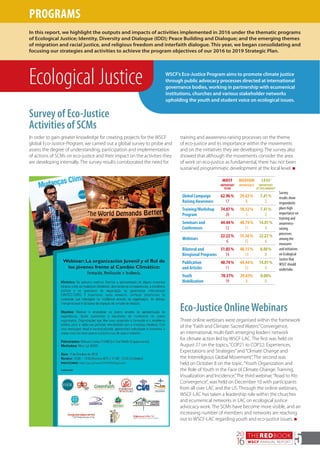
Survey of Eco-Justice
Activities of SCMs
In this report, we highlight the outputs and impacts of activities implemented in 2016 under the thematic programs
of Ecological Justice; Identity, Diversity and Dialogue (IDD); Peace Building and Dialogue; and the emerging themes
of migration and racial justice, and religious freedom and interfaith dialogue. This year, we began consolidating and
focusing our strategies and activities to achieve the program objectives of our 2016 to 2019 Strategic Plan.
MOST MEDIUM *LESS*
IMPORTANT
TO DO
IMPORTANCE IMPORTANT
AT THIS MOMENT
Global Campaign
Raising Awareness
62.96 %
17
29.63 %
8
7.41 %
2
Training/Workshop
Program
74.07 %
20
18.52 %
5
7.41 %
2
Seminars and
Conferences
44.44 %
12
40.74 %
11
14.81 %
4
Webinars
22.22 %
6
55.56 %
15
22.22 %
6
Bilateral and
Biregional Programs
51.85 %
14
48.15 %
13
0.00 %
0
Publication
and Articles
40.74 %
11
44.44 %
12
14.81 %
4
Youth
Mobilization
70.37%
19
29.63%
8
0.00%
0
In order to gain greater knowledge for creating projects for the WSCF
global Eco-Justice Program, we carried out a global survey to probe and
assess the degree of understanding, participation and implementation
of actions of SCMs on eco-justice and their impact on the activities they
are developing internally. The survey results corroborated the need for
training and awareness-raising processes on the theme
of eco-justice and its importance within the movements
and on the initiatives they are developing. The survey also
showed that although the movements consider the area
of work on eco-justice as fundamental, there has not been
sustained programmatic development at the local level. n
Survey
results show
respondents
place high
importance on
training and
awareness-
raising
processes
among the
measures
and initiatives
on Ecological
Justice that
WSCF should
undertake.
THEREDBOOK
WSCF ANNUAL REPORT
20
166
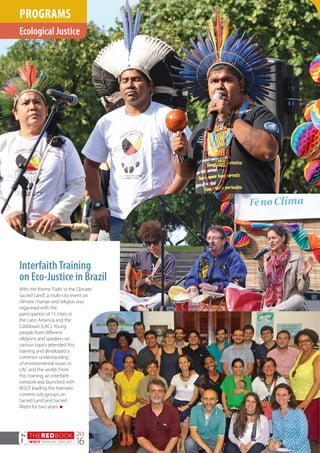
InterfaithTraining
on Eco-Justice in Brazil
With the theme“Faith in the Climate:
Sacred Land”, a multi-city event on
climate change and religion was
organised with the
participation of 15 cities in
the Latin America and the
Caribbean (LAC). Young
people from different
religions and speakers on
various topics attended this
training and developed a
common understanding
of environmental issues in
LAC and the world. From
this training, an interfaith
network was launched with
WSCF leading the thematic
content sub-groups on
Sacred Land and Sacred
Water for two years. n
Ecological Justice
PROGRAMS
THEREDBOOK
WSCF ANNUAL REPORT
20
16 7
Elevating the youth voice in global
advocacy platforms on eco-justice
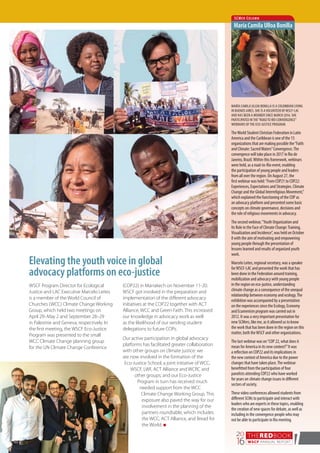
MARÍA CAMILA ULLOA BONILLA IS A COLOMBIAN LIVING
IN BUENOS AIRES. SHE IS AVOLUNTEER OFWSCF-LAC
AND HAS BEEN A MEMBER SINCE MARCH 2016. SHE
PARTICIPATED INTHE“ROADTO RÍO CONVERGENCE”
WEBINARS OFTHE ECO-JUSTICE PROGRAM.
TheWorld Student Christian Federation in Latin
America and the Caribbean is one of the 15
organizations that are making possible the“Faith
and Climate: SacredWaters”Convergence.The
convergence will take place in 2017 in Rio de
Janeiro, Brazil.Within this framework, webinars
were held, as a road-to-Rio event, enabling
the participation of young people and leaders
from all over the region. On August 27, the
first webinar was held:“From COP21 to COP22:
Experiences, Expectations and Strategies. Climate
Change and the Global Interreligious Movement,”
which explained the functioning of the COP as
an advocacy platform and presented some basic
concepts on climate governance, decisions and
the role of religious movements in advocacy.
The second webinar,“Youth Organization and
Its Role in the Face of Climate Change:Training,
Visualization and Incidence”, was held on October
8 with the aim of motivating and empowering
young people through the presentation of
lessons learned and results of organized youth
work.
Marcelo Leites, regional secretary, was a speaker
forWSCF-LAC and presented the work that has
been done in the Federation around training,
mobilization and advocacy with young people
in the region on eco-justice, understanding
climate change as a consequence of the unequal
relationship between economy and ecology.The
exhibition was accompanied by a presentation
on the experiences since the Ecology, Economy
and Ecumenism program was carried out in
2012. It was a very important presentation for
new SCMers, like me, as it allowed us to know
the work that has been done in the region on this
matter, both theWSCF and other organizations.
The last webinar was on“COP 22, what does it
mean for America in its new context?”It was
a reflection on COP22 and its implications in
the new context of America due to the power
changes that have taken place.The webinar
benefitted from the participation of four
panelists attending COP22 who have worked
for years on climate change issues in different
sectors of society.
These video conferences allowed students from
different SCMs to participate and interact with
leaders who are experts in these topics, enabling
the creation of new spaces for debate, as well as
including in the convergence people who may
not be able to participate in Rio meeting.
SCMer Column
María Camila Ulloa Bonilla
WSCF Program Director for Ecological
Justice and LAC Executive Marcelo Leites
is a member of the World Council of
Churches (WCC) Climate Change Working
Group, which held two meetings on
April 29–May 2 and September 28–29
in Palestine and Geneva, respectively. In
the first meeting, the WSCF Eco-Justice
Program was presented to the small
WCC Climate Change planning group
for the UN Climate Change Conference
(COP22) in Marrakech on November 11-20.
WSCF got involved in the preparation and
implementation of the different advocacy
initiatives at the COP22 together with ACT
Alliance, WCC and Green Faith. This increased
our knowledge in advocacy work as well
as the likelihood of our sending student
delegations to future COPs.
Our active participation in global advocacy
platforms has facilitated greater collaboration
with other groups on climate justice: we
are now involved in the formation of the
Eco-Justice School, a joint initiative of WCC,
WSCF, LWF, ACT Alliance and WCRC and
other groups; and our Eco-Justice
Program in turn has received much
needed support from the WCC
Climate Change Working Group. This
exposure also paved the way for our
involvement in the planning of the
partners roundtable, which includes
the WCC, ACT Alliance, and Bread for
the World. n
THEREDBOOK
WSCF ANNUAL REPORT
20
168
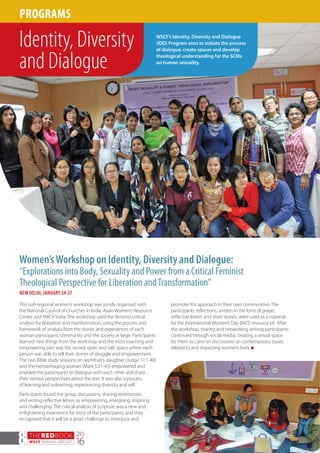
This sub-regional women’s workshop was jointly organised with
the National Council of Churches in India, Asian Women’s Resource
Center and YMCA India. The workshop used the feminist critical
analysis for liberation and transformation, using the process and
framework of analysis from the stories and experiences of each
woman participant, community and the society at large. Participants
learned new things from the workshop and the most touching and
empowering part was the sacred, open and safe space where each
person was able to tell their stories of struggle and empowerment.
The two Bible study sessions on Jephthah’s daughter (Judge 11:1-40)
and the hemorrhaging woman (Mark 5:21-43) empowered and
enabled the participants to dialogue with each other and share
their various perspectives about the text. It was also a process
of learning and unlearning, experiencing diversity and self.
Participants found the group discussions, sharing testimonies
and writing reflective letters as empowering, energising, inspiring
and challenging. The critical analysis of scripture was a new and
enlightening experience for most of the participants, and they
recognised that it will be a great challenge to introduce and
PROGRAMS
WSCF’s Identity, Diversity and Dialogue
(IDD) Program aims to initiate the process
of dialogue, create spaces and develop
theological understanding for the SCMs
on human sexuality.
Identity, Diversity
and Dialogue
Women’sWorkshop on Identity, Diversity and Dialogue:
“Explorations into Body, Sexuality and Power from a Critical Feminist
Theological Perspective for Liberation andTransformation”
NEW DELHI, JANUARY 24-27
promote this approach in their own communities. The
participants reflections, written in the form of prayer,
reflective letters and short stories, were used as a material
for the International Women’s Day (IWD) resource kit. After
the workshop, sharing and networking among participants
continued through social media, creating a virtual space
for them to carry on discussions on contemporary issues
related to and impacting women’s lives. n
9
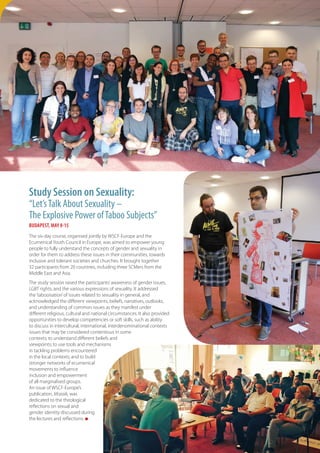
Study Session on Sexuality:
“Let’sTalk About Sexuality –
The Explosive Power ofTaboo Subjects”
BUDAPEST, MAY 8-15
The six-day course, organised jointly by WSCF-Europe and the
Ecumenical Youth Council in Europe, was aimed to empower young
people to fully understand the concepts of gender and sexuality in
order for them to address these issues in their communities, towards
inclusive and tolerant societies and churches. It brought together
32 participants from 20 countries, including three SCMers from the
Middle East and Asia.
The study session raised the participants’awareness of gender issues,
LGBT rights, and the various expressions of sexuality. It addressed
the‘tabooisation’of issues related to sexuality in general, and
acknowledged the different viewpoints, beliefs, narratives, outlooks,
and understanding of common issues as they manifest under
different religious, cultural and national circumstances. It also provided
opportunities to develop competencies or soft skills, such as ability
to discuss in intercultural, international, interdenominational contexts
issues that may be considered contentious in some
contexts; to understand different beliefs and
viewpoints; to use tools and mechanisms
in tackling problems encountered
in the local contexts; and to build
stronger networks of ecumenical
movements to influence
inclusion and empowerment
of all marginalised groups.
An issue of WSCF-Europe’s
publication, Mozaik, was
dedicated to the theological
reflections on sexual and
gender identity discussed during
the lectures and reflections. n
THEREDBOOK
WSCF ANNUAL REPORT
20
1610
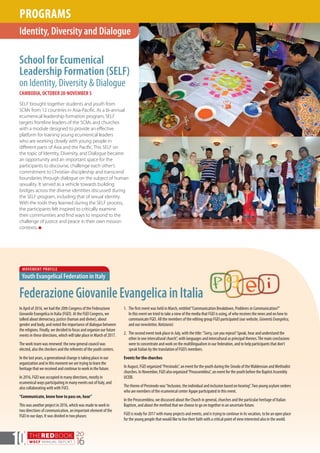
School for Ecumenical
Leadership Formation (SELF)
on Identity, Diversity & Dialogue
CAMBODIA, OCTOBER 20-NOVEMBER 5
SELF brought together students and youth from
SCMs from 12 countries in Asia-Pacific. As a bi-annual
ecumenical leadership formation program, SELF
targets frontline leaders of the SCMs and churches
with a module designed to provide an effective
platform for training young ecumenical leaders
who are working closely with young people in
different parts of Asia and the Pacific. This SELF on
the topic of Identity, Diversity, and Dialogue became
an opportunity and an important space for the
participants to discourse, challenge each other’s
commitment to Christian discipleship and transcend
boundaries through dialogue on the subject of human
sexuality. It served as a vehicle towards building
bridges across the diverse identities discussed during
the SELF program, including that of sexual identity.
With the tools they learned during the SELF process,
the participants felt inspired to critically examine
their communities and find ways to respond to the
challenge of justice and peace in their own mission
contexts. n
Identity, Diversity and Dialogue
PROGRAMS
MOVEMENT PROFILE
Youth Evangelical Federation in Italy
FederazioneGiovanileEvangelicainItalia
In April of 2016, we had the 20th Congress of the Federazione
Giovanile Evangelica in Italia (FGEI). At the FGEI Congress, we
talked about democracy, justice (human and divine), about
gender and body, and noted the importance of dialogue between
the religions. Finally, we decided to focus and organize our future
events in these directions, which will take place in March of 2017.
The work team was renewed: the new general council was
elected, also the checkers and the referents of the youth centers.
In the last years, a generational change is taking place in our
organization and in this moment we are trying to learn the
heritage that we received and continue to work in the future.
In 2016, FGEI was occupied in many directions, mostly in
ecumenical ways participating in many events out of Italy, and
also collaborating with with FUCI.
“Communicate, know how to pass on, hear”
This was another project in 2016, which was made to work in
two directions of communication, an important element of the
FGEI in our days. It was divided in two phases:
1.	 The first event was held in March, entitled“Communication Breakdown, Problems in Communication?”
In this event we tried to take a view of the media that FGEI is using, of who receives the news and on how to
communicate FGEI. All the members of the editing group FGEI participated (our website, GioventùEvangelica,
and our newsletter, Notiziario)
2.	 The second event took place in July, with the title:“Sorry, can you repeat? Speak, hear and understand the
other in one intercultural church”, with languages and intercultural as principal themes.The main conclusions
were to concentrate and work on the multilingualism in our federation, and to help participants that don’t
speak Italian by the translation of FGEI’s members.
Events for the churches
In August, FGEI organized“Presinodo”, an event for the youth during the Sinodo of theWaldensian and Methodist
churches. In November, FGEI also organized“Preassemblea”, an event for the youth before the Baptist Assembly
UCEBI.
The theme of Presinodo was“Inclusion, the individual and inclusion based on hearing”.Two young asylum seekers
who are members of the ecumenical center Agape participated in this event.
In the Preassemblea, we discussed about the Church in general, churches and the particular heritage of Italian
Baptism, and about the method that we choose to go on together in an uncertain future.
FGEI is ready for 2017 with many projects and events, and is trying to continue in its vocation, to be an open place
for the young people that would like to live their faith with a critical point of view interested also in the world.
THEREDBOOK
WSCF ANNUAL REPORT
20
16 11
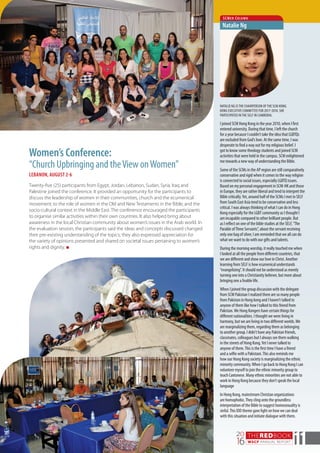
Women’s Conference:
“Church Upbringing and theView onWomen”
LEBANON, AUGUST 2-6
Twenty-five (25) participants from Egypt, Jordan, Lebanon, Sudan, Syria, Iraq and
Palestine joined the conference. It provided an opportunity for the participants to
discuss the leadership of women in their communities, church and the ecumenical
movement; to the role of women in the Old and New Testaments in the Bible; and the
socio-cultural context in the Middle East. The conference encouraged the participants
to organise similar activities within their own countries. It also helped bring about
awareness in the local Christian community about women’s issues in the Arab world. In
the evaluation session, the participants said the ideas and concepts discussed changed
their pre-existing understanding of the topics; they also expressed appreciation for
the variety of opinions presented and shared on societal issues pertaining to women’s
rights and dignity. n
NATALIE NG ISTHE CHAIRPERSON OFTHE SCM HONG
KONG EXECUTIVE COMMITTEE FOR 2017-2018. SHE
PARTICIPATED INTHE SELF IN CAMBODIA.
I joined SCM Hong Kong in the year 2010, when I first
entered university. During that time, I left the church
for a year because I couldn’t take the idea that LGBTQs
are excluded from God’s love. At the same time, I was
desperate to find a way out for my religious belief. I
got to know some theology students and joined SCM
activities that were held in the campus. SCM enlightened
me towards a new way of understanding the Bible.
Some of the SCMs in the AP region are still comparatively
conservative and rigid when it comes to the way religion
is connected to social issues, especially LGBTQ issues.
Based on my personal engagement in SCM-HK and those
in Europe, they are rather liberal and tend to interpret the
Bible critically.Yet, around half of the SCMs I met in SELF
from South East Asia tend to be conservative and less
critical. I was always thinking of what I can do in Hong
Kong especially for the LGBT community as I thought I
am incapable compared to other brilliant people. But
as I reflect on one of the bible studies at the SELF,“The
Parable ofThree Servants”, about the servant receiving
only one bag of silver, I am reminded that we all can do
what we want to do with our gifts and talents.
During the morning worship, it really touched me when
I looked at all the people from different countries, that
we are different and show our love in Christ. Another
learning from SELF is how ecumenical understands
“evangelizing”. It should not be understood as merely
turning one into a Christianity believer, but more about
bringing one a livable life.
When I joined the group discussion with the delegate
from SCM Pakistan I realized there are so many people
from Pakistan in Hong kong and I haven’t talked to
anyone of them like how I talked to this friend from
Pakistan.We Hong Kongers have certain things for
different nationalities. I thought we were living in
harmony, but we are living in two different worlds.We
are marginalizing them, regarding them as belonging
to another group. I didn’t have any Pakistan friends,
classmates, colleagues but I always see them walking
in the streets of Hong Kong.Yet I never talked to
anyone of them.This is the first time I have a friend
and a selfie with a Pakistani.This also reminds me
how our Hong Kong society is marginalizing the ethnic
minority community.When I go back to Hong Kong I can
volunteer myself to join the ethnic minority group to
teach Cantonese. Many ethnic minorities are not able to
work in Hong Kong because they don’t speak the local
language
In Hong Kong, mainstream Christian organizations
are homophobic.They cling onto the groundless
interpretation of the Bible to suggest homosexuality is
sinful.This IDD theme gave light on how we can deal
with this situation and initiate dialogue with them.
SCMer Column
Natalie Ng
THEREDBOOK
WSCF ANNUAL REPORT
20
1612
WSCF’s Peace Building and Dialogue Program
aims to mobilise the Federation on issues
pertaining to overcoming violence and
building peace with a focus on the situations
in the Middle East and Colombia.
Peace Building
and Dialogue
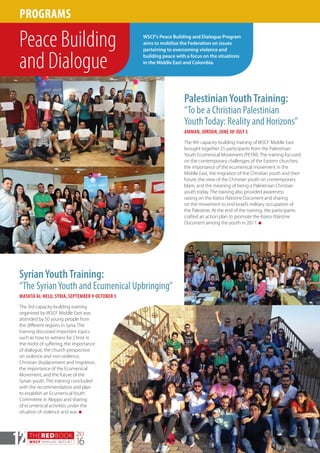
PalestinianYouthTraining:
“To be a Christian Palestinian
YouthToday: Reality and Horizons”
AMMAN, JORDAN, JUNE 30-JULY 3
The 9th capacity-building training of WSCF Middle East
brought together 25 participants from the Palestinian
Youth Ecumenical Movement (PEYM). The training focused
on the contemporary challenges of the Eastern churches,
the importance of the ecumenical movement in the
Middle East, the migration of the Christian youth and their
future, the view of the Christian youth on contemporary
Islam, and the meaning of being a Palestinian Christian
youth today. The training also provided awareness
raising on the Kairos Palestine Document and sharing
on the movement to end Israel’s military occupation of
the Palestine. At the end of the training, the participants
crafted an action plan to promote the Kairos Palestine
Document among the youth in 2017. n
The 3rd capacity-building training
organised by WSCF Middle East was
attended by 50 young people from
the different regions in Syria. The
training discussed important topics
such as how to witness for Christ in
the midst of suffering, the importance
of dialogue, the church perspective
on violence and non-violence,
Christian displacement and migration,
the importance of the Ecumenical
Movement, and the future of the
Syrian youth. The training concluded
with the recommendation and plan
to establish an Ecumenical Youth
Committee in Aleppo and sharing
of ecumenical activities under the
situation of violence and war. n
PROGRAMS
SyrianYouthTraining:
“The SyrianYouth and Ecumenical Upbringing”
MASHTA AL-HELU, SYRIA, SEPTEMBER 9-OCTOBER 3
THEREDBOOK
WSCF ANNUAL REPORT
20
16 13
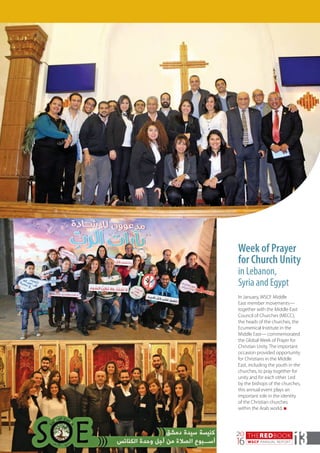
Week of Prayer
for Church Unity
in Lebanon,
Syria and Egypt
In January, WSCF Middle
East member movements—
together with the Middle East
Council of Churches (MECC),
the heads of the churches, the
Ecumenical Institute in the
Middle East— commemorated
the Global Week of Prayer for
Christian Unity. The important
occasion provided opportunity
for Christians in the Middle
East, including the youth in the
churches, to pray together for
unity and for each other. Led
by the bishops of the churches,
this annual event plays an
important role in the identity
of the Christian churches
within the Arab world. n
THEREDBOOK
WSCF ANNUAL REPORT
20
1614
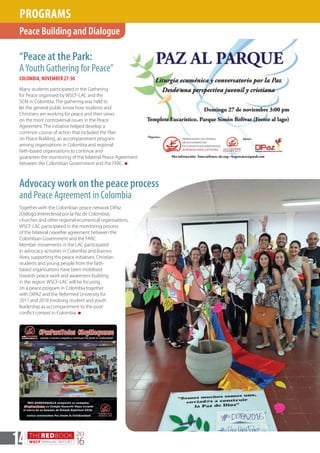
“Peace at the Park:
AYouth Gathering for Peace”
COLOMBIA, NOVEMBER 27-30
Many students participated in the Gathering
for Peace organised by WSCF-LAC and the
SCM in Colombia. The gathering was held to
let the general public know how students and
Christians are working for peace and their views
on the most controversial issues in the Peace
Agreement. The initiative helped develop a
common course of action that included the Plan
on Peace Building, an accompaniment program
among organisations in Colombia and regional
faith-based organisations to continue and
guarantee the monitoring of the bilateral Peace Agreement
between the Colombian Government and the FARC. n
Together with the Colombian peace network DiPaz
(Diálogo Intereclesial por la Paz de Colombia),
churches and other regional ecumenical organisations,
WSCF-LAC participated in the monitoring process
of the bilateral ceasefire agreement between the
Colombian Government and the FARC.
Member movements in the LAC participated
in advocacy activities in Colombia and Buenos
Aires, supporting the peace initiatives. Christian
students and young people from the faith-
based organisations have been mobilised
towards peace work and awareness-building
in the region. WSCF-LAC will be focusing
on a peace program in Colombia together
with DiPAZ and the Reformed University for
2017 and 2018 involving student and youth
leadership as accompaniment to the post-
conflict context in Colombia. n
Peace Building and Dialogue
PROGRAMS
Advocacy work on the peace process
and Peace Agreement in Colombia
THEREDBOOK
WSCF ANNUAL REPORT
20
16 15
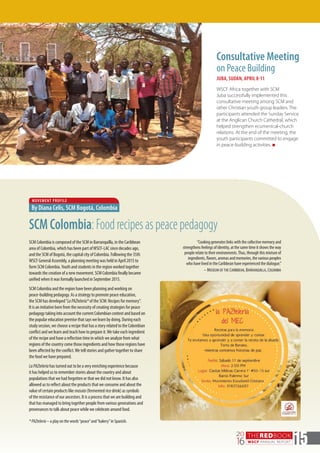
Consultative Meeting
on Peace Building
JUBA, SUDAN, APRIL 8-11
WSCF Africa together with SCM
Juba successfully implemented this
consultative meeting among SCM and
other Christian youth group leaders. The
participants attended the Sunday Service
at the Anglican Church Cathedral, which
helped strengthen ecumenical-church
relations. At the end of the meeting, the
youth participants committed to engage
in peace-building activities. n
MOVEMENT PROFILE
By Diana Celis, SCM Bogotá, Colombia
SCMColombia:Foodrecipesaspeacepedagogy
SCM Colombia is composed of the SCM in Barranquilla, in the Caribbean
area of Colombia, which has been part ofWSCF-LAC since decades ago,
and the SCM of Bogotá, the capital city of Colombia. Following the 35th
WSCF General Assembly, a planning meeting was held in April 2015 to
form SCM Colombia.Youth and students in the region worked together
towards the creation of a new movement. SCM Colombia finally became
unified when it was formally launched in September 2015.
SCM Colombia and the region have been planning and working on
peace-building pedagogy. As a strategy to promote peace education,
the SCM has developed“LaPAZtelería*of the SCM: Recipes for memory”.
It is an initiative born from the necessity of creating strategies for peace
pedagogy taking into account the current Colombian context and based on
the popular education premise that says we learn by doing. During each
study session, we choose a recipe that has a story related to the Colombian
conflict and we learn and teach how to prepare it.We take each ingredient
of the recipe and have a reflection time in which we analyze from what
regions of the country come those ingredients and how those regions have
been affected by the conflict.We tell stories and gather together to share
the food we have prepared.
LaPAZtelería has turned out to be a very enriching experience because
it has helped us to remember stories about the country and about
populations that we had forgotten or that we did not know. It has also
allowed us to reflect about the products that we consume and about the
value of certain products like masato (fermented rice drink) as symbols
of the resistance of our ancestors. It is a process that we are building and
that has managed to bring together people from various generations and
provenances to talk about peace while we celebrate around food.
*PAZtelería– a play on the words“peace”and“bakery”in Spanish.
“Cooking generates links with the collective memory and
strengthens feelings of identity, at the same time it shows the way
people relate to their environments.Thus, through this mixture of
ingredients, flavors, aromas and memories, the various peoples
who have lived in the Caribbean have experienced the dialogue.”
– Museum of the Caribbean, Barranquilla, Colombia
THEREDBOOK
WSCF ANNUAL REPORT
20
1616
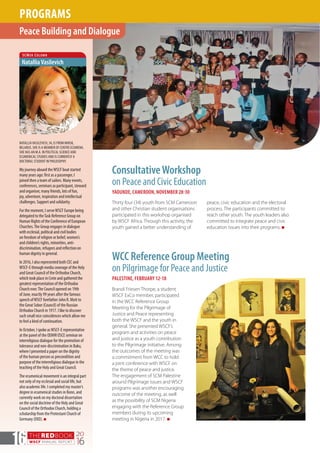
ConsultativeWorkshop
on Peace and Civic Education
YAOUNDE, CAMEROON, NOVEMBER 28-30
Thirty four (34) youth from SCM Cameroon
and other Christian student organisations
participated in this workshop organised
by WSCF Africa. Through this activity, the
youth gained a better understanding of
NATALLIAVASILEVICH, 34, IS FROM MINSK,
BELARUS. SHE IS A MEMBER OF CENTRE ECUMENA.
SHE HAS AN M.A. IN POLITICAL SCIENCE AND
ECUMENICAL STUDIES AND IS CURRENTLY A
DOCTORAL STUDENT IN PHILOSOPHY.
My journey aboard theWSCF boat started
many years ago: first as a passenger, I
joined then a team of sailors. Many events,
conferences, seminars as participant, steward
and organiser, many friends, lots of fun,
joy, adventure, inspiration and intellectual
challenges. Support and solidarity.
For the moment, I serveWSCF Europe being
delegated to theTask Reference Group on
Human Rights of the Conference of European
Churches.The Group engages in dialogue
with ecclesial, political and civil bodies
on freedom of religion or belief, women’s
and children’s rights, minorities, anti-
discrimination, refugees and reflection on
human dignity in general.
In 2016, I also represented both CEC and
WSCF-E through media coverage of the Holy
and Great Council of the Orthodox Church,
which took place in Crete and gathered the
greatest representation of the Orthodox
Church ever.The Council opened on 19th
of June, exactly 99 years after the famous
speech ofWSCF forefather John R. Mott to
the Great Sobor (Council) of the Russian
Orthodox Church in 1917. I like to discover
such small nice coincidences which allow me
to feel a kind of continuation.
In October, I spoke asWSCF-E representative
at the panel of the ODIHR OSCE seminar on
interreligious dialogue for the promotion of
tolerance and non-discrimination in Baku,
where I presented a paper on the dignity
of the human person as precondition and
purpose of the interreligious dialogue in the
teaching of the Holy and Great Council.
The ecumenical movement is an integral part
not only of my ecclesial and social life, but
also academic life. I completed my master’s
degree in ecumenical studies in Bonn, and
currently work on my doctoral dissertation
on the social doctrine of the Holy and Great
Council of the Orthodox Church, holding a
scholarship from the Protestant Church of
Germany (EKD). n
SCMer Column
NatalliaVasilevich
Brandi Friesen Thorpe, a student
WSCF ExCo member, participated
in the WCC Reference Group
Meeting for the Pilgrimage of
Justice and Peace representing
both the WSCF and the youth in
general. She presented WSCF’s
program and activities on peace
and justice as a youth contribution
to the Pilgrimage initiative. Among
the outcomes of the meeting was
a commitment from WCC to hold
a joint conference with WSCF on
the theme of peace and justice.
The engagement of SCM Palestine
around Pilgrimage issues and WSCF
programs was another encouraging
outcome of the meeting, as well
as the possibility of SCM Nigeria
engaging with the Reference Group
members during its upcoming
meeting in Nigeria in 2017. n
Peace Building and Dialogue
PROGRAMS
WCC Reference Group Meeting
on Pilgrimage for Peace and Justice
PALESTINE, FEBRUARY 12-18
peace, civic education and the electoral
process. The participants committed to
reach other youth. The youth leaders also
committed to integrate peace and civic
education issues into their programs. n
THEREDBOOK
WSCF ANNUAL REPORT
20
16 17
Emerging themes and other programs
Inter-Regional Leadership
Training Program (IRLTP):
“Youth Agenda in Advocating for
Migrant and Refugee Rights and
Its Intersection with Racial Justice”
DHAKA, BANGLADESH, DECEMBER 1-6
With Migrants (CWWM) and the
International Migrants Alliance
(IMA) exist where they can channel
their local advocacy work knowing
that other movements will be
advocating in solidarity with them
wherever they are in the world.
New and emerging issues came
out from various discussions in
the program such as the need for
intersectionality as a framework of
analysis on migrant and refugee
issues (with LGBTI, race and color,
for example) in order to mobilise
more groups advocating for
migrant and refugee rights; the
articulation of a“spirituality of
advocacy”that is specific to church
or ecumenical groups; responding
to the challenge of building migrant
centers and decriminalisation of
migrants and refugees; and the
plight of so-called‘stateless’people
such as Rohingyas and the Adivasi
or indigenous people. n
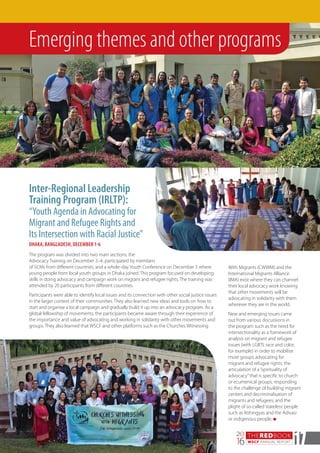
The program was divided into two main sections, the
Advocacy Training on December 2–4, participated by members
of SCMs from different countries, and a whole-day Youth Conference on December 5 where
young people from local youth groups in Dhaka joined. This program focused on developing
skills in doing advocacy and campaign work on migrant and refugee rights. The training was
attended by 20 participants from different countries.
Participants were able to identify local issues and its connection with other social justice issues
in the larger context of their communities. They also learned new ideas and tools on how to
start and organise a local campaign and gradually build it up into an advocacy program. As a
global fellowship of movements, the participants became aware through their experience of
the importance and value of advocating and working in solidarity with other movements and
groups. They also learned that WSCF and other platforms such as the Churches Witnessing
THEREDBOOK
WSCF ANNUAL REPORT
20
1618
Recently, I was given the opportunity to explore this
interest through theWSCF North America when I attended
the Border Solidarity and SOA Convergence trip at the
U.S.-Mexico border in and around Arizona.There is still much
that I’m trying to wrap my head around in reference to that
trip but it’s fair to say that I have much to learn. I thought I
knew how bad the U.S. immigration system was, because
of the stories I had heard from undocumented family and
migrant clients, but this trip opened up my eyes to the awful
ways that migrants crossing the U.S.-Mexico border are
subjected to. Every one of their basic human rights are being
violated in the name of national safety and security and are
left with no course of action to seek justice afterward.
On a personal faith level, this work has driven me to reclaim
the identity given to me by God—as a woman of color,
Mexican and American, bilingual English/Spanish speaker,
documented, US citizen—in this particular time and place
in history, and to ask, what, Lord, does it mean that you
created me this way? And on another level, I am motivated
to do this work because the Lord requires it of me to do
justice and love mercy, and to love my neighbor as myself.
Emerging themes and other programs
PROGRAMS
A delegation of 10 young adults and students
from across the United States immersed in
migrant justice issues such as border patrol
violence, economic reasons for forced migration,
US and Mexico trade and migration policies,
deportations and incarceration of migrants, and
deaths of migrants in the desert. The American
Waldensian Society sponsored the participation
of one student from the Italian SCM and a
young adult working for Mediterranean Hope,
an observatory for migrant justice supported
by the Italian Federation of Protestant Churches
and operating on the island of Lampedusa, a
border island in the Mediterranean Sea where
many migrants travel from North Africa seeking
refuge from war, violence, repression and poverty.
Participants had the opportunity to link their
experience to new theological insights and to
engage in the planning of future WSCF advocacy
work on migrant and refugee issues. n
ELIZABETH RUEDA-HERRERA IS A MEMBER
OF SCM USA AND QUEST CHURCH
(EVANGELICAL COVENANT CHURCH) IN
SEATTLE,WA. SHE PARTICIPATED INTHE
WSCF-NA BORDER SOLIDARITY PROGRAM
IN MEXICO ANDTHE IRLTP IN DHAKA.
SCMer Column
ElizabethRueda-Herrera
U.S.-Mexico Border Solidarity Program
and School of the Americas Convergence
ARIZONA, USA, OCTOBER 1-11
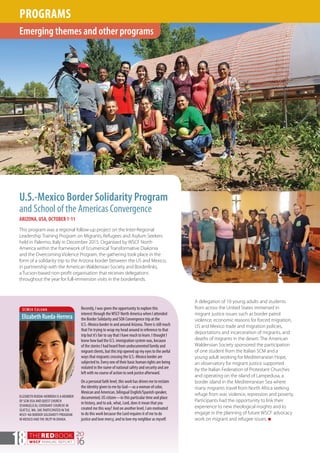
This program was a regional follow-up project on the Inter-Regional
Leadership Training Program on Migrants, Refugees and Asylum Seekers
held in Palermo, Italy in December 2015. Organised by WSCF North
America within the framework of Ecumenical Transformative Diakonia
and the Overcoming Violence Program, the gathering took place in the
form of a solidarity trip to the Arizona border between the US and Mexico,
in partnership with the American Waldensian Society and Borderlinks,
a Tucson-based non-profit organisation that receives delegations
throughout the year for full-immersion visits in the borderlands.
THEREDBOOK
WSCF ANNUAL REPORT
20
16 19
Christian-Muslim Dialogue Conference:
“Religious Freedom in the ArabWorld”
BROUMANA, LEBANON, OCTOBER 12-16
WASSIM EL SAKHLEH IS A SYRIAN MUSLIM
WHO PARTICIPATED INTHE MUSLIM-CHRISTIAN
CONFERENCE IN LEBANON.
A creative journey!The invitation to the
conference was exciting for me. I have
experienced dozens of meetings and
workshops regarding interfaith dialogue,
however this is the first conference that has
been as clear and detailed.The conflicts
that are happening today puts us at a risk
of losing our identity and ripping it apart.
This is why these conferences come as a
support for our social and civil work in our
countries.
“The Christian and MuslimYouths... the
Religious Freedom in the ArabWorld”
This is one of the most exciting topics for
me: the religions in the Middle East, for me,
are not autonomous and open for anyone
and abstract; they are deeply entangled
with history, the land, the past, and the
consciousness of the people who roamed
the land.
The program seemed rich and varied. On
the first day, the participants looked as
if they know one another. Hours later, I
started introducing myself to them, and
go to know them better. I discovered that
we are all working in the same field, on
similar issues, yet in different countries.
Each session was a genuine intellectual
journey.The five days formed a spiritual
journey between the participants coming
from an array of religious affiliations and
nationalities. For me, the sessions added
plenty of new things to my knowledge,
but I have to admit that those little chats,
discussions, breaks between sessions, and
the long evenings were the richest part of
the experience.
Even today, impressions from this meeting
drive our work in the service of peace for
humanity.This meeting was not only a
spiritual and intellectual experience, but
also a life experience through which I got
to meet new friends, brothers and sisters,
who are now part of my entourage, with
whom I can share what I feel and what I
aim to do.
This conference will always be a stepping
stone in my passion for religious diversity.
I am grateful for my friend Katy who invited
me to the conference, and to theWSCF and
its staff for holding such novel activities.
Understanding the Other’s religion is the
basis for preserving our common culture.
A Muslim youth’s perspective
Wassim El Sakhleh
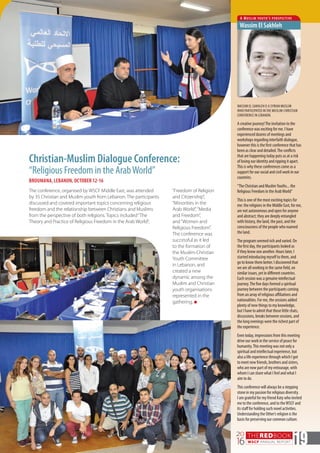
The conference, organised by WSCF Middle East, was attended
by 35 Christian and Muslim youth from Lebanon. The participants
discussed and covered important topics concerning religious
freedom and the relationship between Christians and Muslims
from the perspective of both religions. Topics included“The
Theory and Practice of Religious Freedom in the Arab World”,
“Freedom of Religion
and Citizenship”,
“Minorities in the
Arab World”,“Media
and Freedom”,
and“Women and
Religious Freedom”.
The conference was
successful as it led
to the formation of
the Muslim-Christian
Youth Committee
in Lebanon, and
created a new
dynamic among the
Muslim and Christian
youth organisations
represented in the
gathering. n
THEREDBOOK
WSCF ANNUAL REPORT
20
1620
Emerging themes and other programs
PROGRAMS
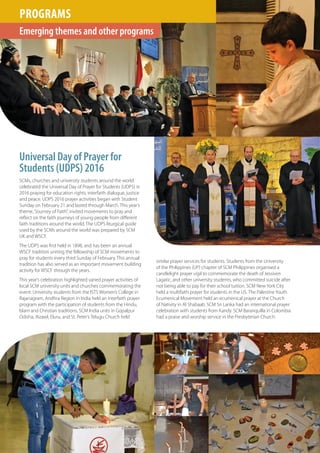
SCMs, churches and university students around the world
celebrated the Universal Day of Prayer for Students (UDPS) in
2016 praying for education rights, interfaith dialogue, justice
and peace. UDPS 2016 prayer activities began with Student
Sunday on February 21 and lasted through March. This year’s
theme,“Journey of Faith”, invited movements to pray and
reflect on the faith journeys of young people from different
faith traditions around the world. The UDPS liturgical guide
used by the SCMs around the world was prepared by SCM
UK and WSCF.
The UDPS was first held in 1898, and has been an annual
WSCF tradition uniting the fellowship of SCM movements to
pray for students every third Sunday of February. This annual
tradition has also served as an important movement building
activity for WSCF through the years.
This year’s celebration highlighted varied prayer activities of
local SCM university units and churches commemorating the
event. University students from the ISTS Women’s College in
Rajanagram, Andhra Region in India held an interfaith prayer
program with the participation of students from the Hindu,
Islam and Christian traditions. SCM India units in Gopalpur
Odisha, Aizawl, Eluru, and St. Peter’s Telugu Church held
Universal Day of Prayer for
Students (UDPS) 2016
similar prayer services for students. Students from the University
of the Philippines (UP) chapter of SCM Philippines organised a
candlelight prayer vigil to commemorate the death of Jessiven
Lagatic, and other university students, who committed suicide after
not being able to pay for their school tuition. SCM New York City
held a multifaith prayer for students in the US. The Palestine Youth
Ecumenical Movement held an ecumenical prayer at the Church
of Nativity in Al Shabaab. SCM Sri Lanka had an international prayer
celebration with students from Kandy. SCM Baranquilla in Colombia
had a praise and worship service in the Presbyterian Church.
THEREDBOOK
WSCF ANNUAL REPORT
20
16 21
MOVEMENT HIGHLIGHTS
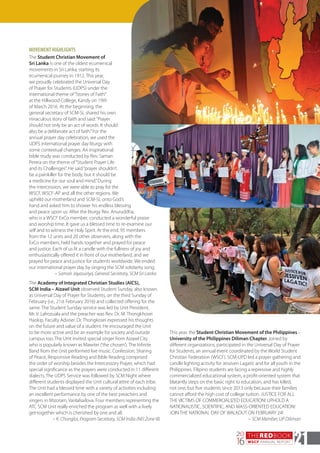
The Student Christian Movement of
Sri Lanka is one of the oldest ecumenical
movements in Sri Lanka, starting its
ecumenical journey in 1912. This year,
we proudly celebrated the Universal Day
of Prayer for Students (UDPS) under the
international theme of“Stories of Faith”
at the Hillwood College, Kandy on 19th
of March 2016. At the beginning, the
general secretary of SCM-SL shared his own
miraculous story of faith and said:“Prayer
should not only be an act of words. It should
also be a deliberate act of faith.”For the
annual prayer day celebration, we used the
UDPS international prayer day liturgy with
some contextual changes. An inspirational
bible study was conducted by Rev. Saman
Perera on the theme of“Student Prayer Life
and its Challenges”. He said“prayer shouldn’t
be a painkiller for the body, but it should be
a medicine for our soul and mind.”During
the intercession, we were able to pray for the
WSCF, WSCF-AP and all the other regions. We
upheld our motherland and SCM-SL onto God’s
hand and asked him to shower his endless blessing
and peace upon us. After the liturgy Rev. Anuruddha,
who is a WSCF ExCo member, conducted a wonderful praise
and worship time. It gave us a blessed time to re-examine our
self and to witness the Holy Spirit. At the end, 95 members
from the 12 units and 20 other observers, along with the
ExCo members, held hands together and prayed for peace
and justice. Each of us lit a candle with the fullness of joy and
enthusiastically offered it in front of our motherland, and we
prayed for peace and justice for students worldwide. We ended
our international prayer day by singing the SCM solidarity song.
– Saman Jayasuriya, General Secretary, SCM Sri Lanka
The Academy of Integrated Christian Studies (AICS),
SCM India – Aizawl Unit observed Student Sunday, also known
as Universal Day of Prayer for Students, on the third Sunday of
February (i.e., 21st February 2016) and collected offering for the
same. The Student Sunday service was led by Unit President,
Mr. V. Lalrozuala and the preacher was Rev. Dr. M. Thongkhosei
Haokip, Faculty Adviser. Dr. Thongkosei expressed his thoughts
on the future and value of a student. He encouraged the Unit
to be more active and be an example for society and outside
campus too. The Unit invited special singer from Aizawl City
who is popularly known as Mawitei (‘the chosen’). The Infinite
Band from the Unit performed live music. Confession, Sharing
of Peace, Responsive Reading and Bible Reading comprised
the order of worship besides the Intercessory Prayer, which had
special significance as the prayers were conducted in 11 different
dialects. The UDPS Service was followed by SCM Night where
different students displayed the Unit cultural attire of each tribe.
The Unit had a blessed time with a variety of activities including
an excellent performance by one of the best preachers and
singers in Mizoram, Vanlalsailova. Four members representing the
ATC SCM Unit really enriched the program as well with a lively
get-together which is cherished by one and all.
– K. Chongloi, Program Secretary, SCM India (NEI Zone III)
This year, the Student Christian Movement of the Philippines –
University of the Philippines Diliman Chapter, joined by
different organizations, participated in the Universal Day of Prayer
for Students, an annual event coordinated by the World Student
Christian Federation (WSCF). SCM-UPD led a prayer gathering and
candle lighting activity for Jessiven Lagatic and for all youth in the
Philippines. Filipino students are facing a repressive and highly
commercialized educational system, a profit-oriented system that
blatantly steps on the basic right to education, and has killed,
not one, but five students since 2013 only because their families
cannot afford the high cost of college tuition. JUSTICE FOR ALL
THE VICTIMS OF COMMERCIALIZED EDUCATION! UPHOLD A
NATIONALISTIC, SCIENTIFIC, AND MASS-ORIENTED EDUCATION!
JOIN THE NATIONAL DAY OF WALKOUT ON FEBRUARY 24!
– SCM Member, UP Diliman
THEREDBOOK
WSCF ANNUAL REPORT
20
1622
Africa
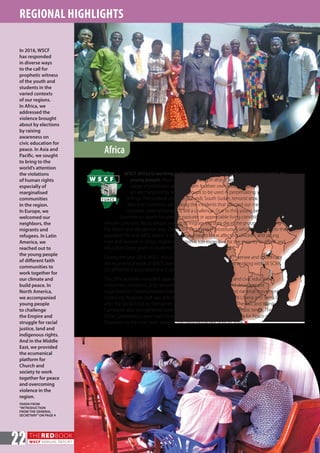
WSCF Africa is working in the context where little job opportunity exists for
young people. Most of them are living in abject poverty and they remain the
target of politicians who use them for their own selfish ambitions. Young people
are also targeted by terrorist groups to be used in perpetuating violence and
killings. The political unrest in Burundi, South Sudan, terrorist attacks in Nigeria,
Mali and Cameroon are among the incidents that affected our members in these
countries. Unemployment is still a challenge. Due to this, young people leave their
countries to search for greener pastures or appreciable living conditions outside the
African continent. Many people resolve to migrate but they die in the process of crossing
the desert and dangerous seas. Others are engaging in prostitution which contribute to the
spread of HIV and AIDS, which is still a serious health issue affecting children, and young
men and women in Africa. Higher education is too expensive for the majority to afford, and
education loans given to students have become a huge burden.
During the year 2016, WSCF Africa continued with its mandate to oversee and coordinate
the ecumenical work of WSCF, strengthening communication and working with 28 SCMs
(22 affiliated, 6 associated and 2 contacts).
The 2016 activities included capacity-building projects on peace and civic education,
movement visitations, and networking with other ecumenical and development
organisations. Communication between the WSCF Africa office and national movements has
improved. Regional staff was able to conduct solidarity visits to SCM Liberia and Sierra Leone
after the Ebola Crisis to strengthen and encourage SCM members. The visit and training in
Cameroon also strengthened communication especially in programmatic terms. The MEPC
(SCM Cameroon) is very much looking forward to bringing the agenda for Peace and Civic
Education to the next level: towards the presidential elections in 2018. n
REGIONAL HIGHLIGHTS
W S C F
FUACE
In 2016, WSCF
has responded
in diverse ways
to the call for
prophetic witness
of the youth and
students in the
varied contexts
of our regions.
In Africa, we
addressed the
violence brought
about by elections
by raising
awareness on
civic education for
peace. In Asia and
Pacific, we sought
to bring to the
world’s attention
the violations
of human rights
especially of
marginalised
communities
in the region.
In Europe, we
welcomed our
neighbors, the
migrants and
refugees. In Latin
America, we
reached out to
the young people
of different faith
communities to
work together for
our climate and
build peace. In
North America,
we accompanied
young people
to challenge
the Empire and
struggle for racial
justice, land and
indigenous rights.
And in the Middle
East, we provided
the ecumenical
platform for
Church and
society to work
together for peace
and overcoming
violence in the
region.
TAKEN FROM
“INTRODUCTION
FROM THE GENERAL
SECRETARY”ON PAGE 4
THEREDBOOK
WSCF ANNUAL REPORT
20
16 23
Asia-Pacific
After the 35th
General Assembly of
the WSCF and
in response
to one of its
mandates,
the WSCF-AP
region for the
first time initiated
a process of dialogue on the issue
of human sexuality, particularly on
homosexuality, with the members of
SCMs under the global theme,“Identity,
Diversity and Dialogue”. SELF, or the
School for Ecumenical Leadership
Formation, brought together members
of all the SCMs in the AP region to
discourse and dialogue theologically on
homosexuality. In Asia—being a diverse
continent in terms of culture, traditions,
practices, religious beliefs and laws—it
is common to have disagreement
and different opinions on the topic of
homosexuality among the SCMs in the
region. In this context, the SELF program
on IDD—which led to an agreement
to create space in the SCMs to initiate
dialogue on homosexuality—could be
considered an important milestone for
the region.
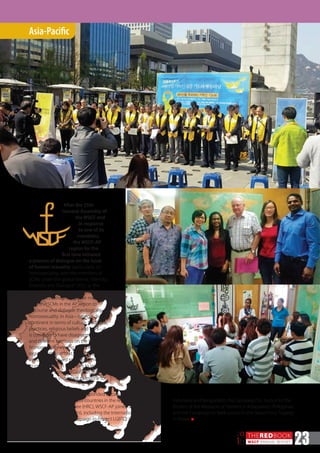
Indonesia and Bangladesh; the Campaign for Justice for the
Victims of the Massacre of Farmers in Kidapawan, Philippines;
and the Campaign to Seek Justice in the Sewol Ferry Tragedy
in Korea. n
The AP region also actively responded to calls against human
rights violations in different countries in the region. Led by its
Human Rights Committee (HRC), WSCF-AP joined and launched
several campaigns in 2016, including the International Women’s
Day Celebration: the Campaign to Protect LGBTQI Rights in
THEREDBOOK
WSCF ANNUAL REPORT
20
1624
REGIONAL HIGHLIGHTS
WSCF Europe
focused its work
on movement
strenthening
and capacity-
building for the
members in the region.
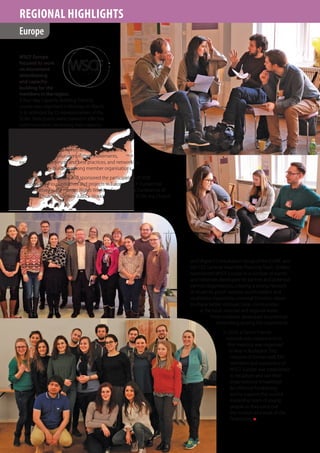
A four-day Capacity-Building Training
course was organised in Norway on March
2–6, attended by 22 representatives of the
SCMs. Participants were trained in effective
communication, increasing their capacity
to develop and run online campaigns for
social justice, and developed their skills
Europe
europe
WSCF
in building communities online. Young staff and
officers from the SCMs were trained in engagement
and working with volunteers in their movements,
exchanging experiences and best practices, and networking
and community-building among member organisations.
WSCF-Europe nominated and sponsored the participation of SCM
members at various initiatives and projects in Europe. WSCF-Europe has
representatives in the Human Rights Working Group of the Conference of
European Churches, the Eco-Justice Working Group of the ECEN, the Church
and Migrant Consultation Group of the CCME, and
the CEC General Assembly Planning Team. SCMers
represented WSCF Europe in a number of events
and initiatives developed by partner and potential
partner organisations, creating a strong network
of students, youth workers, youth leaders and
multipliers inspired by universal Christian values
to shape better, stronger, fairer communities
at the local, national and regional levels.
These initatives developed ecumenical
networking among the movements.
In 2016, a Senior Friends
network was created and its
first meeting was organised
in May in Budapest. This
network of former staff, ERC
members and supporters of
WSCF Europe was established
to recapture and use their
organisational knowledge
for effective fundraising
and to support the current
leadership team of young
people as they carry out
the mission and work of the
Federation. n
THEREDBOOK
WSCF ANNUAL REPORT
20
16 25
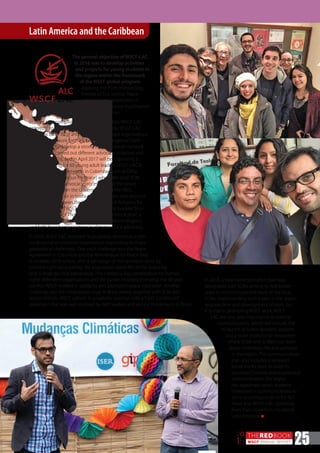
The general objective of WSCF-LAC
in 2016 was to develop activities
and projects for young students in
the region within the framework
of the WSCF global program,
applying the three intersecting
themes of Eco-Justice, Peace
and Interfaith Cooperation in
networking, resource mobilisation
and communication.
In order to accomplish the thematic priorities, WSCF-LAC
entered into new partnerships and networks. WSCF-LAC
joined six other local and regional faith-based organisations
in the LAC network for the interfaith Convergence“Faith
and Climate”to develop a strong interfaith youth network.
The network carried out different advocacy initiatives and
seminars in 2016, and in April 2017 will be organising a
regional training for 60 young adult leaders. WSCF-LAC is
also working with networks in Colombia, such as DiPaz
(Inter Ecclesial Dialogue for Peace) where the local SCM
accompanies the advocacy process toward the peace
agreement between the Government and the FARC.
Another big partner in terms of collaboration and resource
mobilisation has been the Youth Network of Religions for
Peace, with which WSCF jointly released the booklet“Eco-
Justice, Diversity of Thought towards Common Action”, a
promotional material about the role of different religions
and faith-based organisations in climate justice advocacy.
In 2016, WSCF-LAC renewed its prophetic witness as a non-
confessional ecumenical organisation responding to major
geopolitical challenges. One such challenge was the Peace
Agreement in Colombia and the Referendum for Peace held
Latin America and the Caribbean
In 2016, a new communication plan was
developed with SCMs aiming to find better
ways to communicate the work of the local
SCMs. Implementing such a plan in the region
requires time and development of tools, but
it is vital in promoting WSCF work. WSCF-
LAC will also give importance to internal
communication, which will include the
re-launch of a new dynamic website
and a more institutional newsletter
where SCMs and SCMers can learn
about Federation life and activities
in the region. The communication
plan also includes a renewed
social media plan. In order to
promote Christian and ecumenical
communication, the region
has appointed seven students
interested in communications to
serve as correspondents for ALC
News and WSCF-LAC, reporting
from their context to the rest of
Latin America. n
in October 2016 where, after a campaign of manipulation done by
extreme right-wing parties, the population voted NO to the peace by
only a small decimal percentage. This created a big complication for human
rights defenders organisations and the parties involved in ending the 50-year
conflict. WSCF worked in solidarity and promoted peace education. Another
challenge was the institutional coup in Brazil where, together with SCM and
seniors friends, WSCF upheld its prophetic position with a“Faith Confession”
statement that was well received by faith leaders and secular movements in Brazil.
THEREDBOOK
WSCF ANNUAL REPORT
20
1626
REGIONAL HIGHLIGHTS
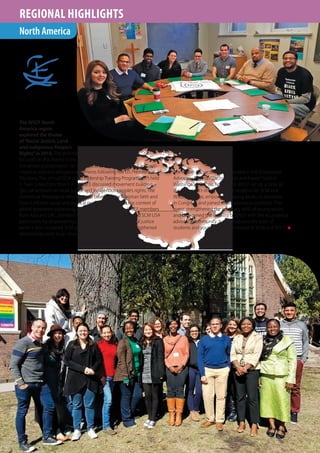
The WSCF North
America region
explored the theme
of“Racial Justice, Land
and Indigenous People’s
Rights”in 2016. The activities
focused on this theme in the context of
the growing polarisation on the issue of racism, xenophobia and anti-
migrants and anti-refugees sentiments following the US Presidential
Elections. The annual SCM USA Leadership Training Program (LTP) held
in Twin Cities from March 31–April 3 discussed movement building,
‘glo-cal’activism on racial justice and indigenous people’s rights. The
contextual theological reflection was based on the Christian faith and
how it informs social and political engagement within the context of
global grassroots organising and movement building. WSCF members
from Asia and LAC attended the event. The LTP strengthened SCM USA
particularly by empowering participants to be active in racial justice
work. It also increased SCM presence in Minnesota and strengthened
relationships with local church partners.
W F-NA
The region also actively participated in the Ecumenical
Advocacy Days on“Racism, Class and Power”held in
Washington, D.C. on April 15-18. WSCF set up a table at
the EAD, sold t-shirts, recruited students for SCM and
WSCF activities, empowered young adults to advocate
in Congress, and joined wider advocacy coalitions. This
event strengthened the advocacy skills of young adults
and broadened the visibility of WSCF with the ecumenical
advocacy community. It also increased the pool of
students and young adults connected to SCM and WSCF. n
North America
THEREDBOOK
WSCF ANNUAL REPORT
20
16 27
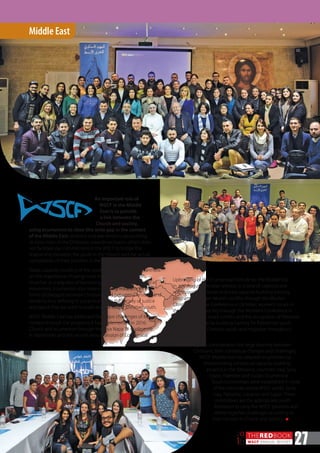
An important role of
WSCF in the Middle
East is to provide
a link between the
Church and society,
MIDDLE
EAST
Middle East
Upbringing of the Ecumenical Institute for the Middle East
in July-August; Christian witness in a time of violence and
war through the Syrian and Iraqi capacity-building training
programs; Christian-Muslim conflict through the Muslim-
Christian Dialogue Conference in October; women’s issues in
the Church and society through the Women’s Conference in
August; the Arab-Israeli conflict and the occupation of Palestine
through the capacity-building training for Palestinian youth
in June-July; and Christian youth and migration throughout
various projects.
Taking into consideration the large diversity between
Christians, their contextual changes and challenges,
WSCF Middle East has adapted its priorities by
implementing contextual capacity-building
projects in the following countries: Iraq, Syria,
Egypt, Palestine and Sudan. Ecumenical
Youth Committees were established in most
of the countries where WSCF works: Syria,
Iraq, Palestine, Lebanon and Egypt. These
committees are the appropriate youth
formation to carry the WSCF priorities and
define together challenges according to
their context in Church and society. n
using ecumenism to close this wide gap in the context
of the Middle East. Violence and war tensions are pushing
de facto most of the Christians towards seclusion, which does
not facilitate our commitment in the WSCF to bridge the
relationship between the youth in the Church and the actual
complexities of their societies in the Arab world.
Today, capacity-building of the youth means spreading awareness
on the importance of being more responsible within their
churches as a way also of becoming involved in the ecumenical
movement. Ecumenism also means building readiness for all
forms of dialogue between Christians, and between Christians and
Muslims, thus defining in a practical vision the society of justice
and peace that we want to build and the role of Christian youth.
WSCF Middle East has addressed the major challenges of its
context through the programs it has implemented in 2016:
Church and ecumenism through the Aiya Napa 31 conference
in September and the second annual session of Ecumenical
THEREDBOOK
WSCF ANNUAL REPORT
20
1628
ORGANISATIONAL REPORT
Governance
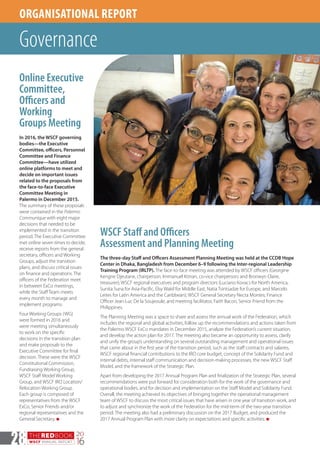
WSCF Staff and Officers
Assessment and Planning Meeting
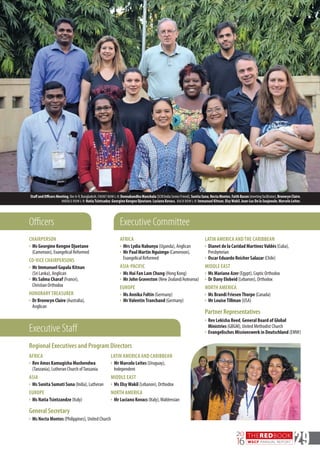
The three-day Staff and Officers Assessment Planning Meeting was held at the CCDB Hope
Center in Dhaka, Bangladesh from December 6–9 following the Inter-regional Leadership
Training Program (IRLTP). The face-to-face meeting was attended by WSCF officers (Georgine
Kengne Djeutane, chairperson; Immanuel Kitnan, co-vice chairperson; and Bronwyn Claire,
treasurer); WSCF regional executives and program directors (Luciano Kovacs for North America,
Sunita Suna for Asia-Pacific, Elsy Wakil for Middle East, Natia Tsintsadze for Europe, and Marcelo
Leites for Latin America and the Caribbean); WSCF General Secretary Necta Montes; Finance
Officer Jean-Luc De la Soujeoule; and meeting facilitator, Faith Bacon, Senior Friend from the
Philippines.
The Planning Meeting was a space to share and assess the annual work of the Federation, which
includes the regional and global activities, follow up the recommendations and actions taken from
the Palermo WSCF ExCo mandates in December 2015, analyze the Federation’s current situation,
and develop the action plan for 2017. The meeting also became an opportunity to assess, clarify
and unify the group’s understanding on several outstanding management and operational issues
that came about in the first year of the transition period, such as the staff contracts and salaries,
WSCF regional financial contributions to the IRO core budget, concept of the Solidarity Fund and
internal debts, internal staff communication and decision-making processes, the new WSCF Staff
Model, and the framework of the Strategic Plan.
Apart from developing the 2017 Annual Program Plan and finalization of the Strategic Plan, several
recommendations were put forward for consideration both for the work of the governance and
operational bodies, and for decision and implementation on the Staff Model and Solidarity Fund.
Overall, the meeting achieved its objectives of bringing together the operational management
team of WSCF to discuss the most critical issues that have arisen in one year of transition work, and
to adjust and synchronize the work of the Federation for the mid-term of the two-year transition
period. The meeting also had a preliminary discussion on the 2017 Budget, and produced the
2017 Annual Program Plan with more clarity on expectations and specific activities. n
Online Executive
Committee,
Officers and
Working
Groups Meeting
In 2016, the WSCF governing
bodies—the Executive
Committee, officers, Personnel
Committee and Finance
Committee—have utilized
online platforms to meet and
decide on important issues
related to the proposals from
the face-to-face Executive
Committee Meeting in
Palermo in December 2015.
The summary of these proposals
were contained in the Palermo
Communique with eight major
decisions that needed to be
implemented in the transition
period. The Executive Committee
met online seven times to decide,
receive reports from the general
secretary, officers and Working
Groups, adjust the transition
plans, and discuss critical issues
on finance and operations. The
officers of the Federation meet
in between ExCo meetings,
while the Staff Team meets
every month to manage and
implement programs.
Four Working Groups (WG)
were formed in 2016 and
were meeting simultaneously
to work on the specific
decisions in the transition plan
and make proposals to the
Executive Committee for final
decision. These were the WSCF
Constitutional Commission,
Fundraising Working Group,
WSCF Staff Model Working
Group, and WSCF IRO Location/
Relocation Working Group.
Each group is composed of
representatives from the WSCF
ExCo, Senior Friends and/or
regional representatives and the
General Secretary. n
THEREDBOOK
WSCF ANNUAL REPORT
20
16 29
CHAIRPERSON
}	Ms Georgine Kengne Djuetane
(Cameroon), Evangelical Reformed
CO-VICE CHAIRPERSONS
}	Mr Immanuel Gopala Kitnan
(Sri Lanka), Anglican
}	Ms Salma Charaf (France),
Christian Orthodox
HONORARY TREASURER
}	Dr Bronwyn Claire (Australia),
Anglican
General Secretary
}	Ms Necta Montes (Philippines), United Church
Executive CommitteeOfficers
Executive Staff
Regional Executives and Program Directors
AFRICA
}	Rev Amos Kamugisha Mushendwa
(Tanzania), Lutheran Church ofTanzania
ASIA
}	Ms Sunita Sumati Suna (India), Lutheran
EUROPE
}	Ms NatiaTsintzandze (Italy)
LATIN AMERICA AND CARIBBEAN
}	Mr Marcelo Leites (Uruguay),
Independent
MIDDLE EAST
}	Ms ElsyWakil (Lebanon), Orthodox
NORTH AMERICA
}	Mr Luciano Kovacs (Italy),Waldensian
LATIN AMERICA AND THE CARIBBEAN
}	Dianet de la Caridad MartinezValdés (Cuba),
Presbyterian
}	Oscar Eduardo Reicher Salazar (Chile)
MIDDLE EAST
}	Ms Mariane Azer (Egypt), Coptic Orthodox
}	Dr Dany Elobeid (Lebanon), Orthodox
NORTH AMERICA
}	Ms Brandi FriesenThorpe (Canada)
}	Mr LouiseTillman (USA)
Partner Representatives
}	Rev Lekisha Reed, General Board of Global
Ministries (GBGM), United Methodist Church
}	Evangelisches Missionswerk in Deutschland (EMW)
AFRICA
}	Mrs Lydia Nabunya (Uganda), Anglican
}	Mr Paul Martin Nguimgo (Cameroon),
Evangelical Reformed
ASIA-PACIFIC
}	Ms Hui Fan Lam Chung (Hong Kong)
}	Mr John Graveston (New Zealand/Aotearoa)
EUROPE
}	Ms Annika Foltin (Germany)
}	MrValentinTranchand (Germany)
Staff and Officers Meeting, Dec 6-9, Bangladesh. FRONT ROW L-R: Deenabandhu Manchala (SCM India Senior Friend), Sunita Suna, Necta Montes, Faith Bacon (meeting facilitator), Bronwyn Claire.
MIDDLE ROW L-R: Natia Tsintsadze, Georgine Kengne Djeutane, Luciano Kovacs. BACK ROW L-R: Immanuel Kitnan, Elsy Wakil, Jean-Luc De la Soujeoule, Marcelo Leites.
THEREDBOOK
WSCF ANNUAL REPORT
20
1630
	 IRAQ	 }	Iraqi ChristianYouth Committee (ICYC)
	 IRELAND	 }	Ireland Student Christian Movement (SCM)
	 ITALY	 }	Federazione Giovanile Evangelica Italiana (FGEI)
	 JAPAN	 }	 Japan StudentYMCAs
	 JORDAN	 }	OrthodoxYouth Fellowship of Jordan
	 KENYA	 }	Kenya Student Christian Movement (SCM)
	 KOREA	 }	Korean Student Christian Federation
	 LATVIA	 }	SCM KRISTA
	 LEBANON	 }	 ApostolicYouth Federation
		}	Armenian EvangelicalYouth Association
		}	Armenian Church University Student Association
		}	Jeunesse Etudiante Chrétienne
		}	Marian Apostolic Movement
		}	OrthodoxYouth Movement in Lebanon
		}	Youth Diocese Church from Lebanon *
	 LESOTHO	 }	SCM Lesotho
	 LIBERIA	 }	National Student Christian Council - SCM Liberia
	 LITHUANIA	 }	Vilinius Evangelical Lutheran AcademicYouth Fellowship
	 MADAGASCAR	 }	Mpianatra Kristiana Malgasi
	 MALAWI	 }	ChristianYouth Association of Malawi *
	 MALAYSIA	 }	SCM Malaysia
	 MEXICO	 }	MEC por la Equidad
		}	MEC México
	 MOZAMBIQUE	 }	SCM Mozambique
	 MYANMAR	 }	SCM Myanmar
	 NAMIBIA	 }	SCM Namibia
	 NEPAL	 }	SCM Nepal
	 NETHERLANDS	 }	Landelijk Steunpunt Studentenpastoren
	 NEW ZEALAND	 }	SCM Aotearoa
	 NIGERIA	 }	SCM Nigeria
	 NORWAY	 }	Norges Kristelige Studentforbund
	 PAKISTAN	 }	SCM Pakistan
	PALESTINE	 }	 EcumenicalYouth Committee
		}	PalestineYouth Ecumenical Movement (PYEM) *
	PAPUA NEW GUINEA	 }	SCM Papua New Guinea
	 PERU	 }	MEC Peru
	 PHILIPPINES	 }	SCM Philippines
	 POLAND	 }	Fellowship of OrthodoxYouth in Poland *
	 ROMANIA	 }	Asociata Studentilor Crestini-Ortodocsi Romani
	 RWANDA	 }	Rassemblement de la Jeunesse Etudiantine à l’Action
		}	Mouvement des Etudiants au Service Social au Rwanda
	 SENEGAL	 }	Mouvement des Jeunes de l’Eglise Protestante du Sénégal
	 SIERRA LEONE	 }	SCM Sierra Leone
	 SINGAPORE	 }	SCM Singapore
	 SLOVAKIA	 }	EKUNET Slovakia
	 SOUTH AFRICA	 }	Federation of South African Christian Students
	 SRI LANKA	 }	SCM Sri Lanka
	 SUDAN	 }	Khartoum University Caucuses
	 SOUTH SUDAN	 }	Sudanese Students Christian Mission
	 SWEDEN	 }	Kristna Studentrörelsen i Sverige
	 SYRIA	 }	OrthodoxYouth Movement in Syria
	 TAIWAN	 }	 SCMTaiwan
	 TANZANIA	 }	Tanzania Student Christian Fellowship
	 THAILAND	 }	 SCMThailand
	 TIMOR LESTE	 }	Movimento Estudante CristaoTimor Leste
	 TOGO	 }	Association Chrétienne d’Elèves et Etudiants duTogo
	 UGANDA	 }	Uganda SCM
	 UKRAINE	 }	[CONTACT PERSON]
	 UNITED KINGDOM	 }	SCM UK
	 USA	 }	SCM USA *
		}	Lutheran Student Movement
		}	United Methodist Student Movement
	 URUGUAY	 }	Espacio Estudiantil Cristiano - MEC Uruguay
	 VENEZUELA	 }	 MECVenezuela
	 ZAMBIA	 }	SCM Zambia
	 ZIMBABWE	 }	SCM Zimbabwe
	ANGOLA	}	World Council of Churches of Angola (CICA)
	 ANGOLA	}	Council of Christian Churches in Angola (CICA)
	ARGENTINA	}	Movimiento Estudiantil Cristiano en Argentina (MEC)
	 ARMENIA	}	Youth Union of Jervezh, ArmenianYouth Union
	 AUSTRALIA	}	Australian Student Christian Movement (SCM)
	AUSTRIA	}	Evangelische Hochschulgemeinde in Österreich (EHG)
	 BANGLADESH	}	Bangladesh Student Christian Movement (SCM)
	 BELARUS	}	Centre Ecumena *
	 BENIN	}	Jeunesse Chrétienne Universitaire et Scolaire du Bénin (JCUSB)
	 BOLIVIA	}	Bolivia Student Christian Movement (SCM)
	 BRAZIL	}	Movimiento Ecuménico de Estudiantes deTeología (MEET)
	 BULGARIA	}	ChristianYouth Council in Bulgaria (CYCB)
	 BURUNDI	}	Département des Jeunes, Eglise Episcopale du Burundi
	 CAMBODIA	}	Cambodian Student Christian Movement (SCM)
	 CAMEROON	}	Mouvement des Etudiants Protestants du Cameroun (MEPC)
	 CANADA	}	Canada Student Christian Movement (SCM)
		}	Mouvement des Etudiants Chrétiens du Québec (MECQ)
	 CHILE	}	Movimiento Estudiantil Cristiano de Chile (MEC)
	 COLOMBIA	}	Pastoral de Jóvenes y Estudiantes de Colombia
	 CÔTE D’IVOIRE	}	Association Chrétienne des Elèves et Etudiants Protestants
de Côte d’Ivoire (ACEEPCI)
	 CROATIA	}	Studentski Evandeoski Pokret (STEP)
	 CUBA	}	Movimiento Estudiantil Cristiano de Cuba (MEC)
	CZECH REPUBLIC	}	Oikumené - AkademickaYMCA
	 DR OF CONGO	}	Association des Jeunes et des Etudiants Chrétiens (AJEC)
		}	Fédération Nationale des Jeunes Protestant (FNJP)
	 DENMARK	}	The Danish Student Christian Movement (SCM)
	 ECUADOR	}	Pastoral Juvenil de Guayaquil
		}	Coordinadora Ecuatoriana para el Acción Juvenil (CEPAJ)
	 EGYPT	}	Coptic CatholicYouth Egypt
		}	The EcumenicalYouth Committee (EYC)
		}	El haq wa el Adel
		}	Evangelical CollegeYouth Egypt
		}	National Participation Committee
		}	OrthodoxYouth Movement - Cairo
		}	TheYouth of Evangelical Synod
		}	University Student Christian Association (USCA)
	 EL SALVADOR	}	Movimiento Estudiantil Cristiano Salvadoreño (MEC)
	 ETHIOPIA	}	Haimonate Abew Ethiopian Students’Association (HAESA)
		}	The Ethiopian Evangelical Church MekaneYesus (EECMY)
	 FINLAND	}	Suomen KristillinenYlioppilaslitto (SKY)
		}	Ortodoksinen Opiskelijalitto (OOL)
	 FRANCE	}	Association des Etudiants Protestants de Paris - Fédération
		}	Française des Associations Chrétiennes d’Etudiants (FFACE)
		}	L’Action Chrétienne des Etudiants Russes- Mouvement de
		}	Jeunesse Orthodoxe (ACER-MJO)
	 GAMBIA	}	Gambia Student Christian Movement (SCM)
	 GEORGIA	}	Georgia Student Christian Movement (SCM)*
		}	Young Christians for Peace and Democracy (YCPD)
	 GERMANY	}	Evangelische Studentinnengemeinde in Deutschland (ESG)
	 GHANA	}	Ghana Student Christian Movement (SCM)
	 GREECE	}	[CONTACT PERSON]
	 HAITI	}	Movimiento Estudiantil Cristiano ACEH Haiti – MEC
	 HONG KONG	}	Hong Kong Student Christian Movement (SCM)
	 ICELAND	}	[CONTACT PERSON]
	 INDIA	}	India Student Christian Movement (SCM)
	 INDONESIA	}	Gerakan Mahaiswa Kristen Indonesia (GMKI)
ORGANISATIONAL REPORT
Membership 2016
WSCF Affiliated, Associated, and Contact Movements*
total: 118 movements, 94 countries
* UPDATED AFTER 35TH GA IN 2015.
CENTENNIAL FUND FINANCIAL OVERVIEW
		 2016	 2015
		 (US$)	 (US$)
Income		
	 Dividends on Shares	 22,429	 20,519
	 Other Income	 0	 0			
TOTALINCOME	 22,429	 20,519
Expenditures		
	Salaries	 8,500	 30,000
	 Printing & Stationery	 3,500	 6,000
	 Audit Fees	 2,664	 2,110
	 Legal Costs	 5,984	 0
	 Apartment Expenses (Budapest)	 0	 9,495
	 Other Office Costs	 8,098	 4,874			
TotalExpenditures	 28,746	52,478
Grants and Other Operating Costs		
	 Grant toWSCF IRO	 20,000	 75,000
	 Board ofTrustees Meeting	 11,645	 12,274			
TotalGrantsandotherOperatingCosts	 31,645	87,274
Extraordinary Income and Expenditure		
on Investment Portfolio		
	 Asset Appreciation / (Depreciation)	 88,058	 118,019
	 Exchange Gain / (Loss) 	 -16,870	 -80,198
	 Bank Charges 	 -10,719	 -11,599
	 Commissions,Taxes 	 -2,134	 -3,266			
TotalExtraordinaryIncomeandExpenditure	58,335	 22,957
TOTALEXPENDITURE	 2,056	 116,795
			
NetProfit/(Loss)	 20,373	 -96,277
THEREDBOOK
WSCF ANNUAL REPORT
20
16 31
In the affairs of the Centennial Fund of theWorld Student Christian
Federation, 2016 was a year of challenge. The year opened with the Trustees
being challenged to report the last five years of activity to the appropriate
Swiss authorities as we are required to do annually under Swiss Law. With new
officers in post, it was no mean feat to achieve an adequacy of reporting which
did satisfy. As President of the Fund, I am most deeply grateful to Jean-Luc De
La Seujeole, our accountant, for the hours of patient reconstruction that he
devoted to bringing our reporting up-to-date. We enter 2017 with a clean sheet.
That reminder of our legal requirement produced voluntarily our second
challenge, which was to review the Constitution of the Centennial Fund
to ensure we are operating in accordance with its terms and conditions.
The review produced the satisfactory conclusion that indeed we are so
operating. In the course of this review, we began a conversation with our
colleague trustees in the United States of America about the way in which
the US trustees hold, administer and report Federation Funds held from their
beginning in the US. That conversation should conclude at our AGM in 2017.
By a decision of the AGM of the Centennial Fund Trustees in 2015, the Investment
Advisory Committee of the Fund was reviewed and reactivated. That process was
completed in 2016 and in welcoming Gunter Schwerdtel as a member of the IAC,
I thank Mathieu Durrelman, the Convenor of the Committee, for the care with
which he devotes to the affairs of the Centennial Fund on a continuing basis.
The greatest challenge faced by the Centennial Fund in 2016 presented itself at the
beginning of January at which moment the Federation was released from a debt
relationship with the World Council of Churches. That achievement is to be very
greatly welcomed in that the Federation now stands in a free relationship with the
WCC as one of the earliest progenitors of that organisation, at least through personnel
if not organic structure. The officers of the Federation are to be congratulated. They
effected a saving of $150,000.00 in the operation of the Federation in 2015, helped
by a small surplus on the General Assembly. The Centennial Fund gave a loan of
$50,000.00 in order to complete the sum owing to the WCC. That loan represents the
new reality for the Federation, which is that the Centennial Fund is now, in effect, the
Banker for the Federation given that the Federation does not possess any capital asset.
This is an entirely new reality and its challenge is to find the 21st century formula
which incarnates a partnership relationship between both bodies in securing the
future viability of the Federation, which is the principal reason for the existence
of the Centennial Fund. Two matters signify the beginnings of this partnership.
The Centennial Fund and the Federation Executive Committee have established
a joint Fundraising Working Party and the Centennial Fund has made available
a long-term and interest-free loan of $250,000.00 to allow the business of the
Federation in later 2016 and 2017 to be transacted albeit with limited funding for
regional staff salaries. But there will be an additional staff salary for fundraising
support for the general secretary who has been invited by the Centennial Fund
Trustees to visit all the regions in order to ensure that the National Movements
of the Federation are fully advised of its financial situation and of the prospects
for fundraising in which every part of the Federation will be called to participate.
Part of the strap line going forward needs to be that the Federation will be in
essence a self-sustaining organisation, thus giving expression to the vision of those
Chinese Christians who were part of our leadership in the early 20th century.
The implementation of this kind of vision requires the
active and ongoing support of Senior Friends, support
of many kinds beyond the support of becoming annual
subscribers, though that, itself, is essential: support
Centennial Fund Report 2016
for organisational needs, for programme needs, for pastoral support needs; support that does not require to feel itself
dominant or in control; support that is not wedded to the practices or processes or structures of the Federation’s past;
support that enshrines the freedom of mind, of spirit, of imagination that characterises the best of the past with the
energy of the present in a focussed vision for the future. For such things we pray and work as Trustees of the Centennial
Fund of the World Student Christian Federation.
DrSaltersSterling
President,WSCFCentennialFund
Centennial Fund members with Senior Friends
THEREDBOOK
WSCF ANNUAL REPORT
20
1632
The World Student Christian Federation
(WSCF) is a non-profit organisation. The WSCF
raises funding from partners and accepts
donations from well-wishers. All donations are
tax-deductible to the extent allowable by law.
The Trustees of the World Student Christian Federation, USA, Inc. is a not-
for-profit charitable organisation incorporated in the State of New York.
This 2016 financial summary combines information from the Geneva-based
Inter-Regional Office (IRO) and six (6) regional offices in Beirut, Trento,
Buenos Aires, Hong Kong, Nairobi and New York, which covers the world.
The year 2016 ended with a loss
of USD 0.02 million. This still leaves
the Federation exposed to negative
cash flow situations on a monthly
basis, which we attempt to
mitigate through pooling of cash
available across all Regions.
Net result
Total expenses at USD 0.96 million
were reduced by -USD 0.28 million
thanks to a strict monitoring of
administrative expenses (reduced
by -USD 0.14 million, at USD 0.38
million) and slightly lower Programs
expenses by also -USD 0.14 million.
Expenses
Total income in 2016 was USD
0.94 million. But this cannot be
compared to the USD 1.68 million
in 2015, which had significant
funding received for the 2015
WSCF General Assembly. Excluding
the income of this exceptional
event (USD 0.46 million), the
Federation experienced another
year of important decline in
its resources, particularly core
funding (USD 0.32 million versus
USD 0.54 million in 2015, or -41%).
The continuation of this trend
(from USD 0.93 million in 2012)
confirms that less resources are
available from traditional partners
and that radical changes in the
structure of the Federation are
called for, such as the hiring
of a new fundraiser in 2017 or
investigating further cost savings
from new operating models.
Income
ExpensesYear 2016
Total Federation - ExpensesYear 2016
	 Program / Geneva 	 $	 36,870	4%
	 Africa			 89,085	9%
	 Middle East			 309,254	32%
	 Latin America			 49,668	5%
	 North America			 162,775	17%
	 Asia-Pacific			 109,950	11%
	 Europe			 118,701	12%
	 Global Services / Geneva			 84,910	9%
	 TOTAL EXPENSES		 $	 961,213
	 NET RESULT		 $	 -20,759
IncomeYear 2016
Total Federation - IncomeYear 2016
	 Geneva		 $	 295,311	31%
	 Africa			 46,796	5%
	 Middle East			 276,753	29%
	 Latin America			 30,157	3%
	 North America			 120,326	13%
	 Asia-Pacific			 87,715	9%
	 Europe			 83,396	9%
	 TOTAL INCOME		 $	 940,454
Total Federation - IncomeYear 2016
	Undesignated	*	$	276,412	29%
	Designated	*		624,123	66%
	 WSCF related sources			 39,919	4%
	 TOTAL INCOME		 $	940,454
	 * Churches & Agencies
5%
9% 4%
32%
17%
11%
12%
9%
9%
9%
31%
5%
29%
3%
13%
4%
29%
66%
Consolidated 2016 Financial Summary
ORGANISATIONAL REPORT
THEREDBOOK
WSCF ANNUAL REPORT
20
16 33
n	Alena Babicova
n	Ann Ng
n	AnnTeicher
n	Anna Najdecka
n	Aude Isimbi
n	Brandi FriesenThorpe
n	Brandon Cook
n	Bronwyn Claire
n	Clare McLean
n	Colin Dwyer
n	Deborah Selby
n	Dirk Grutzmacher
n	Ellies Spiegel
(Paul Denise Fund)
n	Gabriela Bradovkova
n	Gabriella Lettini
n	Herbert Donovan Jr
n	HKG DumperTruck
Drivers Ltd
n	Inget Sembiring
n	Janet Anderson
n	Jannes Hutagalung
n	Jay Hooper
n	Jean-Luc de La Soujeole
n	Jin Kim
n	JohnThurber
n	Jon Chapman
n	Katherine Cunningham
and Kurt Kaboth
n	Katherine Sotejeff-Wilson
n	Kathryn Poethig
n	Kurt Meyer
n	Leonard Bjorkman
n	Liberato Bautista
n	Logan Boese
n	Luciano Kovacs
n	Margaret Arighi
n	Maria Kozhinova
n	Marie Berger
n	Mathieu Durrleman
n	NatiaTsintsadze
n	NCCA
n	Niradh Kaul
n	Ondrej Babicova
n	Pamela Brubaker
n	Rachel Douglas
n	RebeccaTodd Peters
n	Ruth Lindsey
n	Salters Sterling
n	Samuel Partington
n	Shanta Premawardhana
n	Sofie Eriksen
n	Sunita Suna
n	Toddie Peters
n	Trice Gibbons
n	Vera Papp and David
Cleary
n	Walk HKG
n	Wener & Elisabeth Gebert
n	Wynne SarahTaylor
n	ZillahWesley
n	Zuzana Babicova
n	Others
n Advent Lutheran Church of NYC
n Church of All Nations
n Church of Sweden
n Episcopal Church USA
n Evangelical Lutheran Church in America
n Evangelical Lutheran Church in Bavaria
n General Board of Church and Society,
United Methodist Church
n General Board of Global Ministries,
United Methodist Church
n Methodist Church UK
n National Council of Churches
of Christ USA
n NewYork Episcopal Diocese
n Office of Christian Unity
and Interreligious Relationships
of the Council of Bishops
of the United Methodist Church
n Presbyterian Church inTaiwan
n Presbyterian Church in the PROK
n Princeton University Chapel
n Rutgers Presbyterian Church
n The Riverside Church of NewYork
n United Church of Canada
n United Church of Christ
n United MethodistWomen
n Waldensian Church of Italy
n Kairos
n National Christian Council in Japan
n StudentYMCA
n TavolaValdese Otto Per Mille
n The Karibu Foundation
n United MethodistWomen - GBGM
n Waldensian Church / OPM
n World Council of Churches
n WCC Ecumenical Network
n World Day of Prayer USA
Individual Donors
Institutions and Church OrganisationsChurch Partners
Partners and Donors 2016
n	SCM Australia
n	SCM Canada
n	SCM Hong Kong
n	SCM India
n	SCM Japan
n	SCM Korea
n	USTrustees of theWSCF
n	WSCF APAC
n	WSCF Canada
n	WSCF Centennial Fund
WSCF
SCM
n	SCM Liberia
n	SCM New Zealand
n	SCM Old Ghost Fellowship
n	SCM Pakistan
n	APAC Senior Friends
n	UK Senior Friends
n Bread for theWorld
n Christian Solidarity International
n ChurchesWitnessingWith Migrants (CWWM)
n Erasmus+ Programme of the European Commission
n EuropeanYouth Foundation of the Council of Europe
n Evangelischen Missionwerk in Deutschland (EMW)
n Faith Hope Love Fellowship
n Fondation pour l’aide au Protestantisme Reformé
n ICCO & Kerkinatie
n International Catholic Mission Society (MISSIO)
THEREDBOOK
WSCF ANNUAL REPORT
20
16
2016Year in Review
WSCF REGIONAL AND GLOBAL ACTIVITIES
DATE REGION PROGRAM ACTIVITY
Jan 18-22 ME Week of Prayer for the Unity of the Churches in Syria, Lebanon and Egypt
Jan 21-22 LAC PB SCM Colombia–WSCF-LAC: Integration to DiPaz as peace construction commitment, Bogotá, Colombia
Feb 4-6 EUR Europe Regional Committee (ERC) Meeting and MovementVisit, Helsinki, Finland
Feb 28 Global Universal Day of Prayer for Students:“Journey of Faith”, various countries
Feb 12-18 Global PB WCC Reference Group for the Pilgrimage of Justice and Peace, Bethlehem, Palestine
Mar 2-6 EUR Staff Capacity-BuildingTraining Course and MovementVisit, Oslo, Norway
Mar 8 Global InternationalWomen’s Day Celebration, various countries
Mar 10-11 NAR/Global WSCF USTrustees Meeting, NewYork, USA
Mar 14-24 NAR/Global IDD UN Commission on the Status ofWomen, NewYork, USA
Mar 16-19 AP Church of Sweden Partner Assessment Consultation, Hong Kong
Mar 31-3 Apr NAR SCM USA LeadershipTraining Program, Minneapolis / St. Paul, USA
Apr 8-11 AF PB Leadership Consultative Meeting on Peace Building and Civic Education, Juba, South Sudan
Apr 15-18 NAR Ecumenical Advocacy Days on Racism, Class and Power,Washington DC, USA
Apr 27-2 May AF PB Leadership ConsultativeWorkshop with SCM Liberia
Apr 29-2 May LAC/Global EJ WCC Climate ChangeWorking Group Meeting, Israel
May 2-4 AF PB Leadership Consultative Meeting with SCM Sierra Leone
May 4-6 NAR National Council of Churches Christian Unity
Gathering,Washington DC, USA
May 8-15 EUR IDD Youth Conference on Sexuality:
“LetsTalk About Sexuality—The Explosive
Power ofTaboo Subjects”, Budapest, Hungary
May 7-17 Global WCRC Executive Committee Meeting and
MovementVisit, Havana, Cuba
May 13-15 EUR Senior Friends Gathering, Budapest, Hungary
May 14 ME Celebrating EasterTogether,
Lebanon and Egypt
May 18-23 Global WSCF Centennial Fund Board Meeting,
Geneva, Switzerland
Jun 4-5 NAR/Global WSCF USTrustee Spring Meeting, NewYork, USA
Jun 4-8 LAC EJ InterfaithTraining on Eco-Justice, Rio De Janeiro, Brazil
Jun 9-12 NAR Cahoots Festival and SCM of Canada General Conference, Ridgetown, Ontario, Canada
Jun 20-24 NAR EJ Emerging Leaders Multifaith Climate Convergence, New Orleans, USA
Jun 20-1 Jul Global Scandinavian Partners and MovementVisits, Norway, Finland and Sweden
Jun 23-29 Global WCC Central Committee Meeting and MovementVisit,Trondheim, Norway
Jun 23-26 EUR European Regional Committee (ERC) Meeting and MovementVisit, Hamburg, Germany
Jun 30-3 Jul ME PB Capacity-BuildingTraining for PalestinianYouth, Amman, Jordan
Jul 17-29 Global IDD United Church of Canada Partners Council Meeting, Affirm Conference and MovementVisit,Toronto, Canada
Jul 17-6 Aug ME Second Annual Session of Ecumenical Upbringing, Ecumenical Institute for the Middle East, Lebanon
Jul 30-20 Aug Global Agape International Political,TheologicalWork Camps, Agape, Prali, Italy
Aug 2-6 ME IDD WSCF Middle EastWomen’s Conference, Lebanon
Aug 27 LAC EJ Eco-Justice OnlineWebinar:“COP21 to COP22: Experiences, Expectations and Strategies”
and“Climate Change and the Interreligious Global Movement”
Sep 8 ME Senior Friend Gathering, Cairo, Egypt
34
THEREDBOOK
WSCF ANNUAL REPORT
20
16 35
DATE REGION PROGRAM ACTIVITY
Sep 9 ME Regional Committee Meeting, Cairo, Egypt
Sep 29-30 NAR/Global WSCF USTrustee Fall meeting, NewYork, USA
Sep 28-29 LAC/Global EJ WCC Climate ChangeWorking Group Meeting, Geneva, Switzerland
Oct 1-11 NAR US-Mexico Border Solidarity Program and School of the Americas Convergence, Arizona, USA
Sep 29-3 Oct ME PB Capacity-BuildingTraining for SyrianYouth, Mashta al Helu, Syria
Oct 8 LAC EJ Eco-Justice OnlineWebinar:“Youth Organization and the Role ofYouth in the Face of Climate Change:
Training,Visualization and Incidence”
Oct 28-30 NAR SCM Canada Board Meeting, Ottawa, Canada
Oct 14-15 LAC Christian CommunicationTraining:“Being PropheticVoice in LAC”, Buenos Aires, Argentina
Oct 20-Nov AP IDD SELF on Identity, Diversity and Dialogue, Seam Reap, Cambodia
Oct 12-16 ME IFD Christian-Muslim Dialogue Conference:“Religious Freedom in the ArabWorld”, Broumana, Lebanon
Nov 1-4 AF PB Follow up and monitoring of peace and civic education project in Uganda
Nov 3-15 Global IDD Amplify Conference, UCC ExposureVisit and MovementVisit, Jakarta, Indonesia
Nov 11-20 LAC/Global EJ Ecumenical advocacy at COP22, Marrakech, Morocco
Nov 19 NAR SCMTwin Cities Hub Kick-off, Church of all Nations, St Paul, USA
Nov 26-30 AF PB Youth ConsultativeWorkshop on Peace and Civic Education, Cameroon
Nov 27-30 LAC PB “Peace at Park”Gathering ofYouth, Bogotá, Colombia
Nov 28-30 Global PB Peace for Life InterfaithYouth andWomen Assembly, Dhaka, Bangladesh
Dec 1-6 Global IRLTP on Migration at the Intersection with Racial Justice and Indigenous Peoples’Rights, Dhaka, Bangladesh
Dec 6-9 Global WSCF Staff and Officers Meeting, Dhaka, Bangladesh
Dec 6-8 Global ChurchesWitnessingWith Migrants 7th Conference, Dhaka, Bangladesh
Dec 10 LAC EJ Eco-Justice OnlineWebinar:“Road to Río Convergence”
Program Objectives
}	Ecological Justice
	 Promote climate justice through public advocacy
processes directed at international governance bodies,
working in partnership with ecumenical institutions,
churches and various stakeholder networks upholding
the youth and student voice on ecological issues.
}	Identity, Diversity and Dialogue
	 Initiate the process of dialogue, create spaces and develop
theological understanding for the SCMs on human sexuality.
}	Peace Building and Dialogue
	 Mobilise the Federation on issues pertaining
to overcoming violence and building peace
with a focus on the situations in the
Middle East and Colombia.
}	Higher Education
	 Work in solidarity with SCMs and
student movements to advocate for
the right to education for all.
}	Interfaith Dialogue
	 Engage the Federation in creating
and providing interfaith platforms
for youth and students.
World Student Christian Federation
Inter-Regional Office
Ecumenical Centre, 5 route des Morillons
PO Box 2100, CH 1211, Geneva 2, Switzerland
tel + 41 22 791 6358 • fax + 41 22 791 6152
wscf@wscf.ch
www.wscfglobal.orgUT OMNES
U UN NM SI T
WSCF is called to be a prophetic
witness in the Church and the
transformation of the world where
God’s love for creation, justice
and peace is shared by all across
boundaries of race, class, ethnicity,
culture, gender and sexuality.
This vision is nurtured by a
radical hope of God’s reign
in history and liberating
faith in Jesus Christ.
Vision
WSCF is a global fellowship
of Student Christian Movements
putting their faith into action to
contribute to the renewal of the
ecumenical movement and
to promote justice and peace
in the world.
Mission
Strategies
}	Biblical and Theological Analysis
	 Stimulate the study of the Bible and
promote theological thinking among
Christian students to help them
understand the call of God in their lives.
}	Advocacy and Solidarity
	 Enable the Federation to stand firmly in
solidarity with students, movements and
people around the world, especially in
situations of oppression and exploitation,
human rights violations, conflict, war
and violence, and natural disasters,
and advocate for systemic change in
the world and in different contexts.
}	Ecumenical Transformative Diakonia
	 Enhance the capacity of SCMs and the
Federation to serve and respond to the
needs of the community by developing
a deeper understanding and practice of
Ecumenical Transformative Diakonia at
the local, regional and global levels.
}	Movement Building
	 Build dynamic SCMs that will give rise
to a new generation of young Christian
leaders and prophetic witnesses that will
act together to renew the ecumenical
movement and transform the world.
}	Capacity Building
	 Develop enabling structures and systems
and nurture a competent team of staff and
officers that will bring the Federation to a
financially viable state and sustainable future.
WSCF STRATEGIC PLAN 2016 to 2019

WSCF the Redbook 2016

  • 1.
    UT OMNES U UNNM SI T UT OMNES U UN NM SI T 2016RED THE A N N U A L R E P O R T World Student Christian Federation BOOK
  • 2.
    Programs 5 } EcologicalJustice 8 } Identity, Diversity and Dialogue 12 } Peace Building and Dialogue 17 } Emerging themes and other programs Regional Highlights 22 } Africa 23 } Asia-Pacific 24 } Europe 25 } Latin America and the Caribbean 26 } North America 27 } Middle East Organisational Report 28 } Governance 30 } Membership 2016 31 } WSCF Centennial Fund Report 32 } Consolidated 2016 Financial Report 33 } Partners and Donors 2016 2016 Year in Review 34 } WSCF Regional and Global Activities DESIGN AND LAYOUT designworkers.biz TEXT Luciano Kovacs Sunita Suna Elsy Wakil Amos Mushendwa Natia Tsintzadze Marcelo Leites Salters Sterling EDITORS Necta Montes Bes Rifareal FINANCIAL DATA Jean-Luc De La Soujeoloe PHOTO CREDITS Luciano Kovacs Sunita Suna Elsy Wakil Amos Mushendwa Natia Tsintzadze Marcelo Leites THEREDBOOK WSCF ANNUAL REPORT 20 16 Cover photo courtesy of WSCF Europe
  • 3.
    THEREDBOOK WSCF ANNUAL REPORT 20 163 WSCF Chairperson’s Message UT OMNES U UN NM SI T WSCFFUACE FUMEC Dear brothers and sisters in Christ Jesus our Saviour, At the creation of theWorld Student Christian Federation one hundred and twenty-one years ago, our founders prayed God through Jesus Christ to bless their vision and mission in the world.Through the work of the Holy Spirit, members were called to be prophetic witnesses in the Church and society. After years of service and dedication to the mission, the 2015 General Assembly boldly pointed out through situational analysis operational and governance issues which should be addressed in a period of two years to address the challenges identified within the Federation. Halfway down the road, we can report that despite the very challenging tasks at hand, we acknowledge the abundant blessings God has bestowed on our difficult work addressing some necessary reform in the Federation, most of which we hope will be implemented by the end of the coming year.The constitutional amendments are underway; global fundraising strategies revisited and re-developed with the active participation of the Centennial Fund Board ofTrustees; tight budget control being practiced with no external debt, even though we are still struggling with internal debts. Major progress is also made in terms of consultation for the implementation of the new staff model the Executive Committee will decide on. Some staff are working diligently with minimum salary and proud of their commitment to the mission whose work is inspirational, so are the current officers and the Executive Committee members, the US Board ofTrustees, national movements and Senior Friends supporting through prayers and financial contribution as well as our traditional and new partners. Through these small steps we are confident we will realise our goals as recommended by the 2015 General Assembly and more achievements for God’s glory. “InthemountoftheLorditshallbeprovided.” (Genesis 22:14) We are blessed that there are many Senior Friends, partners and national movements who are continuously expressing their solidarity, their support and contribution when needed.Together we will continually seek for true peace and justice in this world where the signs of the kingdom are“less visible”. Young Christian students inWSCF are striving and recommitted through prayer, worship, discipleship, outreach, fellowship, service and mission to respond and bring radical hope for God’s reign in the present world by addressing the new dynamic and challenges posed by current developments in the world. Among them: the decision of Britain to leave the European Union through the Brexit yes vote; the newly elected President of the USA who is vowing to build a wall on the USA-Mexico border; the immigration policy change in many countries previously favourable to immigration; growing terrorism with major attacks in 2016 in France, Belgium, Pakistan and USA; Boko Haram’s continued bombing and killing; raging war in Syria; increasing negative influence of media on young people; growing commercialisation of higher education; rising number of skilled young people desperately seeking better job opportunities; growing consumerism in the world; new challenges posed by climate change fuelled by expanding extractive activities; and lastly, evergrowing poverty in the world affecting more and more women and children. The scripture makes it clear that it is the task of every Christian to help bring people to the saving message of Christ. May God continue His work and liftWSCF higher for His glorious mission. Georgine Kengne Djeutane WSCF Chairperson MESSAGES Georgine
  • 4.
    THEREDBOOK WSCF ANNUAL REPORT 20 164 thegrassroots in next three years.The shift in programmatic strategy has allowed the global team to assess and evaluate, using a common framework, the impact of our programs in the SCMs and communities. Responding to calls for justice and peace in varied contexts, building grassroots ecumenical movements The dynamism and richness of our diverse orientation and identities are reflected in the various ways the WSCF regional bodies have responded to concrete issues in their regional contexts. In Africa, we responded to violence brought about by elections by raising awareness on civic education for peace. In Asia and Pacific, we brought to the world’s attention the violations of human rights especially of marginalized communities in the region. In Europe, we welcomed our neighbors, the migrants and refugees. In Latin America, we reached out to the young people in different faith communities to work together for our climate and build peace. In North America, we accompanied young people to challenge the Empire and struggle for racial justice, land and indigenous rights. And in the Middle East, we provided the ecumenical platform for Church and society to work together for peace and overcoming violence in the region. Transforming the Federation, renewing our prophetic role, demonstrating stewardship of resources The implementation of the PalermoWSCF ExCo mandates towards governance and operational reforms are in varying degrees of completion by the end of 2016. Four out of the eight Palermo mandates were amendments to theWSCF Constitution.The first to be implemented was the consolidation and stabilization of the global leadership with the election of the general secretary, chairperson and co-vice chairpersons in the first quarter of 2016, followed by the formation of theWSCF Constitutional Commission tasked to lead theWSCF constitutional amendments and preparations for the first Online General Assembly. AWSCF Staff ModelWorking Group, formed in August, was mandated to assess theWSCF staff model and propose a more sustainableandeffectivestaffmodelthatreflectsthecurrentneedsandfuturestabilityofWSCF.Thechangein the job titles were likewise implemented immediately, with efforts to change the actual and day-to-day work of the staff. Our regional leaders conducted studies of their office locations to ascertain a more sustainable and efficient use of our human and financial resources and find a strategic location for the global office. Fiscal control and adjustment had to be strictly implemented to monitor the financial health of the Federation. In August, an urgent need to begin the process of reviewing the financial viability of theWSCF staff model as a strategic solution to the chronic financial crisis of the Federation surfaced.This provided a context for the discussion on the need for cultural change highlighted by the incongruent understanding of the transition plan, and on the depth of the crisis within the Federation vis-à-vis structural and operational reforms.This review remains a continuing task. By December 2016,WSCF’s financial situation continued to be a challenging concern for the leadership. But with the solidarity and efforts of the regional bodies and theWSCF Centennial Fund, we ended the year 2016 with good financial performance and a positive outlook for 2017. Finally, we want to acknowledge and give thanks to our partner churches, ecumenical institutions, Senior Friends and members for their trust and invaluable financial support and contribution to the ministry ofWSCF. This is our collective story. May the God of Justice, Peace and Love continue to journey with us as we continue our mission to build God’s Kingdom here on Earth. In Peace and Solidarity, Necta Montes Secretary General Introduction from the General Secretary MESSAGES Dear Sisters and Brothers in Christ, In this annual report, we continue to share with you our transition journey which began a year and half ago in Bogotá, Colombia. Midway into this two-year transition period, we present tangible results with confidence in our stability and strength as an organization renewing itself to respond to God’s call for Christian witness and service in 94 countries where 118 of our member movements are rooted. Common witness for ecological justice, sexual diversity, and peace In 2016, the integration of the global Strategic Plan into the programmatic work of the six regions began to take shape. Visible progress and leadership have been demonstrated in Latin America and the CaribbeanonEcologicalJustice,Asia-Pacific on Identity, Diversity and Dialogue (IDD), and Middle East on Peace Building.The shift in programmatic strategy—where our regions take the lead in translating our global themes and strategies into concrete programs, with our regional staff serving as global program directors—is enabling synergy and coordination in the activities planned to achieve the goals of our global Strategic Plan. The programmatic work of the Federation remains strong and relevant as demonstrated in our activities in 2016. These include the InterfaithTraining on Eco-justice in Brazil; webinars and global advocacy for the COP22 in Marrakech; EcumenicalTraining Program on IDD in Cambodia; a conference on sexuality in Budapest; Christian-Muslim Dialogue Conference in Lebanon; peace advocacy work in Colombia; and a leadership training and solidarity action on refugee and migrant justice issues within the framework of EcumenicalTransformative Diakonia (ETD) in Arizona and Dhaka. These programs combined gathered more than 300 students and youth from different churches and universities, raising awareness on climate justice, the rights of LGBTQI, justice and peace in Palestine and Colombia, rights of migrants and refugees; and organizing common actions and planned ecumenical strategies in Raising PropheticWitnesses for Justice and Peace Necta
  • 5.
    THEREDBOOK WSCF ANNUAL REPORT 20 165 WSCF’s Eco-Justice Program aims to promote climate justice through public advocacy processes directed at international governance bodies, working in partnership with ecumenical institutions, churches and various stakeholder networks upholding the youth and student voice on ecological issues. Ecological Justice Eco-Justice Online Webinars Three online webinars were organised within the framework of the“Faith and Climate: Sacred Waters”Convergence, an international, multi-faith emerging leaders’network for climate action led by WSCF-LAC. The first was held on August 27 on the topics,“COP21 to COP22: Experiences, Expectations and Strategies”and“Climate Change and the Interreligious Global Movement”. The second was held on October 8 on the topic,“Youth Organization and the Role of Youth in the Face of Climate Change: Training, Visualization and Incidence.”The third webinar,“Road to Río Convergence”, was held on December 10 with participants from all over LAC and the US. Through the online webinars, WSCF-LAC has taken a leadership role within the churches and ecumenical networks in LAC on ecological justice advocacy work. The SCMs have become more visible, and an increasing number of members and networks are reaching out to WSCF-LAC regarding youth and eco-justice issues. n PROGRAMS Survey of Eco-Justice Activities of SCMs In this report, we highlight the outputs and impacts of activities implemented in 2016 under the thematic programs of Ecological Justice; Identity, Diversity and Dialogue (IDD); Peace Building and Dialogue; and the emerging themes of migration and racial justice, and religious freedom and interfaith dialogue. This year, we began consolidating and focusing our strategies and activities to achieve the program objectives of our 2016 to 2019 Strategic Plan. MOST MEDIUM *LESS* IMPORTANT TO DO IMPORTANCE IMPORTANT AT THIS MOMENT Global Campaign Raising Awareness 62.96 % 17 29.63 % 8 7.41 % 2 Training/Workshop Program 74.07 % 20 18.52 % 5 7.41 % 2 Seminars and Conferences 44.44 % 12 40.74 % 11 14.81 % 4 Webinars 22.22 % 6 55.56 % 15 22.22 % 6 Bilateral and Biregional Programs 51.85 % 14 48.15 % 13 0.00 % 0 Publication and Articles 40.74 % 11 44.44 % 12 14.81 % 4 Youth Mobilization 70.37% 19 29.63% 8 0.00% 0 In order to gain greater knowledge for creating projects for the WSCF global Eco-Justice Program, we carried out a global survey to probe and assess the degree of understanding, participation and implementation of actions of SCMs on eco-justice and their impact on the activities they are developing internally. The survey results corroborated the need for training and awareness-raising processes on the theme of eco-justice and its importance within the movements and on the initiatives they are developing. The survey also showed that although the movements consider the area of work on eco-justice as fundamental, there has not been sustained programmatic development at the local level. n Survey results show respondents place high importance on training and awareness- raising processes among the measures and initiatives on Ecological Justice that WSCF should undertake.
  • 6.
    THEREDBOOK WSCF ANNUAL REPORT 20 166 InterfaithTraining onEco-Justice in Brazil With the theme“Faith in the Climate: Sacred Land”, a multi-city event on climate change and religion was organised with the participation of 15 cities in the Latin America and the Caribbean (LAC). Young people from different religions and speakers on various topics attended this training and developed a common understanding of environmental issues in LAC and the world. From this training, an interfaith network was launched with WSCF leading the thematic content sub-groups on Sacred Land and Sacred Water for two years. n Ecological Justice PROGRAMS
  • 7.
    THEREDBOOK WSCF ANNUAL REPORT 20 167 Elevating the youth voice in global advocacy platforms on eco-justice MARÍA CAMILA ULLOA BONILLA IS A COLOMBIAN LIVING IN BUENOS AIRES. SHE IS AVOLUNTEER OFWSCF-LAC AND HAS BEEN A MEMBER SINCE MARCH 2016. SHE PARTICIPATED INTHE“ROADTO RÍO CONVERGENCE” WEBINARS OFTHE ECO-JUSTICE PROGRAM. TheWorld Student Christian Federation in Latin America and the Caribbean is one of the 15 organizations that are making possible the“Faith and Climate: SacredWaters”Convergence.The convergence will take place in 2017 in Rio de Janeiro, Brazil.Within this framework, webinars were held, as a road-to-Rio event, enabling the participation of young people and leaders from all over the region. On August 27, the first webinar was held:“From COP21 to COP22: Experiences, Expectations and Strategies. Climate Change and the Global Interreligious Movement,” which explained the functioning of the COP as an advocacy platform and presented some basic concepts on climate governance, decisions and the role of religious movements in advocacy. The second webinar,“Youth Organization and Its Role in the Face of Climate Change:Training, Visualization and Incidence”, was held on October 8 with the aim of motivating and empowering young people through the presentation of lessons learned and results of organized youth work. Marcelo Leites, regional secretary, was a speaker forWSCF-LAC and presented the work that has been done in the Federation around training, mobilization and advocacy with young people in the region on eco-justice, understanding climate change as a consequence of the unequal relationship between economy and ecology.The exhibition was accompanied by a presentation on the experiences since the Ecology, Economy and Ecumenism program was carried out in 2012. It was a very important presentation for new SCMers, like me, as it allowed us to know the work that has been done in the region on this matter, both theWSCF and other organizations. The last webinar was on“COP 22, what does it mean for America in its new context?”It was a reflection on COP22 and its implications in the new context of America due to the power changes that have taken place.The webinar benefitted from the participation of four panelists attending COP22 who have worked for years on climate change issues in different sectors of society. These video conferences allowed students from different SCMs to participate and interact with leaders who are experts in these topics, enabling the creation of new spaces for debate, as well as including in the convergence people who may not be able to participate in Rio meeting. SCMer Column María Camila Ulloa Bonilla WSCF Program Director for Ecological Justice and LAC Executive Marcelo Leites is a member of the World Council of Churches (WCC) Climate Change Working Group, which held two meetings on April 29–May 2 and September 28–29 in Palestine and Geneva, respectively. In the first meeting, the WSCF Eco-Justice Program was presented to the small WCC Climate Change planning group for the UN Climate Change Conference (COP22) in Marrakech on November 11-20. WSCF got involved in the preparation and implementation of the different advocacy initiatives at the COP22 together with ACT Alliance, WCC and Green Faith. This increased our knowledge in advocacy work as well as the likelihood of our sending student delegations to future COPs. Our active participation in global advocacy platforms has facilitated greater collaboration with other groups on climate justice: we are now involved in the formation of the Eco-Justice School, a joint initiative of WCC, WSCF, LWF, ACT Alliance and WCRC and other groups; and our Eco-Justice Program in turn has received much needed support from the WCC Climate Change Working Group. This exposure also paved the way for our involvement in the planning of the partners roundtable, which includes the WCC, ACT Alliance, and Bread for the World. n
  • 8.
    THEREDBOOK WSCF ANNUAL REPORT 20 168 Thissub-regional women’s workshop was jointly organised with the National Council of Churches in India, Asian Women’s Resource Center and YMCA India. The workshop used the feminist critical analysis for liberation and transformation, using the process and framework of analysis from the stories and experiences of each woman participant, community and the society at large. Participants learned new things from the workshop and the most touching and empowering part was the sacred, open and safe space where each person was able to tell their stories of struggle and empowerment. The two Bible study sessions on Jephthah’s daughter (Judge 11:1-40) and the hemorrhaging woman (Mark 5:21-43) empowered and enabled the participants to dialogue with each other and share their various perspectives about the text. It was also a process of learning and unlearning, experiencing diversity and self. Participants found the group discussions, sharing testimonies and writing reflective letters as empowering, energising, inspiring and challenging. The critical analysis of scripture was a new and enlightening experience for most of the participants, and they recognised that it will be a great challenge to introduce and PROGRAMS WSCF’s Identity, Diversity and Dialogue (IDD) Program aims to initiate the process of dialogue, create spaces and develop theological understanding for the SCMs on human sexuality. Identity, Diversity and Dialogue Women’sWorkshop on Identity, Diversity and Dialogue: “Explorations into Body, Sexuality and Power from a Critical Feminist Theological Perspective for Liberation andTransformation” NEW DELHI, JANUARY 24-27 promote this approach in their own communities. The participants reflections, written in the form of prayer, reflective letters and short stories, were used as a material for the International Women’s Day (IWD) resource kit. After the workshop, sharing and networking among participants continued through social media, creating a virtual space for them to carry on discussions on contemporary issues related to and impacting women’s lives. n
  • 9.
    9 Study Session onSexuality: “Let’sTalk About Sexuality – The Explosive Power ofTaboo Subjects” BUDAPEST, MAY 8-15 The six-day course, organised jointly by WSCF-Europe and the Ecumenical Youth Council in Europe, was aimed to empower young people to fully understand the concepts of gender and sexuality in order for them to address these issues in their communities, towards inclusive and tolerant societies and churches. It brought together 32 participants from 20 countries, including three SCMers from the Middle East and Asia. The study session raised the participants’awareness of gender issues, LGBT rights, and the various expressions of sexuality. It addressed the‘tabooisation’of issues related to sexuality in general, and acknowledged the different viewpoints, beliefs, narratives, outlooks, and understanding of common issues as they manifest under different religious, cultural and national circumstances. It also provided opportunities to develop competencies or soft skills, such as ability to discuss in intercultural, international, interdenominational contexts issues that may be considered contentious in some contexts; to understand different beliefs and viewpoints; to use tools and mechanisms in tackling problems encountered in the local contexts; and to build stronger networks of ecumenical movements to influence inclusion and empowerment of all marginalised groups. An issue of WSCF-Europe’s publication, Mozaik, was dedicated to the theological reflections on sexual and gender identity discussed during the lectures and reflections. n
  • 10.
    THEREDBOOK WSCF ANNUAL REPORT 20 1610 Schoolfor Ecumenical Leadership Formation (SELF) on Identity, Diversity & Dialogue CAMBODIA, OCTOBER 20-NOVEMBER 5 SELF brought together students and youth from SCMs from 12 countries in Asia-Pacific. As a bi-annual ecumenical leadership formation program, SELF targets frontline leaders of the SCMs and churches with a module designed to provide an effective platform for training young ecumenical leaders who are working closely with young people in different parts of Asia and the Pacific. This SELF on the topic of Identity, Diversity, and Dialogue became an opportunity and an important space for the participants to discourse, challenge each other’s commitment to Christian discipleship and transcend boundaries through dialogue on the subject of human sexuality. It served as a vehicle towards building bridges across the diverse identities discussed during the SELF program, including that of sexual identity. With the tools they learned during the SELF process, the participants felt inspired to critically examine their communities and find ways to respond to the challenge of justice and peace in their own mission contexts. n Identity, Diversity and Dialogue PROGRAMS MOVEMENT PROFILE Youth Evangelical Federation in Italy FederazioneGiovanileEvangelicainItalia In April of 2016, we had the 20th Congress of the Federazione Giovanile Evangelica in Italia (FGEI). At the FGEI Congress, we talked about democracy, justice (human and divine), about gender and body, and noted the importance of dialogue between the religions. Finally, we decided to focus and organize our future events in these directions, which will take place in March of 2017. The work team was renewed: the new general council was elected, also the checkers and the referents of the youth centers. In the last years, a generational change is taking place in our organization and in this moment we are trying to learn the heritage that we received and continue to work in the future. In 2016, FGEI was occupied in many directions, mostly in ecumenical ways participating in many events out of Italy, and also collaborating with with FUCI. “Communicate, know how to pass on, hear” This was another project in 2016, which was made to work in two directions of communication, an important element of the FGEI in our days. It was divided in two phases: 1. The first event was held in March, entitled“Communication Breakdown, Problems in Communication?” In this event we tried to take a view of the media that FGEI is using, of who receives the news and on how to communicate FGEI. All the members of the editing group FGEI participated (our website, GioventùEvangelica, and our newsletter, Notiziario) 2. The second event took place in July, with the title:“Sorry, can you repeat? Speak, hear and understand the other in one intercultural church”, with languages and intercultural as principal themes.The main conclusions were to concentrate and work on the multilingualism in our federation, and to help participants that don’t speak Italian by the translation of FGEI’s members. Events for the churches In August, FGEI organized“Presinodo”, an event for the youth during the Sinodo of theWaldensian and Methodist churches. In November, FGEI also organized“Preassemblea”, an event for the youth before the Baptist Assembly UCEBI. The theme of Presinodo was“Inclusion, the individual and inclusion based on hearing”.Two young asylum seekers who are members of the ecumenical center Agape participated in this event. In the Preassemblea, we discussed about the Church in general, churches and the particular heritage of Italian Baptism, and about the method that we choose to go on together in an uncertain future. FGEI is ready for 2017 with many projects and events, and is trying to continue in its vocation, to be an open place for the young people that would like to live their faith with a critical point of view interested also in the world.
  • 11.
    THEREDBOOK WSCF ANNUAL REPORT 20 1611 Women’s Conference: “Church Upbringing and theView onWomen” LEBANON, AUGUST 2-6 Twenty-five (25) participants from Egypt, Jordan, Lebanon, Sudan, Syria, Iraq and Palestine joined the conference. It provided an opportunity for the participants to discuss the leadership of women in their communities, church and the ecumenical movement; to the role of women in the Old and New Testaments in the Bible; and the socio-cultural context in the Middle East. The conference encouraged the participants to organise similar activities within their own countries. It also helped bring about awareness in the local Christian community about women’s issues in the Arab world. In the evaluation session, the participants said the ideas and concepts discussed changed their pre-existing understanding of the topics; they also expressed appreciation for the variety of opinions presented and shared on societal issues pertaining to women’s rights and dignity. n NATALIE NG ISTHE CHAIRPERSON OFTHE SCM HONG KONG EXECUTIVE COMMITTEE FOR 2017-2018. SHE PARTICIPATED INTHE SELF IN CAMBODIA. I joined SCM Hong Kong in the year 2010, when I first entered university. During that time, I left the church for a year because I couldn’t take the idea that LGBTQs are excluded from God’s love. At the same time, I was desperate to find a way out for my religious belief. I got to know some theology students and joined SCM activities that were held in the campus. SCM enlightened me towards a new way of understanding the Bible. Some of the SCMs in the AP region are still comparatively conservative and rigid when it comes to the way religion is connected to social issues, especially LGBTQ issues. Based on my personal engagement in SCM-HK and those in Europe, they are rather liberal and tend to interpret the Bible critically.Yet, around half of the SCMs I met in SELF from South East Asia tend to be conservative and less critical. I was always thinking of what I can do in Hong Kong especially for the LGBT community as I thought I am incapable compared to other brilliant people. But as I reflect on one of the bible studies at the SELF,“The Parable ofThree Servants”, about the servant receiving only one bag of silver, I am reminded that we all can do what we want to do with our gifts and talents. During the morning worship, it really touched me when I looked at all the people from different countries, that we are different and show our love in Christ. Another learning from SELF is how ecumenical understands “evangelizing”. It should not be understood as merely turning one into a Christianity believer, but more about bringing one a livable life. When I joined the group discussion with the delegate from SCM Pakistan I realized there are so many people from Pakistan in Hong kong and I haven’t talked to anyone of them like how I talked to this friend from Pakistan.We Hong Kongers have certain things for different nationalities. I thought we were living in harmony, but we are living in two different worlds.We are marginalizing them, regarding them as belonging to another group. I didn’t have any Pakistan friends, classmates, colleagues but I always see them walking in the streets of Hong Kong.Yet I never talked to anyone of them.This is the first time I have a friend and a selfie with a Pakistani.This also reminds me how our Hong Kong society is marginalizing the ethnic minority community.When I go back to Hong Kong I can volunteer myself to join the ethnic minority group to teach Cantonese. Many ethnic minorities are not able to work in Hong Kong because they don’t speak the local language In Hong Kong, mainstream Christian organizations are homophobic.They cling onto the groundless interpretation of the Bible to suggest homosexuality is sinful.This IDD theme gave light on how we can deal with this situation and initiate dialogue with them. SCMer Column Natalie Ng
  • 12.
    THEREDBOOK WSCF ANNUAL REPORT 20 1612 WSCF’sPeace Building and Dialogue Program aims to mobilise the Federation on issues pertaining to overcoming violence and building peace with a focus on the situations in the Middle East and Colombia. Peace Building and Dialogue PalestinianYouthTraining: “To be a Christian Palestinian YouthToday: Reality and Horizons” AMMAN, JORDAN, JUNE 30-JULY 3 The 9th capacity-building training of WSCF Middle East brought together 25 participants from the Palestinian Youth Ecumenical Movement (PEYM). The training focused on the contemporary challenges of the Eastern churches, the importance of the ecumenical movement in the Middle East, the migration of the Christian youth and their future, the view of the Christian youth on contemporary Islam, and the meaning of being a Palestinian Christian youth today. The training also provided awareness raising on the Kairos Palestine Document and sharing on the movement to end Israel’s military occupation of the Palestine. At the end of the training, the participants crafted an action plan to promote the Kairos Palestine Document among the youth in 2017. n The 3rd capacity-building training organised by WSCF Middle East was attended by 50 young people from the different regions in Syria. The training discussed important topics such as how to witness for Christ in the midst of suffering, the importance of dialogue, the church perspective on violence and non-violence, Christian displacement and migration, the importance of the Ecumenical Movement, and the future of the Syrian youth. The training concluded with the recommendation and plan to establish an Ecumenical Youth Committee in Aleppo and sharing of ecumenical activities under the situation of violence and war. n PROGRAMS SyrianYouthTraining: “The SyrianYouth and Ecumenical Upbringing” MASHTA AL-HELU, SYRIA, SEPTEMBER 9-OCTOBER 3
  • 13.
    THEREDBOOK WSCF ANNUAL REPORT 20 1613 Week of Prayer for Church Unity in Lebanon, Syria and Egypt In January, WSCF Middle East member movements— together with the Middle East Council of Churches (MECC), the heads of the churches, the Ecumenical Institute in the Middle East— commemorated the Global Week of Prayer for Christian Unity. The important occasion provided opportunity for Christians in the Middle East, including the youth in the churches, to pray together for unity and for each other. Led by the bishops of the churches, this annual event plays an important role in the identity of the Christian churches within the Arab world. n
  • 14.
    THEREDBOOK WSCF ANNUAL REPORT 20 1614 “Peaceat the Park: AYouth Gathering for Peace” COLOMBIA, NOVEMBER 27-30 Many students participated in the Gathering for Peace organised by WSCF-LAC and the SCM in Colombia. The gathering was held to let the general public know how students and Christians are working for peace and their views on the most controversial issues in the Peace Agreement. The initiative helped develop a common course of action that included the Plan on Peace Building, an accompaniment program among organisations in Colombia and regional faith-based organisations to continue and guarantee the monitoring of the bilateral Peace Agreement between the Colombian Government and the FARC. n Together with the Colombian peace network DiPaz (Diálogo Intereclesial por la Paz de Colombia), churches and other regional ecumenical organisations, WSCF-LAC participated in the monitoring process of the bilateral ceasefire agreement between the Colombian Government and the FARC. Member movements in the LAC participated in advocacy activities in Colombia and Buenos Aires, supporting the peace initiatives. Christian students and young people from the faith- based organisations have been mobilised towards peace work and awareness-building in the region. WSCF-LAC will be focusing on a peace program in Colombia together with DiPAZ and the Reformed University for 2017 and 2018 involving student and youth leadership as accompaniment to the post- conflict context in Colombia. n Peace Building and Dialogue PROGRAMS Advocacy work on the peace process and Peace Agreement in Colombia
  • 15.
    THEREDBOOK WSCF ANNUAL REPORT 20 1615 Consultative Meeting on Peace Building JUBA, SUDAN, APRIL 8-11 WSCF Africa together with SCM Juba successfully implemented this consultative meeting among SCM and other Christian youth group leaders. The participants attended the Sunday Service at the Anglican Church Cathedral, which helped strengthen ecumenical-church relations. At the end of the meeting, the youth participants committed to engage in peace-building activities. n MOVEMENT PROFILE By Diana Celis, SCM Bogotá, Colombia SCMColombia:Foodrecipesaspeacepedagogy SCM Colombia is composed of the SCM in Barranquilla, in the Caribbean area of Colombia, which has been part ofWSCF-LAC since decades ago, and the SCM of Bogotá, the capital city of Colombia. Following the 35th WSCF General Assembly, a planning meeting was held in April 2015 to form SCM Colombia.Youth and students in the region worked together towards the creation of a new movement. SCM Colombia finally became unified when it was formally launched in September 2015. SCM Colombia and the region have been planning and working on peace-building pedagogy. As a strategy to promote peace education, the SCM has developed“LaPAZtelería*of the SCM: Recipes for memory”. It is an initiative born from the necessity of creating strategies for peace pedagogy taking into account the current Colombian context and based on the popular education premise that says we learn by doing. During each study session, we choose a recipe that has a story related to the Colombian conflict and we learn and teach how to prepare it.We take each ingredient of the recipe and have a reflection time in which we analyze from what regions of the country come those ingredients and how those regions have been affected by the conflict.We tell stories and gather together to share the food we have prepared. LaPAZtelería has turned out to be a very enriching experience because it has helped us to remember stories about the country and about populations that we had forgotten or that we did not know. It has also allowed us to reflect about the products that we consume and about the value of certain products like masato (fermented rice drink) as symbols of the resistance of our ancestors. It is a process that we are building and that has managed to bring together people from various generations and provenances to talk about peace while we celebrate around food. *PAZtelería– a play on the words“peace”and“bakery”in Spanish. “Cooking generates links with the collective memory and strengthens feelings of identity, at the same time it shows the way people relate to their environments.Thus, through this mixture of ingredients, flavors, aromas and memories, the various peoples who have lived in the Caribbean have experienced the dialogue.” – Museum of the Caribbean, Barranquilla, Colombia
  • 16.
    THEREDBOOK WSCF ANNUAL REPORT 20 1616 ConsultativeWorkshop onPeace and Civic Education YAOUNDE, CAMEROON, NOVEMBER 28-30 Thirty four (34) youth from SCM Cameroon and other Christian student organisations participated in this workshop organised by WSCF Africa. Through this activity, the youth gained a better understanding of NATALLIAVASILEVICH, 34, IS FROM MINSK, BELARUS. SHE IS A MEMBER OF CENTRE ECUMENA. SHE HAS AN M.A. IN POLITICAL SCIENCE AND ECUMENICAL STUDIES AND IS CURRENTLY A DOCTORAL STUDENT IN PHILOSOPHY. My journey aboard theWSCF boat started many years ago: first as a passenger, I joined then a team of sailors. Many events, conferences, seminars as participant, steward and organiser, many friends, lots of fun, joy, adventure, inspiration and intellectual challenges. Support and solidarity. For the moment, I serveWSCF Europe being delegated to theTask Reference Group on Human Rights of the Conference of European Churches.The Group engages in dialogue with ecclesial, political and civil bodies on freedom of religion or belief, women’s and children’s rights, minorities, anti- discrimination, refugees and reflection on human dignity in general. In 2016, I also represented both CEC and WSCF-E through media coverage of the Holy and Great Council of the Orthodox Church, which took place in Crete and gathered the greatest representation of the Orthodox Church ever.The Council opened on 19th of June, exactly 99 years after the famous speech ofWSCF forefather John R. Mott to the Great Sobor (Council) of the Russian Orthodox Church in 1917. I like to discover such small nice coincidences which allow me to feel a kind of continuation. In October, I spoke asWSCF-E representative at the panel of the ODIHR OSCE seminar on interreligious dialogue for the promotion of tolerance and non-discrimination in Baku, where I presented a paper on the dignity of the human person as precondition and purpose of the interreligious dialogue in the teaching of the Holy and Great Council. The ecumenical movement is an integral part not only of my ecclesial and social life, but also academic life. I completed my master’s degree in ecumenical studies in Bonn, and currently work on my doctoral dissertation on the social doctrine of the Holy and Great Council of the Orthodox Church, holding a scholarship from the Protestant Church of Germany (EKD). n SCMer Column NatalliaVasilevich Brandi Friesen Thorpe, a student WSCF ExCo member, participated in the WCC Reference Group Meeting for the Pilgrimage of Justice and Peace representing both the WSCF and the youth in general. She presented WSCF’s program and activities on peace and justice as a youth contribution to the Pilgrimage initiative. Among the outcomes of the meeting was a commitment from WCC to hold a joint conference with WSCF on the theme of peace and justice. The engagement of SCM Palestine around Pilgrimage issues and WSCF programs was another encouraging outcome of the meeting, as well as the possibility of SCM Nigeria engaging with the Reference Group members during its upcoming meeting in Nigeria in 2017. n Peace Building and Dialogue PROGRAMS WCC Reference Group Meeting on Pilgrimage for Peace and Justice PALESTINE, FEBRUARY 12-18 peace, civic education and the electoral process. The participants committed to reach other youth. The youth leaders also committed to integrate peace and civic education issues into their programs. n
  • 17.
    THEREDBOOK WSCF ANNUAL REPORT 20 1617 Emerging themes and other programs Inter-Regional Leadership Training Program (IRLTP): “Youth Agenda in Advocating for Migrant and Refugee Rights and Its Intersection with Racial Justice” DHAKA, BANGLADESH, DECEMBER 1-6 With Migrants (CWWM) and the International Migrants Alliance (IMA) exist where they can channel their local advocacy work knowing that other movements will be advocating in solidarity with them wherever they are in the world. New and emerging issues came out from various discussions in the program such as the need for intersectionality as a framework of analysis on migrant and refugee issues (with LGBTI, race and color, for example) in order to mobilise more groups advocating for migrant and refugee rights; the articulation of a“spirituality of advocacy”that is specific to church or ecumenical groups; responding to the challenge of building migrant centers and decriminalisation of migrants and refugees; and the plight of so-called‘stateless’people such as Rohingyas and the Adivasi or indigenous people. n The program was divided into two main sections, the Advocacy Training on December 2–4, participated by members of SCMs from different countries, and a whole-day Youth Conference on December 5 where young people from local youth groups in Dhaka joined. This program focused on developing skills in doing advocacy and campaign work on migrant and refugee rights. The training was attended by 20 participants from different countries. Participants were able to identify local issues and its connection with other social justice issues in the larger context of their communities. They also learned new ideas and tools on how to start and organise a local campaign and gradually build it up into an advocacy program. As a global fellowship of movements, the participants became aware through their experience of the importance and value of advocating and working in solidarity with other movements and groups. They also learned that WSCF and other platforms such as the Churches Witnessing
  • 18.
    THEREDBOOK WSCF ANNUAL REPORT 20 1618 Recently,I was given the opportunity to explore this interest through theWSCF North America when I attended the Border Solidarity and SOA Convergence trip at the U.S.-Mexico border in and around Arizona.There is still much that I’m trying to wrap my head around in reference to that trip but it’s fair to say that I have much to learn. I thought I knew how bad the U.S. immigration system was, because of the stories I had heard from undocumented family and migrant clients, but this trip opened up my eyes to the awful ways that migrants crossing the U.S.-Mexico border are subjected to. Every one of their basic human rights are being violated in the name of national safety and security and are left with no course of action to seek justice afterward. On a personal faith level, this work has driven me to reclaim the identity given to me by God—as a woman of color, Mexican and American, bilingual English/Spanish speaker, documented, US citizen—in this particular time and place in history, and to ask, what, Lord, does it mean that you created me this way? And on another level, I am motivated to do this work because the Lord requires it of me to do justice and love mercy, and to love my neighbor as myself. Emerging themes and other programs PROGRAMS A delegation of 10 young adults and students from across the United States immersed in migrant justice issues such as border patrol violence, economic reasons for forced migration, US and Mexico trade and migration policies, deportations and incarceration of migrants, and deaths of migrants in the desert. The American Waldensian Society sponsored the participation of one student from the Italian SCM and a young adult working for Mediterranean Hope, an observatory for migrant justice supported by the Italian Federation of Protestant Churches and operating on the island of Lampedusa, a border island in the Mediterranean Sea where many migrants travel from North Africa seeking refuge from war, violence, repression and poverty. Participants had the opportunity to link their experience to new theological insights and to engage in the planning of future WSCF advocacy work on migrant and refugee issues. n ELIZABETH RUEDA-HERRERA IS A MEMBER OF SCM USA AND QUEST CHURCH (EVANGELICAL COVENANT CHURCH) IN SEATTLE,WA. SHE PARTICIPATED INTHE WSCF-NA BORDER SOLIDARITY PROGRAM IN MEXICO ANDTHE IRLTP IN DHAKA. SCMer Column ElizabethRueda-Herrera U.S.-Mexico Border Solidarity Program and School of the Americas Convergence ARIZONA, USA, OCTOBER 1-11 This program was a regional follow-up project on the Inter-Regional Leadership Training Program on Migrants, Refugees and Asylum Seekers held in Palermo, Italy in December 2015. Organised by WSCF North America within the framework of Ecumenical Transformative Diakonia and the Overcoming Violence Program, the gathering took place in the form of a solidarity trip to the Arizona border between the US and Mexico, in partnership with the American Waldensian Society and Borderlinks, a Tucson-based non-profit organisation that receives delegations throughout the year for full-immersion visits in the borderlands.
  • 19.
    THEREDBOOK WSCF ANNUAL REPORT 20 1619 Christian-Muslim Dialogue Conference: “Religious Freedom in the ArabWorld” BROUMANA, LEBANON, OCTOBER 12-16 WASSIM EL SAKHLEH IS A SYRIAN MUSLIM WHO PARTICIPATED INTHE MUSLIM-CHRISTIAN CONFERENCE IN LEBANON. A creative journey!The invitation to the conference was exciting for me. I have experienced dozens of meetings and workshops regarding interfaith dialogue, however this is the first conference that has been as clear and detailed.The conflicts that are happening today puts us at a risk of losing our identity and ripping it apart. This is why these conferences come as a support for our social and civil work in our countries. “The Christian and MuslimYouths... the Religious Freedom in the ArabWorld” This is one of the most exciting topics for me: the religions in the Middle East, for me, are not autonomous and open for anyone and abstract; they are deeply entangled with history, the land, the past, and the consciousness of the people who roamed the land. The program seemed rich and varied. On the first day, the participants looked as if they know one another. Hours later, I started introducing myself to them, and go to know them better. I discovered that we are all working in the same field, on similar issues, yet in different countries. Each session was a genuine intellectual journey.The five days formed a spiritual journey between the participants coming from an array of religious affiliations and nationalities. For me, the sessions added plenty of new things to my knowledge, but I have to admit that those little chats, discussions, breaks between sessions, and the long evenings were the richest part of the experience. Even today, impressions from this meeting drive our work in the service of peace for humanity.This meeting was not only a spiritual and intellectual experience, but also a life experience through which I got to meet new friends, brothers and sisters, who are now part of my entourage, with whom I can share what I feel and what I aim to do. This conference will always be a stepping stone in my passion for religious diversity. I am grateful for my friend Katy who invited me to the conference, and to theWSCF and its staff for holding such novel activities. Understanding the Other’s religion is the basis for preserving our common culture. A Muslim youth’s perspective Wassim El Sakhleh The conference, organised by WSCF Middle East, was attended by 35 Christian and Muslim youth from Lebanon. The participants discussed and covered important topics concerning religious freedom and the relationship between Christians and Muslims from the perspective of both religions. Topics included“The Theory and Practice of Religious Freedom in the Arab World”, “Freedom of Religion and Citizenship”, “Minorities in the Arab World”,“Media and Freedom”, and“Women and Religious Freedom”. The conference was successful as it led to the formation of the Muslim-Christian Youth Committee in Lebanon, and created a new dynamic among the Muslim and Christian youth organisations represented in the gathering. n
  • 20.
    THEREDBOOK WSCF ANNUAL REPORT 20 1620 Emergingthemes and other programs PROGRAMS SCMs, churches and university students around the world celebrated the Universal Day of Prayer for Students (UDPS) in 2016 praying for education rights, interfaith dialogue, justice and peace. UDPS 2016 prayer activities began with Student Sunday on February 21 and lasted through March. This year’s theme,“Journey of Faith”, invited movements to pray and reflect on the faith journeys of young people from different faith traditions around the world. The UDPS liturgical guide used by the SCMs around the world was prepared by SCM UK and WSCF. The UDPS was first held in 1898, and has been an annual WSCF tradition uniting the fellowship of SCM movements to pray for students every third Sunday of February. This annual tradition has also served as an important movement building activity for WSCF through the years. This year’s celebration highlighted varied prayer activities of local SCM university units and churches commemorating the event. University students from the ISTS Women’s College in Rajanagram, Andhra Region in India held an interfaith prayer program with the participation of students from the Hindu, Islam and Christian traditions. SCM India units in Gopalpur Odisha, Aizawl, Eluru, and St. Peter’s Telugu Church held Universal Day of Prayer for Students (UDPS) 2016 similar prayer services for students. Students from the University of the Philippines (UP) chapter of SCM Philippines organised a candlelight prayer vigil to commemorate the death of Jessiven Lagatic, and other university students, who committed suicide after not being able to pay for their school tuition. SCM New York City held a multifaith prayer for students in the US. The Palestine Youth Ecumenical Movement held an ecumenical prayer at the Church of Nativity in Al Shabaab. SCM Sri Lanka had an international prayer celebration with students from Kandy. SCM Baranquilla in Colombia had a praise and worship service in the Presbyterian Church.
  • 21.
    THEREDBOOK WSCF ANNUAL REPORT 20 1621 MOVEMENT HIGHLIGHTS The Student Christian Movement of Sri Lanka is one of the oldest ecumenical movements in Sri Lanka, starting its ecumenical journey in 1912. This year, we proudly celebrated the Universal Day of Prayer for Students (UDPS) under the international theme of“Stories of Faith” at the Hillwood College, Kandy on 19th of March 2016. At the beginning, the general secretary of SCM-SL shared his own miraculous story of faith and said:“Prayer should not only be an act of words. It should also be a deliberate act of faith.”For the annual prayer day celebration, we used the UDPS international prayer day liturgy with some contextual changes. An inspirational bible study was conducted by Rev. Saman Perera on the theme of“Student Prayer Life and its Challenges”. He said“prayer shouldn’t be a painkiller for the body, but it should be a medicine for our soul and mind.”During the intercession, we were able to pray for the WSCF, WSCF-AP and all the other regions. We upheld our motherland and SCM-SL onto God’s hand and asked him to shower his endless blessing and peace upon us. After the liturgy Rev. Anuruddha, who is a WSCF ExCo member, conducted a wonderful praise and worship time. It gave us a blessed time to re-examine our self and to witness the Holy Spirit. At the end, 95 members from the 12 units and 20 other observers, along with the ExCo members, held hands together and prayed for peace and justice. Each of us lit a candle with the fullness of joy and enthusiastically offered it in front of our motherland, and we prayed for peace and justice for students worldwide. We ended our international prayer day by singing the SCM solidarity song. – Saman Jayasuriya, General Secretary, SCM Sri Lanka The Academy of Integrated Christian Studies (AICS), SCM India – Aizawl Unit observed Student Sunday, also known as Universal Day of Prayer for Students, on the third Sunday of February (i.e., 21st February 2016) and collected offering for the same. The Student Sunday service was led by Unit President, Mr. V. Lalrozuala and the preacher was Rev. Dr. M. Thongkhosei Haokip, Faculty Adviser. Dr. Thongkosei expressed his thoughts on the future and value of a student. He encouraged the Unit to be more active and be an example for society and outside campus too. The Unit invited special singer from Aizawl City who is popularly known as Mawitei (‘the chosen’). The Infinite Band from the Unit performed live music. Confession, Sharing of Peace, Responsive Reading and Bible Reading comprised the order of worship besides the Intercessory Prayer, which had special significance as the prayers were conducted in 11 different dialects. The UDPS Service was followed by SCM Night where different students displayed the Unit cultural attire of each tribe. The Unit had a blessed time with a variety of activities including an excellent performance by one of the best preachers and singers in Mizoram, Vanlalsailova. Four members representing the ATC SCM Unit really enriched the program as well with a lively get-together which is cherished by one and all. – K. Chongloi, Program Secretary, SCM India (NEI Zone III) This year, the Student Christian Movement of the Philippines – University of the Philippines Diliman Chapter, joined by different organizations, participated in the Universal Day of Prayer for Students, an annual event coordinated by the World Student Christian Federation (WSCF). SCM-UPD led a prayer gathering and candle lighting activity for Jessiven Lagatic and for all youth in the Philippines. Filipino students are facing a repressive and highly commercialized educational system, a profit-oriented system that blatantly steps on the basic right to education, and has killed, not one, but five students since 2013 only because their families cannot afford the high cost of college tuition. JUSTICE FOR ALL THE VICTIMS OF COMMERCIALIZED EDUCATION! UPHOLD A NATIONALISTIC, SCIENTIFIC, AND MASS-ORIENTED EDUCATION! JOIN THE NATIONAL DAY OF WALKOUT ON FEBRUARY 24! – SCM Member, UP Diliman
  • 22.
    THEREDBOOK WSCF ANNUAL REPORT 20 1622 Africa WSCFAfrica is working in the context where little job opportunity exists for young people. Most of them are living in abject poverty and they remain the target of politicians who use them for their own selfish ambitions. Young people are also targeted by terrorist groups to be used in perpetuating violence and killings. The political unrest in Burundi, South Sudan, terrorist attacks in Nigeria, Mali and Cameroon are among the incidents that affected our members in these countries. Unemployment is still a challenge. Due to this, young people leave their countries to search for greener pastures or appreciable living conditions outside the African continent. Many people resolve to migrate but they die in the process of crossing the desert and dangerous seas. Others are engaging in prostitution which contribute to the spread of HIV and AIDS, which is still a serious health issue affecting children, and young men and women in Africa. Higher education is too expensive for the majority to afford, and education loans given to students have become a huge burden. During the year 2016, WSCF Africa continued with its mandate to oversee and coordinate the ecumenical work of WSCF, strengthening communication and working with 28 SCMs (22 affiliated, 6 associated and 2 contacts). The 2016 activities included capacity-building projects on peace and civic education, movement visitations, and networking with other ecumenical and development organisations. Communication between the WSCF Africa office and national movements has improved. Regional staff was able to conduct solidarity visits to SCM Liberia and Sierra Leone after the Ebola Crisis to strengthen and encourage SCM members. The visit and training in Cameroon also strengthened communication especially in programmatic terms. The MEPC (SCM Cameroon) is very much looking forward to bringing the agenda for Peace and Civic Education to the next level: towards the presidential elections in 2018. n REGIONAL HIGHLIGHTS W S C F FUACE In 2016, WSCF has responded in diverse ways to the call for prophetic witness of the youth and students in the varied contexts of our regions. In Africa, we addressed the violence brought about by elections by raising awareness on civic education for peace. In Asia and Pacific, we sought to bring to the world’s attention the violations of human rights especially of marginalised communities in the region. In Europe, we welcomed our neighbors, the migrants and refugees. In Latin America, we reached out to the young people of different faith communities to work together for our climate and build peace. In North America, we accompanied young people to challenge the Empire and struggle for racial justice, land and indigenous rights. And in the Middle East, we provided the ecumenical platform for Church and society to work together for peace and overcoming violence in the region. TAKEN FROM “INTRODUCTION FROM THE GENERAL SECRETARY”ON PAGE 4
  • 23.
    THEREDBOOK WSCF ANNUAL REPORT 20 1623 Asia-Pacific After the 35th General Assembly of the WSCF and in response to one of its mandates, the WSCF-AP region for the first time initiated a process of dialogue on the issue of human sexuality, particularly on homosexuality, with the members of SCMs under the global theme,“Identity, Diversity and Dialogue”. SELF, or the School for Ecumenical Leadership Formation, brought together members of all the SCMs in the AP region to discourse and dialogue theologically on homosexuality. In Asia—being a diverse continent in terms of culture, traditions, practices, religious beliefs and laws—it is common to have disagreement and different opinions on the topic of homosexuality among the SCMs in the region. In this context, the SELF program on IDD—which led to an agreement to create space in the SCMs to initiate dialogue on homosexuality—could be considered an important milestone for the region. Indonesia and Bangladesh; the Campaign for Justice for the Victims of the Massacre of Farmers in Kidapawan, Philippines; and the Campaign to Seek Justice in the Sewol Ferry Tragedy in Korea. n The AP region also actively responded to calls against human rights violations in different countries in the region. Led by its Human Rights Committee (HRC), WSCF-AP joined and launched several campaigns in 2016, including the International Women’s Day Celebration: the Campaign to Protect LGBTQI Rights in
  • 24.
    THEREDBOOK WSCF ANNUAL REPORT 20 1624 REGIONALHIGHLIGHTS WSCF Europe focused its work on movement strenthening and capacity- building for the members in the region. A four-day Capacity-Building Training course was organised in Norway on March 2–6, attended by 22 representatives of the SCMs. Participants were trained in effective communication, increasing their capacity to develop and run online campaigns for social justice, and developed their skills Europe europe WSCF in building communities online. Young staff and officers from the SCMs were trained in engagement and working with volunteers in their movements, exchanging experiences and best practices, and networking and community-building among member organisations. WSCF-Europe nominated and sponsored the participation of SCM members at various initiatives and projects in Europe. WSCF-Europe has representatives in the Human Rights Working Group of the Conference of European Churches, the Eco-Justice Working Group of the ECEN, the Church and Migrant Consultation Group of the CCME, and the CEC General Assembly Planning Team. SCMers represented WSCF Europe in a number of events and initiatives developed by partner and potential partner organisations, creating a strong network of students, youth workers, youth leaders and multipliers inspired by universal Christian values to shape better, stronger, fairer communities at the local, national and regional levels. These initatives developed ecumenical networking among the movements. In 2016, a Senior Friends network was created and its first meeting was organised in May in Budapest. This network of former staff, ERC members and supporters of WSCF Europe was established to recapture and use their organisational knowledge for effective fundraising and to support the current leadership team of young people as they carry out the mission and work of the Federation. n
  • 25.
    THEREDBOOK WSCF ANNUAL REPORT 20 1625 The general objective of WSCF-LAC in 2016 was to develop activities and projects for young students in the region within the framework of the WSCF global program, applying the three intersecting themes of Eco-Justice, Peace and Interfaith Cooperation in networking, resource mobilisation and communication. In order to accomplish the thematic priorities, WSCF-LAC entered into new partnerships and networks. WSCF-LAC joined six other local and regional faith-based organisations in the LAC network for the interfaith Convergence“Faith and Climate”to develop a strong interfaith youth network. The network carried out different advocacy initiatives and seminars in 2016, and in April 2017 will be organising a regional training for 60 young adult leaders. WSCF-LAC is also working with networks in Colombia, such as DiPaz (Inter Ecclesial Dialogue for Peace) where the local SCM accompanies the advocacy process toward the peace agreement between the Government and the FARC. Another big partner in terms of collaboration and resource mobilisation has been the Youth Network of Religions for Peace, with which WSCF jointly released the booklet“Eco- Justice, Diversity of Thought towards Common Action”, a promotional material about the role of different religions and faith-based organisations in climate justice advocacy. In 2016, WSCF-LAC renewed its prophetic witness as a non- confessional ecumenical organisation responding to major geopolitical challenges. One such challenge was the Peace Agreement in Colombia and the Referendum for Peace held Latin America and the Caribbean In 2016, a new communication plan was developed with SCMs aiming to find better ways to communicate the work of the local SCMs. Implementing such a plan in the region requires time and development of tools, but it is vital in promoting WSCF work. WSCF- LAC will also give importance to internal communication, which will include the re-launch of a new dynamic website and a more institutional newsletter where SCMs and SCMers can learn about Federation life and activities in the region. The communication plan also includes a renewed social media plan. In order to promote Christian and ecumenical communication, the region has appointed seven students interested in communications to serve as correspondents for ALC News and WSCF-LAC, reporting from their context to the rest of Latin America. n in October 2016 where, after a campaign of manipulation done by extreme right-wing parties, the population voted NO to the peace by only a small decimal percentage. This created a big complication for human rights defenders organisations and the parties involved in ending the 50-year conflict. WSCF worked in solidarity and promoted peace education. Another challenge was the institutional coup in Brazil where, together with SCM and seniors friends, WSCF upheld its prophetic position with a“Faith Confession” statement that was well received by faith leaders and secular movements in Brazil.
  • 26.
    THEREDBOOK WSCF ANNUAL REPORT 20 1626 REGIONALHIGHLIGHTS The WSCF North America region explored the theme of“Racial Justice, Land and Indigenous People’s Rights”in 2016. The activities focused on this theme in the context of the growing polarisation on the issue of racism, xenophobia and anti- migrants and anti-refugees sentiments following the US Presidential Elections. The annual SCM USA Leadership Training Program (LTP) held in Twin Cities from March 31–April 3 discussed movement building, ‘glo-cal’activism on racial justice and indigenous people’s rights. The contextual theological reflection was based on the Christian faith and how it informs social and political engagement within the context of global grassroots organising and movement building. WSCF members from Asia and LAC attended the event. The LTP strengthened SCM USA particularly by empowering participants to be active in racial justice work. It also increased SCM presence in Minnesota and strengthened relationships with local church partners. W F-NA The region also actively participated in the Ecumenical Advocacy Days on“Racism, Class and Power”held in Washington, D.C. on April 15-18. WSCF set up a table at the EAD, sold t-shirts, recruited students for SCM and WSCF activities, empowered young adults to advocate in Congress, and joined wider advocacy coalitions. This event strengthened the advocacy skills of young adults and broadened the visibility of WSCF with the ecumenical advocacy community. It also increased the pool of students and young adults connected to SCM and WSCF. n North America
  • 27.
    THEREDBOOK WSCF ANNUAL REPORT 20 1627 An important role of WSCF in the Middle East is to provide a link between the Church and society, MIDDLE EAST Middle East Upbringing of the Ecumenical Institute for the Middle East in July-August; Christian witness in a time of violence and war through the Syrian and Iraqi capacity-building training programs; Christian-Muslim conflict through the Muslim- Christian Dialogue Conference in October; women’s issues in the Church and society through the Women’s Conference in August; the Arab-Israeli conflict and the occupation of Palestine through the capacity-building training for Palestinian youth in June-July; and Christian youth and migration throughout various projects. Taking into consideration the large diversity between Christians, their contextual changes and challenges, WSCF Middle East has adapted its priorities by implementing contextual capacity-building projects in the following countries: Iraq, Syria, Egypt, Palestine and Sudan. Ecumenical Youth Committees were established in most of the countries where WSCF works: Syria, Iraq, Palestine, Lebanon and Egypt. These committees are the appropriate youth formation to carry the WSCF priorities and define together challenges according to their context in Church and society. n using ecumenism to close this wide gap in the context of the Middle East. Violence and war tensions are pushing de facto most of the Christians towards seclusion, which does not facilitate our commitment in the WSCF to bridge the relationship between the youth in the Church and the actual complexities of their societies in the Arab world. Today, capacity-building of the youth means spreading awareness on the importance of being more responsible within their churches as a way also of becoming involved in the ecumenical movement. Ecumenism also means building readiness for all forms of dialogue between Christians, and between Christians and Muslims, thus defining in a practical vision the society of justice and peace that we want to build and the role of Christian youth. WSCF Middle East has addressed the major challenges of its context through the programs it has implemented in 2016: Church and ecumenism through the Aiya Napa 31 conference in September and the second annual session of Ecumenical
  • 28.
    THEREDBOOK WSCF ANNUAL REPORT 20 1628 ORGANISATIONALREPORT Governance WSCF Staff and Officers Assessment and Planning Meeting The three-day Staff and Officers Assessment Planning Meeting was held at the CCDB Hope Center in Dhaka, Bangladesh from December 6–9 following the Inter-regional Leadership Training Program (IRLTP). The face-to-face meeting was attended by WSCF officers (Georgine Kengne Djeutane, chairperson; Immanuel Kitnan, co-vice chairperson; and Bronwyn Claire, treasurer); WSCF regional executives and program directors (Luciano Kovacs for North America, Sunita Suna for Asia-Pacific, Elsy Wakil for Middle East, Natia Tsintsadze for Europe, and Marcelo Leites for Latin America and the Caribbean); WSCF General Secretary Necta Montes; Finance Officer Jean-Luc De la Soujeoule; and meeting facilitator, Faith Bacon, Senior Friend from the Philippines. The Planning Meeting was a space to share and assess the annual work of the Federation, which includes the regional and global activities, follow up the recommendations and actions taken from the Palermo WSCF ExCo mandates in December 2015, analyze the Federation’s current situation, and develop the action plan for 2017. The meeting also became an opportunity to assess, clarify and unify the group’s understanding on several outstanding management and operational issues that came about in the first year of the transition period, such as the staff contracts and salaries, WSCF regional financial contributions to the IRO core budget, concept of the Solidarity Fund and internal debts, internal staff communication and decision-making processes, the new WSCF Staff Model, and the framework of the Strategic Plan. Apart from developing the 2017 Annual Program Plan and finalization of the Strategic Plan, several recommendations were put forward for consideration both for the work of the governance and operational bodies, and for decision and implementation on the Staff Model and Solidarity Fund. Overall, the meeting achieved its objectives of bringing together the operational management team of WSCF to discuss the most critical issues that have arisen in one year of transition work, and to adjust and synchronize the work of the Federation for the mid-term of the two-year transition period. The meeting also had a preliminary discussion on the 2017 Budget, and produced the 2017 Annual Program Plan with more clarity on expectations and specific activities. n Online Executive Committee, Officers and Working Groups Meeting In 2016, the WSCF governing bodies—the Executive Committee, officers, Personnel Committee and Finance Committee—have utilized online platforms to meet and decide on important issues related to the proposals from the face-to-face Executive Committee Meeting in Palermo in December 2015. The summary of these proposals were contained in the Palermo Communique with eight major decisions that needed to be implemented in the transition period. The Executive Committee met online seven times to decide, receive reports from the general secretary, officers and Working Groups, adjust the transition plans, and discuss critical issues on finance and operations. The officers of the Federation meet in between ExCo meetings, while the Staff Team meets every month to manage and implement programs. Four Working Groups (WG) were formed in 2016 and were meeting simultaneously to work on the specific decisions in the transition plan and make proposals to the Executive Committee for final decision. These were the WSCF Constitutional Commission, Fundraising Working Group, WSCF Staff Model Working Group, and WSCF IRO Location/ Relocation Working Group. Each group is composed of representatives from the WSCF ExCo, Senior Friends and/or regional representatives and the General Secretary. n
  • 29.
    THEREDBOOK WSCF ANNUAL REPORT 20 1629 CHAIRPERSON } Ms Georgine Kengne Djuetane (Cameroon), Evangelical Reformed CO-VICE CHAIRPERSONS } Mr Immanuel Gopala Kitnan (Sri Lanka), Anglican } Ms Salma Charaf (France), Christian Orthodox HONORARY TREASURER } Dr Bronwyn Claire (Australia), Anglican General Secretary } Ms Necta Montes (Philippines), United Church Executive CommitteeOfficers Executive Staff Regional Executives and Program Directors AFRICA } Rev Amos Kamugisha Mushendwa (Tanzania), Lutheran Church ofTanzania ASIA } Ms Sunita Sumati Suna (India), Lutheran EUROPE } Ms NatiaTsintzandze (Italy) LATIN AMERICA AND CARIBBEAN } Mr Marcelo Leites (Uruguay), Independent MIDDLE EAST } Ms ElsyWakil (Lebanon), Orthodox NORTH AMERICA } Mr Luciano Kovacs (Italy),Waldensian LATIN AMERICA AND THE CARIBBEAN } Dianet de la Caridad MartinezValdés (Cuba), Presbyterian } Oscar Eduardo Reicher Salazar (Chile) MIDDLE EAST } Ms Mariane Azer (Egypt), Coptic Orthodox } Dr Dany Elobeid (Lebanon), Orthodox NORTH AMERICA } Ms Brandi FriesenThorpe (Canada) } Mr LouiseTillman (USA) Partner Representatives } Rev Lekisha Reed, General Board of Global Ministries (GBGM), United Methodist Church } Evangelisches Missionswerk in Deutschland (EMW) AFRICA } Mrs Lydia Nabunya (Uganda), Anglican } Mr Paul Martin Nguimgo (Cameroon), Evangelical Reformed ASIA-PACIFIC } Ms Hui Fan Lam Chung (Hong Kong) } Mr John Graveston (New Zealand/Aotearoa) EUROPE } Ms Annika Foltin (Germany) } MrValentinTranchand (Germany) Staff and Officers Meeting, Dec 6-9, Bangladesh. FRONT ROW L-R: Deenabandhu Manchala (SCM India Senior Friend), Sunita Suna, Necta Montes, Faith Bacon (meeting facilitator), Bronwyn Claire. MIDDLE ROW L-R: Natia Tsintsadze, Georgine Kengne Djeutane, Luciano Kovacs. BACK ROW L-R: Immanuel Kitnan, Elsy Wakil, Jean-Luc De la Soujeoule, Marcelo Leites.
  • 30.
    THEREDBOOK WSCF ANNUAL REPORT 20 1630 IRAQ } Iraqi ChristianYouth Committee (ICYC) IRELAND } Ireland Student Christian Movement (SCM) ITALY } Federazione Giovanile Evangelica Italiana (FGEI) JAPAN } Japan StudentYMCAs JORDAN } OrthodoxYouth Fellowship of Jordan KENYA } Kenya Student Christian Movement (SCM) KOREA } Korean Student Christian Federation LATVIA } SCM KRISTA LEBANON } ApostolicYouth Federation } Armenian EvangelicalYouth Association } Armenian Church University Student Association } Jeunesse Etudiante Chrétienne } Marian Apostolic Movement } OrthodoxYouth Movement in Lebanon } Youth Diocese Church from Lebanon * LESOTHO } SCM Lesotho LIBERIA } National Student Christian Council - SCM Liberia LITHUANIA } Vilinius Evangelical Lutheran AcademicYouth Fellowship MADAGASCAR } Mpianatra Kristiana Malgasi MALAWI } ChristianYouth Association of Malawi * MALAYSIA } SCM Malaysia MEXICO } MEC por la Equidad } MEC México MOZAMBIQUE } SCM Mozambique MYANMAR } SCM Myanmar NAMIBIA } SCM Namibia NEPAL } SCM Nepal NETHERLANDS } Landelijk Steunpunt Studentenpastoren NEW ZEALAND } SCM Aotearoa NIGERIA } SCM Nigeria NORWAY } Norges Kristelige Studentforbund PAKISTAN } SCM Pakistan PALESTINE } EcumenicalYouth Committee } PalestineYouth Ecumenical Movement (PYEM) * PAPUA NEW GUINEA } SCM Papua New Guinea PERU } MEC Peru PHILIPPINES } SCM Philippines POLAND } Fellowship of OrthodoxYouth in Poland * ROMANIA } Asociata Studentilor Crestini-Ortodocsi Romani RWANDA } Rassemblement de la Jeunesse Etudiantine à l’Action } Mouvement des Etudiants au Service Social au Rwanda SENEGAL } Mouvement des Jeunes de l’Eglise Protestante du Sénégal SIERRA LEONE } SCM Sierra Leone SINGAPORE } SCM Singapore SLOVAKIA } EKUNET Slovakia SOUTH AFRICA } Federation of South African Christian Students SRI LANKA } SCM Sri Lanka SUDAN } Khartoum University Caucuses SOUTH SUDAN } Sudanese Students Christian Mission SWEDEN } Kristna Studentrörelsen i Sverige SYRIA } OrthodoxYouth Movement in Syria TAIWAN } SCMTaiwan TANZANIA } Tanzania Student Christian Fellowship THAILAND } SCMThailand TIMOR LESTE } Movimento Estudante CristaoTimor Leste TOGO } Association Chrétienne d’Elèves et Etudiants duTogo UGANDA } Uganda SCM UKRAINE } [CONTACT PERSON] UNITED KINGDOM } SCM UK USA } SCM USA * } Lutheran Student Movement } United Methodist Student Movement URUGUAY } Espacio Estudiantil Cristiano - MEC Uruguay VENEZUELA } MECVenezuela ZAMBIA } SCM Zambia ZIMBABWE } SCM Zimbabwe ANGOLA } World Council of Churches of Angola (CICA) ANGOLA } Council of Christian Churches in Angola (CICA) ARGENTINA } Movimiento Estudiantil Cristiano en Argentina (MEC) ARMENIA } Youth Union of Jervezh, ArmenianYouth Union AUSTRALIA } Australian Student Christian Movement (SCM) AUSTRIA } Evangelische Hochschulgemeinde in Österreich (EHG) BANGLADESH } Bangladesh Student Christian Movement (SCM) BELARUS } Centre Ecumena * BENIN } Jeunesse Chrétienne Universitaire et Scolaire du Bénin (JCUSB) BOLIVIA } Bolivia Student Christian Movement (SCM) BRAZIL } Movimiento Ecuménico de Estudiantes deTeología (MEET) BULGARIA } ChristianYouth Council in Bulgaria (CYCB) BURUNDI } Département des Jeunes, Eglise Episcopale du Burundi CAMBODIA } Cambodian Student Christian Movement (SCM) CAMEROON } Mouvement des Etudiants Protestants du Cameroun (MEPC) CANADA } Canada Student Christian Movement (SCM) } Mouvement des Etudiants Chrétiens du Québec (MECQ) CHILE } Movimiento Estudiantil Cristiano de Chile (MEC) COLOMBIA } Pastoral de Jóvenes y Estudiantes de Colombia CÔTE D’IVOIRE } Association Chrétienne des Elèves et Etudiants Protestants de Côte d’Ivoire (ACEEPCI) CROATIA } Studentski Evandeoski Pokret (STEP) CUBA } Movimiento Estudiantil Cristiano de Cuba (MEC) CZECH REPUBLIC } Oikumené - AkademickaYMCA DR OF CONGO } Association des Jeunes et des Etudiants Chrétiens (AJEC) } Fédération Nationale des Jeunes Protestant (FNJP) DENMARK } The Danish Student Christian Movement (SCM) ECUADOR } Pastoral Juvenil de Guayaquil } Coordinadora Ecuatoriana para el Acción Juvenil (CEPAJ) EGYPT } Coptic CatholicYouth Egypt } The EcumenicalYouth Committee (EYC) } El haq wa el Adel } Evangelical CollegeYouth Egypt } National Participation Committee } OrthodoxYouth Movement - Cairo } TheYouth of Evangelical Synod } University Student Christian Association (USCA) EL SALVADOR } Movimiento Estudiantil Cristiano Salvadoreño (MEC) ETHIOPIA } Haimonate Abew Ethiopian Students’Association (HAESA) } The Ethiopian Evangelical Church MekaneYesus (EECMY) FINLAND } Suomen KristillinenYlioppilaslitto (SKY) } Ortodoksinen Opiskelijalitto (OOL) FRANCE } Association des Etudiants Protestants de Paris - Fédération } Française des Associations Chrétiennes d’Etudiants (FFACE) } L’Action Chrétienne des Etudiants Russes- Mouvement de } Jeunesse Orthodoxe (ACER-MJO) GAMBIA } Gambia Student Christian Movement (SCM) GEORGIA } Georgia Student Christian Movement (SCM)* } Young Christians for Peace and Democracy (YCPD) GERMANY } Evangelische Studentinnengemeinde in Deutschland (ESG) GHANA } Ghana Student Christian Movement (SCM) GREECE } [CONTACT PERSON] HAITI } Movimiento Estudiantil Cristiano ACEH Haiti – MEC HONG KONG } Hong Kong Student Christian Movement (SCM) ICELAND } [CONTACT PERSON] INDIA } India Student Christian Movement (SCM) INDONESIA } Gerakan Mahaiswa Kristen Indonesia (GMKI) ORGANISATIONAL REPORT Membership 2016 WSCF Affiliated, Associated, and Contact Movements* total: 118 movements, 94 countries * UPDATED AFTER 35TH GA IN 2015.
  • 31.
    CENTENNIAL FUND FINANCIALOVERVIEW 2016 2015 (US$) (US$) Income Dividends on Shares 22,429 20,519 Other Income 0 0 TOTALINCOME 22,429 20,519 Expenditures Salaries 8,500 30,000 Printing & Stationery 3,500 6,000 Audit Fees 2,664 2,110 Legal Costs 5,984 0 Apartment Expenses (Budapest) 0 9,495 Other Office Costs 8,098 4,874 TotalExpenditures 28,746 52,478 Grants and Other Operating Costs Grant toWSCF IRO 20,000 75,000 Board ofTrustees Meeting 11,645 12,274 TotalGrantsandotherOperatingCosts 31,645 87,274 Extraordinary Income and Expenditure on Investment Portfolio Asset Appreciation / (Depreciation) 88,058 118,019 Exchange Gain / (Loss) -16,870 -80,198 Bank Charges -10,719 -11,599 Commissions,Taxes -2,134 -3,266 TotalExtraordinaryIncomeandExpenditure 58,335 22,957 TOTALEXPENDITURE 2,056 116,795 NetProfit/(Loss) 20,373 -96,277 THEREDBOOK WSCF ANNUAL REPORT 20 16 31 In the affairs of the Centennial Fund of theWorld Student Christian Federation, 2016 was a year of challenge. The year opened with the Trustees being challenged to report the last five years of activity to the appropriate Swiss authorities as we are required to do annually under Swiss Law. With new officers in post, it was no mean feat to achieve an adequacy of reporting which did satisfy. As President of the Fund, I am most deeply grateful to Jean-Luc De La Seujeole, our accountant, for the hours of patient reconstruction that he devoted to bringing our reporting up-to-date. We enter 2017 with a clean sheet. That reminder of our legal requirement produced voluntarily our second challenge, which was to review the Constitution of the Centennial Fund to ensure we are operating in accordance with its terms and conditions. The review produced the satisfactory conclusion that indeed we are so operating. In the course of this review, we began a conversation with our colleague trustees in the United States of America about the way in which the US trustees hold, administer and report Federation Funds held from their beginning in the US. That conversation should conclude at our AGM in 2017. By a decision of the AGM of the Centennial Fund Trustees in 2015, the Investment Advisory Committee of the Fund was reviewed and reactivated. That process was completed in 2016 and in welcoming Gunter Schwerdtel as a member of the IAC, I thank Mathieu Durrelman, the Convenor of the Committee, for the care with which he devotes to the affairs of the Centennial Fund on a continuing basis. The greatest challenge faced by the Centennial Fund in 2016 presented itself at the beginning of January at which moment the Federation was released from a debt relationship with the World Council of Churches. That achievement is to be very greatly welcomed in that the Federation now stands in a free relationship with the WCC as one of the earliest progenitors of that organisation, at least through personnel if not organic structure. The officers of the Federation are to be congratulated. They effected a saving of $150,000.00 in the operation of the Federation in 2015, helped by a small surplus on the General Assembly. The Centennial Fund gave a loan of $50,000.00 in order to complete the sum owing to the WCC. That loan represents the new reality for the Federation, which is that the Centennial Fund is now, in effect, the Banker for the Federation given that the Federation does not possess any capital asset. This is an entirely new reality and its challenge is to find the 21st century formula which incarnates a partnership relationship between both bodies in securing the future viability of the Federation, which is the principal reason for the existence of the Centennial Fund. Two matters signify the beginnings of this partnership. The Centennial Fund and the Federation Executive Committee have established a joint Fundraising Working Party and the Centennial Fund has made available a long-term and interest-free loan of $250,000.00 to allow the business of the Federation in later 2016 and 2017 to be transacted albeit with limited funding for regional staff salaries. But there will be an additional staff salary for fundraising support for the general secretary who has been invited by the Centennial Fund Trustees to visit all the regions in order to ensure that the National Movements of the Federation are fully advised of its financial situation and of the prospects for fundraising in which every part of the Federation will be called to participate. Part of the strap line going forward needs to be that the Federation will be in essence a self-sustaining organisation, thus giving expression to the vision of those Chinese Christians who were part of our leadership in the early 20th century. The implementation of this kind of vision requires the active and ongoing support of Senior Friends, support of many kinds beyond the support of becoming annual subscribers, though that, itself, is essential: support Centennial Fund Report 2016 for organisational needs, for programme needs, for pastoral support needs; support that does not require to feel itself dominant or in control; support that is not wedded to the practices or processes or structures of the Federation’s past; support that enshrines the freedom of mind, of spirit, of imagination that characterises the best of the past with the energy of the present in a focussed vision for the future. For such things we pray and work as Trustees of the Centennial Fund of the World Student Christian Federation. DrSaltersSterling President,WSCFCentennialFund Centennial Fund members with Senior Friends
  • 32.
    THEREDBOOK WSCF ANNUAL REPORT 20 1632 TheWorld Student Christian Federation (WSCF) is a non-profit organisation. The WSCF raises funding from partners and accepts donations from well-wishers. All donations are tax-deductible to the extent allowable by law. The Trustees of the World Student Christian Federation, USA, Inc. is a not- for-profit charitable organisation incorporated in the State of New York. This 2016 financial summary combines information from the Geneva-based Inter-Regional Office (IRO) and six (6) regional offices in Beirut, Trento, Buenos Aires, Hong Kong, Nairobi and New York, which covers the world. The year 2016 ended with a loss of USD 0.02 million. This still leaves the Federation exposed to negative cash flow situations on a monthly basis, which we attempt to mitigate through pooling of cash available across all Regions. Net result Total expenses at USD 0.96 million were reduced by -USD 0.28 million thanks to a strict monitoring of administrative expenses (reduced by -USD 0.14 million, at USD 0.38 million) and slightly lower Programs expenses by also -USD 0.14 million. Expenses Total income in 2016 was USD 0.94 million. But this cannot be compared to the USD 1.68 million in 2015, which had significant funding received for the 2015 WSCF General Assembly. Excluding the income of this exceptional event (USD 0.46 million), the Federation experienced another year of important decline in its resources, particularly core funding (USD 0.32 million versus USD 0.54 million in 2015, or -41%). The continuation of this trend (from USD 0.93 million in 2012) confirms that less resources are available from traditional partners and that radical changes in the structure of the Federation are called for, such as the hiring of a new fundraiser in 2017 or investigating further cost savings from new operating models. Income ExpensesYear 2016 Total Federation - ExpensesYear 2016 Program / Geneva $ 36,870 4% Africa 89,085 9% Middle East 309,254 32% Latin America 49,668 5% North America 162,775 17% Asia-Pacific 109,950 11% Europe 118,701 12% Global Services / Geneva 84,910 9% TOTAL EXPENSES $ 961,213 NET RESULT $ -20,759 IncomeYear 2016 Total Federation - IncomeYear 2016 Geneva $ 295,311 31% Africa 46,796 5% Middle East 276,753 29% Latin America 30,157 3% North America 120,326 13% Asia-Pacific 87,715 9% Europe 83,396 9% TOTAL INCOME $ 940,454 Total Federation - IncomeYear 2016 Undesignated * $ 276,412 29% Designated * 624,123 66% WSCF related sources 39,919 4% TOTAL INCOME $ 940,454 * Churches & Agencies 5% 9% 4% 32% 17% 11% 12% 9% 9% 9% 31% 5% 29% 3% 13% 4% 29% 66% Consolidated 2016 Financial Summary ORGANISATIONAL REPORT
  • 33.
    THEREDBOOK WSCF ANNUAL REPORT 20 1633 n Alena Babicova n Ann Ng n AnnTeicher n Anna Najdecka n Aude Isimbi n Brandi FriesenThorpe n Brandon Cook n Bronwyn Claire n Clare McLean n Colin Dwyer n Deborah Selby n Dirk Grutzmacher n Ellies Spiegel (Paul Denise Fund) n Gabriela Bradovkova n Gabriella Lettini n Herbert Donovan Jr n HKG DumperTruck Drivers Ltd n Inget Sembiring n Janet Anderson n Jannes Hutagalung n Jay Hooper n Jean-Luc de La Soujeole n Jin Kim n JohnThurber n Jon Chapman n Katherine Cunningham and Kurt Kaboth n Katherine Sotejeff-Wilson n Kathryn Poethig n Kurt Meyer n Leonard Bjorkman n Liberato Bautista n Logan Boese n Luciano Kovacs n Margaret Arighi n Maria Kozhinova n Marie Berger n Mathieu Durrleman n NatiaTsintsadze n NCCA n Niradh Kaul n Ondrej Babicova n Pamela Brubaker n Rachel Douglas n RebeccaTodd Peters n Ruth Lindsey n Salters Sterling n Samuel Partington n Shanta Premawardhana n Sofie Eriksen n Sunita Suna n Toddie Peters n Trice Gibbons n Vera Papp and David Cleary n Walk HKG n Wener & Elisabeth Gebert n Wynne SarahTaylor n ZillahWesley n Zuzana Babicova n Others n Advent Lutheran Church of NYC n Church of All Nations n Church of Sweden n Episcopal Church USA n Evangelical Lutheran Church in America n Evangelical Lutheran Church in Bavaria n General Board of Church and Society, United Methodist Church n General Board of Global Ministries, United Methodist Church n Methodist Church UK n National Council of Churches of Christ USA n NewYork Episcopal Diocese n Office of Christian Unity and Interreligious Relationships of the Council of Bishops of the United Methodist Church n Presbyterian Church inTaiwan n Presbyterian Church in the PROK n Princeton University Chapel n Rutgers Presbyterian Church n The Riverside Church of NewYork n United Church of Canada n United Church of Christ n United MethodistWomen n Waldensian Church of Italy n Kairos n National Christian Council in Japan n StudentYMCA n TavolaValdese Otto Per Mille n The Karibu Foundation n United MethodistWomen - GBGM n Waldensian Church / OPM n World Council of Churches n WCC Ecumenical Network n World Day of Prayer USA Individual Donors Institutions and Church OrganisationsChurch Partners Partners and Donors 2016 n SCM Australia n SCM Canada n SCM Hong Kong n SCM India n SCM Japan n SCM Korea n USTrustees of theWSCF n WSCF APAC n WSCF Canada n WSCF Centennial Fund WSCF SCM n SCM Liberia n SCM New Zealand n SCM Old Ghost Fellowship n SCM Pakistan n APAC Senior Friends n UK Senior Friends n Bread for theWorld n Christian Solidarity International n ChurchesWitnessingWith Migrants (CWWM) n Erasmus+ Programme of the European Commission n EuropeanYouth Foundation of the Council of Europe n Evangelischen Missionwerk in Deutschland (EMW) n Faith Hope Love Fellowship n Fondation pour l’aide au Protestantisme Reformé n ICCO & Kerkinatie n International Catholic Mission Society (MISSIO)
  • 34.
    THEREDBOOK WSCF ANNUAL REPORT 20 16 2016Yearin Review WSCF REGIONAL AND GLOBAL ACTIVITIES DATE REGION PROGRAM ACTIVITY Jan 18-22 ME Week of Prayer for the Unity of the Churches in Syria, Lebanon and Egypt Jan 21-22 LAC PB SCM Colombia–WSCF-LAC: Integration to DiPaz as peace construction commitment, Bogotá, Colombia Feb 4-6 EUR Europe Regional Committee (ERC) Meeting and MovementVisit, Helsinki, Finland Feb 28 Global Universal Day of Prayer for Students:“Journey of Faith”, various countries Feb 12-18 Global PB WCC Reference Group for the Pilgrimage of Justice and Peace, Bethlehem, Palestine Mar 2-6 EUR Staff Capacity-BuildingTraining Course and MovementVisit, Oslo, Norway Mar 8 Global InternationalWomen’s Day Celebration, various countries Mar 10-11 NAR/Global WSCF USTrustees Meeting, NewYork, USA Mar 14-24 NAR/Global IDD UN Commission on the Status ofWomen, NewYork, USA Mar 16-19 AP Church of Sweden Partner Assessment Consultation, Hong Kong Mar 31-3 Apr NAR SCM USA LeadershipTraining Program, Minneapolis / St. Paul, USA Apr 8-11 AF PB Leadership Consultative Meeting on Peace Building and Civic Education, Juba, South Sudan Apr 15-18 NAR Ecumenical Advocacy Days on Racism, Class and Power,Washington DC, USA Apr 27-2 May AF PB Leadership ConsultativeWorkshop with SCM Liberia Apr 29-2 May LAC/Global EJ WCC Climate ChangeWorking Group Meeting, Israel May 2-4 AF PB Leadership Consultative Meeting with SCM Sierra Leone May 4-6 NAR National Council of Churches Christian Unity Gathering,Washington DC, USA May 8-15 EUR IDD Youth Conference on Sexuality: “LetsTalk About Sexuality—The Explosive Power ofTaboo Subjects”, Budapest, Hungary May 7-17 Global WCRC Executive Committee Meeting and MovementVisit, Havana, Cuba May 13-15 EUR Senior Friends Gathering, Budapest, Hungary May 14 ME Celebrating EasterTogether, Lebanon and Egypt May 18-23 Global WSCF Centennial Fund Board Meeting, Geneva, Switzerland Jun 4-5 NAR/Global WSCF USTrustee Spring Meeting, NewYork, USA Jun 4-8 LAC EJ InterfaithTraining on Eco-Justice, Rio De Janeiro, Brazil Jun 9-12 NAR Cahoots Festival and SCM of Canada General Conference, Ridgetown, Ontario, Canada Jun 20-24 NAR EJ Emerging Leaders Multifaith Climate Convergence, New Orleans, USA Jun 20-1 Jul Global Scandinavian Partners and MovementVisits, Norway, Finland and Sweden Jun 23-29 Global WCC Central Committee Meeting and MovementVisit,Trondheim, Norway Jun 23-26 EUR European Regional Committee (ERC) Meeting and MovementVisit, Hamburg, Germany Jun 30-3 Jul ME PB Capacity-BuildingTraining for PalestinianYouth, Amman, Jordan Jul 17-29 Global IDD United Church of Canada Partners Council Meeting, Affirm Conference and MovementVisit,Toronto, Canada Jul 17-6 Aug ME Second Annual Session of Ecumenical Upbringing, Ecumenical Institute for the Middle East, Lebanon Jul 30-20 Aug Global Agape International Political,TheologicalWork Camps, Agape, Prali, Italy Aug 2-6 ME IDD WSCF Middle EastWomen’s Conference, Lebanon Aug 27 LAC EJ Eco-Justice OnlineWebinar:“COP21 to COP22: Experiences, Expectations and Strategies” and“Climate Change and the Interreligious Global Movement” Sep 8 ME Senior Friend Gathering, Cairo, Egypt 34
  • 35.
    THEREDBOOK WSCF ANNUAL REPORT 20 1635 DATE REGION PROGRAM ACTIVITY Sep 9 ME Regional Committee Meeting, Cairo, Egypt Sep 29-30 NAR/Global WSCF USTrustee Fall meeting, NewYork, USA Sep 28-29 LAC/Global EJ WCC Climate ChangeWorking Group Meeting, Geneva, Switzerland Oct 1-11 NAR US-Mexico Border Solidarity Program and School of the Americas Convergence, Arizona, USA Sep 29-3 Oct ME PB Capacity-BuildingTraining for SyrianYouth, Mashta al Helu, Syria Oct 8 LAC EJ Eco-Justice OnlineWebinar:“Youth Organization and the Role ofYouth in the Face of Climate Change: Training,Visualization and Incidence” Oct 28-30 NAR SCM Canada Board Meeting, Ottawa, Canada Oct 14-15 LAC Christian CommunicationTraining:“Being PropheticVoice in LAC”, Buenos Aires, Argentina Oct 20-Nov AP IDD SELF on Identity, Diversity and Dialogue, Seam Reap, Cambodia Oct 12-16 ME IFD Christian-Muslim Dialogue Conference:“Religious Freedom in the ArabWorld”, Broumana, Lebanon Nov 1-4 AF PB Follow up and monitoring of peace and civic education project in Uganda Nov 3-15 Global IDD Amplify Conference, UCC ExposureVisit and MovementVisit, Jakarta, Indonesia Nov 11-20 LAC/Global EJ Ecumenical advocacy at COP22, Marrakech, Morocco Nov 19 NAR SCMTwin Cities Hub Kick-off, Church of all Nations, St Paul, USA Nov 26-30 AF PB Youth ConsultativeWorkshop on Peace and Civic Education, Cameroon Nov 27-30 LAC PB “Peace at Park”Gathering ofYouth, Bogotá, Colombia Nov 28-30 Global PB Peace for Life InterfaithYouth andWomen Assembly, Dhaka, Bangladesh Dec 1-6 Global IRLTP on Migration at the Intersection with Racial Justice and Indigenous Peoples’Rights, Dhaka, Bangladesh Dec 6-9 Global WSCF Staff and Officers Meeting, Dhaka, Bangladesh Dec 6-8 Global ChurchesWitnessingWith Migrants 7th Conference, Dhaka, Bangladesh Dec 10 LAC EJ Eco-Justice OnlineWebinar:“Road to Río Convergence”
  • 36.
    Program Objectives } Ecological Justice Promote climate justice through public advocacy processes directed at international governance bodies, working in partnership with ecumenical institutions, churches and various stakeholder networks upholding the youth and student voice on ecological issues. } Identity, Diversity and Dialogue Initiate the process of dialogue, create spaces and develop theological understanding for the SCMs on human sexuality. } Peace Building and Dialogue Mobilise the Federation on issues pertaining to overcoming violence and building peace with a focus on the situations in the Middle East and Colombia. } Higher Education Work in solidarity with SCMs and student movements to advocate for the right to education for all. } Interfaith Dialogue Engage the Federation in creating and providing interfaith platforms for youth and students. World Student Christian Federation Inter-Regional Office Ecumenical Centre, 5 route des Morillons PO Box 2100, CH 1211, Geneva 2, Switzerland tel + 41 22 791 6358 • fax + 41 22 791 6152 wscf@wscf.ch www.wscfglobal.orgUT OMNES U UN NM SI T WSCF is called to be a prophetic witness in the Church and the transformation of the world where God’s love for creation, justice and peace is shared by all across boundaries of race, class, ethnicity, culture, gender and sexuality. This vision is nurtured by a radical hope of God’s reign in history and liberating faith in Jesus Christ. Vision WSCF is a global fellowship of Student Christian Movements putting their faith into action to contribute to the renewal of the ecumenical movement and to promote justice and peace in the world. Mission Strategies } Biblical and Theological Analysis Stimulate the study of the Bible and promote theological thinking among Christian students to help them understand the call of God in their lives. } Advocacy and Solidarity Enable the Federation to stand firmly in solidarity with students, movements and people around the world, especially in situations of oppression and exploitation, human rights violations, conflict, war and violence, and natural disasters, and advocate for systemic change in the world and in different contexts. } Ecumenical Transformative Diakonia Enhance the capacity of SCMs and the Federation to serve and respond to the needs of the community by developing a deeper understanding and practice of Ecumenical Transformative Diakonia at the local, regional and global levels. } Movement Building Build dynamic SCMs that will give rise to a new generation of young Christian leaders and prophetic witnesses that will act together to renew the ecumenical movement and transform the world. } Capacity Building Develop enabling structures and systems and nurture a competent team of staff and officers that will bring the Federation to a financially viable state and sustainable future. WSCF STRATEGIC PLAN 2016 to 2019