Regional Workshop on the “Learning Routes: a Knowledge Management and Capacity
Building Tool for Rural Development in East and Southern Africa (ROUTESA)” Programme
FOLLOWING THE INNOVATION PATH
Kampala, Kigali, Nairobi and Rome
3rd December 2014
Procasur Corporation &
Routesa Programme
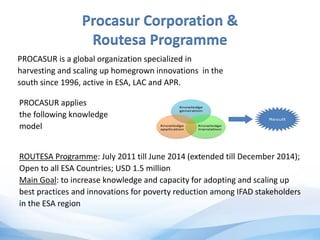
PROCASUR is a global organization specialized in
harvesting and scaling up homegrown innovations in the
south since 1996, active in ESA, LAC and APR.
Knowledge
generation
Knowledge
translation
Knowledge
application
Result
ROUTESA Programme: July 2011 till June 2014 (extended till December 2014);
Open to all ESA Countries; USD 1.5 million
Main Goal: to increase knowledge and capacity for adopting and scaling up
best practices and innovations for poverty reduction among IFAD stakeholders
in the ESA region
PROCASUR applies
the following knowledge
model
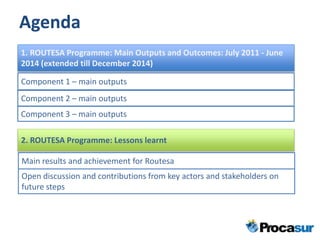
Agenda
1. ROUTESA Programme: Main Outputs and Outcomes: July 2011 - June
2014 (extended till December 2014)
Component 1 – main outputs
Component 2 – main outputs
Component 3 – main outputs
2. ROUTESA Programme: Lessons learnt
Main results and achievement for Routesa
Open discussion and contributions from key actors and stakeholders on
future steps
ROUTESA Programme:
Main outputs and outcomes
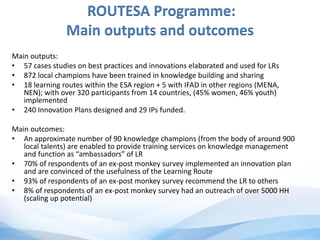
Main outputs:
• 57 cases studies on best practices and innovations elaborated and used for LRs
• 872 local champions have been trained in knowledge building and sharing
• 18 learning routes within the ESA region + 5 with IFAD in other regions (MENA,
NEN); with over 320 participants from 14 countries, (45% women, 46% youth)
implemented
• 240 Innovation Plans designed and 29 IPs funded.
Main outcomes:
• An approximate number of 90 knowledge champions (from the body of around 900
local talents) are enabled to provide training services on knowledge management
and function as “ambassadors” of LR
• 70% of respondents of an ex-post monkey survey implemented an innovation plan
and are convinced of the usefulness of the Learning Route
• 93% of respondents of an ex-post monkey survey recommend the LR to others
• 8% of respondents of an ex-post monkey survey had an outreach of over 5000 HH
(scaling up potential)
ROUTESA Programme:
Local Knowledge and skills management
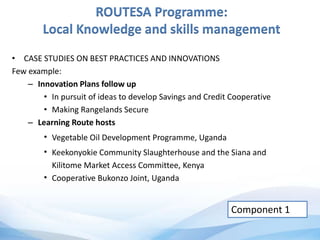
• CASE STUDIES ON BEST PRACTICES AND INNOVATIONS
Few example:
– Innovation Plans follow up
• In pursuit of ideas to develop Savings and Credit Cooperative
• Making Rangelands Secure
– Learning Route hosts
• Vegetable Oil Development Programme, Uganda
• Keekonyokie Community Slaughterhouse and the Siana and
Kilitome Market Access Committee, Kenya
• Cooperative Bukonzo Joint, Uganda
Component 1
ROUTESA Programme:
Local Knowledge and skills management
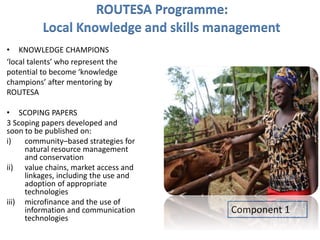
• KNOWLEDGE CHAMPIONS
‘local talents’ who represent the
potential to become ‘knowledge
champions’ after mentoring by
ROUTESA
• SCOPING PAPERS
3 Scoping papers developed and
soon to be published on:
i) community–based strategies for
natural resource management
and conservation
ii) value chains, market access and
linkages, including the use and
adoption of appropriate
technologies
iii) microfinance and the use of
information and communication
technologies
Component 1
ROUTESA Programme:
Capacity building and incentives for local innovations
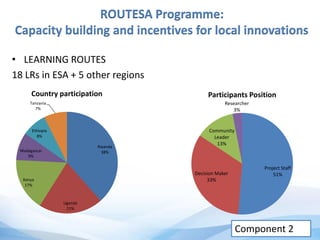
• LEARNING ROUTES
18 LRs in ESA + 5 other regions
Rwanda
38%
Uganda
21%
Kenya
17%
Madagascar
9%
Ethiopia
8%
Tanzania
7%
Country participation
Project Staff
51%Decision Maker
33%
Community
Leader
13%
Researcher
3%
Participants Position
Component 2
ROUTESA Programme:
Capacity building and incentives for local innovations
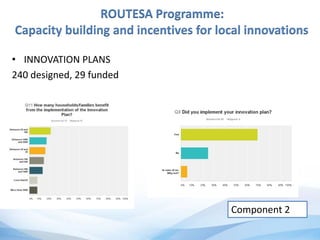
• INNOVATION PLANS
240 designed, 29 funded
Component 2
ROUTESA Programme:
Capacity building and incentives for local innovations
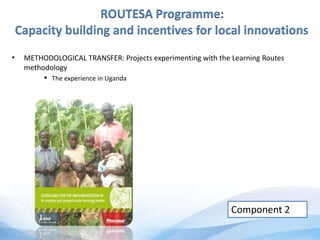
• METHODOLOGICAL TRANSFER: Projects experimenting with the Learning Routes
methodology
 The experience in Uganda
Component 2
ROUTESA Programme:
Capacity building and incentives for local innovations
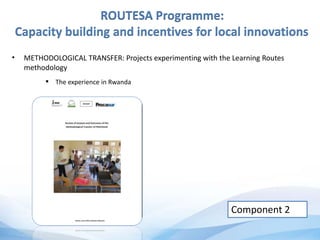
• METHODOLOGICAL TRANSFER: Projects experimenting with the Learning Routes
methodology
Component 2
 The experience in Rwanda
ROUTESA Programme:
Development and dissemination of innovations
• VIDEOS produced under the framework of the Routesa Programme:
Component 3
An example from the Learning Route: "Innovative ideas on
securing resource and land rights through inclusive business
models. The case of Uganda”
19th – 26th August, 2013 (Uganda)
ROUTESA Programme:
Development and dissemination of innovations
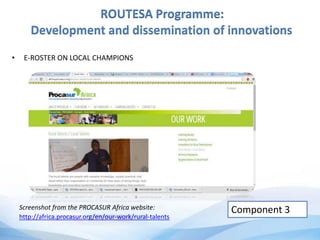
• E-ROSTER ON LOCAL CHAMPIONS
Component 3Screenshot from the PROCASUR Africa website:
http://africa.procasur.org/en/our-work/rural-talents
ROUTESA Programme:
Development and dissemination of innovations
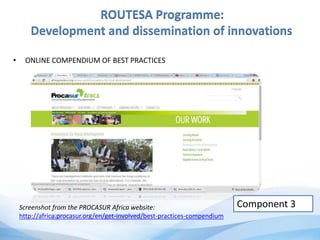
• ONLINE COMPENDIUM OF BEST PRACTICES
Component 3Screenshot from the PROCASUR Africa website:
http://africa.procasur.org/en/get-involved/best-practices-compendium
ROUTESA Programme:
Lessons Learnt
• 75% of the LR participants carried out dissemination activities to their
community based organizations (CBOs) after their return, which indicates a
high level of knowledge transfer to the member of these organizations
which did not participate in the LR.
• 70% of the LR participants developed Innovation Plans (IPs) and applied
knowledge gained
• 75% of the LR participants acknowledged that changes had occurred in the
organization or institutions as a result of the LR (better definition of
objectives and strategies, improved internal organizations, changes in the
management of services of their organizations)
ROUTESA Programme:
Lessons Learnt
Contribution to the positive performance of the IFAD/ESA portfolio
• SSC: increased interaction between ESA countries and within country portfolios
for the scaling up of best practices and innovations (SACCOs LR, Scaling Up of
the CLAR/Intekoy’Imihigo in Rwanda, Uganda ICO, GALS)
• KM: Appropriation of the LR Methodology, capitalization of IFAD best practices
and access to innovations
• Partnership: Linkages with programs, networks and organizations (AFRACA,
FAO, CARE, OXFAM Novib, ILC, ILRI/CGIAR, SPIU-PAPSTA-KWAMP, synergies
IFAD-PTA)
• Targeting: Improved inclusion of women and youth in agricultural and rural
development.
Time for discussion
WHAT ABOUT YOUR EXPERIENCE?
Please contribute with your stories and testimonies
Thanks a lot!
For further details, please visit our website and dedicated page on the impact of the
learning routes:
http://africa.procasur.org
http://africa.procasur.org/en/our-work/innovations-for-rural-development

Ws routesa regional workshop_december 2014

  • 1.
    Regional Workshop onthe “Learning Routes: a Knowledge Management and Capacity Building Tool for Rural Development in East and Southern Africa (ROUTESA)” Programme FOLLOWING THE INNOVATION PATH Kampala, Kigali, Nairobi and Rome 3rd December 2014
  • 2.
    Procasur Corporation & RoutesaProgramme PROCASUR is a global organization specialized in harvesting and scaling up homegrown innovations in the south since 1996, active in ESA, LAC and APR. Knowledge generation Knowledge translation Knowledge application Result ROUTESA Programme: July 2011 till June 2014 (extended till December 2014); Open to all ESA Countries; USD 1.5 million Main Goal: to increase knowledge and capacity for adopting and scaling up best practices and innovations for poverty reduction among IFAD stakeholders in the ESA region PROCASUR applies the following knowledge model
  • 3.
    Agenda 1. ROUTESA Programme:Main Outputs and Outcomes: July 2011 - June 2014 (extended till December 2014) Component 1 – main outputs Component 2 – main outputs Component 3 – main outputs 2. ROUTESA Programme: Lessons learnt Main results and achievement for Routesa Open discussion and contributions from key actors and stakeholders on future steps
  • 4.
    ROUTESA Programme: Main outputsand outcomes Main outputs: • 57 cases studies on best practices and innovations elaborated and used for LRs • 872 local champions have been trained in knowledge building and sharing • 18 learning routes within the ESA region + 5 with IFAD in other regions (MENA, NEN); with over 320 participants from 14 countries, (45% women, 46% youth) implemented • 240 Innovation Plans designed and 29 IPs funded. Main outcomes: • An approximate number of 90 knowledge champions (from the body of around 900 local talents) are enabled to provide training services on knowledge management and function as “ambassadors” of LR • 70% of respondents of an ex-post monkey survey implemented an innovation plan and are convinced of the usefulness of the Learning Route • 93% of respondents of an ex-post monkey survey recommend the LR to others • 8% of respondents of an ex-post monkey survey had an outreach of over 5000 HH (scaling up potential)
  • 5.
    ROUTESA Programme: Local Knowledgeand skills management • CASE STUDIES ON BEST PRACTICES AND INNOVATIONS Few example: – Innovation Plans follow up • In pursuit of ideas to develop Savings and Credit Cooperative • Making Rangelands Secure – Learning Route hosts • Vegetable Oil Development Programme, Uganda • Keekonyokie Community Slaughterhouse and the Siana and Kilitome Market Access Committee, Kenya • Cooperative Bukonzo Joint, Uganda Component 1
  • 6.
    ROUTESA Programme: Local Knowledgeand skills management • KNOWLEDGE CHAMPIONS ‘local talents’ who represent the potential to become ‘knowledge champions’ after mentoring by ROUTESA • SCOPING PAPERS 3 Scoping papers developed and soon to be published on: i) community–based strategies for natural resource management and conservation ii) value chains, market access and linkages, including the use and adoption of appropriate technologies iii) microfinance and the use of information and communication technologies Component 1
  • 7.
    ROUTESA Programme: Capacity buildingand incentives for local innovations • LEARNING ROUTES 18 LRs in ESA + 5 other regions Rwanda 38% Uganda 21% Kenya 17% Madagascar 9% Ethiopia 8% Tanzania 7% Country participation Project Staff 51%Decision Maker 33% Community Leader 13% Researcher 3% Participants Position Component 2
  • 8.
    ROUTESA Programme: Capacity buildingand incentives for local innovations • INNOVATION PLANS 240 designed, 29 funded Component 2
  • 9.
    ROUTESA Programme: Capacity buildingand incentives for local innovations • METHODOLOGICAL TRANSFER: Projects experimenting with the Learning Routes methodology  The experience in Uganda Component 2
  • 10.
    ROUTESA Programme: Capacity buildingand incentives for local innovations • METHODOLOGICAL TRANSFER: Projects experimenting with the Learning Routes methodology Component 2  The experience in Rwanda
  • 11.
    ROUTESA Programme: Development anddissemination of innovations • VIDEOS produced under the framework of the Routesa Programme: Component 3 An example from the Learning Route: "Innovative ideas on securing resource and land rights through inclusive business models. The case of Uganda” 19th – 26th August, 2013 (Uganda)
  • 12.
    ROUTESA Programme: Development anddissemination of innovations • E-ROSTER ON LOCAL CHAMPIONS Component 3Screenshot from the PROCASUR Africa website: http://africa.procasur.org/en/our-work/rural-talents
  • 13.
    ROUTESA Programme: Development anddissemination of innovations • ONLINE COMPENDIUM OF BEST PRACTICES Component 3Screenshot from the PROCASUR Africa website: http://africa.procasur.org/en/get-involved/best-practices-compendium
  • 14.
    ROUTESA Programme: Lessons Learnt •75% of the LR participants carried out dissemination activities to their community based organizations (CBOs) after their return, which indicates a high level of knowledge transfer to the member of these organizations which did not participate in the LR. • 70% of the LR participants developed Innovation Plans (IPs) and applied knowledge gained • 75% of the LR participants acknowledged that changes had occurred in the organization or institutions as a result of the LR (better definition of objectives and strategies, improved internal organizations, changes in the management of services of their organizations)
  • 15.
    ROUTESA Programme: Lessons Learnt Contributionto the positive performance of the IFAD/ESA portfolio • SSC: increased interaction between ESA countries and within country portfolios for the scaling up of best practices and innovations (SACCOs LR, Scaling Up of the CLAR/Intekoy’Imihigo in Rwanda, Uganda ICO, GALS) • KM: Appropriation of the LR Methodology, capitalization of IFAD best practices and access to innovations • Partnership: Linkages with programs, networks and organizations (AFRACA, FAO, CARE, OXFAM Novib, ILC, ILRI/CGIAR, SPIU-PAPSTA-KWAMP, synergies IFAD-PTA) • Targeting: Improved inclusion of women and youth in agricultural and rural development.
  • 16.
    Time for discussion WHATABOUT YOUR EXPERIENCE? Please contribute with your stories and testimonies Thanks a lot! For further details, please visit our website and dedicated page on the impact of the learning routes: http://africa.procasur.org http://africa.procasur.org/en/our-work/innovations-for-rural-development

Editor's Notes

  • #3 We have been training IFAD projects and their partners in ESA not only through their participation in Learning Routes on different thematics, but also through Technical Assistance for the adoption of the Learning Routes methodology as part of their knowledge management strategies.
  • #12   Here is part of the video from Case Study One (Kawacom) of the learning route: "Innovative ideas on securing resource and land rights through inclusive business models. The case of Uganda" that took place between the 19th to the 26th of August, 2013 in Uganda organized by the International Fund for Agricultural Development (IFAD) and the PROCASUR Corporation. Farmers, Government and Private Sector Working Together: