328 |   WRITING TO MAKE A DIFFERENCE:   25 Power ful Techniques to Boost Your Communit y Impact


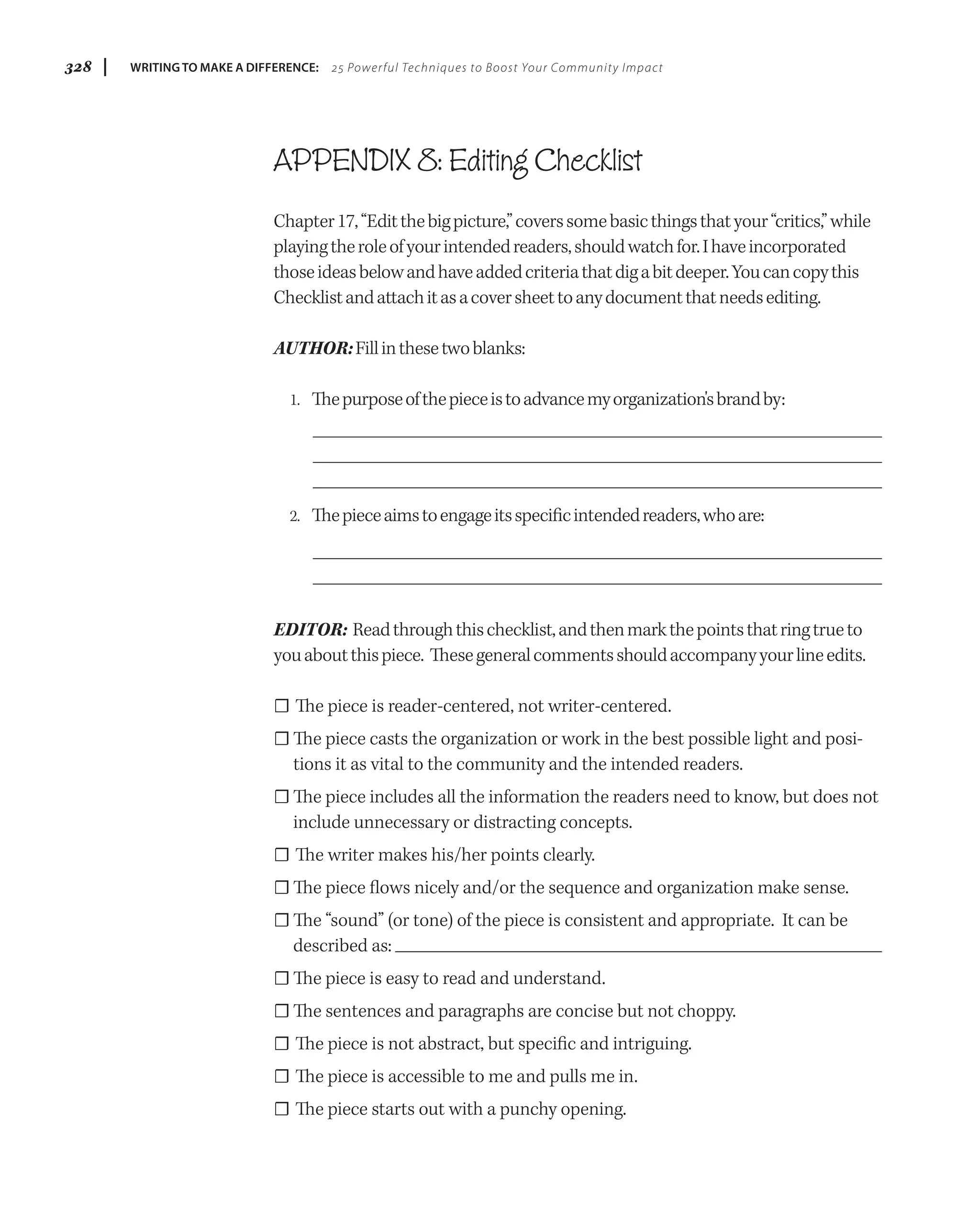
                              APPENDIX 8: Editing Checklist
                              Chapter 17, “Edit the big picture,” covers some basic things that your “critics,” while
                              playing the role of your intended readers, should watch for. I have incorporated
                              those ideas below and have added criteria that dig a bit deeper. You can copy this
                              Checklist and attach it as a cover sheet to any document that needs editing.

                              AUTHOR: Fill in these two blanks:

                                1. The purpose of the piece is to advance my organization's brand by:


                                2. The piece aims to engage its specific intended readers, who are:


                              EDITOR: Read through this checklist, and then mark the points that ring true to
                              you about this piece. These general comments should accompany your line edits.

                              ☐ The piece is reader-centered, not writer-centered.
                              ☐ The piece casts the organization or work in the best possible light and posi-
                                tions it as vital to the community and the intended readers.
                              ☐ The piece includes all the information the readers need to know, but does not
                                include unnecessary or distracting concepts.
                              ☐ The writer makes his/her points clearly.
                              ☐ The piece flows nicely and/or the sequence and organization make sense.
                              ☐ The “sound” (or tone) of the piece is consistent and appropriate. It can be
                                described as:
                              ☐ The piece is easy to read and understand.
                              ☐ The sentences and paragraphs are concise but not choppy.
                              ☐ The piece is not abstract, but specific and intriguing.
                              ☐ The piece is accessible to me and pulls me in.
                              ☐ The piece starts out with a punchy opening.
Appendix 8: Editing Checklist   | 329


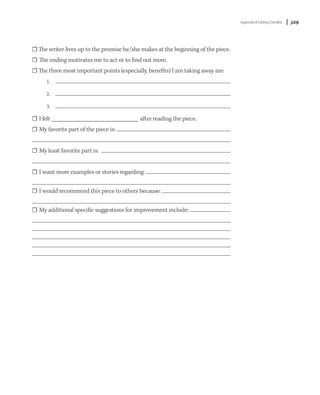
☐ The writer lives up to the promise he/she makes at the beginning of the piece.
☐ The ending motivates me to act or to find out more.
☐ The three most important points (especially, benefits) I am taking away are:
      1.

      2.

      3.

☐ I felt                                   after reading the piece.
☐ My favorite part of the piece is:


☐ My least favorite part is:


☐ I want more examples or stories regarding:

☐ I would recommend this piece to others because:

☐ My additional specific suggestions for improvement include:

Writing With Passion and Power - Editing Checklist

  • 1.
    328 | WRITING TO MAKE A DIFFERENCE: 25 Power ful Techniques to Boost Your Communit y Impact APPENDIX 8: Editing Checklist Chapter 17, “Edit the big picture,” covers some basic things that your “critics,” while playing the role of your intended readers, should watch for. I have incorporated those ideas below and have added criteria that dig a bit deeper. You can copy this Checklist and attach it as a cover sheet to any document that needs editing. AUTHOR: Fill in these two blanks: 1. The purpose of the piece is to advance my organization's brand by: 2. The piece aims to engage its specific intended readers, who are: EDITOR: Read through this checklist, and then mark the points that ring true to you about this piece. These general comments should accompany your line edits. ☐ The piece is reader-centered, not writer-centered. ☐ The piece casts the organization or work in the best possible light and posi- tions it as vital to the community and the intended readers. ☐ The piece includes all the information the readers need to know, but does not include unnecessary or distracting concepts. ☐ The writer makes his/her points clearly. ☐ The piece flows nicely and/or the sequence and organization make sense. ☐ The “sound” (or tone) of the piece is consistent and appropriate. It can be described as: ☐ The piece is easy to read and understand. ☐ The sentences and paragraphs are concise but not choppy. ☐ The piece is not abstract, but specific and intriguing. ☐ The piece is accessible to me and pulls me in. ☐ The piece starts out with a punchy opening.
  • 2.
    Appendix 8: EditingChecklist | 329 ☐ The writer lives up to the promise he/she makes at the beginning of the piece. ☐ The ending motivates me to act or to find out more. ☐ The three most important points (especially, benefits) I am taking away are: 1. 2. 3. ☐ I felt after reading the piece. ☐ My favorite part of the piece is: ☐ My least favorite part is: ☐ I want more examples or stories regarding: ☐ I would recommend this piece to others because: ☐ My additional specific suggestions for improvement include: