Changes in surface runoff from drought­induced soil 
hydrophobicity in the Ventura County watershed 


CVEN 4323 
Dr. Joseph Kasprzyk 
 
Ariel Retuta 
Cassidy Kuhn 
Jack Greene 


1.0 Introduction 
The destructive landslide observed in Camarillo, CA on December 12, 2014 left many                         
residents trapped in their homes and prompted mandatory evacuations. It was triggered                       
by a heavy rainfall event on an area that had been recently devastated by a forest fire                                 
(Camarillo, 2015). This outcome depicts the dynamic relationship between changing                   
environmental conditions and hydrologic runoff . Extensive drought periods have long                     
been included among the adverse ramifications of future global climate change, which                       
raises the question: Do severe drought periods change the soil properties associated                       
with the basin’s rainfall­runoff relationship (Dale, 2001)? 
 
1.1 Problem Scope 
This report aims to help predict how runoff may change as a function of soil permeability                               
in dry, drought­affected areas in multiple adjoining watershed basins within Ventura                     
County, California. These basins will be modeled using the U.S. Army Corp of                         
Engineers’ Hydrologic Modeling System (HEC­HMS) and will be used to simulate runoff                       
generation for storm events with return periods of 2, 10, and 25 and 100 years. The                               
permeability in the model will be changed proportionally to match the permeability                       
changes observed in previous studies. The model will simulate changes in overland                       
runoff only, excluding outputs of sediment and debris transport.  
 
 
2.0 Background 
California’s water resource infrastructure       
has been faced with considerable stress           
from shifting hydrologic character and         
continued population growth. Severe       
climatic and hydrologic droughts have         
taken hold in California over the past 10               
years, with the last three years marking             
some of the driest and hottest since 1985               
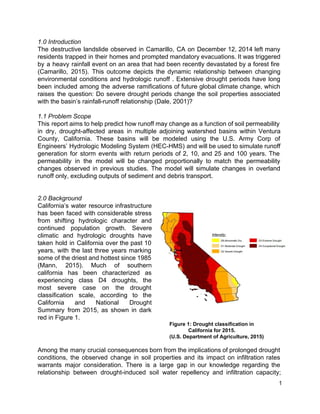
(Mann, 2015). Much of southern         
california has been characterized as         
experiencing class D4 droughts, the         
most severe case on the drought           
classification scale, according to the         
California and National Drought       
Summary from 2015, as shown in dark             
red in Figure 1.   
Figure 1: Drought classification in  
California for 2015. 
(U.S. Department of Agriculture, 2015) 
 
Among the many crucial consequences born from the implications of prolonged drought                       
conditions, the observed change in soil properties and its impact on infiltration rates                         
warrants major consideration. There is a large gap in our knowledge regarding the                         
relationship between drought­induced soil water repellency and infiltration capacity;                 
1 
however, studies have seen significant declines in soil permeability in manually­dried                     
soil. The few studies that have been performed indicate that periods of severe dryness                           
result in hydrophobic soil conditions, which retard the runoff’s ability to infiltrate into soil                           
(Shakesby, 2000). As hydrophobicity is heightened in drier soil, the soil’s capacity to                         
infiltrate water is diminished (Shakesby, 2000). This relationship between ​hydraulic                   
conductivity and soil wettability is depicted in Figure 2. 
   
Reports of reduced infiltration capacities in dry,             
water­repellent soils after prescribed burning         
were found to be as low as 25 times less than                     
in moist soils (DeBano, 1991). Other studies             
observed a diminished capacity of dry sand to               
infiltrate water to 1% of its capacity when               
hydrophilic and moist (Wallis et. al. 1990). This               
increases immediate overland runoff volumes         
and may increase flooding and landslide           
hazards. 
   
The purpose of this study is to superimpose this                 
relationship between soil dryness and         
permeability to drought­stricken soils in         
California in order to identify trends of change in                 
overland runoff discharge. Infiltration rates and           
soil permeability depends on many different           
factors. Among them are soil composition, the             
structure of the media, the chemical condition of 
    ​Figure 2: Hydraulic conductivity curves    ​the soil, plants/animals in the soil, and land use 
for dry, hydrophobic soils (solid line) and ​(Johnson, 1963). This model will look only at one 
             wettable soils (dashed line).               ​of these factors ­ land use. Although the model  
(Shakesby, 2000) ​will output runoff values only, there is a general                       
consensus in the literature that reveals relationships between soil dryness and erosion.  
 
3.0 Model 
Using HEC­HMS, a regional model of the watersheds within Ventura County were                       
created. This model presented both current and future, drought­stricken conditions in                     
order to compare how overland runoff might change under extremely dry conditions.   
 
3.1 Area of Study 
Ventura County, shown in Figure 3, is a coastal area located in the south western part                               
of California. Its northern border is capped by the Santa Barbara National Forest and                           
lies just west of the Santa Susana Mountains and partially by the Santa Monica                           
Mountains. The Pacific Ocean borders Ventura County to the west and southwest  
2 
 
Figure 3: Ventura County location within California  
(City of Ventura, 2015) 
 
The topography of Ventura County includes hilly and mountainous terrain with                     
elevations ranging from sea level up to 6,300 feet above sea level and is punctuated                             
with small valleys and alluvial fan deltas. There are eleven watershed subbasins within                         
the Ventura County borders that were included in the model.  
 
Ventura County comprises three main watersheds: Ventura River at 226 square miles,                       
Calleguas Creek at 343 square miles, and Santa Clara River at 1,634 square miles.  
 
3.2 Assumptions 
The following simplifications and assumptions were made in this study:  
● Uniform spatial distribution of rainfall for each basin for each respective rain                       
event and was kept constant for each time step. Storm depths for a 24­hour                           
storm event were obtained from the National Oceanic and Atmospheric                   
Administration (NOAA). Four different return periods were illustrated in the model                     
to compare runoff change severities across various storm intensities. The 2, 10,                       
25, 100­year storms were modeled.  
● Uniform spatial losses for each basin and are constant for each time step. 
● Uniform initial conditions for each basin.  
● All water drains to ocean. 
● Composite curve numbers are accurate for and representative of the entire                     
basin. 
● Average flow for the driest month, July, was used as the base flow to simulate                             
drought conditions. This averaged baseflow was held constant.  
● Maximally dry soil conditions were assumed to yield 25% less permeability, or                       
25% more imperviousness (Debano, 1991). 
● Lag time was not changed as a function of soil permeability. This value remained                           
constant within the model.  
3 
● Rainfall events are unaffected by drought conditions because meteorological                 
shifts due to climate change are difficult to quantify. This study includes a larger                           
rain event to simulate an extreme weather event and how the area’s changed                         
hydrology would behave in these conditions.  
● Drought affects the entire area the same way and makes all soils uniformly                         
impervious.  
● Changes in soil imperviousness is solely due to the degree of hydrophobicity                       
caused by the driest possible conditions (zero water in the vadose zone).  
 
3.3 Model Description 
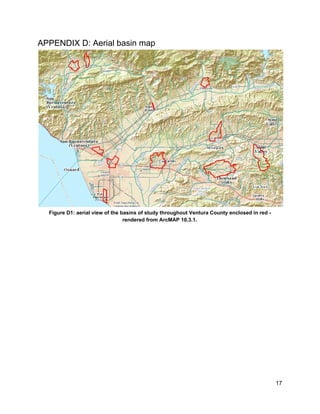
Basins were delineated based on the largest population centers in the county with data                           
from Lindell (2010). The aerial shots of each basin can be found in Attachment D to the                                 
report. Channel and routing information was adopted from the Ventura County                     
Community for a Clean Watershed website. Port Hueneme is not connected to the                         
watersheds of the northern part of the county ­ Port Hueneme drains directly to the                             
Pacific Ocean. All of the other watersheds are modeled independently of each other.                         
The model is set up in two cases to evaluate different storm return periods. One model                               
is considered the base case with accurate soil types and imperviousness. The second                         
model is modeling Ventura County if it were to go into a drought, which would make                               
soils 25% more impervious and create more runoff. The HEC­HMS model is shown in                           
Figure 4  
Figure 4: HEC­HMS Model 
 
   
4 
3.3.1 Meteorological Inputs 
Several 24­hour duration rainfall events were simulated in the model in order to                         
demonstrate the consequences of a change in permeability for the 2, 10, 25 and                           
100­year rainfall events in Ventura County. A weighted spatial average was calculated                       
for each of the four frequency­duration meteorological inputs used in the model to                         
establish a simple, uniform rainfall event for each recurrence interval. A sample                       
calculation for these weighted averages is shown in Appendix C. The values for these                           
calculations were obtained from NOAA rain gages located within the county’s three                       
largest watersheds. A summary of the meteorological inputs are shown in Table 1. 
 
Table 1: Precipitation frequency­duration for  
the  major basins in Ventura County 
(Walter, 2015; NOAA, 2015) 
Ventura 
County’s 
Largest 
Watersheds 
Area  
(sq mi) 
Representative 
Gage Station 
2­Year, 
24­Hour 
Rainfall 
(in) 
10­Year, 
24­Hour 
Rainfall 
(in) 
25­Year, 
24­Hour 
Rainfall 
(in) 
100­Year, 
24­Hour 
Rainfall 
(in) 
Ventura River  226 
Ventura­Downtown 
(93­0066) 
3.00   4.46   5.28   6.46  
Calleguas 
Creek 
343 
Camarillo­Pacific 
Sod (93­0177) 
2.44  3.39   4.44   5.58  
Santa Clara 
River 
1,634 
Piru 2 ESE  
(04­6940) 
3.37   5.34   6.55   8.45  
Ventura 
County 
2,203 
Area Weighted 
Averages 
3.24   5.00   6.09   7.80  
 
3.3.2 Land Use and Loss Method Inputs 
The land use and loss method inputs were obtained from data supplied by Ventura                           
County, which the county computed by characterizing and mapping the land use in GIS.                           
This was achieved by weighting the spatial averages to obtain curve numbers and initial                           
abstractions for each watershed (Liddell, 2010). The land use and loss method inputs                         
that were used in the model are shown in Table 2. 
 
Table 2: Weighted Loss Values for Ventura County 
(Lidell, 2010) 
Watershed  
Area  
(acres) 
Composite Curve 
Number (CN) 
Initial Abstraction, 
S 
Camarillo  2,779  85.12  1.75 
Happy Valley  1,029  77.29  2.94 
Fox  749  74.19  3.48 
Ventura  707  90.93  1.00 
Fillmore  762  74.77  3.37 
Port Hueneme  589  85.6  1.68 
Moorpark  1,816  63.34  5.79 
Oxnard  1,374  84.07  1.89 
5 
Simi Valley  3,321  71.04  4.08 
Santa Paula  64  80.07  2.49 
Thousand Oaks  5,179  81.54  2.26 
 
Curve numbers delineated in Table 2 were held constant within the model due to a lack                               
of available data that would indicate how curve numbers change as a function of soil                             
dryness. Curve numbers are a function of land cover and empirically derived. For this                           
reason, scaling them by a certain percentage would not have been accurate or well                           
representative of the hydrologic behavior of the basin. Instead, the imperviousness input                       
was the variable in our model. This rendered more cohesive model outputs and was                           
more consistent with the literature.  
 
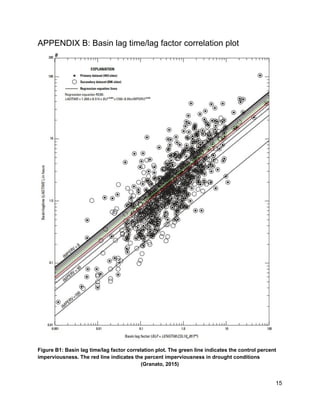
There were no basin lag time values in the city, county, or USGS literature. The lag time                                 
diagram in Appendix B demonstrates that the lag time is slightly dependent on the                           
percent imperviousness of the basin, but is much more dependent on the specific basin                           
at large; namely, things like the basin size and slope (Granato, 2015). Therefore, the lag                             
time was unchanged within each basin for both control and drought conditions. Figure                         
B1 in Appendix B also indicates that a typical lag time might fall in the range of 60 to                                     
120 minutes (Granato, 2015). Thus, the constant lag time values chosen for each basin                           
ranged from 60 to 120 minutes to accommodate for the considerable variability in the                           
size of each basin. The approximate basin lag times are shown in Table 3. 
 
Table 3: Approximated Lag Time Values for Each Basin  
Based on Typical Lag Time Values in Basins Across the United States  
Watershed  
Area  
(acres) 
Basin Lag Time  
(hours) 
Camarillo  2,779  2.0 
Happy Valley  1,029  1.5 
Fox  749  1.5 
Ventura  707  1.5 
Fillmore  762  1.5 
Port Hueneme  589  1.5 
Moorpark  1,816  1.5 
Oxnard  1,374  1.5 
Simi Valley  3,321  2.0 
Santa Paula  64  1.0 
Thousand Oaks  5,179  2.0 
 
The routing lag time values (TL) for each basin were approximated using their main                           
channel lengths, measured in ArcGIS from the outfall of the basin to the end of the                               
reach, calculated using Equation 1. TL values are shown in Table 4.  
 
L  0.0109LT =   0.63651
    (1) 
 
 
6 


Table 4: Channel lag time for channel routing for Ventura County 
Channel Routing  Length (meters)   Channel Lag Time (hours) 
Upper Ventura  12,000  4.30 
Ventura Drain  25,000  6.87 
Upper Santa Clara  20,600  6.07 
Lower Santa Clara  21,300  6.20 
Santa Clara Drain  9,400  3.68 
Upper Calleguas  16,200  5.21 
Lower Calleguas  22,550  6.43 
Calleguas Drain  20,000  5.96 
Port Hueneme Drain*  0  0.00 
*Port Hueneme drains directly to the ocean  
 
3.3.3 Baseflow Inputs 
As stated before, curve number and land use data was severely limited. As a result,                             
only the subbasins with data available were included into the model. Of these seven                           
main areas, streamflow data was found and averaged over what is historically the driest                           
month of the year: July. Gage stations that were in closest proximity to the subbasins                             
included in the model were found. Because the driest month was used in order to make                               
the most conservative representations, many average streamflows were zero. This                   
data, shown below in Table 5, was used as base flow input into HEC­HMS to attempt to                                 
more accurately characterize the overland runoff one might expect to see for the                         
different storms we chose to investigate.  
 
Table 5: Average streamflows for the gage stations representative of each model subbasin. 
(VCWPD Hydrologic Data Server, 2015) 
Station Number 
Corresponding 
Hydrological Element 
Average Streamflow 
(cfs) 
602B  Meiners Oaks  0 
650  Ojai Basin  0 
708A  Oxnard and Ventura  0 
800  Thousand Oaks  0 
803A  Simi Valley  2.4 
806A  Camarillo  0 
841  Moorpark  19.5 
 
 
3.4 Model Outputs/Results 
7 
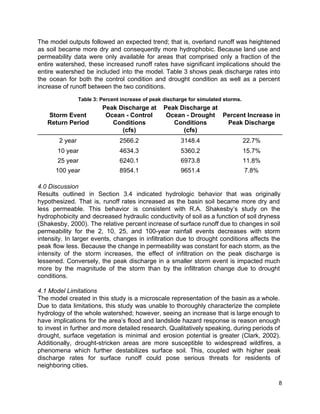
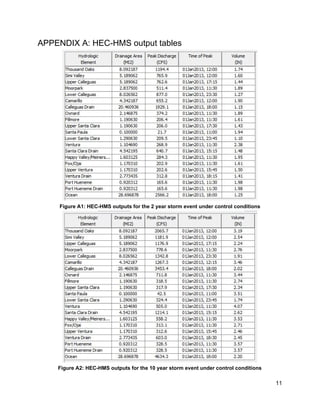
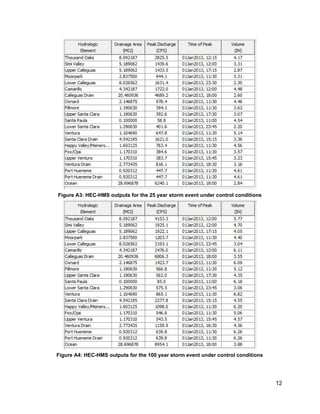
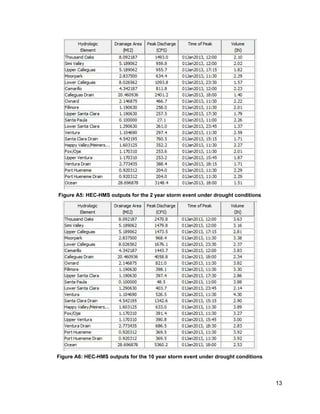
The model outputs followed an expected trend; that is, overland runoff was heightened                         
as soil became more dry and consequently more hydrophobic. Because land use and                         
permeability data were only available for areas that comprised only a fraction of the                           
entire watershed, these increased runoff rates have significant implications should the                     
entire watershed be included into the model. Table 3 shows peak discharge rates into                           
the ocean for both the control condition and drought condition as well as a percent                             
increase of runoff between the two conditions.  
 
Table 3: Percent increase of peak discharge for simulated storms. 
Storm Event 
Return Period  
Peak Discharge at 
Ocean ­ Control 
Conditions 
(cfs) 
Peak Discharge at 
Ocean ­ Drought 
Conditions 
(cfs) 
Percent Increase in 
Peak Discharge 
2 year  2566.2  3148.4  22.7% 
10 year  4634.3  5360.2  15.7% 
25 year    6240.1  6973.8  11.8% 
100 year  8954.1  9651.4  7.8% 
 
4.0 Discussion  
Results outlined in Section 3.4 indicated hydrologic behavior that was originally                     
hypothesized. That is, runoff rates increased as the basin soil became more dry and                           
less permeable. This behavior is consistent with R.A. Shakesby’s study on the                       
hydrophobicity and decreased hydraulic conductivity of soil as a function of soil dryness                         
(Shakesby, 2000). The relative percent increase of surface runoff due to changes in soil                           
permeability for the 2, 10, 25, and 100­year rainfall events decreases with storm                         
intensity. In larger events, changes in infiltration due to drought conditions affects the                         
peak flow less. Because the change in permeability was constant for each storm, as the                             
intensity of the storm increases, the effect of infiltration on the peak discharge is                           
lessened. Conversely, the peak discharge in a smaller storm event is impacted much                         
more by the magnitude of the storm than by the infiltration change due to drought                             
conditions. 
 
4.1 Model Limitations  
The model created in this study is a microscale representation of the basin as a whole.                               
Due to data limitations, this study was unable to thoroughly characterize the complete                         
hydrology of the whole watershed; however, seeing an increase that is large enough to                           
have implications for the area’s flood and landslide hazard response is reason enough                         
to invest in further and more detailed research. Qualitatively speaking, during periods of                         
drought, surface vegetation is minimal and erosion potential is greater (Clark, 2002).                       
Additionally, drought­stricken areas are more susceptible to widespread wildfires, a                   
phenomena which further destabilizes surface soil. This, coupled with higher peak                     
discharge rates for surface runoff could pose serious threats for residents of                       
neighboring cities.  
 
8 
Additional limitations encountered in this study include: 
● Location­specific curve number values for the whole watershed expanse.  
● Comprehensive and thorough characterization of basin lag times. 
● Direct soil moisture­soil permeability relationships within the framework of                 
drought­affected areas.  
● Heavy approximations for the following values: spatial rainfall distributions, base                   
flow rates, and average stream flows. Much of the spatial specificities of these                         
data were grossly superimposed onto the individual areas that were modeled.  
● Strength of data for smaller subsections of the watershed was prioritized the  
 
 
4.2 Suggestions for Future Research 
There were strong correlations between hydrophobicity and soil destabilization that                   
were laterally inferred in Shakesby’s study as well. Evidence for these links creates a                           
heightened level of hazard for destructive events like landslides. Because this is a                         
serious and imminent threat, studies more focused and site­specific studies on hydro                       
geographics are needed to properly profile these risks that are born from a changing                           
hydrologic landscape.  
 
Inferences used in this study regarding soil dryness and hydrophobicity were construed                       
from experiments conducted with simulated­burned soil. Further studies could address                   
and test this relationship using naturally or drought­induced dryness in soil.  


9 
Works Cited 
 
"Camarillo Springs Homes Damaged by Mud, Debris Flow." ​ABC7 Los Angeles​. N.p.,                       
12 Dec. 2014. Web. 05 Nov. 2015. 
Clark, James S., et al. "Drought cycles and landscape responses to past aridity on                           
prairies of the northern Great Plains, USA." ​Ecology​ 83.3 (2002): 595­601. 
Brock, John H., and Leonard F. DeBano. "Wettability of an Arizona chaparral soil                         
influenced by prescribed burning." ​JS Krammes [TECH. COORD.]. Proceedings                 
of a Symposium on the Effects of Fire Management of Southwestern Natural                       
Resources​. 1988. 
Doerr, S. H., R. A. Shakesby, and RPD Walsh. "Soil water repellency: its causes,                           
characteristics and hydro­geomorphological significance." ​Earth­Science         
Reviews​ 51.1 (2000): 33­65. 
Dale, Virginia H., et al. "Climate change and forest disturbances: climate change can                         
affect forests by altering the frequency, intensity, duration, and timing of fire,                       
drought, introduced species, insect and pathogen outbreaks, hurricanes,               
windstorms, ice storms, or landslides." ​BioScience​ 51.9 (2001): 723­734. 
Granato, G. E. “Estimating Basin Lagtime and Hydrograph Timing Indexes Used to                       
Characterize Stormflows for Runoff­Quality Analysis.” Reston, Virginia. 2012.               
USGS. Web. 
Honarbakhsh, Afshin, Seyed Javad Sadatinejad, Moslem Heydari, and Mohamadreza                 
Mozdianfard. "Lag Time Forecasting in a River Basin." ​Environmental Sciences                   
9.1 (2012): 47. Web. 6 Dec. 2015. 
Johnson, A. I. ​A Field Method for Measurement of Infiltration​. Washington, D.C.: U.S.                         
G.P.O., 1963. USGS. Web. 
Liddell, Tommy. “Ventura County Watershed Protection District Planning & Regulatory                   
Hydrology Section Memorandum.” (2010). Web. 
Mann, Michael E., and Peter H. Gleick. "Climate change and California drought in the                           
21st century." ​Proceedings of the National Academy of Sciences 112.13 (2015):                     
3858­3859. 
"RMA Links." ​Ventura County Planning Division​. Web. 2 Dec. 2015. ­ Zoning figure 
Shakesby, R. A., S. H. Doerr, and R. P. D. Walsh. "The erosional impact of soil                               
hydrophobicity: current problems and future research directions." ​Journal of                 
hydrology​ 231 (2000): 178­191. 
Ventura County Watershed Protection District. "VCWPD Hydrologic Data Server."                 
(Hydrodata)​. Web. 7 Dec. 2015.  
Wallis, M. G., D. J. Horne, and A. S. Palmer. "Water repellency in a New Zealand                               
development sequence of yellow brown sands." ​Soil Research 31.5 (1993):                   
641­654. 
Walter, Lorraine. “Ventura River Watershed Management Plan.” (2015). Ventura River                   
Watershed Council. Web. 5 Dec. 2015. 


10 
APPENDIX A: HEC­HMS output tables 
 
Figure A1: HEC­HMS outputs for the 2 year storm event under control conditions 
 
Figure A2: HEC­HMS outputs for the 10 year storm event under control conditions 
11 
 
Figure A3: HEC­HMS outputs for the 25 year storm event under control conditions 
 
Figure A4: HEC­HMS outputs for the 100 year storm event under control conditions 
12 
 
Figure A5: HEC­HMS outputs for the 2 year storm event under drought conditions 
 
Figure A6: HEC­HMS outputs for the 10 year storm event under drought conditions 
13 
 
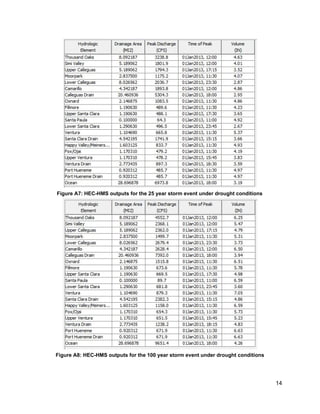
Figure A7: HEC­HMS outputs for the 25 year storm event under drought conditions 
 
Figure A8: HEC­HMS outputs for the 100 year storm event under drought conditions 
14 
APPENDIX B: Basin lag time/lag factor correlation plot
Figure B1: Basin lag time/lag factor correlation plot. The green line indicates the control percent 
imperviousness. The red line indicates the percent imperviousness in drought conditions 
(Granato, 2015) 
15 
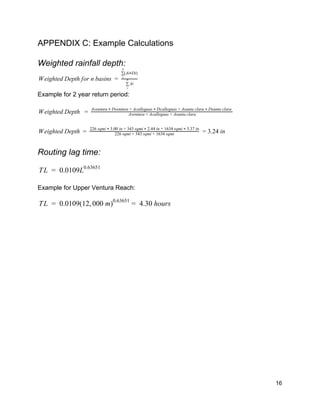
APPENDIX C: Example Calculations 
 
Weighted rainfall depth: 
eighted Depth for n basins   W =  
i∑
n
i
A
(Ai Di)∑
n
i
*
 
Example for 2 year return period: 
 
eighted Depth    W =   Aventura + Acalleguas + Asanta clara
Aventura   Dventura + Acalleguas   Dcalleguas + Asanta clara   Dsanta clara * * *
 
 
eighted Depth    .24 in W =   226 sqmi + 343 sqmi + 1634 sqmi
226 sqmi   3.00 in + 343 sqmi   2.44 in + 1634 sqmi   3.37 in* * *
= 3  
 
Routing lag time: 
 
L  0.0109LT =   0.63651
 
 
Example for Upper Ventura Reach: 
 
L  0.0109(12, 00 m) 4.30 hours  T =   0 0.63651
=     
 
   
16 
APPENDIX D: Aerial basin map  
 
Figure D1: aerial view of the basins of study throughout Ventura County enclosed in red ­ 
rendered from ArcMAP 10.3.1.  
17 

Writing Sample

  • 1.
  • 2.
    1.0 Introduction  The destructive landslideobserved in Camarillo, CA on December 12, 2014 left many                          residents trapped in their homes and prompted mandatory evacuations. It was triggered                        by a heavy rainfall event on an area that had been recently devastated by a forest fire                                  (Camarillo, 2015). This outcome depicts the dynamic relationship between changing                    environmental conditions and hydrologic runoff . Extensive drought periods have long                      been included among the adverse ramifications of future global climate change, which                        raises the question: Do severe drought periods change the soil properties associated                        with the basin’s rainfall­runoff relationship (Dale, 2001)?    1.1 Problem Scope  This report aims to help predict how runoff may change as a function of soil permeability                                in dry, drought­affected areas in multiple adjoining watershed basins within Ventura                      County, California. These basins will be modeled using the U.S. Army Corp of                          Engineers’ Hydrologic Modeling System (HEC­HMS) and will be used to simulate runoff                        generation for storm events with return periods of 2, 10, and 25 and 100 years. The                                permeability in the model will be changed proportionally to match the permeability                        changes observed in previous studies. The model will simulate changes in overland                        runoff only, excluding outputs of sediment and debris transport.       2.0 Background  California’s water resource infrastructure        has been faced with considerable stress            from shifting hydrologic character and          continued population growth. Severe        climatic and hydrologic droughts have          taken hold in California over the past 10                years, with the last three years marking              some of the driest and hottest since 1985                (Mann, 2015). Much of southern          california has been characterized as          experiencing class D4 droughts, the          most severe case on the drought            classification scale, according to the          California and National Drought        Summary from 2015, as shown in dark              red in Figure 1.    Figure 1: Drought classification in   California for 2015.  (U.S. Department of Agriculture, 2015)    Among the many crucial consequences born from the implications of prolonged drought                        conditions, the observed change in soil properties and its impact on infiltration rates                          warrants major consideration. There is a large gap in our knowledge regarding the                          relationship between drought­induced soil water repellency and infiltration capacity;                  1 
  • 3.
    however, studies haveseen significant declines in soil permeability in manually­dried                      soil. The few studies that have been performed indicate that periods of severe dryness                            result in hydrophobic soil conditions, which retard the runoff’s ability to infiltrate into soil                            (Shakesby, 2000). As hydrophobicity is heightened in drier soil, the soil’s capacity to                          infiltrate water is diminished (Shakesby, 2000). This relationship between ​hydraulic                    conductivity and soil wettability is depicted in Figure 2.      Reports of reduced infiltration capacities in dry,              water­repellent soils after prescribed burning          were found to be as low as 25 times less than                      in moist soils (DeBano, 1991). Other studies              observed a diminished capacity of dry sand to                infiltrate water to 1% of its capacity when                hydrophilic and moist (Wallis et. al. 1990). This                increases immediate overland runoff volumes          and may increase flooding and landslide            hazards.      The purpose of this study is to superimpose this                  relationship between soil dryness and          permeability to drought­stricken soils in          California in order to identify trends of change in                  overland runoff discharge. Infiltration rates and            soil permeability depends on many different            factors. Among them are soil composition, the              structure of the media, the chemical condition of      ​Figure 2: Hydraulic conductivity curves    ​the soil, plants/animals in the soil, and land use  for dry, hydrophobic soils (solid line) and ​(Johnson, 1963). This model will look only at one               wettable soils (dashed line).               ​of these factors ­ land use. Although the model   (Shakesby, 2000) ​will output runoff values only, there is a general                        consensus in the literature that reveals relationships between soil dryness and erosion.     3.0 Model  Using HEC­HMS, a regional model of the watersheds within Ventura County were                        created. This model presented both current and future, drought­stricken conditions in                      order to compare how overland runoff might change under extremely dry conditions.      3.1 Area of Study  Ventura County, shown in Figure 3, is a coastal area located in the south western part                                of California. Its northern border is capped by the Santa Barbara National Forest and                            lies just west of the Santa Susana Mountains and partially by the Santa Monica                            Mountains. The Pacific Ocean borders Ventura County to the west and southwest   2 
  • 4.
      Figure 3: Ventura County location within California   (City of Ventura, 2015)    The topography ofVentura County includes hilly and mountainous terrain with                      elevations ranging from sea level up to 6,300 feet above sea level and is punctuated                              with small valleys and alluvial fan deltas. There are eleven watershed subbasins within                          the Ventura County borders that were included in the model.     Ventura County comprises three main watersheds: Ventura River at 226 square miles,                        Calleguas Creek at 343 square miles, and Santa Clara River at 1,634 square miles.     3.2 Assumptions  The following simplifications and assumptions were made in this study:   ● Uniform spatial distribution of rainfall for each basin for each respective rain                        event and was kept constant for each time step. Storm depths for a 24­hour                            storm event were obtained from the National Oceanic and Atmospheric                    Administration (NOAA). Four different return periods were illustrated in the model                      to compare runoff change severities across various storm intensities. The 2, 10,                        25, 100­year storms were modeled.   ● Uniform spatial losses for each basin and are constant for each time step.  ● Uniform initial conditions for each basin.   ● All water drains to ocean.  ● Composite curve numbers are accurate for and representative of the entire                      basin.  ● Average flow for the driest month, July, was used as the base flow to simulate                              drought conditions. This averaged baseflow was held constant.   ● Maximally dry soil conditions were assumed to yield 25% less permeability, or                        25% more imperviousness (Debano, 1991).  ● Lag time was not changed as a function of soil permeability. This value remained                            constant within the model.   3 
  • 5.
    ● Rainfall eventsare unaffected by drought conditions because meteorological                  shifts due to climate change are difficult to quantify. This study includes a larger                            rain event to simulate an extreme weather event and how the area’s changed                          hydrology would behave in these conditions.   ● Drought affects the entire area the same way and makes all soils uniformly                          impervious.   ● Changes in soil imperviousness is solely due to the degree of hydrophobicity                        caused by the driest possible conditions (zero water in the vadose zone).     3.3 Model Description  Basins were delineated based on the largest population centers in the county with data                            from Lindell (2010). The aerial shots of each basin can be found in Attachment D to the                                  report. Channel and routing information was adopted from the Ventura County                      Community for a Clean Watershed website. Port Hueneme is not connected to the                          watersheds of the northern part of the county ­ Port Hueneme drains directly to the                              Pacific Ocean. All of the other watersheds are modeled independently of each other.                          The model is set up in two cases to evaluate different storm return periods. One model                                is considered the base case with accurate soil types and imperviousness. The second                          model is modeling Ventura County if it were to go into a drought, which would make                                soils 25% more impervious and create more runoff. The HEC­HMS model is shown in                            Figure 4   Figure 4: HEC­HMS Model        4 
  • 6.
    3.3.1 Meteorological Inputs  Several 24­hour durationrainfall events were simulated in the model in order to                          demonstrate the consequences of a change in permeability for the 2, 10, 25 and                            100­year rainfall events in Ventura County. A weighted spatial average was calculated                        for each of the four frequency­duration meteorological inputs used in the model to                          establish a simple, uniform rainfall event for each recurrence interval. A sample                        calculation for these weighted averages is shown in Appendix C. The values for these                            calculations were obtained from NOAA rain gages located within the county’s three                        largest watersheds. A summary of the meteorological inputs are shown in Table 1.    Table 1: Precipitation frequency­duration for   the  major basins in Ventura County  (Walter, 2015; NOAA, 2015)  Ventura  County’s  Largest  Watersheds  Area   (sq mi)  Representative  Gage Station  2­Year,  24­Hour  Rainfall  (in)  10­Year,  24­Hour  Rainfall  (in)  25­Year,  24­Hour  Rainfall  (in)  100­Year,  24­Hour  Rainfall  (in)  Ventura River  226  Ventura­Downtown  (93­0066)  3.00   4.46   5.28   6.46   Calleguas  Creek  343  Camarillo­Pacific  Sod (93­0177)  2.44  3.39   4.44   5.58   Santa Clara  River  1,634  Piru 2 ESE   (04­6940)  3.37   5.34   6.55   8.45   Ventura  County  2,203  Area Weighted  Averages  3.24   5.00   6.09   7.80     3.3.2 Land Use and Loss Method Inputs  The land use and loss method inputs were obtained from data supplied by Ventura                            County, which the county computed by characterizing and mapping the land use in GIS.                            This was achieved by weighting the spatial averages to obtain curve numbers and initial                            abstractions for each watershed (Liddell, 2010). The land use and loss method inputs                          that were used in the model are shown in Table 2.    Table 2: Weighted Loss Values for Ventura County  (Lidell, 2010)  Watershed   Area   (acres)  Composite Curve  Number (CN)  Initial Abstraction,  S  Camarillo  2,779  85.12  1.75  Happy Valley  1,029  77.29  2.94  Fox  749  74.19  3.48  Ventura  707  90.93  1.00  Fillmore  762  74.77  3.37  Port Hueneme  589  85.6  1.68  Moorpark  1,816  63.34  5.79  Oxnard  1,374  84.07  1.89  5 
  • 7.
    Simi Valley  3,321  71.04 4.08  Santa Paula  64  80.07  2.49  Thousand Oaks  5,179  81.54  2.26    Curve numbers delineated in Table 2 were held constant within the model due to a lack                                of available data that would indicate how curve numbers change as a function of soil                              dryness. Curve numbers are a function of land cover and empirically derived. For this                            reason, scaling them by a certain percentage would not have been accurate or well                            representative of the hydrologic behavior of the basin. Instead, the imperviousness input                        was the variable in our model. This rendered more cohesive model outputs and was                            more consistent with the literature.     There were no basin lag time values in the city, county, or USGS literature. The lag time                                  diagram in Appendix B demonstrates that the lag time is slightly dependent on the                            percent imperviousness of the basin, but is much more dependent on the specific basin                            at large; namely, things like the basin size and slope (Granato, 2015). Therefore, the lag                              time was unchanged within each basin for both control and drought conditions. Figure                          B1 in Appendix B also indicates that a typical lag time might fall in the range of 60 to                                      120 minutes (Granato, 2015). Thus, the constant lag time values chosen for each basin                            ranged from 60 to 120 minutes to accommodate for the considerable variability in the                            size of each basin. The approximate basin lag times are shown in Table 3.    Table 3: Approximated Lag Time Values for Each Basin   Based on Typical Lag Time Values in Basins Across the United States   Watershed   Area   (acres)  Basin Lag Time   (hours)  Camarillo  2,779  2.0  Happy Valley  1,029  1.5  Fox  749  1.5  Ventura  707  1.5  Fillmore  762  1.5  Port Hueneme  589  1.5  Moorpark  1,816  1.5  Oxnard  1,374  1.5  Simi Valley  3,321  2.0  Santa Paula  64  1.0  Thousand Oaks  5,179  2.0    The routing lag time values (TL) for each basin were approximated using their main                            channel lengths, measured in ArcGIS from the outfall of the basin to the end of the                                reach, calculated using Equation 1. TL values are shown in Table 4.     L  0.0109LT =   0.63651     (1)      6 
  • 8.
          Table 4: Channel lag time for channel routing for Ventura County  Channel Routing  Length (meters)   Channel Lag Time (hours)  Upper Ventura 12,000  4.30  Ventura Drain  25,000  6.87  Upper Santa Clara  20,600  6.07  Lower Santa Clara  21,300  6.20  Santa Clara Drain  9,400  3.68  Upper Calleguas  16,200  5.21  Lower Calleguas  22,550  6.43  Calleguas Drain  20,000  5.96  Port Hueneme Drain*  0  0.00  *Port Hueneme drains directly to the ocean     3.3.3 Baseflow Inputs  As stated before, curve number and land use data was severely limited. As a result,                              only the subbasins with data available were included into the model. Of these seven                            main areas, streamflow data was found and averaged over what is historically the driest                            month of the year: July. Gage stations that were in closest proximity to the subbasins                              included in the model were found. Because the driest month was used in order to make                                the most conservative representations, many average streamflows were zero. This                    data, shown below in Table 5, was used as base flow input into HEC­HMS to attempt to                                  more accurately characterize the overland runoff one might expect to see for the                          different storms we chose to investigate.     Table 5: Average streamflows for the gage stations representative of each model subbasin.  (VCWPD Hydrologic Data Server, 2015)  Station Number  Corresponding  Hydrological Element  Average Streamflow  (cfs)  602B  Meiners Oaks  0  650  Ojai Basin  0  708A  Oxnard and Ventura  0  800  Thousand Oaks  0  803A  Simi Valley  2.4  806A  Camarillo  0  841  Moorpark  19.5      3.4 Model Outputs/Results  7 
  • 9.
    The model outputsfollowed an expected trend; that is, overland runoff was heightened                          as soil became more dry and consequently more hydrophobic. Because land use and                          permeability data were only available for areas that comprised only a fraction of the                            entire watershed, these increased runoff rates have significant implications should the                      entire watershed be included into the model. Table 3 shows peak discharge rates into                            the ocean for both the control condition and drought condition as well as a percent                              increase of runoff between the two conditions.     Table 3: Percent increase of peak discharge for simulated storms.  Storm Event  Return Period   Peak Discharge at  Ocean ­ Control  Conditions  (cfs)  Peak Discharge at  Ocean ­ Drought  Conditions  (cfs)  Percent Increase in  Peak Discharge  2 year  2566.2  3148.4  22.7%  10 year  4634.3  5360.2  15.7%  25 year    6240.1  6973.8  11.8%  100 year  8954.1  9651.4  7.8%    4.0 Discussion   Results outlined in Section 3.4 indicated hydrologic behavior that was originally                      hypothesized. That is, runoff rates increased as the basin soil became more dry and                            less permeable. This behavior is consistent with R.A. Shakesby’s study on the                        hydrophobicity and decreased hydraulic conductivity of soil as a function of soil dryness                          (Shakesby, 2000). The relative percent increase of surface runoff due to changes in soil                            permeability for the 2, 10, 25, and 100­year rainfall events decreases with storm                          intensity. In larger events, changes in infiltration due to drought conditions affects the                          peak flow less. Because the change in permeability was constant for each storm, as the                              intensity of the storm increases, the effect of infiltration on the peak discharge is                            lessened. Conversely, the peak discharge in a smaller storm event is impacted much                          more by the magnitude of the storm than by the infiltration change due to drought                              conditions.    4.1 Model Limitations   The model created in this study is a microscale representation of the basin as a whole.                                Due to data limitations, this study was unable to thoroughly characterize the complete                          hydrology of the whole watershed; however, seeing an increase that is large enough to                            have implications for the area’s flood and landslide hazard response is reason enough                          to invest in further and more detailed research. Qualitatively speaking, during periods of                          drought, surface vegetation is minimal and erosion potential is greater (Clark, 2002).                        Additionally, drought­stricken areas are more susceptible to widespread wildfires, a                    phenomena which further destabilizes surface soil. This, coupled with higher peak                      discharge rates for surface runoff could pose serious threats for residents of                        neighboring cities.     8 
  • 10.
    Additional limitations encountered in this study include:  ● Location­specific curve number values for the whole watershed expanse.   ● Comprehensive and thorough characterization of basin lag times.  ●Direct soil moisture­soil permeability relationships within the framework of                  drought­affected areas.   ● Heavy approximations for the following values: spatial rainfall distributions, base                    flow rates, and average stream flows. Much of the spatial specificities of these                          data were grossly superimposed onto the individual areas that were modeled.   ● Strength of data for smaller subsections of the watershed was prioritized the       4.2 Suggestions for Future Research  There were strong correlations between hydrophobicity and soil destabilization that                    were laterally inferred in Shakesby’s study as well. Evidence for these links creates a                            heightened level of hazard for destructive events like landslides. Because this is a                          serious and imminent threat, studies more focused and site­specific studies on hydro                        geographics are needed to properly profile these risks that are born from a changing                            hydrologic landscape.     Inferences used in this study regarding soil dryness and hydrophobicity were construed                        from experiments conducted with simulated­burned soil. Further studies could address                    and test this relationship using naturally or drought­induced dryness in soil.           9 
  • 11.
    Works Cited    "Camarillo Springs HomesDamaged by Mud, Debris Flow." ​ABC7 Los Angeles​. N.p.,                        12 Dec. 2014. Web. 05 Nov. 2015.  Clark, James S., et al. "Drought cycles and landscape responses to past aridity on                            prairies of the northern Great Plains, USA." ​Ecology​ 83.3 (2002): 595­601.  Brock, John H., and Leonard F. DeBano. "Wettability of an Arizona chaparral soil                          influenced by prescribed burning." ​JS Krammes [TECH. COORD.]. Proceedings                  of a Symposium on the Effects of Fire Management of Southwestern Natural                        Resources​. 1988.  Doerr, S. H., R. A. Shakesby, and RPD Walsh. "Soil water repellency: its causes,                            characteristics and hydro­geomorphological significance." ​Earth­Science          Reviews​ 51.1 (2000): 33­65.  Dale, Virginia H., et al. "Climate change and forest disturbances: climate change can                          affect forests by altering the frequency, intensity, duration, and timing of fire,                        drought, introduced species, insect and pathogen outbreaks, hurricanes,                windstorms, ice storms, or landslides." ​BioScience​ 51.9 (2001): 723­734.  Granato, G. E. “Estimating Basin Lagtime and Hydrograph Timing Indexes Used to                        Characterize Stormflows for Runoff­Quality Analysis.” Reston, Virginia. 2012.                USGS. Web.  Honarbakhsh, Afshin, Seyed Javad Sadatinejad, Moslem Heydari, and Mohamadreza                  Mozdianfard. "Lag Time Forecasting in a River Basin." ​Environmental Sciences                    9.1 (2012): 47. Web. 6 Dec. 2015.  Johnson, A. I. ​A Field Method for Measurement of Infiltration​. Washington, D.C.: U.S.                          G.P.O., 1963. USGS. Web.  Liddell, Tommy. “Ventura County Watershed Protection District Planning & Regulatory                    Hydrology Section Memorandum.” (2010). Web.  Mann, Michael E., and Peter H. Gleick. "Climate change and California drought in the                            21st century." ​Proceedings of the National Academy of Sciences 112.13 (2015):                      3858­3859.  "RMA Links." ​Ventura County Planning Division​. Web. 2 Dec. 2015. ­ Zoning figure  Shakesby, R. A., S. H. Doerr, and R. P. D. Walsh. "The erosional impact of soil                                hydrophobicity: current problems and future research directions." ​Journal of                  hydrology​ 231 (2000): 178­191.  Ventura County Watershed Protection District. "VCWPD Hydrologic Data Server."                  (Hydrodata)​. Web. 7 Dec. 2015.   Wallis, M. G., D. J. Horne, and A. S. Palmer. "Water repellency in a New Zealand                                development sequence of yellow brown sands." ​Soil Research 31.5 (1993):                    641­654.  Walter, Lorraine. “Ventura River Watershed Management Plan.” (2015). Ventura River                    Watershed Council. Web. 5 Dec. 2015.        10 
  • 12.
  • 13.
  • 14.
  • 15.
  • 16.
  • 17.
    APPENDIX C: Example Calculations    Weighted rainfall depth:  eighted Depth for n basins   W =  i∑ n i A (Ai Di)∑ n i *   Example for 2 year return period:    eighted Depth    W =   Aventura + Acalleguas + Asanta clara Aventura   Dventura + Acalleguas   Dcalleguas + Asanta clara   Dsanta clara * * *     eighted Depth    .24 in W =   226 sqmi + 343 sqmi + 1634 sqmi 226 sqmi   3.00 in + 343 sqmi   2.44 in + 1634 sqmi   3.37 in* * * = 3     Routing lag time:    L  0.0109LT =   0.63651     Example for Upper Ventura Reach:    L  0.0109(12, 00 m) 4.30 hours  T =   0 0.63651 =            16 
  • 18.