Copyright © 2010 Pearson Education International Chapter 8 - 1
Writing Routine and
Positive Messages
Copyright © 2010 Pearson Education International Chapter 8 - 2
Learning Objectives
• Apply the three-step writing process to
routine and positive messages
• Outline an effective strategy for writing
routine requests
• Explain how to ask for specific action in a
courteous manner
Copyright © 2010 Pearson Education International Chapter 8 - 3
Learning Objectives
• Describe a strategy for writing routine replies
and positive messages
• Discuss the importance of knowing who is
responsible when granting claims and
requests for adjustment
• Discuss the value of goodwill messages and
explain how to make them effective
Copyright © 2010 Pearson Education International Chapter 8 - 4
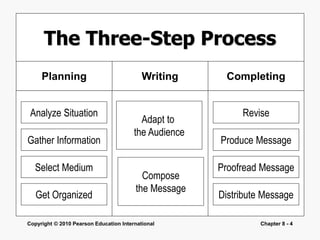
The Three-Step Process
Writing Completing
Planning
Analyze Situation
Gather Information
Select Medium
Get Organized
Revise
Produce Message
Proofread Message
Distribute Message
Adapt to
the Audience
Compose
the Message
Copyright © 2010 Pearson Education International Chapter 8 - 5
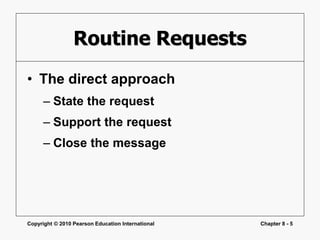
Routine Requests
• The direct approach
– State the request
– Support the request
– Close the message
Copyright © 2010 Pearson Education International Chapter 8 - 6
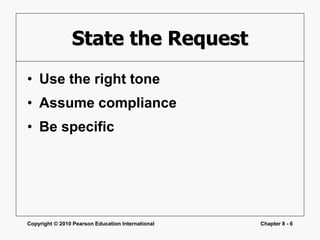
State the Request
• Use the right tone
• Assume compliance
• Be specific
Copyright © 2010 Pearson Education International Chapter 8 - 7
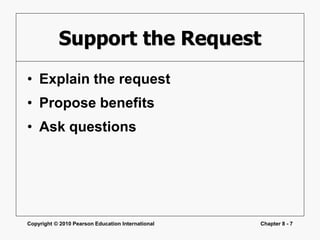
Support the Request
• Explain the request
• Propose benefits
• Ask questions
Copyright © 2010 Pearson Education International Chapter 8 - 8
Close the Message
• Specific request
• Contact information
• Appreciation and goodwill
Copyright © 2010 Pearson Education International Chapter 8 - 9
Common Requests
• Information and action
• Recommendations
• Claims and adjustments
Copyright © 2010 Pearson Education International Chapter 8 - 10
Information and Action
• Adapt to audience and situation
– State the request
– Support the request
– Offer reader benefits
Copyright © 2010 Pearson Education International Chapter 8 - 11
Recommendations
• The direct approach
– Make the request
– Establish rapport
– Express appreciation
Copyright © 2010 Pearson Education International Chapter 8 - 12
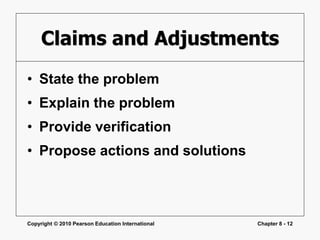
Claims and Adjustments
• State the problem
• Explain the problem
• Provide verification
• Propose actions and solutions
Copyright © 2010 Pearson Education International Chapter 8 - 13
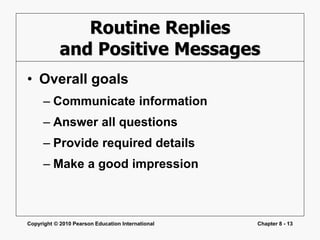
Routine Replies
and Positive Messages
• Overall goals
– Communicate information
– Answer all questions
– Provide required details
– Make a good impression
Copyright © 2010 Pearson Education International Chapter 8 - 14
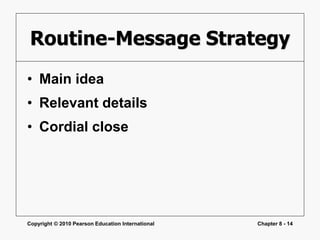
Routine-Message Strategy
• Main idea
• Relevant details
• Cordial close
Copyright © 2010 Pearson Education International Chapter 8 - 15
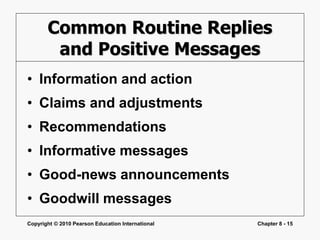
Common Routine Replies
and Positive Messages
• Information and action
• Claims and adjustments
• Recommendations
• Informative messages
• Good-news announcements
• Goodwill messages
Copyright © 2010 Pearson Education International Chapter 8 - 16
Information and Action
• Promptness
• Graciousness
• Thoroughness
Copyright © 2010 Pearson Education International Chapter 8 - 17
Claims and Adjustments
• Who is at fault?
– The company
– The customer
– A third party
Copyright © 2010 Pearson Education International Chapter 8 - 18
Company Is at Fault
• Acknowledge claim or complaint
• Take responsibility for the outcome
• Sympathize with the customer
• Explain your plan of action
• Work to repair the relationship
• Follow up on your response
Copyright © 2010 Pearson Education International Chapter 8 - 19
Customer Is at Fault
• Refuse the claim
– Cost of adjustment
– Cost of lost business
• Grant the claim
– Discourage mistakes
– Maintain the customer
Copyright © 2010 Pearson Education International Chapter 8 - 20
Third-Party Is a Fault
• Evaluate situation
• Offer solutions
• Avoid blame game
Copyright © 2010 Pearson Education International Chapter 8 - 21
Recommendations
• Candidate’s full name
• Position or objective
• Nature of your relationship
• What prompted you to write
• Relevant facts and evidence
• Overall evaluation
Copyright © 2010 Pearson Education International Chapter 8 - 22
Informative Messages
• Reminder notices
• Policy statements
Copyright © 2010 Pearson Education International Chapter 8 - 23
Good-News Announcements
• Direct approach
– Employment offers
– News releases
Copyright © 2010 Pearson Education International Chapter 8 - 24
Effective News Releases
• Pick newsworthy events
• Focus on one subject
• Stress important ideas
• Keep statements brief
Copyright © 2010 Pearson Education International Chapter 8 - 25
Effective News Releases
• Minimize verbal clutter
• Focus on specifics
• Exercise restraint
• Follow industry practices
Copyright © 2010 Pearson Education International Chapter 8 - 26
Goodwill Messages
• Congratulations
– Business and personal occasions
• Appreciation
– Good feelings and performance
• Condolences
– Caring and sympathy

Writing routine and positive messages ppt

  • 1.
    Copyright © 2010Pearson Education International Chapter 8 - 1 Writing Routine and Positive Messages
  • 2.
    Copyright © 2010Pearson Education International Chapter 8 - 2 Learning Objectives • Apply the three-step writing process to routine and positive messages • Outline an effective strategy for writing routine requests • Explain how to ask for specific action in a courteous manner
  • 3.
    Copyright © 2010Pearson Education International Chapter 8 - 3 Learning Objectives • Describe a strategy for writing routine replies and positive messages • Discuss the importance of knowing who is responsible when granting claims and requests for adjustment • Discuss the value of goodwill messages and explain how to make them effective
  • 4.
    Copyright © 2010Pearson Education International Chapter 8 - 4 The Three-Step Process Writing Completing Planning Analyze Situation Gather Information Select Medium Get Organized Revise Produce Message Proofread Message Distribute Message Adapt to the Audience Compose the Message
  • 5.
    Copyright © 2010Pearson Education International Chapter 8 - 5 Routine Requests • The direct approach – State the request – Support the request – Close the message
  • 6.
    Copyright © 2010Pearson Education International Chapter 8 - 6 State the Request • Use the right tone • Assume compliance • Be specific
  • 7.
    Copyright © 2010Pearson Education International Chapter 8 - 7 Support the Request • Explain the request • Propose benefits • Ask questions
  • 8.
    Copyright © 2010Pearson Education International Chapter 8 - 8 Close the Message • Specific request • Contact information • Appreciation and goodwill
  • 9.
    Copyright © 2010Pearson Education International Chapter 8 - 9 Common Requests • Information and action • Recommendations • Claims and adjustments
  • 10.
    Copyright © 2010Pearson Education International Chapter 8 - 10 Information and Action • Adapt to audience and situation – State the request – Support the request – Offer reader benefits
  • 11.
    Copyright © 2010Pearson Education International Chapter 8 - 11 Recommendations • The direct approach – Make the request – Establish rapport – Express appreciation
  • 12.
    Copyright © 2010Pearson Education International Chapter 8 - 12 Claims and Adjustments • State the problem • Explain the problem • Provide verification • Propose actions and solutions
  • 13.
    Copyright © 2010Pearson Education International Chapter 8 - 13 Routine Replies and Positive Messages • Overall goals – Communicate information – Answer all questions – Provide required details – Make a good impression
  • 14.
    Copyright © 2010Pearson Education International Chapter 8 - 14 Routine-Message Strategy • Main idea • Relevant details • Cordial close
  • 15.
    Copyright © 2010Pearson Education International Chapter 8 - 15 Common Routine Replies and Positive Messages • Information and action • Claims and adjustments • Recommendations • Informative messages • Good-news announcements • Goodwill messages
  • 16.
    Copyright © 2010Pearson Education International Chapter 8 - 16 Information and Action • Promptness • Graciousness • Thoroughness
  • 17.
    Copyright © 2010Pearson Education International Chapter 8 - 17 Claims and Adjustments • Who is at fault? – The company – The customer – A third party
  • 18.
    Copyright © 2010Pearson Education International Chapter 8 - 18 Company Is at Fault • Acknowledge claim or complaint • Take responsibility for the outcome • Sympathize with the customer • Explain your plan of action • Work to repair the relationship • Follow up on your response
  • 19.
    Copyright © 2010Pearson Education International Chapter 8 - 19 Customer Is at Fault • Refuse the claim – Cost of adjustment – Cost of lost business • Grant the claim – Discourage mistakes – Maintain the customer
  • 20.
    Copyright © 2010Pearson Education International Chapter 8 - 20 Third-Party Is a Fault • Evaluate situation • Offer solutions • Avoid blame game
  • 21.
    Copyright © 2010Pearson Education International Chapter 8 - 21 Recommendations • Candidate’s full name • Position or objective • Nature of your relationship • What prompted you to write • Relevant facts and evidence • Overall evaluation
  • 22.
    Copyright © 2010Pearson Education International Chapter 8 - 22 Informative Messages • Reminder notices • Policy statements
  • 23.
    Copyright © 2010Pearson Education International Chapter 8 - 23 Good-News Announcements • Direct approach – Employment offers – News releases
  • 24.
    Copyright © 2010Pearson Education International Chapter 8 - 24 Effective News Releases • Pick newsworthy events • Focus on one subject • Stress important ideas • Keep statements brief
  • 25.
    Copyright © 2010Pearson Education International Chapter 8 - 25 Effective News Releases • Minimize verbal clutter • Focus on specifics • Exercise restraint • Follow industry practices
  • 26.
    Copyright © 2010Pearson Education International Chapter 8 - 26 Goodwill Messages • Congratulations – Business and personal occasions • Appreciation – Good feelings and performance • Condolences – Caring and sympathy