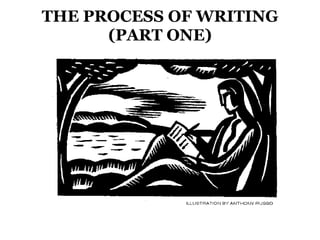
THE PROCESS OF WRITING           (PART ONE)
STEPS OF THE WRITING PROCESS1.   Generating Some Ideas (Prewriting) 2.   Writing a Draft (Recording) 3.   Strengthening Your Draft (Rewriting) Polishing Your Draft (Editing)5.   Proofreading Your Draft (Finishing)
STAGE 1:GENERATING SOME IDEASThere are several prewriting exercises/techniques you can use to generate ideas. Examples:Talking—talk to a classmate, friend, or professor about your topic.Listing—try writing down a list of words or phrases you associate with the topic.
An example of the listing method:Subject: Soup chicken medicinal propertiessoup recipesDinnerwater quality and its effect on flavor of soup web site for soup CulturesMediterranean soup with lamb intestinesvegetable soupssoup spots on clothingcertain cities o.k. for men eating soup to sling necktie over shouldersoup etiquetteside or point of spoon in mouthstone soup children's storyLet’s look at the example of listing on page 39
STEP 1: GENERATING IDEAS CONTINUEDClustering or mapping—this is like listing but provides visual connections
STEP 1: GENERATING IDEAS CONTINUEDFreewriting—just start writing without worrying about grammar or organization. Then, go through and underline ideas you want to explore further. Example:freewriting. don't know. don't know. this is harder than I thought it would be. worried. what if I don't have any ideas to bring out. the writer's perpetual concern--lack of ideas. Cliches. wonder how they got started? had meaning at one time. say "every dog has his day" now and people will jump at you for using sexist language. don't know. don't know. don't know. don't know. hear the timer ticking. time. so much to do and so little time to do it in.
STEP 1: GENERATING IDEAS CONTINUEDReading—go online or to the library and start to read about the topic. This will help you come up with your own ideas about the topic. *BUT do not use another person’s ideas without citing your source. Even if you paraphrase, or don’t use a direct quote, you have to use only your own ideas or tell the reader where you got your information.Mixing—you can also use multiple techniques and mix them together—whatever works for you.
STAGE 2: WRITING A DRAFTOnce you have finished prewriting, you should begin with your THESIS STATEMENT.YOUR THESIS STATEMENT INTRODUCES YOUR IDEAS ON YOUR TOPIC. 
The more specific your thesis is, the better!
YOUR THESIS STATEMENT:It should give your reader a clear idea of what your paper will be about and what point of view you will be expressing.It should not be a simple fact—it must contain an opinion that the essay develops.The best thesis is one that is not obvious—otherwise, why would the reader want to keep reading?
If your thesis is an opinion, then it is…
YOUR THESIS STATEMENT:Your thesis should be arguable—you should be able to prove your thesis in the length of your paper. For example, don’t take on a subject that is too big or complicated for the length of your paper.Let’s look at the thesis statements on pgs. 42-43  Let’s talk about the thesis exercises on pg. 43
Let’s go over some thesis don’ts
THESIS DON’TSDON’T ASK A QUESTION IN YOUR THESIS—A question does not state a point of view.DON’T LIST THE PARTS OF YOUR ESSAY IN YOUR THESIS—Organize your ideas well so that readers understand how the points you make prove your thesis.DON’T USE VAGUE TERMS TO EXPRESS YOUR VIEW OF SOMETHING—These terms include saying something is simply good or bad. Use precise language.
STEP 2: WRITING A DRAFT, CONTINUEDONCE YOU HAVE YOUR THESIS STATEMENT, YOU WANT TO WORK ON ORGANIZING YOUR IDEAS*Find 3 to 4 main points in your free writing that will best support your thesis.
You don’t want your ideas to be like this:
FOUR GENERAL WAYS TO ORGANIZE YOUR IDEAS1.   CHRONOLOGICAL ORDER—this is used most frequently in narrative essays. This is the order an event or a process occurred in. 2.   SPATIAL ORDER—If you are describing something like a place, you describe one location, then another.
FOUR GENERAL WAYS TO ORGANIZE YOUR IDEASGENERAL TO SPECIFIC—When writing an essay that classifies material or uses examples, you might want to organize it by presenting your most general material first and then moving to your most specific.ORDER OF IMPORTANCE—from least   important to most OR vice versa. Generally, you should save your most convincing piece of evidence for last.Let’s look at “Strategies for Getting Started” p. 45

Writing Process Part One For Week 2

  • 1.
    THE PROCESS OFWRITING (PART ONE)
  • 2.
    STEPS OF THEWRITING PROCESS1. Generating Some Ideas (Prewriting) 2. Writing a Draft (Recording) 3. Strengthening Your Draft (Rewriting) Polishing Your Draft (Editing)5. Proofreading Your Draft (Finishing)
  • 3.
    STAGE 1:GENERATING SOMEIDEASThere are several prewriting exercises/techniques you can use to generate ideas. Examples:Talking—talk to a classmate, friend, or professor about your topic.Listing—try writing down a list of words or phrases you associate with the topic.
  • 4.
    An example ofthe listing method:Subject: Soup chicken medicinal propertiessoup recipesDinnerwater quality and its effect on flavor of soup web site for soup CulturesMediterranean soup with lamb intestinesvegetable soupssoup spots on clothingcertain cities o.k. for men eating soup to sling necktie over shouldersoup etiquetteside or point of spoon in mouthstone soup children's storyLet’s look at the example of listing on page 39
  • 5.
    STEP 1: GENERATINGIDEAS CONTINUEDClustering or mapping—this is like listing but provides visual connections
  • 6.
    STEP 1: GENERATINGIDEAS CONTINUEDFreewriting—just start writing without worrying about grammar or organization. Then, go through and underline ideas you want to explore further. Example:freewriting. don't know. don't know. this is harder than I thought it would be. worried. what if I don't have any ideas to bring out. the writer's perpetual concern--lack of ideas. Cliches. wonder how they got started? had meaning at one time. say "every dog has his day" now and people will jump at you for using sexist language. don't know. don't know. don't know. don't know. hear the timer ticking. time. so much to do and so little time to do it in.
  • 7.
    STEP 1: GENERATINGIDEAS CONTINUEDReading—go online or to the library and start to read about the topic. This will help you come up with your own ideas about the topic. *BUT do not use another person’s ideas without citing your source. Even if you paraphrase, or don’t use a direct quote, you have to use only your own ideas or tell the reader where you got your information.Mixing—you can also use multiple techniques and mix them together—whatever works for you.
  • 8.
    STAGE 2: WRITINGA DRAFTOnce you have finished prewriting, you should begin with your THESIS STATEMENT.YOUR THESIS STATEMENT INTRODUCES YOUR IDEAS ON YOUR TOPIC. 
  • 9.
    The more specificyour thesis is, the better!
  • 10.
    YOUR THESIS STATEMENT:Itshould give your reader a clear idea of what your paper will be about and what point of view you will be expressing.It should not be a simple fact—it must contain an opinion that the essay develops.The best thesis is one that is not obvious—otherwise, why would the reader want to keep reading?
  • 11.
    If your thesisis an opinion, then it is…
  • 12.
    YOUR THESIS STATEMENT:Yourthesis should be arguable—you should be able to prove your thesis in the length of your paper. For example, don’t take on a subject that is too big or complicated for the length of your paper.Let’s look at the thesis statements on pgs. 42-43  Let’s talk about the thesis exercises on pg. 43
  • 13.
    Let’s go oversome thesis don’ts
  • 14.
    THESIS DON’TSDON’T ASKA QUESTION IN YOUR THESIS—A question does not state a point of view.DON’T LIST THE PARTS OF YOUR ESSAY IN YOUR THESIS—Organize your ideas well so that readers understand how the points you make prove your thesis.DON’T USE VAGUE TERMS TO EXPRESS YOUR VIEW OF SOMETHING—These terms include saying something is simply good or bad. Use precise language.
  • 15.
    STEP 2: WRITINGA DRAFT, CONTINUEDONCE YOU HAVE YOUR THESIS STATEMENT, YOU WANT TO WORK ON ORGANIZING YOUR IDEAS*Find 3 to 4 main points in your free writing that will best support your thesis.
  • 16.
    You don’t wantyour ideas to be like this:
  • 17.
    FOUR GENERAL WAYSTO ORGANIZE YOUR IDEAS1. CHRONOLOGICAL ORDER—this is used most frequently in narrative essays. This is the order an event or a process occurred in. 2. SPATIAL ORDER—If you are describing something like a place, you describe one location, then another.
  • 18.
    FOUR GENERAL WAYSTO ORGANIZE YOUR IDEASGENERAL TO SPECIFIC—When writing an essay that classifies material or uses examples, you might want to organize it by presenting your most general material first and then moving to your most specific.ORDER OF IMPORTANCE—from least important to most OR vice versa. Generally, you should save your most convincing piece of evidence for last.Let’s look at “Strategies for Getting Started” p. 45