© Boardworks Ltd 2009
1 of 15 © Boardworks Ltd 2009
1 of 15
Teacher’s notes included in the Notes Page
Accompanying worksheet
Flash activity. These activities are not editable.
Extension activities
Icons key: For more detailed instructions, see the Getting Started presentation
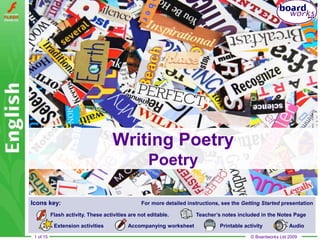
Writing Poetry
Poetry
Audio
Printable activity
© Boardworks Ltd 2009
2 of 15
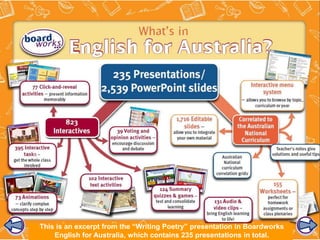
This is an excerpt from the “Writing Poetry” presentation in Boardworks
English for Australia, which contains 235 presentations in total.
© Boardworks Ltd 2009
3 of 15
Learning objectives
© Boardworks Ltd 2009
3 of 15
Read examples of narrative poetry, lyric poetry
and free verse
Analyse and discuss the features of each poetic
form
Write your own mini-collection of poems
© Boardworks Ltd 2009
4 of 15
Why write poetry?
© Boardworks Ltd 2009
5 of 15
Narrative poetry: ballads
© Boardworks Ltd 2009
6 of 15
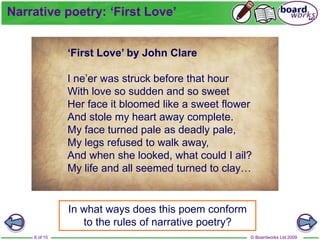
In what ways does this poem conform
to the rules of narrative poetry?
Narrative poetry: ‘First Love’
‘First Love’ by John Clare
I ne’er was struck before that hour
With love so sudden and so sweet
Her face it bloomed like a sweet flower
And stole my heart away complete.
My face turned pale as deadly pale,
My legs refused to walk away,
And when she looked, what could I ail?
My life and all seemed turned to clay…
© Boardworks Ltd 2009
7 of 15
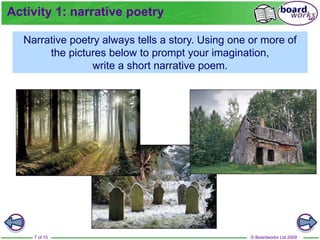
Narrative poetry always tells a story. Using one or more of
the pictures below to prompt your imagination,
write a short narrative poem.
Activity 1: narrative poetry
© Boardworks Ltd 2009
8 of 15
Lyric poetry
An example of a lyric poem is ‘Delay’ by Elizabeth Jennings.
Read it then answer the questions.
What moment leads the poet to express her
feelings in this poem?
What do you think the theme of this poem is?
© Boardworks Ltd 2009
8 of 15
© Boardworks Ltd 2009
9 of 15
Lyric poetry: sonnets and elegies
A sonnet is a lyric poem of
fourteen lines in iambic
pentameter, linked by a
pre-set rhyme scheme.
There are two types of
sonnet: Shakespearean
and Petrarchan.
Sonnets often have love as
their theme.
Elegies do not have a set form.
An elegy mourns the loss of a
person, place or object.
Sonnets and elegies are both forms of lyric poetry.
© Boardworks Ltd 2009
10 of 15
Lyric poem: sonnet
© Boardworks Ltd 2009
11 of 15
Lyric poetry: elegy
© Boardworks Ltd 2009
12 of 15
Free verse
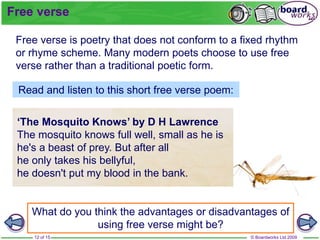
Free verse is poetry that does not conform to a fixed rhythm
or rhyme scheme. Many modern poets choose to use free
verse rather than a traditional poetic form.
What do you think the advantages or disadvantages of
using free verse might be?
Read and listen to this short free verse poem:
‘The Mosquito Knows’ by D H Lawrence
The mosquito knows full well, small as he is
he's a beast of prey. But after all
he only takes his bellyful,
he doesn't put my blood in the bank.
© Boardworks Ltd 2009
13 of 15
Imagine that you have been commissioned by a publisher to
write your own mini-collection of three poems.
Write one narrative poem, one lyric poem and one poem in
free verse for your collection. Try to write about subjects
which you are interested in and which inspire you!
Writing poetry
© Boardworks Ltd 2009
13 of 15
© Boardworks Ltd 2009
14 of 15
Figurative language
© Boardworks Ltd 2009
15 of 15
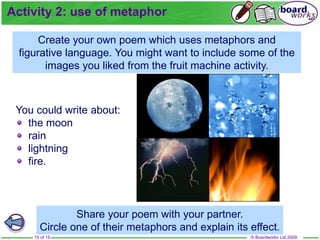
Activity 2: use of metaphor
Create your own poem which uses metaphors and
figurative language. You might want to include some of the
images you liked from the fruit machine activity.
You could write about:
the moon
rain
lightning
fire.
Share your poem with your partner.
Circle one of their metaphors and explain its effect.

Writing Poetry Creative Writing powerpoint

  • 1.
    © Boardworks Ltd2009 1 of 15 © Boardworks Ltd 2009 1 of 15 Teacher’s notes included in the Notes Page Accompanying worksheet Flash activity. These activities are not editable. Extension activities Icons key: For more detailed instructions, see the Getting Started presentation Writing Poetry Poetry Audio Printable activity
  • 2.
    © Boardworks Ltd2009 2 of 15 This is an excerpt from the “Writing Poetry” presentation in Boardworks English for Australia, which contains 235 presentations in total.
  • 3.
    © Boardworks Ltd2009 3 of 15 Learning objectives © Boardworks Ltd 2009 3 of 15 Read examples of narrative poetry, lyric poetry and free verse Analyse and discuss the features of each poetic form Write your own mini-collection of poems
  • 4.
    © Boardworks Ltd2009 4 of 15 Why write poetry?
  • 5.
    © Boardworks Ltd2009 5 of 15 Narrative poetry: ballads
  • 6.
    © Boardworks Ltd2009 6 of 15 In what ways does this poem conform to the rules of narrative poetry? Narrative poetry: ‘First Love’ ‘First Love’ by John Clare I ne’er was struck before that hour With love so sudden and so sweet Her face it bloomed like a sweet flower And stole my heart away complete. My face turned pale as deadly pale, My legs refused to walk away, And when she looked, what could I ail? My life and all seemed turned to clay…
  • 7.
    © Boardworks Ltd2009 7 of 15 Narrative poetry always tells a story. Using one or more of the pictures below to prompt your imagination, write a short narrative poem. Activity 1: narrative poetry
  • 8.
    © Boardworks Ltd2009 8 of 15 Lyric poetry An example of a lyric poem is ‘Delay’ by Elizabeth Jennings. Read it then answer the questions. What moment leads the poet to express her feelings in this poem? What do you think the theme of this poem is? © Boardworks Ltd 2009 8 of 15
  • 9.
    © Boardworks Ltd2009 9 of 15 Lyric poetry: sonnets and elegies A sonnet is a lyric poem of fourteen lines in iambic pentameter, linked by a pre-set rhyme scheme. There are two types of sonnet: Shakespearean and Petrarchan. Sonnets often have love as their theme. Elegies do not have a set form. An elegy mourns the loss of a person, place or object. Sonnets and elegies are both forms of lyric poetry.
  • 10.
    © Boardworks Ltd2009 10 of 15 Lyric poem: sonnet
  • 11.
    © Boardworks Ltd2009 11 of 15 Lyric poetry: elegy
  • 12.
    © Boardworks Ltd2009 12 of 15 Free verse Free verse is poetry that does not conform to a fixed rhythm or rhyme scheme. Many modern poets choose to use free verse rather than a traditional poetic form. What do you think the advantages or disadvantages of using free verse might be? Read and listen to this short free verse poem: ‘The Mosquito Knows’ by D H Lawrence The mosquito knows full well, small as he is he's a beast of prey. But after all he only takes his bellyful, he doesn't put my blood in the bank.
  • 13.
    © Boardworks Ltd2009 13 of 15 Imagine that you have been commissioned by a publisher to write your own mini-collection of three poems. Write one narrative poem, one lyric poem and one poem in free verse for your collection. Try to write about subjects which you are interested in and which inspire you! Writing poetry © Boardworks Ltd 2009 13 of 15
  • 14.
    © Boardworks Ltd2009 14 of 15 Figurative language
  • 15.
    © Boardworks Ltd2009 15 of 15 Activity 2: use of metaphor Create your own poem which uses metaphors and figurative language. You might want to include some of the images you liked from the fruit machine activity. You could write about: the moon rain lightning fire. Share your poem with your partner. Circle one of their metaphors and explain its effect.