Grade 7
DIFFERENCE BETWEEN PROSE AND
POETRY
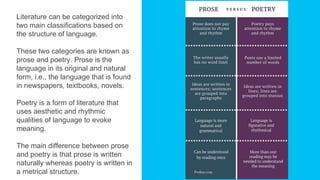
Literature can be categorized into
two main classifications based on
the structure of language.
These two categories are known as
prose and poetry. Prose is the
language in its original and natural
form, i.e., the language that is found
in newspapers, textbooks, novels.
Poetry is a form of literature that
uses aesthetic and rhythmic
qualities of language to evoke
meaning.
The main difference between prose
and poetry is that prose is written
naturally whereas poetry is written in
a metrical structure.
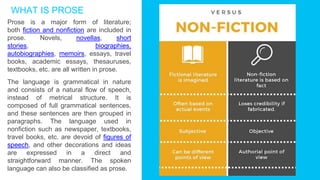
Prose is a major form of literature;
both fiction and nonfiction are included in
prose. Novels, novellas, short
stories, biographies,
autobiographies, memoirs, essays, travel
books, academic essays, thesauruses,
textbooks, etc. are all written in prose.
The language is grammatical in nature
and consists of a natural flow of speech,
instead of metrical structure. It is
composed of full grammatical sentences,
and these sentences are then grouped in
paragraphs. The language used in
nonfiction such as newspaper, textbooks,
travel books, etc. are devoid of figures of
speech, and other decorations and ideas
are expressed in a direct and
straightforward manner. The spoken
language can also be classified as prose.
WHAT IS PROSE
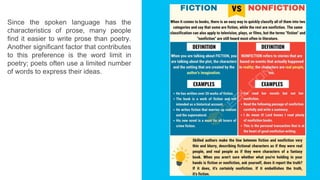
Since the spoken language has the
characteristics of prose, many people
find it easier to write prose than poetry.
Another significant factor that contributes
to this preference is the word limit in
poetry; poets often use a limited number
of words to express their ideas.
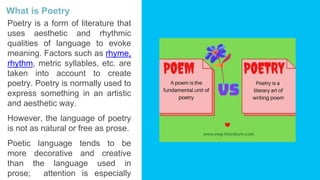
Poetry is a form of literature that
uses aesthetic and rhythmic
qualities of language to evoke
meaning. Factors such as rhyme,
rhythm, metric syllables, etc. are
taken into account to create
poetry. Poetry is normally used to
express something in an artistic
and aesthetic way.
However, the language of poetry
is not as natural or free as prose.
Poetic language tends to be
more decorative and creative
than the language used in
prose; attention is especially
What is Poetry
A poem is composed of lines; a line
can be very long or as short as one
word. A stanza is made up of several
stanzas.
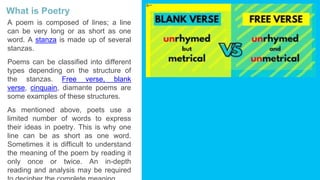
Poems can be classified into different
types depending on the structure of
the stanzas. Free verse, blank
verse, cinquain, diamante poems are
some examples of these structures.
As mentioned above, poets use a
limited number of words to express
their ideas in poetry. This is why one
line can be as short as one word.
Sometimes it is difficult to understand
the meaning of the poem by reading it
only once or twice. An in-depth
reading and analysis may be required
What is Poetry
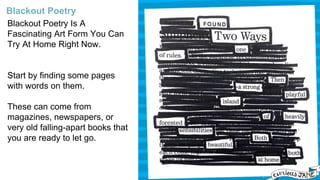
Blackout Poetry Is A
Fascinating Art Form You Can
Try At Home Right Now.
Start by finding some pages
with words on them.
These can come from
magazines, newspapers, or
very old falling-apart books that
you are ready to let go.
Blackout Poetry
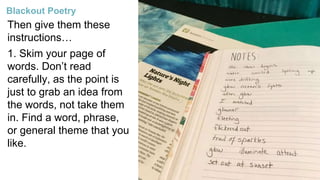
Then give them these
instructions…
1. Skim your page of
words. Don’t read
carefully, as the point is
just to grab an idea from
the words, not take them
in. Find a word, phrase,
or general theme that you
like.
Blackout Poetry
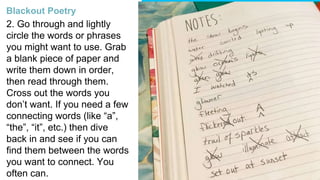
2. Go through and lightly
circle the words or phrases
you might want to use. Grab
a blank piece of paper and
write them down in order,
then read through them.
Cross out the words you
don’t want. If you need a few
connecting words (like “a”,
“the”, “it”, etc.) then dive
back in and see if you can
find them between the words
you want to connect. You
often can.
Blackout Poetry
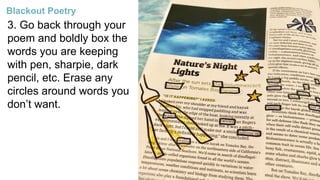
3. Go back through your
poem and boldly box the
words you are keeping
with pen, sharpie, dark
pencil, etc. Erase any
circles around words you
don’t want.
Blackout Poetry
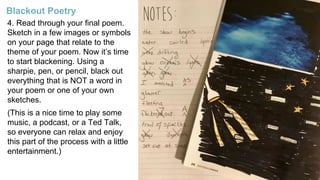
4. Read through your final poem.
Sketch in a few images or symbols
on your page that relate to the
theme of your poem. Now it’s time
to start blackening. Using a
sharpie, pen, or pencil, black out
everything that is NOT a word in
your poem or one of your own
sketches.
(This is a nice time to play some
music, a podcast, or a Ted Talk,
so everyone can relax and enjoy
this part of the process with a little
entertainment.)
Blackout Poetry
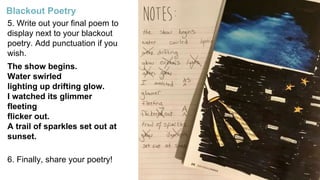
5. Write out your final poem to
display next to your blackout
poetry. Add punctuation if you
wish.
The show begins.
Water swirled
lighting up drifting glow.
I watched its glimmer
fleeting
flicker out.
A trail of sparkles set out at
sunset.
6. Finally, share your poetry!
Blackout Poetry

Difference Between Prose and Poetry.pptx

  • 1.
  • 2.
    Literature can becategorized into two main classifications based on the structure of language. These two categories are known as prose and poetry. Prose is the language in its original and natural form, i.e., the language that is found in newspapers, textbooks, novels. Poetry is a form of literature that uses aesthetic and rhythmic qualities of language to evoke meaning. The main difference between prose and poetry is that prose is written naturally whereas poetry is written in a metrical structure.
  • 3.
    Prose is amajor form of literature; both fiction and nonfiction are included in prose. Novels, novellas, short stories, biographies, autobiographies, memoirs, essays, travel books, academic essays, thesauruses, textbooks, etc. are all written in prose. The language is grammatical in nature and consists of a natural flow of speech, instead of metrical structure. It is composed of full grammatical sentences, and these sentences are then grouped in paragraphs. The language used in nonfiction such as newspaper, textbooks, travel books, etc. are devoid of figures of speech, and other decorations and ideas are expressed in a direct and straightforward manner. The spoken language can also be classified as prose. WHAT IS PROSE
  • 4.
    Since the spokenlanguage has the characteristics of prose, many people find it easier to write prose than poetry. Another significant factor that contributes to this preference is the word limit in poetry; poets often use a limited number of words to express their ideas.
  • 5.
    Poetry is aform of literature that uses aesthetic and rhythmic qualities of language to evoke meaning. Factors such as rhyme, rhythm, metric syllables, etc. are taken into account to create poetry. Poetry is normally used to express something in an artistic and aesthetic way. However, the language of poetry is not as natural or free as prose. Poetic language tends to be more decorative and creative than the language used in prose; attention is especially What is Poetry
  • 6.
    A poem iscomposed of lines; a line can be very long or as short as one word. A stanza is made up of several stanzas. Poems can be classified into different types depending on the structure of the stanzas. Free verse, blank verse, cinquain, diamante poems are some examples of these structures. As mentioned above, poets use a limited number of words to express their ideas in poetry. This is why one line can be as short as one word. Sometimes it is difficult to understand the meaning of the poem by reading it only once or twice. An in-depth reading and analysis may be required What is Poetry
  • 7.
    Blackout Poetry IsA Fascinating Art Form You Can Try At Home Right Now. Start by finding some pages with words on them. These can come from magazines, newspapers, or very old falling-apart books that you are ready to let go. Blackout Poetry
  • 8.
    Then give themthese instructions… 1. Skim your page of words. Don’t read carefully, as the point is just to grab an idea from the words, not take them in. Find a word, phrase, or general theme that you like. Blackout Poetry
  • 9.
    2. Go throughand lightly circle the words or phrases you might want to use. Grab a blank piece of paper and write them down in order, then read through them. Cross out the words you don’t want. If you need a few connecting words (like “a”, “the”, “it”, etc.) then dive back in and see if you can find them between the words you want to connect. You often can. Blackout Poetry
  • 10.
    3. Go backthrough your poem and boldly box the words you are keeping with pen, sharpie, dark pencil, etc. Erase any circles around words you don’t want. Blackout Poetry
  • 11.
    4. Read throughyour final poem. Sketch in a few images or symbols on your page that relate to the theme of your poem. Now it’s time to start blackening. Using a sharpie, pen, or pencil, black out everything that is NOT a word in your poem or one of your own sketches. (This is a nice time to play some music, a podcast, or a Ted Talk, so everyone can relax and enjoy this part of the process with a little entertainment.) Blackout Poetry
  • 12.
    5. Write outyour final poem to display next to your blackout poetry. Add punctuation if you wish. The show begins. Water swirled lighting up drifting glow. I watched its glimmer fleeting flicker out. A trail of sparkles set out at sunset. 6. Finally, share your poetry! Blackout Poetry