Good morning!
And thanks for inviting us to MASDAR.
Getting published in a
peer-reviewed journal
Christopher Leonard 

Editorial Director - QScience.com
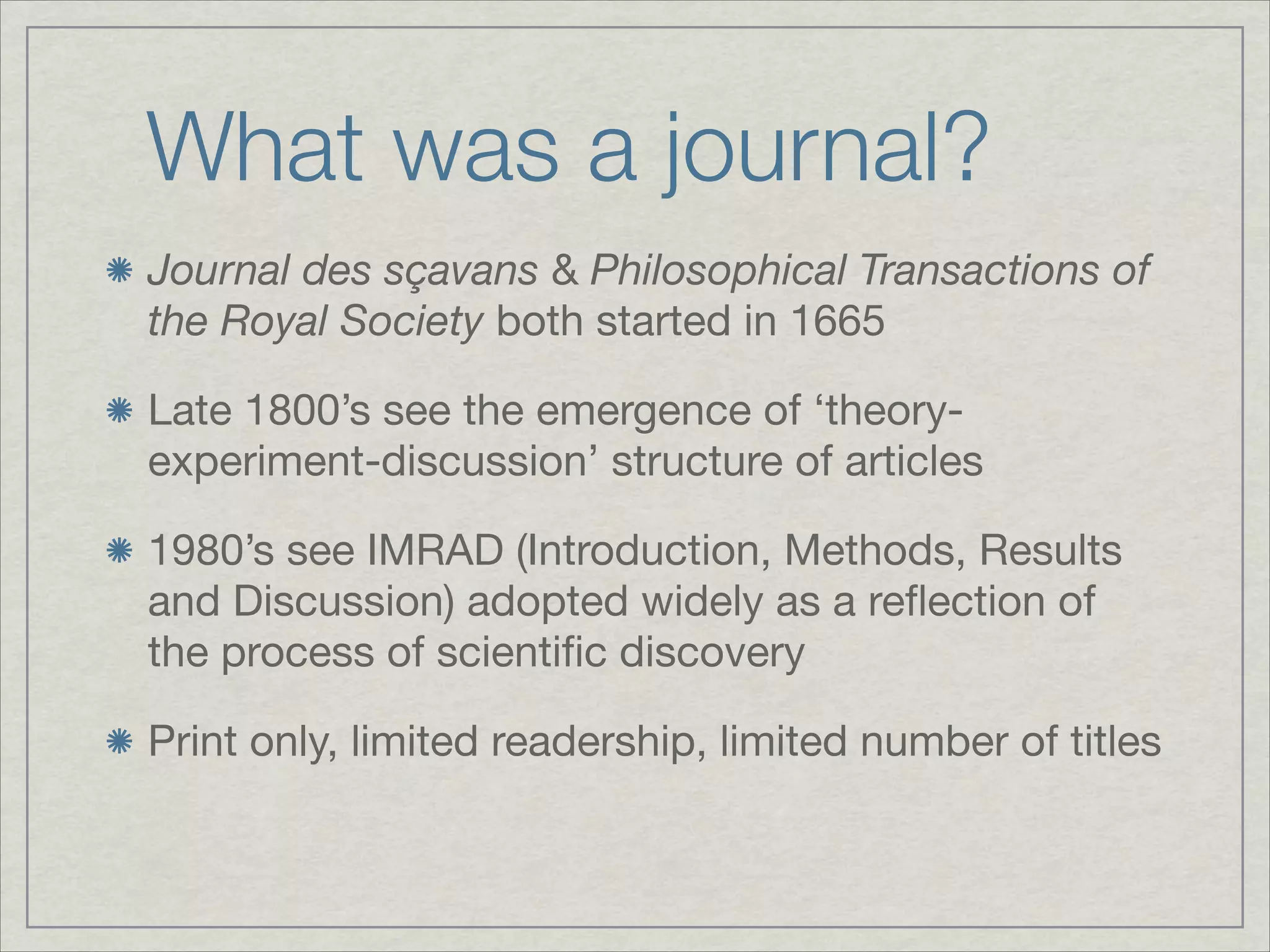
What was a journal?
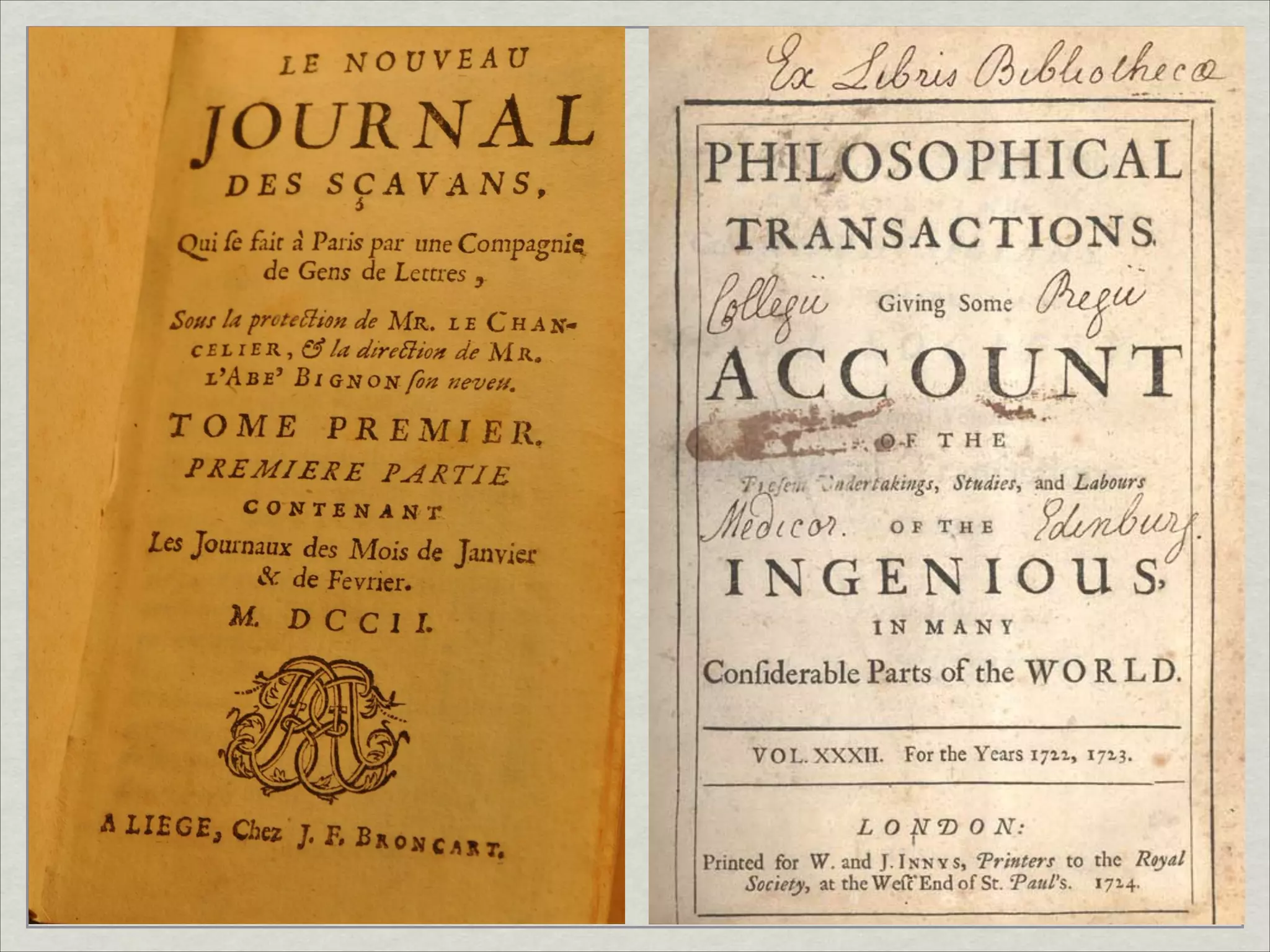
Journal des sçavans & Philosophical Transactions of
the Royal Society both started in 1665


Late 1800’s see the emergence of ‘theory-
experiment-discussion’ structure of articles


1980’s see IMRAD (Introduction, Methods, Results
and Discussion) adopted widely as a reflection of
the process of scientific discovery


Print only, limited readership, limited number of titles
What is a journal?
Electronic-only, or e-leading, peer-reviewed
selection of articles judged to be of a certain
quality within a certain, narrow, field.


Many papers publicly available via open access or
PubMed/arXiv


>20,000 active journal titles


>5,500 papers per day published (2m/year)
Article types

Review articles


Editorials


Commentaries


Research papers
Editorials

Written by Editor or invited guest


Short, select and narrowly focused
Commentaries

Commentaries may be narrative reviews, but
somewhat more opinionated.


Little research methodology, biased synthesis of a
collection of articles.


Usually there to provoke controversy or academic
debate.
Review articles
A comprehensive narrative synthesis of previously
published information, often summarising each
key article.


Bibliographic research methodology frequently a
part of narrative reviews (although is not strictly
required). Reputable sources only.


Will provide in-depth snapshot of a field, convey a
clear message and draw conclusions supported
by data analysis.
Preparing to write a
research manuscript
Target journal
Think about this before you start to write.


Best journal for your article may not necessarily be
best in the field.


Has similar work been published in that journal?


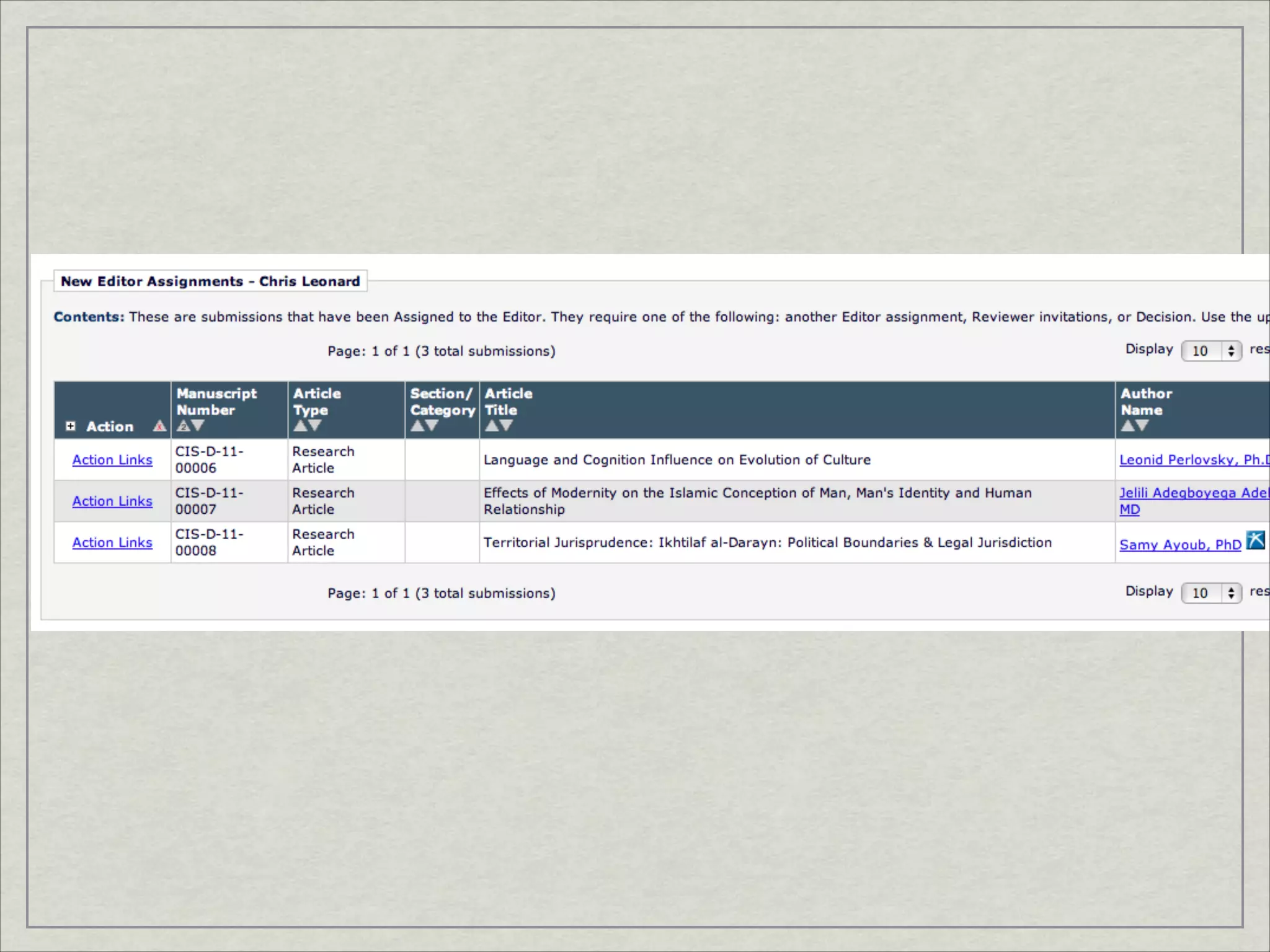
Check the I4As


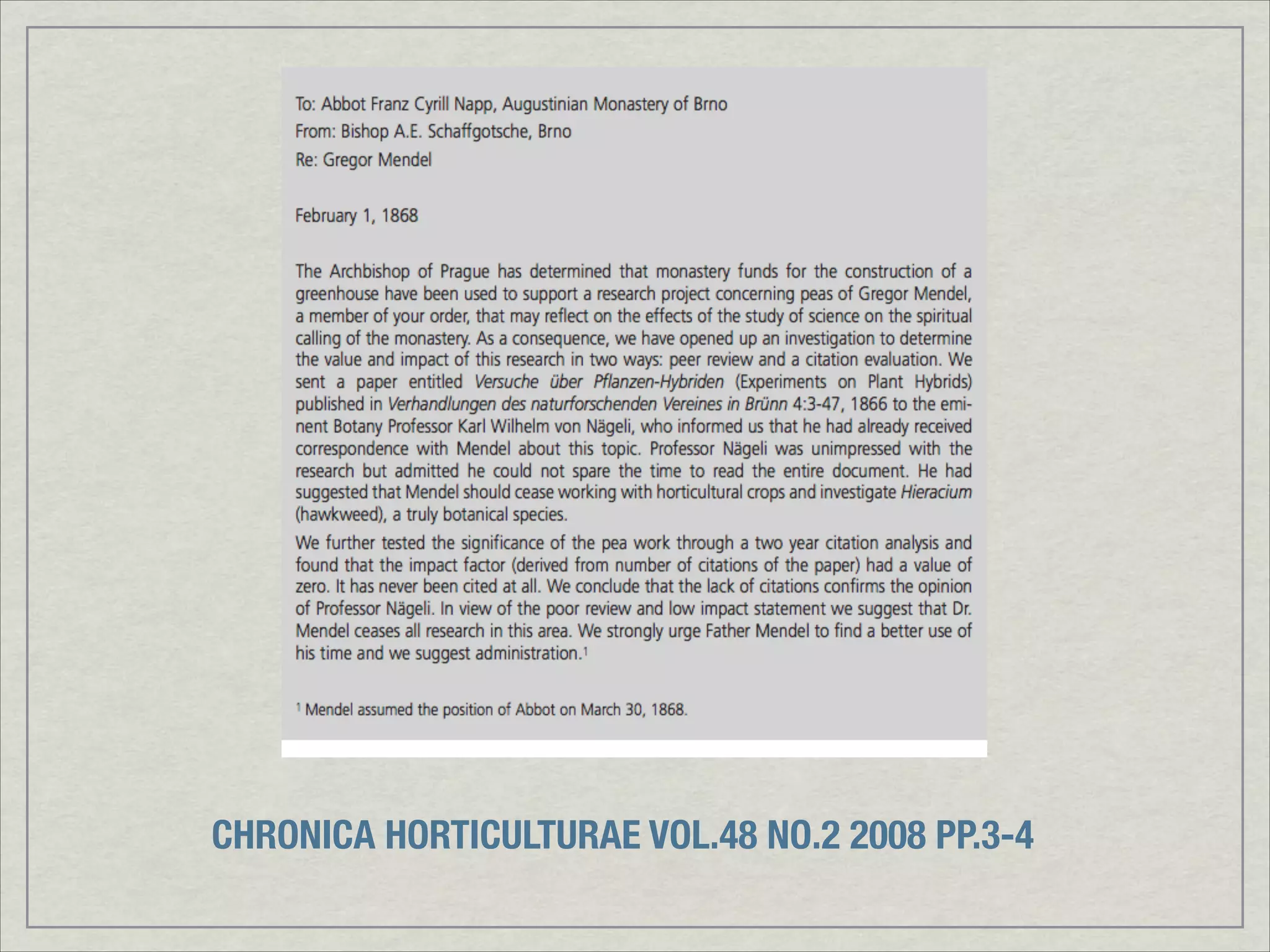
Tyranny of the Impact Factor.
CHRONICA HORTICULTURAE VOL.48 NO.2 2008 PP.3-4
Authorship
         Sort this out before writing the manuscript*.


         Consult with coauthors, gather their ORCIDs.
         Otherwise, preferred name listing and affiliation.


         Usually listed in decreasing order of their
         contribution (although this can vary)


         Determine who is the corresponding author


* READ THIS: Liz Wager’s excellent guide “Recognition, reward and repsonsibility: why the
authorship of scientific papers matters” Maturitas 2009; 62:109-12
Ethical issues
     Fabrication of data


     Duplicate publication


     Plagiarism


     Misuse of statistics


     Manipulation of images


     Inadequate or false citations

  READ THIS: HTTP://PUBLICATIONETHICS.ORG/ MAINLY FOR EDITORS AND 

PUBLISHERS, BUT GIVES A GREAT INSIGHT INTO PROBLEMS SOME PAPERS FACE
Writing the manuscript
Title

Title is THE most important part of the paper.
Decide on best title after writing the manuscript.


Should be descriptive, not cute, and match the
abstract. Not too general, not too much jargon.
Examples	
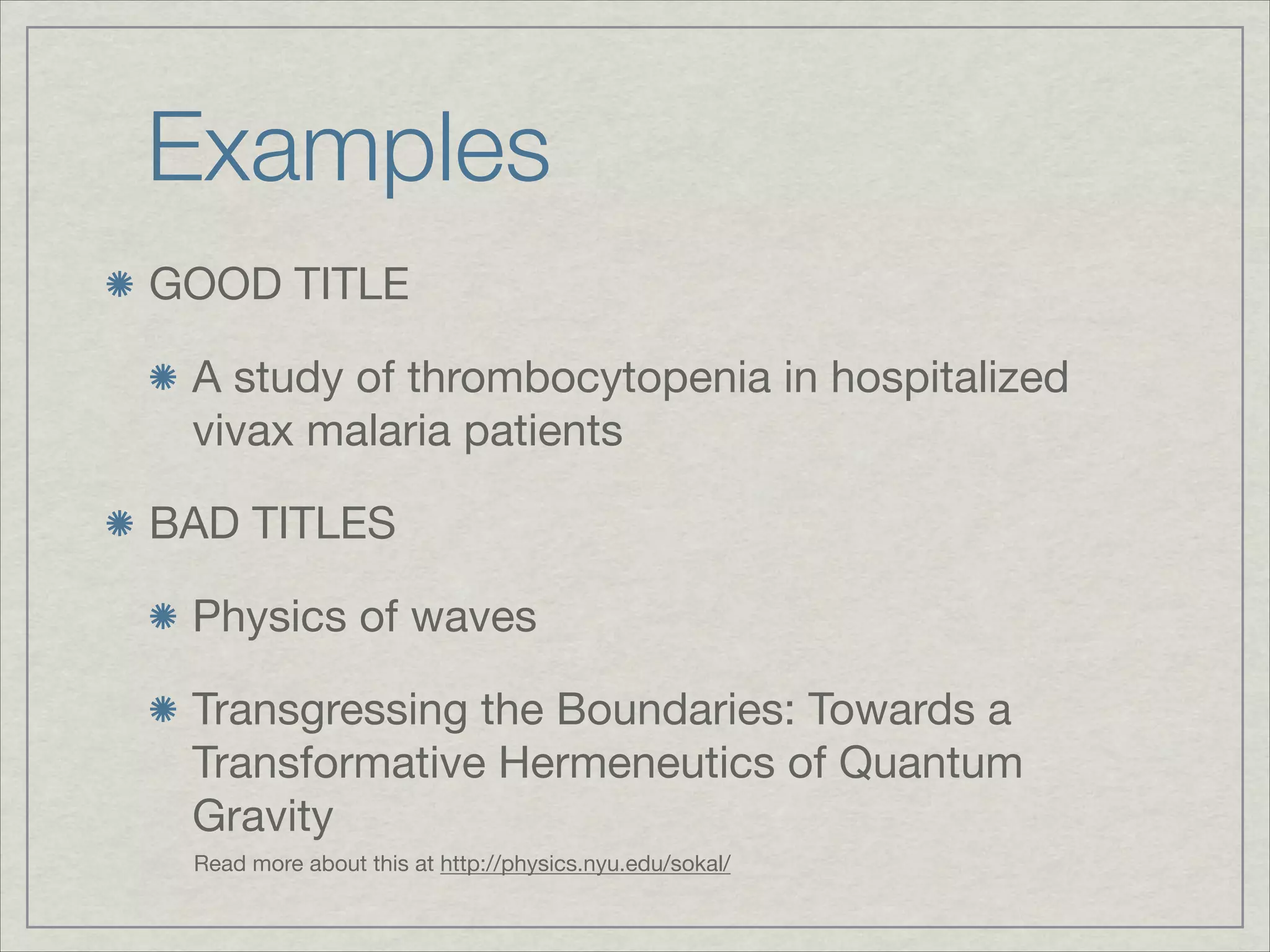
GOOD TITLE


 A study of thrombocytopenia in hospitalized
 vivax malaria patients


BAD TITLES


 Physics of waves


 Transgressing the Boundaries: Towards a
 Transformative Hermeneutics of Quantum
 Gravity
 Read more about this at http://physics.nyu.edu/sokal/
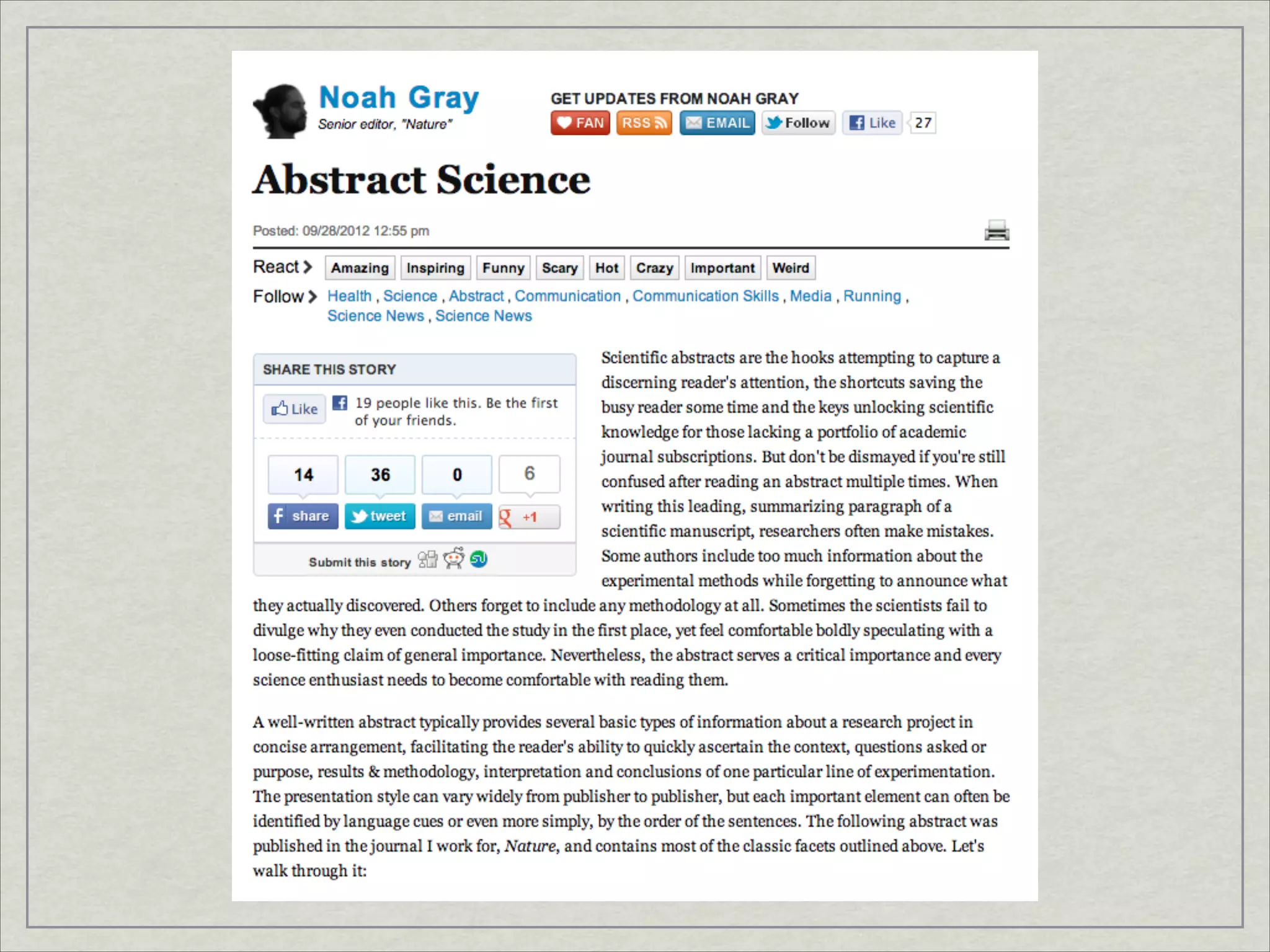
Abstract
In Web of Science/Scopus/Google Scholar.


Think of it as a ‘teaser’ or ‘trailer’ for your paper.


DON’T make it too long. Shorter is ALWAYS better


DON’T introduce and define lots of acronyms


DON’T include references to citations


DO pitch it to non-specialists in your broader field


DO write (or rewrite) it at THE END.

Background information

Bibliographic research to set research question in
context.


Make sure it is up-to-date (consider revising if first
draft is more than 3 months old) - reviewers get
very suspicious about missing citations.


Papers over 10 years old, use with caution.
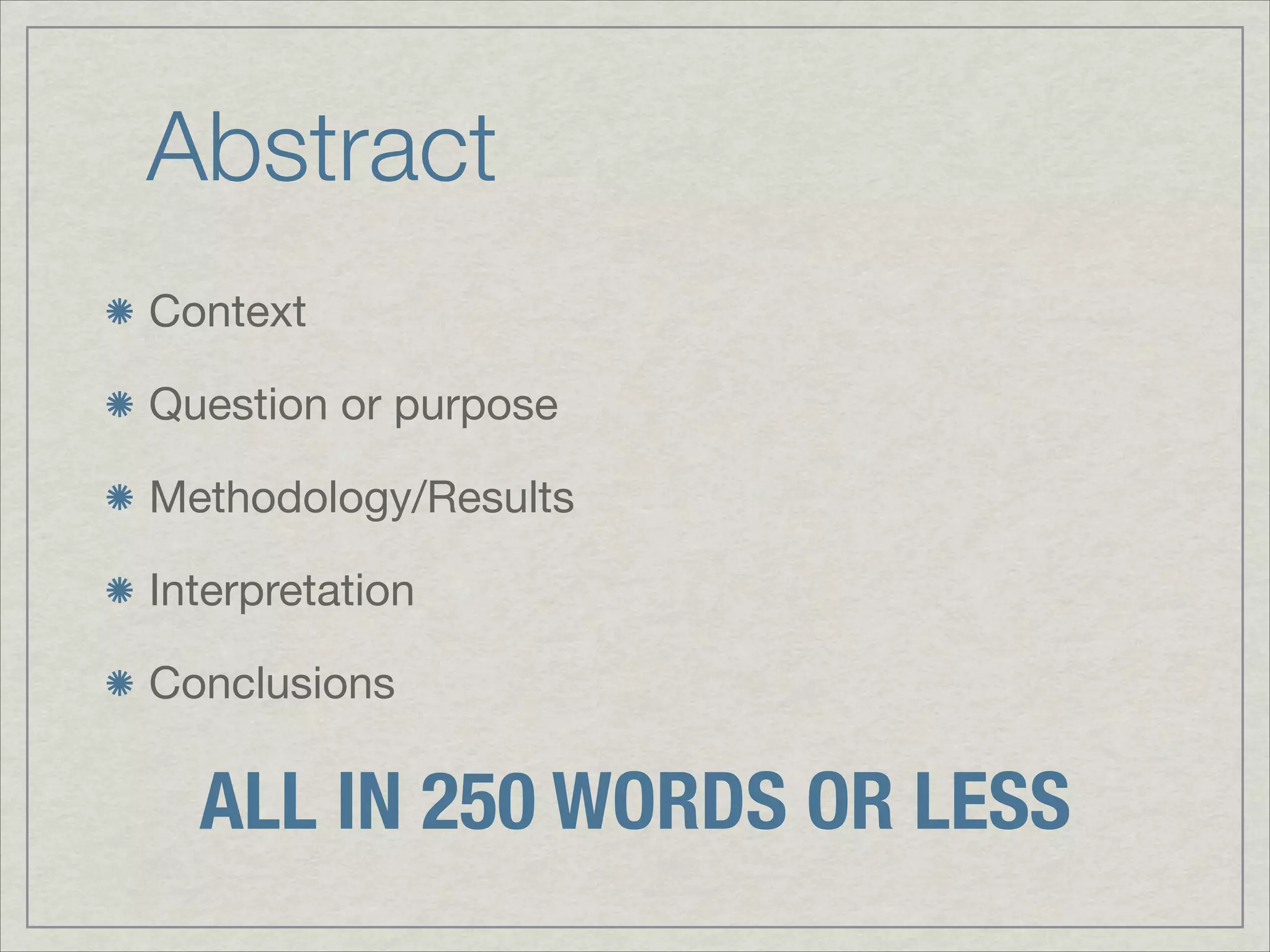
Abstract
Context


Question or purpose


Methodology/Results


Interpretation


Conclusions

  ALL IN 250 WORDS OR LESS
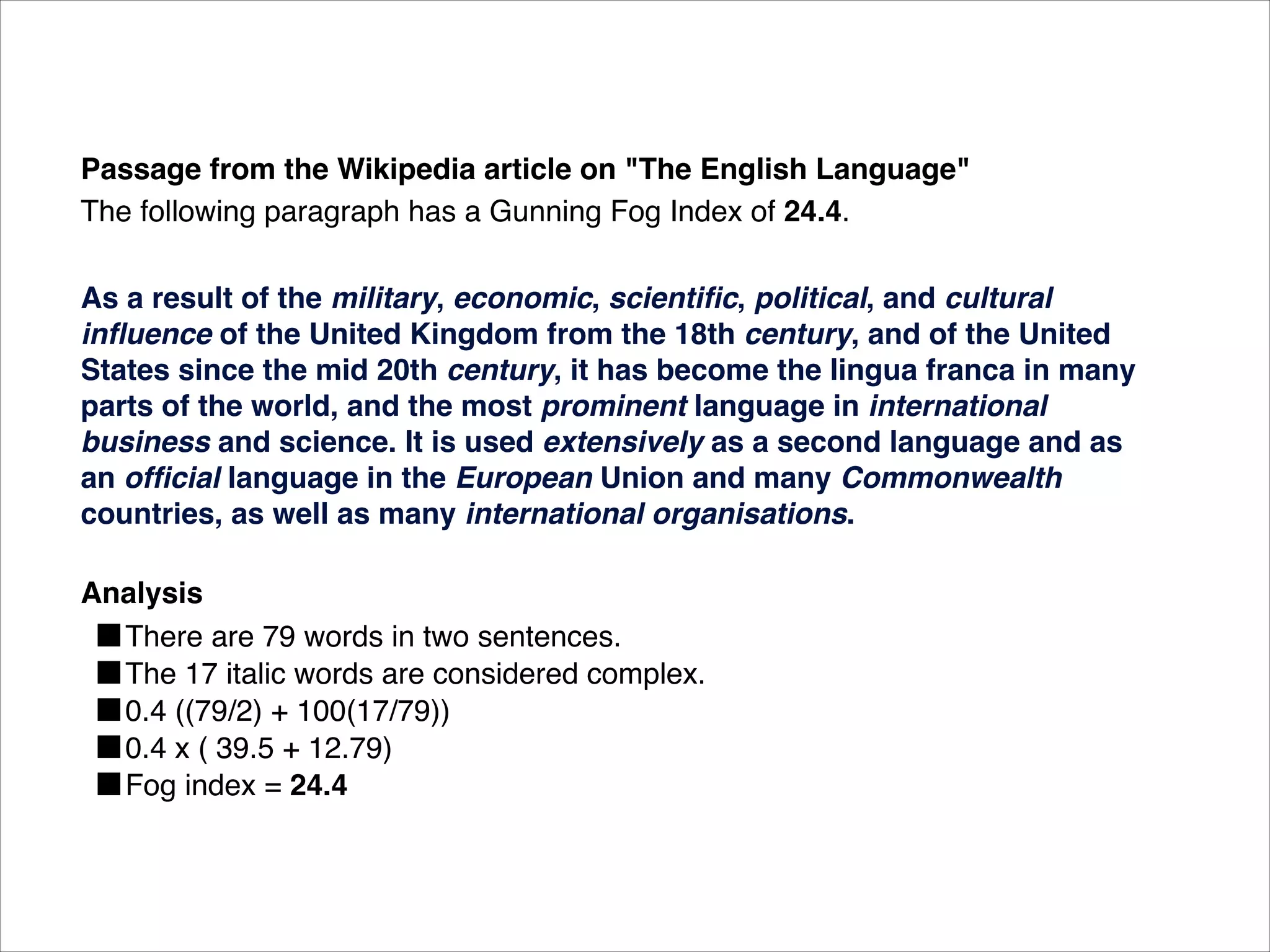
Passage from the Wikipedia article on "The English Language"
The following paragraph has a Gunning Fog Index of 24.4.

As a result of the military, economic, scientific, political, and cultural
influence of the United Kingdom from the 18th century, and of the United
States since the mid 20th century, it has become the lingua franca in many
parts of the world, and the most prominent language in international
business and science. It is used extensively as a second language and as
an official language in the European Union and many Commonwealth
countries, as well as many international organisations.

Analysis
  ■There are 79 words in two sentences.
  ■The 17 italic words are considered complex.
  ■0.4 ((79/2) + 100(17/79))
  ■0.4 x ( 39.5 + 12.79)
  ■Fog index = 24.4
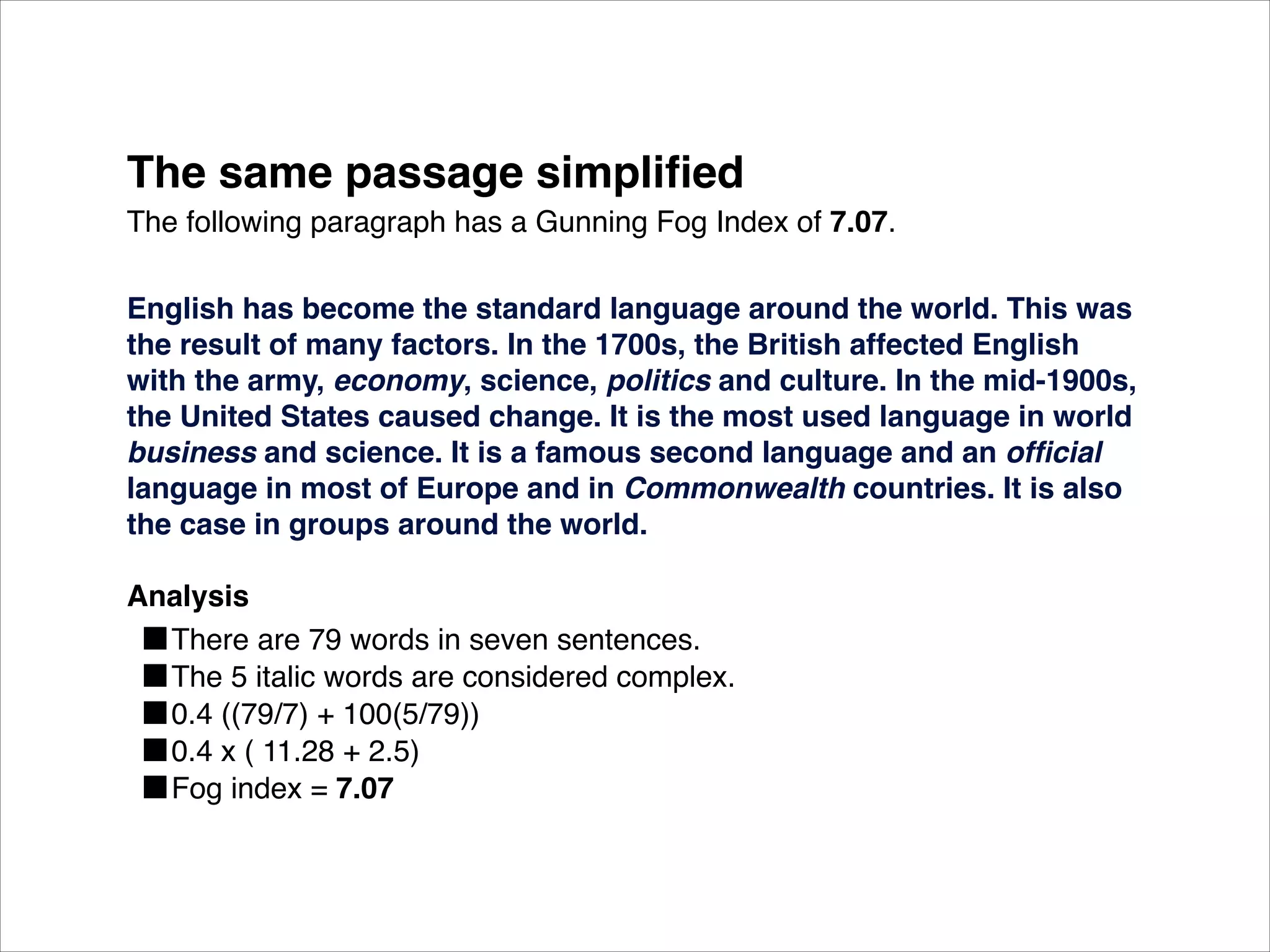
The same passage simplified
The following paragraph has a Gunning Fog Index of 7.07.

English has become the standard language around the world. This was
the result of many factors. In the 1700s, the British affected English
with the army, economy, science, politics and culture. In the mid-1900s,
the United States caused change. It is the most used language in world
business and science. It is a famous second language and an official
language in most of Europe and in Commonwealth countries. It is also
the case in groups around the world.

Analysis
  ■There are 79 words in seven sentences.
  ■The 5 italic words are considered complex.
  ■0.4 ((79/7) + 100(5/79))
  ■0.4 x ( 11.28 + 2.5)
  ■Fog index = 7.07
Introduction
Introduce topic to readers in an accessible way


Should be short and focused


Aim for 3 paragraphs only.

 PARA1: Question or issue, context, relevance [What is known]


 PARA2: Importance of problem/unclear issues [What is unknown]


 PARA3: Rationale, hypothesis, main objective [Why study was done]


Can be written at any point, but good to revisit at
the end.
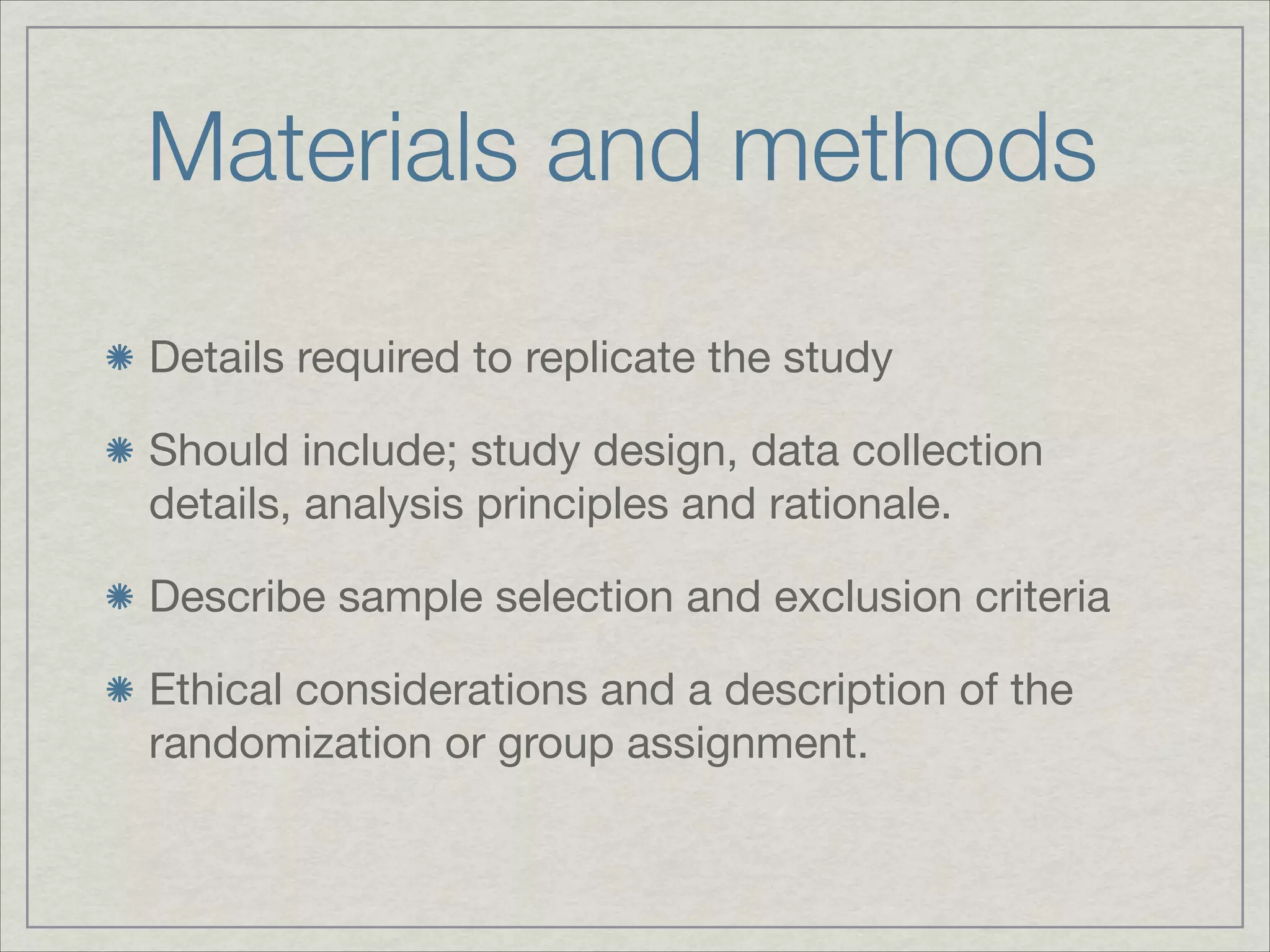
Materials and methods
Details required to replicate the study


Should include; study design, data collection
details, analysis principles and rationale.


Describe sample selection and exclusion criteria


Ethical considerations and a description of the
randomization or group assignment.
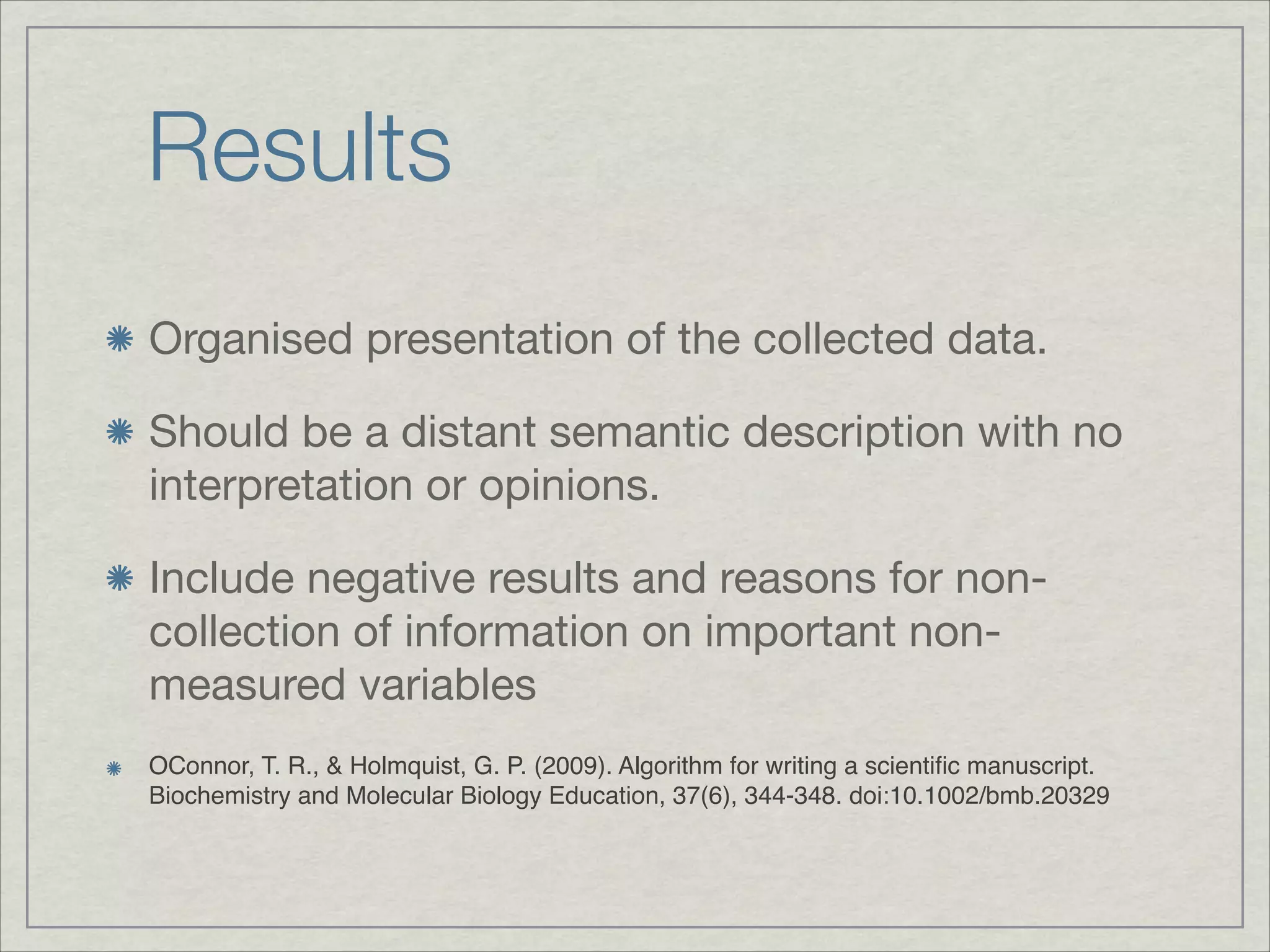
Results
Organised presentation of the collected data.


Should be a distant semantic description with no
interpretation or opinions.


Include negative results and reasons for non-
collection of information on important non-
measured variables

OConnor, T. R., & Holmquist, G. P. (2009). Algorithm for writing a scientific manuscript.
Biochemistry and Molecular Biology Education, 37(6), 344-348. doi:10.1002/bmb.20329
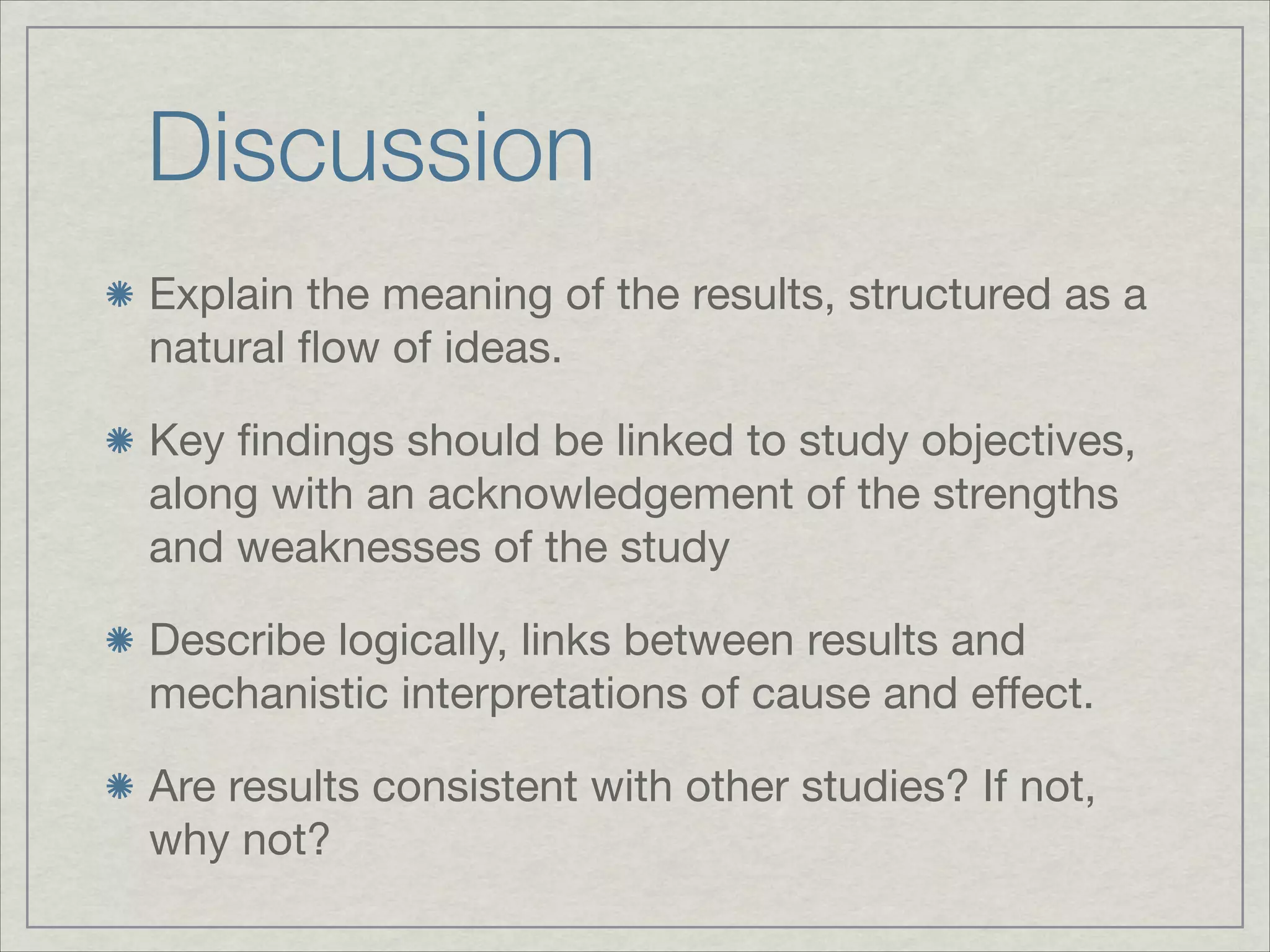
Discussion
Explain the meaning of the results, structured as a
natural flow of ideas.


Key findings should be linked to study objectives,
along with an acknowledgement of the strengths
and weaknesses of the study


Describe logically, links between results and
mechanistic interpretations of cause and effect.


Are results consistent with other studies? If not,
why not?
Discussion
Don’t repeat yourself.


Don’t present results not documented in Results


Don’t overstate importance of results


Do feel free to criticise study limitations


Don’t repeat yourself.
Conclusion
It’s not another Abstract or Introduction.


Keep it short


‘Take home’ message


Do not write: ‘further study is needed’ or any
variation thereof.
Acknowledgements etc.

Contributors who do not qualify for author status


Conflicts of interest


Financial support for the research


Group name if appropriate


Author contributions
References
Keep a good reference library (Mendeley/Zotero)


Make sure references adhere to journal style


Avoid abstracts and ‘personal communications’


Exclude articles ‘in submission’


Authors responsibility to make sure they do not
refer to retracted articles.
A word on figures	
Please, please use your own figures


They are easy to generate with sufficient data
points and standard desktop software. Develop
your own style/colour scheme.


Difficult and expensive to get rights to figures
published by other publishers (>$150/figure)


Scans and photos should be highest possible
resolution. Don’t just embed in Word - we need
source files.
After submission
Reviews & revisions
View peer reviewers as collaborators rather than
enemies


They often make constructive remarks which
should improve the quality of the paper


Good editors will shield you from performing more
experiments (unless it’s Nature or Science)


For each point the reviewer makes, provide a brief
note explaining how you have incorporated their
remark, or a rebuttal.
After publication
Promotion
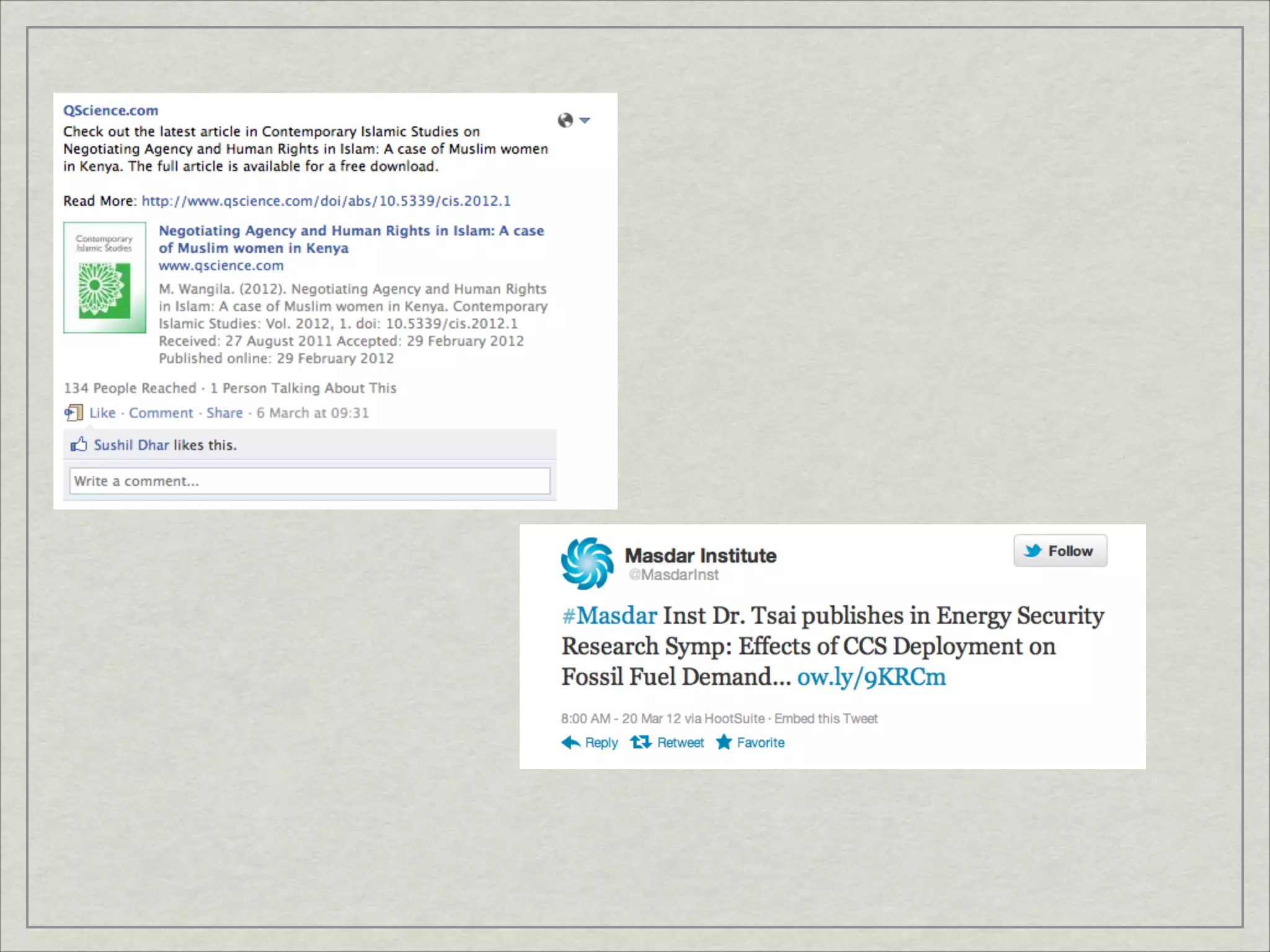
You are the marketer of your own work (usually)


Link to your article from your facebook/twitter/
linkedin/orcid page


Departmental website, institution PR department?


Mendeley, scribd, list-servs, other discussion
boards and lists
A brief note on
open access
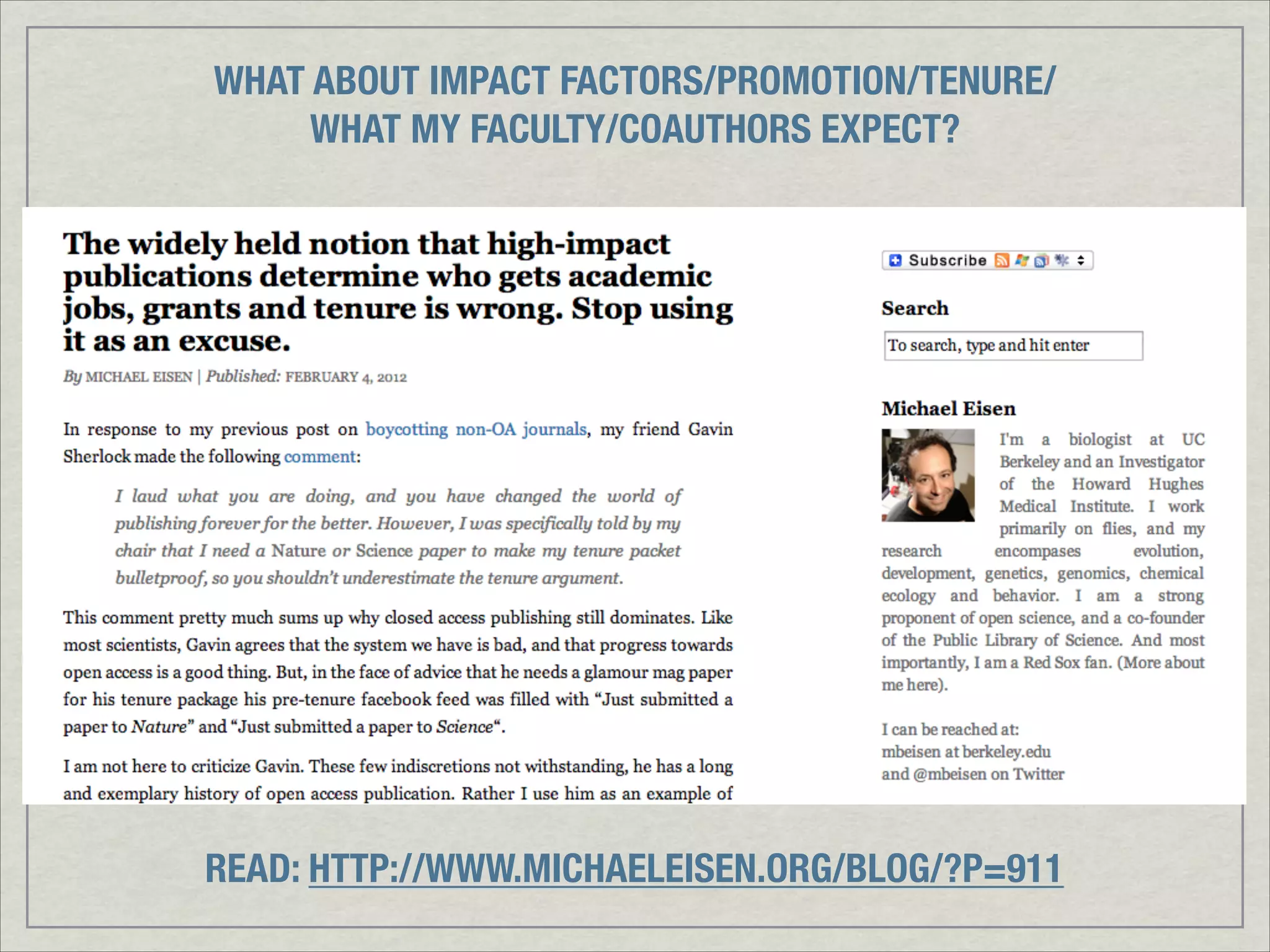
WHAT ABOUT IMPACT FACTORS/PROMOTION/TENURE/

     WHAT MY FACULTY/COAUTHORS EXPECT?


READ: HTTP://WWW.MICHAELEISEN.ORG/BLOG/?P=911
Thanks. And good luck.
More reading:
https://ceprofs.civil.tamu.edu/
ssocolofsky/downloads/
paper_how-to.pdf
cjamesleonard@qf.org.qa
   www.qscience.com
www.twitter.com/qscience

Writing manuscripts for peer reviewed engineering journals

  • 1.
    Good morning! And thanksfor inviting us to MASDAR.
  • 2.
    Getting published ina peer-reviewed journal Christopher Leonard 
 Editorial Director - QScience.com
  • 4.
    What was ajournal? Journal des sçavans & Philosophical Transactions of the Royal Society both started in 1665 Late 1800’s see the emergence of ‘theory- experiment-discussion’ structure of articles 1980’s see IMRAD (Introduction, Methods, Results and Discussion) adopted widely as a reflection of the process of scientific discovery Print only, limited readership, limited number of titles
  • 5.
    What is ajournal? Electronic-only, or e-leading, peer-reviewed selection of articles judged to be of a certain quality within a certain, narrow, field. Many papers publicly available via open access or PubMed/arXiv >20,000 active journal titles >5,500 papers per day published (2m/year)
  • 6.
  • 7.
    Editorials Written by Editoror invited guest Short, select and narrowly focused
  • 8.
    Commentaries Commentaries may benarrative reviews, but somewhat more opinionated. Little research methodology, biased synthesis of a collection of articles. Usually there to provoke controversy or academic debate.
  • 9.
    Review articles A comprehensivenarrative synthesis of previously published information, often summarising each key article. Bibliographic research methodology frequently a part of narrative reviews (although is not strictly required). Reputable sources only. Will provide in-depth snapshot of a field, convey a clear message and draw conclusions supported by data analysis.
  • 10.
    Preparing to writea research manuscript
  • 11.
    Target journal Think aboutthis before you start to write. Best journal for your article may not necessarily be best in the field. Has similar work been published in that journal? Check the I4As Tyranny of the Impact Factor.
  • 12.
  • 13.
    Authorship Sort this out before writing the manuscript*. Consult with coauthors, gather their ORCIDs. Otherwise, preferred name listing and affiliation. Usually listed in decreasing order of their contribution (although this can vary) Determine who is the corresponding author * READ THIS: Liz Wager’s excellent guide “Recognition, reward and repsonsibility: why the authorship of scientific papers matters” Maturitas 2009; 62:109-12
  • 14.
    Ethical issues Fabrication of data Duplicate publication Plagiarism Misuse of statistics Manipulation of images Inadequate or false citations READ THIS: HTTP://PUBLICATIONETHICS.ORG/ MAINLY FOR EDITORS AND 
 PUBLISHERS, BUT GIVES A GREAT INSIGHT INTO PROBLEMS SOME PAPERS FACE
  • 15.
  • 16.
    Title Title is THEmost important part of the paper. Decide on best title after writing the manuscript. Should be descriptive, not cute, and match the abstract. Not too general, not too much jargon.
  • 17.
    Examples GOOD TITLE Astudy of thrombocytopenia in hospitalized vivax malaria patients BAD TITLES Physics of waves Transgressing the Boundaries: Towards a Transformative Hermeneutics of Quantum Gravity Read more about this at http://physics.nyu.edu/sokal/
  • 19.
    Abstract In Web ofScience/Scopus/Google Scholar. Think of it as a ‘teaser’ or ‘trailer’ for your paper. DON’T make it too long. Shorter is ALWAYS better DON’T introduce and define lots of acronyms DON’T include references to citations DO pitch it to non-specialists in your broader field DO write (or rewrite) it at THE END.

  • 20.
    Background information Bibliographic researchto set research question in context. Make sure it is up-to-date (consider revising if first draft is more than 3 months old) - reviewers get very suspicious about missing citations. Papers over 10 years old, use with caution.
  • 22.
  • 23.
    Passage from theWikipedia article on "The English Language" The following paragraph has a Gunning Fog Index of 24.4. As a result of the military, economic, scientific, political, and cultural influence of the United Kingdom from the 18th century, and of the United States since the mid 20th century, it has become the lingua franca in many parts of the world, and the most prominent language in international business and science. It is used extensively as a second language and as an official language in the European Union and many Commonwealth countries, as well as many international organisations. Analysis ■There are 79 words in two sentences. ■The 17 italic words are considered complex. ■0.4 ((79/2) + 100(17/79)) ■0.4 x ( 39.5 + 12.79) ■Fog index = 24.4
  • 24.
    The same passagesimplified The following paragraph has a Gunning Fog Index of 7.07. English has become the standard language around the world. This was the result of many factors. In the 1700s, the British affected English with the army, economy, science, politics and culture. In the mid-1900s, the United States caused change. It is the most used language in world business and science. It is a famous second language and an official language in most of Europe and in Commonwealth countries. It is also the case in groups around the world. Analysis ■There are 79 words in seven sentences. ■The 5 italic words are considered complex. ■0.4 ((79/7) + 100(5/79)) ■0.4 x ( 11.28 + 2.5) ■Fog index = 7.07
  • 26.
    Introduction Introduce topic toreaders in an accessible way Should be short and focused Aim for 3 paragraphs only. PARA1: Question or issue, context, relevance [What is known] PARA2: Importance of problem/unclear issues [What is unknown] PARA3: Rationale, hypothesis, main objective [Why study was done] Can be written at any point, but good to revisit at the end.
  • 27.
    Materials and methods Detailsrequired to replicate the study Should include; study design, data collection details, analysis principles and rationale. Describe sample selection and exclusion criteria Ethical considerations and a description of the randomization or group assignment.
  • 28.
    Results Organised presentation ofthe collected data. Should be a distant semantic description with no interpretation or opinions. Include negative results and reasons for non- collection of information on important non- measured variables OConnor, T. R., & Holmquist, G. P. (2009). Algorithm for writing a scientific manuscript. Biochemistry and Molecular Biology Education, 37(6), 344-348. doi:10.1002/bmb.20329
  • 29.
    Discussion Explain the meaningof the results, structured as a natural flow of ideas. Key findings should be linked to study objectives, along with an acknowledgement of the strengths and weaknesses of the study Describe logically, links between results and mechanistic interpretations of cause and effect. Are results consistent with other studies? If not, why not?
  • 30.
    Discussion Don’t repeat yourself. Don’tpresent results not documented in Results Don’t overstate importance of results Do feel free to criticise study limitations Don’t repeat yourself.
  • 31.
    Conclusion It’s not anotherAbstract or Introduction. Keep it short ‘Take home’ message Do not write: ‘further study is needed’ or any variation thereof.
  • 32.
    Acknowledgements etc. Contributors whodo not qualify for author status Conflicts of interest Financial support for the research Group name if appropriate Author contributions
  • 33.
    References Keep a goodreference library (Mendeley/Zotero) Make sure references adhere to journal style Avoid abstracts and ‘personal communications’ Exclude articles ‘in submission’ Authors responsibility to make sure they do not refer to retracted articles.
  • 34.
    A word onfigures Please, please use your own figures They are easy to generate with sufficient data points and standard desktop software. Develop your own style/colour scheme. Difficult and expensive to get rights to figures published by other publishers (>$150/figure) Scans and photos should be highest possible resolution. Don’t just embed in Word - we need source files.
  • 35.
  • 36.
    Reviews & revisions Viewpeer reviewers as collaborators rather than enemies They often make constructive remarks which should improve the quality of the paper Good editors will shield you from performing more experiments (unless it’s Nature or Science) For each point the reviewer makes, provide a brief note explaining how you have incorporated their remark, or a rebuttal.
  • 37.
  • 38.
    Promotion You are themarketer of your own work (usually) Link to your article from your facebook/twitter/ linkedin/orcid page Departmental website, institution PR department? Mendeley, scribd, list-servs, other discussion boards and lists
  • 41.
    A brief noteon open access
  • 43.
    WHAT ABOUT IMPACTFACTORS/PROMOTION/TENURE/
 WHAT MY FACULTY/COAUTHORS EXPECT? READ: HTTP://WWW.MICHAELEISEN.ORG/BLOG/?P=911
  • 44.
  • 45.
  • 46.
    cjamesleonard@qf.org.qa www.qscience.com www.twitter.com/qscience