1. Welcoming
• Warm Up: TWO TRUTHS ONE LIE
• General principles of the course, syllabus, the
methodology and the evaluation criteria.
TALKING POINTS.
1. Welcoming
Warm Up: TWO TRUTHS ONE LIE
Students take it in turns saying three things about themselves; two of them should
be true, and one of them a lie. The other students then have to guess which
statements are true and which are no.
Eg:
Hello, my name is Cristina Montero, I was born in Medellin, I have been a professor
of English for 16 years now, and I have two cats.
1. Welcoming
General principles of the
course, syllabus, the
methodology and the
evaluation criteria
1. Welcoming: Lecture Objective
To provide students with practical tools and strategies
enabling them to develop academic papers
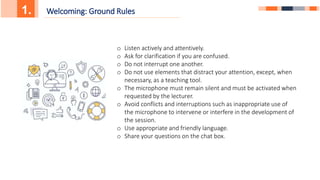
1. Welcoming: Ground Rules
o Listen actively and attentively.
o Ask for clarification if you are confused.
o Do not interrupt one another.
o Do not use elements that distract your attention, except, when
necessary, as a teaching tool.
o The microphone must remain silent and must be activated when
requested by the lecturer.
o Avoid conflicts and interruptions such as inappropriate use of
the microphone to intervene or interfere in the development of
the session.
o Use appropriate and friendly language.
o Share your questions on the chat box.
1.
1.
3.
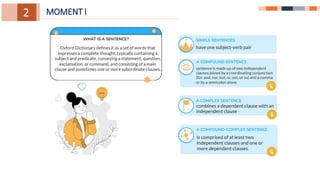
2. MOMENT I
1.
1.
3.
2. MOMENT I
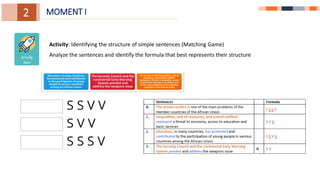
Activity: Identifying the structure of simple sentences (Matching Game)
Analyze the sentences and identify the formula that best represents their structure
1.
1.
3.
2. MOMENT I
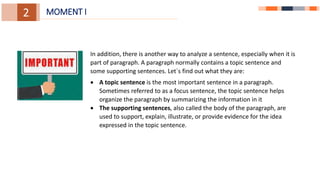
In addition, there is another way to analyze a sentence, especially when it is
part of paragraph. A paragraph normally contains a topic sentence and
some supporting sentences. Let`s find out what they are:
 A topic sentence is the most important sentence in a paragraph.
Sometimes referred to as a focus sentence, the topic sentence helps
organize the paragraph by summarizing the information in it
 The supporting sentences, also called the body of the paragraph, are
used to support, explain, illustrate, or provide evidence for the idea
expressed in the topic sentence.
1.
1.
3.
2. MOMENT I
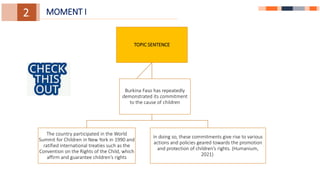
TOPIC SENTENCE
The country participated in the World
Summit for Children in New York in 1990 and
ratified international treaties such as the
Convention on the Rights of the Child, which
affirm and guarantee children’s rights
In doing so, these commitments give rise to various
actions and policies geared towards the promotion
and protection of children’s rights. (Humanium,
2021)
Burkina Faso has repeatedly
demonstrated its commitment
to the cause of children
1.
1.
3.
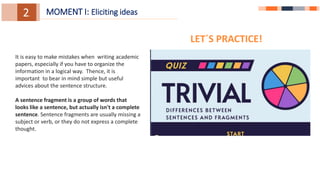
2. MOMENT I: Eliciting ideas
It is easy to make mistakes when writing academic
papers, especially if you have to organize the
information in a logical way. Thence, it is
important to bear in mind simple but useful
advices about the sentence structure.
A sentence fragment is a group of words that
looks like a sentence, but actually isn't a complete
sentence. Sentence fragments are usually missing a
subject or verb, or they do not express a complete
thought.
LET´S PRACTICE!
5.
3. MOMENT 2
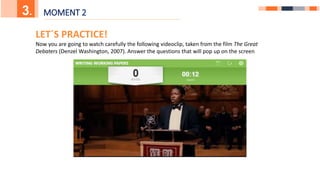
LET´S PRACTICE!
Now you are going to watch carefully the following videoclip, taken from the film The Great
Debaters (Denzel Washington, 2007). Answer the questions that will pop up on the screen
5.
3. MOMENT 2:
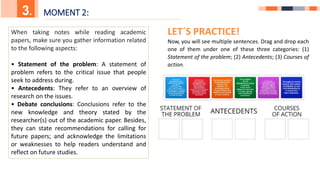
When taking notes while reading academic
papers, make sure you gather information related
to the following aspects:
• Statement of the problem: A statement of
problem refers to the critical issue that people
seek to address during.
• Antecedents: They refer to an overview of
research on the issues.
• Debate conclusions: Conclusions refer to the
new knowledge and theory stated by the
researcher(s) out of the academic paper. Besides,
they can state recommendations for calling for
future papers; and acknowledge the limitations
or weaknesses to help readers understand and
reflect on future studies.
LET´S PRACTICE!
Now, you will see multiple sentences. Drag and drop each
one of them under one of these three categories: (1)
Statement of the problem; (2) Antecedents; (3) Courses of
action.
Questions
4.
REFERENCES
• Donovan-Kranz, Eileen andLad Tobin, eds. Fresh Ink: Essays from Boston College’s
First-Year Writing Seminar 2002. Boston: McGraw Hill, 2002.
• Fields, Suzanne. ―Mission No Longer Impossible—Or Is It?‖ The Aims of
Argument.5thed. Ed. Timothy Crusius and Carolyn E. Channell. Boston: McGraw
Hill, 2006. 646-648.
• Freedman, Jonathan L. ―Violence in the Mass Media and Violence in Society: The
Link is Unproven.‖ The Aims of Argument.5thed. Ed.Timothy Crusius and Carolyn E.
Channell. Boston: McGraw Hill, 2006. 173-177.
• Guterson, David. ―No Place Like Home: On the Manicured Streets of a Master-
Planned Community.‖ Seeing and Writing 3. Ed. Donald McQuade and Christine
McQuade. Boston: Bedford St. Martin, 2006. 183-189.
• The Aims of Argument.5thed. Ed. Timothy Crusius and Carolyn E. Channell. Boston:
McGraw Hill, 2006. 710-718.

WRITING GUIDELINES FOR ACADEMIC PAPERS..

  • 1.
    1. Welcoming • WarmUp: TWO TRUTHS ONE LIE • General principles of the course, syllabus, the methodology and the evaluation criteria. TALKING POINTS.
  • 2.
    1. Welcoming Warm Up:TWO TRUTHS ONE LIE Students take it in turns saying three things about themselves; two of them should be true, and one of them a lie. The other students then have to guess which statements are true and which are no. Eg: Hello, my name is Cristina Montero, I was born in Medellin, I have been a professor of English for 16 years now, and I have two cats.
  • 3.
    1. Welcoming General principlesof the course, syllabus, the methodology and the evaluation criteria
  • 4.
    1. Welcoming: LectureObjective To provide students with practical tools and strategies enabling them to develop academic papers
  • 5.
    1. Welcoming: GroundRules o Listen actively and attentively. o Ask for clarification if you are confused. o Do not interrupt one another. o Do not use elements that distract your attention, except, when necessary, as a teaching tool. o The microphone must remain silent and must be activated when requested by the lecturer. o Avoid conflicts and interruptions such as inappropriate use of the microphone to intervene or interfere in the development of the session. o Use appropriate and friendly language. o Share your questions on the chat box.
  • 6.
  • 7.
    1. 1. 3. 2. MOMENT I Activity:Identifying the structure of simple sentences (Matching Game) Analyze the sentences and identify the formula that best represents their structure
  • 8.
    1. 1. 3. 2. MOMENT I Inaddition, there is another way to analyze a sentence, especially when it is part of paragraph. A paragraph normally contains a topic sentence and some supporting sentences. Let`s find out what they are:  A topic sentence is the most important sentence in a paragraph. Sometimes referred to as a focus sentence, the topic sentence helps organize the paragraph by summarizing the information in it  The supporting sentences, also called the body of the paragraph, are used to support, explain, illustrate, or provide evidence for the idea expressed in the topic sentence.
  • 9.
    1. 1. 3. 2. MOMENT I TOPICSENTENCE The country participated in the World Summit for Children in New York in 1990 and ratified international treaties such as the Convention on the Rights of the Child, which affirm and guarantee children’s rights In doing so, these commitments give rise to various actions and policies geared towards the promotion and protection of children’s rights. (Humanium, 2021) Burkina Faso has repeatedly demonstrated its commitment to the cause of children
  • 10.
    1. 1. 3. 2. MOMENT I:Eliciting ideas It is easy to make mistakes when writing academic papers, especially if you have to organize the information in a logical way. Thence, it is important to bear in mind simple but useful advices about the sentence structure. A sentence fragment is a group of words that looks like a sentence, but actually isn't a complete sentence. Sentence fragments are usually missing a subject or verb, or they do not express a complete thought. LET´S PRACTICE!
  • 11.
    5. 3. MOMENT 2 LET´SPRACTICE! Now you are going to watch carefully the following videoclip, taken from the film The Great Debaters (Denzel Washington, 2007). Answer the questions that will pop up on the screen
  • 12.
    5. 3. MOMENT 2: Whentaking notes while reading academic papers, make sure you gather information related to the following aspects: • Statement of the problem: A statement of problem refers to the critical issue that people seek to address during. • Antecedents: They refer to an overview of research on the issues. • Debate conclusions: Conclusions refer to the new knowledge and theory stated by the researcher(s) out of the academic paper. Besides, they can state recommendations for calling for future papers; and acknowledge the limitations or weaknesses to help readers understand and reflect on future studies. LET´S PRACTICE! Now, you will see multiple sentences. Drag and drop each one of them under one of these three categories: (1) Statement of the problem; (2) Antecedents; (3) Courses of action.
  • 13.
  • 14.
    REFERENCES • Donovan-Kranz, EileenandLad Tobin, eds. Fresh Ink: Essays from Boston College’s First-Year Writing Seminar 2002. Boston: McGraw Hill, 2002. • Fields, Suzanne. ―Mission No Longer Impossible—Or Is It?‖ The Aims of Argument.5thed. Ed. Timothy Crusius and Carolyn E. Channell. Boston: McGraw Hill, 2006. 646-648. • Freedman, Jonathan L. ―Violence in the Mass Media and Violence in Society: The Link is Unproven.‖ The Aims of Argument.5thed. Ed.Timothy Crusius and Carolyn E. Channell. Boston: McGraw Hill, 2006. 173-177. • Guterson, David. ―No Place Like Home: On the Manicured Streets of a Master- Planned Community.‖ Seeing and Writing 3. Ed. Donald McQuade and Christine McQuade. Boston: Bedford St. Martin, 2006. 183-189. • The Aims of Argument.5thed. Ed. Timothy Crusius and Carolyn E. Channell. Boston: McGraw Hill, 2006. 710-718.

Editor's Notes

  • #7 https://view.genial.ly/634ed9d3da9a63001311838b/interactive-content-what-is-a-sentence
  • #8 https://wordwall.net/es/resource/37043777
  • #11 https://view.genial.ly/635039df3d86530018087380/interactive-content-quiz-trivial-ii
  • #12 https://es.educaplay.com/recursos-educativos/13140718-writing_working_papers.html
  • #13 https://wordwall.net/es/resource/37109740/match-sentences-with-categories