Hello, children!
Welcome to our class!
Today,
you will learn how to write
paragraphs that compare and
contrast.
Let’s get started!
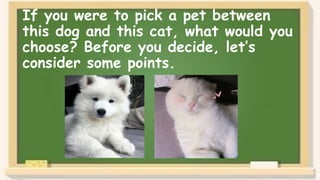
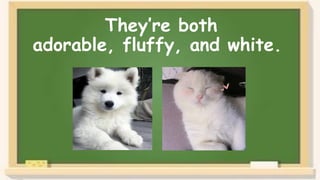
If you were to pick a pet between
this dog and this cat, what would you
choose? Before you decide, let’s
consider some points.
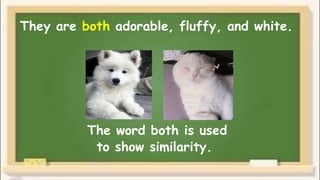
They’re both
adorable, fluffy, and white.
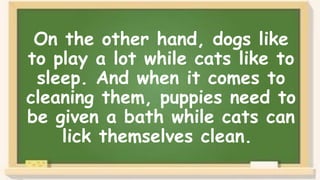
On the other hand, dogs like
to play a lot while cats like to
sleep. And when it comes to
cleaning them, puppies need to
be given a bath while cats can
lick themselves clean.
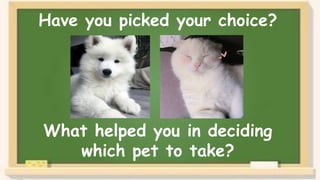
Have you picked your choice?
What helped you in deciding
which pet to take?
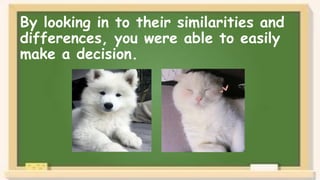
By looking in to their similarities and
differences, you were able to easily
make a decision.
When we considered their
similarities and differences,
we did some comparing and
contrasting. That is exactly
what we do when we compare
and contrast objects, events,
or ideas.
When you compare or make
a comparison, you identify
what is the same in the
subjects being compared.
They are both adorable, fluffy, and white.
The word both is used
to show similarity.
Other signal words used
for comparison are:
like, alike, have in common,
similar, similarly, too, and
same.
When contrasting,
identify what is
different.
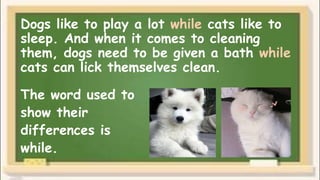
Dogs like to play a lot while cats like to
sleep. And when it comes to cleaning
them, dogs need to be given a bath while
cats can lick themselves clean.
The word used to
show their
differences is
while.
Other signal words used
to contrast two
or more things are:
but, however, while, on the
other hand, although, contrary
to, as opposed, and instead.
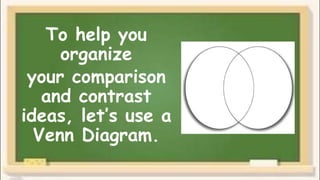
To help you
organize
your comparison
and contrast
ideas, let’s use a
Venn Diagram.
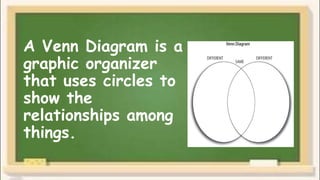
A Venn Diagram is a
graphic organizer
that uses circles to
show the
relationships among
things.
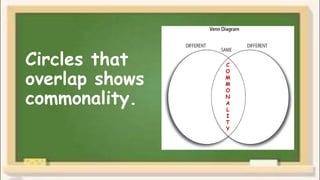
Circles that
overlap shows
commonality.
C
O
M
M
O
N
A
L
I
T
Y
C
O
M
M
O
N
A
L
I
T
Y
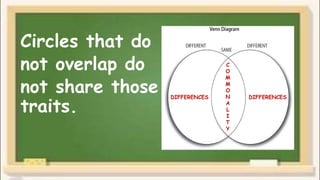
Circles that do
not overlap do
not share those
traits.
DIFFERENCES DIFFERENCES
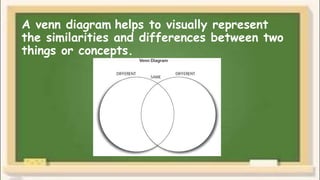
A venn diagram helps to visually represent
the similarities and differences between two
things or concepts.
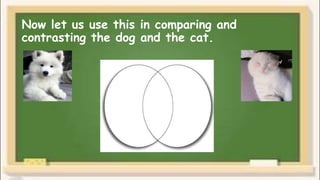
Now let us use this in comparing and
contrasting the dog and the cat.
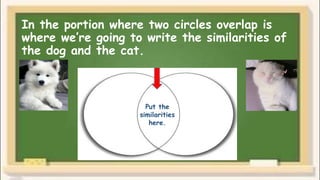
In the portion where two circles overlap is
where we’re going to write the similarities of
the dog and the cat.
Put the
similarities
here.
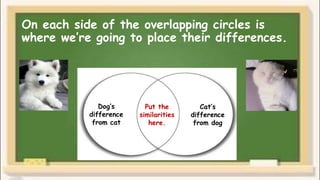
On each side of the overlapping circles is
where we’re going to place their differences.
Put the
similarities
here.
Dog’s
difference
from cat
Cat’s
difference
from dog
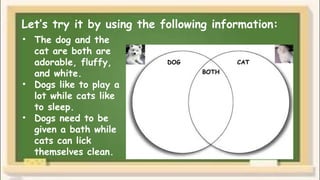
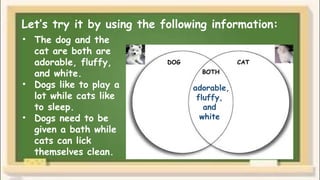
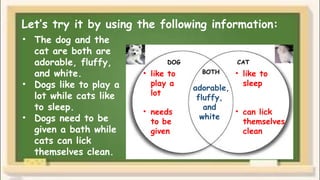
Let’s try it by using the following information:
• The dog and the
cat are both are
adorable, fluffy,
and white.
• Dogs like to play a
lot while cats like
to sleep.
• Dogs need to be
given a bath while
cats can lick
themselves clean.
DOG CAT
BOTH
Let’s try it by using the following information:
• The dog and the
cat are both are
adorable, fluffy,
and white.
• Dogs like to play a
lot while cats like
to sleep.
• Dogs need to be
given a bath while
cats can lick
themselves clean.
DOG CAT
BOTH
adorable,
fluffy,
and
white
Let’s try it by using the following information:
• The dog and the
cat are both are
adorable, fluffy,
and white.
• Dogs like to play a
lot while cats like
to sleep.
• Dogs need to be
given a bath while
cats can lick
themselves clean.
DOG CAT
BOTH
adorable,
fluffy,
and
white
• like to
play a
lot
• like to
sleep
• needs
to be
given
• can lick
themselves
clean
That is how simple to use the
Venn diagram! All you have to do
is place the similarities to the
overlapping circles in the middle
and the differences on each side.
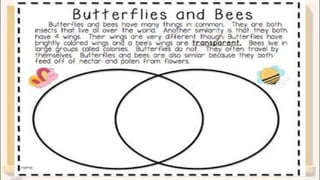
Now, it’s your turn. Read the
paragraph about butterflies and
bees. Compare and contrast by
identifying their commonality and
differences. Use the Venn
diagram to present your answers.
Now,
let’s check
your work.
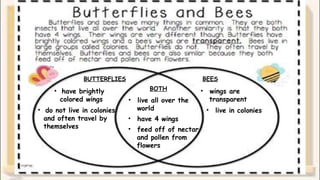
BOTH
• live all over the
world
BUTTERFLIES BEES
• have 4 wings
• feed off of nectar
and pollen from
flowers
• have brightly
colored wings
• do not live in colonies
and often travel by
themselves
• wings are
transparent
• live in colonies
It’s good that you now know
how to identify similarities
and differences, and organize
these ideas in a venn diagram.
You know what?
This is very useful in writing
paragraphs that show
comparison and contrast.
Let’s now find out
how this skill can be applied
in writing such paragraph.
When planning to write
a comparison and contrast
paragraph, you have to write about
similarities and differences.
You can’t just do one. You have to
do both. Otherwise, it can’t be
called a comparison and contrast
paragraph.
Remember that comparison
and contrast paragraph is a
text in which the similarities
and differences of two
subjects are presented and
organized logically.
To write
comparison and contrast
paragraph, you should
remember the following tips:
#1
Choose at least
two subjects you want to
describe.
They should be related
in any way. Do not choose
subjects that are completely
unrelated to each other
because you will have difficulty
in finding their similarities.
#2
Identify their similarities
and differences,
and organize them
in a Venn diagram.
#3
Make a topic sentence
where you include the
subjects you are comparing so
your readers would exactly
know what you’re going to
compare and contrast.
#4
Follow your topic sentence
with supporting details
grouped together.
For example,
after stating the topic
sentence, you might want
to start by stating their
differences, and after that
the similarities follow.
Or you might want
to say how they are the same
with each other first
and then followed by their
differences.
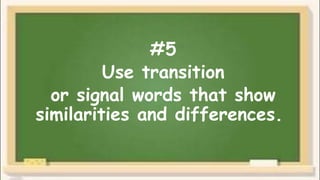
#5
Use transition
or signal words that show
similarities and differences.
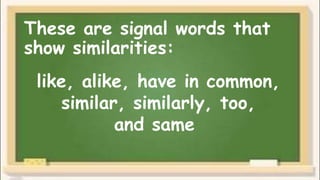
These are signal words that
show similarities:
like, alike, have in common,
similar, similarly, too,
and same
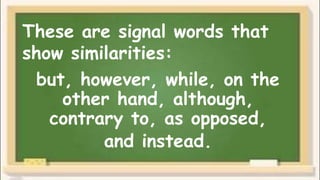
but, however, while, on the
other hand, although,
contrary to, as opposed,
and instead.
These are signal words that
show similarities:
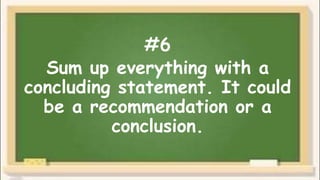
#6
Sum up everything with a
concluding statement. It could
be a recommendation or a
conclusion.
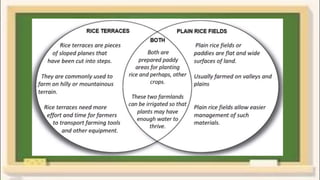
Here is an example
of similarities and differences
presented in a Venn diagram.
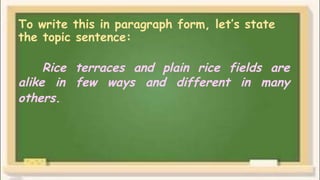
To write this in paragraph form, let’s state
the topic sentence:
Rice terraces and plain rice fields are
alike in few ways and different in many
others.
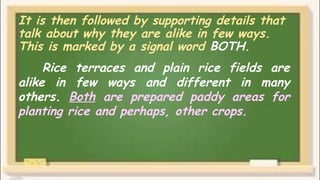
It is then followed by supporting details that
talk about why they are alike in few ways.
This is marked by a signal word BOTH.
Rice terraces and plain rice fields are
alike in few ways and different in many
others. Both are prepared paddy areas for
planting rice and perhaps, other crops.
The next sentence shows another
similarity.
Rice terraces and plain rice fields are
alike in few ways and different in many
others. Both are prepared paddy areas for
planting rice and perhaps, other crops. These
two farmlands can be irrigated so that plants
may have enough water to thrive.
The next paragraph, deals with the differences between
rice terraces and plain rice fields. It begins with the signal
word however to show that the following statements are in
contrast to the first paragraph.
However, rice terraces are pieces of sloped planes that have
been cut into steps.
The next sentence states an additional
detail.
However, rice terraces are pieces of sloped planes that have
been cut into steps. They are commonly used to farm on hilly or
mountainous terrain.
The next sentence shows how plain rice field is
different from rice terraces. It begins with a
transitional word.
However, rice terraces are pieces of sloped planes that have
been cut into steps. They are commonly used to farm on hilly or
mountainous terrain. On the other hand, plain rice fields or paddies
are flat and wide surfaces of land usually farmed on valleys and
plains.
It is then followed by another pair of
differences using the signal word while.
However, rice terraces are pieces of sloped planes that have
been cut into steps. They are commonly used to farm on hilly or
mountainous terrain. On the other hand, plain rice fields or paddies
are flat and wide surfaces of land usually farmed on valleys and
plains. Rice terraces need more effort and time for farmers to
transport farming tools and other equipment, while plain rice fields
allow easier management of such materials.
Then, it is summed up by a concluding
sentence.
However, rice terraces are pieces of sloped planes that have
been cut into steps. They are commonly used to farm on hilly or
mountainous terrain. On the other hand, plain rice fields or paddies
are flat and wide surfaces of land usually farmed on valleys and
plains. Rice terraces need more effort and time for farmers to
transport farming tools and other equipment, while plain rice fields
allow easier management of such materials. Though alike and
different in some other ways, what matters most in both farms is
the effective production of staple foods such as rice, corn, wheat,
and other crops.
Now, it is time for you
to practice what you learned
today by writing
your own paragraphs.
Remember that comparison
and contrast paragraphs
require for similarities and
differences of at least
two subjects.
In order
to effectively make one,
remember the six tips
that I gave a while ago.
#1
Choose at least
two subjects you want
to describe
#2
Identify their
similarities and differences,
and organize them
in a Venn diagram.
#3
Make a topic sentence.
#4
Follow your topic sentence
with supporting details
grouped together.
#5
Use the transition
or signal words that show
similarities and differences.
#6
Sum up everything with a
concluding statement.
Now,
here’s your task.
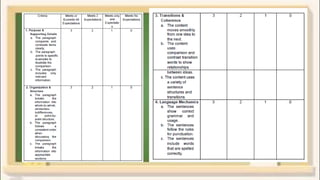
Here is the Rubrics for
Scoring your work.
Select from the given topics
and write at least two paragraphs
showing comparison and contrast
about the one you picked.
Use the Venn diagram in organizing
your ideas. Write your paragraphs
in a one whole sheet of paper.
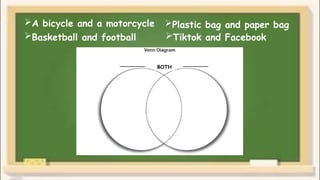
A bicycle and a motorcycle
Basketball and football
Plastic bag and paper bag
Tiktok and Facebook
BOTH
________ ________
Once you’re done,
you may show your work
to your teacher
or to any adult
supervising your studies.
They may use
the scoring rubrics
for comparison and
contrast paragraph in
rating your work.
We have reached
the end of our lesson,
and I would like to congratulate
you for successfully learning how
to write a comparison and
contrast paragraph!
I will see you again on our
next virtual class where
English is made easy with
Teacher Jerrica.
Goodbye, kids!

WRITING COMPARE AND CONTRAST PARAGRAPHS.pptx

  • 2.
  • 3.
    Today, you will learnhow to write paragraphs that compare and contrast.
  • 4.
  • 5.
    If you wereto pick a pet between this dog and this cat, what would you choose? Before you decide, let’s consider some points.
  • 6.
  • 7.
    On the otherhand, dogs like to play a lot while cats like to sleep. And when it comes to cleaning them, puppies need to be given a bath while cats can lick themselves clean.
  • 8.
    Have you pickedyour choice? What helped you in deciding which pet to take?
  • 9.
    By looking into their similarities and differences, you were able to easily make a decision.
  • 10.
    When we consideredtheir similarities and differences, we did some comparing and contrasting. That is exactly what we do when we compare and contrast objects, events, or ideas.
  • 11.
    When you compareor make a comparison, you identify what is the same in the subjects being compared.
  • 12.
    They are bothadorable, fluffy, and white. The word both is used to show similarity.
  • 13.
    Other signal wordsused for comparison are: like, alike, have in common, similar, similarly, too, and same.
  • 14.
  • 15.
    Dogs like toplay a lot while cats like to sleep. And when it comes to cleaning them, dogs need to be given a bath while cats can lick themselves clean. The word used to show their differences is while.
  • 16.
    Other signal wordsused to contrast two or more things are: but, however, while, on the other hand, although, contrary to, as opposed, and instead.
  • 17.
    To help you organize yourcomparison and contrast ideas, let’s use a Venn Diagram.
  • 18.
    A Venn Diagramis a graphic organizer that uses circles to show the relationships among things.
  • 19.
  • 20.
    C O M M O N A L I T Y Circles that do notoverlap do not share those traits. DIFFERENCES DIFFERENCES
  • 21.
    A venn diagramhelps to visually represent the similarities and differences between two things or concepts.
  • 22.
    Now let ususe this in comparing and contrasting the dog and the cat.
  • 23.
    In the portionwhere two circles overlap is where we’re going to write the similarities of the dog and the cat. Put the similarities here.
  • 24.
    On each sideof the overlapping circles is where we’re going to place their differences. Put the similarities here. Dog’s difference from cat Cat’s difference from dog
  • 25.
    Let’s try itby using the following information: • The dog and the cat are both are adorable, fluffy, and white. • Dogs like to play a lot while cats like to sleep. • Dogs need to be given a bath while cats can lick themselves clean. DOG CAT BOTH
  • 26.
    Let’s try itby using the following information: • The dog and the cat are both are adorable, fluffy, and white. • Dogs like to play a lot while cats like to sleep. • Dogs need to be given a bath while cats can lick themselves clean. DOG CAT BOTH adorable, fluffy, and white
  • 27.
    Let’s try itby using the following information: • The dog and the cat are both are adorable, fluffy, and white. • Dogs like to play a lot while cats like to sleep. • Dogs need to be given a bath while cats can lick themselves clean. DOG CAT BOTH adorable, fluffy, and white • like to play a lot • like to sleep • needs to be given • can lick themselves clean
  • 28.
    That is howsimple to use the Venn diagram! All you have to do is place the similarities to the overlapping circles in the middle and the differences on each side.
  • 29.
    Now, it’s yourturn. Read the paragraph about butterflies and bees. Compare and contrast by identifying their commonality and differences. Use the Venn diagram to present your answers.
  • 31.
  • 32.
    BOTH • live allover the world BUTTERFLIES BEES • have 4 wings • feed off of nectar and pollen from flowers • have brightly colored wings • do not live in colonies and often travel by themselves • wings are transparent • live in colonies
  • 33.
    It’s good thatyou now know how to identify similarities and differences, and organize these ideas in a venn diagram.
  • 34.
    You know what? Thisis very useful in writing paragraphs that show comparison and contrast.
  • 35.
    Let’s now findout how this skill can be applied in writing such paragraph.
  • 36.
    When planning towrite a comparison and contrast paragraph, you have to write about similarities and differences. You can’t just do one. You have to do both. Otherwise, it can’t be called a comparison and contrast paragraph.
  • 37.
    Remember that comparison andcontrast paragraph is a text in which the similarities and differences of two subjects are presented and organized logically.
  • 38.
    To write comparison andcontrast paragraph, you should remember the following tips:
  • 39.
    #1 Choose at least twosubjects you want to describe.
  • 40.
    They should berelated in any way. Do not choose subjects that are completely unrelated to each other because you will have difficulty in finding their similarities.
  • 41.
    #2 Identify their similarities anddifferences, and organize them in a Venn diagram.
  • 42.
    #3 Make a topicsentence where you include the subjects you are comparing so your readers would exactly know what you’re going to compare and contrast.
  • 43.
    #4 Follow your topicsentence with supporting details grouped together.
  • 44.
    For example, after statingthe topic sentence, you might want to start by stating their differences, and after that the similarities follow.
  • 45.
    Or you mightwant to say how they are the same with each other first and then followed by their differences.
  • 46.
    #5 Use transition or signalwords that show similarities and differences.
  • 47.
    These are signalwords that show similarities: like, alike, have in common, similar, similarly, too, and same
  • 48.
    but, however, while,on the other hand, although, contrary to, as opposed, and instead. These are signal words that show similarities:
  • 49.
    #6 Sum up everythingwith a concluding statement. It could be a recommendation or a conclusion.
  • 50.
    Here is anexample of similarities and differences presented in a Venn diagram.
  • 52.
    To write thisin paragraph form, let’s state the topic sentence: Rice terraces and plain rice fields are alike in few ways and different in many others.
  • 53.
    It is thenfollowed by supporting details that talk about why they are alike in few ways. This is marked by a signal word BOTH. Rice terraces and plain rice fields are alike in few ways and different in many others. Both are prepared paddy areas for planting rice and perhaps, other crops.
  • 54.
    The next sentenceshows another similarity. Rice terraces and plain rice fields are alike in few ways and different in many others. Both are prepared paddy areas for planting rice and perhaps, other crops. These two farmlands can be irrigated so that plants may have enough water to thrive.
  • 55.
    The next paragraph,deals with the differences between rice terraces and plain rice fields. It begins with the signal word however to show that the following statements are in contrast to the first paragraph. However, rice terraces are pieces of sloped planes that have been cut into steps.
  • 56.
    The next sentencestates an additional detail. However, rice terraces are pieces of sloped planes that have been cut into steps. They are commonly used to farm on hilly or mountainous terrain.
  • 57.
    The next sentenceshows how plain rice field is different from rice terraces. It begins with a transitional word. However, rice terraces are pieces of sloped planes that have been cut into steps. They are commonly used to farm on hilly or mountainous terrain. On the other hand, plain rice fields or paddies are flat and wide surfaces of land usually farmed on valleys and plains.
  • 58.
    It is thenfollowed by another pair of differences using the signal word while. However, rice terraces are pieces of sloped planes that have been cut into steps. They are commonly used to farm on hilly or mountainous terrain. On the other hand, plain rice fields or paddies are flat and wide surfaces of land usually farmed on valleys and plains. Rice terraces need more effort and time for farmers to transport farming tools and other equipment, while plain rice fields allow easier management of such materials.
  • 59.
    Then, it issummed up by a concluding sentence. However, rice terraces are pieces of sloped planes that have been cut into steps. They are commonly used to farm on hilly or mountainous terrain. On the other hand, plain rice fields or paddies are flat and wide surfaces of land usually farmed on valleys and plains. Rice terraces need more effort and time for farmers to transport farming tools and other equipment, while plain rice fields allow easier management of such materials. Though alike and different in some other ways, what matters most in both farms is the effective production of staple foods such as rice, corn, wheat, and other crops.
  • 60.
    Now, it istime for you to practice what you learned today by writing your own paragraphs.
  • 61.
    Remember that comparison andcontrast paragraphs require for similarities and differences of at least two subjects.
  • 62.
    In order to effectivelymake one, remember the six tips that I gave a while ago.
  • 63.
    #1 Choose at least twosubjects you want to describe
  • 64.
    #2 Identify their similarities anddifferences, and organize them in a Venn diagram.
  • 65.
    #3 Make a topicsentence.
  • 66.
    #4 Follow your topicsentence with supporting details grouped together.
  • 67.
    #5 Use the transition orsignal words that show similarities and differences.
  • 68.
    #6 Sum up everythingwith a concluding statement.
  • 69.
  • 70.
    Here is theRubrics for Scoring your work.
  • 71.
    Select from thegiven topics and write at least two paragraphs showing comparison and contrast about the one you picked. Use the Venn diagram in organizing your ideas. Write your paragraphs in a one whole sheet of paper.
  • 73.
    A bicycle anda motorcycle Basketball and football Plastic bag and paper bag Tiktok and Facebook BOTH ________ ________
  • 74.
    Once you’re done, youmay show your work to your teacher or to any adult supervising your studies.
  • 75.
    They may use thescoring rubrics for comparison and contrast paragraph in rating your work.
  • 76.
    We have reached theend of our lesson, and I would like to congratulate you for successfully learning how to write a comparison and contrast paragraph!
  • 77.
    I will seeyou again on our next virtual class where English is made easy with Teacher Jerrica. Goodbye, kids!