WHITE PAPER · BLOCKCHAIN AND DISTRIBUTED LEDGERS - CONCEPTS AND TECHNOLOGY ANALYSIS · Version 1.0
1
BLOCKCHAIN
AND DISTRIBUTED LEDGERS
TECHNOLOGY, ECONOMIC IMPACT AND
TECHNICAL STANDARDIZATION
White Paper
Version 1.0 · June 2018
Avec le support de :
autre visuel autre visuel autre visuel
2
WHITE PAPER · BLOCKCHAIN AND DISTRIBUTED LEDGERS - CONCEPTS AND TECHNOLOGY ANALYSIS · Version 1.0 WHITE PAPER · BLOCKCHAIN AND DISTRIBUTED LEDGERS - CONCEPTS AND TECHNOLOGY ANALYSIS · Version 1.0
3
Avec le support de :
Institut Luxembourgeois de la
Normalisation, de l‘Accréditation, de la
Sécurité et qualité des produits et services
Agence pour la Normalisation et
l’Economie de la Connaissance
BLOCKCHAIN
AND DISTRIBUTED LEDGERS
TECHNOLOGY, ECONOMIC IMPACT AND
TECHNICAL STANDARDIZATION
White Paper
Version 1.0 · June 2018
4 5
WHITE PAPER · BLOCKCHAIN AND DISTRIBUTED LEDGERS · Version 1.0 WHITE PAPER · BLOCKCHAIN AND DISTRIBUTED LEDGERS · Version 1.0
Information and Communication Technologies (ICT) have
become an integral part of our economy and have assumed a
predominant role in our lives. The unprecedented growth of
these technologies and their interdisciplinary applications are
making an impact across various economic sectors, around
the world. Luxembourg is increasingly harnessing these
technological developments to achieve positive transformation.
Our approach to this transformation has been holistic in the
sense that it not only covers strategic adoption but also building
appropriate skills, ecosystems, infrastructure, policy as well as
support, to ensure sustained future development.
Recently, blockchain and distributed ledger technologies (DLT)
have attracted attention of various stakeholders globally,
primarily because they are considered to have a potential to
create various avenues for innovation, transformation and
economic growth. These technologies are undergoing various developments. For instance, although
bitcoin and other cryptocurrencies were originally widely known, the underlying technology that
could facilitate trust, transparency, traceability and immutability, is gaining increasing attention.
Similarly, while traditional blockchains were designed to be public and open, private and permissioned
platforms that could transform business processes and provide decentralized enterprise applications
are being developed. With enormous enthusiasm and effort from the market, Luxembourg is already
establishing itself as a leader in this area, and our goal is to continue to tap the potential that these
technologies offer.
In this context, it is important for market players to understand and gain comprehensive insights on
the concepts, impact and developments relevant to these technologies. To this aim, this white paper
describes the state-of-the-art and provides an analysis of blockchain and DLT from three different
perspectives: basic concepts and technology, economic and business prospects, and technical
standardization.
The first aspect clarifies fundamentals and provides a broad view of the technological landscape,
including the requirements of digital trust as a cornerstone to resilient growth. The second aspect
attempts to analyze the impact that this technology could have on the economy and on the businesses
by means of case studies. The third aspect provides complete details on relevant work in technical
standardization as a key source of knowledge that will establish common technical language, result in
technology’s convergence, and facilitate its continuous improvement.
ILNAS, the national standards body, is in charge of realizing the national technical standardization
strategy, with a strong policy concerning the ICT sector. With associated research and education
initiatives, this white paper is one among several projects that indicates the excellent path that ILNAS is
taking to develop the necessary culture about ICT technical standardization at the national level.
Within this framework, Luxembourg will continue to consider technical standardization as a real force
multiplier for the economy, for competitiveness, and specifically for the ICT sector.
Etienne Schneider
Deputy Prime Minister
Minister of the Economy
6
WHITE PAPER · BLOCKCHAIN AND DISTRIBUTED LEDGERS · Version 1.0 WHITE PAPER · BLOCKCHAIN AND DISTRIBUTED LEDGERS · Version 1.0
7
	 Acknowledgements		
The working-group (WG) commissioned to prepare this white paper is:
Name of the contributor Role Institution/Organization
Mr. Mario GROTZ
Director General for Research,
Intellectual Property and New
Technologies
Ministry of the Economy
Mr. Michele GALLO Director ICT Coordination Ministry of the Economy
Mr. François THILL Deputy Executive Advisor Ministry of the Economy
Mr. Jean-Marie SPAUS HPC Project Coordination Ministry of the Economy
Mr. Daniel LIEBERMANN Director, Directorate Logistics Ministry of the Economy
Ms. Françoise LINERS
Director Life Sciences
& Health Technologies
Ministry of the Economy
Mr. Jean-Marie REIFF Director ILNAS
Dr. Jean-Philippe HUMBERT Deputy Director ILNAS
Dr. Johnatan PECERO
Head of Standardization
Department
ANEC G.I.E.
Dr. Ravi JHAWAR Project Officer ANEC G.I.E.
Mr. Nicolas DOMENJOUD Project Officer ANEC G.I.E.
Mr. Benoit POLETTI General Director Incert G.I.E.
Mr. Nasir ZUBAIRI Co-founder, CEO
Luxembourg House of Financial
Technology
This working-group would like to thank all the people who have helped and supported us, in different ways, in
developing this white paper:
●● Ms. Marianne HOFFMANN, Ministry of the Economy
●● Mr. Lex KAUFHOLD, Ministry of the Economy
●● Dr. ir. R.M. van WESSEL, Apexis Information Solutions
●● Mr. Thibault CHOLLET, Deloitte Luxembourg
●● Ms. Emeline BES, Deloitte Luxembourg
●● Mr. Gaëtan PRADEL, Incert G.I.E.
●● Mr. Marco HOUWEN, Infrachain a.s.b.l.
●● Dr. Cyril CASSAGNES, Infrachain a.s.b.l.
●● Mr. Said FIHRI, KPMG Luxembourg
●● Mr. Romain FOURDIN, KPMG Luxembourg
●● Dr. Pascal ROGIEST, LuxTrust S.A.
●● Mr. Povilas ZINYS, LuxTrust S.A.
8
WHITE PAPER · BLOCKCHAIN AND DISTRIBUTED LEDGERS · Version 1.0 WHITE PAPER · BLOCKCHAIN AND DISTRIBUTED LEDGERS · Version 1.0
9
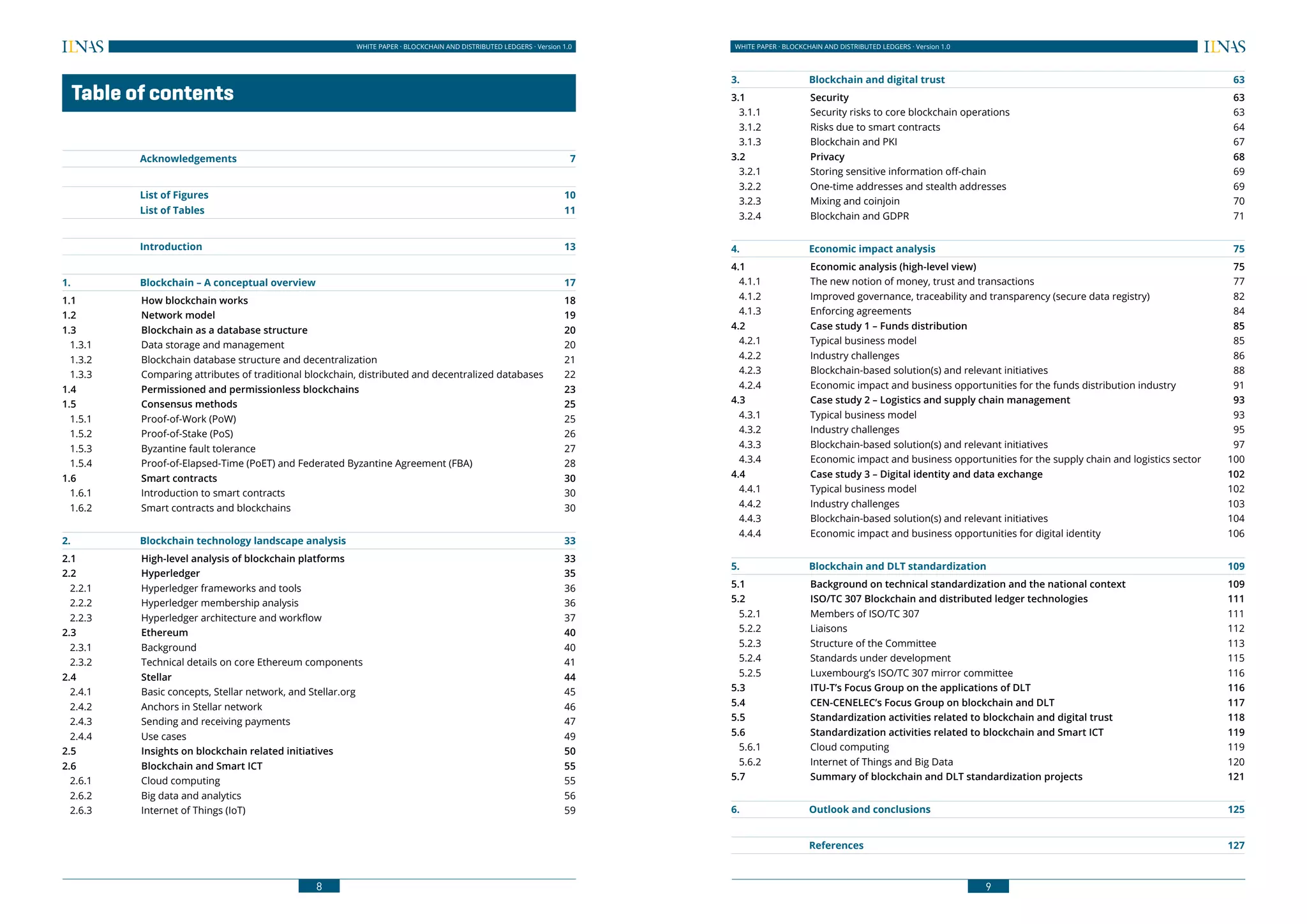
	 Table of contents
	
	Acknowledgements	 7
	 List of Figures	 10
	 List of Tables	 11
	Introduction	 13
1.	 Blockchain – A conceptual overview	 17
1.1	 How blockchain works	 18
1.2	 Network model	 19
1.3	 Blockchain as a database structure	 20
1.3.1	 Data storage and management 	 20
1.3.2	 Blockchain database structure and decentralization	 21
1.3.3	 Comparing attributes of traditional blockchain, distributed and decentralized databases 	 22
1.4	 Permissioned and permissionless blockchains	 23
1.5	 Consensus methods	 25
1.5.1	 Proof-of-Work (PoW)	 25
1.5.2	 Proof-of-Stake (PoS)	 26
1.5.3	 Byzantine fault tolerance	 27
1.5.4	 Proof-of-Elapsed-Time (PoET) and Federated Byzantine Agreement (FBA)	 28
1.6	 Smart contracts	 30
1.6.1	 Introduction to smart contracts	 30
1.6.2	 Smart contracts and blockchains	 30
2.	 Blockchain technology landscape analysis	 33
2.1	 High-level analysis of blockchain platforms	 33
2.2	Hyperledger	 35
2.2.1	 Hyperledger frameworks and tools	 36
2.2.2	 Hyperledger membership analysis	 36
2.2.3	 Hyperledger architecture and workflow	 37
2.3	 Ethereum 	 40
2.3.1	Background	 40
2.3.2	 Technical details on core Ethereum components	 41
2.4	Stellar	 44
2.4.1	 Basic concepts, Stellar network, and Stellar.org	 45
2.4.2	 Anchors in Stellar network	 46
2.4.3	 Sending and receiving payments 	 47
2.4.4	 Use cases	 49
2.5	 Insights on blockchain related initiatives	 50
2.6	 Blockchain and Smart ICT	 55
2.6.1	 Cloud computing	 55
2.6.2	 Big data and analytics	 56
2.6.3	 Internet of Things (IoT)	 59
3.	 Blockchain and digital trust	 63
3.1	Security	 63
3.1.1	 Security risks to core blockchain operations	 63
3.1.2	 Risks due to smart contracts	 64
3.1.3	 Blockchain and PKI	 67
3.2	Privacy	 68
3.2.1	 Storing sensitive information off-chain	 69
3.2.2	 One-time addresses and stealth addresses	 69
3.2.3	 Mixing and coinjoin	 70
3.2.4	 Blockchain and GDPR	 71
4.	 Economic impact analysis	 75
4.1	 Economic analysis (high-level view)	 75
4.1.1	 The new notion of money, trust and transactions	 77
4.1.2	 Improved governance, traceability and transparency (secure data registry)	 82
4.1.3	 Enforcing agreements	 84
4.2	 Case study 1 – Funds distribution	 85
4.2.1	 Typical business model	 85
4.2.2	 Industry challenges	 86
4.2.3	 Blockchain-based solution(s) and relevant initiatives	 88
4.2.4	 Economic impact and business opportunities for the funds distribution industry	 91
4.3	 Case study 2 – Logistics and supply chain management	 93
4.3.1	 Typical business model	 93
4.3.2	 Industry challenges	 95
4.3.3	 Blockchain-based solution(s) and relevant initiatives	 97
4.3.4	 Economic impact and business opportunities for the supply chain and logistics sector	 100
4.4	 Case study 3 – Digital identity and data exchange	 102
4.4.1	 Typical business model	 102
4.4.2	 Industry challenges	 103
4.4.3	 Blockchain-based solution(s) and relevant initiatives	 104
4.4.4	 Economic impact and business opportunities for digital identity	 106
5.	 Blockchain and DLT standardization	 109
5.1	 Background on technical standardization and the national context	 109
5.2	 ISO/TC 307 Blockchain and distributed ledger technologies	 111
5.2.1	 Members of ISO/TC 307	 111
5.2.2	Liaisons	 112
5.2.3	 Structure of the Committee	 113
5.2.4	 Standards under development	 115
5.2.5	 Luxembourg’s ISO/TC 307 mirror committee	 116
5.3	 ITU-T’s Focus Group on the applications of DLT	 116
5.4	 CEN-CENELEC’s Focus Group on blockchain and DLT	 117
5.5	 Standardization activities related to blockchain and digital trust 	 118
5.6	 Standardization activities related to blockchain and Smart ICT	 119
5.6.1	 Cloud computing	 119
5.6.2	 Internet of Things and Big Data	 120
5.7	 Summary of blockchain and DLT standardization projects	 121
6.	 Outlook and conclusions	 125
	References	 127
10
WHITE PAPER · BLOCKCHAIN AND DISTRIBUTED LEDGERS · Version 1.0 WHITE PAPER · BLOCKCHAIN AND DISTRIBUTED LEDGERS · Version 1.0
11
	 List of Figures
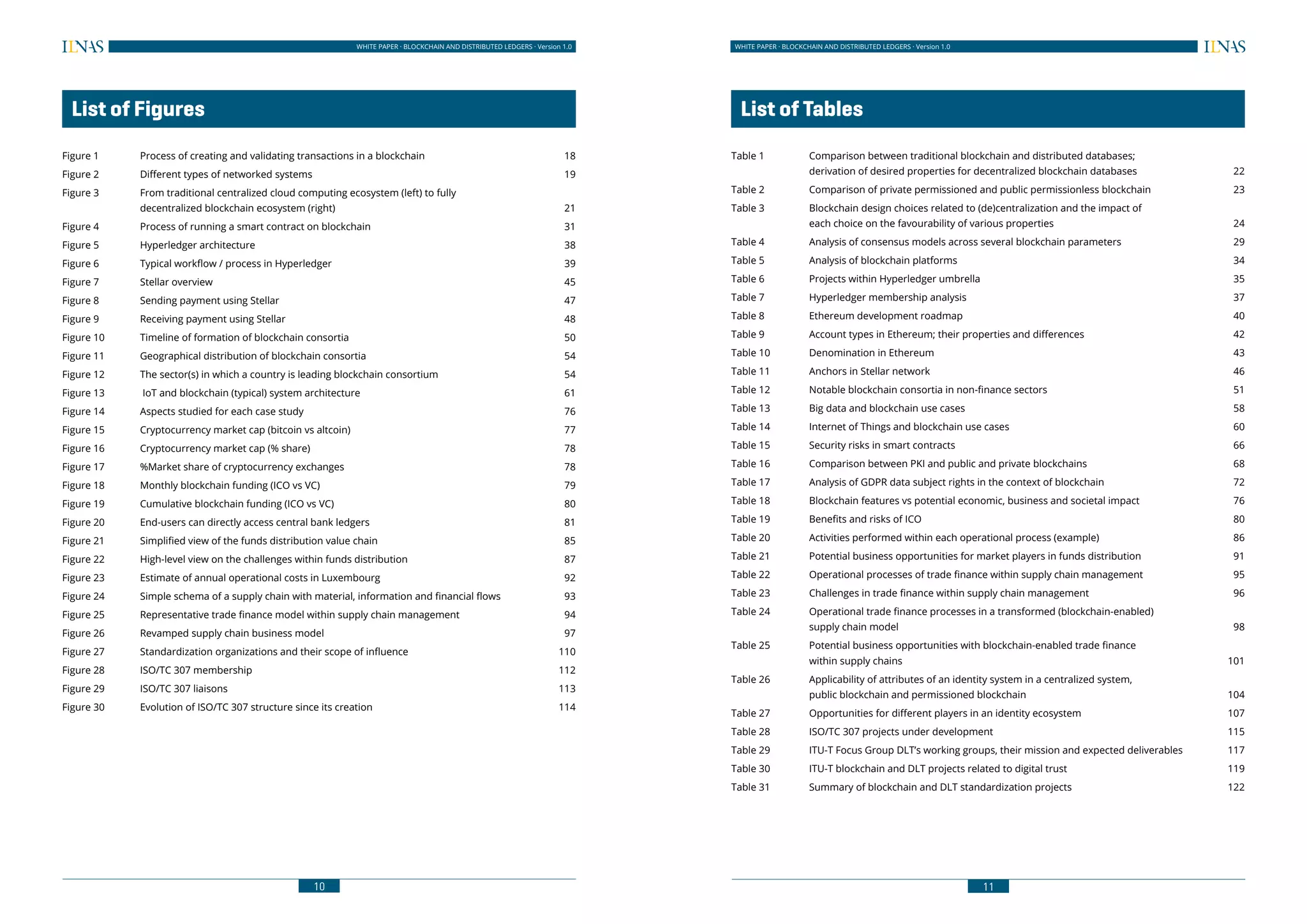
Figure 1 	 Process of creating and validating transactions in a blockchain 	 18
Figure 2 	 Different types of networked systems 	 19
Figure 3 	 From traditional centralized cloud computing ecosystem (left) to fully
decentralized blockchain ecosystem (right) 	 21
Figure 4 	 Process of running a smart contract on blockchain 	 31
Figure 5 	 Hyperledger architecture 	 38
Figure 6 	 Typical workflow / process in Hyperledger	 39
Figure 7 	 Stellar overview 	 45
Figure 8 	 Sending payment using Stellar 	 47
Figure 9 	 Receiving payment using Stellar 	 48
Figure 10 	 Timeline of formation of blockchain consortia 	 50
Figure 11 	 Geographical distribution of blockchain consortia 	 54
Figure 12 	 The sector(s) in which a country is leading blockchain consortium 	 54
Figure 13	 IoT and blockchain (typical) system architecture 	 61
Figure 14 	 Aspects studied for each case study 	 76
Figure 15 	 Cryptocurrency market cap (bitcoin vs altcoin) 	 77
Figure 16 	 Cryptocurrency market cap (% share) 	 78
Figure 17	 %Market share of cryptocurrency exchanges 	 78
Figure 18 	 Monthly blockchain funding (ICO vs VC)	 79
Figure 19 	 Cumulative blockchain funding (ICO vs VC)	 80
Figure 20 	 End-users can directly access central bank ledgers 	 81
Figure 21 	 Simplified view of the funds distribution value chain 	 85
Figure 22	 High-level view on the challenges within funds distribution	 87
Figure 23 	 Estimate of annual operational costs in Luxembourg 	 92
Figure 24 	 Simple schema of a supply chain with material, information and financial flows 	 93
Figure 25 	 Representative trade finance model within supply chain management 	 94
Figure 26 	 Revamped supply chain business model 	 97
Figure 27	 Standardization organizations and their scope of influence	 110
Figure 28 	 ISO/TC 307 membership 	 112
Figure 29 	 ISO/TC 307 liaisons 	 113
Figure 30 	 Evolution of ISO/TC 307 structure since its creation 	 114
	 List of Tables
Table 1 	 Comparison between traditional blockchain and distributed databases;
derivation of desired properties for decentralized blockchain databases 	 22
Table 2 	 Comparison of private permissioned and public permissionless blockchain 	 23
Table 3 	 Blockchain design choices related to (de)centralization and the impact of
each choice on the favourability of various properties 	 24
Table 4 	 Analysis of consensus models across several blockchain parameters 	 29
Table 5 	 Analysis of blockchain platforms 	 34
Table 6 	 Projects within Hyperledger umbrella 	 35
Table 7	 Hyperledger membership analysis	 37
Table 8 	 Ethereum development roadmap 	 40
Table 9 	 Account types in Ethereum; their properties and differences 	 42
Table 10	 Denomination in Ethereum 	 43
Table 11	 Anchors in Stellar network 	 46
Table 12 	 Notable blockchain consortia in non-finance sectors 	 51
Table 13	 Big data and blockchain use cases 	 58
Table 14	 Internet of Things and blockchain use cases 	 60
Table 15 	 Security risks in smart contracts 	 66
Table 16 	 Comparison between PKI and public and private blockchains 	 68
Table 17	 Analysis of GDPR data subject rights in the context of blockchain 	 72
Table 18 	 Blockchain features vs potential economic, business and societal impact 	 76
Table 19	 Benefits and risks of ICO 	 80
Table 20 	 Activities performed within each operational process (example) 	 86
Table 21 	 Potential business opportunities for market players in funds distribution 	 91
Table 22 	 Operational processes of trade finance within supply chain management 	 95
Table 23 	 Challenges in trade finance within supply chain management 	 96
Table 24 	 Operational trade finance processes in a transformed (blockchain-enabled)
supply chain model 	 98
Table 25 	 Potential business opportunities with blockchain-enabled trade finance
within supply chains	 101
Table 26	 Applicability of attributes of an identity system in a centralized system,
public blockchain and permissioned blockchain 	 104
Table 27 	 Opportunities for different players in an identity ecosystem	 107
Table 28 	 ISO/TC 307 projects under development	 115
Table 29 	 ITU-T Focus Group DLT’s working groups, their mission and expected deliverables 	 117
Table 30 	 ITU-T blockchain and DLT projects related to digital trust 	 119
Table 31 	 Summary of blockchain and DLT standardization projects 	 122
12
WHITE PAPER · BLOCKCHAIN AND DISTRIBUTED LEDGERS · Version 1.0 WHITE PAPER · BLOCKCHAIN AND DISTRIBUTED LEDGERS · Version 1.0
13
	Introduction			
The past few years have witnessed a major ICT innovation in the form of the blockchain technology. The core of
this innovation revolves around the notion of a distributed ledger that allows a network of computers to jointly
create, evolve and keep track of a database of records (e.g., business transactions), colloquially known as the
blockchain [1]. Another innovation of this technology comprises an underlying protocol that allows users to reach
consensus without having to trust each other [2].
Until recently, bitcoin was seen as the most prominent application of the blockchain technology [3] [4] [5]. However,
it is just one application of this technology; the real potential of blockchain goes far beyond, with applications
across various sectors including (but not limited to) supply chains, healthcare, banking, financial services, digital
media, payments and industry 4.0. This disruptive potential has led to an unparalleled attention and growth, with
contributions from industries, academia, start-ups as well as administrations from across the globe.
The goal of this white paper is to provide a comprehensive view of the developments around blockchain and
distributed ledger technologies. To this aim, a systematic analysis of this domain is presented from three different
perspectives: blockchain concepts and technology, economic and business impact, and technical standardization,
so that the readers of this white paper could broadly answer to questions such as:
●● How does blockchain work?
●● What are the features, differences and similarities, in major blockchain platforms?
●● How will blockchain affect different economic sectors?
●● What are the benefits of adopting blockchain within a given business?
●● What are the recent developments in blockchain technical standardization?
●● Which set of standards are relevant?
To achieve such broad and comprehensive outcomes, the rest of this white paper is organized along the three-
abovementioned perspectives as follows.
Holistic analysis of blockchain concepts and technology
●● Chapter 1 describes fundamentals of blockchain starting from a conceptual overview on how blockchain
works, to network and data management models, and finally to consensus methods and the role of smart
contracts.
●● Chapter 2 builds on the concepts introduced in Chapter 1 and provides technology analysis across three
dimensions:
■■ First, a high-level analysis of blockchain platforms is provided, then two popular general-purpose
projects Hyperledger and Ethereum are discussed in detail, and finally a platform designed specifically
for digital assets and payments – Stellar – is studied.
■■ The second part of this chapter provides insights on various consortia that were formed by companies,
research institutions, and governments as a means to realize their blockchain strategy.
■■ The third, and the final, part of this chapter establishes the relationship between blockchain and Smart
ICT topics namely Cloud computing, Internet of Things and Big data, to study blockchain from an overall
ICT ecosystem point of view.
●● Chapter 3 provides an analysis of the digital trust aspects of the blockchain technology. In particular, the
strengths and issues of blockchain in terms of security and privacy are studied.
14
WHITE PAPER · BLOCKCHAIN AND DISTRIBUTED LEDGERS · Version 1.0 WHITE PAPER · BLOCKCHAIN AND DISTRIBUTED LEDGERS · Version 1.0
15
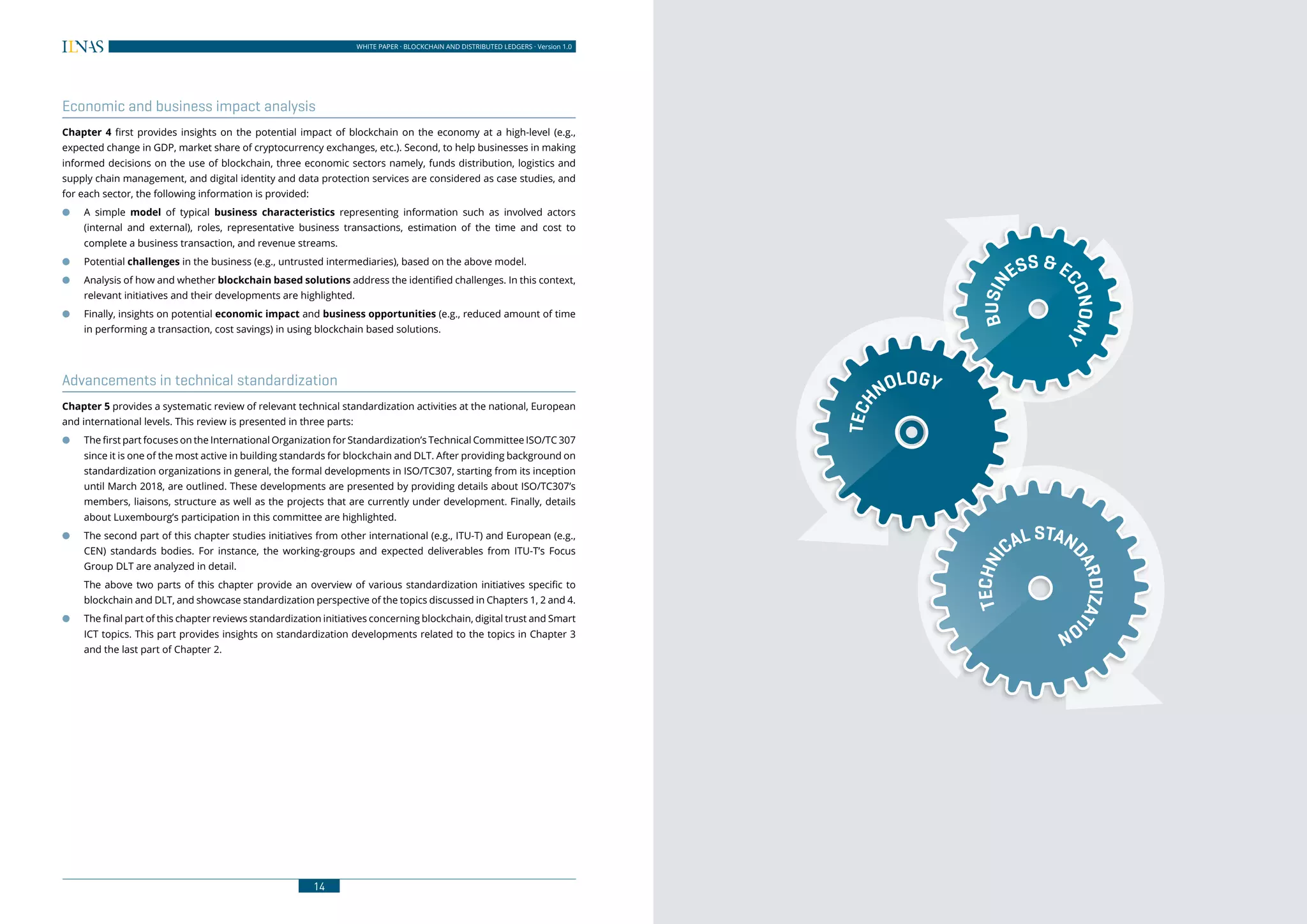
Economic and business impact analysis
Chapter 4 first provides insights on the potential impact of blockchain on the economy at a high-level (e.g.,
expected change in GDP, market share of cryptocurrency exchanges, etc.). Second, to help businesses in making
informed decisions on the use of blockchain, three economic sectors namely, funds distribution, logistics and
supply chain management, and digital identity and data protection services are considered as case studies, and
for each sector, the following information is provided:
●● A simple model of typical business characteristics representing information such as involved actors
(internal and external), roles, representative business transactions, estimation of the time and cost to
complete a business transaction, and revenue streams.
●● Potential challenges in the business (e.g., untrusted intermediaries), based on the above model.
●● Analysis of how and whether blockchain based solutions address the identified challenges. In this context,
relevant initiatives and their developments are highlighted.
●● Finally, insights on potential economic impact and business opportunities (e.g., reduced amount of time
in performing a transaction, cost savings) in using blockchain based solutions.
Advancements in technical standardization
Chapter 5 provides a systematic review of relevant technical standardization activities at the national, European
and international levels. This review is presented in three parts:
●● The first part focuses on the International Organization for Standardization’s Technical Committee ISO/TC 307
since it is one of the most active in building standards for blockchain and DLT. After providing background on
standardization organizations in general, the formal developments in ISO/TC307, starting from its inception
until March 2018, are outlined. These developments are presented by providing details about ISO/TC307’s
members, liaisons, structure as well as the projects that are currently under development. Finally, details
about Luxembourg’s participation in this committee are highlighted.
●● The second part of this chapter studies initiatives from other international (e.g., ITU-T) and European (e.g.,
CEN) standards bodies. For instance, the working-groups and expected deliverables from ITU-T’s Focus
Group DLT are analyzed in detail.
The above two parts of this chapter provide an overview of various standardization initiatives specific to
blockchain and DLT, and showcase standardization perspective of the topics discussed in Chapters 1, 2 and 4.
●● The final part of this chapter reviews standardization initiatives concerning blockchain, digital trust and Smart
ICT topics. This part provides insights on standardization developments related to the topics in Chapter 3
and the last part of Chapter 2.
BUSIN
ESS &E
CONOMY
TECH
NOLOGY
TECHNI
CAL STAN
DARDIZATI
ON
16
WHITE PAPER · BLOCKCHAIN AND DISTRIBUTED LEDGERS - CONCEPTS AND TECHNOLOGY ANALYSIS · Version 1.0 WHITE PAPER · BLOCKCHAIN AND DISTRIBUTED LEDGERS - CONCEPTS AND TECHNOLOGY ANALYSIS · Version 1.0
17
	 1.	 Blockchain – A conceptual overview
The ever-increasing interconnectedness and integration in today’s society have resulted in business networks
wherein economic activity transcends national, geographic, and jurisdictional boundaries. Such business
networks typically enable marketplaces where stakeholders such as producers, consumers, distributors,
intermediaries and partners trade on objects of value, known as assets. In this context, an asset could be tangible
and physical (e.g., mobile phones, real estate) or intangible and virtual (e.g., data, bond certificates, patents)
and a transaction may comprise asset ownership, transfer, or other activities that create value in the business
network. Details about trade transactions (e.g., products, costs, history of account balance) are recorded using
ledgers to keep track of asset ownership and transfers [3]. In situations where a business participates in different
types of economic activities, a common practice consists in maintaining multiple ledgers, each corresponding to
an individual economic activity.
The current practice of creating and maintaining business ledgers relies heavily on centralized, trust-based,
third-party systems. As a result, in some scenarios, current business ledgers become inefficient, expensive, non-
transparent, and vulnerable to fraud and misuse [6]. For instance, the centralized nature of the current system,
along with trust requirements, result in bottlenecks and slowdown of transactions settlement. Similarly, the lack
of transparency and susceptibility to fraud lead to disputes that are costly to resolve (e.g., by reversing various
transactions). Finally, since each participant in the business network is responsible to maintain its own ledger,
out-of-sync copies become a reality and lead to faulty or delayed decision-making, which further results in missed
business opportunities.
The blockchain technology has the potential to address the limitations of current business ledgers and be a
disruptive force in transforming the way businesses are organized. In contrast to traditional ledgers, a blockchain
is a distributed and shared digital ledger that records all transactions that take place in a business network. The
business network is typically represented as public or private peer-to-peer network depending on the business
context and the ledger is decentralized in the sense that the blockchain database structure is replicated across
many participants/nodes in the network, each of whom collaborate in its maintenance [6]. To ensure that ledger
transactions are synchronized i.e., only validated transactions are written in the blockchain and are written in the
same order across all replicas, a blockchain network uses consensus mechanisms [7].
The information in a blockchain is recorded as blocks where a new transaction is linked/chained to previous
blocks in an append-only manner using cryptographic techniques which ensure that a transaction cannot be
modified once it has been written to the ledger. Because of this immutability property, blockchain is sometimes
defined as a system of records that simplifies the task of determining the provenance of information. State-of-
the-art blockchain solutions use smart contracts to support consistent update of information, to enable ledger
functions (e.g., querying), and to automate aspects of transactions management (e.g., automatic calculation of
account balance, controlling access to information)1
.
In the rest of this chapter, a detailed description of the basic concepts of the blockchain technology, including its
working and novel characteristics, are provided.
1]	 Given that this is a rather new paradigm, the ISO/TC 307 Blockchain and Distributed Ledger Technologies is working towards standardization of its taxonomy and
ontology as well as to provide a reference architecture through its working-group WG 1.
Blockchain –
A conceptual
overview
1
18
WHITE PAPER · BLOCKCHAIN AND DISTRIBUTED LEDGERS - CONCEPTS AND TECHNOLOGY ANALYSIS · Version 1.0 WHITE PAPER · BLOCKCHAIN AND DISTRIBUTED LEDGERS - CONCEPTS AND TECHNOLOGY ANALYSIS · Version 1.0
19
	 1.1	 How blockchain works
A block consists of a set of transactions that are grouped together to improve logical organization and scalability.
In general, a block includes a standard set of attributes that are necessary for its functioning such as a block
header, a hash pointer to previous blocks, timestamp, nonce, transaction counter and the set of transactions.
However, the specific structure, attributes and the number of transactions within a block, as well as the design
and type of blockchain varies depending on the application scenario (see Section 1.4). An overview of the general
process for generating blockchain (i.e., how blockchain works) is given below.
Figure 1: Process of creating and validating transactions in a blockchain
The first block called the genesis block is hardcoded at the start of the blockchain and all subsequent blocks are
chained (i.e., have a reference) to the previous blocks, justifying the name blockchain. Figure 1 illustrates the general
process of creating and validating transactions in a blockchain [1] [8]. The steps involved in the process are:
1.	 Transaction definition: Consider that two nodes in the blockchain network agree on a transaction. The first
node Sender then creates a transaction and sends it to the network. For instance, the transaction message
could include information such as the cryptographic public address of Receiver, transaction details (e.g.,
amount to transfer, reference to previous transactions), and a cryptographic digital signature of Sender that
proves the authenticity of the transaction.
2.	 Transaction authentication: The nodes in the network receive the transaction message and validate the
authenticity of the message by verifying the digital signature. The authenticated transaction is placed in a
pool of pending transactions [1].
3.	 Block creation: One of the nodes in the network encapsulates pending transactions in a block and alerts the
nodes across the network about the newly built block for its validation.
4.	 Block validation: The validator nodes in the network receive the new block and work to validate it through
an iterative process that requires consensus from a majority of nodes in the network. These validator nodes
are often referred as Miners [1].
Different validation techniques are used by different blockchain platforms. For example, bitcoin uses
Proof-of-Work [9] [10], Ethereum Metropolis uses a variant of Proof-of-Stake [11] [12] and Ripple builds on
the Byzantine fault tolerance protocol [13]. The primary goal of these techniques is to ensure that every
transaction is valid and synchronized and that fraudulent transactions remain impossible.
In general, the miner who first resolves the computation publishes the results to the entire network. At this
point, the transaction is considered as confirmed.
5.	 Block chaining: Once all transactions are validated, the new block is chained with the previously validated
blocks, forming the blockchain. The current state of the ledger is then broadcasted to the network.
Note that the process of validation can also be performed at the level of transactions instead of a block (differing
from Step 3 above). In this case, miners validate individual transactions (Step 4) and validated transactions are
grouped as blocks (along with Step 5) eventually.
	 1.2	 Network model
Decentralization is one of the core benefits and services provided by the blockchain technology. A typical
blockchain network, as the one supporting bitcoin, is structured as a peer-to-peer (P2P) network on top of
the Internet [3] [14]. P2P means that the computers participating in the network are all equal peers and that
they all provide network services. The network topology is flat in the sense that nodes interconnect in a mesh
structure, with no centralized service or hierarchy, and reciprocity acting as the incentive for participation. Such
P2P networks are inherently resilient, decentralized, and open, precisely reflecting the core characteristic of the
blockchain technology.
Nodes in a blockchain network, though equal, may take different roles depending on the functionality they are
supporting [3]. For instance, a node could take one or more of the following roles:
●● Routing: Each node in the network includes the routing function (receiving and forwarding messages) since
it maintains connections with peers, and validates and propagates transactions/blocks.
●● Maintaining blockchain database: Some nodes maintain a replica of the blockchain/shared ledger and
autonomously and authoritatively verify transactions.
●● Mining: A set of nodes serve as miners by participating in the process of creating new blocks (e.g., by running
mining algorithms such as Proof-of-Work, as discussed in Section 1.5). In addition to mining and routing,
these nodes could also maintain a replica of the blockchain.
●● Application-specific functions: Some nodes in the network specialize in running application-specific
functions such as certain smart contracts features or digital wallets. Similarly to the mining nodes, this
category of nodes could maintain a blockchain replica and/or participate in the mining process, in addition
to routing and running application-specific functions.
●● Finally, there could be complementary nodes running other specialized blockchain protocols in the network.
Figure 2 illustrates the typical nature of centralized, distributed and decentralized systems, based on the seminal
work in [15]. In a centralized system, a single node controls and manages the entire system while all other entities
depend on its services (e.g., a typical client-server paradigm). A distributed system in contrast spreads the tasks of
data storage and computation across multiple nodes, providing economies of scale and fault tolerance. However,
a central process governs the system and controls the storage and computing nodes.
CENTRALIZED DISTRIBUTED DECENTRALIZED
Figure 2: Different types of networked systems
SENDER RECEIVERTRANSACTION
TRANSACTION DEFINITION TRANSACTION AUTHENTICATION BLOCK CREATION BLOCK VALIDATION BLOCK CHAINING
20
WHITE PAPER · BLOCKCHAIN AND DISTRIBUTED LEDGERS - CONCEPTS AND TECHNOLOGY ANALYSIS · Version 1.0 WHITE PAPER · BLOCKCHAIN AND DISTRIBUTED LEDGERS - CONCEPTS AND TECHNOLOGY ANALYSIS · Version 1.0
21
Inadecentralizedsystem,controlovernetworkentitiesisdistributedamongmultiplenodes,removingthesystem’s
dependence on a single process for governance, while ensuring high levels of fault tolerance and scalability. The
basis for decentralizing control in blockchain consists in distributing the right to create, authenticate and verify
the blocks fairly among the nodes in the network (i.e., to distribute various roles among the network nodes
fairly and to employ efficient consensus mechanisms). It is important to note that the blockchain technology is
not designed standalone and requires various other technologies as supporting underlying infrastructure. For
example, blockchain needs Public Key Infrastructure by design (see Chapter 3), and services such as BigChainDB
and IPFS to store large amounts of data in a scalable and decentralized manner [16] (see Chapter 2).
	 1.3	 Blockchain as a database structure
Blockchain is a ledger that records all the transactions in the network. This ledger is decentralized in the sense
that the blockchain database structure is shared and distributed among many nodes in the network, each of
whom collaborate for its maintenance. In this context, the notion of data storage and management in blockchain
becomes interesting and is discussed first in this section. Then, various properties of the blockchain database
structure are studied particularly from decentralization point of view. Finally, a comparison is made between the
properties of traditional blockchain databases (e.g., built for bitcoin) and state-of-the-art distributed databases.
This comparison provides insights on decentralized blockchain databases.
1.3.1	 Data storage and management
Blockchain can be viewed as a database technology that forces every new transaction to have the output of
another transaction as its input2
. This implies that the asset referenced in a transaction is traceable through the
blockchain up to the genesis block, simplifying the task of determining the provenance of information. This aspect
of blockchain can be highly useful for industries in which transparency as well as auditability and traceability are
desirable features. For example, blockchain could record all events concerning the lifecycle of an artwork (e.g.,
creation, exhibition, transfer, ownership) as transactions and establish the provenance of the artwork, which is
for instance useful to know if the art is original or has been forged [17] (see Section 4.3).
When a node creates a new block, it includes in the header of this block a reference to the previous block. Data
is hence stored in the blockchain in a chronological order in an append-only manner, making the database
structure tamper-resistant as well as immutable by design. Furthermore, if another node verifies the referenced
hash to be the same as it recognizes, it implicitly verifies that both nodes agree on the entire history of the
blockchain. This chaining of transactions distinguishes blockchain from other distributed ledger technologies
while being consensus-oriented unites them [18].
One aspect of blockchain data management that was proposed in the context of bitcoin concerns the longest-
chain rule. For a given block on the chain, there is a single path to the genesis block. However, there can be
forks while traversing the blockchain from the genesis block. Forks typically come into existence when blocks are
created by multiple nodes almost at the same time. In such situations, nodes in the network build onto whichever
block they receive first and the probability that the miners continue to solve blocks simultaneously on separate
chains diminishes with each mined block. At a given point, the longest chain is considered as the valid one (since
most effort is taken to produce it) and it overtakes other smaller chains that are consequently dropped. Since a
miner gains less reward for working on a shorter chain, miners have an incentive to reach consensus rapidly and
to work on the mutual version of the blockchain (see Proof-of-Work in Section 1.5 for more details).
2
]	 Bitcoin implements this by means of unspent transaction outputs (UTXO) model where bitcoin cryptocurrency is linked to public keys of users and UTXO provides
transactions in which bitcoins were received by the user but not spent yet [5].
1.3.2	 Blockchain database structure and decentralization
The true potential of blockchain can be realized within a decentralized network where the data in the blockchain
is shared and replicated across many nodes. Each node then has the possibility of verifying the actions of other
nodes in the network, as well as the ability to create, authenticate and verify the new data to be recorded on the
blockchain. This is true particularly for public and permissionless blockchains (see Section 1.4).
Figure 3: From traditional centralized cloud computing ecosystem (left) to fully decentralized blockchain ecosystem (right) [16]
Based on [16], Figure 3 clarifies how a blockchain database structure is associated with other communication
and processing technologies, and compares its usefulness with respect to various decentralization settings
(fully centralized, partially decentralized and fully decentralized contexts). The blockchain database structure is
complementary to decentralized smart contracts processing, file system and communications building blocks
[19]. It can be encapsulated with decentralized computing platforms (e.g., Ethereum), and be used for a wide
range of applications such as identity protocols [20], financial assets protocols [5] [3] and glue protocols [21].
A blockchain database structure can also work in completely centralized or partially decentralized paradigms. For
example, the former is possible in scenarios where decentralizing only storage brings benefits. The latter can be
used when scalability needs are greater than the capabilities of existing decentralized processing technologies.
In this case, blockchain provides a bridge to eventually be a fully decentralized system.
Fully centralized Fully decentralized
Applications
Platform
(e.g., Cloud computing platforms)
Applications
Platform
(e.g., Cloud computing platforms)
Applications
(e.g., Identity / financial asset protocols)
Platform
(e.g., Ethereum, Hyperledger)
Processing
(e.g., Cloud compute services)
Processing
(e.g., Cloud compute services)
Processing
(e.g., Smart contract, Ethereum VM)
Communication
(e.g., Enterprise networks)
Communication Communication
(e.g., P2P network over the Internet)
File system
(e.g., Cloud
storage)
File system
(e.g., Cloud
storage)
File system
(e.g., IPFS)
Database
(e.g., MySQL)
Blockchain
Database
(e.g., BigchainDB)
Blockchain
Database
(e.g., BigchainDB)
22
WHITE PAPER · BLOCKCHAIN AND DISTRIBUTED LEDGERS - CONCEPTS AND TECHNOLOGY ANALYSIS · Version 1.0 WHITE PAPER · BLOCKCHAIN AND DISTRIBUTED LEDGERS - CONCEPTS AND TECHNOLOGY ANALYSIS · Version 1.0
23
1.3.3	 Comparing attributes of traditional blockchain, distributed and
decentralized databases
Modern distributed databases have storage capacities in the orders of petabyte and beyond, throughput
exceeding a million transactions per second, while maintaining the latency within a fraction of a second. Their
design ensures that throughput and capacity increases as the number of nodes in the system increase. A number
of additional features enable querying, insertion and access control over data, based on rich set of languages
such as SQL and NoSQL [16]. In contrast to distributed databases, bitcoin blockchain for example, has a capacity
in the orders of gigabytes, throughput of seconds for a few transaction and the latency of minutes before a single
write. The performance of the system decreases when the number of nodes increase. It is estimated that the
network traffic quadruples when the number of nodes double, with no improvement in throughput, latency or
storage capacity. Moreover, languages for data management are limited.
Distributed databases Traditional blockchain
Decentralized
databases (desired for
blockchain)
Throughput
(that increases with the
number of nodes)
High Low High
Latency Low High Low
Capacity
(that increases with the
number of nodes)
High Low High
Querying features Rich Limited Rich
Access control
capabilities
High Limited High
Decentralized control Not possible Possible Possible
Immutability No Yes Yes
Creation & transfer of
assets
Not possible Possible Possible
Table 1: Comparison between traditional blockchain and distributed databases; derivation of desired properties for decentralized blockchain databases [16]
To meet the full potential of the blockchain technology, as outlined in Table 1, the underlying decentralized
databases need to combine the key benefits of both abovementioned databases, and output high throughput,
capacity, scalability, low latency, and a rich set of query languages [16]. Blockchain and decentralized database
solutions that are currently available in the market are discussed in Chapter 2.
	 1.4	 Permissioned and permissionless blockchains
One primary decision that needs to be made when using a blockchain concerns with its scope (e.g., whether to
use a public or a private blockchain). This decision depends on the application scenario and parameters such as
the access control requirements, regulatory compliance goals, and entities that are entitled to be miners.
A classification of blockchain permissions and scope is as follows [22] [18]:
●● Public blockchain: The blockchain in which there is no restriction on reading data and submitting
transactions for inclusion into the blockchain.
●● Private blockchain: A blockchain that allows direct access to data and transactions submission only to a
predefined list of entities.
●● Permissionless blockchain: The blockchain in which there are no restrictions on identities of transaction
processors.
●● Permissioned blockchain: A blockchain that allows transaction processing only to a predefined list of
subjects with known identities.
There is a spectrum of possibilities among these configurations. For example, a permissioned blockchain could
be either private or public. Blockchain that uses policies to constrain network participation as well as access to
records are both permissioned and private. These are particularly useful for banks and financial institutions
that want to leverage the potential of blockchain while maintaining fine-grained control over data access and
transparency. In contrast, blockchain that gives permissions to read data and to submit transactions to anyone
(or to a list of collaborating institutions), but controlled only by pre-authorized nodes, are permissioned and
public. Similarly, blockchains that are not only open for any participant to join as users and serve as nodes but
also for the data to be publicly transparent are permissionless and public. This model is generally adopted by
cryptocurrencies such as bitcoin. Table 2 compares private permissioned and public permissionless blockchain.
Permissioned blockchain
(Private)
Permissionless blockchain
(Public)
Access granted
Authorized to a pre-defined list of
users
Open access
Approach to traditional
business processes and
regulations
Aims to follow standard business
processes and regulations such as
KYC (Know Your Customer), HIPAA
(Health Insurance Portability and
Accountability Act) and GDPR
(EU General Data Protection
Regulation)
Aims to create censorship resist-
ant, anonymous transactions,
ideally outside the current legal
framework
Miners (validators) Pre-selected, trusted miners
Anonymous, fully decentralized
miners
Typical application domain Enterprise-level systems
Permissionless innovation, open-
access applications
Table 2: Comparison of private permissioned and public permissionless blockchain
Note that using a public blockchain results in better transparency and auditability but has a complex performance
and cost model. Private blockchain, on the other hand, is the most flexible for configuration since it is governed
and hosted by a single organization but has limitations with respect to public blockchain properties such as equal
rights, transparency and auditability [1] [23].
24
WHITE PAPER · BLOCKCHAIN AND DISTRIBUTED LEDGERS - CONCEPTS AND TECHNOLOGY ANALYSIS · Version 1.0 WHITE PAPER · BLOCKCHAIN AND DISTRIBUTED LEDGERS - CONCEPTS AND TECHNOLOGY ANALYSIS · Version 1.0
25
Similarly, permissioned blockchains allow recording larger amount of transaction details, and allow specifying
fine-grained policies wherein some participants may view only abstract information while others, such as auditors,
have access to broader range of transactions. For example, if Party A transfers an asset to Party B, both parties can
see the details of the transactions. An external Party C can know about the existence of this transaction but not its
details. For an auditor or a regulator, full details of transactions can be made available. Such granular permissions
management may not be feasible in case of permissionless blockchain. On the contrary, certain design choices
made in permissionless blockchain become non-essential for scenarios using permissioned blockchain. For
example, Proof-of-Work is suitable for bitcoin (permissionless blockchain) to counter Sybil attacks3
; but, in case
of permissioned blockchain, since the identity of each node is known, Sybil resistance becomes superfluous and
a more cost-effective alternative such as a threshold signature scheme suffices [18]. Chapter 3 discusses such
security and privacy issues in detail.
Based on the discussions in [23], Table 3 summarizes the relationship between blockchain permissions, their
deployment model (with varying degrees of decentralization), and its impact on: i) blockchain features (e.g.,
immutability, trust, transparency), ii) cost, iii) performance and iv) safety. Permissioned blockchain is designed to
be less decentralized than permissionless blockchains but significantly more decentralized than typical master-
access databases. Therefore, there are often trade-offs between permissioned and permissionless blockchains
including transaction processing, rate, cost, censorship-resistance, reversibility and flexibility in changing and
optimizing the network rules [24].
Configuration
Blockchain design
choices
Blockchain
features
Cost
efficiency
Performance
#Failure
points4
Favorability/impact
Fully
centralized
Application offered by
a single provider
(e.g., government)
Low High High 1Application offered by
alternative providers
(e.g., banks, online
payments)
Partially
centralized
& partially
decentralized
Permissioned
blockchain with fine-
grained control over
operations (e.g., at the
transactions level)
Medium Medium Medium AllPermissioned
blockchain with
permissioned
miners (write) but
permissionless normal
nodes (read)
Fully
decentralized
Permissionless
blockchain
High Low Low
Majority
(nodes,
power, stake)
Table 3: Blockchain design choices related to (de)centralization and the impact of each choice on the favourability of various properties [23]4
3
]	 Sybil attacks on a blockchain network can allow a single user to generate several online identities to influence and manipulate the consensus process [166].
4
]	 The number of failure points concerns the safety/fault tolerance of blockchain. For instance, in a fully centralized configuration, the failure of the “central” node
alone results in the failure of the entire system.
	 1.5	 Consensus methods
The blockchain technology enables participants to read from and update to a shared ledger (blockchain) whose
state is maintained collectively by the network in a decentralized manner [2]. To maintain the state of the
blockchain, typically a consensus mechanism is used which guarantees integrity and consistency, and ensures a
common, unambiguous ordering of transactions and blocks. In other words, consensus protocols maintain the
sanctity of data recorded on the blockchain and provide the building blocks that allows a blockchain platform to
function correctly in normal as well as adversarial conditions [25] [26].
Permissionless blockchains expect to have a large number of anonymous and untrusted participants because
any node can join the network, requiring consensus mechanisms to take into account inherent maliciousness
(e.g., resistance against Sybil attacks). For example, bitcoin solves this problem by designing a consensus protocol
where the nodes are obliged to prove that they have expended certain amount of energy. This protocol is
widely known as the Proof-of-Work (PoW). Different techniques are used by different permissionless blockchain
platforms (e.g., bitcoin uses Proof-of-Work while Ethereum Metropolis uses a variant of Proof-of-Stake) and are
discussed further in this section.
In a permissioned blockchain, the nodes are semi-trusted since only verified and registered members take part
as participants. The number of nodes are expected to be small, allowing one to employ consensus mechanisms
other than the PoW [2]. Many aspects of existing research in the field of Byzantine Fault Tolerance (BFT) in
distributed systems are also applicable in the context of reaching consensus in permissioned blockchains.
Consequently, existing blockchain platforms (e.g., Hyperledger [27]) have used well-known Practical Byzantine
Fault Tolerance (PBFT) algorithm [28] and its variant such as SIEVE and Cross-Fault Tolerance (XFT) [29] to ensure
consistent ordering of transactions and to handle non-determinism in smart contract (see Section 1.6) execution.
The rest of this section also discusses this class of consensus mechanisms.
1.5.1	 Proof-of-Work (PoW)
Proof-of-Work is a piece of data that is: i) difficult (costly, time-consuming) to produce, ii) easy for others to verify,
and iii) satisfies certain pre-defined conditions [9] [10]. In general, the task of generating PoW is designed to be a
random process with low probability of success in order to ensure that a lot of trial and error happens on average
before producing a valid PoW.
Bitcoin for instance uses a variant of PoW called HashCash for block validation and chaining [5]. As discussed in
Section 1.1, when a transaction/block is pending, network participants work to validate it through an iterative
process that requires consensus from a majority of nodes. In case of bitcoin, to validate a transaction/block,
miners compete to generate a PoW such that the new block hashes to a value satisfying the current pre-defined
target (as illustrated in the example below). This process ensures that each block is generated only after certain
amount of work has been done. Moreover, due to the low probability of success in generating target PoW, it is
unpredictably as to which node in network will be able to generate the next block.
Example: For the sake of clarity, consider the following example illustrated in [10]. Let the base string be “Hello,
world!” and the target be a variation of the string that SHA-256 hashes to a value beginning with “000”. To find the
target string, nodes competing through PoW vary the string by appending an integer value called a nonce and
increment it in each iteration. In this case, the target variation of “Hello, world!” is achieved after 4251 tries with
first four digits as zeros [10].
26
WHITE PAPER · BLOCKCHAIN AND DISTRIBUTED LEDGERS - CONCEPTS AND TECHNOLOGY ANALYSIS · Version 1.0 WHITE PAPER · BLOCKCHAIN AND DISTRIBUTED LEDGERS - CONCEPTS AND TECHNOLOGY ANALYSIS · Version 1.0
27
●● “Hello, world!0”: 1312af178c253f84028d480a6adc1e25e81caa44c749ec81976192e2ec934c64
●● “Hello, world!1”: e9afc424b79e4f6ab42d99c81156d3a17228d6e1eef4139be78e948a9332a7d8
●● and so on …
●● “Hello, world!4249”: c004190b822f1669cac8dc37e761cb73652e7832fb814565702245cf26ebb9e6
●● “Hello, world!4250”: 0000c3af42fc31103f1fdc0151fa747ff87349a4714df7cc52ea464e12dcd4e9
Generating 4251 number of hashes is not a large amount of work for modern computers. It is only used as an
example PoW here. In practice, bitcoin varies the difficulty and the amount of work required to generate a block
to keep a roughly constant rate of block generation. Currently, the difficulty of this work is set in the bitcoin
network to limit the rate at which new blocks can be generated to one in every ten minutes.
The miner who first resolves the PoW by finding the target, publishes the results to the entire network. All other
nodes can easily verify the result and consequently agree on block validity and new state of the blockchain. The
successful miner is rewarded and new bitcoins (cryptocurrency) are generated in the system. Hence, Proof-of-
Work mining accomplishes several tasks [18]:
●● It allows anyone with a processing unit to participate in the process of creating new blocks.
●● It validates the legitimacy of a transaction.
●● It allows the network to reach consensus and in the process of doing so, avoids issues such as double
spending and Sybil attacks.
●● It introduces new cryptocurrency (e.g., bitcoin) into the system at a steady rate and rewards miners using an
arguably fair distribution mechanism.
●● It makes blocks tamper-resistant. Each block contains the hash of the preceding block, and therefore, each
block is associated with a chain of blocks that together comprise a very large amount of work. Any changes
to a block requires regenerating all successors and redoing all work they contain, making the blockchain
tamper-resistant.
While the PoW model supports open-ended participation, some research argues that its application is hindered
for scenarios that need immediate transaction finality and have high transaction rates (e.g., much greater than
a block per ten minutes). Similarly, the amount of power consumption due to PoW is very high. For example,
[30] suggests that the amount of electricity wasted in bitcoin mining is comparable to the average electricity
consumption of Ireland. On the other hand, consensus models designed for permissioned systems do not
scale beyond tens of peering nodes and cannot have any open-ended participation. The task of designing new
consensus models to address the abovementioned limitations is increasingly emerging as an active research area
[2] [26]. Other consensus mechanisms that are gaining industry and academia attention are discussed below.
The platforms using each of these mechanisms are outlined in Chapter 2.
1.5.2	 Proof-of-Stake (PoS)
The purpose of Proof-of-Stake is same as that of Proof-of-Work but the process to achieve the goal is different.
In contrast to PoW where miners solve complex cryptographic challenges to validate transactions and to create
new blocks, in PoS the creator of the next new block is chosen in a deterministic (pseudo-random) way, based on
its wealth, which is defined as the stake. The stake in this case typically refers to the possession of tokens in the
system (e.g., cryptocurrency).
The basis for decentralizing control in blockchain is for the network to distribute the right to create blocks fairly
among the nodes. If the creator of blocks is selected purely based on the possession of tokens, the richest
member in the network will have an asymmetric advantage, resulting in undesirable centralization. To address
this challenge, several methods for node selection have been proposed:
●● One approach consists in looking for the lowest hash value in combination with the size of the stake [31]
[32]. This introduces a degree of randomization in selecting the next block creator. Moreover, in public
blockchains where all participants know the stakes of all members, each node can predict which node will
have the right to create/forge 5
the next block with reasonable probability.
●● Another approach combines ownership of stake and the period of time over which the tokens are held.
Older and larger sets of stakes have higher probability of forging the next block. Once a stake has been used,
the period of ownership is reset.
In the basic version of PoS, all tokens are usually created in the beginning and the number of tokens do not
change over time, unlike in a system using PoW. Consequently, there are no block rewards (e.g., as in bitcoin)
and the forgers take only the transaction fees. In this context, a PoS system has the potential to result in lower
equilibrium transaction fees [26] and lower long-run operational fees could improve competitiveness as well
as alternative cost-efficient solutions (e.g., as compared to bitcoin). Due to significant reduction in the scale of
resources required, transaction fees could also be reduced even further.
In situations where the stake is escrowed for creating a block of malicious transactions, the network rejects the
transaction and forfeits the escrowed stake. Thus, a PoS system can provide increased protection from malicious
behavior in the network because [2]: i) executing an attack would be highly expensive since attackers need to
gain more than half of the stake in the network to be able to maintain the longest chain and manipulate the
blockchain and ii) the incentives from an attack are diminished. This model is designed to ensure that attackers
could suffer severely from their own attacks.
One limitation of PoS that has been highlighted in the literature [33] is described as the “nothing at stake” problem.
In the case of a consensus failure, block-generators have nothing to lose by voting for multiple blockchain-
histories, preventing the consensus from ever resolving. Since the cost of working on several chains is minimal
(unlike in the PoW systems), anyone can abuse this problem and attempt to double-spend “for free”.
1.5.3	 Byzantine fault tolerance
Many problems studied in the field of Byzantine Fault Tolerance (BFT) are applicable in case of blockchains
particularly for reaching consensus, replicating state, and broadcasting transactions in situations where the
network is not trustworthy (e.g., because of crash failures, uncertain connectivity, or system compromise by an
adversary). Consequently, a number of solutions in the literature have proposed the use of BFT – and its variants
– in permissioned and private blockchains. The most prominent of such solutions are based on the well-known
Practical Byzantine Fault Tolerance (PBFT) algorithm [28] and its variant called SIEVE. The use of these algorithms
in blockchain ensures consistent ordering of transactions in the ledger across all replicas and allows handling of
non-determinism in smart contract (see Section 1.6) execution.
Practical Byzantine Fault Tolerance (PBFT): The PBFT algorithm proposed by Castro and Liskov [28] was one
of the seminal solutions for achieving consensus in the presence of Byzantine failures 6
. It uses the concept of
replicated state machine and a voting mechanism among replicas for consistent state changes. Compared to
existing solutions, this algorithm optimizes several aspects for the system to be practical such as: i) the process of
signing and encryption of messages exchanged between replicas and clients, ii) reducing the size and number of
messages exchanged etc. This algorithm can tolerate f byzantine failures with the help of 3f+1 replicas, imposing
low overhead on performance. In practice, however, this algorithm scales only up to 20 replicas since messaging
overhead increases significantly as the number of replicas increase.
5
]	 In some cryptocurrency solutions that use PoS, the blocks are said to be forged rather than mined.
6
]	 Byzantine failures are defined as arbitrary deviations of a process from its assumed behavior. Such failures include software bugs, transient and permanent mal-
function of system components, or malicious attacks.
28
WHITE PAPER · BLOCKCHAIN AND DISTRIBUTED LEDGERS - CONCEPTS AND TECHNOLOGY ANALYSIS · Version 1.0 WHITE PAPER · BLOCKCHAIN AND DISTRIBUTED LEDGERS - CONCEPTS AND TECHNOLOGY ANALYSIS · Version 1.0
29
SIEVE: Non-determinism in smart contracts might produce different outputs when executed by different replicas
in a distributed network. SIEVE handles transactions that are usually deterministic but sometimes yield different
outputs [2]. This protocol treats a smart contract as a black box; it executes all operations speculatively and
then compares the outputs across replicas. If the protocol detects a minor divergence among a small number of
replicas, the diverging values are filtered. If the divergence occurs across several processes, then the operation
itself is filtered [2].
Cross-Fault Tolerance (XFT): BFT protocols assume a powerful adversary with ability to control compromised
nodes as well as the message delivery of the entire network. This assumption induces complexity in BFT protocols
and makes them less efficient [2]. The cross-fault tolerance (XFT) approach instead assumes that the adversary
cannot control majority of the nodes and generate network partitions at will at the same time [29]. This simplified
model is particularly interesting in blockchain where the nodes might have financial incentives to act maliciously,
yet lack the means and capabilities to compromise communications between nodes or create arbitrary network
partitions [2]. XFT provides correct service as long as majority of the replicas are correct and can communicate
with each other synchronously. It uses same number of resources as protocols that can tolerate simple crash
failures yet tolerate Byzantine faults.
1.5.4	 Proof-of-Elapsed-Time (PoET) and Federated Byzantine Agreement
(FBA)
This section reviews some other consensus mechanisms that fall between the extremes of BFT protocols (used in
permissioned blockchains) and Proof-of-Work (used in permissionless blockchains), based on [2].
Proof-of-Elapsed Time (PoET): PoET is based on the notion of leader election and requires all miners in the
network to run a Trusted Execution Environment (TEE) [2] [21]. Each miner requests a wait time from the code
running inside the TEE and the miner with the shortest wait time wins the lottery to become the leader. The
functions within the TEE ensure that their execution cannot be tampered by external software. When a miner
claims to be a leader and mines a block, it can also demonstrate the proof generated within the TEE, which
other nodes can verify. For example, the leader has to prove that it had the shortest wait time and it waited for
a protocol designated amount of time before starting to mine the next block. The randomness in generating
waiting times ensures that the leader election is randomly distributed among all validating nodes/miners [2]. The
principle drawback of this algorithm is that it is dependent on specialized hardware.
Federated Byzantine Agreement (FBA): This family of protocols depart from the traditional security assumption
for consensus protocols (e.g., in BFT) by relaxing trust assumptions. For example, instead of making global
assumptions about node collusions that the protocol tolerates, nodes in the network declare upfront a list of
nodes that it trusts, operating somewhat in a permissioned fashion [26]. This type of consensus is used by two
well-known blockchain platforms that operate global payment networks: Ripple [13] and Stellar [34].
In the Ripple consensus protocol algorithm, each node in the network maintains a unique node list (UNL), which
consists of the identities of other nodes that are trusted not to collude against it [2] [26] [13]. Consensus in the
network is achieved in multiple rounds where, in each round, all the nodes collect transactions in a data structure
called the candidate set and broadcasts it to other nodes in its UNL. Each node validates the transactions, votes
on them, and broadcasts its votes. The candidate set in each node is refined based on the accumulated votes and
the transactions that receive the largest number of votes are passed to the next round. If a candidate set receives
80% of votes from all nodes in the UNL, the candidate set becomes a valid block and is added to the blockchain
by each node. Next round of consensus is started with newer transactions and pending transactions that are not
validated in the previous round of consensus [2]. The entire network reaches consensus when each individual
sub-network reaches consensus.
The Stellar consensus protocol [34] is similar to the Ripple consensus protocol and FBA. In Stellar, only validator
nodes participate in the consensus protocol and, similarly to Ripple UNL, each validator declares its own
convincing set called a quorum slice. A quorum is a set of nodes that is sufficient to reach an agreement and a
quorum slice is a subset of a quorum that can convince one particular node about agreement [2]. A quorum slice
from each validator must sufficiently overlap with the convincing-sets of other nodes for preventing forks. A node
accepts a transaction for the ledger when a threshold of nodes in its convincing set confirms it [26]. To allow open
participation, Stellar exploits the notion that an individual node can appear on multiple quorum slices, allowing
the nodes to choose a set of nodes within its slice.
Based on the survey in [2] and discussions in this section, Table 4 provides a comparative analysis of popular
consensus schemes across a range of blockchain parameters.
PoW PoS PoET
BFT and its
variants
FBA
Blockchain
type
Permissionless Both Both Permissioned Permissionless
Transaction
finality
Probabilistic Probabilistic Probabilistic Immediate Immediate
Transaction
rate
Low High Medium High High
Need for
tokens
Yes Yes No No No
Cost of
participation
Yes Yes No No No
Scalability of
peer network
High High High Low High
Trust model Untrusted Untrusted Untrusted Semi-trusted Semi-trusted
Table 4: Analysis of consensus models across several blockchain parameters [2]
30
WHITE PAPER · BLOCKCHAIN AND DISTRIBUTED LEDGERS - CONCEPTS AND TECHNOLOGY ANALYSIS · Version 1.0 WHITE PAPER · BLOCKCHAIN AND DISTRIBUTED LEDGERS - CONCEPTS AND TECHNOLOGY ANALYSIS · Version 1.0
31
Agreement on terms
of contract
Terms encoded as smart contract
and deployed on blockchain
Instantiation of
smart contract
New transaction
to be recorded
Block validationBlock chaining
Figure 4: Process of running a smart contract on blockchain
Figure 4 outlines the steps involved in running a simple smart contract on a blockchain (based on [8]) and is
described below:
1.	 Consider that two parties agree on the terms of a contract.
2.	 Based on the agreed terms, the conditions for smart contract are established. These conditions as well as
relevant actions are encoded within a smart contract (e.g., using programming languages such as Solidity
[38]) and deployed on a blockchain (e.g., on Ethereum platform [19] [39]).
3.	 An instance of the smart contract is created in order to initiate new system processes and to run the first
transaction.
4.	 Each time conditions in the smart contract are satisfied (e.g., availability of sufficient amount), a set of
actions (e.g., transfer amount) are triggered and encapsulated as transactions/blocks to be recorded in the
blockchain.
5.	 When miners validate the transaction/block, it is recorded to the blockchain as an entry in the immutable
shared ledger.
Gaining consensuses is one of the major features on which blockchain relies. In this context, correct functioning
of consensus protocols require smart contracts to be deterministic in at least two ways (see Section 1.5 within
the context of Byzantine fault tolerance). First, irrespective of the node on which the smart contract is executed,
it must provide same results. The paradigm of distributed consensus might fail if nodes output even slightly
different results. Second, the language in which smart contracts are written must ensure that its functions provide
consistent output independently to the invocation process. For instance, smart contracts should be unlike some
scripting languages that can produce different results on different web browsers since it may lead into bugs and
loss of integrity and stability during contracts enforcement. Chapter 3 discusses digital trust aspects of smart
contracts in detail.
	 1.6	 Smart contracts
The notion of a smart contract was originally defined as a standalone topic and did not require a blockchain
to run. However, the advent of blockchain has resulted in a significant increase in market attention on smart
contracts, and the state-of-the-art has so far indicated several benefits of combining the two 7
. This section first
introduces smart contracts briefly and then studies their application in blockchain in detail.
1.6.1	 Introduction to smart contracts
Smart contract was introduced as a computerized transaction protocol that executes the terms of a contract [35].
According to this seminal work, the goal of a smart contract in terms of its functionality is threefold. First, to satisfy
general contractual conditions such as payment terms, confidentiality and enforcement. Second, to minimize
malicious and accidental exceptions, and third, to reduce the need for trusted intermediaries. Similarly, in terms
of economic benefits, the goal of a smart contract is to reduce the losses due to frauds and arbitrations as well
as to lower the costs of enforcement and transactions management.
The definition in [35] has been adapted over time in many contexts. For example, [36] defines a smart contract
as a secure and unstoppable computer program representing an agreement that is automatically executable and
enforcable. This definition underscores that smart contracts execute automatically when certain pre-defined
conditions are satisfied, and they are enforceable in the sense that all contractual terms execute as defined
and expected, even in the presence of adversaries. A further refinement of this definition highlights that smart
contract enforcement must work on the principle of code is law, meaning that there is no need for an arbitrator
or a third party to control or influence the execution of the smart contract. This implies that a smart contract must
be fault tolerant, be executable in reasonable amount of time, and support decentralized execution.
A limitation of the above definition is that smart contracts cannot access external data that might be required to
control the execution of the business logic. To deliver data from external sources (e.g., IoT devices, stock market
feeds) to smart contracts, the notion of Oracle was introduced and the above definition was refined to suggest
that smart contracts need not be automatically executable, instead be automatable [37]. Given the confluence of
fundamental properties, the above set of definitions by themselves indicate why execution of smart contracts on
blockchain platforms is a natural and mutually beneficial phenomenon.
1.6.2	 Smart contracts and blockchains
The first-generation blockchain (sometimes defined as blockchain 1.0) which realized bitcoin/cryptocurrency
partially adopted and implemented the notion of a smart contract to regulate transactions and transfer of value
(e.g., bitcoin) in a peer-to-peer network [5]. However, the capability to support programmable transactions and
auxiliary data (e.g., representing digital or physical assets) was highly limited. The second-generation blockchain
(blockchain 2.0), which is ubiquitous today, provides a general-purpose programmable infrastructure wherein
records can be maintained in public or private ledgers. In this context, smart contracts are programs that can
express complex transactions with triggers, conditions and business logic. They can support consistent update of
information and enable ledger functions as well as automate various aspects of transactions. In support of these
developments, a number of programming languages to encode smart contracts such as [38] are now available.
Several use cases and the role of smart contracts in state-of-the-art blockchain platforms such as Ethereum and
Hyperledger are discussed in Chapter 2.
7
]	 The ISO/TC 307 on Blockchain and Distributed Ledger Technologies has created a working-group WG 3 Smart contracts and their applications, which is carrying out
techno-legal standardization activities (see Chapter 5).
32
WHITE PAPER · BLOCKCHAIN AND DISTRIBUTED LEDGERS - CONCEPTS AND TECHNOLOGY ANALYSIS · Version 1.0 WHITE PAPER · BLOCKCHAIN AND DISTRIBUTED LEDGERS - CONCEPTS AND TECHNOLOGY ANALYSIS · Version 1.0
33
	 2.	 Blockchain technology landscape analysis
The previous chapter described fundamentals of blockchain starting from a conceptual overview on how
blockchain works, to network and data management models, and finally to consensus methods and the role
of smart contracts. This chapter builds on these concepts and provides an overall analysis of the technology.
First, an analysis of blockchain platforms is provided, then insights on various consortia that were formed by
companies, research institutions, and governments to realize their blockchain strategy are outlined, and finally,
the relationship between blockchain and Smart ICT (Cloud computing, Internet of Things and Big data) is
established to understand blockchain from a global ICT ecosystem point of view.
	 2.1	 High-level analysis of blockchain platforms
A number of open-source platforms that allow users to create their own blockchain applications have been
developed. Table 5 lists such platforms and characterizes their properties ranging from capabilities to target
application domains, scope and techniques used, based on [40]. Note that, given increased research and industry
attention in this area, the list of platforms in the table is not exhaustive.
One category of platforms build on the blockchain technology for cryptocurrencies to accommodate the notion
of digital assets. In contrast to cryptocurrencies that are created and derive their values from blockchains, digital
assets are a generalization in the sense that they are issued by real world entities and their existence/exchanges are
recorded by blockchain. For instance, Multichain and Corda are two blockchain platforms that use the transaction-
based data model of bitcoin but allow storage and tracking of digital assets history. Differently from bitcoin, these
platforms target private settings that allow enterprises to form closed networks and trade/control assets.
Another category of platforms goes beyond creation and management of digital assets and supports general
user-defined applications, largely via smart contracts. The most popular of such platforms is Ethereum. It
adopts an account-based data model and supports public permissionless applications ranging from simple
crowdfunding campaigns to complex investment funds like The DAO (Decentralized Autonomous Organization).
Monax, Hydrachain, Quorum, Dfinity and Parity are all derived from Ethereum and aim at deploying/executing
arbitrary business logic on distributed shared ledgers. Quorum, for instance, is an Ethereum-based distributed
ledger protocol that provides the financial services industry with a permissioned implementation of Ethereum
supporting transaction and contract privacy.
Stellar, Ripple, Iroha and IOTA also adopt account-based data model, issue their own tokens, and provide their
ledgers as a means to exchange tokens and micropayments. Among these platforms, Stellar is gaining increasing
attention from various organizations globally for its fast, reliable and cost-effective payments infrastructure, while
being public and permissionless. IOTA, on the other hand, is interesting since it allows zero-fee micropayments
and enables a platform that is useful for exchanges among Internet of Things (IoT) devices. Iroha is inspired
by the Hyperledger Fabric architecture and aims to provide a development environment where C++, web and
mobile applications can be built.
Finally, Hyperledger Fabric and Sawtooth Lake represent the third category of blockchain platforms and support
private as well as permissioned enterprise-grade applications. They utilize key-value data model, allowing
applications to create and update key-value tuples (like in traditional databases) on the blockchain. Iroha
complements Fabric and Sawtooth Lake by providing a library of reusable components in C++ that can be called
from Golang and by emphasizing on mobile application development.
Blockchain
technology
landscape
analysis
2
34
WHITE PAPER · BLOCKCHAIN AND DISTRIBUTED LEDGERS - CONCEPTS AND TECHNOLOGY ANALYSIS · Version 1.0 WHITE PAPER · BLOCKCHAIN AND DISTRIBUTED LEDGERS - CONCEPTS AND TECHNOLOGY ANALYSIS · Version 1.0
35
Blockchain
platform
Application Data model
Consensus
mechanism
Ledger type
(scope)
Smart contract
Execution
Language(s)
supported
Corda
Digital assets
Transaction-
based
Raft
Permissioned,
private
JVM Java, Kotlin
Multichain
Trusted
validators
(round robin)
Permissioned,
permissionless,
public, private
Native C++
Openchain8
Single validator
Permissioned,
private
-- --
Stellar
Digital assets
Account-
based
Stellar
consensus
Permissionless,
public
-- --
Ripple
Ripple
consensus
Permissionless,
public
-- --
IOTA9
Digital assets
(focus: IoT)
Account-
based
IOTA’s Tangle
consensus
Permissioned,
public
-- --
Ethereum
General
purpose
Account-
based
Homestead:
PoW (Etash)
Metropolis:
PoS (Casper)
Permissionless,
public
EVM
Solidity,
Serpent, LLL
Monax
Tendermint
(combination
of PoS & PBFT)
Permissioned,
private
EVM
Solidity,
Serpent, LLL
Hydrachain8
Trusted
validators
(majority)
Permissioned,
private
EVM,
Python
Solidity,
Serpent, LLL
Quorum Raft (majority)
Permissioned,
private
EVM Golang
Dfinity8
Threshold relay
Permissionless,
public
EVM
Solidity,
Serpent, LLL
Parity
Trusted
validators
(round robin)
Permissionless,
public
EVM
Solidity,
Serpent, LLL
Hyperledger
Fabric
General
purpose
Key-value
Modular;
PBFT (v0.6.0),
ordering
service Kafka
(v1.0.0)
Permissioned,
private
Dockers Golang, Java
Sawtooth
Lake
PoET
Permissioned,
permissionless,
public, private
Native,
dockers
Python
Iroha9
Digital assets
(focus: mobile
applications)
Account-
based
Sumeragi (BFT)
Permissioned,
private
Dockers C++
Table 5: Analysis of blockchain platforms [40] 8
,9
8
]	 These platforms may not be in active development. For example, Openchain was last updated on GitHub in February 2016, at the time of writing this chapter.
9
] 	 IOTA is a relatively new platform that has currently released Beta version with only a reference implementation. It is a non-blockchain type distributed ledger
technology.
	 Iroha plans to release its Alpha version in September 2017.	
It is clear that Hyperledger and Ethereum serve as reference blockchain platforms that: i) inspire many other
developments, ii) are supported by a large number of stakeholders, and iii) represent two most successful yet
contrasting types of blockchain implementations (e.g., Hyperledger Fabric is private and permissioned while
Ethereum is public and permissionless). An overview of these two platforms is provided next in this chapter.
	2.2	 Hyperledger
Hyperledger is a global, open source collaborative effort, created to develop cross-industry blockchain
technologies that can be used by businesses. It is hosted by The Linux Foundation and supported by a number
industry leaders from healthcare, manufacturing, finance, banking, logistics and technology sectors. Within the
Hyperledger umbrella, a range of projects including distributed ledger frameworks, smart contract engines, client
libraries, graphical interfaces, utility libraries and sample applications are being promoted. These projects adopt
a lifecycle process with five states: proposal, incubation, active, deprecated and end of life. Table 6 reports all
Hyperledger projects and their current status [27] [41] as of September 2017.
Name
Status
(as of Sep 2017)
Description
Support (potentially)
Frameworks
Burrow Incubation Permissioned Ethereum smart-contract blockchain
Fabric Active Distributed ledger in Golang
Indy Incubation Distributed ledger purpose-built for decentralized identity
Iroha Active Distributed ledger in C++
Sawtooth Active Distributed ledger in Python
Modules/Tools
Cello Incubation
Blockchain management
Fabric, (Sawtooth, Iroha)
Cello Analytics Incubation
Blockchain analytics
Cello
Composer Incubation
Development framework; tools for building blockchain networks
Fabric, (Sawtooth, Iroha)
Explorer Incubation
Blockchain Web UI
Fabric, (Sawtooth, Iroha)
Fabric Chaintool Active
Chaincode packaging for Fabric
Fabric
Fabric SDK Py Active
Fabric SDK in Python
Fabric
Fabric SDK Go Incubation
Fabric SDK in Golang
Fabric
Table 6: Projects within Hyperledger umbrella
36
WHITE PAPER · BLOCKCHAIN AND DISTRIBUTED LEDGERS - CONCEPTS AND TECHNOLOGY ANALYSIS · Version 1.0 WHITE PAPER · BLOCKCHAIN AND DISTRIBUTED LEDGERS - CONCEPTS AND TECHNOLOGY ANALYSIS · Version 1.0
37
2.2.1	 Hyperledger frameworks and tools
The first and the most widely recognized project within the Hyperledger umbrella is Hyperledger Fabric, which
is a platform that allows industry or public domain to build distributed ledger solutions. Like other blockchain
technologies, Fabric has a ledger, uses smart contracts, and is a system by which participants manage their
transactions. However, in contrast to typical public and permissionless blockchains, Fabric supports traditional
business networks in which members know each other’s identity but the transactions between them
remain confidential as in private and permissioned blockchains. It implements a modular architecture that
provides functional choice to network designers and, by doing so, it accommodates the complexity and intricacies
that exist across economic ecosystems. For instance, it allows network designers to plug-in specific algorithms
for identity, consensus and encryption at will, offering high degrees of flexibility and scalability. In July 2017,
Hyperledger announced production-ready Hyperleger Fabric V1.0. IBM is one of the leading contributors to this
project.
Recently, two other Hyperledger projects, namely Sawtooth and Iroha, have also advanced their status from
being in incubation to active blockchain frameworks. Sawtooth was originally designed by Intel to study scalability,
security and privacy concerns prompted by original distributed ledgers. It is now a modular platform that allows
organizations to build, deploy, and run distributed ledgers, and includes Proof of Elapsed Time (PoET) as its
consensus mechanism, targeting large distributed validator populations with economical resource consumption.
Iroha, on the other hand, is a business blockchain framework that can be incorporated into infrastructural
projects requiring distributed ledger technology. It follows similar principles as that of Fabric and aims to provide
a development environment where C++, web and mobile application developers can contribute to Hyperledger
project.
Inspired by Hyperledger’s strategy, which encourages re-use of common building blocks and enables rapid
innovation of various distributed ledger components, many other platforms and tools are being developed
within the Hyperledger umbrella (as listed below) [27]:
●● Hyperledger Burrow provides a modular blockchain client with a permissioned smart contract interpreter,
built in part to the specification of the Ethereum Virtual Machine (EVM).
●● Hyperledger Indy is a platform that provides tools, libraries, and reusable components for providing digital
identities rooted on blockchains so that they are interoperable across administrative domains, applications,
and any other silo.
●● Hyperledger Cello is a tool that aims to bring the on-demand (as-a-service) deployment model to the
blockchain ecosystem.
●● Hyperledger Composer is a collaboration tool for building blockchain business networks, accelerating the
development of smart contracts and their deployment across a distributed ledger.
●● Hyperledger Explorer is a tool that allows users to view, invoke, deploy or query blocks, transactions and
associated data, network information, smart contracts and other relevant information stored in the ledger.
2.2.2	 Hyperledger membership analysis
Hyperledger was announced in December 2015 by 17 organizations. Since then, this project attracted interest
of various organizations from across the world, and at the time of writing (October 2017) this chapter, it has 20
premier members, 119 general members and 21 associate members. Table 7 presents an analysis of Hyperledger
membership, (updated version of [42]), to provide insights on the trends and pulse of blockchain advancements.
Geographical distribution of
Hyperledger members
Type of organization
(‘classic’ or ‘innovator’)10
Industry allocation
Among 139 premier and general
members:
51 are from the USA,
32 from China,
6 from Japan, and
4 from Canada.
Within Europe:
9 organizations are from the UK,
3 from France,
4 from Switzerland,
2 from Germany and
1 each from Belgium, Estonia,
Finland, Italy, Netherlands, Spain
and Sweden.
University of Luxembourg (SnT)
is an associate member.
●● 18 of the premier members
and 51 general members are
classic.
●● 2 of the premier members and
56 general members might be
classified as innovators.
●● Other members are difficult to
be classified in a straightfor-
ward manner.
Among the innovators (general
members), 10 are Chinese and 21
are based in the USA.
While classifying organizations per
industry is difficult, the following
provides a broad overview:
●● 52 software
●● 23 financial services
●● 14 ICT
●● 11 services (including
consulting, legal, advertising)
●● 9 banking
●● 7 financial exchanges
●● 6 industrial (including aviation
and automotive)
●● 3 healthcare
●● 2 other services
●● 1 government
Table 7: Hyperledger membership analysis [42] 10
2.2.3	 Hyperledger architecture and workflow
All Hyperledger projects aim to provide business friendly solutions that are not only modular and extensible,
but also secure, token-agnostic and interoperable. Moreover, they aim to provide a rich set of Application
Programming Interfaces (APIs) that enable users and applications to interface with blockchains. To this aim, the
Hyperledger architecture comprises of the following components, and as defined in [43] [27], categorized into
various layers (see Figure 5):
●● Distributed Ledger layer contains components to store the blockchain and the state of the data maintained
by each of the peers. This bottom-most layer specifically consists of the following components.
■■ Communication – responsible for peer-to-peer message exchange between the nodes that participate
in a shared ledger instance. Several network protocols are supported.
■■ Consensus – generates an agreement on the order and confirms the correctness of the set of
transactions that constitute a block. To ensure that any Hyperledger framework can work with any
consensus module, Hyperledger reaches consensus by performing two logically separate activities:
ordering of transactions and validating transactions (as discussed below).
■■ Crypto abstraction – allows swapping of different cryptographic algorithms or modules without
influencing the functioning of other modules.
■■ Ledger storage – ensures data storage and use of various data-stores across modules.
●● Smart contract layer is responsible for processing transaction requests and determining if transactions are
valid by executing business logic.
●● Membership layer authenticates, authorizes and manages identities on a permissioned network. The
identity management11
component enables establishment of a root of trust during setup of a blockchain
instance, enrolment and registration of identities, and management of changes like drops, add, and
revocations. Other components within this layer provide authentication and authorization to various
network participants and transactions.
10
]	 Following the notion in [42], ‘Classic’ is an established business and an ‘Innovator’ is a new organization whose primary focus is blockchain in some form or the other.
11
] The notion of identity is specifically significant in private and permissioned type blockchain. The ISO/TC 307 on Blockchain and Distributed Ledger Technologies has
created a working-group WG 2 Security, privacy and identity to promote standardization activities in this domain (see Chapter 5).
38
WHITE PAPER · BLOCKCHAIN AND DISTRIBUTED LEDGERS - CONCEPTS AND TECHNOLOGY ANALYSIS · Version 1.0 WHITE PAPER · BLOCKCHAIN AND DISTRIBUTED LEDGERS - CONCEPTS AND TECHNOLOGY ANALYSIS · Version 1.0
39
The membership and smart contract layers are together responsible for the management of various policies
specified in the system, such as the endorsement policy, consensus policy, or group management policy.
SDKs APIs
Membership
Smart contract
Distributed Ledger
Identity
management
Lifecycle
management
Peer-to-Peer
communication
Authentication
service
Transaction
validation
Consensus
Authorization
service
Execution
engine
Cryptographic
algorithms
Certificate
management
Event
dispatcher
Ledger storage
Figure 5: Hyperledger architecture [43]
Figure 6 illustrates a generalized view of the overall workflow/process within Hyperledger, based on [43]. However,
given that Hyperledger frameworks are designed independently to serve specific set of goals, some steps within
this process may vary with each framework.
As mentioned above, Hyperledger logically decouples two activities namely ordering of transactions and validating
transactions to achieve consensus, and by doing so, ensures that any framework can work with any consensus
module supported by Hyperledger. The ordering of transactions is performed at the distributed ledger layer
(within the consensus component) and transactions validation is performed at the smart contract layer (see
Figure 5) because it contains the business logic behind what makes a transaction valid.
The consensus component allows ordering of transactions to be implemented in different ways ranging from
a centralized service to distributed protocols that target certain network and node fault models. It uses the
communication component for communicating with the client and other peers on the network.
Client
Distributed ledger layer
(consensus component)
Smart contract layer
Consensus on
other peers
Client
Distributed ledger layer
(consensus component)
Smart contract layer
Consensus on
other peers
Transactions sent to
pending pool
Transactions selected
from pending pool
Transactions sent
for application
Apply transactions
speculatively
Return proof of correct-
ness and/or change set
Alt:
under
correct
operation
Order transactions
Broadcast ordered list of transactions, proof of correct-
ness and the change sets
Send requests Verify transactions
deterministically
Return corrected block
of transactions
Commit block of
transactions
Notify clients of event
(if any)
Figure 6: Typical workflow / process in Hyperledger [43]
The first step of the process consists in receiving transactions from the client application. Transactions are
typically provided via a pre-defined interface to the consensus component, which collects transactions based
on the consensus algorithm and configuration policy (e.g., that may define the number of transactions allowed
and/or time limit). In general, to improve efficiency, transactions are grouped together in a block rather than
working on individual transactions (see Figure 1). The smart contract layer then validates each transaction by
verifying that it conforms to policy specified for the transaction. Invalid transactions are rejected and dropped
from inclusion within a block. Potentially, two types of validation errors can occur: syntax and logic errors:
●● The transaction is typically pruned for syntax errors (e.g., invalid inputs, unverifiable signature, and repeat
transactions).
●● Logic errors take a policy driven approach to decide whether to continue processing or not. For example, a
transaction that would result in double-spend might be logged for auditing if the policy requires.
After successful validation process, the consensus component ensures deterministic ordering of transactions and
broadcasts the list of transactions, proof of correctness as well as the change sets to the peers in the network.
This triggers the final verification process and transactions/block is committed to the ledger.
40
WHITE PAPER · BLOCKCHAIN AND DISTRIBUTED LEDGERS - CONCEPTS AND TECHNOLOGY ANALYSIS · Version 1.0 WHITE PAPER · BLOCKCHAIN AND DISTRIBUTED LEDGERS - CONCEPTS AND TECHNOLOGY ANALYSIS · Version 1.0
41
	2.3	 Ethereum
Ethereum is one of the most successful open-source public blockchain projects, with contributions from many
people around the world. It allows users to create their own operations (smart contracts) and serves as a platform
that allows users to deploy and use different types of decentralized applications that run on blockchain [44]. These
features have created an opportunity for businesses to realize projects that were infeasible earlier. For example,
Luxembourg Stock Exchange has developed a decentralized application to ensure the authenticity and proof
of existence of documents based on Ethereum platform [45]. Similarly, cryptocurrency wallets [46], smart locks
[47], social media platforms with economic incentives [48] as well as electric car charging management system
[49] are using Ethereum, to name a few.
2.3.1	Background
In a white paper published in 2013, Vitalik Buterin [19] proposed Ethereum as a means for building decentralized
applications using general scripting languages. Formal development of Ethereum started in 2014 through a
company called Ethereum Switzerland GmbH. Later, non-profit Ethereum Foundation was established, which was
initially funded by an online public crowdsale – Initial Coin Offering (ICO) – where participants bought Ethereum
cryptocurrency token (ether) with bitcoin (see Chapter 4 for details on ICO). This sale collected 31,591 bitcoins,
worth $18,439,086 at that time, in exchange for 60,102,216 ether.
Developer interest in Ethereum grew steadily and the team delivered a series of prototypes for the community to
evaluate. The last of these prototypes culminated in a public beta pre-release known as Olympic. Table 8 outlines
Ethereum development roadmap. After Olympic, the Foundation announced the launch of Frontier as the next
experimental release of Ethereum platform. Since the initial launch, several protocol upgrades/milestones were
undertaken, resulting in Ethereum evolution with several important changes affecting the underlying functionality
and/or incentives distribution policy of the platform. The Homestead milestone is considered stable at the
time of writing this chapter and details given below are based on the documentation [39] of this milestone.
Version Code name Launch date
Pre-release Step 0 Olympic testnet May 2015
Release Step 1 Frontier 30 July 2015
Release Step 2 Homestead 14 March 2016
Release Step 3 Metropolis (vByzantium) October 2017
Release Step 3.5 Metropolis (vConstantinople) TBA
Release Step 4 Serenity TBA
Old version; not currently
supported
Latest/current version (stable) Planned future releases
Table 8: Ethereum development roadmap
In 2016, a startup called The DAO (Decentralized Autonomous Organization) that was building a humanless
venture capital firm that would allow investors to make decisions through smart contracts was funded through
a token sale and raised around $150 million from thousands of people [50]. Later, The DAO was hacked by an
unknown attacker who stole ether worth $50 million dollars at that time. This event triggered a debate about
whether or not Ethereum should perform a contentious hard fork to reappropriate the stolen funds. Note
that creation of hard fork goes against the fundamental principles of blockchain and its properties of being
immutable, tamper-proof, secure and anonymous. Eventually, the network split into Ethereum and Ethereum
Classic [51]. Both blockchains have the same features and are identical to a certain block where the hard fork was
implemented. After the hard fork related to The DAO, Ethereum was forked twice at the end of 2016 to defend
against other attacks and to improve its protection against DDoS and spam attacks.
In March 2017, around 30 Fortune 500 enterprises, start-ups, research groups and ICT providers formed the
Enterprise Ethereum Alliance (EEA)12
to define enterprise-grade blockchain software. The goals of EEA are
threefold: i) to define a roadmap for enterprise features and requirements; ii) to provide resources for businesses
to learn about Ethereum and use it to address industry specific use cases; and iii) to define governance models
and accountability, IP and licensing models for this open source technology. By July 2017, almost 150 members
joined this non-profit alliance, making it one of the largest.
After this brief overview on the background of Ethereum, the rest of this section provides some technical details
on its core components, based on [44].
2.3.2	 Technical details on core Ethereum components
As mentioned above, Ethereum is designed to let users create their own operations (smart contracts) and to run
decentralized applications on blockchain. In this context, a smart contract is a collection of code (functions) and
data (its state) that resides at a specific address on the blockchain. It is typically written in a high-level language
such as Solidity (or Serpent, LLL)13
, and compiled into an Ethereum-specific binary format called the EVM bytecode.
This bytecode executes on the blockchain within an Ethereum Virtual Machine (EVM).
The notion of accounts is closely associated with smart contracts execution. As illustrated in Table 5, Ethereum
adopts an account-based data model. This implies that an account is a basic unit and, if we view Ethereum
as a state transition system, the states comprise accounts and state transitions represent transfer of value
and information between accounts. There are two types of accounts: Externally Owned Accounts (EOAs) and
Contract Accounts. The functionalities and differences between these account types are outlined in Table 9.
12
]	https://entethalliance.org/
13
]	 Solidity is a language similar to JavaScript. It is currently the flagship language of Ethereum. Serpent and Lisp Like Language (LLL), on the other hand, are similar to
Python and Assembly.
42
WHITE PAPER · BLOCKCHAIN AND DISTRIBUTED LEDGERS - CONCEPTS AND TECHNOLOGY ANALYSIS · Version 1.0 WHITE PAPER · BLOCKCHAIN AND DISTRIBUTED LEDGERS - CONCEPTS AND TECHNOLOGY ANALYSIS · Version 1.0
43
Externally Owned Accounts (EOAs) Contract Accounts
●● Has ether balance
●● Has no associated code
●● Can send transactions
(e.g., ether transfer, trigger contract code)
●● Controlled by private keys
(and as a consequence, directly by human users
who hold the private keys)
●● Has ether balance
●● Has associated code
●● Code execution is triggered by transactions or
messages received from other contracts
●● Controlled by the internal contract code.
A user controls a Contract Account only if it is
programmed to be controlled by an EOA, with a
certain address
●● When executed:
■■ perform operations of arbitrary complexity
(Turing completeness),
■■ manipulate its own persistent storage i.e., can
have a permanent state, and
■■ can call other contracts
Table 9: Account types in Ethereum; their properties and differences [44]
Contract accounts, in other words, are able to pass messages between themselves and perform Turing complete
computation. All other components of Ethereum are discussed below.
Ethereum network and clients: As expected, Ethereum includes a peer-to-peer network protocol that enables
many nodes in the network to maintain and update the blockchain database. To become a node in the network,
the first step consists in running an Ethereum client. An Ethereum client provides a number of methods over
JSON-RPC that an application can use and this task is simplified by means of web3.js14
, web3j15
, Nethereum16
and
Ethereum-ruby17
libraries.
Mining: Since Ethereum is public and permissionless, any node in the network is allowed to be a miner. In
concurrence with typical blockchain concepts, miners group transactions into blocks and collect transaction
fees. Ethereum currently uses Proof-of-Work in the mining process but has announced that a hybrid system
called Casper that merges Proof-of-Work (PoW) with Proof-of-Stake (PoS) is under development, and the new
system will replace the current one in Metropolis milestone [39]. Chapter 1 describes the notions of PoW and PoS.
The PoW algorithm in Ethereum is called Ethash, which is a modification of Dagger-Hashimoto algorithm, and
consists in finding a nonce such that the result remains below a certain difficulty threshold. The difficulty is
dynamically adjusted in order to maintain the average rate of production by the entire network to one block in
every 15 seconds [44] [2]. Ethash ensures synchronization of system state and guarantees that maintaining a
fork or rewriting history by malicious actors are impossible unless the attacker controls more than half of the
network mining power. Differently from bitcoin that experiences certain degree of centralization due to the use
of specialized hardware (e.g. ASICs) by miners, Ethereum provides memory-hard computational problems. The
basis of this idea is that general computers are best suited to solve problems that require both memory as well
as CPU. This makes Ethash ASIC-resistant.
14
]	https://github.com/ethereum/web3.js/
15
]	https://github.com/web3j/web3j
16
]	https://github.com/Nethereum/Nethereum
17
]	https://github.com/DigixGlobal/ethereum-ruby
The fees collected by miners can be viewed as a compensation for dedicating hardware and electricity to the
Ethereum network and for winning the competition (PoW) among miners for including their block as the next one
in the blockchain. The expected revenue from mining will be directly proportional to their relative mining power
(the number of nonce tried per second normalized by the total hashrate of the network). Overall, the successful
PoW miner of the winning block receives:
●● A static block reward of 5 ether for the winning block.
●● The cost of the gas spent within the block (an equivalent amount of ether based on the current gas price is
given).
●● Additional reward of 1/32 per uncle for including uncles as part of the block. Uncles are stale blocks with
parents that are ancestors of a maximum of six blocks of the including block.
Gas and ether: Gas represents the execution fee that senders of transactions pay for operations made on
Ethereum blockchain. The following are terms often associated with it [44]:
●● Gas Cost is a static value denoting how much a computation costs in terms of gas. The goal is to maintain
the real value of gas stable over time.
●● Gas Price indicates the value of gas in terms of another currency or token like ether. The Gas Price is a
floating value such that if the cost of ether (or currency) changes, the Gas Price adapts to keep the same real
value. The goal is to maintain an equilibrium price that users are willing to spend and processing nodes are
willing to accept.
●● Gas Limit represents the maximum amount of gas that a block can use. It includes the maximum amount
of computational load, transaction volume, and block size of a block. Miners can steadily change this value
over time.
●● Gas Fee is the amount of gas to be paid to the miners for running a particular transaction or program (called
a contract).
For example, consider a smart contract that adds 2 numbers and assume that the corresponding EVM opcode
consumes 3 gas. If the gas price is 0.05e12, then the approximate cost would be: 3 * 0.05e12 = 1.5e11 wei. Given
that 1 ether is 1e18 wei, the total cost would be 0.00000015 Ether (see Table 10).
Ether is the name of the currency (token) used in Ethereum [44]. It is used to pay for computation within the
EVM, which is done indirectly by purchasing gas for ether. Ethereum has a metric system of denominations used
as units of ether. The smallest denomination called the base unit of ether is called Wei. Table 10 gives the list of
named denominations and their value in Wei. Following a similar pattern, ether also designates a unit (of 1e18 or
one quintillion Wei) of the currency.
Unit Wei value Wei
Wei 1 wei 1
Kwei (babbage) 1e3 wei 1,000
Mwei (lovelace) 1e6 wei 1,000,000
Gwei (shannon) 1e9 wei 1,000,000,000
Microether (szabo) 1e12 wei 1,000,000,000,000
Milliether (finney) 1e15 wei 1,000,000,000,000,000
Ether (= €260 on 1st
Nov 2017) 1e18 wei 1,000,000,000,000,000,000
Table 10: Denomination in Ethereum [44]
44
WHITE PAPER · BLOCKCHAIN AND DISTRIBUTED LEDGERS - CONCEPTS AND TECHNOLOGY ANALYSIS · Version 1.0 WHITE PAPER · BLOCKCHAIN AND DISTRIBUTED LEDGERS - CONCEPTS AND TECHNOLOGY ANALYSIS · Version 1.0
45
Three possible ways of obtaining ether are:
●● By becoming Ethereum miner (and participating in the mining process),
●● By trading other currencies for ether using centralized or trustless services, and
●● By using Mist Ethereum GUI Wallet that as of Beta 6 introduced the ability to purchase ether using the
http://shapeshift.io API. Several exchanges that serve as platforms to buy and sell cryptocurrencies for fiat
currencies or other cryptocurrencies now trade in ether (see Section 4.1).
Transactions and messages: A transaction refers to the signed data package that stores a message sent by an
EOA. A transaction contains the following information [44]:
●● The identity/address of the recipient of the message,
●● A signature identifying the sender,
●● The amount of ether to transfer from the sender to the recipient,
●● An optional data field,
●● A STARTGAS value, representing the maximum number of computational steps the transaction execution is
allowed to take, and
●● A GASPRICE value, representing the fee the sender pays per computational step.
The first three fields are standard and as expected. The data field is optional and has no function by default.
However, it has an opcode that an EVM can use to allow a contract to access data (see Contract Accounts above).
As discussed above, the fundamental unit of computation in Ethereum is called gas. Each transaction sets a
limit on the number of computational steps that the transaction can use, based on the STARTGAS field. A typical
computational step for instance could cost 1 gas and an expensive computational step could cost higher amounts
of gas. Users must pay a small transaction fees to the network (e.g., 5 gas for every byte in transaction data), as
indicated by the GASPRICE field. This protects the Ethereum blockchain from frivolous or malicious computational
tasks and ensures that attackers pay proportionately for every resource that they consume, including computation,
bandwidth and storage [44]. Chapter 3 analyzes vulnerabilities that result in malicious use of gas.
	2.4	 Stellar
While Ethereum has extensive capabilities, some applications require only a subset of its features, and Turing
completeness as well as support for complex smart contracts become extraneous. For instance, many Initial Coin
Offerings require only basic tokens and not all capabilities of Ethereum. At the same time, several platforms for
specific domains (e.g., payments) are being developed and customized for high performance and usability in
that domain. Stellar is an example of such a platform [52]. It connects banks, payment systems and people, and
ensures quick, reliable and cost-effective transfer of money. This section investigates Stellar in detail and serves
as a reference for an industry-specific platform in this white paper (in contrast to general-purpose platforms –
Hyperledger and Ethereum – discussed earlier).
2.4.1	 Basic concepts, Stellar network, and Stellar.org
As shown in Table 5, accounts are the central database structure in Stellar, similarly to Ethereum. The Stellar ledger
records a list of all the balances and transactions (e.g., offers made for buying and selling currencies) belonging
to every single account on the network. These offers represent commitments to exchange credit (including, one
type of credit to another at a pre-determined rate) and given that the ledger is public, Stellar enables a global
marketplace for offers. Internally, Stellar maintains an order book comprising offers for each currency/issuer
pair. For example, a specific order book in the ledger allows users to see an exchange from BankName/Euro to
CompanyName/Bitcoin. This allows users to not only buy and sell currencies similarly to a traditional foreign
exchange but also to convert currencies seamlessly during transactions.
A copy of the ledger is hosted on each server that runs Stellar Core. Stellar Core implements the Stellar Consensus
Protocol (see Section 1.5), maintains a local copy of the ledger, and remains in sync with other instances of the
Stellar Core in the network. Different individuals and entities around the world maintain these servers, forming a
decentralized network, referred to as the Stellar Network.
The Stellar network allows users to build a range of applications involving payments (e.g., mobile wallets,
banking tools, smart devices that pay for themselves). As shown in the Figure 7, applications interact with the
Stellar network through a server called Horizon. This server allows users to submit transactions, check accounts
and subscribe to events. Users can communicate with Horizon using web browser, command line tools like cURL,
or the Stellar SDK. Stellar.org provides a SDK supporting JavaScript, Java as well as Go programming languages;
while the community maintains SDK supporting Ruby, Python and C#. Internally, Horizon connects to Stellar
Core, which in turn validates and agrees with other instances of Core on the status of every transaction. Each
transaction on the network costs a fee of 100 stroops (0.00001 XLM – Stellar’s native currency Lumen)18
that is
aimed at reducing network spamming. A docker image can be used to install Horizon and Stellar Core19
.
Figure 7: Stellar overview
While the Stellar Network refers to the open source, distributed, and community owned technology, Stellar.org
is the nonprofit organization that contributes to the development of tools and social initiatives around the Stellar
network and financial inclusion20
. Although employees contribute code to the Stellar network, the technology is
independent of the organization.
18
]	https://www.stellar.org/developers/guides/concepts/fees.html
19
]	https://hub.docker.com/r/stellar/quickstart/
20
]	 http://www.ibtimes.co.uk/leaping-into-future-nigerias-rural-microfinance-community-gets-connected-using-stellar-oradian-1541238 as an example
Stellar Core Horizon
Stellar Network
Online
Banking Apps
Mobile Wallets
Payment
Services
User customized
Apps
46
WHITE PAPER · BLOCKCHAIN AND DISTRIBUTED LEDGERS - CONCEPTS AND TECHNOLOGY ANALYSIS · Version 1.0 WHITE PAPER · BLOCKCHAIN AND DISTRIBUTED LEDGERS - CONCEPTS AND TECHNOLOGY ANALYSIS · Version 1.0
47
2.4.2	 Anchors in Stellar network
Anchors are entities in the Stellar network that are trusted to21
:
●● Take a user’s deposit and issue corresponding credit to the user’s account on the Stellar ledger;
●● Allow users to make withdrawals by obtaining credit issued to them.
In other words, all money transactions in the Stellar network (except the native digital currency of lumens) occur
in the form of credit issued by anchors.
Consider a traditional payments service such as Paypal as an example. Users deposit money from their bank
accounts to Paypal accounts and gain Paypal credit. This credit can then be sent to anyone who has a Paypal
account. The receiver of the credit can convert it to currency/real money by withdrawing it from the bank.
Anchors have the same role in the Stellar network. However, a notable difference is, all payment services and
corresponding anchors operate on the same network, making it easy to send and exchange different anchor
credits with each other. Table 11 lists Stellar anchors22
.
Name of the
organization
Country Currency Focus area
Bloom Philippines PHP Remittance
Cellulant Nigeria NGN Payment and digital commerce
Coins Philippines PHP Mobile financial service provider
DBT Uganda, Rwanda UGX Digital payment and banking
Fair-eZone Europe EUR Money transfer
FCMB Nigeria NGN Whole banking
Flutterwave Nigeria, Kenya NGN, KSH Digital payment infrastructure
ICICI Bank India INR
Integrating banking and Stellar
network to support money transfers
KlickEx Pacific Region Multiple Cross-border payments
NaoBTC World BTC
BTC transfer and other digital assets
exchange
Parkway Projects Nigeria NGN Financial technology provider
RippleFox China CNY
CNY anchor that allows sending
money to any bank or Alipay account
in China
SendX Singapore SGD Money transfer globally
Splash Mobile
Money
Sierra Leone SLL Mobile payment system
TEMPO France EUR
European licensed remittance
provider operating in 43 countries
Table 11: Anchors in Stellar network
21
] https://www.stellar.org/how-it-works/stellar-basics/explainers/#Anchors_trust_and_credit	
22
] https://www.stellar.org/about/directory	
An anchor’s infrastructure must support the following activities:
●● Make payments.
●● Monitor a Stellar account and update user accounts when payments are received.
●● Look up and respond to requests for federated addresses.
●● Comply with Anti-Money Laundering (AML) regulations.
Stellar provides a federation server and a regulatory compliance server that an anchor can use within its
infrastructure. It can also write its own customized versions, if necessary. Stellar.org also maintains a bridge
server to simplify usage of federated and compliance servers for sending and receiving payments:
●● The federation server is the Go implementation of the federation protocol. While federation allows a single
Stellar account to represent multiple people/users, the Stellar federation protocol allows conversion of a
human-readable address (e.g., abc*some_org.com) to a Stellar account ID.
●● Complying with Anti-Money Laundering (AML) laws requires financial institutions to know not only who
their customers are sending money to but also who their customers are receiving money from. Certain
jurisdictions allow banks to trust AML procedures of other licensed banks while others require each bank
to do its own sanction checking of both the sender and the receiver. The Compliance Protocol handles all
these scenarios. The compliance server is a stand-alone server, also written in Go, that is designed to make
compliance protocol requests to other organizations.
2.4.3	 Sending and receiving payments23
Figure 8: Sending payment using Stellar
23
]	https://www.stellar.org/developers/guides/get-started/transactions.html
Core Banking
System
User’s App
Client
Endpoint
Fetch Info
Callback
Client
Endpoint
Bridge
Server
Compliance
Server
4
5
Customer
DB
Bridge
Server
Stellar.toml
Federation
Server
Compliance
Server
Stellar Network
Horizon and
Stellar Core
6
6
1 1 2
3
Built by organization A Existing systems Stellar systems Organization B
6
48
WHITE PAPER · BLOCKCHAIN AND DISTRIBUTED LEDGERS - CONCEPTS AND TECHNOLOGY ANALYSIS · Version 1.0 WHITE PAPER · BLOCKCHAIN AND DISTRIBUTED LEDGERS - CONCEPTS AND TECHNOLOGY ANALYSIS · Version 1.0
49
Sending payments (from A to B): A complex payment can be made using Stellar, and its bridge, federation and
compliance services, as follows:
1.	 A customer (from organization A such as a bank) fills out a payment request using A’s mobile app or a
website. The Client UI (user interface) of the app sends the request to the Client Endpoint, which in-turn
forwards it to the bridge server.
2.	 The bridge server determines the need for compliance checks; if true, it forwards transaction information to
the compliance server.
3.	 The compliance server determines the receiving account ID by looking up the federation address.24
4.	 Then, it gets information about the customer sending the payment in order to provide it to the receiving
organization’s compliance systems.
5.	 If the result is successful, the bridge server finally creates a transaction, signs it, and sends it to the Stellar
network.
6.	 Once the Stellar network confirms the transaction, the bridge server returns the result to the Client Endpoint,
which updates customer’s account.
Receiving payments: While receiving a payment from a customer of organization B to A, the flow of activities is
as follows:
Figure 9: Receiving payment using Stellar
24
]	 The stellar.toml file is used to provide a common place where the Internet can find information about a given domain’s Stellar integration. Any website can publish
Stellar network information.
Customer
DB
Sanction
DB
Compliance
DB
Customer
DB
Core Banking
System
User’s App
Sanctions
Callback
Ask User
Callback
Fetch Info
Callback
Compliance
Server
Receive
Callback
Stellar.toml
Federation
Server
Compliance
Server
Compliance
Server
Bridge
Server
Built by organization A Existing systems Stellar systems Organization B
3
5
6
1
1
2
4
5
Stellar Network
Horizon and
Stellar Core
Horizon and
Stellar Core
1.	 B fetches the account ID to send the payment to (using stellar.toml), and obtains A’s federation and
compliance URLs.
2.	 B contacts the compliance server of A with information about the customer sending the payment.
3.	 Then, B’s compliance server contacts three services:
a.	 A sanctions callback to determine whether B’s customer is permitted to pay to the customer of A.
b.	 If B wants to check A’s customer information, a callback is used to determine whether A is willing to
share this information.
c.	 The same callback is useful when sending a payment.
4.	 The sender B submits the transaction to the Stellar network.
5.	 The bridge server monitors the Stellar network for the transaction and sends it to A’s compliance server in
order to verify if it was the same transaction that was approved in Step 3a.
6.	 The bridge server notifies A about the transaction. Organization A can use this information to update its
customer’s account balances.
2.4.4	 Use cases
Several financial institutions, payment aggregators and technology experts have integrated to, are working
with, or are supporting the Stellar network with the aim of building a global infrastructure for payments. These
companies include Stripe, Wanxiang Blockchain Labs, bext360, Gingkoo, Whiterock, Wipro, Hijro, Telindus
and many others25
. For instance, Stellar is being used to: i) decrease the cost of smaller transfers and to offer
incremental payment options (by Deloitte)26
, ii) lower the cost of remittance (by Tempo)27
, and iii) make mobile
money platforms interoperable (by Parkway)28
.
In October 2017, IBM revealed the results of its partnership with Stellar in which it successfully settled real
transactions using the lumens cryptocurrency. The payments were conducted for the Advancement of Pacific
Financial Infrastructure for Inclusion (APFII), an organization of member financial institutions founded by the
United Nations and Swift, and operated by KlickEx, a privately-held direct clearing provider that specializes in
cross-border digital remittances29
.
Initial Coin Offerings are gaining an increasing popularity as a fundraising model for new businesses, particularly
in the blockchain industry. Section 4.1.1 provides detailed insights on ICOs. Traditionally, ICO tokens have
been issued using Ethereum network but this model has recently highlighted some shortcomings such as
slow transaction processing times and expensive gas prices. Consequently, Stellar is being pitched as the best
alternative for ICOs [52].
25
]	https://www.stellar.org/about/directory#companies
26
]	 https://www2.deloitte.com/mt/en/pages/about-deloitte/articles/mt-pr2016-008-deloitte-blockchain-initiative-with-five-tech-companies-and-20-prototypes-in-devel-
opment.html
27
]	https://www.wired.com/2016/12/bitcoin-stellar/
28
]	https://www.stellar.org/how-it-works/powered-by-stellar/#Parkway
29
]	https://www.coindesk.com/ibms-stellar-move-tech-giant-use-lumen-cryptocurrency-payments-rail/
50
WHITE PAPER · BLOCKCHAIN AND DISTRIBUTED LEDGERS - CONCEPTS AND TECHNOLOGY ANALYSIS · Version 1.0 WHITE PAPER · BLOCKCHAIN AND DISTRIBUTED LEDGERS - CONCEPTS AND TECHNOLOGY ANALYSIS · Version 1.0
51
	 2.5	 Insights on blockchain related initiatives
An interesting trend in the areas of blockchain and distributed ledger technologies indicates that a growing
number of companies, regulators, and governments are realizing their blockchain strategy as part of consortia.
In a way, this is a just trend given that distributed ledgers streamline business-to-business workflow, demanding
mutual agreement on standards, infrastructure, and transactions execution. Since these consortia are one of
the primary sources of blockchain development, this section provides a set of insights that might help readers in
gaining deeper understanding of the area.
Insight 1: By October 2017, around 40 consortia have been formed globally, and they can be classified as being
technology-focusedorbusiness-focused[53].Theformerclassofconsortiaaimsatdevelopingreusableblockchain
platforms based on technical standards. The two most successful technology-focused blockchain consortia, as
discussed in Sections 2.2 and 2.3, are Enterprise Ethereum Alliance (EEA) and Hyperledger respectively. Business-
focused consortia, on the other hand, aim at building and operating blockchain platforms to solve specific
business problems. An example is FundChain, launched in summer 2016 by ten key market players of the fund
industry, and aims at “developing solutions using distributed ledger technology and smart contracts to act as
innovation pioneers for the fund distribution value chain in Luxembourg”. A third class of consortia cover both
types of activities. For example, more than 80 financial institutions, regulators, and central banks are developing
the Corda platform as part of the R3 consortium.
Insight 2: The first set of consortia (R3 Distributed Ledger Consortium and Digital Asset Holdings), formed in 2014,
focused on financial services. Similarly, Hyperledger was one of the first technology-focused consortia formed
in December 2015. Year 2016 witnessed formation of many different consortia, some to develop blockchain and
DLT within a country (e.g., UAE’s Global Blockchain Council; see Insight 4), most focusing on financial services30
and
others in specific economic sectors like logistics, healthcare, insurance etc. (Insight 3). The interest in blockchain
continued to grow through year 2017. However, these consortia focus more on cross-sectoral use of blockchain
rather than financial services alone.
Figure 10: Timeline of formation of blockchain consortia
30
]	 Examples: RJBC – Ripple Japanese Bank Consortium, USC – Utility Settlement Coin, RBC – Russian Banks Consortium, FBSC – Financial Blockchain Shenzhen Consorti-
um, P-TDLG – Post-Trade Distributed Ledger Group, Fundchain, SIC – Swiss Industry Consortium, CLS Blockchain Consortium, CULedger Credit Union Consortium.
2016
2017
2014
2015
January
February
March
April
May
June
July
August
September
October
November
December
January
February
March
April
May
June
July
AugustSeptember
October
R3
DAH
Hyperledger
GBC
BRxP
CLA
BCCC
FBSC
P-TDLG
RBC
RJBC
USC
SIC
CLS
CULedger
B3i, HH
HHWG
Fundchain
DLG
Infrachain
BankChain
EEA
DIF
NBC
RLBC
EWF
CSD WG
CBSG
TIoTA
Insight 3: As discussed in Insight 2, while a majority of consortia focuses on financial services, other sectors such
as telecommunications, logistics, energy and healthcare are also following the trend. Some notable consortia of
this kind (at the time of writing this chapter) are:
Name of the
consortium
Sector
Number of
members
Notes
Energy Web
Foundation (EWF)
Energy 12
Co-founded by Rocky Mountain Institute and Grid Singularity.
Companies that are part of the consortium include Centrica plc,
Elia System Operator, ENGIE Group, Sempra Energy, Shell, SPgroup,
Statoil, Stedin B.V., TEPCO, TWL Meine Energiequelle. EWF is a
non-profit focussed on accelerating blockchain technology across
energy sector. Launched a test network in October 2017.
HashedHealth
(HH)
Healthcare NA
Commercialization of blockchain on healthcare; activities range
from regulatory compliance, development, medical records
management, insurance, payments and claims lifecycle.
Hyperledger
Healthcare
Working Group
(HHWG)
Healthcare 5
Build blockchain applications for healthcare space. Members
involved in this working group are Accenture, Gem, Hashed Health,
Kaisser Permanente, IBM.
Carrier Blockchain
Study Group
(CBSG)
Telecommunications 4
This group has so far tested systems for mobile payment and
recharging prepaid phones. Members include Sprint, Softbank,
FarEasTone and TBCASoft. This group also plans to release IoT
applications.
Decentralized
Identity
Foundation (DIF)
Personal Identity 30
The goal of this group is to build an ecosystem around decentralized
identities that are anchored by blockchain IDs, linked to zero-trust
datastores and that are universally discoverable.
www: http://identity.foundation/
Dutch Logistics
Group
(DLG)
Logistics 16
Study efficacy and efficiency of blockchain in reducing supply
chain footprints. Members: TKI Dinalog, TU Delft, ABN Amro, SCF
Community, Port of Rotterdam, Royal Flora Holland, SmartPort,
Windesheim, TNO, Centric, Exact, FBBasic & Cirmar, BeScope
Solutions, NBK, Innopay and TransFollow.
Trusted IoT
Alliance
(TIoTA)
IoT 18
Formally announced in September 2017. This foundation aims
to support the creation of a secure, scalable, interoperable, and
trusted IoT ecosystem. By 2025, the goal is to, on the one hand,
accelerate the digitalization of products, assets, and machines for
frictionless M2M and supply chain interactions. On the other hand,
support the automotive, pharma, drone, smart card, postal system,
supply chain, industrial IoT, insurance, and emerging machine, and
autonomous economies.
www: https://www.trusted-iot.org/
B3i Insurance 15
This is one of the largest and most successful consortium focusing
on insurance and reinsurance challenges. In September 2017, a
beta prototype was released through which productivity gain of up
to 30% was observed. In 2018, the group plans to move towards
real contracts, real data and parallel run.
www: http://b3i.tech/home.html
CSD Working
Group
(CSD WG)
Central Securities
Depositories
6
This association is working on developing reference products using
DLT. It has released product requirements for proxy voting business
case in April 2017, in alignment with ISO 20022. Members include
Moscow Exchange Group, SIX Securities Services, Nordic subsidiary
of Nasdaq, DCV, Strate and Caja De Valores.
Table 12: Notable blockchain consortia in non-finance sectors
52
WHITE PAPER · BLOCKCHAIN AND DISTRIBUTED LEDGERS - CONCEPTS AND TECHNOLOGY ANALYSIS · Version 1.0 WHITE PAPER · BLOCKCHAIN AND DISTRIBUTED LEDGERS - CONCEPTS AND TECHNOLOGY ANALYSIS · Version 1.0
53
Insight 4: Several national (Luxembourg, Japan, UAE, Spain, China, The Netherlands) consortia are formed to
advance the development and adoption of blockchain across multiple sectors:
●● Infrachain was formed in November 2016 in Luxembourg with a threefold mission:
■■ Leapfrog the adoption curve of blockchain by creating a compliant-ready community and permissioned
node blockchain infrastructure.
■■ Provide disintermediation services to all aspects of the economy (e.g., fintech, healthcare, public
services, supply chain management).
■■ Create a vibrant European community of blockchain professionals driving and shaping the future
blockchain industry.
Founding members of this initiative are Abacus Consulting & Solutions, Affidaty S.p.A., Allen & Overy, Ant
Financial, Banque et Caisse d’Epargne de l’Etat (BCEE), Bitbank, Cambridge Blockchain, CoinPlus, Computer
Task Force (CTG), CTIE, Deloitte Luxembourg, eGaaS, Finimmo Luxembourg S.A., Grant Thornton, InTech S.A.,
KPMG, KYC3, LuxTrust S.A., Netis blockchain technologies, Page Solutions, Pingvalue, Scorechain, Snapswap,
SunContract and Telindus.
●● 34 companies formed the Blockchain Collaborative Consortium (BCCC) in Japan in April 2016. Today,
BCCC comprises 146 companies and is involved in a range of activities including educating the public,
researching and developing, and promoting investment in the blockchain technology as well as working
together with blockchain organizations overseas.
●● In February 2016, the Global Blockchain Council (GBC) was formed under Public-Private Partnerships
among businesses, the government of UAE and startups. Several prototypes in a range of sectors have
been unveiled: health records, diamond trade, title transfer, business registration, digital wills, tourism
engagement and improved shipping.
●● A group of 22 Spanish organizations announced launch of RedLyra Blockchain Consortium (RLBC) in May
2017.
●● China Ledger Alliance (CLA), formed in April 2016, aims to develop blockchain technology and focuses on
regulatory compliance and Internet of Everything. It has 11 members including Shanghai Stock Exchange.
●● Ministry of Economic Affairs, The Netherlands, formed the National Blockchain Coalition (NBC) in April
2017. It currently has around 20 members.
Infrachain a.s.b.l.
Infrachain is a private sector initiative with support from the Government of Luxembourg. It has its origins in a
Luxembourgish non-profit organization; but now, it strives to become a European non-profit organization putting
in place community-driven governance for operational blockchain use. A strong and transparent governance
is set within the community in order to distribute the power among members. The role of governance rules is
to guarantee the independence of actors involved in the operation of blockchain instances. This is one of the
main differentiators when compared to a cloud alternative offered on the market. Key features of Infrachain are
summarized here:
●● Host operator (node) Certification – to know all parties related to a blockchain application, Infrachain is
providing an ISO/IEC 27001 inspired certification.
●● To establish signed SLA towards blockchain applications, a “Last man standing” approach is used.
●● The position of Infrachain and all its stakeholders is defined light of the GDPR.
●● Orchestration of private chain instances: Automatic initiation of setup of blockchain instances on host
operators’ resources is possible through an orchestration layer.
●● 3rd
party distributed trust through a community of independent host operators is provided.
●● Infrachain is blockchain technology agnostic and is ready to adapt its governance accordingly.
Infrachain already has 36 members from six EU member states. A stable test environment in Ethereum is available
and it is a member of EEA and, since December 2017, a member of the Hyperledger project.
KYC
IoTcertificates
Transferagents
Reconciliation
Insurtech
Qualitycontrol
Public
Healthcare
...
...
INFRACHAIN ORCHESTRATION LAYER
Regulatory / Compliance / Governance / Standard layer
INDEPENDANT HOST OPERATOR LAYER
Permissioned
node1
Permissioned
node2
Permissioned
node3
Permissioned
node4
Permissioned
node5
Permissioned
node6
Permissioned
node7
...
BLOCKCHAIN APPLICATION LAYER
54
WHITE PAPER · BLOCKCHAIN AND DISTRIBUTED LEDGERS - CONCEPTS AND TECHNOLOGY ANALYSIS · Version 1.0 WHITE PAPER · BLOCKCHAIN AND DISTRIBUTED LEDGERS - CONCEPTS AND TECHNOLOGY ANALYSIS · Version 1.0
55
Insight 5: The pie chart in Figure 11 illustrates where (geographically) these consortia come from (e.g., BCCC
among others come from Japan). In case a consortium involves several international members, the company
leading the consortium (where information is available) and its headquarters is considered as location in this
figure. For instance, R3 Distributed Ledger Consortium involves more than 100 organizations and is headed by
R3 CEV, USA. Finally, note that this figure includes consortia focusing both on financial and non-financial sectors.
USA 37%
CHINA 7%
UAE 4%
INDIA 4%
THE NETHERLANDS 7%
JAPAN 11%
LUXEMBOURG 7%
RUSSIA 4%
SPAIN 4%SWITZERLAND 11%
UK 4%
Figure 11: Geographical distribution of blockchain consortia
Insight 6: Figure 12 illustrates which countries are leading consortia in different sectors.
CHINA
INDIA
JAPAN
LUXEMBOURG
RUSSIA
SPAIN
SWITZERLAND
THE NETHERLANDS
UAE
UK
USA
Energy
Telecommunications
Blockchain technology
(multi-sector)
Healthcare,
pharmaceutical
Logistics
Financial services
(e.g., payments, funds)
insurance, securities)
Other technology areas
(e.g., IoT, personal identity)
Figure 12: The sector(s) in which a country is leading blockchain consortium
Insight 7: Major companies such as Microsoft and IBM are also transforming the outcomes (e.g., blockchain
platforms such as Ethereum and Hyperledger Fabric) of these consortia to enterprise-grade products and
services. For instance, both Microsoft (through Coco Framework [54]) and IBM31
are offering a suite of cloud
services to help clients create and manage blockchain networks. These services are discussed in Section 2.6.1
	 2.6	 Blockchain and Smart ICT
This section establishes the relationship between blockchain and Smart ICT namely Cloud computing, Internet of
Things and Big data to understand blockchain from an overall ICT ecosystem point of view. Section 5.6 summarizes
standardization activities relevant to blockchain and Smart ICT.
2.6.1	 Cloud computing
Blockchain applications are highly resource intensive. For instance, the amount of electricity utilized by bitcoin
mining is comparable to average power consumption of Ireland [30]. Similarly, the amount of networking
resources (e.g., bandwidth) used to ensure consensus is significantly higher than typical centralized applications.
This demand for computing resources, coupled with the necessity for scalability and flexibility in obtaining and
managing those resources, has resulted in wide adoption of cloud computing services by blockchain solutions.
Consequently, many cloud providers are offering cloud environments optimized for blockchain and are building
the new paradigm of blockchain as a service.
For instance, IBM is offering cloud infrastructure services optimized for cloud-based blockchain networks by
allowing auditable operating environment with comprehensive log data that is useful for forensics and compliance.
Cryptographic keys are stored in a secure and tamper-resistant storage. Other supporting modules detect and
respond to unauthorized attempts to access the keys. In addition, the IBM Bluemix platform is providing tools
for rapid development and testing of blockchain applications.
Microsoft Azure is providing tools for building enterprise-grade blockchain solutions with improved security,
performance and operational processes. Its data and AI platform is one of the few services that provides off-chain
data management and analysis capabilities32
. In August 2017, Microsoft also announced its Coco Framework that,
when integrated with a blockchain network, provides [54]:
●● Transaction speed of 1,600 transactions/second;
●● Easily managed data confidentiality; and
●● Distributed governance model for blockchain networks that establishes a network constitution and allows
members to vote on all terms and conditions governing the consortium and the blockchain software system.
In contrast to cloud services that help blockchain networks and applications (above), many solutions have used
blockchain to either improve trust in their cloud services or to build new innovative models. Storj Labs, for
example, uses blockchains to create a peer-to-peer, decentralized, cloud storage system. It uses spare disk space
offered by network nodes, who in turn receive rent in Storj’s native cryptocurrency. Stored files are “shredded”
and the shards encrypted and distributed across available storage using blockchain features.
31
]	 https://www.ibm.com/blockchain/offerings.html
32
]	https://azure.microsoft.com/en-us/solutions/blockchain/
56
WHITE PAPER · BLOCKCHAIN AND DISTRIBUTED LEDGERS - CONCEPTS AND TECHNOLOGY ANALYSIS · Version 1.0 WHITE PAPER · BLOCKCHAIN AND DISTRIBUTED LEDGERS - CONCEPTS AND TECHNOLOGY ANALYSIS · Version 1.0
57
While Liang et al. [55] propose a blockchain-based data provenance architecture in cloud environment with
enhanced privacy and availability, Rimba et al. [56] compares blockchain and cloud services for business process
execution. Other solutions such as [57] explore usage of blockchain features to ensure data integrity in cloud
computing. ISO/IEC JTC 1/SC 38 Cloud Computing and Distributed Platforms and ISO/TC 307 Blockchain and
Distributed Ledger Technologies are working in liaison to standardize these aspects (see Chapter 5).
The advent of cloud computing has also provided impetus to two paradigms (big data and IoT) that play vital
roles in today’s society as well as economy. In this context, the relationship between blockchain, big data and IoT
becomes important and the rest of this section studies these aspects in detail.
2.6.2	 Big data and analytics
The trend within blockchain development is similar to that of big data in the sense that the notion of big data came
into existence when companies designed internet-scale computation frameworks such as BigTable, MapReduce,
Cassandra etc. Then, open source projects like Hadoop started to build tools with support from developers
from across the globe, some even backed by industry leaders. Finally, startups such as MongoDB transformed
open source projects to enterprise-grade products and services. Currently, big data is transforming almost every
enterprise, replacing data stores/warehouses with data lakes, relational databases to unstructured databases,
Gigabytes of data to Petabytes, and so on, providing many new avenues for business opportunities.
By analogy, the notion of blockchain was derived from bitcoin; then, open source projects such as Ethereum and
Hyperledger started building a range of tools/platforms. Several startups such as R3 and international companies
like Microsoft and IBM then started to transform open source tools to enterprise-grade offerings. Now, blockchain
is moving beyond financial services and exploring several other domains including logistics, Internet-of-Things,
healthcare among others [58].
Current big data challenges: Typical big data applications face several challenges ranging from interoperability,
scalability and data quality to trust, data monetization and authenticity. Some key big data challenges are
discussed below [59]:
●● Trust: Data needs to come from reliable sources to ensure high quality of analytical results. In the context of
IoT, for instance, this requirements becomes challenging since sensors might crash or experience Byzantine
failures. Similarly, there is a challenge on the one hand for data receivers in knowing whether the obtained
data is truly authentic and on the other hand for data generators to prove the origin of the data to others.
●● Control over infrastructure: The question of how to share control of the system (e.g., data stores) becomes
criticalforapplicationsthatinvolvesparticipationofseveralstakeholders,whomaysometimesbecompetitors.
●● Administration: Data is often replicated/spread across different geographical locations to improve
resilience/to support business needs. In this context, consistency of data and compliance to regulations
become a challenge.
●● Monetization: Ways to build new business models, rights over data, and the notion of universal data
marketplace remain an open challenge.
Blockchain for big data and analytics: As discussed in Chapter 1, blockchain is a database that offers benefits
such as decentralization, shared control and immutability. However, in comparison with databases currently used
for big data applications (e.g., MongoDB), blockchains not only lack scalability and capacity but also fine-grained
query languages and access control features (see Section 1.3). Recent (blockchain database) advancements
such as BigchainDB are combining the benefits of traditional distributed databases and blockchains, and in this
process, addressing several challenges that were earlier infeasible to be resolved. The opportunities created are
discussed below in detail [58] [59]:
●● Decentralization/shared control: Blockchain enables shared control of the database structure across
the network. For example, let each office of a multinational enterprise control one node of the blockchain
network; then, the enterprise implicitly maintains the database collectively and ensures consistency as well
as availability of data even if one of the offices are under cyberattack.
Moreover, decentralized/shared control results in better and qualitative models for data analytics, leading
to higher profits. Consider a consortium of enterprises as an example. Since no single entity controls the
infrastructure and the benefits apparent, each enterprise might be more willing to share data, as opposed
to being in silos (the present situation). This combination of data from several enterprises would result
in more data, and consequently, better models for analytics (e.g., identifying root causes of failure, fraud
detection) and correlations (e.g., relation between quality of product and energy consumption pattern in a
manufacturing unit) supported by artificial intelligence.
●● Immutability: Data in a blockchain is stored in a chronological order in an append-only manner, making the
database structure tamper-resistant and immutable. This property enables effective audit trials on data, as
well as making provenance of information feasible.
Consider a typical IoT workflow with steps such as data acquisition, event alerts, storage, pre-processing,
normalization and analytics. At each step in the workflow, let a transaction is created (e.g., by including a
hash, digital signature, time-stamp) and stored in the blockchain. The data owner can prove its origin or
verify the authenticity of the data received by means of public key cryptography. Similarly, if a sensor is
compromised and generates incorrect data, a periodic rehash of data can reveal inconsistency. This feature
can be very useful, for instance, in catching leaks within a data supply chain.
●● Data and analytics models as an Intellectual Property (IP): Consider a system that combines Coala IP33
and a global public blockchain. Data (or data analytics model) rights could then comprise an asset that
resides on the blockchain and the participant with the private key owns the asset. Note that the claim of
IP would be a tamper-resistant global registry. Only the owner of the private key can transfer the asset to
others, backed by standard IP laws, by means of a blockchain transaction.
Blockchain and big data use cases: A number of studies have explored the use of blockchain to address
challenges within the big data paradigm. Most notable use cases include Digital Rights Management (DRM),
Healthcare, IoT and decentralized protection of personal data. Table 13 outlines blockchain-based big data use
cases for some industry sectors.
Industry sector Use cases
Health records
Data from healthcare sector comes from a variety of sources (e.g., clinical trials,
patient database, diagnostics reports), in a range of streams, with varying frequencies.
This “big data” is typically shared among a number of stakeholders and needs to be
accessed and interpreted in a time-bound manner.
MedRec [60] deploys three types of smart contracts on Ethereum blockchain and
structures the large amount of medical records. The first type of contract called
Registrar Contract is restricted to certified institutions and stores participants’ identity,
relevant information, and public keys. The Patient-Provider Relationship Contract is
triggered when a node stores or accesses data belonging to another node. Finally, the
Summary Contract helps patients to locate their medical history.
Other studies resolve interoperability issues in health records, and explores effective
use of blockchain and cloud services for healthcare IT and research [61].
33
]	 Coala IP is blockchain-based, community-driven protocol for IP licensing: https://www.coalaip.org/
58
WHITE PAPER · BLOCKCHAIN AND DISTRIBUTED LEDGERS - CONCEPTS AND TECHNOLOGY ANALYSIS · Version 1.0 WHITE PAPER · BLOCKCHAIN AND DISTRIBUTED LEDGERS - CONCEPTS AND TECHNOLOGY ANALYSIS · Version 1.0
59
Digital Rights
Management /
Intellectual Property
Maintaining proper rights and being fairly compensated for digital art on the Internet
has been a challenging task. Some studies are exploring the use of blockchain in
providing proof of ownership by storing time-stamped transactions with hash value
of digital art. For example, Ascribe [62] and Monegraph [63] are using bitcoin network
to verify the authenticity of artwork online and in real-time. The former focuses
on tracking transactions that share and sell digital art, and the latter explores an
ecosystem for licensing of digital art. The idea common to both approaches is that the
owner possesses the private key and the original copy of the hashed art.
Digital trust for big
data
Several studies are exploring how blockchain-based solution can be used to improve
privacy in big data. For instance, while [64] provides an approach to access control,
[65] studies how users can verifiably control how their personal data is used in social
media.
Open data
community
The most critical resource required for obtaining high-quality analytics are the datasets.
Traditionally, these datasets have been scattered across the web and many datasets
are proprietary. The IPDB Foundation is building a global database that simplifies
the task of managing other datasets. Any registered user can submit datasets and
use other’s data. While the data is stored in a decentralized file system such as IPFS,
pointer to the data (or meta-data) is stored using Interplanetary Database (IPDB) [66],
and datasets are connected using Interledger protocol [21], forming a global resource
for data analytics.
Table 13: Big data and blockchain use cases [58] [59]
Architecture: This section provides an overview of BigchainDB [16] since it is one of the first blockchain database
projects and a highly notable one. BigchainDB, instead of scaling the blockchain technology, started with a big
data distributed database and added blockchain characteristics to it. First, this project conducted preliminary
performance tests among existing distributed databases such as Cassandra, HBase, Redis, MongoDB, RethinkDB
and ElasticSearch, and compared them over properties like consistency and change notifications, to select
RethinkDB34
. Three main features were then added to RethinkDB: i) decentralized control, ii) immutability, and iii)
the ability to create and transfer assets.
BigchainDB presents API to its clients, giving an impression that there is a single blockchain database, while
internally there are two distributed databases (RethinkDB): the first database S maintaining an unordered set
of transactions and the second database C storing the blockchain. The BigchainDB consensus algorithm (BCA)
connects S and C databases. When a new transaction arrives to a receiving node, it is validated, and a valid
transaction (according to that node) is stored in S. Identical transactions arriving later are rejected. The receiving
node also randomly assigns transactions to one of the other nodes.
There are two types of nodes: signing nodes and non-signing nodes. A signing node, running the BCA, processes
the transactions from S as follows. It moves the unordered transactions from S to an ordered list, creates a block
of transactions, and records the block in database C. Each block in C is referenced to a parent block and its data,
making C a blockchain.
A voting process among signing nodes decides whether a block is valid or not. To this aim, each signing node
checks the validity of every transaction in the block; if the block contains at least one invalid transaction, it votes
the entire block to be invalid [16]. If all the transactions in the block are valid, it votes as the block to be valid. If a
majority of votes is valid, the block is decided to be valid and recorded immutably in the blockchain.
34
]	RethinkDB is a JSON (NoSQL) open source database written in C++. It has an active development community and performs well in terms of scalable real-time feeds,
which is useful for collaborative applications, connected devices (IoT) and market places, among others. After building the first version of BigchainDB using RethinkDB,
the project is working towards other distributed databases (e.g., MongoDB).
2.6.3	 Internet of Things (IoT)
Introduction to IoT and current challenges: The Internet of Things (IoT) is an ecosystem consisting of numerous
physical objects (things) that are connected via the Internet. This paradigm is bringing more and more things
into the digital fold every day and has the potential to advance the automation of every object used in our life.
As a result, many organizations are massively investing in IoT-based solutions that can expand and improve
business processes and accelerate growth. While the rapid evolution of the IoT market provides a number and
variety of IoT solutions, some key challenges need to be addressed to make solutions trustworthy and scalable
in performing common tasks such as sensing, processing, storage, and communicating, as listed below [67] [68]:
●● Scalability: Current IoT platforms are largely based on the centralized server/client model where all things
are identified, authenticated and connected through cloud servers that provide huge processing and storage
capacities35
. This architecture creates a bottleneck while scaling IoT solutions to a large number of devices.
●● Security and privacy concerns become a paramount challenge for individuals, corporations, and
governments, considering the huge volume of data collected from millions of devices (including from critical
applications such as healthcare).
●● Lack of data standards: The development of a wide range of IoT solutions, supported by different
manufacturers, has resulted in several protocols and application-specific platforms rather than a uniform
approach. In this context, interoperability of devices and platforms is a key challenge to the growth of IoT36
.
●● Cost is a huge barrier for IoT solutions (particularly for the ones following server/client model) with high
infrastructure maintenance costs associated with clouds processing and storage, server farms, and
networking equipment. These costs are only expected to grow in the future with a larger amount of devices
and communications that needs to be handled. Moreover, each of these infrastructure blocks can potentially
become a point of failure, disrupting the entire network.
●● Lifecycle management: The process of configuring and managing numerous devices is a complex process
and is a major concern hindering easy movement to IoT paradigm. For instance, from the manufacturer’s
point of view, the distribution of software updates to millions of devices (sometimes, even a long time after
they have been discontinued) incur very high costs.
Blockchain for IoT: The decentralized, autonomous, and trustless capabilities of the blockchain technology can
potentially serve as the missing link that can address the challenges in the IoT paradigm. In particular, blockchain
can be used for processing of transactions and coordination between devices that enable autonomous functioning
of smart devices without the need for the centralized authority. As a result, blockchain opens the door for IoT
scenarios that were difficult, or even impossible to implement without it37
. Note that the use of blockchain within
IoT scenario would provide a more resilient ecosystem for devices to operate on, with no single point of failure
and with significant savings to IoT industry manufacturers. In fact, several enterprise IoT technologies have
already started analyzing the opportunities and challenges in adoption of blockchain technology.
The benefits of adopting blockchain within IoT are illustrated using the following examples [69] [70] [67]:
●● Devices management: The manufacturer itself can provide the first transaction requesting the update, but
once it is propagated to sufficient number of nodes, the manufacture’s node can stop this service. Let the
smart contract allows devices to share the binary/update they installed; then, a device that joins the network
after the manufacturer has stopped supporting this service, can still retrieve this firmware update from
one of its peers and be assured about the authenticity of the file received. This automated process hence
is significantly simple, efficient and secure as compared to current centralized systems where the device
requesting the update to the manufacturer’s server gets a 404 error.
35
]	https://www.bbvaopenmind.com/en/a-secure-model-of-iot-with-blockchain/
36
]	 The ISO/IEC JTC 1/SC41 Internet of Things and related technologies is actively developing standards to address this issue.
37
]	 https://iot.ieee.org/newsletter/january-2017/iot-and-blockchain-convergence-benefits-and-challenges.html
60
WHITE PAPER · BLOCKCHAIN AND DISTRIBUTED LEDGERS - CONCEPTS AND TECHNOLOGY ANALYSIS · Version 1.0 WHITE PAPER · BLOCKCHAIN AND DISTRIBUTED LEDGERS - CONCEPTS AND TECHNOLOGY ANALYSIS · Version 1.0
61
●● New billing services: A blockchain network that supports cryptocurrency tokens provides a billing layer
that stimulates marketplace of services between devices. For instance, a node A that provides a copy of
the firmware update to node B may charge B for serving it. EtherAPIs is a tool-suite that allows nodes to
monetize API calls – in this case, the caller needs to make necessary micropayment (in Bitcoin or Ethereum
respectively) to obtain APIs.
Blockchain and IoT use cases: Several start-ups (e.g., Filament [71]) as well as consortiums (e.g., TIoTA) have
demonstrateddifferentwaysofusingblockchainswithinIoTscenarios(e.g.,toautomatetheend-to-endprocesses,
integrate various business participants). Table 14 presents blockchain-based IoT use cases for different industry
contexts.
Industry sector Use cases
Supply chain [68]
In current supply chains, each stakeholder maintains its own database/ledger. Even
when the data is shared with the processes, it is often not sufficiently reliable to trigger
concrete actions. Blockchain can help solve some of the key problems in the supply
chain: visibility, optimization, and demand.
For example, the combination of blockchain and IoT can be used efficiently for
tracking food items from farm to packaging and shipping. In this context, IoT can be
used to obtain and process location, refrigeration, soil, and weather data streams, and
blockchain can make all relevant data available to participants in real time, together
identifying contamination and reducing food waste in the supply chain.
Smart home / smart
cities [70]
A large number of devices and sensors are being used to monitor and manage cities
and buildings, with the goal of providing IoT-enabled technologies that improve
operations and experience of residents.
A blockchain-enabled IoT system (in this context) can secure devices and the data
collected. All stakeholders in the business network can collaborate via a blockchain
to provide timely service and to automate payment processes based on quality of
service.
Industrial IoT38
[72]
ArecentmodelinthemanufacturingdomainconsistsinusingIoTandcloudtechnologies
to enable on-demand access to shared pool of configurable manufacturing resources.
However, this model currently requires trusted intermediaries for transactions
between users who wish to avail manufacturing services. To address this challenge, a
peer-to-peer decentralized platform based on blockchain has been proposed.
Energy and utilities
The use of smart contracts and blockchain technology in the energy sector enables
peer-to-peer market where machines can buy and sell energy automatically. In these
lines, a set of software and hardware technologies are being developed that enable
users to trade solar energy from each other39
.
Realizing the disruptive potential of blockchain for the energy industry, companies are
also building mesh networks of smart devices and applications that enable devices
to discover, communicate, and interact with each other. This model allows efficient
monitoring of energy grids and troubleshooting issues in a timely manner.
Healthcare [69] [61]
The data captured from medical monitoring devices are being stored on blockchains
to improve security and privacy and smart contracts are being deployed to implement
access control policies that enable participants to read data only if policy rules are
satisfied (e.g., approval of 3 or more parties). This model is extended to provide patient
records to required participants (e.g., insurance providers) and to automate payments
processing based on trustworthy data in real-time.
Table 14: Internet of Things and blockchain use cases [67] 38
, 39
38
]	https://slock.it/
39
]	 Trans Active Grid. http://transactivegrid.net
Architecture: Figure 13 illustrates the typical architecture of an IoT application supported by a blockchain
platform (e.g., by the Hyperledger Fabric) [67]. The system consists of three main components: i) IoT devices and
gateway, ii) an IoT platform that connects and manages IoT devices as well as analyzes the sensor data, and iii)
a blockchain platform. The system developer deploys a smart contract that defines conditions based on device
data (e.g., reject a shipment if the temperature – measure by sensors – is beyond a certain threshold) on the
blockchain.
Blockchain platform
IoT platform
IoT devices, sensors, gateway
Smart contracts code,
API, registry
IoT devices
management
Data filtering
Certificates, ledger &
client applications
Analytics engine
Figure 13: IoT and blockchain (typical) system architecture
The data from (sensors/gateway) devices are sent to the IoT platform which in-turn filters/aggregates and
subsequently sends the data to the blockchain. Once the data is received, the smart contract is triggered with
appropriate parameters and transactions are recorded on the blockchain. Therefore, the blockchain platform, in
case of Hyperledger Fabric as an example, provides [67]:
●● A (private) blockchain peer-to-peer network infrastructure;
●● Certification authority server that manages the identities of IoT devices;
●● Smart contract / chaincode written in Golang. The smart contract developer can provide also an API that
allows one to initialize, invoke and query data;
●● A ledger that contains all transactions and the world state that denotes the current value of smart contract
data.
WHITE PAPER · BLOCKCHAIN AND DISTRIBUTED LEDGERS - CONCEPTS AND TECHNOLOGY ANALYSIS · Version 1.0
6362
WHITE PAPER · BLOCKCHAIN AND DISTRIBUTED LEDGERS - ECONOMIC AND BUSINESS IMPACT ANALYSIS · Version 1.0
	 3.	 Blockchain and digital trust
Trust in ICT is essential and is no longer a matter of security alone but transversal to various aspects of hardware
and software ranging from consumer devices and equipment to service providers and data centers [73].
Although achieving digital trust is a paramount challenge, it is essential for broad and successful adoption of
any technology. This chapter presents the basic components of digital trust namely security and privacy in
the context of blockchain and distributed ledger technologies. Other relevant topics such as the relationship
between blockchain and Public Key Infrastructure (PKI) as well as the EU’s General Data Protection Regulation
(GDPR) are discussed briefly. Note that other digital trust properties such as interoperability, risk management
and usability – although important – are not discussed in this chapter.
	3.1	 Security
Blockchain and cryptocurrencies in particular are attractive targets for attackers. On the one hand, the technology
is still immature and probably hiding several bugs, and on the other hand, the code that interacts with tokens
usually have real-world value. In fact, attackers have been successful at a number of tactics, and have aimed at
smart contracts, the network itself, cryptocurrency exchanges and wallets, and/or end users.
In this section, first, the security risks that exist in the core operations of blockchain (affecting both blockchain 1.0
and 2.0) are discussed. Then, the risks unique to smart contracts (affecting blockchain 2.0) are introduced with
examples of real attacks.
3.1.1	 Security risks to core blockchain operations
The blockchain technology is inherently prone to several security risks:
●● 51% vulnerability: The consensus mechanisms such as PoW (see Section 1.5), that establish trust in the
system, have 51% vulnerability. If a miner’s hashing power is more than 50% of the total hashing power of
the blockchain, then that miner could control the entire blockchain [74]. In January 2014, the mining pool
ghash.io reached 42% of the total bitcoin computing power. A number of miners voluntarily dropped out
of the pool40
and ghash.io issued a statement that it would avoid reaching the 51% threshold in the future.
Similarly, in PoS-based blockchains, 51% attack may occur if the number of coins owned by a single miner
is more than 50% of the total blockchain. An attacker successful at 51% attack could launch several other
attacks such as [74]:
1.	 Initiate double spending attack.
2.	 Drop and/or modify the ordering of transactions.
3.	 Hinder normal mining operations of other miners.
4.	 Impede the confirmation operation of normal transactions.
●● Private key security: The private key of the user serves as its identity and security credential when using a
blockchain. In blockchain applications, the private key is often generated and maintained by the user itself
(and not by a trusted third party). If a user’s private key is compromised, then the user’s blockchain account
40
]	https://www.coindesk.com/bitcoin-miners-ditch-ghash-io-pool-51-attack/
Blockchain
and digital
trust
3
64
WHITE PAPER · BLOCKCHAIN AND DISTRIBUTED LEDGERS - CONCEPTS AND TECHNOLOGY ANALYSIS · Version 1.0 WHITE PAPER · BLOCKCHAIN AND DISTRIBUTED LEDGERS - CONCEPTS AND TECHNOLOGY ANALYSIS · Version 1.0
65
will face the risk of being tampered by the attackers [74]. Since blockchain is decentralized, it is difficult to
track attacker’s activities – performed using the stolen key – and to recover from the actions performed.
Mayer et al. [75] discovered a vulnerability in the Elliptic Curve Digital Signature Algorithm that allows an
attacker to compromise user’s private key because it does not generate enough randomness during the
signature process.
●● Illegal activities: Users of a public and permissionless blockchain (such as bitcoin) could have multiple
addresses and these addresses need not have any relationship with the user’s real life identity. This aspect
has been exploited to perform illegal activities (e.g., ransomware). Moreover, since users can buy and
sell products from third party platforms, and this process largely remains anonymous, it is hard to track
user behavior and enforce legal sanctions (e.g., the online marketplace Silk Road has been used for illegal
activities [76]).
●● Double spending: Refers to the scenario where a user spends the same cryptocurrency multiple times for
different transactions. In PoW-based blockchains, attackers could exploit the time between two transactions’
initiation and confirmation to launch an attack. Such an attack is referred to as a race attack and results in
double spending [74]. Before the second transaction is mined to be invalid, the attacker gets the output of
the first transaction [77].
3.1.2	 Risks due to smart contracts
Vulnerabilities in smart contracts: Consider smart contracts executed in Ethereum for instance. A high-level
programming language such as Solidity is used to write a smart contract, which is then compiled to the EVM
bytecode (see Section 2.3). In this context, the programmer using Solidity defines sets of functions; however,
since EVM does not support functions, the compiler translates each function to a uniquely identifiable signature
– based on the function’s name and type parameters. At run-time, when a function is invoked, this signature is
passed as input to the contract. If the signature matches a specific function, the corresponding code is executed;
otherwise, it jumps to the fallback function [25]. The fallback function can be viewed as a special function that
can be arbitrarily programmed and that has no name and parameters. This function is also executed when the
contract passes an empty signature (e.g., while sending ether to the contract).
This mechanism of contract execution has resulted in multiple vulnerabilities and many of these have been
exploited. Based the [25] [74], Table 15 outlines a taxonomy of vulnerabilities in smart contracts, their causes,
and the attacks that exploit a given vulnerability (where information is available).
Source Vulnerability Brief description and cause
Resultant
attack
Contract source
code (Solidity)
Call to the unknown
Some primitives in Solidity that are used for
invoking functions and transferring ether
invoke (as a side effect) the fallback function
of the callee/recipient.
The DAO attack
[78]
Out-of-gas send
When using the function send to transfer
ether to a contract, an out-of-gas exception
might incur.
King of the Ether
Throne [79]
Exception disorder
In Solidity, an exception could raise in various
situations. For instance,
●● When the call stack reaches its limits;
●● If the execution runs out of gas;
●● If the command throw is executed.
Depending on how contracts call each other,
Solidity handles exceptions in different ways,
affecting the security of smart contracts. For
instance, believing that a transfer of tokens
was successful because no exceptions were
raised could lead to attacks.
King of the Ether
Throne [79],
GovernMental
[80]
Reentrancy
The transactions are designed to provide
atomicity and sequentiality. These properties
usually give an impression to programmers
that, when a non-recursive function is
invoked, it cannot be re-entered before its
termination. However, this is not always the
case: the fallback mechanism may allow an
attacker to re-enter the caller function. This
could result in unexpected behavior, and in
loops of invocations that could consume all
the gas.
The DAO attack
[78]
Field disclosure
Fields in contracts can be declared as public
or private. However, a private field does not
guarantee its secrecy because, to set the
value of a field, users must send a suitable
transaction to miners who in turn publish it
on the blockchain. Since the blockchain could
be public, everyone can access the contents
of the transaction, and infer the value of the
field.
Multi-player
games [25]
EVM Bytecode
Immutable bugs
A contract published on the blockchain
cannot be altered. The drawback of this
immutability is that if a contract contains a
bug, there is no direct way to patch it.
Rubixi,
GovernMental
[80]
Lost Ether
One has to specify the recipient address
while sending ether. Many addresses are not
associated to any user or contract and there
is no direct way to detect such addresses. As
a result, ether sent to such addresses are lost
forever.
/
66
WHITE PAPER · BLOCKCHAIN AND DISTRIBUTED LEDGERS - CONCEPTS AND TECHNOLOGY ANALYSIS · Version 1.0 WHITE PAPER · BLOCKCHAIN AND DISTRIBUTED LEDGERS - CONCEPTS AND TECHNOLOGY ANALYSIS · Version 1.0
67
Blockchain
Unpredictable state
When a user sends a transaction to the
network to invoke a specific contract, there
is no assurance that the contract will be run
in the same state in which the user sent the
transaction. This may happen in various
circumstances:
●● Other transactions meanwhile change
the state of the contract.
●● Despite being the first transaction, it may
not be the first to be executed. Note that,
when miners group transactions into
blocks, they are not required to preserve
any order.
●● In case the blockchain forks.
Not knowing the state in which a transaction
will be run could result in vulnerabilities. For
instance, when invoking contracts that can
be dynamically updated, the owner can link
this contract to a malicious component that
could steal ether.
GovernMental
[80], Dynamic
libraries [25]
Randomness
Execution of EVM bytecode is deterministic
i.e., under normal behavior, all miners get the
same results. To simulate non-deterministic
choices, some contracts (e.g. lotteries,
games, etc.) generate pseudo-random
numbers, where the initialization seed is
chosen uniquely for all miners. However,
[81] indicates that an adversary could bias
the outcome.
/
Time constraints
Several applications use time constraints to
determine which actions are permitted (or
mandatory) in the current state. Such time
constraints are implemented using block
timestamps that are agreed upon by all the
miners. All the transactions within a block
share the same timestamp and a contract
can retrieve this information. This guarantees
coherence, but it may also expose a contract
to attacks, since the miner who creates the
new block can choose the timestamp with a
certain degree of arbitrariness. A malicious
miner could gain by choosing a suitable
timestamp for a block it is mining.
GovernMental
[80]
Table 15: Security risks in smart contracts [25] [74]
Under-priced operations: As discussed in Section 2.3, each operation in Ethereum is set to a specific gas value
based on its execution time, bandwidth, memory consumption and other parameters. The goal is typically to set
the gas value of an operation proportional to the computing resources it consumes; however, some gas values
are not set properly [74]. For instance, the gas value of some intensive input-output operations are set too low,
allowing attackers to execute these operations in large quantities, thus launching Denial of Service (DoS) attacks
on the blockchain.
The operation EXTCODESIZE has been exploited to attack Ethereum [82]. When this operation is executed, it
reads the state information and the node reads the hard disk. The gas value of EXTCODESIZE was set at 20; this
allowed attackers to call it more than 50,000 times in one transaction, causing consumption of a lot of computing
resources. The block synchronization process in turn became significantly slower as compared to the normal
situation. Similarly, attackers exploited the under-priced operation SUICIDE to launch DoS attacks [83]. In this
attack, SUICIDE was exploited to create about 19 million empty accounts (to be stored in the state tree), wasting
hard disk resources. The result of this attack was signification reduction in the node information synchronization
and transaction processing speed.
3.1.3	 Blockchain and PKI
Public Key Infrastructure (PKI): Public key cryptography consists of a pair of keys (pk,sk), where pk denotes
a public key and sk denotes a private key. Revealing the public key does not compromise the private key but
the latter needs to be kept secret by its owner. This technique not only allows secure communication over an
unsecure public network but also supports verification of the identity of an entity through digital signatures.
A Public Key Infrastructure (PKI) is a system which handles digital certificates, i.e., PKI creates, stores, distributes,
revokes and deletes digital signatures. It binds an identity, verified through a registration process, with a public
key and issues a certificate delivered and signed by a Certificate Authority (CA). Thus, a certificate contains an
identifier, a public key and a digital signature. The purpose of the PKI is to map a public key to its corresponding
identity; it also maintains the database of issued and revoked certificates.
Blockchain and PKI: Public Key Infrastructure (PKI) facilitates strong authentication by binding an identity
to a public key by means a trusted third party (CA). It serves as a fundamental component in blockchain and
distributed ledger systems (see the process of creating and validating transactions in blockchain described in
Section 1.1, for instance. Similarly, for a private and permissioned blockchain, digital signatures could be used
to pre-select the nodes and to establish trustworthiness in validating and storing transactions in the blockchain.
By complementing blockchain and PKI, the security of ICT could be improved in general. This potential has
attracted increasing research attention recently; some promising solutions are discussed here (note that the
state-of-the-art is not mature yet).
●● Certcoin is one of the first decentralized PKI based on NameCoin41
, which is a fork of bitcoin and is built to
be a decentralized domain name server. The users of certcoin are required to trust that most of the other
users are not malicious, instead of trust a third party or a small set of users [84].
●● Emercoin on the other hand provides an implementation of PKI and Access Control List management called
EmcSSH42
.
●● Fredriksson [85] proposed a distributed X.509 PKI, backed by a blockchain, by designing a specific account
tree and a modified Proof of Stake protocol based on Merkle proofs. Currently, certain properties of the
proposal such as the verification of the certificates or their issuance are not well studied. However, the idea
of using X.509 PKI remains promising, in particular because of the strong security provided by the blockchain
structure, but some research challenges need to be addressed to obtain a full blockchain-based PKI.
For the sake of completeness, Table 16 compares several properties of PKI and public and private blockchains,
based on [86].
41
]	https://namecoin.org/
42
]	https://emercoin.com/
68
WHITE PAPER · BLOCKCHAIN AND DISTRIBUTED LEDGERS - CONCEPTS AND TECHNOLOGY ANALYSIS · Version 1.0 WHITE PAPER · BLOCKCHAIN AND DISTRIBUTED LEDGERS - CONCEPTS AND TECHNOLOGY ANALYSIS · Version 1.0
69
Criterion PKI Permissionless blockchain
Permissioned
blockchain
Organization Centralized Decentralized Decentralized
Governance Operating organization Community Consortium
Technology Hierarchical servers Distributed nodes Distributed nodes
Trust basis Trust in the central entity Consensus mechanism
A combination of trust
in the consortium as
well as the consensus
mechanism
Regulation Available (e.g., eIDAS)
Very limited but evolving at
the moment
Very limited but evolving
at the moment
Transparency Limited
High because of open access
and transaction chaining
High transparency due
to transaction logging
Maturity
Mature; used widely in
real-world applications
Immature Immature
Reach
Wide spread particularly
among enterprises
Limited (and largely
constrained with
cryptocurrencies)
Proof-of-concepts
Table 16: Comparison between PKI and public and private blockchains [86]
	3.2	 Privacy
The privacy provided by public and permissionless blockchain is limited to pseudonymity since network
nodes are identified by their public keys, and transaction details such as the transaction amount, assets being
transferred, and metadata including the time of execution are not confidential and are available to anyone
[7] [87]. This lack of confidentiality is cited as a major concern by 56% of the 134 market participants surveyed
by Greenwich Associates [7]. Such concerns arise due to various factors including the privacy requirements
enforced by legislation (General Data Protection Regulation – GDPR), regulation (client confidentiality) or contract
(commercial confidentiality).
R3 makes the following distinction between the terms confidentiality and privacy in blockchain [7]:
●● Confidentiality refers to protecting data (e.g. transaction details, the business logic of smart contracts) from
unauthorized third parties.
●● Privacy refers to protecting the identities of blockchain participants, and parties to transactions, from intrusion.
This definition of confidentiality and privacy implies protection of both data written to the blockchain as well as
the identities of the parties involved. This necessitates that [7]:
●● The identities of the parties involved in a transaction should not be revealed to an unauthorized third party
from the information written to the blockchain, including the metadata.
●● Transaction details are not available to unauthorized parties unless one of the counterparties choose to
disclose this information.
●● Transaction details could not be inferred by collating, analyzing or matching with the information stored off-
chain (see Section 3.2.1). This includes the use of graph analysis, pattern matching and machine learning to
construct a profile of a counterparty based on the activities associated in the ledger.
Sections 3.2.1--3.2.3 review the technologies and protocols that are emerging as potential solutions for adding
confidentiality and privacy to blockchains, and Section 3.2.4 discusses blockchain in the context of the GDPR. At a
high-level, individual techniques proposed to improve privacy and confidentiality in blockchain aim to hide either
the identity of the sender, or the identity of the receiver, or to hide transaction details. Note that in practice, a
combination of these techniques are used to achieve greater degree of confidentiality and privacy. For instance,
Zcash43
combines zero-knowledge proofs and stealth addresses, and Monero44
uses ring structures, stealth
addresses and Pedersen commitments.
3.2.1	 Storing sensitive information off-chain
A simple approach to restrict read access consists in configuring the blockchain to be private and permissioned.
However, this approach is not suitable for use cases in which participants do not want to share transaction
details with others (e.g., competitors within the network). Furthermore, a trusted third party is often required to
manage access to the blockchain [7]. This could become a source of additional costs and a potential single point
of failure. Finally, any breach of the access control mechanism or information leakage could reveal transaction
details stored in the blockchain.
An alternative to restricting read access is to store transaction details “off-chain” – on another system that is
configured with access control restrictions. The off-chain database system effectively provides an enterprise-
grade restricted read access system. This solution is different from the previous technique is the sense that the
blockchain itself can be public and permissionless while the nodes on the blockchain have regulated access to
data.
The blockchain stores a hash of the actual transaction details. A node involved in a transaction can verify that its
view of the transaction matches with that of the other party’s by comparing the hash of the transaction details [7].
The actual transaction details cannot be gained by viewing the blockchain, providing confidentiality of transaction
details, while facilitating access to authorized nodes as well. This technique could support use cases where
participants may wish to keep details of their bilateral transactions private from other blockchain participants [7].
While this solution is actively being considered by many real-world applications, the following aspects need to
taken into account:
●● By storing information off-chain, the blockchain may no longer serve as a single, shared source of truth.
●● Storing transaction details off-chain could require counterparties to maintain their own records, or delegate
that responsibility to a trusted third party. This results in additional costs, potential single point of failure
and information leakage.
3.2.2	 One-time addresses and stealth addresses
One-time addresses: If a node in the network uses the same address to perform all transactions, an attacker can
observe the transactions and infer sensitive information (e.g., the identities of the parties involved). A solution
proposed to solve this problem consists in leveraging a one-time address for each transaction – i.e., the receiving
party generates a new address and communicates it to the sender, who in turn uses this address while performing
the next transaction. Since the new address has no transaction history, it is difficult for an attacker to observe and
assemble a clear view of transactions flow.
43
]	https://z.cash/
44
]	https://github.com/monero-project/monero
70
WHITE PAPER · BLOCKCHAIN AND DISTRIBUTED LEDGERS - CONCEPTS AND TECHNOLOGY ANALYSIS · Version 1.0 WHITE PAPER · BLOCKCHAIN AND DISTRIBUTED LEDGERS - CONCEPTS AND TECHNOLOGY ANALYSIS · Version 1.0
71
Since a certain one-time address is used in a receive and then in a send transaction, additional addresses become
associated, and can be used to de-anonymize transactions. For instance, let X be a one-time address; if Alice has
sent to X and X has sent to Bob (X being the one-time address), then an attacker could use the graph analysis
technique to infer that X is related to both Alice and Bob [7]. Given that information leakage concerning the
identity of the receiver does not occur until it is involved in another transaction as a sender, one-time addresses
may be suitable for use cases where counterparties only want to keep their involvement in a transaction private
for a limited amount of time. Note that this technique aims to hide only the identity of the counterparties; the
transaction details are published on the blockchain.
Stealth addresses: In contrast to the above solution, the technique called stealth addresses allows the sender
to generate the one-time addresses. Here, the recipient generates a parent key pair and publishes the public
key (the stealth address). A sender can then use the stealth address to generate a new one-time address. The
recipient uses the parent private key to calculate the one-time address’s secret key, which is required to future
transaction [7]. This approach significantly reduces the complexity of the one-time addresses technique.
3.2.3	 Mixing and coinjoin
Mixing: Another technique that prevents against graph analysis is mixing. Consider transactions exchanging
ether as an example: a mixing service receives ether from many nodes, shuffles them, and sends to appropriate
recipients but at different times and by splitting it into different amounts. By doing so, the mixing service makes
it difficult to trace the flow of funds. In general, mixing services are third party services that take custody of
many users’ coins for a period but any wallet or exchange could effectively become a mixer. A large number of
transactions and a long duration to hold the coins are typically required for the mixing services to be effective.
The mixing technique introduces several risks that must to be taken into account [7]:
●● The mixer can steal the coins, or it can be hacked, while holding the coins of its clients.
●● Given that the mixer knows the recipient of a transaction, sensitive information could be revealed if the
mixer’s logs are compromised.
●● The mixer could leak the information pertaining the parsing of transactions.
●● The mixers are typically anonymous, so the user has no recourse if the mixer has been compromised.
Coinjoin: Coinjoin is a mixing technique that aims to remove the need for a third party and the trust that needs to
be placed on it based on the observation that a single transaction can have multiple inputs and multiple outputs.
For instance, consider that two parties A and B want to send a bitcoin to parties C and D respectively. Coinjoin
creates a transaction combining both sends (i.e., having two inputs A and B and two outputs C and D), where the
order of inputs and outputs is randomized. If multiple transactions are combined into one coinjoin transaction,
then the uncertainty of the source and the destination of the transaction is higher.
In contrast to the mixing services, coinjoin does not require a trusted third party but all parties involved in a
transaction must communicate with each other to sign the coinjoin transaction [7]. This coordination could
have drawbacks. First, if there are not enough parties that want to participate in a coinjoin at a given point, this
technique could become ineffective. Second, the participants in a coinjoin could infer how to unmix transactions
and know all other participating parties.
3.2.4	 Blockchain and GDPR
The European Union has defined the General Data Protection Regulation (GDPR) to pursue the goals of data
protection and the free movement of personal data in the internal market.
Scope of GDPR: The regulation applies to ‘personal data’ defined as “any information relating to an identified or
identifiable natural person” – the ‘data subject’. An ‘identifiable person’ is defined as a natural person who “can
be identified, directly or indirectly, in particular by reference to an identifier such as a name, an identification
number, location data, an online identifier or to one or more factors specific to the physical, psychological,
genetic, mental, economic, cultural or social identity of that natural person”.
Completely anonymous data does not amount to personal data and falls outside the scope of the regulation.
However, pseudonymous data qualifies as personal data because indirect identification of a natural personal
remains possible.
Applying GDPR to blockchain: As discussed above, two sets of data are stored on blockchains: transactional
data stored in the blocks and public keys. The former could directly comprise personal data and the latter is
pseudonymous. Table 17 analyzes whether data subjects can invoke their rights with data controllers (nodes
maintaining the database) in a blockchain environment based on [88]. This analysis is restricted to substantive
rights, and is provided to stimulate a better understanding – GDPR clauses considered here are representational
and not exhaustive.
From a legal point of view, a data subject can invoke rights vis-à-vis every single node in the network. However,
from a technological point of view, it is unclear how nodes could implement related requests to update, delete
or restrict data. In addition to these technological challenges, regulation’s procedural obligations also need to be
considered in the context of a blockchain system.
WHITE PAPER · BLOCKCHAIN AND DISTRIBUTED LEDGERS - ECONOMIC AND BUSINESS IMPACT ANALYSIS · Version 1.0
7372
WHITE PAPER · BLOCKCHAIN AND DISTRIBUTED LEDGERS - CONCEPTS AND TECHNOLOGY ANALYSIS · Version 1.0
Data protection right
mandated by the GDPR
Analysis of ‘data subject’ rights on blockchain
Data minimization
The GDPR mandates that personal data be “collected for specified, explicit and
legitimate purposes and not further processed in a manner that is incompatible
with those purposes”. On the one hand, blockchain is an immutable database that
is ever growing, and on the other hand, it is distributed across multiple nodes in
the network. These properties pose difficulties in implementing data minimization.
Transactional data stored off-chain could be minimized according to the legal
requirements circumventing the blockchain. However, public keys cannot be
removed retroactively from the ledger.
The right to amendment
The GDPR requires that personal data be accurate and up to date. If this is not the
case, “every reasonable step must be taken to ensure that personal data that are
inaccurate, having regard to the purposes for which they are processed, are erased
or rectified without delay”. Moreover, Article 16 GDPR includes the right to obtain
rectification from the controller without undue delay.
A data subject could therefore address any or all nodes with a request to rectify
personal data. Two issues arise in this context:
●● A data subject cannot identify any or all blockchain nodes that are storing data.
●● Even if the data subject succeeds in addressing a claim under Article 16 GDPR,
nodes may not be able to change any of the encrypted data stored in a block
(due to immutability).
The right to be
forgotten
Article 17 GDPR mandates that the data subject shall have the right to obtain from
the controller “the erasure of personal data concerning him or her without undue
delay”. Immutability of records is one of the most valuable features of blockchain.
However, this very feature makes it challenging to implement Article 17 of GDPR.
The right to access
Controllers typically do not know which data is stored on the blockchain because
they often only handle data in encrypted or hashed formats. This data management
model poses several challenges from GDPR’s ‘right to access’ point of view:
●● Article 15 GDPR indicates that a data subject has the right to obtain confirmation
from the controller whether or not her personal data is being processed. If a
data subject contacts a (controller) node, the latter would not be able to verify
whether personal data is being processed. One solution could be that the data
subject joins a permissionless network and obtains a copy of all data; however,
it is clear whether such a solution would be regarded as a satisfactory solution.
●● Article 15(2) GDPR specifies that data subjects are entitled to be informed
about safeguards where data is transferred to third countries. In the context
of blockchains, given that a node validating a block in the EU could thereafter
share that information with all other nodes, irrespective of their geographical
location.
●● Article 15(3) GDPR entitles data subjects to obtain a copy of their personal data
undergoing processing from controllers, which would be impossible given that
the data is cryptographically pseudonymized.
Table 17: Analysis of GDPR data subject rights in the context of blockchain [88]
74
WHITE PAPER · BLOCKCHAIN AND DISTRIBUTED LEDGERS - ECONOMIC AND BUSINESS IMPACT ANALYSIS · Version 1.0 WHITE PAPER · BLOCKCHAIN AND DISTRIBUTED LEDGERS - ECONOMIC AND BUSINESS IMPACT ANALYSIS · Version 1.0
75
	 4.	 Economic impact analysis
Blockchain and distributed ledger technologies are foundational to various forms of commerce such as record
keeping, contracting, clearing and settling. Their adoption is expected to reduce transaction costs, streamline
operational processes, improve profit margins, and change the roles of businesses within value chains. To
understand the benefits and potential risks, organizations across the world are experimenting with these
technologies and most initiatives are currently in the banking, financial services, and insurance industries. The
top three geographical regions in terms of blockchain-related initiatives are EMEA (40%), Asia/Pacific (30%) and
North America (23%), with the U.S. as the country with the most Proof-of-Concepts [89]. The goal of this chapter
is to provide an in-depth analysis of the impact of blockchain on businesses, society and the economy at large.
	 4.1	 Economic analysis (high-level view)
Given the rapid advancements in the technology [90], recent adoption by industries [91] and potential influence
across multiple economic sectors, assessing the medium to long-term economic impact of blockchain largely
remains an open problem [92] [93]. Nevertheless, studies conducted by various organizations expect blockchain
(and DLT) to grow rapidly in the near future and its adoption to leapfrog in various economic sectors. Some
indicators are listed here as examples to put things into context:
●● The World Economic Forum expects that by 2025, around 10% of the world’s Gross Domestic Product (GDP)
will originate from blockchain-based systems [94].
●● Global Opportunity Report [95] estimates blockchain and DLT to grow from $210 million in 2016 to $2.3
billion by 2021, with an annual growth rate of 61.5%.
●● The survey conducted by PwC [96] indicates that 77% financial institutions expect to adopt blockchain as
part of an in-production system or process by 2020.
Table 18 maps blockchain properties to potential impact on commercial, societal and administration activities, the
expected scope of this impact, and example use cases. The potential to exchange value (tokens, cryptocurrencies)
in a decentralized manner between parties that need not trust each other has transformed the notion of
money and led to a wide range of innovation. This paradigm – if realized at a large scale – could disrupt existing
financial, banking and payment infrastructures, thus influencing the economy as a whole. Cheaper and faster
remittance, funds distribution and crowd funding of start-ups are examples of use cases representing this
paradigm.
Economic
impact
analysis
4
76
WHITE PAPER · BLOCKCHAIN AND DISTRIBUTED LEDGERS - ECONOMIC AND BUSINESS IMPACT ANALYSIS · Version 1.0 WHITE PAPER · BLOCKCHAIN AND DISTRIBUTED LEDGERS - ECONOMIC AND BUSINESS IMPACT ANALYSIS · Version 1.0
77
Blockchain feature
Tokens/
cryptocurrencies
Secure data registry Smart contracts
Potential impact on
the society, public and
private sectors
Transformed notion of:
●● Money
●● Trust
●● Transactions
●● Improve traceability,
governance and
transparency
●● Reduce the scope for
frauds
●● New ways
of enforcing
agreements
●● Changes in
operational
processes
●● Evolution in legal
methods
Expected scope of
impact
Economy at large Individual businesses,
governance models and
public services
Business networks and
ecosystems
Example use cases
Payments and
remittance;
Raising capital;
Banking; and
Financial services.
Land rights;
Identity management;
Educational credentials;
Health records;
IP ownership;
Agriculture & food; and
Manufacturing.
Supply chain
management;
Financial services;
Energy exchange;
Retail;
Smart cities; and
Art market.
Discussed in Section 4.1.1 Section 4.1.2 Section 4.1.3
Table 18: Blockchain features vs potential economic, business and societal impact
Since data stored in a blockchain has chronological ordering and the database structure remains distributed,
tamper-resistantandimmutable,provenanceofinformationbecomessimpleandtrustworthy.Thisisspecifically
desirable for applications where transparency, auditability and traceability are important. Consider land
registry as an example: when a piece of land needs to be registered – if relevant data is recorded in blockchain
once it is verified to be a truthful entry by the authorities, the landowner can easily provide the proof of his/her
rights when necessary. Similarly, the use of blockchain in recording health data, educational credentials, identity
documents, IP ownership etc. is being explored and is creating opportunities for various economic sectors as well
as improving governance.
Smart contracts allow written agreements to be translated into code that can self-verify if conditions have met
to execute the contract as well as self-execute certain actions such as releasing payment and other types of
information. Given that the conditions encoded within a smart contract not only involve financial information but
also real-world entities, they are being deployed on blockchains to study a wide range of applications including
in supply chain management, retail, energy exchange, smart cities etc. Smart contracts cover activities of various
entities within a business network and hence is the expected scope of their direct influence (see Section 1.6).
The rest of this section provides detailed economic and business impact analysis of the three above-discussed
aspects. The impact of the combination of these aspects (blockchain tokens, secure data registry features,
and smart contracts) is then analyzed holistically considering funds distribution, logistics and supply chain
management, and digital identity and data protection services as case studies (see Sections 4.2, 4.3, and 4.4
respectively). The analysis for each case study comprises the following set of information.
Economic
impact on
the sector
New
business
opportunities
Blockchain
based
solutions
Industry
challenges
Existing value
chain model
Figure 14: Aspects studied for each case study
4.1.1	 The new notion of money, trust and transactions
The world of money and finance is rapidly transforming thanks to digitized assets and innovative financial
channels. This transformation has accelerated with the advent of bitcoin as the first fully decentralized digital
currency, and a wide-range of cryptocurrencies derived from it, creating new paradigms for financial transactions
and instruments for forging alternative conduits of capital.
Today, more than 1500 cryptocurrencies with market value are being traded45
. The overall market is highly dynamic
because hundreds of cryptocurrencies are being introduced annually and several being disbanded. Nevertheless,
in the recent past, cryptocurrencies have received significant funding and support from established institutions
and other venture capital (VC) firms. The following insights and figures illustrate the scale of cryptocurrency
adoption as well as economic and innovation activities in this area:
●● Public blockchain
■■ The aggregate market cap (market price times number of existing currency units – Figure 15) of
cryptocurrencies surpassed $600 billion in Q4 2017 [97].
■■ Altcoins46
and cryptocurrencies such as ether, ripple and litecoin are gaining dominant position in terms
of market cap share. While bitcoin accounted for 86% of market cap share at the beginning of 2015, it
accounts only for 40% of total market cap share, as on 20th February 2018 [97] (see Figure 16).
●● Enterprise blockchain
■■ The compound annual growth rate for enterprise blockchain is estimated to be 26.2% [98]. This implies
that the revenue for enterprise blockchain is expected to increase from $2.5 billion in 2016 to $19.9
billion in 2025 worldwide.
Altcoin Market Cap Bitcoin Market Cap
Figure 15: Cryptocurrency market cap (bitcoin vs altcoin) [97]
45
]	https://coinmarketcap.com/all/views/all/
46
]	 The cryptocurrencies that are derived from bitcoin (e.g., by changing parameters such as currency supply, issuance scheme etc.), with little innovation, and are
referred to as altcoins.
78
WHITE PAPER · BLOCKCHAIN AND DISTRIBUTED LEDGERS - ECONOMIC AND BUSINESS IMPACT ANALYSIS · Version 1.0 WHITE PAPER · BLOCKCHAIN AND DISTRIBUTED LEDGERS - ECONOMIC AND BUSINESS IMPACT ANALYSIS · Version 1.0
79
Figure 16: Cryptocurrency market cap (% share) [97]
Cryptocurrency exchanges provide platforms to buy and sell cryptocurrencies for fiat currencies or other
cryptocurrencies. Figure 17 shows the market share of various exchanges that are serving as platforms for
trading, price discovery and liquidity47
:
●● In April 2016, Luxembourg granted a license to Bitstamp to be a regulated cryptocurrency exchange. This
license allows Bitstamp to do business in all EU member states as a payment institution.
●● Japan-based bitFlyer (which expanded to the US in 2017) became another exchange licensed by Luxembourg
as a payment institution in January 2018.
●● Bitstamp and bitFlyer together held 25% of market share as on 20th February 2018 (see Figure 17).
BITFINEX 30%
BIT-X 2%
BITFLYER 13%
BITSTAMP 12%
COINBASE 15%
GEMINI 5%
HITBIT 3%
ITBIT 2%
KRAKEN 13%
OTHERS 5%
Figure 17: %Market share of cryptocurrency exchanges (Source: data.bitcoinity.org)
47
]	 Sourced from data.bitcoinity.org on 20th February 2018
BITCOIN 40%
STELLAR 2%
ETHEREUM 19%
CARDANO 2%
RIPPLE 9%
NEO 2%
BITCOIN CASH 5%
OTHER 18%
LITECOIN 3%
The above economic indicators clearly suggest that cryptocurrencies are gaining increasing popularity and are
driving innovation towards new notions of money and financial transactions (e.g., transfer of value by sending
digital tokens from one account to another without the need of a trusted third party). This paradigm has the
potential to create an entirely new set of businesses, jobs and vocabulary in financial services as well as the
economy at large. To understand this impact clearly, the rest of this section provides details on the transformed
avenues of economy using the following examples: conduits for raising capital, banking infrastructure, payment
systems and e-commerce. An extensive case study on the potential impact of blockchain on funds distribution
is then presented in Section 4.2.
Raising capital – crowd funding and Initial Coin Offering (ICO): A pre-eminent innovation of blockchain
technology and cryptocurrencies consists in the way organizations are attracting funding. An ICO, also known as
a token sale, is an event in which an organization sells digital tokens48
for the purpose of obtaining public capital
to fund software development, business operations, business development, community management, or other
initiatives [52].
During an ICO, token buyers generally contribute fiat currency (e.g., USD) or cryptocurrency (such as ether or
bitcoin) to a specified cryptographically generated address. In exchange, buyers receive certain number of the
organization’s native tokens [52]. In a public sale, anybody who has the capacity to purchase, transmit, and store
cryptocurrencies can be a token buyer. Buyers may have a diverse set of motivations: some may wish to use the
token primarily for its underlying utility, while others may be speculators who hope to profit from trading gains.
Table 19 illustrates the benefits and risks of ICO based on [52]. Note that regulators around the world are
monitoring this phenomenon and several national authorities are issuing guidelines for investors and are
expressing concerns and associated risks. CSSF has also issued notices on ICO49
and virtual currencies50
. It is
important for investors as well as for companies seeking to raise capital to consider such regulatory aspects.
In 2017, organizations raised over $5.3 billion through ICOs, signaling a remarkable tipping point. Among these
organizations, Filecoin ($262 million), Tezos ($232 million), Sirin Labs ($157.9 million) and Bancor ($153 million)
attracted largest amounts of funds through ICO [99]. Figure 18 and Figure 19 illustrate blockchain funding raised
via ICO as compared to VC – highlighting that projects are receiving significant funding and that cumulative ICO
far exceeds cumulative VC.
ICO VC
0
200
400
600
800
1000
1200
1400
1600
US$(Millions)
Funding data between January 2016 to February 2018
Figure 18: Monthly blockchain funding (ICO vs VC); data sourced from [99]
48
]	 In this context, a token is a cryptographically secured digital representation of a set of rights. This could include the right to use of a network or software application,
right to a share of future earnings, the right to vote on decisions made by the organization etc
49
]	 http://www.cssf.lu/fileadmin/files/Protection_consommateurs/Avertissements/A_ICOS_140318.pdf
50
]	 http://www.cssf.lu/fileadmin/files/Protection_consommateurs/Avertissements/A_monnaies_virtuelles_140318.pdf
80
WHITE PAPER · BLOCKCHAIN AND DISTRIBUTED LEDGERS - ECONOMIC AND BUSINESS IMPACT ANALYSIS · Version 1.0 WHITE PAPER · BLOCKCHAIN AND DISTRIBUTED LEDGERS - ECONOMIC AND BUSINESS IMPACT ANALYSIS · Version 1.0
81
ICO VC
Funding data between January 2016 and February 2018
Figure 19: Cumulative blockchain funding (ICO vs VC); data sourced from [99]
Benefits of ICOs Risks of ICOs
For organizations that issue tokens
●● A built-in customer base and positive network
effects
●● A new model of financing for open-source
projects (including early stage innovations)
●● Global and non-discriminatory investor/donor
outreach
●● Fast and easy fundraising mechanism
●● A warm reception from retail investors
For investors and donors
●● Easily transferable
●● Liquidity
●● The network effect of value creation
●● Democratizing investment
●● Potential for gains
Consumer protection
●● Lack of due diligence
●● Smart contracts may have vulnerabilities which
permit unexpected transfers
●● Uncertain basis for token valuation
●● Education
●● Unsophisticated token consumers may not be
able to maintain or secure keys
●● Phishing scams
Market risks
●● High price volatility
●● Market movements attributed to ICO cash outs
●● Market manipulation
●● Network lag during large ICOs
●● Token distribution mechanisms
Regulatory compliance
●● Anonymous or pseudonymous token buyers
●● Tax evasion
●● Uncertain regulatory schema
●● Potential money laundering
Table 19: Benefits and risks of ICO [52]
Banking: Central banks across the world are analyzing the potential benefits and downsides of cryptocurrencies.
While some central banks are exploring how cryptocurrencies could improve the accessibility, resiliency and
efficiency of monetary and financial transactions, others are studying the changes to be made to existing financial
infrastructures [100] [4].
Bank of England published a staff working paper in 2016 presenting a detailed analysis of the macro-economic
consequences of a central bank issued digital currency [4]. In their model, a central bank digital currency (CBDC)
is a universal, electronic, 24x7, national-currency-denominated and interest-bearing access to a central bank’s
balance sheet. The macro-economic modifications needed to introduce this model (economic mechanisms such
as interest rates, liquidity and monetary policies) are kept to a minimum and privately created cryptocurrencies
are not taken into account.
The model builds on an economy with a single, government-defined unit of account and cryptocurrencies are in
the form of bank deposits that maintain a 1-to-1 exchange rate with government money. So, the CBDC issuance
mechanism makes sure the central bank only trades CBDC against government debt instruments. They show that
CBDC issuance amounting to 30% of Gross Domestic Product (GDP) would lead to an increase of almost 3%
of the GDP due to reductions in interest rates, taxes, and monetary transaction costs.
Barrdear and Kumhof (Bank of England) [4] discuss transition risks that need to be managed to ensure financial
stability. Policymakers must carry out thoroughly a due diligence before deciding on the transition to a CBDC
regime because of the lack of any experience in this new monetary and financial environment. In conventional
financial systems, money is propagated from a central bank, through commercial banks, to businesses and
individuals. However, if central banks will issue cryptocurrency themselves, the ledgers of central banks and end-
users could be connected directly (see Figure 20) [101].
Deposit Deposit
Central Bank
CONVENTIONAL SYSTEM CBDC SYSTEM
User User
Bank A
User User
Bank B
User User User User
Central Bank
Figure 20: End-users can directly access central bank ledgers [101]
Payment systems: The transformed financial/banking infrastructure (see Figure 20) has the potential to reduce
transaction costs and time for making payments. Currently, the average cost to the final customer (sender) is
estimated to be 7.68% of the amount transferred; in contrast, using cryptocurrencies and blockchain based
platforms, transaction fees is estimated to be around 0.05% of the value of transactions [4].
82
WHITE PAPER · BLOCKCHAIN AND DISTRIBUTED LEDGERS - ECONOMIC AND BUSINESS IMPACT ANALYSIS · Version 1.0 WHITE PAPER · BLOCKCHAIN AND DISTRIBUTED LEDGERS - ECONOMIC AND BUSINESS IMPACT ANALYSIS · Version 1.0
83
On one hand, the non-bank transactions are reaching up to 10% of the total payments volume [102], and on the
other hand, the global payments volume is increasing approximately at the rate of 5% per year worldwide and is
estimated to have reached $601 billion in 2016 [103]. Given these transaction volumes and transformed financial
infrastructure, Bitpesa (a blockchain-based payments platform) expects reduction in the costs of international
transfers by 75% and the average time of settlement from 12 days to approximately 12 hours51
.
However, for such a payment system to be a real alternative to existing interbank payment systems, the blockchain
technology has to make significant progress. For instance, currently it is not possible to process a vast amount
of transactions per second at a global scale using blockchain. Similarly, security issues need to be addressed
sufficiently (see Chapter 3).
Retail: Another innovation derived from the above-described payment systems consists in blockchain based
online shopping platforms that connect buyers and sellers directly. An example is OpenBazaar [104], an online
fully decentralized marketplace that runs a peer-to-peer network. It allows anyone to join the network where
buyers can purchase goods using a variety of over 50+ cryptocurrencies and sellers are paid in Bitcoin. One
only reveals the chosen personal information and transactions are immutable. Currently, OpenBazaar has over
400,000 downloads, 300 merchants and 10,000 listings [105].
4.1.2	 Improved governance, traceability and transparency (secure data
registry)
The previous section discussed about the influence of cryptocurrencies and blockchain on the economy at
large (e.g., restructuring of banking infrastructures and payment methods). This section analyzes the ability
of blockchain to ensure integrity, nonrepudiation and immutability of records, and its impact on businesses.
Existing literature suggests that these blockchain features could be used for secure exchange of data (e.g., legally
binding documents, personal health records), which could help in reducing frauds and improving transparency
and traceability, thus transforming existing economic, legal and social systems [106]. In the following, examples
across economic sectors are used to understand these opportunities in detail.
Agriculture and food: Blockchain could be used to enhance the traceability and reduce food-fraud by recording
validated information concerning the origin and the state of the food. On one hand, all parties in the value
chain (farmers, suppliers, processors, distributors, retailers, consumers and regulators) can access real-time
information about the food product (e.g., to trace contaminated goods to its source, verify that food is produced
without child labor etc.). On the other hand, users will be able to trace-back the entire product lifecycle from the
farm to a retailer. A test conducted by Walmart to trace mangoes took 6 days before using blockchain and took
2.2 seconds by using blockchain [107].
TheFoodandAgriculturalOrganization(FAO)oftheUnitedNationsalsorecommendsuseofblockchaintechnology
as a vital e-agricultural infrastructure component for building innovative food systems, and for increasing food
safety, security and market efficiencies [108].
In addition to food supply, other blockchain applications in logistics include the fields of flowers, wine, automobile,
art, trade finance and pharmaceuticals, to name a few. Section 4.3 provides a detailed case study on the impact
of blockchain within supply chain management.
51
]	https://news.bitcoin.com/bitpesa-ceo-claims-bitcoin-based-remittance-companies-have-reduced-costs-by-75/
Public services: Several government organizations across the globe are investing in the blockchain technology
to reduce innovation roadblocks and to streamline information across organizations. Potential applications
include citizen’s identity management, provenance of land/assets and sharing health records securely according
to specific rules. The Estonian government for instance is experimenting with distributed ledger technologies to
allow citizens to verify the integrity of their records on government databases [109] [110]. Dubai also envisions
issuing all government documents on blockchain by 2020 [111].
Currently identity systems that are required to make use of governmental services are state owned. However,
digital identities can be recorded in a blockchain and individuals can add things to that identity. Ultimately, an
individual would be able to control his/her identity attributes to realize the concept of self-sovereign identity.
uPort [112] is an example of a self-sovereign identity system that is built on Ethereum. An individual can then
distribute identity attributes for KYC/AML procedures, to pay taxes, and so on.
Furthermore, digital identities could be used to secure e-voting since elections require authentication of voters’
identity. Blockchain could be used for casting, tracking, and counting votes based on tamper proof identities.
This paradigm could not only reduce voter-fraud, lost records and foul play because of hard-to-falsify records,
but also allow voters to verify that no votes were changed, removed or illegitimate added. In 2016, Colombian
expatriates successfully experienced the potential of blockchain technology in a plebiscite on whether to approve
a peace treaty, as they were unable to vote through the official process [113].
Section 4.4 provides a detailed case study on the use of blockchain and DLT for digital identity management
and data protection.
Manufacturing: Industry 4.0 denotes an integrated manufacturing model that uses several technologies
including IoT, cloud computing, artificial intelligence, 3D printing and cyber-physical systems. Blockchain could
become a core part of Industry 4.0 by serving as a record-keeper for all the transactions of smart devices. Similarly,
3D printing is moving manufacturing closer to end-users. However, 3D printing vendors still need conventional
file-sharing methodologies to sell their wares with a considerable risk of intellectual property theft. Blockchain
could provide an audit trail enabling users to track and trace the state of the 3D model file, which might help in
protecting intellectual property rights.
Human Resources: The potential to use blockchain as an immutable source of information could create
opportunities in streamlining human resources tasks. Consider for instance that an educational institution
enters training or graduation data on blockchain. When a candidate applies for a job, the prospective employer
could then verify the candidate’s educational credentials by accessing the information stored on blockchain. This
process of conducting background checks and disclosure of fraudulent claims could be automated and be made
trustworthy.
84
WHITE PAPER · BLOCKCHAIN AND DISTRIBUTED LEDGERS - ECONOMIC AND BUSINESS IMPACT ANALYSIS · Version 1.0 WHITE PAPER · BLOCKCHAIN AND DISTRIBUTED LEDGERS - ECONOMIC AND BUSINESS IMPACT ANALYSIS · Version 1.0
85
4.1.3	 Enforcing agreements
In contrast to cryptocurrencies, smart contracts could be used for complex transactions involving digital assets
such as the Intellectual Property Rights (IPR). Smart contracts autonomously change the status of digital assets
when predefined rules and conditions are satisfied, triggering relevant execution, enforcement, and payments.
The combination of smart contracts and blockchain has the potential to transform the roles of agencies, reduce
coordination costs, and consequently revolutionize business networks/ecosystems [114] [115].
Energy: Blockchain provides opportunities to rethink the energy-exchange processes. Traditionally, to gain
access to electricity, one goes to an established power holding company or use a re-seller that buys from the big
electricity companies. A proof of concept peer-to-peer electricity exchange allows people who own solar panels
to sell their surplus electricity at pre-agreed price by means of smart contracts to others in the neighborhood
[101]. This innovation, when applied to developing countries, could unlock new modes for delivering sustainable
development. The Energy Web Foundation (see Section 2.5) is a global non-profit organization focused on
accelerating blockchain technology across the energy sector.
Intellectual property rights: Blockchain could provide a new approach to the creators of intellectual property
and change the way they store and share their content (see Section 2.6.2) [116]. For instance, using blockchain
technology in the music industry could allow artists to control their musical work (digital assets), extend
ownership of their works, and receive payments instantaneously. In other words, licensing agreements could be
implemented as smart contracts (to a large extent) and royalties could be transferred directly to the producers,
writers, and technicians involved in a song’s production.
Legal: Wills provide another good use case for blockchain smart contracts based solutions. Blockchain
applications can make the verification of the death of an individual, the authenticity of a will and resolution of
will-related litigations easier. It provides verifiable transaction data, identifies correct and complete information
and dismisses claims that are without any merit [117]. The ISO/TC307 has initiated a project on legally binding
smart contracts (see Chapter 5).
	 4.2	 Case study 1 – Funds distribution
Funds distribution refers to the sale of investment funds to investors through channels such as intermediaries in-
cluding Independent Financial Advisers (IFAs), banks, asset managers and other service providers [118]. An invest-
ment fund in this context is a general term for any investment vehicle that pools together the money of a number
of investors and invests in certain markets and securities according to its investment strategy and objectives [118].
Funds distributed exclusively in domestic markets benefit from the existence of established financial infrastructure
(e.g., central securities depositories) [119]. Although a unique set of regulations further simplifies their distribution
processes, they do not achieve the scale required to generate cost efficiencies due to limited market footprints.
In contrast, international funds distributed across multiple domiciles do not benefit from a single infrastructure.
A mixture of bilateral links, aggregator platforms, and processing service providers prevail [118]. Documents and
data dissemination is channeled through multiple information distributors or resellers. Local notifications must
meet various national constraints, including language translation and specific tax reporting duties. Despite being
complex, the setup of distribution networks across multiple countries benefits from the economies of scale and
costs mutualization [119], and supports the growth of these international funds. Luxembourg has the highest
share (63.6%) of authorizations for cross-border distribution in the world and €4.1 trillion net assets were under
management in Luxembourg investment funds at the end of November 2017 [118].
4.2.1	 Typical business model
This section first presents a highly simplified funds distribution value chain to create a general understanding. In
this value chain, an IFA denotes an expert who advises individuals (investors) on their investments. IFA determines
individual’s financial means, investment profile and goals, and recommends investments that fit their needs.
Based on the recommendations made by the IFA, when an investor decides to invest in certain funds, the transfer
agent (TA) undertakes the administration of subscriptions to and redemptions from funds. In Europe, banks and
insurers are the main distribution channels for retail investors.
Funds administration involves various duties such as the calculation of the Net Asset Value (NAV), proper
accounting and the recording of the issue and redemption of fund shares. A regulated institution such as a bank
then provides safekeeping of the fund’s assets in accordance with the applicable regulations. This institution is
commonly referred as the custodian [118]. Intermediaries (e.g., bank, IFA) are typically remunerated either by
charging the investor on top of the fund management fee or by charging the fund as a portion of the management
or distribution fee.
Figure 21: Simplified view of the funds distribution value chain
Investor
Investor
Investor
IFA
Private Bank / Retail Bank
Insurer
Bank
Bank
TA
Fund Admin
Custodian
Fund Admin
Custodian
Platform
Fund
Fund
TA
Advisory Distribution operations Manufacturing
86
WHITE PAPER · BLOCKCHAIN AND DISTRIBUTED LEDGERS - ECONOMIC AND BUSINESS IMPACT ANALYSIS · Version 1.0 WHITE PAPER · BLOCKCHAIN AND DISTRIBUTED LEDGERS - ECONOMIC AND BUSINESS IMPACT ANALYSIS · Version 1.0
87
In reality, funds distribution involves various other market players (e.g., asset managers, distributors, regulators)
and activities (e.g., portfolio management, risk management, compliance and due diligence), making the overall
domain highly complex with several operational processes as part of daily business. As an example, a breakdown
of major operational processes within the fund distribution (and associated management service’s) value chain
is given in Table 20 [119].
Fund processing Cash processing
Errors and
reconciliations
Compliance and record
keeping
●● Fund data
management
●● Technology setup
and maintenance
●● Management of
dealing channels
●● Orders management
●● Client support
●● Corporate actions
●● Transfers
●● Commission
payments
●● Settlement
instruction
management
●● Payment processing
●● Management of
multiple settle
models
●● Dividends payment
●● Cash reconciliation
●● Order reconciliation
●● Position
reconciliation
●● Error corrections and
repairs
●● Know Your Customer
(KYC) documentation
●● Compliance
verification
●● Documentation
gathering
●● Account opening and
maintenance
●● Distributor due
diligence
Table 20: Activities performed within each operational process (example) [119]
4.2.2	 Industry challenges
The trend towards an increasing number of intermediaries has expanded the distribution network, services, as
well as the value chain. It has also led to a counterproductive effect of increased costs for asset managers to
distribute funds and increased costs for investors to buy funds. Moreover, the profit margins of intermediaries
such as transfer agents (TAs) are reducing due to their operational models and/or size. For instance:
●● TA services are being offered for free under packaged propositions with fund custody.
●● TA services are seeing diminishing turnovers due to increased intermediation that reduces de facto number
of accounts and transactions (traditionally their main sources of revenue).
Hence, across the industry on one hand there is a need for consolidation to gain critical mass and profitability
and on the other hand a need for delivering added-value solutions to be more attractive. Creating added-value
solutions is difficult because funds are currently distributed to investors largely via intermediaries and the fund/
asset managers do have all information about investors’ requirements.
Figure 22 highlights major challenges faced by the industry – in four categories.
Market competition
•	 Cost pressure on stakeholders
•	 Time to market becoming key to
access distributors and funds
•	 Competition between actively
managed and alternative funds
•	 Fintech and new technologies
putting traditional actors at risk
•	 Regional asset managers seeking
access to international fund buyers
Operational complexity and
technology
•	 Demand for efficient access to
global distribution
•	 Demand for consolidation and
normalized data
•	 High availability requirements
•	 Changing client demands
Regulatory compliance
•	 Complex risk management and
control to protect investors
•	 Pressure on point of sale and costs
•	 Lack of standardization and
transparency
•	 Several regulations (e.g., PRIIPS,
UCITS V, CRS, FATCA, MiFID II, PSD2)
impacting existing practices
EU market fragmentation
•	 Jurisdictional fragmentation and
lack of transparency in Europe‘s
fund offerings
•	 Adaptation required for local
consumer profiles
•	 Consumer‘s national bias
•	 Different tax and legal treatments
across member states
Figure 22: High-level view on the challenges within funds distribution (this list is representational and not exhaustive)
As a response, among others, industry has made significant progress in addressing the challenges due to
operational complexity (e.g., by automating and speeding operational processes) over the past decade. However,
the experience of subscribing to a fund is still not optimal for institutional as well as retail investors. This is
primarily because the overall trade lifecycle remains labyrinth with various manual processes and intermediaries,
taking several days (up to 4 days [120]) from initiation to settlement. Such challenges relating to operational
processes (see Table 20) and associated costs are discussed here in detail, based on [119].
●● Fund processing:
■■ Orders processing: Given the continuous effort by the industry to automate order flows, the overall
industry level of straight through processing in Luxembourg increased from 47% to 77% in the last 8
years. However, the remaining 23% tasks involving orders processing represent significant costs for the
industry.Amongthesecosts,orderrouting,bookingandconfirmationofmanualorderscost€365million.
The maintenance of bilateral connections (e.g., via SWIFT or proprietary FTP formats), parameterizing
share classes, costs due to SWIFT/FTP terminals, and SWIFT messaging cost approximately €80 million.
Hence, the total cost of processing orders is estimated to be €450 million per year in Luxembourg.
■■ Transfers, corporate actions and dividends: In addition to orders processing, the funds distribution
process involves other activities such as transfers, dividends and corporate actions handling. These
activities are largely performed manually. For instance, stock transfers comprise 10% of subscription
and redemption volumes but the amount of automation at transfer agents and distributors is well be-
low the ones for orders processing. Consequently, the amount of time required for clearing transfers
remain high due to the intrinsic complexity of manually matching both counterparties’ instructions that
often involve multiple rounds of investigation. Similarly, corporate actions and dividends processing in-
cur additional costs because they involve manual booking of notifications and corporate actions events.
Total cost of transfers, corporate actions and dividends processing is estimated to be €120 million per
year in Luxembourg.
88
WHITE PAPER · BLOCKCHAIN AND DISTRIBUTED LEDGERS - ECONOMIC AND BUSINESS IMPACT ANALYSIS · Version 1.0 WHITE PAPER · BLOCKCHAIN AND DISTRIBUTED LEDGERS - ECONOMIC AND BUSINESS IMPACT ANALYSIS · Version 1.0
89
●● Cash processing: One payment per order and per counterparty remains the most common practice in the
industry with few exceptions. This process has significant costs due to high volumes despite being highly
automated. Currently, considering the cost of swift messages to issue and receive payments, the fund
settlement processing in Luxembourg costs €170 million per year.
●● Compliance and record keeping: To comply with Know Your Customer (KYC) regulations, the current
industry practice consists in each management company collecting and verifying a set of documents (e.g.,
passport, ID card, utility bill) on each distributor. This model adds redundancy of requests received by
distributors from all the fund promoters and results in processing overhead across the industry. The tasks
involving KYC and due diligence cost €180 million to Luxembourg’s industry annually.
4.2.3	 Blockchain-based solution(s) and relevant initiatives
Blockchain has the potential to address several industry challenges ranging from significant reduction in the
trade settlement time, increased transparency and traceability, costs mutualization, to name a few. Several
initiatives in Luxembourg are exploring blockchain and distributed ledger technologies for the next generation
funds management services and market infrastructure. Good examples of such initiatives are Fundchain [121]
and FundsDLT [122].
Fundchain is a R&D initiative launched by a Luxembourgish start-up called Scorechain S.A. and is supported by
various major industry players. This initiative has unveiled a Proof-of-Concept called SmartTA. FundsDLT is a result
of collaboration between Fundsquare, InTech, and KPMG Luxembourg. It is a decentralized orders processing
engine based on DLT, digital tokens, and smart contracts. Based on these works, the rest of this section describes
how blockchain could transform existing funds distribution operational processes (and address the challenges
discussed above). Section 4.2.4 then outlines the extent to which the costs incurred due to operational processes
could be reduced.
Funds distribution platforms based on the blockchain technology could potentially offer greater (cost and
temporal) efficiency to the value chain. For instance, orders processing and cash settlement could be encoded as
smart contracts (and deployed on a blockchain) where the former routes the order from the investor to the TA/
fund and the latter orchestrates cash movement. In contrast to the existing practice, the revamped operational
model will allow investors to have direct access to available funds and perform subscription/redemption
operations simply using an interface (e.g., mobile app, web portal) provided by the platform. In the simplest case,
asset managers will sell their funds to the investors as follows [123]:
1.	 Investor sends a subscription order using an interface of the blockchain application.
2.	 The investor’s subscription order triggers the orders management smart contract deployed on the blockchain
(e.g., Order Management System – OMS – smart contract in FundsDLT).
3.	 The smart contract performs necessary checks on the investor and fund characteristics. If successful, the
order is accepted and the settlement process triggered.
4.	 The NAV is computed by the fund accountant and sent to the blockchain network. After a series of validation
checks, the transaction is settled and accounts updated.
5.	 The investor can view the entire process, track the status of the transaction at each step, until the final
transaction confirmation.
Similarly, the Anti-Money Laundering / Know Your Customer (AML/KYC) process performed to verify a client’s
identity could be transformed by introducing a KYC Hub to the blockchain network and the overall process could
be as follows [123] [122]:
1.	 A new investor provides necessary identification details (e.g., passport, ID card, utility bill) to a trusted party
called the KYC Hub.
2.	 After successfully completing the (initial) verification processes, the KYC Hub archives the investor’s
documents in a secure manner in the blockchain and provides a unique digital identity to the investor.
3.	 For any recurrent AML/ KYC procedures, the investor could simply provide digital identity and authorize
management companies/distributors to perform necessary checks without going through the entire AML/
KYC process each time.
4.	 Management companies/distributors could query the trusted KYC Hub based on relevant regulations and
verify the identification details of the investor.
Note that the same KYC Hub could be part of multiple blockchains and provide investors with the same services
across different business networks. This could reduce the compliance costs and increase the reactivity to accept
new business relationships.
Theserevampedoperationalprocessesnotonlyeliminateredundancyandreducethetimetoperformtransactions
but also improve flexibility (along with transparency and traceability) for investors and asset managers.
90
WHITE PAPER · BLOCKCHAIN AND DISTRIBUTED LEDGERS - ECONOMIC AND BUSINESS IMPACT ANALYSIS · Version 1.0 WHITE PAPER · BLOCKCHAIN AND DISTRIBUTED LEDGERS - ECONOMIC AND BUSINESS IMPACT ANALYSIS · Version 1.0
91
FundsDLT
FundsDLT network consists of the following components:
●● FundsDLT is built as a private and permissioned blockchain that uses Ethereum (see Section 2.3) and provides
consortium consensus.
●● It incorporates three smart contracts that perform unique functions:
■■ The Order Management System (OMS) smart contract performs order routing and creates the investor
accounts. It routes the order from the investor to the TA and executes Delivery-Versus-Payment of shares
against cash on the TA and investor accounts.
■■ Cash CCP (Central Counterparty Clearing) smart contract converts fiat currency into coins/tokens
(currently, not using cryptocurrencies but) according to a principal of tokenization. FundsDLT acts as an
orchestrator for the cash movements when mirrored on the cash clearing account on the blockchain.
■■ TA smart contract creates shares in the blockchain on the TA account and delivers them to the OMS smart
contract.
●● FundsDLT allows distributors and asset managers to plug digital orders interface to the network. Similarly, it
integrates cash clearer solution with APIs that allow sending payment instructions and conducting cash settlements.
●● A KYC solution is integrated to cover investor onboarding.
●● FundsDLT will be able to accept and deliver transactions via SWIFT. In addition, an API based on the same standards
as the one from PSD2 has been developed, and it allows to transfer transaction requests from an interface to the
FundsDLT network.
●● The Fundsquare data hub is incorporated within the FundsDLT design to allow for retrieval of fund information.
Using FundsDLT, the operating model sees an investor going through an application to access fund information and
performing KYC duties, then processing an order by provisioning cash through a digitalized token. On the other side,
transfer agents will perform the validation of KYC requirements and order acceptance, while an asset manager can
follow-up on inflows and outflows in the registrar in real time. Once the Net Asset Value (NAV) has been published, the
entire settlement process is executed instantaneously.
FundsDLT is expected to reduce the cost and processing time of transactions and investors, asset managers, custodian
banks and transfer agents will be able to share information in a simpler manner. The ecosystem created by FundsDLT is
designed to streamline AML/KYC and MiFiD verification by standardizing the process and streamlining repetitive tasks.
FundsDLT intends to deliver an ecosystem by leveraging existing accounts, transactions, onboarding, KYC, payments
and entitlement services. This is expected to lead to broader changes in Luxembourg’s pool of expertise, enrich the
current order management services, and enable Fundsquare [124] to provide more value-added services.
FundsDLT
Asset Manager
KYC HubData Hub
User interface
Bank Cash CCP
Transfer Agent
Fund Custodian
Smart contract
Smart contract
Smart contract
Cash CCP
OMS
TA
4.2.4	 Economic impact and business opportunities for the funds
distribution industry
As discussed above, blockchain-based solutions have the potential to streamline operational processes and
increase efficiency in funds distribution. They would help create a decentralized yet unified ecosystem of activities
related to asset managers, distributors, investors and service providers (see Table 21) [125].
Market player Potential business opportunities
Asset managers
The revamped approach to orders processing could create the following
opportunities.
●● Thanks to improved transparency, asset managers can develop better
products that are aligned to the right client segment and meet the needs
of unique client investors. Currently this is infeasible given the lack of
direct contact between investors and asset managers.
●● Reduces the number of intermediaries in the investment process, which
in turn will reduce the cost of fund distribution while providing better
and controlled services to clients.
●● Asset managers could enhance client experience, improve marketing,
and increase brand awareness.
Distributors and investors
Investors could optimize their fund selection strategy while distributors
could ensure cost effectiveness and risk reduction.
●● Access to a range of available funds.
●● Reduce costs and risks of outsourcing order routing, settlement,
corporate actions and sub custody to consortia of partners.
●● Increase revenues due to availability of better investor-focussed
products.
Service providers
●● Reduce intermediary costs while creating value added services and
improve margins.
●● Create innovative services and products (e.g., better data analytics, robot
advisors).
●● Enable easy access to international investors benefiting fund managers.
●● Improve trust through greater transparency in terms of fees and
business transactions.
Table 21: Potential business opportunities for market players in funds distribution
Besides the revenue gains due to business opportunities (see Table 21) that blockchain based funds distribution
ecosystems will create, cost savings could be achieved due to efficient mutualization of data sharing and orders
processing through a central counterparty. The rest of this section discusses the latter aspect (cost savings) in
detail.
As opposed to the current cash processing practices (see Section 4.2.2), consider the practice of netting per
currency across counterparties and transaction types as an example. This practice would significantly reduce
costs: in an ideal world, each market player would process one payment per value date and per currency,
independently from the number of counterparties it deals with. Following the effect of volume compression, via
the use of a central cash compensation account, the same activity would diminish costs (see Figure 23) [119].
92
WHITE PAPER · BLOCKCHAIN AND DISTRIBUTED LEDGERS - ECONOMIC AND BUSINESS IMPACT ANALYSIS · Version 1.0 WHITE PAPER · BLOCKCHAIN AND DISTRIBUTED LEDGERS - ECONOMIC AND BUSINESS IMPACT ANALYSIS · Version 1.0
93
In general, US achieves a higher degree of operational efficiency and cost mutualization than European
counterparts. However, cross-border domiciles (i.e. Luxembourg) are more cost-efficient than other European
domiciles (e.g., France, Germany and the UK) when it comes to multiple market distribution [8]. Given that there
is limited potential for further cost reduction through cross border platforms, Luxembourg could further benefit
by performing four key activities within the distribution supply chain [119]:
1.	 Tackle the residual portion of manual orders and reduce the cost of bilateral connections.
2.	 Increase automation beyond order management.
3.	 Cash netting with a central compensation account as a way to achieve high rates of payment compression.
4.	 Mutualize KYC and distributor due diligence procedures.
These activities could save up to 70% of total distribution costs for Luxembourg’s industry (representing €900
million of annual savings). Figure 23 shows the estimated cost savings achieved by streamlining individual
activities of the funds distribution supply chain [119]. Note that this streamlining could efficiently be achieved
using platforms such as FundsDLT.
Figure 23: Estimate of annual operational costs in Luxembourg [119]
The impact of blockchain on funds distribution is beyond cost savings and has the potential to transform the
overall sector. Note that full-fledged adoption of blockchain-based solutions for funds distribution might result in
addition of operational processes. For example, a new market player or an existing entity might need to perform
new activities such as:
●● Membership management in the blockchain consortium.
●● Administration and maintenance of smart contracts.
●● Management of the overall technical infrastructure.
Current (€Million per year) Future (€Million per year)
Estimation of funds distribution operational costs in Luxembourg
	4.3	 Case study 2 - Logistics and supply chain management
Logistics can be defined as the management of the flow of goods from the point of origin to the point of
consumption. It usually comprises operational activities such as handling, transportation, packaging, inventory
and warehousing. Supply chain management extends this definition of logistics with tactical planning and
controlling in order to strengthen the relationships between the entities connecting the points of origin and
consumption. It involves effective implementation of forward flow as well as reverse flow of resources such
as goods, services, money and relevant information. As an example, Figure 24 illustrates a simple schema of a
supply chain where the downstream material/goods flow is complemented by an upstream financial flow and
various bidirectional information flows. Typically, the goal of logistics is to achieve the seven right of delivery: the
right product, quantity, condition, place, time, customer, and cost [126].
4.3.1	 Typical business model
Supply chain management essentially consists in managing three different flows: material flow, information flow
and financial flow.
Figure 24: Simple schema of a supply chain with material, information and financial flows [126]
Material flow: In today’s connected world, many players are intervening in the supply chain of a product. For
the sake of generality, this case study considers abstract entities representing importers and exporters within a
supply chain. For example, the supplier in Figure 24 is an exporter who produces and delivers raw materials to
manufacturing companies (importers in this case) using logistics service providers. After production, a manufacturer
in turn exports and sells products through retail companies (importers), and so on. This abstraction allows deeper
analysis of various processes and flows between entities (importer and exporter) within a supply chain.
Information flow: Proper information exchange between an importer, exporter and logistics service provider
builds trust and eases avenues of doing business. On the one hand, information flowing downstream to the
next entity in the supply chain (e.g., status of a shipment) helps in improving planning and synchronization of
future activities. On the other hand, upstream information (e.g. planned order volumes) helps in better fulfilling
customers’ needs. Well-managed information flows not only simplify tracking and tracing for importers and
exporters but also eases the task of verifying the legitimacy and accounting of products for the administration
(e.g., pharmaceuticals imported to the country).
Supplier Manufacturer Retailer Consumer
Material flow Material flow Material flow
Financial
flow
Financial
flow
Financial
flow
Information flow
94
WHITE PAPER · BLOCKCHAIN AND DISTRIBUTED LEDGERS - ECONOMIC AND BUSINESS IMPACT ANALYSIS · Version 1.0 WHITE PAPER · BLOCKCHAIN AND DISTRIBUTED LEDGERS - ECONOMIC AND BUSINESS IMPACT ANALYSIS · Version 1.0
95
Financial flow: As discussed above, the downstream material flow is often accompanied by an upstream
financial flow. While end consumers generally pay immediately for the products purchased, the upstream supply
chain partners (exporters) could experience a latency of multiple months. To mitigate trade risks, importers and
exporters leverage trusted financial institutions (FIs) such as banks and insurance companies as intermediaries
[103]. These FIs provide assurance to exporters (in situations where an importer does not pay) and contract
certainty to importers (in the events where goods are not received). In addition to improving risk appetite of
importers and exporters as well as monitoring counterparty performance, FIs document payment and delivery
terms in letters of credit or open account contract vehicles. The importers and exporters pay fees to FIs for
documentation and oversight of payment terms and for taking on the risk position. This financial flow/process
is also referred to as trade finance [103]. The study published by the World Trade Organization [127] indicate
that $18 trillion of annual trade transactions are estimated to involve some form of finance (credit, insurance or
guarantee) globally. For the sake of completeness, this case study considers trade financing to be an integral part
of supply chain management.
While blockchain could potentially play a role in all three flows, the aspect of trade financing within supply chains
has been studied at a greater depth today (e.g., the World Economic Forum has studied trade finance as a use
case in [103]). This aspect is also the main focus of this case study.
IMPORTER EXPORTER IMPORT BANK
CORRESPON-
DENT BANK
EXPORT BANK
INSPECTION
COMPANY
CUSTOMS
(EXPORT)
FREIGHT
CUSTOMS
(IMPORT)
1 order goods
2 invoice
Financial
agreement
reached
A B
3 Send copy of invoice
4 Financial
information
4 Letter of credit
C
5 Financial
information
D
contacts
6 Initiate shipment 7 Verified
consignment
8 Customs
cleared goods
9
Transportation
E
F
9 Custom cleared goodsGoods delivered
10 Notify goods reception
G
12 payment
11 initiate payment
Figure 25: Representative trade finance model within supply chain management [103]. The numbers correspond to the steps in Table 22
and letters in the red font represent challenges (see Table 23). The green lines denote material flow,
orange denote financial flow and all other steps denote information flow explicitly.
Figure 25 represents operational processes of trade finance between an importer and an exporter. Table 22
extends Figure 25 and describes each step in the process using three operational phases (establishment of
agreements, goods delivery/logistics and settlement). Note that the model presented here focusses on a single
import-export pair while similar operations are required across the supply chain, possibly with the involvement
of different logistics service providers, FIs and contractual terms, making the overall supply chain management
a complex domain.
Establish agreements Goods delivery Settlement
1. 	Importer and exporter agree
on the trade of a product.
2. 	An invoice then captures the
financial agreement (point
1) by recording the quantity
of goods, price and delivery
timeline.
3. 	Importer provides a copy of
the invoice to the bank for its
review.
4.	 The `import bank’ reviews the
financial agreement and pro-
vides financials on behalf of the
importer to a `correspondent
bank’ (which has established a
relationship with the `export
bank’).
5. 	The export bank provides the
exporter with finance details,
which enables the exporter to
initiate the shipment.
6. 	When the exporter prepares
the shipment, a trusted third
party inspects the goods and
verifies if the consignment is in
line with the invoice.
7. 	Customs agents within the
export country inspect the
shipment and goods.
8.	 The goods are transported to
the importer.
9.	 After customs clearance at the
import country, the goods are
delivered to the importer.
Multiple modes of transportation
(ship, aircraft, truck, train) and
intermediary warehousing could
be used in points 8 and 9.
10.	The importer, upon receiving
the goods, provides a receipt
notice to the import bank
11.	The import bank then initiates
the payment to the export
bank, via the correspondent
bank.
Table 22: Operational processes of trade finance within supply chain management [103]
4.3.2	 Industry challenges
If it is agreed that digital transformation will help in increasing the efficiency of logistics and supply chain
management, its implementation is currently lower and lacking behind, as compared to other economic sectors
[126]. For example, when shipping a container of perishable goods from East Asia to Europe involves nearly 30
different organizations and they exchange information on approximately 200 different events, often through
printed paperwork [126]. Such paper-based processes result in inefficient, error-prone, time-consuming and
fraud-sensitive supply chains. For instance, estimates indicate that 10% of all freight invoices have inaccurate
data, which leads to disputes and inefficiencies in operational processes [128].
Another source of challenges in today’s supply chains are due to numerous intervalence and interactions from
manufacturing to final delivery of the product. This, in addition to the large number of stakeholders involved in
supply chains, often create low transparency, unstandardized processes and data silos.
This situation may result in the following pain-points to the industry:
●● Traceability: The prevalent information management methods across supply chains induce operational
risks and lack tools to control damages. For instance, due to poor information traceability along the supply
chain, sometimes it is challenging to know whether the products (e.g., perishables) have been stored/
transported under the right conditions, inducing operational risks. Similarly, since information providing
sources (factory or warehouse from which each pallet or container originated) of the inventory could not
always be determined instantaneously, it is difficult to control potential damages. Note that the current
system of documenting information is unable to meet the growing demand among consumers in knowing
detailed information about the products they use (e.g., origin of materials and entities involved in the supply
chain) be it food, apparel or electronics.
96
WHITE PAPER · BLOCKCHAIN AND DISTRIBUTED LEDGERS - ECONOMIC AND BUSINESS IMPACT ANALYSIS · Version 1.0 WHITE PAPER · BLOCKCHAIN AND DISTRIBUTED LEDGERS - ECONOMIC AND BUSINESS IMPACT ANALYSIS · Version 1.0
97
●● Inefficiencies: Similar to the information flow, financial flow largely remains a paper-based business. For
example, the bill of lading52
received when a trader ships goods is paper-based, which should then be sent
by courier to the bank for obtaining a letter of credit, making the overall process relatively slow (as compared
to a digitalized process). In fact, the costs of administration and paperwork processing are estimated to
surpass 15% of the actual transportation costs [129].
●● Cases of fraud: The inefficiencies in the current system have resulted in regular cases of fraud with the bills
of lading, posing losses for banks as well as traders.
●● Transparency and coherence: The need to provide up-to-date information across entities within a supply
chain remains an open challenge. This lack of streamlined information flow is one of the root causes for the
abovementioned challenges and the problem is exacerbated because of the lack of data standards, leading
to a situation where each entity operates on different platforms/formats.
●● Compliance costs: Banks and corporates must perform thorough checks on their customers (due diligence
and KYC) to verify that a transaction does not result in money laundering, terrorist financing or export of
restricted goods. The survey [130] indicate that 30 percent of 722 corporate respondents have spent more
than two months for on-boarding new clients while 10 percent of them claim to have spent four months.
In contrast to the major pain-points discussed above, for the sake of better understanding, Table 23 lists
challenges categorized as the same operational phases (establishment of agreements, goods delivery/logistics
and settlement) as Table 22, based on [103] and [131]. The letters in Figure 25 also indicate these challenges at
different steps of the supply chain model.
Establish payment terms Goods delivery Settlement
A.	 Manual contract creation:
the import bank reviews the
financial agreement manually
and sends financials to the
correspondent bank.
B.	 Invoice factoring: exporters
use invoices to achieve short-
term financing from multiple
banks, adding additional risk in
the event the delivery of goods
fails.
C.	 Manual AML review: the ex-
port bank manually conducts
KYC/AML checks on the finan-
cials received from the import
bank.
D. 	Duplicative bills of lading: the
inability of banks to verify the
authenticity of the bills of lading
result in their use (fraudulently)
multiple times for gaining
credit. Similarly, duplicate or
inaccurate bills are also an
issue for other stakeholders in
the supply chain.
E. 	 Delayed timeline: intermedi-
aries and numerous commu-
nication points delay the ship-
ment of goods due to multiple
checks, which are paper-based.
F. 	 Lack of visibility: information
about the storage and trans-
portation conditions of prod-
ucts along the supply chain is
often unavailable.
G.	 Multiple versions of the
truth: significant version con-
trol challenges exist to main-
tain financial information of
each transaction.
H.	 Delayed payment: before
disbursing funds to the export
bank, multiple intermediary
processes verify that goods are
delivered to the importer as
agreed a prior.
Table 23: Challenges in trade finance within supply chain management [103] [131]
52
]	 A detailed list of cargo in the form of a receipt given by the transport company to the organization consigning the goods.
4.3.3	 Blockchain-based solution(s) and relevant initiatives
Blockchain provides a new way to record provenance across complex supply chains, to automate enforcement of
agreements by means of smart contracts, and to address various other existing challenges. The use of blockchain
in supply chains has attracted significant attention globally from giant retailers to shipping ports and from steel
to valuable commodities such as diamonds and artwork. Some examples of such initiatives are listed here:
●● Walmart, IBM, Chinese retailer JD.com and Tsinghua University have formed a Blockchain Food Safety Alliance
to improve food traceability and safety. Pilot testing indicates that by applying blockchain to trace a package
of mangoes from the farm to the store took about two seconds (as compared to days or weeks earlier)53
.
●● The Danish shipping company Maersk has completed a proof-of-concept trail for marine insurance with
Microsoft, Willis Tower Watson and other insurance companies54
.
●● Maersk and IBM are developing a global trade platform using the blockchain technology to improve the cost
of transportation, lack of visibility and inefficiencies in existing supply chain (paper-based) processes55
.
●● The Port of Rotterdam established BlockLab to study blockchain for energy as well as logistics56
. This project
claims that blockchain has helped in increasing compliance and transparency, better tracking of assets and
orders, as well as resolving trust issues in port logistics [132].
●● 16 companies in The Netherlands, led by TKI Dinalog – a Dutch Institute for Advanced Logistics – is exploring
how DLT can boost efficiency and effectiveness, and reduce supply chain footprints57
.
●● Deloitte Luxembourg has developed a proof-of-concept ArtTracktive to track movements of art works.
Smart
contract
Smart
contract
Smart
contract
Smart
contract
Importer
Exporter
Customs
(export)
Customs
(import)
Inspection
company
Export bank
Import bank
Figure 26: Revamped supply chain business model
53
]	https://www.forbes.com/sites/rogeraitken/2017/12/14/ibm-walmart-launching-blockchain-food-safety-alliance-in-china-with-fortune-500s-jd-com/#5f2cfe337d9c
54
]	http://fortune.com/2017/09/05/maersk-blockchain-insurance/
55
]	 https://www.coindesk.com/shipping-blockchain-maersk-spin-off-aims-commercialize-trade-platform/
56
]	http://www.blocklab.nl/
57
]	https://www.dinalog.nl/
98
WHITE PAPER · BLOCKCHAIN AND DISTRIBUTED LEDGERS - ECONOMIC AND BUSINESS IMPACT ANALYSIS · Version 1.0 WHITE PAPER · BLOCKCHAIN AND DISTRIBUTED LEDGERS - ECONOMIC AND BUSINESS IMPACT ANALYSIS · Version 1.0
99
Figure 26 illustrates how blockchain and smart contracts could revamp the typical business model (supply chain)
described in Section 4.3.1. Table 24 then describes the steps in the revamped trade finance process within the
supply chain model using the same operational phases as in Table 22 and Table 23. Transactions at each step are
securely recorded in the blockchain.
Establish payment terms Goods delivery Settlement
1. 	An importer and an exporter
agree on the trade of a prod-
uct.
2. 	 Using a smart contract, an in-
voice capturing the financial
agreement is generated and
shared with the import bank.
3. 	The import bank (facilitated
by smart contract) reviews the
agreement, drafts the letter of
credit, and sends it to the ex-
port bank for approval.
4. 	The export bank reviews the
letter of credit and generates a
smart contract encoding terms
and conditions of the letter of
credit.
5. 	Exporter digitally signs the let-
ter of credit and initiates the
shipment. The bill of lading
(which is the contract between
the exporter and the carri-
er) would then also be on the
blockchain.
6.	 The inspection company veri-
fies the consignment and the
customs agent within the ex-
port country checks the ship-
ment (both entities potential-
ly as nodes in the blockchain
network). The clearance from
these parties is received by
means of a digital signature.
7.	 The goods are transported and
delivered to the importer after
customs clearance at the im-
port country similarly to step 6.
8.	If applicable, information on
the storage/transportation
conditions are recorded on the
blockchain along the supply
chain.
9. 	 The importer digitally acknowl-
edges the receipt of the goods,
which triggers the smart con-
tract and the payment from the
import bank to the export bank
is carried out.
Table 24: Operational trade finance processes in a transformed (blockchain-enabled) supply chain model [103]
Moving beyond, the fusion of blockchain and IoT could create a number of opportunities for the logistics industry
in general and more so for track-and-trace applications. For instance, consider that physical products are tied
to IoT sensors that record and autonomously transmit data about the product’s condition (e.g., temperature,
location). This data could be used to ensure product integrity and as evidence against product tampering.
Similarly, data about how goods are made, where they come from, and how they are managed could be collected
with the help of IoT devices and stored on the blockchain. This information could then be used by companies to
automatically provide proof of legitimacy (e.g., for pharmaceutical shipments) and authenticity (e.g., for luxury
goods).
ArtTracktive
According to the TEFAF 2016 Art Market Report, in 2016, $63.8 billion-worth of art was sold globally and the
number of art transactions in the world reached 38.1 million.
Due to the paper-based nature of art transactions, there are numerous provenance and traceability issues related
to artworks. The players of the art market still rely on paper certificates and receipts which can easily be lost,
tampered with or stolen – and history has shown that fraudulent certificates of authenticity are not uncommon.
As a response to these challenges, Deloitte Luxembourg has developed a technological alternative to the paper
trail and fragile documentation that normally prove the provenance and track movements of arts.
Deloitte Luxembourg’s ArtTracktive proof-of-concept demonstrates how blockchain technology can solve the
current provenance and traceability issues by tokenizing an art work and storing on a distributed ledger its full
transactional history in a secure environment available to all.
This software application manages and traces the interactions between all parties involved, from the artist or the
owner, via freight forwarders, customs, art galleries, museums and all the way to potential buyers or lenders.
Deloitte is currently in discussion with technology providers to secure a strong link between the token, i.e. the
digital equivalent of a physical object, and the art work itself.
Customs
Buyer
Certification
agency
Artist Art gallery
Shipping
partner
Certification
agencyCustoms
Buyer
Art
gallery
Artist Shipping
partner
BEFORE BLOCKCHAIN
Inefficient, time costly and paper
based process
AFTER BLOCKCHAIN
A unique solution allowing effi-
ciencies gain
BLOCKCHAIN
100
WHITE PAPER · BLOCKCHAIN AND DISTRIBUTED LEDGERS - ECONOMIC AND BUSINESS IMPACT ANALYSIS · Version 1.0 WHITE PAPER · BLOCKCHAIN AND DISTRIBUTED LEDGERS - ECONOMIC AND BUSINESS IMPACT ANALYSIS · Version 1.0
101
4.3.4	 Economic impact and business opportunities for the supply chain
and logistics sector
Logistics is an international trade oriented business and is a vital component of today’s globalized world. In the
year 2015, Luxembourg had an estimated 750 companies related to logistics with an overall turnover of €4.4
billion and the gross income (value added factor costs) of €1.15 billion [133]. The number of persons employed
by this sector during the same period was over 12,500, underscoring its major contribution to the country’s
economy. This implies that achieving new efficiencies in logistics could have a direct and significant impact on
the economy.
As discussed above, blockchain-based solutions have the potential to transform existing processes and increase
efficiency in supply chains. They would help create a decentralized yet unified ecosystem of activities related to
various entities (importer, exporter, banks, customs) and flows (information, finance and material) in the supply
chain, thus achieving cost savings with leaner, more streamlined and automated error-free processes. The World
Economic Forum estimates that reducing supply chain barriers to trade could increase global GDP by nearly
5% and trade by 15% [134]. Maersk and IBM expect their blockchain-based solution designed to track millions
of shipping containers to not only reduce delays and fraud but also lead to billions of dollars in savings to the
industry.
Finally, the visibility and predictability of logistics operations could be increased, the flow of goods could be
achieved in significantly lower time, and sustainable supply chains could be enabled with provenance tracking
and by tackling product counterfeiting. These benefits could transform the industry with new logistics services
and more innovative business models. For the sake of completeness, Table 25 highlights some benefits of
blockchain-based solutions following the three categories used in the rest of this case study.
Establish payment terms Goods delivery Settlement
Speed and scalability: Docu-
ments relating to financial agree-
ments (e.g., invoices) will be ac-
cessible to relevant entities via a
distributed ledger thus making
the review and approval process
easier. Consequently, the amount
of time needed to initiate the ship-
ment would also reduce.
Transparency: The near-real time
access to up-to-date information
could help in better planning of fu-
ture activities. For instance, access
to invoices could improve short-
term finance planning for import-
ers, exporters as well as banks.
Disintermediation: blockchain
could potentially allow ‘import
bank` and ‘export bank` to fi-
nance importers/exporters and
assume risks without collaborat-
ing with the correspondent bank
(trusted third party).
Reduce frauds: The potential for
double spending could be elimi-
nated by tracking bills of lading.
Similarly, since different adminis-
trations need to perform different
checks for certain products and
validate those checks on the block-
chain, the flow of cargo through
those checks is eased up.
Traceability and visibility: chron-
ological recording of each transac-
tion provides a tamper-resistant
trail of activity throughout the
business process. The right trans-
portation and/or warehousing
conditions that need to be respect-
ed (e.g., for temperature-sensitive
products), could be traced along
the supply chain, reducing opera-
tional risks and providing tools to
control damages.
Provenance: blockchain serves as
the data registry where the proof
of ownership is automated and
trustworthy.
Decentralization: when contract
terms are satisfied, the system
automatically executes relevant
activities (e.g., notifying the import
banker) in near-real time, signifi-
cantly reducing the time and costs
of administering the delivery of
goods.
Automated settlement and re-
duced operational costs: smart
contracts trigger settlement terms
when relevant conditions are met,
thus eliminating the need for cor-
respondent banks as well as re-
ducing transaction fees.
Reduced costs of regulatory
compliance (e.g., KYC).
Table 25: Potential business opportunities with blockchain-enabled trade finance within supply chains [103]
102
WHITE PAPER · BLOCKCHAIN AND DISTRIBUTED LEDGERS - ECONOMIC AND BUSINESS IMPACT ANALYSIS · Version 1.0 WHITE PAPER · BLOCKCHAIN AND DISTRIBUTED LEDGERS - ECONOMIC AND BUSINESS IMPACT ANALYSIS · Version 1.0
103
	 4.4	 Case study 3 – Digital identity and data exchange
Identity is a collection of attributes that describe a user. These attributes comprise a set of personal or sensitive data
claimed by the user and verified by a trusted party. Given that a wide variety of the set of attributes exist, the World
Economic Forum [135] has broadly classified attributes into three groups: inherent (e.g., biometric fingerprints,
date of birth), inherited (e.g., citizenship) and assigned (e.g., phone number) attributes. These attributes intrinsically
differ for different types of user groups such as natural persons, enterprises, devices and processes.
A digital identity is a set of digital records that represents a user. In an increasingly borderless and digital world,
digital identities are becoming a norm and digital identity systems allow personal or sensitive data delivery along
with its supporting documentation and validations to service providers. Service providers require a digital identity
system to accept or deny transactions as well as to customize and provide better user experience.
4.4.1	 Typical business model
Identity is foundational to many systems and services – it enables users to participate in transactions, by proving
to their counterparty (such as a service provider) that they have the specific validated attributes required for that
transaction and thereby create a degree of trust. From a service provider’s point of view, a user must satisfy at
least three main aspects of identity [135]:
●● Attributes: The user must present the proof of attributes, which is in turn validated by the service provider.
●● Authentication: The service provider must determine whether the attributes match the presenting user. A
given transaction is allowed only if the user has been authenticated.
●● Authorization: Based on the type of transaction, service provider must establish the requirements for
transaction eligibility and query relevant attributes (e.g., date of birth, address) from the user.
Note that service providers conduct these activities to different degrees of sophistication based on the risk/value
of each transaction and considering the acceptable level of assurance.
To put into context, consider a typical customer’s journey while purchasing an insurance policy for an apartment
today:
1.	 User clicks to subscribe and enters the personal data requested to receive credentials used for authentication.
2.	 User authenticates her email in order to establish a first degree of trust. User also authenticates to the
system and provides necessary personal data about her apartment such as address, apartment size, value
and condition (attributes)58
.
3.	 Insurance company customizes an offer and sends to the user a proposal and contract conditions via an
email or post.
4.	 User provides her identity document and proof of residence document over email or post (proofs and
supporting documentation). Insurance company validates the attributes and their supporting proofs. After
initial validation (authentication), the insurance company generates an application form and sends a contract
for the user to sign by post.
5.	 User reviews and fills in the application form and contract with lacking data; she signs and sends the
application form and the contract to the insurance company by post.
6.	 Finally, user receives the SEPA contract via post. She must fill in the bank details, sign the contract, and send
the agreement via post.
7.	 The same procedure needs to be repeated if she made a mistake, wants to change some attributes or wants
to change the insurance company.
58
]	 The aspects of identity are provided here as examples – to facilitate a better understanding
4.4.2	 Industry challenges
The challenges in the existing identity management systems are wide ranging and are discussed here in three
categories: challenges to the system itself (e.g., need for better trust models, streamlined service delivery, lack
of transparency), challenges related to data management (e.g., security and privacy, increasing transactions
volume), and challenges related to regulations.
Identity management systems: The purpose of an identity system is to allow counterparties with no previous
relationship to establish trust in executing a transaction. However, today’s transactions increasingly involve
very disparate entities (e.g., customers and businesses transacting cross-border), where different trusted third
parties attest an individual’s attributes, using different methods of authentication. Moreover, customers are
increasingly expecting seamless, omni-channel service delivery, and tend to migrate to other services that offer
better customer experience. Customers also expect that their identity would be re-usable in any kind of service
providers’ environments.
Another set of user demands consists of providing increased visibility into which attributes would be exposed
and to what entities during digital transactions. However, current approaches do not allow companies to assess
the accuracy of validations or to trace the process, resulting in a lack of transparency. Recently, the citizens of
Estonia for example were given the ability to view who accessed their records, how often and for what purpose
[110]. This transparency allows citizens to feel ownership over their data, as they are able to see how information
related to them is being used.
Data management: The current centralized systems require service providers to store and manage Personally
Identifiable Information (PII) of their customers for extended periods of time, thus placing significant trust in
them, and leaving them liable for handling PII. The challenges arising from this aspect exacerbates due to the
following issues:
●● Centralized solutions have evolved to address the growing business needs for remote, digitized services and
the benefits of having a large data set regarding customers. However, they are prone to data breaches and
present a single point of failure. The impact of data breaches and failures becomes widespread with poor
business practices concerning data handling and manipulation.
●● The number of identity-dependent transactions is growing through increased use of digital channels and
increasing connectivity between entities.
●● The design of the centralized system needs to be as generic as possible, while defining exactly the needs
of service providers (e.g., the format in which attributes are to be received and the contexts in which they
are applicable). Failure in carefully defining these needs result in various challenges of interoperability. For
instance, address formats, insurance numbers and so on, differ depending on contexts.
Nevertheless, for many users, data management centralized and managed by a renowned trusted third party,
may feel safer than data-distributed alternatives.
Regulations: Regulators are demanding increased transparency around transactions and are holding service
providers liable for inaccurate or missing identity information. For instance, financial institutions face growing
compliance challenges related to identity, with Know Your Customer (KYC) costs that can reach up to $500 million
per year for large banks. As a result, financial institutions require greater granularity and accuracy in the identity
information they capture.
On the other hand, strict data privacy rules such as the European General Data Protection Regulation (GDPR) limit
the ability to access validated customer identity attributes with potential fines up to €20 million or 4% of annual
revenues [135]. Adversaries are gaining access to sophisticated technology and tools that could quickly cause
financial and reputational damage by exploiting weak identity systems.
104
WHITE PAPER · BLOCKCHAIN AND DISTRIBUTED LEDGERS - ECONOMIC AND BUSINESS IMPACT ANALYSIS · Version 1.0 WHITE PAPER · BLOCKCHAIN AND DISTRIBUTED LEDGERS - ECONOMIC AND BUSINESS IMPACT ANALYSIS · Version 1.0
105
4.4.3	 Blockchain-based solution(s) and relevant initiatives
Blockchain could be used in identity applications as an information storage and transfer mechanism within
numerous use cases. For instance, users could store their identity attestations on a ledger and share them with
different service providers using the underlying distributed protocol. Similarly, in a private and permissioned
blockchain where the ledger would be owned by a single entity, a consolidated view of the users’ attestations would
be provided for use in transactions, while concealing the information about the nature of the credentials. Table 26
lists various properties that an identity system (and by extension private data management system) requires and
compares these properties with public blockchain, permissioned blockchain and permissioned-centralized system.
Permissionless
Public blockchain
Permissioned
blockchain
Permissioned
Centralized system
Regulatory compliance
(e.g., GDPR, PSD2, eIDAS)
No Yes Yes
Data availability (SLA)59
No? No? Yes
Erasure and rectification No No Yes
Performance and scalability No Yes? Yes
Data interoperability ? Yes? Yes
Privacy by design No Yes Yes
Immutability Yes Yes Yes
Full end-user control Yes? Yes? Yes?
Transparency and auditability Yes Yes Yes
Transaction maintenance Yes Yes Yes
User experience Yes? Yes? Yes
Table 26: Applicability of attributes of an identity system in a centralized system, public blockchain and permissioned blockchain 59
A blockchain-based identity management system could be viewed as a tool for cutting the paper process during
verification of identity documents and a form of decentralized signature sharing to provide truly decentralized
attestations. For the sake of better understanding, consider again the example of buying an apartment insurance.
This system would involve the following steps in executing a transaction:
1.	 The first time/new user must undergo an initial registration process (similar to the one described in Section
4.4.1), install relevant app and provide consent to manage her personal data. Thereafter:
2.	 User clicks to subscribe and logs in to the blockchain-based identity and data management platform.
3.	 User gives consent to sharing the existing attributes and proofs.
4.	 If necessary, user enters the new requested attributes as well as supporting documentation and gives
consent to sharing them.
5.	 After providing consent, the user waits for a contract to be generated by the insurance company.
6.	 When ready, user signs the contract and the SEPA agreement electronically.
Severalprojectshavebeeninitiatedandcompaniesformedgloballytorealizeadecentralizedidentitymanagement
scheme. In Luxembourg, LuxTrust S.A. is the biggest identity provider and EU-certified Qualified Trust Services
59
]	 In practice, identity information consists of a variety of strings, images, audio and pdf documents, which makes storage on a blockchain inefficient. Moreover, GDPR
enforces the right of erasure that is incompatible with the blockchain technology in general. In this context, the availability of identity information is questionable
(particularly on public blockchain) since it is extremely expensive.
Provider, focused on certificate issuance and management, digital identification and electronic signature.
LuxTrust S.A. and Cambridge Blockchain LLC, the Massachusetts-based digital identity enterprise software, are
collaborating to develop a new privacy-protecting European identity platform (called LTID)60
.
LTID will offer businesses and consumers a trusted environment to exchange and manage personal data online,
in compliance with GDPR. Applications will cover rapid onboarding and validation checks for financial service
providers and other digital onboarding and digital KYC solutions in any sector, as well as a broad range of personal
data sources such as health records and Internet of Things devices. In other words, LITD is an open ecosystem
that connects customers, service providers and validators to enable them to collect, validate, exchange, audit and
re-use personal data in a secure and GDPR compliant environment.
LuxtTrust Personal Data Management & Exchange Platform (LTID)
LTID Platform revolves around 3 main types of users:
1.	 Customer: A customer seeks to obtain products and services from a provider, for which she may need
to share identity and personal data verified by a trusted third party. For example, a customer can be an
individual seeking a loan.
2.	 Service Provider: A service provider provides products and services to customers. The provider may seek
identity and personal data – verified independently by a trusted third party – from the customer to offer the
products and services. For example, a service provider can be a bank that sells consumer loans.
3.	 Trusted Party (or Validator): A trusted party verifies and attests a customer’s data according to validation
models it defined. An example of a trusted party could be a country’s tax authority that attests an individual’s
previous year’s annual income based on a filed tax return.
60
]	https://www.cambridge-blockchain.com/single-post/2016/08/09/Event-1
Trusted Parties
Service providers
Regulators
Fund Custodian
PDS
Owner of
Personal Data
ATTESTATIONS from Trusted Parties in a
Private, Permissioned Blockchain
ROLE ACTIONS ACTORS
Owner Owns and controls personal data Natural persons, Enterprises, Devices
Trusted Party Trusted verification (attestation) of data Enterprises
Service Provider Consumes personal data and attestations Enterprises
Regulator Oversees compliance Supervisors
Direct exchange of
sensitive information
Blockchain state
management & access
Trust and efficiency
from data reuse
LuxTrust Identity Ecosystem
106
WHITE PAPER · BLOCKCHAIN AND DISTRIBUTED LEDGERS - ECONOMIC AND BUSINESS IMPACT ANALYSIS · Version 1.0 WHITE PAPER · BLOCKCHAIN AND DISTRIBUTED LEDGERS - ECONOMIC AND BUSINESS IMPACT ANALYSIS · Version 1.0
107
All types of entities including end-users, corporate and institutional organizations can act as customers, service
providers or trusted parties. In this way, all types of different use cases can be enabled. For example, a natural
person (customer) might want to share some data with a company (service provider) with some validations done
by a governmental organization (trusted party) in case of an insurance service. Similarly, a company (customer)
might want to share some data with a supervisory body (service provider) with some validations done by an
independent auditor (trusted party) in order to achieve certification or compliance with a specific regulation.
The LTID Service should be understood as enabling the sharing of data between at least two parties, a customer
and a service provider, for a specified period of time under certain policies and user’s consent explicitly given to
the service provider. The LTID Service is meant to establish a legal contract between two parties that enables the
sharing of sensitive data with trust, confidence and compliance. Such a contract allows the specification of what
data is shared, for what purpose, the period for which it will be processed and allow the negotiation of additional
policies. The parties involved are always strongly identified by LuxTrust eIDAS trust services and equipped with
electronic certificate and strong authentication as well as legally binding signature service. LTID platform allows
the tracking by, and provides reporting to, all parties involved in a transparent and immutable manner powered
by blockchain technology so that clear records can be presented at any time on what data was shared, for what
purpose, under what rules and for how long (thus matching GDPR reporting obligations).
4.4.4	 Economic impact and business opportunities for digital identity
Currently, the identity in itself is not monetized; that is, the business model today consists of providing identity
more-or-less freely and profits are made from underlying services and business transactions. In the near future,
identity would become a service in itself. LuxTrust S.A. – as an EU qualified trusted service provider – is in an ideal
position to provide a personal data management solution using business models [136] that directly monetize
Personal Data [137].
Identity systems based on the blockchain technology will have the potential to competing challenges of
transparency, privacy and better data protection, faster customer onboarding, lower costs, customized user
experience and enhanced compliance through a single, trusted and consistent view of customer reference data.
The need for intermediaries would reduce and efficiency, quality and re-usability of personal data and electronic
identities would increase. Table 27 lists (although not exhaustive) opportunities to each party involved in the
identity management system, based on [135] [137].
Market players Potential business and economic opportunities
Users
●● Privacy and control: users have greater control over their attributes
and could define who has access to their data.
●● Security: user data and attributes are stored in a safe and secure
manner (e.g., using blockchain properties such as tamper-resistance,
immutability etc.).
●● Convenience: ability to perform transactions across various services
in a cost-effective and efficient manner.
●● Transparency: users have near-complete visibility into how and
when their attributes are used.
Identity providers and trusted
parties (IdPs)
●● Revenue growth: IdPs could build new business models and charge
fees for processing identity transactions.
●● Decreased risk and liability: the consequences of data loss or
breach are significantly clearer to IdPs; thus, they could develop bet-
ter risk management approaches.
●● Competitive positioning: IdPs would become an integral part of the
digital economy and will share strong relationship with users across
sectors.
●● Improved products and services: IdPs could provide highly custom-
ized, detailed and trustworthy services.
Service providers (SPs)
●● Information accuracy: SPs have access to trusted, verified identity
information.
●● Decreased transaction abandonment: A streamlined user experi-
ence removes barriers to completing transactions.
●● Service provision: SPs will be able to differentiate between illicit and
legitimate users with greater efficacy.
●● Service tailoring: Similar to IdPs, service providers could provide im-
proved products and services and reduce risks and liability.
Regulators
●● Tracing of assets: Regulators could trace asset origination and own-
ership effectively.
●● Transparent view of entities: Regulators can access an aggregated
view of legal entities across their hierarchies.
●● Improved compliance: Regulators will be able to access trusted, up-
to-date attribute information about users, and improve the effective-
ness of the overall compliance process.
●● Data standardization: Data collection and storage could become a
standardized approach across various institutions, reducing friction
in data aggregation.
Table 27: Opportunities for different players in an identity ecosystem [135] [137]
WHITE PAPER · BLOCKCHAIN AND DISTRIBUTED LEDGERS - TECHNICAL STANDARDIZATION ANALYSIS · Version 1.0
109108
WHITE PAPER · BLOCKCHAIN AND DISTRIBUTED LEDGERS - ECONOMIC AND BUSINESS IMPACT ANALYSIS · Version 1.0
	 5.	 Blockchain and DLT standardization
The rapid technological advancements in blockchain and DLT as well as their adoption across economic sectors
have warranted a careful study and growth of technical standards. For instance, use of standard architectures
could enable qualitative development of decentralized applications and shared ledgers, and use of standard
terminology could support effective communication and growth. As seen in Chapter 4, data standards are a
prerequisite to streamline supply chains while standards facilitating interoperability are of at most importance to
any use case where business partners need to collaborate for generating value. Similarly, availability of security
and privacy standards are necessary for easy implementation of decentralized funds distribution and identity
management platforms.
Standardization bodies at international as well as European levels have initiated activities that could increase
market confidence in blockchain and DLT. This chapter provides an overview of various developments in the
areas of technical standardization. After providing some background details about standardization (Section
5.1), this chapter first focuses on ISO/TC 307 given that this technical committee is prominent in standardizing
blockchain and DLT (Section 5.2). The chapter then summarizes other initiatives launched by ITU-T (Section 5.3)
and CEN/CENELEC (Section 5.4), and finally about developments with respect to digital trust (Section 5.5) and
Smart ICT (Section 5.6).
	 5.1	 Background on technical standardization and the
national context
Technical standardization is a long-standing tool that is widely recognized for its ability to provide technical or
qualitative referential for products, services or processes. Technical standards are developed by organizations
that bring all interested stakeholders together and are active at different geographical levels in their own area of
competence, as illustrated in Figure 27:
●● At the international level, the three recognized standardization organizations are the:
■■ International Organization for Standardization (ISO)
■■ International Electrotechnical Commission (IEC) and
■■ International Telecommunication Union’s Telecommunication Standardization Sector (ITU-T).
●● In the EU, the three recognized European Standardization Organizations [138] are the:
■■ European Committee for Standardization (CEN)
■■ European Committee for Electrotechnical Standardization (CENELEC) and
■■ European Telecommunications Standards Institute (ETSI).
●● Finally, at national level, each country has one national standards body (NSB) that protect the interests of
the country within the European and international standardization organizations. In Luxembourg, ILNAS
is the NSB and is member of the European and international standardization organizations: CEN, CENELEC,
ETSI, ISO, IEC and ITU-T.
Blockchain
and DLT
standardization
5
110
WHITE PAPER · BLOCKCHAIN AND DISTRIBUTED LEDGERS - TECHNICAL STANDARDIZATION ANALYSIS · Version 1.0 WHITE PAPER · BLOCKCHAIN AND DISTRIBUTED LEDGERS - TECHNICAL STANDARDIZATION ANALYSIS · Version 1.0
111
International level
European level
National level
General
Standardization
Electrotechnical
Standardization
Tele-
communications
Standardization
Figure 27: Standardization organizations and their scope of influence [139]
Technical standards provide an effective economic tool for achieving various objectives, such as mutual
understanding, satisfaction, reducing costs, eliminating waste and improving efficiency, compatibility, security,
performance, quality and reliability, convenience of use, trade, economic performance, accessing the latest
knowledge and technology, providing positive perception and reputation of business. The application of the
fundamental principles stated by the World Trade Organization, namely transparency, openness, impartiality and
consensus, effectiveness and relevance, coherence and development dimension, throughout the development
of technical standards, also guarantees the legitimacy of these documents.
Technical standards also play an important role for innovation. As pointed out by the European Commission (EC)
in its communication Europe 2020 Flagship Initiative [140], standards enable the dissemination of knowledge,
the interoperability between new products and services, and service as a platform for further innovation. This is
all the more important in a world that tends to become digitalized and in which everything becomes connected.
Technical standardization is thus a keystone to ensure the interoperability of complex ICT systems and it will
contribute to erase the barriers that may still exist to build the future of the digital world.
ILNAS – with the support of ANEC GIE – works actively on the development of ICT technical standardization
including in the blockchain and DLT areas. The Luxembourg Standardization Strategy 2014-2020 [141], approved
by the Minister of the Economy, underscores the ICT sector as one of the cornerstones. Accordingly, Luxembourg’s
policy on ICT technical standardization 2015-2020 [142] provides guidance towards a number of activities to
strengthen the national ICT sector’s involvement in standardization work. It includes, beyond the management
of several NMC and the creation of education61
and research62
programs in the standardization area, the
development of reports to inform the market about current standardization developments in the ICT sector.
Main example is the annual publication of the Smart ICT Standards Analysis [143], which provides an overview
of latest standardization developments of selected Smart ICT technologies (Cloud Computing, Internet of Things
and Big Data), as well as the related Digital Trust standards-based evolution. This report also introduces, since
2018, current trends in Smart ICT, namely artificial intelligence and blockchain and DLT, and standardization
developments in these areas. One of the purposes of this report is to serve as a practical tool to national
stakeholders to identify relevant standardization technical committees in Smart ICT, and to offer them guidance
for a potential future involvement in the standards development process [139].
61
]	https://portail-qualite.public.lu/fr/normes-normalisation/education-recherche/projets-phares-dans-l_education-a-la-normalisation.html
62
]	https://portail-qualite.public.lu/fr/normes-normalisation/education-recherche/programme-recherche.html
	 5.2	 ISO/TC 307 Blockchain and distributed ledger
technologies
On April 14, 2016 – Standards Australia proposed to create a new ISO Technical Committee (TC) that would
develop international standards in the areas of blockchain and DLT [144]. After a successful ballot among
member states, the ISO Technical Management Board officially accepted the proposal during its 67th meeting on
September 10, 2016 and Australia was given the responsibility of serving as the Secretariat of the newly created
technical committee ISO/TC 307.
First plenary meeting – April 2017: The first ISO/TC 307 plenary meeting was held in Sydney, Australia from
April 3—5 2017. The objectives of this meeting were threefold:
●● To agree on the title and scope of the technical committee;
●● To review and discuss the contributions provided by international experts participating in the TC in order to
define its structure and future projects; and
●● To establish liaisons with other TCs and external organizations in order to ensure collaboration with all
interested parties.
The major outcomes of this meeting could be summarized as follows:
●● The title of ISO/TC 307 was defined as “Blockchain and distributed ledger technologies” and its scope as
“Standardization of blockchain technologies and distributed ledger technologies”.
●● Based on the contributions received from international experts, the technical committee decided to create
five Study Groups (SGs)63
[145] and one Working Group (WG)64
, as detailed in Figure 30. SGs were given the
responsibility of analyzing the state-of-the-art in their respective domains and of providing a report with
their recommendations to the TC before the next scheduled plenary meeting in November 2017.
●● The Committee initiated its first project of drafting an International Standard that would define the terminology
and concepts (see Table 28), under the responsibility of the newly formed WG, called “WG 1 Terminology”.
Second plenary meeting – November 2017: The second ISO/TC 307 plenary meeting was held in Tokyo, Japan
from November 14—17, 2017. The reports (and recommendations) developed by the SGs and WG 1 were
discussed during this meeting. As a result, the Committee decided to adapt the structure of the TC by creating
two new WGs (merging the work then carried out by SGs) and two new SGs (see Figure 30) [146]. These SGs and
WGs were assigned several new projects that are detailed in Section 5.2.4.
Before providing details on these projects, this section outlines other aspects of ISO/TC 307 such as the current
state of membership, liaisons, and the structure of the TC.
5.2.1	 Members of ISO/TC 307
Figure 28 is a map illustrating the type and expanse of membership in ISO/TC 307. As mentioned above, Australia
serves as the Secretariat and Chair of the TC. It currently has 30 Participating Members (P-members), including
Luxembourg, and 12 Observing Members (O-members). For a newly created TC, these memberships demonstrate
a great interest in the TC’s activities from around the globe.
63
]	 Study Groups are set up to support the activities of a TC for a given task. They are usually disbanded after the completion of their assignment [170].
64
]	 A TC can establish Working Groups that are focusing on specific tasks. They are responsible to develop the first drafts of the standards or other deliverables [170].
112
WHITE PAPER · BLOCKCHAIN AND DISTRIBUTED LEDGERS - TECHNICAL STANDARDIZATION ANALYSIS · Version 1.0 WHITE PAPER · BLOCKCHAIN AND DISTRIBUTED LEDGERS - TECHNICAL STANDARDIZATION ANALYSIS · Version 1.0
113
Note that P-members are required to participate actively in the work of the TC by voting on all official committee
ballots (e.g., at various stages of standards development) as well as by participating in all the plenary meetings of
the TC. In contrast, O-members can observe the standards that are being developed and contribute to the work,
albeit without formal obligation. Therefore, O-members have less impact on voting results and cannot participate
in any WG of the TC [147].
Figure 28: ISO/TC 307 membership [148]
5.2.2	Liaisons
In general, liaisons are established to facilitate better coordination and collaboration in the standards development
processes. Depending on the nature and the type of liaison, the following distinction is typically made:
●● Outgoing liaisons: ISO/TC 307 can access the documents of the TC in liaison and contribute to its work,
through a nominated liaison officer. The liaison officer shall participate in the meetings of the TC in liaison,
share the relevant documents of the TC within ISO/TC 307 (via the Secretariat), submit progress reports and
coordinate inputs from experts of ISO/TC 307 on shared documents.
●● Incoming liaisons: a TC can access the documents of ISO/TC 307 and contribute to its work, through a
nominated liaison officer. The liaison officer has the same responsibilities towards her TC as liaisons officer
from ISO/TC 307 in case of outgoing liaisons.
●● Bilateral liaisons: both outgoing and incoming liaisons are established between the TCs.
Figure 29 provides an overview of ISO/TC 307’s incoming, outgoing and bilateral liaisons. The liaisons formed
with other ISO committees are referred as internal liaisons while the ones established with other organizations
are external liaisons. ISO/TC 307 has five external liaisons with the European Commission (EC), International
Federation of Surveyors (FIG), International Telecommunication Union (ITU), Society for Worldwide Interbank
Financial Telecommunication (SWIFT) and United Nations Economic Commission for Europe (UNECE).
Secretariat
Participating Members
(P-members)
Observing Members
(O-members)
Figure 29: ISO/TC 307 liaisons [148]
5.2.3	 Structure of the Committee
The ISO/TC 307 has progressively defined its structure in order to respond to the market needs and to ensure
the best working environment for the success of its projects. Figure 30 illustrates the evolution of this structure
since its creation and reflects the decisions (taken during the plenary meetings) that affect the TC’s very structure.
ISO/IEC
ISO
Outgoing liaison
Incoming liaison
Bilateral liaison
(incoming and outgoing)
ISO/TC 46
“Information and documentation”
ISO/TC 46/SC 11
“Archives/records management”
ISO/TC 68
“Financial services”
ISO/TC 154
“Processes, data elements and documents in
commerce, industry and administration”
ISO/TC 184/SC 4
“Industrial data”
ISO/TC 211
“Geographic information/Geomatics”
ISO/TC 262
“Risk management”
ISO/TC 292
“Security and resilience”
ISO/PC 295
“Audit data collection”
ISO/PC 308
“Chain of custody”
ISO/TC 309
“Governance of organizations”
ISO/IEC JTC 1
“Information technology”
ISO/IEC JTC 1/SC 7
“Software and systems engineering”
ISO/IEC JTC 1/SC 17
“Cards and security devices for personal
identification”
ISO/IEC JTC 1/SC 27
“IT Security techniques”
ISO/IEC JTC 1/SC 32
“Data management and interchange”
ISO/IEC JTC 1/SC 36
“Information technology for learning,
education and training”
ISO/IEC JTC 1/SC 38
“Cloud Computing and Distributed Platforms”
ISO/IEC JTC 1/SC 40
“IT Service Management and IT Governance”
ISO/TC 307
Blockchain and
distributed ledger
technologies
SWIFT
Society for Worldwide Interbank
Financial Telecommunication
FIG
International Federation of
Surveyors
EC
European Commission
ITU
International Telecommuni-
cation Union
UNECE
United Nations Economic Commission for Europe
LIAISON ORGANIZATIONS
114
WHITE PAPER · BLOCKCHAIN AND DISTRIBUTED LEDGERS - TECHNICAL STANDARDIZATION ANALYSIS · Version 1.0 WHITE PAPER · BLOCKCHAIN AND DISTRIBUTED LEDGERS - TECHNICAL STANDARDIZATION ANALYSIS · Version 1.0
115
ISO/TC 307
Blockchain and DLT
WG 1
“Foundations”
SG 2
“Use Cases”
WG 2
“Security, privacy
and identity”
WG 3
“Smart contracts and
their applications”
SG 6
“Governance of blockchain
and DLT systems”
SG 7
“Interoperability of blockchain
and DLT systems”
ISO/TC 307
Blockchain and DLT
ISO/TC 307
Blockchain
and DLT
September 2016 April 2017 November 2017
WG 1
“Terminology”
SG 1
“Reference architecture,
taxonomy and ontology”
SG 2
“Use Cases”
SG 3
“Security and privacy”
SG 4
“Identity”
SG 5
“Smart contracts”
Figure 30: Evolution of ISO/TC 307 structure since its creation
ISO/TC307iscurrentlycomposedofthreeWorkingGroups(WGs)andthreeStudyGroups(SGs);theresponsibilities
of each are summarized here:
●● WG 1 Foundations: This WG is responsible for the standardization of blockchain and DLT reference
architecture, taxonomy and ontology, as well as terminology and concepts.
●● WG 2 Security, privacy and identity: It is in charge of conducting standardization activities in the areas of
security, privacy and identity of blockchain and DLT systems as well as related technologies and topics.
●● WG 3 Smart contracts and their applications: This WG is responsible for the development of work items
that relate to all aspects of smart contracts and to the complete lifecycle of DLT applications. It will also
progress work items with a more focused perspective on smart contracts with a primarily legally binding
intention to support documentation and operation.
●● SG 2 Use cases: It is responsible to consider the most common types of use cases and the potential
implications of the existing use cases and applications, aiming to report to ISO/TC 307 at its third plenary
meeting with recommendations for future work.
●● SG 6 Governance of blockchain and distributed ledger technology systems: This SG is in charge of
studying literature on relevant topics; it is required to provide a report including recommendations and
proposals to ISO/TC 307 at the third plenary meeting (May 2018).
●● SG 7 Interoperability of blockchain and distributed ledger technology systems: It is responsible to
examine five key topics related to interoperability: policy, trust and organization; transport; data syntactics;
data semantics; and behavioral semantics. This SG is required to report its progress during the third ISO/TC
307 plenary meeting (May 2018) and to propose appropriate recommendations for the future work.
5.2.4	 Standards under development
Given its recent creation and highly evolving domain of its work, ISO/TC 307 has not publish any standard yet. It
has been focusing on studying existing relevant documentation and on defining standardization work requested
by the industry. However, based on this preliminary work done by SGs, the TC has already approved seven
projects, as outlined in Table 28.
Project Topic Scope
ISO/AWI65
22739 Terminology and concepts
ISO 22739 intends to provide fundamental
terminology and definitions applicable to blockchain
and DLT. This document will also describe the
fundamental concepts of blockchain and DLT and
the relationships between these concepts.
ISO/NP66
TR 23244
Overview of privacy and
personally identifiable
information (PII) protection
ISO/TR 23244 will provide an overview of privacy and
Personally Identifiable Information (PII) protection
as they apply to blockchain and DLT systems.
ISO/NP TR 23245
Security risks and
vulnerabilities
ISO/TR 23245 will describe security risks and vulner-
abilities specific to blockchain and DLT systems.
ISO/NP TR 23246 Overview of identity
ISO/TR 23246 will describe an overview of identity
as it applies to DLT and Blockchain systems.
ISO/AWI 23257 Reference architecture
ISO 23257 will specify a reference architecture for
blockchain and DLT systems. The reference archi-
tecture will include concepts, architecture views,
functional components, roles, activities and their
relationships for blockchain and DLT.
ISO/AWI TS 23258 Taxonomy and Ontology
ISO/TS 23258 will specify a taxonomy and an
ontology for blockchain and DLT. The taxonomy will
include a taxonomy of concepts (terms), a taxonomy
of blockchain and DLT systems and a taxonomy of
use cases. The ontology will include classes and
attributes as well as relations between concepts.
ISO/AWI TS 23259
Legally binding smart
contracts
ISO/TS 23259 will define models, components,
structures and workflows for the creation of smart
contracts intended to be legally binding. This
document will not give rules or recommendations
for legal or legislative processes.
Table 28: ISO/TC 307 projects under development 65
, 66
65
]	 AWI means “Approved Work Item”. It designates the standards development stage 20.00 in the International harmonized stage codes [169].
66
]	 NP means “New Project”. It designates the standards development stage 10.99 in the International harmonized stage codes [169].
116
WHITE PAPER · BLOCKCHAIN AND DISTRIBUTED LEDGERS - TECHNICAL STANDARDIZATION ANALYSIS · Version 1.0 WHITE PAPER · BLOCKCHAIN AND DISTRIBUTED LEDGERS - TECHNICAL STANDARDIZATION ANALYSIS · Version 1.0
117
5.2.5	 Luxembourg’s ISO/TC 307 mirror committee
In Luxembourg, ILNAS – with the support of ANEC GIE – manages the ISO/TC 307 National Mirror Committee
(NMC), which is the group of national delegates registered to participate in the work of this TC. Currently, eleven
experts are registered and they actively participate by voting and commenting on the proposals of the TC and
by participating in its international plenary meetings. ILNAS and ANEC GIE also perform a broader monitoring
of blockchain and DLT standardization activities in order to remain up to date and to the inform the national
stakeholders about various developments. Instructions to become an ISO/TC 307 national delegate are available
here67
.
	 5.3	 ITU-T’s Focus Group on the applications of DLT
In May 2017, ITU-T created a Focus Group called the “Application of Distributed Ledger Technology” (FG DLT)
with the objective of “developing a standardization roadmap for interoperable DLT-based services, taking into
consideration the activities underway in ITU, other standards developing organizations, forums and groups” [149].
Several projects are already under development in different ITU-T SGs. The Telecommunication Standardization
Advisory Group (TSAG) advises ITU-T SGs on developments required by the market and cooperates with other
parties involved in blockchain and DLT standardization in order to avoid duplication of work (e.g., with ISO/TC
307).
ITU-T FG DLT currently has four WGs (see Table 29), which are responsible to provide deliverables (reports) on
DLT related topics that will serve as a basis for the development of Recommendations68
in ITU-T SGs [150].
ITU-T Focus Group DLT’s
Working Groups
Mission Expected deliverables
WG 1 State of the Art:
Ecosystem, Terms, Definitions,
Concepts
Identify and introduce key elements
of the DLT ecosystem (e.g., terminol-
ogies, definition, taxonomy, standard-
ization), general concepts for DLT and
related technologies, and identify and
analyze standardization gaps in the
DLT ecosystem
Terms & Definitions; Overview,
Concepts, Ecosystem;
Standardization landscape
WG 2 Applications & Services
Identify and describe DLT-based use
cases, specify which DLT features are
required. Highlight the competitive
advantage brought by DLT to the use
cases. Highlight how the use cases
could benefit from a standardization
effort
Horizontal Applications & Services
(e.g., data usage control, identity
management, security); Vertical
Applications & Services (e.g., telco,
fintech, supply chain, energy)
WG 3 Technology Reference
Framework
Study architectural aspects of DLT in-
cluding interoperability and abstract
a high level technology reference
framework. Provide a mapping of
existing DLT platforms on the frame-
work, and explore criteria and meth-
ods for assessment
Architectural aspects and refer-
ence framework; Overview of ex-
isting platforms and mapping to
reference framework; Platform
assessment criteria and methods
67
]	https://portail-qualite.public.lu/fr/normes-normalisation/participer-normalisation/experts-normalisation.html
68
]	 Recommendations are the primary outcomes from ITU-T. They are equivalent to International Standards in ISO and IEC.
WG 4 Policy Reference
Framework
Identify and describe relevant policy
and regulatory dimensions (e.g., au-
ditability, traceability, privacy, legal
compliance) and highlight associated
constraints (e.g., GDPR, lawful inter-
cept) to the adoption of DLT-based
applications and services. Provide a
mapping of existing DLT platforms on
the dimensions, and explore methods
for assessment
Policy and regulatory dimensions
and constraints for adoption of
DLT-based applications; Mapping of
existing DLT platforms to policy and
regulatory dimensions and con-
straints, and assessment criteria
Table 29: ITU-T Focus Group DLT’s working groups, their mission and expected deliverables [149]
In addition to this Focus Group, other SGs of ITU-T are developing Recommendations related to distributed ledgers.
For instance, SG 16 “Multimedia” is preparing a Recommendation entitled “Requirements and capabilities of
decentralized ledger services” (ITU-T Draft F.DLS) that will offer an overview of decentralized ledger services
(DLS) and specify requirements and capabilities of DLS [151]. Similarly, a Recommendation with the working title
“Scenarios and capability requirements of blockchain in next generation network evolution” (ITU-T Draft
Y.NGNe-BC-reqts) is under preparation by SG 13 “Future networks, with focus on IMT-2020, cloud computing and
trusted network infrastructures” [152].
Other related work from SG 17 “Security”, SG 13 and SG 20 “Internet of things (IoT) and smart cities and
communities (SC&C)” are presented in sections 5.5 and 5.6.
	 5.4	 CEN-CENELEC’s Focus Group on blockchain and DLT
The European Commission has shown an increasing interest in blockchain and DLT. It has taken several initiatives
including establishing a liaison with ISO/TC 307, organization of a workshop on blockchain and DLT policy in
September 2017, and creation of the EU Blockchain Observatory and Forum [153] in February 2018. The latter’s
mission is to “monitor, analyze and address the implications of blockchain developments regarding transversal
issues”, including interoperability and standardization [153].
To support the EC in this work, CEN and CENELEC created a Focus Group on blockchain and distributed ledger
technologies (CEN-CLC FG-Blockchain-DLT) in December 2017. This Focus Group organized its kick-off meeting in
January 2018 and established its terms of reference and objectives. It will currently not develop standards of its
own but actively participate in the international standardization work, mainly through its liaisons with ISO/TC 307
and ITU-T FG DLT. The main objectives of this Focus Group are to [154]:
●● Identify of potential specific European needs;
●● Support to international standardization;
●● Encourage further European participation at ISO level;
●● Liaise with relevant Blockchain/DLT initiatives.
The FG will particularly work towards identifying the European specificities such as interoperability, sustainable
development, security, privacy, identity, smart contracts, reference architectures and identification of use cases/
business cases. In this context, the European Commission has tasked this FG to deliver a white paper on blockchain
and DLT standardization. This white paper shall highlight specific European needs (e.g., EU legislations, specific
European use cases, industrial priorities, etc.) and will serve as a basis for specifying European requirements in
the future international standardization developments [155].
118
WHITE PAPER · BLOCKCHAIN AND DISTRIBUTED LEDGERS - TECHNICAL STANDARDIZATION ANALYSIS · Version 1.0 WHITE PAPER · BLOCKCHAIN AND DISTRIBUTED LEDGERS - TECHNICAL STANDARDIZATION ANALYSIS · Version 1.0
119
	 5.5	 Standardization activities related to blockchain and
digital trust
In addition to standardization developments detailed in previous sections, and particularly ISO/TC 307/WG 2
projects on security, privacy and identity, in this area in 2017, following a workshop on “Security aspects of
Blockchain” organized on March 21, 2017.
As discussed in Section 5.3, ITU-T has initiated several projects to study digital trust (security, privacy,
interoperability, identity etc.) aspects of blockchain and DLT. ITU-T SG 17 “Security” is carrying out this work and
currently the following projects are under development.
Project identifier Title Scope
ITU-T Draft X.dlt-sec
Privacy and security
considerations for using
DLT data in Identity
Management
This Recommendation provides telecom specific privacy
and security considerations for using DLT data in Identity
Management [156]
ITU-T Draft X.sa-dlt
Security assurance
for Distributed Ledger
Technology
This Recommendation provides guidance on security
assurance levels for DLT. It defines DLT security assurance
framework in terms of data integrity, confidentiality,
communication security, and credential management.
Especially, focus is given to security assurance for Proof-of-
Work supporting the data integrity and for cryptography
supporting the confidentiality. It defines three levels of
security assurance (LoSA) of DLT. It also provides guidance
concerning control technologies to be used to mitigate
security threats, which are only relevant with above
security aspects. It does not address assurance level for
authentication and access control of DLT [157].
ITU-T Draft X.sct-dlt
Security capabilities and
threats of Distributed
Ledger Technology
This Recommendation provides security analysis for
developing, operating or using DLT and for supporting
security evaluation for the platform or service system
based on DLT. It analyzes security capabilities achieved by
DLT itself and also list security threats to DLT [158]
ITU-T Draft X.sra-dlt
Security architecture
for Distributed Ledger
Technology
The purpose of this Recommendation is to give guidance
to DLT application providers and service providers to
reduce security risks, improve security of their applications
and services based on DLT, and make the best use of DLT
to provide better applications and services [159]
ITU-T Draft X.ss-dlt
Security Services based
on Distributed Ledger
Technology
This Recommendation is to provide recommendation
on how to deliver a DLT-based security product/service,
examples of security services which can be realized based
on DLT and the use cases of them [160]
ITU-T Draft X.stov
Security threats to
online voting using
distributed ledger
technology
The purpose of this draft new Recommendation is to
identify security threats to online voting using DLT based
on telecommunication/ICT infrastructure. This draft new
Recommendation proposes example models of online
voting using DLT and focuses on security threats in online
voting process on the grounds of the models [161]
ITU-T Draft X.str-dlt
Security threats and
requirements for digital
payment services based
on distributed ledger
technology
This Recommendation focuses on payment services use
cases and clarifies the terminology to avoid confusion by
using different terms with the same meaning or vice versa.
Based on the use cases analysis, service model is described
and security threats and challenges analyzed. The security
requirements are provided against threats and challenges
[162]
Table 30: ITU-T blockchain and DLT projects related to digital trust
	 5.6	 Standardization activities related to blockchain and
Smart ICT
As described in Section 2.6, blockchain and Smart ICT – comprising cloud computing, big data and IoT – are
closely interconnected in an overall ICT ecosystem. This section presents the most relevant standardization
developments within the confluence of blockchain and Smart ICT domains.
5.6.1	 Cloud computing
Figure 29 highlights the bilateral liaison between ISO/TC 307 and ISO/IEC JTC 1/SC 38 “Cloud Computing and
Distributed Platforms” as well as the liaison established between ISO/TC 307 and ITU. These liaisons ensure a
strong collaboration between all the parties involved in blockchain standardization projects related to cloud
computing. Following subsections provide details about these developments.
ISO/IEC JTC 1/SC 38 has already developed many International Standards for Cloud computing and System
Oriented Architecture (SOA). It is notably interested in blockchain and DLT to examine use cases addressing
data provenance and chain of custody in the context of the project ISO/IEC TR “Information technology – Cloud
Computing – Framework of Trust for Processing of Multi-sourced data”. It is also offering its experience to support
future developments of standardization in blockchain and DLT and invite liaisons organizations in this area to
consider its projects, like ISO/IEC 22624 “Information technology -- Cloud Computing -- Taxonomy based data
handling for cloud services” in the context of PII protection. In addition, ISO/IEC TR “Information technology --
Cloud Computing -- Edge computing landscape” should be considered for systems using edge computing in the
blockchain and DLT context.
ITU-T SG 13 “Future networks, with focus on IMT-2020, cloud computing and trusted network infrastructures” has
recently started developing a Recommendation considering blockchain as a service (BaaS) in Cloud computing
environments. The project identifier and title is ITU-T Draft Y.BaaS-reqts “Cloud computing - Functional
requirements for blockchain as a service”. In this recommendation, BaaS is defined as a Cloud service category
in which the capabilities provided to the Cloud service customer are the ability of consensus, smart contract,
transaction, crypto engine, block record storage, peer-to-peer connectivity and management using blockchain
technologies in Cloud computing [163].
120
WHITE PAPER · BLOCKCHAIN AND DISTRIBUTED LEDGERS - TECHNICAL STANDARDIZATION ANALYSIS · Version 1.0 WHITE PAPER · BLOCKCHAIN AND DISTRIBUTED LEDGERS - TECHNICAL STANDARDIZATION ANALYSIS · Version 1.0
121
5.6.2	 Internet of Things and Big Data
ISO/IEC JTC 1/SC 41 “Internet of Things and related technologies” is in charge of IoT standardization at ISO and IEC
levels. It is in liaison with ISO/TC 307 and ITU-T and is currently developing projects that could be of interest for
blockchain and DLT standardization. Firstly, SC 41 projects and publications on IoT vocabulary (ISO/IEC 20924),
use cases (ISO/IEC TR 22417:2017) and reference architecture (ISO/IEC 30141) should be considered in blockchain
use cases since many of them involve IoT devices and systems. Secondly, the projects on IoT interoperability (ISO/
IEC 21823 series) should also be examined for the definition of projects in this area for blockchain and DLT.
On the other hand, ITU-T/SG 20 “Internet of things (IoT) and smart cities and communities (SC&C)” is analyzing
the potential of blockchain and DLT to improve IoT/SC&C applications and services. In this context, it has
launched the development of a Recommendation ITU-T Draft Y.IoT-BoT-fw “Framework of blockchain of things
as decentralized service platform”. This Recommendation will carry out a comparative analysis of blockchain
advantages, contribute to how the blockchain-related technologies to improve the IoT/SC&C applications and
services (including IoT devices, processes and data), and study and provide relevant concept, characteristics,
high-level requirements, framework, capabilities and use cases [164].
ITU-T Focus Group on “Data Processing and Management to support IoT and Smart Cities & Communities” (FG-
DPM) is working on the production of deliverables in the area of data processing and data management in support
of ITU-T/SG 20. It is notably studying the use of blockchain related to IoT to support data management through a
dedicated WG – ITU-T FG DPM/WG 3 “Data sharing, Interoperability and Blockchain” – that is responsible to study
the use of blockchain in DPM. This WG is currently developing three technical reports related to blockchain:
●● Overview of IoT and Blockchain: This technical report provides overview of blockchain aspect of the DPM
for IoT and SC&C.
●● Blockchain-based Data Exchange and Sharing Technology: This technical report provides Blockchain-
based Data Exchange and Sharing Technology aspect of DPM for IoT and SC&C.
●● Blockchain Based Data Management: This technical report provides the data management aspect study
in IoT and SC&C by utilizing Blockchain technology.
	 5.7	 Summary of blockchain and DLT standardization
projects
Topic Sub-topic TC/WG/SG/FG
Project
reference
Project title
Foundations
Terminology;
Definitions;
Concepts
ITU-T/FG DLT/
WG 1
(reports)
●● Terms & Definitions
●● Overview
●● Concepts
●● Ecosystem
●● Standardization landscape
ISO/TC 307/
WG 1
ISO/AWI 22739 Terminology and concepts
Taxonomy;
Ontology
ISO/AWI TS
23258
Taxonomy and Ontology
Reference
architecture;
Functional
requirements;
Framework
ISO/AWI 23257 Reference architecture;
ITU-T/SG 16 F.DLS
Requirements and capabilities of
decentralized ledger services
ITU-T/SG 13
Y.BaaS-reqts
Cloud computing - Functional
requirements for blockchain as a
service
Y.NGNe-BC-
reqts
Scenarios and capability
requirements of blockchain in
next generation network evolution
ITU-T/SG 20 Y.IoT-BoT-fw
Framework of blockchain of things
as decentralized service platform
ITU-T/FG
DLT/WG 3
(reports)
●● Architectural aspects and
reference framework
●● Overview of existing platforms
and mapping to reference
framework
●● Platform assessment criteria
and methods
IoT / Smart
Cities
ITU-T FG DPM/
WG 3
(reports)
●● Overview of IoT and
Blockchain
●● Blockchain-based Data
Exchange and Sharing
Technology
●● Blockchain Based Data
Management
Use Cases
ISO/TC 307/
SG 2
(reports) Use cases
ITU-T/FG DLT/
WG 2
(reports)
●● Horizontal Applications &
Services (e.g., data usage
control, identity management,
security).
●● Vertical Applications & Services
(e.g., telco, fintech, supply
chain, energy).
WHITE PAPER · BLOCKCHAIN AND DISTRIBUTED LEDGERS - CONCEPTS AND TECHNOLOGY ANALYSIS · Version 1.0
123122
Digital Trust
Security
ITU-T/SG 17
X.sra-dlt
Security architecture for
Distributed Ledger Technology
X.sa-dlt
Security assurance for Distributed
Ledger Technology
X.sct-dlt
Security capabilities and threats of
Distributed Ledger Technology
X.ss-dlt
Security Services based on
Distributed Ledger Technology
X.stov
Security threats to online
voting using distributed ledger
technology
X.str-dlt
Security threats and requirements
for digital payment services based
on distributed ledger technology
ISO/TC 307/
WG 2
ISO/NP TR
23245
Security risks and vulnerabilities
Privacy
ISO/NP TR
23244
Overview of privacy and
personally identifiable information
(PII) protection
Identity
ISO/NP TR
23246
Overview of identity
ITU-T/SG 17 X.dlt-sec
Privacy and security
considerations for using DLT data
in Identity Management
Interoperability
ISO/TC 307/
SG 7
(reports)
Interoperability of blockchain and
DLT systems
Governance
ISO/TC 307/
SG 6
(reports)
Governance of blockchain and
DLT systems
Policy / Regulation
ITU-T/FG DLT/
WG 4
(reports)
●● Policy and regulatory
dimensions and constraints
for adoption of DLT-based
applications
●● Mapping of existing DLT
platforms to policy and
regulatory dimensions and
constraints, and assessment
criteria
Smart Contracts
ISO/TC 307/
WG 3
ISO/AWI TS
23259
Legally binding smart contracts
Table 31: Summary of blockchain and DLT standardization projects
WHITE PAPER · BLOCKCHAIN AND DISTRIBUTED LEDGERS · Version 1.0
125124
WHITE PAPER · BLOCKCHAIN AND DISTRIBUTED LEDGERS - CONCEPTS AND TECHNOLOGY ANALYSIS · Version 1.0
125
	 6.	 Outlook and conclusions
Information and Communication Technologies are becoming essential elements of the global economy as well
as today’s society and life. Both public and private sectors across the world are transforming their countries
and businesses with ICT programs ranging from research and innovation, infrastructure building, and skills
development. One ICT innovation – namely, blockchain and distributed ledger technologies – has attracted
unparalleled attention of various stakeholders across the world in the past few years.
A blockchain is a distributed ledger that allows a network of computers to jointly create, evolve and keep track of
a database of records, without having a trust third party. Considering the potential of this innovation, a number
of open-source platforms that not only accommodate the generalized notion of digital assets and various design
choices, but also allow users to create their own decentralized applications, have been developed.
The most interesting feature of blockchain and distributed ledger technologies is that their outcomes are disruptive
as well as foundational to various forms of commerce such as record keeping, contracting, clearing and settling.
Consequently, their adoption is expected to trigger innovation across wide-ranging domains, and result in reduction
in transaction costs, streamlining of operational processes and improve profit margins. For instance, the world
of money and finance is rapidly transforming thanks to digitized assets and innovative financial channels. This
transformation has accelerated with the advent of bitcoin as the first fully decentralized digital currency, creating
new paradigms for financial transactions and instruments for forging alternative conduits of capital. Similarly, the
ability of blockchain to ensure de facto integrity, nonrepudiation and immutability of records, facilitates secure
exchange of data, which could help in reducing frauds and improving transparency and traceability.
The European Commission has launched the EU Blockchain Observatory and Forum and is studying the feasibility
of an EU public blockchain infrastructure to develop cross-border services. Luxembourg is also creating an
ecosystem that favors businesses of all sizes and focus areas, and is rapidly positioning itself as a leader in the
fintech revolution. For instance, Luxembourg is already home to a wide range of companies and start-ups providing
wealth management, payments, cryptocurrency exchange and insurance solutions, to name a few. Beyond fintech,
Luxembourg is actively promoting blockchain and DLT in the areas such as identity management and data protection
services, logistics and healthcare. It has also launched the Infrachain initiative to develop a trusted and compliant
blockchain infrastructure that allows companies in Europe to develop enterprise-grade applications.
The rapid technological advancements as well as adoption across economic sectors have warranted a careful
analysis and development of technical standards. For instance, data standards are a prerequisite to streamline
supplychainsandstandardsfacilitatinginteroperabilityareofatmostimportancetoanyapplicationwherebusiness
partners need to interact in order to generate value. Similarly, availability of security and privacy standards are
necessary for efficient implementation of identity management platforms. The European Commission (EC) plans
to continue to appraise legal, governance and scalability issues and support interoperability and standardization
efforts, including further evaluating the use of blockchain as the Next Generation Internet. The Commission has
established a liaison with ISO/TC 307 in order to engage in and contribute to the development of future standards.
The EC also follow the works of the ITU-T Focus Group on Application for Distributed Ledger Technologies.
In Luxembourg, ILNAS – with the support of ANEC GIE – is actively following the standardization developments
of blockchain and DLT, building on the national Policy for ICT Technical Standardization (2015-2020) 69
. The main
objectives of this policy are to foster and strengthen the national ICT sector’s involvement in the standardization
work. To achieve this, ILNAS is conducting three intertwined projects: a) developing market interest and
involvement, b) promoting and reinforcing market participation, and c) supporting and strengthening the
education about standardization and related research activities.
69
] https://portail-qualite.public.lu/content/dam/qualite/fr/publications/normes-normalisation/orientations-strategiques/politique-luxembourgeoise-pour-la-normalisa-
tion-technique-des-tic-2015-2020/policy-ict-technical-standardization-2015-2020.pdf
Outlook and
conclusions
6
126
WHITE PAPER · BLOCKCHAIN AND DISTRIBUTED LEDGERS · Version 1.0 WHITE PAPER · BLOCKCHAIN AND DISTRIBUTED LEDGERS · Version 1.0
127
In line with the first project, ILNAS and ANEC G.I.E. – in collaboration with the Ministry of the Economy – is
publishing this white paper with the goal of providing a comprehensive analysis of blockchain and DLT from
technological, economic and business, as well as technical standardization perspectives. Among other outcomes,
this white paper aims to create awareness and interest concerning relevant standardization developments within
the national market.
Similarly, conforming to the second project, ILNAS is already a P-member of ISO/TC 307 in which, 11 experts are
currently building and reinforcing national participation. In addition, ILNAS is closely following the developments
of ITU-T FG DLT as well as CEN/CLC FG Blockchain and Distributed Ledger Technologies, and actively transferring
relevant information to the market. Interested stakeholders in Luxembourg could involve in the standards
development process by becoming delegates (e.g., of ISO/TC 307)70
.
Finally, for the third project, ILNAS is strengthening its relations with the University of Luxembourg (SnT) in order to
facilitate standards-related education and research. As part of this partnership, the second edition of the university
certificate program “Smart ICT for Business Innovation” is currently underway. Based on the experiences from
these certificate programs, ILNAS and University of Luxembourg aim to launch a full-fledged Master degree “Smart
Secure ICT for Business Innovation” where digital trust and technical standardization will be at the heart of the
program and be taught transversal to various Smart ICT topics, including blockchain and DLT.
These three projects will allow the national market to make rapid progress and reap the benefits of technical
standardization effectively. They will also serve as a basis for ILNAS to formulate the next national Policy for ICT
Technical Standardization (2020-2030) in which blockchain and DLT will be an integral part.
70
] For relevant information, visit https://portail-qualite.public.lu/fr/normes-normalisation/participer-normalisation/experts-normalisation.html	
	References
[1] 	 Blockchain: Powering the Internet of Value, Evry.
[2] 	 A. Baliga, “Understanding Blockchain Consensus Models,” Persistent Systems Ltd., April 2017.
[3] 	 A. M. Antonopoulos, Mastering Bitcoin: Unlocking Digital Cryptocurrencies, O’Reilly, July 2014.
[4] 	 J. Barrdear and M. Kumhof, “The macroeconomics of central bank issued digital currencies,” Bank of England, London,
2016.
[5] 	 “Bitcoin: Open source P2P money,” [Online]. Available: https://bitcoin.org/en/. [Accessed August 2017].
[6] 	 S. Brakeville and B. Perepa, “Blockchain basics: Introduction to distributed ledgers,” IBM, May 2016. [Online].
	 Available: https://www.ibm.com/developerworks/cloud/library/cl-blockchain-basics-intro-bluemix-trs/index.html.
[Accessed August 2017].
[7] 	 D. Yang, J. Gavigan and Z. Wilcox-O’Hearn, “Survey of confidentiality and privacy preserving technologies for
blockchain,” R3, 2016.
[8] 	 “Impacts of the Blockchain on fund distribution,” Deloitte Luxembourg, June 2016.
[9] 	 M. Jakobsson and A. Juels, “Proofs of Work and Bread Pudding Protocols,” Communications and Multimedia Security,
pp. 258-272, 1999.
[10] 	 “Proof of Work,” [Online]. Available: https://en.bitcoin.it/wiki/Proof_of_work. [Accessed August 2017].
[11] 	 A. Kiayias, I. Konstantinou, A. Russell, B. David and R. Oliynykov, “A Provably Secure Proof-of-Stake Blockchain
Protocol,” September 2016.
[12] 	 “Proof of Stake,” [Online]. Available: https://en.bitcoin.it/wiki/Proof_of_Stake. [Accessed August 2017].
[13] 	 D. Schwartz, N. Youngs and A. Britto, “The Ripple Protocol Consensus Algorithm,” Ripple Labs Inc., 2014.
[14] 	 S. Nakamoto, “Bitcoin: A Peer-to-Peer Electronic Cash System,” October 2008.
[15] 	 P. Barron, “On Distributed Communications: Introduction to Distributed Communications Networks,” August 1964.
[16] 	 T. McConaghy, R. Marques, A. Müller, D. D. Jonghe, T. McConaghy, G. McMullen, R. Henderson, S. Bellemare and A.
Granzotto, “BigChainDB: A Scalable Blockchain Database,” BigchainDB, June 2016.
[17] 	 “Blockchain proof of concept to solve traceability issues in art,” Deloitte, May 2016. [Online]. Available:
	https://www2.deloitte.com/lu/en/pages/technology/articles/blockchain-proof-concept-solve-traceability-issues-art.html.
[Accessed August 2017].
[18] 	 E. Wall and G. Malm, “Using Blockchain Technology and Smart Contracts to Create a Distributed Securities
Depository,” Lund University, June 2016.
[19] 	 V. Buterin, “Ethereum white paper,” 2013.
[20] 	 A. Kosba, A. Miller, E. Shi, Z. Wen and C. Papamanthou, “Hawk: The Blockchain Model of Cryptography and Privacy-
Preserving Smart Contracts,” in Proc. of IEEE Symposium on Security and Privacy, San Jose, CA, USA, May 2016.
[21] 	 “Interledger,” [Online]. Available: https://interledger.org/. [Accessed 2017].
[22] 	 “The Bitfury Group,” [Online]. Available: http://bitfury.com/. [Accessed August 2017].
[23] 	 X. Xu, I. Weber, M. Staples, L. Zhu, J. Bosch, L. Bass, C. Pautasso and P. Rimba, “A Taxonomy of Blockchain-Based
Systems for Architecture Design,” in Proc. of 2017 IEEE International Conference on Software Architecture,
Gothenburg, Sweden, April 2017.
[24] 	 T. Swanson, “Consensus-as-a-service: A Brief Report on the Emergence of Permissioned, Distributed Ledger System,”
2015.
[25] 	 N. Atzei, M. Bartoletti and T. Cimoli, “A Survey of Attacks on Ethereum Smart Contracts (SoK),” in Proc. of International
Conference on Principles of Security and Trust, Uppsala, Sweden, March 2017.
[26] 	 C. Cachin and M. Vukolić, “Blockchain Consensus Protocols in the Wild,” eprint arXiv: 1707:01873, July 2017.
[27] 	 “Hyperledger -- Blockchain Technologies for Business,” [Online]. Available: https://www.hyperledger.org/.
	 [Accessed August 2017].
128
WHITE PAPER · BLOCKCHAIN AND DISTRIBUTED LEDGERS · Version 1.0 WHITE PAPER · BLOCKCHAIN AND DISTRIBUTED LEDGERS · Version 1.0
129
[28] 	 M. Castro and B. Liskov, “Practical Byzantine Fault Tolerance and Proactive Recovery,” ACM Transactions on Computer
Systems, vol. 20, no. 4, pp. 398-461, 2002.
[29] 	 S. Liu, C. Cachin and M. Vukolić, “XFT: Practical Fault Tolerance beyond Crashes,” in 12th USENIX Symposium on
Operating Systems Design and Implementation, Savannah, GA, USA, November 2016.
[30] 	 K. O’Dwyer and D. Malone, “Bitcoin mining and its energy footprint,” in Irish Signals and Systems Conference, Limerick,
Ireland, 2014.
[31] 	 “Blackcoin,” [Online]. Available: http://blackcoin.co/. [Accessed August 2017].
[32] 	 “Nxt - The Blockchain Application Platform,” [Online]. Available: https://nxtplatform.org/. [Accessed August 2017].
[33] 	 A. Poelstra, “Distributed Consensus from Proof of Stake is Impossible,” March 2015.
[34] 	 D. Mazières, “The Stellar Consensus Protocol: A Federated Model for Internet-level Consensus,” Stellar Development
Foundation, February 2016.
[35] 	 N. Szabo, “Smart Contracts: Building Blocks for Digital Markets,” Extropy, 1996.
[36] 	 I. Bashir, Mastering Blockchain, Packt Publishing, March 2017.
[37] 	 S. Thomas and E. Schwartz, “Smart Oracles: A Simple, Powerful Approach to Smart Contracts,” [Online]. Available:
https://github.com/codius/codius/wiki/Smart-Oracles:-A-Simple,-Powerful-Approach-to-Smart-Contracts.
	 [Accessed August 2017].
[38] 	 “Solidity,” [Online]. Available: https://github.com/ethereum/solidity. [Accessed August 2017].
[39] 	 “Ethereum Project,” [Online]. Available: https://www.ethereum.org/. [Accessed August 2017].
[40] 	 T. T. A. Dinh, R. Liu, M. Zhang, G. Chen, B. C. Ooi and J. Wang, “Untangling Blockchain: A Data Processing View of
Blockchain Systems,” arXiv, pp. 1-20, August 2017.
[41] 	 “Hyperledger (Wiki),” [Online]. Available: https://en.wikipedia.org/wiki/Hyperledger. [Accessed August 2017].
[42] 	 C. Brett, “Hyperledger membership analysis,” September 2017. [Online].
	 Available: https://www.enterprisetimes.co.uk/2017/09/01/hyperledger-membership-analysis/. [Accessed October 2017].
[43] 	 “Hyperledger Architecture, Volume 1,” Hyperledger Architecture Working Group, 2017.
[44] 	 “Ethereum Homestead Documentation (Release 0.1),” Ethereum, March 2017.
[45] 	 “Luxembourg Stock Exchange introduces blockchain into reporting service,” October 2016. [Online].
	 Available: https://www.bourse.lu/blockchain-press-release. [Accessed September 2017].
[46] 	 J. Redman, “Jaxx: The New Fleet of Bitcoin and Ethereum Wallets,” February 2016. [Online]. Available: https://news.
bitcoin.com/jaxx-the-new-fleet-of-bitcoin-ethereum-wallets/. [Accessed September 2017].
[47] 	 “Ethereum-based Slock.it reveals first ever lock opened with money,” International Business Times UK, December 2015.
[Online]. Available: http://www.ibtimes.co.uk/ethereum-based-slock-reveals-first-ever-lock-opened-money-1527014.
[Accessed September 2017].
[48] 	 “A Social Operating System for Decentralized Organizations,” Backfeed, [Online]. Available: http://backfeed.cc/.
[Accessed September 2017].
[49] 	 S. Higgins, “Why a German Power Company is Using Ethereum to Test Blockchain Car Charging,” May 2016. [Online].
Available: https://www.coindesk.com/german-utility-company-turns-to-blockchain-amid-shifting-energy-landscape/.
[Accessed September 2017].
[50] 	 “Ethereum,” [Online]. Available: https://en.wikipedia.org/wiki/Ethereum.
[51] 	 “Ethereum (Wiki),” [Online]. Available: https://en.wikipedia.org/wiki/Ethereum. [Accessed August 2017].
[52] 	 “Understanding Initial Coin Offerings: Technology, Benefits, Risks and Regulations,” Technology, Stellar Development
Foundation and The Luxembourg House of Financial, September 2017.
[53] 	 P. Gratzke, D. Schatsky and E. Piscini, “Signals for strategists: banding together for blockchain,” Deloitte University
Press, August 2017.
[54] 	 “The Coco Framework Technical Overview,” Microsoft, August 2017.
[55] 	 X. Liang, S. Shetty, D. Tosh, C. Kamhoua, K. Kwiat and L. Njilla, “ProvChain: A Blockchain-based Data Provenance
Architecture in Cloud Environment with Enhanced Privacy and Availability,” in 17th IEEE/ACM International Symposium
on Cluster, Cloud and Grid Computing, 2017.
[56] 	 P. Rimba, A. B. Tran, I. Weber, M. Staples, A. Ponomarev and X. Xu, “Comparing Blockchain and Cloud Services for
Business Process Execution,” in IEEE International Conference on Software Architecture, 2017.
[57] 	 E. Gaetani, L. Aniello, R. Baldoni, F. Lombardi, A. Margheri and V. Sassone, “Blockchain-based Database to Ensure Data
Integrity in Cloud Computing Environments,” in First Italian Conference on Cybersecurit, 2017.
[58] 	 T. McConaghy, “Blockchains for Artificial Intelligence,” BigchainDB, January 2017. [Online].
	 Available: https://blog.bigchaindb.com/blockchains-for-artificial-intelligence-ec63b0284984. [Accessed September 2017].
[59] 	 T. McConaghy, “Blockchains for Big Data,” BigchainDB, November 2016. [Online]. Available:
	https://blog.bigchaindb.com/blockchains-for-big-data-from-data-audit-trails-to-a-universal-data-exchange-cf9956ec58ea.
[Accessed September 2017].
[60] 	 A. Ekblaw, A. Azaria, J. Halamka and A. Lippman, “A Case Study for Blockchain in Healthcare: MedRec prototype for
electronic health records and medical research data,” MIT Media Lab and Beth Israel Deaconess Medical Center,
August 2016.
[61] 	 N. Gupta, A. Jha and P. Roy, “Adopting Blockchain Technology for Electronic Health Record Interoperability,” Cognizant
Technology Solutions, 2016.
[62] 	 T. McConaghy and D. Holtzman, “Towards an ownership layer for the Internet,” ascribe GmbH, 2015.
[63] 	 “We power the creative content that enlightens the Internet,” [Online]. Available: https://monegraph.com/. [Accessed
September 2017].
[64] 	 H. Es-Samaali, A. Outchakoucht and J.-P. Leroy, “A blockchain-based access control for big data,” International Journal
of Computer Networks and Communications Security, vol. 5, no. 7, pp. 137-147, July 2017.
[65] 	 E. Karafiloski, “Blockchain Solutions for Big Data Challenges,” in IEEE EUROCON, Ohrid, Macedonia, 2017.
[66] 	 “Interplanetary Database,” [Online]. Available: https://ipdb.io/. [Accessed September 2017].
[67] 	 A. Gantait, J. Patra and A. Mukherjee, “Implementing blockchain for cognitive IoT applications,” IBM (Developer Works),
2017.
[68] 	 M. Conoscenti, A. Vetro and J. C. D. Martin, “Blockchain for the Internet of Things: a Systematic Literature Review,” in
13th IEEE/ACS International Conference of Computer Systems and Applications, Agadir, Morocco, 2016.
[69] 	 K. Christidis and M. Devetsikiotis, “Blockchains and Smart Contracts for the Internet of Things,” IEEE Access Special
section on the plethora of research in Internet of Things, vol. 4, pp. 2292-2303, 2016.
[70] 	 A. Dorri, S. Kanhere and R. Jurdak, “Blockchain for IoT security and privacy: The case study of a smart home,” in IEEE
International Conference on Pervasive Computing and Communications Workshops, Kona, HI, USA, 2017.
[71] 	 “Filament,” 2016. [Online]. Available: https://filament.com/assets/downloads/Filament%20Foundations.pdf. [Accessed
October 2017].
[72] 	 A. Bahga and V. Madisetti, “Blockchain Platform for Industrial Internet of Things,” Journal of Software Engineering and
Applications, vol. 9, pp. 533-546, 2016.
[73] 	 ILNAS, White Paper - Digital Trust for Smart ICT, Luxembourg, 2016.
[74] 	 X. Li, P. Jiang, T. Chen, X. Luo and Q. Wen, “A survey on the security of blockchain systems,” Future Generation
Computer Systems, 2017.
[75] 	 H. Mayer, “ECDSA Security in Bitcoin and Ethereum: a Research Survey,” CoinFabrik, 2016.
[76] 	 N. Christin, “Traveling the silk road: a measurement analysis of a large anonymous online marketplace,” in
Proceedings of the 22nd international conference on World Wide Web, Rio de Janeiro, Brazil, 2013.
[77] 	 G. Karame, E. Androulaki, M. Roeschlin, A. Gervais and S. Capkun, “Misbehavior in Bitcoin: A Study of Double-Spending
and Accountability,” ACM Transactions on Information and System Security (TISSEC), vol. 18, no. 1, 2015.
[78] 	 D. Siegel, “Understanding the DAO attack,” [Online]. Available:
	 https://www.coindesk.com/understanding-dao-hack-journalists/. [Accessed March 2018].
[79] 	 “King of the Ether Throne,” [Online]. Available: https://www.kingoftheether.com/postmortem.html.
[80] 	 A. Dika, “Ethereum Smart Contracts: Security Vulnerabilities and Security Tools,” NTNU, 2017.
[81] 	 F. Zhang, E. Cecchetti, K. Croman, A. Juels and E. Shi, “Town Crier: An Authenticated Data Feed for Smart Contracts,” in
Proceedings of the ACM Conference on Computer and Communications Security, Vienna, Austria, 2016.
130
WHITE PAPER · BLOCKCHAIN AND DISTRIBUTED LEDGERS · Version 1.0 WHITE PAPER · BLOCKCHAIN AND DISTRIBUTED LEDGERS · Version 1.0
131
[82] 	 J. Wilcke, “The Ethereum network is currently undergoing a DoS attack,” [Online].
	 Available: https://blog.ethereum.org/2016/09/22/ethereum-network-currently-undergoing-dos-attack/.
	 [Accessed March 2018].
[83] 	 B. Rivlin, “Vitalik Buterin on Empty Accounts and the Ethereum State,” [Online].
	 Available: https://www.ethnews.com/vitalik-buterin-on-empty-accounts-and-the-ethereum-state. [Accessed March 2018].
[84] 	 C. Framknecht, D. Velicanu and S. Yakoubov, “A decentralized public key infrastructure with identity retention,” MIT, 2014.
[85] 	 B. Fredriksson, “A Distributed X.509 Public Key Infrastructure Backed by a Blockchain,” KTH Royal Institute of
Technology, Sweden, 2017.
[86] 	 A. Kudra, “Blockchain Comparison Criteria Catalogue,” Contribution to TeleTrust working group “Blockchain”, 2018.
[87] 	 E. Androulaki, G. Karame, M. Roeschlin, T. Scherer and S. Capkun, “Evaluating User Privacy in Bitcoin,” in International
Conference on Financial Cryptography and Data Security, 2013.
[88] 	 M. Finck, “Blockchains and Data Protection in the European Union,” Max Planck Institute for Innovation and
Competition, 2018.
[89] 	 J. Heng, R. Kandaswamy, N. Barton and D. Groombridge, “Market Guide for Blockchain Consulting and Proof-of-
Concept Development Services,” Gartner report ID: G00317612, 2017.
[90] 	 D. He, K. Habermeier, R. Leckow, V. Haksar, Y. Almeida, M. Kashima, N. Kyriakos-Saad, H. Oura, T. Sedik, N. Stetsenko
and C. Verdugo-Yepes, “Virtual Currencies and Beyond: Initial Considerations,” International Monetary Fund, 2016.
[91] 	 M. Staples, S. Chen, S. Falamaki, A. Ponomarev, P. Rimba, A. B. Tran, I. Weber, X. Xu and J. Zhu, “Risks and
opportunities for systems using blockchain and smart contracts,” Data61 (CSIRO), Sydney, 2017.
[92] 	 M. Pisa and M. Juden, “Blockchain and Economic Development: Hype vs. Reality (CGD Policy Paper),” Center for Global
Development, Washington DC, 2017.
[93] 	 “Understanding the landscape of Distributed Ledger Technologies/Blockchain: Challenges, opportunities and the
prospects for standards,” British Standards Institution, London, 2017.
[94] 	 V. Espinel, D. O’Halloran, E. Brynjolfsson and D. O’Sullivan, “Deep Shift: Technology Tipping Points and Societal Impact
(Survey Report),” World Economic Forum, 2015.
[95] 	 “Global Opportunity Report,” DNV GL AS, 2017.
[96] 	 M. Kashyap, J. Shipman, H. Garfinkel, S. Davies and D. Nicolacakis, “Redrawing the lines: FinTech’s growing influence
on Financial Services,” PwC, 2017.
[97] 	 “Coin Dance Statistics,” [Online]. Available: https://coin.dance/stats. [Accessed February 2018].
[98] 	 G. Hileman and M. Rauchs, “Global Cryptocurrency Benchmarking Study,” Cambridge Centre for Alternative Finance
and Visa, Cambridge, UK, 2017.
[99] 	 “Coindesk ICO Tracker,” [Online]. Available: https://www.coindesk.com/ico-tracker/. [Accessed February 2018].
[100] 	 B. Fung and H. Halaburda, “Central Bank Digital Currencies: A Framework for Assessing Why and How,” Bank of
Canada, 2016.
[101] 	 S. Takagi, “The Impact of Central Bank Digital Currency: From a Functional Perspective,” Center for Global
Communications, International University of Japan, Discussion Paper Series 17-003, 2017.
[102] 	 “Top 10 Trends in Payments,” Capgemini, 2017.
[103] 	 R. Jesse McWaters, “The future of financial infrastructure - An ambitious look at how blockchain can reshape financial
services,” World Economic Forum and Deloitte, 2016.
[104] 	 “OpenBazaar,” [Online]. Available: https://www.openbazaar.org/. [Accessed February 2018].
[105] 	 P. Rizzo, “A new version of OpenBazaar is just months away,” February 2017. [Online].
	 Available: https://www.coindesk.com/blockchain-e-commerce-openbazaar-just-months-away/.
	 [Accessed February 2018].
[106] 	 M. Iansiti and K. Lakani, “The truth about blockchain,” Harvard Business Review, January-February, 2017.
[107] 	 “How blockchain technology could transform the food industry,” December 2017. [Online].
	 Available: http://theconversation.com/how-blockchain-technology-could-transform-the-food-industry-89348.
	 [Accessed February 2018].
[108] 	 Y. P. Lin, J. R. Petway, J. Anthony, H. Mukhtar, S. W. Liao, C. F. Chou and Y. F. Ho, “Blockchain: The Evolutionary Next
Step for ICT E-Agriculture,” Environments, vol. 4, no. 3, 2017.
[109] 	 “Distributed Ledger Technology: beyond block chain,” Report by the UK Government Chief Scientific Adviser,
Government Office for Science, London, 2016.
[110] 	 “e-estonia,” [Online]. Available: https://e-estonia.com/solutions/e-identity/id-card/. [Accessed February 2018].
[111] 	 “Smart Dubai,” [Online]. Available: http://smartdubai.ae. [Accessed February 2018].
[112] 	 “uport.me -- open identity system for the decentralized web,” [Online]. Available: https://www.uport.me/. [Accessed
February 2018].
[113] 	 “Embracing Innovation in Government Global Trends,” in World Government Summit, Organisation for Economic Co-
operation and Development Publishing, Dubai, UAE, 2017.
[114] 	 M. Swan, Blockchain blueprint for a new economy, O’Reilly Media, 2015.
[115] 	 V. Gupta, Internet of Agreements, London: Hexayurt Capita (internetofagreements.com), 2017.
[116] 	 D. Tapscott and A. Tapscott, The impact of the blockchain goes beyond financial services, Harvard Business Review,
2016.
[117] 	 D. Tapscott and A. Tapscott, “How Blockchain Will Change Organizations,” MIT Sloan Management Review, vol. 58, no.
2, 2017.
[118] 	 “Association of the Luxembourg Fund Industry (ALFI),” [Online]. Available: www.alfi.lu. [Accessed 2018].
[119] 	 “Europe’s fund expenses at a crossroads: The benefits of mutualizing the cost of distribution,” Fundsquare and
Deloitte, Luxembourg, 2014.
[120] 	 “How can Fintech facilitate fund distribution?,” Deloitte and ALFI, Luxembourg, 2016.
[121] 	 “Fundchain,” [Online]. Available: http://fundchain.lu/. [Accessed 2018].
[122] 	 “FundsDLT,” [Online]. Available: https://www.fundsdlt.net/. [Accessed 2018].
[123] 	 “Distributed Ledger Technology: The genesis of a new business model for the asset management industry,” Fundchain
and PwC, Luxembourg, 2017.
[124] 	 “Fundsquare,” [Online]. Available: https://www.fundsquare.net/. [Accessed 2018].
[125] 	 “Unlocking Economic Advantage with Blockchain: A guide for asset managers,” Oliver Wyman and JP Morgan, 2016.
[126] 	 M. Petersen, N. Hackius and B. v. See, “Mapping the Sea of Opportunities: Blockchain in Supply Chain and Logistics,”
Kühne Logistics University, 2017.
[127] 	 M. Auboin, “Improving the availability of trade finance in developing countries: an assessment of remaining gaps,”
World Trade Organization - Economic Research and Statistics Division, 2015.
[128] 	 “Blockchain in logistics,” DHL Trend Research, 2018.
[129] 	 T. Groenfeldt, “IBM and Maersk apply blockchain to container shipping,” [Online]. Available: https://www.forbes.com/
sites/tomgroenfeldt/2017/03/05/ibm-and-maersk-apply-blockchain-to-container-shipping/#10bbaae43f05. [Accessed
March 2018].
[130] 	 J. Groenewegen, M. Heijmerikx and J. Kalf, “The impact of blockchain on trade finance (Economic report),”
RaboResearch - Economic Research (Rabobank), [Online]. Available:
	 https://economics.rabobank.com/publications/2017/november/the-impact-of-blockchain-on-trade-finance/.
	 [Accessed March 2018].
[131] 	 S. Chatterjee, V. Singla and M. Lam, “How blockchain can reshape trade finance,” Deloitte.
[132] 	 A. Beije and J. Jullens, “A lead via Blockchain technology - Position paper on a digital Port of Rotterdam,”
Commissioned by City of Rotterdam, 2016.
[133] 	 “STATEC -- Luxembourg: Special NACE Rev. 2 aggregates, 2005--2015 (Structural business statistics),” [Online].
Available: http://www.statistiques.public.lu/stat/TableViewer/tableViewHTML.aspx?ReportId=13331&IF_
Language=en&IF_SearchString=logistique&IF_SearchProperties=1,6&IF_SearchExactWord=true&IF_
SearchType=AND&IF_SearchRange=SHARED. [Accessed April 2018].
[134] 	 “Enabling trade valuing growth opportunities,” World Economic Forum, 2013.
132
WHITE PAPER · BLOCKCHAIN AND DISTRIBUTED LEDGERS · Version 1.0 WHITE PAPER · BLOCKCHAIN AND DISTRIBUTED LEDGERS · Version 1.0
133
[135] 	 “A Blueprint for Digital Identity - The Role of Financial Institutions in Building Digital Identity,” World Economic Forum,
2016.
[136] 	 S. Kavadias, K. Ladas and C. Loch, “The transformative business model,” Harvard Business Review, October 2016.
[Online]. Available: https://hbr.org/2016/10/the-transformative-business-model. [Accessed April 2018].
[137] 	 “Personal Data: The Emergence of a New Asset Class,” World Economic Forum, 2011.
[138] 	 European Parliament and the Council, “Regulation (EU) No 1025/2012 of the European Parliament and of the Council,”
2012. [Online]. Available: http://eur-lex.europa.eu/LexUriServ/LexUriServ.do?uri=OJ:L:2012:316:0012:0033:EN:PDF.
[139] 	 ILNAS, “Standards Analysis Smart ICT - Luxembourg,” 2018. [Online]. Available: https://portail-qualite.public.lu/
content/dam/qualite/publications/normalisation/2018/standards-analysis-smart-ict-2-0.pdf.
[140] 	 European Commission, “Europe 2020 Flagship Initiative, Innovation Union, COM(2010) 546,” 2010. [Online]. Available:
https://ec.europa.eu/research/innovation-union/pdf/innovation-union-communication_en.pdf.
[141] 	 “Luxembourg Standardization Strategy 2014-2020,” ILNAS, [Online]. Available: https://portail-qualite.public.lu/content/
dam/qualite/fr/publications/normes-normalisation/orientations-strategiques/strategie-normative-2014-2020/
luxembourg-standardization-strategy-2014-2020.pdf.
[142] 	 “Policy on ICT technical standardization (2015-2020),” ILNAS, [Online]. Available: https://portail-qualite.public.lu/
content/dam/qualite/fr/publications/normes-normalisation/orientations-strategiques/politique-luxembourgeoise-
pour-la-normalisation-technique-des-tic-2015-2020/policy-ict-technical-standardization-2015-2020.pdf.
[143] 	 Standards Analysis - Smart ICT version 2.0, Luxembourg: ILNAS, January 2018.
[144] 	 Standards Australia, “Roadmap for Blockchain Standards,” 2017. [Online]. Available: http://www.standards.org.au/
OurOrganisation/News/Documents/Roadmap_for_Blockchain_Standards_report.pdf.
[145] 	 ISO/TC 307, N68 RESOLUTIONS MEETING 001 TC 307 FINAL, 2017.
[146] 	 ISO/TC 307, “N194 Meeting 02 Resolutions Final,” 2017.
[147] 	 ISO/IEC, “ISO/IEC Directives, Part 1 - Consolidated ISO Supplement — Procedures specific to ISO,” 2017. [Online].
Available: https://isotc.iso.org/livelink/livelink/fetch/2000/2122/4230450/4230452/ISO_IEC_Directives_Part_1_and_
Consolidated_ISO_Supplement_%2D_2017_%288th_edition%29_%2D_PDF.pdf?nodeid=18905271&vernum=-2.
[148] 	 ISO, “ISO/TC 307 Blockchain and distributed ledger technologies,” [Online].
	 Available: https://www.iso.org/committee/6266604.html.
[149] 	 ITU, “Focus Group on Application of Distributed Ledger Technology,” [Online].
	 Available: https://www.itu.int/en/ITU-T/focusgroups/dlt/Pages/default.aspx.
[150] 	 ITU-T FG DLT, Overview of FG DLT working groups and deliverables.
[151] 	 ITU-T, “F.DLS - Requirements and capabilities of decentralized ledger services,” [Online].
	 Available: https://www.itu.int/ITU-T/workprog/wp_item.aspx?isn=14071.
[152] 	 ITU-T, “Y.NGNe-BC-reqts - Scenarios and capability requirements of blockchain in next generation network evolution,”
[Online]. Available: https://www.itu.int/ITU-T/workprog/wp_item.aspx?isn=14282.
[153] 	 European Commission, “Tender Specifications - European Blockchain Observatory and Forum - Setting-up and
running a European expertise hub on blockchain and DLT - Smart 2017/1130,” 2017. [Online].
	 Available: http://ec.europa.eu/information_society/newsroom/image/document/2017-29/smart_2017-1130_tender_
specifications_C3FFB185-C346-C9FD-A79D76E0F72D4742_46087.pdf.
[154] 	 CEN-CENELEC Focus Group on Blockchain and Distributed Ledger Technologies, Terms of reference, 2018.
[155] 	 CEN-CENELEC Focus Group on Blockchain and Distributed Ledger Technologies, CEN-CENELEC – Blockchain and DLT
Stakeholder Engagement Workshop - White Paper project kick-off meeting, 2018.
[156] 	 ITU-T, “X.dlt-sec - Privacy and security considerations for using DLT data in Identity Management,” [Online].
	 Available: https://www.itu.int/ITU-T/workprog/wp_item.aspx?isn=14375.
[157] 	 ITU-T, “X.sa-dlt - Security assurance for Distributed Ledger Technology,” [Online].
	 Available: https://www.itu.int/ITU-T/workprog/wp_item.aspx?isn=14376.
[158] 	 ITU-T, “X.sct-dlt - Security capabilities and threats of Distributed Ledger Technology,” [Online].
	 Available: https://www.itu.int/ITU-T/workprog/wp_item.aspx?isn=14373.
[159] 	 ITU-T, “X.sra-dlt - Security architecture for Distributed Ledger Technology,” [Online].
	 Available: https://www.itu.int/ITU-T/workprog/wp_item.aspx?isn=14371.
[160] 	 ITU-T, “X.ss-dlt - Security Services based on Distributed Ledger Technology,” [Online].
	 Available: https://www.itu.int/ITU-T/workprog/wp_item.aspx?isn=14374.
[161] 	 ITU-T, “X.stov - Security threats to online voting using distributed ledger technology,” [Online].
	 Available: https://www.itu.int/ITU-T/workprog/wp_item.aspx?isn=14377.
[162] 	 ITU-T, “X.str-dlt - Security threats and requirements for digital payment services based on distributed ledger
technology,” [Online]. Available: https://www.itu.int/ITU-T/workprog/wp_item.aspx?isn=14372.
[163] 	 ITU-T, “Y.BaaS-reqts - Cloud computing - Functional requirements for blockchain as a service,” [Online].
	 Available: https://www.itu.int/ITU-T/workprog/wp_item.aspx?isn=14485.
[164] 	 ITU-T, “Y.IoT-BoT-fw - Framework of blockchain of things as decentralized service platform,” [Online].
	 Available: https://www.itu.int/ITU-T/workprog/wp_item.aspx?isn=14099.
[165] 	 G. Wood, “Ethereum: A Secure Decentralized Generalised Transaction Ledger (Revision EIP-150),” April 2017.
[166] 	 J. Douceur, “The Sybil Attack,” in International Workshop on Peer-To-Peer Systems, 2002.
[167] 	 BSI, “Distributed Ledger Technologies/Blockchain: Challenges, opportunities and the prospects for standards,” 2017.
[Online]. Available: https://www.bsigroup.com/PageFiles/508003/BSI_Blockchain_DLT_Web.pdf.
[168] 	 China Blockchain Technology and Industrial Development Forum, “White Paper on China Blockchain Technology and
Application Development,” 2016.
[169] 	 ISO, “International harmonized stage codes,” [Online]. Available: https://www.iso.org/stage-codes.html.
[170] 	 ISO, “My ISO job - What delegates and experts need to know,” 2016. [Online].
	 Available: https://www.iso.org/files/live/sites/isoorg/files/archive/pdf/en/my_iso_job.pdf.
[171] 	 ILNAS, “Certificat universitaire « Smart ICT for Business Innovation »,” [Online]. Available: https://portail-qualite.public.
lu/fr/normes-normalisation/education-recherche/projets-phares-dans-l_education-a-la-normalisation.html.
[172] 	 ILNAS, “Programme de recherche ILNAS-UL : Normalisation technique pour une utilisation fiable dans le domaine
« Smart ICT »,” [Online]. Available: https://portail-qualite.public.lu/fr/normes-normalisation/education-recherche/
programme-recherche.html.
WHITE PAPER · BLOCKCHAIN · Version 1.0
135
136
WHITE PAPER · BLOCKCHAIN AND DISTRIBUTED LEDGERS - CONCEPTS AND TECHNOLOGY ANALYSIS · Version 1.0
136
WHITE PAPER · DIGITAL TRUST · Version 3.0 · October 2016
136
Institut Luxembourgeois de la
Normalisation, de l‘Accréditation, de la
Sécurité et qualité des produits et services
Southlane Tower I · 1, avenue du Swing · L-4367 Belvaux · Tel. : (+352) 24 77 43 -70 · Fax : (+352) 24 79 43 -70 · E-mail : info@ilnas.etat.lu
www.portail-qualite.lu
June2018·BlockchainandDistributedLedgersV1.0·©ILNAS/ANEC
Agence pour la Normalisation
et l’Economie de la Connaissance

Wp blockchain ilnas_e-version

  • 1.
    WHITE PAPER ·BLOCKCHAIN AND DISTRIBUTED LEDGERS - CONCEPTS AND TECHNOLOGY ANALYSIS · Version 1.0 1 BLOCKCHAIN AND DISTRIBUTED LEDGERS TECHNOLOGY, ECONOMIC IMPACT AND TECHNICAL STANDARDIZATION White Paper Version 1.0 · June 2018 Avec le support de : autre visuel autre visuel autre visuel
  • 2.
    2 WHITE PAPER ·BLOCKCHAIN AND DISTRIBUTED LEDGERS - CONCEPTS AND TECHNOLOGY ANALYSIS · Version 1.0 WHITE PAPER · BLOCKCHAIN AND DISTRIBUTED LEDGERS - CONCEPTS AND TECHNOLOGY ANALYSIS · Version 1.0 3 Avec le support de : Institut Luxembourgeois de la Normalisation, de l‘Accréditation, de la Sécurité et qualité des produits et services Agence pour la Normalisation et l’Economie de la Connaissance BLOCKCHAIN AND DISTRIBUTED LEDGERS TECHNOLOGY, ECONOMIC IMPACT AND TECHNICAL STANDARDIZATION White Paper Version 1.0 · June 2018
  • 3.
    4 5 WHITE PAPER· BLOCKCHAIN AND DISTRIBUTED LEDGERS · Version 1.0 WHITE PAPER · BLOCKCHAIN AND DISTRIBUTED LEDGERS · Version 1.0 Information and Communication Technologies (ICT) have become an integral part of our economy and have assumed a predominant role in our lives. The unprecedented growth of these technologies and their interdisciplinary applications are making an impact across various economic sectors, around the world. Luxembourg is increasingly harnessing these technological developments to achieve positive transformation. Our approach to this transformation has been holistic in the sense that it not only covers strategic adoption but also building appropriate skills, ecosystems, infrastructure, policy as well as support, to ensure sustained future development. Recently, blockchain and distributed ledger technologies (DLT) have attracted attention of various stakeholders globally, primarily because they are considered to have a potential to create various avenues for innovation, transformation and economic growth. These technologies are undergoing various developments. For instance, although bitcoin and other cryptocurrencies were originally widely known, the underlying technology that could facilitate trust, transparency, traceability and immutability, is gaining increasing attention. Similarly, while traditional blockchains were designed to be public and open, private and permissioned platforms that could transform business processes and provide decentralized enterprise applications are being developed. With enormous enthusiasm and effort from the market, Luxembourg is already establishing itself as a leader in this area, and our goal is to continue to tap the potential that these technologies offer. In this context, it is important for market players to understand and gain comprehensive insights on the concepts, impact and developments relevant to these technologies. To this aim, this white paper describes the state-of-the-art and provides an analysis of blockchain and DLT from three different perspectives: basic concepts and technology, economic and business prospects, and technical standardization. The first aspect clarifies fundamentals and provides a broad view of the technological landscape, including the requirements of digital trust as a cornerstone to resilient growth. The second aspect attempts to analyze the impact that this technology could have on the economy and on the businesses by means of case studies. The third aspect provides complete details on relevant work in technical standardization as a key source of knowledge that will establish common technical language, result in technology’s convergence, and facilitate its continuous improvement. ILNAS, the national standards body, is in charge of realizing the national technical standardization strategy, with a strong policy concerning the ICT sector. With associated research and education initiatives, this white paper is one among several projects that indicates the excellent path that ILNAS is taking to develop the necessary culture about ICT technical standardization at the national level. Within this framework, Luxembourg will continue to consider technical standardization as a real force multiplier for the economy, for competitiveness, and specifically for the ICT sector. Etienne Schneider Deputy Prime Minister Minister of the Economy
  • 4.
    6 WHITE PAPER ·BLOCKCHAIN AND DISTRIBUTED LEDGERS · Version 1.0 WHITE PAPER · BLOCKCHAIN AND DISTRIBUTED LEDGERS · Version 1.0 7 Acknowledgements The working-group (WG) commissioned to prepare this white paper is: Name of the contributor Role Institution/Organization Mr. Mario GROTZ Director General for Research, Intellectual Property and New Technologies Ministry of the Economy Mr. Michele GALLO Director ICT Coordination Ministry of the Economy Mr. François THILL Deputy Executive Advisor Ministry of the Economy Mr. Jean-Marie SPAUS HPC Project Coordination Ministry of the Economy Mr. Daniel LIEBERMANN Director, Directorate Logistics Ministry of the Economy Ms. Françoise LINERS Director Life Sciences & Health Technologies Ministry of the Economy Mr. Jean-Marie REIFF Director ILNAS Dr. Jean-Philippe HUMBERT Deputy Director ILNAS Dr. Johnatan PECERO Head of Standardization Department ANEC G.I.E. Dr. Ravi JHAWAR Project Officer ANEC G.I.E. Mr. Nicolas DOMENJOUD Project Officer ANEC G.I.E. Mr. Benoit POLETTI General Director Incert G.I.E. Mr. Nasir ZUBAIRI Co-founder, CEO Luxembourg House of Financial Technology This working-group would like to thank all the people who have helped and supported us, in different ways, in developing this white paper: ●● Ms. Marianne HOFFMANN, Ministry of the Economy ●● Mr. Lex KAUFHOLD, Ministry of the Economy ●● Dr. ir. R.M. van WESSEL, Apexis Information Solutions ●● Mr. Thibault CHOLLET, Deloitte Luxembourg ●● Ms. Emeline BES, Deloitte Luxembourg ●● Mr. Gaëtan PRADEL, Incert G.I.E. ●● Mr. Marco HOUWEN, Infrachain a.s.b.l. ●● Dr. Cyril CASSAGNES, Infrachain a.s.b.l. ●● Mr. Said FIHRI, KPMG Luxembourg ●● Mr. Romain FOURDIN, KPMG Luxembourg ●● Dr. Pascal ROGIEST, LuxTrust S.A. ●● Mr. Povilas ZINYS, LuxTrust S.A.
  • 5.
    8 WHITE PAPER ·BLOCKCHAIN AND DISTRIBUTED LEDGERS · Version 1.0 WHITE PAPER · BLOCKCHAIN AND DISTRIBUTED LEDGERS · Version 1.0 9 Table of contents Acknowledgements 7 List of Figures 10 List of Tables 11 Introduction 13 1. Blockchain – A conceptual overview 17 1.1 How blockchain works 18 1.2 Network model 19 1.3 Blockchain as a database structure 20 1.3.1 Data storage and management 20 1.3.2 Blockchain database structure and decentralization 21 1.3.3 Comparing attributes of traditional blockchain, distributed and decentralized databases 22 1.4 Permissioned and permissionless blockchains 23 1.5 Consensus methods 25 1.5.1 Proof-of-Work (PoW) 25 1.5.2 Proof-of-Stake (PoS) 26 1.5.3 Byzantine fault tolerance 27 1.5.4 Proof-of-Elapsed-Time (PoET) and Federated Byzantine Agreement (FBA) 28 1.6 Smart contracts 30 1.6.1 Introduction to smart contracts 30 1.6.2 Smart contracts and blockchains 30 2. Blockchain technology landscape analysis 33 2.1 High-level analysis of blockchain platforms 33 2.2 Hyperledger 35 2.2.1 Hyperledger frameworks and tools 36 2.2.2 Hyperledger membership analysis 36 2.2.3 Hyperledger architecture and workflow 37 2.3 Ethereum 40 2.3.1 Background 40 2.3.2 Technical details on core Ethereum components 41 2.4 Stellar 44 2.4.1 Basic concepts, Stellar network, and Stellar.org 45 2.4.2 Anchors in Stellar network 46 2.4.3 Sending and receiving payments 47 2.4.4 Use cases 49 2.5 Insights on blockchain related initiatives 50 2.6 Blockchain and Smart ICT 55 2.6.1 Cloud computing 55 2.6.2 Big data and analytics 56 2.6.3 Internet of Things (IoT) 59 3. Blockchain and digital trust 63 3.1 Security 63 3.1.1 Security risks to core blockchain operations 63 3.1.2 Risks due to smart contracts 64 3.1.3 Blockchain and PKI 67 3.2 Privacy 68 3.2.1 Storing sensitive information off-chain 69 3.2.2 One-time addresses and stealth addresses 69 3.2.3 Mixing and coinjoin 70 3.2.4 Blockchain and GDPR 71 4. Economic impact analysis 75 4.1 Economic analysis (high-level view) 75 4.1.1 The new notion of money, trust and transactions 77 4.1.2 Improved governance, traceability and transparency (secure data registry) 82 4.1.3 Enforcing agreements 84 4.2 Case study 1 – Funds distribution 85 4.2.1 Typical business model 85 4.2.2 Industry challenges 86 4.2.3 Blockchain-based solution(s) and relevant initiatives 88 4.2.4 Economic impact and business opportunities for the funds distribution industry 91 4.3 Case study 2 – Logistics and supply chain management 93 4.3.1 Typical business model 93 4.3.2 Industry challenges 95 4.3.3 Blockchain-based solution(s) and relevant initiatives 97 4.3.4 Economic impact and business opportunities for the supply chain and logistics sector 100 4.4 Case study 3 – Digital identity and data exchange 102 4.4.1 Typical business model 102 4.4.2 Industry challenges 103 4.4.3 Blockchain-based solution(s) and relevant initiatives 104 4.4.4 Economic impact and business opportunities for digital identity 106 5. Blockchain and DLT standardization 109 5.1 Background on technical standardization and the national context 109 5.2 ISO/TC 307 Blockchain and distributed ledger technologies 111 5.2.1 Members of ISO/TC 307 111 5.2.2 Liaisons 112 5.2.3 Structure of the Committee 113 5.2.4 Standards under development 115 5.2.5 Luxembourg’s ISO/TC 307 mirror committee 116 5.3 ITU-T’s Focus Group on the applications of DLT 116 5.4 CEN-CENELEC’s Focus Group on blockchain and DLT 117 5.5 Standardization activities related to blockchain and digital trust 118 5.6 Standardization activities related to blockchain and Smart ICT 119 5.6.1 Cloud computing 119 5.6.2 Internet of Things and Big Data 120 5.7 Summary of blockchain and DLT standardization projects 121 6. Outlook and conclusions 125 References 127
  • 6.
    10 WHITE PAPER ·BLOCKCHAIN AND DISTRIBUTED LEDGERS · Version 1.0 WHITE PAPER · BLOCKCHAIN AND DISTRIBUTED LEDGERS · Version 1.0 11 List of Figures Figure 1 Process of creating and validating transactions in a blockchain 18 Figure 2 Different types of networked systems 19 Figure 3 From traditional centralized cloud computing ecosystem (left) to fully decentralized blockchain ecosystem (right) 21 Figure 4 Process of running a smart contract on blockchain 31 Figure 5 Hyperledger architecture 38 Figure 6 Typical workflow / process in Hyperledger 39 Figure 7 Stellar overview 45 Figure 8 Sending payment using Stellar 47 Figure 9 Receiving payment using Stellar 48 Figure 10 Timeline of formation of blockchain consortia 50 Figure 11 Geographical distribution of blockchain consortia 54 Figure 12 The sector(s) in which a country is leading blockchain consortium 54 Figure 13 IoT and blockchain (typical) system architecture 61 Figure 14 Aspects studied for each case study 76 Figure 15 Cryptocurrency market cap (bitcoin vs altcoin) 77 Figure 16 Cryptocurrency market cap (% share) 78 Figure 17 %Market share of cryptocurrency exchanges 78 Figure 18 Monthly blockchain funding (ICO vs VC) 79 Figure 19 Cumulative blockchain funding (ICO vs VC) 80 Figure 20 End-users can directly access central bank ledgers 81 Figure 21 Simplified view of the funds distribution value chain 85 Figure 22 High-level view on the challenges within funds distribution 87 Figure 23 Estimate of annual operational costs in Luxembourg 92 Figure 24 Simple schema of a supply chain with material, information and financial flows 93 Figure 25 Representative trade finance model within supply chain management 94 Figure 26 Revamped supply chain business model 97 Figure 27 Standardization organizations and their scope of influence 110 Figure 28 ISO/TC 307 membership 112 Figure 29 ISO/TC 307 liaisons 113 Figure 30 Evolution of ISO/TC 307 structure since its creation 114 List of Tables Table 1 Comparison between traditional blockchain and distributed databases; derivation of desired properties for decentralized blockchain databases 22 Table 2 Comparison of private permissioned and public permissionless blockchain 23 Table 3 Blockchain design choices related to (de)centralization and the impact of each choice on the favourability of various properties 24 Table 4 Analysis of consensus models across several blockchain parameters 29 Table 5 Analysis of blockchain platforms 34 Table 6 Projects within Hyperledger umbrella 35 Table 7 Hyperledger membership analysis 37 Table 8 Ethereum development roadmap 40 Table 9 Account types in Ethereum; their properties and differences 42 Table 10 Denomination in Ethereum 43 Table 11 Anchors in Stellar network 46 Table 12 Notable blockchain consortia in non-finance sectors 51 Table 13 Big data and blockchain use cases 58 Table 14 Internet of Things and blockchain use cases 60 Table 15 Security risks in smart contracts 66 Table 16 Comparison between PKI and public and private blockchains 68 Table 17 Analysis of GDPR data subject rights in the context of blockchain 72 Table 18 Blockchain features vs potential economic, business and societal impact 76 Table 19 Benefits and risks of ICO 80 Table 20 Activities performed within each operational process (example) 86 Table 21 Potential business opportunities for market players in funds distribution 91 Table 22 Operational processes of trade finance within supply chain management 95 Table 23 Challenges in trade finance within supply chain management 96 Table 24 Operational trade finance processes in a transformed (blockchain-enabled) supply chain model 98 Table 25 Potential business opportunities with blockchain-enabled trade finance within supply chains 101 Table 26 Applicability of attributes of an identity system in a centralized system, public blockchain and permissioned blockchain 104 Table 27 Opportunities for different players in an identity ecosystem 107 Table 28 ISO/TC 307 projects under development 115 Table 29 ITU-T Focus Group DLT’s working groups, their mission and expected deliverables 117 Table 30 ITU-T blockchain and DLT projects related to digital trust 119 Table 31 Summary of blockchain and DLT standardization projects 122
  • 7.
    12 WHITE PAPER ·BLOCKCHAIN AND DISTRIBUTED LEDGERS · Version 1.0 WHITE PAPER · BLOCKCHAIN AND DISTRIBUTED LEDGERS · Version 1.0 13 Introduction The past few years have witnessed a major ICT innovation in the form of the blockchain technology. The core of this innovation revolves around the notion of a distributed ledger that allows a network of computers to jointly create, evolve and keep track of a database of records (e.g., business transactions), colloquially known as the blockchain [1]. Another innovation of this technology comprises an underlying protocol that allows users to reach consensus without having to trust each other [2]. Until recently, bitcoin was seen as the most prominent application of the blockchain technology [3] [4] [5]. However, it is just one application of this technology; the real potential of blockchain goes far beyond, with applications across various sectors including (but not limited to) supply chains, healthcare, banking, financial services, digital media, payments and industry 4.0. This disruptive potential has led to an unparalleled attention and growth, with contributions from industries, academia, start-ups as well as administrations from across the globe. The goal of this white paper is to provide a comprehensive view of the developments around blockchain and distributed ledger technologies. To this aim, a systematic analysis of this domain is presented from three different perspectives: blockchain concepts and technology, economic and business impact, and technical standardization, so that the readers of this white paper could broadly answer to questions such as: ●● How does blockchain work? ●● What are the features, differences and similarities, in major blockchain platforms? ●● How will blockchain affect different economic sectors? ●● What are the benefits of adopting blockchain within a given business? ●● What are the recent developments in blockchain technical standardization? ●● Which set of standards are relevant? To achieve such broad and comprehensive outcomes, the rest of this white paper is organized along the three- abovementioned perspectives as follows. Holistic analysis of blockchain concepts and technology ●● Chapter 1 describes fundamentals of blockchain starting from a conceptual overview on how blockchain works, to network and data management models, and finally to consensus methods and the role of smart contracts. ●● Chapter 2 builds on the concepts introduced in Chapter 1 and provides technology analysis across three dimensions: ■■ First, a high-level analysis of blockchain platforms is provided, then two popular general-purpose projects Hyperledger and Ethereum are discussed in detail, and finally a platform designed specifically for digital assets and payments – Stellar – is studied. ■■ The second part of this chapter provides insights on various consortia that were formed by companies, research institutions, and governments as a means to realize their blockchain strategy. ■■ The third, and the final, part of this chapter establishes the relationship between blockchain and Smart ICT topics namely Cloud computing, Internet of Things and Big data, to study blockchain from an overall ICT ecosystem point of view. ●● Chapter 3 provides an analysis of the digital trust aspects of the blockchain technology. In particular, the strengths and issues of blockchain in terms of security and privacy are studied.
  • 8.
    14 WHITE PAPER ·BLOCKCHAIN AND DISTRIBUTED LEDGERS · Version 1.0 WHITE PAPER · BLOCKCHAIN AND DISTRIBUTED LEDGERS · Version 1.0 15 Economic and business impact analysis Chapter 4 first provides insights on the potential impact of blockchain on the economy at a high-level (e.g., expected change in GDP, market share of cryptocurrency exchanges, etc.). Second, to help businesses in making informed decisions on the use of blockchain, three economic sectors namely, funds distribution, logistics and supply chain management, and digital identity and data protection services are considered as case studies, and for each sector, the following information is provided: ●● A simple model of typical business characteristics representing information such as involved actors (internal and external), roles, representative business transactions, estimation of the time and cost to complete a business transaction, and revenue streams. ●● Potential challenges in the business (e.g., untrusted intermediaries), based on the above model. ●● Analysis of how and whether blockchain based solutions address the identified challenges. In this context, relevant initiatives and their developments are highlighted. ●● Finally, insights on potential economic impact and business opportunities (e.g., reduced amount of time in performing a transaction, cost savings) in using blockchain based solutions. Advancements in technical standardization Chapter 5 provides a systematic review of relevant technical standardization activities at the national, European and international levels. This review is presented in three parts: ●● The first part focuses on the International Organization for Standardization’s Technical Committee ISO/TC 307 since it is one of the most active in building standards for blockchain and DLT. After providing background on standardization organizations in general, the formal developments in ISO/TC307, starting from its inception until March 2018, are outlined. These developments are presented by providing details about ISO/TC307’s members, liaisons, structure as well as the projects that are currently under development. Finally, details about Luxembourg’s participation in this committee are highlighted. ●● The second part of this chapter studies initiatives from other international (e.g., ITU-T) and European (e.g., CEN) standards bodies. For instance, the working-groups and expected deliverables from ITU-T’s Focus Group DLT are analyzed in detail. The above two parts of this chapter provide an overview of various standardization initiatives specific to blockchain and DLT, and showcase standardization perspective of the topics discussed in Chapters 1, 2 and 4. ●● The final part of this chapter reviews standardization initiatives concerning blockchain, digital trust and Smart ICT topics. This part provides insights on standardization developments related to the topics in Chapter 3 and the last part of Chapter 2. BUSIN ESS &E CONOMY TECH NOLOGY TECHNI CAL STAN DARDIZATI ON
  • 9.
    16 WHITE PAPER ·BLOCKCHAIN AND DISTRIBUTED LEDGERS - CONCEPTS AND TECHNOLOGY ANALYSIS · Version 1.0 WHITE PAPER · BLOCKCHAIN AND DISTRIBUTED LEDGERS - CONCEPTS AND TECHNOLOGY ANALYSIS · Version 1.0 17 1. Blockchain – A conceptual overview The ever-increasing interconnectedness and integration in today’s society have resulted in business networks wherein economic activity transcends national, geographic, and jurisdictional boundaries. Such business networks typically enable marketplaces where stakeholders such as producers, consumers, distributors, intermediaries and partners trade on objects of value, known as assets. In this context, an asset could be tangible and physical (e.g., mobile phones, real estate) or intangible and virtual (e.g., data, bond certificates, patents) and a transaction may comprise asset ownership, transfer, or other activities that create value in the business network. Details about trade transactions (e.g., products, costs, history of account balance) are recorded using ledgers to keep track of asset ownership and transfers [3]. In situations where a business participates in different types of economic activities, a common practice consists in maintaining multiple ledgers, each corresponding to an individual economic activity. The current practice of creating and maintaining business ledgers relies heavily on centralized, trust-based, third-party systems. As a result, in some scenarios, current business ledgers become inefficient, expensive, non- transparent, and vulnerable to fraud and misuse [6]. For instance, the centralized nature of the current system, along with trust requirements, result in bottlenecks and slowdown of transactions settlement. Similarly, the lack of transparency and susceptibility to fraud lead to disputes that are costly to resolve (e.g., by reversing various transactions). Finally, since each participant in the business network is responsible to maintain its own ledger, out-of-sync copies become a reality and lead to faulty or delayed decision-making, which further results in missed business opportunities. The blockchain technology has the potential to address the limitations of current business ledgers and be a disruptive force in transforming the way businesses are organized. In contrast to traditional ledgers, a blockchain is a distributed and shared digital ledger that records all transactions that take place in a business network. The business network is typically represented as public or private peer-to-peer network depending on the business context and the ledger is decentralized in the sense that the blockchain database structure is replicated across many participants/nodes in the network, each of whom collaborate in its maintenance [6]. To ensure that ledger transactions are synchronized i.e., only validated transactions are written in the blockchain and are written in the same order across all replicas, a blockchain network uses consensus mechanisms [7]. The information in a blockchain is recorded as blocks where a new transaction is linked/chained to previous blocks in an append-only manner using cryptographic techniques which ensure that a transaction cannot be modified once it has been written to the ledger. Because of this immutability property, blockchain is sometimes defined as a system of records that simplifies the task of determining the provenance of information. State-of- the-art blockchain solutions use smart contracts to support consistent update of information, to enable ledger functions (e.g., querying), and to automate aspects of transactions management (e.g., automatic calculation of account balance, controlling access to information)1 . In the rest of this chapter, a detailed description of the basic concepts of the blockchain technology, including its working and novel characteristics, are provided. 1] Given that this is a rather new paradigm, the ISO/TC 307 Blockchain and Distributed Ledger Technologies is working towards standardization of its taxonomy and ontology as well as to provide a reference architecture through its working-group WG 1. Blockchain – A conceptual overview 1
  • 10.
    18 WHITE PAPER ·BLOCKCHAIN AND DISTRIBUTED LEDGERS - CONCEPTS AND TECHNOLOGY ANALYSIS · Version 1.0 WHITE PAPER · BLOCKCHAIN AND DISTRIBUTED LEDGERS - CONCEPTS AND TECHNOLOGY ANALYSIS · Version 1.0 19 1.1 How blockchain works A block consists of a set of transactions that are grouped together to improve logical organization and scalability. In general, a block includes a standard set of attributes that are necessary for its functioning such as a block header, a hash pointer to previous blocks, timestamp, nonce, transaction counter and the set of transactions. However, the specific structure, attributes and the number of transactions within a block, as well as the design and type of blockchain varies depending on the application scenario (see Section 1.4). An overview of the general process for generating blockchain (i.e., how blockchain works) is given below. Figure 1: Process of creating and validating transactions in a blockchain The first block called the genesis block is hardcoded at the start of the blockchain and all subsequent blocks are chained (i.e., have a reference) to the previous blocks, justifying the name blockchain. Figure 1 illustrates the general process of creating and validating transactions in a blockchain [1] [8]. The steps involved in the process are: 1. Transaction definition: Consider that two nodes in the blockchain network agree on a transaction. The first node Sender then creates a transaction and sends it to the network. For instance, the transaction message could include information such as the cryptographic public address of Receiver, transaction details (e.g., amount to transfer, reference to previous transactions), and a cryptographic digital signature of Sender that proves the authenticity of the transaction. 2. Transaction authentication: The nodes in the network receive the transaction message and validate the authenticity of the message by verifying the digital signature. The authenticated transaction is placed in a pool of pending transactions [1]. 3. Block creation: One of the nodes in the network encapsulates pending transactions in a block and alerts the nodes across the network about the newly built block for its validation. 4. Block validation: The validator nodes in the network receive the new block and work to validate it through an iterative process that requires consensus from a majority of nodes in the network. These validator nodes are often referred as Miners [1]. Different validation techniques are used by different blockchain platforms. For example, bitcoin uses Proof-of-Work [9] [10], Ethereum Metropolis uses a variant of Proof-of-Stake [11] [12] and Ripple builds on the Byzantine fault tolerance protocol [13]. The primary goal of these techniques is to ensure that every transaction is valid and synchronized and that fraudulent transactions remain impossible. In general, the miner who first resolves the computation publishes the results to the entire network. At this point, the transaction is considered as confirmed. 5. Block chaining: Once all transactions are validated, the new block is chained with the previously validated blocks, forming the blockchain. The current state of the ledger is then broadcasted to the network. Note that the process of validation can also be performed at the level of transactions instead of a block (differing from Step 3 above). In this case, miners validate individual transactions (Step 4) and validated transactions are grouped as blocks (along with Step 5) eventually. 1.2 Network model Decentralization is one of the core benefits and services provided by the blockchain technology. A typical blockchain network, as the one supporting bitcoin, is structured as a peer-to-peer (P2P) network on top of the Internet [3] [14]. P2P means that the computers participating in the network are all equal peers and that they all provide network services. The network topology is flat in the sense that nodes interconnect in a mesh structure, with no centralized service or hierarchy, and reciprocity acting as the incentive for participation. Such P2P networks are inherently resilient, decentralized, and open, precisely reflecting the core characteristic of the blockchain technology. Nodes in a blockchain network, though equal, may take different roles depending on the functionality they are supporting [3]. For instance, a node could take one or more of the following roles: ●● Routing: Each node in the network includes the routing function (receiving and forwarding messages) since it maintains connections with peers, and validates and propagates transactions/blocks. ●● Maintaining blockchain database: Some nodes maintain a replica of the blockchain/shared ledger and autonomously and authoritatively verify transactions. ●● Mining: A set of nodes serve as miners by participating in the process of creating new blocks (e.g., by running mining algorithms such as Proof-of-Work, as discussed in Section 1.5). In addition to mining and routing, these nodes could also maintain a replica of the blockchain. ●● Application-specific functions: Some nodes in the network specialize in running application-specific functions such as certain smart contracts features or digital wallets. Similarly to the mining nodes, this category of nodes could maintain a blockchain replica and/or participate in the mining process, in addition to routing and running application-specific functions. ●● Finally, there could be complementary nodes running other specialized blockchain protocols in the network. Figure 2 illustrates the typical nature of centralized, distributed and decentralized systems, based on the seminal work in [15]. In a centralized system, a single node controls and manages the entire system while all other entities depend on its services (e.g., a typical client-server paradigm). A distributed system in contrast spreads the tasks of data storage and computation across multiple nodes, providing economies of scale and fault tolerance. However, a central process governs the system and controls the storage and computing nodes. CENTRALIZED DISTRIBUTED DECENTRALIZED Figure 2: Different types of networked systems SENDER RECEIVERTRANSACTION TRANSACTION DEFINITION TRANSACTION AUTHENTICATION BLOCK CREATION BLOCK VALIDATION BLOCK CHAINING
  • 11.
    20 WHITE PAPER ·BLOCKCHAIN AND DISTRIBUTED LEDGERS - CONCEPTS AND TECHNOLOGY ANALYSIS · Version 1.0 WHITE PAPER · BLOCKCHAIN AND DISTRIBUTED LEDGERS - CONCEPTS AND TECHNOLOGY ANALYSIS · Version 1.0 21 Inadecentralizedsystem,controlovernetworkentitiesisdistributedamongmultiplenodes,removingthesystem’s dependence on a single process for governance, while ensuring high levels of fault tolerance and scalability. The basis for decentralizing control in blockchain consists in distributing the right to create, authenticate and verify the blocks fairly among the nodes in the network (i.e., to distribute various roles among the network nodes fairly and to employ efficient consensus mechanisms). It is important to note that the blockchain technology is not designed standalone and requires various other technologies as supporting underlying infrastructure. For example, blockchain needs Public Key Infrastructure by design (see Chapter 3), and services such as BigChainDB and IPFS to store large amounts of data in a scalable and decentralized manner [16] (see Chapter 2). 1.3 Blockchain as a database structure Blockchain is a ledger that records all the transactions in the network. This ledger is decentralized in the sense that the blockchain database structure is shared and distributed among many nodes in the network, each of whom collaborate for its maintenance. In this context, the notion of data storage and management in blockchain becomes interesting and is discussed first in this section. Then, various properties of the blockchain database structure are studied particularly from decentralization point of view. Finally, a comparison is made between the properties of traditional blockchain databases (e.g., built for bitcoin) and state-of-the-art distributed databases. This comparison provides insights on decentralized blockchain databases. 1.3.1 Data storage and management Blockchain can be viewed as a database technology that forces every new transaction to have the output of another transaction as its input2 . This implies that the asset referenced in a transaction is traceable through the blockchain up to the genesis block, simplifying the task of determining the provenance of information. This aspect of blockchain can be highly useful for industries in which transparency as well as auditability and traceability are desirable features. For example, blockchain could record all events concerning the lifecycle of an artwork (e.g., creation, exhibition, transfer, ownership) as transactions and establish the provenance of the artwork, which is for instance useful to know if the art is original or has been forged [17] (see Section 4.3). When a node creates a new block, it includes in the header of this block a reference to the previous block. Data is hence stored in the blockchain in a chronological order in an append-only manner, making the database structure tamper-resistant as well as immutable by design. Furthermore, if another node verifies the referenced hash to be the same as it recognizes, it implicitly verifies that both nodes agree on the entire history of the blockchain. This chaining of transactions distinguishes blockchain from other distributed ledger technologies while being consensus-oriented unites them [18]. One aspect of blockchain data management that was proposed in the context of bitcoin concerns the longest- chain rule. For a given block on the chain, there is a single path to the genesis block. However, there can be forks while traversing the blockchain from the genesis block. Forks typically come into existence when blocks are created by multiple nodes almost at the same time. In such situations, nodes in the network build onto whichever block they receive first and the probability that the miners continue to solve blocks simultaneously on separate chains diminishes with each mined block. At a given point, the longest chain is considered as the valid one (since most effort is taken to produce it) and it overtakes other smaller chains that are consequently dropped. Since a miner gains less reward for working on a shorter chain, miners have an incentive to reach consensus rapidly and to work on the mutual version of the blockchain (see Proof-of-Work in Section 1.5 for more details). 2 ] Bitcoin implements this by means of unspent transaction outputs (UTXO) model where bitcoin cryptocurrency is linked to public keys of users and UTXO provides transactions in which bitcoins were received by the user but not spent yet [5]. 1.3.2 Blockchain database structure and decentralization The true potential of blockchain can be realized within a decentralized network where the data in the blockchain is shared and replicated across many nodes. Each node then has the possibility of verifying the actions of other nodes in the network, as well as the ability to create, authenticate and verify the new data to be recorded on the blockchain. This is true particularly for public and permissionless blockchains (see Section 1.4). Figure 3: From traditional centralized cloud computing ecosystem (left) to fully decentralized blockchain ecosystem (right) [16] Based on [16], Figure 3 clarifies how a blockchain database structure is associated with other communication and processing technologies, and compares its usefulness with respect to various decentralization settings (fully centralized, partially decentralized and fully decentralized contexts). The blockchain database structure is complementary to decentralized smart contracts processing, file system and communications building blocks [19]. It can be encapsulated with decentralized computing platforms (e.g., Ethereum), and be used for a wide range of applications such as identity protocols [20], financial assets protocols [5] [3] and glue protocols [21]. A blockchain database structure can also work in completely centralized or partially decentralized paradigms. For example, the former is possible in scenarios where decentralizing only storage brings benefits. The latter can be used when scalability needs are greater than the capabilities of existing decentralized processing technologies. In this case, blockchain provides a bridge to eventually be a fully decentralized system. Fully centralized Fully decentralized Applications Platform (e.g., Cloud computing platforms) Applications Platform (e.g., Cloud computing platforms) Applications (e.g., Identity / financial asset protocols) Platform (e.g., Ethereum, Hyperledger) Processing (e.g., Cloud compute services) Processing (e.g., Cloud compute services) Processing (e.g., Smart contract, Ethereum VM) Communication (e.g., Enterprise networks) Communication Communication (e.g., P2P network over the Internet) File system (e.g., Cloud storage) File system (e.g., Cloud storage) File system (e.g., IPFS) Database (e.g., MySQL) Blockchain Database (e.g., BigchainDB) Blockchain Database (e.g., BigchainDB)
  • 12.
    22 WHITE PAPER ·BLOCKCHAIN AND DISTRIBUTED LEDGERS - CONCEPTS AND TECHNOLOGY ANALYSIS · Version 1.0 WHITE PAPER · BLOCKCHAIN AND DISTRIBUTED LEDGERS - CONCEPTS AND TECHNOLOGY ANALYSIS · Version 1.0 23 1.3.3 Comparing attributes of traditional blockchain, distributed and decentralized databases Modern distributed databases have storage capacities in the orders of petabyte and beyond, throughput exceeding a million transactions per second, while maintaining the latency within a fraction of a second. Their design ensures that throughput and capacity increases as the number of nodes in the system increase. A number of additional features enable querying, insertion and access control over data, based on rich set of languages such as SQL and NoSQL [16]. In contrast to distributed databases, bitcoin blockchain for example, has a capacity in the orders of gigabytes, throughput of seconds for a few transaction and the latency of minutes before a single write. The performance of the system decreases when the number of nodes increase. It is estimated that the network traffic quadruples when the number of nodes double, with no improvement in throughput, latency or storage capacity. Moreover, languages for data management are limited. Distributed databases Traditional blockchain Decentralized databases (desired for blockchain) Throughput (that increases with the number of nodes) High Low High Latency Low High Low Capacity (that increases with the number of nodes) High Low High Querying features Rich Limited Rich Access control capabilities High Limited High Decentralized control Not possible Possible Possible Immutability No Yes Yes Creation & transfer of assets Not possible Possible Possible Table 1: Comparison between traditional blockchain and distributed databases; derivation of desired properties for decentralized blockchain databases [16] To meet the full potential of the blockchain technology, as outlined in Table 1, the underlying decentralized databases need to combine the key benefits of both abovementioned databases, and output high throughput, capacity, scalability, low latency, and a rich set of query languages [16]. Blockchain and decentralized database solutions that are currently available in the market are discussed in Chapter 2. 1.4 Permissioned and permissionless blockchains One primary decision that needs to be made when using a blockchain concerns with its scope (e.g., whether to use a public or a private blockchain). This decision depends on the application scenario and parameters such as the access control requirements, regulatory compliance goals, and entities that are entitled to be miners. A classification of blockchain permissions and scope is as follows [22] [18]: ●● Public blockchain: The blockchain in which there is no restriction on reading data and submitting transactions for inclusion into the blockchain. ●● Private blockchain: A blockchain that allows direct access to data and transactions submission only to a predefined list of entities. ●● Permissionless blockchain: The blockchain in which there are no restrictions on identities of transaction processors. ●● Permissioned blockchain: A blockchain that allows transaction processing only to a predefined list of subjects with known identities. There is a spectrum of possibilities among these configurations. For example, a permissioned blockchain could be either private or public. Blockchain that uses policies to constrain network participation as well as access to records are both permissioned and private. These are particularly useful for banks and financial institutions that want to leverage the potential of blockchain while maintaining fine-grained control over data access and transparency. In contrast, blockchain that gives permissions to read data and to submit transactions to anyone (or to a list of collaborating institutions), but controlled only by pre-authorized nodes, are permissioned and public. Similarly, blockchains that are not only open for any participant to join as users and serve as nodes but also for the data to be publicly transparent are permissionless and public. This model is generally adopted by cryptocurrencies such as bitcoin. Table 2 compares private permissioned and public permissionless blockchain. Permissioned blockchain (Private) Permissionless blockchain (Public) Access granted Authorized to a pre-defined list of users Open access Approach to traditional business processes and regulations Aims to follow standard business processes and regulations such as KYC (Know Your Customer), HIPAA (Health Insurance Portability and Accountability Act) and GDPR (EU General Data Protection Regulation) Aims to create censorship resist- ant, anonymous transactions, ideally outside the current legal framework Miners (validators) Pre-selected, trusted miners Anonymous, fully decentralized miners Typical application domain Enterprise-level systems Permissionless innovation, open- access applications Table 2: Comparison of private permissioned and public permissionless blockchain Note that using a public blockchain results in better transparency and auditability but has a complex performance and cost model. Private blockchain, on the other hand, is the most flexible for configuration since it is governed and hosted by a single organization but has limitations with respect to public blockchain properties such as equal rights, transparency and auditability [1] [23].
  • 13.
    24 WHITE PAPER ·BLOCKCHAIN AND DISTRIBUTED LEDGERS - CONCEPTS AND TECHNOLOGY ANALYSIS · Version 1.0 WHITE PAPER · BLOCKCHAIN AND DISTRIBUTED LEDGERS - CONCEPTS AND TECHNOLOGY ANALYSIS · Version 1.0 25 Similarly, permissioned blockchains allow recording larger amount of transaction details, and allow specifying fine-grained policies wherein some participants may view only abstract information while others, such as auditors, have access to broader range of transactions. For example, if Party A transfers an asset to Party B, both parties can see the details of the transactions. An external Party C can know about the existence of this transaction but not its details. For an auditor or a regulator, full details of transactions can be made available. Such granular permissions management may not be feasible in case of permissionless blockchain. On the contrary, certain design choices made in permissionless blockchain become non-essential for scenarios using permissioned blockchain. For example, Proof-of-Work is suitable for bitcoin (permissionless blockchain) to counter Sybil attacks3 ; but, in case of permissioned blockchain, since the identity of each node is known, Sybil resistance becomes superfluous and a more cost-effective alternative such as a threshold signature scheme suffices [18]. Chapter 3 discusses such security and privacy issues in detail. Based on the discussions in [23], Table 3 summarizes the relationship between blockchain permissions, their deployment model (with varying degrees of decentralization), and its impact on: i) blockchain features (e.g., immutability, trust, transparency), ii) cost, iii) performance and iv) safety. Permissioned blockchain is designed to be less decentralized than permissionless blockchains but significantly more decentralized than typical master- access databases. Therefore, there are often trade-offs between permissioned and permissionless blockchains including transaction processing, rate, cost, censorship-resistance, reversibility and flexibility in changing and optimizing the network rules [24]. Configuration Blockchain design choices Blockchain features Cost efficiency Performance #Failure points4 Favorability/impact Fully centralized Application offered by a single provider (e.g., government) Low High High 1Application offered by alternative providers (e.g., banks, online payments) Partially centralized & partially decentralized Permissioned blockchain with fine- grained control over operations (e.g., at the transactions level) Medium Medium Medium AllPermissioned blockchain with permissioned miners (write) but permissionless normal nodes (read) Fully decentralized Permissionless blockchain High Low Low Majority (nodes, power, stake) Table 3: Blockchain design choices related to (de)centralization and the impact of each choice on the favourability of various properties [23]4 3 ] Sybil attacks on a blockchain network can allow a single user to generate several online identities to influence and manipulate the consensus process [166]. 4 ] The number of failure points concerns the safety/fault tolerance of blockchain. For instance, in a fully centralized configuration, the failure of the “central” node alone results in the failure of the entire system. 1.5 Consensus methods The blockchain technology enables participants to read from and update to a shared ledger (blockchain) whose state is maintained collectively by the network in a decentralized manner [2]. To maintain the state of the blockchain, typically a consensus mechanism is used which guarantees integrity and consistency, and ensures a common, unambiguous ordering of transactions and blocks. In other words, consensus protocols maintain the sanctity of data recorded on the blockchain and provide the building blocks that allows a blockchain platform to function correctly in normal as well as adversarial conditions [25] [26]. Permissionless blockchains expect to have a large number of anonymous and untrusted participants because any node can join the network, requiring consensus mechanisms to take into account inherent maliciousness (e.g., resistance against Sybil attacks). For example, bitcoin solves this problem by designing a consensus protocol where the nodes are obliged to prove that they have expended certain amount of energy. This protocol is widely known as the Proof-of-Work (PoW). Different techniques are used by different permissionless blockchain platforms (e.g., bitcoin uses Proof-of-Work while Ethereum Metropolis uses a variant of Proof-of-Stake) and are discussed further in this section. In a permissioned blockchain, the nodes are semi-trusted since only verified and registered members take part as participants. The number of nodes are expected to be small, allowing one to employ consensus mechanisms other than the PoW [2]. Many aspects of existing research in the field of Byzantine Fault Tolerance (BFT) in distributed systems are also applicable in the context of reaching consensus in permissioned blockchains. Consequently, existing blockchain platforms (e.g., Hyperledger [27]) have used well-known Practical Byzantine Fault Tolerance (PBFT) algorithm [28] and its variant such as SIEVE and Cross-Fault Tolerance (XFT) [29] to ensure consistent ordering of transactions and to handle non-determinism in smart contract (see Section 1.6) execution. The rest of this section also discusses this class of consensus mechanisms. 1.5.1 Proof-of-Work (PoW) Proof-of-Work is a piece of data that is: i) difficult (costly, time-consuming) to produce, ii) easy for others to verify, and iii) satisfies certain pre-defined conditions [9] [10]. In general, the task of generating PoW is designed to be a random process with low probability of success in order to ensure that a lot of trial and error happens on average before producing a valid PoW. Bitcoin for instance uses a variant of PoW called HashCash for block validation and chaining [5]. As discussed in Section 1.1, when a transaction/block is pending, network participants work to validate it through an iterative process that requires consensus from a majority of nodes. In case of bitcoin, to validate a transaction/block, miners compete to generate a PoW such that the new block hashes to a value satisfying the current pre-defined target (as illustrated in the example below). This process ensures that each block is generated only after certain amount of work has been done. Moreover, due to the low probability of success in generating target PoW, it is unpredictably as to which node in network will be able to generate the next block. Example: For the sake of clarity, consider the following example illustrated in [10]. Let the base string be “Hello, world!” and the target be a variation of the string that SHA-256 hashes to a value beginning with “000”. To find the target string, nodes competing through PoW vary the string by appending an integer value called a nonce and increment it in each iteration. In this case, the target variation of “Hello, world!” is achieved after 4251 tries with first four digits as zeros [10].
  • 14.
    26 WHITE PAPER ·BLOCKCHAIN AND DISTRIBUTED LEDGERS - CONCEPTS AND TECHNOLOGY ANALYSIS · Version 1.0 WHITE PAPER · BLOCKCHAIN AND DISTRIBUTED LEDGERS - CONCEPTS AND TECHNOLOGY ANALYSIS · Version 1.0 27 ●● “Hello, world!0”: 1312af178c253f84028d480a6adc1e25e81caa44c749ec81976192e2ec934c64 ●● “Hello, world!1”: e9afc424b79e4f6ab42d99c81156d3a17228d6e1eef4139be78e948a9332a7d8 ●● and so on … ●● “Hello, world!4249”: c004190b822f1669cac8dc37e761cb73652e7832fb814565702245cf26ebb9e6 ●● “Hello, world!4250”: 0000c3af42fc31103f1fdc0151fa747ff87349a4714df7cc52ea464e12dcd4e9 Generating 4251 number of hashes is not a large amount of work for modern computers. It is only used as an example PoW here. In practice, bitcoin varies the difficulty and the amount of work required to generate a block to keep a roughly constant rate of block generation. Currently, the difficulty of this work is set in the bitcoin network to limit the rate at which new blocks can be generated to one in every ten minutes. The miner who first resolves the PoW by finding the target, publishes the results to the entire network. All other nodes can easily verify the result and consequently agree on block validity and new state of the blockchain. The successful miner is rewarded and new bitcoins (cryptocurrency) are generated in the system. Hence, Proof-of- Work mining accomplishes several tasks [18]: ●● It allows anyone with a processing unit to participate in the process of creating new blocks. ●● It validates the legitimacy of a transaction. ●● It allows the network to reach consensus and in the process of doing so, avoids issues such as double spending and Sybil attacks. ●● It introduces new cryptocurrency (e.g., bitcoin) into the system at a steady rate and rewards miners using an arguably fair distribution mechanism. ●● It makes blocks tamper-resistant. Each block contains the hash of the preceding block, and therefore, each block is associated with a chain of blocks that together comprise a very large amount of work. Any changes to a block requires regenerating all successors and redoing all work they contain, making the blockchain tamper-resistant. While the PoW model supports open-ended participation, some research argues that its application is hindered for scenarios that need immediate transaction finality and have high transaction rates (e.g., much greater than a block per ten minutes). Similarly, the amount of power consumption due to PoW is very high. For example, [30] suggests that the amount of electricity wasted in bitcoin mining is comparable to the average electricity consumption of Ireland. On the other hand, consensus models designed for permissioned systems do not scale beyond tens of peering nodes and cannot have any open-ended participation. The task of designing new consensus models to address the abovementioned limitations is increasingly emerging as an active research area [2] [26]. Other consensus mechanisms that are gaining industry and academia attention are discussed below. The platforms using each of these mechanisms are outlined in Chapter 2. 1.5.2 Proof-of-Stake (PoS) The purpose of Proof-of-Stake is same as that of Proof-of-Work but the process to achieve the goal is different. In contrast to PoW where miners solve complex cryptographic challenges to validate transactions and to create new blocks, in PoS the creator of the next new block is chosen in a deterministic (pseudo-random) way, based on its wealth, which is defined as the stake. The stake in this case typically refers to the possession of tokens in the system (e.g., cryptocurrency). The basis for decentralizing control in blockchain is for the network to distribute the right to create blocks fairly among the nodes. If the creator of blocks is selected purely based on the possession of tokens, the richest member in the network will have an asymmetric advantage, resulting in undesirable centralization. To address this challenge, several methods for node selection have been proposed: ●● One approach consists in looking for the lowest hash value in combination with the size of the stake [31] [32]. This introduces a degree of randomization in selecting the next block creator. Moreover, in public blockchains where all participants know the stakes of all members, each node can predict which node will have the right to create/forge 5 the next block with reasonable probability. ●● Another approach combines ownership of stake and the period of time over which the tokens are held. Older and larger sets of stakes have higher probability of forging the next block. Once a stake has been used, the period of ownership is reset. In the basic version of PoS, all tokens are usually created in the beginning and the number of tokens do not change over time, unlike in a system using PoW. Consequently, there are no block rewards (e.g., as in bitcoin) and the forgers take only the transaction fees. In this context, a PoS system has the potential to result in lower equilibrium transaction fees [26] and lower long-run operational fees could improve competitiveness as well as alternative cost-efficient solutions (e.g., as compared to bitcoin). Due to significant reduction in the scale of resources required, transaction fees could also be reduced even further. In situations where the stake is escrowed for creating a block of malicious transactions, the network rejects the transaction and forfeits the escrowed stake. Thus, a PoS system can provide increased protection from malicious behavior in the network because [2]: i) executing an attack would be highly expensive since attackers need to gain more than half of the stake in the network to be able to maintain the longest chain and manipulate the blockchain and ii) the incentives from an attack are diminished. This model is designed to ensure that attackers could suffer severely from their own attacks. One limitation of PoS that has been highlighted in the literature [33] is described as the “nothing at stake” problem. In the case of a consensus failure, block-generators have nothing to lose by voting for multiple blockchain- histories, preventing the consensus from ever resolving. Since the cost of working on several chains is minimal (unlike in the PoW systems), anyone can abuse this problem and attempt to double-spend “for free”. 1.5.3 Byzantine fault tolerance Many problems studied in the field of Byzantine Fault Tolerance (BFT) are applicable in case of blockchains particularly for reaching consensus, replicating state, and broadcasting transactions in situations where the network is not trustworthy (e.g., because of crash failures, uncertain connectivity, or system compromise by an adversary). Consequently, a number of solutions in the literature have proposed the use of BFT – and its variants – in permissioned and private blockchains. The most prominent of such solutions are based on the well-known Practical Byzantine Fault Tolerance (PBFT) algorithm [28] and its variant called SIEVE. The use of these algorithms in blockchain ensures consistent ordering of transactions in the ledger across all replicas and allows handling of non-determinism in smart contract (see Section 1.6) execution. Practical Byzantine Fault Tolerance (PBFT): The PBFT algorithm proposed by Castro and Liskov [28] was one of the seminal solutions for achieving consensus in the presence of Byzantine failures 6 . It uses the concept of replicated state machine and a voting mechanism among replicas for consistent state changes. Compared to existing solutions, this algorithm optimizes several aspects for the system to be practical such as: i) the process of signing and encryption of messages exchanged between replicas and clients, ii) reducing the size and number of messages exchanged etc. This algorithm can tolerate f byzantine failures with the help of 3f+1 replicas, imposing low overhead on performance. In practice, however, this algorithm scales only up to 20 replicas since messaging overhead increases significantly as the number of replicas increase. 5 ] In some cryptocurrency solutions that use PoS, the blocks are said to be forged rather than mined. 6 ] Byzantine failures are defined as arbitrary deviations of a process from its assumed behavior. Such failures include software bugs, transient and permanent mal- function of system components, or malicious attacks.
  • 15.
    28 WHITE PAPER ·BLOCKCHAIN AND DISTRIBUTED LEDGERS - CONCEPTS AND TECHNOLOGY ANALYSIS · Version 1.0 WHITE PAPER · BLOCKCHAIN AND DISTRIBUTED LEDGERS - CONCEPTS AND TECHNOLOGY ANALYSIS · Version 1.0 29 SIEVE: Non-determinism in smart contracts might produce different outputs when executed by different replicas in a distributed network. SIEVE handles transactions that are usually deterministic but sometimes yield different outputs [2]. This protocol treats a smart contract as a black box; it executes all operations speculatively and then compares the outputs across replicas. If the protocol detects a minor divergence among a small number of replicas, the diverging values are filtered. If the divergence occurs across several processes, then the operation itself is filtered [2]. Cross-Fault Tolerance (XFT): BFT protocols assume a powerful adversary with ability to control compromised nodes as well as the message delivery of the entire network. This assumption induces complexity in BFT protocols and makes them less efficient [2]. The cross-fault tolerance (XFT) approach instead assumes that the adversary cannot control majority of the nodes and generate network partitions at will at the same time [29]. This simplified model is particularly interesting in blockchain where the nodes might have financial incentives to act maliciously, yet lack the means and capabilities to compromise communications between nodes or create arbitrary network partitions [2]. XFT provides correct service as long as majority of the replicas are correct and can communicate with each other synchronously. It uses same number of resources as protocols that can tolerate simple crash failures yet tolerate Byzantine faults. 1.5.4 Proof-of-Elapsed-Time (PoET) and Federated Byzantine Agreement (FBA) This section reviews some other consensus mechanisms that fall between the extremes of BFT protocols (used in permissioned blockchains) and Proof-of-Work (used in permissionless blockchains), based on [2]. Proof-of-Elapsed Time (PoET): PoET is based on the notion of leader election and requires all miners in the network to run a Trusted Execution Environment (TEE) [2] [21]. Each miner requests a wait time from the code running inside the TEE and the miner with the shortest wait time wins the lottery to become the leader. The functions within the TEE ensure that their execution cannot be tampered by external software. When a miner claims to be a leader and mines a block, it can also demonstrate the proof generated within the TEE, which other nodes can verify. For example, the leader has to prove that it had the shortest wait time and it waited for a protocol designated amount of time before starting to mine the next block. The randomness in generating waiting times ensures that the leader election is randomly distributed among all validating nodes/miners [2]. The principle drawback of this algorithm is that it is dependent on specialized hardware. Federated Byzantine Agreement (FBA): This family of protocols depart from the traditional security assumption for consensus protocols (e.g., in BFT) by relaxing trust assumptions. For example, instead of making global assumptions about node collusions that the protocol tolerates, nodes in the network declare upfront a list of nodes that it trusts, operating somewhat in a permissioned fashion [26]. This type of consensus is used by two well-known blockchain platforms that operate global payment networks: Ripple [13] and Stellar [34]. In the Ripple consensus protocol algorithm, each node in the network maintains a unique node list (UNL), which consists of the identities of other nodes that are trusted not to collude against it [2] [26] [13]. Consensus in the network is achieved in multiple rounds where, in each round, all the nodes collect transactions in a data structure called the candidate set and broadcasts it to other nodes in its UNL. Each node validates the transactions, votes on them, and broadcasts its votes. The candidate set in each node is refined based on the accumulated votes and the transactions that receive the largest number of votes are passed to the next round. If a candidate set receives 80% of votes from all nodes in the UNL, the candidate set becomes a valid block and is added to the blockchain by each node. Next round of consensus is started with newer transactions and pending transactions that are not validated in the previous round of consensus [2]. The entire network reaches consensus when each individual sub-network reaches consensus. The Stellar consensus protocol [34] is similar to the Ripple consensus protocol and FBA. In Stellar, only validator nodes participate in the consensus protocol and, similarly to Ripple UNL, each validator declares its own convincing set called a quorum slice. A quorum is a set of nodes that is sufficient to reach an agreement and a quorum slice is a subset of a quorum that can convince one particular node about agreement [2]. A quorum slice from each validator must sufficiently overlap with the convincing-sets of other nodes for preventing forks. A node accepts a transaction for the ledger when a threshold of nodes in its convincing set confirms it [26]. To allow open participation, Stellar exploits the notion that an individual node can appear on multiple quorum slices, allowing the nodes to choose a set of nodes within its slice. Based on the survey in [2] and discussions in this section, Table 4 provides a comparative analysis of popular consensus schemes across a range of blockchain parameters. PoW PoS PoET BFT and its variants FBA Blockchain type Permissionless Both Both Permissioned Permissionless Transaction finality Probabilistic Probabilistic Probabilistic Immediate Immediate Transaction rate Low High Medium High High Need for tokens Yes Yes No No No Cost of participation Yes Yes No No No Scalability of peer network High High High Low High Trust model Untrusted Untrusted Untrusted Semi-trusted Semi-trusted Table 4: Analysis of consensus models across several blockchain parameters [2]
  • 16.
    30 WHITE PAPER ·BLOCKCHAIN AND DISTRIBUTED LEDGERS - CONCEPTS AND TECHNOLOGY ANALYSIS · Version 1.0 WHITE PAPER · BLOCKCHAIN AND DISTRIBUTED LEDGERS - CONCEPTS AND TECHNOLOGY ANALYSIS · Version 1.0 31 Agreement on terms of contract Terms encoded as smart contract and deployed on blockchain Instantiation of smart contract New transaction to be recorded Block validationBlock chaining Figure 4: Process of running a smart contract on blockchain Figure 4 outlines the steps involved in running a simple smart contract on a blockchain (based on [8]) and is described below: 1. Consider that two parties agree on the terms of a contract. 2. Based on the agreed terms, the conditions for smart contract are established. These conditions as well as relevant actions are encoded within a smart contract (e.g., using programming languages such as Solidity [38]) and deployed on a blockchain (e.g., on Ethereum platform [19] [39]). 3. An instance of the smart contract is created in order to initiate new system processes and to run the first transaction. 4. Each time conditions in the smart contract are satisfied (e.g., availability of sufficient amount), a set of actions (e.g., transfer amount) are triggered and encapsulated as transactions/blocks to be recorded in the blockchain. 5. When miners validate the transaction/block, it is recorded to the blockchain as an entry in the immutable shared ledger. Gaining consensuses is one of the major features on which blockchain relies. In this context, correct functioning of consensus protocols require smart contracts to be deterministic in at least two ways (see Section 1.5 within the context of Byzantine fault tolerance). First, irrespective of the node on which the smart contract is executed, it must provide same results. The paradigm of distributed consensus might fail if nodes output even slightly different results. Second, the language in which smart contracts are written must ensure that its functions provide consistent output independently to the invocation process. For instance, smart contracts should be unlike some scripting languages that can produce different results on different web browsers since it may lead into bugs and loss of integrity and stability during contracts enforcement. Chapter 3 discusses digital trust aspects of smart contracts in detail. 1.6 Smart contracts The notion of a smart contract was originally defined as a standalone topic and did not require a blockchain to run. However, the advent of blockchain has resulted in a significant increase in market attention on smart contracts, and the state-of-the-art has so far indicated several benefits of combining the two 7 . This section first introduces smart contracts briefly and then studies their application in blockchain in detail. 1.6.1 Introduction to smart contracts Smart contract was introduced as a computerized transaction protocol that executes the terms of a contract [35]. According to this seminal work, the goal of a smart contract in terms of its functionality is threefold. First, to satisfy general contractual conditions such as payment terms, confidentiality and enforcement. Second, to minimize malicious and accidental exceptions, and third, to reduce the need for trusted intermediaries. Similarly, in terms of economic benefits, the goal of a smart contract is to reduce the losses due to frauds and arbitrations as well as to lower the costs of enforcement and transactions management. The definition in [35] has been adapted over time in many contexts. For example, [36] defines a smart contract as a secure and unstoppable computer program representing an agreement that is automatically executable and enforcable. This definition underscores that smart contracts execute automatically when certain pre-defined conditions are satisfied, and they are enforceable in the sense that all contractual terms execute as defined and expected, even in the presence of adversaries. A further refinement of this definition highlights that smart contract enforcement must work on the principle of code is law, meaning that there is no need for an arbitrator or a third party to control or influence the execution of the smart contract. This implies that a smart contract must be fault tolerant, be executable in reasonable amount of time, and support decentralized execution. A limitation of the above definition is that smart contracts cannot access external data that might be required to control the execution of the business logic. To deliver data from external sources (e.g., IoT devices, stock market feeds) to smart contracts, the notion of Oracle was introduced and the above definition was refined to suggest that smart contracts need not be automatically executable, instead be automatable [37]. Given the confluence of fundamental properties, the above set of definitions by themselves indicate why execution of smart contracts on blockchain platforms is a natural and mutually beneficial phenomenon. 1.6.2 Smart contracts and blockchains The first-generation blockchain (sometimes defined as blockchain 1.0) which realized bitcoin/cryptocurrency partially adopted and implemented the notion of a smart contract to regulate transactions and transfer of value (e.g., bitcoin) in a peer-to-peer network [5]. However, the capability to support programmable transactions and auxiliary data (e.g., representing digital or physical assets) was highly limited. The second-generation blockchain (blockchain 2.0), which is ubiquitous today, provides a general-purpose programmable infrastructure wherein records can be maintained in public or private ledgers. In this context, smart contracts are programs that can express complex transactions with triggers, conditions and business logic. They can support consistent update of information and enable ledger functions as well as automate various aspects of transactions. In support of these developments, a number of programming languages to encode smart contracts such as [38] are now available. Several use cases and the role of smart contracts in state-of-the-art blockchain platforms such as Ethereum and Hyperledger are discussed in Chapter 2. 7 ] The ISO/TC 307 on Blockchain and Distributed Ledger Technologies has created a working-group WG 3 Smart contracts and their applications, which is carrying out techno-legal standardization activities (see Chapter 5).
  • 17.
    32 WHITE PAPER ·BLOCKCHAIN AND DISTRIBUTED LEDGERS - CONCEPTS AND TECHNOLOGY ANALYSIS · Version 1.0 WHITE PAPER · BLOCKCHAIN AND DISTRIBUTED LEDGERS - CONCEPTS AND TECHNOLOGY ANALYSIS · Version 1.0 33 2. Blockchain technology landscape analysis The previous chapter described fundamentals of blockchain starting from a conceptual overview on how blockchain works, to network and data management models, and finally to consensus methods and the role of smart contracts. This chapter builds on these concepts and provides an overall analysis of the technology. First, an analysis of blockchain platforms is provided, then insights on various consortia that were formed by companies, research institutions, and governments to realize their blockchain strategy are outlined, and finally, the relationship between blockchain and Smart ICT (Cloud computing, Internet of Things and Big data) is established to understand blockchain from a global ICT ecosystem point of view. 2.1 High-level analysis of blockchain platforms A number of open-source platforms that allow users to create their own blockchain applications have been developed. Table 5 lists such platforms and characterizes their properties ranging from capabilities to target application domains, scope and techniques used, based on [40]. Note that, given increased research and industry attention in this area, the list of platforms in the table is not exhaustive. One category of platforms build on the blockchain technology for cryptocurrencies to accommodate the notion of digital assets. In contrast to cryptocurrencies that are created and derive their values from blockchains, digital assets are a generalization in the sense that they are issued by real world entities and their existence/exchanges are recorded by blockchain. For instance, Multichain and Corda are two blockchain platforms that use the transaction- based data model of bitcoin but allow storage and tracking of digital assets history. Differently from bitcoin, these platforms target private settings that allow enterprises to form closed networks and trade/control assets. Another category of platforms goes beyond creation and management of digital assets and supports general user-defined applications, largely via smart contracts. The most popular of such platforms is Ethereum. It adopts an account-based data model and supports public permissionless applications ranging from simple crowdfunding campaigns to complex investment funds like The DAO (Decentralized Autonomous Organization). Monax, Hydrachain, Quorum, Dfinity and Parity are all derived from Ethereum and aim at deploying/executing arbitrary business logic on distributed shared ledgers. Quorum, for instance, is an Ethereum-based distributed ledger protocol that provides the financial services industry with a permissioned implementation of Ethereum supporting transaction and contract privacy. Stellar, Ripple, Iroha and IOTA also adopt account-based data model, issue their own tokens, and provide their ledgers as a means to exchange tokens and micropayments. Among these platforms, Stellar is gaining increasing attention from various organizations globally for its fast, reliable and cost-effective payments infrastructure, while being public and permissionless. IOTA, on the other hand, is interesting since it allows zero-fee micropayments and enables a platform that is useful for exchanges among Internet of Things (IoT) devices. Iroha is inspired by the Hyperledger Fabric architecture and aims to provide a development environment where C++, web and mobile applications can be built. Finally, Hyperledger Fabric and Sawtooth Lake represent the third category of blockchain platforms and support private as well as permissioned enterprise-grade applications. They utilize key-value data model, allowing applications to create and update key-value tuples (like in traditional databases) on the blockchain. Iroha complements Fabric and Sawtooth Lake by providing a library of reusable components in C++ that can be called from Golang and by emphasizing on mobile application development. Blockchain technology landscape analysis 2
  • 18.
    34 WHITE PAPER ·BLOCKCHAIN AND DISTRIBUTED LEDGERS - CONCEPTS AND TECHNOLOGY ANALYSIS · Version 1.0 WHITE PAPER · BLOCKCHAIN AND DISTRIBUTED LEDGERS - CONCEPTS AND TECHNOLOGY ANALYSIS · Version 1.0 35 Blockchain platform Application Data model Consensus mechanism Ledger type (scope) Smart contract Execution Language(s) supported Corda Digital assets Transaction- based Raft Permissioned, private JVM Java, Kotlin Multichain Trusted validators (round robin) Permissioned, permissionless, public, private Native C++ Openchain8 Single validator Permissioned, private -- -- Stellar Digital assets Account- based Stellar consensus Permissionless, public -- -- Ripple Ripple consensus Permissionless, public -- -- IOTA9 Digital assets (focus: IoT) Account- based IOTA’s Tangle consensus Permissioned, public -- -- Ethereum General purpose Account- based Homestead: PoW (Etash) Metropolis: PoS (Casper) Permissionless, public EVM Solidity, Serpent, LLL Monax Tendermint (combination of PoS & PBFT) Permissioned, private EVM Solidity, Serpent, LLL Hydrachain8 Trusted validators (majority) Permissioned, private EVM, Python Solidity, Serpent, LLL Quorum Raft (majority) Permissioned, private EVM Golang Dfinity8 Threshold relay Permissionless, public EVM Solidity, Serpent, LLL Parity Trusted validators (round robin) Permissionless, public EVM Solidity, Serpent, LLL Hyperledger Fabric General purpose Key-value Modular; PBFT (v0.6.0), ordering service Kafka (v1.0.0) Permissioned, private Dockers Golang, Java Sawtooth Lake PoET Permissioned, permissionless, public, private Native, dockers Python Iroha9 Digital assets (focus: mobile applications) Account- based Sumeragi (BFT) Permissioned, private Dockers C++ Table 5: Analysis of blockchain platforms [40] 8 ,9 8 ] These platforms may not be in active development. For example, Openchain was last updated on GitHub in February 2016, at the time of writing this chapter. 9 ] IOTA is a relatively new platform that has currently released Beta version with only a reference implementation. It is a non-blockchain type distributed ledger technology. Iroha plans to release its Alpha version in September 2017. It is clear that Hyperledger and Ethereum serve as reference blockchain platforms that: i) inspire many other developments, ii) are supported by a large number of stakeholders, and iii) represent two most successful yet contrasting types of blockchain implementations (e.g., Hyperledger Fabric is private and permissioned while Ethereum is public and permissionless). An overview of these two platforms is provided next in this chapter. 2.2 Hyperledger Hyperledger is a global, open source collaborative effort, created to develop cross-industry blockchain technologies that can be used by businesses. It is hosted by The Linux Foundation and supported by a number industry leaders from healthcare, manufacturing, finance, banking, logistics and technology sectors. Within the Hyperledger umbrella, a range of projects including distributed ledger frameworks, smart contract engines, client libraries, graphical interfaces, utility libraries and sample applications are being promoted. These projects adopt a lifecycle process with five states: proposal, incubation, active, deprecated and end of life. Table 6 reports all Hyperledger projects and their current status [27] [41] as of September 2017. Name Status (as of Sep 2017) Description Support (potentially) Frameworks Burrow Incubation Permissioned Ethereum smart-contract blockchain Fabric Active Distributed ledger in Golang Indy Incubation Distributed ledger purpose-built for decentralized identity Iroha Active Distributed ledger in C++ Sawtooth Active Distributed ledger in Python Modules/Tools Cello Incubation Blockchain management Fabric, (Sawtooth, Iroha) Cello Analytics Incubation Blockchain analytics Cello Composer Incubation Development framework; tools for building blockchain networks Fabric, (Sawtooth, Iroha) Explorer Incubation Blockchain Web UI Fabric, (Sawtooth, Iroha) Fabric Chaintool Active Chaincode packaging for Fabric Fabric Fabric SDK Py Active Fabric SDK in Python Fabric Fabric SDK Go Incubation Fabric SDK in Golang Fabric Table 6: Projects within Hyperledger umbrella
  • 19.
    36 WHITE PAPER ·BLOCKCHAIN AND DISTRIBUTED LEDGERS - CONCEPTS AND TECHNOLOGY ANALYSIS · Version 1.0 WHITE PAPER · BLOCKCHAIN AND DISTRIBUTED LEDGERS - CONCEPTS AND TECHNOLOGY ANALYSIS · Version 1.0 37 2.2.1 Hyperledger frameworks and tools The first and the most widely recognized project within the Hyperledger umbrella is Hyperledger Fabric, which is a platform that allows industry or public domain to build distributed ledger solutions. Like other blockchain technologies, Fabric has a ledger, uses smart contracts, and is a system by which participants manage their transactions. However, in contrast to typical public and permissionless blockchains, Fabric supports traditional business networks in which members know each other’s identity but the transactions between them remain confidential as in private and permissioned blockchains. It implements a modular architecture that provides functional choice to network designers and, by doing so, it accommodates the complexity and intricacies that exist across economic ecosystems. For instance, it allows network designers to plug-in specific algorithms for identity, consensus and encryption at will, offering high degrees of flexibility and scalability. In July 2017, Hyperledger announced production-ready Hyperleger Fabric V1.0. IBM is one of the leading contributors to this project. Recently, two other Hyperledger projects, namely Sawtooth and Iroha, have also advanced their status from being in incubation to active blockchain frameworks. Sawtooth was originally designed by Intel to study scalability, security and privacy concerns prompted by original distributed ledgers. It is now a modular platform that allows organizations to build, deploy, and run distributed ledgers, and includes Proof of Elapsed Time (PoET) as its consensus mechanism, targeting large distributed validator populations with economical resource consumption. Iroha, on the other hand, is a business blockchain framework that can be incorporated into infrastructural projects requiring distributed ledger technology. It follows similar principles as that of Fabric and aims to provide a development environment where C++, web and mobile application developers can contribute to Hyperledger project. Inspired by Hyperledger’s strategy, which encourages re-use of common building blocks and enables rapid innovation of various distributed ledger components, many other platforms and tools are being developed within the Hyperledger umbrella (as listed below) [27]: ●● Hyperledger Burrow provides a modular blockchain client with a permissioned smart contract interpreter, built in part to the specification of the Ethereum Virtual Machine (EVM). ●● Hyperledger Indy is a platform that provides tools, libraries, and reusable components for providing digital identities rooted on blockchains so that they are interoperable across administrative domains, applications, and any other silo. ●● Hyperledger Cello is a tool that aims to bring the on-demand (as-a-service) deployment model to the blockchain ecosystem. ●● Hyperledger Composer is a collaboration tool for building blockchain business networks, accelerating the development of smart contracts and their deployment across a distributed ledger. ●● Hyperledger Explorer is a tool that allows users to view, invoke, deploy or query blocks, transactions and associated data, network information, smart contracts and other relevant information stored in the ledger. 2.2.2 Hyperledger membership analysis Hyperledger was announced in December 2015 by 17 organizations. Since then, this project attracted interest of various organizations from across the world, and at the time of writing (October 2017) this chapter, it has 20 premier members, 119 general members and 21 associate members. Table 7 presents an analysis of Hyperledger membership, (updated version of [42]), to provide insights on the trends and pulse of blockchain advancements. Geographical distribution of Hyperledger members Type of organization (‘classic’ or ‘innovator’)10 Industry allocation Among 139 premier and general members: 51 are from the USA, 32 from China, 6 from Japan, and 4 from Canada. Within Europe: 9 organizations are from the UK, 3 from France, 4 from Switzerland, 2 from Germany and 1 each from Belgium, Estonia, Finland, Italy, Netherlands, Spain and Sweden. University of Luxembourg (SnT) is an associate member. ●● 18 of the premier members and 51 general members are classic. ●● 2 of the premier members and 56 general members might be classified as innovators. ●● Other members are difficult to be classified in a straightfor- ward manner. Among the innovators (general members), 10 are Chinese and 21 are based in the USA. While classifying organizations per industry is difficult, the following provides a broad overview: ●● 52 software ●● 23 financial services ●● 14 ICT ●● 11 services (including consulting, legal, advertising) ●● 9 banking ●● 7 financial exchanges ●● 6 industrial (including aviation and automotive) ●● 3 healthcare ●● 2 other services ●● 1 government Table 7: Hyperledger membership analysis [42] 10 2.2.3 Hyperledger architecture and workflow All Hyperledger projects aim to provide business friendly solutions that are not only modular and extensible, but also secure, token-agnostic and interoperable. Moreover, they aim to provide a rich set of Application Programming Interfaces (APIs) that enable users and applications to interface with blockchains. To this aim, the Hyperledger architecture comprises of the following components, and as defined in [43] [27], categorized into various layers (see Figure 5): ●● Distributed Ledger layer contains components to store the blockchain and the state of the data maintained by each of the peers. This bottom-most layer specifically consists of the following components. ■■ Communication – responsible for peer-to-peer message exchange between the nodes that participate in a shared ledger instance. Several network protocols are supported. ■■ Consensus – generates an agreement on the order and confirms the correctness of the set of transactions that constitute a block. To ensure that any Hyperledger framework can work with any consensus module, Hyperledger reaches consensus by performing two logically separate activities: ordering of transactions and validating transactions (as discussed below). ■■ Crypto abstraction – allows swapping of different cryptographic algorithms or modules without influencing the functioning of other modules. ■■ Ledger storage – ensures data storage and use of various data-stores across modules. ●● Smart contract layer is responsible for processing transaction requests and determining if transactions are valid by executing business logic. ●● Membership layer authenticates, authorizes and manages identities on a permissioned network. The identity management11 component enables establishment of a root of trust during setup of a blockchain instance, enrolment and registration of identities, and management of changes like drops, add, and revocations. Other components within this layer provide authentication and authorization to various network participants and transactions. 10 ] Following the notion in [42], ‘Classic’ is an established business and an ‘Innovator’ is a new organization whose primary focus is blockchain in some form or the other. 11 ] The notion of identity is specifically significant in private and permissioned type blockchain. The ISO/TC 307 on Blockchain and Distributed Ledger Technologies has created a working-group WG 2 Security, privacy and identity to promote standardization activities in this domain (see Chapter 5).
  • 20.
    38 WHITE PAPER ·BLOCKCHAIN AND DISTRIBUTED LEDGERS - CONCEPTS AND TECHNOLOGY ANALYSIS · Version 1.0 WHITE PAPER · BLOCKCHAIN AND DISTRIBUTED LEDGERS - CONCEPTS AND TECHNOLOGY ANALYSIS · Version 1.0 39 The membership and smart contract layers are together responsible for the management of various policies specified in the system, such as the endorsement policy, consensus policy, or group management policy. SDKs APIs Membership Smart contract Distributed Ledger Identity management Lifecycle management Peer-to-Peer communication Authentication service Transaction validation Consensus Authorization service Execution engine Cryptographic algorithms Certificate management Event dispatcher Ledger storage Figure 5: Hyperledger architecture [43] Figure 6 illustrates a generalized view of the overall workflow/process within Hyperledger, based on [43]. However, given that Hyperledger frameworks are designed independently to serve specific set of goals, some steps within this process may vary with each framework. As mentioned above, Hyperledger logically decouples two activities namely ordering of transactions and validating transactions to achieve consensus, and by doing so, ensures that any framework can work with any consensus module supported by Hyperledger. The ordering of transactions is performed at the distributed ledger layer (within the consensus component) and transactions validation is performed at the smart contract layer (see Figure 5) because it contains the business logic behind what makes a transaction valid. The consensus component allows ordering of transactions to be implemented in different ways ranging from a centralized service to distributed protocols that target certain network and node fault models. It uses the communication component for communicating with the client and other peers on the network. Client Distributed ledger layer (consensus component) Smart contract layer Consensus on other peers Client Distributed ledger layer (consensus component) Smart contract layer Consensus on other peers Transactions sent to pending pool Transactions selected from pending pool Transactions sent for application Apply transactions speculatively Return proof of correct- ness and/or change set Alt: under correct operation Order transactions Broadcast ordered list of transactions, proof of correct- ness and the change sets Send requests Verify transactions deterministically Return corrected block of transactions Commit block of transactions Notify clients of event (if any) Figure 6: Typical workflow / process in Hyperledger [43] The first step of the process consists in receiving transactions from the client application. Transactions are typically provided via a pre-defined interface to the consensus component, which collects transactions based on the consensus algorithm and configuration policy (e.g., that may define the number of transactions allowed and/or time limit). In general, to improve efficiency, transactions are grouped together in a block rather than working on individual transactions (see Figure 1). The smart contract layer then validates each transaction by verifying that it conforms to policy specified for the transaction. Invalid transactions are rejected and dropped from inclusion within a block. Potentially, two types of validation errors can occur: syntax and logic errors: ●● The transaction is typically pruned for syntax errors (e.g., invalid inputs, unverifiable signature, and repeat transactions). ●● Logic errors take a policy driven approach to decide whether to continue processing or not. For example, a transaction that would result in double-spend might be logged for auditing if the policy requires. After successful validation process, the consensus component ensures deterministic ordering of transactions and broadcasts the list of transactions, proof of correctness as well as the change sets to the peers in the network. This triggers the final verification process and transactions/block is committed to the ledger.
  • 21.
    40 WHITE PAPER ·BLOCKCHAIN AND DISTRIBUTED LEDGERS - CONCEPTS AND TECHNOLOGY ANALYSIS · Version 1.0 WHITE PAPER · BLOCKCHAIN AND DISTRIBUTED LEDGERS - CONCEPTS AND TECHNOLOGY ANALYSIS · Version 1.0 41 2.3 Ethereum Ethereum is one of the most successful open-source public blockchain projects, with contributions from many people around the world. It allows users to create their own operations (smart contracts) and serves as a platform that allows users to deploy and use different types of decentralized applications that run on blockchain [44]. These features have created an opportunity for businesses to realize projects that were infeasible earlier. For example, Luxembourg Stock Exchange has developed a decentralized application to ensure the authenticity and proof of existence of documents based on Ethereum platform [45]. Similarly, cryptocurrency wallets [46], smart locks [47], social media platforms with economic incentives [48] as well as electric car charging management system [49] are using Ethereum, to name a few. 2.3.1 Background In a white paper published in 2013, Vitalik Buterin [19] proposed Ethereum as a means for building decentralized applications using general scripting languages. Formal development of Ethereum started in 2014 through a company called Ethereum Switzerland GmbH. Later, non-profit Ethereum Foundation was established, which was initially funded by an online public crowdsale – Initial Coin Offering (ICO) – where participants bought Ethereum cryptocurrency token (ether) with bitcoin (see Chapter 4 for details on ICO). This sale collected 31,591 bitcoins, worth $18,439,086 at that time, in exchange for 60,102,216 ether. Developer interest in Ethereum grew steadily and the team delivered a series of prototypes for the community to evaluate. The last of these prototypes culminated in a public beta pre-release known as Olympic. Table 8 outlines Ethereum development roadmap. After Olympic, the Foundation announced the launch of Frontier as the next experimental release of Ethereum platform. Since the initial launch, several protocol upgrades/milestones were undertaken, resulting in Ethereum evolution with several important changes affecting the underlying functionality and/or incentives distribution policy of the platform. The Homestead milestone is considered stable at the time of writing this chapter and details given below are based on the documentation [39] of this milestone. Version Code name Launch date Pre-release Step 0 Olympic testnet May 2015 Release Step 1 Frontier 30 July 2015 Release Step 2 Homestead 14 March 2016 Release Step 3 Metropolis (vByzantium) October 2017 Release Step 3.5 Metropolis (vConstantinople) TBA Release Step 4 Serenity TBA Old version; not currently supported Latest/current version (stable) Planned future releases Table 8: Ethereum development roadmap In 2016, a startup called The DAO (Decentralized Autonomous Organization) that was building a humanless venture capital firm that would allow investors to make decisions through smart contracts was funded through a token sale and raised around $150 million from thousands of people [50]. Later, The DAO was hacked by an unknown attacker who stole ether worth $50 million dollars at that time. This event triggered a debate about whether or not Ethereum should perform a contentious hard fork to reappropriate the stolen funds. Note that creation of hard fork goes against the fundamental principles of blockchain and its properties of being immutable, tamper-proof, secure and anonymous. Eventually, the network split into Ethereum and Ethereum Classic [51]. Both blockchains have the same features and are identical to a certain block where the hard fork was implemented. After the hard fork related to The DAO, Ethereum was forked twice at the end of 2016 to defend against other attacks and to improve its protection against DDoS and spam attacks. In March 2017, around 30 Fortune 500 enterprises, start-ups, research groups and ICT providers formed the Enterprise Ethereum Alliance (EEA)12 to define enterprise-grade blockchain software. The goals of EEA are threefold: i) to define a roadmap for enterprise features and requirements; ii) to provide resources for businesses to learn about Ethereum and use it to address industry specific use cases; and iii) to define governance models and accountability, IP and licensing models for this open source technology. By July 2017, almost 150 members joined this non-profit alliance, making it one of the largest. After this brief overview on the background of Ethereum, the rest of this section provides some technical details on its core components, based on [44]. 2.3.2 Technical details on core Ethereum components As mentioned above, Ethereum is designed to let users create their own operations (smart contracts) and to run decentralized applications on blockchain. In this context, a smart contract is a collection of code (functions) and data (its state) that resides at a specific address on the blockchain. It is typically written in a high-level language such as Solidity (or Serpent, LLL)13 , and compiled into an Ethereum-specific binary format called the EVM bytecode. This bytecode executes on the blockchain within an Ethereum Virtual Machine (EVM). The notion of accounts is closely associated with smart contracts execution. As illustrated in Table 5, Ethereum adopts an account-based data model. This implies that an account is a basic unit and, if we view Ethereum as a state transition system, the states comprise accounts and state transitions represent transfer of value and information between accounts. There are two types of accounts: Externally Owned Accounts (EOAs) and Contract Accounts. The functionalities and differences between these account types are outlined in Table 9. 12 ] https://entethalliance.org/ 13 ] Solidity is a language similar to JavaScript. It is currently the flagship language of Ethereum. Serpent and Lisp Like Language (LLL), on the other hand, are similar to Python and Assembly.
  • 22.
    42 WHITE PAPER ·BLOCKCHAIN AND DISTRIBUTED LEDGERS - CONCEPTS AND TECHNOLOGY ANALYSIS · Version 1.0 WHITE PAPER · BLOCKCHAIN AND DISTRIBUTED LEDGERS - CONCEPTS AND TECHNOLOGY ANALYSIS · Version 1.0 43 Externally Owned Accounts (EOAs) Contract Accounts ●● Has ether balance ●● Has no associated code ●● Can send transactions (e.g., ether transfer, trigger contract code) ●● Controlled by private keys (and as a consequence, directly by human users who hold the private keys) ●● Has ether balance ●● Has associated code ●● Code execution is triggered by transactions or messages received from other contracts ●● Controlled by the internal contract code. A user controls a Contract Account only if it is programmed to be controlled by an EOA, with a certain address ●● When executed: ■■ perform operations of arbitrary complexity (Turing completeness), ■■ manipulate its own persistent storage i.e., can have a permanent state, and ■■ can call other contracts Table 9: Account types in Ethereum; their properties and differences [44] Contract accounts, in other words, are able to pass messages between themselves and perform Turing complete computation. All other components of Ethereum are discussed below. Ethereum network and clients: As expected, Ethereum includes a peer-to-peer network protocol that enables many nodes in the network to maintain and update the blockchain database. To become a node in the network, the first step consists in running an Ethereum client. An Ethereum client provides a number of methods over JSON-RPC that an application can use and this task is simplified by means of web3.js14 , web3j15 , Nethereum16 and Ethereum-ruby17 libraries. Mining: Since Ethereum is public and permissionless, any node in the network is allowed to be a miner. In concurrence with typical blockchain concepts, miners group transactions into blocks and collect transaction fees. Ethereum currently uses Proof-of-Work in the mining process but has announced that a hybrid system called Casper that merges Proof-of-Work (PoW) with Proof-of-Stake (PoS) is under development, and the new system will replace the current one in Metropolis milestone [39]. Chapter 1 describes the notions of PoW and PoS. The PoW algorithm in Ethereum is called Ethash, which is a modification of Dagger-Hashimoto algorithm, and consists in finding a nonce such that the result remains below a certain difficulty threshold. The difficulty is dynamically adjusted in order to maintain the average rate of production by the entire network to one block in every 15 seconds [44] [2]. Ethash ensures synchronization of system state and guarantees that maintaining a fork or rewriting history by malicious actors are impossible unless the attacker controls more than half of the network mining power. Differently from bitcoin that experiences certain degree of centralization due to the use of specialized hardware (e.g. ASICs) by miners, Ethereum provides memory-hard computational problems. The basis of this idea is that general computers are best suited to solve problems that require both memory as well as CPU. This makes Ethash ASIC-resistant. 14 ] https://github.com/ethereum/web3.js/ 15 ] https://github.com/web3j/web3j 16 ] https://github.com/Nethereum/Nethereum 17 ] https://github.com/DigixGlobal/ethereum-ruby The fees collected by miners can be viewed as a compensation for dedicating hardware and electricity to the Ethereum network and for winning the competition (PoW) among miners for including their block as the next one in the blockchain. The expected revenue from mining will be directly proportional to their relative mining power (the number of nonce tried per second normalized by the total hashrate of the network). Overall, the successful PoW miner of the winning block receives: ●● A static block reward of 5 ether for the winning block. ●● The cost of the gas spent within the block (an equivalent amount of ether based on the current gas price is given). ●● Additional reward of 1/32 per uncle for including uncles as part of the block. Uncles are stale blocks with parents that are ancestors of a maximum of six blocks of the including block. Gas and ether: Gas represents the execution fee that senders of transactions pay for operations made on Ethereum blockchain. The following are terms often associated with it [44]: ●● Gas Cost is a static value denoting how much a computation costs in terms of gas. The goal is to maintain the real value of gas stable over time. ●● Gas Price indicates the value of gas in terms of another currency or token like ether. The Gas Price is a floating value such that if the cost of ether (or currency) changes, the Gas Price adapts to keep the same real value. The goal is to maintain an equilibrium price that users are willing to spend and processing nodes are willing to accept. ●● Gas Limit represents the maximum amount of gas that a block can use. It includes the maximum amount of computational load, transaction volume, and block size of a block. Miners can steadily change this value over time. ●● Gas Fee is the amount of gas to be paid to the miners for running a particular transaction or program (called a contract). For example, consider a smart contract that adds 2 numbers and assume that the corresponding EVM opcode consumes 3 gas. If the gas price is 0.05e12, then the approximate cost would be: 3 * 0.05e12 = 1.5e11 wei. Given that 1 ether is 1e18 wei, the total cost would be 0.00000015 Ether (see Table 10). Ether is the name of the currency (token) used in Ethereum [44]. It is used to pay for computation within the EVM, which is done indirectly by purchasing gas for ether. Ethereum has a metric system of denominations used as units of ether. The smallest denomination called the base unit of ether is called Wei. Table 10 gives the list of named denominations and their value in Wei. Following a similar pattern, ether also designates a unit (of 1e18 or one quintillion Wei) of the currency. Unit Wei value Wei Wei 1 wei 1 Kwei (babbage) 1e3 wei 1,000 Mwei (lovelace) 1e6 wei 1,000,000 Gwei (shannon) 1e9 wei 1,000,000,000 Microether (szabo) 1e12 wei 1,000,000,000,000 Milliether (finney) 1e15 wei 1,000,000,000,000,000 Ether (= €260 on 1st Nov 2017) 1e18 wei 1,000,000,000,000,000,000 Table 10: Denomination in Ethereum [44]
  • 23.
    44 WHITE PAPER ·BLOCKCHAIN AND DISTRIBUTED LEDGERS - CONCEPTS AND TECHNOLOGY ANALYSIS · Version 1.0 WHITE PAPER · BLOCKCHAIN AND DISTRIBUTED LEDGERS - CONCEPTS AND TECHNOLOGY ANALYSIS · Version 1.0 45 Three possible ways of obtaining ether are: ●● By becoming Ethereum miner (and participating in the mining process), ●● By trading other currencies for ether using centralized or trustless services, and ●● By using Mist Ethereum GUI Wallet that as of Beta 6 introduced the ability to purchase ether using the http://shapeshift.io API. Several exchanges that serve as platforms to buy and sell cryptocurrencies for fiat currencies or other cryptocurrencies now trade in ether (see Section 4.1). Transactions and messages: A transaction refers to the signed data package that stores a message sent by an EOA. A transaction contains the following information [44]: ●● The identity/address of the recipient of the message, ●● A signature identifying the sender, ●● The amount of ether to transfer from the sender to the recipient, ●● An optional data field, ●● A STARTGAS value, representing the maximum number of computational steps the transaction execution is allowed to take, and ●● A GASPRICE value, representing the fee the sender pays per computational step. The first three fields are standard and as expected. The data field is optional and has no function by default. However, it has an opcode that an EVM can use to allow a contract to access data (see Contract Accounts above). As discussed above, the fundamental unit of computation in Ethereum is called gas. Each transaction sets a limit on the number of computational steps that the transaction can use, based on the STARTGAS field. A typical computational step for instance could cost 1 gas and an expensive computational step could cost higher amounts of gas. Users must pay a small transaction fees to the network (e.g., 5 gas for every byte in transaction data), as indicated by the GASPRICE field. This protects the Ethereum blockchain from frivolous or malicious computational tasks and ensures that attackers pay proportionately for every resource that they consume, including computation, bandwidth and storage [44]. Chapter 3 analyzes vulnerabilities that result in malicious use of gas. 2.4 Stellar While Ethereum has extensive capabilities, some applications require only a subset of its features, and Turing completeness as well as support for complex smart contracts become extraneous. For instance, many Initial Coin Offerings require only basic tokens and not all capabilities of Ethereum. At the same time, several platforms for specific domains (e.g., payments) are being developed and customized for high performance and usability in that domain. Stellar is an example of such a platform [52]. It connects banks, payment systems and people, and ensures quick, reliable and cost-effective transfer of money. This section investigates Stellar in detail and serves as a reference for an industry-specific platform in this white paper (in contrast to general-purpose platforms – Hyperledger and Ethereum – discussed earlier). 2.4.1 Basic concepts, Stellar network, and Stellar.org As shown in Table 5, accounts are the central database structure in Stellar, similarly to Ethereum. The Stellar ledger records a list of all the balances and transactions (e.g., offers made for buying and selling currencies) belonging to every single account on the network. These offers represent commitments to exchange credit (including, one type of credit to another at a pre-determined rate) and given that the ledger is public, Stellar enables a global marketplace for offers. Internally, Stellar maintains an order book comprising offers for each currency/issuer pair. For example, a specific order book in the ledger allows users to see an exchange from BankName/Euro to CompanyName/Bitcoin. This allows users to not only buy and sell currencies similarly to a traditional foreign exchange but also to convert currencies seamlessly during transactions. A copy of the ledger is hosted on each server that runs Stellar Core. Stellar Core implements the Stellar Consensus Protocol (see Section 1.5), maintains a local copy of the ledger, and remains in sync with other instances of the Stellar Core in the network. Different individuals and entities around the world maintain these servers, forming a decentralized network, referred to as the Stellar Network. The Stellar network allows users to build a range of applications involving payments (e.g., mobile wallets, banking tools, smart devices that pay for themselves). As shown in the Figure 7, applications interact with the Stellar network through a server called Horizon. This server allows users to submit transactions, check accounts and subscribe to events. Users can communicate with Horizon using web browser, command line tools like cURL, or the Stellar SDK. Stellar.org provides a SDK supporting JavaScript, Java as well as Go programming languages; while the community maintains SDK supporting Ruby, Python and C#. Internally, Horizon connects to Stellar Core, which in turn validates and agrees with other instances of Core on the status of every transaction. Each transaction on the network costs a fee of 100 stroops (0.00001 XLM – Stellar’s native currency Lumen)18 that is aimed at reducing network spamming. A docker image can be used to install Horizon and Stellar Core19 . Figure 7: Stellar overview While the Stellar Network refers to the open source, distributed, and community owned technology, Stellar.org is the nonprofit organization that contributes to the development of tools and social initiatives around the Stellar network and financial inclusion20 . Although employees contribute code to the Stellar network, the technology is independent of the organization. 18 ] https://www.stellar.org/developers/guides/concepts/fees.html 19 ] https://hub.docker.com/r/stellar/quickstart/ 20 ] http://www.ibtimes.co.uk/leaping-into-future-nigerias-rural-microfinance-community-gets-connected-using-stellar-oradian-1541238 as an example Stellar Core Horizon Stellar Network Online Banking Apps Mobile Wallets Payment Services User customized Apps
  • 24.
    46 WHITE PAPER ·BLOCKCHAIN AND DISTRIBUTED LEDGERS - CONCEPTS AND TECHNOLOGY ANALYSIS · Version 1.0 WHITE PAPER · BLOCKCHAIN AND DISTRIBUTED LEDGERS - CONCEPTS AND TECHNOLOGY ANALYSIS · Version 1.0 47 2.4.2 Anchors in Stellar network Anchors are entities in the Stellar network that are trusted to21 : ●● Take a user’s deposit and issue corresponding credit to the user’s account on the Stellar ledger; ●● Allow users to make withdrawals by obtaining credit issued to them. In other words, all money transactions in the Stellar network (except the native digital currency of lumens) occur in the form of credit issued by anchors. Consider a traditional payments service such as Paypal as an example. Users deposit money from their bank accounts to Paypal accounts and gain Paypal credit. This credit can then be sent to anyone who has a Paypal account. The receiver of the credit can convert it to currency/real money by withdrawing it from the bank. Anchors have the same role in the Stellar network. However, a notable difference is, all payment services and corresponding anchors operate on the same network, making it easy to send and exchange different anchor credits with each other. Table 11 lists Stellar anchors22 . Name of the organization Country Currency Focus area Bloom Philippines PHP Remittance Cellulant Nigeria NGN Payment and digital commerce Coins Philippines PHP Mobile financial service provider DBT Uganda, Rwanda UGX Digital payment and banking Fair-eZone Europe EUR Money transfer FCMB Nigeria NGN Whole banking Flutterwave Nigeria, Kenya NGN, KSH Digital payment infrastructure ICICI Bank India INR Integrating banking and Stellar network to support money transfers KlickEx Pacific Region Multiple Cross-border payments NaoBTC World BTC BTC transfer and other digital assets exchange Parkway Projects Nigeria NGN Financial technology provider RippleFox China CNY CNY anchor that allows sending money to any bank or Alipay account in China SendX Singapore SGD Money transfer globally Splash Mobile Money Sierra Leone SLL Mobile payment system TEMPO France EUR European licensed remittance provider operating in 43 countries Table 11: Anchors in Stellar network 21 ] https://www.stellar.org/how-it-works/stellar-basics/explainers/#Anchors_trust_and_credit 22 ] https://www.stellar.org/about/directory An anchor’s infrastructure must support the following activities: ●● Make payments. ●● Monitor a Stellar account and update user accounts when payments are received. ●● Look up and respond to requests for federated addresses. ●● Comply with Anti-Money Laundering (AML) regulations. Stellar provides a federation server and a regulatory compliance server that an anchor can use within its infrastructure. It can also write its own customized versions, if necessary. Stellar.org also maintains a bridge server to simplify usage of federated and compliance servers for sending and receiving payments: ●● The federation server is the Go implementation of the federation protocol. While federation allows a single Stellar account to represent multiple people/users, the Stellar federation protocol allows conversion of a human-readable address (e.g., abc*some_org.com) to a Stellar account ID. ●● Complying with Anti-Money Laundering (AML) laws requires financial institutions to know not only who their customers are sending money to but also who their customers are receiving money from. Certain jurisdictions allow banks to trust AML procedures of other licensed banks while others require each bank to do its own sanction checking of both the sender and the receiver. The Compliance Protocol handles all these scenarios. The compliance server is a stand-alone server, also written in Go, that is designed to make compliance protocol requests to other organizations. 2.4.3 Sending and receiving payments23 Figure 8: Sending payment using Stellar 23 ] https://www.stellar.org/developers/guides/get-started/transactions.html Core Banking System User’s App Client Endpoint Fetch Info Callback Client Endpoint Bridge Server Compliance Server 4 5 Customer DB Bridge Server Stellar.toml Federation Server Compliance Server Stellar Network Horizon and Stellar Core 6 6 1 1 2 3 Built by organization A Existing systems Stellar systems Organization B 6
  • 25.
    48 WHITE PAPER ·BLOCKCHAIN AND DISTRIBUTED LEDGERS - CONCEPTS AND TECHNOLOGY ANALYSIS · Version 1.0 WHITE PAPER · BLOCKCHAIN AND DISTRIBUTED LEDGERS - CONCEPTS AND TECHNOLOGY ANALYSIS · Version 1.0 49 Sending payments (from A to B): A complex payment can be made using Stellar, and its bridge, federation and compliance services, as follows: 1. A customer (from organization A such as a bank) fills out a payment request using A’s mobile app or a website. The Client UI (user interface) of the app sends the request to the Client Endpoint, which in-turn forwards it to the bridge server. 2. The bridge server determines the need for compliance checks; if true, it forwards transaction information to the compliance server. 3. The compliance server determines the receiving account ID by looking up the federation address.24 4. Then, it gets information about the customer sending the payment in order to provide it to the receiving organization’s compliance systems. 5. If the result is successful, the bridge server finally creates a transaction, signs it, and sends it to the Stellar network. 6. Once the Stellar network confirms the transaction, the bridge server returns the result to the Client Endpoint, which updates customer’s account. Receiving payments: While receiving a payment from a customer of organization B to A, the flow of activities is as follows: Figure 9: Receiving payment using Stellar 24 ] The stellar.toml file is used to provide a common place where the Internet can find information about a given domain’s Stellar integration. Any website can publish Stellar network information. Customer DB Sanction DB Compliance DB Customer DB Core Banking System User’s App Sanctions Callback Ask User Callback Fetch Info Callback Compliance Server Receive Callback Stellar.toml Federation Server Compliance Server Compliance Server Bridge Server Built by organization A Existing systems Stellar systems Organization B 3 5 6 1 1 2 4 5 Stellar Network Horizon and Stellar Core Horizon and Stellar Core 1. B fetches the account ID to send the payment to (using stellar.toml), and obtains A’s federation and compliance URLs. 2. B contacts the compliance server of A with information about the customer sending the payment. 3. Then, B’s compliance server contacts three services: a. A sanctions callback to determine whether B’s customer is permitted to pay to the customer of A. b. If B wants to check A’s customer information, a callback is used to determine whether A is willing to share this information. c. The same callback is useful when sending a payment. 4. The sender B submits the transaction to the Stellar network. 5. The bridge server monitors the Stellar network for the transaction and sends it to A’s compliance server in order to verify if it was the same transaction that was approved in Step 3a. 6. The bridge server notifies A about the transaction. Organization A can use this information to update its customer’s account balances. 2.4.4 Use cases Several financial institutions, payment aggregators and technology experts have integrated to, are working with, or are supporting the Stellar network with the aim of building a global infrastructure for payments. These companies include Stripe, Wanxiang Blockchain Labs, bext360, Gingkoo, Whiterock, Wipro, Hijro, Telindus and many others25 . For instance, Stellar is being used to: i) decrease the cost of smaller transfers and to offer incremental payment options (by Deloitte)26 , ii) lower the cost of remittance (by Tempo)27 , and iii) make mobile money platforms interoperable (by Parkway)28 . In October 2017, IBM revealed the results of its partnership with Stellar in which it successfully settled real transactions using the lumens cryptocurrency. The payments were conducted for the Advancement of Pacific Financial Infrastructure for Inclusion (APFII), an organization of member financial institutions founded by the United Nations and Swift, and operated by KlickEx, a privately-held direct clearing provider that specializes in cross-border digital remittances29 . Initial Coin Offerings are gaining an increasing popularity as a fundraising model for new businesses, particularly in the blockchain industry. Section 4.1.1 provides detailed insights on ICOs. Traditionally, ICO tokens have been issued using Ethereum network but this model has recently highlighted some shortcomings such as slow transaction processing times and expensive gas prices. Consequently, Stellar is being pitched as the best alternative for ICOs [52]. 25 ] https://www.stellar.org/about/directory#companies 26 ] https://www2.deloitte.com/mt/en/pages/about-deloitte/articles/mt-pr2016-008-deloitte-blockchain-initiative-with-five-tech-companies-and-20-prototypes-in-devel- opment.html 27 ] https://www.wired.com/2016/12/bitcoin-stellar/ 28 ] https://www.stellar.org/how-it-works/powered-by-stellar/#Parkway 29 ] https://www.coindesk.com/ibms-stellar-move-tech-giant-use-lumen-cryptocurrency-payments-rail/
  • 26.
    50 WHITE PAPER ·BLOCKCHAIN AND DISTRIBUTED LEDGERS - CONCEPTS AND TECHNOLOGY ANALYSIS · Version 1.0 WHITE PAPER · BLOCKCHAIN AND DISTRIBUTED LEDGERS - CONCEPTS AND TECHNOLOGY ANALYSIS · Version 1.0 51 2.5 Insights on blockchain related initiatives An interesting trend in the areas of blockchain and distributed ledger technologies indicates that a growing number of companies, regulators, and governments are realizing their blockchain strategy as part of consortia. In a way, this is a just trend given that distributed ledgers streamline business-to-business workflow, demanding mutual agreement on standards, infrastructure, and transactions execution. Since these consortia are one of the primary sources of blockchain development, this section provides a set of insights that might help readers in gaining deeper understanding of the area. Insight 1: By October 2017, around 40 consortia have been formed globally, and they can be classified as being technology-focusedorbusiness-focused[53].Theformerclassofconsortiaaimsatdevelopingreusableblockchain platforms based on technical standards. The two most successful technology-focused blockchain consortia, as discussed in Sections 2.2 and 2.3, are Enterprise Ethereum Alliance (EEA) and Hyperledger respectively. Business- focused consortia, on the other hand, aim at building and operating blockchain platforms to solve specific business problems. An example is FundChain, launched in summer 2016 by ten key market players of the fund industry, and aims at “developing solutions using distributed ledger technology and smart contracts to act as innovation pioneers for the fund distribution value chain in Luxembourg”. A third class of consortia cover both types of activities. For example, more than 80 financial institutions, regulators, and central banks are developing the Corda platform as part of the R3 consortium. Insight 2: The first set of consortia (R3 Distributed Ledger Consortium and Digital Asset Holdings), formed in 2014, focused on financial services. Similarly, Hyperledger was one of the first technology-focused consortia formed in December 2015. Year 2016 witnessed formation of many different consortia, some to develop blockchain and DLT within a country (e.g., UAE’s Global Blockchain Council; see Insight 4), most focusing on financial services30 and others in specific economic sectors like logistics, healthcare, insurance etc. (Insight 3). The interest in blockchain continued to grow through year 2017. However, these consortia focus more on cross-sectoral use of blockchain rather than financial services alone. Figure 10: Timeline of formation of blockchain consortia 30 ] Examples: RJBC – Ripple Japanese Bank Consortium, USC – Utility Settlement Coin, RBC – Russian Banks Consortium, FBSC – Financial Blockchain Shenzhen Consorti- um, P-TDLG – Post-Trade Distributed Ledger Group, Fundchain, SIC – Swiss Industry Consortium, CLS Blockchain Consortium, CULedger Credit Union Consortium. 2016 2017 2014 2015 January February March April May June July August September October November December January February March April May June July AugustSeptember October R3 DAH Hyperledger GBC BRxP CLA BCCC FBSC P-TDLG RBC RJBC USC SIC CLS CULedger B3i, HH HHWG Fundchain DLG Infrachain BankChain EEA DIF NBC RLBC EWF CSD WG CBSG TIoTA Insight 3: As discussed in Insight 2, while a majority of consortia focuses on financial services, other sectors such as telecommunications, logistics, energy and healthcare are also following the trend. Some notable consortia of this kind (at the time of writing this chapter) are: Name of the consortium Sector Number of members Notes Energy Web Foundation (EWF) Energy 12 Co-founded by Rocky Mountain Institute and Grid Singularity. Companies that are part of the consortium include Centrica plc, Elia System Operator, ENGIE Group, Sempra Energy, Shell, SPgroup, Statoil, Stedin B.V., TEPCO, TWL Meine Energiequelle. EWF is a non-profit focussed on accelerating blockchain technology across energy sector. Launched a test network in October 2017. HashedHealth (HH) Healthcare NA Commercialization of blockchain on healthcare; activities range from regulatory compliance, development, medical records management, insurance, payments and claims lifecycle. Hyperledger Healthcare Working Group (HHWG) Healthcare 5 Build blockchain applications for healthcare space. Members involved in this working group are Accenture, Gem, Hashed Health, Kaisser Permanente, IBM. Carrier Blockchain Study Group (CBSG) Telecommunications 4 This group has so far tested systems for mobile payment and recharging prepaid phones. Members include Sprint, Softbank, FarEasTone and TBCASoft. This group also plans to release IoT applications. Decentralized Identity Foundation (DIF) Personal Identity 30 The goal of this group is to build an ecosystem around decentralized identities that are anchored by blockchain IDs, linked to zero-trust datastores and that are universally discoverable. www: http://identity.foundation/ Dutch Logistics Group (DLG) Logistics 16 Study efficacy and efficiency of blockchain in reducing supply chain footprints. Members: TKI Dinalog, TU Delft, ABN Amro, SCF Community, Port of Rotterdam, Royal Flora Holland, SmartPort, Windesheim, TNO, Centric, Exact, FBBasic & Cirmar, BeScope Solutions, NBK, Innopay and TransFollow. Trusted IoT Alliance (TIoTA) IoT 18 Formally announced in September 2017. This foundation aims to support the creation of a secure, scalable, interoperable, and trusted IoT ecosystem. By 2025, the goal is to, on the one hand, accelerate the digitalization of products, assets, and machines for frictionless M2M and supply chain interactions. On the other hand, support the automotive, pharma, drone, smart card, postal system, supply chain, industrial IoT, insurance, and emerging machine, and autonomous economies. www: https://www.trusted-iot.org/ B3i Insurance 15 This is one of the largest and most successful consortium focusing on insurance and reinsurance challenges. In September 2017, a beta prototype was released through which productivity gain of up to 30% was observed. In 2018, the group plans to move towards real contracts, real data and parallel run. www: http://b3i.tech/home.html CSD Working Group (CSD WG) Central Securities Depositories 6 This association is working on developing reference products using DLT. It has released product requirements for proxy voting business case in April 2017, in alignment with ISO 20022. Members include Moscow Exchange Group, SIX Securities Services, Nordic subsidiary of Nasdaq, DCV, Strate and Caja De Valores. Table 12: Notable blockchain consortia in non-finance sectors
  • 27.
    52 WHITE PAPER ·BLOCKCHAIN AND DISTRIBUTED LEDGERS - CONCEPTS AND TECHNOLOGY ANALYSIS · Version 1.0 WHITE PAPER · BLOCKCHAIN AND DISTRIBUTED LEDGERS - CONCEPTS AND TECHNOLOGY ANALYSIS · Version 1.0 53 Insight 4: Several national (Luxembourg, Japan, UAE, Spain, China, The Netherlands) consortia are formed to advance the development and adoption of blockchain across multiple sectors: ●● Infrachain was formed in November 2016 in Luxembourg with a threefold mission: ■■ Leapfrog the adoption curve of blockchain by creating a compliant-ready community and permissioned node blockchain infrastructure. ■■ Provide disintermediation services to all aspects of the economy (e.g., fintech, healthcare, public services, supply chain management). ■■ Create a vibrant European community of blockchain professionals driving and shaping the future blockchain industry. Founding members of this initiative are Abacus Consulting & Solutions, Affidaty S.p.A., Allen & Overy, Ant Financial, Banque et Caisse d’Epargne de l’Etat (BCEE), Bitbank, Cambridge Blockchain, CoinPlus, Computer Task Force (CTG), CTIE, Deloitte Luxembourg, eGaaS, Finimmo Luxembourg S.A., Grant Thornton, InTech S.A., KPMG, KYC3, LuxTrust S.A., Netis blockchain technologies, Page Solutions, Pingvalue, Scorechain, Snapswap, SunContract and Telindus. ●● 34 companies formed the Blockchain Collaborative Consortium (BCCC) in Japan in April 2016. Today, BCCC comprises 146 companies and is involved in a range of activities including educating the public, researching and developing, and promoting investment in the blockchain technology as well as working together with blockchain organizations overseas. ●● In February 2016, the Global Blockchain Council (GBC) was formed under Public-Private Partnerships among businesses, the government of UAE and startups. Several prototypes in a range of sectors have been unveiled: health records, diamond trade, title transfer, business registration, digital wills, tourism engagement and improved shipping. ●● A group of 22 Spanish organizations announced launch of RedLyra Blockchain Consortium (RLBC) in May 2017. ●● China Ledger Alliance (CLA), formed in April 2016, aims to develop blockchain technology and focuses on regulatory compliance and Internet of Everything. It has 11 members including Shanghai Stock Exchange. ●● Ministry of Economic Affairs, The Netherlands, formed the National Blockchain Coalition (NBC) in April 2017. It currently has around 20 members. Infrachain a.s.b.l. Infrachain is a private sector initiative with support from the Government of Luxembourg. It has its origins in a Luxembourgish non-profit organization; but now, it strives to become a European non-profit organization putting in place community-driven governance for operational blockchain use. A strong and transparent governance is set within the community in order to distribute the power among members. The role of governance rules is to guarantee the independence of actors involved in the operation of blockchain instances. This is one of the main differentiators when compared to a cloud alternative offered on the market. Key features of Infrachain are summarized here: ●● Host operator (node) Certification – to know all parties related to a blockchain application, Infrachain is providing an ISO/IEC 27001 inspired certification. ●● To establish signed SLA towards blockchain applications, a “Last man standing” approach is used. ●● The position of Infrachain and all its stakeholders is defined light of the GDPR. ●● Orchestration of private chain instances: Automatic initiation of setup of blockchain instances on host operators’ resources is possible through an orchestration layer. ●● 3rd party distributed trust through a community of independent host operators is provided. ●● Infrachain is blockchain technology agnostic and is ready to adapt its governance accordingly. Infrachain already has 36 members from six EU member states. A stable test environment in Ethereum is available and it is a member of EEA and, since December 2017, a member of the Hyperledger project. KYC IoTcertificates Transferagents Reconciliation Insurtech Qualitycontrol Public Healthcare ... ... INFRACHAIN ORCHESTRATION LAYER Regulatory / Compliance / Governance / Standard layer INDEPENDANT HOST OPERATOR LAYER Permissioned node1 Permissioned node2 Permissioned node3 Permissioned node4 Permissioned node5 Permissioned node6 Permissioned node7 ... BLOCKCHAIN APPLICATION LAYER
  • 28.
    54 WHITE PAPER ·BLOCKCHAIN AND DISTRIBUTED LEDGERS - CONCEPTS AND TECHNOLOGY ANALYSIS · Version 1.0 WHITE PAPER · BLOCKCHAIN AND DISTRIBUTED LEDGERS - CONCEPTS AND TECHNOLOGY ANALYSIS · Version 1.0 55 Insight 5: The pie chart in Figure 11 illustrates where (geographically) these consortia come from (e.g., BCCC among others come from Japan). In case a consortium involves several international members, the company leading the consortium (where information is available) and its headquarters is considered as location in this figure. For instance, R3 Distributed Ledger Consortium involves more than 100 organizations and is headed by R3 CEV, USA. Finally, note that this figure includes consortia focusing both on financial and non-financial sectors. USA 37% CHINA 7% UAE 4% INDIA 4% THE NETHERLANDS 7% JAPAN 11% LUXEMBOURG 7% RUSSIA 4% SPAIN 4%SWITZERLAND 11% UK 4% Figure 11: Geographical distribution of blockchain consortia Insight 6: Figure 12 illustrates which countries are leading consortia in different sectors. CHINA INDIA JAPAN LUXEMBOURG RUSSIA SPAIN SWITZERLAND THE NETHERLANDS UAE UK USA Energy Telecommunications Blockchain technology (multi-sector) Healthcare, pharmaceutical Logistics Financial services (e.g., payments, funds) insurance, securities) Other technology areas (e.g., IoT, personal identity) Figure 12: The sector(s) in which a country is leading blockchain consortium Insight 7: Major companies such as Microsoft and IBM are also transforming the outcomes (e.g., blockchain platforms such as Ethereum and Hyperledger Fabric) of these consortia to enterprise-grade products and services. For instance, both Microsoft (through Coco Framework [54]) and IBM31 are offering a suite of cloud services to help clients create and manage blockchain networks. These services are discussed in Section 2.6.1 2.6 Blockchain and Smart ICT This section establishes the relationship between blockchain and Smart ICT namely Cloud computing, Internet of Things and Big data to understand blockchain from an overall ICT ecosystem point of view. Section 5.6 summarizes standardization activities relevant to blockchain and Smart ICT. 2.6.1 Cloud computing Blockchain applications are highly resource intensive. For instance, the amount of electricity utilized by bitcoin mining is comparable to average power consumption of Ireland [30]. Similarly, the amount of networking resources (e.g., bandwidth) used to ensure consensus is significantly higher than typical centralized applications. This demand for computing resources, coupled with the necessity for scalability and flexibility in obtaining and managing those resources, has resulted in wide adoption of cloud computing services by blockchain solutions. Consequently, many cloud providers are offering cloud environments optimized for blockchain and are building the new paradigm of blockchain as a service. For instance, IBM is offering cloud infrastructure services optimized for cloud-based blockchain networks by allowing auditable operating environment with comprehensive log data that is useful for forensics and compliance. Cryptographic keys are stored in a secure and tamper-resistant storage. Other supporting modules detect and respond to unauthorized attempts to access the keys. In addition, the IBM Bluemix platform is providing tools for rapid development and testing of blockchain applications. Microsoft Azure is providing tools for building enterprise-grade blockchain solutions with improved security, performance and operational processes. Its data and AI platform is one of the few services that provides off-chain data management and analysis capabilities32 . In August 2017, Microsoft also announced its Coco Framework that, when integrated with a blockchain network, provides [54]: ●● Transaction speed of 1,600 transactions/second; ●● Easily managed data confidentiality; and ●● Distributed governance model for blockchain networks that establishes a network constitution and allows members to vote on all terms and conditions governing the consortium and the blockchain software system. In contrast to cloud services that help blockchain networks and applications (above), many solutions have used blockchain to either improve trust in their cloud services or to build new innovative models. Storj Labs, for example, uses blockchains to create a peer-to-peer, decentralized, cloud storage system. It uses spare disk space offered by network nodes, who in turn receive rent in Storj’s native cryptocurrency. Stored files are “shredded” and the shards encrypted and distributed across available storage using blockchain features. 31 ] https://www.ibm.com/blockchain/offerings.html 32 ] https://azure.microsoft.com/en-us/solutions/blockchain/
  • 29.
    56 WHITE PAPER ·BLOCKCHAIN AND DISTRIBUTED LEDGERS - CONCEPTS AND TECHNOLOGY ANALYSIS · Version 1.0 WHITE PAPER · BLOCKCHAIN AND DISTRIBUTED LEDGERS - CONCEPTS AND TECHNOLOGY ANALYSIS · Version 1.0 57 While Liang et al. [55] propose a blockchain-based data provenance architecture in cloud environment with enhanced privacy and availability, Rimba et al. [56] compares blockchain and cloud services for business process execution. Other solutions such as [57] explore usage of blockchain features to ensure data integrity in cloud computing. ISO/IEC JTC 1/SC 38 Cloud Computing and Distributed Platforms and ISO/TC 307 Blockchain and Distributed Ledger Technologies are working in liaison to standardize these aspects (see Chapter 5). The advent of cloud computing has also provided impetus to two paradigms (big data and IoT) that play vital roles in today’s society as well as economy. In this context, the relationship between blockchain, big data and IoT becomes important and the rest of this section studies these aspects in detail. 2.6.2 Big data and analytics The trend within blockchain development is similar to that of big data in the sense that the notion of big data came into existence when companies designed internet-scale computation frameworks such as BigTable, MapReduce, Cassandra etc. Then, open source projects like Hadoop started to build tools with support from developers from across the globe, some even backed by industry leaders. Finally, startups such as MongoDB transformed open source projects to enterprise-grade products and services. Currently, big data is transforming almost every enterprise, replacing data stores/warehouses with data lakes, relational databases to unstructured databases, Gigabytes of data to Petabytes, and so on, providing many new avenues for business opportunities. By analogy, the notion of blockchain was derived from bitcoin; then, open source projects such as Ethereum and Hyperledger started building a range of tools/platforms. Several startups such as R3 and international companies like Microsoft and IBM then started to transform open source tools to enterprise-grade offerings. Now, blockchain is moving beyond financial services and exploring several other domains including logistics, Internet-of-Things, healthcare among others [58]. Current big data challenges: Typical big data applications face several challenges ranging from interoperability, scalability and data quality to trust, data monetization and authenticity. Some key big data challenges are discussed below [59]: ●● Trust: Data needs to come from reliable sources to ensure high quality of analytical results. In the context of IoT, for instance, this requirements becomes challenging since sensors might crash or experience Byzantine failures. Similarly, there is a challenge on the one hand for data receivers in knowing whether the obtained data is truly authentic and on the other hand for data generators to prove the origin of the data to others. ●● Control over infrastructure: The question of how to share control of the system (e.g., data stores) becomes criticalforapplicationsthatinvolvesparticipationofseveralstakeholders,whomaysometimesbecompetitors. ●● Administration: Data is often replicated/spread across different geographical locations to improve resilience/to support business needs. In this context, consistency of data and compliance to regulations become a challenge. ●● Monetization: Ways to build new business models, rights over data, and the notion of universal data marketplace remain an open challenge. Blockchain for big data and analytics: As discussed in Chapter 1, blockchain is a database that offers benefits such as decentralization, shared control and immutability. However, in comparison with databases currently used for big data applications (e.g., MongoDB), blockchains not only lack scalability and capacity but also fine-grained query languages and access control features (see Section 1.3). Recent (blockchain database) advancements such as BigchainDB are combining the benefits of traditional distributed databases and blockchains, and in this process, addressing several challenges that were earlier infeasible to be resolved. The opportunities created are discussed below in detail [58] [59]: ●● Decentralization/shared control: Blockchain enables shared control of the database structure across the network. For example, let each office of a multinational enterprise control one node of the blockchain network; then, the enterprise implicitly maintains the database collectively and ensures consistency as well as availability of data even if one of the offices are under cyberattack. Moreover, decentralized/shared control results in better and qualitative models for data analytics, leading to higher profits. Consider a consortium of enterprises as an example. Since no single entity controls the infrastructure and the benefits apparent, each enterprise might be more willing to share data, as opposed to being in silos (the present situation). This combination of data from several enterprises would result in more data, and consequently, better models for analytics (e.g., identifying root causes of failure, fraud detection) and correlations (e.g., relation between quality of product and energy consumption pattern in a manufacturing unit) supported by artificial intelligence. ●● Immutability: Data in a blockchain is stored in a chronological order in an append-only manner, making the database structure tamper-resistant and immutable. This property enables effective audit trials on data, as well as making provenance of information feasible. Consider a typical IoT workflow with steps such as data acquisition, event alerts, storage, pre-processing, normalization and analytics. At each step in the workflow, let a transaction is created (e.g., by including a hash, digital signature, time-stamp) and stored in the blockchain. The data owner can prove its origin or verify the authenticity of the data received by means of public key cryptography. Similarly, if a sensor is compromised and generates incorrect data, a periodic rehash of data can reveal inconsistency. This feature can be very useful, for instance, in catching leaks within a data supply chain. ●● Data and analytics models as an Intellectual Property (IP): Consider a system that combines Coala IP33 and a global public blockchain. Data (or data analytics model) rights could then comprise an asset that resides on the blockchain and the participant with the private key owns the asset. Note that the claim of IP would be a tamper-resistant global registry. Only the owner of the private key can transfer the asset to others, backed by standard IP laws, by means of a blockchain transaction. Blockchain and big data use cases: A number of studies have explored the use of blockchain to address challenges within the big data paradigm. Most notable use cases include Digital Rights Management (DRM), Healthcare, IoT and decentralized protection of personal data. Table 13 outlines blockchain-based big data use cases for some industry sectors. Industry sector Use cases Health records Data from healthcare sector comes from a variety of sources (e.g., clinical trials, patient database, diagnostics reports), in a range of streams, with varying frequencies. This “big data” is typically shared among a number of stakeholders and needs to be accessed and interpreted in a time-bound manner. MedRec [60] deploys three types of smart contracts on Ethereum blockchain and structures the large amount of medical records. The first type of contract called Registrar Contract is restricted to certified institutions and stores participants’ identity, relevant information, and public keys. The Patient-Provider Relationship Contract is triggered when a node stores or accesses data belonging to another node. Finally, the Summary Contract helps patients to locate their medical history. Other studies resolve interoperability issues in health records, and explores effective use of blockchain and cloud services for healthcare IT and research [61]. 33 ] Coala IP is blockchain-based, community-driven protocol for IP licensing: https://www.coalaip.org/
  • 30.
    58 WHITE PAPER ·BLOCKCHAIN AND DISTRIBUTED LEDGERS - CONCEPTS AND TECHNOLOGY ANALYSIS · Version 1.0 WHITE PAPER · BLOCKCHAIN AND DISTRIBUTED LEDGERS - CONCEPTS AND TECHNOLOGY ANALYSIS · Version 1.0 59 Digital Rights Management / Intellectual Property Maintaining proper rights and being fairly compensated for digital art on the Internet has been a challenging task. Some studies are exploring the use of blockchain in providing proof of ownership by storing time-stamped transactions with hash value of digital art. For example, Ascribe [62] and Monegraph [63] are using bitcoin network to verify the authenticity of artwork online and in real-time. The former focuses on tracking transactions that share and sell digital art, and the latter explores an ecosystem for licensing of digital art. The idea common to both approaches is that the owner possesses the private key and the original copy of the hashed art. Digital trust for big data Several studies are exploring how blockchain-based solution can be used to improve privacy in big data. For instance, while [64] provides an approach to access control, [65] studies how users can verifiably control how their personal data is used in social media. Open data community The most critical resource required for obtaining high-quality analytics are the datasets. Traditionally, these datasets have been scattered across the web and many datasets are proprietary. The IPDB Foundation is building a global database that simplifies the task of managing other datasets. Any registered user can submit datasets and use other’s data. While the data is stored in a decentralized file system such as IPFS, pointer to the data (or meta-data) is stored using Interplanetary Database (IPDB) [66], and datasets are connected using Interledger protocol [21], forming a global resource for data analytics. Table 13: Big data and blockchain use cases [58] [59] Architecture: This section provides an overview of BigchainDB [16] since it is one of the first blockchain database projects and a highly notable one. BigchainDB, instead of scaling the blockchain technology, started with a big data distributed database and added blockchain characteristics to it. First, this project conducted preliminary performance tests among existing distributed databases such as Cassandra, HBase, Redis, MongoDB, RethinkDB and ElasticSearch, and compared them over properties like consistency and change notifications, to select RethinkDB34 . Three main features were then added to RethinkDB: i) decentralized control, ii) immutability, and iii) the ability to create and transfer assets. BigchainDB presents API to its clients, giving an impression that there is a single blockchain database, while internally there are two distributed databases (RethinkDB): the first database S maintaining an unordered set of transactions and the second database C storing the blockchain. The BigchainDB consensus algorithm (BCA) connects S and C databases. When a new transaction arrives to a receiving node, it is validated, and a valid transaction (according to that node) is stored in S. Identical transactions arriving later are rejected. The receiving node also randomly assigns transactions to one of the other nodes. There are two types of nodes: signing nodes and non-signing nodes. A signing node, running the BCA, processes the transactions from S as follows. It moves the unordered transactions from S to an ordered list, creates a block of transactions, and records the block in database C. Each block in C is referenced to a parent block and its data, making C a blockchain. A voting process among signing nodes decides whether a block is valid or not. To this aim, each signing node checks the validity of every transaction in the block; if the block contains at least one invalid transaction, it votes the entire block to be invalid [16]. If all the transactions in the block are valid, it votes as the block to be valid. If a majority of votes is valid, the block is decided to be valid and recorded immutably in the blockchain. 34 ] RethinkDB is a JSON (NoSQL) open source database written in C++. It has an active development community and performs well in terms of scalable real-time feeds, which is useful for collaborative applications, connected devices (IoT) and market places, among others. After building the first version of BigchainDB using RethinkDB, the project is working towards other distributed databases (e.g., MongoDB). 2.6.3 Internet of Things (IoT) Introduction to IoT and current challenges: The Internet of Things (IoT) is an ecosystem consisting of numerous physical objects (things) that are connected via the Internet. This paradigm is bringing more and more things into the digital fold every day and has the potential to advance the automation of every object used in our life. As a result, many organizations are massively investing in IoT-based solutions that can expand and improve business processes and accelerate growth. While the rapid evolution of the IoT market provides a number and variety of IoT solutions, some key challenges need to be addressed to make solutions trustworthy and scalable in performing common tasks such as sensing, processing, storage, and communicating, as listed below [67] [68]: ●● Scalability: Current IoT platforms are largely based on the centralized server/client model where all things are identified, authenticated and connected through cloud servers that provide huge processing and storage capacities35 . This architecture creates a bottleneck while scaling IoT solutions to a large number of devices. ●● Security and privacy concerns become a paramount challenge for individuals, corporations, and governments, considering the huge volume of data collected from millions of devices (including from critical applications such as healthcare). ●● Lack of data standards: The development of a wide range of IoT solutions, supported by different manufacturers, has resulted in several protocols and application-specific platforms rather than a uniform approach. In this context, interoperability of devices and platforms is a key challenge to the growth of IoT36 . ●● Cost is a huge barrier for IoT solutions (particularly for the ones following server/client model) with high infrastructure maintenance costs associated with clouds processing and storage, server farms, and networking equipment. These costs are only expected to grow in the future with a larger amount of devices and communications that needs to be handled. Moreover, each of these infrastructure blocks can potentially become a point of failure, disrupting the entire network. ●● Lifecycle management: The process of configuring and managing numerous devices is a complex process and is a major concern hindering easy movement to IoT paradigm. For instance, from the manufacturer’s point of view, the distribution of software updates to millions of devices (sometimes, even a long time after they have been discontinued) incur very high costs. Blockchain for IoT: The decentralized, autonomous, and trustless capabilities of the blockchain technology can potentially serve as the missing link that can address the challenges in the IoT paradigm. In particular, blockchain can be used for processing of transactions and coordination between devices that enable autonomous functioning of smart devices without the need for the centralized authority. As a result, blockchain opens the door for IoT scenarios that were difficult, or even impossible to implement without it37 . Note that the use of blockchain within IoT scenario would provide a more resilient ecosystem for devices to operate on, with no single point of failure and with significant savings to IoT industry manufacturers. In fact, several enterprise IoT technologies have already started analyzing the opportunities and challenges in adoption of blockchain technology. The benefits of adopting blockchain within IoT are illustrated using the following examples [69] [70] [67]: ●● Devices management: The manufacturer itself can provide the first transaction requesting the update, but once it is propagated to sufficient number of nodes, the manufacture’s node can stop this service. Let the smart contract allows devices to share the binary/update they installed; then, a device that joins the network after the manufacturer has stopped supporting this service, can still retrieve this firmware update from one of its peers and be assured about the authenticity of the file received. This automated process hence is significantly simple, efficient and secure as compared to current centralized systems where the device requesting the update to the manufacturer’s server gets a 404 error. 35 ] https://www.bbvaopenmind.com/en/a-secure-model-of-iot-with-blockchain/ 36 ] The ISO/IEC JTC 1/SC41 Internet of Things and related technologies is actively developing standards to address this issue. 37 ] https://iot.ieee.org/newsletter/january-2017/iot-and-blockchain-convergence-benefits-and-challenges.html
  • 31.
    60 WHITE PAPER ·BLOCKCHAIN AND DISTRIBUTED LEDGERS - CONCEPTS AND TECHNOLOGY ANALYSIS · Version 1.0 WHITE PAPER · BLOCKCHAIN AND DISTRIBUTED LEDGERS - CONCEPTS AND TECHNOLOGY ANALYSIS · Version 1.0 61 ●● New billing services: A blockchain network that supports cryptocurrency tokens provides a billing layer that stimulates marketplace of services between devices. For instance, a node A that provides a copy of the firmware update to node B may charge B for serving it. EtherAPIs is a tool-suite that allows nodes to monetize API calls – in this case, the caller needs to make necessary micropayment (in Bitcoin or Ethereum respectively) to obtain APIs. Blockchain and IoT use cases: Several start-ups (e.g., Filament [71]) as well as consortiums (e.g., TIoTA) have demonstrateddifferentwaysofusingblockchainswithinIoTscenarios(e.g.,toautomatetheend-to-endprocesses, integrate various business participants). Table 14 presents blockchain-based IoT use cases for different industry contexts. Industry sector Use cases Supply chain [68] In current supply chains, each stakeholder maintains its own database/ledger. Even when the data is shared with the processes, it is often not sufficiently reliable to trigger concrete actions. Blockchain can help solve some of the key problems in the supply chain: visibility, optimization, and demand. For example, the combination of blockchain and IoT can be used efficiently for tracking food items from farm to packaging and shipping. In this context, IoT can be used to obtain and process location, refrigeration, soil, and weather data streams, and blockchain can make all relevant data available to participants in real time, together identifying contamination and reducing food waste in the supply chain. Smart home / smart cities [70] A large number of devices and sensors are being used to monitor and manage cities and buildings, with the goal of providing IoT-enabled technologies that improve operations and experience of residents. A blockchain-enabled IoT system (in this context) can secure devices and the data collected. All stakeholders in the business network can collaborate via a blockchain to provide timely service and to automate payment processes based on quality of service. Industrial IoT38 [72] ArecentmodelinthemanufacturingdomainconsistsinusingIoTandcloudtechnologies to enable on-demand access to shared pool of configurable manufacturing resources. However, this model currently requires trusted intermediaries for transactions between users who wish to avail manufacturing services. To address this challenge, a peer-to-peer decentralized platform based on blockchain has been proposed. Energy and utilities The use of smart contracts and blockchain technology in the energy sector enables peer-to-peer market where machines can buy and sell energy automatically. In these lines, a set of software and hardware technologies are being developed that enable users to trade solar energy from each other39 . Realizing the disruptive potential of blockchain for the energy industry, companies are also building mesh networks of smart devices and applications that enable devices to discover, communicate, and interact with each other. This model allows efficient monitoring of energy grids and troubleshooting issues in a timely manner. Healthcare [69] [61] The data captured from medical monitoring devices are being stored on blockchains to improve security and privacy and smart contracts are being deployed to implement access control policies that enable participants to read data only if policy rules are satisfied (e.g., approval of 3 or more parties). This model is extended to provide patient records to required participants (e.g., insurance providers) and to automate payments processing based on trustworthy data in real-time. Table 14: Internet of Things and blockchain use cases [67] 38 , 39 38 ] https://slock.it/ 39 ] Trans Active Grid. http://transactivegrid.net Architecture: Figure 13 illustrates the typical architecture of an IoT application supported by a blockchain platform (e.g., by the Hyperledger Fabric) [67]. The system consists of three main components: i) IoT devices and gateway, ii) an IoT platform that connects and manages IoT devices as well as analyzes the sensor data, and iii) a blockchain platform. The system developer deploys a smart contract that defines conditions based on device data (e.g., reject a shipment if the temperature – measure by sensors – is beyond a certain threshold) on the blockchain. Blockchain platform IoT platform IoT devices, sensors, gateway Smart contracts code, API, registry IoT devices management Data filtering Certificates, ledger & client applications Analytics engine Figure 13: IoT and blockchain (typical) system architecture The data from (sensors/gateway) devices are sent to the IoT platform which in-turn filters/aggregates and subsequently sends the data to the blockchain. Once the data is received, the smart contract is triggered with appropriate parameters and transactions are recorded on the blockchain. Therefore, the blockchain platform, in case of Hyperledger Fabric as an example, provides [67]: ●● A (private) blockchain peer-to-peer network infrastructure; ●● Certification authority server that manages the identities of IoT devices; ●● Smart contract / chaincode written in Golang. The smart contract developer can provide also an API that allows one to initialize, invoke and query data; ●● A ledger that contains all transactions and the world state that denotes the current value of smart contract data.
  • 32.
    WHITE PAPER ·BLOCKCHAIN AND DISTRIBUTED LEDGERS - CONCEPTS AND TECHNOLOGY ANALYSIS · Version 1.0 6362 WHITE PAPER · BLOCKCHAIN AND DISTRIBUTED LEDGERS - ECONOMIC AND BUSINESS IMPACT ANALYSIS · Version 1.0 3. Blockchain and digital trust Trust in ICT is essential and is no longer a matter of security alone but transversal to various aspects of hardware and software ranging from consumer devices and equipment to service providers and data centers [73]. Although achieving digital trust is a paramount challenge, it is essential for broad and successful adoption of any technology. This chapter presents the basic components of digital trust namely security and privacy in the context of blockchain and distributed ledger technologies. Other relevant topics such as the relationship between blockchain and Public Key Infrastructure (PKI) as well as the EU’s General Data Protection Regulation (GDPR) are discussed briefly. Note that other digital trust properties such as interoperability, risk management and usability – although important – are not discussed in this chapter. 3.1 Security Blockchain and cryptocurrencies in particular are attractive targets for attackers. On the one hand, the technology is still immature and probably hiding several bugs, and on the other hand, the code that interacts with tokens usually have real-world value. In fact, attackers have been successful at a number of tactics, and have aimed at smart contracts, the network itself, cryptocurrency exchanges and wallets, and/or end users. In this section, first, the security risks that exist in the core operations of blockchain (affecting both blockchain 1.0 and 2.0) are discussed. Then, the risks unique to smart contracts (affecting blockchain 2.0) are introduced with examples of real attacks. 3.1.1 Security risks to core blockchain operations The blockchain technology is inherently prone to several security risks: ●● 51% vulnerability: The consensus mechanisms such as PoW (see Section 1.5), that establish trust in the system, have 51% vulnerability. If a miner’s hashing power is more than 50% of the total hashing power of the blockchain, then that miner could control the entire blockchain [74]. In January 2014, the mining pool ghash.io reached 42% of the total bitcoin computing power. A number of miners voluntarily dropped out of the pool40 and ghash.io issued a statement that it would avoid reaching the 51% threshold in the future. Similarly, in PoS-based blockchains, 51% attack may occur if the number of coins owned by a single miner is more than 50% of the total blockchain. An attacker successful at 51% attack could launch several other attacks such as [74]: 1. Initiate double spending attack. 2. Drop and/or modify the ordering of transactions. 3. Hinder normal mining operations of other miners. 4. Impede the confirmation operation of normal transactions. ●● Private key security: The private key of the user serves as its identity and security credential when using a blockchain. In blockchain applications, the private key is often generated and maintained by the user itself (and not by a trusted third party). If a user’s private key is compromised, then the user’s blockchain account 40 ] https://www.coindesk.com/bitcoin-miners-ditch-ghash-io-pool-51-attack/ Blockchain and digital trust 3
  • 33.
    64 WHITE PAPER ·BLOCKCHAIN AND DISTRIBUTED LEDGERS - CONCEPTS AND TECHNOLOGY ANALYSIS · Version 1.0 WHITE PAPER · BLOCKCHAIN AND DISTRIBUTED LEDGERS - CONCEPTS AND TECHNOLOGY ANALYSIS · Version 1.0 65 will face the risk of being tampered by the attackers [74]. Since blockchain is decentralized, it is difficult to track attacker’s activities – performed using the stolen key – and to recover from the actions performed. Mayer et al. [75] discovered a vulnerability in the Elliptic Curve Digital Signature Algorithm that allows an attacker to compromise user’s private key because it does not generate enough randomness during the signature process. ●● Illegal activities: Users of a public and permissionless blockchain (such as bitcoin) could have multiple addresses and these addresses need not have any relationship with the user’s real life identity. This aspect has been exploited to perform illegal activities (e.g., ransomware). Moreover, since users can buy and sell products from third party platforms, and this process largely remains anonymous, it is hard to track user behavior and enforce legal sanctions (e.g., the online marketplace Silk Road has been used for illegal activities [76]). ●● Double spending: Refers to the scenario where a user spends the same cryptocurrency multiple times for different transactions. In PoW-based blockchains, attackers could exploit the time between two transactions’ initiation and confirmation to launch an attack. Such an attack is referred to as a race attack and results in double spending [74]. Before the second transaction is mined to be invalid, the attacker gets the output of the first transaction [77]. 3.1.2 Risks due to smart contracts Vulnerabilities in smart contracts: Consider smart contracts executed in Ethereum for instance. A high-level programming language such as Solidity is used to write a smart contract, which is then compiled to the EVM bytecode (see Section 2.3). In this context, the programmer using Solidity defines sets of functions; however, since EVM does not support functions, the compiler translates each function to a uniquely identifiable signature – based on the function’s name and type parameters. At run-time, when a function is invoked, this signature is passed as input to the contract. If the signature matches a specific function, the corresponding code is executed; otherwise, it jumps to the fallback function [25]. The fallback function can be viewed as a special function that can be arbitrarily programmed and that has no name and parameters. This function is also executed when the contract passes an empty signature (e.g., while sending ether to the contract). This mechanism of contract execution has resulted in multiple vulnerabilities and many of these have been exploited. Based the [25] [74], Table 15 outlines a taxonomy of vulnerabilities in smart contracts, their causes, and the attacks that exploit a given vulnerability (where information is available). Source Vulnerability Brief description and cause Resultant attack Contract source code (Solidity) Call to the unknown Some primitives in Solidity that are used for invoking functions and transferring ether invoke (as a side effect) the fallback function of the callee/recipient. The DAO attack [78] Out-of-gas send When using the function send to transfer ether to a contract, an out-of-gas exception might incur. King of the Ether Throne [79] Exception disorder In Solidity, an exception could raise in various situations. For instance, ●● When the call stack reaches its limits; ●● If the execution runs out of gas; ●● If the command throw is executed. Depending on how contracts call each other, Solidity handles exceptions in different ways, affecting the security of smart contracts. For instance, believing that a transfer of tokens was successful because no exceptions were raised could lead to attacks. King of the Ether Throne [79], GovernMental [80] Reentrancy The transactions are designed to provide atomicity and sequentiality. These properties usually give an impression to programmers that, when a non-recursive function is invoked, it cannot be re-entered before its termination. However, this is not always the case: the fallback mechanism may allow an attacker to re-enter the caller function. This could result in unexpected behavior, and in loops of invocations that could consume all the gas. The DAO attack [78] Field disclosure Fields in contracts can be declared as public or private. However, a private field does not guarantee its secrecy because, to set the value of a field, users must send a suitable transaction to miners who in turn publish it on the blockchain. Since the blockchain could be public, everyone can access the contents of the transaction, and infer the value of the field. Multi-player games [25] EVM Bytecode Immutable bugs A contract published on the blockchain cannot be altered. The drawback of this immutability is that if a contract contains a bug, there is no direct way to patch it. Rubixi, GovernMental [80] Lost Ether One has to specify the recipient address while sending ether. Many addresses are not associated to any user or contract and there is no direct way to detect such addresses. As a result, ether sent to such addresses are lost forever. /
  • 34.
    66 WHITE PAPER ·BLOCKCHAIN AND DISTRIBUTED LEDGERS - CONCEPTS AND TECHNOLOGY ANALYSIS · Version 1.0 WHITE PAPER · BLOCKCHAIN AND DISTRIBUTED LEDGERS - CONCEPTS AND TECHNOLOGY ANALYSIS · Version 1.0 67 Blockchain Unpredictable state When a user sends a transaction to the network to invoke a specific contract, there is no assurance that the contract will be run in the same state in which the user sent the transaction. This may happen in various circumstances: ●● Other transactions meanwhile change the state of the contract. ●● Despite being the first transaction, it may not be the first to be executed. Note that, when miners group transactions into blocks, they are not required to preserve any order. ●● In case the blockchain forks. Not knowing the state in which a transaction will be run could result in vulnerabilities. For instance, when invoking contracts that can be dynamically updated, the owner can link this contract to a malicious component that could steal ether. GovernMental [80], Dynamic libraries [25] Randomness Execution of EVM bytecode is deterministic i.e., under normal behavior, all miners get the same results. To simulate non-deterministic choices, some contracts (e.g. lotteries, games, etc.) generate pseudo-random numbers, where the initialization seed is chosen uniquely for all miners. However, [81] indicates that an adversary could bias the outcome. / Time constraints Several applications use time constraints to determine which actions are permitted (or mandatory) in the current state. Such time constraints are implemented using block timestamps that are agreed upon by all the miners. All the transactions within a block share the same timestamp and a contract can retrieve this information. This guarantees coherence, but it may also expose a contract to attacks, since the miner who creates the new block can choose the timestamp with a certain degree of arbitrariness. A malicious miner could gain by choosing a suitable timestamp for a block it is mining. GovernMental [80] Table 15: Security risks in smart contracts [25] [74] Under-priced operations: As discussed in Section 2.3, each operation in Ethereum is set to a specific gas value based on its execution time, bandwidth, memory consumption and other parameters. The goal is typically to set the gas value of an operation proportional to the computing resources it consumes; however, some gas values are not set properly [74]. For instance, the gas value of some intensive input-output operations are set too low, allowing attackers to execute these operations in large quantities, thus launching Denial of Service (DoS) attacks on the blockchain. The operation EXTCODESIZE has been exploited to attack Ethereum [82]. When this operation is executed, it reads the state information and the node reads the hard disk. The gas value of EXTCODESIZE was set at 20; this allowed attackers to call it more than 50,000 times in one transaction, causing consumption of a lot of computing resources. The block synchronization process in turn became significantly slower as compared to the normal situation. Similarly, attackers exploited the under-priced operation SUICIDE to launch DoS attacks [83]. In this attack, SUICIDE was exploited to create about 19 million empty accounts (to be stored in the state tree), wasting hard disk resources. The result of this attack was signification reduction in the node information synchronization and transaction processing speed. 3.1.3 Blockchain and PKI Public Key Infrastructure (PKI): Public key cryptography consists of a pair of keys (pk,sk), where pk denotes a public key and sk denotes a private key. Revealing the public key does not compromise the private key but the latter needs to be kept secret by its owner. This technique not only allows secure communication over an unsecure public network but also supports verification of the identity of an entity through digital signatures. A Public Key Infrastructure (PKI) is a system which handles digital certificates, i.e., PKI creates, stores, distributes, revokes and deletes digital signatures. It binds an identity, verified through a registration process, with a public key and issues a certificate delivered and signed by a Certificate Authority (CA). Thus, a certificate contains an identifier, a public key and a digital signature. The purpose of the PKI is to map a public key to its corresponding identity; it also maintains the database of issued and revoked certificates. Blockchain and PKI: Public Key Infrastructure (PKI) facilitates strong authentication by binding an identity to a public key by means a trusted third party (CA). It serves as a fundamental component in blockchain and distributed ledger systems (see the process of creating and validating transactions in blockchain described in Section 1.1, for instance. Similarly, for a private and permissioned blockchain, digital signatures could be used to pre-select the nodes and to establish trustworthiness in validating and storing transactions in the blockchain. By complementing blockchain and PKI, the security of ICT could be improved in general. This potential has attracted increasing research attention recently; some promising solutions are discussed here (note that the state-of-the-art is not mature yet). ●● Certcoin is one of the first decentralized PKI based on NameCoin41 , which is a fork of bitcoin and is built to be a decentralized domain name server. The users of certcoin are required to trust that most of the other users are not malicious, instead of trust a third party or a small set of users [84]. ●● Emercoin on the other hand provides an implementation of PKI and Access Control List management called EmcSSH42 . ●● Fredriksson [85] proposed a distributed X.509 PKI, backed by a blockchain, by designing a specific account tree and a modified Proof of Stake protocol based on Merkle proofs. Currently, certain properties of the proposal such as the verification of the certificates or their issuance are not well studied. However, the idea of using X.509 PKI remains promising, in particular because of the strong security provided by the blockchain structure, but some research challenges need to be addressed to obtain a full blockchain-based PKI. For the sake of completeness, Table 16 compares several properties of PKI and public and private blockchains, based on [86]. 41 ] https://namecoin.org/ 42 ] https://emercoin.com/
  • 35.
    68 WHITE PAPER ·BLOCKCHAIN AND DISTRIBUTED LEDGERS - CONCEPTS AND TECHNOLOGY ANALYSIS · Version 1.0 WHITE PAPER · BLOCKCHAIN AND DISTRIBUTED LEDGERS - CONCEPTS AND TECHNOLOGY ANALYSIS · Version 1.0 69 Criterion PKI Permissionless blockchain Permissioned blockchain Organization Centralized Decentralized Decentralized Governance Operating organization Community Consortium Technology Hierarchical servers Distributed nodes Distributed nodes Trust basis Trust in the central entity Consensus mechanism A combination of trust in the consortium as well as the consensus mechanism Regulation Available (e.g., eIDAS) Very limited but evolving at the moment Very limited but evolving at the moment Transparency Limited High because of open access and transaction chaining High transparency due to transaction logging Maturity Mature; used widely in real-world applications Immature Immature Reach Wide spread particularly among enterprises Limited (and largely constrained with cryptocurrencies) Proof-of-concepts Table 16: Comparison between PKI and public and private blockchains [86] 3.2 Privacy The privacy provided by public and permissionless blockchain is limited to pseudonymity since network nodes are identified by their public keys, and transaction details such as the transaction amount, assets being transferred, and metadata including the time of execution are not confidential and are available to anyone [7] [87]. This lack of confidentiality is cited as a major concern by 56% of the 134 market participants surveyed by Greenwich Associates [7]. Such concerns arise due to various factors including the privacy requirements enforced by legislation (General Data Protection Regulation – GDPR), regulation (client confidentiality) or contract (commercial confidentiality). R3 makes the following distinction between the terms confidentiality and privacy in blockchain [7]: ●● Confidentiality refers to protecting data (e.g. transaction details, the business logic of smart contracts) from unauthorized third parties. ●● Privacy refers to protecting the identities of blockchain participants, and parties to transactions, from intrusion. This definition of confidentiality and privacy implies protection of both data written to the blockchain as well as the identities of the parties involved. This necessitates that [7]: ●● The identities of the parties involved in a transaction should not be revealed to an unauthorized third party from the information written to the blockchain, including the metadata. ●● Transaction details are not available to unauthorized parties unless one of the counterparties choose to disclose this information. ●● Transaction details could not be inferred by collating, analyzing or matching with the information stored off- chain (see Section 3.2.1). This includes the use of graph analysis, pattern matching and machine learning to construct a profile of a counterparty based on the activities associated in the ledger. Sections 3.2.1--3.2.3 review the technologies and protocols that are emerging as potential solutions for adding confidentiality and privacy to blockchains, and Section 3.2.4 discusses blockchain in the context of the GDPR. At a high-level, individual techniques proposed to improve privacy and confidentiality in blockchain aim to hide either the identity of the sender, or the identity of the receiver, or to hide transaction details. Note that in practice, a combination of these techniques are used to achieve greater degree of confidentiality and privacy. For instance, Zcash43 combines zero-knowledge proofs and stealth addresses, and Monero44 uses ring structures, stealth addresses and Pedersen commitments. 3.2.1 Storing sensitive information off-chain A simple approach to restrict read access consists in configuring the blockchain to be private and permissioned. However, this approach is not suitable for use cases in which participants do not want to share transaction details with others (e.g., competitors within the network). Furthermore, a trusted third party is often required to manage access to the blockchain [7]. This could become a source of additional costs and a potential single point of failure. Finally, any breach of the access control mechanism or information leakage could reveal transaction details stored in the blockchain. An alternative to restricting read access is to store transaction details “off-chain” – on another system that is configured with access control restrictions. The off-chain database system effectively provides an enterprise- grade restricted read access system. This solution is different from the previous technique is the sense that the blockchain itself can be public and permissionless while the nodes on the blockchain have regulated access to data. The blockchain stores a hash of the actual transaction details. A node involved in a transaction can verify that its view of the transaction matches with that of the other party’s by comparing the hash of the transaction details [7]. The actual transaction details cannot be gained by viewing the blockchain, providing confidentiality of transaction details, while facilitating access to authorized nodes as well. This technique could support use cases where participants may wish to keep details of their bilateral transactions private from other blockchain participants [7]. While this solution is actively being considered by many real-world applications, the following aspects need to taken into account: ●● By storing information off-chain, the blockchain may no longer serve as a single, shared source of truth. ●● Storing transaction details off-chain could require counterparties to maintain their own records, or delegate that responsibility to a trusted third party. This results in additional costs, potential single point of failure and information leakage. 3.2.2 One-time addresses and stealth addresses One-time addresses: If a node in the network uses the same address to perform all transactions, an attacker can observe the transactions and infer sensitive information (e.g., the identities of the parties involved). A solution proposed to solve this problem consists in leveraging a one-time address for each transaction – i.e., the receiving party generates a new address and communicates it to the sender, who in turn uses this address while performing the next transaction. Since the new address has no transaction history, it is difficult for an attacker to observe and assemble a clear view of transactions flow. 43 ] https://z.cash/ 44 ] https://github.com/monero-project/monero
  • 36.
    70 WHITE PAPER ·BLOCKCHAIN AND DISTRIBUTED LEDGERS - CONCEPTS AND TECHNOLOGY ANALYSIS · Version 1.0 WHITE PAPER · BLOCKCHAIN AND DISTRIBUTED LEDGERS - CONCEPTS AND TECHNOLOGY ANALYSIS · Version 1.0 71 Since a certain one-time address is used in a receive and then in a send transaction, additional addresses become associated, and can be used to de-anonymize transactions. For instance, let X be a one-time address; if Alice has sent to X and X has sent to Bob (X being the one-time address), then an attacker could use the graph analysis technique to infer that X is related to both Alice and Bob [7]. Given that information leakage concerning the identity of the receiver does not occur until it is involved in another transaction as a sender, one-time addresses may be suitable for use cases where counterparties only want to keep their involvement in a transaction private for a limited amount of time. Note that this technique aims to hide only the identity of the counterparties; the transaction details are published on the blockchain. Stealth addresses: In contrast to the above solution, the technique called stealth addresses allows the sender to generate the one-time addresses. Here, the recipient generates a parent key pair and publishes the public key (the stealth address). A sender can then use the stealth address to generate a new one-time address. The recipient uses the parent private key to calculate the one-time address’s secret key, which is required to future transaction [7]. This approach significantly reduces the complexity of the one-time addresses technique. 3.2.3 Mixing and coinjoin Mixing: Another technique that prevents against graph analysis is mixing. Consider transactions exchanging ether as an example: a mixing service receives ether from many nodes, shuffles them, and sends to appropriate recipients but at different times and by splitting it into different amounts. By doing so, the mixing service makes it difficult to trace the flow of funds. In general, mixing services are third party services that take custody of many users’ coins for a period but any wallet or exchange could effectively become a mixer. A large number of transactions and a long duration to hold the coins are typically required for the mixing services to be effective. The mixing technique introduces several risks that must to be taken into account [7]: ●● The mixer can steal the coins, or it can be hacked, while holding the coins of its clients. ●● Given that the mixer knows the recipient of a transaction, sensitive information could be revealed if the mixer’s logs are compromised. ●● The mixer could leak the information pertaining the parsing of transactions. ●● The mixers are typically anonymous, so the user has no recourse if the mixer has been compromised. Coinjoin: Coinjoin is a mixing technique that aims to remove the need for a third party and the trust that needs to be placed on it based on the observation that a single transaction can have multiple inputs and multiple outputs. For instance, consider that two parties A and B want to send a bitcoin to parties C and D respectively. Coinjoin creates a transaction combining both sends (i.e., having two inputs A and B and two outputs C and D), where the order of inputs and outputs is randomized. If multiple transactions are combined into one coinjoin transaction, then the uncertainty of the source and the destination of the transaction is higher. In contrast to the mixing services, coinjoin does not require a trusted third party but all parties involved in a transaction must communicate with each other to sign the coinjoin transaction [7]. This coordination could have drawbacks. First, if there are not enough parties that want to participate in a coinjoin at a given point, this technique could become ineffective. Second, the participants in a coinjoin could infer how to unmix transactions and know all other participating parties. 3.2.4 Blockchain and GDPR The European Union has defined the General Data Protection Regulation (GDPR) to pursue the goals of data protection and the free movement of personal data in the internal market. Scope of GDPR: The regulation applies to ‘personal data’ defined as “any information relating to an identified or identifiable natural person” – the ‘data subject’. An ‘identifiable person’ is defined as a natural person who “can be identified, directly or indirectly, in particular by reference to an identifier such as a name, an identification number, location data, an online identifier or to one or more factors specific to the physical, psychological, genetic, mental, economic, cultural or social identity of that natural person”. Completely anonymous data does not amount to personal data and falls outside the scope of the regulation. However, pseudonymous data qualifies as personal data because indirect identification of a natural personal remains possible. Applying GDPR to blockchain: As discussed above, two sets of data are stored on blockchains: transactional data stored in the blocks and public keys. The former could directly comprise personal data and the latter is pseudonymous. Table 17 analyzes whether data subjects can invoke their rights with data controllers (nodes maintaining the database) in a blockchain environment based on [88]. This analysis is restricted to substantive rights, and is provided to stimulate a better understanding – GDPR clauses considered here are representational and not exhaustive. From a legal point of view, a data subject can invoke rights vis-à-vis every single node in the network. However, from a technological point of view, it is unclear how nodes could implement related requests to update, delete or restrict data. In addition to these technological challenges, regulation’s procedural obligations also need to be considered in the context of a blockchain system.
  • 37.
    WHITE PAPER ·BLOCKCHAIN AND DISTRIBUTED LEDGERS - ECONOMIC AND BUSINESS IMPACT ANALYSIS · Version 1.0 7372 WHITE PAPER · BLOCKCHAIN AND DISTRIBUTED LEDGERS - CONCEPTS AND TECHNOLOGY ANALYSIS · Version 1.0 Data protection right mandated by the GDPR Analysis of ‘data subject’ rights on blockchain Data minimization The GDPR mandates that personal data be “collected for specified, explicit and legitimate purposes and not further processed in a manner that is incompatible with those purposes”. On the one hand, blockchain is an immutable database that is ever growing, and on the other hand, it is distributed across multiple nodes in the network. These properties pose difficulties in implementing data minimization. Transactional data stored off-chain could be minimized according to the legal requirements circumventing the blockchain. However, public keys cannot be removed retroactively from the ledger. The right to amendment The GDPR requires that personal data be accurate and up to date. If this is not the case, “every reasonable step must be taken to ensure that personal data that are inaccurate, having regard to the purposes for which they are processed, are erased or rectified without delay”. Moreover, Article 16 GDPR includes the right to obtain rectification from the controller without undue delay. A data subject could therefore address any or all nodes with a request to rectify personal data. Two issues arise in this context: ●● A data subject cannot identify any or all blockchain nodes that are storing data. ●● Even if the data subject succeeds in addressing a claim under Article 16 GDPR, nodes may not be able to change any of the encrypted data stored in a block (due to immutability). The right to be forgotten Article 17 GDPR mandates that the data subject shall have the right to obtain from the controller “the erasure of personal data concerning him or her without undue delay”. Immutability of records is one of the most valuable features of blockchain. However, this very feature makes it challenging to implement Article 17 of GDPR. The right to access Controllers typically do not know which data is stored on the blockchain because they often only handle data in encrypted or hashed formats. This data management model poses several challenges from GDPR’s ‘right to access’ point of view: ●● Article 15 GDPR indicates that a data subject has the right to obtain confirmation from the controller whether or not her personal data is being processed. If a data subject contacts a (controller) node, the latter would not be able to verify whether personal data is being processed. One solution could be that the data subject joins a permissionless network and obtains a copy of all data; however, it is clear whether such a solution would be regarded as a satisfactory solution. ●● Article 15(2) GDPR specifies that data subjects are entitled to be informed about safeguards where data is transferred to third countries. In the context of blockchains, given that a node validating a block in the EU could thereafter share that information with all other nodes, irrespective of their geographical location. ●● Article 15(3) GDPR entitles data subjects to obtain a copy of their personal data undergoing processing from controllers, which would be impossible given that the data is cryptographically pseudonymized. Table 17: Analysis of GDPR data subject rights in the context of blockchain [88]
  • 38.
    74 WHITE PAPER ·BLOCKCHAIN AND DISTRIBUTED LEDGERS - ECONOMIC AND BUSINESS IMPACT ANALYSIS · Version 1.0 WHITE PAPER · BLOCKCHAIN AND DISTRIBUTED LEDGERS - ECONOMIC AND BUSINESS IMPACT ANALYSIS · Version 1.0 75 4. Economic impact analysis Blockchain and distributed ledger technologies are foundational to various forms of commerce such as record keeping, contracting, clearing and settling. Their adoption is expected to reduce transaction costs, streamline operational processes, improve profit margins, and change the roles of businesses within value chains. To understand the benefits and potential risks, organizations across the world are experimenting with these technologies and most initiatives are currently in the banking, financial services, and insurance industries. The top three geographical regions in terms of blockchain-related initiatives are EMEA (40%), Asia/Pacific (30%) and North America (23%), with the U.S. as the country with the most Proof-of-Concepts [89]. The goal of this chapter is to provide an in-depth analysis of the impact of blockchain on businesses, society and the economy at large. 4.1 Economic analysis (high-level view) Given the rapid advancements in the technology [90], recent adoption by industries [91] and potential influence across multiple economic sectors, assessing the medium to long-term economic impact of blockchain largely remains an open problem [92] [93]. Nevertheless, studies conducted by various organizations expect blockchain (and DLT) to grow rapidly in the near future and its adoption to leapfrog in various economic sectors. Some indicators are listed here as examples to put things into context: ●● The World Economic Forum expects that by 2025, around 10% of the world’s Gross Domestic Product (GDP) will originate from blockchain-based systems [94]. ●● Global Opportunity Report [95] estimates blockchain and DLT to grow from $210 million in 2016 to $2.3 billion by 2021, with an annual growth rate of 61.5%. ●● The survey conducted by PwC [96] indicates that 77% financial institutions expect to adopt blockchain as part of an in-production system or process by 2020. Table 18 maps blockchain properties to potential impact on commercial, societal and administration activities, the expected scope of this impact, and example use cases. The potential to exchange value (tokens, cryptocurrencies) in a decentralized manner between parties that need not trust each other has transformed the notion of money and led to a wide range of innovation. This paradigm – if realized at a large scale – could disrupt existing financial, banking and payment infrastructures, thus influencing the economy as a whole. Cheaper and faster remittance, funds distribution and crowd funding of start-ups are examples of use cases representing this paradigm. Economic impact analysis 4
  • 39.
    76 WHITE PAPER ·BLOCKCHAIN AND DISTRIBUTED LEDGERS - ECONOMIC AND BUSINESS IMPACT ANALYSIS · Version 1.0 WHITE PAPER · BLOCKCHAIN AND DISTRIBUTED LEDGERS - ECONOMIC AND BUSINESS IMPACT ANALYSIS · Version 1.0 77 Blockchain feature Tokens/ cryptocurrencies Secure data registry Smart contracts Potential impact on the society, public and private sectors Transformed notion of: ●● Money ●● Trust ●● Transactions ●● Improve traceability, governance and transparency ●● Reduce the scope for frauds ●● New ways of enforcing agreements ●● Changes in operational processes ●● Evolution in legal methods Expected scope of impact Economy at large Individual businesses, governance models and public services Business networks and ecosystems Example use cases Payments and remittance; Raising capital; Banking; and Financial services. Land rights; Identity management; Educational credentials; Health records; IP ownership; Agriculture & food; and Manufacturing. Supply chain management; Financial services; Energy exchange; Retail; Smart cities; and Art market. Discussed in Section 4.1.1 Section 4.1.2 Section 4.1.3 Table 18: Blockchain features vs potential economic, business and societal impact Since data stored in a blockchain has chronological ordering and the database structure remains distributed, tamper-resistantandimmutable,provenanceofinformationbecomessimpleandtrustworthy.Thisisspecifically desirable for applications where transparency, auditability and traceability are important. Consider land registry as an example: when a piece of land needs to be registered – if relevant data is recorded in blockchain once it is verified to be a truthful entry by the authorities, the landowner can easily provide the proof of his/her rights when necessary. Similarly, the use of blockchain in recording health data, educational credentials, identity documents, IP ownership etc. is being explored and is creating opportunities for various economic sectors as well as improving governance. Smart contracts allow written agreements to be translated into code that can self-verify if conditions have met to execute the contract as well as self-execute certain actions such as releasing payment and other types of information. Given that the conditions encoded within a smart contract not only involve financial information but also real-world entities, they are being deployed on blockchains to study a wide range of applications including in supply chain management, retail, energy exchange, smart cities etc. Smart contracts cover activities of various entities within a business network and hence is the expected scope of their direct influence (see Section 1.6). The rest of this section provides detailed economic and business impact analysis of the three above-discussed aspects. The impact of the combination of these aspects (blockchain tokens, secure data registry features, and smart contracts) is then analyzed holistically considering funds distribution, logistics and supply chain management, and digital identity and data protection services as case studies (see Sections 4.2, 4.3, and 4.4 respectively). The analysis for each case study comprises the following set of information. Economic impact on the sector New business opportunities Blockchain based solutions Industry challenges Existing value chain model Figure 14: Aspects studied for each case study 4.1.1 The new notion of money, trust and transactions The world of money and finance is rapidly transforming thanks to digitized assets and innovative financial channels. This transformation has accelerated with the advent of bitcoin as the first fully decentralized digital currency, and a wide-range of cryptocurrencies derived from it, creating new paradigms for financial transactions and instruments for forging alternative conduits of capital. Today, more than 1500 cryptocurrencies with market value are being traded45 . The overall market is highly dynamic because hundreds of cryptocurrencies are being introduced annually and several being disbanded. Nevertheless, in the recent past, cryptocurrencies have received significant funding and support from established institutions and other venture capital (VC) firms. The following insights and figures illustrate the scale of cryptocurrency adoption as well as economic and innovation activities in this area: ●● Public blockchain ■■ The aggregate market cap (market price times number of existing currency units – Figure 15) of cryptocurrencies surpassed $600 billion in Q4 2017 [97]. ■■ Altcoins46 and cryptocurrencies such as ether, ripple and litecoin are gaining dominant position in terms of market cap share. While bitcoin accounted for 86% of market cap share at the beginning of 2015, it accounts only for 40% of total market cap share, as on 20th February 2018 [97] (see Figure 16). ●● Enterprise blockchain ■■ The compound annual growth rate for enterprise blockchain is estimated to be 26.2% [98]. This implies that the revenue for enterprise blockchain is expected to increase from $2.5 billion in 2016 to $19.9 billion in 2025 worldwide. Altcoin Market Cap Bitcoin Market Cap Figure 15: Cryptocurrency market cap (bitcoin vs altcoin) [97] 45 ] https://coinmarketcap.com/all/views/all/ 46 ] The cryptocurrencies that are derived from bitcoin (e.g., by changing parameters such as currency supply, issuance scheme etc.), with little innovation, and are referred to as altcoins.
  • 40.
    78 WHITE PAPER ·BLOCKCHAIN AND DISTRIBUTED LEDGERS - ECONOMIC AND BUSINESS IMPACT ANALYSIS · Version 1.0 WHITE PAPER · BLOCKCHAIN AND DISTRIBUTED LEDGERS - ECONOMIC AND BUSINESS IMPACT ANALYSIS · Version 1.0 79 Figure 16: Cryptocurrency market cap (% share) [97] Cryptocurrency exchanges provide platforms to buy and sell cryptocurrencies for fiat currencies or other cryptocurrencies. Figure 17 shows the market share of various exchanges that are serving as platforms for trading, price discovery and liquidity47 : ●● In April 2016, Luxembourg granted a license to Bitstamp to be a regulated cryptocurrency exchange. This license allows Bitstamp to do business in all EU member states as a payment institution. ●● Japan-based bitFlyer (which expanded to the US in 2017) became another exchange licensed by Luxembourg as a payment institution in January 2018. ●● Bitstamp and bitFlyer together held 25% of market share as on 20th February 2018 (see Figure 17). BITFINEX 30% BIT-X 2% BITFLYER 13% BITSTAMP 12% COINBASE 15% GEMINI 5% HITBIT 3% ITBIT 2% KRAKEN 13% OTHERS 5% Figure 17: %Market share of cryptocurrency exchanges (Source: data.bitcoinity.org) 47 ] Sourced from data.bitcoinity.org on 20th February 2018 BITCOIN 40% STELLAR 2% ETHEREUM 19% CARDANO 2% RIPPLE 9% NEO 2% BITCOIN CASH 5% OTHER 18% LITECOIN 3% The above economic indicators clearly suggest that cryptocurrencies are gaining increasing popularity and are driving innovation towards new notions of money and financial transactions (e.g., transfer of value by sending digital tokens from one account to another without the need of a trusted third party). This paradigm has the potential to create an entirely new set of businesses, jobs and vocabulary in financial services as well as the economy at large. To understand this impact clearly, the rest of this section provides details on the transformed avenues of economy using the following examples: conduits for raising capital, banking infrastructure, payment systems and e-commerce. An extensive case study on the potential impact of blockchain on funds distribution is then presented in Section 4.2. Raising capital – crowd funding and Initial Coin Offering (ICO): A pre-eminent innovation of blockchain technology and cryptocurrencies consists in the way organizations are attracting funding. An ICO, also known as a token sale, is an event in which an organization sells digital tokens48 for the purpose of obtaining public capital to fund software development, business operations, business development, community management, or other initiatives [52]. During an ICO, token buyers generally contribute fiat currency (e.g., USD) or cryptocurrency (such as ether or bitcoin) to a specified cryptographically generated address. In exchange, buyers receive certain number of the organization’s native tokens [52]. In a public sale, anybody who has the capacity to purchase, transmit, and store cryptocurrencies can be a token buyer. Buyers may have a diverse set of motivations: some may wish to use the token primarily for its underlying utility, while others may be speculators who hope to profit from trading gains. Table 19 illustrates the benefits and risks of ICO based on [52]. Note that regulators around the world are monitoring this phenomenon and several national authorities are issuing guidelines for investors and are expressing concerns and associated risks. CSSF has also issued notices on ICO49 and virtual currencies50 . It is important for investors as well as for companies seeking to raise capital to consider such regulatory aspects. In 2017, organizations raised over $5.3 billion through ICOs, signaling a remarkable tipping point. Among these organizations, Filecoin ($262 million), Tezos ($232 million), Sirin Labs ($157.9 million) and Bancor ($153 million) attracted largest amounts of funds through ICO [99]. Figure 18 and Figure 19 illustrate blockchain funding raised via ICO as compared to VC – highlighting that projects are receiving significant funding and that cumulative ICO far exceeds cumulative VC. ICO VC 0 200 400 600 800 1000 1200 1400 1600 US$(Millions) Funding data between January 2016 to February 2018 Figure 18: Monthly blockchain funding (ICO vs VC); data sourced from [99] 48 ] In this context, a token is a cryptographically secured digital representation of a set of rights. This could include the right to use of a network or software application, right to a share of future earnings, the right to vote on decisions made by the organization etc 49 ] http://www.cssf.lu/fileadmin/files/Protection_consommateurs/Avertissements/A_ICOS_140318.pdf 50 ] http://www.cssf.lu/fileadmin/files/Protection_consommateurs/Avertissements/A_monnaies_virtuelles_140318.pdf
  • 41.
    80 WHITE PAPER ·BLOCKCHAIN AND DISTRIBUTED LEDGERS - ECONOMIC AND BUSINESS IMPACT ANALYSIS · Version 1.0 WHITE PAPER · BLOCKCHAIN AND DISTRIBUTED LEDGERS - ECONOMIC AND BUSINESS IMPACT ANALYSIS · Version 1.0 81 ICO VC Funding data between January 2016 and February 2018 Figure 19: Cumulative blockchain funding (ICO vs VC); data sourced from [99] Benefits of ICOs Risks of ICOs For organizations that issue tokens ●● A built-in customer base and positive network effects ●● A new model of financing for open-source projects (including early stage innovations) ●● Global and non-discriminatory investor/donor outreach ●● Fast and easy fundraising mechanism ●● A warm reception from retail investors For investors and donors ●● Easily transferable ●● Liquidity ●● The network effect of value creation ●● Democratizing investment ●● Potential for gains Consumer protection ●● Lack of due diligence ●● Smart contracts may have vulnerabilities which permit unexpected transfers ●● Uncertain basis for token valuation ●● Education ●● Unsophisticated token consumers may not be able to maintain or secure keys ●● Phishing scams Market risks ●● High price volatility ●● Market movements attributed to ICO cash outs ●● Market manipulation ●● Network lag during large ICOs ●● Token distribution mechanisms Regulatory compliance ●● Anonymous or pseudonymous token buyers ●● Tax evasion ●● Uncertain regulatory schema ●● Potential money laundering Table 19: Benefits and risks of ICO [52] Banking: Central banks across the world are analyzing the potential benefits and downsides of cryptocurrencies. While some central banks are exploring how cryptocurrencies could improve the accessibility, resiliency and efficiency of monetary and financial transactions, others are studying the changes to be made to existing financial infrastructures [100] [4]. Bank of England published a staff working paper in 2016 presenting a detailed analysis of the macro-economic consequences of a central bank issued digital currency [4]. In their model, a central bank digital currency (CBDC) is a universal, electronic, 24x7, national-currency-denominated and interest-bearing access to a central bank’s balance sheet. The macro-economic modifications needed to introduce this model (economic mechanisms such as interest rates, liquidity and monetary policies) are kept to a minimum and privately created cryptocurrencies are not taken into account. The model builds on an economy with a single, government-defined unit of account and cryptocurrencies are in the form of bank deposits that maintain a 1-to-1 exchange rate with government money. So, the CBDC issuance mechanism makes sure the central bank only trades CBDC against government debt instruments. They show that CBDC issuance amounting to 30% of Gross Domestic Product (GDP) would lead to an increase of almost 3% of the GDP due to reductions in interest rates, taxes, and monetary transaction costs. Barrdear and Kumhof (Bank of England) [4] discuss transition risks that need to be managed to ensure financial stability. Policymakers must carry out thoroughly a due diligence before deciding on the transition to a CBDC regime because of the lack of any experience in this new monetary and financial environment. In conventional financial systems, money is propagated from a central bank, through commercial banks, to businesses and individuals. However, if central banks will issue cryptocurrency themselves, the ledgers of central banks and end- users could be connected directly (see Figure 20) [101]. Deposit Deposit Central Bank CONVENTIONAL SYSTEM CBDC SYSTEM User User Bank A User User Bank B User User User User Central Bank Figure 20: End-users can directly access central bank ledgers [101] Payment systems: The transformed financial/banking infrastructure (see Figure 20) has the potential to reduce transaction costs and time for making payments. Currently, the average cost to the final customer (sender) is estimated to be 7.68% of the amount transferred; in contrast, using cryptocurrencies and blockchain based platforms, transaction fees is estimated to be around 0.05% of the value of transactions [4].
  • 42.
    82 WHITE PAPER ·BLOCKCHAIN AND DISTRIBUTED LEDGERS - ECONOMIC AND BUSINESS IMPACT ANALYSIS · Version 1.0 WHITE PAPER · BLOCKCHAIN AND DISTRIBUTED LEDGERS - ECONOMIC AND BUSINESS IMPACT ANALYSIS · Version 1.0 83 On one hand, the non-bank transactions are reaching up to 10% of the total payments volume [102], and on the other hand, the global payments volume is increasing approximately at the rate of 5% per year worldwide and is estimated to have reached $601 billion in 2016 [103]. Given these transaction volumes and transformed financial infrastructure, Bitpesa (a blockchain-based payments platform) expects reduction in the costs of international transfers by 75% and the average time of settlement from 12 days to approximately 12 hours51 . However, for such a payment system to be a real alternative to existing interbank payment systems, the blockchain technology has to make significant progress. For instance, currently it is not possible to process a vast amount of transactions per second at a global scale using blockchain. Similarly, security issues need to be addressed sufficiently (see Chapter 3). Retail: Another innovation derived from the above-described payment systems consists in blockchain based online shopping platforms that connect buyers and sellers directly. An example is OpenBazaar [104], an online fully decentralized marketplace that runs a peer-to-peer network. It allows anyone to join the network where buyers can purchase goods using a variety of over 50+ cryptocurrencies and sellers are paid in Bitcoin. One only reveals the chosen personal information and transactions are immutable. Currently, OpenBazaar has over 400,000 downloads, 300 merchants and 10,000 listings [105]. 4.1.2 Improved governance, traceability and transparency (secure data registry) The previous section discussed about the influence of cryptocurrencies and blockchain on the economy at large (e.g., restructuring of banking infrastructures and payment methods). This section analyzes the ability of blockchain to ensure integrity, nonrepudiation and immutability of records, and its impact on businesses. Existing literature suggests that these blockchain features could be used for secure exchange of data (e.g., legally binding documents, personal health records), which could help in reducing frauds and improving transparency and traceability, thus transforming existing economic, legal and social systems [106]. In the following, examples across economic sectors are used to understand these opportunities in detail. Agriculture and food: Blockchain could be used to enhance the traceability and reduce food-fraud by recording validated information concerning the origin and the state of the food. On one hand, all parties in the value chain (farmers, suppliers, processors, distributors, retailers, consumers and regulators) can access real-time information about the food product (e.g., to trace contaminated goods to its source, verify that food is produced without child labor etc.). On the other hand, users will be able to trace-back the entire product lifecycle from the farm to a retailer. A test conducted by Walmart to trace mangoes took 6 days before using blockchain and took 2.2 seconds by using blockchain [107]. TheFoodandAgriculturalOrganization(FAO)oftheUnitedNationsalsorecommendsuseofblockchaintechnology as a vital e-agricultural infrastructure component for building innovative food systems, and for increasing food safety, security and market efficiencies [108]. In addition to food supply, other blockchain applications in logistics include the fields of flowers, wine, automobile, art, trade finance and pharmaceuticals, to name a few. Section 4.3 provides a detailed case study on the impact of blockchain within supply chain management. 51 ] https://news.bitcoin.com/bitpesa-ceo-claims-bitcoin-based-remittance-companies-have-reduced-costs-by-75/ Public services: Several government organizations across the globe are investing in the blockchain technology to reduce innovation roadblocks and to streamline information across organizations. Potential applications include citizen’s identity management, provenance of land/assets and sharing health records securely according to specific rules. The Estonian government for instance is experimenting with distributed ledger technologies to allow citizens to verify the integrity of their records on government databases [109] [110]. Dubai also envisions issuing all government documents on blockchain by 2020 [111]. Currently identity systems that are required to make use of governmental services are state owned. However, digital identities can be recorded in a blockchain and individuals can add things to that identity. Ultimately, an individual would be able to control his/her identity attributes to realize the concept of self-sovereign identity. uPort [112] is an example of a self-sovereign identity system that is built on Ethereum. An individual can then distribute identity attributes for KYC/AML procedures, to pay taxes, and so on. Furthermore, digital identities could be used to secure e-voting since elections require authentication of voters’ identity. Blockchain could be used for casting, tracking, and counting votes based on tamper proof identities. This paradigm could not only reduce voter-fraud, lost records and foul play because of hard-to-falsify records, but also allow voters to verify that no votes were changed, removed or illegitimate added. In 2016, Colombian expatriates successfully experienced the potential of blockchain technology in a plebiscite on whether to approve a peace treaty, as they were unable to vote through the official process [113]. Section 4.4 provides a detailed case study on the use of blockchain and DLT for digital identity management and data protection. Manufacturing: Industry 4.0 denotes an integrated manufacturing model that uses several technologies including IoT, cloud computing, artificial intelligence, 3D printing and cyber-physical systems. Blockchain could become a core part of Industry 4.0 by serving as a record-keeper for all the transactions of smart devices. Similarly, 3D printing is moving manufacturing closer to end-users. However, 3D printing vendors still need conventional file-sharing methodologies to sell their wares with a considerable risk of intellectual property theft. Blockchain could provide an audit trail enabling users to track and trace the state of the 3D model file, which might help in protecting intellectual property rights. Human Resources: The potential to use blockchain as an immutable source of information could create opportunities in streamlining human resources tasks. Consider for instance that an educational institution enters training or graduation data on blockchain. When a candidate applies for a job, the prospective employer could then verify the candidate’s educational credentials by accessing the information stored on blockchain. This process of conducting background checks and disclosure of fraudulent claims could be automated and be made trustworthy.
  • 43.
    84 WHITE PAPER ·BLOCKCHAIN AND DISTRIBUTED LEDGERS - ECONOMIC AND BUSINESS IMPACT ANALYSIS · Version 1.0 WHITE PAPER · BLOCKCHAIN AND DISTRIBUTED LEDGERS - ECONOMIC AND BUSINESS IMPACT ANALYSIS · Version 1.0 85 4.1.3 Enforcing agreements In contrast to cryptocurrencies, smart contracts could be used for complex transactions involving digital assets such as the Intellectual Property Rights (IPR). Smart contracts autonomously change the status of digital assets when predefined rules and conditions are satisfied, triggering relevant execution, enforcement, and payments. The combination of smart contracts and blockchain has the potential to transform the roles of agencies, reduce coordination costs, and consequently revolutionize business networks/ecosystems [114] [115]. Energy: Blockchain provides opportunities to rethink the energy-exchange processes. Traditionally, to gain access to electricity, one goes to an established power holding company or use a re-seller that buys from the big electricity companies. A proof of concept peer-to-peer electricity exchange allows people who own solar panels to sell their surplus electricity at pre-agreed price by means of smart contracts to others in the neighborhood [101]. This innovation, when applied to developing countries, could unlock new modes for delivering sustainable development. The Energy Web Foundation (see Section 2.5) is a global non-profit organization focused on accelerating blockchain technology across the energy sector. Intellectual property rights: Blockchain could provide a new approach to the creators of intellectual property and change the way they store and share their content (see Section 2.6.2) [116]. For instance, using blockchain technology in the music industry could allow artists to control their musical work (digital assets), extend ownership of their works, and receive payments instantaneously. In other words, licensing agreements could be implemented as smart contracts (to a large extent) and royalties could be transferred directly to the producers, writers, and technicians involved in a song’s production. Legal: Wills provide another good use case for blockchain smart contracts based solutions. Blockchain applications can make the verification of the death of an individual, the authenticity of a will and resolution of will-related litigations easier. It provides verifiable transaction data, identifies correct and complete information and dismisses claims that are without any merit [117]. The ISO/TC307 has initiated a project on legally binding smart contracts (see Chapter 5). 4.2 Case study 1 – Funds distribution Funds distribution refers to the sale of investment funds to investors through channels such as intermediaries in- cluding Independent Financial Advisers (IFAs), banks, asset managers and other service providers [118]. An invest- ment fund in this context is a general term for any investment vehicle that pools together the money of a number of investors and invests in certain markets and securities according to its investment strategy and objectives [118]. Funds distributed exclusively in domestic markets benefit from the existence of established financial infrastructure (e.g., central securities depositories) [119]. Although a unique set of regulations further simplifies their distribution processes, they do not achieve the scale required to generate cost efficiencies due to limited market footprints. In contrast, international funds distributed across multiple domiciles do not benefit from a single infrastructure. A mixture of bilateral links, aggregator platforms, and processing service providers prevail [118]. Documents and data dissemination is channeled through multiple information distributors or resellers. Local notifications must meet various national constraints, including language translation and specific tax reporting duties. Despite being complex, the setup of distribution networks across multiple countries benefits from the economies of scale and costs mutualization [119], and supports the growth of these international funds. Luxembourg has the highest share (63.6%) of authorizations for cross-border distribution in the world and €4.1 trillion net assets were under management in Luxembourg investment funds at the end of November 2017 [118]. 4.2.1 Typical business model This section first presents a highly simplified funds distribution value chain to create a general understanding. In this value chain, an IFA denotes an expert who advises individuals (investors) on their investments. IFA determines individual’s financial means, investment profile and goals, and recommends investments that fit their needs. Based on the recommendations made by the IFA, when an investor decides to invest in certain funds, the transfer agent (TA) undertakes the administration of subscriptions to and redemptions from funds. In Europe, banks and insurers are the main distribution channels for retail investors. Funds administration involves various duties such as the calculation of the Net Asset Value (NAV), proper accounting and the recording of the issue and redemption of fund shares. A regulated institution such as a bank then provides safekeeping of the fund’s assets in accordance with the applicable regulations. This institution is commonly referred as the custodian [118]. Intermediaries (e.g., bank, IFA) are typically remunerated either by charging the investor on top of the fund management fee or by charging the fund as a portion of the management or distribution fee. Figure 21: Simplified view of the funds distribution value chain Investor Investor Investor IFA Private Bank / Retail Bank Insurer Bank Bank TA Fund Admin Custodian Fund Admin Custodian Platform Fund Fund TA Advisory Distribution operations Manufacturing
  • 44.
    86 WHITE PAPER ·BLOCKCHAIN AND DISTRIBUTED LEDGERS - ECONOMIC AND BUSINESS IMPACT ANALYSIS · Version 1.0 WHITE PAPER · BLOCKCHAIN AND DISTRIBUTED LEDGERS - ECONOMIC AND BUSINESS IMPACT ANALYSIS · Version 1.0 87 In reality, funds distribution involves various other market players (e.g., asset managers, distributors, regulators) and activities (e.g., portfolio management, risk management, compliance and due diligence), making the overall domain highly complex with several operational processes as part of daily business. As an example, a breakdown of major operational processes within the fund distribution (and associated management service’s) value chain is given in Table 20 [119]. Fund processing Cash processing Errors and reconciliations Compliance and record keeping ●● Fund data management ●● Technology setup and maintenance ●● Management of dealing channels ●● Orders management ●● Client support ●● Corporate actions ●● Transfers ●● Commission payments ●● Settlement instruction management ●● Payment processing ●● Management of multiple settle models ●● Dividends payment ●● Cash reconciliation ●● Order reconciliation ●● Position reconciliation ●● Error corrections and repairs ●● Know Your Customer (KYC) documentation ●● Compliance verification ●● Documentation gathering ●● Account opening and maintenance ●● Distributor due diligence Table 20: Activities performed within each operational process (example) [119] 4.2.2 Industry challenges The trend towards an increasing number of intermediaries has expanded the distribution network, services, as well as the value chain. It has also led to a counterproductive effect of increased costs for asset managers to distribute funds and increased costs for investors to buy funds. Moreover, the profit margins of intermediaries such as transfer agents (TAs) are reducing due to their operational models and/or size. For instance: ●● TA services are being offered for free under packaged propositions with fund custody. ●● TA services are seeing diminishing turnovers due to increased intermediation that reduces de facto number of accounts and transactions (traditionally their main sources of revenue). Hence, across the industry on one hand there is a need for consolidation to gain critical mass and profitability and on the other hand a need for delivering added-value solutions to be more attractive. Creating added-value solutions is difficult because funds are currently distributed to investors largely via intermediaries and the fund/ asset managers do have all information about investors’ requirements. Figure 22 highlights major challenges faced by the industry – in four categories. Market competition • Cost pressure on stakeholders • Time to market becoming key to access distributors and funds • Competition between actively managed and alternative funds • Fintech and new technologies putting traditional actors at risk • Regional asset managers seeking access to international fund buyers Operational complexity and technology • Demand for efficient access to global distribution • Demand for consolidation and normalized data • High availability requirements • Changing client demands Regulatory compliance • Complex risk management and control to protect investors • Pressure on point of sale and costs • Lack of standardization and transparency • Several regulations (e.g., PRIIPS, UCITS V, CRS, FATCA, MiFID II, PSD2) impacting existing practices EU market fragmentation • Jurisdictional fragmentation and lack of transparency in Europe‘s fund offerings • Adaptation required for local consumer profiles • Consumer‘s national bias • Different tax and legal treatments across member states Figure 22: High-level view on the challenges within funds distribution (this list is representational and not exhaustive) As a response, among others, industry has made significant progress in addressing the challenges due to operational complexity (e.g., by automating and speeding operational processes) over the past decade. However, the experience of subscribing to a fund is still not optimal for institutional as well as retail investors. This is primarily because the overall trade lifecycle remains labyrinth with various manual processes and intermediaries, taking several days (up to 4 days [120]) from initiation to settlement. Such challenges relating to operational processes (see Table 20) and associated costs are discussed here in detail, based on [119]. ●● Fund processing: ■■ Orders processing: Given the continuous effort by the industry to automate order flows, the overall industry level of straight through processing in Luxembourg increased from 47% to 77% in the last 8 years. However, the remaining 23% tasks involving orders processing represent significant costs for the industry.Amongthesecosts,orderrouting,bookingandconfirmationofmanualorderscost€365million. The maintenance of bilateral connections (e.g., via SWIFT or proprietary FTP formats), parameterizing share classes, costs due to SWIFT/FTP terminals, and SWIFT messaging cost approximately €80 million. Hence, the total cost of processing orders is estimated to be €450 million per year in Luxembourg. ■■ Transfers, corporate actions and dividends: In addition to orders processing, the funds distribution process involves other activities such as transfers, dividends and corporate actions handling. These activities are largely performed manually. For instance, stock transfers comprise 10% of subscription and redemption volumes but the amount of automation at transfer agents and distributors is well be- low the ones for orders processing. Consequently, the amount of time required for clearing transfers remain high due to the intrinsic complexity of manually matching both counterparties’ instructions that often involve multiple rounds of investigation. Similarly, corporate actions and dividends processing in- cur additional costs because they involve manual booking of notifications and corporate actions events. Total cost of transfers, corporate actions and dividends processing is estimated to be €120 million per year in Luxembourg.
  • 45.
    88 WHITE PAPER ·BLOCKCHAIN AND DISTRIBUTED LEDGERS - ECONOMIC AND BUSINESS IMPACT ANALYSIS · Version 1.0 WHITE PAPER · BLOCKCHAIN AND DISTRIBUTED LEDGERS - ECONOMIC AND BUSINESS IMPACT ANALYSIS · Version 1.0 89 ●● Cash processing: One payment per order and per counterparty remains the most common practice in the industry with few exceptions. This process has significant costs due to high volumes despite being highly automated. Currently, considering the cost of swift messages to issue and receive payments, the fund settlement processing in Luxembourg costs €170 million per year. ●● Compliance and record keeping: To comply with Know Your Customer (KYC) regulations, the current industry practice consists in each management company collecting and verifying a set of documents (e.g., passport, ID card, utility bill) on each distributor. This model adds redundancy of requests received by distributors from all the fund promoters and results in processing overhead across the industry. The tasks involving KYC and due diligence cost €180 million to Luxembourg’s industry annually. 4.2.3 Blockchain-based solution(s) and relevant initiatives Blockchain has the potential to address several industry challenges ranging from significant reduction in the trade settlement time, increased transparency and traceability, costs mutualization, to name a few. Several initiatives in Luxembourg are exploring blockchain and distributed ledger technologies for the next generation funds management services and market infrastructure. Good examples of such initiatives are Fundchain [121] and FundsDLT [122]. Fundchain is a R&D initiative launched by a Luxembourgish start-up called Scorechain S.A. and is supported by various major industry players. This initiative has unveiled a Proof-of-Concept called SmartTA. FundsDLT is a result of collaboration between Fundsquare, InTech, and KPMG Luxembourg. It is a decentralized orders processing engine based on DLT, digital tokens, and smart contracts. Based on these works, the rest of this section describes how blockchain could transform existing funds distribution operational processes (and address the challenges discussed above). Section 4.2.4 then outlines the extent to which the costs incurred due to operational processes could be reduced. Funds distribution platforms based on the blockchain technology could potentially offer greater (cost and temporal) efficiency to the value chain. For instance, orders processing and cash settlement could be encoded as smart contracts (and deployed on a blockchain) where the former routes the order from the investor to the TA/ fund and the latter orchestrates cash movement. In contrast to the existing practice, the revamped operational model will allow investors to have direct access to available funds and perform subscription/redemption operations simply using an interface (e.g., mobile app, web portal) provided by the platform. In the simplest case, asset managers will sell their funds to the investors as follows [123]: 1. Investor sends a subscription order using an interface of the blockchain application. 2. The investor’s subscription order triggers the orders management smart contract deployed on the blockchain (e.g., Order Management System – OMS – smart contract in FundsDLT). 3. The smart contract performs necessary checks on the investor and fund characteristics. If successful, the order is accepted and the settlement process triggered. 4. The NAV is computed by the fund accountant and sent to the blockchain network. After a series of validation checks, the transaction is settled and accounts updated. 5. The investor can view the entire process, track the status of the transaction at each step, until the final transaction confirmation. Similarly, the Anti-Money Laundering / Know Your Customer (AML/KYC) process performed to verify a client’s identity could be transformed by introducing a KYC Hub to the blockchain network and the overall process could be as follows [123] [122]: 1. A new investor provides necessary identification details (e.g., passport, ID card, utility bill) to a trusted party called the KYC Hub. 2. After successfully completing the (initial) verification processes, the KYC Hub archives the investor’s documents in a secure manner in the blockchain and provides a unique digital identity to the investor. 3. For any recurrent AML/ KYC procedures, the investor could simply provide digital identity and authorize management companies/distributors to perform necessary checks without going through the entire AML/ KYC process each time. 4. Management companies/distributors could query the trusted KYC Hub based on relevant regulations and verify the identification details of the investor. Note that the same KYC Hub could be part of multiple blockchains and provide investors with the same services across different business networks. This could reduce the compliance costs and increase the reactivity to accept new business relationships. Theserevampedoperationalprocessesnotonlyeliminateredundancyandreducethetimetoperformtransactions but also improve flexibility (along with transparency and traceability) for investors and asset managers.
  • 46.
    90 WHITE PAPER ·BLOCKCHAIN AND DISTRIBUTED LEDGERS - ECONOMIC AND BUSINESS IMPACT ANALYSIS · Version 1.0 WHITE PAPER · BLOCKCHAIN AND DISTRIBUTED LEDGERS - ECONOMIC AND BUSINESS IMPACT ANALYSIS · Version 1.0 91 FundsDLT FundsDLT network consists of the following components: ●● FundsDLT is built as a private and permissioned blockchain that uses Ethereum (see Section 2.3) and provides consortium consensus. ●● It incorporates three smart contracts that perform unique functions: ■■ The Order Management System (OMS) smart contract performs order routing and creates the investor accounts. It routes the order from the investor to the TA and executes Delivery-Versus-Payment of shares against cash on the TA and investor accounts. ■■ Cash CCP (Central Counterparty Clearing) smart contract converts fiat currency into coins/tokens (currently, not using cryptocurrencies but) according to a principal of tokenization. FundsDLT acts as an orchestrator for the cash movements when mirrored on the cash clearing account on the blockchain. ■■ TA smart contract creates shares in the blockchain on the TA account and delivers them to the OMS smart contract. ●● FundsDLT allows distributors and asset managers to plug digital orders interface to the network. Similarly, it integrates cash clearer solution with APIs that allow sending payment instructions and conducting cash settlements. ●● A KYC solution is integrated to cover investor onboarding. ●● FundsDLT will be able to accept and deliver transactions via SWIFT. In addition, an API based on the same standards as the one from PSD2 has been developed, and it allows to transfer transaction requests from an interface to the FundsDLT network. ●● The Fundsquare data hub is incorporated within the FundsDLT design to allow for retrieval of fund information. Using FundsDLT, the operating model sees an investor going through an application to access fund information and performing KYC duties, then processing an order by provisioning cash through a digitalized token. On the other side, transfer agents will perform the validation of KYC requirements and order acceptance, while an asset manager can follow-up on inflows and outflows in the registrar in real time. Once the Net Asset Value (NAV) has been published, the entire settlement process is executed instantaneously. FundsDLT is expected to reduce the cost and processing time of transactions and investors, asset managers, custodian banks and transfer agents will be able to share information in a simpler manner. The ecosystem created by FundsDLT is designed to streamline AML/KYC and MiFiD verification by standardizing the process and streamlining repetitive tasks. FundsDLT intends to deliver an ecosystem by leveraging existing accounts, transactions, onboarding, KYC, payments and entitlement services. This is expected to lead to broader changes in Luxembourg’s pool of expertise, enrich the current order management services, and enable Fundsquare [124] to provide more value-added services. FundsDLT Asset Manager KYC HubData Hub User interface Bank Cash CCP Transfer Agent Fund Custodian Smart contract Smart contract Smart contract Cash CCP OMS TA 4.2.4 Economic impact and business opportunities for the funds distribution industry As discussed above, blockchain-based solutions have the potential to streamline operational processes and increase efficiency in funds distribution. They would help create a decentralized yet unified ecosystem of activities related to asset managers, distributors, investors and service providers (see Table 21) [125]. Market player Potential business opportunities Asset managers The revamped approach to orders processing could create the following opportunities. ●● Thanks to improved transparency, asset managers can develop better products that are aligned to the right client segment and meet the needs of unique client investors. Currently this is infeasible given the lack of direct contact between investors and asset managers. ●● Reduces the number of intermediaries in the investment process, which in turn will reduce the cost of fund distribution while providing better and controlled services to clients. ●● Asset managers could enhance client experience, improve marketing, and increase brand awareness. Distributors and investors Investors could optimize their fund selection strategy while distributors could ensure cost effectiveness and risk reduction. ●● Access to a range of available funds. ●● Reduce costs and risks of outsourcing order routing, settlement, corporate actions and sub custody to consortia of partners. ●● Increase revenues due to availability of better investor-focussed products. Service providers ●● Reduce intermediary costs while creating value added services and improve margins. ●● Create innovative services and products (e.g., better data analytics, robot advisors). ●● Enable easy access to international investors benefiting fund managers. ●● Improve trust through greater transparency in terms of fees and business transactions. Table 21: Potential business opportunities for market players in funds distribution Besides the revenue gains due to business opportunities (see Table 21) that blockchain based funds distribution ecosystems will create, cost savings could be achieved due to efficient mutualization of data sharing and orders processing through a central counterparty. The rest of this section discusses the latter aspect (cost savings) in detail. As opposed to the current cash processing practices (see Section 4.2.2), consider the practice of netting per currency across counterparties and transaction types as an example. This practice would significantly reduce costs: in an ideal world, each market player would process one payment per value date and per currency, independently from the number of counterparties it deals with. Following the effect of volume compression, via the use of a central cash compensation account, the same activity would diminish costs (see Figure 23) [119].
  • 47.
    92 WHITE PAPER ·BLOCKCHAIN AND DISTRIBUTED LEDGERS - ECONOMIC AND BUSINESS IMPACT ANALYSIS · Version 1.0 WHITE PAPER · BLOCKCHAIN AND DISTRIBUTED LEDGERS - ECONOMIC AND BUSINESS IMPACT ANALYSIS · Version 1.0 93 In general, US achieves a higher degree of operational efficiency and cost mutualization than European counterparts. However, cross-border domiciles (i.e. Luxembourg) are more cost-efficient than other European domiciles (e.g., France, Germany and the UK) when it comes to multiple market distribution [8]. Given that there is limited potential for further cost reduction through cross border platforms, Luxembourg could further benefit by performing four key activities within the distribution supply chain [119]: 1. Tackle the residual portion of manual orders and reduce the cost of bilateral connections. 2. Increase automation beyond order management. 3. Cash netting with a central compensation account as a way to achieve high rates of payment compression. 4. Mutualize KYC and distributor due diligence procedures. These activities could save up to 70% of total distribution costs for Luxembourg’s industry (representing €900 million of annual savings). Figure 23 shows the estimated cost savings achieved by streamlining individual activities of the funds distribution supply chain [119]. Note that this streamlining could efficiently be achieved using platforms such as FundsDLT. Figure 23: Estimate of annual operational costs in Luxembourg [119] The impact of blockchain on funds distribution is beyond cost savings and has the potential to transform the overall sector. Note that full-fledged adoption of blockchain-based solutions for funds distribution might result in addition of operational processes. For example, a new market player or an existing entity might need to perform new activities such as: ●● Membership management in the blockchain consortium. ●● Administration and maintenance of smart contracts. ●● Management of the overall technical infrastructure. Current (€Million per year) Future (€Million per year) Estimation of funds distribution operational costs in Luxembourg 4.3 Case study 2 - Logistics and supply chain management Logistics can be defined as the management of the flow of goods from the point of origin to the point of consumption. It usually comprises operational activities such as handling, transportation, packaging, inventory and warehousing. Supply chain management extends this definition of logistics with tactical planning and controlling in order to strengthen the relationships between the entities connecting the points of origin and consumption. It involves effective implementation of forward flow as well as reverse flow of resources such as goods, services, money and relevant information. As an example, Figure 24 illustrates a simple schema of a supply chain where the downstream material/goods flow is complemented by an upstream financial flow and various bidirectional information flows. Typically, the goal of logistics is to achieve the seven right of delivery: the right product, quantity, condition, place, time, customer, and cost [126]. 4.3.1 Typical business model Supply chain management essentially consists in managing three different flows: material flow, information flow and financial flow. Figure 24: Simple schema of a supply chain with material, information and financial flows [126] Material flow: In today’s connected world, many players are intervening in the supply chain of a product. For the sake of generality, this case study considers abstract entities representing importers and exporters within a supply chain. For example, the supplier in Figure 24 is an exporter who produces and delivers raw materials to manufacturing companies (importers in this case) using logistics service providers. After production, a manufacturer in turn exports and sells products through retail companies (importers), and so on. This abstraction allows deeper analysis of various processes and flows between entities (importer and exporter) within a supply chain. Information flow: Proper information exchange between an importer, exporter and logistics service provider builds trust and eases avenues of doing business. On the one hand, information flowing downstream to the next entity in the supply chain (e.g., status of a shipment) helps in improving planning and synchronization of future activities. On the other hand, upstream information (e.g. planned order volumes) helps in better fulfilling customers’ needs. Well-managed information flows not only simplify tracking and tracing for importers and exporters but also eases the task of verifying the legitimacy and accounting of products for the administration (e.g., pharmaceuticals imported to the country). Supplier Manufacturer Retailer Consumer Material flow Material flow Material flow Financial flow Financial flow Financial flow Information flow
  • 48.
    94 WHITE PAPER ·BLOCKCHAIN AND DISTRIBUTED LEDGERS - ECONOMIC AND BUSINESS IMPACT ANALYSIS · Version 1.0 WHITE PAPER · BLOCKCHAIN AND DISTRIBUTED LEDGERS - ECONOMIC AND BUSINESS IMPACT ANALYSIS · Version 1.0 95 Financial flow: As discussed above, the downstream material flow is often accompanied by an upstream financial flow. While end consumers generally pay immediately for the products purchased, the upstream supply chain partners (exporters) could experience a latency of multiple months. To mitigate trade risks, importers and exporters leverage trusted financial institutions (FIs) such as banks and insurance companies as intermediaries [103]. These FIs provide assurance to exporters (in situations where an importer does not pay) and contract certainty to importers (in the events where goods are not received). In addition to improving risk appetite of importers and exporters as well as monitoring counterparty performance, FIs document payment and delivery terms in letters of credit or open account contract vehicles. The importers and exporters pay fees to FIs for documentation and oversight of payment terms and for taking on the risk position. This financial flow/process is also referred to as trade finance [103]. The study published by the World Trade Organization [127] indicate that $18 trillion of annual trade transactions are estimated to involve some form of finance (credit, insurance or guarantee) globally. For the sake of completeness, this case study considers trade financing to be an integral part of supply chain management. While blockchain could potentially play a role in all three flows, the aspect of trade financing within supply chains has been studied at a greater depth today (e.g., the World Economic Forum has studied trade finance as a use case in [103]). This aspect is also the main focus of this case study. IMPORTER EXPORTER IMPORT BANK CORRESPON- DENT BANK EXPORT BANK INSPECTION COMPANY CUSTOMS (EXPORT) FREIGHT CUSTOMS (IMPORT) 1 order goods 2 invoice Financial agreement reached A B 3 Send copy of invoice 4 Financial information 4 Letter of credit C 5 Financial information D contacts 6 Initiate shipment 7 Verified consignment 8 Customs cleared goods 9 Transportation E F 9 Custom cleared goodsGoods delivered 10 Notify goods reception G 12 payment 11 initiate payment Figure 25: Representative trade finance model within supply chain management [103]. The numbers correspond to the steps in Table 22 and letters in the red font represent challenges (see Table 23). The green lines denote material flow, orange denote financial flow and all other steps denote information flow explicitly. Figure 25 represents operational processes of trade finance between an importer and an exporter. Table 22 extends Figure 25 and describes each step in the process using three operational phases (establishment of agreements, goods delivery/logistics and settlement). Note that the model presented here focusses on a single import-export pair while similar operations are required across the supply chain, possibly with the involvement of different logistics service providers, FIs and contractual terms, making the overall supply chain management a complex domain. Establish agreements Goods delivery Settlement 1. Importer and exporter agree on the trade of a product. 2. An invoice then captures the financial agreement (point 1) by recording the quantity of goods, price and delivery timeline. 3. Importer provides a copy of the invoice to the bank for its review. 4. The `import bank’ reviews the financial agreement and pro- vides financials on behalf of the importer to a `correspondent bank’ (which has established a relationship with the `export bank’). 5. The export bank provides the exporter with finance details, which enables the exporter to initiate the shipment. 6. When the exporter prepares the shipment, a trusted third party inspects the goods and verifies if the consignment is in line with the invoice. 7. Customs agents within the export country inspect the shipment and goods. 8. The goods are transported to the importer. 9. After customs clearance at the import country, the goods are delivered to the importer. Multiple modes of transportation (ship, aircraft, truck, train) and intermediary warehousing could be used in points 8 and 9. 10. The importer, upon receiving the goods, provides a receipt notice to the import bank 11. The import bank then initiates the payment to the export bank, via the correspondent bank. Table 22: Operational processes of trade finance within supply chain management [103] 4.3.2 Industry challenges If it is agreed that digital transformation will help in increasing the efficiency of logistics and supply chain management, its implementation is currently lower and lacking behind, as compared to other economic sectors [126]. For example, when shipping a container of perishable goods from East Asia to Europe involves nearly 30 different organizations and they exchange information on approximately 200 different events, often through printed paperwork [126]. Such paper-based processes result in inefficient, error-prone, time-consuming and fraud-sensitive supply chains. For instance, estimates indicate that 10% of all freight invoices have inaccurate data, which leads to disputes and inefficiencies in operational processes [128]. Another source of challenges in today’s supply chains are due to numerous intervalence and interactions from manufacturing to final delivery of the product. This, in addition to the large number of stakeholders involved in supply chains, often create low transparency, unstandardized processes and data silos. This situation may result in the following pain-points to the industry: ●● Traceability: The prevalent information management methods across supply chains induce operational risks and lack tools to control damages. For instance, due to poor information traceability along the supply chain, sometimes it is challenging to know whether the products (e.g., perishables) have been stored/ transported under the right conditions, inducing operational risks. Similarly, since information providing sources (factory or warehouse from which each pallet or container originated) of the inventory could not always be determined instantaneously, it is difficult to control potential damages. Note that the current system of documenting information is unable to meet the growing demand among consumers in knowing detailed information about the products they use (e.g., origin of materials and entities involved in the supply chain) be it food, apparel or electronics.
  • 49.
    96 WHITE PAPER ·BLOCKCHAIN AND DISTRIBUTED LEDGERS - ECONOMIC AND BUSINESS IMPACT ANALYSIS · Version 1.0 WHITE PAPER · BLOCKCHAIN AND DISTRIBUTED LEDGERS - ECONOMIC AND BUSINESS IMPACT ANALYSIS · Version 1.0 97 ●● Inefficiencies: Similar to the information flow, financial flow largely remains a paper-based business. For example, the bill of lading52 received when a trader ships goods is paper-based, which should then be sent by courier to the bank for obtaining a letter of credit, making the overall process relatively slow (as compared to a digitalized process). In fact, the costs of administration and paperwork processing are estimated to surpass 15% of the actual transportation costs [129]. ●● Cases of fraud: The inefficiencies in the current system have resulted in regular cases of fraud with the bills of lading, posing losses for banks as well as traders. ●● Transparency and coherence: The need to provide up-to-date information across entities within a supply chain remains an open challenge. This lack of streamlined information flow is one of the root causes for the abovementioned challenges and the problem is exacerbated because of the lack of data standards, leading to a situation where each entity operates on different platforms/formats. ●● Compliance costs: Banks and corporates must perform thorough checks on their customers (due diligence and KYC) to verify that a transaction does not result in money laundering, terrorist financing or export of restricted goods. The survey [130] indicate that 30 percent of 722 corporate respondents have spent more than two months for on-boarding new clients while 10 percent of them claim to have spent four months. In contrast to the major pain-points discussed above, for the sake of better understanding, Table 23 lists challenges categorized as the same operational phases (establishment of agreements, goods delivery/logistics and settlement) as Table 22, based on [103] and [131]. The letters in Figure 25 also indicate these challenges at different steps of the supply chain model. Establish payment terms Goods delivery Settlement A. Manual contract creation: the import bank reviews the financial agreement manually and sends financials to the correspondent bank. B. Invoice factoring: exporters use invoices to achieve short- term financing from multiple banks, adding additional risk in the event the delivery of goods fails. C. Manual AML review: the ex- port bank manually conducts KYC/AML checks on the finan- cials received from the import bank. D. Duplicative bills of lading: the inability of banks to verify the authenticity of the bills of lading result in their use (fraudulently) multiple times for gaining credit. Similarly, duplicate or inaccurate bills are also an issue for other stakeholders in the supply chain. E. Delayed timeline: intermedi- aries and numerous commu- nication points delay the ship- ment of goods due to multiple checks, which are paper-based. F. Lack of visibility: information about the storage and trans- portation conditions of prod- ucts along the supply chain is often unavailable. G. Multiple versions of the truth: significant version con- trol challenges exist to main- tain financial information of each transaction. H. Delayed payment: before disbursing funds to the export bank, multiple intermediary processes verify that goods are delivered to the importer as agreed a prior. Table 23: Challenges in trade finance within supply chain management [103] [131] 52 ] A detailed list of cargo in the form of a receipt given by the transport company to the organization consigning the goods. 4.3.3 Blockchain-based solution(s) and relevant initiatives Blockchain provides a new way to record provenance across complex supply chains, to automate enforcement of agreements by means of smart contracts, and to address various other existing challenges. The use of blockchain in supply chains has attracted significant attention globally from giant retailers to shipping ports and from steel to valuable commodities such as diamonds and artwork. Some examples of such initiatives are listed here: ●● Walmart, IBM, Chinese retailer JD.com and Tsinghua University have formed a Blockchain Food Safety Alliance to improve food traceability and safety. Pilot testing indicates that by applying blockchain to trace a package of mangoes from the farm to the store took about two seconds (as compared to days or weeks earlier)53 . ●● The Danish shipping company Maersk has completed a proof-of-concept trail for marine insurance with Microsoft, Willis Tower Watson and other insurance companies54 . ●● Maersk and IBM are developing a global trade platform using the blockchain technology to improve the cost of transportation, lack of visibility and inefficiencies in existing supply chain (paper-based) processes55 . ●● The Port of Rotterdam established BlockLab to study blockchain for energy as well as logistics56 . This project claims that blockchain has helped in increasing compliance and transparency, better tracking of assets and orders, as well as resolving trust issues in port logistics [132]. ●● 16 companies in The Netherlands, led by TKI Dinalog – a Dutch Institute for Advanced Logistics – is exploring how DLT can boost efficiency and effectiveness, and reduce supply chain footprints57 . ●● Deloitte Luxembourg has developed a proof-of-concept ArtTracktive to track movements of art works. Smart contract Smart contract Smart contract Smart contract Importer Exporter Customs (export) Customs (import) Inspection company Export bank Import bank Figure 26: Revamped supply chain business model 53 ] https://www.forbes.com/sites/rogeraitken/2017/12/14/ibm-walmart-launching-blockchain-food-safety-alliance-in-china-with-fortune-500s-jd-com/#5f2cfe337d9c 54 ] http://fortune.com/2017/09/05/maersk-blockchain-insurance/ 55 ] https://www.coindesk.com/shipping-blockchain-maersk-spin-off-aims-commercialize-trade-platform/ 56 ] http://www.blocklab.nl/ 57 ] https://www.dinalog.nl/
  • 50.
    98 WHITE PAPER ·BLOCKCHAIN AND DISTRIBUTED LEDGERS - ECONOMIC AND BUSINESS IMPACT ANALYSIS · Version 1.0 WHITE PAPER · BLOCKCHAIN AND DISTRIBUTED LEDGERS - ECONOMIC AND BUSINESS IMPACT ANALYSIS · Version 1.0 99 Figure 26 illustrates how blockchain and smart contracts could revamp the typical business model (supply chain) described in Section 4.3.1. Table 24 then describes the steps in the revamped trade finance process within the supply chain model using the same operational phases as in Table 22 and Table 23. Transactions at each step are securely recorded in the blockchain. Establish payment terms Goods delivery Settlement 1. An importer and an exporter agree on the trade of a prod- uct. 2. Using a smart contract, an in- voice capturing the financial agreement is generated and shared with the import bank. 3. The import bank (facilitated by smart contract) reviews the agreement, drafts the letter of credit, and sends it to the ex- port bank for approval. 4. The export bank reviews the letter of credit and generates a smart contract encoding terms and conditions of the letter of credit. 5. Exporter digitally signs the let- ter of credit and initiates the shipment. The bill of lading (which is the contract between the exporter and the carri- er) would then also be on the blockchain. 6. The inspection company veri- fies the consignment and the customs agent within the ex- port country checks the ship- ment (both entities potential- ly as nodes in the blockchain network). The clearance from these parties is received by means of a digital signature. 7. The goods are transported and delivered to the importer after customs clearance at the im- port country similarly to step 6. 8. If applicable, information on the storage/transportation conditions are recorded on the blockchain along the supply chain. 9. The importer digitally acknowl- edges the receipt of the goods, which triggers the smart con- tract and the payment from the import bank to the export bank is carried out. Table 24: Operational trade finance processes in a transformed (blockchain-enabled) supply chain model [103] Moving beyond, the fusion of blockchain and IoT could create a number of opportunities for the logistics industry in general and more so for track-and-trace applications. For instance, consider that physical products are tied to IoT sensors that record and autonomously transmit data about the product’s condition (e.g., temperature, location). This data could be used to ensure product integrity and as evidence against product tampering. Similarly, data about how goods are made, where they come from, and how they are managed could be collected with the help of IoT devices and stored on the blockchain. This information could then be used by companies to automatically provide proof of legitimacy (e.g., for pharmaceutical shipments) and authenticity (e.g., for luxury goods). ArtTracktive According to the TEFAF 2016 Art Market Report, in 2016, $63.8 billion-worth of art was sold globally and the number of art transactions in the world reached 38.1 million. Due to the paper-based nature of art transactions, there are numerous provenance and traceability issues related to artworks. The players of the art market still rely on paper certificates and receipts which can easily be lost, tampered with or stolen – and history has shown that fraudulent certificates of authenticity are not uncommon. As a response to these challenges, Deloitte Luxembourg has developed a technological alternative to the paper trail and fragile documentation that normally prove the provenance and track movements of arts. Deloitte Luxembourg’s ArtTracktive proof-of-concept demonstrates how blockchain technology can solve the current provenance and traceability issues by tokenizing an art work and storing on a distributed ledger its full transactional history in a secure environment available to all. This software application manages and traces the interactions between all parties involved, from the artist or the owner, via freight forwarders, customs, art galleries, museums and all the way to potential buyers or lenders. Deloitte is currently in discussion with technology providers to secure a strong link between the token, i.e. the digital equivalent of a physical object, and the art work itself. Customs Buyer Certification agency Artist Art gallery Shipping partner Certification agencyCustoms Buyer Art gallery Artist Shipping partner BEFORE BLOCKCHAIN Inefficient, time costly and paper based process AFTER BLOCKCHAIN A unique solution allowing effi- ciencies gain BLOCKCHAIN
  • 51.
    100 WHITE PAPER ·BLOCKCHAIN AND DISTRIBUTED LEDGERS - ECONOMIC AND BUSINESS IMPACT ANALYSIS · Version 1.0 WHITE PAPER · BLOCKCHAIN AND DISTRIBUTED LEDGERS - ECONOMIC AND BUSINESS IMPACT ANALYSIS · Version 1.0 101 4.3.4 Economic impact and business opportunities for the supply chain and logistics sector Logistics is an international trade oriented business and is a vital component of today’s globalized world. In the year 2015, Luxembourg had an estimated 750 companies related to logistics with an overall turnover of €4.4 billion and the gross income (value added factor costs) of €1.15 billion [133]. The number of persons employed by this sector during the same period was over 12,500, underscoring its major contribution to the country’s economy. This implies that achieving new efficiencies in logistics could have a direct and significant impact on the economy. As discussed above, blockchain-based solutions have the potential to transform existing processes and increase efficiency in supply chains. They would help create a decentralized yet unified ecosystem of activities related to various entities (importer, exporter, banks, customs) and flows (information, finance and material) in the supply chain, thus achieving cost savings with leaner, more streamlined and automated error-free processes. The World Economic Forum estimates that reducing supply chain barriers to trade could increase global GDP by nearly 5% and trade by 15% [134]. Maersk and IBM expect their blockchain-based solution designed to track millions of shipping containers to not only reduce delays and fraud but also lead to billions of dollars in savings to the industry. Finally, the visibility and predictability of logistics operations could be increased, the flow of goods could be achieved in significantly lower time, and sustainable supply chains could be enabled with provenance tracking and by tackling product counterfeiting. These benefits could transform the industry with new logistics services and more innovative business models. For the sake of completeness, Table 25 highlights some benefits of blockchain-based solutions following the three categories used in the rest of this case study. Establish payment terms Goods delivery Settlement Speed and scalability: Docu- ments relating to financial agree- ments (e.g., invoices) will be ac- cessible to relevant entities via a distributed ledger thus making the review and approval process easier. Consequently, the amount of time needed to initiate the ship- ment would also reduce. Transparency: The near-real time access to up-to-date information could help in better planning of fu- ture activities. For instance, access to invoices could improve short- term finance planning for import- ers, exporters as well as banks. Disintermediation: blockchain could potentially allow ‘import bank` and ‘export bank` to fi- nance importers/exporters and assume risks without collaborat- ing with the correspondent bank (trusted third party). Reduce frauds: The potential for double spending could be elimi- nated by tracking bills of lading. Similarly, since different adminis- trations need to perform different checks for certain products and validate those checks on the block- chain, the flow of cargo through those checks is eased up. Traceability and visibility: chron- ological recording of each transac- tion provides a tamper-resistant trail of activity throughout the business process. The right trans- portation and/or warehousing conditions that need to be respect- ed (e.g., for temperature-sensitive products), could be traced along the supply chain, reducing opera- tional risks and providing tools to control damages. Provenance: blockchain serves as the data registry where the proof of ownership is automated and trustworthy. Decentralization: when contract terms are satisfied, the system automatically executes relevant activities (e.g., notifying the import banker) in near-real time, signifi- cantly reducing the time and costs of administering the delivery of goods. Automated settlement and re- duced operational costs: smart contracts trigger settlement terms when relevant conditions are met, thus eliminating the need for cor- respondent banks as well as re- ducing transaction fees. Reduced costs of regulatory compliance (e.g., KYC). Table 25: Potential business opportunities with blockchain-enabled trade finance within supply chains [103]
  • 52.
    102 WHITE PAPER ·BLOCKCHAIN AND DISTRIBUTED LEDGERS - ECONOMIC AND BUSINESS IMPACT ANALYSIS · Version 1.0 WHITE PAPER · BLOCKCHAIN AND DISTRIBUTED LEDGERS - ECONOMIC AND BUSINESS IMPACT ANALYSIS · Version 1.0 103 4.4 Case study 3 – Digital identity and data exchange Identity is a collection of attributes that describe a user. These attributes comprise a set of personal or sensitive data claimed by the user and verified by a trusted party. Given that a wide variety of the set of attributes exist, the World Economic Forum [135] has broadly classified attributes into three groups: inherent (e.g., biometric fingerprints, date of birth), inherited (e.g., citizenship) and assigned (e.g., phone number) attributes. These attributes intrinsically differ for different types of user groups such as natural persons, enterprises, devices and processes. A digital identity is a set of digital records that represents a user. In an increasingly borderless and digital world, digital identities are becoming a norm and digital identity systems allow personal or sensitive data delivery along with its supporting documentation and validations to service providers. Service providers require a digital identity system to accept or deny transactions as well as to customize and provide better user experience. 4.4.1 Typical business model Identity is foundational to many systems and services – it enables users to participate in transactions, by proving to their counterparty (such as a service provider) that they have the specific validated attributes required for that transaction and thereby create a degree of trust. From a service provider’s point of view, a user must satisfy at least three main aspects of identity [135]: ●● Attributes: The user must present the proof of attributes, which is in turn validated by the service provider. ●● Authentication: The service provider must determine whether the attributes match the presenting user. A given transaction is allowed only if the user has been authenticated. ●● Authorization: Based on the type of transaction, service provider must establish the requirements for transaction eligibility and query relevant attributes (e.g., date of birth, address) from the user. Note that service providers conduct these activities to different degrees of sophistication based on the risk/value of each transaction and considering the acceptable level of assurance. To put into context, consider a typical customer’s journey while purchasing an insurance policy for an apartment today: 1. User clicks to subscribe and enters the personal data requested to receive credentials used for authentication. 2. User authenticates her email in order to establish a first degree of trust. User also authenticates to the system and provides necessary personal data about her apartment such as address, apartment size, value and condition (attributes)58 . 3. Insurance company customizes an offer and sends to the user a proposal and contract conditions via an email or post. 4. User provides her identity document and proof of residence document over email or post (proofs and supporting documentation). Insurance company validates the attributes and their supporting proofs. After initial validation (authentication), the insurance company generates an application form and sends a contract for the user to sign by post. 5. User reviews and fills in the application form and contract with lacking data; she signs and sends the application form and the contract to the insurance company by post. 6. Finally, user receives the SEPA contract via post. She must fill in the bank details, sign the contract, and send the agreement via post. 7. The same procedure needs to be repeated if she made a mistake, wants to change some attributes or wants to change the insurance company. 58 ] The aspects of identity are provided here as examples – to facilitate a better understanding 4.4.2 Industry challenges The challenges in the existing identity management systems are wide ranging and are discussed here in three categories: challenges to the system itself (e.g., need for better trust models, streamlined service delivery, lack of transparency), challenges related to data management (e.g., security and privacy, increasing transactions volume), and challenges related to regulations. Identity management systems: The purpose of an identity system is to allow counterparties with no previous relationship to establish trust in executing a transaction. However, today’s transactions increasingly involve very disparate entities (e.g., customers and businesses transacting cross-border), where different trusted third parties attest an individual’s attributes, using different methods of authentication. Moreover, customers are increasingly expecting seamless, omni-channel service delivery, and tend to migrate to other services that offer better customer experience. Customers also expect that their identity would be re-usable in any kind of service providers’ environments. Another set of user demands consists of providing increased visibility into which attributes would be exposed and to what entities during digital transactions. However, current approaches do not allow companies to assess the accuracy of validations or to trace the process, resulting in a lack of transparency. Recently, the citizens of Estonia for example were given the ability to view who accessed their records, how often and for what purpose [110]. This transparency allows citizens to feel ownership over their data, as they are able to see how information related to them is being used. Data management: The current centralized systems require service providers to store and manage Personally Identifiable Information (PII) of their customers for extended periods of time, thus placing significant trust in them, and leaving them liable for handling PII. The challenges arising from this aspect exacerbates due to the following issues: ●● Centralized solutions have evolved to address the growing business needs for remote, digitized services and the benefits of having a large data set regarding customers. However, they are prone to data breaches and present a single point of failure. The impact of data breaches and failures becomes widespread with poor business practices concerning data handling and manipulation. ●● The number of identity-dependent transactions is growing through increased use of digital channels and increasing connectivity between entities. ●● The design of the centralized system needs to be as generic as possible, while defining exactly the needs of service providers (e.g., the format in which attributes are to be received and the contexts in which they are applicable). Failure in carefully defining these needs result in various challenges of interoperability. For instance, address formats, insurance numbers and so on, differ depending on contexts. Nevertheless, for many users, data management centralized and managed by a renowned trusted third party, may feel safer than data-distributed alternatives. Regulations: Regulators are demanding increased transparency around transactions and are holding service providers liable for inaccurate or missing identity information. For instance, financial institutions face growing compliance challenges related to identity, with Know Your Customer (KYC) costs that can reach up to $500 million per year for large banks. As a result, financial institutions require greater granularity and accuracy in the identity information they capture. On the other hand, strict data privacy rules such as the European General Data Protection Regulation (GDPR) limit the ability to access validated customer identity attributes with potential fines up to €20 million or 4% of annual revenues [135]. Adversaries are gaining access to sophisticated technology and tools that could quickly cause financial and reputational damage by exploiting weak identity systems.
  • 53.
    104 WHITE PAPER ·BLOCKCHAIN AND DISTRIBUTED LEDGERS - ECONOMIC AND BUSINESS IMPACT ANALYSIS · Version 1.0 WHITE PAPER · BLOCKCHAIN AND DISTRIBUTED LEDGERS - ECONOMIC AND BUSINESS IMPACT ANALYSIS · Version 1.0 105 4.4.3 Blockchain-based solution(s) and relevant initiatives Blockchain could be used in identity applications as an information storage and transfer mechanism within numerous use cases. For instance, users could store their identity attestations on a ledger and share them with different service providers using the underlying distributed protocol. Similarly, in a private and permissioned blockchain where the ledger would be owned by a single entity, a consolidated view of the users’ attestations would be provided for use in transactions, while concealing the information about the nature of the credentials. Table 26 lists various properties that an identity system (and by extension private data management system) requires and compares these properties with public blockchain, permissioned blockchain and permissioned-centralized system. Permissionless Public blockchain Permissioned blockchain Permissioned Centralized system Regulatory compliance (e.g., GDPR, PSD2, eIDAS) No Yes Yes Data availability (SLA)59 No? No? Yes Erasure and rectification No No Yes Performance and scalability No Yes? Yes Data interoperability ? Yes? Yes Privacy by design No Yes Yes Immutability Yes Yes Yes Full end-user control Yes? Yes? Yes? Transparency and auditability Yes Yes Yes Transaction maintenance Yes Yes Yes User experience Yes? Yes? Yes Table 26: Applicability of attributes of an identity system in a centralized system, public blockchain and permissioned blockchain 59 A blockchain-based identity management system could be viewed as a tool for cutting the paper process during verification of identity documents and a form of decentralized signature sharing to provide truly decentralized attestations. For the sake of better understanding, consider again the example of buying an apartment insurance. This system would involve the following steps in executing a transaction: 1. The first time/new user must undergo an initial registration process (similar to the one described in Section 4.4.1), install relevant app and provide consent to manage her personal data. Thereafter: 2. User clicks to subscribe and logs in to the blockchain-based identity and data management platform. 3. User gives consent to sharing the existing attributes and proofs. 4. If necessary, user enters the new requested attributes as well as supporting documentation and gives consent to sharing them. 5. After providing consent, the user waits for a contract to be generated by the insurance company. 6. When ready, user signs the contract and the SEPA agreement electronically. Severalprojectshavebeeninitiatedandcompaniesformedgloballytorealizeadecentralizedidentitymanagement scheme. In Luxembourg, LuxTrust S.A. is the biggest identity provider and EU-certified Qualified Trust Services 59 ] In practice, identity information consists of a variety of strings, images, audio and pdf documents, which makes storage on a blockchain inefficient. Moreover, GDPR enforces the right of erasure that is incompatible with the blockchain technology in general. In this context, the availability of identity information is questionable (particularly on public blockchain) since it is extremely expensive. Provider, focused on certificate issuance and management, digital identification and electronic signature. LuxTrust S.A. and Cambridge Blockchain LLC, the Massachusetts-based digital identity enterprise software, are collaborating to develop a new privacy-protecting European identity platform (called LTID)60 . LTID will offer businesses and consumers a trusted environment to exchange and manage personal data online, in compliance with GDPR. Applications will cover rapid onboarding and validation checks for financial service providers and other digital onboarding and digital KYC solutions in any sector, as well as a broad range of personal data sources such as health records and Internet of Things devices. In other words, LITD is an open ecosystem that connects customers, service providers and validators to enable them to collect, validate, exchange, audit and re-use personal data in a secure and GDPR compliant environment. LuxtTrust Personal Data Management & Exchange Platform (LTID) LTID Platform revolves around 3 main types of users: 1. Customer: A customer seeks to obtain products and services from a provider, for which she may need to share identity and personal data verified by a trusted third party. For example, a customer can be an individual seeking a loan. 2. Service Provider: A service provider provides products and services to customers. The provider may seek identity and personal data – verified independently by a trusted third party – from the customer to offer the products and services. For example, a service provider can be a bank that sells consumer loans. 3. Trusted Party (or Validator): A trusted party verifies and attests a customer’s data according to validation models it defined. An example of a trusted party could be a country’s tax authority that attests an individual’s previous year’s annual income based on a filed tax return. 60 ] https://www.cambridge-blockchain.com/single-post/2016/08/09/Event-1 Trusted Parties Service providers Regulators Fund Custodian PDS Owner of Personal Data ATTESTATIONS from Trusted Parties in a Private, Permissioned Blockchain ROLE ACTIONS ACTORS Owner Owns and controls personal data Natural persons, Enterprises, Devices Trusted Party Trusted verification (attestation) of data Enterprises Service Provider Consumes personal data and attestations Enterprises Regulator Oversees compliance Supervisors Direct exchange of sensitive information Blockchain state management & access Trust and efficiency from data reuse LuxTrust Identity Ecosystem
  • 54.
    106 WHITE PAPER ·BLOCKCHAIN AND DISTRIBUTED LEDGERS - ECONOMIC AND BUSINESS IMPACT ANALYSIS · Version 1.0 WHITE PAPER · BLOCKCHAIN AND DISTRIBUTED LEDGERS - ECONOMIC AND BUSINESS IMPACT ANALYSIS · Version 1.0 107 All types of entities including end-users, corporate and institutional organizations can act as customers, service providers or trusted parties. In this way, all types of different use cases can be enabled. For example, a natural person (customer) might want to share some data with a company (service provider) with some validations done by a governmental organization (trusted party) in case of an insurance service. Similarly, a company (customer) might want to share some data with a supervisory body (service provider) with some validations done by an independent auditor (trusted party) in order to achieve certification or compliance with a specific regulation. The LTID Service should be understood as enabling the sharing of data between at least two parties, a customer and a service provider, for a specified period of time under certain policies and user’s consent explicitly given to the service provider. The LTID Service is meant to establish a legal contract between two parties that enables the sharing of sensitive data with trust, confidence and compliance. Such a contract allows the specification of what data is shared, for what purpose, the period for which it will be processed and allow the negotiation of additional policies. The parties involved are always strongly identified by LuxTrust eIDAS trust services and equipped with electronic certificate and strong authentication as well as legally binding signature service. LTID platform allows the tracking by, and provides reporting to, all parties involved in a transparent and immutable manner powered by blockchain technology so that clear records can be presented at any time on what data was shared, for what purpose, under what rules and for how long (thus matching GDPR reporting obligations). 4.4.4 Economic impact and business opportunities for digital identity Currently, the identity in itself is not monetized; that is, the business model today consists of providing identity more-or-less freely and profits are made from underlying services and business transactions. In the near future, identity would become a service in itself. LuxTrust S.A. – as an EU qualified trusted service provider – is in an ideal position to provide a personal data management solution using business models [136] that directly monetize Personal Data [137]. Identity systems based on the blockchain technology will have the potential to competing challenges of transparency, privacy and better data protection, faster customer onboarding, lower costs, customized user experience and enhanced compliance through a single, trusted and consistent view of customer reference data. The need for intermediaries would reduce and efficiency, quality and re-usability of personal data and electronic identities would increase. Table 27 lists (although not exhaustive) opportunities to each party involved in the identity management system, based on [135] [137]. Market players Potential business and economic opportunities Users ●● Privacy and control: users have greater control over their attributes and could define who has access to their data. ●● Security: user data and attributes are stored in a safe and secure manner (e.g., using blockchain properties such as tamper-resistance, immutability etc.). ●● Convenience: ability to perform transactions across various services in a cost-effective and efficient manner. ●● Transparency: users have near-complete visibility into how and when their attributes are used. Identity providers and trusted parties (IdPs) ●● Revenue growth: IdPs could build new business models and charge fees for processing identity transactions. ●● Decreased risk and liability: the consequences of data loss or breach are significantly clearer to IdPs; thus, they could develop bet- ter risk management approaches. ●● Competitive positioning: IdPs would become an integral part of the digital economy and will share strong relationship with users across sectors. ●● Improved products and services: IdPs could provide highly custom- ized, detailed and trustworthy services. Service providers (SPs) ●● Information accuracy: SPs have access to trusted, verified identity information. ●● Decreased transaction abandonment: A streamlined user experi- ence removes barriers to completing transactions. ●● Service provision: SPs will be able to differentiate between illicit and legitimate users with greater efficacy. ●● Service tailoring: Similar to IdPs, service providers could provide im- proved products and services and reduce risks and liability. Regulators ●● Tracing of assets: Regulators could trace asset origination and own- ership effectively. ●● Transparent view of entities: Regulators can access an aggregated view of legal entities across their hierarchies. ●● Improved compliance: Regulators will be able to access trusted, up- to-date attribute information about users, and improve the effective- ness of the overall compliance process. ●● Data standardization: Data collection and storage could become a standardized approach across various institutions, reducing friction in data aggregation. Table 27: Opportunities for different players in an identity ecosystem [135] [137]
  • 55.
    WHITE PAPER ·BLOCKCHAIN AND DISTRIBUTED LEDGERS - TECHNICAL STANDARDIZATION ANALYSIS · Version 1.0 109108 WHITE PAPER · BLOCKCHAIN AND DISTRIBUTED LEDGERS - ECONOMIC AND BUSINESS IMPACT ANALYSIS · Version 1.0 5. Blockchain and DLT standardization The rapid technological advancements in blockchain and DLT as well as their adoption across economic sectors have warranted a careful study and growth of technical standards. For instance, use of standard architectures could enable qualitative development of decentralized applications and shared ledgers, and use of standard terminology could support effective communication and growth. As seen in Chapter 4, data standards are a prerequisite to streamline supply chains while standards facilitating interoperability are of at most importance to any use case where business partners need to collaborate for generating value. Similarly, availability of security and privacy standards are necessary for easy implementation of decentralized funds distribution and identity management platforms. Standardization bodies at international as well as European levels have initiated activities that could increase market confidence in blockchain and DLT. This chapter provides an overview of various developments in the areas of technical standardization. After providing some background details about standardization (Section 5.1), this chapter first focuses on ISO/TC 307 given that this technical committee is prominent in standardizing blockchain and DLT (Section 5.2). The chapter then summarizes other initiatives launched by ITU-T (Section 5.3) and CEN/CENELEC (Section 5.4), and finally about developments with respect to digital trust (Section 5.5) and Smart ICT (Section 5.6). 5.1 Background on technical standardization and the national context Technical standardization is a long-standing tool that is widely recognized for its ability to provide technical or qualitative referential for products, services or processes. Technical standards are developed by organizations that bring all interested stakeholders together and are active at different geographical levels in their own area of competence, as illustrated in Figure 27: ●● At the international level, the three recognized standardization organizations are the: ■■ International Organization for Standardization (ISO) ■■ International Electrotechnical Commission (IEC) and ■■ International Telecommunication Union’s Telecommunication Standardization Sector (ITU-T). ●● In the EU, the three recognized European Standardization Organizations [138] are the: ■■ European Committee for Standardization (CEN) ■■ European Committee for Electrotechnical Standardization (CENELEC) and ■■ European Telecommunications Standards Institute (ETSI). ●● Finally, at national level, each country has one national standards body (NSB) that protect the interests of the country within the European and international standardization organizations. In Luxembourg, ILNAS is the NSB and is member of the European and international standardization organizations: CEN, CENELEC, ETSI, ISO, IEC and ITU-T. Blockchain and DLT standardization 5
  • 56.
    110 WHITE PAPER ·BLOCKCHAIN AND DISTRIBUTED LEDGERS - TECHNICAL STANDARDIZATION ANALYSIS · Version 1.0 WHITE PAPER · BLOCKCHAIN AND DISTRIBUTED LEDGERS - TECHNICAL STANDARDIZATION ANALYSIS · Version 1.0 111 International level European level National level General Standardization Electrotechnical Standardization Tele- communications Standardization Figure 27: Standardization organizations and their scope of influence [139] Technical standards provide an effective economic tool for achieving various objectives, such as mutual understanding, satisfaction, reducing costs, eliminating waste and improving efficiency, compatibility, security, performance, quality and reliability, convenience of use, trade, economic performance, accessing the latest knowledge and technology, providing positive perception and reputation of business. The application of the fundamental principles stated by the World Trade Organization, namely transparency, openness, impartiality and consensus, effectiveness and relevance, coherence and development dimension, throughout the development of technical standards, also guarantees the legitimacy of these documents. Technical standards also play an important role for innovation. As pointed out by the European Commission (EC) in its communication Europe 2020 Flagship Initiative [140], standards enable the dissemination of knowledge, the interoperability between new products and services, and service as a platform for further innovation. This is all the more important in a world that tends to become digitalized and in which everything becomes connected. Technical standardization is thus a keystone to ensure the interoperability of complex ICT systems and it will contribute to erase the barriers that may still exist to build the future of the digital world. ILNAS – with the support of ANEC GIE – works actively on the development of ICT technical standardization including in the blockchain and DLT areas. The Luxembourg Standardization Strategy 2014-2020 [141], approved by the Minister of the Economy, underscores the ICT sector as one of the cornerstones. Accordingly, Luxembourg’s policy on ICT technical standardization 2015-2020 [142] provides guidance towards a number of activities to strengthen the national ICT sector’s involvement in standardization work. It includes, beyond the management of several NMC and the creation of education61 and research62 programs in the standardization area, the development of reports to inform the market about current standardization developments in the ICT sector. Main example is the annual publication of the Smart ICT Standards Analysis [143], which provides an overview of latest standardization developments of selected Smart ICT technologies (Cloud Computing, Internet of Things and Big Data), as well as the related Digital Trust standards-based evolution. This report also introduces, since 2018, current trends in Smart ICT, namely artificial intelligence and blockchain and DLT, and standardization developments in these areas. One of the purposes of this report is to serve as a practical tool to national stakeholders to identify relevant standardization technical committees in Smart ICT, and to offer them guidance for a potential future involvement in the standards development process [139]. 61 ] https://portail-qualite.public.lu/fr/normes-normalisation/education-recherche/projets-phares-dans-l_education-a-la-normalisation.html 62 ] https://portail-qualite.public.lu/fr/normes-normalisation/education-recherche/programme-recherche.html 5.2 ISO/TC 307 Blockchain and distributed ledger technologies On April 14, 2016 – Standards Australia proposed to create a new ISO Technical Committee (TC) that would develop international standards in the areas of blockchain and DLT [144]. After a successful ballot among member states, the ISO Technical Management Board officially accepted the proposal during its 67th meeting on September 10, 2016 and Australia was given the responsibility of serving as the Secretariat of the newly created technical committee ISO/TC 307. First plenary meeting – April 2017: The first ISO/TC 307 plenary meeting was held in Sydney, Australia from April 3—5 2017. The objectives of this meeting were threefold: ●● To agree on the title and scope of the technical committee; ●● To review and discuss the contributions provided by international experts participating in the TC in order to define its structure and future projects; and ●● To establish liaisons with other TCs and external organizations in order to ensure collaboration with all interested parties. The major outcomes of this meeting could be summarized as follows: ●● The title of ISO/TC 307 was defined as “Blockchain and distributed ledger technologies” and its scope as “Standardization of blockchain technologies and distributed ledger technologies”. ●● Based on the contributions received from international experts, the technical committee decided to create five Study Groups (SGs)63 [145] and one Working Group (WG)64 , as detailed in Figure 30. SGs were given the responsibility of analyzing the state-of-the-art in their respective domains and of providing a report with their recommendations to the TC before the next scheduled plenary meeting in November 2017. ●● The Committee initiated its first project of drafting an International Standard that would define the terminology and concepts (see Table 28), under the responsibility of the newly formed WG, called “WG 1 Terminology”. Second plenary meeting – November 2017: The second ISO/TC 307 plenary meeting was held in Tokyo, Japan from November 14—17, 2017. The reports (and recommendations) developed by the SGs and WG 1 were discussed during this meeting. As a result, the Committee decided to adapt the structure of the TC by creating two new WGs (merging the work then carried out by SGs) and two new SGs (see Figure 30) [146]. These SGs and WGs were assigned several new projects that are detailed in Section 5.2.4. Before providing details on these projects, this section outlines other aspects of ISO/TC 307 such as the current state of membership, liaisons, and the structure of the TC. 5.2.1 Members of ISO/TC 307 Figure 28 is a map illustrating the type and expanse of membership in ISO/TC 307. As mentioned above, Australia serves as the Secretariat and Chair of the TC. It currently has 30 Participating Members (P-members), including Luxembourg, and 12 Observing Members (O-members). For a newly created TC, these memberships demonstrate a great interest in the TC’s activities from around the globe. 63 ] Study Groups are set up to support the activities of a TC for a given task. They are usually disbanded after the completion of their assignment [170]. 64 ] A TC can establish Working Groups that are focusing on specific tasks. They are responsible to develop the first drafts of the standards or other deliverables [170].
  • 57.
    112 WHITE PAPER ·BLOCKCHAIN AND DISTRIBUTED LEDGERS - TECHNICAL STANDARDIZATION ANALYSIS · Version 1.0 WHITE PAPER · BLOCKCHAIN AND DISTRIBUTED LEDGERS - TECHNICAL STANDARDIZATION ANALYSIS · Version 1.0 113 Note that P-members are required to participate actively in the work of the TC by voting on all official committee ballots (e.g., at various stages of standards development) as well as by participating in all the plenary meetings of the TC. In contrast, O-members can observe the standards that are being developed and contribute to the work, albeit without formal obligation. Therefore, O-members have less impact on voting results and cannot participate in any WG of the TC [147]. Figure 28: ISO/TC 307 membership [148] 5.2.2 Liaisons In general, liaisons are established to facilitate better coordination and collaboration in the standards development processes. Depending on the nature and the type of liaison, the following distinction is typically made: ●● Outgoing liaisons: ISO/TC 307 can access the documents of the TC in liaison and contribute to its work, through a nominated liaison officer. The liaison officer shall participate in the meetings of the TC in liaison, share the relevant documents of the TC within ISO/TC 307 (via the Secretariat), submit progress reports and coordinate inputs from experts of ISO/TC 307 on shared documents. ●● Incoming liaisons: a TC can access the documents of ISO/TC 307 and contribute to its work, through a nominated liaison officer. The liaison officer has the same responsibilities towards her TC as liaisons officer from ISO/TC 307 in case of outgoing liaisons. ●● Bilateral liaisons: both outgoing and incoming liaisons are established between the TCs. Figure 29 provides an overview of ISO/TC 307’s incoming, outgoing and bilateral liaisons. The liaisons formed with other ISO committees are referred as internal liaisons while the ones established with other organizations are external liaisons. ISO/TC 307 has five external liaisons with the European Commission (EC), International Federation of Surveyors (FIG), International Telecommunication Union (ITU), Society for Worldwide Interbank Financial Telecommunication (SWIFT) and United Nations Economic Commission for Europe (UNECE). Secretariat Participating Members (P-members) Observing Members (O-members) Figure 29: ISO/TC 307 liaisons [148] 5.2.3 Structure of the Committee The ISO/TC 307 has progressively defined its structure in order to respond to the market needs and to ensure the best working environment for the success of its projects. Figure 30 illustrates the evolution of this structure since its creation and reflects the decisions (taken during the plenary meetings) that affect the TC’s very structure. ISO/IEC ISO Outgoing liaison Incoming liaison Bilateral liaison (incoming and outgoing) ISO/TC 46 “Information and documentation” ISO/TC 46/SC 11 “Archives/records management” ISO/TC 68 “Financial services” ISO/TC 154 “Processes, data elements and documents in commerce, industry and administration” ISO/TC 184/SC 4 “Industrial data” ISO/TC 211 “Geographic information/Geomatics” ISO/TC 262 “Risk management” ISO/TC 292 “Security and resilience” ISO/PC 295 “Audit data collection” ISO/PC 308 “Chain of custody” ISO/TC 309 “Governance of organizations” ISO/IEC JTC 1 “Information technology” ISO/IEC JTC 1/SC 7 “Software and systems engineering” ISO/IEC JTC 1/SC 17 “Cards and security devices for personal identification” ISO/IEC JTC 1/SC 27 “IT Security techniques” ISO/IEC JTC 1/SC 32 “Data management and interchange” ISO/IEC JTC 1/SC 36 “Information technology for learning, education and training” ISO/IEC JTC 1/SC 38 “Cloud Computing and Distributed Platforms” ISO/IEC JTC 1/SC 40 “IT Service Management and IT Governance” ISO/TC 307 Blockchain and distributed ledger technologies SWIFT Society for Worldwide Interbank Financial Telecommunication FIG International Federation of Surveyors EC European Commission ITU International Telecommuni- cation Union UNECE United Nations Economic Commission for Europe LIAISON ORGANIZATIONS
  • 58.
    114 WHITE PAPER ·BLOCKCHAIN AND DISTRIBUTED LEDGERS - TECHNICAL STANDARDIZATION ANALYSIS · Version 1.0 WHITE PAPER · BLOCKCHAIN AND DISTRIBUTED LEDGERS - TECHNICAL STANDARDIZATION ANALYSIS · Version 1.0 115 ISO/TC 307 Blockchain and DLT WG 1 “Foundations” SG 2 “Use Cases” WG 2 “Security, privacy and identity” WG 3 “Smart contracts and their applications” SG 6 “Governance of blockchain and DLT systems” SG 7 “Interoperability of blockchain and DLT systems” ISO/TC 307 Blockchain and DLT ISO/TC 307 Blockchain and DLT September 2016 April 2017 November 2017 WG 1 “Terminology” SG 1 “Reference architecture, taxonomy and ontology” SG 2 “Use Cases” SG 3 “Security and privacy” SG 4 “Identity” SG 5 “Smart contracts” Figure 30: Evolution of ISO/TC 307 structure since its creation ISO/TC307iscurrentlycomposedofthreeWorkingGroups(WGs)andthreeStudyGroups(SGs);theresponsibilities of each are summarized here: ●● WG 1 Foundations: This WG is responsible for the standardization of blockchain and DLT reference architecture, taxonomy and ontology, as well as terminology and concepts. ●● WG 2 Security, privacy and identity: It is in charge of conducting standardization activities in the areas of security, privacy and identity of blockchain and DLT systems as well as related technologies and topics. ●● WG 3 Smart contracts and their applications: This WG is responsible for the development of work items that relate to all aspects of smart contracts and to the complete lifecycle of DLT applications. It will also progress work items with a more focused perspective on smart contracts with a primarily legally binding intention to support documentation and operation. ●● SG 2 Use cases: It is responsible to consider the most common types of use cases and the potential implications of the existing use cases and applications, aiming to report to ISO/TC 307 at its third plenary meeting with recommendations for future work. ●● SG 6 Governance of blockchain and distributed ledger technology systems: This SG is in charge of studying literature on relevant topics; it is required to provide a report including recommendations and proposals to ISO/TC 307 at the third plenary meeting (May 2018). ●● SG 7 Interoperability of blockchain and distributed ledger technology systems: It is responsible to examine five key topics related to interoperability: policy, trust and organization; transport; data syntactics; data semantics; and behavioral semantics. This SG is required to report its progress during the third ISO/TC 307 plenary meeting (May 2018) and to propose appropriate recommendations for the future work. 5.2.4 Standards under development Given its recent creation and highly evolving domain of its work, ISO/TC 307 has not publish any standard yet. It has been focusing on studying existing relevant documentation and on defining standardization work requested by the industry. However, based on this preliminary work done by SGs, the TC has already approved seven projects, as outlined in Table 28. Project Topic Scope ISO/AWI65 22739 Terminology and concepts ISO 22739 intends to provide fundamental terminology and definitions applicable to blockchain and DLT. This document will also describe the fundamental concepts of blockchain and DLT and the relationships between these concepts. ISO/NP66 TR 23244 Overview of privacy and personally identifiable information (PII) protection ISO/TR 23244 will provide an overview of privacy and Personally Identifiable Information (PII) protection as they apply to blockchain and DLT systems. ISO/NP TR 23245 Security risks and vulnerabilities ISO/TR 23245 will describe security risks and vulner- abilities specific to blockchain and DLT systems. ISO/NP TR 23246 Overview of identity ISO/TR 23246 will describe an overview of identity as it applies to DLT and Blockchain systems. ISO/AWI 23257 Reference architecture ISO 23257 will specify a reference architecture for blockchain and DLT systems. The reference archi- tecture will include concepts, architecture views, functional components, roles, activities and their relationships for blockchain and DLT. ISO/AWI TS 23258 Taxonomy and Ontology ISO/TS 23258 will specify a taxonomy and an ontology for blockchain and DLT. The taxonomy will include a taxonomy of concepts (terms), a taxonomy of blockchain and DLT systems and a taxonomy of use cases. The ontology will include classes and attributes as well as relations between concepts. ISO/AWI TS 23259 Legally binding smart contracts ISO/TS 23259 will define models, components, structures and workflows for the creation of smart contracts intended to be legally binding. This document will not give rules or recommendations for legal or legislative processes. Table 28: ISO/TC 307 projects under development 65 , 66 65 ] AWI means “Approved Work Item”. It designates the standards development stage 20.00 in the International harmonized stage codes [169]. 66 ] NP means “New Project”. It designates the standards development stage 10.99 in the International harmonized stage codes [169].
  • 59.
    116 WHITE PAPER ·BLOCKCHAIN AND DISTRIBUTED LEDGERS - TECHNICAL STANDARDIZATION ANALYSIS · Version 1.0 WHITE PAPER · BLOCKCHAIN AND DISTRIBUTED LEDGERS - TECHNICAL STANDARDIZATION ANALYSIS · Version 1.0 117 5.2.5 Luxembourg’s ISO/TC 307 mirror committee In Luxembourg, ILNAS – with the support of ANEC GIE – manages the ISO/TC 307 National Mirror Committee (NMC), which is the group of national delegates registered to participate in the work of this TC. Currently, eleven experts are registered and they actively participate by voting and commenting on the proposals of the TC and by participating in its international plenary meetings. ILNAS and ANEC GIE also perform a broader monitoring of blockchain and DLT standardization activities in order to remain up to date and to the inform the national stakeholders about various developments. Instructions to become an ISO/TC 307 national delegate are available here67 . 5.3 ITU-T’s Focus Group on the applications of DLT In May 2017, ITU-T created a Focus Group called the “Application of Distributed Ledger Technology” (FG DLT) with the objective of “developing a standardization roadmap for interoperable DLT-based services, taking into consideration the activities underway in ITU, other standards developing organizations, forums and groups” [149]. Several projects are already under development in different ITU-T SGs. The Telecommunication Standardization Advisory Group (TSAG) advises ITU-T SGs on developments required by the market and cooperates with other parties involved in blockchain and DLT standardization in order to avoid duplication of work (e.g., with ISO/TC 307). ITU-T FG DLT currently has four WGs (see Table 29), which are responsible to provide deliverables (reports) on DLT related topics that will serve as a basis for the development of Recommendations68 in ITU-T SGs [150]. ITU-T Focus Group DLT’s Working Groups Mission Expected deliverables WG 1 State of the Art: Ecosystem, Terms, Definitions, Concepts Identify and introduce key elements of the DLT ecosystem (e.g., terminol- ogies, definition, taxonomy, standard- ization), general concepts for DLT and related technologies, and identify and analyze standardization gaps in the DLT ecosystem Terms & Definitions; Overview, Concepts, Ecosystem; Standardization landscape WG 2 Applications & Services Identify and describe DLT-based use cases, specify which DLT features are required. Highlight the competitive advantage brought by DLT to the use cases. Highlight how the use cases could benefit from a standardization effort Horizontal Applications & Services (e.g., data usage control, identity management, security); Vertical Applications & Services (e.g., telco, fintech, supply chain, energy) WG 3 Technology Reference Framework Study architectural aspects of DLT in- cluding interoperability and abstract a high level technology reference framework. Provide a mapping of existing DLT platforms on the frame- work, and explore criteria and meth- ods for assessment Architectural aspects and refer- ence framework; Overview of ex- isting platforms and mapping to reference framework; Platform assessment criteria and methods 67 ] https://portail-qualite.public.lu/fr/normes-normalisation/participer-normalisation/experts-normalisation.html 68 ] Recommendations are the primary outcomes from ITU-T. They are equivalent to International Standards in ISO and IEC. WG 4 Policy Reference Framework Identify and describe relevant policy and regulatory dimensions (e.g., au- ditability, traceability, privacy, legal compliance) and highlight associated constraints (e.g., GDPR, lawful inter- cept) to the adoption of DLT-based applications and services. Provide a mapping of existing DLT platforms on the dimensions, and explore methods for assessment Policy and regulatory dimensions and constraints for adoption of DLT-based applications; Mapping of existing DLT platforms to policy and regulatory dimensions and con- straints, and assessment criteria Table 29: ITU-T Focus Group DLT’s working groups, their mission and expected deliverables [149] In addition to this Focus Group, other SGs of ITU-T are developing Recommendations related to distributed ledgers. For instance, SG 16 “Multimedia” is preparing a Recommendation entitled “Requirements and capabilities of decentralized ledger services” (ITU-T Draft F.DLS) that will offer an overview of decentralized ledger services (DLS) and specify requirements and capabilities of DLS [151]. Similarly, a Recommendation with the working title “Scenarios and capability requirements of blockchain in next generation network evolution” (ITU-T Draft Y.NGNe-BC-reqts) is under preparation by SG 13 “Future networks, with focus on IMT-2020, cloud computing and trusted network infrastructures” [152]. Other related work from SG 17 “Security”, SG 13 and SG 20 “Internet of things (IoT) and smart cities and communities (SC&C)” are presented in sections 5.5 and 5.6. 5.4 CEN-CENELEC’s Focus Group on blockchain and DLT The European Commission has shown an increasing interest in blockchain and DLT. It has taken several initiatives including establishing a liaison with ISO/TC 307, organization of a workshop on blockchain and DLT policy in September 2017, and creation of the EU Blockchain Observatory and Forum [153] in February 2018. The latter’s mission is to “monitor, analyze and address the implications of blockchain developments regarding transversal issues”, including interoperability and standardization [153]. To support the EC in this work, CEN and CENELEC created a Focus Group on blockchain and distributed ledger technologies (CEN-CLC FG-Blockchain-DLT) in December 2017. This Focus Group organized its kick-off meeting in January 2018 and established its terms of reference and objectives. It will currently not develop standards of its own but actively participate in the international standardization work, mainly through its liaisons with ISO/TC 307 and ITU-T FG DLT. The main objectives of this Focus Group are to [154]: ●● Identify of potential specific European needs; ●● Support to international standardization; ●● Encourage further European participation at ISO level; ●● Liaise with relevant Blockchain/DLT initiatives. The FG will particularly work towards identifying the European specificities such as interoperability, sustainable development, security, privacy, identity, smart contracts, reference architectures and identification of use cases/ business cases. In this context, the European Commission has tasked this FG to deliver a white paper on blockchain and DLT standardization. This white paper shall highlight specific European needs (e.g., EU legislations, specific European use cases, industrial priorities, etc.) and will serve as a basis for specifying European requirements in the future international standardization developments [155].
  • 60.
    118 WHITE PAPER ·BLOCKCHAIN AND DISTRIBUTED LEDGERS - TECHNICAL STANDARDIZATION ANALYSIS · Version 1.0 WHITE PAPER · BLOCKCHAIN AND DISTRIBUTED LEDGERS - TECHNICAL STANDARDIZATION ANALYSIS · Version 1.0 119 5.5 Standardization activities related to blockchain and digital trust In addition to standardization developments detailed in previous sections, and particularly ISO/TC 307/WG 2 projects on security, privacy and identity, in this area in 2017, following a workshop on “Security aspects of Blockchain” organized on March 21, 2017. As discussed in Section 5.3, ITU-T has initiated several projects to study digital trust (security, privacy, interoperability, identity etc.) aspects of blockchain and DLT. ITU-T SG 17 “Security” is carrying out this work and currently the following projects are under development. Project identifier Title Scope ITU-T Draft X.dlt-sec Privacy and security considerations for using DLT data in Identity Management This Recommendation provides telecom specific privacy and security considerations for using DLT data in Identity Management [156] ITU-T Draft X.sa-dlt Security assurance for Distributed Ledger Technology This Recommendation provides guidance on security assurance levels for DLT. It defines DLT security assurance framework in terms of data integrity, confidentiality, communication security, and credential management. Especially, focus is given to security assurance for Proof-of- Work supporting the data integrity and for cryptography supporting the confidentiality. It defines three levels of security assurance (LoSA) of DLT. It also provides guidance concerning control technologies to be used to mitigate security threats, which are only relevant with above security aspects. It does not address assurance level for authentication and access control of DLT [157]. ITU-T Draft X.sct-dlt Security capabilities and threats of Distributed Ledger Technology This Recommendation provides security analysis for developing, operating or using DLT and for supporting security evaluation for the platform or service system based on DLT. It analyzes security capabilities achieved by DLT itself and also list security threats to DLT [158] ITU-T Draft X.sra-dlt Security architecture for Distributed Ledger Technology The purpose of this Recommendation is to give guidance to DLT application providers and service providers to reduce security risks, improve security of their applications and services based on DLT, and make the best use of DLT to provide better applications and services [159] ITU-T Draft X.ss-dlt Security Services based on Distributed Ledger Technology This Recommendation is to provide recommendation on how to deliver a DLT-based security product/service, examples of security services which can be realized based on DLT and the use cases of them [160] ITU-T Draft X.stov Security threats to online voting using distributed ledger technology The purpose of this draft new Recommendation is to identify security threats to online voting using DLT based on telecommunication/ICT infrastructure. This draft new Recommendation proposes example models of online voting using DLT and focuses on security threats in online voting process on the grounds of the models [161] ITU-T Draft X.str-dlt Security threats and requirements for digital payment services based on distributed ledger technology This Recommendation focuses on payment services use cases and clarifies the terminology to avoid confusion by using different terms with the same meaning or vice versa. Based on the use cases analysis, service model is described and security threats and challenges analyzed. The security requirements are provided against threats and challenges [162] Table 30: ITU-T blockchain and DLT projects related to digital trust 5.6 Standardization activities related to blockchain and Smart ICT As described in Section 2.6, blockchain and Smart ICT – comprising cloud computing, big data and IoT – are closely interconnected in an overall ICT ecosystem. This section presents the most relevant standardization developments within the confluence of blockchain and Smart ICT domains. 5.6.1 Cloud computing Figure 29 highlights the bilateral liaison between ISO/TC 307 and ISO/IEC JTC 1/SC 38 “Cloud Computing and Distributed Platforms” as well as the liaison established between ISO/TC 307 and ITU. These liaisons ensure a strong collaboration between all the parties involved in blockchain standardization projects related to cloud computing. Following subsections provide details about these developments. ISO/IEC JTC 1/SC 38 has already developed many International Standards for Cloud computing and System Oriented Architecture (SOA). It is notably interested in blockchain and DLT to examine use cases addressing data provenance and chain of custody in the context of the project ISO/IEC TR “Information technology – Cloud Computing – Framework of Trust for Processing of Multi-sourced data”. It is also offering its experience to support future developments of standardization in blockchain and DLT and invite liaisons organizations in this area to consider its projects, like ISO/IEC 22624 “Information technology -- Cloud Computing -- Taxonomy based data handling for cloud services” in the context of PII protection. In addition, ISO/IEC TR “Information technology -- Cloud Computing -- Edge computing landscape” should be considered for systems using edge computing in the blockchain and DLT context. ITU-T SG 13 “Future networks, with focus on IMT-2020, cloud computing and trusted network infrastructures” has recently started developing a Recommendation considering blockchain as a service (BaaS) in Cloud computing environments. The project identifier and title is ITU-T Draft Y.BaaS-reqts “Cloud computing - Functional requirements for blockchain as a service”. In this recommendation, BaaS is defined as a Cloud service category in which the capabilities provided to the Cloud service customer are the ability of consensus, smart contract, transaction, crypto engine, block record storage, peer-to-peer connectivity and management using blockchain technologies in Cloud computing [163].
  • 61.
    120 WHITE PAPER ·BLOCKCHAIN AND DISTRIBUTED LEDGERS - TECHNICAL STANDARDIZATION ANALYSIS · Version 1.0 WHITE PAPER · BLOCKCHAIN AND DISTRIBUTED LEDGERS - TECHNICAL STANDARDIZATION ANALYSIS · Version 1.0 121 5.6.2 Internet of Things and Big Data ISO/IEC JTC 1/SC 41 “Internet of Things and related technologies” is in charge of IoT standardization at ISO and IEC levels. It is in liaison with ISO/TC 307 and ITU-T and is currently developing projects that could be of interest for blockchain and DLT standardization. Firstly, SC 41 projects and publications on IoT vocabulary (ISO/IEC 20924), use cases (ISO/IEC TR 22417:2017) and reference architecture (ISO/IEC 30141) should be considered in blockchain use cases since many of them involve IoT devices and systems. Secondly, the projects on IoT interoperability (ISO/ IEC 21823 series) should also be examined for the definition of projects in this area for blockchain and DLT. On the other hand, ITU-T/SG 20 “Internet of things (IoT) and smart cities and communities (SC&C)” is analyzing the potential of blockchain and DLT to improve IoT/SC&C applications and services. In this context, it has launched the development of a Recommendation ITU-T Draft Y.IoT-BoT-fw “Framework of blockchain of things as decentralized service platform”. This Recommendation will carry out a comparative analysis of blockchain advantages, contribute to how the blockchain-related technologies to improve the IoT/SC&C applications and services (including IoT devices, processes and data), and study and provide relevant concept, characteristics, high-level requirements, framework, capabilities and use cases [164]. ITU-T Focus Group on “Data Processing and Management to support IoT and Smart Cities & Communities” (FG- DPM) is working on the production of deliverables in the area of data processing and data management in support of ITU-T/SG 20. It is notably studying the use of blockchain related to IoT to support data management through a dedicated WG – ITU-T FG DPM/WG 3 “Data sharing, Interoperability and Blockchain” – that is responsible to study the use of blockchain in DPM. This WG is currently developing three technical reports related to blockchain: ●● Overview of IoT and Blockchain: This technical report provides overview of blockchain aspect of the DPM for IoT and SC&C. ●● Blockchain-based Data Exchange and Sharing Technology: This technical report provides Blockchain- based Data Exchange and Sharing Technology aspect of DPM for IoT and SC&C. ●● Blockchain Based Data Management: This technical report provides the data management aspect study in IoT and SC&C by utilizing Blockchain technology. 5.7 Summary of blockchain and DLT standardization projects Topic Sub-topic TC/WG/SG/FG Project reference Project title Foundations Terminology; Definitions; Concepts ITU-T/FG DLT/ WG 1 (reports) ●● Terms & Definitions ●● Overview ●● Concepts ●● Ecosystem ●● Standardization landscape ISO/TC 307/ WG 1 ISO/AWI 22739 Terminology and concepts Taxonomy; Ontology ISO/AWI TS 23258 Taxonomy and Ontology Reference architecture; Functional requirements; Framework ISO/AWI 23257 Reference architecture; ITU-T/SG 16 F.DLS Requirements and capabilities of decentralized ledger services ITU-T/SG 13 Y.BaaS-reqts Cloud computing - Functional requirements for blockchain as a service Y.NGNe-BC- reqts Scenarios and capability requirements of blockchain in next generation network evolution ITU-T/SG 20 Y.IoT-BoT-fw Framework of blockchain of things as decentralized service platform ITU-T/FG DLT/WG 3 (reports) ●● Architectural aspects and reference framework ●● Overview of existing platforms and mapping to reference framework ●● Platform assessment criteria and methods IoT / Smart Cities ITU-T FG DPM/ WG 3 (reports) ●● Overview of IoT and Blockchain ●● Blockchain-based Data Exchange and Sharing Technology ●● Blockchain Based Data Management Use Cases ISO/TC 307/ SG 2 (reports) Use cases ITU-T/FG DLT/ WG 2 (reports) ●● Horizontal Applications & Services (e.g., data usage control, identity management, security). ●● Vertical Applications & Services (e.g., telco, fintech, supply chain, energy).
  • 62.
    WHITE PAPER ·BLOCKCHAIN AND DISTRIBUTED LEDGERS - CONCEPTS AND TECHNOLOGY ANALYSIS · Version 1.0 123122 Digital Trust Security ITU-T/SG 17 X.sra-dlt Security architecture for Distributed Ledger Technology X.sa-dlt Security assurance for Distributed Ledger Technology X.sct-dlt Security capabilities and threats of Distributed Ledger Technology X.ss-dlt Security Services based on Distributed Ledger Technology X.stov Security threats to online voting using distributed ledger technology X.str-dlt Security threats and requirements for digital payment services based on distributed ledger technology ISO/TC 307/ WG 2 ISO/NP TR 23245 Security risks and vulnerabilities Privacy ISO/NP TR 23244 Overview of privacy and personally identifiable information (PII) protection Identity ISO/NP TR 23246 Overview of identity ITU-T/SG 17 X.dlt-sec Privacy and security considerations for using DLT data in Identity Management Interoperability ISO/TC 307/ SG 7 (reports) Interoperability of blockchain and DLT systems Governance ISO/TC 307/ SG 6 (reports) Governance of blockchain and DLT systems Policy / Regulation ITU-T/FG DLT/ WG 4 (reports) ●● Policy and regulatory dimensions and constraints for adoption of DLT-based applications ●● Mapping of existing DLT platforms to policy and regulatory dimensions and constraints, and assessment criteria Smart Contracts ISO/TC 307/ WG 3 ISO/AWI TS 23259 Legally binding smart contracts Table 31: Summary of blockchain and DLT standardization projects
  • 63.
    WHITE PAPER ·BLOCKCHAIN AND DISTRIBUTED LEDGERS · Version 1.0 125124 WHITE PAPER · BLOCKCHAIN AND DISTRIBUTED LEDGERS - CONCEPTS AND TECHNOLOGY ANALYSIS · Version 1.0 125 6. Outlook and conclusions Information and Communication Technologies are becoming essential elements of the global economy as well as today’s society and life. Both public and private sectors across the world are transforming their countries and businesses with ICT programs ranging from research and innovation, infrastructure building, and skills development. One ICT innovation – namely, blockchain and distributed ledger technologies – has attracted unparalleled attention of various stakeholders across the world in the past few years. A blockchain is a distributed ledger that allows a network of computers to jointly create, evolve and keep track of a database of records, without having a trust third party. Considering the potential of this innovation, a number of open-source platforms that not only accommodate the generalized notion of digital assets and various design choices, but also allow users to create their own decentralized applications, have been developed. The most interesting feature of blockchain and distributed ledger technologies is that their outcomes are disruptive as well as foundational to various forms of commerce such as record keeping, contracting, clearing and settling. Consequently, their adoption is expected to trigger innovation across wide-ranging domains, and result in reduction in transaction costs, streamlining of operational processes and improve profit margins. For instance, the world of money and finance is rapidly transforming thanks to digitized assets and innovative financial channels. This transformation has accelerated with the advent of bitcoin as the first fully decentralized digital currency, creating new paradigms for financial transactions and instruments for forging alternative conduits of capital. Similarly, the ability of blockchain to ensure de facto integrity, nonrepudiation and immutability of records, facilitates secure exchange of data, which could help in reducing frauds and improving transparency and traceability. The European Commission has launched the EU Blockchain Observatory and Forum and is studying the feasibility of an EU public blockchain infrastructure to develop cross-border services. Luxembourg is also creating an ecosystem that favors businesses of all sizes and focus areas, and is rapidly positioning itself as a leader in the fintech revolution. For instance, Luxembourg is already home to a wide range of companies and start-ups providing wealth management, payments, cryptocurrency exchange and insurance solutions, to name a few. Beyond fintech, Luxembourg is actively promoting blockchain and DLT in the areas such as identity management and data protection services, logistics and healthcare. It has also launched the Infrachain initiative to develop a trusted and compliant blockchain infrastructure that allows companies in Europe to develop enterprise-grade applications. The rapid technological advancements as well as adoption across economic sectors have warranted a careful analysis and development of technical standards. For instance, data standards are a prerequisite to streamline supplychainsandstandardsfacilitatinginteroperabilityareofatmostimportancetoanyapplicationwherebusiness partners need to interact in order to generate value. Similarly, availability of security and privacy standards are necessary for efficient implementation of identity management platforms. The European Commission (EC) plans to continue to appraise legal, governance and scalability issues and support interoperability and standardization efforts, including further evaluating the use of blockchain as the Next Generation Internet. The Commission has established a liaison with ISO/TC 307 in order to engage in and contribute to the development of future standards. The EC also follow the works of the ITU-T Focus Group on Application for Distributed Ledger Technologies. In Luxembourg, ILNAS – with the support of ANEC GIE – is actively following the standardization developments of blockchain and DLT, building on the national Policy for ICT Technical Standardization (2015-2020) 69 . The main objectives of this policy are to foster and strengthen the national ICT sector’s involvement in the standardization work. To achieve this, ILNAS is conducting three intertwined projects: a) developing market interest and involvement, b) promoting and reinforcing market participation, and c) supporting and strengthening the education about standardization and related research activities. 69 ] https://portail-qualite.public.lu/content/dam/qualite/fr/publications/normes-normalisation/orientations-strategiques/politique-luxembourgeoise-pour-la-normalisa- tion-technique-des-tic-2015-2020/policy-ict-technical-standardization-2015-2020.pdf Outlook and conclusions 6
  • 64.
    126 WHITE PAPER ·BLOCKCHAIN AND DISTRIBUTED LEDGERS · Version 1.0 WHITE PAPER · BLOCKCHAIN AND DISTRIBUTED LEDGERS · Version 1.0 127 In line with the first project, ILNAS and ANEC G.I.E. – in collaboration with the Ministry of the Economy – is publishing this white paper with the goal of providing a comprehensive analysis of blockchain and DLT from technological, economic and business, as well as technical standardization perspectives. Among other outcomes, this white paper aims to create awareness and interest concerning relevant standardization developments within the national market. Similarly, conforming to the second project, ILNAS is already a P-member of ISO/TC 307 in which, 11 experts are currently building and reinforcing national participation. In addition, ILNAS is closely following the developments of ITU-T FG DLT as well as CEN/CLC FG Blockchain and Distributed Ledger Technologies, and actively transferring relevant information to the market. Interested stakeholders in Luxembourg could involve in the standards development process by becoming delegates (e.g., of ISO/TC 307)70 . Finally, for the third project, ILNAS is strengthening its relations with the University of Luxembourg (SnT) in order to facilitate standards-related education and research. As part of this partnership, the second edition of the university certificate program “Smart ICT for Business Innovation” is currently underway. Based on the experiences from these certificate programs, ILNAS and University of Luxembourg aim to launch a full-fledged Master degree “Smart Secure ICT for Business Innovation” where digital trust and technical standardization will be at the heart of the program and be taught transversal to various Smart ICT topics, including blockchain and DLT. These three projects will allow the national market to make rapid progress and reap the benefits of technical standardization effectively. They will also serve as a basis for ILNAS to formulate the next national Policy for ICT Technical Standardization (2020-2030) in which blockchain and DLT will be an integral part. 70 ] For relevant information, visit https://portail-qualite.public.lu/fr/normes-normalisation/participer-normalisation/experts-normalisation.html References [1] Blockchain: Powering the Internet of Value, Evry. [2] A. Baliga, “Understanding Blockchain Consensus Models,” Persistent Systems Ltd., April 2017. [3] A. M. Antonopoulos, Mastering Bitcoin: Unlocking Digital Cryptocurrencies, O’Reilly, July 2014. [4] J. Barrdear and M. Kumhof, “The macroeconomics of central bank issued digital currencies,” Bank of England, London, 2016. [5] “Bitcoin: Open source P2P money,” [Online]. Available: https://bitcoin.org/en/. [Accessed August 2017]. [6] S. Brakeville and B. Perepa, “Blockchain basics: Introduction to distributed ledgers,” IBM, May 2016. [Online]. Available: https://www.ibm.com/developerworks/cloud/library/cl-blockchain-basics-intro-bluemix-trs/index.html. [Accessed August 2017]. [7] D. Yang, J. Gavigan and Z. Wilcox-O’Hearn, “Survey of confidentiality and privacy preserving technologies for blockchain,” R3, 2016. [8] “Impacts of the Blockchain on fund distribution,” Deloitte Luxembourg, June 2016. [9] M. Jakobsson and A. Juels, “Proofs of Work and Bread Pudding Protocols,” Communications and Multimedia Security, pp. 258-272, 1999. [10] “Proof of Work,” [Online]. Available: https://en.bitcoin.it/wiki/Proof_of_work. [Accessed August 2017]. [11] A. Kiayias, I. Konstantinou, A. Russell, B. David and R. Oliynykov, “A Provably Secure Proof-of-Stake Blockchain Protocol,” September 2016. [12] “Proof of Stake,” [Online]. Available: https://en.bitcoin.it/wiki/Proof_of_Stake. [Accessed August 2017]. [13] D. Schwartz, N. Youngs and A. Britto, “The Ripple Protocol Consensus Algorithm,” Ripple Labs Inc., 2014. [14] S. Nakamoto, “Bitcoin: A Peer-to-Peer Electronic Cash System,” October 2008. [15] P. Barron, “On Distributed Communications: Introduction to Distributed Communications Networks,” August 1964. [16] T. McConaghy, R. Marques, A. Müller, D. D. Jonghe, T. McConaghy, G. McMullen, R. Henderson, S. Bellemare and A. Granzotto, “BigChainDB: A Scalable Blockchain Database,” BigchainDB, June 2016. [17] “Blockchain proof of concept to solve traceability issues in art,” Deloitte, May 2016. [Online]. Available: https://www2.deloitte.com/lu/en/pages/technology/articles/blockchain-proof-concept-solve-traceability-issues-art.html. [Accessed August 2017]. [18] E. Wall and G. Malm, “Using Blockchain Technology and Smart Contracts to Create a Distributed Securities Depository,” Lund University, June 2016. [19] V. Buterin, “Ethereum white paper,” 2013. [20] A. Kosba, A. Miller, E. Shi, Z. Wen and C. Papamanthou, “Hawk: The Blockchain Model of Cryptography and Privacy- Preserving Smart Contracts,” in Proc. of IEEE Symposium on Security and Privacy, San Jose, CA, USA, May 2016. [21] “Interledger,” [Online]. Available: https://interledger.org/. [Accessed 2017]. [22] “The Bitfury Group,” [Online]. Available: http://bitfury.com/. [Accessed August 2017]. [23] X. Xu, I. Weber, M. Staples, L. Zhu, J. Bosch, L. Bass, C. Pautasso and P. Rimba, “A Taxonomy of Blockchain-Based Systems for Architecture Design,” in Proc. of 2017 IEEE International Conference on Software Architecture, Gothenburg, Sweden, April 2017. [24] T. Swanson, “Consensus-as-a-service: A Brief Report on the Emergence of Permissioned, Distributed Ledger System,” 2015. [25] N. Atzei, M. Bartoletti and T. Cimoli, “A Survey of Attacks on Ethereum Smart Contracts (SoK),” in Proc. of International Conference on Principles of Security and Trust, Uppsala, Sweden, March 2017. [26] C. Cachin and M. Vukolić, “Blockchain Consensus Protocols in the Wild,” eprint arXiv: 1707:01873, July 2017. [27] “Hyperledger -- Blockchain Technologies for Business,” [Online]. Available: https://www.hyperledger.org/. [Accessed August 2017].
  • 65.
    128 WHITE PAPER ·BLOCKCHAIN AND DISTRIBUTED LEDGERS · Version 1.0 WHITE PAPER · BLOCKCHAIN AND DISTRIBUTED LEDGERS · Version 1.0 129 [28] M. Castro and B. Liskov, “Practical Byzantine Fault Tolerance and Proactive Recovery,” ACM Transactions on Computer Systems, vol. 20, no. 4, pp. 398-461, 2002. [29] S. Liu, C. Cachin and M. Vukolić, “XFT: Practical Fault Tolerance beyond Crashes,” in 12th USENIX Symposium on Operating Systems Design and Implementation, Savannah, GA, USA, November 2016. [30] K. O’Dwyer and D. Malone, “Bitcoin mining and its energy footprint,” in Irish Signals and Systems Conference, Limerick, Ireland, 2014. [31] “Blackcoin,” [Online]. Available: http://blackcoin.co/. [Accessed August 2017]. [32] “Nxt - The Blockchain Application Platform,” [Online]. Available: https://nxtplatform.org/. [Accessed August 2017]. [33] A. Poelstra, “Distributed Consensus from Proof of Stake is Impossible,” March 2015. [34] D. Mazières, “The Stellar Consensus Protocol: A Federated Model for Internet-level Consensus,” Stellar Development Foundation, February 2016. [35] N. Szabo, “Smart Contracts: Building Blocks for Digital Markets,” Extropy, 1996. [36] I. Bashir, Mastering Blockchain, Packt Publishing, March 2017. [37] S. Thomas and E. Schwartz, “Smart Oracles: A Simple, Powerful Approach to Smart Contracts,” [Online]. Available: https://github.com/codius/codius/wiki/Smart-Oracles:-A-Simple,-Powerful-Approach-to-Smart-Contracts. [Accessed August 2017]. [38] “Solidity,” [Online]. Available: https://github.com/ethereum/solidity. [Accessed August 2017]. [39] “Ethereum Project,” [Online]. Available: https://www.ethereum.org/. [Accessed August 2017]. [40] T. T. A. Dinh, R. Liu, M. Zhang, G. Chen, B. C. Ooi and J. Wang, “Untangling Blockchain: A Data Processing View of Blockchain Systems,” arXiv, pp. 1-20, August 2017. [41] “Hyperledger (Wiki),” [Online]. Available: https://en.wikipedia.org/wiki/Hyperledger. [Accessed August 2017]. [42] C. Brett, “Hyperledger membership analysis,” September 2017. [Online]. Available: https://www.enterprisetimes.co.uk/2017/09/01/hyperledger-membership-analysis/. [Accessed October 2017]. [43] “Hyperledger Architecture, Volume 1,” Hyperledger Architecture Working Group, 2017. [44] “Ethereum Homestead Documentation (Release 0.1),” Ethereum, March 2017. [45] “Luxembourg Stock Exchange introduces blockchain into reporting service,” October 2016. [Online]. Available: https://www.bourse.lu/blockchain-press-release. [Accessed September 2017]. [46] J. Redman, “Jaxx: The New Fleet of Bitcoin and Ethereum Wallets,” February 2016. [Online]. Available: https://news. bitcoin.com/jaxx-the-new-fleet-of-bitcoin-ethereum-wallets/. [Accessed September 2017]. [47] “Ethereum-based Slock.it reveals first ever lock opened with money,” International Business Times UK, December 2015. [Online]. Available: http://www.ibtimes.co.uk/ethereum-based-slock-reveals-first-ever-lock-opened-money-1527014. [Accessed September 2017]. [48] “A Social Operating System for Decentralized Organizations,” Backfeed, [Online]. Available: http://backfeed.cc/. [Accessed September 2017]. [49] S. Higgins, “Why a German Power Company is Using Ethereum to Test Blockchain Car Charging,” May 2016. [Online]. Available: https://www.coindesk.com/german-utility-company-turns-to-blockchain-amid-shifting-energy-landscape/. [Accessed September 2017]. [50] “Ethereum,” [Online]. Available: https://en.wikipedia.org/wiki/Ethereum. [51] “Ethereum (Wiki),” [Online]. Available: https://en.wikipedia.org/wiki/Ethereum. [Accessed August 2017]. [52] “Understanding Initial Coin Offerings: Technology, Benefits, Risks and Regulations,” Technology, Stellar Development Foundation and The Luxembourg House of Financial, September 2017. [53] P. Gratzke, D. Schatsky and E. Piscini, “Signals for strategists: banding together for blockchain,” Deloitte University Press, August 2017. [54] “The Coco Framework Technical Overview,” Microsoft, August 2017. [55] X. Liang, S. Shetty, D. Tosh, C. Kamhoua, K. Kwiat and L. Njilla, “ProvChain: A Blockchain-based Data Provenance Architecture in Cloud Environment with Enhanced Privacy and Availability,” in 17th IEEE/ACM International Symposium on Cluster, Cloud and Grid Computing, 2017. [56] P. Rimba, A. B. Tran, I. Weber, M. Staples, A. Ponomarev and X. Xu, “Comparing Blockchain and Cloud Services for Business Process Execution,” in IEEE International Conference on Software Architecture, 2017. [57] E. Gaetani, L. Aniello, R. Baldoni, F. Lombardi, A. Margheri and V. Sassone, “Blockchain-based Database to Ensure Data Integrity in Cloud Computing Environments,” in First Italian Conference on Cybersecurit, 2017. [58] T. McConaghy, “Blockchains for Artificial Intelligence,” BigchainDB, January 2017. [Online]. Available: https://blog.bigchaindb.com/blockchains-for-artificial-intelligence-ec63b0284984. [Accessed September 2017]. [59] T. McConaghy, “Blockchains for Big Data,” BigchainDB, November 2016. [Online]. Available: https://blog.bigchaindb.com/blockchains-for-big-data-from-data-audit-trails-to-a-universal-data-exchange-cf9956ec58ea. [Accessed September 2017]. [60] A. Ekblaw, A. Azaria, J. Halamka and A. Lippman, “A Case Study for Blockchain in Healthcare: MedRec prototype for electronic health records and medical research data,” MIT Media Lab and Beth Israel Deaconess Medical Center, August 2016. [61] N. Gupta, A. Jha and P. Roy, “Adopting Blockchain Technology for Electronic Health Record Interoperability,” Cognizant Technology Solutions, 2016. [62] T. McConaghy and D. Holtzman, “Towards an ownership layer for the Internet,” ascribe GmbH, 2015. [63] “We power the creative content that enlightens the Internet,” [Online]. Available: https://monegraph.com/. [Accessed September 2017]. [64] H. Es-Samaali, A. Outchakoucht and J.-P. Leroy, “A blockchain-based access control for big data,” International Journal of Computer Networks and Communications Security, vol. 5, no. 7, pp. 137-147, July 2017. [65] E. Karafiloski, “Blockchain Solutions for Big Data Challenges,” in IEEE EUROCON, Ohrid, Macedonia, 2017. [66] “Interplanetary Database,” [Online]. Available: https://ipdb.io/. [Accessed September 2017]. [67] A. Gantait, J. Patra and A. Mukherjee, “Implementing blockchain for cognitive IoT applications,” IBM (Developer Works), 2017. [68] M. Conoscenti, A. Vetro and J. C. D. Martin, “Blockchain for the Internet of Things: a Systematic Literature Review,” in 13th IEEE/ACS International Conference of Computer Systems and Applications, Agadir, Morocco, 2016. [69] K. Christidis and M. Devetsikiotis, “Blockchains and Smart Contracts for the Internet of Things,” IEEE Access Special section on the plethora of research in Internet of Things, vol. 4, pp. 2292-2303, 2016. [70] A. Dorri, S. Kanhere and R. Jurdak, “Blockchain for IoT security and privacy: The case study of a smart home,” in IEEE International Conference on Pervasive Computing and Communications Workshops, Kona, HI, USA, 2017. [71] “Filament,” 2016. [Online]. Available: https://filament.com/assets/downloads/Filament%20Foundations.pdf. [Accessed October 2017]. [72] A. Bahga and V. Madisetti, “Blockchain Platform for Industrial Internet of Things,” Journal of Software Engineering and Applications, vol. 9, pp. 533-546, 2016. [73] ILNAS, White Paper - Digital Trust for Smart ICT, Luxembourg, 2016. [74] X. Li, P. Jiang, T. Chen, X. Luo and Q. Wen, “A survey on the security of blockchain systems,” Future Generation Computer Systems, 2017. [75] H. Mayer, “ECDSA Security in Bitcoin and Ethereum: a Research Survey,” CoinFabrik, 2016. [76] N. Christin, “Traveling the silk road: a measurement analysis of a large anonymous online marketplace,” in Proceedings of the 22nd international conference on World Wide Web, Rio de Janeiro, Brazil, 2013. [77] G. Karame, E. Androulaki, M. Roeschlin, A. Gervais and S. Capkun, “Misbehavior in Bitcoin: A Study of Double-Spending and Accountability,” ACM Transactions on Information and System Security (TISSEC), vol. 18, no. 1, 2015. [78] D. Siegel, “Understanding the DAO attack,” [Online]. Available: https://www.coindesk.com/understanding-dao-hack-journalists/. [Accessed March 2018]. [79] “King of the Ether Throne,” [Online]. Available: https://www.kingoftheether.com/postmortem.html. [80] A. Dika, “Ethereum Smart Contracts: Security Vulnerabilities and Security Tools,” NTNU, 2017. [81] F. Zhang, E. Cecchetti, K. Croman, A. Juels and E. Shi, “Town Crier: An Authenticated Data Feed for Smart Contracts,” in Proceedings of the ACM Conference on Computer and Communications Security, Vienna, Austria, 2016.
  • 66.
    130 WHITE PAPER ·BLOCKCHAIN AND DISTRIBUTED LEDGERS · Version 1.0 WHITE PAPER · BLOCKCHAIN AND DISTRIBUTED LEDGERS · Version 1.0 131 [82] J. Wilcke, “The Ethereum network is currently undergoing a DoS attack,” [Online]. Available: https://blog.ethereum.org/2016/09/22/ethereum-network-currently-undergoing-dos-attack/. [Accessed March 2018]. [83] B. Rivlin, “Vitalik Buterin on Empty Accounts and the Ethereum State,” [Online]. Available: https://www.ethnews.com/vitalik-buterin-on-empty-accounts-and-the-ethereum-state. [Accessed March 2018]. [84] C. Framknecht, D. Velicanu and S. Yakoubov, “A decentralized public key infrastructure with identity retention,” MIT, 2014. [85] B. Fredriksson, “A Distributed X.509 Public Key Infrastructure Backed by a Blockchain,” KTH Royal Institute of Technology, Sweden, 2017. [86] A. Kudra, “Blockchain Comparison Criteria Catalogue,” Contribution to TeleTrust working group “Blockchain”, 2018. [87] E. Androulaki, G. Karame, M. Roeschlin, T. Scherer and S. Capkun, “Evaluating User Privacy in Bitcoin,” in International Conference on Financial Cryptography and Data Security, 2013. [88] M. Finck, “Blockchains and Data Protection in the European Union,” Max Planck Institute for Innovation and Competition, 2018. [89] J. Heng, R. Kandaswamy, N. Barton and D. Groombridge, “Market Guide for Blockchain Consulting and Proof-of- Concept Development Services,” Gartner report ID: G00317612, 2017. [90] D. He, K. Habermeier, R. Leckow, V. Haksar, Y. Almeida, M. Kashima, N. Kyriakos-Saad, H. Oura, T. Sedik, N. Stetsenko and C. Verdugo-Yepes, “Virtual Currencies and Beyond: Initial Considerations,” International Monetary Fund, 2016. [91] M. Staples, S. Chen, S. Falamaki, A. Ponomarev, P. Rimba, A. B. Tran, I. Weber, X. Xu and J. Zhu, “Risks and opportunities for systems using blockchain and smart contracts,” Data61 (CSIRO), Sydney, 2017. [92] M. Pisa and M. Juden, “Blockchain and Economic Development: Hype vs. Reality (CGD Policy Paper),” Center for Global Development, Washington DC, 2017. [93] “Understanding the landscape of Distributed Ledger Technologies/Blockchain: Challenges, opportunities and the prospects for standards,” British Standards Institution, London, 2017. [94] V. Espinel, D. O’Halloran, E. Brynjolfsson and D. O’Sullivan, “Deep Shift: Technology Tipping Points and Societal Impact (Survey Report),” World Economic Forum, 2015. [95] “Global Opportunity Report,” DNV GL AS, 2017. [96] M. Kashyap, J. Shipman, H. Garfinkel, S. Davies and D. Nicolacakis, “Redrawing the lines: FinTech’s growing influence on Financial Services,” PwC, 2017. [97] “Coin Dance Statistics,” [Online]. Available: https://coin.dance/stats. [Accessed February 2018]. [98] G. Hileman and M. Rauchs, “Global Cryptocurrency Benchmarking Study,” Cambridge Centre for Alternative Finance and Visa, Cambridge, UK, 2017. [99] “Coindesk ICO Tracker,” [Online]. Available: https://www.coindesk.com/ico-tracker/. [Accessed February 2018]. [100] B. Fung and H. Halaburda, “Central Bank Digital Currencies: A Framework for Assessing Why and How,” Bank of Canada, 2016. [101] S. Takagi, “The Impact of Central Bank Digital Currency: From a Functional Perspective,” Center for Global Communications, International University of Japan, Discussion Paper Series 17-003, 2017. [102] “Top 10 Trends in Payments,” Capgemini, 2017. [103] R. Jesse McWaters, “The future of financial infrastructure - An ambitious look at how blockchain can reshape financial services,” World Economic Forum and Deloitte, 2016. [104] “OpenBazaar,” [Online]. Available: https://www.openbazaar.org/. [Accessed February 2018]. [105] P. Rizzo, “A new version of OpenBazaar is just months away,” February 2017. [Online]. Available: https://www.coindesk.com/blockchain-e-commerce-openbazaar-just-months-away/. [Accessed February 2018]. [106] M. Iansiti and K. Lakani, “The truth about blockchain,” Harvard Business Review, January-February, 2017. [107] “How blockchain technology could transform the food industry,” December 2017. [Online]. Available: http://theconversation.com/how-blockchain-technology-could-transform-the-food-industry-89348. [Accessed February 2018]. [108] Y. P. Lin, J. R. Petway, J. Anthony, H. Mukhtar, S. W. Liao, C. F. Chou and Y. F. Ho, “Blockchain: The Evolutionary Next Step for ICT E-Agriculture,” Environments, vol. 4, no. 3, 2017. [109] “Distributed Ledger Technology: beyond block chain,” Report by the UK Government Chief Scientific Adviser, Government Office for Science, London, 2016. [110] “e-estonia,” [Online]. Available: https://e-estonia.com/solutions/e-identity/id-card/. [Accessed February 2018]. [111] “Smart Dubai,” [Online]. Available: http://smartdubai.ae. [Accessed February 2018]. [112] “uport.me -- open identity system for the decentralized web,” [Online]. Available: https://www.uport.me/. [Accessed February 2018]. [113] “Embracing Innovation in Government Global Trends,” in World Government Summit, Organisation for Economic Co- operation and Development Publishing, Dubai, UAE, 2017. [114] M. Swan, Blockchain blueprint for a new economy, O’Reilly Media, 2015. [115] V. Gupta, Internet of Agreements, London: Hexayurt Capita (internetofagreements.com), 2017. [116] D. Tapscott and A. Tapscott, The impact of the blockchain goes beyond financial services, Harvard Business Review, 2016. [117] D. Tapscott and A. Tapscott, “How Blockchain Will Change Organizations,” MIT Sloan Management Review, vol. 58, no. 2, 2017. [118] “Association of the Luxembourg Fund Industry (ALFI),” [Online]. Available: www.alfi.lu. [Accessed 2018]. [119] “Europe’s fund expenses at a crossroads: The benefits of mutualizing the cost of distribution,” Fundsquare and Deloitte, Luxembourg, 2014. [120] “How can Fintech facilitate fund distribution?,” Deloitte and ALFI, Luxembourg, 2016. [121] “Fundchain,” [Online]. Available: http://fundchain.lu/. [Accessed 2018]. [122] “FundsDLT,” [Online]. Available: https://www.fundsdlt.net/. [Accessed 2018]. [123] “Distributed Ledger Technology: The genesis of a new business model for the asset management industry,” Fundchain and PwC, Luxembourg, 2017. [124] “Fundsquare,” [Online]. Available: https://www.fundsquare.net/. [Accessed 2018]. [125] “Unlocking Economic Advantage with Blockchain: A guide for asset managers,” Oliver Wyman and JP Morgan, 2016. [126] M. Petersen, N. Hackius and B. v. See, “Mapping the Sea of Opportunities: Blockchain in Supply Chain and Logistics,” Kühne Logistics University, 2017. [127] M. Auboin, “Improving the availability of trade finance in developing countries: an assessment of remaining gaps,” World Trade Organization - Economic Research and Statistics Division, 2015. [128] “Blockchain in logistics,” DHL Trend Research, 2018. [129] T. Groenfeldt, “IBM and Maersk apply blockchain to container shipping,” [Online]. Available: https://www.forbes.com/ sites/tomgroenfeldt/2017/03/05/ibm-and-maersk-apply-blockchain-to-container-shipping/#10bbaae43f05. [Accessed March 2018]. [130] J. Groenewegen, M. Heijmerikx and J. Kalf, “The impact of blockchain on trade finance (Economic report),” RaboResearch - Economic Research (Rabobank), [Online]. Available: https://economics.rabobank.com/publications/2017/november/the-impact-of-blockchain-on-trade-finance/. [Accessed March 2018]. [131] S. Chatterjee, V. Singla and M. Lam, “How blockchain can reshape trade finance,” Deloitte. [132] A. Beije and J. Jullens, “A lead via Blockchain technology - Position paper on a digital Port of Rotterdam,” Commissioned by City of Rotterdam, 2016. [133] “STATEC -- Luxembourg: Special NACE Rev. 2 aggregates, 2005--2015 (Structural business statistics),” [Online]. Available: http://www.statistiques.public.lu/stat/TableViewer/tableViewHTML.aspx?ReportId=13331&IF_ Language=en&IF_SearchString=logistique&IF_SearchProperties=1,6&IF_SearchExactWord=true&IF_ SearchType=AND&IF_SearchRange=SHARED. [Accessed April 2018]. [134] “Enabling trade valuing growth opportunities,” World Economic Forum, 2013.
  • 67.
    132 WHITE PAPER ·BLOCKCHAIN AND DISTRIBUTED LEDGERS · Version 1.0 WHITE PAPER · BLOCKCHAIN AND DISTRIBUTED LEDGERS · Version 1.0 133 [135] “A Blueprint for Digital Identity - The Role of Financial Institutions in Building Digital Identity,” World Economic Forum, 2016. [136] S. Kavadias, K. Ladas and C. Loch, “The transformative business model,” Harvard Business Review, October 2016. [Online]. Available: https://hbr.org/2016/10/the-transformative-business-model. [Accessed April 2018]. [137] “Personal Data: The Emergence of a New Asset Class,” World Economic Forum, 2011. [138] European Parliament and the Council, “Regulation (EU) No 1025/2012 of the European Parliament and of the Council,” 2012. [Online]. Available: http://eur-lex.europa.eu/LexUriServ/LexUriServ.do?uri=OJ:L:2012:316:0012:0033:EN:PDF. [139] ILNAS, “Standards Analysis Smart ICT - Luxembourg,” 2018. [Online]. Available: https://portail-qualite.public.lu/ content/dam/qualite/publications/normalisation/2018/standards-analysis-smart-ict-2-0.pdf. [140] European Commission, “Europe 2020 Flagship Initiative, Innovation Union, COM(2010) 546,” 2010. [Online]. Available: https://ec.europa.eu/research/innovation-union/pdf/innovation-union-communication_en.pdf. [141] “Luxembourg Standardization Strategy 2014-2020,” ILNAS, [Online]. Available: https://portail-qualite.public.lu/content/ dam/qualite/fr/publications/normes-normalisation/orientations-strategiques/strategie-normative-2014-2020/ luxembourg-standardization-strategy-2014-2020.pdf. [142] “Policy on ICT technical standardization (2015-2020),” ILNAS, [Online]. Available: https://portail-qualite.public.lu/ content/dam/qualite/fr/publications/normes-normalisation/orientations-strategiques/politique-luxembourgeoise- pour-la-normalisation-technique-des-tic-2015-2020/policy-ict-technical-standardization-2015-2020.pdf. [143] Standards Analysis - Smart ICT version 2.0, Luxembourg: ILNAS, January 2018. [144] Standards Australia, “Roadmap for Blockchain Standards,” 2017. [Online]. Available: http://www.standards.org.au/ OurOrganisation/News/Documents/Roadmap_for_Blockchain_Standards_report.pdf. [145] ISO/TC 307, N68 RESOLUTIONS MEETING 001 TC 307 FINAL, 2017. [146] ISO/TC 307, “N194 Meeting 02 Resolutions Final,” 2017. [147] ISO/IEC, “ISO/IEC Directives, Part 1 - Consolidated ISO Supplement — Procedures specific to ISO,” 2017. [Online]. Available: https://isotc.iso.org/livelink/livelink/fetch/2000/2122/4230450/4230452/ISO_IEC_Directives_Part_1_and_ Consolidated_ISO_Supplement_%2D_2017_%288th_edition%29_%2D_PDF.pdf?nodeid=18905271&vernum=-2. [148] ISO, “ISO/TC 307 Blockchain and distributed ledger technologies,” [Online]. Available: https://www.iso.org/committee/6266604.html. [149] ITU, “Focus Group on Application of Distributed Ledger Technology,” [Online]. Available: https://www.itu.int/en/ITU-T/focusgroups/dlt/Pages/default.aspx. [150] ITU-T FG DLT, Overview of FG DLT working groups and deliverables. [151] ITU-T, “F.DLS - Requirements and capabilities of decentralized ledger services,” [Online]. Available: https://www.itu.int/ITU-T/workprog/wp_item.aspx?isn=14071. [152] ITU-T, “Y.NGNe-BC-reqts - Scenarios and capability requirements of blockchain in next generation network evolution,” [Online]. Available: https://www.itu.int/ITU-T/workprog/wp_item.aspx?isn=14282. [153] European Commission, “Tender Specifications - European Blockchain Observatory and Forum - Setting-up and running a European expertise hub on blockchain and DLT - Smart 2017/1130,” 2017. [Online]. Available: http://ec.europa.eu/information_society/newsroom/image/document/2017-29/smart_2017-1130_tender_ specifications_C3FFB185-C346-C9FD-A79D76E0F72D4742_46087.pdf. [154] CEN-CENELEC Focus Group on Blockchain and Distributed Ledger Technologies, Terms of reference, 2018. [155] CEN-CENELEC Focus Group on Blockchain and Distributed Ledger Technologies, CEN-CENELEC – Blockchain and DLT Stakeholder Engagement Workshop - White Paper project kick-off meeting, 2018. [156] ITU-T, “X.dlt-sec - Privacy and security considerations for using DLT data in Identity Management,” [Online]. Available: https://www.itu.int/ITU-T/workprog/wp_item.aspx?isn=14375. [157] ITU-T, “X.sa-dlt - Security assurance for Distributed Ledger Technology,” [Online]. Available: https://www.itu.int/ITU-T/workprog/wp_item.aspx?isn=14376. [158] ITU-T, “X.sct-dlt - Security capabilities and threats of Distributed Ledger Technology,” [Online]. Available: https://www.itu.int/ITU-T/workprog/wp_item.aspx?isn=14373. [159] ITU-T, “X.sra-dlt - Security architecture for Distributed Ledger Technology,” [Online]. Available: https://www.itu.int/ITU-T/workprog/wp_item.aspx?isn=14371. [160] ITU-T, “X.ss-dlt - Security Services based on Distributed Ledger Technology,” [Online]. Available: https://www.itu.int/ITU-T/workprog/wp_item.aspx?isn=14374. [161] ITU-T, “X.stov - Security threats to online voting using distributed ledger technology,” [Online]. Available: https://www.itu.int/ITU-T/workprog/wp_item.aspx?isn=14377. [162] ITU-T, “X.str-dlt - Security threats and requirements for digital payment services based on distributed ledger technology,” [Online]. Available: https://www.itu.int/ITU-T/workprog/wp_item.aspx?isn=14372. [163] ITU-T, “Y.BaaS-reqts - Cloud computing - Functional requirements for blockchain as a service,” [Online]. Available: https://www.itu.int/ITU-T/workprog/wp_item.aspx?isn=14485. [164] ITU-T, “Y.IoT-BoT-fw - Framework of blockchain of things as decentralized service platform,” [Online]. Available: https://www.itu.int/ITU-T/workprog/wp_item.aspx?isn=14099. [165] G. Wood, “Ethereum: A Secure Decentralized Generalised Transaction Ledger (Revision EIP-150),” April 2017. [166] J. Douceur, “The Sybil Attack,” in International Workshop on Peer-To-Peer Systems, 2002. [167] BSI, “Distributed Ledger Technologies/Blockchain: Challenges, opportunities and the prospects for standards,” 2017. [Online]. Available: https://www.bsigroup.com/PageFiles/508003/BSI_Blockchain_DLT_Web.pdf. [168] China Blockchain Technology and Industrial Development Forum, “White Paper on China Blockchain Technology and Application Development,” 2016. [169] ISO, “International harmonized stage codes,” [Online]. Available: https://www.iso.org/stage-codes.html. [170] ISO, “My ISO job - What delegates and experts need to know,” 2016. [Online]. Available: https://www.iso.org/files/live/sites/isoorg/files/archive/pdf/en/my_iso_job.pdf. [171] ILNAS, “Certificat universitaire « Smart ICT for Business Innovation »,” [Online]. Available: https://portail-qualite.public. lu/fr/normes-normalisation/education-recherche/projets-phares-dans-l_education-a-la-normalisation.html. [172] ILNAS, “Programme de recherche ILNAS-UL : Normalisation technique pour une utilisation fiable dans le domaine « Smart ICT »,” [Online]. Available: https://portail-qualite.public.lu/fr/normes-normalisation/education-recherche/ programme-recherche.html.
  • 68.
    WHITE PAPER ·BLOCKCHAIN · Version 1.0 135
  • 69.
    136 WHITE PAPER ·BLOCKCHAIN AND DISTRIBUTED LEDGERS - CONCEPTS AND TECHNOLOGY ANALYSIS · Version 1.0 136 WHITE PAPER · DIGITAL TRUST · Version 3.0 · October 2016 136 Institut Luxembourgeois de la Normalisation, de l‘Accréditation, de la Sécurité et qualité des produits et services Southlane Tower I · 1, avenue du Swing · L-4367 Belvaux · Tel. : (+352) 24 77 43 -70 · Fax : (+352) 24 79 43 -70 · E-mail : info@ilnas.etat.lu www.portail-qualite.lu June2018·BlockchainandDistributedLedgersV1.0·©ILNAS/ANEC Agence pour la Normalisation et l’Economie de la Connaissance