onvenience  ertainty omfort onfidence ost C Getting people out of their cars and into public transport Alinta Thornton User Experience Lead Independent Digital Media
Background Results of user research Real life scenarios Getting people out of their cars and into public transport
Conclusion Mass movements are strongly affected by individual choices, and these come down to how each individual manages the trade-off with the five Cs. This trade-off is strongly affected by decisions at a wider level that improve each aspect of the five Cs.
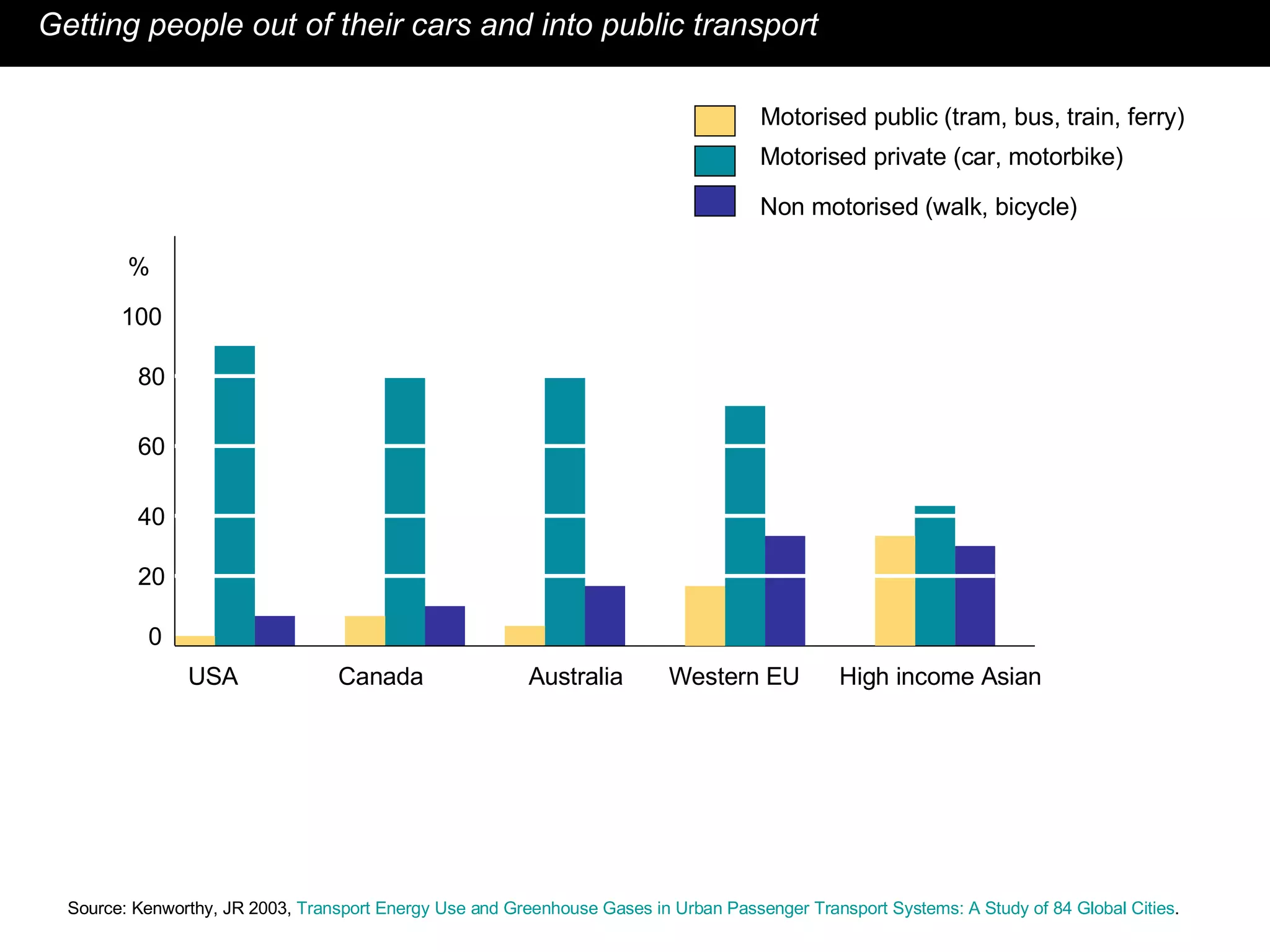
USA Canada Getting people out of their cars and into public transport Source: Kenworthy, JR 2003,  Transport Energy Use and Greenhouse Gases in Urban Passenger Transport Systems: A Study of 84 Global Cities .  0 20 40 60 80 100 High income Asian Motorised public (tram, bus, train, ferry) Motorised private (car, motorbike) Non motorised (walk, bicycle) % Australia Western EU
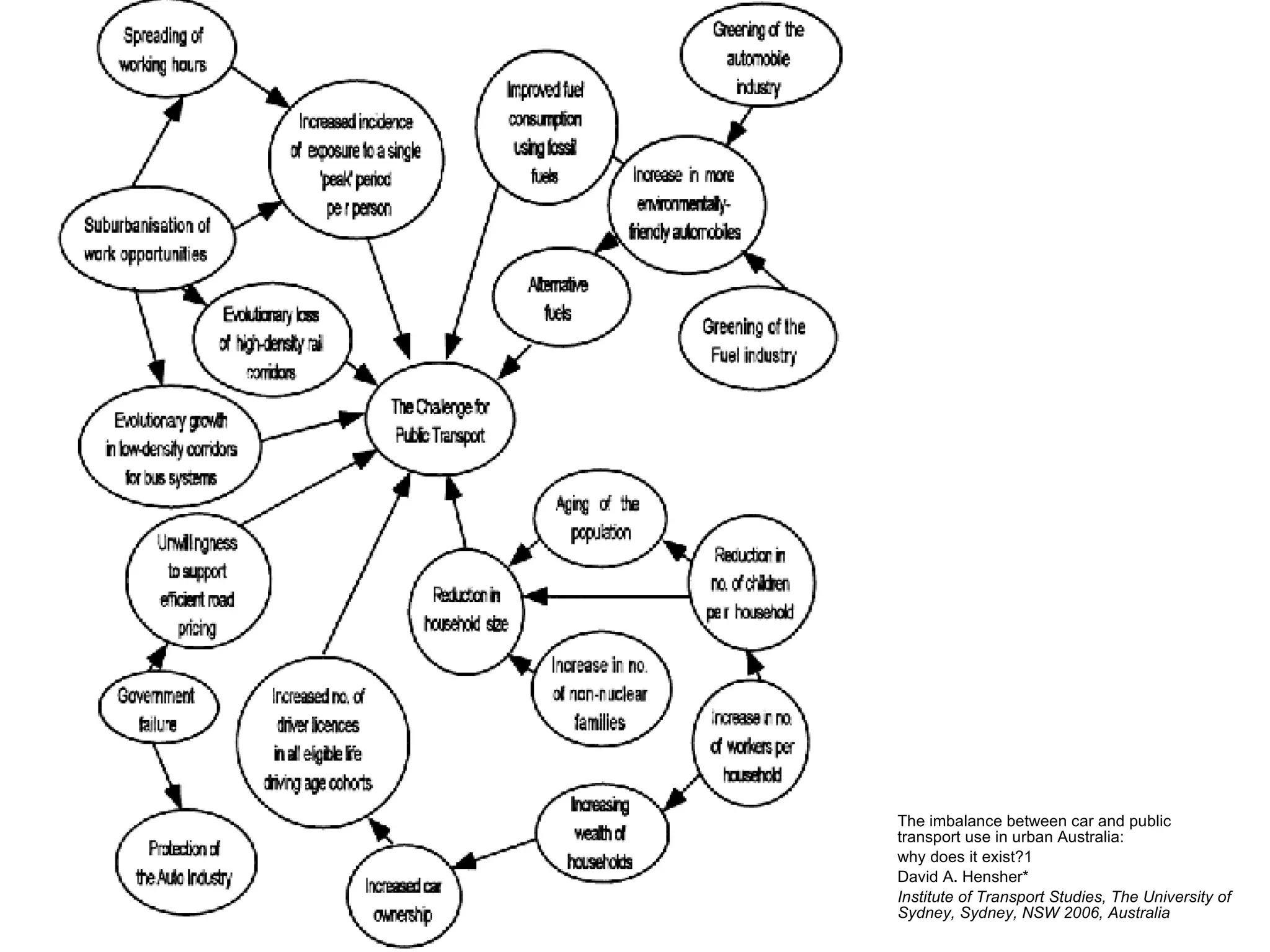
The imbalance between car and public transport use in urban Australia: why does it exist?1 David A. Hensher* Institute of Transport Studies, The University of Sydney, Sydney, NSW 2006, Australia
Getting people out of their cars and into public transport Adults who usually take public transport to work or study: 59% These people considered public transport more convenient, comfortable and less stressful than any other mode of travel. This was reflected across all age groups.  Costs less (28%)  Too difficult to park (23%).  -ABS, 2006 Reasons used
Getting people out of their cars and into public transport ABS, 2006
Getting people out of their cars and into public transport No service available at a convenient time (28%)  Prefer comfort and convenience and privacy of my car (27%)  Takes too long (20%).  Need own vehicle before, during or after work or study hours (13-14%).  Prefer to walk or cycle (6%)  ABS, 2006 Reasons NOT used
Getting people out of their cars and into public transport ABS, 2006
Getting people out of their cars and into public transport No service available at a convenient time (28%)  Prefer comfort and convenience and privacy of my car (27%)  Takes too long (20%).  Need own vehicle before, during or after work or study hours (13-14%).  Prefer to walk or cycle (6%)  ABS, 2006 Reasons NOT used
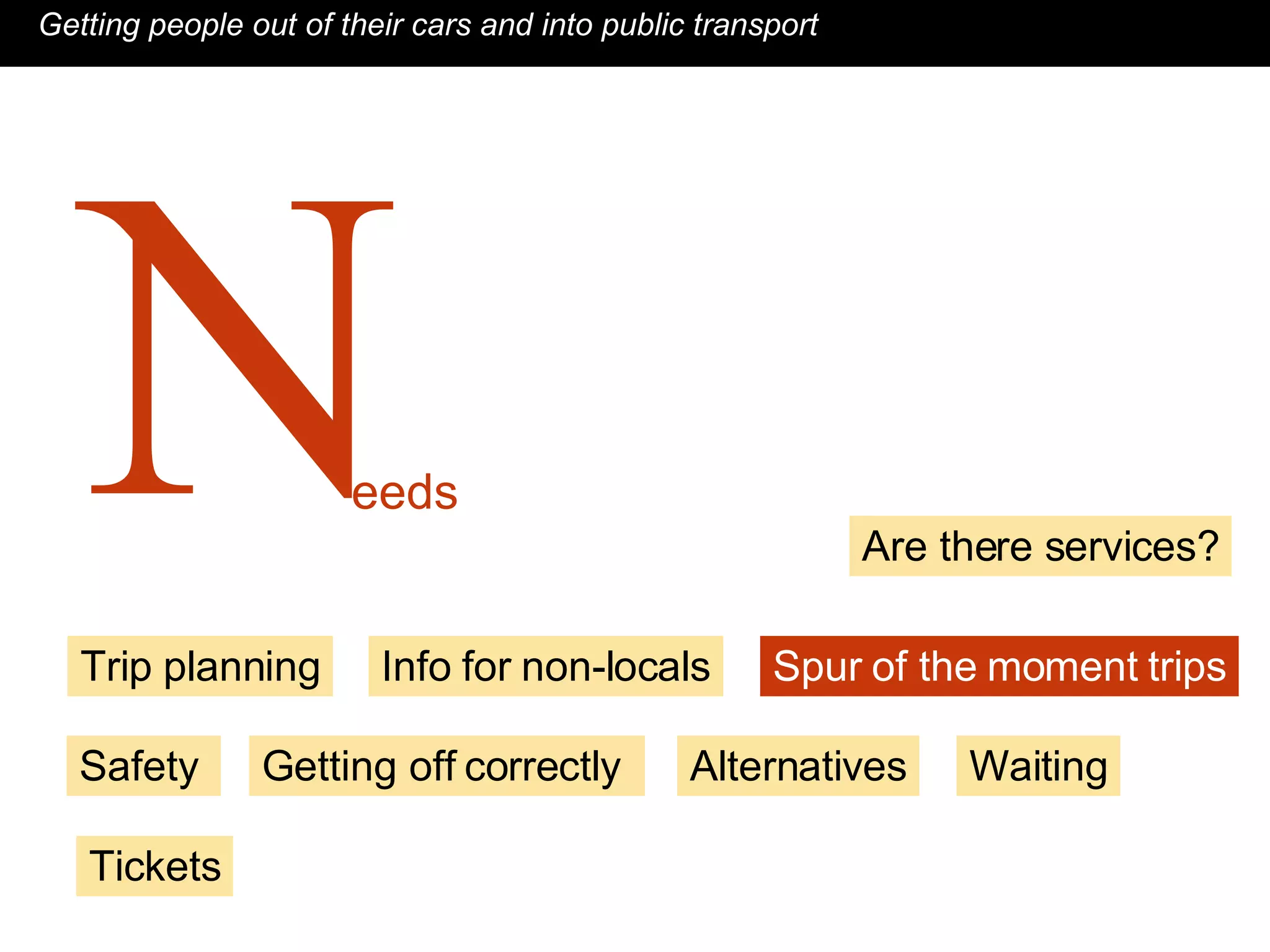
Getting people out of their cars and into public transport Are there services? Trip planning Info for non-locals Spur of the moment trips Safety  Alternatives Getting off correctly  Waiting Tickets eeds N
NEED: More services. More cross-city services. Services that connect with other PT types.  Convenience    Can I use public transport at all? There’s no train service out my way. There’s only one bus service and that goes directly to the city. Too bad if you want to go anywhere else.  Are there services?
NEED: More services. More cross-city services. Services that connect with other PT types.  Convenience    Can I use public transport at all? I would love to get public transport all the time, to help the environment. But the bus service to [my suburb] are useless.  On Saturdays they go every two hours, on Sundays there are two, and after 7pm weekdays the service stops.  There’s only one route, too. If you want to go anywhere other than [big shopping mall], tough luck! It doesn’t matter how cheap they make it, it’s got to go where you want to go.  Are there services?
NEED: More services. More cross-city services. Services that connect with other PT types.  Convenience    Can I use public transport at all? When I worked in the city, it was fine. Lots of trains and buses. Now I work in [a suburb], and it’s the pits. It’s only a 15 minute drive, but there’s literally no service that connects to there. I’d have to go almost to the city and come back out again. As if!  Are there services?
Getting people out of their cars and into public transport Trip planning Info for non-locals Spur of the moment trips Safety  Alternatives Are there services? Getting off correctly  Waiting Tickets eeds N
NEED: Accurate info about destination time to my stop Certainty    How long will it really take? I’m uncertain when I’m going to arrive, because the trip can take twice as long as on the timetable. Trip planning
NEED: Simple point to point trip planning across all public transport types Convenience    Which routes should I take? A lot of planning is needed, it’s a pain. The need to plan stops me from taking public transport at night, because they aren’t standard routes. Like when I’m going to a party, or a concert venue. Trip planning
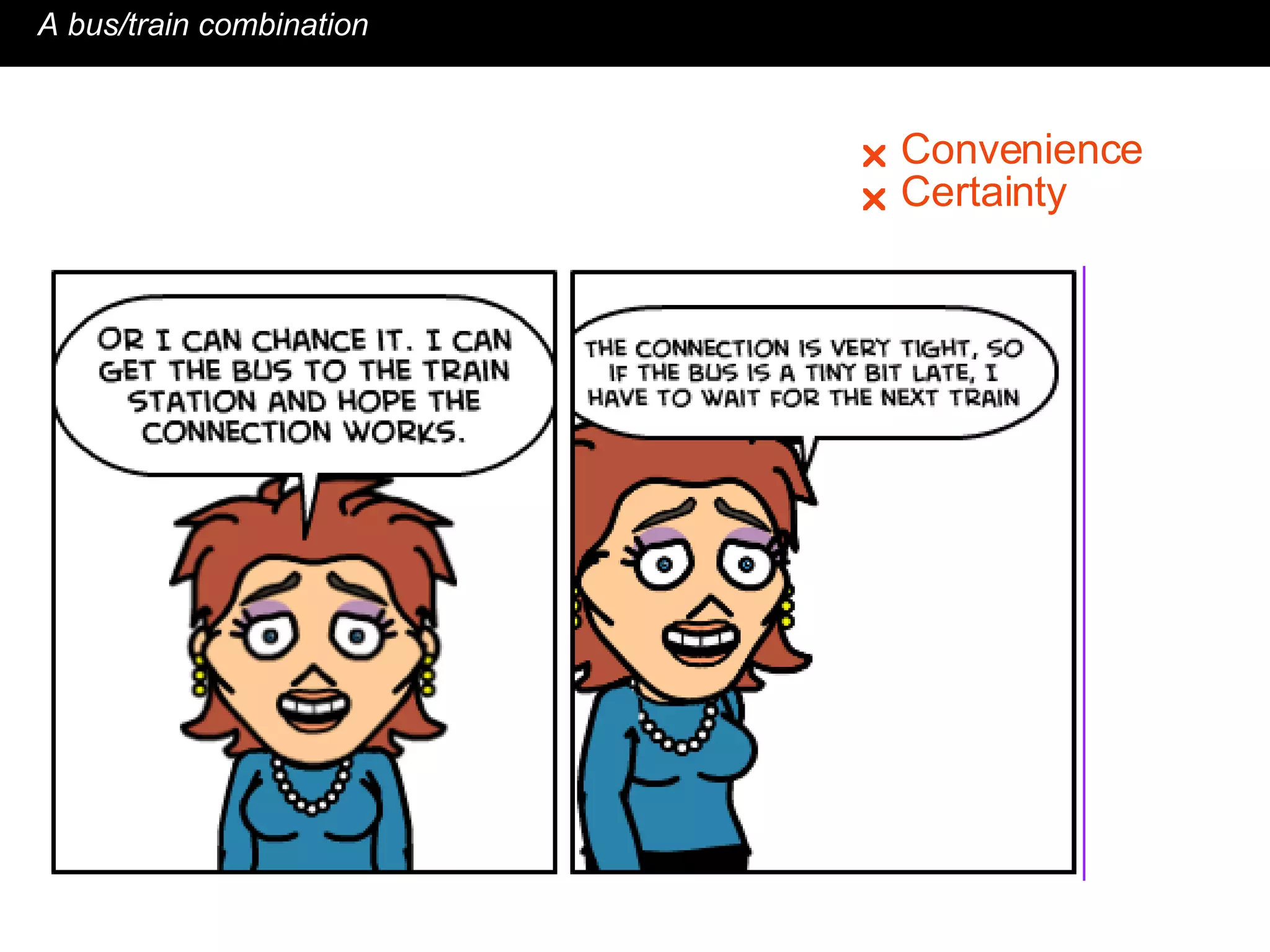
NEED: More services point to point, across the city rather than into the hubs. Better connections.  Certainty    How can I get there without too many changes? To get to my workplace from home, it’s a major hassle. I work in a suburb, not the city, so it’s a bus ride, then a train ride, then a change of train line, then a 10 minute walk. I have to leave lots of time to be sure of making the connections work. Once I was an hour late for work because two connections didn’t work.  I’m dressed in heels and carrying a laptop and briefcase, sometimes my gym bag as well, and it’s all too much.  Trip planning
NEED: Simple point to point trip planning across all public transport types Certainty    It’s too hard to plan If I’m going somewhere new I use my car, because easier to plan trip with street directory than try to call up the info service, or use the internet. It takes a long time and it’s easier to get in my car and drive.   Trip planning
NEED: Info about standard of bus/train that’s on your route, at that time, on that day. aircon, etc.  Comfort    How comfortable will it be? If there’s bad weather, I drive. For instance if it’s hot, or it’s raining. If I could be sure my train is going to be heated/airconditioned, that would be different, but it’s a bit of a lottery.  Trip planning
NEED: Better shelters. Info about which shelters have what standard of protection from elements.  Comfort    How comfortable will it be? You know, I’d probably get the bus more often if there was a proper bus shelter near my place. The closest one is just a sign, there’s nowhere to sit.  If it’s hot, I have to stand for up to half an hour in the hot sun. If it’s raining, or cold and windy, that’s not nice either. It’s a long walk to the next stop with a shelter and it doesn’t seem worth it.  Trip planning
NEED: Better shelters. Pedestrian crossings for busy roads.  Confidence    How comfortable will it be? I don’t want my daughter to have to cross a major road, or wait for the bus in full sun. So I drive her.  Trip planning Comfort   
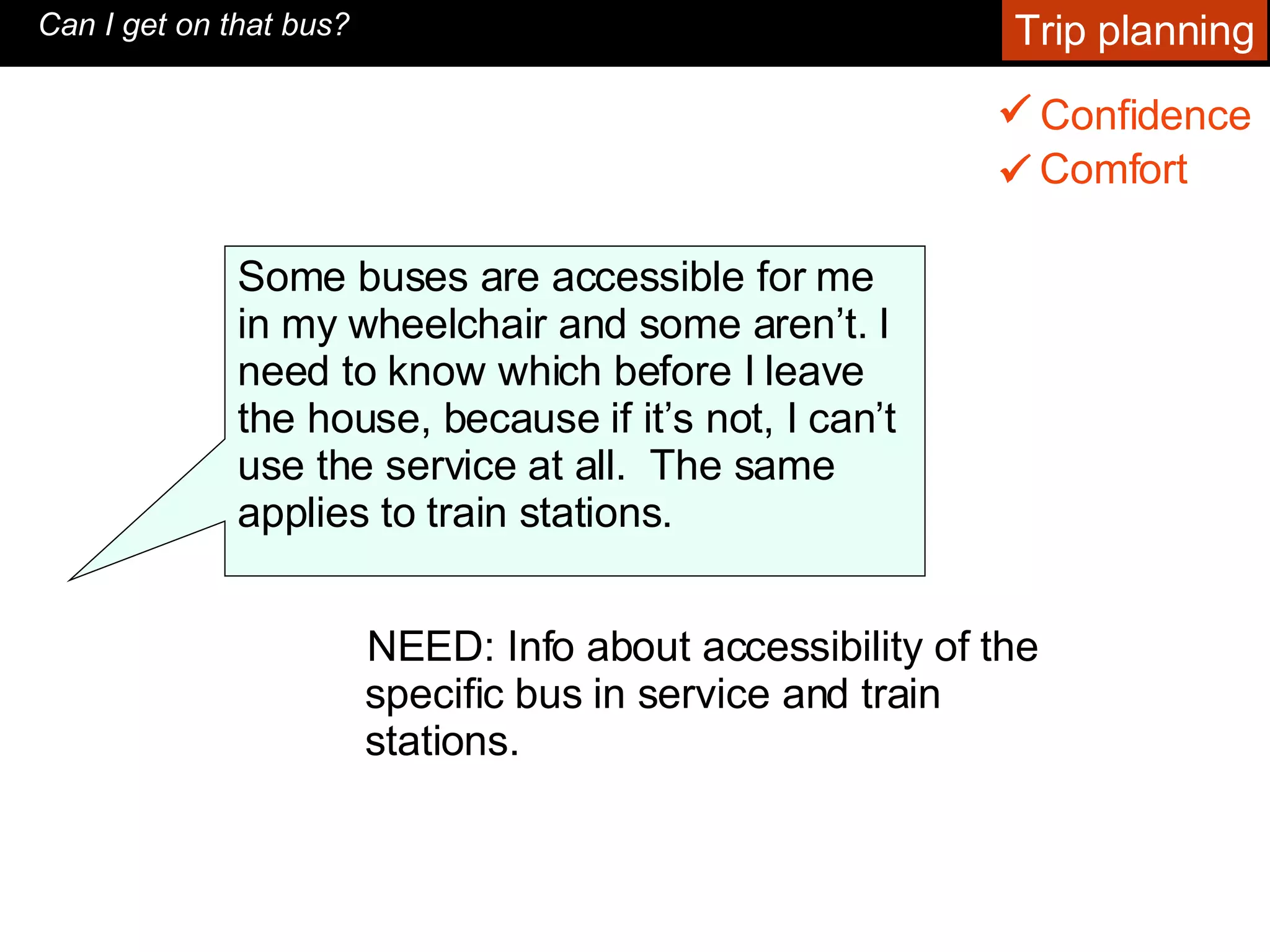
NEED: Info about accessibility of the specific bus in service and train stations.  Can I get on that bus? Some buses are accessible for me in my wheelchair and some aren’t. I need to know which before I leave the house, because if it’s not, I can’t use the service at all.  The same applies to train stations.  Trip planning Confidence    Comfort   
NEED: a map to work out where the bus stop is, integrated with timetable. Convenience    Planning my trip is difficult I have to use Whereis to find where the bus stop is if I’m going somewhere I’m not familiar with. I need to know how close the stop is to where I’m going.  Trip planning
NEED: faster, easier to use trip planning service, by web and by phone, and also at the bus stop or train station.  Convenience    Planning my trip is difficult I use the trip planner on the web or I call the info service. But the planner is hard to use. It gives me all these lists and choices that are really confusing. It’s hard to work out the route and where the stop is.   Sometimes you call up and it takes so long you miss your bus.  I’d like a map I can click on to say “from here to here” so that the web site or touch screen tells me how to get there.  Trip planning
Getting people out of their cars and into public transport Info for non-locals Are there services? Spur of the moment trips Safety  Alternatives Are there services? Trip planning Getting off correctly  Waiting Tickets eeds N
NEED: bus drivers provided with information to assist passengers.  Convenience    Information at the stop or on the bus If I don’t have the right change, or I’m not sure of the route or when to get off, I walk or drive if it’s too far. The bus isn’t supportive of someone who doesn’t already know where they’re going.  It relies on particular drivers to provide information and support and that is patchy.  Sometimes they are unhelpful and sometimes they just don’t know.  Info for non-locals
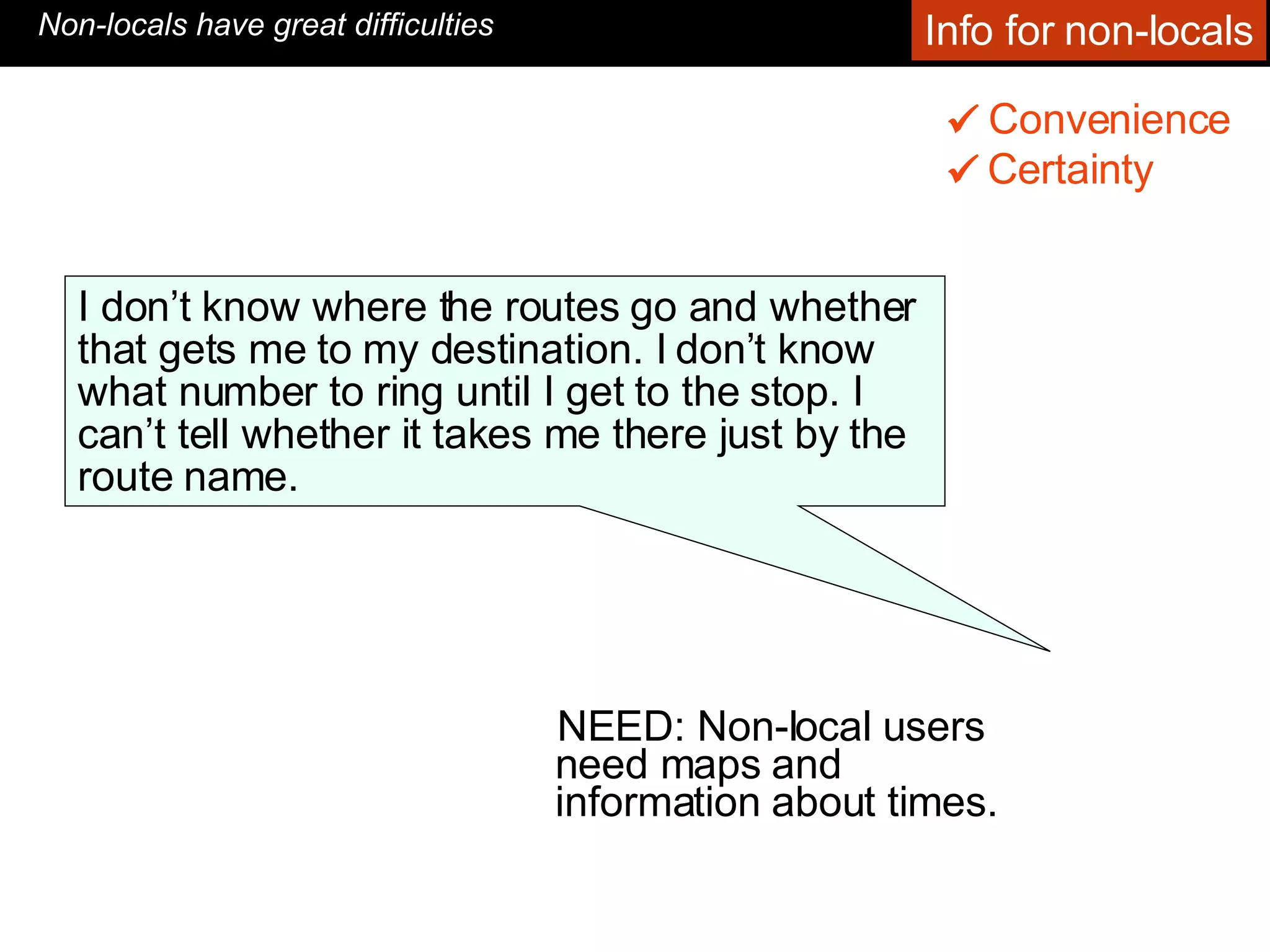
NEED: Non-local users need maps and information about times. Convenience    Non-locals have great difficulties I don’t know where the routes go and whether that gets me to my destination. I don’t know what number to ring until I get to the stop. I can’t tell whether it takes me there just by the route name.  Certainty    Info for non-locals
NEED: Non-local users need maps, routes and information about times. Non-locals have great difficulties Visitors to this city should never use buses. They’ll have no idea where they’ll end up. Unless they know to use the phone service or you’re going to major destinations. You need a travel agent for anything off the major routes!   Info for non-locals Convenience    Certainty   
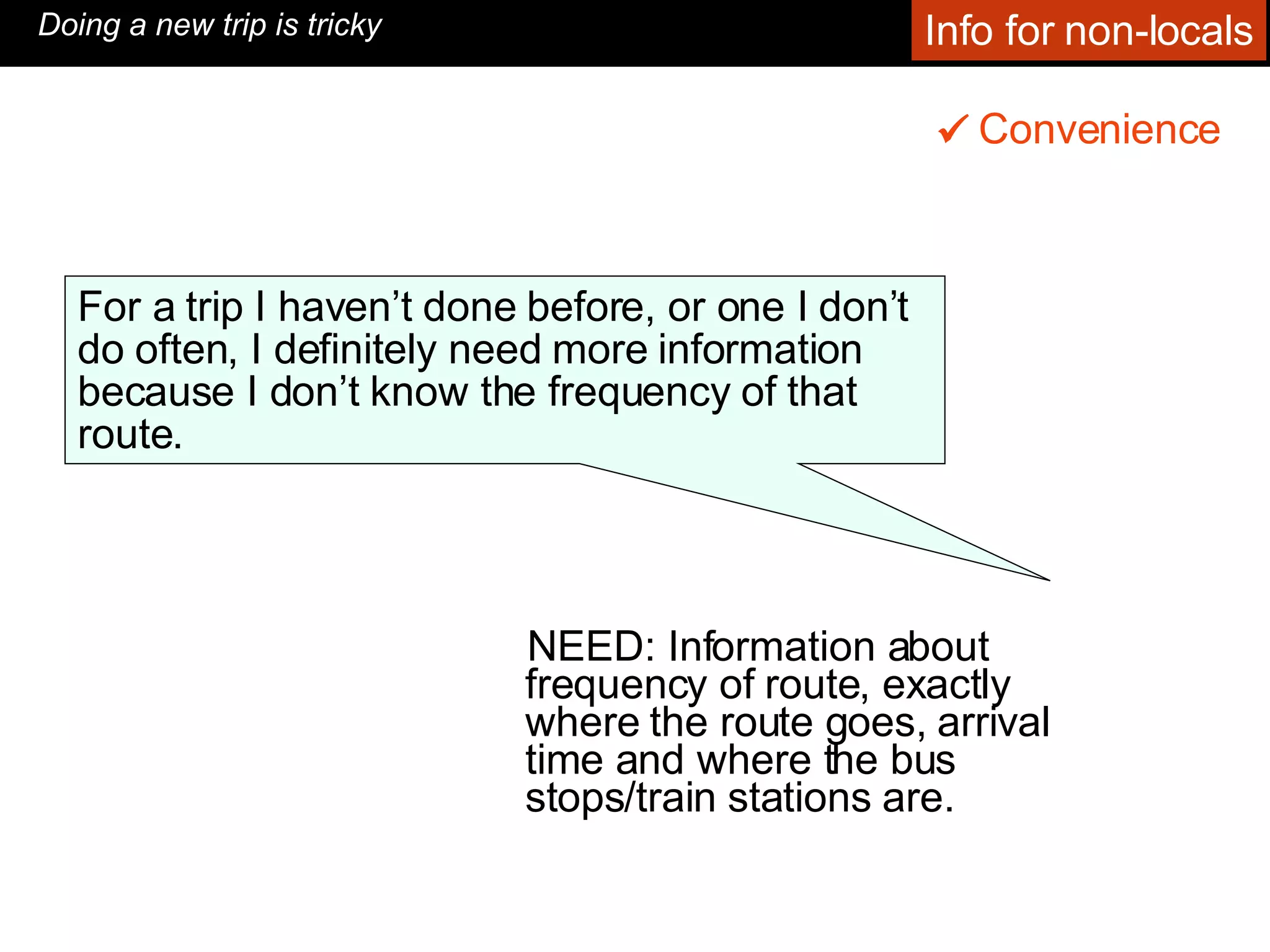
NEED: Information about frequency of route, exactly where the route goes, arrival time and where the bus stops/train stations are.  Convenience    Doing a new trip is tricky For a trip I haven’t done before, or one I don’t do often, I definitely need more information because I don’t know the frequency of that route.  Info for non-locals
Getting people out of their cars and into public transport Trip planning Info for non-locals Spur of the moment trips Are there services? Safety  Alternatives Are there services? Trip planning Info for non-locals Getting off correctly  Waiting Tickets eeds N
NEED: Information at the bus stop and through other methods (mobile phone web site, info call service) to help plan the trip. Convenience    Buses can get you most places but you have to do research to work it out. Too bad if you’re already out there on the street. You almost need to go home again to find out what to do! On the street planning Spur of the moment trips
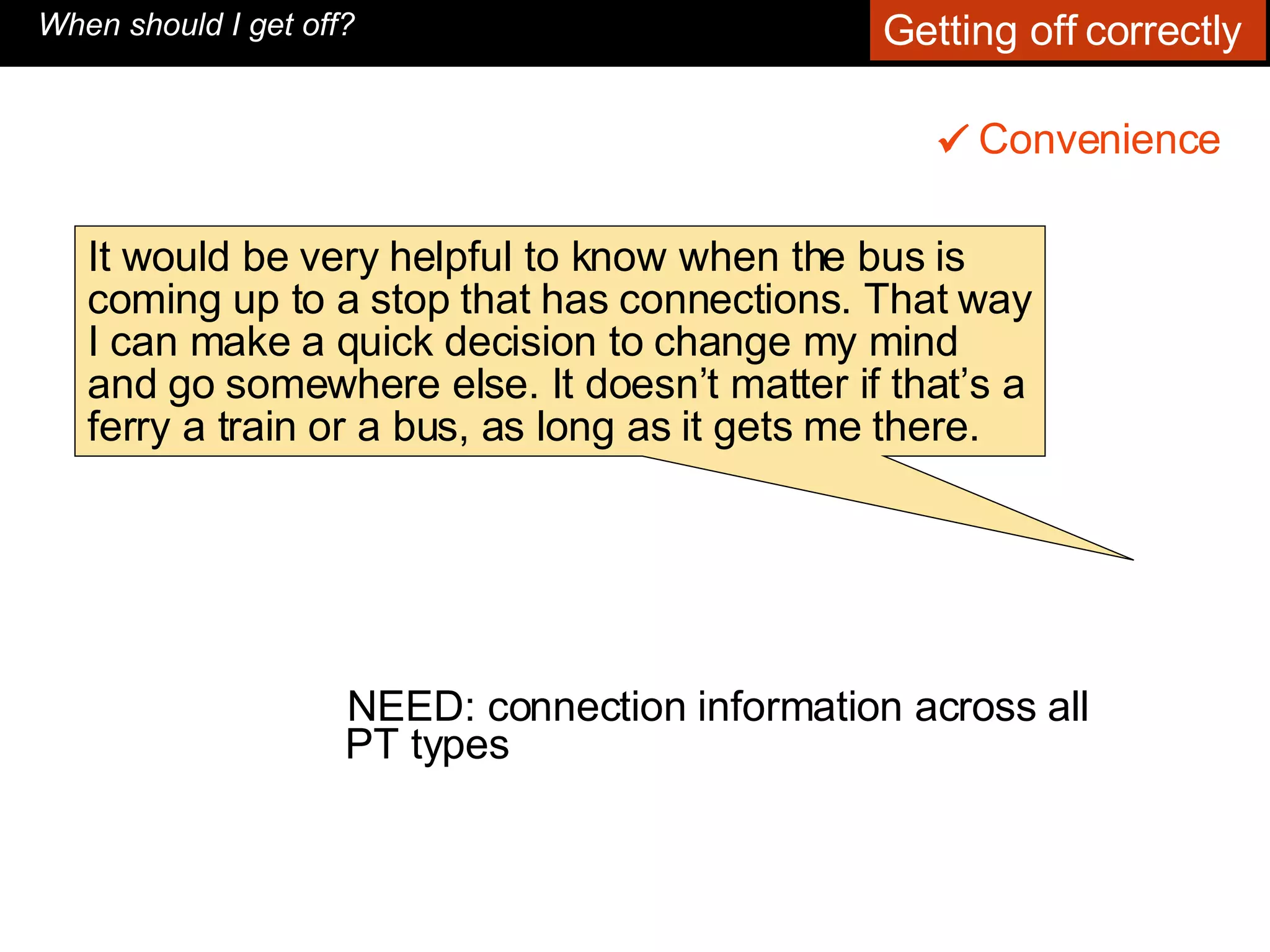
NEED: connection information across all PT types  Convenience    When should I get off? It would be very helpful to know when the bus is coming up to a stop that has connections. That way I can make a quick decision to change my mind and go somewhere else. It doesn’t matter if that’s a ferry a train or a bus, as long as it gets me there.  Getting off correctly
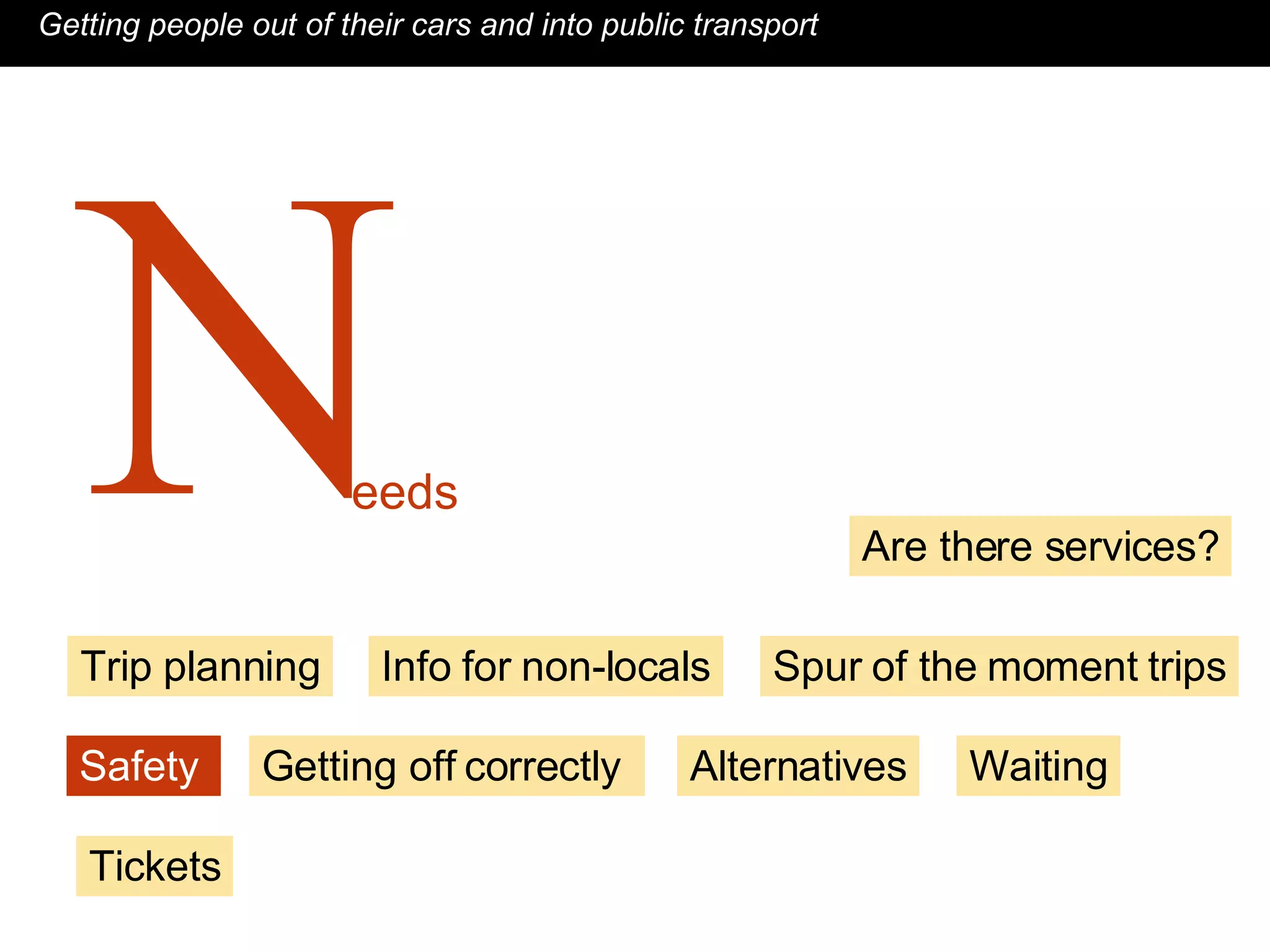
Getting people out of their cars and into public transport Trip planning Info for non-locals Spur of the moment trips Safety  Trip planning Info for non-locals Getting off correctly  Alternatives Are there services? Trip planning Info for non-locals Getting off correctly  Waiting Tickets eeds N
NEED: Accurate info about when the bus will leave/arrive; more services late at night; taxi number or direct phone to taxi company available at stop.  Confidence    There aren’t any buses late at night to my house from the train station. That means I have to call to have someone pick me up from the stop, or walk into a lonely deserted car park at night. Even when it’s earlier, I really need to know when the bus is coming, so I don’t end up standing at the deserted stop for ages. I also need to know how else to get there.  Saftey travelling at night Safety
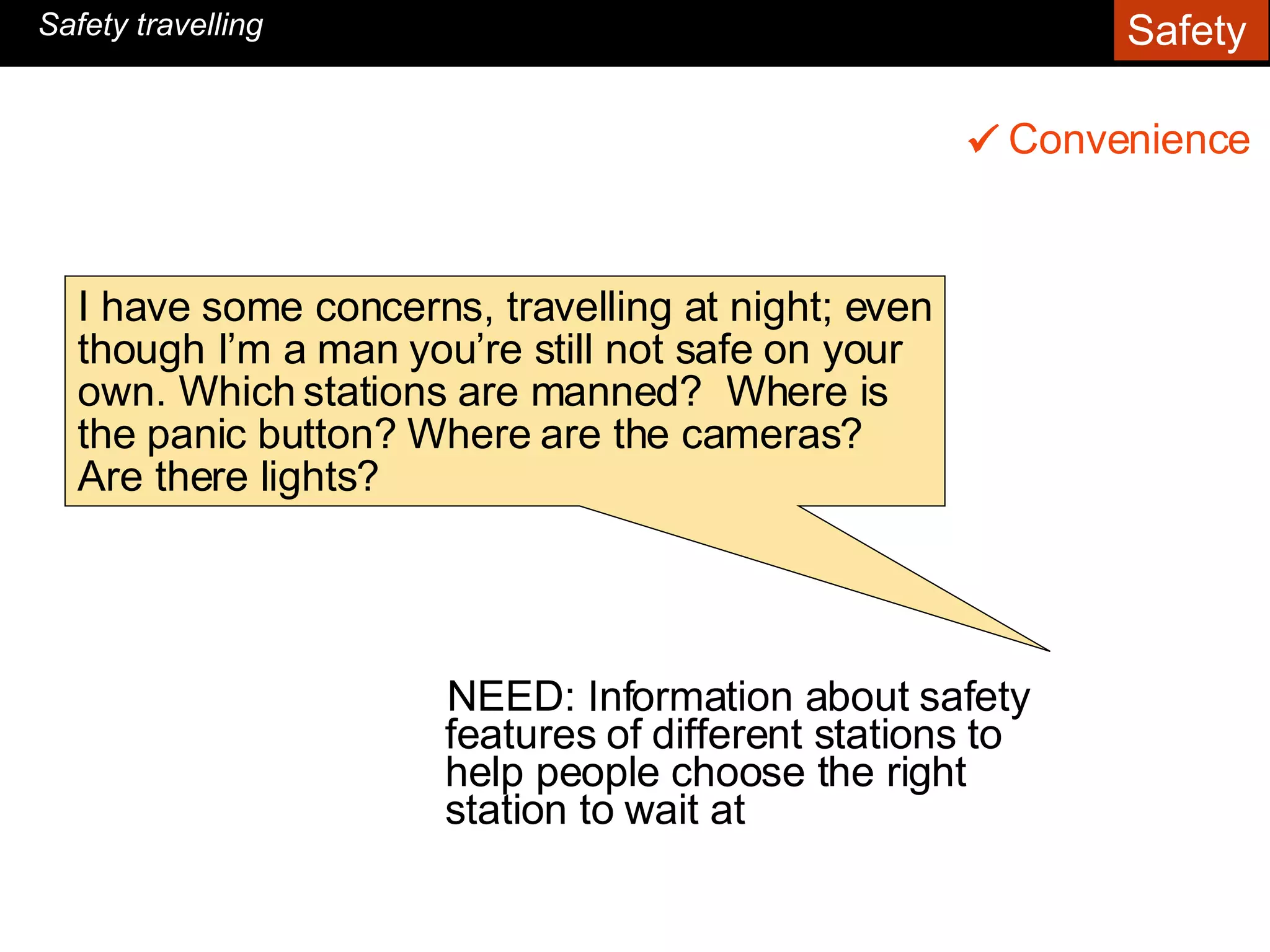
NEED: Information about safety features of different stations to help people choose the right station to wait at Convenience    Safety travelling I have some concerns, travelling at night; even though I’m a man you’re still not safe on your own. Which stations are manned?  Where is the panic button? Where are the cameras? Are there lights?   Safety
NEED: Up to date information about the expected arrival time of bus/train.  Convenience    Safety travelling I like to time it so I’m not waiting too long at a dark station late at night.  Safety
NEED: Staffed stations; information about which are staffed and which not.  Convenience    Safety travelling I strongly prefer stations where there are staff present. It makes me feel much safer.  Safety
Getting people out of their cars and into public transport Trip planning Info for non-locals Spur of the moment trips Safety  Getting off correctly  Are there services? eeds N
NEED: Show map info on web site, mobile phone site, so that users can see where the stops are relative to their destination. Show progress in the bus; show local attractions in the area.  Display local streets around the stop both on the bus and at the bus stop after getting off.  When should I get off? It’s hard to know whether a particular stop is the closest to my destination.. should I choose another stop? Sometimes you get off, then walk for ages and find there was another stop just past where you were going. Getting off correctly  Convenience    Certainty   
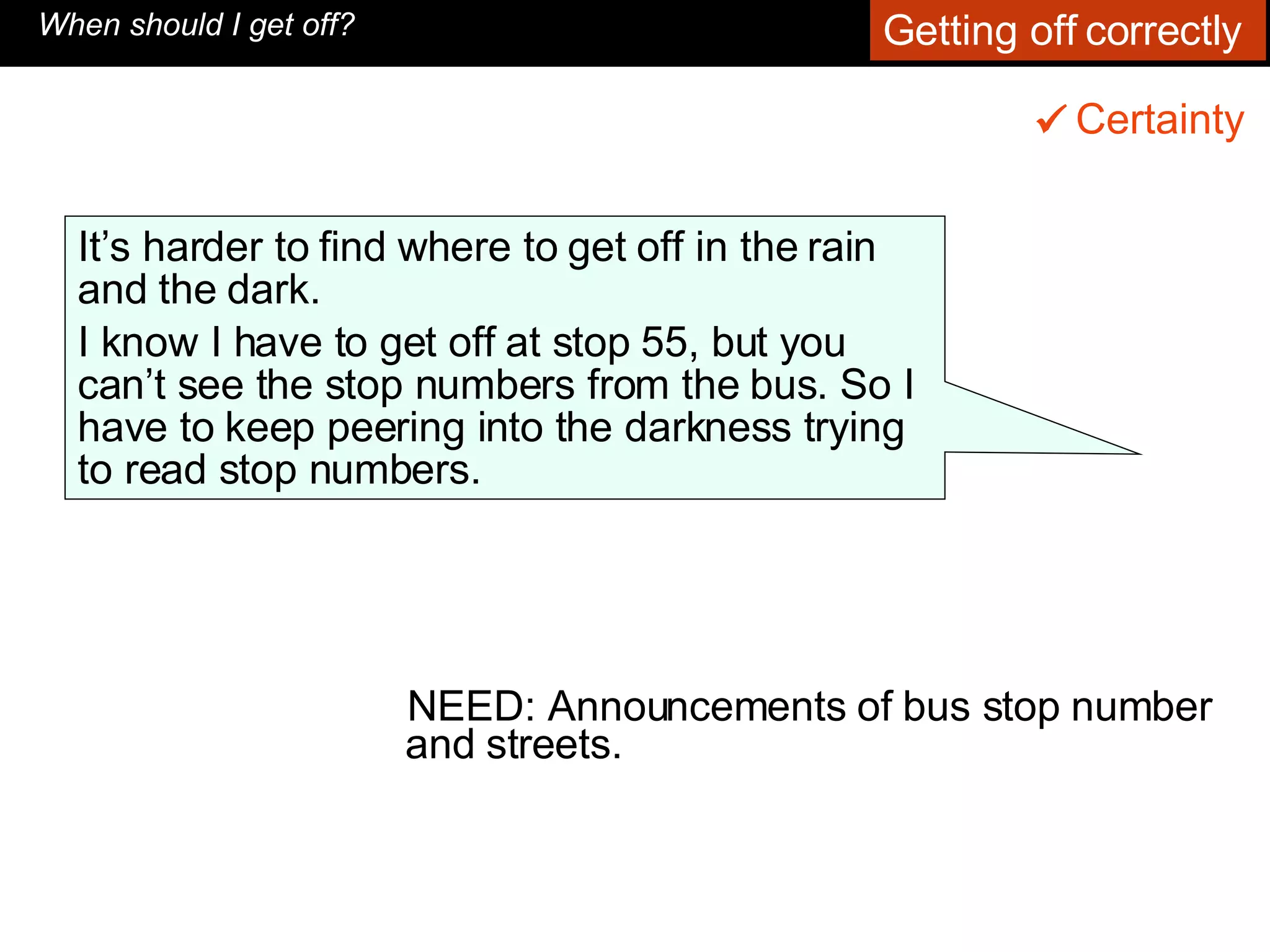
NEED: Announcements of bus stop number and streets. When should I get off? It’s harder to find where to get off in the rain and the dark.  I know I have to get off at stop 55, but you can’t see the stop numbers from the bus. So I have to keep peering into the darkness trying to read stop numbers.   Certainty    Getting off correctly
Getting people out of their cars and into public transport Trip planning Info for non-locals Spur of the moment trips Safety  Getting off correctly  Alternatives Are there services? Trip planning Info for non-locals Spur of the moment trips Safety  Getting off correctly  Waiting Tickets eeds N
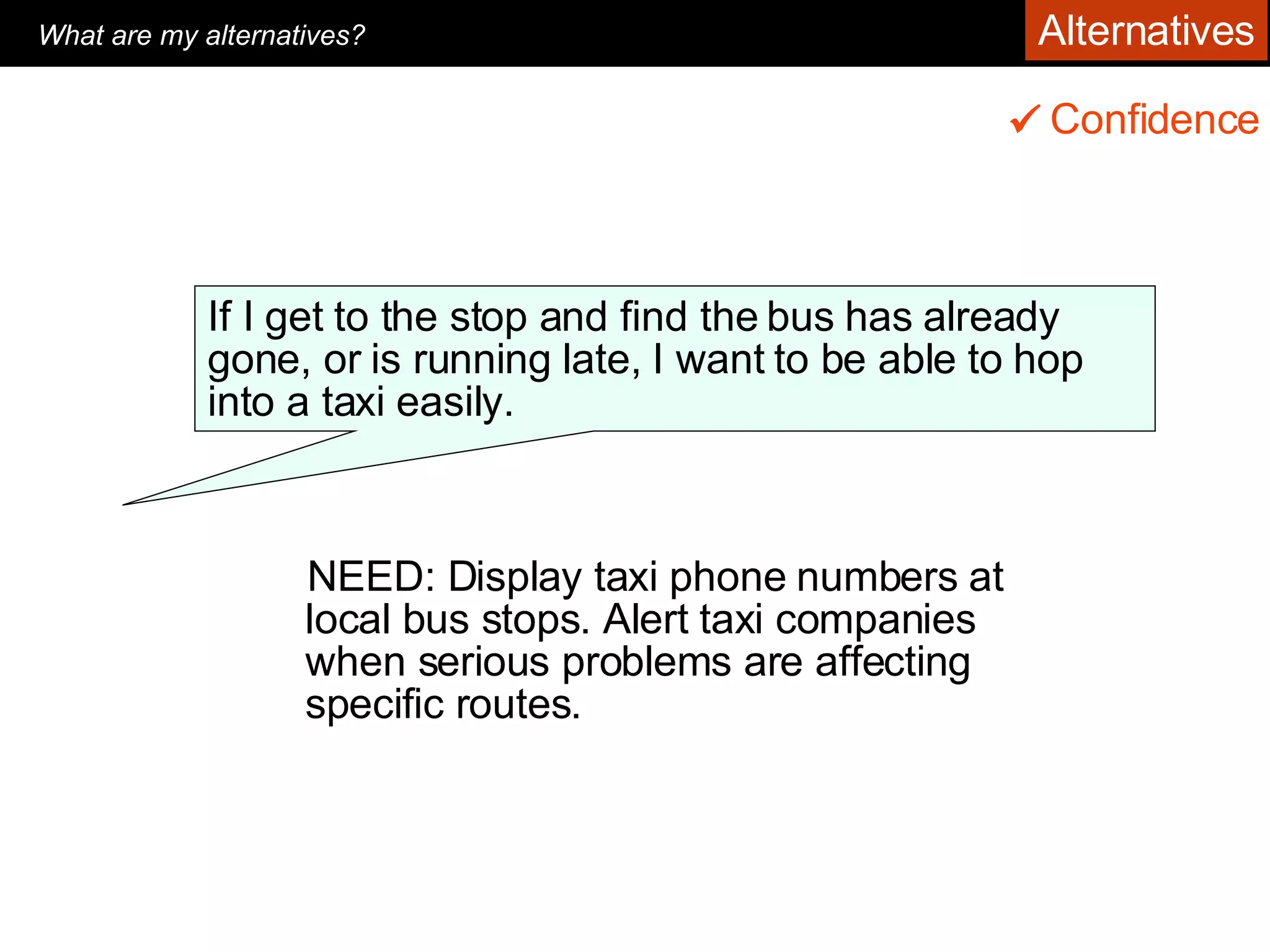
NEED: Display taxi phone numbers at local bus stops. Alert taxi companies when serious problems are affecting specific routes.  Confidence    If I get to the stop and find the bus has already gone, or is running late, I want to be able to hop into a taxi easily.  What are my alternatives?   Alternatives
NEED: Detailed arrival information at the stop/station.  Confidence    It would be good to know when the previous bus has already gone so I know not to expect it. Like at the airport – when is it due according to timetable, when is it actually arriving (“oh yes, that’s the 12.25 bus”), and the bay number when you’re at a big station.   Should I catch this bus or make another arrangement? Alternatives
NEED: info that helps passengers make decisions around serious delays, such as traffic problems, track work, breakdowns Certainty    Should I wait, or make another arrangement? I want to know why it’s delayed so I can understand whether to make another arrangement or to wait. I don’t really care about the reason, just how long the wait will be.  Alternatives
Getting people out of their cars and into public transport Trip planning Info for non-locals Spur of the moment trips Safety  Getting off correctly  Alternatives Waiting Are there services? Trip planning Info for non-locals Spur of the moment trips Safety  Getting off correctly  Alternatives Tickets eeds N
NEED: point to point trip planning while at the station.  Convenience    Which platform should I be on? I get to the train station, and there are all these lines I’m not familiar with. Two or three could possibly go near my destination but you can’t tell from the name of the line which one.  So you go look at the board, and it has the lines, and by the time you work out which one to be on, the train it lists has probably already been and gone. It’s all very confusing.  Waiting
NEED: information about trains on different platforms.  Convenience    Which platform should I be on? If you go down to the platform at the train station, all you can see is the train coming on that platform. You can’t see if there’s a more convenient one on another platform without going back out of the barriers again.  Waiting
NEED: information about other trains on the same platform.  Convenience    Is this the right train to catch? Waiting at the station, all you can see is the upcoming train. My station, just 2 mins walk from my house, is one that trains only sometimes stop at.  I can see the next scheduled train doesn’t stop there, but I can catch that train anyway and then walk the 15 mins from there to my place. Or I can wait for the next one. But I can’t see if that’s the one that goes to my station. It might be the same 15 minute walk, and all I do is arrive home later. It’s very frustrating.  Waiting
NEED: information about the type of bus/train that’s about to arrive.  Convenience    Which platform should I be on? I need to know if the bus is “all stops” or “express” and whether it picks up at your stop. The express is much much better, it takes just 10 minutes to work instead of 35, so I have time for a coffee when I get there.  Waiting
NEED: info about seat belts, airconditioning, accessibility. Protection from weather at stop Convenience    Is this the best bus/train to catch? Am I going to have a comfortable ride? I want to know whether I should wait for the next bus, or whether that’s pointless. Waiting
NEED: info about how full the next train/bus is.  Certainty    Should I wait, or make another arrangement? Football crowds fill up trains and you can’t get on – you’re there but you miss the train. It’s the same with schoolkids after school.   Waiting
NEED: info about how full the next train/bus is. Flexibility to put on additional services when heavy usage.  Certainty    Should I wait, or make another arrangement? I want to know when I can  get on . Not just if it’s coming.. if it’s full it’s no use to me. You can’t rely on the timetable because a full train means there may as well not be a train at all.   Waiting
NEED: when is the next bus that isn’t full? Put on services that leave from closer in to the city.  Certainty    Should I wait, or make another arrangement? I live about 5km from the city centre. Services are often full when they get to me, or there’s standing room only. So I drive to work.  Waiting
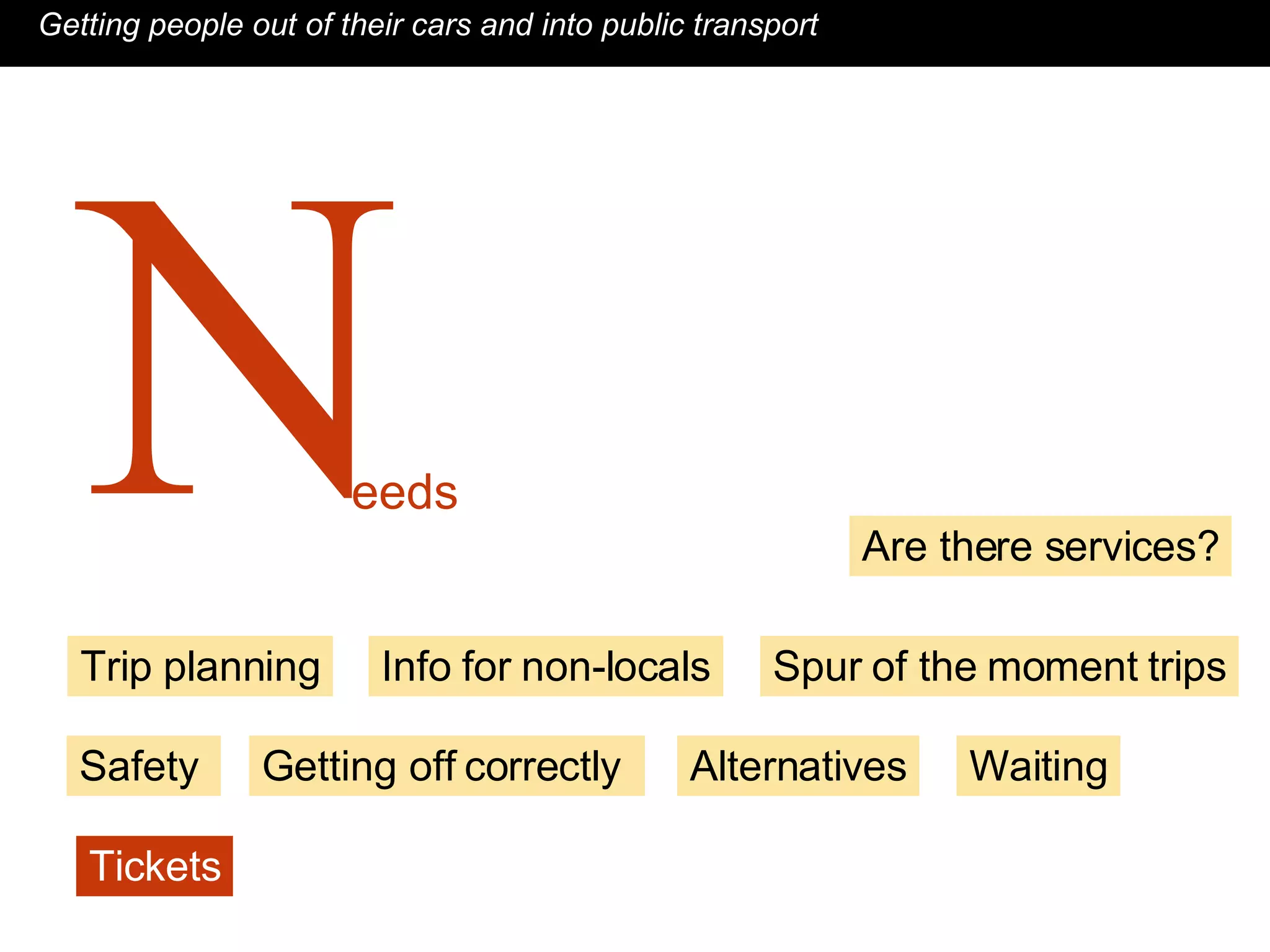
Getting people out of their cars and into public transport Trip planning Info for non-locals Spur of the moment trips Safety  Getting off correctly  Alternatives Waiting Tickets Are there services? eeds N
NEED: easy to use ticket machines or staff to sell tickets. Certainty    Ticket problems I hate the weekly tickets. Getting them is a pain and the machines are so difficult to use.  Tickets
cenarios S Getting people out of their cars and into public transport
Some scenarios from real life passenger stories
cenarios S Getting people out of their cars and into public transport Is the bus on time?  S
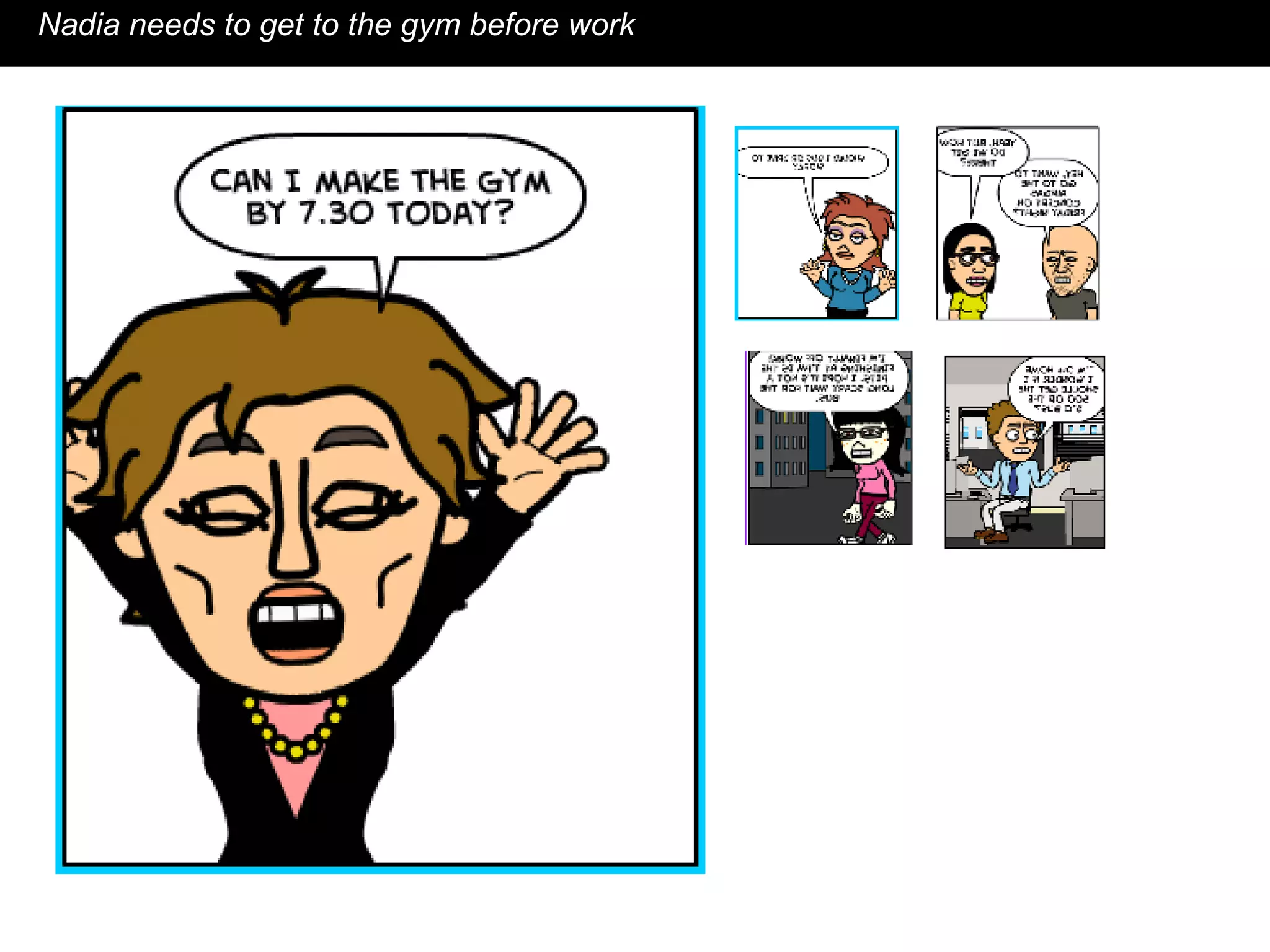
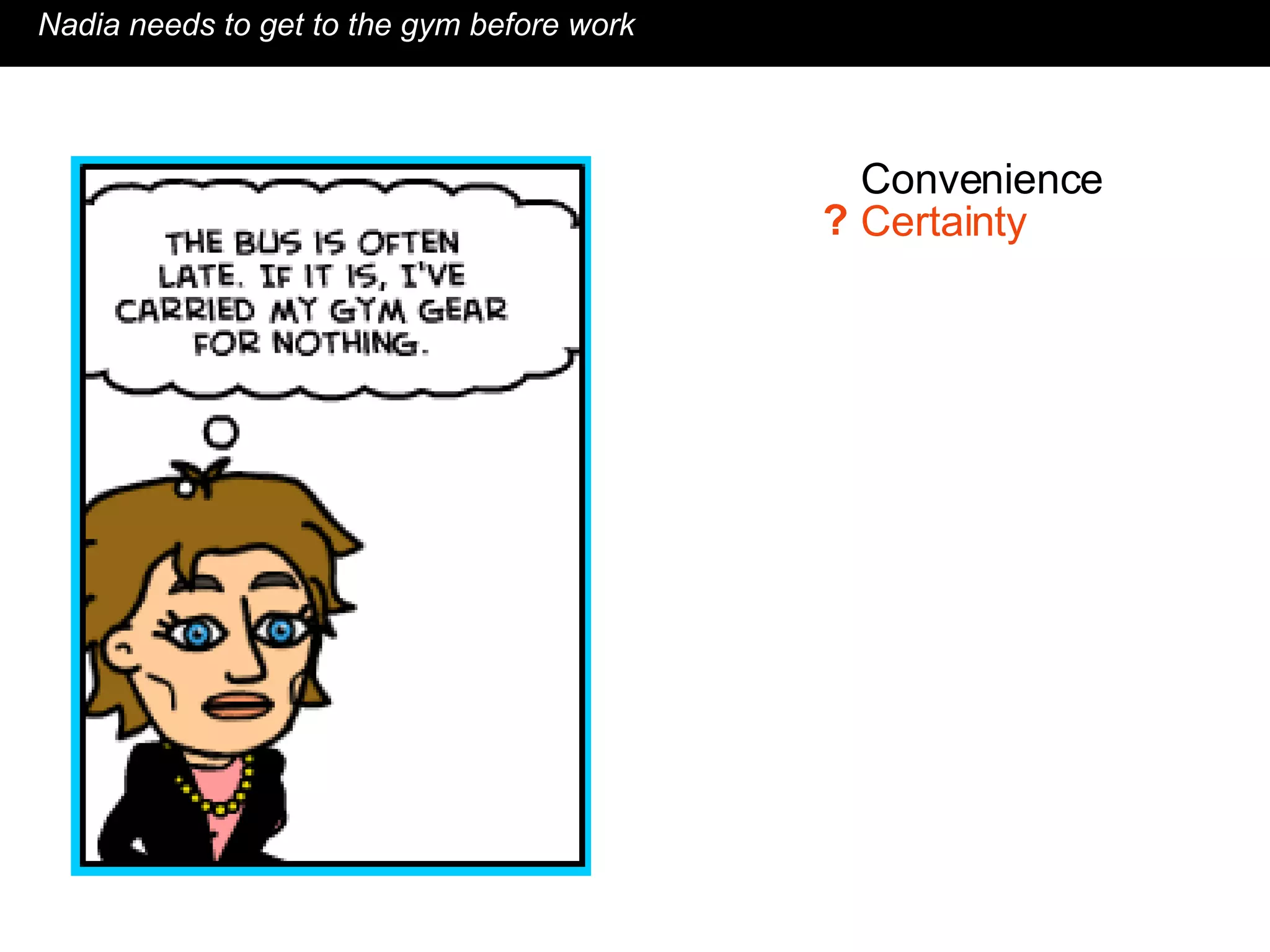
Nadia needs to get to the gym before work
Convenience  Certainty   ?  Nadia needs to get to the gym before work
Convenience  Certainty   ? Nadia needs to get to the gym before work
Convenience (Bus)  Certainty (Car) Bus stop is close Cheaper  Parking station further away Will make gym on time More expensive  Nadia needs to get to the gym before work
Nadia needs to get to the gym before work Imagine this… Convenience   Certainty    
cenarios S Getting people out of their cars and into public transport Connection certainty
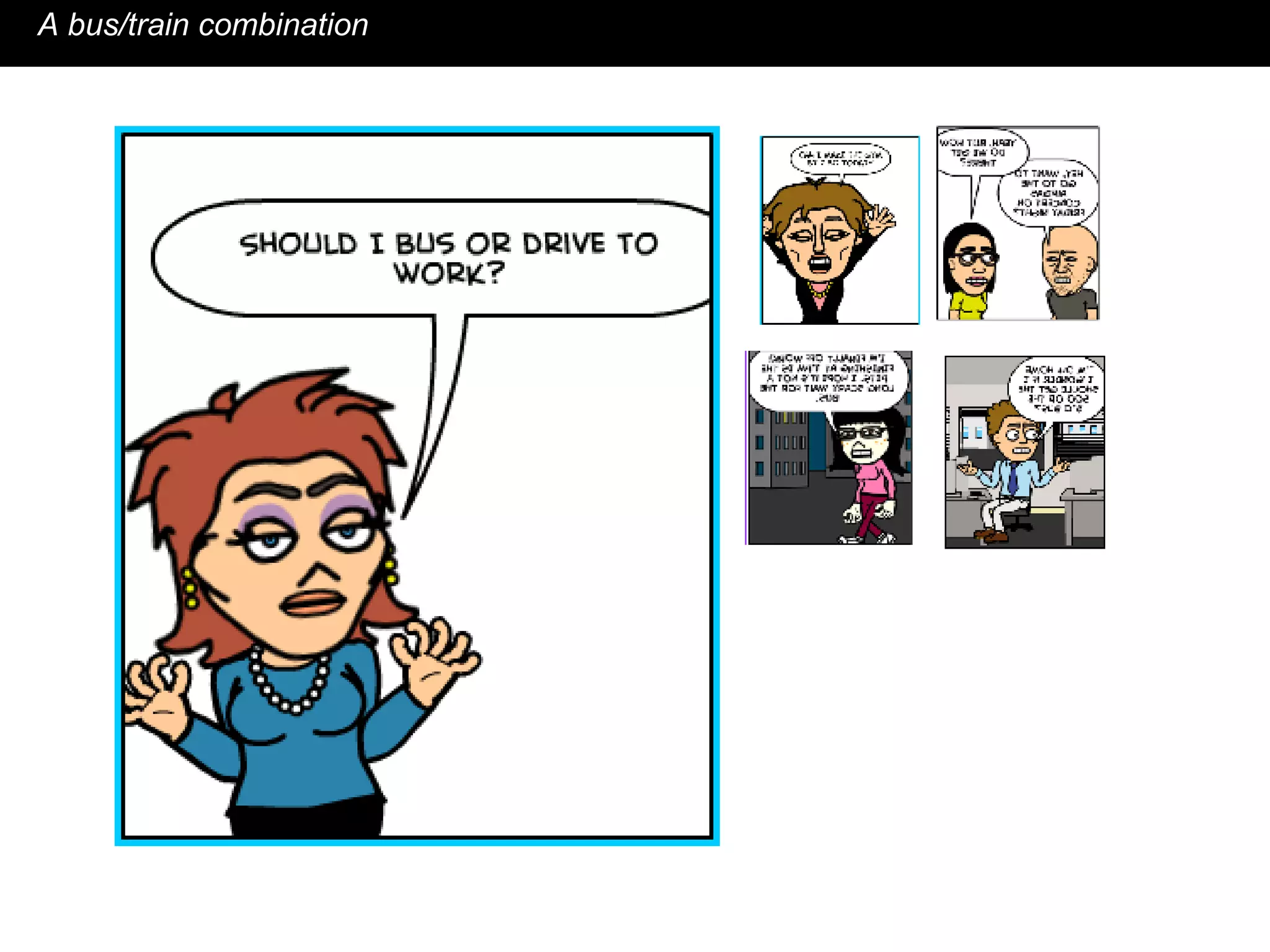
A bus/train combination
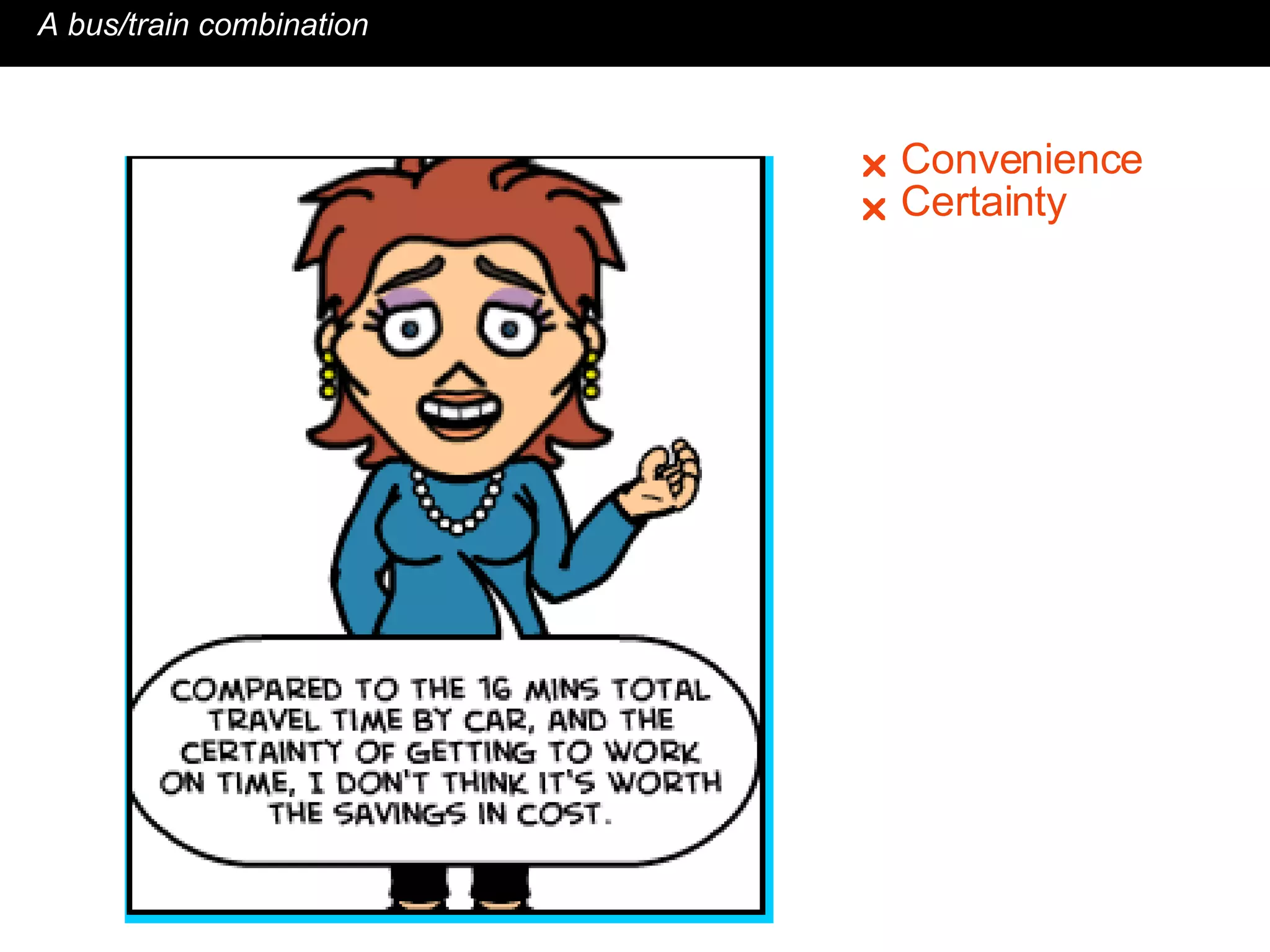
A bus/train combination Convenience   Certainty    
A bus/train combination Convenience   Certainty    
Imagine this… A bus/train combination Convenience   Certainty    
cenarios Getting people out of their cars and into public transport Non-standard trips & non-locals S
Gary and Misha, out of towners, going to a concert
Gary and Misha, out of towners, going to a concert Convenience   Certainty   ? 
Gary and Misha, out of towners, going to a concert Imagine this: Convenience   Certainty    
cenarios Getting people out of their cars and into public transport Safety S
Alexandra goes home late at night
Convenience   Confidence     Alexandra goes home late at night
Convenience   Confidence   Alexandra goes home late at night Imagine this:  
cenarios Getting people out of their cars and into public transport Planning S
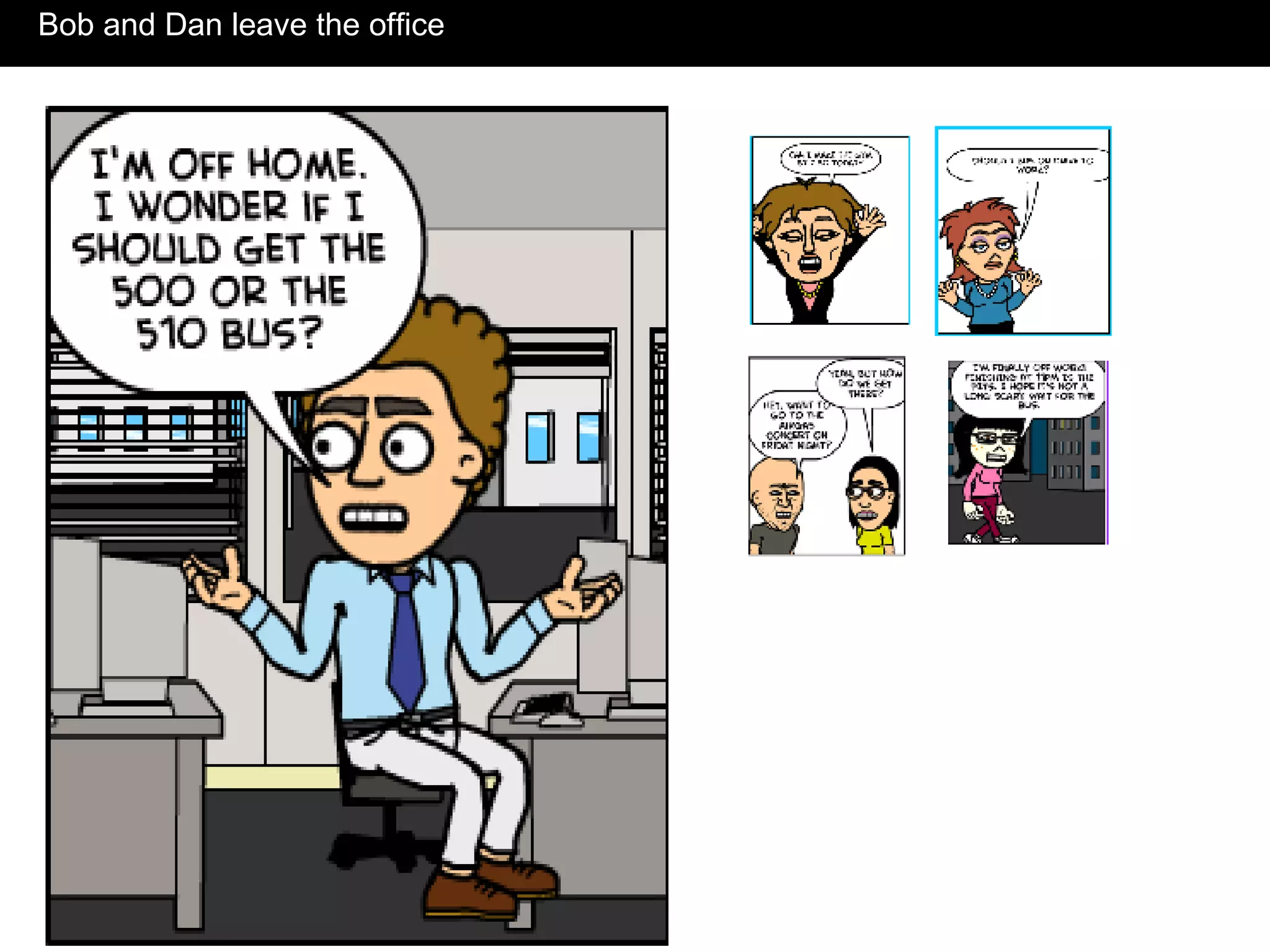
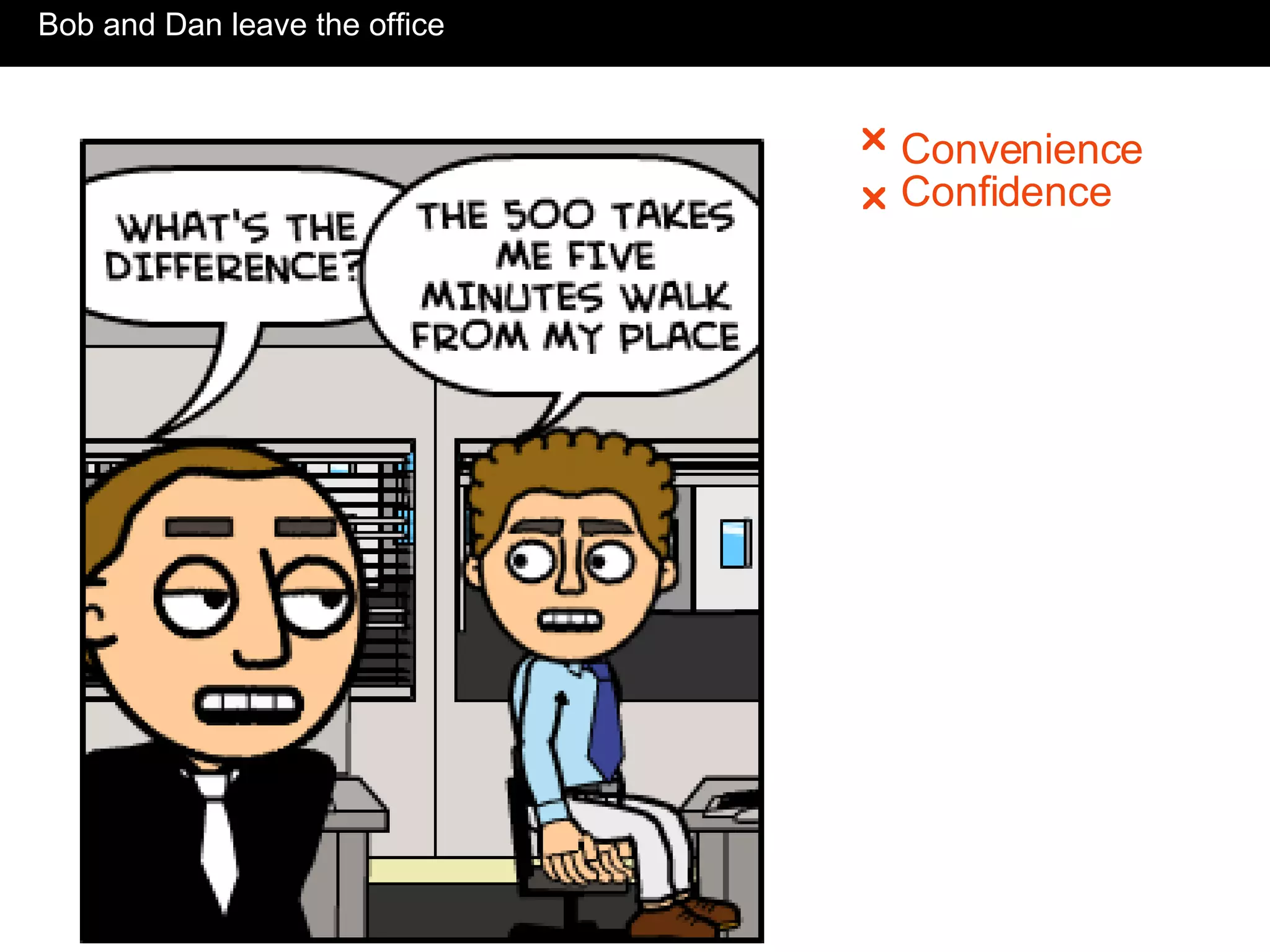
Bob and Dan leave the office
Convenience   Confidence     Bob and Dan leave the office
Convenience   Confidence     Bob and Dan leave the office Imagine this:
cenarios Getting people out of their cars and into public transport Ease S
My trip around the city Australia Wanted to go to major local attraction. Visitor to the city; was already out and about when decided to do this. Arrived at stop to find Bus XX there. Didn’t know if it went past my destination or not. Driver didn’t know either. Got off. No information at bus stop other than surburb it ended at. Called phone service, who said catch bus XX. “It’s just left”, I said. The next one is in 5 minutes. I waited in 35C heat. Full sun. 20 minutes later I had sunburn but no bus. Gave up, flagged taxi.
My trip around the city Hungary Wanted to go to major local attraction. Visitor to the city; was already out and about when decided to do this. Unable to speak Hungarian; minimal German. Arrived at train station. Asked how to get to my destination. Was told take train XX and get off at station Y, change to platform 2 and take train AA to station BB. Paid a ludicrously small amount. On the platform, a sign counted up in seconds. This was seconds since the last train. It’s never more than 3 minutes. Train arrived in 60 seconds. Clean. Fast. Well signposted. Changed correctly. Got off correctly. Arrived at destination within 15 minutes.
Conclusion o….….. S
Conclusion Mass movements are strongly affected by individual choices, and these come down to how each individual manages the trade-off with the five Cs. This trade-off is strongly affected by decisions at a wider level that improve each aspect of the five Cs.
Contact Alinta Thornton User Experience Lead Independent Digital Media www.idmco.com.au [email_address] http://eezia.blogspot.com

World Usability Day

  • 1.
    onvenience ertaintyomfort onfidence ost C Getting people out of their cars and into public transport Alinta Thornton User Experience Lead Independent Digital Media
  • 2.
    Background Results ofuser research Real life scenarios Getting people out of their cars and into public transport
  • 3.
    Conclusion Mass movementsare strongly affected by individual choices, and these come down to how each individual manages the trade-off with the five Cs. This trade-off is strongly affected by decisions at a wider level that improve each aspect of the five Cs.
  • 4.
    USA Canada Gettingpeople out of their cars and into public transport Source: Kenworthy, JR 2003, Transport Energy Use and Greenhouse Gases in Urban Passenger Transport Systems: A Study of 84 Global Cities . 0 20 40 60 80 100 High income Asian Motorised public (tram, bus, train, ferry) Motorised private (car, motorbike) Non motorised (walk, bicycle) % Australia Western EU
  • 5.
    The imbalance betweencar and public transport use in urban Australia: why does it exist?1 David A. Hensher* Institute of Transport Studies, The University of Sydney, Sydney, NSW 2006, Australia
  • 6.
    Getting people outof their cars and into public transport Adults who usually take public transport to work or study: 59% These people considered public transport more convenient, comfortable and less stressful than any other mode of travel. This was reflected across all age groups. Costs less (28%) Too difficult to park (23%). -ABS, 2006 Reasons used
  • 7.
    Getting people outof their cars and into public transport ABS, 2006
  • 8.
    Getting people outof their cars and into public transport No service available at a convenient time (28%) Prefer comfort and convenience and privacy of my car (27%) Takes too long (20%). Need own vehicle before, during or after work or study hours (13-14%). Prefer to walk or cycle (6%) ABS, 2006 Reasons NOT used
  • 9.
    Getting people outof their cars and into public transport ABS, 2006
  • 10.
    Getting people outof their cars and into public transport No service available at a convenient time (28%) Prefer comfort and convenience and privacy of my car (27%) Takes too long (20%). Need own vehicle before, during or after work or study hours (13-14%). Prefer to walk or cycle (6%) ABS, 2006 Reasons NOT used
  • 11.
    Getting people outof their cars and into public transport Are there services? Trip planning Info for non-locals Spur of the moment trips Safety Alternatives Getting off correctly Waiting Tickets eeds N
  • 12.
    NEED: More services.More cross-city services. Services that connect with other PT types. Convenience  Can I use public transport at all? There’s no train service out my way. There’s only one bus service and that goes directly to the city. Too bad if you want to go anywhere else. Are there services?
  • 13.
    NEED: More services.More cross-city services. Services that connect with other PT types. Convenience  Can I use public transport at all? I would love to get public transport all the time, to help the environment. But the bus service to [my suburb] are useless. On Saturdays they go every two hours, on Sundays there are two, and after 7pm weekdays the service stops. There’s only one route, too. If you want to go anywhere other than [big shopping mall], tough luck! It doesn’t matter how cheap they make it, it’s got to go where you want to go. Are there services?
  • 14.
    NEED: More services.More cross-city services. Services that connect with other PT types. Convenience  Can I use public transport at all? When I worked in the city, it was fine. Lots of trains and buses. Now I work in [a suburb], and it’s the pits. It’s only a 15 minute drive, but there’s literally no service that connects to there. I’d have to go almost to the city and come back out again. As if! Are there services?
  • 15.
    Getting people outof their cars and into public transport Trip planning Info for non-locals Spur of the moment trips Safety Alternatives Are there services? Getting off correctly Waiting Tickets eeds N
  • 16.
    NEED: Accurate infoabout destination time to my stop Certainty  How long will it really take? I’m uncertain when I’m going to arrive, because the trip can take twice as long as on the timetable. Trip planning
  • 17.
    NEED: Simple pointto point trip planning across all public transport types Convenience  Which routes should I take? A lot of planning is needed, it’s a pain. The need to plan stops me from taking public transport at night, because they aren’t standard routes. Like when I’m going to a party, or a concert venue. Trip planning
  • 18.
    NEED: More servicespoint to point, across the city rather than into the hubs. Better connections. Certainty  How can I get there without too many changes? To get to my workplace from home, it’s a major hassle. I work in a suburb, not the city, so it’s a bus ride, then a train ride, then a change of train line, then a 10 minute walk. I have to leave lots of time to be sure of making the connections work. Once I was an hour late for work because two connections didn’t work. I’m dressed in heels and carrying a laptop and briefcase, sometimes my gym bag as well, and it’s all too much. Trip planning
  • 19.
    NEED: Simple pointto point trip planning across all public transport types Certainty  It’s too hard to plan If I’m going somewhere new I use my car, because easier to plan trip with street directory than try to call up the info service, or use the internet. It takes a long time and it’s easier to get in my car and drive. Trip planning
  • 20.
    NEED: Info aboutstandard of bus/train that’s on your route, at that time, on that day. aircon, etc. Comfort  How comfortable will it be? If there’s bad weather, I drive. For instance if it’s hot, or it’s raining. If I could be sure my train is going to be heated/airconditioned, that would be different, but it’s a bit of a lottery. Trip planning
  • 21.
    NEED: Better shelters.Info about which shelters have what standard of protection from elements. Comfort  How comfortable will it be? You know, I’d probably get the bus more often if there was a proper bus shelter near my place. The closest one is just a sign, there’s nowhere to sit. If it’s hot, I have to stand for up to half an hour in the hot sun. If it’s raining, or cold and windy, that’s not nice either. It’s a long walk to the next stop with a shelter and it doesn’t seem worth it. Trip planning
  • 22.
    NEED: Better shelters.Pedestrian crossings for busy roads. Confidence  How comfortable will it be? I don’t want my daughter to have to cross a major road, or wait for the bus in full sun. So I drive her. Trip planning Comfort 
  • 23.
    NEED: Info aboutaccessibility of the specific bus in service and train stations. Can I get on that bus? Some buses are accessible for me in my wheelchair and some aren’t. I need to know which before I leave the house, because if it’s not, I can’t use the service at all. The same applies to train stations. Trip planning Confidence  Comfort 
  • 24.
    NEED: a mapto work out where the bus stop is, integrated with timetable. Convenience  Planning my trip is difficult I have to use Whereis to find where the bus stop is if I’m going somewhere I’m not familiar with. I need to know how close the stop is to where I’m going. Trip planning
  • 25.
    NEED: faster, easierto use trip planning service, by web and by phone, and also at the bus stop or train station. Convenience  Planning my trip is difficult I use the trip planner on the web or I call the info service. But the planner is hard to use. It gives me all these lists and choices that are really confusing. It’s hard to work out the route and where the stop is. Sometimes you call up and it takes so long you miss your bus. I’d like a map I can click on to say “from here to here” so that the web site or touch screen tells me how to get there. Trip planning
  • 26.
    Getting people outof their cars and into public transport Info for non-locals Are there services? Spur of the moment trips Safety Alternatives Are there services? Trip planning Getting off correctly Waiting Tickets eeds N
  • 27.
    NEED: bus driversprovided with information to assist passengers. Convenience  Information at the stop or on the bus If I don’t have the right change, or I’m not sure of the route or when to get off, I walk or drive if it’s too far. The bus isn’t supportive of someone who doesn’t already know where they’re going. It relies on particular drivers to provide information and support and that is patchy. Sometimes they are unhelpful and sometimes they just don’t know. Info for non-locals
  • 28.
    NEED: Non-local usersneed maps and information about times. Convenience  Non-locals have great difficulties I don’t know where the routes go and whether that gets me to my destination. I don’t know what number to ring until I get to the stop. I can’t tell whether it takes me there just by the route name. Certainty  Info for non-locals
  • 29.
    NEED: Non-local usersneed maps, routes and information about times. Non-locals have great difficulties Visitors to this city should never use buses. They’ll have no idea where they’ll end up. Unless they know to use the phone service or you’re going to major destinations. You need a travel agent for anything off the major routes! Info for non-locals Convenience  Certainty 
  • 30.
    NEED: Information aboutfrequency of route, exactly where the route goes, arrival time and where the bus stops/train stations are. Convenience  Doing a new trip is tricky For a trip I haven’t done before, or one I don’t do often, I definitely need more information because I don’t know the frequency of that route. Info for non-locals
  • 31.
    Getting people outof their cars and into public transport Trip planning Info for non-locals Spur of the moment trips Are there services? Safety Alternatives Are there services? Trip planning Info for non-locals Getting off correctly Waiting Tickets eeds N
  • 32.
    NEED: Information atthe bus stop and through other methods (mobile phone web site, info call service) to help plan the trip. Convenience  Buses can get you most places but you have to do research to work it out. Too bad if you’re already out there on the street. You almost need to go home again to find out what to do! On the street planning Spur of the moment trips
  • 33.
    NEED: connection informationacross all PT types Convenience  When should I get off? It would be very helpful to know when the bus is coming up to a stop that has connections. That way I can make a quick decision to change my mind and go somewhere else. It doesn’t matter if that’s a ferry a train or a bus, as long as it gets me there. Getting off correctly
  • 34.
    Getting people outof their cars and into public transport Trip planning Info for non-locals Spur of the moment trips Safety Trip planning Info for non-locals Getting off correctly Alternatives Are there services? Trip planning Info for non-locals Getting off correctly Waiting Tickets eeds N
  • 35.
    NEED: Accurate infoabout when the bus will leave/arrive; more services late at night; taxi number or direct phone to taxi company available at stop. Confidence  There aren’t any buses late at night to my house from the train station. That means I have to call to have someone pick me up from the stop, or walk into a lonely deserted car park at night. Even when it’s earlier, I really need to know when the bus is coming, so I don’t end up standing at the deserted stop for ages. I also need to know how else to get there. Saftey travelling at night Safety
  • 36.
    NEED: Information aboutsafety features of different stations to help people choose the right station to wait at Convenience  Safety travelling I have some concerns, travelling at night; even though I’m a man you’re still not safe on your own. Which stations are manned? Where is the panic button? Where are the cameras? Are there lights? Safety
  • 37.
    NEED: Up todate information about the expected arrival time of bus/train. Convenience  Safety travelling I like to time it so I’m not waiting too long at a dark station late at night. Safety
  • 38.
    NEED: Staffed stations;information about which are staffed and which not. Convenience  Safety travelling I strongly prefer stations where there are staff present. It makes me feel much safer. Safety
  • 39.
    Getting people outof their cars and into public transport Trip planning Info for non-locals Spur of the moment trips Safety Getting off correctly Are there services? eeds N
  • 40.
    NEED: Show mapinfo on web site, mobile phone site, so that users can see where the stops are relative to their destination. Show progress in the bus; show local attractions in the area. Display local streets around the stop both on the bus and at the bus stop after getting off. When should I get off? It’s hard to know whether a particular stop is the closest to my destination.. should I choose another stop? Sometimes you get off, then walk for ages and find there was another stop just past where you were going. Getting off correctly Convenience  Certainty 
  • 41.
    NEED: Announcements ofbus stop number and streets. When should I get off? It’s harder to find where to get off in the rain and the dark. I know I have to get off at stop 55, but you can’t see the stop numbers from the bus. So I have to keep peering into the darkness trying to read stop numbers. Certainty  Getting off correctly
  • 42.
    Getting people outof their cars and into public transport Trip planning Info for non-locals Spur of the moment trips Safety Getting off correctly Alternatives Are there services? Trip planning Info for non-locals Spur of the moment trips Safety Getting off correctly Waiting Tickets eeds N
  • 43.
    NEED: Display taxiphone numbers at local bus stops. Alert taxi companies when serious problems are affecting specific routes. Confidence  If I get to the stop and find the bus has already gone, or is running late, I want to be able to hop into a taxi easily. What are my alternatives? Alternatives
  • 44.
    NEED: Detailed arrivalinformation at the stop/station. Confidence  It would be good to know when the previous bus has already gone so I know not to expect it. Like at the airport – when is it due according to timetable, when is it actually arriving (“oh yes, that’s the 12.25 bus”), and the bay number when you’re at a big station. Should I catch this bus or make another arrangement? Alternatives
  • 45.
    NEED: info thathelps passengers make decisions around serious delays, such as traffic problems, track work, breakdowns Certainty  Should I wait, or make another arrangement? I want to know why it’s delayed so I can understand whether to make another arrangement or to wait. I don’t really care about the reason, just how long the wait will be. Alternatives
  • 46.
    Getting people outof their cars and into public transport Trip planning Info for non-locals Spur of the moment trips Safety Getting off correctly Alternatives Waiting Are there services? Trip planning Info for non-locals Spur of the moment trips Safety Getting off correctly Alternatives Tickets eeds N
  • 47.
    NEED: point topoint trip planning while at the station. Convenience  Which platform should I be on? I get to the train station, and there are all these lines I’m not familiar with. Two or three could possibly go near my destination but you can’t tell from the name of the line which one. So you go look at the board, and it has the lines, and by the time you work out which one to be on, the train it lists has probably already been and gone. It’s all very confusing. Waiting
  • 48.
    NEED: information abouttrains on different platforms. Convenience  Which platform should I be on? If you go down to the platform at the train station, all you can see is the train coming on that platform. You can’t see if there’s a more convenient one on another platform without going back out of the barriers again. Waiting
  • 49.
    NEED: information aboutother trains on the same platform. Convenience  Is this the right train to catch? Waiting at the station, all you can see is the upcoming train. My station, just 2 mins walk from my house, is one that trains only sometimes stop at. I can see the next scheduled train doesn’t stop there, but I can catch that train anyway and then walk the 15 mins from there to my place. Or I can wait for the next one. But I can’t see if that’s the one that goes to my station. It might be the same 15 minute walk, and all I do is arrive home later. It’s very frustrating. Waiting
  • 50.
    NEED: information aboutthe type of bus/train that’s about to arrive. Convenience  Which platform should I be on? I need to know if the bus is “all stops” or “express” and whether it picks up at your stop. The express is much much better, it takes just 10 minutes to work instead of 35, so I have time for a coffee when I get there. Waiting
  • 51.
    NEED: info aboutseat belts, airconditioning, accessibility. Protection from weather at stop Convenience  Is this the best bus/train to catch? Am I going to have a comfortable ride? I want to know whether I should wait for the next bus, or whether that’s pointless. Waiting
  • 52.
    NEED: info abouthow full the next train/bus is. Certainty  Should I wait, or make another arrangement? Football crowds fill up trains and you can’t get on – you’re there but you miss the train. It’s the same with schoolkids after school. Waiting
  • 53.
    NEED: info abouthow full the next train/bus is. Flexibility to put on additional services when heavy usage. Certainty  Should I wait, or make another arrangement? I want to know when I can get on . Not just if it’s coming.. if it’s full it’s no use to me. You can’t rely on the timetable because a full train means there may as well not be a train at all. Waiting
  • 54.
    NEED: when isthe next bus that isn’t full? Put on services that leave from closer in to the city. Certainty  Should I wait, or make another arrangement? I live about 5km from the city centre. Services are often full when they get to me, or there’s standing room only. So I drive to work. Waiting
  • 55.
    Getting people outof their cars and into public transport Trip planning Info for non-locals Spur of the moment trips Safety Getting off correctly Alternatives Waiting Tickets Are there services? eeds N
  • 56.
    NEED: easy touse ticket machines or staff to sell tickets. Certainty  Ticket problems I hate the weekly tickets. Getting them is a pain and the machines are so difficult to use. Tickets
  • 57.
    cenarios S Gettingpeople out of their cars and into public transport
  • 58.
    Some scenarios fromreal life passenger stories
  • 59.
    cenarios S Gettingpeople out of their cars and into public transport Is the bus on time? S
  • 60.
    Nadia needs toget to the gym before work
  • 61.
    Convenience Certainty ?  Nadia needs to get to the gym before work
  • 62.
    Convenience Certainty ? Nadia needs to get to the gym before work
  • 63.
    Convenience (Bus) Certainty (Car) Bus stop is close Cheaper Parking station further away Will make gym on time More expensive Nadia needs to get to the gym before work
  • 64.
    Nadia needs toget to the gym before work Imagine this… Convenience Certainty  
  • 65.
    cenarios S Gettingpeople out of their cars and into public transport Connection certainty
  • 66.
  • 67.
    A bus/train combinationConvenience Certainty  
  • 68.
    A bus/train combinationConvenience Certainty  
  • 69.
    A bus/train combinationConvenience Certainty  
  • 70.
    A bus/train combinationConvenience Certainty  
  • 71.
    A bus/train combinationConvenience Certainty  
  • 72.
    Imagine this… Abus/train combination Convenience Certainty  
  • 73.
    cenarios Getting peopleout of their cars and into public transport Non-standard trips & non-locals S
  • 74.
    Gary and Misha,out of towners, going to a concert
  • 75.
    Gary and Misha,out of towners, going to a concert Convenience Certainty ? 
  • 76.
    Gary and Misha,out of towners, going to a concert Convenience Certainty ? 
  • 77.
    Gary and Misha,out of towners, going to a concert Convenience Certainty ? 
  • 78.
    Gary and Misha,out of towners, going to a concert Imagine this: Convenience Certainty  
  • 79.
    cenarios Getting peopleout of their cars and into public transport Safety S
  • 80.
    Alexandra goes homelate at night
  • 81.
    Convenience Confidence   Alexandra goes home late at night
  • 82.
    Convenience Confidence   Alexandra goes home late at night
  • 83.
    Convenience Confidence Alexandra goes home late at night Imagine this:  
  • 84.
    cenarios Getting peopleout of their cars and into public transport Planning S
  • 85.
    Bob and Danleave the office
  • 86.
    Convenience Confidence   Bob and Dan leave the office
  • 87.
    Convenience Confidence   Bob and Dan leave the office
  • 88.
    Convenience Confidence   Bob and Dan leave the office
  • 89.
    Convenience Confidence   Bob and Dan leave the office
  • 90.
    Convenience Confidence   Bob and Dan leave the office Imagine this:
  • 91.
    cenarios Getting peopleout of their cars and into public transport Ease S
  • 92.
    My trip aroundthe city Australia Wanted to go to major local attraction. Visitor to the city; was already out and about when decided to do this. Arrived at stop to find Bus XX there. Didn’t know if it went past my destination or not. Driver didn’t know either. Got off. No information at bus stop other than surburb it ended at. Called phone service, who said catch bus XX. “It’s just left”, I said. The next one is in 5 minutes. I waited in 35C heat. Full sun. 20 minutes later I had sunburn but no bus. Gave up, flagged taxi.
  • 93.
    My trip aroundthe city Hungary Wanted to go to major local attraction. Visitor to the city; was already out and about when decided to do this. Unable to speak Hungarian; minimal German. Arrived at train station. Asked how to get to my destination. Was told take train XX and get off at station Y, change to platform 2 and take train AA to station BB. Paid a ludicrously small amount. On the platform, a sign counted up in seconds. This was seconds since the last train. It’s never more than 3 minutes. Train arrived in 60 seconds. Clean. Fast. Well signposted. Changed correctly. Got off correctly. Arrived at destination within 15 minutes.
  • 94.
  • 95.
    Conclusion Mass movementsare strongly affected by individual choices, and these come down to how each individual manages the trade-off with the five Cs. This trade-off is strongly affected by decisions at a wider level that improve each aspect of the five Cs.
  • 96.
    Contact Alinta ThorntonUser Experience Lead Independent Digital Media www.idmco.com.au [email_address] http://eezia.blogspot.com

Editor's Notes

  • #2 Our transport system was first conceived of in the 19 th century to deal with mass transportation. Moving a lot of people from the suburbs to the city centre and back to the suburbs, primarily. It was a way to build houses further away from the main areas of work. Since then a lot has changed. There’s the car, for a start. And people need transport to school and back, because modern transport means they can live far away from their work and school and friends. Your family can be 15 suburbs away across town, your closest friend can live in Woollongong, and that’s fine because you have phones and email and cars. Society has outstripped the transport systems that were envisaged to cope with a much more static, stable community where you lived in one house all your life and life was largely local. Rather than thinking of public transport as a system for taking masses of people from A (their suburb) to B (the city), modern transport must embrace the idea that people have complicated, non-local lives. To see this you really need to look at individuals and their stories, which bring these issues into sharp relief. I have three parts to this presentation. The first section will briefly cover what the 5 Cs are. The second part gives quotes from the research I conducted while I was at the Hiser Group. It was done in 2007, and covered public transport users who use PT at least once a month through to those who use it daily, of all ages and demographics. I’m going to present quotes to bring each issue to life, and present associated needs with each. Some of those needs are already being addressed in some cities and for some types of public transport, and some are not. The third part will delve deeper into the individual life to illustrate real life scenarios described by the participants. It will show you how individual choices affect mass outcomes.