WORLD HERITAGE-
INDIA
PREPARED BY:
DHANESH S
WORLD HERITAGE SITES
• A World Heritage Site is a landmark or area, selected by the United Nations
Educational, Scientific and Cultural Organization (UNESCO) for having cultural, historical,
scientific or other form of significance, which is legally protected by international treaties.
The sites are judged to be important for the collective and preservative interests of
humanity.
• World Heritage Sites are classified into three categories as
❑Cultural
❑Natural
❑Mixed
WORLD HERITAGE SITE-SELECTION
CRITERIA
• To be included on the World Heritage List, sites must be of outstanding universal value and meet at least
one out of ten selection criteria.
➢ to represent a masterpiece of human creative genius;
➢ to exhibit an important interchange of human values, over a span of time or within a cultural area of the world,
on developments in architecture or technology, monumental arts, town-planning or landscape design;
➢ to bear a unique or at least exceptional testimony to a cultural tradition or to a civilization which is living or
which has disappeared;
➢ to be an outstanding example of a type of building, architectural or technological ensemble or landscape which
illustrates (a) significant stage(s) in human history;
➢ to be an outstanding example of a traditional human settlement, land-use, or sea-use which is representative of a
culture (or cultures), or human interaction with the environment especially when it has become vulnerable under
the impact of irreversible change;
WORLD HERITAGE SITE-SELECTION
CRITERIA
➢ to be directly or tangibly associated with events or living traditions, with ideas, or with beliefs, with artistic and
literary works of outstanding universal significance. (The Committee considers that this criterion should
preferably be used in conjunction with other criteria);
➢ to contain superlative natural phenomena or areas of exceptional natural beauty and aesthetic importance;
➢ to be outstanding examples representing major stages of earth's history, including the record of life, significant
on-going geological processes in the development of landforms, or significant geomorphic or physiographic
features;
➢ to be outstanding examples representing significant on-going ecological and biological processes in the evolution
and development of terrestrial, fresh water, coastal and marine ecosystems and communities of plants and
animals;
➢ to contain the most important and significant natural habitats for in-situ conservation of biological diversity,
including those containing threatened species of outstanding universal value from the point of view of science or
conservation.
WORLD HERITAGE SITES-INDIA
• Currently 39 sites in India has been approved as World Heritage Sites by UNESCO
• 30 of which falls under Cultural, 7 under Natural and 2 under Mixed
• Apart from this 42 sites are included in theTentative List
• A Tentative List is an inventory of those properties which each State Party intends to
consider for nomination.
• Following slides gives a brief introduction to variousWorld Heritage Sites in India
WORLD HERITAGE SITE-
INDIA(CULTURAL)
AGRA FORT
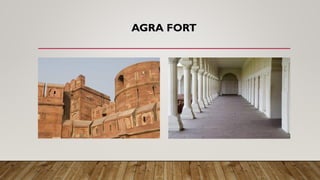
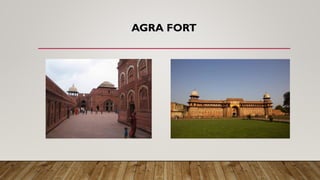
• Agra Fort is a historical fort in the city of Agra in India. It was the main residence of the
emperors of the Mughal Dynasty until 1638, when the capital was shifted from Agra to
Del. hiBefore capture by the British, the last Indian rulers to have occupied it were the
Marathas.
• Near the gardens of theTaj Mahal stands the important 16th-century Mughal monument
known as the Red Fort of Agra.This powerful fortress of red sandstone encompasses,
within its 2.5-km-long enclosure walls, the imperial city of the Mughal rulers. It comprises
many fairy-tale palaces, such as the Jahangir Palace and the Khas Mahal, built by Shah
Jahan; audience halls, such as the Diwan-i-Khas; and two very beautiful mosques.
AGRA FORT
AGRA FORT
AJANTA CAVES
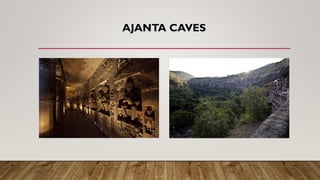
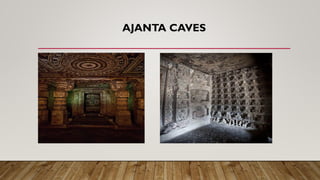
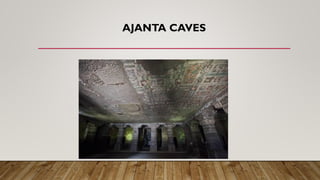
• The Ajanta Caves are 30 (approximately) rock-cut Buddhist cave monuments which
date from the 2nd century BCE to about 480 CE in Aurangabad district of Maharashtra
state of India. The caves include paintings and rock-cut sculptures described as among the
finest surviving examples of ancient Indian art, particularly expressive paintings that
present emotions through gesture, pose and form.
• The first Buddhist cave monuments at Ajanta date from the 2nd and 1st centuries B.C.
During the Gupta period (5th and 6th centuries A.D.), many more richly decorated caves
were added to the original group. The paintings and sculptures of Ajanta, considered
masterpieces of Buddhist religious art, have had a considerable artistic influence.
AJANTA CAVES
AJANTA CAVES
AJANTA CAVES
ARCHAEOLOGICAL SITE OF NALANDA
MAHAVIHARA AT NALANDA, BIHAR
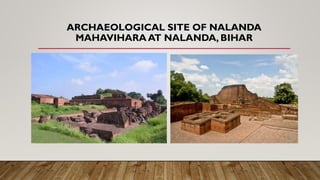
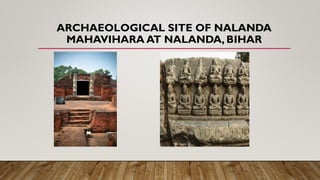
• The Archaeological Site of Nalanda Mahavihara is located in the North-eastern state of Bihar,
India. Spread over an area of 23 hectares the Archaeological site of Nalanda Mahavihara
presents remains dating from circa. 3rd Cen BCE with one of the earliest, the largest of its
time and longest serving monastic cum scholastic establishment in Indian Subcontinent from
5th Cen CE - 13th Cen CE before the sack and abandonment of Nalanda in the 13th Century.
It includes stupas, chaityas, viharas, shrines, many votive structures and important art works in
stucco, stone and metal.The layout of the buildings testifies to the change from grouping
around the stupa-chaitya to a formal linear alignment flanking an axis from south to north.The
historic development of the property testifies to the development of Buddhism into a religion
and the flourishing of monastic and educational traditions.
ARCHAEOLOGICAL SITE OF NALANDA
MAHAVIHARA AT NALANDA, BIHAR
ARCHAEOLOGICAL SITE OF NALANDA
MAHAVIHARA AT NALANDA, BIHAR
BUDDHIST MONUMENTS AT SANCHI
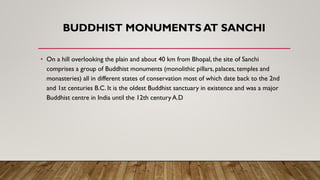
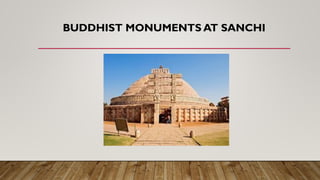
• On a hill overlooking the plain and about 40 km from Bhopal, the site of Sanchi
comprises a group of Buddhist monuments (monolithic pillars, palaces, temples and
monasteries) all in different states of conservation most of which date back to the 2nd
and 1st centuries B.C. It is the oldest Buddhist sanctuary in existence and was a major
Buddhist centre in India until the 12th century A.D
BUDDHIST MONUMENTS AT SANCHI
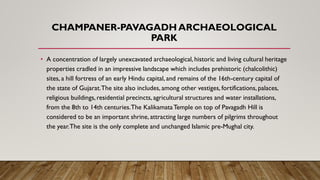
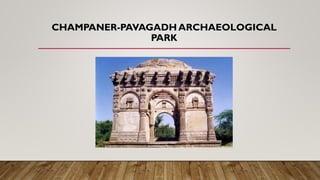
CHAMPANER-PAVAGADH ARCHAEOLOGICAL
PARK
• A concentration of largely unexcavated archaeological, historic and living cultural heritage
properties cradled in an impressive landscape which includes prehistoric (chalcolithic)
sites, a hill fortress of an early Hindu capital, and remains of the 16th-century capital of
the state of Gujarat.The site also includes, among other vestiges, fortifications, palaces,
religious buildings, residential precincts, agricultural structures and water installations,
from the 8th to 14th centuries.The KalikamataTemple on top of Pavagadh Hill is
considered to be an important shrine, attracting large numbers of pilgrims throughout
the year.The site is the only complete and unchanged Islamic pre-Mughal city.
CHAMPANER-PAVAGADH ARCHAEOLOGICAL
PARK
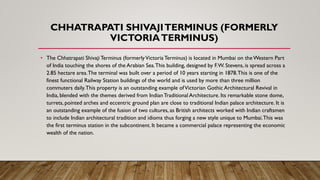
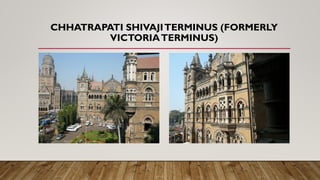
CHHATRAPATI SHIVAJITERMINUS (FORMERLY
VICTORIATERMINUS)
• The Chhatrapati Shivaji Terminus (formerlyVictoria Terminus) is located in Mumbai on theWestern Part
of India touching the shores of the Arabian Sea.This building, designed by F.W. Stevens, is spread across a
2.85 hectare area.The terminal was built over a period of 10 years starting in 1878.This is one of the
finest functional Railway Station buildings of the world and is used by more than three million
commuters daily.This property is an outstanding example ofVictorian Gothic Architectural Revival in
India, blended with the themes derived from IndianTraditional Architecture. Its remarkable stone dome,
turrets, pointed arches and eccentric ground plan are close to traditional Indian palace architecture. It is
an outstanding example of the fusion of two cultures, as British architects worked with Indian craftsmen
to include Indian architectural tradition and idioms thus forging a new style unique to Mumbai.This was
the first terminus station in the subcontinent. It became a commercial palace representing the economic
wealth of the nation.
CHHATRAPATI SHIVAJITERMINUS (FORMERLY
VICTORIATERMINUS)
CHHATRAPATI SHIVAJITERMINUS (FORMERLY
VICTORIATERMINUS)
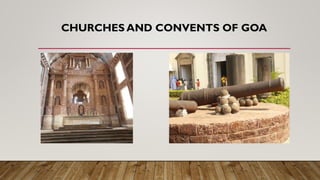
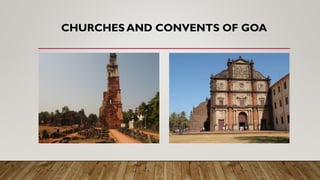
CHURCHES AND CONVENTS OF GOA
• The churches and convents of Goa, the former capital of the Portuguese Indies –
particularly the Church of Bom Jesus, which contains the tomb of St Francis-Xavier –
illustrate the evangelization of Asia.These monuments were influential in spreading forms
of Manueline, Mannerist and Baroque art in all the countries of Asia where missions were
established.
CHURCHES AND CONVENTS OF GOA
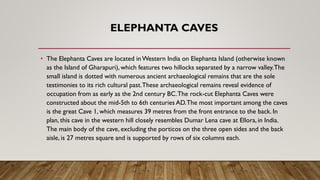
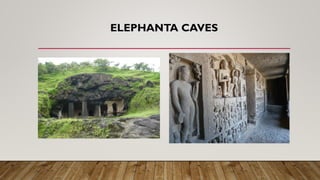
ELEPHANTA CAVES
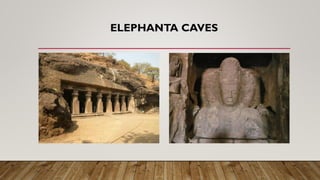
• The Elephanta Caves are located inWestern India on Elephanta Island (otherwise known
as the Island of Gharapuri), which features two hillocks separated by a narrow valley.The
small island is dotted with numerous ancient archaeological remains that are the sole
testimonies to its rich cultural past.These archaeological remains reveal evidence of
occupation from as early as the 2nd century BC.The rock-cut Elephanta Caves were
constructed about the mid-5th to 6th centuries AD.The most important among the caves
is the great Cave 1, which measures 39 metres from the front entrance to the back. In
plan, this cave in the western hill closely resembles Dumar Lena cave at Ellora, in India.
The main body of the cave, excluding the porticos on the three open sides and the back
aisle, is 27 metres square and is supported by rows of six columns each.
ELEPHANTA CAVES
ELEPHANTA CAVES
ELLORA CAVES
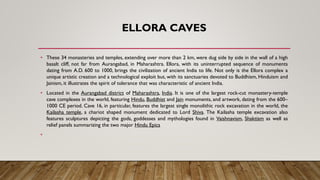
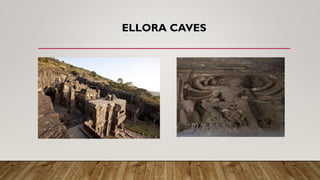
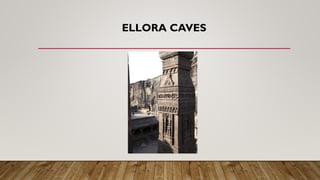
• These 34 monasteries and temples, extending over more than 2 km, were dug side by side in the wall of a high
basalt cliff, not far from Aurangabad, in Maharashtra. Ellora, with its uninterrupted sequence of monuments
dating from A.D. 600 to 1000, brings the civilization of ancient India to life. Not only is the Ellora complex a
unique artistic creation and a technological exploit but, with its sanctuaries devoted to Buddhism, Hinduism and
Jainism, it illustrates the spirit of tolerance that was characteristic of ancient India.
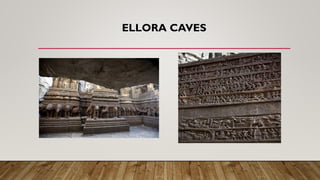
• Located in the Aurangabad district of Maharashtra, India. It is one of the largest rock-cut monastery-temple
cave complexes in the world, featuring Hindu, Buddhist and Jain monuments, and artwork, dating from the 600–
1000 CE period. Cave 16, in particular, features the largest single monolithic rock excavation in the world, the
Kailasha temple, a chariot shaped monument dedicated to Lord Shiva. The Kailasha temple excavation also
features sculptures depicting the gods, goddesses and mythologies found in Vaishnavism, Shaktism as well as
relief panels summarizing the two major Hindu Epics
•
ELLORA CAVES
ELLORA CAVES
ELLORA CAVES
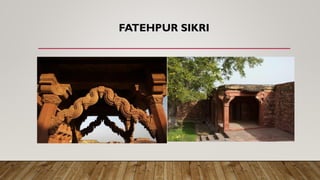
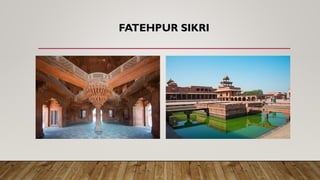
FATEHPUR SIKRI
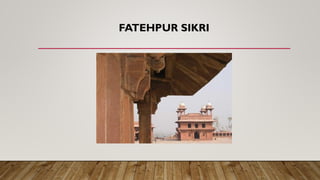
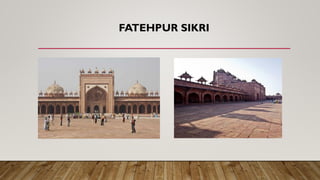
• Built during the second half of the 16th century by the Emperor Akbar, Fatehpur Sikri
(the City ofVictory) was the capital of the Mughal Empire for only some 10 years.The
complex of monuments and temples, all in a uniform architectural style, includes one of
the largest mosques in India, the Jama Masjid.
• The name of the city is derived from the village called Sikri which occupied the spot
before. An Archaeological Survey of India(ASI) excavation from 1999-2000 indicated that
there was a habitation, temples and commercial centres here before Akbar built his
capital. The region was settled by Sungas following their expansion. In 12th century, it was
briefly controlled by Sikarwar Rajputs.
FATEHPUR SIKRI
FATEHPUR SIKRI
FATEHPUR SIKRI
FATEHPUR SIKRI
GREAT LIVING CHOLATEMPLES
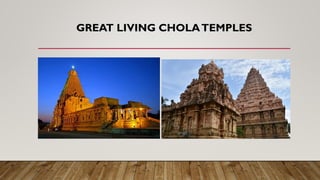
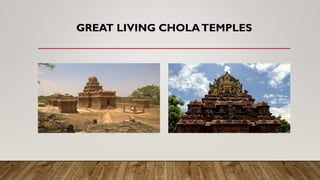
• The Great Living CholaTemples were built by kings of the Chola Empire, which stretched
over all of south India and the neighbouring islands.The site includes three great 11th-
and 12th-centuryTemples: the BrihadisvaraTemple atThanjavur, the BrihadisvaraTemple
at Gangaikondacholisvaram and the AiravatesvaraTemple at Darasuram.TheTemple of
Gangaikondacholisvaram, built by Rajendra I, was completed in 1035. Its 53-m vimana
(sanctum tower) has recessed corners and a graceful upward curving movement,
contrasting with the straight and severe tower atThanjavur.The Airavatesvara temple
complex, built by Rajaraja II, at Darasuram features a 24-m vimana and a stone image of
Shiva.The temples testify to the brilliant achievements of the Chola in architecture,
sculpture, painting and bronze casting.
GREAT LIVING CHOLATEMPLES
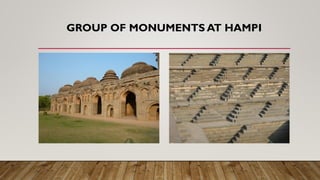
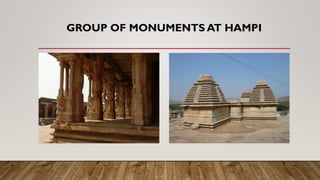
GROUP OF MONUMENTS AT HAMPI
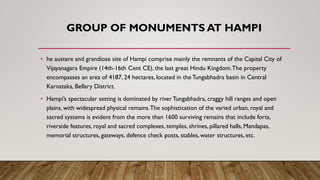
• he austere and grandiose site of Hampi comprise mainly the remnants of the Capital City of
Vijayanagara Empire (14th-16th Cent CE), the last great Hindu Kingdom.The property
encompasses an area of 4187, 24 hectares, located in the Tungabhadra basin in Central
Karnataka, Bellary District.
• Hampi’s spectacular setting is dominated by riverTungabhadra, craggy hill ranges and open
plains, with widespread physical remains.The sophistication of the varied urban, royal and
sacred systems is evident from the more than 1600 surviving remains that include forts,
riverside features, royal and sacred complexes, temples, shrines, pillared halls, Mandapas,
memorial structures, gateways, defence check posts, stables, water structures, etc.
GROUP OF MONUMENTS AT HAMPI
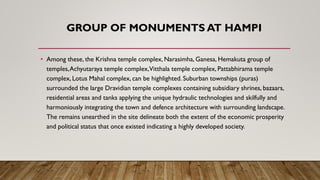
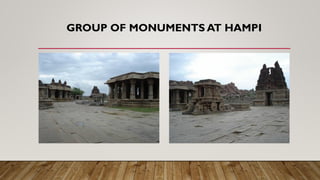
• Among these, the Krishna temple complex, Narasimha, Ganesa, Hemakuta group of
temples,Achyutaraya temple complex,Vitthala temple complex, Pattabhirama temple
complex, Lotus Mahal complex, can be highlighted. Suburban townships (puras)
surrounded the large Dravidian temple complexes containing subsidiary shrines, bazaars,
residential areas and tanks applying the unique hydraulic technologies and skilfully and
harmoniously integrating the town and defence architecture with surrounding landscape.
The remains unearthed in the site delineate both the extent of the economic prosperity
and political status that once existed indicating a highly developed society.
GROUP OF MONUMENTS AT HAMPI
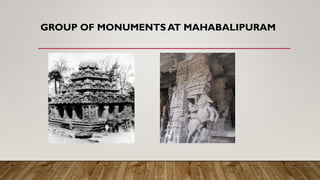
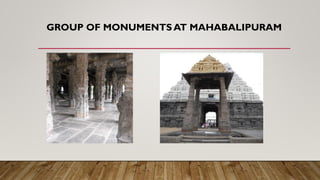
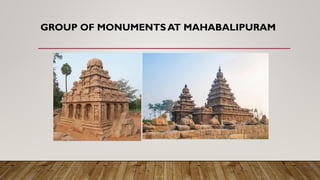
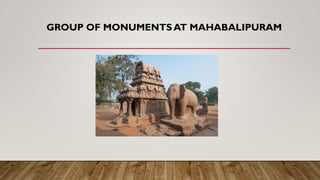
GROUP OF MONUMENTS AT MAHABALIPURAM
• This group of sanctuaries, founded by the Pallava kings, was carved out of rock along the Coromandel
coast in the 7th and 8th centuries. It is known especially for its rathas (temples in the form of chariots),
mandapas (cave sanctuaries), giant open-air reliefs such as the famous 'Descent of the Ganges', and the
temple of Rivage, with thousands of sculptures to the glory of Shiva
• The site has 40 ancient monuments and Hindu temples,including one of the largest open-air rock reliefs
in the world: the Descent of the Ganges or Arjuna's Penance. The group contains several categories of
monuments: rata temples with monolithic processional chariots, built between 630 and 668; mandapa
viharas (cave temples) with narratives from the Mahabharata and Shaivic, Shakti and Vaishna inscriptions
in a number of Indian languages and scripts; rock reliefs (particularly bas-reliefs); stone-cut temples built
between 695 and 722, and archaeological excavations dated to the 6th century and earlier.
GROUP OF MONUMENTS AT MAHABALIPURAM
GROUP OF MONUMENTS AT PATTADAKAL
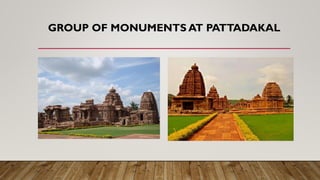
• Pattadakal, in Karnataka, represents the high point of an eclectic art which, in the 7th and
8th centuries under the Chalukya dynasty, achieved a harmonious blend of architectural
forms from northern and southern India.An impressive series of nine Hindu temples, as
well as a Jain sanctuary, can be seen there. One masterpiece from the group stands out –
theTemple ofVirupaksha, built c. 740 by Queen Lokamahadevi to commemorate her
husband's victory over the kings from the South.
GROUP OF MONUMENTS AT PATTADAKAL
HILL FORTS OF RAJASTHAN
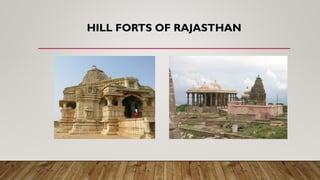
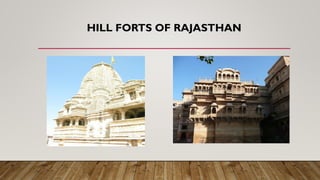
• The serial site, situated in the state of Rajastahan, includes six majestic forts in Chittorgarh;
Kumbhalgarh; Sawai Madhopur; Jhalawar; Jaipur, and Jaisalmer.The ecclectic architecture of the
forts, some up to 20 kilometres in circumference, bears testimony to the power of the Rajput
princely states that flourished in the region from the 8th to the 18th centuries. Enclosed
within defensive walls are major urban centres, palaces, trading centres and other buildings
including temples that often predate the fortifications within which developed an elaborate
courtly culture that supported learning, music and the arts. Some of the urban centres
enclosed in the fortifications have survived, as have many of the site's temples and other
sacred buildings.The forts use the natural defenses offered by the landscape: hills, deserts,
rivers, and dense forests.They also feature extensive water harvesting structures, largely still
in use today.
HILL FORTS OF RAJASTHAN
HISTORIC CITY OF AHMADABAD
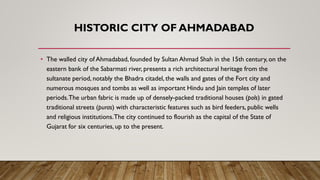
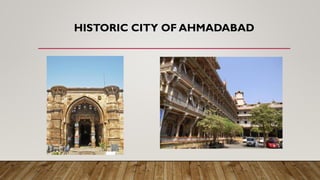
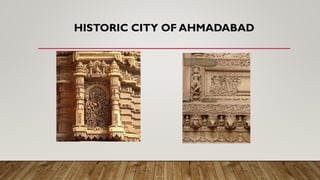
• The walled city of Ahmadabad, founded by Sultan Ahmad Shah in the 15th century, on the
eastern bank of the Sabarmati river, presents a rich architectural heritage from the
sultanate period, notably the Bhadra citadel, the walls and gates of the Fort city and
numerous mosques and tombs as well as important Hindu and Jain temples of later
periods.The urban fabric is made up of densely-packed traditional houses (pols) in gated
traditional streets (puras) with characteristic features such as bird feeders, public wells
and religious institutions.The city continued to flourish as the capital of the State of
Gujarat for six centuries, up to the present.
HISTORIC CITY OF AHMADABAD
HUMAYUN'STOMB, DELHI
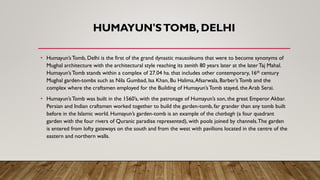
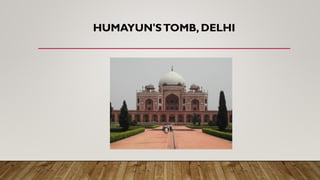
• Humayun’sTomb, Delhi is the first of the grand dynastic mausoleums that were to become synonyms of
Mughal architecture with the architectural style reaching its zenith 80 years later at the laterTaj Mahal.
Humayun’sTomb stands within a complex of 27.04 ha. that includes other contemporary, 16th century
Mughal garden-tombs such as Nila Gumbad, Isa Khan, Bu Halima,Afsarwala, Barber’sTomb and the
complex where the craftsmen employed for the Building of Humayun’sTomb stayed, the Arab Serai.
• Humayun’sTomb was built in the 1560’s, with the patronage of Humayun’s son, the great Emperor Akbar.
Persian and Indian craftsmen worked together to build the garden-tomb, far grander than any tomb built
before in the Islamic world. Humayun’s garden-tomb is an example of the charbagh (a four quadrant
garden with the four rivers of Quranic paradise represented), with pools joined by channels.The garden
is entered from lofty gateways on the south and from the west with pavilions located in the centre of the
eastern and northern walls.
HUMAYUN'STOMB, DELHI
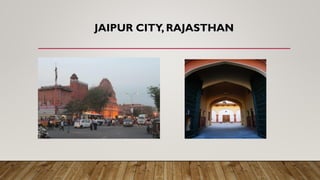
JAIPUR CITY, RAJASTHAN
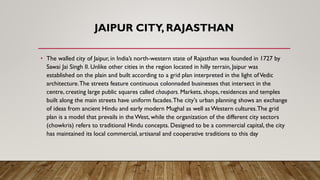
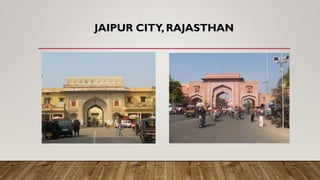
• The walled city of Jaipur, in India’s north-western state of Rajasthan was founded in 1727 by
Sawai Jai Singh II. Unlike other cities in the region located in hilly terrain, Jaipur was
established on the plain and built according to a grid plan interpreted in the light ofVedic
architecture.The streets feature continuous colonnaded businesses that intersect in the
centre, creating large public squares called chaupars. Markets, shops, residences and temples
built along the main streets have uniform facades.The city's urban planning shows an exchange
of ideas from ancient Hindu and early modern Mughal as well as Western cultures.The grid
plan is a model that prevails in the West, while the organization of the different city sectors
(chowkris) refers to traditional Hindu concepts. Designed to be a commercial capital, the city
has maintained its local commercial, artisanal and cooperative traditions to this day
JAIPUR CITY, RAJASTHAN
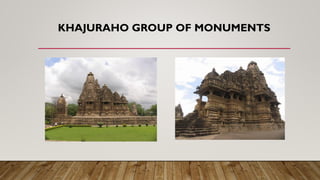
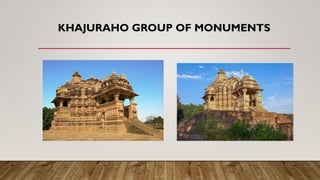
KHAJURAHO GROUP OF MONUMENTS
• The temples at Khajuraho were built during the Chandella dynasty, which reached its
apogee between 950 and 1050. Only about 20 temples remain; they fall into three distinct
groups and belong to two different religions – Hinduism and Jainism.They strike a perfect
balance between architecture and sculpture.TheTemple of Kandariya is decorated with a
profusion of sculptures that are among the greatest masterpieces of Indian art.
KHAJURAHO GROUP OF MONUMENTS
MAHABODHITEMPLE COMPLEX AT BODH GAYA
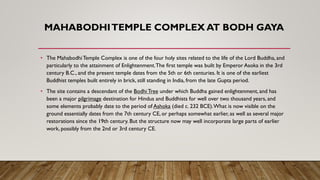
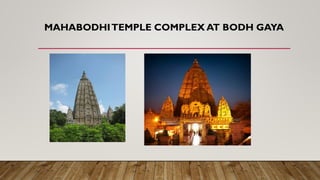
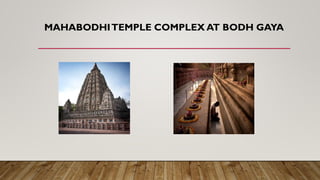
• The MahabodhiTemple Complex is one of the four holy sites related to the life of the Lord Buddha, and
particularly to the attainment of Enlightenment.The first temple was built by Emperor Asoka in the 3rd
century B.C., and the present temple dates from the 5th or 6th centuries. It is one of the earliest
Buddhist temples built entirely in brick, still standing in India, from the late Gupta period.
• The site contains a descendant of the Bodhi Tree under which Buddha gained enlightenment, and has
been a major pilgrimage destination for Hindus and Buddhists for well over two thousand years, and
some elements probably date to the period of Ashoka (died c. 232 BCE).What is now visible on the
ground essentially dates from the 7th century CE, or perhaps somewhat earlier, as well as several major
restorations since the 19th century. But the structure now may well incorporate large parts of earlier
work, possibly from the 2nd or 3rd century CE.
MAHABODHITEMPLE COMPLEX AT BODH GAYA
MOUNTAIN RAILWAYS OF INDIA
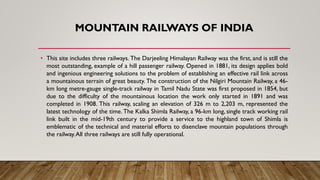
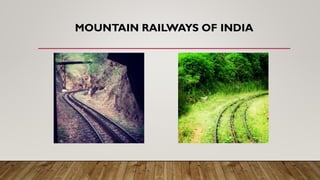
• This site includes three railways. The Darjeeling Himalayan Railway was the first, and is still the
most outstanding, example of a hill passenger railway. Opened in 1881, its design applies bold
and ingenious engineering solutions to the problem of establishing an effective rail link across
a mountainous terrain of great beauty. The construction of the Nilgiri Mountain Railway, a 46-
km long metre-gauge single-track railway in Tamil Nadu State was first proposed in 1854, but
due to the difficulty of the mountainous location the work only started in 1891 and was
completed in 1908. This railway, scaling an elevation of 326 m to 2,203 m, represented the
latest technology of the time. The Kalka Shimla Railway, a 96-km long, single track working rail
link built in the mid-19th century to provide a service to the highland town of Shimla is
emblematic of the technical and material efforts to disenclave mountain populations through
the railway.All three railways are still fully operational.
MOUNTAIN RAILWAYS OF INDIA
QUTB MINAR AND ITS MONUMENTS, DELHI
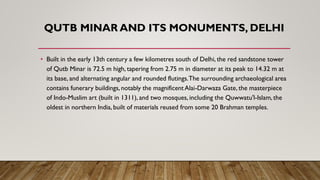
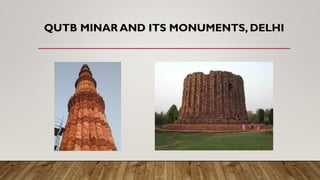
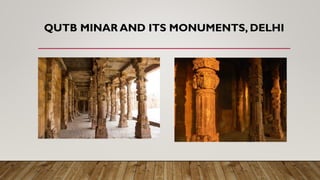
• Built in the early 13th century a few kilometres south of Delhi, the red sandstone tower
of Qutb Minar is 72.5 m high, tapering from 2.75 m in diameter at its peak to 14.32 m at
its base, and alternating angular and rounded flutings.The surrounding archaeological area
contains funerary buildings, notably the magnificent Alai-Darwaza Gate, the masterpiece
of Indo-Muslim art (built in 1311), and two mosques, including the Quwwatu'l-Islam, the
oldest in northern India, built of materials reused from some 20 Brahman temples.
QUTB MINAR AND ITS MONUMENTS, DELHI
RANI-KI-VAV (THE QUEEN’S STEPWELL) AT
PATAN, GUJARAT
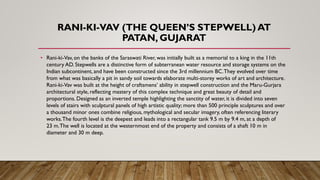
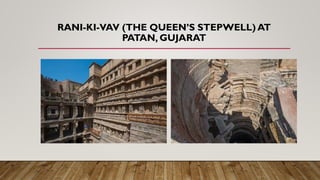
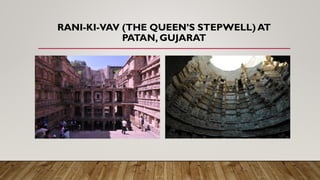
• Rani-ki-Vav, on the banks of the Saraswati River, was initially built as a memorial to a king in the 11th
century AD. Stepwells are a distinctive form of subterranean water resource and storage systems on the
Indian subcontinent, and have been constructed since the 3rd millennium BC.They evolved over time
from what was basically a pit in sandy soil towards elaborate multi-storey works of art and architecture.
Rani-ki-Vav was built at the height of craftsmens’ ability in stepwell construction and the Maru-Gurjara
architectural style, reflecting mastery of this complex technique and great beauty of detail and
proportions. Designed as an inverted temple highlighting the sanctity of water, it is divided into seven
levels of stairs with sculptural panels of high artistic quality; more than 500 principle sculptures and over
a thousand minor ones combine religious, mythological and secular imagery, often referencing literary
works.The fourth level is the deepest and leads into a rectangular tank 9.5 m by 9.4 m, at a depth of
23 m.The well is located at the westernmost end of the property and consists of a shaft 10 m in
diameter and 30 m deep.
RANI-KI-VAV (THE QUEEN’S STEPWELL) AT
PATAN, GUJARAT
RANI-KI-VAV (THE QUEEN’S STEPWELL) AT
PATAN, GUJARAT
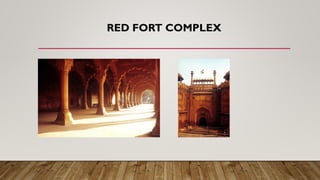
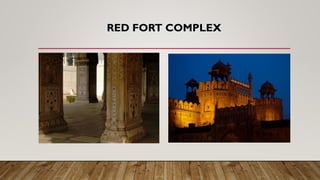
RED FORT COMPLEX
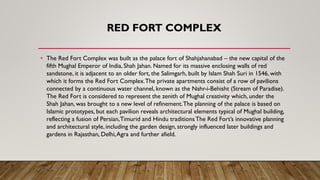
• The Red Fort Complex was built as the palace fort of Shahjahanabad – the new capital of the
fifth Mughal Emperor of India, Shah Jahan. Named for its massive enclosing walls of red
sandstone, it is adjacent to an older fort, the Salimgarh, built by Islam Shah Suri in 1546, with
which it forms the Red Fort Complex.The private apartments consist of a row of pavilions
connected by a continuous water channel, known as the Nahr-i-Behisht (Stream of Paradise).
The Red Fort is considered to represent the zenith of Mughal creativity which, under the
Shah Jahan, was brought to a new level of refinement.The planning of the palace is based on
Islamic prototypes, but each pavilion reveals architectural elements typical of Mughal building,
reflecting a fusion of Persian,Timurid and Hindu traditionsThe Red Fort’s innovative planning
and architectural style, including the garden design, strongly influenced later buildings and
gardens in Rajasthan, Delhi,Agra and further afield.
RED FORT COMPLEX
RED FORT COMPLEX
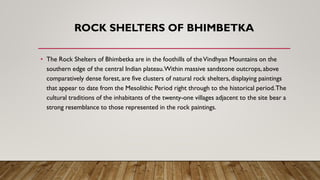
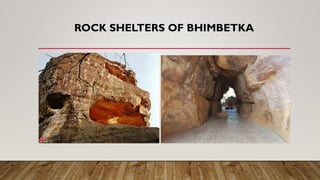
ROCK SHELTERS OF BHIMBETKA
• The Rock Shelters of Bhimbetka are in the foothills of theVindhyan Mountains on the
southern edge of the central Indian plateau.Within massive sandstone outcrops, above
comparatively dense forest, are five clusters of natural rock shelters, displaying paintings
that appear to date from the Mesolithic Period right through to the historical period.The
cultural traditions of the inhabitants of the twenty-one villages adjacent to the site bear a
strong resemblance to those represented in the rock paintings.
ROCK SHELTERS OF BHIMBETKA
SUNTEMPLE, KONARAK
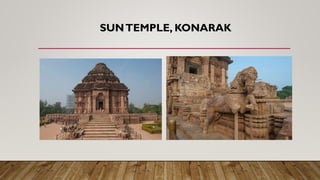
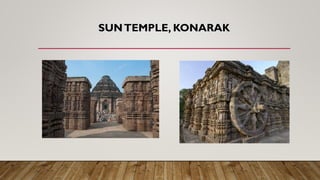
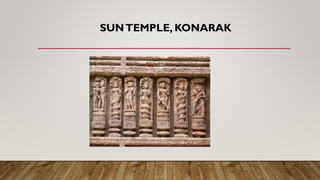
• The SunTemple at Konârak, located on the eastern shores of the Indian subcontinent, is one of the
outstanding examples of temple architecture and art as revealed in its conception, scale and proportion,
and in the sublime narrative strength of its sculptural embellishment. It is an outstanding testimony to the
13th-century kingdom of Orissa and a monumental example of the personification of divinity, thus
forming an invaluable link in the history of the diffusion of the cult of Surya,the Sun God. In this sense, it
is directly and materially linked to Brahmanism and tantricbelief systems.The SunTemple is the
culmination of Kalingan temple architecture, with all its defining elements in complete and perfect form.
A masterpiece of creative genius in both conception and realisation, the temple represents a chariot of
the Sun God, with twelve pairs of wheels drawn by seven horses evoking its movement across the
heavens. It is embellished with sophisticated and refined iconographical depictions of contemporary life
and activities
SUNTEMPLE, KONARAK
SUNTEMPLE, KONARAK
SUNTEMPLE, KONARAK
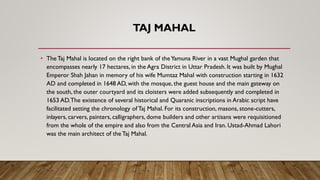
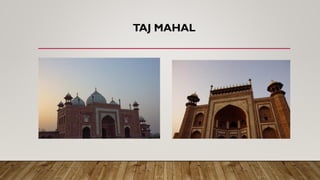
TAJ MAHAL
• The Taj Mahal is located on the right bank of theYamuna River in a vast Mughal garden that
encompasses nearly 17 hectares, in the Agra District in Uttar Pradesh. It was built by Mughal
Emperor Shah Jahan in memory of his wife Mumtaz Mahal with construction starting in 1632
AD and completed in 1648 AD, with the mosque, the guest house and the main gateway on
the south, the outer courtyard and its cloisters were added subsequently and completed in
1653 AD.The existence of several historical and Quaranic inscriptions in Arabic script have
facilitated setting the chronology of Taj Mahal. For its construction, masons, stone-cutters,
inlayers, carvers, painters, calligraphers, dome builders and other artisans were requisitioned
from the whole of the empire and also from the Central Asia and Iran. Ustad-Ahmad Lahori
was the main architect of the Taj Mahal.
TAJ MAHAL
TAJ MAHAL
HE ARCHITECTURALWORK OF LE CORBUSIER,
AN OUTSTANDING CONTRIBUTIONTOTHE
MODERN MOVEMENT
• Chosen from the work of Le Corbusier, the 17 sites comprising this transnational serial
property are spread over seven countries and are a testimonial to the invention of a new
architectural language that made a break with the past.They were built over a period of a
half-century, in the course of what Le Corbusier described as “patient research”.The
Complexe du Capitole in Chandigarh (India), the National Museum ofWestern Art,Tokyo
(Japan), the House of Dr Curutchet in La Plata (Argentina) and the Unité d’habitation in
Marseille (France) reflect the solutions that the Modern Movement sought to apply
during the 20th century to the challenges of inventing new architectural techniques to
respond to the needs of society.These masterpieces of creative genius also attest to the
internationalization of architectural practice across the planet
HE ARCHITECTURALWORK OF LE CORBUSIER,
AN OUTSTANDING CONTRIBUTIONTOTHE
MODERN MOVEMENT
HE ARCHITECTURALWORK OF LE CORBUSIER,
AN OUTSTANDING CONTRIBUTIONTOTHE
MODERN MOVEMENT
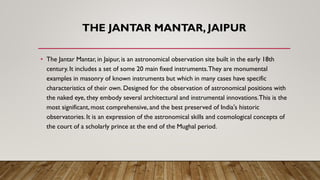
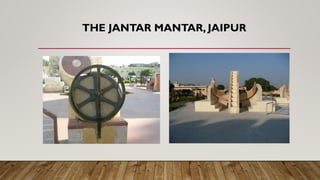
THE JANTAR MANTAR, JAIPUR
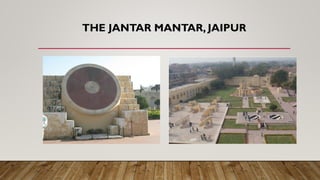
• The Jantar Mantar, in Jaipur, is an astronomical observation site built in the early 18th
century. It includes a set of some 20 main fixed instruments.They are monumental
examples in masonry of known instruments but which in many cases have specific
characteristics of their own. Designed for the observation of astronomical positions with
the naked eye, they embody several architectural and instrumental innovations.This is the
most significant, most comprehensive, and the best preserved of India's historic
observatories. It is an expression of the astronomical skills and cosmological concepts of
the court of a scholarly prince at the end of the Mughal period.
THE JANTAR MANTAR, JAIPUR
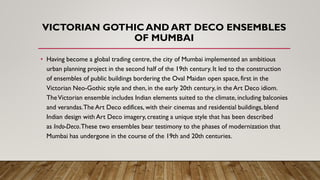
VICTORIAN GOTHIC AND ART DECO ENSEMBLES
OF MUMBAI
• Having become a global trading centre, the city of Mumbai implemented an ambitious
urban planning project in the second half of the 19th century. It led to the construction
of ensembles of public buildings bordering the Oval Maidan open space, first in the
Victorian Neo-Gothic style and then, in the early 20th century, in the Art Deco idiom.
TheVictorian ensemble includes Indian elements suited to the climate, including balconies
and verandas.The Art Deco edifices, with their cinemas and residential buildings, blend
Indian design with Art Deco imagery, creating a unique style that has been described
as Indo-Deco.These two ensembles bear testimony to the phases of modernization that
Mumbai has undergone in the course of the 19th and 20th centuries.
VICTORIAN GOTHIC AND ART DECO
ENSEMBLES OF MUMBAI
VICTORIAN GOTHIC AND ART DECO
ENSEMBLES OF MUMBAI
WORLD HERITAGE SITE-
INDIA(NATURAL)
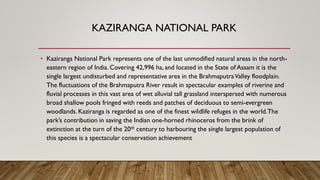
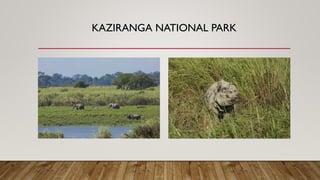
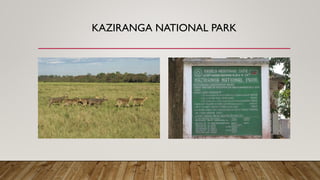
KAZIRANGA NATIONAL PARK
• Kaziranga National Park represents one of the last unmodified natural areas in the north-
eastern region of India. Covering 42,996 ha, and located in the State of Assam it is the
single largest undisturbed and representative area in the BrahmaputraValley floodplain.
The fluctuations of the Brahmaputra River result in spectacular examples of riverine and
fluvial processes in this vast area of wet alluvial tall grassland interspersed with numerous
broad shallow pools fringed with reeds and patches of deciduous to semi-evergreen
woodlands. Kaziranga is regarded as one of the finest wildlife refuges in the world.The
park’s contribution in saving the Indian one-horned rhinoceros from the brink of
extinction at the turn of the 20th century to harbouring the single largest population of
this species is a spectacular conservation achievement
KAZIRANGA NATIONAL PARK
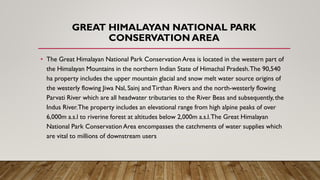
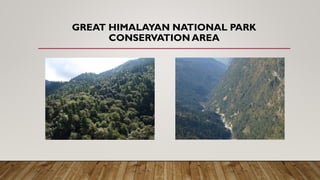
GREAT HIMALAYAN NATIONAL PARK
CONSERVATION AREA
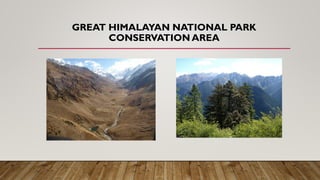
• The Great Himalayan National Park Conservation Area is located in the western part of
the Himalayan Mountains in the northern Indian State of Himachal Pradesh.The 90,540
ha property includes the upper mountain glacial and snow melt water source origins of
the westerly flowing Jiwa Nal, Sainj andTirthan Rivers and the north-westerly flowing
Parvati River which are all headwater tributaries to the River Beas and subsequently, the
Indus River.The property includes an elevational range from high alpine peaks of over
6,000m a.s.l to riverine forest at altitudes below 2,000m a.s.l.The Great Himalayan
National Park Conservation Area encompasses the catchments of water supplies which
are vital to millions of downstream users
GREAT HIMALAYAN NATIONAL PARK
CONSERVATION AREA
GREAT HIMALAYAN NATIONAL PARK
CONSERVATION AREA
KEOLADEO NATIONAL PARK
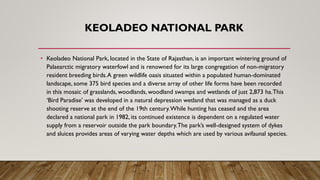
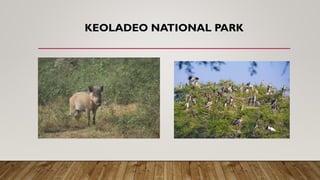
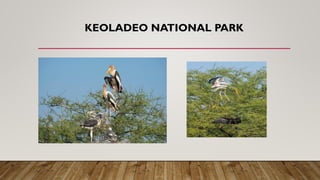
• Keoladeo National Park, located in the State of Rajasthan, is an important wintering ground of
Palaearctic migratory waterfowl and is renowned for its large congregation of non-migratory
resident breeding birds.A green wildlife oasis situated within a populated human-dominated
landscape, some 375 bird species and a diverse array of other life forms have been recorded
in this mosaic of grasslands, woodlands, woodland swamps and wetlands of just 2,873 ha.This
‘Bird Paradise’ was developed in a natural depression wetland that was managed as a duck
shooting reserve at the end of the 19th century.While hunting has ceased and the area
declared a national park in 1982, its continued existence is dependent on a regulated water
supply from a reservoir outside the park boundary.The park’s well-designed system of dykes
and sluices provides areas of varying water depths which are used by various avifaunal species.
KEOLADEO NATIONAL PARK
MANAS WILDLIFE SANCTUARY
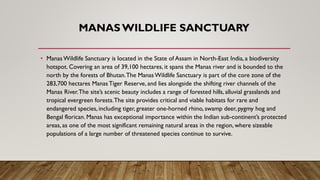
• Manas Wildlife Sanctuary is located in the State of Assam in North-East India, a biodiversity
hotspot. Covering an area of 39,100 hectares, it spans the Manas river and is bounded to the
north by the forests of Bhutan.The Manas Wildlife Sanctuary is part of the core zone of the
283,700 hectares Manas Tiger Reserve, and lies alongside the shifting river channels of the
Manas River.The site’s scenic beauty includes a range of forested hills, alluvial grasslands and
tropical evergreen forests.The site provides critical and viable habitats for rare and
endangered species, including tiger, greater one-horned rhino, swamp deer, pygmy hog and
Bengal florican. Manas has exceptional importance within the Indian sub-continent’s protected
areas, as one of the most significant remaining natural areas in the region, where sizeable
populations of a large number of threatened species continue to survive.
MANAS WILDLIFE SANCTUARY
NANDA DEVI ANDVALLEY OF FLOWERS
NATIONAL PARKS
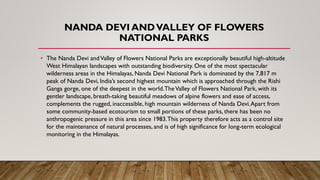
• The Nanda Devi andValley of Flowers National Parks are exceptionally beautiful high-altitude
West Himalayan landscapes with outstanding biodiversity. One of the most spectacular
wilderness areas in the Himalayas, Nanda Devi National Park is dominated by the 7,817 m
peak of Nanda Devi, India’s second highest mountain which is approached through the Rishi
Ganga gorge, one of the deepest in the world.TheValley of Flowers National Park, with its
gentler landscape, breath-taking beautiful meadows of alpine flowers and ease of access,
complements the rugged, inaccessible, high mountain wilderness of Nanda Devi.Apart from
some community-based ecotourism to small portions of these parks, there has been no
anthropogenic pressure in this area since 1983.This property therefore acts as a control site
for the maintenance of natural processes, and is of high significance for long-term ecological
monitoring in the Himalayas.
NANDA DEVI ANDVALLEY OF FLOWERS
NATIONAL PARKS
SUNDARBANS NATIONAL PARK
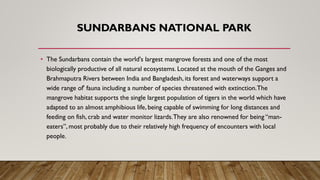
• The Sundarbans contain the world's largest mangrove forests and one of the most
biologically productive of all natural ecosystems. Located at the mouth of the Ganges and
Brahmaputra Rivers between India and Bangladesh, its forest and waterways support a
wide range of' fauna including a number of species threatened with extinction.The
mangrove habitat supports the single largest population of tigers in the world which have
adapted to an almost amphibious life, being capable of swimming for long distances and
feeding on fish, crab and water monitor lizards.They are also renowned for being “man-
eaters”, most probably due to their relatively high frequency of encounters with local
people.
SUNDARBANS NATIONAL PARK
WESTERN GHATS
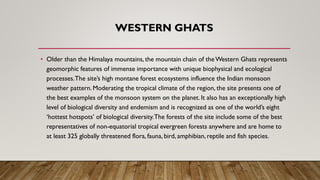
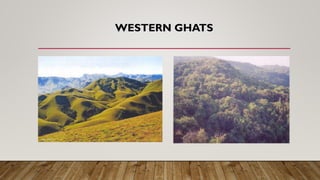
• Older than the Himalaya mountains, the mountain chain of theWestern Ghats represents
geomorphic features of immense importance with unique biophysical and ecological
processes.The site’s high montane forest ecosystems influence the Indian monsoon
weather pattern. Moderating the tropical climate of the region, the site presents one of
the best examples of the monsoon system on the planet. It also has an exceptionally high
level of biological diversity and endemism and is recognized as one of the world’s eight
‘hottest hotspots’ of biological diversity.The forests of the site include some of the best
representatives of non-equatorial tropical evergreen forests anywhere and are home to
at least 325 globally threatened flora, fauna, bird, amphibian, reptile and fish species.
WESTERN GHATS
WORLD HERITAGE SITE-INDIA(MIXED)
KHANGCHENDZONGA NATIONAL PARK
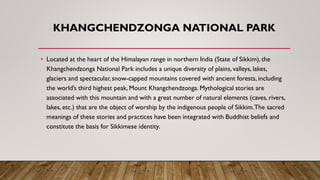
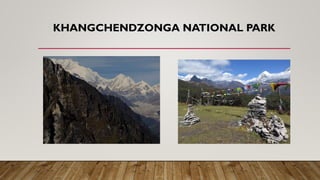
• Located at the heart of the Himalayan range in northern India (State of Sikkim), the
Khangchendzonga National Park includes a unique diversity of plains, valleys, lakes,
glaciers and spectacular, snow-capped mountains covered with ancient forests, including
the world’s third highest peak, Mount Khangchendzonga. Mythological stories are
associated with this mountain and with a great number of natural elements (caves, rivers,
lakes, etc.) that are the object of worship by the indigenous people of Sikkim.The sacred
meanings of these stories and practices have been integrated with Buddhist beliefs and
constitute the basis for Sikkimese identity.
KHANGCHENDZONGA NATIONAL PARK
REFERENCES
• http://whc.unesco.org/en/statesparties/IN
• https://en.wikipedia.org/wiki/List_of_World_Heritage_Sites_in_India

World Heritage Sites-India

  • 1.
  • 2.
    WORLD HERITAGE SITES •A World Heritage Site is a landmark or area, selected by the United Nations Educational, Scientific and Cultural Organization (UNESCO) for having cultural, historical, scientific or other form of significance, which is legally protected by international treaties. The sites are judged to be important for the collective and preservative interests of humanity. • World Heritage Sites are classified into three categories as ❑Cultural ❑Natural ❑Mixed
  • 3.
    WORLD HERITAGE SITE-SELECTION CRITERIA •To be included on the World Heritage List, sites must be of outstanding universal value and meet at least one out of ten selection criteria. ➢ to represent a masterpiece of human creative genius; ➢ to exhibit an important interchange of human values, over a span of time or within a cultural area of the world, on developments in architecture or technology, monumental arts, town-planning or landscape design; ➢ to bear a unique or at least exceptional testimony to a cultural tradition or to a civilization which is living or which has disappeared; ➢ to be an outstanding example of a type of building, architectural or technological ensemble or landscape which illustrates (a) significant stage(s) in human history; ➢ to be an outstanding example of a traditional human settlement, land-use, or sea-use which is representative of a culture (or cultures), or human interaction with the environment especially when it has become vulnerable under the impact of irreversible change;
  • 4.
    WORLD HERITAGE SITE-SELECTION CRITERIA ➢to be directly or tangibly associated with events or living traditions, with ideas, or with beliefs, with artistic and literary works of outstanding universal significance. (The Committee considers that this criterion should preferably be used in conjunction with other criteria); ➢ to contain superlative natural phenomena or areas of exceptional natural beauty and aesthetic importance; ➢ to be outstanding examples representing major stages of earth's history, including the record of life, significant on-going geological processes in the development of landforms, or significant geomorphic or physiographic features; ➢ to be outstanding examples representing significant on-going ecological and biological processes in the evolution and development of terrestrial, fresh water, coastal and marine ecosystems and communities of plants and animals; ➢ to contain the most important and significant natural habitats for in-situ conservation of biological diversity, including those containing threatened species of outstanding universal value from the point of view of science or conservation.
  • 5.
    WORLD HERITAGE SITES-INDIA •Currently 39 sites in India has been approved as World Heritage Sites by UNESCO • 30 of which falls under Cultural, 7 under Natural and 2 under Mixed • Apart from this 42 sites are included in theTentative List • A Tentative List is an inventory of those properties which each State Party intends to consider for nomination. • Following slides gives a brief introduction to variousWorld Heritage Sites in India
  • 6.
  • 7.
    AGRA FORT • AgraFort is a historical fort in the city of Agra in India. It was the main residence of the emperors of the Mughal Dynasty until 1638, when the capital was shifted from Agra to Del. hiBefore capture by the British, the last Indian rulers to have occupied it were the Marathas. • Near the gardens of theTaj Mahal stands the important 16th-century Mughal monument known as the Red Fort of Agra.This powerful fortress of red sandstone encompasses, within its 2.5-km-long enclosure walls, the imperial city of the Mughal rulers. It comprises many fairy-tale palaces, such as the Jahangir Palace and the Khas Mahal, built by Shah Jahan; audience halls, such as the Diwan-i-Khas; and two very beautiful mosques.
  • 8.
  • 9.
  • 10.
    AJANTA CAVES • TheAjanta Caves are 30 (approximately) rock-cut Buddhist cave monuments which date from the 2nd century BCE to about 480 CE in Aurangabad district of Maharashtra state of India. The caves include paintings and rock-cut sculptures described as among the finest surviving examples of ancient Indian art, particularly expressive paintings that present emotions through gesture, pose and form. • The first Buddhist cave monuments at Ajanta date from the 2nd and 1st centuries B.C. During the Gupta period (5th and 6th centuries A.D.), many more richly decorated caves were added to the original group. The paintings and sculptures of Ajanta, considered masterpieces of Buddhist religious art, have had a considerable artistic influence.
  • 11.
  • 12.
  • 13.
  • 14.
    ARCHAEOLOGICAL SITE OFNALANDA MAHAVIHARA AT NALANDA, BIHAR • The Archaeological Site of Nalanda Mahavihara is located in the North-eastern state of Bihar, India. Spread over an area of 23 hectares the Archaeological site of Nalanda Mahavihara presents remains dating from circa. 3rd Cen BCE with one of the earliest, the largest of its time and longest serving monastic cum scholastic establishment in Indian Subcontinent from 5th Cen CE - 13th Cen CE before the sack and abandonment of Nalanda in the 13th Century. It includes stupas, chaityas, viharas, shrines, many votive structures and important art works in stucco, stone and metal.The layout of the buildings testifies to the change from grouping around the stupa-chaitya to a formal linear alignment flanking an axis from south to north.The historic development of the property testifies to the development of Buddhism into a religion and the flourishing of monastic and educational traditions.
  • 15.
    ARCHAEOLOGICAL SITE OFNALANDA MAHAVIHARA AT NALANDA, BIHAR
  • 16.
    ARCHAEOLOGICAL SITE OFNALANDA MAHAVIHARA AT NALANDA, BIHAR
  • 17.
    BUDDHIST MONUMENTS ATSANCHI • On a hill overlooking the plain and about 40 km from Bhopal, the site of Sanchi comprises a group of Buddhist monuments (monolithic pillars, palaces, temples and monasteries) all in different states of conservation most of which date back to the 2nd and 1st centuries B.C. It is the oldest Buddhist sanctuary in existence and was a major Buddhist centre in India until the 12th century A.D
  • 18.
  • 19.
    CHAMPANER-PAVAGADH ARCHAEOLOGICAL PARK • Aconcentration of largely unexcavated archaeological, historic and living cultural heritage properties cradled in an impressive landscape which includes prehistoric (chalcolithic) sites, a hill fortress of an early Hindu capital, and remains of the 16th-century capital of the state of Gujarat.The site also includes, among other vestiges, fortifications, palaces, religious buildings, residential precincts, agricultural structures and water installations, from the 8th to 14th centuries.The KalikamataTemple on top of Pavagadh Hill is considered to be an important shrine, attracting large numbers of pilgrims throughout the year.The site is the only complete and unchanged Islamic pre-Mughal city.
  • 20.
  • 21.
    CHHATRAPATI SHIVAJITERMINUS (FORMERLY VICTORIATERMINUS) •The Chhatrapati Shivaji Terminus (formerlyVictoria Terminus) is located in Mumbai on theWestern Part of India touching the shores of the Arabian Sea.This building, designed by F.W. Stevens, is spread across a 2.85 hectare area.The terminal was built over a period of 10 years starting in 1878.This is one of the finest functional Railway Station buildings of the world and is used by more than three million commuters daily.This property is an outstanding example ofVictorian Gothic Architectural Revival in India, blended with the themes derived from IndianTraditional Architecture. Its remarkable stone dome, turrets, pointed arches and eccentric ground plan are close to traditional Indian palace architecture. It is an outstanding example of the fusion of two cultures, as British architects worked with Indian craftsmen to include Indian architectural tradition and idioms thus forging a new style unique to Mumbai.This was the first terminus station in the subcontinent. It became a commercial palace representing the economic wealth of the nation.
  • 22.
  • 23.
  • 24.
    CHURCHES AND CONVENTSOF GOA • The churches and convents of Goa, the former capital of the Portuguese Indies – particularly the Church of Bom Jesus, which contains the tomb of St Francis-Xavier – illustrate the evangelization of Asia.These monuments were influential in spreading forms of Manueline, Mannerist and Baroque art in all the countries of Asia where missions were established.
  • 25.
  • 26.
  • 27.
  • 28.
    ELEPHANTA CAVES • TheElephanta Caves are located inWestern India on Elephanta Island (otherwise known as the Island of Gharapuri), which features two hillocks separated by a narrow valley.The small island is dotted with numerous ancient archaeological remains that are the sole testimonies to its rich cultural past.These archaeological remains reveal evidence of occupation from as early as the 2nd century BC.The rock-cut Elephanta Caves were constructed about the mid-5th to 6th centuries AD.The most important among the caves is the great Cave 1, which measures 39 metres from the front entrance to the back. In plan, this cave in the western hill closely resembles Dumar Lena cave at Ellora, in India. The main body of the cave, excluding the porticos on the three open sides and the back aisle, is 27 metres square and is supported by rows of six columns each.
  • 29.
  • 30.
  • 31.
    ELLORA CAVES • These34 monasteries and temples, extending over more than 2 km, were dug side by side in the wall of a high basalt cliff, not far from Aurangabad, in Maharashtra. Ellora, with its uninterrupted sequence of monuments dating from A.D. 600 to 1000, brings the civilization of ancient India to life. Not only is the Ellora complex a unique artistic creation and a technological exploit but, with its sanctuaries devoted to Buddhism, Hinduism and Jainism, it illustrates the spirit of tolerance that was characteristic of ancient India. • Located in the Aurangabad district of Maharashtra, India. It is one of the largest rock-cut monastery-temple cave complexes in the world, featuring Hindu, Buddhist and Jain monuments, and artwork, dating from the 600– 1000 CE period. Cave 16, in particular, features the largest single monolithic rock excavation in the world, the Kailasha temple, a chariot shaped monument dedicated to Lord Shiva. The Kailasha temple excavation also features sculptures depicting the gods, goddesses and mythologies found in Vaishnavism, Shaktism as well as relief panels summarizing the two major Hindu Epics •
  • 32.
  • 33.
  • 34.
  • 35.
    FATEHPUR SIKRI • Builtduring the second half of the 16th century by the Emperor Akbar, Fatehpur Sikri (the City ofVictory) was the capital of the Mughal Empire for only some 10 years.The complex of monuments and temples, all in a uniform architectural style, includes one of the largest mosques in India, the Jama Masjid. • The name of the city is derived from the village called Sikri which occupied the spot before. An Archaeological Survey of India(ASI) excavation from 1999-2000 indicated that there was a habitation, temples and commercial centres here before Akbar built his capital. The region was settled by Sungas following their expansion. In 12th century, it was briefly controlled by Sikarwar Rajputs.
  • 36.
  • 37.
  • 38.
  • 39.
  • 40.
    GREAT LIVING CHOLATEMPLES •The Great Living CholaTemples were built by kings of the Chola Empire, which stretched over all of south India and the neighbouring islands.The site includes three great 11th- and 12th-centuryTemples: the BrihadisvaraTemple atThanjavur, the BrihadisvaraTemple at Gangaikondacholisvaram and the AiravatesvaraTemple at Darasuram.TheTemple of Gangaikondacholisvaram, built by Rajendra I, was completed in 1035. Its 53-m vimana (sanctum tower) has recessed corners and a graceful upward curving movement, contrasting with the straight and severe tower atThanjavur.The Airavatesvara temple complex, built by Rajaraja II, at Darasuram features a 24-m vimana and a stone image of Shiva.The temples testify to the brilliant achievements of the Chola in architecture, sculpture, painting and bronze casting.
  • 41.
  • 42.
  • 43.
    GROUP OF MONUMENTSAT HAMPI • he austere and grandiose site of Hampi comprise mainly the remnants of the Capital City of Vijayanagara Empire (14th-16th Cent CE), the last great Hindu Kingdom.The property encompasses an area of 4187, 24 hectares, located in the Tungabhadra basin in Central Karnataka, Bellary District. • Hampi’s spectacular setting is dominated by riverTungabhadra, craggy hill ranges and open plains, with widespread physical remains.The sophistication of the varied urban, royal and sacred systems is evident from the more than 1600 surviving remains that include forts, riverside features, royal and sacred complexes, temples, shrines, pillared halls, Mandapas, memorial structures, gateways, defence check posts, stables, water structures, etc.
  • 44.
    GROUP OF MONUMENTSAT HAMPI • Among these, the Krishna temple complex, Narasimha, Ganesa, Hemakuta group of temples,Achyutaraya temple complex,Vitthala temple complex, Pattabhirama temple complex, Lotus Mahal complex, can be highlighted. Suburban townships (puras) surrounded the large Dravidian temple complexes containing subsidiary shrines, bazaars, residential areas and tanks applying the unique hydraulic technologies and skilfully and harmoniously integrating the town and defence architecture with surrounding landscape. The remains unearthed in the site delineate both the extent of the economic prosperity and political status that once existed indicating a highly developed society.
  • 45.
  • 46.
  • 47.
  • 48.
    GROUP OF MONUMENTSAT MAHABALIPURAM • This group of sanctuaries, founded by the Pallava kings, was carved out of rock along the Coromandel coast in the 7th and 8th centuries. It is known especially for its rathas (temples in the form of chariots), mandapas (cave sanctuaries), giant open-air reliefs such as the famous 'Descent of the Ganges', and the temple of Rivage, with thousands of sculptures to the glory of Shiva • The site has 40 ancient monuments and Hindu temples,including one of the largest open-air rock reliefs in the world: the Descent of the Ganges or Arjuna's Penance. The group contains several categories of monuments: rata temples with monolithic processional chariots, built between 630 and 668; mandapa viharas (cave temples) with narratives from the Mahabharata and Shaivic, Shakti and Vaishna inscriptions in a number of Indian languages and scripts; rock reliefs (particularly bas-reliefs); stone-cut temples built between 695 and 722, and archaeological excavations dated to the 6th century and earlier.
  • 49.
    GROUP OF MONUMENTSAT MAHABALIPURAM
  • 50.
    GROUP OF MONUMENTSAT MAHABALIPURAM
  • 51.
    GROUP OF MONUMENTSAT MAHABALIPURAM
  • 52.
    GROUP OF MONUMENTSAT MAHABALIPURAM
  • 53.
    GROUP OF MONUMENTSAT PATTADAKAL • Pattadakal, in Karnataka, represents the high point of an eclectic art which, in the 7th and 8th centuries under the Chalukya dynasty, achieved a harmonious blend of architectural forms from northern and southern India.An impressive series of nine Hindu temples, as well as a Jain sanctuary, can be seen there. One masterpiece from the group stands out – theTemple ofVirupaksha, built c. 740 by Queen Lokamahadevi to commemorate her husband's victory over the kings from the South.
  • 54.
    GROUP OF MONUMENTSAT PATTADAKAL
  • 55.
    HILL FORTS OFRAJASTHAN • The serial site, situated in the state of Rajastahan, includes six majestic forts in Chittorgarh; Kumbhalgarh; Sawai Madhopur; Jhalawar; Jaipur, and Jaisalmer.The ecclectic architecture of the forts, some up to 20 kilometres in circumference, bears testimony to the power of the Rajput princely states that flourished in the region from the 8th to the 18th centuries. Enclosed within defensive walls are major urban centres, palaces, trading centres and other buildings including temples that often predate the fortifications within which developed an elaborate courtly culture that supported learning, music and the arts. Some of the urban centres enclosed in the fortifications have survived, as have many of the site's temples and other sacred buildings.The forts use the natural defenses offered by the landscape: hills, deserts, rivers, and dense forests.They also feature extensive water harvesting structures, largely still in use today.
  • 56.
    HILL FORTS OFRAJASTHAN
  • 57.
    HILL FORTS OFRAJASTHAN
  • 58.
    HISTORIC CITY OFAHMADABAD • The walled city of Ahmadabad, founded by Sultan Ahmad Shah in the 15th century, on the eastern bank of the Sabarmati river, presents a rich architectural heritage from the sultanate period, notably the Bhadra citadel, the walls and gates of the Fort city and numerous mosques and tombs as well as important Hindu and Jain temples of later periods.The urban fabric is made up of densely-packed traditional houses (pols) in gated traditional streets (puras) with characteristic features such as bird feeders, public wells and religious institutions.The city continued to flourish as the capital of the State of Gujarat for six centuries, up to the present.
  • 59.
  • 60.
  • 61.
    HUMAYUN'STOMB, DELHI • Humayun’sTomb,Delhi is the first of the grand dynastic mausoleums that were to become synonyms of Mughal architecture with the architectural style reaching its zenith 80 years later at the laterTaj Mahal. Humayun’sTomb stands within a complex of 27.04 ha. that includes other contemporary, 16th century Mughal garden-tombs such as Nila Gumbad, Isa Khan, Bu Halima,Afsarwala, Barber’sTomb and the complex where the craftsmen employed for the Building of Humayun’sTomb stayed, the Arab Serai. • Humayun’sTomb was built in the 1560’s, with the patronage of Humayun’s son, the great Emperor Akbar. Persian and Indian craftsmen worked together to build the garden-tomb, far grander than any tomb built before in the Islamic world. Humayun’s garden-tomb is an example of the charbagh (a four quadrant garden with the four rivers of Quranic paradise represented), with pools joined by channels.The garden is entered from lofty gateways on the south and from the west with pavilions located in the centre of the eastern and northern walls.
  • 62.
  • 63.
    JAIPUR CITY, RAJASTHAN •The walled city of Jaipur, in India’s north-western state of Rajasthan was founded in 1727 by Sawai Jai Singh II. Unlike other cities in the region located in hilly terrain, Jaipur was established on the plain and built according to a grid plan interpreted in the light ofVedic architecture.The streets feature continuous colonnaded businesses that intersect in the centre, creating large public squares called chaupars. Markets, shops, residences and temples built along the main streets have uniform facades.The city's urban planning shows an exchange of ideas from ancient Hindu and early modern Mughal as well as Western cultures.The grid plan is a model that prevails in the West, while the organization of the different city sectors (chowkris) refers to traditional Hindu concepts. Designed to be a commercial capital, the city has maintained its local commercial, artisanal and cooperative traditions to this day
  • 64.
  • 65.
  • 66.
    KHAJURAHO GROUP OFMONUMENTS • The temples at Khajuraho were built during the Chandella dynasty, which reached its apogee between 950 and 1050. Only about 20 temples remain; they fall into three distinct groups and belong to two different religions – Hinduism and Jainism.They strike a perfect balance between architecture and sculpture.TheTemple of Kandariya is decorated with a profusion of sculptures that are among the greatest masterpieces of Indian art.
  • 67.
  • 68.
  • 69.
    MAHABODHITEMPLE COMPLEX ATBODH GAYA • The MahabodhiTemple Complex is one of the four holy sites related to the life of the Lord Buddha, and particularly to the attainment of Enlightenment.The first temple was built by Emperor Asoka in the 3rd century B.C., and the present temple dates from the 5th or 6th centuries. It is one of the earliest Buddhist temples built entirely in brick, still standing in India, from the late Gupta period. • The site contains a descendant of the Bodhi Tree under which Buddha gained enlightenment, and has been a major pilgrimage destination for Hindus and Buddhists for well over two thousand years, and some elements probably date to the period of Ashoka (died c. 232 BCE).What is now visible on the ground essentially dates from the 7th century CE, or perhaps somewhat earlier, as well as several major restorations since the 19th century. But the structure now may well incorporate large parts of earlier work, possibly from the 2nd or 3rd century CE.
  • 70.
  • 71.
  • 72.
    MOUNTAIN RAILWAYS OFINDIA • This site includes three railways. The Darjeeling Himalayan Railway was the first, and is still the most outstanding, example of a hill passenger railway. Opened in 1881, its design applies bold and ingenious engineering solutions to the problem of establishing an effective rail link across a mountainous terrain of great beauty. The construction of the Nilgiri Mountain Railway, a 46- km long metre-gauge single-track railway in Tamil Nadu State was first proposed in 1854, but due to the difficulty of the mountainous location the work only started in 1891 and was completed in 1908. This railway, scaling an elevation of 326 m to 2,203 m, represented the latest technology of the time. The Kalka Shimla Railway, a 96-km long, single track working rail link built in the mid-19th century to provide a service to the highland town of Shimla is emblematic of the technical and material efforts to disenclave mountain populations through the railway.All three railways are still fully operational.
  • 73.
  • 74.
  • 75.
    QUTB MINAR ANDITS MONUMENTS, DELHI • Built in the early 13th century a few kilometres south of Delhi, the red sandstone tower of Qutb Minar is 72.5 m high, tapering from 2.75 m in diameter at its peak to 14.32 m at its base, and alternating angular and rounded flutings.The surrounding archaeological area contains funerary buildings, notably the magnificent Alai-Darwaza Gate, the masterpiece of Indo-Muslim art (built in 1311), and two mosques, including the Quwwatu'l-Islam, the oldest in northern India, built of materials reused from some 20 Brahman temples.
  • 76.
    QUTB MINAR ANDITS MONUMENTS, DELHI
  • 77.
    QUTB MINAR ANDITS MONUMENTS, DELHI
  • 78.
    RANI-KI-VAV (THE QUEEN’SSTEPWELL) AT PATAN, GUJARAT • Rani-ki-Vav, on the banks of the Saraswati River, was initially built as a memorial to a king in the 11th century AD. Stepwells are a distinctive form of subterranean water resource and storage systems on the Indian subcontinent, and have been constructed since the 3rd millennium BC.They evolved over time from what was basically a pit in sandy soil towards elaborate multi-storey works of art and architecture. Rani-ki-Vav was built at the height of craftsmens’ ability in stepwell construction and the Maru-Gurjara architectural style, reflecting mastery of this complex technique and great beauty of detail and proportions. Designed as an inverted temple highlighting the sanctity of water, it is divided into seven levels of stairs with sculptural panels of high artistic quality; more than 500 principle sculptures and over a thousand minor ones combine religious, mythological and secular imagery, often referencing literary works.The fourth level is the deepest and leads into a rectangular tank 9.5 m by 9.4 m, at a depth of 23 m.The well is located at the westernmost end of the property and consists of a shaft 10 m in diameter and 30 m deep.
  • 79.
    RANI-KI-VAV (THE QUEEN’SSTEPWELL) AT PATAN, GUJARAT
  • 80.
    RANI-KI-VAV (THE QUEEN’SSTEPWELL) AT PATAN, GUJARAT
  • 81.
    RED FORT COMPLEX •The Red Fort Complex was built as the palace fort of Shahjahanabad – the new capital of the fifth Mughal Emperor of India, Shah Jahan. Named for its massive enclosing walls of red sandstone, it is adjacent to an older fort, the Salimgarh, built by Islam Shah Suri in 1546, with which it forms the Red Fort Complex.The private apartments consist of a row of pavilions connected by a continuous water channel, known as the Nahr-i-Behisht (Stream of Paradise). The Red Fort is considered to represent the zenith of Mughal creativity which, under the Shah Jahan, was brought to a new level of refinement.The planning of the palace is based on Islamic prototypes, but each pavilion reveals architectural elements typical of Mughal building, reflecting a fusion of Persian,Timurid and Hindu traditionsThe Red Fort’s innovative planning and architectural style, including the garden design, strongly influenced later buildings and gardens in Rajasthan, Delhi,Agra and further afield.
  • 82.
  • 83.
  • 84.
    ROCK SHELTERS OFBHIMBETKA • The Rock Shelters of Bhimbetka are in the foothills of theVindhyan Mountains on the southern edge of the central Indian plateau.Within massive sandstone outcrops, above comparatively dense forest, are five clusters of natural rock shelters, displaying paintings that appear to date from the Mesolithic Period right through to the historical period.The cultural traditions of the inhabitants of the twenty-one villages adjacent to the site bear a strong resemblance to those represented in the rock paintings.
  • 85.
  • 86.
    SUNTEMPLE, KONARAK • TheSunTemple at Konârak, located on the eastern shores of the Indian subcontinent, is one of the outstanding examples of temple architecture and art as revealed in its conception, scale and proportion, and in the sublime narrative strength of its sculptural embellishment. It is an outstanding testimony to the 13th-century kingdom of Orissa and a monumental example of the personification of divinity, thus forming an invaluable link in the history of the diffusion of the cult of Surya,the Sun God. In this sense, it is directly and materially linked to Brahmanism and tantricbelief systems.The SunTemple is the culmination of Kalingan temple architecture, with all its defining elements in complete and perfect form. A masterpiece of creative genius in both conception and realisation, the temple represents a chariot of the Sun God, with twelve pairs of wheels drawn by seven horses evoking its movement across the heavens. It is embellished with sophisticated and refined iconographical depictions of contemporary life and activities
  • 87.
  • 88.
  • 89.
  • 90.
    TAJ MAHAL • TheTaj Mahal is located on the right bank of theYamuna River in a vast Mughal garden that encompasses nearly 17 hectares, in the Agra District in Uttar Pradesh. It was built by Mughal Emperor Shah Jahan in memory of his wife Mumtaz Mahal with construction starting in 1632 AD and completed in 1648 AD, with the mosque, the guest house and the main gateway on the south, the outer courtyard and its cloisters were added subsequently and completed in 1653 AD.The existence of several historical and Quaranic inscriptions in Arabic script have facilitated setting the chronology of Taj Mahal. For its construction, masons, stone-cutters, inlayers, carvers, painters, calligraphers, dome builders and other artisans were requisitioned from the whole of the empire and also from the Central Asia and Iran. Ustad-Ahmad Lahori was the main architect of the Taj Mahal.
  • 91.
  • 92.
  • 93.
    HE ARCHITECTURALWORK OFLE CORBUSIER, AN OUTSTANDING CONTRIBUTIONTOTHE MODERN MOVEMENT • Chosen from the work of Le Corbusier, the 17 sites comprising this transnational serial property are spread over seven countries and are a testimonial to the invention of a new architectural language that made a break with the past.They were built over a period of a half-century, in the course of what Le Corbusier described as “patient research”.The Complexe du Capitole in Chandigarh (India), the National Museum ofWestern Art,Tokyo (Japan), the House of Dr Curutchet in La Plata (Argentina) and the Unité d’habitation in Marseille (France) reflect the solutions that the Modern Movement sought to apply during the 20th century to the challenges of inventing new architectural techniques to respond to the needs of society.These masterpieces of creative genius also attest to the internationalization of architectural practice across the planet
  • 94.
    HE ARCHITECTURALWORK OFLE CORBUSIER, AN OUTSTANDING CONTRIBUTIONTOTHE MODERN MOVEMENT
  • 95.
    HE ARCHITECTURALWORK OFLE CORBUSIER, AN OUTSTANDING CONTRIBUTIONTOTHE MODERN MOVEMENT
  • 96.
    THE JANTAR MANTAR,JAIPUR • The Jantar Mantar, in Jaipur, is an astronomical observation site built in the early 18th century. It includes a set of some 20 main fixed instruments.They are monumental examples in masonry of known instruments but which in many cases have specific characteristics of their own. Designed for the observation of astronomical positions with the naked eye, they embody several architectural and instrumental innovations.This is the most significant, most comprehensive, and the best preserved of India's historic observatories. It is an expression of the astronomical skills and cosmological concepts of the court of a scholarly prince at the end of the Mughal period.
  • 97.
  • 98.
  • 99.
    VICTORIAN GOTHIC ANDART DECO ENSEMBLES OF MUMBAI • Having become a global trading centre, the city of Mumbai implemented an ambitious urban planning project in the second half of the 19th century. It led to the construction of ensembles of public buildings bordering the Oval Maidan open space, first in the Victorian Neo-Gothic style and then, in the early 20th century, in the Art Deco idiom. TheVictorian ensemble includes Indian elements suited to the climate, including balconies and verandas.The Art Deco edifices, with their cinemas and residential buildings, blend Indian design with Art Deco imagery, creating a unique style that has been described as Indo-Deco.These two ensembles bear testimony to the phases of modernization that Mumbai has undergone in the course of the 19th and 20th centuries.
  • 100.
    VICTORIAN GOTHIC ANDART DECO ENSEMBLES OF MUMBAI
  • 101.
    VICTORIAN GOTHIC ANDART DECO ENSEMBLES OF MUMBAI
  • 102.
  • 103.
    KAZIRANGA NATIONAL PARK •Kaziranga National Park represents one of the last unmodified natural areas in the north- eastern region of India. Covering 42,996 ha, and located in the State of Assam it is the single largest undisturbed and representative area in the BrahmaputraValley floodplain. The fluctuations of the Brahmaputra River result in spectacular examples of riverine and fluvial processes in this vast area of wet alluvial tall grassland interspersed with numerous broad shallow pools fringed with reeds and patches of deciduous to semi-evergreen woodlands. Kaziranga is regarded as one of the finest wildlife refuges in the world.The park’s contribution in saving the Indian one-horned rhinoceros from the brink of extinction at the turn of the 20th century to harbouring the single largest population of this species is a spectacular conservation achievement
  • 104.
  • 105.
  • 106.
  • 107.
    GREAT HIMALAYAN NATIONALPARK CONSERVATION AREA • The Great Himalayan National Park Conservation Area is located in the western part of the Himalayan Mountains in the northern Indian State of Himachal Pradesh.The 90,540 ha property includes the upper mountain glacial and snow melt water source origins of the westerly flowing Jiwa Nal, Sainj andTirthan Rivers and the north-westerly flowing Parvati River which are all headwater tributaries to the River Beas and subsequently, the Indus River.The property includes an elevational range from high alpine peaks of over 6,000m a.s.l to riverine forest at altitudes below 2,000m a.s.l.The Great Himalayan National Park Conservation Area encompasses the catchments of water supplies which are vital to millions of downstream users
  • 108.
    GREAT HIMALAYAN NATIONALPARK CONSERVATION AREA
  • 109.
    GREAT HIMALAYAN NATIONALPARK CONSERVATION AREA
  • 110.
    KEOLADEO NATIONAL PARK •Keoladeo National Park, located in the State of Rajasthan, is an important wintering ground of Palaearctic migratory waterfowl and is renowned for its large congregation of non-migratory resident breeding birds.A green wildlife oasis situated within a populated human-dominated landscape, some 375 bird species and a diverse array of other life forms have been recorded in this mosaic of grasslands, woodlands, woodland swamps and wetlands of just 2,873 ha.This ‘Bird Paradise’ was developed in a natural depression wetland that was managed as a duck shooting reserve at the end of the 19th century.While hunting has ceased and the area declared a national park in 1982, its continued existence is dependent on a regulated water supply from a reservoir outside the park boundary.The park’s well-designed system of dykes and sluices provides areas of varying water depths which are used by various avifaunal species.
  • 111.
  • 112.
  • 113.
    MANAS WILDLIFE SANCTUARY •Manas Wildlife Sanctuary is located in the State of Assam in North-East India, a biodiversity hotspot. Covering an area of 39,100 hectares, it spans the Manas river and is bounded to the north by the forests of Bhutan.The Manas Wildlife Sanctuary is part of the core zone of the 283,700 hectares Manas Tiger Reserve, and lies alongside the shifting river channels of the Manas River.The site’s scenic beauty includes a range of forested hills, alluvial grasslands and tropical evergreen forests.The site provides critical and viable habitats for rare and endangered species, including tiger, greater one-horned rhino, swamp deer, pygmy hog and Bengal florican. Manas has exceptional importance within the Indian sub-continent’s protected areas, as one of the most significant remaining natural areas in the region, where sizeable populations of a large number of threatened species continue to survive.
  • 114.
  • 115.
  • 116.
    NANDA DEVI ANDVALLEYOF FLOWERS NATIONAL PARKS • The Nanda Devi andValley of Flowers National Parks are exceptionally beautiful high-altitude West Himalayan landscapes with outstanding biodiversity. One of the most spectacular wilderness areas in the Himalayas, Nanda Devi National Park is dominated by the 7,817 m peak of Nanda Devi, India’s second highest mountain which is approached through the Rishi Ganga gorge, one of the deepest in the world.TheValley of Flowers National Park, with its gentler landscape, breath-taking beautiful meadows of alpine flowers and ease of access, complements the rugged, inaccessible, high mountain wilderness of Nanda Devi.Apart from some community-based ecotourism to small portions of these parks, there has been no anthropogenic pressure in this area since 1983.This property therefore acts as a control site for the maintenance of natural processes, and is of high significance for long-term ecological monitoring in the Himalayas.
  • 117.
    NANDA DEVI ANDVALLEYOF FLOWERS NATIONAL PARKS
  • 118.
    SUNDARBANS NATIONAL PARK •The Sundarbans contain the world's largest mangrove forests and one of the most biologically productive of all natural ecosystems. Located at the mouth of the Ganges and Brahmaputra Rivers between India and Bangladesh, its forest and waterways support a wide range of' fauna including a number of species threatened with extinction.The mangrove habitat supports the single largest population of tigers in the world which have adapted to an almost amphibious life, being capable of swimming for long distances and feeding on fish, crab and water monitor lizards.They are also renowned for being “man- eaters”, most probably due to their relatively high frequency of encounters with local people.
  • 119.
  • 120.
    WESTERN GHATS • Olderthan the Himalaya mountains, the mountain chain of theWestern Ghats represents geomorphic features of immense importance with unique biophysical and ecological processes.The site’s high montane forest ecosystems influence the Indian monsoon weather pattern. Moderating the tropical climate of the region, the site presents one of the best examples of the monsoon system on the planet. It also has an exceptionally high level of biological diversity and endemism and is recognized as one of the world’s eight ‘hottest hotspots’ of biological diversity.The forests of the site include some of the best representatives of non-equatorial tropical evergreen forests anywhere and are home to at least 325 globally threatened flora, fauna, bird, amphibian, reptile and fish species.
  • 121.
  • 122.
  • 123.
    KHANGCHENDZONGA NATIONAL PARK •Located at the heart of the Himalayan range in northern India (State of Sikkim), the Khangchendzonga National Park includes a unique diversity of plains, valleys, lakes, glaciers and spectacular, snow-capped mountains covered with ancient forests, including the world’s third highest peak, Mount Khangchendzonga. Mythological stories are associated with this mountain and with a great number of natural elements (caves, rivers, lakes, etc.) that are the object of worship by the indigenous people of Sikkim.The sacred meanings of these stories and practices have been integrated with Buddhist beliefs and constitute the basis for Sikkimese identity.
  • 124.
  • 125.
  • 126.