DEPARTMENT OF COMPUTER SCIENCE
ENGINEERING &
INFORMATION TECHOLOGY
JAYPEE INSTITUTE OF INFORMATION
TECHNOLOGY, NOIDA
Project Supervisor:
Mrs. Amanpreet Kaur
Submitted by:
Ayush Garg (10104746)
Rajat Ghai (10104741)
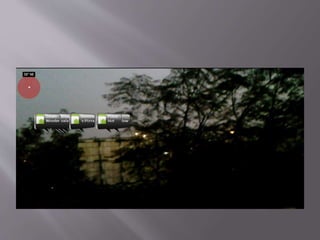
 Augmented reality (AR) is a live, direct or
indirect, view of a physical, real-world
environment whose elements are augmented
(or supplemented) by computer-generated
sensory input such as sound, video, graphics or
GPS data
 Augmented reality applications can enhance a
user's experience when traveling by providing
real time informational displays regarding a
location and its features
 The amount data we rely on every day is
overwhelming, and there is no sign of it
slowing down. Instead of having users find the
information they need, the information should
come to them automatically
 Battery issue is one of the major concern of
android devices, as our application is having
social features so application require to remain
active every time, which drains battery
 The major concern of our project to avoid
drainage of android device battery, because
our application contains many social features
and for that user have to active with internet
service.
 Other concern is not make our application as
light as possible. If application is heavy it hang
the phone.
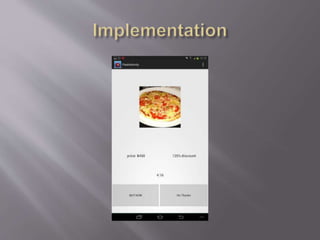
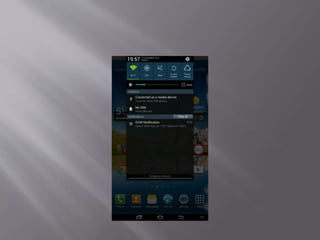
 We use PUSH notification features which will
work even though our application is closed by
sending deals as a notification.
 We use multithreading and put our database
used in our application online.
 It is an application which tells you nothing on a
literal or intellectual level, but which in
instinctive, emotional terms makes you
understand more than you will ever be able to
verbally communicate to another human being
 We use our own “Software Sensor”.
 Eclipse is an Integrated development
environment (IDE). It contains a base
workspace and an extensible plug-in system
for customizing the environment. Written
mostly in Java, Eclipse can be used to develop
applications in Java
 Eclipse uses plug-ins to provide all the
functionality within and on top of the runtime
system. Its runtime system is based on
Equinox, an implementation of the OSGi core
framework specification
 Android Studio is an integrated development
environment (IDE) for the Android platform
Android Studio includes a powerful code
editor. It's based on the IntelliJ IDEA editor,
which supports features such as smart editing,
advanced code refactoring, and deep static
code analysis
 Hardware Requirement:
 Processor: ARM(armebai-v7a) and above
 RAM: 512 Mb
 Disk space: Min. 1Gb
 Device GPS
 Software Requirement:
 For developing the application:
Operating System: Windows 7/8
Language: JAVA, XML, php, MySQL
Tools: Android (IDE)
Debugger: Android Dalvik Debug Monitor
Service
 For running the application:
OS: Android 2.2 or higher version
 Low Pass filter Algorithm
The Android sensor framework lets you access
many types of sensors. Two very basic types
are:
1. Hardware Sensors.
2. Software Sensors.
 Hardware sensors are physical components
built into a handset or tablet device. They
derive their data by directly measuring
specific environmental properties, such as
acceleration, geomagnetic field strength, or
angular change. For example:
Sensor.TYPE_ACCELEROMETER",
Sensor.TYPE_MAGNETIC_FIELD
 Software sensors are not physical devices,
although they mimic hardware-based sensors.
Software-based sensors derive their data from
one or more of the hardware-based sensors
and are sometimes called virtual sensors or
synthetic sensors. For example:
Sensor.TYPE_ORIENTATION,
Sensor.TYPE_ROTATION_VECTOR
 Our application is reliable but it’s not 100%
accurate and can produce still more accurate
results if we use gyro sensors. However we
have applied low pass filter to improve the
accuracy of our application.
 Compass tends to go crazy near magnetic
devices.
 Markers overlap each other to resolve this
problem we can use better plotting system.
 By combining the accelerometer sensor and
magnetic sensor and by applying low pass
filter we can get orientation of device. Fix
location can be calculated using GPS and with
the help of latitude and longitude we can
receive the nearby data of selected categories
 Rather than using polling Pushing is better
because it saves battery whenever our server
has data to send to all application it can send
that data to all devices.
 [1] Mr. Raviraj S.Patkar, Mr. S. Pratap Singh, Ms. Swati V. Birje,”
International Journal of Advanced Research in Computer Science and
Software Engineering,” IEEE Transanction, 5, May 2013.
 [2] Naresh Kumar N, Prof. Mohan K, “GCM Service Driven
Communication With An Android Application in Cloud Computing,” in
proceeding, 5, May 2013.
 [3] Poonam, Prof. (Dr.) Yusuf Mulge, “Remote Temperature Monitoring
Using LM35
 sensor and Intimate Android user via C2DM Service,” in proceeding, 6,
June 2013.
 [4] Zhi Xu, Kun Bai, Sencun Zhu, “Inferring User Inputs On Smartphone
Touchscreens Using On-board Motion Sensors,” in proceeding, April 16–
18, 2012.
 [5] Shahid Ayub, Alireza Bahraminisaab, Bahram Honary,” A Sensor
Fusion Method for Smart phone Orientation Estimation,” in proceeding,
June, 011.
 [6] Hamed Ketabdar, Mehran Roshandel, Kamer Ali Yüksel, “Towards
Using Embedded Magnetic Field Sensor for Around Mobile Device 3D
Interaction,” in proceeding, May, 2012.

World explorer

  • 1.
    DEPARTMENT OF COMPUTERSCIENCE ENGINEERING & INFORMATION TECHOLOGY JAYPEE INSTITUTE OF INFORMATION TECHNOLOGY, NOIDA Project Supervisor: Mrs. Amanpreet Kaur Submitted by: Ayush Garg (10104746) Rajat Ghai (10104741)
  • 2.
     Augmented reality(AR) is a live, direct or indirect, view of a physical, real-world environment whose elements are augmented (or supplemented) by computer-generated sensory input such as sound, video, graphics or GPS data  Augmented reality applications can enhance a user's experience when traveling by providing real time informational displays regarding a location and its features
  • 3.
     The amountdata we rely on every day is overwhelming, and there is no sign of it slowing down. Instead of having users find the information they need, the information should come to them automatically  Battery issue is one of the major concern of android devices, as our application is having social features so application require to remain active every time, which drains battery
  • 4.
     The majorconcern of our project to avoid drainage of android device battery, because our application contains many social features and for that user have to active with internet service.  Other concern is not make our application as light as possible. If application is heavy it hang the phone.
  • 5.
     We usePUSH notification features which will work even though our application is closed by sending deals as a notification.  We use multithreading and put our database used in our application online.
  • 6.
     It isan application which tells you nothing on a literal or intellectual level, but which in instinctive, emotional terms makes you understand more than you will ever be able to verbally communicate to another human being  We use our own “Software Sensor”.
  • 7.
     Eclipse isan Integrated development environment (IDE). It contains a base workspace and an extensible plug-in system for customizing the environment. Written mostly in Java, Eclipse can be used to develop applications in Java  Eclipse uses plug-ins to provide all the functionality within and on top of the runtime system. Its runtime system is based on Equinox, an implementation of the OSGi core framework specification
  • 8.
     Android Studiois an integrated development environment (IDE) for the Android platform Android Studio includes a powerful code editor. It's based on the IntelliJ IDEA editor, which supports features such as smart editing, advanced code refactoring, and deep static code analysis
  • 9.
     Hardware Requirement: Processor: ARM(armebai-v7a) and above  RAM: 512 Mb  Disk space: Min. 1Gb  Device GPS
  • 10.
     Software Requirement: For developing the application: Operating System: Windows 7/8 Language: JAVA, XML, php, MySQL Tools: Android (IDE) Debugger: Android Dalvik Debug Monitor Service  For running the application: OS: Android 2.2 or higher version
  • 11.
     Low Passfilter Algorithm The Android sensor framework lets you access many types of sensors. Two very basic types are: 1. Hardware Sensors. 2. Software Sensors.
  • 12.
     Hardware sensorsare physical components built into a handset or tablet device. They derive their data by directly measuring specific environmental properties, such as acceleration, geomagnetic field strength, or angular change. For example: Sensor.TYPE_ACCELEROMETER", Sensor.TYPE_MAGNETIC_FIELD
  • 13.
     Software sensorsare not physical devices, although they mimic hardware-based sensors. Software-based sensors derive their data from one or more of the hardware-based sensors and are sometimes called virtual sensors or synthetic sensors. For example: Sensor.TYPE_ORIENTATION, Sensor.TYPE_ROTATION_VECTOR
  • 18.
     Our applicationis reliable but it’s not 100% accurate and can produce still more accurate results if we use gyro sensors. However we have applied low pass filter to improve the accuracy of our application.  Compass tends to go crazy near magnetic devices.  Markers overlap each other to resolve this problem we can use better plotting system.
  • 19.
     By combiningthe accelerometer sensor and magnetic sensor and by applying low pass filter we can get orientation of device. Fix location can be calculated using GPS and with the help of latitude and longitude we can receive the nearby data of selected categories  Rather than using polling Pushing is better because it saves battery whenever our server has data to send to all application it can send that data to all devices.
  • 20.
     [1] Mr.Raviraj S.Patkar, Mr. S. Pratap Singh, Ms. Swati V. Birje,” International Journal of Advanced Research in Computer Science and Software Engineering,” IEEE Transanction, 5, May 2013.  [2] Naresh Kumar N, Prof. Mohan K, “GCM Service Driven Communication With An Android Application in Cloud Computing,” in proceeding, 5, May 2013.  [3] Poonam, Prof. (Dr.) Yusuf Mulge, “Remote Temperature Monitoring Using LM35  sensor and Intimate Android user via C2DM Service,” in proceeding, 6, June 2013.  [4] Zhi Xu, Kun Bai, Sencun Zhu, “Inferring User Inputs On Smartphone Touchscreens Using On-board Motion Sensors,” in proceeding, April 16– 18, 2012.  [5] Shahid Ayub, Alireza Bahraminisaab, Bahram Honary,” A Sensor Fusion Method for Smart phone Orientation Estimation,” in proceeding, June, 011.  [6] Hamed Ketabdar, Mehran Roshandel, Kamer Ali Yüksel, “Towards Using Embedded Magnetic Field Sensor for Around Mobile Device 3D Interaction,” in proceeding, May, 2012.