World Economic and Financial Surveys


             World Economic outlook
                                 october 2010


                Recovery, Risk, and Rebalancing


                      International Monetary Fund
©2010 International Monetary Fund

                       Production: IMF Multimedia Services Division
                     Cover and Design: Luisa Menjivar and Jorge Salazar
                           Composition: Maryland Composition


                              Cataloging-in-Publication Data

World economic outlook (International Monetary Fund)
 World economic outlook : a survey by the staff of the International Monetary Fund. —
Washington, DC : International Monetary Fund, 1980–
 v. ; 28 cm. — (1981–1984: Occasional paper / International Monetary Fund, 0251-6365).
— (1986– : World economic and financial surveys, 0256-6877)

Semiannual. Some issues also have thematic titles.
Has occasional updates, 1984–

   1. Economic development — Periodicals. 2. Economic forecasting — Periodicals.
3. Economic policy — Periodicals. 4. International economic relations —
Periodicals. I. International Monetary Fund. II. Series: Occasional paper (International
Monetary Fund). III. Series: World economic and financial surveys.

HC10.W7979

ISBN 978-1-58906-915-2


                                      Please send orders to:
                      International Monetary Fund, Publication Services
                       P.O. Box 92780, Washington, D.C. 20090, U.S.A.
                         Tel.: (202) 623-7430       Fax: (202) 623-7201
                                 E-mail: publications@imf.org
                                    www.imfbookstore.org
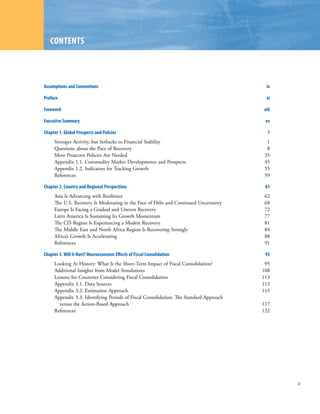
ContEntS


Assumptions and Conventions                                                              ix

Preface                                                                                  xi

Foreword                                                                                xiii

Executive Summary                                                                        xv

Chapter 1. Global Prospects and Policies                                                  1
     Stronger Activity, but Setbacks to Financial Stability                               1
     Questions about the Pace of Recovery                                                 8
     More Proactive Policies Are Needed                                                  35
     Appendix 1.1. Commodity Market Developments and Prospects                           45
     Appendix 1.2. Indicators for Tracking Growth                                        55
     References                                                                          59

Chapter 2. Country and Regional Perspectives                                             61
     Asia Is Advancing with Resilience                                                   62
     The U.S. Recovery Is Moderating in the Face of Debt and Continued Uncertainty       68
     Europe Is Facing a Gradual and Uneven Recovery                                      72
     Latin America Is Sustaining Its Growth Momentum                                     77
     The CIS Region Is Experiencing a Modest Recovery                                    81
     The Middle East and North Africa Region Is Recovering Strongly                      84
     Africa’s Growth Is Accelerating                                                     88
     References                                                                          91

Chapter 3. Will It Hurt? Macroeconomic Effects of Fiscal Consolidation                   93
     Looking At History: What Is the Short-Term Impact of Fiscal Consolidation?          95
     Additional Insights from Model Simulations                                         108
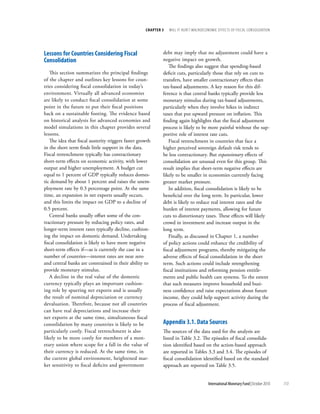
     Lessons for Countries Considering Fiscal Consolidation                             113
     Appendix 3.1. Data Sources                                                         113
     Appendix 3.2. Estimation Approach                                                  115
     Appendix 3.3. Identifying Periods of Fiscal Consolidation: The Standard Approach
       versus the Action-Based Approach                                                 117
     References                                                                         122


                                                                                               iii
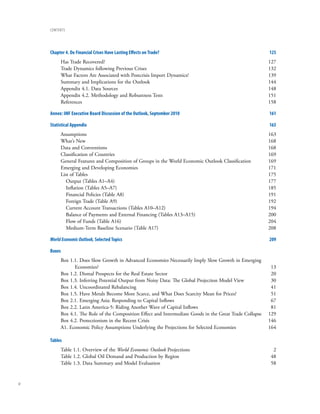
contents


     Chapter 4. Do Financial Crises Have Lasting Effects on trade?                                         125
          Has Trade Recovered?                                                                             127
          Trade Dynamics following Previous Crises                                                         132
          What Factors Are Associated with Postcrisis Import Dynamics?                                     139
          Summary and Implications for the Outlook                                                         144
          Appendix 4.1. Data Sources                                                                       148
          Appendix 4.2. Methodology and Robustness Tests                                                   151
          References                                                                                       158

     Annex: IMF Executive Board Discussion of the outlook, September 2010                                  161

     Statistical Appendix                                                                                  163
          Assumptions                                                                                      163
          What’s New                                                                                       168
          Data and Conventions                                                                             168
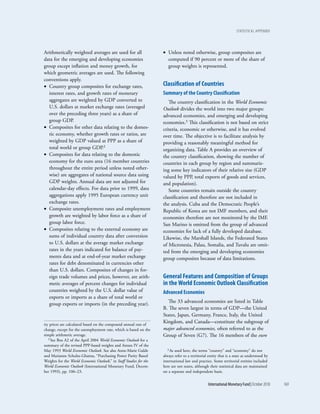
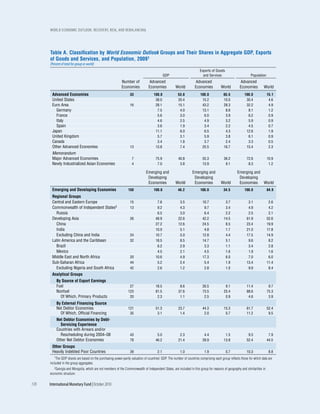
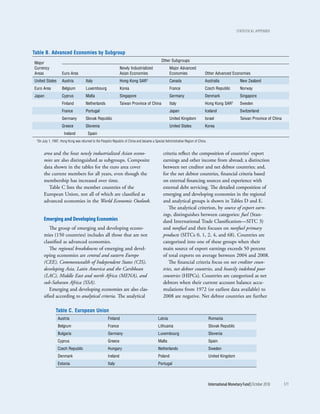
          Classification of Countries                                                                      169
          General Features and Composition of Groups in the World Economic Outlook Classification          169
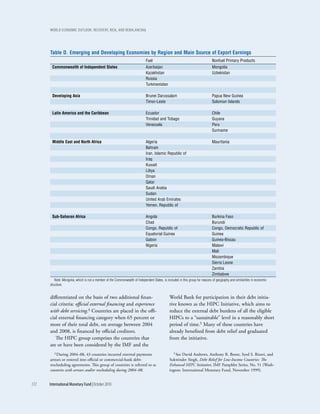
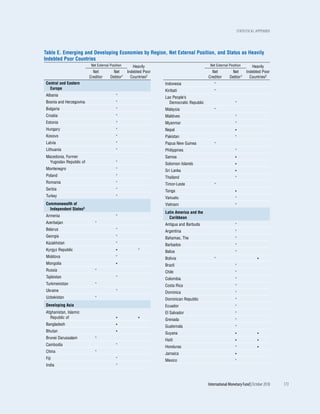
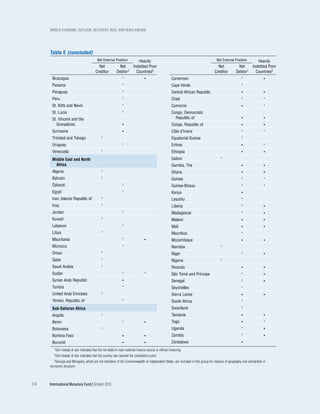
          Emerging and Developing Economies                                                                171
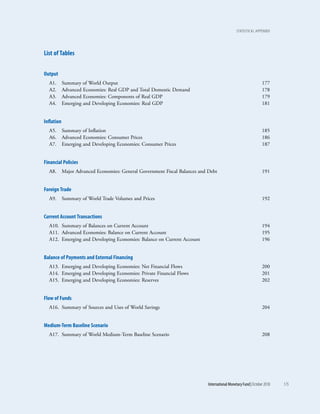
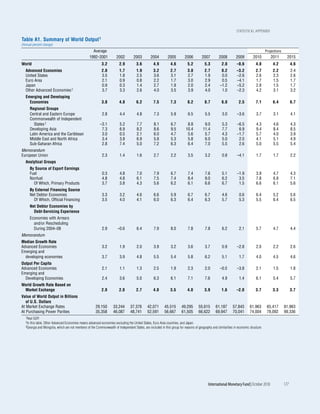
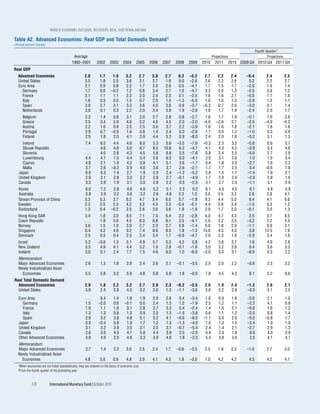
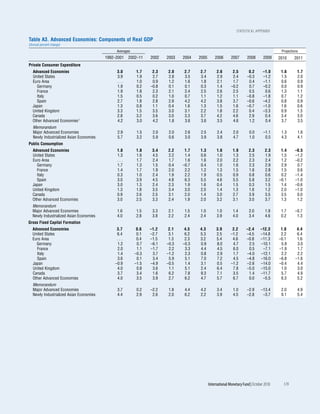
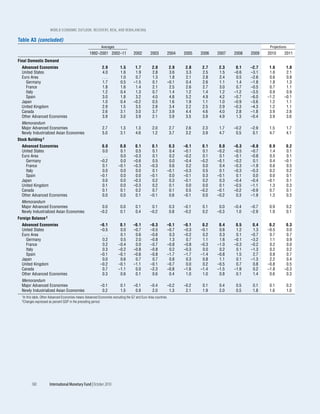
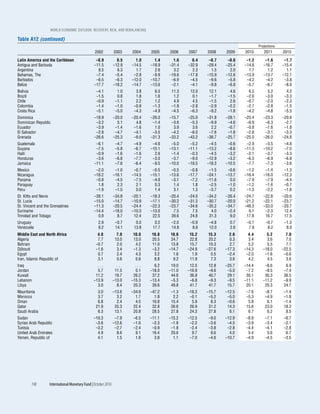
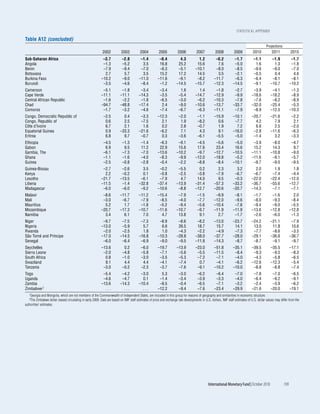
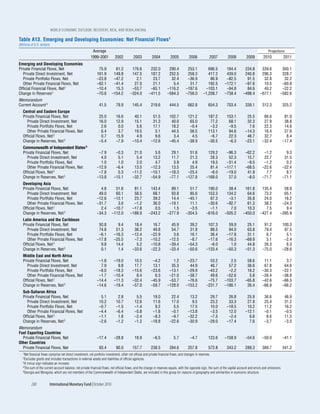
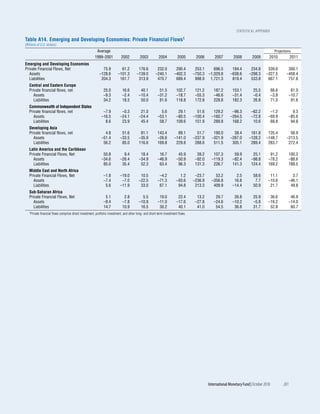
          List of Tables                                                                                   175
             Output (Tables A1–A4)                                                                         177
             Inflation (Tables A5–A7)                                                                      185
             Financial Policies (Table A8)                                                                 191
             Foreign Trade (Table A9)                                                                      192
             Current Account Transactions (Tables A10–A12)                                                 194
             Balance of Payments and External Financing (Tables A13–A15)                                   200
             Flow of Funds (Table A16)                                                                     204
             Medium-Term Baseline Scenario (Table A17)                                                     208

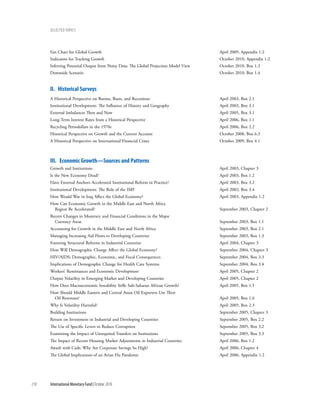
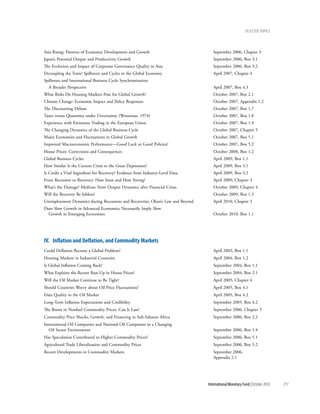
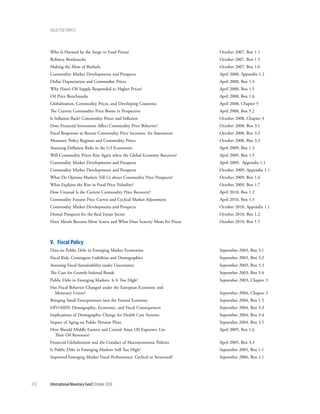
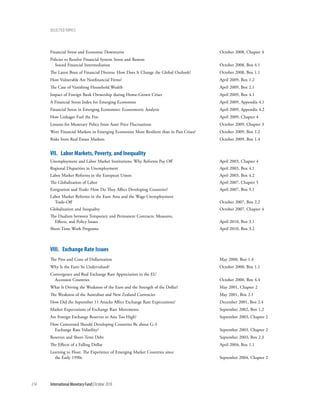
     World Economic Outlook, Selected topics                                                               209

     Boxes
          Box 1.1. Does Slow Growth in Advanced Economies Necessarily Imply Slow Growth in Emerging
                Economies?                                                                                  13
          Box 1.2. Dismal Prospects for the Real Estate Sector                                              20
          Box 1.3. Inferring Potential Output from Noisy Data: The Global Projection Model View             30
          Box 1.4. Uncoordinated Rebalancing                                                                41
          Box 1.5. Have Metals Become More Scarce, and What Does Scarcity Mean for Prices?                  51
          Box 2.1. Emerging Asia: Responding to Capital Inflows                                             67
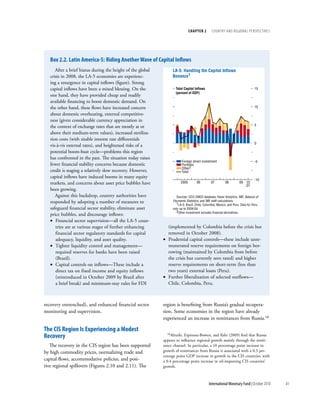
          Box 2.2. Latin America-5: Riding Another Wave of Capital Inflows                                  81
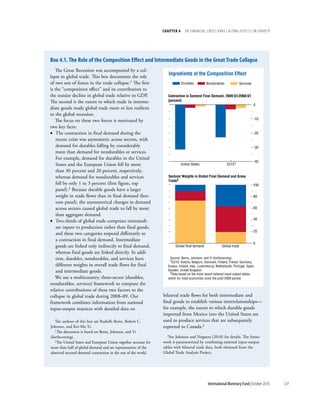
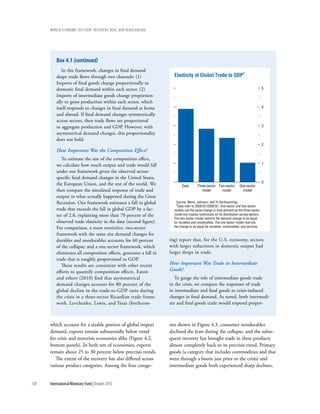
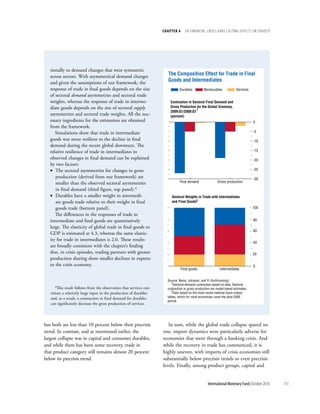
          Box 4.1. The Role of the Composition Effect and Intermediate Goods in the Great Trade Collapse   129
          Box 4.2. Protectionism in the Recent Crisis                                                      146
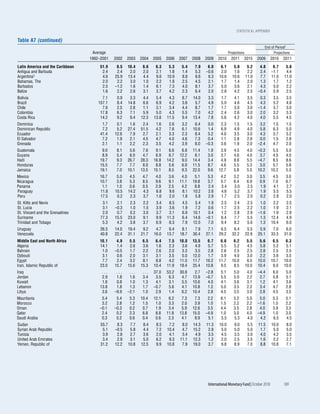
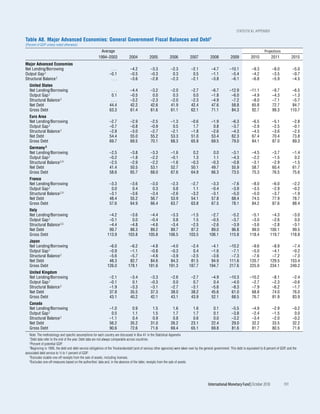
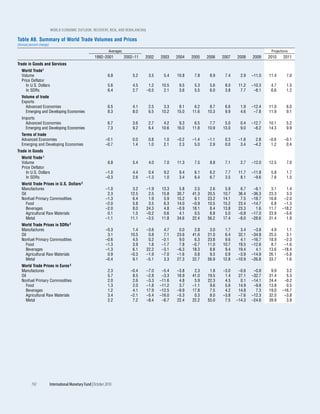
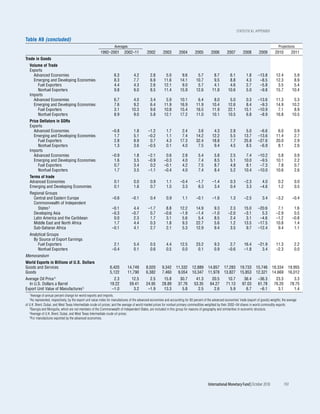
          A1. Economic Policy Assumptions Underlying the Projections for Selected Economies                164

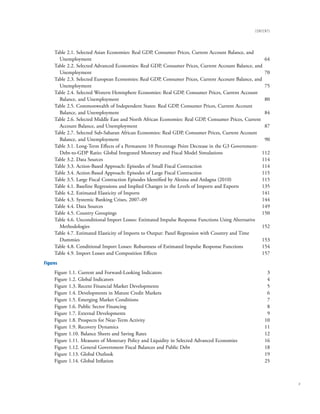
     tables
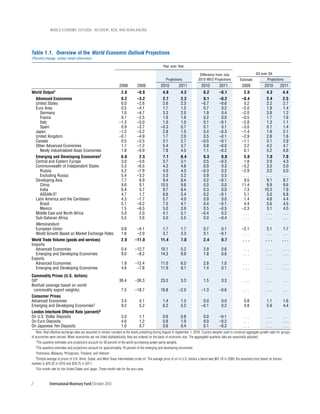
          Table 1.1. Overview of the World Economic Outlook Projections                                     2
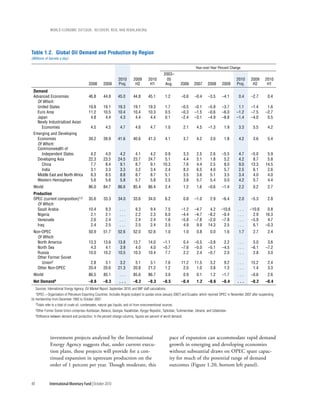
          Table 1.2. Global Oil Demand and Production by Region                                            48
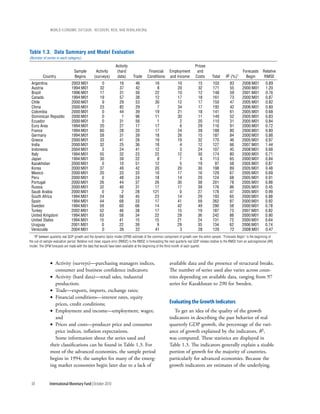
          Table 1.3. Data Summary and Model Evaluation                                                     58


iv
contents


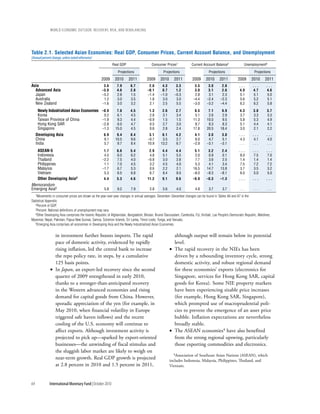
     Table 2.1. Selected Asian Economies: Real GDP, Consumer Prices, Current Account Balance, and
       Unemployment                                                                                   64
     Table 2.2. Selected Advanced Economies: Real GDP, Consumer Prices, Current Account Balance, and
       Unemployment                                                                                   70
     Table 2.3. Selected European Economies: Real GDP, Consumer Prices, Current Account Balance, and
       Unemployment                                                                                   75
     Table 2.4. Selected Western Hemisphere Economies: Real GDP, Consumer Prices, Current Account
       Balance, and Unemployment                                                                      80
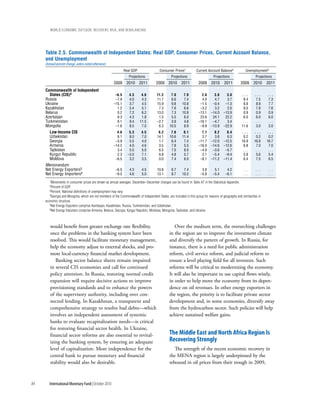
     Table 2.5. Commonwealth of Independent States: Real GDP, Consumer Prices, Current Account
       Balance, and Unemployment                                                                      84
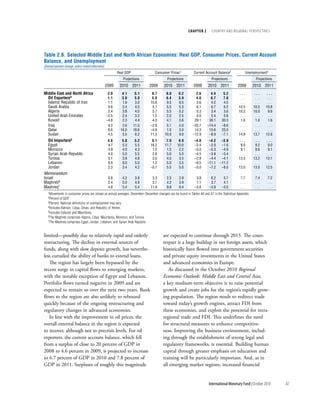
     Table 2.6. Selected Middle East and North African Economies: Real GDP, Consumer Prices, Current
       Account Balance, and Unemployment                                                              87
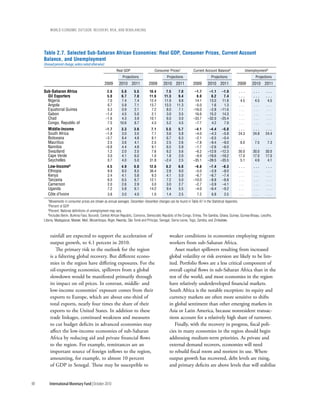
     Table 2.7. Selected Sub-Saharan African Economies: Real GDP, Consumer Prices, Current Account
       Balance, and Unemployment                                                                      90
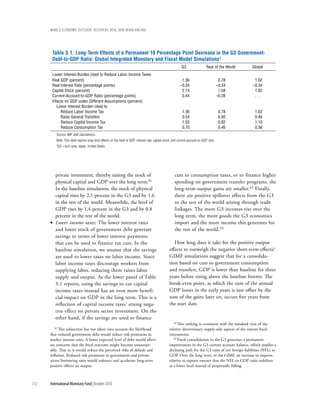
     Table 3.1. Long-Term Effects of a Permanent 10 Percentage Point Decrease in the G3 Government-
       Debt-to-GDP Ratio: Global Integrated Monetary and Fiscal Model Simulations                    112
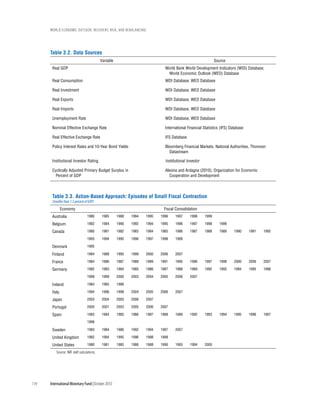
     Table 3.2. Data Sources                                                                         114
     Table 3.3. Action-Based Approach: Episodes of Small Fiscal Contraction                          114
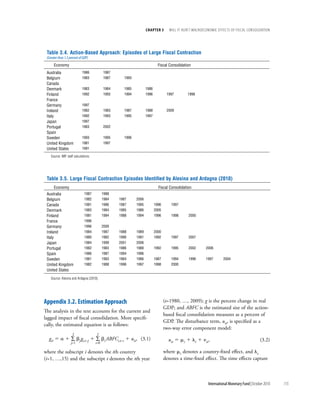
     Table 3.4. Action-Based Approach: Episodes of Large Fiscal Contraction                          115
     Table 3.5. Large Fiscal Contraction Episodes Identified by Alesina and Ardagna (2010)           115
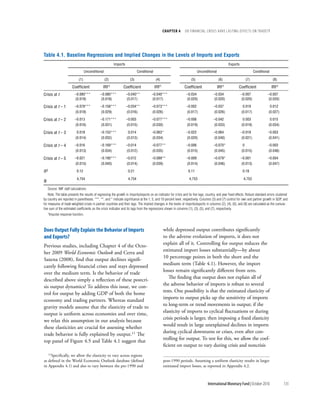
     Table 4.1. Baseline Regressions and Implied Changes in the Levels of Imports and Exports        135
     Table 4.2. Estimated Elasticity of Imports                                                      141
     Table 4.3. Systemic Banking Crises, 2007–09                                                     144
     Table 4.4. Data Sources                                                                         149
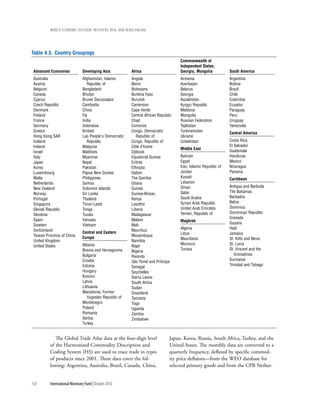
     Table 4.5. Country Groupings                                                                    150
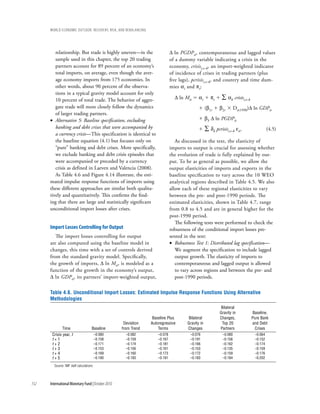
     Table 4.6. Unconditional Import Losses: Estimated Impulse Response Functions Using Alternative
       Methodologies                                                                                 152
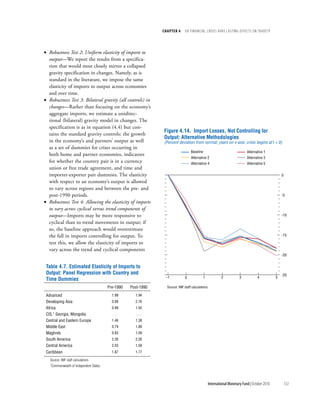
     Table 4.7. Estimated Elasticity of Imports to Output: Panel Regression with Country and Time
       Dummies                                                                                       153
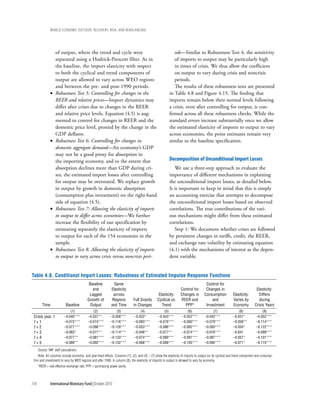
     Table 4.8. Conditional Import Losses: Robustness of Estimated Impulse Response Functions        154
     Table 4.9. Import Losses and Composition Effects                                                157
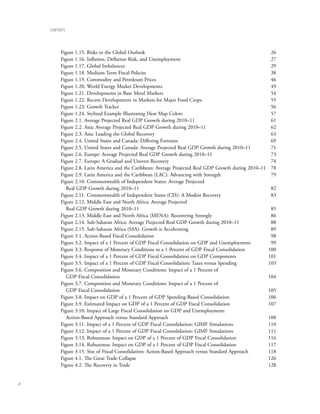
Figures
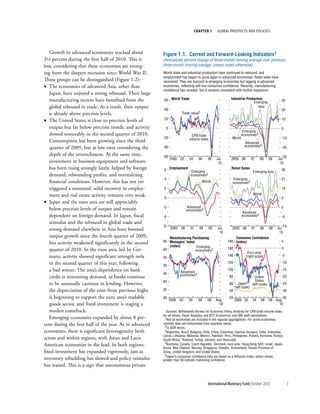
     Figure 1.1. Current and Forward-Looking Indicators                                                3
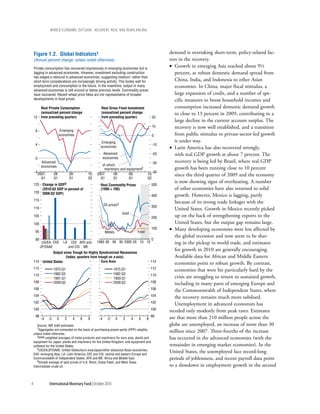
     Figure 1.2. Global Indicators                                                                     4
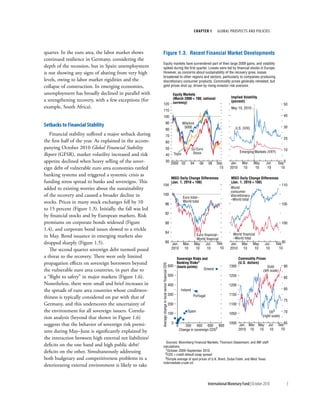
     Figure 1.3. Recent Financial Market Developments                                                  5
     Figure 1.4. Developments in Mature Credit Markets                                                 6
     Figure 1.5. Emerging Market Conditions                                                            7
     Figure 1.6. Public Sector Financing                                                               8
     Figure 1.7. External Developments                                                                 9
     Figure 1.8. Prospects for Near-Term Activity                                                     10
     Figure 1.9. Recovery Dynamics                                                                    11
     Figure 1.10. Balance Sheets and Saving Rates                                                     12
     Figure 1.11. Measures of Monetary Policy and Liquidity in Selected Advanced Economies            16
     Figure 1.12. General Government Fiscal Balances and Public Debt                                  18
     Figure 1.13. Global Outlook                                                                      19
     Figure 1.14. Global Inflation                                                                    25


                                                                                                            v
contents


          Figure 1.15. Risks to the Global Outlook                                                         26
          Figure 1.16. Inflation, Deflation Risk, and Unemployment                                         27
          Figure 1.17. Global Imbalances                                                                   29
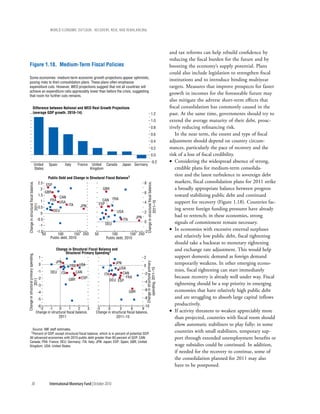
          Figure 1.18. Medium-Term Fiscal Policies                                                         38
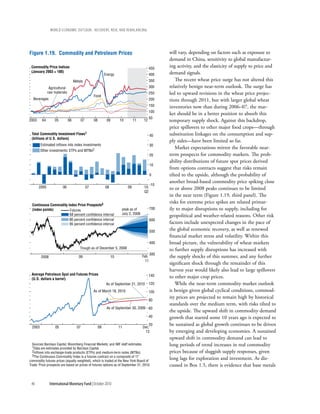
          Figure 1.19. Commodity and Petroleum Prices                                                      46
          Figure 1.20. World Energy Market Developments                                                    49
          Figure 1.21. Developments in Base Metal Markets                                                  54
          Figure 1.22. Recent Developments in Markets for Major Food Crops                                 55
          Figure 1.23. Growth Tracker                                                                      56
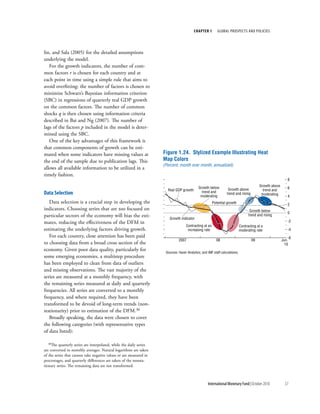
          Figure 1.24. Stylized Example Illustrating Heat Map Colors                                       57
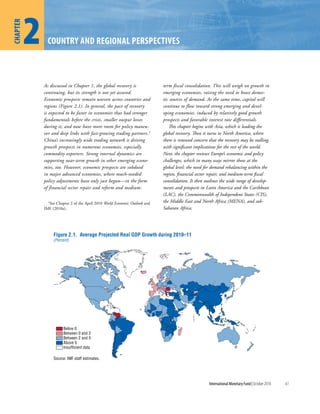
          Figure 2.1. Average Projected Real GDP Growth during 2010–11                                     61
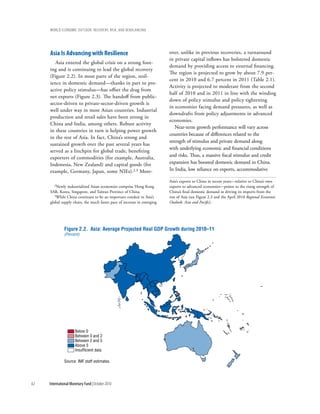
          Figure 2.2. Asia: Average Projected Real GDP Growth during 2010–11                               62
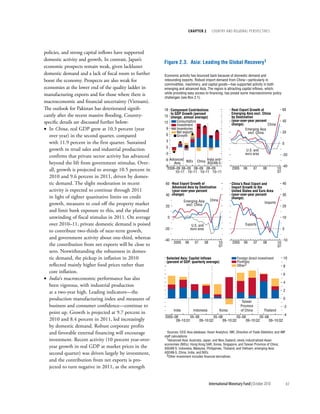
          Figure 2.3. Asia: Leading the Global Recovery                                                    63
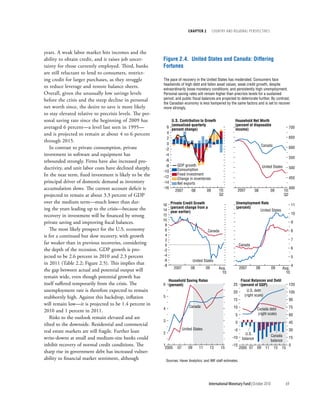
          Figure 2.4. United States and Canada: Differing Fortunes                                         69
          Figure 2.5. United States and Canada: Average Projected Real GDP Growth during 2010–11           71
          Figure 2.6. Europe: Average Projected Real GDP Growth during 2010–11                             73
          Figure 2.7. Europe: A Gradual and Uneven Recovery                                                74
          Figure 2.8. Latin America and the Caribbean: Average Projected Real GDP Growth during 2010–11    78
          Figure 2.9. Latin America and the Caribbean (LAC): Advancing with Strength                       79
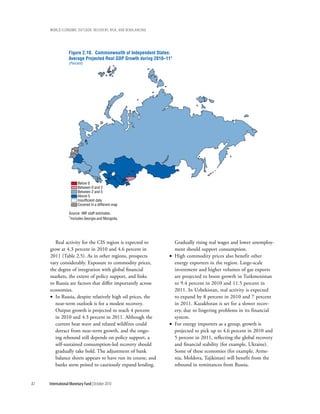
          Figure 2.10. Commonwealth of Independent States: Average Projected
             Real GDP Growth during 2010–11                                                                82
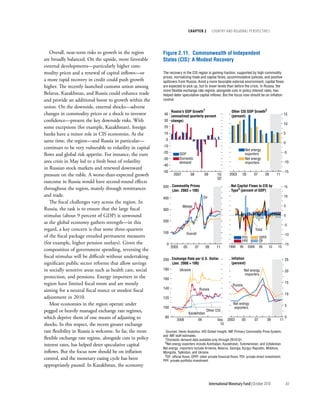
          Figure 2.11. Commonwealth of Independent States (CIS): A Modest Recovery                         83
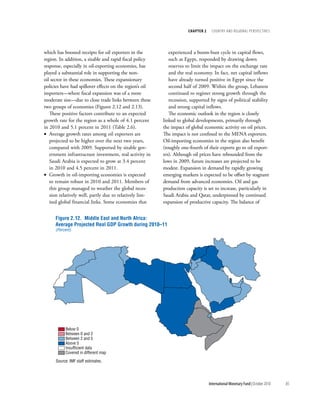
          Figure 2.12. Middle East and North Africa: Average Projected
             Real GDP Growth during 2010–11                                                                85
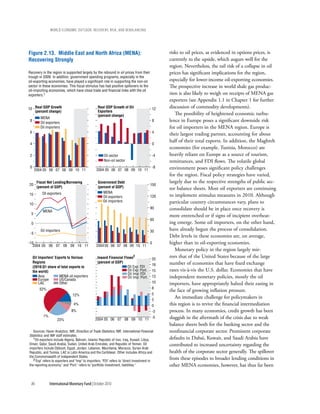
          Figure 2.13. Middle East and North Africa (MENA): Recovering Strongly                            86
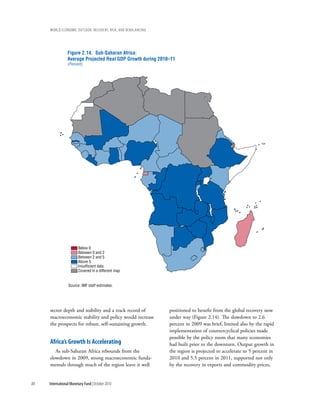
          Figure 2.14. Sub-Saharan Africa: Average Projected Real GDP Growth during 2010–11                88
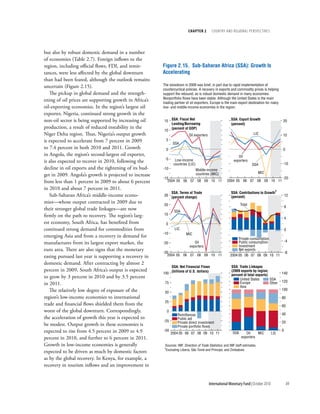
          Figure 2.15. Sub-Saharan Africa (SSA): Growth is Accelerating                                    89
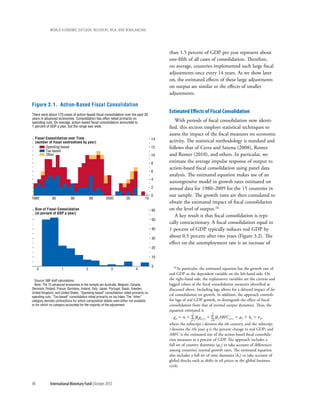
          Figure 3.1. Action-Based Fiscal Consolidation                                                    98
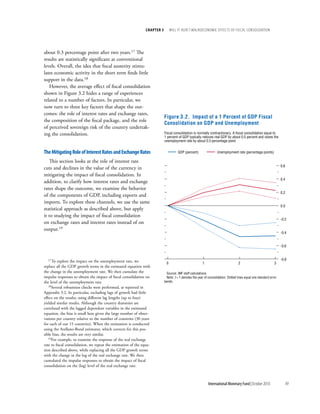
          Figure 3.2. Impact of a 1 Percent of GDP Fiscal Consolidation on GDP and Unemployment            99
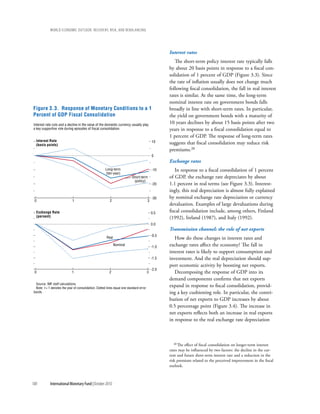
          Figure 3.3. Response of Monetary Conditions to a 1 Percent of GDP Fiscal Consolidation          100
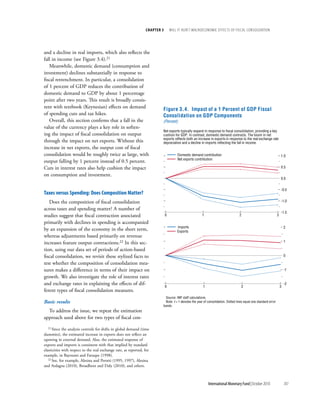
          Figure 3.4. Impact of a 1 Percent of GDP Fiscal Consolidation on GDP Components                 101
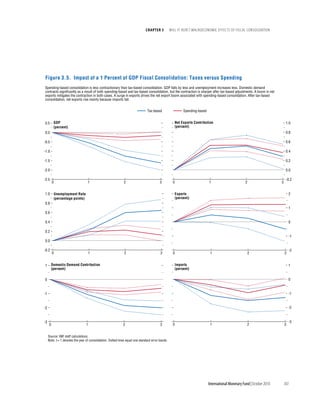
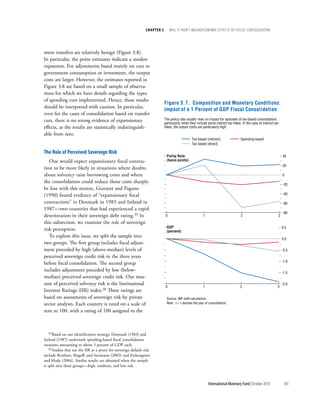
          Figure 3.5. Impact of a 1 Percent of GDP Fiscal Consolidation: Taxes versus Spending            103
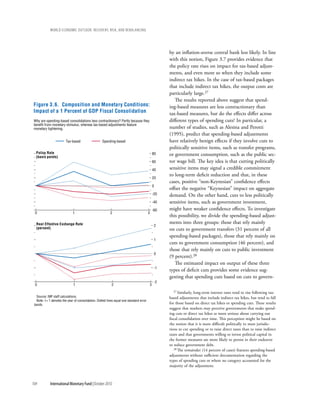
          Figure 3.6. Composition and Monetary Conditions: Impact of a 1 Percent of
             GDP Fiscal Consolidation                                                                     104
          Figure 3.7. Composition and Monetary Conditions: Impact of a 1 Percent of
             GDP Fiscal Consolidation                                                                     105
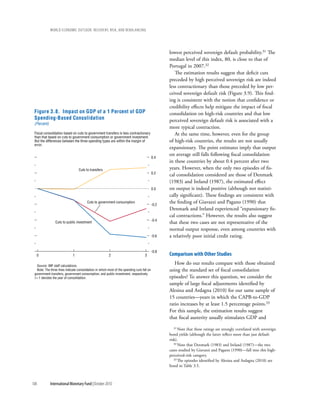
          Figure 3.8. Impact on GDP of a 1 Percent of GDP Spending-Based Consolidation                    106
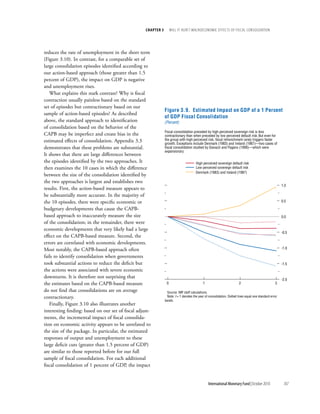
          Figure 3.9. Estimated Impact on GDP of a 1 Percent of GDP Fiscal Consolidation                  107
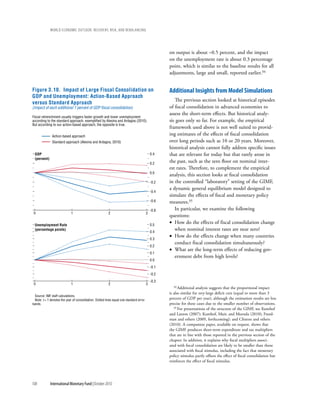
          Figure 3.10. Impact of Large Fiscal Consolidation on GDP and Unemployment:
             Action-Based Approach versus Standard Approach                                               108
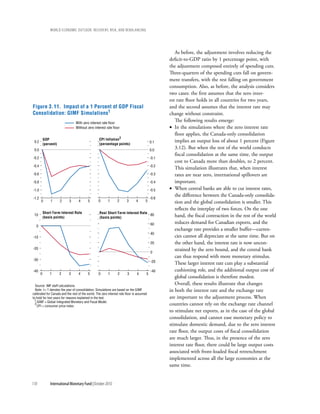
          Figure 3.11. Impact of a 1 Percent of GDP Fiscal Consolidation: GIMF Simulations                110
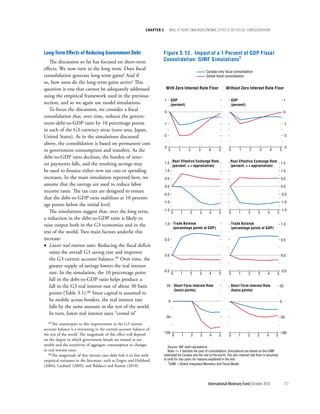
          Figure 3.12. Impact of a 1 Percent of GDP Fiscal Consolidation: GIMF Simulations                111
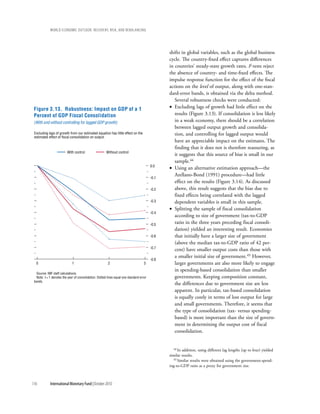
          Figure 3.13. Robustness: Impact on GDP of a 1 Percent of GDP Fiscal Consolidation               116
          Figure 3.14. Robustness: Impact on GDP of a 1 Percent of GDP Fiscal Consolidation               117
          Figure 3.15. Size of Fiscal Consolidation: Action-Based Approach versus Standard Approach       118
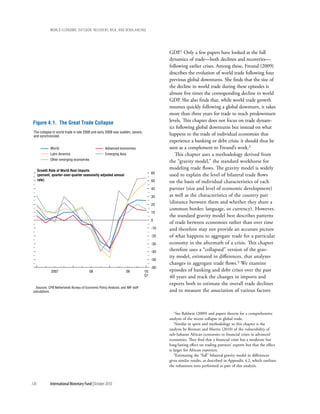
          Figure 4.1. The Great Trade Collapse                                                            126
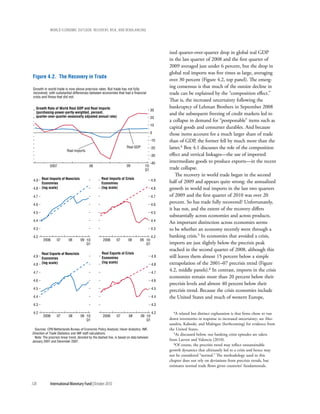
          Figure 4.2. The Recovery in Trade                                                               128


vi
contents


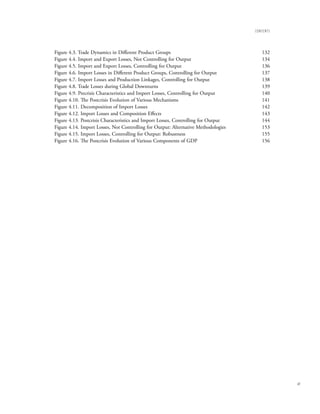
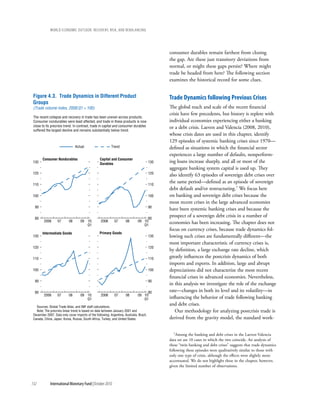
Figure 4.3. Trade Dynamics in Different Product Groups                                 132
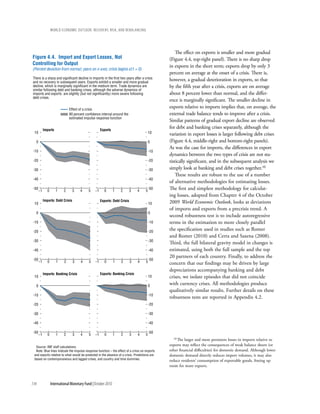
Figure 4.4. Import and Export Losses, Not Controlling for Output                       134
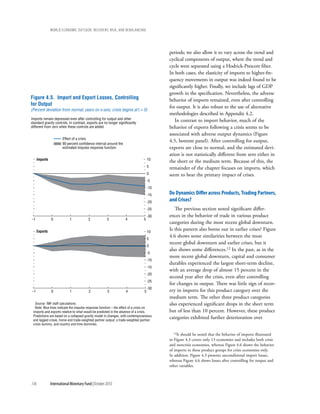
Figure 4.5. Import and Export Losses, Controlling for Output                           136
Figure 4.6. Import Losses in Different Product Groups, Controlling for Output          137
Figure 4.7. Import Losses and Production Linkages, Controlling for Output              138
Figure 4.8. Trade Losses during Global Downturns                                       139
Figure 4.9. Precrisis Characteristics and Import Losses, Controlling for Output        140
Figure 4.10. The Postcrisis Evolution of Various Mechanisms                            141
Figure 4.11. Decomposition of Import Losses                                            142
Figure 4.12. Import Losses and Composition Effects                                     143
Figure 4.13. Postcrisis Characteristics and Import Losses, Controlling for Output      144
Figure 4.14. Import Losses, Not Controlling for Output: Alternative Methodologies      153
Figure 4.15. Import Losses, Controlling for Output: Robustness                         155
Figure 4.16. The Postcrisis Evolution of Various Components of GDP                     156


                                                                                               vii
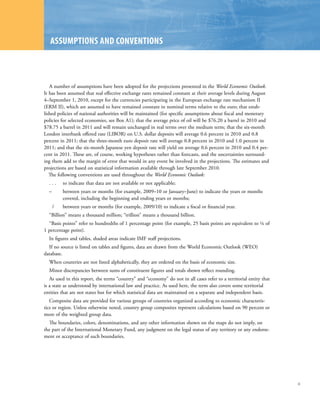
ASSuMPtIonS AnD ConvEntIonS


   A number of assumptions have been adopted for the projections presented in the World Economic Outlook.
It has been assumed that real effective exchange rates remained constant at their average levels during August
4–September 1, 2010, except for the currencies participating in the European exchange rate mechanism II
(ERM II), which are assumed to have remained constant in nominal terms relative to the euro; that estab-
lished policies of national authorities will be maintained (for specific assumptions about fiscal and monetary
policies for selected economies, see Box A1); that the average price of oil will be $76.20 a barrel in 2010 and
$78.75 a barrel in 2011 and will remain unchanged in real terms over the medium term; that the six-month
London interbank offered rate (LIBOR) on U.S. dollar deposits will average 0.6 percent in 2010 and 0.8
percent in 2011; that the three-month euro deposit rate will average 0.8 percent in 2010 and 1.0 percent in
2011; and that the six-month Japanese yen deposit rate will yield on average 0.6 percent in 2010 and 0.4 per-
cent in 2011. These are, of course, working hypotheses rather than forecasts, and the uncertainties surround-
ing them add to the margin of error that would in any event be involved in the projections. The estimates and
projections are based on statistical information available through late September 2010.
   The following conventions are used throughout the World Economic Outlook:
  ...     to indicate that data are not available or not applicable;
  –       between years or months (for example, 2009–10 or January–June) to indicate the years or months
          covered, including the beginning and ending years or months;
      /   between years or months (for example, 2009/10) to indicate a fiscal or financial year.
  “Billion” means a thousand million; “trillion” means a thousand billion.
  “Basis points” refer to hundredths of 1 percentage point (for example, 25 basis points are equivalent to ¼ of
1 percentage point).
  In figures and tables, shaded areas indicate IMF staff projections.
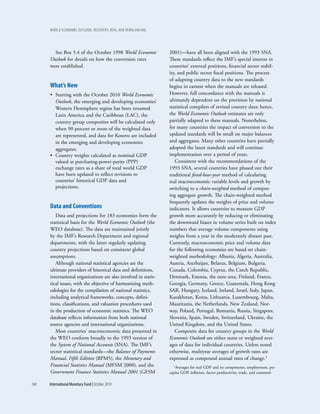
  If no source is listed on tables and figures, data are drawn from the World Economic Outlook (WEO)
database.
  When countries are not listed alphabetically, they are ordered on the basis of economic size.
  Minor discrepancies between sums of constituent figures and totals shown reflect rounding.
   As used in this report, the terms “country” and “economy” do not in all cases refer to a territorial entity that
is a state as understood by international law and practice. As used here, the term also covers some territorial
entities that are not states but for which statistical data are maintained on a separate and independent basis.
   Composite data are provided for various groups of countries organized according to economic characteris-
tics or region. Unless otherwise noted, country group composites represent calculations based on 90 percent or
more of the weighted group data.
  The boundaries, colors, denominations, and any other information shown on the maps do not imply, on
the part of the International Monetary Fund, any judgment on the legal status of any territory or any endorse-
ment or acceptance of such boundaries.


                                                                                                                      ix
FuRtHER InFoRMAtIon AnD DAtA


       This version of the World Economic Outlook is available in full on the IMF’s website, www.imf.org. Accom-
    panying it on the website is a larger compilation of data from the WEO database than is included in the
    report itself, including files containing the series most frequently requested by readers. These files may be
    downloaded for use in a variety of software packages.
       Inquiries about the content of the World Economic Outlook and the WEO database should be sent by mail,
    forum, or fax (telephone inquiries cannot be accepted) to
                                          World Economic Studies Division
                                               Research Department
                                           International Monetary Fund
                                               700 19th Street, N.W.
                                          Washington, D.C. 20431, U.S.A.
                           Forum address: www.imf.org/weoforum       Fax: (202) 623-6343


x
PREFACE


   The analysis and projections contained in the World Economic Outlook are integral elements of the IMF’s
surveillance of economic developments and policies in its member countries, of developments in international
financial markets, and of the global economic system. The survey of prospects and policies is the product
of a comprehensive interdepartmental review of world economic developments, which draws primarily on
information the IMF staff gathers through its consultations with member countries. These consultations are
carried out in particular by the IMF’s area departments—namely, the African Department, Asia and Pacific
Department, European Department, Middle East and Central Asia Department, and Western Hemisphere
Department—together with the Strategy, Policy, and Review Department; the Monetary and Capital Markets
Department; and the Fiscal Affairs Department.
   The analysis in this report was coordinated in the Research Department under the general direction of
Olivier Blanchard, Economic Counsellor and Director of Research. The project was directed by Jörg Decres-
sin, Assistant Director, Research Department, and Petya Koeva Brooks, Division Chief, Research Department.
   The primary contributors to this report are Abdul Abiad, Pete Devries, Rupa Duttagupta, Charles Freed-
man, Jaime Guajardo, Prakash Kannan, Douglas Laxton, Daniel Leigh, Prachi Mishra, Andrea Pescatori, Alas-
dair Scott, and Petia Topalova. Toh Kuan, Gavin Asdorian, Stephanie Denis, Angela Espiritu, Emory Oakes,
Murad Omoev, Andy Salazar, Min Kyu Song, Ercument Tulun, and Jessie Yang provided research assistance.
Saurabh Gupta, Mahnaz Hemmati, Laurent Meister, Liessel Ampie, Vladimir Bougay, Anastasia Francis,
Wendy Mak, Shamiso Mapondera, Nhu Nguyen, Pavel Pimenov, and Steve Zhang managed the database and
the computer systems. Jenita Arshad and Tita Gunio were responsible for word processing. Other contributors
include Rudolfs Bems, John Bluedorn, Philippe Bracke, Nese Erbil, Roberto Garcia-Saltos, Robert Gregory,
Thomas Helbling, Deniz Igan, Robert C. Johnson, Michael Kumhof, Prakash Loungani, Petar Manchev, Troy
Matheson, Susanna Mursula, David Reichsfeld, Shaun Roache, Jair Rodriguez, Marina Rousset, Robert J. Tet-
low, and Kei-Mu Yi. David Romer of the Research Department provided advice and encouragement. Donald
Davis was an external consultant. Kevin Clinton provided comments and suggestions. Linda Griffin Kean of
the External Relations Department edited the manuscript and coordinated the production of the publication.
   The analysis has benefited from comments and suggestions by staff from other IMF departments, as well as
by Executive Directors following their discussion of the report on September 20, 2010. However, both projec-
tions and policy considerations are those of the IMF staff and should not be attributed to Executive Directors
or to their national authorities.


                                                                                                                 xi
FoREWoRD


A
             chieving a “strong, balanced, and sus-          The result is a recovery that is neither strong nor
             tained world recovery”—to quote from         balanced and runs the risk of not being sustained.
             the goal set in Pittsburgh by the G20—       For the past year or so, inventory accumulation
             was never going to be easy. It requires      and fiscal stimulus were driving the recovery. The
much more than just going back to business as             first is coming to an end. The second is slowly
usual. It requires two fundamental and difficult          being phased out. Consumption and investment
economic rebalancing acts.                                now have to take the lead. But in most advanced
    First, internal rebalancing: When private demand      economies, weak consumption and investment,
collapsed, fiscal stimulus helped alleviate the fall in   together with little improvement in net exports, are
output. But fiscal stimulus has to eventually give        leading to low growth. Unemployment is high and
way to fiscal consolidation, and private demand           barely decreasing. By contrast, in many emerging
must be strong enough to take the lead and sustain        market economies, where excesses were limited and
growth.                                                   the scars are few, consumption, investment, and net
    Second, external rebalancing: Many advanced           exports are all contributing to strong growth, and
economies, most notably the United States, which          output is once again close to potential.
relied excessively on domestic demand, must now              What can be done to improve things?
rely more on net exports. Many emerging mar-                 First, and wherever private demand is weak,
ket economies, most notably China, which relied           central banks should continue with accommodative
excessively on net exports, must now rely more on         monetary policy. However, one should be realistic.
domestic demand.                                          Not much more can be done, and one should not
    These two rebalancing acts are taking place too       expect too much from further quantitative or credit
slowly.                                                   easing. While there is no evidence yet that sustained
    Private domestic demand remains weak in               low interest rates are leading to excessive risk tak-
advanced economies. This weakness reflects both           ing, should such risks materialize, they should be
a correction of precrisis excesses and the scars of       addressed through macroprudential measures, not
the crisis. U.S. consumers who had overborrowed           through increases in policy rates.
before the crisis are now saving more and consum-            Second, and wherever needed, governments
ing less, and while this is good for the long term,       must continue both financial repair and financial
it is a drag on demand in the short term. Hous-           reform. Many banks remain undercapitalized, and
ing booms have given way to housing slumps, and           tight credit is constraining segments of demand.
housing investment will remain depressed for some         Securitization, which must play an important role
time. And weaknesses in the financial system are          in any future intermediation system, is still mori-
still constraining credit.                                bund. Financial reform is proceeding, but questions
    External rebalancing remains limited. Net exports     remain about “too-big-to-fail” institutions, the
are not contributing to growth in advanced econo-         perimeter of regulation, and cross-border issues. The
mies, and the U.S. trade deficit remains large. Many      faster reform uncertainty is reduced, the more the
emerging market economies continue to run large           financial system will support demand and growth.
current account surpluses and to respond to capital          Third, and again wherever needed, governments
inflows primarily through reserve accumulation            must address fiscal consolidation. What is essential
rather than exchange rate appreciation. Interna-          is not so much phasing out fiscal stimulus now,
tional reserves are higher than they have ever been       but offering credible medium-term plans for debt
and continue to increase.                                 stabilization and, eventually, debt reduction. Such


                                                                                                                   xiii
FoReWoRD


      credible plans may involve fiscal rules, the cre-         production toward domestic goods. Finally, to the
      ation of independent fiscal agencies, and phased-in       extent that countries remain worried about sudden
      entitlement reforms. They have not been offered in        stops, better provision of global liquidity can play
      most countries, but they are essential and, once in       an important role and limit the accumulation of
      place, will give governments more fiscal flexibility to   reserves.
      sustain growth in the short term.                            All these pieces are interconnected. Unless
         Fourth, emerging market economies with large           advanced economies can count on stronger private
      current account surpluses must accelerate rebal-          demand, both domestic and foreign, they will find
      ancing. This is not only in the world economy’s           it difficult to achieve fiscal consolidation. And wor-
      interest, but also in their own. In many coun-            ries about sovereign risk can easily derail growth.
      tries, distortions have led to too low a level of         If growth stops in advanced economies, emerging
      consumption or too little investment. Removing            market economies will have a hard time decoupling.
      these distortions and thus allowing consumption           The need for careful design at the national level,
      and investment to increase is desirable. To a large       and coordination at the global level, may be even
      extent, market forces in the form of large capital        more important today than at the peak of the crisis,
      inflows are pushing these countries in the right          a year and a half ago.
      direction. Unless offset by reserve accumulation,
      capital inflows will lead to exchange rate apprecia-
      tion. With the help of macroprudential measures           Olivier Blanchard
      and capital controls, these flows can help reallocate     Economic Counsellor


xiv
ExECutIvE SuMMARy


Thus far, economic recovery is proceeding broadly as       Economic Outlook (WEO) Update. A surge in inven-
expected, but downside risks remain elevated. Most         tory and, lately, fixed investment accounted for a
advanced economies and a few emerging economies            dramatic rise in manufacturing and global trade.
still face large adjustments. Their recoveries are         Low consumer confidence and reduced household
proceeding at a sluggish pace, and high unemploy-          incomes and wealth are holding consumption down
ment poses major social challenges. By contrast, many      in many advanced economies. Growth in these
emerging and developing economies are again seeing         economies reached only about 3½ percent during
strong growth, because they did not experience major       the first half of 2010, a low rate considering that
financial excesses just prior to the Great Recession.      they are emerging from the deepest recession since
Sustained, healthy recovery rests on two rebalancing       World War II. Their recoveries will remain fragile
acts: internal rebalancing, with a strengthening of        for as long as improving business investment does
private demand in advanced economies, allowing for         not translate into higher employment growth. How-
fiscal consolidation; and external rebalancing, with       ever, household spending is doing well in many
an increase in net exports in deficit countries, such      emerging market economies, which expanded by
as the United States, and a decrease in net exports in     close to 8 percent and where investment is propel-
surplus countries, notably emerging Asia. The two          ling job creation. This heterogeneity in the pace of
interact in strong ways. Increased net exports in          recovery across advanced and emerging economies
advanced economies imply higher demand and higher          is discussed in detail in Chapter 2.
growth, allowing more room for fiscal consolida-              At the same time, financial stability suffered a
tion. Strengthened domestic demand helps emerging          major setback, as explained in the accompanying
market economies maintain growth in the face of            October 2010 Global Financial Stability Report
lower exports. A number of policies are required to        (GFSR). Market volatility increased and investor
support these rebalancing acts. In advanced economies,     confidence dropped. Prices in many stock exchanges
the repair and reform of the financial sector need         fell, led initially by financial stocks and by Euro-
to accelerate to allow a resumption of healthy credit      pean markets. Heavy selling of the sovereign debt of
growth. In addition, fiscal adjustment needs to start      vulnerable euro area economies rattled the bank-
in earnest in 2011. Specific plans to cut future budget    ing system, triggering a systemic crisis. This added
deficits are urgently needed now to create new room        to existing worries about the sustainability of the
for fiscal policy maneuver. If global growth threatens     recovery and caused a broader decline in stocks.
to slow appreciably more than expected, countries          Risk premiums on corporate bonds widened, and
with fiscal room could postpone some of the planned        corporate bond issues slowed to a trickle in May.
consolidation. Meanwhile, key emerging economies           Issuance in emerging markets also dropped sharply.
will need to further develop domestic sources of growth,   Since the beginning of the summer, however, finan-
with the support of greater exchange rate flexibility.     cial conditions have improved again. Tail risks have
                                                           been reduced by unprecedented European policy
                                                           initiatives—the European Central Bank’s Securi-
Stronger Activity, but Setbacks to Financial               ties Markets Program and euro area governments’
Stability                                                  European Stabilization Mechanism—and by a
   Economic recovery continued to strengthen dur-          front-loading of fiscal adjustment. However, under-
ing the first half of 2010. Global activity expanded       lying sovereign and banking vulnerabilities remain a
at an annual rate of about 5¼ percent––about ½             significant challenge amid lingering concerns about
percent higher than anticipated in the July World          risks to the global recovery.


                                                                                                                  xv
eXecUtIVe sUMMARY


      Questions about the Pace of Recovery                      expected, countries with fiscal room could postpone
                                                                some of the planned consolidation. One of the
         The global recovery remains fragile, because
                                                                most urgent challenges for advanced economies is
      strong policies to foster internal rebalancing of
                                                                to legislate plans that help achieve sustainable fiscal
      demand from public to private sources and exter-
                                                                positions before the end of the decade. This task is
      nal rebalancing from deficit to surplus economies
                                                                now more pressing than it was six months ago to
      are not yet in place. Global activity is forecast to
                                                                rebuild room for fiscal policy maneuver in the face
      expand by 4.8 percent in 2010 and 4.2 percent
                                                                of still-volatile sovereign debt markets. Such room
      in 2011, broadly in line with earlier expectations,
                                                                could be needed because monetary policy alone
      and downside risks continue to predominate.
                                                                might not be able to provide sufficient support to
      WEO projections are that output of emerging and
                                                                counter the threat of a weakening of activity that is
      developing economies will expand at rates of 7.1
                                                                markedly more pronounced than expected.
      and 6.4 percent, respectively, in 2010 and 2011. In
                                                                   Fiscal policy tightening will likely prove contrac-
      advanced economies, however, growth is projected
                                                                tionary in most economies, although the extent is
      at only 2.7 and 2.2 percent, respectively, with some
                                                                difficult to gauge. The survey of past experience
      economies slowing noticeably during the second
                                                                in Chapter 3 suggests that fiscal consolidation
      half of 2010 and the first half of 2011, followed
                                                                in advanced economies typically detracts from
      by a reacceleration of activity. Slack will remain
                                                                short-term growth. The introduction of credible,
      substantial and unemployment persistently high.
                                                                growth-friendly, medium-term fiscal consolidation
      Inflation is projected to stay generally low, amid
                                                                plans––currently not on offer in many advanced
      continued excess capacity and high unemployment,
                                                                economies––would help limit the deflationary
      with a few exceptions among the emerging econo-
                                                                impact of consolidation on private demand in
      mies. Risks to the growth forecasts are mainly to
                                                                the short term. Such plans would have to include
      the downside. However, the probability of a sharp
                                                                reforms to rapidly growing spending programs,
      global slowdown, including stagnation or contrac-
                                                                notably entitlements, and tax reforms that favor
      tion in advanced economies, still appears low.
                                                                production rather than consumption.
                                                                   Better financial sector policies and practices in
                                                                advanced economies are critical for strengthening
      More Proactive Policies Are needed                        the resilience of the recovery to shocks and sustain-
         Policies need to become more proactive to              ing private demand over the medium term. Progress
      achieve the required internal and external rebalanc-      on this front has been very slow. Apparently isolated
      ing. Most advanced economies and a few emerging           difficulties in a few spots can have large spillover
      economies still face major adjustments, including         effects, via complex financial linkages and deterio-
      the need to strengthen household balance sheets,          ration of fragile confidence. As the October 2010
      stabilize and subsequently reduce high public             GFSR explains, incomplete progress in addressing
      debt, and repair and reform their financial sectors.      the legacy problems of the crisis has left systems in
      Monetary policy should stay highly supportive in          advanced economies vulnerable. Failure to rapidly
      most of the advanced economies and should be the          resolve, restructure, or consolidate weak banks and
      first line of defense against any larger-than-projected   repair wholesale markets raises the need for further
      weakening of activity as fiscal support diminishes.       fiscal backstopping and low interest rates to support
      With policy rates already near zero in the large          recovery, which can cause other problems, includ-
      advanced economies, monetary policymakers may             ing spillovers to emerging economies. More broadly,
      have to resort to further unconventional measures         policymakers need to continue to clarify and specify
      if private demand weakens unexpectedly as fiscal          regulatory reform, building on the improvements
      support wanes.                                            proposed by the Basel Committee on Banking
         Fiscal adjustment needs to start in 2011. If global    Supervision. This would help financial markets and
      growth threatens to slow appreciably more than            institutions provide more support, on a sounder


xvi
eXecUtIVe sUMMARY


basis, for consumption and investment, which is        immediately, because domestic demand recovery is
essential for strong, sustainable growth.              already well under way or public debt is relatively
   Structural policies that strengthen growth over     high. In various emerging economies, rising infla-
the medium term would also help support the            tion or high credit growth also signal a need for
required normalization of macroeconomic policies       further monetary tightening.
in advanced economies. While supportive macro-            Many emerging and developing economies have
economic policies and financial sector repair and      successfully concluded first-generation reforms
reform are essential for stronger job creation, in a   that improved macroeconomic policy frameworks,
number of economies, labor market policies could       strengthening their resilience to macroeconomic
enhance growth and job creation and reduce high        shocks. However, to sustain or further raise poten-
unemployment over the medium term. Comple-             tial growth and employment, efforts could usefully
mentary reforms to product and services markets        focus on simplifying product and services market
could strengthen the employment effects by boost-      regulation, raising human capital, and building
ing labor demand and real wages through greater        critical infrastructure. Such reforms would also help
competition and lower markups on prices.               absorb growing capital inflows in a productive man-
   Although many emerging economies are seeing         ner, which would accelerate global income conver-
high growth again, they continue to rely sig-          gence and external rebalancing. As Chapter 1 and
nificantly on demand from advanced economies.          the October 2010 GFSR underscore, these flows
Chapter 4 makes clear that demand for imports          can be expected to grow over the medium term, as
from the advanced economies will continue to be        the performance of emerging economies improves
below precrisis trends, in view of the high share      relative to that of the advanced economies, yields in
of consumer durables and investment goods in           the advanced economies remain low for some time,
trade. Emerging economies that relied heavily on       and institutional investors in advanced economies
demand from these economies will therefore have to     continue to diversify their exposures.
rebalance growth further toward domestic sources          Strong, coordinated policy responses by all are
to achieve growth rates similar to those before the    essential to limit the fallout of the Great Reces-
crisis, helping the required external rebalancing.     sion. Historical evidence suggests that countries
In economies with excessive external surpluses,        hit by financial crises typically suffer permanent
which are mainly in emerging Asia, fiscal tighten-     output losses relative to precrisis trends. How-
ing should therefore take a backseat to monetary       ever, outcomes after individual crises have varied
tightening and exchange rate flexibility. Removing     widely, depending on the policy responses. So far,
distortions that drive high household or corporate     much progress has been made through coordinated
saving rates and deter investment in nontradables      policy responses in alleviating liquidity strains and
sectors would facilitate the rebalancing of growth     rebuilding confidence, and this has been essential
to domestic sources. Such rebalancing will require     for activity to rebound. The challenge ahead is for
further deregulation and reform of financial sectors   policymakers to put in place, in a coordinated man-
and corporate governance, as well as stronger social   ner, policies that support the fundamental adjust-
safety nets in key Asian economies. In many other      ments needed for a return to healthy medium-term
emerging economies, fiscal tightening can start        growth.


                                                                                                                xvii
1
chapter


                Global proSpectS and policieS


              Thus far, economic recovery is proceeding broadly as            solidation. Meanwhile, key emerging economies will
              expected, although downside risks remain elevated. Most         need to further develop domestic sources of growth,
              advanced and a few emerging economies still face major          with the support of greater exchange rate flexibility.
              adjustments, including the need to strengthen household
              balance sheets, stabilize and subsequently reduce high
              public debt, and repair and reform their financial sectors.     Stronger activity, but Setbacks to Financial
              In many of these economies, the financial sector is still       Stability
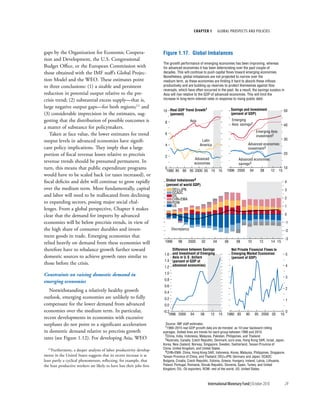
              vulnerable to shocks, and growth appears to be slow-               Economic recovery continued to strengthen
              ing as policy stimulus wanes. By contrast, in emerging          during the first half of 2010, but global financial
              and developing economies prudent policies, implemented          stability suffered a major setback with the turmoil
              partly in response to earlier crises, have contributed to       in sovereign debt markets in the second quarter
              a significantly improved medium-term growth outlook             of 2010. The extent of economic recovery differs
              relative to the aftermath of previous global recessions.        importantly across regions, with Asia in the lead.
              However, activity in these economies, particularly those        The United States and Japan experienced a notice-
              in emerging Asia, remains dependent on demand in                able slowdown during the second quarter of 2010,
              advanced economies. In this setting, global activity is fore-   while growth accelerated in Europe and stayed
              cast to expand by 4.8 percent in 2010 and 4.2 percent in        strong in emerging and developing economies.
              2011, with a temporary slowdown during the second half          Financial conditions have begun to normalize, but
              of 2010 and the first half of 2011. Output of emerg-            institutions and markets are still fragile. In general,
              ing and developing economies is projected to expand at          volatility in financial, currency, and commodity
              rates of 7.1 percent and 6.4 percent in 2010 and 2011,          markets remains elevated.
              respectively. In advanced economies, however, growth is
              projected to be only 2.7 percent and 2.2 percent, respec-
              tively. Risks to the forecast are mainly to the downside.       Growing Momentum through the First half of 2010
              Sustained, healthy recovery rests on two rebalancing acts:         The world economy expanded at an annual rate
              internal rebalancing, with a strengthening of private           of about 5¼ percent during the first half of 2010––
              demand in advanced economies, allowing for fiscal               about ½ percent higher than in the July 2010 World
              consolidation; and external rebalancing, with an increase       Economic Outlook (WEO) Update (Table 1.1). World
              in net exports in deficit countries and a decrease in net       industrial production reached growth rates of about
              exports in surplus countries, notably emerging Asia. The        15 percent, and global trade recovered at rates over
              two interact in strong ways. Increased net exports in           40 percent during this period (Figure 1.1). A surge
              advanced economies imply higher demand and higher               in inventory and, lately, fixed investment accounts
              growth, allowing more room for fiscal consolidation. A          for this dramatic rise––with the latter in particular
              number of policies are required to support these rebalanc-      boding well for continued recovery. Manufacturing
              ing acts. In advanced economies, repair and reform of the       confidence indices are back to precrisis levels, and
              financial sector need to accelerate to allow a resumption       employment in advanced economies is expanding
              of healthy credit growth. In addition, fiscal adjustment        moderately. Household spending is doing well in
              needs to start in earnest in 2011. Specific plans to cut        emerging market economies, but in advanced econo-
              future budget deficits are urgently needed to create new        mies, low consumer confidence, high unemployment,
              room for fiscal policy maneuver. If global growth threatens     stagnant incomes, and reduced household wealth
              to slow appreciably more than expected, countries with          are holding consumption down. Chapter 2 discusses
              fiscal room could postpone some of the planned con-             regional developments in more detail.


                                                                                                        International Monetary Fund | October 2010   1
wOrld ecOnOmic OutlOOk: recOvery, risk, and rebalancing


Table 1.1. Overview of the World Economic Outlook Projections
(Percent change, unless noted otherwise)

                                                                                                    Year over Year

                                                                                                                                Difference from July                       Q4 over Q4
                                                                                                      Projections              2010 WEO Projections            Estimate             Projections
                                                                   2008         2009               2010         2011              2010         2011              2009             2010        2011
World Output1                                                       2.8         –0.6                4.8           4.2              0.2         –0.1               2.0               4.3         4.4
  Advanced Economies                                                0.2         –3.2                2.7           2.2              0.1         –0.2              –0.4              2.4          2.5
  United States                                                     0.0         –2.6                2.6           2.3             –0.7         –0.6               0.2              2.2          2.7
  Euro Area                                                         0.5         –4.1                1.7           1.5              0.7          0.2              –2.0              1.9          1.4
    Germany                                                         1.0         –4.7                3.3           2.0              1.9          0.4              –2.0              3.9          1.2
    France                                                          0.1         –2.5                1.6           1.6              0.2          0.0              –0.5              1.7          1.6
    Italy                                                          –1.3         –5.0                1.0           1.0              0.1         –0.1              –2.8              1.3          1.1
    Spain                                                           0.9         –3.7               –0.3           0.7              0.1          0.1              –3.0              0.1          1.4
  Japan                                                            –1.2         –5.2                2.8           1.5              0.4         –0.3              –1.4              1.9          2.1
  United Kingdom                                                   –0.1         –4.9                1.7           2.0              0.5         –0.1              –2.9              2.8          1.6
  Canada                                                            0.5         –2.5                3.1           2.7             –0.5         –0.1              –1.1              3.1          2.9
  Other Advanced Economies                                          1.7         –1.2                5.4           3.7              0.8         –0.0               3.2              4.2          4.7
    Newly Industrialized Asian Economies                            1.8         –0.9                7.8           4.5              1.1         –0.2               6.1              5.2          6.6
  Emerging and Developing Economies2                                6.0          2.5                7.1           6.4              0.3          0.0               5.6              7.0          7.0
  Central and Eastern Europe                                        3.0         –3.6                3.7           3.1              0.5         –0.3               1.8              2.9          4.3
  Commonwealth of Independent States                                5.3         –6.5                4.3           4.6              0.0          0.3              –3.2              3.3          5.0
    Russia                                                          5.2         –7.9                4.0           4.3             –0.3          0.2              –2.9              3.2          5.0
    Excluding Russia                                                5.4         –3.2                5.3           5.2              0.9          0.5               ...              ...          ...
  Developing Asia                                                   7.7          6.9                9.4           8.4              0.2         –0.1               9.5              9.1          8.7
    China                                                           9.6          9.1               10.5           9.6              0.0          0.0              11.4              9.9          9.6
    India                                                           6.4          5.7                9.7           8.4              0.3          0.0               7.3             10.3          7.9
    ASEAN-53                                                        4.7          1.7                6.6           5.4              0.2         –0.1               5.1              5.0          6.8
  Latin America and the Caribbean                                   4.3         –1.7                5.7           4.0              0.9          0.0               1.4              4.8          4.4
    Brazil                                                          5.1         –0.2                7.5           4.1              0.4         –0.1               4.4              5.6          4.5
    Mexico                                                          1.5         –6.5                5.0           3.9              0.5         –0.5              –2.3              3.1          4.5
  Middle East and North Africa                                      5.0          2.0                4.1           5.1             –0.4          0.2               ...              ...          ...
  Sub-Saharan Africa                                                5.5          2.6                5.0           5.5              0.0         –0.4               ...              ...          ...
  Memorandum
  European Union                                                    0.8         –4.1                1.7           1.7              0.7          0.1              –2.1              2.1         1.7
  World Growth Based on Market Exchange Rates                       1.6         –2.0                3.7           3.3              0.1         –0.1               ...              ...         ...
World Trade Volume (goods and services)                             2.9        –11.0               11.4           7.0              2.4          0.7              ...               ...         ...
Imports
  Advanced Economies                                                0.4        –12.7               10.1           5.2              2.9           0.6              ...              ...          ...
  Emerging and Developing Economies                                 9.0         –8.2               14.3           9.9              1.8           0.6              ...              ...          ...
Exports
  Advanced Economies                                                1.9        –12.4               11.0           6.0              2.8           1.0              ...              ...          ...
  Emerging and Developing Economies                                 4.6         –7.8               11.9           9.1              1.4           0.1              ...              ...          ...
Commodity Prices (U.S. dollars)
Oil4                                                               36.4        –36.3               23.3           3.3              1.5           0.3              ...              ...          ...
Nonfuel (average based on world
 commodity export weights)                                          7.5        –18.7               16.8         –2.0              –1.3         –0.6               ...              ...          ...
Consumer Prices
Advanced Economies                                                  3.4           0.1               1.4           1.3              0.0           0.0              0.8               1.1         1.6
Emerging and Developing Economies2                                  9.2           5.2               6.2           5.2             –0.1           0.2              4.8               5.9         4.4
London Interbank Offered Rate (percent)5
On U.S. Dollar Deposits                                             3.0           1.1               0.6           0.8              0.0         –0.1               ...              ...          ...
On Euro Deposits                                                    4.6           1.2               0.8           1.0              0.0         –0.2               ...              ...          ...
On Japanese Yen Deposits                                            1.0           0.7               0.6           0.4              0.1         –0.2               ...              ...          ...
    Note: Real effective exchange rates are assumed to remain constant at the levels prevailing during August 4–September 1, 2010. Country weights used to construct aggregate growth rates for groups
of economies were revised. When economies are not listed alphabetically, they are ordered on the basis of economic size. The aggregated quarterly data are seasonally adjusted.
    1The quarterly estimates and projections account for 90 percent of the world purchasing-power-parity weights.

    2The quarterly estimates and projections account for approximately 78 percent of the emerging and developing economies.

    3Indonesia, Malaysia, Philippines, Thailand, and Vietnam.

    4Simple average of prices of U.K. Brent, Dubai, and West Texas Intermediate crude oil. The average price of oil in U.S. dollars a barrel was $61.78 in 2009; the assumed price based on futures

markets is $76.20 in 2010 and $78.75 in 2011.
    5Six-month rate for the United States and Japan. Three-month rate for the euro area.


2            International Monetary Fund | October 2010
chapter 1       Global ProsPects and PolIcIes


   Growth in advanced economies reached about            Figure 1.1. Current and Forward-Looking Indicators1
3½ percent during the first half of 2010. This is        (Annualized percent change of three-month moving average over previous
low, considering that these economies are emerg-         three-month moving average, unless noted otherwise)
ing from the deepest recession since World War II.       World trade and industrial production have continued to rebound, and
                                                         employment has begun to grow again in advanced economies. Retail sales have
Three groups can be distinguished (Figure 1.2):          recovered. They are buoyant in emerging economies but lagging in advanced
• The economies of advanced Asia, other than             economies, reflecting still-low consumer confidence. Recently, manufacturing
                                                         confidence has receded, but it remains consistent with further expansion.
   Japan, have enjoyed a strong rebound. Their large
   manufacturing sectors have benefited from the         60 World Trade                                    Industrial Production
                                                                                                                          Emerging                  30
   global rebound in trade. As a result, their output    40
                                                                                                                              Asia
                                                                                                                                                    20
   is already above precrisis levels.                                  Trade value2

• The United States is close to precrisis levels of      20                                                                                         10

   output but far below precrisis trends, and activity     0                                                                                        0
                                                                                                                     Emerging
   slowed noticeably in the second quarter of 2010.                           CPB trade                             economies3
                                                         -20                volume index                    World                                   -10
   Consumption has been growing since the third                                                                       Advanced
                                                                                                                      economies4
   quarter of 2009, but at low rates considering the     -40                                                                                        -20
   depth of the retrenchment. At the same time,          -60                                                                                        -30
                                                               2000 02      04     06     08    Jul.        2005 06           07    08       09   Jul.
   investment in business equipment and software                                                 10                                                10
   has been rising strongly lately, helped by foreign    6 Employment Emerging                              Retail Sales                            36
                                                                                                                               Emerging Asia
   demand, rebounding profits, and normalizing                        economies3
                                                         4                                                    Emerging                              27
   financial conditions. However, this has not yet                          World                            economies3
   triggered a sustained, solid recovery in employ-      2                                                                                          18
   ment and real estate activity remains very weak.                                                                            World
                                                         0                                                                                          9
• Japan and the euro area are still appreciably
                                                         -2                Advanced                                                                 0
   below precrisis levels of output and remain                             economies4
                                                                                                                    Advanced
   dependent on foreign demand. In Japan, fiscal         -4                                                         economies4                      -9
   stimulus and the rebound in global trade and
                                                         -6                                                                                          -18
   strong demand elsewhere in Asia have boosted                2005   06     07     08     09    Jul.       2005 06           07    08       09   Jul.
                                                                                                  10                                               10
   output growth since the fourth quarter of 2009,          Manufacturing Purchasing                         Consumer Confidence
   but activity weakened significantly in the second     65 Managers’ Index                              180 (index)                                5
                                                            (index)          Emerging
   quarter of 2010. In the euro area, led by Ger-        60                                              160                                        0
                                                                            economies3
                                                                                                                        Euro area
   many, activity showed significant strength only                                                       140           (right scale)                -5
                                                         55
   in the second quarter of this year, following         50
                                                                                                         120                                        -10

   a bad winter. The area’s dependence on bank                        Advanced
                                                                                                         100                                        -15
                                                         45           economies4
   credit is restraining demand, as banks continue                                                        80                    United              -20
                                                         40                                                                     States
   to be unusually cautious in lending. However,                                                          60     Japan5       (left scale)          -25
                                                                                                               (left scale)
   the depreciation of the euro from previous highs      35                                               40                                        -30
   is beginning to support the euro area’s tradable      30
                                                               2000   02    04     06     08    Aug.
                                                                                                          20
                                                                                                               2000 02        04     06
                                                                                                                                                   -35
                                                                                                                                             08 Aug.
   goods sector, and fixed investment is staging a                                                10                                              10
   modest comeback.                                        Sources: Netherlands Bureau for Economic Policy Analysis for CPB trade volume index;
                                                         for all others, Haver Analytics and NTC Economics; and IMF staff calculations.
   Emerging economies expanded by about 8 per-            1Not all economies are included in the regional aggregations. For some economies,
cent during the first half of the year. As in advanced   monthly data are interpolated from quarterly series.
                                                          2In SDR terms.
economies, there is significant heterogeneity both        3Argentina, Brazil, Bulgaria, Chile, China, Colombia, Estonia, Hungary, India, Indonesia,
                                                         Latvia, Lithuania, Malaysia, Mexico, Pakistan, Peru, Philippines, Poland, Romania, Russia,
across and within regions, with Asian and Latin          South Africa, Thailand, Turkey, Ukraine, and Venezuela.
                                                          4Australia, Canada, Czech Republic, Denmark, euro area, Hong Kong SAR, Israel, Japan,
American economies in the lead. In both regions,
                                                         Korea, New Zealand, Norway, Singapore, Sweden, Switzerland, Taiwan Province of
fixed investment has expanded vigorously, just as        China, United Kingdom, and United States.
                                                          5Japan’s consumer confidence data are based on a diffusion index, where values
inventory rebuilding has slowed and policy stimulus      greater than 50 indicate improving confidence.
has waned. This is a sign that autonomous private


                                                                                          International Monetary Fund | October 2010                       3
wOrld ecOnOmic OutlOOk: recOvery, risk, and rebalancing


    Figure 1.2. Global Indicators1                                                                demand is overtaking short-term, policy-related fac-
    (Annual percent change, unless noted otherwise)                                               tors in the recovery.
    Private consumption has recovered impressively in emerging economies but is
                                                                                                  • Growth in emerging Asia reached about 9½
    lagging in advanced economies. However, investment excluding construction                        percent, as robust domestic demand spread from
    has staged a rebound in advanced economies, suggesting medium- rather than
    short-term considerations are increasingly driving activity. This bodes well for                 China, India, and Indonesia to other Asian
    employment and consumption in the future. In the meantime, output in many                        economies. In China, major fiscal stimulus, a
    advanced economies is still around or below precrisis levels. Commodity prices
    have recovered. Recent wheat price hikes are not representative of broader                       large expansion of credit, and a number of spe-
    developments in food prices.                                                                     cific measures to boost household incomes and
       Real Private Consumption                     Real Gross Fixed Investment                      consumption increased domestic demand growth
       (annualized percent change                   (annualized percent change                       to close to 13 percent in 2009, contributing to a
    12 from preceding quarter)                      from preceding quarter)                 20
                                                                                                     large decline in the current account surplus. The
                                                                                            10       recovery is now well established, and a transition
     8                     Emerging
                          economies                                                         0        from public stimulus to private-sector-led growth
                                                     Emerging                                        is under way.
     4                                                                                      -10
                                                    economies                                     • Latin America has also recovered strongly,
                                                        Advanced                            -20      with real GDP growth at about 7 percent. The
     0                                                  economies
          Advanced                                                                          -30      recovery is being led by Brazil, where real GDP
          economies                                  of which:
                                                      machinery and equipment2                       growth has been running close to 10 percent
    -4                                                                                     -40
      2007:         08:          09:        10:   2007:     08:      09:                10:          since the third quarter of 2009 and the economy
        Q1          Q1           Q1         Q2      Q1      Q1       Q1                 Q2
                                                                                                     is now showing signs of overheating. A number
    125 Change in GDP3                              Real Commodity Prices                   500
        (2010:Q2 GDP in percent of                  (1995 = 100)                                     of other economies have also returned to solid
    120 2008:Q2 GDP)
                                                                                            400      growth. However, Mexico is lagging, partly
    115
                                                                                                     because of its strong trade linkages with the
                                                        Oil prices4                         300
    110                                                                                              United States. Growth in Mexico recently picked
                                                                      Gold
    105                                                                                     200      up on the back of strengthening exports to the
    100                                                                                              United States, but the output gap remains large.
     95                                                                          Food
                                                                                            100   • Many developing economies were less affected by
                                                         Metals
                                                                                                     the global recession and now seem to be shar-
     90                                                                                     0
           US/EA EAS        LA     CEE AFR and    1980 85 90 95 2000 05 10 15                        ing in the pickup in world trade, and estimates
          JP/OAAE                and CIS ME
                                                                                                     for growth in 2010 are generally encouraging.
                  Output since Trough for Highly Synchronized Recessions
                          (Index; quarters from trough on x-axis)                                    Available data for African and Middle Eastern
    114    United States                          Euro Area                                 114
                                                                                                     economies point to robust growth. By contrast,
    112                                                                                     112
                    1975:Q1                                    1975:Q1                               economies that were hit particularly hard by the
    110             1982:Q3                                    1982:Q3                      110
                    1991:Q1                                    1993:Q1                               crisis are struggling to return to sustained growth,
    108             2009:Q2                                    2009:Q2                      108      including in many parts of emerging Europe and
    106                                                                                     106      the Commonwealth of Independent States, where
    104                                                                                     104      the recovery remains much more subdued.
    102                                                                                     102      Unemployment in advanced economies has
    100                                                                                     100   receded only modestly from peak rates. Estimates
     98                                                                                     98    are that more than 210 million people across the
          -4   -2     0      2     4   6    8      -4     -2      0   2      4   6      8
       Source: IMF staff estimates.                                                               globe are unemployed, an increase of more than 30
       1Aggregates are computed on the basis of purchasing-power-parity (PPP) weights,
    unless noted otherwise.
                                                                                                  million since 2007. Three-fourths of the increase
       2PPP-weighted averages of metal products and machinery for euro area, plants and           has occurred in the advanced economies (with the
    equipment for Japan, plants and machinery for the United Kingdom, and equipment and
    software for the United States.                                                               remainder in emerging market economies). In the
       3US/EA/JP/OAAE: United States/euro area/Japan/other advanced Asian economies;
    EAS: emerging Asia; LA: Latin America; CEE and CIS: central and eastern Europe and
                                                                                                  United States, the unemployed face record-long
    Commonwealth of Independent States; AFR and ME: Africa and Middle East.                       periods of joblessness, and recent payroll data point
       4Simple average of spot prices of U.K. Brent, Dubai Fateh, and West Texas
    Intermediate crude oil.                                                                       to a slowdown in employment growth in the second


4              International Monetary Fund | October 2010
chapter 1        Global ProsPects and PolIcIes


quarter. In the euro area, the labor market shows               Figure 1.3. Recent Financial Market Developments
continued resilience in Germany, considering the
                                                                 Equity markets have surrendered part of their large 2009 gains, and volatility
depth of the recession, but in Spain unemployment                spiked during the first quarter. Losses were led by financial stocks in Europe.
is not showing any signs of abating from very high               However, as concerns about sustainability of the recovery grew, losses
                                                                 broadened to other regions and sectors, particularly to companies producing
levels, owing to labor market rigidities and the                 discretionary consumer products. Commodity prices generally retreated, but
collapse of construction. In emerging economies,                 gold prices shot up, driven by rising investor risk aversion.

unemployment has broadly declined in parallel with                                                          Equity Markets
                                                                                                            (March 2000 = 100; national                  Implied Volatility
a strengthening recovery, with a few exceptions (for                                                        currency)                                    (percent)
                                                                  120                                                                                                                           50
example, South Africa).                                                                                                                                  May 10, 2010
                                                                  110
                                                                  100                                                                                                                           40
                                                                                     90                                Wilshire
Setbacks to Financial Stability                                                                                         5000                                U.S. (VIX)                          30
                                                                                     80
   Financial stability suffered a major setback during                               70
                                                                                                                                                                                                20
the first half of the year. As explained in the accom-                               60
panying October 2010 Global Financial Stability                                      50                                       DJ Euro                                                           10
                                                                                                                               Stoxx                            Emerging Markets (VXY)
Report (GFSR), market volatility increased and risk                                  40                        Topix

appetite declined when heavy selling of the sover-                                   30
                                                                                                          2000 02             04     06   08   Sep.      Jan.     Mar.   May       Jul.        0
                                                                                                                                                                                            Sep.
eign debt of vulnerable euro area economies rattled                                                                                              10      2010      10     10        10        10

banking systems and triggered a systemic crisis as
                                                                                                           MSCI Daily Change Differences                 MSCI Daily Change Differences
funding stress spread to banks and sovereigns. This                                                        (Jan. 1, 2010 = 100)                          (Jan. 1, 2010 = 100)
                                                               104                                                                                                                     110
added to existing worries about the sustainability                                                                                                       World
                                                                                                                                                         consumer
of the recovery and caused a broader decline in                100
                                                                                                                       Euro total–
                                                                                                                                                         discretionary
                                                                                                                                                         –World total
stocks. Prices in many stock exchanges fell by 10                                 96
                                                                                                                       World total
                                                                                                                                                                                       105
to 15 percent (Figure 1.3). Initially, the fall was led
                                                                                  92
by financial stocks and by European markets. Risk
premiums on corporate bonds widened (Figure                                       88                                                                                                           100
1.4), and corporate bond issues slowed to a trickle
                                                                                  84                                                                       World financial
in May. Bond issuance in emerging markets also                                                                                  Euro financial–
                                                                                                                                World financial            –World total
dropped sharply (Figure 1.5).                                                     80 Jan.                              Mar.    May     Jul.   Sep.       Jan.     Mar.   May    Jul.       Sep.95
                                                                                     2010                               10      10      10      10       2010      10     10     10          10
   The second quarter sovereign debt turmoil posed
a threat to the recovery. There were only limited                                                            Sovereign Risks and                                Commodity Prices
propagation effects on sovereign borrowers beyond                                                            Banking Risks1                                     (U.S. dollars)
                                                          Average change in local senior financial CDS


                                                                                                         600 (basis points)                             1300                      Gold          90
the vulnerable euro area countries, in part due to                                                                            Greece                                           (left scale)
a “flight to safety” in major markets (Figure 1.6).                                                      500                                            1250
                                                                                                                                                                                                85
Nonetheless, there were small and brief increases in                                                     400                                            1200
the spreads of euro area countries whose creditwor-                                                                 Ireland                                                                     80
                                                                                                         300                   Portugal                 1150
thiness is typically considered on par with that of
                                                                                                                                                                                                75
Germany, and this underscores the uncertainty of                                                         200                                            1100
the environment for all sovereign issuers. Correla-                                                      100
                                                                                                                          Spain
                                                                                                                                                        1050                        Oil3        70
                                                                                                                                                                               (right scale)
tion analysis (beyond that shown in Figure 1.6)
suggests that the behavior of sovereign risk premi-                                                        0                                            1000                                   65
                                                                                                                                                                                            Sep.
                                                                                                                0       200 400 600 800                         Jan. Mar. May       Jul.
ums during May–June is significantly explained by                                                                   Change in sovereign CDS2                    2010 10    10        10       10

the interaction between high external net liabilities/
                                                                   Sources: Bloomberg Financial Markets; Thomson Datastream; and IMF staff
deficits on the one hand and high public debt/                   calculations.
                                                                   1October 2009–September 2010.
deficits on the other. Simultaneously addressing                   2CDS = credit default swap spread.
both budgetary and competitiveness problems in a                   3Simple average of spot prices of U.K. Brent, Dubai Fateh, and West Texas
                                                                 Intermediate crude oil.
deteriorating external environment is likely to take


                                                                                                                                          International Monetary Fund | October 2010                5
wOrld ecOnOmic OutlOOk: recOvery, risk, and rebalancing


Figure 1.4. Developments in Mature Credit Markets                                                a heavy toll on growth, which may help explain
Funding strains in advanced economy banking markets reappeared, but tensions                     why some euro area banking systems came under
remained much lower than one year earlier. Bond yields for Germany, Japan, and                   particular strain.
the United States declined amid investor flight to safe havens and rising concerns
about the sustainability of the recovery. However, yields in vulnerable euro area
countries rose because of concerns about high public and external deficits and
debt. Notwithstanding the turbulence, bank lending conditions in major                           there are Signs of normalization, but important
economies continued to normalize. Corporate spreads widened somewhat, and
issuance briefly dried up.                                                                       Vulnerabilities remain
         Interbank Spreads1                           Bank CDS Spreads                              In recent months, financial conditions have
500                                                                                      400
         (basis points)                               (ten-year, median; in basis
                                                      points)                                    been easing again. Tail risks have been reduced by
400
                                                                                         300     unprecedented European policy initiatives––the
300
                                 U.S.                                   United                   European Central Bank’s (ECB’s) Securities Markets
                                                                        States
200
                                dollar
                                                                                         200
                                                                                                 Program (SMP) and euro area governments’ Euro-
                                                            Euro
                                                                                                 pean Stabilization Mechanism––and by a front-
100                                                         area
                                                                                         100
                                                                                                 loading of fiscal adjustment in response to market
    0                                                                                            pressures. However, underlying sovereign and
          Yen         Euro                                                                       banking vulnerabilities pose a significant challenge
-100                                                                                       0
        2000 02          04       06     08    Sep.    2003 04 05 06 07 08 09 Sep.               amid lingering concerns about risks to the global
                                                 10                                      10
    Government Bond Yields2
                                                           Government Bond Spreads               recovery.
                                                           (two-year yield spreads
6                                                     700 over German bunds,              2000   • Sovereign bond auctions in the euro area have
                 United                                    basis points)                            successfully rolled over substantial maturities,
                                                      600                    Greece
5                States                                                    (right scale) 1600
                                                                             Ireland                albeit at higher costs. But concerns about rollover
                                                      500
4                                                                            Portugal               failures remain elevated.
                                                                             Spain        1200
                                                      400
3                                                                                                • After declining sharply in May, there was some
                     Germany
                                                      300                                800        recovery in the issuance of both advanced econ-
2
                                                      200                                           omy nonfinancial corporate bonds and emerging
                                                                                400                 market sovereign and corporate bonds in June
1                    Japan                            100              May 10,
                                                                        2010                        and more through September.
0                                                       0                       0
    2002        04         06          08      Sep.       Jan. Mar. May Jul. Sep.                   The stress test exercise of the Committee of Euro-
                                                 10       2010                 10
                           3                                                                     pean Banking Supervisors was generally welcomed by
100 Bank Lending Conditions                     -15    Corporate Spreads                1800
    Euro area                                          (basis points; averages of                markets for improving disclosure. Following the tests,
 80 (left scale) Japan                          -10    Europe and United States)
                                                                                        1500     credit default swap spreads on euro area bank bonds
                      (inverted;
 60                  right scale)               -5
                                                                                        1200
                                                                                                 declined, bank stocks recovered, and several banks
 40                                             0                                                successfully tapped bond markets. However, signifi-
                                                                                        900      cant tiering in interbank markets and still-heavy reli-
 20                                             5
                                                                                        600      ance by many banks on ECB financing suggest that
    0                                           10
            United                                                 BB                            major policy challenges remain to be addressed.
-20          States                             15                                      300
          (left scale)                                      AAA
                                                                                                    The recovery has helped improve the health of
-40
        2000 02       04      06       08
                                                20
                                              10:     2000 02      04      06    08
                                                                                         0
                                                                                      Sep.       the banking system. According to the October
                                              Q3                                        10       2010 GFSR, total bank write-downs and loan
  Sources: Bank of America/Merrill Lynch; Bank of Japan; Bloomberg Financial Markets;            provisions are $2.2 trillion, down from the April
European Central Bank; Federal Reserve Board of Governors; and IMF staff calculations.
 1Three-month London interbank offered rate minus three-month government bill                    2010 estimate of $2.3 trillion. Banks have made
rate.
 2Ten-year government bonds.
                                                                                                 further progress in realizing these write-downs, with
 3Percent of respondents describing lending standards as tightening “considerably” or            more than three-quarters already reported, leaving
“somewhat” minus those indicating standards as easing “considerably” or “somewhat”
over the previous three months. Survey of changes to credit standards for loans or lines         a residual amount of approximately $550 billion.
of credit to enterprises for the euro area; average of surveys on changes in credit              In addition, the average Tier 1 capital ratio in the
standards for commercial/industrial and commercial real estate lending for the United
States; diffusion index of “accommodative” minus “severe,” Tankan survey of lending              global banking system rose to more than 10 percent
attitude of financial institutions for Japan.
                                                                                                 at end-2009, although this mostly reflects govern-


6               International Monetary Fund | October 2010
chapter 1              Global ProsPects and PolIcIes


ment recapitalization, given that less than half the      Figure 1.5. Emerging Market Conditions
capital raised was from market sources.
   Overall, however, heightened economic uncer-           Equity markets in emerging economies also surrendered a small part of earlier
tainty, continued deleveraging, and sovereign             gains during the turbulent months of May and June. Spreads widened
                                                          moderately and issuance fell. However, local bank credit markets continue to
spillovers imply that core banking systems remain         recover, with emerging Europe lagging. China has slowed very high credit
vulnerable to confidence shocks and are heavily           growth rates to address growing macroprudential concerns.

reliant on government or central bank support. As             Equity Markets                                         Interest Rate Spreads
                                                          600 (2001 = 100;                                           (basis points)                      1600
discussed further below, banks face major refinanc-           national currency)
ing requirements in wholesale markets that are still      500                                                                    United States
in disrepair. This poses particular challenges for euro                                                                               BB                 1200
                                                          400         Latin
area banks because of their high reliance on whole-                  America
sale funding markets. As noted in the October 2010        300
                                                                 Eastern                                                     Sovereign1
                                                                                                                                                         800
GFSR, the financial system remains vulnerable to                 Europe
                                                          200                          Asia                                      Corporate2
downside risks because capital and liquidity buffers                                                                                                     400
are insufficient to support market confidence under       100
                                                                                                                      AAA
renewed stress.                                              0                                                                                           0
                                                                 2002      04     06           08        Sep.       2002        04    06      08      Sep.
                                                                                                          10                                            10

Volatile currencies and commodity prices                                                                             New Issues by Region3
                                                          280 Emerging Market Issuance                                                                       280
                                                              (billions of U.S. dollars)                             (billions of U.S. dollars)
   Financial turbulence led to sharp currency             240      Equities                                                                                  240
                                                                   Bonds                                                   Western Hemisphere
movements in the first half of 2010 (Figure 1.7).                  Syndicated loans                                        Middle East
                                                          200                                                              Europe                            200
The euro depreciated by about 15 percent in real                                                                           Asia
                                                          160                                                              Africa                            160
effective terms, although it has partially recovered
and is currently trading at a level broadly in line       120                                                                                                120
with medium-term fundamentals, according to                80                                                                                                80
IMF staff estimates. The U.S. dollar appreciated           40                                                                                                40
in real effective terms as risk aversion rose during
                                                            0                                                                                                0
May–June, but it has since returned to levels seen               2005 06        07        08    09       10:        2002        04    06         08    10:
                                                                                                         Q2                                            Q2
earlier in the year, on the strong side of medium-
term fundamentals. The yen weakened briefly in             Private Credit Growth4                                                                            60
April but has been appreciating since and now                                                                                        China
                                                                                        Asia                                                                 50
stands more than 25 percent above 2007 levels,                                       excluding
                                                                                                                                                             40
prompting the authorities to intervene in exchange                  Eastern            China
                                                                    Europe                                                                                   30
markets due to concerns about disruptive yen
movements. At current levels, the yen remains                                                                                                                20

broadly in line with medium-term fundamentals.                                                                                                               10

With a few exceptions, emerging Asian curren-                                                                                                                0

cies, including the Chinese renminbi, appreciated                        Latin                                                                               -10
                                                                        America
modestly in real effective terms. However, many              2002          03        04             05         06          07        08       09
                                                                                                                                                          -20
                                                                                                                                                        Jul.
remain undervalued relative to medium-term                                                                                                               10
fundamentals.
                                                            Sources: Bloomberg Financial Markets; Capital Data; IMF, International Financial
   Commodity prices surrendered some of the               Statistics; and IMF staff calculations.
strong gains realized during the initial phase of           1JPMorgan EMBI Global Index spread.
                                                            2JPMorgan CEMBI Broad Index spread.
the recovery (see Figures 1.2 and 1.3). These early         3Total of equity, syndicated loans, and international bond issues.
                                                            4Annualized percent change of three-month moving average over previous
gains reflected a combination of strong demand in         three-month moving average.
emerging economies and, considering the phase of
the cycle, low inventories for some commodities


                                                                                               International Monetary Fund | October 2010                         7
wOrld ecOnOmic OutlOOk: recOvery, risk, and rebalancing


Figure 1.6. Public Sector Financing1                                                                                                                         (Appendix 1.1). Precious metals, however, con-
                                                                                                                                                             tinued to soar during the turbulence, amid heavy
 Public sector financing needs are very large in many economies. However,                                                                                    buying by risk-averse investors. Furthermore, the
 demand for sovereign debt has remained strong because of high risk aversion.
 Accordingly, long-term government bond rates of most advanced economies                                                                                     weather-related downgrades in harvest expectations
 have declined since March 2010 as concerns about the recovery rose. Also, even                                                                              for some major exporters recently pushed up wheat
 during the most turbulent times in June, only a few governments experienced a
 major widening of spreads. In the euro area, widening spreads correlate                                                                                     prices. Although the market for wheat remains
 negatively with strong current account or fiscal balances.                                                                                                  appreciably less tight than during the price spikes of
                                                                                                                                                             2007–08, and prices of other food and agricultural
 30                               Sovereign Gross Funding Requirements2                                                              60
                                  (percent of projected 2011 GDP)
                                                                                                                                                             inputs (for example, fertilizer) have not risen much,
 25                                                                                                                                  50                      policymakers may have to take action to protect
 20                                                                                                                                  40
                                                                                                                                                             the poor from sharp price increases in major food
 15                                                                                                                                  30
                                                                                                                                                             staples, such as wheat.
 10                                                                                                                                  20
          5                                                                                                                          10
          0                                                                                                                           0                      Questions about the pace of recovery
     -5                                                               Maturing debt Oct. 2010–Dec. 2011                              -10
                                                                      Central Government Fiscal Balance, FY2011
                                                                                                                                                                Thus far, economic recovery is proceeding more
-10                                                                                                                                  -20
-15                                                                                                                                  -30
                                                                                                                                                             or less as expected. Sustained, healthy recovery
                                                                                                                                                             rests on two rebalancing acts: internal rebalanc-
                              NOR
                              KOR
                              AUS
                              SWE
                              SVN
                              AUT
                                FIN
                               NZL
                              DNK
                              SVK
                              DEU
                               CZE
                              GBR
                              CAN
                                IRL
                              NLD
                              ESP
                              PRT
                               FRA
                               BEL
                                ITA
                              GRC
                              USA
                               JPN


                                                                                                                                                             ing, with a strengthening of private demand in
         Change in Long-Term Bond Yield, 2010                                                                                500                             advanced economies allowing for fiscal consolida-
         (basis points)                  June 2010 minus minimum in 2010:H1
                                         Change from March 2010                                                              400                             tion; and external rebalancing, with an increase
                                                                                                                                                             in net exports in deficit economies, such as the
                                                                                                                             300
                                                                                                                                                             United States, and a decrease in net exports in
                                                                                                                             200
                                                                                                                                                             surplus economies, notably emerging Asia. The
                                                                                                                             100                             two interact in strong ways. Increases in net
                                                                                                                             0                               exports in advanced economies imply higher
                                                                                                                             -100
                                                                                                                                                             demand and higher growth, creating more room
                                                                                                                                                             for fiscal consolidation. In the short term, high
                                                                                                                             -200
                                                                                                                                                             uncertainty in financial markets; weak real estate
       AUS
        AUT
        BEL
       CAN
        CZE
       DNK
         FIN
        FRA
       DEU
       GRC
       HKG
         IRL
        ISR
         ITA
        JPN
       KOR
       NLD
        NZL
       NOR
        PRT
       SGP
        SVK
       SVN
        ESP
       SWE
       TWN
       GBR
       USA


                                                                                                                                                             markets, household balance sheets, and incomes;
                        Current Account and Bond Yield                             Fiscal Balance and Bond Yield                                             and slowing inventory rebuilding will restrain the
                          800                                                                                800                                             transition from publicly to privately led recovery
 with Germany (June 2010, basis points)


                                                                                                                    with Germany (June 2010, basis points)


                                                                                   GRC
Ten-year government bond yield spread


                                 GRC
                                                                                                                   Ten-year government bond yield spread


                                                                                                                                                             in advanced economies. Domestic demand in most
                                          600      Euro area                                                 600
                                                                                    Euro area                                                                emerging economies is expected to be robust in
                                          400                                                                400                                             comparison with recovery following past global
                                                  PRT          IRL                IRL        PRT
                                                                                                                                                             recessions as a result of improved fundamen-
                                                                                        ESP
                                          200        ESP                                                     200                                             tals. Over the medium term, however, domestic
                                                                     AUT                              AUT
                        FRA        NLD                                                      FRA                                                              demand is unlikely to be strong enough to offset
                               FIN         0                                                         NLD FIN 0
                 Euro area                                                            Euro area                                                              weaker demand in advanced economies, and global
             excluding Greece                                                     excluding Greece
        -200                                                                                                   -200                                          demand rebalancing is therefore projected to stall.
            -20 -16 -12 -8 -4 0 4                                               -12 -10 -8 -6 -4 -2 0 2
   Current account spread with Germany                                            Fiscal balance spread with Germany                                         At the same time, unless financial and structural
           (2009, percent of GDP)                                                         (2009, percent of GDP)                                             policies are significantly strengthened, potential
            Source: IMF staff estimates.
                                                                                                                                                             output in advanced economies is likely to remain
        1AUS: Australia; AUT: Austria; BEL: Belgium; CAN: Canada; CZE: Czech Republic; DNK:                                                                  appreciably below precrisis trends. Together, these
 Denmark; FIN: Finland; FRA: France; DEU: Germany; GRC: Greece; HKG: Hong Kong SAR;
 ISL: Iceland; IRL: Ireland; ISR: Israel; ITA: Italy; JPN: Japan; KOR: Korea; NLD: Netherlands;                                                              developments portend a slow and sluggish recovery
 NZL: New Zealand; NOR: Norway; PRT: Portugal; SGP: Singapore; SVK: Slovak Republic;                                                                         that is broadly in line with earlier WEO projec-
 SVN: Slovenia; ESP: Spain; SWE: Sweden; TWN: Taiwan Province of China; GBR: United
 Kingdom; USA: United States.                                                                                                                                tions and that is vulnerable to downside risks.
  2All left scale except Japan; Japan right scale.


8                                               International Monetary Fund | October 2010
chapter 1           Global ProsPects and PolIcIes


Questions about near-term prospects                       Figure 1.7. External Developments
   The momentum of the global recovery appears            (Index, 2000 = 100; three-month moving average, unless noted otherwise)

to be slowing in the third quarter in both advanced
                                                          The euro depreciated significantly during May–June 2010, while the currencies
and emerging economies. The IMF staff’s momen-            of China, Japan, and the United States appreciated. More generally, the
tum tracker does, however, indicate that growth           currencies of many emerging economies appreciated noticeably from troughs
                                                          recorded during the crisis. Many emerging economies, notably in Asia, are
remains above potential in many places (Figure 1.8;       building up international reserves. This slows the rebalancing of global demand.
Appendix 1.2). This reflects exceptionally strong
growth in manufacturing and trade during the                                                 Major Currencies
past year. A key question is how the recovery will        150 Nominal Effective                            Real Effective Exchange                 140
                                                              Exchange Rate                                Rate
evolve during the remainder of 2010 and in 2011.          140                                                       Euro area                      130
                                                                          Euro area
On the downside, the inventory rebound can be             130                                                                                      120
expected to slow, fiscal policy stimulus is being         120                                                                United                110
                                                                                                                             States
withdrawn, and there are ongoing uncertainties in         110
                                                                                                                                           China
                                                                                                                                                   100
                                                                                      China
financial markets. Taken together with the positive       100                                                                                      90
factors that are also in the pipeline, the recovery is     90                                                                                      80
                                                                                                               Japan
likely to slow in the near term and to reaccelerate        80          Japan United                                                                70
during 2011, but in advanced economies to stay                               States
                                                           70                                                                                 60
                                                                2000    02   04     06      08      Aug.   2000   02    04       06   08 Aug.
sluggish by past standards. Moreover, the recovery                                                    10                                   10
remains vulnerable to shocks, and downside risks
                                                                             Emerging and Developing Economies
predominate.
                                                          120 Nominal Effective                             Real Effective Exchange                140
                                                              Exchange Rate                                 Rate
Forces driving the near-term recovery                     110    Middle East and
                                                                                                                         Emerging
                                                                                                                                                   130
                                                                                                                          Europe4
                                                                   North Africa1
   Robust growth in many emerging market econo-           100                                                                                      120
                                                                              Africa2
mies will pull the recovery along over the near                                                                    Africa2
                                                           90                         Asia3                                                        110
term. In most, the recovery seems to have entered a
                                                           80                                                                                      100
self-sustaining phase, beyond restocking and on to                                                                       Asia3
consumption and fixed investment, which are strong         70                                                                                      90

because large increases in industrial production have      60    Emerging            Latin
                                                                                                            Latin
                                                                                                                             Middle East      80
                                                                  Europe4           America5                               and North Africa1
eroded excess capacity (Figures 1.2 and 1.9). Emerg-                                                       America5
                                                           50                                                                                 70
                                                                2000    02   04     06      08      Aug.   2000 02       04 06      08 Aug.
ing market economies have coped much better with                                                      10                                     10
the global downturn by virtue of strong trend growth      24 Current Account Positions                      International Reserves               1100
and avoidance of financial excess (Box 1.1). Many            (percent of GDP)
                                                                                                                                      Asia       1000
                                                          20
developing economies, particularly in sub-Saharan              Middle East and                                                                   900
                                                          16     North Africa1                                    Middle East and
Africa, were less affected by the global downturn                                                                                                800
                                                                                                                    North Africa1
                                                          12 Sub-Saharan                                                                         700
and are experiencing solid domestic demand growth.              Africa          Latin
                                                           8                   America                            Emerging                       600
High import growth is projected to lower the overall                                       Asia                    Europe4                       500
                                                           4
current account surpluses (net lending) of the emerg-                                                                                            400
                                                           0                                               Latin America                         300
ing and developing economies from about 3½ per-
                                                          -4                 Emerging Europe4                                                    200
cent of GDP in 2008 to about 1½ percent of GDP
                                                                                                                                                 100
in 2011. As explained in the October 2010 GFSR,           -8
                                                            2000       02    04       06          08 09    2000 02      04       06   08     Jul.
relatively stronger growth prospects, a shift in global                                                                                      10

asset allocation, and expectations for low interest         Sources: IMF, International Financial Statistics; and IMF staff calculations.
                                                            1Bahrain, Djibouti, Egypt, Islamic Republic of Iran, Jordan, Kuwait, Lebanon, Libya,
rates in mature markets continue to boost emerging        Oman, Qatar, Saudi Arabia, Sudan, Syrian Arab Republic, United Arab Emirates, and
                                                          Republic of Yemen.
market capital flows.                                       2Botswana, Burkina Faso, Cameroon, Chad, Republic of Congo, Côte d'Ivoire,

   In advanced economies, both manufacturing and          Equatorial Guinea, Ethiopia, Gabon, Ghana, Guinea, Kenya, Madagascar, Mali, Mauritius,
                                                          Mozambique, Namibia, Niger, Nigeria, Rwanda, Senegal, South Africa, Tanzania,
investment in machinery and equipment should con-         Uganda, and Zambia.
                                                            3Asia excluding China.
tinue to recover. Industrial production remains con-        4Bulgaria, Croatia, Estonia, Hungary, Latvia, Lithuania, Poland, Romania, and Turkey.
                                                            5Argentina, Brazil, Chile, Colombia, Mexico, Peru, and Venezuela.


                                                                                           International Monetary Fund | October 2010               9
wOrld ecOnOmic OutlOOk: recOvery, risk, and rebalancing


Figure 1.8. Prospects for Near-Term Activity                                                            siderably below precrisis levels, reflecting the adverse
                                                                                                        impact of uncertainty and financial conditions
Lead economic and sentiment indicators point to diminishing growth                                      on purchases of “postponable” items––consumer
momentum in many parts of the world. However, momentum is generally
expected to remain above WEO trend growth rates. Activity is forecast to slow                           durables and investment goods (see Figure 1.9).
during the second half of 2010 and then to re-accelerate, reflecting diminishing                        Although part of the output loss may be perma-
policy stimulus but growing private sector demand. This change in momentum
is apparent in most countries. Unemployment is expected to stay high for some                           nent, the remainder is likely to disappear gradually
time in many advanced economies.                                                                        with improved financial conditions and decreased
                                    Growth Tracker1
                                                                                                        uncertainty. Investment in machinery and equip-
          Above potential and moderating               Below potential and moderating                   ment is already showing strength in a number of
          Above potential and rising                   Contracting at a moderating rate
          Below potential and rising                   Contracting at an increasing rate                advanced economies. In addition, deleveraging by
Western Hemisphere
    United States                                                                                       nonfinancial firms is already further along than
            Brazil
           Mexico
          Canada
                                                                                                        deleveraging by households (Figure 1.10), which
       Argentina
        Colombia                                                                                        reflects a smaller buildup of debt during the previ-
       Venezuela
             Peru                                                                                       ous decade and the strong recovery of profitability
             Chile
         Ecuador
 Dominican Rep.
                                                                                                        and cash flow. This is especially true in the United
         Uruguay
Asia Pacific                                                                                            States, where companies slashed investment and
            China
            Japan                                                                                       payrolls early in the recession. Strong production
             India
            Korea
       Indonesia                                                                                        through July will likely continue to propel invest-
         Australia
Europe                                                                                                  ment while inventory building decelerates.
        Euro area
        Germany
           Russia
                                                                                                            The latest turbulence has interrupted, but not
 United Kingdom                                                                                         derailed, the upturn in the credit cycle. Credit growth
           France
              Italy
            Spain                                                                                       is rising again in many emerging economies, with
           Turkey
          Sweden
           Greece
                                                                                                        the exception of crisis-hit countries in eastern Europe
         Portugal
Africa                                                                                                  (see Figure 1.5). In key advanced economies, surveys
     South Africa
Middle East and Central Asia
     Saudi Arabia
                                                                                                        suggest that bank lending has ceased to tighten (see
      Kazakhstan
                    Sep.   Jan.       July            Jan.           July      Jan.        Aug.         Figure 1.4). Setbacks in the euro area have turned out
                    2007    08         08              09             09        10           10         to be smaller than feared during the market turmoil
      Real GDP Growth                                                                                   of the spring, and U.S. banks loosened lending stan-
      (annualized percent change from previous half year)
5                                                                                               12      dards during the second quarter. Regulatory changes
                               Advanced economies (left scale)
4                              Emerging and developing economies (right scale)                  10      designed to strengthen capital bases and discourage
                                                                                                8
                                                                                                        excessive risk taking are not expected to have major
3                                                                                                       negative effects on lending in the near term.
                                                                                                6
2                                                                                                           Commodity prices have stabilized after an initial
                                                                                                4
                                                                                                        rally. Fluctuating in a $75 to $80 range, crude oil
1                                                                                               2       prices are higher than usual at this stage of a recov-
0                                                                                               0       ery. The same holds for other commodities, notably
         2009:H2          2010:H1         2010:H2             2011:H1       2011:H2
                                                                                                        metals. This is a lingering effect of tight markets
                               Unemployment Rate (percent)
                                                                                                        before the crisis. However, there is currently plenty
9 Advanced Economies                                Emerging and Developing
                                                    Economies                                       9
                                                                                                        of spare capacity in the extractive industries, likely
8                                                                                                   8
                                                                                                        enough to meet demand through 2011 (Appen-
                                                                                                        dix 1.1). Consistent with this view, forward markets
7                                                                                                   7   see broadly unchanged prices for oil and many
                                                                                                        other commodities over the near term.
6                                                                                                   6
                                                                                                        Forces holding back a near-term recovery
5                                                                                                   5
 2000            05           10           15 2000              05          10             15              Although financial market confidence has been
    Sources: Haver Analytics; and IMF staff estimates.                                                  returning, the October 2010 GFSR underscores
    1Within regions, countries are listed by economic size.


10             International Monetary Fund | October 2010
chapter 1        Global ProsPects and PolIcIes


that high volatility and, notably, sovereign risk,
bank funding, and unfinished regulatory reform
remain causes for concern. Additional forces weigh-      Figure 1.9. Recovery Dynamics
ing on the recovery include weakness in real estate
markets, diminishing fiscal stimulus, and high           During the crisis, industrial production fell much more sharply than suggested by
                                                         the trend relationship between output and GDP. This reflects a sharp drop in
unemployment.                                            purchases of "postponable" items. Industrial production will continue to catch up
                                                         with GDP, but at a diminishing rate. The inventory-driven rebound is largely over;
High uncertainty in financial markets                    as capacity utilization rates climb, investment should expand further, making a
                                                         growing contribution to output growth.
   Absent strong, credible, medium-term fiscal con-
solidation plans, sovereign debt markets continue to         Global Industrial Production                 Industrial Production
pose risks to the recovery. Sovereign debt maturing      135 and Estimated Trend1                         Deviation from Trend1                  4

in vulnerable euro area countries during the remain-     130 (index)                                      (percent)
                                                                                                                                                 2
                                                         125
der of this year and 2011 is large (see Figure 1.6).                                                                                             0
                                                         120
In refinancing this debt, these countries will face      115 Estimated
                                                                                        Industrial
                                                                                                                                                 -2
                                                                                       production
stiff competition, given the large funding needs of      110   trend
                                                                                                                                                 -4
other advanced economies. Any renewed turbulence         105
                                                                                                                                                 -6
in sovereign debt markets could trigger an adverse       100
feedback loop between sovereign debt markets and          95                                                                                      -8
                                                               2000   02     04     06      08 10:       2000     02     04      06       08   10:
the financial sector, inflicting major damage on the                                           Q1                                              Q1

recovery.
                                                                            GDP growth2                          Gross fixed capital formation
   Banks also face a “wall” of maturing debt,                               Private consumption                  Change in inventories
which presents important risks for the normaliza-                           Public consumption                   Net exports

tion of credit conditions. There has been little                                 3
                                                           4 Capacity Utilization                        Contribution to Growth:                 5
progress in lengthening the maturity of their fund-          (standard deviation from                    United States
                                                           2 average)                                                                            4
ing and, as a result, over $4 trillion in debt is due
                                                           0                                                                                     3
to be refinanced in the next 24 months. Funding
                                                          -2                                                                                     2
problems could easily arise for specific institutions,                 United States
                                                          -4                                                                                     1
prompted by renewed stress in sovereign debt                           Euro area
                                                          -6           Japan                                                                     0
markets, further weakness in real estate markets, or                   Korea
                                                          -8           Brazil                                                                    -1
downside surprises to economic activity. Because
                                                         -10                                                                                     -2
of complex linkages within and across borders,                 2000   02    04      06     08    10:      2010:H1 10:H2       11:H1    11:H2
                                                                                                 Q2
these problems could quickly become more
widespread.                                               4 Contribution to Growth: Euro                 Contribution to Growth:                 14
                                                            Area                                         China
   Continued regulatory uncertainty or ill-conceived                                                                                             12
                                                          3
regulatory action regarding the financial sector                                                                                                 10
                                                          2
could undercut the nascent recovery of credit. Many                                                                                              8

prudential policy challenges remain to be addressed,      1                                                                                      6
                                                                                                                                                 4
and taxation of financial activity may increase—          0
                                                                                                                                                 2
measures that might make the financial system safer      -1
                                                                                                                                                 0
and less costly for taxpayers over the long term, but    -2                                                                                      -2
                                                               2010:H1 10:H2      11:H1    11:H2                2010               2011
which could weigh down output more than markets
expect during the short term.                             Sources: Haver Analytics; and IMF staff estimates.
                                                          1Trend estimated using a cointegrating relationship with global GDP.
No upside from real estate                                2Annualized percent change over previous half year for the United States and Euro
                                                         area, and percent change for China.
                                                          3Data standardized using averages and standard deviations taken from the 10 years
   Real estate market quagmires could further under-
                                                         before the crisis.
cut household and bank balance sheets. The drop in
residential investment has been exceptionally steep


                                                                                          International Monetary Fund | October 2010             11
wOrld ecOnOmic OutlOOk: recOvery, risk, and rebalancing


                                                                                                       compared with past recessions. Nonetheless, in many
                                                                                                       parts of the world real estate prices are still high com-
                                                                                                       pared with standard valuation indicators (Box 1.2).
Figure 1.10. Balance Sheets and Saving Rates
(Percent)
                                                                                                       In the United States, there remains a large overhang
                                                                                                       of unsold properties with “underwater” mortgages.1
Household debt ceased to grow during 2009 in the United States and the United                          Depressed transactions keep inventories high, put-
Kingdom. In the euro area, debt continued to grow through 2009, mainly outside                         ting greater downward pressure on prices. In many
Germany. In some vulnerable economies a sharp cut in borrowing is now under
way. Deleveraging by nonfinancial firms is already further along than deleveraging                     parts of the world, over the near term real estate will
by households, except in some vulnerable economies.
                                                                                                       remain a drag on growth, as well as a continued risk
                                                                                                       to the stability of lending institutions.
       Household: Debt-to-Income                 Household: Growth Rate of
180                                                                                               20
       Ratio                                     Debt Stock
                                                 (annual rate)                                         Deleveraging by households
160           United
                                                                 United States                    15
             Kingdom                                                                                      Households continue to save more than before
140                     Japan
                                                                                                  10   the crisis as they repair their balance sheets,
120                                                                                                    although saving rates are on course to moderate
                                                                      United                      5    soon (see Figure 1.10). Household debt ceased to
100                                  Euro             Euro           Kingdom
                                     area             area                                             grow during 2009 in the United States and the
                                                                                                  0
 80                       United                                                                       United Kingdom. While this has brought about a
                          States                                      Japan
 60                                                                                               -5   noticeable decline in ratios of debt to income and
      2000    02     04       06     08 10:     2000      02         04      06       08    10:
                                        Q2                                                  Q2         debt to financial assets, these ratios remain well
                                                                                                       above the levels of a decade ago. In the euro area,
40
   Household: Growth Rate of
                                                9
                                                      Household Saving Rate
                                                                                                  16
                                                                                                       where the precrisis expansion had been rapid in
   Debt Stock
35 (annual rate)
                                                         Japan                      United             some economies, debt continued to grow through-
                                                      (left scale)                Kingdom
30             Greece                                                             (left scale)         out 2009, except in Germany. However, a sharp
25                                              6                                                 15   cut in household borrowing is now under way, and
20                                                                                                     judging from debt ratios, corrections may have
15                      Spain                                                                          some way to go, especially, but not exclusively, in
10                                              3                                                 14   the vulnerable euro area countries. Even so, delever-
 5                 Portugal                             United                                         aging may not require significant additional hikes in
                                                         States               Euro area
 0                                                                           (right scale)             household saving rates—WEO projections include
                                                      (left scale)
-5                                              0                                                 13
      2000    02     04       06      08 10:     2000      03        06      09       12     15        no further increases.
                                         Q1

    Nonfinancial Corporations:                   Nonfinancial Corporations:
                                                                                                       Slowing inventory accumulation
100 Debt as a Share of Financial                 Debt as a Share of Financial                    200      In the United States and several advanced Asian
    Assets                                       Assets
 90
                                                                                                 180   economies, inventory rebuilding has been in high
                  United
                 Kingdom
                                                                                                 160   gear and is not expected to accelerate further. In
 80                                                             Portugal
                                                                                                 140   the euro area and Japan, inventory drawdowns
 70                                                            Greece                            120   were more limited during the downturn, possibly
                              Euro
                              area                                                               100   reflecting labor hoarding that kept production up.
 60
                   Japan                                                                         80    In these economies, too, inventory rebuilding is
                                                                          Spain
 50                                                                                                    unlikely to accelerate. Therefore, inventories will
                                                                                                 60
         United States
 40                                                                                              40    turn from being a supportive to a neutral factor in
      2000    02     04       06     08 10:     2000      02         04      06       08 10:
                                        Q2                                               Q1            the recovery.

 Sources: Haver Analytics; and IMF staff estimates.
                                                                                                         1 “Underwater”   mortgages are loans that exceed the market
                                                                                                       value of the property. See Box 1.3 of the October 2010 GFSR
                                                                                                       for a discussion of downside risks to U.S. real estate markets.


12            International Monetary Fund | October 2010
chapter 1      Global ProsPects and PolIcIes


box 1.1. does Slow Growth in advanced economies necessarily imply Slow Growth in emerging
economies?
   The world economy has only recently begun to                     Tracking emerging economy performance in
emerge from the deepest recession since World War                the wake of major advanced economy recessions
II. In advanced economies, recovery is predicted                 requires clear metrics. Real GDP is an obvi-
to be unusually sluggish compared with recovery                  ous measure of macroeconomic performance,
following previous recessions, with households                   but relative to what? One reference point is the
and financial institutions seeking to repair balance             economy’s own growth rate before the crisis—that
sheets, credit growth constrained, and persistent                is, was the economy able to bounce back with
demand and employment uncertainty.                               above-average growth in the immediate aftermath
   What are the prospects for emerging economies?                of the recession, or did it experience a period of
It has long been assumed that the fortunes of emerg-             below-average growth? This can be measured by
ing economies follow those of advanced econo-                    calculating the difference between the economy’s
mies—when the United States sneezes, it has been                 average growth rate in the three years after the
said, the rest of the world catches cold. This view              recession and its average growth rate three years
would imply that emerging economies are now likely               before that recession. These measures are termed
to experience a period of below-average growth.                  “growth differences.” Another approach is to
   But is this assumption correct? This box                      gauge how much output was lost as a result of
reviews the growth of emerging economies in                      the shock, which is estimated by calculating for
the aftermath of previous advanced economy                       each economy the difference between the level
recessions. A striking fact becomes clear: emerg-                of output three years after the recession and the
ing economies have performed better after more                   level of output implied by extrapolating a trend
recent advanced economy recessions than after                    based on the seven years of output growth leading
those in the 1970s and 1980s. This fact holds                    in to the recession. These measures are termed
across different measures of performance. How-                   “level differences.” A third metric is the state of
ever, emerging economies have also become more                   the world economy in the aftermath of the reces-
highly correlated with advanced economies over                   sion—that is, how well did each economy cope
time. One explanation that might reconcile these                 with the shock relative to the rest of the world?
dichotomous trends is improved domestic policies                 This involves calculating the difference between
in emerging economies that have increased their                  the average growth rate during the three years
resilience to shocks, even while greater integration             after the recession for a given emerging economy
has made them more correlated with advanced                      and the average advanced economy growth rates
economy business cycles.                                         over the same period (weighted by purchasing
   The analysis examines four recessions in                      power parity). These measures are termed “relative
advanced economies: 1974–75, 1980–83, 1991–                      growth differences.”3
93, and 2001. These dates are closely aligned with                  These measures are used to examine real GDP
U.S. recessions identified by the National Bureau                data for emerging economies during the aftermath
of Economic Research (NBER).1 All were signifi-                  of the four advanced economy recessions considered
cant downturns at a global level, with the major-                here. An intriguing pattern emerges: the perfor-
ity of advanced economies experiencing outright
                                                                   3The   emerging economies are grouped as follows: Asia
recession during the first three episodes.2
                                                                 (China, Hong Kong SAR, India, Indonesia, Korea, Malaysia,
                                                                 Philippines, Singapore, Taiwan Province of China, Thailand);
   The authors of this box are Jörg Decressin, Alasdair Scott,   Latin America (Brazil, Chile, Colombia, Mexico, Peru); Others
and Petia Topalova.                                              (Czech Republic, Egypt, Hungary, Israel, Morocco, Poland, Rus-
   1The NBER identified separate recessions in 1980 and          sia, Saudi Arabia, South Africa, Turkey). Advanced economies
1981–1982, but these are collapsed here into a single episode.   are Australia, Austria, Belgium, Canada, Denmark, Finland,
   2For this reason, we extend the period of the 1991 reces-     France, Germany, Greece, Iceland, Ireland, Italy, Japan, Luxem-
sion to include 1992 and 1993, during which time many            bourg, Netherlands, New Zealand, Norway, Portugal, Spain,
advanced economies were in recession.                            Sweden, Switzerland, United Kingdom, and United States. The


                                                                                             International Monetary Fund | October 2010   13
wOrld ecOnOmic OutlOOk: recOvery, risk, and rebalancing


         box 1.1 (continued)
             Emerging Economies' Performance after                                Correlation of Advanced and Emerging
             Advanced Economy Recessions                                          Economy Detrended Output
                                                                                  (Rolling correlations, 20-year window, window-end
             (Percentage points, unless noted otherwise)                          years on x-axis)

                   Emerging economy average            Latin America
                   Asia                                Other                                                                           0.5

               Growth Differences
                                                                         3
                                                                         2                                                             0.4
                                                                         1
                                                                         0
                                                                         -1                                                            0.3
                                                                         -2
                                                                         -3
                                                                         -4                                                            0.2
                   1974             80            91          2001

              Level Differences
              (percent)                                                0.10
                                                                                                                                       0.1
                                                                       0.05

                                                                       0.00

                                                                       -0.05                                                           0.0
                                                                                  1979      84        89        94    99   2004   09
                                                                       -0.10

                                                                       -0.15        Source: IMF staff calculations.

                                                                       -0.20
                   1974            80            91        2001
                                                                               mance of emerging economies has improved after
               Relative Growth                                                 each subsequent advanced economy recession (first
                                                                         10
                                                                               figure). For emerging economies as a whole, growth
                                                                         8
                                                                               three years after the recessions of 1991–93 and 2001
                                                                         6     exceeded growth three years before. In terms of levels
                                                                         4     of output, emerging economies actually experienced
                                                                         2     output gains relative to their precrisis trends after the
                                                                               2001 recession. And there was stronger growth in
                                                                         0
                                                                               these economies than in advanced economies in the
                                                                         -2
                   1974             80            91         2001              aftermath of the recessions. By contrast, the growth
                                                                               performance of emerging economies was poor after
               Source: IMF staff calculations.                                 the earlier recessions of 1974–75 and 1980–83, with a
                                                                               substantial implied output loss. In these cases, emerg-
                                                                               ing economies caught pneumonia when advanced
                                                                               economies caught cold. But such vulnerability is
         set of advanced economies is based on the World Economic
         Outlook database industrial countries classification as of            much less apparent in recent years.
         1990. The set of emerging economies follows The Economist                One argument is that emerging economies have
         magazine grouping, with the addition of Argentina and                 performed better because they have “decoupled.”4
         Venezuela. Note that some economies that are currently                However, many studies point to increasing integra-
         classified as advanced were emerging during the earlier years
         under study here and are, for comparability, retained in
         the set of emerging economies (Hong Kong SAR, Korea,
         Taiwan Province of China). Each group is aggregated using                4This view was prominently articulated by Goldman Sachs in

         purchasing-power-parity weights.                                      the early 2000s.


14   International Monetary Fund | October 2010
chapter 1      Global ProsPects and PolIcIes


   tion of emerging economies into global trade and                       dent on bank lending instead of foreign invest-
   capital markets, which seems to contradict the                         ment were susceptible to rapid capital outflows.6
   decoupling hypothesis. And a shared theme in the                       Similarly, analysis of the four episodes considered
   economic histories of many emerging economies                          here shows that the current account balance at
   is a move away from highly directed, domestically                      the onset of the advanced economy recession is a
   oriented economies and toward increased market                         significant indicator of subsequent performance.
   liberalization and openness to foreign competition                     Narrative evidence suggests that emerging
   in goods and capital. This pattern is supported by a                   economies are now more flexible and, as such,
   simple calculation of rolling correlations between the                 have been more resilient to foreign shocks. For
   detrended aggregate output of advanced and emerg-                      example, flexible exchange rates helped to pre-
   ing economies (second figure).5 These correlations                     serve competitiveness and allow trade to bounce
   steadily increased over time, accelerating in recent                   back quickly following the downturn in the early
   years—if anything, emerging economies are more                         2000s, and capital inflows have been much less
   “coupled” than ever with advanced economies.                           affected in recent episodes.
      How can we reconcile that emerging econo-                              It could also be that the apparent pattern of
   mies seem to be more dependent on advanced                             improved emerging economy performance over
   economies but have managed nonetheless to be                           time has more to do with the very different shocks
   less affected by their recessions? One possibility                     that generated the advanced economy reces-
   is that improved macroeconomic management                              sions than any underlying trend toward greater
   may have helped insulate emerging econo-                               resilience. Unfortunately, from a statistical point
   mies from the worst effects of recent advanced                         of view, there are too few recession episodes to
   economy recessions. Empirical evidence suggests                        be able to rigorously test competing explanations
   that economies with weaker external balances                           such as this. But there are good reasons to think
   were particularly vulnerable to the recent crisis,                     that emerging economies’ strong performance may
   and that economies that were particularly depen-                       persist.
      5As is common, the series is detrended using a Hodrick-

   Prescott (H-P) filter. The filter passes through the variation in        6See  Milesi-Ferretti and Tille (2010); Berkman and others
   the series at business cycle frequencies (and higher) and removes      (2009); Blanchard, Faruqee, and Das (2010); and Claessens and
   low frequencies (that is, very gradual shifts in underlying trends).   others (2010).


Shifting policy support                                                     Norway, and Sweden have recently raised policy
   While monetary policy will remain accommo-                               interest rates. However, rates in these economies
dative, with increasing effectiveness as financial                          remain very low by historical standards, except
markets heal, fiscal policy will soon become less                           where recovery is already more entrenched. The
stimulative. At the same time, the mix of macro-                            Federal Reserve, Bank of Japan, ECB, and Bank
economic policies across countries will provide only                        of England have kept the main policy rate near
limited support to global demand rebalancing.                               the zero bound, with the Federal Reserve indicat-
                                                                            ing that conditions likely warrant exceptionally
                                                                            low interest rates for an extended period. The
Easy monetary conditions
                                                                            market response to concerns about the sustain-
  Monetary policy remains appropriately supportive                          ability and pace of recovery has been a sharp
in most economies, and markets are expecting a                              decline in longer-term government yields. As
very gradual return to more normal interest rates                           financial institutions and markets heal, low inter-
(Figure 1.11).                                                              est rates should exert stronger stimulus.
• In advanced economies, the central banks of                             • A number of emerging economies have effected
   Australia, Canada, Israel, Korea, New Zealand,                           monetary tightening, with rate hikes (for exam-


                                                                                                      International Monetary Fund | October 2010   15
wOrld ecOnOmic OutlOOk: recOvery, risk, and rebalancing


Figure 1.11. Measures of Monetary Policy and                                                             ple, Brazil, India, Malaysia, Peru), increased
Liquidity in Selected Advanced Economies                                                                 cash reserve requirements (for example, China,
(Percent, unless noted otherwise)                                                                        India, Turkey), or direct limits on credit
                                                                                                         growth (for example, China). The tightening
Monetary policy remains appropriately supportive. Amid rising uncertainty about
future prospects, expectations for further rate hikes have been pushed further                           is expected to proceed at a gradual pace, as
into the future, mainly in advanced economies.                                                           inflation is generally projected to be contained.
  Nominal Short-Term Interest                       Real Short-Term Interest
                                                                                                         The more pressing concern in a few economies
7 Rates1                                            Rates2                                       4       is high credit growth for real estate purchases.
6          United                                                                                3       In various Asian economies, the authorities
           States                                                                                        have successfully intervened to slow such credit
5                                                              Euro area                         2
              Euro                                                                                       growth with prudential regulations. In some
4
              area                                                                               1       economies in emerging Europe, by contrast,
3
                                                                             Japan                       central banks have cut rates in response to
                                                                                                 0
2                                                                                                        diminishing price pressures and growing uncer-
1                                                              United States                     -1      tainty in western Europe (for example, Hungary,
      Japan
0                                                                                             -2         Romania, Russia).
    2000     02      04       06      08   Sep.     2000      02      04     06       08   Aug.
                                             10                                              10          Central banks had employed unconventional
                                                                                                      support measures during the crisis to help stabilize
20 Nominal Policy Rates                             Real Policy Rates2                           14
                                                                                                      banks and markets. Some of these—such as the
16          Latin                                          Latin
                                                                                                 12   provision of a large quantity of excess reserves to
           America3                                       America3                               10   the banking system—were designed to effect a
12                                                                                               8    general easing of credit when short-term interest
                                                                                                      rates were at the zero floor (“quantitative eas-
 8                                                                                               6
                     Asia                                            Asia                             ing”). Others—such as the purchase of nontra-
                                                                                                 4
 4
                            Eastern                                                                   ditional financial assets—were designed to foster
                            Europe4                                Eastern                       2    confidence and liquidity in specific markets that
                                                                   Europe4
 0
      2003 04 05 06 07 08 09 Aug.
                                                                              0
                                                    2003 04 05 06 07 08 09 Aug.
                                                                                                      had broken down (“qualitative easing”). Central
                               10                                            10                       banks have appropriately terminated many of their
                                                                                                      unconventional support programs, but there have
1.5 Policy Rate Expectations5,6                         Interest Rate Expectations6              13
    (months on x-axis)                                  (months on x-axis)
                                                                                                 12
                                                                                                      also been reversals:
                                                                             Brazil              11   • The Federal Reserve has rightly wound down
1.0
                                                                                                 10      most of its emergency facilities (for example,
                                Europe
                                                                               Turkey7           9       the Term Asset-Backed Securities Loan Facil-
      United Kingdom
                                                                                                 8
                                                                                                         ity expired June 30, 2010) and has also ended
                                                                                                 7
0.5                                                                                                      an asset purchase program. However, it recently
                                                                     Mexico8                     6
                                                                                                 5       decided to reinvest principal payments on its
                     United States                                             India             4       portfolio of government-sponsored-enterprise
0.0
      t       t+3         t+6      t+9     t + 12   t        t+3       t+6        t + 9 t + 12
                                                                                                 3       (GSE) debt and mortgage-backed securities into
                                                                                                         longer-term Treasury bills. Although the quanti-
  Sources: Bloomberg Financial Markets; Eurostat; Haver Analytics; and IMF staff
calculations.
                                                                                                         tative impact of this measure is limited, it signals
 1Three-month treasury bill.                                                                             the Federal Reserve’s resolve to maintain support-
 2Relative to core inflation.
 3 Argentina, Brazil, Chile, Colombia, Mexico, and Peru.                                                 ive monetary conditions for an extended period.
 4 Bulgaria, Estonia, Hungary, Latvia, Lithuania, and Poland.
 5 Expectations are based on the federal funds rate for the United States, the sterling               • Renewed financial turmoil led the ECB to step
overnight interbank average rate for the United Kingdom, and the euro interbank                          into government bond markets with its SMP.2
offered forward rates for Europe; updated September 23, 2010.
 6 Updated September 23, 2010. Dashed lines are as of April 12, 2010.
 7 Average bid-ask spread of the Turkish lira reference interest rate as of September 23,
                                                                                                        2Unlike the purchases of government bonds by the Bank of
2010. Some periods are linearly interpolated.
 8 Based on futures of 28-day interbank rates.                                                        England, which ended some time ago, the stated objective of the


16             International Monetary Fund | October 2010
chapter 1     Global ProsPects and PolIcIes


    Purchases under this program, which have                            of Canada, the euro area, Japan, Switzerland, and
    reached about €60 billion, helped lower volatil-                    the United Kingdom recently revived their dollar
    ity and have now been pared back in response to                     swap facilities as dollar funding strains emerged
    stabilizing conditions. The ECB has stopped its                     during the May–June financial turmoil.
    program of making limited purchases of covered                      Sales of assets, tightening of collateral require-
    bonds as well as its 12-month long-term refi-                    ments, or the phasing out of other support for
    nancing operation. However, many banks remain                    funding should be a gradual process, because market
    highly dependent on ECB financing facilities,                    volatility remains high, banks remain vulnerable,
    and moving away from fixed-rate, full-allotment                  various wholesale markets are in disrepair, and many
    operations and tightening collateral requirements                real-estate-related markets are weak.4 In the mean-
    would be risky. This underscores the need to                     time, central banks can absorb liquidity in a variety
    make rapid progress with recapitalization at the                 of ways should upside risks to inflation emerge.5
    national level.
•   The Bank of Japan terminated its limited com-                    Fiscal consolidation
    mercial paper and corporate bond purchasing                         Fiscal policy will tighten during 2011 (Figure
    program and expanded a fund-supplying facility                   1.12). In advanced economies, fiscal balances fell
    aimed at reducing term premiums. However,                        (that is, deficits increased) by about 5 percent
    with the appreciation of the yen and declining                   of GDP in 2009, following a 2½ percent fall in
    equity prices, financial conditions have tightened               2008. In structural, or cyclically adjusted terms,
    and deflation remains a threat. Further monetary                 the decline was about 2½ percent in 2009—the
    easing may thus be needed.                                       remaining 2½ percent resulted from the automatic
•   The Bank of England halted its program of                        effects of the recession on tax revenues and social
    reserve-financed government bond purchases                       spending. The balances are now forecast to increase
    in February 2010. This was appropriate, given                    by about ¾ percent in 2010 and a further 1¼ per-
    normalization in many parts of the financial sec-                cent of GDP in 2011. This reflects revenue gains
    tor, low long-term interest rates on government                  and expenditure reductions associated with the
    paper, and continued above-target inflation (due                 recovery and a continued discretionary loosening
    to price-level shocks).3                                         in 2010––by about ¼ percent of GDP––followed
•   Other central banks, such as the Reserve Bank                    by a 1 percent tightening in 2011.6 In emerging
    of Australia, the Bank of Canada, the Swedish                    economies, fiscal balances are forecast to increase
    Riksbank, and those in emerging economies,                       by ¾ percent of GDP in 2010 and by a further
    have largely unwound liquidity support measures                  ¾ percent in 2011, following a loosening of almost
    as their financial markets have healed and their                 4½ percent of GDP in 2009.
    economies have recovered robustly. In fact, a                       The fiscal policy change will likely prove contrac-
    number of emerging economies have tightened                      tionary for most economies in 2011, although the
    prudential policies and practices in response                    extent is difficult to determine. Chapter 3 pres-
    to an upsurge in capital inflows or rapid credit                 ents an econometric analysis of past consolidation
    growth.                                                          efforts in advanced economies, which reveals that
•   Given the sizable U.S. dollar funding needs of
    many commercial banks outside the United                            4None of the major central banks have discussed a timetable

    States, the Federal Reserve and the central banks                for selling securities.
                                                                        5The Federal Reserve recently deployed a Term Deposit Facil-

                                                                     ity and tested reverse repurchase operations to absorb liquidity,
ECB’s intervention is not to lower long-term interest rates but to   if necessary.
counter excessive volatility in order to ensure proper functioning      6This represents consolidation of ¼ percent of GDP more

of monetary transmission.                                            than forecast in the April 2010 World Economic Outlook for
   3Modest purchases of private sector assets have continued but     2010–11, with about 1 percent of GDP additional tightening
are financed by the issuance of treasury bills or as part of cash    in the euro area and ½ percent of GDP less tightening in the
management operations.                                               United States.


                                                                                                International Monetary Fund | October 2010   17
wOrld ecOnOmic OutlOOk: recOvery, risk, and rebalancing


Figure 1.12. General Government Fiscal Balances                                                   fiscal tightening by 1 percent of GDP has typically
and Public Debt                                                                                   caused a 1 percent decline in domestic demand
(Percent of GDP, unless noted otherwise)                                                          after two years––about half the effect on real GDP
                                                                                                  usually being offset by higher net exports. Past
Fiscal policy will become contractionary in 2011, following significant expansion
mostly during 2009. Nonetheless, public debt ratios are projected to continue to                  experience may tell little about the likely impact
rise, unless further action is taken. Although fiscal and household consolidation                 of consolidation under present circumstances,
can be expected to lower demand in advanced economies, domestic demand in
key emerging economies is not projected to compensate for this. Similarly, the                    but several considerations point to contractionary
change in fiscal policies in emerging and advanced economies with low debt                        effects over the short term, especially in the major
and external surpluses is not expected to differ much from policy elsewhere.
                                                                                                  advanced economies. The introduction of credible,
    2 Fiscal Balance                              Public Debt                             120     growth-friendly, medium-term fiscal consolidation
          Emerging and                                             Advanced                       plans would have beneficial effects on investment,
    0 developing economies                                         economies              100
                                                                                                  but such plans are generally not on offer. Also, with
 -2                                                                                       80
                                                      G7                                          many countries poised to adjust at the same time,
 -4                                                                                       60      the export channel will be muted. Furthermore,
                                                                                World
               Advanced
 -6            economies                                                                  40      because markets already expect policy rates in the
                                                                 Emerging and
 -8                     World                                     developing              20      large advanced economies to remain near zero
                                                                  economies
-10                                                                                       0       during the coming year, conventional monetary
   1980         90       2000         10 15    1950 60      70   80    90 2000 10 15
                                                                                                  policy can offer only limited short-term help when
                                                                                                  demand weakens, unlike during some past consoli-
12 Total Domestic Demand                          Public Debt in 2009                     120
   (percent)                                          Total                                       dation episodes. Relatively little is known about the
           Average growth 2003–07                     Advanced economies                          effectiveness of unconventional monetary easing
 9         Growth in 2011                             Emerging economies                  90
           Average growth 2011–15                                                                 measures under fiscal tightening.
 6                                                                                        60
                                                                                                  The forecast for 2010–11
 3                                                                                        30         Overall, the recovery is expected to continue
                                                                                                  broadly in line with earlier forecasts. With negative
 0                                                                                        0
       Excessive Excessive Aligned1,4            Excessive Excessive Aligned1,4,5                 and positive factors broadly canceling each other
        external   external                       external    external
       surpluses1,2 deficits1,3                  surpluses1,2 deficits1,3                         out over the next couple of years, WEO projections
                                                                                                  for 2010 and 2011 foresee little change in global
6 Fiscal Balance                                  Structural Fiscal Balance                   6   growth. World GDP is forecast to expand by 4.8
          Change in 2011                               Change in 2011                             percent in 2010 and by 4.2 percent in 2011 (Table
          Change in 2011–15                            Change in 2011–15
                                                                                                  1.1; Figure 1.13). The forecast assumes that the
4                                                                                             4
                                                                                                  downside risks identified do not materialize: high
                                                                                                  uncertainty would weigh on private demand but
2                                                                                             2   would not forestall a continued recovery of invest-
                                                                                                  ment, employment, and household consumption.
0                                                                                             0   This largely makes up for the diminishing fiscal
      Excessive Excessive Aligned1,4              Excessive Excessive Aligned1,4
       external    external                        external   external                            stimulus, which starts in the second half of 2010.
      surpluses1,2 deficits1,3                    surpluses1,2 deficits1,3                           The stable annual growth rates mask a temporary
                                                                                                  slowdown in activity. In advanced economies, where
    Source: IMF staff calculations.
 1Based on the IMF staff's Consultative Group on Exchange Rate Issues (CGER). CGER                GDP growth is estimated at 3½ percent for the
countries include Argentina, Australia, Brazil, Canada, Chile, China, Colombia, Czech             first half of 2010, projected growth in the second
Republic, euro area, Hungary, India, Indonesia, Israel, Japan, Korea, Malaysia, Mexico,
Pakistan, Poland, Russia, South Africa, Sweden, Switzerland, Thailand, Turkey, United             half is 1¾ percent. Then, in response to expansion-
Kingdom, and United States. For a detailed discussion of the methodology for the
calculation of exchange rates’ over- or undervaluation, see Lee and others (2008).
                                                                                                  ary factors, growth rises above 2½ percent during
 2These economies account for 19.4 percent of global GDP.
 3These economies account for 21.6 percent of global GDP.
                                                                                                  the course of 2011 (see Figure 1.8). These are low
 4These economies account for 44.0 percent of global GDP.                                         growth rates, considering the depth of the recession
 5Excludes Japan.
                                                                                                  and the amount of excess capacity, and this means


18             International Monetary Fund | October 2010
chapter 1           Global ProsPects and PolIcIes


a very slow decline in high unemployment rates.           Figure 1.13. Global Outlook
In emerging and developing economies, generally           (Real GDP; quarterly percent change from one year earlier, unless noted
                                                          otherwise)
healthy growth also slows in the second half of
2010, to about 6¼ percent.                                With negative and positive factors broadly canceling each other out over the next
                                                          couple of years, WEO projections for 2010 and 2011 foresee little change in
   Inflation is projected in general to stay low amid     global growth. In advanced economies, growth rates are forecast to remain low,
                                                          considering the depth of the recession and the amount of excess capacity. In
continued excess capacity and high unemployment           emerging economies, growth is projected to be robust, compared with the
(Figure 1.14). The recovery of commodity prices,          experience following past global recessions, except in a number of economies in
                                                          emerging Europe and the Commonwealth of Independent States.
however, has raised the level of consumer prices
during 2010. Thus, in advanced economies, head-
                                                          10      Emerging                                                                         6
line inflation has been running about 1¾ percent                                                                            United States
                                                           8     economies1,2
for many months but has lately begun to slow to                                                                                                    3
                                                           6                      World2
under 1½ percent. Core inflation has been much
                                                           4
lower, recently falling below 1 percent. In emerg-                                                                                                 0
ing economies, headline and core rates are about           2
                                                                                                               Japan      Euro
                                                           0                                                              area                     -3
5¾ percent and 3 percent, respectively. With market
                                                                          Advanced
indicators suggesting that commodity prices should        -2
                                                                          economies2,3                                                             -6
remain stable and with downward pressure on wages         -4

gradually diminishing, headline and core inflation        -6
                                                                2000 02    04     06     08      10         2000 02       04     06     08   10
                                                                                                                                                   -9

in advanced economies should converge to about
                                                          16                                                                                       16
1¼ percent in 2011 and in emerging and developing                                  China
                                                                          India
economies to about 5 percent. Among some major            12                                                                                       12
emerging economies, capacity constraints are begin-                                                                    Emerging Europe6
                                                           8                                                                                       8
ning to boost prices: Brazil, for example, has expe-
rienced gradual increases in inflation pressure, while     4                                                                                       4
                                                                            ASEAN-44                                           Brazil
India has seen a sharp rise in inflation.                  0                                                                                       0
                                                                                   NIEs5                      Latin America7
Risks to activity are mainly to the downside              -4                                                                                       -4

   Risks to the growth projections are mainly to the      -8 2000 02       04     06     08      10         2000 02       04     06     08   10
                                                                                                                                                   -8
downside. Financial and macroeconomic conditions
are likely to remain unsettled for as long as funda-      16                                                                                        8

mental economic weaknesses persist and the required       12                           CIS8                                                         7

reforms remain a work in progress. Major risks have         8
                                                                                                                                                    6

already been discussed. Key is that room for policy         4
                                                                            Russia                                                                  5
                                                                                                                         Sub-Saharan
maneuver in advanced economies has fallen. Refi-                                                                            Africa8
                                                                                                                                                    4
                                                            0
nancing requirements during the last quarter of 2010                                                                                                3
                                                                                                              Middle East
                                                           -4
and during 2011 will be large. For example, among                                                             and North                             2
                                                                                                                Africa8
the major advanced economies, Japan will need to           -8                                                                                       1
issue a gross volume of government bills and bonds        -12                                                                                       0
                                                                2000 02     04     06      08    10        2000   02      04     06     08    10
with a value that exceeds 40 percent of GDP; in
France, Italy, and the United States, the value exceeds    Sources: Haver Analytics; and World Economic Outlook database.
                                                           1Comprises China, India, Russia, South Africa, Turkey, and economies listed in
20 percent of GDP (see Figure 1.6). With such high        footnotes 4, 6, and 7.
                                                           2Includes only economies that report quarterly data.
volume passing through markets, small disturbances         3Australia, Canada, Czech Republic, Denmark, euro area, Hong Kong SAR, Israel, Japan,
may propagate rapidly across sovereign debt markets,      Korea, New Zealand, Norway, Singapore, Sweden, Switzerland, Taiwan Province of
                                                          China, United Kingdom, and United States.
prompting changes in investor confidence and stall-        4Indonesia, Malaysia, Philippines, and Thailand.
                                                           5Newly industrialized Asian economies (NIEs) comprise Hong Kong SAR, Korea,
ing the recovery.                                         Singapore, and Taiwan Province of China.
                                                           6Bulgaria, Estonia, Hungary, Latvia, Lithuania, and Poland.
   In addition, the financial sector remains very          7Argentina, Brazil, Chile, Colombia, Mexico, Peru, and Venezuela.
fragile. Banks face major funding requirements             8Annual percent change from one year earlier.


                                                                                              International Monetary Fund | October 2010            19
wOrld ecOnOmic OutlOOk: recOvery, risk, and rebalancing


         box 1.2. dismal prospects for the real estate Sector
                                                                                      Real estate markets have been a source of
             Asynchronized Adjustment1                                             strength during past recoveries, but this time is
                       Rebound economies                   Bust economies          different. In many advanced economies, household
               Rebound and Bust: House Price Index
                                                                                   sector develeraging and the process of reallocating
                                                                             180
               (2002:Q1 = 100)                                                     resources away from the construction sector will act
                                                                             160
                                                                                   as a drag on economic activity. In a few countries,
                                                                                   these problems are serious enough to raise concerns
                                                                             140   that there will be a “double dip” in the housing
                                                                                   market. In some economies, particularly in the
                                                                             120   Asia-Pacific region, real estate markets are rebound-
                                                                                   ing, but a fear of overheating is leading to policy
                                                                   100             responses that are likely to keep these markets from
                                                   Asynchronized
                       Synchronized boom             adjustment                    providing a boost to near-term growth.
                                                                   80
                2002 03       04   05      06    07     08      09:
                                                                Q4                 Recent Developments in Real Estate Markets
               Rebound and Bust: Construction Gross Value          130
               Added Index                                                            The real estate boom between 2002 and 2007
               (2002:Q1 = 100)
                                                                                   was synchronized, but the subsequent bust was not.
                                                                             120   Broadly speaking, economies fall into two clusters
                                                                                   (first figure):1
                                                                             110   • Bust economies: In the vast majority of econo-
                                                                                       mies, house prices are continuing to fall or are
                                                                             100
                                                                                       gradually stabilizing, which translates into a fall
                                                            Asynchronized
                                                                                       in both residential investment and gross value
                         Synchronized boom                   adjustment                added (GVA) in the construction sector. In these
                2002    03      04     05      06     07      08     09 10:90          economies house prices have fallen by over 10
                                                                        Q1
                                                                                       percent a year since 2007, after rising about 8½
               Rebound and Bust: Residential Investment Index2               160
               (2002:Q1 = 100)                                                         percent annually between 2000 and 2007. The
                                                 Asynchronized                         cumulative decline in residential investment
                                                   adjustment
                   Synchronized boom                                         140       since 2007 is nearly 30 percent.
                                                                                   • Rebound economies: Several economies in the
                                                                             120       Asia-Pacific region, joined by most Scandinavian
                                                                                       countries and Canada, are seeing a rebound in
                                                                                       house prices and residential investment and a
                                                                             100
                                                                                       stabilization in construction GVA.
                                                                                      The rebound economies are those with bet-
                                                                           80      ter postcrisis growth prospects and better growth
                2002    03      04     05      06     07      08     09 10:
                                                                        Q1         outcomes (second figure). Another factor influenc-
                Sources: National sources; Organization for Economic
             Cooperation and Development, Global Property Guide; and IMF
                                                                                   ing the cross-country variation in housing market
             staff calculations.                                                   outcomes since 2007 was the extent of the boom
              1Rebound economies are Australia, Canada, China, Finland,
             Hong Kong SAR, New Zealand, Norway, Singapore, and Sweden.
             Bust economies are Bulgaria, Croatia, Denmark, Estonia, France,          The main authors of this box are Deniz Igan and Prakash
             Greece, Hungary, Iceland, Ireland, Italy, Latvia, Lithuania, Malta,
             Netherlands, Philippines, Poland, Russia, Slovak Republic,            Loungani. Philippe Bracke and Jair Rodriguez provided
             Slovenia, South Africa, Spain, United Arab Emirates, United           research assistance.
             Kingdom, and United States. House prices in Germany and                  1A third group of economies lies in between. In this small
             Japan have been in decline for an extended period, so these
             countries are not included here.
                                                                                   group (composed of Austria, Belgium, Colombia, Israel,
              2Residential investment data are only for advanced economies.        and Switzerland), house prices have increased modestly—by
                                                                                   about 2 percent annually since 2007, compared with a
                                                                                   2½ percent annual increase between 2000 and 2007—and
                                                                                   residential investment has been flat.


20   International Monetary Fund | October 2010
chapter 1       Global ProsPects and PolIcIes


     GDP Prospects and Growth: Housing                                  Cross-Country Differences
     Rebound versus Bust Economies
                                                                               Rebound economies                  Bust economies
     (Percent)
                                                                                                                                  450
            Rebound economies              Bust economies                                                                         400


                                                                                                                                                     Amplitude of previous cycle
                                                                                                                                  350
                                                                 3                                                                300
                                                                                                                                  250
                                                                                                                                  200
                                                                 2                                                                150
                                                                                                                                  100
                                                                 1                                                                50
                                                                                                                                  0
                                                                        -80          -60          -40       -20        0        20
                                                                                            Price change since last peak
                                                                 0

                                                                                                                                80


                                                                                                                                     growth in previous expansion1
                                                                                                                                     GVA minus construction share
                                                                 -1
                                                                                                                                60

                                                                                                                                40
                                                                 -2
                                                                                                                                20

                                                                 -3                                                             0

                                                                                                                                -20
                                                                 -4                                                             -40
      2009 Consensus Forecasts          Actual GDP growth               -80        -60           -40      -20         0       20
         for growth in 2010           since last housing peak                               Price change since last peak

                                                                                                                               250
     Sources: Consensus Forecasts; and IMF staff calculations.


                                                                                                                                     Residential investment growth in
                                                                                                                               200


                                                                                                                                           previous expansion
that preceded the bust. The greater the boom, the                                                                              150
greater the subsequent fall (third figure).2
                                                                                                                               100

Collapse of Residential Investment in Advanced                                                                                 50
Economies
                                                                                                                               0
   In advanced economies, a feature of the real estate                  -50    -40         -30 -20 -10           0     10    20
                                                                                            Price change since last peak
cycle over the past decade that differs sharply from
past cycles is enhanced access to credit. Easy monetary
                                                                          Source: IMF staff calculations.
conditions and financial innovation gave households                      1GVA = gross value added.
greater access to credit and led to a buildup in lever-
age. The process of develeraging could make the                       which is more difficult to sell off in a fire sale than
macroeconomic impact of this housing bust greater                     bonds and equities. Therefore, the recovery is likely
than in the past. Moreover, household sector delever-                 to be slower than in recessions triggered by problems
aging proceeds at a much slower pace than corporate                   related to corporate balance sheets.
or financial sector deleveraging. This is because the                    For countries such as Spain and Ireland there is
largest portion of household balance sheets on both                   an additional reason to expect slow recovery. The
the asset and the liability side tends to be real estate,             feedback loop between credit and collateral prices
                                                                      created a construction boom, significantly distort-
  2Policy  interventions to support recovery in housing, long-
                                                                      ing the allocation of resources. As a result, the con-
term growth prospects, and the debt burden on households              struction sector grew disproportionately to other
are other possible explanations for the cross-country varia-          sectors of the economy and became the engine of
tion in real estate market outcomes.                                  growth in these economies. The share of construc-


                                                                                                        International Monetary Fund | October 2010                                 21
wOrld ecOnOmic OutlOOk: recOvery, risk, and rebalancing


         box 1.2 (continued)
                                                                                       unemployment rates stubbornly high (Aspachs-
             Advanced Economies: Current versus                                        Bracons and Rabanal, 2009).
             Previous Housing Cycles1                                                     The fourth figure compares the paths of two major
                                                                                       household-sector components of GDP, namely,
                            Current cycle                Previous cycles               consumption and residential investment, around
                                                                                       house price cycle peaks during the current cycle and
            120 House Prices                       GDP                           120   previous cycles. For advanced economies as a whole,
                                                                                       after a sizable initial decline, private consumption
            100                                                                  100   reverts to the path evident in previous housing cycles.
                                                                                       However, the path for residential investment is starkly
              80                                                                 80
                                                                                       different in this cycle than in the past. Residential
                                                                                       investment does not appear likely to come back
              60                                                                 60
                                                                                       anytime soon, especially given the outlook for house
                                                                                       prices. Historically, residential investment has been
              40                                                            40
                   -8 -4 0      4   8 12 14 -8 -4 0             4    8 12 14           positively correlated with residential property price
                                                                                       appreciation, with a cross-country average correlation
            120 Consumption                        Residential                   120   coefficient of 0.3. If the gap between current house
                                                   Investment
                                                                                       prices and their fundamental values based on an
            100                                                                  100   econometric model were to be corrected over the next
                                                                                       five years in all advanced economies, real house prices
              80                                                                 80
                                                                                       would fall at an annual rate of between 0.5 percent
                                                                                       and 1.5 percent on average between 2010 and 2015.4
              60                                                                 60
                                                                                       Hence, residential investment could remain depressed
                                                                                       for several more years.
              40                                                            40
                   -8 -4 0      4   8 12 14 -8 -4 0             4    8 12 14
                                                                                       Double Dip in U.K. and U.S. Real Estate Markets?
               Sources: Haver Analytics; Organization for Economic                        Comparing current and past housing cycles in
             Cooperation and Development; and IMF, International Financial
             Statistics.                                                               the United States reinforces these observations (fifth
              1House price cycle peaks are dated for each country
                                                                                       figure). Residential investment remains severely
             separately. All series are indexed to equal 100 at the peak date.
             The series shown under previous cycles is the average index               depressed compared with past cycles, which can at
             value for all countries around all peaks except the most recent           least partially be explained by the pattern in house
             one.
                                                                                       prices and household outstanding debt. The bleak
                                                                                       outlook for house prices slows deleveraging for the
         tion in total value added stood at 12 percent in                              household sector as mortgages remain underwater
         Spain and 10 percent in Ireland by the end of                                 (that is, with debt exceeding the market value of the
         2006, compared with the euro area average of just                             property). The problem is compounded because, in
         under 7 percent. The housing bust thus brought
         a severe contraction in construction output and                                  4It is hard to predict when the correction in real estate
         employment.3 The unemployment rate is now three                               markets will be complete. Historically, downturns last
         times its 2000–07 average in Ireland and twice its                            roughly four years, suggesting that the current downturn
         2000–07 average in Spain, compared with a 20                                  could be over in the next two years. However, given that
         percent increase on average among euro area coun-                             the duration of the latest upturn was 2.6 times that of his-
         tries. Reallocation of labor away from construction                           torical upturns, the correction could last for the next eight
                                                                                       years. The calculations in the text are based on a middle-
         is likely to take considerable time, which will keep
                                                                                       ground assumption that the correction will be complete in
           3In general, there appears to be a relationship between                     five years. The econometric model posits real house price
         precrisis real estate activity levels and postcrisis economic                 growth to be a function of (1) changes in per capita dispos-
         performance: the higher the residential investment as a                       able income, working-age population, construction costs,
         proportion of GDP in 2006, the larger the peak-to-trough                      and credit and equity prices; and (2) the level of short- and
         drop in real GDP.                                                             long-term interest rates.


22   International Monetary Fund | October 2010
chapter 1         Global ProsPects and PolIcIes


this recession, U.S. states where the house price bust
was more pronounced are also where unemploy-                          United States: Current versus Previous
ment has increased the most. This relationship likely                 Housing Cycles
reflects the importance of the construction sector in
                                                                                  Current cycle              Previous cycles
these states’ economies as well as lower labor mobil-
ity resulting from problems in the housing sector.                      GDP                                                           110
   In both the United Kingdom and the United
States, tax measures temporarily increased activ-                                                                                     105
ity, but housing demand fell and prices receded
after the recent expiration of these incentives (sixth                                                                                100
figure).5 Although this was anticipated, the drop
was larger than expected. Especially in the United                                                                                     95

States, given the limited success of mortgage modi-
fication programs and the shadow inventory from                                                                                        90
                                                                      -8         -4         0         4          8          12   14
foreclosures and delinquencies, this has renewed
                                                                      110 Consumption                     Residential                 140
fears of a double dip in real estate markets.6 A lot                                                      Investment
will depend on the path of economic recovery: if                                                                                      120
                                                                      105
employment creation remains low, risks of a double
dip in housing naturally increase.                                                                                                    100
                                                                      100
   There are other threats to the fragile stabilization.                                                                               80
First, delinquency rates on commercial-mortgage-                       95
backed securities have recently reached record highs,                                                                                  60

and considerable amounts of commercial real estate                     90                                                              40
debt will come due over the next few years.7 Second,                        -8 -4 0     4   8 12 14 -8 -4 0             4   8 12 14

resets on adjustable-rate loans are looming on the                    105 House Prices                    Household                   110
horizon. Refinancing options are limited, despite his-                                                    Outstanding Debt
                                                                      100
                                                                                                                                      105
  5In  the United Kingdom, the temporary stamp duty
exemption for homes between £125,000 and £175,000 that                 95
                                                                                                                                      100
expired in December 2009 was replaced in March 2010 by
                                                                       90
a new, two-year exemption on first home purchases up to
£250,000. This renewed policy initiative partially explains                                                                            95
                                                                       85
the relatively better indicators in the U.K. market compared
with the U.S. market. What remains worrisome, however, is              80                                                              90
                                                                            -8 -4 0     4   8 12 14 -8 -4 0             4   8 12 14
that house prices are still high based on traditional valuation
yardsticks, and policy support may not be enough to prevent             Sources: Haver Analytics; Organization for Economic
further correction.                                                   Cooperation and Development; and IMF, International Financial
   6In addition to the 2.3 million homes that are already in          Statistics.

foreclosure, an estimated 3.3 million properties are at risk
because they have been in default for 60 days or more. This
estimate does not include modified loans, for which redefault      torically low mortgage rates, because many of these
rates reach 50 percent within a year of modification. On           loans are underwater or have higher-than-original
top of that, some of the 5 million now holding underwater          balances due to negative amortization and because
mortgages may strategically default if prices do not recover.      borrowers face a depressed labor market.8 Third,
All in all, the shadow inventory of houses for sale may reach
7 million, against a historical absorption of 700,000 units a
                                                                   renewed strain on credit conditions may materialize
year overall in the U.S. housing market.                           from loan losses due to delinquencies, which still
   7In the United States, $566 billion in commercial real estate
                                                                      8In the United States, the total balance of loans that will
debt, the majority of which was provided by banks, comes
due in 2010 and 2011, according to Foresight Analytics, LLC.       experience a payment shock because of interest rate adjust-
In the United Kingdom, about £160 billion in commercial            ments is expected to peak sometime around mid-2011, reach-
property debt will mature over the next five years.                ing $18 billion, according to Amherst Securities.


                                                                                                  International Monetary Fund | October 2010   23
wOrld ecOnOmic OutlOOk: recOvery, risk, and rebalancing


         box 1.2 (continued)
                                                                                     this group, current price-to-rent and price-to-
             Tax Relief to the Rescue?
                                                                                     income ratios are still above historical averages,
                                                                                     and econometric estimates still show a deviation
                       Price index1
                       Existing home sales                                           of house prices from fundamental values. For the
                                                                                     Asian economies in this group (namely, China,
              United States: Housing Market Activity                           180
                                                                                     Hong Kong SAR, and Singapore), fundamentals
              (seasonally adjusted index, December                                   appear to provide more support for the observed
              2003 = 100)
                   Home buyer tax credit originally to expire in
                                                                               160   price increases, mainly due to strong growth
                   December 2009, then extended to April 2010                        prospects. But the econometric estimates are less
                                                                               140
                                                                                     reliable for these economies because data are avail-
                                                                               120   able for only a fairly short period. More anecdotal
                                                                                     evidence—reports of speculative activity, rising
                                                                               100
                                                                                     vacancy rates in commercial property, sizable mort-
                                                                               80    gage credit growth, and massive capital inflows,
                                                                                     especially in China—suggest that these real estate
                                                                               60
                2004      05       06        07       08        09      May          markets may be overheating. In China, deviation of
                                                                         10
                                                                                     house prices from fundamentals is estimated to be
                                                                                     higher in Beijing, Nanjing, Shanghai, and Shen-
              United Kingdom: Housing Market Activity                          180
              (seasonally adjusted index, December                                   zhen than in other cities (Ahuja and Porter, 2010).
              2003 = 100)                                                      160      In some cases, the rebound may be the result
                                                                               140   of policy measures put in place to help economic
                                                                               120   recovery during the crisis. For example, in China,
                                                                               100   tax incentives for home buyers and encouragement
                                                Suspension of stamp                  to banks to keep extending credit for real estate
                                               duty in December 2009           80
                                                                                     purchases coincided with the strong rebound in
                                                                               60
                                                                                     market activity. More recently, some governments in
                                                                               40    the region have taken measures to tame real estate
                2004      05       06        07       08        09      May
                                                                               20    markets. The Chinese government deployed a range
                                                                         10          of regulatory tools in the spring of 2010, including
                                                                                     increases in transaction taxes and stricter controls on
              Sources: Haver Analytics; Investment Property Databank;                lending. The government will need to evaluate the
            Moody's; and IMF staff calculations.
             1Residential real estate index for the United States is the             impact of these measures over time and to fine-tune
            Case-Shiller index. Residential real estate index for the United         them to keep risks in check while avoiding excessive
            Kingdom is the Halifax index.
                                                                                     restraint on real estate investment.
                                                                                        To summarize, in contrast to past recoveries, there
         may have not reached their peak, and higher capital                         appears to be little hope for a sustained upside boost
         and liquidity requirements in the context of new                            to the overall economy from the real estate sector.
         financial regulations.9                                                     In economies where real estate markets are still in
         Another Bubble in Asia?                                                     decline, the drag on real activity will continue. And
                                                                                     in economies where house prices and residential
           Several economies in the Asia-Pacific region, as                          investment are rebounding, concern about bubbles
         well as Canada and most Scandinavian countries                              is eliciting policy actions that will temper any short-
         have experienced a rebound in real estate prices                            term boost to economic activity.
         and residential investment since 2009. Will this
         rebound continue? In many of the economies in
           9It should be noted that the United States and the                        peak in the United Kingdom. Last but not least, differences
         United Kingdom have different housing markets: arrears                      in supply constraints may also lead to a divergence in the
         and repossessions are considerably lower and loan losses                    probability of a double-dip real estate downturn in these
         due to mortgage delinquencies, arguably, are closer to their                two countries.


24   International Monetary Fund | October 2010
chapter 1      Global ProsPects and PolIcIes


in a market that is still very risk averse. As recent     Figure 1.14. Global Inflation
experience has shown, funding troubles at indi-           (Twelve-month change in the consumer price index, unless noted
                                                          otherwise)
vidual institutions can have major macroeconomic
ramifications. New capital shortfalls that require        Inflation is projected to stay low amid continued excess capacity and high
additional public financial sector support would add      unemployment. The recovery of commodity prices has raised the level of
                                                          consumer prices. With market indicators suggesting that commodity prices
to the pressures on public finances, which in turn        should remain stable and with downward pressure on wages gradually
                                                          diminishing, headline and core inflation in advanced economies should converge
could further dampen market sentiment.                    to about 1¼ percent in 2011, and in emerging economies to about 5 percent.
• In the euro area, as the October 2010 GFSR              Inflation pressures are more elevated in economies that have had a history of
                                                          unstable inflation or that are operating closer to capacity.
   shows, intensifying funding strains could again
   stress banking systems. If unaddressed, such                                          Global Aggregates
   funding pressures could reawaken deleveraging          10 Headline Inflation                            Core Inflation                      10
   pressures and the adverse feedback loop between                   Emerging                               Emerging economies
                                                           8                                                                                   8
   the euro area banking system and the regional                    economies                                 excluding India

   economy.                                                6                                                                        Emerging   6
                                                                                                                                   economies
• In the United States, the real estate sector could            World                                                  World
                                                           4                                                                                   4
   well dip again, exposing pockets of vulnerability
                                                           2                                                                                   2
   in the banking system. A stress test of the top
                                                                 Advanced                                      Advanced
   40 U.S. bank holding companies suggests that,           0     economies                                     economies
                                                                                                                                               0
   under an adverse scenario where residential and        -2                                                                             -2
                                                               2002 03 04 05 06 07 08 09 Aug.              2002 03 04 05 06 07 08 09 Aug.
   commercial real estate prices fall by 6 percent                                        10                                          10
   and 9 percent, respectively, and real GDP growth
                                                                                         Country Indicators
   slows to 1.2 percent in 2011, banks would
                                                          5 Advanced Economies:                            Advanced Economies: Core            5
   require a total of $57 billion in additional capital     Headline Inflation                             Inflation
   in order to maintain a 6 percent Tier 1 common         4                                                                                    4
                                                            United States1
                                                          3                                                              United States1        3
   capital/risk-weighted assets ratio. Although the
   capital of U.S. banks thus appears broadly suffi-      2                                                                                    2
                                                                           Euro
   cient, substantially more capital would be needed      1                area                                                Euro area       1

   in the absence of GSE and other government             0                                                                                    0

   intervention.                                          -1         Japan                                                      Japan          -1
• In Japan, a near-term disruption in the govern-         -2                                                                                   -2
   ment bond market remains unlikely, but the             -3                                                                            -3
                                                               2002 03 04 05 06 07 08 09 Aug.              2002 03 04 05 06 07 08 09 Aug.
   factors currently supporting the Japanese bond                                          10                                          10
   market are expected to gradually erode. Also,
                                                          4 Advanced Economies:                             Emerging Economies:                25
   banks’ ever larger holdings of government bonds          Inflation Expectations2                         Headline Inflation
   and the increasing interest rate risk arising from     3
                                                                          United States
                                                                                                              Brazil
                                                                                                                                               20
   their extension into longer-dated maturities cre-                                                                                Russia
                                                                                                                                               15
   ate a potential risk to financial stability if there   2

   were a sudden increase in government bond                              Euro area                                                            10
                                                          1                                                 India3
   yields.                                                                                                                                     5

                                                          0
Quantitative risk indicators                                                                                                                   0
                                                                        Japan                                China
   The IMF staff’s quantitative indicators con-           -1
                                                               2002 03 04 05 06 07 08 09 Sep.              2002 03 04 05 06 07 08 09 Aug.
                                                                                                                                         -5

firm that risks to activity are still high and to the                                      10                                          10

downside in 2011 (Figure 1.15). Specifically, risks
                                                            Sources: Consensus Economics; Haver Analytics; and IMF staff calculations.
as measured by the dispersion in analysts’ fore-           1Personal consumption expenditure deflator.
                                                           2One-year-ahead Consensus Forecasts. The December values are the average of the
casts for real GDP growth or inflation, oil price         surrounding November and January values.
options, and the Chicago Board Options Exchange            3Consumer price index for industrial workers.


                                                                                          International Monetary Fund | October 2010               25
wOrld ecOnOmic OutlOOk: recOvery, risk, and rebalancing


 Figure 1.15. Risks to the Global Outlook
 Risks to the growth projections are mainly to the downside. Financial and
                                                                                                     Market Volatility Index (VIX)7 have moved up
 macroeconomic conditions are likely to remain unsettled for as long as the                          to varying degrees lately, although they remain
 fundamental economic weaknesses persist and the required reforms remain a
 work in progress. The fan chart confirms that risks to activity are still high and to
                                                                                                     appreciably lower than one year ago. Term spread
 the downside in 2011. Risks as measured by the dispersion in analysts' forecasts                    data point to larger upside risks to growth in 2010
 for real GDP growth, oil prices, inflation, and the VIX1 have moved up to varying
 degrees lately, although they remain appreciably lower than one year ago.                           than last April, consistent with upward revisions to
                                                                                                     WEO growth projections. For 2011, the distribu-
     Prospects for World GDP Growth2
     (percent change)
                                                                                                8    tion of forecasts for the slope of the yield curve
                        Baseline forecast                                                            is tilted downward, pointing to downside risks to
                        50 percent confidence interval                                          6
                        70 percent confidence interval                                               activity. Options prices on the S&P 500 indicate
                        90 percent confidence interval
                                                                                                4    smaller upside risks from financial surprises in
                                                                                                     2010–11 relative to last April. Options prices
                                                                                                2    for futures on petroleum and other commodities
                                                                                                     suggest smaller downside risks to growth in 2010
                                                                                                0
                                                                                                     than last April; risks for sharp increases in com-
                                                                                                -2   modity prices are higher in the medium term, as
 2007                    08                     09                      10                    11
                                                                                                     spare capacity and inventory buffers diminish (see
     Balance of Risks Associated with Selected Risk Factors3                                  0.3    Appendix 1.1).
                                                                                              0.2       The fan chart analysis also suggests that risks
                                                                                                     for a sharp global slowdown, including a “double
                                                                                              0.1
                                                                                                     dip” in advanced economies, over the coming year
                                                                                              0.0    still appear low (see Figure 1.15). Such a scenario
                                                                                              -0.1
                                                                                                     would entail 2 percent or less real GDP growth
                                Balance of risks for
                                       2010 (as of February 2010 WEO Update)
                                                                                                     over the coming year, with zero growth in the
                                                                                              -0.2
                                       2010 (current WEO)                                            advanced economies and about 4 percent growth
                                       2011 (current WEO)
                                                                                              -0.3   in the emerging and developing economies.
         Term spread             S&P 500             Inflation risks     Oil market risks
                                                                                                     According to the fan chart, the probability of
 70 Dispersion of Forecasts and Implied Volatility                                             0.8
                                                                                                     global growth falling below 2 percent is less than
 60                                                               VIX1                         0.7
                                                                                                     5 percent.
                                                              (left scale)
                                                                                               0.6
 50
                                         GDP 4
                                     (right scale)                                             0.5   Concerns about high inflation or deflation
 40
                                                                                               0.4      Inflation in advanced economies has declined
 30
                                                                                               0.3   by less than expected, considering the depth of the
 20
                                                                                               0.2   recession. For example, in the United States, the
 10           Term spread5                                                                     0.1   drop in core inflation from 2008 to 2010 was about
               (right scale)
     0
          2000             02              04               06               08
                                                                                               0.0
                                                                                            Aug.
                                                                                                     1 percent, whereas the drop during the 1981–83
                                                                                              10     recession was about 4 percent. The weaker infla-
    Sources: Bloomberg Financial Markets; Chicago Board Options Exchange; Consensus
 Economics; and IMF staff estimates.
                                                                                                     tion response may reflect a variety of factors, for
    1VIX: Chicago Board Options Exchange Market Volatility Index, a measure of the implied
                                                                                                     example, more credible inflation control, intensified
 volatility of options on the S&P 500 index.
    2The fan chart shows the uncertainty around the World Economic Outlook (WEO) central             losses in productive capacity, and downward wage
 forecast with 50, 70, and 90 percent probability intervals. As shown, the 70 percent
 confidence interval includes the 50 percent interval, and the 90 percent confidence interval
                                                                                                     and price rigidities.
 includes the 50 and 70 percent intervals. See Appendix 1.2 in the April 2009 WEO for                   The improved credibility of monetary policy
 details.
    3Bars depict the coefficient of skewness expressed in units of the underlying variables.         and its exceptionally strong response, together
 The values for inflation risks and oil market risks are entered with the opposite sign since
 they represent downside risks to growth.
                                                                                                     with temporarily low growth in potential output,
    4The series measures the dispersion of GDP forecasts for the G7 economies (Canada,
                                                                                                     which has kept output gaps from widening even
 France, Germany, Italy, Japan, United Kingdom, United States), Brazil, China, India, and
 Mexico.
    5The series measures the dispersion of term spreads implicit in interest rate forecasts
 for Germany, Japan, the United Kingdom, and the United States.                                        7The VIX is a popular measure of the implied volatility of

                                                                                                     options on the Standard & Poor’s (S&P) 500 index.


26               International Monetary Fund | October 2010
chapter 1         Global ProsPects and PolIcIes


further, may be key explanatory factors. With                        Figure 1.16. Inflation, Deflation Risk, and
strong credibility, medium- to long-term inflation                   Unemployment
expectations are much more stable than the actual                    Short-term Consensus Forecasts inflation expectations have overshot actual
                                                                     inflation by substantial margins. They have also been higher than indicated by
inflation rate—overpredicting inflation when it is                   past relationships with various fundamental determinants. This is surprising, as
                                                                     IMF staff analysis suggests that deflation rather than high inflation is the more
below the presumed central bank target, and vice                     pertinent risk. Assuming that these short-term expectations are representative of
versa.                                                               those in the broader economy, their stickiness may explain part of the stickiness
                                                                     of actual inflation.
   However, recent short-term forecasts from Con-                        Actual Core Inflation Minus Inflation Expectations1
sensus Economics have also overpredicted the actual                      (percent)                                                                     3
                                                                                                                                                                    2
outcomes in a large number of countries, sometimes                                                                        USA                      GBR
                                                                           CAN                    CAN                                 GBR                           1
                                                                                       CAN                                GBR                      ITA
by surprisingly large margins (Figure 1.16). Assum-                        ITA
                                                                           FRA         FRA
                                                                                                  FRA         CAN         CAN         CAN          CAN
                                                                                                  DEU         FRA         DEU         ITA                           0
                                                                           USA         ITA                                                         FRA
ing that these expectations are representative of those                    JPN         USA        ITA         DEU         ITA         USA          DEU
                                                                                       DEU        USA         GBR                     FRA                           -1
                                                                           GBR                                            FRA                      USA
in the broader economy, their stickiness may explain                       DEU         GBR        GBR
                                                                                                  JPN
                                                                                                              USA         JPN         DEU          JPN
                                                                                       JPN                    ITA                     JPN                           -2
part of the stickiness of actual inflation. This raises the                                                   JPN
                                                                                                                                                                    -3
question of why short-term expectations have been so                                                                                                                -4
high in some countries.8 Possible explanations could                                                                                                                -5
be “turning point” mistakes (misjudging changes in                                                                                                                  -6
                                                                     2008:Q4 09:Q1       09:Q2      09:Q3     09:Q4       10:Q1      10:Q2
the business cycle); optimistic views about the depth                   Residuals of Country-Specific Regressions for Inflation Expectations1, 2
                                                                                                                                                              2.0
of the recession; fears of high commodity prices; or                    (percent)     USA
                                                                                                                  CAN                                         1.5
concerns about growing central bank balance sheets,                                     GBR          USA
                                                                                                                  USA
                                                                                                     CAN
                                                                                        CAN
diminishing central bank independence, or central                                                                               CAN
                                                                                                                                             CAN              1.0
                                                                          USA           DEU          DEU          DEU           DEU
banks’ commitment to low inflation. In fact, concerns                                                                                        DEU
                                                                          CAN                                                                ITA              0.5
                                                                          JPN           ITA          GBR          JPN           USA
about the potential for high inflation in advanced                        FRA           FRA          ITA          ITA           JPN          JPN
                                                                                                                                                              0.0
                                                                          ITA           JPN          FRA          FRA           FRA          FRA
economies in the future have been lingering in the                        GBR                        JPN                        ITA
                                                                                                                                             USA
                                                                          DEU                                                   GBR                           -0.5
background. Beyond a downside skew to growth from                                                                                            GBR
                                                                                                                  GBR                                         -1.0
stronger-than-anticipated monetary tightening in the
fan chart (see Figure 1.15), such concerns are reflected             2008:Q4      09:Q1        09:Q2         09:Q3        09:Q4         10:Q1
                                                                                                                                                              -1.5

in record high prices for gold.                                                 Deflation Vulnerability Indicator: Key Economies3
                                                                                         High risk         Moderate risk          Low risk
   These concerns appear excessive for a variety                         Deflation Indicator                      Vulnerability Including House Prices
of reasons. Measures of liquidity in advanced                                                    Projections       Ireland, Japan, Spain, Switzerland,


                                                                                                                                                              0.3 < Index < 0.5 > 0.5
                                                                     0.5                                                  Netherlands, Finland
                                                                            Vulnerability including
economies, such as the growth rate of broad                                       house prices                          Russia, Germany, Norway,
money, show very little dynamism, and central                        0.4                                           Thailand, Mexico, France, Canada,
                                                                                                                    Taiwan Province of China, United
banks have policy tools at their disposal to control                 0.3                                               States, Singapore, Belgium,
liquidity, notwithstanding large balance sheets.                                                                       Austria, Denmark, Italy, New
                                                                                                                    Zealand, Portugal, Greece, Korea
Also, with open capital markets, higher inflation                    0.2
                                                                                                                        United Kingdom, Sweden,
targets would quickly feed into higher public debt                                                                      Hong Kong SAR, Australia,
                                                                                                                                                              < 0.3
                                                                     0.1           Vulnerability
                                                                                                                       Poland, South Africa, China,
service. Moreover, risks from commodity prices                                       indicator4
                                                                                                                                 Malaysia
appear limited over the next couple of years: if,                    0.0
                                                                         1994     98     2002      06       10:
for example, oil prices were to jump unexpectedly,                                                          Q4
                                                                        Sources: Bloomberg Financial Markets; Haver Analytics; and IMF staff calculations.
the fact that wages did not rise correspondingly                        1CAN: Canada; FRA: France; DEU: Germany; ITA: Italy; JPN: Japan; GBR: United
                                                                     Kingdom; USA: United States.
during the 2005–07 oil price spikes is largely reas-                    2The residuals are differences between actual one-year-ahead Consensus inflation

suring about the prospective behavior of inflation.                  expectations and out-of-sample forecasts of these expectations. The forecasts are
                                                                     obtained from regressions of one-year-ahead Consensus inflation expectations on
For high inflation to emerge, there would have to                    lagged values of these expectations, Consensus expectations for unemployment rates,
                                                                     WEO expectations for output gaps, oil price growth rates, and long-term Consensus
                                                                     expectations for inflation. The regression samples typically cover 1999:Q1 to 2008:Q4.
  8Short-term    inflation expectations have also been higher than   Positive residuals suggest that short-term Consensus expectations have been higher
                                                                     than could have been expected given their past relationship with unemployment rates,
suggested by their past relationships with various fundamen-         output gaps, oil prices, and long-term Consensus expectations.
tal variables, such as unemployment rates, commodity prices,            3For details on the construction of this indicator, see Kumar and others (2003) and
capacity indicators, actual inflation, and medium- to long-term      Decressin and Laxton (2009). The figure also features an expanded indicator, which
inflation expectations.                                              includes house prices. Vulnerability is as of 2010:Q2.
                                                                        4Major advanced and emerging economies.


                                                                                                  International Monetary Fund | October 2010                  27
wOrld ecOnOmic OutlOOk: recOvery, risk, and rebalancing


     be multiple shocks, including a sudden move to                   Deteriorating growth prospects in advanced
     financial or trade protectionism that would undo                 versus emerging economies
     much of the integration of markets that has taken                   The latest crisis comes on top of an ongoing
     place over recent decades. Such a scenario seems                 decline in advanced versus emerging economy
     remote.                                                          growth rates. In advanced economies, this trend is
        Under present circumstances, deflation is the                 being driven by a variety of fundamental factors,
     more pertinent risk. The reason is that risks to                 such as falling population growth (Figure 1.17).
     activity are clearly to the downside: households                 Developments in emerging economies have been
     remain saddled with appreciable debt; the financial              quite different (see Box 1.1). As a group, emerg-
     system remains vulnerable; and expectations could                ing economies posted a string of impressive growth
     gradually catch up with actual inflation, putting                rates after the turn of the millennium. Looking
     further downward pressure on prices and wages.                   ahead, advanced economies face appreciably weaker
     Judging by the IMF staff’s deflation risk indicator,             prospects for activity than over the past decade,
     deflation risks have recently risen again to a high              absent significant reforms. The results of an analysis
     level, although they remain below the peaks reached              of potential output developments are sobering
     one year ago (see Figure 1.16). How households                   (Box 1.3): they point to large and persistent output
     behave will crucially depend on how policymak-                   losses from the recession. This is consistent with
     ers roll back large public deficits. Mistakes could              other empirical evidence that suggests that a portion
     cause a long period of deflation or low inflation and            of the sharp decline in GDP during the recession
     disappointing economic growth.9                                  should be presumed to be permanent, unless there
                                                                      is significant policy change.10
                                                                         One can best infer the path for potential output,
     Questions about Medium-term prospects
                                                                      which is by nature an unobservable variable, on the
        One year into the recovery is the right time to               basis of the joint behavior of observable variables
     take stock of some medium-term developments                      that potential output either influences (output
     and assess what they portend for growth prospects.               growth, inflation, unemployment, capacity utiliza-
     These include (1) the apparent worsening of fun-                 tion) or is influenced by (labor force growth, capital
     damentals in advanced versus emerging economies,                 investment, productivity growth). For example, the
     which has been amplified by the financial crisis and             steep drop in business fixed investment during the
     will delay a robust pickup in private demand, and                recession has reduced manufacturing capacity (see
     (2) the limited extent to which emerging econo-                  Figure 1.9). This suggests lower potential output
     mies that have external surpluses can offset lower               and hence a smaller output gap. In the opposite
     demand in advanced economies, which indicates                    direction, U.S. labor productivity has been very
     that demand rebalancing is stalling. Together, these             strong until lately.
     developments are consistent with a subdued recov-                   There are various ways to estimate potential
     ery in many parts of the world.                                  output, each with its strengths and weaknesses. The
        This stocktaking sets the stage for a discussion              most credible estimates, given current informa-
     of some of the key challenges facing advanced and                tion, point to a substantial downward shift in the
     emerging economy policymakers that are discussed                 path of potential output for the United States and
     in the subsequent section: (1) repair and reform of              the euro area. Box 1.3 compares the most recent
     financial markets, (2) medium-term fiscal consolida-             estimates of potential output growth and output
     tion, (3) monetary and exchange rate policies, and
     (4) policy coordination.
                                                                        10As  outlined in Chapter 4 of the October 2009 World
                                                                      Economic Outlook, financial crises have typically been followed by
                                                                      large, permanent losses of output. However, the aftermath shows
        9The underlying scenario analysis can be found in Chapter 1   wide variation, not least because conditions and policy responses
     of the April 2010 World Economic Outlook.                        differed across countries.


28   International Monetary Fund | October 2010
chapter 1            Global ProsPects and PolIcIes


gaps by the Organization for Economic Coopera-                           Figure 1.17. Global Imbalances
tion and Development, the U.S. Congressional
                                                                         The growth performance of emerging economies has been improving, whereas
Budget Office, or the European Commission with                           for advanced economies it has been deteriorating over the past couple of
those obtained with the IMF staff’s Global Projec-                       decades. This will continue to push capital flows toward emerging economies.
                                                                         Nonetheless, global imbalances are not projected to narrow over the
tion Model and the WEO. These estimates point                            medium term, as these economies are finding it hard to absorb these inflows
to three conclusions: (1) a sizable and persistent                       productively and are building up reserves to protect themselves against flow
                                                                         reversals, which have often occurred in the past. As a result, the savings surplus in
reduction in potential output relative to the pre-                       Asia will rise relative to the GDP of advanced economies. This will limit the
crisis trend; (2) substantial excess supply—that is,                     increase in long-term interest rates in response to rising public debt.

large negative output gaps—for both regions;11 and                                               1                             Savings and Investment
                                                                         10 Real GDP Trend Growth                                                                       50
(3) considerable imprecision in the estimates, sug-                         (percent)                                          (percent of GDP)
gesting that the distribution of possible outcomes is                     8                   Asia                             Emerging
                                                                                                                               Asia: savings2                           40
a matter of substance for policymakers.
                                                                                                                                                  Emerging Asia:
   Taken at face value, the lower estimates for trend                     6
                                                                                                                                                  investment2
output levels in advanced economies have signifi-                                                      Latin                                                            30
                                                                          4                           America                             Advanced economies:
cant policy implications. They imply that a large                                                                                         investment3
portion of fiscal revenue losses relative to precrisis                    2
                                                                                                                                                                        20
                                                                                                   Advanced                        Advanced economies:
revenue trends should be presumed permanent. In                                                    economies                       savings3
turn, this means that public expenditure programs                         0
                                                                           1980 85 90 95 2000 05 10 15                     1996 2000         04     08     12      15
                                                                                                                                                                        10
would have to be scaled back (or taxes increased), or
fiscal deficits and debt will continue to grow rapidly                     Global Imbalances4                                                                           4
                                                                           (percent of world GDP)
over the medium term. More fundamentally, capital                              DEU+JPN                                                                                  3
                                                                               OCADC
and labor will need to be reallocated from declining                           OIL
                                                                               CHN+EMA                                                                                  2
to expanding sectors, posing major social chal-                                ROW
                                                                               US                                                                                       1
lenges. From a global perspective, Chapter 4 makes
clear that the demand for imports by advanced                                                                                                                           0

economies will be below precrisis trends, in view of                                                                                                                    -1
the high share of consumer durables and invest-                                 Discrepancy                                                                             -2
ment goods in trade. Emerging economies that
                                                                                                                                                                        -3
relied heavily on demand from these economies will                        1996      98     2000        02       04        06      08     10         12     14 15

therefore have to rebalance growth further toward                             Difference between Savings                       Net Private Financial Flows to
                                                                          1.6 and Investment of Emerging                       Emerging Market Economies                5
domestic sources to achieve growth rates similar to                           Asia in U.S. dollars                             (percent of GDP)
                                                                          1.4 (percent of GDP of
those before the crisis.
                                                                          1.2 advanced economies)                                                                       4

Constraints on raising domestic demand in                                 1.0
                                                                                                                                                                        3
                                                                          0.8
emerging economies
                                                                          0.6
                                                                                                                                                                        2
   Notwithstanding a relatively healthy growth                            0.4
outlook, emerging economies are unlikely to fully                         0.2                                                                                           1
compensate for the lower demand from advanced                             0.0
economies over the medium term. In particular,                           -0.2                                                                                           0
                                                                            1996 2000         04      08       12    15    1980 85      90        95 2000 05       10
recent developments in economies with excessive
surpluses do not point to a significant acceleration                      Source: IMF staff estimates.
                                                                          11980–2015 real GDP growth data are de-trended as 10-year backward rolling
in domestic demand relative to precrisis growth                          averages. Dotted lines are trends for each group between 1990 and 2015.
                                                                          2China, India, Indonesia, Malaysia, Pakistan, Philippines, and Thailand.
rates (see Figure 1.12). For developing Asia, WEO                         3Australia, Canada, Czech Republic, Denmark, euro area, Hong Kong SAR, Israel, Japan,
                                                                         Korea, New Zealand, Norway, Singapore, Sweden, Switzerland, Taiwan Province of
   11Furthermore, a deeper analysis of labor productivity develop-       China, United Kingdom, and United States.
                                                                          4CHN+EMA: China, Hong Kong SAR, Indonesia, Korea, Malaysia, Philippines, Singapore,
ments in the United States suggests that its recent increase is at       Taiwan Province of China, and Thailand; DEU+JPN: Germany and Japan; OCADC:
least partly a cyclical phenomenon, reflecting, for example, that        Bulgaria, Croatia, Czech Republic, Estonia, Greece, Hungary, Ireland, Latvia, Lithuania,
the least productive workers are likely to have lost their jobs first.   Poland, Portugal, Romania, Slovak Republic, Slovenia, Spain, Turkey, and United
                                                                         Kingdom; OIL: Oil exporters; ROW: rest of the world; US: United States.


                                                                                                            International Monetary Fund | October 2010                  29
wOrld ecOnOmic OutlOOk: recOvery, risk, and rebalancing


         box 1.3. inferring potential output from noisy data: the Global projection Model View
            The sluggish output growth experienced during              data. All else equal, a user would prefer estimates of
         the recovery to date has brought increasing atten-            output gaps that are not significantly revised with
         tion to whether this is merely demand deficiency—             the receipt of new data.2
         a large, negative output gap—or whether much
         of it could be because trend output—otherwise                 The Global Projection Model
         known as potential output—has shifted downward.                  The Global Projection Model (GPM), a nonlin-
            This question is a perennial one, not the least            ear, forward-looking, multicountry model formu-
         because estimating potential output is a challenging          lated by the IMF’s Research Department, includes
         task; for policy institutions, however, it is criti-          a block that computes estimates of potential output
         cal. The growth rate of potential output pins down            and the associated output gap. The block is a
         for fiscal authorities and lawmakers how quickly              member of a class of models called “unobserved
         an economy’s tax base is likely to expand. It also            components models,” so called because their task
         establishes a baseline for GDP growth for forecast-           is to split the observable variable output into
         ers and provides a benchmark for market watchers              two unobservables, the output gap and potential
         to interpret the flow of data in real time. The level         output. Potential output, in turn, is driven by
         of potential output defines the point toward which            permanent shocks to the level of potential output
         the economy should be expected to gravitate over              and temporary (but possibly long-lasting) shocks to
         the indefinite future and provides an estimate of             the growth rate of potential output. The model uses
         incipient inflation or deflation pressure. This box           observable measures such as output as well as infla-
         reviews some issues associated with the measure-              tion, long-term inflation expectations, unemploy-
         ment of potential output and outlines one method,             ment, and total capacity utilization to infer what
         among several, that is used by the IMF staff as an            potential output is likely to be.
         input for the World Economic Outlook (WEO), as                   The idea is best illustrated with a concrete
         well as for other purposes.                                   example: conventional wisdom says firms respond
            Intrinsically, potential output is unobservable; it        to short-term fluctuations in sales by adjusting
         must be inferred from the movement of actual out-             labor input, from which it follows that product
         put, either on its own or in conjunction with the             market gaps are linked to labor market gaps, a
         comovement of associated variables. One popular               nexus known as Okun’s law. It follows that if
         approach is to use univariate time-series methods,            output is rising and unemployment is falling, firms
         such as split time trends and the Hodrick-Prescott            are facing increasing demand. If, however, output is
         (H-P) filter. These have the advantage of simplic-            rising and unemployment is flat or rising, firms are
         ity and replicability, but disadvantages include              augmenting sales without increasing employment,
         the limited information that univariate methods               and thus their costs must be falling, and a supply-
         employ, the inconsistency of “prefiltered” estimates          side improvement is likely at work. Of course, in
         because they are not estimated jointly with the               practice, matters are not so clear-cut. The relation-
         forecast model in which there are used, and the               ship between unemployment and output is loose
         sensitivity of the estimates to the data at the end           and dynamic. The linkage shows variation over
         of the sample.1 The end-of-sample sensitivity of              stages of the cycle and over time more broadly. And
         many detrending methods is a special case of the              the interpretation of changes in labor input that
         broader issue of how alternative methods respond              emerge from fluctuations in labor force participa-
         to additions to data sets and revisions to existing           tion and the average workweek can differ from
                                                                       those stemming from changes in employment.

            The main author of this box is Robert Tetlow. Petar Man-      2A univariate filter does not recognize a cycle until it is

         chev provided research assistance.                            over. With multivariate methods, the more the comovements
            1Box 1.3 of the October 2008 World Economic Outlook        of associated variables can pick up turning points in the cycle
         provides some discussion of the end-of-sample problem         in real time, the less the addition of new observations will
         associated with, in this instance, the H-P filter.            change prior estimates.


30   International Monetary Fund | October 2010
chapter 1           Global ProsPects and PolIcIes


   For this reason, the GPM’s estimates of poten-
tial output are conditioned on three variables,                 GPM Estimates of Potential Output in the
other than on output itself. The first of these is              United States with 90 Percent Confidence
                                                                Bands1
unemployment operating through Okun’s law, as
just discussed. A second source of information is                           GPM potential, 90 percent confidence bands
capacity utilization. If output is down because of                          Actual
a negative demand shock, production falls much
                                                                 Output Growth
more than industrial capacity, opening a substan-                (percent change from one year earlier)
tial capacity-utilization gap. But if the shock is to                                                                                  8
productivity, the desired capital stock would fall                                                                2010:                6
and, accordingly, capital investment would also                                                                     Q2
                                                                                                                                       4
fall, reducing business capacity. Thus, a capacity-
utilization gap that is disproportionately small                                                                                       2

given the observed decline in output signals a                                                                                         0
negative supply shock. In short, the model reads                                                                                      -2
observations in total capacity utilization and
                                                                                                                                      -4
infers from prediction errors in this and other
series whether utilization has changed because of                                                                                     -6
                                                                1978:   83:     88:      93:       98:    2003:    08:         13:
a demand shock, or whether equilibrium capacity                   Q1    Q1      Q1       Q1        Q1       Q1     Q1          Q1

itself has changed. It does this by choosing the
                                                                 Real GDP
characterization of shocks that minimizes predic-                (trillions of chained 2005 U.S. dollars)
tion errors. The third indicator is inflation. At the                                                                                16.5
crux of the Phillips curve is the notion that for                                    2010:                                           16.0
                                                                                       Q2
inflation to be stable over time, there must be nei-                                                                                 15.5
ther excess demand nor excess supply. As it hap-                                                                                     15.0
pens, the influence of excess demand on inflation                                                                                    14.5
is a weak one, with a variety of other forces also                                                                                   14.0
at work, and thus inflation’s role in pinning down
                                                                                                                                     13.5
potential output in the GPM is often dominated
                                                                                                                                     13.0
by other factors.
   The virtue of this system is its consistency, flex-                                                                               12.5
                                                                2007: 08:      09:     10:      11:      12:   13:       14:
                                                                  Q1 Q1        Q1      Q1       Q1       Q1    Q1        Q1
ibility, and ability to render not just estimates of
unobservables but measures of uncertainty around
                                                                 Source: IMF staff calculations.
those estimates. But it is not a panacea. Consider               1GPM = Global Projection Model.

the first figure, which shows 90 percent confidence
intervals for both year-over-year growth and the
level of potential output in the United States. The          generally, the figure exhibits noteworthy in-sample
red line in the bottom panel showing the actual              precision, but the bands widen substantially during
data is well outside the confidence interval, indicat-       the forecast period.3 Indeed, while we can say that
ing that it is statistically safe to conclude that the       it is likely that the level of potential output in the
current output gap is negative, an inference that is         United States will be higher in the future than it
often difficult to make in more normal times. More           is currently, we cannot say much more than that
  3The block is estimated using a systems approach with

Bayesian methods and the Kalman filter. This allows for      utilization rate. In the figures, the path for potential growth
potential output to be estimated simultaneously with two     is the two-sided estimate from the Kalman smoother.
other unobservables, the nonaccelerating inflation rate of   In-sample confidence intervals are asymptotic estimates com-
unemployment, and the equilibrium capacity-                  puted from the inverse of the model’s Hessian matrix.


                                                                                               International Monetary Fund | October 2010   31
wOrld ecOnOmic OutlOOk: recOvery, risk, and rebalancing


         box 1.3 (continued)
                                                                                    business cycle fluctuations.4 It is in this context
             Estimates of Real Potential Output and                                 that the way the recent financial crisis is inter-
             Output Gap                                                             preted is important. The smooth-trends view
                                                                                    represents the belief that the precrisis trend is
                      United States                 Euro Area
                                                                                    sustainable and points directly to demand man-
                    H-P trend (1960–2007)             H-P trend (1993–2007)
                    OECD June 2010                    OECD June 2010                agement policies to move actual output to that
                    CBO Aug. 2010                     EC Dec. 2009                  trend. The stochastic view entertains the notion
                    GPM Sep. 17, 2010                 GPM Sep. 17, 2010
                    WEO Sep. 15, 2010                 WEO Sep. 15, 2010             that the crisis and its aftermath may have shifted
                   Estimates of Real Potential Output (2004 = 100)
                                                                                    potential downward, which would call for some-
             140                                                              125   what less activist policies on the demand side but
                                                                                    perhaps more policy actions to boost aggregate
                                                                              120
             130                                                                    supply.5
                                                                              115      The top panel of the second figure illustrates
             120                                                                    the issue for the United States and the euro area.
                                                                              110
                                                                                    In both panels, the dark-blue line captures the
             110                                                                    precrisis view of the (indexed) level of trend output
                                                                              105
                                                                                    as measured by an H-P filter to 2007 and then
             100                                                         100
               2004       08        12 14 2004            08        12 14           projected forward.6 The other lines show estimates
                                                                                    from the Organization for Economic Cooperation
                               Estimates of the Output Gap
              5                                                                2    and Development (OECD), the WEO, and either
                                                                                    the U.S. Congressional Budget Office (CBO) or
                                                                               0    the European Commission (EC), as applicable.
              0                                                                     The light-blue line is from the GPM. As is the case
                                                                               -2
                                                                                    for the CBO and OECD estimates, the GPM says
                                                                               -4   potential output has fallen significantly below what
              -5
                                                                               -6   the precrisis estimate would have been. At the same
                                                                                    time, the GPM projections show some tendency to
             -10                                                               -8
               2004       08        12 14 2004            08         12   14        revert to a higher level; indeed, although it is not
                                                                                    apparent from the chart, the GPM path implies a
               Sources: European Commission (EC); Organization of
             Economic Cooperation and Development (OECD); U.S.
                                                                                    lasting effect on the level of potential output from
             Congressional Budget Office (CBO); and IMF staff calculations.         the crisis, but no permanent effect on the growth
                                                                                    rate. The output gaps that are implied by these
                                                                                    estimates of potential are shown in the bottom
         with great confidence. Clearly, even in this instance
                                                                                    panel. Taken together, these estimates suggest that
         where we are taking the model of potential output
                                                                                    the data had a substantial influence on estimates of
         as given, there is a lot of uncertainty and consider-
         able room for debate regarding the “best” projec-                             4Two opposing cases are represented by a simple time

         tion for potential.                                                        trend representing the highly Keynesian view that supply
                                                                                    shocks play no significant role in the business cycle and a
         Models as Characterizations of the Data                                    view that all fluctuations in output are equilibrium phenom-
                                                                                    ena, encompassing the real business cycle view that all shocks
           The evolution over time of estimates of                                  are supply shocks.
         potential output expresses how the user sees                                  5Cerra and Saxena (2008) and Reinhart and Rogoff

         the incidence of shocks: smooth, deterministic                             (2009) provide evidence to suggest that financial crises may
         time trends suggest that the user believes supply                          produce highly persistent reductions in output. See also
                                                                                    Chapter 4 of the October 2009 World Economic Outlook.
         shocks are rare and easily identifiable in real                               6Precrisis historical estimates and forecasts from the
         time. A volatile, stochastic process signals a view                        OECD, WEO, CBO and EC are similar to the applicable
         that supply shocks are an important source of                              H-P trend line path shown in dark blue in the figure.


32   International Monetary Fund | October 2010
chapter 1        Global ProsPects and PolIcIes


potential and the ensuing output gaps regardless of
the model, as indicated by the substantial vertical                Evolution of Real-Time Estimates of
distance between the dark blue line and the other                  Potential Output in the United States
lines in both figures. At the same time, all three                 during the Late 1990s
estimates currently show substantial excess sup-
ply—that is, large negative output gaps—for both                   Vintages:
                                                                               Jan. 1998            Jan. 2001             Latest
the United States and the euro area.
   These estimates are snapshots taken at a given                      Real Potential GDP               Output Gap
point in time; it is also interesting to examine how                   Growth                           (percent deviation
estimates change with the receipt of new data.                         (percent change                  from potential)
                                                                       from a year earlier)
The third figure shows the evolution of estimates
                                                                                      Global Projection Model
of potential output growth and the output gap                      5                                                                4
during the late 1990s boom in the United States
as measured by the GPM and the CBO.7 What                          4
                                                                                                                                    2
makes this an interesting period to study is that, in              3
hindsight, we know that the boom was driven by                                                                                      0
persistent shocks to productivity.8 Three vintages                 2
are shown, one before the boom was manifest, one                       1997:Q4                        1997:Q4                       -2
                                                                   1                    2000:Q4                         2000:Q4
as the boom crested, and the latest vintage.9
   A tenet of monetary economics is that central                   0                            04: 1994                             -4
                                                                                                                                   04:
                                                                    1994         98        02                    98        02
                                                                                                Q4                                 Q4
banks should work against demand shocks and
accommodate supply shocks. How did the two
                                                                                 U.S. Congressional Budget Office
models assess the incoming data? Were there                        5                                                                4
substantial revisions to the historical record? As
might be expected, there were significant upward                   4
                                                                                                                                    2
revisions to the estimates of potential growth for                 3
both models. However, the CBO (bottom left                                                                                          0
panel) tended to shift potential growth more or less               2
uniformly; that is, revisions affected both forecast               1
                                                                       1997:Q4                        1997:Q4                       -2
                                                                                        2000:Q4                         2000:Q4
and backcast growth. In contrast, the GPM revi-
sions (top-left panel) varied more from date to date               0
                                                                    1994         98        02   04: 1994        98         02
                                                                                                                                     -4
                                                                                                                                   04:
and affected forecast growth more than backcast                                                 Q4                                 Q4

growth. The implications of this growth in output per
   11As it happens, in recent quarters, for real-time out-
                                                                     Sources: U.S. Congressional Budget Office; and IMF staff
put gaps the United States has declined that the GPM
worker in (right-hand panels) show substantially.                  calculations.
estimates of the output gap changed only modestly


  7At
                                                                with the receipt of new data, whereas the CBO
        the risk of oversimplification, the CBO’s methods for
measuring potential output can reasonably be described as       gaps changed substantially, with revisions going
falling into the filtering range of methodologies except they   back several years. To the extent that policy design
are applied to the constituent parts of potential output and
then built up. See Arnold (2009) and references therein for     service only a few months. To construct these real-time
details.                                                        GPM estimates for the figures in this box, we downloaded
   8Tetlow and Ironside (2007) document the difficulties the    real-time data sets from the Federal Reserve Bank of St.
U.S. Federal Reserve Board staff had in tracking potential      Louis ALFRED database and estimated the model for each
output growth in the late 1990s. Other forecasters found the    vintage of data. It is always possible that the model we would
period similarly challenging.                                   have used in the past might have differed from the one we
   9The end of the vintage sample period is shown by the        use now. The CBO estimates are genuine real-time estimates
appropriate vertical line. In fact, the GPM has been in         using whatever methodology the CBO used at the time.


                                                                                                International Monetary Fund | October 2010   33
wOrld ecOnOmic OutlOOk: recOvery, risk, and rebalancing


         box 1.3 (continued)
                                                                                 We have already noted the substantial changes in
             Decomposition of Revisions to U.S. Real                          estimated potential growth since the onset of the
             Potential GDP Growth, as of 2010:Q2                              financial crisis. The fourth figure decomposes the
             (Percent, year over year; latest GPM                             contributions to the change for 2010:Q2, relative
             versus 2007:Q3)
                                                                              to before the crisis in 2007:Q2. Not surprisingly,
                                                                              potential output growth has shifted downward, and
                                                                              a contributor to the change in view was the col-
                                                                   0.2        lapse in GDP growth. The data on unemployment
                                                                              actually reduce potential output, and thus shrink
                                                                   0.0
                                                                              the absolute output gap slightly, because the decline
                                                                              in unemployment from its peak earlier in the year
                                                                   -0.2
                                                                              is seen as being early; the model therefore infers
                                                                              that more of the decline in output must originate
                                                                   -0.4
                                                                              from the supply side. With some manipulation, the
                                                                              first two bars of the chart can be used to tease out
                                                                   -0.6
                                                                              the contribution of output per worker, a calculation
                                                                   -0.8
                                                                              of some interest given the strong growth in output
                                                                              per worker in 2009. The GDP growth contribution
                                                                   -1.0       and (un)employment contribution approximately
                                                                              cancel each other out, which amounts to saying
                                                                   -1.2       that the model sees output per worker in 2009 as a
                                                                              cyclical phenomenon.11 More intriguing, perhaps,
             GDP growth Unemployment Capacity         All other
                                                                   -1.4       given its small share of U.S. GDP, is the very large
                                     utilization                              subtraction from potential growth—making the
                                                                              output gap less negative than otherwise—coming
               Source: IMF staff calculations.                                from capacity utilization. The mechanism here is as
                                                                              described above: the financial crisis reduced busi-
                                                                              ness fixed investment, and hence total industrial
         depends on reliable real-time estimates of excess                    capacity, such that capacity utilization was not as
         demand, this is a noteworthy observation.10                          low as would be expected if the shock were entirely
                                                                              a demand disturbance.
            10The literature on the pitfalls of the use of unreliable real-

         time estimates of the output gap is huge. See, for example,            11As it happens, in recent quarters, growth in output per
         Orphanides (1999).                                                   worker in the United States has declined substantially.


     projections suggest that saving rates will rise from                     • Structural constraints: Some two-thirds of gross
     about 44½ percent of GDP in 2010 to close to                               national saving in the region has been by China
     45½ percent in 2012–15, while the investment                               in the recent past. Even in a best-case scenario,
     ratio moves sideways.12 Thus, global imbalances                            however, China will provide only a partial offset
     are not projected to narrow further. This reflects                         to the weaker demand from advanced economies,
     primarily four factors:                                                    given the relatively small size of both overall
                                                                                Chinese consumption and Chinese imports of
                                                                                consumer goods.13 Also, in many emerging Asian
        12In the other region with high saving rates––the Middle
                                                                                economies, investment in the services sector is
     East––the savings ratio is also projected to rise during 2009–15.
     In this case, it is a reflection of a modest correction from a large       13See IMF (2010). IMF (2009) finds that despite above-aver-

     oil-price and fiscal-stimulus related fall during 2008–09.               age import growth rates over the past 15 years, China’s imports


34   International Monetary Fund | October 2010
chapter 1    Global ProsPects and PolIcIes


  low, with India a notable exception. Policy efforts              example, Brazil, Indonesia). The difference in
  have been directed at allowing greater competi-                  the pace of consolidation during 2011 between
  tion in infrastructure-related services, further                 economies with excessive external surpluses and
  opening the retail and financial sectors, and lift-              deficits is modest (see Figure 1.12). Medium-
  ing restrictions on entry into social services, such             term projections reinforce this point.
  as health and education. However, these will take
  time to bear fruit.
• Restrictions on capital inflows: Here it is useful to          More proactive policies are needed
  distinguish between restrictions from the period                  To sum up, short- and medium-term prospects
  before the latest crisis and recovery and restrictions         continue to point to the slow, sluggish recovery
  imposed recently in response to capital inflows.               anticipated earlier, and it remains subject mainly
  The former can have large effects on inflows but               to downside risks. Policies need to accelerate the
  can be reduced only very gradually, in tandem                  rebalancing of demand from public to private sources
  with reforms to goods and services markets, finan-             in advanced economies and from economies with
  cial systems, and prudential policies and practices.           external deficits to those with external surpluses.
  Controls imposed recently are reviewed in more                 In many advanced economies, the financial sector
  detail in Chapter 2. Again, two types can be                   remains the Achilles’ heel of recovery prospects for
  distinguished: (1) those that affect both domestic             private demand. Insufficient progress with repair
  residents and foreign investors (macroprudential               and reform is weighing on credit and slowing the
  measures)––most of the measures adopted in                     normalization of monetary and fiscal policies, with
  emerging Asia fall into this category; and (2) those           adverse spillovers for emerging economies. Acceler-
  that target foreign investors specifically (classic            ated financial restructuring and reform should thus
  capital controls)––these have been the main focus              be top priorities. So far, progress has been painfully
  of some countries in Latin America (Brazil). Given             slow. Fiscal consolidation needs to start in 2011.
  the nature of measures adopted recently, their                 Government budgetary policies are in the process of
  medium-term effects on global demand rebalanc-                 moving from short-term stimulus to medium-term
  ing are probably not large.                                    consolidation. However, fiscal policymakers urgently
• Concerns about destabilizing currency apprecia-                need to legislate measures that lower deficits over the
  tions and related losses of competitiveness: These             medium term. This is necessary not only to halt and
  have led key emerging economies to mainly accu-                ultimately reverse the large rise in public debt ratios,
  mulate reserves rather than to allow the nominal               but also to help create more room for policy maneu-
  exchange rate to appreciate in response to trade               ver in the short term. In addition, fiscal adjustment
  surpluses and capital inflows (see Figure 1.7).                needs to be supported with structural reform. Policies
  While offering insurance against sudden stops,                 that eliminate distortions to domestic demand in key
  accumulating reserves to mitigate currency appre-              emerging economies would strengthen prospects for
  ciation pressures in response to sustained current             global demand rebalancing and thereby support a
  account surpluses is likely to slow domestic                   more robust recovery in both emerging and advanced
  demand and to gradually raise inflation. And it                economies. However, there are many constraints on
  puts a burden on the budgets of emerging econo-                what can be achieved over the medium term, and
  mies, given the difference between domestic and                policymakers would be well advised to base their
  reserve-asset interest rates.                                  plans on prudent growth projections.
• Fiscal policy stances: Almost all major emerging
  market economies are consolidating, with only
  a few keeping support broadly unchanged (for                   More progress is needed in repairing and reforming
                                                                 the Financial Sector
of consumer goods still accounted for only 3 percent of global      Financial sector policies are critical for sustaining
imports in 2008.                                                 a healthy recovery. Apparently isolated difficulties in


                                                                                        International Monetary Fund | October 2010   35
wOrld ecOnOmic OutlOOk: recOvery, risk, and rebalancing


     a few spots can have large spillover effects via com-     obligations. In Europe, a number of banks remain
     plex financial linkages and deterioration of fragile      reliant on ECB financing facilities or on various
     confidence. Failure to rapidly resolve, restructure, or   forms of government support. Moreover, as under-
     consolidate weak banks and repair wholesale mar-          scored in the October 2010 GFSR, usage of govern-
     kets raises the need for further fiscal backstopping      ments’ recapitalization and debt guarantee programs
     and low interest rates to support recovery, which         remains substantial in advanced economies, even if
     can cause other problems, including spillovers to         demand for these programs has declined. In fact,
     emerging economies. More progress with financial          while programs were closed in some advanced econo-
     sector repair and reform should thus be a top prior-      mies, they had to be extended in many European
     ity for advanced economies.                               economies. Given the “wall” of maturing bank debt,
        As the October 2010 GFSR explains, insuffi-            governments and central banks may need to continue
     cient progress in addressing the legacy problems of       to provide funding guarantees and extraordinary
     the crisis has left the system vulnerable to funding      liquidity facilities (or ensure that they will have the
     shocks and a loss of market confidence. Progress in       ability to provide liquidity insurance via other means
     addressing weak banks is urgently needed:                 if necessary) until banks clearly demonstrate their
     • U.S. banks have made considerable progress              ability to self-fund unaided.
        in recognizing losses and rebuilding capital.             Beyond addressing the legacy problems, authori-
        However, important risks continue to revolve           ties face the challenge of putting in place prudential
        around exposure to real estate, especially by small    frameworks that deliver a safer and stronger global
        and midsize banks, which are major providers           financial system. Regulatory reforms have focused
        of credit to small and medium-size enterprises         primarily on improving the prospects of individual
        (SMEs). These account for a large part of total        institutions and sectors and now need to adopt a
        employment in the economy. In addition, con-           more global view. Thus, the focus should be not just
        tinuing weakness in private-label securitization       on enhancing microprudential regulation but also
        markets is limiting the ability of banks to offload    on developing a more macroprudential approach to
        risk from their balance sheets. Reforms to the         limit systemic risks emanating from too-big-to-fail
        housing finance system are crucial but remain          institutions, which are now recognized to include
        unfinished.                                            nonbanks.
     • European banks face challenges from fragile                In this context, the recent proposals of the Basel
        funding and profitability, sovereign debt expo-        Committee on Banking Supervision (BCBS) are
        sure, and real estate lending. Decisive actions are    welcome, representing a substantial improvement
        being undertaken in some countries (for example,       in the quality and quantity of capital in comparison
        Ireland, Spain, United Kingdom), but much              with the precrisis situation. In particular, common
        remains to be done to put bank balance sheets          equity will represent a higher proportion of capital
        on a sustainable footing. In other countries (for      and thus allow for greater loss absorption. Also, the
        example, Germany) long-standing problems have          amount of intangibles and qualified assets will be
        yet to be addressed. A range of measures should        limited to 15 percent.14 Phase-in arrangements have
        be considered, including forcing weak banks to         been developed to allow banks to move to these
        raise additional capital, secure stable funding,       higher standards mainly through retention of earn-
        and more decisively clean up their balance sheets.     ings. As the global financial system stabilizes and
        In cases when viable business models cannot be         the world economic recovery is firmly entrenched,
        established, regulators should have the power to       completely phasing out intangibles and scaling back
        restructure or resolve quickly.                        the transition period should be considered. This will
        In the meantime, the public sector will remain
     heavily involved in financial intermediation. In the        14These   include deferred tax assets, mortgage servicing rights,
     United States, for example, mortgage lending is being     significant investments in common shares of financial institu-
     propped up by the government’s purchase of GSE            tions, and other intangible assets.


36   International Monetary Fund | October 2010
chapter 1     Global ProsPects and PolIcIes


further raise banking sector resilience to absorb any                 of ctivities toward less regulated, nonbank financial
future shocks. Under the baseline scenario, shorter                   intermediaries or markets.16
phase-in periods would not have placed undue                             Requirements differ in emerging economies.
pressure on the banking system and the economy.                       Many avoided financial excesses ahead of the crisis
In fact, the longer financial institutions remain                     by adopting prudential policies and practices that
with lower buffers, the higher the risk of emerg-                     were more stringent than those in the major finan-
ing vulnerabilities and the greater the burden on                     cial centers, an approach that has been vindicated.
supervisors.                                                          The challenge facing these economies is to further
   A major challenge is removing the ability of sig-                  deepen financial intermediation, with a view to
nificant financial enterprises in the public or private               fostering sound lending to households and SMEs.
sector to leverage (implicitly or explicitly) taxpayer-               In some cases, this will require broader reform of
subsidized borrowing. This applies to a broad range                   legal frameworks, including bankruptcy codes. At
of enterprises, such as the GSEs, many public sector                  the same time, prudential policies and practices will
banks in Germany and elsewhere, and many “too-                        have to stay one step ahead of the development of
important-to-fail” entities. Excessive risk taking in                 national financial systems.
the financial system also needs to be mitigated by
ensuring strong capitalization and risk management
at significant nonbank institutions and by removing                   “Growth-Friendly” plans for Medium-term Fiscal
tax breaks for personal or corporate debt financing.                  consolidation are Still Missing
Other policy challenges range from reforms to over-                      Fiscal consolidation needs to start in earnest in
the-counter derivative exposures, to more effective                   2011. Of utmost importance are firm commitments
cross-border resolution frameworks, and from better                   to ambitious and credible strategies to lower fiscal
compensation practices, to improved accounting                        deficits over the medium term, preferably with
standards.                                                            legislated tax and expenditure reforms that become
   The potential effects of the full set of reforms on                effective in the future and support investment and
credit and growth are hard to determine. Much will                    labor supply over the medium term. This task is
depend on their design and how they are phased                        now more urgent than it was six months ago, as
in––they will likely detract from activity in the                     further fiscal accommodation could be needed in
short term but will bring benefits in the long term.                  the short term if global activity slows appreciably
Model-based assessments by the Basel Committee                        more than projected. Absent credible plans to lower
on Banking Supervision suggest that tighter capital                   deficits over the medium term, however, such sup-
regulation will affect macroeconomic activity,                        port could cause renewed turbulence in sovereign
primarily through an increase in the cost of bank                     debt markets that could undermine the effectiveness
credit.15 The new regulation is expected to reduce                    of any support measures.
macroeconomic volatility by reducing bank vulner-                        Plans should emphasize policy measures that
ability during crises and limiting credit expansion in                reform major, rapidly growing spending programs,
upturns. However, the effectiveness of these bank-                    such as pension entitlements and public health
centric measures will depend critically on the rigor                  care systems, and make permanent reductions in
of implementation and the potential for the shift                     nonentitlement spending.17 There is also wide
                                                                      scope to improve tax structures, for example, by
  15Available estimates suggest that in the steady state, a 2 per-    shifting the tax burden from earnings to consump-
centage point increase in required bank capital will permanently
                                                                      tion spending or property. Well-designed spending
reduce the level of output by about 0.2 to 0.3 percentage point.
However, model risks surrounding the estimate are skewed
toward a more significant impact of up to 0.7 percentage point          16See  also Chapter 3 of the April 2009 GFSR; Claessens and
of output in some specifications. In any case, the calibration will   others (2010); and Viñals and Fiechter (2010).
have to be revisited in light of the latest capital adequacy and        17The net present value of future increases in health care

liquidity proposals. For further discussion, see BCBS (2010) and      and pension spending is many times larger than the increase in
MAC and BCBS (2010).                                                  public debt due to the crisis.


                                                                                                International Monetary Fund | October 2010   37
wOrld ecOnOmic OutlOOk: recOvery, risk, and rebalancing


                                                                                                                                                                and tax reforms can help rebuild confidence by
                                                                                                                                                                reducing the fiscal burden for the future and by
    Figure 1.18. Medium-Term Fiscal Policies                                                                                                                    boosting the economy’s supply potential. Plans
                                                                                                                                                                could also include legislation to strengthen fiscal
    Some economies' medium-term economic growth projections appear optimistic,
    posing risks to their consolidation plans. These plans often emphasize
                                                                                                                                                                institutions and to introduce binding multiyear
    expenditure cuts. However, WEO projections suggest that not all countries will                                                                              targets. Measures that improve prospects for faster
    achieve an expenditure ratio appreciably lower than before the crisis, suggesting
    that room for further cuts remains.
                                                                                                                                                                growth in incomes for the foreseeable future may
                                                                                                                                                                also mitigate the adverse short-term effects that
                Difference between National and WEO Real Growth Projections                                                                                     fiscal consolidation has commonly caused in the
                (average GDP growth, 2010–14)                                                                                         1.2                       past. At the same time, governments should try to
                                                                                                                                      1.0                       extend the average maturity of their debt, proac-
                                                                                                                                      0.8                       tively reducing refinancing risk.
                                                                                                                                      0.6                          In the near term, the extent and type of fiscal
                                                                                                                                      0.4                       adjustment should depend on country circum-
                                                                                                                                      0.2                       stances, particularly the pace of recovery and the
                                                                                                                                      0.0                       risk of a loss of fiscal credibility.
                                                                                                                                      -0.2                      • Considering the widespread absence of strong,
                    United                     Spain      Italy    France    United Canada       Japan Germany
                    States                                                  Kingdom                                                                                credible plans for medium-term consolida-
                                                                                                                                                                   tion and the latest turbulence in sovereign debt
                                               Public Debt and Change in Structural Fiscal Balance1
                                         2.5 ESP                                                                   8                                               markets, fiscal consolidation plans for 2011 strike
 Change in structural fiscal balance,


                                                                                                                         Change in structural fiscal balance,


                                           2                                      GBR                                                                              a broadly appropriate balance between progress
                                             GBR                                                                   6
                                         1.5
                                                      CAN                                                                                                          toward stabilizing public debt and continued
                                                FRA                              CAN FRA
                                           1          USA                                                          4                                               support for recovery (Figure 1.18). Countries fac-
                                                                                                                                      2011–15


                                                            ITA                ESP
                2011


                                         0.5                       JPN
                                                  DEU                                                                                                              ing severe foreign funding pressures have already
                                           0                                                USA                    2
                                                                                                             JPN                                                   had to retrench; in these economies, strong
                                 -0.5                                                            ITA
                                                                                     DEU
                                                                                                                   0                                               signals of commitment remain necessary.
                                         -1
                                 -1.5                                                                              -2
                                                                                                                                                                • In economies with excessive external surpluses
                                     50              100        150 250       50         100          150 250
                                                Public debt, 2010                     Public debt, 2010                                                            and relatively low public debt, fiscal tightening
                                                                                                                                                                   should take a backseat to monetary tightening
                                                    Change in Structural Fiscal Balance and                                                                        and exchange rate adjustment. This would help
                                                         Structural Primary Spending1
Change in structural primary spending,


                                         1                                                                         2                                               support domestic demand as foreign demand
                                                    JPN                                                                                                            temporarily weakens. In other emerging econo-
                                                                                                                       Change in structural primary


                                         0                                                  JPN
                                                             FRA USA                                               0
                                                                                              USA
                                                                                                                                                                   mies, fiscal tightening can start immediately
                                                                                                                           spending, 2011–15


                                    -1          DEU    ITA         CAN                          CAN
                                                                                     ITA                           -2
                                    -2                       GBR     ESP                          FRA                                                              because recovery is already well under way. Fiscal
                                                                                         DEU ESP
                2011


                                                                                                                   -4
                                    -3                                                                                                                             tightening should be a top priority in emerging
                                    -4                                                                 GBR         -6                                              economies that have relatively high public debt
                                    -5                                                                             -8                                              and are struggling to absorb large capital inflows
                             -6                                                                                  -10
                                                                                                                                                                   productively.
                               -2   -1     0       1      2     3              -3     0       3        6       9
                            Change in structural fiscal balance,               Change in structural fiscal balance,                                             • If activity threatens to weaken appreciably more
                                           2011                                             2011–15                                                                than projected, countries with fiscal room should
                                                                                                                                                                   allow automatic stabilizers to play fully; in some
               Source: IMF staff estimates.
          1Percent of GDP, except structural fiscal balance, which is in percent of potential GDP.                                                                 countries with small stabilizers, temporary sup-
    All advanced economies with 2010 public debt greater than 60 percent of GDP. CAN:                                                                              port through extended unemployment benefits or
    Canada; FRA: France; DEU: Germany; ITA: Italy; JPN: Japan; ESP: Spain; GBR: United
    Kingdom; USA: United States.                                                                                                                                   wage subsidies could be continued. In addition,
                                                                                                                                                                   if needed for the recovery to continue, some of
                                                                                                                                                                   the consolidation planned for 2011 may also
                                                                                                                                                                   have to be postponed.


          38                                    International Monetary Fund | October 2010
chapter 1     Global ProsPects and PolIcIes


   Looking further ahead, advanced economy gov-                       to depress output by less than revenue increases,
ernments need to begin legislating the consolidation                  according to Chapter 3. Also, indirect rather than
measures they intend to implement in the future to                    direct taxes contribute mainly to revenue-raising
achieve their medium-term fiscal objectives. Most                     measures, which should limit distortions to labor
advanced economy governments aim to stabilize or                      supply and investment and accelerate output gains
lower debt-to-GDP ratios sometime before or dur-                      over the long term.
ing 2015––objectives beyond 2015 have typically                          Additional efforts could usefully focus on lower-
not been spelled out.18 WEO projections suggest                       ing spending and eliminating many tax exemptions
that many will achieve this objective, although                       and subsidies, notably those that favor debt over
typically one or two years later than planned. Their                  equity financing, and, in some economies, raising
governments should adopt additional measures                          taxes on property.20 Moreover, more could be done
soon to reduce the likelihood of slippage. Among                      to secure long-term fiscal sustainability. This can
the major advanced economies with high or rapidly                     help build confidence in public finances without
rising debt, Spain and the United States would fail                   necessarily detracting from demand today. Examples
to stabilize debt by 2015. A major reason for the                     of such measures include linking statutory retire-
projected overshooting is that real GDP growth                        ment ages to life expectancy and improving the
projections of the authorities are noticeably higher                  efficiency of health care spending. Thus far, only
than those of the WEO.19 These governments too                        a few governments have recently take steps in this
should soon specify significant adjustment measures                   direction. While rolling back deficits, governments
to achieve debt stabilization by 2015. Japan is plan-                 will need to protect the most vulnerable segments
ning to reduce its public-debt-to-GDP ratio starting                  of society.21
in FY2021; the authorities should outline the key                        Fiscal consolidation should alleviate any undue
revenue and expenditure measures of their strategy                    pressure for longer-term interest rates to rise as the
in order to strengthen its credibility.                               global economy approaches full potential output.
   As discussed, the fiscal adjustment that is shap-                  Existing empirical evidence suggests that a lower
ing up is likely to detract from demand. Present                      debt ratio in advanced economies, equivalent to
fiscal plans for 2011 and beyond do not point to                      10 percentage points of GDP, might lower equilib-
major differentiation across countries according to                   rium interest rates by at least 30 basis points over
their external and public debt positions (see Figure                  the long term, with a few estimates going as high as
1.12). Chapter 3 suggests that such synchronized                      100 basis points. The IMF staff estimates in Chap-
adjustment will make consolidation more painful.                      ter 3 are close to the lower bound of this range.
Encouragingly, however, some two-thirds of the                        With plenty of excess capacity, real interest rates
planned adjustment is taking place on the expen-                      are currently not a relevant constraint on private
diture side (notably lowering spending on wages,                      investment. However, this may change, although a
pensions, and public administration), which seems                     case for major, public-debt-driven increases in rates

   18The IMF’s forthcoming November 2010 Fiscal Monitor                  20Expenditure ratios in a number of advanced economies

will provide a detailed assessment of fiscal policy challenges and    with high debt are not projected to fall much below precrisis
objectives. Ideally, high-debt countries should try to reduce debt    levels, and thus there still appears to be further room to lower
ratios back to the precrisis median of 60 percent of GDP: doing       spending. Revenue measures to consider include improving the
so by 2030 would require improvements in structural primary           performance of the value-added tax (VAT)—for example, by
balances of advanced economies by over 8 percentage points            eliminating exemptions and reduced rates; in some countries,
of GDP from the 2010 level. For emerging economies, using             raising tobacco and alcohol excises to the advanced G20 aver-
a similar methodology but assuming a lower debt target (40            age; and increasing property taxes in European countries to the
percent, a threshold beyond which fiscal risk is often considered     level in other advanced economies. For the United States and
to rise in emerging economies), the adjustment averages less than     Japan, introducing a VAT and raising the rate, respectively, could
3 percentage points of GDP.                                           become significant sources of additional revenue.
   19This reflects the WEO’s larger estimated reduction in poten-        21For details on measures to support the unemployed, includ-

tial output relative to precrisis trends as the major financial and   ing their reintegration into labor markets, see Chapter 3 of the
real-estate-related shocks continue to reverberate for some time.     April 2010 World Economic Outlook.


                                                                                                 International Monetary Fund | October 2010   39
wOrld ecOnOmic OutlOOk: recOvery, risk, and rebalancing


     beyond precrisis averages is far from evident consid-                 long-term government bond rates. Central banks in
     ering the following:22                                                emerging economies have more room for interest
     • In many advanced economies, absent major                            rate cuts, if needed.
        policy initiatives to raise potential output, house-                  Looking further ahead, monetary policy will
        hold saving rates are likely to be higher than                     have to carefully consider the implications of fiscal
        before the crisis and investment lower, in line                    consolidation and key financial sector trends for
        with potential output.                                             inflation. A number of governments are planning
     • In key emerging economies, savings surpluses are                    revenue increases, notably from indirect taxes. Past
        forecast to continue to rise (see Figure 1.17). The                experience in advanced economies suggests that
        gap between saving and investment in emerging                      central banks typically were less accommodative of
        Asia, following a recent contraction, would widen                  revenue than of expenditure measures to cut deficits
        to above precrisis levels, if measured as a share of               (see Chapter 3). In the face of weak labor markets
        advanced economies’ GDP.                                           in advanced economies, a long-term trend toward
        Thus, to some extent, features of the precrisis                    more job-friendly wage setting, and some labor
     “savings glut” are going to remain in place. How-                     market reforms, significant inflationary effects of
     ever, this should not induce advanced economies to                    sales tax hikes on wages appear unlikely in the cur-
     postpone the adoption of measures that reduce fiscal                  rent economic environment, and thus central banks
     deficits over the medium term. Postponing fiscal                      can afford a more accommodative response. At the
     consolidation in advanced economies until emerging                    same time, risk premiums and financial intermedia-
     economies have boosted internal demand increases                      tion costs can be expected to stay more elevated
     downside risks, as the IMF’s Global Integrated Mon-                   after the crisis. All else equal, both trends would call
     etary and Fiscal Model illustrates (see Box 1.4).                     for greater monetary accommodation.
                                                                              Monetary policy requirements are diverse for
                                                                           emerging and developing economies. Some of the
     Monetary policy Should Stay accommodative in Many
                                                                           larger, fast-growing emerging economies, faced
     economies
                                                                           with rising inflation or asset price pressures, have
        Given subdued inflation and prospects for fiscal                   appropriately tightened monetary conditions, and
     consolidation, monetary conditions should remain                      markets are pricing in some further moves (see
     highly accommodative for the foreseeable future                       Figure 1.11). Central banks in emerging and devel-
     in most advanced economies. If downside risks to                      oping economies must be alert to second-round
     growth materialize, monetary policy should be the                     effects on wages from higher food prices or upside
     first line of defense. At present, because of near-zero               surprises to energy prices. Risks are more elevated
     policy rates, central banks in key advanced econo-                    in economies that have had a history of unstable
     mies would again have to rely on balance sheet                        inflation or that are operating closer to capacity. By
     expansion or changes in balance sheet composition                     the same token, if downside risks to global growth
     to ease financial conditions. Although difficult to                   materialize, there may need to be a swift policy
     predict with great confidence, qualitative easing                     reversal. Looking further ahead, falling risk premi-
     measures are likely to be more effective than quan-                   ums would call for tighter monetary policy stances,
     titative easing measures, given the still-weak state of               all else remaining unchanged.
     banks, the disrepair in some financial markets, and
     generally elevated volatility. To put it differently,
     risk premiums across markets should probably be                       exchange rate policies Should Support the
     of greater concern to policymakers than levels of                     rebalancing of Global demand
                                                                             In emerging economies with excessive exter-
        22Measuring real interest rates raises a number of problems.       nal surpluses, monetary tightening should be
     IMF staff estimates suggest that long-term real interest rates were
     somewhat below the long-term historical average––commonly esti-       supported with currency appreciation as excess
     mated at about 2½ percent––during the decade before the crisis.       demand pressures build. In this regard, exchange


40   International Monetary Fund | October 2010
chapter 1     Global ProsPects and PolIcIes


box 1.4. Uncoordinated rebalancing
   The downside scenario in this box is based on             the region’s demand for government debt from the
simulations using the IMF’s Global Integrated                advanced economies (emerging Asia has been a par-
Monetary and Fiscal Model (GIMF), a multire-                 ticularly heavy investor in U.S. debt). Particularly if
gional dynamic general equilibrium model.1 The               accompanied by investor perceptions that advanced
scenario starts in 2011 and illustrates that postpon-        economies do not have in place credible medium-
ing fiscal consolidation in advanced economies               term consolidation plans, such a portfolio shock
until emerging economies have boosted internal               could lead to an increase in sovereign and corpo-
demand increases downside risks in the form of an            rate spreads (blue lines), especially for the United
unfavorable market reaction that raises advanced             States. We assume a 225-basis-point increase in the
economies’ sovereign and corporate spreads. This             sovereign spread on impact (which retreats to 175
in turn forces these economies into large, front-            basis points permanently after five years), with a
loaded, and ill-targeted fiscal consolidation that           150-basis-point additional and temporary increase
takes many years to become credible and to bring             for the corporate sector. The increase in spreads
spreads back down. Throughout, interest rates are            is roughly half the size for the other advanced
assumed constant for two years in the advanced               economies. This leads to an output decline of about
economies and for one year elsewhere, with emerg-            3 percent in the United States, with a very slow
ing Asia following a flexible exchange rate regime.          recovery thereafter, and of about 0.5 percent in
The figure shows WEO baselines in light blue (or,            other advanced economies.
when gray-shaded, it shows deviations from WEO                  The increase in borrowing spreads forces large,
baselines).                                                  earlier-than-planned, and highly contractionary
   The first part of the scenario (orange lines)             fiscal consolidation in the advanced economies
assumes that emerging Asia uses fiscal and struc-            starting in 2012. Consolidations equal 2 percent-
tural policies to stimulate internal demand. It              age points of GDP in the United States and half
assumes increases of 2 percentage points of baseline         as much in other advanced economies (red lines).
GDP in both government investment and trans-                 Negative multiplier effects, including spillovers
fers targeted to individuals with a high propensity          to regions that do not undertake fiscal consolida-
to consume, financed in equal parts by increases             tion, are large for two reasons. First, the cuts are
in the deficit and in consumption taxes. Domes-              assumed to be chosen on the basis of implementa-
tic structural policies in the region produce an             tion speed rather than likely impact on output,
additional 1 percent gain in GDP relative to the             with 40 percent accounted for by higher labor
baseline by 2014. The combined policies lead                 income taxes, 40 percent by cuts in transfers
to a cumulative domestic output expansion of 2               targeted to individuals with a high propensity to
percent by 2015. They also generate positive trade           consume, and 20 percent by cuts in government
spillovers, particularly for strong exporters such as        investment. Second, the sudden, forced consoli-
Japan and Germany.                                           dations are assumed to become credible only in
   Under regular circumstances, this would be                2014, so that their beneficial effects on risk premi-
only partly offset by higher policy interest rates in        ums are quite gradual. By 2015 most regions are
advanced economies in response to demand-driven              on their way to a full recovery. The exception is
inflation pressures. But because the policies reduce         the United States, which takes several additional
emerging Asia’s external surpluses, they also reduce         years to recover.
                                                                Maximum output losses relative to baseline
   The main author of this box is Michael Kumhof.            under this scenario equal almost 4 percent in
   1The GIMF divides the world economy into six regions,
                                                             the United States and about 1 percent in other
as shown in the figure: the United States, the euro area
excluding Germany, Germany, Japan, emerging Asia, and        advanced economies, with emerging Asia experi-
remaining countries (the remaining countries region is not   encing only very small output losses in 2011 and
shown in the figure here).                                   2012. The current account imbalance between


                                                                                     International Monetary Fund | October 2010   41
wOrld ecOnOmic OutlOOk: recOvery, risk, and rebalancing


           box 1.4 (continued)
           Uncoordinated Rebalancing1
           (Years on x-axis)
                         WEO baseline                                                              Reforms in emerging Asia based on the G20-MAP2
                         Risk premium shocks against the advanced economies                        Fiscal consolidation in the advanced economies
                   United States          Euro Area Excluding                 Germany                          Japan                    Emerging Asia
                                               Germany
                                                          Real GDP (percent deviation from WEO baseline)
            4                                                     4                        4                                     4                           4

            2                                                        2                             2                             2                           2

            0                                                        0                             0                             0                           0

           -2                                                        -2                            -2                            -2                          -2

           -4                                                        -4                      -4                                 -4                          -4
             2006 09           12      15 2006     09     12       15 2006 09        12    15 2006 09                 12      15 2006       09      12    15
                                                                 Real Short-Term Interest Rate (percent)
            6                                                        6                       6                                   6                           1

            4                                                        4                             4                             4
                                                                                                                                                             0
            2                                                        2                             2                             2
                                                                                                                                                             -1
            0                                                        0                             0                             0

           -2                                                        -2                      -2                                 -2                          -2
             2006 09           12      15 2006     09     12       15 2006 09       12    15 2006             09      12      15 2006       09      12    15
                                                                   Long-Term Interest Rate (percent)
           8                                                          8                       8                                     8                       1.5

           6                                                          6                            6                                6
                                                                                                                                                            1.0
           4                                                          4                            4                                4
                                                                                                                                                            0.5
           2                                                          2                            2                                2

           0                                                       0                      0                                      0                          0.0
            2006       09      12      15 2006     09     12    15 2006 09       12    15 2006 09                      12      15 2006      09      12    15
                                                          Government Balance (percentage points of GDP)
               0                                                 0                      0                                       0                           0


            -5                                                      -5                           -5                             -5                          -5


           -10                                                      -10                          -10                            -10                         -10


           -15                                                      -15                      -15                               -15                          -15
              2006 09          12      15 2006 09         12      15 2006 09         12    15    2006 09             12      15    2006     09      12    15
                                                               Current Account (percentage points of GDP)
               0                                                     2                         8                                5.0                             8


                                                                                                   6
            -5                                                       0                                                          2.5                             4
                                                                                                   4


           -10                                                       -2                            2                           0.0                           0
              2006 09          12      15 2006     09     12       15 2006        09     12      15 2006      09      12     15 2006         09      12    15

               Source: Global Integrated Monetary and Fiscal Model simulations.
               1Panels with a gray background depict the deviation of the series from the WEO baseline; panels with a blue background depict levels of
           the series as found in the baseline and alternative scenarios.
             2G20 Mutual Assessment Process (G20, 2010b).


42   International Monetary Fund | October 2010
chapter 1    Global ProsPects and PolIcIes


   the United States and emerging Asia improves            for emerging Asia itself. The reason is that the
   significantly.                                          advanced economies account for a very large share
      These results are of course sensitive to our         of the world economy. For the United States, the
   assumptions about the size of shocks. Although          difference between the two effects is even larger,
   there is reasonable agreement on the likely mag-        given the limited export flows from the United
   nitude and effects of fiscal measures, the likely       States to emerging Asia.
   magnitude of spread-related shocks is subject to           The policy conclusion from this analysis is that
   considerable uncertainty. But it seems clear that the   rebalancing from public to private demand in
   negative growth effects of a generalized increase in    advanced economies and rebalancing from external
   risk premiums in all advanced economies should          to domestic demand in key emerging economies
   be larger than the positive growth effects of higher    are closely related and that a robust recovery
   demand from emerging Asia, except of course             requires that they move ahead together.


rate instability and overshooting remain important            and, in some respects, presents a problem that
concerns for many emerging economies. However,                might best be addressed by collective action
improvements in fundamentals in many of these                 taken in a coordinated manner. Nonetheless,
economies relative to those of advanced economies             where inflows are associated with sector-specific
are consistent with a long-term appreciation of               overheating, targeted macroprudential measures
their currencies.                                             to address the specific risks can play a useful
   The challenge for emerging economies is to                 supplementary role.
determine the extent to which changes in exchange             Taking a medium-term perspective, economies
rates bring them in line with fundamentals. Such an        should continue to strengthen their prudential frame-
assessment would have to be made on a case-by-case         works and open up sectors to domestic and foreign
basis.                                                     direct investment, with a view to creating opportu-
• If exchange rate overshooting and falling com-           nities for productive use of incoming capital. This
   petitiveness become concerns, countries should          will help fight speculative excesses and reduce the
   consider reducing fiscal deficits to ease pressure      need for macroprudential interventions, including
   on interest rates, some building up of reserves,        restrictions on capital inflows. As far as the latter are
   and possibly imposing some restrictions on              concerned, their objective should be to ensure a pro-
   capital inflows or removing controls on outflows.       ductive use of capital. However, determining what is
   As discussed in more detail in Chapter 2, some          productive and what is not can be a challenge. Also,
   countries in Latin America fall into this category.     relatively little is known about the effectiveness and
   However, the restrictions on capital inflows            efficiency of macroprudential measures and capital
   appear to be second-best responses, and it will         controls beyond the very short term.
   be important to deploy suitable regulatory and
   supervisory responses, as is being done in some
   countries, to obtain more durable protection
   against speculative excesses.                           Structural reforms are needed to Support Growth
• If exchange rates are undervalued from a                 and rebalancing
   medium-term perspective, then nominal appre-               Structural policies to develop productive poten-
   ciation should be part of the policy response to        tial and support global demand rebalancing are
   inflows. This applies to a number of countries in       essential to forging a sustainable recovery. A detailed
   emerging Asia (discussed further in Chapter 2)          discussion of the challenges, which are very com-


                                                                                  International Monetary Fund | October 2010   43
wOrld ecOnOmic OutlOOk: recOvery, risk, and rebalancing


     plex, is beyond the scope of this report.23 Require-          safety nets. Even with the rapid progress under way,
     ments will vary both across and within the groups             however, such reforms will take some time to yield
     of advanced and emerging economies.                           major gains.24
        High and persistent unemployment poses a
     major policy challenge in many advanced econo-
     mies. Accommodative macroeconomic policies and                developing economies need help in coping with
     financial sector repair (to facilitate access to credit       potentially tighter Financing constraints
     by SMEs, which account for most employment) are                  Thanks to stronger policy frameworks, growth
     essential to raise employment. In addition, labor             in the world’s poorer economies is projected to
     and product market policies could enhance growth              return to about 6 percent during 2010–11, which is
     and job creation and reduce high unemployment                 appreciably higher than during the 1990s. Encour-
     over the medium term. Labor market reforms that               agingly, foreign investors have not taken wholesale
     could increase employment include (1) measures                flight from developing economies, as evidenced, for
     that eliminate two-tier labor markets by lower-               example, by recovering equity markets, sovereign
     ing protection afforded to workers on permanent               spreads that returned close to precrisis levels, and
     contracts, while raising protection available to              successful bond issuances (for example, by Senegal
     those with temporary contracts; (2) measures to               in December 2009).
     facilitate job searching, skills matching, and labor             However, some developing economies could
     mobility; (3) better access to training and educa-            face the prospect of scarcer and costlier capital.
     tion to support ongoing sectoral changes; (4)                 With tighter capital markets, these economies will
     well-designed employment subsidies for vulnerable             need to increasingly rely on domestic sources of
     groups (the long-term unemployed or the young)                funding. This puts a premium on financial devel-
     to help accelerate their reintegration into the labor         opment. In addition, there is a need for supple-
     market. Complementary product market reforms                  menting traditional financing with innovative
     could strengthen the employment effects by boost-             forms of finance such as risk-mitigation guaran-
     ing labor demand and real wages through greater               tees, public-private partnerships, and South-South
     competition and lower markups on prices.                      investments.25 Moreover, initiatives should be
        Many emerging and developing economies have                taken to improve poor countries’ market access—
     successfully concluded first-generation reforms               for example, extending 100 percent duty-free and
     that improved macroeconomic policy frameworks,                quota-free access to the least developed countries,
     strengthening their resilience to macroeconomic               with liberal rules of origin. Improved market
     shocks. However, to further raise potential growth            access for low-income countries would have to be
     and employment, efforts could usefully focus on               complemented with stronger trade facilitation and
     simplifying product and services market regula-               aid-for-trade programs to enhance these countries’
     tion, raising human capital, and building critical            trade capacity.
     infrastructure.
        In key emerging Asian economies, the removal of
     distortions that drive high household or corporate            policy coordination brings Major benefits
     saving rates and deter investment in nontradables                Much progress has been made through coordina-
     sectors could boost domestically led growth, as               tion in alleviating liquidity strains and rebuilding
     demand from major advanced economies stays                    confidence. Key actions—large interest rates cuts
     below precrisis trends. This could be helped with             and unconventional monetary measures, financial
     further deregulation and reform of financial sectors          support from the IMF and other international
     and corporate governance, as well as stronger social
                                                                     24For further information, see the IMF’s April 2010 Regional

                                                                   Economic Outlook for Asia; or, for China specifically, see IMF
      23For further discussion, see, for example, OECD (2010) or   Country Report No. 10/238.
     World Bank (2010a and earlier years).                           25See World Bank (2010b).


44   International Monetary Fund | October 2010
chapter 1     Global ProsPects and PolIcIes


financial institutions, and global fiscal stimulus—     surged in July and August. Overall, in August the
have all involved international policy coordination.    IMF commodity price index was about 6 percent
   The quality of coordination will now have to         above its December 2009 level.
change. Accommodative macroeconomic policies                The recovery in global commodity markets
and support for the financial sector were necessary     continued through August, notwithstanding price
to avoid costly, chaotic adjustments in response to     fluctuations due to changes in expectations about
structural shocks that, ultimately, will need to be     near-term global economic prospects. Incoming
met with fundamental reforms. The challenge ahead       commodity market data have corroborated expec-
is to put in place these fundamental reforms in a       tations of robust or improving demand, given
coordinated manner. Unlike during the height of         forecasts for global growth. The peaking of excess
the crisis, the measures that are required now differ   inventories for many cyclical commodities was
across countries. They will need to encourage less      another sign of normalization.
public demand in the advanced economies, more               Recent commodity price developments were a
domestic demand in key emerging economies,              reminder of the marked effects that broad financial
and further financial sector repair and reform. A       market volatility has had on commodity prices dur-
separate IMF report for the G20 Mutual Assess-          ing the global financial crisis and the early recovery.
ment Program finds that the adoption of growth-         Such volatility spillovers from broader financial
friendly medium-term fiscal consolidation programs      markets to commodity markets are not unusual,
by advanced economies, policies to rebalance            although their strength has varied depending on
demand in emerging economies, and structural            the underlying factors. When driven by rapidly
reforms to boost potential output everywhere would      changing expectations about future global economic
raise global GDP by 2½ percent over the medium          prospects, as in May and June of this year, strong
term.26 Hence, policy coordination can have major       volatility spillovers are to be expected, given that
benefits, as it did at the height of the crisis.        commodities are both goods and real assets and that
                                                        inventory demand is forward looking. Similarly,
                                                        higher currency market volatility often leads to
appendix 1.1. commodity Market                          increased commodity price volatility.
developments and prospects                                  In recent weeks, global financial market condi-
The authors of this appendix are Thomas Helbling,       tions have stabilized, as tail risks have been reduced
Shaun Roache, Nese Erbil, and Marina Rousset.           by policy adjustment. Demand should continue to
                                                        support commodity prices as the global recovery pro-
   After rising through early May 2010, commod-
                                                        gresses under the baseline projections in this World
ity prices generally declined during the remainder
                                                        Economic Outlook. In many cases, however, further
of the second quarter, following increased financial
                                                        upward price pressures will likely remain moder-
market volatility on concerns about vulnerable euro
                                                        ate and will be balanced by other forces. Demand
area economies (Figure 1.19, top panel). Prices
                                                        growth should slow for some of the more cyclically
have since recovered much of their second-quarter
                                                        sensitive commodities, notably metals, as the boost
losses, but only the prices of food commodities,
                                                        to global manufacturing activity from the inventory
beverages, and agricultural commodities have risen
                                                        cycle wanes. Within the broad global context, pros-
beyond early May peaks. The overperformance of
                                                        pects for activity in China are particularly important
the latter largely reflects downgraded harvest expec-
                                                        for many commodities, given the rapid increase in
tations resulting from poor weather conditions.
                                                        that economy’s share of global commodity demand
The downgrading was particularly large for wheat,
                                                        over the past decade. Moderating growth in China
reflecting drought conditions and wildfires in Russia
                                                        will thus likely be a force in restraining commodity
and some other major exporters, and wheat prices
                                                        demand expansion. On the supply side, there are
                                                        still considerable capacity and inventory buffers. The
  26See   G20 (2010b).                                  commodity-specific impact of these broad forces


                                                                               International Monetary Fund | October 2010   45
wOrld ecOnOmic OutlOOk: recOvery, risk, and rebalancing


Figure 1.19. Commodity and Petroleum Prices                                                          will vary, depending on factors such as exposure to
                                                                                                     demand in China, sensitivity to global manufactur-
 Commodity Price Indices                                                                     450
                                                                                                     ing activity, and the elasticity of supply to price and
 (January 2003 = 100)                                                                                demand signals.
                                                              Energy                         400
                                   Metals                                                    350         The recent wheat price surge has not altered this
               Agricultural                                                                  300     relatively benign near-term outlook. The surge has
              raw materials                                                                  250     led to upward revisions in the wheat price projec-
                                                    Food
  Beverages                                                                                  200     tions through 2011, but with larger global wheat
                                                                                             150     inventories now than during 2006–07, the mar-
                                                                                             100
                                                                                                     ket should be in a better position to absorb this
                                                                                             50
2003     04       05          06          07        08         09       10        11    12           temporary supply shock. Against this backdrop,
                                                                                                     price spillovers to other major food crops—through
 Total Commodity Investment Flows1                                                             40    substitution linkages on the consumption and sup-
 (billions of U.S. dollars)
                                                                                                     ply sides—have been limited so far.
        Estimated inflows into index investments                                               30
                                                                                                         Market expectations mirror the favorable near-
        Other investments: ETPs and MTNs2
                                                                                               20    term prospects for commodity markets. The prob-
                                                                                                     ability distributions of future spot prices derived
                                                                                               10
                                                                                                     from options contracts suggest that risks remain
                                                                                               0     tilted to the upside, although the probability of
                                                                                                     another broad-based commodity price spiking close
                                                                                               -10
       2005             06                     07             08             09          10:         to or above 2008 peaks continues to be limited
                                                                                         Q2
                                                                                                     in the near term (Figure 1.19, third panel). The
                                                                                                     risks for extreme price spikes are related primar-
  Continuous Commodity Index Price Prospects3
  (index points)        Futures                                          peak as of            700   ily to major disruptions to supply, including for
                        68 percent confidence interval                   July 2, 2008
                                                                                                     geopolitical and weather-related reasons. Other risk
                        86 percent confidence interval                                         600
                        95 percent confidence interval                                               factors include unexpected changes in the pace of
                                                                                               500
                                                                                                     the global economic recovery, as well as renewed
                                                                                                     financial market stress and volatility. Within this
                                                                                               400   broad picture, the vulnerability of wheat markets
                                       Trough as of December 5, 2008                                 to further supply disruptions has increased with
                                                                                               300
        2008                          09                           10                   Feb.         the supply shocks of this summer, and any further
                                                                                          11
                                                                                                     significant shock through the remainder of this
                                                                                                     harvest year would likely also lead to large spillovers
 Average Petroleum Spot and Futures Prices                                                   140
 (U.S. dollars a barrel)
                                                                                                     to other major crop prices.
                                                               As of September 21, 2010      120         While the near-term commodity market outlook
                                                    As of March 18, 2010                     100     is benign given global cyclical conditions, commod-
                                                                                                     ity prices are projected to remain high by historical
                                                                                             80
                                                                                                     standards over the medium term, with risks tilted to
                                                               As of September 30, 2009 60
                                                                                                     the upside. The upward shift in commodity demand
                                                                                             40      growth that started some 10 years ago is expected to
 2003              05                07                  09             11
                                                                                           20
                                                                                        Dec.
                                                                                                     be sustained as global growth continues to be driven
                                                                                         13          by emerging and developing economies. A sustained
                                                                                                     upward shift in commodity demand can lead to
  Sources: Barclays Capital; Bloomberg Financial Markets; and IMF staff estimates.
  1Data are estimates provided by Barclays Capital.
                                                                                                     long periods of trend increases in real commodity
  2Inflows into exchange-trade products (ETPs) and medium-term notes (MTNs).                         prices because of sluggish supply responses, given
  3The Continuous Commodity Index is a futures contract on a composite of 17
commodity futures prices (equally weighted), which is traded at the New York Board of
                                                                                                     long lags for exploration and investment. As dis-
Trade. Price prospects are based on prices of futures options as of September 21, 2010.              cussed in Box 1.5, there is evidence that base metals


 46            International Monetary Fund | October 2010
chapter 1    Global ProsPects and PolIcIes


are in the midst of such a trend upswing after 20          gains, partly due to the incentives from high prices
years of trend declines.                                   to ramp up production, including through greater
                                                           use of enhanced recovery techniques where feasible.
                                                           Still-favorable cost conditions on the oil services
oil and other energy Markets                               side have reinforced these incentives.
   The spot price of one barrel of crude oil in the           Increases in OPEC production of natural gas
world market has remained broadly in the $70               liquids, which are not subject to production quotas,
to $80 range that began to emerge in fall 2009,            also account for a substantial share of the produc-
although there has been occasional trading above           tion increases in 2010 (top right panel). OPEC
and below the band. Within the anchor provided             crude oil production in contrast has risen only
by the band, price volatility has remained relatively      marginally despite low capacity utilization in some
elevated since concerns over fiscal positions and          major producers, highlighting the continued need
competitiveness in vulnerable euro area economies          for production curbs to keep prices in the $70–$80
intensified in May.                                        range.
   The normalization in physical spot oil markets             Overall, however, oil markets have not yet
has continued since the release of the April 2010          reached a state of full cyclical normalization. With
World Economic Outlook. Oil demand strength-               the broadly balanced expansion of demand and sup-
ened more than expected in the first half of 2010,         ply, the correction of excess cyclical inventories—
primarily reflecting stronger-than-projected global        those above seasonal five-year average levels—in
activity and an increase in Chinese oil demand             the Organization for Economic Cooperation and
above what would have been expected on the basis           Development countries has remained partial (mid-
of activity. Current data indicate that global oil         dle right panel). And OPEC spare capacity buffers
demand rose by 2.7 percent on an annual basis in           remain high despite some rise in crude oil produc-
the first half of the year, the strongest year-over-year   tion because capacity has increased even more. The
increase since 2004 (Table 1.2). While demand has          continued upward slope in the oil futures curve
risen more than expected in advanced as well as            (“contango”) is another reflection of incomplete
emerging and developing economies, the latter still        normalization in oil markets.
account for virtually all the growth in demand (Fig-          Oil demand will continue to rise as the global
ure 1.20, top left panel). In particular, oil demand       recovery progresses, with the buoyancy deter-
in China increased by 14 percent in the first half         mined in part by the strength of the expansion in
of the year, exceeding real GDP growth by some             activity. Based on previous patterns in the early
3 percentage points. Such divergences between oil          stages of expansion after global recessions, some
demand and broad activity growth in China were             of the recent buildup of oil demand momentum
observed in the past, notably in early 2004, but           in emerging and developing economies is likely to
they seemed to reflect special factors and remained        carry into 2011. While the momentum will put
short-lived. Nevertheless, compared with other             upward pressure on prices, oil futures data sug-
cyclically sensitive commodities, notably base met-        gest that the extent of price pressure will remain
als, advanced economies still account for a relatively     limited (see Figure 1.19, bottom panel). On the
larger share of final oil consumption.                     demand side, despite the likely rapid demand
   Oil production edged up during the first half of        expansion in emerging and developing econo-
2010, almost matching the rise in demand. About            mies, global oil demand growth is expected to be
half the supply increase is attributable to rises          moderated by stagnation or subdued increases in
in total production outside the Organization of            advanced economies. Such expectations are con-
Petroleum Exporting Countries (OPEC), notwith-             sistent both with recent fuel efficiency trends and
standing production declines in the North Sea and          the estimated relationship between oil demand,
Mexico (middle left panel). The turnaround in              activity growth, and real oil prices in advanced
overall non-OPEC production reflected widespread           economies. Second, information on upstream


                                                                                 International Monetary Fund | October 2010   47
wOrld ecOnOmic OutlOOk: recOvery, risk, and rebalancing


Table 1.2. Global Oil Demand and Production by Region
(Millions of barrels a day)

                                                                                                                                  Year-over-Year Percent Change
                                                                                                             2003–
                                                                         2010        2009        2010          05                                            2010    2009    2010
                                                 2008        2009        Proj.        H2          H1          Avg.      2006    2007       2008       2009   Proj.    H2      H1
 Demand
 Advanced Economies                              46.8        44.8        45.0        44.8        45.1         1.2       –0.6     –0.4      –3.5       –4.1    0.4    –2.7      0.4
   Of Which:
   United States                                 19.8        19.1        19.3        19.1        19.3         1.7       –0.5     –0.1      –5.9       –3.7    1.1    –1.4      1.6
   Euro Area                                     11.2        10.5        10.4        10.4        10.3         0.5       –0.3     –1.5      –0.6       –6.0   –1.2    –7.5     –2.7
   Japan                                          4.8         4.4         4.3         4.4         4.4         0.1       –2.4     –3.1      –4.9       –8.8   –1.4    –4.0      0.5
   Newly Industrialized Asian
     Economies                                     4.5         4.5        4.7          4.6         4.7        1.0        2.1       4.5     –1.3        1.9    3.3     5.5      4.2
 Emerging and Developing
   Economies                                     39.2        39.9        41.6        40.6        41.3         4.1        3.7       4.2       3.0       1.8    4.2     3.6      5.4
   Of Which:
   Commonwealth of
     Independent States                           4.2         4.0         4.2         4.1         4.2         0.9        3.3       2.5       2.6      –5.5    4.7    –5.0      5.9
   Developing Asia                               22.3        23.5        24.5        23.7        24.7         5.1        4.4       5.1       1.8       5.2    4.2     8.7      5.8
     China                                        7.7         8.4         9.1         8.7         9.1        10.3        7.6       4.4       2.5       8.0    9.0    13.3     14.5
     India                                        3.1         3.3         3.3         3.2         3.4         2.4        8.3       6.5       4.0       5.7    2.5     6.1      2.6
   Middle East and North Africa                   8.3         8.5         8.8         8.7         8.7         5.1        3.5       3.6       5.1       3.5    3.4     4.0      4.0
   Western Hemisphere                             5.6         5.6         5.8         5.7         5.8         2.5        3.8       5.7       5.4       0.0    4.2     0.7      4.4
 World                                           86.0        84.7        86.6        85.4        86.4         2.4        1.2       1.6     –0.6       –1.4    2.2     0.2      2.7
 Production
 OPEC (current composition)1,2                   35.6        33.3        34.0        33.6        34.0         6.2        0.8     –1.0        2.9      –6.4    2.0    –5.3      2.8
   Of Which:
   Saudi Arabia                                  10.4          9.3        ...          9.3         9.4        7.5       –1.2     –4.7       4.2      –10.6   ...     –10.6     0.8
   Nigeria                                        2.1          2.1        ...          2.2         2.3        6.0       –4.4     –4.7      –8.2       –0.4   ...       2.9    16.3
   Venezuela                                      2.6          2.4        ...          2.4         2.4        1.6       –5.8     –7.8      –2.0       –7.8   ...      –5.9     4.7
   Iraq                                           2.4          2.5        ...          2.5         2.4        2.5        4.9      9.9      14.3        2.5   ...       6.1    –0.3
 Non-OPEC                                        50.9        51.7        52.6        52.0        52.6         1.0        1.0       0.8       0.0       1.6    1.7     2.7      2.4
   Of Which:
   North America                                 13.3        13.6        13.8        13.7        14.0        –1.1        0.4     –0.5      –3.8        2.2   ...      5.0      3.6
   North Sea                                      4.3         4.1         3.9         4.0         4.0        –5.7       –7.6     –5.0      –5.1       –4.5   ...     –6.1     –7.2
   Russia                                        10.0        10.2        10.5        10.3        10.4         7.7        2.2      2.4      –0.7        2.0   ...      2.8      3.0
   Other Former Soviet
     Union3                                       2.8         3.1         3.2         3.1         3.1         7.6       11.2     11.5        3.2       9.2   ...     15.2      2.4
   Other Non-OPEC                                20.4        20.6        21.3        20.8        21.2         1.2        2.0      1.0        3.8       1.3   ...      1.4      3.3
 World                                           86.5        85.1         ...        85.6        86.7         3.0        0.9       0.1       1.2      –1.7   ...     –0.6      2.6
 Net Demand4                                     –0.6        –0.3         ...        –0.2        –0.3        –0.5       –0.4       1.2     –0.6       –0.4   ...     –0.2     –0.4
     Sources: International Energy Agency, Oil Market Report, September 2010; and IMF staff calculations.
    1OPEC = Organization of Petroleum Exporting Countries. Includes Angola (subject to quotas since January 2007) and Ecuador, which rejoined OPEC in November 2007 after suspending

its membership from December 1992 to October 2007.
     2Totals   refer to a total of crude oil, condensates, natural gas liquids, and oil from nonconventional sources.
     3Other    Former Soviet Union comprises Azerbaijan, Belarus, Georgia, Kazakhstan, Kyrgyz Republic, Tajikistan, Turkmenistan, Ukraine, and Uzbekistan.
     4Difference   between demand and production. In the percent change columns, figures are percent of world demand.


                   investment projects analyzed by the International                                              pace of expansion can accommodate rapid demand
                   Energy Agency suggests that, under current execu-                                              growth in emerging and developing economies
                   tion plans, these projects will provide for a con-                                             without substantial draws on OPEC spare capac-
                   tinued expansion in upstream production on the                                                 ity for much of the potential range of demand
                   order of 1 percent per year. Though moderate, this                                             outcomes (Figure 1.20, bottom left panel).


48                 International Monetary Fund | October 2010
chapter 1                  Global ProsPects and PolIcIes


   Under such relatively benign supply conditions,                 Figure 1.20. World Energy Market Developments
OPEC production policies would continue to
remain an important factor in determining prices.                     Contribution to Global Annual                                       OPEC Production
                                                                   10 Growth of Oil Demand                                                Changes from Peak2                                    2
In particular, the price path will depend on (1) the                  (percent)                                                           (million barrels a day)
                                                                    8        U.S.      China                                                                                                    1
target price at which OPEC members will accom-                               Other industrial countries
                                                                    6                                                                                                                    0
modate an increasing call on their spare capacity,                           Emerging and                                                                                     Oct. 1997
                                                                    4        developing                                                                                       price peak -1
(2) the reservation price at which additional supply                         economies
                                                                                                                                          July
                                                                    2                                                                                                                           -2
would be reduced, and (3) quota discipline among                                Total                                                     2008
                                                                    0                                                                     price                                                 -3
members.                                                           -2                                                                     peak             Nov. 2000                            -4
   The main upside risks to this baseline picture of                                                            World GDP1                                 price peak
                                                                   -4                                                                                                                           -5
                                                                         2008             09                           10     10:         1          5       9    13        17    21 24
relative stability in the oil market come from the                                                                            Q2
supply side, whereas on the demand side they seem
                                                                     Non-OPEC Oil Production3                                                 Oil Market Buffers, 2008–104
limited to large upward surprises. On the downside,                3 (contributions to change in                                                                                        7
                                                                     overall production, percent)                                                    Mar. 10                  Jul. 10   6
demand risks related to risks to the global recovery


                                                                                                                                                                                            OPEC spare capacity
                                                                   2
                                                                          Annual average                                                                            Nov. 09             5
remain important. In terms of the distribution of                  1      2005–08                                                             Feb.
                                                                                                                                                                              Jan. 09 4
risks, oil futures market participants see relatively                                                                                          08         Jan. 08
                                                                                                                                                                                      3
                                                                   0
large price spikes to be more likely than large price                              2010:Q2/                                                                                             2
                                                                   -1              2009:Q1                                                                               5-year
drops, although such events remain tail risks.27                                                                                                            Jul. 08     average         1
                                                                   -2                                                                                                                  0
   Supply risk factors with the potential for a                                                                                       -50                0      50      100         150
                                                                                     Other
                                                                                      FSU
                                                                                              Mexico and
                                                                                               North Sea
                                                                                                               Other
                                                                                                           non-OPEC
                                                                                                                            Total
                                                                                                                       production
                                                                          Russia

                                                                                                                                                         OECD inventories
sustained impact are likely to come from obstacles
to investment projects, for both new and replace-
ment projects, although some geopolitical risks                       OPEC Spare Capacity Prospects5                                      Primary Energy Sources
                                                                   12 (million barrels a day)                                             (percent change, 2003–09)                     160
may also have a longer-lasting price impact. High
                                                                   10                                       Upper
oil prices and lower costs have helped keep capital                                                                                               Coal                                  120
expenditure at robust levels, supporting an unex-                   8                                                                             Natural gas
                                                                                                                                                  Oil
pected increase in non-OPEC production despite                      6                                       Baseline                                                                    80
ongoing declines in the North Sea and Mexico. But                   4
                                                                                                                                                                                        40
the oil spill in the Gulf of Mexico has illustrated                 2
                                                                                                                Lower
the risks involved in projects at the technological
                                                                    0                                                                                                                   0
                                                                           2009          10                11           12                     Demand                    Price
frontier. The production effects of the moratorium
on new deepwater drilling in the U.S. part of the
                                                                        Prices of Energy Commodities                                                                                    140
Gulf will be small from a global perspective, as deep                   (U.S. dollars per barrel of oil equivalent)
                                                                                                                                                                      Oil               120
sea exploration and development elsewhere have
                                                                                                                                                Australian                              100
continued. Nevertheless, expansion of this seg-                                                                                                   coal                                  80
                                                                                                                               U.S. gas
ment of unconventional oil production faces risks                              Asian
                                                                             liquefied                                                                                                  60
that extend beyond U.S. borders and safety-related                          natural gas                                                                                                 40
government intervention.                                                                                                                                                                20
   Price differentiation has remained a hallmark of                1992             94         96               98          2000     02              04        06           08
                                                                                                                                                                                       0
                                                                                                                                                                                    Aug.
broad fuel market developments (Figure 1.20, bot-                                                                                                                                     10
tom panel). In particular, natural gas prices in the                  Sources: IMF Primary Commodity Price System; International Energy Agency, Oil
                                                                   Market Report September 2010; and IMF staff calculations.
North American market have remained relatively                        1Annual change, in percent.
                                                                      2Organization of Petroleum Exporting Countries (OPEC) membership as of the first
                                                                   month of each episode. Months from oil price peak on x-axis.
   27Futures options prices as of September 20, 2010, suggest a       3North Sea: Norway and United Kingdom. Other FSU: other former Soviet Union.
                                                                      4Organization for Economic Cooperation and Development (OECD) stocks —
price level of $123.90 per barrel at the upper 95 percent of the   deviations from five-year average (million barrels) on x-axis, OPEC effective spare
expected distribution for end-June 2011(a 95 percent difference    capacity (million barrels a day) on y-axis.
                                                                      5The chart shows the expected spare capacity based on supply forecasts by the
from the first-month future price on that day) and a price of
                                                                   International Energy Agency and stochastic simulations of regional oil demand
$47.10 at the lower 5 percent of the expected distribution (a 38
                                                                   equations (estimated over 1981–2008) around the WEO GDP forecasts. The lines
percent difference).                                               labeled “lower” and “upper” show the 14 and 86 percentiles implied by stochastic
                                                                   simulations.


                                                                                                                     International Monetary Fund | October 2010                                       49
wOrld ecOnOmic OutlOOk: recOvery, risk, and rebalancing


     low, reflecting weak demand, given the still large           The outlook for metal demand depends impor-
     output gap in the region and the shale gas “revolu-       tantly on growth prospects in China, given
     tion” (the promise of unlocking large quantities of       the rapid rise of this economy’s share in global
     natural gas from shale deposits through advances in       demand over the past decade (middle right panel).
     hydraulic fracturing). With the implied shift in rela-    Following a strong rise in 2009, related to signifi-
     tive energy prices, natural gas has recouped some         cant macroeconomic policy stimulus—directed,
     of its previous loss of competitiveness as a primary      in large part, toward infrastructure investment—
     energy input, including in the power sector. The          China’s metal demand has now stabilized at a high
     improvement in long-term U.S. gas supply pros-            level, and two developments are likely to restrain
     pects has also had reverberations in gas markets in       demand growth in the quarters ahead. First, the
     other regions. One transmission channel has been          pace of growth in China should continue to mod-
     the redirection of liquefied natural gas (LNG) ship-      erate as the effects of stimulus wane and efforts
     ments away from the United States in the context          to slow credit growth affect investment. Second,
     of an improved global distribution infrastructure.        end users may choose to run down the invento-
     This redirection has introduced some price arbitrage      ries that built up rapidly during 2009 to support
     between markets and changes in pricing regimes in         increased investment activities. Base metal stocks
     European gas markets, notably with respect to the         held in warehouses monitored by the Shanghai
     indexing of gas contract prices to oil markets. How       Futures Exchange have only just begun to decline
     lasting the pricing regime changes and the pressure       from their recent cyclical peaks, with destocking
     for further narrowing of the large price differen-        in copper most advanced. Renewed appreciation
     tials across regions will be depends on a number of       of the Chinese renminbi may partially offset these
     factors. The most important ones are prospects for        factors by increasing the purchasing power of
     developing shale gas production on other continents       domestic metal consumers. There have been signs
     and the prices at which shale gas production can be       of recovering metal demand from advanced econo-
     expanded on a sustained basis. The same factors will      mies during early 2010, but the gradual pace of
     also determine whether natural gas will experience        expansion anticipated for these economies suggests
     sustained global market share increases as a source       that emerging economies will remain the engine of
     of primary energy.                                        demand growth (bottom left panel). On balance,
                                                               this suggests that metal prices should increase
                                                               modestly through the end of 2011.
     Metal Market developments                                    Supply issues have not played a major role in
        Metal prices have responded strongly so far to         price changes in recent months. The exception is
     changing expectations about prospects for the global      iron ore, for which a shift from contract to spot
     economic recovery. Following a sharp rise through         pricing affected the price formation process and
     May, due largely to a faster pace of recovery than        may explain some of the recent rise in prices.
     expected, metal prices declined as turbulence in          However, over the medium term, constraints on
     financial markets cast a cloud over the prospects for     the growth of supply may become more important
     growth (Figure 1.21, top left panel). Reflecting the      in determining market balances and prices (Box
     influence of common macroeconomic factors, metal          1.5). Deteriorating mine productivity (copper and
     prices have moved in tandem with broader finan-           tin) and the impact of policies targeted at reducing
     cial conditions since the intensification of the crisis   the impact of metal smelting on the environment
     in the third quarter of 2008, notably with global         (lead) are among the most important constraints
     equity markets (top right panel). Metal-specific          on supply. Inventory-to-use ratios increased during
     supply developments have played some part in price        the recession and provide some buffer for shocks;
     behavior, but the relatively low dispersion of price      however, they have begun to decline and would
     changes so far in 2010 highlights the importance of       experience sustained falls in the event of physical
     common factors (middle left panel).                       market deficits (bottom right panel). The medium-


50   International Monetary Fund | October 2010
chapter 1         Global ProsPects and PolIcIes


box 1.5. have Metals become More Scarce, and What does Scarcity Mean for prices?
   Emerging economies have been an engine of
growth during the current global economic recov-            Low-Pass-Filtered Metal Prices: First
ery, and they are likely to continue to lead growth         Principal Component
in the years ahead. Because their growth is more
                                                            8                Principal component1                           8
commodity-intensive than that of advanced econo-
mies, the rapid increase in demand for commodi-                              Equally weighted metals real price
                                                            6                index (logs, right scale)
ties over the past decade is set to continue. Will
supply keep pace with demand growth at prices
                                                            4                                                               7
close to today’s levels, or will increasing commodity
scarcity require that prices keep rising over the long      2
term? This box addresses that question for base
metals by assessing a commonly accepted indicator           0                                                               6
of scarcity, the long-term behavior of real prices.
   What does economic theory predict for long-              -2
term commodity price behavior? Hotelling (1931)
showed that the price of a nonrenewable resource            -4                                                              5
should reflect the marginal cost of extraction
and the in situ value; that is, the marginal value          -6
of keeping reserves in the ground. This theory
famously predicts that the resource price should            -8                                                               4
                                                                 1850   70      90 1910      30     50    70      90      May
increase at the rate of interest if marginal extrac-                                                                     2010
tion costs remain unchanged. In equilibrium, the
                                                               Sources: Bloomberg Financial Markets; London Metal
return from keeping reserves in the ground is just           Exchange; and IMF staff calculations.
                                                              1Spliced principal component incorporating the largest
equal to what could be earned in interest, keeping           number of metals at each date based on data availability.
the resource owner indifferent to extracting one
more unit of the commodity. The increase in prices
can then be interpreted as a “scarcity rent,” and            The behavior of a real base metals price index
the price can be expected to continue rising until       going back to 1850 suggests that metal supply
demand is choked off and the resource is effectively     became more abundant during the 19th century as
exhausted.                                               real prices declined, with somewhat more balanced
   Changes in scarcity can mean that prices do not       supply and demand growth since 1900 leading to
follow this rule in practice. Prices may rise faster     broadly constant real prices (first figure). Hotelling’s
than the rate of interest, reflecting permanent shifts   prediction of lower prices stemming from a drop
in demand that cannot be met by a compensating           in marginal costs has come about largely because of
change in supply due to physical or technological        technological innovation, which has allowed for a
constraints (for example, the finite availability of     combination of lower extraction costs and new ore
reserves or deteriorating ore quality). Prices may       deposit discoveries. These developments over the
also remain broadly unchanged or even decline            very long term have been punctuated by upswings
in the event that marginal extraction costs fall         and downswings that have sometimes persisted
(and supply increases) or end users find lower-cost      for decades. One way to analyze time variation
substitutes, both the result of new technology. This     in long-term price behavior is to examine the
suggests that the long-term behavior of commodity        so-called low-frequency component in these series.
prices can provide useful information for assessing      This component can be extracted with a low-pass
how the nature of scarcity is changing.                  filter, which removes the influence of fluctuations
                                                         at seasonal or business cycle frequencies that play
  The author of this box is Shaun Roache.                an influential role in commodity price behavior


                                                                                          International Monetary Fund | October 2010   51
wOrld ecOnOmic OutlOOk: recOvery, risk, and rebalancing


         box 1.5 (continued)
                                                                                true long-term scarcity. For example, for base and
             Demand Growth Contributions and                                    precious metals, the average time needed to confirm
             Market Balances
                                                                                a discovery following initial exploration can be as
             (Annual percent change, unless noted otherwise)
                                                                                long as 20 years, with the average time from discov-
              15                                                           8
                                                                                ery to production estimated at about nine years (Sil-
                                                                                litoe, 2000). The sluggish supply response to shifts
                                                                           6    in demand can then give rise to price cycles with a
              10                                                                longer duration than the typical two- to eight-year
                                                                           4    business cycle (Slade, 1982).
                                                                                   For the purpose of this box, measures of the long-
               5
                                                                           2    term component in real base metal prices were thus
                                                                                extracted with a low-pass filter that excludes all fluc-
               0                                                           0    tuations with a cycle frequency of less than 30 years
                                                                                (including business and super cycles).2 To distill the
                                                                           -2   common factor in the long-term price measures for
              -5
                                                                                individual metals, the first principal component was
                          Surplus-deficit (percent of production,
                                                                           -4   computed for different groups among them, based
                          right scale)
                          Total demand                                          on when price data first become available. The first
             -10
                          China
                                                                           -6
                          Other emerging and developing economies               principal component accounted for between 70
                          Advanced economies
                                                                                percent and 80 percent of total variance in all cases,
             -15                                                           -8
                   1996           2000             04              08           depending on which metals were included.
                                                                                   These measures show very similar behavior in the
                Sources: World Bureau of Metal Statistics; and IMF staff        long-term component of real prices for base metals.
             calculations.
                                                                                They bottomed out between 1996 (aluminum)
                                                                                and 2000 (zinc) and have risen for all metals since
         (Cashin, McDermott, and Scott, 2002). For com-                         then. This followed a period lasting about 25 years,
         modities, in contrast to many macroeconomic                            during which the trend component in real prices
         variables, it may also be appropriate to filter out                    declined significantly. The measure of the common
         even longer periodic fluctuations that are unrelated                   factor in long-term real base metal prices reached
         to long-term scarcity.                                                 a trough in December 1998 and subsequently
            Some previous studies have suggested the possibil-                  experienced its largest rise for at least a century
         ity of “super cycles” for commodity prices (Cudding-                   over the past 12 years (see first figure). The rise has
         ton and Jerrett, 2008), and this is supported by the                   not been interrupted by the global financial crisis
         empirical evidence. For example, a significant con-                    or the Great Recession. The decline and recovery of
         tribution to the total variation in real prices comes                  metal prices observed since 2007 is instead largely
         from slow-moving (or low-frequency) components,                        explained by fluctuations in the business cycle
         which include the effects of long-term scarcity but                    component in prices.
         also the existence of medium-term super cycles.1 The                      What explains this evidence for increased long-
         underlying causes of these super cycles are the long                   term scarcity of base metals? The most important
         implementation lags for discovery, exploration, and                    explanation is increasing commodity demand by
         capital investment in minerals industries, rather than                 emerging economies, particularly China, together
                                                                                with a relatively sluggish supply response (second
            1For most of the metals considered in this analysis,

         periodograms, which decompose the variance in real prices                 2This analysis uses U.S. dollar price indices deflated by

         into cycles of different frequencies, show that cycles with            the U.S. consumer price index and a Christiano-Fitzgerald
         durations significantly longer than the business cycle account         asymmetric filter, with adjustments for I(1) series including
         for a particularly large share of the variation.                       aluminum, copper, iron ore, and lead.


52   International Monetary Fund | October 2010
chapter 1     Global ProsPects and PolIcIes


   figure). During 1998–2009, global base metal                 Does the evidence of increased scarcity mean
   demand grew by about 4 percent on an annual               that demand-supply balance will require even
   average basis, slightly exceeding the growth of pri-      higher prices in the future? The measure of scarcity
   mary production.3 As a result, most metal markets         used in this analysis suggests that base metal prices
   have moved into, or very close to, deficit, as mea-       are only about halfway through the current period
   sured by the difference between primary produc-           of trend price increases. On average since 1850,
   tion and consumption. Deficits have been filled by        the common factor in the long-term component
   running down inventories or using scrap, but these        of metal prices has taken about 20 years to move
   resources remain limited.                                 from trough to peak, although the duration of
      Supply has shown some signs of responding              these upturns varies and depends on the pace of
   to higher prices, and global primary production           technological innovation.4
   grew at its fastest annual rate in at least 10 years         Until now, there have been few convincing signs
   in 2007; however, even in the aftermath of the            of a persistent increase in the growth of metal sup-
   Great Recession, concern has continued to build           ply, and an ongoing global recovery will preclude
   about the ability of supply to keep pace with future      a strong offset from cyclical factors. This would
   consumption growth. This is only partly related           mean that, if demand continues to grow at the
   to a lack of capital investment. For some metals,         rates observed over the past decade, the current era
   technological and geological constraints have led         of higher scarcity, rising metal price trends, and a
   to declining mine productivity—particularly for           balance of price risks tilted toward the upside may
   copper and tin. For other metals, constraints on          continue for some time.
   current production technologies imposed by envi-
   ronmental policies may also curtail supply—espe-
   cially for lead and, to a lesser extent, aluminum.           4Based on the Bry-Boschan methodology for identifying

                                                             turning points. The average length of low-frequency cycles—
     3Measured as the IMF-index-weighted average of alumi-   a peak-to-peak cycle—using the low-pass filter is about 35
   num, copper, iron ore, lead, nickel, tin, and zinc.       years.


term balance of risks for prices should thus remain          expectations of global growth or to changing global
tilted toward the upside, particularly for copper.           financial market conditions. Reflecting a return to
                                                             more normal conditions, the correlation of food
                                                             prices with other commodities has been steadily
Food Market developments                                     declining since peaking in early 2009, and comove-
   Food prices broadly declined during the first two         ment is now approaching the levels that characterized
quarters of 2010 but have since recovered to leave           food markets before the 2008–09 boom and bust
the IMF food and beverage price index about 20 per-          (middle left panel).
cent higher for the year to date (Figure 1.22, top              The normalization is due largely to the again-
left panel). Price volatility has picked up somewhat         dominant influence of commodity-specific supply
in recent months, but it still remains considerably          developments for major food crops. In particular,
below the elevated levels of the 2008–09 period, and         during the early part of 2010, as other commodity
the probability of future extreme price movements—           prices were rising on improving prospects for the
implied from options prices—has fallen modestly              global economy, food prices were drifting lower as
(top right panel). In contrast to other commodities,         demand projections remained relatively stable and
including base metals and energy, food prices have           global supply expectations were revised higher (mid-
shown little sensitivity in recent months to changing        dle right panel). The expansion of global acreage in


                                                                                       International Monetary Fund | October 2010   53
wOrld ecOnOmic OutlOOk: recOvery, risk, and rebalancing


Figure 1.21. Developments in Base Metal Markets                                                     response to higher prices during 2005–08 contrib-
                                                                                                    uted to the rise in supply, along with robust yields,
    Selected Metal Prices                            Metal Prices: Correlation with
450 (January 2006 = 100)                             Global Equity Prices2                1.2       in part due to favorable weather patterns in key
400                Nickel                                 60-day rolling correlation      1.0       producing areas. In recent months, global supply
                   Lead                                   95 percent significance
350
                   Copper                                                                 0.8       estimates for the major crops in 2010 have begun to
300                Aluminum
                                                                                          0.6       be downgraded. The sharpest downgrade has been
250                              Futures
                                 curves1                                                  0.4       for the 2010 wheat harvest due to adverse weather
200                                                                                                 conditions in Russia, Ukraine, and to a lesser extent
                                                                                          0.2
150                                                                                                 North America. Spillovers from these supply shocks
100                                                                                       0.0
                                                                                                    to other food prices have so far been limited, in
 50                                                                                       -0.2
                                                                                                    part reflecting the temporary nature of the shocks,
     0                                                                                    -0.4
      2006   08       10         12        14      2000 02     04    06    08     10                relatively ample wheat inventories. Harvest expec-
                                                                                                    tations for other major crops have been revised
   Dispersion of Monthly Price                       China's Share of Global                   60   modestly lower, with the early effects of the La
14 Changes3                                          Demand
   (percent)                                         (percent)                                      Niña weather pattern contributing to lower output
12                                                                                             50
                                                           Copper                                   in Asia. Notwithstanding these revisions, prospects
10                                                         Aluminum                                 remain for relatively buoyant supply this year from
                                                                                               40
                                                           Other base metals4
 8                                                                                                  possible wheat substitutes, including corn and rice,
                                                                                               30
 6                                                                                                  and crops that may be more indirectly affected by
                                                                                               20   higher wheat prices, including soybeans.
 4
                                                                                                       The relatively low cyclical sensitivity of food
 2                                                                                             10
                                                                                                    demand means that actual and anticipated demand
 0
     2000    02      04     06        08    Aug.    2000–05 06      07     08        09
                                                                                               0    growth has remained modest. Emerging economies
                                              10    average                                         should continue to account for much of the growth
       Global Demand Growth                          Stock-to-Use Ratios                            in demand for major crops during 2010–12, with
       Contributions5                                (standard deviations from
           China                                     average)
                                                                                                    demand in advanced economies remaining relatively
           Other emerging economies                                                                 sluggish, continuing the pattern of recent years
                                                             Copper
           Advanced economies6                               Aluminum                               (bottom left panel). One factor that has restrained
           Total demand growth                               Other base metals4
           Total supply growth                                                                      demand growth is the slowdown in the growth
160                                                                                            5    of biofuel production, as lower fuel prices led to
120
                                                                                               4    a decline in the energy-to-food price ratio and
                                                                                               3    thereby reduced the incentives for biofuel use. This
 80                                                                                                 slowdown may be temporary, however, as energy
                                                                                               2
                                                                                                    prices have recovered faster than corn prices (bot-
 40                                                                                            1
                                                                                                    tom right panel). A number of large U.S. ethanol
                                                                                               0    producers have now emerged from bankruptcy or
  0
                                                                                               -1   have restarted idled production facilities, and the
                                                                                                    share of the U.S. corn crop used for ethanol pro-
-40                                                                                            -2
   Jan. 2003 09:           09:        10: 10:      1995      99     2003        07        10        duction is expected to increase modestly to 35 per-
   –Jun. 08 Q1             Q3         Q1 Q2
                                                                                                    cent in 2010. The prospects for a further increase in
  Sources: Bloomberg Financial Markets; London Metal Exchange; Thomson
                                                                                                    biofuel demand will also depend on public poli-
Datastream; World Bureau of Metal Statistics; and IMF staff calculations.
  1Prices as of September 22, 2010.
                                                                                                    cies. Examples include changes in usage mandates
  2Correlation of log price change.                                                                 and ceilings, including the outcome of the current
  3Three-month average of the standard deviation of the cross section of monthly log
changes in the prices of aluminium, copper, lead, nickel, tin, and zinc.
                                                                                                    review of the amount of ethanol in gasoline sold in
  4IMF index-weighted average of nickel, tin, zinc, and lead.                                       the United States, and other forms of government
  5Percent change from one quarter to the next, annualized.
  6Excluding newly industrialized Asian economies (Hong Kong SAR, Korea, Singapore,                 support, such as subsidies.
and Taiwan Province of China).


 54           International Monetary Fund | October 2010
chapter 1           Global ProsPects and PolIcIes


   Overall, food prices remain high in real terms
compared with averages over the past few decades
and, at this level, are expected to provide for a             Figure 1.22. Recent Developments in Markets for
broadly balanced expansion of demand and supply.              Major Food Crops
In the near term, with the exception of wheat,
                                                                      Prices of Selected Food Crops                Corn and Wheat: Implied
stock-to-use ratios could even increase, as markets                   (Index; January 2006 = 100)                  Probability Distribution of
                                                              350                                                  9-Month Price Changes2                  150
for major crops may be in surplus in 2010 and                               Soybeans                               (percent)        5 percent tails
2011. Nevertheless, stock-to-use ratios are unlikely          300           Wheat                                                                          120
                                                                                                                                   10 percent tails
                                                                            Sugar
                                                                                                                                    Futures
to return to long-term averages.28 The capacity of                          Corn                                                    contract prices        90
                                                              250
some major food commodity markets to absorb                                                        Futures
                                                                                                   curves 1                                                60
supply shocks therefore may be relatively limited,            200
                                                                                                                                                           30
suggesting that food prices will remain subject to            150
upside risks over the medium term.                                                                                                                         0
                                                              100                                                                                          -30

                                                               50                                                                                         -60
appendix 1.2. indicators for tracking Growth                         2006      08        10           12                2008             09            10:
                                                                                                                                                       Q3
The author of this appendix is Troy Matheson, with                Food Prices; Correlations                        Major Crops: Estimated
                                                              1.2 with Nonfood                                                                              24
research assistance from David Reichsfeld.                                                                         End-Year Global Stock-Use
                                                                  Commodities3                                     Ratio4
                                                                1             Food and energy                      (percent)                                22
    Growth indicators have recently been developed            0.8   Food and correlation
that utilize a wide range of economic data. This                     metals
                                                              0.6 correlation                                                                               20
appendix discusses the methodology underlying the             0.4
growth indicators and provides some details on the                                                                                             2007
                                                                                                                                                            18
                                                              0.2                                                                              2008
data used to compute the indicator for each coun-                                                                                              2009
                                                                0
try. Also discussed is how well the growth indicators                                        95 percent                                        2010         16
                                                              -0.2                           significance                                      2011
fit the past behavior of quarterly real GDP growth
                                                              -0.4
and how well they forecast relative to a simple time-            2005 06        07     08     09       Sep.      Oct.               08        09       Sep.14
                                                                                                        10        06                                    10
series benchmark.
                                                                  Major Crop Demand                                  U.S. Ethanol Production
    The colors in the growth tracker heat map (Figure         150 (annual change, millions                        18 from Corn                             400
1.23) are based on the behavior of the new growth                 of metric tons)                                 16         Crude oil–corn price          360
                                                              120     Advanced economies                                     ratio (rebased,
indicators over time. Figure 1.24 shows a stylized                    China                                       14                                       320
                                                                                                                             2000 = 100, leading
                                                                      Other developing and                        12         2 years; right scale)         280
example of how to interpret what each color in the             90
                                                                      emerging economies
                                                                                                                  10                                       240
heat map means: orange indicates growth below                  60
                                                                                                                       Change in
                                                                                                                   8 corn use for                          200
trend and falling; red and pink indicate contraction                                                               6 ethanol5                              160
at increasing and moderating rates, respectively; the          30
                                                                                                                   4                                       120
two lightest shades of blue represent rising growth             0                                                  2                                       80
rates, with the lightest blue indicating that growth is                                                            0                                       40
                                                              -30                                                 -2                                       0
below potential; and the darkest blue indicates that             1996        2000       04          08 10              2000    03        06    09     12
growth is moderating but remains above potential.
    As background, it is important to understand                Sources: Bloomberg Financial Markets; U.S. Department of Agriculture estimates;
                                                              Datastream; and IMF staff calculations.
that economic data are often very noisy and avail-              1Prices as of September 22, 2010.
                                                                2Implied from nine-month maturity option contracts and measured as the
able only with a substantial lag. Determining the             unweighted average of corn and wheat percent difference from current spot prices.
                                                                3Rolling 60-day correlation of log price changes between the IMF food index and the
underlying state of an economy is thus very difficult
                                                              IMF metals and energy indices.
in practice, requiring a mix of information gleaned             4Monthly unweighted average for corn, rice, soybeans, and wheat.
                                                                5Change in proportion of U.S. corn harvest used for ethanol, percentage points.

  28See Chapter 1 of the April 2010 World Economic Outlook,

pp. 40–41.


                                                                                                   International Monetary Fund | October 2010              55
wOrld ecOnOmic OutlOOk: recOvery, risk, and rebalancing


                                                                                                 from economic and statistical models and, perhaps
                                                                                                 most important, economic judgment. Against this
                                                                                                 backdrop, the growth indicators should be viewed
                                                                                                 as a useful addition to the toolkit for assessing the
                                                                                                 current state of economic activity.


                                                                                                 the dynamic Factor Model
                                                                                                    The growth indicators are estimated using a
Figure 1.23. Growth Tracker                                                                      dynamic factor model (DFM).29 The DFM is
                                                                                                 particularly useful in this context, because it can
         Above potential and moderating              Below potential and moderating              utilize a large number of economic time series in a
         Above potential and rising                  Contracting at a moderating rate
         Below potential and rising                  Contracting at an increasing rate
                                                                                                 timely fashion and can produce reasonable short-
Western Hemisphere                                                                               term forecasts.
    United States
             Brazil
           Mexico
                                                                                                    The DFM assumes that real GDP growth yt can
           Canada
        Argentina                                                                                be decomposed into a common component ct and
        Colombia
        Venezuela                                                                                an idiosyncratic component et.The common com-
              Peru
              Chile
          Ecuador
                                                                                                 ponent captures the bulk of the covariation between
 Dominican Rep.                                                                                  growth and a wide range of economic indicators,
         Uruguay
Asia Pacific
             China                                                                               while the idiosyncratic component is assumed
             Japan
              India
             Korea
                                                                                                 mainly to affect only growth:
        Indonesia
         Australia
Europe                                                                                              yt = m + ct + et , where et ~ N(0, ψ),          (A.1.2.1)
        Euro Area
         Germany
           Russia
United Kingdom
                                                                                                 where m is a constant and ct = ΛFt, with
            France
               Italy                                                                             Ft = (F1t, . . . , Frt ) ′ and Λ = (l1, . . . , lr ). The
             Spain
            Turkey                                                                               common component is thus related to growth
          Sweden
           Greece
         Portugal
                                                                                                 through a linear combination of a small handful of
Africa
     South Africa                                                                                r common factors Ft. The common factors them-
Middle East and Central Asia
     Saudi Arabia                                                                                selves are, in turn, estimated using information
       Kazakhstan
                    Sep. Jan.          July         Jan.         July        Jan.         Aug.   from a potentially large set of economic indicators.
                    2007  08            08           09           09          10            10
                                                                                                 For each country, it is the common component of
  Sources: Haver Analytics; and IMF staff calculations.                                          growth that is used as the growth indicator.
  Note: The growth trackers are constructed using a large number of daily, monthly,
and quarterly indicators and a dynamic factor model that incorporates all available                 The dynamics of the common factors are cap-
data. The trackers are estimated and forecast at a monthly frequency. The                        tured by the following vector autoregressive process:
classifications represented in the table are based on the behavior of a centered
seven-month moving average. The most recent estimates implicitly include forecasts                        p
and can change with the arrival of more data. The trend is the growth rate of potential
output in the WEO projections. Within regions, countries are listed by economic size.               Ft = ∑ biFt–i + Bnt, where nt ~ N(0, Iq), (A.1.2.2)
                                                                                                         i=1

                                                                                                 where the bis are r × r matrices, p is the lag length
                                                                                                 of the process, B is an r × q matrix, and q is the
                                                                                                 number of underlying common shocks driving the
                                                                                                 economy. The number of static factors r is gener-
                                                                                                 ally assumed to be large relative to the number of
                                                                                                 common shocks in order to capture the dynamic
                                                                                                 relationships in the economy. See Giannone, Reich-

                                                                                                    29See Giannone, Reichlin, and Small (2008); Matheson (2010,

                                                                                                 forthcoming); and Liu, Romeu, and Matheson (forthcoming).


 56           International Monetary Fund | October 2010
chapter 1        Global ProsPects and PolIcIes


lin, and Sala (2005) for the detailed assumptions
underlying the model.
   For the growth indicators, the number of com-
mon factors r is chosen for each country and at
each point in time using a simple rule that aims to
avoid overfitting: the number of factors is chosen to
minimize Schwarz’s Bayesian information criterion
(SBC) in regressions of quarterly real GDP growth
on the common factors. The number of common
shocks q is then chosen using information criteria
described in Bai and Ng (2007). The number of
lags of the factors p included in the model is deter-
mined using the SBC.
   One of the key advantages of this framework is
that common components of growth can be esti-
mated when some indicators have missing values at                    Figure 1.24. Stylized Example Illustrating Heat
the end of the sample due to publication lags. This                  Map Colors
                                                                     (Percent; month over month, annualized)
allows all available information to be utilized in a
timely fashion.
                                                                                                                                                             8

                                                                                             Growth below                                  Growth above
                                                                                                                   Growth above                              6
                                                                       Real GDP growth                                                       trend and
data Selection                                                                                 trend and
                                                                                              moderating
                                                                                                                  trend and rising          moderating
                                                                                                                                                             4
   Data selection is a crucial step in developing the                                                   Potential growth                                     2
indicators. Choosing series that are too focused on                                                                                  Growth below
                                                                                                                                                             0
particular sectors of the economy will bias the esti-                                                                               trend and rising
                                                                        Growth indicator
mates, reducing the effectiveness of the DFM in                                                                                                              -2
                                                                                    Contracting at an                         Contracting at a
estimating the underlying factors driving growth.                                    increasing rate                          moderating rate                -4
   For each country, close attention has been paid                                                                                                            -6
                                                                               2007                       08                          09                  Jun.
to choosing data from a broad cross section of the                                                                                                          10
economy. Given poor data quality, particularly for                    Sources: Haver Analytics; and IMF staff calculations.
some emerging economies, a multistep procedure
has been employed to clean from data of outliers
and missing observations. The vast majority of the
series are measured at a monthly frequency, with
the remaining series measured at daily and quarterly
frequencies. All series are converted to a monthly
frequency, and where required, they have been
transformed to be devoid of long-term trends (non-
stationarity) prior to estimation of the DFM.30
   Broadly speaking, the data were chosen to cover
the following categories (with representative types
of data listed):

  30The  quarterly series are interpolated, while the daily series
are converted to monthly averages. Natural logarithms are taken
of the series that cannot take negative values or are measured in
percentages, and quarterly differences are taken of the nonsta-
tionary series. The remaining data are not transformed.


                                                                                                    International Monetary Fund | October 2010              57
wOrld ecOnOmic OutlOOk: recOvery, risk, and rebalancing


Table 1.3. Data Summary and Model Evaluation
(Number of series in each category)

                                                                  Activity                                                     Prices
                                  Sample          Activity         (hard                   Financial       Employment           and                                Forecasts Relative
          Country                 Begins         (surveys)         data)       Trade      Conditions       and Income          Costs        Total     R2 (%)1        Begin    RMSE
 Argentina                      2003:M01              0              16          46            16                10              15         103          83        2008:M01          0.89
 Austria                        1994:M01             32              37          42             8                20              32         171          55        2000:M01          1.20
 Brazil                         1996:M01             17              31          56            22                10              12         148          59        2001:M01          0.76
 Canada                         1994:M01             19              57          38            12                17              18         161          73        2000:M01          0.87
 Chile                          2000:M01              9              29          53            30                12              17         150          47        2005:M01          0.82
 China                          2000:M01             23              82          29             7                34              17         192          42        2006:M01          0.80
 Colombia                       2000:M01              0              44          39            19                21              18         141          61        2005:M01          0.68
 Dominican Republic             2000:M01              0               1          96            11                30              11         149          52        2005:M01          0.83
 Ecuador                        2000:M01              0              31          56             1                 2              20         110          31        2005:M01          0.84
 Euro Area                      1994:M01             20              27          17            17                 6              29         116          91        2000:M01          0.72
 France                         1994:M01             60              28          20            17                24              39         188          80        2000:M01          0.80
 Germany                        1994:M01             58              31          39            18                26              15         187          84        2000:M01          0.88
 Greece                         2000:M01             33              41          26            19                19              32         170          46        2005:M01          0.97
 India                          2000:M01             32              25          36            18                 4              12         127          66        2007:M01          1.44
 Indonesia                      2004:M01              3              24          41            12                 3              24         107          45        2008:M01          0.68
 Italy                          1994:M01             55              32          23            22                12              30         174          80        2000:M01          0.71
 Japan                          1994:M01             30              39          22             9                 7               6         113          65        2000:M01          0.84
 Kazakhstan                     2000:M01              0              10          51            12                 5              19          97          58        2005:M01          0.87
 Korea                          2000:M01             37              49          42            20                20              30         198          89        2005:M01          0.48
 Mexico                         2000:M01             20              33          33            10                17              16         129          67        2005:M01          0.69
 Peru                           2000:M01              0              48          24            18                14              20         124          68        2005:M01          0.91
 Portugal                       2000:M01             26              44          37            26                30              38         201          78        2005:M01          0.88
 Russia                         2000:M01             32              40          31            17                17              39         176          86        2005:M01          0.45
 Saudi Arabia                   2000:M01              0               2          28           121                 0              27         178          47        2005:M01          0.99
 South Africa                   1994:M01             24              58          45            23                14              29         193          65        2000:M01          0.88
 Spain                          1994:M01             44              68          33            17                41              59         262          87        2000:M01          0.92
 Sweden                         1994:M01             59              60          66            14                42              49         290          58        2000:M01          0.78
 Turkey                         2002:M01             52              46          38            17                15              19         187          73        2007:M01          0.82
 United Kingdom                 1994:M01             63              58          34            22                29              36         242          88        2000:M01          0.90
 United States                  1994:M01             15              41          15            15                21              24         131          72        2000:M01          0.64
 Uruguay                        2001:M01              0              22          39             9                29              35         134          62        2006:M01          0.74
 Venezuela                      2004:M01              0              26          22            41                 3              28         120          72        2008:M01          0.47
   1R2 between quarterly real GDP growth and the dynamic factor model (DFM) estimate of the common component of growth over the entire sample. “Forecasts Begin” is the beginning of

the out-of-sample evaluation period. Relative root mean square error (RMSE) is the RMSE in forecasting the next quarterly real GDP release relative to the RMSE from an autoregressive (AR)
model. The DFM forecasts are made with the data that would have been available at the beginning of the third month of each quarter.


               • Activity (surveys)—purchasing managers indices,                                           available data and the presence of structural breaks.
                 consumer and business confidence indicators;                                              The number of series used also varies across coun-
               • Activity (hard data)—retail sales, industrial                                             tries depending on available data, ranging from 97
                 production;                                                                               series for Kazakhstan to 290 for Sweden.
               • Trade—exports, imports, exchange rates;
               • Financial conditions—interest rates, equity
                 prices, credit conditions;                                                                evaluating the Growth indicators
               • Employment and income—employment, wages;                                                    To get an idea of the quality of the growth
                 and                                                                                       indicators in describing the past behavior of real
               • Prices and costs—producer price and consumer                                              quarterly GDP growth, the percentage of the vari-
                 price indices, inflation expectations.                                                    ance of growth explained by the indicators, R2,
                 Some information about the series used and                                                was computed. These statistics are displayed in
               their classifications can be found in Table 1.3. For                                        Table 1.3. The indicators generally explain a sizable
               most of the advanced economies, the sample period                                           portion of growth for the majority of countries,
               begins in 1994; the samples for many of the emerg-                                          particularly for advanced economies. Because the
               ing market economies begin later due to a lack of                                           growth indicators are estimates of the underlying,


 58            International Monetary Fund | October 2010
chapter 1      Global ProsPects and PolIcIes


pervasive component of growth, their explanatory                    Arnold, Robert, 2009, “The Challenges of Estimating Poten-
power tends not to be as great for emerging econo-                     tial Output in Real Time,” Federal Reserve Bank of St.
mies, where growth tends to be more volatile and                       Louis Review, Vol. 4, pp. 271–90.
subject to larger idiosyncratic shocks.                             Aspachs-Bracons, Oriol, and Pau Rabanal, 2009, “Drivers of
                                                                       Housing Cycles in Spain,” IMF Working Paper No. 09/203
   Assessing the underlying state of the economy
                                                                       (Washington: International Monetary Fund). Available at
is contingent on the behavior of the data at hand
                                                                       www.imf.org/external/pubs/ft/wp/2009/wp09203.pdf.
and the model used to analyze the data. As such, to                 Bai, Jushan, and Serena Ng, 2007, “Determining the Num-
the extent new data differ from previous estimates                     ber of Primitive Shocks in Factor Models,” Journal of Busi-
produced by the indicators, they can be revised over                   ness and Economic Statistics, Vol. 25, No. 1, pp. 52–60.
both the historical period and the forecast period.                 Basel Committee on Banking Supervision (BCBS), 2010, “An
This may cause the indicators to produce some false                    Assessment of the Long-Term Economic Impact of the
signals in real time. Thus, to evaluate how well the                   New Regulatory Framework” (Basel: Bank for International
indicators perform in real time, a simulated real-                     Settlements). Available at www.bis.org/publ/bcbs173.pdf.
time forecasting experiment was conducted.                          Berkman, Pelin, Gaston Gelos, Robert Rennhack, and James
   Specifically, over a forecast evaluation period,                    Walsh, 2009, “The Global Financial Crisis: Explaining
the indicators were estimated once every quarter                       Cross-Country Differences in the Output Impact,” IMF
                                                                       Working Paper No. 09/280 (Washington: International
using all data that would have been available at the
                                                                       Monetary Fund). Available at www.imf.org/external/pubs/
beginning of the third month of each quarter.31
                                                                       ft/wp/2009/wp09280.pdf.
Using the latest available data for real quarterly                  Blanchard, Olivier, Hamid Faruqee, and Udabir Das, 2010,
GDP growth as the target for the forecasts, root                       “The Stockholm Principles: Guiding Principles for Man-
mean squared errors (RMSEs) for the indicators                         aging Sovereign Risk and High Levels of Public Debt”
in predicting the next observation of quarterly real                   (Washington: International Monetary Fund).
GDP growth were computed. For the purposes                          Cashin, Paul C., John McDermott, and Alasdair Scott,
of comparison, RMSEs for simple autoregressive                         2002, “Booms and Slumps in World Commodity Prices,”
(AR) models are also calculated.32 The ratios of the                   Journal of Development Economics, Vol. 69 (October 1),
RMSEs of the growth indicators relative to those                       pp. 277–96.
of the AR model are displayed in Table 1.3, where                   Cerra, Valerie, and Sweta Saxena, 2008, “Growth Dynamics:
ratios less than 1 show that the growth indicator                      The Myth of Economic Recovery,” American Economic
                                                                       Review, Vol. 98, No. 1, pp. 439–57.
outperforms the AR model.
                                                                    Claessens, Stijn, Giovanni Dell’Ariccia, Deniz Igan, and Luc
   For almost all countries, the growth indicators
                                                                       Laeven, 2010, “Lessons and Policy Implications from the
outperform the AR in forecasting, with India and                       Global Financial Crisis,” IMF Working Paper No. 10/44
Australia the only exceptions. The relatively good                     (Washington: International Monetary Fund). Available at
forecasting performance of the growth indicators is                    www.imf.org/external/pubs/ft/wp/2010/wp1044.pdf.
confirmed in Matheson (2010), who uses compari-                     Cuddington, John T., and Daniel Jerrett, 2008, “Super
sons with forecasts from a range of more sophisti-                     Cycles in Real Metals Prices?” IMF Staff Papers, Vol. 55,
cated models than reported here.                                       No. 4, pp. 541–65.
                                                                    Decressin, Jörg, and Douglas Laxton, 2009, “Gauging Risks
                                                                       for Deflation,” IMF Staff Position Note 09/01 (Washing-
references                                                             ton: International Monetary Fund). Available at www.imf.
                                                                       org/external/pubs/ft/spn/2009/spn0901.pdf.
Ahuja, Ashvin, and Nathan Porter, forthcoming, “Are House
                                                                    Giannone, Domenico, Lucrezia Reichlin, and Luca Sala, 2005,
  Prices Rising Too Fast in China?” IMF Working Paper
                                                                       “Monetary Policy in Real Time,” in NBER Macroeconomics
  (Washington: International Monetary Fund).
                                                                       Annual 2004, ed. by Mark Gertler and Kenneth Rogoff
                                                                       (Cambridge, Massachusetts: MIT Press), pp. 161–200.
   31Due to a lack of available data, real-time data vintages are
                                                                    Giannone, Domenico, Lucrezia Reichlin, and David Small,
not used. Instead, we use the most recent vintage of data to
                                                                       2008, “Nowcasting: The Real-Time Informational
simulate the data available each time a forecast is made.
   32The number of lags is selected using Schwarz’s Bayesian           Content of Macroeconomic Data,” Journal of Monetary
information criterion.                                                 Economics, Vol. 55, No. 4, pp. 665–76.


                                                                                              International Monetary Fund | October 2010   59
wOrld ecOnOmic OutlOOk: recOvery, risk, and rebalancing


     Group of Twenty (G20), 2010a, “G20 and Global Develop-               sition to Stronger Capital and Liquidity Requirements,”
        ment,” Report Prepared by Staff of the World Bank for             (Basel: Financial Stability Board, and Basel Committee
        the G20 Mutual Assessment Process, G20 Toronto Sum-               on Banking Supervision). Available at www.bis.org/publ/
        mit, Toronto, Canada, June 26–27, 2010 (Washington:               othp10.pdf.
        World Bank). Available at http://siteresources.worldbank.     Matheson, Troy D., 2010, “An Analysis of the Informational
        org/DEC/Resources/G20Framework&MAP-WBReport-                      Content of New Zealand Data Releases: The Importance
        TorontoSummit-2.pdf.                                              of Business Opinion Surveys,” Economic Modelling, Vol.
     ———, 2010b, “G20 Mutual Assessment Process—Alter-                    27, No. 1, pp. 304–14.
        native Policy Scenarios,” Report Prepared by Staff of         _______, forthcoming, “New Indicators for Tracking
        the International Monetary Fund for the G20 Mutual                Growth in Real Time,” IMF Working Paper (Washington:
        Assessment Process, G-20 Toronto Summit, Toronto,                 International Monetary Fund).
        Canada, June 26–27, 2010 (Washington: International           Milesi-Ferretti, Gian-Maria, and Cédric Tille, 2010, “The
        Monetary Fund). Available at www.imf.org/external/np/             Great Retrenchment: International Capital Flows during
        g20/pdf/062710a.pdf.                                              the Global Financial Crisis,” unpublished.
     Hotelling, Harold, 1931, “The Economics of Exhaustible            Organization for Economic Cooperation and Development
        Resources,” The Journal of Political Economy, Vol. 39, No.        (OECD), 2010, “Economic Policy Reforms: Going for
        2, pp. 137–75.                                                    Growth 2010” (Paris).
     International Monetary Fund (IMF), 2009, People’s Republic       Orphanides, Athanasios, 1999, “Monetary Policy Rules
        of China—Hong Kong Special Administrative Region:                 Based on Real-Time Data,” American Economic Review,
        2009 Article IV Consultation—Staff Report; Staff State-           Vol. 91, No. 4, pp. 964–85.
        ment; Public Information Notice on the Executive Board        Reinhart, Carmen M., and Kenneth S. Rogoff, 2009, This
        Discussion, IMF Staff Country Report No. 09/321                   Time is Different: Eight Centuries of Financial Folly (Princ-
        (Washington). Available at http://www.imf.org/external/           eton, New Jersey: Princeton University Press).
        pubs/ft/scr/2009/cr09321.pdf.                                 Sillitoe, Richard H., 2000, “Exploration and Discovery of
     ———, 2010, People’s Republic of China: 2010 Article IV               Base- and Precious-Metal Deposits in the Circum-Pacific
        Consultation—Staff Report; Staff Statement; Public Infor-         Region—A Late 1990s Update,” Resource Geology Special
        mation Notice on the Executive Board Discussion, IMF              Issue No. 21.
        Staff Country Report No. 10/238 (Washington). Available       Slade, Margaret E., 1982, “Cycles in Natural-Resource Com-
        at www.imf.org/external/pubs/ft/scr/2010/cr10238.pdf.             modity Prices: An Analysis of the Frequency Domain,”
     Kumar, Manmohan, Taimur Baig, Jörg Decressin, Chris                  Journal of Environmental Economics and Management, Vol.
        Faulkner-MacDonagh, and Tarhan Feyzioglu, 2003,                   9, No. 2, pp. 138–48.
        Deflation: Determinants, Risks, and Policy Options, IMF       Tetlow, Robert J., and Brian Ironside, 2007, “Real-Time
        Occasional Paper 221 (Washington: International Mon-              Model Uncertainty in the United States: The Fed,
        etary Fund).                                                      1996–2003,” Journal of Money, Credit and Banking, Vol.
     Lee, Jaewoo, Gian Maria Milesi-Ferretti, Jonathan Ostry, Ales-       39, No. 7, pp. 1533–67.
        sandra Prati, and Luca Antionio Ricci, 2008, Exchange Rate    Viñals, José, and Jonathan Fiechter, 2010, “The Making of
        Assessments: CGER Methodologies, IMF Occasional Paper             Good Supervision: Learning to Say ‘No,’ ” IMF Staff
        No. 261 (Washington: International Monetary Fund).                Position Note 10/08 (Washington: International Mon-
     Liu, Philip, Rafael Romeu, and Troy D. Matheson, forth-              etary Fund). Available at www.imf.org/external/pubs/ft/
        coming, “Real-Time Forecasts of Economic Activity for             spn/2010/spn1008.pdf.
        Latin American Countries,” IMF Working Paper (Wash-           World Bank, 2010a, World Development Report 2010
        ington: International Monetary Fund).                             (Washington).
     Macroeconomic Assessment Group (MAC), 2010, “Interim
        Report: Assessing the Macroeconomic Impact of the Tran-


60   International Monetary Fund | October 2010
2
chapter


                country and regional perspectives


              As discussed in Chapter 1, the global recovery is               term fiscal consolidation. This will weigh on growth in
              continuing, but its strength is not yet assured.                emerging economies, raising the need to boost domes-
              Economic prospects remain uneven across countries and           tic sources of demand. At the same time, capital will
              regions (Figure 2.1). In general, the pace of recovery          continue to flow toward strong emerging and devel-
              is expected to be faster in economies that had stronger         oping economies, induced by relatively good growth
              fundamentals before the crisis, smaller output losses           prospects and favorable interest rate differentials.
              during it, and now have more room for policy maneu-                This chapter begins with Asia, which is leading the
              ver and deep links with fast-growing trading partners.1         global recovery. Then it turns to North America, where
              China’s increasingly wide trading network is driving            there is renewed concern that the recovery may be stalling,
              growth prospects in numerous economies, especially              with significant implications for the rest of the world.
              commodity exporters. Strong internal dynamics are               Next, the chapter reviews Europe’s economic and policy
              supporting near-term growth in other emerging econo-            challenges, which in many ways mirror those at the
              mies, too. However, economic prospects are subdued              global level: the need for demand rebalancing within the
              in major advanced economies, where much-needed                  region, financial sector repair, and medium-term fiscal
              policy adjustments have only just begun—in the form             consolidation. It then outlines the wide range of develop-
              of financial sector repair and reform and medium-               ments and prospects in Latin America and the Caribbean
                                                                              (LAC), the Commonwealth of Independent States (CIS),
                1See Chapter 2 of the April 2010 World Economic Outlook and   the Middle East and North Africa (MENA), and sub-
              IMF (2010a).                                                    Saharan Africa.


                   Figure 2.1. Average Projected Real GDP Growth during 2010–11
                   (Percent)


                         Below 0
                         Between 0 and 2
                         Between 2 and 5
                         Above 5
                         Insufficient data

                   Source: IMF staff estimates.


                                                                                                       International Monetary Fund | October 2010   61
wOrld ecOnOmic OutlOOk: recOvery, risk, and rebalancing


     asia is advancing with resilience                                   over, unlike in previous recoveries, a turnaround
                                                                         in private capital inflows has bolstered domestic
        Asia entered the global crisis on a strong foot-
                                                                         demand by providing access to external financing.
     ing and is continuing to lead the global recovery
                                                                         The region is projected to grow by about 7.9 per-
     (Figure 2.2). In most parts of the region, resil-
                                                                         cent in 2010 and 6.7 percent in 2011 (Table 2.1).
     ience in domestic demand—thanks in part to pro-
                                                                         Activity is projected to moderate from the second
     active policy stimulus—has offset the drag from
                                                                         half of 2010 and in 2011 in line with the winding
     net exports (Figure 2.3). The handoff from public-
                                                                         down of policy stimulus and policy tightening
     sector-driven to private-sector-driven growth is
                                                                         in economies facing demand pressures, as well as
     well under way in most Asian countries. Industrial
                                                                         downdrafts from policy adjustments in advanced
     production and retail sales have been strong in
                                                                         economies.
     China and India, among others. Robust activity
                                                                            Near-term growth performance will vary across
     in these countries in turn is helping power growth
                                                                         countries because of differences related to the
     in the rest of Asia. In fact, China’s strong and
                                                                         strength of stimulus and private demand along
     sustained growth over the past several years has
                                                                         with underlying economic and financial conditions
     served as a linchpin for global trade, benefiting
     exporters of commodities (for example, Australia,                   and risks. Thus, a massive fiscal stimulus and credit
     Indonesia, New Zealand) and capital goods (for                      expansion has boosted domestic demand in China.
     example, Germany, Japan, some NIEs).2,3 More-                       In India, low reliance on exports, accommodative

                                                                         Asia’s exports to China in recent years—relative to China’s own
        2Newly industrialized Asian economies comprise Hong Kong         exports to advanced economies—points to the rising strength of
     SAR, Korea, Singapore, and Taiwan Province of China.                China’s final domestic demand in driving its imports from the
        3While China continues to be an important conduit in Asia’s      rest of Asia (see Figure 2.3 and the April 2010 Regional Economic
     global supply chain, the much faster pace of increase in emerging   Outlook: Asia and Pacific).


              Figure 2.2. Asia: Average Projected Real GDP Growth during 2010–11
              (Percent)


                      Below 0
                      Between 0 and 2
                      Between 2 and 5
                      Above 5
                      Insufficient data

              Source: IMF staff estimates.


62   International Monetary Fund | October 2010
chapter 2             cOuntry and regiOnal PersPectives


policies, and strong capital inflows have supported
domestic activity and growth. In contrast, Japan’s
                                                        Figure 2.3. Asia: Leading the Global Recovery1
economic prospects remain weak, given lackluster
domestic demand and a lack of fiscal room to further    Economic activity has bounced back because of domestic demand and
boost the economy. Prospects are also weak for          rebounding exports. Robust import demand from China—particularly in
                                                        commodities, machinery, and capital goods—has supported activity in both
economies at the lower end of the quality ladder in     emerging and advanced Asia. The region is attracting capital inflows, which,
manufacturing exports and for those where there is      while providing easy access to financing, has posed some macroeconomic policy
                                                        challenges (see Box 2.1).
macroeconomic and financial uncertainty (Vietnam).
The outlook for Pakistan has deteriorated signifi-      18 Component Contributions                           Real Export Growth of                   60
                                                           to GDP Growth (percent                            Emerging Asia excl. China
cantly after the recent massive flooding. Country-      15 change, annual average)                           by Destination
specific details are discussed further below:           12     Consumption                                   (year-over-year percent                 40
                                                               Investment                                    change)                 China
• In China, real GDP grew at 10.3 percent (year          9     Inventories                                            Emerging Asia
                                                               Net exports                                              excl. China                  20
  over year) in the second quarter, compared             6     Growth
  with 11.9 percent in the first quarter. Sustained      3
                                                                                                                                                     0
                                                         0
  growth in retail sales and industrial production                                                                      U.S. and
                                                        -3                                                             euro area                     -20
  confirms that private sector activity has advanced
                                                        -6 Advanced NIEs China India and
  beyond the lift from government stimulus. Over-             Asia             ASEAN-5
                                                        -9                                                                                           -40
  all, growth is projected to average 10.5 percent in     2008–09 08–09 08–09 08–09                          2005    06        07   08         10:
                                                               10–11 10–11 10–11 10–11                                                         Q1
  2010 and 9.6 percent in 2011, driven by domes-
  tic demand. The slight moderation in recent           60 Real Export Growth of                             China’s Real Export and                 40
                                                           Advanced Asia by Destination                      Import Growth to the
  activity is expected to continue through 2011            (year-over-year percent                           United States and Euro Area
                                                        40 change)                                           (year-over-year percent                 30
  in light of tighter quanitative limits on credit                                                           change)
                                                                      Emerging Asia          China
  growth, measures to cool off the property market                                                                                 Imports
                                                        20             excl. China                                                                   20
  and limit bank exposure to this, and the planned
  unwinding of fiscal stimulus in 2011. On average        0                                                                                          10
  over 2010–11, private domestic demand is poised                            U.S. and                                  Exports
                                                        -20                 euro area                                                                0
  to contribute two-thirds of near-term growth,
  and government activity about one-third, whereas      -40                                                                                          -10
                                                              2005     06      07       08           10:     2005     06       07   08         10:
  the contribution from net exports will be close to                                                 Q1                                        Q1
  zero. Notwithstanding the robustness in domes-
  tic demand, the pickup in inflation in 2010            Selected Asia: Capital Inflows                         Foreign direct investment            10
                                                         (percent of GDP, quarterly average)                    Portfolio
  reflected mainly higher food prices rather than                                                               Other2                               8
  core inflation.                                                                                                                                    6
• India’s macroeconomic performance has also
                                                                                                                                                     4
  been vigorous, with industrial production
  at a two-year high. Leading indicators—the                                                                                                         2

  production manufacturing index and measures of                                                                     Taiwan
                                                                                                                                                     0
  business and consumer confidence—continue to                                                                      Province                         -2
                                                              India           Indonesia              Korea          of China        Thailand
  point up. Growth is projected at 9.7 percent in                                                                                                    -4
                                                        2005–08       05–08         05–08         05–08        05–08
  2010 and 8.4 percent in 2011, led increasingly              09–10:Q1     09–10:Q2      09–10:Q2      09–10:Q2      09–10:Q2
  by domestic demand. Robust corporate profits
  and favorable external financing will encourage         Sources: CEIC Asia database; Haver Analytics; IMF, Direction of Trade Statistics; and IMF
                                                        staff calculations
  investment. Recent activity (10 percent year-over-      1Advanced Asia: Australia, Japan, and New Zealand; newly industrialized Asian
                                                        economies (NIEs): Hong Kong SAR, Korea, Singapore, and Taiwan Province of China;
  year growth in real GDP at market prices in the       ASEAN-5: Indonesia, Malaysia, Philippines, Thailand, and Vietnam; emerging Asia:
  second quarter) was driven largely by investment,     ASEAN-5, China, India, and NIEs.
                                                          2Other investment includes financial derivatives.
  and the contribution from net exports is pro-
  jected to turn negative in 2011, as the strength


                                                                                             International Monetary Fund | October 2010                  63
wOrld ecOnOmic OutlOOk: recOvery, risk, and rebalancing


Table 2.1. Selected Asian Economies: Real GDP, Consumer Prices, Current Account Balance, and Unemployment
(Annual percent change, unless noted otherwise)
                                                             Real GDP                      Consumer Prices1              Current Account Balance2                Unemployment3

                                                                 Projections                        Projections                       Projections                       Projections

                                                     2009      2010      2011          2009      2010       2011          2009      2010      2011          2009      2010       2011
Asia                                                  3.6       7.9        6.7           2.0       4.3       3.3           3.5        3.0       2.8          ...       ...        ...
  Advanced Asia                                      –3.0       4.6        2.8          –0.1       0.7       1.2           3.0        3.1       2.6          4.9       4.7        4.6
  Japan                                              –5.2       2.8        1.5          –1.4      –1.0      –0.3           2.8        3.1       2.3          5.1       5.1        5.0
  Australia                                           1.2       3.0        3.5           1.8       3.0       3.0          –4.4       –2.4      –2.3          5.6       5.2        5.1
  New Zealand                                        –1.6       3.0        3.2           2.1       2.5       5.5          –3.0       –3.2      –4.4          6.2       6.2        5.8

      Newly Industrialized Asian Economies           –0.9       7.8        4.5           1.3       2.6       2.7           8.5        7.1       6.9          4.3        3.8       3.7
      Korea                                           0.2       6.1        4.5           2.8       3.1       3.4           5.1        2.6       2.9          3.7        3.3       3.3
      Taiwan Province of China                       –1.9       9.3        4.4          –0.9       1.5       1.5          11.3       10.0       9.5          5.8        5.3       4.9
      Hong Kong SAR                                  –2.8       6.0        4.7           0.5       2.7       3.0           8.7        8.3       8.3          5.1        4.4       4.1
      Singapore                                      –1.3      15.0        4.5           0.6       2.8       2.4          17.8       20.5      18.4          3.0        2.1       2.2
     Developing Asia                                  6.9       9.4        8.4           3.1       6.1       4.2           4.1        3.0       3.0          ...       ...        ...
     China                                            9.1      10.5        9.6          –0.7       3.5       2.7           6.0        4.7       5.1          4.3       4.1        4.0
     India                                            5.7       9.7        8.4          10.9      13.2       6.7          –2.9       –3.1      –3.1          ...       ...        ...

  ASEAN-5                                             1.7       6.6        5.4           2.9       4.4       4.4           5.1        3.2       2.4          ...       ...        ...
  Indonesia                                           4.5       6.0        6.2           4.8       5.1       5.5           2.0        0.9       0.1          8.0       7.5        7.0
  Thailand                                           –2.2       7.5        4.0          –0.8       3.0       2.8           7.7        3.6       2.5          1.4       1.4        1.4
  Philippines                                         1.1       7.0        4.5           3.2       4.5       4.0           5.3        4.1       3.4          7.5       7.2        7.2
  Malaysia                                           –1.7       6.7        5.3           0.6       2.2       2.1          16.5       14.7      13.8          3.7       3.5        3.2
  Vietnam                                             5.3       6.5        6.8           6.7       8.4       8.0          –8.0       –8.3      –8.1          6.0       5.0        5.0
  Other Developing Asia4                              4.4       5.3        4.6          11.2       9.1       9.6          –0.9      –0.3       –1.3          ...       ...        ...
Memorandum
Emerging Asia5                                         5.8       9.2       7.9           2.8       5.6       4.0            4.8       3.7       3.7          ...        ...       ...
     1Movements  in consumer prices are shown as the year-over-year changes in annual averages. December–December changes can be found in Tables A6 and A7 in the
Statistical Appendix.
   2Percent of GDP.
   3Percent. National definitions of unemployment may vary.
   4Other Developing Asia comprises the Islamic Republic of Afghanistan, Bangladesh, Bhutan, Brunei Darussalam, Cambodia, Fiji, Kiribati, Lao People’s Democratic Republic, Maldives,

Myanmar, Nepal, Pakistan, Papua New Guinea, Samoa, Solomon Islands, Sri Lanka, Timor-Leste, Tonga, and Vanuatu.
   5Emerging Asia comprises all economies in Developing Asia and the Newly Industrialized Asian Economies.


                in investment further boosts imports. The rapid                                            although output will remain below its potential
                pace of domestic activity, evidenced by rapidly                                            level.
                rising inflation, led the central bank to increase                                       • The rapid recovery in the NIEs has been
                the repo policy rate, in steps, by a cumulative                                            driven by a rebounding inventory cycle, strong
                125 basis points.                                                                          domestic activity, and robust regional demand
              • In Japan, an export-led recovery since the second                                          for these economies’ exports (electronics for
                quarter of 2009 strengthened in early 2010,                                                Singapore, services for Hong Kong SAR, capital
                thanks to a stronger-than-anticipated recovery                                             goods for Korea). Some NIE property markets
                in the Western advanced economies and rising                                               have been experiencing sizable price increases
                demand for capital goods from China. However,                                              (for example, Hong Kong SAR, Singapore),
                sporadic appreciation of the yen (for example, in                                          which prompted use of macroprudential poli-
                May 2010, when financial volatility in Europe                                              cies to prevent the emergence of an asset price
                triggered safe haven inflows) and the recent                                               bubble. Inflation expectations are nevertheless
                cooling of the U.S. economy will continue to                                               broadly stable.
                affect exports. Although investment activity is                                          • The ASEAN economies4 have also benefited
                projected to pick up—sparked by export-oriented                                            from the strong regional upswing, particularly
                businesses—the unwinding of fiscal stimulus and                                            those exporting commodities and electronics.
                the sluggish labor market are likely to weigh on
                                                                                                           4Association of Southeast Asian Nations (ASEAN), which
                near-term growth. Real GDP growth is projected                                           includes Indonesia, Malaysia, Philippines, Thailand, and
                at 2.8 percent in 2010 and 1.5 percent in 2011,                                          Vietnam.


64            International Monetary Fund | October 2010
chapter 2     cOuntry and regiOnal PersPectives


    The broad-based export rebound is now feeding         entire region will need to adopt some combination
    through an autonomous demand-driven recov-            of the following policies to support durable domes-
    ery, particularly in private investment (although     tic demand: appropriate appreciation of the cur-
    investment activity is not yet fully under way        rency to enhance domestic income and purchasing
    in Malaysia). In Vietnam, the macroeconomic           power, removal of structural bottlenecks to domestic
    situation has recently stabilized after the 2009      investment or consumption or both, and boosts to
    stimulus measures, which had raised perceived         productivity in the nontradables or service sector.5
    risk and triggered market uncertainty, were partly    In addition, the macroeconomic and structural
    reversed. Overall, near-term growth for the           policy mix to address near-term challenges must—to
    region is projected to be underpinned both by         the extent possible—be conducive to meeting the
    exports and domestic demand.                          region’s medium-term rebalancing needs.
• In the advanced economies of commodity produc-             Against this backdrop, fiscal policy—in particular
    ers, Australia and New Zealand, early in the year     the unwinding of stimulus—needs to be carefully
    policy stimulus and exports supported activity.       calibrated to strike a balance between supporting
    Stronger trade links with China have increased        a self-sustained recovery in private activity over
    these economies’ resilience to cyclical downturns     the near and medium term and avoiding fiscal risk
    in traditional partners, such as the United States.   or overheating pressure. Therefore, fiscal with-
    Notwithstanding impressive performance so far,        drawal would be appropriate under the baseline
risks to near-term growth in emerging Asia are            projections, provided a private demand recovery is
tilted slightly to the downside, mainly because of        robustly established. Some postponement of con-
uncertainty in the external environment. Thus,            solidation may be needed, where there is fiscal room
a slower recovery in the United States and the            to do so, should external downside risks to growth
euro area, a greater-than-anticipated slowdown in         materialize. In addition, some economies could
China, or negative spillovers from unanticipated          reorient the composition of fiscal spending within
financial shocks abroad could interrupt the pace          the available fiscal envelope to further support the
of recovery. These risks are somewhat offset by an        role of domestic demand in growth (for example,
upside risk of even faster recovery in private sector     measures to encourage consumption in China and
activity.                                                 to improve the quality of infrastructure services
    In advanced Asia, downside risks dominate as          in Indonesia). In contrast, consolidation should
well, but also reflect domestic vulnerability. These      be a priority where fiscal risks are building (India,
risks include yen appreciation and worsening defla-       Malaysia, Philippines). In Japan, decisive fiscal
tion in Japan; higher risk premiums, given high           consolidation is unavoidable, given the high level of
external debt in New Zealand; and, given assessed         public debt and anticipated fiscal needs related to
mild overvaluation, a potential correction in house       the aging population. Consolidation should focus
prices that could hit household wealth and con-           on entitlement spending and comprehensive tax
sumer confidence in Australia and New Zealand.            reform. New Zealand’s high external debt also calls
    Looking beyond the crisis, Asia’s medium-term         for greater fiscal prudence.
prospects depend on how successfully it is able to           Monetary policy needs to be responsive to the
rebalance the drivers of growth—with greater reli-        domestic cycle—that is, prospects for inflation,
ance on domestic sources compared with external           which are influenced by the degree of economic
demand. Such a rebalancing in China is critical           slack. Most economies in the region have already
to enhance the role of household consumption in           resumed rate hikes (Australia, India, Korea, Malay-
domestic growth. To the extent that a stronger Chi-       sia, New Zealand, Thailand), tightened liquidity
nese currency eases this process, other surplus coun-     management (reimposition of quantitative limits
tries in the region could follow suit, which would
facilitate the needed shift toward domestic sources         5See also the April 2010 and October 2010 issues of the

of growth. However, in addition to China, the             Regional Economic Outlook: Asia and Pacific.
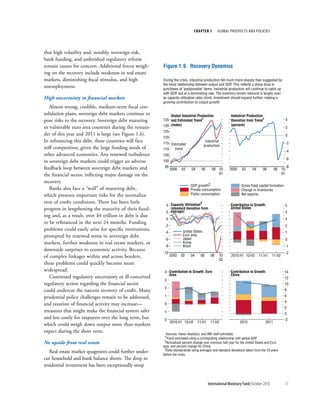


                                                                                     International Monetary Fund | October 2010   65
wOrld ecOnOmic OutlOOk: recOvery, risk, and rebalancing


     to credit growth in China, higher reserve require-        and higher stamp duties on property sales, among
     ments in India and China), or made use of other           others. Hong Kong SAR, Malaysia, and Singapore
     tools (steady appreciation of the nominal effective       are employing a coordinated approach to withdraw
     exchange rate target by Singapore). The overall           blanket guarantees on banks’ wholesale deposits.
     monetary stance, however, is still largely accom-            The recent resurgence in capital inflows to
     modative or neutral. Thus, economies that are             emerging Asia, after a temporary stop during the
     beginning to face inflation pressure should further       global crisis in 2008, has raised potential policy
     tighten monetary policy. If domestic overheating is       challenges. On the one hand, capital flows have
     influenced by strong capital flows, monetary tight-       helped support domestic demand. On the other
     ening should be accompanied by currency appre-            hand, the size of global inflows relative to the
     ciation to help offset inflation pressure, discourage     comparatively small financial markets has raised
     speculative inflows, and support medium-term              or intensified existing concerns, including the risk
     rebalancing. Conversely, if private demand is not         of inflation, asset price bubbles, financial sector
     yet fully established and in the absence of inflation     instability (if inflows are not properly intermedi-
     pressure, monetary policy would need to remain            ated), excessive appreciation, and risks associ-
     accommodative to help jump-start private activity.        ated with a sudden stop of capital flows. Given
     Finally, if broad-based downside risks to growth          wide variation in capital account openness across
     begin to materialize, most Asian economies can use        economies and across alternative types of invest-
     the available monetary room to support economic           ment within the same economy, it is possible that
     activity.                                                 some economies may receive more capital inflows
        With the return of normal financial sector             than they can efficiently intermediate. Alternatively,
     conditions, the time is also ripe for unwinding           capital controls in one sector (for example, foreign
     special support measures introduced during the            direct investment—FDI) may be inducing excessive
     crisis. Some countries have already started (for          inflows into others (for example, portfolio, equity).
     example, removal of guarantees on banks’ wholesale        Economies have been implementing a range
     funding in Australia and New Zealand, unwinding           of measures to deal with their varied situations
     of the previously expanded central bank liquidity/        (Box 2.1). The measures generally address poten-
     rediscount window in Hong Kong SAR and Philip-            tial financial stability concerns and do not impose
     pines). Others are tightening regulatory measures         wholesale restraint on capital inflows. At the
     further to enhance financial system stability. Policy-    same time, it is not clear how much these policy
     makers in New Zealand introduced a new liquidity          responses will deliver. A few issues stand out:6
     policy, including a core funding ratio to improve         • Macroprudential measures should focus primar-
     bank liquidity and reduce banks’ dependence on               ily on financial stability and should not be used
     short-term funding. In China, prudential regula-             to postpone needed macroeconomic adjustment.
     tions were introduced to reduce banks’ exposure to           Thus, where large current account imbalances
     potentially risky property loans, and other direct           may reflect an undervalued exchange rate,
     measures were deployed to cool the property market           currency appreciation is the best response to
     (for example, increased minimum down payments,               capital inflows. Conversely, if the exchange rate
     lower loan-to-value ratios, higher mortgage rates for        is broadly at its medium-term equilibrium level,
     second homes). The banking system thus appears               but reserves are assessed to be insufficient, capital
     well positioned to absorb moderate potential losses          inflows should be used to build up reserves.
     (see the October 2010 issue of the Global Financial          Many economies in emerging Asia are among the
     Stability Report—GFSR). Similarly, policymakers              largest reserve holders, and so they do not fall
     in Hong Kong SAR took measures to address risks              into this category.
     of property price inflation. These include maxi-
     mum loan-to-value ratios on high-end properties             6See   also the April 2010 GFSR.


66   International Monetary Fund | October 2010
chapter 2         cOuntry and regiOnal PersPectives


   Box 2.1. emerging asia: responding to capital inflows
      Emerging Asia is experiencing a revival in capital
   inflows. Total inflows to the region over the past         Emerging Asia: Recent Experience with
   four quarters more than quadrupled relative to             Capital Inflows1
   2008 levels (figure), although in many cases, net
   inflows are negative or dwarfed by large current             Total Capital Inflows                                        20
                                                                (percent of GDP)
   account surpluses. Many economies are respond-
   ing to balance of payments surpluses largely                                                                              15
   through reserve accumulation rather than currency
   appreciation. In addition, some economies have                                                                            10
   preemptively adopted a variety of macroprudential
   measures to address potential financial stability                                                                         5
   issues and/or discourage speculative inflows:
   • Preventing asset price bubbles—setting maxi-
                                                                                                                             0
      mum loan-to-value ratios, increased provisioning
      vis-à-vis real estate credit, and taking other mea-
                                                                                                                             -5
      sures specifically targeting the real estate market
      (Hong Kong SAR, India, Korea, Singapore).                     Foreign direct investment
                                                                    Portfolio                                                -10
   • Tightening liquidity control and management—                   Other2
                                                                    Total
      taking measures to prevent excessive volatility of
      capital flows (for example, a one-month holding               2005        06         07         08         09 10:
                                                                                                                             -15
      period for central bank certificates for both                                                                 Q1

      resident and nonresident investors in Indonesia);
                                                                Sources: CEIC Asia database; Haver Analytics; IMF, International
      raising required reserves for banks (India).            Financial Statistics; and IMF staff calculations.
   • Limiting banks’ foreign exchange exposure—set-             1Emerging Asia: China, Hong Kong SAR, India, Indonesia,
                                                              Korea, Malaysia, Philippines, Singapore, Taiwan Province of
      ting prudential limits on banks’ forward open           China, and Thailand.
      position limits and net open positions (Korea).          2Other investment includes financial derivatives.

   • Tightening financial supervision—tightening
      prudential limits on capital, liquidity, and lever-
      age; enhanced stress testing; enhanced corporate        accounts (Taiwan Province of China); setting
      governance (Hong Kong SAR, Singapore).                  limits on external borrowing operations (India).
   • Capital controls on inflows—preventing non-            • Further liberalizing selected outflows (India,
      residents from opening short-term time deposit          Malaysia, Thailand).


• Greater exchange rate flexibility can reinforce           • Other macroeconomic policy options include a
  macroprudential measures. For example, two-                 more aggressive unwinding of fiscal stimulus or
  way exchange rate flexibility can increase the              even tightening—if inflows are concentrated in
  perception of exchange rate risk and discourage             government securities—to prevent vulnerability
  speculative capital inflows. This is especially             to a sudden turnaround in investor sentiment or
  important for economies with excessive external             a lowering of interest rates when inflation expec-
  surpluses, where relatively sizable apprecia-               tations are well grounded. However, given that
  tion—apart from narrowing the current account               the adoption of fiscal policies that improve the
  imbalance—would increase the perception of                  recipient economy’s macro fundamentals could
  exchange rate risk and therefore deter speculative          in fact result in stronger inflows to the private
  capital inflows.                                            sector, such policies on their own would not


                                                                                           International Monetary Fund | October 2010   67
wOrld ecOnOmic OutlOOk: recOvery, risk, and rebalancing


        necessarily reduce the need for greater exchange           Many economies have already embarked on such
        rate flexibility.                                      reforms. Apart from the recent resumption of a
     • If the financial sector is healthy, restrictions on     managed floating exchange rate regime in China,
        capital outflows can be eased to limit upward          the government has launched a number of measures
        pressure on the currency and alleviate concerns        to enhance the social safety net (IMF, 2010c). In
        about overvaluation or loss of external competi-       Korea, the government recently announced plans
        tiveness. Furthermore, measures can be taken to        to further develop the service industry, including
        free up restrictions in key growth sectors, which      through streamlined regulation and greater compe-
        could help attract longer-term capital inflows (for    tition. Singapore’s recent budget contains measures
        example, FDI).                                         to enhance labor productivity. However, the time
        The best response to capital inflows may be a          needed for these measures to be effective, and the
     coordinated one, especially when they are driven          slower pace of adjustment in advanced economies
     by global factors or have global implications.7           (anticipated in light of the shorter-term economic
     Thus, resistance to currency appreciation by one          challenges they face), suggest that the period over
     economy could discourage others because of                which global imbalances may eventually narrow will
     competitiveness concerns. Alternatively, macro-           be protracted.
     prudential measures by one economy could divert
     flows to others in the region. A potential ratchet
     effect could lead to reserve accumulation in emerg-       the u.s. recovery is Moderating in the Face
     ing market economies—larger accumulation of               of debt and continued uncertainty
     reserves by one could induce further accumulation            The U.S. economy is recovering, thanks to
     by others in the region if the level of reserves          unprecedented macroeconomic policy stimulus,
     is perceived as a proxy for the credibility of a          emergency financial stabilization measures, and a
     country’s policy framework (see Cheung and Qian,          modest cyclical upswing. But the rate of expansion
     2009). International coordination could alleviate         is beginning to moderate. The economy grew at an
     challenges of this nature.                                annualized rate of 1.7 percent in the three months
        Asia should also focus on various structural           to June, a slower pace than the 3.7 percent growth
     reforms to accomplish its medium-term rebalanc-           rate posted in the first quarter. Moreover, high-
     ing objectives. Specific policy options include           frequency indicators suggest a weak recovery in
     implementing reforms to health care, education,           coming quarters.
     and pension systems to enhance the social safety             Much of the weakness of this recovery is due to
     net (China); promoting investment by small and            sluggish personal consumption—by far the biggest
     medium-size enterprises (Japan); improving the            component of U.S. GDP. There are several reasons
     business climate (Philippines); increasing the            for this weakness. First, household net worth has
     productivity of the nontradables or services sector       deteriorated sharply (Figure 2.4). House prices
     (China, Japan, Korea); facilitating further prod-         have fallen by 25 to 30 percent over the past three
     uct and labor market flexibility and productivity         years (depending on which index is used), with
     (China, Malaysia, some NIEs, Philippines); lower-         the brunt of the adjustment falling on house-
     ing corporate saving by realigning relative prices        holds that have the highest marginal propensity
     for a range of inputs, including capital, land, water,    to consume. Second, unemployment is high: it is
     and energy (China); and further financial sector          currently 9.6 percent of the workforce; a broader
     development and capital market deepening (China,          measure of unemployment (which takes into
     India, Philippines, Thailand).                            account those seeking full-time jobs but finding
                                                               only part-time work) is 16.7 percent; and the
                                                               median duration of unemployment, 20 weeks,
        7See   also IMF (2010b).                               is nearly twice the peak level of the previous 40


68   International Monetary Fund | October 2010
chapter 2      cOuntry and regiOnal PersPectives


years. A weak labor market hits incomes and the
ability to obtain credit, and it raises job uncer-        Figure 2.4. United States and Canada: Differing
tainty for those currently employed. Third, banks         Fortunes
are still reluctant to lend to consumers, restrict-
ing credit for larger purchases, as they struggle         The pace of recovery in the United States has moderated. Consumers face
                                                          headwinds of high debt and fallen asset values; weak credit growth, despite
to reduce leverage and restore balance sheets.            extraordinarily loose monetary conditions; and persistently high unemployment.
Overall, given the unusually low savings levels           Personal saving rates will remain higher than precrisis levels for a sustained
before the crisis and the steep decline in personal       period, and public fiscal balances are projected to deteriorate further. By contrast,
                                                          the Canadian economy is less hampered by the same factors and is set to recover
net worth since, the desire to save is more likely        more strongly.
to stay elevated relative to precrisis levels. The per-
sonal saving rate since the beginning of 2009 has             U.S. Contribution to Growth                    Household Net Worth
                                                              (annualized quarterly                          (percent of disposable
averaged 6 percent—a level last seen in 1995—               6
                                                              percent change)                                income)                                       700
and is projected to remain at about 4 to 6 percent          4
                                                            2                                                                                              650
through 2015.
                                                            0                                                                       Canada
    In contrast to private consumption, private            -2                                                                                              600
investment in software and equipment has                   -4
                                                                                                                                                           550
rebounded strongly. Firms have also increased pro-         -6
                                                           -8    GDP growth                                                         United States
ductivity, and unit labor costs have declined sharply.           Consumption                                                                               500
                                                          -10
In the near term, fixed investment is likely to be the    -12
                                                                 Fixed investment
                                                                 Change in inventories                                                                     450
principal driver of domestic demand as inventory          -14    Net exports
accumulation slows. The current account deficit is        -16
                                                                2007      08        09    10:                     2007        08           09        10:
                                                                                                                                                           400
projected to remain at about 3.3 percent of GDP                                           Q2                                                         Q2
over the medium term—much lower than dur-                                                                     Unemployment Rate
                                                          16 Private Credit Growth                                                                             11
ing the years leading up to the crisis—because the           (percent change from a                           (percent)
                                                          14 year earlier)                                                United States
                                                                                                                                                               10
recovery in investment will be financed by strong         12
                                                          10
private saving and improving fiscal balances.              8
                                                                                                                                                               9
    The most likely prospect for the U.S. economy          6                          Canada                                                                   8
is for a continued but slow recovery, with growth          4
                                                           2                                                                                                   7
far weaker than in previous recoveries, considering        0                                                       Canada
the depth of the recession. GDP growth is pro-                                                                                                                 6
                                                          -2
jected to be 2.6 percent in 2010 and 2.3 percent          -4                                                                                                   5
                                                          -6                United States
in 2011 (Table 2.2; Figure 2.5). This implies that        -8                                                                                                   4
                                                               2007        08       09      Aug.                   2007       08           09     Aug.
the gap between actual and potential output will                                              10                                                    10
remain wide, even though potential growth has
                                                            Household Saving Rates                             Fiscal Balances and Debt
itself suffered temporarily from the crisis. The          6 (percent)                                       25 (percent of GDP)                            120
unemployment rate is therefore expected to remain                                                           20     U.S. debt                               105
                                                                                                                 (right scale)
stubbornly high. Against this backdrop, inflation         5
                                                                                                            15                                             90
will remain low—it is projected to be 1.4 percent in                          Canada
                                                          4                                                 10                 Canada debt                 75
2010 and 1 percent in 2011.
                                                                                                              5                (right scale)               60
    Risks to the outlook remain elevated and are
                                                          3                                                   0                                            45
tilted to the downside. Residential and commercial
                                                                          United States                      -5                                            30
real estate markets are still fragile. Further loan       2                                                           U.S.                 Canada
write-downs at small and medium-size banks could                                                           -10      balance                balance
                                                                                                                                                           15
inhibit recovery of normal credit conditions. The         1                                                -15                                             0
                                                           2005      07       09    11      13     15              2005 07     09     11     13   15
sharp rise in government debt has increased vulner-
ability to financial market sentiment, although               Sources: Haver Analytics; and IMF staff estimates.


                                                                                           International Monetary Fund | October 2010                 69
wOrld ecOnOmic OutlOOk: recOvery, risk, and rebalancing


               Treasury security yields have fallen significantly                                         and medium-term credibility. If downside risks
               recently amid economic weakness, flight to quality,                                        to growth materialize, there is some room to
               and expectations of additional government bond                                             reduce up-front adjustment while strengthening
               purchases by the Federal Reserve (Fed). Easing                                             medium-term credibility. This could be achieved
               consumer price inflation, together with weak labor                                         by further entitlement spending reforms, which
               markets and relatively low consumption demand,                                             would have little immediate impact on demand.
               points to a tail risk of deflation. On the upside,                                         However, the existing fiscal plans do not stabilize
               it is possible that business fixed investment could                                        medium-term debt, which should be put firmly
               rebound faster from still-depressed levels.                                                on a downward path to rebuild room for fiscal
                   Against this backdrop, U.S. authorities will need                                      maneuver and avoid negative effects on lend-
               to find a way to exit from extraordinary policy                                            ing rates and long-term growth. Hence, a clear
               intervention without undermining the fledgling                                             commitment to additional consolidation mea-
               recovery, while dealing with the long-term legacies                                        sures under credible economic assumptions (by
               of fiscal imbalances, gaps and overlaps in financial                                       enshrining targets and/or measures in legislation,
               regulation, and a weakened banking sector.                                                 for example) would be desirable. In this context,
               • A key macroeconomic challenge is to ensure                                               the President’s Fiscal Commission is expected to
                   that the public debt is put on a sustainable                                           play a key role in fostering political consensus,
                   path without jeopardizing the recovery. Under                                          including in difficult areas such as tax policy and
                   current policies, the general government deficit                                       entitlement spending.
                   is projected to be about 10 percent of GDP in                                        • Monetary policy should remain accommodative
                   both 2010 and 2011, and gross general govern-                                          because of muted inflation, subpar growth, and
                   ment debt will increase to about 110 percent                                           lingering financial strain. The Fed has maintained
                   of GDP by 2015. Given the risks posed by                                               the policy rate at a record low while signaling
                   budgetary imbalances, the groundwork for                                               that conditions are likely to warrant keeping the
                   fiscal consolidation must begin in 2011. The                                           rate at exceptionally low levels for an extended
                   proposed fiscal tightening of about 1 percent                                          period. In light of larger downside risks, the
                   of GDP in 2011 implied by the administra-                                              Fed’s recent decision to resume its purchases
                   tion’s mid-session review strikes the right balance                                    of government securities (using resources from
                   between near-term support for the recovery                                             maturing government-sponsored-enterprise debt


Table 2.2. Selected Advanced Economies: Real GDP, Consumer Prices, Current Account Balance,
and Unemployment
(Annual percent change, unless noted otherwise)
                                                                      Real GDP                   Consumer Prices1           Current Account Balance2         Unemployment3

                                                                          Projections                    Projections                    Projections               Projections

                                                               2009 2010 2011                 2009 2010 2011                 2009 2010 2011                2009 2010 2011
Advanced Economies                                             –3.2      2.7      2.2           0.1      1.4      1.3         –0.3     –0.3      –0.1      8.0    8.3     8.2
United States                                                  –2.6      2.6      2.3          –0.3      1.4      1.0         –2.7     –3.2      –2.6      9.3    9.7     9.6
Euro Area4,5                                                   –4.1      1.7      1.5           0.3      1.6      1.5         –0.6      0.2       0.5      9.4   10.1    10.0
Japan                                                          –5.2      2.8      1.5          –1.4     –1.0     –0.3          2.8      3.1       2.3      5.1    5.1     5.0
United Kingdom4                                                –4.9      1.7      2.0           2.1      3.1      2.5         –1.1     –2.2      –2.0      7.5    7.9     7.4
Canada                                                         –2.5      3.1      2.7           0.3      1.8      2.0         –2.8     –2.8      –2.7      8.3    8.0     7.5
Other Advanced Economies                                       –1.2      5.4      3.7           1.5      2.4      2.5          4.8      5.0       4.9      5.0    4.8     4.7
Memorandum
Newly Industrialized Asian Economies                           –0.9      7.8       4.5          1.3      2.6       2.7         8.5       7.1         6.9   4.3    3.8     3.7
     1Movements   in consumer prices are shown as annual averages. December–December changes can be found in Table A6 in the Statistical Appendix.
     2Percent of GDP.
     3Percent. National definitions of unemployment may vary.
     4Based on Eurostat’s harmonized index of consumer prices.
     5Current account position corrected for reporting discrepancies in intra-area transactions.


70             International Monetary Fund | October 2010
chapter 2     cOuntry and regiOnal PersPectives


             Figure 2.5. United States and Canada:
             Average Projected Real GDP Growth during 2010–11
             (Percent)


                  Below 0
                  Between 0 and 2
                  Between 2 and 5
                  Above 5
                  Insufficient data
                  Covered in a different map

             Source: IMF staff estimates.


  and mortgage-backed securities in its portfolio) is   oversight of systemically important financial
  appropriate. In the event that such risks material-   firms. It establishes a special resolution authority,
  ize, policy responses could include a strengthened    with the aim of facilitating orderly intervention
  commitment to maintaining the ultra-low policy        procedures for systemically important nonbank
  rate for an extended period, expanding asset pur-     financial institutions. It increases regulation of
  chases, and relaunching facilities to aid stressed    over-the-counter derivatives markets and estab-
  markets. Meanwhile, the Fed has been developing       lishes the Bureau of Consumer Financial Protec-
  a well-diversified toolkit for managing monetary      tion. The legislation also authorizes the Financial
  conditions, which will help facilitate monetary       Stability Oversight Council (FSOC), which
  exit when needed.                                     encompasses all the major financial supervisory
• Notwithstanding considerable efforts to improve       bodies at the federal level and is chaired by the
  financial stability, the banking system remains       Treasury secretary. The FSOC is authorized
  vulnerable. Capital will probably need to be          to (1) recommend higher prudential require-
  raised to meet higher regulatory requirements.        ments; (2) designate financial firms, activities, or
  The newly enacted Dodd-Frank Wall Street              market utilities as systemically important; and
  Reform and Consumer Protection Act expands            (3) approve the breakup of large and complex


                                                                              International Monetary Fund | October 2010   71
wOrld ecOnOmic OutlOOk: recOvery, risk, and rebalancing


        companies if financial stability is threatened.        uled. Should conditions worsen unexpectedly, fiscal
        However, the specifics will need to be worked          policy would be able to respond—the Canadian
        out before it will be clear how the legislation will   fiscal deficit is projected to be 2.9 percent of GDP
        be implemented in practice, especially concerning      in 2011, with net public debt hovering around
        the setting of new prudential norms, the cross-        33.5 percent of GDP.
        border implementation of resolution procedures,
        and the functioning of the FSOC.
        Policy choices in the United States matter greatly     europe is Facing a gradual and uneven
     for the rest of the world. The huge prospective           recovery
     funding requirements of the government may have               In Europe, the road to recovery has been bumpy.
     implications for other economies. To the extent that      Largely caused by unsustainable policies in some
     10-year Treasury bonds set a benchmark for other          member countries, the sovereign debt crisis in the
     assets, market nervousness about the fiscal position      spring erupted before the euro area’s recovery could
     of the United States could cause an international         gain traction. The crisis spread internationally,
     increase in interest rates. In addition, because of       threatening the financial system as well as regional
     the U.S. dollar’s role as a reserve currency and the      and global recovery. A strong and far-reaching
     importance of the United States as a financial cen-       policy response contained the situation. Unprec-
     ter, policy inaction by the U.S. authorities would        edented liquidity and credit support, new European
     have far greater effects on other economies than          financing instruments, and substantial fiscal action
     that implied by trade linkages alone. Shocks to con-      in affected countries arrested the financial turmoil,
     fidence in the United States could cause an interna-      moderating its adverse impact on Europe’s eco-
     tional increase in bond and equity risk premiums.         nomic activity.
        The Canadian economy has been relatively buoy-             The recovery has finally gained some vigor, but
     ant. Household balance sheets are healthier than          it is still likely to be moderate and uneven (Figures
     in the United States, and banks have very solid           2.6 and 2.7). Advanced Europe’s GDP is projected
     books. Monetary and fiscal stimulus and strong            to grow at 1.7 percent in 2010 and 1.6 percent
     international demand for commodities helped boost         in 2011 (Table 2.3). Emerging Europe’s growth is
     the growth rate in the first quarter of this year to      expected to be 3.7 percent in 2010 and 3.1 percent
     5.8 percent, double that of the United States, with       in 2011. There are pronounced differences in
     consumer spending especially robust. House prices         economic prospects across the region, depending on
     held up relatively well during the crisis. The unem-      the condition of public and private sector balance
     ployment rate, at 8.1 percent, is well below that in      sheets and the extent to which macroeconomic poli-
     the United States and has been declining steadily         cies can support the recovery.
     since early 2009. However, recent data indicate a         • Despite robust manufacturing exports in recent
     moderation in growth, which nonetheless seems                 months, moderate recovery is expected in Ger-
     to remain above potential. Risks to the Canadian              many because weak growth is expected among its
     economy are mainly external. The economy is vul-              trading partners. In France, growth is projected
     nerable to a dip in commodity prices, particularly            to be modest, as private consumption is weak-
     for minerals and energy, and a slowdown in the                ened by high unemployment and the withdrawal
     U.S. economy, which buys about three-quarters of              of stimulus measures. In Italy, the recovery is
     its exports.                                                  expected to be even more subdued, as a persis-
        Improving conditions have allowed policymakers             tent competitiveness problem limits the scope
     in Canada to start unwinding policy stimulus. The             for export growth, and planned fiscal consolida-
     Bank of Canada has already raised the overnight               tion weakens private demand. Constrained by
     rate from 0.25 percent, where it had been since               fiscal and competitiveness imbalances, growth in
     the crisis, to 1 percent as of September. The fiscal          Greece, Ireland, Portugal, and Spain is projected
     stimulus package has been implemented as sched-               to be much lower. Outside the euro area, the


72   International Monetary Fund | October 2010
chapter 2     cOuntry and regiOnal PersPectives


    Figure 2.6. Europe: Average Projected Real GDP Growth during 2010–11
    (Percent)


          Below 0
          Between 0 and 2
          Between 2 and 5
          Above 5
          Insufficient data


    Source: IMF staff estimates.


  prospects for recovery are similarly diverse. In the       or have vulnerable private or public sector bal-
  United Kingdom, domestic demand is expected                ance sheets (Hungary, Romania) are expected to
  to remain relatively subdued, particularly follow-         recover more slowly. These problems have tightly
  ing the recent measures to cut the budget deficit.         constrained the room for policy maneuver.
• In emerging Europe, growth in economies that               Risks to the outlook have become more balanced.
  experienced the mildest downturns (Poland), and        Although downside risks continue to threaten
  others that faced the crisis with relatively strong    Europe’s recovery, some upside risks have recently
  household and bank balance sheets (Turkey), is         emerged. The main upside risk comes from higher-
  projected to continue gaining strength, helped         than-expected real activity in Germany, which could
  by the normalization of global trade and capi-         lift growth in Europe more generally, given the
  tal flows. However, those that had experienced         country’s substantial trade and production linkages.
  unsustainable domestic booms (Bulgaria, Latvia)        Nevertheless, downside risks still loom large. In the


                                                                                 International Monetary Fund | October 2010   73
wOrld ecOnOmic OutlOOk: recOvery, risk, and rebalancing


  Figure 2.7. Europe: A Gradual and Uneven                                                                             near term, as discussed in Chapter 1 of the GFSR,
  Recovery                                                                                                             the potential for financial spillovers across sover-
                                                                                                                       eigns remains elevated in the euro area, particularly
    The recovery is gradually taking hold, but domestic demand is expected to
    remain sluggish, especially in advanced Europe. Fiscal consolidation plans across                                  among peripheral economies. European banking
    Europe are rightfully differentiated: economies facing market pressure or external
    financing constraints have larger and more front-loaded adjustments than those
                                                                                                                       systems are still heavily reliant on government sup-
    with more manageable debt dynamics. Economic prospects are closely                                                 port and are highly vulnerable to deterioration in
    connected via cross-border bank flows and trade linkages, especially with
    Germany.                                                                                                           the real economy, sovereign shocks, and funding
                                                                                                                       strains. Hence, if unaddressed, renewed financial
                                                        Contribution to Growth                                         sector stress could spread—including to emerging
                                  GDP growth                    Public consumption       Change in inventories
                                  Private consumption           Fixed investment         Net exports                   Europe via trade and cross-border bank flows—and
         5                    Advanced Europe                              Emerging Europe                       12    could have significant adverse effects on real activity.
         4                    (percent)                                    (percent)                                   In the medium term, the main risk is that fiscal and
                                                                                                                 8
         3                                                                                                             competitiveness imbalances in peripheral economies
         2
                                                                                                                 4     and insufficient action to tackle weak banks could
         1
         0                                                                                                       0
                                                                                                                       lead to a protracted period of subpar growth and
   -1                                                                                                                  occasional crises.
                                                                                                                 -4
   -2                                                                                                                     Against this backdrop, the overarching policy
   -3                                                                                                                  challenge is to use the window of opportunity
                                                                                                                 -8
   -4
                                                                                                                       afforded by the unprecedented policy support to
   -5                                                                                                            -12
                              2006 07 08 09 10 11 12                       2006 07 08 09 10 11 12                      address underlying problems through national and
                                                                                                                       EU-level action.
          0.5 Advanced Europe Fiscal                                       Advanced Europe Fiscal            120
              Adjustment1                                                  Debt in 2015                                   Establishing public debt sustainability remains a
          0.0                                                              (percent of GDP)                  110       top priority for many European economies. Across
   -0.5
                                                                                                             100       Europe, current fiscal consolidation plans are going
   -1.0
                                                                                                             90        in the right direction. They are rightfully differenti-
   -1.5
                                                                                                             80
                                                                                                                       ated—economies facing market pressure or severe
   -2.0
                                                                                                                       external financing constraints (for example, Greece,
                                                                                                             70
   -2.5                                 2010 minus 2011                                                                Iceland, Ireland, Portugal, Spain) have larger and
   -3.0                                 2010 minus 2013                                                      60
                                                                                                                       more front-loaded adjustments than others. Nev-
   -3.5                                                                                                      50        ertheless, given the considerable near-term easing
                               Vulnerable Other       Other                Vulnerable Other       Other
                                euro area euro area advanced                euro area euro area advanced               in Germany, the overall fiscal stance in the euro
                              8 Bank Flows and Credit                      2009 Exports to Germany               40    area will remain broadly neutral in 2010—as is
                                Growth during                              (percent of total exports)
                              4 2009:Q3–2010:Q12                                                                       appropriate, given the still-fragile recovery. Plans
Bank flows (percent of GDP)


                                                               SVK
                                                     POL                                                         30    for medium-term fiscal adjustment, however, need
                              0
                                            HUN               HRV TUR                                                  to be strengthened considerably to deliver perma-
                                                        CZE
                              -4                                 SVN                                             20    nent savings in the face of looming age-related
                                             ROM
                                                         BGR
                              -8     EST                                                                               spending. Ambitious entitlement spending reforms
                                                                                                                 10    would deliver large credibility gains at a lesser cost
                         -12         LTU
                                                    LVA                                                                in terms of short-term growth; they would also
                         -16
                            -8         -6     -4   -2     0      2   4                                           0     forestall a need for more painful reforms in the
                                     Real credit growth (percent)           CZE HUN SVK SVN ROM BGR
                                                                                                                       future. Some economies have taken steps in that
     Sources: Bank for International Settlements; Haver Analytics; IMF, Direction of Trade                             direction (for example, France, Italy), but more
   Statistics; and IMF staff estimates.                                                                                could be done. Key items will be raising the retire-
    1Change in structural balance in percent of potential GDP. Vulnerable euro area
   comprises Greece, Ireland, Italy, Portugal, and Spain. Other euro area comprises euro                               ment age to reflect increased life expectancy, more
   area economies excluding vulnerable euro area. Other advanced comprises advanced
   Europe excluding the euro area.                                                                                     efficient health care spending, and reform of social
    2BGR: Bulgaria; CZE: Czech Republic; EST: Estonia; HRV: Croatia; HUN: Hungary; LTU:
   Lithuania; LVA: Latvia; POL: Poland; ROM: Romania; SVK: Slovak Republic; SVN: Slovenia;
                                                                                                                       security funding that reduces distortions to the
   TUR: Turkey.                                                                                                        labor supply.


                      74                    International Monetary Fund | October 2010
chapter 2       cOuntry and regiOnal PersPectives


table 2.3. selected european economies: real gdp, consumer prices, current account Balance, and
unemployment
(Annual percent change, unless noted otherwise)
                                                             Real GDP                      Consumer Prices1           Current Account Balance2         Unemployment3
                                                                 Projections                        Projections                 Projections                   Projections
                                                     2009       2010      2011         2009         2010   2011       2009     2010      2011       2009     2010    2011
europe                                               –4.0       2.0        1.8          1.3          2.3      2.0      0.1      0.3      0.5        ...     ...      ...
  advanced europe                                    –4.1       1.7        1.6          0.7          1.8      1.6      0.3      0.8      1.0         8.8     9.4      9.3
  Euro Area4,5                                       –4.1       1.7        1.5          0.3          1.6      1.5     –0.6      0.2      0.5         9.4    10.1     10.0
      Germany                                        –4.7       3.3        2.0          0.2          1.3      1.4      4.9      6.1      5.8         7.5     7.1      7.1
      France                                         –2.5       1.6        1.6          0.1          1.6      1.6     –1.9     –1.8     –1.8         9.4     9.8      9.8
      Italy                                          –5.0       1.0        1.0          0.8          1.6      1.7     –3.2     –2.9     –2.7         7.8     8.7      8.6
      Spain                                          –3.7      –0.3        0.7         –0.2          1.5      1.1     –5.5     –5.2     –4.8        18.0    19.9     19.3
      Netherlands                                    –3.9       1.8        1.7          1.0          1.3      1.1      5.4      5.7      6.8         3.5     4.2      4.4
      Belgium                                        –2.7       1.6       1.7           0.0          2.0      1.9      0.3      0.5      1.8         7.7     8.7      8.5
      Greece                                         –2.0      –4.0      –2.6           1.4          4.6      2.2    –11.2    –10.8     –7.7         9.4    11.8     14.6
      Austria                                        –3.9       1.6       1.6           0.4          1.5      1.7      2.3      2.3      2.4         4.8     4.1      4.2
      Portugal                                       –2.6       1.1       0.0          –0.9          0.9      1.2    –10.0    –10.0     –9.2         9.6    10.7     10.9
      Finland                                        –8.0       2.4       2.0           1.6          1.4      1.8      1.3      1.4      1.6         8.3     8.8      8.7
      Ireland                                        –7.6      –0.3        2.3         –1.7         –1.6   –0.5       –3.0     –2.7     –1.1        11.8    13.5     13.0
      Slovak Republic                                –4.7       4.1        4.3          0.9          0.7    1.9       –3.2     –1.4     –2.6        12.1    14.1     12.7
      Slovenia                                       –7.8       0.8        2.4          0.9          1.5    2.3       –1.5     –0.7     –0.7         6.0     7.8      8.1
      Luxembourg                                     –4.1       3.0        3.1          0.4          2.3    1.9        5.7      6.9      7.2         6.0     5.8      5.6
      Cyprus                                         –1.7       0.4        1.8          0.2          2.2    2.3       –8.3     –7.9     –7.4         5.3     7.1      6.9
      Malta                                          –2.1       1.7        1.7          1.8          1.9    2.1       –6.1     –5.4     –5.3         7.0     6.9      6.9
   United Kingdom5                                   –4.9       1.7        2.0          2.1          3.1      2.5     –1.1     –2.2     –2.0         7.5      7.9      7.4
   Sweden                                            –5.1       4.4        2.6          2.0          1.8      1.9      7.2      5.9      5.7         8.3      8.2      8.2
   Switzerland                                       –1.9       2.9        1.7         –0.5          0.7      0.5      8.5      9.6     10.3         3.6      3.6      3.4
   Czech Republic                                    –4.1       2.0        2.2          1.0          1.6      2.0     –1.1     –1.2     –0.6         6.7      8.3      8.0
   Norway                                            –1.4       0.6        1.8          2.2          2.5      1.4     13.1     16.6     16.4         3.2      3.5      3.6
   Denmark                                           –4.7       2.0        2.3          1.3          2.0      2.0      4.2      3.4      3.0         3.6      4.2      4.7
   Iceland                                           –6.8      –3.0        3.0         12.0          5.9      3.5     –6.5     –0.9      2.1         8.0      8.6      8.4
   emerging europe6                                  –3.6       3.7        3.1           4.7         5.2      4.1     –2.5     –3.7     –4.0        ...     ...      ...
   Turkey                                            –4.7       7.8        3.6           6.3         8.7      5.7     –2.3     –5.2     –5.4        14.0    11.0     10.7
   Poland                                             1.7       3.4        3.7           3.5         2.4      2.7     –1.7     –2.4     –2.6         8.2     9.8      9.2
   Romania                                           –7.1      –1.9        1.5           5.6         5.9      5.2     –4.5     –5.1     –5.4         6.3     7.2      7.1
   Hungary                                           –6.3       0.6        2.0           4.2         4.7      3.3      0.2      0.5      0.7        10.1    10.8     10.3
   Bulgaria                                          –5.0       0.0        2.0           2.5         2.2      2.9     –9.5     –3.0     –3.1         6.8     8.3      7.6
   Croatia                                           –5.8      –1.5        1.6          2.4          1.9      2.8     –5.3     –3.8     –4.7         9.2     9.5      9.0
   Lithuania                                        –14.8       1.3        3.1          4.2          1.0      1.3      4.2      1.9      0.2        13.7    18.0     16.0
   Latvia                                           –18.0      –1.0        3.3          3.3         –1.4      0.9      8.6      5.5      2.9        17.3    19.8     17.5
   Estonia                                          –13.9       1.8        3.5         –0.1          2.5      2.0      4.5      4.2      3.4        13.8    17.5     16.4
   1Movements      in consumer prices are shown as annual averages. December–December changes can be found in Tables A6 and A7 in the Statistical Appendix.
   2Percent    of GDP.
   3Percent.   National definitions of unemployment may vary.
   4Current    account position corrected for reporting discrepancies in intra-area transactions.
   5Based   on Eurostat’s harmonized index of consumer prices.
   6Includes   Albania, Bosnia and Herzegovina, Kosovo, former Yugoslav Republic of Macedonia, and Serbia.


   Monetary policy should remain very support-                                                      continued financial strain, to very gradually unwind
ive for the foreseeable future in most European                                                     nonstandard support measures and collateral-
economies. In advanced Europe, inflation remains                                                    requirement changes. This will help support the
low because output gaps are large, and inflation                                                    recovery by dampening the adverse short-term
expectations are well anchored. Core inflation is                                                   effects of fiscal consolidation on domestic demand.
projected to remain at about 1½ percent in the                                                      If downside risks to growth materialize, central
euro area. Thus, in the euro area, it is appropriate                                                banks in advanced Europe may need to again rely
to keep interest rates exceptionally low, and, given                                                more strongly on their balance sheets to further ease


                                                                                                                                  International Monetary Fund | October 2010   75
wOrld ecOnOmic OutlOOk: recOvery, risk, and rebalancing


     monetary conditions. In emerging Europe, infla-              anism (ESM) is likely to prove useful, but sharing
     tion prospects are a bit mixed—reflecting differ-            fiscal burdens implies a need for shared responsibil-
     ent exchange rate regimes and varying degrees of             ity for fiscal policy. This principle was recognized
     economic slack—but are generally contained. In               with the adoption of the Stability and Growth Pact.
     some economies, value-added tax hikes are likely to          However, economies failed to live up to its letter
     temporarily drive up inflation (for example, Poland,         and spirit by not adjusting sufficiently during good
     Romania).                                                    times. Thus, the Pact needs to be strengthened to
        The resilience of Europe’s financial sector must          feature better incentives for preventing and resolv-
     be improved and its stability secured. Resolving             ing fiscal imbalances. It needs to encourage the
     banking sector issues is essential to spur lending,          building up of sufficient buffers in good times,
     which is very important to firms’ external funding.          establish credible procedures for the enforcement
     As discussed in the October 2010 GFSR, how-                  of the common fiscal rules, and beef up centralized
     ever, European banks continue to face challenges.            crisis management capabilities—a gap now tempo-
     These include heavy reliance on European Central             rarily filled by the ESM and the larger European
     Bank financing facilities—or on government sup-              Financial Stability Facility, the latter designed
     port—and large exposure to risky sovereign debt.             specifically for euro area members.
     The stress tests conducted by the Committee of                  In addition, the crisis has shown how finan-
     European Banking Supervisors have been helpful               cial sector problems in specific countries can very
     in improving disclosure regarding banks’ condi-              quickly have pan-European consequences. Differ-
     tion. These tests also provide a useful guide to the         ences in prudential policies and practices across
     need to recapitalize, restructure, or resolve vulner-        countries encourage complex business structures,
     able banks. In this respect, some economies (for             regulatory arbitrage, and rent seeking, with deleteri-
     example, Ireland, Spain) have made more progress             ous consequences for Europe’s financial stability.
     than others (for example, Germany) in tackling               Supervisory or regulatory gaps have major spill-
     weak banks. Nonetheless, as discussed in the GFSR,           overs. Hence, joint accountability and responsibility
     an adverse funding scenario could have a significant         for Europe’s common good of “financial stability”—
     impact on the European banking system. To cope               in the form of an integrated European financial
     with the looming wall of maturing bank debt, some            stability framework—are urgently needed. Such
     blanket financial support measures may need to be            a framework needs to be built on two pillars: (1)
     extended, but not at the cost of postponing much-            integrated crisis management and resolution—for
     needed restructuring. Meanwhile, it will be impor-           example, through a European resolution author-
     tant to resolve uncertainty about regulatory reforms,        ity—and (2) integrated supervision, to make burden
     which would help increase banks’ willingness to              sharing acceptable. Both are necessary to achieve
     supply credit and support the recovery. Invigorat-           a fully integrated, efficient, and stable market for
     ing credit is also a challenge in emerging Europe,           financial services. Steps in this direction are being
     particularly given the deterioration in bank credit          taken—for instance, the establishment of the Euro-
     portfolios during the crisis.                                pean Systemic Risk Board and discussions about a
        Another crucial task ahead is the reform of EU            more integrated resolution framework. Nevertheless,
     policy frameworks. The cross-border dimension of             considering the devastating consequences of the
     many issues argues for a stronger role at the EU             crisis and the magnitude of the challenge, progress
     level. The crisis exposed long-standing problems in          is still very slow, hampered by narrow national
     existing fiscal, structural, and financial stability poli-   interests.
     cies. Such weaknesses need to be addressed in order             Last, a better structural policy framework is also
     to ensure Europe’s future stability and growth.              necessary to help improve competitiveness, address
        A key challenge is the future of fiscal surveillance      macroeconomic imbalances, and boost growth.
     and sovereign crisis management. An arrangement                 The current policy agenda (Europe 2020) could
     along the lines of the European Stabilization Mech-          be improved in several ways. Specifically, surveil-


76   International Monetary Fund | October 2010
chapter 2     cOuntry and regiOnal PersPectives


lance over structural bottlenecks, competitiveness,                   Growth in the region is projected to average 5.7
and imbalances needs to become more binding. It                    percent in 2010 and 4 percent in 2011 (Table 2.4).
should also consider the fiscal and financial policy               Risks to the outlook emerge from both external
challenges facing countries. To speed the process                  and domestic factors. External risks are tilted to the
of reform, priority should be given to a narrow                    downside, reflecting mainly a worse-than-antici-
range of strategic objectives that have major cross-               pated recovery in advanced economies, with its neg-
border implications. For instance, most Mediter-                   ative spillovers on commodity prices. An additional
ranean economies need to address labor market                      contagion channel arises from the large presence of
segmentation, inadequate wage flexibility, and                     foreign banks in Latin America, although the fact
skill mismatches; upgrade education systems; and                   that these banks have relied primarily on subsidiar-
foster capital deepening and innovation. In addi-                  ies funded by local deposits rather than cross-border
tion, reform to bankruptcy proceedings in these                    flows mitigates the risk. On the other side, there
economies will help facilitate firm turnover and                   are also risks of overheating, particularly if unwind-
entrepreneurship. For all EU economies, further lib-               ing of earlier stimulus takes longer than currently
eralization of product and service markets under the               anticipated (see below).
Single Market program will strengthen the employ-                     Prospects within the LAC region are quite diverse
ment effects of labor market reform.                               given the varying strength of macroeconomic policy
                                                                   frameworks, the role of domestic demand, and dif-
                                                                   ferent degrees of exposure to spillovers from global
latin america is sustaining its growth                             trade and financial markets:
Momentum                                                           • Impressive improvements in macroeconomic pol-
   The LAC region is exiting the global crisis at a                   icy frameworks over the past two decades, com-
faster pace than anticipated (Figures 2.8 and 2.9).                   bined with accommodative policies, easy external
This reflects solid macroeconomic policy funda-                       financing conditions, and strong commodity
mentals, sizable policy support, favorable exter-                     prices, are driving a robust recovery in the LA-4
nal financing conditions, and strong commodity                        (Brazil, Chile, Colombia, Peru). Despite the
revenues. Robust commodity export revenues                            expected dynamism in domestic demand, current
have boosted domestic income, which along with                        account balances are projected to deteriorate only
easy financing conditions has supported domes-                        marginally in 2010 and 2011. High commodity
tic demand. For many of these economies, the                          prices and continued vitality in Asia are expected
potential negative effect from subdued demand                         to sustain exports. Similarly, Uruguay, which
for imports by the advanced economies will be                         has made substantial progress in macroeconomic
manageable, given lower reliance on external trade8                   policy management and faces a favorable external
and greater dependence on commodity exports,                          environment, is expected to experience strong
for which external demand is projected to remain                      growth dynamics in 2010–11.
robust (see Chapter 1, Appendix 1.1). However,                     • Mexico is also staging a steady recovery, despite
Mexico, with its deep real and financial links to                     the 2009 hard landing and the drag from the
the U.S. economy, and the commodity-importing                         U.S. economy. As in the LA-4, recovery has been
Central American and Caribbean regions, with their                    underpinned by strong policy frameworks in the
dependence on tourism and remittance flows from                       run-up to the crisis. However, Mexico’s outlook
the United States, will be more vulnerable than oth-                  arguably faces larger downside risks than that
ers to weak U.S. economic conditions.                                 of the LA-4. A weaker-than-projected recovery
                                                                      in the U.S. economy would have important
  8For  instance, the share of exports plus imports in total          implications for Mexico. Furthermore, with more
GDP—a very rough measure of openness—averaged less than 50            than 80 percent of domestic financial system
percent in the LA-5 (Brazil, Chile, Colombia, Mexico, Peru) in
the past five years (compared with more than 125 percent for the      assets owned by systemic global banks, substan-
ASEAN economies).                                                     tially higher capital charges arising from global


                                                                                           International Monetary Fund | October 2010   77
wOrld ecOnOmic OutlOOk: recOvery, risk, and rebalancing


            Figure 2.8. Latin America and the Caribbean:
            Average Projected Real GDP Growth during 2010–11
            (Percent)


                  Below 0
                  Between 0 and 2
                  Between 2 and 5
                  Above 5
                  Insufficient data

            Source: IMF staff estimates.


       financial sector regulatory reform could affect         exporters will continue to benefit from the
       the availability of credit for the private sector in    strength in their terms of trade, growing links
       Mexico.                                                 with China, and strong intraregional link-
     • The outlook for the rest of the LAC region is           ages. Thus, Argentina and Paraguay are set to
       somewhat mixed. Overall, the commodity                  experience high growth, supported in large part


78   International Monetary Fund | October 2010
chapter 2      cOuntry and regiOnal PersPectives


   by strong trade ties vis-à-vis Brazil and a sharp              Figure 2.9. Latin America and the Caribbean (LAC):
   rebound in agricultural production following                   Advancing with Strength1
   last year’s severe drought. Conversely, despite                A proactive crisis response and favorable terms of trade have driven Latin
   high oil prices, Ecuador’s recovery will be muted              America’s speedy recovery. Commodity exporters are also benefiting from
                                                                  increasing demand from emerging Asia, particularly China. Capital inflows have
   given supply-side constraints. Venezuela’s reces-              picked up sharply in some economies. Although inflows have boosted the
   sion will continue in 2010, reflecting severe                  equities market, the recovery in private credit has remained sluggish.

   supply bottlenecks, challenges from capital                    15 Selected LAC: Component                       LAC: Terms of Trade of Goods             160
   flight, and generally weak policy frameworks.                     Contributions to GDP Growth                   (2000 = 100)
                                                                     (percent change, annual
                                                                     average)                                                                               150
   Growth in most of the Caribbean countries                                           Consumption                  Other Latin America
                                                                  10                   Investment
   will be subdued amid weak prospects for tour-                                       Inventories                                                          140
                                                                                       Net exports
   ism and remittances and limited room for                                            Growth                                                               130
                                                                   5                                                                         LA-5
   policy support in light of chronic public debt                                                                                                           120
   burdens.9                                                                                                                                                110
                                                                   0
   LAC economies need to establish policies to
                                                                                                                                                            100
achieve strong and sustainable growth like Asia.                           LA-4        Mexico Rest of LAC
                                                                                                         2                   Rest of LAC
                                                                  -5                                                                                        90
However, unlike Asia, medium-term policy pri-                          2008–09   08–09    08–09                 2000 02       04       06    08     10
                                                                            10–11     10–11    10–11
orities are not driven by rebalancing more toward
domestic demand (given relatively low reliance                    80 Real Export Growth of LA-5                    Real Export Growth of Other    150
on external trade, although the tourism-depen-                       by Destination                                Latin America by Destination
                                                                     (year-over-year percent                       (year-over-year percent
                                                                  60 change)                                       change)
dent Caribbean countries are notable exceptions)                                       Latin
                                                                                     America4                                 China        Latin  100
                                                                                                                                         America4
but rather by a need to ensure that strong growth                 40       China
                                                                                                                                                            50
does not give rise to balance sheet vulnerabili-
                                                                  20
ties in the private or public sector. Macroeco-                                                                                                             0
nomic and prudential policies will need to be                       0                                                         U.S. and
                                                                                  Emerging Asia                              euro area
designed to ensure that the recovery becomes well                 -20              excl. China3                    Emerging Asia
                                                                                                                                                            -50
                                                                          U.S. and
entrenched and at the same time to contain the                           euro area                                  excl. China3
                                                                  -40                                                                                       -100
risks of overheating and the buildup of fiscal and                       2005     06     07    08         10:
                                                                                                          Q1
                                                                                                                    2005    06      07      08        10:
                                                                                                                                                      Q1
financial sector risks.
                                                                  20 Selected Latin America:                       LA-5: Real Domestic Credit                   60
   Thus, the priority for the region is now to use                   Capital Inflows (percent of                   to the Private Sector6
                                                                     GDP, quarterly average)5
the window provided by the cyclical upswing to                    15                  FDI
                                                                                                                                Peru
                                                                                                                                                                40
start unwinding stimulus, regain room for policy                                      Portfolio
                                                                                      Other                                                  Brazil
maneuver, and sustain its relatively recent track                 10
                                                                                    2005–08
                                                                                                                                                                20

record of strong macroeconomic policy manage-                                       09–10:Q2
                                                                   5                                                                                            0
ment. In many economies the policy mix should                                                                      Colombia
                                                                                                                                 Mexico
favor early withdrawal of the fiscal stimulus, while               0                                                                                            -20
allowing the withdrawal of monetary stimulus to                                                                                              Chile
proceed at a slower pace. Fiscal tightening will help             -5
                                                                        Brazil    Colombia    Peru                   2007         08         09          July
                                                                                                                                                             -40

address risks of inflation pressure (Peru, Uruguay)                           Chile     Mexico Uruguay                                                    10
and exchange rate overvaluation (Brazil), reduce                    Sources: CEIC EMED database; Haver Analytics; IMF, Balance of Payments Statistics;
                                                                  IMF, Direction of Trade Statistics; and IMF staff estimates.
the generally high public debt and associated                       1LA-4: Brazil, Chile, Colombia, and Peru; LA-5: LA-4 and Mexico; Other Latin America:
vulnerability, and provide a cushion for future                   Argentina, Bolivia, Ecuador, Paraguay, Uruguay, and Venezuela.
                                                                    2Rest of LAC in this panel excludes Antigua and Barbuda, Dominica, Grenada, Guyana,
contingencies. Moreover, given policy challenges                  Jamaica, St. Kitts and Nevis, St. Lucia, and St. Vincent and the Grenadines due to lack of
                                                                  data on GDP components.
arising from strong and persistent capital inflows                  3Emerging Asia: ASEAN-5, China, India, and NIEs. See Figure 2.3 for list of NIEs and
                                                                  ASEAN-5.
                                                                    4Latin America: LA-5 and Other Latin America (see footnote 1).
                                                                    5Data for Peru only up to 2009:Q4. Data for Colombia and Uruguay only up to 2010:Q1.
  9See the October 2010 Regional Economic Outlook: Western        FDI = foreign direct investment. Other investment includes financial derivatives.
Hemisphere for a more detailed discussion of the challenges and     6Annualized percent change of three-month moving average over previous three-month
prospects in the rest of the LAC region.                          moving average.


                                                                                                    International Monetary Fund | October 2010                       79
wOrld ecOnOmic OutlOOk: recOvery, risk, and rebalancing


     Table 2.4. Selected Western Hemisphere Economies: Real GDP, Consumer Prices, Current Account
     Balance, and Unemployment
     (Annual percent change, unless noted otherwise)
                                                              Real GDP                  Consumer Prices1              Current Account Balance2          Unemployment3
                                                                 Projections                      Projections                      Projections                  Projections
                                                       2009     2010 2011            2009       2010 2011             2009       2010 2011 2009                2010 2011
     North America                                     –3.0      2.9     2.5           0.2        1.7      1.2         –2.6       –3.0     –2.6      ...         ...     ...
     United States                                     –2.6      2.6     2.3          –0.3        1.4      1.0         –2.7       –3.2     –2.6      9.3         9.7     9.6
     Canada                                            –2.5      3.1     2.7           0.3        1.8      2.0         –2.8       –2.8     –2.7      8.3         8.0     7.5
     Mexico                                            –6.5      5.0     3.9           5.3        4.2      3.2         –0.6       –1.2     –1.4      5.5         5.0     4.5
     South America                                     –0.2      6.3     4.1           6.4       6.8       6.9         –0.3       –1.0     –1.4      ...        ...     ...
     Brazil                                            –0.2      7.5     4.1           4.9       5.0       4.6         –1.5       –2.6     –3.0       8.1        7.2     7.5
     Argentina4                                         0.9      7.5     4.0           6.3      10.6      10.6          2.0        1.7      1.2       8.4        8.0     8.6
     Colombia                                           0.8      4.7     4.6           4.2       2.4       2.6         –2.2       –2.7     –2.8      12.0       12.0    11.5
     Venezuela                                         –3.3     –1.3     0.5          27.1      29.2      32.2          2.6        7.8      8.2       7.9        8.6     8.1
     Peru                                               0.9      8.3     6.0           2.9       1.7       2.5          0.2       –1.3     –2.2       8.6        8.0     7.5
     Chile                                             –1.5      5.0     6.0           1.7        1.7      3.0          2.6       –0.7     –2.0       9.6        9.0     8.7
     Ecuador                                            0.4      2.9     2.3           5.2        4.0      3.5         –0.7       –0.8     –1.6       8.5        8.6     8.5
     Bolivia                                            3.4      4.0     4.5           3.3        1.7      4.1          4.6        6.5      5.2       ...        ...     ...
     Uruguay                                            2.9      8.5     5.0           7.1        6.5      6.4          0.7       –0.1     –0.7       7.3        7.0     6.9
     Paraguay                                          –3.8      9.0     5.0           2.6        4.6      5.2         –1.0       –1.2     –1.6       5.6        5.3     5.2
     Central America5                                  –0.5      3.1     3.7           3.8        3.9      4.1         –1.8       –5.1     –5.5      ...         ...     ...
     The Caribbean6                                     0.4      2.4     4.3           3.5        7.2      5.5         –4.2       –3.0     –2.9      ...         ...     ...
     Memorandum
     Latin America and the Caribbean7                  –1.7      5.7     4.0           6.0        6.1      5.8         –0.6       –1.2     –1.6       ...        ...     ...
        1Movements    in consumer prices are shown as annual averages. December–December changes can be found in Tables A6 and A7 in the Statistical Appendix.
        2Percent of GDP.
        3Percent. National definitions of unemployment may vary.
        4Private analysts estimate that consumer price index inflation has been considerably higher. The authorities have created a board of academic advisors to assess these

     issues. Private analysts are also of the view that real GDP growth has been significantly lower than the official reports since the last quarter of 2008.
        5Central America comprises Costa Rica, El Salvador, Guatemala, Honduras, Nicaragua, and Panama.
        6The Caribbean comprises Antigua and Barbuda, The Bahamas, Barbados, Belize, Dominica, Dominican Republic, Grenada, Guyana, Haiti, Jamaica, St. Kitts and Nevis, St.

     Lucia, St. Vincent and the Grenadines, Suriname, and Trinidad and Tobago.
        7Comprises Mexico and economies from the Caribbean, Central America, and South America.


     in some economies, fiscal tools are likely better                                        the region include structural reforms to improve
     options to deal with overheating pressures than                                          the investment climate, which would attract stable
     monetary tools. However, in Chile, fiscal stimulus                                       FDI inflows and improve external competitiveness
     can be withdrawn only gradually in the context of                                        (for example, streamlining business regulations,
     earthquake-related reconstruction spending, and                                          upgrading infrastructure, labor and product market
     so tighter monetary conditions may be needed to                                          reforms). However, these reforms will take time
     rein in inflation. For the rest of Latin America as                                      to implement. In the meantime, economies have
     well, it is also critical to use the cyclical upswing to                                 begun to use a combination of macroeconomic and
     rebuild fiscal room and avoid procyclical policies.                                      macroprudential measures to address the challenges
     However, the pace of stimulus withdrawal could                                           posed by capital inflows (Box 2.2). Regarding the
     be slowed if downside risks to growth were to                                            use of capital controls, preliminary indications are
     materialize, especially for countries with available                                     that they may have helped somewhat in changing
     policy room.                                                                             the composition of inflows but not the volume (see
        With respect to the approach to capital inflows,                                      the April and October 2010 issues of the GFSR).
     the focus among the LA-5 (LA-4 plus Mexico) has                                          In this context, the possible use of capital con-
     appropriately been to deepen capital markets and                                         trols should be supported by other measures—for
     improve the supervisory and regulatory framework                                         example, continued two-way exchange rate flexibil-
     to enable absorption of capital inflows without                                          ity to discourage speculative inflows, fiscal consoli-
     endangering financial stability. Other priorities for                                    dation (where public debt is high and private sector


80   International Monetary Fund | October 2010
chapter 2        cOuntry and regiOnal PersPectives


   Box 2.2. latin america-5: riding another Wave of capital inflows
      After a brief hiatus during the height of the global        LA-5: Handling the Capital Inflows
   crisis in 2008, the LA-5 economies are experienc-              Bonanza1
   ing a resurgence in capital inflows (figure). Strong
   capital inflows have been a mixed blessing. On the               Total Capital Inflows                                       15
                                                                    (percent of GDP)
   one hand, they have provided cheap and readily
   available financing to boost domestic demand. On
   the other hand, these flows have increased concern                                                                           10

   about domestic overheating, external competitive-
   ness (given considerable currency appreciation in
   the context of exchange rates that are mostly at or                                                                          5

   above their medium-term values), increased steriliza-
   tion costs (with sizable interest rate differentials
                                                                                                                                0
   vis-à-vis external rates), and heightened risks of a
   potential boom-bust cycle—problems this region
   has confronted in the past. The situation today raises
                                                                        Foreign direct investment                               -5
   fewer financial stability concerns because domestic                  Portfolio
                                                                        Other2
   credit is staging a relatively slow recovery. However,               Total
   capital inflows have induced booms in many equity
                                                                                                                                -10
   markets, and concerns about asset price bubbles have                2005         06        07         08         09 10:
                                                                                                                       Q1
   been growing.
      Against this backdrop, country authorities have               Sources: CEIC EMED database; Haver Analytics; IMF, Balance of
   responded by adopting a number of measures to                  Payments Statistics; and IMF staff calculations.
                                                                    1LA-5: Brazil, Chile, Colombia, Mexico, and Peru. Data for Peru
   safeguard financial sector stability, eliminate asset          only up to 2009:Q4.
                                                                    2Other investment includes financial derivatives.
   price bubbles, and discourage inflows:
   • Financial sector supervision—all the LA-5 coun-
      tries are at various stages of further enhancing         (implemented by Colombia before the crisis but
      financial sector regulatory standards for capital        removed in October 2008).
      adequacy, liquidity, and asset quality.                • Prudential capital controls—these include unre-
   • Tighter liquidity control and management—                 munerated reserve requirements on foreign bor-
      required reserves for banks have been raised             rowing (maintained by Colombia from before
      (Brazil).                                                the crisis but currently zero rated) and higher
   • Capital controls on inflows—These include a               reserve requirements on short-term (less than
      direct tax on fixed income and equity inflows            two years) external loans (Peru).
      (reintroduced in October 2009 by Brazil after          • Further liberalization of selected outflows—
      a brief break) and minimum-stay rules for FDI            Chile, Colombia, Peru.


recovery entrenched), and enhanced financial sector          region is benefiting from Russia’s gradual recupera-
monitoring and supervision.                                  tion. Some economies in the region have already
                                                             experienced an increase in remittances from Russia.10

the cis region is experiencing a Modest
recovery                                                        10Alturki, Espinosa-Bowen, and Ilahi (2009) find that Russia

                                                             appears to influence regional growth mainly through the remit-
   The recovery in the CIS region has been supported         tance channel. In particular, a 10 percentage point increase in
by high commodity prices, normalizing trade and              growth of remittances from Russia is associated with a 0.3 per-
                                                             centage point GDP increase in growth in the CIS countries, with
capital flows, accommodative policies, and posi-             a 0.4 percentage point increase in oil-importing CIS countries’
tive regional spillovers (Figures 2.10 and 2.11). The        growth.


                                                                                             International Monetary Fund | October 2010   81
wOrld ecOnOmic OutlOOk: recOvery, risk, and rebalancing


                 Figure 2.10. Commonwealth of Independent States:
                 Average Projected Real GDP Growth during 2010–111
                 (Percent)


                        Below 0
                        Between 0 and 2
                        Between 2 and 5
                        Above 5
                        Insufficient data
                        Covered in a different map

                  Source: IMF staff estimates.
                  1
                   Includes Georgia and Mongolia.


        Real activity for the CIS region is expected to           Gradually rising real wages and lower unemploy-
     grow at 4.3 percent in 2010 and 4.6 percent in               ment should support consumption.
     2011 (Table 2.5). As in other regions, prospects           • High commodity prices also benefit other
     vary considerably. Exposure to commodity prices,             energy exporters in the region. Large-scale
     the degree of integration with global financial              investment and higher volumes of gas exports
     markets, the extent of policy support, and links             are projected to boost growth in Turkmenistan
     to Russia are factors that differ importantly across         to 9.4 percent in 2010 and 11.5 percent in
     economies.                                                   2011. In Uzbekistan, real activity is expected
     • In Russia, despite relatively high oil prices, the         to expand by 8 percent in 2010 and 7 percent
        near-term outlook is for a modest recovery.               in 2011. Kazakhstan is set for a slower recov-
        Output growth is projected to reach 4 percent             ery, due to lingering problems in its financial
        in 2010 and 4.3 percent in 2011. Although the             system.
        current heat wave and related wildfires could           • For energy importers as a group, growth is
        detract from near-term growth, and the ongo-              projected to pick up to 4.6 percent in 2010 and
        ing rebound still depends on policy support, a            5 percent in 2011, reflecting the global recovery
        self-sustained consumption-led recovery should            and financial stability (for example, Ukraine).
        gradually take hold. The adjustment of bank               Some of these economies (for example, Arme-
        balance sheets appears to have run its course, and        nia, Moldova, Tajikistan) will benefit from the
        banks seem poised to cautiously expand lending.           rebound in remittances from Russia.


82   International Monetary Fund | October 2010
chapter 2            cOuntry and regiOnal PersPectives


   Overall, near-term risks to growth in the region        Figure 2.11. Commonwealth of Independent
are broadly balanced. On the upside, more favorable        States (CIS): A Modest Recovery
external developments—particularly higher com-
modity prices and a renewal of capital inflows—or          The recovery in the CIS region is gaining traction, supported by high commodity
                                                           prices, normalizing trade and capital flows, accommodative policies, and positive
a more rapid recovery in credit could push growth          spillovers from Russia. Amid a more favorable external environment, capital flows
higher. The recently launched customs union among          are expected to pick up, but to lower levels than before the crisis. In Russia, the
                                                           more flexible exchange rate regime, alongside cuts in policy interest rates, has
Belarus, Kazakhstan, and Russia could enhance trade        helped deter speculative capital inflows. But the focus now should be on inflation
and provide an additional boost to growth within the       control.

union. On the downside, external shocks—adverse
                                                              Russia’s GDP Growth1                               Other CIS GDP Growth2
changes in commodity prices or a shock to investor         40
                                                              (annualized quarterly percent                      (percent)
                                                                                                                                                           15
confidence—present the key downside risks. With            30 change)
                                                                                                                                                           10
some exceptions (for example, Kazakhstan), foreign         20
banks have a minor role in CIS economies. At the           10                                                                                              5

same time, the region—and Russia in particular—              0
                                                                                                                                                           0
continues to be very vulnerable to volatility in capital   -10
                                                                                                                            Net energy
                                                           -20                                                                                             -5
flows and global risk appetite. For instance, the euro                  GDP                                                 exporters
                                                           -30          Domestic                                            Net energy
area crisis in May led to a fresh bout of volatility                    demand                                              importers                      -10
                                                           -40
in Russian stock markets and renewed downward
                                                           -50                                                                                             -15
pressure on the ruble. A worse-than-expected growth                2007         08           09        10:      2003       05      07          09    11
                                                                                                       Q2
outcome in Russia would have second-round effects
                                                           500 Commodity Prices                                  Net Capital Flows to CIS by               15
throughout the region, mainly through remittances              (Jan. 2003 = 100)                                 Type3 (percent of GDP)
and trade.                                                                                  Oil                                                            10
                                                           400
   The fiscal challenges vary across the region. In
                                                                          Metals                                                                           5
Russia, the task is to ensure that the large fiscal        300
stimulus (about 9 percent of GDP) is unwound                                                                                                               0

as the global economy gathers strength—in this             200
                                                                                                                                                           -5
regard, a key concern is that some three-quarters                                                                                      Total
                                                           100              Overall
of the fiscal package entailed permanent measures                                                                                                          -10
                                                                                                                        PDI              OPFF
                                                                                                                        PPF              OF
(for example, higher pension outlays). Given the             0                                                                                             -15
                                                                 2003     05         07      09        11      1990    95       2000     05     10   15
composition of government spending, reversing the
fiscal stimulus will be difficult without undertaking                                                            Inflation
                                                           200 Exchange Rate per U.S. Dollar                                                               25
significant public sector reforms that allow savings           (Jan. 2008 = 100)                                 (percent)
in socially sensitive areas such as health care, social    180          Ukraine                                             Net energy                     20
                                                                                                                            importers
protection, and pensions. Energy importers in the          160
region have limited fiscal room and are mostly                                                                                                             15
                                                                                                                  Russia
                                                           140                            Russia
aiming for a neutral fiscal stance or modest fiscal
                                                                                                                                                           10
adjustment in 2010.                                        120
   Most economies in the region operate under                                                                     Net energy
                                                                                                                                                           5
                                                           100                                                     exporters
pegged or heavily managed exchange rate regimes,                               Kazakhstan
                                                                                              Other CIS
which deprive them of one means of adjusting to             80
                                                                     2008             09               Sep.   2003      05         07           09    11
                                                                                                                                                           0

shocks. In this respect, the recent greater exchange                                                     10

rate flexibility in Russia is welcome. So far, the more      Sources: Haver Analytics; IHS Global Insight; IMF Primary Commodity Price System;
                                                           and IMF staff estimates.
flexible exchange rate regime, alongside cuts in policy     1Domestic demand data available only through 2010:Q1.
                                                            2Net energy exporters include Azerbaijan, Kazakhstan, Turkmenistan, and Uzbekistan.
interest rates, has helped deter speculative capital
                                                           Net energy importers include Armenia, Belarus, Georgia, Kyrgyz Republic, Moldova,
inflows. But the focus now should be on inflation          Mongolia, Tajikistan, and Ukraine.
                                                            3OF: official flows; OPFF: other private financial flows; PDI: private direct investment;
control, and the monetary easing cycle has been            PPF: private portfolio investment.
appropriately paused. In Kazakhstan, the economy


                                                                                                  International Monetary Fund | October 2010                   83
wOrld ecOnOmic OutlOOk: recOvery, risk, and rebalancing


     Table 2.5. Commonwealth of Independent States: Real GDP, Consumer Prices, Current Account Balance,
     and Unemployment
     (Annual percent change, unless noted otherwise)
                                                                Real GDP                  Consumer Prices1            Current Account Balance2             Unemployment3
                                                                   Projections                     Projections                     Projections                     Projections
                                                        2009     2010      2011         2009 2010          2011         2009     2010      2011        2009      2010     2011
     Commonwealth of Independent
       States (CIS)4                                     –6.5      4.3       4.6        11.2       7.0      7.9           2.6      3.8       3.0        ...       ...     ...
     Russia                                              –7.9      4.0       4.3        11.7       6.6      7.4           4.0      4.7       3.7         8.4      7.5     7.3
     Ukraine                                            –15.1      3.7       4.5        15.9       9.8     10.8          –1.5     –0.4      –1.3         8.8      8.8     7.7
     Kazakhstan                                           1.2      5.4       5.1         7.3       7.6      6.6          –3.2      3.2       2.0         8.0      7.8     7.6
     Belarus                                              0.2      7.2       6.2        13.0       7.3     10.8         –13.1    –14.0     –13.9         0.9      0.9     0.9
     Azerbaijan                                           9.3      4.3       1.8         1.5       5.5      6.0          23.6     24.1      22.2         6.0      6.0     6.0
     Turkmenistan                                         6.1      9.4      11.5        –2.7       3.9      4.8         –16.1     –4.7       3.4         ...      ...     ...
     Mongolia                                            –1.6      8.5       7.0         6.3      10.5      8.9          –9.8    –13.9     –22.9        11.6      3.0     3.0
       Low-Income CIS                                     4.8      5.3       4.5         6.2       7.6      8.1           7.1      8.2       8.4        ...      ...      ...
       Uzbekistan                                         8.1      8.0       7.0        14.1      10.6     11.4           2.7      3.8       6.3         0.2      0.2      0.2
       Georgia                                           –3.9      5.5       4.0         1.7       6.4      7.4         –11.7    –12.0     –12.5        16.9     16.8     16.7
       Armenia                                          –14.2      4.0       4.6         3.5       7.8      5.5         –16.0    –14.6     –12.6         6.8      7.0      7.0
       Tajikistan                                         3.4      5.5       5.0         6.5       7.0      8.0          –4.9     –3.6      –5.7         ...      ...      ...
       Kyrgyz Republic                                    2.3     –3.5       7.1         6.8       4.8      5.7           2.1     –5.4      –9.4         5.8      5.6      5.4
       Moldova                                           –6.5      3.2       3.5         0.0       7.4      6.0          –8.1    –11.2     –11.4         6.4      7.5      6.5
     Memorandum
     Net Energy Exporters5                               –6.0       4.3      4.5        10.8       6.7      7.4           3.8      5.1       4.2         ...       ...     ...
     Net Energy Importers6                               –9.5       4.6      5.0        13.1       8.7     10.2          –5.8     –5.4      –6.1         ...       ...     ...
        1Movements   in consumer prices are shown as annual averages. December–December changes can be found in Table A7 in the Statistical Appendix.
        2Percent of GDP.
        3Percent. National definitions of unemployment may vary.
        4Georgia and Mongolia, which are not members of the Commonwealth of Independent States, are included in this group for reasons of geography and similarities in

     economic structure.
        5Net Energy Exporters comprise Azerbaijan, Kazakhstan, Russia, Turkmenistan, and Uzbekistan.
        6Net Energy Importers comprise Armenia, Belarus, Georgia, Kyrgyz Republic, Moldova, Mongolia, Tajikistan, and Ukraine.


        would benefit from greater exchange rate flexibility,                                        Over the medium term, the overarching challenges
        once the problems in the banking system have been                                         in the region are to improve the investment climate
        resolved. This would facilitate monetary management,                                      and diversify the pattern of growth. In Russia, for
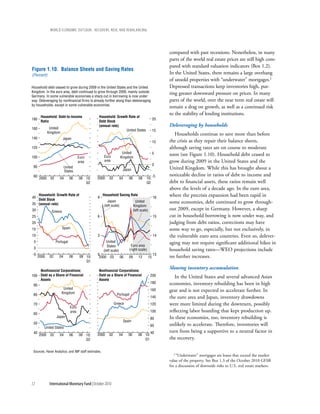
        help the economy adjust to external shocks, and pro-                                      instance, there is a need for public administration
        mote local-currency financial market development.                                         reform, civil service reform, and judicial reform to
           Banking sector balance sheets remain impaired                                          ensure a level playing field for all investors. Such
        in several CIS economies and call for continued                                           reforms will be critical to modernizing the economy.
        policy attention. In Russia, restoring normal credit                                      It will also be important to use capital flows wisely,
        expansion will require decisive actions to improve                                        in order to help move the economy from its depen-
        provisioning standards and to enhance the powers                                          dence on oil revenues. In other energy exporters in
        of the supervisory authority, including over con-                                         the region, the priority is to facilitate private sector
        nected lending. In Kazakhstan, a transparent and                                          development and, in some economies, diversify away
        comprehensive strategy to resolve bad debts—which                                         from the hydrocarbon sector. Such policies will help
        involves an independent assessment of systemic                                            achieve sustained welfare gains.
        banks to evaluate recapitalization needs—is critical
        for restoring financial sector health. In Ukraine,
        financial sector reforms are also essential to revital-                                   the Middle east and north africa region is
        izing the banking system, by ensuring an adequate                                         recovering strongly
        level of capitalization. More independence for the                                           The strength of the recent economic recovery in
        central bank to pursue monetary and financial                                             the MENA region is largely underpinned by the
        stability would also be desirable.                                                        rebound in oil prices from their trough in 2009,


84      International Monetary Fund | October 2010
chapter 2     cOuntry and regiOnal PersPectives


which has boosted receipts for oil exporters in the          experienced a boom-bust cycle in capital flows,
region. In addition, a sizable and rapid fiscal policy       such as Egypt, responded by drawing down
response, especially in oil-exporting economies, has         reserves to limit the impact on the exchange rate
played a substantial role in supporting the non-             and the real economy. In fact, net capital inflows
oil sector in these economies. These expansionary            have already turned positive in Egypt since the
policies have had spillover effects on the region’s oil      second half of 2009. Within the group, Lebanon
importers—where fiscal expansion was of a more               continued to register strong growth through the
moderate size—due to close trade links between these         recession, supported by signs of political stability
two groups of economies (Figures 2.12 and 2.13).             and strong capital inflows.
   These positive factors contribute to an expected          The economic outlook in the region is closely
growth rate for the region as a whole of 4.1 percent      linked to global developments, primarily through
in 2010 and 5.1 percent in 2011 (Table 2.6).              the impact of global economic activity on oil prices.
• Average growth rates among oil exporters are            The impact is not confined to the MENA exporters.
   projected to be higher over the next two years,        Oil-importing economies in the region also benefit
   compared with 2009. Supported by sizable gov-          (roughly one-fourth of their exports go to oil export-
   ernment infrastructure investment, real activity in    ers). Although oil prices have rebounded from the
   Saudi Arabia is expected to grow at 3.4 percent        lows in 2009, future increases are projected to be
   in 2010 and 4.5 percent in 2011.                       modest. Expansion in demand by rapidly growing
• Growth in oil-importing economies is expected           emerging markets is expected to be offset by stagnant
   to remain robust in 2010 and 2011. Members of          demand from advanced economies. Oil and gas
   this group managed to weather the global reces-        production capacity is set to increase, particularly in
   sion relatively well, partly due to relatively lim-    Saudi Arabia and Qatar, underpinned by continued
   ited global financial links. Some economies that       expansion of productive capacity. The balance of


      Figure 2.12. Middle East and North Africa:
      Average Projected Real GDP Growth during 2010–11
      (Percent)


           Below 0
           Between 0 and 2
           Between 2 and 5
           Above 5
           Insufficient data
           Covered in different map

      Source: IMF staff estimates.


                                                                                   International Monetary Fund | October 2010   85
wOrld ecOnOmic OutlOOk: recOvery, risk, and rebalancing


Figure 2.13. Middle East and North Africa (MENA):                                                  risks to oil prices, as evidenced in options prices, is
Recovering Strongly                                                                                currently to the upside, which augurs well for the
                                                                                                   region. Nevertheless, the tail risk of a collapse in oil
Recovery in the region is supported largely by the rebound in oil prices from their                prices has significant implications for the region,
trough in 2009. In addition, government spending programs, especially in the
oil-exporting economies, have played a significant role in supporting the non-oil                  especially for lower-income oil-exporting economies.
sector in these economies. This fiscal stimulus has had positive spillovers to the                 The prospective increase in world shale gas produc-
oil-importing economies, which have close trade and financial links with the oil
exporters.1                                                                                        tion is also likely to weigh on receipts of MENA gas
                                                                                                   exporters (see Appendix 1.1 in Chapter 1 for further
10 Real GDP Growth                                 Real GDP Growth of Oil                     12
                                                                                                   discussion of commodity developments).
   (percent change)                                Exporters
                                                   (percent change)                                   The possibility of heightened economic turbu-
         MENA
 8
         Oil exporters
                                                                                              8    lence in Europe poses a significant downside risk
         Oil importers                                                                             for oil importers in the MENA region. Europe is
 6                                                                                            4
                                                                                                   their largest trading partner, accounting for about
                                                                                                   half of their total exports. In addition, the Maghreb
 4                                                                                            0
                                                                                                   economies (for example, Tunisia, Morocco) are
 2                                                      Oil sector                            -4   heavily reliant on Europe as a source of tourism,
                                                        Non-oil sector                             remittances, and FDI flows. The volatile global
 0                                                                                            -8   environment poses significant policy challenges
      2004 05 06 07 08 09 10 11                   2004 05 06 07 08 09 10 11
                                                                                                   for the region. Fiscal policy strategies have varied,
       Fiscal Net Lending/Borrowing                Government Debt                                 largely due to the respective strengths of public sec-
20                                                                                        150
       (percent of GDP)                            (percent of GDP)                                tor balance sheets. Most oil exporters are continuing
           Oil exporters                              MENA
15
                                                      Oil exporters                       120      to implement stimulus measures in 2010. Although
                                                      Oil importers                                particular country circumstances vary, plans to
10
           MENA
                                                                                          90       consolidate should be in place once recovery is
 5
                                                                                                   more entrenched or if signs of incipient overheat-
                                                                                          60
 0                                                                                                 ing emerge. Some oil importers, on the other hand,
          Oil importers                                                                   30
                                                                                                   have already begun the process of consolidation.
 -5
                                                                                                   Debt levels in these economies are, on average,
-10                                                                                       0        higher than in oil-exporting economies.
   2004 05 06 07 08 09 10 11                      2004 05 06 07 08 09 10 11
                                                                                                      Monetary policy in the region largely mir-
     Oil Importers' Exports to Various             Inward Financial Flows2                  20
                                                                                                   rors that of the United States because of the large
     Regions                                       (percent of GDP)                                number of economies that have fixed exchange
                                                                      Oil Exp: FDI          18
     (2010:Q1 share of total exports to
     the world)                                                       Oil Exp: Port.        15     rates vis-à-vis the U.S. dollar. Economies that have
                                                                      Oil Imp: FDI
         Asia
         Europe
                      MENA oil exporters
                      US/Canada
                                                                      Oil Imp: Port.        13     independent monetary policies, mostly the oil
         LAC          Other                                                                 10     importers, have appropriately halted their easing in
         52%                                                                                8
                                                                                                   the face of growing inflation pressure.
                                12%                                                         5
                                                                                            3
                                                                                                      An immediate challenge for policymakers in
                                 4%                                                         0      this region is to revive the financial intermediation
                               8%                                                           -3     process. In many economies, credit growth has been
           1%                                                                               -5     sluggish in the aftermath of the crisis due to weak
                     23%                         2004 05 06 07 08 09 10 11
                                                                                                   balance sheets both for the banking sector and the
   Sources: Haver Analytics; IMF, Direction of Trade Statistics; IMF, International Financial      nonfinancial corporate sector. Prominent corporate
Statistics; and IMF staff estimates.
   1Oil exporters include Algeria, Bahrain, Islamic Republic of Iran, Iraq, Kuwait, Libya,         defaults in Dubai, Kuwait, and Saudi Arabia have
Oman, Qatar, Saudi Arabia, Sudan, United Arab Emirates, and Republic of Yemen. Oil                 contributed to increased uncertainty regarding the
importers include Djibouti, Egypt, Jordan, Lebanon, Mauritania, Morocco, Syrian Arab
Republic, and Tunisia. LAC is Latin America and the Caribbean. Other includes Africa and           health of the corporate sector generally. The spillover
the Commonwealth of Independent States.
   2"Exp" refers to exporters and "Imp" to importers. "FDI" refers to "direct investment in        from these episodes to broader lending conditions in
the reporting economy," and "Port." refers to "portfolio investment, liabilities."                 other MENA economies, however, has thus far been


 86             International Monetary Fund | October 2010
chapter 2         cOuntry and regiOnal PersPectives


Table 2.6. Selected Middle East and North African Economies: Real GDP, Consumer Prices, Current Account
Balance, and Unemployment
(Annual percent change, unless noted otherwise)
                                                         Real GDP                 Consumer Prices1            Current Account Balance2              Unemployment3
                                                            Projections                    Projections                     Projections                      Projections
                                                  2009    2010 2011          2009       2010 2011             2009       2010 2011             2009        2010 2011
Middle East and North Africa                       2.0      4.1      5.1       6.7        6.8      6.2          2.6       4.4       5.2         ...        ...    ...
   Oil Exporters4                                  1.1      3.8      5.0       5.9        6.4      5.9          4.6       6.7       7.8          ...        ...    ...
   Islamic Republic of Iran                        1.1      1.6      3.0      10.8        9.5      8.5          3.6       4.2       4.5          ...        ...    ...
   Saudi Arabia                                    0.6      3.4      4.5       5.1        5.5      5.3          6.1       6.7       6.2         10.5       10.5   10.8
   Algeria                                         2.4      3.8      4.0       5.7        5.5      5.2          0.3       3.4       3.6         10.2       10.0    9.8
   United Arab Emirates                           –2.5      2.4      3.2       1.2        2.0      2.5          4.0       5.4       5.6          ...        ...    ...
   Kuwait                                         –4.8      2.3      4.4       4.0        4.1      3.6         29.1      30.1      30.3          1.6        1.6    1.6
   Iraq                                            4.2      2.6     11.5      –2.8        5.1      5.0        –25.7     –14.4      –8.6          ...        ...    ...
   Qatar                                           8.6     16.0     18.6      –4.9        1.0      3.0         14.3      15.6      23.0          ...        ...    ...
   Sudan                                           4.5      5.5      6.2      11.3       10.0      9.0        –12.9      –8.9      –7.1         14.9       13.7   12.6
   Oil Importers5                                  4.6     5.0      5.2        9.1        7.9      6.9         –4.0      –4.2      –3.9         ...        ...    ...
   Egypt                                           4.7     5.3      5.5       16.2       11.7     10.0         –2.4      –2.0      –1.6          9.0        9.2    9.0
   Morocco                                         4.9     4.0      4.3        1.0        1.5      2.2         –5.0      –5.3      –4.9          9.1        9.6    9.1
   Syrian Arab Republic                            4.0     5.0      5.5        2.8        5.0      5.0         –4.5      –3.9      –3.4          ...        ...    ...
   Tunisia                                         3.1     3.8      4.8        3.5        4.5      3.5         –2.8      –4.4      –4.1         13.3       13.2   13.1
   Lebanon                                         9.0     8.0      5.0        1.2        5.0      3.5         –9.5     –11.1     –11.2          ...        ...    ...
   Jordan                                          2.3     3.4      4.2       –0.7        5.5      5.0         –5.0      –7.2      –8.5         13.0       13.0   12.5
Memorandum
Israel                                             0.8      4.2      3.8       3.3        2.3      2.8          3.8        6.2      5.7          7.7        7.4    7.2
Maghreb6                                           2.4      5.0      4.6       3.7        4.2      3.9          1.1        3.7      4.1          ...        ...    ...
Mashreq7                                           4.8      5.4      5.4      11.9        9.8      8.4         –3.8       –3.8     –3.5          ...        ...    ...
   1Movements   in consumer prices are shown as annual averages. December–December changes can be found in Tables A6 and A7 in the Statistical Appendix.
   2Percent of GDP.
   3Percent. National definitions of unemployment may vary.
   4Includes Bahrain, Libya, Oman, and Republic of Yemen.
   5Includes Djibouti and Mauritania.
   6The Maghreb comprises Algeria, Libya, Mauritania, Morocco, and Tunisia.
   7The Mashreq comprises Egypt, Jordan, Lebanon, and Syrian Arab Republic.


limited—possibly due to relatively rapid and orderly                                    are expected to continue through 2015. The coun-
restructuring. The decline in external sources of                                       terpart is a large buildup in net foreign assets, which
funds, along with slow deposit growth, has neverthe-                                    historically have flowed into government securities
less curtailed the ability of banks to extend loans.                                    and private equity investments in the United States
   The region has largely been bypassed by the                                          and advanced economies in Europe.
recent surge in capital flows to emerging markets,                                         As discussed in the October 2010 Regional
with the notable exception of Egypt and Lebanon.                                        Economic Outlook: Middle East and Central Asia,
Portfolio flows turned negative in 2009 and are                                         a key medium-term objective is to raise potential
expected to remain so over the next two years. Bank                                     growth and create jobs for the region’s rapidly grow-
flows to the region are also unlikely to rebound                                        ing population. The region needs to redirect trade
quickly because of the ongoing restructuring and                                        toward today’s growth engines, attract FDI from
regulatory changes in advanced economies.                                               these economies, and exploit the potential for intra-
   In line with the improvement in oil prices, the                                      regional trade and FDI. This underlines the need
overall external balance in the region is expected                                      for structural measures to enhance competitive-
to recover, although not to precrisis levels. For oil                                   ness. Improving the business environment, includ-
exporters, the current account balance, which fell                                      ing through the establishment of strong legal and
from a surplus of close to 20 percent of GDP in                                         regulatory frameworks, is essential. Building human
2008 to 4.6 percent in 2009, is projected to increase                                   capital through greater emphasis on education and
to 6.7 percent of GDP in 2010 and 7.8 percent of                                        training will be particularly important. And, as in
GDP in 2011. Surpluses of roughly this magnitude                                        all emerging market regions, increased financial


                                                                                                                          International Monetary Fund | October 2010      87
wOrld ecOnOmic OutlOOk: recOvery, risk, and rebalancing


                 Figure 2.14. Sub-Saharan Africa:
                 Average Projected Real GDP Growth during 2010–11
                 (Percent)


                        Below 0
                        Between 0 and 2
                        Between 2 and 5
                        Above 5
                        Insufficient data
                        Covered in a different map


                 Source: IMF staff estimates.


     sector depth and stability and a track record of          positioned to benefit from the global recovery now
     macroeconomic stability and policy would increase         under way (Figure 2.14). The slowdown to 2.6
     the prospects for robust, self-sustaining growth.         percent in 2009 was brief, limited also by the rapid
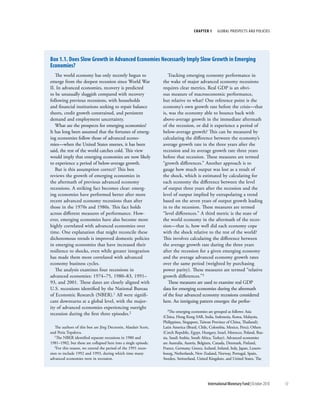
                                                               implementation of countercyclical policies made
                                                               possible by the policy room that many economies
     africa’s growth is accelerating                           had built prior to the downturn. Output growth in
        As sub-Saharan Africa rebounds from the                the region is projected to accelerate to 5 percent in
     slowdown in 2009, strong macroeconomic funda-             2010 and 5.5 percent in 2011, supported not only
     mentals through much of the region leave it well          by the recovery in exports and commodity prices,


88   International Monetary Fund | October 2010
chapter 2         cOuntry and regiOnal PersPectives


but also by robust domestic demand in a number
of economies (Table 2.7). Foreign inflows to the
region, including official flows, FDI, and remit-       Figure 2.15. Sub-Saharan Africa (SSA): Growth Is
tances, were less affected by the global downturn       Accelerating
than had been feared, although the outlook remains
uncertain (Figure 2.15).                                The slowdown in 2009 was brief, in part due to rapid implementation of
                                                        countercyclical policies. A recovery in exports and commodity prices is helping
   The pickup in global demand and the strength-        support the rebound, as is robust domestic demand in many economies.
                                                        Nonportfolio flows have been stable. Although the United States is the main
ening of oil prices are supporting growth in Africa’s   trading partner of oil exporters, Europe is the main export destination for many
oil-exporting economies. In the region’s largest oil    low- and middle-income economies in the region.
exporter, Nigeria, continued strong growth in the
non-oil sector is being supported by increasing oil     15 SSA: Fiscal Net                                SSA: Export Growth                 20
                                                           Lending/Borrowing                              (percent)
production, a result of reduced instability in the         (percent of GDP)
                                                        10
Niger Delta region. Thus, Nigeria’s output growth                      Oil exporters                                       LIC               10
is expected to accelerate from 7 percent in 2009         5
                                                            SSA
to 7.4 percent in both 2010 and 2011. Growth              0                                                                                  0
in Angola, the region’s second-largest oil exporter,                                                           Oil
                                                         -5     Low-income
is also expected to recover in 2010, following the                                                          exporters
                                                                                                                                             -10
                                                               countries (LIC)                                            SSA
decline in oil exports and the tightening of its bud-   -10                      Middle-income
                                                                                                                                 MIC
get in 2009. Angola’s growth is projected to increase                            countries (MIC)
                                                        -15                                                                                  -20
from less than 1 percent in 2009 to about 6 percent        2004 05 06 07 08 09 10 11                   2004 05 06 07 08 09 10 11

in 2010 and about 7 percent in 2011.
                                                              SSA: Terms of Trade                         SSA: Contributions to Growth1
   Sub-Saharan Africa’s middle-income econo-            30
                                                              (percent change)                            (percent)                              12
mies—whose output contracted in 2009 due to             20                                                        Total
                                                                                                                                                 8
their stronger global trade linkages—are now                   SSA
firmly on the path to recovery. The region’s larg-      10
                                                                                                                                                 4
est economy, South Africa, has benefited from             0
continued strong demand for commodities from                    LIC                                                                              0
                                                        -10             MIC
emerging Asia and from a recovery in demand for                                                                 Private consumption
manufactures from its largest export market, the        -20                   Oil                               Public consumption               -4
                                                                           exporters                            Investment
euro area. There are also signs that the monetary       -30
                                                                                                                Net exports
                                                                                                                                                 -8
easing pursued last year is supporting a recovery in       2004 05 06 07 08 09 10 11                      2004 05 06 07 08 09 10 11

domestic demand. After contracting by almost 2
                                                              SSA: Net Financial Flows                     SSA: Trade Linkages
percent in 2009, South Africa’s output is expected            (billions of U.S. dollars)                   (2009 exports by region;
                                                        100                                                percent of total exports)         140
to grow by 3 percent in 2010 and by 3.5 percent                                                                 United States        SSA
                                                                                                                                             120
in 2011.                                                 75                                                     Europe               Other
                                                                                                                Asia
   The relatively low degree of exposure of the          50
                                                                                                                                             100

region’s low-income economies to international                                                                                               80
                                                         25
trade and financial flows shielded them from the                                                                                             60
worst of the global downturn. Correspondingly,            0
                                                                  Remittances                                                                40
the acceleration of growth this year is expected to               Public aid
                                                        -25       Private direct investment                                                  20
be modest. Output growth in these economies is                    Private portfolio flows
expected to rise from 4.5 percent in 2009 to 4.9        -50
                                                              2004 05 06 07 08 09 10 11                     SSA      Oil    MIC        LIC
                                                                                                                                             0

percent in 2010, and further to 6 percent in 2011.                                                                exporters

Growth in low-income economies is generally              Sources: IMF, Direction of Trade Statistics; and IMF staff estimates.
                                                        1Excluding Liberia, São Tomé and Príncipe, and Zimbabwe.
expected to be driven as much by domestic factors
as by the global recovery. In Kenya, for example, a
recovery in tourism inflows and an improvement in


                                                                                          International Monetary Fund | October 2010              89
wOrld ecOnOmic OutlOOk: recOvery, risk, and rebalancing


     Table 2.7. Selected Sub-Saharan African Economies: Real GDP, Consumer Prices, Current Account
     Balance, and Unemployment
     (Annual percent change, unless noted otherwise)
                                                              Real GDP                  Consumer Prices1             Current Account Balance2                Unemployment3
                                                                 Projections                     Projections                      Projections                      Projections
                                                       2009    2010 2011           2009       2010 2011              2009       2010 2011             2009       2010 2011
     Sub-Saharan Africa                                 2.6      5.0     5.5        10.4        7.5      7.0          –1.7       –1.1     –1.9         ...        ...      ...
       Oil Exporters                                    5.0      6.7     7.0        11.6       11.3      9.4           6.0        8.2      7.4         ...        ...      ...
       Nigeria                                          7.0      7.4     7.4        12.4       11.9      9.8          14.1       13.0     11.8          4.5        4.5      4.5
       Angola                                           0.7      5.9     7.1        13.7       13.3     11.3          –5.0        1.6      1.3         ...        ...      ...
       Equatorial Guinea                                5.3      0.9     2.1         7.2        8.0      7.1         –16.0       –2.8    –11.6         ...        ...      ...
       Gabon                                           –1.4      4.5     5.0         2.1        3.0      3.5          16.6       15.2     14.3         ...        ...      ...
       Chad                                            –1.6      4.3     3.9        10.1        6.0      3.0         –33.7      –32.0    –25.4         ...        ...      ...
       Congo, Republic of                               7.5     10.6     8.7         4.3        5.2      4.5          –7.7        4.2      7.9         ...        ...      ...
       Middle-Income                                   –1.7     3.3      3.6         7.1        5.5      5.7          –4.1       –4.4     –5.8         ...       ...       ...
       South Africa                                    –1.8     3.0      3.5         7.1        5.6      5.8          –4.0       –4.3     –5.8         24.3      24.8      24.4
       Botswana                                        –3.7     8.4      4.8         8.1        6.7      6.3          –2.1       –0.5     –0.4         ...       ...       ...
       Mauritius                                        2.5     3.6      4.1         2.5        2.5      2.6          –7.8       –9.4     –9.0          8.0       7.5       7.3
       Namibia                                         –0.8     4.4      4.8         9.1        6.5      5.9          –1.7       –2.6     –6.0         ...       ...       ...
       Swaziland                                        1.2     2.0      2.5         7.6        6.2      5.6          –6.2      –12.6    –12.3         30.0      30.0      30.0
       Cape Verde                                       3.0     4.1      6.0         1.0        1.8      2.0          –9.9      –18.6    –18.2         17.0      17.0      17.0
       Seychelles                                       0.7     4.0      5.0        31.8       –2.4      2.5         –35.1      –39.5    –35.5          5.1       4.6       4.1
       Low-Income4                                      4.5     4.9      6.0        12.6        6.2      6.0          –6.8       –7.4     –8.3         ...        ...      ...
       Ethiopia                                         9.9     8.0      8.5        36.4        2.8      9.0          –5.0       –3.9     –8.0         ...        ...      ...
       Kenya                                            2.4     4.1      5.8         9.3        4.1      5.0          –6.7       –6.7     –7.4         ...        ...      ...
       Tanzania                                         6.0     6.5      6.7        12.1        7.2      5.0         –10.0       –8.8     –8.8         ...        ...      ...
       Cameroon                                         2.0     2.6      2.9         3.0        3.0      2.7          –2.7       –3.9     –4.1         ...        ...      ...
       Uganda                                           7.2     5.8      6.1        14.2        9.4      5.5          –4.0       –6.4     –9.2         ...        ...      ...
       Côte d’Ivoire                                    3.8      3.0     4.0         1.0        1.4       2.5          7.2        6.8       2.5        ...        ...       ...
        1Movements   in consumer prices are shown as annual averages. December–December changes can be found in Table A7 in the Statistical Appendix.
        2Percent of GDP.
        3Percent. National definitions of unemployment may vary.
        4Includes Benin, Burkina Faso, Burundi, Central African Republic, Comoros, Democratic Republic of the Congo, Eritrea, The Gambia, Ghana, Guinea, Guinea-Bissau, Lesotho,

     Liberia, Madagascar, Malawi, Mali, Mozambique, Niger, Rwanda, São Tomé and Príncipe, Senegal, Sierra Leone, Togo, Zambia, and Zimbabwe.


         rainfall are expected to support the acceleration of                                      weaker conditions in economies employing migrant
         output growth, to 4.1 percent in 2010.                                                    workers from sub-Saharan Africa.
            The primary risk to the outlook for the region                                            Asset market spillovers resulting from increased
         is a faltering global recovery. But different econo-                                      global volatility or risk aversion are likely to be lim-
         mies in the region have differing exposures. For the                                      ited. Portfolio flows are a less critical component of
         oil-exporting economies, spillovers from a global                                         overall capital flows in sub-Saharan Africa than in the
         slowdown would be manifested primarily through                                            rest of the world, and most economies in the region
         its impact on oil prices. In contrast, middle- and                                        have relatively underdeveloped financial markets.
         low-income economies’ exposure comes from their                                           South Africa is the notable exception: its equity and
         exports to Europe, which are about one-third of                                           currency markets are often more sensitive to shifts
         total exports, nearly four times the share of their                                       in global sentiment than other emerging markets in
         exports to the United States. In addition to these                                        Asia or Latin America, because nonresident transac-
         trade linkages, continued weakness and measures                                           tions account for a relatively high share of turnover.
         to cut budget deficits in advanced economies may                                             Finally, with the recovery in progress, fiscal poli-
         affect the low-income economies of sub-Saharan                                            cies in many economies in the region should begin
         Africa by reducing aid and private financial flows                                        addressing medium-term priorities. As private and
         to the region. For example, remittances are an                                            external demand recovers, economies will need
         important source of foreign inflows to the region,                                        to rebuild fiscal room and reorient its use. Where
         amounting, for example, to almost 10 percent                                              output growth has recovered, debt levels are rising,
         of GDP in Senegal. These may be susceptible to                                            and primary deficits are above levels that will stabilize


90       International Monetary Fund | October 2010
chapter 2     cOuntry and regiOnal PersPectives


debt over the medium term, more prudent fiscal bal-           Financial, and Remittance Channels,” IMF Working
ances are in order. However, where output growth is           Paper No. 09/277 (Washington: International Mon-
still weak, outstanding debt is low, and fiscal deficits      etary Fund). Available at www.imf.org/external/pubs/ft/
are in check, there may be scope to sustain higher            wp/2009/wp09277.pdf.
levels of spending in priority areas such as educa-        Cheung, Yin-Wong, and Xingwang Qian, 2009, “Hoarding
                                                              of International Reserves: Mrs. Machlup’s Wardrobe and
tion, health, and infrastructure investment. One
                                                              the Joneses,” Review of International Economics, Vol. 17,
of the positive aspects of the response to the recent
                                                              No. 4, pp. 824–43.
downturn was the ability of many economies in the
                                                           International Monetary Fund (IMF), 2010a, “How Did
region to shield such pro-poor and pro-growth public
                                                              Emerging Markets Cope in the Crisis?” IMF Policy Paper
spending. As highlighted in the April 2010 Regional           (Washington: International Monetary Fund). Available at
Economic Outlook: Sub-Saharan Africa, spending on             www.imf.org/external/np/pp/eng/2010/061510.pdf.
health and education actually increased in real terms      ——, 2010b, “Reserve Accumulation and International
in 20 of 29 low-income economies in 2009. Public              Monetary Stability,” IMF Policy Paper (Washington:
capital spending also increased in real terms in half         International Monetary Fund). Available at www.imf.org/
the economies in the region.                                  external/np/pp/eng/2010/041310.pdf.
                                                           _____, 2010c, People’s Republic of China: 2010 Article IV
                                                              Consultation—Staff Report; Staff Statement; Public Infor-
references                                                    mation Notice on the Executive Board Discussion, IMF
Alturki, Fahad, Jaime Espinosa-Bowen, and Nadeem Ilahi,       Staff Country Report No. 10/238 (Washington). Available
   2009, “How Russia Affects the Neighborhood: Trade,         at www.imf.org/external/pubs/ft/scr/2010/cr10238.pdf.


                                                                                     International Monetary Fund | October 2010   91
1
          3
chapter
 hapter

                 Will it hurt? MacroeconoMic effects of fiscal
                 consolidation


              This chapter examines the effects of fiscal consolidation        large spending cuts and tax hikes. An important
              —tax hikes and government spending cuts—on economic              and timely question is, therefore, whether fiscal
              activity. Based on a historical analysis of fiscal consolida-    retrenchment will hurt economic performance.
              tion in advanced economies, and on simulations of the               Although there is widespread agreement that
              IMF’s Global Integrated Monetary and Fiscal Model                reducing debt has important long-term benefits,
              (GIMF), it finds that fiscal consolidation typically reduces     there is no consensus regarding the short-term
              output and raises unemployment in the short term. At             effects of fiscal austerity. On the one hand, the
              the same time, interest rate cuts, a fall in the value of        conventional Keynesian view is that cutting spend-
              the currency, and a rise in net exports usually soften the       ing or raising taxes reduces economic activity in the
              contractionary impact. Consolidation is more painful             short term. On the other hand, a number of studies
              when it relies primarily on tax hikes; this occurs largely       present evidence that cutting budget deficits can
              because central banks typically provide less monetary            stimulate the economy even in the short term. The
              stimulus during such episodes, particularly when they            notion that fiscal retrenchment stimulates growth
              involve indirect tax hikes that raise inflation. Also, fiscal    in the short term is often referred to as the “expan-
              consolidation is more costly when the perceived risk of          sionary fiscal contractions” hypothesis. A key factor
              sovereign default is low. These findings suggest that budget     explaining such effects is an improvement in house-
              deficit cuts are likely to be more painful if they occur         hold and business confidence.2 The truth could be
              simultaneously across many countries, and if monetary            a mixture. For example, it may be that the short-
              policy is not in a position to offset them. Over the long        term effects are usually contractionary, but that
              term, reducing government debt is likely to raise output,        expansionary effects can occur when government
              as real interest rates decline and the lighter burden of         solvency is in question, or when the consolidation is
              interest payments permits cuts to distortionary taxes.           structured in a way that increases confidence.
                                                                                  This chapter offers new evidence regarding these
              Budget deficits and government debt soared during                important issues by studying fiscal consolidation
              the Great Recession. In 2009, the budget deficit                 in advanced economies over the past 30 years. It
              averaged about 9 percent of GDP in advanced                      examines budget policies to identify periods of
              economies, up from only 1 percent of GDP in                      fiscal consolidation, and then uses simple statisti-
              2007.1 By the end of 2010, government debt is                    cal techniques to investigate the short-term growth
              expected to reach about 100 percent of GDP—its                   effects of consolidation and how those effects are
              highest level in 50 years. Looking ahead, population             influenced by such factors as monetary policy,
              aging could create even more serious problems for                international trade, the form of the consolidation,
              public finances.                                                 and perceived sovereign risk. To complement the
                 In response to these worrisome developments,                  historical analysis, the chapter employs simulations
              virtually all advanced economies will face the                   of the IMF’s GIMF to explore additional issues
              challenge of fiscal consolidation. Indeed, many                  such as the long-term effects of debt reduction. In
              governments are already undertaking or planning                  particular, the chapter attempts to answer the fol-
                                                                               lowing questions:
                  The main authors of this chapter are Daniel Leigh (team
              leader), Pete Devries, Charles Freedman, Jaime Guajardo, Doug-
              las Laxton, and Andrea Pescatori, with support from Murad          2 For  a summary of how such expansionary effects can arise
              Omoev, Min Kyu Song, and Jessie Yang.                            in the short term, see, for example, Alesina (2010). Under some
                 1Advanced economies are defined as the 33 economies so        strict assumptions, Ricardian equivalence can imply that fiscal
              designated based on the World Economic Outlook classification    consolidation has no impact on economic activity, as changes in
              described in the Statistical Appendix.                           private demand exactly offset changes in government demand.


                                                                                                          International Monetary Fund | October 2010   93
wOrld ecOnOmic OutlOOk: recOvery, risk, and rebalancing


     • What are the short-term effects of fiscal retrench-                 biases the analysis toward downplaying contraction-
        ment on economic activity? Does output                             ary effects and overstating expansionary ones.
        typically contract or expand in response to tax                       To avoid the problems associated with these
        hikes and spending cuts? What happens to                           existing studies, we use an alternative method
        unemployment?                                                      for identifying periods of fiscal consolidation. In
     • What factors dampen or exacerbate the short-                        particular, our approach focuses on policy actions
        term effects? In particular, what are the roles of                 intended to reduce the budget deficit. As we
        monetary policy, the composition of the package                    explain later, this approach helps us obtain more
        (taxes versus spending), and the perceived risk of                 accurate estimates of the effects of tax hikes and
        sovereign default in shaping the outcome? What                     spending cuts on economic activity. Methodologi-
        are the consequences of many countries cutting                     cally, our approach is close to that of Romer and
        deficits at the same time?                                         Romer (1989, 2010), who examine the effects on
     • Does fiscal consolidation have different effects                    U.S. output of changes in monetary policy and tax
        when interest rates are near zero? Interest rates                  rates in the United States.
        have rarely been near zero in the past––with the                      The main findings of the chapter are as follows:
        exception of Japan since the 1990s––but they are                   • Fiscal consolidation typically has a contraction-
        near zero in many advanced economies today.                           ary effect on output. A fiscal consolidation equal
        Would fiscal consolidation in this environment                        to 1 percent of GDP typically reduces GDP by
        be more or less painful than in the past?                             about 0.5 percent within two years and raises
     • What are the long-term effects on output of                            the unemployment rate by about 0.3 percentage
        reducing government debt? Do the long-term                            point. Domestic demand—consumption and
        effects depend on whether the savings from lower                      investment—falls by about 1 percent.
        interest payments are used to provide tax cuts or                  • Reductions in interest rates usually support
        to finance new spending?                                              output during episodes of fiscal consolidation.
        Given the importance of these issues, this chapter                    Central banks offset some of the contractionary
     is not the first to address them. In particular, previ-                  pressures by cutting policy interest rates, and
     ous work by Giavazzi and Pagano (1990, 1996),                            longer-term rates also typically decline, cushion-
     Alesina and Perotti (1995, 1997), and Alesina and                        ing the impact on consumption and investment.
     Ardagna (1998, 2010) has been extremely influ-                           For each 1 percent of GDP of fiscal consolida-
     ential in the debate regarding the consequences of                       tion, interest rates usually fall by about 20 basis
     fiscal adjustment.3 A key conclusion of these studies                    points after two years. The model simulations
     is that fiscal adjustments tend to be expansion-                         also imply that, if interest rates are near zero, the
     ary when they rely primarily on spending cuts.4                          effects of fiscal consolidation are more costly in
     However, these studies often identify periods of                         terms of lost output.5
     fiscal consolidation using a statistical concept––the                 • A decline in the real value of the domestic cur-
     increase in the cyclically adjusted budget surplus––                     rency typically plays an important cushioning
     that, as this chapter shows, is a highly imperfect                       role by spurring net exports and is usually due
     measure of actual policy actions. The chapter finds                      to nominal depreciation or currency devalu-
     that this way of selecting cases of consolidation                        ation. For each 1 percent of GDP of fiscal
                                                                              consolidation, the value of the currency usually
                                                                              falls by about 1.1 percent, and the contribu-
        3 Note that the literature on fiscal consolidation is part of a

     broader empirical literature on the effects of fiscal policy, which
     includes, among others, the work of Blanchard and Perotti                5 For simplicity, the model simulations ignore the possibil-

     (2002), Barro and Redlick (2009), Hall (2009), Ramey and              ity that the central bank responds to fiscal consolidation using
     Shapiro (1998), Ramey (2009), and Romer and Romer (2010).             unconventional monetary tools, such as quantitative and credit
        4 Many studies have followed the Alesina and Perotti (1995)        easing. To the extent that such tools would be used to support
     methodology, including Broadbent and Daly (2010), Tsibouris           output, the simulations may overstate the impact of the zero
     and others (2006), and Von Hagen and Strauch (2001).                  interest rate floor.


94   International Monetary Fund | October 2010
chapter 3    will it Hurt? macrOecOnOmic effects Of fiscal cOnsOlidatiOn


   tion of net exports to GDP rises by about 0.5           looking at history: What is the short-term
   percentage point. Because not all countries can         impact of fiscal consolidation?
   increase net exports at the same time, this find-
                                                              In this section, we examine the history of fiscal
   ing implies that fiscal contraction is likely to be
                                                           retrenchment in advanced economies over the past
   more painful when many countries adjust at the
                                                           30 years and evaluate the short-term effects on eco-
   same time.
                                                           nomic activity. The section starts by explaining how
• Fiscal contraction that relies on spending cuts
                                                           we identify periods of fiscal consolidation, and con-
   tends to have smaller contractionary effects than
                                                           trasts our approach to the standard approach used
   tax-based adjustments. This is partly because
                                                           in previous studies. It then reports the estimated
   central banks usually provide substantially more
                                                           effects of fiscal consolidation, and compares our
   stimulus following a spending-based contraction
                                                           results with those based on the standard approach.
   than following a tax-based contraction. Monetary
   stimulus is particularly weak following indirect
   tax hikes (such as the value-added tax, VAT) that       identifying cases of fiscal consolidation
   raise prices.
                                                              The usual approach to identifying historical
• Fiscal retrenchment in countries that face a
                                                           cases of fiscal retrenchment is to focus on swings
   higher perceived sovereign default risk tends to
                                                           in the cyclically adjusted primary budget bal-
   be less contractionary. However, even among
                                                           ance (CAPB). The CAPB is calculated by taking
   such high-risk countries, expansionary effects are
                                                           the actual primary balance––non-interest revenue
   unusual.
                                                           minus non-interest spending––and subtracting the
• Model simulations suggest that over the long
                                                           estimated effect of business cycle fluctuations on
   term, reducing debt is likely to be beneficial.
                                                           the fiscal accounts. For example, Alesina and Perotti
   In particular, the GIMF simulations considered
                                                           (1995) and Alesina and Ardagna (2010) correct
   here suggest that lower government debt lev-
                                                           the primary surplus for year-to-year changes in the
   els reduce real interest rates, which stimulates
                                                           unemployment rate.6 Cyclical adjustment offers an
   private investment. Also, the lower burden of
                                                           intuitive way of dealing with the fact that tax rev-
   interest payments creates fiscal room for cutting
                                                           enue and government spending move automatically
   distortionary taxes. Both of these effects raise
                                                           with the business cycle. The idea is that, once they
   output in the long term. Overall, the simulations
                                                           are cyclically adjusted, changes in fiscal variables
   imply that for every 10 percentage point fall in
                                                           reflect policymakers’ decisions to change tax rates
   the debt-to-GDP ratio, output rises by about
                                                           and spending levels. A sharp increase in the CAPB
   1.4 percent in the long term.
                                                           would therefore provide evidence of deliberate deep
   The remainder of the chapter is organized as
                                                           deficit cuts.
follows. The first section provides an empiri-
                                                              However, the conventional approach used to
cal assessment of the short-term impact of fiscal
                                                           identify cases of fiscal consolidation is far from
consolidation using a new database of historical
                                                           perfect and can bias the results toward finding
episodes of fiscal consolidation during 1980–2009.
The second section complements the histori-
cal analysis by conducting model simulations to                6 In
                                                                  particular, these studies use a method proposed by
address additional issues, such as the consequences        Blanchard (1990) following which “the cyclically adjusted value
of being near the zero bound on nominal inter-             of the change in a fiscal variable is the difference between a
                                                           measure of the fiscal variable in period t computed as if the
est rates, the impact of having many countries
                                                           unemployment rate were equal to the one in t − 1 and the actual
consolidating simultaneously, and the long-term            value of the fiscal variable in year t – 1” (Alesina and Ardagna,
consequences of reducing debt levels. The conclud-         2010, p. 7). Most studies also use a statistical threshold for iden-
ing section draws lessons from the analysis for            tifying large increases in the CAPB. For example, Alesina and
                                                           Ardagna (2010) identify a period of fiscal adjustment as a year
countries considering fiscal consolidation in the          in which the ratio of the CAPB to GDP improves by at least 1.5
current environment.                                       percentage points.


                                                                                       International Monetary Fund | October 2010   95
wOrld ecOnOmic OutlOOk: recOvery, risk, and rebalancing


     expansionary effects.7 Two key problems relate to                           first country than for the second country, despite
     measurement errors and to policy motivation:                                the presence of identical consolidation measures.
     • The first problem is that cyclical adjustment                             The standard approach would therefore tend to
       methods suffer from measurement errors that are                           miss cases of consolidation followed by adverse
       likely to be correlated with economic develop-                            shocks, because there may be little or no rise in
       ments. For example, standard cyclical-adjustment                          the CAPB despite the consolidation measures.
       methods fail to remove swings in government                               The case of Germany in 1982 provides a real-
       tax revenue associated with asset price or com-                           world counterpart to this hypothetical example:
       modity price movements from the fiscal data,                              the CAPB-to-GDP ratio rose by only 0.4 per-
       resulting in changes in the CAPB that are not                             centage point, despite the fact that the authorities
       necessarily linked to actual policy changes.8 Thus,                       implemented fiscal austerity measures amounting
       including episodes associated with asset price                            to about 1.4 percent of GDP.11 The impact of
       booms––which tend to coincide with economic                               these measures on the CAPB was partly offset by
       expansions––and excluding episodes associated                             countercyclical stimulus measures introduced in
       with asset price busts from the sample introduces                         response to the recession that year.12
       an expansionary bias.9 For example, in the case                           Moreover, the problems with the usual approach
       of Ireland in 2009, the collapse in stock and                          are not just hypothetical or limited to a few specific
       housing prices induced a sharp reduction in the                        cases. As we show in Appendix 3.3, the change in the
       CAPB despite the implementation of tax hikes                           CAPB-to-GDP ratio is an unreliable guide regard-
       and spending cuts totaling 4.5 percent of GDP.10                       ing the presence of fiscal consolidation. The standard
     • The second problem with the standard approach                          approach tends to select periods associated with favor-
       is that it ignores the motivation behind fiscal                        able outcomes but during which no austerity measures
       actions. Thus, it omits years during which actions                     were actually taken. It also tends to omit cases of fiscal
       aimed at fiscal consolidation were followed by                         austerity associated with unfavorable outcomes.
       an adverse shock and an offsetting discretion-                            Therefore, rather than focusing on the CAPB,
       ary stimulus. For example, imagine that two                            we look at policy actions. In particular, we identify
       countries adopt identical consolidation policies,                      cases in which the government implemented tax
       but then one is hit by an adverse shock and so                         hikes or spending cuts (at the general government
       adopts discretionary stimulus, while the other is                      level) to reduce the budget deficit and put pub-
       hit with a favorable shock. Here, the change in                        lic finances on a more sustainable footing. Thus,
       the CAPB would show a smaller increase for the                         whereas the usual strategy identifies periods of con-
        7 Appendix 3.3 provides a number of specific examples
                                                                              solidation based on successful (cyclically adjusted)
     that illustrate the problems associated with the conventional            budget outcomes, our approach identifies episodes
     approach.                                                                based on fiscal policy actions motivated by deficit
        8 As Morris and Schuknecht (2007) explain, “asset price
                                                                              reduction, irrespective of the outcomes.
     movements are a major factor behind unexplained changes in the
     cyclically adjusted balance, which, if not accounted for, can lead
     to erroneous conclusions regarding underlying fiscal develop-               11 The source of the data for the CAPB-to-GDP ratio is Ale-

     ments” (p. 4).                                                           sina and Ardagna (2010). The concept of government used for
        9 A similar problem occurs during sharp recessions. As                the CAPB is that of the general government.
     Wolswijk (2007) explains, standard cyclical adjustment methods              12 For similar reasons, the standard approach is likely to iden-

     assume that the automatic response (elasticity) of fiscal variables      tify cases of fiscal tightening that are unrelated to deficit-reduc-
     to the business cycle is constant over time. However, there is           tion concerns. For example, imagine that two countries adopt no
     evidence that sharp recessions have a stronger-than-average auto-        consolidation measures, but then one is hit by a favorable shock
     matic effect on fiscal variables. Therefore, if a fiscal consolidation   and so adopts countercyclical tightening to cool the economy,
     coincides with a sharp recession, it is less likely to be picked up      while the other does nothing. Here, the change in the CAPB
     by the standard approach, which searches for an increase in the          would show tightening for the first country, and no change for
     CAPB.                                                                    the second country, despite the lack of consolidation measures in
        10 See 2009 OECD Economic Surveys: Ireland; EC (2008);                both countries. The standard approach would therefore tend to
     and 2009 IMF Staff Report for Ireland (Country Report No.                include cases associated with economic booms despite the lack of
     09/195).                                                                 measures aimed at fiscal consolidation.


96   International Monetary Fund | October 2010
chapter 3    will it Hurt? macrOecOnOmic effects Of fiscal cOnsOlidatiOn


   Although our action-based approach addresses           Developments reports, country budget documents,
the problems associated with the conventional             and additional country-specific sources.13 The
approach to identifying fiscal consolidation, both        estimated effect on the budget deficit is based on
the standard approach and our approach are subject        these sources. In this respect, our methodology is
to two additional criticisms. First, if countries         closely related to the “narrative approach” proposed
sometimes postpone fiscal consolidation until the         by Romer and Romer (1989, 2004, 2010).14 The
economy recovers, then the consolidation exercise         analysis also distinguishes between permanent
will be associated with good economic outcomes in         and temporary measures. Temporary measures are
both the standard approach and our approach. Sec-         recorded as generating positive savings when they
ond, if a country is committed to a deficit-reduc-        are introduced and negative savings when they
tion path and the economy falls into a recession,         expire.
it may implement additional fiscal consolidation             The sample includes the fiscal actions taken to
measures, thus associating fiscal consolidation with      reduce the deficit in 15 advanced economies during
unfavorable economic outcomes in both the stan-           1980–2009.15 The main reason the analysis focuses
dard approach and our approach. Thus, biases may          on advanced economies is that fiscal policy adjust-
remain even in our approach, although it is unclear       ment needs are particularly large, on average, for
in which direction they would go overall.                 the group of advanced economies, as discussed in
   In addition, in contrast to some previous studies,     the IMF’s May 2010 Fiscal Monitor (IMF, 2010).
we do not focus on periods of “sustained” (mul-              For the 15 countries covered—Australia, Bel-
tiyear) fiscal consolidation. A key problem with          gium, Canada, Denmark, Finland, France, Ger-
such an approach is that governments may choose           many, Ireland, Italy, Japan, Portugal, Spain, Sweden,
to interrupt a program of fiscal austerity due to         the United Kingdom, and the United States—we
unfavorable output developments. For example,             identified 173 years in which there were budget-
Japan’s six-year fiscal adjustment plan, initiated in     ary measures aimed at fiscal consolidation. Thus,
1997, was suspended in December 1998 following            on average across the sample countries, about 40
a sharp economic downturn. In contrast, favorable         percent of years saw the introduction of budget-
output developments are likely to help governments        ary measures aimed at reducing the deficit (Figure
complete a sustained fiscal consolidation. Therefore,     3.1). The average size of fiscal consolidation was
focusing on cases of sustained consolidation would        about 1 percent of GDP per year, but the range was
bias toward finding expansionary effects.                 wide (see Figure 3.1). Fiscal contractions of more
   In sum, not only does the standard approach
                                                              13 Additionalcountry-specific sources used to clarify the
sometimes select years that bear no relation to
                                                          motivation behind the fiscal consolidation measures include
actual changes in fiscal policy, it also biases the       Kuttner and Posen (2002), Nakagawa (2009), and Takahashi
results toward downplaying contractionary effects         and Tokuoka (2010) for Japan; Lawson (1992) for the United
and overstating the expansionary effects of fiscal        Kingdom; and Romer and Romer (2009) and the sources cited
                                                          therein, for the United States. We find that the estimates of the
adjustment. In contrast, a key contribution of this       measures’ expected impact on the fiscal deficit at the time they
chapter is to reduce these bias problems and there-       were implemented are similar across the various sources.
                                                             14 Focusing on the United States, Romer and Romer (2010)
fore allow us to better estimate the causal impact on
                                                          use the narrative record, such as congressional reports, to identify
output of fiscal consolidation.                           the size and motivation for all post–World War II tax policy
                                                          actions. They find that only a small share of observed changes in
                                                          government revenue reflect actual changes in tax policy and use
implementing the action-Based approach                    the changes in tax policy identified by means of their narrative
                                                          approach to obtain estimates of the causal impact of tax changes
   Our approach requires identifying policy actions       on the economy.
motivated by deficit reduction. Therefore, we exam-          15 The complete list of periods of fiscal adjustments is reported

ine accounts and records of what countries actu-          in Appendix 3.1. A companion paper, available on request,
                                                          shows how we implement the approach. In particular, it provides
ally did. In particular, we analyze OECD Economic         quotations and citations for each case to show how we deter-
Surveys, IMF Staff Reports, IMF Recent Economic           mined the presence of fiscal consolidation measures.


                                                                                      International Monetary Fund | October 2010   97
wOrld ecOnOmic OutlOOk: recOvery, risk, and rebalancing


                                                                                             than 1.5 percent of GDP per year represent about
                                                                                             one-fifth of all cases of consolidation. Therefore,
                                                                                             on average, countries implemented such large fiscal
                                                                                             adjustments once every 14 years. As we show later
                                                                                             on, the estimated effects of these large adjustments
                                                                                             on output are similar to the effects of smaller
                                                                                             adjustments.

Figure 3.1. Action-Based Fiscal Consolidation
There were about 170 cases of action-based fiscal consolidation over the past 30
                                                                                             estimated effects of fiscal consolidation
years in advanced economies. Consolidation has often relied primarily on
spending cuts. On average, action-based fiscal consolidation amounted to                        With periods of fiscal consolidation now identi-
1 percent of GDP a year, but the range was wide.                                             fied, this section employs statistical techniques to
                                                                                             assess the impact of the fiscal measures on economic
  Fiscal Consolidation over Time                                                        14
  (number of fiscal contractions by year)                                                    activity. The statistical methodology is standard and
         Spending-based                                                                 12   follows that of Cerra and Saxena (2008), Romer
         Tax-based
         Other                                                                          10   and Romer (2010), and others. In particular, we
                                                                                        8
                                                                                             estimate the average impulse response of output to
                                                                                             action-based fiscal consolidation using panel data
                                                                                        6
                                                                                             analysis. The estimated equation makes use of an
                                                                                        4
                                                                                             autoregressive model in growth rates estimated on
                                                                                        2    annual data for 1980–2009 for the 15 countries in
                                                                                        0    our sample. The growth rates are then cumulated to
1980          85            90             95         2000           05           10
                                                                                             obtain the estimated impact of fiscal consolidation
  Size of Fiscal Consolidation                                                          60   on the level of output.16
  (in percent of GDP a year)
                                                                                                A key result is that fiscal consolidation is typi-
                                                                                        50
                                                                                             cally contractionary. A fiscal consolidation equal to
                                                                                        40   1 percent of GDP typically reduces real GDP by
                                                                                        30
                                                                                             about 0.5 percent after two years (Figure 3.2). The
                                                                                             effect on the unemployment rate is an increase of
                                                                                        20

                                                                                        10

                                                                                        0       16 In particular, the estimated equation has the growth rate of
     0               1                 2                 3                 4
                                                                                             real GDP as the dependent variable on the left-hand side. On
  Source: IMF staff calculations.                                                            the right-hand side, the explanatory variables are the current and
  Note: The 15 advanced economies in the sample are Australia, Belgium, Canada,              lagged values of the fiscal consolidation measures identified as
Denmark, Finland, France, Germany, Ireland, Italy, Japan, Portugal, Spain, Sweden,           discussed above. Including lags allows for a delayed impact of fis-
United Kingdom, and United States. “Spending-based” consolidation relied primarily on
spending cuts. “Tax-based” consolidation relied primarily on tax hikes. The “other”
                                                                                             cal consolidation on growth. In addition, the approach controls
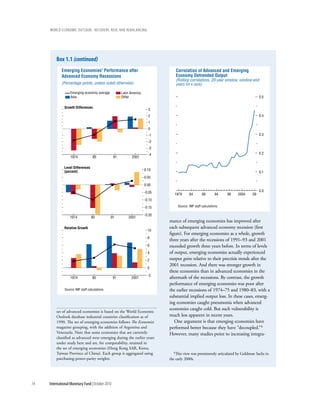
category denotes contractions for which composition details were either not available        for lags of real GDP growth, to distinguish the effect of fiscal
or for which no category accounted for the majority of the adjustment.                       consolidation from that of normal output dynamics. Thus, the
                                                                                             equation estimated is
                                                                                                           2           2
                                                                                               git 5 a 1 ∑ bj gi,t–j 1 ∑ bs ABFCi,t–s 1 mi 1 lt 1 nit ,
                                                                                                          j=1          s=0
                                                                                             where the subscript i denotes the ith country, and the subscript
                                                                                             t denotes the tth year; g is the percent change in real GDP; and
                                                                                             ABFC is the estimated size of the action-based fiscal consolida-
                                                                                             tion measures as a percent of GDP. The approach includes a
                                                                                             full set of country dummies (mi ) to take account of differences
                                                                                             among countries’ normal growth rates. The estimated equation
                                                                                             also includes a full set of time dummies (lt ) to take account of
                                                                                             global shocks such as shifts in oil prices or the global business
                                                                                             cycle.


98           International Monetary Fund | October 2010
chapter 3        will it Hurt? macrOecOnOmic effects Of fiscal cOnsOlidatiOn


about 0.3 percentage point after two years.17 The
results are statistically significant at conventional
levels. Overall, the idea that fiscal austerity stimu-
lates economic activity in the short term finds little
support in the data.18
   However, the average effect of fiscal consolidation
shown in Figure 3.2 hides a range of experiences
related to a number of factors. In particular, we
now turn to three key factors that shape the out-
comes: the role of interest rates and exchange rates,
                                                                            Figure 3.2. Impact of a 1 Percent of GDP Fiscal
the composition of the fiscal package, and the role
                                                                            Consolidation on GDP and Unemployment
of perceived sovereign risk of the country undertak-
ing the consolidation.                                                      Fiscal consolidation is normally contractionary. A fiscal consolidation equal to
                                                                            1 percent of GDP typically reduces real GDP by about 0.5 percent and raises the
                                                                            unemployment rate by about 0.3 percentage point.


the Mitigating role of interest rates and exchange rates                              GDP (percent)                 Unemployment rate (percentage points)

   This section looks at the role of interest rate
                                                                                                                                                                     0.6
cuts and declines in the value of the currency in
mitigating the impact of fiscal consolidation. In
                                                                                                                                                                     0.4
addition, to clarify how interest rates and exchange
rates shape the outcome, we examine the behavior
                                                                                                                                                                     0.2
of the components of GDP, including exports and
imports. To explore these channels, we use the same
                                                                                                                                                                     0.0
statistical approach as described above, but apply
it to studying the impact of fiscal consolidation
                                                                                                                                                                     -0.2
on exchange rates and interest rates instead of on
output.19
                                                                                                                                                                     -0.4


                                                                                                                                                                     -0.6


  17 To  explore the impact on the unemployment rate, we                                                                                                             -0.8
                                                                             0                           1                          2                           3
replace all the GDP growth terms in the estimated equation with
the change in the unemployment rate. We then cumulate the                     Source: IMF staff calculations.
impulse responses to obtain the impact of fiscal consolidation on             Note: t = 1 denotes the year of consolidation. Dotted lines equal one standard error
the level of the unemployment rate.                                         bands.
   18Several robustness checks were performed, as reported in

Appendix 3.2. In particular, excluding lags of growth had little
effect on the results; using different lag lengths (up to four)
yielded similar results. Although the country dummies are
correlated with the lagged dependent variables in the estimated
equation, the bias is small here given the large number of obser-
vations per country relative to the number of countries (30 years
for each of our 15 countries). When the estimation is conducted
using the Arellano-Bond estimator, which corrects for this pos-
sible bias, the results are very similar.
   19For example, to examine the response of the real exchange

rate to fiscal consolidation, we repeat the estimation of the equa-
tion described above, while replacing all the GDP growth terms
with the change in the log of the real exchange rate. We then
cumulated the impulse responses to obtain the impact of fiscal
consolidation on the (log) level of the real exchange rate.


                                                                                                             International Monetary Fund | October 2010                    99
wOrld ecOnOmic OutlOOk: recOvery, risk, and rebalancing


                                                                                                    Interest rates
                                                                                                       The short-term policy interest rate typically falls
                                                                                                    by about 20 basis points in response to a fiscal con-
                                                                                                    solidation of 1 percent of GDP (Figure 3.3). Since
                                                                                                    the rate of inflation usually does not change much
                                                                                                    following fiscal consolidation, the fall in real interest
                                                                                                    rates is similar. At the same time, the long-term
                                                                                                    nominal interest rate on government bonds falls
Figure 3.3. Response of Monetary Conditions to a 1                                                  broadly in line with short-term rates. In particular,
Percent of GDP Fiscal Consolidation                                                                 the yield on government bonds with a maturity of
Interest rate cuts and a decline in the value of the domestic currency usually play
                                                                                                    10 years declines by about 15 basis points after two
a key supportive role during episodes of fiscal consolidation.                                      years in response to a fiscal consolidation equal to
                                                                                                    1 percent of GDP. The response of long-term rates
  Interest Rate                                                                              10
  (basis points)                                                                                    suggests that fiscal consolidation may reduce risk
                                                                                                    premiums.20
                                                                                             0
                                                                                                    Exchange rates
                                                       Long-term                             -10       In response to a fiscal consolidation of 1 percent
                                                       (ten-year)
                                                                           Short-term               of GDP, the exchange rate depreciates by about
                                                                            (policy)
                                                                                             -20    1.1 percent in real terms (see Figure 3.3). Interest-
                                                                                                    ingly, this real depreciation is almost fully explained
                                                                                             -30    by nominal exchange rate depreciation or currency
 0                            1                           2                              3
                                                                                                    devaluation. Examples of large devaluations during
  Exchange Rate                                                                              0.5    fiscal consolidation include, among others, Finland
  (percent)                                                                                         (1992), Ireland (1987), and Italy (1992).
                                                                                             0.0
                                                                                                    Transmission channel: the role of net exports
                                                                                             -0.5
                                                        Real                                           How do these changes in interest rates and
                                                               Nominal
                                                                                             -1.0   exchange rates affect the economy? The fall in
                                                                                                    interest rates is likely to support consumption and
                                                                                             -1.5   investment. And the real depreciation should sup-
                                                                                                    port economic activity by boosting net exports.
                                                                                             -2.0
 0                            1                           2                              3             Decomposing the response of GDP into its
                                                                                                    demand components confirms that net exports
  Source: IMF staff calculations.
  Note: t = 1 denotes the year of consolidation. Dotted lines equal one standard error
                                                                                                    expand in response to fiscal consolidation, provid-
 bands.                                                                                             ing a key cushioning role. In particular, the contri-
                                                                                                    bution of net exports to GDP increases by about
                                                                                                    0.5 percentage point (Figure 3.4). The increase in
                                                                                                    net exports reflects both an increase in real exports
                                                                                                    in response to the real exchange rate depreciation


                                                                                                      20 The effect of fiscal consolidation on longer-term interest
                                                                                                    rates may be influenced by two factors: the decline in the cur-
                                                                                                    rent and future short-term interest rate and a reduction in the
                                                                                                    risk premium related to the perceived improvement in the fiscal
                                                                                                    outlook.


100          International Monetary Fund | October 2010
chapter 3       will it Hurt? macrOecOnOmic effects Of fiscal cOnsOlidatiOn


and a decline in real imports, which also reflects the
fall in income (see Figure 3.4).21
   Meanwhile, domestic demand (consumption and
investment) declines substantially in response to
fiscal retrenchment. In particular, a consolidation
of 1 percent of GDP reduces the contribution of
domestic demand to GDP by about 1 percentage
point after two years. This result is broadly consis-
tent with textbook (Keynesian) effects on demand
                                                                          Figure 3.4. Impact of a 1 Percent of GDP Fiscal
of spending cuts and tax hikes.                                           Consolidation on GDP Components
   Overall, this section confirms that a fall in the                      (Percent)
value of the currency plays a key role in soften-
                                                                          Net exports typically expand in response to fiscal consolidation, providing a key
ing the impact of fiscal consolidation on output                          cushion for GDP. In contrast, domestic demand contracts. The boom in net
                                                                          exports reflects both an increase in exports in response to the real exchange rate
through the impact on net exports. Without this                           depreciation and a decline in imports reflecting the fall in income.
increase in net exports, the output cost of fiscal
consolidation would be roughly twice as large, with                                   Domestic demand contribution                                                    1.0
                                                                                      Net exports contribution
output falling by 1 percent instead of 0.5 percent.
Cuts in interest rates also help cushion the impact                                                                                                                   0.5

on consumption and investment.
                                                                                                                                                                      0.0


                                                                                                                                                                      -0.5
taxes versus spending: does composition Matter?
   Does the composition of fiscal consolidation                                                                                                                       -1.0

across taxes and spending matter? A number of
                                                                                                                                                                      -1.5
studies suggest that fiscal contraction associated                            0                        1                           2                              3

primarily with declines in spending is accompanied
                                                                                      Imports                                                                             2
by an expansion of the economy in the short term,                                     Exports
whereas adjustments based primarily on revenue
increases feature output contractions.22 In this sec-                                                                                                                     1

tion, using our data set of periods of action-based
fiscal consolidation, we revisit these stylized facts to                                                                                                                  0

test whether the composition of consolidation mea-
sures makes a difference in terms of their impact on                                                                                                                      -1
growth. We also investigate the role of interest rates
and exchange rates in explaining the effects of dif-                                                                                                                      -2
                                                                              0                        1                            2                                 3
ferent types of fiscal consolidation measures.
                                                                           Source: IMF staff calculations.
Basic results                                                              Note: t = 1 denotes the year of consolidation. Dotted lines equal one standard error
                                                                          bands.
  To address the issue, we repeat the estimation
approach used above for two types of fiscal con-
   21 Since the analysis controls for shifts in global demand (time

dummies), the estimated increase in exports does not reflect an
upswing in external demand. Also, the estimated response of
exports and imports is consistent with that implied by standard
elasticities with respect to the real exchange rate, as reported, for
example, in Bayoumi and Faruqee (1998).
   22 See, for example, Alesina and Perotti (1995, 1997), Alesina

and Ardagna (2010), Broadbent and Daly (2010), and others.


                                                                                                           International Monetary Fund | October 2010                     101
wOrld ecOnOmic OutlOOk: recOvery, risk, and rebalancing


      solidation. The first type, denoted “tax-based,”                       Why are spending-based adjustments less
      corresponds to years in which the contribution of                      contractionary?
      tax hikes to fiscal consolidation is greater than the                     Much of the difference is due to the response
      contribution of spending cuts. The second type,                        of monetary conditions to fiscal consolidation:
      denoted “spending-based,” corresponds to years in                      interest rates and the value of the currency tend to
      which the contribution of spending cuts to fiscal                      fall more following spending-based consolidation
      consolidation is greater than that of tax hikes.23                     (Figure 3.6). Existing estimates in the literature
         The following main results emerge from the                          can provide a rough sense of how much of the
      analysis:                                                              difference in output performance stems from the
      • Spending-based adjustments are less contraction-                     difference in monetary conditions. The difference
         ary than tax-based adjustments. In the case of                      in interest rate responses between tax-based and
         tax-based programs, the effect of a fiscal con-                     spending-based fiscal consolidation is about 50 basis
         solidation of 1 percent of GDP on GDP is –1.3                       points in the first year (see Figure 3.6).25 Mean-
         percent after two years (Figure 3.5). In the case                   while, the output cost for tax-based consolidation
         of spending-based programs, the effect is –0.3                      exceeds that for spending-based consolidation by
         percent after two years, and is not statistically                   about 0.3 percentage point in the first year and by
         significant.24 Similarly, while deficit cuts that                   about 1 percentage point in the second year (see
         rely on tax hikes raise the unemployment rate                       Figure 3.5). Therefore, for the difference in output
         by about 0.6 percentage point, spending-based                       outcomes to be attributable entirely to the different
         deficit cuts raise the unemployment rate only                       monetary policy responses, a 100 basis point rise
         by about 0.2 percentage point (see Figure 3.5).                     in interest rates would need to reduce output by
         However, as will be shown below, a key rea-                         about 0.6 percent in the first year and 2 percent in
         son the costs of spending-based deficit cuts are                    the second. Such impacts are within the range of
         relatively small is that they typically benefit from                estimates found in the empirical literature, though
         a large dose of monetary stimulus, as well as an                    toward the high end.26 Thus, it appears that the
         expansion in exports.                                               difference in monetary policy responses accounts for
      • Domestic demand contracts for both types of                          much, though probably not all, of the difference in
         fiscal consolidation, but by more in the case of                    output performance.
         tax-based packages. In particular, in the case of                      These findings are in line with the notion that
         spending-based measures, domestic demand falls                      central banks view spending-based deficit cuts more
         by about 0.9 percent after two years, whereas the                   favorably, possibly because they interpret them as a
         decline exceeds 1.8 percent in the case of tax-                     signal of a stronger commitment to fiscal discipline,
         based packages (see Figure 3.5).                                    and are therefore more willing to provide monetary
      • A rise in net exports mitigates the impact of the                    stimulus following spending-based adjustments. It is
         consolidation on GDP in both cases. However,                        also plausible that an increase in taxes, if it involves
         there is a considerably larger improvement in                       indirect tax hikes (sales and excise taxes, VAT),
         exports associated with spending-based measures                     raises inflation on impact, making interest rate cuts
         than with tax-based measures, whereas imports fall
         more for tax-based adjustments (see Figure 3.5).                       25 Note that part of the effect of interest rates on output works

                                                                             through the exchange rate. Therefore, to avoid double counting,
                                                                             the difference in output costs due to the difference in exchange
                                                                             rate behavior is not considered separately here.
                                                                                26 Romer and Romer (2004) find that an unexpected 100
         23 Similar results are obtained if the tax-based type corresponds   basis point increase in interest rates reduces output (measured
      to years in which the contribution of tax hikes to fiscal consoli-     by industrial production) by 4.3 percent after two years. Sims
      dation was more than 60 percent of the total; the same holds           (1992) estimates the maximum impact on industrial production
      true for the spending-based type.                                      at about –1.5 percent, while Bernanke and Mihov (1998) and
         24 The difference between the tax-based and spending-based          Christiano, Eichenbaum, and Evans (1996) find a maximum
      responses is strongly statistically significant.                       effect on real GDP close to –1 percent.


102   International Monetary Fund | October 2010
chapter 3           will it Hurt? macrOecOnOmic effects Of fiscal cOnsOlidatiOn


Figure 3.5. Impact of a 1 Percent of GDP Fiscal Consolidation: Taxes versus Spending
Spending-based consolidation is less contractionary than tax-based consolidation. GDP falls by less and unemployment increases less. Domestic demand
contracts significantly as a result of both spending-based and tax-based consolidation, but the contraction is sharper after tax-based adjustments. A boom in net
exports mitigates the contraction in both cases. A surge in exports drives the net export boom associated with spending-based consolidation. After tax-based
consolidation, net exports rise mainly because imports fall.


                                                                                Tax-based                  Spending-based


0.5      GDP                                                                                          Net Exports Contribution                                               1.0
         (percent)                                                                                    (percent)
0.0                                                                                                                                                                          0.8

-0.5                                                                                                                                                                         0.6

-1.0                                                                                                                                                                         0.4

-1.5                                                                                                                                                                         0.2

-2.0                                                                                                                                                                         0.0

-2.5                                                                                                                                                                         -0.2
         0                         1                          2                           3          0                      1                        2                   3


1.0          Unemployment Rate                                                                        Exports                                                                    2
             (percentage points)                                                                      (percent)
0.8
                                                                                                                                                                                 1
0.6

0.4                                                                                                                                                                              0

0.2
                                                                                                                                                                                 -1
0.0

-0.2                                                                                                                                                                             -2
         0                         1                           2                          3          0                       1                        2                      3


1      Domestic Demand Contribution                                                                   Imports                                                                    1
       (percent)                                                                                      (percent)

0                                                                                                                                                                                0


-1                                                                                                                                                                               -1


-2                                                                                                                                                                               -2


-3                                                                                                                                                                               -3
     0                             1                          2                           3          0                       1                        2                      3


     Source: IMF staff calculations.
     Note: t = 1 denotes the year of consolidation. Dotted lines equal one standard error bands.


                                                                                                                            International Monetary Fund | October 2010   103
wOrld ecOnOmic OutlOOk: recOvery, risk, and rebalancing


                                                                                                       by an inflation-averse central bank less likely. In line
                                                                                                       with this notion, Figure 3.7 provides evidence that
                                                                                                       the policy rate rises on impact for tax-based adjust-
                                                                                                       ments, and even more so when they include some
                                                                                                       indirect tax hikes. In the case of tax-based packages
                                                                                                       that include indirect tax hikes, the output costs are
                                                                                                       particularly large.27
                                                                                                          The results reported above suggest that spend-
 Figure 3.6. Composition and Monetary Conditions:                                                      ing-based measures are less contractionary than
 Impact of a 1 Percent of GDP Fiscal Consolidation                                                     tax-based measures, but do the effects differ across
 Why are spending-based consolidations less contractionary? Partly because they                        different types of spending cuts? In particular, a
 benefit from monetary stimulus, whereas tax-based adjustments feature
 monetary tightening.                                                                                  number of studies, such as Alesina and Perotti
                                                                                                       (1995), predict that spending-based adjustments
                        Tax-based                   Spending-based                                     have relatively benign effects if they involve cuts to
                                                                                                       politically sensitive items, such as transfer programs,
  Policy Rate                                                                                    80    or government consumption, such as the public sec-
  (basis points)
                                                                                                 60    tor wage bill. The key idea is that cutting politically
                                                                                                 40    sensitive items may signal a credible commitment
                                                                                                       to long-term deficit reduction and that, in these
                                                                                                 20
                                                                                                       cases, positive “non-Keynesian” confidence effects
                                                                                                 0
                                                                                                       offset the negative “Keynesian” impact on aggregate
                                                                                                 -20   demand. On the other hand, cuts to less politically
                                                                                                 -40   sensitive items, such as government investment,
                                                                                                 -60   might have weaker confidence effects. To investigate
 0                            1                           2                              3
                                                                                                       this possibility, we divide the spending-based adjust-
  Real Effective Exchange Rate                                                                         ments into three groups: those that rely mainly
                                                                                                  2
  (percent)                                                                                            on cuts to government transfers (31 percent of all
                                                                                                       spending-based packages), those that rely mainly on
                                                                                                  1
                                                                                                       cuts to government consumption (46 percent), and
                                                                                                       those that rely mainly on cuts to public investment
                                                                                                  0
                                                                                                       (9 percent).28
                                                                                                          The estimated impact on output of these three
                                                                                                  -1
                                                                                                       types of deficit cuts provides some evidence sug-
                                                                                                       gesting that spending cuts based on cuts to govern-
                                                                                                  -2
 0                            1                            2                                 3
                                                                                                         27 Similarly, long-term interest rates tend to rise following tax-
  Source: IMF staff calculations.                                                                      based adjustments that include indirect tax hikes, but tend to fall
  Note: t = 1 denotes the year of consolidation. Dotted lines equal one standard error
 bands.                                                                                                for those based on direct tax hikes or spending cuts. These results
                                                                                                       suggest that markets may perceive governments that make spend-
                                                                                                       ing cuts or direct tax hikes as more serious about carrying out
                                                                                                       fiscal consolidation over time. This perception might be based on
                                                                                                       the notion that it is more difficult politically in most jurisdic-
                                                                                                       tions to cut spending or to raise direct taxes than to raise indirect
                                                                                                       taxes and that governments willing to invest political capital in
                                                                                                       the former measures are more likely to persist in their endeavor
                                                                                                       to reduce government debt.
                                                                                                          28 The remainder (14 percent of cases) features spending-based

                                                                                                       adjustments without sufficient documentation regarding the
                                                                                                       types of spending cuts or where no category accounted for the
                                                                                                       majority of the adjustment.


104          International Monetary Fund | October 2010
chapter 3       will it Hurt? macrOecOnOmic effects Of fiscal cOnsOlidatiOn


ment transfers are relatively benign (Figure 3.8).
In particular, the point estimates indicate a modest
expansion. For adjustments based mainly on cuts to
government consumption or investment, the output
costs are larger. However, the estimates reported in
Figure 3.8 are based on a small sample of observa-
tions for which we have details regarding the types
of spending cuts implemented. Hence, these results
                                                                             Figure 3.7. Composition and Monetary Conditions:
should be interpreted with caution. In particular,
                                                                             Impact of a 1 Percent of GDP Fiscal Consolidation
even for the cases of consolidation based on transfer
cuts, there is no strong evidence of expansionary                            The policy rate usually rises on impact for episodes of tax-based consolidation,
                                                                             particularly when they include some indirect tax hikes. In the case of indirect tax
effects, as the results are statistically indistinguish-                     hikes, the output costs are particularly high.
able from zero.
                                                                                                 Tax-based (indirect)               Spending-based
                                                                                                 Tax-based (direct)

the role of perceived sovereign risk
                                                                              Policy Rate                                                                          40
   One would expect expansionary fiscal contrac-                              (basis points)
                                                                                                                                                                   20
tion to be more likely in situations where doubts
about solvency raise borrowing costs and where                                                                                                                     0
the consolidation could reduce those costs sharply.
                                                                                                                                                                   -20
In line with this notion, Giavazzi and Pagano
(1990) found evidence of “expansionary fiscal                                                                                                                      -40

contractions” in Denmark in 1983 and Ireland in                                                                                                                    -60
1987—two countries that had experienced a rapid
                                                                                                                                                                   -80
deterioration in their sovereign debt rating.29 In                           0                           1                          2                          3
this subsection, we examine the role of sovereign
                                                                              GDP                                                                                  0.5
risk perception.                                                              (percent)
   To explore this issue, we split the sample into
                                                                                                                                                                   0.0
two groups. The first group includes fiscal adjust-
ment preceded by high (above-median) levels of                                                                                                                     -0.5
perceived sovereign credit risk in the three years
                                                                                                                                                                   -1.0
before fiscal consolidation. The second group
includes adjustment preceded by low (below-                                                                                                                        -1.5
median) perceived sovereign credit risk. Our mea-
sure of perceived solvency risk is the Institutional                                                                                                               -2.0
                                                                             0                           1                          2                          3
Investor Ratings (IIR) index.30 These ratings are
based on assessments of sovereign risk by private                             Source: IMF staff calculations.
sector analysts. Each country is rated on a scale of                          Note: t = 1 denotes the year of consolidation.

zero to 100, with a rating of 100 assigned to the


  29 Based   on our identification strategy, Denmark (1983) and
Ireland (1987) undertook spending-based fiscal consolidation
measures amounting to about 3 percent of GDP each.
   30 Studies that use the IIR as a proxy for sovereign default risk

include Reinhart, Rogoff, and Savastano (2003) and Eichengreen
and Mody (2004). Similar results are obtained when the sample
is split into three groups—high, medium, and low risk.


                                                                                                             International Monetary Fund | October 2010             105
wOrld ecOnOmic OutlOOk: recOvery, risk, and rebalancing


                                                                                                    lowest perceived sovereign default probability.31 The
                                                                                                    median level of this index, 80, is close to that of
                                                                                                    Portugal in 2007.32
                                                                                                       The estimation results suggest that deficit cuts
                                                                                                    preceded by high perceived sovereign risk are indeed
                                                                                                    less contractionary than those preceded by low per-
                                                                                                    ceived sovereign default risk (Figure 3.9). This find-
                                                                                                    ing is consistent with the notion that confidence or
                                                                                                    credibility effects help mitigate the impact of fiscal
 Figure 3.8. Impact on GDP of a 1 Percent of GDP                                                    consolidation on high-risk countries and that low
 Spending-Based Consolidation                                                                       perceived sovereign default risk is associated with a
 (Percent)
                                                                                                    more typical contraction.
 Fiscal consolidation based on cuts to government transfers is less contractionary                     At the same time, however, even for the group
 than that based on cuts to government consumption or government investment.
 But the differences between the three spending types are within the margin of                      of high-risk countries, the results are not usually
 error.
                                                                                                    expansionary. The point estimates imply that output
                                                                                                    on average still falls following fiscal consolidation
                                                                                             0.4
                                                                                                    in these countries by about 0.4 percent after two
                                  Cuts to transfers                                                 years. However, when the only two episodes of fis-
                                                                                             0.2
                                                                                                    cal consolidation considered are those of Denmark
                                                                                                    (1983) and Ireland (1987), the estimated effect
                                                                                             0.0    on output is indeed positive (although not statisti-
                                                                                                    cally significant). These findings are consistent with
                                         Cuts to government consumption
                                                                                             -0.2
                                                                                                    the finding of Giavazzi and Pagano (1990) that
                                                                                                    Denmark and Ireland experienced “expansionary fis-
                                                                                                    cal contractions.” However, the results also suggest
                                                                                             -0.4
                Cuts to public investment                                                           that these two cases are not representative of the
                                                                                                    normal output response, even among countries with
                                                                                             -0.6   a relatively poor initial credit rating.

                                                                                             -0.8
  0                           1                          2                           3              comparison with other studies
   Source: IMF staff calculations.
                                                                                                       How do our results compare with those obtained
   Note: The three lines indicate consolidation in which most of the spending cuts fell on          using the standard set of fiscal consolidation
 government transfers, government consumption, and public investment, respectively.
 t = 1 denotes the year of consolidation.                                                           episodes? To answer this question, we consider the
                                                                                                    sample of large fiscal adjustments identified by
                                                                                                    Alesina and Ardagna (2010) for our same sample of
                                                                                                    15 countries––years in which the CAPB-to-GDP
                                                                                                    ratio increases by at least 1.5 percentage points.33
                                                                                                    For this sample, the estimation results suggest
                                                                                                    that fiscal austerity usually stimulates GDP and
                                                                                                        31 Note that these ratings are strongly correlated with sovereign

                                                                                                    bond yields (although the latter reflect more than just default
                                                                                                    risk).
                                                                                                        32 Note that Denmark (1983) and Ireland (1987)––the two

                                                                                                    cases studied by Giavazzi and Pagano (1990)––fall into this high-
                                                                                                    perceived-risk category.
                                                                                                        33 The episodes identified by Alesina and Ardagna (2010) are

                                                                                                    listed in Table 3.5.


106          International Monetary Fund | October 2010
chapter 3        will it Hurt? macrOecOnOmic effects Of fiscal cOnsOlidatiOn


reduces the rate of unemployment in the short term
(Figure 3.10). In contrast, for a comparable set of
large consolidation episodes identified according to
our action-based approach (those greater than 1.5
percent of GDP), the impact on GDP is negative
and unemployment rises.
   What explains this stark contrast? Why is fiscal
contraction usually painless based on the standard
set of episodes but contractionary based on our
                                                                Figure 3.9. Estimated Impact on GDP of a 1 Percent
sample of action-based episodes? As described
                                                                of GDP Fiscal Consolidation
above, the standard approach to identification                  (Percent)
of consolidation based on the behavior of the
                                                                Fiscal consolidation preceded by high perceived sovereign risk is less
CAPB may be imperfect and create bias in the                    contractionary than when preceded by low perceived default risk. But even for
estimated effects of consolidation. Appendix 3.3                the group with high perceived risk, fiscal retrenchment rarely triggers faster
                                                                growth. Exceptions include Denmark (1983) and Ireland (1987)—two cases of
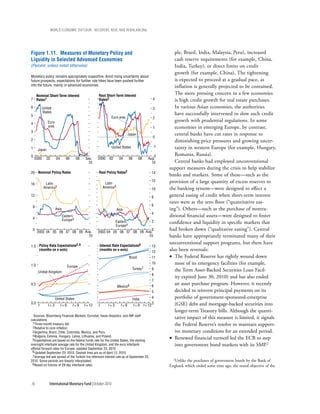
demonstrates that these problems are substantial.               fiscal consolidation studied by Giavazzi and Pagano (1990)—which were
                                                                expansionary.
It shows that there are large differences between
the episodes identified by the two approaches. It                                      High perceived sovereign default risk
then examines the 10 cases in which the difference                                     Low perceived sovereign default risk
                                                                                       Denmark (1983) and Ireland (1987)
between the size of the consolidation identified by
the two approaches is largest and establishes two
                                                                                                                                                        1.0
results. First, the action-based measure appears to
be substantially more accurate. In the majority of
the 10 episodes, there were specific economic or                                                                                                        0.5

budgetary developments that cause the CAPB-
based approach to inaccurately measure the size                                                                                                         0.0
of the consolidation; in the remainder, there were
economic developments that very likely had a large
                                                                                                                                                        -0.5
effect on the CAPB-based measure. Second, the
errors are correlated with economic developments.
Most notably, the CAPB-based approach often                                                                                                             -1.0

fails to identify consolidation when governments
took substantial actions to reduce the deficit but                                                                                                      -1.5
the actions were associated with severe economic
downturns. It is therefore not surprising that                                                                                                          -2.0
the estimates based on the CAPB-based measure                    0                          1                           2                          3

do not find that consolidations are on average                   Source: IMF staff calculations.
contractionary.                                                  Note: t = 1 denotes the year of consolidation. Dotted lines equal one standard error
                                                                bands.
   Finally, Figure 3.10 also illustrates another
interesting finding: based on our set of fiscal adjust-
ments, the incremental impact of fiscal consolida-
tion on economic activity appears to be unrelated to
the size of the package. In particular, the estimated
responses of output and unemployment to these
large deficit cuts (greater than 1.5 percent of GDP)
are similar to those reported before for our full
sample of fiscal consolidation. For each additional
fiscal consolidation of 1 percent of GDP, the impact


                                                                                                International Monetary Fund | October 2010               107
wOrld ecOnOmic OutlOOk: recOvery, risk, and rebalancing


                                                                                                   on output is about –0.5 percent, and the impact
                                                                                                   on the unemployment rate is about 0.3 percentage
                                                                                                   point, which is similar to the baseline results for all
                                                                                                   adjustments, large and small, reported earlier.34


Figure 3.10. Impact of Large Fiscal Consolidation on                                               additional insights from Model simulations
GDP and Unemployment: Action-Based Approach
                                                                                                      The previous section looked at historical episodes
versus Standard Approach
(Impact of each additional 1 percent of GDP fiscal consolidation)                                  of fiscal consolidation in advanced economies to
                                                                                                   assess the short-term effects. But historical analy-
Fiscal retrenchment usually triggers faster growth and lower unemployment
according to the standard approach, exemplified by Alesina and Ardagna (2010).                     sis goes only so far. For example, the empirical
But according to our action-based approach, the opposite is true.
                                                                                                   framework used above is not well suited to provid-
              Action-based approach
                                                                                                   ing estimates of the effects of fiscal consolidation
               Standard approach (Alesina and Ardagna, 2010)                                       over long periods such as 10 or 20 years. Moreover,
                                                                                                   historical analysis cannot fully address specific issues
 GDP                                                                                        0.4    that are relevant for today but that rarely arose in
 (percent)
                                                                                            0.2
                                                                                                   the past, such as the zero floor on nominal inter-
                                                                                                   est rates. Therefore, to complement the empirical
                                                                                            0.0
                                                                                                   analysis, this section looks at fiscal consolidation
                                                                                            -0.2   in the controlled “laboratory” setting of the GIMF,
                                                                                                   a dynamic general equilibrium model designed to
                                                                                            -0.4
                                                                                                   simulate the effects of fiscal and monetary policy
                                                                                            -0.6   measures.35
                                                                                            -0.8      In particular, we examine the following
 0                           1                           2                              3
                                                                                                   questions:
 Unemployment Rate                                                                          0.5
                                                                                                   • How do the effects of fiscal consolidation change
 (percentage points)
                                                                                            0.4
                                                                                                      when nominal interest rates are near zero?
                                                                                                   • How do the effects change when many countries
                                                                                            0.3
                                                                                                      conduct fiscal consolidation simultaneously?
                                                                                            0.2
                                                                                                   • What are the long-term effects of reducing gov-
                                                                                            0.1
                                                                                                      ernment debt from high levels?
                                                                                            0.0
                                                                                            -0.1
                                                                                            -0.2
                                                                                            -0.3
 0                           1                           2                              3
                                                                                                      34 Additional analysis suggests that the proportional impact

                                                                                                   is also similar for very large deficit cuts (equal to more than 3
 Source: IMF staff calculations.
 Note: t = 1 denotes the year of consolidation. Dotted lines equal one standard error              percent of GDP per year), although the estimation results are less
bands.                                                                                             precise for these cases due to the smaller number of observations.
                                                                                                      35 For presentations of the structure of the GIMF, see Kumhof

                                                                                                   and Laxton (2007); Kumhof, Muir, and Mursula (2010); Freed-
                                                                                                   man and others (2009, forthcoming); and Clinton and others
                                                                                                   (2010). A companion paper, available on request, shows that
                                                                                                   the GIMF produces short-term expenditure and tax multipliers
                                                                                                   that are in line with those reported in the previous section of the
                                                                                                   chapter. In addition, it explains why fiscal multipliers associ-
                                                                                                   ated with fiscal consolidation are likely to be smaller than those
                                                                                                   associated with fiscal stimulus, including the fact that monetary
                                                                                                   policy stimulus partly offsets the effect of fiscal consolidation but
                                                                                                   reinforces the effect of fiscal stimulus.


108          International Monetary Fund | October 2010
chapter 3   will it Hurt? macrOecOnOmic effects Of fiscal cOnsOlidatiOn


fiscal consolidation when policy rates are near the Zero       rate, resulting from the persistence of the decline
interest rate floor                                            in the interest rate, boosts exports and raises the
                                                               trade balance. Again, these simulation results are
   Since the onset of the Great Recession, short-
                                                               consistent with the empirical findings reported in
term interest rates in the largest advanced econo-
                                                               the previous section.36
mies have been near the zero interest rate floor.
                                                             • However, when interest rates are stuck at zero,
Yet of the historical episodes considered above,
                                                               the output cost of fiscal consolidation doubles to
only those of Japan since the 1990s occurred in an
                                                               about 1 percent after two years (see Figure 3.11).
environment of near-zero interest rates. In the other
                                                               Here, the simulation assumes that the zero lower
episodes, interest rate cuts typically followed fiscal
                                                               bound holds for two years.37 During this time,
consolidation.
                                                               the central bank is powerless to offset the slump
   Therefore, to look at the effects of fiscal con-
                                                               in aggregate demand and inflation induced by
solidation when interest rates are near zero, we use
                                                               the cut in government spending. The result-
model simulations. In particular, we look at what
                                                               ing fall in inflation raises the real interest rate,
happens when a small open economy, which we
                                                               which in turn exacerbates the decline in aggregate
calibrate to fit the main features of Canada, imple-
                                                               demand, amplifying the short-term contraction-
ments fiscal consolidation with and without the
                                                               ary effect of fiscal consolidation.
zero interest rate floor. For simplicity, the analysis
ignores the possibility of the central bank respond-
ing to the consolidation by using unconventional             fiscal consolidation in Many countries at the same time
monetary tools, such as quantitative and credit eas-
                                                                How do the effects of fiscal consolidation change
ing. To the extent that such policies would be used
                                                             when many countries consolidate at the same time?
to support output in response to the consolidation,
                                                             This question is relevant today, as a number of advanced
the simulations reported here may overstate the
                                                             economies set fiscal consolidation in motion.
impact of the zero interest rate floor.
                                                                To address this issue, the simulations compare a
   The consolidation considered here is a reduction
                                                             situation in which only Canada cuts its fiscal deficit
in the deficit equivalent to 1 percentage point of
                                                             to one in which all countries do so simultaneously
GDP, composed entirely of spending cuts. Three-
                                                             (global fiscal consolidation). We again use Canada here
quarters of the spending cuts fall on government
                                                             to illustrate the case of an economy small enough to
transfers, with the rest falling on government
                                                             have small spillover effects on the rest of the world and
consumption. All the simulations considered in
                                                             open enough that fiscal contraction in the rest of the
this subsection assume that there are no cuts to
                                                             world has significant effects on its GDP.38
productive public investment. If the spending cuts
do include cuts to productive public investment,
                                                                36 In an economy such as the United States, with less exposure
the long-term effects of fiscal consolidation can be
                                                             to foreign trade, the domestic-demand channel would be more
negligible or even negative.                                 important. In this case, it would require a larger decline in the
   The results suggest the following:                        interest rate to offset the effects of the fiscal contraction on
• When the interest rate is well above zero and free         domestic demand.
                                                                37 Why do the simulations assume that the zero interest rate
   to decline, the output cost is about 0.5 percent          floor holds for two years? In the model, the only way the central
   after two years (Figure 3.11). This output cost is        bank can stabilize output and inflation is by cutting nomi-
   broadly consistent with the estimated short-term          nal interest rates. When the option of cutting interest rates is
                                                             removed for a long time—here, three or more years––the model
   effect reported in the previous section of this
                                                             generates unstable macroeconomic dynamics, which complicates
   chapter. Two factors make the impact on GDP               the computation of simulation results. In addition, for most
   less than one-to-one for every 1 percent of GDP           countries, it is unlikely that interest rates will stay at zero for
   of fiscal consolidation. First, lower interest rates      more than two years.
                                                                38 In 2009, Canada’s GDP was 1.9 percent of global GDP
   help offset the shock to domestic demand. Sec-            on a purchasing-power-parity basis, and the sum of exports and
   ond, a significant depreciation in the exchange           imports represented 71 percent of GDP.


                                                                                         International Monetary Fund | October 2010   109
wOrld ecOnOmic OutlOOk: recOvery, risk, and rebalancing


                                                                                                     As before, the adjustment involves reducing the
                                                                                                  deficit-to-GDP ratio by 1 percentage point, with
                                                                                                  the adjustment composed entirely of spending cuts.
                                                                                                  Three-quarters of the spending cuts fall on govern-
                                                                                                  ment transfers, with the rest falling on government
                                                                                                  consumption. Also, as before, the analysis considers
                                                                                                  two cases: the first assumes that the zero inter-
                                                                                                  est rate floor holds in all countries for two years,
Figure 3.11. Impact of a 1 Percent of GDP Fiscal
                                   1                                                              and the second assumes that the interest rate may
Consolidation: GIMF Simulations1                                                                  change without constraint.
                                 With zero interest rate floor
                                                                                                     The following results emerge:
                                 Without zero interest rate floor                                 • In the simulations where the zero interest rate
                                                                                                     floor applies, the Canada-only consolidation
           GDP                                     CPI Inflation 2                                   implies an output loss of about 1 percent (Figure
 0.2                                                                                       0.1
           (percent)                               (percentage points)
 0.0                                                                                       0.0
                                                                                                     3.12). But when the rest of the world conducts
                                                                                                     fiscal consolidation at the same time, the output
-0.2                                                                                       -0.1
                                                                                                     cost to Canada more than doubles, to 2 percent.
-0.4                                                                                       -0.2
                                                                                                     This simulation illustrates that, when interest
-0.6                                                                                       -0.3      rates are near zero, international spillovers are
-0.8                                                                                       -0.4      important.
-1.0                                                                                       -0.5   • When central banks are able to cut interest rates,
                                                                                                     the difference between the Canada-only consolida-
-1.2                                                                                       -0.6
       0       1       2    3      4      5       0      1       2      3      4      5              tion and the global consolidation is smaller. This
                                                                                                     reflects the interplay of two forces. On the one
           Short-Term Interest Rate                Real Short-Term Interest Rate
 10
           (basis points)                          (basis points)
                                                                                 80                  hand, the fiscal contraction in the rest of the world
                                                                                           60        reduces demand for Canadian exports, and the
  0
                                                                                                     exchange rate provides a smaller buffer—curren-
                                                                                           40
-10                                                                                                  cies cannot all depreciate at the same time. But on
                                                                                           20        the other hand, the interest rate is now uncon-
-20                                                                                                  strained by the zero bound, and the central bank
                                                                                           0
                                                                                                     can thus respond with more monetary stimulus.
-30
                                                                                           -20       These larger interest rate cuts play a substantial
-40                                                                                        -40       cushioning role, and the additional output cost of
       0       1       2   3       4      5       0       1      2      3       4      5
                                                                                                     global consolidation is therefore modest.
  Source: IMF staff calculations.
                                                                                                     Overall, these results illustrate that changes
  Note: t = 1 denotes the year of consolidation. Simulations are based on the GIMF                in both the interest rate and the exchange rate
calibrated for Canada and the rest of the world. The zero interest rate floor is assumed
to hold for two years for reasons explained in the text.                                          are important to the adjustment process. When
  1 GIMF = Global Integrated Monetary and Fiscal Model.
  2
    CPI = consumer price index.
                                                                                                  countries cannot rely on the exchange rate channel
                                                                                                  to stimulate net exports, as in the case of the global
                                                                                                  consolidation, and cannot ease monetary policy to
                                                                                                  stimulate domestic demand, due to the zero interest
                                                                                                  rate floor, the output costs of fiscal consolidation
                                                                                                  are much larger. Thus, in the presence of the zero
                                                                                                  interest rate floor, there could be large output costs
                                                                                                  associated with front-loaded fiscal retrenchment
                                                                                                  implemented across all the large economies at the
                                                                                                  same time.


110            International Monetary Fund | October 2010
chapter 3        will it Hurt? macrOecOnOmic effects Of fiscal cOnsOlidatiOn


long-term effects of reducing Government debt                           Figure 3.12. Impact of a 1 Percent of GDP Fiscal
   The discussion so far has focused on short-term                      Consolidation: GIMF Simulations1
effects. We now turn to the long term. Does fiscal
                                                                                                                Canada-only fiscal consolidation
consolidation generate long-term gains? And if                                                                  Global fiscal consolidation
so, how soon do the long-term gains arrive? This
question is one that cannot be adequately addressed                          With Zero Interest Rate Floor                   Without Zero Interest Rate Floor
using the empirical framework used in the previous
                                                                            1        GDP                                        GDP                                          1
section, and so we again use model simulations.                                      (percent)                                  (percent)
   To focus the discussion, we consider a fiscal                            0                                                                                                0
consolidation that, over time, reduces the govern-
ment-debt-to-GDP ratio by 10 percentage points                              -1                                                                                               -1
in each of the G3 currency areas (euro area, Japan,
United States). As in the simulations discussed                             -2                                                                                               -2

above, the consolidation is based on permanent cuts
                                                                            -3                                                                                               -3
to government consumption and transfers. As the                                  0          1       2       3    4      5      0        1     2         3       4       5

debt-to-GDP ratio declines, the burden of inter-
est payments falls, and the resulting savings may                           1.5 Real Effective Exchange Rate                    Real Effective Exchange Rate
                                                                                                                                                                        1.5
                                                                                (percent; + = appreciation)                     (percent; + = appreciation)
be used to finance either new tax cuts or spending                          1.0                                                                                         1.0
increases. In the main simulation reported here, we                         0.5                                                                                         0.5
assume that the savings are used to reduce labor                            0.0                                                                                         0.0
income taxes. The tax cuts are designed to ensure
                                                                            -0.5                                                                                        -0.5
that the debt-to-GDP ratio stabilizes at 10 percent-
                                                                            -1.0                                                                                        -1.0
age points below the initial level.
   The simulations suggest that, over the long term,                        -1.5                                                                                        -1.5
                                                                                     0          1   2       3     4     5      0       1     2      3       4       5
a reduction in the debt-to-GDP ratio is likely to
                                                                            1.0          Trade Balance                             Trade Balance
raise output both in the G3 economies and in the                                                                                                                        1.0
                                                                                         (percentage points of GDP)                (percentage points of GDP)
rest of the world. Two main factors underlie this
increase:                                                                   0.5                                                                                         0.5
• Lower real interest rates: Reducing the fiscal deficit
   raises the overall G3 saving rate and improves
                                                                            0.0                                                                                         0.0
   the G3 current account balance.39 Over time, the
   greater supply of savings lowers the real interest
                                                                            -0.5                                                                                        -0.5
   rate. In the simulation, the 10 percentage point                                  0          1   2       3     4     5      0       1     2      3       4       5
   fall in the debt-to-GDP ratio helps produce a
   fall in the G3 real interest rate of about 30 basis                          50 Short-Term Interest Rate                     Short-Term Interest Rate                50
                                                                                   (basis points)                               (basis points)
   points (Table 3.1).40 Since capital is assumed to
   be mobile across borders, the real interest rate                              0                                                                                      0
   falls by the same amount in the rest of the world.
   In turn, lower real interest rates “crowd in”
                                                                             -50                                                                                        -50
  39 The  counterpart to this improvement in the G3 current
account balance is a worsening in the current account balance of
the rest of the world. The magnitude of this effect will depend             -100                                                                                        -100
                                                                                     0          1       2   3     4     5      0       1     2      3       4       5
on the degree to which government bonds are treated as net
wealth and the sensitivity of aggregate consumption to changes                 Source: IMF staff calculations.
in real interest rates.                                                        Note: t = 1 denotes the year of consolidation. Simulations are based on the GIMF
   40 The magnitude of this interest rate–debt link is in line with         calibrated for Canada and the rest of the world. The zero interest rate floor is assumed
empirical estimates in the literature, such as Engen and Hubbard            to hold for two years for reasons explained in the text.
                                                                               1GIMF = Global Integrated Monetary and Fiscal Model.
(2004), Laubach (2009), and Baldacci and Kumar (2010).


                                                                                                                 International Monetary Fund | October 2010                 111
wOrld ecOnOmic OutlOOk: recOvery, risk, and rebalancing


       Table 3.1. Long-Term Effects of a Permanent 10 Percentage Point Decrease in the G3 Government-
       Debt-to-GDP Ratio: Global Integrated Monetary and Fiscal Model Simulations1
                                                                                                              G3                  Rest of the World     Global
       Lower Interest Burden Used to Reduce Labor Income Taxes
       Real GDP (percent)                                                                                     1.36                           0.78        1.02
       Real Interest Rate (percentage points)                                                                –0.34                          –0.34       –0.34
       Capital Stock (percent)                                                                                2.14                           1.58        1.82
       Current-Account-to-GDP Ratio (percentage points)                                                       0.44                          –0.28        ...
       Effects on GDP under Different Assumptions (percent)
          Lower Interest Burden Used to
            Reduce Labor Income Tax                                                                           1.36                           0.78        1.02
            Raise General Transfers                                                                           0.54                           0.40        0.46
            Reduce Capital Income Tax                                                                         1.50                           0.82        1.10
            Reduce Consumption Tax                                                                            0.70                           0.46        0.56
          Source: IMF staff calculations.
          Note: This table reports long-term effects on the level of GDP, interest rate, capital stock, and current-account-to-GDP ratio.
          1G3   = euro area, Japan, United States.


        private investment, thereby raising the stock of                                                cuts to consumption taxes, or to finance higher
        physical capital and GDP over the long term.41                                                  spending on government transfer programs, the
        In the baseline simulation, the stock of physical                                               long-term output gains are smaller.42 Finally,
        capital rises by 2.1 percent in the G3 and by 1.6                                               there are positive spillover effects from the G3
        in the rest of the world. Meanwhile, the level of                                               to the rest of the world arising through trade
        GDP rises by 1.4 percent in the G3 and by 0.8                                                   linkages. The more G3 incomes rise over the
        percent in the rest of the world.                                                               long term, the more goods the G3 economies
      • Lower income taxes: The lower interest rates                                                    import and the more income this generates for
        and lower stock of government debt generate                                                     the rest of the world.43
        savings in terms of lower interest payments
        that can be used to finance tax cuts. In the                                                   How long does it take for the positive output
        baseline simulation, we assume that the savings                                             effects to outweigh the negative short-term effects?
        are used to lower taxes on labor income. Since                                              GIMF simulations suggest that for a consolida-
        labor income taxes discourage workers from                                                  tion based on cuts to government consumption
        supplying labor, reducing them raises labor                                                 and transfers, GDP is lower than baseline for three
        supply and output. As the lower panel of Table                                              years before rising above the baseline forever. The
        3.1 reports, using the savings to cut capital                                               break-even point, at which the sum of the annual
        income taxes instead has an even more benefi-                                               GDP losses in the early years is just offset by the
        cial impact on GDP in the long term. This is a                                              sum of the gains later on, occurs five years from
        reflection of capital income taxes’ strong nega-                                            the start date.
        tive effect on private sector investment. On the
        other hand, if the savings are used to finance
                                                                                                       42 This ranking is consistent with the standard view of the
        41 This  subsection has not taken into account the likelihood                               relative distortionary supply-side aspects of the various fiscal
      that reduced government debt would reduce risk premiums in                                    instruments.
      market interest rates. A lower expected level of debt would allevi-                              43 Fiscal consolidation in the G3 generates a permanent

      ate concerns that the fiscal outcome might become unsustain-                                  improvement in the G3 current account balance, which implies a
      able. That is, it would reduce the perceived risks of default and                             declining path for the G3 ratio of net foreign liabilities (NFL) to
      inflation. Reduced risk premiums in government and private                                    GDP. Over the long term, in the GIMF, an increase in imports
      sector borrowing rates would enhance and accelerate long-term                                 relative to exports ensures that the NFL-to-GDP ratio stabilizes
      positive effects on output.                                                                   at a lower level instead of perpetually falling.


112   International Monetary Fund | October 2010
chapter 3   will it Hurt? macrOecOnOmic effects Of fiscal cOnsOlidatiOn


lessons for countries considering fiscal                     debt may imply that no adjustment could have a
consolidation                                                negative impact on growth.
                                                                The findings also suggest that spending-based
   This section summarizes the principal findings            deficit cuts, particularly those that rely on cuts to
of the chapter and outlines key lessons for coun-            transfers, have smaller contractionary effects than
tries considering fiscal consolidation in today’s            tax-based adjustments. A key reason for this dif-
environment. Virtually all advanced economies                ference is that central banks typically provide less
are likely to conduct fiscal consolidation at some           monetary stimulus during tax-based adjustments,
point in the future to put their fiscal positions            particularly when they involve hikes in indirect
back on a sustainable footing. The evidence based            taxes that put upward pressure on inflation. This
on historical analysis for advanced economies and            finding again highlights that the fiscal adjustment
model simulations in this chapter provides several           process is likely to be more painful without the sup-
lessons.                                                     portive role of interest rate cuts.
   The idea that fiscal austerity triggers faster growth        Fiscal retrenchment in countries that face a
in the short term finds little support in the data.          higher perceived sovereign default risk tends to
Fiscal retrenchment typically has contractionary             be less contractionary. But expansionary effects of
short-term effects on economic activity, with lower          consolidation are unusual even for this group. This
output and higher unemployment. A budget cut                 result implies that short-term negative effects are
equal to 1 percent of GDP typically reduces domes-           likely to be smaller in economies currently facing
tic demand by about 1 percent and raises the unem-           greater market pressure.
ployment rate by 0.3 percentage point. At the same              In addition, fiscal consolidation is likely to be
time, an expansion in net exports usually occurs,            beneficial over the long term. In particular, lower
and this limits the impact on GDP to a decline of            debt is likely to reduce real interest rates and the
0.5 percent.                                                 burden of interest payments, allowing for future
   Central banks usually offset some of the con-             cuts to distortionary taxes. These effects will likely
tractionary pressure by reducing policy rates, and           crowd in investment and increase output in the
longer-term interest rates typically decline, cushion-       long term.
ing the impact on domestic demand. Undertaking                  Finally, as discussed in Chapter 1, a number
fiscal consolidation is likely to have more negative         of policy actions could enhance the credibility of
short-term effects if—as is currently the case in a          fiscal adjustment programs, thereby mitigating the
number of countries––interest rates are near zero            adverse effects of fiscal consolidation in the short
and central banks are constrained in their ability to        term. Such actions could include strengthening
provide monetary stimulus.                                   fiscal institutions and reforming pension entitle-
   A decline in the real value of the domestic               ments and public health care systems. To the extent
currency typically plays an important cushion-               that such measures improve household and busi-
ing role by spurring net exports and is usually              ness confidence and raise expectations about future
the result of nominal depreciation or currency               income, they could help support activity during the
devaluation. Therefore, because not all countries            process of fiscal adjustment.
can have real depreciations and increase their
net exports at the same time, simultaneous fiscal
consolidation by many countries is likely to be              appendix 3.1. data sources
particularly costly. Fiscal retrenchment is also             The sources of the data used for the analysis are
likely to be more costly for members of a mon-               listed in Table 3.2. The episodes of fiscal consolida-
etary union where scope for a fall in the value of           tion identified based on the action-based approach
their currency is reduced. At the same time, in              are reported in Tables 3.3 and 3.4. The episodes of
the current global environment, heightened mar-              fiscal consolidation identified based on the standard
ket sensitivity to fiscal deficits and government            approach are reported on Table 3.5.


                                                                                       International Monetary Fund | October 2010   113
wOrld ecOnOmic OutlOOk: recOvery, risk, and rebalancing


      Table 3.2. Data Sources
                                            Variable                                                          Source
       Real GDP                                                               World Bank World Development Indicators (WDI) Database,
                                                                               World Economic Outlook (WEO) Database
       Real Consumption                                                       WDI Database, WEO Database

       Real Investment                                                        WDI Database, WEO Database

       Real Exports                                                           WDI Database, WEO Database

       Real Imports                                                           WDI Database, WEO Database

       Unemployment Rate                                                      WDI Database, WEO Database

       Nominal Effective Exchange Rate                                        International Financial Statistics (IFS) Database

       Real Effective Exchange Rate                                           IFS Database

       Policy Interest Rates and 10-Year Bond Yields                          Bloomberg Financial Markets, National Authorities, Thomson
                                                                                Datastream

       Institutional Investor Rating                                          Institutional Investor

       Cyclically Adjusted Primary Budget Surplus in                          Alesina and Ardagna (2010), Organization for Economic
         Percent of GDP                                                          Cooperation and Development


       Table 3.3. Action-Based Approach: Episodes of Small Fiscal Contraction
       (Smaller than 1.5 percent of GDP)
               Economy                                                       Fiscal Consolidation
       Australia                  1980       1985      1988   1994   1995   1996    1997     1998      1999

       Belgium                    1982       1984      1990   1992   1994   1995    1996     1997      1998     1999

       Canada                     1980       1981      1982   1983   1984   1985    1986     1987      1988     1989     1990     1991   1992

                                  1993       1994      1995   1996   1997   1998    1999

       Denmark                    1995

       Finland                    1984       1988      1995   1999   2000   2006    2007

       France                     1984       1986      1987   1988   1989   1991    1995     1996      1997     1998     2000     2006   2007

       Germany                    1982       1983      1984   1985   1986   1987    1988     1989      1992     1993     1994     1995   1996

                                  1998       1999      2000   2003   2004   2005    2006     2007

       Ireland                    1984       1985      1986

       Italy                      1994       1996      1998   2004   2005   2006    2007

       Japan                      2003       2004      2005   2006   2007

       Portugal                   2000       2001      2003   2005   2006   2007

       Spain                      1983       1984      1985   1986   1987   1988    1989     1992      1993     1994     1995     1996   1997

                                  1998

       Sweden                     1983       1984      1986   1992   1994   1997    2007

       United Kingdom             1982       1994      1995   1996   1998   1999

       United States              1980       1981      1985   1986   1988   1990    1993     1994      2000

          Source: IMF staff calculations.


114   International Monetary Fund | October 2010
chapter 3        will it Hurt? macrOecOnOmic effects Of fiscal cOnsOlidatiOn


 Table 3.4. Action-Based Approach: Episodes of Large Fiscal Contraction
 (Greater than 1.5 percent of GDP)
      Economy                                                               Fiscal Consolidation
 Australia                   1986           1987
 Belgium                     1983           1987     1993
 Canada
 Denmark                     1983           1984     1985          1986
 Finland                     1992           1993     1994          1996           1997        1998
 France
 Germany                     1997
 Ireland                     1982           1983     1987          1988           2009
 Italy                       1992           1993     1995          1997
 Japan                       1997
 Portugal                    1983           2002
 Spain
 Sweden                      1993           1995     1996
 United Kingdom              1981           1997
 United States               1991

    Source: IMF staff calculations.


 Table 3.5. Large Fiscal Contraction Episodes Identified by Alesina and Ardagna (2010)
      Economy                                                               Fiscal Consolidation
 Australia                     1987         1988
 Belgium                       1982         1984   1987     2006
 Canada                        1981         1986   1987     1995          1996       1997
 Denmark                       1983         1984   1985     1986          2005
 Finland                       1981         1984   1988     1994          1996       1998      2000
 France                        1996
 Germany                       1996         2000
 Ireland                       1984         1987   1988     1989          2000
 Italy                         1980         1982   1990     1991          1992       1997      2007
 Japan                         1984         1999   2001     2006
 Portugal                      1982         1983   1986     1988          1992       1995      2002      2006
 Spain                         1986         1987   1994     1996
 Sweden                        1981         1983   1984     1986          1987       1994      1996      1997       2004
 United Kingdom                1982         1988   1996     1997          1998       2000
 United States
    Source: Alesina and Ardagna (2010).


appendix 3.2. estimation approach                                                (t=1980, …, 2009); g is the percent change in real
                                                                                 GDP; and ABFC is the estimated size of the action-
The analysis in the text accounts for the current and
                                                                                 based fiscal consolidation measures as a percent of
lagged impact of fiscal consolidation. More specifi-
                                                                                 GDP. The disturbance term, uit, is specified as a
cally, the estimated equation is as follows:
                                                                                 two-way error component model:
                     2                2
  git 5 a 1 ∑ bj gi,t–j 1 ∑ bs ABFCi,t–s 1 uit , (3.1)                             uit 5 mi 1 lt 1 nit ,                                     (3.2)
                    j=1               s=0

where the subscript i denotes the ith country                                    where mi denotes a country-fixed effect, and lt
(i=1, …,15) and the subscript t denotes the tth year                             denotes a time-fixed effect. The time effects capture


                                                                                                          International Monetary Fund | October 2010   115
wOrld ecOnOmic OutlOOk: recOvery, risk, and rebalancing


                                                                                                 shifts in global variables, such as the global business
                                                                                                 cycle. The country-fixed effect captures differences
                                                                                                 in countries’ steady-state growth rates. F-tests reject
                                                                                                 the absence of country- and time-fixed effects. The
                                                                                                 impulse response function for the effect of the fiscal
                                                                                                 actions on the level of output, along with one-stan-
                                                                                                 dard-error bands, is obtained via the delta method.
                                                                                                    Several robustness checks were conducted:
 Figure 3.13. Robustness: Impact on GDP of a 1                                                   • Excluding lags of growth had little effect on the
 Percent of GDP Fiscal Consolidation                                                                results (Figure 3.13). If consolidation is less likely
 (With and without controlling for lagged GDP growth)                                               in a weak economy, there should be a correlation
                                                                                                    between lagged output growth and consolida-
 Excluding lags of growth from our estimated equation has little effect on the                      tion, and controlling for lagged output would
 estimated effect of fiscal consolidation on output.
                                                                                                    have an appreciable impact on the estimates. The
                                                                                                    finding that it does not is therefore reassuring, as
                          With control                  Without control
                                                                                                    it suggests that this source of bias is small in our
                                                                                                    sample.44
                                                                                          0.0
                                                                                                 • Using an alternative estimation approach––the
                                                                                                    Arellano-Bond (1991) procedure––had little
                                                                                          -0.1
                                                                                                    effect on the results (Figure 3.14). As discussed
                                                                                          -0.2      above, this result suggests that the bias due to
                                                                                                    fixed effects being correlated with the lagged
                                                                                          -0.3      dependent variables is small in this sample.
                                                                                                 • Splitting the sample of fiscal consolidation
                                                                                          -0.4
                                                                                                    according to size of government (tax-to-GDP
                                                                                          -0.5
                                                                                                    ratio in the three years preceding fiscal consoli-
                                                                                                    dation) yielded an interesting result. Economies
                                                                                          -0.6      that initially have a larger size of government
                                                                                                    (above the median tax-to-GDP ratio of 42 per-
                                                                                          -0.7
                                                                                                    cent) have smaller output costs than those with
                                                                                                    a smaller initial size of government.45 However,
                                                                                          -0.8
  0                           1                          2                           3              larger governments are also more likely to engage
                                                                                                    in spending-based consolidation than smaller
   Source: IMF staff calculations.
   Note: t = 1 denotes the year of consolidation. Dotted lines equal one standard error             governments. Keeping composition constant,
 bands.
                                                                                                    the differences due to government size are less
                                                                                                    apparent. In particular, tax-based consolidation
                                                                                                    is equally costly in terms of lost output for large
                                                                                                    and small governments. Therefore, it seems that
                                                                                                    the type of consolidation (tax- versus spending-
                                                                                                    based) is more important than the size of govern-
                                                                                                    ment in determining the output cost of fiscal
                                                                                                    consolidation.


                                                                                                    44 In addition, using different lag lengths (up to four) yielded

                                                                                                 similar results.
                                                                                                    45 Similar results were obtained using the government-spend-

                                                                                                 ing-to-GDP ratio as a proxy for government size.


116          International Monetary Fund | October 2010
chapter 3        will it Hurt? macrOecOnOmic effects Of fiscal cOnsOlidatiOn


• The results were more contractionary when
  the sample of fiscal adjustments was limited to
  episodes occurring in economies with a fixed
  exchange rate regime. This result held up under
  both the IMF’s de facto and de jure classification
  of exchange rate regimes. The result is consis-
  tent with standard Mundell-Fleming theory
  and a number of recent studies, such as Ilzetzki,
  Mendoza, and Végh (2009), who find that fiscal
  multipliers are larger in economies with fixed                       Figure 3.14. Robustness: Impact on GDP of a 1
  exchange rate regimes.                                               Percent of GDP Fiscal Consolidation
• Splitting the sample of fiscal consolidation                         (Baseline estimator versus Arellano-Bond estimator)
  episodes according to openness to trade (ratio of                    Using the Arellano-Bond procedure had little effect on the results, suggesting
  exports plus imports to GDP) did not materially                      that the bias due to correlation of the fixed effects with the lagged dependent
                                                                       variables is small in this sample.
  change the results.
                                                                                                  Baseline estimator
                                                                                                  Arellano-Bond estimator
appendix 3.3. identifying periods of fiscal
consolidation: the standard approach versus                                                                                                                        0.0
the action-Based approach
                                                                                                                                                                   -0.1
   Figure 3.15 provides a scatter plot of increases
in the cyclically adjusted primary budget balance
                                                                                                                                                                   -0.2
(CAPB)––the standard measure of fiscal consolida-
tion––on the vertical axis versus the size of fiscal
                                                                                                                                                                   -0.3
consolidation based on the policy record on the
horizontal axis. The figure reports years for which
                                                                                                                                                                   -0.4
either the CAPB-to-GDP ratio increased or the
policy record indicated fiscal consolidation.46 The
                                                                                                                                                                   -0.5
CAPB-to-GDP data are from Alesina and Ardagna
(2010).47 The top-right corner of the scatter plot
                                                                                                                                                                   -0.6
shows cases in which the two measures agree that
there was a large fiscal consolidation (greater than
                                                                                                                                                                   -0.7
1.5 percent of GDP). It includes cases such as                              0                          1                          2                           3
Denmark (1983) and Ireland (1987)––the two cases
                                                                            Source: IMF staff calculations.
highlighted by Giavazzi and Pagano (1990) in their                          Note: t = 1 denotes the year of consolidation. Dotted lines equal one standard error
                                                                           bands.
work on expansionary fiscal contraction. However,
Figure 3.15 also reports numerous cases in which
the standard approach and our approach come to
different conclusions regarding the presence and size
of fiscal consolidation.
   46 Cases in which there was no evidence of fiscal consolida-

tion in the historical record correspond to the observations along
the zero line on the horizontal axis, with positive values on the
vertical axis.
   47 The cases of increases in the CAPB-to-GDP ratio greater

than 1.5 percentage points in Figure 3.15 are also those reported
as large fiscal adjustments in Table A1 in Alesina and Ardagna
(2010).


                                                                                                            International Monetary Fund | October 2010               117
wOrld ecOnOmic OutlOOk: recOvery, risk, and rebalancing


                                                                                                                                             Which approach typically more accurately identi-
                                                                                                                                          fies fiscal consolidation? To address this question,
                                                                                                                                          we focus on the largest discrepancies between the
                                                                                                                                          two approaches: the 10 cases for which the dis-
                                                                                                                                          crepancy between the two approaches exceeded
                                                                                                                                          3 percent of GDP. In each of these cases, fiscal
                                                                                                                                          consolidation was assessed as large (greater than
                                                                                                                                          1.5 percentage points of GDP) by at least one of
Figure 3.15. Size of Fiscal Consolidation:                                                                                                the two approaches. These 10 cases are highlighted
Action-Based Approach versus Standard Approach1                                                                                           in Figure 3.15.
(Percent of GDP)                                                                                                                             We start with the cases in the top-left corner of
                                                                                                                                          Figure 3.15, which contains five periods identi-
There are numerous cases in which the standard approach and our action-based                                                              fied as large consolidations based on the standard
approach differ regarding the presence and size of fiscal consolidation. After
analyzing in detail the 10 largest discrepancies between the two approaches, we                                                           approach, but for which the policy record shows
conclude that our action-based approach more accurately identifies the size of
fiscal consolidation.                                                                                                                     either only a small consolidation or no consolida-
                                                                                                                                          tion at all.
                                                                                   8                                                      • Germany (1996): The CAPB-to-GDP ratio
            DEU 1996                                                                                                                         increased by 6.4 percentage points, but the policy
                                                                                   6
  JPN 1999 JPN 2006                                                                                                                          record indicates fiscal consolidation measures
                  BEL 1984
                                                                                        (change in cyclically adjusted primary balance)


        FIN 2000                                                                   4                                                         amounting to only 0.2 percent of GDP. The
                                                                                                                                             large increase in the CAPB-to-GDP ratio in
                                                                                   2
                                                                                                                                             1996 reflected a large one-time capital transfer
                                                                                                      Standard approach


                                                        FIN 1993
                                                                                   0                                                         in 1995, which implied a change in the CAPB-
                                                   IRL 1982
                                                              ITA 1993                                                                       to-GDP ratio of about –7 percentage points in
                                  FIN 1992                                         -2                                                        1995 and 6.4 percentage points in 1996. The
                                                                                   -4
                                                                                                                                             sharp increase in the CAPB in 1996 thus had
                                                                IRL 2009
                                                                                                                                             nothing to do with fiscal austerity measures. In
                                                                                   -6                                                        particular, as reported in the 1996 IMF Recent
                                                                                   -8
                                                                                                                                             Economic Developments report (p. 18), a one-time
                                                                                                                                             transfer of Treuhand (Trust Agency) and East
                                                                                   -10                                                       German housing debt to the general government
-1         0           1          2         3        4              5          6
                               Action-based approach                                                                                         amounting to 6.8 percent of GDP occurred
                                                                                                                                             in 1995. This operation was recorded by the
   Sources: Alesina and Ardagna (2010); and IMF staff calculations.
   Note: The diagonal line reports the 45-degree line, where the action-based approach and                                                   Organization for Economic Cooperation and
standard approach agree. Dotted lines indicate episodes of consolidation equal to 1.5
percent of GDP. Highlighted observations indicate years for which the two approaches
                                                                                                                                             Development (OECD) as a one-time increase in
differ by more than 3 percent of GDP.
   1BEL: Belgium; DEU: Germany; FIN: Finland; IRL: Ireland; ITA: Italy; JPN: Japan.
                                                                                                                                             capital transfers that raised the general govern-
                                                                                                                                             ment deficit from 2.3 percent of GDP in 1994
                                                                                                                                             to 9.7 percent of GDP in 1995. The deficit
                                                                                                                                             returned to a more normal level in 1996, at 3.3
                                                                                                                                             percent of GDP. Therefore, the sharp increase
                                                                                                                                             in the CAPB in 1996 bears no relation to fiscal
                                                                                                                                             austerity measures, but instead reflects the end of
                                                                                                                                             a one-time capital transfer.
                                                                                                                                          • Japan (1999): The CAPB-to-GDP ratio rose
                                                                                                                                             by about 4.9 percentage points, but the policy
                                                                                                                                             record shows no evidence of fiscal consolidation
                                                                                                                                             measures. Indeed, Japan’s fiscal consolidation


118         International Monetary Fund | October 2010
chapter 3   will it Hurt? macrOecOnOmic effects Of fiscal cOnsOlidatiOn


  program, initiated in 1997, was suspended in                        However, we can find no mention of social security
  1998 following the onset of a severe recession,                     cuts in the historical record, such as in the OECD
  and there is no evidence of measures designed                       Economic Survey.50 Overall, therefore, we conclude
  to cut the budget deficit until 2002, when                          that the increase in the CAPB-to-GDP ratio of 4.1
  the authorities announced a new multiyear                           percentage points overstates the amount of consoli-
  program of fiscal consolidation (2003 OECD                          dation in 2000 by at least 2 percentage points and
  Economic Survey: Japan, p. 15). Instead, as the                     probably closer to 3.
  1998 OECD Economic Survey: Japan reports (p.                      • Japan (2006): The CAPB-to-GDP ratio increased
  84), the government made a one-time capital                         by 4.1 percentage points, but the policy record
  transfer in 1998 to the Japan National Railway,                     indicates fiscal consolidation measures amounting
  amounting to about ¥24.3 trillion (4.8 percent                      to only 0.67 percent of GDP, implying a discrep-
  of GDP). The one-time nature of this capital                        ancy of about 3.4 percent of GDP. In terms of
  transfer implies a change in the (general govern-                   actual consolidation measures, the policy record
  ment) CAPB of about 4.8 percentage points of                        indicates a cut in public investment of about
  GDP in the following year, 1999. This increase is                   0.27 percent of GDP (2007 IMF Staff Report,
  similar to the 4.9 percentage point change in the                   pp. 32–33) and income tax hikes worth about
  CAPB-to-GDP ratio computed by Alesina and                           ¥2 trillion (0.4 percent of GDP—Takahashi and
  Ardagna (2010). Therefore, the sharp increase                       Tokuoka, 2010). At the same time, the CAPB-to-
  in the CAPB in 1999 bears no relation to fiscal                     GDP ratio reported in the 2008 OECD Economic
  austerity measures, but instead reflects the end of                 Surveys: Japan rose by 3.2 percentage points in
  a one-time capital transfer.                                        2006 (Table 3.1, p. 65, line 4). Thus, some (0.9
• Finland (2000): The CAPB-to-GDP ratio                               percentage point) of the discrepancy is due to
  increased by 4.1 percentage points, but the policy                  differences between the OECD Economic Survey
  record shows fiscal consolidation measures amount-                  and Alesina and Ardagna (2010) in the method
  ing to only 0.9 percent of GDP.48 This episode cor-                 used to compute the CAPB. In addition, the
  responds to an asset price boom: real stock prices                  OECD Economic Survey indicates that a large part
  in Finland rose by 70 percent in 1999 and by 86                     of the CAPB increase resulted from one-time
  percent in 2000 (Haver Analytics). Of the 4.1 per-                  asset operations that improved the fiscal balance
  centage point increase in the CAPB-to-GDP ratio,                    in 2006 but were unrelated to tax hikes or spend-
  2 percentage points reflect a rise in revenue from                  ing cuts.51 Without these one-time asset opera-
  one-time factors unrelated to policy actions.49                     tions, the 2008 OECD Economic Survey: Japan
  These one-time factors included a rise in tax rev-                  estimates that the CAPB-to-GDP ratio increased
  enue associated with stock-option and capital gains                 by only 0.4 percentage point in 2006 (OECD
  and an increase in non-tax (property income) rev-                   Table 3.1, p. 65, line 8). Therefore, once the
  enue partly due to an extraordinary dividend issued                 change in the CAPB-to-GDP ratio is adjusted to
  by the fully state-owned bank Leonia on the eve                     remove the influence of asset operations unre-
  of its merger with the private insurance company                    lated to tax hikes and spending cuts, the increase
  Sampo. Regarding the remaining 1.2 percentage
  point discrepancy relative to the historical record
  (2.1 versus 0.9), the OECD Economic Outlook                          50 Note that cuts to social security spending, which is not

  database indicates a fall in cyclically adjusted                  recorded as central government spending, are not part of the
  social security outlays of about 1 percentage point.              measures amounting to 0.9 percent of GDP that we identify in
                                                                    the policy record.
                                                                       51 The 2008 OECD Economic Survey: Japan reports that the
   48 The fiscal measures reflected mainly central government       one-time factors include receipts of funds by the government
spending restraint (OECD Economic Surveys 1999–2000, p. 36).        from corporate pension funds, receipts associated with the priva-
   49 The 2001–02 issue of OECD Economic Surveys: Finland           tization of highway corporations, and receipts from the “transfer
reports the 2000 budget outcome as “a very high surplus mainly      of the reserve fund from the Fiscal Loan Fund Special Account
due to one-off factors” (p. 37).                                    to the central government” (p. 65).


                                                                                               International Monetary Fund | October 2010   119
wOrld ecOnOmic OutlOOk: recOvery, risk, and rebalancing


         in the CAPB-to-GDP ratio is close to our esti-                        both tax hikes and spending cuts.54 The fall in
         mate of policy measures of 0.67 percent of GDP.                       the CAPB despite a substantial fiscal consolida-
      • Belgium (1984): The CAPB-to-GDP ratio                                  tion reflects the impact of the financial crisis
         increased by 4.7 percentage points, but the policy                    during which stock and house prices fell sharp-
         record indicates fiscal consolidation measures                        ly.55 For reasons discussed above, such sharp
         amounting to 0.88 percent of GDP, implying a                          contractions tend to have a negative impact on
         discrepancy of about 3.8 percent of GDP.52 At                         the CAPB, causing the CAPB-based approach
         the same time, the CAPB-to-GDP ratio reported                         to inaccurately identify the size of consolidation
         in the OECD Economic Outlook database rises                           measures. Indeed, while the CAPB-to-GDP ratio
         by 4.1 percentage points in 1984. Thus, some of                       computed by Alesina and Ardagna (2010) falls
         the discrepancy (0.6 percentage point) is due to                      by 4.4 percentage points, the CAPB-to-GDP
         differences in the method used to compute the                         ratio computed by the OECD falls by only
         CAPB. Of the remaining discrepancy (3.2 per-                          1.1 percentage points. As expected, the fall in the
         centage points), most is explained by the end of                      CAPB-to-GDP ratio is driven by a sharp decline
         a one-time capital transfer made in 1983. In par-                     in cyclically adjusted tax revenue, which falls by
         ticular, the OECD Economic Outlook database                           2.6 percentage points in 2009 according to the
         indicates a one-time increase in capital transfers                    OECD’s calculations. Government tax revenue
         in 1983 that reduced the CAPB-to-GDP ratio                            directly related to asset prices––capital gains taxes
         by 2.1 percentage points in 1983. When this                           and stamp duties––fell by 1 percent of GDP in
         one-time transfer came to an end in 1984, it                          2009.56 Another 0.8 percentage point decline in
         caused the CAPB-to-GDP ratio to rise by 2.1                           the CAPB-to-GDP ratio is driven by an increase
         percentage points (OECD Economic Outlook                              in cyclically adjusted social security benefit pay-
         database). Therefore, excluding the influence of                      ments that have no counterpart in the policy
         this one-time capital transfer, the discrepancy                       record. Excluding these cyclically adjusted items,
         between the standard approach and our action-                         the CAPB-to-GDP ratio rises by 2.3 percent-
         based approach shrinks from 3.2 percent of GDP                        age points (–1.1 1 2.6 1 0.8), which represents
         to 1.1 percent of GDP (3.2 minus 2.1).53                              a large fiscal consolidation and is substantially
         Next we turn to the five cases in the bottom-                         closer to our estimated size of fiscal consolidation
      right corner of Figure 3.15––periods that are                            than the Alesina and Ardagna (2010) estimate of
      identified as large consolidations based on our                          –4.4 percentage points.
      action-based approach, but which feature either a                      • Italy (1993): The CAPB-to-GDP ratio increased by
      fall or a small increase in the CAPB.                                    only 0.2 percentage point in 1993, but the policy
      • Ireland (2009): Here, the CAPB-to-GDP ratio                            record reports a large consolidation of 4.3 percent
         fell by about 4.4 percentage points, but the                          of GDP. A plausible reason for this large discrep-
         historical record reports that fiscal consolida-                      ancy is that there was a sharp economic contraction
         tion measures of about 4.5 percent of GDP were
         implemented in 2009. These measures included                           54 The 2009 OECD Economic Survey: Ireland (p. 50) and EC

                                                                             (2008, p. D15) report spending cuts in 2009 of €1 billion (0.6
                                                                             percent of GDP) announced in July 2008, and the 2009 OECD
         52 According to the policy record, fiscal consolidation consisted   Economic Survey: Ireland (pp. 50–51) reports additional spending
      of a “levy of 2 percent a year for three years on earned incomes,”     cuts and tax hikes amounting to 3.9 percent of GDP, implying a
      which was expected to increase revenue by 0.75 percentage point        total consolidation of 4.5 percent of GDP.
      of GDP in 1984 (1984/1985 OECD Economic Surveys: Belgium,                 55 Real stock and house prices fell by 44 percent and 20 per-

      p. 11), and spending cuts of 0.13 percent of GDP consisting            cent in 2009, respectively (Haver Analytics database).
      of cuts to the public sector wage bill, public sector operating           56 Revenue from capital gains taxes and stamp duties fell by

      costs, and social security savings (IMF, Belgium: Recent Economic      73 and 45 percent in 2009 (Ministry of Finance white paper
      Developments, 1984, p. 47).                                            on receipts and expenditures 2009 and 2010). There was also a
         53 The policy record suggests that the increase in capital trans-   sharp fall in the cyclically adjusted indirect-tax-to-GDP ratio,
      fers in 1983 reflected “direct aid to industry” (1985/1986 OECD        which fell by 1.4 percentage points (OECD Economic Outlook
      Economic Survey: Belgium, pp. 25–26).                                  database).


120   International Monetary Fund | October 2010
chapter 3   will it Hurt? macrOecOnOmic effects Of fiscal cOnsOlidatiOn


  in 1993 associated with the European exchange rate                  points (OECD Economic Outlook database).
  mechanism crisis, which, for the reasons explained                  Excluding these two cyclically adjusted items, the
  above, causes the CAPB-based approach to be                         CAPB-to-GDP ratio rose by 1.5 percentage points
  inaccurate. Indeed, while the CAPB-to-GDP ratio                     in 1992, close to the size of consolidation based
  computed by Alesina and Ardagna (2010) increases                    on the policy record (1.8 percent of GDP). Simi-
  by 0.2 percentage point, the CAPB-to-GDP ratio                      larly, in 1993, as the sharp recession continued,
  computed by the OECD increases by 1.9 percent-                      the cyclically adjusted tax-revenue-to-GDP ratio
  age points (OECD Economic Outlook database).                        fell by 1.1 percentage points, and the cyclically
  The OECD’s calculation of the change in the                         adjusted social-security-spending-to-GDP ratio
  CAPB-to-GDP ratio is therefore consistent with                      rose by 1.9 percentage points. Excluding these
  a large fiscal consolidation in 1993 (greater than                  two cyclically adjusted items, the CAPB-to-GDP
  1.5 percent of GDP). However, even this estimate                    ratio rose by 3.8 percentage points in 1992, in line
  of fiscal consolidation is substantially smaller than               with the size of consolidation based on the policy
  what is in the policy record. In particular, according              record (3.8 percent of GDP).
  to the OECD Economic Surveys and the IMF Recent                   • Ireland (1982): The CAPB-to-GDP ratio
  Economic Developments reports, fiscal consolidation                 increased by 0.05 percentage point, but the
  measures in 1993 amounted to more than 4 percent                    narrative record indicates fiscal consolidation
  of GDP. The source of the remaining discrepancy                     measures totaling 3.8 percent of GDP. The small
  vis-à-vis the change in the CAPB-to-GDP ratio                       increase in the CAPB reflects the problems of
  could plausibly reflect the fact that, during sharp                 cyclical-adjustment techniques during episodes
  recessions, cyclical-adjustment techniques tend to                  in which consolidation consists of consumption
  allocate part of the fiscal worsening due to auto-                  tax hikes and in which there is a large decline in
  matic stabilizers to a fall in the CAPB. This prob-                 private consumption. In particular, Ireland’s 1982
  lem causes the increase in the CAPB to understate                   fiscal consolidation package included substantial
  the size of fiscal consolidation measures.                          increases in value-added tax (VAT) rates (from
• Finland (1992) and (1993): The CAPB-to-GDP                          10 to 18 percent in the lower rate, and from 25
  ratio fell by 2.0 percentage points in 1992 and rose                to 30 percent in the standard rate) and in excise
  by 0.8 percentage point in 1993, but the policy                     duties. At the same time, real private consump-
  record indicates consolidation measures amount-                     tion fell by 7.1 percent, although real GDP grew
  ing to 1.8 and 3.8 percent of GDP in 1992 and                       by 2.3 percent, supported by external demand.
  1993, respectively. The fall in the CAPB in 1992                    This is the only year since 1970 in which private
  despite evidence of fiscal austerity measures during                consumption fell while GDP grew. The result
  those years was probably due to the depth of the                    was a small increase in VAT receipts for a given
  recession after the outbreak of the Finnish banking                 level of GDP. The change in tax rates is not taken
  crisis at the end of 1991.57 For reasons explained                  into account by the CAPB-based approach, as
  above, these developments probably depressed                        fiscal variables are cyclically adjusted with respect
  tax revenue and increased social security transfers                 to overall GDP and the elasticity is assumed to
  beyond what could have been predicted based on                      be constant over time. Therefore, the CAPB-to-
  standard cyclical-adjustment techniques. In line                    GDP ratio fails to pick up the large tax hikes that
  with this notion, the cyclically adjusted tax-revenue-              occurred that year. The OECD’s CAPB-to-GDP
  to-GDP ratio fell in 1992 by 1.2 percentage                         ratio increases by more than that of Alesina and
  points, and the cyclically adjusted social-security-                Ardagna (2010)––0.8 percentage point––leaving
  spending-to-GDP ratio rose by 2.3 percentage                        a discrepancy of 3 percent of GDP relative to our
                                                                      action-based fiscal consolidation measure. The
  57 Real GDP fell by 6.4 percent in 1991 and 3.8 percent in
                                                                      following simple calculation illustrates how more
1992, and the unemployment rate increased by 5.1 percentage
points in 1992. In 1993, real GDP fell by another 0.9 percent
                                                                      than half of this remaining discrepancy could
and the unemployment rate increased by 4.6 percentage points.         be due to the unusual behavior of consumption


                                                                                              International Monetary Fund | October 2010   121
wOrld ecOnOmic OutlOOk: recOvery, risk, and rebalancing


         during this episode. If the consumption-to-GDP                  Alesina, Alberto, and Roberto Perotti, 1995, “Fiscal Expan-
         ratio in 1982 had remained at the 1981 level                       sions and Fiscal Adjustments in OECD Countries,”
         of 65 percent, instead of falling to 59 percent,                   Economic Policy, Vol. 10, No. 21, pp. 205–248.
         the VAT hike would have added 1.6 percent-                      ———, 1997, “Fiscal Adjustments in OECD Countries:
                                                                            Composition and Macroeconomic Effects,” IMF Staff
         age points to the cyclically adjusted tax-to-GDP
                                                                            Papers, Vol. 44 (June), pp. 210–48.
         ratio.58 This increase in cyclically adjusted tax
                                                                         Baldacci, Emanuele, and Manmohan S. Kumar, 2010, “Fiscal
         revenue would have raised the CAPB-to-GDP                          Deficits, Public Debt, and Sovereign Bond Yields,” IMF
         ratio from the OECD’s 0.8 percentage point to                      Working Paper No. 10/184 (Washington: International
         2.4 percentage points, far closer to our action-                   Monetary Fund).
         based measure of fiscal consolidation (3.8 percent              Barro, Robert J., and Charles J. Redlick, 2009, “Macroeco-
         of GDP). Overall, this is a case in which the                      nomic Effects from Government Purchases and Taxes,”
         standard approach seems to miss a large part of                    NBER Working Paper No. 15369 (Cambridge, Massa-
         the fiscal austerity measures.                                     chusetts: National Bureau of Economic Research).
         This examination of the 10 largest disagree-                    Bayoumi, Tamim, and Hamid Faruqee, 1998, “A Calibrated
      ments between the two approaches provides strong                      Model of the Underlying Current Account,” in Exchange
      evidence that our action-based approach more                          Rate Assessment: Extensions of the Macroeconomic Balance
                                                                            Approach, IMF Occasional Paper No. 167, ed. by Peter
      accurately identifies the size of fiscal consolidation.
                                                                            Isard and Hamid Faruqee (Washington: International
      We find seven cases where we are able to identify
                                                                            Monetary Fund).
      specific economic or budgetary developments that                   Bernanke, Ben S., and Ilian Mihov, 1998, “Measuring Mon-
      cause the CAPB-based measures used by Alesina                         etary Policy,” Quarterly Journal of Economics, Vol. 113,
      and Ardagna (2010) to inaccurately identify the size                  No. 3, pp. 869–902.
      of the consolidation and that largely explain the                  Blanchard, Olivier J., 1990, “Suggestions for a New Set
      gap between the two measures. In the remaining                        of Fiscal Indicators,” OECD Economics Department
      three cases (Italy in 1993 and Finland in 1992 and                    Working Paper No. 79 (Paris: Organization for Economic
      1993), there were crises or large economic contrac-                   Cooperation and Development).
      tions that could plausibly have caused the CAPB-                   ———, and Roberto Perotti, 2002, “An Empirical Charac-
      based approach to be highly inaccurate. We find no                    terization of the Dynamic Effects of Changes in Govern-
      cases where there is evidence that our action-based                   ment Spending and Taxes on Output,” Quarterly Journal
                                                                            of Economics, Vol. 107 (November), pp. 1329–68.
      measure was substantially inaccurate.
                                                                         Broadbent, Ben, and Kevin Daly, 2010, “Limiting the Fall-
                                                                            Out from Fiscal Adjustment,” Goldman Sachs Global
      references                                                            Economics Paper No. 195 (New York: Goldman Sachs).
                                                                         Cerra, Valerie, and Sweta Saxena, 2008, “Growth Dynamics:
      Alesina, Alberto, 2010, “Fiscal Adjustments: Lessons from
                                                                            The Myth of Economic Recovery,” American Economic
         Recent History,” paper prepared for the ECOFIN meet-
                                                                            Review, Vol. 98, No. 1, pp. 439–57.
         ing, Madrid, April 15.
                                                                         Christiano, Lawrence J., Martin Eichenbaum, and Charles
      ———, and Silvia Ardagna, 1998, “Tales of Fiscal Adjust-
                                                                            Evans, 1996, “The Effects of Monetary Policy Shocks:
         ment,” Economic Policy, Vol. 13, No. 27, pp. 487–545.
                                                                            Evidence from the Flow of Funds,” Review of Economics
      ———, 2010, “Large Changes in Fiscal Policy: Taxes versus
                                                                            and Statistics, Vol. 78, No. 1, pp. 16–34.
         Spending,” Tax Policy and the Economy, Vol. 24, ed. by
                                                                         Christiano, Lawrence, Martin Eichenbaum, and Sergio Rebelo,
         Jeffrey R. Brown (Cambridge, Massachusetts: National
                                                                            2009, “When Is the Government Spending Multiplier
         Bureau of Economic Research).
                                                                            Large?” NBER Working Paper No. 15394 (Cambridge,
                                                                            Massachusetts: National Bureau of Economic Research).
        58 In  particular, the indirect-tax-to-GDP ratio in 1982 was     Clinton, Kevin, Michael Kumhof, Douglas Laxton, and
      15.3 percent, implying––given the consumption-to-GDP ratio            Susanna Mursula, 2010, “Budget Consolidation: Short-
      of 59 percent––an average indirect tax rate of about 26 percent.
                                                                            Term Pain and Long-Term Gain,” IMF Working Paper
      Therefore, keeping the consumption-to-GDP ratio at the 1981
      level of 65 percent could have yielded an indirect-tax-to-GDP         No. 10/163 (Washington: International Monetary Fund).
      ratio of 16.9 percent (26 percent × 65 percent)––that is, 1.6      Coenen, Günter, Christopher Erceg, Charles Freedman,
      percentage points higher than the actual 15.3 percent.                Davide Furceri, Michael Kumhof, René Lalonde, Douglas


122   International Monetary Fund | October 2010
chapter 3   will it Hurt? macrOecOnOmic effects Of fiscal cOnsOlidatiOn


    Laxton, Jesper Lindé, Annabelle Mourougane, Dirk Muir,          ———, Dirk Muir, and Susanna Mursula, 2010, “The
    Susanna Mursula, Carlos de Resende, John Roberts, Wer-             Global Integrated Monetary and Fiscal Model (GIMF)—
    ner Roeger, Stephen Snudden, Mathias Trabandt, and Jan             Theoretical Structure,” IMF Working Paper 10/34 (Wash-
    in ‘t Veld, 2010, “Effects of Fiscal Stimulus in Structural        ington: International Monetary Fund).
    Models,” IMF Working Paper 10/73 (Washington: Inter-            Kuttner, Kenneth N.K., and Adam S. Posen, 2002, “Fiscal
    national Monetary Fund).                                           Policy Effectiveness in Japan,” Journal of the Japanese and
Eichengreen, Barry, and Ashoka Mody, 2004, “Do Collective              International Economics, Vol. 16, pp. 536–58.
    Action Clauses Raise Borrowing Costs?” The Economic             Laubach, Thomas, 2009, “New Evidence on the Interest
    Journal, Royal Economic Society, Vol. 114, No. 495,                Rate Effects of Budget Deficits and Debt,” Journal of
    pp. 247–64.                                                        the European Economic Association, Vol. 7, No. 4, pp.
Engen, Eric M., and R. Glenn Hubbard, 2004, “Federal                   858–85.
    Government Debt and Interest Rates,” NBER Macro-                Lawson, Nigel, 1992, The View from No. 11: Memoirs of a
    economics Annual, Vol. 19 (Cambridge, Massachusetts:               Tory Radical (London: Bantam).
    National Bureau of Economic Research), pp. 83–138.              Laxton, Douglas, and Papa N’Diaye, 2002, “Monetary
European Commission (EC), 2008, Ireland—Stability                      Policy Credibility and the Unemployment-Inflation
    Programme Update (October). Available at: ec.europa.eu/            Trade-Off: Some Evidence from 17 Industrial Countries,”
    economy_finance/publications/publication13542_en.pdf.              IMF Working Paper 02/220 (Washington: International
Freedman, Charles, Michael Kumhof, Douglas Laxton, and                 Monetary Fund).
    Jaewoo Lee, 2009, “The Case for Global Fiscal Stimulus,”        Mishkin, Frederic, 2007, “Inflation Dynamics,” speech deliv-
    IMF Staff Position Paper Note 09/03 (Washington: Inter-            ered at the Federal Reserve Bank of San Francisco Annual
    national Monetary Fund).                                           Macro Conference, March 23.
Freedman, Charles, Michael Kumhof, Douglas Laxton, Dirk             Morris, Richard, and Ludger Schuknecht, 2007, “Structural
    Muir, and Susanna Mursula, forthcoming, “Global Effects            Balances and Revenue Windfalls: the Role of Asset Prices
    of Fiscal Stimulus During the Crisis,” Journal of Monetary         Revisited,” European Central Bank Working Paper Series
    Economics.                                                         No. 737.
Giavazzi, Francesco, and Marco Pagano, 1990, “Can Severe            Nakagawa, Makoto, 2009, “Note on Stimulus Packages in
    Fiscal Contractions Be Expansionary? Tales of Two Small            Japan Since the 1990s,” (unpublished; Washington: Inter-
    European Countries,” NBER Macroeconomics Annual,                   national Monetary Fund).
    Vol. 5 (Cambridge, Massachusetts: National Bureau of            Organization for Economic Cooperation and Develop-
    Economic Research).                                                ment (OECD), OECD Economic Surveys, various years
———, 1996, “Non-Keynesian Effects of Fiscal Policy                     (Paris).
    Changes: International Evidence and the Swedish Experi-         Ramey, Valerie A., 2009, “Identifying Government Spending
    ence,” Swedish Economic Policy Review, Vol. 3, No. 1, pp.          Shocks: It’s All in the Timing,” NBER Working Paper No.
    67–103.                                                            15464 (Cambridge, Massachusetts: National Bureau of
Hall, Robert E., 2009, “By How Much Does GDP Rise If                   Economic Research).
    the Government Buys More Output?” Brookings Papers on           ———, and Matthew D. Shapiro, 1998, “Costly Capital
    Economic Activity 2009:2, Fall, pp. 183–231.                       Reallocation and the Effects of Government Spending,”
Ilzetzki, Ethan, Enrique G. Mendoza, and Carlos A. Végh,               Carnegie-Rochester Conference Series on Public Policy 48
    2009, “How Big are Fiscal Multipliers?” CEPR Policy                (June), pp. 145–94.
    Insight No. 39 (London: Centre for Economic Policy              Reinhart, Carmen M., Kenneth S. Rogoff, and Miguel A.
    Research).                                                         Savastano, 2003, “Debt Intolerance,” NBER Working
International Monetary Fund (IMF), IMF staff reports for               Paper No. 9908 (Cambridge, Massachusetts: National
    Article IV consultations, 1978–2009 (Washington).                  Bureau of Economic Research).
———, Recent Economic Developments, 1978–2009                        Romer, Christina D., and David H. Romer, 1989, “Does
    (Washington).                                                      Monetary Policy Matter? A New Test in the Spirit of
———, 2010, “Navigating the Fiscal Challenges Ahead,”                   Friedman and Schwartz,” in NBER Macroeconomics
    Fiscal Monitor (Washington, May).                                  Annual, Vol. 4, ed. by Olivier Jean Blanchard and Stanley
Kumhof, Michael, and Douglas Laxton, 2007, “A Party                    Fischer (Cambridge, Massachusetts: National Bureau of
    Without a Hangover? On the Effects of U.S. Govern-                 Economic Research), pp. 121–170.
    ment Deficits,” IMF Working Paper 07/202 (Washington:
    International Monetary Fund).


                                                                                              International Monetary Fund | October 2010   123
wOrld ecOnOmic OutlOOk: recOvery, risk, and rebalancing


      ———, 2004, “A New Measure of Monetary Shocks: Deri-              Tsibouris, George C., Mark A. Horton, Mark J. Flanagan,
         vation and Implications,” American Economic Review, Vol.         and Wojciech S. Maliszewski, 2006, Experience with Large
         94, No. 4, pp. 1055–84.                                          Fiscal Adjustments, IMF Occasional Paper No. 246 (Wash-
      ———, 2009, “A Narrative Analysis of Postwar Tax                     ington: International Monetary Fund).
         Changes” (Berkeley: University of California). Available at   Von Hagen, Jürgen, and Rolf Strauch, 2001, “Fiscal Con-
         http://elsa.berkeley.edu/~dromer/papers/nadraft609.pdf.          solidations: Quality, Economic Conditions, and Success,”
      ———, 2010, “The Macroeconomic Effects of Tax Changes:               Public Choice, Vol. 109, No. 3–4, pp. 327–46.
         Estimates Based on a New Measure of Fiscal Shocks,”           Wolswijk, Guido, 2007, “Short- and Long-Run Tax Elastici-
         American Economic Review, Vol. 100, No. 3, pp. 763–801.          ties—the Case of the Netherlands,” European Central
      Sims, Christopher A, 1992, “Interpreting the Macroeco-              Bank Working Paper Series No. 763 (Frankfurt: European
         nomic Time Series Facts: The Effects of Monetary Policy,”        Central Bank).
         European Economic Review, Vol. 36, No. 5, pp. 975–1000.
      Takahashi, Keiko, and Kiichi Tokuoka, 2010, “Fiscal Adjust-
         ment Plans––Japan Case Study,” (unpublished; Washing-
         ton: International Monetary Fund).


124   International Monetary Fund | October 2010
4
chapter


                Do Financial crises have lasting eFFects on traDe?


              This chapter looks at trade dynamics following                  World imports grew at an annualized rate of
              banking and debt crises, to help us understand how              more than 20 percent in the last two quarters
              trade might evolve for economies recently affected by           of 2009 and the first quarter of 2010. How-
              such crises. Imports of the crisis economy tend to fall         ever, as this chapter shows, trade remains below
              substantially in the short term—beyond what would               its precrisis trend, and for some economies—
              be expected from the decline in output—and they                 particularly those hit by a banking crisis—it
              stay depressed through the medium term. In con-                 remains below precrisis levels. Because the recent
              trast, exports of the crisis economy are not as badly           crises occurred in large, advanced economies
              affected. These findings suggest that the recovery              that account for a substantial portion of global
              of import demand in the United States and much                  demand, the speed and extent of their trade
              of western Europe may be even more anemic than                  recovery will affect the growth prospects not only
              suggested by their relatively weak projected output             of the crisis economies but also of their trading
              recoveries. Thus, the narrowing of the large cur-               partners.
              rent account deficits of some crisis countries such as             This chapter looks at trade dynamics fol-
              the United States that occurred in 2009 may prove               lowing banking and debt crises, to help us
              to be quite durable. For economies that experience              understand how trade might evolve for econo-
              a crisis, the chapter underscores the importance of             mies that are affected by such crises. It continues
              embracing structural reforms to help support the                the research agenda pursued in recent issues
              recovery of output and trade. For economies that rely           of the World Economic Outlook to analyze the
              heavily on external demand for their growth, the                medium-term macroeconomic consequences
              chapter’s findings highlight the urgency of reorient-           of crises. This chapter addresses the following
              ing growth by strengthening domestic demand.                    questions:
                                                                              • To what extent has trade recovered from the
                 One of the most notable features of the Great                   recent global recession? Have the speed and
              Recession was the “sudden, severe, and synchronized”               extent of the recovery differed among econo-
              collapse in trade in late 2008 and early 2009 (Baldwin,            mies, particularly between those that suffered a
              2009). In the half-year encompassing the last quarter              banking crisis and those that did not? Has the
              of 2008 and the first quarter of 2009, the annualized              recovery varied across different product groups?
              drop in world imports was more than 30 percent, with            • How has trade behaved in the wake of previous
              roughly equal declines experienced by advanced and                 banking and debt crises? Do such crises have last-
              emerging economies (Figure 4.1). The fall in trade                 ing effects on trade?
              spared no one—all economies experienced a drop in               • What factors apart from the level of output are
              both exports and imports during this period. Likewise,             associated with sharp declines in trade following
              growth in trade in virtually all product categories went           a crisis? And what role can postcrisis policies and
              from positive in the second quarter of 2008 to nega-               conditions play in enhancing the recovery of trade?
              tive by the first quarter of 2009.                              • What are the implications for the recovery of
                 The rapid recovery in trade that began in the                   trade from the recent crisis? And what lessons can
              second half of 2009 has been remarkable as well.                   be drawn for the future?
                                                                                 Much of the recent literature on trade and crises
                 The main authors of this chapter are Abdul Abiad, Prachi     has focused on the recent global downturn and spe-
              Mishra, and Petia Topalova, with support from Gavin Asdorian,
              Stephanie Denis, and Andy Salazar. Donald Davis was the         cifically on explaining the “Great Trade Collapse”—
              external consultant.                                            that is, on why world trade fell by much more than


                                                                                                    International Monetary Fund | October 2010   125
wOrld ecOnOmic OutlOOk: recOvery, risk, and rebalancing


                                                                                            GDP.1 Only a few papers have looked at the full
                                                                                            dynamics of trade—both declines and recoveries—
                                                                                            following earlier crises. Among these, Freund (2009)
                                                                                            describes the evolution of world trade following four
                                                                                            previous global downturns. She finds that the size of
                                                                                            the decline in world trade during these episodes is
                                                                                            almost five times the corresponding decline in world
                                                                                            GDP. She also finds that, while world trade growth
                                                                                            resumes quickly following a global downturn, it takes
                                                                                            more than three years for trade to reach predownturn
 Figure 4.1. The Great Trade Collapse                                                       levels. This chapter does not focus on trade dynam-
                                                                                            ics following global downturns but instead on what
 The collapse in world trade in late 2008 and early 2009 was sudden, severe,
 and synchronized.
                                                                                            happens to the trade of individual economies that
                                                                                            experience a banking or debt crisis; it should thus be
              World                                  Advanced economies                     seen as a complement to Freund’s work.2
              Latin America                          Emerging Asia                             This chapter uses a methodology derived from
              Other emerging economies                                                      the “gravity model,” the standard workhorse for
      Growth Rate of World Real Imports
                                                                                            modeling trade flows. The gravity model is widely
                                                                                      60
      (percent, quarter-over-quarter seasonally adjusted annual                             used to explain the level of bilateral trade flows
      rate)                                                                           50    on the basis of individual characteristics of each
                                                                                      40    partner (size and level of economic development)
                                                                                      30    as well as the characteristics of the country pair
                                                                                      20
                                                                                            (distance between them and whether they share a
                                                                                            common border, language, or currency). However,
                                                                                      10
                                                                                            the standard gravity model best describes patterns
                                                                                      0
                                                                                            of trade between economies rather than over time
                                                                                      -10   and therefore may not provide an accurate picture
                                                                                      -20   of what happens to aggregate trade for a particular
                                                                                      -30   economy in the aftermath of a crisis. This chapter
                                                                                      -40
                                                                                            therefore uses a “collapsed” version of the grav-
                                                                                            ity model, estimated in differences, that analyzes
                                                                                      -50
                                                                                            changes in aggregate trade flows.3 We examine
                                                                                      -60
               2007                      08                         09          10:         episodes of banking and debt crises over the past
                                                                                Q1          40 years and track the changes in imports and
                                                                                            exports both to estimate the overall trade declines
   Sources: CPB Netherlands Bureau of Economic Policy Analysis; and IMF staff
 calculations.                                                                              and to measure the association of various factors


                                                                                              1See   Baldwin (2009) and papers therein for a comprehensive
                                                                                            analysis of the recent collapse in global trade.
                                                                                                2Similar in spirit and methodology to this chapter is the

                                                                                            analysis by Berman and Martin (2010) of the vulnerability of
                                                                                            sub-Saharan African economies to financial crises in advanced
                                                                                            economies. They find that a financial crisis has a moderate but
                                                                                            long-lasting effect on trading partners’ exports but that the effect
                                                                                            is larger for African exporters.
                                                                                                3Estimating the “full” bilateral gravity model in differences

                                                                                            gives similar results, as described in Appendix 4.2, which outlines
                                                                                            the robustness tests performed as part of this analysis.


126           International Monetary Fund | October 2010
chapter 4   dO Financial crises Have lasting eFFects On trade??


such as output and exchange rate dynamics with              These findings suggest that the full recovery of
the postcrisis behavior of trade.                        import demand in countries that recently suffered a
  The main findings of the chapter are as follows:       banking crisis—including the United States and the
• There is a sharp decline in an economy’s               United Kingdom—may be even more protracted than
  imports following a crisis—16 percent, on              suggested by their relatively slow projected output
  average—and this decline is persistent, with           recovery. Thus, the narrowing of the large current
  imports remaining below normal (that is, below         account deficits in some crisis countries such as the
  their predicted level in the absence of a crisis)      United States that occurred in 2009 may prove to be
  even over the medium term. Depressed output            quite durable. For economies that experience a crisis,
  does not explain the entire decline in postcrisis      the chapter underscores the importance of embrac-
  imports.                                               ing structural reforms to help support the recovery of
• Exports of the crisis economy are not as adversely     output and trade. For economies that rely heavily on
  affected. There is a small and gradual decline in      demand from those countries for their growth, the
  exports, so that, in the medium term, exports are      chapter’s findings highlight the urgency of rebalancing
  on average about 8 percent below their pre-            growth by strengthening domestic demand.
  dicted level in the absence of a crisis. And unlike       It is important to emphasize from the outset that
  for imports, all of the export decline can be          this chapter seeks to identify patterns and correlations
  explained by adverse output dynamics; after con-       rather than to establish causality between various poli-
  trolling for output declines, export performance       cies and initial conditions on one hand and postcrisis
  is no different from normal.                           trade dynamics on the other. Many of the variables
• Weak output remains the most important factor          we explore, including credit and the exchange rate, are
  in the decline of imports in both the short and        likely to be simultaneously determined with trade. For
  the medium term, but other factors also play a         example, do adverse credit conditions in the aftermath
  role. In particular, impaired credit conditions        of a crisis hinder trade finance and reduce trade flows?
  are associated with a weaker recovery in imports       Or are weak credit and anemic trade both manifesta-
  (above and beyond the impact of weak credit on         tions of depressed postcrisis economic conditions?
  output), especially in the medium term. In the         Sorting out these possibilities is beyond the scope of
  short term, increased exchange rate volatility and     this chapter.
  currency depreciation are associated with import          The remainder of the chapter is structured as
  losses. There is no evidence that tariffs and          follows. The first section describes the behavior of
  antidumping measures rise, on average, during          trade following the recent global downturn, docu-
  crisis periods. There is also evidence to suggest      menting both the collapse in trade and the recovery
  that “the composition effect” can account for at       to date, and exploring differences across economies
  least a portion of postcrisis import losses: during    and product categories. The second section uses a
  crises, demand falls primarily in products that        regression framework to analyze earlier crisis epi-
  comprise a larger share of trade than of output,       sodes, providing estimates of the size of import and
  such as durables.                                      export losses in both the short and medium term.
• Pre- and postcrisis conditions and policies affect     The third section examines the extent to which
  the behavior of trade following a crisis. Import       postcrisis import dynamics are associated with vari-
  losses tend to be greater for economies entering a     ous factors such as credit, protection, and exchange
  crisis with a relatively weak current account posi-    rate dynamics. The fourth section discusses implica-
  tion—suggesting that external imbalances tend          tions for the global economic outlook.
  to diminish following a crisis. Imports also fare
  worse when the crisis is accompanied by greater
  currency depreciation and exchange rate volatil-       has trade recovered?
  ity, relatively weaker credit conditions, and larger   As noted above, the collapse in trade between late
  increases in protectionism.                            2008 and early 2009 was quite severe. The annual-


                                                                                  International Monetary Fund | October 2010   127
wOrld ecOnOmic OutlOOk: recOvery, risk, and rebalancing


                                                                                                 ized quarter-over-quarter drop in global real GDP
                                                                                                 in the last quarter of 2008 and the first quarter of
                                                                                                 2009 averaged just under 6 percent, but the drop in
                                                                                                 global real imports was five times as large, averaging
Figure 4.2. The Recovery in Trade
                                                                                                 over 30 percent (Figure 4.2, top panel). The emerg-
 Growth in world trade is now above precrisis rates. But trade has not fully
                                                                                                 ing consensus is that much of the outsize decline in
 recovered, with substantial differences between economies that had a financial                  trade can be explained by the “composition effect.”
 crisis and those that did not.
                                                                                                 That is, the increased uncertainty following the
   Growth Rate of World Real GDP and Real Imports                                                bankruptcy of Lehman Brothers in September 2008
                                                                                           30
   (purchasing-power-parity-weighted, percent,                                                   and the subsequent freezing of credit markets led to
   quarter-over-quarter seasonally adjusted annual rate)                                   20
                                                                                                 a collapse in demand for “postponable” items such as
                                                                                           10
                                                                                                 capital goods and consumer durables. And because
                                                                                           0     those items account for a much larger share of trade
                                                                                           -10   than of GDP, the former fell by much more than the
                                                                       Real GDP            -20   latter.4 Box 4.1 discusses the role of the composition
                          Real imports
                                                                                           -30   effect and vertical linkages—the use of imported
                                                                                           -40   intermediate goods to produce exports—in the recent
             2007                          08                          09            10:
                                                                                     Q1          trade collapse.
                                                                                                     The recovery in world trade began in the second
 4.9   Real Imports of Noncrisis                    Real Imports of Crisis                 4.9
       Economies                                    Economies                                    half of 2009 and appears quite strong: the annualized
 4.8   (log scale)                                  (log scale)                            4.8   growth in world real imports in the last two quarters
 4.7                                                                                       4.7   of 2009 and the first quarter of 2010 was over 20
 4.6                                                                                       4.6
                                                                                                 percent. So has trade fully recovered? Unfortunately,
                                                                                                 it has not, and the extent of the recovery differs
 4.5                                                                                       4.5
                                                                                                 substantially across economies and across products.
 4.4                                                                                       4.4
                                                                                                 An important distinction across economies seems
 4.3                                                                                       4.3   to be whether an economy recently went through a
 4.2                                                                                       4.2   banking crisis.5 In economies that avoided a crisis,
        2006      07       08       09 10:           2006      07       08       09 10:
                                       Q1                                           Q1           imports are just slightly below the precrisis peak
                                                                                                 reached in the second quarter of 2008, although this
       Real Exports of Noncrisis                    Real Exports of Crisis
 4.9
       Economies                                    Economies                              4.9   still leaves them almost 15 percent below a simple
 4.8   (log scale)                                  (log scale)
                                                                                           4.8   extrapolation of the 2001–07 precrisis trend (Figure
 4.7                                                                                       4.7
                                                                                                 4.2, middle panels).6 In contrast, imports in the crisis
                                                                                                 economies remain more than 20 percent below their
 4.6                                                                                       4.6
                                                                                                 precrisis levels and almost 40 percent below their
 4.5                                                                                       4.5
                                                                                                 precrisis trend. Because the crisis economies include
 4.4                                                                                       4.4   the United States and much of western Europe,
 4.3                                                                                       4.3

 4.2                                                                                       4.2     4A  related but distinct explanation is that firms chose to run
        2006      07       08       09 10:           2006       07       08       09 10:
                                       Q1                                            Q1          down inventories in response to increased uncertainty; see Ales-
                                                                                                 sandria, Kaboski, and Midrigan (forthcoming) for evidence from
  Sources: CPB Netherlands Bureau of Economic Policy Analysis; Haver Analytics; IMF,             the United States.
Direction of Trade Statistics; and IMF staff calculations.                                          5As discussed below, our banking crisis episodes are taken
  Note: The precrisis linear trend, denoted by the dashed line, is based on data between
January 2001 and December 2007.                                                                  from Laeven and Valencia (2010).
                                                                                                    6Of course, the precrisis trend may reflect unsustainable

                                                                                                 growth dynamics that ultimately led to a crisis and hence may
                                                                                                 not be considered “normal.” The methodology used in this
                                                                                                 chapter does not rely on deviations from precrisis trends, but
                                                                                                 estimates normal trade flows given countries’ fundamentals.


128          International Monetary Fund | October 2010
chapter 4      dO Financial crises Have lasting eFFects On trade??


Box 4.1. the role of the composition effect and intermediate goods in the great trade collapse
   The Great Recession was accompanied by a col-
                                                                    Ingredients of the Composition Effect
lapse in global trade. This box documents the role
of two sets of forces in the trade collapse.1 The first                      Durables          Nondurables                Services
is the “composition effect” and its contribution to
the outsize decline in global trade relative to GDP.               Contraction in Sectoral Final Demand, 2009:Q1/2008:Q1
The second is the extent to which trade in interme-                (percent)
                                                                                                                                     0
diate goods made global trade more or less resilient
to the global recession.
   The focus on these two forces is motivated by                                                                                     -10

two key facts:
• The contraction in final demand during the                                                                                         -20
    recent crisis was asymmetric across sectors, with
    demand for durables falling by considerably                                                                                      -30
    more than demand for nondurables or services.
    For example, demand for durables in the United
                                                                                                                                     -40
    States and the European Union fell by more                               United States                     EU151
    than 30 percent and 20 percent, respectively,
    whereas demand for nondurables and services                     Sectoral Weights in Global Final Demand and Gross
                                                                    Trade2
    fell by only 1 to 3 percent (first figure, top                                                                                   100
    panel).2 Because durable goods have a larger
    weight in trade flows than in final demand (bot-                                                                                 80
    tom panel), the asymmetrical changes in demand
    across sectors caused global trade to fall by more                                                                               60
    than aggregate demand.
                                                                                                                                     40
• Two-thirds of global trade comprises intermedi-
    ate inputs to production rather than final goods,
                                                                                                                                     20
    and these two categories respond differently to
    a contraction in final demand. Intermediate
                                                                                                                                     0
    goods are linked only indirectly to final demand,                   Global final demand                Global trade
    whereas final goods are linked directly. In addi-
    tion, durables, nondurables, and services have                   Source: Bems, Johnson, and Yi (forthcoming).
                                                                     1EU15: Austria, Belgium, Denmark, Finland, France, Germany,
    different weights in overall trade flows for final             Greece, Ireland, Italy, Luxembourg, Netherlands, Portugal, Spain,
    and intermediate goods.                                        Sweden, United Kingdom.
                                                                    2Data based on the most recent national input-output tables,
   We use a multicountry, three-sector (durables,                  which for most economies cover the post-2000 period.
nondurables, services) framework to compute the
relative contributions of these two factors to the
collapse in global trade during 2008–09. Our                     bilateral trade flows for both intermediate and
framework combines information from national                     final goods to establish various interrelationships—
input-output matrices with detailed data on                      for example, the extent to which durable goods
                                                                 imported from Mexico into the United States are
   The authors of this box are Rudolfs Bems, Robert C.           used to produce services that are subsequently
Johnson, and Kei-Mu Yi.                                          exported to Canada.3
   1The discussion is based on Bems, Johnson, and Yi
                                                                    3See Johnson and Noguera (2010) for details. The frame-
(forthcoming).
   2The United States and European Union together account for    work is parameterized by combining national input-output
more than half of global demand and are representative of the    tables with bilateral trade data, both obtained from the
observed sectoral demand contraction in the rest of the world.   Global Trade Analysis Project.


                                                                                                International Monetary Fund | October 2010   129
wOrld ecOnOmic OutlOOk: recOvery, risk, and rebalancing


          Box 4.1 (continued)
             In this framework, changes in final demand
          shape trade flows through two channels: (1)                 Elasticity of Global Trade to GDP1
          Imports of final goods change proportionally to
          domestic final demand within each sector. (2)                                                                                   5

          Imports of intermediate goods change proportion-
          ally to gross production within each sector, which
          itself responds to changes in final demand at home                                                                              4

          and abroad. If final demand changes symmetrically
          across sectors, then trade flows are proportional
          to aggregate production and GDP. However, with                                                                                  3

          asymmetrical demand changes, this proportionality
          does not hold.
                                                                                                                                          2
          How Important Was the Composition Effect?
             To estimate the size of the composition effect,
          we calculate how much output and trade would fall                                                                               1

          under our framework given the observed sector-
          specific final demand changes in the United States,
                                                                                                                                          0
          the European Union, and the rest of the world. We                 Data       Three-sector Two-sector         One-sector
          then compare the simulated response of trade and                                model       model              model
          output to what actually happened during the Great
          Recession. Our framework estimates a fall in global          Source: Bems, Johnson, and Yi (forthcoming).
                                                                       1Data refer to 2009:Q1/2008:Q1. One-sector and two-sector
          trade that exceeds the fall in global GDP by a fac-         models use the same change in final demand as the three-sector
          tor of 2.8, explaining more than 70 percent of the          model but impose restrictions on its distribution across sectors.
                                                                      The two-sector model restricts the demand change to be equal
          observed trade elasticity in the data (second figure).      for durables and nondurables. The one-sector model restricts
          For comparison, a more restrictive, two-sector              the change to be equal for durables, nondurables, and services.

          framework with the same size demand changes for
          durables and nondurables accounts for 60 percent          ing) report that, for the U.S. economy, sectors
          of the collapse; and a one-sector framework, which        with larger reductions in domestic output had
          eliminates all composition effects, generates a fall in   larger drops in trade.
          trade that is roughly proportional to GDP.
             These results are consistent with other recent         How Important Was Trade in Intermediate
          efforts to quantify composition effects. Eaton            Goods?
          and others (2010) find that asymmetrical                     To gauge the role of intermediate goods trade
          demand changes account for 80 percent of the              in the crisis, we compare the responses of trade
          global decline in the trade-to-GDP ratio during           in intermediate and final goods to crisis-induced
          the crisis in a three-sector Ricardian trade frame-       changes in final demand. As noted, both intermedi-
          work. Levchenko, Lewis, and Tesar (forthcom-              ate and final goods trade would respond propor-


      which account for a sizable portion of global import          ries shown in Figure 4.3, consumer nondurables
      demand, exports remain substantially below trend              declined the least during the collapse, and the subse-
      for crisis and noncrisis economies alike (Figure 4.2,         quent recovery has brought trade in these products
      bottom panels). In both sets of economies, exports            almost completely back to its precrisis trend. Primary
      remain about 25 to 30 percent below precrisis trends.         goods (a category that includes commodities and that
         The extent of the recovery has also differed across        went through a boom just prior to the crisis) and
      various product categories. Among the four catego-            intermediate goods both experienced sharp declines,


130   International Monetary Fund | October 2010
chapter 4     dO Financial crises Have lasting eFFects On trade??


   tionally to demand changes that were symmetric
   across sectors. With asymmetrical demand changes                     The Composition Effect for Trade in Final
   and given the assumptions of our framework, the                      Goods and Intermediates
   response of trade in final goods depends on the size                         Durables          Nondurables             Services
   of sectoral demand asymmetries and sectoral trade
   weights, whereas the response of trade in interme-                     Contraction in Sectoral Final Demand and
   diate goods depends on the size of sectoral supply                     Gross Production for the Global Economy,
                                                                                           1
                                                                          2009:Q1/2008:Q1
   asymmetries and sectoral trade weights. All the nec-                   (percent)
   essary ingredients for the estimation are obtained                                                                                0
   from the framework.
      Simulations show that trade in intermediate                                                                                    -5

   goods was more resilient to the decline in final                                                                                  -10
   demand during the recent global downturn. The
   relative resilience of trade in intermediates to                                                                                  -15

   observed changes in final demand can be explained                                                                                 -20
   by two factors:
   • The sectoral asymmetries for changes in gross                                                                                   -25

      production (derived from our framework) are                                                                                    -30
      smaller than the observed sectoral asymmetries                            Final demand                Gross production

      in final demand (third figure, top panel).4
   • Durables have a smaller weight in intermedi-                          Sectoral Weights in Trade with Intermediates
      ate goods trade relative to their weight in final                    and Final Goods2
      goods trade (bottom panel).                                                                                                    100
      The differences in the responses of trade in
   intermediate and final goods are quantitatively                                                                                   80
   large. The elasticity of global trade in final goods to
                                                                                                                                     60
   GDP is estimated at 4.3, whereas the same elastic-
   ity for trade in intermediates is 2.0. These results
                                                                                                                                     40
   are broadly consistent with the chapter’s finding
   that, in crisis episodes, trading partners with greater                                                                           20
   production sharing show smaller declines in exports
   to the crisis economy.                                                                                                            0
                                                                                  Final goods                Intermediates


                                                                        Source: Bems, Johnson, and Yi (forthcoming).
                                                                           1Sectoral demand contraction based on data. Sectoral
     4This   result follows from the observation that services con-     contraction in gross production are model-based estimates.
   stitute a relatively large input in the production of durables          2Data based on the most recent national input-output

   and, as a result, a contraction in final demand for durables         tables, which for most economies cover the post-2000
                                                                        period.
   can significantly decrease the gross production of services.


but both are less than 10 percent below their precrisis                  In sum, while the global trade collapse spared no
trend. In contrast, and as mentioned earlier, the                     one, import dynamics were particularly adverse for
largest collapse was in capital and consumer durables,                economies that went through a banking crisis. And
and while there has been some recovery, trade in                      while the recovery in trade has commenced, it is
that product category still remains almost 20 percent                 highly uneven, with imports of crisis economies still
below its precrisis trend.                                            substantially below precrisis trends or even precrisis
                                                                      levels. Finally, among product groups, capital and


                                                                                                     International Monetary Fund | October 2010   131
wOrld ecOnOmic OutlOOk: recOvery, risk, and rebalancing


                                                                                                consumer durables remain farthest from closing
                                                                                                the gap. Are these just transitory deviations from
                                                                                                normal, or might these gaps persist? Where might
                                                                                                trade be headed from here? The following section
                                                                                                examines the historical record for some clues.


 Figure 4.3. Trade Dynamics in Different Product                                                trade Dynamics following previous crises
 Groups
 (Trade volume index, 2008:Q1 = 100)                                                            The global reach and scale of the recent financial
                                                                                                crisis have few precedents, but history is replete with
 The recent collapse and recovery in trade has been uneven across products.
 Consumer nondurables were least affected, and trade in these products is now                   individual economies experiencing either a banking
 close to its precrisis trend. In contrast, trade in capital and consumer durables              or a debt crisis. Laeven and Valencia (2008, 2010),
 suffered the largest decline and remains substantially below trend.
                                                                                                whose crisis dates are used in this chapter, identify
                                                                                                129 episodes of systemic banking crises since 1970—
                                 Actual                     Trend                               defined as situations in which the financial sector
                                                                                                experiences a large number of defaults, nonperform-
        Consumer Nondurables                       Capital and Consumer
130                                                Durables                               130   ing loans increase sharply, and all or most of the
                                                                                                aggregate banking system capital is used up. They
120                                                                                       120
                                                                                                also identify 63 episodes of sovereign debt crises over
110                                                                                       110
                                                                                                the same period—defined as an episode of sovereign
                                                                                                debt default and/or restructuring.7 We focus here
100                                                                                       100   on banking and sovereign debt crises because the
                                                                                                most recent crises in the large advanced economies
  90                                                                                      90
                                                                                                have been systemic banking crises and because the
  80                                                                                 80
                                                                                                prospect of a sovereign debt crisis in a number of
         2006      07       08      09 10:          2006      07       08       09 10:          economies has been increasing. The chapter does not
                                       Q1                                          Q1
                                                                                                focus on currency crises, because trade dynamics fol-
       Intermediate Goods                          Primary Goods
130                                                                                       130   lowing such crises are fundamentally different—the
                                                                                                most important characteristic of currency crises is,
120                                                                                       120
                                                                                                by definition, a large exchange rate decline, which
110                                                                                       110
                                                                                                greatly influences the postcrisis dynamics of both
                                                                                                imports and exports. In addition, large and abrupt
100                                                                                       100   depreciations did not characterize the most recent
                                                                                                financial crises in advanced economies. Nevertheless,
  90                                                                                      90
                                                                                                in this analysis we investigate the role of the exchange
  80                                                                                 80         rate—changes in both its level and its volatility—in
         2006      07       08      09 10:          2006      07       08       09 10:
                                       Q1                                          Q1           influencing the behavior of trade following banking
   Sources: Global Trade Atlas; and IMF staff calculations.
                                                                                                and debt crises.
   Note: The precrisis linear trend is based on data between January 2001 and                      Our methodology for analyzing postcrisis trade is
 December 2007. Data only cover imports of the following: Argentina, Australia, Brazil,
 Canada, China, Japan, Korea, Russia, South Africa, Turkey, and United States.                  derived from the gravity model, the standard work-

                                                                                                  7Among     the banking and debt crises in the Laeven-Valencia
                                                                                                data set are 10 cases in which the two coincide. An analysis of
                                                                                                these “twin banking and debt crises” suggests that trade dynamics
                                                                                                following these episodes were qualitatively similar to those with
                                                                                                only one type of crisis, although the effects were slightly more
                                                                                                accentuated. We do not highlight these in the chapter, however,
                                                                                                given the limited number of observations.


132          International Monetary Fund | October 2010
chapter 4     dO Financial crises Have lasting eFFects On trade??


horse in the empirical trade literature.8 The gravity                from the IMF’s Direction of Trade Statistics
model relates the level of bilateral trade flows—or                  (DOTS) database. We also extend the NBER-UN
alternatively, import and export flows separately—                   World Trade Flows database (Feenstra and others,
to characteristics of the importing and exporting                    2005) to analyze trade patterns by product cat-
economies (most notably size and level of develop-                   egory. (Data sources are outlined in Appendix 4.1.)
ment) as well as to country-pair characteristics such                Growth in aggregate imports and exports is then
as distance between them and whether they share                      modeled as a function of contemporaneous and
a common border or language. These and other                         lagged values of a crisis dummy variable, changes in
time-invariant country-pair characteristics can also                 economic fundamentals (primarily economic size,
be controlled for by the inclusion of country-pair                   as proxied by GDP), and changes in the (import-
dummy variables. The gravity model has been in use                   or export-weighted) characteristics of its trading
since the 1960s, and its popularity has derived in                   partners.9 To control for economies’ characteristics
large part from its ability to empirically fit the trade             that do not change over time, country dummies are
data, that is, to describe what normal bilateral trade               also included. Finally, all our specifications include
flows should be, given economies’ fundamentals.                      time dummies to control for factors that affect all
The literature has used this framework to investigate                economies’ trade simultaneously, such as global
a number of questions, including the impact of                       downturns or increases in global uncertainty or risk
trade agreements (Frankel, Stein, and Wei, 1996),                    aversion.
currency unions (Rose, 2000), exchange rate volatil-
ity (Thursby and Thursby, 1987), and war (Glick
and Taylor, 2010; and Martin, Mayer, and Thoenig,                    What happens to imports and exports after a crisis?
2008). The use of the gravity model has also been                    We first estimate the unconditional behavior of an
supported by recent attempts to strengthen its theo-                 economy’s imports and exports—that is, without
retical microfoundations (see Anderson and Van                       controlling for output—to gauge the extent to
Wincoop, 2003, among others).                                        which trade is affected in the aftermath of a crisis.
   The approach taken in this paper is a collapsed                   On average, imports fall by about 8 percent in the
version of the gravity model that uses aggregate                     crisis year (Figure 4.4, top-left panel; Table 4.1). An
imports or exports of a given economy rather than                    additional drop of about 8 percent occurs the fol-
bilateral trade flows. This is done because our                      lowing year. There is little sign of recovery in subse-
primary concern is in describing the evolution of                    quent years, so that by the fifth year after the crisis,
aggregate trade, not bilateral trade. And the model                  imports remain about 19 percent below their level
is estimated in growth rates rather than in levels                   predicted in the absence of a crisis. That pattern—
to better model the dynamics of trade over time.                     a sharp short-term drop in imports followed by
The results are robust to estimating the standard                    little or no recovery in the medium term—is also
bilateral gravity model in changes as well as to other               evident when looking at debt crises and banking
changes in specification. (Appendix 4.2 outlines the                 crises separately, although medium-term effects are
econometric specifications used and the robust-                      more adverse for the former (Figure 4.4, middle-left
ness of the main results to alternative econometric                  and bottom-left panels). The differences in import
specifications.)                                                     dynamics between the two types of crisis are not
   Our sample consists of 154 advanced as well as                    statistically significant, however.
emerging and developing economies covering the
period 1970–2009. Bilateral and aggregate import                       9Most    gravity models in the literature are typically estimated
and export flows for each economy are obtained                       in levels and also include GDP per capita. When estimating
                                                                     the model in changes, however, there is a very high correlation
                                                                     between the growth rates of GDP and GDP per capita, and so
  8See  Baldwin and Taglioni (2006) for a survey of the use of       we exclude the latter in our baseline specification. The results
gravity models in the literature, as well as the pitfalls faced in   reported below are very similar if one includes own and trading
estimating them.                                                     partners’ growth in GDP per capita.


                                                                                                 International Monetary Fund | October 2010   133
wOrld ecOnOmic OutlOOk: recOvery, risk, and rebalancing


                                                                                                    The effect on exports is smaller and more gradual
Figure 4.4. Import and Export Losses, Not                                                       (Figure 4.4, top-right panel). There is no sharp drop
Controlling for Output                                                                          in exports in the short term; exports drop by only 3
(Percent deviation from normal; years on x-axis; crisis begins at t = 0)
                                                                                                percent on average at the onset of a crisis. There is,
There is a sharp and significant decline in imports in the first two years after a crisis       however, a gradual deterioration in exports, so that
and no recovery in subsequent years. Exports exhibit a smaller and more gradual
decline, which is marginally significant in the medium term. Trade dynamics are                 by the fifth year after a crisis, exports are on average
similar following debt and banking crises, although the adverse dynamics of
imports and exports are slightly (but not significantly) more severe following                  about 8 percent lower than normal, and the differ-
debt crises.
                                                                                                ence is marginally significant. The smaller decline in
                                Effect of a crisis
                                                                                                exports relative to imports implies that, on average, the
                                90 percent confidence interval around the                       external trade balance tends to improve after a crisis.
                                estimated impulse response function
                                                                                                Similar patterns of gradual export decline are observed
            Imports                                    Exports
                                                                                                for debt and banking crises separately, although the
 10                                                                                       10    variation in export losses is larger following debt crises
  0                                                                                       0     (Figure 4.4, middle-right and bottom-right panels).
                                                                                                As was the case for imports, the differences in export
 -10                                                                                      -10
                                                                                                dynamics between the two types of crisis are not sta-
 -20                                                                                      -20   tistically significant, and in the subsequent analysis we
 -30                                                                                      -30   simply look at banking and debt crises together.10
                                                                                                    These results are robust to the use of a number
 -40                                                                                      -40
                                                                                                of alternative methodologies for estimating losses.
 -50
       –1      0      1     2      3   4     5    –1     0       1   2        3   4   5
                                                                                          -50   The first and simplest methodology for calculat-
                                                                                                ing losses, adopted from Chapter 4 of the October
            Imports: Debt Crisis                       Exports: Debt Crisis                     2009 World Economic Outlook, looks at deviations
 10                                                                                       10
                                                                                                of imports and exports from a precrisis trend. A
  0                                                                                       0
                                                                                                second robustness test is to include autoregressive
 -10                                                                                      -10   terms in the estimation to more closely parallel
 -20                                                                                      -20
                                                                                                the specification used in studies such as Romer
                                                                                                and Romer (2010) and Cerra and Saxena (2008).
 -30                                                                                      -30
                                                                                                Third, the full bilateral gravity model in changes is
 -40                                                                                      -40   estimated, using both the full sample and the top
                                                                                                20 partners of each country. Finally, to address the
 -50                                                                                      -50
       –1      0      1     2      3    4    5    –1      0      1   2        3   4   5         concern that our findings may be driven by large
                                                                                                depreciations accompanying banking and debt
            Imports: Banking Crisis                    Exports: Banking Crisis
 10                                                                                       10    crises, we isolate episodes that did not coincide
  0                                                                                       0
                                                                                                with currency crises. All methodologies produce
                                                                                                qualitatively similar results. Further details on these
 -10                                                                                      -10
                                                                                                robustness tests are reported in Appendix 4.2.
 -20                                                                                      -20

 -30                                                                                      -30

 -40                                                                                      -40

 -50                                                                                      -50
       –1      0      1     2      3   4     5    –1      0      1   2        3   4   5
                                                                                                   10 The larger and more persistent losses in imports relative to

  Source: IMF staff calculations.
                                                                                                exports may reflect the consequences of weak balance sheets (or
  Note: Blue lines indicate the impulse response function – the effect of a crisis on imports   other financial difficulties) for domestic demand. Although lower
 and exports relative to what would be predicted in the absence of a crisis. Predictions are    domestic demand directly reduces import volumes, it may also
 based on contemporaneous and lagged crises, and country and time dummies.                      reduce residents’ consumption of exportable goods, freeing up
                                                                                                room for more exports.


134                International Monetary Fund | October 2010
chapter 4      dO Financial crises Have lasting eFFects On trade??


Table 4.1. Baseline Regressions and Implied Changes in the Levels of Imports and Exports
                                                          Imports                                                                                   Exports

                                    Unconditional                            Conditional                                    Unconditional                               Conditional

                             (1)                    (2)               (3)                  (4)                        (5)                   (6)                   (7)                   (8)

                        Coefficient             IRF1            Coefficient                IRF1                  Coefficient                IRF1            Coefficient               IRF1
Crisis at t               –0.080***           –0.080***             –0.040**           –0.040***                  –0.034                –0.034                –0.007                –0.007
                          (0.018)             (0.018)               (0.017)            (0.017)                    (0.020)               (0.020)               (0.020)               (0.020)

Crisis at t – 1           –0.078***           –0.158***             –0.034**           –0.073***                  –0.002                –0.037                 0.019                 0.012
                          (0.018)             (0.029)               (0.016)            (0.026)                    (0.017)               (0.026)               (0.017)               (0.027)

Crisis at t – 2           –0.013              –0.171***             –0.003             –0.077***                  –0.006                –0.042                 0.003                 0.015
                          (0.016)             (0.031)               (0.015)            (0.030)                    (0.019)               (0.033)               (0.019)               (0.034)

Crisis at t – 3            0.018              –0.153***              0.014             –0.063*                    –0.022                –0.064                –0.018                –0.003
                          (0.014)             (0.032)               (0.013)            (0.034)                    (0.020)               (0.040)               (0.021)               (0.041)

Crisis at t – 4           –0.016              –0.169***             –0.014             –0.077**                   –0.006                –0.070*                0                    –0.003
                          (0.013)             (0.034)               (0.012)            (0.035)                    (0.015)               (0.045)               (0.015)               (0.046)

Crisis at t – 5           –0.021              –0.190***             –0.012             –0.089**                   –0.009                –0.079*               –0.001                –0.004
                          (0.015)             (0.040)               (0.014)            (0.039)                    (0.014)               (0.046)               (0.013)               (0.047)

R2                         0.12                                      0.21                                           0.11                                       0.18

                           4,754                                     4,754                                          4,753                                       4,753
N
    Source: IMF staff calculations.
    Note: The table presents the results of regressing the growth in imports/exports on an indicator for crisis and its five lags, country, and year fixed effects. Robust standard errors clustered
by country are reported in parentheses. ***, **, and * indicate significance at the 1, 5, and 10 percent level, respectively. Columns (3) and (7) control for own and partner growth in GDP, and
for measures of trade-weighted crises in partner countries and their lags. The implied changes in the levels of imports/exports in columns (2), (4), (6), and (8) are calculated as the cumula-
tive sum of the estimated coefficients on the crisis indicator and its lags from the regressions shown in columns (1), (3), (5), and (7), respectively.
    1Impulse   response function.


Does output Fully explain the Behavior of imports                                                 while depressed output contributes significantly
and exports?                                                                                      to the adverse evolution of imports, it does not
                                                                                                  explain all of it. Controlling for output reduces the
Previous studies, including Chapter 4 of the Octo-
                                                                                                  estimated import losses substantially—by about
ber 2009 World Economic Outlook and Cerra and
                                                                                                  10 percentage points in both the short and the
Saxena (2008), find that output declines signifi-
                                                                                                  medium term (Table 4.1). However, the import
cantly following financial crises and stays depressed
                                                                                                  losses remain significantly different from zero.
over the medium term. Is the behavior of trade
                                                                                                     The finding that output does not explain all of
described above simply a reflection of these postcri-
                                                                                                  the adverse behavior of imports is robust to several
sis output dynamics? To address this issue, we con-
                                                                                                  tests. One possibility is that the estimated elasticity of
trol for output by adding GDP of both the home
                                                                                                  imports to output picks up the sensitivity of imports
economy and trading partners. Whereas standard
                                                                                                  to long-term or trend movements in output; if the
gravity models assume that the elasticity of trade to
                                                                                                  elasticity of imports to cyclical fluctuations or during
output is uniform across economies and over time,
                                                                                                  crisis periods is larger, then imposing a fixed elasticity
we relax this assumption in our analysis because
                                                                                                  would result in large unexplained declines in imports
these elasticities are crucial for assessing whether
                                                                                                  during cyclical downturns or crises, even after con-
trade behavior is fully explained by output.11 The
                                                                                                  trolling for output. To test for this, we allow the coef-
top panel of Figure 4.5 and Table 4.1 suggest that
                                                                                                  ficient on output to vary during crisis and noncrisis
     11Specifically,
                 we allow the elasticity to vary across regions
as defined in the World Economic Outlook database (defined                                        post-1990 periods. Assuming a uniform elasticity results in larger
in Appendix 4.1) and also to vary between the pre-1990 and                                        estimated import losses, as reported in Appendix 4.2.


                                                                                                                                   International Monetary Fund | October 2010                   135
wOrld ecOnOmic OutlOOk: recOvery, risk, and rebalancing


                                                                                         periods; we also allow it to vary across the trend and
                                                                                         cyclical components of output, where the trend and
                                                                                         cycle were separated using a Hodrick-Prescott filter.
                                                                                         In both cases, the elasticity of imports to higher-fre-
                                                                                         quency movements in output was indeed found to be
                                                                                         significantly higher. Finally, we include lags of GDP
                                                                                         growth in the specification. Nevertheless, the adverse
Figure 4.5. Import and Export Losses, Controlling                                        behavior of imports remained, even after controlling
for Output                                                                               for output. It is also robust to the use of alternative
(Percent deviation from normal; years on x-axis; crisis begins at t = 0)
                                                                                         methodologies described in Appendix 4.2.
Imports remain depressed even after controlling for output and other                        In contrast to import behavior, much of the
standard gravity controls. In contrast, exports are no longer significantly
different from zero when these controls are added.                                       behavior of exports following a crisis seems to be
                                                                                         associated with adverse output dynamics (Figure
                        Effect of a crisis
                        90 percent confidence interval around the
                                                                                         4.5, bottom panel). After controlling for output,
                        estimated impulse response function                              exports are close to normal, and the estimated devi-
                                                                                         ation is not statistically different from zero either in
      Imports                                                                      10
                                                                                         the short or the medium term. Because of this, the
                                                                                   5     remainder of the chapter focuses on imports, which
                                                                                   0     seem to bear the primary impact of crises.
                                                                                   -5
                                                                                   -10
                                                                                   -15   Do Dynamics Differ across products, trading partners,
                                                                                   -20
                                                                                         and crises?
                                                                                   -25      The previous section noted significant differ-
                                                                                   -30   ences in the behavior of trade in various product
–1              0            1           2            3             4          5
                                                                                         categories during the most recent global downturn.
      Exports                                                                      10
                                                                                         Is this pattern also borne out in earlier crises? Figure
                                                                                   5
                                                                                         4.6 shows some similarities between the most
                                                                                         recent global downturn and earlier crises, but it
                                                                                   0
                                                                                         also shows some differences.12 In the past, as in the
                                                                                   -5
                                                                                         more recent global downturn, capital and consumer
                                                                                   -10
                                                                                         durables experienced the largest short-term decline,
                                                                                   -15
                                                                                         with an average drop of almost 15 percent in the
                                                                                   -20
                                                                                         second year after the crisis, even after controlling
                                                                                   -25
                                                                                         for changes in output. There was little sign of recov-
                                                                                   -30
–1              0            1            2           3             4          5         ery in imports for this product category over the
                                                                                         medium term. The other three product categories
  Source: IMF staff calculations.                                                        also experienced significant drops in the short term
  Note: Blue lines indicate the impulse response function – the effect of a crisis on
 imports and exports relative to what would be predicted in the absence of a crisis.     but of less than 10 percent. However, these product
 Predictions are based on a collapsed gravity model in changes, with contemporaneous
 and lagged crises, home and trade-weighted partner output, a trade-weighted partner
                                                                                         categories exhibited further deterioration over
 crisis dummy, and country and time dummies.

                                                                                           12It should be noted that the behavior of imports illustrated
                                                                                         in Figure 4.3 covers only 13 economies and includes both crisis
                                                                                         and noncrisis economies, whereas Figure 4.6 shows the behavior
                                                                                         of imports in these product groups for crisis economies only.
                                                                                         In addition, Figure 4.3 presents unconditional import losses,
                                                                                         whereas Figure 4.6 shows losses after controlling for output and
                                                                                         other variables.


136             International Monetary Fund | October 2010
chapter 4           dO Financial crises Have lasting eFFects On trade??


the medium term, which is somewhat puzzling,
especially because the analyses that find these losses
already control for output.13
   It is also possible that different trading partners’
exports to the crisis economy are affected in differ-
ent ways. Are some trading partners’ exports more
resilient than others? One factor that does seem to                    Figure 4.6. Import Losses in Different Product
matter is the strength of international production                     Groups, Controlling for Output
linkages—the use of intermediate imported goods                        (Percent deviation from normal; years on x-axis; crisis begins at t = 0)

in the production of exports.14 Greater produc-                        Imports of capital and consumer durables fall most sharply in the short term, as
                                                                       in the recent crisis. Imports in other product groups fall more gradually but
tion sharing tends to make trade more resilient:                       steadily over time.
the more vertically integrated a crisis economy is
with a trading partner, the smaller the decline in                                               Effect of a crisis
imports from that trading partner (Figure 4.7). The                                              90 percent confidence interval around the
                                                                                                 estimated impulse response function
finding is consistent with the idea of a “beachhead
effect,” with firms that have incurred the sunk costs                             Consumer Nondurables                      Capital and Consumer
                                                                        10                                                  Durables                                 10
of entering a relationship unwilling to leave simply
because conditions turn bad.15
                                                                         0                                                                                           0
   Finally, we evaluate whether trade dynamics
differ if a crisis coincides with a global downturn,
where the latter is defined as in Freund (2009).16                     -10                                                                                           -10

About one-fifth of earlier crisis episodes occurred
during years of global downturns. Economies that                       -20                                                                                           -20


                                                                       -30                                                                                           -30
  13If past crises typically occurred in lower-income countries              –1     0       1    2     3    4     5    –1     0     1      2     3      4        5
with weak social safety nets, it is possible that crises and the
resulting (uncushioned) rise in unemployment would lead to                        Intermediate Goods                        Primary Goods
declines even in consumer nondurables. See, for example, Fried-         10                                                                                           20
man and Levinsohn (2003) for an analysis of the impact of the
1997 Asian crisis on Indonesian households. The effects would                                                                                                        10
                                                                         0
remain even in the regressions that control for output if the
measured GDP decline failed to adequately capture the adverse                                                                                                        0
impact on poorer households.                                           -10
   14We measure the intensity of production linkages between
                                                                                                                                                                     -10
two countries by the ratio of value-added to exports (VAX) of
Johnson and Noguera (2010). The VAX ratio, constructed from            -20
                                                                                                                                                                     -20
input-output tables and bilateral trade across a large sample of
countries, captures the extent to which the exports from country
A to country B are used as intermediate goods in the production        -30                                                                                           -30
                                                                             –1      0      1    2     3    4     5    –1     0     1      2     3      4        5
of country B’s exports.
   15See Baldwin (1988), who proposed beachhead effects as one
                                                                          Source: IMF staff calculations.
potential explanation for hysteresis in international trade. Our          Note: Blue lines indicate the impulse response function – the effect of a crisis on
findings are also consistent with other studies, such as that by       imports relative to what would be predicted in the absence of a crisis. Predictions are
Altomonte and Ottaviano (2009), who note the resilience of             based on a collapsed gravity model in changes, with contemporaneous and lagged
                                                                       crises, home and trade-weighted partner output, a trade-weighted partner crisis
trade between western and central Europe during the recent cri-        dummy, and country and time dummies.
sis, and Bernard and others (2009), who document the resilience
of intra-Asian “supply chain” trade following the Asian crisis.
   16Specifically, Freund (2009) defines global downturns as years

when world real GDP growth is (1) below 2 percent, (2) more
than 1.5 percentage points below the previous five-year average,
and (3) at its minimum relative to the previous two years and
the following two years. The procedure identifies the following
global downturns: 1975, 1982, 1991, 2001, and 2008.


                                                                                                       International Monetary Fund | October 2010                137
wOrld ecOnOmic OutlOOk: recOvery, risk, and rebalancing


                                                                                             experienced a crisis during a global downturn had
                                                                                             deeper import and export losses, both uncondition-
                                                                                             ally and after conditioning on output (Figure 4.8).
                                                                                             The unconditional import losses remain larger than
                                                                                             the export losses, and so, even in these cases, net
                                                                                             exports of the crisis economies still tend to improve.
Figure 4.7. Import Losses and Production Linkages,
                                                                                             This suggests that such financial crises may result in
Controlling for Output
(Percent deviation from normal; years on x-axis; crisis begins at t = 0)                     deeper trade losses than historical episodes that did
                                                                                             not coincide with a global downturn.
Stronger production linkages between economies tend to make trade more
resilient. The more vertically integrated a crisis economy is with a trading
partner, the smaller the decline in imports from that trading partner.
                                                                                             Do precrisis conditions Matter?
                       Effect of a crisis
                       90 percent confidence interval around
                                                                                                The import dynamics in Figures 4.4 and 4.5
                       the estimated impulse response function                               present only the average behavior across all his-
                                                                                             torical crisis episodes. But might import dynam-
     Low Production Linkages                                                           5     ics differ depending on precrisis conditions? For
                                                                                       0
                                                                                             example, an economy that entered the crisis with
                                                                                             a relatively deteriorated current account balance
                                                                                       -5
                                                                                             may see more of an adjustment in relative prices,
                                                                                       -10
                                                                                             so that imports may fare relatively worse than in an
                                                                                       -15   economy that entered a crisis with a more favorable
                                                                                       -20   current account position. The top panels of Figure
                                                                                       -25
                                                                                             4.9 suggest that this is the case. For the subsample
                                                                                             of crisis episodes with above-median precrisis cur-
                                                                                       -30
–1            0             1             2            3             4             5         rent account balances, there was no deterioration
                                                                                             in imports after controlling for output; for the
   High Production Linkages                                                                  subsample with below-median precrisis current
                                                                                       5

                                                                                       0
                                                                                             account balances, the import loss after controlling
                                                                                             for output was much larger and more persistent.
                                                                                       -5
                                                                                                Similarly, economies with a higher degree of
                                                                                       -10   financial or trade openness entering the crisis
                                                                                       -15   seemed to experience a smaller import loss (Figure
                                                                                       -20   4.9, middle and bottom panels). While the exact
                                                                                             nature of the association between precrisis open-
                                                                                       -25
                                                                                             ness and postcrisis trade dynamics is unclear, we
                                                                                       -30
–1            0             1            2             3             4            5          have two conjectures. First, greater financial open-
                                                                                             ness could mean less dependence on the domestic
   Sources: Johnson and Noguera (2010); and IMF staff calculations.
   Note: Blue lines indicate the impulse response function – the effect of a crisis on
                                                                                             banking sector, especially for trade finance. If this
imports relative to what would be predicted in the absence of a crisis. Predictions are      is the case, then a banking crisis that damages the
based on a gravity model in changes, with contemporaneous and lagged crises, home
and partner output and output per capita, partner crisis dummies, and importer-exporter      domestic financial sector could have less of an
and time dummies. Importer-exporter pairs are split into those with above-median
value-added-to-exports ratios as of 2006 (low production linkages) and those below the
                                                                                             impact in more financially open economies. Second,
median (high production linkages). The value-added-to-exports ratios are from Johnson        the association between trade openness and post-
and Noguera (2010).
                                                                                             crisis dynamics could be related to the greater trade
                                                                                             resilience of more vertically integrated economies,
                                                                                             because economies with the strongest production
                                                                                             linkages also tend to have relatively high measured
                                                                                             levels of trade integration.


138           International Monetary Fund | October 2010
chapter 4        dO Financial crises Have lasting eFFects On trade??


What Factors are associated with postcrisis
import Dynamics?
   If output does not explain all the behavior of
imports following a crisis, then what does? Potential
additional explanations, which have been discussed
in the context of the recent crisis, include the                   Figure 4.8. Trade Losses during Global Downturns
                                                                   (Percent deviation from normal; years on x-axis; crisis begins at t = 0)
following:
• Impaired credit: Banking crises in particular are                Import and export losses are higher after crises that occur during global
                                                                   downturns.
   associated with a tightening of credit conditions—
   Abiad, Dell’Ariccia, and Li (forthcoming) find                                   Effect of a crisis not                    Effect of a crisis during a
                                                                                    during a global downturn                  global downturn
   that when a downturn is associated with a banking
   crisis, a “creditless recovery” (one in which real
                                                                                   Trade Losses, Not Controlling for Output
   credit growth is negative) becomes twice as likely.
                                                                    10     Imports                                    Exports                                   10
   If the downturn is also preceded by a credit boom,
   the likelihood of a creditless recovery quadruples
                                                                      0                                                                                         0
   and becomes a near certainty. Difficulty in obtain-
   ing credit may have deleterious effects on imports,              -10                                                                                         -10
   above and beyond any effects weak credit might
                                                                    -20                                                                                         -20
   have on aggregate demand.17
• Increased protectionism: In the aftermath of
                                                                    -30                                                                                         -30
   a crisis, interest groups that favor protecting
   domestic production may be strengthened.18                       -40
                                                                          –1   0     1     2     3     4    5       –1    0       1     2     3    4        5
                                                                                                                                                                -40
   Increased protection need not come in the form
   of increased tariffs; it may also be manifest in                                  Trade Losses, Controlling for Output
   increased use of antidumping measures and other
                                                                    10     Imports                                    Exports                                   10
   forms of “murky protectionism,” such as clauses
   in stimulus packages that restrict spending to                     0                                                                                         0
   domestic producers. Box 4.2 discusses the use of
   protectionist measures and their effect on trade                 -10                                                                                         -10

   in the wake of the recent crisis.
                                                                    -20                                                                                         -20
• Exchange rate dynamics: Imports may be adversely
   affected by changes in both the level and the                    -30                                                                                         -30
   volatility of exchange rates. Kaminsky and
   Reinhart (1999) note that many banking crises                    -40                                                                                         -40
                                                                          –1   0      1    2     3     4    5       –1    0       1     2     3    4        5
   are also associated with sharp depreciations of
   the currency; in such cases the swing in relative                   Source: IMF staff calculations.
                                                                       Note: Lines indicate the impulse response function—the effect of a crisis on
   prices would hurt imports but boost exports. In                  imports and exports relative to what would be predicted in the absence of a crisis.
                                                                    Predictions of unconditional losses are based on contemporaneous and lagged
   addition, exchange rate variability may increase                 crises, country and time dummies, and interactions of contemporaneous and lagged
   during crisis periods, and increased variability has             crises with years of global downturns. Predictions of conditional losses are based on
                                                                    a collapsed gravity model in changes, with contemporaneous and lagged crises,
                                                                    home and trade-weighted partner output, a trade-weighted partner crisis dummy,
                                                                    country and time dummies, and interactions of contemporaneous and lagged crises
   17See Amiti and Weinstein (2009), Iacovone and Zavacka           with years of global downturns. The definition of global downturns follows Freund
(2009), and Chor and Manova (2010) for the importance of            (2009), and includes 1975, 1982, 1991, 2001, and 2008.
trade finance and credit in explaining export performance during
crises.
   18For example, the Great Depression was followed by a

“wholesale rise in protectionism,” which not only slowed the
process of economic recovery but created lasting protectionist
legacies in a number of countries (see O’Rourke, 2009).


                                                                                                     International Monetary Fund | October 2010                     139
wOrld ecOnOmic OutlOOk: recOvery, risk, and rebalancing


                                                                                                been shown to adversely affect trade (Thursby and
Figure 4.9. Precrisis Characteristics and Import
                                                                                                Thursby, 1987).
Losses, Controlling for Output
(Percent deviation from normal; years on x-axis; crisis begins at t = 0)                    • The composition effect: Because certain product
Economies that entered a crisis with a low current account balance or a lesser
                                                                                                categories represent a greater share of trade than
degree of trade or financial openness experienced deeper import losses even                     of output, a fall in demand for these products will
after controlling for output and other standard gravity controls.
                                                                                                result in a larger drop in trade than in output. Cri-
                      Effect of a crisis
                                                                                                ses may lead to a greater fall in demand for goods
                      90 percent confidence interval around the                                 than for services, for example, and most trade is
                      estimated impulse response function
                                                                                                in goods, whereas services account for the bulk of
                                                                                                output. And within goods, durables form a larger
       High Current Account                    Low Current Account
20     Balance                                 Balance                                10        share of trade than of output. As noted in Box
                                                                                                4.1, the composition effect seem to explain much
10                                                                                    0         of the outsize drop in trade during the recent
                                                                                                crisis. Unfortunately, the lack of comprehensive
  0                                                                                   -10       historical data on the composition of demand
                                                                                                precludes a detailed investigation of this particular
-10                                                                                   -20       mechanism, but below we present some evidence
                                                                                                that suggests that composition effects played at
-20                                                                                   -30       least a partial role even in earlier crises.
      –1   0   1     2     3     4     5     –1    0     1     2     3     4      5
                                                                                                For these mechanisms to be associated with
10     High Financial Openness                 Low Financial Openness                 10    the observed postcrisis import dynamics, not only
                                                                                            should these factors have an adverse effect on
  0                                                                                   0
                                                                                            imports, they should also tend to worsen during cri-
                                                                                            sis periods. To investigate the role of each of these
-10                                                                                   -10
                                                                                            mechanisms, we follow a three-step approach. In
                                                                                            the first step, we estimate impulse-response func-
-20                                                                                   -20
                                                                                            tions to gauge how credit, protection, and exchange
                                                                                            rate dynamics evolve in the aftermath of a crisis.
                                                                                            In the second step, we estimate the elasticity of
-30                                                                                   -30
      –1   0   1     2      3     4     5    –1    0     1     2      3     4     5         imports with respect to these factors. The third step
       High Trade Openness                     Low Trade Openness                           combines the first two steps to obtain an estimate
10                                                                                    10
                                                                                            of how much each mechanism can account for
                                                                                            postcrisis import dynamics. Details are described in
  0                                                                                   0
                                                                                            Appendix 4.2. It should be emphasized that none
                                                                                            of this analysis attempts to identify causation, only
-10                                                                                   -10
                                                                                            association; we want to know how much of an
                                                                                            import decline we would predict given the behavior
-20                                                                                   -20
                                                                                            of the various correlates.
                                                                                                The results of the first step of this three-step
-30                                                                                   -30
      –1   0   1     2      3     4     5    –1    0     1      2     3     4     5         methodology are shown in Figure 4.10, which shows
                                                                                            how the level and volatility of the real effective
    Source: IMF staff calculations.                                                         exchange rate (REER), credit, and tariffs evolve on
    Note: Blue lines indicate the impulse response function – the effect of a crisis on
  imports relative to what would be predicted in the absence of a crisis. Predictions       average following a crisis. The REER depreciates in
  are based on a collapsed gravity model in changes, with contemporaneous and
  lagged crises, home and trade-weighted partner output, a trade-weighted partner crisis    the short term by about 6 percent on average in the
  dummy, and country and time dummies. Crisis episodes are split into those for which the   first two years of the crisis and stays depreciated in
  current account balance, degree of financial openness, and trade openness are,
  respectively, above or below the crisis sample median in year t –1.                       subsequent years, but the variation around this aver-
                                                                                            age is quite large. There is also a significant increase


 140           International Monetary Fund | October 2010
chapter 4       dO Financial crises Have lasting eFFects On trade??


in the volatility of the REER in the short term that
declines over the medium term. Credit to the private
sector, measured relative to GDP, steadily declines in
the years following a crisis, with an average decline
of more than 15 percentage points by the fifth year.
Although the magnitude of this decline looks quite
large, it should be noted that many banking crises                                    Figure 4.10. The Postcrisis Evolution of Various
were preceded by excessive credit growth. Finally                                     Mechanisms
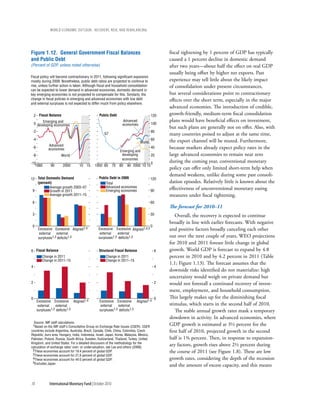
                                                                                      (Percent deviation from normal; years on x-axis; crisis begins at t = 0)
and somewhat surprisingly, there is no evidence
                                                                                       Crises are followed by persistent declines in credit as a share of GDP, as well as
that protectionism, as measured by the average tariff                                  temporary rises in exchange rate volatility. There is a small and statistically
level, increases following a crisis. There is a statisti-                              insignificant real depreciation and no evidence of significant changes in import
                                                                                       tariffs.
cally insignificant change in average tariffs following
a crisis in both the short and medium term.19 This                                                            Effect of a crisis
last finding, however, should not be interpreted to                                                           90 percent confidence interval around the
                                                                                                              estimated impulse response function
mean that overall protection does not rise, given
that increased protectionism may manifest itself in                                           Real Effective Exchange                    Volatility of the Real
“murky” forms (mentioned above), which are dif-                                        10     Rate                                       Effective Exchange Rate1                 60

ficult to detect in the data.
                                                                                                                                                                                  40
   The estimated elasticity of imports to mecha-
                                                                                         0
nisms other than output is outlined in Table 4.2.20                                                                                                                               20
The estimated elasticity of imports to the REER, at
about 0.09, is substantially smaller than estimates                                                                                                                               0
                                                                                      -10
from other studies. This may be due to the fact
                                                                                                                                                                                  -20
that the model estimates only the contemporaneous
association between the REER and imports.21 The                                       -20                                                                                         -40
                                                                                             –1   0     1      2     3      4    5    –1     0     1      2     3      4     5

Table 4.2. Estimated Elasticity of Imports
                                                                                       10     Credit to GDP                              Import Tariffs                           20
 REER1                                                                 0.09*
 Volatility of REER                                                   –0.05***
                                                                                         0
 Credit-to-GDP ratio                                                   0.10***                                                                                                    10
 Tariffs                                                              –0.03
                                                                                      -10
   Source: IMF staff calculations.
                                                                                                                                                                                  0
   Note: Elasticity is estimated by regressing the log of imports on the log of the
                                                                                      -20
variables of interest and economy- and year-fixed effects. ***, **, and * indicate
significance at the 1, 5, and 10 percent level, respectively. Standard errors (not                                                                                                -10
reported) are clustered by economy and corrected for heteroscedasticity.              -30
   1Real   effective exchange rate.
                                                                                      -40                                                                                         -20
                                                                                            –1    0     1      2     3      4    5    –1     0     1      2     3      4     5
   19The number of antidumping measures imposed by a country

also does not increase significantly following crises.                                    Source: IMF staff calculations.
   20As noted above, the estimated elasticity of imports with                             Note: Blue lines indicate the impulse response function—the effect of a crisis
                                                                                       relative to what would be predicted in the absence of a crisis. Predictions are based on
respect to output in the baseline specification varies across
                                                                                       contemporaneous and lagged crises and country and time dummies.
regions and over time. These elasticities are discussed in Appen-                         1
                                                                                           Exchange rate volatility is measured as the annual standard deviation of monthly
dix 4.2.                                                                               real effective exchange rate depreciation.
   21Estimates of this elasticity in the literature vary by horizon

(Senhadji, 1998, for example, finds an elasticity close to zero
in the short term but higher than 1 in the long term), as well
as across countries (Kwack and others, 2007, have elasticities
that range from 0.4 to 1.2 across a wide range of countries).
Using the higher estimates found in the literature will, of course,
increase the fraction of import loss that can be accounted for by
postcrisis declines in the REER.


                                                                                                                         International Monetary Fund | October 2010                   141
wOrld ecOnOmic OutlOOk: recOvery, risk, and rebalancing


                                                                                                  estimated elasticity of imports to REER volatil-
                                                                                                  ity and credit are both statistically significant and
                                                                                                  of the expected sign. The estimated elasticity of
                                                                                                  imports to tariffs, while negative as expected, is not
                                                                                                  statistically significant.
                                                                                                     Combining these results allows us to estimate
                                                                                                  the average contribution of these various mecha-
                                                                                                  nisms (Figure 4.11). The estimated contribution
                                                                                                  of output is derived as the difference between the
Figure 4.11. Decomposition of Import Losses                                                       unconditional import loss reported in Figure 4.4
(Percent; years on x-axis; crisis begins at t = 0)
                                                                                                  and the import loss controlling for output in Figure
Output declines account for the biggest share of import losses in the                             4.5. At the onset of a crisis (year t), the decline in
aftermath of crises. However, the temporary rise in exchange rate volatility and
persistent impairment of credit also contribute. Controlling for these potential                  output accounts for about half of the overall loss in
explanations still leaves a portion of import losses unexplained, which may
reflect composition effects.
                                                                                                  imports in that year; increased exchange rate volatil-
                                                                                                  ity accounts for another one-fifth of the import loss.
                            Output                  REER1 volatility                              Real depreciation and weak credit together account
                            Credit                  Tariffs
                            REER1                   Unexplained                                   for less than 10 percent of the loss in the crisis
                                                                                                  year, so that about 20 percent of the import loss in
                                                                                            110
                                                                                                  the year of the crisis remains unaccounted for. In
                                                                                            100
                                                                                                  subsequent years, output remains the most impor-
                                                                                            90
                                                                                                  tant contributor to depressed imports, accounting
                                                                                            80
                                                                                                  for anywhere between 50 and 60 percent of the
                                                                                            70
                                                                                                  total import loss. The role of exchange rate volatility
                                                                                            60
                                                                                                  diminishes over time, a reflection of the fact that
                                                                                            50
                                                                                                  the surge in volatility in the immediate aftermath
                                                                                            40
                                                                                                  of a crisis subsides over time. The role of credit, in
                                                                                            30
                                                                                                  contrast, increases over time because credit steadily
                                                                                            20
                                                                                                  worsens following a crisis; by the fifth year, weak
                                                                                            10    credit conditions account for about 10 percent of
                                                                                            0     the total import loss.
                                                                                            –10      Although these mechanisms help account for
        0              1             2             3              4             5
                                                                                                  a significant portion of the estimated postcrisis
    Source: IMF staff calculations.                                                               import loss, between 20 and 35 percent of the
    Note: Unconditional import losses (see Figure 4.4) are decomposed into changes
 attributable to the fall in output and credit, a rise in exchange rate volatility,               latter remains unexplained. To what extent might
 depreciation, and changes in tariffs. The contribution of output is computed as the              the composition effect account for the unexplained
 difference between the unconditional and conditional import losses (see Table 4.1).
 The contribution of the remaining factors is calculated as the product of the elasticity         component? This chapter’s focus on trade in goods,
 of imports with respect to each factor and the change in the factor following crises
 (depicted in Figure 4.10), as a percent of the unconditional change in imports after             and the lack of detailed historical data on the
 crises.
    1REER = real effective exchange rate.
                                                                                                  demand share of durables and nondurables for a
                                                                                                  wide range of economies preclude inclusion of com-
                                                                                                  position effects in our three-step methodology. But
                                                                                                  there is some evidence to suggest that such effects
                                                                                                  were important in earlier crises as well.22 Imports
                                                                                                  fall much more than output if two conditions are

                                                                                                     22Box 4.1 uses a more sophisticated framework and more

                                                                                                  disaggregated data to obtain more precise estimates of the role
                                                                                                  of the composition effect in explaining the most recent trade
                                                                                                  collapse.


142           International Monetary Fund | October 2010
chapter 4      dO Financial crises Have lasting eFFects On trade??


satisfied: demand for some goods must fall more
than for others, and those goods must account
for a larger share of trade than of output. Across
a sample of 48 economies and 26 crisis episodes
for which data are available, tradable investment
goods (machinery and equipment) account for 18
percent of trade but only 8 percent of GDP (Figure
4.12). And the postcrisis decline in machinery and
                                                                             Figure 4.12. Import Losses and Composition Effects
equipment is much larger—imports of these goods                              (Percent)
decline by more than one-third by the second year
                                                                             Durables comprise a much larger share of trade than of output. In addition,
after a crisis, more than 10 times the postcrisis                            demand for durables declines substantially more than demand for nondurables
decline in the rest of GDP over the same                                     following crises. These two facts suggest that composition effects may play an
                                                                             important role in postcrisis import losses.
period.23 Calculations in Appendix 4.2 suggest that,
even when focusing narrowly on these investment
                                                                                 Share of Durables                                                                    20
durables, the composition effect can explain at least
a portion of the postcrisis fall in imports.
   The three-step methodology provides only an                                                                                                                        15

estimate of the average contribution of the vari-
ous mechanisms to import dynamics. For example,                                                                                                                       10

although the size of the average depreciation is
small following a crisis, it is also clear from Figure                                                                                                                5

4.10 that there is substantial variation around this
average. Is it possible that economies whose cur-                                                                                                                     0
                                                                                                   Imports                            Output
rencies depreciated more substantially had imports
that evolved differently than those whose curren-                                Fall in Demand
                                                                                                                                                                     0
cies did not depreciate as much? Figure 4.13 sheds
some light on these possibilities; once again, all the
reported import losses already control for output.                                                                                                                   -10

Crisis episodes with a relatively large depreciation
seem to be associated with more depressed imports                                                                                                                    -20

than those with smaller depreciations (top panels).
Crises during which the increase in exchange rate                                                                                                                    -30

volatility was lower, or credit conditions were better,
seem to be associated with less import deterioration                                                                                                                 -40
                                                                                                  Durables                        Nondurables
(middle panels).24 Finally, there is evidence that cri-
ses during which tariffs increased by relatively more                           Source: IMF staff calculations.
were associated with worse import performance,                                  Note: The average share of machinery and equipment in GDP and share of capital
                                                                             durables in imports in a sample of 48 countries is shown in the top panel. The
particularly in the short term, consistent with the                          estimated impulse response two years after a crisis is shown in the bottom panel. The
                                                                             estimated impulse response function is based on contemporaneous and lagged crises
findings in Box 4.2 regarding the recent crisis.                             and country and time dummies.


  23One    possibility is that a decline in credit availability follow-
ing a crisis affects demand for durables more than demand for
other goods.
   24These findings are robust to the use of alternative proxies

that more closely track trade finance as opposed to the measure
of general credit conditions that is used here. Specifically, it is
robust to using the change in the outstanding stock of external
short-term debt, which includes short-term credit for trade
(Ronci, 2004).


                                                                                                          International Monetary Fund | October 2010                 143
wOrld ecOnOmic OutlOOk: recOvery, risk, and rebalancing


                                                                                                     summary and implications for the outlook
                                                                                                     This analysis finds that crises tend to depress
                                                                                                     imports substantially in the short term—above
                                                                                                     and beyond any import compression due to lower
Figure 4.13. Postcrisis Characteristics and Import                                                   output—and that imports tend to stay depressed
Losses, Controlling for Output                                                                       through the medium term. Imports tend to decline
(Percent deviation from normal; years on the x-axis; crisis begins at t = 0)                         more if the economy entered the crisis with a
 The evolution of imports following crises is associated with postcrisis economic
                                                                                                     relatively unfavorable current account balance and if
 conditions and policies. Imports fare worse when a crisis is accompanied by a                       the crisis resulted in a relatively large decline in the
 larger depreciation, greater exchange rate volatility, a sharper decline in credit,
 or a greater increase in protectionism.
                                                                                                     REER or poor credit conditions. Finally, exports
                                                                                                     exhibit a smaller and more gradual decline that can
                             Effect of a crisis                                                      be fully accounted for by changes in output.
                             90 percent confidence interval around                                      How do those results inform the outlook for
                             the estimated impulse response function
                                                                                                     trade? As the world economy emerges from the
  10       High Depreciation                         Low Depreciation                          10
                                                                                                     Great Trade Collapse of 2008–09, recent data
                                                                                                     make it just as easy to view the trade recovery glass
      0                                                                                        0
                                                                                                     as being half full as it is to view it as half empty.
                                                                                                     Optimists can point to strong growth in world
                                                                                                     trade since the second half of 2009, while pessimists
 -10                                                                                           -10
                                                                                                     can lament that imports and exports remain far
                                                                                                     below precrisis trends, or even below precrisis levels
 -20                                                                                           -20
                                                                                                     for some economies. Which perspective is justified?
                                                                                                     Although caution should be exercised when drawing
 -30                                                                                           -30
       –1      0       1    2     3     4    5     –1    0      1    2     3     4     5             implications for the recent, more global crisis from
                                                                                                     historical crisis episodes, we use the evidence in this
           High Increase in Exchange                 Low Increase in Exchange                        chapter to try to shed light on where trade might be
  10       Rate Volatility                                                                     10
                                                     Rate Volatility
                                                                                                     headed.
      0                                                                                        0        The recent financial crisis has been concentrated
                                                                                                     in many large, advanced economies (Table 4.3),
 -10                                                                                           -10
                                                                                                     and so this chapter’s findings have implications not
                                                                                                     just for individual economies but also for the global
                                                                                                     recovery and for global trade patterns. The 13
 -20                                                                                           -20


 -30                                                                                           -30
          –1   0       1     2    3     4     5    –1   0       1    2     3     4         5         Table 4.3. Systemic Banking Crises, 2007–09
                                                                                                      Systemic Cases                            Borderline Cases
    Source: IMF staff calculations.
    Note: Blue lines indicate the impulse response function – the effect of a crisis on               Austria                                   France
 imports relative to what would be predicted in the absence of a crisis. Predictions are              Belgium                                   Greece
 based on a collapsed gravity model in changes, with contemporaneous and lagged                       Denmark                                   Hungary
 crises, home and trade-weighted partner output, a trade-weighted partner crisis                      Iceland                                   Kazakhstan
 dummy, and country and time dummies. Crisis episodes are split into those during                     Ireland                                   Portugal
 which depreciation, the change in real effective exchange rate volatility, and the                   Latvia                                    Russia
 change in credit to GDP between t = 0 and t = 5 are, respectively, above or below the
 crisis sample median. In the case of tariffs, the figure reports conditional imports
                                                                                                      Mongolia                                  Slovenia
 after crises with a change in the trade liberalization index above and below the 75th                Netherlands                               Spain
 percentile.                                                                                          United Kingdom                            Sweden
                                                                                                      United States                             Switzerland
                                                                                                        Source: Laeven and Valencia (2010).
                                                                                                        Note: Laeven and Valencia (2010) define systemic banking crises as cases in
                                                                                                     which at least three of their listed interventions took place, whereas borderline
                                                                                                     cases are those that “almost meet” their definition of a systemic crisis.


144                International Monetary Fund | October 2010
chapter 4            dO Financial crises Have lasting eFFects On trade??


countries that recently had a systemic banking crisis
account for about 40 percent of global demand,
with the three largest countries—Germany, the
United Kingdom, and the United States—account-
ing for more than one-third of global demand.
Including 10 additional countries that Laeven and
Valencia (2010) identify as having had a “bor-
derline” systemic banking crisis, the recent crisis      Figure 4.13. (concluded)
countries account for over half of world demand                                     Effect of a crisis
and output. This chapter’s estimates of postcrisis                                  90 percent confidence interval around
                                                                                    the estimated impulse response function
trade dynamics are consistent with the sharp and
substantial drop in import demand that has been               High Decline in Credit to                       Low Decline in Credit to
                                                           10 GDP                                                                                  10
evident in these countries. More important for the                                                            GDP

outlook, this analysis suggests that these countries’        5                                                                                     5
imports are likely to remain depressed for a number
                                                             0                                                                                     0
of years, even more than their tempered output
projections would suggest. If, in addition, some            -5                                                                                     -5

economies fall into a sovereign debt crisis—which         -10                                                                                      -10
this analysis finds to be associated with more acute
                                                          -15                                                                                      -15
import losses—prospects for global import demand
will dim even further. For economies that rely heav-      -20                                                                                      -20
                                                             –1         0      1    2    3    4     5    –1     0     1     2     3     4      5
ily on external demand for growth, the chapter’s
findings underscore the importance of rebalancing                     High Increase in Import                 Low Increase in Import
                                                          30                                                                                           30
toward domestic sources of growth or, more gener-                     Tariffs                                 Tariffs

ally, of developing “twin engines” of growth.             20                                                                                           20
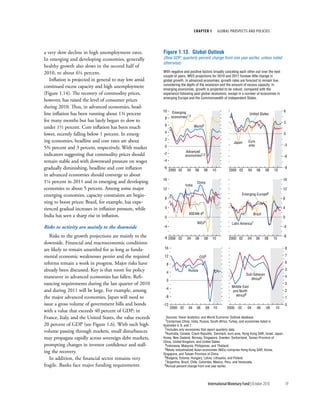
   The analysis also suggests that import dynamics
may differ across the crisis countries. For countries     10                                                                                           10
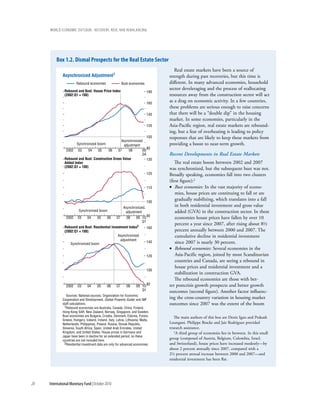
that entered the crisis with a relatively weak cur-
                                                            0                                                                                          0
rent account, such as the United Kingdom and the
United States, import demand is likely to be even        -10                                                                                           -10
more anemic. Exports to the United Kingdom are
also weighed down by the substantial deprecia-           -20
                                                                 –1      0     1    2    3     4    5    –1      0    1      2     3      4        5
                                                                                                                                                       -20

tion of the pound sterling since 2008. Finally, real
credit in these two economies is decelerating or            Source: IMF staff calculations.
                                                            Note: Blue lines indicate the impulse response function—the effect of a crisis on
even contracting, which the chapter suggests will        imports relative to what would be predicted in the absence of a crisis. Predictions are
also weaken imports beyond its effects on output.        based on a collapsed gravity model in changes, with contemporaneous and lagged
                                                         crises, home and trade-weighted partner output, a trade-weighted partner crisis
   The fact that these countries’ exports are not        dummy, and country and time dummies. Crisis episodes are split into those during
                                                         which depreciation, the change in real effective exchange rate volatility, and the
expected to decline nearly as much as their              change in credit to GDP between t = 0 and t = 5 are, respectively, above or below the
imports implies a likely improvement in the              crisis sample median. In the case of tariffs, the figure reports conditional imports
                                                         after crises with a change in the average tariff above and below the 75th percentile.
external balances of the crisis countries and a
deterioration in the balances of their partners.
Because the United States accounted for a large
part of the global imbalances that widened
substantially in the early 2000s, a silver lining
from the recent crisis is the narrowing of the
U.S. external deficit, and this chapter suggests
that this narrowing may be more durable than


                                                                                          International Monetary Fund | October 2010                    145
wOrld ecOnOmic OutlOOk: recOvery, risk, and rebalancing


          Box 4.2. protectionism in the recent crisis
             The extent of trade protectionism before and
                                                                       Simple Average Tariff Rates: 2008
          during the recent crisis has been subject to signifi-        (Percent)
          cantly different interpretations. This box addresses
                                                                                               MFN applied1              Bound
          the question by drawing on recent research by IMF
          staff (Gregory and others, 2010). New trade restric-
          tions have so far been limited to a small share of                                                                                                50

          global trade but have had a strong negative impact
          on trade flows. This box suggests ways for econo-                                                                                                 40
          mies to avoid allowing rising trade protectionism to
          interfere with the recovery.                                                                                                                      30
             Trade became much freer during the second half
          of the 20th century. Among major western European                                                                                                 20
          and North American countries, average tariffs fell
          from 15 to 4 percent between the 1950s and mid-                                                                                                   10
          2000s. In many major developing economies, tariffs
          increased or remained very high until the 1980s
                                                                                                                                                            0
          but have since come down sharply. Nonetheless, the


                                                                                      Brazil


                                                                                                                           United States
                                                                          Argentina


                                                                                                 China


                                                                                                         India

                                                                                                                 Japan


                                                                                                                                           European Union
          pace of trade reforms waned after the mid-2000s
          as protectionist sentiment began to increase, and so
          substantial trade restrictions were still in place when
          the crisis hit. Moreover, gaps in World Trade Orga-
          nization (WTO) commitments leave a wide scope                 Source: World Trade Organization, World Tariff Profiles 2009.
          for legal backsliding on trade policy. Tariffs—the            1MFN = Most favored nation.

          most transparent and easily monitored trade policy
          instrument—provide an illustrative example. Some
          economies can raise tariffs substantially without         • Multilateral rules and institutions have clarified
          exceeding their WTO bindings (first figure).                 the types of policy actions considered respon-
             Once the crisis took hold in mid-2008, politi-            sible. The strong WTO-based trade system has
          cal leaders’ awareness of the risks of protectionism,        been central.
          backed by increased monitoring activities, helped         • Trade declined much more rapidly than overall
          limit the protectionist response. Mindful of both            economic activity. The ratio of imports to GDP
          the disastrous results of protectionism during the           declined as well. Although job losses mounted,
          1930s and the contribution of trade to macro-                they were not, by and large, blamed on trade.
          economic performance, the Group of 20 (G20)               • Macroeconomic and financial sector policies
          economies pledged in November 2008 to “refrain               were supportive of trade.
          from raising new barriers to investment or to                Even so, once the crisis took hold, a number of
          trade in goods and services, imposing new export          trade restrictions were introduced. The sharp rise in
          restrictions, or implementing WTO inconsistent            unemployment and its continued high levels may
          measures to stimulate exports.” In April 2009 and         help explain the increased frequency of industry
          again in June 2010, G20 leaders extended this             requests for trade remedies. In addition, there was
          pledge and asked the WTO and other institutions           increased use of unconventional measures, which
          to monitor adherence.                                     are harder to quantify.
             Several other factors have worked to limit the            However, the extent of trade restrictions is
          protectionist response to the crisis:                     unclear, and various monitoring efforts have
                                                                    come to quite different conclusions. None of the
             The main author of this box is Robert Gregory.         watchdogs suggest that we have seen, or are likely


146   International Monetary Fund | October 2010
chapter 4     dO Financial crises Have lasting eFFects On trade??


   Measures included in Gregory and                         year” and that “much of the discrimination put in
   Others (2010)                                            place then has yet to be removed” (GTA, 2010).
   (Number of measures)                                        Gregory and others (2010) explore the impact
              Tariffs, import bans, quotas                  of both conventional and more unconventional
              Trade defense measures                        “behind the border” measures highlighted in the
              Nontariff barriers                            GTA reports, such as technical barriers to trade,
              Bailouts, subsidies
                                                            procurement, and regulatory measures. The analysis
              Local content, public procurement
              Export measures                               matches data from GTA monitoring of measures
                                                            taken between mid-2008 and late 2009 with
                                                            detailed product-level data on bilateral monthly
                                                            trade flows.1 The second figure illustrates the varied
                                                  51
                                                            nature of these protectionist measures. There is
    55                                                      strong evidence that, after an economy imposed
                                                            import restrictions on a particular product, its
                                                            imports fell in succeeding months relative to world
                                                            trade in the same product (third figure). Allowing
                                                            for various time-varying fixed effects, more sophis-
                                                            ticated econometric analysis suggests that trade in
                                                       16
                                                            the affected products dropped an average of 3 to 8
                                                              1Extending the data set through May 2010 does not

                                                            substantially change the results of the analysis.
         21                                       14


                                   27
                                                               Bilateral Trade Flows subject to Measures
                                                               Implemented in November 2008
                                                               (Index, October 2008 = 100)
     Source: Global Trade Alert Database.
                                                                                                                        120


to see, an extreme protectionist surge like that of
                                                                                                                        100
the 1930s, but their assessments differ markedly.
The June 2010 joint report of the WTO, Organiza-
tion for Economic Cooperation and Development                                                                           80
(OECD), and United Nations Conference on
Trade and Development (unctad) indicates that
                                                                                                                        60
“protectionist policy responses have been limited,
although there are still instances of restrictive mea-
sures taken… [T]here continues to be few instances                                                                      40
of new import restrictions and a greater use of
export restrictions, but some G20 governments
                                                                                                                        20
have also taken steps to facilitate trade” (WTO,
OECD, and unctad, 2010). In contrast, the sixth
report of Global Trade Alert (GTA), which is asso-                                                                      0
                                                                  2008         09         09        09         09
ciated with the London-based Centre for Economic
                                                                  Nov.        Feb.        May      Aug.       Nov.
Policy Research and supported by the World Bank,
also released in June 2010, concludes that “as far as           Source: IMF staff calculations.
open markets were concerned, 2009 was a terrible


                                                                                           International Monetary Fund | October 2010   147
wOrld ecOnOmic OutlOOk: recOvery, risk, and rebalancing


          Box 4.2 (continued)
          percent after the imposition of restrictions. How-       Gaps in WTO commitments leave ample scope
          ever, in the aggregate, restrictions implemented      for further trade restrictions, and a failure by all
          during the study period decreased trade by 0.25       economies to vigorously resist protectionism could
          percent, because these measures affected only a       threaten the economic recovery and slow future
          small share of global trade.                          growth. Maintaining and enhancing the monitoring
            Looking ahead, sustained high unemployment,         of protectionist measures and sustaining high-level
          uneven growth, an unwinding of government stim-       political awareness of the associated macroeconomic
          ulus measures, and growing economic imbalances        risks will help. But the surest way to avoid such a
          may increase protectionist pressure. In some econo-   downside scenario is to tighten multilateral trade
          mies, such pressure may also emerge from high         commitments by completing the WTO Doha
          commodity prices or a surge in capital inflows,       Round. This can be viewed as a key part of the exit
          which may lead to rapid currency appreciation.        strategy from the global economic crisis.


      in the absence of a financial crisis. On the other        appendix 4.1. Data sources
      hand, the finding that imports decline mostly for
                                                                    The primary data sources for the chapter are the
      investment-related goods suggests that the post-
                                                                IMF’s Direction of Trade Statistics (DOTS), World
      crisis outlook for innovation and potential growth
                                                                Economic Outlook (WEO), and International
      could be diminished.
                                                                Financial Statistics (IFS) databases; the NBER-UN
         Domestic policymakers who might be concerned
                                                                World Trade Flows database (2005); and Laeven and
      about the harmful effects of a financial crisis on
                                                                Valencia (2008, 2010). Additional data sources are
      exports may be reassured by the chapter’s findings
                                                                listed in Table 4.4, and the WEO analytical regions
      that declines in exports are, on average, small and
                                                                are in Table 4.5.
      gradual. Moreover, these effects can be accounted
                                                                    Crisis indicators are from Laeven and Valencia
      for by weaker output, suggesting that addressing the
                                                                (2008, 2010). Laeven and Valencia (2010) present
      factors that depress output on the supply side will       new and comprehensive data on the starting dates
      help exports recover as well.                             and characteristics of systemic banking crises over
         Finally, although domestic policymakers may            the period 1970–2009, building on earlier work
      care more about the consequences for exports than         by Caprio and others (2005), Laeven and Valencia
      for imports, the global nature of the recent crisis       (2008), and Reinhart and Rogoff (2009). They
      means that a coordinated and protracted slump in          update the Laeven and Valencia (2008) database
      import demand across a wide swath of economies            on systemic banking crises to include the recent
      bodes ill for the global recovery. Not surprisingly,      episodes following the U.S. mortgage crisis of
      the chapter finds that boosting output will con-          2007 and identify 129 episodes since 1970.
      siderably help imports to recover. In that regard,            Laeven and Valencia (2008) also identify debt
      productivity-enhancing structural reforms could           crisis episodes based on sovereign debt default
      help raise growth. The chapter’s findings suggest         and restructuring by relying on information from
      that, beyond supporting domestic demand, taking           Beim and Calomiris (2001), World Bank (2002),
      steps to improve credit conditions, keeping pro-          Sturzenegger and Zettelmeyer (2006), and IMF
      tectionist tendencies at bay, and avoiding exces-         staff reports. The information compiled includes the
      sive exchange rate volatility may help support the        year of sovereign default on private lending and the
      recovery of trade. A conclusion of the Doha Round         year of debt rescheduling. Using this approach, they
      of global trade talks would also reinforce the revival    identify 63 episodes of sovereign debt default and
      of global trade.                                          restructuring since 1970.


148   International Monetary Fund | October 2010
chapter 4    dO Financial crises Have lasting eFFects On trade??


Table 4.4. Data Sources
 Variable                                        Source
 Annual Data
 Real Exports and Imports                        Direction of Trade Statistics (DOTS) Database
 Real GDP in U.S. Dollars                        World Economic Outlook (WEO) Database
 Real GDP per Capita in U.S. Dollars             WEO Database
 World Import/Export Price Deflator              International Financial Statistics (IFS) Database
 Real Effective Exchange Rate                    IMF
 Product-Level Imports and Exports               Feenstra and others (2005), COMTRADE, Pula and Peltonen (2009)
 Current Account Balance                         WEO Database
 Financial Openness                              Lane and Milesi-Ferretti (2007)
 Trade Liberalization                            IMF
 Bank Credit                                     IFS Database
 Production Sharing                              Johnson and Noguera (2010)
 Debt Crisis Indicators                          Laeven and Valencia (2008)
 Banking Crisis Indicators                       Laeven and Valencia (2010)
 Investment Durables (machinery and equipment)   Organization for Economic Cooperation and Development, Eurostat, Haver
                                                    Analytics
 High-Frequency Data
 Real Exports and Imports                        CPB Netherlands Bureau of Economic Policy Analysis, DOTS Database, Global
                                                   Trade Atlas, Haver Analytics
 Antidumping Data                                Bown (2010)
 World Import/Export Price Deflator              IFS Database, CPB Netherlands Bureau of Economic Policy Analaysis


   Data on bilateral and aggregate imports and                   Nondurables, Intermediate Goods, and Primary
exports from the DOTS database are reported in                   Goods, following Pula and Peltonen (2009).
current U.S. dollars. These are deflated using the                  The current account balance is taken from the
world import and export price deflators from the                 WEO database. Trade openness is measured as the
IFS database, to determine each economy’s real                   ratio of the sum of imports and exports to GDP.
imports and exports. The series on real GDP in                   Financial openness is calculated as the sum of
U.S. dollars is from the WEO database. Import-                   foreign assets and foreign liabilities divided by GDP,
and export-weighted partner GDP and GDP per                      using the updated and extended External Wealth of
capita are constructed using real GDP in U.S. dol-               Nations Mark II Database (see Lane and Milesi-
lars and import and export weights from the DOTS                 Ferretti, 2007).
database. These weights vary each year according                    Bank credit to the private nonfinancial sector is
to the actual import and export flows between                    taken from the IFS database. Breaks in these data
economies.                                                       are identified using the IFS Country Notes publica-
   Data on imports and exports by product category               tion, and data are growth-spliced at these points.
are constructed from the NBER-UN World Trade                     The real effective exchange rate (REER) data are
Flows database (see Feenstra and others, 2005).                  from the IMF’s Information Notice System. The
The database is first extended using the UN                      volatility of the REER is calculated as the standard
COMTRADE database. The codes from the Stan-                      deviation of the monthly REER change in each
dard International Trade Classification, Revision 2,             year. The measure of trade liberalization is from the
that identify products in the NBER-UN trade data                 IMF Structural Reforms Database and is described
are matched to the UN Broad Economic Classifi-                   in IMF (2008).
cation (BEC) codes. These are then classified into                  Bilateral data on production sharing are from
Capital Goods, Consumer Durables, Consumer                       Johnson and Noguera (2010).


                                                                                           International Monetary Fund | October 2010   149
wOrld ecOnOmic OutlOOk: recOvery, risk, and rebalancing


Table 4.5. Country Groupings
                                                                                    Commonwealth of
                                                                                    Independent States,
 Advanced Economies            Developing Asia           Africa                     Georgia, Mongolia           South America
 Australia                     Afghanistan, Islamic      Angola                     Armenia                     Argentina
 Austria                           Republic of           Benin                      Azerbaijan                  Bolivia
 Belgium                       Bangladesh                Botswana                   Belarus                     Brazil
 Canada                        Bhutan                    Burkina Faso               Georgia                     Chile
 Cyprus                        Brunei Darussalam         Burundi                    Kazakhstan                  Colombia
 Czech Republic                Cambodia                  Cameroon                   Kyrgyz Republic             Ecuador
 Denmark                       China                     Cape Verde                 Moldova                     Paraguay
 Finland                       Fiji                      Central African Republic   Mongolia                    Peru
 France                        India                     Chad                       Russian Federation          Uruguay
 Germany                       Indonesia                 Comoros                    Tajikistan                  Venezuela
 Greece                        Kiribati                  Congo, Democratic          Turkmenistan                Central America
 Hong Kong SAR                 Lao People's Democratic      Republic of             Ukraine
 Iceland                           Republic              Congo, Republic of         Uzbekistan                  Costa Rica
 Ireland                       Malaysia                  Côte d’Ivoire                                          El Salvador
                                                                                    Middle East                 Guatemala
 Israel                        Maldives                  Djibouti
 Italy                         Myanmar                   Equatorial Guinea          Bahrain                     Honduras
 Japan                         Nepal                     Eritrea                    Egypt                       Mexico
 Korea                         Pakistan                  Ethiopia                   Iran, Islamic Republic of   Nicaragua
 Luxembourg                    Papua New Guinea          Gabon                      Jordan                      Panama
 Malta                         Philippines               The Gambia                 Kuwait                      Caribbean
 Netherlands                   Samoa                     Ghana                      Lebanon
                                                                                    Oman                        Antigua and Barbuda
 New Zealand                   Solomon Islands           Guinea
                                                                                    Qatar                       The Bahamas
 Norway                        Sri Lanka                 Guinea-Bissau
                                                                                    Saudi Arabia                Barbados
 Portugal                      Thailand                  Kenya
                                                                                    Syrian Arab Republic        Belize
 Singapore                     Timor-Leste               Lesotho
                                                                                    United Arab Emirates        Dominica
 Slovak Republic               Tonga                     Liberia
                                                                                    Yemen, Republic of          Dominican Republic
 Slovenia                      Tuvalu                    Madagascar
                                                                                                                Grenada
 Spain                         Vanuatu                   Malawi                     Maghreb                     Guyana
 Sweden                        Vietnam                   Mali
 Switzerland                                             Mauritius                  Algeria                     Haiti
                               Central and Eastern                                  Libya                       Jamaica
 Taiwan Province of China                                Mozambique
                               Europe                                               Mauritania                  St. Kitts and Nevis
 United Kingdom                                          Namibia
 United States                 Albania                   Niger                      Morocco                     St. Lucia
                               Bosnia and Herzegovina    Nigeria                    Tunisia                     St. Vincent and the
                               Bulgaria                                                                            Grenadines
                                                         Rwanda
                               Croatia                                                                          Suriname
                                                         São Tomé and Príncipe
                               Estonia                                                                          Trinidad and Tobago
                                                         Senegal
                               Hungary                   Seychelles
                               Kosovo                    Sierra Leone
                               Latvia                    South Africa
                               Lithuania                 Sudan
                               Macedonia, Former         Swaziland
                                  Yugoslav Republic of   Tanzania
                               Montenegro                Togo
                               Poland                    Uganda
                               Romania                   Zambia
                               Serbia                    Zimbabwe
                               Turkey


             The Global Trade Atlas data at the four-digit level               Japan, Korea, Russia, South Africa, Turkey, and the
          of the Harmonized Commodity Description and                          United States. The monthly data are converted to a
          Coding System (HS) are used to trace trade in types                  quarterly frequency, deflated by specific commod-
          of products since 2001. These data cover the fol-                    ity price deflators—from the WEO database for
          lowing: Argentina, Australia, Brazil, Canada, China,                 selected primary goods and from the CPB Nether-


150       International Monetary Fund | October 2010
chapter 4     dO Financial crises Have lasting eFFects On trade??


lands Bureau of Economic Policy Analysis for the                       following a crisis.26 In contrast to the baseline,
remaining products—and are seasonally adjusted.                        this methodology allows for an episode-specific
The HS four-digit codes are matched to the BEC                         trend, as opposed to the country-specific trend
and classified into Capital Goods, Consumer                            that is captured by ai in the baseline specifica-
Durables, Consumer Nondurables, Intermediate                           tion. However, it does not control for global
Goods, and Primary Goods, following Pula and                           conditions as is done in the baseline.
Peltonen (2009).                                                     • Alternative 2: Baseline specification with autore-
                                                                       gressive terms—The baseline specification is
                                                                       augmented by including four lags of the growth
appendix 4.2. Methodology and robustness                               of imports on the right-hand side, paralleling the
tests                                                                  specifications used in Romer and Romer (2010)
estimating Unconditional import losses                                 and Cerra and Saxena (2008):
   The analysis25 first estimates the unconditional                        D ln Mit 5 ai 1 pt 1 ∑ rl D ln Mi,t–1
dynamics of imports in the aftermath of crises using
a “collapsed” gravity model of trade in changes.                                           1 ∑ ak crisisi,t–k 1 eit.                (4.3)
In the baseline regression specification in the text,                • Alternative 3: Bilateral gravity in changes—A
the growth in an economy’s aggregate imports,                          directional gravity model (that is, one with bilat-
D ln Mit , is expressed as a function of a dummy                       eral imports or exports as opposed to bilateral
variable indicating whether a crisis started in year t,                trade) is estimated in changes. The growth in
five lags of this dummy variable, and country and                      bilateral imports of an economy from each trad-
time dummies:                                                          ing partner, D ln Mimp,exp,t, is regressed on a crisis
   D ln Mit 5 ai 1 pt 1 ∑ ak crisisi,t–k 1 eit. (4.1)                  indicator and its lags, as well as on time and
                                                                       importer-exporter pair dummies:
The robustness of the estimated unconditional
import losses from the baseline specification is                           D ln Mimp,exp,t 5 aimp,exp 1 pt
verified by using the following five alternative                                       1 ∑ a'k crisisimp,t–k 1 eimp,exp,t .         (4.4)
specifications:
• Alternative 1: Deviation from precrisis trend—                     • Alternative 4: Bilateral gravity in changes, using top
   This procedure measures import loss as a simple                     20 partners—This specification is identical to the
   deviation of ln Mit from a precrisis trend, ln Trit,                directional gravity model in changes as described
   where the latter is a linear trend based on a                       in equation (4.4) but focuses only on the top
   precrisis window from (t – 7) to (t – 1). The                       20 partners from which an economy imports.
   mean import loss k years after a crisis is just the                 This is done because our primary concern is in
   average of this import loss, (ln Mit – ln Trit),                    describing the behavior of aggregate trade, rather
   across all crisis episodes. This is equivalent to                   than average bilateral trade. The standard gravity
   estimating the following equation, either in levels                 model weights all bilateral trade observations
   or changes:                                                         equally, regardless of the size of the bilateral trade

      ln Mit 2 ln Trit 5 ∑ bk crisisi,t–k 1 eit.             (4.2)
                                                                       26The   results from estimating equation (4.2) in levels or
   This procedure is similar to the procedure                        changes are identical because, as in Chapter 4 of the October
                                                                     2009 World Economic Outlook, the import losses are normalized
   used in Chapter 4 of the October 2009 World                       so that the loss in the year before the crisis (t – 1) is zero. The
   Economic Outlook for estimating output losses                     primary differences between the procedure used here and in
                                                                     Chapter 4 of the October 2009 World Economic Outlook are the
                                                                     following: (1) the definition of crisis (debt crises combined with
                                                                     banking crises versus banking crises only), (2) the precrisis win-
  25We   focus on import dynamics here, since the chapter’s          dow used to calculate the trend [(t – 7) to (t – 1) versus (t – 10)
results suggest that imports are where the impact of a crisis on     to (t – 3)], and (3) the choice of dependent variable (imports
trade is primarily manifested.                                       versus GDP per capita).


                                                                                                 International Monetary Fund | October 2010   151
wOrld ecOnOmic OutlOOk: recOvery, risk, and rebalancing


         relationship. But trade is highly uneven—in the                     D ln PGDPit, contemporaneous and lagged values
         sample used in this chapter, the top 20 trading                     of a dummy variable indicating a crisis in the
         partners account for 89 percent of an economy’s                     economy, crisisi,t–k, an import-weighted indicator
         total imports, on average, even though the aver-                    of incidence of crises in trading partners (plus
         age economy imports from 175 economies. In                          five lags), pcrisisi,t–k, and country and time dum-
         other words, about 90 percent of the observa-                       mies ai and pt:
         tions in a typical gravity model account for only
         10 percent of total trade. The behavior of aggre-                     D ln Mit 5 ai 1 pt 1 ∑ ak crisisi,t–k
         gate trade will more closely follow the dynamics                                   1 (b1r 1 b2r  Dt≥1990)D ln GDPit
         of larger trading partners.
      • Alternative 5: Baseline specification, excluding                                    1 b3 D ln PGDPit
         banking and debt crises that were accompanied by                                   1 ∑ dk pcrisisi,t–k eit.             (4.5)
         a currency crisis—This specification is identical to
         the baseline equation (4.1) but focuses only on                        As discussed in the text, the elasticity of
         “pure” banking and debt crises. More specifically,                  imports to output is crucial for assessing whether
         we exclude banking and debt crisis episodes that                    the evolution of trade is fully explained by out-
         were accompanied or preceded by a currency                          put. To be as general as possible, we allow the
         crisis as defined in Laeven and Valencia (2008).                    output elasticities of imports and exports in the
         As Table 4.6 and Figure 4.14 illustrate, the esti-                  baseline specification to vary across the 10 WEO
      mated impulse response functions of imports using                      analytical regions described in Table 4.5. We also
      these different approaches are similar both qualita-                   allow each of these regional elasticities to vary
      tively and quantitatively. This confirms the find-                     between the pre- and post-1990 periods. The
      ing that there are large and statistically significant                 estimated elasticities, shown in Table 4.7, range
      unconditional import losses after crises.                              from 0.8 to 4.5 and are in general higher for the
                                                                             post-1990 period.
                                                                                The following tests were performed to check the
      import losses controlling for output                                   robustness of the conditional import losses pre-
         The import losses controlling for output                            sented in the text:
      are also computed using the baseline model in                          • Robustness Test 1: Distributed lag specification—
      changes, this time with a set of controls derived                         We augment the specification to include lagged
      from the standard gravity model. Specifically,                            output growth. The elasticity of imports to
      the growth of imports, D ln Mit, is modeled as a                          contemporaneous and lagged output is allowed
      function of the growth in the economy’s output,                           to vary across regions and between the pre- and
      D ln GDPit, its partners’ import-weighted output,                         post-1990 periods.


      Table 4.6. Unconditional Import Losses: Estimated Impulse Response Functions Using Alternative
      Methodologies
                                                                                                       Bilateral
                                                                                                       Gravity in      Baseline,
                                                                 Baseline Plus       Bilateral         Changes,        Pure Bank
                                                    Deviation   Autoregressive       Gravity in         Top 20         and Debt
              Time                   Baseline      from Trend       Terms            Changes           Partners         Crises
       Crisis year, t                     –0.080     –0.082         –0.078             –0.076            –0.080         –0.064
       t+1                                –0.158     –0.159         –0.167             –0.191            –0.156         –0.152
       t+2                                –0.171     –0.174         –0.181             –0.166            –0.162         –0.174
       t+3                                –0.153     –0.156         –0.161             –0.153            –0.135         –0.159
       t+4                                –0.169     –0.160         –0.173             –0.172            –0.159         –0.176
       t+5                                –0.190     –0.183         –0.191             –0.183            –0.184         –0.202

        Source: IMF staff calculations.


152   International Monetary Fund | October 2010
chapter 4      dO Financial crises Have lasting eFFects On trade??


• Robustness Test 2: Uniform elasticity of imports to
  output—We report the results from a specifica-
  tion that would most closely mirror a collapsed
  gravity specification in changes. Namely, as is
  standard in the literature, we impose the same
  elasticity of imports to output across economies
  and over time.
• Robustness Test 3: Bilateral gravity (all controls) in
  changes—Rather than focusing on the economy’s
  aggregate imports, we estimate a unidirec-
  tional (bilateral) gravity model in changes. The
  specification is as in equation (4.4) but con-
                                                                    Figure 4.14. Import Losses, Not Controlling for
  tains the standard gravity controls: the growth
                                                                    Output: Alternative Methodologies
  in the economy’s and partners’ output as well                     (Percent deviation from normal; years on x-axis; crisis begins at t = 0)
  as a set of dummies for crises occurring in
                                                                                       Baseline                               Alternative 1
  both home and partner economies, indicators
                                                                                       Alternative 2                          Alternative 3
  for whether the country pair is in a currency                                        Alternative 4                          Alternative 5
  union or free trade agreement, and time and
  importer-exporter pair dummies. The elasticity                                                                                                     0
  with respect to an economy’s output is allowed
  to vary across regions and between the pre- and
  post-1990 periods.                                                                                                                                 -5
• Robustness Test 4: Allowing the elasticity of imports
  to vary across cyclical versus trend components of
  output—Imports may be more responsive to                                                                                                           -10
  cyclical than to trend movements in output; if
  so, the baseline approach would overestimate
  the fall in imports controlling for output. To                                                                                                     -15

  test this, we allow the elasticity of imports to
  vary across the trend and cyclical components
                                                                                                                                                     -20


 Table 4.7. Estimated Elasticity of Imports to
 Output: Panel Regression with Country and                                                                                                           -25
                                                                     –1            0            1            2           3           4           5
 Time Dummies
                                             Pre-1990   Post-1990     Source: IMF staff calculations.

 Advanced                                      1.99       1.94
 Developing Asia                               0.89       2.76
 Africa                                        0.99       1.50
 CIS,1 Georgia, Mongolia                       ...         ...
 Central and Eastern Europe                    1.46       1.38
 Middle East                                   0.79       1.89
 Maghreb                                       0.83       1.09
 South America                                 2.26       2.26
 Central America                               2.03       1.58
 Caribbean                                     1.87       1.77

   Source: IMF staff calculations.
   1Commonwealth    of Independent States.


                                                                                                    International Monetary Fund | October 2010           153
wOrld ecOnOmic OutlOOk: recOvery, risk, and rebalancing


                    of output, where the trend and cycle were                                                ods—Similar to Robustness Test 4, the sensitivity
                    separated using a Hodrick-Prescott filter. As in                                         of imports to output may be particularly high
                    the baseline, the import elasticity with respect                                         in times of crisis. We thus allow the coefficient
                    to both the cyclical and trend components of                                             on output to vary during crisis and noncrisis
                    output are allowed to vary across WEO regions                                            periods.
                    and between the pre- and post-1990 periods.                                              The results of these robustness tests are presented
                •   Robustness Test 5: Controlling for changes in the                                     in Table 4.8 and Figure 4.15. The finding that
                    REER and relative prices—Import dynamics may                                          imports remain below their normal levels following
                    differ after crises due to changes in the REER                                        a crisis, even after controlling for output, is con-
                    and relative price levels. Equation (4.5) is aug-                                     firmed across all these robustness checks. While the
                    mented to control for changes in REER and the                                         standard errors increase substantially once we allow
                    domestic price level, proxied by the change in the                                    the estimated elasticity of imports to output to vary
                    GDP deflator.                                                                         across economies, the point estimates remain very
                •   Robustness Test 6: Controlling for changes in                                         similar to the baseline specification.
                    domestic aggregate demand—An economy’s GDP
                    may not be a good proxy for absorption in
                    the importing economy, and to the extent that                                         Decomposition of Unconditional import losses
                    absorption declines more than GDP during cri-                                            We use a three-step approach to evaluate the
                    ses, the estimated import losses after controlling                                    importance of different mechanisms in explaining
                    for output may be overstated. We replace growth                                       the unconditional import losses, as detailed below.
                    in output by growth in domestic absorption                                            It is important to keep in mind that this is simply
                    (consumption plus investment) on the right-hand                                       an accounting exercise that attempts to decompose
                    side of equation (4.5).                                                               the unconditional import losses based on observed
                •   Robustness Test 7: Allowing the elasticity of imports                                 correlations. The true contributions of the vari-
                    to output to differ across economies—We further                                       ous mechanisms might differ from these estimated
                    increase the flexibility of our specification by                                      correlations.
                    estimating separately the elasticity of imports                                          Step 1: We document whether crises are followed
                    to output for each of the 154 economies in the                                        by persistent changes in tariffs, credit, the REER,
                    sample.                                                                               and exchange rate volatility by estimating equation
                •   Robustness Test 8: Allowing the elasticity of imports                                 (4.1) with the mechanisms of interest as the depen-
                    to output to vary across crisis versus noncrisis peri-                                dent variable.


Table 4.8. Conditional Import Losses: Robustness of Estimated Impulse Response Functions
                                              Baseline            Same                                                                Control for
                                                and             Elasticity                                         Control for        Changes in                              Elasticity:
                                              Lagged             across                           Elasticity:      Changes in        Consumption            Elasticity:         Differs
                                             Growth of          Regions        Full Gravity      Cyclical vs.      REER and               and               Varies by           during
         Time               Baseline           Output           and Time       in Changes           Trend            PPP1             Investment            Economy          Crisis Years
                               (1)               (2)               (3)             (4)               (5)                (6)                (7)                  (8)               (9)
 Crisis year, t            –0.040***          –0.037**         –0.058***       –0.022*           –0.043***          –0.052***         –0.042***             –0.031*           –0.052***
 t+1                       –0.073***          –0.074***        –0.116***       –0.093***         –0.076***          –0.090***         –0.079***             –0.058**          –0.114***
 t+2                       –0.077***          –0.086***        –0.129***       –0.053***         –0.086***          –0.092***         –0.093***             –0.054*           –0.122***
 t+3                       –0.063*            –0.071**         –0.114***       –0.048**          –0.077**           –0.074***         –0.076***             –0.041            –0.099***
 t+4                       –0.077**           –0.081***        –0.133***       –0.074***         –0.090***          –0.091***         –0.087***             –0.057*           –0.101***
 t+5                       –0.089**           –0.092***        –0.152***       –0.068***         –0.099***          –0.105***         –0.095***             –0.071*           –0.115***

      Source: IMF staff calculations.
     Note: All columns include economy- and year-fixed effects. Columns (1), (2), and (4) – (7) allow the elasticity of imports to output (or its cyclical and trend component and consump-
 tion and investment) to vary by WEO regions and after 1990. In column (8), the elasticity of imports to output is allowed to vary by economy.
      1REER   = real effective exchange rate; PPP = purchasing power parity.


154             International Monetary Fund | October 2010
chapter 4      dO Financial crises Have lasting eFFects On trade??


   Step 2: We estimate the elasticity of imports with
respect to the various mechanisms in the following
regression framework:

  ln Mit = ai + pt
           + (bGDP,r + bGDP,r × Dt≥1990) ln GDPit
           + bTariff ln Tariffit + bcr ln Creditit
           + bREER ln REERit + bvol ln Volatilityit
           + ∑ ak crisisi,t–k + b3 ln PGDPit
           + ∑ dk pcrisisi,t–k + it                 (4.6)   Figure 4.15. Import Losses, Controlling for
                                                             Output: Robustness
                                                             (Percent deviation from normal; years on x-axis; crisis begins at t = 0)
   Step 3: We combine the estimates from steps 1
and 2 to quantify the contribution of various mech-                             Baseline                                Robustness 1
anisms. In particular, the estimated change in the                              Robustness 2                            Robustness 3
                                                                                Robustness 4                            Robustness 5
mechanism following a crisis in step 1 is multiplied
                                                                                Robustness 6                            Robustness 7
by the estimated elasticity of imports with respect                             Robustness 8
to that mechanism in step 2. The contribution of
each mechanism is then expressed as a fraction of                                                                                               0
the unconditional import losses. The contribution
of output is computed as the difference between the                                                                                             -2

unconditional import losses from equation (4.1)
                                                                                                                                                -4
and import losses conditional on output from equa-
tion (4.5).
                                                                                                                                                -6


                                                                                                                                                -8
composition effects during earlier crises: a Back-of-
the-envelope calculation
                                                                                                                                                -10
   If GDP and imports had the same composition
of goods and services, and if, within each sector,                                                                                              -12
imports changed proportionally to domestic final
demand, imports would be expected to fall by as                                                                                                 -14

much as GDP after a crisis. However, if there are
                                                                                                                                                -16
differences in the composition of imports and GDP,            –1            0              1            2           3           4           5
and if goods and services that constitute a larger
                                                               Source: IMF staff calculations.
share of trade than of GDP experience a relatively
larger decline in demand following a crisis, imports
will fall more than GDP even in the absence of
changes in other factors (such as credit, exchange
rates, or degree of protectionism) described in the
chapter. For example, part of the outsize decline
in imports relative to GDP in the recent crisis has
been attributed to the resilience in the demand
for services relative to manufactured goods. Since
demand for manufactured goods experienced a
relatively larger decline and since manufactured


                                                                                               International Monetary Fund | October 2010           155
wOrld ecOnOmic OutlOOk: recOvery, risk, and rebalancing


                                                                                                       goods comprise a larger share of trade than of GDP,
                                                                                                       overall imports declined more than GDP (Borchert
                                                                                                       and Mattoo, 2009).
                                                                                                          We first investigate whether historically there is
                                                                                                       a difference in the behavior of manufactured goods
                                                                                                       and services following crises. Since detailed data on
                                                                                                       the demand side are not available, we use sectoral
                                                                                                       value-added data to document whether there
                                                                                                       are differences in the behavior of services versus
 Figure 4.16. The Postcrisis Evolution of Various
                                                                                                       industry after crises. Somewhat surprisingly, this
 Components of GDP
 (Percent deviation from normal; years on x-axis; crisis begins at t = 0)                              does not appear to be the case. The estimated drop
                                                                                                       in services is very similar to the decline in industry
 Crises are followed by roughly equal declines in services and industry. The
 postcrisis decline in investment in machinery and equipment, on the other                             value added after crises (Figure 4.16, top panel).27
 hand, is much deeper than for the rest of output.                                                     Given this similarity in the dynamics of services and
                                                                                                       industry, the different shares of services in output
       Services, Industry, and Total Output
                                                                                             0         and trade do not appear to be a likely explanation.
                                                                                                          However, within the “manufactured goods” cat-
                                                                                             -2
                                                                                                       egory, there are compositional differences between
                                                                          Total output       -4        output and trade. Across a sample of 48 economies
                                                                                                       for which disaggregated data on gross fixed invest-
                                                      Services                               -6        ment are available, (capital) durables, measured by
                                                                                                       tradable investment goods—namely, machinery and
                                           Industry                                          -8
                                                                                                       equipment—account for only 8 percent of GDP.
                                                                                             -10       For the same set of economies, the average share
 –1              0             1             2             3               4             5
                                                                                                       of (capital) durables in imports is 18 percent.28
       Durables and the Rest of Output
                                                                                                       Although the data coverage is rather scant—only
                                                                                                 0
                                                                                                       26 of the identified crises can be included in the
                                    Rest of output                                                     analysis— we provide some back-of-the-envelope
                                                                                                 -10   calculations to estimate the contribution of these
                                                                                                       composition effects in explaining import losses fol-
                                                                                                 -20   lowing crises.
                                                               Durables
                                                                                                          We begin with the following two identities:
                                                                                                 -30
                                                                                                          GDPgth = shdur            × DURGDP
                                                                                                                              GDP              gth


 –1              0              1             2             3                  4             5
                                                                                                 -40                   + (1 – shdur ) × OTHERGDP                    (4.7)
                                                                                                                                       GDP                  gth

                                                                                                          IMPgth = shdur            × DURIMP
       Source: IMF staff calculations.                                                                                        IMP            gth
       Note: Lines indicate the impulse response function – the effect of a crisis on imports
      relative to what would be predicted in the absence of a crisis. Predictions are based on            + (1 – shdur ) × OTHERIMP ,                               (4.8)
                                                                                                                        IMP                    gth
      contemporaneous and lagged crises, and country and time dummies.


                                                                                                          27The overall output loss is slightly lower than the loss of

                                                                                                       services and industry due to the resilience of agricultural produc-
                                                                                                       tion to crises.
                                                                                                          28The definition of “durables” in the trade and output data is

                                                                                                       not identical because these series come from different, not always
                                                                                                       comparable, data sources. However, it is unlikely that differences
                                                                                                       in definitions account for the differences in the shares of these
                                                                                                       goods in imports and output.


156            International Monetary Fund | October 2010
chapter 4         dO Financial crises Have lasting eFFects On trade??


where GDPgth and IMPgth are the growth rates in                                                  Table 4.9 and Figure 4.16 present the findings
GDP and imports, respectively; shdur and shdur                                                from this exercise. The impulse response functions
                                       GDP         IMP
are the share of (capital) durables in GDP and                                                of investment in machinery and equipment and
imports, respectively; DURGDPgth and DURIMPgth are                                            the rest of GDP are shown in Figure 4.16 (bottom
the growth rate in the (capital) durable component                                            panel).29 The postcrisis decline in investment, and
of GDP and imports, respectively; and OTHERGDPgth                                             in particular in machinery and equipment, is much
and OTHERIMPgth are the growth rate in other com-                                             larger than the postcrisis decline in the rest of GDP
ponents of GDP and imports, respectively.                                                     over the same period. As presented in column (6)
   Assuming the elasticity of imports of different prod-                                      of Table 4.9, for this selected sample of crises, the
ucts to GDP is 1, equation (4.8) can be rewritten as                                          composition effect can explain 5 to 13 percent of
                                                                                              the unconditional import loss. It is important to
    IMPgth = shdur              × DURGDP
                          IMP                        gth                                      keep in mind that these composition effects are
                   + (1 – shdur ) × OTHERGDP .                                 (4.9)          calculated only from the different shares and post-
                                       IMP                            gth
                                                                                              crisis behavior of machinery and equipment relative
Subtracting (4.7) from (4.9) implies
                                                                                              to the rest of output; other composition effects—
    IMPgth – GDPgth = (shdur                         – shdur )                                most notably, from consumer durables—may
                                               IMP             GDP
                                                                                              also be present. In addition, composition effects
                    × (DURGDP – OTHERGDP ).                                   (4.10)
                                         gth                          gth                     may already be reflected in the higher elasticity of
   Based on equation (4.10), we define the compo-                                             imports to output that is allowed for in our baseline
sition effect as the extent to which the difference                                           specification. Thus, these estimates of the size of the
between the growth rates of GDP and imports is                                                composition effect could be thought of as a lower
explained by different compositions of GDP and                                                bound.
imports. It is a product of two factors: (1) differ-
ences in the share of durables in imports and GDP
and (2) differences in the growth of durables and
other components following a crisis. If either of
these differences is zero, composition cannot be an                                             29Given the share of durables in GDP, as well as the decline in
explanation for observing import losses controlling                                           overall GDP, we can also calculate how much demand for other
for output.                                                                                   components of GDP falls after crises.


Table 4.9. Import Losses and Composition Effects
                                                                            Implied Response Function

                                                                                                         Actual                 Estimated               Share of Import
                                                           Investment                                    Import                Composition             Loss Explained by
                                GDP                        in Durables            Other                   Loss                    Effect              Composition Effects

       Time                      (1)                           (2)                 (3)                      (4)                      (5)                         (6)
Crisis year, t                  –0.024                       –0.091               –0.018                  –0.088                   –0.007                        8.0
t+1                             –0.051                       –0.285               –0.029                  –0.267                   –0.025                        9.2
t+2                             –0.054                       –0.340               –0.028                  –0.250                   –0.030                       12.1
t+3                             –0.050                       –0.234               –0.033                  –0.155                   –0.019                       12.6
t+4                             –0.048                       –0.160               –0.038                  –0.153                   –0.012                        7.7
t+5                             –0.049                       –0.114               –0.043                  –0.144                   –0.007                        4.8

   Source: IMF staff calculations.
   Note: All estimates in columns (1), (2), and (4) are significant at the 1 percent level. Standard errors (not reported) are clustered by economy and corrected for heterosce-
dasticity. The actual import loss is estimated for the subsample of economies and crises for which disaggregated investment data are available. The share of import loss
explained by composition effects in column (6) is calculated as the estimated composition effect in column (5) divided by the actual import loss multiplied by 100.


                                                                                                                                 International Monetary Fund | October 2010        157
wOrld ecOnOmic OutlOOk: recOvery, risk, and rebalancing


      references                                                     Bown, Chad, 2010, “Fourth Quarter 2009 Protectionism
                                                                        Data: Requests for New Trade Barriers Fall for the First
      Abiad, Abdul, Giovanni Dell’Ariccia, and Bin Li, forthcom-        Time in Crisis; But Newly Imposed Barriers Increase,” a
         ing, “Creditless Recoveries,” IMF Working Paper (Wash-         Monitoring Update to the Global Antidumping Database,
         ington: International Monetary Fund).                          February (Washington: World Bank).
      Alessandria, George, Joseph P. Kaboski, and Virgiliu           Caprio, Gerard, Daniela Klingebiel, Luc Laeven, and
         Midrigan, forthcoming, “The Great Trade Collapse of            Guillermo Noguera, 2005, “Appendix: Banking Crisis
         2008–09: An Inventory Adjustment?” IMF Economic                Database,” in Systemic Financial Crises: Containment
         Review, (Washington: International Monetary Fund).             and Resolution, ed. by Patrick Honohan and Luc Laeven
      Altomonte, Carlo, and Gianmarco I.P. Ottaviano, 2009,             (Cambridge, United Kingdom: Cambridge University
         “Resilient to the Crisis? Global Supply Chains and Trade       Press).
         Flows,” in The Great Trade Collapse: Causes, Consequences   Cerra, Valerie, and Sweta Saxena, 2008, “Growth Dynamics:
         and Prospects, ed. by Richard Baldwin. Available at www.       The Myth of Economic Recovery,” American Economic
         voxeu.org/index.php?q=node/4289.                               Review, Vol. 98, No. 1, pp. 439–57.
      Amiti, Mary, and David E. Weinstein, 2009, “Exports and        Chor, Davin, and Kalina Manova, 2010, “Off the Cliff and
         Financial Shocks,” NBER Working Paper No. 15556                Back? Credit Conditions and International Trade during
         (Cambridge, Massachusetts: National Bureau of Economic         the Global Financial Crisis” (unpublished; Stanford, Cali-
         Research).                                                     fornia: Stanford University).
      Anderson, James, and Eric Van Wincoop, 2003, “Gravity          Eaton, Jonathan, Sam Kortum, Brent Neiman, and John
         with Gravitas: A Solution to the Border Puzzle,” American      Romalis, 2010, “Trade and the Global Recession” (unpub-
         Economic Review, Vol. 93, No. 1, pp. 170–92.                   lished; Chicago, Illinois: University of Chicago). Available
      Baldwin, Richard, 1988, “Hysteresis in Import Prices: The         at http://home.uchicago.edu/~kortum/papers/EKNR.pdf.
         Beachhead Effect,” American Economic Review, Vol. 78,       Feenstra, Robert, Robert Lipsey, Haiyan Deng, Alyson Ma,
         No. 4, pp. 773–85.                                             and Hengyong Mo, 2005, “World Trade Flows: 1962–
      ———, ed., 2009, The Great Trade Collapse: Causes, Conse-          2000,” NBER Working Paper No. 11040 (Cambridge,
         quences and Prospects. Available at www.voxeu.org/index.       Massachusetts: National Bureau of Economic Research).
         php?q=node/4297.                                            Frankel, Jeffrey, Ernesto Stein, and Shang-Jin Wei, 1996,
      ———, and Daria Taglioni, 2006, “Gravity for Dummies               “Regional Trading Arrangements: Natural or Supernatural?”
         and Dummies for Gravity Equations,” NBER Working               American Economic Review, Vol. 86, No. 2, pp. 52–56.
         Paper No. 12516 (Cambridge, Massachusetts: National         Friedman, Jed, and James Levinsohn, 2003, “The Distribu-
         Bureau of Economic Research).                                  tional Impacts of Indonesia’s Financial Crisis on Household
      Beim, David, and Charles Calomiris, 2001, Emerging                Welfare: A ‘Rapid Response’ Methodology,” The World
         Financial Markets, appendix to Chapter 1 (New York:            Bank Economic Review, Vol. 16, No. 3, pp. 397–423.
         McGraw-Hill/Irwin).                                         Freund, Caroline, 2009, “The Trade Response to Global
      Bems, Rudolfs, Robert Johnson, and Kei-Mu Yi, forthcom-           Downturns: Historical Evidence,” Policy Research Work-
         ing, “Demand Spillovers and the Collapse of Trade in the       ing Paper No. 5015 (Washington: World Bank).
         Global Recession,” IMF Economic Review (Washington:         Glick, Reuven, and Alan M. Taylor, 2010, “Collateral Dam-
         International Monetary Fund).                                  age: Trade Disruption and the Economic Impact of War,”
      Berman, Nicolas, and Philippe Martin, 2010, “The                  The Review of Economics and Statistics, Vol. 92, No. 1, pp.
         Vulnerability of Sub-Saharan Africa to the Financial           102–27.
         Crisis: The Case of Trade,” CEPR Discussion Paper           Global Trade Alert, 2010, “Unequal Compliance: The 6th
         No. 7765 (London: Centre for Economic Policy                   GTA Report” (London). Available at www.globaltrade
         Research).                                                     alert.org/gta-analysis/unequal-compliance-6th-gta-report.
      Bernard, Andrew, J. Bradford Jensen, Stephen J. Redding,       Gregory, Rob, Christian Henn, Brad McDonald and Mika
         and Peter K. Schott, 2009, “The Margins of U.S. Trade,”        Saito, 2010, “Trade and the Crisis: Protect or Recover,”
         American Economic Review Papers and Proceedings, Vol. 99,      IMF Staff Position Note 10/07 (Washington: Interna-
         No. 2, pp. 487–93.                                             tional Monetary Fund).
      Borchert, Ingo, and Aaditya Mattoo, 2009, “The Crisis-Resil-   Iacovone, Leonardo, and Veronika Zavacka, 2009, “Banking
         ience of Services Trade,” Policy Research Working Paper        Crises and Exports: Lessons from the Past,” Policy Research
         4917 (Washington: World Bank).                                 Working Paper No. 5016 (Washington: World Bank).


158   International Monetary Fund | October 2010
chapter 4    dO Financial crises Have lasting eFFects On trade??


International Monetary Fund (IMF), 2008, “Structural           Pula, Gabor, and Tuomas Peltonen, 2009, “Has Emerging
   Reforms and Economic Performance in Advanced and               Asia Decoupled? An Analysis of Production and Trade
   Developing Countries,” Research Department paper. Avail-       Linkages Using the Asian International Input-Output
   able at www.imf.org/external/np/res/docs/2008/0608.htm.        Table,” ECB Working Paper No. 993 (Frankfurt: Euro-
Johnson, Robert C., and Guillermo Noguera, 2010,                  pean Central Bank).
   “Accounting for Intermediates: Production Sharing and       Reinhart, Carmen, and Kenneth Rogoff, 2009, This Time
   Trade in Value Added” (unpublished; Hanover, New               Is Different: Eight Centuries of Financial Folly (Princeton,
   Hampshire: Dartmouth College).                                 New Jersey: Princeton University Press).
Kaminsky, Graciela, L., and Carmen M. Reinhart, 1999,          Romer, Christina, and David Romer, 2010, “The Macroeco-
   “The Twin Crises: The Causes of Banking and Balance of         nomic Effects of Tax Changes: Estimates Based on a New
   Payments Problems,” American Economic Review, Vol. 89,         Measure of Fiscal Shocks,” American Economic Review,
   No. 3, pp. 473–500.                                            Vol. 100, No. 3, pp. 763–801.
Kwack, Sung Yeung, Choong Y. Ahn, Young S. Lee, and            Ronci, Marcio, 2004, “Trade Finance and Trade Flows: Panel
   Doo Y. Yang, 2007, “Consistent Estimates of World Trade        Data Evidence from 10 Crises,” IMF Working Paper
   Elasticities and an Application to the Effects of Chinese      04/225 (Washington: International Monetary Fund).
   Yuan (RMB) Appreciation,” Journal of Asian Economics,       Rose, Andrew, 2000, “One Money, One Market: Estimating
   Vol. 18, No. 2, pp. 314–30.                                    the Effect of Common Currencies on Trade,” Economic
Laeven, Luc, and Fabian Valencia, 2008, “Systemic Banking         Policy, Vol. 15, No. 30, pp. 7–46.
   Crises: A New Database,” IMF Working Paper 08/224           Senhadji, Abdelhak, 1998, “Time-Series Estimation of
   (Washington: International Monetary Fund).                     Structural Import Demand Equations: A Cross-country
———, 2010, “Resolution of Banking Crises: The Good,               Analysis,” IMF Staff Papers, Vol. 45, No. 2 (Washington:
   the Bad, and the Ugly,” IMF Working Paper 10/146               International Monetary Fund).
   (Washington: International Monetary Fund).                  Sturzenegger, Federico, and Jeromin Zettelmeyer, 2006, Debt
Lane, Philip R., and Gian Maria Milesi-Ferretti, 2007, “The       Defaults and Lessons from a Decade of Crises, Chapter 1,
   External Wealth of Nations Mark II,” Journal of Interna-       Table 1 (Cambridge, Massachusetts: MIT Press).
   tional Economics, Vol. 73, No. 2, pp. 223–50.               Thursby, Marie, and Jerry Thursby, 1987, “Bilateral Trade
Levchenko, Andrei, Logan Lewis, and Linda Tesar, forth-           Flows, the Linder Hypothesis, and Exchange Risk,”
   coming, “The Collapse of International Trade during the        Review of Economics and Statistics, Vol. 69, No. 3, pp.
   2008-2009 Crisis: In Search of the Smoking Gun,” IMF           488–95.
   Economic Review (Washington: International Monetary         World Bank, 2002, Global Development Finance, appendix
   Fund).                                                         on commercial debt restructuring (Washington: World
Martin, Philippe, Thierry Mayer, and Mathias Thoenig,             Bank).
   2008, “Make Trade, Not War?” Review of Economic Stud-       World Trade Organization (WTO), Organization for
   ies, Vol. 75, No. 3, pp. 865–900.                              Economic Cooperation and Development (OECD), and
O’Rourke, Kevin, 2009, “Government Policies and the Col-          United Nations Conference on Trade and Development
   lapse in Trade during the Great Depression,” in The Great      (UNCTAD), 2010, “Report on G20 Trade and Invest-
   Trade Collapse: Causes, Consequences and Prospects, ed.        ment Measures (November 2009 to Mid-May 2010)”
   by Richard Baldwin. Available at www.voxeu.org/index.          (Paris, June). Available at www.unctad.org/templates/
   php?q=node/4267.                                               Download.asp?docid=13369&lang=1.


                                                                                         International Monetary Fund | October 2010   159
Annex
          IMF executIve BoArd dIscussIon oF the outlook, septeMBer 2010


          The following remarks by the Acting Chair were made at the conclusion of the Executive Board’s discussion of the
                                       World Economic Outlook on September 20, 2010.


        E
                    xecutive Directors observed that the global      and debt stabilization, including through legislation
                    economic recovery is proceeding broadly as       where necessary. At the same time, policymakers
                    projected, despite disturbances in financial     should stand ready to act if global growth threatens
                    markets. The recovery is losing momen-           to slow appreciably more than expected. In this
        tum temporarily during the second half of 2010 and           regard, consideration could be given to postpon-
        will likely remain weak in the first half of 2011, as        ing consolidation in countries with fiscal room and
        extraordinary policy stimulus is gradually withdrawn.        credibility to do so. In all but the most vulnerable
        Directors welcomed signs that financial conditions           countries, automatic stabilizers should be allowed to
        have begun to normalize, aided by policy coordina-           operate. Directors stressed that medium-term con-
        tion and announcements of a front-loading of fiscal          solidation plans should be based on realistic growth
        adjustment in Europe. A more robust, self-sustaining         projections and include reforms to limit rapidly
        global recovery will require progress in achieving           escalating spending programs such as pension enti-
        both internal and global demand rebalancing, sup-            tlements and public health care and tax incentives
        ported by healthy financial systems.                         to boost the supply potential and discourage debt.
           Directors noted that the observed asymmetry                  In light of subdued inflation pressures, Direc-
        in growth performances will likely persist. In most          tors generally considered that monetary policy in
        advanced and a few emerging market economies,                most advanced economies should remain highly
        recoveries are proceeding at a sluggish pace, and            accommodative, including through unconventional
        large internal adjustments remain needed to achieve          measures if needed, and should be the first line of
        internal rebalancing from stimulus-led to private-           defense against any larger-than-projected weakening
        sector-led growth. On the other hand, growth in              of activity as fiscal stimulus is being unwound. In
        many emerging market and developing economies                emerging market economies with rising inflation or
        continues to be vigorous, on the back of improved            asset price pressures, monetary tightening has been
        macroeconomic policy frameworks and a stronger               broadly appropriate. For all economies, the impli-
        financial footing. Downside risks to near-term               cations of fiscal consolidation and developments
        global growth remain elevated and concentrated in            in financial and asset markets for inflation would
        advanced economies. These emanate from height-               also need to be taken into account when setting
        ened uncertainty in financial markets, fragile real          monetary policy.
        estate markets, continued household deleveraging,               Directors underscored the urgent need for restor-
        and persistently high unemployment. However, the             ing financial sector health and making progress
        probability of a sharp global slowdown, including            in regulatory reforms in a coordinated manner,
        stagnation or contraction in advanced economies,             especially among advanced economies. To enable
        appears low.                                                 an early exit from fiscal support as well as address
           Directors agreed that fiscal consolidation is a           legacy problems, priorities include restructuring and
        top priority in countries with relatively high public        resolving weak financial institutions; implementing
        debt. They highlighted the urgency of adopting               measures to shore up bank capital adequacy, liquid-
        credible strategies for medium-term consolidation            ity, and stability of funding sources; and improving


                                                                                            International Monetary Fund | October 2010   161
wOrld ecOnOmic OutlOOk: recOvery, risk, and rebalancing


      coordination of supervision to avoid rapid cross-         account deficits. Continued fiscal adjustment and
      border amplification of shocks. Further advance-          financial sector reforms that discourage excessive
      ment toward building a stronger financial regulatory      spending are also key.
      framework is crucial to underpin market confidence           Directors noted that structural policies that
      and enhance global financial stability.                   strengthen growth over the medium term would
         Directors emphasized that medium-term growth           help support the required normalization of macro-
      prospects depend on progress in implementing              economic policies in advanced economies. Labor
      structural policies to give forceful impetus to global    market policies, coupled with complementary
      demand rebalancing. In this regard, many emerging         product and services market reforms, should aim
      market economies would need to further reorient           to promote competition and enhance growth and
      toward domestic demand, not only because import           job creation, and with sufficient support for the
      recovery in advanced economies will likely trail          unemployed.
      behind precrisis trends, but also to achieve balanced        Directors underscored the critical importance of
      growth that addresses their own consumption and           continued policy effort and coordination at both
      investment needs. For economies with excessive            the regional and global levels—as demonstrated
      external surpluses, this would entail allowing further    during the global crisis and more recently during
      exchange rate flexibility and appreciation in response    the European sovereign debt market turmoil. While
      to sustained capital inflows, while safeguarding finan-   policy requirements now differ considerably across
      cial stability with macroprudential or other targeted     countries, it is essential that countries continue to
      measures. These measures should be complemented           work together toward the common goal of achiev-
      by structural reforms aimed at enhancing social safety    ing strong, sustained, and balanced growth over
      nets and shifting toward optimal saving-investment        the medium term. Directors also emphasized the
      patterns. Similarly, measures to boost net exports        need to avoid negative spillovers as well as trade and
      would be crucial for economies with excessive current     investment protectionism.


162   International Monetary Fund | October 2010
StatiStical appendix


T
             he Statistical Appendix presents his-       assumptions underlying the projections for selected
             torical data, as well as projections. It    economies are described in Box A1.
             comprises five sections: Assumptions,          With regard to interest rates, it is assumed that
             What’s New, Data and Conventions,           the London interbank offered rate (LIBOR) on six-
Classification of Countries, and Statistical Tables.     month U.S. dollar deposits will average 0.6 percent
   The assumptions underlying the estimates and          in 2010 and 0.8 percent in 2011, that three-month
projections for 2010–11 and the medium-term sce-         euro deposits will average 0.8 percent in 2010 and
nario for 2012–15 are summarized in the first sec-       1.0 percent in 2011, and that six-month yen depos-
tion. The second section presents a brief description    its will average 0.6 percent in 2010 and 0.4 percent
of changes to the database and statistical tables.       in 2011.
The third section provides a general description of         With respect to introduction of the euro, on
the data and of the conventions used for calculat-       December 31, 1998, the Council of the European
ing country group composites. The classification         Union decided that, effective January 1, 1999, the
of countries in the various groups presented in          irrevocably fixed conversion rates between the euro
the World Economic Outlook is summarized in the          and currencies of the member states adopting the
fourth section.                                          euro are as follows.
   The last, and main, section comprises the statis-
tical tables. Data in these tables have been com-
piled on the basis of information available through         1 euro   =       13.7603       Austrian schillings
late September 2010. The figures for 2010 and                        =       40.3399       Belgian francs
beyond are shown with the same degree of preci-                      =       0.585274      Cyprus pound1
sion as the historical figures solely for convenience;               =       1.95583       Deutsche mark
because they are projections, the same degree of                     =       5.94573       Finnish markkaa
accuracy is not to be inferred.                                      =       6.55957       French francs
                                                                     =       340.750       Greek drachma2
assumptions                                                          =       0.787564      Irish pound
                                                                     =       1,936.27      Italian lire
   Real effective exchange rates for the advanced
                                                                     =       40.3399       Luxembourg francs
economies are assumed to remain constant at their
                                                                     =       0.42930       Maltese lira3
average levels during the period August 4–Septem-
                                                                     =       2.20371       Netherlands guilders
ber 1, 2010. For 2010 and 2011, these assumptions
                                                                     =       200.482       Portuguese escudos
imply average U.S. dollar/SDR conversion rates of
                                                                     =       30.1260       Slovak koruna4
1.516 and 1.520, U.S. dollar/euro conversion rates
                                                                     =       239.640       Slovenian tolars5
of 1.308 and 1.284, and yen/U.S. dollar conversion
                                                                     =       166.386       Spanish pesetas
rates of 88.5 and 84.2, respectively.
   It is assumed that the price of oil will average
                                                              1Established on January 1, 2008.
$76.20 a barrel in 2010 and $78.75 a barrel in
                                                              2Established on January 1, 2001.
2011.                                                         3Established on January 1, 2008.
   Established policies of national authorities are           4Established on January 1, 2009.

assumed to be maintained. The more specific policy            5Established on January 1, 2007.


                                                                                   International Monetary Fund | October 2010   163
WOrld EcOnOmic OutlOOk: rEcOvEry, risk, and rEbalancing


          Box a1. economic policy assumptions Underlying the projections for Selected economies


          Fiscal Policy Assumptions                                         spending ceilings (approved by Parliament) and
             The short-term fiscal policy assumptions used                  the health insurance package savings for all years
          in the World Economic Outlook (WEO) are based                     (2011–15).
          on officially announced budgets, adjusted for dif-                   Belgium: Projections for 2010 are IMF staff
          ferences between the national authorities and the                 estimates based on the 2010 budgets approved by
          IMF staff regarding macroeconomic assumptions                     the federal, regional, and community parliaments
          and projected fiscal outturns. The medium-term                    and further strengthened by the Intergovernmen-
          fiscal projections incorporate policy measures that               tal Agreement 2009–10. Projections for the outer
          are judged likely to be implemented. In cases                     years are IMF staff estimates, assuming unchanged
          where the IMF staff has insufficient informa-                     policies.
          tion to assess the authorities’ budget intentions                    Brazil: The 2010 forecasts are based on the
          and prospects for policy implementation, an                       budget law and IMF staff assumptions. For the
          unchanged structural primary balance is assumed,                  outer years, the IMF staff assumes unchanged
          unless indicated otherwise. Specific assumptions                  policies, with a further increase in public invest-
          used in some of the advanced economies follow                     ment in line with the authorities’ intentions.
          (see also Tables B5, B6, B7, and B9 in the Statisti-                 Canada: Projections use the baseline forecasts in
          cal Appendix for data on fiscal net lending/bor-                  the latest Budget 2010—Leading the Way on Jobs
          rowing and structural balances).1                                 and Growth. The IMF staff makes some adjust-
             Argentina: The 2010 forecasts are based on the                 ments to this forecast for differences in macro-
          2009 outturn and IMF staff assumptions. For                       economic projections. The IMF staff forecast also
          the outer years, the IMF staff assumes unchanged                  incorporates the most recent data releases from
          policies.                                                         Finance Canada and Statistics Canada, including
             Australia: Fiscal projections are based on the                 federal, provincial, and territorial budgetary out-
          2010–11 budget, 2010 economic statement, 2010                     turns through the end of 2010:Q1.
          pre-election economic and fiscal outlook, and                        China: For 2010–11, the government is
          IMF staff projections.                                            assumed to continue and complete the stimulus
             Austria: Fiscal projections for 2010 are based                 program it announced in late 2008, although the
          on the authorities’ budget, adjusted for differences              lack of details published on this package compli-
          in the IMF staff’s macro framework. For 2011                      cates IMF staff analysis. Specifically, the IMF staff
          the IMF staff includes the central government’s                   assumes the stimulus is not withdrawn in 2010,
                                                                            and so there is no significant fiscal impulse. Stim-
             1The output gap is actual minus potential output, as a per-
                                                                            ulus is withdrawn in 2011, resulting in a negative
          cent of potential output. Structural balances are expressed as    fiscal impulse of about 1 percent of GDP (reflect-
          a percent of potential output. The structural budget balance
                                                                            ing both higher revenue and lower spending).
          is the budgetary position that would be observed if the level
          of actual output coincided with potential output. Changes            Denmark: Projections for 2010–11 are aligned
          in the structural budget balance consequently include effects     with the latest official budget estimates and the
          of temporary fiscal measures, the impact of fluctuations in       underlying economic projections, adjusted where
          interest rates and debt-service costs, and other noncyclical      appropriate for the IMF staff’s macroeconomic
          fluctuations in the budget balance. The computations of
                                                                            assumptions. For 2012–15, the projections incor-
          structural budget balances are based on IMF staff estimates
          of potential GDP and revenue and expenditure elasticities         porate key features of the medium-term fiscal plan
          (see the October 1993 World Economic Outlook, Annex I).           as embodied in the authorities’ 2009 Convergence
          Net debt is defined as gross debt minus financial assets of the   Program submitted to the European Union.
          general government, which include assets held by the social          France: Projections for 2010 are based on the
          security insurance system. Estimates of the output gap and
                                                                            2010 budget and the latest Stability Program and
          of the structural balance are subject to significant margins of
          uncertainty.                                                      are adjusted for differences in macroeconomic


164   International Monetary Fund | October 2010
statistical appEndix


assumptions. Projections for the outer years         presentation differs from Indian national accounts
incorporate the IMF staff’s assessment of current    data, particularly regarding subsidies and certain
policies and implementation of announced adjust-     loans.
ment measures.                                          Indonesia: The 2009 outturn for the overall
   Germany: Projections for 2010 are based on the    fiscal deficit was 1.6 percent of estimated GDP.
2010 budget, adjusted for the differences in the     The outturn was lower than the revised budget
IMF staff’s macro framework and estimates of the     deficit, largely as a result of lower interest pay-
implementation of the fiscal stimulus measures.      ments and underspending on personnel, material
The IMF staff’s projections for 2011 and beyond      goods, and other spending. About 85 percent
reflect the authorities’ adopted core federal gov-   of the announced 2009 stimulus measures were
ernment budget plan, adjusted for the differences    implemented (1.1 percent of GDP), with revenue
in the IMF staff’s macro framework and assump-       measures comprising nearly three-quarters of
tions on fiscal developments in state and local      the total package. The 2010 revised budget draft
governments, the social insurance system, and        envisages a budget deficit higher than projected by
special funds.                                       the IMF staff. The IMF staff builds in a cushion
   Greece: Macroeconomic and fiscal projections      for a track record of underexecution, the 2010
for 2010 and the medium term are consistent          deficit is likely to be below the announced deficit
with the policies agreed to between IMF staff and    target. The IMF staff’s overall deficit projection is
the authorities in the context of the Stand-By       about 1.5 percent of GDP.
Arrangement. Fiscal projections assume a strong         Ireland: Fiscal projections for 2010 are based on
front-loaded fiscal adjustment in 2010, followed     the 2010 budget, adjusted for financial sector sup-
by further measures in 2011–13. Growth is            port and differences in macroeconomic assump-
expected to bottom out in late 2010 and gradually    tions between the IMF staff and the authorities.
rebound after that, coming into positive territory   So far during 2010, the government has injected
in 2012.                                             about €22 billion in capital to banks. The Central
   Hong Kong SAR: Projections are based on the       Statistics Office of Ireland has determined that
authorities’ medium-term fiscal projections.         €8.3 billion of the €22 billion should be reported
   Hungary: The 2010 forecast is based on the        as expenditure in the budget. The statistical treat-
implementation of the budget and the macro           ment of the remaining amount is to be deter-
framework discussed during the Sixth Review of       mined at a later stage. On this basis, the IMF staff
the Stand-By Arrangement. The IMF staff assumes      projections include the €8.3 billion in the 2010
measures will be undertaken in addition to those     deficit. For 2011–12, IMF staff projections incor-
outlined by the authorities for 2011–15: in 2011,    porate most of the adjustment efforts announced
1¾ percent of GDP, to achieve a fiscal target of     by the authorities in their Stability Program
2.8 percent of GDP and in the medium term to         Update, although two-thirds of these measures
ensure fiscal sustainability.                        have not been specified or agreed to by the
   India: Historical data are based on budgetary     government. For the remainder of the projection
execution data. Projections are based on available   period and in the absence of specifically identified
information on the authorities’ fiscal plans, with   measures, the projections do not incorporate fur-
some adjustments for the IMF staff’s assump-         ther budgetary adjustments. The authorities have
tions. Projections are based on the budget itself    announced their intention to further lower the
as well as the semiannual budget review. Sub-        deficit below 3 percent of GDP by 2014 and have
national data are incorporated with a lag of up      identified broad areas in which to target savings
to two years; general government data are thus       but have yet to specify and put in place measures
finalized long after central government data. IMF    to realize these savings.


                                                                            International Monetary Fund | October 2010   165
WOrld EcOnOmic OutlOOk: rEcOvEry, risk, and rEbalancing


          Box a1 (concluded)
             Italy: The fiscal projections incorporate the        projections for spending, including for pen-
          impact of the 2010 budget law and fiscal adjust-        sions and health care, and for wage restraint. For
          ment measures for 2010–13 as approved by the            2010–11, projections take into account departure
          government in May 2010 and modified during              from the balanced budget target under the excep-
          parliamentary approval during June–July. The            tional clause of the fiscal framework, which allows
          IMF staff projections are based on the authori-         for a small deficit reflecting cyclical deterioration
          ties’ estimates of the policy scenario, including the   in revenues.
          above medium-term fiscal consolidation package             Netherlands: Fiscal projections for the period
          and adjusted mainly for differences in the mac-         2009–11 are based on Bureau for Economic
          roeconomic assumptions and for less optimistic          Policy Analysis budget projections, after adjusting
          assumptions concerning the impact of revenue            for differences in macroeconomic assumptions.
          administration measures (to combat tax evasion).        For the remainder of the projection period, the
          After 2013, a constant structural primary balance       projection assumes unchanged policies.
          (net of one-time items) is assumed.                        New Zealand: Fiscal projections are based on
             Japan: The 2010 projections assume that fis-         the authorities’ 2010 budget and IMF staff esti-
          cal plans will be implemented as announced by           mates. The New Zealand fiscal accounts switched
          the government. The medium-term projections             to generally accepted accounting principles begin-
          typically assume that expenditure and revenue of        ning in fiscal year 2006/07, with no comparable
          the general government are adjusted in line with        historical data.
          current underlying demographic and economic                Portugal: For 2010, fiscal projections are based
          trends (excluding fiscal stimulus).                     on the 2010 budget, adjusted for differences
             Korea: The fiscal projections assume that            between the government’s and the IMF staff’s
          fiscal policies will be implemented in 2010 as          macroeconomic assumptions. For 2011 and
          announced by the government. The 2010 budget            beyond, the IMF staff largely incorporates the
          scales back stimulus measures relative to 2009,         specific fiscal measures in the medium-term fiscal
          implying a negative fiscal impulse estimated at 2       plan, adjusted for the IMF staff’s macroeconomic
          percent of GDP. Expenditure numbers for 2010            projections.
          correspond to the expenditure numbers presented            Russia: Projections for 2010 are based on
          in the government’s budget proposal. Revenue            the nominal expenditures in the 2010 budget,
          projections reflect the IMF staff’s macroeconomic       including the June supplementary budget, and the
          assumptions, adjusted for the estimated costs of        IMF staff’s revenue projections. Projections for
          tax measures included in the multiyear stimulus         2011–13 are based on the non-oil deficit in per-
          package introduced last year and discretionary          cent of GDP implied by the draft medium-term
          revenue-raising measures included in the 2010           budget and on the IMF staff’s revenue projections.
          budget. The medium-term projections assume that         The IMF staff assumes an unchanged non-oil
          the government will continue with its consolida-        federal government balance in percent of GDP
          tion plans and balance the budget (excluding            during 2013–15.
          social security funds) in 2014.                            Saudi Arabia: The authorities systematically
             Mexico: Fiscal projections are based on (1) the      underestimate revenues and expenditures in the
          IMF staff’s macroeconomic projections; (2) the          budget relative to actual outturns. IMF staff pro-
          modified balanced budget rule under the Fiscal          jections of oil revenues are based on WEO base-
          Responsibility Legislation, including the use of        line oil prices discounted by 5 percent, reflecting
          the exceptional clause; and (3) the authorities’        the higher sulfur content in Saudi crude oil.


166   International Monetary Fund | October 2010
statistical appEndix


Regarding non-oil revenues, customs receipts are       sures to restore balance in the federal accounts and
assumed to grow in line with imports, invest-          strengthen social security finances.
ment income in line with the London interbank             Turkey: Fiscal projections assume the authorities
offered rate (LIBOR), and fees and charges as a        adhere to their budget target for 2010 and to their
function of non-oil GDP. On the expenditure            known policy intentions as stated in the Medium-
side, wages are assumed to rise above the natural      Term Program unveiled in September 2009.
rate of increase, reflecting a salary increase of 15      United Kingdom: Fiscal projections are based on
percent distributed during 2008–10, and goods          the authorities’ 2010 budget, announced in June
and services are projected to grow in line with        2010. These projections incorporate the announced
inflation over the medium term. In 2010 and            medium-term consolidation plans from 2010
2013, 13th-month pay is awarded based on the           onward. The projections are adjusted for differ-
lunar calendar. Interest payments are projected        ences in forecasts of macroeconomic and financial
to decline in line with the authorities’ policy of     variables.
repaying public debt. Capital spending in 2010            United States: Fiscal projections are based on pol-
is projected to be higher than in the budget by        icies outlined in the Administration’s Mid-Session
about 32 percent and in line with the authori-         Budget Review for fiscal year 2011. The authorities’
ties’ announcement of $400 billion in spending         federal projections are adjusted by the IMF staff for
over the medium term. The pace of spending is          differences in the budget forecasts of key macroeco-
projected to slow over the medium term, leading        nomic and financial variables and are converted to
to a tightening of the fiscal stance.                  a general government basis. The estimates of fiscal
   Singapore: For fiscal year 2010/11, projections     deficit are adjusted for one-off items (the cost of
are based on budget numbers. For the remainder         financial sector support).
of the projection period, the IMF staff assumes
unchanged policies.                                    Monetary Policy Assumptions
   South Africa: Fiscal projections are based on the      Monetary policy assumptions are based on the
authorities’ 2010 intentions as stated in the budget   established policy framework in each country.
review published February 17, 2010, and on             In most cases, this implies a nonaccommodative
discussions conducted during the June Article IV       stance over the business cycle: official interest rates
consultation.                                          will increase when economic indicators suggest that
   Spain: For 2010, fiscal projections incorporate     inflation will rise above its acceptable rate or range,
the impact of measures in the 2010 budget, the         and they will decrease when indicators suggest that
latest Stability Program, and a May fiscal package.    prospective inflation will not exceed the accept-
For 2011 and beyond, fiscal projections are based      able rate or range, that prospective output growth
on the authorities’ medium-term plan, adjusted for     is below its potential rate, and that the margin of
the IMF staff’s macroeconomic projections.             slack in the economy is significant. On this basis,
   Sweden: Fiscal projections for 2010 are in line     the LIBOR on six-month U.S. dollar deposits
with the authorities’ projections. The impact          is assumed to average 0.6 percent in 2010 and
of cyclical developments on the fiscal accounts        0.8 percent in 2011 (see Table 1.1). The rate on
is calculated using the Organization for Eco-          three-month euro deposits is assumed to average
nomic Cooperation and Development’s latest             0.8 percent in 2010 and 1.0 percent in 2011. The
semi-elasticity.                                       interest rate on six-month Japanese yen deposits
   Switzerland: Projections for 2009–15 are based      is assumed to average 0.6 percent in 2010 and
on IMF staff calculations, which incorporate mea-      0.4 percent in 2011.


                                                                               International Monetary Fund | October 2010   167
WOrld EcOnOmic OutlOOk: rEcOvEry, risk, and rEbalancing


        See Box 5.4 of the October 1998 World Economic           2001)—have all been aligned with the 1993 SNA.
      Outlook for details on how the conversion rates            These standards reflect the IMF’s special interest in
      were established.                                          countries’ external positions, financial sector stabil-
                                                                 ity, and public sector fiscal positions. The process
                                                                 of adapting country data to the new standards
      What’s new                                                 begins in earnest when the manuals are released.
      • Starting with the October 2010 World Economic            However, full concordance with the manuals is
        Outlook, the emerging and developing economies’          ultimately dependent on the provision by national
        Western Hemisphere region has been renamed               statistical compilers of revised country data; hence,
        Latin America and the Caribbean (LAC), the               the World Economic Outlook estimates are only
        country group composites will be calculated only         partially adapted to these manuals. Nonetheless,
        when 90 percent or more of the weighted data             for many countries the impact of conversion to the
        are represented, and data for Kosovo are included        updated standards will be small on major balances
        in the emerging and developing economies                 and aggregates. Many other countries have partially
        aggregates.                                              adopted the latest standards and will continue
      • Country weights calculated as nominal GDP                implementation over a period of years.
        valued at purchasing-power-parity (PPP)                     Consistent with the recommendations of the
        exchange rates as a share of total world GDP             1993 SNA, several countries have phased out their
        have been updated to reflect revisions to                traditional fixed-base-year method of calculating
        countries’ historical GDP data and                       real macroeconomic variable levels and growth by
        projections.                                             switching to a chain-weighted method of comput-
                                                                 ing aggregate growth. The chain-weighted method
                                                                 frequently updates the weights of price and volume
      data and conventions                                       indicators. It allows countries to measure GDP
         Data and projections for 183 economies form the         growth more accurately by reducing or eliminating
      statistical basis for the World Economic Outlook (the      the downward biases in volume series built on index
      WEO database). The data are maintained jointly             numbers that average volume components using
      by the IMF’s Research Department and regional              weights from a year in the moderately distant past.
      departments, with the latter regularly updating            Currently, macroeconomic price and volume data
      country projections based on consistent global             for the following economies are based on chain-
      assumptions.                                               weighted methodology: Albania, Algeria, Australia,
         Although national statistical agencies are the          Austria, Azerbaijan, Belarus, Belgium, Bulgaria,
      ultimate providers of historical data and definitions,     Canada, Colombia, Cyprus, the Czech Republic,
      international organizations are also involved in statis-   Denmark, Estonia, the euro area, Finland, France,
      tical issues, with the objective of harmonizing meth-      Georgia, Germany, Greece, Guatemala, Hong Kong
      odologies for the compilation of national statistics,      SAR, Hungary, Iceland, Ireland, Israel, Italy, Japan,
      including analytical frameworks, concepts, defini-         Kazakhstan, Korea, Lithuania, Luxembourg, Malta,
      tions, classifications, and valuation procedures used      Mauritania, the Netherlands, New Zealand, Nor-
      in the production of economic statistics. The WEO          way, Poland, Portugal, Romania, Russia, Singapore,
      database reflects information from both national           Slovenia, Spain, Sweden, Switzerland, Ukraine, the
      source agencies and international organizations.           United Kingdom, and the United States.
         Most countries’ macroeconomic data presented in            Composite data for country groups in the World
      the WEO conform broadly to the 1993 version of             Economic Outlook are either sums or weighted aver-
      the System of National Accounts (SNA). The IMF’s           ages of data for individual countries. Unless noted
      sector statistical standards—the Balance of Payments       otherwise, multiyear averages of growth rates are
      Manual, Fifth Edition (BPM5), the Monetary and             expressed as compound annual rates of change.1
      Financial Statistics Manual (MFSM 2000), and the             1Averages for real GDP and its components, employment, per

      Government Finance Statistics Manual 2001 (GFSM            capita GDP, inflation, factor productivity, trade, and commod-

168   International Monetary Fund | October 2010
statistical appEndix


Arithmetically weighted averages are used for all                   • Unless noted otherwise, group composites are
data for the emerging and developing economies                        computed if 90 percent or more of the share of
group except inflation and money growth, for                          group weights is represented.
which geometric averages are used. The following
conventions apply.
• Country group composites for exchange rates,                      classification of countries
  interest rates, and growth rates of monetary                      Summary of the country classification
  aggregates are weighted by GDP converted to                          The country classification in the World Economic
  U.S. dollars at market exchange rates (averaged                   Outlook divides the world into two major groups:
  over the preceding three years) as a share of                     advanced economies, and emerging and developing
  group GDP.                                                        economies.3 This classification is not based on strict
• Composites for other data relating to the domes-                  criteria, economic or otherwise, and it has evolved
  tic economy, whether growth rates or ratios, are                  over time. The objective is to facilitate analysis by
  weighted by GDP valued at PPP as a share of                       providing a reasonably meaningful method for
  total world or group GDP.2                                        organizing data. Table A provides an overview of
• Composites for data relating to the domestic                      the country classification, showing the number of
  economy for the euro area (16 member countries                    countries in each group by region and summariz-
  throughout the entire period unless noted other-                  ing some key indicators of their relative size (GDP
  wise) are aggregates of national source data using                valued by PPP, total exports of goods and services,
  GDP weights. Annual data are not adjusted for                     and population).
  calendar-day effects. For data prior to 1999, data                   Some countries remain outside the country
  aggregations apply 1995 European currency unit                    classification and therefore are not included in
  exchange rates.                                                   the analysis. Cuba and the Democratic People’s
• Composite unemployment rates and employment                       Republic of Korea are not IMF members, and their
  growth are weighted by labor force as a share of                  economies therefore are not monitored by the IMF.
  group labor force.                                                San Marino is omitted from the group of advanced
• Composites relating to the external economy are                   economies for lack of a fully developed database.
  sums of individual country data after conversion                  Likewise, the Marshall Islands, the Federated States
  to U.S. dollars at the average market exchange                    of Micronesia, Palau, Somalia, and Tuvalu are omit-
  rates in the years indicated for balance of pay-                  ted from the emerging and developing economies
  ments data and at end-of-year market exchange                     group composites because of data limitations.
  rates for debt denominated in currencies other
  than U.S. dollars. Composites of changes in for-
  eign trade volumes and prices, however, are arith-                General Features and composition of Groups
  metic averages of percent changes for individual                  in the World economic Outlook classification
  countries weighted by the U.S. dollar value of                    advanced economies
  exports or imports as a share of total world or
                                                                       The 33 advanced economies are listed in Table
  group exports or imports (in the preceding year).
                                                                    B. The seven largest in terms of GDP—the United
                                                                    States, Japan, Germany, France, Italy, the United
ity prices are calculated based on the compound annual rate of
                                                                    Kingdom, and Canada—constitute the subgroup of
change, except for the unemployment rate, which is based on the     major advanced economies, often referred to as the
simple arithmetic average.                                          Group of Seven (G7). The 16 members of the euro
   2 See Box A2 of the April 2004 World Economic Outlook for a

summary of the revised PPP-based weights and Annex IV of the
May 1993 World Economic Outlook. See also Anne-Marie Gulde             3 As used here, the terms “country” and “economy” do not

and Marianne Schulze-Ghattas, “Purchasing Power Parity Based        always refer to a territorial entity that is a state as understood by
Weights for the World Economic Outlook,” in Staff Studies for the   international law and practice. Some territorial entities included
World Economic Outlook (International Monetary Fund, Decem-         here are not states, although their statistical data are maintained
ber 1993), pp. 106–23.                                              on a separate and independent basis.


                                                                                                 International Monetary Fund | October 2010   169
WOrld EcOnOmic OutlOOk: rEcOvEry, risk, and rEbalancing


      Table A. Classification by World Economic Outlook Groups and Their Shares in Aggregate GDP, Exports
      of Goods and Services, and Population, 20091
      (Percent of total for group or world)
                                                                                                                       Exports of Goods
                                                                                             GDP                         and Services                        Population
                                                            Number of            Advanced                           Advanced                          Advanced
                                                            Economies           Economies           World          Economies           World         Economies         World
       Advanced Economies                                         33                100.0             53.8             100.0             65.5            100.0             15.1
       United States                                                                 38.0             20.4              15.2             10.0             30.4              4.6
       Euro Area                                                  16                 28.1             15.1              43.2             28.3             32.2              4.9
         Germany                                                                      7.5              4.0              13.1              8.6              8.1              1.2
         France                                                                       5.6              3.0               6.0              3.9              6.2              0.9
         Italy                                                                        4.6              2.5               4.9              3.2              5.9              0.9
         Spain                                                                        3.6              1.9               3.4              2.2              4.5              0.7
       Japan                                                                         11.1              6.0               6.5              4.3             12.6              1.9
       United Kingdom                                                                 5.7              3.1               5.9              3.8              6.1              0.9
       Canada                                                                         3.4              1.8               3.7              2.4              3.3              0.5
       Other Advanced Economies                                   13                 13.8              7.4              25.5             16.7             15.4              2.3
       Memorandum
       Major Advanced Economies                                    7                 75.9             40.8               55.3            36.2             72.6             10.9
       Newly Industrialized Asian Economies                        4                  7.0              3.8               13.9             9.1              8.3              1.2

                                                                              Emerging and                       Emerging and                      Emerging and
                                                                               Developing                         Developing                        Developing
                                                                               Economies            World         Economies            World        Economies World
       Emerging and Developing Economies                         150                100.0             46.2             100.0             34.5            100.0             84.9
       Regional Groups
       Central and Eastern Europe                                 15                  7.6              3.5               10.7             3.7              3.1              2.6
       Commonwealth of Independent States2                        13                  9.2              4.3                9.7             3.4              4.9              4.2
         Russia                                                                       6.5              3.0                6.4             2.2              2.5              2.1
       Developing Asia                                            26                 48.9             22.6               42.2            14.5             61.9             52.6
         China                                                                       27.2             12.6               24.5             8.5             23.4             19.9
         India                                                                       10.9              5.1                4.8             1.7             21.0             17.8
         Excluding China and India                                24                 10.7              5.0               12.8             4.4             17.5             14.9
       Latin America and the Caribbean                            32                 18.5              8.5               14.7             5.1              9.6              8.2
         Brazil                                                                       6.2              2.9                3.3             1.1              3.4              2.8
         Mexico                                                                       4.5              2.1                4.5             1.6              1.9              1.6
       Middle East and North Africa                               20                 10.6              4.9               17.3             6.0              7.0              6.0
       Sub-Saharan Africa                                         44                  5.2              2.4                5.4             1.9             13.4             11.4
         Excluding Nigeria and South Africa                       42                  2.6              1.2                2.8             1.0              9.9              8.4
       Analytical Groups
           By Source of Export Earnings
           Fuel                                                   27                 18.5              8.6               26.5             9.1             11.4              9.7
           Nonfuel                                               123                 81.5             37.6               73.5            25.4             88.6             75.3
             Of Which, Primary Products                           20                  2.3              1.1                2.5             0.9              4.6              3.9
           By External Financing Source
           Net Debtor Economies                                  121                 51.3             23.7               44.3            15.3             61.7             52.4
             Of Which, Official Financing                         35                  3.1              1.4                2.0             0.7             11.2              9.5
           Net Debtor Economies by Debt-
             Servicing Experience
           Countries with Arrears and/or
             Rescheduling during 2004–08                          43                  5.0              2.3                4.4             1.5              9.3              7.9
           Other Net Debtor Economies                             78                 46.2             21.4               39.9            13.8             52.4             44.5
       Other Groups
       Heavily Indebted Poor Countries                            39                   2.1              1.0               1.9             0.7             10.3              8.8
         1The GDP shares are based on the purchasing-power-parity valuation of countries’ GDP. The number of countries comprising each group reflects those for which data are
      included in the group aggregates.
         2Georgia and Mongolia, which are not members of the Commonwealth of Independent States, are included in this group for reasons of geography and similarities in

      economic structure.

170   International Monetary Fund | October 2010
statistical appEndix


Table B. Advanced Economies by Subgroup
                                                                                                Other Subgroups
Major
Currency                                                          Newly Industrialized                Major Advanced
Areas                Euro Area                                    Asian Economies                     Economies                 Other Advanced Economies
United States        Austria           Italy                      Hong Kong    SAR1                   Canada                    Australia                 New Zealand
Euro Area            Belgium           Luxembourg                 Korea                               France                    Czech Republic            Norway
Japan                Cyprus            Malta                      Singapore                           Germany                   Denmark                   Singapore
                     Finland           Netherlands                Taiwan Province of China            Italy                     Hong Kong       SAR1      Sweden
                     France            Portugal                                                       Japan                     Iceland                   Switzerland
                     Germany           Slovak Republic                                                United Kingdom            Israel                    Taiwan Province of China
                     Greece            Slovenia                                                       United States             Korea
                       Ireland           Spain
 1On   July 1, 1997, Hong Kong was returned to the People’s Republic of China and became a Special Administrative Region of China.


        area and the four newly industrialized Asian econo-                                      criteria reflect the composition of countries’ export
        mies are also distinguished as subgroups. Composite                                      earnings and other income from abroad; a distinction
        data shown in the tables for the euro area cover                                         between net creditor and net debtor countries; and,
        the current members for all years, even though the                                       for the net debtor countries, financial criteria based
        membership has increased over time.                                                      on external financing sources and experience with
           Table C lists the member countries of the                                             external debt servicing. The detailed composition of
        European Union, not all of which are classified as                                       emerging and developing economies in the regional
        advanced economies in the World Economic Outlook.                                        and analytical groups is shown in Tables D and E.
                                                                                                    The analytical criterion, by source of export earn-
                                                                                                 ings, distinguishes between categories: fuel (Stan-
        emerging and developing economies                                                        dard International Trade Classification—SITC 3)
            The group of emerging and developing econo-                                          and nonfuel and then focuses on nonfuel primary
        mies (150 countries) includes all those that are not                                     products (SITCs 0, 1, 2, 4, and 68). Countries are
        classified as advanced economies.                                                        categorized into one of these groups when their
            The regional breakdowns of emerging and devel-                                       main source of export earnings exceeds 50 percent
        oping economies are central and eastern Europe                                           of total exports on average between 2004 and 2008.
        (CEE), Commonwealth of Independent States (CIS),                                            The financial criteria focus on net creditor coun-
        developing Asia, Latin America and the Caribbean                                         tries, net debtor countries, and heavily indebted poor
        (LAC), Middle East and north Africa (MENA), and                                          countries (HIPCs). Countries are categorized as net
        sub-Saharan Africa (SSA).                                                                debtors when their current account balance accu-
            Emerging and developing economies are also clas-                                     mulations from 1972 (or earliest data available) to
        sified according to analytical criteria. The analytical                                  2008 are negative. Net debtor countries are further

                 Table C. European Union
                  Austria                               Finland                              Latvia                                  Romania
                  Belgium                               France                               Lithuania                               Slovak Republic
                  Bulgaria                              Germany                              Luxembourg                              Slovenia
                  Cyprus                                Greece                               Malta                                   Spain
                  Czech Republic                        Hungary                              Netherlands                             Sweden
                  Denmark                               Ireland                              Poland                                  United Kingdom
                  Estonia                               Italy                                Portugal


                                                                                                                                     International Monetary Fund | October 2010      171
WOrld EcOnOmic OutlOOk: rEcOvEry, risk, and rEbalancing


      Table D. Emerging and Developing Economies by Region and Main Source of Export Earnings
                                                                              Fuel                                              Nonfuel Primary Products
       Commonwealth of Independent States                                     Azerbaijan                                        Mongolia
                                                                              Kazakhstan                                        Uzbekistan
                                                                              Russia
                                                                              Turkmenistan

       Developing Asia                                                        Brunei Darussalam                                 Papua New Guinea
                                                                              Timor-Leste                                       Solomon Islands

       Latin America and the Caribbean                                        Ecuador                                           Chile
                                                                              Trinidad and Tobago                               Guyana
                                                                              Venezuela                                         Peru
                                                                                                                                Suriname

       Middle East and North Africa                                           Algeria                                           Mauritania
                                                                              Bahrain
                                                                              Iran, Islamic Republic of
                                                                              Iraq
                                                                              Kuwait
                                                                              Libya
                                                                              Oman
                                                                              Qatar
                                                                              Saudi Arabia
                                                                              Sudan
                                                                              United Arab Emirates
                                                                              Yemen, Republic of

       Sub-Saharan Africa                                                     Angola                                            Burkina Faso
                                                                              Chad                                              Burundi
                                                                              Congo, Republic of                                Congo, Democratic Republic of
                                                                              Equatorial Guinea                                 Guinea
                                                                              Gabon                                             Guinea-Bissau
                                                                              Nigeria                                           Malawi
                                                                                                                                Mali
                                                                                                                                Mozambique
                                                                                                                                Sierra Leone
                                                                                                                                Zambia
                                                                                                                                Zimbabwe
          Note: Mongolia, which is not a member of the Commonwealth of Independent States, is included in this group for reasons of geography and similarities in economic
      structure.


      differentiated on the basis of two additional finan-                                      World Bank for participation in their debt initia-
      cial criteria: official external financing and experience                                 tive known as the HIPC Initiative, which aims to
      with debt servicing.4 Countries are placed in the offi-                                   reduce the external debt burdens of all the eligible
      cial external financing category when 65 percent or                                       HIPCs to a “sustainable” level in a reasonably short
      more of their total debt, on average between 2004                                         period of time.5 Many of these countries have
      and 2008, is financed by official creditors.                                              already benefited from debt relief and graduated
         The HIPC group comprises the countries that                                            from the initiative.
      are or have been considered by the IMF and the
         4 During 2004–08, 43 countries incurred external payments                                5 See David Andrews, Anthony R. Boote, Syed S. Rizavi, and

      arrears or entered into official or commercial-bank debt-                                 Sukwinder Singh, Debt Relief for Low-Income Countries: The
      rescheduling agreements. This group of countries is referred to as                        Enhanced HIPC Initiative, IMF Pamphlet Series, No. 51 (Wash-
      countries with arrears and/or rescheduling during 2004–08.                                ington: International Monetary Fund, November 1999).


172   International Monetary Fund | October 2010
statistical appEndix


Table E. Emerging and Developing Economies by Region, Net External Position, and Status as Heavily
Indebted Poor Countries
                          Net External Position   Heavily                               Net External Position   Heavily
                           Net           Net   Indebted Poor                             Net           Net   Indebted Poor
                         Creditor      Debtor1   Countries2                            Creditor      Debtor1   Countries2
Central and Eastern                                            Indonesia                  *
  Europe
                                                               Kiribati                   *
Albania                                    *
                                                               Lao People’s
Bosnia and Herzegovina                     *                     Democratic Republic                     *
Bulgaria                                   *                   Malaysia                   *
Croatia                                    *                   Maldives                                  *
Estonia                                    *                   Myanmar                                   *
Hungary                                    *                   Nepal                                     •
Kosovo                                     *                   Pakistan                                  *
Latvia                                     *                   Papua New Guinea           *
Lithuania                                  *                   Philippines                               *
Macedonia, Former                                              Samoa                                     •
 Yugoslav Republic of                      *                   Solomon Islands                           •
Montenegro                                 *                   Sri Lanka                                 •
Poland                                     *                   Thailand                                  *
Romania                                    *                   Timor-Leste                *
Serbia                                     *                   Tonga                                     •
Turkey                                     *                   Vanuatu                                   *
Commonwealth of                                                Vietnam                                   *
  Independent States3
                                                               Latin America and the
Armenia                                    *                     Caribbean
Azerbaijan                  *                                  Antigua and Barbuda                       *
Belarus                                    *                   Argentina                                 *
Georgia                                    *                   Bahamas, The                              *
Kazakhstan                                 *                   Barbados                                  *
Kyrgyz Republic                            •         *         Belize                                    *
Moldova                                    *                   Bolivia                    *                              •
Mongolia                                   •                   Brazil                                    *
Russia                      *                                  Chile                                     *
Tajikistan                                 *                   Colombia                                  *
Turkmenistan                *                                  Costa Rica                                *
Ukraine                                    *                   Dominica                                  *
Uzbekistan                  *                                  Dominican Republic                        *
Developing Asia                                                Ecuador                                   *
Afghanistan, Islamic                                           El Salvador                               *
  Republic of                              •         •
                                                               Grenada                                   *
Bangladesh                                 •
                                                               Guatemala                                 *
Bhutan                                     •
                                                               Guyana                                    •               •
Brunei Darussalam           *
                                                               Haiti                                     •               •
Cambodia                                   *
                                                               Honduras                                  *               •
China                       *
                                                               Jamaica                                   •
Fiji                                       *
                                                               Mexico                                    *
India                                      *


                                                                                       International Monetary Fund | October 2010   173
WOrld EcOnOmic OutlOOk: rEcOvEry, risk, and rEbalancing


      Table E (concluded)
                                              Net External Position     Heavily                                                       Net External Position   Heavily
                                              Net              Net   Indebted Poor                                                     Net           Net   Indebted Poor
                                            Creditor         Debtor1   Countries2                                                    Creditor      Debtor1   Countries2
       Nicaragua                                                  *                 •                     Cameroon                                     *              •
       Panama                                                     *                                       Cape Verde                                   *
       Paraguay                                                   *                                       Central African Republic                     •              •
       Peru                                                       *                                       Chad                                         *              *
       St. Kitts and Nevis                                        *                                       Comoros                                      •              *
       St. Lucia                                                  *                                       Congo, Democratic
       St. Vincent and the                                                                                  Republic of                                •              •
          Grenadines                                              •                                       Congo, Republic of                           •              •
       Suriname                                                   •                                       Côte d’Ivoire                                *              *
       Trinidad and Tobago                       *                                                        Equatorial Guinea                            *
       Uruguay                                                    *                                       Eritrea                                      •              *
       Venezuela                                 *                                                        Ethiopia                                     •              •

       Middle East and North                                                                              Gabon                         *
         Africa                                                                                           Gambia, The                                  •              •
       Algeria                                   *                                                        Ghana                                        •              •
       Bahrain                                   *                                                        Guinea                                       *              *
       Djibouti                                                   *                                       Guinea-Bissau                                *              *
       Egypt                                                      *                                       Kenya                                        •
       Iran, Islamic Republic of                 *                                                        Lesotho                                      *
       Iraq                                      *                                                        Liberia                                      *              •
       Jordan                                                     *                                       Madagascar                                   *              •
       Kuwait                                    *                                                        Malawi                                       •              •
       Lebanon                                                    *                                       Mali                                         •              •
       Libya                                     *                                                        Mauritius                                    *
       Mauritania                                                 *                 •                     Mozambique                                   •              •
       Morocco                                                    *                                       Namibia                       *
       Oman                                      *                                                        Niger                                        *              •
       Qatar                                     *                                                        Nigeria                       *
       Saudi Arabia                              *                                                        Rwanda                                       •              •
       Sudan                                                      *                 *                     São Tomé and Príncipe                        *              •
       Syrian Arab Republic                                       •                                       Senegal                                      *              •
       Tunisia                                                    *                                       Seychelles                                   *
       United Arab Emirates                      *                                                        Sierra Leone                                 •              •
       Yemen, Republic of                                         *                                       South Africa                                 *
       Sub-Saharan Africa                                                                                 Swaziland                                    *
       Angola                                    *                                                        Tanzania                                     •              •
       Benin                                                      *                 •                     Togo                                         •              *
       Botswana                                  *                                                        Uganda                                       *              •
       Burkina Faso                                               •                 •                     Zambia                                       *              •
       Burundi                                                    •                 •                     Zimbabwe                                     •
         1Dot   instead of star indicates that the net debtor’s main external finance source is official financing.
         2Dot   instead of star indicates that the country has reached the completion point.
         3Georgia and Mongolia, which are not members of the Commonwealth of Independent States, are included in this group for reasons of geography and similarities in
      economic structure.


174   International Monetary Fund | October 2010
statistical appEndix


list of tables


Output
  A1.       Summary of World Output                                                                              177
  A2.       Advanced Economies: Real GDP and Total Domestic Demand                                               178
  A3.       Advanced Economies: Components of Real GDP                                                           179
  A4.       Emerging and Developing Economies: Real GDP                                                          181


inflation
  A5.       Summary of Inflation                                                                                 185
  A6.       Advanced Economies: Consumer Prices                                                                  186
  A7.       Emerging and Developing Economies: Consumer Prices                                                   187


Financial policies
  A8.       Major Advanced Economies: General Government Fiscal Balances and Debt                                191


Foreign trade
  A9.       Summary of World Trade Volumes and Prices                                                            192


current account transactions
  A10. Summary of Balances on Current Account                                                                    194
  A11. Advanced Economies: Balance on Current Account                                                            195
  A12. Emerging and Developing Economies: Balance on Current Account                                             196


Balance of payments and external Financing
  A13. Emerging and Developing Economies: Net Financial Flows                                                    200
  A14. Emerging and Developing Economies: Private Financial Flows                                                201
  A15. Emerging and Developing Economies: Reserves                                                               202


Flow of Funds
  A16. Summary of Sources and Uses of World Savings                                                              204


Medium-term Baseline Scenario
  A17. Summary of World Medium-Term Baseline Scenario                                                            208


                                                                             International Monetary Fund | October 2010   175
statistical appEndix

Table A1. Summary of World                     Output 1
(Annual percent change)
                                                     Average                                                                                                                             Projections
                                                   1992–2001           2002         2003         2004         2005         2006         2007         2008         2009         2010         2011         2015
World                                                       3.2          2.9          3.6          4.9          4.6          5.2          5.3          2.8        –0.6           4.8          4.2            4.6
   Advanced Economies                                       2.8          1.7          1.9          3.2          2.7          3.0          2.7          0.2        –3.2           2.7          2.2            2.4
   United States                                            3.5          1.8          2.5          3.6          3.1          2.7          1.9          0.0        –2.6           2.6          2.3            2.6
   Euro Area                                                2.1          0.9          0.8          2.2          1.7          3.0          2.9          0.5        –4.1           1.7          1.5            1.7
   Japan                                                    0.9          0.3          1.4          2.7          1.9          2.0          2.4         –1.2        –5.2           2.8          1.5            1.7
   Other Advanced Economies 2                               3.7          3.3          2.6          4.0          3.5          3.9          4.0          1.0        –2.3           4.2          3.1            3.2
   Emerging and Developing
     Economies                                              3.8          4.8          6.2          7.5          7.3          8.2          8.7          6.0          2.5          7.1          6.4            6.7
         Regional Groups
         Central and Eastern Europe                         2.8           4.4          4.8         7.3          5.9          6.5          5.5          3.0         –3.6          3.7          3.1            4.1
         Commonwealth of Independent
           States 3                                        –3.1           5.2          7.7         8.1          6.7          8.8          9.0          5.3         –6.5          4.3          4.6            4.3
         Developing Asia                                    7.3           6.9          8.2         8.6          9.5         10.4         11.4          7.7          6.9          9.4          8.4            8.5
         Latin America and the Caribbean                    3.0           0.5          2.1         6.0          4.7          5.6          5.7          4.3         –1.7          5.7          4.0            3.9
         Middle East and North Africa                       3.4           3.8          6.9         5.8          5.3          5.8          6.0          5.0          2.0          4.1          5.1            4.9
         Sub-Saharan Africa                                 2.8           7.4          5.0         7.2          6.3          6.4          7.0          5.5          2.6          5.0          5.5            5.4
Memorandum
European Union                                              2.3           1.4          1.6         2.7          2.2          3.5          3.2          0.8         –4.1          1.7          1.7            2.2
   Analytical Groups
         By Source of Export Earnings
         Fuel                                               0.3           4.8          7.0         7.9          6.7          7.4          7.6          5.1         –1.9          3.9          4.7            4.3
         Nonfuel                                            4.8           4.8          6.1         7.5          7.4          8.4          9.0          6.2          3.5          7.8          6.8            7.1
           Of Which, Primary Products                       3.7           3.8          4.3         5.6          6.2          6.1          6.6          6.7          1.5          6.6          6.1            5.6
         By External Financing Source
         Net Debtor Economies                               3.3           3.2         4.6          6.6          5.9          6.7          6.7          4.6          0.6          6.4          5.2            5.6
           Of Which, Official Financing                     3.5           4.0         4.1          6.0          6.3          6.4          6.3          5.7          5.3          5.5          6.4            6.5
         Net Debtor Economies by
           Debt-Servicing Experience
         Economies with Arrears
           and/or Rescheduling
           During 2004–08                                   2.9         –0.6          6.4          7.9          8.0          7.8          7.8          6.2          2.1          5.7          4.7            4.4
Memorandum
Median Growth Rate
Advanced Economies                                          3.2           1.9         2.0          3.9          3.2          3.6          3.7          0.9        –2.8           2.0          2.2            2.6
Emerging and
  developing economies                                      3.7           3.9         4.8          5.5          5.4          5.8          6.2          5.1          1.7          4.0          4.5            4.6
Output Per Capita
Advanced Economies                                          2.1           1.1         1.3          2.5          1.9          2.3          2.0         –0.5        –3.8           2.1          1.5            1.8
Emerging and
  Developing Economies                                      2.4           3.6         5.0          6.3          6.1          7.1          7.6          4.9          1.4          6.1          5.4            5.7
World Growth Rate Based on
 Market Exchange                                            2.9          2.0          2.7          4.0          3.5          4.0          3.9          1.6        –2.0           3.7          3.3            3.7
Value of World Output in Billions
   of U.S. Dollars
At Market Exchange Rates                               29,150        33,244       37,376       42,071       45,515      49,295       55,615       61,187       57,843       61,963        65,417       81,963
At Purchasing Power Parities                           35,358        46,087       48,741       52,591       56,667      61,505       66,622       69,947       70,041       74,004        78,092       99,336
   1Real GDP.
   2Inthis table, Other Advanced Economies means advanced economies excluding the United States, Euro Area countries, and Japan.
   3Georgia and Mongolia, which are not members of the Commonwealth of Independent States, are included in this group for reasons of geography and similarities in economic structure.


                                                                                                                                             International Monetary Fund | October 2010                177
WOrld EcOnOmic OutlOOk: rEcOvEry, risk, and rEbalancing

Table A2. Advanced Economies: Real GDP and Total Domestic Demand 1
(Annual percent change)
                                                                                                                                                                           Fourth Quarter 2
                                              Average                                                                                         Projections                          Projections
                                             1992–2001          2002       2003      2004      2005        2006   2007   2008   2009   2010     2011        2015 2009:Q4 2010:Q4 2011:Q4
Real GDP
   Advanced Economies                                  2.8        1.7       1.9        3.2       2.7        3.0    2.7    0.2   –3.2    2.7       2.2        2.4    –0.4          2.4            2.5
   United States                                       3.5        1.8       2.5        3.6       3.1        2.7    1.9    0.0   –2.6    2.6       2.3        2.6     0.2          2.2            2.7
   Euro Area                                           2.1        0.9       0.8        2.2       1.7        3.0    2.9    0.5   –4.1    1.7       1.5        1.7    –2.0          1.9            1.4
     Germany                                           1.7        0.0      –0.2        1.2       0.8        3.4    2.7    1.0   –4.7    3.3       2.0        1.3    –2.0          3.9            1.2
     France                                            2.1        1.1       1.1        2.3       2.0        2.4    2.3    0.1   –2.5    1.6       1.6        2.1    –0.5          1.7            1.6
     Italy                                             1.6        0.5       0.0        1.5       0.7        2.0    1.5   –1.3   –5.0    1.0       1.0        1.3    –2.8          1.3            1.1
     Spain                                             3.0        2.7       3.1        3.3       3.6        4.0    3.6    0.9   –3.7   –0.3       0.7        2.0    –3.0          0.1            1.4
     Netherlands                                       3.0        0.1       0.3        2.2       2.0        3.4    3.9    1.9   –3.9    1.8       1.7        1.9    –2.4          2.0            1.7
      Belgium                                          2.3         1.4       0.8       3.1           2.0    2.7    2.8    0.8   –2.7    1.6       1.7        1.9    –0.1          1.0         2.8
      Greece                                           2.5         3.4       5.9       4.6           2.2    4.5    4.5    2.0   –2.0   –4.0      –2.6        2.7    –2.5         –4.9        –0.2
      Austria                                          2.2         1.6       0.8       2.5           2.5    3.6    3.7    2.2   –3.9    1.6       1.6        1.8    –2.1          1.8         1.6
      Portugal                                         2.9         0.7      –0.9       1.6           0.8    1.4    2.4    0.0   –2.6    1.1       0.0        1.2    –1.0          0.3         0.9
      Finland                                          2.9         1.8       2.0       4.1           2.9    4.4    5.3    0.9   –8.0    2.4       2.0        1.8    –5.2          3.1         1.3
     Ireland                                           7.4         6.5       4.4        4.6          6.0    5.3    5.6   –3.5   –7.6   –0.3       2.3        3.5    –5.6          0.6            5.7
     Slovak Republic                                   ...         4.6       4.8        5.0          6.7    8.5   10.6    6.2   –4.7    4.1       4.3        4.2    –3.9          3.4            4.8
     Slovenia                                          ...         4.0       2.8        4.3          4.5    5.8    6.8    3.5   –7.8    0.8       2.4        2.5    –5.6          2.7            2.9
     Luxembourg                                        4.4         4.1       1.5        4.4          5.4    5.6    6.5    0.0   –4.1    3.0       3.1        2.6     1.0          1.5            3.4
     Cyprus                                            4.8         2.1       1.9        4.2          3.9    4.1    5.1    3.6   –1.7    0.4       1.8        3.0    –2.7          1.6            2.3
     Malta                                             3.7         2.6      –0.3        0.9          4.0    3.6    3.7    2.6   –2.1    1.7       1.7        2.5     0.4         –0.6            1.8
   Japan                                               0.9         0.3       1.4        2.7          1.9    2.0    2.4   –1.2   –5.2    2.8       1.5        1.7    –1.4          1.9            2.1
   United Kingdom                                      2.9         2.1       2.8        3.0          2.2    2.8    2.7   –0.1   –4.9    1.7       2.0        2.6    –2.9          2.8            1.6
   Canada                                              3.3         2.9       1.9        3.1          3.0    2.8    2.2    0.5   –2.5    3.1       2.7        2.0    –1.1          3.1            2.9
   Korea                                               6.0         7.2      2.8        4.6           4.0    5.2    5.1    2.3    0.2    6.1       4.5        4.0     6.1          4.8            5.9
   Australia                                           3.8         3.9      3.2        3.6           3.2    2.6    4.8    2.2    1.2    3.0       3.5        3.2     2.6          2.8            4.1
   Taiwan Province of China                            5.3         5.3      3.7        6.2           4.7    5.4    6.0    0.7   –1.9    9.3       4.4        5.0     8.4          4.1            6.6
   Sweden                                              2.3         2.5      2.3        4.2           3.2    4.3    3.3   –0.4   –5.1    4.4       2.6        3.4    –1.5          5.3            1.2
   Switzerland                                         1.3         0.4     –0.2        2.5           2.6    3.6    3.6    1.9   –1.9    2.9       1.7        2.0    –0.1          3.0            1.3
   Hong Kong SAR                                       3.4         1.8       3.0       8.5           7.1    7.0    6.4    2.2   –2.8    6.0       4.7        4.3     2.5          3.7            8.5
   Czech Republic                                      ...         1.9       3.6       4.5           6.3    6.8    6.1    2.5   –4.1    2.0       2.2        3.5    –3.2          2.2            2.5
   Norway                                              3.6         1.5       1.0       3.9           2.7    2.3    2.7    0.8   –1.4    0.6       1.8        2.0    –1.1          0.9            2.1
   Singapore                                           6.4         4.2       4.6       9.2           7.4    8.6    8.5    1.8   –1.3   15.0       4.5        4.0     3.8         12.5            7.6
   Denmark                                             2.5         0.5       0.4       2.3           2.4    3.4    1.7   –0.9   –4.7    2.0       2.3        1.9    –2.9          3.4            1.6
   Israel                                              5.3       –0.6        1.5       5.1           4.9    5.7    5.3    4.2    0.8    4.2       3.8        3.7     1.6           4.9           2.8
   New Zealand                                         3.3        4.9        4.1       4.4           3.2    1.0    2.8   –0.1   –1.6    3.0       3.2        2.6     0.4           3.6           3.3
   Iceland                                             3.0        0.1        2.4       7.7           7.5    4.6    6.0    1.0   –6.8   –3.0       3.0        3.1    –8.8           0.3           2.2
   Memorandum
   Major Advanced Economies                            2.6         1.3       1.8        2.9          2.4    2.6    2.1   –0.1   –3.5    2.5       2.0        2.2    –0.8           2.3           2.2
   Newly Industrialized Asian
     Economies                                         5.5         5.8       3.2        5.9          4.8    5.8    5.8    1.8   –0.9    7.8       4.5        4.3     6.1           5.2           6.6
Real Total Domestic Demand
  Advanced Economies                                   2.9         1.8       2.2       3.2           2.7    2.8    2.3   –0.2   –3.5    2.6       1.9        2.4    –1.3          2.6            2.1
  United States                                        3.9         2.4       2.8       4.0           3.2    2.6    1.3   –1.1   –3.6    3.0       2.2        2.9    –0.9          3.1            2.5
   Euro Area                                           ...        0.4        1.4       1.9           1.9    2.9    2.6    0.4   –3.4    1.0       0.9        1.6    –2.6          2.1            1.0
     Germany                                           1.5       –2.0        0.6      –0.1           0.0    2.4    1.3    1.2   –1.9    2.5       1.2        1.1    –2.2          4.1            0.9
     France                                            1.9        1.1        1.8       3.1           2.8    2.7    3.3    0.4   –2.4    1.4       1.6        2.1    –0.8          1.6            1.3
     Italy                                             1.3        1.3        0.8       1.3           0.9    2.0    1.3   –1.5   –3.8    0.6       1.1        1.2    –2.0          0.8            1.4
     Spain                                             2.9        3.2        3.8       4.8           5.1    5.2    4.1   –0.6   –6.0   –1.1       0.0        2.0    –5.0         –0.8            1.7
   Japan                                               0.9       –0.4        0.8       1.9           1.7    1.2    1.3   –1.3   –4.0    1.0       1.3        1.5    –3.4          1.0            1.9
   United Kingdom                                      3.1        3.2        2.9       3.5           2.1    2.5    3.1   –0.7   –5.4    2.4       1.4        2.1    –2.7          2.9            1.3
   Canada                                              2.6        3.0        4.5       4.1           5.0    4.4    3.9    2.5   –2.6    4.9       2.9        1.9     0.0          4.3            2.9
   Other Advanced Economies                            3.8        4.0        2.0       4.6           3.3    3.9    4.6    1.8   –2.5    5.3       3.8        3.6     2.0          4.1            3.7
   Memorandum
   Major Advanced Economies                            2.7         1.4       2.2       3.0           2.5    2.4    1.7   –0.6   –3.5    2.5       1.9        2.3    –1.6          2.7            2.0
   Newly Industrialized Asian
     Economies                                         4.8         5.0       0.9       4.8           2.9    4.1    4.3    1.8   –3.0    7.0       4.2        4.2     4.3          4.2            4.1
   1When  economies are not listed alphabetically, they are ordered on the basis of economic size.
   2From the fourth quarter of the preceding year.


             178           International Monetary Fund | October 2010
statistical appEndix

Table A3. Advanced Economies: Components of Real GDP
(Annual percent change)
                                               Averages                                                                                    Projections
                                          1992–2001   2002–11    2002   2003   2004   2005       2006       2007       2008       2009    2010     2011
Private Consumer Expenditure
  Advanced Economies                           3.0        1.7     2.3   2.0     2.7   2.7         2.6        2.5        0.2       –1.0     1.6       1.7
  United States                                3.9        1.9     2.7   2.8     3.5   3.4         2.9        2.4       –0.3       –1.2     1.5       2.0
  Euro Area                                    ...        1.0     0.9   1.2     1.6   1.8         2.1        1.7        0.4       –1.1     0.6       0.9
    Germany                                    1.9        0.2    –0.8   0.1     0.1   0.3         1.4       –0.2        0.7       –0.2     0.0       0.9
    France                                     1.9        1.8     2.3   2.1     2.4   2.5         2.6        2.5        0.5        0.6     1.3       1.1
    Italy                                      1.5        0.5     0.2   1.0     0.7   1.1         1.2        1.1       –0.8       –1.8     0.7       1.2
    Spain                                      2.7        1.8     2.8   2.9     4.2   4.2         3.8        3.7       –0.6       –4.2     0.8       0.9
  Japan                                        1.3        0.8     1.1   0.4     1.6   1.3         1.5        1.6       –0.7       –1.0     1.6       0.6
  United Kingdom                               3.3        1.5     3.5   3.0     3.1   2.2         1.8        2.2        0.4       –3.3     0.9       1.5
  Canada                                       2.8        3.2     3.6   3.0     3.3   3.7         4.2        4.6        2.9        0.4     3.4       3.0
  Other Advanced Economies 1                   4.2        3.0     4.2   1.8     3.6   3.6         3.5        4.6        1.2        0.4     3.7       3.5
   Memorandum
   Major Advanced Economies                    2.9         1.5    2.0    2.0    2.6   2.5         2.4        2.0        0.0       –1.1     1.3       1.6
   Newly Industrialized Asian Economies        5.7         3.2    5.9    0.6    3.0   3.9         3.8        4.7        1.0        0.5     4.3       4.1
Public Consumption
  Advanced Economies                           1.8        1.8     3.4   2.2     1.7   1.3         1.6        1.9        2.3        2.3     1.4      –0.5
  United States                                1.3        1.6     4.5   2.2     1.4   0.6         1.0        1.3        2.5        1.9     1.5      –1.2
  Euro Area                                    ...        1.7     2.4   1.7     1.6   1.6         2.0        2.2        2.3        2.4     1.2      –0.2
    Germany                                    1.7        1.3     1.5   0.4    –0.7   0.4         1.0        1.6        2.3        2.9     2.9       0.7
    France                                     1.4        1.7     1.9   2.0     2.2   1.2         1.3        1.5        1.6        2.8     1.5       0.6
    Italy                                      0.3        1.0     2.4   1.9     2.2   1.9         0.5        0.9        0.8        0.6     0.2      –1.4
    Spain                                      3.0        3.9     4.5   4.8     6.3   5.5         4.6        5.5        5.8        3.2    –0.1      –1.0
  Japan                                        3.0        1.3     2.4   2.3     1.9   1.6         0.4        1.5        0.3        1.5     1.4      –0.6
  United Kingdom                               1.3        1.8     3.5   3.4     3.0   2.0         1.4        1.3        1.6        1.2     2.0      –1.0
  Canada                                       0.9        2.6     2.5   3.1     2.0   1.4         3.0        2.7        3.9        3.5     3.5       0.0
  Other Advanced Economies                     3.0        2.5     3.3   2.4     1.9   2.0         3.2        3.1        3.0        3.7     1.3       1.2
  Memorandum
  Major Advanced Economies                     1.6         1.5    3.3    2.1    1.5   1.0         1.0        1.4        2.0        1.9     1.7      –0.7
  Newly Industrialized Asian Economies         4.0         2.8    3.8    2.2    2.4   2.4         3.9        4.0        3.4        4.6     0.2       1.3
Gross Fixed Capital Formation
  Advanced Economies                           3.7         0.6   –1.2    2.1    4.5   4.3         3.9        2.2      –2.4      –12.3      1.8       4.4
  United States                                6.4         0.1   –2.7    3.1    6.2   5.3         2.5       –1.2      –4.5      –14.8      2.2       6.4
  Euro Area                                    ...         0.4   –1.5    1.3    2.3   3.2         5.4        4.6      –0.8      –11.3     –0.1       1.6
    Germany                                    1.2         0.7   –6.1   –0.3   –0.3   0.9         8.0        4.7       2.5      –10.1      5.9       3.0
    France                                     2.0         1.1   –1.7    2.2    3.3   4.4         4.5        6.0       0.5       –7.1     –1.9       1.7
    Italy                                      1.4        –0.3    3.7   –1.2    2.3   0.8         2.9        1.7      –4.0      –12.1      2.2       2.2
    Spain                                      3.6         0.1    3.4    5.9    5.1   7.0         7.2        4.5      –4.8      –16.0     –6.8      –1.6
  Japan                                       –0.9        –1.5   –4.9   –0.5    1.4   3.1         0.5       –1.2      –2.6      –14.0     –0.4       4.4
  United Kingdom                               4.0         0.8    3.6    1.1    5.1   2.4         6.4        7.8      –5.0      –15.0      1.0       3.0
  Canada                                       3.7         3.4    1.6    6.2    7.8   9.3         7.1        3.5       1.4      –11.7      5.7       4.9
  Other Advanced Economies                     4.0         3.5    3.9    2.7    6.2   4.7         5.7        6.7       0.0       –5.5      6.3       5.2
  Memorandum
  Major Advanced Economies                     3.7         0.2   –2.2    1.8    4.4   4.2         3.4        1.0       –2.9     –13.4      2.0       4.9
  Newly Industrialized Asian Economies         4.4         2.9    2.6    2.0    6.2   2.2         3.9        4.5       –2.8      –3.7      9.1       5.4


                                                                                             International Monetary Fund | October 2010     179
WOrld EcOnOmic OutlOOk: rEcOvEry, risk, and rEbalancing

Table A3 (concluded)
                                                              Averages                                                                                      Projections
                                                      1992–2001 2002–11               2002        2003        2004      2005   2006   2007   2008   2009   2010      2011
Final Domestic Demand
  Advanced Economies                                           2.9          1.5        1.7         2.0         2.9       2.8    2.7    2.3    0.1   –2.7    1.6       1.8
  United States                                                4.0          1.6        1.9         2.8         3.6       3.3    2.5    1.5   –0.6   –3.1    1.6       2.1
  Euro Area                                                    ...          1.0        0.7         1.3         1.8       2.1    2.8    2.4    0.5   –2.6    0.6       0.8
    Germany                                                    1.7          0.5       –1.5         0.1        –0.1       0.4    2.6    1.1    1.4   –1.8    1.8       1.3
    France                                                     1.8          1.6        1.4         2.1         2.5       2.6    2.7    3.0    0.7   –0.5    0.7       1.1
    Italy                                                      1.2          0.4        1.3         0.7         1.4       1.2    1.4    1.2   –1.2   –3.5    0.9       0.9
    Spain                                                      3.0          1.8        3.2         4.0         4.8       5.2    4.9    4.2   –0.7   –6.0   –1.2      –0.1
  Japan                                                        1.0          0.4       –0.2         0.5         1.6       1.9    1.1    1.0   –0.9   –3.6    1.2       1.1
  United Kingdom                                               2.9          1.5        3.5         2.8         3.4       2.2    2.5    2.9   –0.3   –4.3    1.2       1.1
  Canada                                                       2.6          3.1        3.0         3.7         3.9       4.4    4.6    4.0    2.8   –1.8    3.9       2.8
  Other Advanced Economies                                     3.9          3.0        3.9         2.1         3.9       3.5    3.9    4.9    1.3   –0.4    3.9       3.6
  Memorandum
  Major Advanced Economies                                     2.7          1.3        1.3         2.0            2.7    2.6    2.3    1.7   –0.2   –2.9    1.5           1.7
  Newly Industrialized Asian Economies                         5.0          3.1        4.6         1.2            3.7    3.2    3.9    4.7    0.5    0.1    4.7           4.1
Stock Building 2
  Advanced Economies                                          0.0           0.0        0.1         0.1         0.3      –0.1    0.1    0.0   –0.3   –0.8    0.9       0.2
  United States                                               0.0           0.1        0.5         0.1         0.4      –0.1    0.1   –0.2   –0.5   –0.7    1.4       0.1
  Euro Area                                                   ...           0.0       –0.3         0.1         0.2      –0.2    0.1    0.1   –0.1   –0.8    0.5       0.1
    Germany                                                  –0.2           0.0       –0.6         0.5         0.0      –0.4   –0.2   –0.1   –0.2    0.1    0.4      –0.1
    France                                                    0.1          –0.1       –0.3        –0.3         0.6       0.2    0.0    0.4   –0.3   –1.9    0.6       0.5
    Italy                                                     0.0           0.0        0.0         0.1        –0.1      –0.3    0.5    0.1   –0.3   –0.3    0.2       0.2
    Spain                                                    –0.1           0.0        0.0        –0.1         0.0      –0.1    0.3   –0.1    0.1    0.0    0.0       0.1
  Japan                                                       0.0           0.0       –0.3         0.2         0.3      –0.1    0.2    0.3   –0.4   –0.4   –0.1       0.1
  United Kingdom                                              0.1           0.0       –0.3         0.2         0.1       0.0    0.0    0.1   –0.5   –1.1    1.3       0.3
  Canada                                                      0.1           0.1        0.2         0.7         0.1       0.5   –0.2   –0.1   –0.2   –0.9    0.7       0.1
  Other Advanced Economies                                    0.0           0.0        0.1        –0.1         0.6      –0.1    0.0   –0.2    0.3   –1.9    1.3       0.3
  Memorandum
  Major Advanced Economies                                    0.0           0.0        0.1         0.1            0.3   –0.1    0.1    0.0   –0.4   –0.7    0.9           0.2
  Newly Industrialized Asian Economies                       –0.2           0.1        0.4        –0.2            0.8   –0.2    0.2   –0.3    1.0   –2.9    1.9           0.1
Foreign Balance 2
  Advanced Economies                                         –0.1           0.1       –0.1        –0.3        –0.1      –0.1    0.2    0.4    0.5    0.4    0.2       0.3
  United States                                              –0.5           0.0       –0.7        –0.5        –0.7      –0.3   –0.1    0.6    1.2    1.3   –0.5       0.0
  Euro Area                                                   ...           0.1        0.6        –0.6         0.3      –0.2    0.2    0.3    0.1   –0.7    0.7       0.7
    Germany                                                   0.2           0.5        2.0        –0.8         1.3       0.7    1.1    1.6   –0.1   –3.2    1.1       0.9
    France                                                    0.2          –0.4        0.0        –0.7        –0.8      –0.8   –0.3   –1.0   –0.3   –0.2    0.2       0.0
    Italy                                                     0.3          –0.2       –0.8        –0.8         0.2      –0.3    0.0    0.2    0.1   –1.3    0.2       0.2
    Spain                                                    –0.1          –0.1       –0.6        –0.8        –1.7      –1.7   –1.4   –0.8    1.5    2.7    0.8       0.7
  Japan                                                       0.0           0.6        0.7         0.7         0.8       0.3    0.8    1.1    0.1   –1.3    2.2       0.4
  United Kingdom                                             –0.2          –0.1       –1.1        –0.1        –0.7       0.0    0.2   –0.5    0.7    0.8   –0.8       0.5
  Canada                                                      0.7          –1.1        0.0        –2.3        –0.8      –1.6   –1.4   –1.5   –1.9    0.2   –1.8      –0.3
  Other Advanced Economies                                    0.3           0.6        0.1         0.6         0.4       1.0    1.0    0.8    0.1    1.4    0.6       0.3
  Memorandum
  Major Advanced Economies                                   –0.1           0.1       –0.1        –0.4        –0.2      –0.2    0.1    0.4    0.5    0.1    0.1           0.2
  Newly Industrialized Asian Economies                        0.2           1.5        0.9         2.0         1.3       2.1    1.9    2.0    0.5    1.8    1.6           1.0
  1In   this table, Other Advanced Economies means Advanced Economies excluding the G7 and Euro Area countries.
  2Changes      expressed as percent GDP in the preceding period.


           180          International Monetary Fund | October 2010
statistical appEndix

Table A4. Emerging and Developing Economies: Real           GDP 1
(Annual percent change)
                                           Average                                                                                    Projections
                                         1992–2001   2002   2003    2004   2005   2006     2007       2008        2009     2010          2011       2015
Central and Eastern       Europe2              2.8    4.4    4.8     7.3    5.9    6.5       5.5       3.0        –3.6       3.7           3.1       4.1
Albania                                        5.5    4.2    5.8     5.7    5.8    5.4       5.9       7.7         3.3       2.6           3.2       5.0
Bosnia and Herzegovina                         ...    5.0    3.5     6.3    4.0    6.1       6.1       5.7        –3.1       0.5           3.0       4.5
Bulgaria                                      –2.5    4.5    5.0     6.6    6.2    6.3       6.2       6.0        –5.0       0.0           2.0       5.0
Croatia                                        ...    5.4    5.0     4.2    4.2    4.7       5.5       2.4        –5.8      –1.5           1.6       3.0
Estonia                                        ...    7.9    7.6     7.2    9.4   10.6       6.9      –5.1       –13.9       1.8           3.5       3.1
Hungary                                        2.5    4.4    4.3     4.9    3.5    4.0      1.0        0.6        –6.3       0.6           2.0       3.0
Kosovo                                         ...   –0.7    5.4     2.6    3.8    3.8      4.0        5.4         4.0       4.6           5.9       4.4
Latvia                                         ...    6.5    7.2     8.7   10.6   12.2     10.0       –4.2       –18.0      –1.0           3.3       4.0
Lithuania                                      ...    6.9   10.2     7.4    7.8    7.8      9.8        2.8       –14.8       1.3           3.1       3.6
Macedonia, Former Yugoslav Republic of        –0.8    0.9    2.8     4.1    4.1    3.9      6.1        5.0        –0.8       1.2           3.0       4.0
Montenegro                                     ...    1.9    2.5     4.4    4.2    8.6     10.7         6.9       –5.7      –1.8           4.5       4.0
Poland                                         4.6    1.4    3.9     5.3    3.6    6.2      6.8         5.0        1.7       3.4           3.7       4.3
Romania                                        0.3    5.1    5.2     8.5    4.2    7.9      6.3         7.3       –7.1      –1.9           1.5       4.2
Serbia                                         ...    3.9    2.4     8.5    5.4    5.2      6.9         5.5       –3.0       1.5           3.0       5.0
Turkey                                         3.0    6.2    5.3     9.4    8.4    6.9      4.7         0.7       –4.7       7.8           3.6       4.0
Commonwealth of Independent
  States 2,3                                  –3.1    5.2    7.7     8.1    6.7    8.8      9.0         5.3       –6.5       4.3           4.6       4.3
Russia                                        –2.9    4.7    7.3     7.2    6.4    8.2      8.5         5.2       –7.9       4.0           4.3       4.0
Excluding Russia                               ...    6.6    9.1    10.8    7.6   10.5     10.0         5.4       –3.2       5.3           5.2       4.9
Armenia                                        ...   13.2   14.0    10.5   13.9   13.2     13.7        6.9       –14.2        4.0          4.6       4.0
Azerbaijan                                     ...    8.1   10.5    10.2   26.4   34.5     25.0       10.8         9.3        4.3          1.8       0.9
Belarus                                       –0.7    5.0    7.0    11.4    9.4   10.0      8.6       10.2         0.2        7.2          6.2       4.5
Georgia                                        ...    5.5   11.1     5.9    9.6    9.4     12.3        2.3        –3.9        5.5          4.0       5.0
Kazakhstan                                     ...    9.8    9.3     9.6    9.7   10.7      8.9        3.2         1.2        5.4          5.1       6.5
Kyrgyz Republic                                ...    0.0    7.0     7.0   –0.2    3.1      8.5        8.4         2.3      –3.5          7.1        4.7
Moldova                                        ...    7.8    6.6     7.4    7.5    4.8      3.0        7.8        –6.5       3.2          3.5        5.0
Mongolia                                       1.2    4.7    7.0    10.6    7.3    8.6     10.2        8.9        –1.6       8.5          7.0       12.8
Tajikistan                                     ...    9.1   10.2    10.6    6.7    7.0      7.8        7.9         3.4       5.5          5.0        5.0
Turkmenistan                                   ...   15.8   17.1    14.7   13.0   11.4     11.6       10.5         6.1       9.4         11.5        7.2
Ukraine                                       –6.4    5.2    9.6    12.1    2.7    7.3       7.9        2.1      –15.1        3.7          4.5       4.0
Uzbekistan                                     0.3    4.0    4.2     7.4    7.0    7.5       9.5        9.0        8.1        8.0          7.0       6.0


                                                                                         International Monetary Fund | October 2010           181
WOrld EcOnOmic OutlOOk: rEcOvEry, risk, and rEbalancing

Table A4 (continued)
                                                Average                                                                        Projections
                                              1992–2001         2002   2003   2004   2005   2006   2007   2008   2009   2010      2011       2015
Developing Asia                                        7.3       6.9    8.2    8.6    9.5   10.4   11.4    7.7    6.9    9.4        8.4       8.5
Afghanistan, Islamic Republic of                       ...       ...   15.1    8.8   16.1    8.2   14.2    3.4   22.5    8.9        6.8       7.0
Bangladesh                                             5.0       4.8    5.8    6.1    6.3    6.5    6.3    6.0    5.6    5.8        6.3       7.0
Bhutan                                                 5.6      10.8    4.0    8.0    7.0    6.4   19.7    5.0    6.3    6.8        6.6       4.7
Brunei Darussalam                                      2.2       3.9    2.9    0.5    0.4    4.4    0.2   –1.9   –0.5    0.5        1.0       1.6
Cambodia                                               7.0       6.6    8.5   10.3   13.3   10.8   10.2    6.7   –2.0    4.8        6.8       6.8
China                                                 10.3       9.1   10.1   10.1   11.3   12.7   14.2    9.6    9.1   10.5        9.6       9.5
Fiji                                                   3.1       3.2    1.0    5.5    0.6    1.9   –0.5   –0.1   –2.2    1.8        2.0       2.4
India                                                  5.7       4.6    6.9    8.1    9.2    9.7    9.9    6.4    5.7    9.7        8.4       8.1
Indonesia                                              3.6       4.5    4.8    5.0    5.7    5.5    6.3    6.0    4.5    6.0        6.2       7.0
Kiribati                                               4.0       6.1    2.3    2.2    3.9    1.9    0.4   –1.1   –0.7    1.5        1.2       1.2
Lao People’s Democratic Republic                       6.1       6.9    6.2    7.0    6.8    8.6    7.8    7.8    7.6    7.7        7.5       9.3
Malaysia                                               6.2       5.4    5.8    6.8    5.3    5.8    6.5    4.7   –1.7    6.7        5.3       5.0
Maldives                                               7.1       6.5    8.5    9.5   –4.6   18.0    7.2    6.2   –3.1    3.4        3.6       4.5
Myanmar                                                8.3      12.0   13.8   13.6   13.6   13.1   11.9    3.6    4.9    5.3        5.0       5.0
Nepal                                                  4.9       0.1    3.9    4.7    3.5    3.4    3.4    6.1    4.9    3.0        4.0       4.8
Pakistan                                               3.6       3.2    4.9    7.4    7.7    6.1    5.6    1.6    3.4    4.8        2.8       6.0
Papua New Guinea                                       3.6       2.0    4.4    0.6    3.9    2.3    7.2    6.7    4.5    8.0        5.5       5.0
Philippines                                            3.3       4.4    4.9    6.4    5.0    5.3    7.1    3.7    1.1    7.0        4.5       4.5
Samoa                                                  4.0       6.2    3.8    4.2    7.0    2.2    2.3    5.0   –4.9   –1.3        3.0       3.0
Solomon Islands                                        1.1      –2.8    6.5    4.9    5.4    6.9   10.7    7.3   –2.2    3.4        5.2      10.5
Sri Lanka                                              4.6       4.0    5.9    5.4    6.2    7.7    6.8    6.0    3.5    7.0        7.0       6.5
Thailand                                               3.8       5.3    7.1    6.3    4.6    5.1    4.9    2.5   –2.2    7.5        4.0       5.0
Timor-Leste                                            ...       2.1   –0.1    4.4    6.5   –5.9    9.1   11.0   11.6    7.9        8.2       6.3
Tonga                                                  1.2       3.1    1.8    0.0   –0.2   –0.3    0.4    0.8   –0.5    0.6        1.7       1.8
Vanuatu                                                2.7      –4.2    3.7    4.4    5.1    7.2    6.7    6.3    3.6    3.0        3.7       4.0
Vietnam                                                7.7       7.1    7.3    7.8    8.4    8.2    8.5    6.3    5.3    6.5        6.8       7.5


          182      International Monetary Fund | October 2010
statistical appEndix

Table A4 (continued)
                                    Average                                                                                Projections
                                  1992–2001   2002    2003   2004   2005   2006   2007      2008        2009       2010        2011         2015
Latin America and the Caribbean         3.0     0.5    2.1    6.0    4.7    5.6    5.7        4.3       –1.7         5.7        4.0          3.9
Antigua and Barbuda                     3.3     2.0    4.3    5.4    5.0   12.9    6.5        1.8       –8.9        –4.1        3.1          4.4
Argentina4                              2.7   –10.9    8.8    9.0    9.2    8.5    8.7        6.8        0.9         7.5        4.0          3.0
Bahamas, The                            3.1     2.2    0.7    1.6    5.0    3.5    1.9       –1.7       –4.3         0.5        1.5          2.5
Barbados                                1.1     0.7    2.0    4.8    3.9    3.6    3.8       –0.2       –5.5        –0.5        3.0          2.5
Belize                                  5.4     5.1    9.3    4.6    3.0    4.7    1.2        3.8        0.0         2.0        2.3          2.5
Bolivia                                 3.4     2.5    2.7    4.2    4.4    4.8    4.6         6.1       3.4         4.0        4.5          4.5
Brazil                                  2.6     2.7    1.1    5.7    3.2    4.0    6.1         5.1      –0.2         7.5        4.1          4.1
Chile                                   6.0     2.2    4.0    6.0    5.5    4.6    4.6         3.7      –1.5         5.0        6.0          4.5
Colombia                                2.7     2.5    3.9    5.3    5.0    7.1    6.3         2.7       0.8         4.7        4.6          4.5
Costa Rica                              5.1     2.9    6.4    4.3    5.9    8.8    7.9         2.8      –1.1         3.8        4.2          4.4
Dominica                                1.5    –5.1    0.1    3.0    3.3    4.8    2.5         3.2      –0.3         1.4        2.5          3.0
Dominican Republic                      6.2     5.8   –0.3    1.3    9.3   10.7    8.5         5.3       3.5         5.5        5.5          6.0
Ecuador                                 2.3     3.4    3.3    8.8    5.7    4.8    2.0         6.5       0.4         2.9        2.3          2.0
El Salvador                             4.4     2.3    2.3    1.9    3.3    4.2    4.3         2.4      –3.5         1.0        2.5          4.0
Grenada                                 3.8     1.6    7.1   –5.7   11.0   –2.3    4.9         2.2      –7.7         0.8        2.0          4.0
Guatemala                               3.6     3.9    2.5    3.2    3.3    5.4    6.3        3.3         0.5        2.4        2.6          3.2
Guyana                                  4.5     1.1   –0.7    1.6   –1.9    5.1    7.0        2.0         3.0        2.9        3.1          3.0
Haiti                                   0.1    –0.3    0.4   –3.5    1.8    2.2    3.3        0.8         2.9       –8.5        9.8          6.0
Honduras                                3.2     3.8    4.5    6.2    6.1    6.6    6.2        4.0        –1.9        2.4        3.5          4.0
Jamaica                                 0.5     1.0    3.5    1.4    1.1    3.0    1.4       –0.9        –3.0       –0.1        1.8          2.1
Mexico                                  3.0     0.8    1.7    4.0    3.2    4.9    3.3        1.5        –6.5        5.0        3.9          3.8
Nicaragua                               3.9     0.8    2.5    5.3    4.3    4.2    3.1        2.8        –1.5        3.0        3.0          4.0
Panama                                  4.6     2.2    4.2    7.5    7.2    8.5   12.1       10.1         3.0        6.2        6.7          6.7
Paraguay                                1.7     0.0    3.8    4.1    2.9    4.3    6.8        5.8        –3.8        9.0        5.0          4.0
Peru                                    3.8     5.0    4.0    5.0    6.8    7.7    8.9        9.8         0.9        8.3        6.0          5.7
St. Kitts and Nevis                     4.4    –0.3   –1.2    7.3    5.2    2.6    4.2        4.6       –5.5        –1.5        0.5          2.0
St. Lucia                               1.7     0.6    3.5    3.8    4.4    4.8    1.5        0.7       –5.2         1.1        2.3          3.8
St. Vincent and the Grenadines          2.9     3.2    2.8    6.8    2.6    7.6    8.0       –0.6       –1.0         0.5        2.0          3.5
Suriname                                0.8     2.8    6.3    8.5    4.4    3.8    5.2        6.0        2.5         4.0        4.7          6.0
Trinidad and Tobago                     4.6     7.9   14.4    7.9    6.2   13.2    4.8        2.4       –3.5         1.2        2.5          2.6
Uruguay                                 2.2    –7.1    2.3    4.6    6.8    4.3    7.5         8.5       2.9         8.5        5.0          4.0
Venezuela                               1.5    –8.9   –7.8   18.3   10.3    9.9    8.2         4.8      –3.3        –1.3        0.5          1.7
Middle East and North Africa            3.4     3.8    6.9    5.8    5.3    5.8    6.0        5.0         2.0        4.1        5.1          4.9
Algeria                                 2.0     4.7    6.9    5.2    5.1    2.0    3.0        2.4         2.4        3.8        4.0          4.1
Bahrain                                 4.9     5.2    7.2    5.6    7.9    6.7    8.4        6.3         3.1        4.0        4.5          5.2
Djibouti                               –1.1     2.6    3.2    3.0    3.2    4.8    5.1        5.8         5.0        4.5        5.4          6.2
Egypt                                   4.5     3.2    3.2    4.1    4.5    6.8    7.1        7.2         4.7        5.3        5.5          6.5
Iran, Islamic Republic of               2.9     7.5    7.2    5.1    4.7    5.8    7.8        1.0         1.1        1.6        3.0          3.0
Iraq                                    ...     ...    ...    ...   –0.7    6.2    1.5         9.5        4.2        2.6       11.5         10.2
Jordan                                  5.1     5.8    4.2    8.6    8.1    7.9    8.5         7.6        2.3        3.4        4.2          5.5
Kuwait                                  8.9     2.8   17.4   11.2   10.4    5.3    4.5         5.5       –4.8        2.3        4.4          5.3
Lebanon                                 4.1     3.4    3.2    7.5    1.0    0.6    7.5         9.3        9.0        8.0        5.0          4.0
Libya                                  –1.7    –1.3   13.0    4.4   10.3    6.7    7.5         2.3       –2.3       10.6        6.2          7.7
Mauritania                              2.9     1.1    5.6    5.2    5.4   11.4    1.0        3.7        –1.1        4.7        5.1          4.7
Morocco                                 2.4     3.3    6.3    4.8    3.0    7.8    2.7        5.6         4.9        4.0        4.3          5.0
Oman                                    4.4     2.1    0.3    3.4    4.0    5.5    6.8       12.8         3.6        4.7        4.7          4.5
Qatar                                   7.9     3.2    6.3   17.7    7.6   18.6   26.8       25.4         8.6       16.0       18.6          5.1
Saudi Arabia                            1.9     0.1    7.7    5.3    5.6    3.2    2.0        4.2         0.6        3.4        4.5          4.7
Sudan                                   4.5     5.4    7.1    5.1    6.3   11.3   10.2         6.8        4.5        5.5        6.2          5.1
Syrian Arab Republic                    4.1     5.9   –2.1    6.7    4.5    5.1    4.3         5.2        4.0        5.0        5.5          5.6
Tunisia                                 4.8     1.7    5.5    6.0    4.0    5.7    6.3         4.5        3.1        3.8        4.8          5.8
United Arab Emirates                    4.3     2.6   11.9    9.7    8.2    8.7    6.1         5.1       –2.5        2.4        3.2          4.1
Yemen, Republic of                      5.4     3.9    3.7    4.0    5.6    3.2    3.3         3.6        3.9        8.0        4.1          4.5


                                                                                  International Monetary Fund | October 2010          183
WOrld EcOnOmic OutlOOk: rEcOvEry, risk, and rEbalancing

Table A4 (concluded)
                                                          Average                                                                                                                                  Projections
                                                        1992–2001             2002          2003         2004         2005          2006         2007          2008         2009         2010          2011         2015
Sub-Saharan Africa                                                2.8           7.4          5.0           7.2          6.3           6.4          7.0          5.5           2.6           5.0          5.5          5.4
Angola                                                            1.5          14.5          3.3          11.2         20.6          18.6         20.3         13.3           0.7           5.9          7.1          4.2
Benin                                                             4.7           4.4          4.0           3.0          2.9           3.8          4.6          5.0           2.5           2.8          3.6          6.0
Botswana                                                          5.4           9.0          6.3           6.0          1.6           5.1          4.8          3.1          –3.7           8.4          4.8          5.3
Burkina Faso                                                      5.1           4.4          7.8           4.5          8.7           5.5          3.6          5.2           3.2           4.4          4.7          6.5
Burundi                                                          –2.1           4.4         –1.2           4.8          0.9           5.1          3.6          4.5           3.5           3.9          4.5          5.0
Cameroon 5                                                         2.2          4.0          4.0           3.7           2.3          3.2           3.3         2.9           2.0           2.6          2.9           3.5
Cape Verde                                                         7.3          5.3          4.7           4.3           6.5         10.1           8.6         5.6           3.0           4.1          6.0           6.8
Central African Republic                                           1.3         –0.6         –7.1           1.0           2.4          3.8           3.7         2.0           1.7           3.3          4.0           5.5
Chad                                                               2.9          8.5         14.7          33.6           7.9          0.2           0.2        –0.4          –1.6           4.3          3.9           2.7
Comoros                                                            2.0          4.1          2.5          –0.2           4.2          1.2           0.5         1.0           1.8           2.1          2.5           4.0
Congo, Democratic Republic of                                    –5.0           3.5          5.8           6.6           7.8          5.6          6.3          6.2            2.8         5.4           7.0           6.9
Congo, Republic of                                                1.6           4.6          0.8           3.5           7.8          6.2         –1.6          5.6            7.5        10.6           8.7           2.9
Côte d’Ivoire                                                     3.3          –1.6         –1.7           1.6           1.9          0.7          1.6          2.3            3.8         3.0           4.0           6.0
Equatorial Guinea                                                38.3          19.5         14.0          38.0           9.7          1.3         21.4         10.7            5.3         0.9           2.1           0.7
Eritrea                                                           ...           3.0         –2.7           1.5           2.6         –1.0          1.4         –9.8            3.6         1.8           2.8           3.7
Ethiopia                                                           4.4          1.6         –2.1          11.7         12.6          11.5         11.8         11.2           9.9           8.0          8.5           8.0
Gabon                                                              1.3         –0.3          2.5           1.4          3.0           1.2          5.3          2.7          –1.4           4.5          5.0           2.4
Gambia, The                                                        4.6         –3.2          6.9           7.0          0.3           3.4          6.0          6.3           5.6           5.0          5.4           5.4
Ghana                                                              4.1          4.5          5.2           5.6          5.9           6.4          5.7          7.2           4.1           5.0          9.9           5.8
Guinea                                                             4.3          4.2          1.2           2.3          3.0           2.5          1.8          4.9          –0.3           3.0          3.9           4.1
Guinea-Bissau                                                      0.8         1.8          –3.5           3.1           5.0          2.2           0.2          3.6          3.0          3.5           4.3          4.7
Kenya                                                              2.1         0.3           2.8           4.6           6.0          6.3           6.9          1.3          2.4          4.1           5.8          6.5
Lesotho                                                            4.2         1.1           4.3           2.3           1.1          6.5           2.4          4.5          0.9          5.6           3.8         22.0
Liberia                                                            ...         3.8         –31.3           2.6           5.3          7.8           9.4          7.1          4.6          6.3           9.5          7.6
Madagascar                                                         3.0       –12.4           9.8           5.3           4.6          5.0           6.2          7.1         –3.7         –2.0           2.8          5.0
Malawi                                                             2.1           1.7          5.5          5.5           2.6          7.7           5.8          8.8          7.5           6.0          6.2           6.8
Mali                                                               3.7           4.3          7.6          2.3           6.1          5.3           4.3          5.0          4.4           5.1          5.4           4.5
Mauritius                                                          5.6           1.9          4.3          5.5           1.5          3.9           5.4          5.0          2.5           3.6          4.1           4.4
Mozambique                                                         7.1           9.2          6.5          8.8           8.7          6.3           7.3          6.7          6.3           6.5          7.5           7.8
Namibia                                                            3.5           4.8          4.3         12.3           2.5          7.1           5.4          4.3         –0.8           4.4          4.8           4.2
Niger                                                              1.5          5.3          7.1          –0.8           8.4          5.8           3.4         8.7          –1.2           3.5          5.2          4.4
Nigeria                                                            2.7         21.2         10.3          10.6           5.4          6.2           7.0         6.0           7.0           7.4          7.4          6.0
Rwanda                                                             1.6         13.2          2.2           7.4           9.4          9.2           5.5        11.2           4.1           5.4          5.9          6.5
São Tomé and Príncipe                                              1.7         11.6          5.4           6.6           5.7          6.7           6.0         5.8           4.0           4.5          5.5         29.3
Senegal                                                            3.3          0.7          6.7           5.9           5.6          2.4           5.0         3.2           2.2           4.0          4.4          5.0
Seychelles                                                        4.0           1.2         –5.9          –2.9           7.5          8.3         19.7         –1.3           0.7           4.0          5.0           5.0
Sierra Leone                                                     –5.3          27.4          9.5           7.4           7.2          7.3          6.4          5.5           3.2           4.5          5.2           6.5
South Africa                                                      2.2           3.7          2.9           4.6           5.3          5.6          5.5          3.7          –1.8           3.0          3.5           4.5
Swaziland                                                         2.9           1.8          3.9           2.5           2.2          2.9          3.5          2.4           1.2           2.0          2.5           2.4
Tanzania                                                          3.3           7.2          6.9           7.8           7.4          6.7          7.1          7.4           6.0           6.5          6.7           7.0
Togo                                                               0.7         –0.2           5.2          2.3           1.2          3.7          1.9          2.2           3.1           3.3          3.5           4.0
Uganda                                                             6.6          8.7           6.5          6.8           6.3         10.8          8.4          8.7           7.2           5.8          6.1           7.0
Zambia                                                             0.3          3.3           5.1          5.4           5.3          6.2          6.2          5.7           6.3           6.6          6.4           7.4
Zimbabwe 6                                                         ...          ...           ...          ...           ...         –3.7         –3.7        –18.9           5.7           5.9          4.5           4.5
   1For  many countries, figures for recent years are IMF staff estimates. Data for some countries are for fiscal years.
   2Data  for some countries refer to real net material product (NMP) or are estimates based on NMP. For many countries, figures for recent years are IMF staff estimates. The figures should be interpreted only as
indicative of broad orders of magnitude because reliable, comparable data are not generally available. In particular, the output growth of new private enterprises in the informal economy is not fully reflected in the
recent figures.
   3Georgia and Mongolia, which are not members of the Commonwealth of Independent States, are included in this group for reasons of geography and similarities in economic structure.
   4Private analysts are of the view that real GDP growth has been lower than the official reports since the last quarter of 2008.
   5The percent changes in 2002 are calculated over a period of 18 months, reflecting a change in the fiscal year cycle (from July–June to January–December).
   6The Zimbabwe dollar ceased circulating in early 2009. Data are based on staff estimates of price and exchange rate developments in U.S. dollars. IMF staff estimates of U.S. dollar values may differ from the

authorities’ estimates. Real GDP is in constant 2009 prices.


           184           International Monetary Fund | October 2010
statistical appEndix

Table A5. Summary of Inflation
(Percent)
                                                           Average                                                                                                                       Projections
                                                         1992–2001           2002        2003         2004        2005        2006         2007        2008        2009         2010        2011          2015
GDP Deflators
   Advanced Economies                                             2.0          1.6         1.8          2.0         2.1         2.2          2.3         2.0         0.7          1.1        1.3           1.7
   United States                                                  1.9          1.6         2.2          2.8         3.3         3.3          2.9         2.2         0.9          0.9        1.3           1.8
   Euro Area                                                      2.1          2.6         2.2          1.9         2.0         1.9          2.4         2.1         1.0          1.3        1.4           1.8
   Japan                                                         –0.2         –1.5        –1.6         –1.1        –1.2        –0.9         –0.7        –0.8        –0.9         –2.1       –1.2           0.4
   Other Advanced Economies 1                                     2.6          1.9         2.1          2.4         1.9         2.2          2.7         3.1         0.8          2.7        2.6           2.2
Consumer Prices
   Advanced Economies                                             2.4          1.6         1.9          2.0         2.3          2.4         2.2         3.4         0.1          1.4        1.3           1.9
   United States                                                  2.7          1.6         2.3          2.7         3.4          3.2         2.9         3.8        –0.3          1.4        1.0           1.9
   Euro Area 2                                                    2.2          2.3         2.1          2.2         2.2          2.2         2.1         3.3         0.3          1.6        1.5           1.9
   Japan                                                          0.4         –0.9        –0.3          0.0        –0.3          0.3         0.0         1.4        –1.4         –1.0       –0.3           1.0
   Other Advanced Economies 1                                     2.6          1.7         1.8          1.8         2.1          2.1         2.1         3.8         1.5          2.5        2.5           2.2
   Emerging and Developing Economies                             38.4          6.9          6.7         5.9         5.9          5.6         6.5         9.2          5.2         6.2         5.2          3.8
         Regional Groups
         Central and Eastern Europe                              50.9         18.6        11.1          6.6         5.9          5.9         6.0         8.1         4.7          5.2         4.1          3.2
         Commonwealth of Independent States 3                   172.1         14.0        12.3         10.4        12.1          9.5         9.7        15.6        11.2          7.0         7.9          5.2
         Developing Asia                                          7.4          2.1         2.6          4.1         3.8          4.2         5.4         7.5         3.1          6.1         4.2          2.8
         Latin America and the Caribbean                         51.9          8.5        10.4          6.6         6.3          5.3         5.4         7.9         6.0          6.1         5.8          5.2
         Middle East and North Africa                            10.1          4.9         5.5          6.5         6.4          7.5        10.0        13.5         6.7          6.8         6.2          5.5
         Sub-Saharan Africa                                      26.2         11.3        10.9          7.6         8.9          6.9         6.9        11.7        10.4          7.5         7.0          5.5
    Memorandum
    European Union                                                 5.8         2.5          2.2         2.3         2.3          2.3         2.4         3.7          0.9         1.9         1.8          2.0
   Analytical Groups
         By Source of Export Earnings
         Fuel                                                    71.3         11.9        11.5          9.8        10.0          9.0        10.1        15.0          9.4         8.0         8.0          6.3
         Nonfuel                                                 30.0          5.7         5.6          5.0         4.9          4.7         5.6         7.9          4.3         5.9         4.6          3.3
           Of Which, Primary Products                             ...          5.6         5.0          3.8         5.2          5.2         5.1         9.1          5.2         4.4         4.7          3.9
         By External Financing Source
         Net Debtor Economies                                    39.1          8.0          7.4         5.5         5.9          5.8         6.0         9.0          7.1         7.4         5.7          4.2
           Of Which, Official Financing                          19.6          4.4          8.5         7.4         8.6          8.3         9.0        14.7          9.0         7.0         6.6          4.9
         Net Debtor Economies by
           Debt-Servicing Experience
         Economies with Arrears and/or
           Rescheduling during 2004–08                           29.1         16.3        11.9          7.8         8.0          8.7         8.2        11.4          6.6         7.9         7.8          6.8
    Memorandum
    Median Inflation Rate
    Advanced Economies                                             2.4         2.3          2.1         2.0         2.1          2.2         2.1         3.8          0.8         1.8         1.9          2.0
    Emerging and Developing Economies                              8.3         3.6          4.4         4.4         6.0          6.0         6.4        10.3          3.7         4.7         4.7          4.0
   1Inthis table, Other Advanced Economies means advanced economies excluding the United States, Euro Area countries, and Japan.
   2Based  on Eurostat’s harmonized index of consumer prices.
   3Georgia and Mongolia, which are not members of the Commonwealth of Independent States, are included in this group for reasons of geography and similarities in economic structure.


                                                                                                                                          International Monetary Fund | October 2010                185
WOrld EcOnOmic OutlOOk: rEcOvEry, risk, and rEbalancing

Table A6. Advanced Economies: Consumer Prices
(Annual percent change)
                                                                                                                                                       End of Period 1
                                           Average                                                                             Projections                   Projections
                                         1992–2001         2002        2003   2004   2005   2006   2007   2008   2009   2010     2011        2015   2009   2010     2011
Consumer Prices
Advanced Economies                                2.4        1.6        1.9    2.0    2.3    2.4    2.2    3.4    0.1    1.4       1.3        1.9    1.0     1.1      1.5
United States                                     2.7        1.6        2.3    2.7    3.4    3.2    2.9    3.8   –0.3    1.4       1.0        1.9    1.9     0.5      1.2
Euro Area 2                                       2.2        2.3        2.1    2.2    2.2    2.2    2.1    3.3    0.3    1.6       1.5        1.9    0.9     1.6      1.5
  Germany                                         2.1        1.4        1.0    1.8    1.9    1.8    2.3    2.8    0.2    1.3       1.4        2.0    0.8     1.3      1.4
  France                                          1.6        1.9        2.2    2.3    1.9    1.9    1.6    3.2    0.1    1.6       1.6        1.9    0.1     1.6      1.6
  Italy                                           3.3        2.6        2.8    2.3    2.2    2.2    2.0    3.5    0.8    1.6       1.7        2.0    1.0     1.7      1.7
  Spain                                           3.7        3.6        3.1    3.1    3.4    3.6    2.8    4.1   –0.2    1.5       1.1        1.9    0.9     1.4      1.2
  Netherlands                                     2.5        3.8        2.2    1.4    1.5    1.7    1.6    2.2    1.0    1.3       1.1        1.5    1.0     1.3      1.1
   Belgium                                        1.9        1.6        1.5    1.9    2.5    2.3    1.8    4.5    0.0    2.0       1.9        2.2    0.0     2.5      2.0
   Greece                                         7.6        3.9        3.4    3.0    3.5    3.3    3.0    4.2    1.4    4.6       2.2        1.0    2.0     4.4      1.4
   Austria                                        1.9        1.7        1.3    2.0    2.1    1.7    2.2    3.2    0.4    1.5       1.7        2.0    1.1     1.1      2.1
   Portugal                                       4.0        3.7        3.3    2.5    2.1    3.0    2.4    2.7   –0.9    0.9       1.2        1.9   –0.1     0.9      1.3
   Finland                                        1.8        2.0        1.3    0.1    0.8    1.3    1.6    3.9    1.6    1.4       1.8        1.7    1.8     1.4      1.8
  Ireland                                         2.7        4.7        4.0    2.3    2.2    2.7    2.9    3.1   –1.7   –1.6      –0.5        1.9   –2.6    –0.6      0.1
  Slovak Republic                                 ...        3.5        8.4    7.5    2.8    4.3    1.9    3.9    0.9    0.7       1.9        2.8    0.0     1.0      2.0
  Slovenia                                        ...        7.5        5.6    3.6    2.5    2.5    3.6    5.7    0.9    1.5       2.3        2.9    1.6     2.1      2.4
  Luxembourg                                      2.1        2.1        2.0    2.2    2.5    2.7    2.3    3.4    0.4    2.3       1.9        1.9    1.8     2.7      1.2
  Cyprus                                          3.5        2.8        4.0    1.9    2.0    2.2    2.2    4.4    0.2    2.2       2.3        2.2    1.6     1.3      3.3
  Malta                                           3.1        2.6        1.9    2.7    2.5    2.6    0.7    4.7    1.8    1.9       2.1        2.4   –0.4     3.2      2.4
Japan                                             0.4       –0.9       –0.3    0.0   –0.3    0.3    0.0    1.4   –1.4   –1.0      –0.3        1.0   –1.7    –1.1      0.7
United Kingdom 2                                  2.1        1.3        1.4    1.3    2.0    2.3    2.3    3.6    2.1    3.1       2.5        2.0    2.1     2.6      2.5
Canada                                            1.7        2.3        2.7    1.8    2.2    2.0    2.1    2.4    0.3    1.8       2.0        2.0    0.8     2.1      2.0
Korea                                             4.6        2.8        3.5    3.6    2.8    2.2    2.5    4.7    2.8    3.1        3.4       3.0    2.8     3.0      3.5
Australia                                         2.3        3.0        2.8    2.3    2.7    3.5    2.3    4.4    1.8    3.0        3.0       2.5    2.1     3.1      3.1
Taiwan Province of China                          2.2       –0.2       –0.3    1.6    2.3    0.6    1.8    3.5   –0.9    1.5        1.5       2.0   –6.4     2.3      1.5
Sweden                                            2.0        1.9        2.3    1.0    0.8    1.5    1.7    3.3    2.0    1.8        1.9       2.0    2.8     1.6      1.9
Switzerland                                       1.5        0.6        0.6    0.8    1.2    1.1    0.7    2.4   –0.5    0.7        0.5       1.0    0.3     0.7      0.5
Hong Kong SAR                                     4.1       –3.0       –2.6   –0.4    0.9    2.0    2.0    4.3    0.5    2.7       3.0        2.5   –2.3     2.7      3.0
Czech Republic                                    ...        1.9        0.1    2.8    1.8    2.5    2.9    6.3    1.0    1.6       2.0        2.0    1.0     2.3      2.2
Norway                                            2.3        1.3        2.5    0.5    1.5    2.3    0.7    3.8    2.2    2.5       1.4        2.5    2.0     1.6      1.9
Singapore                                         1.5       –0.4        0.5    1.7    0.5    1.0    2.1    6.6    0.6    2.8       2.4        2.0   –0.8     4.1      1.1
Denmark                                           2.0        2.4        2.1    1.2    1.8    1.9    1.7    3.4    1.3    2.0       2.0        2.0    1.5     2.2      2.0
Israel                                            7.8        5.7        0.7   –0.4    1.4    2.1    0.5    4.6    3.3    2.3       2.8        2.5    4.0     1.1      2.6
New Zealand                                       1.8        2.6        1.7    2.3    3.0    3.4    2.4    4.0    2.1    2.5       5.5        2.0    2.0     4.1      4.4
Iceland                                           3.2        4.8        2.1    3.2    4.0    6.8    5.0   12.4   12.0    5.9       3.5        2.5    7.5     4.0      2.7
Memorandum
Major Advanced Economies                          2.1        1.3        1.7    2.0    2.3    2.4    2.2    3.2   –0.1    1.2       1.1        1.8    1.1     0.7      1.4
Newly Industrialized Asian
Economies                                         3.6        1.0        1.5    2.4    2.2    1.6    2.2    4.5    1.3    2.6       2.7        2.6   –0.7     2.9      2.7
   1December–December     changes. Several countries report Q4–Q4 changes.
   2Based on Eurostat’s harmonized index of consumer prices.


          186             International Monetary Fund | October 2010
statistical appEndix

Table A7. Emerging and Developing Economies: Consumer Prices1
(Annual percent change)
                                                                                                                                                End of Period 2
                                       Average                                                                    Projections                         Projections
                                     1992–2001   2002   2003   2004   2005   2006   2007   2008   2009    2010      2011        2015   2009         2010      2011
Central and Eastern       Europe 3        50.9   18.6   11.1    6.6    5.9    5.9    6.0    8.1    4.7      5.2       4.1        3.2     4.6         5.1       4.1
Albania                                   31.1    5.2    2.3    2.9    2.4    2.4    2.9    3.4    2.2      3.4       2.9        3.0     3.5         3.0       2.9
Bosnia and Herzegovina                     ...    0.3    0.5    0.3    3.6    6.1    1.5    7.4   –0.4      2.4       2.5        2.5     0.0         3.3       2.0
Bulgaria                                  80.8    5.8    2.3    6.1    6.0    7.4    7.6   12.0    2.5      2.2       2.9        3.0     1.6         2.7       3.0
Croatia                                    ...    1.7    1.8    2.0    3.3    3.2    2.9    6.1    2.4      1.9       2.8        3.0     1.9         2.5       2.8
Estonia                                    ...    3.6    1.3    3.0    4.1    4.4    6.6   10.4   –0.1      2.5       2.0        2.5    –1.7         3.8       1.4
Hungary                                   17.6    5.3    4.6    6.8    3.6    3.9    7.9    6.1    4.2      4.7       3.3        3.0     5.6          3.5      3.3
Kosovo                                     ...    3.6    0.3   –1.1   –1.4    0.6    4.4    9.4   –2.4      1.7       3.2        1.7     0.1          3.1      2.4
Latvia                                     ...    2.0    2.9    6.2    6.9    6.6   10.1   15.3    3.3     –1.4       0.9        1.4    –1.4          1.3      0.3
Lithuania                                  ...    0.3   –1.1    1.2    2.7    3.8    5.8   11.1    4.2      1.0       1.3        1.7     1.2          0.5      1.2
Macedonia, Former Yugoslav
   Republic of                            72.6    2.2    1.2   –0.4    0.5    3.2    2.3    8.3   –0.8      1.9       3.0        3.0    –1.6          2.0      3.0
Montenegro                                 ...   19.7    7.5    3.1    3.4    3.0    4.2    8.5    3.4      0.6       1.0        1.5     1.5          0.8      1.1
Poland                                    20.2    1.9    0.8    3.5    2.1    1.0    2.5    4.2    3.5      2.4       2.7        2.5     3.5          2.4      2.7
Romania                                   88.2   22.5   15.3   11.9    9.0    6.6    4.8    7.8    5.6      5.9       5.2        3.0     4.7          7.9      3.0
Serbia                                     ...   19.5   11.7   10.1   17.3   12.7    6.5   12.4    8.1      4.6       4.4        4.0     6.6          6.8      5.0
Turkey                                    74.9   45.1   25.3    8.6    8.2    9.6    8.8   10.4    6.3      8.7       5.7        4.0     6.5          7.6      6.2
Commonwealth of
  Independent States 3,4                 172.1   14.0   12.3   10.4   12.1    9.5    9.7   15.6   11.2      7.0       7.9        5.2     8.6         8.2       7.2
Russia                                   157.4   15.8   13.7   10.9   12.7    9.7    9.0   14.1   11.7      6.6       7.4        5.0     8.8         7.5       6.8
Excluding Russia                           ...    9.2    8.7    9.1   10.7    8.9   11.6   19.5   10.1      8.2       8.9        5.6     8.1         9.9       8.2
Armenia                                    ...    1.1    4.7    7.0    0.6    2.9    4.4    9.0    3.5      7.8       5.5        4.0     6.6         7.1       4.6
Azerbaijan                                 ...    2.8    2.2    6.7    9.7    8.4   16.6   20.8    1.5      5.5       6.0        3.0     0.7         7.0       5.0
Belarus                                  324.8   42.6   28.4   18.1   10.3    7.0    8.4   14.8   13.0      7.3      10.8        5.0    10.1        10.0      10.0
Georgia                                    ...    5.6    4.8    5.7    8.3    9.2    9.2   10.0    1.7      6.4       7.4        6.0     3.0         8.8       6.0
Kazakhstan                                 ...    5.9    6.6    7.1    7.9    8.7   10.8   17.1    7.3      7.6       6.6        6.0     6.3         8.0       6.8
Kyrgyz Republic                           45.5    2.1    3.1    4.1    4.3    5.6   10.2   24.5    6.8      4.8       5.7        7.9     0.0         6.0       8.0
Moldova                                    ...    5.2   11.7   12.4   11.9   12.7   12.4   12.7    0.0      7.4       6.0        4.0     0.4         8.0       6.0
Mongolia                                  57.1    0.9    5.1    7.9   12.5    4.5    8.2   26.8    6.3     10.5       8.9        5.0     1.9        12.0       7.4
Tajikistan                                 ...   12.2   16.4    7.2    7.3   10.0   13.2   20.4    6.5      7.0       8.0        5.0     5.0         9.0       7.0
Turkmenistan                               ...    8.8    5.6    5.9   10.7    8.2    6.3   14.5   –2.7      3.9       4.8        4.5     0.2         4.6       5.0
Ukraine                                  222.2    0.7    5.2    9.0   13.5    9.1   12.8   25.2   15.9      9.8      10.8        5.2    12.3        12.0       9.8
Uzbekistan                                 ...   27.3   11.6    6.6   10.0   14.2   12.3   12.7   14.1     10.6      11.4       10.0    10.6        12.9      10.0


                                                                                                   International Monetary Fund | October 2010           187
WOrld EcOnOmic OutlOOk: rEcOvEry, risk, and rEbalancing

Table A7 (continued)
                                                                                                                                                 End of Period 2
                                          Average                                                                        Projections                   Projections
                                        1992–2001       2002    2003   2004   2005   2006   2007   2008   2009    2010     2011        2015   2009   2010     2011
Developing Asia                                7.4        2.1    2.6    4.1    3.8    4.2    5.4    7.5     3.1    6.1       4.2        2.8    4.7    5.1      4.1
Afghanistan, Islamic Republic of               ...        5.1   24.1   13.2   12.3    5.1   13.0   26.8   –12.2    0.4       3.4        4.0   –5.1    5.0      4.0
Bangladesh                                     4.9        3.7    5.4    6.1    7.0    6.8    9.1    8.9     5.4    8.5       6.9        4.0    8.5    7.4      6.4
Bhutan                                         8.3        2.5    2.1    4.6    5.3    5.0    5.2    8.4     8.7    8.0       4.5        3.9    8.3    7.0      4.5
Brunei Darussalam                              1.9       –2.3    0.3    0.9    1.1    0.2    0.3    2.7     1.8    1.8       1.8        1.8    1.8    1.8      1.8
Cambodia                                      20.1        0.1    1.0    3.9    6.3    6.1    7.7   25.0    –0.7    4.0       5.2        3.0    5.3    4.5      4.0
China                                          6.9       –0.8    1.2    3.9    1.8    1.5    4.8    5.9    –0.7    3.5       2.7        2.0    0.7     3.5      2.7
Fiji                                           3.2        0.8    4.2    2.8    2.4    2.5    4.8    7.7     3.7    6.2       3.8        3.0    6.8     4.0      3.3
India                                          8.0        4.3    3.8    3.8    4.2    6.2    6.4    8.3    10.9   13.2       6.7        4.0   15.0     8.6      5.7
Indonesia                                     13.4       11.8    6.8    6.1   10.5   13.1    6.0    9.8     4.8    5.1       5.5        3.7    2.8     5.9      5.8
Kiribati                                       3.1        3.2    1.9   –0.9   –0.3   –1.5    4.2   11.0     8.8    2.4       2.5        2.5    0.1     2.4      2.5
Lao People’s Democratic Republic              28.5       10.6   15.5   10.5    7.2    6.8    4.5    7.6     0.0    5.4       5.7        3.3    3.9     5.5      5.7
Malaysia                                       3.3        1.8    1.1    1.4    3.0    3.6    2.0    5.4     0.6    2.2       2.1        2.5    1.2     2.2      2.1
Maldives                                       5.9        0.9   –2.8    6.3    2.5    3.5    7.4   12.3     4.0    4.5       5.5        3.0    4.0     5.0      6.0
Myanmar                                       24.7       58.1   24.9    3.8   10.7   26.3   32.9   22.5     8.0    7.9       9.1        9.3    6.8     9.0      9.2
Nepal                                          8.6        2.9    4.7    4.0    4.5    8.0    6.4    7.7    13.2   10.5       6.8        5.0   11.4     9.6      6.0
Pakistan                                       8.3        2.5    3.1    4.6    9.3    7.9    7.8   12.0    20.8   11.7      13.5        6.0   13.1   12.7     12.5
Papua New Guinea                               9.7       11.8   14.7    2.1    1.8    2.4    0.9   10.8     6.9    7.1       8.0        5.0    5.7    8.5      7.5
Philippines                                    7.5        3.0    3.5    6.0    7.6    6.2    2.8    9.3     3.2    4.5       4.0        4.0    4.3    4.5      4.0
Samoa                                          3.9        7.4    4.3    7.8    7.8    3.2    4.5    6.2    14.4   –0.2       3.0        4.0    9.8   –0.3      6.0
Solomon Islands                                9.6        9.5   10.5    6.9    7.0   11.1    7.7   17.4     7.1    4.8       6.2        5.2    1.8    6.5      6.0
Sri Lanka                                      9.9        9.6    9.0    9.0   11.0   10.0   15.8   22.6     3.4    6.5       8.0        6.0    4.8     6.5      8.6
Thailand                                       4.1        0.7    1.8    2.8    4.5    4.6    2.2    5.5    –0.8    3.0       2.8        2.0    3.5     1.5      5.8
Timor-Leste                                    ...        4.7    7.2    3.2    1.8    4.1    8.9    7.6     0.1    4.0       4.0        4.0    2.0     4.0      4.0
Tonga                                          4.0       10.8   11.5   10.6    8.3    6.0    7.5    7.3     3.5    3.2       4.2        6.0    2.8     4.2      4.1
Vanuatu                                        2.8        2.0    3.0    1.4    1.2    2.0    3.9    4.8     4.5    3.7       3.0        3.0    2.3     3.9      3.0
Vietnam                                        8.6        4.1    3.3    7.9    8.4    7.5    8.3   23.1     6.7    8.4       8.0        5.0    6.5     8.0      7.1


          188      International Monetary Fund | October 2010
statistical appEndix

Table A7 (continued)
                                                                                                                                      End of Period2
                                   Average                                                                    Projections                  Projections
                                  1992–2001   2002   2003   2004   2005   2006   2007   2008   2009   2010      2011    2015       2009      2010   2011
Latin America and the Caribbean        51.9    8.5   10.4    6.6    6.3    5.3    5.4    7.9    6.0     6.1      5.8         5.2    4.8       6.7    5.8
Antigua and Barbuda                     2.4    2.4    2.0    2.0    2.1    1.8    1.4    5.3   –0.6     2.0      1.6         2.2    2.4      –1.1    4.4
Argentina5                              4.6   25.9   13.4    4.4    9.6   10.9    8.8    8.6    6.3    10.6     10.6        11.0    7.7      11.0   11.0
Bahamas, The                            2.0    2.2    3.0    1.0    2.2    1.8    2.5    4.5    2.1     1.7      1.4         2.0    1.3       1.7    1.2
Barbados                                2.5   –1.2    1.6    1.4    6.1    7.3    4.0    8.1    3.7     5.0      3.6         2.1    4.3       5.0    2.2
Belize                                  1.6    2.2    2.6    3.1    3.7    4.2    2.3    6.4    2.0     2.8      4.2         2.5   –0.4       5.9    2.5
Bolivia                                 7.1    0.9    3.3    4.4    5.4    4.3    8.7   14.0    3.3     1.7       4.1        3.5    0.3       3.5    3.5
Brazil                                157.1    8.4   14.8    6.6    6.9    4.2    3.6    5.7    4.9     5.0       4.6        4.5    4.3       5.2    4.8
Chile                                   7.6    2.5    2.8    1.1    3.1    3.4    4.4    8.7    1.7     1.7       3.0        3.0   –1.4       3.7    3.0
Colombia                               17.8    6.3    7.1    5.9    5.0    4.3    5.5    7.0    4.2     2.4       2.6        3.0    2.0       3.2    3.3
Costa Rica                             14.2    9.2    9.4   12.3   13.8   11.5    9.4   13.4    7.8     5.6       4.2        4.0    4.0       5.5    4.5
Dominica                                1.7    0.1    1.6    2.4    1.6    2.6    3.2    6.4    0.0     2.3       1.5        1.5    3.2       1.5    1.5
Dominican Republic                      7.2    5.2   27.4   51.5    4.2    7.6    6.1   10.6    1.4     6.9       4.9        4.0    5.8       6.3    5.0
Ecuador                                41.4   12.6    7.9    2.7    2.1    3.3    2.3    8.4    5.2     4.0       3.5        3.0    4.3       3.7    3.2
El Salvador                             7.2    1.9    2.1    4.5    4.7    4.0    4.6    7.3    0.4     1.1       2.8        2.8    0.0       1.5    2.8
Grenada                                 2.1    1.1    2.2    2.3    3.5    4.2    3.9    8.0   –0.3     3.6       1.9        2.0   –2.4       4.7    2.0
Guatemala                               9.0    8.1    5.6    7.6    9.1    6.6    6.8   11.4    1.9     3.9      4.5         4.0   –0.3       5.5    5.0
Guyana                                  8.9    5.4    6.0    4.7    6.9    6.7   12.2    8.1    3.0     3.7      4.6         4.0    3.7       4.5    4.0
Haiti                                  19.7    9.3   26.7   28.3   16.8   14.2    9.0   14.4    3.4     4.9      8.8         5.5   –4.7       8.5    8.6
Honduras                               15.5    7.7    7.7    8.0    8.8    5.6    6.9   11.5    8.7     4.6      5.5         5.3    3.0       5.7    5.8
Jamaica                                19.1    7.0   10.1   13.5   15.1    8.5    9.3   22.0    9.6    12.7      5.8         5.5   10.2      10.2    5.3
Mexico                                 16.7    5.0    4.5    4.7    4.0    3.6    4.0    5.1    5.3     4.2      3.2         3.0    3.5       4.5    3.0
Nicaragua                              10.7    3.8    5.3    8.5    9.6    9.1   11.1   19.8    3.7     5.7      6.4         6.9    0.9       7.0    6.7
Panama                                  1.1    1.0    0.6    0.5    2.9    2.5    4.2    8.8    2.4     3.4      3.0         2.5    1.9       4.1    2.7
Paraguay                               11.8   10.5   14.2    4.3    6.8    9.6    8.1   10.2    2.6     4.6      5.2         3.7    1.9       5.5    5.5
Peru                                   17.5    0.2    2.3    3.7    1.6    2.0    1.8    5.8    2.9     1.7      2.5         2.0    0.2       2.8    2.0
St. Kitts and Nevis                     3.1    2.1    2.3    2.2    3.4    8.5    4.5    5.4    1.9     2.5       2.4        2.5    1.0       2.2    2.5
St. Lucia                               3.1   –0.3    1.0    1.5    3.9    3.6    1.9    7.2    0.6     1.7       2.5        2.2    1.0       1.9    2.1
St. Vincent and the Grenadines          2.0    0.7    0.2    3.0    3.7    3.1    6.9   10.1    0.4     1.2       2.8        2.9   –1.6       1.9    2.9
Suriname                               77.3   15.5   23.0    9.1    9.9   11.3    6.4   14.6   –0.1     6.4       7.7        5.5    1.3      12.4    4.9
Trinidad and Tobago                     5.3    4.2    3.8    3.7    6.9    8.3    7.9   12.0    7.0     9.4       8.2        5.0    1.3      10.4    6.0
Uruguay                                26.5   14.0   19.4    9.2    4.7    6.4    8.1    7.9    7.1     6.5      6.4         5.5    5.9       7.0    6.0
Venezuela                              40.8   22.4   31.1   21.7   16.0   13.7   18.7   30.4   27.1    29.2     32.2        22.9   25.1      33.3   31.0
Middle East and North Africa          10.1     4.9    5.5    6.5    6.4    7.5   10.0   13.5    6.7     6.8      6.2         5.5    5.6       6.5    6.3
Algeria                               14.1     1.4    2.6    3.6    1.6    2.3    3.6    4.9    5.7     5.5      5.2         4.5    5.8       5.3    5.1
Bahrain                                1.0    –0.5    1.7    2.2    2.6    2.0    3.3    3.5    2.8     2.6      2.5         2.5    2.8       2.5    2.5
Djibouti                               3.1     0.6    2.0    3.1    3.1    3.5    5.0   12.0    1.7     3.9      4.0         3.0    2.2       3.9    3.5
Egypt                                  7.7     2.4    3.2    8.1    8.8    4.2   11.0   11.7   16.2    11.7     10.0         6.5   10.0      10.7   10.0
Iran, Islamic Republic of             23.0    15.7   15.6   15.3   10.4   11.9   18.4   25.4   10.8     9.5      8.5        10.0   10.4       8.0   10.0
Iraq                                    ...    ...    ...    ...   37.0   53.2   30.8    2.7   –2.8     5.1      5.0         4.0   –4.4       6.0    5.0
Jordan                                  2.9    1.8    1.6    3.4    3.5    6.3    4.7   13.9   –0.7     5.5      5.0         2.2    2.7       5.8    5.1
Kuwait                                  1.6    0.8    1.0    1.3    4.1    3.1    5.5   10.6    4.0     4.1      3.6         3.1    1.2       4.1    3.6
Lebanon                                13.8    1.8    1.3    1.7   –0.7    5.6    4.1   10.8    1.2     5.0      3.5         2.2    3.4       4.7    2.8
Libya                                   3.6   –9.9   –2.1    1.0    2.9    1.4    6.2   10.4    2.8     4.5      3.5         3.0    2.8       4.5    3.5
Mauritania                             5.4     5.4    5.3   10.4   12.1    6.2    7.3    7.3    2.2     6.1      5.2         5.0    5.0       5.3    5.1
Morocco                                3.2     2.8    1.2    1.5    1.0    3.3    2.0    3.9    1.0     1.5      2.2         2.2   –1.6       1.5    2.2
Oman                                  –0.1    –0.3    0.2    0.7    1.9    3.4    5.9   12.6    3.5     4.4      3.5         2.8    4.0       3.9    3.3
Qatar                                  2.4     0.2    2.3    6.8    8.8   11.8   13.8   15.0   –4.9     1.0      3.0         4.0   –4.9       1.0    3.0
Saudi Arabia                           0.3     0.2    0.6    0.4    0.6    2.3    4.1    9.9    5.1     5.5      5.3         4.0    4.2       6.5    4.5
Sudan                                  55.7    8.3    7.7    8.4    8.5    7.2    8.0   14.3   11.3    10.0       9.0        5.5   11.5      10.0    8.0
Syrian Arab Republic                    5.1   –0.5    5.8    4.4    7.2   10.4    4.7   15.2    2.8     5.0       5.0        5.0    1.7       5.0    5.0
Tunisia                                 3.9    2.8    2.7    3.6    2.0    4.1    3.4    4.9    3.5     4.5       3.5        3.0    4.0       4.2    3.5
United Arab Emirates                    3.4    2.9    3.1    5.0    6.2    9.3   11.1   12.3    1.2     2.0       2.5        3.5    1.6       2.2    2.7
Yemen, Republic of                     31.2   12.2   10.8   12.5    9.9   10.8    7.9   19.0    3.7     9.8       8.9        7.0    8.8      10.8    7.1


                                                                                                International Monetary Fund | October 2010          189
WOrld EcOnOmic OutlOOk: rEcOvEry, risk, and rEbalancing

Table A7 (concluded)
                                                                                                                                                                                                  End of Period 2
                                             Average                                                                                                              Projections                           Projections
                                           1992–2001          2002        2003       2004        2005       2006       2007        2008       2009       2010        2011       2015       2009        2010       2011
Sub-Saharan Africa                                 26.2        11.3       10.9         7.6        8.9         6.9        6.9       11.7       10.4         7.5        7.0         5.5        7.9         7.3        6.6
Angola                                            569.9       108.9       98.3        43.6       23.0        13.3       12.2       12.5       13.7        13.3       11.3         6.0       14.0        11.2       12.0
Benin                                               7.8         2.4        1.5         0.9        5.4         3.8        1.3        8.0        2.2         2.8        2.8         2.8       –2.9         3.0        2.8
Botswana                                           10.0         8.0        9.2         7.0        8.6        11.6        7.1       12.6        8.1         6.7        6.3         5.2        5.8         6.6        5.9
Burkina Faso                                        4.6         2.3        2.0        –0.4        6.4         2.4       –0.2       10.7        2.6         2.3        2.0         2.0       –0.3         2.0        2.0
Burundi                                            15.3        –1.3       10.7         8.0       13.5         2.7        8.3       24.4       10.7         7.2        8.4         5.0        4.6         9.8        7.0
Cameroon 6                                           5.2         6.3        0.6        0.3         2.0        4.9        1.1         5.3        3.0         3.0        2.7        2.7        0.9         2.7         1.5
Cape Verde                                           5.5         1.9        1.2       –1.9         0.4        4.8        4.4         6.8        1.0         1.8        2.0        2.0       –0.4         2.7         2.0
Central African Republic                             4.6         2.3        4.4       –2.2         2.9        6.7        0.9         9.3        3.5         1.4        2.4        2.0       –1.2         3.1         1.8
Chad                                                 5.3         5.2       –1.8       –4.8         3.7        7.7       –7.4         8.3       10.1         6.0        3.0        3.0        4.7         9.0         3.0
Comoros                                              4.3         3.6        3.7        4.5         3.0        3.4        4.5         4.8        4.8         2.6        2.9        3.0        2.1         3.1         2.7
Congo, Democratic Republic of                     818.7        25.3        12.8        4.0       21.4        13.2       16.7       18.0        46.2       26.2        13.5        8.3       52.3        15.0       12.0
Congo, Republic of                                  6.4         3.0         1.7        3.7        2.5         4.7        2.6        6.0         4.3        5.2         4.5        3.0        2.5         4.2        4.8
Côte d’Ivoire                                       6.3         3.1         3.3        1.5        3.9         2.5        1.9        6.3         1.0        1.4         2.5        2.5       –1.7         2.1        2.5
Equatorial Guinea                                   7.8         7.6         7.3        4.2        5.7         4.5        2.8        4.3         7.2        8.0         7.1        6.4        8.1         7.7        6.9
Eritrea                                             ...        16.9        22.7       25.1       12.5        15.1        9.3       19.9        34.7       20.5        15.0       14.0       30.2        16.8       14.5
Ethiopia                                             4.6       –7.2        15.1        8.6         6.8       12.3       15.8        25.3       36.4        2.8         9.0         6.0       2.7         7.3        9.8
Gabon                                                5.5        0.2         2.1        0.4         1.2       –1.4        5.0         5.3        2.1        3.0         3.5         3.0       0.8         3.0        3.5
Gambia, The                                          3.8        8.6        17.0       14.3         5.0        2.1        5.4         4.5        4.6        3.9         5.0         5.0       2.7         5.0        5.0
Ghana                                               27.1       14.8        26.7       12.6        15.1       10.2       10.7        16.5       19.3       10.6         8.8         5.0      16.0         9.2        8.5
Guinea                                               6.0        3.0        11.0       17.5        31.4       34.7       22.9        18.4        4.7       15.4        16.5         5.0       7.9        19.4       13.5
Guinea-Bissau                                       27.3        3.3        –3.5        0.8        3.3         0.7        4.6       10.4        –1.6         1.5        2.5        2.5       –6.4         2.5         2.5
Kenya                                               14.5        2.0         9.8       11.8        9.9         6.0        4.3       16.2         9.3         4.1        5.0        5.0        5.3         5.0         5.0
Lesotho                                              9.5       12.5         7.3        5.0        3.4         6.1        8.0       10.7         7.2         6.3        6.0        5.0        4.2         5.8         5.6
Liberia                                              ...       14.2        10.3        3.6        6.9         7.2       13.7       17.5         7.4         7.2        4.3        5.0        9.7         4.8         4.7
Madagascar                                          16.1       16.2        –1.1       14.0       18.4        10.8       10.4        9.2         9.0         9.0        8.8        5.0        8.0         9.2         8.5
Malawi                                              33.0       17.4         9.6       11.4       15.5        13.9         7.9       8.7         8.4         8.0        8.0         5.6        7.6        7.6         7.0
Mali                                                 4.0        4.9        –1.2       –3.1        6.4         1.5         1.5       9.1         2.2         2.1        2.6         3.4        1.6        2.3         2.8
Mauritius                                            6.8        6.5         3.9        4.7        4.9         9.0         8.8       9.7         2.5         2.5        2.6         2.6        2.5        2.5         2.6
Mozambique                                          26.1       16.8        13.5       12.6        6.4        13.2         8.2      10.3         3.3         9.3        5.6         5.6        4.2        8.0         5.6
Namibia                                              9.7       11.3         7.2        4.1        2.3         5.1         6.7      10.0         9.1         6.5        5.9         4.9        7.0        6.0         5.7
Niger                                                5.3        2.7        –1.8        0.4        7.8         0.1        0.1        10.5        1.1        3.4         2.0         2.0      –0.6         1.8         2.0
Nigeria                                             29.2       12.9        14.0       15.0       17.9         8.2        5.4        11.6       12.4       11.9         9.8         8.5      11.9        11.2         8.5
Rwanda                                              14.6        2.0         7.4       12.0        9.1         8.8        9.1        15.4       10.4        6.4         6.5         5.0       5.7         7.0         6.0
São Tomé and Príncipe                               31.9        9.2         9.6       12.8       17.2        23.1       18.5        26.0       17.0       12.3         7.4         3.0      16.1         9.0         6.0
Senegal                                              4.6        2.3         0.0        0.5        1.7         2.1        5.9         5.8       –1.7        0.9         2.1         2.1      –2.2         2.1         2.1
Seychelles                                           2.7         0.2         3.3       3.9         0.6       –1.9        5.3        37.0       31.8       –2.4         2.5         3.0      –2.5         1.1         2.9
Sierra Leone                                        23.5        –3.7         7.5      14.2        12.0        9.5       11.6        14.8        9.2       16.5         8.2         6.2      10.8        14.0         9.5
South Africa                                         8.0         9.2         5.8       1.4         3.4        4.7        7.1        11.5        7.1        5.6         5.8         4.5       6.3         5.8         5.7
Swaziland                                            8.8        11.7         7.4       3.4         4.8        5.3        8.2        13.1        7.6        6.2         5.6         4.8       5.4         5.9         5.3
Tanzania                                            17.1         4.6         4.4       4.1         4.4        7.3        7.0        10.3       12.1        7.2         5.0         5.0      12.2         5.0         5.0
Togo                                                 6.5         3.1       –0.9        0.4         6.8        2.2        0.9         8.7        1.9         2.2        2.0        2.4       –2.4         4.3         1.0
Uganda                                              11.0        –2.0        5.7        5.0         8.0        6.6        6.8         7.3       14.2         9.4        5.5        5.8       12.3         4.2         4.4
Zambia                                              52.4        22.2       21.4       18.0        18.3        9.0       10.7        12.4       13.4         8.2        7.5        5.0        9.9         8.0         7.0
Zimbabwe7                                            ...         ...        ...        ...         ...        ...        ...         ...        6.5         4.7        7.8        4.9       –7.7         9.1         6.2
    1In accordance with standard practice in the World Economic Outlook, movements in consumer prices are indicated as annual averages rather than as December–December changes during the year, as is the

practice in some countries. For many countries, figures for recent years are IMF staff estimates. Data for some countries are for fiscal years.
    2December–December changes. Several countries report Q4–Q4 changes.
    3For many countries, inflation for the earlier years is measured on the basis of a retail price index. Consumer price index (CPI) inflation data with broader and more up-to-date coverage are typically used for

more recent years.
    4Georgia and Mongolia, which are not members of the Commonwealth of Independent States, are included in this group for reasons of geography and similarities in economic structure.
    5Private analysts estimate that CPI inflation has been considerably higher. The authorities have created a board of academic advisors to assess these issues.
    6The percent changes in 2002 are calculated over a period of 18 months, reflecting a change in the fiscal year cycle (from July–June to January–December).
    7The Zimbabwe dollar ceased circulating in early 2009. Data are based on staff estimates of price and exchange rate developments in U.S. dollars. Staff estimates of U.S. dollar values may differ from authorities’

estimates.


          190            International Monetary Fund | October 2010
statistical appEndix

Table A8. Major Advanced Economies: General Government Fiscal Balances and Debt1
(Percent of GDP unless noted otherwise)
                                                         Average                                                                                                                          Projections
                                                        1994–2003               2004            2005            2006            2007           2008            2009            2010            2011            2015
Major Advanced Economies
Net Lending/Borrowing                                             ...            –4.2            –3.3            –2.3           –2.1            –4.7          –10.1             –9.3            –8.0           –5.0
Output Gap 2                                                     –0.1            –0.5            –0.3             0.3            0.5            –1.1           –5.4             –4.2            –3.5           –0.7
Structural Balance 2                                              ...            –3.6            –2.8            –2.3           –2.1            –3.8           –6.1             –6.8            –5.9           –4.5
   United States
   Net Lending/Borrowing                                          ...            –4.4            –3.2            –2.0           –2.7            –6.7          –12.9           –11.1             –9.7           –6.5
   Output Gap 2                                                   0.1            –0.5             0.0             0.3            0.0            –1.8           –6.0            –4.9             –4.3           –1.3
   Structural Balance 2                                           ...            –3.2            –2.3            –2.0           –2.3            –4.9           –7.2            –8.0             –7.1           –5.7
   Net Debt                                                      44.4            42.2            42.6            41.9           42.4            47.6           58.8            65.8             72.7           84.7
   Gross Debt                                                    63.3            61.4            61.6            61.1           62.1            71.1           84.3            92.7             99.3          110.7
   Euro Area
   Net Lending/Borrowing                                         –2.7            –2.9            –2.5            –1.3           –0.6            –1.9            –6.3            –6.5            –5.1           –2.8
   Output Gap 2                                                  –0.7            –0.8            –0.9             0.5            1.7             0.8            –3.7            –2.9            –2.5           –0.1
   Structural Balance 2                                          –2.8            –3.0            –2.7            –2.1           –1.8            –2.6            –4.3            –4.5            –3.6           –2.5
   Net Debt                                                      54.4            55.0            55.2            53.3           51.0            53.4            62.3            67.4            70.4           73.8
   Gross Debt                                                    69.7            69.5            70.1            68.3           65.9            69.5            79.0            84.1            87.0           89.3
   Germany 3
   Net Lending/Borrowing                                         –2.5            –3.8            –3.3            –1.6            0.2             0.0            –3.1            –4.5            –3.7           –1.4
   Output Gap 2                                                  –0.2            –1.8            –2.2            –0.1            1.3             1.1            –4.3            –2.2            –1.5            0.2
   Structural Balance 2,4                                        –2.5            –2.9            –2.2            –1.6           –0.3            –0.3            –0.8            –3.1            –2.9           –1.5
   Net Debt                                                      41.4            50.5            53.1            52.7           50.1            49.7            55.9            58.7            60.4           61.7
   Gross Debt                                                    58.6            65.7            68.0            67.6           64.9            66.3            73.5            75.3            76.5           75.6
   France
   Net Lending/Borrowing                                         –3.3            –3.6            –3.0            –2.3           –2.7            –3.3            –7.6            –8.0            –6.0           –2.2
   Output Gap 2                                                   0.0             0.4             0.3             0.8            1.1            –0.4            –3.9            –3.5            –2.9           –0.2
   Structural Balance 2,4                                        –3.1            –3.6            –3.4            –2.6           –3.2            –3.1            –5.0            –5.0            –3.7           –1.9
   Net Debt                                                      48.4            55.2            56.7            53.9           54.1            57.8            68.4            74.5            77.9           78.7
   Gross Debt                                                    57.6            64.9            66.4            63.7           63.8            67.5            78.1            84.2            87.6           88.4
   Italy
   Net Lending/Borrowing                                        –4.2             –3.6           –4.4            –3.3            –1.5            –2.7           –5.2            –5.1            –4.3            –3.0
   Output Gap 2                                                 –0.1              0.0           –0.4             0.8             1.5            –0.5           –3.7            –3.0            –2.6             0.0
   Structural Balance 2,5                                       –4.4             –4.8           –4.6            –3.4            –2.5            –2.6           –3.9            –3.6            –2.8            –3.1
   Net Debt                                                     99.7             88.3           89.2            89.7            87.2            89.0           96.8            99.0           100.1            99.5
   Gross Debt                                                  113.9            103.8          105.8           106.5           103.5           106.1          115.8           118.4           119.7           118.8
   Japan
   Net Lending/Borrowing                                        –6.0             –6.2           –4.8            –4.0            –2.4            –4.1          –10.2            –9.6            –8.9            –7.4
   Output Gap 2                                                 –0.9             –1.1           –0.8            –0.3             0.4            –1.6           –7.1            –5.0            –4.1            –0.2
   Structural Balance 2                                         –5.6             –5.7           –4.6            –3.9            –2.5            –3.6           –7.3            –7.6            –7.2            –7.3
   Net Debt                                                     48.3             82.7           84.6            84.3            81.5            94.9          111.6           120.7           129.5           153.4
   Gross Debt                                                  126.0            178.1          191.6           191.3           187.7           194.7          217.6           225.9           234.1           249.2
   United Kingdom
   Net Lending/Borrowing                                         –2.1            –3.4            –3.3            –2.6           –2.7            –4.9          –10.3           –10.2             –8.1           –2.4
   Output Gap 2                                                  –0.1             0.1            –0.3             0.0            0.7             0.4           –4.0            –2.7             –2.3           –0.6
   Structural Balance 2                                          –1.9            –3.3            –3.1            –2.7           –3.1            –5.6           –8.3            –7.9             –6.2           –1.7
   Net Debt                                                      37.8            35.5            37.3            38.0           38.2            45.6           61.0            68.8             74.0           76.0
   Gross Debt                                                    43.1            40.2            42.1            43.1           43.9            52.1           68.5            76.7             81.9           83.9
   Canada
   Net Lending/Borrowing                                         –1.0             0.9             1.5             1.6            1.6             0.1            –5.5            –4.9            –2.9           –0.2
   Output Gap 2                                                   0.5             1.1             1.5             1.7            1.7             0.1            –3.8            –2.4            –1.5            0.0
   Structural Balance 2                                          –1.1             0.4             0.9             0.8            0.6             0.0            –3.2            –3.4            –2.0           –0.2
   Net Debt                                                      56.2            35.2            31.0            26.2           23.1            22.4            29.0            32.2            33.5           32.2
   Gross Debt                                                    90.6            72.6            71.6            69.4           65.1            69.8            81.6            81.7            80.5           71.6
   Note: The methodology and specific assumptions for each country are discussed in Box A1 in the Statistical Appendix.
   1Debt data refer to the end of the year. Debt data are not always comparable across countries.
   2Percent of potential GDP.
   3Beginning in 1995, the debt and debt-service obligations of the Treuhandanstalt (and of various other agencies) were taken over by the general government. This debt is equivalent to 8 percent of GDP, and the

associated debt service to ½ to 1 percent of GDP.
   4Excludes sizable one-off receipts from the sale of assets, including licenses.
   5Excludes one-off measures based on the authorities’ data and, in the absence of the latter, receipts from the sale of assets.


                                                                                                                                              International Monetary Fund | October 2010                191
WOrld EcOnOmic OutlOOk: rEcOvEry, risk, and rEbalancing

Table A9. Summary of World Trade Volumes and Prices
(Annual percent change)
                                                                  Averages                                                                         Projections
                                                        1992–2001            2002–11   2002   2003    2004   2005   2006   2007   2008    2009    2010     2011
Trade in Goods and Services
   World Trade1
   Volume                                                        6.8             5.2    3.5     5.4   10.8    7.8    8.9    7.4     2.9   –11.0   11.4       7.0
   Price Deflator
     In U.S. Dollars                                             5.6             4.5    1.2    10.5    9.5    5.3    5.6    8.0    11.2   –10.3    4.7       1.5
     In SDRs                                                     6.4             2.7   –0.5     2.1    3.6    5.5    6.0    3.8     7.7    –8.1    6.6       1.2
   Volume of trade
   Exports
     Advanced Economies                                          6.5             4.1    2.5     3.3    9.1    6.2    8.7    6.6     1.9   –12.4   11.0       6.0
     Emerging and Developing Economies                           8.3             8.0    6.5    10.2   15.0   11.6   10.3    9.9     4.6    –7.8   11.9       9.1
   Imports
     Advanced Economies                                          6.7             3.6    2.7     4.2    9.3    6.5    7.7    5.0     0.4   –12.7   10.1       5.2
     Emerging and Developing Economies                           7.3             9.2    6.4    10.6   16.0   11.8   10.9   13.0     9.0    –8.2   14.3       9.9
   Terms of trade
   Advanced Economies                                           –0.1             0.0    0.8     1.0   –0.2   –1.4   –1.1    0.3    –1.8     2.8   –0.6     –0.1
   Emerging and Developing Economies                            –0.7             1.4    1.0     2.1    2.3    5.0    2.9    0.0     3.4    –4.2    1.2      0.4
Trade in Goods
   World Trade 1
   Volume                                                        6.8             5.4    4.0     7.0   11.3    7.5    8.8    7.1     2.7   –12.0   12.5       7.0
   Price Deflator
     In U.S. Dollars                                            –1.0             4.4    0.4     9.2    9.4    6.1    6.2    7.7    11.7   –11.8    5.8       1.7
     In SDRs                                                    –0.3             2.6   –1.3     1.0    3.4    6.4    6.7    3.5     8.1    –9.6    7.6       1.5
   World Trade Prices in U.S. Dollars 2
   Manufactures                                                 –1.0             3.2   –1.9    13.3    5.8    2.5    2.6    5.9     6.7    –6.1    3.1      1.4
   Oil                                                           2.3            12.5    2.5    15.8   30.7   41.3   20.5   10.7    36.4   –36.3   23.3      3.3
   Nonfuel Primary Commodities                                  –1.3             6.4    1.9     5.9   15.2    6.1   23.2   14.1     7.5   –18.7   16.8     –2.0
      Food                                                      –2.0             5.8    3.5     6.3   14.0   –0.9   10.5   15.2    23.4   –14.7    6.8     –1.3
      Beverages                                                 –2.0             8.0   24.3     4.8   –0.9   18.1    8.4   13.8    23.3     1.6   11.7    –18.2
      Agricultural Raw Materials                                 0.1             1.5   –0.2     0.6    4.1    0.5    8.8    5.0    –0.8   –17.0   23.9     –5.6
      Metal                                                     –1.1            11.1   –3.5    11.8   34.6   22.4   56.2   17.4    –8.0   –28.6   31.4      1.9
   World Trade Prices in SDRs 2
   Manufactures                                                 –0.3             1.4   –3.6     4.7    0.0    2.8    3.0    1.7     3.4    –3.8    4.9      1.1
   Oil                                                           3.1            10.5    0.8     7.1   23.6   41.6   21.0    6.4    32.1   –34.8   25.5      3.1
   Nonfuel Primary Commodities                                  –0.6             4.5    0.2    –2.1    9.0    6.3   23.8    9.6     4.1   –16.7   18.9     –2.3
      Food                                                      –1.3             3.9    1.8    –1.7    7.8   –0.7   11.0   10.7    19.5   –12.6    8.7     –1.6
      Beverages                                                 –1.3             6.1   22.2    –3.1   –6.3   18.3    8.8    9.4    19.4     4.1   13.6    –18.4
      Agricultural Raw Materials                                 0.9            –0.3   –1.9    –7.0   –1.6    0.8    9.3    0.9    –3.9   –14.9   26.1     –5.8
      Metal                                                     –0.4             9.1   –5.1     3.3   27.3   22.7   56.9   12.8   –10.9   –26.8   33.7      1.6
   World Trade Prices in Euros 2
   Manufactures                                                  2.3            –0.4   –7.0    –5.4   –3.8    2.3    1.8   –3.0    –0.6    –0.8    9.9      3.2
   Oil                                                           5.7             8.5   –2.8    –3.3   18.9   41.0   19.5    1.4    27.1   –32.7   31.4      5.3
   Nonfuel Primary Commodities                                   2.0             2.6   –3.3   –11.6    4.8    5.9   22.3    4.5     0.1   –14.1   24.4     –0.2
      Food                                                       1.3             2.0   –1.8   –11.2    3.7   –1.1    9.6    5.6    14.9    –9.8   13.8      0.5
      Beverages                                                  1.2             4.1   17.9   –12.5   –9.9   17.8    7.5    4.2    14.8     7.3   19.0    –16.7
      Agricultural Raw Materials                                 3.4            –2.1   –5.4   –16.0   –5.3    0.3    8.0   –3.8    –7.6   –12.3   32.0     –3.8
      Metal                                                      2.2             7.2   –8.4    –6.7   22.4   22.2   55.0    7.5   –14.3   –24.6   39.9      3.8


          192             International Monetary Fund | October 2010
statistical appEndix

Table A9 (concluded)
                                                                     Averages                                                                                                                       Projections
                                                          1992–2001         2002–11           2002        2003         2004        2005        2006         2007        2008         2009        2010          2011
Trade in Goods
   Volume of Trade
   Exports
     Advanced Economies                                             6.3            4.2          2.8         5.0         9.6          5.7         8.7          6.1          1.8      –13.8         12.4           5.9
     Emerging and Developing Economies                              8.3            7.7          6.9        11.6        14.1         10.7         9.5          8.8          4.3       –8.5         12.3           8.9
       Fuel Exporters                                               4.4            4.3          2.6        12.1         9.0          5.7         4.1          4.6          2.7       –5.8          3.5           5.4
       Nonfuel Exporters                                            9.8            9.0          8.5        11.4        15.9         12.6        11.8         10.6          5.0       –9.8         15.7          10.4
   Imports
     Advanced Economies                                             6.7            4.0          3.4         5.9        10.1          6.4         8.0          5.0         0.3       –13.6         11.3           5.3
     Emerging and Developing Economies                              7.6            9.2          6.4        11.9        16.9         11.9        10.4         12.6         8.4        –9.3         14.9          10.2
       Fuel Exporters                                               3.1           10.3          9.6        10.8        15.4         16.5        11.9         22.1        15.1       –10.9          7.1           8.9
       Nonfuel Exporters                                            8.9            9.0          5.8        12.1        17.2         11.0        10.1         10.5         6.8        –8.9         16.8          10.5
   Price Deflators in SDRs
   Exports
     Advanced Economies                                            –0.8            1.8         –1.2          1.7        2.4          3.6         4.3          2.8         5.0        –6.6          6.0           0.9
     Emerging and Developing Economies                              1.7            5.1         –0.2          1.1        7.4         14.2        12.2          5.5        13.7       –13.6         11.4           2.7
        Fuel Exporters                                              2.8            8.9          0.7          4.3       17.3         32.4        18.8          7.7        25.8       –27.6         20.0           2.9
        Nonfuel Exporters                                           1.3            3.6         –0.5          0.1        4.0          7.5         9.4          4.5         8.5        –6.9          8.1           2.6
   Imports
     Advanced Economies                                            –0.9            1.8         –2.1         0.6          2.8         5.4          5.8         2.5         7.4       –10.2          5.8           0.9
     Emerging and Developing Economies                              1.6            3.5         –0.9        –0.3          4.0         7.4          8.5         5.1        10.0        –9.5         10.1           2.2
        Fuel Exporters                                              0.7            3.4          0.2        –0.1          4.2         7.5          8.7         4.8         8.1        –7.3          7.8           0.7
        Nonfuel Exporters                                           1.7            3.5         –1.1        –0.4          4.0         7.4          8.4         5.2        10.4       –10.0         10.6           2.6
   Terms of trade
   Advanced Economies                                               0.1            0.0          0.9          1.1       –0.4         –1.7        –1.4          0.3        –2.3         4.0          0.2           0.0
   Emerging and Developing Economies                                0.1            1.6          0.7          1.5        3.3          6.3         3.4          0.4         3.3        –4.6          1.2           0.5
   Regional Groups
     Central and Eastern Europe                                    –0.6           –0.1          0.4          0.9         1.1        –0.1        –1.6          1.3        –2.5          3.4        –3.2          –0.4
     Commonwealth of Independent
       States 3                                                    –0.1            4.4         –1.7         8.8        12.2         14.9         9.3          2.3        15.0       –20.6          7.1           1.6
     Developing Asia                                               –0.3           –0.7          0.7        –0.6        –1.9         –1.4        –1.0         –2.0        –3.1         5.3         –2.9           0.5
     Latin America and the Caribbean                                0.0            2.3          1.7         3.1         5.6          5.4         8.5          2.4         3.1        –4.6         –1.2          –0.8
     Middle East and North Africa                                   1.7            4.4          0.3         1.8         9.3         22.7         5.6          1.2        13.5       –17.5         10.8           1.4
     Sub-Saharan Africa                                            –0.1            4.1          2.7         2.1         5.3         12.9         9.4          3.5         9.7       –12.4          9.4           1.1
   Analytical Groups
     By Source of Export Earnings
        Fuel Exporters                                              2.1            5.4          0.5          4.4       12.5         23.2          9.3         2.7        16.4       –21.9         11.3           2.2
        Nonfuel Exporters                                          –0.4            0.1          0.6          0.5        0.0          0.1          0.9        –0.6        –1.8         3.4         –2.3           0.0
Memorandum
World Exports in Billions of U.S. Dollars
Goods and Services                                               6,420         14,749        8,020       9,342      11,332       12,889      14,857      17,283       19,733      15,746       18,334      19,955
Goods                                                            5,122         11,790        6,382       7,460       9,054       10,347      11,978      13,827       15,853      12,321       14,669      16,012
Average Oil Price 4                                                2.3           12.5          2.5        15.8         30.7        41.3         20.5        10.7        36.4        –36.3        23.3            3.3
  In U.S. Dollars a Barrel                                       19.22          59.41        24.95       28.89        37.76       53.35        64.27       71.13       97.03        61.78       76.20          78.75
Export Unit Value of Manufactures 5                               –1.0            3.2         –1.9        13.3          5.8         2.5          2.6         5.9         6.7         –6.1         3.1            1.4
   1Average  of annual percent change for world exports and imports.
   2As  represented, respectively, by the export unit value index for manufactures of the advanced economies and accounting for 83 percent of the advanced economies’ trade (export of goods) weights; the average
of U.K. Brent, Dubai, and West Texas Intermediate crude oil prices; and the average of world market prices for nonfuel primary commodities weighted by their 2002–04 shares in world commodity exports.
   3Georgia and Mongolia, which are not members of the Commonwealth of Independent States, are included in this group for reasons of geography and similarities in economic structure.
   4Average of U.K. Brent, Dubai, and West Texas Intermediate crude oil prices.
   5For manufactures exported by the advanced economies.


                                                                                                                                             International Monetary Fund | October 2010                  193
WOrld EcOnOmic OutlOOk: rEcOvEry, risk, and rEbalancing

Table A10. Summary of Balances on Current Account
(Billions of U.S. dollars)
                                                                                                                                                                                            Projections
                                                        2002           2003           2004           2005            2006           2007           2008            2009           2010           2011            2015
Advanced Economies                                   –216.3         –218.4         –219.9          –409.7         –453.0         –343.5          –492.6         –122.6         –110.1           –28.6           –274.4
United States                                        –458.1         –520.7         –630.5          –747.6         –802.6         –718.1          –668.9         –378.4         –466.5          –400.4           –601.7
Euro Area 1                                            43.4           23.6           76.6            14.6          –12.6           18.6          –226.4          –77.9           21.3            57.2             22.5
Japan                                                 112.6          136.2          172.1           165.7          170.4          211.0           157.1          141.8          166.5           133.3            121.5
Other Advanced Economies 2                             83.3          125.3          123.2           127.5          133.5          116.9           120.0          164.8          168.7           181.3            183.3
Memorandum
Newly Industrialized Asian
  economies                                             55.9            80.8           82.9           79.5            89.7         113.7            86.8          136.2          132.1          137.1            150.7
Emerging and Developing
  Economies                                             79.9          145.4          219.6          444.5           662.8          654.3          703.4          339.1           312.3          325.2            763.8
  Regional Groups
  Central and Eastern Europe                           –20.1          –33.3          –53.4           –59.8          –87.4         –132.9         –153.0           –40.2          –64.7          –73.8           –112.3
   Commonwealth of Independent
     States 3                                           30.3           35.7           63.5            87.5           96.3           71.7          107.7            42.4           74.6           65.3             45.2
   Developing Asia                                      67.1           85.0           92.9           167.5          289.2          418.3          435.6           321.7          273.2          308.1            731.2
   Latin America and the Caribbean                     –16.2            9.2           21.4            36.7           49.8           15.1          –28.9           –21.9          –56.6          –80.2           –109.8
   Middle East and North Africa                         31.3           60.9          103.2           215.3          284.1          272.3          343.5            52.3           97.1          127.1            234.5
   Sub-Saharan Africa                                  –12.4          –12.2           –8.0            –2.8           30.8            9.7           –1.5           –15.1          –11.3          –21.4            –24.9
Memorandum
European Union                                          16.5            15.3           64.5          –10.5          –44.6          –66.9         –189.5           –48.7          –11.1            23.3            –0.2
Analytical Groups
  By Source of Export Earnings
  Fuel                                                  60.5          104.9          185.9           351.9          479.4          434.9          587.3           156.3          262.9          288.3            381.3
  Nonfuel                                               19.5           40.5           33.7            92.6          183.4          219.4          116.0           182.8           49.4           36.9            382.4
    Of Which, Primary Products                          –4.4           –4.4           –0.9            –1.8            9.3            6.5          –13.6            –3.0          –12.6          –18.2            –18.2
   By External Financing Source
   Net Debtor Economies                                –36.8          –32.4          –57.3           –96.5        –118.3          –213.6         –363.5         –176.0         –265.8          –330.0           –426.3
     Of Which, Official Financing                       –4.8           –7.1           –6.2            –9.0         –10.2           –12.7          –24.8          –15.9          –20.1           –25.1            –26.4
   Net Debtor Economies by Debt-
     Servicing Experience
   Economies with Arrears and/or
     Rescheduling during 2004–08                          2.4             2.7          –5.9           –7.7            –5.6         –18.0          –32.5           –30.2          –31.7          –39.9            –39.5
World1                                               –136.4           –73.0            –0.2           34.8          209.8          310.8          210.7          216.6           202.3          296.6            489.4
Memorandum
In Percent of Total World Current
   Account Transactions                                 –0.8            –0.4             0.0            0.1            0.7            0.9             0.5            0.7            0.6             0.7            0.9
In Percent of World GDP                                 –0.4            –0.2             0.0            0.1            0.4            0.6             0.3            0.4            0.3             0.5            0.6
   1Reflects errors, omissions, and asymmetries in balance of payments statistics on the current account, as well as the exclusion of data for international organizations and a limited number of countries.

Calculated as the sum of the balances of individual Euro Area countries. See “Classification of Countries” in the introduction to this Statistical Appendix.
   2In this table, Other Advanced Economies means Advanced Economies excluding the United States, Euro Area countries, and Japan.
   3Georgia and Mongolia, which are not members of the Commonwealth of Independent States, are included in this group for reasons of geography and similarities in economic structure.


           194               International Monetary Fund | October 2010
statistical appEndix

Table A11. Advanced Economies: Balance on Current Account
(Percent of GDP)
                                                                                                                                                  Projections
                                                             2002          2003    2004   2005    2006    2007    2008       2009        2010        2011       2015
Advanced Economies                                            –0.8         –0.7    –0.7   –1.2    –1.2     –0.9   –1.2        –0.3        –0.3        –0.1      –0.6
United States                                                 –4.3         –4.7    –5.3   –5.9    –6.0     –5.1   –4.7        –2.7        –3.2        –2.6      –3.3
Euro Area 1                                                    0.7          0.5     1.2    0.4     0.4      0.4   –0.7        –0.4         0.2         0.5       0.2
  Germany                                                      2.0          1.9     4.7    5.1     6.5      7.6    6.7         4.9         6.1         5.8       3.9
  France                                                       1.2          0.7     0.5   –0.5    –0.6     –1.0   –1.9        –1.9        –1.8        –1.8      –1.8
  Italy                                                       –0.8         –1.3    –0.9   –1.7    –2.6     –2.4   –3.4        –3.2        –2.9        –2.7      –2.4
  Spain                                                       –3.3         –3.5    –5.3   –7.4    –9.0    –10.0   –9.7        –5.5        –5.2        –4.8      –4.3
  Netherlands                                                  2.5          5.5     7.5    7.3     9.3      8.6    4.8         5.4         5.7         6.8       6.3
   Belgium                                                     4.6           4.1    3.5     2.6     2.0     1.6    –2.9        0.3         0.5         1.8       4.1
   Greece                                                     –6.5          –6.6   –5.8    –7.3   –11.3   –14.4   –14.6      –11.2       –10.8        –7.7      –4.0
   Austria                                                     2.7           1.7    2.2     2.2     2.8     3.5     3.3        2.3         2.3         2.4       2.3
   Portugal                                                   –7.7          –5.8   –7.2    –9.1    –9.6    –9.0   –11.6      –10.0       –10.0        –9.2      –8.4
   Finland                                                     8.5           4.8    6.2     3.4     4.2     4.3     3.1        1.3         1.4         1.6       1.7
   Ireland                                                    –1.0           0.0   –0.6    –3.5    –3.6    –5.3    –5.2       –3.0        –2.7        –1.1      –1.2
   Slovak Republic                                            –7.9          –5.9   –7.8    –8.5    –7.8    –5.3    –6.6       –3.2        –1.4        –2.6      –2.3
   Slovenia                                                    1.1          –0.8   –2.7    –1.7    –2.5    –4.8    –6.7       –1.5        –0.7        –0.7      –1.0
   Luxembourg                                                 10.5           8.1   11.9    11.0    10.3     9.7     5.3        5.7         6.9         7.2       8.5
   Cyprus                                                     –3.8          –2.3   –5.0    –5.9    –7.0   –11.7   –17.5       –8.3        –7.9        –7.4      –6.1
   Malta                                                       2.5          –3.1   –6.0    –8.8    –9.2    –6.2    –5.6       –6.1        –5.4        –5.3      –4.5
Japan                                                          2.9           3.2    3.7     3.6     3.9     4.8     3.2        2.8         3.1         2.3       1.9
United Kingdom                                                –1.7          –1.6   –2.1    –2.6    –3.4    –2.6    –1.6       –1.1        –2.2        –2.0      –1.1
Canada                                                         1.7           1.2    2.3     1.9     1.4     0.8     0.4       –2.8        –2.8        –2.7      –1.8
Korea                                                          0.9           1.9    3.9     1.8     0.6     0.6    –0.6        5.1         2.6         2.9       2.0
Australia                                                     –3.6          –5.2   –6.0    –5.7    –5.3    –6.2    –4.5       –4.4        –2.4        –2.3      –6.0
Taiwan Province of China                                       8.8           9.8    5.8     4.8     7.0     8.9     6.8       11.3        10.0         9.5       8.6
Sweden                                                         5.0           7.1    6.7     6.9     8.5     8.4     7.6        7.2         5.9         5.7       6.2
Switzerland                                                    8.8          13.3   13.4    14.0    15.1     9.0     2.0        8.5         9.6        10.3      11.3
Hong Kong SAR                                                  7.6          10.4    9.5   11.4     12.1    12.3    13.6        8.7         8.3         8.3       9.0
Czech Republic                                                –5.7          –6.3   –5.3   –1.3     –2.5    –3.3    –0.6       –1.1        –1.2        –0.6      –0.3
Norway                                                        12.6          12.3   12.7   16.3     17.2    14.1    17.9       13.1        16.6        16.4      15.8
Singapore                                                     12.9          22.8   17.1   21.3     24.2    26.7    18.5       17.8        20.5        18.4      14.1
Denmark                                                        2.7           3.7    3.3    4.1      3.1     1.6     1.9        4.2         3.4         3.0       2.5
Israel                                                        –1.1           0.6    1.8     3.1     5.1     2.9     0.7        3.8         6.2         5.7       4.5
New Zealand                                                   –3.9          –4.2   –6.2    –8.3    –8.4    –8.0    –8.6       –3.0        –3.2        –4.4      –6.6
Iceland                                                        1.6          –4.8   –9.8   –16.1   –25.6   –16.3   –26.0       –6.5        –0.9         2.1      –0.4
Memorandum
Major Advanced Economies                                      –1.4          –1.5   –1.4    –1.9    –2.0    –1.3    –1.4       –0.8        –0.9        –0.8      –1.3
Euro Area 2                                                    0.6           0.3    0.8     0.1    –0.1     0.2    –1.7       –0.6         0.2         0.5       0.2
Newly Industrialized Asian Economies                           4.9           6.7    6.2     5.3     5.4     6.2     5.0        8.5         7.1         6.9       5.8
   1Calculated   as the sum of the balances of individual Euro Area countries.
   2Corrected   for reporting discrepancies in intra-area transactions.


                                                                                                                   International Monetary Fund | October 2010      195
WOrld EcOnOmic OutlOOk: rEcOvEry, risk, and rEbalancing

Table A12. Emerging and Developing Economies: Balance on Current Account
(Percent of GDP)
                                                                                                                                Projections
                                                  2002          2003    2004    2005    2006    2007    2008    2009    2010        2011      2015
Central and Eastern Europe                         –3.1          –4.2    –5.4    –5.1    –6.6    –8.0    –7.9    –2.5   –3.7        –4.0      –4.6
Albania                                            –7.2          –5.0    –4.0    –6.1    –5.6   –10.4   –15.2   –14.0   –9.2        –8.9      –4.9
Bosnia and Herzegovina                            –17.8         –19.4   –16.4   –17.2    –8.0   –10.7   –14.5    –6.9   –5.5        –5.5      –5.0
Bulgaria                                           –2.4          –5.5    –6.6   –12.4   –18.4   –26.9   –24.2    –9.5   –3.0        –3.1      –4.0
Croatia                                            –7.5          –5.3    –4.4    –5.5    –6.9    –7.6    –9.2    –5.3   –3.8        –4.7      –6.4
Estonia                                           –10.6         –11.3   –11.3   –10.0   –15.3   –17.2    –9.7     4.5    4.2         3.4      –4.0
Hungary                                            –7.0          –8.0    –8.4    –7.2    –7.1    –6.5    –7.1     0.2     0.5        0.7       –1.8
Kosovo                                             –6.7          –8.1    –8.3    –7.4    –6.7    –8.8   –16.0   –18.6   –18.5      –18.2      –11.5
Latvia                                             –6.6          –8.1   –12.9   –12.5   –22.5   –22.3   –13.1     8.6     5.5        2.9       –2.5
Lithuania                                          –5.2          –6.9    –7.6    –7.1   –10.7   –14.6   –12.2     4.2     1.9        0.2       –4.2
Macedonia, Former Yugoslav Republic of             –9.5          –4.1    –8.4    –2.6    –0.9    –7.0   –12.8    –7.2    –3.9       –4.4       –3.9
Montenegro                                          ...          –6.7    –7.2    –8.5   –24.1   –39.5   –51.8   –30.3   –17.0      –12.0       –9.0
Poland                                             –2.8          –2.5    –4.0    –1.2    –2.7    –4.8    –5.1    –1.7    –2.4       –2.6       –2.4
Romania                                            –3.3          –5.8    –8.4    –9.8   –10.4   –13.4   –11.9    –4.5    –5.1       –5.4       –4.9
Serbia                                             –8.3          –7.2   –12.1    –8.7   –10.2   –16.0   –17.7    –6.7    –9.6       –9.4       –5.5
Turkey                                             –0.3          –2.5    –3.7    –4.6    –6.1    –5.9    –5.7    –2.3    –5.2       –5.4       –6.2
Commonwealth of Independent States1                 6.5           6.2     8.2     8.7     7.4     4.2     4.9     2.6     3.8        3.0       1.4
Russia                                              8.4           8.2    10.1    11.1     9.5     5.9     6.2     4.0     4.7        3.7       1.3
Excluding Russia                                    1.0           0.2     2.2     1.3     0.6    –1.3     0.8    –1.8     1.0        0.6       1.6
Armenia                                            –6.2          –6.8    –0.5    –1.0    –1.8    –6.4   –11.8   –16.0   –14.6      –12.6       –8.1
Azerbaijan                                        –12.3         –27.8   –29.8     1.3    17.6    27.3    35.5    23.6    24.1       22.2       21.1
Belarus                                            –2.3          –2.4    –5.3     1.4    –3.9    –6.7    –8.7   –13.1   –14.0      –13.9       –9.5
Georgia                                            –6.4          –9.6    –6.9   –11.1   –15.1   –19.7   –22.7   –11.7   –12.0      –12.5       –8.9
Kazakhstan                                         –4.2          –0.9     0.8    –1.8    –2.5    –8.1     4.6    –3.2     3.2        2.0        2.5
Kyrgyz Republic                                    –4.0           1.7     4.9     2.8    –3.1    –0.2    –8.1     2.1    –5.4       –9.4       –3.9
Moldova                                            –1.2          –6.6    –1.8    –7.6   –11.4   –15.3   –16.3    –8.1   –11.2      –11.4       –7.5
Mongolia                                           –8.6          –7.1     1.3     1.3     7.0     6.7   –14.0    –9.8   –13.9      –22.9       –4.9
Tajikistan                                         –3.5          –1.3    –3.9    –2.7    –2.8    –8.6    –7.7    –4.9    –3.6       –5.7       –6.6
Turkmenistan                                        6.7           2.7     0.6     5.1    15.7    15.5    18.7   –16.1    –4.7        3.4       22.7
Ukraine                                              7.5          5.8    10.6     2.9    –1.5    –3.7    –7.1    –1.5    –0.4       –1.3       –3.2
Uzbekistan                                           1.2          5.8     7.2     7.7     9.1     7.3     8.7     2.7     3.8        6.3        2.0


         196       International Monetary Fund | October 2010
statistical appEndix
Table A12 (continued)
                                                                                                                          Projections
                                   2002    2003    2004    2005    2006    2007         2008         2009         2010          2011          2015
Developing Asia                      2.5     2.8     2.6     4.1     6.0     6.9          5.9          4.1          3.0           3.0           4.8
Afghanistan, Islamic Republic of    –3.7   –17.0    –4.6    –2.5    –4.9     0.9         –0.9         –1.8          0.6          –0.4          –5.5
Bangladesh                           0.3     0.3    –0.3     0.0     1.2     1.1          1.9          3.3          2.5           1.1          –0.2
Bhutan                             –15.1   –22.8   –17.6   –29.2    –4.3    12.2         –2.2         –9.6         –7.2         –13.8         –23.4
Brunei Darussalam                   41.2    47.7    48.6    52.8    56.3    50.9         59.1         46.7         43.3          43.2          50.9
Cambodia                            –2.4    –3.6    –2.2    –3.8    –0.6    –2.5         –6.2         –5.2         –7.3          –9.1          –6.8
China                                2.4     2.8     3.6     7.1     9.3    10.6          9.6          6.0         4.7            5.1           7.8
Fiji                                 2.5    –6.4   –12.6    –9.9   –18.7   –13.6        –17.9         –8.9       –10.1          –13.8          –8.2
India                                1.4     1.5     0.1    –1.3    –1.0    –0.7         –2.0         –2.9        –3.1           –3.1          –2.2
Indonesia                            4.0     3.5     0.6     0.1     3.0     2.4          0.0          2.0         0.9            0.1          –1.0
Kiribati                             7.6   –19.5   –11.1   –18.5    –2.9    –1.0         –0.6         –4.1        –7.1           –8.1         –10.3
Lao People’s Democratic Republic    –9.8   –13.1   –17.8   –18.1   –11.2   –15.9        –18.5       –17.6        –10.2          –13.6         –20.0
Malaysia                             8.0    12.0    12.1    15.0    16.4    15.9         17.5        16.5         14.7           13.8          10.2
Maldives                            –5.6    –4.5   –15.8   –36.4   –33.0   –41.5        –51.4       –31.7        –26.0          –17.4          –7.4
Myanmar                              0.2    –1.0     2.4     3.7     7.1     0.6         –2.2        –1.6         –2.4           –2.3           1.8
Nepal                                6.4     2.4     2.7     1.9     2.1    –0.1          2.7         4.2         –2.9           –0.1          –0.3
Pakistan                             3.9     4.9     1.8    –1.4    –3.9    –4.8         –8.5        –5.7         –2.0           –3.1          –4.2
Papua New Guinea                    –1.4     4.3     2.1     6.1     8.0     3.3         10.0        –6.8        –16.1          –18.5           5.6
Philippines                         –0.4     0.4     1.9     2.0     4.5     4.9          2.2         5.3          4.1            3.4           2.1
Samoa                               –8.9    –8.3    –8.4    –9.6   –11.1   –15.9         –6.2        –2.0         –9.3          –15.0          –3.0
Solomon Islands                     –4.3     6.3    16.3    –7.0    –1.6    –8.2        –16.4       –21.1        –30.1          –27.6         –32.9
Sri Lanka                           –1.4    –0.4    –3.1    –2.5    –5.3    –4.3         –9.8         –0.5        –4.3           –4.6          –5.0
Thailand                             3.7     3.4     1.7    –4.3     1.1     6.3          0.6          7.7         3.6            2.5           0.0
Timor-Leste                        –15.6   –15.1    21.1    78.8   165.5   329.0        455.6        245.3       223.8          188.4         117.7
Tonga                                0.6     0.7     0.4    –5.2    –8.2    –8.8        –11.6        –15.7       –18.6          –20.0         –12.1
Vanuatu                             –4.6    –5.7    –6.0    –8.4    –5.3    –6.9         –5.9         –2.2        –2.4           –3.8          –6.1
Vietnam                             –1.7    –4.9    –3.5    –1.1    –0.3    –9.8        –11.9         –8.0         –8.3          –8.1          –6.1


                                                                                   International Monetary Fund | October 2010           197
WOrld EcOnOmic OutlOOk: rEcOvEry, risk, and rEbalancing

Table A12 (continued)
                                                                                                                               Projections
                                                2002           2003    2004    2005    2006    2007    2008    2009    2010       2011       2015
Latin America and the Caribbean                  –0.9            0.5     1.0     1.4     1.6     0.4    –0.7    –0.6    –1.2       –1.6       –1.7
Antigua and Barbuda                             –11.5          –12.9   –14.5   –18.9   –31.4   –32.9   –29.4   –25.4   –14.8      –16.7      –15.4
Argentina                                         8.5            6.3     1.7     2.6     3.2     2.3     1.5     2.0     1.7        1.2        1.1
Bahamas, The                                     –7.4           –5.4    –2.8    –9.9   –19.6   –17.8   –15.9   –12.6   –13.9      –13.7      –12.1
Barbados                                         –6.5           –6.3   –12.0   –10.7    –6.9    –4.5    –9.6    –5.8    –4.2       –4.2       –3.8
Belize                                          –17.7          –18.2   –14.7   –13.6    –2.1    –4.1    –9.8    –6.8    –5.7       –6.7       –8.0
Bolivia                                          –4.1            1.0     3.8     6.5    11.3    12.0    12.1     4.6     6.5        5.2        4.2
Brazil                                           –1.5            0.8     1.8     1.6     1.2     0.1    –1.7    –1.5    –2.6       –3.0       –3.3
Chile                                            –0.9           –1.1     2.2     1.2     4.9     4.5    –1.5     2.6    –0.7       –2.0       –2.3
Colombia                                         –1.4           –1.0    –0.8    –1.3    –1.9    –2.8    –2.9    –2.2    –2.7       –2.8       –1.5
Costa Rica                                       –5.1           –5.0    –4.3    –4.9    –4.5    –6.3    –9.2    –1.8    –4.2       –4.8       –5.5
Dominica                                        –18.9          –20.0   –20.4   –26.0   –15.7   –25.0   –31.8   –28.1   –25.4      –23.3      –20.6
Dominican Republic                               –3.2            5.1     4.8    –1.4    –3.6    –5.3    –9.9    –4.6    –6.9       –6.3       –2.7
Ecuador                                          –3.9           –1.4    –1.6     1.0     3.9     3.6     2.2    –0.7    –0.8       –1.6       –1.8
El Salvador                                      –2.8           –4.7    –4.1    –3.5    –4.2    –6.0    –7.6    –1.8    –2.8       –3.1       –3.3
Grenada                                         –26.6          –25.3    –9.0   –31.3   –33.2   –43.2   –38.7   –25.7   –25.0      –26.0      –24.8
Guatemala                                        –6.1           –4.7    –4.9    –4.6    –5.0    –5.2    –4.5    –0.6    –2.9       –3.5       –4.8
Guyana                                           –7.5           –5.8    –6.7   –10.1   –13.1   –11.1   –13.2    –8.6   –11.3      –10.2       –7.5
Haiti                                            –0.9           –1.6    –1.6     2.6    –1.4    –0.3    –4.5    –3.2    –2.1       –3.7       –3.3
Honduras                                         –3.6           –6.8    –7.7    –3.0    –3.7    –9.0   –12.9    –3.2    –6.3       –6.9       –6.8
Jamaica                                         –11.1           –7.6    –6.4    –9.5   –10.0   –16.5   –18.3   –10.5    –7.7       –7.3       –3.6
Mexico                                           –2.0           –1.0    –0.7    –0.5    –0.5    –0.8    –1.5    –0.6    –1.2       –1.4       –1.3
Nicaragua                                       –18.2          –16.1   –14.5   –15.1   –13.6   –17.7   –24.1   –13.7   –16.4      –16.0      –12.3
Panama                                           –0.8           –4.5    –7.5    –4.9    –3.1    –7.2   –11.6     0.0    –7.9       –7.9       –4.4
Paraguay                                          1.8            2.3     2.1     0.3     1.4     1.8    –2.5    –1.0    –1.2       –1.6       –0.7
Peru                                             –1.9           –1.5     0.0     1.4     3.1     1.3    –3.7     0.2    –1.3       –2.2       –1.8
St. Kitts and Nevis                             –39.1          –34.8   –20.1   –18.3   –20.4   –24.0   –34.2   –26.4   –24.7      –22.8      –20.6
St. Lucia                                       –15.0          –14.7   –10.9   –17.1   –30.2   –31.3   –30.7   –20.0   –21.2      –22.1      –23.7
St. Vincent and the Grenadines                  –11.3          –20.5   –24.4   –22.3   –23.7   –34.6   –35.2   –34.7   –48.3      –33.0      –20.7
Suriname                                        –14.4          –18.0   –10.3   –13.0     7.5     7.5     4.0    –2.4     0.1       –2.3       12.4
Trinidad and Tobago                               0.9            8.7    12.4    22.5    39.6    24.8    31.3     9.0    17.8       16.7       17.5
Uruguay                                            2.9          –0.7     0.0     0.2    –2.0    –0.9    –4.8     0.7    –0.1       –0.7       –1.3
Venezuela                                          8.2          14.1    13.8    17.7    14.8     8.8    12.0     2.6     7.8        8.2        8.0
Middle East and North Africa                      4.0            7.0   10.0    16.8     18.6    15.2    15.3     2.6     4.4        5.2        7.0
Algeria                                           7.7           13.0   13.0    20.5     24.7    22.8    20.2     0.3     3.4        3.6        7.0
Bahrain                                          –0.7            2.0    4.2    11.0     13.8    15.7    10.3     2.7     5.2        5.5        7.7
Djibouti                                         –1.6            3.4   –1.3    –3.2    –14.7   –24.9   –27.6   –17.3   –14.3      –18.0      –22.5
Egypt                                             0.7            2.4    4.3     3.2      1.6     1.9     0.5    –2.4    –2.0       –1.6       –0.6
Iran, Islamic Republic of                         3.1            0.6    0.6     8.8      9.2    11.9     7.3     3.6     4.2        4.5        3.6
Iraq                                              ...            ...     ...     6.2    19.0    12.5    12.8   –25.7   –14.4      –8.6         6.9
Jordan                                            5.7           11.5     0.1   –18.0   –11.0   –16.9    –9.6    –5.0    –7.2      –8.5        –7.4
Kuwait                                           11.2           19.7    26.2    37.2    44.6    36.8    40.7    29.1    30.1      30.3        36.5
Lebanon                                         –13.9          –13.0   –15.3   –13.4    –5.3    –6.8    –9.3    –9.5   –11.1     –11.2        –9.9
Libya                                             3.0            8.4    20.3    39.6    49.8    41.7    41.7    15.7    20.1      20.3        24.7
Mauritania                                        3.0          –13.6   –34.6   –47.2    –1.3   –18.3   –15.7   –12.5    –7.6       –8.7       –1.4
Morocco                                           3.7            3.2     1.7     1.8     2.2    –0.1    –5.2    –5.0    –5.3       –4.9       –1.8
Oman                                              6.8            2.4     4.5    16.8    15.4     5.9     8.3    –0.6     5.8        6.1       –1.4
Qatar                                            21.9           25.3    22.4    32.8    26.6    26.9    31.2    14.3    15.6       23.0       18.3
Saudi Arabia                                      6.3           13.1    20.8    28.5    27.8    24.3    27.8     6.1     6.7        6.2        8.5
Sudan                                          –10.3            –7.9    –6.5   –11.1   –15.2   –12.5    –9.0   –12.9    –8.9       –7.1       –6.7
Syrian Arab Republic                            –3.6           –12.6    –1.6    –2.3    –1.8    –2.2    –3.6    –4.5    –3.9       –3.4       –2.1
Tunisia                                         –3.2            –2.7    –2.4    –0.9    –1.8    –2.4    –3.8    –2.8    –4.4       –4.1       –2.8
United Arab Emirates                             4.9             8.6     9.1    16.4    20.6     9.7     8.6     4.0     5.4        5.6        6.7
Yemen, Republic of                               4.1             1.5     1.6     3.8     1.1    –7.0    –4.6   –10.7    –4.9       –4.5       –3.5


        198       International Monetary Fund | October 2010
statistical appEndix

Table A12 (concluded)
                                                                                                                                                                                             Projections
                                                            2002           2003           2004          2005           2006           2007           2008           2009          2010           2011            2015
Sub-Saharan Africa                                          –3.7            –2.8          –1.4           –0.4           4.3            1.2           –0.2           –1.7           –1.1          –1.9             –1.7
Angola                                                      –1.3            –5.2           3.5           16.8          25.2           15.6            7.6           –5.0            1.6           1.3             –1.8
Benin                                                       –7.9            –9.4          –7.0           –6.3          –5.1          –10.1           –8.0           –8.5           –9.6          –9.0             –7.0
Botswana                                                     2.7             5.7           3.5           15.2          17.2           14.5            3.5           –2.1           –0.5           0.4              4.6
Burkina Faso                                               –10.2            –9.0         –11.0          –11.6          –9.1           –8.2          –11.7           –6.3           –6.4          –8.1             –8.1
Burundi                                                     –3.5            –4.6          –8.4           –1.2         –14.5          –15.7          –12.3          –14.5           –9.1         –10.7            –10.2
Cameroon                                                    –5.1           –1.8           –3.4           –3.4            1.6           1.4           –1.8           –2.7          –3.9           –4.1             –1.3
Cape Verde                                                 –11.1          –11.1          –14.3           –3.5           –5.4         –14.7          –12.9           –9.9         –18.6          –18.2             –8.9
Central African Republic                                    –1.6           –2.2           –1.8           –6.5           –3.0          –6.2          –10.3           –7.8          –7.6           –8.2             –8.9
Chad                                                       –94.7          –48.8          –17.4            2.4           –9.0         –10.6          –13.7          –33.7         –32.0          –25.4             –5.3
Comoros                                                     –1.7           –3.2           –4.6           –7.4           –6.7          –6.3          –11.1           –7.9          –8.9          –12.5            –10.3
Congo, Democratic Republic of                                –2.5           0.4           –3.3          –12.3           –2.0           –1.1         –15.9          –10.1         –20.7          –21.6             –2.2
Congo, Republic of                                            0.6           2.5           –7.5            2.1            1.9           –8.2           0.6           –7.7           4.2            7.9              2.1
Côte d’Ivoire                                                 6.7           2.1            1.6            0.2            2.8           –0.7           1.9            7.2           6.8            2.5             –2.0
Equatorial Guinea                                             0.9         –33.3          –21.6           –6.2            7.1            4.3           9.1          –16.0          –2.8          –11.6             –6.3
Eritrea                                                       6.8           9.7           –0.7            0.3           –3.6           –6.1          –5.5           –5.0          –1.4            3.2             –3.3
Ethiopia                                                     –4.5           –1.3          –1.4           –6.3          –9.1           –4.5           –5.6           –5.0          –3.9           –8.0             –4.7
Gabon                                                         6.9            9.5          11.2           22.9          15.6           17.6           23.4           16.6          15.2           14.3              9.7
Gambia, The                                                  –6.1           –7.3          –7.0          –13.6         –10.2           –9.7          –12.7          –10.5         –11.1          –10.8             –9.0
Ghana                                                        –1.1           –1.6          –4.0           –8.3          –9.9          –12.0          –18.8           –5.2         –11.6           –9.1             –5.7
Guinea                                                       –2.5           –0.8          –2.8           –0.4          –2.2           –8.8           –8.4          –10.1          –9.7           –9.0             –9.5
Guinea-Bissau                                               –2.7           –2.6            3.5           –0.2          –5.5            0.2            2.3            3.2           2.0            1.9              1.8
Kenya                                                        2.2           –0.2            0.1           –0.8          –2.5           –3.8           –7.9           –6.7          –6.7           –7.4             –4.4
Lesotho                                                    –21.7          –13.5           –6.1           –7.9           4.7           14.0            9.5           –0.3         –22.0          –22.4            –12.0
Liberia                                                    –11.5           –1.4          –32.8          –37.4         –13.9          –31.4          –57.3          –33.2         –36.7          –55.6            –12.7
Madagascar                                                  –6.0           –6.0           –9.2          –10.6          –8.8          –12.7          –20.6          –20.7         –14.3           –7.1             –7.1
Malawi                                                      –8.6          –11.7          –11.2          –15.4          –7.9            –1.5          –9.9           –8.1          –1.7           –1.6              2.0
Mali                                                        –3.0           –6.7           –7.9           –8.5          –4.0            –7.7         –12.0           –9.6          –8.0           –9.3             –8.4
Mauritius                                                    5.2            1.7           –1.8           –5.2          –9.4            –5.6         –10.4           –7.8          –9.4           –9.0             –5.5
Mozambique                                                 –20.7          –17.3          –10.7          –11.6         –10.7            –9.7         –11.9          –11.9         –13.6          –12.8            –12.8
Namibia                                                      3.4            6.1            7.0            4.7          13.8             9.1           2.7           –1.7          –2.6           –6.0             –1.3
Niger                                                       –9.7           –7.5           –7.3           –8.9          –8.6           –8.2          –13.0          –23.7         –24.2          –21.1             –7.9
Nigeria                                                    –13.0           –5.9            5.7            6.6          26.5           18.7           15.7           14.1          13.0           11.8             10.6
Rwanda                                                      –2.0           –2.5            1.8            1.0          –4.3           –2.2           –4.9           –7.3          –7.7           –8.6             –3.5
São Tomé and Príncipe                                      –17.0          –14.5          –16.8          –10.3         –28.8          –38.0          –37.7          –28.0         –29.1          –36.6            –36.7
Senegal                                                     –6.0           –6.4           –6.9           –9.0          –9.5          –11.8          –14.3           –8.7          –8.7           –9.1             –9.7
Seychelles                                                 –13.6             0.2           –6.0         –19.7         –13.9          –23.0          –51.8          –35.1         –39.5          –35.5            –17.1
Sierra Leone                                                –2.0            –4.8           –5.8          –7.1          –5.6           –5.5          –11.5           –8.4          –9.3           –9.5             –8.3
South Africa                                                 0.8            –1.0           –3.0          –3.5          –5.3           –7.2           –7.1           –4.0          –4.3           –5.8             –6.5
Swaziland                                                    9.1             4.4            4.4          –4.1          –7.4            0.7           –4.1           –6.2         –12.6          –12.3             –5.4
Tanzania                                                    –3.0            –0.2           –2.3          –3.7          –7.6           –9.1          –10.2          –10.0          –8.8           –8.8             –7.4
Togo                                                        –5.4           –4.2           –3.0            5.3           –3.0           –6.2          –6.4           –7.0          –7.8           –7.0             –6.5
Uganda                                                      –4.6           –4.7            0.1           –1.4           –3.4           –3.9          –3.3           –4.0          –6.4           –9.2             –9.1
Zambia                                                     –13.6          –14.3          –10.4           –8.5           –0.4           –6.5          –7.1           –3.2          –2.4           –3.9             –6.2
Zimbabwe 2                                                   ...            ...            ...          –12.2           –9.4           –7.6         –23.4          –29.9         –21.6          –20.0            –19.1
   1Georgia   and Mongolia, which are not members of the Commonwealth of Independent States, are included in this group for reasons of geography and similarities in economic structure.
   2The  Zimbabwe dollar ceased circulating in early 2009. Data are based on IMF staff estimates of price and exchange rate developments in U.S. dollars. IMF staff estimates of U.S. dollar values may differ from the
authorities’ estimates.


                                                                                                                                               International Monetary Fund | October 2010                  199
WOrld EcOnOmic OutlOOk: rEcOvEry, risk, and rEbalancing

Table A13. Emerging and Developing Economies: Net Financial Flows1
(Billions of U.S. dollars)
                                                         Average                                                                                                                                     Projections
                                                        1999–2001          2002           2003           2004           2005          2006            2007           2008           2009         2010              2011
Emerging and Developing Economies
Private Financial Flows, Net                                  75.9         61.2          176.6         232.0          290.4          253.1          696.5           184.4         234.8         339.6           300.1
  Private Direct Investment, Net                             161.9        149.8          147.5         187.2          252.5          258.3          417.2           439.0         240.8         296.3           328.7
  Private Portfolio Flows, Net                               –23.8        –47.2            2.1          23.7           32.4          –36.9           86.9           –82.5          91.5          32.8            32.2
  Other Private Financial Flows, Net                         –62.1        –41.4           27.0          21.1            5.4           31.7          192.5          –172.1         –97.6          10.5           –60.8
Official Financial Flows, Net2                               –10.4         15.3          –53.7         –65.1         –116.2         –187.6         –103.1           –94.8          84.6          40.2           –22.2
Change in Reserves3                                          –70.6       –154.2         –324.0        –411.5         –584.3         –756.0       –1,208.7          –738.4        –498.4        –677.1          –582.6
Memorandum
Current Account 4                                              41.5         79.9         145.4          219.6          444.5         662.8            654.3         703.4          339.1        312.3              325.2
   Central and Eastern Europe
   Private Financial Flows, Net                                25.0         16.6          40.1           51.5          102.7         121.2            187.2         153.1           25.5         66.6               81.0
     Private Direct Investment, Net                            16.0         12.9          15.1           31.3           40.0          65.0             77.2          68.1           32.3         27.9               38.8
     Private Portfolio Flows, Net                               2.6          0.0           5.6           17.1           18.2          –0.4             –3.2          –9.5            7.6         22.3               14.6
     Other Private Financial Flows, Net                         6.4          3.7          19.5            3.1           44.5          56.5            113.1          94.6          –14.3         16.4               27.6
   Official Flows, Net 2                                        0.7         15.9           4.9            9.6            3.4           4.5             –6.7          22.3           46.7         32.7                8.4
   Change in Reserves, Net 3                                   –5.4         –7.9         –10.4          –12.6          –45.4         –38.9            –30.5          –6.3          –23.1        –32.4              –17.4
   Commonwealth of Independent States 5
   Private Financial Flows, Net                               –7.9          –0.3          21.0            5.6           29.1          51.6           129.2          –96.3          –62.2         –1.2                9.3
     Private Direct Investment, Net                            4.0           5.1           5.4           13.2           11.7          21.3            28.3           52.3           15.7         22.7               31.5
     Private Portfolio Flows, Net                              1.0           1.0           2.0            4.7            3.9           4.9            19.5          –31.4           –9.5         –1.2                0.2
     Other Private Financial Flows, Net                      –12.9          –6.4          13.5          –12.3           13.5          25.4            81.4         –117.1          –68.5        –22.6              –22.4
   Official Flows, Net 2                                      –7.8           5.3         –11.2          –10.1          –18.3         –25.4            –6.0          –19.0           41.9          7.7                8.7
   Change in Reserves, Net 3                                 –13.8         –15.1         –32.7          –54.9          –77.1        –127.8          –168.0           27.0           –8.0        –71.7              –71.1
   Developing Asia
   Private Financial Flows, Net                                4.8         51.6           81.1         143.4           89.1           51.7           190.0           38.4         161.8         135.4            58.9
     Private Direct Investment, Net                           49.0         60.1           58.5          68.1           93.8           85.6           153.3          134.2          64.6          73.2            65.1
     Private Portfolio Flows, Net                            –12.6        –12.1           23.7          39.2           14.4          –45.1            67.3           –3.1          35.8          24.0            18.2
     Other Private Financial Flows, Net                      –31.7          3.6           –1.2          36.0          –19.1           11.1           –30.6          –92.7          61.3          38.2           –24.3
   Official Flows, Net 2                                       2.4        –10.7          –17.8           0.5            1.5           –3.5            –1.1            7.0          10.3           7.5             9.4
   Change in Reserves, Net 3                                 –34.3       –112.0         –188.9        –243.2         –277.9         –354.5          –616.0         –505.2        –450.0        –427.4          –395.9
   Latin America and the Caribbean
   Private Financial Flows, Net                               50.8           9.4          18.4           16.7           45.9          39.2           107.3           59.9           25.1         91.2              100.3
     Private Direct Investment, Net                           74.8          51.3          38.2           49.8           54.7          31.8            88.5           94.0           63.8         79.4               97.5
     Private Portfolio Flows, Net                             –6.1         –16.3         –12.4          –22.9            3.6          16.1            36.4          –17.8           31.1          6.7                5.1
     Other Private Financial Flows, Net                      –17.8         –25.5          –7.3          –10.2          –12.5          –8.7           –17.6          –16.3          –69.9          5.1               –2.4
   Official Flows, Net 2                                       9.8          14.4           5.2          –10.8          –39.4         –54.3            –6.0            1.0           44.8         26.3                6.3
   Change in Reserves, Net 3                                   0.1           1.4         –33.6          –22.3          –33.4         –50.6          –133.4          –50.3          –51.3        –75.0              –28.6
   Middle East and North Africa
   Private Financial Flows, Net                               –1.8         –19.0          10.5           –4.2           1.2          –23.7            53.2            2.5           58.6         11.1                3.7
     Private Direct Investment, Net                            7.9           9.8          17.7           13.1          35.3           44.9            46.7           57.2           36.6         67.8               64.6
     Private Portfolio Flows, Net                             –8.0         –18.3         –15.6          –23.6         –13.1          –29.9           –43.2           –2.2           16.2        –30.3              –22.1
     Other Private Financial Flows, Net                       –1.7         –10.4           8.4            6.3         –21.0          –38.7            49.6          –52.6            5.8        –26.4              –38.8
   Official Flows, Net 2                                     –14.4         –11.3         –32.4          –45.9         –53.7          –76.6           –75.7         –103.7          –65.8        –42.6              –66.5
   Change in Reserves, Net 3                                 –14.6         –19.4         –57.0          –59.7        –128.0         –153.2          –231.7         –186.1           26.4        –66.9              –66.2
   Sub-Saharan Africa
   Private Financial Flows, Net                                 5.1          2.8            5.5          19.0           22.4          13.2             29.7          26.8           25.9          36.6              46.9
     Private Direct Investment, Net                            10.2         10.7           12.6          11.6           17.0           9.5             23.2          33.3           27.8          25.4              31.2
     Private Portfolio Flows, Net                              –0.7         –1.5           –1.4           9.2            5.5          17.5             10.0         –18.5           10.2          11.2              16.2
     Other Private Financial Flows, Net                        –4.4         –6.4           –5.8          –1.8           –0.1         –13.8             –3.5          12.0          –12.1          –0.1              –0.5
   Official Flows, Net 2                                       –1.1          1.8           –2.4          –8.3           –9.7         –32.2             –7.5          –2.4            6.6           8.6              11.5
   Change in Reserves, Net 3                                   –2.6         –1.2           –1.3         –18.8          –22.6         –30.9            –29.0         –17.4            7.6          –3.7              –3.5
Memorandum
Fuel Exporting Countries
  Private Financial Flows, Net                               –17.4         –28.8           18.9           –6.5            5.7          –4.7           123.6        –158.9          –54.6        –50.0              –41.1
Other Countries
  Private Financial Flows, Net                                 93.4         90.0         157.7          238.5          284.6         257.8            572.8         343.2          289.3        389.7              341.2
   1Net financial flows comprise net direct investment, net portfolio investment, other net official and private financial flows, and changes in reserves.
   2Excludes  grants and includes transactions in external assets and liabilities of official agencies.
   3A minus sign indicates an increase.
   4The sum of the current account balance, net private financial flows, net official flows, and the change in reserves equals, with the opposite sign, the sum of the capital account and errors and omissions.
   5Georgia and Mongolia, which are not members of the Commonwealth of Independent States, are included in this group for reasons of geography and similarities in economic structure.


          200            International Monetary Fund | October 2010
statistical appEndix

Table A14. Emerging and Developing Economies: Private Financial                                                     Flows1
(Billions of U.S. dollars)
                                                         Average                                                                                                                           Projections
                                                        1999–2001            2002           2003          2004           2005       2006        2007         2008        2009        2010              2011
Emerging and Developing Economies
Private Financial Flows, Net                                  75.9           61.2         176.6          232.0          290.4       253.1    696.5         184.4        234.8       339.6           300.1
   Assets                                                   –128.6         –101.3        –139.0         –240.1         –402.3      –750.3 –1,029.8        –638.6       –298.3      –327.5          –458.4
   Liabilities                                               204.3          161.7         313.9          470.7          689.4       998.9 1,721.3          819.4        533.8       667.1           757.8
   Central and Eastern Europe
   Private financial flows, net                                25.0           16.6          40.1           51.5         102.7       121.2      187.2        153.1         25.5           66.6           81.0
      Assets                                                   –9.3           –2.4         –10.4          –31.2         –18.7       –55.3      –46.6        –31.4         –0.4           –3.8          –10.7
      Liabilities                                              34.2           18.5          50.0           81.6         118.8       172.8      228.8        182.3         26.8           71.0           91.6
   Commonwealth of Independent States
   Private financial flows, net                                –7.9          –0.3           21.0            5.6          29.1        51.6      129.2       –96.3         –62.2       –1.2                9.3
      Assets                                                  –16.5         –24.1          –24.4          –53.1         –80.5      –100.4     –160.7      –264.5         –72.8      –69.9              –85.6
      Liabilities                                               8.6          23.9           45.4           58.7         109.6       151.9      289.8       168.2          10.6       68.8               94.8
   Developing Asia
   Private financial flows, net                                 4.8          51.6           81.1          143.4          89.1        51.7      190.0        38.4        161.8       135.4            58.9
      Assets                                                  –51.4         –33.5          –35.9          –26.6        –141.0      –237.9     –321.9      –267.0       –128.2      –148.7          –213.5
      Liabilities                                              56.2          85.0          116.6          169.8         229.8       288.6      511.5       305.1        289.4       283.7           272.4
   Latin America and the Caribbean
   Private Financial Flows, Net                                50.8           9.4           18.4           16.7          45.9        39.2      107.3         59.9         25.1       91.2              100.3
      Assets                                                  –34.6         –26.4          –34.9          –46.9         –50.9       –92.0     –119.3        –82.4        –98.8      –78.2              –88.6
      Liabilities                                              85.0          35.4           52.3           63.4          96.3       131.3      226.7        141.3        124.4      169.2              188.5
   Middle East and North Africa
   Private Financial Flows, Net                                –1.8         –19.0           10.5           –4.2           1.2       –23.7       53.2          2.5         58.6       11.1                3.7
      Assets                                                   –7.4          –7.0          –22.5          –71.3         –93.6      –236.9     –356.8         16.8          7.7      –10.6              –46.1
      Liabilities                                               5.6         –11.9           33.0           67.1          94.8       213.3      409.9        –14.4         50.9       21.7               49.8
   Sub-Saharan Africa
   Private Financial Flows, Net                                 5.1            2.8           5.5           19.0          22.4        13.2       29.7         26.8         25.9       36.6               46.9
      Assets                                                   –9.4           –7.8         –10.9          –11.0         –17.6       –27.8      –24.6        –10.2         –5.8      –16.2              –14.0
      Liabilities                                              14.7           10.9          16.5           30.2          40.1        41.0       54.5         36.8         31.7       52.8               60.7
   1Private   financial flows comprise direct investment, portfolio investment, and other long- and short-term investment flows.


                                                                                                                                            International Monetary Fund | October 2010           201
WOrld EcOnOmic OutlOOk: rEcOvEry, risk, and rEbalancing

Table A15. Emerging and Developing Economies: Reserves1
                                                    2002         2003      2004      2005        2006         2007        2008      2009      2010      2011

                                                                                             Billions of U.S. Dollars
Emerging and Developing Economies                1,032.5       1,363.1   1,814.3   2,309.2   3,078.6      4,374.7       4,957.0   5,518.3   6,194.4   6,776.3
  Regional Groups
  Central and Eastern Europe                         92.8       115.9     135.8      166.2      211.7        268.1        265.4     305.8     338.2     355.5
  Commonwealth of Independent States2                58.0        92.3     148.7      214.3      355.7        548.3        502.6     512.7     584.4     655.5
    Russia                                           44.6        73.8     121.5      176.5      296.2        467.6        412.7     417.8     468.7     508.1
    Excluding Russia                                 13.3        18.5      27.2       37.8       59.5         80.8         89.9      94.9     115.7     147.4
  Developing Asia                                   496.7       670.3     934.6    1,156.1    1,489.4      2,129.0      2,533.9   3,007.9   3,434.4   3,829.7
    China                                           292.0       409.2     615.5      822.5    1,069.5      1,531.3      1,950.3   2,348.8   2,693.4   3,025.6
    India                                            68.2        99.5     127.2      132.5      171.3        267.6        248.0     266.2     281.6     295.9
    Excluding China and India                       136.5       161.6     191.8      201.1      248.5        330.0        335.5     393.0     459.4     508.2
  Latin America and the Caribbean                   160.5       195.4     220.6      255.3      310.3        445.1        497.3     547.8     622.8     651.4
    Brazil                                           37.5        48.9      52.5       53.3       85.2        179.5        192.9     237.4     274.9     292.7
    Mexico                                           50.6        59.0      64.1       74.1       76.3         87.1         95.1      99.6     119.6     129.6
  Middle East and North Africa                      188.9       250.2     313.8      436.5      597.5        839.0      1,001.7     987.6   1,054.5   1,120.6
  Sub-Saharan Africa                                 35.5        39.2      60.7       80.8      114.0        145.2        156.2     156.4     160.1     163.6
    Excluding Nigeria and South Africa               22.0        25.3      30.4       33.7       48.4         64.0         72.3      78.5      87.1      97.3
  Analytical Groups
    By Source of Export Earnings
    Fuel                                            214.9        291.7     419.1     612.9      927.2      1,343.1      1,473.5   1,424.8   1,554.2   1,670.6
    Nonfuel                                         817.6      1,071.4   1,395.2   1,696.3    2,151.4      3,031.5      3,483.5   4,093.4   4,640.2   5,105.7
      Of Which, Primary Products                     30.3         32.2      35.9      39.2       47.3         58.9         71.8      83.3      95.1     103.4
    By External Financing Source
    Net Debtor Economies                            461.4       585.8     686.7     777.9       976.3      1,356.3      1,405.1   1,593.8   1,775.8   1,905.5
      Of Which, Official Financing                   22.0        38.9      42.4      42.7        46.5         54.3         54.6      70.5      78.7      86.2
    Net Debtor Economies by
      Debt-Servicing Experience
    Economies with Arrears and/or
      Rescheduling during 2004–08                    29.9         35.6      46.0      59.8       72.6        100.6       104.2     119.5     126.2     132.7
  Other Groups
  Heavily Indebted Poor Countries                    16.0         18.6      23.3      24.3       31.4         41.5         45.1      55.6      60.6      69.3


       202        International Monetary Fund | October 2010
statistical appEndix

Table A15 (concluded)
                                                                                                                                                                                        Projections
                                                           2002            2003           2004           2005           2006           2007            2008           2009           2010         2011

                                                                                       Ratio of Reserves to Imports of Goods and Services 3
Emerging and Developing Economies                           54.4           60.5           63.2            67.1           75.4           86.8           80.0          108.5           99.5         96.6
  Regional Groups
  Central and Eastern Europe                                39.5           37.9            33.9           35.6           37.3           37.3           30.6            49.9           48.9            47.5
  Commonwealth of Independent
    States 2                                                40.8           52.4           65.3           76.8          101.1          115.5            81.1          118.2          115.1        113.0
    Russia                                                  52.9           71.5           93.0          107.4          141.7          165.5           112.3          164.8          152.8        143.8
    Excluding Russia                                        23.1           25.3           28.0           32.9           41.6           42.1            35.7           52.6           57.5         65.0
  Developing Asia                                           67.9           74.4           79.4           81.7           89.5          107.1           106.3          143.8          125.0        119.2
    China                                                   89.0           91.1          101.5          115.5          125.4          148.0           158.2          211.0          169.6        157.8
    India                                                   90.0          107.1           97.0           72.8           75.5           95.1            71.5           81.6           76.2         69.7
    Excluding China and India                               41.6           44.9           43.6           38.6           42.5           49.1            41.8           60.2           58.2         58.4
  Latin America and the Caribbean                           40.2           47.2           44.4           43.4           44.8           53.8            49.8           70.5           63.4         61.0
    Brazil                                                  60.8           76.8           65.6           54.4           70.7          113.8            87.6          135.9          117.9        110.0
    Mexico                                                  27.3           31.4           29.8           30.5           27.4           28.5            28.5           38.7           35.9         36.5
  Middle East and North Africa                              69.3           79.4           80.0           90.4          104.0          113.9           104.7          114.8          111.0        109.2
  Sub-Saharan Africa                                        31.5           27.9           35.2           38.9           48.5           49.3            42.0           50.2           46.4         42.9
    Excluding Nigeria and South Africa                      37.7           36.2           34.8           32.1           40.8           41.6            35.3           42.6           43.2         43.7
  Analytical Groups
        By Source of Export Earnings
        Fuel                                                57.3           66.6           76.8            89.5         112.6          123.6           105.0          122.0          117.6        115.0
        Nonfuel                                             53.8           59.0           60.1            61.6          66.0           76.7            72.6          104.4           94.6         91.8
          Of Which, Primary Products                        63.5           60.0           54.3            47.5          49.7           47.4            44.0           64.5           58.3         56.6
        By External Financing Source
        Net Debtor Economies                                43.1           47.3           44.1            41.7           43.9           50.1           42.4           61.0           58.0         56.5
          Of Which, Official Financing                      38.9           60.0           54.7            45.6           42.6           40.2           32.7           46.2           44.8         44.0
        Net Debtor Economies by Debt-
          Servicing Experience
        Economies with Arrears
          and/or Rescheduling during
          2004–08                                           31.7           32.4           32.6            34.9           35.7           39.4           32.1           45.1           42.0         40.6
 Other Groups
 Heavily Indebted Poor Countries                            31.3           31.9           32.0            27.4           30.1           32.6           28.2           38.9           37.7         39.5
  1Inthis table, official holdings of gold are valued at SDR 35 an ounce. This convention results in a marked underestimation of reserves for countries that have substantial gold holdings.
  2Georgia and Mongolia, which are not members of the Commonwealth of Independent States, are included in this group for reasons of geography and similarities in economic structure.
  3Reserves at year-end in percent of imports of goods and services for the year indicated.


                                                                                                                                               International Monetary Fund | October 2010                203
WOrld EcOnOmic OutlOOk: rEcOvEry, risk, and rEbalancing

Table A16. Summary of Sources and Uses of World Savings
(Percent of GDP)
                                                          Averages                                                            Projections
                                                  1988–95        1996–2003   2004   2005   2006   2007   2008   2009   2010     2011        2012–15
World
Savings                                                22.2           21.8   22.1   22.8   24.1   24.3   24.1   21.8   23.0      23.8          25.1
Investment                                             23.3           22.1   22.1   22.5   23.2   23.7   23.8   21.6   22.6      23.3          24.6
   Advanced Economies
   Savings                                             22.0           21.0   20.0   20.2   20.9   20.8   19.6   17.1   18.1      18.9          19.7
   Investment                                          22.7           21.3   20.7   21.2   21.6   21.6   20.9   17.8   18.4      19.0          20.1
   Net Lending                                         –0.7           –0.3   –0.7   –1.0   –0.7   –0.8   –1.3   –0.7   –0.3      –0.1          –0.4
     Current Transfers                                 –0.4           –0.5   –0.7   –0.7   –0.7   –0.8   –0.8   –0.8   –0.8      –0.8          –0.8
     Factor Income                                     –0.6            0.3    0.5    0.7    1.2    0.7    0.4    0.1    0.5       0.5           0.2
     Resource Balance                                   0.3            0.0   –0.5   –0.9   –1.0   –0.6   –0.7    0.1    0.2       0.3           0.3
      United States
      Savings                                          15.9           17.0   14.5   15.1   16.2   14.3   12.4   10.9   12.4      13.8          15.5
      Investment                                       18.4           19.6   19.7   20.3   20.5   19.6   18.0   14.8   15.9      16.5          18.5
      Net Lending                                      –2.5           –2.7   –5.2   –5.2   –4.3   –5.2   –5.6   –4.0   –3.4      –2.6          –3.0
        Current Transfers                              –0.4           –0.6   –0.7   –0.8   –0.7   –0.8   –0.8   –0.9   –0.9      –0.8          –0.7
        Factor Income                                  –0.7            0.8    0.7    1.3    2.0    0.6    0.1   –0.4    0.9       1.2           1.0
        Resource Balance                               –1.3           –2.9   –5.1   –5.7   –5.7   –5.0   –4.9   –2.7   –3.4      –3.1          –3.3
      Euro area
      Savings                                           ...           21.3   21.9   21.6   22.6   23.4   22.0   19.0   19.6      19.9          20.1
      Investment                                        ...           20.8   20.4   20.8   21.7   22.3   21.9   18.9   18.8      18.9          19.4
      Net Lending                                       ...            0.5    1.5    0.8    0.9    1.2    0.1    0.1    0.7       1.0           0.7
        Current Transfers1                             –0.6           –0.7   –0.8   –0.9   –0.9   –1.0   –1.1   –1.1   –1.1      –1.2          –1.3
         Factor Income1                                –0.8           –0.5    0.2    0.1    0.5    0.5    0.0   –0.3   –0.4      –0.6          –1.3
         Resource Balance1                              1.0            1.7    2.1    1.6    1.3    1.7    1.2    1.5    2.2       2.7           3.3
         Germany
         Savings                                       22.9           20.0   22.9   23.2   25.7   28.8   28.4   23.3   24.9      24.5          23.0
         Investment                                    23.6           20.2   17.1   16.9   17.6   18.3   18.5   16.5   17.0      17.0          17.2
         Net Lending                                   –0.7           –0.1    5.8    6.4    8.1   10.4    9.9    6.8    7.9       7.5           5.9
              Current Transfers                        –1.6           –1.3   –1.3   –1.3   –1.2   –1.3   –1.4   –1.5   –1.6      –1.7          –2.1
              Factor Income                            –0.8           –0.5    2.1    2.4    3.6    4.6    4.4    3.0    2.3       1.3          –1.3
              Resource Balance                          1.7            1.7    5.0    5.3    5.7    7.2    6.9    5.3    7.3       7.9           9.2
         France
         Savings                                       20.2           21.0   20.0   19.8   20.6   21.2   20.1   17.1   17.8      18.4          18.8
         Investment                                    20.3           18.9   19.5   20.3   21.1   22.2   22.0   19.0   19.6      20.1          20.6
         Net Lending                                   –0.2            2.0    0.5   –0.5   –0.6   –1.0   –1.9   –1.9   –1.8      –1.8          –1.8
              Current Transfers                        –0.7           –0.9   –1.1   –1.3   –1.2   –1.2   –1.2   –1.4   –1.4      –1.4          –1.5
              Factor Income                            –0.6            1.0    1.1    1.4    1.6    1.6    1.5    1.3    1.4       1.3           1.2
              Resource Balance                          1.0            1.9    0.5   –0.6   –1.0   –1.4   –2.2   –1.8   –1.7      –1.7          –1.5
         Italy
         Savings                                       20.4           20.9   19.9   19.0   19.0   19.4   17.7   15.7   16.4      17.1          17.9
         Investment                                    21.0           20.2   20.8   20.7   21.6   21.9   21.1   18.9   19.3      19.8          20.4
         Net Lending                                   –0.6            0.7   –0.9   –1.7   –2.6   –2.4   –3.4   –3.2   –2.9      –2.7          –2.5
               Current Transfers                       –0.5           –0.5   –0.6   –0.7   –0.9   –0.9   –1.0   –0.8   –0.8      –0.8          –0.8
               Factor Income                           –1.5           –1.1   –1.1   –1.0   –0.9   –1.3   –1.9   –1.8   –1.8      –1.8          –1.6
               Resource Balance                         1.3            2.3    0.7    0.0   –0.8   –0.3   –0.5   –0.5   –0.2       0.0          –0.1
      Japan
      Savings                                          33.1           28.1   26.8   27.2   27.7   28.5   26.8   23.1   23.2      23.3          24.0
      Investment                                       30.7           25.6   23.0   23.6   23.8   23.7   23.6   20.4   20.1      21.0          21.9
      Net Lending                                       2.3            2.5    3.7    3.6    3.9    4.8    3.2    2.7    3.1       2.3           2.1
        Current Transfers                              –0.2           –0.2   –0.2   –0.2   –0.2   –0.3   –0.3   –0.2   –0.2      –0.2          –0.1
        Factor Income                                   0.8            1.5    1.8    2.3    2.7    3.1    3.1    2.5    2.4       2.4           2.6
        Resource Balance                                1.7            1.3    2.0    1.5    1.4    1.9    0.4    0.5    0.9       0.1          –0.4
      United Kingdom
      Savings                                          15.8           16.0   15.0   14.5   14.1   15.6   15.0   12.5   12.2      12.8          14.8
      Investment                                       18.4           17.4   17.1   17.1   17.5   18.2   16.6   13.6   14.4      14.9          16.2
      Net Lending                                      –2.6           –1.5   –2.1   –2.6   –3.4   –2.6   –1.6   –1.1   –2.2      –2.0          –1.4
        Current Transfers                              –0.7           –0.8   –0.9   –0.9   –0.9   –1.0   –1.0   –1.1   –1.1      –1.1          –1.1
        Factor Income                                  –0.4            0.7    1.5    1.7    0.6    1.4    1.9    2.2    1.6       1.3           1.0
        Resource Balance                               –1.5           –1.3   –2.7   –3.4   –3.1   –3.1   –2.6   –2.3   –2.7      –2.3          –1.3


          204       International Monetary Fund | October 2010
statistical appEndix

Table A16 (continued)
                                        Averages                                                                          Projections
                                  1988–95   1996–2003     2004   2005   2006   2007     2008         2009        2010         2011 2012–15
    Canada
    Savings                          16.7          20.8   23.0   24.0   24.4   24.1      23.6        18.1         19.0         19.7        20.4
    Investment                       19.9          19.8   20.7   22.1   23.0   23.2      23.1        21.0         21.8         22.5        22.5
    Net Lending                      –3.2           1.0    2.3    1.9    1.4    0.8       0.4        –2.9         –2.8         –2.7        –2.1
       Current Transfers             –0.1           0.1   –0.1   –0.1   –0.1   –0.1       0.0        –0.1         –0.1         –0.2        –0.2
       Factor Income                 –3.5          –2.9   –1.9   –1.7   –0.9   –0.9      –1.0        –0.9         –1.1         –1.2        –1.6
       Resource Balance               0.5           3.8    4.2    3.7    2.4    1.9       1.5        –1.8         –1.6         –1.4        –0.3
    Newly Industrialized Asian
       Economies
    Savings                          35.5          32.2   32.9   31.6   31.9   32.5      32.7        32.2         33.6         33.5        32.9
    Investment                       32.1          28.1   26.7   26.1   26.4   26.1      27.8        23.6         26.5         26.6        26.9
    Net Lending                       3.4           4.1    6.2    5.5    5.5    6.4       5.0         8.6          7.1          6.9         6.0
      Current Transfers              –0.1          –0.4   –0.7   –0.7   –0.7   –0.7      –0.6        –0.6         –0.5         –0.5        –0.5
      Factor Income                   1.0           0.4    0.5    0.2    0.5    0.7       1.4         1.4          0.6          0.2         0.4
      Resource Balance                2.5           4.2    6.4    6.0    5.7    6.3       4.1         7.8          7.0          7.2         6.1
  Emerging and Developing
     Economies
  Savings                            23.4          25.0   29.6   31.1   33.0   33.3     33.8         32.1         32.5         32.9        33.8
  Investment                         25.9          25.0   27.3   26.9   27.9   29.2     30.3         30.1         31.0         31.5        32.0
  Net Lending                        –2.0           0.0    2.5    4.1    5.1    4.0      3.5          2.0          1.6          1.5         1.9
    Current Transfers                 0.6           1.1    1.6    1.7    1.8    1.6      1.5          1.4          1.3          1.3         1.2
    Factor Income                    –1.7          –1.9   –1.9   –1.8   –1.7   –1.6     –1.6         –1.3         –1.5         –1.4        –1.1
    Resource Balance                 –0.9           0.8    2.7    4.2    5.1    4.1      3.7          1.8          1.6          1.6         1.7
  Memorandum
  Acquisition of Foreign Assets       1.7           4.0    7.0    9.3   11.5   14.1       7.0          4.8         4.4             4.2         4.4
    Change in Reserves                0.8           1.5    4.6    5.4    5.9    7.7       3.9          2.8         3.3             2.6         2.3
Regional Groups
  Central and Eastern Europe
  Savings                            21.6          18.1   16.4   16.5   16.9   16.9     17.1         16.6         17.1         17.6        18.4
  Investment                         23.1          21.4   21.8   21.5   23.5   25.0     25.0         18.9         20.7         21.5        22.8
  Net Lending                        –1.4          –3.2   –5.4   –5.1   –6.7   –8.1     –7.8         –2.4         –3.7         –3.9        –4.4
    Current Transfers                 1.7           2.0    2.0    1.9    2.0    1.8      1.7          1.9          1.6          1.7         1.7
    Factor Income                    –1.7          –1.3   –2.5   –2.1   –2.4   –2.9     –2.5         –2.2         –2.2         –2.2        –2.0
    Resource Balance                 –1.4          –4.1   –5.0   –4.9   –6.3   –7.0     –7.1         –2.2         –3.3         –3.6        –4.2
  Memorandum
  Acquisition of Foreign Assets       0.8           2.0    4.0    5.1    6.3    5.3       2.3          1.6         2.8             2.1         2.7
    Change in Reserves               –0.2           1.2    1.3    3.9    3.0    1.9       0.3          1.4         1.9             0.9         1.1
  Commonwealth of Independent
    States 2
  Savings                            24.1          25.2   30.0   30.0   30.3   30.7      30.5        22.6         24.4         25.1        25.1
  Investment                         37.4          20.6   21.6   21.2   23.0   26.7      25.7        19.8         20.5         22.2        23.6
  Net Lending                       –10.3           4.7    8.4    8.8    7.3    4.0       4.8         2.8          3.9          3.0         1.6
     Current Transfers                0.8           0.5    0.5    0.5    0.4    0.3       0.4         0.4          0.3          0.3         0.3
    Factor Income                    –1.3          –2.8   –2.2   –2.7   –3.3   –2.9      –3.4        –3.6         –3.9         –3.1        –2.0
    Resource Balance                –10.2           6.9    9.9   11.0   10.3    6.8       8.0         5.8          7.4          5.8         3.5
  Memorandum
  Acquisition of Foreign Assets       1.0           6.5   14.1   15.4   14.8   17.4      10.0          1.5          5.6            5.8         4.3
  Change in Reserves                 –0.3           2.1    7.1    7.7    9.8    9.8      –1.2          0.5          3.7            3.2         1.9
  Developing Asia
  Savings                            30.3          32.9   38.4   40.2   42.9   43.8      44.2        45.0         44.6         44.7        45.4
  Investment                         32.7          31.5   35.8   36.1   36.9   36.9      38.4        40.9         41.6         41.7        41.5
  Net Lending                        –2.4           1.4    2.6    4.1    6.0    6.9       5.8         4.1          3.0          3.0         4.0
    Current Transfers                 0.9           1.5    2.1    2.2    2.2    2.2       2.0         1.7          1.8          1.8         1.7
    Factor Income                    –1.8          –1.5   –1.0   –0.7   –0.4   –0.2       0.0         0.0          0.0         –0.1         0.0
    Resource Balance                 –1.5           1.4    1.6    2.6    4.2    4.9       3.8         2.4          1.1          1.3         2.2
  Memorandum
  Acquisition of Foreign Assets       4.2           5.4    7.3    9.5   11.3   14.6       9.0          7.1         5.4             5.0         5.7
    Change in Reserves                1.5           2.4    6.9    6.8    7.4   10.2       6.8          5.7         4.7             3.9         3.3


                                                                                      International Monetary Fund | October 2010         205
WOrld EcOnOmic OutlOOk: rEcOvEry, risk, and rEbalancing


Table A16 (continued)
                                                          Averages                                                            Projections
                                                1988–95          1996–2003   2004   2005   2006   2007   2008   2009   2010    2011         2012–15
  Latin America and the Caribbean
  Savings                                            19.2             18.5   21.8   21.9   23.1   22.4   22.4   19.2   19.8     19.9           20.5
  Investment                                         20.3             20.9   20.8   20.5   21.7   22.3   23.6   19.8   21.1     21.7           22.5
  Net Lending                                        –1.2             –2.5    1.0    1.4    1.4    0.1   –1.2   –0.6   –1.3     –1.8           –2.0
    Current Transfers                                 0.8              1.2    2.1    2.0    2.1    1.8    1.6    1.5    1.3      1.3            1.4
    Factor Income                                    –2.3             –3.0   –3.1   –3.1   –3.3   –3.0   –3.1   –2.6   –2.8     –2.8           –2.6
    Resource Balance                                  0.3             –0.7    2.1    2.4    2.6    1.3    0.3    0.5    0.1     –0.3           –0.7
  Memorandum
  Acquisition of Foreign Assets                        0.4             2.1    2.9    3.4    3.2    6.3    2.2    3.5    2.3       1.6           1.3
    Change in Reserves                                 0.7             0.3    1.0    1.3    1.6    3.6    1.2    1.3    1.6       0.6           0.5
  Middle East and North Africa
  Savings                                            20.3             27.3   34.4   41.0   42.4   42.3   43.7   32.0   33.3     33.8           34.2
  Investment                                         24.4             23.5   25.2   23.7   23.6   27.3   28.3   29.3   28.9     28.6           22.8
  Net Lending                                        –4.1              3.8   10.3   17.4   19.0   15.3   15.4    3.6    5.0      5.8           –4.4
    Current Transfers                                –2.1             –1.3   –0.6    0.0   –0.3   –0.8   –1.0   –1.4   –1.3     –1.4            1.7
    Factor Income                                     0.9              0.7   –0.1    0.1    1.2    1.3    0.5    0.2   –0.8     –0.8           –2.0
    Resource Balance                                 –2.9              4.4   11.1   17.3   18.4   15.0   15.9    4.0    6.6      7.4           –4.2
  Memorandum
  Acquisition of Foreign Assets                        0.3             5.6   15.0   22.7   31.6   36.0   12.3    4.2    4.5       5.6           2.7
    Change in Reserves                                 0.3             2.2    5.8   10.0   10.0   12.9    8.3   –1.3    3.0       2.7           1.1
  Sub-Saharan Africa
  Savings                                            16.2             16.1   18.4   19.3   24.9   22.8   22.5   20.9   22.5     20.9           20.2
  Investment                                         17.0             18.4   19.7   19.6   20.5   21.6   22.5   22.3   23.4     22.6           21.5
  Net Lending                                        –0.9             –2.3   –1.3   –0.3    4.5    1.2    0.0   –1.4   –0.9     –1.7           –1.3
    Current Transfers                                 2.0              2.2    2.6    2.6    4.6    4.6    4.5    4.7    4.0      3.6            3.4
    Factor Income                                    –2.9             –4.0   –5.0   –5.5   –4.4   –5.8   –5.8   –4.0   –4.7     –4.7           –5.0
    Resource Balance                                  0.2             –0.2    1.2    2.7    4.4    2.6    1.4   –2.0   –0.1     –0.6            0.3
  Memorandum
  Acquisition of Foreign Assets                        0.4             2.4    2.5    4.7    9.4    7.7    3.7    3.6    5.3       4.6           4.4
    Change in Reserves                                 0.5             0.8    3.6    3.6    4.3    3.5    1.9   –0.9    0.4       0.3           0.9
Analytical Groups
  By Source of Export Earnings
    Fuel Exporters
    Savings                                          20.4             28.0   33.7   38.1   39.8   38.5   38.9   29.4   31.2     31.3           30.9
    Investment                                       25.2             22.9   23.5   22.3   23.1   26.6   26.3   24.9   24.8     25.1           25.1
    Net Lending                                      –2.9              5.1   10.9   15.9   16.8   12.0   12.6    4.9    6.7      6.5            5.8
      Current Transfers                              –3.5             –1.8   –1.1   –0.6   –0.3   –0.7   –0.7   –1.0   –1.0     –1.0           –1.1
      Factor Income                                   0.5             –1.2   –2.0   –2.2   –1.9   –1.9   –2.7   –2.1   –3.0     –2.6           –1.4
      Resource Balance                                0.3              8.2   14.0   18.7   19.2   14.8   16.2    7.5   10.3      9.8            8.5
    Memorandum
    Acquisition of Foreign Assets                     0.6              6.6   14.9   21.2   24.9   27.4   12.4    3.8    5.9       6.4           6.0
      Change in Reserves                             –0.1              1.7    7.0    9.2   10.4   11.0    3.7   –1.5    3.1       2.5           2.5
    Nonfuel Exporters
    Savings                                          23.8             24.4   28.7   29.2   31.1   31.8   32.3   32.7   32.8     33.2           34.6
    Investment                                       25.7             25.4   28.2   28.1   29.3   30.0   31.5   31.4   32.5     33.0           33.7
    Net Lending                                      –1.8             –1.1    0.5    1.1    1.9    1.8    0.8    1.3    0.3      0.2            0.9
       Current Transfers                              1.4              1.7    2.3    2.3    2.4    2.3    2.1    2.0    1.9      1.9            1.8
       Factor Income                                 –2.1             –2.0   –1.9   –1.7   –1.6   –1.5   –1.3   –1.1   –1.1     –1.1           –1.0
       Resource Balance                              –1.2             –0.7    0.0    0.4    1.1    1.0   –0.1    0.4   –0.5     –0.5            0.0
    Memorandum
    Acquisition of Foreign Assets                      1.9             3.4    5.1    6.2    7.6   10.2    5.4    5.1    4.1       3.6           4.0
      Change in Reserves                               1.0             1.5    4.0    4.4    4.6    6.7    3.9    3.9    3.3       2.6           2.3


       206          International Monetary Fund | October 2010
statistical appEndix


Table A16 (concluded)
                                                                      Averages                                                                                                                 Projections
                                                             1988–95         1996–2003             2004         2005         2006          2007         2008         2009         2010            2011        2012–15
   By External Financing Source
      Net Debtor Economies
      Savings                                                      20.3               19.0          21.6         21.5         22.6          22.9         22.0         20.6         21.4           21.9              23.5
      Investment                                                   22.1               21.4          22.7         23.1         24.2          25.5         25.8         22.5         24.0           24.9              26.5
      Net Lending                                                  –1.9               –2.4          –1.1         –1.6         –1.7          –2.6         –3.8         –1.9         –2.6           –3.0              –3.0
        Current Transfers                                           1.7                2.2           3.0          3.0          3.0           2.9          2.8          2.8          2.6            2.5               2.5
        Factor Income                                              –1.9               –2.3          –2.5         –2.5         –2.6          –2.6         –2.5         –2.3         –2.4           –2.4              –2.3
        Resource Balance                                           –1.6               –2.4          –1.6         –2.1         –2.2          –2.9         –4.1         –2.5         –2.8           –3.1              –3.2
      Memorandum
      Acquisition of Foreign Assets                                 0.6                 2.0          3.2           3.0          4.5          6.2           1.6          2.2         2.4             1.8               1.9
        Change in Reserves                                          0.7                 0.8          1.6           2.0          2.5          4.0           1.0          1.5         1.8             1.2               1.1
      Official Financing
      Savings                                                      17.2               18.0          21.0        20.9          21.2         21.8         19.6          21.6        21.5            22.0              23.7
      Investment                                                   20.3               20.8          23.3        24.0          24.3         24.9         24.5          24.3        25.2            26.4              27.2
      Net Lending                                                  –3.2               –2.8          –2.3        –3.1          –3.1         –3.1         –4.9          –2.7        –3.7            –4.4              –3.5
        Current Transfers                                           5.5                6.5           9.7        10.3          10.4         10.7         10.7          10.7        10.7            10.1               9.3
        Factor Income                                              –2.0               –2.0          –2.1        –2.2          –2.0         –1.2         –1.2          –1.2        –1.6            –2.1              –1.6
        Resource Balance                                           –6.7               –7.3          –9.8       –11.4         –11.5        –12.6        –14.6         –12.4       –13.0           –12.6             –11.3
      Memorandum
      Acquisition of Foreign Assets                                 0.8                 0.3          0.8         –4.2           0.9          1.7           0.2          0.7         1.5             0.9               1.3
        Change in Reserves                                          1.4                 1.3          0.8          0.6           1.3          2.2           0.4          2.9         1.9             1.6               1.7
   Net Debtor Economies by
     Debt-Servicing Experience
      Economies with Arrears and/or
        Rescheduling During 2004–08
      Savings                                                      14.7               15.1          19.8         21.0         22.8          21.9         20.8         18.8         19.6           19.7              19.8
      Investment                                                   18.1               18.6          20.7         22.2         23.3          24.4         24.9         22.1         22.9           23.6              23.2
      Net Lending                                                  –3.4               –3.5          –0.8         –1.1         –0.5          –2.5         –4.1         –3.3         –3.3           –3.9              –3.4
        Current Transfers                                           1.8                2.8           5.3          5.2          5.0           4.6          4.1          4.1          3.8            3.6               3.4
        Factor Income                                              –3.6               –4.4          –5.1         –4.4         –3.9          –4.2         –4.6         –3.7         –3.8           –4.0              –3.4
        Resource Balance                                           –1.6               –2.0          –1.2         –2.0         –1.7          –2.9         –3.8         –3.9         –3.4           –3.7              –3.5
      Memorandum
      Acquisition of Foreign Assets                                 1.8                 2.9          3.4           2.6          3.6          5.5           1.3          0.9         1.7             1.3               1.7
        Change in Reserves                                          0.3                 0.3          2.5           3.3          2.1          3.6           0.6          1.5         0.8             0.7               1.1
    Note: The estimates in this table are based on individual countries’ national accounts and balance of payments statistics. Country group composites are calculated as the sum of the U.S. dollar values for the
relevant individual countries. This differs from the calculations in the April 2005 and earlier issues of the World Economic Outlook, where the composites were weighted by GDP valued at purchasing power parities
as a share of total world GDP. For many countries, the estimates of national savings are built up from national accounts data on gross domestic investment and from balance-of-payments-based data on net foreign
investment. The latter, which is equivalent to the current account balance, comprises three components: current transfers, net factor income, and the resource balance. The mixing of data source, which is dictated
by availability, implies that the estimates for national savings that are derived incorporate the statistical discrepancies. Furthermore, errors, omissions, and asymmetries in balance of payments statistics affect the
estimates for net lending; at the global level, net lending, which in theory would be zero, equals the world current account discrepancy. Despite these statistical shortcomings, flow of funds estimates, such as those
presented in these tables, provide a useful framework for analyzing developments in savings and investment, both over time and across regions and countries.
    1Calculated from the data of individual Euro Area countries.
    2Georgia and Mongolia, which are not members of the Commonwealth of Independent States, are included in this group for reasons of geography and similarities in economic structure.


                                                                                                                                                 International Monetary Fund | October 2010                  207
WOrld EcOnOmic OutlOOk: rEcOvEry, risk, and rEbalancing


Table A17. Summary of World Medium-Term Baseline Scenario
                                                                  Averages                                                                                      Projections
                                                          1992–99             2000–07                 2008                2009               2010              2011       2008–11    2012–15
                                                                                                    Annual Percent Change Unless Noted Otherwise
World Real GDP                                                   3.1                4.2               2.8           –0.6           4.8           4.2                          2.8        4.6
Advanced Economies                                               2.8                2.6                0.2          –3.2            2.7          2.2                          0.4        2.5
Emerging and Developing Economies                                3.6                6.5                6.0            2.5           7.1          6.4                          5.5        6.6
Memorandum
Potential Output
  Major Advanced Economies                                       2.5                 2.3                1.4                 1.0                1.1              1.3            1.2       1.6
World Trade, Volume1                                             7.1                6.9                 2.9              –11.0                11.4              7.0           2.2        6.9
Imports
  Advanced Economies                                             6.9                5.8                 0.4              –12.7                10.1              5.2            0.4       5.5
  Emerging and Developing Economies                              7.2               10.5                 9.0               –8.2                14.3              9.9            5.9       9.2
Exports
  Advanced Economies                                             6.8                 5.9                1.9              –12.4                11.0              6.0            1.2       5.5
  Emerging and Developing Economies                              8.5                 9.8                4.6               –7.8                11.9              9.1            4.2       9.2
Terms of trade
  Advanced Economies                                            0.2                –0.3                –1.8                2.8                –0.6             –0.1            0.0      –0.1
  Emerging and Developing Economies                            –1.3                 2.1                 3.4               –4.2                 1.2              0.4            0.2       0.2
World Prices in U.S. Dollars
Manufactures                                                   –0.6                 2.8                 6.7               –6.1                 3.1              1.4            1.2       1.2
Oil                                                            –0.9                18.8                36.4              –36.3                23.3              3.3            2.6       2.7
Nonfuel Primary Commodities                                    –1.5                 7.9                 7.5              –18.7                16.8             –2.0            0.0      –1.5
Consumer Prices
Advanced Economies                                              2.4                  2.1                3.4                 0.1                1.4              1.3            1.6       1.7
Emerging and Developing Economies                              47.2                  6.7                9.2                 5.2                6.2              5.2            6.5       4.1
Interest Rates (in percent)
Real Six-Month LIBOR 2                                           3.2                 1.1                0.9                 0.2               –0.3             –0.4            0.1       1.2
World Real Long-Term Interest Rate 3                             3.8                 2.1                0.4                 3.2                1.9              2.5            2.0       3.1
                                                                                                                        Percent of GDP
Balances on Current Account
Advanced Economies                                               0.0               –0.9                –1.2               –0.3                –0.3             –0.1           –0.5      –0.3
Emerging and Developing Economies                               –1.5                2.6                 3.7                1.9                 1.5              1.4            2.1       1.9
Total External Debt
Emerging and Developing Economies                               37.4               32.7                24.5               27.3                24.7             24.0           25.1      22.4
Debt Service
Emerging and Developing Economies                                7.7               10.0                 9.2                 9.5                8.2              7.8            8.7       7.7
  1Datarefer to trade in goods and services.
  2London interbank offered rate on U.S. dollar deposits minus percent change in U.S. GDP deflator.
  3GDP-weighted average of 10-year (or nearest maturity) government bond rates for Canada, France, Germany, Italy, Japan, United Kingdom, and United States.


          208          International Monetary Fund | October 2010
World Economic outlook
   Selected topicS


World economic outlook Archives
World Economic Outlook: Asset Prices and the Business Cycle                     May 2000
World Economic Outlook: Focus on Transition Economies                           October 2000
World Economic Outlook: Fiscal Policy and Macroeconomic Stability               May 2001
World Economic Outlook: The Information Technology Revolution                   October 2001
World Economic Outlook: The Global Economy After September 11                   December 2001
World Economic Outlook: Recessions and Recoveries                               April 2002
World Economic Outlook: Trade and Finance                                       September 2002
World Economic Outlook: Growth and Institutions                                 April 2003
World Economic Outlook: Public Debt in Emerging Markets                         September 2003
World Economic Outlook: Advancing Structural Reforms                            April 2004
World Economic Outlook: The Global Demographic Transition                       September 2004
World Economic Outlook: Globalization and External Balances                     April 2005
World Economic Outlook: Building Institutions                                   September 2005
World Economic Outlook: Globalization and Inflation                             April 2006
World Economic Outlook: Financial Systems and Economic Cycles                   September 2006
World Economic Outlook: Spillovers and Cycles in the Global Economy             April 2007
World Economic Outlook: Globalization and Inequality                            October 2007
World Economic Outlook: Housing and the Business Cycle                          April 2008
World Economic Outlook: Financial Stress, Downturns, and Recoveries             October 2008
World Economic Outlook: Crisis and Recovery                                     April 2009
World Economic Outlook: Sustaining the Recovery                                 October 2009
World Economic Outlook: Rebalancing Growth                                      April 2010
World Economic Outlook: Recovery, Risk, and Rebalancing                         October 2010


i. Methodology—Aggregation, Modeling, and Forecasting
The Global Economy Model                                                        April 2003, Box 4.3
How Should We Measure Global Growth?                                            September 2003, Box 1.2
Measuring Foreign Reserves                                                      September 2003, Box 2.2
The Effects of Tax Cuts in a Global Fiscal Model                                April 2004, Box 2.2
How Accurate Are the Forecasts in the World Economic Outlook?                   April 2006, Box 1.3
Drawing the Line Between Personal and Corporate Savings                         April 2006, Box 4.1
Measuring Inequality: Conceptual, Methodological, and Measurement Issues        October 2007, Box 4.1
New Business Cycle Indices for Latin America: A Historical Reconstruction       October 2007, Box 5.3
Implications of New PPP Estimates for Measuring Global Growth                   April 2008, Appendix 1.1
Measuring Output Gaps                                                           October 2008, Box 1.3
Assessing and Communicating Risks to the Global Outlook                         October 2008, Appendix 1.1


                                                                            International Monetary Fund | October 2010   209
Selected tOpicS


      Fan Chart for Global Growth                                                    April 2009, Appendix 1.2
      Indicators for Tracking Growth                                                 October 2010, Appendix 1.2
      Inferring Potential Output from Noisy Data: The Global Projection Model View   October 2010, Box 1.3
      Downside Scenario                                                              October 2010, Box 1.4


      ii. Historical Surveys
      A Historical Perspective on Booms, Busts, and Recessions                       April 2003, Box 2.1
      Institutional Development: The Influence of History and Geography              April 2003, Box 3.1
      External Imbalances Then and Now                                               April 2005, Box 3.1
      Long-Term Interest Rates from a Historical Perspective                         April 2006, Box 1.1
      Recycling Petrodollars in the 1970s                                            April 2006, Box 2.2
      Historical Perspective on Growth and the Current Account                       October 2008, Box 6.3
      A Historical Perspective on International Financial Crises                     October 2009, Box 4.1


      iii. economic Growth—Sources and patterns
      Growth and Institutions                                                        April 2003, Chapter 3
      Is the New Economy Dead?                                                       April 2003, Box 1.2
      Have External Anchors Accelerated Institutional Reform in Practice?            April 2003, Box 3.2
      Institutional Development: The Role of the IMF                                 April 2003, Box 3.4
      How Would War in Iraq Affect the Global Economy?                               April 2003, Appendix 1.2
      How Can Economic Growth in the Middle East and North Africa
        Region Be Accelerated?                                                       September 2003, Chapter 2
      Recent Changes in Monetary and Financial Conditions in the Major
        Currency Areas                                                               September 2003, Box 1.1
      Accounting for Growth in the Middle East and North Africa                      September 2003, Box 2.1
      Managing Increasing Aid Flows to Developing Countries                          September 2003, Box 1.3
      Fostering Structural Reforms in Industrial Countries                           April 2004, Chapter 3
      How Will Demographic Change Affect the Global Economy?                         September 2004, Chapter 3
      HIV/AIDS: Demographic, Economic, and Fiscal Consequences                       September 2004, Box 3.3
      Implications of Demographic Change for Health Care Systems                     September 2004, Box 3.4
      Workers’ Remittances and Economic Development                                  April 2005, Chapter 2
      Output Volatility in Emerging Market and Developing Countries                  April 2005, Chapter 2
      How Does Macroeconomic Instability Stifle Sub-Saharan African Growth?          April 2005, Box 1.5
      How Should Middle Eastern and Central Asian Oil Exporters Use Their
        Oil Revenues?                                                                April 2005, Box 1.6
      Why Is Volatility Harmful?                                                     April 2005, Box 2.3
      Building Institutions                                                          September 2005, Chapter 3
      Return on Investment in Industrial and Developing Countries                    September 2005, Box 2.2
      The Use of Specific Levers to Reduce Corruption                                September 2005, Box 3.2
      Examining the Impact of Unrequited Transfers on Institutions                   September 2005, Box 3.3
      The Impact of Recent Housing Market Adjustments in Industrial Countries        April 2006, Box 1.2
      Awash with Cash: Why Are Corporate Savings So High?                            April 2006, Chapter 4
      The Global Implications of an Avian Flu Pandemic                               April 2006, Appendix 1.2


210   International Monetary Fund | October 2010
Selected tOpicS


Asia Rising: Patterns of Economic Development and Growth                           September 2006, Chapter 3
Japan’s Potential Output and Productivity Growth                                   September 2006, Box 3.1
The Evolution and Impact of Corporate Governance Quality in Asia                   September 2006, Box 3.2
Decoupling the Train? Spillovers and Cycles in the Global Economy                  April 2007, Chapter 4
Spillovers and International Business Cycle Synchronization:
  A Broader Perspective                                                            April 2007, Box 4.3
What Risks Do Housing Markets Pose for Global Growth?                              October 2007, Box 2.1
Climate Change: Economic Impact and Policy Responses                               October 2007, Appendix 1.2
The Discounting Debate                                                             October 2007, Box 1.7
Taxes versus Quantities under Uncertainty (Weitzman, 1974)                         October 2007, Box 1.8
Experience with Emissions Trading in the European Union                            October 2007, Box 1.9
The Changing Dynamics of the Global Business Cycle                                 October 2007, Chapter 5
Major Economies and Fluctuations in Global Growth                                  October 2007, Box 5.1
Improved Macroeconomic Performance—Good Luck or Good Policies?                     October 2007, Box 5.2
House Prices: Corrections and Consequences                                         October 2008, Box 1.2
Global Business Cycles                                                             April 2009, Box 1.1
How Similar Is the Current Crisis to the Great Depression?                         April 2009, Box 3.1
Is Credit a Vital Ingredient for Recovery? Evidence from Industry-Level Data       April 2009, Box 3.2
From Recession to Recovery: How Soon and How Strong?                               April 2009, Chapter 3
What’s the Damage? Medium-Term Output Dynamics after Financial Crises              October 2009, Chapter 4
Will the Recovery Be Jobless?                                                      October 2009, Box 1.3
Unemployment Dynamics during Recessions and Recoveries: Okun’s Law and Beyond      April 2010, Chapter 3
Does Slow Growth in Advanced Economics Necessarily Imply Slow
  Growth in Emerging Economies                                                     October 2010, Box 1.1


iV. inflation and deflation, and commodity Markets
Could Deflation Become a Global Problem?                                           April 2003, Box 1.1
Housing Markets in Industrial Countries                                            April 2004, Box 1.2
Is Global Inflation Coming Back?                                                   September 2004, Box 1.1
What Explains the Recent Run-Up in House Prices?                                   September 2004, Box 2.1
Will the Oil Market Continue to Be Tight?                                          April 2005, Chapter 4
Should Countries Worry about Oil Price Fluctuations?                               April 2005, Box 4.1
Data Quality in the Oil Market                                                     April 2005, Box 4.2
Long-Term Inflation Expectations and Credibility                                   September 2005, Box 4.2
The Boom in Nonfuel Commodity Prices: Can It Last?                                 September 2006, Chapter 5
Commodity Price Shocks, Growth, and Financing in Sub-Saharan Africa                September 2006, Box 2.2
International Oil Companies and National Oil Companies in a Changing
   Oil Sector Environment                                                          September 2006, Box 1.4
Has Speculation Contributed to Higher Commodity Prices?                            September 2006, Box 5.1
Agricultural Trade Liberalization and Commodity Prices                             September 2006, Box 5.2
Recent Developments in Commodity Markets                                           September 2006,
                                                                                   Appendix 2.1


                                                                                International Monetary Fund | October 2010   211
Selected tOpicS


      Who Is Harmed by the Surge in Food Prices?                              October 2007, Box 1.1
      Refinery Bottlenecks                                                    October 2007, Box 1.5
      Making the Most of Biofuels                                             October 2007, Box 1.6
      Commodity Market Developments and Prospects                             April 2008, Appendix 1.2
      Dollar Depreciation and Commodity Prices                                April 2008, Box 1.4
      Why Hasn’t Oil Supply Responded to Higher Prices?                       April 2008, Box 1.5
      Oil Price Benchmarks                                                    April 2008, Box 1.6
      Globalization, Commodity Prices, and Developing Countries               April 2008, Chapter 5
      The Current Commodity Price Boom in Perspective                         April 2008, Box 5.2
      Is Inflation Back? Commodity Prices and Inflation                       October 2008, Chapter 3
      Does Financial Investment Affect Commodity Price Behavior?              October 2008, Box 3.1
      Fiscal Responses to Recent Commodity Price Increases: An Assessment     October 2008, Box 3.2
      Monetary Policy Regimes and Commodity Prices                            October 2008, Box 3.3
      Assessing Deflation Risks in the G3 Economies                           April 2009, Box 1.3
      Will Commodity Prices Rise Again when the Global Economy Recovers?      April 2009, Box 1.5
      Commodity Market Developments and Prospects                             April 2009, Appendix 1.1
      Commodity Market Developments and Prospects                             October 2009, Appendix 1.1
      What Do Options Markets Tell Us about Commodity Price Prospects?        October 2009, Box 1.6
      What Explains the Rise in Food Price Volatility?                        October 2009, Box 1.7
      How Unusual Is the Current Commodity Price Recovery?                    April 2010, Box 1.2
      Commodity Futures Price Curves and Cyclical Market Adjustment           April 2010, Box 1.3
      Commodity Market Developments and Prospects                             October 2010, Appendix 1.1
      Dismal Prospects for the Real Estate Sector                             October 2010, Box 1.2
      Have Metals Become More Scarce and What Does Scarcity Mean for Prices   October 2010, Box 1.5


      V. Fiscal policy
      Data on Public Debt in Emerging Market Economies                        September 2003, Box 3.1
      Fiscal Risk: Contingent Liabilities and Demographics                    September 2003, Box 3.2
      Assessing Fiscal Sustainability under Uncertainty                       September 2003, Box 3.3
      The Case for Growth-Indexed Bonds                                       September 2003, Box 3.4
      Public Debt in Emerging Markets: Is It Too High?                        September 2003, Chapter 3
      Has Fiscal Behavior Changed under the European Economic and
        Monetary Union?                                                       September 2004, Chapter 2
      Bringing Small Entrepreneurs into the Formal Economy                    September 2004, Box 1.5
      HIV/AIDS: Demographic, Economic, and Fiscal Consequences                September 2004, Box 3.3
      Implications of Demographic Change for Health Care Systems              September 2004, Box 3.4
      Impact of Aging on Public Pension Plans                                 September 2004, Box 3.5
      How Should Middle Eastern and Central Asian Oil Exporters Use           April 2005, Box 1.6
        Their Oil Revenues?
      Financial Globalization and the Conduct of Macroeconomic Policies       April 2005, Box 3.3
      Is Public Debt in Emerging Markets Still Too High?                      September 2005, Box 1.1
      Improved Emerging Market Fiscal Performance: Cyclical or Structural?    September 2006, Box 2.1


212   International Monetary Fund | October 2010
Selected tOpicS


When Does Fiscal Stimulus Work?                                                April 2008, Box 2.1
Fiscal Policy as a Countercyclical Tool                                        October 2008, Chapter 5
Differences in the Extent of Automatic Stabilizers and Their Relationship
  with Discretionary Fiscal Policy                                             October 2008, Box 5.1
Why Is It So Hard to Determine the Effects of Fiscal Stimulus?                 October 2008, Box 5.2
Have the U.S. Tax Cuts been “TTT” [Timely, Temporary, and Targeted]?           October 2008, Box 5.3
Will It Hurt? Macroeconomic Effects of Fiscal Consolidation                    October 2010, Chapter 3


Vi. Monetary policy, Financial Markets, and Flow of Funds
When Bubbles Burst                                                             April 2003, Chapter 2
How Do Balance Sheet Vulnerabilities Affect Investment?                        April 2003, Box 2.3
Identifying Asset Price Booms and Busts                                        April 2003, Appendix 2.1
Are Foreign Exchange Reserves in Asia Too High?                                September 2003, Chapter 2
Reserves and Short-Term Debt                                                   September 2003, Box 2.3
Are Credit Booms in Emerging Markets a Concern?                                April 2004, Chapter 4
How Do U.S. Interest and Exchange Rates Affect Emerging Markets’
  Balance Sheets?                                                              April 2004, Box 2.1
Does Financial Sector Development Help Economic Growth and Welfare?            April 2004, Box 4.1
Adjustable- or Fixed-Rate Mortgages: What Influences a Country’s Choices?      September 2004, Box 2.2
What Are the Risks from Low U.S. Long-Term Interest Rates?                     April 2005, Box 1.2
Regulating Remittances                                                         April 2005, Box 2.2
Financial Globalization and the Conduct of Macroeconomic Policies              April 2005, Box 3.3
Monetary Policy in a Globalized World                                          April 2005, Box 3.4
Does Inflation Targeting Work in Emerging Markets?                             September 2005, Chapter 4
A Closer Look at Inflation Targeting Alternatives: Money and
  Exchange Rate Targets                                                        September 2005, Box 4.1
How Has Globalization Affected Inflation?                                      April 2006, Chapter 3
The Impact of Petrodollars on U.S. and Emerging Market Bond Yields             April 2006, Box 2.3
Globalization and Inflation in Emerging Markets                                April 2006, Box 3.1
Globalization and Low Inflation in a Historical Perspective                    April 2006, Box 3.2
Exchange Rate Pass-Through to Import Prices                                    April 2006, Box 3.3
Trends in the Financial Sector’s Profits and Savings                           April 2006, Box 4.2
How Do Financial Systems Affect Economic Cycles?                               September 2006, Chapter 4
Financial Leverage and Debt Deflation                                          September 2006, Box 4.1
Financial Linkages and Spillovers                                              April 2007, Box 4.1
Macroeconomic Conditions in Industrial Countries and Financial Flows to
 Emerging Markets                                                              April 2007, Box 4.2
What Is Global Liquidity?                                                      October 2007, Box 1.4
Macroeconomic Implications of Recent Market Turmoil: Patterns from
 Previous Episodes                                                             October 2007, Box 1.2
The Changing Housing Cycle and the Implications for Monetary Policy            April 2008, Chapter 3
Assessing Vulnerabilities to Housing Market Corrections                        April 2008, Box 3.1
Is There a Credit Crunch?                                                      April 2008, Box 1.1


                                                                            International Monetary Fund | October 2010   213
Selected tOpicS


      Financial Stress and Economic Downturns                                            October 2008, Chapter 4
      Policies to Resolve Financial System Stress and Restore
        Sound Financial Intermediation                                                   October 2008, Box 4.1
      The Latest Bout of Financial Distress: How Does It Change the Global Outlook?      October 2008, Box 1.1
      How Vulnerable Are Nonfinancial Firms?                                             April 2009, Box 1.2
      The Case of Vanishing Household Wealth                                             April 2009, Box 2.1
      Impact of Foreign Bank Ownership during Home-Grown Crises                          April 2009, Box 4.1
      A Financial Stress Index for Emerging Economies                                    April 2009, Appendix 4.1
      Financial Stress in Emerging Economies: Econometric Analysis                       April 2009, Appendix 4.2
      How Linkages Fuel the Fire                                                         April 2009, Chapter 4
      Lessons for Monetary Policy from Asset Price Fluctuations                          October 2009, Chapter 3
      Were Financial Markets in Emerging Economies More Resilient than in Past Crises?   October 2009, Box 1.2
      Risks from Real Estate Markets                                                     October 2009, Box 1.4


      Vii. labor Markets, poverty, and inequality
      Unemployment and Labor Market Institutions: Why Reforms Pay Off                    April 2003, Chapter 4
      Regional Disparities in Unemployment                                               April 2003, Box 4.1
      Labor Market Reforms in the European Union                                         April 2003, Box 4.2
      The Globalization of Labor                                                         April 2007, Chapter 5
      Emigration and Trade: How Do They Affect Developing Countries?                     April 2007, Box 5.1
      Labor Market Reforms in the Euro Area and the Wage-Unemployment
        Trade-Off                                                                        October 2007, Box 2.2
      Globalization and Inequality                                                       October 2007, Chapter 4
      The Dualism between Temporary and Permanent Contracts: Measures,
        Effects, and Policy Issues                                                       April 2010, Box 3.1
      Short-Time Work Programs                                                           April 2010, Box 3.2


      Viii. exchange Rate issues
      The Pros and Cons of Dollarization                                                 May 2000, Box 1.4
      Why Is the Euro So Undervalued?                                                    October 2000, Box 1.1
      Convergence and Real Exchange Rate Appreciation in the EU
        Accession Countries                                                              October 2000, Box 4.4
      What Is Driving the Weakness of the Euro and the Strength of the Dollar?           May 2001, Chapter 2
      The Weakness of the Australian and New Zealand Currencies                          May 2001, Box 2.1
      How Did the September 11 Attacks Affect Exchange Rate Expectations?                December 2001, Box 2.4
      Market Expectations of Exchange Rate Movements                                     September 2002, Box 1.2
      Are Foreign Exchange Reserves in Asia Too High?                                    September 2003, Chapter 2
      How Concerned Should Developing Countries Be about G-3
        Exchange Rate Volatility?                                                        September 2003, Chapter 2
      Reserves and Short-Term Debt                                                       September 2003, Box 2.3
      The Effects of a Falling Dollar                                                    April 2004, Box 1.1
      Learning to Float: The Experience of Emerging Market Countries since
        the Early 1990s                                                                  September 2004, Chapter 2


214   International Monetary Fund | October 2010
Selected tOpicS


How Did Chile, India, and Brazil Learn to Float?                             September 2004, Box 2.3
Foreign Exchange Market Development and Intervention                         September 2004, Box 2.4
How Emerging Market Countries May Be Affected by External Shocks             September 2006, Box 1.3
Exchange Rates and the Adjustment of External Imbalances                     April 2007, Chapter 3
Exchange Rate Pass-Through to Trade Prices and External Adjustment           April 2007, Box 3.3
Depreciation of the U.S. Dollar: Causes and Consequences                     April 2008, Box 1.2
Lessons from the Crisis: On the Choice of Exchange Rate Regime               April 2010, Box 1.1


iX. external payments, trade, capital Movements, and Foreign debt
Risks to the Multilateral Trading System                                     April 2004, Box 1.3
Is the Doha Round Back on Track?                                             September 2004, Box 1.3
Regional Trade Agreements and Integration: The Experience with NAFTA         September 2004, Box 1.4
Trade and Financial Integration in Europe: Five Years after the
  Euro’s Introduction                                                        September 2004, Box 2.5
Globalization and External Imbalances                                        April 2005, Chapter 3
The Ending of Global Textile Trade Quotas                                    April 2005, Box 1.3
What Progress Has Been Made in Implementing Policies to Reduce
 Global Imbalances?                                                          April 2005, Box 1.4
Measuring a Country’s Net External Position                                  April 2005, Box 3.2
Global Imbalances: A Saving and Investment Perspective                       September 2005, Chapter 2
Impact of Demographic Change on Saving, Investment, and Current
  Account Balances                                                           September 2005, Box 2.3
How Will Global Imbalances Adjust?                                           September 2005,
                                                                             Appendix 1.2
Oil Prices and Global Imbalances                                             April 2006, Chapter 2
How Much Progress Has Been Made in Addressing Global Imbalances?             April 2006, Box 1.4
The Doha Round after the Hong Kong SAR Meetings                              April 2006, Box 1.5
Capital Flows to Emerging Market Countries: A Long-Term Perspective          September 2006, Box 1.1
How Will Global Imbalances Adjust?                                           September 2006, Box 2.1
External Sustainability and Financial Integration                            April 2007, Box 3.1
Large and Persistent Current Account Imbalances                              April 2007, Box 3.2
Multilateral Consultation on Global Imbalances                               October 2007, Box 1.3
Managing the Macroeconomic Consequences of Large and Volatile Aid Flows      October 2007, Box 2.3
Managing Large Capital Inflows                                               October 2007, Chapter 3
Can Capital Controls Work?                                                   October 2007, Box 3.1
Multilateral Consultation on Global Imbalances: Progress Report              April 2008, Box 1.3
How Does the Globalization of Trade and Finance Affect Growth?
  Theory and Evidence                                                        April 2008, Box 5.1
Divergence of Current Account Balances across Emerging Economies             October 2008, Chapter 6
Current Account Determinants for Oil-Exporting Countries                     October 2008, Box 6.1
Sovereign Wealth Funds: Implications for Global Financial Markets            October 2008, Box 6.2
Global Imbalances and the Financial Crisis                                   April 2009, Box 1.4
Trade Finance and Global Trade: New Evidence from Bank Surveys               October 2009, Box 1.1


                                                                          International Monetary Fund | October 2010   215
Selected tOpicS


      From Deficit to Surplus: Recent Shifts in Global Current Accounts                     October 2009, Box 1.5
      Getting the Balance Right: Transitioning out of Sustained Current Account Surpluses   April 2010, Chapter 4
      Emerging Asia: Responding to Capital Inflows                                          October 2010, Box 2.1
      Latin America-5: Riding Another Wave of Capital Inflows                               October 2010, Box 2.2
      Do Financial Crises Have Lasting Effects on Trade?                                    October 2010, Chapter 4


      X. Regional issues
      Promoting Stronger Institutions and Growth: The New Partnership for
        Africa’s Development                                                                April 2003, Box 3.3
      How Can Economic Growth in the Middle East and North Africa
        Region Be Accelerated?                                                              September 2003, Chapter 2
      Gulf Cooperation Council: Challenges on the Road to a Monetary Union                  September 2003, Box 1.5
      Accounting for Growth in the Middle East and North Africa                             September 2003, Box 2.1
      Is Emerging Asia Becoming an Engine of World Growth?                                  April 2004, Box 1.4
      What Works in Africa                                                                  April 2004, Box 1.5
      Economic Integration and Structural Reforms: The European Experience                  April 2004, Box 3.4
      What Are the Risks of Slower Growth in China?                                         September 2004, Box 1.2
      Governance Challenges and Progress in Sub-Saharan Africa                              September 2004, Box 1.6
      The Indian Ocean Tsunami: Impact on South Asian Economies                             April 2005, Box 1.1
      Workers’ Remittances and Emigration in the Caribbean                                  April 2005, Box 2.1
      What Explains Divergent External Sector Performance in the Euro Area?                 September 2005, Box 1.3
      Pressures Mount for African Cotton Producers                                          September 2005, Box 1.5
      Is Investment in Emerging Asia Too Low?                                               September 2005, Box 2.4
      Developing Institutions to Reflect Local Conditions: The Example of
        Ownership Transformation in China versus Central and Eastern Europe                 September 2005, Box 3.1
      How Rapidly Are Oil Exporters Spending Their Revenue Gains?                           April 2006, Box 2.1
      EMU: 10 Years On                                                                      October 2008, Box 2.1
      Vulnerabilities in Emerging Economies                                                 April 2009, Box 2.2


      Xi. country-Specific Analyses
      How Important Are Banking Weaknesses in Explaining Germany’s Stagnation?              April 2003, Box 1.3
      Are Corporate Financial Conditions Related to the Severity of Recessions
        in the United States?                                                               April 2003, Box 2.2
      Rebuilding Post-Conflict Iraq                                                         September 2003, Box 1.4
      How Will the U.S. Budget Deficit Affect the Rest of the World?                        April 2004, Chapter 2
      China’s Emergence and Its Impact on the Global Economy                                April 2004, Chapter 2
      Can China Sustain Its Rapid Output Growth?                                            April 2004, Box 2.3
      Quantifying the International Impact of China’s WTO Accession                         April 2004, Box 2.4
      Structural Reforms and Economic Growth: New Zealand’s Experience                      April 2004, Box 3.1
      Structural Reforms in the United Kingdom during the 1980s                             April 2004, Box 3.2
      The Netherlands: How the Interaction of Labor Market Reforms and
        Tax Cuts Led to Strong Employment Growth                                            April 2004, Box 3.3


216   International Monetary Fund | October 2010
Selected tOpicS


Why Is the U.S. International Income Account Still in the Black,
 and Will This Last?                                                               September, 2005, Box 1.2
Is India Becoming an Engine for Global Growth?                                     September, 2005, Box 1.4
Saving and Investment in China                                                     September, 2005, Box 2.1
China’s GDP Revision: What Does It Mean for China and
  the Global Economy?                                                              April 2006, Box 1.6
What Do Country Studies of the Impact of Globalization on Inequality Tell Us?
 Examples from Mexico, China, and India                                            October 2007, Box 4.2
Japan after the Plaza Accord                                                       April 2010, Box 4.1
Taiwan Province of China in the Late 1980s                                         April 2010, Box 4.2


Xii. Special topics
Climate Change and the Global Economy                                              April 2008, Chapter 4
Rising Car Ownership in Emerging Economies: Implications for Climate Change        April 2008, Box 4.1
South Asia: Illustrative Impact of an Abrupt Climate Shock                         April 2008, Box 4.2
Macroeconomic Policies for Smoother Adjustment to Abrupt Climate Shocks            April 2008, Box 4.3
Catastrophe Insurance and Bonds: New Instruments to Hedge Extreme
  Weather Risks                                                                    April 2008, Box 4.4
Recent Emission-Reduction Policy Initiatives                                       April 2008, Box 4.5
Complexities in Designing Domestic Mitigation Policies                             April 2008, Box 4.6


                                                                                International Monetary Fund | October 2010   217
Expand Your Global Expertise
Learn more about other macroeconomic reports available from the International Monetary Fund…


                                       Global Financial Stability Report
                                       The GFSR aims to deepen understanding of global capital flows, which play
                                       a critical role as an engine of world economic growth. It focuses on current
                                       conditions in global financial markets, highlighting issues of both financial
                                       imbalances and of a structural nature that could pose risks to financial market
                                       stability and market access. The GFSR also draws out the financial ramifications
                                       of economic imbalances highlighted by the World Economic Outlook, making it
                                       an indispensable companion publication.
                                       Annual subscription: $108. Paperback
                                       Published twice yearly. ISSN: 1729-701X. Stock# GFSREA

Fiscal Monitor
A key aspect of the IMF’s surveillance responsibilities has gained further importance with
increasing fiscal challenges in the aftermath of the global financial crisis and multilateral
surveillance of fiscal developments. The Fiscal Monitor was launched in 2009 to survey
and analyze the latest public finance developments, update fiscal implications of the
crisis and medium-term fiscal projections, and assess policies to put public finances on
a sustainable footing. The Fiscal Monitor is prepared twice a year by the IMF’s Fiscal
Affairs Department. The Monitor’s projections are based on the same database used for
the World Economic Outlook and Global Financial Stability Report.
English. Paperback. Individual issues of the Fiscal Monitor are available at $35
(academic rate: $30).
Annual subscription $53. Published twice yearly. ISSN: 2219-276X. Stock# FMOEA2010002


                                                                                            Regional Economic
                                                                                            Outlooks
                                                                                             How do prudent economic
                                                                                             policies help regions absorb
                                                                                             potential shocks and spillovers
                                                                                             from one economy to another? In
                                                                                             this environment, the International
                                                                                             Monetary Fund’s five Regional
                                                                                             Economic Outlooks are more
valuable than ever. Recent economic developments and prospects are d
                                                        d                 discussed for the region as a whole as well as for
                                                                                  d
specific economies. The reports include key data for economies that make up each region as well as surveys of regional
economic and financial development and trends.
Individual copies of the Regional Economic Outlooks are available for $35 (academic rate: $30).

For detailed information or to place an order, please go to www.imfbookstore.org or contact publications@imf.org.
World economic outlook 2010 imf

World economic outlook 2010 imf

  • 1.
    World Economic andFinancial Surveys World Economic outlook october 2010 Recovery, Risk, and Rebalancing International Monetary Fund
  • 2.
    ©2010 International MonetaryFund Production: IMF Multimedia Services Division Cover and Design: Luisa Menjivar and Jorge Salazar Composition: Maryland Composition Cataloging-in-Publication Data World economic outlook (International Monetary Fund) World economic outlook : a survey by the staff of the International Monetary Fund. — Washington, DC : International Monetary Fund, 1980– v. ; 28 cm. — (1981–1984: Occasional paper / International Monetary Fund, 0251-6365). — (1986– : World economic and financial surveys, 0256-6877) Semiannual. Some issues also have thematic titles. Has occasional updates, 1984– 1. Economic development — Periodicals. 2. Economic forecasting — Periodicals. 3. Economic policy — Periodicals. 4. International economic relations — Periodicals. I. International Monetary Fund. II. Series: Occasional paper (International Monetary Fund). III. Series: World economic and financial surveys. HC10.W7979 ISBN 978-1-58906-915-2 Please send orders to: International Monetary Fund, Publication Services P.O. Box 92780, Washington, D.C. 20090, U.S.A. Tel.: (202) 623-7430 Fax: (202) 623-7201 E-mail: publications@imf.org www.imfbookstore.org
  • 3.
    ContEntS Assumptions and Conventions ix Preface xi Foreword xiii Executive Summary xv Chapter 1. Global Prospects and Policies 1 Stronger Activity, but Setbacks to Financial Stability 1 Questions about the Pace of Recovery 8 More Proactive Policies Are Needed 35 Appendix 1.1. Commodity Market Developments and Prospects 45 Appendix 1.2. Indicators for Tracking Growth 55 References 59 Chapter 2. Country and Regional Perspectives 61 Asia Is Advancing with Resilience 62 The U.S. Recovery Is Moderating in the Face of Debt and Continued Uncertainty 68 Europe Is Facing a Gradual and Uneven Recovery 72 Latin America Is Sustaining Its Growth Momentum 77 The CIS Region Is Experiencing a Modest Recovery 81 The Middle East and North Africa Region Is Recovering Strongly 84 Africa’s Growth Is Accelerating 88 References 91 Chapter 3. Will It Hurt? Macroeconomic Effects of Fiscal Consolidation 93 Looking At History: What Is the Short-Term Impact of Fiscal Consolidation? 95 Additional Insights from Model Simulations 108 Lessons for Countries Considering Fiscal Consolidation 113 Appendix 3.1. Data Sources 113 Appendix 3.2. Estimation Approach 115 Appendix 3.3. Identifying Periods of Fiscal Consolidation: The Standard Approach versus the Action-Based Approach 117 References 122 iii
  • 4.
    contents Chapter 4. Do Financial Crises Have Lasting Effects on trade? 125 Has Trade Recovered? 127 Trade Dynamics following Previous Crises 132 What Factors Are Associated with Postcrisis Import Dynamics? 139 Summary and Implications for the Outlook 144 Appendix 4.1. Data Sources 148 Appendix 4.2. Methodology and Robustness Tests 151 References 158 Annex: IMF Executive Board Discussion of the outlook, September 2010 161 Statistical Appendix 163 Assumptions 163 What’s New 168 Data and Conventions 168 Classification of Countries 169 General Features and Composition of Groups in the World Economic Outlook Classification 169 Emerging and Developing Economies 171 List of Tables 175 Output (Tables A1–A4) 177 Inflation (Tables A5–A7) 185 Financial Policies (Table A8) 191 Foreign Trade (Table A9) 192 Current Account Transactions (Tables A10–A12) 194 Balance of Payments and External Financing (Tables A13–A15) 200 Flow of Funds (Table A16) 204 Medium-Term Baseline Scenario (Table A17) 208 World Economic Outlook, Selected topics 209 Boxes Box 1.1. Does Slow Growth in Advanced Economies Necessarily Imply Slow Growth in Emerging Economies? 13 Box 1.2. Dismal Prospects for the Real Estate Sector 20 Box 1.3. Inferring Potential Output from Noisy Data: The Global Projection Model View 30 Box 1.4. Uncoordinated Rebalancing 41 Box 1.5. Have Metals Become More Scarce, and What Does Scarcity Mean for Prices? 51 Box 2.1. Emerging Asia: Responding to Capital Inflows 67 Box 2.2. Latin America-5: Riding Another Wave of Capital Inflows 81 Box 4.1. The Role of the Composition Effect and Intermediate Goods in the Great Trade Collapse 129 Box 4.2. Protectionism in the Recent Crisis 146 A1. Economic Policy Assumptions Underlying the Projections for Selected Economies 164 tables Table 1.1. Overview of the World Economic Outlook Projections 2 Table 1.2. Global Oil Demand and Production by Region 48 Table 1.3. Data Summary and Model Evaluation 58 iv
  • 5.
    contents Table 2.1. Selected Asian Economies: Real GDP, Consumer Prices, Current Account Balance, and Unemployment 64 Table 2.2. Selected Advanced Economies: Real GDP, Consumer Prices, Current Account Balance, and Unemployment 70 Table 2.3. Selected European Economies: Real GDP, Consumer Prices, Current Account Balance, and Unemployment 75 Table 2.4. Selected Western Hemisphere Economies: Real GDP, Consumer Prices, Current Account Balance, and Unemployment 80 Table 2.5. Commonwealth of Independent States: Real GDP, Consumer Prices, Current Account Balance, and Unemployment 84 Table 2.6. Selected Middle East and North African Economies: Real GDP, Consumer Prices, Current Account Balance, and Unemployment 87 Table 2.7. Selected Sub-Saharan African Economies: Real GDP, Consumer Prices, Current Account Balance, and Unemployment 90 Table 3.1. Long-Term Effects of a Permanent 10 Percentage Point Decrease in the G3 Government- Debt-to-GDP Ratio: Global Integrated Monetary and Fiscal Model Simulations 112 Table 3.2. Data Sources 114 Table 3.3. Action-Based Approach: Episodes of Small Fiscal Contraction 114 Table 3.4. Action-Based Approach: Episodes of Large Fiscal Contraction 115 Table 3.5. Large Fiscal Contraction Episodes Identified by Alesina and Ardagna (2010) 115 Table 4.1. Baseline Regressions and Implied Changes in the Levels of Imports and Exports 135 Table 4.2. Estimated Elasticity of Imports 141 Table 4.3. Systemic Banking Crises, 2007–09 144 Table 4.4. Data Sources 149 Table 4.5. Country Groupings 150 Table 4.6. Unconditional Import Losses: Estimated Impulse Response Functions Using Alternative Methodologies 152 Table 4.7. Estimated Elasticity of Imports to Output: Panel Regression with Country and Time Dummies 153 Table 4.8. Conditional Import Losses: Robustness of Estimated Impulse Response Functions 154 Table 4.9. Import Losses and Composition Effects 157 Figures Figure 1.1. Current and Forward-Looking Indicators 3 Figure 1.2. Global Indicators 4 Figure 1.3. Recent Financial Market Developments 5 Figure 1.4. Developments in Mature Credit Markets 6 Figure 1.5. Emerging Market Conditions 7 Figure 1.6. Public Sector Financing 8 Figure 1.7. External Developments 9 Figure 1.8. Prospects for Near-Term Activity 10 Figure 1.9. Recovery Dynamics 11 Figure 1.10. Balance Sheets and Saving Rates 12 Figure 1.11. Measures of Monetary Policy and Liquidity in Selected Advanced Economies 16 Figure 1.12. General Government Fiscal Balances and Public Debt 18 Figure 1.13. Global Outlook 19 Figure 1.14. Global Inflation 25 v
  • 6.
    contents Figure 1.15. Risks to the Global Outlook 26 Figure 1.16. Inflation, Deflation Risk, and Unemployment 27 Figure 1.17. Global Imbalances 29 Figure 1.18. Medium-Term Fiscal Policies 38 Figure 1.19. Commodity and Petroleum Prices 46 Figure 1.20. World Energy Market Developments 49 Figure 1.21. Developments in Base Metal Markets 54 Figure 1.22. Recent Developments in Markets for Major Food Crops 55 Figure 1.23. Growth Tracker 56 Figure 1.24. Stylized Example Illustrating Heat Map Colors 57 Figure 2.1. Average Projected Real GDP Growth during 2010–11 61 Figure 2.2. Asia: Average Projected Real GDP Growth during 2010–11 62 Figure 2.3. Asia: Leading the Global Recovery 63 Figure 2.4. United States and Canada: Differing Fortunes 69 Figure 2.5. United States and Canada: Average Projected Real GDP Growth during 2010–11 71 Figure 2.6. Europe: Average Projected Real GDP Growth during 2010–11 73 Figure 2.7. Europe: A Gradual and Uneven Recovery 74 Figure 2.8. Latin America and the Caribbean: Average Projected Real GDP Growth during 2010–11 78 Figure 2.9. Latin America and the Caribbean (LAC): Advancing with Strength 79 Figure 2.10. Commonwealth of Independent States: Average Projected Real GDP Growth during 2010–11 82 Figure 2.11. Commonwealth of Independent States (CIS): A Modest Recovery 83 Figure 2.12. Middle East and North Africa: Average Projected Real GDP Growth during 2010–11 85 Figure 2.13. Middle East and North Africa (MENA): Recovering Strongly 86 Figure 2.14. Sub-Saharan Africa: Average Projected Real GDP Growth during 2010–11 88 Figure 2.15. Sub-Saharan Africa (SSA): Growth is Accelerating 89 Figure 3.1. Action-Based Fiscal Consolidation 98 Figure 3.2. Impact of a 1 Percent of GDP Fiscal Consolidation on GDP and Unemployment 99 Figure 3.3. Response of Monetary Conditions to a 1 Percent of GDP Fiscal Consolidation 100 Figure 3.4. Impact of a 1 Percent of GDP Fiscal Consolidation on GDP Components 101 Figure 3.5. Impact of a 1 Percent of GDP Fiscal Consolidation: Taxes versus Spending 103 Figure 3.6. Composition and Monetary Conditions: Impact of a 1 Percent of GDP Fiscal Consolidation 104 Figure 3.7. Composition and Monetary Conditions: Impact of a 1 Percent of GDP Fiscal Consolidation 105 Figure 3.8. Impact on GDP of a 1 Percent of GDP Spending-Based Consolidation 106 Figure 3.9. Estimated Impact on GDP of a 1 Percent of GDP Fiscal Consolidation 107 Figure 3.10. Impact of Large Fiscal Consolidation on GDP and Unemployment: Action-Based Approach versus Standard Approach 108 Figure 3.11. Impact of a 1 Percent of GDP Fiscal Consolidation: GIMF Simulations 110 Figure 3.12. Impact of a 1 Percent of GDP Fiscal Consolidation: GIMF Simulations 111 Figure 3.13. Robustness: Impact on GDP of a 1 Percent of GDP Fiscal Consolidation 116 Figure 3.14. Robustness: Impact on GDP of a 1 Percent of GDP Fiscal Consolidation 117 Figure 3.15. Size of Fiscal Consolidation: Action-Based Approach versus Standard Approach 118 Figure 4.1. The Great Trade Collapse 126 Figure 4.2. The Recovery in Trade 128 vi
  • 7.
    contents Figure 4.3. TradeDynamics in Different Product Groups 132 Figure 4.4. Import and Export Losses, Not Controlling for Output 134 Figure 4.5. Import and Export Losses, Controlling for Output 136 Figure 4.6. Import Losses in Different Product Groups, Controlling for Output 137 Figure 4.7. Import Losses and Production Linkages, Controlling for Output 138 Figure 4.8. Trade Losses during Global Downturns 139 Figure 4.9. Precrisis Characteristics and Import Losses, Controlling for Output 140 Figure 4.10. The Postcrisis Evolution of Various Mechanisms 141 Figure 4.11. Decomposition of Import Losses 142 Figure 4.12. Import Losses and Composition Effects 143 Figure 4.13. Postcrisis Characteristics and Import Losses, Controlling for Output 144 Figure 4.14. Import Losses, Not Controlling for Output: Alternative Methodologies 153 Figure 4.15. Import Losses, Controlling for Output: Robustness 155 Figure 4.16. The Postcrisis Evolution of Various Components of GDP 156 vii
  • 9.
    ASSuMPtIonS AnD ConvEntIonS A number of assumptions have been adopted for the projections presented in the World Economic Outlook. It has been assumed that real effective exchange rates remained constant at their average levels during August 4–September 1, 2010, except for the currencies participating in the European exchange rate mechanism II (ERM II), which are assumed to have remained constant in nominal terms relative to the euro; that estab- lished policies of national authorities will be maintained (for specific assumptions about fiscal and monetary policies for selected economies, see Box A1); that the average price of oil will be $76.20 a barrel in 2010 and $78.75 a barrel in 2011 and will remain unchanged in real terms over the medium term; that the six-month London interbank offered rate (LIBOR) on U.S. dollar deposits will average 0.6 percent in 2010 and 0.8 percent in 2011; that the three-month euro deposit rate will average 0.8 percent in 2010 and 1.0 percent in 2011; and that the six-month Japanese yen deposit rate will yield on average 0.6 percent in 2010 and 0.4 per- cent in 2011. These are, of course, working hypotheses rather than forecasts, and the uncertainties surround- ing them add to the margin of error that would in any event be involved in the projections. The estimates and projections are based on statistical information available through late September 2010. The following conventions are used throughout the World Economic Outlook: ... to indicate that data are not available or not applicable; – between years or months (for example, 2009–10 or January–June) to indicate the years or months covered, including the beginning and ending years or months; / between years or months (for example, 2009/10) to indicate a fiscal or financial year. “Billion” means a thousand million; “trillion” means a thousand billion. “Basis points” refer to hundredths of 1 percentage point (for example, 25 basis points are equivalent to ¼ of 1 percentage point). In figures and tables, shaded areas indicate IMF staff projections. If no source is listed on tables and figures, data are drawn from the World Economic Outlook (WEO) database. When countries are not listed alphabetically, they are ordered on the basis of economic size. Minor discrepancies between sums of constituent figures and totals shown reflect rounding. As used in this report, the terms “country” and “economy” do not in all cases refer to a territorial entity that is a state as understood by international law and practice. As used here, the term also covers some territorial entities that are not states but for which statistical data are maintained on a separate and independent basis. Composite data are provided for various groups of countries organized according to economic characteris- tics or region. Unless otherwise noted, country group composites represent calculations based on 90 percent or more of the weighted group data. The boundaries, colors, denominations, and any other information shown on the maps do not imply, on the part of the International Monetary Fund, any judgment on the legal status of any territory or any endorse- ment or acceptance of such boundaries. ix
  • 10.
    FuRtHER InFoRMAtIon AnDDAtA This version of the World Economic Outlook is available in full on the IMF’s website, www.imf.org. Accom- panying it on the website is a larger compilation of data from the WEO database than is included in the report itself, including files containing the series most frequently requested by readers. These files may be downloaded for use in a variety of software packages. Inquiries about the content of the World Economic Outlook and the WEO database should be sent by mail, forum, or fax (telephone inquiries cannot be accepted) to World Economic Studies Division Research Department International Monetary Fund 700 19th Street, N.W. Washington, D.C. 20431, U.S.A. Forum address: www.imf.org/weoforum Fax: (202) 623-6343 x
  • 11.
    PREFACE The analysis and projections contained in the World Economic Outlook are integral elements of the IMF’s surveillance of economic developments and policies in its member countries, of developments in international financial markets, and of the global economic system. The survey of prospects and policies is the product of a comprehensive interdepartmental review of world economic developments, which draws primarily on information the IMF staff gathers through its consultations with member countries. These consultations are carried out in particular by the IMF’s area departments—namely, the African Department, Asia and Pacific Department, European Department, Middle East and Central Asia Department, and Western Hemisphere Department—together with the Strategy, Policy, and Review Department; the Monetary and Capital Markets Department; and the Fiscal Affairs Department. The analysis in this report was coordinated in the Research Department under the general direction of Olivier Blanchard, Economic Counsellor and Director of Research. The project was directed by Jörg Decres- sin, Assistant Director, Research Department, and Petya Koeva Brooks, Division Chief, Research Department. The primary contributors to this report are Abdul Abiad, Pete Devries, Rupa Duttagupta, Charles Freed- man, Jaime Guajardo, Prakash Kannan, Douglas Laxton, Daniel Leigh, Prachi Mishra, Andrea Pescatori, Alas- dair Scott, and Petia Topalova. Toh Kuan, Gavin Asdorian, Stephanie Denis, Angela Espiritu, Emory Oakes, Murad Omoev, Andy Salazar, Min Kyu Song, Ercument Tulun, and Jessie Yang provided research assistance. Saurabh Gupta, Mahnaz Hemmati, Laurent Meister, Liessel Ampie, Vladimir Bougay, Anastasia Francis, Wendy Mak, Shamiso Mapondera, Nhu Nguyen, Pavel Pimenov, and Steve Zhang managed the database and the computer systems. Jenita Arshad and Tita Gunio were responsible for word processing. Other contributors include Rudolfs Bems, John Bluedorn, Philippe Bracke, Nese Erbil, Roberto Garcia-Saltos, Robert Gregory, Thomas Helbling, Deniz Igan, Robert C. Johnson, Michael Kumhof, Prakash Loungani, Petar Manchev, Troy Matheson, Susanna Mursula, David Reichsfeld, Shaun Roache, Jair Rodriguez, Marina Rousset, Robert J. Tet- low, and Kei-Mu Yi. David Romer of the Research Department provided advice and encouragement. Donald Davis was an external consultant. Kevin Clinton provided comments and suggestions. Linda Griffin Kean of the External Relations Department edited the manuscript and coordinated the production of the publication. The analysis has benefited from comments and suggestions by staff from other IMF departments, as well as by Executive Directors following their discussion of the report on September 20, 2010. However, both projec- tions and policy considerations are those of the IMF staff and should not be attributed to Executive Directors or to their national authorities. xi
  • 13.
    FoREWoRD A chieving a “strong, balanced, and sus- The result is a recovery that is neither strong nor tained world recovery”—to quote from balanced and runs the risk of not being sustained. the goal set in Pittsburgh by the G20— For the past year or so, inventory accumulation was never going to be easy. It requires and fiscal stimulus were driving the recovery. The much more than just going back to business as first is coming to an end. The second is slowly usual. It requires two fundamental and difficult being phased out. Consumption and investment economic rebalancing acts. now have to take the lead. But in most advanced First, internal rebalancing: When private demand economies, weak consumption and investment, collapsed, fiscal stimulus helped alleviate the fall in together with little improvement in net exports, are output. But fiscal stimulus has to eventually give leading to low growth. Unemployment is high and way to fiscal consolidation, and private demand barely decreasing. By contrast, in many emerging must be strong enough to take the lead and sustain market economies, where excesses were limited and growth. the scars are few, consumption, investment, and net Second, external rebalancing: Many advanced exports are all contributing to strong growth, and economies, most notably the United States, which output is once again close to potential. relied excessively on domestic demand, must now What can be done to improve things? rely more on net exports. Many emerging mar- First, and wherever private demand is weak, ket economies, most notably China, which relied central banks should continue with accommodative excessively on net exports, must now rely more on monetary policy. However, one should be realistic. domestic demand. Not much more can be done, and one should not These two rebalancing acts are taking place too expect too much from further quantitative or credit slowly. easing. While there is no evidence yet that sustained Private domestic demand remains weak in low interest rates are leading to excessive risk tak- advanced economies. This weakness reflects both ing, should such risks materialize, they should be a correction of precrisis excesses and the scars of addressed through macroprudential measures, not the crisis. U.S. consumers who had overborrowed through increases in policy rates. before the crisis are now saving more and consum- Second, and wherever needed, governments ing less, and while this is good for the long term, must continue both financial repair and financial it is a drag on demand in the short term. Hous- reform. Many banks remain undercapitalized, and ing booms have given way to housing slumps, and tight credit is constraining segments of demand. housing investment will remain depressed for some Securitization, which must play an important role time. And weaknesses in the financial system are in any future intermediation system, is still mori- still constraining credit. bund. Financial reform is proceeding, but questions External rebalancing remains limited. Net exports remain about “too-big-to-fail” institutions, the are not contributing to growth in advanced econo- perimeter of regulation, and cross-border issues. The mies, and the U.S. trade deficit remains large. Many faster reform uncertainty is reduced, the more the emerging market economies continue to run large financial system will support demand and growth. current account surpluses and to respond to capital Third, and again wherever needed, governments inflows primarily through reserve accumulation must address fiscal consolidation. What is essential rather than exchange rate appreciation. Interna- is not so much phasing out fiscal stimulus now, tional reserves are higher than they have ever been but offering credible medium-term plans for debt and continue to increase. stabilization and, eventually, debt reduction. Such xiii
  • 14.
    FoReWoRD credible plans may involve fiscal rules, the cre- production toward domestic goods. Finally, to the ation of independent fiscal agencies, and phased-in extent that countries remain worried about sudden entitlement reforms. They have not been offered in stops, better provision of global liquidity can play most countries, but they are essential and, once in an important role and limit the accumulation of place, will give governments more fiscal flexibility to reserves. sustain growth in the short term. All these pieces are interconnected. Unless Fourth, emerging market economies with large advanced economies can count on stronger private current account surpluses must accelerate rebal- demand, both domestic and foreign, they will find ancing. This is not only in the world economy’s it difficult to achieve fiscal consolidation. And wor- interest, but also in their own. In many coun- ries about sovereign risk can easily derail growth. tries, distortions have led to too low a level of If growth stops in advanced economies, emerging consumption or too little investment. Removing market economies will have a hard time decoupling. these distortions and thus allowing consumption The need for careful design at the national level, and investment to increase is desirable. To a large and coordination at the global level, may be even extent, market forces in the form of large capital more important today than at the peak of the crisis, inflows are pushing these countries in the right a year and a half ago. direction. Unless offset by reserve accumulation, capital inflows will lead to exchange rate apprecia- tion. With the help of macroprudential measures Olivier Blanchard and capital controls, these flows can help reallocate Economic Counsellor xiv
  • 15.
    ExECutIvE SuMMARy Thus far,economic recovery is proceeding broadly as Economic Outlook (WEO) Update. A surge in inven- expected, but downside risks remain elevated. Most tory and, lately, fixed investment accounted for a advanced economies and a few emerging economies dramatic rise in manufacturing and global trade. still face large adjustments. Their recoveries are Low consumer confidence and reduced household proceeding at a sluggish pace, and high unemploy- incomes and wealth are holding consumption down ment poses major social challenges. By contrast, many in many advanced economies. Growth in these emerging and developing economies are again seeing economies reached only about 3½ percent during strong growth, because they did not experience major the first half of 2010, a low rate considering that financial excesses just prior to the Great Recession. they are emerging from the deepest recession since Sustained, healthy recovery rests on two rebalancing World War II. Their recoveries will remain fragile acts: internal rebalancing, with a strengthening of for as long as improving business investment does private demand in advanced economies, allowing for not translate into higher employment growth. How- fiscal consolidation; and external rebalancing, with ever, household spending is doing well in many an increase in net exports in deficit countries, such emerging market economies, which expanded by as the United States, and a decrease in net exports in close to 8 percent and where investment is propel- surplus countries, notably emerging Asia. The two ling job creation. This heterogeneity in the pace of interact in strong ways. Increased net exports in recovery across advanced and emerging economies advanced economies imply higher demand and higher is discussed in detail in Chapter 2. growth, allowing more room for fiscal consolida- At the same time, financial stability suffered a tion. Strengthened domestic demand helps emerging major setback, as explained in the accompanying market economies maintain growth in the face of October 2010 Global Financial Stability Report lower exports. A number of policies are required to (GFSR). Market volatility increased and investor support these rebalancing acts. In advanced economies, confidence dropped. Prices in many stock exchanges the repair and reform of the financial sector need fell, led initially by financial stocks and by Euro- to accelerate to allow a resumption of healthy credit pean markets. Heavy selling of the sovereign debt of growth. In addition, fiscal adjustment needs to start vulnerable euro area economies rattled the bank- in earnest in 2011. Specific plans to cut future budget ing system, triggering a systemic crisis. This added deficits are urgently needed now to create new room to existing worries about the sustainability of the for fiscal policy maneuver. If global growth threatens recovery and caused a broader decline in stocks. to slow appreciably more than expected, countries Risk premiums on corporate bonds widened, and with fiscal room could postpone some of the planned corporate bond issues slowed to a trickle in May. consolidation. Meanwhile, key emerging economies Issuance in emerging markets also dropped sharply. will need to further develop domestic sources of growth, Since the beginning of the summer, however, finan- with the support of greater exchange rate flexibility. cial conditions have improved again. Tail risks have been reduced by unprecedented European policy initiatives—the European Central Bank’s Securi- Stronger Activity, but Setbacks to Financial ties Markets Program and euro area governments’ Stability European Stabilization Mechanism—and by a Economic recovery continued to strengthen dur- front-loading of fiscal adjustment. However, under- ing the first half of 2010. Global activity expanded lying sovereign and banking vulnerabilities remain a at an annual rate of about 5¼ percent––about ½ significant challenge amid lingering concerns about percent higher than anticipated in the July World risks to the global recovery. xv
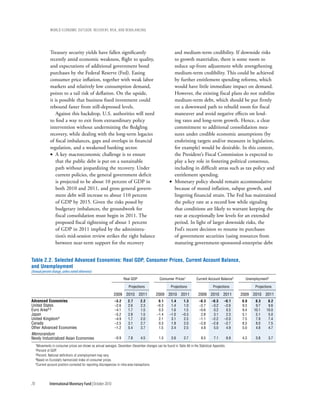
  • 16.
    eXecUtIVe sUMMARY Questions about the Pace of Recovery expected, countries with fiscal room could postpone some of the planned consolidation. One of the The global recovery remains fragile, because most urgent challenges for advanced economies is strong policies to foster internal rebalancing of to legislate plans that help achieve sustainable fiscal demand from public to private sources and exter- positions before the end of the decade. This task is nal rebalancing from deficit to surplus economies now more pressing than it was six months ago to are not yet in place. Global activity is forecast to rebuild room for fiscal policy maneuver in the face expand by 4.8 percent in 2010 and 4.2 percent of still-volatile sovereign debt markets. Such room in 2011, broadly in line with earlier expectations, could be needed because monetary policy alone and downside risks continue to predominate. might not be able to provide sufficient support to WEO projections are that output of emerging and counter the threat of a weakening of activity that is developing economies will expand at rates of 7.1 markedly more pronounced than expected. and 6.4 percent, respectively, in 2010 and 2011. In Fiscal policy tightening will likely prove contrac- advanced economies, however, growth is projected tionary in most economies, although the extent is at only 2.7 and 2.2 percent, respectively, with some difficult to gauge. The survey of past experience economies slowing noticeably during the second in Chapter 3 suggests that fiscal consolidation half of 2010 and the first half of 2011, followed in advanced economies typically detracts from by a reacceleration of activity. Slack will remain short-term growth. The introduction of credible, substantial and unemployment persistently high. growth-friendly, medium-term fiscal consolidation Inflation is projected to stay generally low, amid plans––currently not on offer in many advanced continued excess capacity and high unemployment, economies––would help limit the deflationary with a few exceptions among the emerging econo- impact of consolidation on private demand in mies. Risks to the growth forecasts are mainly to the short term. Such plans would have to include the downside. However, the probability of a sharp reforms to rapidly growing spending programs, global slowdown, including stagnation or contrac- notably entitlements, and tax reforms that favor tion in advanced economies, still appears low. production rather than consumption. Better financial sector policies and practices in advanced economies are critical for strengthening More Proactive Policies Are needed the resilience of the recovery to shocks and sustain- Policies need to become more proactive to ing private demand over the medium term. Progress achieve the required internal and external rebalanc- on this front has been very slow. Apparently isolated ing. Most advanced economies and a few emerging difficulties in a few spots can have large spillover economies still face major adjustments, including effects, via complex financial linkages and deterio- the need to strengthen household balance sheets, ration of fragile confidence. As the October 2010 stabilize and subsequently reduce high public GFSR explains, incomplete progress in addressing debt, and repair and reform their financial sectors. the legacy problems of the crisis has left systems in Monetary policy should stay highly supportive in advanced economies vulnerable. Failure to rapidly most of the advanced economies and should be the resolve, restructure, or consolidate weak banks and first line of defense against any larger-than-projected repair wholesale markets raises the need for further weakening of activity as fiscal support diminishes. fiscal backstopping and low interest rates to support With policy rates already near zero in the large recovery, which can cause other problems, includ- advanced economies, monetary policymakers may ing spillovers to emerging economies. More broadly, have to resort to further unconventional measures policymakers need to continue to clarify and specify if private demand weakens unexpectedly as fiscal regulatory reform, building on the improvements support wanes. proposed by the Basel Committee on Banking Fiscal adjustment needs to start in 2011. If global Supervision. This would help financial markets and growth threatens to slow appreciably more than institutions provide more support, on a sounder xvi
  • 17.
    eXecUtIVe sUMMARY basis, forconsumption and investment, which is immediately, because domestic demand recovery is essential for strong, sustainable growth. already well under way or public debt is relatively Structural policies that strengthen growth over high. In various emerging economies, rising infla- the medium term would also help support the tion or high credit growth also signal a need for required normalization of macroeconomic policies further monetary tightening. in advanced economies. While supportive macro- Many emerging and developing economies have economic policies and financial sector repair and successfully concluded first-generation reforms reform are essential for stronger job creation, in a that improved macroeconomic policy frameworks, number of economies, labor market policies could strengthening their resilience to macroeconomic enhance growth and job creation and reduce high shocks. However, to sustain or further raise poten- unemployment over the medium term. Comple- tial growth and employment, efforts could usefully mentary reforms to product and services markets focus on simplifying product and services market could strengthen the employment effects by boost- regulation, raising human capital, and building ing labor demand and real wages through greater critical infrastructure. Such reforms would also help competition and lower markups on prices. absorb growing capital inflows in a productive man- Although many emerging economies are seeing ner, which would accelerate global income conver- high growth again, they continue to rely sig- gence and external rebalancing. As Chapter 1 and nificantly on demand from advanced economies. the October 2010 GFSR underscore, these flows Chapter 4 makes clear that demand for imports can be expected to grow over the medium term, as from the advanced economies will continue to be the performance of emerging economies improves below precrisis trends, in view of the high share relative to that of the advanced economies, yields in of consumer durables and investment goods in the advanced economies remain low for some time, trade. Emerging economies that relied heavily on and institutional investors in advanced economies demand from these economies will therefore have to continue to diversify their exposures. rebalance growth further toward domestic sources Strong, coordinated policy responses by all are to achieve growth rates similar to those before the essential to limit the fallout of the Great Reces- crisis, helping the required external rebalancing. sion. Historical evidence suggests that countries In economies with excessive external surpluses, hit by financial crises typically suffer permanent which are mainly in emerging Asia, fiscal tighten- output losses relative to precrisis trends. How- ing should therefore take a backseat to monetary ever, outcomes after individual crises have varied tightening and exchange rate flexibility. Removing widely, depending on the policy responses. So far, distortions that drive high household or corporate much progress has been made through coordinated saving rates and deter investment in nontradables policy responses in alleviating liquidity strains and sectors would facilitate the rebalancing of growth rebuilding confidence, and this has been essential to domestic sources. Such rebalancing will require for activity to rebound. The challenge ahead is for further deregulation and reform of financial sectors policymakers to put in place, in a coordinated man- and corporate governance, as well as stronger social ner, policies that support the fundamental adjust- safety nets in key Asian economies. In many other ments needed for a return to healthy medium-term emerging economies, fiscal tightening can start growth. xvii
  • 19.
    1 chapter Global proSpectS and policieS Thus far, economic recovery is proceeding broadly as solidation. Meanwhile, key emerging economies will expected, although downside risks remain elevated. Most need to further develop domestic sources of growth, advanced and a few emerging economies still face major with the support of greater exchange rate flexibility. adjustments, including the need to strengthen household balance sheets, stabilize and subsequently reduce high public debt, and repair and reform their financial sectors. Stronger activity, but Setbacks to Financial In many of these economies, the financial sector is still Stability vulnerable to shocks, and growth appears to be slow- Economic recovery continued to strengthen ing as policy stimulus wanes. By contrast, in emerging during the first half of 2010, but global financial and developing economies prudent policies, implemented stability suffered a major setback with the turmoil partly in response to earlier crises, have contributed to in sovereign debt markets in the second quarter a significantly improved medium-term growth outlook of 2010. The extent of economic recovery differs relative to the aftermath of previous global recessions. importantly across regions, with Asia in the lead. However, activity in these economies, particularly those The United States and Japan experienced a notice- in emerging Asia, remains dependent on demand in able slowdown during the second quarter of 2010, advanced economies. In this setting, global activity is fore- while growth accelerated in Europe and stayed cast to expand by 4.8 percent in 2010 and 4.2 percent in strong in emerging and developing economies. 2011, with a temporary slowdown during the second half Financial conditions have begun to normalize, but of 2010 and the first half of 2011. Output of emerg- institutions and markets are still fragile. In general, ing and developing economies is projected to expand at volatility in financial, currency, and commodity rates of 7.1 percent and 6.4 percent in 2010 and 2011, markets remains elevated. respectively. In advanced economies, however, growth is projected to be only 2.7 percent and 2.2 percent, respec- tively. Risks to the forecast are mainly to the downside. Growing Momentum through the First half of 2010 Sustained, healthy recovery rests on two rebalancing acts: The world economy expanded at an annual rate internal rebalancing, with a strengthening of private of about 5¼ percent during the first half of 2010–– demand in advanced economies, allowing for fiscal about ½ percent higher than in the July 2010 World consolidation; and external rebalancing, with an increase Economic Outlook (WEO) Update (Table 1.1). World in net exports in deficit countries and a decrease in net industrial production reached growth rates of about exports in surplus countries, notably emerging Asia. The 15 percent, and global trade recovered at rates over two interact in strong ways. Increased net exports in 40 percent during this period (Figure 1.1). A surge advanced economies imply higher demand and higher in inventory and, lately, fixed investment accounts growth, allowing more room for fiscal consolidation. A for this dramatic rise––with the latter in particular number of policies are required to support these rebalanc- boding well for continued recovery. Manufacturing ing acts. In advanced economies, repair and reform of the confidence indices are back to precrisis levels, and financial sector need to accelerate to allow a resumption employment in advanced economies is expanding of healthy credit growth. In addition, fiscal adjustment moderately. Household spending is doing well in needs to start in earnest in 2011. Specific plans to cut emerging market economies, but in advanced econo- future budget deficits are urgently needed to create new mies, low consumer confidence, high unemployment, room for fiscal policy maneuver. If global growth threatens stagnant incomes, and reduced household wealth to slow appreciably more than expected, countries with are holding consumption down. Chapter 2 discusses fiscal room could postpone some of the planned con- regional developments in more detail. International Monetary Fund | October 2010 1
  • 20.
    wOrld ecOnOmic OutlOOk:recOvery, risk, and rebalancing Table 1.1. Overview of the World Economic Outlook Projections (Percent change, unless noted otherwise) Year over Year Difference from July Q4 over Q4 Projections 2010 WEO Projections Estimate Projections 2008 2009 2010 2011 2010 2011 2009 2010 2011 World Output1 2.8 –0.6 4.8 4.2 0.2 –0.1 2.0 4.3 4.4 Advanced Economies 0.2 –3.2 2.7 2.2 0.1 –0.2 –0.4 2.4 2.5 United States 0.0 –2.6 2.6 2.3 –0.7 –0.6 0.2 2.2 2.7 Euro Area 0.5 –4.1 1.7 1.5 0.7 0.2 –2.0 1.9 1.4 Germany 1.0 –4.7 3.3 2.0 1.9 0.4 –2.0 3.9 1.2 France 0.1 –2.5 1.6 1.6 0.2 0.0 –0.5 1.7 1.6 Italy –1.3 –5.0 1.0 1.0 0.1 –0.1 –2.8 1.3 1.1 Spain 0.9 –3.7 –0.3 0.7 0.1 0.1 –3.0 0.1 1.4 Japan –1.2 –5.2 2.8 1.5 0.4 –0.3 –1.4 1.9 2.1 United Kingdom –0.1 –4.9 1.7 2.0 0.5 –0.1 –2.9 2.8 1.6 Canada 0.5 –2.5 3.1 2.7 –0.5 –0.1 –1.1 3.1 2.9 Other Advanced Economies 1.7 –1.2 5.4 3.7 0.8 –0.0 3.2 4.2 4.7 Newly Industrialized Asian Economies 1.8 –0.9 7.8 4.5 1.1 –0.2 6.1 5.2 6.6 Emerging and Developing Economies2 6.0 2.5 7.1 6.4 0.3 0.0 5.6 7.0 7.0 Central and Eastern Europe 3.0 –3.6 3.7 3.1 0.5 –0.3 1.8 2.9 4.3 Commonwealth of Independent States 5.3 –6.5 4.3 4.6 0.0 0.3 –3.2 3.3 5.0 Russia 5.2 –7.9 4.0 4.3 –0.3 0.2 –2.9 3.2 5.0 Excluding Russia 5.4 –3.2 5.3 5.2 0.9 0.5 ... ... ... Developing Asia 7.7 6.9 9.4 8.4 0.2 –0.1 9.5 9.1 8.7 China 9.6 9.1 10.5 9.6 0.0 0.0 11.4 9.9 9.6 India 6.4 5.7 9.7 8.4 0.3 0.0 7.3 10.3 7.9 ASEAN-53 4.7 1.7 6.6 5.4 0.2 –0.1 5.1 5.0 6.8 Latin America and the Caribbean 4.3 –1.7 5.7 4.0 0.9 0.0 1.4 4.8 4.4 Brazil 5.1 –0.2 7.5 4.1 0.4 –0.1 4.4 5.6 4.5 Mexico 1.5 –6.5 5.0 3.9 0.5 –0.5 –2.3 3.1 4.5 Middle East and North Africa 5.0 2.0 4.1 5.1 –0.4 0.2 ... ... ... Sub-Saharan Africa 5.5 2.6 5.0 5.5 0.0 –0.4 ... ... ... Memorandum European Union 0.8 –4.1 1.7 1.7 0.7 0.1 –2.1 2.1 1.7 World Growth Based on Market Exchange Rates 1.6 –2.0 3.7 3.3 0.1 –0.1 ... ... ... World Trade Volume (goods and services) 2.9 –11.0 11.4 7.0 2.4 0.7 ... ... ... Imports Advanced Economies 0.4 –12.7 10.1 5.2 2.9 0.6 ... ... ... Emerging and Developing Economies 9.0 –8.2 14.3 9.9 1.8 0.6 ... ... ... Exports Advanced Economies 1.9 –12.4 11.0 6.0 2.8 1.0 ... ... ... Emerging and Developing Economies 4.6 –7.8 11.9 9.1 1.4 0.1 ... ... ... Commodity Prices (U.S. dollars) Oil4 36.4 –36.3 23.3 3.3 1.5 0.3 ... ... ... Nonfuel (average based on world commodity export weights) 7.5 –18.7 16.8 –2.0 –1.3 –0.6 ... ... ... Consumer Prices Advanced Economies 3.4 0.1 1.4 1.3 0.0 0.0 0.8 1.1 1.6 Emerging and Developing Economies2 9.2 5.2 6.2 5.2 –0.1 0.2 4.8 5.9 4.4 London Interbank Offered Rate (percent)5 On U.S. Dollar Deposits 3.0 1.1 0.6 0.8 0.0 –0.1 ... ... ... On Euro Deposits 4.6 1.2 0.8 1.0 0.0 –0.2 ... ... ... On Japanese Yen Deposits 1.0 0.7 0.6 0.4 0.1 –0.2 ... ... ... Note: Real effective exchange rates are assumed to remain constant at the levels prevailing during August 4–September 1, 2010. Country weights used to construct aggregate growth rates for groups of economies were revised. When economies are not listed alphabetically, they are ordered on the basis of economic size. The aggregated quarterly data are seasonally adjusted. 1The quarterly estimates and projections account for 90 percent of the world purchasing-power-parity weights. 2The quarterly estimates and projections account for approximately 78 percent of the emerging and developing economies. 3Indonesia, Malaysia, Philippines, Thailand, and Vietnam. 4Simple average of prices of U.K. Brent, Dubai, and West Texas Intermediate crude oil. The average price of oil in U.S. dollars a barrel was $61.78 in 2009; the assumed price based on futures markets is $76.20 in 2010 and $78.75 in 2011. 5Six-month rate for the United States and Japan. Three-month rate for the euro area. 2 International Monetary Fund | October 2010
  • 21.
    chapter 1 Global ProsPects and PolIcIes Growth in advanced economies reached about Figure 1.1. Current and Forward-Looking Indicators1 3½ percent during the first half of 2010. This is (Annualized percent change of three-month moving average over previous low, considering that these economies are emerg- three-month moving average, unless noted otherwise) ing from the deepest recession since World War II. World trade and industrial production have continued to rebound, and employment has begun to grow again in advanced economies. Retail sales have Three groups can be distinguished (Figure 1.2): recovered. They are buoyant in emerging economies but lagging in advanced • The economies of advanced Asia, other than economies, reflecting still-low consumer confidence. Recently, manufacturing confidence has receded, but it remains consistent with further expansion. Japan, have enjoyed a strong rebound. Their large manufacturing sectors have benefited from the 60 World Trade Industrial Production Emerging 30 global rebound in trade. As a result, their output 40 Asia 20 is already above precrisis levels. Trade value2 • The United States is close to precrisis levels of 20 10 output but far below precrisis trends, and activity 0 0 Emerging slowed noticeably in the second quarter of 2010. CPB trade economies3 -20 volume index World -10 Consumption has been growing since the third Advanced economies4 quarter of 2009, but at low rates considering the -40 -20 depth of the retrenchment. At the same time, -60 -30 2000 02 04 06 08 Jul. 2005 06 07 08 09 Jul. investment in business equipment and software 10 10 has been rising strongly lately, helped by foreign 6 Employment Emerging Retail Sales 36 Emerging Asia demand, rebounding profits, and normalizing economies3 4 Emerging 27 financial conditions. However, this has not yet World economies3 triggered a sustained, solid recovery in employ- 2 18 ment and real estate activity remains very weak. World 0 9 • Japan and the euro area are still appreciably -2 Advanced 0 below precrisis levels of output and remain economies4 Advanced dependent on foreign demand. In Japan, fiscal -4 economies4 -9 stimulus and the rebound in global trade and -6 -18 strong demand elsewhere in Asia have boosted 2005 06 07 08 09 Jul. 2005 06 07 08 09 Jul. 10 10 output growth since the fourth quarter of 2009, Manufacturing Purchasing Consumer Confidence but activity weakened significantly in the second 65 Managers’ Index 180 (index) 5 (index) Emerging quarter of 2010. In the euro area, led by Ger- 60 160 0 economies3 Euro area many, activity showed significant strength only 140 (right scale) -5 55 in the second quarter of this year, following 50 120 -10 a bad winter. The area’s dependence on bank Advanced 100 -15 45 economies4 credit is restraining demand, as banks continue 80 United -20 40 States to be unusually cautious in lending. However, 60 Japan5 (left scale) -25 (left scale) the depreciation of the euro from previous highs 35 40 -30 is beginning to support the euro area’s tradable 30 2000 02 04 06 08 Aug. 20 2000 02 04 06 -35 08 Aug. goods sector, and fixed investment is staging a 10 10 modest comeback. Sources: Netherlands Bureau for Economic Policy Analysis for CPB trade volume index; for all others, Haver Analytics and NTC Economics; and IMF staff calculations. Emerging economies expanded by about 8 per- 1Not all economies are included in the regional aggregations. For some economies, cent during the first half of the year. As in advanced monthly data are interpolated from quarterly series. 2In SDR terms. economies, there is significant heterogeneity both 3Argentina, Brazil, Bulgaria, Chile, China, Colombia, Estonia, Hungary, India, Indonesia, Latvia, Lithuania, Malaysia, Mexico, Pakistan, Peru, Philippines, Poland, Romania, Russia, across and within regions, with Asian and Latin South Africa, Thailand, Turkey, Ukraine, and Venezuela. 4Australia, Canada, Czech Republic, Denmark, euro area, Hong Kong SAR, Israel, Japan, American economies in the lead. In both regions, Korea, New Zealand, Norway, Singapore, Sweden, Switzerland, Taiwan Province of fixed investment has expanded vigorously, just as China, United Kingdom, and United States. 5Japan’s consumer confidence data are based on a diffusion index, where values inventory rebuilding has slowed and policy stimulus greater than 50 indicate improving confidence. has waned. This is a sign that autonomous private International Monetary Fund | October 2010 3
  • 22.
    wOrld ecOnOmic OutlOOk:recOvery, risk, and rebalancing Figure 1.2. Global Indicators1 demand is overtaking short-term, policy-related fac- (Annual percent change, unless noted otherwise) tors in the recovery. Private consumption has recovered impressively in emerging economies but is • Growth in emerging Asia reached about 9½ lagging in advanced economies. However, investment excluding construction percent, as robust domestic demand spread from has staged a rebound in advanced economies, suggesting medium- rather than short-term considerations are increasingly driving activity. This bodes well for China, India, and Indonesia to other Asian employment and consumption in the future. In the meantime, output in many economies. In China, major fiscal stimulus, a advanced economies is still around or below precrisis levels. Commodity prices have recovered. Recent wheat price hikes are not representative of broader large expansion of credit, and a number of spe- developments in food prices. cific measures to boost household incomes and Real Private Consumption Real Gross Fixed Investment consumption increased domestic demand growth (annualized percent change (annualized percent change to close to 13 percent in 2009, contributing to a 12 from preceding quarter) from preceding quarter) 20 large decline in the current account surplus. The 10 recovery is now well established, and a transition 8 Emerging economies 0 from public stimulus to private-sector-led growth Emerging is under way. 4 -10 economies • Latin America has also recovered strongly, Advanced -20 with real GDP growth at about 7 percent. The 0 economies Advanced -30 recovery is being led by Brazil, where real GDP economies of which: machinery and equipment2 growth has been running close to 10 percent -4 -40 2007: 08: 09: 10: 2007: 08: 09: 10: since the third quarter of 2009 and the economy Q1 Q1 Q1 Q2 Q1 Q1 Q1 Q2 is now showing signs of overheating. A number 125 Change in GDP3 Real Commodity Prices 500 (2010:Q2 GDP in percent of (1995 = 100) of other economies have also returned to solid 120 2008:Q2 GDP) 400 growth. However, Mexico is lagging, partly 115 because of its strong trade linkages with the Oil prices4 300 110 United States. Growth in Mexico recently picked Gold 105 200 up on the back of strengthening exports to the 100 United States, but the output gap remains large. 95 Food 100 • Many developing economies were less affected by Metals the global recession and now seem to be shar- 90 0 US/EA EAS LA CEE AFR and 1980 85 90 95 2000 05 10 15 ing in the pickup in world trade, and estimates JP/OAAE and CIS ME for growth in 2010 are generally encouraging. Output since Trough for Highly Synchronized Recessions (Index; quarters from trough on x-axis) Available data for African and Middle Eastern 114 United States Euro Area 114 economies point to robust growth. By contrast, 112 112 1975:Q1 1975:Q1 economies that were hit particularly hard by the 110 1982:Q3 1982:Q3 110 1991:Q1 1993:Q1 crisis are struggling to return to sustained growth, 108 2009:Q2 2009:Q2 108 including in many parts of emerging Europe and 106 106 the Commonwealth of Independent States, where 104 104 the recovery remains much more subdued. 102 102 Unemployment in advanced economies has 100 100 receded only modestly from peak rates. Estimates 98 98 are that more than 210 million people across the -4 -2 0 2 4 6 8 -4 -2 0 2 4 6 8 Source: IMF staff estimates. globe are unemployed, an increase of more than 30 1Aggregates are computed on the basis of purchasing-power-parity (PPP) weights, unless noted otherwise. million since 2007. Three-fourths of the increase 2PPP-weighted averages of metal products and machinery for euro area, plants and has occurred in the advanced economies (with the equipment for Japan, plants and machinery for the United Kingdom, and equipment and software for the United States. remainder in emerging market economies). In the 3US/EA/JP/OAAE: United States/euro area/Japan/other advanced Asian economies; EAS: emerging Asia; LA: Latin America; CEE and CIS: central and eastern Europe and United States, the unemployed face record-long Commonwealth of Independent States; AFR and ME: Africa and Middle East. periods of joblessness, and recent payroll data point 4Simple average of spot prices of U.K. Brent, Dubai Fateh, and West Texas Intermediate crude oil. to a slowdown in employment growth in the second 4 International Monetary Fund | October 2010
  • 23.
    chapter 1 Global ProsPects and PolIcIes quarter. In the euro area, the labor market shows Figure 1.3. Recent Financial Market Developments continued resilience in Germany, considering the Equity markets have surrendered part of their large 2009 gains, and volatility depth of the recession, but in Spain unemployment spiked during the first quarter. Losses were led by financial stocks in Europe. is not showing any signs of abating from very high However, as concerns about sustainability of the recovery grew, losses broadened to other regions and sectors, particularly to companies producing levels, owing to labor market rigidities and the discretionary consumer products. Commodity prices generally retreated, but collapse of construction. In emerging economies, gold prices shot up, driven by rising investor risk aversion. unemployment has broadly declined in parallel with Equity Markets (March 2000 = 100; national Implied Volatility a strengthening recovery, with a few exceptions (for currency) (percent) 120 50 example, South Africa). May 10, 2010 110 100 40 90 Wilshire Setbacks to Financial Stability 5000 U.S. (VIX) 30 80 Financial stability suffered a major setback during 70 20 the first half of the year. As explained in the accom- 60 panying October 2010 Global Financial Stability 50 DJ Euro 10 Stoxx Emerging Markets (VXY) Report (GFSR), market volatility increased and risk 40 Topix appetite declined when heavy selling of the sover- 30 2000 02 04 06 08 Sep. Jan. Mar. May Jul. 0 Sep. eign debt of vulnerable euro area economies rattled 10 2010 10 10 10 10 banking systems and triggered a systemic crisis as MSCI Daily Change Differences MSCI Daily Change Differences funding stress spread to banks and sovereigns. This (Jan. 1, 2010 = 100) (Jan. 1, 2010 = 100) 104 110 added to existing worries about the sustainability World consumer of the recovery and caused a broader decline in 100 Euro total– discretionary –World total stocks. Prices in many stock exchanges fell by 10 96 World total 105 to 15 percent (Figure 1.3). Initially, the fall was led 92 by financial stocks and by European markets. Risk premiums on corporate bonds widened (Figure 88 100 1.4), and corporate bond issues slowed to a trickle 84 World financial in May. Bond issuance in emerging markets also Euro financial– World financial –World total dropped sharply (Figure 1.5). 80 Jan. Mar. May Jul. Sep. Jan. Mar. May Jul. Sep.95 2010 10 10 10 10 2010 10 10 10 10 The second quarter sovereign debt turmoil posed a threat to the recovery. There were only limited Sovereign Risks and Commodity Prices propagation effects on sovereign borrowers beyond Banking Risks1 (U.S. dollars) Average change in local senior financial CDS 600 (basis points) 1300 Gold 90 the vulnerable euro area countries, in part due to Greece (left scale) a “flight to safety” in major markets (Figure 1.6). 500 1250 85 Nonetheless, there were small and brief increases in 400 1200 the spreads of euro area countries whose creditwor- Ireland 80 300 Portugal 1150 thiness is typically considered on par with that of 75 Germany, and this underscores the uncertainty of 200 1100 the environment for all sovereign issuers. Correla- 100 Spain 1050 Oil3 70 (right scale) tion analysis (beyond that shown in Figure 1.6) suggests that the behavior of sovereign risk premi- 0 1000 65 Sep. 0 200 400 600 800 Jan. Mar. May Jul. ums during May–June is significantly explained by Change in sovereign CDS2 2010 10 10 10 10 the interaction between high external net liabilities/ Sources: Bloomberg Financial Markets; Thomson Datastream; and IMF staff deficits on the one hand and high public debt/ calculations. 1October 2009–September 2010. deficits on the other. Simultaneously addressing 2CDS = credit default swap spread. both budgetary and competitiveness problems in a 3Simple average of spot prices of U.K. Brent, Dubai Fateh, and West Texas Intermediate crude oil. deteriorating external environment is likely to take International Monetary Fund | October 2010 5
  • 24.
    wOrld ecOnOmic OutlOOk:recOvery, risk, and rebalancing Figure 1.4. Developments in Mature Credit Markets a heavy toll on growth, which may help explain Funding strains in advanced economy banking markets reappeared, but tensions why some euro area banking systems came under remained much lower than one year earlier. Bond yields for Germany, Japan, and particular strain. the United States declined amid investor flight to safe havens and rising concerns about the sustainability of the recovery. However, yields in vulnerable euro area countries rose because of concerns about high public and external deficits and debt. Notwithstanding the turbulence, bank lending conditions in major there are Signs of normalization, but important economies continued to normalize. Corporate spreads widened somewhat, and issuance briefly dried up. Vulnerabilities remain Interbank Spreads1 Bank CDS Spreads In recent months, financial conditions have 500 400 (basis points) (ten-year, median; in basis points) been easing again. Tail risks have been reduced by 400 300 unprecedented European policy initiatives––the 300 U.S. United European Central Bank’s (ECB’s) Securities Markets States 200 dollar 200 Program (SMP) and euro area governments’ Euro- Euro pean Stabilization Mechanism––and by a front- 100 area 100 loading of fiscal adjustment in response to market 0 pressures. However, underlying sovereign and Yen Euro banking vulnerabilities pose a significant challenge -100 0 2000 02 04 06 08 Sep. 2003 04 05 06 07 08 09 Sep. amid lingering concerns about risks to the global 10 10 Government Bond Yields2 Government Bond Spreads recovery. (two-year yield spreads 6 700 over German bunds, 2000 • Sovereign bond auctions in the euro area have United basis points) successfully rolled over substantial maturities, 600 Greece 5 States (right scale) 1600 Ireland albeit at higher costs. But concerns about rollover 500 4 Portugal failures remain elevated. Spain 1200 400 3 • After declining sharply in May, there was some Germany 300 800 recovery in the issuance of both advanced econ- 2 200 omy nonfinancial corporate bonds and emerging 400 market sovereign and corporate bonds in June 1 Japan 100 May 10, 2010 and more through September. 0 0 0 2002 04 06 08 Sep. Jan. Mar. May Jul. Sep. The stress test exercise of the Committee of Euro- 10 2010 10 3 pean Banking Supervisors was generally welcomed by 100 Bank Lending Conditions -15 Corporate Spreads 1800 Euro area (basis points; averages of markets for improving disclosure. Following the tests, 80 (left scale) Japan -10 Europe and United States) 1500 credit default swap spreads on euro area bank bonds (inverted; 60 right scale) -5 1200 declined, bank stocks recovered, and several banks 40 0 successfully tapped bond markets. However, signifi- 900 cant tiering in interbank markets and still-heavy reli- 20 5 600 ance by many banks on ECB financing suggest that 0 10 United BB major policy challenges remain to be addressed. -20 States 15 300 (left scale) AAA The recovery has helped improve the health of -40 2000 02 04 06 08 20 10: 2000 02 04 06 08 0 Sep. the banking system. According to the October Q3 10 2010 GFSR, total bank write-downs and loan Sources: Bank of America/Merrill Lynch; Bank of Japan; Bloomberg Financial Markets; provisions are $2.2 trillion, down from the April European Central Bank; Federal Reserve Board of Governors; and IMF staff calculations. 1Three-month London interbank offered rate minus three-month government bill 2010 estimate of $2.3 trillion. Banks have made rate. 2Ten-year government bonds. further progress in realizing these write-downs, with 3Percent of respondents describing lending standards as tightening “considerably” or more than three-quarters already reported, leaving “somewhat” minus those indicating standards as easing “considerably” or “somewhat” over the previous three months. Survey of changes to credit standards for loans or lines a residual amount of approximately $550 billion. of credit to enterprises for the euro area; average of surveys on changes in credit In addition, the average Tier 1 capital ratio in the standards for commercial/industrial and commercial real estate lending for the United States; diffusion index of “accommodative” minus “severe,” Tankan survey of lending global banking system rose to more than 10 percent attitude of financial institutions for Japan. at end-2009, although this mostly reflects govern- 6 International Monetary Fund | October 2010
  • 25.
    chapter 1 Global ProsPects and PolIcIes ment recapitalization, given that less than half the Figure 1.5. Emerging Market Conditions capital raised was from market sources. Overall, however, heightened economic uncer- Equity markets in emerging economies also surrendered a small part of earlier tainty, continued deleveraging, and sovereign gains during the turbulent months of May and June. Spreads widened moderately and issuance fell. However, local bank credit markets continue to spillovers imply that core banking systems remain recover, with emerging Europe lagging. China has slowed very high credit vulnerable to confidence shocks and are heavily growth rates to address growing macroprudential concerns. reliant on government or central bank support. As Equity Markets Interest Rate Spreads 600 (2001 = 100; (basis points) 1600 discussed further below, banks face major refinanc- national currency) ing requirements in wholesale markets that are still 500 United States in disrepair. This poses particular challenges for euro BB 1200 400 Latin area banks because of their high reliance on whole- America sale funding markets. As noted in the October 2010 300 Eastern Sovereign1 800 GFSR, the financial system remains vulnerable to Europe 200 Asia Corporate2 downside risks because capital and liquidity buffers 400 are insufficient to support market confidence under 100 AAA renewed stress. 0 0 2002 04 06 08 Sep. 2002 04 06 08 Sep. 10 10 Volatile currencies and commodity prices New Issues by Region3 280 Emerging Market Issuance 280 (billions of U.S. dollars) (billions of U.S. dollars) Financial turbulence led to sharp currency 240 Equities 240 Bonds Western Hemisphere movements in the first half of 2010 (Figure 1.7). Syndicated loans Middle East 200 Europe 200 The euro depreciated by about 15 percent in real Asia 160 Africa 160 effective terms, although it has partially recovered and is currently trading at a level broadly in line 120 120 with medium-term fundamentals, according to 80 80 IMF staff estimates. The U.S. dollar appreciated 40 40 in real effective terms as risk aversion rose during 0 0 May–June, but it has since returned to levels seen 2005 06 07 08 09 10: 2002 04 06 08 10: Q2 Q2 earlier in the year, on the strong side of medium- term fundamentals. The yen weakened briefly in Private Credit Growth4 60 April but has been appreciating since and now China Asia 50 stands more than 25 percent above 2007 levels, excluding 40 prompting the authorities to intervene in exchange Eastern China Europe 30 markets due to concerns about disruptive yen movements. At current levels, the yen remains 20 broadly in line with medium-term fundamentals. 10 With a few exceptions, emerging Asian curren- 0 cies, including the Chinese renminbi, appreciated Latin -10 America modestly in real effective terms. However, many 2002 03 04 05 06 07 08 09 -20 Jul. remain undervalued relative to medium-term 10 fundamentals. Sources: Bloomberg Financial Markets; Capital Data; IMF, International Financial Commodity prices surrendered some of the Statistics; and IMF staff calculations. strong gains realized during the initial phase of 1JPMorgan EMBI Global Index spread. 2JPMorgan CEMBI Broad Index spread. the recovery (see Figures 1.2 and 1.3). These early 3Total of equity, syndicated loans, and international bond issues. 4Annualized percent change of three-month moving average over previous gains reflected a combination of strong demand in three-month moving average. emerging economies and, considering the phase of the cycle, low inventories for some commodities International Monetary Fund | October 2010 7
  • 26.
    wOrld ecOnOmic OutlOOk:recOvery, risk, and rebalancing Figure 1.6. Public Sector Financing1 (Appendix 1.1). Precious metals, however, con- tinued to soar during the turbulence, amid heavy Public sector financing needs are very large in many economies. However, buying by risk-averse investors. Furthermore, the demand for sovereign debt has remained strong because of high risk aversion. Accordingly, long-term government bond rates of most advanced economies weather-related downgrades in harvest expectations have declined since March 2010 as concerns about the recovery rose. Also, even for some major exporters recently pushed up wheat during the most turbulent times in June, only a few governments experienced a major widening of spreads. In the euro area, widening spreads correlate prices. Although the market for wheat remains negatively with strong current account or fiscal balances. appreciably less tight than during the price spikes of 2007–08, and prices of other food and agricultural 30 Sovereign Gross Funding Requirements2 60 (percent of projected 2011 GDP) inputs (for example, fertilizer) have not risen much, 25 50 policymakers may have to take action to protect 20 40 the poor from sharp price increases in major food 15 30 staples, such as wheat. 10 20 5 10 0 0 Questions about the pace of recovery -5 Maturing debt Oct. 2010–Dec. 2011 -10 Central Government Fiscal Balance, FY2011 Thus far, economic recovery is proceeding more -10 -20 -15 -30 or less as expected. Sustained, healthy recovery rests on two rebalancing acts: internal rebalanc- NOR KOR AUS SWE SVN AUT FIN NZL DNK SVK DEU CZE GBR CAN IRL NLD ESP PRT FRA BEL ITA GRC USA JPN ing, with a strengthening of private demand in Change in Long-Term Bond Yield, 2010 500 advanced economies allowing for fiscal consolida- (basis points) June 2010 minus minimum in 2010:H1 Change from March 2010 400 tion; and external rebalancing, with an increase in net exports in deficit economies, such as the 300 United States, and a decrease in net exports in 200 surplus economies, notably emerging Asia. The 100 two interact in strong ways. Increases in net 0 exports in advanced economies imply higher -100 demand and higher growth, creating more room for fiscal consolidation. In the short term, high -200 uncertainty in financial markets; weak real estate AUS AUT BEL CAN CZE DNK FIN FRA DEU GRC HKG IRL ISR ITA JPN KOR NLD NZL NOR PRT SGP SVK SVN ESP SWE TWN GBR USA markets, household balance sheets, and incomes; Current Account and Bond Yield Fiscal Balance and Bond Yield and slowing inventory rebuilding will restrain the 800 800 transition from publicly to privately led recovery with Germany (June 2010, basis points) with Germany (June 2010, basis points) GRC Ten-year government bond yield spread GRC Ten-year government bond yield spread in advanced economies. Domestic demand in most 600 Euro area 600 Euro area emerging economies is expected to be robust in 400 400 comparison with recovery following past global PRT IRL IRL PRT recessions as a result of improved fundamen- ESP 200 ESP 200 tals. Over the medium term, however, domestic AUT AUT FRA NLD FRA demand is unlikely to be strong enough to offset FIN 0 NLD FIN 0 Euro area Euro area weaker demand in advanced economies, and global excluding Greece excluding Greece -200 -200 demand rebalancing is therefore projected to stall. -20 -16 -12 -8 -4 0 4 -12 -10 -8 -6 -4 -2 0 2 Current account spread with Germany Fiscal balance spread with Germany At the same time, unless financial and structural (2009, percent of GDP) (2009, percent of GDP) policies are significantly strengthened, potential Source: IMF staff estimates. output in advanced economies is likely to remain 1AUS: Australia; AUT: Austria; BEL: Belgium; CAN: Canada; CZE: Czech Republic; DNK: appreciably below precrisis trends. Together, these Denmark; FIN: Finland; FRA: France; DEU: Germany; GRC: Greece; HKG: Hong Kong SAR; ISL: Iceland; IRL: Ireland; ISR: Israel; ITA: Italy; JPN: Japan; KOR: Korea; NLD: Netherlands; developments portend a slow and sluggish recovery NZL: New Zealand; NOR: Norway; PRT: Portugal; SGP: Singapore; SVK: Slovak Republic; that is broadly in line with earlier WEO projec- SVN: Slovenia; ESP: Spain; SWE: Sweden; TWN: Taiwan Province of China; GBR: United Kingdom; USA: United States. tions and that is vulnerable to downside risks. 2All left scale except Japan; Japan right scale. 8 International Monetary Fund | October 2010
  • 27.
    chapter 1 Global ProsPects and PolIcIes Questions about near-term prospects Figure 1.7. External Developments The momentum of the global recovery appears (Index, 2000 = 100; three-month moving average, unless noted otherwise) to be slowing in the third quarter in both advanced The euro depreciated significantly during May–June 2010, while the currencies and emerging economies. The IMF staff’s momen- of China, Japan, and the United States appreciated. More generally, the tum tracker does, however, indicate that growth currencies of many emerging economies appreciated noticeably from troughs recorded during the crisis. Many emerging economies, notably in Asia, are remains above potential in many places (Figure 1.8; building up international reserves. This slows the rebalancing of global demand. Appendix 1.2). This reflects exceptionally strong growth in manufacturing and trade during the Major Currencies past year. A key question is how the recovery will 150 Nominal Effective Real Effective Exchange 140 Exchange Rate Rate evolve during the remainder of 2010 and in 2011. 140 Euro area 130 Euro area On the downside, the inventory rebound can be 130 120 expected to slow, fiscal policy stimulus is being 120 United 110 States withdrawn, and there are ongoing uncertainties in 110 China 100 China financial markets. Taken together with the positive 100 90 factors that are also in the pipeline, the recovery is 90 80 Japan likely to slow in the near term and to reaccelerate 80 Japan United 70 during 2011, but in advanced economies to stay States 70 60 2000 02 04 06 08 Aug. 2000 02 04 06 08 Aug. sluggish by past standards. Moreover, the recovery 10 10 remains vulnerable to shocks, and downside risks Emerging and Developing Economies predominate. 120 Nominal Effective Real Effective Exchange 140 Exchange Rate Rate Forces driving the near-term recovery 110 Middle East and Emerging 130 Europe4 North Africa1 Robust growth in many emerging market econo- 100 120 Africa2 mies will pull the recovery along over the near Africa2 90 Asia3 110 term. In most, the recovery seems to have entered a 80 100 self-sustaining phase, beyond restocking and on to Asia3 consumption and fixed investment, which are strong 70 90 because large increases in industrial production have 60 Emerging Latin Latin Middle East 80 Europe4 America5 and North Africa1 eroded excess capacity (Figures 1.2 and 1.9). Emerg- America5 50 70 2000 02 04 06 08 Aug. 2000 02 04 06 08 Aug. ing market economies have coped much better with 10 10 the global downturn by virtue of strong trend growth 24 Current Account Positions International Reserves 1100 and avoidance of financial excess (Box 1.1). Many (percent of GDP) Asia 1000 20 developing economies, particularly in sub-Saharan Middle East and 900 16 North Africa1 Middle East and Africa, were less affected by the global downturn 800 North Africa1 12 Sub-Saharan 700 and are experiencing solid domestic demand growth. Africa Latin 8 America Emerging 600 High import growth is projected to lower the overall Asia Europe4 500 4 current account surpluses (net lending) of the emerg- 400 0 Latin America 300 ing and developing economies from about 3½ per- -4 Emerging Europe4 200 cent of GDP in 2008 to about 1½ percent of GDP 100 in 2011. As explained in the October 2010 GFSR, -8 2000 02 04 06 08 09 2000 02 04 06 08 Jul. relatively stronger growth prospects, a shift in global 10 asset allocation, and expectations for low interest Sources: IMF, International Financial Statistics; and IMF staff calculations. 1Bahrain, Djibouti, Egypt, Islamic Republic of Iran, Jordan, Kuwait, Lebanon, Libya, rates in mature markets continue to boost emerging Oman, Qatar, Saudi Arabia, Sudan, Syrian Arab Republic, United Arab Emirates, and Republic of Yemen. market capital flows. 2Botswana, Burkina Faso, Cameroon, Chad, Republic of Congo, Côte d'Ivoire, In advanced economies, both manufacturing and Equatorial Guinea, Ethiopia, Gabon, Ghana, Guinea, Kenya, Madagascar, Mali, Mauritius, Mozambique, Namibia, Niger, Nigeria, Rwanda, Senegal, South Africa, Tanzania, investment in machinery and equipment should con- Uganda, and Zambia. 3Asia excluding China. tinue to recover. Industrial production remains con- 4Bulgaria, Croatia, Estonia, Hungary, Latvia, Lithuania, Poland, Romania, and Turkey. 5Argentina, Brazil, Chile, Colombia, Mexico, Peru, and Venezuela. International Monetary Fund | October 2010 9
  • 28.
    wOrld ecOnOmic OutlOOk:recOvery, risk, and rebalancing Figure 1.8. Prospects for Near-Term Activity siderably below precrisis levels, reflecting the adverse impact of uncertainty and financial conditions Lead economic and sentiment indicators point to diminishing growth on purchases of “postponable” items––consumer momentum in many parts of the world. However, momentum is generally expected to remain above WEO trend growth rates. Activity is forecast to slow durables and investment goods (see Figure 1.9). during the second half of 2010 and then to re-accelerate, reflecting diminishing Although part of the output loss may be perma- policy stimulus but growing private sector demand. This change in momentum is apparent in most countries. Unemployment is expected to stay high for some nent, the remainder is likely to disappear gradually time in many advanced economies. with improved financial conditions and decreased Growth Tracker1 uncertainty. Investment in machinery and equip- Above potential and moderating Below potential and moderating ment is already showing strength in a number of Above potential and rising Contracting at a moderating rate Below potential and rising Contracting at an increasing rate advanced economies. In addition, deleveraging by Western Hemisphere United States nonfinancial firms is already further along than Brazil Mexico Canada deleveraging by households (Figure 1.10), which Argentina Colombia reflects a smaller buildup of debt during the previ- Venezuela Peru ous decade and the strong recovery of profitability Chile Ecuador Dominican Rep. and cash flow. This is especially true in the United Uruguay Asia Pacific States, where companies slashed investment and China Japan payrolls early in the recession. Strong production India Korea Indonesia through July will likely continue to propel invest- Australia Europe ment while inventory building decelerates. Euro area Germany Russia The latest turbulence has interrupted, but not United Kingdom derailed, the upturn in the credit cycle. Credit growth France Italy Spain is rising again in many emerging economies, with Turkey Sweden Greece the exception of crisis-hit countries in eastern Europe Portugal Africa (see Figure 1.5). In key advanced economies, surveys South Africa Middle East and Central Asia Saudi Arabia suggest that bank lending has ceased to tighten (see Kazakhstan Sep. Jan. July Jan. July Jan. Aug. Figure 1.4). Setbacks in the euro area have turned out 2007 08 08 09 09 10 10 to be smaller than feared during the market turmoil Real GDP Growth of the spring, and U.S. banks loosened lending stan- (annualized percent change from previous half year) 5 12 dards during the second quarter. Regulatory changes Advanced economies (left scale) 4 Emerging and developing economies (right scale) 10 designed to strengthen capital bases and discourage 8 excessive risk taking are not expected to have major 3 negative effects on lending in the near term. 6 2 Commodity prices have stabilized after an initial 4 rally. Fluctuating in a $75 to $80 range, crude oil 1 2 prices are higher than usual at this stage of a recov- 0 0 ery. The same holds for other commodities, notably 2009:H2 2010:H1 2010:H2 2011:H1 2011:H2 metals. This is a lingering effect of tight markets Unemployment Rate (percent) before the crisis. However, there is currently plenty 9 Advanced Economies Emerging and Developing Economies 9 of spare capacity in the extractive industries, likely 8 8 enough to meet demand through 2011 (Appen- dix 1.1). Consistent with this view, forward markets 7 7 see broadly unchanged prices for oil and many other commodities over the near term. 6 6 Forces holding back a near-term recovery 5 5 2000 05 10 15 2000 05 10 15 Although financial market confidence has been Sources: Haver Analytics; and IMF staff estimates. returning, the October 2010 GFSR underscores 1Within regions, countries are listed by economic size. 10 International Monetary Fund | October 2010
  • 29.
    chapter 1 Global ProsPects and PolIcIes that high volatility and, notably, sovereign risk, bank funding, and unfinished regulatory reform remain causes for concern. Additional forces weigh- Figure 1.9. Recovery Dynamics ing on the recovery include weakness in real estate markets, diminishing fiscal stimulus, and high During the crisis, industrial production fell much more sharply than suggested by the trend relationship between output and GDP. This reflects a sharp drop in unemployment. purchases of "postponable" items. Industrial production will continue to catch up with GDP, but at a diminishing rate. The inventory-driven rebound is largely over; High uncertainty in financial markets as capacity utilization rates climb, investment should expand further, making a growing contribution to output growth. Absent strong, credible, medium-term fiscal con- solidation plans, sovereign debt markets continue to Global Industrial Production Industrial Production pose risks to the recovery. Sovereign debt maturing 135 and Estimated Trend1 Deviation from Trend1 4 in vulnerable euro area countries during the remain- 130 (index) (percent) 2 125 der of this year and 2011 is large (see Figure 1.6). 0 120 In refinancing this debt, these countries will face 115 Estimated Industrial -2 production stiff competition, given the large funding needs of 110 trend -4 other advanced economies. Any renewed turbulence 105 -6 in sovereign debt markets could trigger an adverse 100 feedback loop between sovereign debt markets and 95 -8 2000 02 04 06 08 10: 2000 02 04 06 08 10: the financial sector, inflicting major damage on the Q1 Q1 recovery. GDP growth2 Gross fixed capital formation Banks also face a “wall” of maturing debt, Private consumption Change in inventories which presents important risks for the normaliza- Public consumption Net exports tion of credit conditions. There has been little 3 4 Capacity Utilization Contribution to Growth: 5 progress in lengthening the maturity of their fund- (standard deviation from United States 2 average) 4 ing and, as a result, over $4 trillion in debt is due 0 3 to be refinanced in the next 24 months. Funding -2 2 problems could easily arise for specific institutions, United States -4 1 prompted by renewed stress in sovereign debt Euro area -6 Japan 0 markets, further weakness in real estate markets, or Korea -8 Brazil -1 downside surprises to economic activity. Because -10 -2 of complex linkages within and across borders, 2000 02 04 06 08 10: 2010:H1 10:H2 11:H1 11:H2 Q2 these problems could quickly become more widespread. 4 Contribution to Growth: Euro Contribution to Growth: 14 Area China Continued regulatory uncertainty or ill-conceived 12 3 regulatory action regarding the financial sector 10 2 could undercut the nascent recovery of credit. Many 8 prudential policy challenges remain to be addressed, 1 6 4 and taxation of financial activity may increase— 0 2 measures that might make the financial system safer -1 0 and less costly for taxpayers over the long term, but -2 -2 2010:H1 10:H2 11:H1 11:H2 2010 2011 which could weigh down output more than markets expect during the short term. Sources: Haver Analytics; and IMF staff estimates. 1Trend estimated using a cointegrating relationship with global GDP. No upside from real estate 2Annualized percent change over previous half year for the United States and Euro area, and percent change for China. 3Data standardized using averages and standard deviations taken from the 10 years Real estate market quagmires could further under- before the crisis. cut household and bank balance sheets. The drop in residential investment has been exceptionally steep International Monetary Fund | October 2010 11
  • 30.
    wOrld ecOnOmic OutlOOk:recOvery, risk, and rebalancing compared with past recessions. Nonetheless, in many parts of the world real estate prices are still high com- pared with standard valuation indicators (Box 1.2). Figure 1.10. Balance Sheets and Saving Rates (Percent) In the United States, there remains a large overhang of unsold properties with “underwater” mortgages.1 Household debt ceased to grow during 2009 in the United States and the United Depressed transactions keep inventories high, put- Kingdom. In the euro area, debt continued to grow through 2009, mainly outside ting greater downward pressure on prices. In many Germany. In some vulnerable economies a sharp cut in borrowing is now under way. Deleveraging by nonfinancial firms is already further along than deleveraging parts of the world, over the near term real estate will by households, except in some vulnerable economies. remain a drag on growth, as well as a continued risk to the stability of lending institutions. Household: Debt-to-Income Household: Growth Rate of 180 20 Ratio Debt Stock (annual rate) Deleveraging by households 160 United United States 15 Kingdom Households continue to save more than before 140 Japan 10 the crisis as they repair their balance sheets, 120 although saving rates are on course to moderate United 5 soon (see Figure 1.10). Household debt ceased to 100 Euro Euro Kingdom area area grow during 2009 in the United States and the 0 80 United United Kingdom. While this has brought about a States Japan 60 -5 noticeable decline in ratios of debt to income and 2000 02 04 06 08 10: 2000 02 04 06 08 10: Q2 Q2 debt to financial assets, these ratios remain well above the levels of a decade ago. In the euro area, 40 Household: Growth Rate of 9 Household Saving Rate 16 where the precrisis expansion had been rapid in Debt Stock 35 (annual rate) Japan United some economies, debt continued to grow through- (left scale) Kingdom 30 Greece (left scale) out 2009, except in Germany. However, a sharp 25 6 15 cut in household borrowing is now under way, and 20 judging from debt ratios, corrections may have 15 Spain some way to go, especially, but not exclusively, in 10 3 14 the vulnerable euro area countries. Even so, delever- 5 Portugal United aging may not require significant additional hikes in States Euro area 0 (right scale) household saving rates—WEO projections include (left scale) -5 0 13 2000 02 04 06 08 10: 2000 03 06 09 12 15 no further increases. Q1 Nonfinancial Corporations: Nonfinancial Corporations: Slowing inventory accumulation 100 Debt as a Share of Financial Debt as a Share of Financial 200 In the United States and several advanced Asian Assets Assets 90 180 economies, inventory rebuilding has been in high United Kingdom 160 gear and is not expected to accelerate further. In 80 Portugal 140 the euro area and Japan, inventory drawdowns 70 Greece 120 were more limited during the downturn, possibly Euro area 100 reflecting labor hoarding that kept production up. 60 Japan 80 In these economies, too, inventory rebuilding is Spain 50 unlikely to accelerate. Therefore, inventories will 60 United States 40 40 turn from being a supportive to a neutral factor in 2000 02 04 06 08 10: 2000 02 04 06 08 10: Q2 Q1 the recovery. Sources: Haver Analytics; and IMF staff estimates. 1 “Underwater” mortgages are loans that exceed the market value of the property. See Box 1.3 of the October 2010 GFSR for a discussion of downside risks to U.S. real estate markets. 12 International Monetary Fund | October 2010
  • 31.
    chapter 1 Global ProsPects and PolIcIes box 1.1. does Slow Growth in advanced economies necessarily imply Slow Growth in emerging economies? The world economy has only recently begun to Tracking emerging economy performance in emerge from the deepest recession since World War the wake of major advanced economy recessions II. In advanced economies, recovery is predicted requires clear metrics. Real GDP is an obvi- to be unusually sluggish compared with recovery ous measure of macroeconomic performance, following previous recessions, with households but relative to what? One reference point is the and financial institutions seeking to repair balance economy’s own growth rate before the crisis—that sheets, credit growth constrained, and persistent is, was the economy able to bounce back with demand and employment uncertainty. above-average growth in the immediate aftermath What are the prospects for emerging economies? of the recession, or did it experience a period of It has long been assumed that the fortunes of emerg- below-average growth? This can be measured by ing economies follow those of advanced econo- calculating the difference between the economy’s mies—when the United States sneezes, it has been average growth rate in the three years after the said, the rest of the world catches cold. This view recession and its average growth rate three years would imply that emerging economies are now likely before that recession. These measures are termed to experience a period of below-average growth. “growth differences.” Another approach is to But is this assumption correct? This box gauge how much output was lost as a result of reviews the growth of emerging economies in the shock, which is estimated by calculating for the aftermath of previous advanced economy each economy the difference between the level recessions. A striking fact becomes clear: emerg- of output three years after the recession and the ing economies have performed better after more level of output implied by extrapolating a trend recent advanced economy recessions than after based on the seven years of output growth leading those in the 1970s and 1980s. This fact holds in to the recession. These measures are termed across different measures of performance. How- “level differences.” A third metric is the state of ever, emerging economies have also become more the world economy in the aftermath of the reces- highly correlated with advanced economies over sion—that is, how well did each economy cope time. One explanation that might reconcile these with the shock relative to the rest of the world? dichotomous trends is improved domestic policies This involves calculating the difference between in emerging economies that have increased their the average growth rate during the three years resilience to shocks, even while greater integration after the recession for a given emerging economy has made them more correlated with advanced and the average advanced economy growth rates economy business cycles. over the same period (weighted by purchasing The analysis examines four recessions in power parity). These measures are termed “relative advanced economies: 1974–75, 1980–83, 1991– growth differences.”3 93, and 2001. These dates are closely aligned with These measures are used to examine real GDP U.S. recessions identified by the National Bureau data for emerging economies during the aftermath of Economic Research (NBER).1 All were signifi- of the four advanced economy recessions considered cant downturns at a global level, with the major- here. An intriguing pattern emerges: the perfor- ity of advanced economies experiencing outright 3The emerging economies are grouped as follows: Asia recession during the first three episodes.2 (China, Hong Kong SAR, India, Indonesia, Korea, Malaysia, Philippines, Singapore, Taiwan Province of China, Thailand); The authors of this box are Jörg Decressin, Alasdair Scott, Latin America (Brazil, Chile, Colombia, Mexico, Peru); Others and Petia Topalova. (Czech Republic, Egypt, Hungary, Israel, Morocco, Poland, Rus- 1The NBER identified separate recessions in 1980 and sia, Saudi Arabia, South Africa, Turkey). Advanced economies 1981–1982, but these are collapsed here into a single episode. are Australia, Austria, Belgium, Canada, Denmark, Finland, 2For this reason, we extend the period of the 1991 reces- France, Germany, Greece, Iceland, Ireland, Italy, Japan, Luxem- sion to include 1992 and 1993, during which time many bourg, Netherlands, New Zealand, Norway, Portugal, Spain, advanced economies were in recession. Sweden, Switzerland, United Kingdom, and United States. The International Monetary Fund | October 2010 13
  • 32.
    wOrld ecOnOmic OutlOOk:recOvery, risk, and rebalancing box 1.1 (continued) Emerging Economies' Performance after Correlation of Advanced and Emerging Advanced Economy Recessions Economy Detrended Output (Rolling correlations, 20-year window, window-end (Percentage points, unless noted otherwise) years on x-axis) Emerging economy average Latin America Asia Other 0.5 Growth Differences 3 2 0.4 1 0 -1 0.3 -2 -3 -4 0.2 1974 80 91 2001 Level Differences (percent) 0.10 0.1 0.05 0.00 -0.05 0.0 1979 84 89 94 99 2004 09 -0.10 -0.15 Source: IMF staff calculations. -0.20 1974 80 91 2001 mance of emerging economies has improved after Relative Growth each subsequent advanced economy recession (first 10 figure). For emerging economies as a whole, growth 8 three years after the recessions of 1991–93 and 2001 6 exceeded growth three years before. In terms of levels 4 of output, emerging economies actually experienced 2 output gains relative to their precrisis trends after the 2001 recession. And there was stronger growth in 0 these economies than in advanced economies in the -2 1974 80 91 2001 aftermath of the recessions. By contrast, the growth performance of emerging economies was poor after Source: IMF staff calculations. the earlier recessions of 1974–75 and 1980–83, with a substantial implied output loss. In these cases, emerg- ing economies caught pneumonia when advanced economies caught cold. But such vulnerability is set of advanced economies is based on the World Economic Outlook database industrial countries classification as of much less apparent in recent years. 1990. The set of emerging economies follows The Economist One argument is that emerging economies have magazine grouping, with the addition of Argentina and performed better because they have “decoupled.”4 Venezuela. Note that some economies that are currently However, many studies point to increasing integra- classified as advanced were emerging during the earlier years under study here and are, for comparability, retained in the set of emerging economies (Hong Kong SAR, Korea, Taiwan Province of China). Each group is aggregated using 4This view was prominently articulated by Goldman Sachs in purchasing-power-parity weights. the early 2000s. 14 International Monetary Fund | October 2010
  • 33.
    chapter 1 Global ProsPects and PolIcIes tion of emerging economies into global trade and dent on bank lending instead of foreign invest- capital markets, which seems to contradict the ment were susceptible to rapid capital outflows.6 decoupling hypothesis. And a shared theme in the Similarly, analysis of the four episodes considered economic histories of many emerging economies here shows that the current account balance at is a move away from highly directed, domestically the onset of the advanced economy recession is a oriented economies and toward increased market significant indicator of subsequent performance. liberalization and openness to foreign competition Narrative evidence suggests that emerging in goods and capital. This pattern is supported by a economies are now more flexible and, as such, simple calculation of rolling correlations between the have been more resilient to foreign shocks. For detrended aggregate output of advanced and emerg- example, flexible exchange rates helped to pre- ing economies (second figure).5 These correlations serve competitiveness and allow trade to bounce steadily increased over time, accelerating in recent back quickly following the downturn in the early years—if anything, emerging economies are more 2000s, and capital inflows have been much less “coupled” than ever with advanced economies. affected in recent episodes. How can we reconcile that emerging econo- It could also be that the apparent pattern of mies seem to be more dependent on advanced improved emerging economy performance over economies but have managed nonetheless to be time has more to do with the very different shocks less affected by their recessions? One possibility that generated the advanced economy reces- is that improved macroeconomic management sions than any underlying trend toward greater may have helped insulate emerging econo- resilience. Unfortunately, from a statistical point mies from the worst effects of recent advanced of view, there are too few recession episodes to economy recessions. Empirical evidence suggests be able to rigorously test competing explanations that economies with weaker external balances such as this. But there are good reasons to think were particularly vulnerable to the recent crisis, that emerging economies’ strong performance may and that economies that were particularly depen- persist. 5As is common, the series is detrended using a Hodrick- Prescott (H-P) filter. The filter passes through the variation in 6See Milesi-Ferretti and Tille (2010); Berkman and others the series at business cycle frequencies (and higher) and removes (2009); Blanchard, Faruqee, and Das (2010); and Claessens and low frequencies (that is, very gradual shifts in underlying trends). others (2010). Shifting policy support Norway, and Sweden have recently raised policy While monetary policy will remain accommo- interest rates. However, rates in these economies dative, with increasing effectiveness as financial remain very low by historical standards, except markets heal, fiscal policy will soon become less where recovery is already more entrenched. The stimulative. At the same time, the mix of macro- Federal Reserve, Bank of Japan, ECB, and Bank economic policies across countries will provide only of England have kept the main policy rate near limited support to global demand rebalancing. the zero bound, with the Federal Reserve indicat- ing that conditions likely warrant exceptionally low interest rates for an extended period. The Easy monetary conditions market response to concerns about the sustain- Monetary policy remains appropriately supportive ability and pace of recovery has been a sharp in most economies, and markets are expecting a decline in longer-term government yields. As very gradual return to more normal interest rates financial institutions and markets heal, low inter- (Figure 1.11). est rates should exert stronger stimulus. • In advanced economies, the central banks of • A number of emerging economies have effected Australia, Canada, Israel, Korea, New Zealand, monetary tightening, with rate hikes (for exam- International Monetary Fund | October 2010 15
  • 34.
    wOrld ecOnOmic OutlOOk:recOvery, risk, and rebalancing Figure 1.11. Measures of Monetary Policy and ple, Brazil, India, Malaysia, Peru), increased Liquidity in Selected Advanced Economies cash reserve requirements (for example, China, (Percent, unless noted otherwise) India, Turkey), or direct limits on credit growth (for example, China). The tightening Monetary policy remains appropriately supportive. Amid rising uncertainty about future prospects, expectations for further rate hikes have been pushed further is expected to proceed at a gradual pace, as into the future, mainly in advanced economies. inflation is generally projected to be contained. Nominal Short-Term Interest Real Short-Term Interest The more pressing concern in a few economies 7 Rates1 Rates2 4 is high credit growth for real estate purchases. 6 United 3 In various Asian economies, the authorities States have successfully intervened to slow such credit 5 Euro area 2 Euro growth with prudential regulations. In some 4 area 1 economies in emerging Europe, by contrast, 3 Japan central banks have cut rates in response to 0 2 diminishing price pressures and growing uncer- 1 United States -1 tainty in western Europe (for example, Hungary, Japan 0 -2 Romania, Russia). 2000 02 04 06 08 Sep. 2000 02 04 06 08 Aug. 10 10 Central banks had employed unconventional support measures during the crisis to help stabilize 20 Nominal Policy Rates Real Policy Rates2 14 banks and markets. Some of these—such as the 16 Latin Latin 12 provision of a large quantity of excess reserves to America3 America3 10 the banking system—were designed to effect a 12 8 general easing of credit when short-term interest rates were at the zero floor (“quantitative eas- 8 6 Asia Asia ing”). Others—such as the purchase of nontra- 4 4 Eastern ditional financial assets—were designed to foster Europe4 Eastern 2 confidence and liquidity in specific markets that Europe4 0 2003 04 05 06 07 08 09 Aug. 0 2003 04 05 06 07 08 09 Aug. had broken down (“qualitative easing”). Central 10 10 banks have appropriately terminated many of their unconventional support programs, but there have 1.5 Policy Rate Expectations5,6 Interest Rate Expectations6 13 (months on x-axis) (months on x-axis) 12 also been reversals: Brazil 11 • The Federal Reserve has rightly wound down 1.0 10 most of its emergency facilities (for example, Europe Turkey7 9 the Term Asset-Backed Securities Loan Facil- United Kingdom 8 ity expired June 30, 2010) and has also ended 7 0.5 an asset purchase program. However, it recently Mexico8 6 5 decided to reinvest principal payments on its United States India 4 portfolio of government-sponsored-enterprise 0.0 t t+3 t+6 t+9 t + 12 t t+3 t+6 t + 9 t + 12 3 (GSE) debt and mortgage-backed securities into longer-term Treasury bills. Although the quanti- Sources: Bloomberg Financial Markets; Eurostat; Haver Analytics; and IMF staff calculations. tative impact of this measure is limited, it signals 1Three-month treasury bill. the Federal Reserve’s resolve to maintain support- 2Relative to core inflation. 3 Argentina, Brazil, Chile, Colombia, Mexico, and Peru. ive monetary conditions for an extended period. 4 Bulgaria, Estonia, Hungary, Latvia, Lithuania, and Poland. 5 Expectations are based on the federal funds rate for the United States, the sterling • Renewed financial turmoil led the ECB to step overnight interbank average rate for the United Kingdom, and the euro interbank into government bond markets with its SMP.2 offered forward rates for Europe; updated September 23, 2010. 6 Updated September 23, 2010. Dashed lines are as of April 12, 2010. 7 Average bid-ask spread of the Turkish lira reference interest rate as of September 23, 2Unlike the purchases of government bonds by the Bank of 2010. Some periods are linearly interpolated. 8 Based on futures of 28-day interbank rates. England, which ended some time ago, the stated objective of the 16 International Monetary Fund | October 2010
  • 35.
    chapter 1 Global ProsPects and PolIcIes Purchases under this program, which have of Canada, the euro area, Japan, Switzerland, and reached about €60 billion, helped lower volatil- the United Kingdom recently revived their dollar ity and have now been pared back in response to swap facilities as dollar funding strains emerged stabilizing conditions. The ECB has stopped its during the May–June financial turmoil. program of making limited purchases of covered Sales of assets, tightening of collateral require- bonds as well as its 12-month long-term refi- ments, or the phasing out of other support for nancing operation. However, many banks remain funding should be a gradual process, because market highly dependent on ECB financing facilities, volatility remains high, banks remain vulnerable, and moving away from fixed-rate, full-allotment various wholesale markets are in disrepair, and many operations and tightening collateral requirements real-estate-related markets are weak.4 In the mean- would be risky. This underscores the need to time, central banks can absorb liquidity in a variety make rapid progress with recapitalization at the of ways should upside risks to inflation emerge.5 national level. • The Bank of Japan terminated its limited com- Fiscal consolidation mercial paper and corporate bond purchasing Fiscal policy will tighten during 2011 (Figure program and expanded a fund-supplying facility 1.12). In advanced economies, fiscal balances fell aimed at reducing term premiums. However, (that is, deficits increased) by about 5 percent with the appreciation of the yen and declining of GDP in 2009, following a 2½ percent fall in equity prices, financial conditions have tightened 2008. In structural, or cyclically adjusted terms, and deflation remains a threat. Further monetary the decline was about 2½ percent in 2009—the easing may thus be needed. remaining 2½ percent resulted from the automatic • The Bank of England halted its program of effects of the recession on tax revenues and social reserve-financed government bond purchases spending. The balances are now forecast to increase in February 2010. This was appropriate, given by about ¾ percent in 2010 and a further 1¼ per- normalization in many parts of the financial sec- cent of GDP in 2011. This reflects revenue gains tor, low long-term interest rates on government and expenditure reductions associated with the paper, and continued above-target inflation (due recovery and a continued discretionary loosening to price-level shocks).3 in 2010––by about ¼ percent of GDP––followed • Other central banks, such as the Reserve Bank by a 1 percent tightening in 2011.6 In emerging of Australia, the Bank of Canada, the Swedish economies, fiscal balances are forecast to increase Riksbank, and those in emerging economies, by ¾ percent of GDP in 2010 and by a further have largely unwound liquidity support measures ¾ percent in 2011, following a loosening of almost as their financial markets have healed and their 4½ percent of GDP in 2009. economies have recovered robustly. In fact, a The fiscal policy change will likely prove contrac- number of emerging economies have tightened tionary for most economies in 2011, although the prudential policies and practices in response extent is difficult to determine. Chapter 3 pres- to an upsurge in capital inflows or rapid credit ents an econometric analysis of past consolidation growth. efforts in advanced economies, which reveals that • Given the sizable U.S. dollar funding needs of many commercial banks outside the United 4None of the major central banks have discussed a timetable States, the Federal Reserve and the central banks for selling securities. 5The Federal Reserve recently deployed a Term Deposit Facil- ity and tested reverse repurchase operations to absorb liquidity, ECB’s intervention is not to lower long-term interest rates but to if necessary. counter excessive volatility in order to ensure proper functioning 6This represents consolidation of ¼ percent of GDP more of monetary transmission. than forecast in the April 2010 World Economic Outlook for 3Modest purchases of private sector assets have continued but 2010–11, with about 1 percent of GDP additional tightening are financed by the issuance of treasury bills or as part of cash in the euro area and ½ percent of GDP less tightening in the management operations. United States. International Monetary Fund | October 2010 17
  • 36.
    wOrld ecOnOmic OutlOOk:recOvery, risk, and rebalancing Figure 1.12. General Government Fiscal Balances fiscal tightening by 1 percent of GDP has typically and Public Debt caused a 1 percent decline in domestic demand (Percent of GDP, unless noted otherwise) after two years––about half the effect on real GDP usually being offset by higher net exports. Past Fiscal policy will become contractionary in 2011, following significant expansion mostly during 2009. Nonetheless, public debt ratios are projected to continue to experience may tell little about the likely impact rise, unless further action is taken. Although fiscal and household consolidation of consolidation under present circumstances, can be expected to lower demand in advanced economies, domestic demand in key emerging economies is not projected to compensate for this. Similarly, the but several considerations point to contractionary change in fiscal policies in emerging and advanced economies with low debt effects over the short term, especially in the major and external surpluses is not expected to differ much from policy elsewhere. advanced economies. The introduction of credible, 2 Fiscal Balance Public Debt 120 growth-friendly, medium-term fiscal consolidation Emerging and Advanced plans would have beneficial effects on investment, 0 developing economies economies 100 but such plans are generally not on offer. Also, with -2 80 G7 many countries poised to adjust at the same time, -4 60 the export channel will be muted. Furthermore, World Advanced -6 economies 40 because markets already expect policy rates in the Emerging and -8 World developing 20 large advanced economies to remain near zero economies -10 0 during the coming year, conventional monetary 1980 90 2000 10 15 1950 60 70 80 90 2000 10 15 policy can offer only limited short-term help when demand weakens, unlike during some past consoli- 12 Total Domestic Demand Public Debt in 2009 120 (percent) Total dation episodes. Relatively little is known about the Average growth 2003–07 Advanced economies effectiveness of unconventional monetary easing 9 Growth in 2011 Emerging economies 90 Average growth 2011–15 measures under fiscal tightening. 6 60 The forecast for 2010–11 3 30 Overall, the recovery is expected to continue broadly in line with earlier forecasts. With negative 0 0 Excessive Excessive Aligned1,4 Excessive Excessive Aligned1,4,5 and positive factors broadly canceling each other external external external external surpluses1,2 deficits1,3 surpluses1,2 deficits1,3 out over the next couple of years, WEO projections for 2010 and 2011 foresee little change in global 6 Fiscal Balance Structural Fiscal Balance 6 growth. World GDP is forecast to expand by 4.8 Change in 2011 Change in 2011 percent in 2010 and by 4.2 percent in 2011 (Table Change in 2011–15 Change in 2011–15 1.1; Figure 1.13). The forecast assumes that the 4 4 downside risks identified do not materialize: high uncertainty would weigh on private demand but 2 2 would not forestall a continued recovery of invest- ment, employment, and household consumption. 0 0 This largely makes up for the diminishing fiscal Excessive Excessive Aligned1,4 Excessive Excessive Aligned1,4 external external external external stimulus, which starts in the second half of 2010. surpluses1,2 deficits1,3 surpluses1,2 deficits1,3 The stable annual growth rates mask a temporary slowdown in activity. In advanced economies, where Source: IMF staff calculations. 1Based on the IMF staff's Consultative Group on Exchange Rate Issues (CGER). CGER GDP growth is estimated at 3½ percent for the countries include Argentina, Australia, Brazil, Canada, Chile, China, Colombia, Czech first half of 2010, projected growth in the second Republic, euro area, Hungary, India, Indonesia, Israel, Japan, Korea, Malaysia, Mexico, Pakistan, Poland, Russia, South Africa, Sweden, Switzerland, Thailand, Turkey, United half is 1¾ percent. Then, in response to expansion- Kingdom, and United States. For a detailed discussion of the methodology for the calculation of exchange rates’ over- or undervaluation, see Lee and others (2008). ary factors, growth rises above 2½ percent during 2These economies account for 19.4 percent of global GDP. 3These economies account for 21.6 percent of global GDP. the course of 2011 (see Figure 1.8). These are low 4These economies account for 44.0 percent of global GDP. growth rates, considering the depth of the recession 5Excludes Japan. and the amount of excess capacity, and this means 18 International Monetary Fund | October 2010
  • 37.
    chapter 1 Global ProsPects and PolIcIes a very slow decline in high unemployment rates. Figure 1.13. Global Outlook In emerging and developing economies, generally (Real GDP; quarterly percent change from one year earlier, unless noted otherwise) healthy growth also slows in the second half of 2010, to about 6¼ percent. With negative and positive factors broadly canceling each other out over the next couple of years, WEO projections for 2010 and 2011 foresee little change in Inflation is projected in general to stay low amid global growth. In advanced economies, growth rates are forecast to remain low, considering the depth of the recession and the amount of excess capacity. In continued excess capacity and high unemployment emerging economies, growth is projected to be robust, compared with the (Figure 1.14). The recovery of commodity prices, experience following past global recessions, except in a number of economies in emerging Europe and the Commonwealth of Independent States. however, has raised the level of consumer prices during 2010. Thus, in advanced economies, head- 10 Emerging 6 line inflation has been running about 1¾ percent United States 8 economies1,2 for many months but has lately begun to slow to 3 6 World2 under 1½ percent. Core inflation has been much 4 lower, recently falling below 1 percent. In emerg- 0 ing economies, headline and core rates are about 2 Japan Euro 0 area -3 5¾ percent and 3 percent, respectively. With market Advanced indicators suggesting that commodity prices should -2 economies2,3 -6 remain stable and with downward pressure on wages -4 gradually diminishing, headline and core inflation -6 2000 02 04 06 08 10 2000 02 04 06 08 10 -9 in advanced economies should converge to about 16 16 1¼ percent in 2011 and in emerging and developing China India economies to about 5 percent. Among some major 12 12 emerging economies, capacity constraints are begin- Emerging Europe6 8 8 ning to boost prices: Brazil, for example, has expe- rienced gradual increases in inflation pressure, while 4 4 ASEAN-44 Brazil India has seen a sharp rise in inflation. 0 0 NIEs5 Latin America7 Risks to activity are mainly to the downside -4 -4 Risks to the growth projections are mainly to the -8 2000 02 04 06 08 10 2000 02 04 06 08 10 -8 downside. Financial and macroeconomic conditions are likely to remain unsettled for as long as funda- 16 8 mental economic weaknesses persist and the required 12 CIS8 7 reforms remain a work in progress. Major risks have 8 6 already been discussed. Key is that room for policy 4 Russia 5 Sub-Saharan maneuver in advanced economies has fallen. Refi- Africa8 4 0 nancing requirements during the last quarter of 2010 3 Middle East -4 and during 2011 will be large. For example, among and North 2 Africa8 the major advanced economies, Japan will need to -8 1 issue a gross volume of government bills and bonds -12 0 2000 02 04 06 08 10 2000 02 04 06 08 10 with a value that exceeds 40 percent of GDP; in France, Italy, and the United States, the value exceeds Sources: Haver Analytics; and World Economic Outlook database. 1Comprises China, India, Russia, South Africa, Turkey, and economies listed in 20 percent of GDP (see Figure 1.6). With such high footnotes 4, 6, and 7. 2Includes only economies that report quarterly data. volume passing through markets, small disturbances 3Australia, Canada, Czech Republic, Denmark, euro area, Hong Kong SAR, Israel, Japan, may propagate rapidly across sovereign debt markets, Korea, New Zealand, Norway, Singapore, Sweden, Switzerland, Taiwan Province of China, United Kingdom, and United States. prompting changes in investor confidence and stall- 4Indonesia, Malaysia, Philippines, and Thailand. 5Newly industrialized Asian economies (NIEs) comprise Hong Kong SAR, Korea, ing the recovery. Singapore, and Taiwan Province of China. 6Bulgaria, Estonia, Hungary, Latvia, Lithuania, and Poland. In addition, the financial sector remains very 7Argentina, Brazil, Chile, Colombia, Mexico, Peru, and Venezuela. fragile. Banks face major funding requirements 8Annual percent change from one year earlier. International Monetary Fund | October 2010 19
  • 38.
    wOrld ecOnOmic OutlOOk:recOvery, risk, and rebalancing box 1.2. dismal prospects for the real estate Sector Real estate markets have been a source of Asynchronized Adjustment1 strength during past recoveries, but this time is Rebound economies Bust economies different. In many advanced economies, household Rebound and Bust: House Price Index sector develeraging and the process of reallocating 180 (2002:Q1 = 100) resources away from the construction sector will act 160 as a drag on economic activity. In a few countries, these problems are serious enough to raise concerns 140 that there will be a “double dip” in the housing market. In some economies, particularly in the 120 Asia-Pacific region, real estate markets are rebound- ing, but a fear of overheating is leading to policy 100 responses that are likely to keep these markets from Asynchronized Synchronized boom adjustment providing a boost to near-term growth. 80 2002 03 04 05 06 07 08 09: Q4 Recent Developments in Real Estate Markets Rebound and Bust: Construction Gross Value 130 Added Index The real estate boom between 2002 and 2007 (2002:Q1 = 100) was synchronized, but the subsequent bust was not. 120 Broadly speaking, economies fall into two clusters (first figure):1 110 • Bust economies: In the vast majority of econo- mies, house prices are continuing to fall or are 100 gradually stabilizing, which translates into a fall Asynchronized in both residential investment and gross value Synchronized boom adjustment added (GVA) in the construction sector. In these 2002 03 04 05 06 07 08 09 10:90 economies house prices have fallen by over 10 Q1 percent a year since 2007, after rising about 8½ Rebound and Bust: Residential Investment Index2 160 (2002:Q1 = 100) percent annually between 2000 and 2007. The Asynchronized cumulative decline in residential investment adjustment Synchronized boom 140 since 2007 is nearly 30 percent. • Rebound economies: Several economies in the 120 Asia-Pacific region, joined by most Scandinavian countries and Canada, are seeing a rebound in house prices and residential investment and a 100 stabilization in construction GVA. The rebound economies are those with bet- 80 ter postcrisis growth prospects and better growth 2002 03 04 05 06 07 08 09 10: Q1 outcomes (second figure). Another factor influenc- Sources: National sources; Organization for Economic Cooperation and Development, Global Property Guide; and IMF ing the cross-country variation in housing market staff calculations. outcomes since 2007 was the extent of the boom 1Rebound economies are Australia, Canada, China, Finland, Hong Kong SAR, New Zealand, Norway, Singapore, and Sweden. Bust economies are Bulgaria, Croatia, Denmark, Estonia, France, The main authors of this box are Deniz Igan and Prakash Greece, Hungary, Iceland, Ireland, Italy, Latvia, Lithuania, Malta, Netherlands, Philippines, Poland, Russia, Slovak Republic, Loungani. Philippe Bracke and Jair Rodriguez provided Slovenia, South Africa, Spain, United Arab Emirates, United research assistance. Kingdom, and United States. House prices in Germany and 1A third group of economies lies in between. In this small Japan have been in decline for an extended period, so these countries are not included here. group (composed of Austria, Belgium, Colombia, Israel, 2Residential investment data are only for advanced economies. and Switzerland), house prices have increased modestly—by about 2 percent annually since 2007, compared with a 2½ percent annual increase between 2000 and 2007—and residential investment has been flat. 20 International Monetary Fund | October 2010
  • 39.
    chapter 1 Global ProsPects and PolIcIes GDP Prospects and Growth: Housing Cross-Country Differences Rebound versus Bust Economies Rebound economies Bust economies (Percent) 450 Rebound economies Bust economies 400 Amplitude of previous cycle 350 3 300 250 200 2 150 100 1 50 0 -80 -60 -40 -20 0 20 Price change since last peak 0 80 growth in previous expansion1 GVA minus construction share -1 60 40 -2 20 -3 0 -20 -4 -40 2009 Consensus Forecasts Actual GDP growth -80 -60 -40 -20 0 20 for growth in 2010 since last housing peak Price change since last peak 250 Sources: Consensus Forecasts; and IMF staff calculations. Residential investment growth in 200 previous expansion that preceded the bust. The greater the boom, the 150 greater the subsequent fall (third figure).2 100 Collapse of Residential Investment in Advanced 50 Economies 0 In advanced economies, a feature of the real estate -50 -40 -30 -20 -10 0 10 20 Price change since last peak cycle over the past decade that differs sharply from past cycles is enhanced access to credit. Easy monetary Source: IMF staff calculations. conditions and financial innovation gave households 1GVA = gross value added. greater access to credit and led to a buildup in lever- age. The process of develeraging could make the which is more difficult to sell off in a fire sale than macroeconomic impact of this housing bust greater bonds and equities. Therefore, the recovery is likely than in the past. Moreover, household sector delever- to be slower than in recessions triggered by problems aging proceeds at a much slower pace than corporate related to corporate balance sheets. or financial sector deleveraging. This is because the For countries such as Spain and Ireland there is largest portion of household balance sheets on both an additional reason to expect slow recovery. The the asset and the liability side tends to be real estate, feedback loop between credit and collateral prices created a construction boom, significantly distort- 2Policy interventions to support recovery in housing, long- ing the allocation of resources. As a result, the con- term growth prospects, and the debt burden on households struction sector grew disproportionately to other are other possible explanations for the cross-country varia- sectors of the economy and became the engine of tion in real estate market outcomes. growth in these economies. The share of construc- International Monetary Fund | October 2010 21
  • 40.
    wOrld ecOnOmic OutlOOk:recOvery, risk, and rebalancing box 1.2 (continued) unemployment rates stubbornly high (Aspachs- Advanced Economies: Current versus Bracons and Rabanal, 2009). Previous Housing Cycles1 The fourth figure compares the paths of two major household-sector components of GDP, namely, Current cycle Previous cycles consumption and residential investment, around house price cycle peaks during the current cycle and 120 House Prices GDP 120 previous cycles. For advanced economies as a whole, after a sizable initial decline, private consumption 100 100 reverts to the path evident in previous housing cycles. However, the path for residential investment is starkly 80 80 different in this cycle than in the past. Residential investment does not appear likely to come back 60 60 anytime soon, especially given the outlook for house prices. Historically, residential investment has been 40 40 -8 -4 0 4 8 12 14 -8 -4 0 4 8 12 14 positively correlated with residential property price appreciation, with a cross-country average correlation 120 Consumption Residential 120 coefficient of 0.3. If the gap between current house Investment prices and their fundamental values based on an 100 100 econometric model were to be corrected over the next five years in all advanced economies, real house prices 80 80 would fall at an annual rate of between 0.5 percent and 1.5 percent on average between 2010 and 2015.4 60 60 Hence, residential investment could remain depressed for several more years. 40 40 -8 -4 0 4 8 12 14 -8 -4 0 4 8 12 14 Double Dip in U.K. and U.S. Real Estate Markets? Sources: Haver Analytics; Organization for Economic Comparing current and past housing cycles in Cooperation and Development; and IMF, International Financial Statistics. the United States reinforces these observations (fifth 1House price cycle peaks are dated for each country figure). Residential investment remains severely separately. All series are indexed to equal 100 at the peak date. The series shown under previous cycles is the average index depressed compared with past cycles, which can at value for all countries around all peaks except the most recent least partially be explained by the pattern in house one. prices and household outstanding debt. The bleak outlook for house prices slows deleveraging for the tion in total value added stood at 12 percent in household sector as mortgages remain underwater Spain and 10 percent in Ireland by the end of (that is, with debt exceeding the market value of the 2006, compared with the euro area average of just property). The problem is compounded because, in under 7 percent. The housing bust thus brought a severe contraction in construction output and 4It is hard to predict when the correction in real estate employment.3 The unemployment rate is now three markets will be complete. Historically, downturns last times its 2000–07 average in Ireland and twice its roughly four years, suggesting that the current downturn 2000–07 average in Spain, compared with a 20 could be over in the next two years. However, given that percent increase on average among euro area coun- the duration of the latest upturn was 2.6 times that of his- tries. Reallocation of labor away from construction torical upturns, the correction could last for the next eight years. The calculations in the text are based on a middle- is likely to take considerable time, which will keep ground assumption that the correction will be complete in 3In general, there appears to be a relationship between five years. The econometric model posits real house price precrisis real estate activity levels and postcrisis economic growth to be a function of (1) changes in per capita dispos- performance: the higher the residential investment as a able income, working-age population, construction costs, proportion of GDP in 2006, the larger the peak-to-trough and credit and equity prices; and (2) the level of short- and drop in real GDP. long-term interest rates. 22 International Monetary Fund | October 2010
  • 41.
    chapter 1 Global ProsPects and PolIcIes this recession, U.S. states where the house price bust was more pronounced are also where unemploy- United States: Current versus Previous ment has increased the most. This relationship likely Housing Cycles reflects the importance of the construction sector in Current cycle Previous cycles these states’ economies as well as lower labor mobil- ity resulting from problems in the housing sector. GDP 110 In both the United Kingdom and the United States, tax measures temporarily increased activ- 105 ity, but housing demand fell and prices receded after the recent expiration of these incentives (sixth 100 figure).5 Although this was anticipated, the drop was larger than expected. Especially in the United 95 States, given the limited success of mortgage modi- fication programs and the shadow inventory from 90 -8 -4 0 4 8 12 14 foreclosures and delinquencies, this has renewed 110 Consumption Residential 140 fears of a double dip in real estate markets.6 A lot Investment will depend on the path of economic recovery: if 120 105 employment creation remains low, risks of a double dip in housing naturally increase. 100 100 There are other threats to the fragile stabilization. 80 First, delinquency rates on commercial-mortgage- 95 backed securities have recently reached record highs, 60 and considerable amounts of commercial real estate 90 40 debt will come due over the next few years.7 Second, -8 -4 0 4 8 12 14 -8 -4 0 4 8 12 14 resets on adjustable-rate loans are looming on the 105 House Prices Household 110 horizon. Refinancing options are limited, despite his- Outstanding Debt 100 105 5In the United Kingdom, the temporary stamp duty exemption for homes between £125,000 and £175,000 that 95 100 expired in December 2009 was replaced in March 2010 by 90 a new, two-year exemption on first home purchases up to £250,000. This renewed policy initiative partially explains 95 85 the relatively better indicators in the U.K. market compared with the U.S. market. What remains worrisome, however, is 80 90 -8 -4 0 4 8 12 14 -8 -4 0 4 8 12 14 that house prices are still high based on traditional valuation yardsticks, and policy support may not be enough to prevent Sources: Haver Analytics; Organization for Economic further correction. Cooperation and Development; and IMF, International Financial 6In addition to the 2.3 million homes that are already in Statistics. foreclosure, an estimated 3.3 million properties are at risk because they have been in default for 60 days or more. This estimate does not include modified loans, for which redefault torically low mortgage rates, because many of these rates reach 50 percent within a year of modification. On loans are underwater or have higher-than-original top of that, some of the 5 million now holding underwater balances due to negative amortization and because mortgages may strategically default if prices do not recover. borrowers face a depressed labor market.8 Third, All in all, the shadow inventory of houses for sale may reach 7 million, against a historical absorption of 700,000 units a renewed strain on credit conditions may materialize year overall in the U.S. housing market. from loan losses due to delinquencies, which still 7In the United States, $566 billion in commercial real estate 8In the United States, the total balance of loans that will debt, the majority of which was provided by banks, comes due in 2010 and 2011, according to Foresight Analytics, LLC. experience a payment shock because of interest rate adjust- In the United Kingdom, about £160 billion in commercial ments is expected to peak sometime around mid-2011, reach- property debt will mature over the next five years. ing $18 billion, according to Amherst Securities. International Monetary Fund | October 2010 23
  • 42.
    wOrld ecOnOmic OutlOOk:recOvery, risk, and rebalancing box 1.2 (continued) this group, current price-to-rent and price-to- Tax Relief to the Rescue? income ratios are still above historical averages, and econometric estimates still show a deviation Price index1 Existing home sales of house prices from fundamental values. For the Asian economies in this group (namely, China, United States: Housing Market Activity 180 Hong Kong SAR, and Singapore), fundamentals (seasonally adjusted index, December appear to provide more support for the observed 2003 = 100) Home buyer tax credit originally to expire in 160 price increases, mainly due to strong growth December 2009, then extended to April 2010 prospects. But the econometric estimates are less 140 reliable for these economies because data are avail- 120 able for only a fairly short period. More anecdotal evidence—reports of speculative activity, rising 100 vacancy rates in commercial property, sizable mort- 80 gage credit growth, and massive capital inflows, especially in China—suggest that these real estate 60 2004 05 06 07 08 09 May markets may be overheating. In China, deviation of 10 house prices from fundamentals is estimated to be higher in Beijing, Nanjing, Shanghai, and Shen- United Kingdom: Housing Market Activity 180 (seasonally adjusted index, December zhen than in other cities (Ahuja and Porter, 2010). 2003 = 100) 160 In some cases, the rebound may be the result 140 of policy measures put in place to help economic 120 recovery during the crisis. For example, in China, 100 tax incentives for home buyers and encouragement Suspension of stamp to banks to keep extending credit for real estate duty in December 2009 80 purchases coincided with the strong rebound in 60 market activity. More recently, some governments in 40 the region have taken measures to tame real estate 2004 05 06 07 08 09 May 20 markets. The Chinese government deployed a range 10 of regulatory tools in the spring of 2010, including increases in transaction taxes and stricter controls on Sources: Haver Analytics; Investment Property Databank; lending. The government will need to evaluate the Moody's; and IMF staff calculations. 1Residential real estate index for the United States is the impact of these measures over time and to fine-tune Case-Shiller index. Residential real estate index for the United them to keep risks in check while avoiding excessive Kingdom is the Halifax index. restraint on real estate investment. To summarize, in contrast to past recoveries, there may have not reached their peak, and higher capital appears to be little hope for a sustained upside boost and liquidity requirements in the context of new to the overall economy from the real estate sector. financial regulations.9 In economies where real estate markets are still in Another Bubble in Asia? decline, the drag on real activity will continue. And in economies where house prices and residential Several economies in the Asia-Pacific region, as investment are rebounding, concern about bubbles well as Canada and most Scandinavian countries is eliciting policy actions that will temper any short- have experienced a rebound in real estate prices term boost to economic activity. and residential investment since 2009. Will this rebound continue? In many of the economies in 9It should be noted that the United States and the peak in the United Kingdom. Last but not least, differences United Kingdom have different housing markets: arrears in supply constraints may also lead to a divergence in the and repossessions are considerably lower and loan losses probability of a double-dip real estate downturn in these due to mortgage delinquencies, arguably, are closer to their two countries. 24 International Monetary Fund | October 2010
  • 43.
    chapter 1 Global ProsPects and PolIcIes in a market that is still very risk averse. As recent Figure 1.14. Global Inflation experience has shown, funding troubles at indi- (Twelve-month change in the consumer price index, unless noted otherwise) vidual institutions can have major macroeconomic ramifications. New capital shortfalls that require Inflation is projected to stay low amid continued excess capacity and high additional public financial sector support would add unemployment. The recovery of commodity prices has raised the level of consumer prices. With market indicators suggesting that commodity prices to the pressures on public finances, which in turn should remain stable and with downward pressure on wages gradually diminishing, headline and core inflation in advanced economies should converge could further dampen market sentiment. to about 1¼ percent in 2011, and in emerging economies to about 5 percent. • In the euro area, as the October 2010 GFSR Inflation pressures are more elevated in economies that have had a history of unstable inflation or that are operating closer to capacity. shows, intensifying funding strains could again stress banking systems. If unaddressed, such Global Aggregates funding pressures could reawaken deleveraging 10 Headline Inflation Core Inflation 10 pressures and the adverse feedback loop between Emerging Emerging economies 8 8 the euro area banking system and the regional economies excluding India economy. 6 Emerging 6 economies • In the United States, the real estate sector could World World 4 4 well dip again, exposing pockets of vulnerability 2 2 in the banking system. A stress test of the top Advanced Advanced 40 U.S. bank holding companies suggests that, 0 economies economies 0 under an adverse scenario where residential and -2 -2 2002 03 04 05 06 07 08 09 Aug. 2002 03 04 05 06 07 08 09 Aug. commercial real estate prices fall by 6 percent 10 10 and 9 percent, respectively, and real GDP growth Country Indicators slows to 1.2 percent in 2011, banks would 5 Advanced Economies: Advanced Economies: Core 5 require a total of $57 billion in additional capital Headline Inflation Inflation in order to maintain a 6 percent Tier 1 common 4 4 United States1 3 United States1 3 capital/risk-weighted assets ratio. Although the capital of U.S. banks thus appears broadly suffi- 2 2 Euro cient, substantially more capital would be needed 1 area Euro area 1 in the absence of GSE and other government 0 0 intervention. -1 Japan Japan -1 • In Japan, a near-term disruption in the govern- -2 -2 ment bond market remains unlikely, but the -3 -3 2002 03 04 05 06 07 08 09 Aug. 2002 03 04 05 06 07 08 09 Aug. factors currently supporting the Japanese bond 10 10 market are expected to gradually erode. Also, 4 Advanced Economies: Emerging Economies: 25 banks’ ever larger holdings of government bonds Inflation Expectations2 Headline Inflation and the increasing interest rate risk arising from 3 United States Brazil 20 their extension into longer-dated maturities cre- Russia 15 ate a potential risk to financial stability if there 2 were a sudden increase in government bond Euro area 10 1 India3 yields. 5 0 Quantitative risk indicators 0 Japan China The IMF staff’s quantitative indicators con- -1 2002 03 04 05 06 07 08 09 Sep. 2002 03 04 05 06 07 08 09 Aug. -5 firm that risks to activity are still high and to the 10 10 downside in 2011 (Figure 1.15). Specifically, risks Sources: Consensus Economics; Haver Analytics; and IMF staff calculations. as measured by the dispersion in analysts’ fore- 1Personal consumption expenditure deflator. 2One-year-ahead Consensus Forecasts. The December values are the average of the casts for real GDP growth or inflation, oil price surrounding November and January values. options, and the Chicago Board Options Exchange 3Consumer price index for industrial workers. International Monetary Fund | October 2010 25
  • 44.
    wOrld ecOnOmic OutlOOk:recOvery, risk, and rebalancing Figure 1.15. Risks to the Global Outlook Risks to the growth projections are mainly to the downside. Financial and Market Volatility Index (VIX)7 have moved up macroeconomic conditions are likely to remain unsettled for as long as the to varying degrees lately, although they remain fundamental economic weaknesses persist and the required reforms remain a work in progress. The fan chart confirms that risks to activity are still high and to appreciably lower than one year ago. Term spread the downside in 2011. Risks as measured by the dispersion in analysts' forecasts data point to larger upside risks to growth in 2010 for real GDP growth, oil prices, inflation, and the VIX1 have moved up to varying degrees lately, although they remain appreciably lower than one year ago. than last April, consistent with upward revisions to WEO growth projections. For 2011, the distribu- Prospects for World GDP Growth2 (percent change) 8 tion of forecasts for the slope of the yield curve Baseline forecast is tilted downward, pointing to downside risks to 50 percent confidence interval 6 70 percent confidence interval activity. Options prices on the S&P 500 indicate 90 percent confidence interval 4 smaller upside risks from financial surprises in 2010–11 relative to last April. Options prices 2 for futures on petroleum and other commodities suggest smaller downside risks to growth in 2010 0 than last April; risks for sharp increases in com- -2 modity prices are higher in the medium term, as 2007 08 09 10 11 spare capacity and inventory buffers diminish (see Balance of Risks Associated with Selected Risk Factors3 0.3 Appendix 1.1). 0.2 The fan chart analysis also suggests that risks for a sharp global slowdown, including a “double 0.1 dip” in advanced economies, over the coming year 0.0 still appear low (see Figure 1.15). Such a scenario -0.1 would entail 2 percent or less real GDP growth Balance of risks for 2010 (as of February 2010 WEO Update) over the coming year, with zero growth in the -0.2 2010 (current WEO) advanced economies and about 4 percent growth 2011 (current WEO) -0.3 in the emerging and developing economies. Term spread S&P 500 Inflation risks Oil market risks According to the fan chart, the probability of 70 Dispersion of Forecasts and Implied Volatility 0.8 global growth falling below 2 percent is less than 60 VIX1 0.7 5 percent. (left scale) 0.6 50 GDP 4 (right scale) 0.5 Concerns about high inflation or deflation 40 0.4 Inflation in advanced economies has declined 30 0.3 by less than expected, considering the depth of the 20 0.2 recession. For example, in the United States, the 10 Term spread5 0.1 drop in core inflation from 2008 to 2010 was about (right scale) 0 2000 02 04 06 08 0.0 Aug. 1 percent, whereas the drop during the 1981–83 10 recession was about 4 percent. The weaker infla- Sources: Bloomberg Financial Markets; Chicago Board Options Exchange; Consensus Economics; and IMF staff estimates. tion response may reflect a variety of factors, for 1VIX: Chicago Board Options Exchange Market Volatility Index, a measure of the implied example, more credible inflation control, intensified volatility of options on the S&P 500 index. 2The fan chart shows the uncertainty around the World Economic Outlook (WEO) central losses in productive capacity, and downward wage forecast with 50, 70, and 90 percent probability intervals. As shown, the 70 percent confidence interval includes the 50 percent interval, and the 90 percent confidence interval and price rigidities. includes the 50 and 70 percent intervals. See Appendix 1.2 in the April 2009 WEO for The improved credibility of monetary policy details. 3Bars depict the coefficient of skewness expressed in units of the underlying variables. and its exceptionally strong response, together The values for inflation risks and oil market risks are entered with the opposite sign since they represent downside risks to growth. with temporarily low growth in potential output, 4The series measures the dispersion of GDP forecasts for the G7 economies (Canada, which has kept output gaps from widening even France, Germany, Italy, Japan, United Kingdom, United States), Brazil, China, India, and Mexico. 5The series measures the dispersion of term spreads implicit in interest rate forecasts for Germany, Japan, the United Kingdom, and the United States. 7The VIX is a popular measure of the implied volatility of options on the Standard & Poor’s (S&P) 500 index. 26 International Monetary Fund | October 2010
  • 45.
    chapter 1 Global ProsPects and PolIcIes further, may be key explanatory factors. With Figure 1.16. Inflation, Deflation Risk, and strong credibility, medium- to long-term inflation Unemployment expectations are much more stable than the actual Short-term Consensus Forecasts inflation expectations have overshot actual inflation by substantial margins. They have also been higher than indicated by inflation rate—overpredicting inflation when it is past relationships with various fundamental determinants. This is surprising, as IMF staff analysis suggests that deflation rather than high inflation is the more below the presumed central bank target, and vice pertinent risk. Assuming that these short-term expectations are representative of versa. those in the broader economy, their stickiness may explain part of the stickiness of actual inflation. However, recent short-term forecasts from Con- Actual Core Inflation Minus Inflation Expectations1 sensus Economics have also overpredicted the actual (percent) 3 2 outcomes in a large number of countries, sometimes USA GBR CAN CAN GBR 1 CAN GBR ITA by surprisingly large margins (Figure 1.16). Assum- ITA FRA FRA FRA CAN CAN CAN CAN DEU FRA DEU ITA 0 USA ITA FRA ing that these expectations are representative of those JPN USA ITA DEU ITA USA DEU DEU USA GBR FRA -1 GBR FRA USA in the broader economy, their stickiness may explain DEU GBR GBR JPN USA JPN DEU JPN JPN ITA JPN -2 part of the stickiness of actual inflation. This raises the JPN -3 question of why short-term expectations have been so -4 high in some countries.8 Possible explanations could -5 be “turning point” mistakes (misjudging changes in -6 2008:Q4 09:Q1 09:Q2 09:Q3 09:Q4 10:Q1 10:Q2 the business cycle); optimistic views about the depth Residuals of Country-Specific Regressions for Inflation Expectations1, 2 2.0 of the recession; fears of high commodity prices; or (percent) USA CAN 1.5 concerns about growing central bank balance sheets, GBR USA USA CAN CAN diminishing central bank independence, or central CAN CAN 1.0 USA DEU DEU DEU DEU banks’ commitment to low inflation. In fact, concerns DEU CAN ITA 0.5 JPN ITA GBR JPN USA about the potential for high inflation in advanced FRA FRA ITA ITA JPN JPN 0.0 ITA JPN FRA FRA FRA FRA economies in the future have been lingering in the GBR JPN ITA USA DEU GBR -0.5 background. Beyond a downside skew to growth from GBR GBR -1.0 stronger-than-anticipated monetary tightening in the fan chart (see Figure 1.15), such concerns are reflected 2008:Q4 09:Q1 09:Q2 09:Q3 09:Q4 10:Q1 -1.5 in record high prices for gold. Deflation Vulnerability Indicator: Key Economies3 High risk Moderate risk Low risk These concerns appear excessive for a variety Deflation Indicator Vulnerability Including House Prices of reasons. Measures of liquidity in advanced Projections Ireland, Japan, Spain, Switzerland, 0.3 < Index < 0.5 > 0.5 0.5 Netherlands, Finland Vulnerability including economies, such as the growth rate of broad house prices Russia, Germany, Norway, money, show very little dynamism, and central 0.4 Thailand, Mexico, France, Canada, Taiwan Province of China, United banks have policy tools at their disposal to control 0.3 States, Singapore, Belgium, liquidity, notwithstanding large balance sheets. Austria, Denmark, Italy, New Zealand, Portugal, Greece, Korea Also, with open capital markets, higher inflation 0.2 United Kingdom, Sweden, targets would quickly feed into higher public debt Hong Kong SAR, Australia, < 0.3 0.1 Vulnerability Poland, South Africa, China, service. Moreover, risks from commodity prices indicator4 Malaysia appear limited over the next couple of years: if, 0.0 1994 98 2002 06 10: for example, oil prices were to jump unexpectedly, Q4 Sources: Bloomberg Financial Markets; Haver Analytics; and IMF staff calculations. the fact that wages did not rise correspondingly 1CAN: Canada; FRA: France; DEU: Germany; ITA: Italy; JPN: Japan; GBR: United Kingdom; USA: United States. during the 2005–07 oil price spikes is largely reas- 2The residuals are differences between actual one-year-ahead Consensus inflation suring about the prospective behavior of inflation. expectations and out-of-sample forecasts of these expectations. The forecasts are obtained from regressions of one-year-ahead Consensus inflation expectations on For high inflation to emerge, there would have to lagged values of these expectations, Consensus expectations for unemployment rates, WEO expectations for output gaps, oil price growth rates, and long-term Consensus expectations for inflation. The regression samples typically cover 1999:Q1 to 2008:Q4. 8Short-term inflation expectations have also been higher than Positive residuals suggest that short-term Consensus expectations have been higher than could have been expected given their past relationship with unemployment rates, suggested by their past relationships with various fundamen- output gaps, oil prices, and long-term Consensus expectations. tal variables, such as unemployment rates, commodity prices, 3For details on the construction of this indicator, see Kumar and others (2003) and capacity indicators, actual inflation, and medium- to long-term Decressin and Laxton (2009). The figure also features an expanded indicator, which inflation expectations. includes house prices. Vulnerability is as of 2010:Q2. 4Major advanced and emerging economies. International Monetary Fund | October 2010 27
  • 46.
    wOrld ecOnOmic OutlOOk:recOvery, risk, and rebalancing be multiple shocks, including a sudden move to Deteriorating growth prospects in advanced financial or trade protectionism that would undo versus emerging economies much of the integration of markets that has taken The latest crisis comes on top of an ongoing place over recent decades. Such a scenario seems decline in advanced versus emerging economy remote. growth rates. In advanced economies, this trend is Under present circumstances, deflation is the being driven by a variety of fundamental factors, more pertinent risk. The reason is that risks to such as falling population growth (Figure 1.17). activity are clearly to the downside: households Developments in emerging economies have been remain saddled with appreciable debt; the financial quite different (see Box 1.1). As a group, emerg- system remains vulnerable; and expectations could ing economies posted a string of impressive growth gradually catch up with actual inflation, putting rates after the turn of the millennium. Looking further downward pressure on prices and wages. ahead, advanced economies face appreciably weaker Judging by the IMF staff’s deflation risk indicator, prospects for activity than over the past decade, deflation risks have recently risen again to a high absent significant reforms. The results of an analysis level, although they remain below the peaks reached of potential output developments are sobering one year ago (see Figure 1.16). How households (Box 1.3): they point to large and persistent output behave will crucially depend on how policymak- losses from the recession. This is consistent with ers roll back large public deficits. Mistakes could other empirical evidence that suggests that a portion cause a long period of deflation or low inflation and of the sharp decline in GDP during the recession disappointing economic growth.9 should be presumed to be permanent, unless there is significant policy change.10 One can best infer the path for potential output, Questions about Medium-term prospects which is by nature an unobservable variable, on the One year into the recovery is the right time to basis of the joint behavior of observable variables take stock of some medium-term developments that potential output either influences (output and assess what they portend for growth prospects. growth, inflation, unemployment, capacity utiliza- These include (1) the apparent worsening of fun- tion) or is influenced by (labor force growth, capital damentals in advanced versus emerging economies, investment, productivity growth). For example, the which has been amplified by the financial crisis and steep drop in business fixed investment during the will delay a robust pickup in private demand, and recession has reduced manufacturing capacity (see (2) the limited extent to which emerging econo- Figure 1.9). This suggests lower potential output mies that have external surpluses can offset lower and hence a smaller output gap. In the opposite demand in advanced economies, which indicates direction, U.S. labor productivity has been very that demand rebalancing is stalling. Together, these strong until lately. developments are consistent with a subdued recov- There are various ways to estimate potential ery in many parts of the world. output, each with its strengths and weaknesses. The This stocktaking sets the stage for a discussion most credible estimates, given current informa- of some of the key challenges facing advanced and tion, point to a substantial downward shift in the emerging economy policymakers that are discussed path of potential output for the United States and in the subsequent section: (1) repair and reform of the euro area. Box 1.3 compares the most recent financial markets, (2) medium-term fiscal consolida- estimates of potential output growth and output tion, (3) monetary and exchange rate policies, and (4) policy coordination. 10As outlined in Chapter 4 of the October 2009 World Economic Outlook, financial crises have typically been followed by large, permanent losses of output. However, the aftermath shows 9The underlying scenario analysis can be found in Chapter 1 wide variation, not least because conditions and policy responses of the April 2010 World Economic Outlook. differed across countries. 28 International Monetary Fund | October 2010
  • 47.
    chapter 1 Global ProsPects and PolIcIes gaps by the Organization for Economic Coopera- Figure 1.17. Global Imbalances tion and Development, the U.S. Congressional The growth performance of emerging economies has been improving, whereas Budget Office, or the European Commission with for advanced economies it has been deteriorating over the past couple of those obtained with the IMF staff’s Global Projec- decades. This will continue to push capital flows toward emerging economies. Nonetheless, global imbalances are not projected to narrow over the tion Model and the WEO. These estimates point medium term, as these economies are finding it hard to absorb these inflows to three conclusions: (1) a sizable and persistent productively and are building up reserves to protect themselves against flow reversals, which have often occurred in the past. As a result, the savings surplus in reduction in potential output relative to the pre- Asia will rise relative to the GDP of advanced economies. This will limit the crisis trend; (2) substantial excess supply—that is, increase in long-term interest rates in response to rising public debt. large negative output gaps—for both regions;11 and 1 Savings and Investment 10 Real GDP Trend Growth 50 (3) considerable imprecision in the estimates, sug- (percent) (percent of GDP) gesting that the distribution of possible outcomes is 8 Asia Emerging Asia: savings2 40 a matter of substance for policymakers. Emerging Asia: Taken at face value, the lower estimates for trend 6 investment2 output levels in advanced economies have signifi- Latin 30 4 America Advanced economies: cant policy implications. They imply that a large investment3 portion of fiscal revenue losses relative to precrisis 2 20 Advanced Advanced economies: revenue trends should be presumed permanent. In economies savings3 turn, this means that public expenditure programs 0 1980 85 90 95 2000 05 10 15 1996 2000 04 08 12 15 10 would have to be scaled back (or taxes increased), or fiscal deficits and debt will continue to grow rapidly Global Imbalances4 4 (percent of world GDP) over the medium term. More fundamentally, capital DEU+JPN 3 OCADC and labor will need to be reallocated from declining OIL CHN+EMA 2 to expanding sectors, posing major social chal- ROW US 1 lenges. From a global perspective, Chapter 4 makes clear that the demand for imports by advanced 0 economies will be below precrisis trends, in view of -1 the high share of consumer durables and invest- Discrepancy -2 ment goods in trade. Emerging economies that -3 relied heavily on demand from these economies will 1996 98 2000 02 04 06 08 10 12 14 15 therefore have to rebalance growth further toward Difference between Savings Net Private Financial Flows to 1.6 and Investment of Emerging Emerging Market Economies 5 domestic sources to achieve growth rates similar to Asia in U.S. dollars (percent of GDP) 1.4 (percent of GDP of those before the crisis. 1.2 advanced economies) 4 Constraints on raising domestic demand in 1.0 3 0.8 emerging economies 0.6 2 Notwithstanding a relatively healthy growth 0.4 outlook, emerging economies are unlikely to fully 0.2 1 compensate for the lower demand from advanced 0.0 economies over the medium term. In particular, -0.2 0 1996 2000 04 08 12 15 1980 85 90 95 2000 05 10 recent developments in economies with excessive surpluses do not point to a significant acceleration Source: IMF staff estimates. 11980–2015 real GDP growth data are de-trended as 10-year backward rolling in domestic demand relative to precrisis growth averages. Dotted lines are trends for each group between 1990 and 2015. 2China, India, Indonesia, Malaysia, Pakistan, Philippines, and Thailand. rates (see Figure 1.12). For developing Asia, WEO 3Australia, Canada, Czech Republic, Denmark, euro area, Hong Kong SAR, Israel, Japan, Korea, New Zealand, Norway, Singapore, Sweden, Switzerland, Taiwan Province of 11Furthermore, a deeper analysis of labor productivity develop- China, United Kingdom, and United States. 4CHN+EMA: China, Hong Kong SAR, Indonesia, Korea, Malaysia, Philippines, Singapore, ments in the United States suggests that its recent increase is at Taiwan Province of China, and Thailand; DEU+JPN: Germany and Japan; OCADC: least partly a cyclical phenomenon, reflecting, for example, that Bulgaria, Croatia, Czech Republic, Estonia, Greece, Hungary, Ireland, Latvia, Lithuania, the least productive workers are likely to have lost their jobs first. Poland, Portugal, Romania, Slovak Republic, Slovenia, Spain, Turkey, and United Kingdom; OIL: Oil exporters; ROW: rest of the world; US: United States. International Monetary Fund | October 2010 29
  • 48.
    wOrld ecOnOmic OutlOOk:recOvery, risk, and rebalancing box 1.3. inferring potential output from noisy data: the Global projection Model View The sluggish output growth experienced during data. All else equal, a user would prefer estimates of the recovery to date has brought increasing atten- output gaps that are not significantly revised with tion to whether this is merely demand deficiency— the receipt of new data.2 a large, negative output gap—or whether much of it could be because trend output—otherwise The Global Projection Model known as potential output—has shifted downward. The Global Projection Model (GPM), a nonlin- This question is a perennial one, not the least ear, forward-looking, multicountry model formu- because estimating potential output is a challenging lated by the IMF’s Research Department, includes task; for policy institutions, however, it is criti- a block that computes estimates of potential output cal. The growth rate of potential output pins down and the associated output gap. The block is a for fiscal authorities and lawmakers how quickly member of a class of models called “unobserved an economy’s tax base is likely to expand. It also components models,” so called because their task establishes a baseline for GDP growth for forecast- is to split the observable variable output into ers and provides a benchmark for market watchers two unobservables, the output gap and potential to interpret the flow of data in real time. The level output. Potential output, in turn, is driven by of potential output defines the point toward which permanent shocks to the level of potential output the economy should be expected to gravitate over and temporary (but possibly long-lasting) shocks to the indefinite future and provides an estimate of the growth rate of potential output. The model uses incipient inflation or deflation pressure. This box observable measures such as output as well as infla- reviews some issues associated with the measure- tion, long-term inflation expectations, unemploy- ment of potential output and outlines one method, ment, and total capacity utilization to infer what among several, that is used by the IMF staff as an potential output is likely to be. input for the World Economic Outlook (WEO), as The idea is best illustrated with a concrete well as for other purposes. example: conventional wisdom says firms respond Intrinsically, potential output is unobservable; it to short-term fluctuations in sales by adjusting must be inferred from the movement of actual out- labor input, from which it follows that product put, either on its own or in conjunction with the market gaps are linked to labor market gaps, a comovement of associated variables. One popular nexus known as Okun’s law. It follows that if approach is to use univariate time-series methods, output is rising and unemployment is falling, firms such as split time trends and the Hodrick-Prescott are facing increasing demand. If, however, output is (H-P) filter. These have the advantage of simplic- rising and unemployment is flat or rising, firms are ity and replicability, but disadvantages include augmenting sales without increasing employment, the limited information that univariate methods and thus their costs must be falling, and a supply- employ, the inconsistency of “prefiltered” estimates side improvement is likely at work. Of course, in because they are not estimated jointly with the practice, matters are not so clear-cut. The relation- forecast model in which there are used, and the ship between unemployment and output is loose sensitivity of the estimates to the data at the end and dynamic. The linkage shows variation over of the sample.1 The end-of-sample sensitivity of stages of the cycle and over time more broadly. And many detrending methods is a special case of the the interpretation of changes in labor input that broader issue of how alternative methods respond emerge from fluctuations in labor force participa- to additions to data sets and revisions to existing tion and the average workweek can differ from those stemming from changes in employment. The main author of this box is Robert Tetlow. Petar Man- 2A univariate filter does not recognize a cycle until it is chev provided research assistance. over. With multivariate methods, the more the comovements 1Box 1.3 of the October 2008 World Economic Outlook of associated variables can pick up turning points in the cycle provides some discussion of the end-of-sample problem in real time, the less the addition of new observations will associated with, in this instance, the H-P filter. change prior estimates. 30 International Monetary Fund | October 2010
  • 49.
    chapter 1 Global ProsPects and PolIcIes For this reason, the GPM’s estimates of poten- tial output are conditioned on three variables, GPM Estimates of Potential Output in the other than on output itself. The first of these is United States with 90 Percent Confidence Bands1 unemployment operating through Okun’s law, as just discussed. A second source of information is GPM potential, 90 percent confidence bands capacity utilization. If output is down because of Actual a negative demand shock, production falls much Output Growth more than industrial capacity, opening a substan- (percent change from one year earlier) tial capacity-utilization gap. But if the shock is to 8 productivity, the desired capital stock would fall 2010: 6 and, accordingly, capital investment would also Q2 4 fall, reducing business capacity. Thus, a capacity- utilization gap that is disproportionately small 2 given the observed decline in output signals a 0 negative supply shock. In short, the model reads -2 observations in total capacity utilization and -4 infers from prediction errors in this and other series whether utilization has changed because of -6 1978: 83: 88: 93: 98: 2003: 08: 13: a demand shock, or whether equilibrium capacity Q1 Q1 Q1 Q1 Q1 Q1 Q1 Q1 itself has changed. It does this by choosing the Real GDP characterization of shocks that minimizes predic- (trillions of chained 2005 U.S. dollars) tion errors. The third indicator is inflation. At the 16.5 crux of the Phillips curve is the notion that for 2010: 16.0 Q2 inflation to be stable over time, there must be nei- 15.5 ther excess demand nor excess supply. As it hap- 15.0 pens, the influence of excess demand on inflation 14.5 is a weak one, with a variety of other forces also 14.0 at work, and thus inflation’s role in pinning down 13.5 potential output in the GPM is often dominated 13.0 by other factors. The virtue of this system is its consistency, flex- 12.5 2007: 08: 09: 10: 11: 12: 13: 14: Q1 Q1 Q1 Q1 Q1 Q1 Q1 Q1 ibility, and ability to render not just estimates of unobservables but measures of uncertainty around Source: IMF staff calculations. those estimates. But it is not a panacea. Consider 1GPM = Global Projection Model. the first figure, which shows 90 percent confidence intervals for both year-over-year growth and the level of potential output in the United States. The generally, the figure exhibits noteworthy in-sample red line in the bottom panel showing the actual precision, but the bands widen substantially during data is well outside the confidence interval, indicat- the forecast period.3 Indeed, while we can say that ing that it is statistically safe to conclude that the it is likely that the level of potential output in the current output gap is negative, an inference that is United States will be higher in the future than it often difficult to make in more normal times. More is currently, we cannot say much more than that 3The block is estimated using a systems approach with Bayesian methods and the Kalman filter. This allows for utilization rate. In the figures, the path for potential growth potential output to be estimated simultaneously with two is the two-sided estimate from the Kalman smoother. other unobservables, the nonaccelerating inflation rate of In-sample confidence intervals are asymptotic estimates com- unemployment, and the equilibrium capacity- puted from the inverse of the model’s Hessian matrix. International Monetary Fund | October 2010 31
  • 50.
    wOrld ecOnOmic OutlOOk:recOvery, risk, and rebalancing box 1.3 (continued) business cycle fluctuations.4 It is in this context Estimates of Real Potential Output and that the way the recent financial crisis is inter- Output Gap preted is important. The smooth-trends view represents the belief that the precrisis trend is United States Euro Area sustainable and points directly to demand man- H-P trend (1960–2007) H-P trend (1993–2007) OECD June 2010 OECD June 2010 agement policies to move actual output to that CBO Aug. 2010 EC Dec. 2009 trend. The stochastic view entertains the notion GPM Sep. 17, 2010 GPM Sep. 17, 2010 WEO Sep. 15, 2010 WEO Sep. 15, 2010 that the crisis and its aftermath may have shifted Estimates of Real Potential Output (2004 = 100) potential downward, which would call for some- 140 125 what less activist policies on the demand side but perhaps more policy actions to boost aggregate 120 130 supply.5 115 The top panel of the second figure illustrates 120 the issue for the United States and the euro area. 110 In both panels, the dark-blue line captures the 110 precrisis view of the (indexed) level of trend output 105 as measured by an H-P filter to 2007 and then 100 100 2004 08 12 14 2004 08 12 14 projected forward.6 The other lines show estimates from the Organization for Economic Cooperation Estimates of the Output Gap 5 2 and Development (OECD), the WEO, and either the U.S. Congressional Budget Office (CBO) or 0 the European Commission (EC), as applicable. 0 The light-blue line is from the GPM. As is the case -2 for the CBO and OECD estimates, the GPM says -4 potential output has fallen significantly below what -5 -6 the precrisis estimate would have been. At the same time, the GPM projections show some tendency to -10 -8 2004 08 12 14 2004 08 12 14 revert to a higher level; indeed, although it is not apparent from the chart, the GPM path implies a Sources: European Commission (EC); Organization of Economic Cooperation and Development (OECD); U.S. lasting effect on the level of potential output from Congressional Budget Office (CBO); and IMF staff calculations. the crisis, but no permanent effect on the growth rate. The output gaps that are implied by these estimates of potential are shown in the bottom with great confidence. Clearly, even in this instance panel. Taken together, these estimates suggest that where we are taking the model of potential output the data had a substantial influence on estimates of as given, there is a lot of uncertainty and consider- able room for debate regarding the “best” projec- 4Two opposing cases are represented by a simple time tion for potential. trend representing the highly Keynesian view that supply shocks play no significant role in the business cycle and a Models as Characterizations of the Data view that all fluctuations in output are equilibrium phenom- ena, encompassing the real business cycle view that all shocks The evolution over time of estimates of are supply shocks. potential output expresses how the user sees 5Cerra and Saxena (2008) and Reinhart and Rogoff the incidence of shocks: smooth, deterministic (2009) provide evidence to suggest that financial crises may time trends suggest that the user believes supply produce highly persistent reductions in output. See also Chapter 4 of the October 2009 World Economic Outlook. shocks are rare and easily identifiable in real 6Precrisis historical estimates and forecasts from the time. A volatile, stochastic process signals a view OECD, WEO, CBO and EC are similar to the applicable that supply shocks are an important source of H-P trend line path shown in dark blue in the figure. 32 International Monetary Fund | October 2010
  • 51.
    chapter 1 Global ProsPects and PolIcIes potential and the ensuing output gaps regardless of the model, as indicated by the substantial vertical Evolution of Real-Time Estimates of distance between the dark blue line and the other Potential Output in the United States lines in both figures. At the same time, all three during the Late 1990s estimates currently show substantial excess sup- ply—that is, large negative output gaps—for both Vintages: Jan. 1998 Jan. 2001 Latest the United States and the euro area. These estimates are snapshots taken at a given Real Potential GDP Output Gap point in time; it is also interesting to examine how Growth (percent deviation estimates change with the receipt of new data. (percent change from potential) from a year earlier) The third figure shows the evolution of estimates Global Projection Model of potential output growth and the output gap 5 4 during the late 1990s boom in the United States as measured by the GPM and the CBO.7 What 4 2 makes this an interesting period to study is that, in 3 hindsight, we know that the boom was driven by 0 persistent shocks to productivity.8 Three vintages 2 are shown, one before the boom was manifest, one 1997:Q4 1997:Q4 -2 1 2000:Q4 2000:Q4 as the boom crested, and the latest vintage.9 A tenet of monetary economics is that central 0 04: 1994 -4 04: 1994 98 02 98 02 Q4 Q4 banks should work against demand shocks and accommodate supply shocks. How did the two U.S. Congressional Budget Office models assess the incoming data? Were there 5 4 substantial revisions to the historical record? As might be expected, there were significant upward 4 2 revisions to the estimates of potential growth for 3 both models. However, the CBO (bottom left 0 panel) tended to shift potential growth more or less 2 uniformly; that is, revisions affected both forecast 1 1997:Q4 1997:Q4 -2 2000:Q4 2000:Q4 and backcast growth. In contrast, the GPM revi- sions (top-left panel) varied more from date to date 0 1994 98 02 04: 1994 98 02 -4 04: and affected forecast growth more than backcast Q4 Q4 growth. The implications of this growth in output per 11As it happens, in recent quarters, for real-time out- Sources: U.S. Congressional Budget Office; and IMF staff put gaps the United States has declined that the GPM worker in (right-hand panels) show substantially. calculations. estimates of the output gap changed only modestly 7At with the receipt of new data, whereas the CBO the risk of oversimplification, the CBO’s methods for measuring potential output can reasonably be described as gaps changed substantially, with revisions going falling into the filtering range of methodologies except they back several years. To the extent that policy design are applied to the constituent parts of potential output and then built up. See Arnold (2009) and references therein for service only a few months. To construct these real-time details. GPM estimates for the figures in this box, we downloaded 8Tetlow and Ironside (2007) document the difficulties the real-time data sets from the Federal Reserve Bank of St. U.S. Federal Reserve Board staff had in tracking potential Louis ALFRED database and estimated the model for each output growth in the late 1990s. Other forecasters found the vintage of data. It is always possible that the model we would period similarly challenging. have used in the past might have differed from the one we 9The end of the vintage sample period is shown by the use now. The CBO estimates are genuine real-time estimates appropriate vertical line. In fact, the GPM has been in using whatever methodology the CBO used at the time. International Monetary Fund | October 2010 33
  • 52.
    wOrld ecOnOmic OutlOOk:recOvery, risk, and rebalancing box 1.3 (continued) We have already noted the substantial changes in Decomposition of Revisions to U.S. Real estimated potential growth since the onset of the Potential GDP Growth, as of 2010:Q2 financial crisis. The fourth figure decomposes the (Percent, year over year; latest GPM contributions to the change for 2010:Q2, relative versus 2007:Q3) to before the crisis in 2007:Q2. Not surprisingly, potential output growth has shifted downward, and a contributor to the change in view was the col- 0.2 lapse in GDP growth. The data on unemployment actually reduce potential output, and thus shrink 0.0 the absolute output gap slightly, because the decline in unemployment from its peak earlier in the year -0.2 is seen as being early; the model therefore infers that more of the decline in output must originate -0.4 from the supply side. With some manipulation, the first two bars of the chart can be used to tease out -0.6 the contribution of output per worker, a calculation -0.8 of some interest given the strong growth in output per worker in 2009. The GDP growth contribution -1.0 and (un)employment contribution approximately cancel each other out, which amounts to saying -1.2 that the model sees output per worker in 2009 as a cyclical phenomenon.11 More intriguing, perhaps, GDP growth Unemployment Capacity All other -1.4 given its small share of U.S. GDP, is the very large utilization subtraction from potential growth—making the output gap less negative than otherwise—coming Source: IMF staff calculations. from capacity utilization. The mechanism here is as described above: the financial crisis reduced busi- ness fixed investment, and hence total industrial depends on reliable real-time estimates of excess capacity, such that capacity utilization was not as demand, this is a noteworthy observation.10 low as would be expected if the shock were entirely a demand disturbance. 10The literature on the pitfalls of the use of unreliable real- time estimates of the output gap is huge. See, for example, 11As it happens, in recent quarters, growth in output per Orphanides (1999). worker in the United States has declined substantially. projections suggest that saving rates will rise from • Structural constraints: Some two-thirds of gross about 44½ percent of GDP in 2010 to close to national saving in the region has been by China 45½ percent in 2012–15, while the investment in the recent past. Even in a best-case scenario, ratio moves sideways.12 Thus, global imbalances however, China will provide only a partial offset are not projected to narrow further. This reflects to the weaker demand from advanced economies, primarily four factors: given the relatively small size of both overall Chinese consumption and Chinese imports of consumer goods.13 Also, in many emerging Asian 12In the other region with high saving rates––the Middle economies, investment in the services sector is East––the savings ratio is also projected to rise during 2009–15. In this case, it is a reflection of a modest correction from a large 13See IMF (2010). IMF (2009) finds that despite above-aver- oil-price and fiscal-stimulus related fall during 2008–09. age import growth rates over the past 15 years, China’s imports 34 International Monetary Fund | October 2010
  • 53.
    chapter 1 Global ProsPects and PolIcIes low, with India a notable exception. Policy efforts example, Brazil, Indonesia). The difference in have been directed at allowing greater competi- the pace of consolidation during 2011 between tion in infrastructure-related services, further economies with excessive external surpluses and opening the retail and financial sectors, and lift- deficits is modest (see Figure 1.12). Medium- ing restrictions on entry into social services, such term projections reinforce this point. as health and education. However, these will take time to bear fruit. • Restrictions on capital inflows: Here it is useful to More proactive policies are needed distinguish between restrictions from the period To sum up, short- and medium-term prospects before the latest crisis and recovery and restrictions continue to point to the slow, sluggish recovery imposed recently in response to capital inflows. anticipated earlier, and it remains subject mainly The former can have large effects on inflows but to downside risks. Policies need to accelerate the can be reduced only very gradually, in tandem rebalancing of demand from public to private sources with reforms to goods and services markets, finan- in advanced economies and from economies with cial systems, and prudential policies and practices. external deficits to those with external surpluses. Controls imposed recently are reviewed in more In many advanced economies, the financial sector detail in Chapter 2. Again, two types can be remains the Achilles’ heel of recovery prospects for distinguished: (1) those that affect both domestic private demand. Insufficient progress with repair residents and foreign investors (macroprudential and reform is weighing on credit and slowing the measures)––most of the measures adopted in normalization of monetary and fiscal policies, with emerging Asia fall into this category; and (2) those adverse spillovers for emerging economies. Acceler- that target foreign investors specifically (classic ated financial restructuring and reform should thus capital controls)––these have been the main focus be top priorities. So far, progress has been painfully of some countries in Latin America (Brazil). Given slow. Fiscal consolidation needs to start in 2011. the nature of measures adopted recently, their Government budgetary policies are in the process of medium-term effects on global demand rebalanc- moving from short-term stimulus to medium-term ing are probably not large. consolidation. However, fiscal policymakers urgently • Concerns about destabilizing currency apprecia- need to legislate measures that lower deficits over the tions and related losses of competitiveness: These medium term. This is necessary not only to halt and have led key emerging economies to mainly accu- ultimately reverse the large rise in public debt ratios, mulate reserves rather than to allow the nominal but also to help create more room for policy maneu- exchange rate to appreciate in response to trade ver in the short term. In addition, fiscal adjustment surpluses and capital inflows (see Figure 1.7). needs to be supported with structural reform. Policies While offering insurance against sudden stops, that eliminate distortions to domestic demand in key accumulating reserves to mitigate currency appre- emerging economies would strengthen prospects for ciation pressures in response to sustained current global demand rebalancing and thereby support a account surpluses is likely to slow domestic more robust recovery in both emerging and advanced demand and to gradually raise inflation. And it economies. However, there are many constraints on puts a burden on the budgets of emerging econo- what can be achieved over the medium term, and mies, given the difference between domestic and policymakers would be well advised to base their reserve-asset interest rates. plans on prudent growth projections. • Fiscal policy stances: Almost all major emerging market economies are consolidating, with only a few keeping support broadly unchanged (for More progress is needed in repairing and reforming the Financial Sector of consumer goods still accounted for only 3 percent of global Financial sector policies are critical for sustaining imports in 2008. a healthy recovery. Apparently isolated difficulties in International Monetary Fund | October 2010 35
  • 54.
    wOrld ecOnOmic OutlOOk:recOvery, risk, and rebalancing a few spots can have large spillover effects via com- obligations. In Europe, a number of banks remain plex financial linkages and deterioration of fragile reliant on ECB financing facilities or on various confidence. Failure to rapidly resolve, restructure, or forms of government support. Moreover, as under- consolidate weak banks and repair wholesale mar- scored in the October 2010 GFSR, usage of govern- kets raises the need for further fiscal backstopping ments’ recapitalization and debt guarantee programs and low interest rates to support recovery, which remains substantial in advanced economies, even if can cause other problems, including spillovers to demand for these programs has declined. In fact, emerging economies. More progress with financial while programs were closed in some advanced econo- sector repair and reform should thus be a top prior- mies, they had to be extended in many European ity for advanced economies. economies. Given the “wall” of maturing bank debt, As the October 2010 GFSR explains, insuffi- governments and central banks may need to continue cient progress in addressing the legacy problems of to provide funding guarantees and extraordinary the crisis has left the system vulnerable to funding liquidity facilities (or ensure that they will have the shocks and a loss of market confidence. Progress in ability to provide liquidity insurance via other means addressing weak banks is urgently needed: if necessary) until banks clearly demonstrate their • U.S. banks have made considerable progress ability to self-fund unaided. in recognizing losses and rebuilding capital. Beyond addressing the legacy problems, authori- However, important risks continue to revolve ties face the challenge of putting in place prudential around exposure to real estate, especially by small frameworks that deliver a safer and stronger global and midsize banks, which are major providers financial system. Regulatory reforms have focused of credit to small and medium-size enterprises primarily on improving the prospects of individual (SMEs). These account for a large part of total institutions and sectors and now need to adopt a employment in the economy. In addition, con- more global view. Thus, the focus should be not just tinuing weakness in private-label securitization on enhancing microprudential regulation but also markets is limiting the ability of banks to offload on developing a more macroprudential approach to risk from their balance sheets. Reforms to the limit systemic risks emanating from too-big-to-fail housing finance system are crucial but remain institutions, which are now recognized to include unfinished. nonbanks. • European banks face challenges from fragile In this context, the recent proposals of the Basel funding and profitability, sovereign debt expo- Committee on Banking Supervision (BCBS) are sure, and real estate lending. Decisive actions are welcome, representing a substantial improvement being undertaken in some countries (for example, in the quality and quantity of capital in comparison Ireland, Spain, United Kingdom), but much with the precrisis situation. In particular, common remains to be done to put bank balance sheets equity will represent a higher proportion of capital on a sustainable footing. In other countries (for and thus allow for greater loss absorption. Also, the example, Germany) long-standing problems have amount of intangibles and qualified assets will be yet to be addressed. A range of measures should limited to 15 percent.14 Phase-in arrangements have be considered, including forcing weak banks to been developed to allow banks to move to these raise additional capital, secure stable funding, higher standards mainly through retention of earn- and more decisively clean up their balance sheets. ings. As the global financial system stabilizes and In cases when viable business models cannot be the world economic recovery is firmly entrenched, established, regulators should have the power to completely phasing out intangibles and scaling back restructure or resolve quickly. the transition period should be considered. This will In the meantime, the public sector will remain heavily involved in financial intermediation. In the 14These include deferred tax assets, mortgage servicing rights, United States, for example, mortgage lending is being significant investments in common shares of financial institu- propped up by the government’s purchase of GSE tions, and other intangible assets. 36 International Monetary Fund | October 2010
  • 55.
    chapter 1 Global ProsPects and PolIcIes further raise banking sector resilience to absorb any of ctivities toward less regulated, nonbank financial future shocks. Under the baseline scenario, shorter intermediaries or markets.16 phase-in periods would not have placed undue Requirements differ in emerging economies. pressure on the banking system and the economy. Many avoided financial excesses ahead of the crisis In fact, the longer financial institutions remain by adopting prudential policies and practices that with lower buffers, the higher the risk of emerg- were more stringent than those in the major finan- ing vulnerabilities and the greater the burden on cial centers, an approach that has been vindicated. supervisors. The challenge facing these economies is to further A major challenge is removing the ability of sig- deepen financial intermediation, with a view to nificant financial enterprises in the public or private fostering sound lending to households and SMEs. sector to leverage (implicitly or explicitly) taxpayer- In some cases, this will require broader reform of subsidized borrowing. This applies to a broad range legal frameworks, including bankruptcy codes. At of enterprises, such as the GSEs, many public sector the same time, prudential policies and practices will banks in Germany and elsewhere, and many “too- have to stay one step ahead of the development of important-to-fail” entities. Excessive risk taking in national financial systems. the financial system also needs to be mitigated by ensuring strong capitalization and risk management at significant nonbank institutions and by removing “Growth-Friendly” plans for Medium-term Fiscal tax breaks for personal or corporate debt financing. consolidation are Still Missing Other policy challenges range from reforms to over- Fiscal consolidation needs to start in earnest in the-counter derivative exposures, to more effective 2011. Of utmost importance are firm commitments cross-border resolution frameworks, and from better to ambitious and credible strategies to lower fiscal compensation practices, to improved accounting deficits over the medium term, preferably with standards. legislated tax and expenditure reforms that become The potential effects of the full set of reforms on effective in the future and support investment and credit and growth are hard to determine. Much will labor supply over the medium term. This task is depend on their design and how they are phased now more urgent than it was six months ago, as in––they will likely detract from activity in the further fiscal accommodation could be needed in short term but will bring benefits in the long term. the short term if global activity slows appreciably Model-based assessments by the Basel Committee more than projected. Absent credible plans to lower on Banking Supervision suggest that tighter capital deficits over the medium term, however, such sup- regulation will affect macroeconomic activity, port could cause renewed turbulence in sovereign primarily through an increase in the cost of bank debt markets that could undermine the effectiveness credit.15 The new regulation is expected to reduce of any support measures. macroeconomic volatility by reducing bank vulner- Plans should emphasize policy measures that ability during crises and limiting credit expansion in reform major, rapidly growing spending programs, upturns. However, the effectiveness of these bank- such as pension entitlements and public health centric measures will depend critically on the rigor care systems, and make permanent reductions in of implementation and the potential for the shift nonentitlement spending.17 There is also wide scope to improve tax structures, for example, by 15Available estimates suggest that in the steady state, a 2 per- shifting the tax burden from earnings to consump- centage point increase in required bank capital will permanently tion spending or property. Well-designed spending reduce the level of output by about 0.2 to 0.3 percentage point. However, model risks surrounding the estimate are skewed toward a more significant impact of up to 0.7 percentage point 16See also Chapter 3 of the April 2009 GFSR; Claessens and of output in some specifications. In any case, the calibration will others (2010); and Viñals and Fiechter (2010). have to be revisited in light of the latest capital adequacy and 17The net present value of future increases in health care liquidity proposals. For further discussion, see BCBS (2010) and and pension spending is many times larger than the increase in MAC and BCBS (2010). public debt due to the crisis. International Monetary Fund | October 2010 37
  • 56.
    wOrld ecOnOmic OutlOOk:recOvery, risk, and rebalancing and tax reforms can help rebuild confidence by reducing the fiscal burden for the future and by Figure 1.18. Medium-Term Fiscal Policies boosting the economy’s supply potential. Plans could also include legislation to strengthen fiscal Some economies' medium-term economic growth projections appear optimistic, posing risks to their consolidation plans. These plans often emphasize institutions and to introduce binding multiyear expenditure cuts. However, WEO projections suggest that not all countries will targets. Measures that improve prospects for faster achieve an expenditure ratio appreciably lower than before the crisis, suggesting that room for further cuts remains. growth in incomes for the foreseeable future may also mitigate the adverse short-term effects that Difference between National and WEO Real Growth Projections fiscal consolidation has commonly caused in the (average GDP growth, 2010–14) 1.2 past. At the same time, governments should try to 1.0 extend the average maturity of their debt, proac- 0.8 tively reducing refinancing risk. 0.6 In the near term, the extent and type of fiscal 0.4 adjustment should depend on country circum- 0.2 stances, particularly the pace of recovery and the 0.0 risk of a loss of fiscal credibility. -0.2 • Considering the widespread absence of strong, United Spain Italy France United Canada Japan Germany States Kingdom credible plans for medium-term consolida- tion and the latest turbulence in sovereign debt Public Debt and Change in Structural Fiscal Balance1 2.5 ESP 8 markets, fiscal consolidation plans for 2011 strike Change in structural fiscal balance, Change in structural fiscal balance, 2 GBR a broadly appropriate balance between progress GBR 6 1.5 CAN toward stabilizing public debt and continued FRA CAN FRA 1 USA 4 support for recovery (Figure 1.18). Countries fac- 2011–15 ITA ESP 2011 0.5 JPN DEU ing severe foreign funding pressures have already 0 USA 2 JPN had to retrench; in these economies, strong -0.5 ITA DEU 0 signals of commitment remain necessary. -1 -1.5 -2 • In economies with excessive external surpluses 50 100 150 250 50 100 150 250 Public debt, 2010 Public debt, 2010 and relatively low public debt, fiscal tightening should take a backseat to monetary tightening Change in Structural Fiscal Balance and and exchange rate adjustment. This would help Structural Primary Spending1 Change in structural primary spending, 1 2 support domestic demand as foreign demand JPN temporarily weakens. In other emerging econo- Change in structural primary 0 JPN FRA USA 0 USA mies, fiscal tightening can start immediately spending, 2011–15 -1 DEU ITA CAN CAN ITA -2 -2 GBR ESP FRA because recovery is already well under way. Fiscal DEU ESP 2011 -4 -3 tightening should be a top priority in emerging -4 GBR -6 economies that have relatively high public debt -5 -8 and are struggling to absorb large capital inflows -6 -10 productively. -2 -1 0 1 2 3 -3 0 3 6 9 Change in structural fiscal balance, Change in structural fiscal balance, • If activity threatens to weaken appreciably more 2011 2011–15 than projected, countries with fiscal room should allow automatic stabilizers to play fully; in some Source: IMF staff estimates. 1Percent of GDP, except structural fiscal balance, which is in percent of potential GDP. countries with small stabilizers, temporary sup- All advanced economies with 2010 public debt greater than 60 percent of GDP. CAN: port through extended unemployment benefits or Canada; FRA: France; DEU: Germany; ITA: Italy; JPN: Japan; ESP: Spain; GBR: United Kingdom; USA: United States. wage subsidies could be continued. In addition, if needed for the recovery to continue, some of the consolidation planned for 2011 may also have to be postponed. 38 International Monetary Fund | October 2010
  • 57.
    chapter 1 Global ProsPects and PolIcIes Looking further ahead, advanced economy gov- to depress output by less than revenue increases, ernments need to begin legislating the consolidation according to Chapter 3. Also, indirect rather than measures they intend to implement in the future to direct taxes contribute mainly to revenue-raising achieve their medium-term fiscal objectives. Most measures, which should limit distortions to labor advanced economy governments aim to stabilize or supply and investment and accelerate output gains lower debt-to-GDP ratios sometime before or dur- over the long term. ing 2015––objectives beyond 2015 have typically Additional efforts could usefully focus on lower- not been spelled out.18 WEO projections suggest ing spending and eliminating many tax exemptions that many will achieve this objective, although and subsidies, notably those that favor debt over typically one or two years later than planned. Their equity financing, and, in some economies, raising governments should adopt additional measures taxes on property.20 Moreover, more could be done soon to reduce the likelihood of slippage. Among to secure long-term fiscal sustainability. This can the major advanced economies with high or rapidly help build confidence in public finances without rising debt, Spain and the United States would fail necessarily detracting from demand today. Examples to stabilize debt by 2015. A major reason for the of such measures include linking statutory retire- projected overshooting is that real GDP growth ment ages to life expectancy and improving the projections of the authorities are noticeably higher efficiency of health care spending. Thus far, only than those of the WEO.19 These governments too a few governments have recently take steps in this should soon specify significant adjustment measures direction. While rolling back deficits, governments to achieve debt stabilization by 2015. Japan is plan- will need to protect the most vulnerable segments ning to reduce its public-debt-to-GDP ratio starting of society.21 in FY2021; the authorities should outline the key Fiscal consolidation should alleviate any undue revenue and expenditure measures of their strategy pressure for longer-term interest rates to rise as the in order to strengthen its credibility. global economy approaches full potential output. As discussed, the fiscal adjustment that is shap- Existing empirical evidence suggests that a lower ing up is likely to detract from demand. Present debt ratio in advanced economies, equivalent to fiscal plans for 2011 and beyond do not point to 10 percentage points of GDP, might lower equilib- major differentiation across countries according to rium interest rates by at least 30 basis points over their external and public debt positions (see Figure the long term, with a few estimates going as high as 1.12). Chapter 3 suggests that such synchronized 100 basis points. The IMF staff estimates in Chap- adjustment will make consolidation more painful. ter 3 are close to the lower bound of this range. Encouragingly, however, some two-thirds of the With plenty of excess capacity, real interest rates planned adjustment is taking place on the expen- are currently not a relevant constraint on private diture side (notably lowering spending on wages, investment. However, this may change, although a pensions, and public administration), which seems case for major, public-debt-driven increases in rates 18The IMF’s forthcoming November 2010 Fiscal Monitor 20Expenditure ratios in a number of advanced economies will provide a detailed assessment of fiscal policy challenges and with high debt are not projected to fall much below precrisis objectives. Ideally, high-debt countries should try to reduce debt levels, and thus there still appears to be further room to lower ratios back to the precrisis median of 60 percent of GDP: doing spending. Revenue measures to consider include improving the so by 2030 would require improvements in structural primary performance of the value-added tax (VAT)—for example, by balances of advanced economies by over 8 percentage points eliminating exemptions and reduced rates; in some countries, of GDP from the 2010 level. For emerging economies, using raising tobacco and alcohol excises to the advanced G20 aver- a similar methodology but assuming a lower debt target (40 age; and increasing property taxes in European countries to the percent, a threshold beyond which fiscal risk is often considered level in other advanced economies. For the United States and to rise in emerging economies), the adjustment averages less than Japan, introducing a VAT and raising the rate, respectively, could 3 percentage points of GDP. become significant sources of additional revenue. 19This reflects the WEO’s larger estimated reduction in poten- 21For details on measures to support the unemployed, includ- tial output relative to precrisis trends as the major financial and ing their reintegration into labor markets, see Chapter 3 of the real-estate-related shocks continue to reverberate for some time. April 2010 World Economic Outlook. International Monetary Fund | October 2010 39
  • 58.
    wOrld ecOnOmic OutlOOk:recOvery, risk, and rebalancing beyond precrisis averages is far from evident consid- long-term government bond rates. Central banks in ering the following:22 emerging economies have more room for interest • In many advanced economies, absent major rate cuts, if needed. policy initiatives to raise potential output, house- Looking further ahead, monetary policy will hold saving rates are likely to be higher than have to carefully consider the implications of fiscal before the crisis and investment lower, in line consolidation and key financial sector trends for with potential output. inflation. A number of governments are planning • In key emerging economies, savings surpluses are revenue increases, notably from indirect taxes. Past forecast to continue to rise (see Figure 1.17). The experience in advanced economies suggests that gap between saving and investment in emerging central banks typically were less accommodative of Asia, following a recent contraction, would widen revenue than of expenditure measures to cut deficits to above precrisis levels, if measured as a share of (see Chapter 3). In the face of weak labor markets advanced economies’ GDP. in advanced economies, a long-term trend toward Thus, to some extent, features of the precrisis more job-friendly wage setting, and some labor “savings glut” are going to remain in place. How- market reforms, significant inflationary effects of ever, this should not induce advanced economies to sales tax hikes on wages appear unlikely in the cur- postpone the adoption of measures that reduce fiscal rent economic environment, and thus central banks deficits over the medium term. Postponing fiscal can afford a more accommodative response. At the consolidation in advanced economies until emerging same time, risk premiums and financial intermedia- economies have boosted internal demand increases tion costs can be expected to stay more elevated downside risks, as the IMF’s Global Integrated Mon- after the crisis. All else equal, both trends would call etary and Fiscal Model illustrates (see Box 1.4). for greater monetary accommodation. Monetary policy requirements are diverse for emerging and developing economies. Some of the Monetary policy Should Stay accommodative in Many larger, fast-growing emerging economies, faced economies with rising inflation or asset price pressures, have Given subdued inflation and prospects for fiscal appropriately tightened monetary conditions, and consolidation, monetary conditions should remain markets are pricing in some further moves (see highly accommodative for the foreseeable future Figure 1.11). Central banks in emerging and devel- in most advanced economies. If downside risks to oping economies must be alert to second-round growth materialize, monetary policy should be the effects on wages from higher food prices or upside first line of defense. At present, because of near-zero surprises to energy prices. Risks are more elevated policy rates, central banks in key advanced econo- in economies that have had a history of unstable mies would again have to rely on balance sheet inflation or that are operating closer to capacity. By expansion or changes in balance sheet composition the same token, if downside risks to global growth to ease financial conditions. Although difficult to materialize, there may need to be a swift policy predict with great confidence, qualitative easing reversal. Looking further ahead, falling risk premi- measures are likely to be more effective than quan- ums would call for tighter monetary policy stances, titative easing measures, given the still-weak state of all else remaining unchanged. banks, the disrepair in some financial markets, and generally elevated volatility. To put it differently, risk premiums across markets should probably be exchange rate policies Should Support the of greater concern to policymakers than levels of rebalancing of Global demand In emerging economies with excessive exter- 22Measuring real interest rates raises a number of problems. nal surpluses, monetary tightening should be IMF staff estimates suggest that long-term real interest rates were somewhat below the long-term historical average––commonly esti- supported with currency appreciation as excess mated at about 2½ percent––during the decade before the crisis. demand pressures build. In this regard, exchange 40 International Monetary Fund | October 2010
  • 59.
    chapter 1 Global ProsPects and PolIcIes box 1.4. Uncoordinated rebalancing The downside scenario in this box is based on the region’s demand for government debt from the simulations using the IMF’s Global Integrated advanced economies (emerging Asia has been a par- Monetary and Fiscal Model (GIMF), a multire- ticularly heavy investor in U.S. debt). Particularly if gional dynamic general equilibrium model.1 The accompanied by investor perceptions that advanced scenario starts in 2011 and illustrates that postpon- economies do not have in place credible medium- ing fiscal consolidation in advanced economies term consolidation plans, such a portfolio shock until emerging economies have boosted internal could lead to an increase in sovereign and corpo- demand increases downside risks in the form of an rate spreads (blue lines), especially for the United unfavorable market reaction that raises advanced States. We assume a 225-basis-point increase in the economies’ sovereign and corporate spreads. This sovereign spread on impact (which retreats to 175 in turn forces these economies into large, front- basis points permanently after five years), with a loaded, and ill-targeted fiscal consolidation that 150-basis-point additional and temporary increase takes many years to become credible and to bring for the corporate sector. The increase in spreads spreads back down. Throughout, interest rates are is roughly half the size for the other advanced assumed constant for two years in the advanced economies. This leads to an output decline of about economies and for one year elsewhere, with emerg- 3 percent in the United States, with a very slow ing Asia following a flexible exchange rate regime. recovery thereafter, and of about 0.5 percent in The figure shows WEO baselines in light blue (or, other advanced economies. when gray-shaded, it shows deviations from WEO The increase in borrowing spreads forces large, baselines). earlier-than-planned, and highly contractionary The first part of the scenario (orange lines) fiscal consolidation in the advanced economies assumes that emerging Asia uses fiscal and struc- starting in 2012. Consolidations equal 2 percent- tural policies to stimulate internal demand. It age points of GDP in the United States and half assumes increases of 2 percentage points of baseline as much in other advanced economies (red lines). GDP in both government investment and trans- Negative multiplier effects, including spillovers fers targeted to individuals with a high propensity to regions that do not undertake fiscal consolida- to consume, financed in equal parts by increases tion, are large for two reasons. First, the cuts are in the deficit and in consumption taxes. Domes- assumed to be chosen on the basis of implementa- tic structural policies in the region produce an tion speed rather than likely impact on output, additional 1 percent gain in GDP relative to the with 40 percent accounted for by higher labor baseline by 2014. The combined policies lead income taxes, 40 percent by cuts in transfers to a cumulative domestic output expansion of 2 targeted to individuals with a high propensity to percent by 2015. They also generate positive trade consume, and 20 percent by cuts in government spillovers, particularly for strong exporters such as investment. Second, the sudden, forced consoli- Japan and Germany. dations are assumed to become credible only in Under regular circumstances, this would be 2014, so that their beneficial effects on risk premi- only partly offset by higher policy interest rates in ums are quite gradual. By 2015 most regions are advanced economies in response to demand-driven on their way to a full recovery. The exception is inflation pressures. But because the policies reduce the United States, which takes several additional emerging Asia’s external surpluses, they also reduce years to recover. Maximum output losses relative to baseline The main author of this box is Michael Kumhof. under this scenario equal almost 4 percent in 1The GIMF divides the world economy into six regions, the United States and about 1 percent in other as shown in the figure: the United States, the euro area excluding Germany, Germany, Japan, emerging Asia, and advanced economies, with emerging Asia experi- remaining countries (the remaining countries region is not encing only very small output losses in 2011 and shown in the figure here). 2012. The current account imbalance between International Monetary Fund | October 2010 41
  • 60.
    wOrld ecOnOmic OutlOOk:recOvery, risk, and rebalancing box 1.4 (continued) Uncoordinated Rebalancing1 (Years on x-axis) WEO baseline Reforms in emerging Asia based on the G20-MAP2 Risk premium shocks against the advanced economies Fiscal consolidation in the advanced economies United States Euro Area Excluding Germany Japan Emerging Asia Germany Real GDP (percent deviation from WEO baseline) 4 4 4 4 4 2 2 2 2 2 0 0 0 0 0 -2 -2 -2 -2 -2 -4 -4 -4 -4 -4 2006 09 12 15 2006 09 12 15 2006 09 12 15 2006 09 12 15 2006 09 12 15 Real Short-Term Interest Rate (percent) 6 6 6 6 1 4 4 4 4 0 2 2 2 2 -1 0 0 0 0 -2 -2 -2 -2 -2 2006 09 12 15 2006 09 12 15 2006 09 12 15 2006 09 12 15 2006 09 12 15 Long-Term Interest Rate (percent) 8 8 8 8 1.5 6 6 6 6 1.0 4 4 4 4 0.5 2 2 2 2 0 0 0 0 0.0 2006 09 12 15 2006 09 12 15 2006 09 12 15 2006 09 12 15 2006 09 12 15 Government Balance (percentage points of GDP) 0 0 0 0 0 -5 -5 -5 -5 -5 -10 -10 -10 -10 -10 -15 -15 -15 -15 -15 2006 09 12 15 2006 09 12 15 2006 09 12 15 2006 09 12 15 2006 09 12 15 Current Account (percentage points of GDP) 0 2 8 5.0 8 6 -5 0 2.5 4 4 -10 -2 2 0.0 0 2006 09 12 15 2006 09 12 15 2006 09 12 15 2006 09 12 15 2006 09 12 15 Source: Global Integrated Monetary and Fiscal Model simulations. 1Panels with a gray background depict the deviation of the series from the WEO baseline; panels with a blue background depict levels of the series as found in the baseline and alternative scenarios. 2G20 Mutual Assessment Process (G20, 2010b). 42 International Monetary Fund | October 2010
  • 61.
    chapter 1 Global ProsPects and PolIcIes the United States and emerging Asia improves for emerging Asia itself. The reason is that the significantly. advanced economies account for a very large share These results are of course sensitive to our of the world economy. For the United States, the assumptions about the size of shocks. Although difference between the two effects is even larger, there is reasonable agreement on the likely mag- given the limited export flows from the United nitude and effects of fiscal measures, the likely States to emerging Asia. magnitude of spread-related shocks is subject to The policy conclusion from this analysis is that considerable uncertainty. But it seems clear that the rebalancing from public to private demand in negative growth effects of a generalized increase in advanced economies and rebalancing from external risk premiums in all advanced economies should to domestic demand in key emerging economies be larger than the positive growth effects of higher are closely related and that a robust recovery demand from emerging Asia, except of course requires that they move ahead together. rate instability and overshooting remain important and, in some respects, presents a problem that concerns for many emerging economies. However, might best be addressed by collective action improvements in fundamentals in many of these taken in a coordinated manner. Nonetheless, economies relative to those of advanced economies where inflows are associated with sector-specific are consistent with a long-term appreciation of overheating, targeted macroprudential measures their currencies. to address the specific risks can play a useful The challenge for emerging economies is to supplementary role. determine the extent to which changes in exchange Taking a medium-term perspective, economies rates bring them in line with fundamentals. Such an should continue to strengthen their prudential frame- assessment would have to be made on a case-by-case works and open up sectors to domestic and foreign basis. direct investment, with a view to creating opportu- • If exchange rate overshooting and falling com- nities for productive use of incoming capital. This petitiveness become concerns, countries should will help fight speculative excesses and reduce the consider reducing fiscal deficits to ease pressure need for macroprudential interventions, including on interest rates, some building up of reserves, restrictions on capital inflows. As far as the latter are and possibly imposing some restrictions on concerned, their objective should be to ensure a pro- capital inflows or removing controls on outflows. ductive use of capital. However, determining what is As discussed in more detail in Chapter 2, some productive and what is not can be a challenge. Also, countries in Latin America fall into this category. relatively little is known about the effectiveness and However, the restrictions on capital inflows efficiency of macroprudential measures and capital appear to be second-best responses, and it will controls beyond the very short term. be important to deploy suitable regulatory and supervisory responses, as is being done in some countries, to obtain more durable protection against speculative excesses. Structural reforms are needed to Support Growth • If exchange rates are undervalued from a and rebalancing medium-term perspective, then nominal appre- Structural policies to develop productive poten- ciation should be part of the policy response to tial and support global demand rebalancing are inflows. This applies to a number of countries in essential to forging a sustainable recovery. A detailed emerging Asia (discussed further in Chapter 2) discussion of the challenges, which are very com- International Monetary Fund | October 2010 43
  • 62.
    wOrld ecOnOmic OutlOOk:recOvery, risk, and rebalancing plex, is beyond the scope of this report.23 Require- safety nets. Even with the rapid progress under way, ments will vary both across and within the groups however, such reforms will take some time to yield of advanced and emerging economies. major gains.24 High and persistent unemployment poses a major policy challenge in many advanced econo- mies. Accommodative macroeconomic policies and developing economies need help in coping with financial sector repair (to facilitate access to credit potentially tighter Financing constraints by SMEs, which account for most employment) are Thanks to stronger policy frameworks, growth essential to raise employment. In addition, labor in the world’s poorer economies is projected to and product market policies could enhance growth return to about 6 percent during 2010–11, which is and job creation and reduce high unemployment appreciably higher than during the 1990s. Encour- over the medium term. Labor market reforms that agingly, foreign investors have not taken wholesale could increase employment include (1) measures flight from developing economies, as evidenced, for that eliminate two-tier labor markets by lower- example, by recovering equity markets, sovereign ing protection afforded to workers on permanent spreads that returned close to precrisis levels, and contracts, while raising protection available to successful bond issuances (for example, by Senegal those with temporary contracts; (2) measures to in December 2009). facilitate job searching, skills matching, and labor However, some developing economies could mobility; (3) better access to training and educa- face the prospect of scarcer and costlier capital. tion to support ongoing sectoral changes; (4) With tighter capital markets, these economies will well-designed employment subsidies for vulnerable need to increasingly rely on domestic sources of groups (the long-term unemployed or the young) funding. This puts a premium on financial devel- to help accelerate their reintegration into the labor opment. In addition, there is a need for supple- market. Complementary product market reforms menting traditional financing with innovative could strengthen the employment effects by boost- forms of finance such as risk-mitigation guaran- ing labor demand and real wages through greater tees, public-private partnerships, and South-South competition and lower markups on prices. investments.25 Moreover, initiatives should be Many emerging and developing economies have taken to improve poor countries’ market access— successfully concluded first-generation reforms for example, extending 100 percent duty-free and that improved macroeconomic policy frameworks, quota-free access to the least developed countries, strengthening their resilience to macroeconomic with liberal rules of origin. Improved market shocks. However, to further raise potential growth access for low-income countries would have to be and employment, efforts could usefully focus on complemented with stronger trade facilitation and simplifying product and services market regula- aid-for-trade programs to enhance these countries’ tion, raising human capital, and building critical trade capacity. infrastructure. In key emerging Asian economies, the removal of distortions that drive high household or corporate policy coordination brings Major benefits saving rates and deter investment in nontradables Much progress has been made through coordina- sectors could boost domestically led growth, as tion in alleviating liquidity strains and rebuilding demand from major advanced economies stays confidence. Key actions—large interest rates cuts below precrisis trends. This could be helped with and unconventional monetary measures, financial further deregulation and reform of financial sectors support from the IMF and other international and corporate governance, as well as stronger social 24For further information, see the IMF’s April 2010 Regional Economic Outlook for Asia; or, for China specifically, see IMF 23For further discussion, see, for example, OECD (2010) or Country Report No. 10/238. World Bank (2010a and earlier years). 25See World Bank (2010b). 44 International Monetary Fund | October 2010
  • 63.
    chapter 1 Global ProsPects and PolIcIes financial institutions, and global fiscal stimulus— surged in July and August. Overall, in August the have all involved international policy coordination. IMF commodity price index was about 6 percent The quality of coordination will now have to above its December 2009 level. change. Accommodative macroeconomic policies The recovery in global commodity markets and support for the financial sector were necessary continued through August, notwithstanding price to avoid costly, chaotic adjustments in response to fluctuations due to changes in expectations about structural shocks that, ultimately, will need to be near-term global economic prospects. Incoming met with fundamental reforms. The challenge ahead commodity market data have corroborated expec- is to put in place these fundamental reforms in a tations of robust or improving demand, given coordinated manner. Unlike during the height of forecasts for global growth. The peaking of excess the crisis, the measures that are required now differ inventories for many cyclical commodities was across countries. They will need to encourage less another sign of normalization. public demand in the advanced economies, more Recent commodity price developments were a domestic demand in key emerging economies, reminder of the marked effects that broad financial and further financial sector repair and reform. A market volatility has had on commodity prices dur- separate IMF report for the G20 Mutual Assess- ing the global financial crisis and the early recovery. ment Program finds that the adoption of growth- Such volatility spillovers from broader financial friendly medium-term fiscal consolidation programs markets to commodity markets are not unusual, by advanced economies, policies to rebalance although their strength has varied depending on demand in emerging economies, and structural the underlying factors. When driven by rapidly reforms to boost potential output everywhere would changing expectations about future global economic raise global GDP by 2½ percent over the medium prospects, as in May and June of this year, strong term.26 Hence, policy coordination can have major volatility spillovers are to be expected, given that benefits, as it did at the height of the crisis. commodities are both goods and real assets and that inventory demand is forward looking. Similarly, higher currency market volatility often leads to appendix 1.1. commodity Market increased commodity price volatility. developments and prospects In recent weeks, global financial market condi- The authors of this appendix are Thomas Helbling, tions have stabilized, as tail risks have been reduced Shaun Roache, Nese Erbil, and Marina Rousset. by policy adjustment. Demand should continue to support commodity prices as the global recovery pro- After rising through early May 2010, commod- gresses under the baseline projections in this World ity prices generally declined during the remainder Economic Outlook. In many cases, however, further of the second quarter, following increased financial upward price pressures will likely remain moder- market volatility on concerns about vulnerable euro ate and will be balanced by other forces. Demand area economies (Figure 1.19, top panel). Prices growth should slow for some of the more cyclically have since recovered much of their second-quarter sensitive commodities, notably metals, as the boost losses, but only the prices of food commodities, to global manufacturing activity from the inventory beverages, and agricultural commodities have risen cycle wanes. Within the broad global context, pros- beyond early May peaks. The overperformance of pects for activity in China are particularly important the latter largely reflects downgraded harvest expec- for many commodities, given the rapid increase in tations resulting from poor weather conditions. that economy’s share of global commodity demand The downgrading was particularly large for wheat, over the past decade. Moderating growth in China reflecting drought conditions and wildfires in Russia will thus likely be a force in restraining commodity and some other major exporters, and wheat prices demand expansion. On the supply side, there are still considerable capacity and inventory buffers. The 26See G20 (2010b). commodity-specific impact of these broad forces International Monetary Fund | October 2010 45
  • 64.
    wOrld ecOnOmic OutlOOk:recOvery, risk, and rebalancing Figure 1.19. Commodity and Petroleum Prices will vary, depending on factors such as exposure to demand in China, sensitivity to global manufactur- Commodity Price Indices 450 ing activity, and the elasticity of supply to price and (January 2003 = 100) demand signals. Energy 400 Metals 350 The recent wheat price surge has not altered this Agricultural 300 relatively benign near-term outlook. The surge has raw materials 250 led to upward revisions in the wheat price projec- Food Beverages 200 tions through 2011, but with larger global wheat 150 inventories now than during 2006–07, the mar- 100 ket should be in a better position to absorb this 50 2003 04 05 06 07 08 09 10 11 12 temporary supply shock. Against this backdrop, price spillovers to other major food crops—through Total Commodity Investment Flows1 40 substitution linkages on the consumption and sup- (billions of U.S. dollars) ply sides—have been limited so far. Estimated inflows into index investments 30 Market expectations mirror the favorable near- Other investments: ETPs and MTNs2 20 term prospects for commodity markets. The prob- ability distributions of future spot prices derived 10 from options contracts suggest that risks remain 0 tilted to the upside, although the probability of another broad-based commodity price spiking close -10 2005 06 07 08 09 10: to or above 2008 peaks continues to be limited Q2 in the near term (Figure 1.19, third panel). The risks for extreme price spikes are related primar- Continuous Commodity Index Price Prospects3 (index points) Futures peak as of 700 ily to major disruptions to supply, including for 68 percent confidence interval July 2, 2008 geopolitical and weather-related reasons. Other risk 86 percent confidence interval 600 95 percent confidence interval factors include unexpected changes in the pace of 500 the global economic recovery, as well as renewed financial market stress and volatility. Within this 400 broad picture, the vulnerability of wheat markets Trough as of December 5, 2008 to further supply disruptions has increased with 300 2008 09 10 Feb. the supply shocks of this summer, and any further 11 significant shock through the remainder of this harvest year would likely also lead to large spillovers Average Petroleum Spot and Futures Prices 140 (U.S. dollars a barrel) to other major crop prices. As of September 21, 2010 120 While the near-term commodity market outlook As of March 18, 2010 100 is benign given global cyclical conditions, commod- ity prices are projected to remain high by historical 80 standards over the medium term, with risks tilted to As of September 30, 2009 60 the upside. The upward shift in commodity demand 40 growth that started some 10 years ago is expected to 2003 05 07 09 11 20 Dec. be sustained as global growth continues to be driven 13 by emerging and developing economies. A sustained upward shift in commodity demand can lead to Sources: Barclays Capital; Bloomberg Financial Markets; and IMF staff estimates. 1Data are estimates provided by Barclays Capital. long periods of trend increases in real commodity 2Inflows into exchange-trade products (ETPs) and medium-term notes (MTNs). prices because of sluggish supply responses, given 3The Continuous Commodity Index is a futures contract on a composite of 17 commodity futures prices (equally weighted), which is traded at the New York Board of long lags for exploration and investment. As dis- Trade. Price prospects are based on prices of futures options as of September 21, 2010. cussed in Box 1.5, there is evidence that base metals 46 International Monetary Fund | October 2010
  • 65.
    chapter 1 Global ProsPects and PolIcIes are in the midst of such a trend upswing after 20 gains, partly due to the incentives from high prices years of trend declines. to ramp up production, including through greater use of enhanced recovery techniques where feasible. Still-favorable cost conditions on the oil services oil and other energy Markets side have reinforced these incentives. The spot price of one barrel of crude oil in the Increases in OPEC production of natural gas world market has remained broadly in the $70 liquids, which are not subject to production quotas, to $80 range that began to emerge in fall 2009, also account for a substantial share of the produc- although there has been occasional trading above tion increases in 2010 (top right panel). OPEC and below the band. Within the anchor provided crude oil production in contrast has risen only by the band, price volatility has remained relatively marginally despite low capacity utilization in some elevated since concerns over fiscal positions and major producers, highlighting the continued need competitiveness in vulnerable euro area economies for production curbs to keep prices in the $70–$80 intensified in May. range. The normalization in physical spot oil markets Overall, however, oil markets have not yet has continued since the release of the April 2010 reached a state of full cyclical normalization. With World Economic Outlook. Oil demand strength- the broadly balanced expansion of demand and sup- ened more than expected in the first half of 2010, ply, the correction of excess cyclical inventories— primarily reflecting stronger-than-projected global those above seasonal five-year average levels—in activity and an increase in Chinese oil demand the Organization for Economic Cooperation and above what would have been expected on the basis Development countries has remained partial (mid- of activity. Current data indicate that global oil dle right panel). And OPEC spare capacity buffers demand rose by 2.7 percent on an annual basis in remain high despite some rise in crude oil produc- the first half of the year, the strongest year-over-year tion because capacity has increased even more. The increase since 2004 (Table 1.2). While demand has continued upward slope in the oil futures curve risen more than expected in advanced as well as (“contango”) is another reflection of incomplete emerging and developing economies, the latter still normalization in oil markets. account for virtually all the growth in demand (Fig- Oil demand will continue to rise as the global ure 1.20, top left panel). In particular, oil demand recovery progresses, with the buoyancy deter- in China increased by 14 percent in the first half mined in part by the strength of the expansion in of the year, exceeding real GDP growth by some activity. Based on previous patterns in the early 3 percentage points. Such divergences between oil stages of expansion after global recessions, some demand and broad activity growth in China were of the recent buildup of oil demand momentum observed in the past, notably in early 2004, but in emerging and developing economies is likely to they seemed to reflect special factors and remained carry into 2011. While the momentum will put short-lived. Nevertheless, compared with other upward pressure on prices, oil futures data sug- cyclically sensitive commodities, notably base met- gest that the extent of price pressure will remain als, advanced economies still account for a relatively limited (see Figure 1.19, bottom panel). On the larger share of final oil consumption. demand side, despite the likely rapid demand Oil production edged up during the first half of expansion in emerging and developing econo- 2010, almost matching the rise in demand. About mies, global oil demand growth is expected to be half the supply increase is attributable to rises moderated by stagnation or subdued increases in in total production outside the Organization of advanced economies. Such expectations are con- Petroleum Exporting Countries (OPEC), notwith- sistent both with recent fuel efficiency trends and standing production declines in the North Sea and the estimated relationship between oil demand, Mexico (middle left panel). The turnaround in activity growth, and real oil prices in advanced overall non-OPEC production reflected widespread economies. Second, information on upstream International Monetary Fund | October 2010 47
  • 66.
    wOrld ecOnOmic OutlOOk:recOvery, risk, and rebalancing Table 1.2. Global Oil Demand and Production by Region (Millions of barrels a day) Year-over-Year Percent Change 2003– 2010 2009 2010 05 2010 2009 2010 2008 2009 Proj. H2 H1 Avg. 2006 2007 2008 2009 Proj. H2 H1 Demand Advanced Economies 46.8 44.8 45.0 44.8 45.1 1.2 –0.6 –0.4 –3.5 –4.1 0.4 –2.7 0.4 Of Which: United States 19.8 19.1 19.3 19.1 19.3 1.7 –0.5 –0.1 –5.9 –3.7 1.1 –1.4 1.6 Euro Area 11.2 10.5 10.4 10.4 10.3 0.5 –0.3 –1.5 –0.6 –6.0 –1.2 –7.5 –2.7 Japan 4.8 4.4 4.3 4.4 4.4 0.1 –2.4 –3.1 –4.9 –8.8 –1.4 –4.0 0.5 Newly Industrialized Asian Economies 4.5 4.5 4.7 4.6 4.7 1.0 2.1 4.5 –1.3 1.9 3.3 5.5 4.2 Emerging and Developing Economies 39.2 39.9 41.6 40.6 41.3 4.1 3.7 4.2 3.0 1.8 4.2 3.6 5.4 Of Which: Commonwealth of Independent States 4.2 4.0 4.2 4.1 4.2 0.9 3.3 2.5 2.6 –5.5 4.7 –5.0 5.9 Developing Asia 22.3 23.5 24.5 23.7 24.7 5.1 4.4 5.1 1.8 5.2 4.2 8.7 5.8 China 7.7 8.4 9.1 8.7 9.1 10.3 7.6 4.4 2.5 8.0 9.0 13.3 14.5 India 3.1 3.3 3.3 3.2 3.4 2.4 8.3 6.5 4.0 5.7 2.5 6.1 2.6 Middle East and North Africa 8.3 8.5 8.8 8.7 8.7 5.1 3.5 3.6 5.1 3.5 3.4 4.0 4.0 Western Hemisphere 5.6 5.6 5.8 5.7 5.8 2.5 3.8 5.7 5.4 0.0 4.2 0.7 4.4 World 86.0 84.7 86.6 85.4 86.4 2.4 1.2 1.6 –0.6 –1.4 2.2 0.2 2.7 Production OPEC (current composition)1,2 35.6 33.3 34.0 33.6 34.0 6.2 0.8 –1.0 2.9 –6.4 2.0 –5.3 2.8 Of Which: Saudi Arabia 10.4 9.3 ... 9.3 9.4 7.5 –1.2 –4.7 4.2 –10.6 ... –10.6 0.8 Nigeria 2.1 2.1 ... 2.2 2.3 6.0 –4.4 –4.7 –8.2 –0.4 ... 2.9 16.3 Venezuela 2.6 2.4 ... 2.4 2.4 1.6 –5.8 –7.8 –2.0 –7.8 ... –5.9 4.7 Iraq 2.4 2.5 ... 2.5 2.4 2.5 4.9 9.9 14.3 2.5 ... 6.1 –0.3 Non-OPEC 50.9 51.7 52.6 52.0 52.6 1.0 1.0 0.8 0.0 1.6 1.7 2.7 2.4 Of Which: North America 13.3 13.6 13.8 13.7 14.0 –1.1 0.4 –0.5 –3.8 2.2 ... 5.0 3.6 North Sea 4.3 4.1 3.9 4.0 4.0 –5.7 –7.6 –5.0 –5.1 –4.5 ... –6.1 –7.2 Russia 10.0 10.2 10.5 10.3 10.4 7.7 2.2 2.4 –0.7 2.0 ... 2.8 3.0 Other Former Soviet Union3 2.8 3.1 3.2 3.1 3.1 7.6 11.2 11.5 3.2 9.2 ... 15.2 2.4 Other Non-OPEC 20.4 20.6 21.3 20.8 21.2 1.2 2.0 1.0 3.8 1.3 ... 1.4 3.3 World 86.5 85.1 ... 85.6 86.7 3.0 0.9 0.1 1.2 –1.7 ... –0.6 2.6 Net Demand4 –0.6 –0.3 ... –0.2 –0.3 –0.5 –0.4 1.2 –0.6 –0.4 ... –0.2 –0.4 Sources: International Energy Agency, Oil Market Report, September 2010; and IMF staff calculations. 1OPEC = Organization of Petroleum Exporting Countries. Includes Angola (subject to quotas since January 2007) and Ecuador, which rejoined OPEC in November 2007 after suspending its membership from December 1992 to October 2007. 2Totals refer to a total of crude oil, condensates, natural gas liquids, and oil from nonconventional sources. 3Other Former Soviet Union comprises Azerbaijan, Belarus, Georgia, Kazakhstan, Kyrgyz Republic, Tajikistan, Turkmenistan, Ukraine, and Uzbekistan. 4Difference between demand and production. In the percent change columns, figures are percent of world demand. investment projects analyzed by the International pace of expansion can accommodate rapid demand Energy Agency suggests that, under current execu- growth in emerging and developing economies tion plans, these projects will provide for a con- without substantial draws on OPEC spare capac- tinued expansion in upstream production on the ity for much of the potential range of demand order of 1 percent per year. Though moderate, this outcomes (Figure 1.20, bottom left panel). 48 International Monetary Fund | October 2010
  • 67.
    chapter 1 Global ProsPects and PolIcIes Under such relatively benign supply conditions, Figure 1.20. World Energy Market Developments OPEC production policies would continue to remain an important factor in determining prices. Contribution to Global Annual OPEC Production 10 Growth of Oil Demand Changes from Peak2 2 In particular, the price path will depend on (1) the (percent) (million barrels a day) 8 U.S. China 1 target price at which OPEC members will accom- Other industrial countries 6 0 modate an increasing call on their spare capacity, Emerging and Oct. 1997 4 developing price peak -1 (2) the reservation price at which additional supply economies July 2 -2 would be reduced, and (3) quota discipline among Total 2008 0 price -3 members. -2 peak Nov. 2000 -4 The main upside risks to this baseline picture of World GDP1 price peak -4 -5 2008 09 10 10: 1 5 9 13 17 21 24 relative stability in the oil market come from the Q2 supply side, whereas on the demand side they seem Non-OPEC Oil Production3 Oil Market Buffers, 2008–104 limited to large upward surprises. On the downside, 3 (contributions to change in 7 overall production, percent) Mar. 10 Jul. 10 6 demand risks related to risks to the global recovery OPEC spare capacity 2 Annual average Nov. 09 5 remain important. In terms of the distribution of 1 2005–08 Feb. Jan. 09 4 risks, oil futures market participants see relatively 08 Jan. 08 3 0 large price spikes to be more likely than large price 2010:Q2/ 2 -1 2009:Q1 5-year drops, although such events remain tail risks.27 Jul. 08 average 1 -2 0 Supply risk factors with the potential for a -50 0 50 100 150 Other FSU Mexico and North Sea Other non-OPEC Total production Russia OECD inventories sustained impact are likely to come from obstacles to investment projects, for both new and replace- ment projects, although some geopolitical risks OPEC Spare Capacity Prospects5 Primary Energy Sources 12 (million barrels a day) (percent change, 2003–09) 160 may also have a longer-lasting price impact. High 10 Upper oil prices and lower costs have helped keep capital Coal 120 expenditure at robust levels, supporting an unex- 8 Natural gas Oil pected increase in non-OPEC production despite 6 Baseline 80 ongoing declines in the North Sea and Mexico. But 4 40 the oil spill in the Gulf of Mexico has illustrated 2 Lower the risks involved in projects at the technological 0 0 2009 10 11 12 Demand Price frontier. The production effects of the moratorium on new deepwater drilling in the U.S. part of the Prices of Energy Commodities 140 Gulf will be small from a global perspective, as deep (U.S. dollars per barrel of oil equivalent) Oil 120 sea exploration and development elsewhere have Australian 100 continued. Nevertheless, expansion of this seg- coal 80 U.S. gas ment of unconventional oil production faces risks Asian liquefied 60 that extend beyond U.S. borders and safety-related natural gas 40 government intervention. 20 Price differentiation has remained a hallmark of 1992 94 96 98 2000 02 04 06 08 0 Aug. broad fuel market developments (Figure 1.20, bot- 10 tom panel). In particular, natural gas prices in the Sources: IMF Primary Commodity Price System; International Energy Agency, Oil Market Report September 2010; and IMF staff calculations. North American market have remained relatively 1Annual change, in percent. 2Organization of Petroleum Exporting Countries (OPEC) membership as of the first month of each episode. Months from oil price peak on x-axis. 27Futures options prices as of September 20, 2010, suggest a 3North Sea: Norway and United Kingdom. Other FSU: other former Soviet Union. 4Organization for Economic Cooperation and Development (OECD) stocks — price level of $123.90 per barrel at the upper 95 percent of the deviations from five-year average (million barrels) on x-axis, OPEC effective spare expected distribution for end-June 2011(a 95 percent difference capacity (million barrels a day) on y-axis. 5The chart shows the expected spare capacity based on supply forecasts by the from the first-month future price on that day) and a price of International Energy Agency and stochastic simulations of regional oil demand $47.10 at the lower 5 percent of the expected distribution (a 38 equations (estimated over 1981–2008) around the WEO GDP forecasts. The lines percent difference). labeled “lower” and “upper” show the 14 and 86 percentiles implied by stochastic simulations. International Monetary Fund | October 2010 49
  • 68.
    wOrld ecOnOmic OutlOOk:recOvery, risk, and rebalancing low, reflecting weak demand, given the still large The outlook for metal demand depends impor- output gap in the region and the shale gas “revolu- tantly on growth prospects in China, given tion” (the promise of unlocking large quantities of the rapid rise of this economy’s share in global natural gas from shale deposits through advances in demand over the past decade (middle right panel). hydraulic fracturing). With the implied shift in rela- Following a strong rise in 2009, related to signifi- tive energy prices, natural gas has recouped some cant macroeconomic policy stimulus—directed, of its previous loss of competitiveness as a primary in large part, toward infrastructure investment— energy input, including in the power sector. The China’s metal demand has now stabilized at a high improvement in long-term U.S. gas supply pros- level, and two developments are likely to restrain pects has also had reverberations in gas markets in demand growth in the quarters ahead. First, the other regions. One transmission channel has been pace of growth in China should continue to mod- the redirection of liquefied natural gas (LNG) ship- erate as the effects of stimulus wane and efforts ments away from the United States in the context to slow credit growth affect investment. Second, of an improved global distribution infrastructure. end users may choose to run down the invento- This redirection has introduced some price arbitrage ries that built up rapidly during 2009 to support between markets and changes in pricing regimes in increased investment activities. Base metal stocks European gas markets, notably with respect to the held in warehouses monitored by the Shanghai indexing of gas contract prices to oil markets. How Futures Exchange have only just begun to decline lasting the pricing regime changes and the pressure from their recent cyclical peaks, with destocking for further narrowing of the large price differen- in copper most advanced. Renewed appreciation tials across regions will be depends on a number of of the Chinese renminbi may partially offset these factors. The most important ones are prospects for factors by increasing the purchasing power of developing shale gas production on other continents domestic metal consumers. There have been signs and the prices at which shale gas production can be of recovering metal demand from advanced econo- expanded on a sustained basis. The same factors will mies during early 2010, but the gradual pace of also determine whether natural gas will experience expansion anticipated for these economies suggests sustained global market share increases as a source that emerging economies will remain the engine of of primary energy. demand growth (bottom left panel). On balance, this suggests that metal prices should increase modestly through the end of 2011. Metal Market developments Supply issues have not played a major role in Metal prices have responded strongly so far to price changes in recent months. The exception is changing expectations about prospects for the global iron ore, for which a shift from contract to spot economic recovery. Following a sharp rise through pricing affected the price formation process and May, due largely to a faster pace of recovery than may explain some of the recent rise in prices. expected, metal prices declined as turbulence in However, over the medium term, constraints on financial markets cast a cloud over the prospects for the growth of supply may become more important growth (Figure 1.21, top left panel). Reflecting the in determining market balances and prices (Box influence of common macroeconomic factors, metal 1.5). Deteriorating mine productivity (copper and prices have moved in tandem with broader finan- tin) and the impact of policies targeted at reducing cial conditions since the intensification of the crisis the impact of metal smelting on the environment in the third quarter of 2008, notably with global (lead) are among the most important constraints equity markets (top right panel). Metal-specific on supply. Inventory-to-use ratios increased during supply developments have played some part in price the recession and provide some buffer for shocks; behavior, but the relatively low dispersion of price however, they have begun to decline and would changes so far in 2010 highlights the importance of experience sustained falls in the event of physical common factors (middle left panel). market deficits (bottom right panel). The medium- 50 International Monetary Fund | October 2010
  • 69.
    chapter 1 Global ProsPects and PolIcIes box 1.5. have Metals become More Scarce, and What does Scarcity Mean for prices? Emerging economies have been an engine of growth during the current global economic recov- Low-Pass-Filtered Metal Prices: First ery, and they are likely to continue to lead growth Principal Component in the years ahead. Because their growth is more 8 Principal component1 8 commodity-intensive than that of advanced econo- mies, the rapid increase in demand for commodi- Equally weighted metals real price 6 index (logs, right scale) ties over the past decade is set to continue. Will supply keep pace with demand growth at prices 4 7 close to today’s levels, or will increasing commodity scarcity require that prices keep rising over the long 2 term? This box addresses that question for base metals by assessing a commonly accepted indicator 0 6 of scarcity, the long-term behavior of real prices. What does economic theory predict for long- -2 term commodity price behavior? Hotelling (1931) showed that the price of a nonrenewable resource -4 5 should reflect the marginal cost of extraction and the in situ value; that is, the marginal value -6 of keeping reserves in the ground. This theory famously predicts that the resource price should -8 4 1850 70 90 1910 30 50 70 90 May increase at the rate of interest if marginal extrac- 2010 tion costs remain unchanged. In equilibrium, the Sources: Bloomberg Financial Markets; London Metal return from keeping reserves in the ground is just Exchange; and IMF staff calculations. 1Spliced principal component incorporating the largest equal to what could be earned in interest, keeping number of metals at each date based on data availability. the resource owner indifferent to extracting one more unit of the commodity. The increase in prices can then be interpreted as a “scarcity rent,” and The behavior of a real base metals price index the price can be expected to continue rising until going back to 1850 suggests that metal supply demand is choked off and the resource is effectively became more abundant during the 19th century as exhausted. real prices declined, with somewhat more balanced Changes in scarcity can mean that prices do not supply and demand growth since 1900 leading to follow this rule in practice. Prices may rise faster broadly constant real prices (first figure). Hotelling’s than the rate of interest, reflecting permanent shifts prediction of lower prices stemming from a drop in demand that cannot be met by a compensating in marginal costs has come about largely because of change in supply due to physical or technological technological innovation, which has allowed for a constraints (for example, the finite availability of combination of lower extraction costs and new ore reserves or deteriorating ore quality). Prices may deposit discoveries. These developments over the also remain broadly unchanged or even decline very long term have been punctuated by upswings in the event that marginal extraction costs fall and downswings that have sometimes persisted (and supply increases) or end users find lower-cost for decades. One way to analyze time variation substitutes, both the result of new technology. This in long-term price behavior is to examine the suggests that the long-term behavior of commodity so-called low-frequency component in these series. prices can provide useful information for assessing This component can be extracted with a low-pass how the nature of scarcity is changing. filter, which removes the influence of fluctuations at seasonal or business cycle frequencies that play The author of this box is Shaun Roache. an influential role in commodity price behavior International Monetary Fund | October 2010 51
  • 70.
    wOrld ecOnOmic OutlOOk:recOvery, risk, and rebalancing box 1.5 (continued) true long-term scarcity. For example, for base and Demand Growth Contributions and precious metals, the average time needed to confirm Market Balances a discovery following initial exploration can be as (Annual percent change, unless noted otherwise) long as 20 years, with the average time from discov- 15 8 ery to production estimated at about nine years (Sil- litoe, 2000). The sluggish supply response to shifts 6 in demand can then give rise to price cycles with a 10 longer duration than the typical two- to eight-year 4 business cycle (Slade, 1982). For the purpose of this box, measures of the long- 5 2 term component in real base metal prices were thus extracted with a low-pass filter that excludes all fluc- 0 0 tuations with a cycle frequency of less than 30 years (including business and super cycles).2 To distill the -2 common factor in the long-term price measures for -5 individual metals, the first principal component was Surplus-deficit (percent of production, -4 computed for different groups among them, based right scale) Total demand on when price data first become available. The first -10 China -6 Other emerging and developing economies principal component accounted for between 70 Advanced economies percent and 80 percent of total variance in all cases, -15 -8 1996 2000 04 08 depending on which metals were included. These measures show very similar behavior in the Sources: World Bureau of Metal Statistics; and IMF staff long-term component of real prices for base metals. calculations. They bottomed out between 1996 (aluminum) and 2000 (zinc) and have risen for all metals since (Cashin, McDermott, and Scott, 2002). For com- then. This followed a period lasting about 25 years, modities, in contrast to many macroeconomic during which the trend component in real prices variables, it may also be appropriate to filter out declined significantly. The measure of the common even longer periodic fluctuations that are unrelated factor in long-term real base metal prices reached to long-term scarcity. a trough in December 1998 and subsequently Some previous studies have suggested the possibil- experienced its largest rise for at least a century ity of “super cycles” for commodity prices (Cudding- over the past 12 years (see first figure). The rise has ton and Jerrett, 2008), and this is supported by the not been interrupted by the global financial crisis empirical evidence. For example, a significant con- or the Great Recession. The decline and recovery of tribution to the total variation in real prices comes metal prices observed since 2007 is instead largely from slow-moving (or low-frequency) components, explained by fluctuations in the business cycle which include the effects of long-term scarcity but component in prices. also the existence of medium-term super cycles.1 The What explains this evidence for increased long- underlying causes of these super cycles are the long term scarcity of base metals? The most important implementation lags for discovery, exploration, and explanation is increasing commodity demand by capital investment in minerals industries, rather than emerging economies, particularly China, together with a relatively sluggish supply response (second 1For most of the metals considered in this analysis, periodograms, which decompose the variance in real prices 2This analysis uses U.S. dollar price indices deflated by into cycles of different frequencies, show that cycles with the U.S. consumer price index and a Christiano-Fitzgerald durations significantly longer than the business cycle account asymmetric filter, with adjustments for I(1) series including for a particularly large share of the variation. aluminum, copper, iron ore, and lead. 52 International Monetary Fund | October 2010
  • 71.
    chapter 1 Global ProsPects and PolIcIes figure). During 1998–2009, global base metal Does the evidence of increased scarcity mean demand grew by about 4 percent on an annual that demand-supply balance will require even average basis, slightly exceeding the growth of pri- higher prices in the future? The measure of scarcity mary production.3 As a result, most metal markets used in this analysis suggests that base metal prices have moved into, or very close to, deficit, as mea- are only about halfway through the current period sured by the difference between primary produc- of trend price increases. On average since 1850, tion and consumption. Deficits have been filled by the common factor in the long-term component running down inventories or using scrap, but these of metal prices has taken about 20 years to move resources remain limited. from trough to peak, although the duration of Supply has shown some signs of responding these upturns varies and depends on the pace of to higher prices, and global primary production technological innovation.4 grew at its fastest annual rate in at least 10 years Until now, there have been few convincing signs in 2007; however, even in the aftermath of the of a persistent increase in the growth of metal sup- Great Recession, concern has continued to build ply, and an ongoing global recovery will preclude about the ability of supply to keep pace with future a strong offset from cyclical factors. This would consumption growth. This is only partly related mean that, if demand continues to grow at the to a lack of capital investment. For some metals, rates observed over the past decade, the current era technological and geological constraints have led of higher scarcity, rising metal price trends, and a to declining mine productivity—particularly for balance of price risks tilted toward the upside may copper and tin. For other metals, constraints on continue for some time. current production technologies imposed by envi- ronmental policies may also curtail supply—espe- cially for lead and, to a lesser extent, aluminum. 4Based on the Bry-Boschan methodology for identifying turning points. The average length of low-frequency cycles— 3Measured as the IMF-index-weighted average of alumi- a peak-to-peak cycle—using the low-pass filter is about 35 num, copper, iron ore, lead, nickel, tin, and zinc. years. term balance of risks for prices should thus remain expectations of global growth or to changing global tilted toward the upside, particularly for copper. financial market conditions. Reflecting a return to more normal conditions, the correlation of food prices with other commodities has been steadily Food Market developments declining since peaking in early 2009, and comove- Food prices broadly declined during the first two ment is now approaching the levels that characterized quarters of 2010 but have since recovered to leave food markets before the 2008–09 boom and bust the IMF food and beverage price index about 20 per- (middle left panel). cent higher for the year to date (Figure 1.22, top The normalization is due largely to the again- left panel). Price volatility has picked up somewhat dominant influence of commodity-specific supply in recent months, but it still remains considerably developments for major food crops. In particular, below the elevated levels of the 2008–09 period, and during the early part of 2010, as other commodity the probability of future extreme price movements— prices were rising on improving prospects for the implied from options prices—has fallen modestly global economy, food prices were drifting lower as (top right panel). In contrast to other commodities, demand projections remained relatively stable and including base metals and energy, food prices have global supply expectations were revised higher (mid- shown little sensitivity in recent months to changing dle right panel). The expansion of global acreage in International Monetary Fund | October 2010 53
  • 72.
    wOrld ecOnOmic OutlOOk:recOvery, risk, and rebalancing Figure 1.21. Developments in Base Metal Markets response to higher prices during 2005–08 contrib- uted to the rise in supply, along with robust yields, Selected Metal Prices Metal Prices: Correlation with 450 (January 2006 = 100) Global Equity Prices2 1.2 in part due to favorable weather patterns in key 400 Nickel 60-day rolling correlation 1.0 producing areas. In recent months, global supply Lead 95 percent significance 350 Copper 0.8 estimates for the major crops in 2010 have begun to 300 Aluminum 0.6 be downgraded. The sharpest downgrade has been 250 Futures curves1 0.4 for the 2010 wheat harvest due to adverse weather 200 conditions in Russia, Ukraine, and to a lesser extent 0.2 150 North America. Spillovers from these supply shocks 100 0.0 to other food prices have so far been limited, in 50 -0.2 part reflecting the temporary nature of the shocks, 0 -0.4 2006 08 10 12 14 2000 02 04 06 08 10 relatively ample wheat inventories. Harvest expec- tations for other major crops have been revised Dispersion of Monthly Price China's Share of Global 60 modestly lower, with the early effects of the La 14 Changes3 Demand (percent) (percent) Niña weather pattern contributing to lower output 12 50 Copper in Asia. Notwithstanding these revisions, prospects 10 Aluminum remain for relatively buoyant supply this year from 40 Other base metals4 8 possible wheat substitutes, including corn and rice, 30 6 and crops that may be more indirectly affected by 20 higher wheat prices, including soybeans. 4 The relatively low cyclical sensitivity of food 2 10 demand means that actual and anticipated demand 0 2000 02 04 06 08 Aug. 2000–05 06 07 08 09 0 growth has remained modest. Emerging economies 10 average should continue to account for much of the growth Global Demand Growth Stock-to-Use Ratios in demand for major crops during 2010–12, with Contributions5 (standard deviations from China average) demand in advanced economies remaining relatively Other emerging economies sluggish, continuing the pattern of recent years Copper Advanced economies6 Aluminum (bottom left panel). One factor that has restrained Total demand growth Other base metals4 Total supply growth demand growth is the slowdown in the growth 160 5 of biofuel production, as lower fuel prices led to 120 4 a decline in the energy-to-food price ratio and 3 thereby reduced the incentives for biofuel use. This 80 slowdown may be temporary, however, as energy 2 prices have recovered faster than corn prices (bot- 40 1 tom right panel). A number of large U.S. ethanol 0 producers have now emerged from bankruptcy or 0 -1 have restarted idled production facilities, and the share of the U.S. corn crop used for ethanol pro- -40 -2 Jan. 2003 09: 09: 10: 10: 1995 99 2003 07 10 duction is expected to increase modestly to 35 per- –Jun. 08 Q1 Q3 Q1 Q2 cent in 2010. The prospects for a further increase in Sources: Bloomberg Financial Markets; London Metal Exchange; Thomson biofuel demand will also depend on public poli- Datastream; World Bureau of Metal Statistics; and IMF staff calculations. 1Prices as of September 22, 2010. cies. Examples include changes in usage mandates 2Correlation of log price change. and ceilings, including the outcome of the current 3Three-month average of the standard deviation of the cross section of monthly log changes in the prices of aluminium, copper, lead, nickel, tin, and zinc. review of the amount of ethanol in gasoline sold in 4IMF index-weighted average of nickel, tin, zinc, and lead. the United States, and other forms of government 5Percent change from one quarter to the next, annualized. 6Excluding newly industrialized Asian economies (Hong Kong SAR, Korea, Singapore, support, such as subsidies. and Taiwan Province of China). 54 International Monetary Fund | October 2010
  • 73.
    chapter 1 Global ProsPects and PolIcIes Overall, food prices remain high in real terms compared with averages over the past few decades and, at this level, are expected to provide for a Figure 1.22. Recent Developments in Markets for broadly balanced expansion of demand and supply. Major Food Crops In the near term, with the exception of wheat, Prices of Selected Food Crops Corn and Wheat: Implied stock-to-use ratios could even increase, as markets (Index; January 2006 = 100) Probability Distribution of 350 9-Month Price Changes2 150 for major crops may be in surplus in 2010 and Soybeans (percent) 5 percent tails 2011. Nevertheless, stock-to-use ratios are unlikely 300 Wheat 120 10 percent tails Sugar Futures to return to long-term averages.28 The capacity of Corn contract prices 90 250 some major food commodity markets to absorb Futures curves 1 60 supply shocks therefore may be relatively limited, 200 30 suggesting that food prices will remain subject to 150 upside risks over the medium term. 0 100 -30 50 -60 appendix 1.2. indicators for tracking Growth 2006 08 10 12 2008 09 10: Q3 The author of this appendix is Troy Matheson, with Food Prices; Correlations Major Crops: Estimated 1.2 with Nonfood 24 research assistance from David Reichsfeld. End-Year Global Stock-Use Commodities3 Ratio4 1 Food and energy (percent) 22 Growth indicators have recently been developed 0.8 Food and correlation that utilize a wide range of economic data. This metals 0.6 correlation 20 appendix discusses the methodology underlying the 0.4 growth indicators and provides some details on the 2007 18 0.2 2008 data used to compute the indicator for each coun- 2009 0 try. Also discussed is how well the growth indicators 95 percent 2010 16 -0.2 significance 2011 fit the past behavior of quarterly real GDP growth -0.4 and how well they forecast relative to a simple time- 2005 06 07 08 09 Sep. Oct. 08 09 Sep.14 10 06 10 series benchmark. Major Crop Demand U.S. Ethanol Production The colors in the growth tracker heat map (Figure 150 (annual change, millions 18 from Corn 400 1.23) are based on the behavior of the new growth of metric tons) 16 Crude oil–corn price 360 120 Advanced economies ratio (rebased, indicators over time. Figure 1.24 shows a stylized China 14 320 2000 = 100, leading Other developing and 12 2 years; right scale) 280 example of how to interpret what each color in the 90 emerging economies 10 240 heat map means: orange indicates growth below 60 Change in 8 corn use for 200 trend and falling; red and pink indicate contraction 6 ethanol5 160 at increasing and moderating rates, respectively; the 30 4 120 two lightest shades of blue represent rising growth 0 2 80 rates, with the lightest blue indicating that growth is 0 40 -30 -2 0 below potential; and the darkest blue indicates that 1996 2000 04 08 10 2000 03 06 09 12 growth is moderating but remains above potential. As background, it is important to understand Sources: Bloomberg Financial Markets; U.S. Department of Agriculture estimates; Datastream; and IMF staff calculations. that economic data are often very noisy and avail- 1Prices as of September 22, 2010. 2Implied from nine-month maturity option contracts and measured as the able only with a substantial lag. Determining the unweighted average of corn and wheat percent difference from current spot prices. 3Rolling 60-day correlation of log price changes between the IMF food index and the underlying state of an economy is thus very difficult IMF metals and energy indices. in practice, requiring a mix of information gleaned 4Monthly unweighted average for corn, rice, soybeans, and wheat. 5Change in proportion of U.S. corn harvest used for ethanol, percentage points. 28See Chapter 1 of the April 2010 World Economic Outlook, pp. 40–41. International Monetary Fund | October 2010 55
  • 74.
    wOrld ecOnOmic OutlOOk:recOvery, risk, and rebalancing from economic and statistical models and, perhaps most important, economic judgment. Against this backdrop, the growth indicators should be viewed as a useful addition to the toolkit for assessing the current state of economic activity. the dynamic Factor Model The growth indicators are estimated using a Figure 1.23. Growth Tracker dynamic factor model (DFM).29 The DFM is particularly useful in this context, because it can Above potential and moderating Below potential and moderating utilize a large number of economic time series in a Above potential and rising Contracting at a moderating rate Below potential and rising Contracting at an increasing rate timely fashion and can produce reasonable short- Western Hemisphere term forecasts. United States Brazil Mexico The DFM assumes that real GDP growth yt can Canada Argentina be decomposed into a common component ct and Colombia Venezuela an idiosyncratic component et.The common com- Peru Chile Ecuador ponent captures the bulk of the covariation between Dominican Rep. growth and a wide range of economic indicators, Uruguay Asia Pacific China while the idiosyncratic component is assumed Japan India Korea mainly to affect only growth: Indonesia Australia Europe yt = m + ct + et , where et ~ N(0, ψ), (A.1.2.1) Euro Area Germany Russia United Kingdom where m is a constant and ct = ΛFt, with France Italy Ft = (F1t, . . . , Frt ) ′ and Λ = (l1, . . . , lr ). The Spain Turkey common component is thus related to growth Sweden Greece Portugal through a linear combination of a small handful of Africa South Africa r common factors Ft. The common factors them- Middle East and Central Asia Saudi Arabia selves are, in turn, estimated using information Kazakhstan Sep. Jan. July Jan. July Jan. Aug. from a potentially large set of economic indicators. 2007 08 08 09 09 10 10 For each country, it is the common component of Sources: Haver Analytics; and IMF staff calculations. growth that is used as the growth indicator. Note: The growth trackers are constructed using a large number of daily, monthly, and quarterly indicators and a dynamic factor model that incorporates all available The dynamics of the common factors are cap- data. The trackers are estimated and forecast at a monthly frequency. The tured by the following vector autoregressive process: classifications represented in the table are based on the behavior of a centered seven-month moving average. The most recent estimates implicitly include forecasts p and can change with the arrival of more data. The trend is the growth rate of potential output in the WEO projections. Within regions, countries are listed by economic size. Ft = ∑ biFt–i + Bnt, where nt ~ N(0, Iq), (A.1.2.2) i=1 where the bis are r × r matrices, p is the lag length of the process, B is an r × q matrix, and q is the number of underlying common shocks driving the economy. The number of static factors r is gener- ally assumed to be large relative to the number of common shocks in order to capture the dynamic relationships in the economy. See Giannone, Reich- 29See Giannone, Reichlin, and Small (2008); Matheson (2010, forthcoming); and Liu, Romeu, and Matheson (forthcoming). 56 International Monetary Fund | October 2010
  • 75.
    chapter 1 Global ProsPects and PolIcIes lin, and Sala (2005) for the detailed assumptions underlying the model. For the growth indicators, the number of com- mon factors r is chosen for each country and at each point in time using a simple rule that aims to avoid overfitting: the number of factors is chosen to minimize Schwarz’s Bayesian information criterion (SBC) in regressions of quarterly real GDP growth on the common factors. The number of common shocks q is then chosen using information criteria described in Bai and Ng (2007). The number of lags of the factors p included in the model is deter- mined using the SBC. One of the key advantages of this framework is that common components of growth can be esti- mated when some indicators have missing values at Figure 1.24. Stylized Example Illustrating Heat the end of the sample due to publication lags. This Map Colors (Percent; month over month, annualized) allows all available information to be utilized in a timely fashion. 8 Growth below Growth above Growth above 6 Real GDP growth trend and data Selection trend and moderating trend and rising moderating 4 Data selection is a crucial step in developing the Potential growth 2 indicators. Choosing series that are too focused on Growth below 0 particular sectors of the economy will bias the esti- trend and rising Growth indicator mates, reducing the effectiveness of the DFM in -2 Contracting at an Contracting at a estimating the underlying factors driving growth. increasing rate moderating rate -4 For each country, close attention has been paid -6 2007 08 09 Jun. to choosing data from a broad cross section of the 10 economy. Given poor data quality, particularly for Sources: Haver Analytics; and IMF staff calculations. some emerging economies, a multistep procedure has been employed to clean from data of outliers and missing observations. The vast majority of the series are measured at a monthly frequency, with the remaining series measured at daily and quarterly frequencies. All series are converted to a monthly frequency, and where required, they have been transformed to be devoid of long-term trends (non- stationarity) prior to estimation of the DFM.30 Broadly speaking, the data were chosen to cover the following categories (with representative types of data listed): 30The quarterly series are interpolated, while the daily series are converted to monthly averages. Natural logarithms are taken of the series that cannot take negative values or are measured in percentages, and quarterly differences are taken of the nonsta- tionary series. The remaining data are not transformed. International Monetary Fund | October 2010 57
  • 76.
    wOrld ecOnOmic OutlOOk:recOvery, risk, and rebalancing Table 1.3. Data Summary and Model Evaluation (Number of series in each category) Activity Prices Sample Activity (hard Financial Employment and Forecasts Relative Country Begins (surveys) data) Trade Conditions and Income Costs Total R2 (%)1 Begin RMSE Argentina 2003:M01 0 16 46 16 10 15 103 83 2008:M01 0.89 Austria 1994:M01 32 37 42 8 20 32 171 55 2000:M01 1.20 Brazil 1996:M01 17 31 56 22 10 12 148 59 2001:M01 0.76 Canada 1994:M01 19 57 38 12 17 18 161 73 2000:M01 0.87 Chile 2000:M01 9 29 53 30 12 17 150 47 2005:M01 0.82 China 2000:M01 23 82 29 7 34 17 192 42 2006:M01 0.80 Colombia 2000:M01 0 44 39 19 21 18 141 61 2005:M01 0.68 Dominican Republic 2000:M01 0 1 96 11 30 11 149 52 2005:M01 0.83 Ecuador 2000:M01 0 31 56 1 2 20 110 31 2005:M01 0.84 Euro Area 1994:M01 20 27 17 17 6 29 116 91 2000:M01 0.72 France 1994:M01 60 28 20 17 24 39 188 80 2000:M01 0.80 Germany 1994:M01 58 31 39 18 26 15 187 84 2000:M01 0.88 Greece 2000:M01 33 41 26 19 19 32 170 46 2005:M01 0.97 India 2000:M01 32 25 36 18 4 12 127 66 2007:M01 1.44 Indonesia 2004:M01 3 24 41 12 3 24 107 45 2008:M01 0.68 Italy 1994:M01 55 32 23 22 12 30 174 80 2000:M01 0.71 Japan 1994:M01 30 39 22 9 7 6 113 65 2000:M01 0.84 Kazakhstan 2000:M01 0 10 51 12 5 19 97 58 2005:M01 0.87 Korea 2000:M01 37 49 42 20 20 30 198 89 2005:M01 0.48 Mexico 2000:M01 20 33 33 10 17 16 129 67 2005:M01 0.69 Peru 2000:M01 0 48 24 18 14 20 124 68 2005:M01 0.91 Portugal 2000:M01 26 44 37 26 30 38 201 78 2005:M01 0.88 Russia 2000:M01 32 40 31 17 17 39 176 86 2005:M01 0.45 Saudi Arabia 2000:M01 0 2 28 121 0 27 178 47 2005:M01 0.99 South Africa 1994:M01 24 58 45 23 14 29 193 65 2000:M01 0.88 Spain 1994:M01 44 68 33 17 41 59 262 87 2000:M01 0.92 Sweden 1994:M01 59 60 66 14 42 49 290 58 2000:M01 0.78 Turkey 2002:M01 52 46 38 17 15 19 187 73 2007:M01 0.82 United Kingdom 1994:M01 63 58 34 22 29 36 242 88 2000:M01 0.90 United States 1994:M01 15 41 15 15 21 24 131 72 2000:M01 0.64 Uruguay 2001:M01 0 22 39 9 29 35 134 62 2006:M01 0.74 Venezuela 2004:M01 0 26 22 41 3 28 120 72 2008:M01 0.47 1R2 between quarterly real GDP growth and the dynamic factor model (DFM) estimate of the common component of growth over the entire sample. “Forecasts Begin” is the beginning of the out-of-sample evaluation period. Relative root mean square error (RMSE) is the RMSE in forecasting the next quarterly real GDP release relative to the RMSE from an autoregressive (AR) model. The DFM forecasts are made with the data that would have been available at the beginning of the third month of each quarter. • Activity (surveys)—purchasing managers indices, available data and the presence of structural breaks. consumer and business confidence indicators; The number of series used also varies across coun- • Activity (hard data)—retail sales, industrial tries depending on available data, ranging from 97 production; series for Kazakhstan to 290 for Sweden. • Trade—exports, imports, exchange rates; • Financial conditions—interest rates, equity prices, credit conditions; evaluating the Growth indicators • Employment and income—employment, wages; To get an idea of the quality of the growth and indicators in describing the past behavior of real • Prices and costs—producer price and consumer quarterly GDP growth, the percentage of the vari- price indices, inflation expectations. ance of growth explained by the indicators, R2, Some information about the series used and was computed. These statistics are displayed in their classifications can be found in Table 1.3. For Table 1.3. The indicators generally explain a sizable most of the advanced economies, the sample period portion of growth for the majority of countries, begins in 1994; the samples for many of the emerg- particularly for advanced economies. Because the ing market economies begin later due to a lack of growth indicators are estimates of the underlying, 58 International Monetary Fund | October 2010
  • 77.
    chapter 1 Global ProsPects and PolIcIes pervasive component of growth, their explanatory Arnold, Robert, 2009, “The Challenges of Estimating Poten- power tends not to be as great for emerging econo- tial Output in Real Time,” Federal Reserve Bank of St. mies, where growth tends to be more volatile and Louis Review, Vol. 4, pp. 271–90. subject to larger idiosyncratic shocks. Aspachs-Bracons, Oriol, and Pau Rabanal, 2009, “Drivers of Housing Cycles in Spain,” IMF Working Paper No. 09/203 Assessing the underlying state of the economy (Washington: International Monetary Fund). Available at is contingent on the behavior of the data at hand www.imf.org/external/pubs/ft/wp/2009/wp09203.pdf. and the model used to analyze the data. As such, to Bai, Jushan, and Serena Ng, 2007, “Determining the Num- the extent new data differ from previous estimates ber of Primitive Shocks in Factor Models,” Journal of Busi- produced by the indicators, they can be revised over ness and Economic Statistics, Vol. 25, No. 1, pp. 52–60. both the historical period and the forecast period. Basel Committee on Banking Supervision (BCBS), 2010, “An This may cause the indicators to produce some false Assessment of the Long-Term Economic Impact of the signals in real time. Thus, to evaluate how well the New Regulatory Framework” (Basel: Bank for International indicators perform in real time, a simulated real- Settlements). Available at www.bis.org/publ/bcbs173.pdf. time forecasting experiment was conducted. Berkman, Pelin, Gaston Gelos, Robert Rennhack, and James Specifically, over a forecast evaluation period, Walsh, 2009, “The Global Financial Crisis: Explaining the indicators were estimated once every quarter Cross-Country Differences in the Output Impact,” IMF Working Paper No. 09/280 (Washington: International using all data that would have been available at the Monetary Fund). Available at www.imf.org/external/pubs/ beginning of the third month of each quarter.31 ft/wp/2009/wp09280.pdf. Using the latest available data for real quarterly Blanchard, Olivier, Hamid Faruqee, and Udabir Das, 2010, GDP growth as the target for the forecasts, root “The Stockholm Principles: Guiding Principles for Man- mean squared errors (RMSEs) for the indicators aging Sovereign Risk and High Levels of Public Debt” in predicting the next observation of quarterly real (Washington: International Monetary Fund). GDP growth were computed. For the purposes Cashin, Paul C., John McDermott, and Alasdair Scott, of comparison, RMSEs for simple autoregressive 2002, “Booms and Slumps in World Commodity Prices,” (AR) models are also calculated.32 The ratios of the Journal of Development Economics, Vol. 69 (October 1), RMSEs of the growth indicators relative to those pp. 277–96. of the AR model are displayed in Table 1.3, where Cerra, Valerie, and Sweta Saxena, 2008, “Growth Dynamics: ratios less than 1 show that the growth indicator The Myth of Economic Recovery,” American Economic Review, Vol. 98, No. 1, pp. 439–57. outperforms the AR model. Claessens, Stijn, Giovanni Dell’Ariccia, Deniz Igan, and Luc For almost all countries, the growth indicators Laeven, 2010, “Lessons and Policy Implications from the outperform the AR in forecasting, with India and Global Financial Crisis,” IMF Working Paper No. 10/44 Australia the only exceptions. The relatively good (Washington: International Monetary Fund). Available at forecasting performance of the growth indicators is www.imf.org/external/pubs/ft/wp/2010/wp1044.pdf. confirmed in Matheson (2010), who uses compari- Cuddington, John T., and Daniel Jerrett, 2008, “Super sons with forecasts from a range of more sophisti- Cycles in Real Metals Prices?” IMF Staff Papers, Vol. 55, cated models than reported here. No. 4, pp. 541–65. Decressin, Jörg, and Douglas Laxton, 2009, “Gauging Risks for Deflation,” IMF Staff Position Note 09/01 (Washing- references ton: International Monetary Fund). Available at www.imf. org/external/pubs/ft/spn/2009/spn0901.pdf. Ahuja, Ashvin, and Nathan Porter, forthcoming, “Are House Giannone, Domenico, Lucrezia Reichlin, and Luca Sala, 2005, Prices Rising Too Fast in China?” IMF Working Paper “Monetary Policy in Real Time,” in NBER Macroeconomics (Washington: International Monetary Fund). Annual 2004, ed. by Mark Gertler and Kenneth Rogoff (Cambridge, Massachusetts: MIT Press), pp. 161–200. 31Due to a lack of available data, real-time data vintages are Giannone, Domenico, Lucrezia Reichlin, and David Small, not used. Instead, we use the most recent vintage of data to 2008, “Nowcasting: The Real-Time Informational simulate the data available each time a forecast is made. 32The number of lags is selected using Schwarz’s Bayesian Content of Macroeconomic Data,” Journal of Monetary information criterion. Economics, Vol. 55, No. 4, pp. 665–76. International Monetary Fund | October 2010 59
  • 78.
    wOrld ecOnOmic OutlOOk:recOvery, risk, and rebalancing Group of Twenty (G20), 2010a, “G20 and Global Develop- sition to Stronger Capital and Liquidity Requirements,” ment,” Report Prepared by Staff of the World Bank for (Basel: Financial Stability Board, and Basel Committee the G20 Mutual Assessment Process, G20 Toronto Sum- on Banking Supervision). Available at www.bis.org/publ/ mit, Toronto, Canada, June 26–27, 2010 (Washington: othp10.pdf. World Bank). Available at http://siteresources.worldbank. Matheson, Troy D., 2010, “An Analysis of the Informational org/DEC/Resources/G20Framework&MAP-WBReport- Content of New Zealand Data Releases: The Importance TorontoSummit-2.pdf. of Business Opinion Surveys,” Economic Modelling, Vol. ———, 2010b, “G20 Mutual Assessment Process—Alter- 27, No. 1, pp. 304–14. native Policy Scenarios,” Report Prepared by Staff of _______, forthcoming, “New Indicators for Tracking the International Monetary Fund for the G20 Mutual Growth in Real Time,” IMF Working Paper (Washington: Assessment Process, G-20 Toronto Summit, Toronto, International Monetary Fund). Canada, June 26–27, 2010 (Washington: International Milesi-Ferretti, Gian-Maria, and Cédric Tille, 2010, “The Monetary Fund). Available at www.imf.org/external/np/ Great Retrenchment: International Capital Flows during g20/pdf/062710a.pdf. the Global Financial Crisis,” unpublished. Hotelling, Harold, 1931, “The Economics of Exhaustible Organization for Economic Cooperation and Development Resources,” The Journal of Political Economy, Vol. 39, No. (OECD), 2010, “Economic Policy Reforms: Going for 2, pp. 137–75. Growth 2010” (Paris). International Monetary Fund (IMF), 2009, People’s Republic Orphanides, Athanasios, 1999, “Monetary Policy Rules of China—Hong Kong Special Administrative Region: Based on Real-Time Data,” American Economic Review, 2009 Article IV Consultation—Staff Report; Staff State- Vol. 91, No. 4, pp. 964–85. ment; Public Information Notice on the Executive Board Reinhart, Carmen M., and Kenneth S. Rogoff, 2009, This Discussion, IMF Staff Country Report No. 09/321 Time is Different: Eight Centuries of Financial Folly (Princ- (Washington). Available at http://www.imf.org/external/ eton, New Jersey: Princeton University Press). pubs/ft/scr/2009/cr09321.pdf. Sillitoe, Richard H., 2000, “Exploration and Discovery of ———, 2010, People’s Republic of China: 2010 Article IV Base- and Precious-Metal Deposits in the Circum-Pacific Consultation—Staff Report; Staff Statement; Public Infor- Region—A Late 1990s Update,” Resource Geology Special mation Notice on the Executive Board Discussion, IMF Issue No. 21. Staff Country Report No. 10/238 (Washington). Available Slade, Margaret E., 1982, “Cycles in Natural-Resource Com- at www.imf.org/external/pubs/ft/scr/2010/cr10238.pdf. modity Prices: An Analysis of the Frequency Domain,” Kumar, Manmohan, Taimur Baig, Jörg Decressin, Chris Journal of Environmental Economics and Management, Vol. Faulkner-MacDonagh, and Tarhan Feyzioglu, 2003, 9, No. 2, pp. 138–48. Deflation: Determinants, Risks, and Policy Options, IMF Tetlow, Robert J., and Brian Ironside, 2007, “Real-Time Occasional Paper 221 (Washington: International Mon- Model Uncertainty in the United States: The Fed, etary Fund). 1996–2003,” Journal of Money, Credit and Banking, Vol. Lee, Jaewoo, Gian Maria Milesi-Ferretti, Jonathan Ostry, Ales- 39, No. 7, pp. 1533–67. sandra Prati, and Luca Antionio Ricci, 2008, Exchange Rate Viñals, José, and Jonathan Fiechter, 2010, “The Making of Assessments: CGER Methodologies, IMF Occasional Paper Good Supervision: Learning to Say ‘No,’ ” IMF Staff No. 261 (Washington: International Monetary Fund). Position Note 10/08 (Washington: International Mon- Liu, Philip, Rafael Romeu, and Troy D. Matheson, forth- etary Fund). Available at www.imf.org/external/pubs/ft/ coming, “Real-Time Forecasts of Economic Activity for spn/2010/spn1008.pdf. Latin American Countries,” IMF Working Paper (Wash- World Bank, 2010a, World Development Report 2010 ington: International Monetary Fund). (Washington). Macroeconomic Assessment Group (MAC), 2010, “Interim Report: Assessing the Macroeconomic Impact of the Tran- 60 International Monetary Fund | October 2010
  • 79.
    2 chapter country and regional perspectives As discussed in Chapter 1, the global recovery is term fiscal consolidation. This will weigh on growth in continuing, but its strength is not yet assured. emerging economies, raising the need to boost domes- Economic prospects remain uneven across countries and tic sources of demand. At the same time, capital will regions (Figure 2.1). In general, the pace of recovery continue to flow toward strong emerging and devel- is expected to be faster in economies that had stronger oping economies, induced by relatively good growth fundamentals before the crisis, smaller output losses prospects and favorable interest rate differentials. during it, and now have more room for policy maneu- This chapter begins with Asia, which is leading the ver and deep links with fast-growing trading partners.1 global recovery. Then it turns to North America, where China’s increasingly wide trading network is driving there is renewed concern that the recovery may be stalling, growth prospects in numerous economies, especially with significant implications for the rest of the world. commodity exporters. Strong internal dynamics are Next, the chapter reviews Europe’s economic and policy supporting near-term growth in other emerging econo- challenges, which in many ways mirror those at the mies, too. However, economic prospects are subdued global level: the need for demand rebalancing within the in major advanced economies, where much-needed region, financial sector repair, and medium-term fiscal policy adjustments have only just begun—in the form consolidation. It then outlines the wide range of develop- of financial sector repair and reform and medium- ments and prospects in Latin America and the Caribbean (LAC), the Commonwealth of Independent States (CIS), 1See Chapter 2 of the April 2010 World Economic Outlook and the Middle East and North Africa (MENA), and sub- IMF (2010a). Saharan Africa. Figure 2.1. Average Projected Real GDP Growth during 2010–11 (Percent) Below 0 Between 0 and 2 Between 2 and 5 Above 5 Insufficient data Source: IMF staff estimates. International Monetary Fund | October 2010 61
  • 80.
    wOrld ecOnOmic OutlOOk:recOvery, risk, and rebalancing asia is advancing with resilience over, unlike in previous recoveries, a turnaround in private capital inflows has bolstered domestic Asia entered the global crisis on a strong foot- demand by providing access to external financing. ing and is continuing to lead the global recovery The region is projected to grow by about 7.9 per- (Figure 2.2). In most parts of the region, resil- cent in 2010 and 6.7 percent in 2011 (Table 2.1). ience in domestic demand—thanks in part to pro- Activity is projected to moderate from the second active policy stimulus—has offset the drag from half of 2010 and in 2011 in line with the winding net exports (Figure 2.3). The handoff from public- down of policy stimulus and policy tightening sector-driven to private-sector-driven growth is in economies facing demand pressures, as well as well under way in most Asian countries. Industrial downdrafts from policy adjustments in advanced production and retail sales have been strong in economies. China and India, among others. Robust activity Near-term growth performance will vary across in these countries in turn is helping power growth countries because of differences related to the in the rest of Asia. In fact, China’s strong and strength of stimulus and private demand along sustained growth over the past several years has with underlying economic and financial conditions served as a linchpin for global trade, benefiting exporters of commodities (for example, Australia, and risks. Thus, a massive fiscal stimulus and credit Indonesia, New Zealand) and capital goods (for expansion has boosted domestic demand in China. example, Germany, Japan, some NIEs).2,3 More- In India, low reliance on exports, accommodative Asia’s exports to China in recent years—relative to China’s own 2Newly industrialized Asian economies comprise Hong Kong exports to advanced economies—points to the rising strength of SAR, Korea, Singapore, and Taiwan Province of China. China’s final domestic demand in driving its imports from the 3While China continues to be an important conduit in Asia’s rest of Asia (see Figure 2.3 and the April 2010 Regional Economic global supply chain, the much faster pace of increase in emerging Outlook: Asia and Pacific). Figure 2.2. Asia: Average Projected Real GDP Growth during 2010–11 (Percent) Below 0 Between 0 and 2 Between 2 and 5 Above 5 Insufficient data Source: IMF staff estimates. 62 International Monetary Fund | October 2010
  • 81.
    chapter 2 cOuntry and regiOnal PersPectives policies, and strong capital inflows have supported domestic activity and growth. In contrast, Japan’s Figure 2.3. Asia: Leading the Global Recovery1 economic prospects remain weak, given lackluster domestic demand and a lack of fiscal room to further Economic activity has bounced back because of domestic demand and boost the economy. Prospects are also weak for rebounding exports. Robust import demand from China—particularly in commodities, machinery, and capital goods—has supported activity in both economies at the lower end of the quality ladder in emerging and advanced Asia. The region is attracting capital inflows, which, manufacturing exports and for those where there is while providing easy access to financing, has posed some macroeconomic policy challenges (see Box 2.1). macroeconomic and financial uncertainty (Vietnam). The outlook for Pakistan has deteriorated signifi- 18 Component Contributions Real Export Growth of 60 to GDP Growth (percent Emerging Asia excl. China cantly after the recent massive flooding. Country- 15 change, annual average) by Destination specific details are discussed further below: 12 Consumption (year-over-year percent 40 Investment change) China • In China, real GDP grew at 10.3 percent (year 9 Inventories Emerging Asia Net exports excl. China 20 over year) in the second quarter, compared 6 Growth with 11.9 percent in the first quarter. Sustained 3 0 0 growth in retail sales and industrial production U.S. and -3 euro area -20 confirms that private sector activity has advanced -6 Advanced NIEs China India and beyond the lift from government stimulus. Over- Asia ASEAN-5 -9 -40 all, growth is projected to average 10.5 percent in 2008–09 08–09 08–09 08–09 2005 06 07 08 10: 10–11 10–11 10–11 10–11 Q1 2010 and 9.6 percent in 2011, driven by domes- tic demand. The slight moderation in recent 60 Real Export Growth of China’s Real Export and 40 Advanced Asia by Destination Import Growth to the activity is expected to continue through 2011 (year-over-year percent United States and Euro Area 40 change) (year-over-year percent 30 in light of tighter quanitative limits on credit change) Emerging Asia China growth, measures to cool off the property market Imports 20 excl. China 20 and limit bank exposure to this, and the planned unwinding of fiscal stimulus in 2011. On average 0 10 over 2010–11, private domestic demand is poised U.S. and Exports -20 euro area 0 to contribute two-thirds of near-term growth, and government activity about one-third, whereas -40 -10 2005 06 07 08 10: 2005 06 07 08 10: the contribution from net exports will be close to Q1 Q1 zero. Notwithstanding the robustness in domes- tic demand, the pickup in inflation in 2010 Selected Asia: Capital Inflows Foreign direct investment 10 (percent of GDP, quarterly average) Portfolio reflected mainly higher food prices rather than Other2 8 core inflation. 6 • India’s macroeconomic performance has also 4 been vigorous, with industrial production at a two-year high. Leading indicators—the 2 production manufacturing index and measures of Taiwan 0 business and consumer confidence—continue to Province -2 India Indonesia Korea of China Thailand point up. Growth is projected at 9.7 percent in -4 2005–08 05–08 05–08 05–08 05–08 2010 and 8.4 percent in 2011, led increasingly 09–10:Q1 09–10:Q2 09–10:Q2 09–10:Q2 09–10:Q2 by domestic demand. Robust corporate profits and favorable external financing will encourage Sources: CEIC Asia database; Haver Analytics; IMF, Direction of Trade Statistics; and IMF staff calculations investment. Recent activity (10 percent year-over- 1Advanced Asia: Australia, Japan, and New Zealand; newly industrialized Asian economies (NIEs): Hong Kong SAR, Korea, Singapore, and Taiwan Province of China; year growth in real GDP at market prices in the ASEAN-5: Indonesia, Malaysia, Philippines, Thailand, and Vietnam; emerging Asia: second quarter) was driven largely by investment, ASEAN-5, China, India, and NIEs. 2Other investment includes financial derivatives. and the contribution from net exports is pro- jected to turn negative in 2011, as the strength International Monetary Fund | October 2010 63
  • 82.
    wOrld ecOnOmic OutlOOk:recOvery, risk, and rebalancing Table 2.1. Selected Asian Economies: Real GDP, Consumer Prices, Current Account Balance, and Unemployment (Annual percent change, unless noted otherwise) Real GDP Consumer Prices1 Current Account Balance2 Unemployment3 Projections Projections Projections Projections 2009 2010 2011 2009 2010 2011 2009 2010 2011 2009 2010 2011 Asia 3.6 7.9 6.7 2.0 4.3 3.3 3.5 3.0 2.8 ... ... ... Advanced Asia –3.0 4.6 2.8 –0.1 0.7 1.2 3.0 3.1 2.6 4.9 4.7 4.6 Japan –5.2 2.8 1.5 –1.4 –1.0 –0.3 2.8 3.1 2.3 5.1 5.1 5.0 Australia 1.2 3.0 3.5 1.8 3.0 3.0 –4.4 –2.4 –2.3 5.6 5.2 5.1 New Zealand –1.6 3.0 3.2 2.1 2.5 5.5 –3.0 –3.2 –4.4 6.2 6.2 5.8 Newly Industrialized Asian Economies –0.9 7.8 4.5 1.3 2.6 2.7 8.5 7.1 6.9 4.3 3.8 3.7 Korea 0.2 6.1 4.5 2.8 3.1 3.4 5.1 2.6 2.9 3.7 3.3 3.3 Taiwan Province of China –1.9 9.3 4.4 –0.9 1.5 1.5 11.3 10.0 9.5 5.8 5.3 4.9 Hong Kong SAR –2.8 6.0 4.7 0.5 2.7 3.0 8.7 8.3 8.3 5.1 4.4 4.1 Singapore –1.3 15.0 4.5 0.6 2.8 2.4 17.8 20.5 18.4 3.0 2.1 2.2 Developing Asia 6.9 9.4 8.4 3.1 6.1 4.2 4.1 3.0 3.0 ... ... ... China 9.1 10.5 9.6 –0.7 3.5 2.7 6.0 4.7 5.1 4.3 4.1 4.0 India 5.7 9.7 8.4 10.9 13.2 6.7 –2.9 –3.1 –3.1 ... ... ... ASEAN-5 1.7 6.6 5.4 2.9 4.4 4.4 5.1 3.2 2.4 ... ... ... Indonesia 4.5 6.0 6.2 4.8 5.1 5.5 2.0 0.9 0.1 8.0 7.5 7.0 Thailand –2.2 7.5 4.0 –0.8 3.0 2.8 7.7 3.6 2.5 1.4 1.4 1.4 Philippines 1.1 7.0 4.5 3.2 4.5 4.0 5.3 4.1 3.4 7.5 7.2 7.2 Malaysia –1.7 6.7 5.3 0.6 2.2 2.1 16.5 14.7 13.8 3.7 3.5 3.2 Vietnam 5.3 6.5 6.8 6.7 8.4 8.0 –8.0 –8.3 –8.1 6.0 5.0 5.0 Other Developing Asia4 4.4 5.3 4.6 11.2 9.1 9.6 –0.9 –0.3 –1.3 ... ... ... Memorandum Emerging Asia5 5.8 9.2 7.9 2.8 5.6 4.0 4.8 3.7 3.7 ... ... ... 1Movements in consumer prices are shown as the year-over-year changes in annual averages. December–December changes can be found in Tables A6 and A7 in the Statistical Appendix. 2Percent of GDP. 3Percent. National definitions of unemployment may vary. 4Other Developing Asia comprises the Islamic Republic of Afghanistan, Bangladesh, Bhutan, Brunei Darussalam, Cambodia, Fiji, Kiribati, Lao People’s Democratic Republic, Maldives, Myanmar, Nepal, Pakistan, Papua New Guinea, Samoa, Solomon Islands, Sri Lanka, Timor-Leste, Tonga, and Vanuatu. 5Emerging Asia comprises all economies in Developing Asia and the Newly Industrialized Asian Economies. in investment further boosts imports. The rapid although output will remain below its potential pace of domestic activity, evidenced by rapidly level. rising inflation, led the central bank to increase • The rapid recovery in the NIEs has been the repo policy rate, in steps, by a cumulative driven by a rebounding inventory cycle, strong 125 basis points. domestic activity, and robust regional demand • In Japan, an export-led recovery since the second for these economies’ exports (electronics for quarter of 2009 strengthened in early 2010, Singapore, services for Hong Kong SAR, capital thanks to a stronger-than-anticipated recovery goods for Korea). Some NIE property markets in the Western advanced economies and rising have been experiencing sizable price increases demand for capital goods from China. However, (for example, Hong Kong SAR, Singapore), sporadic appreciation of the yen (for example, in which prompted use of macroprudential poli- May 2010, when financial volatility in Europe cies to prevent the emergence of an asset price triggered safe haven inflows) and the recent bubble. Inflation expectations are nevertheless cooling of the U.S. economy will continue to broadly stable. affect exports. Although investment activity is • The ASEAN economies4 have also benefited projected to pick up—sparked by export-oriented from the strong regional upswing, particularly businesses—the unwinding of fiscal stimulus and those exporting commodities and electronics. the sluggish labor market are likely to weigh on 4Association of Southeast Asian Nations (ASEAN), which near-term growth. Real GDP growth is projected includes Indonesia, Malaysia, Philippines, Thailand, and at 2.8 percent in 2010 and 1.5 percent in 2011, Vietnam. 64 International Monetary Fund | October 2010
  • 83.
    chapter 2 cOuntry and regiOnal PersPectives The broad-based export rebound is now feeding entire region will need to adopt some combination through an autonomous demand-driven recov- of the following policies to support durable domes- ery, particularly in private investment (although tic demand: appropriate appreciation of the cur- investment activity is not yet fully under way rency to enhance domestic income and purchasing in Malaysia). In Vietnam, the macroeconomic power, removal of structural bottlenecks to domestic situation has recently stabilized after the 2009 investment or consumption or both, and boosts to stimulus measures, which had raised perceived productivity in the nontradables or service sector.5 risk and triggered market uncertainty, were partly In addition, the macroeconomic and structural reversed. Overall, near-term growth for the policy mix to address near-term challenges must—to region is projected to be underpinned both by the extent possible—be conducive to meeting the exports and domestic demand. region’s medium-term rebalancing needs. • In the advanced economies of commodity produc- Against this backdrop, fiscal policy—in particular ers, Australia and New Zealand, early in the year the unwinding of stimulus—needs to be carefully policy stimulus and exports supported activity. calibrated to strike a balance between supporting Stronger trade links with China have increased a self-sustained recovery in private activity over these economies’ resilience to cyclical downturns the near and medium term and avoiding fiscal risk in traditional partners, such as the United States. or overheating pressure. Therefore, fiscal with- Notwithstanding impressive performance so far, drawal would be appropriate under the baseline risks to near-term growth in emerging Asia are projections, provided a private demand recovery is tilted slightly to the downside, mainly because of robustly established. Some postponement of con- uncertainty in the external environment. Thus, solidation may be needed, where there is fiscal room a slower recovery in the United States and the to do so, should external downside risks to growth euro area, a greater-than-anticipated slowdown in materialize. In addition, some economies could China, or negative spillovers from unanticipated reorient the composition of fiscal spending within financial shocks abroad could interrupt the pace the available fiscal envelope to further support the of recovery. These risks are somewhat offset by an role of domestic demand in growth (for example, upside risk of even faster recovery in private sector measures to encourage consumption in China and activity. to improve the quality of infrastructure services In advanced Asia, downside risks dominate as in Indonesia). In contrast, consolidation should well, but also reflect domestic vulnerability. These be a priority where fiscal risks are building (India, risks include yen appreciation and worsening defla- Malaysia, Philippines). In Japan, decisive fiscal tion in Japan; higher risk premiums, given high consolidation is unavoidable, given the high level of external debt in New Zealand; and, given assessed public debt and anticipated fiscal needs related to mild overvaluation, a potential correction in house the aging population. Consolidation should focus prices that could hit household wealth and con- on entitlement spending and comprehensive tax sumer confidence in Australia and New Zealand. reform. New Zealand’s high external debt also calls Looking beyond the crisis, Asia’s medium-term for greater fiscal prudence. prospects depend on how successfully it is able to Monetary policy needs to be responsive to the rebalance the drivers of growth—with greater reli- domestic cycle—that is, prospects for inflation, ance on domestic sources compared with external which are influenced by the degree of economic demand. Such a rebalancing in China is critical slack. Most economies in the region have already to enhance the role of household consumption in resumed rate hikes (Australia, India, Korea, Malay- domestic growth. To the extent that a stronger Chi- sia, New Zealand, Thailand), tightened liquidity nese currency eases this process, other surplus coun- management (reimposition of quantitative limits tries in the region could follow suit, which would facilitate the needed shift toward domestic sources 5See also the April 2010 and October 2010 issues of the of growth. However, in addition to China, the Regional Economic Outlook: Asia and Pacific. International Monetary Fund | October 2010 65
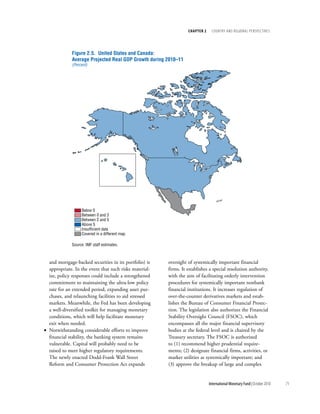
  • 84.
    wOrld ecOnOmic OutlOOk:recOvery, risk, and rebalancing to credit growth in China, higher reserve require- and higher stamp duties on property sales, among ments in India and China), or made use of other others. Hong Kong SAR, Malaysia, and Singapore tools (steady appreciation of the nominal effective are employing a coordinated approach to withdraw exchange rate target by Singapore). The overall blanket guarantees on banks’ wholesale deposits. monetary stance, however, is still largely accom- The recent resurgence in capital inflows to modative or neutral. Thus, economies that are emerging Asia, after a temporary stop during the beginning to face inflation pressure should further global crisis in 2008, has raised potential policy tighten monetary policy. If domestic overheating is challenges. On the one hand, capital flows have influenced by strong capital flows, monetary tight- helped support domestic demand. On the other ening should be accompanied by currency appre- hand, the size of global inflows relative to the ciation to help offset inflation pressure, discourage comparatively small financial markets has raised speculative inflows, and support medium-term or intensified existing concerns, including the risk rebalancing. Conversely, if private demand is not of inflation, asset price bubbles, financial sector yet fully established and in the absence of inflation instability (if inflows are not properly intermedi- pressure, monetary policy would need to remain ated), excessive appreciation, and risks associ- accommodative to help jump-start private activity. ated with a sudden stop of capital flows. Given Finally, if broad-based downside risks to growth wide variation in capital account openness across begin to materialize, most Asian economies can use economies and across alternative types of invest- the available monetary room to support economic ment within the same economy, it is possible that activity. some economies may receive more capital inflows With the return of normal financial sector than they can efficiently intermediate. Alternatively, conditions, the time is also ripe for unwinding capital controls in one sector (for example, foreign special support measures introduced during the direct investment—FDI) may be inducing excessive crisis. Some countries have already started (for inflows into others (for example, portfolio, equity). example, removal of guarantees on banks’ wholesale Economies have been implementing a range funding in Australia and New Zealand, unwinding of measures to deal with their varied situations of the previously expanded central bank liquidity/ (Box 2.1). The measures generally address poten- rediscount window in Hong Kong SAR and Philip- tial financial stability concerns and do not impose pines). Others are tightening regulatory measures wholesale restraint on capital inflows. At the further to enhance financial system stability. Policy- same time, it is not clear how much these policy makers in New Zealand introduced a new liquidity responses will deliver. A few issues stand out:6 policy, including a core funding ratio to improve • Macroprudential measures should focus primar- bank liquidity and reduce banks’ dependence on ily on financial stability and should not be used short-term funding. In China, prudential regula- to postpone needed macroeconomic adjustment. tions were introduced to reduce banks’ exposure to Thus, where large current account imbalances potentially risky property loans, and other direct may reflect an undervalued exchange rate, measures were deployed to cool the property market currency appreciation is the best response to (for example, increased minimum down payments, capital inflows. Conversely, if the exchange rate lower loan-to-value ratios, higher mortgage rates for is broadly at its medium-term equilibrium level, second homes). The banking system thus appears but reserves are assessed to be insufficient, capital well positioned to absorb moderate potential losses inflows should be used to build up reserves. (see the October 2010 issue of the Global Financial Many economies in emerging Asia are among the Stability Report—GFSR). Similarly, policymakers largest reserve holders, and so they do not fall in Hong Kong SAR took measures to address risks into this category. of property price inflation. These include maxi- mum loan-to-value ratios on high-end properties 6See also the April 2010 GFSR. 66 International Monetary Fund | October 2010
  • 85.
    chapter 2 cOuntry and regiOnal PersPectives Box 2.1. emerging asia: responding to capital inflows Emerging Asia is experiencing a revival in capital inflows. Total inflows to the region over the past Emerging Asia: Recent Experience with four quarters more than quadrupled relative to Capital Inflows1 2008 levels (figure), although in many cases, net inflows are negative or dwarfed by large current Total Capital Inflows 20 (percent of GDP) account surpluses. Many economies are respond- ing to balance of payments surpluses largely 15 through reserve accumulation rather than currency appreciation. In addition, some economies have 10 preemptively adopted a variety of macroprudential measures to address potential financial stability 5 issues and/or discourage speculative inflows: • Preventing asset price bubbles—setting maxi- 0 mum loan-to-value ratios, increased provisioning vis-à-vis real estate credit, and taking other mea- -5 sures specifically targeting the real estate market (Hong Kong SAR, India, Korea, Singapore). Foreign direct investment Portfolio -10 • Tightening liquidity control and management— Other2 Total taking measures to prevent excessive volatility of capital flows (for example, a one-month holding 2005 06 07 08 09 10: -15 period for central bank certificates for both Q1 resident and nonresident investors in Indonesia); Sources: CEIC Asia database; Haver Analytics; IMF, International raising required reserves for banks (India). Financial Statistics; and IMF staff calculations. • Limiting banks’ foreign exchange exposure—set- 1Emerging Asia: China, Hong Kong SAR, India, Indonesia, Korea, Malaysia, Philippines, Singapore, Taiwan Province of ting prudential limits on banks’ forward open China, and Thailand. position limits and net open positions (Korea). 2Other investment includes financial derivatives. • Tightening financial supervision—tightening prudential limits on capital, liquidity, and lever- age; enhanced stress testing; enhanced corporate accounts (Taiwan Province of China); setting governance (Hong Kong SAR, Singapore). limits on external borrowing operations (India). • Capital controls on inflows—preventing non- • Further liberalizing selected outflows (India, residents from opening short-term time deposit Malaysia, Thailand). • Greater exchange rate flexibility can reinforce • Other macroeconomic policy options include a macroprudential measures. For example, two- more aggressive unwinding of fiscal stimulus or way exchange rate flexibility can increase the even tightening—if inflows are concentrated in perception of exchange rate risk and discourage government securities—to prevent vulnerability speculative capital inflows. This is especially to a sudden turnaround in investor sentiment or important for economies with excessive external a lowering of interest rates when inflation expec- surpluses, where relatively sizable apprecia- tations are well grounded. However, given that tion—apart from narrowing the current account the adoption of fiscal policies that improve the imbalance—would increase the perception of recipient economy’s macro fundamentals could exchange rate risk and therefore deter speculative in fact result in stronger inflows to the private capital inflows. sector, such policies on their own would not International Monetary Fund | October 2010 67
  • 86.
    wOrld ecOnOmic OutlOOk:recOvery, risk, and rebalancing necessarily reduce the need for greater exchange Many economies have already embarked on such rate flexibility. reforms. Apart from the recent resumption of a • If the financial sector is healthy, restrictions on managed floating exchange rate regime in China, capital outflows can be eased to limit upward the government has launched a number of measures pressure on the currency and alleviate concerns to enhance the social safety net (IMF, 2010c). In about overvaluation or loss of external competi- Korea, the government recently announced plans tiveness. Furthermore, measures can be taken to to further develop the service industry, including free up restrictions in key growth sectors, which through streamlined regulation and greater compe- could help attract longer-term capital inflows (for tition. Singapore’s recent budget contains measures example, FDI). to enhance labor productivity. However, the time The best response to capital inflows may be a needed for these measures to be effective, and the coordinated one, especially when they are driven slower pace of adjustment in advanced economies by global factors or have global implications.7 (anticipated in light of the shorter-term economic Thus, resistance to currency appreciation by one challenges they face), suggest that the period over economy could discourage others because of which global imbalances may eventually narrow will competitiveness concerns. Alternatively, macro- be protracted. prudential measures by one economy could divert flows to others in the region. A potential ratchet effect could lead to reserve accumulation in emerg- the u.s. recovery is Moderating in the Face ing market economies—larger accumulation of of debt and continued uncertainty reserves by one could induce further accumulation The U.S. economy is recovering, thanks to by others in the region if the level of reserves unprecedented macroeconomic policy stimulus, is perceived as a proxy for the credibility of a emergency financial stabilization measures, and a country’s policy framework (see Cheung and Qian, modest cyclical upswing. But the rate of expansion 2009). International coordination could alleviate is beginning to moderate. The economy grew at an challenges of this nature. annualized rate of 1.7 percent in the three months Asia should also focus on various structural to June, a slower pace than the 3.7 percent growth reforms to accomplish its medium-term rebalanc- rate posted in the first quarter. Moreover, high- ing objectives. Specific policy options include frequency indicators suggest a weak recovery in implementing reforms to health care, education, coming quarters. and pension systems to enhance the social safety Much of the weakness of this recovery is due to net (China); promoting investment by small and sluggish personal consumption—by far the biggest medium-size enterprises (Japan); improving the component of U.S. GDP. There are several reasons business climate (Philippines); increasing the for this weakness. First, household net worth has productivity of the nontradables or services sector deteriorated sharply (Figure 2.4). House prices (China, Japan, Korea); facilitating further prod- have fallen by 25 to 30 percent over the past three uct and labor market flexibility and productivity years (depending on which index is used), with (China, Malaysia, some NIEs, Philippines); lower- the brunt of the adjustment falling on house- ing corporate saving by realigning relative prices holds that have the highest marginal propensity for a range of inputs, including capital, land, water, to consume. Second, unemployment is high: it is and energy (China); and further financial sector currently 9.6 percent of the workforce; a broader development and capital market deepening (China, measure of unemployment (which takes into India, Philippines, Thailand). account those seeking full-time jobs but finding only part-time work) is 16.7 percent; and the median duration of unemployment, 20 weeks, 7See also IMF (2010b). is nearly twice the peak level of the previous 40 68 International Monetary Fund | October 2010
  • 87.
    chapter 2 cOuntry and regiOnal PersPectives years. A weak labor market hits incomes and the ability to obtain credit, and it raises job uncer- Figure 2.4. United States and Canada: Differing tainty for those currently employed. Third, banks Fortunes are still reluctant to lend to consumers, restrict- ing credit for larger purchases, as they struggle The pace of recovery in the United States has moderated. Consumers face headwinds of high debt and fallen asset values; weak credit growth, despite to reduce leverage and restore balance sheets. extraordinarily loose monetary conditions; and persistently high unemployment. Overall, given the unusually low savings levels Personal saving rates will remain higher than precrisis levels for a sustained before the crisis and the steep decline in personal period, and public fiscal balances are projected to deteriorate further. By contrast, the Canadian economy is less hampered by the same factors and is set to recover net worth since, the desire to save is more likely more strongly. to stay elevated relative to precrisis levels. The per- sonal saving rate since the beginning of 2009 has U.S. Contribution to Growth Household Net Worth (annualized quarterly (percent of disposable averaged 6 percent—a level last seen in 1995— 6 percent change) income) 700 and is projected to remain at about 4 to 6 percent 4 2 650 through 2015. 0 Canada In contrast to private consumption, private -2 600 investment in software and equipment has -4 550 rebounded strongly. Firms have also increased pro- -6 -8 GDP growth United States ductivity, and unit labor costs have declined sharply. Consumption 500 -10 In the near term, fixed investment is likely to be the -12 Fixed investment Change in inventories 450 principal driver of domestic demand as inventory -14 Net exports accumulation slows. The current account deficit is -16 2007 08 09 10: 2007 08 09 10: 400 projected to remain at about 3.3 percent of GDP Q2 Q2 over the medium term—much lower than dur- Unemployment Rate 16 Private Credit Growth 11 ing the years leading up to the crisis—because the (percent change from a (percent) 14 year earlier) United States 10 recovery in investment will be financed by strong 12 10 private saving and improving fiscal balances. 8 9 The most likely prospect for the U.S. economy 6 Canada 8 is for a continued but slow recovery, with growth 4 2 7 far weaker than in previous recoveries, considering 0 Canada the depth of the recession. GDP growth is pro- 6 -2 jected to be 2.6 percent in 2010 and 2.3 percent -4 5 -6 United States in 2011 (Table 2.2; Figure 2.5). This implies that -8 4 2007 08 09 Aug. 2007 08 09 Aug. the gap between actual and potential output will 10 10 remain wide, even though potential growth has Household Saving Rates Fiscal Balances and Debt itself suffered temporarily from the crisis. The 6 (percent) 25 (percent of GDP) 120 unemployment rate is therefore expected to remain 20 U.S. debt 105 (right scale) stubbornly high. Against this backdrop, inflation 5 15 90 will remain low—it is projected to be 1.4 percent in Canada 4 10 Canada debt 75 2010 and 1 percent in 2011. 5 (right scale) 60 Risks to the outlook remain elevated and are 3 0 45 tilted to the downside. Residential and commercial United States -5 30 real estate markets are still fragile. Further loan 2 U.S. Canada write-downs at small and medium-size banks could -10 balance balance 15 inhibit recovery of normal credit conditions. The 1 -15 0 2005 07 09 11 13 15 2005 07 09 11 13 15 sharp rise in government debt has increased vulner- ability to financial market sentiment, although Sources: Haver Analytics; and IMF staff estimates. International Monetary Fund | October 2010 69
  • 88.
    wOrld ecOnOmic OutlOOk:recOvery, risk, and rebalancing Treasury security yields have fallen significantly and medium-term credibility. If downside risks recently amid economic weakness, flight to quality, to growth materialize, there is some room to and expectations of additional government bond reduce up-front adjustment while strengthening purchases by the Federal Reserve (Fed). Easing medium-term credibility. This could be achieved consumer price inflation, together with weak labor by further entitlement spending reforms, which markets and relatively low consumption demand, would have little immediate impact on demand. points to a tail risk of deflation. On the upside, However, the existing fiscal plans do not stabilize it is possible that business fixed investment could medium-term debt, which should be put firmly rebound faster from still-depressed levels. on a downward path to rebuild room for fiscal Against this backdrop, U.S. authorities will need maneuver and avoid negative effects on lend- to find a way to exit from extraordinary policy ing rates and long-term growth. Hence, a clear intervention without undermining the fledgling commitment to additional consolidation mea- recovery, while dealing with the long-term legacies sures under credible economic assumptions (by of fiscal imbalances, gaps and overlaps in financial enshrining targets and/or measures in legislation, regulation, and a weakened banking sector. for example) would be desirable. In this context, • A key macroeconomic challenge is to ensure the President’s Fiscal Commission is expected to that the public debt is put on a sustainable play a key role in fostering political consensus, path without jeopardizing the recovery. Under including in difficult areas such as tax policy and current policies, the general government deficit entitlement spending. is projected to be about 10 percent of GDP in • Monetary policy should remain accommodative both 2010 and 2011, and gross general govern- because of muted inflation, subpar growth, and ment debt will increase to about 110 percent lingering financial strain. The Fed has maintained of GDP by 2015. Given the risks posed by the policy rate at a record low while signaling budgetary imbalances, the groundwork for that conditions are likely to warrant keeping the fiscal consolidation must begin in 2011. The rate at exceptionally low levels for an extended proposed fiscal tightening of about 1 percent period. In light of larger downside risks, the of GDP in 2011 implied by the administra- Fed’s recent decision to resume its purchases tion’s mid-session review strikes the right balance of government securities (using resources from between near-term support for the recovery maturing government-sponsored-enterprise debt Table 2.2. Selected Advanced Economies: Real GDP, Consumer Prices, Current Account Balance, and Unemployment (Annual percent change, unless noted otherwise) Real GDP Consumer Prices1 Current Account Balance2 Unemployment3 Projections Projections Projections Projections 2009 2010 2011 2009 2010 2011 2009 2010 2011 2009 2010 2011 Advanced Economies –3.2 2.7 2.2 0.1 1.4 1.3 –0.3 –0.3 –0.1 8.0 8.3 8.2 United States –2.6 2.6 2.3 –0.3 1.4 1.0 –2.7 –3.2 –2.6 9.3 9.7 9.6 Euro Area4,5 –4.1 1.7 1.5 0.3 1.6 1.5 –0.6 0.2 0.5 9.4 10.1 10.0 Japan –5.2 2.8 1.5 –1.4 –1.0 –0.3 2.8 3.1 2.3 5.1 5.1 5.0 United Kingdom4 –4.9 1.7 2.0 2.1 3.1 2.5 –1.1 –2.2 –2.0 7.5 7.9 7.4 Canada –2.5 3.1 2.7 0.3 1.8 2.0 –2.8 –2.8 –2.7 8.3 8.0 7.5 Other Advanced Economies –1.2 5.4 3.7 1.5 2.4 2.5 4.8 5.0 4.9 5.0 4.8 4.7 Memorandum Newly Industrialized Asian Economies –0.9 7.8 4.5 1.3 2.6 2.7 8.5 7.1 6.9 4.3 3.8 3.7 1Movements in consumer prices are shown as annual averages. December–December changes can be found in Table A6 in the Statistical Appendix. 2Percent of GDP. 3Percent. National definitions of unemployment may vary. 4Based on Eurostat’s harmonized index of consumer prices. 5Current account position corrected for reporting discrepancies in intra-area transactions. 70 International Monetary Fund | October 2010
  • 89.
    chapter 2 cOuntry and regiOnal PersPectives Figure 2.5. United States and Canada: Average Projected Real GDP Growth during 2010–11 (Percent) Below 0 Between 0 and 2 Between 2 and 5 Above 5 Insufficient data Covered in a different map Source: IMF staff estimates. and mortgage-backed securities in its portfolio) is oversight of systemically important financial appropriate. In the event that such risks material- firms. It establishes a special resolution authority, ize, policy responses could include a strengthened with the aim of facilitating orderly intervention commitment to maintaining the ultra-low policy procedures for systemically important nonbank rate for an extended period, expanding asset pur- financial institutions. It increases regulation of chases, and relaunching facilities to aid stressed over-the-counter derivatives markets and estab- markets. Meanwhile, the Fed has been developing lishes the Bureau of Consumer Financial Protec- a well-diversified toolkit for managing monetary tion. The legislation also authorizes the Financial conditions, which will help facilitate monetary Stability Oversight Council (FSOC), which exit when needed. encompasses all the major financial supervisory • Notwithstanding considerable efforts to improve bodies at the federal level and is chaired by the financial stability, the banking system remains Treasury secretary. The FSOC is authorized vulnerable. Capital will probably need to be to (1) recommend higher prudential require- raised to meet higher regulatory requirements. ments; (2) designate financial firms, activities, or The newly enacted Dodd-Frank Wall Street market utilities as systemically important; and Reform and Consumer Protection Act expands (3) approve the breakup of large and complex International Monetary Fund | October 2010 71
  • 90.
    wOrld ecOnOmic OutlOOk:recOvery, risk, and rebalancing companies if financial stability is threatened. uled. Should conditions worsen unexpectedly, fiscal However, the specifics will need to be worked policy would be able to respond—the Canadian out before it will be clear how the legislation will fiscal deficit is projected to be 2.9 percent of GDP be implemented in practice, especially concerning in 2011, with net public debt hovering around the setting of new prudential norms, the cross- 33.5 percent of GDP. border implementation of resolution procedures, and the functioning of the FSOC. Policy choices in the United States matter greatly europe is Facing a gradual and uneven for the rest of the world. The huge prospective recovery funding requirements of the government may have In Europe, the road to recovery has been bumpy. implications for other economies. To the extent that Largely caused by unsustainable policies in some 10-year Treasury bonds set a benchmark for other member countries, the sovereign debt crisis in the assets, market nervousness about the fiscal position spring erupted before the euro area’s recovery could of the United States could cause an international gain traction. The crisis spread internationally, increase in interest rates. In addition, because of threatening the financial system as well as regional the U.S. dollar’s role as a reserve currency and the and global recovery. A strong and far-reaching importance of the United States as a financial cen- policy response contained the situation. Unprec- ter, policy inaction by the U.S. authorities would edented liquidity and credit support, new European have far greater effects on other economies than financing instruments, and substantial fiscal action that implied by trade linkages alone. Shocks to con- in affected countries arrested the financial turmoil, fidence in the United States could cause an interna- moderating its adverse impact on Europe’s eco- tional increase in bond and equity risk premiums. nomic activity. The Canadian economy has been relatively buoy- The recovery has finally gained some vigor, but ant. Household balance sheets are healthier than it is still likely to be moderate and uneven (Figures in the United States, and banks have very solid 2.6 and 2.7). Advanced Europe’s GDP is projected books. Monetary and fiscal stimulus and strong to grow at 1.7 percent in 2010 and 1.6 percent international demand for commodities helped boost in 2011 (Table 2.3). Emerging Europe’s growth is the growth rate in the first quarter of this year to expected to be 3.7 percent in 2010 and 3.1 percent 5.8 percent, double that of the United States, with in 2011. There are pronounced differences in consumer spending especially robust. House prices economic prospects across the region, depending on held up relatively well during the crisis. The unem- the condition of public and private sector balance ployment rate, at 8.1 percent, is well below that in sheets and the extent to which macroeconomic poli- the United States and has been declining steadily cies can support the recovery. since early 2009. However, recent data indicate a • Despite robust manufacturing exports in recent moderation in growth, which nonetheless seems months, moderate recovery is expected in Ger- to remain above potential. Risks to the Canadian many because weak growth is expected among its economy are mainly external. The economy is vul- trading partners. In France, growth is projected nerable to a dip in commodity prices, particularly to be modest, as private consumption is weak- for minerals and energy, and a slowdown in the ened by high unemployment and the withdrawal U.S. economy, which buys about three-quarters of of stimulus measures. In Italy, the recovery is its exports. expected to be even more subdued, as a persis- Improving conditions have allowed policymakers tent competitiveness problem limits the scope in Canada to start unwinding policy stimulus. The for export growth, and planned fiscal consolida- Bank of Canada has already raised the overnight tion weakens private demand. Constrained by rate from 0.25 percent, where it had been since fiscal and competitiveness imbalances, growth in the crisis, to 1 percent as of September. The fiscal Greece, Ireland, Portugal, and Spain is projected stimulus package has been implemented as sched- to be much lower. Outside the euro area, the 72 International Monetary Fund | October 2010
  • 91.
    chapter 2 cOuntry and regiOnal PersPectives Figure 2.6. Europe: Average Projected Real GDP Growth during 2010–11 (Percent) Below 0 Between 0 and 2 Between 2 and 5 Above 5 Insufficient data Source: IMF staff estimates. prospects for recovery are similarly diverse. In the or have vulnerable private or public sector bal- United Kingdom, domestic demand is expected ance sheets (Hungary, Romania) are expected to to remain relatively subdued, particularly follow- recover more slowly. These problems have tightly ing the recent measures to cut the budget deficit. constrained the room for policy maneuver. • In emerging Europe, growth in economies that Risks to the outlook have become more balanced. experienced the mildest downturns (Poland), and Although downside risks continue to threaten others that faced the crisis with relatively strong Europe’s recovery, some upside risks have recently household and bank balance sheets (Turkey), is emerged. The main upside risk comes from higher- projected to continue gaining strength, helped than-expected real activity in Germany, which could by the normalization of global trade and capi- lift growth in Europe more generally, given the tal flows. However, those that had experienced country’s substantial trade and production linkages. unsustainable domestic booms (Bulgaria, Latvia) Nevertheless, downside risks still loom large. In the International Monetary Fund | October 2010 73
  • 92.
    wOrld ecOnOmic OutlOOk:recOvery, risk, and rebalancing Figure 2.7. Europe: A Gradual and Uneven near term, as discussed in Chapter 1 of the GFSR, Recovery the potential for financial spillovers across sover- eigns remains elevated in the euro area, particularly The recovery is gradually taking hold, but domestic demand is expected to remain sluggish, especially in advanced Europe. Fiscal consolidation plans across among peripheral economies. European banking Europe are rightfully differentiated: economies facing market pressure or external financing constraints have larger and more front-loaded adjustments than those systems are still heavily reliant on government sup- with more manageable debt dynamics. Economic prospects are closely port and are highly vulnerable to deterioration in connected via cross-border bank flows and trade linkages, especially with Germany. the real economy, sovereign shocks, and funding strains. Hence, if unaddressed, renewed financial Contribution to Growth sector stress could spread—including to emerging GDP growth Public consumption Change in inventories Private consumption Fixed investment Net exports Europe via trade and cross-border bank flows—and 5 Advanced Europe Emerging Europe 12 could have significant adverse effects on real activity. 4 (percent) (percent) In the medium term, the main risk is that fiscal and 8 3 competitiveness imbalances in peripheral economies 2 4 and insufficient action to tackle weak banks could 1 0 0 lead to a protracted period of subpar growth and -1 occasional crises. -4 -2 Against this backdrop, the overarching policy -3 challenge is to use the window of opportunity -8 -4 afforded by the unprecedented policy support to -5 -12 2006 07 08 09 10 11 12 2006 07 08 09 10 11 12 address underlying problems through national and EU-level action. 0.5 Advanced Europe Fiscal Advanced Europe Fiscal 120 Adjustment1 Debt in 2015 Establishing public debt sustainability remains a 0.0 (percent of GDP) 110 top priority for many European economies. Across -0.5 100 Europe, current fiscal consolidation plans are going -1.0 90 in the right direction. They are rightfully differenti- -1.5 80 ated—economies facing market pressure or severe -2.0 external financing constraints (for example, Greece, 70 -2.5 2010 minus 2011 Iceland, Ireland, Portugal, Spain) have larger and -3.0 2010 minus 2013 60 more front-loaded adjustments than others. Nev- -3.5 50 ertheless, given the considerable near-term easing Vulnerable Other Other Vulnerable Other Other euro area euro area advanced euro area euro area advanced in Germany, the overall fiscal stance in the euro 8 Bank Flows and Credit 2009 Exports to Germany 40 area will remain broadly neutral in 2010—as is Growth during (percent of total exports) 4 2009:Q3–2010:Q12 appropriate, given the still-fragile recovery. Plans Bank flows (percent of GDP) SVK POL 30 for medium-term fiscal adjustment, however, need 0 HUN HRV TUR to be strengthened considerably to deliver perma- CZE -4 SVN 20 nent savings in the face of looming age-related ROM BGR -8 EST spending. Ambitious entitlement spending reforms 10 would deliver large credibility gains at a lesser cost -12 LTU LVA in terms of short-term growth; they would also -16 -8 -6 -4 -2 0 2 4 0 forestall a need for more painful reforms in the Real credit growth (percent) CZE HUN SVK SVN ROM BGR future. Some economies have taken steps in that Sources: Bank for International Settlements; Haver Analytics; IMF, Direction of Trade direction (for example, France, Italy), but more Statistics; and IMF staff estimates. could be done. Key items will be raising the retire- 1Change in structural balance in percent of potential GDP. Vulnerable euro area comprises Greece, Ireland, Italy, Portugal, and Spain. Other euro area comprises euro ment age to reflect increased life expectancy, more area economies excluding vulnerable euro area. Other advanced comprises advanced Europe excluding the euro area. efficient health care spending, and reform of social 2BGR: Bulgaria; CZE: Czech Republic; EST: Estonia; HRV: Croatia; HUN: Hungary; LTU: Lithuania; LVA: Latvia; POL: Poland; ROM: Romania; SVK: Slovak Republic; SVN: Slovenia; security funding that reduces distortions to the TUR: Turkey. labor supply. 74 International Monetary Fund | October 2010
  • 93.
    chapter 2 cOuntry and regiOnal PersPectives table 2.3. selected european economies: real gdp, consumer prices, current account Balance, and unemployment (Annual percent change, unless noted otherwise) Real GDP Consumer Prices1 Current Account Balance2 Unemployment3 Projections Projections Projections Projections 2009 2010 2011 2009 2010 2011 2009 2010 2011 2009 2010 2011 europe –4.0 2.0 1.8 1.3 2.3 2.0 0.1 0.3 0.5 ... ... ... advanced europe –4.1 1.7 1.6 0.7 1.8 1.6 0.3 0.8 1.0 8.8 9.4 9.3 Euro Area4,5 –4.1 1.7 1.5 0.3 1.6 1.5 –0.6 0.2 0.5 9.4 10.1 10.0 Germany –4.7 3.3 2.0 0.2 1.3 1.4 4.9 6.1 5.8 7.5 7.1 7.1 France –2.5 1.6 1.6 0.1 1.6 1.6 –1.9 –1.8 –1.8 9.4 9.8 9.8 Italy –5.0 1.0 1.0 0.8 1.6 1.7 –3.2 –2.9 –2.7 7.8 8.7 8.6 Spain –3.7 –0.3 0.7 –0.2 1.5 1.1 –5.5 –5.2 –4.8 18.0 19.9 19.3 Netherlands –3.9 1.8 1.7 1.0 1.3 1.1 5.4 5.7 6.8 3.5 4.2 4.4 Belgium –2.7 1.6 1.7 0.0 2.0 1.9 0.3 0.5 1.8 7.7 8.7 8.5 Greece –2.0 –4.0 –2.6 1.4 4.6 2.2 –11.2 –10.8 –7.7 9.4 11.8 14.6 Austria –3.9 1.6 1.6 0.4 1.5 1.7 2.3 2.3 2.4 4.8 4.1 4.2 Portugal –2.6 1.1 0.0 –0.9 0.9 1.2 –10.0 –10.0 –9.2 9.6 10.7 10.9 Finland –8.0 2.4 2.0 1.6 1.4 1.8 1.3 1.4 1.6 8.3 8.8 8.7 Ireland –7.6 –0.3 2.3 –1.7 –1.6 –0.5 –3.0 –2.7 –1.1 11.8 13.5 13.0 Slovak Republic –4.7 4.1 4.3 0.9 0.7 1.9 –3.2 –1.4 –2.6 12.1 14.1 12.7 Slovenia –7.8 0.8 2.4 0.9 1.5 2.3 –1.5 –0.7 –0.7 6.0 7.8 8.1 Luxembourg –4.1 3.0 3.1 0.4 2.3 1.9 5.7 6.9 7.2 6.0 5.8 5.6 Cyprus –1.7 0.4 1.8 0.2 2.2 2.3 –8.3 –7.9 –7.4 5.3 7.1 6.9 Malta –2.1 1.7 1.7 1.8 1.9 2.1 –6.1 –5.4 –5.3 7.0 6.9 6.9 United Kingdom5 –4.9 1.7 2.0 2.1 3.1 2.5 –1.1 –2.2 –2.0 7.5 7.9 7.4 Sweden –5.1 4.4 2.6 2.0 1.8 1.9 7.2 5.9 5.7 8.3 8.2 8.2 Switzerland –1.9 2.9 1.7 –0.5 0.7 0.5 8.5 9.6 10.3 3.6 3.6 3.4 Czech Republic –4.1 2.0 2.2 1.0 1.6 2.0 –1.1 –1.2 –0.6 6.7 8.3 8.0 Norway –1.4 0.6 1.8 2.2 2.5 1.4 13.1 16.6 16.4 3.2 3.5 3.6 Denmark –4.7 2.0 2.3 1.3 2.0 2.0 4.2 3.4 3.0 3.6 4.2 4.7 Iceland –6.8 –3.0 3.0 12.0 5.9 3.5 –6.5 –0.9 2.1 8.0 8.6 8.4 emerging europe6 –3.6 3.7 3.1 4.7 5.2 4.1 –2.5 –3.7 –4.0 ... ... ... Turkey –4.7 7.8 3.6 6.3 8.7 5.7 –2.3 –5.2 –5.4 14.0 11.0 10.7 Poland 1.7 3.4 3.7 3.5 2.4 2.7 –1.7 –2.4 –2.6 8.2 9.8 9.2 Romania –7.1 –1.9 1.5 5.6 5.9 5.2 –4.5 –5.1 –5.4 6.3 7.2 7.1 Hungary –6.3 0.6 2.0 4.2 4.7 3.3 0.2 0.5 0.7 10.1 10.8 10.3 Bulgaria –5.0 0.0 2.0 2.5 2.2 2.9 –9.5 –3.0 –3.1 6.8 8.3 7.6 Croatia –5.8 –1.5 1.6 2.4 1.9 2.8 –5.3 –3.8 –4.7 9.2 9.5 9.0 Lithuania –14.8 1.3 3.1 4.2 1.0 1.3 4.2 1.9 0.2 13.7 18.0 16.0 Latvia –18.0 –1.0 3.3 3.3 –1.4 0.9 8.6 5.5 2.9 17.3 19.8 17.5 Estonia –13.9 1.8 3.5 –0.1 2.5 2.0 4.5 4.2 3.4 13.8 17.5 16.4 1Movements in consumer prices are shown as annual averages. December–December changes can be found in Tables A6 and A7 in the Statistical Appendix. 2Percent of GDP. 3Percent. National definitions of unemployment may vary. 4Current account position corrected for reporting discrepancies in intra-area transactions. 5Based on Eurostat’s harmonized index of consumer prices. 6Includes Albania, Bosnia and Herzegovina, Kosovo, former Yugoslav Republic of Macedonia, and Serbia. Monetary policy should remain very support- continued financial strain, to very gradually unwind ive for the foreseeable future in most European nonstandard support measures and collateral- economies. In advanced Europe, inflation remains requirement changes. This will help support the low because output gaps are large, and inflation recovery by dampening the adverse short-term expectations are well anchored. Core inflation is effects of fiscal consolidation on domestic demand. projected to remain at about 1½ percent in the If downside risks to growth materialize, central euro area. Thus, in the euro area, it is appropriate banks in advanced Europe may need to again rely to keep interest rates exceptionally low, and, given more strongly on their balance sheets to further ease International Monetary Fund | October 2010 75
  • 94.
    wOrld ecOnOmic OutlOOk:recOvery, risk, and rebalancing monetary conditions. In emerging Europe, infla- anism (ESM) is likely to prove useful, but sharing tion prospects are a bit mixed—reflecting differ- fiscal burdens implies a need for shared responsibil- ent exchange rate regimes and varying degrees of ity for fiscal policy. This principle was recognized economic slack—but are generally contained. In with the adoption of the Stability and Growth Pact. some economies, value-added tax hikes are likely to However, economies failed to live up to its letter temporarily drive up inflation (for example, Poland, and spirit by not adjusting sufficiently during good Romania). times. Thus, the Pact needs to be strengthened to The resilience of Europe’s financial sector must feature better incentives for preventing and resolv- be improved and its stability secured. Resolving ing fiscal imbalances. It needs to encourage the banking sector issues is essential to spur lending, building up of sufficient buffers in good times, which is very important to firms’ external funding. establish credible procedures for the enforcement As discussed in the October 2010 GFSR, how- of the common fiscal rules, and beef up centralized ever, European banks continue to face challenges. crisis management capabilities—a gap now tempo- These include heavy reliance on European Central rarily filled by the ESM and the larger European Bank financing facilities—or on government sup- Financial Stability Facility, the latter designed port—and large exposure to risky sovereign debt. specifically for euro area members. The stress tests conducted by the Committee of In addition, the crisis has shown how finan- European Banking Supervisors have been helpful cial sector problems in specific countries can very in improving disclosure regarding banks’ condi- quickly have pan-European consequences. Differ- tion. These tests also provide a useful guide to the ences in prudential policies and practices across need to recapitalize, restructure, or resolve vulner- countries encourage complex business structures, able banks. In this respect, some economies (for regulatory arbitrage, and rent seeking, with deleteri- example, Ireland, Spain) have made more progress ous consequences for Europe’s financial stability. than others (for example, Germany) in tackling Supervisory or regulatory gaps have major spill- weak banks. Nonetheless, as discussed in the GFSR, overs. Hence, joint accountability and responsibility an adverse funding scenario could have a significant for Europe’s common good of “financial stability”— impact on the European banking system. To cope in the form of an integrated European financial with the looming wall of maturing bank debt, some stability framework—are urgently needed. Such blanket financial support measures may need to be a framework needs to be built on two pillars: (1) extended, but not at the cost of postponing much- integrated crisis management and resolution—for needed restructuring. Meanwhile, it will be impor- example, through a European resolution author- tant to resolve uncertainty about regulatory reforms, ity—and (2) integrated supervision, to make burden which would help increase banks’ willingness to sharing acceptable. Both are necessary to achieve supply credit and support the recovery. Invigorat- a fully integrated, efficient, and stable market for ing credit is also a challenge in emerging Europe, financial services. Steps in this direction are being particularly given the deterioration in bank credit taken—for instance, the establishment of the Euro- portfolios during the crisis. pean Systemic Risk Board and discussions about a Another crucial task ahead is the reform of EU more integrated resolution framework. Nevertheless, policy frameworks. The cross-border dimension of considering the devastating consequences of the many issues argues for a stronger role at the EU crisis and the magnitude of the challenge, progress level. The crisis exposed long-standing problems in is still very slow, hampered by narrow national existing fiscal, structural, and financial stability poli- interests. cies. Such weaknesses need to be addressed in order Last, a better structural policy framework is also to ensure Europe’s future stability and growth. necessary to help improve competitiveness, address A key challenge is the future of fiscal surveillance macroeconomic imbalances, and boost growth. and sovereign crisis management. An arrangement The current policy agenda (Europe 2020) could along the lines of the European Stabilization Mech- be improved in several ways. Specifically, surveil- 76 International Monetary Fund | October 2010
  • 95.
    chapter 2 cOuntry and regiOnal PersPectives lance over structural bottlenecks, competitiveness, Growth in the region is projected to average 5.7 and imbalances needs to become more binding. It percent in 2010 and 4 percent in 2011 (Table 2.4). should also consider the fiscal and financial policy Risks to the outlook emerge from both external challenges facing countries. To speed the process and domestic factors. External risks are tilted to the of reform, priority should be given to a narrow downside, reflecting mainly a worse-than-antici- range of strategic objectives that have major cross- pated recovery in advanced economies, with its neg- border implications. For instance, most Mediter- ative spillovers on commodity prices. An additional ranean economies need to address labor market contagion channel arises from the large presence of segmentation, inadequate wage flexibility, and foreign banks in Latin America, although the fact skill mismatches; upgrade education systems; and that these banks have relied primarily on subsidiar- foster capital deepening and innovation. In addi- ies funded by local deposits rather than cross-border tion, reform to bankruptcy proceedings in these flows mitigates the risk. On the other side, there economies will help facilitate firm turnover and are also risks of overheating, particularly if unwind- entrepreneurship. For all EU economies, further lib- ing of earlier stimulus takes longer than currently eralization of product and service markets under the anticipated (see below). Single Market program will strengthen the employ- Prospects within the LAC region are quite diverse ment effects of labor market reform. given the varying strength of macroeconomic policy frameworks, the role of domestic demand, and dif- ferent degrees of exposure to spillovers from global latin america is sustaining its growth trade and financial markets: Momentum • Impressive improvements in macroeconomic pol- The LAC region is exiting the global crisis at a icy frameworks over the past two decades, com- faster pace than anticipated (Figures 2.8 and 2.9). bined with accommodative policies, easy external This reflects solid macroeconomic policy funda- financing conditions, and strong commodity mentals, sizable policy support, favorable exter- prices, are driving a robust recovery in the LA-4 nal financing conditions, and strong commodity (Brazil, Chile, Colombia, Peru). Despite the revenues. Robust commodity export revenues expected dynamism in domestic demand, current have boosted domestic income, which along with account balances are projected to deteriorate only easy financing conditions has supported domes- marginally in 2010 and 2011. High commodity tic demand. For many of these economies, the prices and continued vitality in Asia are expected potential negative effect from subdued demand to sustain exports. Similarly, Uruguay, which for imports by the advanced economies will be has made substantial progress in macroeconomic manageable, given lower reliance on external trade8 policy management and faces a favorable external and greater dependence on commodity exports, environment, is expected to experience strong for which external demand is projected to remain growth dynamics in 2010–11. robust (see Chapter 1, Appendix 1.1). However, • Mexico is also staging a steady recovery, despite Mexico, with its deep real and financial links to the 2009 hard landing and the drag from the the U.S. economy, and the commodity-importing U.S. economy. As in the LA-4, recovery has been Central American and Caribbean regions, with their underpinned by strong policy frameworks in the dependence on tourism and remittance flows from run-up to the crisis. However, Mexico’s outlook the United States, will be more vulnerable than oth- arguably faces larger downside risks than that ers to weak U.S. economic conditions. of the LA-4. A weaker-than-projected recovery in the U.S. economy would have important 8For instance, the share of exports plus imports in total implications for Mexico. Furthermore, with more GDP—a very rough measure of openness—averaged less than 50 than 80 percent of domestic financial system percent in the LA-5 (Brazil, Chile, Colombia, Mexico, Peru) in the past five years (compared with more than 125 percent for the assets owned by systemic global banks, substan- ASEAN economies). tially higher capital charges arising from global International Monetary Fund | October 2010 77
  • 96.
    wOrld ecOnOmic OutlOOk:recOvery, risk, and rebalancing Figure 2.8. Latin America and the Caribbean: Average Projected Real GDP Growth during 2010–11 (Percent) Below 0 Between 0 and 2 Between 2 and 5 Above 5 Insufficient data Source: IMF staff estimates. financial sector regulatory reform could affect exporters will continue to benefit from the the availability of credit for the private sector in strength in their terms of trade, growing links Mexico. with China, and strong intraregional link- • The outlook for the rest of the LAC region is ages. Thus, Argentina and Paraguay are set to somewhat mixed. Overall, the commodity experience high growth, supported in large part 78 International Monetary Fund | October 2010
  • 97.
    chapter 2 cOuntry and regiOnal PersPectives by strong trade ties vis-à-vis Brazil and a sharp Figure 2.9. Latin America and the Caribbean (LAC): rebound in agricultural production following Advancing with Strength1 last year’s severe drought. Conversely, despite A proactive crisis response and favorable terms of trade have driven Latin high oil prices, Ecuador’s recovery will be muted America’s speedy recovery. Commodity exporters are also benefiting from increasing demand from emerging Asia, particularly China. Capital inflows have given supply-side constraints. Venezuela’s reces- picked up sharply in some economies. Although inflows have boosted the sion will continue in 2010, reflecting severe equities market, the recovery in private credit has remained sluggish. supply bottlenecks, challenges from capital 15 Selected LAC: Component LAC: Terms of Trade of Goods 160 flight, and generally weak policy frameworks. Contributions to GDP Growth (2000 = 100) (percent change, annual average) 150 Growth in most of the Caribbean countries Consumption Other Latin America 10 Investment will be subdued amid weak prospects for tour- Inventories 140 Net exports ism and remittances and limited room for Growth 130 5 LA-5 policy support in light of chronic public debt 120 burdens.9 110 0 LAC economies need to establish policies to 100 achieve strong and sustainable growth like Asia. LA-4 Mexico Rest of LAC 2 Rest of LAC -5 90 However, unlike Asia, medium-term policy pri- 2008–09 08–09 08–09 2000 02 04 06 08 10 10–11 10–11 10–11 orities are not driven by rebalancing more toward domestic demand (given relatively low reliance 80 Real Export Growth of LA-5 Real Export Growth of Other 150 on external trade, although the tourism-depen- by Destination Latin America by Destination (year-over-year percent (year-over-year percent 60 change) change) dent Caribbean countries are notable exceptions) Latin America4 China Latin 100 America4 but rather by a need to ensure that strong growth 40 China 50 does not give rise to balance sheet vulnerabili- 20 ties in the private or public sector. Macroeco- 0 nomic and prudential policies will need to be 0 U.S. and Emerging Asia euro area designed to ensure that the recovery becomes well -20 excl. China3 Emerging Asia -50 U.S. and entrenched and at the same time to contain the euro area excl. China3 -40 -100 risks of overheating and the buildup of fiscal and 2005 06 07 08 10: Q1 2005 06 07 08 10: Q1 financial sector risks. 20 Selected Latin America: LA-5: Real Domestic Credit 60 Thus, the priority for the region is now to use Capital Inflows (percent of to the Private Sector6 GDP, quarterly average)5 the window provided by the cyclical upswing to 15 FDI Peru 40 start unwinding stimulus, regain room for policy Portfolio Other Brazil maneuver, and sustain its relatively recent track 10 2005–08 20 record of strong macroeconomic policy manage- 09–10:Q2 5 0 ment. In many economies the policy mix should Colombia Mexico favor early withdrawal of the fiscal stimulus, while 0 -20 allowing the withdrawal of monetary stimulus to Chile proceed at a slower pace. Fiscal tightening will help -5 Brazil Colombia Peru 2007 08 09 July -40 address risks of inflation pressure (Peru, Uruguay) Chile Mexico Uruguay 10 and exchange rate overvaluation (Brazil), reduce Sources: CEIC EMED database; Haver Analytics; IMF, Balance of Payments Statistics; IMF, Direction of Trade Statistics; and IMF staff estimates. the generally high public debt and associated 1LA-4: Brazil, Chile, Colombia, and Peru; LA-5: LA-4 and Mexico; Other Latin America: vulnerability, and provide a cushion for future Argentina, Bolivia, Ecuador, Paraguay, Uruguay, and Venezuela. 2Rest of LAC in this panel excludes Antigua and Barbuda, Dominica, Grenada, Guyana, contingencies. Moreover, given policy challenges Jamaica, St. Kitts and Nevis, St. Lucia, and St. Vincent and the Grenadines due to lack of data on GDP components. arising from strong and persistent capital inflows 3Emerging Asia: ASEAN-5, China, India, and NIEs. See Figure 2.3 for list of NIEs and ASEAN-5. 4Latin America: LA-5 and Other Latin America (see footnote 1). 5Data for Peru only up to 2009:Q4. Data for Colombia and Uruguay only up to 2010:Q1. 9See the October 2010 Regional Economic Outlook: Western FDI = foreign direct investment. Other investment includes financial derivatives. Hemisphere for a more detailed discussion of the challenges and 6Annualized percent change of three-month moving average over previous three-month prospects in the rest of the LAC region. moving average. International Monetary Fund | October 2010 79
  • 98.
    wOrld ecOnOmic OutlOOk:recOvery, risk, and rebalancing Table 2.4. Selected Western Hemisphere Economies: Real GDP, Consumer Prices, Current Account Balance, and Unemployment (Annual percent change, unless noted otherwise) Real GDP Consumer Prices1 Current Account Balance2 Unemployment3 Projections Projections Projections Projections 2009 2010 2011 2009 2010 2011 2009 2010 2011 2009 2010 2011 North America –3.0 2.9 2.5 0.2 1.7 1.2 –2.6 –3.0 –2.6 ... ... ... United States –2.6 2.6 2.3 –0.3 1.4 1.0 –2.7 –3.2 –2.6 9.3 9.7 9.6 Canada –2.5 3.1 2.7 0.3 1.8 2.0 –2.8 –2.8 –2.7 8.3 8.0 7.5 Mexico –6.5 5.0 3.9 5.3 4.2 3.2 –0.6 –1.2 –1.4 5.5 5.0 4.5 South America –0.2 6.3 4.1 6.4 6.8 6.9 –0.3 –1.0 –1.4 ... ... ... Brazil –0.2 7.5 4.1 4.9 5.0 4.6 –1.5 –2.6 –3.0 8.1 7.2 7.5 Argentina4 0.9 7.5 4.0 6.3 10.6 10.6 2.0 1.7 1.2 8.4 8.0 8.6 Colombia 0.8 4.7 4.6 4.2 2.4 2.6 –2.2 –2.7 –2.8 12.0 12.0 11.5 Venezuela –3.3 –1.3 0.5 27.1 29.2 32.2 2.6 7.8 8.2 7.9 8.6 8.1 Peru 0.9 8.3 6.0 2.9 1.7 2.5 0.2 –1.3 –2.2 8.6 8.0 7.5 Chile –1.5 5.0 6.0 1.7 1.7 3.0 2.6 –0.7 –2.0 9.6 9.0 8.7 Ecuador 0.4 2.9 2.3 5.2 4.0 3.5 –0.7 –0.8 –1.6 8.5 8.6 8.5 Bolivia 3.4 4.0 4.5 3.3 1.7 4.1 4.6 6.5 5.2 ... ... ... Uruguay 2.9 8.5 5.0 7.1 6.5 6.4 0.7 –0.1 –0.7 7.3 7.0 6.9 Paraguay –3.8 9.0 5.0 2.6 4.6 5.2 –1.0 –1.2 –1.6 5.6 5.3 5.2 Central America5 –0.5 3.1 3.7 3.8 3.9 4.1 –1.8 –5.1 –5.5 ... ... ... The Caribbean6 0.4 2.4 4.3 3.5 7.2 5.5 –4.2 –3.0 –2.9 ... ... ... Memorandum Latin America and the Caribbean7 –1.7 5.7 4.0 6.0 6.1 5.8 –0.6 –1.2 –1.6 ... ... ... 1Movements in consumer prices are shown as annual averages. December–December changes can be found in Tables A6 and A7 in the Statistical Appendix. 2Percent of GDP. 3Percent. National definitions of unemployment may vary. 4Private analysts estimate that consumer price index inflation has been considerably higher. The authorities have created a board of academic advisors to assess these issues. Private analysts are also of the view that real GDP growth has been significantly lower than the official reports since the last quarter of 2008. 5Central America comprises Costa Rica, El Salvador, Guatemala, Honduras, Nicaragua, and Panama. 6The Caribbean comprises Antigua and Barbuda, The Bahamas, Barbados, Belize, Dominica, Dominican Republic, Grenada, Guyana, Haiti, Jamaica, St. Kitts and Nevis, St. Lucia, St. Vincent and the Grenadines, Suriname, and Trinidad and Tobago. 7Comprises Mexico and economies from the Caribbean, Central America, and South America. in some economies, fiscal tools are likely better the region include structural reforms to improve options to deal with overheating pressures than the investment climate, which would attract stable monetary tools. However, in Chile, fiscal stimulus FDI inflows and improve external competitiveness can be withdrawn only gradually in the context of (for example, streamlining business regulations, earthquake-related reconstruction spending, and upgrading infrastructure, labor and product market so tighter monetary conditions may be needed to reforms). However, these reforms will take time rein in inflation. For the rest of Latin America as to implement. In the meantime, economies have well, it is also critical to use the cyclical upswing to begun to use a combination of macroeconomic and rebuild fiscal room and avoid procyclical policies. macroprudential measures to address the challenges However, the pace of stimulus withdrawal could posed by capital inflows (Box 2.2). Regarding the be slowed if downside risks to growth were to use of capital controls, preliminary indications are materialize, especially for countries with available that they may have helped somewhat in changing policy room. the composition of inflows but not the volume (see With respect to the approach to capital inflows, the April and October 2010 issues of the GFSR). the focus among the LA-5 (LA-4 plus Mexico) has In this context, the possible use of capital con- appropriately been to deepen capital markets and trols should be supported by other measures—for improve the supervisory and regulatory framework example, continued two-way exchange rate flexibil- to enable absorption of capital inflows without ity to discourage speculative inflows, fiscal consoli- endangering financial stability. Other priorities for dation (where public debt is high and private sector 80 International Monetary Fund | October 2010
  • 99.
    chapter 2 cOuntry and regiOnal PersPectives Box 2.2. latin america-5: riding another Wave of capital inflows After a brief hiatus during the height of the global LA-5: Handling the Capital Inflows crisis in 2008, the LA-5 economies are experienc- Bonanza1 ing a resurgence in capital inflows (figure). Strong capital inflows have been a mixed blessing. On the Total Capital Inflows 15 (percent of GDP) one hand, they have provided cheap and readily available financing to boost domestic demand. On the other hand, these flows have increased concern 10 about domestic overheating, external competitive- ness (given considerable currency appreciation in the context of exchange rates that are mostly at or 5 above their medium-term values), increased steriliza- tion costs (with sizable interest rate differentials 0 vis-à-vis external rates), and heightened risks of a potential boom-bust cycle—problems this region has confronted in the past. The situation today raises Foreign direct investment -5 fewer financial stability concerns because domestic Portfolio Other2 credit is staging a relatively slow recovery. However, Total capital inflows have induced booms in many equity -10 markets, and concerns about asset price bubbles have 2005 06 07 08 09 10: Q1 been growing. Against this backdrop, country authorities have Sources: CEIC EMED database; Haver Analytics; IMF, Balance of responded by adopting a number of measures to Payments Statistics; and IMF staff calculations. 1LA-5: Brazil, Chile, Colombia, Mexico, and Peru. Data for Peru safeguard financial sector stability, eliminate asset only up to 2009:Q4. 2Other investment includes financial derivatives. price bubbles, and discourage inflows: • Financial sector supervision—all the LA-5 coun- tries are at various stages of further enhancing (implemented by Colombia before the crisis but financial sector regulatory standards for capital removed in October 2008). adequacy, liquidity, and asset quality. • Prudential capital controls—these include unre- • Tighter liquidity control and management— munerated reserve requirements on foreign bor- required reserves for banks have been raised rowing (maintained by Colombia from before (Brazil). the crisis but currently zero rated) and higher • Capital controls on inflows—These include a reserve requirements on short-term (less than direct tax on fixed income and equity inflows two years) external loans (Peru). (reintroduced in October 2009 by Brazil after • Further liberalization of selected outflows— a brief break) and minimum-stay rules for FDI Chile, Colombia, Peru. recovery entrenched), and enhanced financial sector region is benefiting from Russia’s gradual recupera- monitoring and supervision. tion. Some economies in the region have already experienced an increase in remittances from Russia.10 the cis region is experiencing a Modest recovery 10Alturki, Espinosa-Bowen, and Ilahi (2009) find that Russia appears to influence regional growth mainly through the remit- The recovery in the CIS region has been supported tance channel. In particular, a 10 percentage point increase in by high commodity prices, normalizing trade and growth of remittances from Russia is associated with a 0.3 per- centage point GDP increase in growth in the CIS countries, with capital flows, accommodative policies, and posi- a 0.4 percentage point increase in oil-importing CIS countries’ tive regional spillovers (Figures 2.10 and 2.11). The growth. International Monetary Fund | October 2010 81
  • 100.
    wOrld ecOnOmic OutlOOk:recOvery, risk, and rebalancing Figure 2.10. Commonwealth of Independent States: Average Projected Real GDP Growth during 2010–111 (Percent) Below 0 Between 0 and 2 Between 2 and 5 Above 5 Insufficient data Covered in a different map Source: IMF staff estimates. 1 Includes Georgia and Mongolia. Real activity for the CIS region is expected to Gradually rising real wages and lower unemploy- grow at 4.3 percent in 2010 and 4.6 percent in ment should support consumption. 2011 (Table 2.5). As in other regions, prospects • High commodity prices also benefit other vary considerably. Exposure to commodity prices, energy exporters in the region. Large-scale the degree of integration with global financial investment and higher volumes of gas exports markets, the extent of policy support, and links are projected to boost growth in Turkmenistan to Russia are factors that differ importantly across to 9.4 percent in 2010 and 11.5 percent in economies. 2011. In Uzbekistan, real activity is expected • In Russia, despite relatively high oil prices, the to expand by 8 percent in 2010 and 7 percent near-term outlook is for a modest recovery. in 2011. Kazakhstan is set for a slower recov- Output growth is projected to reach 4 percent ery, due to lingering problems in its financial in 2010 and 4.3 percent in 2011. Although the system. current heat wave and related wildfires could • For energy importers as a group, growth is detract from near-term growth, and the ongo- projected to pick up to 4.6 percent in 2010 and ing rebound still depends on policy support, a 5 percent in 2011, reflecting the global recovery self-sustained consumption-led recovery should and financial stability (for example, Ukraine). gradually take hold. The adjustment of bank Some of these economies (for example, Arme- balance sheets appears to have run its course, and nia, Moldova, Tajikistan) will benefit from the banks seem poised to cautiously expand lending. rebound in remittances from Russia. 82 International Monetary Fund | October 2010
  • 101.
    chapter 2 cOuntry and regiOnal PersPectives Overall, near-term risks to growth in the region Figure 2.11. Commonwealth of Independent are broadly balanced. On the upside, more favorable States (CIS): A Modest Recovery external developments—particularly higher com- modity prices and a renewal of capital inflows—or The recovery in the CIS region is gaining traction, supported by high commodity prices, normalizing trade and capital flows, accommodative policies, and positive a more rapid recovery in credit could push growth spillovers from Russia. Amid a more favorable external environment, capital flows higher. The recently launched customs union among are expected to pick up, but to lower levels than before the crisis. In Russia, the more flexible exchange rate regime, alongside cuts in policy interest rates, has Belarus, Kazakhstan, and Russia could enhance trade helped deter speculative capital inflows. But the focus now should be on inflation and provide an additional boost to growth within the control. union. On the downside, external shocks—adverse Russia’s GDP Growth1 Other CIS GDP Growth2 changes in commodity prices or a shock to investor 40 (annualized quarterly percent (percent) 15 confidence—present the key downside risks. With 30 change) 10 some exceptions (for example, Kazakhstan), foreign 20 banks have a minor role in CIS economies. At the 10 5 same time, the region—and Russia in particular— 0 0 continues to be very vulnerable to volatility in capital -10 Net energy -20 -5 flows and global risk appetite. For instance, the euro GDP exporters -30 Domestic Net energy area crisis in May led to a fresh bout of volatility demand importers -10 -40 in Russian stock markets and renewed downward -50 -15 pressure on the ruble. A worse-than-expected growth 2007 08 09 10: 2003 05 07 09 11 Q2 outcome in Russia would have second-round effects 500 Commodity Prices Net Capital Flows to CIS by 15 throughout the region, mainly through remittances (Jan. 2003 = 100) Type3 (percent of GDP) and trade. Oil 10 400 The fiscal challenges vary across the region. In Metals 5 Russia, the task is to ensure that the large fiscal 300 stimulus (about 9 percent of GDP) is unwound 0 as the global economy gathers strength—in this 200 -5 regard, a key concern is that some three-quarters Total 100 Overall of the fiscal package entailed permanent measures -10 PDI OPFF PPF OF (for example, higher pension outlays). Given the 0 -15 2003 05 07 09 11 1990 95 2000 05 10 15 composition of government spending, reversing the fiscal stimulus will be difficult without undertaking Inflation 200 Exchange Rate per U.S. Dollar 25 significant public sector reforms that allow savings (Jan. 2008 = 100) (percent) in socially sensitive areas such as health care, social 180 Ukraine Net energy 20 importers protection, and pensions. Energy importers in the 160 region have limited fiscal room and are mostly 15 Russia 140 Russia aiming for a neutral fiscal stance or modest fiscal 10 adjustment in 2010. 120 Most economies in the region operate under Net energy 5 100 exporters pegged or heavily managed exchange rate regimes, Kazakhstan Other CIS which deprive them of one means of adjusting to 80 2008 09 Sep. 2003 05 07 09 11 0 shocks. In this respect, the recent greater exchange 10 rate flexibility in Russia is welcome. So far, the more Sources: Haver Analytics; IHS Global Insight; IMF Primary Commodity Price System; and IMF staff estimates. flexible exchange rate regime, alongside cuts in policy 1Domestic demand data available only through 2010:Q1. 2Net energy exporters include Azerbaijan, Kazakhstan, Turkmenistan, and Uzbekistan. interest rates, has helped deter speculative capital Net energy importers include Armenia, Belarus, Georgia, Kyrgyz Republic, Moldova, inflows. But the focus now should be on inflation Mongolia, Tajikistan, and Ukraine. 3OF: official flows; OPFF: other private financial flows; PDI: private direct investment; control, and the monetary easing cycle has been PPF: private portfolio investment. appropriately paused. In Kazakhstan, the economy International Monetary Fund | October 2010 83
  • 102.
    wOrld ecOnOmic OutlOOk:recOvery, risk, and rebalancing Table 2.5. Commonwealth of Independent States: Real GDP, Consumer Prices, Current Account Balance, and Unemployment (Annual percent change, unless noted otherwise) Real GDP Consumer Prices1 Current Account Balance2 Unemployment3 Projections Projections Projections Projections 2009 2010 2011 2009 2010 2011 2009 2010 2011 2009 2010 2011 Commonwealth of Independent States (CIS)4 –6.5 4.3 4.6 11.2 7.0 7.9 2.6 3.8 3.0 ... ... ... Russia –7.9 4.0 4.3 11.7 6.6 7.4 4.0 4.7 3.7 8.4 7.5 7.3 Ukraine –15.1 3.7 4.5 15.9 9.8 10.8 –1.5 –0.4 –1.3 8.8 8.8 7.7 Kazakhstan 1.2 5.4 5.1 7.3 7.6 6.6 –3.2 3.2 2.0 8.0 7.8 7.6 Belarus 0.2 7.2 6.2 13.0 7.3 10.8 –13.1 –14.0 –13.9 0.9 0.9 0.9 Azerbaijan 9.3 4.3 1.8 1.5 5.5 6.0 23.6 24.1 22.2 6.0 6.0 6.0 Turkmenistan 6.1 9.4 11.5 –2.7 3.9 4.8 –16.1 –4.7 3.4 ... ... ... Mongolia –1.6 8.5 7.0 6.3 10.5 8.9 –9.8 –13.9 –22.9 11.6 3.0 3.0 Low-Income CIS 4.8 5.3 4.5 6.2 7.6 8.1 7.1 8.2 8.4 ... ... ... Uzbekistan 8.1 8.0 7.0 14.1 10.6 11.4 2.7 3.8 6.3 0.2 0.2 0.2 Georgia –3.9 5.5 4.0 1.7 6.4 7.4 –11.7 –12.0 –12.5 16.9 16.8 16.7 Armenia –14.2 4.0 4.6 3.5 7.8 5.5 –16.0 –14.6 –12.6 6.8 7.0 7.0 Tajikistan 3.4 5.5 5.0 6.5 7.0 8.0 –4.9 –3.6 –5.7 ... ... ... Kyrgyz Republic 2.3 –3.5 7.1 6.8 4.8 5.7 2.1 –5.4 –9.4 5.8 5.6 5.4 Moldova –6.5 3.2 3.5 0.0 7.4 6.0 –8.1 –11.2 –11.4 6.4 7.5 6.5 Memorandum Net Energy Exporters5 –6.0 4.3 4.5 10.8 6.7 7.4 3.8 5.1 4.2 ... ... ... Net Energy Importers6 –9.5 4.6 5.0 13.1 8.7 10.2 –5.8 –5.4 –6.1 ... ... ... 1Movements in consumer prices are shown as annual averages. December–December changes can be found in Table A7 in the Statistical Appendix. 2Percent of GDP. 3Percent. National definitions of unemployment may vary. 4Georgia and Mongolia, which are not members of the Commonwealth of Independent States, are included in this group for reasons of geography and similarities in economic structure. 5Net Energy Exporters comprise Azerbaijan, Kazakhstan, Russia, Turkmenistan, and Uzbekistan. 6Net Energy Importers comprise Armenia, Belarus, Georgia, Kyrgyz Republic, Moldova, Mongolia, Tajikistan, and Ukraine. would benefit from greater exchange rate flexibility, Over the medium term, the overarching challenges once the problems in the banking system have been in the region are to improve the investment climate resolved. This would facilitate monetary management, and diversify the pattern of growth. In Russia, for help the economy adjust to external shocks, and pro- instance, there is a need for public administration mote local-currency financial market development. reform, civil service reform, and judicial reform to Banking sector balance sheets remain impaired ensure a level playing field for all investors. Such in several CIS economies and call for continued reforms will be critical to modernizing the economy. policy attention. In Russia, restoring normal credit It will also be important to use capital flows wisely, expansion will require decisive actions to improve in order to help move the economy from its depen- provisioning standards and to enhance the powers dence on oil revenues. In other energy exporters in of the supervisory authority, including over con- the region, the priority is to facilitate private sector nected lending. In Kazakhstan, a transparent and development and, in some economies, diversify away comprehensive strategy to resolve bad debts—which from the hydrocarbon sector. Such policies will help involves an independent assessment of systemic achieve sustained welfare gains. banks to evaluate recapitalization needs—is critical for restoring financial sector health. In Ukraine, financial sector reforms are also essential to revital- the Middle east and north africa region is izing the banking system, by ensuring an adequate recovering strongly level of capitalization. More independence for the The strength of the recent economic recovery in central bank to pursue monetary and financial the MENA region is largely underpinned by the stability would also be desirable. rebound in oil prices from their trough in 2009, 84 International Monetary Fund | October 2010
  • 103.
    chapter 2 cOuntry and regiOnal PersPectives which has boosted receipts for oil exporters in the experienced a boom-bust cycle in capital flows, region. In addition, a sizable and rapid fiscal policy such as Egypt, responded by drawing down response, especially in oil-exporting economies, has reserves to limit the impact on the exchange rate played a substantial role in supporting the non- and the real economy. In fact, net capital inflows oil sector in these economies. These expansionary have already turned positive in Egypt since the policies have had spillover effects on the region’s oil second half of 2009. Within the group, Lebanon importers—where fiscal expansion was of a more continued to register strong growth through the moderate size—due to close trade links between these recession, supported by signs of political stability two groups of economies (Figures 2.12 and 2.13). and strong capital inflows. These positive factors contribute to an expected The economic outlook in the region is closely growth rate for the region as a whole of 4.1 percent linked to global developments, primarily through in 2010 and 5.1 percent in 2011 (Table 2.6). the impact of global economic activity on oil prices. • Average growth rates among oil exporters are The impact is not confined to the MENA exporters. projected to be higher over the next two years, Oil-importing economies in the region also benefit compared with 2009. Supported by sizable gov- (roughly one-fourth of their exports go to oil export- ernment infrastructure investment, real activity in ers). Although oil prices have rebounded from the Saudi Arabia is expected to grow at 3.4 percent lows in 2009, future increases are projected to be in 2010 and 4.5 percent in 2011. modest. Expansion in demand by rapidly growing • Growth in oil-importing economies is expected emerging markets is expected to be offset by stagnant to remain robust in 2010 and 2011. Members of demand from advanced economies. Oil and gas this group managed to weather the global reces- production capacity is set to increase, particularly in sion relatively well, partly due to relatively lim- Saudi Arabia and Qatar, underpinned by continued ited global financial links. Some economies that expansion of productive capacity. The balance of Figure 2.12. Middle East and North Africa: Average Projected Real GDP Growth during 2010–11 (Percent) Below 0 Between 0 and 2 Between 2 and 5 Above 5 Insufficient data Covered in different map Source: IMF staff estimates. International Monetary Fund | October 2010 85
  • 104.
    wOrld ecOnOmic OutlOOk:recOvery, risk, and rebalancing Figure 2.13. Middle East and North Africa (MENA): risks to oil prices, as evidenced in options prices, is Recovering Strongly currently to the upside, which augurs well for the region. Nevertheless, the tail risk of a collapse in oil Recovery in the region is supported largely by the rebound in oil prices from their prices has significant implications for the region, trough in 2009. In addition, government spending programs, especially in the oil-exporting economies, have played a significant role in supporting the non-oil especially for lower-income oil-exporting economies. sector in these economies. This fiscal stimulus has had positive spillovers to the The prospective increase in world shale gas produc- oil-importing economies, which have close trade and financial links with the oil exporters.1 tion is also likely to weigh on receipts of MENA gas exporters (see Appendix 1.1 in Chapter 1 for further 10 Real GDP Growth Real GDP Growth of Oil 12 discussion of commodity developments). (percent change) Exporters (percent change) The possibility of heightened economic turbu- MENA 8 Oil exporters 8 lence in Europe poses a significant downside risk Oil importers for oil importers in the MENA region. Europe is 6 4 their largest trading partner, accounting for about half of their total exports. In addition, the Maghreb 4 0 economies (for example, Tunisia, Morocco) are 2 Oil sector -4 heavily reliant on Europe as a source of tourism, Non-oil sector remittances, and FDI flows. The volatile global 0 -8 environment poses significant policy challenges 2004 05 06 07 08 09 10 11 2004 05 06 07 08 09 10 11 for the region. Fiscal policy strategies have varied, Fiscal Net Lending/Borrowing Government Debt largely due to the respective strengths of public sec- 20 150 (percent of GDP) (percent of GDP) tor balance sheets. Most oil exporters are continuing Oil exporters MENA 15 Oil exporters 120 to implement stimulus measures in 2010. Although Oil importers particular country circumstances vary, plans to 10 MENA 90 consolidate should be in place once recovery is 5 more entrenched or if signs of incipient overheat- 60 0 ing emerge. Some oil importers, on the other hand, Oil importers 30 have already begun the process of consolidation. -5 Debt levels in these economies are, on average, -10 0 higher than in oil-exporting economies. 2004 05 06 07 08 09 10 11 2004 05 06 07 08 09 10 11 Monetary policy in the region largely mir- Oil Importers' Exports to Various Inward Financial Flows2 20 rors that of the United States because of the large Regions (percent of GDP) number of economies that have fixed exchange Oil Exp: FDI 18 (2010:Q1 share of total exports to the world) Oil Exp: Port. 15 rates vis-à-vis the U.S. dollar. Economies that have Oil Imp: FDI Asia Europe MENA oil exporters US/Canada Oil Imp: Port. 13 independent monetary policies, mostly the oil LAC Other 10 importers, have appropriately halted their easing in 52% 8 the face of growing inflation pressure. 12% 5 3 An immediate challenge for policymakers in 4% 0 this region is to revive the financial intermediation 8% -3 process. In many economies, credit growth has been 1% -5 sluggish in the aftermath of the crisis due to weak 23% 2004 05 06 07 08 09 10 11 balance sheets both for the banking sector and the Sources: Haver Analytics; IMF, Direction of Trade Statistics; IMF, International Financial nonfinancial corporate sector. Prominent corporate Statistics; and IMF staff estimates. 1Oil exporters include Algeria, Bahrain, Islamic Republic of Iran, Iraq, Kuwait, Libya, defaults in Dubai, Kuwait, and Saudi Arabia have Oman, Qatar, Saudi Arabia, Sudan, United Arab Emirates, and Republic of Yemen. Oil contributed to increased uncertainty regarding the importers include Djibouti, Egypt, Jordan, Lebanon, Mauritania, Morocco, Syrian Arab Republic, and Tunisia. LAC is Latin America and the Caribbean. Other includes Africa and health of the corporate sector generally. The spillover the Commonwealth of Independent States. 2"Exp" refers to exporters and "Imp" to importers. "FDI" refers to "direct investment in from these episodes to broader lending conditions in the reporting economy," and "Port." refers to "portfolio investment, liabilities." other MENA economies, however, has thus far been 86 International Monetary Fund | October 2010
  • 105.
    chapter 2 cOuntry and regiOnal PersPectives Table 2.6. Selected Middle East and North African Economies: Real GDP, Consumer Prices, Current Account Balance, and Unemployment (Annual percent change, unless noted otherwise) Real GDP Consumer Prices1 Current Account Balance2 Unemployment3 Projections Projections Projections Projections 2009 2010 2011 2009 2010 2011 2009 2010 2011 2009 2010 2011 Middle East and North Africa 2.0 4.1 5.1 6.7 6.8 6.2 2.6 4.4 5.2 ... ... ... Oil Exporters4 1.1 3.8 5.0 5.9 6.4 5.9 4.6 6.7 7.8 ... ... ... Islamic Republic of Iran 1.1 1.6 3.0 10.8 9.5 8.5 3.6 4.2 4.5 ... ... ... Saudi Arabia 0.6 3.4 4.5 5.1 5.5 5.3 6.1 6.7 6.2 10.5 10.5 10.8 Algeria 2.4 3.8 4.0 5.7 5.5 5.2 0.3 3.4 3.6 10.2 10.0 9.8 United Arab Emirates –2.5 2.4 3.2 1.2 2.0 2.5 4.0 5.4 5.6 ... ... ... Kuwait –4.8 2.3 4.4 4.0 4.1 3.6 29.1 30.1 30.3 1.6 1.6 1.6 Iraq 4.2 2.6 11.5 –2.8 5.1 5.0 –25.7 –14.4 –8.6 ... ... ... Qatar 8.6 16.0 18.6 –4.9 1.0 3.0 14.3 15.6 23.0 ... ... ... Sudan 4.5 5.5 6.2 11.3 10.0 9.0 –12.9 –8.9 –7.1 14.9 13.7 12.6 Oil Importers5 4.6 5.0 5.2 9.1 7.9 6.9 –4.0 –4.2 –3.9 ... ... ... Egypt 4.7 5.3 5.5 16.2 11.7 10.0 –2.4 –2.0 –1.6 9.0 9.2 9.0 Morocco 4.9 4.0 4.3 1.0 1.5 2.2 –5.0 –5.3 –4.9 9.1 9.6 9.1 Syrian Arab Republic 4.0 5.0 5.5 2.8 5.0 5.0 –4.5 –3.9 –3.4 ... ... ... Tunisia 3.1 3.8 4.8 3.5 4.5 3.5 –2.8 –4.4 –4.1 13.3 13.2 13.1 Lebanon 9.0 8.0 5.0 1.2 5.0 3.5 –9.5 –11.1 –11.2 ... ... ... Jordan 2.3 3.4 4.2 –0.7 5.5 5.0 –5.0 –7.2 –8.5 13.0 13.0 12.5 Memorandum Israel 0.8 4.2 3.8 3.3 2.3 2.8 3.8 6.2 5.7 7.7 7.4 7.2 Maghreb6 2.4 5.0 4.6 3.7 4.2 3.9 1.1 3.7 4.1 ... ... ... Mashreq7 4.8 5.4 5.4 11.9 9.8 8.4 –3.8 –3.8 –3.5 ... ... ... 1Movements in consumer prices are shown as annual averages. December–December changes can be found in Tables A6 and A7 in the Statistical Appendix. 2Percent of GDP. 3Percent. National definitions of unemployment may vary. 4Includes Bahrain, Libya, Oman, and Republic of Yemen. 5Includes Djibouti and Mauritania. 6The Maghreb comprises Algeria, Libya, Mauritania, Morocco, and Tunisia. 7The Mashreq comprises Egypt, Jordan, Lebanon, and Syrian Arab Republic. limited—possibly due to relatively rapid and orderly are expected to continue through 2015. The coun- restructuring. The decline in external sources of terpart is a large buildup in net foreign assets, which funds, along with slow deposit growth, has neverthe- historically have flowed into government securities less curtailed the ability of banks to extend loans. and private equity investments in the United States The region has largely been bypassed by the and advanced economies in Europe. recent surge in capital flows to emerging markets, As discussed in the October 2010 Regional with the notable exception of Egypt and Lebanon. Economic Outlook: Middle East and Central Asia, Portfolio flows turned negative in 2009 and are a key medium-term objective is to raise potential expected to remain so over the next two years. Bank growth and create jobs for the region’s rapidly grow- flows to the region are also unlikely to rebound ing population. The region needs to redirect trade quickly because of the ongoing restructuring and toward today’s growth engines, attract FDI from regulatory changes in advanced economies. these economies, and exploit the potential for intra- In line with the improvement in oil prices, the regional trade and FDI. This underlines the need overall external balance in the region is expected for structural measures to enhance competitive- to recover, although not to precrisis levels. For oil ness. Improving the business environment, includ- exporters, the current account balance, which fell ing through the establishment of strong legal and from a surplus of close to 20 percent of GDP in regulatory frameworks, is essential. Building human 2008 to 4.6 percent in 2009, is projected to increase capital through greater emphasis on education and to 6.7 percent of GDP in 2010 and 7.8 percent of training will be particularly important. And, as in GDP in 2011. Surpluses of roughly this magnitude all emerging market regions, increased financial International Monetary Fund | October 2010 87
  • 106.
    wOrld ecOnOmic OutlOOk:recOvery, risk, and rebalancing Figure 2.14. Sub-Saharan Africa: Average Projected Real GDP Growth during 2010–11 (Percent) Below 0 Between 0 and 2 Between 2 and 5 Above 5 Insufficient data Covered in a different map Source: IMF staff estimates. sector depth and stability and a track record of positioned to benefit from the global recovery now macroeconomic stability and policy would increase under way (Figure 2.14). The slowdown to 2.6 the prospects for robust, self-sustaining growth. percent in 2009 was brief, limited also by the rapid implementation of countercyclical policies made possible by the policy room that many economies africa’s growth is accelerating had built prior to the downturn. Output growth in As sub-Saharan Africa rebounds from the the region is projected to accelerate to 5 percent in slowdown in 2009, strong macroeconomic funda- 2010 and 5.5 percent in 2011, supported not only mentals through much of the region leave it well by the recovery in exports and commodity prices, 88 International Monetary Fund | October 2010
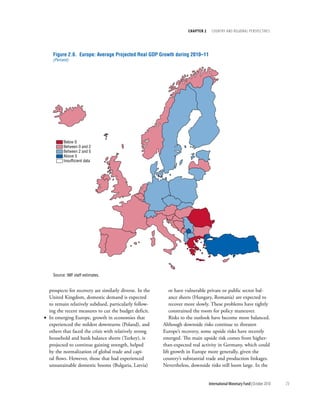
  • 107.
    chapter 2 cOuntry and regiOnal PersPectives but also by robust domestic demand in a number of economies (Table 2.7). Foreign inflows to the region, including official flows, FDI, and remit- Figure 2.15. Sub-Saharan Africa (SSA): Growth Is tances, were less affected by the global downturn Accelerating than had been feared, although the outlook remains uncertain (Figure 2.15). The slowdown in 2009 was brief, in part due to rapid implementation of countercyclical policies. A recovery in exports and commodity prices is helping The pickup in global demand and the strength- support the rebound, as is robust domestic demand in many economies. Nonportfolio flows have been stable. Although the United States is the main ening of oil prices are supporting growth in Africa’s trading partner of oil exporters, Europe is the main export destination for many oil-exporting economies. In the region’s largest oil low- and middle-income economies in the region. exporter, Nigeria, continued strong growth in the non-oil sector is being supported by increasing oil 15 SSA: Fiscal Net SSA: Export Growth 20 Lending/Borrowing (percent) production, a result of reduced instability in the (percent of GDP) 10 Niger Delta region. Thus, Nigeria’s output growth Oil exporters LIC 10 is expected to accelerate from 7 percent in 2009 5 SSA to 7.4 percent in both 2010 and 2011. Growth 0 0 in Angola, the region’s second-largest oil exporter, Oil -5 Low-income is also expected to recover in 2010, following the exporters -10 countries (LIC) SSA decline in oil exports and the tightening of its bud- -10 Middle-income MIC get in 2009. Angola’s growth is projected to increase countries (MIC) -15 -20 from less than 1 percent in 2009 to about 6 percent 2004 05 06 07 08 09 10 11 2004 05 06 07 08 09 10 11 in 2010 and about 7 percent in 2011. SSA: Terms of Trade SSA: Contributions to Growth1 Sub-Saharan Africa’s middle-income econo- 30 (percent change) (percent) 12 mies—whose output contracted in 2009 due to 20 Total 8 their stronger global trade linkages—are now SSA firmly on the path to recovery. The region’s larg- 10 4 est economy, South Africa, has benefited from 0 continued strong demand for commodities from LIC 0 -10 MIC emerging Asia and from a recovery in demand for Private consumption manufactures from its largest export market, the -20 Oil Public consumption -4 exporters Investment euro area. There are also signs that the monetary -30 Net exports -8 easing pursued last year is supporting a recovery in 2004 05 06 07 08 09 10 11 2004 05 06 07 08 09 10 11 domestic demand. After contracting by almost 2 SSA: Net Financial Flows SSA: Trade Linkages percent in 2009, South Africa’s output is expected (billions of U.S. dollars) (2009 exports by region; 100 percent of total exports) 140 to grow by 3 percent in 2010 and by 3.5 percent United States SSA 120 in 2011. 75 Europe Other Asia The relatively low degree of exposure of the 50 100 region’s low-income economies to international 80 25 trade and financial flows shielded them from the 60 worst of the global downturn. Correspondingly, 0 Remittances 40 the acceleration of growth this year is expected to Public aid -25 Private direct investment 20 be modest. Output growth in these economies is Private portfolio flows expected to rise from 4.5 percent in 2009 to 4.9 -50 2004 05 06 07 08 09 10 11 SSA Oil MIC LIC 0 percent in 2010, and further to 6 percent in 2011. exporters Growth in low-income economies is generally Sources: IMF, Direction of Trade Statistics; and IMF staff estimates. 1Excluding Liberia, São Tomé and Príncipe, and Zimbabwe. expected to be driven as much by domestic factors as by the global recovery. In Kenya, for example, a recovery in tourism inflows and an improvement in International Monetary Fund | October 2010 89
  • 108.
    wOrld ecOnOmic OutlOOk:recOvery, risk, and rebalancing Table 2.7. Selected Sub-Saharan African Economies: Real GDP, Consumer Prices, Current Account Balance, and Unemployment (Annual percent change, unless noted otherwise) Real GDP Consumer Prices1 Current Account Balance2 Unemployment3 Projections Projections Projections Projections 2009 2010 2011 2009 2010 2011 2009 2010 2011 2009 2010 2011 Sub-Saharan Africa 2.6 5.0 5.5 10.4 7.5 7.0 –1.7 –1.1 –1.9 ... ... ... Oil Exporters 5.0 6.7 7.0 11.6 11.3 9.4 6.0 8.2 7.4 ... ... ... Nigeria 7.0 7.4 7.4 12.4 11.9 9.8 14.1 13.0 11.8 4.5 4.5 4.5 Angola 0.7 5.9 7.1 13.7 13.3 11.3 –5.0 1.6 1.3 ... ... ... Equatorial Guinea 5.3 0.9 2.1 7.2 8.0 7.1 –16.0 –2.8 –11.6 ... ... ... Gabon –1.4 4.5 5.0 2.1 3.0 3.5 16.6 15.2 14.3 ... ... ... Chad –1.6 4.3 3.9 10.1 6.0 3.0 –33.7 –32.0 –25.4 ... ... ... Congo, Republic of 7.5 10.6 8.7 4.3 5.2 4.5 –7.7 4.2 7.9 ... ... ... Middle-Income –1.7 3.3 3.6 7.1 5.5 5.7 –4.1 –4.4 –5.8 ... ... ... South Africa –1.8 3.0 3.5 7.1 5.6 5.8 –4.0 –4.3 –5.8 24.3 24.8 24.4 Botswana –3.7 8.4 4.8 8.1 6.7 6.3 –2.1 –0.5 –0.4 ... ... ... Mauritius 2.5 3.6 4.1 2.5 2.5 2.6 –7.8 –9.4 –9.0 8.0 7.5 7.3 Namibia –0.8 4.4 4.8 9.1 6.5 5.9 –1.7 –2.6 –6.0 ... ... ... Swaziland 1.2 2.0 2.5 7.6 6.2 5.6 –6.2 –12.6 –12.3 30.0 30.0 30.0 Cape Verde 3.0 4.1 6.0 1.0 1.8 2.0 –9.9 –18.6 –18.2 17.0 17.0 17.0 Seychelles 0.7 4.0 5.0 31.8 –2.4 2.5 –35.1 –39.5 –35.5 5.1 4.6 4.1 Low-Income4 4.5 4.9 6.0 12.6 6.2 6.0 –6.8 –7.4 –8.3 ... ... ... Ethiopia 9.9 8.0 8.5 36.4 2.8 9.0 –5.0 –3.9 –8.0 ... ... ... Kenya 2.4 4.1 5.8 9.3 4.1 5.0 –6.7 –6.7 –7.4 ... ... ... Tanzania 6.0 6.5 6.7 12.1 7.2 5.0 –10.0 –8.8 –8.8 ... ... ... Cameroon 2.0 2.6 2.9 3.0 3.0 2.7 –2.7 –3.9 –4.1 ... ... ... Uganda 7.2 5.8 6.1 14.2 9.4 5.5 –4.0 –6.4 –9.2 ... ... ... Côte d’Ivoire 3.8 3.0 4.0 1.0 1.4 2.5 7.2 6.8 2.5 ... ... ... 1Movements in consumer prices are shown as annual averages. December–December changes can be found in Table A7 in the Statistical Appendix. 2Percent of GDP. 3Percent. National definitions of unemployment may vary. 4Includes Benin, Burkina Faso, Burundi, Central African Republic, Comoros, Democratic Republic of the Congo, Eritrea, The Gambia, Ghana, Guinea, Guinea-Bissau, Lesotho, Liberia, Madagascar, Malawi, Mali, Mozambique, Niger, Rwanda, São Tomé and Príncipe, Senegal, Sierra Leone, Togo, Zambia, and Zimbabwe. rainfall are expected to support the acceleration of weaker conditions in economies employing migrant output growth, to 4.1 percent in 2010. workers from sub-Saharan Africa. The primary risk to the outlook for the region Asset market spillovers resulting from increased is a faltering global recovery. But different econo- global volatility or risk aversion are likely to be lim- mies in the region have differing exposures. For the ited. Portfolio flows are a less critical component of oil-exporting economies, spillovers from a global overall capital flows in sub-Saharan Africa than in the slowdown would be manifested primarily through rest of the world, and most economies in the region its impact on oil prices. In contrast, middle- and have relatively underdeveloped financial markets. low-income economies’ exposure comes from their South Africa is the notable exception: its equity and exports to Europe, which are about one-third of currency markets are often more sensitive to shifts total exports, nearly four times the share of their in global sentiment than other emerging markets in exports to the United States. In addition to these Asia or Latin America, because nonresident transac- trade linkages, continued weakness and measures tions account for a relatively high share of turnover. to cut budget deficits in advanced economies may Finally, with the recovery in progress, fiscal poli- affect the low-income economies of sub-Saharan cies in many economies in the region should begin Africa by reducing aid and private financial flows addressing medium-term priorities. As private and to the region. For example, remittances are an external demand recovers, economies will need important source of foreign inflows to the region, to rebuild fiscal room and reorient its use. Where amounting, for example, to almost 10 percent output growth has recovered, debt levels are rising, of GDP in Senegal. These may be susceptible to and primary deficits are above levels that will stabilize 90 International Monetary Fund | October 2010
  • 109.
    chapter 2 cOuntry and regiOnal PersPectives debt over the medium term, more prudent fiscal bal- Financial, and Remittance Channels,” IMF Working ances are in order. However, where output growth is Paper No. 09/277 (Washington: International Mon- still weak, outstanding debt is low, and fiscal deficits etary Fund). Available at www.imf.org/external/pubs/ft/ are in check, there may be scope to sustain higher wp/2009/wp09277.pdf. levels of spending in priority areas such as educa- Cheung, Yin-Wong, and Xingwang Qian, 2009, “Hoarding of International Reserves: Mrs. Machlup’s Wardrobe and tion, health, and infrastructure investment. One the Joneses,” Review of International Economics, Vol. 17, of the positive aspects of the response to the recent No. 4, pp. 824–43. downturn was the ability of many economies in the International Monetary Fund (IMF), 2010a, “How Did region to shield such pro-poor and pro-growth public Emerging Markets Cope in the Crisis?” IMF Policy Paper spending. As highlighted in the April 2010 Regional (Washington: International Monetary Fund). Available at Economic Outlook: Sub-Saharan Africa, spending on www.imf.org/external/np/pp/eng/2010/061510.pdf. health and education actually increased in real terms ——, 2010b, “Reserve Accumulation and International in 20 of 29 low-income economies in 2009. Public Monetary Stability,” IMF Policy Paper (Washington: capital spending also increased in real terms in half International Monetary Fund). Available at www.imf.org/ the economies in the region. external/np/pp/eng/2010/041310.pdf. _____, 2010c, People’s Republic of China: 2010 Article IV Consultation—Staff Report; Staff Statement; Public Infor- references mation Notice on the Executive Board Discussion, IMF Alturki, Fahad, Jaime Espinosa-Bowen, and Nadeem Ilahi, Staff Country Report No. 10/238 (Washington). Available 2009, “How Russia Affects the Neighborhood: Trade, at www.imf.org/external/pubs/ft/scr/2010/cr10238.pdf. International Monetary Fund | October 2010 91
  • 111.
    1 3 chapter hapter Will it hurt? MacroeconoMic effects of fiscal consolidation This chapter examines the effects of fiscal consolidation large spending cuts and tax hikes. An important —tax hikes and government spending cuts—on economic and timely question is, therefore, whether fiscal activity. Based on a historical analysis of fiscal consolida- retrenchment will hurt economic performance. tion in advanced economies, and on simulations of the Although there is widespread agreement that IMF’s Global Integrated Monetary and Fiscal Model reducing debt has important long-term benefits, (GIMF), it finds that fiscal consolidation typically reduces there is no consensus regarding the short-term output and raises unemployment in the short term. At effects of fiscal austerity. On the one hand, the the same time, interest rate cuts, a fall in the value of conventional Keynesian view is that cutting spend- the currency, and a rise in net exports usually soften the ing or raising taxes reduces economic activity in the contractionary impact. Consolidation is more painful short term. On the other hand, a number of studies when it relies primarily on tax hikes; this occurs largely present evidence that cutting budget deficits can because central banks typically provide less monetary stimulate the economy even in the short term. The stimulus during such episodes, particularly when they notion that fiscal retrenchment stimulates growth involve indirect tax hikes that raise inflation. Also, fiscal in the short term is often referred to as the “expan- consolidation is more costly when the perceived risk of sionary fiscal contractions” hypothesis. A key factor sovereign default is low. These findings suggest that budget explaining such effects is an improvement in house- deficit cuts are likely to be more painful if they occur hold and business confidence.2 The truth could be simultaneously across many countries, and if monetary a mixture. For example, it may be that the short- policy is not in a position to offset them. Over the long term effects are usually contractionary, but that term, reducing government debt is likely to raise output, expansionary effects can occur when government as real interest rates decline and the lighter burden of solvency is in question, or when the consolidation is interest payments permits cuts to distortionary taxes. structured in a way that increases confidence. This chapter offers new evidence regarding these Budget deficits and government debt soared during important issues by studying fiscal consolidation the Great Recession. In 2009, the budget deficit in advanced economies over the past 30 years. It averaged about 9 percent of GDP in advanced examines budget policies to identify periods of economies, up from only 1 percent of GDP in fiscal consolidation, and then uses simple statisti- 2007.1 By the end of 2010, government debt is cal techniques to investigate the short-term growth expected to reach about 100 percent of GDP—its effects of consolidation and how those effects are highest level in 50 years. Looking ahead, population influenced by such factors as monetary policy, aging could create even more serious problems for international trade, the form of the consolidation, public finances. and perceived sovereign risk. To complement the In response to these worrisome developments, historical analysis, the chapter employs simulations virtually all advanced economies will face the of the IMF’s GIMF to explore additional issues challenge of fiscal consolidation. Indeed, many such as the long-term effects of debt reduction. In governments are already undertaking or planning particular, the chapter attempts to answer the fol- lowing questions: The main authors of this chapter are Daniel Leigh (team leader), Pete Devries, Charles Freedman, Jaime Guajardo, Doug- las Laxton, and Andrea Pescatori, with support from Murad 2 For a summary of how such expansionary effects can arise Omoev, Min Kyu Song, and Jessie Yang. in the short term, see, for example, Alesina (2010). Under some 1Advanced economies are defined as the 33 economies so strict assumptions, Ricardian equivalence can imply that fiscal designated based on the World Economic Outlook classification consolidation has no impact on economic activity, as changes in described in the Statistical Appendix. private demand exactly offset changes in government demand. International Monetary Fund | October 2010 93
  • 112.
    wOrld ecOnOmic OutlOOk:recOvery, risk, and rebalancing • What are the short-term effects of fiscal retrench- biases the analysis toward downplaying contraction- ment on economic activity? Does output ary effects and overstating expansionary ones. typically contract or expand in response to tax To avoid the problems associated with these hikes and spending cuts? What happens to existing studies, we use an alternative method unemployment? for identifying periods of fiscal consolidation. In • What factors dampen or exacerbate the short- particular, our approach focuses on policy actions term effects? In particular, what are the roles of intended to reduce the budget deficit. As we monetary policy, the composition of the package explain later, this approach helps us obtain more (taxes versus spending), and the perceived risk of accurate estimates of the effects of tax hikes and sovereign default in shaping the outcome? What spending cuts on economic activity. Methodologi- are the consequences of many countries cutting cally, our approach is close to that of Romer and deficits at the same time? Romer (1989, 2010), who examine the effects on • Does fiscal consolidation have different effects U.S. output of changes in monetary policy and tax when interest rates are near zero? Interest rates rates in the United States. have rarely been near zero in the past––with the The main findings of the chapter are as follows: exception of Japan since the 1990s––but they are • Fiscal consolidation typically has a contraction- near zero in many advanced economies today. ary effect on output. A fiscal consolidation equal Would fiscal consolidation in this environment to 1 percent of GDP typically reduces GDP by be more or less painful than in the past? about 0.5 percent within two years and raises • What are the long-term effects on output of the unemployment rate by about 0.3 percentage reducing government debt? Do the long-term point. Domestic demand—consumption and effects depend on whether the savings from lower investment—falls by about 1 percent. interest payments are used to provide tax cuts or • Reductions in interest rates usually support to finance new spending? output during episodes of fiscal consolidation. Given the importance of these issues, this chapter Central banks offset some of the contractionary is not the first to address them. In particular, previ- pressures by cutting policy interest rates, and ous work by Giavazzi and Pagano (1990, 1996), longer-term rates also typically decline, cushion- Alesina and Perotti (1995, 1997), and Alesina and ing the impact on consumption and investment. Ardagna (1998, 2010) has been extremely influ- For each 1 percent of GDP of fiscal consolida- ential in the debate regarding the consequences of tion, interest rates usually fall by about 20 basis fiscal adjustment.3 A key conclusion of these studies points after two years. The model simulations is that fiscal adjustments tend to be expansion- also imply that, if interest rates are near zero, the ary when they rely primarily on spending cuts.4 effects of fiscal consolidation are more costly in However, these studies often identify periods of terms of lost output.5 fiscal consolidation using a statistical concept––the • A decline in the real value of the domestic cur- increase in the cyclically adjusted budget surplus–– rency typically plays an important cushioning that, as this chapter shows, is a highly imperfect role by spurring net exports and is usually due measure of actual policy actions. The chapter finds to nominal depreciation or currency devalu- that this way of selecting cases of consolidation ation. For each 1 percent of GDP of fiscal consolidation, the value of the currency usually falls by about 1.1 percent, and the contribu- 3 Note that the literature on fiscal consolidation is part of a broader empirical literature on the effects of fiscal policy, which includes, among others, the work of Blanchard and Perotti 5 For simplicity, the model simulations ignore the possibil- (2002), Barro and Redlick (2009), Hall (2009), Ramey and ity that the central bank responds to fiscal consolidation using Shapiro (1998), Ramey (2009), and Romer and Romer (2010). unconventional monetary tools, such as quantitative and credit 4 Many studies have followed the Alesina and Perotti (1995) easing. To the extent that such tools would be used to support methodology, including Broadbent and Daly (2010), Tsibouris output, the simulations may overstate the impact of the zero and others (2006), and Von Hagen and Strauch (2001). interest rate floor. 94 International Monetary Fund | October 2010
  • 113.
    chapter 3 will it Hurt? macrOecOnOmic effects Of fiscal cOnsOlidatiOn tion of net exports to GDP rises by about 0.5 looking at history: What is the short-term percentage point. Because not all countries can impact of fiscal consolidation? increase net exports at the same time, this find- In this section, we examine the history of fiscal ing implies that fiscal contraction is likely to be retrenchment in advanced economies over the past more painful when many countries adjust at the 30 years and evaluate the short-term effects on eco- same time. nomic activity. The section starts by explaining how • Fiscal contraction that relies on spending cuts we identify periods of fiscal consolidation, and con- tends to have smaller contractionary effects than trasts our approach to the standard approach used tax-based adjustments. This is partly because in previous studies. It then reports the estimated central banks usually provide substantially more effects of fiscal consolidation, and compares our stimulus following a spending-based contraction results with those based on the standard approach. than following a tax-based contraction. Monetary stimulus is particularly weak following indirect tax hikes (such as the value-added tax, VAT) that identifying cases of fiscal consolidation raise prices. The usual approach to identifying historical • Fiscal retrenchment in countries that face a cases of fiscal retrenchment is to focus on swings higher perceived sovereign default risk tends to in the cyclically adjusted primary budget bal- be less contractionary. However, even among ance (CAPB). The CAPB is calculated by taking such high-risk countries, expansionary effects are the actual primary balance––non-interest revenue unusual. minus non-interest spending––and subtracting the • Model simulations suggest that over the long estimated effect of business cycle fluctuations on term, reducing debt is likely to be beneficial. the fiscal accounts. For example, Alesina and Perotti In particular, the GIMF simulations considered (1995) and Alesina and Ardagna (2010) correct here suggest that lower government debt lev- the primary surplus for year-to-year changes in the els reduce real interest rates, which stimulates unemployment rate.6 Cyclical adjustment offers an private investment. Also, the lower burden of intuitive way of dealing with the fact that tax rev- interest payments creates fiscal room for cutting enue and government spending move automatically distortionary taxes. Both of these effects raise with the business cycle. The idea is that, once they output in the long term. Overall, the simulations are cyclically adjusted, changes in fiscal variables imply that for every 10 percentage point fall in reflect policymakers’ decisions to change tax rates the debt-to-GDP ratio, output rises by about and spending levels. A sharp increase in the CAPB 1.4 percent in the long term. would therefore provide evidence of deliberate deep The remainder of the chapter is organized as deficit cuts. follows. The first section provides an empiri- However, the conventional approach used to cal assessment of the short-term impact of fiscal identify cases of fiscal consolidation is far from consolidation using a new database of historical perfect and can bias the results toward finding episodes of fiscal consolidation during 1980–2009. The second section complements the histori- cal analysis by conducting model simulations to 6 In particular, these studies use a method proposed by address additional issues, such as the consequences Blanchard (1990) following which “the cyclically adjusted value of being near the zero bound on nominal inter- of the change in a fiscal variable is the difference between a measure of the fiscal variable in period t computed as if the est rates, the impact of having many countries unemployment rate were equal to the one in t − 1 and the actual consolidating simultaneously, and the long-term value of the fiscal variable in year t – 1” (Alesina and Ardagna, consequences of reducing debt levels. The conclud- 2010, p. 7). Most studies also use a statistical threshold for iden- ing section draws lessons from the analysis for tifying large increases in the CAPB. For example, Alesina and Ardagna (2010) identify a period of fiscal adjustment as a year countries considering fiscal consolidation in the in which the ratio of the CAPB to GDP improves by at least 1.5 current environment. percentage points. International Monetary Fund | October 2010 95
  • 114.
    wOrld ecOnOmic OutlOOk:recOvery, risk, and rebalancing expansionary effects.7 Two key problems relate to first country than for the second country, despite measurement errors and to policy motivation: the presence of identical consolidation measures. • The first problem is that cyclical adjustment The standard approach would therefore tend to methods suffer from measurement errors that are miss cases of consolidation followed by adverse likely to be correlated with economic develop- shocks, because there may be little or no rise in ments. For example, standard cyclical-adjustment the CAPB despite the consolidation measures. methods fail to remove swings in government The case of Germany in 1982 provides a real- tax revenue associated with asset price or com- world counterpart to this hypothetical example: modity price movements from the fiscal data, the CAPB-to-GDP ratio rose by only 0.4 per- resulting in changes in the CAPB that are not centage point, despite the fact that the authorities necessarily linked to actual policy changes.8 Thus, implemented fiscal austerity measures amounting including episodes associated with asset price to about 1.4 percent of GDP.11 The impact of booms––which tend to coincide with economic these measures on the CAPB was partly offset by expansions––and excluding episodes associated countercyclical stimulus measures introduced in with asset price busts from the sample introduces response to the recession that year.12 an expansionary bias.9 For example, in the case Moreover, the problems with the usual approach of Ireland in 2009, the collapse in stock and are not just hypothetical or limited to a few specific housing prices induced a sharp reduction in the cases. As we show in Appendix 3.3, the change in the CAPB despite the implementation of tax hikes CAPB-to-GDP ratio is an unreliable guide regard- and spending cuts totaling 4.5 percent of GDP.10 ing the presence of fiscal consolidation. The standard • The second problem with the standard approach approach tends to select periods associated with favor- is that it ignores the motivation behind fiscal able outcomes but during which no austerity measures actions. Thus, it omits years during which actions were actually taken. It also tends to omit cases of fiscal aimed at fiscal consolidation were followed by austerity associated with unfavorable outcomes. an adverse shock and an offsetting discretion- Therefore, rather than focusing on the CAPB, ary stimulus. For example, imagine that two we look at policy actions. In particular, we identify countries adopt identical consolidation policies, cases in which the government implemented tax but then one is hit by an adverse shock and so hikes or spending cuts (at the general government adopts discretionary stimulus, while the other is level) to reduce the budget deficit and put pub- hit with a favorable shock. Here, the change in lic finances on a more sustainable footing. Thus, the CAPB would show a smaller increase for the whereas the usual strategy identifies periods of con- 7 Appendix 3.3 provides a number of specific examples solidation based on successful (cyclically adjusted) that illustrate the problems associated with the conventional budget outcomes, our approach identifies episodes approach. based on fiscal policy actions motivated by deficit 8 As Morris and Schuknecht (2007) explain, “asset price reduction, irrespective of the outcomes. movements are a major factor behind unexplained changes in the cyclically adjusted balance, which, if not accounted for, can lead to erroneous conclusions regarding underlying fiscal develop- 11 The source of the data for the CAPB-to-GDP ratio is Ale- ments” (p. 4). sina and Ardagna (2010). The concept of government used for 9 A similar problem occurs during sharp recessions. As the CAPB is that of the general government. Wolswijk (2007) explains, standard cyclical adjustment methods 12 For similar reasons, the standard approach is likely to iden- assume that the automatic response (elasticity) of fiscal variables tify cases of fiscal tightening that are unrelated to deficit-reduc- to the business cycle is constant over time. However, there is tion concerns. For example, imagine that two countries adopt no evidence that sharp recessions have a stronger-than-average auto- consolidation measures, but then one is hit by a favorable shock matic effect on fiscal variables. Therefore, if a fiscal consolidation and so adopts countercyclical tightening to cool the economy, coincides with a sharp recession, it is less likely to be picked up while the other does nothing. Here, the change in the CAPB by the standard approach, which searches for an increase in the would show tightening for the first country, and no change for CAPB. the second country, despite the lack of consolidation measures in 10 See 2009 OECD Economic Surveys: Ireland; EC (2008); both countries. The standard approach would therefore tend to and 2009 IMF Staff Report for Ireland (Country Report No. include cases associated with economic booms despite the lack of 09/195). measures aimed at fiscal consolidation. 96 International Monetary Fund | October 2010
  • 115.
    chapter 3 will it Hurt? macrOecOnOmic effects Of fiscal cOnsOlidatiOn Although our action-based approach addresses Developments reports, country budget documents, the problems associated with the conventional and additional country-specific sources.13 The approach to identifying fiscal consolidation, both estimated effect on the budget deficit is based on the standard approach and our approach are subject these sources. In this respect, our methodology is to two additional criticisms. First, if countries closely related to the “narrative approach” proposed sometimes postpone fiscal consolidation until the by Romer and Romer (1989, 2004, 2010).14 The economy recovers, then the consolidation exercise analysis also distinguishes between permanent will be associated with good economic outcomes in and temporary measures. Temporary measures are both the standard approach and our approach. Sec- recorded as generating positive savings when they ond, if a country is committed to a deficit-reduc- are introduced and negative savings when they tion path and the economy falls into a recession, expire. it may implement additional fiscal consolidation The sample includes the fiscal actions taken to measures, thus associating fiscal consolidation with reduce the deficit in 15 advanced economies during unfavorable economic outcomes in both the stan- 1980–2009.15 The main reason the analysis focuses dard approach and our approach. Thus, biases may on advanced economies is that fiscal policy adjust- remain even in our approach, although it is unclear ment needs are particularly large, on average, for in which direction they would go overall. the group of advanced economies, as discussed in In addition, in contrast to some previous studies, the IMF’s May 2010 Fiscal Monitor (IMF, 2010). we do not focus on periods of “sustained” (mul- For the 15 countries covered—Australia, Bel- tiyear) fiscal consolidation. A key problem with gium, Canada, Denmark, Finland, France, Ger- such an approach is that governments may choose many, Ireland, Italy, Japan, Portugal, Spain, Sweden, to interrupt a program of fiscal austerity due to the United Kingdom, and the United States—we unfavorable output developments. For example, identified 173 years in which there were budget- Japan’s six-year fiscal adjustment plan, initiated in ary measures aimed at fiscal consolidation. Thus, 1997, was suspended in December 1998 following on average across the sample countries, about 40 a sharp economic downturn. In contrast, favorable percent of years saw the introduction of budget- output developments are likely to help governments ary measures aimed at reducing the deficit (Figure complete a sustained fiscal consolidation. Therefore, 3.1). The average size of fiscal consolidation was focusing on cases of sustained consolidation would about 1 percent of GDP per year, but the range was bias toward finding expansionary effects. wide (see Figure 3.1). Fiscal contractions of more In sum, not only does the standard approach 13 Additionalcountry-specific sources used to clarify the sometimes select years that bear no relation to motivation behind the fiscal consolidation measures include actual changes in fiscal policy, it also biases the Kuttner and Posen (2002), Nakagawa (2009), and Takahashi results toward downplaying contractionary effects and Tokuoka (2010) for Japan; Lawson (1992) for the United and overstating the expansionary effects of fiscal Kingdom; and Romer and Romer (2009) and the sources cited therein, for the United States. We find that the estimates of the adjustment. In contrast, a key contribution of this measures’ expected impact on the fiscal deficit at the time they chapter is to reduce these bias problems and there- were implemented are similar across the various sources. 14 Focusing on the United States, Romer and Romer (2010) fore allow us to better estimate the causal impact on use the narrative record, such as congressional reports, to identify output of fiscal consolidation. the size and motivation for all post–World War II tax policy actions. They find that only a small share of observed changes in government revenue reflect actual changes in tax policy and use implementing the action-Based approach the changes in tax policy identified by means of their narrative approach to obtain estimates of the causal impact of tax changes Our approach requires identifying policy actions on the economy. motivated by deficit reduction. Therefore, we exam- 15 The complete list of periods of fiscal adjustments is reported ine accounts and records of what countries actu- in Appendix 3.1. A companion paper, available on request, shows how we implement the approach. In particular, it provides ally did. In particular, we analyze OECD Economic quotations and citations for each case to show how we deter- Surveys, IMF Staff Reports, IMF Recent Economic mined the presence of fiscal consolidation measures. International Monetary Fund | October 2010 97
  • 116.
    wOrld ecOnOmic OutlOOk:recOvery, risk, and rebalancing than 1.5 percent of GDP per year represent about one-fifth of all cases of consolidation. Therefore, on average, countries implemented such large fiscal adjustments once every 14 years. As we show later on, the estimated effects of these large adjustments on output are similar to the effects of smaller adjustments. Figure 3.1. Action-Based Fiscal Consolidation There were about 170 cases of action-based fiscal consolidation over the past 30 estimated effects of fiscal consolidation years in advanced economies. Consolidation has often relied primarily on spending cuts. On average, action-based fiscal consolidation amounted to With periods of fiscal consolidation now identi- 1 percent of GDP a year, but the range was wide. fied, this section employs statistical techniques to assess the impact of the fiscal measures on economic Fiscal Consolidation over Time 14 (number of fiscal contractions by year) activity. The statistical methodology is standard and Spending-based 12 follows that of Cerra and Saxena (2008), Romer Tax-based Other 10 and Romer (2010), and others. In particular, we 8 estimate the average impulse response of output to action-based fiscal consolidation using panel data 6 analysis. The estimated equation makes use of an 4 autoregressive model in growth rates estimated on 2 annual data for 1980–2009 for the 15 countries in 0 our sample. The growth rates are then cumulated to 1980 85 90 95 2000 05 10 obtain the estimated impact of fiscal consolidation Size of Fiscal Consolidation 60 on the level of output.16 (in percent of GDP a year) A key result is that fiscal consolidation is typi- 50 cally contractionary. A fiscal consolidation equal to 40 1 percent of GDP typically reduces real GDP by 30 about 0.5 percent after two years (Figure 3.2). The effect on the unemployment rate is an increase of 20 10 0 16 In particular, the estimated equation has the growth rate of 0 1 2 3 4 real GDP as the dependent variable on the left-hand side. On Source: IMF staff calculations. the right-hand side, the explanatory variables are the current and Note: The 15 advanced economies in the sample are Australia, Belgium, Canada, lagged values of the fiscal consolidation measures identified as Denmark, Finland, France, Germany, Ireland, Italy, Japan, Portugal, Spain, Sweden, discussed above. Including lags allows for a delayed impact of fis- United Kingdom, and United States. “Spending-based” consolidation relied primarily on spending cuts. “Tax-based” consolidation relied primarily on tax hikes. The “other” cal consolidation on growth. In addition, the approach controls category denotes contractions for which composition details were either not available for lags of real GDP growth, to distinguish the effect of fiscal or for which no category accounted for the majority of the adjustment. consolidation from that of normal output dynamics. Thus, the equation estimated is 2 2 git 5 a 1 ∑ bj gi,t–j 1 ∑ bs ABFCi,t–s 1 mi 1 lt 1 nit , j=1 s=0 where the subscript i denotes the ith country, and the subscript t denotes the tth year; g is the percent change in real GDP; and ABFC is the estimated size of the action-based fiscal consolida- tion measures as a percent of GDP. The approach includes a full set of country dummies (mi ) to take account of differences among countries’ normal growth rates. The estimated equation also includes a full set of time dummies (lt ) to take account of global shocks such as shifts in oil prices or the global business cycle. 98 International Monetary Fund | October 2010
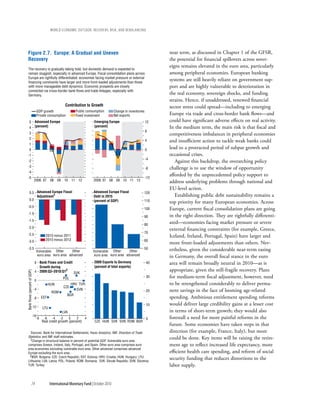
  • 117.
    chapter 3 will it Hurt? macrOecOnOmic effects Of fiscal cOnsOlidatiOn about 0.3 percentage point after two years.17 The results are statistically significant at conventional levels. Overall, the idea that fiscal austerity stimu- lates economic activity in the short term finds little support in the data.18 However, the average effect of fiscal consolidation shown in Figure 3.2 hides a range of experiences related to a number of factors. In particular, we now turn to three key factors that shape the out- comes: the role of interest rates and exchange rates, Figure 3.2. Impact of a 1 Percent of GDP Fiscal the composition of the fiscal package, and the role Consolidation on GDP and Unemployment of perceived sovereign risk of the country undertak- ing the consolidation. Fiscal consolidation is normally contractionary. A fiscal consolidation equal to 1 percent of GDP typically reduces real GDP by about 0.5 percent and raises the unemployment rate by about 0.3 percentage point. the Mitigating role of interest rates and exchange rates GDP (percent) Unemployment rate (percentage points) This section looks at the role of interest rate 0.6 cuts and declines in the value of the currency in mitigating the impact of fiscal consolidation. In 0.4 addition, to clarify how interest rates and exchange rates shape the outcome, we examine the behavior 0.2 of the components of GDP, including exports and imports. To explore these channels, we use the same 0.0 statistical approach as described above, but apply it to studying the impact of fiscal consolidation -0.2 on exchange rates and interest rates instead of on output.19 -0.4 -0.6 17 To explore the impact on the unemployment rate, we -0.8 0 1 2 3 replace all the GDP growth terms in the estimated equation with the change in the unemployment rate. We then cumulate the Source: IMF staff calculations. impulse responses to obtain the impact of fiscal consolidation on Note: t = 1 denotes the year of consolidation. Dotted lines equal one standard error the level of the unemployment rate. bands. 18Several robustness checks were performed, as reported in Appendix 3.2. In particular, excluding lags of growth had little effect on the results; using different lag lengths (up to four) yielded similar results. Although the country dummies are correlated with the lagged dependent variables in the estimated equation, the bias is small here given the large number of obser- vations per country relative to the number of countries (30 years for each of our 15 countries). When the estimation is conducted using the Arellano-Bond estimator, which corrects for this pos- sible bias, the results are very similar. 19For example, to examine the response of the real exchange rate to fiscal consolidation, we repeat the estimation of the equa- tion described above, while replacing all the GDP growth terms with the change in the log of the real exchange rate. We then cumulated the impulse responses to obtain the impact of fiscal consolidation on the (log) level of the real exchange rate. International Monetary Fund | October 2010 99
  • 118.
    wOrld ecOnOmic OutlOOk:recOvery, risk, and rebalancing Interest rates The short-term policy interest rate typically falls by about 20 basis points in response to a fiscal con- solidation of 1 percent of GDP (Figure 3.3). Since the rate of inflation usually does not change much following fiscal consolidation, the fall in real interest rates is similar. At the same time, the long-term nominal interest rate on government bonds falls Figure 3.3. Response of Monetary Conditions to a 1 broadly in line with short-term rates. In particular, Percent of GDP Fiscal Consolidation the yield on government bonds with a maturity of Interest rate cuts and a decline in the value of the domestic currency usually play 10 years declines by about 15 basis points after two a key supportive role during episodes of fiscal consolidation. years in response to a fiscal consolidation equal to 1 percent of GDP. The response of long-term rates Interest Rate 10 (basis points) suggests that fiscal consolidation may reduce risk premiums.20 0 Exchange rates Long-term -10 In response to a fiscal consolidation of 1 percent (ten-year) Short-term of GDP, the exchange rate depreciates by about (policy) -20 1.1 percent in real terms (see Figure 3.3). Interest- ingly, this real depreciation is almost fully explained -30 by nominal exchange rate depreciation or currency 0 1 2 3 devaluation. Examples of large devaluations during Exchange Rate 0.5 fiscal consolidation include, among others, Finland (percent) (1992), Ireland (1987), and Italy (1992). 0.0 Transmission channel: the role of net exports -0.5 Real How do these changes in interest rates and Nominal -1.0 exchange rates affect the economy? The fall in interest rates is likely to support consumption and -1.5 investment. And the real depreciation should sup- port economic activity by boosting net exports. -2.0 0 1 2 3 Decomposing the response of GDP into its demand components confirms that net exports Source: IMF staff calculations. Note: t = 1 denotes the year of consolidation. Dotted lines equal one standard error expand in response to fiscal consolidation, provid- bands. ing a key cushioning role. In particular, the contri- bution of net exports to GDP increases by about 0.5 percentage point (Figure 3.4). The increase in net exports reflects both an increase in real exports in response to the real exchange rate depreciation 20 The effect of fiscal consolidation on longer-term interest rates may be influenced by two factors: the decline in the cur- rent and future short-term interest rate and a reduction in the risk premium related to the perceived improvement in the fiscal outlook. 100 International Monetary Fund | October 2010
  • 119.
    chapter 3 will it Hurt? macrOecOnOmic effects Of fiscal cOnsOlidatiOn and a decline in real imports, which also reflects the fall in income (see Figure 3.4).21 Meanwhile, domestic demand (consumption and investment) declines substantially in response to fiscal retrenchment. In particular, a consolidation of 1 percent of GDP reduces the contribution of domestic demand to GDP by about 1 percentage point after two years. This result is broadly consis- tent with textbook (Keynesian) effects on demand Figure 3.4. Impact of a 1 Percent of GDP Fiscal of spending cuts and tax hikes. Consolidation on GDP Components Overall, this section confirms that a fall in the (Percent) value of the currency plays a key role in soften- Net exports typically expand in response to fiscal consolidation, providing a key ing the impact of fiscal consolidation on output cushion for GDP. In contrast, domestic demand contracts. The boom in net exports reflects both an increase in exports in response to the real exchange rate through the impact on net exports. Without this depreciation and a decline in imports reflecting the fall in income. increase in net exports, the output cost of fiscal consolidation would be roughly twice as large, with Domestic demand contribution 1.0 Net exports contribution output falling by 1 percent instead of 0.5 percent. Cuts in interest rates also help cushion the impact 0.5 on consumption and investment. 0.0 -0.5 taxes versus spending: does composition Matter? Does the composition of fiscal consolidation -1.0 across taxes and spending matter? A number of -1.5 studies suggest that fiscal contraction associated 0 1 2 3 primarily with declines in spending is accompanied Imports 2 by an expansion of the economy in the short term, Exports whereas adjustments based primarily on revenue increases feature output contractions.22 In this sec- 1 tion, using our data set of periods of action-based fiscal consolidation, we revisit these stylized facts to 0 test whether the composition of consolidation mea- sures makes a difference in terms of their impact on -1 growth. We also investigate the role of interest rates and exchange rates in explaining the effects of dif- -2 0 1 2 3 ferent types of fiscal consolidation measures. Source: IMF staff calculations. Basic results Note: t = 1 denotes the year of consolidation. Dotted lines equal one standard error bands. To address the issue, we repeat the estimation approach used above for two types of fiscal con- 21 Since the analysis controls for shifts in global demand (time dummies), the estimated increase in exports does not reflect an upswing in external demand. Also, the estimated response of exports and imports is consistent with that implied by standard elasticities with respect to the real exchange rate, as reported, for example, in Bayoumi and Faruqee (1998). 22 See, for example, Alesina and Perotti (1995, 1997), Alesina and Ardagna (2010), Broadbent and Daly (2010), and others. International Monetary Fund | October 2010 101
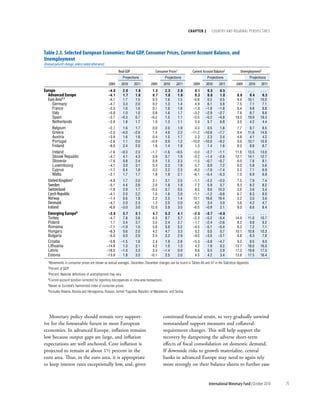
  • 120.
    wOrld ecOnOmic OutlOOk:recOvery, risk, and rebalancing solidation. The first type, denoted “tax-based,” Why are spending-based adjustments less corresponds to years in which the contribution of contractionary? tax hikes to fiscal consolidation is greater than the Much of the difference is due to the response contribution of spending cuts. The second type, of monetary conditions to fiscal consolidation: denoted “spending-based,” corresponds to years in interest rates and the value of the currency tend to which the contribution of spending cuts to fiscal fall more following spending-based consolidation consolidation is greater than that of tax hikes.23 (Figure 3.6). Existing estimates in the literature The following main results emerge from the can provide a rough sense of how much of the analysis: difference in output performance stems from the • Spending-based adjustments are less contraction- difference in monetary conditions. The difference ary than tax-based adjustments. In the case of in interest rate responses between tax-based and tax-based programs, the effect of a fiscal con- spending-based fiscal consolidation is about 50 basis solidation of 1 percent of GDP on GDP is –1.3 points in the first year (see Figure 3.6).25 Mean- percent after two years (Figure 3.5). In the case while, the output cost for tax-based consolidation of spending-based programs, the effect is –0.3 exceeds that for spending-based consolidation by percent after two years, and is not statistically about 0.3 percentage point in the first year and by significant.24 Similarly, while deficit cuts that about 1 percentage point in the second year (see rely on tax hikes raise the unemployment rate Figure 3.5). Therefore, for the difference in output by about 0.6 percentage point, spending-based outcomes to be attributable entirely to the different deficit cuts raise the unemployment rate only monetary policy responses, a 100 basis point rise by about 0.2 percentage point (see Figure 3.5). in interest rates would need to reduce output by However, as will be shown below, a key rea- about 0.6 percent in the first year and 2 percent in son the costs of spending-based deficit cuts are the second. Such impacts are within the range of relatively small is that they typically benefit from estimates found in the empirical literature, though a large dose of monetary stimulus, as well as an toward the high end.26 Thus, it appears that the expansion in exports. difference in monetary policy responses accounts for • Domestic demand contracts for both types of much, though probably not all, of the difference in fiscal consolidation, but by more in the case of output performance. tax-based packages. In particular, in the case of These findings are in line with the notion that spending-based measures, domestic demand falls central banks view spending-based deficit cuts more by about 0.9 percent after two years, whereas the favorably, possibly because they interpret them as a decline exceeds 1.8 percent in the case of tax- signal of a stronger commitment to fiscal discipline, based packages (see Figure 3.5). and are therefore more willing to provide monetary • A rise in net exports mitigates the impact of the stimulus following spending-based adjustments. It is consolidation on GDP in both cases. However, also plausible that an increase in taxes, if it involves there is a considerably larger improvement in indirect tax hikes (sales and excise taxes, VAT), exports associated with spending-based measures raises inflation on impact, making interest rate cuts than with tax-based measures, whereas imports fall more for tax-based adjustments (see Figure 3.5). 25 Note that part of the effect of interest rates on output works through the exchange rate. Therefore, to avoid double counting, the difference in output costs due to the difference in exchange rate behavior is not considered separately here. 26 Romer and Romer (2004) find that an unexpected 100 23 Similar results are obtained if the tax-based type corresponds basis point increase in interest rates reduces output (measured to years in which the contribution of tax hikes to fiscal consoli- by industrial production) by 4.3 percent after two years. Sims dation was more than 60 percent of the total; the same holds (1992) estimates the maximum impact on industrial production true for the spending-based type. at about –1.5 percent, while Bernanke and Mihov (1998) and 24 The difference between the tax-based and spending-based Christiano, Eichenbaum, and Evans (1996) find a maximum responses is strongly statistically significant. effect on real GDP close to –1 percent. 102 International Monetary Fund | October 2010
  • 121.
    chapter 3 will it Hurt? macrOecOnOmic effects Of fiscal cOnsOlidatiOn Figure 3.5. Impact of a 1 Percent of GDP Fiscal Consolidation: Taxes versus Spending Spending-based consolidation is less contractionary than tax-based consolidation. GDP falls by less and unemployment increases less. Domestic demand contracts significantly as a result of both spending-based and tax-based consolidation, but the contraction is sharper after tax-based adjustments. A boom in net exports mitigates the contraction in both cases. A surge in exports drives the net export boom associated with spending-based consolidation. After tax-based consolidation, net exports rise mainly because imports fall. Tax-based Spending-based 0.5 GDP Net Exports Contribution 1.0 (percent) (percent) 0.0 0.8 -0.5 0.6 -1.0 0.4 -1.5 0.2 -2.0 0.0 -2.5 -0.2 0 1 2 3 0 1 2 3 1.0 Unemployment Rate Exports 2 (percentage points) (percent) 0.8 1 0.6 0.4 0 0.2 -1 0.0 -0.2 -2 0 1 2 3 0 1 2 3 1 Domestic Demand Contribution Imports 1 (percent) (percent) 0 0 -1 -1 -2 -2 -3 -3 0 1 2 3 0 1 2 3 Source: IMF staff calculations. Note: t = 1 denotes the year of consolidation. Dotted lines equal one standard error bands. International Monetary Fund | October 2010 103
  • 122.
    wOrld ecOnOmic OutlOOk:recOvery, risk, and rebalancing by an inflation-averse central bank less likely. In line with this notion, Figure 3.7 provides evidence that the policy rate rises on impact for tax-based adjust- ments, and even more so when they include some indirect tax hikes. In the case of tax-based packages that include indirect tax hikes, the output costs are particularly large.27 The results reported above suggest that spend- Figure 3.6. Composition and Monetary Conditions: ing-based measures are less contractionary than Impact of a 1 Percent of GDP Fiscal Consolidation tax-based measures, but do the effects differ across Why are spending-based consolidations less contractionary? Partly because they different types of spending cuts? In particular, a benefit from monetary stimulus, whereas tax-based adjustments feature monetary tightening. number of studies, such as Alesina and Perotti (1995), predict that spending-based adjustments Tax-based Spending-based have relatively benign effects if they involve cuts to politically sensitive items, such as transfer programs, Policy Rate 80 or government consumption, such as the public sec- (basis points) 60 tor wage bill. The key idea is that cutting politically 40 sensitive items may signal a credible commitment to long-term deficit reduction and that, in these 20 cases, positive “non-Keynesian” confidence effects 0 offset the negative “Keynesian” impact on aggregate -20 demand. On the other hand, cuts to less politically -40 sensitive items, such as government investment, -60 might have weaker confidence effects. To investigate 0 1 2 3 this possibility, we divide the spending-based adjust- Real Effective Exchange Rate ments into three groups: those that rely mainly 2 (percent) on cuts to government transfers (31 percent of all spending-based packages), those that rely mainly on 1 cuts to government consumption (46 percent), and those that rely mainly on cuts to public investment 0 (9 percent).28 The estimated impact on output of these three -1 types of deficit cuts provides some evidence sug- gesting that spending cuts based on cuts to govern- -2 0 1 2 3 27 Similarly, long-term interest rates tend to rise following tax- Source: IMF staff calculations. based adjustments that include indirect tax hikes, but tend to fall Note: t = 1 denotes the year of consolidation. Dotted lines equal one standard error bands. for those based on direct tax hikes or spending cuts. These results suggest that markets may perceive governments that make spend- ing cuts or direct tax hikes as more serious about carrying out fiscal consolidation over time. This perception might be based on the notion that it is more difficult politically in most jurisdic- tions to cut spending or to raise direct taxes than to raise indirect taxes and that governments willing to invest political capital in the former measures are more likely to persist in their endeavor to reduce government debt. 28 The remainder (14 percent of cases) features spending-based adjustments without sufficient documentation regarding the types of spending cuts or where no category accounted for the majority of the adjustment. 104 International Monetary Fund | October 2010
  • 123.
    chapter 3 will it Hurt? macrOecOnOmic effects Of fiscal cOnsOlidatiOn ment transfers are relatively benign (Figure 3.8). In particular, the point estimates indicate a modest expansion. For adjustments based mainly on cuts to government consumption or investment, the output costs are larger. However, the estimates reported in Figure 3.8 are based on a small sample of observa- tions for which we have details regarding the types of spending cuts implemented. Hence, these results Figure 3.7. Composition and Monetary Conditions: should be interpreted with caution. In particular, Impact of a 1 Percent of GDP Fiscal Consolidation even for the cases of consolidation based on transfer cuts, there is no strong evidence of expansionary The policy rate usually rises on impact for episodes of tax-based consolidation, particularly when they include some indirect tax hikes. In the case of indirect tax effects, as the results are statistically indistinguish- hikes, the output costs are particularly high. able from zero. Tax-based (indirect) Spending-based Tax-based (direct) the role of perceived sovereign risk Policy Rate 40 One would expect expansionary fiscal contrac- (basis points) 20 tion to be more likely in situations where doubts about solvency raise borrowing costs and where 0 the consolidation could reduce those costs sharply. -20 In line with this notion, Giavazzi and Pagano (1990) found evidence of “expansionary fiscal -40 contractions” in Denmark in 1983 and Ireland in -60 1987—two countries that had experienced a rapid -80 deterioration in their sovereign debt rating.29 In 0 1 2 3 this subsection, we examine the role of sovereign GDP 0.5 risk perception. (percent) To explore this issue, we split the sample into 0.0 two groups. The first group includes fiscal adjust- ment preceded by high (above-median) levels of -0.5 perceived sovereign credit risk in the three years -1.0 before fiscal consolidation. The second group includes adjustment preceded by low (below- -1.5 median) perceived sovereign credit risk. Our mea- sure of perceived solvency risk is the Institutional -2.0 0 1 2 3 Investor Ratings (IIR) index.30 These ratings are based on assessments of sovereign risk by private Source: IMF staff calculations. sector analysts. Each country is rated on a scale of Note: t = 1 denotes the year of consolidation. zero to 100, with a rating of 100 assigned to the 29 Based on our identification strategy, Denmark (1983) and Ireland (1987) undertook spending-based fiscal consolidation measures amounting to about 3 percent of GDP each. 30 Studies that use the IIR as a proxy for sovereign default risk include Reinhart, Rogoff, and Savastano (2003) and Eichengreen and Mody (2004). Similar results are obtained when the sample is split into three groups—high, medium, and low risk. International Monetary Fund | October 2010 105
  • 124.
    wOrld ecOnOmic OutlOOk:recOvery, risk, and rebalancing lowest perceived sovereign default probability.31 The median level of this index, 80, is close to that of Portugal in 2007.32 The estimation results suggest that deficit cuts preceded by high perceived sovereign risk are indeed less contractionary than those preceded by low per- ceived sovereign default risk (Figure 3.9). This find- ing is consistent with the notion that confidence or credibility effects help mitigate the impact of fiscal Figure 3.8. Impact on GDP of a 1 Percent of GDP consolidation on high-risk countries and that low Spending-Based Consolidation perceived sovereign default risk is associated with a (Percent) more typical contraction. Fiscal consolidation based on cuts to government transfers is less contractionary At the same time, however, even for the group than that based on cuts to government consumption or government investment. But the differences between the three spending types are within the margin of of high-risk countries, the results are not usually error. expansionary. The point estimates imply that output on average still falls following fiscal consolidation 0.4 in these countries by about 0.4 percent after two Cuts to transfers years. However, when the only two episodes of fis- 0.2 cal consolidation considered are those of Denmark (1983) and Ireland (1987), the estimated effect 0.0 on output is indeed positive (although not statisti- cally significant). These findings are consistent with Cuts to government consumption -0.2 the finding of Giavazzi and Pagano (1990) that Denmark and Ireland experienced “expansionary fis- cal contractions.” However, the results also suggest -0.4 Cuts to public investment that these two cases are not representative of the normal output response, even among countries with -0.6 a relatively poor initial credit rating. -0.8 0 1 2 3 comparison with other studies Source: IMF staff calculations. How do our results compare with those obtained Note: The three lines indicate consolidation in which most of the spending cuts fell on using the standard set of fiscal consolidation government transfers, government consumption, and public investment, respectively. t = 1 denotes the year of consolidation. episodes? To answer this question, we consider the sample of large fiscal adjustments identified by Alesina and Ardagna (2010) for our same sample of 15 countries––years in which the CAPB-to-GDP ratio increases by at least 1.5 percentage points.33 For this sample, the estimation results suggest that fiscal austerity usually stimulates GDP and 31 Note that these ratings are strongly correlated with sovereign bond yields (although the latter reflect more than just default risk). 32 Note that Denmark (1983) and Ireland (1987)––the two cases studied by Giavazzi and Pagano (1990)––fall into this high- perceived-risk category. 33 The episodes identified by Alesina and Ardagna (2010) are listed in Table 3.5. 106 International Monetary Fund | October 2010
  • 125.
    chapter 3 will it Hurt? macrOecOnOmic effects Of fiscal cOnsOlidatiOn reduces the rate of unemployment in the short term (Figure 3.10). In contrast, for a comparable set of large consolidation episodes identified according to our action-based approach (those greater than 1.5 percent of GDP), the impact on GDP is negative and unemployment rises. What explains this stark contrast? Why is fiscal contraction usually painless based on the standard set of episodes but contractionary based on our Figure 3.9. Estimated Impact on GDP of a 1 Percent sample of action-based episodes? As described of GDP Fiscal Consolidation above, the standard approach to identification (Percent) of consolidation based on the behavior of the Fiscal consolidation preceded by high perceived sovereign risk is less CAPB may be imperfect and create bias in the contractionary than when preceded by low perceived default risk. But even for estimated effects of consolidation. Appendix 3.3 the group with high perceived risk, fiscal retrenchment rarely triggers faster growth. Exceptions include Denmark (1983) and Ireland (1987)—two cases of demonstrates that these problems are substantial. fiscal consolidation studied by Giavazzi and Pagano (1990)—which were expansionary. It shows that there are large differences between the episodes identified by the two approaches. It High perceived sovereign default risk then examines the 10 cases in which the difference Low perceived sovereign default risk Denmark (1983) and Ireland (1987) between the size of the consolidation identified by the two approaches is largest and establishes two 1.0 results. First, the action-based measure appears to be substantially more accurate. In the majority of the 10 episodes, there were specific economic or 0.5 budgetary developments that cause the CAPB- based approach to inaccurately measure the size 0.0 of the consolidation; in the remainder, there were economic developments that very likely had a large -0.5 effect on the CAPB-based measure. Second, the errors are correlated with economic developments. Most notably, the CAPB-based approach often -1.0 fails to identify consolidation when governments took substantial actions to reduce the deficit but -1.5 the actions were associated with severe economic downturns. It is therefore not surprising that -2.0 the estimates based on the CAPB-based measure 0 1 2 3 do not find that consolidations are on average Source: IMF staff calculations. contractionary. Note: t = 1 denotes the year of consolidation. Dotted lines equal one standard error bands. Finally, Figure 3.10 also illustrates another interesting finding: based on our set of fiscal adjust- ments, the incremental impact of fiscal consolida- tion on economic activity appears to be unrelated to the size of the package. In particular, the estimated responses of output and unemployment to these large deficit cuts (greater than 1.5 percent of GDP) are similar to those reported before for our full sample of fiscal consolidation. For each additional fiscal consolidation of 1 percent of GDP, the impact International Monetary Fund | October 2010 107
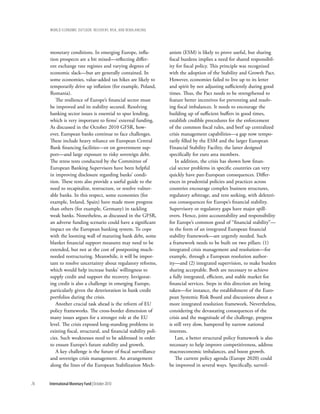
  • 126.
    wOrld ecOnOmic OutlOOk:recOvery, risk, and rebalancing on output is about –0.5 percent, and the impact on the unemployment rate is about 0.3 percentage point, which is similar to the baseline results for all adjustments, large and small, reported earlier.34 Figure 3.10. Impact of Large Fiscal Consolidation on additional insights from Model simulations GDP and Unemployment: Action-Based Approach The previous section looked at historical episodes versus Standard Approach (Impact of each additional 1 percent of GDP fiscal consolidation) of fiscal consolidation in advanced economies to assess the short-term effects. But historical analy- Fiscal retrenchment usually triggers faster growth and lower unemployment according to the standard approach, exemplified by Alesina and Ardagna (2010). sis goes only so far. For example, the empirical But according to our action-based approach, the opposite is true. framework used above is not well suited to provid- Action-based approach ing estimates of the effects of fiscal consolidation Standard approach (Alesina and Ardagna, 2010) over long periods such as 10 or 20 years. Moreover, historical analysis cannot fully address specific issues GDP 0.4 that are relevant for today but that rarely arose in (percent) 0.2 the past, such as the zero floor on nominal inter- est rates. Therefore, to complement the empirical 0.0 analysis, this section looks at fiscal consolidation -0.2 in the controlled “laboratory” setting of the GIMF, a dynamic general equilibrium model designed to -0.4 simulate the effects of fiscal and monetary policy -0.6 measures.35 -0.8 In particular, we examine the following 0 1 2 3 questions: Unemployment Rate 0.5 • How do the effects of fiscal consolidation change (percentage points) 0.4 when nominal interest rates are near zero? • How do the effects change when many countries 0.3 conduct fiscal consolidation simultaneously? 0.2 • What are the long-term effects of reducing gov- 0.1 ernment debt from high levels? 0.0 -0.1 -0.2 -0.3 0 1 2 3 34 Additional analysis suggests that the proportional impact is also similar for very large deficit cuts (equal to more than 3 Source: IMF staff calculations. Note: t = 1 denotes the year of consolidation. Dotted lines equal one standard error percent of GDP per year), although the estimation results are less bands. precise for these cases due to the smaller number of observations. 35 For presentations of the structure of the GIMF, see Kumhof and Laxton (2007); Kumhof, Muir, and Mursula (2010); Freed- man and others (2009, forthcoming); and Clinton and others (2010). A companion paper, available on request, shows that the GIMF produces short-term expenditure and tax multipliers that are in line with those reported in the previous section of the chapter. In addition, it explains why fiscal multipliers associ- ated with fiscal consolidation are likely to be smaller than those associated with fiscal stimulus, including the fact that monetary policy stimulus partly offsets the effect of fiscal consolidation but reinforces the effect of fiscal stimulus. 108 International Monetary Fund | October 2010
  • 127.
    chapter 3 will it Hurt? macrOecOnOmic effects Of fiscal cOnsOlidatiOn fiscal consolidation when policy rates are near the Zero rate, resulting from the persistence of the decline interest rate floor in the interest rate, boosts exports and raises the trade balance. Again, these simulation results are Since the onset of the Great Recession, short- consistent with the empirical findings reported in term interest rates in the largest advanced econo- the previous section.36 mies have been near the zero interest rate floor. • However, when interest rates are stuck at zero, Yet of the historical episodes considered above, the output cost of fiscal consolidation doubles to only those of Japan since the 1990s occurred in an about 1 percent after two years (see Figure 3.11). environment of near-zero interest rates. In the other Here, the simulation assumes that the zero lower episodes, interest rate cuts typically followed fiscal bound holds for two years.37 During this time, consolidation. the central bank is powerless to offset the slump Therefore, to look at the effects of fiscal con- in aggregate demand and inflation induced by solidation when interest rates are near zero, we use the cut in government spending. The result- model simulations. In particular, we look at what ing fall in inflation raises the real interest rate, happens when a small open economy, which we which in turn exacerbates the decline in aggregate calibrate to fit the main features of Canada, imple- demand, amplifying the short-term contraction- ments fiscal consolidation with and without the ary effect of fiscal consolidation. zero interest rate floor. For simplicity, the analysis ignores the possibility of the central bank respond- ing to the consolidation by using unconventional fiscal consolidation in Many countries at the same time monetary tools, such as quantitative and credit eas- How do the effects of fiscal consolidation change ing. To the extent that such policies would be used when many countries consolidate at the same time? to support output in response to the consolidation, This question is relevant today, as a number of advanced the simulations reported here may overstate the economies set fiscal consolidation in motion. impact of the zero interest rate floor. To address this issue, the simulations compare a The consolidation considered here is a reduction situation in which only Canada cuts its fiscal deficit in the deficit equivalent to 1 percentage point of to one in which all countries do so simultaneously GDP, composed entirely of spending cuts. Three- (global fiscal consolidation). We again use Canada here quarters of the spending cuts fall on government to illustrate the case of an economy small enough to transfers, with the rest falling on government have small spillover effects on the rest of the world and consumption. All the simulations considered in open enough that fiscal contraction in the rest of the this subsection assume that there are no cuts to world has significant effects on its GDP.38 productive public investment. If the spending cuts do include cuts to productive public investment, 36 In an economy such as the United States, with less exposure the long-term effects of fiscal consolidation can be to foreign trade, the domestic-demand channel would be more negligible or even negative. important. In this case, it would require a larger decline in the The results suggest the following: interest rate to offset the effects of the fiscal contraction on • When the interest rate is well above zero and free domestic demand. 37 Why do the simulations assume that the zero interest rate to decline, the output cost is about 0.5 percent floor holds for two years? In the model, the only way the central after two years (Figure 3.11). This output cost is bank can stabilize output and inflation is by cutting nomi- broadly consistent with the estimated short-term nal interest rates. When the option of cutting interest rates is removed for a long time—here, three or more years––the model effect reported in the previous section of this generates unstable macroeconomic dynamics, which complicates chapter. Two factors make the impact on GDP the computation of simulation results. In addition, for most less than one-to-one for every 1 percent of GDP countries, it is unlikely that interest rates will stay at zero for of fiscal consolidation. First, lower interest rates more than two years. 38 In 2009, Canada’s GDP was 1.9 percent of global GDP help offset the shock to domestic demand. Sec- on a purchasing-power-parity basis, and the sum of exports and ond, a significant depreciation in the exchange imports represented 71 percent of GDP. International Monetary Fund | October 2010 109
  • 128.
    wOrld ecOnOmic OutlOOk:recOvery, risk, and rebalancing As before, the adjustment involves reducing the deficit-to-GDP ratio by 1 percentage point, with the adjustment composed entirely of spending cuts. Three-quarters of the spending cuts fall on govern- ment transfers, with the rest falling on government consumption. Also, as before, the analysis considers two cases: the first assumes that the zero inter- est rate floor holds in all countries for two years, Figure 3.11. Impact of a 1 Percent of GDP Fiscal 1 and the second assumes that the interest rate may Consolidation: GIMF Simulations1 change without constraint. With zero interest rate floor The following results emerge: Without zero interest rate floor • In the simulations where the zero interest rate floor applies, the Canada-only consolidation GDP CPI Inflation 2 implies an output loss of about 1 percent (Figure 0.2 0.1 (percent) (percentage points) 0.0 0.0 3.12). But when the rest of the world conducts fiscal consolidation at the same time, the output -0.2 -0.1 cost to Canada more than doubles, to 2 percent. -0.4 -0.2 This simulation illustrates that, when interest -0.6 -0.3 rates are near zero, international spillovers are -0.8 -0.4 important. -1.0 -0.5 • When central banks are able to cut interest rates, the difference between the Canada-only consolida- -1.2 -0.6 0 1 2 3 4 5 0 1 2 3 4 5 tion and the global consolidation is smaller. This reflects the interplay of two forces. On the one Short-Term Interest Rate Real Short-Term Interest Rate 10 (basis points) (basis points) 80 hand, the fiscal contraction in the rest of the world 60 reduces demand for Canadian exports, and the 0 exchange rate provides a smaller buffer—curren- 40 -10 cies cannot all depreciate at the same time. But on 20 the other hand, the interest rate is now uncon- -20 strained by the zero bound, and the central bank 0 can thus respond with more monetary stimulus. -30 -20 These larger interest rate cuts play a substantial -40 -40 cushioning role, and the additional output cost of 0 1 2 3 4 5 0 1 2 3 4 5 global consolidation is therefore modest. Source: IMF staff calculations. Overall, these results illustrate that changes Note: t = 1 denotes the year of consolidation. Simulations are based on the GIMF in both the interest rate and the exchange rate calibrated for Canada and the rest of the world. The zero interest rate floor is assumed to hold for two years for reasons explained in the text. are important to the adjustment process. When 1 GIMF = Global Integrated Monetary and Fiscal Model. 2 CPI = consumer price index. countries cannot rely on the exchange rate channel to stimulate net exports, as in the case of the global consolidation, and cannot ease monetary policy to stimulate domestic demand, due to the zero interest rate floor, the output costs of fiscal consolidation are much larger. Thus, in the presence of the zero interest rate floor, there could be large output costs associated with front-loaded fiscal retrenchment implemented across all the large economies at the same time. 110 International Monetary Fund | October 2010
  • 129.
    chapter 3 will it Hurt? macrOecOnOmic effects Of fiscal cOnsOlidatiOn long-term effects of reducing Government debt Figure 3.12. Impact of a 1 Percent of GDP Fiscal The discussion so far has focused on short-term Consolidation: GIMF Simulations1 effects. We now turn to the long term. Does fiscal Canada-only fiscal consolidation consolidation generate long-term gains? And if Global fiscal consolidation so, how soon do the long-term gains arrive? This question is one that cannot be adequately addressed With Zero Interest Rate Floor Without Zero Interest Rate Floor using the empirical framework used in the previous 1 GDP GDP 1 section, and so we again use model simulations. (percent) (percent) To focus the discussion, we consider a fiscal 0 0 consolidation that, over time, reduces the govern- ment-debt-to-GDP ratio by 10 percentage points -1 -1 in each of the G3 currency areas (euro area, Japan, United States). As in the simulations discussed -2 -2 above, the consolidation is based on permanent cuts -3 -3 to government consumption and transfers. As the 0 1 2 3 4 5 0 1 2 3 4 5 debt-to-GDP ratio declines, the burden of inter- est payments falls, and the resulting savings may 1.5 Real Effective Exchange Rate Real Effective Exchange Rate 1.5 (percent; + = appreciation) (percent; + = appreciation) be used to finance either new tax cuts or spending 1.0 1.0 increases. In the main simulation reported here, we 0.5 0.5 assume that the savings are used to reduce labor 0.0 0.0 income taxes. The tax cuts are designed to ensure -0.5 -0.5 that the debt-to-GDP ratio stabilizes at 10 percent- -1.0 -1.0 age points below the initial level. The simulations suggest that, over the long term, -1.5 -1.5 0 1 2 3 4 5 0 1 2 3 4 5 a reduction in the debt-to-GDP ratio is likely to 1.0 Trade Balance Trade Balance raise output both in the G3 economies and in the 1.0 (percentage points of GDP) (percentage points of GDP) rest of the world. Two main factors underlie this increase: 0.5 0.5 • Lower real interest rates: Reducing the fiscal deficit raises the overall G3 saving rate and improves 0.0 0.0 the G3 current account balance.39 Over time, the greater supply of savings lowers the real interest -0.5 -0.5 rate. In the simulation, the 10 percentage point 0 1 2 3 4 5 0 1 2 3 4 5 fall in the debt-to-GDP ratio helps produce a fall in the G3 real interest rate of about 30 basis 50 Short-Term Interest Rate Short-Term Interest Rate 50 (basis points) (basis points) points (Table 3.1).40 Since capital is assumed to be mobile across borders, the real interest rate 0 0 falls by the same amount in the rest of the world. In turn, lower real interest rates “crowd in” -50 -50 39 The counterpart to this improvement in the G3 current account balance is a worsening in the current account balance of the rest of the world. The magnitude of this effect will depend -100 -100 0 1 2 3 4 5 0 1 2 3 4 5 on the degree to which government bonds are treated as net wealth and the sensitivity of aggregate consumption to changes Source: IMF staff calculations. in real interest rates. Note: t = 1 denotes the year of consolidation. Simulations are based on the GIMF 40 The magnitude of this interest rate–debt link is in line with calibrated for Canada and the rest of the world. The zero interest rate floor is assumed empirical estimates in the literature, such as Engen and Hubbard to hold for two years for reasons explained in the text. 1GIMF = Global Integrated Monetary and Fiscal Model. (2004), Laubach (2009), and Baldacci and Kumar (2010). International Monetary Fund | October 2010 111
  • 130.
    wOrld ecOnOmic OutlOOk:recOvery, risk, and rebalancing Table 3.1. Long-Term Effects of a Permanent 10 Percentage Point Decrease in the G3 Government- Debt-to-GDP Ratio: Global Integrated Monetary and Fiscal Model Simulations1 G3 Rest of the World Global Lower Interest Burden Used to Reduce Labor Income Taxes Real GDP (percent) 1.36 0.78 1.02 Real Interest Rate (percentage points) –0.34 –0.34 –0.34 Capital Stock (percent) 2.14 1.58 1.82 Current-Account-to-GDP Ratio (percentage points) 0.44 –0.28 ... Effects on GDP under Different Assumptions (percent) Lower Interest Burden Used to Reduce Labor Income Tax 1.36 0.78 1.02 Raise General Transfers 0.54 0.40 0.46 Reduce Capital Income Tax 1.50 0.82 1.10 Reduce Consumption Tax 0.70 0.46 0.56 Source: IMF staff calculations. Note: This table reports long-term effects on the level of GDP, interest rate, capital stock, and current-account-to-GDP ratio. 1G3 = euro area, Japan, United States. private investment, thereby raising the stock of cuts to consumption taxes, or to finance higher physical capital and GDP over the long term.41 spending on government transfer programs, the In the baseline simulation, the stock of physical long-term output gains are smaller.42 Finally, capital rises by 2.1 percent in the G3 and by 1.6 there are positive spillover effects from the G3 in the rest of the world. Meanwhile, the level of to the rest of the world arising through trade GDP rises by 1.4 percent in the G3 and by 0.8 linkages. The more G3 incomes rise over the percent in the rest of the world. long term, the more goods the G3 economies • Lower income taxes: The lower interest rates import and the more income this generates for and lower stock of government debt generate the rest of the world.43 savings in terms of lower interest payments that can be used to finance tax cuts. In the How long does it take for the positive output baseline simulation, we assume that the savings effects to outweigh the negative short-term effects? are used to lower taxes on labor income. Since GIMF simulations suggest that for a consolida- labor income taxes discourage workers from tion based on cuts to government consumption supplying labor, reducing them raises labor and transfers, GDP is lower than baseline for three supply and output. As the lower panel of Table years before rising above the baseline forever. The 3.1 reports, using the savings to cut capital break-even point, at which the sum of the annual income taxes instead has an even more benefi- GDP losses in the early years is just offset by the cial impact on GDP in the long term. This is a sum of the gains later on, occurs five years from reflection of capital income taxes’ strong nega- the start date. tive effect on private sector investment. On the other hand, if the savings are used to finance 42 This ranking is consistent with the standard view of the 41 This subsection has not taken into account the likelihood relative distortionary supply-side aspects of the various fiscal that reduced government debt would reduce risk premiums in instruments. market interest rates. A lower expected level of debt would allevi- 43 Fiscal consolidation in the G3 generates a permanent ate concerns that the fiscal outcome might become unsustain- improvement in the G3 current account balance, which implies a able. That is, it would reduce the perceived risks of default and declining path for the G3 ratio of net foreign liabilities (NFL) to inflation. Reduced risk premiums in government and private GDP. Over the long term, in the GIMF, an increase in imports sector borrowing rates would enhance and accelerate long-term relative to exports ensures that the NFL-to-GDP ratio stabilizes positive effects on output. at a lower level instead of perpetually falling. 112 International Monetary Fund | October 2010
  • 131.
    chapter 3 will it Hurt? macrOecOnOmic effects Of fiscal cOnsOlidatiOn lessons for countries considering fiscal debt may imply that no adjustment could have a consolidation negative impact on growth. The findings also suggest that spending-based This section summarizes the principal findings deficit cuts, particularly those that rely on cuts to of the chapter and outlines key lessons for coun- transfers, have smaller contractionary effects than tries considering fiscal consolidation in today’s tax-based adjustments. A key reason for this dif- environment. Virtually all advanced economies ference is that central banks typically provide less are likely to conduct fiscal consolidation at some monetary stimulus during tax-based adjustments, point in the future to put their fiscal positions particularly when they involve hikes in indirect back on a sustainable footing. The evidence based taxes that put upward pressure on inflation. This on historical analysis for advanced economies and finding again highlights that the fiscal adjustment model simulations in this chapter provides several process is likely to be more painful without the sup- lessons. portive role of interest rate cuts. The idea that fiscal austerity triggers faster growth Fiscal retrenchment in countries that face a in the short term finds little support in the data. higher perceived sovereign default risk tends to Fiscal retrenchment typically has contractionary be less contractionary. But expansionary effects of short-term effects on economic activity, with lower consolidation are unusual even for this group. This output and higher unemployment. A budget cut result implies that short-term negative effects are equal to 1 percent of GDP typically reduces domes- likely to be smaller in economies currently facing tic demand by about 1 percent and raises the unem- greater market pressure. ployment rate by 0.3 percentage point. At the same In addition, fiscal consolidation is likely to be time, an expansion in net exports usually occurs, beneficial over the long term. In particular, lower and this limits the impact on GDP to a decline of debt is likely to reduce real interest rates and the 0.5 percent. burden of interest payments, allowing for future Central banks usually offset some of the con- cuts to distortionary taxes. These effects will likely tractionary pressure by reducing policy rates, and crowd in investment and increase output in the longer-term interest rates typically decline, cushion- long term. ing the impact on domestic demand. Undertaking Finally, as discussed in Chapter 1, a number fiscal consolidation is likely to have more negative of policy actions could enhance the credibility of short-term effects if—as is currently the case in a fiscal adjustment programs, thereby mitigating the number of countries––interest rates are near zero adverse effects of fiscal consolidation in the short and central banks are constrained in their ability to term. Such actions could include strengthening provide monetary stimulus. fiscal institutions and reforming pension entitle- A decline in the real value of the domestic ments and public health care systems. To the extent currency typically plays an important cushion- that such measures improve household and busi- ing role by spurring net exports and is usually ness confidence and raise expectations about future the result of nominal depreciation or currency income, they could help support activity during the devaluation. Therefore, because not all countries process of fiscal adjustment. can have real depreciations and increase their net exports at the same time, simultaneous fiscal consolidation by many countries is likely to be appendix 3.1. data sources particularly costly. Fiscal retrenchment is also The sources of the data used for the analysis are likely to be more costly for members of a mon- listed in Table 3.2. The episodes of fiscal consolida- etary union where scope for a fall in the value of tion identified based on the action-based approach their currency is reduced. At the same time, in are reported in Tables 3.3 and 3.4. The episodes of the current global environment, heightened mar- fiscal consolidation identified based on the standard ket sensitivity to fiscal deficits and government approach are reported on Table 3.5. International Monetary Fund | October 2010 113
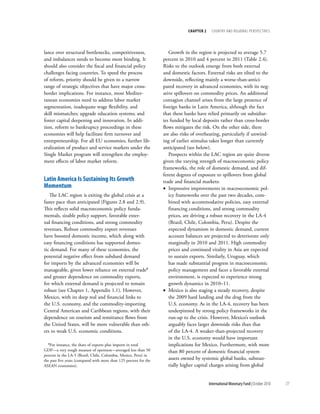
  • 132.
    wOrld ecOnOmic OutlOOk:recOvery, risk, and rebalancing Table 3.2. Data Sources Variable Source Real GDP World Bank World Development Indicators (WDI) Database, World Economic Outlook (WEO) Database Real Consumption WDI Database, WEO Database Real Investment WDI Database, WEO Database Real Exports WDI Database, WEO Database Real Imports WDI Database, WEO Database Unemployment Rate WDI Database, WEO Database Nominal Effective Exchange Rate International Financial Statistics (IFS) Database Real Effective Exchange Rate IFS Database Policy Interest Rates and 10-Year Bond Yields Bloomberg Financial Markets, National Authorities, Thomson Datastream Institutional Investor Rating Institutional Investor Cyclically Adjusted Primary Budget Surplus in Alesina and Ardagna (2010), Organization for Economic Percent of GDP Cooperation and Development Table 3.3. Action-Based Approach: Episodes of Small Fiscal Contraction (Smaller than 1.5 percent of GDP) Economy Fiscal Consolidation Australia 1980 1985 1988 1994 1995 1996 1997 1998 1999 Belgium 1982 1984 1990 1992 1994 1995 1996 1997 1998 1999 Canada 1980 1981 1982 1983 1984 1985 1986 1987 1988 1989 1990 1991 1992 1993 1994 1995 1996 1997 1998 1999 Denmark 1995 Finland 1984 1988 1995 1999 2000 2006 2007 France 1984 1986 1987 1988 1989 1991 1995 1996 1997 1998 2000 2006 2007 Germany 1982 1983 1984 1985 1986 1987 1988 1989 1992 1993 1994 1995 1996 1998 1999 2000 2003 2004 2005 2006 2007 Ireland 1984 1985 1986 Italy 1994 1996 1998 2004 2005 2006 2007 Japan 2003 2004 2005 2006 2007 Portugal 2000 2001 2003 2005 2006 2007 Spain 1983 1984 1985 1986 1987 1988 1989 1992 1993 1994 1995 1996 1997 1998 Sweden 1983 1984 1986 1992 1994 1997 2007 United Kingdom 1982 1994 1995 1996 1998 1999 United States 1980 1981 1985 1986 1988 1990 1993 1994 2000 Source: IMF staff calculations. 114 International Monetary Fund | October 2010
  • 133.
    chapter 3 will it Hurt? macrOecOnOmic effects Of fiscal cOnsOlidatiOn Table 3.4. Action-Based Approach: Episodes of Large Fiscal Contraction (Greater than 1.5 percent of GDP) Economy Fiscal Consolidation Australia 1986 1987 Belgium 1983 1987 1993 Canada Denmark 1983 1984 1985 1986 Finland 1992 1993 1994 1996 1997 1998 France Germany 1997 Ireland 1982 1983 1987 1988 2009 Italy 1992 1993 1995 1997 Japan 1997 Portugal 1983 2002 Spain Sweden 1993 1995 1996 United Kingdom 1981 1997 United States 1991 Source: IMF staff calculations. Table 3.5. Large Fiscal Contraction Episodes Identified by Alesina and Ardagna (2010) Economy Fiscal Consolidation Australia 1987 1988 Belgium 1982 1984 1987 2006 Canada 1981 1986 1987 1995 1996 1997 Denmark 1983 1984 1985 1986 2005 Finland 1981 1984 1988 1994 1996 1998 2000 France 1996 Germany 1996 2000 Ireland 1984 1987 1988 1989 2000 Italy 1980 1982 1990 1991 1992 1997 2007 Japan 1984 1999 2001 2006 Portugal 1982 1983 1986 1988 1992 1995 2002 2006 Spain 1986 1987 1994 1996 Sweden 1981 1983 1984 1986 1987 1994 1996 1997 2004 United Kingdom 1982 1988 1996 1997 1998 2000 United States Source: Alesina and Ardagna (2010). appendix 3.2. estimation approach (t=1980, …, 2009); g is the percent change in real GDP; and ABFC is the estimated size of the action- The analysis in the text accounts for the current and based fiscal consolidation measures as a percent of lagged impact of fiscal consolidation. More specifi- GDP. The disturbance term, uit, is specified as a cally, the estimated equation is as follows: two-way error component model: 2 2 git 5 a 1 ∑ bj gi,t–j 1 ∑ bs ABFCi,t–s 1 uit , (3.1) uit 5 mi 1 lt 1 nit , (3.2) j=1 s=0 where the subscript i denotes the ith country where mi denotes a country-fixed effect, and lt (i=1, …,15) and the subscript t denotes the tth year denotes a time-fixed effect. The time effects capture International Monetary Fund | October 2010 115
  • 134.
    wOrld ecOnOmic OutlOOk:recOvery, risk, and rebalancing shifts in global variables, such as the global business cycle. The country-fixed effect captures differences in countries’ steady-state growth rates. F-tests reject the absence of country- and time-fixed effects. The impulse response function for the effect of the fiscal actions on the level of output, along with one-stan- dard-error bands, is obtained via the delta method. Several robustness checks were conducted: Figure 3.13. Robustness: Impact on GDP of a 1 • Excluding lags of growth had little effect on the Percent of GDP Fiscal Consolidation results (Figure 3.13). If consolidation is less likely (With and without controlling for lagged GDP growth) in a weak economy, there should be a correlation between lagged output growth and consolida- Excluding lags of growth from our estimated equation has little effect on the tion, and controlling for lagged output would estimated effect of fiscal consolidation on output. have an appreciable impact on the estimates. The finding that it does not is therefore reassuring, as With control Without control it suggests that this source of bias is small in our sample.44 0.0 • Using an alternative estimation approach––the Arellano-Bond (1991) procedure––had little -0.1 effect on the results (Figure 3.14). As discussed -0.2 above, this result suggests that the bias due to fixed effects being correlated with the lagged -0.3 dependent variables is small in this sample. • Splitting the sample of fiscal consolidation -0.4 according to size of government (tax-to-GDP -0.5 ratio in the three years preceding fiscal consoli- dation) yielded an interesting result. Economies -0.6 that initially have a larger size of government (above the median tax-to-GDP ratio of 42 per- -0.7 cent) have smaller output costs than those with a smaller initial size of government.45 However, -0.8 0 1 2 3 larger governments are also more likely to engage in spending-based consolidation than smaller Source: IMF staff calculations. Note: t = 1 denotes the year of consolidation. Dotted lines equal one standard error governments. Keeping composition constant, bands. the differences due to government size are less apparent. In particular, tax-based consolidation is equally costly in terms of lost output for large and small governments. Therefore, it seems that the type of consolidation (tax- versus spending- based) is more important than the size of govern- ment in determining the output cost of fiscal consolidation. 44 In addition, using different lag lengths (up to four) yielded similar results. 45 Similar results were obtained using the government-spend- ing-to-GDP ratio as a proxy for government size. 116 International Monetary Fund | October 2010
  • 135.
    chapter 3 will it Hurt? macrOecOnOmic effects Of fiscal cOnsOlidatiOn • The results were more contractionary when the sample of fiscal adjustments was limited to episodes occurring in economies with a fixed exchange rate regime. This result held up under both the IMF’s de facto and de jure classification of exchange rate regimes. The result is consis- tent with standard Mundell-Fleming theory and a number of recent studies, such as Ilzetzki, Mendoza, and Végh (2009), who find that fiscal multipliers are larger in economies with fixed Figure 3.14. Robustness: Impact on GDP of a 1 exchange rate regimes. Percent of GDP Fiscal Consolidation • Splitting the sample of fiscal consolidation (Baseline estimator versus Arellano-Bond estimator) episodes according to openness to trade (ratio of Using the Arellano-Bond procedure had little effect on the results, suggesting exports plus imports to GDP) did not materially that the bias due to correlation of the fixed effects with the lagged dependent variables is small in this sample. change the results. Baseline estimator Arellano-Bond estimator appendix 3.3. identifying periods of fiscal consolidation: the standard approach versus 0.0 the action-Based approach -0.1 Figure 3.15 provides a scatter plot of increases in the cyclically adjusted primary budget balance -0.2 (CAPB)––the standard measure of fiscal consolida- tion––on the vertical axis versus the size of fiscal -0.3 consolidation based on the policy record on the horizontal axis. The figure reports years for which -0.4 either the CAPB-to-GDP ratio increased or the policy record indicated fiscal consolidation.46 The -0.5 CAPB-to-GDP data are from Alesina and Ardagna (2010).47 The top-right corner of the scatter plot -0.6 shows cases in which the two measures agree that there was a large fiscal consolidation (greater than -0.7 1.5 percent of GDP). It includes cases such as 0 1 2 3 Denmark (1983) and Ireland (1987)––the two cases Source: IMF staff calculations. highlighted by Giavazzi and Pagano (1990) in their Note: t = 1 denotes the year of consolidation. Dotted lines equal one standard error bands. work on expansionary fiscal contraction. However, Figure 3.15 also reports numerous cases in which the standard approach and our approach come to different conclusions regarding the presence and size of fiscal consolidation. 46 Cases in which there was no evidence of fiscal consolida- tion in the historical record correspond to the observations along the zero line on the horizontal axis, with positive values on the vertical axis. 47 The cases of increases in the CAPB-to-GDP ratio greater than 1.5 percentage points in Figure 3.15 are also those reported as large fiscal adjustments in Table A1 in Alesina and Ardagna (2010). International Monetary Fund | October 2010 117
  • 136.
    wOrld ecOnOmic OutlOOk:recOvery, risk, and rebalancing Which approach typically more accurately identi- fies fiscal consolidation? To address this question, we focus on the largest discrepancies between the two approaches: the 10 cases for which the dis- crepancy between the two approaches exceeded 3 percent of GDP. In each of these cases, fiscal consolidation was assessed as large (greater than 1.5 percentage points of GDP) by at least one of Figure 3.15. Size of Fiscal Consolidation: the two approaches. These 10 cases are highlighted Action-Based Approach versus Standard Approach1 in Figure 3.15. (Percent of GDP) We start with the cases in the top-left corner of Figure 3.15, which contains five periods identi- There are numerous cases in which the standard approach and our action-based fied as large consolidations based on the standard approach differ regarding the presence and size of fiscal consolidation. After analyzing in detail the 10 largest discrepancies between the two approaches, we approach, but for which the policy record shows conclude that our action-based approach more accurately identifies the size of fiscal consolidation. either only a small consolidation or no consolida- tion at all. 8 • Germany (1996): The CAPB-to-GDP ratio DEU 1996 increased by 6.4 percentage points, but the policy 6 JPN 1999 JPN 2006 record indicates fiscal consolidation measures BEL 1984 (change in cyclically adjusted primary balance) FIN 2000 4 amounting to only 0.2 percent of GDP. The large increase in the CAPB-to-GDP ratio in 2 1996 reflected a large one-time capital transfer Standard approach FIN 1993 0 in 1995, which implied a change in the CAPB- IRL 1982 ITA 1993 to-GDP ratio of about –7 percentage points in FIN 1992 -2 1995 and 6.4 percentage points in 1996. The -4 sharp increase in the CAPB in 1996 thus had IRL 2009 nothing to do with fiscal austerity measures. In -6 particular, as reported in the 1996 IMF Recent -8 Economic Developments report (p. 18), a one-time transfer of Treuhand (Trust Agency) and East -10 German housing debt to the general government -1 0 1 2 3 4 5 6 Action-based approach amounting to 6.8 percent of GDP occurred in 1995. This operation was recorded by the Sources: Alesina and Ardagna (2010); and IMF staff calculations. Note: The diagonal line reports the 45-degree line, where the action-based approach and Organization for Economic Cooperation and standard approach agree. Dotted lines indicate episodes of consolidation equal to 1.5 percent of GDP. Highlighted observations indicate years for which the two approaches Development (OECD) as a one-time increase in differ by more than 3 percent of GDP. 1BEL: Belgium; DEU: Germany; FIN: Finland; IRL: Ireland; ITA: Italy; JPN: Japan. capital transfers that raised the general govern- ment deficit from 2.3 percent of GDP in 1994 to 9.7 percent of GDP in 1995. The deficit returned to a more normal level in 1996, at 3.3 percent of GDP. Therefore, the sharp increase in the CAPB in 1996 bears no relation to fiscal austerity measures, but instead reflects the end of a one-time capital transfer. • Japan (1999): The CAPB-to-GDP ratio rose by about 4.9 percentage points, but the policy record shows no evidence of fiscal consolidation measures. Indeed, Japan’s fiscal consolidation 118 International Monetary Fund | October 2010
  • 137.
    chapter 3 will it Hurt? macrOecOnOmic effects Of fiscal cOnsOlidatiOn program, initiated in 1997, was suspended in However, we can find no mention of social security 1998 following the onset of a severe recession, cuts in the historical record, such as in the OECD and there is no evidence of measures designed Economic Survey.50 Overall, therefore, we conclude to cut the budget deficit until 2002, when that the increase in the CAPB-to-GDP ratio of 4.1 the authorities announced a new multiyear percentage points overstates the amount of consoli- program of fiscal consolidation (2003 OECD dation in 2000 by at least 2 percentage points and Economic Survey: Japan, p. 15). Instead, as the probably closer to 3. 1998 OECD Economic Survey: Japan reports (p. • Japan (2006): The CAPB-to-GDP ratio increased 84), the government made a one-time capital by 4.1 percentage points, but the policy record transfer in 1998 to the Japan National Railway, indicates fiscal consolidation measures amounting amounting to about ¥24.3 trillion (4.8 percent to only 0.67 percent of GDP, implying a discrep- of GDP). The one-time nature of this capital ancy of about 3.4 percent of GDP. In terms of transfer implies a change in the (general govern- actual consolidation measures, the policy record ment) CAPB of about 4.8 percentage points of indicates a cut in public investment of about GDP in the following year, 1999. This increase is 0.27 percent of GDP (2007 IMF Staff Report, similar to the 4.9 percentage point change in the pp. 32–33) and income tax hikes worth about CAPB-to-GDP ratio computed by Alesina and ¥2 trillion (0.4 percent of GDP—Takahashi and Ardagna (2010). Therefore, the sharp increase Tokuoka, 2010). At the same time, the CAPB-to- in the CAPB in 1999 bears no relation to fiscal GDP ratio reported in the 2008 OECD Economic austerity measures, but instead reflects the end of Surveys: Japan rose by 3.2 percentage points in a one-time capital transfer. 2006 (Table 3.1, p. 65, line 4). Thus, some (0.9 • Finland (2000): The CAPB-to-GDP ratio percentage point) of the discrepancy is due to increased by 4.1 percentage points, but the policy differences between the OECD Economic Survey record shows fiscal consolidation measures amount- and Alesina and Ardagna (2010) in the method ing to only 0.9 percent of GDP.48 This episode cor- used to compute the CAPB. In addition, the responds to an asset price boom: real stock prices OECD Economic Survey indicates that a large part in Finland rose by 70 percent in 1999 and by 86 of the CAPB increase resulted from one-time percent in 2000 (Haver Analytics). Of the 4.1 per- asset operations that improved the fiscal balance centage point increase in the CAPB-to-GDP ratio, in 2006 but were unrelated to tax hikes or spend- 2 percentage points reflect a rise in revenue from ing cuts.51 Without these one-time asset opera- one-time factors unrelated to policy actions.49 tions, the 2008 OECD Economic Survey: Japan These one-time factors included a rise in tax rev- estimates that the CAPB-to-GDP ratio increased enue associated with stock-option and capital gains by only 0.4 percentage point in 2006 (OECD and an increase in non-tax (property income) rev- Table 3.1, p. 65, line 8). Therefore, once the enue partly due to an extraordinary dividend issued change in the CAPB-to-GDP ratio is adjusted to by the fully state-owned bank Leonia on the eve remove the influence of asset operations unre- of its merger with the private insurance company lated to tax hikes and spending cuts, the increase Sampo. Regarding the remaining 1.2 percentage point discrepancy relative to the historical record (2.1 versus 0.9), the OECD Economic Outlook 50 Note that cuts to social security spending, which is not database indicates a fall in cyclically adjusted recorded as central government spending, are not part of the social security outlays of about 1 percentage point. measures amounting to 0.9 percent of GDP that we identify in the policy record. 51 The 2008 OECD Economic Survey: Japan reports that the 48 The fiscal measures reflected mainly central government one-time factors include receipts of funds by the government spending restraint (OECD Economic Surveys 1999–2000, p. 36). from corporate pension funds, receipts associated with the priva- 49 The 2001–02 issue of OECD Economic Surveys: Finland tization of highway corporations, and receipts from the “transfer reports the 2000 budget outcome as “a very high surplus mainly of the reserve fund from the Fiscal Loan Fund Special Account due to one-off factors” (p. 37). to the central government” (p. 65). International Monetary Fund | October 2010 119
  • 138.
    wOrld ecOnOmic OutlOOk:recOvery, risk, and rebalancing in the CAPB-to-GDP ratio is close to our esti- both tax hikes and spending cuts.54 The fall in mate of policy measures of 0.67 percent of GDP. the CAPB despite a substantial fiscal consolida- • Belgium (1984): The CAPB-to-GDP ratio tion reflects the impact of the financial crisis increased by 4.7 percentage points, but the policy during which stock and house prices fell sharp- record indicates fiscal consolidation measures ly.55 For reasons discussed above, such sharp amounting to 0.88 percent of GDP, implying a contractions tend to have a negative impact on discrepancy of about 3.8 percent of GDP.52 At the CAPB, causing the CAPB-based approach the same time, the CAPB-to-GDP ratio reported to inaccurately identify the size of consolidation in the OECD Economic Outlook database rises measures. Indeed, while the CAPB-to-GDP ratio by 4.1 percentage points in 1984. Thus, some of computed by Alesina and Ardagna (2010) falls the discrepancy (0.6 percentage point) is due to by 4.4 percentage points, the CAPB-to-GDP differences in the method used to compute the ratio computed by the OECD falls by only CAPB. Of the remaining discrepancy (3.2 per- 1.1 percentage points. As expected, the fall in the centage points), most is explained by the end of CAPB-to-GDP ratio is driven by a sharp decline a one-time capital transfer made in 1983. In par- in cyclically adjusted tax revenue, which falls by ticular, the OECD Economic Outlook database 2.6 percentage points in 2009 according to the indicates a one-time increase in capital transfers OECD’s calculations. Government tax revenue in 1983 that reduced the CAPB-to-GDP ratio directly related to asset prices––capital gains taxes by 2.1 percentage points in 1983. When this and stamp duties––fell by 1 percent of GDP in one-time transfer came to an end in 1984, it 2009.56 Another 0.8 percentage point decline in caused the CAPB-to-GDP ratio to rise by 2.1 the CAPB-to-GDP ratio is driven by an increase percentage points (OECD Economic Outlook in cyclically adjusted social security benefit pay- database). Therefore, excluding the influence of ments that have no counterpart in the policy this one-time capital transfer, the discrepancy record. Excluding these cyclically adjusted items, between the standard approach and our action- the CAPB-to-GDP ratio rises by 2.3 percent- based approach shrinks from 3.2 percent of GDP age points (–1.1 1 2.6 1 0.8), which represents to 1.1 percent of GDP (3.2 minus 2.1).53 a large fiscal consolidation and is substantially Next we turn to the five cases in the bottom- closer to our estimated size of fiscal consolidation right corner of Figure 3.15––periods that are than the Alesina and Ardagna (2010) estimate of identified as large consolidations based on our –4.4 percentage points. action-based approach, but which feature either a • Italy (1993): The CAPB-to-GDP ratio increased by fall or a small increase in the CAPB. only 0.2 percentage point in 1993, but the policy • Ireland (2009): Here, the CAPB-to-GDP ratio record reports a large consolidation of 4.3 percent fell by about 4.4 percentage points, but the of GDP. A plausible reason for this large discrep- historical record reports that fiscal consolida- ancy is that there was a sharp economic contraction tion measures of about 4.5 percent of GDP were implemented in 2009. These measures included 54 The 2009 OECD Economic Survey: Ireland (p. 50) and EC (2008, p. D15) report spending cuts in 2009 of €1 billion (0.6 percent of GDP) announced in July 2008, and the 2009 OECD 52 According to the policy record, fiscal consolidation consisted Economic Survey: Ireland (pp. 50–51) reports additional spending of a “levy of 2 percent a year for three years on earned incomes,” cuts and tax hikes amounting to 3.9 percent of GDP, implying a which was expected to increase revenue by 0.75 percentage point total consolidation of 4.5 percent of GDP. of GDP in 1984 (1984/1985 OECD Economic Surveys: Belgium, 55 Real stock and house prices fell by 44 percent and 20 per- p. 11), and spending cuts of 0.13 percent of GDP consisting cent in 2009, respectively (Haver Analytics database). of cuts to the public sector wage bill, public sector operating 56 Revenue from capital gains taxes and stamp duties fell by costs, and social security savings (IMF, Belgium: Recent Economic 73 and 45 percent in 2009 (Ministry of Finance white paper Developments, 1984, p. 47). on receipts and expenditures 2009 and 2010). There was also a 53 The policy record suggests that the increase in capital trans- sharp fall in the cyclically adjusted indirect-tax-to-GDP ratio, fers in 1983 reflected “direct aid to industry” (1985/1986 OECD which fell by 1.4 percentage points (OECD Economic Outlook Economic Survey: Belgium, pp. 25–26). database). 120 International Monetary Fund | October 2010
  • 139.
    chapter 3 will it Hurt? macrOecOnOmic effects Of fiscal cOnsOlidatiOn in 1993 associated with the European exchange rate points (OECD Economic Outlook database). mechanism crisis, which, for the reasons explained Excluding these two cyclically adjusted items, the above, causes the CAPB-based approach to be CAPB-to-GDP ratio rose by 1.5 percentage points inaccurate. Indeed, while the CAPB-to-GDP ratio in 1992, close to the size of consolidation based computed by Alesina and Ardagna (2010) increases on the policy record (1.8 percent of GDP). Simi- by 0.2 percentage point, the CAPB-to-GDP ratio larly, in 1993, as the sharp recession continued, computed by the OECD increases by 1.9 percent- the cyclically adjusted tax-revenue-to-GDP ratio age points (OECD Economic Outlook database). fell by 1.1 percentage points, and the cyclically The OECD’s calculation of the change in the adjusted social-security-spending-to-GDP ratio CAPB-to-GDP ratio is therefore consistent with rose by 1.9 percentage points. Excluding these a large fiscal consolidation in 1993 (greater than two cyclically adjusted items, the CAPB-to-GDP 1.5 percent of GDP). However, even this estimate ratio rose by 3.8 percentage points in 1992, in line of fiscal consolidation is substantially smaller than with the size of consolidation based on the policy what is in the policy record. In particular, according record (3.8 percent of GDP). to the OECD Economic Surveys and the IMF Recent • Ireland (1982): The CAPB-to-GDP ratio Economic Developments reports, fiscal consolidation increased by 0.05 percentage point, but the measures in 1993 amounted to more than 4 percent narrative record indicates fiscal consolidation of GDP. The source of the remaining discrepancy measures totaling 3.8 percent of GDP. The small vis-à-vis the change in the CAPB-to-GDP ratio increase in the CAPB reflects the problems of could plausibly reflect the fact that, during sharp cyclical-adjustment techniques during episodes recessions, cyclical-adjustment techniques tend to in which consolidation consists of consumption allocate part of the fiscal worsening due to auto- tax hikes and in which there is a large decline in matic stabilizers to a fall in the CAPB. This prob- private consumption. In particular, Ireland’s 1982 lem causes the increase in the CAPB to understate fiscal consolidation package included substantial the size of fiscal consolidation measures. increases in value-added tax (VAT) rates (from • Finland (1992) and (1993): The CAPB-to-GDP 10 to 18 percent in the lower rate, and from 25 ratio fell by 2.0 percentage points in 1992 and rose to 30 percent in the standard rate) and in excise by 0.8 percentage point in 1993, but the policy duties. At the same time, real private consump- record indicates consolidation measures amount- tion fell by 7.1 percent, although real GDP grew ing to 1.8 and 3.8 percent of GDP in 1992 and by 2.3 percent, supported by external demand. 1993, respectively. The fall in the CAPB in 1992 This is the only year since 1970 in which private despite evidence of fiscal austerity measures during consumption fell while GDP grew. The result those years was probably due to the depth of the was a small increase in VAT receipts for a given recession after the outbreak of the Finnish banking level of GDP. The change in tax rates is not taken crisis at the end of 1991.57 For reasons explained into account by the CAPB-based approach, as above, these developments probably depressed fiscal variables are cyclically adjusted with respect tax revenue and increased social security transfers to overall GDP and the elasticity is assumed to beyond what could have been predicted based on be constant over time. Therefore, the CAPB-to- standard cyclical-adjustment techniques. In line GDP ratio fails to pick up the large tax hikes that with this notion, the cyclically adjusted tax-revenue- occurred that year. The OECD’s CAPB-to-GDP to-GDP ratio fell in 1992 by 1.2 percentage ratio increases by more than that of Alesina and points, and the cyclically adjusted social-security- Ardagna (2010)––0.8 percentage point––leaving spending-to-GDP ratio rose by 2.3 percentage a discrepancy of 3 percent of GDP relative to our action-based fiscal consolidation measure. The 57 Real GDP fell by 6.4 percent in 1991 and 3.8 percent in following simple calculation illustrates how more 1992, and the unemployment rate increased by 5.1 percentage points in 1992. In 1993, real GDP fell by another 0.9 percent than half of this remaining discrepancy could and the unemployment rate increased by 4.6 percentage points. be due to the unusual behavior of consumption International Monetary Fund | October 2010 121
  • 140.
    wOrld ecOnOmic OutlOOk:recOvery, risk, and rebalancing during this episode. If the consumption-to-GDP Alesina, Alberto, and Roberto Perotti, 1995, “Fiscal Expan- ratio in 1982 had remained at the 1981 level sions and Fiscal Adjustments in OECD Countries,” of 65 percent, instead of falling to 59 percent, Economic Policy, Vol. 10, No. 21, pp. 205–248. the VAT hike would have added 1.6 percent- ———, 1997, “Fiscal Adjustments in OECD Countries: Composition and Macroeconomic Effects,” IMF Staff age points to the cyclically adjusted tax-to-GDP Papers, Vol. 44 (June), pp. 210–48. ratio.58 This increase in cyclically adjusted tax Baldacci, Emanuele, and Manmohan S. Kumar, 2010, “Fiscal revenue would have raised the CAPB-to-GDP Deficits, Public Debt, and Sovereign Bond Yields,” IMF ratio from the OECD’s 0.8 percentage point to Working Paper No. 10/184 (Washington: International 2.4 percentage points, far closer to our action- Monetary Fund). based measure of fiscal consolidation (3.8 percent Barro, Robert J., and Charles J. Redlick, 2009, “Macroeco- of GDP). Overall, this is a case in which the nomic Effects from Government Purchases and Taxes,” standard approach seems to miss a large part of NBER Working Paper No. 15369 (Cambridge, Massa- the fiscal austerity measures. chusetts: National Bureau of Economic Research). This examination of the 10 largest disagree- Bayoumi, Tamim, and Hamid Faruqee, 1998, “A Calibrated ments between the two approaches provides strong Model of the Underlying Current Account,” in Exchange evidence that our action-based approach more Rate Assessment: Extensions of the Macroeconomic Balance Approach, IMF Occasional Paper No. 167, ed. by Peter accurately identifies the size of fiscal consolidation. Isard and Hamid Faruqee (Washington: International We find seven cases where we are able to identify Monetary Fund). specific economic or budgetary developments that Bernanke, Ben S., and Ilian Mihov, 1998, “Measuring Mon- cause the CAPB-based measures used by Alesina etary Policy,” Quarterly Journal of Economics, Vol. 113, and Ardagna (2010) to inaccurately identify the size No. 3, pp. 869–902. of the consolidation and that largely explain the Blanchard, Olivier J., 1990, “Suggestions for a New Set gap between the two measures. In the remaining of Fiscal Indicators,” OECD Economics Department three cases (Italy in 1993 and Finland in 1992 and Working Paper No. 79 (Paris: Organization for Economic 1993), there were crises or large economic contrac- Cooperation and Development). tions that could plausibly have caused the CAPB- ———, and Roberto Perotti, 2002, “An Empirical Charac- based approach to be highly inaccurate. We find no terization of the Dynamic Effects of Changes in Govern- cases where there is evidence that our action-based ment Spending and Taxes on Output,” Quarterly Journal of Economics, Vol. 107 (November), pp. 1329–68. measure was substantially inaccurate. Broadbent, Ben, and Kevin Daly, 2010, “Limiting the Fall- Out from Fiscal Adjustment,” Goldman Sachs Global references Economics Paper No. 195 (New York: Goldman Sachs). Cerra, Valerie, and Sweta Saxena, 2008, “Growth Dynamics: Alesina, Alberto, 2010, “Fiscal Adjustments: Lessons from The Myth of Economic Recovery,” American Economic Recent History,” paper prepared for the ECOFIN meet- Review, Vol. 98, No. 1, pp. 439–57. ing, Madrid, April 15. Christiano, Lawrence J., Martin Eichenbaum, and Charles ———, and Silvia Ardagna, 1998, “Tales of Fiscal Adjust- Evans, 1996, “The Effects of Monetary Policy Shocks: ment,” Economic Policy, Vol. 13, No. 27, pp. 487–545. Evidence from the Flow of Funds,” Review of Economics ———, 2010, “Large Changes in Fiscal Policy: Taxes versus and Statistics, Vol. 78, No. 1, pp. 16–34. Spending,” Tax Policy and the Economy, Vol. 24, ed. by Christiano, Lawrence, Martin Eichenbaum, and Sergio Rebelo, Jeffrey R. Brown (Cambridge, Massachusetts: National 2009, “When Is the Government Spending Multiplier Bureau of Economic Research). Large?” NBER Working Paper No. 15394 (Cambridge, Massachusetts: National Bureau of Economic Research). 58 In particular, the indirect-tax-to-GDP ratio in 1982 was Clinton, Kevin, Michael Kumhof, Douglas Laxton, and 15.3 percent, implying––given the consumption-to-GDP ratio Susanna Mursula, 2010, “Budget Consolidation: Short- of 59 percent––an average indirect tax rate of about 26 percent. Term Pain and Long-Term Gain,” IMF Working Paper Therefore, keeping the consumption-to-GDP ratio at the 1981 level of 65 percent could have yielded an indirect-tax-to-GDP No. 10/163 (Washington: International Monetary Fund). ratio of 16.9 percent (26 percent × 65 percent)––that is, 1.6 Coenen, Günter, Christopher Erceg, Charles Freedman, percentage points higher than the actual 15.3 percent. Davide Furceri, Michael Kumhof, René Lalonde, Douglas 122 International Monetary Fund | October 2010
  • 141.
    chapter 3 will it Hurt? macrOecOnOmic effects Of fiscal cOnsOlidatiOn Laxton, Jesper Lindé, Annabelle Mourougane, Dirk Muir, ———, Dirk Muir, and Susanna Mursula, 2010, “The Susanna Mursula, Carlos de Resende, John Roberts, Wer- Global Integrated Monetary and Fiscal Model (GIMF)— ner Roeger, Stephen Snudden, Mathias Trabandt, and Jan Theoretical Structure,” IMF Working Paper 10/34 (Wash- in ‘t Veld, 2010, “Effects of Fiscal Stimulus in Structural ington: International Monetary Fund). Models,” IMF Working Paper 10/73 (Washington: Inter- Kuttner, Kenneth N.K., and Adam S. Posen, 2002, “Fiscal national Monetary Fund). Policy Effectiveness in Japan,” Journal of the Japanese and Eichengreen, Barry, and Ashoka Mody, 2004, “Do Collective International Economics, Vol. 16, pp. 536–58. Action Clauses Raise Borrowing Costs?” The Economic Laubach, Thomas, 2009, “New Evidence on the Interest Journal, Royal Economic Society, Vol. 114, No. 495, Rate Effects of Budget Deficits and Debt,” Journal of pp. 247–64. the European Economic Association, Vol. 7, No. 4, pp. Engen, Eric M., and R. Glenn Hubbard, 2004, “Federal 858–85. Government Debt and Interest Rates,” NBER Macro- Lawson, Nigel, 1992, The View from No. 11: Memoirs of a economics Annual, Vol. 19 (Cambridge, Massachusetts: Tory Radical (London: Bantam). National Bureau of Economic Research), pp. 83–138. Laxton, Douglas, and Papa N’Diaye, 2002, “Monetary European Commission (EC), 2008, Ireland—Stability Policy Credibility and the Unemployment-Inflation Programme Update (October). Available at: ec.europa.eu/ Trade-Off: Some Evidence from 17 Industrial Countries,” economy_finance/publications/publication13542_en.pdf. IMF Working Paper 02/220 (Washington: International Freedman, Charles, Michael Kumhof, Douglas Laxton, and Monetary Fund). Jaewoo Lee, 2009, “The Case for Global Fiscal Stimulus,” Mishkin, Frederic, 2007, “Inflation Dynamics,” speech deliv- IMF Staff Position Paper Note 09/03 (Washington: Inter- ered at the Federal Reserve Bank of San Francisco Annual national Monetary Fund). Macro Conference, March 23. Freedman, Charles, Michael Kumhof, Douglas Laxton, Dirk Morris, Richard, and Ludger Schuknecht, 2007, “Structural Muir, and Susanna Mursula, forthcoming, “Global Effects Balances and Revenue Windfalls: the Role of Asset Prices of Fiscal Stimulus During the Crisis,” Journal of Monetary Revisited,” European Central Bank Working Paper Series Economics. No. 737. Giavazzi, Francesco, and Marco Pagano, 1990, “Can Severe Nakagawa, Makoto, 2009, “Note on Stimulus Packages in Fiscal Contractions Be Expansionary? Tales of Two Small Japan Since the 1990s,” (unpublished; Washington: Inter- European Countries,” NBER Macroeconomics Annual, national Monetary Fund). Vol. 5 (Cambridge, Massachusetts: National Bureau of Organization for Economic Cooperation and Develop- Economic Research). ment (OECD), OECD Economic Surveys, various years ———, 1996, “Non-Keynesian Effects of Fiscal Policy (Paris). Changes: International Evidence and the Swedish Experi- Ramey, Valerie A., 2009, “Identifying Government Spending ence,” Swedish Economic Policy Review, Vol. 3, No. 1, pp. Shocks: It’s All in the Timing,” NBER Working Paper No. 67–103. 15464 (Cambridge, Massachusetts: National Bureau of Hall, Robert E., 2009, “By How Much Does GDP Rise If Economic Research). the Government Buys More Output?” Brookings Papers on ———, and Matthew D. Shapiro, 1998, “Costly Capital Economic Activity 2009:2, Fall, pp. 183–231. Reallocation and the Effects of Government Spending,” Ilzetzki, Ethan, Enrique G. Mendoza, and Carlos A. Végh, Carnegie-Rochester Conference Series on Public Policy 48 2009, “How Big are Fiscal Multipliers?” CEPR Policy (June), pp. 145–94. Insight No. 39 (London: Centre for Economic Policy Reinhart, Carmen M., Kenneth S. Rogoff, and Miguel A. Research). Savastano, 2003, “Debt Intolerance,” NBER Working International Monetary Fund (IMF), IMF staff reports for Paper No. 9908 (Cambridge, Massachusetts: National Article IV consultations, 1978–2009 (Washington). Bureau of Economic Research). ———, Recent Economic Developments, 1978–2009 Romer, Christina D., and David H. Romer, 1989, “Does (Washington). Monetary Policy Matter? A New Test in the Spirit of ———, 2010, “Navigating the Fiscal Challenges Ahead,” Friedman and Schwartz,” in NBER Macroeconomics Fiscal Monitor (Washington, May). Annual, Vol. 4, ed. by Olivier Jean Blanchard and Stanley Kumhof, Michael, and Douglas Laxton, 2007, “A Party Fischer (Cambridge, Massachusetts: National Bureau of Without a Hangover? On the Effects of U.S. Govern- Economic Research), pp. 121–170. ment Deficits,” IMF Working Paper 07/202 (Washington: International Monetary Fund). International Monetary Fund | October 2010 123
  • 142.
    wOrld ecOnOmic OutlOOk:recOvery, risk, and rebalancing ———, 2004, “A New Measure of Monetary Shocks: Deri- Tsibouris, George C., Mark A. Horton, Mark J. Flanagan, vation and Implications,” American Economic Review, Vol. and Wojciech S. Maliszewski, 2006, Experience with Large 94, No. 4, pp. 1055–84. Fiscal Adjustments, IMF Occasional Paper No. 246 (Wash- ———, 2009, “A Narrative Analysis of Postwar Tax ington: International Monetary Fund). Changes” (Berkeley: University of California). Available at Von Hagen, Jürgen, and Rolf Strauch, 2001, “Fiscal Con- http://elsa.berkeley.edu/~dromer/papers/nadraft609.pdf. solidations: Quality, Economic Conditions, and Success,” ———, 2010, “The Macroeconomic Effects of Tax Changes: Public Choice, Vol. 109, No. 3–4, pp. 327–46. Estimates Based on a New Measure of Fiscal Shocks,” Wolswijk, Guido, 2007, “Short- and Long-Run Tax Elastici- American Economic Review, Vol. 100, No. 3, pp. 763–801. ties—the Case of the Netherlands,” European Central Sims, Christopher A, 1992, “Interpreting the Macroeco- Bank Working Paper Series No. 763 (Frankfurt: European nomic Time Series Facts: The Effects of Monetary Policy,” Central Bank). European Economic Review, Vol. 36, No. 5, pp. 975–1000. Takahashi, Keiko, and Kiichi Tokuoka, 2010, “Fiscal Adjust- ment Plans––Japan Case Study,” (unpublished; Washing- ton: International Monetary Fund). 124 International Monetary Fund | October 2010
  • 143.
    4 chapter Do Financial crises have lasting eFFects on traDe? This chapter looks at trade dynamics following World imports grew at an annualized rate of banking and debt crises, to help us understand how more than 20 percent in the last two quarters trade might evolve for economies recently affected by of 2009 and the first quarter of 2010. How- such crises. Imports of the crisis economy tend to fall ever, as this chapter shows, trade remains below substantially in the short term—beyond what would its precrisis trend, and for some economies— be expected from the decline in output—and they particularly those hit by a banking crisis—it stay depressed through the medium term. In con- remains below precrisis levels. Because the recent trast, exports of the crisis economy are not as badly crises occurred in large, advanced economies affected. These findings suggest that the recovery that account for a substantial portion of global of import demand in the United States and much demand, the speed and extent of their trade of western Europe may be even more anemic than recovery will affect the growth prospects not only suggested by their relatively weak projected output of the crisis economies but also of their trading recoveries. Thus, the narrowing of the large cur- partners. rent account deficits of some crisis countries such as This chapter looks at trade dynamics fol- the United States that occurred in 2009 may prove lowing banking and debt crises, to help us to be quite durable. For economies that experience understand how trade might evolve for econo- a crisis, the chapter underscores the importance of mies that are affected by such crises. It continues embracing structural reforms to help support the the research agenda pursued in recent issues recovery of output and trade. For economies that rely of the World Economic Outlook to analyze the heavily on external demand for their growth, the medium-term macroeconomic consequences chapter’s findings highlight the urgency of reorient- of crises. This chapter addresses the following ing growth by strengthening domestic demand. questions: • To what extent has trade recovered from the One of the most notable features of the Great recent global recession? Have the speed and Recession was the “sudden, severe, and synchronized” extent of the recovery differed among econo- collapse in trade in late 2008 and early 2009 (Baldwin, mies, particularly between those that suffered a 2009). In the half-year encompassing the last quarter banking crisis and those that did not? Has the of 2008 and the first quarter of 2009, the annualized recovery varied across different product groups? drop in world imports was more than 30 percent, with • How has trade behaved in the wake of previous roughly equal declines experienced by advanced and banking and debt crises? Do such crises have last- emerging economies (Figure 4.1). The fall in trade ing effects on trade? spared no one—all economies experienced a drop in • What factors apart from the level of output are both exports and imports during this period. Likewise, associated with sharp declines in trade following growth in trade in virtually all product categories went a crisis? And what role can postcrisis policies and from positive in the second quarter of 2008 to nega- conditions play in enhancing the recovery of trade? tive by the first quarter of 2009. • What are the implications for the recovery of The rapid recovery in trade that began in the trade from the recent crisis? And what lessons can second half of 2009 has been remarkable as well. be drawn for the future? Much of the recent literature on trade and crises The main authors of this chapter are Abdul Abiad, Prachi has focused on the recent global downturn and spe- Mishra, and Petia Topalova, with support from Gavin Asdorian, Stephanie Denis, and Andy Salazar. Donald Davis was the cifically on explaining the “Great Trade Collapse”— external consultant. that is, on why world trade fell by much more than International Monetary Fund | October 2010 125
  • 144.
    wOrld ecOnOmic OutlOOk:recOvery, risk, and rebalancing GDP.1 Only a few papers have looked at the full dynamics of trade—both declines and recoveries— following earlier crises. Among these, Freund (2009) describes the evolution of world trade following four previous global downturns. She finds that the size of the decline in world trade during these episodes is almost five times the corresponding decline in world GDP. She also finds that, while world trade growth resumes quickly following a global downturn, it takes more than three years for trade to reach predownturn Figure 4.1. The Great Trade Collapse levels. This chapter does not focus on trade dynam- ics following global downturns but instead on what The collapse in world trade in late 2008 and early 2009 was sudden, severe, and synchronized. happens to the trade of individual economies that experience a banking or debt crisis; it should thus be World Advanced economies seen as a complement to Freund’s work.2 Latin America Emerging Asia This chapter uses a methodology derived from Other emerging economies the “gravity model,” the standard workhorse for Growth Rate of World Real Imports modeling trade flows. The gravity model is widely 60 (percent, quarter-over-quarter seasonally adjusted annual used to explain the level of bilateral trade flows rate) 50 on the basis of individual characteristics of each 40 partner (size and level of economic development) 30 as well as the characteristics of the country pair 20 (distance between them and whether they share a common border, language, or currency). However, 10 the standard gravity model best describes patterns 0 of trade between economies rather than over time -10 and therefore may not provide an accurate picture -20 of what happens to aggregate trade for a particular -30 economy in the aftermath of a crisis. This chapter -40 therefore uses a “collapsed” version of the grav- ity model, estimated in differences, that analyzes -50 changes in aggregate trade flows.3 We examine -60 2007 08 09 10: episodes of banking and debt crises over the past Q1 40 years and track the changes in imports and exports both to estimate the overall trade declines Sources: CPB Netherlands Bureau of Economic Policy Analysis; and IMF staff calculations. and to measure the association of various factors 1See Baldwin (2009) and papers therein for a comprehensive analysis of the recent collapse in global trade. 2Similar in spirit and methodology to this chapter is the analysis by Berman and Martin (2010) of the vulnerability of sub-Saharan African economies to financial crises in advanced economies. They find that a financial crisis has a moderate but long-lasting effect on trading partners’ exports but that the effect is larger for African exporters. 3Estimating the “full” bilateral gravity model in differences gives similar results, as described in Appendix 4.2, which outlines the robustness tests performed as part of this analysis. 126 International Monetary Fund | October 2010
  • 145.
    chapter 4 dO Financial crises Have lasting eFFects On trade?? such as output and exchange rate dynamics with These findings suggest that the full recovery of the postcrisis behavior of trade. import demand in countries that recently suffered a The main findings of the chapter are as follows: banking crisis—including the United States and the • There is a sharp decline in an economy’s United Kingdom—may be even more protracted than imports following a crisis—16 percent, on suggested by their relatively slow projected output average—and this decline is persistent, with recovery. Thus, the narrowing of the large current imports remaining below normal (that is, below account deficits in some crisis countries such as the their predicted level in the absence of a crisis) United States that occurred in 2009 may prove to be even over the medium term. Depressed output quite durable. For economies that experience a crisis, does not explain the entire decline in postcrisis the chapter underscores the importance of embrac- imports. ing structural reforms to help support the recovery of • Exports of the crisis economy are not as adversely output and trade. For economies that rely heavily on affected. There is a small and gradual decline in demand from those countries for their growth, the exports, so that, in the medium term, exports are chapter’s findings highlight the urgency of rebalancing on average about 8 percent below their pre- growth by strengthening domestic demand. dicted level in the absence of a crisis. And unlike It is important to emphasize from the outset that for imports, all of the export decline can be this chapter seeks to identify patterns and correlations explained by adverse output dynamics; after con- rather than to establish causality between various poli- trolling for output declines, export performance cies and initial conditions on one hand and postcrisis is no different from normal. trade dynamics on the other. Many of the variables • Weak output remains the most important factor we explore, including credit and the exchange rate, are in the decline of imports in both the short and likely to be simultaneously determined with trade. For the medium term, but other factors also play a example, do adverse credit conditions in the aftermath role. In particular, impaired credit conditions of a crisis hinder trade finance and reduce trade flows? are associated with a weaker recovery in imports Or are weak credit and anemic trade both manifesta- (above and beyond the impact of weak credit on tions of depressed postcrisis economic conditions? output), especially in the medium term. In the Sorting out these possibilities is beyond the scope of short term, increased exchange rate volatility and this chapter. currency depreciation are associated with import The remainder of the chapter is structured as losses. There is no evidence that tariffs and follows. The first section describes the behavior of antidumping measures rise, on average, during trade following the recent global downturn, docu- crisis periods. There is also evidence to suggest menting both the collapse in trade and the recovery that “the composition effect” can account for at to date, and exploring differences across economies least a portion of postcrisis import losses: during and product categories. The second section uses a crises, demand falls primarily in products that regression framework to analyze earlier crisis epi- comprise a larger share of trade than of output, sodes, providing estimates of the size of import and such as durables. export losses in both the short and medium term. • Pre- and postcrisis conditions and policies affect The third section examines the extent to which the behavior of trade following a crisis. Import postcrisis import dynamics are associated with vari- losses tend to be greater for economies entering a ous factors such as credit, protection, and exchange crisis with a relatively weak current account posi- rate dynamics. The fourth section discusses implica- tion—suggesting that external imbalances tend tions for the global economic outlook. to diminish following a crisis. Imports also fare worse when the crisis is accompanied by greater currency depreciation and exchange rate volatil- has trade recovered? ity, relatively weaker credit conditions, and larger As noted above, the collapse in trade between late increases in protectionism. 2008 and early 2009 was quite severe. The annual- International Monetary Fund | October 2010 127
  • 146.
    wOrld ecOnOmic OutlOOk:recOvery, risk, and rebalancing ized quarter-over-quarter drop in global real GDP in the last quarter of 2008 and the first quarter of 2009 averaged just under 6 percent, but the drop in global real imports was five times as large, averaging Figure 4.2. The Recovery in Trade over 30 percent (Figure 4.2, top panel). The emerg- Growth in world trade is now above precrisis rates. But trade has not fully ing consensus is that much of the outsize decline in recovered, with substantial differences between economies that had a financial trade can be explained by the “composition effect.” crisis and those that did not. That is, the increased uncertainty following the Growth Rate of World Real GDP and Real Imports bankruptcy of Lehman Brothers in September 2008 30 (purchasing-power-parity-weighted, percent, and the subsequent freezing of credit markets led to quarter-over-quarter seasonally adjusted annual rate) 20 a collapse in demand for “postponable” items such as 10 capital goods and consumer durables. And because 0 those items account for a much larger share of trade -10 than of GDP, the former fell by much more than the Real GDP -20 latter.4 Box 4.1 discusses the role of the composition Real imports -30 effect and vertical linkages—the use of imported -40 intermediate goods to produce exports—in the recent 2007 08 09 10: Q1 trade collapse. The recovery in world trade began in the second 4.9 Real Imports of Noncrisis Real Imports of Crisis 4.9 Economies Economies half of 2009 and appears quite strong: the annualized 4.8 (log scale) (log scale) 4.8 growth in world real imports in the last two quarters 4.7 4.7 of 2009 and the first quarter of 2010 was over 20 4.6 4.6 percent. So has trade fully recovered? Unfortunately, it has not, and the extent of the recovery differs 4.5 4.5 substantially across economies and across products. 4.4 4.4 An important distinction across economies seems 4.3 4.3 to be whether an economy recently went through a 4.2 4.2 banking crisis.5 In economies that avoided a crisis, 2006 07 08 09 10: 2006 07 08 09 10: Q1 Q1 imports are just slightly below the precrisis peak reached in the second quarter of 2008, although this Real Exports of Noncrisis Real Exports of Crisis 4.9 Economies Economies 4.9 still leaves them almost 15 percent below a simple 4.8 (log scale) (log scale) 4.8 extrapolation of the 2001–07 precrisis trend (Figure 4.7 4.7 4.2, middle panels).6 In contrast, imports in the crisis economies remain more than 20 percent below their 4.6 4.6 precrisis levels and almost 40 percent below their 4.5 4.5 precrisis trend. Because the crisis economies include 4.4 4.4 the United States and much of western Europe, 4.3 4.3 4.2 4.2 4A related but distinct explanation is that firms chose to run 2006 07 08 09 10: 2006 07 08 09 10: Q1 Q1 down inventories in response to increased uncertainty; see Ales- sandria, Kaboski, and Midrigan (forthcoming) for evidence from Sources: CPB Netherlands Bureau of Economic Policy Analysis; Haver Analytics; IMF, the United States. Direction of Trade Statistics; and IMF staff calculations. 5As discussed below, our banking crisis episodes are taken Note: The precrisis linear trend, denoted by the dashed line, is based on data between January 2001 and December 2007. from Laeven and Valencia (2010). 6Of course, the precrisis trend may reflect unsustainable growth dynamics that ultimately led to a crisis and hence may not be considered “normal.” The methodology used in this chapter does not rely on deviations from precrisis trends, but estimates normal trade flows given countries’ fundamentals. 128 International Monetary Fund | October 2010
  • 147.
    chapter 4 dO Financial crises Have lasting eFFects On trade?? Box 4.1. the role of the composition effect and intermediate goods in the great trade collapse The Great Recession was accompanied by a col- Ingredients of the Composition Effect lapse in global trade. This box documents the role of two sets of forces in the trade collapse.1 The first Durables Nondurables Services is the “composition effect” and its contribution to the outsize decline in global trade relative to GDP. Contraction in Sectoral Final Demand, 2009:Q1/2008:Q1 The second is the extent to which trade in interme- (percent) 0 diate goods made global trade more or less resilient to the global recession. The focus on these two forces is motivated by -10 two key facts: • The contraction in final demand during the -20 recent crisis was asymmetric across sectors, with demand for durables falling by considerably -30 more than demand for nondurables or services. For example, demand for durables in the United -40 States and the European Union fell by more United States EU151 than 30 percent and 20 percent, respectively, whereas demand for nondurables and services Sectoral Weights in Global Final Demand and Gross Trade2 fell by only 1 to 3 percent (first figure, top 100 panel).2 Because durable goods have a larger weight in trade flows than in final demand (bot- 80 tom panel), the asymmetrical changes in demand across sectors caused global trade to fall by more 60 than aggregate demand. 40 • Two-thirds of global trade comprises intermedi- ate inputs to production rather than final goods, 20 and these two categories respond differently to a contraction in final demand. Intermediate 0 goods are linked only indirectly to final demand, Global final demand Global trade whereas final goods are linked directly. In addi- tion, durables, nondurables, and services have Source: Bems, Johnson, and Yi (forthcoming). 1EU15: Austria, Belgium, Denmark, Finland, France, Germany, different weights in overall trade flows for final Greece, Ireland, Italy, Luxembourg, Netherlands, Portugal, Spain, and intermediate goods. Sweden, United Kingdom. 2Data based on the most recent national input-output tables, We use a multicountry, three-sector (durables, which for most economies cover the post-2000 period. nondurables, services) framework to compute the relative contributions of these two factors to the collapse in global trade during 2008–09. Our bilateral trade flows for both intermediate and framework combines information from national final goods to establish various interrelationships— input-output matrices with detailed data on for example, the extent to which durable goods imported from Mexico into the United States are The authors of this box are Rudolfs Bems, Robert C. used to produce services that are subsequently Johnson, and Kei-Mu Yi. exported to Canada.3 1The discussion is based on Bems, Johnson, and Yi 3See Johnson and Noguera (2010) for details. The frame- (forthcoming). 2The United States and European Union together account for work is parameterized by combining national input-output more than half of global demand and are representative of the tables with bilateral trade data, both obtained from the observed sectoral demand contraction in the rest of the world. Global Trade Analysis Project. International Monetary Fund | October 2010 129
  • 148.
    wOrld ecOnOmic OutlOOk:recOvery, risk, and rebalancing Box 4.1 (continued) In this framework, changes in final demand shape trade flows through two channels: (1) Elasticity of Global Trade to GDP1 Imports of final goods change proportionally to domestic final demand within each sector. (2) 5 Imports of intermediate goods change proportion- ally to gross production within each sector, which itself responds to changes in final demand at home 4 and abroad. If final demand changes symmetrically across sectors, then trade flows are proportional to aggregate production and GDP. However, with 3 asymmetrical demand changes, this proportionality does not hold. 2 How Important Was the Composition Effect? To estimate the size of the composition effect, we calculate how much output and trade would fall 1 under our framework given the observed sector- specific final demand changes in the United States, 0 the European Union, and the rest of the world. We Data Three-sector Two-sector One-sector then compare the simulated response of trade and model model model output to what actually happened during the Great Recession. Our framework estimates a fall in global Source: Bems, Johnson, and Yi (forthcoming). 1Data refer to 2009:Q1/2008:Q1. One-sector and two-sector trade that exceeds the fall in global GDP by a fac- models use the same change in final demand as the three-sector tor of 2.8, explaining more than 70 percent of the model but impose restrictions on its distribution across sectors. The two-sector model restricts the demand change to be equal observed trade elasticity in the data (second figure). for durables and nondurables. The one-sector model restricts For comparison, a more restrictive, two-sector the change to be equal for durables, nondurables, and services. framework with the same size demand changes for durables and nondurables accounts for 60 percent ing) report that, for the U.S. economy, sectors of the collapse; and a one-sector framework, which with larger reductions in domestic output had eliminates all composition effects, generates a fall in larger drops in trade. trade that is roughly proportional to GDP. These results are consistent with other recent How Important Was Trade in Intermediate efforts to quantify composition effects. Eaton Goods? and others (2010) find that asymmetrical To gauge the role of intermediate goods trade demand changes account for 80 percent of the in the crisis, we compare the responses of trade global decline in the trade-to-GDP ratio during in intermediate and final goods to crisis-induced the crisis in a three-sector Ricardian trade frame- changes in final demand. As noted, both intermedi- work. Levchenko, Lewis, and Tesar (forthcom- ate and final goods trade would respond propor- which account for a sizable portion of global import ries shown in Figure 4.3, consumer nondurables demand, exports remain substantially below trend declined the least during the collapse, and the subse- for crisis and noncrisis economies alike (Figure 4.2, quent recovery has brought trade in these products bottom panels). In both sets of economies, exports almost completely back to its precrisis trend. Primary remain about 25 to 30 percent below precrisis trends. goods (a category that includes commodities and that The extent of the recovery has also differed across went through a boom just prior to the crisis) and various product categories. Among the four catego- intermediate goods both experienced sharp declines, 130 International Monetary Fund | October 2010
  • 149.
    chapter 4 dO Financial crises Have lasting eFFects On trade?? tionally to demand changes that were symmetric across sectors. With asymmetrical demand changes The Composition Effect for Trade in Final and given the assumptions of our framework, the Goods and Intermediates response of trade in final goods depends on the size Durables Nondurables Services of sectoral demand asymmetries and sectoral trade weights, whereas the response of trade in interme- Contraction in Sectoral Final Demand and diate goods depends on the size of sectoral supply Gross Production for the Global Economy, 1 2009:Q1/2008:Q1 asymmetries and sectoral trade weights. All the nec- (percent) essary ingredients for the estimation are obtained 0 from the framework. Simulations show that trade in intermediate -5 goods was more resilient to the decline in final -10 demand during the recent global downturn. The relative resilience of trade in intermediates to -15 observed changes in final demand can be explained -20 by two factors: • The sectoral asymmetries for changes in gross -25 production (derived from our framework) are -30 smaller than the observed sectoral asymmetries Final demand Gross production in final demand (third figure, top panel).4 • Durables have a smaller weight in intermedi- Sectoral Weights in Trade with Intermediates ate goods trade relative to their weight in final and Final Goods2 goods trade (bottom panel). 100 The differences in the responses of trade in intermediate and final goods are quantitatively 80 large. The elasticity of global trade in final goods to 60 GDP is estimated at 4.3, whereas the same elastic- ity for trade in intermediates is 2.0. These results 40 are broadly consistent with the chapter’s finding that, in crisis episodes, trading partners with greater 20 production sharing show smaller declines in exports to the crisis economy. 0 Final goods Intermediates Source: Bems, Johnson, and Yi (forthcoming). 1Sectoral demand contraction based on data. Sectoral 4This result follows from the observation that services con- contraction in gross production are model-based estimates. stitute a relatively large input in the production of durables 2Data based on the most recent national input-output and, as a result, a contraction in final demand for durables tables, which for most economies cover the post-2000 period. can significantly decrease the gross production of services. but both are less than 10 percent below their precrisis In sum, while the global trade collapse spared no trend. In contrast, and as mentioned earlier, the one, import dynamics were particularly adverse for largest collapse was in capital and consumer durables, economies that went through a banking crisis. And and while there has been some recovery, trade in while the recovery in trade has commenced, it is that product category still remains almost 20 percent highly uneven, with imports of crisis economies still below its precrisis trend. substantially below precrisis trends or even precrisis levels. Finally, among product groups, capital and International Monetary Fund | October 2010 131
  • 150.
    wOrld ecOnOmic OutlOOk:recOvery, risk, and rebalancing consumer durables remain farthest from closing the gap. Are these just transitory deviations from normal, or might these gaps persist? Where might trade be headed from here? The following section examines the historical record for some clues. Figure 4.3. Trade Dynamics in Different Product trade Dynamics following previous crises Groups (Trade volume index, 2008:Q1 = 100) The global reach and scale of the recent financial crisis have few precedents, but history is replete with The recent collapse and recovery in trade has been uneven across products. Consumer nondurables were least affected, and trade in these products is now individual economies experiencing either a banking close to its precrisis trend. In contrast, trade in capital and consumer durables or a debt crisis. Laeven and Valencia (2008, 2010), suffered the largest decline and remains substantially below trend. whose crisis dates are used in this chapter, identify 129 episodes of systemic banking crises since 1970— Actual Trend defined as situations in which the financial sector experiences a large number of defaults, nonperform- Consumer Nondurables Capital and Consumer 130 Durables 130 ing loans increase sharply, and all or most of the aggregate banking system capital is used up. They 120 120 also identify 63 episodes of sovereign debt crises over 110 110 the same period—defined as an episode of sovereign debt default and/or restructuring.7 We focus here 100 100 on banking and sovereign debt crises because the most recent crises in the large advanced economies 90 90 have been systemic banking crises and because the 80 80 prospect of a sovereign debt crisis in a number of 2006 07 08 09 10: 2006 07 08 09 10: economies has been increasing. The chapter does not Q1 Q1 focus on currency crises, because trade dynamics fol- Intermediate Goods Primary Goods 130 130 lowing such crises are fundamentally different—the most important characteristic of currency crises is, 120 120 by definition, a large exchange rate decline, which 110 110 greatly influences the postcrisis dynamics of both imports and exports. In addition, large and abrupt 100 100 depreciations did not characterize the most recent financial crises in advanced economies. Nevertheless, 90 90 in this analysis we investigate the role of the exchange 80 80 rate—changes in both its level and its volatility—in 2006 07 08 09 10: 2006 07 08 09 10: Q1 Q1 influencing the behavior of trade following banking Sources: Global Trade Atlas; and IMF staff calculations. and debt crises. Note: The precrisis linear trend is based on data between January 2001 and Our methodology for analyzing postcrisis trade is December 2007. Data only cover imports of the following: Argentina, Australia, Brazil, Canada, China, Japan, Korea, Russia, South Africa, Turkey, and United States. derived from the gravity model, the standard work- 7Among the banking and debt crises in the Laeven-Valencia data set are 10 cases in which the two coincide. An analysis of these “twin banking and debt crises” suggests that trade dynamics following these episodes were qualitatively similar to those with only one type of crisis, although the effects were slightly more accentuated. We do not highlight these in the chapter, however, given the limited number of observations. 132 International Monetary Fund | October 2010
  • 151.
    chapter 4 dO Financial crises Have lasting eFFects On trade?? horse in the empirical trade literature.8 The gravity from the IMF’s Direction of Trade Statistics model relates the level of bilateral trade flows—or (DOTS) database. We also extend the NBER-UN alternatively, import and export flows separately— World Trade Flows database (Feenstra and others, to characteristics of the importing and exporting 2005) to analyze trade patterns by product cat- economies (most notably size and level of develop- egory. (Data sources are outlined in Appendix 4.1.) ment) as well as to country-pair characteristics such Growth in aggregate imports and exports is then as distance between them and whether they share modeled as a function of contemporaneous and a common border or language. These and other lagged values of a crisis dummy variable, changes in time-invariant country-pair characteristics can also economic fundamentals (primarily economic size, be controlled for by the inclusion of country-pair as proxied by GDP), and changes in the (import- dummy variables. The gravity model has been in use or export-weighted) characteristics of its trading since the 1960s, and its popularity has derived in partners.9 To control for economies’ characteristics large part from its ability to empirically fit the trade that do not change over time, country dummies are data, that is, to describe what normal bilateral trade also included. Finally, all our specifications include flows should be, given economies’ fundamentals. time dummies to control for factors that affect all The literature has used this framework to investigate economies’ trade simultaneously, such as global a number of questions, including the impact of downturns or increases in global uncertainty or risk trade agreements (Frankel, Stein, and Wei, 1996), aversion. currency unions (Rose, 2000), exchange rate volatil- ity (Thursby and Thursby, 1987), and war (Glick and Taylor, 2010; and Martin, Mayer, and Thoenig, What happens to imports and exports after a crisis? 2008). The use of the gravity model has also been We first estimate the unconditional behavior of an supported by recent attempts to strengthen its theo- economy’s imports and exports—that is, without retical microfoundations (see Anderson and Van controlling for output—to gauge the extent to Wincoop, 2003, among others). which trade is affected in the aftermath of a crisis. The approach taken in this paper is a collapsed On average, imports fall by about 8 percent in the version of the gravity model that uses aggregate crisis year (Figure 4.4, top-left panel; Table 4.1). An imports or exports of a given economy rather than additional drop of about 8 percent occurs the fol- bilateral trade flows. This is done because our lowing year. There is little sign of recovery in subse- primary concern is in describing the evolution of quent years, so that by the fifth year after the crisis, aggregate trade, not bilateral trade. And the model imports remain about 19 percent below their level is estimated in growth rates rather than in levels predicted in the absence of a crisis. That pattern— to better model the dynamics of trade over time. a sharp short-term drop in imports followed by The results are robust to estimating the standard little or no recovery in the medium term—is also bilateral gravity model in changes as well as to other evident when looking at debt crises and banking changes in specification. (Appendix 4.2 outlines the crises separately, although medium-term effects are econometric specifications used and the robust- more adverse for the former (Figure 4.4, middle-left ness of the main results to alternative econometric and bottom-left panels). The differences in import specifications.) dynamics between the two types of crisis are not Our sample consists of 154 advanced as well as statistically significant, however. emerging and developing economies covering the period 1970–2009. Bilateral and aggregate import 9Most gravity models in the literature are typically estimated and export flows for each economy are obtained in levels and also include GDP per capita. When estimating the model in changes, however, there is a very high correlation between the growth rates of GDP and GDP per capita, and so 8See Baldwin and Taglioni (2006) for a survey of the use of we exclude the latter in our baseline specification. The results gravity models in the literature, as well as the pitfalls faced in reported below are very similar if one includes own and trading estimating them. partners’ growth in GDP per capita. International Monetary Fund | October 2010 133
  • 152.
    wOrld ecOnOmic OutlOOk:recOvery, risk, and rebalancing The effect on exports is smaller and more gradual Figure 4.4. Import and Export Losses, Not (Figure 4.4, top-right panel). There is no sharp drop Controlling for Output in exports in the short term; exports drop by only 3 (Percent deviation from normal; years on x-axis; crisis begins at t = 0) percent on average at the onset of a crisis. There is, There is a sharp and significant decline in imports in the first two years after a crisis however, a gradual deterioration in exports, so that and no recovery in subsequent years. Exports exhibit a smaller and more gradual decline, which is marginally significant in the medium term. Trade dynamics are by the fifth year after a crisis, exports are on average similar following debt and banking crises, although the adverse dynamics of imports and exports are slightly (but not significantly) more severe following about 8 percent lower than normal, and the differ- debt crises. ence is marginally significant. The smaller decline in Effect of a crisis exports relative to imports implies that, on average, the 90 percent confidence interval around the external trade balance tends to improve after a crisis. estimated impulse response function Similar patterns of gradual export decline are observed Imports Exports for debt and banking crises separately, although the 10 10 variation in export losses is larger following debt crises 0 0 (Figure 4.4, middle-right and bottom-right panels). As was the case for imports, the differences in export -10 -10 dynamics between the two types of crisis are not sta- -20 -20 tistically significant, and in the subsequent analysis we -30 -30 simply look at banking and debt crises together.10 These results are robust to the use of a number -40 -40 of alternative methodologies for estimating losses. -50 –1 0 1 2 3 4 5 –1 0 1 2 3 4 5 -50 The first and simplest methodology for calculat- ing losses, adopted from Chapter 4 of the October Imports: Debt Crisis Exports: Debt Crisis 2009 World Economic Outlook, looks at deviations 10 10 of imports and exports from a precrisis trend. A 0 0 second robustness test is to include autoregressive -10 -10 terms in the estimation to more closely parallel -20 -20 the specification used in studies such as Romer and Romer (2010) and Cerra and Saxena (2008). -30 -30 Third, the full bilateral gravity model in changes is -40 -40 estimated, using both the full sample and the top 20 partners of each country. Finally, to address the -50 -50 –1 0 1 2 3 4 5 –1 0 1 2 3 4 5 concern that our findings may be driven by large depreciations accompanying banking and debt Imports: Banking Crisis Exports: Banking Crisis 10 10 crises, we isolate episodes that did not coincide 0 0 with currency crises. All methodologies produce qualitatively similar results. Further details on these -10 -10 robustness tests are reported in Appendix 4.2. -20 -20 -30 -30 -40 -40 -50 -50 –1 0 1 2 3 4 5 –1 0 1 2 3 4 5 10 The larger and more persistent losses in imports relative to Source: IMF staff calculations. exports may reflect the consequences of weak balance sheets (or Note: Blue lines indicate the impulse response function – the effect of a crisis on imports other financial difficulties) for domestic demand. Although lower and exports relative to what would be predicted in the absence of a crisis. Predictions are domestic demand directly reduces import volumes, it may also based on contemporaneous and lagged crises, and country and time dummies. reduce residents’ consumption of exportable goods, freeing up room for more exports. 134 International Monetary Fund | October 2010
  • 153.
    chapter 4 dO Financial crises Have lasting eFFects On trade?? Table 4.1. Baseline Regressions and Implied Changes in the Levels of Imports and Exports Imports Exports Unconditional Conditional Unconditional Conditional (1) (2) (3) (4) (5) (6) (7) (8) Coefficient IRF1 Coefficient IRF1 Coefficient IRF1 Coefficient IRF1 Crisis at t –0.080*** –0.080*** –0.040** –0.040*** –0.034 –0.034 –0.007 –0.007 (0.018) (0.018) (0.017) (0.017) (0.020) (0.020) (0.020) (0.020) Crisis at t – 1 –0.078*** –0.158*** –0.034** –0.073*** –0.002 –0.037 0.019 0.012 (0.018) (0.029) (0.016) (0.026) (0.017) (0.026) (0.017) (0.027) Crisis at t – 2 –0.013 –0.171*** –0.003 –0.077*** –0.006 –0.042 0.003 0.015 (0.016) (0.031) (0.015) (0.030) (0.019) (0.033) (0.019) (0.034) Crisis at t – 3 0.018 –0.153*** 0.014 –0.063* –0.022 –0.064 –0.018 –0.003 (0.014) (0.032) (0.013) (0.034) (0.020) (0.040) (0.021) (0.041) Crisis at t – 4 –0.016 –0.169*** –0.014 –0.077** –0.006 –0.070* 0 –0.003 (0.013) (0.034) (0.012) (0.035) (0.015) (0.045) (0.015) (0.046) Crisis at t – 5 –0.021 –0.190*** –0.012 –0.089** –0.009 –0.079* –0.001 –0.004 (0.015) (0.040) (0.014) (0.039) (0.014) (0.046) (0.013) (0.047) R2 0.12 0.21 0.11 0.18 4,754 4,754 4,753 4,753 N Source: IMF staff calculations. Note: The table presents the results of regressing the growth in imports/exports on an indicator for crisis and its five lags, country, and year fixed effects. Robust standard errors clustered by country are reported in parentheses. ***, **, and * indicate significance at the 1, 5, and 10 percent level, respectively. Columns (3) and (7) control for own and partner growth in GDP, and for measures of trade-weighted crises in partner countries and their lags. The implied changes in the levels of imports/exports in columns (2), (4), (6), and (8) are calculated as the cumula- tive sum of the estimated coefficients on the crisis indicator and its lags from the regressions shown in columns (1), (3), (5), and (7), respectively. 1Impulse response function. Does output Fully explain the Behavior of imports while depressed output contributes significantly and exports? to the adverse evolution of imports, it does not explain all of it. Controlling for output reduces the Previous studies, including Chapter 4 of the Octo- estimated import losses substantially—by about ber 2009 World Economic Outlook and Cerra and 10 percentage points in both the short and the Saxena (2008), find that output declines signifi- medium term (Table 4.1). However, the import cantly following financial crises and stays depressed losses remain significantly different from zero. over the medium term. Is the behavior of trade The finding that output does not explain all of described above simply a reflection of these postcri- the adverse behavior of imports is robust to several sis output dynamics? To address this issue, we con- tests. One possibility is that the estimated elasticity of trol for output by adding GDP of both the home imports to output picks up the sensitivity of imports economy and trading partners. Whereas standard to long-term or trend movements in output; if the gravity models assume that the elasticity of trade to elasticity of imports to cyclical fluctuations or during output is uniform across economies and over time, crisis periods is larger, then imposing a fixed elasticity we relax this assumption in our analysis because would result in large unexplained declines in imports these elasticities are crucial for assessing whether during cyclical downturns or crises, even after con- trade behavior is fully explained by output.11 The trolling for output. To test for this, we allow the coef- top panel of Figure 4.5 and Table 4.1 suggest that ficient on output to vary during crisis and noncrisis 11Specifically, we allow the elasticity to vary across regions as defined in the World Economic Outlook database (defined post-1990 periods. Assuming a uniform elasticity results in larger in Appendix 4.1) and also to vary between the pre-1990 and estimated import losses, as reported in Appendix 4.2. International Monetary Fund | October 2010 135
  • 154.
    wOrld ecOnOmic OutlOOk:recOvery, risk, and rebalancing periods; we also allow it to vary across the trend and cyclical components of output, where the trend and cycle were separated using a Hodrick-Prescott filter. In both cases, the elasticity of imports to higher-fre- quency movements in output was indeed found to be significantly higher. Finally, we include lags of GDP growth in the specification. Nevertheless, the adverse Figure 4.5. Import and Export Losses, Controlling behavior of imports remained, even after controlling for Output for output. It is also robust to the use of alternative (Percent deviation from normal; years on x-axis; crisis begins at t = 0) methodologies described in Appendix 4.2. Imports remain depressed even after controlling for output and other In contrast to import behavior, much of the standard gravity controls. In contrast, exports are no longer significantly different from zero when these controls are added. behavior of exports following a crisis seems to be associated with adverse output dynamics (Figure Effect of a crisis 90 percent confidence interval around the 4.5, bottom panel). After controlling for output, estimated impulse response function exports are close to normal, and the estimated devi- ation is not statistically different from zero either in Imports 10 the short or the medium term. Because of this, the 5 remainder of the chapter focuses on imports, which 0 seem to bear the primary impact of crises. -5 -10 -15 Do Dynamics Differ across products, trading partners, -20 and crises? -25 The previous section noted significant differ- -30 ences in the behavior of trade in various product –1 0 1 2 3 4 5 categories during the most recent global downturn. Exports 10 Is this pattern also borne out in earlier crises? Figure 5 4.6 shows some similarities between the most recent global downturn and earlier crises, but it 0 also shows some differences.12 In the past, as in the -5 more recent global downturn, capital and consumer -10 durables experienced the largest short-term decline, -15 with an average drop of almost 15 percent in the -20 second year after the crisis, even after controlling -25 for changes in output. There was little sign of recov- -30 –1 0 1 2 3 4 5 ery in imports for this product category over the medium term. The other three product categories Source: IMF staff calculations. also experienced significant drops in the short term Note: Blue lines indicate the impulse response function – the effect of a crisis on imports and exports relative to what would be predicted in the absence of a crisis. but of less than 10 percent. However, these product Predictions are based on a collapsed gravity model in changes, with contemporaneous and lagged crises, home and trade-weighted partner output, a trade-weighted partner categories exhibited further deterioration over crisis dummy, and country and time dummies. 12It should be noted that the behavior of imports illustrated in Figure 4.3 covers only 13 economies and includes both crisis and noncrisis economies, whereas Figure 4.6 shows the behavior of imports in these product groups for crisis economies only. In addition, Figure 4.3 presents unconditional import losses, whereas Figure 4.6 shows losses after controlling for output and other variables. 136 International Monetary Fund | October 2010
  • 155.
    chapter 4 dO Financial crises Have lasting eFFects On trade?? the medium term, which is somewhat puzzling, especially because the analyses that find these losses already control for output.13 It is also possible that different trading partners’ exports to the crisis economy are affected in differ- ent ways. Are some trading partners’ exports more resilient than others? One factor that does seem to Figure 4.6. Import Losses in Different Product matter is the strength of international production Groups, Controlling for Output linkages—the use of intermediate imported goods (Percent deviation from normal; years on x-axis; crisis begins at t = 0) in the production of exports.14 Greater produc- Imports of capital and consumer durables fall most sharply in the short term, as in the recent crisis. Imports in other product groups fall more gradually but tion sharing tends to make trade more resilient: steadily over time. the more vertically integrated a crisis economy is with a trading partner, the smaller the decline in Effect of a crisis imports from that trading partner (Figure 4.7). The 90 percent confidence interval around the estimated impulse response function finding is consistent with the idea of a “beachhead effect,” with firms that have incurred the sunk costs Consumer Nondurables Capital and Consumer 10 Durables 10 of entering a relationship unwilling to leave simply because conditions turn bad.15 0 0 Finally, we evaluate whether trade dynamics differ if a crisis coincides with a global downturn, where the latter is defined as in Freund (2009).16 -10 -10 About one-fifth of earlier crisis episodes occurred during years of global downturns. Economies that -20 -20 -30 -30 13If past crises typically occurred in lower-income countries –1 0 1 2 3 4 5 –1 0 1 2 3 4 5 with weak social safety nets, it is possible that crises and the resulting (uncushioned) rise in unemployment would lead to Intermediate Goods Primary Goods declines even in consumer nondurables. See, for example, Fried- 10 20 man and Levinsohn (2003) for an analysis of the impact of the 1997 Asian crisis on Indonesian households. The effects would 10 0 remain even in the regressions that control for output if the measured GDP decline failed to adequately capture the adverse 0 impact on poorer households. -10 14We measure the intensity of production linkages between -10 two countries by the ratio of value-added to exports (VAX) of Johnson and Noguera (2010). The VAX ratio, constructed from -20 -20 input-output tables and bilateral trade across a large sample of countries, captures the extent to which the exports from country A to country B are used as intermediate goods in the production -30 -30 –1 0 1 2 3 4 5 –1 0 1 2 3 4 5 of country B’s exports. 15See Baldwin (1988), who proposed beachhead effects as one Source: IMF staff calculations. potential explanation for hysteresis in international trade. Our Note: Blue lines indicate the impulse response function – the effect of a crisis on findings are also consistent with other studies, such as that by imports relative to what would be predicted in the absence of a crisis. Predictions are Altomonte and Ottaviano (2009), who note the resilience of based on a collapsed gravity model in changes, with contemporaneous and lagged crises, home and trade-weighted partner output, a trade-weighted partner crisis trade between western and central Europe during the recent cri- dummy, and country and time dummies. sis, and Bernard and others (2009), who document the resilience of intra-Asian “supply chain” trade following the Asian crisis. 16Specifically, Freund (2009) defines global downturns as years when world real GDP growth is (1) below 2 percent, (2) more than 1.5 percentage points below the previous five-year average, and (3) at its minimum relative to the previous two years and the following two years. The procedure identifies the following global downturns: 1975, 1982, 1991, 2001, and 2008. International Monetary Fund | October 2010 137
  • 156.
    wOrld ecOnOmic OutlOOk:recOvery, risk, and rebalancing experienced a crisis during a global downturn had deeper import and export losses, both uncondition- ally and after conditioning on output (Figure 4.8). The unconditional import losses remain larger than the export losses, and so, even in these cases, net exports of the crisis economies still tend to improve. Figure 4.7. Import Losses and Production Linkages, This suggests that such financial crises may result in Controlling for Output (Percent deviation from normal; years on x-axis; crisis begins at t = 0) deeper trade losses than historical episodes that did not coincide with a global downturn. Stronger production linkages between economies tend to make trade more resilient. The more vertically integrated a crisis economy is with a trading partner, the smaller the decline in imports from that trading partner. Do precrisis conditions Matter? Effect of a crisis 90 percent confidence interval around The import dynamics in Figures 4.4 and 4.5 the estimated impulse response function present only the average behavior across all his- torical crisis episodes. But might import dynam- Low Production Linkages 5 ics differ depending on precrisis conditions? For 0 example, an economy that entered the crisis with a relatively deteriorated current account balance -5 may see more of an adjustment in relative prices, -10 so that imports may fare relatively worse than in an -15 economy that entered a crisis with a more favorable -20 current account position. The top panels of Figure -25 4.9 suggest that this is the case. For the subsample of crisis episodes with above-median precrisis cur- -30 –1 0 1 2 3 4 5 rent account balances, there was no deterioration in imports after controlling for output; for the High Production Linkages subsample with below-median precrisis current 5 0 account balances, the import loss after controlling for output was much larger and more persistent. -5 Similarly, economies with a higher degree of -10 financial or trade openness entering the crisis -15 seemed to experience a smaller import loss (Figure -20 4.9, middle and bottom panels). While the exact nature of the association between precrisis open- -25 ness and postcrisis trade dynamics is unclear, we -30 –1 0 1 2 3 4 5 have two conjectures. First, greater financial open- ness could mean less dependence on the domestic Sources: Johnson and Noguera (2010); and IMF staff calculations. Note: Blue lines indicate the impulse response function – the effect of a crisis on banking sector, especially for trade finance. If this imports relative to what would be predicted in the absence of a crisis. Predictions are is the case, then a banking crisis that damages the based on a gravity model in changes, with contemporaneous and lagged crises, home and partner output and output per capita, partner crisis dummies, and importer-exporter domestic financial sector could have less of an and time dummies. Importer-exporter pairs are split into those with above-median value-added-to-exports ratios as of 2006 (low production linkages) and those below the impact in more financially open economies. Second, median (high production linkages). The value-added-to-exports ratios are from Johnson the association between trade openness and post- and Noguera (2010). crisis dynamics could be related to the greater trade resilience of more vertically integrated economies, because economies with the strongest production linkages also tend to have relatively high measured levels of trade integration. 138 International Monetary Fund | October 2010
  • 157.
    chapter 4 dO Financial crises Have lasting eFFects On trade?? What Factors are associated with postcrisis import Dynamics? If output does not explain all the behavior of imports following a crisis, then what does? Potential additional explanations, which have been discussed in the context of the recent crisis, include the Figure 4.8. Trade Losses during Global Downturns (Percent deviation from normal; years on x-axis; crisis begins at t = 0) following: • Impaired credit: Banking crises in particular are Import and export losses are higher after crises that occur during global downturns. associated with a tightening of credit conditions— Abiad, Dell’Ariccia, and Li (forthcoming) find Effect of a crisis not Effect of a crisis during a during a global downturn global downturn that when a downturn is associated with a banking crisis, a “creditless recovery” (one in which real Trade Losses, Not Controlling for Output credit growth is negative) becomes twice as likely. 10 Imports Exports 10 If the downturn is also preceded by a credit boom, the likelihood of a creditless recovery quadruples 0 0 and becomes a near certainty. Difficulty in obtain- ing credit may have deleterious effects on imports, -10 -10 above and beyond any effects weak credit might -20 -20 have on aggregate demand.17 • Increased protectionism: In the aftermath of -30 -30 a crisis, interest groups that favor protecting domestic production may be strengthened.18 -40 –1 0 1 2 3 4 5 –1 0 1 2 3 4 5 -40 Increased protection need not come in the form of increased tariffs; it may also be manifest in Trade Losses, Controlling for Output increased use of antidumping measures and other 10 Imports Exports 10 forms of “murky protectionism,” such as clauses in stimulus packages that restrict spending to 0 0 domestic producers. Box 4.2 discusses the use of protectionist measures and their effect on trade -10 -10 in the wake of the recent crisis. -20 -20 • Exchange rate dynamics: Imports may be adversely affected by changes in both the level and the -30 -30 volatility of exchange rates. Kaminsky and Reinhart (1999) note that many banking crises -40 -40 –1 0 1 2 3 4 5 –1 0 1 2 3 4 5 are also associated with sharp depreciations of the currency; in such cases the swing in relative Source: IMF staff calculations. Note: Lines indicate the impulse response function—the effect of a crisis on prices would hurt imports but boost exports. In imports and exports relative to what would be predicted in the absence of a crisis. Predictions of unconditional losses are based on contemporaneous and lagged addition, exchange rate variability may increase crises, country and time dummies, and interactions of contemporaneous and lagged during crisis periods, and increased variability has crises with years of global downturns. Predictions of conditional losses are based on a collapsed gravity model in changes, with contemporaneous and lagged crises, home and trade-weighted partner output, a trade-weighted partner crisis dummy, country and time dummies, and interactions of contemporaneous and lagged crises 17See Amiti and Weinstein (2009), Iacovone and Zavacka with years of global downturns. The definition of global downturns follows Freund (2009), and Chor and Manova (2010) for the importance of (2009), and includes 1975, 1982, 1991, 2001, and 2008. trade finance and credit in explaining export performance during crises. 18For example, the Great Depression was followed by a “wholesale rise in protectionism,” which not only slowed the process of economic recovery but created lasting protectionist legacies in a number of countries (see O’Rourke, 2009). International Monetary Fund | October 2010 139
  • 158.
    wOrld ecOnOmic OutlOOk:recOvery, risk, and rebalancing been shown to adversely affect trade (Thursby and Figure 4.9. Precrisis Characteristics and Import Thursby, 1987). Losses, Controlling for Output (Percent deviation from normal; years on x-axis; crisis begins at t = 0) • The composition effect: Because certain product Economies that entered a crisis with a low current account balance or a lesser categories represent a greater share of trade than degree of trade or financial openness experienced deeper import losses even of output, a fall in demand for these products will after controlling for output and other standard gravity controls. result in a larger drop in trade than in output. Cri- Effect of a crisis ses may lead to a greater fall in demand for goods 90 percent confidence interval around the than for services, for example, and most trade is estimated impulse response function in goods, whereas services account for the bulk of output. And within goods, durables form a larger High Current Account Low Current Account 20 Balance Balance 10 share of trade than of output. As noted in Box 4.1, the composition effect seem to explain much 10 0 of the outsize drop in trade during the recent crisis. Unfortunately, the lack of comprehensive 0 -10 historical data on the composition of demand precludes a detailed investigation of this particular -10 -20 mechanism, but below we present some evidence that suggests that composition effects played at -20 -30 least a partial role even in earlier crises. –1 0 1 2 3 4 5 –1 0 1 2 3 4 5 For these mechanisms to be associated with 10 High Financial Openness Low Financial Openness 10 the observed postcrisis import dynamics, not only should these factors have an adverse effect on 0 0 imports, they should also tend to worsen during cri- sis periods. To investigate the role of each of these -10 -10 mechanisms, we follow a three-step approach. In the first step, we estimate impulse-response func- -20 -20 tions to gauge how credit, protection, and exchange rate dynamics evolve in the aftermath of a crisis. In the second step, we estimate the elasticity of -30 -30 –1 0 1 2 3 4 5 –1 0 1 2 3 4 5 imports with respect to these factors. The third step High Trade Openness Low Trade Openness combines the first two steps to obtain an estimate 10 10 of how much each mechanism can account for postcrisis import dynamics. Details are described in 0 0 Appendix 4.2. It should be emphasized that none of this analysis attempts to identify causation, only -10 -10 association; we want to know how much of an import decline we would predict given the behavior -20 -20 of the various correlates. The results of the first step of this three-step -30 -30 –1 0 1 2 3 4 5 –1 0 1 2 3 4 5 methodology are shown in Figure 4.10, which shows how the level and volatility of the real effective Source: IMF staff calculations. exchange rate (REER), credit, and tariffs evolve on Note: Blue lines indicate the impulse response function – the effect of a crisis on imports relative to what would be predicted in the absence of a crisis. Predictions average following a crisis. The REER depreciates in are based on a collapsed gravity model in changes, with contemporaneous and lagged crises, home and trade-weighted partner output, a trade-weighted partner crisis the short term by about 6 percent on average in the dummy, and country and time dummies. Crisis episodes are split into those for which the first two years of the crisis and stays depreciated in current account balance, degree of financial openness, and trade openness are, respectively, above or below the crisis sample median in year t –1. subsequent years, but the variation around this aver- age is quite large. There is also a significant increase 140 International Monetary Fund | October 2010
  • 159.
    chapter 4 dO Financial crises Have lasting eFFects On trade?? in the volatility of the REER in the short term that declines over the medium term. Credit to the private sector, measured relative to GDP, steadily declines in the years following a crisis, with an average decline of more than 15 percentage points by the fifth year. Although the magnitude of this decline looks quite large, it should be noted that many banking crises Figure 4.10. The Postcrisis Evolution of Various were preceded by excessive credit growth. Finally Mechanisms (Percent deviation from normal; years on x-axis; crisis begins at t = 0) and somewhat surprisingly, there is no evidence Crises are followed by persistent declines in credit as a share of GDP, as well as that protectionism, as measured by the average tariff temporary rises in exchange rate volatility. There is a small and statistically level, increases following a crisis. There is a statisti- insignificant real depreciation and no evidence of significant changes in import tariffs. cally insignificant change in average tariffs following a crisis in both the short and medium term.19 This Effect of a crisis last finding, however, should not be interpreted to 90 percent confidence interval around the estimated impulse response function mean that overall protection does not rise, given that increased protectionism may manifest itself in Real Effective Exchange Volatility of the Real “murky” forms (mentioned above), which are dif- 10 Rate Effective Exchange Rate1 60 ficult to detect in the data. 40 The estimated elasticity of imports to mecha- 0 nisms other than output is outlined in Table 4.2.20 20 The estimated elasticity of imports to the REER, at about 0.09, is substantially smaller than estimates 0 -10 from other studies. This may be due to the fact -20 that the model estimates only the contemporaneous association between the REER and imports.21 The -20 -40 –1 0 1 2 3 4 5 –1 0 1 2 3 4 5 Table 4.2. Estimated Elasticity of Imports 10 Credit to GDP Import Tariffs 20 REER1 0.09* Volatility of REER –0.05*** 0 Credit-to-GDP ratio 0.10*** 10 Tariffs –0.03 -10 Source: IMF staff calculations. 0 Note: Elasticity is estimated by regressing the log of imports on the log of the -20 variables of interest and economy- and year-fixed effects. ***, **, and * indicate significance at the 1, 5, and 10 percent level, respectively. Standard errors (not -10 reported) are clustered by economy and corrected for heteroscedasticity. -30 1Real effective exchange rate. -40 -20 –1 0 1 2 3 4 5 –1 0 1 2 3 4 5 19The number of antidumping measures imposed by a country also does not increase significantly following crises. Source: IMF staff calculations. 20As noted above, the estimated elasticity of imports with Note: Blue lines indicate the impulse response function—the effect of a crisis relative to what would be predicted in the absence of a crisis. Predictions are based on respect to output in the baseline specification varies across contemporaneous and lagged crises and country and time dummies. regions and over time. These elasticities are discussed in Appen- 1 Exchange rate volatility is measured as the annual standard deviation of monthly dix 4.2. real effective exchange rate depreciation. 21Estimates of this elasticity in the literature vary by horizon (Senhadji, 1998, for example, finds an elasticity close to zero in the short term but higher than 1 in the long term), as well as across countries (Kwack and others, 2007, have elasticities that range from 0.4 to 1.2 across a wide range of countries). Using the higher estimates found in the literature will, of course, increase the fraction of import loss that can be accounted for by postcrisis declines in the REER. International Monetary Fund | October 2010 141
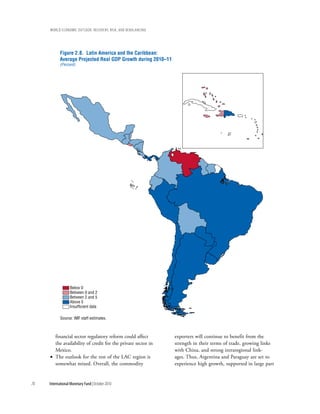
  • 160.
    wOrld ecOnOmic OutlOOk:recOvery, risk, and rebalancing estimated elasticity of imports to REER volatil- ity and credit are both statistically significant and of the expected sign. The estimated elasticity of imports to tariffs, while negative as expected, is not statistically significant. Combining these results allows us to estimate the average contribution of these various mecha- nisms (Figure 4.11). The estimated contribution of output is derived as the difference between the Figure 4.11. Decomposition of Import Losses unconditional import loss reported in Figure 4.4 (Percent; years on x-axis; crisis begins at t = 0) and the import loss controlling for output in Figure Output declines account for the biggest share of import losses in the 4.5. At the onset of a crisis (year t), the decline in aftermath of crises. However, the temporary rise in exchange rate volatility and persistent impairment of credit also contribute. Controlling for these potential output accounts for about half of the overall loss in explanations still leaves a portion of import losses unexplained, which may reflect composition effects. imports in that year; increased exchange rate volatil- ity accounts for another one-fifth of the import loss. Output REER1 volatility Real depreciation and weak credit together account Credit Tariffs REER1 Unexplained for less than 10 percent of the loss in the crisis year, so that about 20 percent of the import loss in 110 the year of the crisis remains unaccounted for. In 100 subsequent years, output remains the most impor- 90 tant contributor to depressed imports, accounting 80 for anywhere between 50 and 60 percent of the 70 total import loss. The role of exchange rate volatility 60 diminishes over time, a reflection of the fact that 50 the surge in volatility in the immediate aftermath 40 of a crisis subsides over time. The role of credit, in 30 contrast, increases over time because credit steadily 20 worsens following a crisis; by the fifth year, weak 10 credit conditions account for about 10 percent of 0 the total import loss. –10 Although these mechanisms help account for 0 1 2 3 4 5 a significant portion of the estimated postcrisis Source: IMF staff calculations. import loss, between 20 and 35 percent of the Note: Unconditional import losses (see Figure 4.4) are decomposed into changes attributable to the fall in output and credit, a rise in exchange rate volatility, latter remains unexplained. To what extent might depreciation, and changes in tariffs. The contribution of output is computed as the the composition effect account for the unexplained difference between the unconditional and conditional import losses (see Table 4.1). The contribution of the remaining factors is calculated as the product of the elasticity component? This chapter’s focus on trade in goods, of imports with respect to each factor and the change in the factor following crises (depicted in Figure 4.10), as a percent of the unconditional change in imports after and the lack of detailed historical data on the crises. 1REER = real effective exchange rate. demand share of durables and nondurables for a wide range of economies preclude inclusion of com- position effects in our three-step methodology. But there is some evidence to suggest that such effects were important in earlier crises as well.22 Imports fall much more than output if two conditions are 22Box 4.1 uses a more sophisticated framework and more disaggregated data to obtain more precise estimates of the role of the composition effect in explaining the most recent trade collapse. 142 International Monetary Fund | October 2010
  • 161.
    chapter 4 dO Financial crises Have lasting eFFects On trade?? satisfied: demand for some goods must fall more than for others, and those goods must account for a larger share of trade than of output. Across a sample of 48 economies and 26 crisis episodes for which data are available, tradable investment goods (machinery and equipment) account for 18 percent of trade but only 8 percent of GDP (Figure 4.12). And the postcrisis decline in machinery and Figure 4.12. Import Losses and Composition Effects equipment is much larger—imports of these goods (Percent) decline by more than one-third by the second year Durables comprise a much larger share of trade than of output. In addition, after a crisis, more than 10 times the postcrisis demand for durables declines substantially more than demand for nondurables decline in the rest of GDP over the same following crises. These two facts suggest that composition effects may play an important role in postcrisis import losses. period.23 Calculations in Appendix 4.2 suggest that, even when focusing narrowly on these investment Share of Durables 20 durables, the composition effect can explain at least a portion of the postcrisis fall in imports. The three-step methodology provides only an 15 estimate of the average contribution of the vari- ous mechanisms to import dynamics. For example, 10 although the size of the average depreciation is small following a crisis, it is also clear from Figure 5 4.10 that there is substantial variation around this average. Is it possible that economies whose cur- 0 Imports Output rencies depreciated more substantially had imports that evolved differently than those whose curren- Fall in Demand 0 cies did not depreciate as much? Figure 4.13 sheds some light on these possibilities; once again, all the reported import losses already control for output. -10 Crisis episodes with a relatively large depreciation seem to be associated with more depressed imports -20 than those with smaller depreciations (top panels). Crises during which the increase in exchange rate -30 volatility was lower, or credit conditions were better, seem to be associated with less import deterioration -40 Durables Nondurables (middle panels).24 Finally, there is evidence that cri- ses during which tariffs increased by relatively more Source: IMF staff calculations. were associated with worse import performance, Note: The average share of machinery and equipment in GDP and share of capital durables in imports in a sample of 48 countries is shown in the top panel. The particularly in the short term, consistent with the estimated impulse response two years after a crisis is shown in the bottom panel. The estimated impulse response function is based on contemporaneous and lagged crises findings in Box 4.2 regarding the recent crisis. and country and time dummies. 23One possibility is that a decline in credit availability follow- ing a crisis affects demand for durables more than demand for other goods. 24These findings are robust to the use of alternative proxies that more closely track trade finance as opposed to the measure of general credit conditions that is used here. Specifically, it is robust to using the change in the outstanding stock of external short-term debt, which includes short-term credit for trade (Ronci, 2004). International Monetary Fund | October 2010 143
  • 162.
    wOrld ecOnOmic OutlOOk:recOvery, risk, and rebalancing summary and implications for the outlook This analysis finds that crises tend to depress imports substantially in the short term—above and beyond any import compression due to lower Figure 4.13. Postcrisis Characteristics and Import output—and that imports tend to stay depressed Losses, Controlling for Output through the medium term. Imports tend to decline (Percent deviation from normal; years on the x-axis; crisis begins at t = 0) more if the economy entered the crisis with a The evolution of imports following crises is associated with postcrisis economic relatively unfavorable current account balance and if conditions and policies. Imports fare worse when a crisis is accompanied by a the crisis resulted in a relatively large decline in the larger depreciation, greater exchange rate volatility, a sharper decline in credit, or a greater increase in protectionism. REER or poor credit conditions. Finally, exports exhibit a smaller and more gradual decline that can Effect of a crisis be fully accounted for by changes in output. 90 percent confidence interval around How do those results inform the outlook for the estimated impulse response function trade? As the world economy emerges from the 10 High Depreciation Low Depreciation 10 Great Trade Collapse of 2008–09, recent data make it just as easy to view the trade recovery glass 0 0 as being half full as it is to view it as half empty. Optimists can point to strong growth in world trade since the second half of 2009, while pessimists -10 -10 can lament that imports and exports remain far below precrisis trends, or even below precrisis levels -20 -20 for some economies. Which perspective is justified? Although caution should be exercised when drawing -30 -30 –1 0 1 2 3 4 5 –1 0 1 2 3 4 5 implications for the recent, more global crisis from historical crisis episodes, we use the evidence in this High Increase in Exchange Low Increase in Exchange chapter to try to shed light on where trade might be 10 Rate Volatility 10 Rate Volatility headed. 0 0 The recent financial crisis has been concentrated in many large, advanced economies (Table 4.3), -10 -10 and so this chapter’s findings have implications not just for individual economies but also for the global recovery and for global trade patterns. The 13 -20 -20 -30 -30 –1 0 1 2 3 4 5 –1 0 1 2 3 4 5 Table 4.3. Systemic Banking Crises, 2007–09 Systemic Cases Borderline Cases Source: IMF staff calculations. Note: Blue lines indicate the impulse response function – the effect of a crisis on Austria France imports relative to what would be predicted in the absence of a crisis. Predictions are Belgium Greece based on a collapsed gravity model in changes, with contemporaneous and lagged Denmark Hungary crises, home and trade-weighted partner output, a trade-weighted partner crisis Iceland Kazakhstan dummy, and country and time dummies. Crisis episodes are split into those during Ireland Portugal which depreciation, the change in real effective exchange rate volatility, and the Latvia Russia change in credit to GDP between t = 0 and t = 5 are, respectively, above or below the crisis sample median. In the case of tariffs, the figure reports conditional imports Mongolia Slovenia after crises with a change in the trade liberalization index above and below the 75th Netherlands Spain percentile. United Kingdom Sweden United States Switzerland Source: Laeven and Valencia (2010). Note: Laeven and Valencia (2010) define systemic banking crises as cases in which at least three of their listed interventions took place, whereas borderline cases are those that “almost meet” their definition of a systemic crisis. 144 International Monetary Fund | October 2010
  • 163.
    chapter 4 dO Financial crises Have lasting eFFects On trade?? countries that recently had a systemic banking crisis account for about 40 percent of global demand, with the three largest countries—Germany, the United Kingdom, and the United States—account- ing for more than one-third of global demand. Including 10 additional countries that Laeven and Valencia (2010) identify as having had a “bor- derline” systemic banking crisis, the recent crisis Figure 4.13. (concluded) countries account for over half of world demand Effect of a crisis and output. This chapter’s estimates of postcrisis 90 percent confidence interval around the estimated impulse response function trade dynamics are consistent with the sharp and substantial drop in import demand that has been High Decline in Credit to Low Decline in Credit to 10 GDP 10 evident in these countries. More important for the GDP outlook, this analysis suggests that these countries’ 5 5 imports are likely to remain depressed for a number 0 0 of years, even more than their tempered output projections would suggest. If, in addition, some -5 -5 economies fall into a sovereign debt crisis—which -10 -10 this analysis finds to be associated with more acute -15 -15 import losses—prospects for global import demand will dim even further. For economies that rely heav- -20 -20 –1 0 1 2 3 4 5 –1 0 1 2 3 4 5 ily on external demand for growth, the chapter’s findings underscore the importance of rebalancing High Increase in Import Low Increase in Import 30 30 toward domestic sources of growth or, more gener- Tariffs Tariffs ally, of developing “twin engines” of growth. 20 20 The analysis also suggests that import dynamics may differ across the crisis countries. For countries 10 10 that entered the crisis with a relatively weak cur- 0 0 rent account, such as the United Kingdom and the United States, import demand is likely to be even -10 -10 more anemic. Exports to the United Kingdom are also weighed down by the substantial deprecia- -20 –1 0 1 2 3 4 5 –1 0 1 2 3 4 5 -20 tion of the pound sterling since 2008. Finally, real credit in these two economies is decelerating or Source: IMF staff calculations. Note: Blue lines indicate the impulse response function—the effect of a crisis on even contracting, which the chapter suggests will imports relative to what would be predicted in the absence of a crisis. Predictions are also weaken imports beyond its effects on output. based on a collapsed gravity model in changes, with contemporaneous and lagged crises, home and trade-weighted partner output, a trade-weighted partner crisis The fact that these countries’ exports are not dummy, and country and time dummies. Crisis episodes are split into those during which depreciation, the change in real effective exchange rate volatility, and the expected to decline nearly as much as their change in credit to GDP between t = 0 and t = 5 are, respectively, above or below the imports implies a likely improvement in the crisis sample median. In the case of tariffs, the figure reports conditional imports after crises with a change in the average tariff above and below the 75th percentile. external balances of the crisis countries and a deterioration in the balances of their partners. Because the United States accounted for a large part of the global imbalances that widened substantially in the early 2000s, a silver lining from the recent crisis is the narrowing of the U.S. external deficit, and this chapter suggests that this narrowing may be more durable than International Monetary Fund | October 2010 145
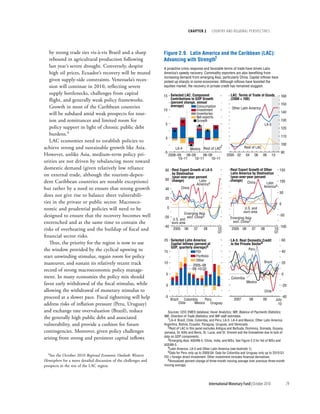
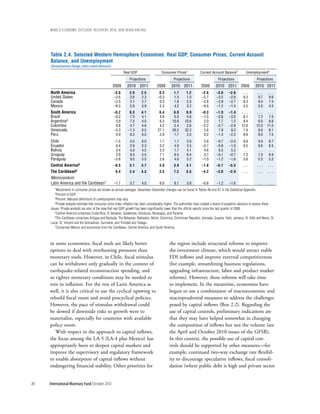
  • 164.
    wOrld ecOnOmic OutlOOk:recOvery, risk, and rebalancing Box 4.2. protectionism in the recent crisis The extent of trade protectionism before and Simple Average Tariff Rates: 2008 during the recent crisis has been subject to signifi- (Percent) cantly different interpretations. This box addresses MFN applied1 Bound the question by drawing on recent research by IMF staff (Gregory and others, 2010). New trade restric- tions have so far been limited to a small share of 50 global trade but have had a strong negative impact on trade flows. This box suggests ways for econo- 40 mies to avoid allowing rising trade protectionism to interfere with the recovery. 30 Trade became much freer during the second half of the 20th century. Among major western European 20 and North American countries, average tariffs fell from 15 to 4 percent between the 1950s and mid- 10 2000s. In many major developing economies, tariffs increased or remained very high until the 1980s 0 but have since come down sharply. Nonetheless, the Brazil United States Argentina China India Japan European Union pace of trade reforms waned after the mid-2000s as protectionist sentiment began to increase, and so substantial trade restrictions were still in place when the crisis hit. Moreover, gaps in World Trade Orga- nization (WTO) commitments leave a wide scope Source: World Trade Organization, World Tariff Profiles 2009. for legal backsliding on trade policy. Tariffs—the 1MFN = Most favored nation. most transparent and easily monitored trade policy instrument—provide an illustrative example. Some economies can raise tariffs substantially without • Multilateral rules and institutions have clarified exceeding their WTO bindings (first figure). the types of policy actions considered respon- Once the crisis took hold in mid-2008, politi- sible. The strong WTO-based trade system has cal leaders’ awareness of the risks of protectionism, been central. backed by increased monitoring activities, helped • Trade declined much more rapidly than overall limit the protectionist response. Mindful of both economic activity. The ratio of imports to GDP the disastrous results of protectionism during the declined as well. Although job losses mounted, 1930s and the contribution of trade to macro- they were not, by and large, blamed on trade. economic performance, the Group of 20 (G20) • Macroeconomic and financial sector policies economies pledged in November 2008 to “refrain were supportive of trade. from raising new barriers to investment or to Even so, once the crisis took hold, a number of trade in goods and services, imposing new export trade restrictions were introduced. The sharp rise in restrictions, or implementing WTO inconsistent unemployment and its continued high levels may measures to stimulate exports.” In April 2009 and help explain the increased frequency of industry again in June 2010, G20 leaders extended this requests for trade remedies. In addition, there was pledge and asked the WTO and other institutions increased use of unconventional measures, which to monitor adherence. are harder to quantify. Several other factors have worked to limit the However, the extent of trade restrictions is protectionist response to the crisis: unclear, and various monitoring efforts have come to quite different conclusions. None of the The main author of this box is Robert Gregory. watchdogs suggest that we have seen, or are likely 146 International Monetary Fund | October 2010
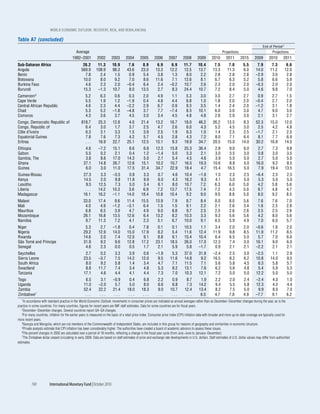
  • 165.
    chapter 4 dO Financial crises Have lasting eFFects On trade?? Measures included in Gregory and year” and that “much of the discrimination put in Others (2010) place then has yet to be removed” (GTA, 2010). (Number of measures) Gregory and others (2010) explore the impact Tariffs, import bans, quotas of both conventional and more unconventional Trade defense measures “behind the border” measures highlighted in the Nontariff barriers GTA reports, such as technical barriers to trade, Bailouts, subsidies procurement, and regulatory measures. The analysis Local content, public procurement Export measures matches data from GTA monitoring of measures taken between mid-2008 and late 2009 with detailed product-level data on bilateral monthly trade flows.1 The second figure illustrates the varied 51 nature of these protectionist measures. There is 55 strong evidence that, after an economy imposed import restrictions on a particular product, its imports fell in succeeding months relative to world trade in the same product (third figure). Allowing for various time-varying fixed effects, more sophis- ticated econometric analysis suggests that trade in 16 the affected products dropped an average of 3 to 8 1Extending the data set through May 2010 does not substantially change the results of the analysis. 21 14 27 Bilateral Trade Flows subject to Measures Implemented in November 2008 (Index, October 2008 = 100) Source: Global Trade Alert Database. 120 to see, an extreme protectionist surge like that of 100 the 1930s, but their assessments differ markedly. The June 2010 joint report of the WTO, Organiza- tion for Economic Cooperation and Development 80 (OECD), and United Nations Conference on Trade and Development (unctad) indicates that 60 “protectionist policy responses have been limited, although there are still instances of restrictive mea- sures taken… [T]here continues to be few instances 40 of new import restrictions and a greater use of export restrictions, but some G20 governments 20 have also taken steps to facilitate trade” (WTO, OECD, and unctad, 2010). In contrast, the sixth report of Global Trade Alert (GTA), which is asso- 0 2008 09 09 09 09 ciated with the London-based Centre for Economic Nov. Feb. May Aug. Nov. Policy Research and supported by the World Bank, also released in June 2010, concludes that “as far as Source: IMF staff calculations. open markets were concerned, 2009 was a terrible International Monetary Fund | October 2010 147
  • 166.
    wOrld ecOnOmic OutlOOk:recOvery, risk, and rebalancing Box 4.2 (continued) percent after the imposition of restrictions. How- Gaps in WTO commitments leave ample scope ever, in the aggregate, restrictions implemented for further trade restrictions, and a failure by all during the study period decreased trade by 0.25 economies to vigorously resist protectionism could percent, because these measures affected only a threaten the economic recovery and slow future small share of global trade. growth. Maintaining and enhancing the monitoring Looking ahead, sustained high unemployment, of protectionist measures and sustaining high-level uneven growth, an unwinding of government stim- political awareness of the associated macroeconomic ulus measures, and growing economic imbalances risks will help. But the surest way to avoid such a may increase protectionist pressure. In some econo- downside scenario is to tighten multilateral trade mies, such pressure may also emerge from high commitments by completing the WTO Doha commodity prices or a surge in capital inflows, Round. This can be viewed as a key part of the exit which may lead to rapid currency appreciation. strategy from the global economic crisis. in the absence of a financial crisis. On the other appendix 4.1. Data sources hand, the finding that imports decline mostly for The primary data sources for the chapter are the investment-related goods suggests that the post- IMF’s Direction of Trade Statistics (DOTS), World crisis outlook for innovation and potential growth Economic Outlook (WEO), and International could be diminished. Financial Statistics (IFS) databases; the NBER-UN Domestic policymakers who might be concerned World Trade Flows database (2005); and Laeven and about the harmful effects of a financial crisis on Valencia (2008, 2010). Additional data sources are exports may be reassured by the chapter’s findings listed in Table 4.4, and the WEO analytical regions that declines in exports are, on average, small and are in Table 4.5. gradual. Moreover, these effects can be accounted Crisis indicators are from Laeven and Valencia for by weaker output, suggesting that addressing the (2008, 2010). Laeven and Valencia (2010) present factors that depress output on the supply side will new and comprehensive data on the starting dates help exports recover as well. and characteristics of systemic banking crises over Finally, although domestic policymakers may the period 1970–2009, building on earlier work care more about the consequences for exports than by Caprio and others (2005), Laeven and Valencia for imports, the global nature of the recent crisis (2008), and Reinhart and Rogoff (2009). They means that a coordinated and protracted slump in update the Laeven and Valencia (2008) database import demand across a wide swath of economies on systemic banking crises to include the recent bodes ill for the global recovery. Not surprisingly, episodes following the U.S. mortgage crisis of the chapter finds that boosting output will con- 2007 and identify 129 episodes since 1970. siderably help imports to recover. In that regard, Laeven and Valencia (2008) also identify debt productivity-enhancing structural reforms could crisis episodes based on sovereign debt default help raise growth. The chapter’s findings suggest and restructuring by relying on information from that, beyond supporting domestic demand, taking Beim and Calomiris (2001), World Bank (2002), steps to improve credit conditions, keeping pro- Sturzenegger and Zettelmeyer (2006), and IMF tectionist tendencies at bay, and avoiding exces- staff reports. The information compiled includes the sive exchange rate volatility may help support the year of sovereign default on private lending and the recovery of trade. A conclusion of the Doha Round year of debt rescheduling. Using this approach, they of global trade talks would also reinforce the revival identify 63 episodes of sovereign debt default and of global trade. restructuring since 1970. 148 International Monetary Fund | October 2010
  • 167.
    chapter 4 dO Financial crises Have lasting eFFects On trade?? Table 4.4. Data Sources Variable Source Annual Data Real Exports and Imports Direction of Trade Statistics (DOTS) Database Real GDP in U.S. Dollars World Economic Outlook (WEO) Database Real GDP per Capita in U.S. Dollars WEO Database World Import/Export Price Deflator International Financial Statistics (IFS) Database Real Effective Exchange Rate IMF Product-Level Imports and Exports Feenstra and others (2005), COMTRADE, Pula and Peltonen (2009) Current Account Balance WEO Database Financial Openness Lane and Milesi-Ferretti (2007) Trade Liberalization IMF Bank Credit IFS Database Production Sharing Johnson and Noguera (2010) Debt Crisis Indicators Laeven and Valencia (2008) Banking Crisis Indicators Laeven and Valencia (2010) Investment Durables (machinery and equipment) Organization for Economic Cooperation and Development, Eurostat, Haver Analytics High-Frequency Data Real Exports and Imports CPB Netherlands Bureau of Economic Policy Analysis, DOTS Database, Global Trade Atlas, Haver Analytics Antidumping Data Bown (2010) World Import/Export Price Deflator IFS Database, CPB Netherlands Bureau of Economic Policy Analaysis Data on bilateral and aggregate imports and Nondurables, Intermediate Goods, and Primary exports from the DOTS database are reported in Goods, following Pula and Peltonen (2009). current U.S. dollars. These are deflated using the The current account balance is taken from the world import and export price deflators from the WEO database. Trade openness is measured as the IFS database, to determine each economy’s real ratio of the sum of imports and exports to GDP. imports and exports. The series on real GDP in Financial openness is calculated as the sum of U.S. dollars is from the WEO database. Import- foreign assets and foreign liabilities divided by GDP, and export-weighted partner GDP and GDP per using the updated and extended External Wealth of capita are constructed using real GDP in U.S. dol- Nations Mark II Database (see Lane and Milesi- lars and import and export weights from the DOTS Ferretti, 2007). database. These weights vary each year according Bank credit to the private nonfinancial sector is to the actual import and export flows between taken from the IFS database. Breaks in these data economies. are identified using the IFS Country Notes publica- Data on imports and exports by product category tion, and data are growth-spliced at these points. are constructed from the NBER-UN World Trade The real effective exchange rate (REER) data are Flows database (see Feenstra and others, 2005). from the IMF’s Information Notice System. The The database is first extended using the UN volatility of the REER is calculated as the standard COMTRADE database. The codes from the Stan- deviation of the monthly REER change in each dard International Trade Classification, Revision 2, year. The measure of trade liberalization is from the that identify products in the NBER-UN trade data IMF Structural Reforms Database and is described are matched to the UN Broad Economic Classifi- in IMF (2008). cation (BEC) codes. These are then classified into Bilateral data on production sharing are from Capital Goods, Consumer Durables, Consumer Johnson and Noguera (2010). International Monetary Fund | October 2010 149
  • 168.
    wOrld ecOnOmic OutlOOk:recOvery, risk, and rebalancing Table 4.5. Country Groupings Commonwealth of Independent States, Advanced Economies Developing Asia Africa Georgia, Mongolia South America Australia Afghanistan, Islamic Angola Armenia Argentina Austria Republic of Benin Azerbaijan Bolivia Belgium Bangladesh Botswana Belarus Brazil Canada Bhutan Burkina Faso Georgia Chile Cyprus Brunei Darussalam Burundi Kazakhstan Colombia Czech Republic Cambodia Cameroon Kyrgyz Republic Ecuador Denmark China Cape Verde Moldova Paraguay Finland Fiji Central African Republic Mongolia Peru France India Chad Russian Federation Uruguay Germany Indonesia Comoros Tajikistan Venezuela Greece Kiribati Congo, Democratic Turkmenistan Central America Hong Kong SAR Lao People's Democratic Republic of Ukraine Iceland Republic Congo, Republic of Uzbekistan Costa Rica Ireland Malaysia Côte d’Ivoire El Salvador Middle East Guatemala Israel Maldives Djibouti Italy Myanmar Equatorial Guinea Bahrain Honduras Japan Nepal Eritrea Egypt Mexico Korea Pakistan Ethiopia Iran, Islamic Republic of Nicaragua Luxembourg Papua New Guinea Gabon Jordan Panama Malta Philippines The Gambia Kuwait Caribbean Netherlands Samoa Ghana Lebanon Oman Antigua and Barbuda New Zealand Solomon Islands Guinea Qatar The Bahamas Norway Sri Lanka Guinea-Bissau Saudi Arabia Barbados Portugal Thailand Kenya Syrian Arab Republic Belize Singapore Timor-Leste Lesotho United Arab Emirates Dominica Slovak Republic Tonga Liberia Yemen, Republic of Dominican Republic Slovenia Tuvalu Madagascar Grenada Spain Vanuatu Malawi Maghreb Guyana Sweden Vietnam Mali Switzerland Mauritius Algeria Haiti Central and Eastern Libya Jamaica Taiwan Province of China Mozambique Europe Mauritania St. Kitts and Nevis United Kingdom Namibia United States Albania Niger Morocco St. Lucia Bosnia and Herzegovina Nigeria Tunisia St. Vincent and the Bulgaria Grenadines Rwanda Croatia Suriname São Tomé and Príncipe Estonia Trinidad and Tobago Senegal Hungary Seychelles Kosovo Sierra Leone Latvia South Africa Lithuania Sudan Macedonia, Former Swaziland Yugoslav Republic of Tanzania Montenegro Togo Poland Uganda Romania Zambia Serbia Zimbabwe Turkey The Global Trade Atlas data at the four-digit level Japan, Korea, Russia, South Africa, Turkey, and the of the Harmonized Commodity Description and United States. The monthly data are converted to a Coding System (HS) are used to trace trade in types quarterly frequency, deflated by specific commod- of products since 2001. These data cover the fol- ity price deflators—from the WEO database for lowing: Argentina, Australia, Brazil, Canada, China, selected primary goods and from the CPB Nether- 150 International Monetary Fund | October 2010
  • 169.
    chapter 4 dO Financial crises Have lasting eFFects On trade?? lands Bureau of Economic Policy Analysis for the following a crisis.26 In contrast to the baseline, remaining products—and are seasonally adjusted. this methodology allows for an episode-specific The HS four-digit codes are matched to the BEC trend, as opposed to the country-specific trend and classified into Capital Goods, Consumer that is captured by ai in the baseline specifica- Durables, Consumer Nondurables, Intermediate tion. However, it does not control for global Goods, and Primary Goods, following Pula and conditions as is done in the baseline. Peltonen (2009). • Alternative 2: Baseline specification with autore- gressive terms—The baseline specification is augmented by including four lags of the growth appendix 4.2. Methodology and robustness of imports on the right-hand side, paralleling the tests specifications used in Romer and Romer (2010) estimating Unconditional import losses and Cerra and Saxena (2008): The analysis25 first estimates the unconditional D ln Mit 5 ai 1 pt 1 ∑ rl D ln Mi,t–1 dynamics of imports in the aftermath of crises using a “collapsed” gravity model of trade in changes. 1 ∑ ak crisisi,t–k 1 eit. (4.3) In the baseline regression specification in the text, • Alternative 3: Bilateral gravity in changes—A the growth in an economy’s aggregate imports, directional gravity model (that is, one with bilat- D ln Mit , is expressed as a function of a dummy eral imports or exports as opposed to bilateral variable indicating whether a crisis started in year t, trade) is estimated in changes. The growth in five lags of this dummy variable, and country and bilateral imports of an economy from each trad- time dummies: ing partner, D ln Mimp,exp,t, is regressed on a crisis D ln Mit 5 ai 1 pt 1 ∑ ak crisisi,t–k 1 eit. (4.1) indicator and its lags, as well as on time and importer-exporter pair dummies: The robustness of the estimated unconditional import losses from the baseline specification is D ln Mimp,exp,t 5 aimp,exp 1 pt verified by using the following five alternative 1 ∑ a'k crisisimp,t–k 1 eimp,exp,t . (4.4) specifications: • Alternative 1: Deviation from precrisis trend— • Alternative 4: Bilateral gravity in changes, using top This procedure measures import loss as a simple 20 partners—This specification is identical to the deviation of ln Mit from a precrisis trend, ln Trit, directional gravity model in changes as described where the latter is a linear trend based on a in equation (4.4) but focuses only on the top precrisis window from (t – 7) to (t – 1). The 20 partners from which an economy imports. mean import loss k years after a crisis is just the This is done because our primary concern is in average of this import loss, (ln Mit – ln Trit), describing the behavior of aggregate trade, rather across all crisis episodes. This is equivalent to than average bilateral trade. The standard gravity estimating the following equation, either in levels model weights all bilateral trade observations or changes: equally, regardless of the size of the bilateral trade ln Mit 2 ln Trit 5 ∑ bk crisisi,t–k 1 eit. (4.2) 26The results from estimating equation (4.2) in levels or This procedure is similar to the procedure changes are identical because, as in Chapter 4 of the October 2009 World Economic Outlook, the import losses are normalized used in Chapter 4 of the October 2009 World so that the loss in the year before the crisis (t – 1) is zero. The Economic Outlook for estimating output losses primary differences between the procedure used here and in Chapter 4 of the October 2009 World Economic Outlook are the following: (1) the definition of crisis (debt crises combined with banking crises versus banking crises only), (2) the precrisis win- 25We focus on import dynamics here, since the chapter’s dow used to calculate the trend [(t – 7) to (t – 1) versus (t – 10) results suggest that imports are where the impact of a crisis on to (t – 3)], and (3) the choice of dependent variable (imports trade is primarily manifested. versus GDP per capita). International Monetary Fund | October 2010 151
  • 170.
    wOrld ecOnOmic OutlOOk:recOvery, risk, and rebalancing relationship. But trade is highly uneven—in the D ln PGDPit, contemporaneous and lagged values sample used in this chapter, the top 20 trading of a dummy variable indicating a crisis in the partners account for 89 percent of an economy’s economy, crisisi,t–k, an import-weighted indicator total imports, on average, even though the aver- of incidence of crises in trading partners (plus age economy imports from 175 economies. In five lags), pcrisisi,t–k, and country and time dum- other words, about 90 percent of the observa- mies ai and pt: tions in a typical gravity model account for only 10 percent of total trade. The behavior of aggre- D ln Mit 5 ai 1 pt 1 ∑ ak crisisi,t–k gate trade will more closely follow the dynamics 1 (b1r 1 b2r  Dt≥1990)D ln GDPit of larger trading partners. • Alternative 5: Baseline specification, excluding 1 b3 D ln PGDPit banking and debt crises that were accompanied by 1 ∑ dk pcrisisi,t–k eit. (4.5) a currency crisis—This specification is identical to the baseline equation (4.1) but focuses only on As discussed in the text, the elasticity of “pure” banking and debt crises. More specifically, imports to output is crucial for assessing whether we exclude banking and debt crisis episodes that the evolution of trade is fully explained by out- were accompanied or preceded by a currency put. To be as general as possible, we allow the crisis as defined in Laeven and Valencia (2008). output elasticities of imports and exports in the As Table 4.6 and Figure 4.14 illustrate, the esti- baseline specification to vary across the 10 WEO mated impulse response functions of imports using analytical regions described in Table 4.5. We also these different approaches are similar both qualita- allow each of these regional elasticities to vary tively and quantitatively. This confirms the find- between the pre- and post-1990 periods. The ing that there are large and statistically significant estimated elasticities, shown in Table 4.7, range unconditional import losses after crises. from 0.8 to 4.5 and are in general higher for the post-1990 period. The following tests were performed to check the import losses controlling for output robustness of the conditional import losses pre- The import losses controlling for output sented in the text: are also computed using the baseline model in • Robustness Test 1: Distributed lag specification— changes, this time with a set of controls derived We augment the specification to include lagged from the standard gravity model. Specifically, output growth. The elasticity of imports to the growth of imports, D ln Mit, is modeled as a contemporaneous and lagged output is allowed function of the growth in the economy’s output, to vary across regions and between the pre- and D ln GDPit, its partners’ import-weighted output, post-1990 periods. Table 4.6. Unconditional Import Losses: Estimated Impulse Response Functions Using Alternative Methodologies Bilateral Gravity in Baseline, Baseline Plus Bilateral Changes, Pure Bank Deviation Autoregressive Gravity in Top 20 and Debt Time Baseline from Trend Terms Changes Partners Crises Crisis year, t –0.080 –0.082 –0.078 –0.076 –0.080 –0.064 t+1 –0.158 –0.159 –0.167 –0.191 –0.156 –0.152 t+2 –0.171 –0.174 –0.181 –0.166 –0.162 –0.174 t+3 –0.153 –0.156 –0.161 –0.153 –0.135 –0.159 t+4 –0.169 –0.160 –0.173 –0.172 –0.159 –0.176 t+5 –0.190 –0.183 –0.191 –0.183 –0.184 –0.202 Source: IMF staff calculations. 152 International Monetary Fund | October 2010
  • 171.
    chapter 4 dO Financial crises Have lasting eFFects On trade?? • Robustness Test 2: Uniform elasticity of imports to output—We report the results from a specifica- tion that would most closely mirror a collapsed gravity specification in changes. Namely, as is standard in the literature, we impose the same elasticity of imports to output across economies and over time. • Robustness Test 3: Bilateral gravity (all controls) in changes—Rather than focusing on the economy’s aggregate imports, we estimate a unidirec- tional (bilateral) gravity model in changes. The specification is as in equation (4.4) but con- Figure 4.14. Import Losses, Not Controlling for tains the standard gravity controls: the growth Output: Alternative Methodologies in the economy’s and partners’ output as well (Percent deviation from normal; years on x-axis; crisis begins at t = 0) as a set of dummies for crises occurring in Baseline Alternative 1 both home and partner economies, indicators Alternative 2 Alternative 3 for whether the country pair is in a currency Alternative 4 Alternative 5 union or free trade agreement, and time and importer-exporter pair dummies. The elasticity 0 with respect to an economy’s output is allowed to vary across regions and between the pre- and post-1990 periods. -5 • Robustness Test 4: Allowing the elasticity of imports to vary across cyclical versus trend components of output—Imports may be more responsive to -10 cyclical than to trend movements in output; if so, the baseline approach would overestimate the fall in imports controlling for output. To -15 test this, we allow the elasticity of imports to vary across the trend and cyclical components -20 Table 4.7. Estimated Elasticity of Imports to Output: Panel Regression with Country and -25 –1 0 1 2 3 4 5 Time Dummies Pre-1990 Post-1990 Source: IMF staff calculations. Advanced 1.99 1.94 Developing Asia 0.89 2.76 Africa 0.99 1.50 CIS,1 Georgia, Mongolia ... ... Central and Eastern Europe 1.46 1.38 Middle East 0.79 1.89 Maghreb 0.83 1.09 South America 2.26 2.26 Central America 2.03 1.58 Caribbean 1.87 1.77 Source: IMF staff calculations. 1Commonwealth of Independent States. International Monetary Fund | October 2010 153
  • 172.
    wOrld ecOnOmic OutlOOk:recOvery, risk, and rebalancing of output, where the trend and cycle were ods—Similar to Robustness Test 4, the sensitivity separated using a Hodrick-Prescott filter. As in of imports to output may be particularly high the baseline, the import elasticity with respect in times of crisis. We thus allow the coefficient to both the cyclical and trend components of on output to vary during crisis and noncrisis output are allowed to vary across WEO regions periods. and between the pre- and post-1990 periods. The results of these robustness tests are presented • Robustness Test 5: Controlling for changes in the in Table 4.8 and Figure 4.15. The finding that REER and relative prices—Import dynamics may imports remain below their normal levels following differ after crises due to changes in the REER a crisis, even after controlling for output, is con- and relative price levels. Equation (4.5) is aug- firmed across all these robustness checks. While the mented to control for changes in REER and the standard errors increase substantially once we allow domestic price level, proxied by the change in the the estimated elasticity of imports to output to vary GDP deflator. across economies, the point estimates remain very • Robustness Test 6: Controlling for changes in similar to the baseline specification. domestic aggregate demand—An economy’s GDP may not be a good proxy for absorption in the importing economy, and to the extent that Decomposition of Unconditional import losses absorption declines more than GDP during cri- We use a three-step approach to evaluate the ses, the estimated import losses after controlling importance of different mechanisms in explaining for output may be overstated. We replace growth the unconditional import losses, as detailed below. in output by growth in domestic absorption It is important to keep in mind that this is simply (consumption plus investment) on the right-hand an accounting exercise that attempts to decompose side of equation (4.5). the unconditional import losses based on observed • Robustness Test 7: Allowing the elasticity of imports correlations. The true contributions of the vari- to output to differ across economies—We further ous mechanisms might differ from these estimated increase the flexibility of our specification by correlations. estimating separately the elasticity of imports Step 1: We document whether crises are followed to output for each of the 154 economies in the by persistent changes in tariffs, credit, the REER, sample. and exchange rate volatility by estimating equation • Robustness Test 8: Allowing the elasticity of imports (4.1) with the mechanisms of interest as the depen- to output to vary across crisis versus noncrisis peri- dent variable. Table 4.8. Conditional Import Losses: Robustness of Estimated Impulse Response Functions Baseline Same Control for and Elasticity Control for Changes in Elasticity: Lagged across Elasticity: Changes in Consumption Elasticity: Differs Growth of Regions Full Gravity Cyclical vs. REER and and Varies by during Time Baseline Output and Time in Changes Trend PPP1 Investment Economy Crisis Years (1) (2) (3) (4) (5) (6) (7) (8) (9) Crisis year, t –0.040*** –0.037** –0.058*** –0.022* –0.043*** –0.052*** –0.042*** –0.031* –0.052*** t+1 –0.073*** –0.074*** –0.116*** –0.093*** –0.076*** –0.090*** –0.079*** –0.058** –0.114*** t+2 –0.077*** –0.086*** –0.129*** –0.053*** –0.086*** –0.092*** –0.093*** –0.054* –0.122*** t+3 –0.063* –0.071** –0.114*** –0.048** –0.077** –0.074*** –0.076*** –0.041 –0.099*** t+4 –0.077** –0.081*** –0.133*** –0.074*** –0.090*** –0.091*** –0.087*** –0.057* –0.101*** t+5 –0.089** –0.092*** –0.152*** –0.068*** –0.099*** –0.105*** –0.095*** –0.071* –0.115*** Source: IMF staff calculations. Note: All columns include economy- and year-fixed effects. Columns (1), (2), and (4) – (7) allow the elasticity of imports to output (or its cyclical and trend component and consump- tion and investment) to vary by WEO regions and after 1990. In column (8), the elasticity of imports to output is allowed to vary by economy. 1REER = real effective exchange rate; PPP = purchasing power parity. 154 International Monetary Fund | October 2010
  • 173.
    chapter 4 dO Financial crises Have lasting eFFects On trade?? Step 2: We estimate the elasticity of imports with respect to the various mechanisms in the following regression framework: ln Mit = ai + pt + (bGDP,r + bGDP,r × Dt≥1990) ln GDPit + bTariff ln Tariffit + bcr ln Creditit + bREER ln REERit + bvol ln Volatilityit + ∑ ak crisisi,t–k + b3 ln PGDPit + ∑ dk pcrisisi,t–k + it (4.6) Figure 4.15. Import Losses, Controlling for Output: Robustness (Percent deviation from normal; years on x-axis; crisis begins at t = 0) Step 3: We combine the estimates from steps 1 and 2 to quantify the contribution of various mech- Baseline Robustness 1 anisms. In particular, the estimated change in the Robustness 2 Robustness 3 Robustness 4 Robustness 5 mechanism following a crisis in step 1 is multiplied Robustness 6 Robustness 7 by the estimated elasticity of imports with respect Robustness 8 to that mechanism in step 2. The contribution of each mechanism is then expressed as a fraction of 0 the unconditional import losses. The contribution of output is computed as the difference between the -2 unconditional import losses from equation (4.1) -4 and import losses conditional on output from equa- tion (4.5). -6 -8 composition effects during earlier crises: a Back-of- the-envelope calculation -10 If GDP and imports had the same composition of goods and services, and if, within each sector, -12 imports changed proportionally to domestic final demand, imports would be expected to fall by as -14 much as GDP after a crisis. However, if there are -16 differences in the composition of imports and GDP, –1 0 1 2 3 4 5 and if goods and services that constitute a larger Source: IMF staff calculations. share of trade than of GDP experience a relatively larger decline in demand following a crisis, imports will fall more than GDP even in the absence of changes in other factors (such as credit, exchange rates, or degree of protectionism) described in the chapter. For example, part of the outsize decline in imports relative to GDP in the recent crisis has been attributed to the resilience in the demand for services relative to manufactured goods. Since demand for manufactured goods experienced a relatively larger decline and since manufactured International Monetary Fund | October 2010 155
  • 174.
    wOrld ecOnOmic OutlOOk:recOvery, risk, and rebalancing goods comprise a larger share of trade than of GDP, overall imports declined more than GDP (Borchert and Mattoo, 2009). We first investigate whether historically there is a difference in the behavior of manufactured goods and services following crises. Since detailed data on the demand side are not available, we use sectoral value-added data to document whether there are differences in the behavior of services versus Figure 4.16. The Postcrisis Evolution of Various industry after crises. Somewhat surprisingly, this Components of GDP (Percent deviation from normal; years on x-axis; crisis begins at t = 0) does not appear to be the case. The estimated drop in services is very similar to the decline in industry Crises are followed by roughly equal declines in services and industry. The postcrisis decline in investment in machinery and equipment, on the other value added after crises (Figure 4.16, top panel).27 hand, is much deeper than for the rest of output. Given this similarity in the dynamics of services and industry, the different shares of services in output Services, Industry, and Total Output 0 and trade do not appear to be a likely explanation. However, within the “manufactured goods” cat- -2 egory, there are compositional differences between Total output -4 output and trade. Across a sample of 48 economies for which disaggregated data on gross fixed invest- Services -6 ment are available, (capital) durables, measured by tradable investment goods—namely, machinery and Industry -8 equipment—account for only 8 percent of GDP. -10 For the same set of economies, the average share –1 0 1 2 3 4 5 of (capital) durables in imports is 18 percent.28 Durables and the Rest of Output Although the data coverage is rather scant—only 0 26 of the identified crises can be included in the Rest of output analysis— we provide some back-of-the-envelope -10 calculations to estimate the contribution of these composition effects in explaining import losses fol- -20 lowing crises. Durables We begin with the following two identities: -30 GDPgth = shdur × DURGDP GDP gth –1 0 1 2 3 4 5 -40 + (1 – shdur ) × OTHERGDP (4.7) GDP gth IMPgth = shdur × DURIMP Source: IMF staff calculations. IMP gth Note: Lines indicate the impulse response function – the effect of a crisis on imports relative to what would be predicted in the absence of a crisis. Predictions are based on + (1 – shdur ) × OTHERIMP , (4.8) IMP gth contemporaneous and lagged crises, and country and time dummies. 27The overall output loss is slightly lower than the loss of services and industry due to the resilience of agricultural produc- tion to crises. 28The definition of “durables” in the trade and output data is not identical because these series come from different, not always comparable, data sources. However, it is unlikely that differences in definitions account for the differences in the shares of these goods in imports and output. 156 International Monetary Fund | October 2010
  • 175.
    chapter 4 dO Financial crises Have lasting eFFects On trade?? where GDPgth and IMPgth are the growth rates in Table 4.9 and Figure 4.16 present the findings GDP and imports, respectively; shdur and shdur from this exercise. The impulse response functions GDP IMP are the share of (capital) durables in GDP and of investment in machinery and equipment and imports, respectively; DURGDPgth and DURIMPgth are the rest of GDP are shown in Figure 4.16 (bottom the growth rate in the (capital) durable component panel).29 The postcrisis decline in investment, and of GDP and imports, respectively; and OTHERGDPgth in particular in machinery and equipment, is much and OTHERIMPgth are the growth rate in other com- larger than the postcrisis decline in the rest of GDP ponents of GDP and imports, respectively. over the same period. As presented in column (6) Assuming the elasticity of imports of different prod- of Table 4.9, for this selected sample of crises, the ucts to GDP is 1, equation (4.8) can be rewritten as composition effect can explain 5 to 13 percent of the unconditional import loss. It is important to IMPgth = shdur × DURGDP IMP gth keep in mind that these composition effects are + (1 – shdur ) × OTHERGDP . (4.9) calculated only from the different shares and post- IMP gth crisis behavior of machinery and equipment relative Subtracting (4.7) from (4.9) implies to the rest of output; other composition effects— IMPgth – GDPgth = (shdur – shdur ) most notably, from consumer durables—may IMP GDP also be present. In addition, composition effects × (DURGDP – OTHERGDP ). (4.10) gth gth may already be reflected in the higher elasticity of Based on equation (4.10), we define the compo- imports to output that is allowed for in our baseline sition effect as the extent to which the difference specification. Thus, these estimates of the size of the between the growth rates of GDP and imports is composition effect could be thought of as a lower explained by different compositions of GDP and bound. imports. It is a product of two factors: (1) differ- ences in the share of durables in imports and GDP and (2) differences in the growth of durables and other components following a crisis. If either of these differences is zero, composition cannot be an 29Given the share of durables in GDP, as well as the decline in explanation for observing import losses controlling overall GDP, we can also calculate how much demand for other for output. components of GDP falls after crises. Table 4.9. Import Losses and Composition Effects Implied Response Function Actual Estimated Share of Import Investment Import Composition Loss Explained by GDP in Durables Other Loss Effect Composition Effects Time (1) (2) (3) (4) (5) (6) Crisis year, t –0.024 –0.091 –0.018 –0.088 –0.007 8.0 t+1 –0.051 –0.285 –0.029 –0.267 –0.025 9.2 t+2 –0.054 –0.340 –0.028 –0.250 –0.030 12.1 t+3 –0.050 –0.234 –0.033 –0.155 –0.019 12.6 t+4 –0.048 –0.160 –0.038 –0.153 –0.012 7.7 t+5 –0.049 –0.114 –0.043 –0.144 –0.007 4.8 Source: IMF staff calculations. Note: All estimates in columns (1), (2), and (4) are significant at the 1 percent level. Standard errors (not reported) are clustered by economy and corrected for heterosce- dasticity. The actual import loss is estimated for the subsample of economies and crises for which disaggregated investment data are available. The share of import loss explained by composition effects in column (6) is calculated as the estimated composition effect in column (5) divided by the actual import loss multiplied by 100. International Monetary Fund | October 2010 157
  • 176.
    wOrld ecOnOmic OutlOOk:recOvery, risk, and rebalancing references Bown, Chad, 2010, “Fourth Quarter 2009 Protectionism Data: Requests for New Trade Barriers Fall for the First Abiad, Abdul, Giovanni Dell’Ariccia, and Bin Li, forthcom- Time in Crisis; But Newly Imposed Barriers Increase,” a ing, “Creditless Recoveries,” IMF Working Paper (Wash- Monitoring Update to the Global Antidumping Database, ington: International Monetary Fund). February (Washington: World Bank). Alessandria, George, Joseph P. Kaboski, and Virgiliu Caprio, Gerard, Daniela Klingebiel, Luc Laeven, and Midrigan, forthcoming, “The Great Trade Collapse of Guillermo Noguera, 2005, “Appendix: Banking Crisis 2008–09: An Inventory Adjustment?” IMF Economic Database,” in Systemic Financial Crises: Containment Review, (Washington: International Monetary Fund). and Resolution, ed. by Patrick Honohan and Luc Laeven Altomonte, Carlo, and Gianmarco I.P. Ottaviano, 2009, (Cambridge, United Kingdom: Cambridge University “Resilient to the Crisis? Global Supply Chains and Trade Press). Flows,” in The Great Trade Collapse: Causes, Consequences Cerra, Valerie, and Sweta Saxena, 2008, “Growth Dynamics: and Prospects, ed. by Richard Baldwin. Available at www. The Myth of Economic Recovery,” American Economic voxeu.org/index.php?q=node/4289. Review, Vol. 98, No. 1, pp. 439–57. Amiti, Mary, and David E. Weinstein, 2009, “Exports and Chor, Davin, and Kalina Manova, 2010, “Off the Cliff and Financial Shocks,” NBER Working Paper No. 15556 Back? Credit Conditions and International Trade during (Cambridge, Massachusetts: National Bureau of Economic the Global Financial Crisis” (unpublished; Stanford, Cali- Research). fornia: Stanford University). Anderson, James, and Eric Van Wincoop, 2003, “Gravity Eaton, Jonathan, Sam Kortum, Brent Neiman, and John with Gravitas: A Solution to the Border Puzzle,” American Romalis, 2010, “Trade and the Global Recession” (unpub- Economic Review, Vol. 93, No. 1, pp. 170–92. lished; Chicago, Illinois: University of Chicago). Available Baldwin, Richard, 1988, “Hysteresis in Import Prices: The at http://home.uchicago.edu/~kortum/papers/EKNR.pdf. Beachhead Effect,” American Economic Review, Vol. 78, Feenstra, Robert, Robert Lipsey, Haiyan Deng, Alyson Ma, No. 4, pp. 773–85. and Hengyong Mo, 2005, “World Trade Flows: 1962– ———, ed., 2009, The Great Trade Collapse: Causes, Conse- 2000,” NBER Working Paper No. 11040 (Cambridge, quences and Prospects. Available at www.voxeu.org/index. Massachusetts: National Bureau of Economic Research). php?q=node/4297. Frankel, Jeffrey, Ernesto Stein, and Shang-Jin Wei, 1996, ———, and Daria Taglioni, 2006, “Gravity for Dummies “Regional Trading Arrangements: Natural or Supernatural?” and Dummies for Gravity Equations,” NBER Working American Economic Review, Vol. 86, No. 2, pp. 52–56. Paper No. 12516 (Cambridge, Massachusetts: National Friedman, Jed, and James Levinsohn, 2003, “The Distribu- Bureau of Economic Research). tional Impacts of Indonesia’s Financial Crisis on Household Beim, David, and Charles Calomiris, 2001, Emerging Welfare: A ‘Rapid Response’ Methodology,” The World Financial Markets, appendix to Chapter 1 (New York: Bank Economic Review, Vol. 16, No. 3, pp. 397–423. McGraw-Hill/Irwin). Freund, Caroline, 2009, “The Trade Response to Global Bems, Rudolfs, Robert Johnson, and Kei-Mu Yi, forthcom- Downturns: Historical Evidence,” Policy Research Work- ing, “Demand Spillovers and the Collapse of Trade in the ing Paper No. 5015 (Washington: World Bank). Global Recession,” IMF Economic Review (Washington: Glick, Reuven, and Alan M. Taylor, 2010, “Collateral Dam- International Monetary Fund). age: Trade Disruption and the Economic Impact of War,” Berman, Nicolas, and Philippe Martin, 2010, “The The Review of Economics and Statistics, Vol. 92, No. 1, pp. Vulnerability of Sub-Saharan Africa to the Financial 102–27. Crisis: The Case of Trade,” CEPR Discussion Paper Global Trade Alert, 2010, “Unequal Compliance: The 6th No. 7765 (London: Centre for Economic Policy GTA Report” (London). Available at www.globaltrade Research). alert.org/gta-analysis/unequal-compliance-6th-gta-report. Bernard, Andrew, J. Bradford Jensen, Stephen J. Redding, Gregory, Rob, Christian Henn, Brad McDonald and Mika and Peter K. Schott, 2009, “The Margins of U.S. Trade,” Saito, 2010, “Trade and the Crisis: Protect or Recover,” American Economic Review Papers and Proceedings, Vol. 99, IMF Staff Position Note 10/07 (Washington: Interna- No. 2, pp. 487–93. tional Monetary Fund). Borchert, Ingo, and Aaditya Mattoo, 2009, “The Crisis-Resil- Iacovone, Leonardo, and Veronika Zavacka, 2009, “Banking ience of Services Trade,” Policy Research Working Paper Crises and Exports: Lessons from the Past,” Policy Research 4917 (Washington: World Bank). Working Paper No. 5016 (Washington: World Bank). 158 International Monetary Fund | October 2010
  • 177.
    chapter 4 dO Financial crises Have lasting eFFects On trade?? International Monetary Fund (IMF), 2008, “Structural Pula, Gabor, and Tuomas Peltonen, 2009, “Has Emerging Reforms and Economic Performance in Advanced and Asia Decoupled? An Analysis of Production and Trade Developing Countries,” Research Department paper. Avail- Linkages Using the Asian International Input-Output able at www.imf.org/external/np/res/docs/2008/0608.htm. Table,” ECB Working Paper No. 993 (Frankfurt: Euro- Johnson, Robert C., and Guillermo Noguera, 2010, pean Central Bank). “Accounting for Intermediates: Production Sharing and Reinhart, Carmen, and Kenneth Rogoff, 2009, This Time Trade in Value Added” (unpublished; Hanover, New Is Different: Eight Centuries of Financial Folly (Princeton, Hampshire: Dartmouth College). New Jersey: Princeton University Press). Kaminsky, Graciela, L., and Carmen M. Reinhart, 1999, Romer, Christina, and David Romer, 2010, “The Macroeco- “The Twin Crises: The Causes of Banking and Balance of nomic Effects of Tax Changes: Estimates Based on a New Payments Problems,” American Economic Review, Vol. 89, Measure of Fiscal Shocks,” American Economic Review, No. 3, pp. 473–500. Vol. 100, No. 3, pp. 763–801. Kwack, Sung Yeung, Choong Y. Ahn, Young S. Lee, and Ronci, Marcio, 2004, “Trade Finance and Trade Flows: Panel Doo Y. Yang, 2007, “Consistent Estimates of World Trade Data Evidence from 10 Crises,” IMF Working Paper Elasticities and an Application to the Effects of Chinese 04/225 (Washington: International Monetary Fund). Yuan (RMB) Appreciation,” Journal of Asian Economics, Rose, Andrew, 2000, “One Money, One Market: Estimating Vol. 18, No. 2, pp. 314–30. the Effect of Common Currencies on Trade,” Economic Laeven, Luc, and Fabian Valencia, 2008, “Systemic Banking Policy, Vol. 15, No. 30, pp. 7–46. Crises: A New Database,” IMF Working Paper 08/224 Senhadji, Abdelhak, 1998, “Time-Series Estimation of (Washington: International Monetary Fund). Structural Import Demand Equations: A Cross-country ———, 2010, “Resolution of Banking Crises: The Good, Analysis,” IMF Staff Papers, Vol. 45, No. 2 (Washington: the Bad, and the Ugly,” IMF Working Paper 10/146 International Monetary Fund). (Washington: International Monetary Fund). Sturzenegger, Federico, and Jeromin Zettelmeyer, 2006, Debt Lane, Philip R., and Gian Maria Milesi-Ferretti, 2007, “The Defaults and Lessons from a Decade of Crises, Chapter 1, External Wealth of Nations Mark II,” Journal of Interna- Table 1 (Cambridge, Massachusetts: MIT Press). tional Economics, Vol. 73, No. 2, pp. 223–50. Thursby, Marie, and Jerry Thursby, 1987, “Bilateral Trade Levchenko, Andrei, Logan Lewis, and Linda Tesar, forth- Flows, the Linder Hypothesis, and Exchange Risk,” coming, “The Collapse of International Trade during the Review of Economics and Statistics, Vol. 69, No. 3, pp. 2008-2009 Crisis: In Search of the Smoking Gun,” IMF 488–95. Economic Review (Washington: International Monetary World Bank, 2002, Global Development Finance, appendix Fund). on commercial debt restructuring (Washington: World Martin, Philippe, Thierry Mayer, and Mathias Thoenig, Bank). 2008, “Make Trade, Not War?” Review of Economic Stud- World Trade Organization (WTO), Organization for ies, Vol. 75, No. 3, pp. 865–900. Economic Cooperation and Development (OECD), and O’Rourke, Kevin, 2009, “Government Policies and the Col- United Nations Conference on Trade and Development lapse in Trade during the Great Depression,” in The Great (UNCTAD), 2010, “Report on G20 Trade and Invest- Trade Collapse: Causes, Consequences and Prospects, ed. ment Measures (November 2009 to Mid-May 2010)” by Richard Baldwin. Available at www.voxeu.org/index. (Paris, June). Available at www.unctad.org/templates/ php?q=node/4267. Download.asp?docid=13369&lang=1. International Monetary Fund | October 2010 159
  • 179.
    Annex IMF executIve BoArd dIscussIon oF the outlook, septeMBer 2010 The following remarks by the Acting Chair were made at the conclusion of the Executive Board’s discussion of the World Economic Outlook on September 20, 2010. E xecutive Directors observed that the global and debt stabilization, including through legislation economic recovery is proceeding broadly as where necessary. At the same time, policymakers projected, despite disturbances in financial should stand ready to act if global growth threatens markets. The recovery is losing momen- to slow appreciably more than expected. In this tum temporarily during the second half of 2010 and regard, consideration could be given to postpon- will likely remain weak in the first half of 2011, as ing consolidation in countries with fiscal room and extraordinary policy stimulus is gradually withdrawn. credibility to do so. In all but the most vulnerable Directors welcomed signs that financial conditions countries, automatic stabilizers should be allowed to have begun to normalize, aided by policy coordina- operate. Directors stressed that medium-term con- tion and announcements of a front-loading of fiscal solidation plans should be based on realistic growth adjustment in Europe. A more robust, self-sustaining projections and include reforms to limit rapidly global recovery will require progress in achieving escalating spending programs such as pension enti- both internal and global demand rebalancing, sup- tlements and public health care and tax incentives ported by healthy financial systems. to boost the supply potential and discourage debt. Directors noted that the observed asymmetry In light of subdued inflation pressures, Direc- in growth performances will likely persist. In most tors generally considered that monetary policy in advanced and a few emerging market economies, most advanced economies should remain highly recoveries are proceeding at a sluggish pace, and accommodative, including through unconventional large internal adjustments remain needed to achieve measures if needed, and should be the first line of internal rebalancing from stimulus-led to private- defense against any larger-than-projected weakening sector-led growth. On the other hand, growth in of activity as fiscal stimulus is being unwound. In many emerging market and developing economies emerging market economies with rising inflation or continues to be vigorous, on the back of improved asset price pressures, monetary tightening has been macroeconomic policy frameworks and a stronger broadly appropriate. For all economies, the impli- financial footing. Downside risks to near-term cations of fiscal consolidation and developments global growth remain elevated and concentrated in in financial and asset markets for inflation would advanced economies. These emanate from height- also need to be taken into account when setting ened uncertainty in financial markets, fragile real monetary policy. estate markets, continued household deleveraging, Directors underscored the urgent need for restor- and persistently high unemployment. However, the ing financial sector health and making progress probability of a sharp global slowdown, including in regulatory reforms in a coordinated manner, stagnation or contraction in advanced economies, especially among advanced economies. To enable appears low. an early exit from fiscal support as well as address Directors agreed that fiscal consolidation is a legacy problems, priorities include restructuring and top priority in countries with relatively high public resolving weak financial institutions; implementing debt. They highlighted the urgency of adopting measures to shore up bank capital adequacy, liquid- credible strategies for medium-term consolidation ity, and stability of funding sources; and improving International Monetary Fund | October 2010 161
  • 180.
    wOrld ecOnOmic OutlOOk:recOvery, risk, and rebalancing coordination of supervision to avoid rapid cross- account deficits. Continued fiscal adjustment and border amplification of shocks. Further advance- financial sector reforms that discourage excessive ment toward building a stronger financial regulatory spending are also key. framework is crucial to underpin market confidence Directors noted that structural policies that and enhance global financial stability. strengthen growth over the medium term would Directors emphasized that medium-term growth help support the required normalization of macro- prospects depend on progress in implementing economic policies in advanced economies. Labor structural policies to give forceful impetus to global market policies, coupled with complementary demand rebalancing. In this regard, many emerging product and services market reforms, should aim market economies would need to further reorient to promote competition and enhance growth and toward domestic demand, not only because import job creation, and with sufficient support for the recovery in advanced economies will likely trail unemployed. behind precrisis trends, but also to achieve balanced Directors underscored the critical importance of growth that addresses their own consumption and continued policy effort and coordination at both investment needs. For economies with excessive the regional and global levels—as demonstrated external surpluses, this would entail allowing further during the global crisis and more recently during exchange rate flexibility and appreciation in response the European sovereign debt market turmoil. While to sustained capital inflows, while safeguarding finan- policy requirements now differ considerably across cial stability with macroprudential or other targeted countries, it is essential that countries continue to measures. These measures should be complemented work together toward the common goal of achiev- by structural reforms aimed at enhancing social safety ing strong, sustained, and balanced growth over nets and shifting toward optimal saving-investment the medium term. Directors also emphasized the patterns. Similarly, measures to boost net exports need to avoid negative spillovers as well as trade and would be crucial for economies with excessive current investment protectionism. 162 International Monetary Fund | October 2010
  • 181.
    StatiStical appendix T he Statistical Appendix presents his- assumptions underlying the projections for selected torical data, as well as projections. It economies are described in Box A1. comprises five sections: Assumptions, With regard to interest rates, it is assumed that What’s New, Data and Conventions, the London interbank offered rate (LIBOR) on six- Classification of Countries, and Statistical Tables. month U.S. dollar deposits will average 0.6 percent The assumptions underlying the estimates and in 2010 and 0.8 percent in 2011, that three-month projections for 2010–11 and the medium-term sce- euro deposits will average 0.8 percent in 2010 and nario for 2012–15 are summarized in the first sec- 1.0 percent in 2011, and that six-month yen depos- tion. The second section presents a brief description its will average 0.6 percent in 2010 and 0.4 percent of changes to the database and statistical tables. in 2011. The third section provides a general description of With respect to introduction of the euro, on the data and of the conventions used for calculat- December 31, 1998, the Council of the European ing country group composites. The classification Union decided that, effective January 1, 1999, the of countries in the various groups presented in irrevocably fixed conversion rates between the euro the World Economic Outlook is summarized in the and currencies of the member states adopting the fourth section. euro are as follows. The last, and main, section comprises the statis- tical tables. Data in these tables have been com- piled on the basis of information available through 1 euro = 13.7603 Austrian schillings late September 2010. The figures for 2010 and = 40.3399 Belgian francs beyond are shown with the same degree of preci- = 0.585274 Cyprus pound1 sion as the historical figures solely for convenience; = 1.95583 Deutsche mark because they are projections, the same degree of = 5.94573 Finnish markkaa accuracy is not to be inferred. = 6.55957 French francs = 340.750 Greek drachma2 assumptions = 0.787564 Irish pound = 1,936.27 Italian lire Real effective exchange rates for the advanced = 40.3399 Luxembourg francs economies are assumed to remain constant at their = 0.42930 Maltese lira3 average levels during the period August 4–Septem- = 2.20371 Netherlands guilders ber 1, 2010. For 2010 and 2011, these assumptions = 200.482 Portuguese escudos imply average U.S. dollar/SDR conversion rates of = 30.1260 Slovak koruna4 1.516 and 1.520, U.S. dollar/euro conversion rates = 239.640 Slovenian tolars5 of 1.308 and 1.284, and yen/U.S. dollar conversion = 166.386 Spanish pesetas rates of 88.5 and 84.2, respectively. It is assumed that the price of oil will average 1Established on January 1, 2008. $76.20 a barrel in 2010 and $78.75 a barrel in 2Established on January 1, 2001. 2011. 3Established on January 1, 2008. Established policies of national authorities are 4Established on January 1, 2009. assumed to be maintained. The more specific policy 5Established on January 1, 2007. International Monetary Fund | October 2010 163
  • 182.
    WOrld EcOnOmic OutlOOk:rEcOvEry, risk, and rEbalancing Box a1. economic policy assumptions Underlying the projections for Selected economies Fiscal Policy Assumptions spending ceilings (approved by Parliament) and The short-term fiscal policy assumptions used the health insurance package savings for all years in the World Economic Outlook (WEO) are based (2011–15). on officially announced budgets, adjusted for dif- Belgium: Projections for 2010 are IMF staff ferences between the national authorities and the estimates based on the 2010 budgets approved by IMF staff regarding macroeconomic assumptions the federal, regional, and community parliaments and projected fiscal outturns. The medium-term and further strengthened by the Intergovernmen- fiscal projections incorporate policy measures that tal Agreement 2009–10. Projections for the outer are judged likely to be implemented. In cases years are IMF staff estimates, assuming unchanged where the IMF staff has insufficient informa- policies. tion to assess the authorities’ budget intentions Brazil: The 2010 forecasts are based on the and prospects for policy implementation, an budget law and IMF staff assumptions. For the unchanged structural primary balance is assumed, outer years, the IMF staff assumes unchanged unless indicated otherwise. Specific assumptions policies, with a further increase in public invest- used in some of the advanced economies follow ment in line with the authorities’ intentions. (see also Tables B5, B6, B7, and B9 in the Statisti- Canada: Projections use the baseline forecasts in cal Appendix for data on fiscal net lending/bor- the latest Budget 2010—Leading the Way on Jobs rowing and structural balances).1 and Growth. The IMF staff makes some adjust- Argentina: The 2010 forecasts are based on the ments to this forecast for differences in macro- 2009 outturn and IMF staff assumptions. For economic projections. The IMF staff forecast also the outer years, the IMF staff assumes unchanged incorporates the most recent data releases from policies. Finance Canada and Statistics Canada, including Australia: Fiscal projections are based on the federal, provincial, and territorial budgetary out- 2010–11 budget, 2010 economic statement, 2010 turns through the end of 2010:Q1. pre-election economic and fiscal outlook, and China: For 2010–11, the government is IMF staff projections. assumed to continue and complete the stimulus Austria: Fiscal projections for 2010 are based program it announced in late 2008, although the on the authorities’ budget, adjusted for differences lack of details published on this package compli- in the IMF staff’s macro framework. For 2011 cates IMF staff analysis. Specifically, the IMF staff the IMF staff includes the central government’s assumes the stimulus is not withdrawn in 2010, and so there is no significant fiscal impulse. Stim- 1The output gap is actual minus potential output, as a per- ulus is withdrawn in 2011, resulting in a negative cent of potential output. Structural balances are expressed as fiscal impulse of about 1 percent of GDP (reflect- a percent of potential output. The structural budget balance ing both higher revenue and lower spending). is the budgetary position that would be observed if the level of actual output coincided with potential output. Changes Denmark: Projections for 2010–11 are aligned in the structural budget balance consequently include effects with the latest official budget estimates and the of temporary fiscal measures, the impact of fluctuations in underlying economic projections, adjusted where interest rates and debt-service costs, and other noncyclical appropriate for the IMF staff’s macroeconomic fluctuations in the budget balance. The computations of assumptions. For 2012–15, the projections incor- structural budget balances are based on IMF staff estimates of potential GDP and revenue and expenditure elasticities porate key features of the medium-term fiscal plan (see the October 1993 World Economic Outlook, Annex I). as embodied in the authorities’ 2009 Convergence Net debt is defined as gross debt minus financial assets of the Program submitted to the European Union. general government, which include assets held by the social France: Projections for 2010 are based on the security insurance system. Estimates of the output gap and 2010 budget and the latest Stability Program and of the structural balance are subject to significant margins of uncertainty. are adjusted for differences in macroeconomic 164 International Monetary Fund | October 2010
  • 183.
    statistical appEndix assumptions. Projectionsfor the outer years presentation differs from Indian national accounts incorporate the IMF staff’s assessment of current data, particularly regarding subsidies and certain policies and implementation of announced adjust- loans. ment measures. Indonesia: The 2009 outturn for the overall Germany: Projections for 2010 are based on the fiscal deficit was 1.6 percent of estimated GDP. 2010 budget, adjusted for the differences in the The outturn was lower than the revised budget IMF staff’s macro framework and estimates of the deficit, largely as a result of lower interest pay- implementation of the fiscal stimulus measures. ments and underspending on personnel, material The IMF staff’s projections for 2011 and beyond goods, and other spending. About 85 percent reflect the authorities’ adopted core federal gov- of the announced 2009 stimulus measures were ernment budget plan, adjusted for the differences implemented (1.1 percent of GDP), with revenue in the IMF staff’s macro framework and assump- measures comprising nearly three-quarters of tions on fiscal developments in state and local the total package. The 2010 revised budget draft governments, the social insurance system, and envisages a budget deficit higher than projected by special funds. the IMF staff. The IMF staff builds in a cushion Greece: Macroeconomic and fiscal projections for a track record of underexecution, the 2010 for 2010 and the medium term are consistent deficit is likely to be below the announced deficit with the policies agreed to between IMF staff and target. The IMF staff’s overall deficit projection is the authorities in the context of the Stand-By about 1.5 percent of GDP. Arrangement. Fiscal projections assume a strong Ireland: Fiscal projections for 2010 are based on front-loaded fiscal adjustment in 2010, followed the 2010 budget, adjusted for financial sector sup- by further measures in 2011–13. Growth is port and differences in macroeconomic assump- expected to bottom out in late 2010 and gradually tions between the IMF staff and the authorities. rebound after that, coming into positive territory So far during 2010, the government has injected in 2012. about €22 billion in capital to banks. The Central Hong Kong SAR: Projections are based on the Statistics Office of Ireland has determined that authorities’ medium-term fiscal projections. €8.3 billion of the €22 billion should be reported Hungary: The 2010 forecast is based on the as expenditure in the budget. The statistical treat- implementation of the budget and the macro ment of the remaining amount is to be deter- framework discussed during the Sixth Review of mined at a later stage. On this basis, the IMF staff the Stand-By Arrangement. The IMF staff assumes projections include the €8.3 billion in the 2010 measures will be undertaken in addition to those deficit. For 2011–12, IMF staff projections incor- outlined by the authorities for 2011–15: in 2011, porate most of the adjustment efforts announced 1¾ percent of GDP, to achieve a fiscal target of by the authorities in their Stability Program 2.8 percent of GDP and in the medium term to Update, although two-thirds of these measures ensure fiscal sustainability. have not been specified or agreed to by the India: Historical data are based on budgetary government. For the remainder of the projection execution data. Projections are based on available period and in the absence of specifically identified information on the authorities’ fiscal plans, with measures, the projections do not incorporate fur- some adjustments for the IMF staff’s assump- ther budgetary adjustments. The authorities have tions. Projections are based on the budget itself announced their intention to further lower the as well as the semiannual budget review. Sub- deficit below 3 percent of GDP by 2014 and have national data are incorporated with a lag of up identified broad areas in which to target savings to two years; general government data are thus but have yet to specify and put in place measures finalized long after central government data. IMF to realize these savings. International Monetary Fund | October 2010 165
  • 184.
    WOrld EcOnOmic OutlOOk:rEcOvEry, risk, and rEbalancing Box a1 (concluded) Italy: The fiscal projections incorporate the projections for spending, including for pen- impact of the 2010 budget law and fiscal adjust- sions and health care, and for wage restraint. For ment measures for 2010–13 as approved by the 2010–11, projections take into account departure government in May 2010 and modified during from the balanced budget target under the excep- parliamentary approval during June–July. The tional clause of the fiscal framework, which allows IMF staff projections are based on the authori- for a small deficit reflecting cyclical deterioration ties’ estimates of the policy scenario, including the in revenues. above medium-term fiscal consolidation package Netherlands: Fiscal projections for the period and adjusted mainly for differences in the mac- 2009–11 are based on Bureau for Economic roeconomic assumptions and for less optimistic Policy Analysis budget projections, after adjusting assumptions concerning the impact of revenue for differences in macroeconomic assumptions. administration measures (to combat tax evasion). For the remainder of the projection period, the After 2013, a constant structural primary balance projection assumes unchanged policies. (net of one-time items) is assumed. New Zealand: Fiscal projections are based on Japan: The 2010 projections assume that fis- the authorities’ 2010 budget and IMF staff esti- cal plans will be implemented as announced by mates. The New Zealand fiscal accounts switched the government. The medium-term projections to generally accepted accounting principles begin- typically assume that expenditure and revenue of ning in fiscal year 2006/07, with no comparable the general government are adjusted in line with historical data. current underlying demographic and economic Portugal: For 2010, fiscal projections are based trends (excluding fiscal stimulus). on the 2010 budget, adjusted for differences Korea: The fiscal projections assume that between the government’s and the IMF staff’s fiscal policies will be implemented in 2010 as macroeconomic assumptions. For 2011 and announced by the government. The 2010 budget beyond, the IMF staff largely incorporates the scales back stimulus measures relative to 2009, specific fiscal measures in the medium-term fiscal implying a negative fiscal impulse estimated at 2 plan, adjusted for the IMF staff’s macroeconomic percent of GDP. Expenditure numbers for 2010 projections. correspond to the expenditure numbers presented Russia: Projections for 2010 are based on in the government’s budget proposal. Revenue the nominal expenditures in the 2010 budget, projections reflect the IMF staff’s macroeconomic including the June supplementary budget, and the assumptions, adjusted for the estimated costs of IMF staff’s revenue projections. Projections for tax measures included in the multiyear stimulus 2011–13 are based on the non-oil deficit in per- package introduced last year and discretionary cent of GDP implied by the draft medium-term revenue-raising measures included in the 2010 budget and on the IMF staff’s revenue projections. budget. The medium-term projections assume that The IMF staff assumes an unchanged non-oil the government will continue with its consolida- federal government balance in percent of GDP tion plans and balance the budget (excluding during 2013–15. social security funds) in 2014. Saudi Arabia: The authorities systematically Mexico: Fiscal projections are based on (1) the underestimate revenues and expenditures in the IMF staff’s macroeconomic projections; (2) the budget relative to actual outturns. IMF staff pro- modified balanced budget rule under the Fiscal jections of oil revenues are based on WEO base- Responsibility Legislation, including the use of line oil prices discounted by 5 percent, reflecting the exceptional clause; and (3) the authorities’ the higher sulfur content in Saudi crude oil. 166 International Monetary Fund | October 2010
  • 185.
    statistical appEndix Regarding non-oilrevenues, customs receipts are sures to restore balance in the federal accounts and assumed to grow in line with imports, invest- strengthen social security finances. ment income in line with the London interbank Turkey: Fiscal projections assume the authorities offered rate (LIBOR), and fees and charges as a adhere to their budget target for 2010 and to their function of non-oil GDP. On the expenditure known policy intentions as stated in the Medium- side, wages are assumed to rise above the natural Term Program unveiled in September 2009. rate of increase, reflecting a salary increase of 15 United Kingdom: Fiscal projections are based on percent distributed during 2008–10, and goods the authorities’ 2010 budget, announced in June and services are projected to grow in line with 2010. These projections incorporate the announced inflation over the medium term. In 2010 and medium-term consolidation plans from 2010 2013, 13th-month pay is awarded based on the onward. The projections are adjusted for differ- lunar calendar. Interest payments are projected ences in forecasts of macroeconomic and financial to decline in line with the authorities’ policy of variables. repaying public debt. Capital spending in 2010 United States: Fiscal projections are based on pol- is projected to be higher than in the budget by icies outlined in the Administration’s Mid-Session about 32 percent and in line with the authori- Budget Review for fiscal year 2011. The authorities’ ties’ announcement of $400 billion in spending federal projections are adjusted by the IMF staff for over the medium term. The pace of spending is differences in the budget forecasts of key macroeco- projected to slow over the medium term, leading nomic and financial variables and are converted to to a tightening of the fiscal stance. a general government basis. The estimates of fiscal Singapore: For fiscal year 2010/11, projections deficit are adjusted for one-off items (the cost of are based on budget numbers. For the remainder financial sector support). of the projection period, the IMF staff assumes unchanged policies. Monetary Policy Assumptions South Africa: Fiscal projections are based on the Monetary policy assumptions are based on the authorities’ 2010 intentions as stated in the budget established policy framework in each country. review published February 17, 2010, and on In most cases, this implies a nonaccommodative discussions conducted during the June Article IV stance over the business cycle: official interest rates consultation. will increase when economic indicators suggest that Spain: For 2010, fiscal projections incorporate inflation will rise above its acceptable rate or range, the impact of measures in the 2010 budget, the and they will decrease when indicators suggest that latest Stability Program, and a May fiscal package. prospective inflation will not exceed the accept- For 2011 and beyond, fiscal projections are based able rate or range, that prospective output growth on the authorities’ medium-term plan, adjusted for is below its potential rate, and that the margin of the IMF staff’s macroeconomic projections. slack in the economy is significant. On this basis, Sweden: Fiscal projections for 2010 are in line the LIBOR on six-month U.S. dollar deposits with the authorities’ projections. The impact is assumed to average 0.6 percent in 2010 and of cyclical developments on the fiscal accounts 0.8 percent in 2011 (see Table 1.1). The rate on is calculated using the Organization for Eco- three-month euro deposits is assumed to average nomic Cooperation and Development’s latest 0.8 percent in 2010 and 1.0 percent in 2011. The semi-elasticity. interest rate on six-month Japanese yen deposits Switzerland: Projections for 2009–15 are based is assumed to average 0.6 percent in 2010 and on IMF staff calculations, which incorporate mea- 0.4 percent in 2011. International Monetary Fund | October 2010 167
  • 186.
    WOrld EcOnOmic OutlOOk:rEcOvEry, risk, and rEbalancing See Box 5.4 of the October 1998 World Economic 2001)—have all been aligned with the 1993 SNA. Outlook for details on how the conversion rates These standards reflect the IMF’s special interest in were established. countries’ external positions, financial sector stabil- ity, and public sector fiscal positions. The process of adapting country data to the new standards What’s new begins in earnest when the manuals are released. • Starting with the October 2010 World Economic However, full concordance with the manuals is Outlook, the emerging and developing economies’ ultimately dependent on the provision by national Western Hemisphere region has been renamed statistical compilers of revised country data; hence, Latin America and the Caribbean (LAC), the the World Economic Outlook estimates are only country group composites will be calculated only partially adapted to these manuals. Nonetheless, when 90 percent or more of the weighted data for many countries the impact of conversion to the are represented, and data for Kosovo are included updated standards will be small on major balances in the emerging and developing economies and aggregates. Many other countries have partially aggregates. adopted the latest standards and will continue • Country weights calculated as nominal GDP implementation over a period of years. valued at purchasing-power-parity (PPP) Consistent with the recommendations of the exchange rates as a share of total world GDP 1993 SNA, several countries have phased out their have been updated to reflect revisions to traditional fixed-base-year method of calculating countries’ historical GDP data and real macroeconomic variable levels and growth by projections. switching to a chain-weighted method of comput- ing aggregate growth. The chain-weighted method frequently updates the weights of price and volume data and conventions indicators. It allows countries to measure GDP Data and projections for 183 economies form the growth more accurately by reducing or eliminating statistical basis for the World Economic Outlook (the the downward biases in volume series built on index WEO database). The data are maintained jointly numbers that average volume components using by the IMF’s Research Department and regional weights from a year in the moderately distant past. departments, with the latter regularly updating Currently, macroeconomic price and volume data country projections based on consistent global for the following economies are based on chain- assumptions. weighted methodology: Albania, Algeria, Australia, Although national statistical agencies are the Austria, Azerbaijan, Belarus, Belgium, Bulgaria, ultimate providers of historical data and definitions, Canada, Colombia, Cyprus, the Czech Republic, international organizations are also involved in statis- Denmark, Estonia, the euro area, Finland, France, tical issues, with the objective of harmonizing meth- Georgia, Germany, Greece, Guatemala, Hong Kong odologies for the compilation of national statistics, SAR, Hungary, Iceland, Ireland, Israel, Italy, Japan, including analytical frameworks, concepts, defini- Kazakhstan, Korea, Lithuania, Luxembourg, Malta, tions, classifications, and valuation procedures used Mauritania, the Netherlands, New Zealand, Nor- in the production of economic statistics. The WEO way, Poland, Portugal, Romania, Russia, Singapore, database reflects information from both national Slovenia, Spain, Sweden, Switzerland, Ukraine, the source agencies and international organizations. United Kingdom, and the United States. Most countries’ macroeconomic data presented in Composite data for country groups in the World the WEO conform broadly to the 1993 version of Economic Outlook are either sums or weighted aver- the System of National Accounts (SNA). The IMF’s ages of data for individual countries. Unless noted sector statistical standards—the Balance of Payments otherwise, multiyear averages of growth rates are Manual, Fifth Edition (BPM5), the Monetary and expressed as compound annual rates of change.1 Financial Statistics Manual (MFSM 2000), and the 1Averages for real GDP and its components, employment, per Government Finance Statistics Manual 2001 (GFSM capita GDP, inflation, factor productivity, trade, and commod- 168 International Monetary Fund | October 2010
  • 187.
    statistical appEndix Arithmetically weightedaverages are used for all • Unless noted otherwise, group composites are data for the emerging and developing economies computed if 90 percent or more of the share of group except inflation and money growth, for group weights is represented. which geometric averages are used. The following conventions apply. • Country group composites for exchange rates, classification of countries interest rates, and growth rates of monetary Summary of the country classification aggregates are weighted by GDP converted to The country classification in the World Economic U.S. dollars at market exchange rates (averaged Outlook divides the world into two major groups: over the preceding three years) as a share of advanced economies, and emerging and developing group GDP. economies.3 This classification is not based on strict • Composites for other data relating to the domes- criteria, economic or otherwise, and it has evolved tic economy, whether growth rates or ratios, are over time. The objective is to facilitate analysis by weighted by GDP valued at PPP as a share of providing a reasonably meaningful method for total world or group GDP.2 organizing data. Table A provides an overview of • Composites for data relating to the domestic the country classification, showing the number of economy for the euro area (16 member countries countries in each group by region and summariz- throughout the entire period unless noted other- ing some key indicators of their relative size (GDP wise) are aggregates of national source data using valued by PPP, total exports of goods and services, GDP weights. Annual data are not adjusted for and population). calendar-day effects. For data prior to 1999, data Some countries remain outside the country aggregations apply 1995 European currency unit classification and therefore are not included in exchange rates. the analysis. Cuba and the Democratic People’s • Composite unemployment rates and employment Republic of Korea are not IMF members, and their growth are weighted by labor force as a share of economies therefore are not monitored by the IMF. group labor force. San Marino is omitted from the group of advanced • Composites relating to the external economy are economies for lack of a fully developed database. sums of individual country data after conversion Likewise, the Marshall Islands, the Federated States to U.S. dollars at the average market exchange of Micronesia, Palau, Somalia, and Tuvalu are omit- rates in the years indicated for balance of pay- ted from the emerging and developing economies ments data and at end-of-year market exchange group composites because of data limitations. rates for debt denominated in currencies other than U.S. dollars. Composites of changes in for- eign trade volumes and prices, however, are arith- General Features and composition of Groups metic averages of percent changes for individual in the World economic Outlook classification countries weighted by the U.S. dollar value of advanced economies exports or imports as a share of total world or The 33 advanced economies are listed in Table group exports or imports (in the preceding year). B. The seven largest in terms of GDP—the United States, Japan, Germany, France, Italy, the United ity prices are calculated based on the compound annual rate of Kingdom, and Canada—constitute the subgroup of change, except for the unemployment rate, which is based on the major advanced economies, often referred to as the simple arithmetic average. Group of Seven (G7). The 16 members of the euro 2 See Box A2 of the April 2004 World Economic Outlook for a summary of the revised PPP-based weights and Annex IV of the May 1993 World Economic Outlook. See also Anne-Marie Gulde 3 As used here, the terms “country” and “economy” do not and Marianne Schulze-Ghattas, “Purchasing Power Parity Based always refer to a territorial entity that is a state as understood by Weights for the World Economic Outlook,” in Staff Studies for the international law and practice. Some territorial entities included World Economic Outlook (International Monetary Fund, Decem- here are not states, although their statistical data are maintained ber 1993), pp. 106–23. on a separate and independent basis. International Monetary Fund | October 2010 169
  • 188.
    WOrld EcOnOmic OutlOOk:rEcOvEry, risk, and rEbalancing Table A. Classification by World Economic Outlook Groups and Their Shares in Aggregate GDP, Exports of Goods and Services, and Population, 20091 (Percent of total for group or world) Exports of Goods GDP and Services Population Number of Advanced Advanced Advanced Economies Economies World Economies World Economies World Advanced Economies 33 100.0 53.8 100.0 65.5 100.0 15.1 United States 38.0 20.4 15.2 10.0 30.4 4.6 Euro Area 16 28.1 15.1 43.2 28.3 32.2 4.9 Germany 7.5 4.0 13.1 8.6 8.1 1.2 France 5.6 3.0 6.0 3.9 6.2 0.9 Italy 4.6 2.5 4.9 3.2 5.9 0.9 Spain 3.6 1.9 3.4 2.2 4.5 0.7 Japan 11.1 6.0 6.5 4.3 12.6 1.9 United Kingdom 5.7 3.1 5.9 3.8 6.1 0.9 Canada 3.4 1.8 3.7 2.4 3.3 0.5 Other Advanced Economies 13 13.8 7.4 25.5 16.7 15.4 2.3 Memorandum Major Advanced Economies 7 75.9 40.8 55.3 36.2 72.6 10.9 Newly Industrialized Asian Economies 4 7.0 3.8 13.9 9.1 8.3 1.2 Emerging and Emerging and Emerging and Developing Developing Developing Economies World Economies World Economies World Emerging and Developing Economies 150 100.0 46.2 100.0 34.5 100.0 84.9 Regional Groups Central and Eastern Europe 15 7.6 3.5 10.7 3.7 3.1 2.6 Commonwealth of Independent States2 13 9.2 4.3 9.7 3.4 4.9 4.2 Russia 6.5 3.0 6.4 2.2 2.5 2.1 Developing Asia 26 48.9 22.6 42.2 14.5 61.9 52.6 China 27.2 12.6 24.5 8.5 23.4 19.9 India 10.9 5.1 4.8 1.7 21.0 17.8 Excluding China and India 24 10.7 5.0 12.8 4.4 17.5 14.9 Latin America and the Caribbean 32 18.5 8.5 14.7 5.1 9.6 8.2 Brazil 6.2 2.9 3.3 1.1 3.4 2.8 Mexico 4.5 2.1 4.5 1.6 1.9 1.6 Middle East and North Africa 20 10.6 4.9 17.3 6.0 7.0 6.0 Sub-Saharan Africa 44 5.2 2.4 5.4 1.9 13.4 11.4 Excluding Nigeria and South Africa 42 2.6 1.2 2.8 1.0 9.9 8.4 Analytical Groups By Source of Export Earnings Fuel 27 18.5 8.6 26.5 9.1 11.4 9.7 Nonfuel 123 81.5 37.6 73.5 25.4 88.6 75.3 Of Which, Primary Products 20 2.3 1.1 2.5 0.9 4.6 3.9 By External Financing Source Net Debtor Economies 121 51.3 23.7 44.3 15.3 61.7 52.4 Of Which, Official Financing 35 3.1 1.4 2.0 0.7 11.2 9.5 Net Debtor Economies by Debt- Servicing Experience Countries with Arrears and/or Rescheduling during 2004–08 43 5.0 2.3 4.4 1.5 9.3 7.9 Other Net Debtor Economies 78 46.2 21.4 39.9 13.8 52.4 44.5 Other Groups Heavily Indebted Poor Countries 39 2.1 1.0 1.9 0.7 10.3 8.8 1The GDP shares are based on the purchasing-power-parity valuation of countries’ GDP. The number of countries comprising each group reflects those for which data are included in the group aggregates. 2Georgia and Mongolia, which are not members of the Commonwealth of Independent States, are included in this group for reasons of geography and similarities in economic structure. 170 International Monetary Fund | October 2010
  • 189.
    statistical appEndix Table B.Advanced Economies by Subgroup Other Subgroups Major Currency Newly Industrialized Major Advanced Areas Euro Area Asian Economies Economies Other Advanced Economies United States Austria Italy Hong Kong SAR1 Canada Australia New Zealand Euro Area Belgium Luxembourg Korea France Czech Republic Norway Japan Cyprus Malta Singapore Germany Denmark Singapore Finland Netherlands Taiwan Province of China Italy Hong Kong SAR1 Sweden France Portugal Japan Iceland Switzerland Germany Slovak Republic United Kingdom Israel Taiwan Province of China Greece Slovenia United States Korea Ireland Spain 1On July 1, 1997, Hong Kong was returned to the People’s Republic of China and became a Special Administrative Region of China. area and the four newly industrialized Asian econo- criteria reflect the composition of countries’ export mies are also distinguished as subgroups. Composite earnings and other income from abroad; a distinction data shown in the tables for the euro area cover between net creditor and net debtor countries; and, the current members for all years, even though the for the net debtor countries, financial criteria based membership has increased over time. on external financing sources and experience with Table C lists the member countries of the external debt servicing. The detailed composition of European Union, not all of which are classified as emerging and developing economies in the regional advanced economies in the World Economic Outlook. and analytical groups is shown in Tables D and E. The analytical criterion, by source of export earn- ings, distinguishes between categories: fuel (Stan- emerging and developing economies dard International Trade Classification—SITC 3) The group of emerging and developing econo- and nonfuel and then focuses on nonfuel primary mies (150 countries) includes all those that are not products (SITCs 0, 1, 2, 4, and 68). Countries are classified as advanced economies. categorized into one of these groups when their The regional breakdowns of emerging and devel- main source of export earnings exceeds 50 percent oping economies are central and eastern Europe of total exports on average between 2004 and 2008. (CEE), Commonwealth of Independent States (CIS), The financial criteria focus on net creditor coun- developing Asia, Latin America and the Caribbean tries, net debtor countries, and heavily indebted poor (LAC), Middle East and north Africa (MENA), and countries (HIPCs). Countries are categorized as net sub-Saharan Africa (SSA). debtors when their current account balance accu- Emerging and developing economies are also clas- mulations from 1972 (or earliest data available) to sified according to analytical criteria. The analytical 2008 are negative. Net debtor countries are further Table C. European Union Austria Finland Latvia Romania Belgium France Lithuania Slovak Republic Bulgaria Germany Luxembourg Slovenia Cyprus Greece Malta Spain Czech Republic Hungary Netherlands Sweden Denmark Ireland Poland United Kingdom Estonia Italy Portugal International Monetary Fund | October 2010 171
  • 190.
    WOrld EcOnOmic OutlOOk:rEcOvEry, risk, and rEbalancing Table D. Emerging and Developing Economies by Region and Main Source of Export Earnings Fuel Nonfuel Primary Products Commonwealth of Independent States Azerbaijan Mongolia Kazakhstan Uzbekistan Russia Turkmenistan Developing Asia Brunei Darussalam Papua New Guinea Timor-Leste Solomon Islands Latin America and the Caribbean Ecuador Chile Trinidad and Tobago Guyana Venezuela Peru Suriname Middle East and North Africa Algeria Mauritania Bahrain Iran, Islamic Republic of Iraq Kuwait Libya Oman Qatar Saudi Arabia Sudan United Arab Emirates Yemen, Republic of Sub-Saharan Africa Angola Burkina Faso Chad Burundi Congo, Republic of Congo, Democratic Republic of Equatorial Guinea Guinea Gabon Guinea-Bissau Nigeria Malawi Mali Mozambique Sierra Leone Zambia Zimbabwe Note: Mongolia, which is not a member of the Commonwealth of Independent States, is included in this group for reasons of geography and similarities in economic structure. differentiated on the basis of two additional finan- World Bank for participation in their debt initia- cial criteria: official external financing and experience tive known as the HIPC Initiative, which aims to with debt servicing.4 Countries are placed in the offi- reduce the external debt burdens of all the eligible cial external financing category when 65 percent or HIPCs to a “sustainable” level in a reasonably short more of their total debt, on average between 2004 period of time.5 Many of these countries have and 2008, is financed by official creditors. already benefited from debt relief and graduated The HIPC group comprises the countries that from the initiative. are or have been considered by the IMF and the 4 During 2004–08, 43 countries incurred external payments 5 See David Andrews, Anthony R. Boote, Syed S. Rizavi, and arrears or entered into official or commercial-bank debt- Sukwinder Singh, Debt Relief for Low-Income Countries: The rescheduling agreements. This group of countries is referred to as Enhanced HIPC Initiative, IMF Pamphlet Series, No. 51 (Wash- countries with arrears and/or rescheduling during 2004–08. ington: International Monetary Fund, November 1999). 172 International Monetary Fund | October 2010
  • 191.
    statistical appEndix Table E.Emerging and Developing Economies by Region, Net External Position, and Status as Heavily Indebted Poor Countries Net External Position Heavily Net External Position Heavily Net Net Indebted Poor Net Net Indebted Poor Creditor Debtor1 Countries2 Creditor Debtor1 Countries2 Central and Eastern Indonesia * Europe Kiribati * Albania * Lao People’s Bosnia and Herzegovina * Democratic Republic * Bulgaria * Malaysia * Croatia * Maldives * Estonia * Myanmar * Hungary * Nepal • Kosovo * Pakistan * Latvia * Papua New Guinea * Lithuania * Philippines * Macedonia, Former Samoa • Yugoslav Republic of * Solomon Islands • Montenegro * Sri Lanka • Poland * Thailand * Romania * Timor-Leste * Serbia * Tonga • Turkey * Vanuatu * Commonwealth of Vietnam * Independent States3 Latin America and the Armenia * Caribbean Azerbaijan * Antigua and Barbuda * Belarus * Argentina * Georgia * Bahamas, The * Kazakhstan * Barbados * Kyrgyz Republic • * Belize * Moldova * Bolivia * • Mongolia • Brazil * Russia * Chile * Tajikistan * Colombia * Turkmenistan * Costa Rica * Ukraine * Dominica * Uzbekistan * Dominican Republic * Developing Asia Ecuador * Afghanistan, Islamic El Salvador * Republic of • • Grenada * Bangladesh • Guatemala * Bhutan • Guyana • • Brunei Darussalam * Haiti • • Cambodia * Honduras * • China * Jamaica • Fiji * Mexico * India * International Monetary Fund | October 2010 173
  • 192.
    WOrld EcOnOmic OutlOOk:rEcOvEry, risk, and rEbalancing Table E (concluded) Net External Position Heavily Net External Position Heavily Net Net Indebted Poor Net Net Indebted Poor Creditor Debtor1 Countries2 Creditor Debtor1 Countries2 Nicaragua * • Cameroon * • Panama * Cape Verde * Paraguay * Central African Republic • • Peru * Chad * * St. Kitts and Nevis * Comoros • * St. Lucia * Congo, Democratic St. Vincent and the Republic of • • Grenadines • Congo, Republic of • • Suriname • Côte d’Ivoire * * Trinidad and Tobago * Equatorial Guinea * Uruguay * Eritrea • * Venezuela * Ethiopia • • Middle East and North Gabon * Africa Gambia, The • • Algeria * Ghana • • Bahrain * Guinea * * Djibouti * Guinea-Bissau * * Egypt * Kenya • Iran, Islamic Republic of * Lesotho * Iraq * Liberia * • Jordan * Madagascar * • Kuwait * Malawi • • Lebanon * Mali • • Libya * Mauritius * Mauritania * • Mozambique • • Morocco * Namibia * Oman * Niger * • Qatar * Nigeria * Saudi Arabia * Rwanda • • Sudan * * São Tomé and Príncipe * • Syrian Arab Republic • Senegal * • Tunisia * Seychelles * United Arab Emirates * Sierra Leone • • Yemen, Republic of * South Africa * Sub-Saharan Africa Swaziland * Angola * Tanzania • • Benin * • Togo • * Botswana * Uganda * • Burkina Faso • • Zambia * • Burundi • • Zimbabwe • 1Dot instead of star indicates that the net debtor’s main external finance source is official financing. 2Dot instead of star indicates that the country has reached the completion point. 3Georgia and Mongolia, which are not members of the Commonwealth of Independent States, are included in this group for reasons of geography and similarities in economic structure. 174 International Monetary Fund | October 2010
  • 193.
    statistical appEndix list oftables Output A1. Summary of World Output 177 A2. Advanced Economies: Real GDP and Total Domestic Demand 178 A3. Advanced Economies: Components of Real GDP 179 A4. Emerging and Developing Economies: Real GDP 181 inflation A5. Summary of Inflation 185 A6. Advanced Economies: Consumer Prices 186 A7. Emerging and Developing Economies: Consumer Prices 187 Financial policies A8. Major Advanced Economies: General Government Fiscal Balances and Debt 191 Foreign trade A9. Summary of World Trade Volumes and Prices 192 current account transactions A10. Summary of Balances on Current Account 194 A11. Advanced Economies: Balance on Current Account 195 A12. Emerging and Developing Economies: Balance on Current Account 196 Balance of payments and external Financing A13. Emerging and Developing Economies: Net Financial Flows 200 A14. Emerging and Developing Economies: Private Financial Flows 201 A15. Emerging and Developing Economies: Reserves 202 Flow of Funds A16. Summary of Sources and Uses of World Savings 204 Medium-term Baseline Scenario A17. Summary of World Medium-Term Baseline Scenario 208 International Monetary Fund | October 2010 175
  • 195.
    statistical appEndix Table A1.Summary of World Output 1 (Annual percent change) Average Projections 1992–2001 2002 2003 2004 2005 2006 2007 2008 2009 2010 2011 2015 World 3.2 2.9 3.6 4.9 4.6 5.2 5.3 2.8 –0.6 4.8 4.2 4.6 Advanced Economies 2.8 1.7 1.9 3.2 2.7 3.0 2.7 0.2 –3.2 2.7 2.2 2.4 United States 3.5 1.8 2.5 3.6 3.1 2.7 1.9 0.0 –2.6 2.6 2.3 2.6 Euro Area 2.1 0.9 0.8 2.2 1.7 3.0 2.9 0.5 –4.1 1.7 1.5 1.7 Japan 0.9 0.3 1.4 2.7 1.9 2.0 2.4 –1.2 –5.2 2.8 1.5 1.7 Other Advanced Economies 2 3.7 3.3 2.6 4.0 3.5 3.9 4.0 1.0 –2.3 4.2 3.1 3.2 Emerging and Developing Economies 3.8 4.8 6.2 7.5 7.3 8.2 8.7 6.0 2.5 7.1 6.4 6.7 Regional Groups Central and Eastern Europe 2.8 4.4 4.8 7.3 5.9 6.5 5.5 3.0 –3.6 3.7 3.1 4.1 Commonwealth of Independent States 3 –3.1 5.2 7.7 8.1 6.7 8.8 9.0 5.3 –6.5 4.3 4.6 4.3 Developing Asia 7.3 6.9 8.2 8.6 9.5 10.4 11.4 7.7 6.9 9.4 8.4 8.5 Latin America and the Caribbean 3.0 0.5 2.1 6.0 4.7 5.6 5.7 4.3 –1.7 5.7 4.0 3.9 Middle East and North Africa 3.4 3.8 6.9 5.8 5.3 5.8 6.0 5.0 2.0 4.1 5.1 4.9 Sub-Saharan Africa 2.8 7.4 5.0 7.2 6.3 6.4 7.0 5.5 2.6 5.0 5.5 5.4 Memorandum European Union 2.3 1.4 1.6 2.7 2.2 3.5 3.2 0.8 –4.1 1.7 1.7 2.2 Analytical Groups By Source of Export Earnings Fuel 0.3 4.8 7.0 7.9 6.7 7.4 7.6 5.1 –1.9 3.9 4.7 4.3 Nonfuel 4.8 4.8 6.1 7.5 7.4 8.4 9.0 6.2 3.5 7.8 6.8 7.1 Of Which, Primary Products 3.7 3.8 4.3 5.6 6.2 6.1 6.6 6.7 1.5 6.6 6.1 5.6 By External Financing Source Net Debtor Economies 3.3 3.2 4.6 6.6 5.9 6.7 6.7 4.6 0.6 6.4 5.2 5.6 Of Which, Official Financing 3.5 4.0 4.1 6.0 6.3 6.4 6.3 5.7 5.3 5.5 6.4 6.5 Net Debtor Economies by Debt-Servicing Experience Economies with Arrears and/or Rescheduling During 2004–08 2.9 –0.6 6.4 7.9 8.0 7.8 7.8 6.2 2.1 5.7 4.7 4.4 Memorandum Median Growth Rate Advanced Economies 3.2 1.9 2.0 3.9 3.2 3.6 3.7 0.9 –2.8 2.0 2.2 2.6 Emerging and developing economies 3.7 3.9 4.8 5.5 5.4 5.8 6.2 5.1 1.7 4.0 4.5 4.6 Output Per Capita Advanced Economies 2.1 1.1 1.3 2.5 1.9 2.3 2.0 –0.5 –3.8 2.1 1.5 1.8 Emerging and Developing Economies 2.4 3.6 5.0 6.3 6.1 7.1 7.6 4.9 1.4 6.1 5.4 5.7 World Growth Rate Based on Market Exchange 2.9 2.0 2.7 4.0 3.5 4.0 3.9 1.6 –2.0 3.7 3.3 3.7 Value of World Output in Billions of U.S. Dollars At Market Exchange Rates 29,150 33,244 37,376 42,071 45,515 49,295 55,615 61,187 57,843 61,963 65,417 81,963 At Purchasing Power Parities 35,358 46,087 48,741 52,591 56,667 61,505 66,622 69,947 70,041 74,004 78,092 99,336 1Real GDP. 2Inthis table, Other Advanced Economies means advanced economies excluding the United States, Euro Area countries, and Japan. 3Georgia and Mongolia, which are not members of the Commonwealth of Independent States, are included in this group for reasons of geography and similarities in economic structure. International Monetary Fund | October 2010 177
  • 196.
    WOrld EcOnOmic OutlOOk:rEcOvEry, risk, and rEbalancing Table A2. Advanced Economies: Real GDP and Total Domestic Demand 1 (Annual percent change) Fourth Quarter 2 Average Projections Projections 1992–2001 2002 2003 2004 2005 2006 2007 2008 2009 2010 2011 2015 2009:Q4 2010:Q4 2011:Q4 Real GDP Advanced Economies 2.8 1.7 1.9 3.2 2.7 3.0 2.7 0.2 –3.2 2.7 2.2 2.4 –0.4 2.4 2.5 United States 3.5 1.8 2.5 3.6 3.1 2.7 1.9 0.0 –2.6 2.6 2.3 2.6 0.2 2.2 2.7 Euro Area 2.1 0.9 0.8 2.2 1.7 3.0 2.9 0.5 –4.1 1.7 1.5 1.7 –2.0 1.9 1.4 Germany 1.7 0.0 –0.2 1.2 0.8 3.4 2.7 1.0 –4.7 3.3 2.0 1.3 –2.0 3.9 1.2 France 2.1 1.1 1.1 2.3 2.0 2.4 2.3 0.1 –2.5 1.6 1.6 2.1 –0.5 1.7 1.6 Italy 1.6 0.5 0.0 1.5 0.7 2.0 1.5 –1.3 –5.0 1.0 1.0 1.3 –2.8 1.3 1.1 Spain 3.0 2.7 3.1 3.3 3.6 4.0 3.6 0.9 –3.7 –0.3 0.7 2.0 –3.0 0.1 1.4 Netherlands 3.0 0.1 0.3 2.2 2.0 3.4 3.9 1.9 –3.9 1.8 1.7 1.9 –2.4 2.0 1.7 Belgium 2.3 1.4 0.8 3.1 2.0 2.7 2.8 0.8 –2.7 1.6 1.7 1.9 –0.1 1.0 2.8 Greece 2.5 3.4 5.9 4.6 2.2 4.5 4.5 2.0 –2.0 –4.0 –2.6 2.7 –2.5 –4.9 –0.2 Austria 2.2 1.6 0.8 2.5 2.5 3.6 3.7 2.2 –3.9 1.6 1.6 1.8 –2.1 1.8 1.6 Portugal 2.9 0.7 –0.9 1.6 0.8 1.4 2.4 0.0 –2.6 1.1 0.0 1.2 –1.0 0.3 0.9 Finland 2.9 1.8 2.0 4.1 2.9 4.4 5.3 0.9 –8.0 2.4 2.0 1.8 –5.2 3.1 1.3 Ireland 7.4 6.5 4.4 4.6 6.0 5.3 5.6 –3.5 –7.6 –0.3 2.3 3.5 –5.6 0.6 5.7 Slovak Republic ... 4.6 4.8 5.0 6.7 8.5 10.6 6.2 –4.7 4.1 4.3 4.2 –3.9 3.4 4.8 Slovenia ... 4.0 2.8 4.3 4.5 5.8 6.8 3.5 –7.8 0.8 2.4 2.5 –5.6 2.7 2.9 Luxembourg 4.4 4.1 1.5 4.4 5.4 5.6 6.5 0.0 –4.1 3.0 3.1 2.6 1.0 1.5 3.4 Cyprus 4.8 2.1 1.9 4.2 3.9 4.1 5.1 3.6 –1.7 0.4 1.8 3.0 –2.7 1.6 2.3 Malta 3.7 2.6 –0.3 0.9 4.0 3.6 3.7 2.6 –2.1 1.7 1.7 2.5 0.4 –0.6 1.8 Japan 0.9 0.3 1.4 2.7 1.9 2.0 2.4 –1.2 –5.2 2.8 1.5 1.7 –1.4 1.9 2.1 United Kingdom 2.9 2.1 2.8 3.0 2.2 2.8 2.7 –0.1 –4.9 1.7 2.0 2.6 –2.9 2.8 1.6 Canada 3.3 2.9 1.9 3.1 3.0 2.8 2.2 0.5 –2.5 3.1 2.7 2.0 –1.1 3.1 2.9 Korea 6.0 7.2 2.8 4.6 4.0 5.2 5.1 2.3 0.2 6.1 4.5 4.0 6.1 4.8 5.9 Australia 3.8 3.9 3.2 3.6 3.2 2.6 4.8 2.2 1.2 3.0 3.5 3.2 2.6 2.8 4.1 Taiwan Province of China 5.3 5.3 3.7 6.2 4.7 5.4 6.0 0.7 –1.9 9.3 4.4 5.0 8.4 4.1 6.6 Sweden 2.3 2.5 2.3 4.2 3.2 4.3 3.3 –0.4 –5.1 4.4 2.6 3.4 –1.5 5.3 1.2 Switzerland 1.3 0.4 –0.2 2.5 2.6 3.6 3.6 1.9 –1.9 2.9 1.7 2.0 –0.1 3.0 1.3 Hong Kong SAR 3.4 1.8 3.0 8.5 7.1 7.0 6.4 2.2 –2.8 6.0 4.7 4.3 2.5 3.7 8.5 Czech Republic ... 1.9 3.6 4.5 6.3 6.8 6.1 2.5 –4.1 2.0 2.2 3.5 –3.2 2.2 2.5 Norway 3.6 1.5 1.0 3.9 2.7 2.3 2.7 0.8 –1.4 0.6 1.8 2.0 –1.1 0.9 2.1 Singapore 6.4 4.2 4.6 9.2 7.4 8.6 8.5 1.8 –1.3 15.0 4.5 4.0 3.8 12.5 7.6 Denmark 2.5 0.5 0.4 2.3 2.4 3.4 1.7 –0.9 –4.7 2.0 2.3 1.9 –2.9 3.4 1.6 Israel 5.3 –0.6 1.5 5.1 4.9 5.7 5.3 4.2 0.8 4.2 3.8 3.7 1.6 4.9 2.8 New Zealand 3.3 4.9 4.1 4.4 3.2 1.0 2.8 –0.1 –1.6 3.0 3.2 2.6 0.4 3.6 3.3 Iceland 3.0 0.1 2.4 7.7 7.5 4.6 6.0 1.0 –6.8 –3.0 3.0 3.1 –8.8 0.3 2.2 Memorandum Major Advanced Economies 2.6 1.3 1.8 2.9 2.4 2.6 2.1 –0.1 –3.5 2.5 2.0 2.2 –0.8 2.3 2.2 Newly Industrialized Asian Economies 5.5 5.8 3.2 5.9 4.8 5.8 5.8 1.8 –0.9 7.8 4.5 4.3 6.1 5.2 6.6 Real Total Domestic Demand Advanced Economies 2.9 1.8 2.2 3.2 2.7 2.8 2.3 –0.2 –3.5 2.6 1.9 2.4 –1.3 2.6 2.1 United States 3.9 2.4 2.8 4.0 3.2 2.6 1.3 –1.1 –3.6 3.0 2.2 2.9 –0.9 3.1 2.5 Euro Area ... 0.4 1.4 1.9 1.9 2.9 2.6 0.4 –3.4 1.0 0.9 1.6 –2.6 2.1 1.0 Germany 1.5 –2.0 0.6 –0.1 0.0 2.4 1.3 1.2 –1.9 2.5 1.2 1.1 –2.2 4.1 0.9 France 1.9 1.1 1.8 3.1 2.8 2.7 3.3 0.4 –2.4 1.4 1.6 2.1 –0.8 1.6 1.3 Italy 1.3 1.3 0.8 1.3 0.9 2.0 1.3 –1.5 –3.8 0.6 1.1 1.2 –2.0 0.8 1.4 Spain 2.9 3.2 3.8 4.8 5.1 5.2 4.1 –0.6 –6.0 –1.1 0.0 2.0 –5.0 –0.8 1.7 Japan 0.9 –0.4 0.8 1.9 1.7 1.2 1.3 –1.3 –4.0 1.0 1.3 1.5 –3.4 1.0 1.9 United Kingdom 3.1 3.2 2.9 3.5 2.1 2.5 3.1 –0.7 –5.4 2.4 1.4 2.1 –2.7 2.9 1.3 Canada 2.6 3.0 4.5 4.1 5.0 4.4 3.9 2.5 –2.6 4.9 2.9 1.9 0.0 4.3 2.9 Other Advanced Economies 3.8 4.0 2.0 4.6 3.3 3.9 4.6 1.8 –2.5 5.3 3.8 3.6 2.0 4.1 3.7 Memorandum Major Advanced Economies 2.7 1.4 2.2 3.0 2.5 2.4 1.7 –0.6 –3.5 2.5 1.9 2.3 –1.6 2.7 2.0 Newly Industrialized Asian Economies 4.8 5.0 0.9 4.8 2.9 4.1 4.3 1.8 –3.0 7.0 4.2 4.2 4.3 4.2 4.1 1When economies are not listed alphabetically, they are ordered on the basis of economic size. 2From the fourth quarter of the preceding year. 178 International Monetary Fund | October 2010
  • 197.
    statistical appEndix Table A3.Advanced Economies: Components of Real GDP (Annual percent change) Averages Projections 1992–2001 2002–11 2002 2003 2004 2005 2006 2007 2008 2009 2010 2011 Private Consumer Expenditure Advanced Economies 3.0 1.7 2.3 2.0 2.7 2.7 2.6 2.5 0.2 –1.0 1.6 1.7 United States 3.9 1.9 2.7 2.8 3.5 3.4 2.9 2.4 –0.3 –1.2 1.5 2.0 Euro Area ... 1.0 0.9 1.2 1.6 1.8 2.1 1.7 0.4 –1.1 0.6 0.9 Germany 1.9 0.2 –0.8 0.1 0.1 0.3 1.4 –0.2 0.7 –0.2 0.0 0.9 France 1.9 1.8 2.3 2.1 2.4 2.5 2.6 2.5 0.5 0.6 1.3 1.1 Italy 1.5 0.5 0.2 1.0 0.7 1.1 1.2 1.1 –0.8 –1.8 0.7 1.2 Spain 2.7 1.8 2.8 2.9 4.2 4.2 3.8 3.7 –0.6 –4.2 0.8 0.9 Japan 1.3 0.8 1.1 0.4 1.6 1.3 1.5 1.6 –0.7 –1.0 1.6 0.6 United Kingdom 3.3 1.5 3.5 3.0 3.1 2.2 1.8 2.2 0.4 –3.3 0.9 1.5 Canada 2.8 3.2 3.6 3.0 3.3 3.7 4.2 4.6 2.9 0.4 3.4 3.0 Other Advanced Economies 1 4.2 3.0 4.2 1.8 3.6 3.6 3.5 4.6 1.2 0.4 3.7 3.5 Memorandum Major Advanced Economies 2.9 1.5 2.0 2.0 2.6 2.5 2.4 2.0 0.0 –1.1 1.3 1.6 Newly Industrialized Asian Economies 5.7 3.2 5.9 0.6 3.0 3.9 3.8 4.7 1.0 0.5 4.3 4.1 Public Consumption Advanced Economies 1.8 1.8 3.4 2.2 1.7 1.3 1.6 1.9 2.3 2.3 1.4 –0.5 United States 1.3 1.6 4.5 2.2 1.4 0.6 1.0 1.3 2.5 1.9 1.5 –1.2 Euro Area ... 1.7 2.4 1.7 1.6 1.6 2.0 2.2 2.3 2.4 1.2 –0.2 Germany 1.7 1.3 1.5 0.4 –0.7 0.4 1.0 1.6 2.3 2.9 2.9 0.7 France 1.4 1.7 1.9 2.0 2.2 1.2 1.3 1.5 1.6 2.8 1.5 0.6 Italy 0.3 1.0 2.4 1.9 2.2 1.9 0.5 0.9 0.8 0.6 0.2 –1.4 Spain 3.0 3.9 4.5 4.8 6.3 5.5 4.6 5.5 5.8 3.2 –0.1 –1.0 Japan 3.0 1.3 2.4 2.3 1.9 1.6 0.4 1.5 0.3 1.5 1.4 –0.6 United Kingdom 1.3 1.8 3.5 3.4 3.0 2.0 1.4 1.3 1.6 1.2 2.0 –1.0 Canada 0.9 2.6 2.5 3.1 2.0 1.4 3.0 2.7 3.9 3.5 3.5 0.0 Other Advanced Economies 3.0 2.5 3.3 2.4 1.9 2.0 3.2 3.1 3.0 3.7 1.3 1.2 Memorandum Major Advanced Economies 1.6 1.5 3.3 2.1 1.5 1.0 1.0 1.4 2.0 1.9 1.7 –0.7 Newly Industrialized Asian Economies 4.0 2.8 3.8 2.2 2.4 2.4 3.9 4.0 3.4 4.6 0.2 1.3 Gross Fixed Capital Formation Advanced Economies 3.7 0.6 –1.2 2.1 4.5 4.3 3.9 2.2 –2.4 –12.3 1.8 4.4 United States 6.4 0.1 –2.7 3.1 6.2 5.3 2.5 –1.2 –4.5 –14.8 2.2 6.4 Euro Area ... 0.4 –1.5 1.3 2.3 3.2 5.4 4.6 –0.8 –11.3 –0.1 1.6 Germany 1.2 0.7 –6.1 –0.3 –0.3 0.9 8.0 4.7 2.5 –10.1 5.9 3.0 France 2.0 1.1 –1.7 2.2 3.3 4.4 4.5 6.0 0.5 –7.1 –1.9 1.7 Italy 1.4 –0.3 3.7 –1.2 2.3 0.8 2.9 1.7 –4.0 –12.1 2.2 2.2 Spain 3.6 0.1 3.4 5.9 5.1 7.0 7.2 4.5 –4.8 –16.0 –6.8 –1.6 Japan –0.9 –1.5 –4.9 –0.5 1.4 3.1 0.5 –1.2 –2.6 –14.0 –0.4 4.4 United Kingdom 4.0 0.8 3.6 1.1 5.1 2.4 6.4 7.8 –5.0 –15.0 1.0 3.0 Canada 3.7 3.4 1.6 6.2 7.8 9.3 7.1 3.5 1.4 –11.7 5.7 4.9 Other Advanced Economies 4.0 3.5 3.9 2.7 6.2 4.7 5.7 6.7 0.0 –5.5 6.3 5.2 Memorandum Major Advanced Economies 3.7 0.2 –2.2 1.8 4.4 4.2 3.4 1.0 –2.9 –13.4 2.0 4.9 Newly Industrialized Asian Economies 4.4 2.9 2.6 2.0 6.2 2.2 3.9 4.5 –2.8 –3.7 9.1 5.4 International Monetary Fund | October 2010 179
  • 198.
    WOrld EcOnOmic OutlOOk:rEcOvEry, risk, and rEbalancing Table A3 (concluded) Averages Projections 1992–2001 2002–11 2002 2003 2004 2005 2006 2007 2008 2009 2010 2011 Final Domestic Demand Advanced Economies 2.9 1.5 1.7 2.0 2.9 2.8 2.7 2.3 0.1 –2.7 1.6 1.8 United States 4.0 1.6 1.9 2.8 3.6 3.3 2.5 1.5 –0.6 –3.1 1.6 2.1 Euro Area ... 1.0 0.7 1.3 1.8 2.1 2.8 2.4 0.5 –2.6 0.6 0.8 Germany 1.7 0.5 –1.5 0.1 –0.1 0.4 2.6 1.1 1.4 –1.8 1.8 1.3 France 1.8 1.6 1.4 2.1 2.5 2.6 2.7 3.0 0.7 –0.5 0.7 1.1 Italy 1.2 0.4 1.3 0.7 1.4 1.2 1.4 1.2 –1.2 –3.5 0.9 0.9 Spain 3.0 1.8 3.2 4.0 4.8 5.2 4.9 4.2 –0.7 –6.0 –1.2 –0.1 Japan 1.0 0.4 –0.2 0.5 1.6 1.9 1.1 1.0 –0.9 –3.6 1.2 1.1 United Kingdom 2.9 1.5 3.5 2.8 3.4 2.2 2.5 2.9 –0.3 –4.3 1.2 1.1 Canada 2.6 3.1 3.0 3.7 3.9 4.4 4.6 4.0 2.8 –1.8 3.9 2.8 Other Advanced Economies 3.9 3.0 3.9 2.1 3.9 3.5 3.9 4.9 1.3 –0.4 3.9 3.6 Memorandum Major Advanced Economies 2.7 1.3 1.3 2.0 2.7 2.6 2.3 1.7 –0.2 –2.9 1.5 1.7 Newly Industrialized Asian Economies 5.0 3.1 4.6 1.2 3.7 3.2 3.9 4.7 0.5 0.1 4.7 4.1 Stock Building 2 Advanced Economies 0.0 0.0 0.1 0.1 0.3 –0.1 0.1 0.0 –0.3 –0.8 0.9 0.2 United States 0.0 0.1 0.5 0.1 0.4 –0.1 0.1 –0.2 –0.5 –0.7 1.4 0.1 Euro Area ... 0.0 –0.3 0.1 0.2 –0.2 0.1 0.1 –0.1 –0.8 0.5 0.1 Germany –0.2 0.0 –0.6 0.5 0.0 –0.4 –0.2 –0.1 –0.2 0.1 0.4 –0.1 France 0.1 –0.1 –0.3 –0.3 0.6 0.2 0.0 0.4 –0.3 –1.9 0.6 0.5 Italy 0.0 0.0 0.0 0.1 –0.1 –0.3 0.5 0.1 –0.3 –0.3 0.2 0.2 Spain –0.1 0.0 0.0 –0.1 0.0 –0.1 0.3 –0.1 0.1 0.0 0.0 0.1 Japan 0.0 0.0 –0.3 0.2 0.3 –0.1 0.2 0.3 –0.4 –0.4 –0.1 0.1 United Kingdom 0.1 0.0 –0.3 0.2 0.1 0.0 0.0 0.1 –0.5 –1.1 1.3 0.3 Canada 0.1 0.1 0.2 0.7 0.1 0.5 –0.2 –0.1 –0.2 –0.9 0.7 0.1 Other Advanced Economies 0.0 0.0 0.1 –0.1 0.6 –0.1 0.0 –0.2 0.3 –1.9 1.3 0.3 Memorandum Major Advanced Economies 0.0 0.0 0.1 0.1 0.3 –0.1 0.1 0.0 –0.4 –0.7 0.9 0.2 Newly Industrialized Asian Economies –0.2 0.1 0.4 –0.2 0.8 –0.2 0.2 –0.3 1.0 –2.9 1.9 0.1 Foreign Balance 2 Advanced Economies –0.1 0.1 –0.1 –0.3 –0.1 –0.1 0.2 0.4 0.5 0.4 0.2 0.3 United States –0.5 0.0 –0.7 –0.5 –0.7 –0.3 –0.1 0.6 1.2 1.3 –0.5 0.0 Euro Area ... 0.1 0.6 –0.6 0.3 –0.2 0.2 0.3 0.1 –0.7 0.7 0.7 Germany 0.2 0.5 2.0 –0.8 1.3 0.7 1.1 1.6 –0.1 –3.2 1.1 0.9 France 0.2 –0.4 0.0 –0.7 –0.8 –0.8 –0.3 –1.0 –0.3 –0.2 0.2 0.0 Italy 0.3 –0.2 –0.8 –0.8 0.2 –0.3 0.0 0.2 0.1 –1.3 0.2 0.2 Spain –0.1 –0.1 –0.6 –0.8 –1.7 –1.7 –1.4 –0.8 1.5 2.7 0.8 0.7 Japan 0.0 0.6 0.7 0.7 0.8 0.3 0.8 1.1 0.1 –1.3 2.2 0.4 United Kingdom –0.2 –0.1 –1.1 –0.1 –0.7 0.0 0.2 –0.5 0.7 0.8 –0.8 0.5 Canada 0.7 –1.1 0.0 –2.3 –0.8 –1.6 –1.4 –1.5 –1.9 0.2 –1.8 –0.3 Other Advanced Economies 0.3 0.6 0.1 0.6 0.4 1.0 1.0 0.8 0.1 1.4 0.6 0.3 Memorandum Major Advanced Economies –0.1 0.1 –0.1 –0.4 –0.2 –0.2 0.1 0.4 0.5 0.1 0.1 0.2 Newly Industrialized Asian Economies 0.2 1.5 0.9 2.0 1.3 2.1 1.9 2.0 0.5 1.8 1.6 1.0 1In this table, Other Advanced Economies means Advanced Economies excluding the G7 and Euro Area countries. 2Changes expressed as percent GDP in the preceding period. 180 International Monetary Fund | October 2010
  • 199.
    statistical appEndix Table A4.Emerging and Developing Economies: Real GDP 1 (Annual percent change) Average Projections 1992–2001 2002 2003 2004 2005 2006 2007 2008 2009 2010 2011 2015 Central and Eastern Europe2 2.8 4.4 4.8 7.3 5.9 6.5 5.5 3.0 –3.6 3.7 3.1 4.1 Albania 5.5 4.2 5.8 5.7 5.8 5.4 5.9 7.7 3.3 2.6 3.2 5.0 Bosnia and Herzegovina ... 5.0 3.5 6.3 4.0 6.1 6.1 5.7 –3.1 0.5 3.0 4.5 Bulgaria –2.5 4.5 5.0 6.6 6.2 6.3 6.2 6.0 –5.0 0.0 2.0 5.0 Croatia ... 5.4 5.0 4.2 4.2 4.7 5.5 2.4 –5.8 –1.5 1.6 3.0 Estonia ... 7.9 7.6 7.2 9.4 10.6 6.9 –5.1 –13.9 1.8 3.5 3.1 Hungary 2.5 4.4 4.3 4.9 3.5 4.0 1.0 0.6 –6.3 0.6 2.0 3.0 Kosovo ... –0.7 5.4 2.6 3.8 3.8 4.0 5.4 4.0 4.6 5.9 4.4 Latvia ... 6.5 7.2 8.7 10.6 12.2 10.0 –4.2 –18.0 –1.0 3.3 4.0 Lithuania ... 6.9 10.2 7.4 7.8 7.8 9.8 2.8 –14.8 1.3 3.1 3.6 Macedonia, Former Yugoslav Republic of –0.8 0.9 2.8 4.1 4.1 3.9 6.1 5.0 –0.8 1.2 3.0 4.0 Montenegro ... 1.9 2.5 4.4 4.2 8.6 10.7 6.9 –5.7 –1.8 4.5 4.0 Poland 4.6 1.4 3.9 5.3 3.6 6.2 6.8 5.0 1.7 3.4 3.7 4.3 Romania 0.3 5.1 5.2 8.5 4.2 7.9 6.3 7.3 –7.1 –1.9 1.5 4.2 Serbia ... 3.9 2.4 8.5 5.4 5.2 6.9 5.5 –3.0 1.5 3.0 5.0 Turkey 3.0 6.2 5.3 9.4 8.4 6.9 4.7 0.7 –4.7 7.8 3.6 4.0 Commonwealth of Independent States 2,3 –3.1 5.2 7.7 8.1 6.7 8.8 9.0 5.3 –6.5 4.3 4.6 4.3 Russia –2.9 4.7 7.3 7.2 6.4 8.2 8.5 5.2 –7.9 4.0 4.3 4.0 Excluding Russia ... 6.6 9.1 10.8 7.6 10.5 10.0 5.4 –3.2 5.3 5.2 4.9 Armenia ... 13.2 14.0 10.5 13.9 13.2 13.7 6.9 –14.2 4.0 4.6 4.0 Azerbaijan ... 8.1 10.5 10.2 26.4 34.5 25.0 10.8 9.3 4.3 1.8 0.9 Belarus –0.7 5.0 7.0 11.4 9.4 10.0 8.6 10.2 0.2 7.2 6.2 4.5 Georgia ... 5.5 11.1 5.9 9.6 9.4 12.3 2.3 –3.9 5.5 4.0 5.0 Kazakhstan ... 9.8 9.3 9.6 9.7 10.7 8.9 3.2 1.2 5.4 5.1 6.5 Kyrgyz Republic ... 0.0 7.0 7.0 –0.2 3.1 8.5 8.4 2.3 –3.5 7.1 4.7 Moldova ... 7.8 6.6 7.4 7.5 4.8 3.0 7.8 –6.5 3.2 3.5 5.0 Mongolia 1.2 4.7 7.0 10.6 7.3 8.6 10.2 8.9 –1.6 8.5 7.0 12.8 Tajikistan ... 9.1 10.2 10.6 6.7 7.0 7.8 7.9 3.4 5.5 5.0 5.0 Turkmenistan ... 15.8 17.1 14.7 13.0 11.4 11.6 10.5 6.1 9.4 11.5 7.2 Ukraine –6.4 5.2 9.6 12.1 2.7 7.3 7.9 2.1 –15.1 3.7 4.5 4.0 Uzbekistan 0.3 4.0 4.2 7.4 7.0 7.5 9.5 9.0 8.1 8.0 7.0 6.0 International Monetary Fund | October 2010 181
  • 200.
    WOrld EcOnOmic OutlOOk:rEcOvEry, risk, and rEbalancing Table A4 (continued) Average Projections 1992–2001 2002 2003 2004 2005 2006 2007 2008 2009 2010 2011 2015 Developing Asia 7.3 6.9 8.2 8.6 9.5 10.4 11.4 7.7 6.9 9.4 8.4 8.5 Afghanistan, Islamic Republic of ... ... 15.1 8.8 16.1 8.2 14.2 3.4 22.5 8.9 6.8 7.0 Bangladesh 5.0 4.8 5.8 6.1 6.3 6.5 6.3 6.0 5.6 5.8 6.3 7.0 Bhutan 5.6 10.8 4.0 8.0 7.0 6.4 19.7 5.0 6.3 6.8 6.6 4.7 Brunei Darussalam 2.2 3.9 2.9 0.5 0.4 4.4 0.2 –1.9 –0.5 0.5 1.0 1.6 Cambodia 7.0 6.6 8.5 10.3 13.3 10.8 10.2 6.7 –2.0 4.8 6.8 6.8 China 10.3 9.1 10.1 10.1 11.3 12.7 14.2 9.6 9.1 10.5 9.6 9.5 Fiji 3.1 3.2 1.0 5.5 0.6 1.9 –0.5 –0.1 –2.2 1.8 2.0 2.4 India 5.7 4.6 6.9 8.1 9.2 9.7 9.9 6.4 5.7 9.7 8.4 8.1 Indonesia 3.6 4.5 4.8 5.0 5.7 5.5 6.3 6.0 4.5 6.0 6.2 7.0 Kiribati 4.0 6.1 2.3 2.2 3.9 1.9 0.4 –1.1 –0.7 1.5 1.2 1.2 Lao People’s Democratic Republic 6.1 6.9 6.2 7.0 6.8 8.6 7.8 7.8 7.6 7.7 7.5 9.3 Malaysia 6.2 5.4 5.8 6.8 5.3 5.8 6.5 4.7 –1.7 6.7 5.3 5.0 Maldives 7.1 6.5 8.5 9.5 –4.6 18.0 7.2 6.2 –3.1 3.4 3.6 4.5 Myanmar 8.3 12.0 13.8 13.6 13.6 13.1 11.9 3.6 4.9 5.3 5.0 5.0 Nepal 4.9 0.1 3.9 4.7 3.5 3.4 3.4 6.1 4.9 3.0 4.0 4.8 Pakistan 3.6 3.2 4.9 7.4 7.7 6.1 5.6 1.6 3.4 4.8 2.8 6.0 Papua New Guinea 3.6 2.0 4.4 0.6 3.9 2.3 7.2 6.7 4.5 8.0 5.5 5.0 Philippines 3.3 4.4 4.9 6.4 5.0 5.3 7.1 3.7 1.1 7.0 4.5 4.5 Samoa 4.0 6.2 3.8 4.2 7.0 2.2 2.3 5.0 –4.9 –1.3 3.0 3.0 Solomon Islands 1.1 –2.8 6.5 4.9 5.4 6.9 10.7 7.3 –2.2 3.4 5.2 10.5 Sri Lanka 4.6 4.0 5.9 5.4 6.2 7.7 6.8 6.0 3.5 7.0 7.0 6.5 Thailand 3.8 5.3 7.1 6.3 4.6 5.1 4.9 2.5 –2.2 7.5 4.0 5.0 Timor-Leste ... 2.1 –0.1 4.4 6.5 –5.9 9.1 11.0 11.6 7.9 8.2 6.3 Tonga 1.2 3.1 1.8 0.0 –0.2 –0.3 0.4 0.8 –0.5 0.6 1.7 1.8 Vanuatu 2.7 –4.2 3.7 4.4 5.1 7.2 6.7 6.3 3.6 3.0 3.7 4.0 Vietnam 7.7 7.1 7.3 7.8 8.4 8.2 8.5 6.3 5.3 6.5 6.8 7.5 182 International Monetary Fund | October 2010
  • 201.
    statistical appEndix Table A4(continued) Average Projections 1992–2001 2002 2003 2004 2005 2006 2007 2008 2009 2010 2011 2015 Latin America and the Caribbean 3.0 0.5 2.1 6.0 4.7 5.6 5.7 4.3 –1.7 5.7 4.0 3.9 Antigua and Barbuda 3.3 2.0 4.3 5.4 5.0 12.9 6.5 1.8 –8.9 –4.1 3.1 4.4 Argentina4 2.7 –10.9 8.8 9.0 9.2 8.5 8.7 6.8 0.9 7.5 4.0 3.0 Bahamas, The 3.1 2.2 0.7 1.6 5.0 3.5 1.9 –1.7 –4.3 0.5 1.5 2.5 Barbados 1.1 0.7 2.0 4.8 3.9 3.6 3.8 –0.2 –5.5 –0.5 3.0 2.5 Belize 5.4 5.1 9.3 4.6 3.0 4.7 1.2 3.8 0.0 2.0 2.3 2.5 Bolivia 3.4 2.5 2.7 4.2 4.4 4.8 4.6 6.1 3.4 4.0 4.5 4.5 Brazil 2.6 2.7 1.1 5.7 3.2 4.0 6.1 5.1 –0.2 7.5 4.1 4.1 Chile 6.0 2.2 4.0 6.0 5.5 4.6 4.6 3.7 –1.5 5.0 6.0 4.5 Colombia 2.7 2.5 3.9 5.3 5.0 7.1 6.3 2.7 0.8 4.7 4.6 4.5 Costa Rica 5.1 2.9 6.4 4.3 5.9 8.8 7.9 2.8 –1.1 3.8 4.2 4.4 Dominica 1.5 –5.1 0.1 3.0 3.3 4.8 2.5 3.2 –0.3 1.4 2.5 3.0 Dominican Republic 6.2 5.8 –0.3 1.3 9.3 10.7 8.5 5.3 3.5 5.5 5.5 6.0 Ecuador 2.3 3.4 3.3 8.8 5.7 4.8 2.0 6.5 0.4 2.9 2.3 2.0 El Salvador 4.4 2.3 2.3 1.9 3.3 4.2 4.3 2.4 –3.5 1.0 2.5 4.0 Grenada 3.8 1.6 7.1 –5.7 11.0 –2.3 4.9 2.2 –7.7 0.8 2.0 4.0 Guatemala 3.6 3.9 2.5 3.2 3.3 5.4 6.3 3.3 0.5 2.4 2.6 3.2 Guyana 4.5 1.1 –0.7 1.6 –1.9 5.1 7.0 2.0 3.0 2.9 3.1 3.0 Haiti 0.1 –0.3 0.4 –3.5 1.8 2.2 3.3 0.8 2.9 –8.5 9.8 6.0 Honduras 3.2 3.8 4.5 6.2 6.1 6.6 6.2 4.0 –1.9 2.4 3.5 4.0 Jamaica 0.5 1.0 3.5 1.4 1.1 3.0 1.4 –0.9 –3.0 –0.1 1.8 2.1 Mexico 3.0 0.8 1.7 4.0 3.2 4.9 3.3 1.5 –6.5 5.0 3.9 3.8 Nicaragua 3.9 0.8 2.5 5.3 4.3 4.2 3.1 2.8 –1.5 3.0 3.0 4.0 Panama 4.6 2.2 4.2 7.5 7.2 8.5 12.1 10.1 3.0 6.2 6.7 6.7 Paraguay 1.7 0.0 3.8 4.1 2.9 4.3 6.8 5.8 –3.8 9.0 5.0 4.0 Peru 3.8 5.0 4.0 5.0 6.8 7.7 8.9 9.8 0.9 8.3 6.0 5.7 St. Kitts and Nevis 4.4 –0.3 –1.2 7.3 5.2 2.6 4.2 4.6 –5.5 –1.5 0.5 2.0 St. Lucia 1.7 0.6 3.5 3.8 4.4 4.8 1.5 0.7 –5.2 1.1 2.3 3.8 St. Vincent and the Grenadines 2.9 3.2 2.8 6.8 2.6 7.6 8.0 –0.6 –1.0 0.5 2.0 3.5 Suriname 0.8 2.8 6.3 8.5 4.4 3.8 5.2 6.0 2.5 4.0 4.7 6.0 Trinidad and Tobago 4.6 7.9 14.4 7.9 6.2 13.2 4.8 2.4 –3.5 1.2 2.5 2.6 Uruguay 2.2 –7.1 2.3 4.6 6.8 4.3 7.5 8.5 2.9 8.5 5.0 4.0 Venezuela 1.5 –8.9 –7.8 18.3 10.3 9.9 8.2 4.8 –3.3 –1.3 0.5 1.7 Middle East and North Africa 3.4 3.8 6.9 5.8 5.3 5.8 6.0 5.0 2.0 4.1 5.1 4.9 Algeria 2.0 4.7 6.9 5.2 5.1 2.0 3.0 2.4 2.4 3.8 4.0 4.1 Bahrain 4.9 5.2 7.2 5.6 7.9 6.7 8.4 6.3 3.1 4.0 4.5 5.2 Djibouti –1.1 2.6 3.2 3.0 3.2 4.8 5.1 5.8 5.0 4.5 5.4 6.2 Egypt 4.5 3.2 3.2 4.1 4.5 6.8 7.1 7.2 4.7 5.3 5.5 6.5 Iran, Islamic Republic of 2.9 7.5 7.2 5.1 4.7 5.8 7.8 1.0 1.1 1.6 3.0 3.0 Iraq ... ... ... ... –0.7 6.2 1.5 9.5 4.2 2.6 11.5 10.2 Jordan 5.1 5.8 4.2 8.6 8.1 7.9 8.5 7.6 2.3 3.4 4.2 5.5 Kuwait 8.9 2.8 17.4 11.2 10.4 5.3 4.5 5.5 –4.8 2.3 4.4 5.3 Lebanon 4.1 3.4 3.2 7.5 1.0 0.6 7.5 9.3 9.0 8.0 5.0 4.0 Libya –1.7 –1.3 13.0 4.4 10.3 6.7 7.5 2.3 –2.3 10.6 6.2 7.7 Mauritania 2.9 1.1 5.6 5.2 5.4 11.4 1.0 3.7 –1.1 4.7 5.1 4.7 Morocco 2.4 3.3 6.3 4.8 3.0 7.8 2.7 5.6 4.9 4.0 4.3 5.0 Oman 4.4 2.1 0.3 3.4 4.0 5.5 6.8 12.8 3.6 4.7 4.7 4.5 Qatar 7.9 3.2 6.3 17.7 7.6 18.6 26.8 25.4 8.6 16.0 18.6 5.1 Saudi Arabia 1.9 0.1 7.7 5.3 5.6 3.2 2.0 4.2 0.6 3.4 4.5 4.7 Sudan 4.5 5.4 7.1 5.1 6.3 11.3 10.2 6.8 4.5 5.5 6.2 5.1 Syrian Arab Republic 4.1 5.9 –2.1 6.7 4.5 5.1 4.3 5.2 4.0 5.0 5.5 5.6 Tunisia 4.8 1.7 5.5 6.0 4.0 5.7 6.3 4.5 3.1 3.8 4.8 5.8 United Arab Emirates 4.3 2.6 11.9 9.7 8.2 8.7 6.1 5.1 –2.5 2.4 3.2 4.1 Yemen, Republic of 5.4 3.9 3.7 4.0 5.6 3.2 3.3 3.6 3.9 8.0 4.1 4.5 International Monetary Fund | October 2010 183
  • 202.
    WOrld EcOnOmic OutlOOk:rEcOvEry, risk, and rEbalancing Table A4 (concluded) Average Projections 1992–2001 2002 2003 2004 2005 2006 2007 2008 2009 2010 2011 2015 Sub-Saharan Africa 2.8 7.4 5.0 7.2 6.3 6.4 7.0 5.5 2.6 5.0 5.5 5.4 Angola 1.5 14.5 3.3 11.2 20.6 18.6 20.3 13.3 0.7 5.9 7.1 4.2 Benin 4.7 4.4 4.0 3.0 2.9 3.8 4.6 5.0 2.5 2.8 3.6 6.0 Botswana 5.4 9.0 6.3 6.0 1.6 5.1 4.8 3.1 –3.7 8.4 4.8 5.3 Burkina Faso 5.1 4.4 7.8 4.5 8.7 5.5 3.6 5.2 3.2 4.4 4.7 6.5 Burundi –2.1 4.4 –1.2 4.8 0.9 5.1 3.6 4.5 3.5 3.9 4.5 5.0 Cameroon 5 2.2 4.0 4.0 3.7 2.3 3.2 3.3 2.9 2.0 2.6 2.9 3.5 Cape Verde 7.3 5.3 4.7 4.3 6.5 10.1 8.6 5.6 3.0 4.1 6.0 6.8 Central African Republic 1.3 –0.6 –7.1 1.0 2.4 3.8 3.7 2.0 1.7 3.3 4.0 5.5 Chad 2.9 8.5 14.7 33.6 7.9 0.2 0.2 –0.4 –1.6 4.3 3.9 2.7 Comoros 2.0 4.1 2.5 –0.2 4.2 1.2 0.5 1.0 1.8 2.1 2.5 4.0 Congo, Democratic Republic of –5.0 3.5 5.8 6.6 7.8 5.6 6.3 6.2 2.8 5.4 7.0 6.9 Congo, Republic of 1.6 4.6 0.8 3.5 7.8 6.2 –1.6 5.6 7.5 10.6 8.7 2.9 Côte d’Ivoire 3.3 –1.6 –1.7 1.6 1.9 0.7 1.6 2.3 3.8 3.0 4.0 6.0 Equatorial Guinea 38.3 19.5 14.0 38.0 9.7 1.3 21.4 10.7 5.3 0.9 2.1 0.7 Eritrea ... 3.0 –2.7 1.5 2.6 –1.0 1.4 –9.8 3.6 1.8 2.8 3.7 Ethiopia 4.4 1.6 –2.1 11.7 12.6 11.5 11.8 11.2 9.9 8.0 8.5 8.0 Gabon 1.3 –0.3 2.5 1.4 3.0 1.2 5.3 2.7 –1.4 4.5 5.0 2.4 Gambia, The 4.6 –3.2 6.9 7.0 0.3 3.4 6.0 6.3 5.6 5.0 5.4 5.4 Ghana 4.1 4.5 5.2 5.6 5.9 6.4 5.7 7.2 4.1 5.0 9.9 5.8 Guinea 4.3 4.2 1.2 2.3 3.0 2.5 1.8 4.9 –0.3 3.0 3.9 4.1 Guinea-Bissau 0.8 1.8 –3.5 3.1 5.0 2.2 0.2 3.6 3.0 3.5 4.3 4.7 Kenya 2.1 0.3 2.8 4.6 6.0 6.3 6.9 1.3 2.4 4.1 5.8 6.5 Lesotho 4.2 1.1 4.3 2.3 1.1 6.5 2.4 4.5 0.9 5.6 3.8 22.0 Liberia ... 3.8 –31.3 2.6 5.3 7.8 9.4 7.1 4.6 6.3 9.5 7.6 Madagascar 3.0 –12.4 9.8 5.3 4.6 5.0 6.2 7.1 –3.7 –2.0 2.8 5.0 Malawi 2.1 1.7 5.5 5.5 2.6 7.7 5.8 8.8 7.5 6.0 6.2 6.8 Mali 3.7 4.3 7.6 2.3 6.1 5.3 4.3 5.0 4.4 5.1 5.4 4.5 Mauritius 5.6 1.9 4.3 5.5 1.5 3.9 5.4 5.0 2.5 3.6 4.1 4.4 Mozambique 7.1 9.2 6.5 8.8 8.7 6.3 7.3 6.7 6.3 6.5 7.5 7.8 Namibia 3.5 4.8 4.3 12.3 2.5 7.1 5.4 4.3 –0.8 4.4 4.8 4.2 Niger 1.5 5.3 7.1 –0.8 8.4 5.8 3.4 8.7 –1.2 3.5 5.2 4.4 Nigeria 2.7 21.2 10.3 10.6 5.4 6.2 7.0 6.0 7.0 7.4 7.4 6.0 Rwanda 1.6 13.2 2.2 7.4 9.4 9.2 5.5 11.2 4.1 5.4 5.9 6.5 São Tomé and Príncipe 1.7 11.6 5.4 6.6 5.7 6.7 6.0 5.8 4.0 4.5 5.5 29.3 Senegal 3.3 0.7 6.7 5.9 5.6 2.4 5.0 3.2 2.2 4.0 4.4 5.0 Seychelles 4.0 1.2 –5.9 –2.9 7.5 8.3 19.7 –1.3 0.7 4.0 5.0 5.0 Sierra Leone –5.3 27.4 9.5 7.4 7.2 7.3 6.4 5.5 3.2 4.5 5.2 6.5 South Africa 2.2 3.7 2.9 4.6 5.3 5.6 5.5 3.7 –1.8 3.0 3.5 4.5 Swaziland 2.9 1.8 3.9 2.5 2.2 2.9 3.5 2.4 1.2 2.0 2.5 2.4 Tanzania 3.3 7.2 6.9 7.8 7.4 6.7 7.1 7.4 6.0 6.5 6.7 7.0 Togo 0.7 –0.2 5.2 2.3 1.2 3.7 1.9 2.2 3.1 3.3 3.5 4.0 Uganda 6.6 8.7 6.5 6.8 6.3 10.8 8.4 8.7 7.2 5.8 6.1 7.0 Zambia 0.3 3.3 5.1 5.4 5.3 6.2 6.2 5.7 6.3 6.6 6.4 7.4 Zimbabwe 6 ... ... ... ... ... –3.7 –3.7 –18.9 5.7 5.9 4.5 4.5 1For many countries, figures for recent years are IMF staff estimates. Data for some countries are for fiscal years. 2Data for some countries refer to real net material product (NMP) or are estimates based on NMP. For many countries, figures for recent years are IMF staff estimates. The figures should be interpreted only as indicative of broad orders of magnitude because reliable, comparable data are not generally available. In particular, the output growth of new private enterprises in the informal economy is not fully reflected in the recent figures. 3Georgia and Mongolia, which are not members of the Commonwealth of Independent States, are included in this group for reasons of geography and similarities in economic structure. 4Private analysts are of the view that real GDP growth has been lower than the official reports since the last quarter of 2008. 5The percent changes in 2002 are calculated over a period of 18 months, reflecting a change in the fiscal year cycle (from July–June to January–December). 6The Zimbabwe dollar ceased circulating in early 2009. Data are based on staff estimates of price and exchange rate developments in U.S. dollars. IMF staff estimates of U.S. dollar values may differ from the authorities’ estimates. Real GDP is in constant 2009 prices. 184 International Monetary Fund | October 2010
  • 203.
    statistical appEndix Table A5.Summary of Inflation (Percent) Average Projections 1992–2001 2002 2003 2004 2005 2006 2007 2008 2009 2010 2011 2015 GDP Deflators Advanced Economies 2.0 1.6 1.8 2.0 2.1 2.2 2.3 2.0 0.7 1.1 1.3 1.7 United States 1.9 1.6 2.2 2.8 3.3 3.3 2.9 2.2 0.9 0.9 1.3 1.8 Euro Area 2.1 2.6 2.2 1.9 2.0 1.9 2.4 2.1 1.0 1.3 1.4 1.8 Japan –0.2 –1.5 –1.6 –1.1 –1.2 –0.9 –0.7 –0.8 –0.9 –2.1 –1.2 0.4 Other Advanced Economies 1 2.6 1.9 2.1 2.4 1.9 2.2 2.7 3.1 0.8 2.7 2.6 2.2 Consumer Prices Advanced Economies 2.4 1.6 1.9 2.0 2.3 2.4 2.2 3.4 0.1 1.4 1.3 1.9 United States 2.7 1.6 2.3 2.7 3.4 3.2 2.9 3.8 –0.3 1.4 1.0 1.9 Euro Area 2 2.2 2.3 2.1 2.2 2.2 2.2 2.1 3.3 0.3 1.6 1.5 1.9 Japan 0.4 –0.9 –0.3 0.0 –0.3 0.3 0.0 1.4 –1.4 –1.0 –0.3 1.0 Other Advanced Economies 1 2.6 1.7 1.8 1.8 2.1 2.1 2.1 3.8 1.5 2.5 2.5 2.2 Emerging and Developing Economies 38.4 6.9 6.7 5.9 5.9 5.6 6.5 9.2 5.2 6.2 5.2 3.8 Regional Groups Central and Eastern Europe 50.9 18.6 11.1 6.6 5.9 5.9 6.0 8.1 4.7 5.2 4.1 3.2 Commonwealth of Independent States 3 172.1 14.0 12.3 10.4 12.1 9.5 9.7 15.6 11.2 7.0 7.9 5.2 Developing Asia 7.4 2.1 2.6 4.1 3.8 4.2 5.4 7.5 3.1 6.1 4.2 2.8 Latin America and the Caribbean 51.9 8.5 10.4 6.6 6.3 5.3 5.4 7.9 6.0 6.1 5.8 5.2 Middle East and North Africa 10.1 4.9 5.5 6.5 6.4 7.5 10.0 13.5 6.7 6.8 6.2 5.5 Sub-Saharan Africa 26.2 11.3 10.9 7.6 8.9 6.9 6.9 11.7 10.4 7.5 7.0 5.5 Memorandum European Union 5.8 2.5 2.2 2.3 2.3 2.3 2.4 3.7 0.9 1.9 1.8 2.0 Analytical Groups By Source of Export Earnings Fuel 71.3 11.9 11.5 9.8 10.0 9.0 10.1 15.0 9.4 8.0 8.0 6.3 Nonfuel 30.0 5.7 5.6 5.0 4.9 4.7 5.6 7.9 4.3 5.9 4.6 3.3 Of Which, Primary Products ... 5.6 5.0 3.8 5.2 5.2 5.1 9.1 5.2 4.4 4.7 3.9 By External Financing Source Net Debtor Economies 39.1 8.0 7.4 5.5 5.9 5.8 6.0 9.0 7.1 7.4 5.7 4.2 Of Which, Official Financing 19.6 4.4 8.5 7.4 8.6 8.3 9.0 14.7 9.0 7.0 6.6 4.9 Net Debtor Economies by Debt-Servicing Experience Economies with Arrears and/or Rescheduling during 2004–08 29.1 16.3 11.9 7.8 8.0 8.7 8.2 11.4 6.6 7.9 7.8 6.8 Memorandum Median Inflation Rate Advanced Economies 2.4 2.3 2.1 2.0 2.1 2.2 2.1 3.8 0.8 1.8 1.9 2.0 Emerging and Developing Economies 8.3 3.6 4.4 4.4 6.0 6.0 6.4 10.3 3.7 4.7 4.7 4.0 1Inthis table, Other Advanced Economies means advanced economies excluding the United States, Euro Area countries, and Japan. 2Based on Eurostat’s harmonized index of consumer prices. 3Georgia and Mongolia, which are not members of the Commonwealth of Independent States, are included in this group for reasons of geography and similarities in economic structure. International Monetary Fund | October 2010 185
  • 204.
    WOrld EcOnOmic OutlOOk:rEcOvEry, risk, and rEbalancing Table A6. Advanced Economies: Consumer Prices (Annual percent change) End of Period 1 Average Projections Projections 1992–2001 2002 2003 2004 2005 2006 2007 2008 2009 2010 2011 2015 2009 2010 2011 Consumer Prices Advanced Economies 2.4 1.6 1.9 2.0 2.3 2.4 2.2 3.4 0.1 1.4 1.3 1.9 1.0 1.1 1.5 United States 2.7 1.6 2.3 2.7 3.4 3.2 2.9 3.8 –0.3 1.4 1.0 1.9 1.9 0.5 1.2 Euro Area 2 2.2 2.3 2.1 2.2 2.2 2.2 2.1 3.3 0.3 1.6 1.5 1.9 0.9 1.6 1.5 Germany 2.1 1.4 1.0 1.8 1.9 1.8 2.3 2.8 0.2 1.3 1.4 2.0 0.8 1.3 1.4 France 1.6 1.9 2.2 2.3 1.9 1.9 1.6 3.2 0.1 1.6 1.6 1.9 0.1 1.6 1.6 Italy 3.3 2.6 2.8 2.3 2.2 2.2 2.0 3.5 0.8 1.6 1.7 2.0 1.0 1.7 1.7 Spain 3.7 3.6 3.1 3.1 3.4 3.6 2.8 4.1 –0.2 1.5 1.1 1.9 0.9 1.4 1.2 Netherlands 2.5 3.8 2.2 1.4 1.5 1.7 1.6 2.2 1.0 1.3 1.1 1.5 1.0 1.3 1.1 Belgium 1.9 1.6 1.5 1.9 2.5 2.3 1.8 4.5 0.0 2.0 1.9 2.2 0.0 2.5 2.0 Greece 7.6 3.9 3.4 3.0 3.5 3.3 3.0 4.2 1.4 4.6 2.2 1.0 2.0 4.4 1.4 Austria 1.9 1.7 1.3 2.0 2.1 1.7 2.2 3.2 0.4 1.5 1.7 2.0 1.1 1.1 2.1 Portugal 4.0 3.7 3.3 2.5 2.1 3.0 2.4 2.7 –0.9 0.9 1.2 1.9 –0.1 0.9 1.3 Finland 1.8 2.0 1.3 0.1 0.8 1.3 1.6 3.9 1.6 1.4 1.8 1.7 1.8 1.4 1.8 Ireland 2.7 4.7 4.0 2.3 2.2 2.7 2.9 3.1 –1.7 –1.6 –0.5 1.9 –2.6 –0.6 0.1 Slovak Republic ... 3.5 8.4 7.5 2.8 4.3 1.9 3.9 0.9 0.7 1.9 2.8 0.0 1.0 2.0 Slovenia ... 7.5 5.6 3.6 2.5 2.5 3.6 5.7 0.9 1.5 2.3 2.9 1.6 2.1 2.4 Luxembourg 2.1 2.1 2.0 2.2 2.5 2.7 2.3 3.4 0.4 2.3 1.9 1.9 1.8 2.7 1.2 Cyprus 3.5 2.8 4.0 1.9 2.0 2.2 2.2 4.4 0.2 2.2 2.3 2.2 1.6 1.3 3.3 Malta 3.1 2.6 1.9 2.7 2.5 2.6 0.7 4.7 1.8 1.9 2.1 2.4 –0.4 3.2 2.4 Japan 0.4 –0.9 –0.3 0.0 –0.3 0.3 0.0 1.4 –1.4 –1.0 –0.3 1.0 –1.7 –1.1 0.7 United Kingdom 2 2.1 1.3 1.4 1.3 2.0 2.3 2.3 3.6 2.1 3.1 2.5 2.0 2.1 2.6 2.5 Canada 1.7 2.3 2.7 1.8 2.2 2.0 2.1 2.4 0.3 1.8 2.0 2.0 0.8 2.1 2.0 Korea 4.6 2.8 3.5 3.6 2.8 2.2 2.5 4.7 2.8 3.1 3.4 3.0 2.8 3.0 3.5 Australia 2.3 3.0 2.8 2.3 2.7 3.5 2.3 4.4 1.8 3.0 3.0 2.5 2.1 3.1 3.1 Taiwan Province of China 2.2 –0.2 –0.3 1.6 2.3 0.6 1.8 3.5 –0.9 1.5 1.5 2.0 –6.4 2.3 1.5 Sweden 2.0 1.9 2.3 1.0 0.8 1.5 1.7 3.3 2.0 1.8 1.9 2.0 2.8 1.6 1.9 Switzerland 1.5 0.6 0.6 0.8 1.2 1.1 0.7 2.4 –0.5 0.7 0.5 1.0 0.3 0.7 0.5 Hong Kong SAR 4.1 –3.0 –2.6 –0.4 0.9 2.0 2.0 4.3 0.5 2.7 3.0 2.5 –2.3 2.7 3.0 Czech Republic ... 1.9 0.1 2.8 1.8 2.5 2.9 6.3 1.0 1.6 2.0 2.0 1.0 2.3 2.2 Norway 2.3 1.3 2.5 0.5 1.5 2.3 0.7 3.8 2.2 2.5 1.4 2.5 2.0 1.6 1.9 Singapore 1.5 –0.4 0.5 1.7 0.5 1.0 2.1 6.6 0.6 2.8 2.4 2.0 –0.8 4.1 1.1 Denmark 2.0 2.4 2.1 1.2 1.8 1.9 1.7 3.4 1.3 2.0 2.0 2.0 1.5 2.2 2.0 Israel 7.8 5.7 0.7 –0.4 1.4 2.1 0.5 4.6 3.3 2.3 2.8 2.5 4.0 1.1 2.6 New Zealand 1.8 2.6 1.7 2.3 3.0 3.4 2.4 4.0 2.1 2.5 5.5 2.0 2.0 4.1 4.4 Iceland 3.2 4.8 2.1 3.2 4.0 6.8 5.0 12.4 12.0 5.9 3.5 2.5 7.5 4.0 2.7 Memorandum Major Advanced Economies 2.1 1.3 1.7 2.0 2.3 2.4 2.2 3.2 –0.1 1.2 1.1 1.8 1.1 0.7 1.4 Newly Industrialized Asian Economies 3.6 1.0 1.5 2.4 2.2 1.6 2.2 4.5 1.3 2.6 2.7 2.6 –0.7 2.9 2.7 1December–December changes. Several countries report Q4–Q4 changes. 2Based on Eurostat’s harmonized index of consumer prices. 186 International Monetary Fund | October 2010
  • 205.
    statistical appEndix Table A7.Emerging and Developing Economies: Consumer Prices1 (Annual percent change) End of Period 2 Average Projections Projections 1992–2001 2002 2003 2004 2005 2006 2007 2008 2009 2010 2011 2015 2009 2010 2011 Central and Eastern Europe 3 50.9 18.6 11.1 6.6 5.9 5.9 6.0 8.1 4.7 5.2 4.1 3.2 4.6 5.1 4.1 Albania 31.1 5.2 2.3 2.9 2.4 2.4 2.9 3.4 2.2 3.4 2.9 3.0 3.5 3.0 2.9 Bosnia and Herzegovina ... 0.3 0.5 0.3 3.6 6.1 1.5 7.4 –0.4 2.4 2.5 2.5 0.0 3.3 2.0 Bulgaria 80.8 5.8 2.3 6.1 6.0 7.4 7.6 12.0 2.5 2.2 2.9 3.0 1.6 2.7 3.0 Croatia ... 1.7 1.8 2.0 3.3 3.2 2.9 6.1 2.4 1.9 2.8 3.0 1.9 2.5 2.8 Estonia ... 3.6 1.3 3.0 4.1 4.4 6.6 10.4 –0.1 2.5 2.0 2.5 –1.7 3.8 1.4 Hungary 17.6 5.3 4.6 6.8 3.6 3.9 7.9 6.1 4.2 4.7 3.3 3.0 5.6 3.5 3.3 Kosovo ... 3.6 0.3 –1.1 –1.4 0.6 4.4 9.4 –2.4 1.7 3.2 1.7 0.1 3.1 2.4 Latvia ... 2.0 2.9 6.2 6.9 6.6 10.1 15.3 3.3 –1.4 0.9 1.4 –1.4 1.3 0.3 Lithuania ... 0.3 –1.1 1.2 2.7 3.8 5.8 11.1 4.2 1.0 1.3 1.7 1.2 0.5 1.2 Macedonia, Former Yugoslav Republic of 72.6 2.2 1.2 –0.4 0.5 3.2 2.3 8.3 –0.8 1.9 3.0 3.0 –1.6 2.0 3.0 Montenegro ... 19.7 7.5 3.1 3.4 3.0 4.2 8.5 3.4 0.6 1.0 1.5 1.5 0.8 1.1 Poland 20.2 1.9 0.8 3.5 2.1 1.0 2.5 4.2 3.5 2.4 2.7 2.5 3.5 2.4 2.7 Romania 88.2 22.5 15.3 11.9 9.0 6.6 4.8 7.8 5.6 5.9 5.2 3.0 4.7 7.9 3.0 Serbia ... 19.5 11.7 10.1 17.3 12.7 6.5 12.4 8.1 4.6 4.4 4.0 6.6 6.8 5.0 Turkey 74.9 45.1 25.3 8.6 8.2 9.6 8.8 10.4 6.3 8.7 5.7 4.0 6.5 7.6 6.2 Commonwealth of Independent States 3,4 172.1 14.0 12.3 10.4 12.1 9.5 9.7 15.6 11.2 7.0 7.9 5.2 8.6 8.2 7.2 Russia 157.4 15.8 13.7 10.9 12.7 9.7 9.0 14.1 11.7 6.6 7.4 5.0 8.8 7.5 6.8 Excluding Russia ... 9.2 8.7 9.1 10.7 8.9 11.6 19.5 10.1 8.2 8.9 5.6 8.1 9.9 8.2 Armenia ... 1.1 4.7 7.0 0.6 2.9 4.4 9.0 3.5 7.8 5.5 4.0 6.6 7.1 4.6 Azerbaijan ... 2.8 2.2 6.7 9.7 8.4 16.6 20.8 1.5 5.5 6.0 3.0 0.7 7.0 5.0 Belarus 324.8 42.6 28.4 18.1 10.3 7.0 8.4 14.8 13.0 7.3 10.8 5.0 10.1 10.0 10.0 Georgia ... 5.6 4.8 5.7 8.3 9.2 9.2 10.0 1.7 6.4 7.4 6.0 3.0 8.8 6.0 Kazakhstan ... 5.9 6.6 7.1 7.9 8.7 10.8 17.1 7.3 7.6 6.6 6.0 6.3 8.0 6.8 Kyrgyz Republic 45.5 2.1 3.1 4.1 4.3 5.6 10.2 24.5 6.8 4.8 5.7 7.9 0.0 6.0 8.0 Moldova ... 5.2 11.7 12.4 11.9 12.7 12.4 12.7 0.0 7.4 6.0 4.0 0.4 8.0 6.0 Mongolia 57.1 0.9 5.1 7.9 12.5 4.5 8.2 26.8 6.3 10.5 8.9 5.0 1.9 12.0 7.4 Tajikistan ... 12.2 16.4 7.2 7.3 10.0 13.2 20.4 6.5 7.0 8.0 5.0 5.0 9.0 7.0 Turkmenistan ... 8.8 5.6 5.9 10.7 8.2 6.3 14.5 –2.7 3.9 4.8 4.5 0.2 4.6 5.0 Ukraine 222.2 0.7 5.2 9.0 13.5 9.1 12.8 25.2 15.9 9.8 10.8 5.2 12.3 12.0 9.8 Uzbekistan ... 27.3 11.6 6.6 10.0 14.2 12.3 12.7 14.1 10.6 11.4 10.0 10.6 12.9 10.0 International Monetary Fund | October 2010 187
  • 206.
    WOrld EcOnOmic OutlOOk:rEcOvEry, risk, and rEbalancing Table A7 (continued) End of Period 2 Average Projections Projections 1992–2001 2002 2003 2004 2005 2006 2007 2008 2009 2010 2011 2015 2009 2010 2011 Developing Asia 7.4 2.1 2.6 4.1 3.8 4.2 5.4 7.5 3.1 6.1 4.2 2.8 4.7 5.1 4.1 Afghanistan, Islamic Republic of ... 5.1 24.1 13.2 12.3 5.1 13.0 26.8 –12.2 0.4 3.4 4.0 –5.1 5.0 4.0 Bangladesh 4.9 3.7 5.4 6.1 7.0 6.8 9.1 8.9 5.4 8.5 6.9 4.0 8.5 7.4 6.4 Bhutan 8.3 2.5 2.1 4.6 5.3 5.0 5.2 8.4 8.7 8.0 4.5 3.9 8.3 7.0 4.5 Brunei Darussalam 1.9 –2.3 0.3 0.9 1.1 0.2 0.3 2.7 1.8 1.8 1.8 1.8 1.8 1.8 1.8 Cambodia 20.1 0.1 1.0 3.9 6.3 6.1 7.7 25.0 –0.7 4.0 5.2 3.0 5.3 4.5 4.0 China 6.9 –0.8 1.2 3.9 1.8 1.5 4.8 5.9 –0.7 3.5 2.7 2.0 0.7 3.5 2.7 Fiji 3.2 0.8 4.2 2.8 2.4 2.5 4.8 7.7 3.7 6.2 3.8 3.0 6.8 4.0 3.3 India 8.0 4.3 3.8 3.8 4.2 6.2 6.4 8.3 10.9 13.2 6.7 4.0 15.0 8.6 5.7 Indonesia 13.4 11.8 6.8 6.1 10.5 13.1 6.0 9.8 4.8 5.1 5.5 3.7 2.8 5.9 5.8 Kiribati 3.1 3.2 1.9 –0.9 –0.3 –1.5 4.2 11.0 8.8 2.4 2.5 2.5 0.1 2.4 2.5 Lao People’s Democratic Republic 28.5 10.6 15.5 10.5 7.2 6.8 4.5 7.6 0.0 5.4 5.7 3.3 3.9 5.5 5.7 Malaysia 3.3 1.8 1.1 1.4 3.0 3.6 2.0 5.4 0.6 2.2 2.1 2.5 1.2 2.2 2.1 Maldives 5.9 0.9 –2.8 6.3 2.5 3.5 7.4 12.3 4.0 4.5 5.5 3.0 4.0 5.0 6.0 Myanmar 24.7 58.1 24.9 3.8 10.7 26.3 32.9 22.5 8.0 7.9 9.1 9.3 6.8 9.0 9.2 Nepal 8.6 2.9 4.7 4.0 4.5 8.0 6.4 7.7 13.2 10.5 6.8 5.0 11.4 9.6 6.0 Pakistan 8.3 2.5 3.1 4.6 9.3 7.9 7.8 12.0 20.8 11.7 13.5 6.0 13.1 12.7 12.5 Papua New Guinea 9.7 11.8 14.7 2.1 1.8 2.4 0.9 10.8 6.9 7.1 8.0 5.0 5.7 8.5 7.5 Philippines 7.5 3.0 3.5 6.0 7.6 6.2 2.8 9.3 3.2 4.5 4.0 4.0 4.3 4.5 4.0 Samoa 3.9 7.4 4.3 7.8 7.8 3.2 4.5 6.2 14.4 –0.2 3.0 4.0 9.8 –0.3 6.0 Solomon Islands 9.6 9.5 10.5 6.9 7.0 11.1 7.7 17.4 7.1 4.8 6.2 5.2 1.8 6.5 6.0 Sri Lanka 9.9 9.6 9.0 9.0 11.0 10.0 15.8 22.6 3.4 6.5 8.0 6.0 4.8 6.5 8.6 Thailand 4.1 0.7 1.8 2.8 4.5 4.6 2.2 5.5 –0.8 3.0 2.8 2.0 3.5 1.5 5.8 Timor-Leste ... 4.7 7.2 3.2 1.8 4.1 8.9 7.6 0.1 4.0 4.0 4.0 2.0 4.0 4.0 Tonga 4.0 10.8 11.5 10.6 8.3 6.0 7.5 7.3 3.5 3.2 4.2 6.0 2.8 4.2 4.1 Vanuatu 2.8 2.0 3.0 1.4 1.2 2.0 3.9 4.8 4.5 3.7 3.0 3.0 2.3 3.9 3.0 Vietnam 8.6 4.1 3.3 7.9 8.4 7.5 8.3 23.1 6.7 8.4 8.0 5.0 6.5 8.0 7.1 188 International Monetary Fund | October 2010
  • 207.
    statistical appEndix Table A7(continued) End of Period2 Average Projections Projections 1992–2001 2002 2003 2004 2005 2006 2007 2008 2009 2010 2011 2015 2009 2010 2011 Latin America and the Caribbean 51.9 8.5 10.4 6.6 6.3 5.3 5.4 7.9 6.0 6.1 5.8 5.2 4.8 6.7 5.8 Antigua and Barbuda 2.4 2.4 2.0 2.0 2.1 1.8 1.4 5.3 –0.6 2.0 1.6 2.2 2.4 –1.1 4.4 Argentina5 4.6 25.9 13.4 4.4 9.6 10.9 8.8 8.6 6.3 10.6 10.6 11.0 7.7 11.0 11.0 Bahamas, The 2.0 2.2 3.0 1.0 2.2 1.8 2.5 4.5 2.1 1.7 1.4 2.0 1.3 1.7 1.2 Barbados 2.5 –1.2 1.6 1.4 6.1 7.3 4.0 8.1 3.7 5.0 3.6 2.1 4.3 5.0 2.2 Belize 1.6 2.2 2.6 3.1 3.7 4.2 2.3 6.4 2.0 2.8 4.2 2.5 –0.4 5.9 2.5 Bolivia 7.1 0.9 3.3 4.4 5.4 4.3 8.7 14.0 3.3 1.7 4.1 3.5 0.3 3.5 3.5 Brazil 157.1 8.4 14.8 6.6 6.9 4.2 3.6 5.7 4.9 5.0 4.6 4.5 4.3 5.2 4.8 Chile 7.6 2.5 2.8 1.1 3.1 3.4 4.4 8.7 1.7 1.7 3.0 3.0 –1.4 3.7 3.0 Colombia 17.8 6.3 7.1 5.9 5.0 4.3 5.5 7.0 4.2 2.4 2.6 3.0 2.0 3.2 3.3 Costa Rica 14.2 9.2 9.4 12.3 13.8 11.5 9.4 13.4 7.8 5.6 4.2 4.0 4.0 5.5 4.5 Dominica 1.7 0.1 1.6 2.4 1.6 2.6 3.2 6.4 0.0 2.3 1.5 1.5 3.2 1.5 1.5 Dominican Republic 7.2 5.2 27.4 51.5 4.2 7.6 6.1 10.6 1.4 6.9 4.9 4.0 5.8 6.3 5.0 Ecuador 41.4 12.6 7.9 2.7 2.1 3.3 2.3 8.4 5.2 4.0 3.5 3.0 4.3 3.7 3.2 El Salvador 7.2 1.9 2.1 4.5 4.7 4.0 4.6 7.3 0.4 1.1 2.8 2.8 0.0 1.5 2.8 Grenada 2.1 1.1 2.2 2.3 3.5 4.2 3.9 8.0 –0.3 3.6 1.9 2.0 –2.4 4.7 2.0 Guatemala 9.0 8.1 5.6 7.6 9.1 6.6 6.8 11.4 1.9 3.9 4.5 4.0 –0.3 5.5 5.0 Guyana 8.9 5.4 6.0 4.7 6.9 6.7 12.2 8.1 3.0 3.7 4.6 4.0 3.7 4.5 4.0 Haiti 19.7 9.3 26.7 28.3 16.8 14.2 9.0 14.4 3.4 4.9 8.8 5.5 –4.7 8.5 8.6 Honduras 15.5 7.7 7.7 8.0 8.8 5.6 6.9 11.5 8.7 4.6 5.5 5.3 3.0 5.7 5.8 Jamaica 19.1 7.0 10.1 13.5 15.1 8.5 9.3 22.0 9.6 12.7 5.8 5.5 10.2 10.2 5.3 Mexico 16.7 5.0 4.5 4.7 4.0 3.6 4.0 5.1 5.3 4.2 3.2 3.0 3.5 4.5 3.0 Nicaragua 10.7 3.8 5.3 8.5 9.6 9.1 11.1 19.8 3.7 5.7 6.4 6.9 0.9 7.0 6.7 Panama 1.1 1.0 0.6 0.5 2.9 2.5 4.2 8.8 2.4 3.4 3.0 2.5 1.9 4.1 2.7 Paraguay 11.8 10.5 14.2 4.3 6.8 9.6 8.1 10.2 2.6 4.6 5.2 3.7 1.9 5.5 5.5 Peru 17.5 0.2 2.3 3.7 1.6 2.0 1.8 5.8 2.9 1.7 2.5 2.0 0.2 2.8 2.0 St. Kitts and Nevis 3.1 2.1 2.3 2.2 3.4 8.5 4.5 5.4 1.9 2.5 2.4 2.5 1.0 2.2 2.5 St. Lucia 3.1 –0.3 1.0 1.5 3.9 3.6 1.9 7.2 0.6 1.7 2.5 2.2 1.0 1.9 2.1 St. Vincent and the Grenadines 2.0 0.7 0.2 3.0 3.7 3.1 6.9 10.1 0.4 1.2 2.8 2.9 –1.6 1.9 2.9 Suriname 77.3 15.5 23.0 9.1 9.9 11.3 6.4 14.6 –0.1 6.4 7.7 5.5 1.3 12.4 4.9 Trinidad and Tobago 5.3 4.2 3.8 3.7 6.9 8.3 7.9 12.0 7.0 9.4 8.2 5.0 1.3 10.4 6.0 Uruguay 26.5 14.0 19.4 9.2 4.7 6.4 8.1 7.9 7.1 6.5 6.4 5.5 5.9 7.0 6.0 Venezuela 40.8 22.4 31.1 21.7 16.0 13.7 18.7 30.4 27.1 29.2 32.2 22.9 25.1 33.3 31.0 Middle East and North Africa 10.1 4.9 5.5 6.5 6.4 7.5 10.0 13.5 6.7 6.8 6.2 5.5 5.6 6.5 6.3 Algeria 14.1 1.4 2.6 3.6 1.6 2.3 3.6 4.9 5.7 5.5 5.2 4.5 5.8 5.3 5.1 Bahrain 1.0 –0.5 1.7 2.2 2.6 2.0 3.3 3.5 2.8 2.6 2.5 2.5 2.8 2.5 2.5 Djibouti 3.1 0.6 2.0 3.1 3.1 3.5 5.0 12.0 1.7 3.9 4.0 3.0 2.2 3.9 3.5 Egypt 7.7 2.4 3.2 8.1 8.8 4.2 11.0 11.7 16.2 11.7 10.0 6.5 10.0 10.7 10.0 Iran, Islamic Republic of 23.0 15.7 15.6 15.3 10.4 11.9 18.4 25.4 10.8 9.5 8.5 10.0 10.4 8.0 10.0 Iraq ... ... ... ... 37.0 53.2 30.8 2.7 –2.8 5.1 5.0 4.0 –4.4 6.0 5.0 Jordan 2.9 1.8 1.6 3.4 3.5 6.3 4.7 13.9 –0.7 5.5 5.0 2.2 2.7 5.8 5.1 Kuwait 1.6 0.8 1.0 1.3 4.1 3.1 5.5 10.6 4.0 4.1 3.6 3.1 1.2 4.1 3.6 Lebanon 13.8 1.8 1.3 1.7 –0.7 5.6 4.1 10.8 1.2 5.0 3.5 2.2 3.4 4.7 2.8 Libya 3.6 –9.9 –2.1 1.0 2.9 1.4 6.2 10.4 2.8 4.5 3.5 3.0 2.8 4.5 3.5 Mauritania 5.4 5.4 5.3 10.4 12.1 6.2 7.3 7.3 2.2 6.1 5.2 5.0 5.0 5.3 5.1 Morocco 3.2 2.8 1.2 1.5 1.0 3.3 2.0 3.9 1.0 1.5 2.2 2.2 –1.6 1.5 2.2 Oman –0.1 –0.3 0.2 0.7 1.9 3.4 5.9 12.6 3.5 4.4 3.5 2.8 4.0 3.9 3.3 Qatar 2.4 0.2 2.3 6.8 8.8 11.8 13.8 15.0 –4.9 1.0 3.0 4.0 –4.9 1.0 3.0 Saudi Arabia 0.3 0.2 0.6 0.4 0.6 2.3 4.1 9.9 5.1 5.5 5.3 4.0 4.2 6.5 4.5 Sudan 55.7 8.3 7.7 8.4 8.5 7.2 8.0 14.3 11.3 10.0 9.0 5.5 11.5 10.0 8.0 Syrian Arab Republic 5.1 –0.5 5.8 4.4 7.2 10.4 4.7 15.2 2.8 5.0 5.0 5.0 1.7 5.0 5.0 Tunisia 3.9 2.8 2.7 3.6 2.0 4.1 3.4 4.9 3.5 4.5 3.5 3.0 4.0 4.2 3.5 United Arab Emirates 3.4 2.9 3.1 5.0 6.2 9.3 11.1 12.3 1.2 2.0 2.5 3.5 1.6 2.2 2.7 Yemen, Republic of 31.2 12.2 10.8 12.5 9.9 10.8 7.9 19.0 3.7 9.8 8.9 7.0 8.8 10.8 7.1 International Monetary Fund | October 2010 189
  • 208.
    WOrld EcOnOmic OutlOOk:rEcOvEry, risk, and rEbalancing Table A7 (concluded) End of Period 2 Average Projections Projections 1992–2001 2002 2003 2004 2005 2006 2007 2008 2009 2010 2011 2015 2009 2010 2011 Sub-Saharan Africa 26.2 11.3 10.9 7.6 8.9 6.9 6.9 11.7 10.4 7.5 7.0 5.5 7.9 7.3 6.6 Angola 569.9 108.9 98.3 43.6 23.0 13.3 12.2 12.5 13.7 13.3 11.3 6.0 14.0 11.2 12.0 Benin 7.8 2.4 1.5 0.9 5.4 3.8 1.3 8.0 2.2 2.8 2.8 2.8 –2.9 3.0 2.8 Botswana 10.0 8.0 9.2 7.0 8.6 11.6 7.1 12.6 8.1 6.7 6.3 5.2 5.8 6.6 5.9 Burkina Faso 4.6 2.3 2.0 –0.4 6.4 2.4 –0.2 10.7 2.6 2.3 2.0 2.0 –0.3 2.0 2.0 Burundi 15.3 –1.3 10.7 8.0 13.5 2.7 8.3 24.4 10.7 7.2 8.4 5.0 4.6 9.8 7.0 Cameroon 6 5.2 6.3 0.6 0.3 2.0 4.9 1.1 5.3 3.0 3.0 2.7 2.7 0.9 2.7 1.5 Cape Verde 5.5 1.9 1.2 –1.9 0.4 4.8 4.4 6.8 1.0 1.8 2.0 2.0 –0.4 2.7 2.0 Central African Republic 4.6 2.3 4.4 –2.2 2.9 6.7 0.9 9.3 3.5 1.4 2.4 2.0 –1.2 3.1 1.8 Chad 5.3 5.2 –1.8 –4.8 3.7 7.7 –7.4 8.3 10.1 6.0 3.0 3.0 4.7 9.0 3.0 Comoros 4.3 3.6 3.7 4.5 3.0 3.4 4.5 4.8 4.8 2.6 2.9 3.0 2.1 3.1 2.7 Congo, Democratic Republic of 818.7 25.3 12.8 4.0 21.4 13.2 16.7 18.0 46.2 26.2 13.5 8.3 52.3 15.0 12.0 Congo, Republic of 6.4 3.0 1.7 3.7 2.5 4.7 2.6 6.0 4.3 5.2 4.5 3.0 2.5 4.2 4.8 Côte d’Ivoire 6.3 3.1 3.3 1.5 3.9 2.5 1.9 6.3 1.0 1.4 2.5 2.5 –1.7 2.1 2.5 Equatorial Guinea 7.8 7.6 7.3 4.2 5.7 4.5 2.8 4.3 7.2 8.0 7.1 6.4 8.1 7.7 6.9 Eritrea ... 16.9 22.7 25.1 12.5 15.1 9.3 19.9 34.7 20.5 15.0 14.0 30.2 16.8 14.5 Ethiopia 4.6 –7.2 15.1 8.6 6.8 12.3 15.8 25.3 36.4 2.8 9.0 6.0 2.7 7.3 9.8 Gabon 5.5 0.2 2.1 0.4 1.2 –1.4 5.0 5.3 2.1 3.0 3.5 3.0 0.8 3.0 3.5 Gambia, The 3.8 8.6 17.0 14.3 5.0 2.1 5.4 4.5 4.6 3.9 5.0 5.0 2.7 5.0 5.0 Ghana 27.1 14.8 26.7 12.6 15.1 10.2 10.7 16.5 19.3 10.6 8.8 5.0 16.0 9.2 8.5 Guinea 6.0 3.0 11.0 17.5 31.4 34.7 22.9 18.4 4.7 15.4 16.5 5.0 7.9 19.4 13.5 Guinea-Bissau 27.3 3.3 –3.5 0.8 3.3 0.7 4.6 10.4 –1.6 1.5 2.5 2.5 –6.4 2.5 2.5 Kenya 14.5 2.0 9.8 11.8 9.9 6.0 4.3 16.2 9.3 4.1 5.0 5.0 5.3 5.0 5.0 Lesotho 9.5 12.5 7.3 5.0 3.4 6.1 8.0 10.7 7.2 6.3 6.0 5.0 4.2 5.8 5.6 Liberia ... 14.2 10.3 3.6 6.9 7.2 13.7 17.5 7.4 7.2 4.3 5.0 9.7 4.8 4.7 Madagascar 16.1 16.2 –1.1 14.0 18.4 10.8 10.4 9.2 9.0 9.0 8.8 5.0 8.0 9.2 8.5 Malawi 33.0 17.4 9.6 11.4 15.5 13.9 7.9 8.7 8.4 8.0 8.0 5.6 7.6 7.6 7.0 Mali 4.0 4.9 –1.2 –3.1 6.4 1.5 1.5 9.1 2.2 2.1 2.6 3.4 1.6 2.3 2.8 Mauritius 6.8 6.5 3.9 4.7 4.9 9.0 8.8 9.7 2.5 2.5 2.6 2.6 2.5 2.5 2.6 Mozambique 26.1 16.8 13.5 12.6 6.4 13.2 8.2 10.3 3.3 9.3 5.6 5.6 4.2 8.0 5.6 Namibia 9.7 11.3 7.2 4.1 2.3 5.1 6.7 10.0 9.1 6.5 5.9 4.9 7.0 6.0 5.7 Niger 5.3 2.7 –1.8 0.4 7.8 0.1 0.1 10.5 1.1 3.4 2.0 2.0 –0.6 1.8 2.0 Nigeria 29.2 12.9 14.0 15.0 17.9 8.2 5.4 11.6 12.4 11.9 9.8 8.5 11.9 11.2 8.5 Rwanda 14.6 2.0 7.4 12.0 9.1 8.8 9.1 15.4 10.4 6.4 6.5 5.0 5.7 7.0 6.0 São Tomé and Príncipe 31.9 9.2 9.6 12.8 17.2 23.1 18.5 26.0 17.0 12.3 7.4 3.0 16.1 9.0 6.0 Senegal 4.6 2.3 0.0 0.5 1.7 2.1 5.9 5.8 –1.7 0.9 2.1 2.1 –2.2 2.1 2.1 Seychelles 2.7 0.2 3.3 3.9 0.6 –1.9 5.3 37.0 31.8 –2.4 2.5 3.0 –2.5 1.1 2.9 Sierra Leone 23.5 –3.7 7.5 14.2 12.0 9.5 11.6 14.8 9.2 16.5 8.2 6.2 10.8 14.0 9.5 South Africa 8.0 9.2 5.8 1.4 3.4 4.7 7.1 11.5 7.1 5.6 5.8 4.5 6.3 5.8 5.7 Swaziland 8.8 11.7 7.4 3.4 4.8 5.3 8.2 13.1 7.6 6.2 5.6 4.8 5.4 5.9 5.3 Tanzania 17.1 4.6 4.4 4.1 4.4 7.3 7.0 10.3 12.1 7.2 5.0 5.0 12.2 5.0 5.0 Togo 6.5 3.1 –0.9 0.4 6.8 2.2 0.9 8.7 1.9 2.2 2.0 2.4 –2.4 4.3 1.0 Uganda 11.0 –2.0 5.7 5.0 8.0 6.6 6.8 7.3 14.2 9.4 5.5 5.8 12.3 4.2 4.4 Zambia 52.4 22.2 21.4 18.0 18.3 9.0 10.7 12.4 13.4 8.2 7.5 5.0 9.9 8.0 7.0 Zimbabwe7 ... ... ... ... ... ... ... ... 6.5 4.7 7.8 4.9 –7.7 9.1 6.2 1In accordance with standard practice in the World Economic Outlook, movements in consumer prices are indicated as annual averages rather than as December–December changes during the year, as is the practice in some countries. For many countries, figures for recent years are IMF staff estimates. Data for some countries are for fiscal years. 2December–December changes. Several countries report Q4–Q4 changes. 3For many countries, inflation for the earlier years is measured on the basis of a retail price index. Consumer price index (CPI) inflation data with broader and more up-to-date coverage are typically used for more recent years. 4Georgia and Mongolia, which are not members of the Commonwealth of Independent States, are included in this group for reasons of geography and similarities in economic structure. 5Private analysts estimate that CPI inflation has been considerably higher. The authorities have created a board of academic advisors to assess these issues. 6The percent changes in 2002 are calculated over a period of 18 months, reflecting a change in the fiscal year cycle (from July–June to January–December). 7The Zimbabwe dollar ceased circulating in early 2009. Data are based on staff estimates of price and exchange rate developments in U.S. dollars. Staff estimates of U.S. dollar values may differ from authorities’ estimates. 190 International Monetary Fund | October 2010
  • 209.
    statistical appEndix Table A8.Major Advanced Economies: General Government Fiscal Balances and Debt1 (Percent of GDP unless noted otherwise) Average Projections 1994–2003 2004 2005 2006 2007 2008 2009 2010 2011 2015 Major Advanced Economies Net Lending/Borrowing ... –4.2 –3.3 –2.3 –2.1 –4.7 –10.1 –9.3 –8.0 –5.0 Output Gap 2 –0.1 –0.5 –0.3 0.3 0.5 –1.1 –5.4 –4.2 –3.5 –0.7 Structural Balance 2 ... –3.6 –2.8 –2.3 –2.1 –3.8 –6.1 –6.8 –5.9 –4.5 United States Net Lending/Borrowing ... –4.4 –3.2 –2.0 –2.7 –6.7 –12.9 –11.1 –9.7 –6.5 Output Gap 2 0.1 –0.5 0.0 0.3 0.0 –1.8 –6.0 –4.9 –4.3 –1.3 Structural Balance 2 ... –3.2 –2.3 –2.0 –2.3 –4.9 –7.2 –8.0 –7.1 –5.7 Net Debt 44.4 42.2 42.6 41.9 42.4 47.6 58.8 65.8 72.7 84.7 Gross Debt 63.3 61.4 61.6 61.1 62.1 71.1 84.3 92.7 99.3 110.7 Euro Area Net Lending/Borrowing –2.7 –2.9 –2.5 –1.3 –0.6 –1.9 –6.3 –6.5 –5.1 –2.8 Output Gap 2 –0.7 –0.8 –0.9 0.5 1.7 0.8 –3.7 –2.9 –2.5 –0.1 Structural Balance 2 –2.8 –3.0 –2.7 –2.1 –1.8 –2.6 –4.3 –4.5 –3.6 –2.5 Net Debt 54.4 55.0 55.2 53.3 51.0 53.4 62.3 67.4 70.4 73.8 Gross Debt 69.7 69.5 70.1 68.3 65.9 69.5 79.0 84.1 87.0 89.3 Germany 3 Net Lending/Borrowing –2.5 –3.8 –3.3 –1.6 0.2 0.0 –3.1 –4.5 –3.7 –1.4 Output Gap 2 –0.2 –1.8 –2.2 –0.1 1.3 1.1 –4.3 –2.2 –1.5 0.2 Structural Balance 2,4 –2.5 –2.9 –2.2 –1.6 –0.3 –0.3 –0.8 –3.1 –2.9 –1.5 Net Debt 41.4 50.5 53.1 52.7 50.1 49.7 55.9 58.7 60.4 61.7 Gross Debt 58.6 65.7 68.0 67.6 64.9 66.3 73.5 75.3 76.5 75.6 France Net Lending/Borrowing –3.3 –3.6 –3.0 –2.3 –2.7 –3.3 –7.6 –8.0 –6.0 –2.2 Output Gap 2 0.0 0.4 0.3 0.8 1.1 –0.4 –3.9 –3.5 –2.9 –0.2 Structural Balance 2,4 –3.1 –3.6 –3.4 –2.6 –3.2 –3.1 –5.0 –5.0 –3.7 –1.9 Net Debt 48.4 55.2 56.7 53.9 54.1 57.8 68.4 74.5 77.9 78.7 Gross Debt 57.6 64.9 66.4 63.7 63.8 67.5 78.1 84.2 87.6 88.4 Italy Net Lending/Borrowing –4.2 –3.6 –4.4 –3.3 –1.5 –2.7 –5.2 –5.1 –4.3 –3.0 Output Gap 2 –0.1 0.0 –0.4 0.8 1.5 –0.5 –3.7 –3.0 –2.6 0.0 Structural Balance 2,5 –4.4 –4.8 –4.6 –3.4 –2.5 –2.6 –3.9 –3.6 –2.8 –3.1 Net Debt 99.7 88.3 89.2 89.7 87.2 89.0 96.8 99.0 100.1 99.5 Gross Debt 113.9 103.8 105.8 106.5 103.5 106.1 115.8 118.4 119.7 118.8 Japan Net Lending/Borrowing –6.0 –6.2 –4.8 –4.0 –2.4 –4.1 –10.2 –9.6 –8.9 –7.4 Output Gap 2 –0.9 –1.1 –0.8 –0.3 0.4 –1.6 –7.1 –5.0 –4.1 –0.2 Structural Balance 2 –5.6 –5.7 –4.6 –3.9 –2.5 –3.6 –7.3 –7.6 –7.2 –7.3 Net Debt 48.3 82.7 84.6 84.3 81.5 94.9 111.6 120.7 129.5 153.4 Gross Debt 126.0 178.1 191.6 191.3 187.7 194.7 217.6 225.9 234.1 249.2 United Kingdom Net Lending/Borrowing –2.1 –3.4 –3.3 –2.6 –2.7 –4.9 –10.3 –10.2 –8.1 –2.4 Output Gap 2 –0.1 0.1 –0.3 0.0 0.7 0.4 –4.0 –2.7 –2.3 –0.6 Structural Balance 2 –1.9 –3.3 –3.1 –2.7 –3.1 –5.6 –8.3 –7.9 –6.2 –1.7 Net Debt 37.8 35.5 37.3 38.0 38.2 45.6 61.0 68.8 74.0 76.0 Gross Debt 43.1 40.2 42.1 43.1 43.9 52.1 68.5 76.7 81.9 83.9 Canada Net Lending/Borrowing –1.0 0.9 1.5 1.6 1.6 0.1 –5.5 –4.9 –2.9 –0.2 Output Gap 2 0.5 1.1 1.5 1.7 1.7 0.1 –3.8 –2.4 –1.5 0.0 Structural Balance 2 –1.1 0.4 0.9 0.8 0.6 0.0 –3.2 –3.4 –2.0 –0.2 Net Debt 56.2 35.2 31.0 26.2 23.1 22.4 29.0 32.2 33.5 32.2 Gross Debt 90.6 72.6 71.6 69.4 65.1 69.8 81.6 81.7 80.5 71.6 Note: The methodology and specific assumptions for each country are discussed in Box A1 in the Statistical Appendix. 1Debt data refer to the end of the year. Debt data are not always comparable across countries. 2Percent of potential GDP. 3Beginning in 1995, the debt and debt-service obligations of the Treuhandanstalt (and of various other agencies) were taken over by the general government. This debt is equivalent to 8 percent of GDP, and the associated debt service to ½ to 1 percent of GDP. 4Excludes sizable one-off receipts from the sale of assets, including licenses. 5Excludes one-off measures based on the authorities’ data and, in the absence of the latter, receipts from the sale of assets. International Monetary Fund | October 2010 191
  • 210.
    WOrld EcOnOmic OutlOOk:rEcOvEry, risk, and rEbalancing Table A9. Summary of World Trade Volumes and Prices (Annual percent change) Averages Projections 1992–2001 2002–11 2002 2003 2004 2005 2006 2007 2008 2009 2010 2011 Trade in Goods and Services World Trade1 Volume 6.8 5.2 3.5 5.4 10.8 7.8 8.9 7.4 2.9 –11.0 11.4 7.0 Price Deflator In U.S. Dollars 5.6 4.5 1.2 10.5 9.5 5.3 5.6 8.0 11.2 –10.3 4.7 1.5 In SDRs 6.4 2.7 –0.5 2.1 3.6 5.5 6.0 3.8 7.7 –8.1 6.6 1.2 Volume of trade Exports Advanced Economies 6.5 4.1 2.5 3.3 9.1 6.2 8.7 6.6 1.9 –12.4 11.0 6.0 Emerging and Developing Economies 8.3 8.0 6.5 10.2 15.0 11.6 10.3 9.9 4.6 –7.8 11.9 9.1 Imports Advanced Economies 6.7 3.6 2.7 4.2 9.3 6.5 7.7 5.0 0.4 –12.7 10.1 5.2 Emerging and Developing Economies 7.3 9.2 6.4 10.6 16.0 11.8 10.9 13.0 9.0 –8.2 14.3 9.9 Terms of trade Advanced Economies –0.1 0.0 0.8 1.0 –0.2 –1.4 –1.1 0.3 –1.8 2.8 –0.6 –0.1 Emerging and Developing Economies –0.7 1.4 1.0 2.1 2.3 5.0 2.9 0.0 3.4 –4.2 1.2 0.4 Trade in Goods World Trade 1 Volume 6.8 5.4 4.0 7.0 11.3 7.5 8.8 7.1 2.7 –12.0 12.5 7.0 Price Deflator In U.S. Dollars –1.0 4.4 0.4 9.2 9.4 6.1 6.2 7.7 11.7 –11.8 5.8 1.7 In SDRs –0.3 2.6 –1.3 1.0 3.4 6.4 6.7 3.5 8.1 –9.6 7.6 1.5 World Trade Prices in U.S. Dollars 2 Manufactures –1.0 3.2 –1.9 13.3 5.8 2.5 2.6 5.9 6.7 –6.1 3.1 1.4 Oil 2.3 12.5 2.5 15.8 30.7 41.3 20.5 10.7 36.4 –36.3 23.3 3.3 Nonfuel Primary Commodities –1.3 6.4 1.9 5.9 15.2 6.1 23.2 14.1 7.5 –18.7 16.8 –2.0 Food –2.0 5.8 3.5 6.3 14.0 –0.9 10.5 15.2 23.4 –14.7 6.8 –1.3 Beverages –2.0 8.0 24.3 4.8 –0.9 18.1 8.4 13.8 23.3 1.6 11.7 –18.2 Agricultural Raw Materials 0.1 1.5 –0.2 0.6 4.1 0.5 8.8 5.0 –0.8 –17.0 23.9 –5.6 Metal –1.1 11.1 –3.5 11.8 34.6 22.4 56.2 17.4 –8.0 –28.6 31.4 1.9 World Trade Prices in SDRs 2 Manufactures –0.3 1.4 –3.6 4.7 0.0 2.8 3.0 1.7 3.4 –3.8 4.9 1.1 Oil 3.1 10.5 0.8 7.1 23.6 41.6 21.0 6.4 32.1 –34.8 25.5 3.1 Nonfuel Primary Commodities –0.6 4.5 0.2 –2.1 9.0 6.3 23.8 9.6 4.1 –16.7 18.9 –2.3 Food –1.3 3.9 1.8 –1.7 7.8 –0.7 11.0 10.7 19.5 –12.6 8.7 –1.6 Beverages –1.3 6.1 22.2 –3.1 –6.3 18.3 8.8 9.4 19.4 4.1 13.6 –18.4 Agricultural Raw Materials 0.9 –0.3 –1.9 –7.0 –1.6 0.8 9.3 0.9 –3.9 –14.9 26.1 –5.8 Metal –0.4 9.1 –5.1 3.3 27.3 22.7 56.9 12.8 –10.9 –26.8 33.7 1.6 World Trade Prices in Euros 2 Manufactures 2.3 –0.4 –7.0 –5.4 –3.8 2.3 1.8 –3.0 –0.6 –0.8 9.9 3.2 Oil 5.7 8.5 –2.8 –3.3 18.9 41.0 19.5 1.4 27.1 –32.7 31.4 5.3 Nonfuel Primary Commodities 2.0 2.6 –3.3 –11.6 4.8 5.9 22.3 4.5 0.1 –14.1 24.4 –0.2 Food 1.3 2.0 –1.8 –11.2 3.7 –1.1 9.6 5.6 14.9 –9.8 13.8 0.5 Beverages 1.2 4.1 17.9 –12.5 –9.9 17.8 7.5 4.2 14.8 7.3 19.0 –16.7 Agricultural Raw Materials 3.4 –2.1 –5.4 –16.0 –5.3 0.3 8.0 –3.8 –7.6 –12.3 32.0 –3.8 Metal 2.2 7.2 –8.4 –6.7 22.4 22.2 55.0 7.5 –14.3 –24.6 39.9 3.8 192 International Monetary Fund | October 2010
  • 211.
    statistical appEndix Table A9(concluded) Averages Projections 1992–2001 2002–11 2002 2003 2004 2005 2006 2007 2008 2009 2010 2011 Trade in Goods Volume of Trade Exports Advanced Economies 6.3 4.2 2.8 5.0 9.6 5.7 8.7 6.1 1.8 –13.8 12.4 5.9 Emerging and Developing Economies 8.3 7.7 6.9 11.6 14.1 10.7 9.5 8.8 4.3 –8.5 12.3 8.9 Fuel Exporters 4.4 4.3 2.6 12.1 9.0 5.7 4.1 4.6 2.7 –5.8 3.5 5.4 Nonfuel Exporters 9.8 9.0 8.5 11.4 15.9 12.6 11.8 10.6 5.0 –9.8 15.7 10.4 Imports Advanced Economies 6.7 4.0 3.4 5.9 10.1 6.4 8.0 5.0 0.3 –13.6 11.3 5.3 Emerging and Developing Economies 7.6 9.2 6.4 11.9 16.9 11.9 10.4 12.6 8.4 –9.3 14.9 10.2 Fuel Exporters 3.1 10.3 9.6 10.8 15.4 16.5 11.9 22.1 15.1 –10.9 7.1 8.9 Nonfuel Exporters 8.9 9.0 5.8 12.1 17.2 11.0 10.1 10.5 6.8 –8.9 16.8 10.5 Price Deflators in SDRs Exports Advanced Economies –0.8 1.8 –1.2 1.7 2.4 3.6 4.3 2.8 5.0 –6.6 6.0 0.9 Emerging and Developing Economies 1.7 5.1 –0.2 1.1 7.4 14.2 12.2 5.5 13.7 –13.6 11.4 2.7 Fuel Exporters 2.8 8.9 0.7 4.3 17.3 32.4 18.8 7.7 25.8 –27.6 20.0 2.9 Nonfuel Exporters 1.3 3.6 –0.5 0.1 4.0 7.5 9.4 4.5 8.5 –6.9 8.1 2.6 Imports Advanced Economies –0.9 1.8 –2.1 0.6 2.8 5.4 5.8 2.5 7.4 –10.2 5.8 0.9 Emerging and Developing Economies 1.6 3.5 –0.9 –0.3 4.0 7.4 8.5 5.1 10.0 –9.5 10.1 2.2 Fuel Exporters 0.7 3.4 0.2 –0.1 4.2 7.5 8.7 4.8 8.1 –7.3 7.8 0.7 Nonfuel Exporters 1.7 3.5 –1.1 –0.4 4.0 7.4 8.4 5.2 10.4 –10.0 10.6 2.6 Terms of trade Advanced Economies 0.1 0.0 0.9 1.1 –0.4 –1.7 –1.4 0.3 –2.3 4.0 0.2 0.0 Emerging and Developing Economies 0.1 1.6 0.7 1.5 3.3 6.3 3.4 0.4 3.3 –4.6 1.2 0.5 Regional Groups Central and Eastern Europe –0.6 –0.1 0.4 0.9 1.1 –0.1 –1.6 1.3 –2.5 3.4 –3.2 –0.4 Commonwealth of Independent States 3 –0.1 4.4 –1.7 8.8 12.2 14.9 9.3 2.3 15.0 –20.6 7.1 1.6 Developing Asia –0.3 –0.7 0.7 –0.6 –1.9 –1.4 –1.0 –2.0 –3.1 5.3 –2.9 0.5 Latin America and the Caribbean 0.0 2.3 1.7 3.1 5.6 5.4 8.5 2.4 3.1 –4.6 –1.2 –0.8 Middle East and North Africa 1.7 4.4 0.3 1.8 9.3 22.7 5.6 1.2 13.5 –17.5 10.8 1.4 Sub-Saharan Africa –0.1 4.1 2.7 2.1 5.3 12.9 9.4 3.5 9.7 –12.4 9.4 1.1 Analytical Groups By Source of Export Earnings Fuel Exporters 2.1 5.4 0.5 4.4 12.5 23.2 9.3 2.7 16.4 –21.9 11.3 2.2 Nonfuel Exporters –0.4 0.1 0.6 0.5 0.0 0.1 0.9 –0.6 –1.8 3.4 –2.3 0.0 Memorandum World Exports in Billions of U.S. Dollars Goods and Services 6,420 14,749 8,020 9,342 11,332 12,889 14,857 17,283 19,733 15,746 18,334 19,955 Goods 5,122 11,790 6,382 7,460 9,054 10,347 11,978 13,827 15,853 12,321 14,669 16,012 Average Oil Price 4 2.3 12.5 2.5 15.8 30.7 41.3 20.5 10.7 36.4 –36.3 23.3 3.3 In U.S. Dollars a Barrel 19.22 59.41 24.95 28.89 37.76 53.35 64.27 71.13 97.03 61.78 76.20 78.75 Export Unit Value of Manufactures 5 –1.0 3.2 –1.9 13.3 5.8 2.5 2.6 5.9 6.7 –6.1 3.1 1.4 1Average of annual percent change for world exports and imports. 2As represented, respectively, by the export unit value index for manufactures of the advanced economies and accounting for 83 percent of the advanced economies’ trade (export of goods) weights; the average of U.K. Brent, Dubai, and West Texas Intermediate crude oil prices; and the average of world market prices for nonfuel primary commodities weighted by their 2002–04 shares in world commodity exports. 3Georgia and Mongolia, which are not members of the Commonwealth of Independent States, are included in this group for reasons of geography and similarities in economic structure. 4Average of U.K. Brent, Dubai, and West Texas Intermediate crude oil prices. 5For manufactures exported by the advanced economies. International Monetary Fund | October 2010 193
  • 212.
    WOrld EcOnOmic OutlOOk:rEcOvEry, risk, and rEbalancing Table A10. Summary of Balances on Current Account (Billions of U.S. dollars) Projections 2002 2003 2004 2005 2006 2007 2008 2009 2010 2011 2015 Advanced Economies –216.3 –218.4 –219.9 –409.7 –453.0 –343.5 –492.6 –122.6 –110.1 –28.6 –274.4 United States –458.1 –520.7 –630.5 –747.6 –802.6 –718.1 –668.9 –378.4 –466.5 –400.4 –601.7 Euro Area 1 43.4 23.6 76.6 14.6 –12.6 18.6 –226.4 –77.9 21.3 57.2 22.5 Japan 112.6 136.2 172.1 165.7 170.4 211.0 157.1 141.8 166.5 133.3 121.5 Other Advanced Economies 2 83.3 125.3 123.2 127.5 133.5 116.9 120.0 164.8 168.7 181.3 183.3 Memorandum Newly Industrialized Asian economies 55.9 80.8 82.9 79.5 89.7 113.7 86.8 136.2 132.1 137.1 150.7 Emerging and Developing Economies 79.9 145.4 219.6 444.5 662.8 654.3 703.4 339.1 312.3 325.2 763.8 Regional Groups Central and Eastern Europe –20.1 –33.3 –53.4 –59.8 –87.4 –132.9 –153.0 –40.2 –64.7 –73.8 –112.3 Commonwealth of Independent States 3 30.3 35.7 63.5 87.5 96.3 71.7 107.7 42.4 74.6 65.3 45.2 Developing Asia 67.1 85.0 92.9 167.5 289.2 418.3 435.6 321.7 273.2 308.1 731.2 Latin America and the Caribbean –16.2 9.2 21.4 36.7 49.8 15.1 –28.9 –21.9 –56.6 –80.2 –109.8 Middle East and North Africa 31.3 60.9 103.2 215.3 284.1 272.3 343.5 52.3 97.1 127.1 234.5 Sub-Saharan Africa –12.4 –12.2 –8.0 –2.8 30.8 9.7 –1.5 –15.1 –11.3 –21.4 –24.9 Memorandum European Union 16.5 15.3 64.5 –10.5 –44.6 –66.9 –189.5 –48.7 –11.1 23.3 –0.2 Analytical Groups By Source of Export Earnings Fuel 60.5 104.9 185.9 351.9 479.4 434.9 587.3 156.3 262.9 288.3 381.3 Nonfuel 19.5 40.5 33.7 92.6 183.4 219.4 116.0 182.8 49.4 36.9 382.4 Of Which, Primary Products –4.4 –4.4 –0.9 –1.8 9.3 6.5 –13.6 –3.0 –12.6 –18.2 –18.2 By External Financing Source Net Debtor Economies –36.8 –32.4 –57.3 –96.5 –118.3 –213.6 –363.5 –176.0 –265.8 –330.0 –426.3 Of Which, Official Financing –4.8 –7.1 –6.2 –9.0 –10.2 –12.7 –24.8 –15.9 –20.1 –25.1 –26.4 Net Debtor Economies by Debt- Servicing Experience Economies with Arrears and/or Rescheduling during 2004–08 2.4 2.7 –5.9 –7.7 –5.6 –18.0 –32.5 –30.2 –31.7 –39.9 –39.5 World1 –136.4 –73.0 –0.2 34.8 209.8 310.8 210.7 216.6 202.3 296.6 489.4 Memorandum In Percent of Total World Current Account Transactions –0.8 –0.4 0.0 0.1 0.7 0.9 0.5 0.7 0.6 0.7 0.9 In Percent of World GDP –0.4 –0.2 0.0 0.1 0.4 0.6 0.3 0.4 0.3 0.5 0.6 1Reflects errors, omissions, and asymmetries in balance of payments statistics on the current account, as well as the exclusion of data for international organizations and a limited number of countries. Calculated as the sum of the balances of individual Euro Area countries. See “Classification of Countries” in the introduction to this Statistical Appendix. 2In this table, Other Advanced Economies means Advanced Economies excluding the United States, Euro Area countries, and Japan. 3Georgia and Mongolia, which are not members of the Commonwealth of Independent States, are included in this group for reasons of geography and similarities in economic structure. 194 International Monetary Fund | October 2010
  • 213.
    statistical appEndix Table A11.Advanced Economies: Balance on Current Account (Percent of GDP) Projections 2002 2003 2004 2005 2006 2007 2008 2009 2010 2011 2015 Advanced Economies –0.8 –0.7 –0.7 –1.2 –1.2 –0.9 –1.2 –0.3 –0.3 –0.1 –0.6 United States –4.3 –4.7 –5.3 –5.9 –6.0 –5.1 –4.7 –2.7 –3.2 –2.6 –3.3 Euro Area 1 0.7 0.5 1.2 0.4 0.4 0.4 –0.7 –0.4 0.2 0.5 0.2 Germany 2.0 1.9 4.7 5.1 6.5 7.6 6.7 4.9 6.1 5.8 3.9 France 1.2 0.7 0.5 –0.5 –0.6 –1.0 –1.9 –1.9 –1.8 –1.8 –1.8 Italy –0.8 –1.3 –0.9 –1.7 –2.6 –2.4 –3.4 –3.2 –2.9 –2.7 –2.4 Spain –3.3 –3.5 –5.3 –7.4 –9.0 –10.0 –9.7 –5.5 –5.2 –4.8 –4.3 Netherlands 2.5 5.5 7.5 7.3 9.3 8.6 4.8 5.4 5.7 6.8 6.3 Belgium 4.6 4.1 3.5 2.6 2.0 1.6 –2.9 0.3 0.5 1.8 4.1 Greece –6.5 –6.6 –5.8 –7.3 –11.3 –14.4 –14.6 –11.2 –10.8 –7.7 –4.0 Austria 2.7 1.7 2.2 2.2 2.8 3.5 3.3 2.3 2.3 2.4 2.3 Portugal –7.7 –5.8 –7.2 –9.1 –9.6 –9.0 –11.6 –10.0 –10.0 –9.2 –8.4 Finland 8.5 4.8 6.2 3.4 4.2 4.3 3.1 1.3 1.4 1.6 1.7 Ireland –1.0 0.0 –0.6 –3.5 –3.6 –5.3 –5.2 –3.0 –2.7 –1.1 –1.2 Slovak Republic –7.9 –5.9 –7.8 –8.5 –7.8 –5.3 –6.6 –3.2 –1.4 –2.6 –2.3 Slovenia 1.1 –0.8 –2.7 –1.7 –2.5 –4.8 –6.7 –1.5 –0.7 –0.7 –1.0 Luxembourg 10.5 8.1 11.9 11.0 10.3 9.7 5.3 5.7 6.9 7.2 8.5 Cyprus –3.8 –2.3 –5.0 –5.9 –7.0 –11.7 –17.5 –8.3 –7.9 –7.4 –6.1 Malta 2.5 –3.1 –6.0 –8.8 –9.2 –6.2 –5.6 –6.1 –5.4 –5.3 –4.5 Japan 2.9 3.2 3.7 3.6 3.9 4.8 3.2 2.8 3.1 2.3 1.9 United Kingdom –1.7 –1.6 –2.1 –2.6 –3.4 –2.6 –1.6 –1.1 –2.2 –2.0 –1.1 Canada 1.7 1.2 2.3 1.9 1.4 0.8 0.4 –2.8 –2.8 –2.7 –1.8 Korea 0.9 1.9 3.9 1.8 0.6 0.6 –0.6 5.1 2.6 2.9 2.0 Australia –3.6 –5.2 –6.0 –5.7 –5.3 –6.2 –4.5 –4.4 –2.4 –2.3 –6.0 Taiwan Province of China 8.8 9.8 5.8 4.8 7.0 8.9 6.8 11.3 10.0 9.5 8.6 Sweden 5.0 7.1 6.7 6.9 8.5 8.4 7.6 7.2 5.9 5.7 6.2 Switzerland 8.8 13.3 13.4 14.0 15.1 9.0 2.0 8.5 9.6 10.3 11.3 Hong Kong SAR 7.6 10.4 9.5 11.4 12.1 12.3 13.6 8.7 8.3 8.3 9.0 Czech Republic –5.7 –6.3 –5.3 –1.3 –2.5 –3.3 –0.6 –1.1 –1.2 –0.6 –0.3 Norway 12.6 12.3 12.7 16.3 17.2 14.1 17.9 13.1 16.6 16.4 15.8 Singapore 12.9 22.8 17.1 21.3 24.2 26.7 18.5 17.8 20.5 18.4 14.1 Denmark 2.7 3.7 3.3 4.1 3.1 1.6 1.9 4.2 3.4 3.0 2.5 Israel –1.1 0.6 1.8 3.1 5.1 2.9 0.7 3.8 6.2 5.7 4.5 New Zealand –3.9 –4.2 –6.2 –8.3 –8.4 –8.0 –8.6 –3.0 –3.2 –4.4 –6.6 Iceland 1.6 –4.8 –9.8 –16.1 –25.6 –16.3 –26.0 –6.5 –0.9 2.1 –0.4 Memorandum Major Advanced Economies –1.4 –1.5 –1.4 –1.9 –2.0 –1.3 –1.4 –0.8 –0.9 –0.8 –1.3 Euro Area 2 0.6 0.3 0.8 0.1 –0.1 0.2 –1.7 –0.6 0.2 0.5 0.2 Newly Industrialized Asian Economies 4.9 6.7 6.2 5.3 5.4 6.2 5.0 8.5 7.1 6.9 5.8 1Calculated as the sum of the balances of individual Euro Area countries. 2Corrected for reporting discrepancies in intra-area transactions. International Monetary Fund | October 2010 195
  • 214.
    WOrld EcOnOmic OutlOOk:rEcOvEry, risk, and rEbalancing Table A12. Emerging and Developing Economies: Balance on Current Account (Percent of GDP) Projections 2002 2003 2004 2005 2006 2007 2008 2009 2010 2011 2015 Central and Eastern Europe –3.1 –4.2 –5.4 –5.1 –6.6 –8.0 –7.9 –2.5 –3.7 –4.0 –4.6 Albania –7.2 –5.0 –4.0 –6.1 –5.6 –10.4 –15.2 –14.0 –9.2 –8.9 –4.9 Bosnia and Herzegovina –17.8 –19.4 –16.4 –17.2 –8.0 –10.7 –14.5 –6.9 –5.5 –5.5 –5.0 Bulgaria –2.4 –5.5 –6.6 –12.4 –18.4 –26.9 –24.2 –9.5 –3.0 –3.1 –4.0 Croatia –7.5 –5.3 –4.4 –5.5 –6.9 –7.6 –9.2 –5.3 –3.8 –4.7 –6.4 Estonia –10.6 –11.3 –11.3 –10.0 –15.3 –17.2 –9.7 4.5 4.2 3.4 –4.0 Hungary –7.0 –8.0 –8.4 –7.2 –7.1 –6.5 –7.1 0.2 0.5 0.7 –1.8 Kosovo –6.7 –8.1 –8.3 –7.4 –6.7 –8.8 –16.0 –18.6 –18.5 –18.2 –11.5 Latvia –6.6 –8.1 –12.9 –12.5 –22.5 –22.3 –13.1 8.6 5.5 2.9 –2.5 Lithuania –5.2 –6.9 –7.6 –7.1 –10.7 –14.6 –12.2 4.2 1.9 0.2 –4.2 Macedonia, Former Yugoslav Republic of –9.5 –4.1 –8.4 –2.6 –0.9 –7.0 –12.8 –7.2 –3.9 –4.4 –3.9 Montenegro ... –6.7 –7.2 –8.5 –24.1 –39.5 –51.8 –30.3 –17.0 –12.0 –9.0 Poland –2.8 –2.5 –4.0 –1.2 –2.7 –4.8 –5.1 –1.7 –2.4 –2.6 –2.4 Romania –3.3 –5.8 –8.4 –9.8 –10.4 –13.4 –11.9 –4.5 –5.1 –5.4 –4.9 Serbia –8.3 –7.2 –12.1 –8.7 –10.2 –16.0 –17.7 –6.7 –9.6 –9.4 –5.5 Turkey –0.3 –2.5 –3.7 –4.6 –6.1 –5.9 –5.7 –2.3 –5.2 –5.4 –6.2 Commonwealth of Independent States1 6.5 6.2 8.2 8.7 7.4 4.2 4.9 2.6 3.8 3.0 1.4 Russia 8.4 8.2 10.1 11.1 9.5 5.9 6.2 4.0 4.7 3.7 1.3 Excluding Russia 1.0 0.2 2.2 1.3 0.6 –1.3 0.8 –1.8 1.0 0.6 1.6 Armenia –6.2 –6.8 –0.5 –1.0 –1.8 –6.4 –11.8 –16.0 –14.6 –12.6 –8.1 Azerbaijan –12.3 –27.8 –29.8 1.3 17.6 27.3 35.5 23.6 24.1 22.2 21.1 Belarus –2.3 –2.4 –5.3 1.4 –3.9 –6.7 –8.7 –13.1 –14.0 –13.9 –9.5 Georgia –6.4 –9.6 –6.9 –11.1 –15.1 –19.7 –22.7 –11.7 –12.0 –12.5 –8.9 Kazakhstan –4.2 –0.9 0.8 –1.8 –2.5 –8.1 4.6 –3.2 3.2 2.0 2.5 Kyrgyz Republic –4.0 1.7 4.9 2.8 –3.1 –0.2 –8.1 2.1 –5.4 –9.4 –3.9 Moldova –1.2 –6.6 –1.8 –7.6 –11.4 –15.3 –16.3 –8.1 –11.2 –11.4 –7.5 Mongolia –8.6 –7.1 1.3 1.3 7.0 6.7 –14.0 –9.8 –13.9 –22.9 –4.9 Tajikistan –3.5 –1.3 –3.9 –2.7 –2.8 –8.6 –7.7 –4.9 –3.6 –5.7 –6.6 Turkmenistan 6.7 2.7 0.6 5.1 15.7 15.5 18.7 –16.1 –4.7 3.4 22.7 Ukraine 7.5 5.8 10.6 2.9 –1.5 –3.7 –7.1 –1.5 –0.4 –1.3 –3.2 Uzbekistan 1.2 5.8 7.2 7.7 9.1 7.3 8.7 2.7 3.8 6.3 2.0 196 International Monetary Fund | October 2010
  • 215.
    statistical appEndix Table A12(continued) Projections 2002 2003 2004 2005 2006 2007 2008 2009 2010 2011 2015 Developing Asia 2.5 2.8 2.6 4.1 6.0 6.9 5.9 4.1 3.0 3.0 4.8 Afghanistan, Islamic Republic of –3.7 –17.0 –4.6 –2.5 –4.9 0.9 –0.9 –1.8 0.6 –0.4 –5.5 Bangladesh 0.3 0.3 –0.3 0.0 1.2 1.1 1.9 3.3 2.5 1.1 –0.2 Bhutan –15.1 –22.8 –17.6 –29.2 –4.3 12.2 –2.2 –9.6 –7.2 –13.8 –23.4 Brunei Darussalam 41.2 47.7 48.6 52.8 56.3 50.9 59.1 46.7 43.3 43.2 50.9 Cambodia –2.4 –3.6 –2.2 –3.8 –0.6 –2.5 –6.2 –5.2 –7.3 –9.1 –6.8 China 2.4 2.8 3.6 7.1 9.3 10.6 9.6 6.0 4.7 5.1 7.8 Fiji 2.5 –6.4 –12.6 –9.9 –18.7 –13.6 –17.9 –8.9 –10.1 –13.8 –8.2 India 1.4 1.5 0.1 –1.3 –1.0 –0.7 –2.0 –2.9 –3.1 –3.1 –2.2 Indonesia 4.0 3.5 0.6 0.1 3.0 2.4 0.0 2.0 0.9 0.1 –1.0 Kiribati 7.6 –19.5 –11.1 –18.5 –2.9 –1.0 –0.6 –4.1 –7.1 –8.1 –10.3 Lao People’s Democratic Republic –9.8 –13.1 –17.8 –18.1 –11.2 –15.9 –18.5 –17.6 –10.2 –13.6 –20.0 Malaysia 8.0 12.0 12.1 15.0 16.4 15.9 17.5 16.5 14.7 13.8 10.2 Maldives –5.6 –4.5 –15.8 –36.4 –33.0 –41.5 –51.4 –31.7 –26.0 –17.4 –7.4 Myanmar 0.2 –1.0 2.4 3.7 7.1 0.6 –2.2 –1.6 –2.4 –2.3 1.8 Nepal 6.4 2.4 2.7 1.9 2.1 –0.1 2.7 4.2 –2.9 –0.1 –0.3 Pakistan 3.9 4.9 1.8 –1.4 –3.9 –4.8 –8.5 –5.7 –2.0 –3.1 –4.2 Papua New Guinea –1.4 4.3 2.1 6.1 8.0 3.3 10.0 –6.8 –16.1 –18.5 5.6 Philippines –0.4 0.4 1.9 2.0 4.5 4.9 2.2 5.3 4.1 3.4 2.1 Samoa –8.9 –8.3 –8.4 –9.6 –11.1 –15.9 –6.2 –2.0 –9.3 –15.0 –3.0 Solomon Islands –4.3 6.3 16.3 –7.0 –1.6 –8.2 –16.4 –21.1 –30.1 –27.6 –32.9 Sri Lanka –1.4 –0.4 –3.1 –2.5 –5.3 –4.3 –9.8 –0.5 –4.3 –4.6 –5.0 Thailand 3.7 3.4 1.7 –4.3 1.1 6.3 0.6 7.7 3.6 2.5 0.0 Timor-Leste –15.6 –15.1 21.1 78.8 165.5 329.0 455.6 245.3 223.8 188.4 117.7 Tonga 0.6 0.7 0.4 –5.2 –8.2 –8.8 –11.6 –15.7 –18.6 –20.0 –12.1 Vanuatu –4.6 –5.7 –6.0 –8.4 –5.3 –6.9 –5.9 –2.2 –2.4 –3.8 –6.1 Vietnam –1.7 –4.9 –3.5 –1.1 –0.3 –9.8 –11.9 –8.0 –8.3 –8.1 –6.1 International Monetary Fund | October 2010 197
  • 216.
    WOrld EcOnOmic OutlOOk:rEcOvEry, risk, and rEbalancing Table A12 (continued) Projections 2002 2003 2004 2005 2006 2007 2008 2009 2010 2011 2015 Latin America and the Caribbean –0.9 0.5 1.0 1.4 1.6 0.4 –0.7 –0.6 –1.2 –1.6 –1.7 Antigua and Barbuda –11.5 –12.9 –14.5 –18.9 –31.4 –32.9 –29.4 –25.4 –14.8 –16.7 –15.4 Argentina 8.5 6.3 1.7 2.6 3.2 2.3 1.5 2.0 1.7 1.2 1.1 Bahamas, The –7.4 –5.4 –2.8 –9.9 –19.6 –17.8 –15.9 –12.6 –13.9 –13.7 –12.1 Barbados –6.5 –6.3 –12.0 –10.7 –6.9 –4.5 –9.6 –5.8 –4.2 –4.2 –3.8 Belize –17.7 –18.2 –14.7 –13.6 –2.1 –4.1 –9.8 –6.8 –5.7 –6.7 –8.0 Bolivia –4.1 1.0 3.8 6.5 11.3 12.0 12.1 4.6 6.5 5.2 4.2 Brazil –1.5 0.8 1.8 1.6 1.2 0.1 –1.7 –1.5 –2.6 –3.0 –3.3 Chile –0.9 –1.1 2.2 1.2 4.9 4.5 –1.5 2.6 –0.7 –2.0 –2.3 Colombia –1.4 –1.0 –0.8 –1.3 –1.9 –2.8 –2.9 –2.2 –2.7 –2.8 –1.5 Costa Rica –5.1 –5.0 –4.3 –4.9 –4.5 –6.3 –9.2 –1.8 –4.2 –4.8 –5.5 Dominica –18.9 –20.0 –20.4 –26.0 –15.7 –25.0 –31.8 –28.1 –25.4 –23.3 –20.6 Dominican Republic –3.2 5.1 4.8 –1.4 –3.6 –5.3 –9.9 –4.6 –6.9 –6.3 –2.7 Ecuador –3.9 –1.4 –1.6 1.0 3.9 3.6 2.2 –0.7 –0.8 –1.6 –1.8 El Salvador –2.8 –4.7 –4.1 –3.5 –4.2 –6.0 –7.6 –1.8 –2.8 –3.1 –3.3 Grenada –26.6 –25.3 –9.0 –31.3 –33.2 –43.2 –38.7 –25.7 –25.0 –26.0 –24.8 Guatemala –6.1 –4.7 –4.9 –4.6 –5.0 –5.2 –4.5 –0.6 –2.9 –3.5 –4.8 Guyana –7.5 –5.8 –6.7 –10.1 –13.1 –11.1 –13.2 –8.6 –11.3 –10.2 –7.5 Haiti –0.9 –1.6 –1.6 2.6 –1.4 –0.3 –4.5 –3.2 –2.1 –3.7 –3.3 Honduras –3.6 –6.8 –7.7 –3.0 –3.7 –9.0 –12.9 –3.2 –6.3 –6.9 –6.8 Jamaica –11.1 –7.6 –6.4 –9.5 –10.0 –16.5 –18.3 –10.5 –7.7 –7.3 –3.6 Mexico –2.0 –1.0 –0.7 –0.5 –0.5 –0.8 –1.5 –0.6 –1.2 –1.4 –1.3 Nicaragua –18.2 –16.1 –14.5 –15.1 –13.6 –17.7 –24.1 –13.7 –16.4 –16.0 –12.3 Panama –0.8 –4.5 –7.5 –4.9 –3.1 –7.2 –11.6 0.0 –7.9 –7.9 –4.4 Paraguay 1.8 2.3 2.1 0.3 1.4 1.8 –2.5 –1.0 –1.2 –1.6 –0.7 Peru –1.9 –1.5 0.0 1.4 3.1 1.3 –3.7 0.2 –1.3 –2.2 –1.8 St. Kitts and Nevis –39.1 –34.8 –20.1 –18.3 –20.4 –24.0 –34.2 –26.4 –24.7 –22.8 –20.6 St. Lucia –15.0 –14.7 –10.9 –17.1 –30.2 –31.3 –30.7 –20.0 –21.2 –22.1 –23.7 St. Vincent and the Grenadines –11.3 –20.5 –24.4 –22.3 –23.7 –34.6 –35.2 –34.7 –48.3 –33.0 –20.7 Suriname –14.4 –18.0 –10.3 –13.0 7.5 7.5 4.0 –2.4 0.1 –2.3 12.4 Trinidad and Tobago 0.9 8.7 12.4 22.5 39.6 24.8 31.3 9.0 17.8 16.7 17.5 Uruguay 2.9 –0.7 0.0 0.2 –2.0 –0.9 –4.8 0.7 –0.1 –0.7 –1.3 Venezuela 8.2 14.1 13.8 17.7 14.8 8.8 12.0 2.6 7.8 8.2 8.0 Middle East and North Africa 4.0 7.0 10.0 16.8 18.6 15.2 15.3 2.6 4.4 5.2 7.0 Algeria 7.7 13.0 13.0 20.5 24.7 22.8 20.2 0.3 3.4 3.6 7.0 Bahrain –0.7 2.0 4.2 11.0 13.8 15.7 10.3 2.7 5.2 5.5 7.7 Djibouti –1.6 3.4 –1.3 –3.2 –14.7 –24.9 –27.6 –17.3 –14.3 –18.0 –22.5 Egypt 0.7 2.4 4.3 3.2 1.6 1.9 0.5 –2.4 –2.0 –1.6 –0.6 Iran, Islamic Republic of 3.1 0.6 0.6 8.8 9.2 11.9 7.3 3.6 4.2 4.5 3.6 Iraq ... ... ... 6.2 19.0 12.5 12.8 –25.7 –14.4 –8.6 6.9 Jordan 5.7 11.5 0.1 –18.0 –11.0 –16.9 –9.6 –5.0 –7.2 –8.5 –7.4 Kuwait 11.2 19.7 26.2 37.2 44.6 36.8 40.7 29.1 30.1 30.3 36.5 Lebanon –13.9 –13.0 –15.3 –13.4 –5.3 –6.8 –9.3 –9.5 –11.1 –11.2 –9.9 Libya 3.0 8.4 20.3 39.6 49.8 41.7 41.7 15.7 20.1 20.3 24.7 Mauritania 3.0 –13.6 –34.6 –47.2 –1.3 –18.3 –15.7 –12.5 –7.6 –8.7 –1.4 Morocco 3.7 3.2 1.7 1.8 2.2 –0.1 –5.2 –5.0 –5.3 –4.9 –1.8 Oman 6.8 2.4 4.5 16.8 15.4 5.9 8.3 –0.6 5.8 6.1 –1.4 Qatar 21.9 25.3 22.4 32.8 26.6 26.9 31.2 14.3 15.6 23.0 18.3 Saudi Arabia 6.3 13.1 20.8 28.5 27.8 24.3 27.8 6.1 6.7 6.2 8.5 Sudan –10.3 –7.9 –6.5 –11.1 –15.2 –12.5 –9.0 –12.9 –8.9 –7.1 –6.7 Syrian Arab Republic –3.6 –12.6 –1.6 –2.3 –1.8 –2.2 –3.6 –4.5 –3.9 –3.4 –2.1 Tunisia –3.2 –2.7 –2.4 –0.9 –1.8 –2.4 –3.8 –2.8 –4.4 –4.1 –2.8 United Arab Emirates 4.9 8.6 9.1 16.4 20.6 9.7 8.6 4.0 5.4 5.6 6.7 Yemen, Republic of 4.1 1.5 1.6 3.8 1.1 –7.0 –4.6 –10.7 –4.9 –4.5 –3.5 198 International Monetary Fund | October 2010
  • 217.
    statistical appEndix Table A12(concluded) Projections 2002 2003 2004 2005 2006 2007 2008 2009 2010 2011 2015 Sub-Saharan Africa –3.7 –2.8 –1.4 –0.4 4.3 1.2 –0.2 –1.7 –1.1 –1.9 –1.7 Angola –1.3 –5.2 3.5 16.8 25.2 15.6 7.6 –5.0 1.6 1.3 –1.8 Benin –7.9 –9.4 –7.0 –6.3 –5.1 –10.1 –8.0 –8.5 –9.6 –9.0 –7.0 Botswana 2.7 5.7 3.5 15.2 17.2 14.5 3.5 –2.1 –0.5 0.4 4.6 Burkina Faso –10.2 –9.0 –11.0 –11.6 –9.1 –8.2 –11.7 –6.3 –6.4 –8.1 –8.1 Burundi –3.5 –4.6 –8.4 –1.2 –14.5 –15.7 –12.3 –14.5 –9.1 –10.7 –10.2 Cameroon –5.1 –1.8 –3.4 –3.4 1.6 1.4 –1.8 –2.7 –3.9 –4.1 –1.3 Cape Verde –11.1 –11.1 –14.3 –3.5 –5.4 –14.7 –12.9 –9.9 –18.6 –18.2 –8.9 Central African Republic –1.6 –2.2 –1.8 –6.5 –3.0 –6.2 –10.3 –7.8 –7.6 –8.2 –8.9 Chad –94.7 –48.8 –17.4 2.4 –9.0 –10.6 –13.7 –33.7 –32.0 –25.4 –5.3 Comoros –1.7 –3.2 –4.6 –7.4 –6.7 –6.3 –11.1 –7.9 –8.9 –12.5 –10.3 Congo, Democratic Republic of –2.5 0.4 –3.3 –12.3 –2.0 –1.1 –15.9 –10.1 –20.7 –21.6 –2.2 Congo, Republic of 0.6 2.5 –7.5 2.1 1.9 –8.2 0.6 –7.7 4.2 7.9 2.1 Côte d’Ivoire 6.7 2.1 1.6 0.2 2.8 –0.7 1.9 7.2 6.8 2.5 –2.0 Equatorial Guinea 0.9 –33.3 –21.6 –6.2 7.1 4.3 9.1 –16.0 –2.8 –11.6 –6.3 Eritrea 6.8 9.7 –0.7 0.3 –3.6 –6.1 –5.5 –5.0 –1.4 3.2 –3.3 Ethiopia –4.5 –1.3 –1.4 –6.3 –9.1 –4.5 –5.6 –5.0 –3.9 –8.0 –4.7 Gabon 6.9 9.5 11.2 22.9 15.6 17.6 23.4 16.6 15.2 14.3 9.7 Gambia, The –6.1 –7.3 –7.0 –13.6 –10.2 –9.7 –12.7 –10.5 –11.1 –10.8 –9.0 Ghana –1.1 –1.6 –4.0 –8.3 –9.9 –12.0 –18.8 –5.2 –11.6 –9.1 –5.7 Guinea –2.5 –0.8 –2.8 –0.4 –2.2 –8.8 –8.4 –10.1 –9.7 –9.0 –9.5 Guinea-Bissau –2.7 –2.6 3.5 –0.2 –5.5 0.2 2.3 3.2 2.0 1.9 1.8 Kenya 2.2 –0.2 0.1 –0.8 –2.5 –3.8 –7.9 –6.7 –6.7 –7.4 –4.4 Lesotho –21.7 –13.5 –6.1 –7.9 4.7 14.0 9.5 –0.3 –22.0 –22.4 –12.0 Liberia –11.5 –1.4 –32.8 –37.4 –13.9 –31.4 –57.3 –33.2 –36.7 –55.6 –12.7 Madagascar –6.0 –6.0 –9.2 –10.6 –8.8 –12.7 –20.6 –20.7 –14.3 –7.1 –7.1 Malawi –8.6 –11.7 –11.2 –15.4 –7.9 –1.5 –9.9 –8.1 –1.7 –1.6 2.0 Mali –3.0 –6.7 –7.9 –8.5 –4.0 –7.7 –12.0 –9.6 –8.0 –9.3 –8.4 Mauritius 5.2 1.7 –1.8 –5.2 –9.4 –5.6 –10.4 –7.8 –9.4 –9.0 –5.5 Mozambique –20.7 –17.3 –10.7 –11.6 –10.7 –9.7 –11.9 –11.9 –13.6 –12.8 –12.8 Namibia 3.4 6.1 7.0 4.7 13.8 9.1 2.7 –1.7 –2.6 –6.0 –1.3 Niger –9.7 –7.5 –7.3 –8.9 –8.6 –8.2 –13.0 –23.7 –24.2 –21.1 –7.9 Nigeria –13.0 –5.9 5.7 6.6 26.5 18.7 15.7 14.1 13.0 11.8 10.6 Rwanda –2.0 –2.5 1.8 1.0 –4.3 –2.2 –4.9 –7.3 –7.7 –8.6 –3.5 São Tomé and Príncipe –17.0 –14.5 –16.8 –10.3 –28.8 –38.0 –37.7 –28.0 –29.1 –36.6 –36.7 Senegal –6.0 –6.4 –6.9 –9.0 –9.5 –11.8 –14.3 –8.7 –8.7 –9.1 –9.7 Seychelles –13.6 0.2 –6.0 –19.7 –13.9 –23.0 –51.8 –35.1 –39.5 –35.5 –17.1 Sierra Leone –2.0 –4.8 –5.8 –7.1 –5.6 –5.5 –11.5 –8.4 –9.3 –9.5 –8.3 South Africa 0.8 –1.0 –3.0 –3.5 –5.3 –7.2 –7.1 –4.0 –4.3 –5.8 –6.5 Swaziland 9.1 4.4 4.4 –4.1 –7.4 0.7 –4.1 –6.2 –12.6 –12.3 –5.4 Tanzania –3.0 –0.2 –2.3 –3.7 –7.6 –9.1 –10.2 –10.0 –8.8 –8.8 –7.4 Togo –5.4 –4.2 –3.0 5.3 –3.0 –6.2 –6.4 –7.0 –7.8 –7.0 –6.5 Uganda –4.6 –4.7 0.1 –1.4 –3.4 –3.9 –3.3 –4.0 –6.4 –9.2 –9.1 Zambia –13.6 –14.3 –10.4 –8.5 –0.4 –6.5 –7.1 –3.2 –2.4 –3.9 –6.2 Zimbabwe 2 ... ... ... –12.2 –9.4 –7.6 –23.4 –29.9 –21.6 –20.0 –19.1 1Georgia and Mongolia, which are not members of the Commonwealth of Independent States, are included in this group for reasons of geography and similarities in economic structure. 2The Zimbabwe dollar ceased circulating in early 2009. Data are based on IMF staff estimates of price and exchange rate developments in U.S. dollars. IMF staff estimates of U.S. dollar values may differ from the authorities’ estimates. International Monetary Fund | October 2010 199
  • 218.
    WOrld EcOnOmic OutlOOk:rEcOvEry, risk, and rEbalancing Table A13. Emerging and Developing Economies: Net Financial Flows1 (Billions of U.S. dollars) Average Projections 1999–2001 2002 2003 2004 2005 2006 2007 2008 2009 2010 2011 Emerging and Developing Economies Private Financial Flows, Net 75.9 61.2 176.6 232.0 290.4 253.1 696.5 184.4 234.8 339.6 300.1 Private Direct Investment, Net 161.9 149.8 147.5 187.2 252.5 258.3 417.2 439.0 240.8 296.3 328.7 Private Portfolio Flows, Net –23.8 –47.2 2.1 23.7 32.4 –36.9 86.9 –82.5 91.5 32.8 32.2 Other Private Financial Flows, Net –62.1 –41.4 27.0 21.1 5.4 31.7 192.5 –172.1 –97.6 10.5 –60.8 Official Financial Flows, Net2 –10.4 15.3 –53.7 –65.1 –116.2 –187.6 –103.1 –94.8 84.6 40.2 –22.2 Change in Reserves3 –70.6 –154.2 –324.0 –411.5 –584.3 –756.0 –1,208.7 –738.4 –498.4 –677.1 –582.6 Memorandum Current Account 4 41.5 79.9 145.4 219.6 444.5 662.8 654.3 703.4 339.1 312.3 325.2 Central and Eastern Europe Private Financial Flows, Net 25.0 16.6 40.1 51.5 102.7 121.2 187.2 153.1 25.5 66.6 81.0 Private Direct Investment, Net 16.0 12.9 15.1 31.3 40.0 65.0 77.2 68.1 32.3 27.9 38.8 Private Portfolio Flows, Net 2.6 0.0 5.6 17.1 18.2 –0.4 –3.2 –9.5 7.6 22.3 14.6 Other Private Financial Flows, Net 6.4 3.7 19.5 3.1 44.5 56.5 113.1 94.6 –14.3 16.4 27.6 Official Flows, Net 2 0.7 15.9 4.9 9.6 3.4 4.5 –6.7 22.3 46.7 32.7 8.4 Change in Reserves, Net 3 –5.4 –7.9 –10.4 –12.6 –45.4 –38.9 –30.5 –6.3 –23.1 –32.4 –17.4 Commonwealth of Independent States 5 Private Financial Flows, Net –7.9 –0.3 21.0 5.6 29.1 51.6 129.2 –96.3 –62.2 –1.2 9.3 Private Direct Investment, Net 4.0 5.1 5.4 13.2 11.7 21.3 28.3 52.3 15.7 22.7 31.5 Private Portfolio Flows, Net 1.0 1.0 2.0 4.7 3.9 4.9 19.5 –31.4 –9.5 –1.2 0.2 Other Private Financial Flows, Net –12.9 –6.4 13.5 –12.3 13.5 25.4 81.4 –117.1 –68.5 –22.6 –22.4 Official Flows, Net 2 –7.8 5.3 –11.2 –10.1 –18.3 –25.4 –6.0 –19.0 41.9 7.7 8.7 Change in Reserves, Net 3 –13.8 –15.1 –32.7 –54.9 –77.1 –127.8 –168.0 27.0 –8.0 –71.7 –71.1 Developing Asia Private Financial Flows, Net 4.8 51.6 81.1 143.4 89.1 51.7 190.0 38.4 161.8 135.4 58.9 Private Direct Investment, Net 49.0 60.1 58.5 68.1 93.8 85.6 153.3 134.2 64.6 73.2 65.1 Private Portfolio Flows, Net –12.6 –12.1 23.7 39.2 14.4 –45.1 67.3 –3.1 35.8 24.0 18.2 Other Private Financial Flows, Net –31.7 3.6 –1.2 36.0 –19.1 11.1 –30.6 –92.7 61.3 38.2 –24.3 Official Flows, Net 2 2.4 –10.7 –17.8 0.5 1.5 –3.5 –1.1 7.0 10.3 7.5 9.4 Change in Reserves, Net 3 –34.3 –112.0 –188.9 –243.2 –277.9 –354.5 –616.0 –505.2 –450.0 –427.4 –395.9 Latin America and the Caribbean Private Financial Flows, Net 50.8 9.4 18.4 16.7 45.9 39.2 107.3 59.9 25.1 91.2 100.3 Private Direct Investment, Net 74.8 51.3 38.2 49.8 54.7 31.8 88.5 94.0 63.8 79.4 97.5 Private Portfolio Flows, Net –6.1 –16.3 –12.4 –22.9 3.6 16.1 36.4 –17.8 31.1 6.7 5.1 Other Private Financial Flows, Net –17.8 –25.5 –7.3 –10.2 –12.5 –8.7 –17.6 –16.3 –69.9 5.1 –2.4 Official Flows, Net 2 9.8 14.4 5.2 –10.8 –39.4 –54.3 –6.0 1.0 44.8 26.3 6.3 Change in Reserves, Net 3 0.1 1.4 –33.6 –22.3 –33.4 –50.6 –133.4 –50.3 –51.3 –75.0 –28.6 Middle East and North Africa Private Financial Flows, Net –1.8 –19.0 10.5 –4.2 1.2 –23.7 53.2 2.5 58.6 11.1 3.7 Private Direct Investment, Net 7.9 9.8 17.7 13.1 35.3 44.9 46.7 57.2 36.6 67.8 64.6 Private Portfolio Flows, Net –8.0 –18.3 –15.6 –23.6 –13.1 –29.9 –43.2 –2.2 16.2 –30.3 –22.1 Other Private Financial Flows, Net –1.7 –10.4 8.4 6.3 –21.0 –38.7 49.6 –52.6 5.8 –26.4 –38.8 Official Flows, Net 2 –14.4 –11.3 –32.4 –45.9 –53.7 –76.6 –75.7 –103.7 –65.8 –42.6 –66.5 Change in Reserves, Net 3 –14.6 –19.4 –57.0 –59.7 –128.0 –153.2 –231.7 –186.1 26.4 –66.9 –66.2 Sub-Saharan Africa Private Financial Flows, Net 5.1 2.8 5.5 19.0 22.4 13.2 29.7 26.8 25.9 36.6 46.9 Private Direct Investment, Net 10.2 10.7 12.6 11.6 17.0 9.5 23.2 33.3 27.8 25.4 31.2 Private Portfolio Flows, Net –0.7 –1.5 –1.4 9.2 5.5 17.5 10.0 –18.5 10.2 11.2 16.2 Other Private Financial Flows, Net –4.4 –6.4 –5.8 –1.8 –0.1 –13.8 –3.5 12.0 –12.1 –0.1 –0.5 Official Flows, Net 2 –1.1 1.8 –2.4 –8.3 –9.7 –32.2 –7.5 –2.4 6.6 8.6 11.5 Change in Reserves, Net 3 –2.6 –1.2 –1.3 –18.8 –22.6 –30.9 –29.0 –17.4 7.6 –3.7 –3.5 Memorandum Fuel Exporting Countries Private Financial Flows, Net –17.4 –28.8 18.9 –6.5 5.7 –4.7 123.6 –158.9 –54.6 –50.0 –41.1 Other Countries Private Financial Flows, Net 93.4 90.0 157.7 238.5 284.6 257.8 572.8 343.2 289.3 389.7 341.2 1Net financial flows comprise net direct investment, net portfolio investment, other net official and private financial flows, and changes in reserves. 2Excludes grants and includes transactions in external assets and liabilities of official agencies. 3A minus sign indicates an increase. 4The sum of the current account balance, net private financial flows, net official flows, and the change in reserves equals, with the opposite sign, the sum of the capital account and errors and omissions. 5Georgia and Mongolia, which are not members of the Commonwealth of Independent States, are included in this group for reasons of geography and similarities in economic structure. 200 International Monetary Fund | October 2010
  • 219.
    statistical appEndix Table A14.Emerging and Developing Economies: Private Financial Flows1 (Billions of U.S. dollars) Average Projections 1999–2001 2002 2003 2004 2005 2006 2007 2008 2009 2010 2011 Emerging and Developing Economies Private Financial Flows, Net 75.9 61.2 176.6 232.0 290.4 253.1 696.5 184.4 234.8 339.6 300.1 Assets –128.6 –101.3 –139.0 –240.1 –402.3 –750.3 –1,029.8 –638.6 –298.3 –327.5 –458.4 Liabilities 204.3 161.7 313.9 470.7 689.4 998.9 1,721.3 819.4 533.8 667.1 757.8 Central and Eastern Europe Private financial flows, net 25.0 16.6 40.1 51.5 102.7 121.2 187.2 153.1 25.5 66.6 81.0 Assets –9.3 –2.4 –10.4 –31.2 –18.7 –55.3 –46.6 –31.4 –0.4 –3.8 –10.7 Liabilities 34.2 18.5 50.0 81.6 118.8 172.8 228.8 182.3 26.8 71.0 91.6 Commonwealth of Independent States Private financial flows, net –7.9 –0.3 21.0 5.6 29.1 51.6 129.2 –96.3 –62.2 –1.2 9.3 Assets –16.5 –24.1 –24.4 –53.1 –80.5 –100.4 –160.7 –264.5 –72.8 –69.9 –85.6 Liabilities 8.6 23.9 45.4 58.7 109.6 151.9 289.8 168.2 10.6 68.8 94.8 Developing Asia Private financial flows, net 4.8 51.6 81.1 143.4 89.1 51.7 190.0 38.4 161.8 135.4 58.9 Assets –51.4 –33.5 –35.9 –26.6 –141.0 –237.9 –321.9 –267.0 –128.2 –148.7 –213.5 Liabilities 56.2 85.0 116.6 169.8 229.8 288.6 511.5 305.1 289.4 283.7 272.4 Latin America and the Caribbean Private Financial Flows, Net 50.8 9.4 18.4 16.7 45.9 39.2 107.3 59.9 25.1 91.2 100.3 Assets –34.6 –26.4 –34.9 –46.9 –50.9 –92.0 –119.3 –82.4 –98.8 –78.2 –88.6 Liabilities 85.0 35.4 52.3 63.4 96.3 131.3 226.7 141.3 124.4 169.2 188.5 Middle East and North Africa Private Financial Flows, Net –1.8 –19.0 10.5 –4.2 1.2 –23.7 53.2 2.5 58.6 11.1 3.7 Assets –7.4 –7.0 –22.5 –71.3 –93.6 –236.9 –356.8 16.8 7.7 –10.6 –46.1 Liabilities 5.6 –11.9 33.0 67.1 94.8 213.3 409.9 –14.4 50.9 21.7 49.8 Sub-Saharan Africa Private Financial Flows, Net 5.1 2.8 5.5 19.0 22.4 13.2 29.7 26.8 25.9 36.6 46.9 Assets –9.4 –7.8 –10.9 –11.0 –17.6 –27.8 –24.6 –10.2 –5.8 –16.2 –14.0 Liabilities 14.7 10.9 16.5 30.2 40.1 41.0 54.5 36.8 31.7 52.8 60.7 1Private financial flows comprise direct investment, portfolio investment, and other long- and short-term investment flows. International Monetary Fund | October 2010 201
  • 220.
    WOrld EcOnOmic OutlOOk:rEcOvEry, risk, and rEbalancing Table A15. Emerging and Developing Economies: Reserves1 2002 2003 2004 2005 2006 2007 2008 2009 2010 2011 Billions of U.S. Dollars Emerging and Developing Economies 1,032.5 1,363.1 1,814.3 2,309.2 3,078.6 4,374.7 4,957.0 5,518.3 6,194.4 6,776.3 Regional Groups Central and Eastern Europe 92.8 115.9 135.8 166.2 211.7 268.1 265.4 305.8 338.2 355.5 Commonwealth of Independent States2 58.0 92.3 148.7 214.3 355.7 548.3 502.6 512.7 584.4 655.5 Russia 44.6 73.8 121.5 176.5 296.2 467.6 412.7 417.8 468.7 508.1 Excluding Russia 13.3 18.5 27.2 37.8 59.5 80.8 89.9 94.9 115.7 147.4 Developing Asia 496.7 670.3 934.6 1,156.1 1,489.4 2,129.0 2,533.9 3,007.9 3,434.4 3,829.7 China 292.0 409.2 615.5 822.5 1,069.5 1,531.3 1,950.3 2,348.8 2,693.4 3,025.6 India 68.2 99.5 127.2 132.5 171.3 267.6 248.0 266.2 281.6 295.9 Excluding China and India 136.5 161.6 191.8 201.1 248.5 330.0 335.5 393.0 459.4 508.2 Latin America and the Caribbean 160.5 195.4 220.6 255.3 310.3 445.1 497.3 547.8 622.8 651.4 Brazil 37.5 48.9 52.5 53.3 85.2 179.5 192.9 237.4 274.9 292.7 Mexico 50.6 59.0 64.1 74.1 76.3 87.1 95.1 99.6 119.6 129.6 Middle East and North Africa 188.9 250.2 313.8 436.5 597.5 839.0 1,001.7 987.6 1,054.5 1,120.6 Sub-Saharan Africa 35.5 39.2 60.7 80.8 114.0 145.2 156.2 156.4 160.1 163.6 Excluding Nigeria and South Africa 22.0 25.3 30.4 33.7 48.4 64.0 72.3 78.5 87.1 97.3 Analytical Groups By Source of Export Earnings Fuel 214.9 291.7 419.1 612.9 927.2 1,343.1 1,473.5 1,424.8 1,554.2 1,670.6 Nonfuel 817.6 1,071.4 1,395.2 1,696.3 2,151.4 3,031.5 3,483.5 4,093.4 4,640.2 5,105.7 Of Which, Primary Products 30.3 32.2 35.9 39.2 47.3 58.9 71.8 83.3 95.1 103.4 By External Financing Source Net Debtor Economies 461.4 585.8 686.7 777.9 976.3 1,356.3 1,405.1 1,593.8 1,775.8 1,905.5 Of Which, Official Financing 22.0 38.9 42.4 42.7 46.5 54.3 54.6 70.5 78.7 86.2 Net Debtor Economies by Debt-Servicing Experience Economies with Arrears and/or Rescheduling during 2004–08 29.9 35.6 46.0 59.8 72.6 100.6 104.2 119.5 126.2 132.7 Other Groups Heavily Indebted Poor Countries 16.0 18.6 23.3 24.3 31.4 41.5 45.1 55.6 60.6 69.3 202 International Monetary Fund | October 2010
  • 221.
    statistical appEndix Table A15(concluded) Projections 2002 2003 2004 2005 2006 2007 2008 2009 2010 2011 Ratio of Reserves to Imports of Goods and Services 3 Emerging and Developing Economies 54.4 60.5 63.2 67.1 75.4 86.8 80.0 108.5 99.5 96.6 Regional Groups Central and Eastern Europe 39.5 37.9 33.9 35.6 37.3 37.3 30.6 49.9 48.9 47.5 Commonwealth of Independent States 2 40.8 52.4 65.3 76.8 101.1 115.5 81.1 118.2 115.1 113.0 Russia 52.9 71.5 93.0 107.4 141.7 165.5 112.3 164.8 152.8 143.8 Excluding Russia 23.1 25.3 28.0 32.9 41.6 42.1 35.7 52.6 57.5 65.0 Developing Asia 67.9 74.4 79.4 81.7 89.5 107.1 106.3 143.8 125.0 119.2 China 89.0 91.1 101.5 115.5 125.4 148.0 158.2 211.0 169.6 157.8 India 90.0 107.1 97.0 72.8 75.5 95.1 71.5 81.6 76.2 69.7 Excluding China and India 41.6 44.9 43.6 38.6 42.5 49.1 41.8 60.2 58.2 58.4 Latin America and the Caribbean 40.2 47.2 44.4 43.4 44.8 53.8 49.8 70.5 63.4 61.0 Brazil 60.8 76.8 65.6 54.4 70.7 113.8 87.6 135.9 117.9 110.0 Mexico 27.3 31.4 29.8 30.5 27.4 28.5 28.5 38.7 35.9 36.5 Middle East and North Africa 69.3 79.4 80.0 90.4 104.0 113.9 104.7 114.8 111.0 109.2 Sub-Saharan Africa 31.5 27.9 35.2 38.9 48.5 49.3 42.0 50.2 46.4 42.9 Excluding Nigeria and South Africa 37.7 36.2 34.8 32.1 40.8 41.6 35.3 42.6 43.2 43.7 Analytical Groups By Source of Export Earnings Fuel 57.3 66.6 76.8 89.5 112.6 123.6 105.0 122.0 117.6 115.0 Nonfuel 53.8 59.0 60.1 61.6 66.0 76.7 72.6 104.4 94.6 91.8 Of Which, Primary Products 63.5 60.0 54.3 47.5 49.7 47.4 44.0 64.5 58.3 56.6 By External Financing Source Net Debtor Economies 43.1 47.3 44.1 41.7 43.9 50.1 42.4 61.0 58.0 56.5 Of Which, Official Financing 38.9 60.0 54.7 45.6 42.6 40.2 32.7 46.2 44.8 44.0 Net Debtor Economies by Debt- Servicing Experience Economies with Arrears and/or Rescheduling during 2004–08 31.7 32.4 32.6 34.9 35.7 39.4 32.1 45.1 42.0 40.6 Other Groups Heavily Indebted Poor Countries 31.3 31.9 32.0 27.4 30.1 32.6 28.2 38.9 37.7 39.5 1Inthis table, official holdings of gold are valued at SDR 35 an ounce. This convention results in a marked underestimation of reserves for countries that have substantial gold holdings. 2Georgia and Mongolia, which are not members of the Commonwealth of Independent States, are included in this group for reasons of geography and similarities in economic structure. 3Reserves at year-end in percent of imports of goods and services for the year indicated. International Monetary Fund | October 2010 203
  • 222.
    WOrld EcOnOmic OutlOOk:rEcOvEry, risk, and rEbalancing Table A16. Summary of Sources and Uses of World Savings (Percent of GDP) Averages Projections 1988–95 1996–2003 2004 2005 2006 2007 2008 2009 2010 2011 2012–15 World Savings 22.2 21.8 22.1 22.8 24.1 24.3 24.1 21.8 23.0 23.8 25.1 Investment 23.3 22.1 22.1 22.5 23.2 23.7 23.8 21.6 22.6 23.3 24.6 Advanced Economies Savings 22.0 21.0 20.0 20.2 20.9 20.8 19.6 17.1 18.1 18.9 19.7 Investment 22.7 21.3 20.7 21.2 21.6 21.6 20.9 17.8 18.4 19.0 20.1 Net Lending –0.7 –0.3 –0.7 –1.0 –0.7 –0.8 –1.3 –0.7 –0.3 –0.1 –0.4 Current Transfers –0.4 –0.5 –0.7 –0.7 –0.7 –0.8 –0.8 –0.8 –0.8 –0.8 –0.8 Factor Income –0.6 0.3 0.5 0.7 1.2 0.7 0.4 0.1 0.5 0.5 0.2 Resource Balance 0.3 0.0 –0.5 –0.9 –1.0 –0.6 –0.7 0.1 0.2 0.3 0.3 United States Savings 15.9 17.0 14.5 15.1 16.2 14.3 12.4 10.9 12.4 13.8 15.5 Investment 18.4 19.6 19.7 20.3 20.5 19.6 18.0 14.8 15.9 16.5 18.5 Net Lending –2.5 –2.7 –5.2 –5.2 –4.3 –5.2 –5.6 –4.0 –3.4 –2.6 –3.0 Current Transfers –0.4 –0.6 –0.7 –0.8 –0.7 –0.8 –0.8 –0.9 –0.9 –0.8 –0.7 Factor Income –0.7 0.8 0.7 1.3 2.0 0.6 0.1 –0.4 0.9 1.2 1.0 Resource Balance –1.3 –2.9 –5.1 –5.7 –5.7 –5.0 –4.9 –2.7 –3.4 –3.1 –3.3 Euro area Savings ... 21.3 21.9 21.6 22.6 23.4 22.0 19.0 19.6 19.9 20.1 Investment ... 20.8 20.4 20.8 21.7 22.3 21.9 18.9 18.8 18.9 19.4 Net Lending ... 0.5 1.5 0.8 0.9 1.2 0.1 0.1 0.7 1.0 0.7 Current Transfers1 –0.6 –0.7 –0.8 –0.9 –0.9 –1.0 –1.1 –1.1 –1.1 –1.2 –1.3 Factor Income1 –0.8 –0.5 0.2 0.1 0.5 0.5 0.0 –0.3 –0.4 –0.6 –1.3 Resource Balance1 1.0 1.7 2.1 1.6 1.3 1.7 1.2 1.5 2.2 2.7 3.3 Germany Savings 22.9 20.0 22.9 23.2 25.7 28.8 28.4 23.3 24.9 24.5 23.0 Investment 23.6 20.2 17.1 16.9 17.6 18.3 18.5 16.5 17.0 17.0 17.2 Net Lending –0.7 –0.1 5.8 6.4 8.1 10.4 9.9 6.8 7.9 7.5 5.9 Current Transfers –1.6 –1.3 –1.3 –1.3 –1.2 –1.3 –1.4 –1.5 –1.6 –1.7 –2.1 Factor Income –0.8 –0.5 2.1 2.4 3.6 4.6 4.4 3.0 2.3 1.3 –1.3 Resource Balance 1.7 1.7 5.0 5.3 5.7 7.2 6.9 5.3 7.3 7.9 9.2 France Savings 20.2 21.0 20.0 19.8 20.6 21.2 20.1 17.1 17.8 18.4 18.8 Investment 20.3 18.9 19.5 20.3 21.1 22.2 22.0 19.0 19.6 20.1 20.6 Net Lending –0.2 2.0 0.5 –0.5 –0.6 –1.0 –1.9 –1.9 –1.8 –1.8 –1.8 Current Transfers –0.7 –0.9 –1.1 –1.3 –1.2 –1.2 –1.2 –1.4 –1.4 –1.4 –1.5 Factor Income –0.6 1.0 1.1 1.4 1.6 1.6 1.5 1.3 1.4 1.3 1.2 Resource Balance 1.0 1.9 0.5 –0.6 –1.0 –1.4 –2.2 –1.8 –1.7 –1.7 –1.5 Italy Savings 20.4 20.9 19.9 19.0 19.0 19.4 17.7 15.7 16.4 17.1 17.9 Investment 21.0 20.2 20.8 20.7 21.6 21.9 21.1 18.9 19.3 19.8 20.4 Net Lending –0.6 0.7 –0.9 –1.7 –2.6 –2.4 –3.4 –3.2 –2.9 –2.7 –2.5 Current Transfers –0.5 –0.5 –0.6 –0.7 –0.9 –0.9 –1.0 –0.8 –0.8 –0.8 –0.8 Factor Income –1.5 –1.1 –1.1 –1.0 –0.9 –1.3 –1.9 –1.8 –1.8 –1.8 –1.6 Resource Balance 1.3 2.3 0.7 0.0 –0.8 –0.3 –0.5 –0.5 –0.2 0.0 –0.1 Japan Savings 33.1 28.1 26.8 27.2 27.7 28.5 26.8 23.1 23.2 23.3 24.0 Investment 30.7 25.6 23.0 23.6 23.8 23.7 23.6 20.4 20.1 21.0 21.9 Net Lending 2.3 2.5 3.7 3.6 3.9 4.8 3.2 2.7 3.1 2.3 2.1 Current Transfers –0.2 –0.2 –0.2 –0.2 –0.2 –0.3 –0.3 –0.2 –0.2 –0.2 –0.1 Factor Income 0.8 1.5 1.8 2.3 2.7 3.1 3.1 2.5 2.4 2.4 2.6 Resource Balance 1.7 1.3 2.0 1.5 1.4 1.9 0.4 0.5 0.9 0.1 –0.4 United Kingdom Savings 15.8 16.0 15.0 14.5 14.1 15.6 15.0 12.5 12.2 12.8 14.8 Investment 18.4 17.4 17.1 17.1 17.5 18.2 16.6 13.6 14.4 14.9 16.2 Net Lending –2.6 –1.5 –2.1 –2.6 –3.4 –2.6 –1.6 –1.1 –2.2 –2.0 –1.4 Current Transfers –0.7 –0.8 –0.9 –0.9 –0.9 –1.0 –1.0 –1.1 –1.1 –1.1 –1.1 Factor Income –0.4 0.7 1.5 1.7 0.6 1.4 1.9 2.2 1.6 1.3 1.0 Resource Balance –1.5 –1.3 –2.7 –3.4 –3.1 –3.1 –2.6 –2.3 –2.7 –2.3 –1.3 204 International Monetary Fund | October 2010
  • 223.
    statistical appEndix Table A16(continued) Averages Projections 1988–95 1996–2003 2004 2005 2006 2007 2008 2009 2010 2011 2012–15 Canada Savings 16.7 20.8 23.0 24.0 24.4 24.1 23.6 18.1 19.0 19.7 20.4 Investment 19.9 19.8 20.7 22.1 23.0 23.2 23.1 21.0 21.8 22.5 22.5 Net Lending –3.2 1.0 2.3 1.9 1.4 0.8 0.4 –2.9 –2.8 –2.7 –2.1 Current Transfers –0.1 0.1 –0.1 –0.1 –0.1 –0.1 0.0 –0.1 –0.1 –0.2 –0.2 Factor Income –3.5 –2.9 –1.9 –1.7 –0.9 –0.9 –1.0 –0.9 –1.1 –1.2 –1.6 Resource Balance 0.5 3.8 4.2 3.7 2.4 1.9 1.5 –1.8 –1.6 –1.4 –0.3 Newly Industrialized Asian Economies Savings 35.5 32.2 32.9 31.6 31.9 32.5 32.7 32.2 33.6 33.5 32.9 Investment 32.1 28.1 26.7 26.1 26.4 26.1 27.8 23.6 26.5 26.6 26.9 Net Lending 3.4 4.1 6.2 5.5 5.5 6.4 5.0 8.6 7.1 6.9 6.0 Current Transfers –0.1 –0.4 –0.7 –0.7 –0.7 –0.7 –0.6 –0.6 –0.5 –0.5 –0.5 Factor Income 1.0 0.4 0.5 0.2 0.5 0.7 1.4 1.4 0.6 0.2 0.4 Resource Balance 2.5 4.2 6.4 6.0 5.7 6.3 4.1 7.8 7.0 7.2 6.1 Emerging and Developing Economies Savings 23.4 25.0 29.6 31.1 33.0 33.3 33.8 32.1 32.5 32.9 33.8 Investment 25.9 25.0 27.3 26.9 27.9 29.2 30.3 30.1 31.0 31.5 32.0 Net Lending –2.0 0.0 2.5 4.1 5.1 4.0 3.5 2.0 1.6 1.5 1.9 Current Transfers 0.6 1.1 1.6 1.7 1.8 1.6 1.5 1.4 1.3 1.3 1.2 Factor Income –1.7 –1.9 –1.9 –1.8 –1.7 –1.6 –1.6 –1.3 –1.5 –1.4 –1.1 Resource Balance –0.9 0.8 2.7 4.2 5.1 4.1 3.7 1.8 1.6 1.6 1.7 Memorandum Acquisition of Foreign Assets 1.7 4.0 7.0 9.3 11.5 14.1 7.0 4.8 4.4 4.2 4.4 Change in Reserves 0.8 1.5 4.6 5.4 5.9 7.7 3.9 2.8 3.3 2.6 2.3 Regional Groups Central and Eastern Europe Savings 21.6 18.1 16.4 16.5 16.9 16.9 17.1 16.6 17.1 17.6 18.4 Investment 23.1 21.4 21.8 21.5 23.5 25.0 25.0 18.9 20.7 21.5 22.8 Net Lending –1.4 –3.2 –5.4 –5.1 –6.7 –8.1 –7.8 –2.4 –3.7 –3.9 –4.4 Current Transfers 1.7 2.0 2.0 1.9 2.0 1.8 1.7 1.9 1.6 1.7 1.7 Factor Income –1.7 –1.3 –2.5 –2.1 –2.4 –2.9 –2.5 –2.2 –2.2 –2.2 –2.0 Resource Balance –1.4 –4.1 –5.0 –4.9 –6.3 –7.0 –7.1 –2.2 –3.3 –3.6 –4.2 Memorandum Acquisition of Foreign Assets 0.8 2.0 4.0 5.1 6.3 5.3 2.3 1.6 2.8 2.1 2.7 Change in Reserves –0.2 1.2 1.3 3.9 3.0 1.9 0.3 1.4 1.9 0.9 1.1 Commonwealth of Independent States 2 Savings 24.1 25.2 30.0 30.0 30.3 30.7 30.5 22.6 24.4 25.1 25.1 Investment 37.4 20.6 21.6 21.2 23.0 26.7 25.7 19.8 20.5 22.2 23.6 Net Lending –10.3 4.7 8.4 8.8 7.3 4.0 4.8 2.8 3.9 3.0 1.6 Current Transfers 0.8 0.5 0.5 0.5 0.4 0.3 0.4 0.4 0.3 0.3 0.3 Factor Income –1.3 –2.8 –2.2 –2.7 –3.3 –2.9 –3.4 –3.6 –3.9 –3.1 –2.0 Resource Balance –10.2 6.9 9.9 11.0 10.3 6.8 8.0 5.8 7.4 5.8 3.5 Memorandum Acquisition of Foreign Assets 1.0 6.5 14.1 15.4 14.8 17.4 10.0 1.5 5.6 5.8 4.3 Change in Reserves –0.3 2.1 7.1 7.7 9.8 9.8 –1.2 0.5 3.7 3.2 1.9 Developing Asia Savings 30.3 32.9 38.4 40.2 42.9 43.8 44.2 45.0 44.6 44.7 45.4 Investment 32.7 31.5 35.8 36.1 36.9 36.9 38.4 40.9 41.6 41.7 41.5 Net Lending –2.4 1.4 2.6 4.1 6.0 6.9 5.8 4.1 3.0 3.0 4.0 Current Transfers 0.9 1.5 2.1 2.2 2.2 2.2 2.0 1.7 1.8 1.8 1.7 Factor Income –1.8 –1.5 –1.0 –0.7 –0.4 –0.2 0.0 0.0 0.0 –0.1 0.0 Resource Balance –1.5 1.4 1.6 2.6 4.2 4.9 3.8 2.4 1.1 1.3 2.2 Memorandum Acquisition of Foreign Assets 4.2 5.4 7.3 9.5 11.3 14.6 9.0 7.1 5.4 5.0 5.7 Change in Reserves 1.5 2.4 6.9 6.8 7.4 10.2 6.8 5.7 4.7 3.9 3.3 International Monetary Fund | October 2010 205
  • 224.
    WOrld EcOnOmic OutlOOk:rEcOvEry, risk, and rEbalancing Table A16 (continued) Averages Projections 1988–95 1996–2003 2004 2005 2006 2007 2008 2009 2010 2011 2012–15 Latin America and the Caribbean Savings 19.2 18.5 21.8 21.9 23.1 22.4 22.4 19.2 19.8 19.9 20.5 Investment 20.3 20.9 20.8 20.5 21.7 22.3 23.6 19.8 21.1 21.7 22.5 Net Lending –1.2 –2.5 1.0 1.4 1.4 0.1 –1.2 –0.6 –1.3 –1.8 –2.0 Current Transfers 0.8 1.2 2.1 2.0 2.1 1.8 1.6 1.5 1.3 1.3 1.4 Factor Income –2.3 –3.0 –3.1 –3.1 –3.3 –3.0 –3.1 –2.6 –2.8 –2.8 –2.6 Resource Balance 0.3 –0.7 2.1 2.4 2.6 1.3 0.3 0.5 0.1 –0.3 –0.7 Memorandum Acquisition of Foreign Assets 0.4 2.1 2.9 3.4 3.2 6.3 2.2 3.5 2.3 1.6 1.3 Change in Reserves 0.7 0.3 1.0 1.3 1.6 3.6 1.2 1.3 1.6 0.6 0.5 Middle East and North Africa Savings 20.3 27.3 34.4 41.0 42.4 42.3 43.7 32.0 33.3 33.8 34.2 Investment 24.4 23.5 25.2 23.7 23.6 27.3 28.3 29.3 28.9 28.6 22.8 Net Lending –4.1 3.8 10.3 17.4 19.0 15.3 15.4 3.6 5.0 5.8 –4.4 Current Transfers –2.1 –1.3 –0.6 0.0 –0.3 –0.8 –1.0 –1.4 –1.3 –1.4 1.7 Factor Income 0.9 0.7 –0.1 0.1 1.2 1.3 0.5 0.2 –0.8 –0.8 –2.0 Resource Balance –2.9 4.4 11.1 17.3 18.4 15.0 15.9 4.0 6.6 7.4 –4.2 Memorandum Acquisition of Foreign Assets 0.3 5.6 15.0 22.7 31.6 36.0 12.3 4.2 4.5 5.6 2.7 Change in Reserves 0.3 2.2 5.8 10.0 10.0 12.9 8.3 –1.3 3.0 2.7 1.1 Sub-Saharan Africa Savings 16.2 16.1 18.4 19.3 24.9 22.8 22.5 20.9 22.5 20.9 20.2 Investment 17.0 18.4 19.7 19.6 20.5 21.6 22.5 22.3 23.4 22.6 21.5 Net Lending –0.9 –2.3 –1.3 –0.3 4.5 1.2 0.0 –1.4 –0.9 –1.7 –1.3 Current Transfers 2.0 2.2 2.6 2.6 4.6 4.6 4.5 4.7 4.0 3.6 3.4 Factor Income –2.9 –4.0 –5.0 –5.5 –4.4 –5.8 –5.8 –4.0 –4.7 –4.7 –5.0 Resource Balance 0.2 –0.2 1.2 2.7 4.4 2.6 1.4 –2.0 –0.1 –0.6 0.3 Memorandum Acquisition of Foreign Assets 0.4 2.4 2.5 4.7 9.4 7.7 3.7 3.6 5.3 4.6 4.4 Change in Reserves 0.5 0.8 3.6 3.6 4.3 3.5 1.9 –0.9 0.4 0.3 0.9 Analytical Groups By Source of Export Earnings Fuel Exporters Savings 20.4 28.0 33.7 38.1 39.8 38.5 38.9 29.4 31.2 31.3 30.9 Investment 25.2 22.9 23.5 22.3 23.1 26.6 26.3 24.9 24.8 25.1 25.1 Net Lending –2.9 5.1 10.9 15.9 16.8 12.0 12.6 4.9 6.7 6.5 5.8 Current Transfers –3.5 –1.8 –1.1 –0.6 –0.3 –0.7 –0.7 –1.0 –1.0 –1.0 –1.1 Factor Income 0.5 –1.2 –2.0 –2.2 –1.9 –1.9 –2.7 –2.1 –3.0 –2.6 –1.4 Resource Balance 0.3 8.2 14.0 18.7 19.2 14.8 16.2 7.5 10.3 9.8 8.5 Memorandum Acquisition of Foreign Assets 0.6 6.6 14.9 21.2 24.9 27.4 12.4 3.8 5.9 6.4 6.0 Change in Reserves –0.1 1.7 7.0 9.2 10.4 11.0 3.7 –1.5 3.1 2.5 2.5 Nonfuel Exporters Savings 23.8 24.4 28.7 29.2 31.1 31.8 32.3 32.7 32.8 33.2 34.6 Investment 25.7 25.4 28.2 28.1 29.3 30.0 31.5 31.4 32.5 33.0 33.7 Net Lending –1.8 –1.1 0.5 1.1 1.9 1.8 0.8 1.3 0.3 0.2 0.9 Current Transfers 1.4 1.7 2.3 2.3 2.4 2.3 2.1 2.0 1.9 1.9 1.8 Factor Income –2.1 –2.0 –1.9 –1.7 –1.6 –1.5 –1.3 –1.1 –1.1 –1.1 –1.0 Resource Balance –1.2 –0.7 0.0 0.4 1.1 1.0 –0.1 0.4 –0.5 –0.5 0.0 Memorandum Acquisition of Foreign Assets 1.9 3.4 5.1 6.2 7.6 10.2 5.4 5.1 4.1 3.6 4.0 Change in Reserves 1.0 1.5 4.0 4.4 4.6 6.7 3.9 3.9 3.3 2.6 2.3 206 International Monetary Fund | October 2010
  • 225.
    statistical appEndix Table A16(concluded) Averages Projections 1988–95 1996–2003 2004 2005 2006 2007 2008 2009 2010 2011 2012–15 By External Financing Source Net Debtor Economies Savings 20.3 19.0 21.6 21.5 22.6 22.9 22.0 20.6 21.4 21.9 23.5 Investment 22.1 21.4 22.7 23.1 24.2 25.5 25.8 22.5 24.0 24.9 26.5 Net Lending –1.9 –2.4 –1.1 –1.6 –1.7 –2.6 –3.8 –1.9 –2.6 –3.0 –3.0 Current Transfers 1.7 2.2 3.0 3.0 3.0 2.9 2.8 2.8 2.6 2.5 2.5 Factor Income –1.9 –2.3 –2.5 –2.5 –2.6 –2.6 –2.5 –2.3 –2.4 –2.4 –2.3 Resource Balance –1.6 –2.4 –1.6 –2.1 –2.2 –2.9 –4.1 –2.5 –2.8 –3.1 –3.2 Memorandum Acquisition of Foreign Assets 0.6 2.0 3.2 3.0 4.5 6.2 1.6 2.2 2.4 1.8 1.9 Change in Reserves 0.7 0.8 1.6 2.0 2.5 4.0 1.0 1.5 1.8 1.2 1.1 Official Financing Savings 17.2 18.0 21.0 20.9 21.2 21.8 19.6 21.6 21.5 22.0 23.7 Investment 20.3 20.8 23.3 24.0 24.3 24.9 24.5 24.3 25.2 26.4 27.2 Net Lending –3.2 –2.8 –2.3 –3.1 –3.1 –3.1 –4.9 –2.7 –3.7 –4.4 –3.5 Current Transfers 5.5 6.5 9.7 10.3 10.4 10.7 10.7 10.7 10.7 10.1 9.3 Factor Income –2.0 –2.0 –2.1 –2.2 –2.0 –1.2 –1.2 –1.2 –1.6 –2.1 –1.6 Resource Balance –6.7 –7.3 –9.8 –11.4 –11.5 –12.6 –14.6 –12.4 –13.0 –12.6 –11.3 Memorandum Acquisition of Foreign Assets 0.8 0.3 0.8 –4.2 0.9 1.7 0.2 0.7 1.5 0.9 1.3 Change in Reserves 1.4 1.3 0.8 0.6 1.3 2.2 0.4 2.9 1.9 1.6 1.7 Net Debtor Economies by Debt-Servicing Experience Economies with Arrears and/or Rescheduling During 2004–08 Savings 14.7 15.1 19.8 21.0 22.8 21.9 20.8 18.8 19.6 19.7 19.8 Investment 18.1 18.6 20.7 22.2 23.3 24.4 24.9 22.1 22.9 23.6 23.2 Net Lending –3.4 –3.5 –0.8 –1.1 –0.5 –2.5 –4.1 –3.3 –3.3 –3.9 –3.4 Current Transfers 1.8 2.8 5.3 5.2 5.0 4.6 4.1 4.1 3.8 3.6 3.4 Factor Income –3.6 –4.4 –5.1 –4.4 –3.9 –4.2 –4.6 –3.7 –3.8 –4.0 –3.4 Resource Balance –1.6 –2.0 –1.2 –2.0 –1.7 –2.9 –3.8 –3.9 –3.4 –3.7 –3.5 Memorandum Acquisition of Foreign Assets 1.8 2.9 3.4 2.6 3.6 5.5 1.3 0.9 1.7 1.3 1.7 Change in Reserves 0.3 0.3 2.5 3.3 2.1 3.6 0.6 1.5 0.8 0.7 1.1 Note: The estimates in this table are based on individual countries’ national accounts and balance of payments statistics. Country group composites are calculated as the sum of the U.S. dollar values for the relevant individual countries. This differs from the calculations in the April 2005 and earlier issues of the World Economic Outlook, where the composites were weighted by GDP valued at purchasing power parities as a share of total world GDP. For many countries, the estimates of national savings are built up from national accounts data on gross domestic investment and from balance-of-payments-based data on net foreign investment. The latter, which is equivalent to the current account balance, comprises three components: current transfers, net factor income, and the resource balance. The mixing of data source, which is dictated by availability, implies that the estimates for national savings that are derived incorporate the statistical discrepancies. Furthermore, errors, omissions, and asymmetries in balance of payments statistics affect the estimates for net lending; at the global level, net lending, which in theory would be zero, equals the world current account discrepancy. Despite these statistical shortcomings, flow of funds estimates, such as those presented in these tables, provide a useful framework for analyzing developments in savings and investment, both over time and across regions and countries. 1Calculated from the data of individual Euro Area countries. 2Georgia and Mongolia, which are not members of the Commonwealth of Independent States, are included in this group for reasons of geography and similarities in economic structure. International Monetary Fund | October 2010 207
  • 226.
    WOrld EcOnOmic OutlOOk:rEcOvEry, risk, and rEbalancing Table A17. Summary of World Medium-Term Baseline Scenario Averages Projections 1992–99 2000–07 2008 2009 2010 2011 2008–11 2012–15 Annual Percent Change Unless Noted Otherwise World Real GDP 3.1 4.2 2.8 –0.6 4.8 4.2 2.8 4.6 Advanced Economies 2.8 2.6 0.2 –3.2 2.7 2.2 0.4 2.5 Emerging and Developing Economies 3.6 6.5 6.0 2.5 7.1 6.4 5.5 6.6 Memorandum Potential Output Major Advanced Economies 2.5 2.3 1.4 1.0 1.1 1.3 1.2 1.6 World Trade, Volume1 7.1 6.9 2.9 –11.0 11.4 7.0 2.2 6.9 Imports Advanced Economies 6.9 5.8 0.4 –12.7 10.1 5.2 0.4 5.5 Emerging and Developing Economies 7.2 10.5 9.0 –8.2 14.3 9.9 5.9 9.2 Exports Advanced Economies 6.8 5.9 1.9 –12.4 11.0 6.0 1.2 5.5 Emerging and Developing Economies 8.5 9.8 4.6 –7.8 11.9 9.1 4.2 9.2 Terms of trade Advanced Economies 0.2 –0.3 –1.8 2.8 –0.6 –0.1 0.0 –0.1 Emerging and Developing Economies –1.3 2.1 3.4 –4.2 1.2 0.4 0.2 0.2 World Prices in U.S. Dollars Manufactures –0.6 2.8 6.7 –6.1 3.1 1.4 1.2 1.2 Oil –0.9 18.8 36.4 –36.3 23.3 3.3 2.6 2.7 Nonfuel Primary Commodities –1.5 7.9 7.5 –18.7 16.8 –2.0 0.0 –1.5 Consumer Prices Advanced Economies 2.4 2.1 3.4 0.1 1.4 1.3 1.6 1.7 Emerging and Developing Economies 47.2 6.7 9.2 5.2 6.2 5.2 6.5 4.1 Interest Rates (in percent) Real Six-Month LIBOR 2 3.2 1.1 0.9 0.2 –0.3 –0.4 0.1 1.2 World Real Long-Term Interest Rate 3 3.8 2.1 0.4 3.2 1.9 2.5 2.0 3.1 Percent of GDP Balances on Current Account Advanced Economies 0.0 –0.9 –1.2 –0.3 –0.3 –0.1 –0.5 –0.3 Emerging and Developing Economies –1.5 2.6 3.7 1.9 1.5 1.4 2.1 1.9 Total External Debt Emerging and Developing Economies 37.4 32.7 24.5 27.3 24.7 24.0 25.1 22.4 Debt Service Emerging and Developing Economies 7.7 10.0 9.2 9.5 8.2 7.8 8.7 7.7 1Datarefer to trade in goods and services. 2London interbank offered rate on U.S. dollar deposits minus percent change in U.S. GDP deflator. 3GDP-weighted average of 10-year (or nearest maturity) government bond rates for Canada, France, Germany, Italy, Japan, United Kingdom, and United States. 208 International Monetary Fund | October 2010
  • 227.
    World Economic outlook Selected topicS World economic outlook Archives World Economic Outlook: Asset Prices and the Business Cycle May 2000 World Economic Outlook: Focus on Transition Economies October 2000 World Economic Outlook: Fiscal Policy and Macroeconomic Stability May 2001 World Economic Outlook: The Information Technology Revolution October 2001 World Economic Outlook: The Global Economy After September 11 December 2001 World Economic Outlook: Recessions and Recoveries April 2002 World Economic Outlook: Trade and Finance September 2002 World Economic Outlook: Growth and Institutions April 2003 World Economic Outlook: Public Debt in Emerging Markets September 2003 World Economic Outlook: Advancing Structural Reforms April 2004 World Economic Outlook: The Global Demographic Transition September 2004 World Economic Outlook: Globalization and External Balances April 2005 World Economic Outlook: Building Institutions September 2005 World Economic Outlook: Globalization and Inflation April 2006 World Economic Outlook: Financial Systems and Economic Cycles September 2006 World Economic Outlook: Spillovers and Cycles in the Global Economy April 2007 World Economic Outlook: Globalization and Inequality October 2007 World Economic Outlook: Housing and the Business Cycle April 2008 World Economic Outlook: Financial Stress, Downturns, and Recoveries October 2008 World Economic Outlook: Crisis and Recovery April 2009 World Economic Outlook: Sustaining the Recovery October 2009 World Economic Outlook: Rebalancing Growth April 2010 World Economic Outlook: Recovery, Risk, and Rebalancing October 2010 i. Methodology—Aggregation, Modeling, and Forecasting The Global Economy Model April 2003, Box 4.3 How Should We Measure Global Growth? September 2003, Box 1.2 Measuring Foreign Reserves September 2003, Box 2.2 The Effects of Tax Cuts in a Global Fiscal Model April 2004, Box 2.2 How Accurate Are the Forecasts in the World Economic Outlook? April 2006, Box 1.3 Drawing the Line Between Personal and Corporate Savings April 2006, Box 4.1 Measuring Inequality: Conceptual, Methodological, and Measurement Issues October 2007, Box 4.1 New Business Cycle Indices for Latin America: A Historical Reconstruction October 2007, Box 5.3 Implications of New PPP Estimates for Measuring Global Growth April 2008, Appendix 1.1 Measuring Output Gaps October 2008, Box 1.3 Assessing and Communicating Risks to the Global Outlook October 2008, Appendix 1.1 International Monetary Fund | October 2010 209
  • 228.
    Selected tOpicS Fan Chart for Global Growth April 2009, Appendix 1.2 Indicators for Tracking Growth October 2010, Appendix 1.2 Inferring Potential Output from Noisy Data: The Global Projection Model View October 2010, Box 1.3 Downside Scenario October 2010, Box 1.4 ii. Historical Surveys A Historical Perspective on Booms, Busts, and Recessions April 2003, Box 2.1 Institutional Development: The Influence of History and Geography April 2003, Box 3.1 External Imbalances Then and Now April 2005, Box 3.1 Long-Term Interest Rates from a Historical Perspective April 2006, Box 1.1 Recycling Petrodollars in the 1970s April 2006, Box 2.2 Historical Perspective on Growth and the Current Account October 2008, Box 6.3 A Historical Perspective on International Financial Crises October 2009, Box 4.1 iii. economic Growth—Sources and patterns Growth and Institutions April 2003, Chapter 3 Is the New Economy Dead? April 2003, Box 1.2 Have External Anchors Accelerated Institutional Reform in Practice? April 2003, Box 3.2 Institutional Development: The Role of the IMF April 2003, Box 3.4 How Would War in Iraq Affect the Global Economy? April 2003, Appendix 1.2 How Can Economic Growth in the Middle East and North Africa Region Be Accelerated? September 2003, Chapter 2 Recent Changes in Monetary and Financial Conditions in the Major Currency Areas September 2003, Box 1.1 Accounting for Growth in the Middle East and North Africa September 2003, Box 2.1 Managing Increasing Aid Flows to Developing Countries September 2003, Box 1.3 Fostering Structural Reforms in Industrial Countries April 2004, Chapter 3 How Will Demographic Change Affect the Global Economy? September 2004, Chapter 3 HIV/AIDS: Demographic, Economic, and Fiscal Consequences September 2004, Box 3.3 Implications of Demographic Change for Health Care Systems September 2004, Box 3.4 Workers’ Remittances and Economic Development April 2005, Chapter 2 Output Volatility in Emerging Market and Developing Countries April 2005, Chapter 2 How Does Macroeconomic Instability Stifle Sub-Saharan African Growth? April 2005, Box 1.5 How Should Middle Eastern and Central Asian Oil Exporters Use Their Oil Revenues? April 2005, Box 1.6 Why Is Volatility Harmful? April 2005, Box 2.3 Building Institutions September 2005, Chapter 3 Return on Investment in Industrial and Developing Countries September 2005, Box 2.2 The Use of Specific Levers to Reduce Corruption September 2005, Box 3.2 Examining the Impact of Unrequited Transfers on Institutions September 2005, Box 3.3 The Impact of Recent Housing Market Adjustments in Industrial Countries April 2006, Box 1.2 Awash with Cash: Why Are Corporate Savings So High? April 2006, Chapter 4 The Global Implications of an Avian Flu Pandemic April 2006, Appendix 1.2 210 International Monetary Fund | October 2010
  • 229.
    Selected tOpicS Asia Rising:Patterns of Economic Development and Growth September 2006, Chapter 3 Japan’s Potential Output and Productivity Growth September 2006, Box 3.1 The Evolution and Impact of Corporate Governance Quality in Asia September 2006, Box 3.2 Decoupling the Train? Spillovers and Cycles in the Global Economy April 2007, Chapter 4 Spillovers and International Business Cycle Synchronization: A Broader Perspective April 2007, Box 4.3 What Risks Do Housing Markets Pose for Global Growth? October 2007, Box 2.1 Climate Change: Economic Impact and Policy Responses October 2007, Appendix 1.2 The Discounting Debate October 2007, Box 1.7 Taxes versus Quantities under Uncertainty (Weitzman, 1974) October 2007, Box 1.8 Experience with Emissions Trading in the European Union October 2007, Box 1.9 The Changing Dynamics of the Global Business Cycle October 2007, Chapter 5 Major Economies and Fluctuations in Global Growth October 2007, Box 5.1 Improved Macroeconomic Performance—Good Luck or Good Policies? October 2007, Box 5.2 House Prices: Corrections and Consequences October 2008, Box 1.2 Global Business Cycles April 2009, Box 1.1 How Similar Is the Current Crisis to the Great Depression? April 2009, Box 3.1 Is Credit a Vital Ingredient for Recovery? Evidence from Industry-Level Data April 2009, Box 3.2 From Recession to Recovery: How Soon and How Strong? April 2009, Chapter 3 What’s the Damage? Medium-Term Output Dynamics after Financial Crises October 2009, Chapter 4 Will the Recovery Be Jobless? October 2009, Box 1.3 Unemployment Dynamics during Recessions and Recoveries: Okun’s Law and Beyond April 2010, Chapter 3 Does Slow Growth in Advanced Economics Necessarily Imply Slow Growth in Emerging Economies October 2010, Box 1.1 iV. inflation and deflation, and commodity Markets Could Deflation Become a Global Problem? April 2003, Box 1.1 Housing Markets in Industrial Countries April 2004, Box 1.2 Is Global Inflation Coming Back? September 2004, Box 1.1 What Explains the Recent Run-Up in House Prices? September 2004, Box 2.1 Will the Oil Market Continue to Be Tight? April 2005, Chapter 4 Should Countries Worry about Oil Price Fluctuations? April 2005, Box 4.1 Data Quality in the Oil Market April 2005, Box 4.2 Long-Term Inflation Expectations and Credibility September 2005, Box 4.2 The Boom in Nonfuel Commodity Prices: Can It Last? September 2006, Chapter 5 Commodity Price Shocks, Growth, and Financing in Sub-Saharan Africa September 2006, Box 2.2 International Oil Companies and National Oil Companies in a Changing Oil Sector Environment September 2006, Box 1.4 Has Speculation Contributed to Higher Commodity Prices? September 2006, Box 5.1 Agricultural Trade Liberalization and Commodity Prices September 2006, Box 5.2 Recent Developments in Commodity Markets September 2006, Appendix 2.1 International Monetary Fund | October 2010 211
  • 230.
    Selected tOpicS Who Is Harmed by the Surge in Food Prices? October 2007, Box 1.1 Refinery Bottlenecks October 2007, Box 1.5 Making the Most of Biofuels October 2007, Box 1.6 Commodity Market Developments and Prospects April 2008, Appendix 1.2 Dollar Depreciation and Commodity Prices April 2008, Box 1.4 Why Hasn’t Oil Supply Responded to Higher Prices? April 2008, Box 1.5 Oil Price Benchmarks April 2008, Box 1.6 Globalization, Commodity Prices, and Developing Countries April 2008, Chapter 5 The Current Commodity Price Boom in Perspective April 2008, Box 5.2 Is Inflation Back? Commodity Prices and Inflation October 2008, Chapter 3 Does Financial Investment Affect Commodity Price Behavior? October 2008, Box 3.1 Fiscal Responses to Recent Commodity Price Increases: An Assessment October 2008, Box 3.2 Monetary Policy Regimes and Commodity Prices October 2008, Box 3.3 Assessing Deflation Risks in the G3 Economies April 2009, Box 1.3 Will Commodity Prices Rise Again when the Global Economy Recovers? April 2009, Box 1.5 Commodity Market Developments and Prospects April 2009, Appendix 1.1 Commodity Market Developments and Prospects October 2009, Appendix 1.1 What Do Options Markets Tell Us about Commodity Price Prospects? October 2009, Box 1.6 What Explains the Rise in Food Price Volatility? October 2009, Box 1.7 How Unusual Is the Current Commodity Price Recovery? April 2010, Box 1.2 Commodity Futures Price Curves and Cyclical Market Adjustment April 2010, Box 1.3 Commodity Market Developments and Prospects October 2010, Appendix 1.1 Dismal Prospects for the Real Estate Sector October 2010, Box 1.2 Have Metals Become More Scarce and What Does Scarcity Mean for Prices October 2010, Box 1.5 V. Fiscal policy Data on Public Debt in Emerging Market Economies September 2003, Box 3.1 Fiscal Risk: Contingent Liabilities and Demographics September 2003, Box 3.2 Assessing Fiscal Sustainability under Uncertainty September 2003, Box 3.3 The Case for Growth-Indexed Bonds September 2003, Box 3.4 Public Debt in Emerging Markets: Is It Too High? September 2003, Chapter 3 Has Fiscal Behavior Changed under the European Economic and Monetary Union? September 2004, Chapter 2 Bringing Small Entrepreneurs into the Formal Economy September 2004, Box 1.5 HIV/AIDS: Demographic, Economic, and Fiscal Consequences September 2004, Box 3.3 Implications of Demographic Change for Health Care Systems September 2004, Box 3.4 Impact of Aging on Public Pension Plans September 2004, Box 3.5 How Should Middle Eastern and Central Asian Oil Exporters Use April 2005, Box 1.6 Their Oil Revenues? Financial Globalization and the Conduct of Macroeconomic Policies April 2005, Box 3.3 Is Public Debt in Emerging Markets Still Too High? September 2005, Box 1.1 Improved Emerging Market Fiscal Performance: Cyclical or Structural? September 2006, Box 2.1 212 International Monetary Fund | October 2010
  • 231.
    Selected tOpicS When DoesFiscal Stimulus Work? April 2008, Box 2.1 Fiscal Policy as a Countercyclical Tool October 2008, Chapter 5 Differences in the Extent of Automatic Stabilizers and Their Relationship with Discretionary Fiscal Policy October 2008, Box 5.1 Why Is It So Hard to Determine the Effects of Fiscal Stimulus? October 2008, Box 5.2 Have the U.S. Tax Cuts been “TTT” [Timely, Temporary, and Targeted]? October 2008, Box 5.3 Will It Hurt? Macroeconomic Effects of Fiscal Consolidation October 2010, Chapter 3 Vi. Monetary policy, Financial Markets, and Flow of Funds When Bubbles Burst April 2003, Chapter 2 How Do Balance Sheet Vulnerabilities Affect Investment? April 2003, Box 2.3 Identifying Asset Price Booms and Busts April 2003, Appendix 2.1 Are Foreign Exchange Reserves in Asia Too High? September 2003, Chapter 2 Reserves and Short-Term Debt September 2003, Box 2.3 Are Credit Booms in Emerging Markets a Concern? April 2004, Chapter 4 How Do U.S. Interest and Exchange Rates Affect Emerging Markets’ Balance Sheets? April 2004, Box 2.1 Does Financial Sector Development Help Economic Growth and Welfare? April 2004, Box 4.1 Adjustable- or Fixed-Rate Mortgages: What Influences a Country’s Choices? September 2004, Box 2.2 What Are the Risks from Low U.S. Long-Term Interest Rates? April 2005, Box 1.2 Regulating Remittances April 2005, Box 2.2 Financial Globalization and the Conduct of Macroeconomic Policies April 2005, Box 3.3 Monetary Policy in a Globalized World April 2005, Box 3.4 Does Inflation Targeting Work in Emerging Markets? September 2005, Chapter 4 A Closer Look at Inflation Targeting Alternatives: Money and Exchange Rate Targets September 2005, Box 4.1 How Has Globalization Affected Inflation? April 2006, Chapter 3 The Impact of Petrodollars on U.S. and Emerging Market Bond Yields April 2006, Box 2.3 Globalization and Inflation in Emerging Markets April 2006, Box 3.1 Globalization and Low Inflation in a Historical Perspective April 2006, Box 3.2 Exchange Rate Pass-Through to Import Prices April 2006, Box 3.3 Trends in the Financial Sector’s Profits and Savings April 2006, Box 4.2 How Do Financial Systems Affect Economic Cycles? September 2006, Chapter 4 Financial Leverage and Debt Deflation September 2006, Box 4.1 Financial Linkages and Spillovers April 2007, Box 4.1 Macroeconomic Conditions in Industrial Countries and Financial Flows to Emerging Markets April 2007, Box 4.2 What Is Global Liquidity? October 2007, Box 1.4 Macroeconomic Implications of Recent Market Turmoil: Patterns from Previous Episodes October 2007, Box 1.2 The Changing Housing Cycle and the Implications for Monetary Policy April 2008, Chapter 3 Assessing Vulnerabilities to Housing Market Corrections April 2008, Box 3.1 Is There a Credit Crunch? April 2008, Box 1.1 International Monetary Fund | October 2010 213
  • 232.
    Selected tOpicS Financial Stress and Economic Downturns October 2008, Chapter 4 Policies to Resolve Financial System Stress and Restore Sound Financial Intermediation October 2008, Box 4.1 The Latest Bout of Financial Distress: How Does It Change the Global Outlook? October 2008, Box 1.1 How Vulnerable Are Nonfinancial Firms? April 2009, Box 1.2 The Case of Vanishing Household Wealth April 2009, Box 2.1 Impact of Foreign Bank Ownership during Home-Grown Crises April 2009, Box 4.1 A Financial Stress Index for Emerging Economies April 2009, Appendix 4.1 Financial Stress in Emerging Economies: Econometric Analysis April 2009, Appendix 4.2 How Linkages Fuel the Fire April 2009, Chapter 4 Lessons for Monetary Policy from Asset Price Fluctuations October 2009, Chapter 3 Were Financial Markets in Emerging Economies More Resilient than in Past Crises? October 2009, Box 1.2 Risks from Real Estate Markets October 2009, Box 1.4 Vii. labor Markets, poverty, and inequality Unemployment and Labor Market Institutions: Why Reforms Pay Off April 2003, Chapter 4 Regional Disparities in Unemployment April 2003, Box 4.1 Labor Market Reforms in the European Union April 2003, Box 4.2 The Globalization of Labor April 2007, Chapter 5 Emigration and Trade: How Do They Affect Developing Countries? April 2007, Box 5.1 Labor Market Reforms in the Euro Area and the Wage-Unemployment Trade-Off October 2007, Box 2.2 Globalization and Inequality October 2007, Chapter 4 The Dualism between Temporary and Permanent Contracts: Measures, Effects, and Policy Issues April 2010, Box 3.1 Short-Time Work Programs April 2010, Box 3.2 Viii. exchange Rate issues The Pros and Cons of Dollarization May 2000, Box 1.4 Why Is the Euro So Undervalued? October 2000, Box 1.1 Convergence and Real Exchange Rate Appreciation in the EU Accession Countries October 2000, Box 4.4 What Is Driving the Weakness of the Euro and the Strength of the Dollar? May 2001, Chapter 2 The Weakness of the Australian and New Zealand Currencies May 2001, Box 2.1 How Did the September 11 Attacks Affect Exchange Rate Expectations? December 2001, Box 2.4 Market Expectations of Exchange Rate Movements September 2002, Box 1.2 Are Foreign Exchange Reserves in Asia Too High? September 2003, Chapter 2 How Concerned Should Developing Countries Be about G-3 Exchange Rate Volatility? September 2003, Chapter 2 Reserves and Short-Term Debt September 2003, Box 2.3 The Effects of a Falling Dollar April 2004, Box 1.1 Learning to Float: The Experience of Emerging Market Countries since the Early 1990s September 2004, Chapter 2 214 International Monetary Fund | October 2010
  • 233.
    Selected tOpicS How DidChile, India, and Brazil Learn to Float? September 2004, Box 2.3 Foreign Exchange Market Development and Intervention September 2004, Box 2.4 How Emerging Market Countries May Be Affected by External Shocks September 2006, Box 1.3 Exchange Rates and the Adjustment of External Imbalances April 2007, Chapter 3 Exchange Rate Pass-Through to Trade Prices and External Adjustment April 2007, Box 3.3 Depreciation of the U.S. Dollar: Causes and Consequences April 2008, Box 1.2 Lessons from the Crisis: On the Choice of Exchange Rate Regime April 2010, Box 1.1 iX. external payments, trade, capital Movements, and Foreign debt Risks to the Multilateral Trading System April 2004, Box 1.3 Is the Doha Round Back on Track? September 2004, Box 1.3 Regional Trade Agreements and Integration: The Experience with NAFTA September 2004, Box 1.4 Trade and Financial Integration in Europe: Five Years after the Euro’s Introduction September 2004, Box 2.5 Globalization and External Imbalances April 2005, Chapter 3 The Ending of Global Textile Trade Quotas April 2005, Box 1.3 What Progress Has Been Made in Implementing Policies to Reduce Global Imbalances? April 2005, Box 1.4 Measuring a Country’s Net External Position April 2005, Box 3.2 Global Imbalances: A Saving and Investment Perspective September 2005, Chapter 2 Impact of Demographic Change on Saving, Investment, and Current Account Balances September 2005, Box 2.3 How Will Global Imbalances Adjust? September 2005, Appendix 1.2 Oil Prices and Global Imbalances April 2006, Chapter 2 How Much Progress Has Been Made in Addressing Global Imbalances? April 2006, Box 1.4 The Doha Round after the Hong Kong SAR Meetings April 2006, Box 1.5 Capital Flows to Emerging Market Countries: A Long-Term Perspective September 2006, Box 1.1 How Will Global Imbalances Adjust? September 2006, Box 2.1 External Sustainability and Financial Integration April 2007, Box 3.1 Large and Persistent Current Account Imbalances April 2007, Box 3.2 Multilateral Consultation on Global Imbalances October 2007, Box 1.3 Managing the Macroeconomic Consequences of Large and Volatile Aid Flows October 2007, Box 2.3 Managing Large Capital Inflows October 2007, Chapter 3 Can Capital Controls Work? October 2007, Box 3.1 Multilateral Consultation on Global Imbalances: Progress Report April 2008, Box 1.3 How Does the Globalization of Trade and Finance Affect Growth? Theory and Evidence April 2008, Box 5.1 Divergence of Current Account Balances across Emerging Economies October 2008, Chapter 6 Current Account Determinants for Oil-Exporting Countries October 2008, Box 6.1 Sovereign Wealth Funds: Implications for Global Financial Markets October 2008, Box 6.2 Global Imbalances and the Financial Crisis April 2009, Box 1.4 Trade Finance and Global Trade: New Evidence from Bank Surveys October 2009, Box 1.1 International Monetary Fund | October 2010 215
  • 234.
    Selected tOpicS From Deficit to Surplus: Recent Shifts in Global Current Accounts October 2009, Box 1.5 Getting the Balance Right: Transitioning out of Sustained Current Account Surpluses April 2010, Chapter 4 Emerging Asia: Responding to Capital Inflows October 2010, Box 2.1 Latin America-5: Riding Another Wave of Capital Inflows October 2010, Box 2.2 Do Financial Crises Have Lasting Effects on Trade? October 2010, Chapter 4 X. Regional issues Promoting Stronger Institutions and Growth: The New Partnership for Africa’s Development April 2003, Box 3.3 How Can Economic Growth in the Middle East and North Africa Region Be Accelerated? September 2003, Chapter 2 Gulf Cooperation Council: Challenges on the Road to a Monetary Union September 2003, Box 1.5 Accounting for Growth in the Middle East and North Africa September 2003, Box 2.1 Is Emerging Asia Becoming an Engine of World Growth? April 2004, Box 1.4 What Works in Africa April 2004, Box 1.5 Economic Integration and Structural Reforms: The European Experience April 2004, Box 3.4 What Are the Risks of Slower Growth in China? September 2004, Box 1.2 Governance Challenges and Progress in Sub-Saharan Africa September 2004, Box 1.6 The Indian Ocean Tsunami: Impact on South Asian Economies April 2005, Box 1.1 Workers’ Remittances and Emigration in the Caribbean April 2005, Box 2.1 What Explains Divergent External Sector Performance in the Euro Area? September 2005, Box 1.3 Pressures Mount for African Cotton Producers September 2005, Box 1.5 Is Investment in Emerging Asia Too Low? September 2005, Box 2.4 Developing Institutions to Reflect Local Conditions: The Example of Ownership Transformation in China versus Central and Eastern Europe September 2005, Box 3.1 How Rapidly Are Oil Exporters Spending Their Revenue Gains? April 2006, Box 2.1 EMU: 10 Years On October 2008, Box 2.1 Vulnerabilities in Emerging Economies April 2009, Box 2.2 Xi. country-Specific Analyses How Important Are Banking Weaknesses in Explaining Germany’s Stagnation? April 2003, Box 1.3 Are Corporate Financial Conditions Related to the Severity of Recessions in the United States? April 2003, Box 2.2 Rebuilding Post-Conflict Iraq September 2003, Box 1.4 How Will the U.S. Budget Deficit Affect the Rest of the World? April 2004, Chapter 2 China’s Emergence and Its Impact on the Global Economy April 2004, Chapter 2 Can China Sustain Its Rapid Output Growth? April 2004, Box 2.3 Quantifying the International Impact of China’s WTO Accession April 2004, Box 2.4 Structural Reforms and Economic Growth: New Zealand’s Experience April 2004, Box 3.1 Structural Reforms in the United Kingdom during the 1980s April 2004, Box 3.2 The Netherlands: How the Interaction of Labor Market Reforms and Tax Cuts Led to Strong Employment Growth April 2004, Box 3.3 216 International Monetary Fund | October 2010
  • 235.
    Selected tOpicS Why Isthe U.S. International Income Account Still in the Black, and Will This Last? September, 2005, Box 1.2 Is India Becoming an Engine for Global Growth? September, 2005, Box 1.4 Saving and Investment in China September, 2005, Box 2.1 China’s GDP Revision: What Does It Mean for China and the Global Economy? April 2006, Box 1.6 What Do Country Studies of the Impact of Globalization on Inequality Tell Us? Examples from Mexico, China, and India October 2007, Box 4.2 Japan after the Plaza Accord April 2010, Box 4.1 Taiwan Province of China in the Late 1980s April 2010, Box 4.2 Xii. Special topics Climate Change and the Global Economy April 2008, Chapter 4 Rising Car Ownership in Emerging Economies: Implications for Climate Change April 2008, Box 4.1 South Asia: Illustrative Impact of an Abrupt Climate Shock April 2008, Box 4.2 Macroeconomic Policies for Smoother Adjustment to Abrupt Climate Shocks April 2008, Box 4.3 Catastrophe Insurance and Bonds: New Instruments to Hedge Extreme Weather Risks April 2008, Box 4.4 Recent Emission-Reduction Policy Initiatives April 2008, Box 4.5 Complexities in Designing Domestic Mitigation Policies April 2008, Box 4.6 International Monetary Fund | October 2010 217
  • 237.
    Expand Your GlobalExpertise Learn more about other macroeconomic reports available from the International Monetary Fund… Global Financial Stability Report The GFSR aims to deepen understanding of global capital flows, which play a critical role as an engine of world economic growth. It focuses on current conditions in global financial markets, highlighting issues of both financial imbalances and of a structural nature that could pose risks to financial market stability and market access. The GFSR also draws out the financial ramifications of economic imbalances highlighted by the World Economic Outlook, making it an indispensable companion publication. Annual subscription: $108. Paperback Published twice yearly. ISSN: 1729-701X. Stock# GFSREA Fiscal Monitor A key aspect of the IMF’s surveillance responsibilities has gained further importance with increasing fiscal challenges in the aftermath of the global financial crisis and multilateral surveillance of fiscal developments. The Fiscal Monitor was launched in 2009 to survey and analyze the latest public finance developments, update fiscal implications of the crisis and medium-term fiscal projections, and assess policies to put public finances on a sustainable footing. The Fiscal Monitor is prepared twice a year by the IMF’s Fiscal Affairs Department. The Monitor’s projections are based on the same database used for the World Economic Outlook and Global Financial Stability Report. English. Paperback. Individual issues of the Fiscal Monitor are available at $35 (academic rate: $30). Annual subscription $53. Published twice yearly. ISSN: 2219-276X. Stock# FMOEA2010002 Regional Economic Outlooks How do prudent economic policies help regions absorb potential shocks and spillovers from one economy to another? In this environment, the International Monetary Fund’s five Regional Economic Outlooks are more valuable than ever. Recent economic developments and prospects are d d discussed for the region as a whole as well as for d specific economies. The reports include key data for economies that make up each region as well as surveys of regional economic and financial development and trends. Individual copies of the Regional Economic Outlooks are available for $35 (academic rate: $30). For detailed information or to place an order, please go to www.imfbookstore.org or contact publications@imf.org.